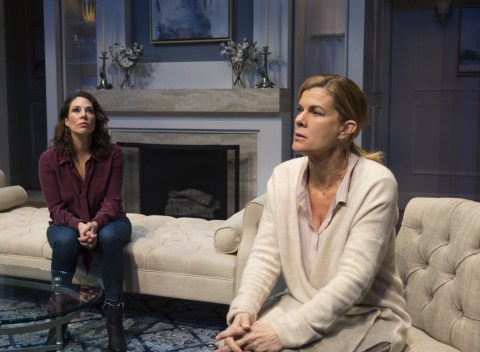
Blog Archives

‘After’ by Michael McKeever, Directed by Joe Brancato at 59E59 Theaters

Mia Matthews, Jolie Curtsinger, Bill Phillips, Denise Cormier, Micchael Frederic, After, Joe Brancato, Michael McKeever, 59E59 Theaters

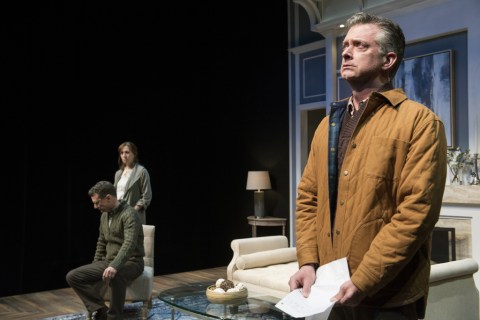
(L to R): Mia Matthews, Jolie Curtsinger, Bill Phillips, Denise Cormier, Michael Frederic in ‘After,’ written by Michael McKeever, directed by Joe Brancato at 59E59 Theaters (John Quilty)

The play After by Michael McKeever superbly, incisively directed by Joe Brancato at 59E59 Theaters chronicles what happens between two families whose teenage sons, once friends, are involved in a bullying incident. In examining the events before, during and after the incident, the playwright dissects the anatomy of denial, psychological debility and delusion in the lives of each of the parents and their sons. Whether the occurrence may have been avoided is uncertain. However, the play argues that openness and communication should be the linchpins of a family unit. When they are not, the possibilities for self-destruction are endless.

The Campbells and the Beckmans, once friends, meet to discuss a bullying text that Kyle Campbell sent to Matthew Beckman. Julia Campbell’s sister Val (Jolie Curtsinger) is present during the discussion to help strengthen Julia and serve as a mediator, though both Connie and Alan Beckman question the soundness of this.

Julia Campbell (Mia Matthews) is a beautiful woman and everything about her speaks of her desire for perfection, peace and happiness. And if there is a wrinkle in her fine world, she will either straighten it out or justify with logic why the wrinkle doesn’t exist.

Michael Frederic, Mia Matthews, Bill Philips, Denise Cormier, Jolie Curtsinger, After, Joe Brancato, Michael McKeever

(L to R): Michael Frederic, Mia Matthews, Bill Philips, Denise Cormier, Jolie Curtsinger in ‘After,’ written by Michael McKeever, directed by Joe Brancato at 59E59 Theaters (John Quilty Photography)

On the other hand Connie Beckman (Denise Cormier) appears to have donned the role of motherhood with a vengeance. Front and center she is a mama bear defending her baby cub and will do whatever she deems necessary to make sure he is safe, regardless of her cub’s wishes. In the opening dialogue between the Beckmans, the playwright establishes that Connie is assertive and confrontational with everyone. Her husband Alan (Bill Phillips) suggests that she must tone down her combativeness if they are to make inroads toward the resolution they desire during this meet up with the Campbells about Kyle’s text to Matthew.

The text “You’re next faggot,” is opaque. Apparently, neither teenager is discussing with their parents what “next” means, who provoked whom, why Matthew is a “faggot,” in Kyle’s eyes, even what Kyle means by “faggot.” Somehow, the vital import of the text is lost in all of the wrangling about Kyle’s punishment and whether this is just a matter of “boys will be boys” shenanigans.

Connie Beckman has not informed Matthew of the visit, not wanting to antagonize her son whom she infers would be furious if he knew. Overshadowing the discussion is the Beckman’s intention to convince the Campbells that the two sons should not be allowed to confront each other again, because the text, from their perspective, is a dangerous threat.

To deflect what happened, Kyle has offered to apologize, though we learn later this does not “come from the heart.” Additionally, Kyle has received a suspension from the principal and it is hoped that the parties involved have made up and all is well. On his part Matthew apparently feels to deal with the event on his own. Like Kyle, Matthew is deflecting and hiding what occurred from his parents, keeping it as a secret between himself and Kyle.

Mia Matthews, Michael Frederic, Bill Phillips, After, Michael MKeever, Joe Brancato

(L to R): Mia Matthews, Michael Frederic, Bill Phillips in ‘After,’ written by Michael McKeever, directed by Joe Brancato at 59E59 Theaters (John Quilty Photography)

The Campbells and Beckmans do not have open communication with their sons so that the teenagers feel they can discuss ANYTHING with them or even ask for the help that they need. In fact the only reason why the parents became involved is because Connie broke the privacy rules with her son and checked his phone text messages, then went to the principal. Her actions from a teenagers’ perspective identify her as an over-protective mother who is exacerbating the problem when it should be left between Kyle and Matthew to resolve. Certainly, the Campbells both feel that if Connie had not forced the issue, nothing further would have happened and their sons would be “OK.”

We learn later, the situation is more complicated than both families imagine. The teenagers are duping the parents and principal. Lip service has been given, but the truth has been obfuscated and no one wants to look for it, not even the teenage boys who are unable to deal with their own personal feelings on a rational level to make themselves understood to themselves, let alone others.

Initially, McKeever doesn’t focus on the lack of communication between parents and sons. It only manifests as a reveal by the conclusion of the play. The irony is that the parents don’t see this elephant in the room either. Both couples are on the defensive and willing to blame “the other side,” as opposed to coming to terms with the fact that they do not communicate with their children on the deepest level possible to understand what the text means. Allowed to continue, both sons’ isolation and reluctance to speak to their parents may result in an escalation of events between Kyle and Matthew.

Denise Cormier, Bill Phillips, Michael Frederic, After, Michael Frederic, Michael McKeever, Joe Brancato

(L to R): Denise Cormier, Bill Phillips, Michael Frederic in ‘After,’ written by Michael McKeever, directed by Joe Brancato (John Quilty Photography)

That their blindness about their children belies a flaw within the parents’ psyches gradually becomes apparent. Indeed, the incident between Kyle and Matthew explodes the arrogance each mother has about her ability to parent her child. It also explodes the stereotypic masculine tropes the fathers may embrace since their sons did not feel comfortable enough to discuss the underlying situation with them either. The walls that divide the sons from their parents, and the spouses from each other only expand as the couples attempt to come to a satisfying conclusion, an impossibility as long as the blindness and alienation remains.

The Beckmans argue that the text is a threat, that it is serious and should be dealt with not only by a suspension but by Kyle’s expulsion from the private school which abstains from taking such extreme action for monetary reasons.  To illustrate the point that the texting threat is severe and perception means everything, Alan frightens all in the room with a rifle he takes from the living room wall mounting. Though he proves his point about the nature of a perceived threats’ power, it falls on the Campbell’s deaf ears. Tate Campbell believes that the text is just BS. He minimizes his son’s behavior as does Julia Campbell and both agree if Connie had not taken the text to the principal, Kyle and Matthew would have forgotten about the situation.

As the arc of the play’s development expands and intensifies, revelations about the couples become manifest. In the “During” segment of the play, the circumstances between Julia and Connie appear to improve after Julia shares her difficulties becoming pregnant with Kyle. Both women apologize to each other. Nevertheless, Kyle’s resentment at being suspended and Matthew’s fear about facing Kyle in school have not been dealt with adequately. Neither son expresses his emotions to his parents. The situation explodes with disastrous consequences and at the end of the segment of “During,” a catastrophe occurs which is elucidated in the last segment of the play with irony.

This is a riveting, powerful and timely production. The greatness of the play in its themes, conflicts and revelation of the importance of communication among family members is evident from the outset. The adroit actors carry the tension throughout. Indeed, each actor hits the ball out of the park so that no one character “dominates” the other which would ruin the dynamic and theme that all have a responsibility in the events. This is ensemble work at its best, its most alive.

Jolie Curtsinger, Mia Matthews, After, Michael McKeever, Joe Brancato

(L to R): Jolie Curtsinger, Mia Matthews in ‘After,’ written by Michael McKeever, directed by Joe Brancato (John Quilty Photography)

Brancato’s direction paces the suspense toward the tragic and uplifting conclusion.  And the production values sustain this presentation making for vibrant, “in-the- moment” theater that resonates for us, as thrilling theater should.

With McKeever’s examination of such a situation, we hope to learn from the mistakes of these two families. As the playwright implies, channels of communication must be open. Judgmental, value-laden condemnation should not be the focal point of a parent-child relationship. Ironically, over-protection can damage as can permissiveness and laissez faire parenting styles. However, with teenagers, it is impossible to second guess them. They may damn well do as they please. What then? The parents must deal with what comes “after.”

Kudos to the artistic creatives for their efforts which enhance the production’s themes and provide a supportive milieu for the actors to exercise their craft to perfection. These include Gregory Gale (Costume Designer), William Neal (Original Music/Sound Designer), Brian Prather (Scenic Designer), Martin E. Vreeland (Lighting Designer), Buffy Cardoza (Properties Designer), Max Silverman (Associate Sound Designer).

After is being presented by Penguin Rep Theatre and Inproximity Theatre Company in their New York City Premiere. The production runs 90 minutes with no intermission at 59E59 Theaters (59E59th Street between Madison and Lexington Ave.) until 14 April. To purchase tickets you may go to the website by CLICKING HERE.


‘Agnes’ by Catya McMullen (AMC’s ‘Dietland’), at 59E59 Theaters, NYC Review

Hiram Delgado, Mykal Monroe, Laura RamadeiAgnes, Jenna Worsham, 59E59 Theaters,Catya McMullen

(L to R): Hiram Delgado, Mykal Monroe, Laura Ramadei in ‘Agnes,’ presented by Lesser America in association with Hugh Hayes, written by Catya McMullen, directed by Jenna Worsham at 59E59 Theaters (Hunter Canning)

With hurricane season upon us, the intriguing production of Agnes appears timely, ably directed by Jenna Worsham at 59E59 Theaters.

Four New York City 20-somethings burrow in their apartment and into each other while weathering the titular hurricane. Invited by zany Ronan to crash with former friends since her “A” evacuation zone leaves her homeless for the night, Anna joins the reunion/party, where hidden emotions and jealousies collide, and confrontations reveal secrets aching for revelation.

As the characters reformulate their mutual relationships, they develop new relationships with themselves too. Though satisfying resolutions never come easily, the process of getting there presents itself. And like all storms, eventually the hurricanes within and without dissolve, with clearer weather ahead.

The 90-minute one-act opens after dynamic, rocking music subsides. Charlie enters a cluttered, homely, shared apartment. John Edgar Barker portrays the emotionally complex and Asperger-challenged Charlie with sustained believability. His performance throughout is well-executed, thoughtful, and finely tuned.

Charlie carefully pulls out a box from the shelf above the bed, flips through the audio tapes inside and selects one. As he listens to “Subject 37, Lorraine,” the taped interview soothes him. Stepping into the light as the tape plays, “Lorraine” (Claire Siebers) relates her experiences in a physical storm which symbolically aligns with her personal troubles. Though we don’t realize it yet, one of McMullen’s themes is unwinding as, inevitably, these quirky individuals fall over each other as they struggle with their own internal hurricanes.
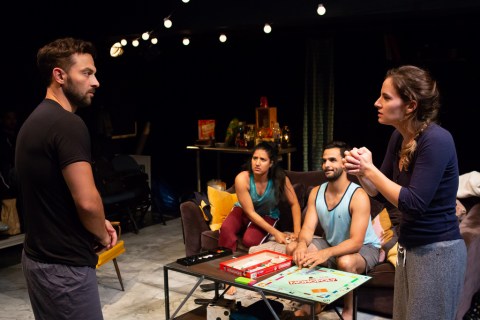
John Edgar Barker, Mykal Monroe, Hiram Delgado, Laura Ramadei, Agnes, Catya McMullen, 59E59 Theaters

L to R): John Edgar Barker, Mykal Monroe, Hiram Delgado, Laura Ramadei in ‘Agnes’ by Catya McMullen at 59E59 Theaters (Hunter Canning)

Upon seeing that Charlie has returned from parts unknown, his younger sister June ferociously welcomes him back. As June, Laura Ramadei adheres with precision to apt emotional modulations and delivers an overall spot-on, nuanced performance. Though June remains on tenterhooks questioning Charlie’s whereabouts, her expressions of mild outrage reveal heavy concern. Obviously, she has cast herself as his caretaker, a role Charlie’s older self chafes at.

Nevertheless, Charlie’s vacant, aloof responses to her and rebuffs of physical affection indicate familiar ground. Their relationship is strained. The pull and twists of sibling love combined with intense overprotectiveness grates on Charlie. Finally, we learn through McMullen’s quippy, well-crafted dialogue that Charlie’s Asperger’s locks him away from normal behavior, social interactions, and intimacy. Indeed, the syndrome predisposes him from easily relating to others, including sister June. By degrees the playwright, director, and excellent ensemble reveal the rationality of June’s behavior toward her brother. Yet we also realize that her dependence on being the nurturer stifles both of their individuality and autonomy. Where will their struggle end?

laire Siebers, John Edgar Barker, Agnes, Catya McMullen, Jenna Worsham, 59E59 Theaters

Claire Siebers, John Edgar Barker in ‘Agnes’ written by Catya McMullen, directed by Jenna Worsham at 59E59 Theaters (Hunter Canning)

This conflict and other issues explode in the presence of Anna, June’s former lover. Delightfully portrayed by Claire Siebers, Anna lures all around her, with moment-to-moment emotional content that shines from within, outward. As Anna seduces us and the others, June’s current lover, the feisty Elle (Mykal Monroe), becomes outraged fearing she’ll lose June. As the brilliant medical student, Monroe is Ramadei’s foil. Their interactions ring with authenticity.

Threatened by Anna’s beauty, seductiveness, and joy, Elle confronts June. When June ameliorates her rage with affection and sex, Elle succumbs. The storm subsides momentarily. But dark clouds still fly overhead, for June will most likely not move to another state with Elle as Elle completes her studies. Anna, who has just moved near them, threatens the end of June’s and Elle’s relationship if June stays in New York.

The conflict climaxes when Charlie expresses his attraction to Anna. Intriguingly, the ancient story of experienced lover shepherding the inexperienced acolyte unfolds. Charlie asks her for help in expressing his loving emotions for her sexually. Will she rebuff one who makes his need and innocence so sweet, so insistent? What of her former relationship with June and perception of herself? How will Charlie feel if she rejects him, or loves him then leaves him?

The situation becomes the powderkeg that blows open June’s underlying feelings about her relationships with Charlie, Elle, Anna, and herself. It explodes Charlie’s relationship with June and sets it on a different course. Anna is the catalyst and change agent. Blown back into their lives via the necessity of finding a haven (this symbolism thrums), she adds her unique complexity to their human dynamic. However, being with them throws open the doors to the random. Like the random effects of the weather, she may break, and the relationships between and among the individuals may be destroyed. Only empathy and communication will salve the wounds.
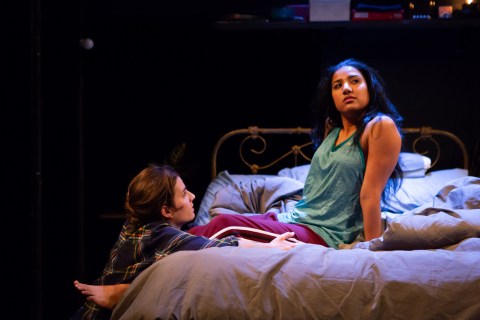
Laura Ramadei, Mykal Monroe, Agnes, 59E59 Theaters

(L to R): Laura Ramadei, Mykal Monroe, ‘Agnes,’ 59E59 Theaters (Hunter Canning)

Ironically, Charlie who yearns for meaningful connection does communicate with Anna. But June waits in the wings seemingly without the understanding or the ability to “let her older brother grow up on his own.” In a confusing flood of emotions, Anna is evicted from June’s safe haven into Hurricane Agnes the next day. Though the air clears, it is time to survey the damage. Indeed, the situation among June, Elle, and Charlie will never be the same.

As for Ronan, who attempts to negotiate his own breakup with his wife, that remains for the sunshine. Hiram Delgado’s Ronan effervesces with vibrancy and pathos. As the peacemaker who cannot attain peace with his own wife, he introduces the catalyst (Anna). However, he cannot halt the chain of events. Nevertheless, his humor steers the group and provides some measure of riotous sanity. Delgado’s is a stand-up performance.
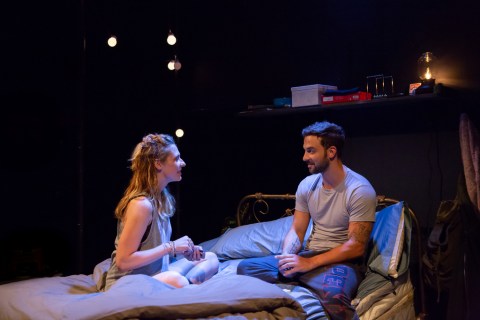
Claire Siebers, John Edgar Barker, Agnes, Catya McMullen, Jenna Worsham, 59E59 Theaters

Claire Siebers, John Edgar Barker in ‘Agnes’ written by Catya McMullen, directed by Jenna Worsham at 59E59 Theaters (Hunter Canning)

The play’s centerpiece message is that Charlie’s condition represents in exaggerated form the human condition. Especially in these times, one of humanity’s failures centers on crippled relationships and the lack of meaningful connections. With inflexibility comes the inability to stand in another’s shoes or perceive the sanctity of another’s viewpoint. The brilliant yet socially “backward” Charlie recognizes these failings within himself and seeks to correct them. The others only reflect their incapacity to empathize with those closest to them. The hard truth of communication necessitates that one listen and put aside one’s own needs. Charlie appears to be the only one in Agnes who fervently tries. And through their fears, he attempts to lead his sister to understand.

Ironically too, Charlie symbolizes the best of humanity. Indeed, he does this despite his stilted, abrupt, truth-blurting observations (many of them humorous). Despite his social inadequacies, he is brutally aware of himself. Though he doesn’t readily show emotional connection and appears without emotional tenor, his awareness of others is acute. Finally, we note the importance of openness and empathetic listening.

In this tour-de-force, which is sometimes humorous, sometimes spellbindingly real, Worsham and the cast riffing on McMullen’s deft writing remind us of underestimated human verities. It is a pleasant irony that the character who appears most socially dysfunctional recognizes and explores the greatest of human truths.

Not to give too much away, do look for thematic connections with the characters Charlie interviews. The metaphors and symbolism are particularly apt. Agnes is a must-see.

Kudos to the design team: Angelica Borrero (sets), Cheyenne Sykes (lighting), Daniel Melnick (sound), and Nicole Slaven (costumes). Agnes runs at 59E59 Theaters until 29 September. Visit the website for tickets.

‘Invincible,’ Theater Review, 59E59 Theaters

Alastair Whatley, Emily Bowker, Invincible, 59E59 Theaters, Brits Off Broadway

Alastair Whatley and Emily Bowker in ‘Invincible’ at 59E59 Theaters, as part of the Brits Off Broadway 2017 season (Manuel Harlan)

Invincible currently at 59E59 Theaters is a tour de force written by Torben Betts, directed by Stephen Darcy with original direction by Christopher Harper. Presented by The Original Theatre Company and Ghost Light Theatre Productions, it is one of 59E59 Theaters Brits Off Broadway offerings this season.

Playwright Betts selects a mundane situation of neighbors being introduced to the neighborhood and spins it gyrating with turns that by the end of Act II career the audience into a ditch of shocking displacement and surprise. However, life cannot be all fun and games and ridicule, especially when there is a severe economic downturn and one is forced to downsize and relocate away from a tony London lifestyle as Emily and Oliver have to do. Indeed, we cannot anticipate what lurks around the corner of ourselves and especially behind the closed doors of our neighbors with whom we may have little in common.

The class divide of education and economics, conservative and liberal/radical Marxist views form the casual backdrop of a disastrous few meetings between two neighboring families in a North England suburb. We are first introduced to the educated Marxist Emily (Emily Bowker is superb as a high-strung feminist who peels away the layers to reveal a seething emotional depth) and liberal-minded, posh, near-pro cricket player Oliver (Alastair Whatley gives an exceptional performance as the initially weak-willed, accommodating partner) as they argue about not getting married.

Emily abhors bourgeois, middle-class mores that stultify relationships. She will not even consider pleasing Oliver’s sickly mother before she dies. Their assumptions that solidify the basis of their rant are largely humorous. However, Betts injects enough clues for us to eventually realize that Emily’s fears are more than Marxist chic and she is attempting to deal with inner guilt and pressure. The seemingly good-natured, innocent-looking Oliver, who has pedaled along beside her for four years keeping his mother in anticipation of their marriage has grown weary of making excuses. We find their exchange ironic in the extreme; usually the woman wants the big marriage and party. This is not who Emily is and once more, though his mother would be happy to see them married before she dies in a few months, she will not get her dying wish because of Emily’s strident inflexibility.

Elizabeth Boag, Alastair Whatley, Invincible, Brits Off Broadway, 59E59 Theaters

Elizabeth Boag, Alastair Whatley in ‘Invincible’ part of the Brits Off Broadway at 59E59 Theaters (Manuel Harlan)

On the contrary, their neighborly couple the sexy, uneducated Dawn (Elizabeth Boag in a stunning portrayal of  developing emotional cave-ins) and boorish, football-lover and postman Alan (Graeme Brookes is the believable, noxious lout whose kindness and love sustain and comfort) appear as if they rushed to embrace the cultural folkways of marriage, children, a family lifestyle so they could follow their parents unthinkingly into the grave. The couples could not be more disparate, and as Alan proclaims his love for his favorite football team and beer, we understand that Dawn and Alan are apparently shallow flag waving conservatives who mindlessly uphold blue-collar assumptions and chase them down with “bring their own” beer, when Oliver and Emily tell them they eschew alcohol and have none to offer.

Betts, the director and actors unfold the fireworks gradually. They also drop lightning bolts upon us when we least expect it. The arc of the play develops keeping the tensions fluid and random. We are not privy to the usual rants of liberal vs. conservative. The couples attempt to be neighborly by avoiding dangerous subjects. And the playwright stays away from conservative cant, though in the first part of the play, Emily’s Marxist diatribe to back off Oliver’s marriage plans for his mom’s happiness is funny.

Graeme Brookes, Elizabeth Boag, Invincible, 59E59 Theaters

Graeme Brookes, Elizabeth Boag in ‘Invincible’ at 59E59 Theaters (Manuel Harlan)

When the couples face off against each other with awkward friendliness during a pleasant evening, the divisions between their differences of education and lifestyles creep forward. Underneath are boiling emotions in both families when the characters drive toward each other to reveal their passions. For Alan, it is his cat Vince (Invincible) whom Emily and Dawn dislike, Emily principally because the cat is a killer and no creature is safe in Vince’s dominion which is everywhere. Talkative Alan also discusses his paintings which are hysterically child-like and so amateurish, we wonder why he bothers not to take the painting lessons he sorely needs. However, he believes the paintings of Vince are special.

We know the first dive into the ditch cannot be prevented when Alan persists in his demands that the talented Emily (her paintings have been priced at around one thousand pounds), provide her true opinion of his work which he proudly shows as we cringe, albeit with laughter. After coaxing her, Emily gives her critique which is hysterical. The loutish, jabbering Alan quiets himself into a sulk and his ire reveals an annoyance that runs deeper as he attempts to defend the great sensitivity behind his awful work.

It is a mistake that Oliver attempts to defend Alan. Emily explodes about the importance of truth and their waste of an evening of banal conversation instead of discussing the “Western powers behaving like psychopaths, forever sending misguided, ignorant soldiers to murder innocent civilians in illegal wars!”

Alan and Dawn’s son is doing just that and the remainder of the evening drills out the undercurrents which have divided the couples all along. Alan defends their son’s heroism to protect their freedoms so Emily can “paint her pictures and have all her clever opinions.” In effect he is lambasting her for being chic, unthinking and hypocritical. Dawn tells her she needs to “have a quiet little think about that.” As Dawn and Alan storm out, Emily, Oliver and the audience are left to the silence of their own souls.

Emily Bowker, Graeme Grookes, Elizabeth Boag, Alastair Whatley, Invincible, 59E59 Theaters

(L to R): Emily Bowker, Graeme Brookes, Elizabeth Boag, Alastair Whatley in ‘Invincible’ at 59E59 Theaters (Manuel Harlan)

Betts has initialized the themes by the end of Act I which he completes in Act II. Because of their night with Alan and Dawn and Dawn’s parting remarks, Emily and Oliver confront their griefs. It is then we discover why Emily and Oliver have sworn off liquor, why Emily has immersed herself in radical politics and why Oliver puts up with her mood swings, stresses and odd demands. It is then we understand that Dawn is unhappy with who she is and how she measures up. One night with Emily and Oliver has transformed Alan’s and her awareness of self and goals.

The exchange has been revolutionary; the characters’ personalities change by the play’s conclusion. There has been a convergence. Which couple benefits the most is debatable. Betts reveals that Oliver and Emily have the makings of the wealthy, sleazy and corrupt conservatives they used to decry. Alan and Dawn have been devastated into perhaps turning from the warmongering they once embraced and sent their son off to partake of. And as the latter two confront a devastation, we can identify with the love, forgiveness and care that Alan, whom we once deemed loutish, gives Dawn. Heroism comes in many shapes and forms, sometimes initially unappealing ones.

Betts has manipulated us cleverly to look at our own humanity and the humanity of those with class perspectives and behaviors precisely counter to our own. Themes of flexibility, empathy and tolerance are in the forefront of this production which reveals the fickleness of human nature when circumstances change. Stephen Darcy’s excellent direction and the tremendously effecting performances by the actors in this strong ensemble piece, reveal Invincible to be a complex, thought-provoking production which examines the best and worst of our prejudices and attitudes and the strength of human character required to be truly invincible in the face of loss.

You can see Invincible which has one intermission and is running at 59E59 Theaters (59 East 59th Street) until 2 July. You can pick up tickets if you click HERE.

Save


‘The Tribute Artist’ at 59E59 Theaters

L to R: Cynthia Harris and Charles Busch in The Tribute Artist by Charles Bush, Directed by Carl Andress, presented by Primary Stages at 59E59 Theaters. Photo by James Leynse.

L to R: Cynthia Harris and Charles Busch in The Tribute Artist by Charles Bush, Directed by Carl Andress, presented by Primary Stages at 59E59 Theaters. Photo by James Leynse.

Buying and selling Manhattan real estate! It’s all about being in the right place at the right time with the right clients. If the opportunity to sign a deal on a most fabulous place in Greenwich Village just dropped in your lap, you’d probably leap at it. What if it involved a smidgeon of shadiness and a soupcon of fraud?

The Tribute Artist by Charles Busch presents a hilarious scenario of three rather desperate, down on their luck characters, one attractive and potentially nefarious thief, and a $12 million dollar townhouse whose owner has recently died. From soup to nuts, this two act play is a cleverly written comedy that is beautifully acted by the ensemble cast and tightly directed by Carl Andress. Charles Busch, a Drama Desk Award winner for “Career Achievement as Playwright and Performer,” once again delights with his impeccable timing and comic genius in a play that skirts the edges of farce. The Tribute Artist’s trending humor, themes, and ironies are incisive and just shy of brilliant.

The play opens to the sumptuous living room of a Greenwich Village townhouse where we meet grand dame Adriana (the lively and funny Cynthia Harris), the homeowner. We appreciate Adriana’s sulfuric wit which she states, “is not nastiness, but my European sense of irony.” This “upper crust” lady is a former clothing designer and she is entertaining her down-to-earth and frenetic real estate broker, Rita (the excellent Julie Halston), who may or may not broker the townhouse sale. Jimmy (Charles Busch), a recently fired Las Vegas drag queen, who prefers to be called a “celebrity tribute artist,” is staying with Adriana for a while. When we are introduced to Rita and Jimmy, both are modeling Adriana’s designer clothing, and Jimmy is modeling one of her wigs. Rita and Jimmy have been long time friends. They enjoy Adriana’s hospitality as she fills in details from her past which, unbeknownst to them, are portentous to their future. When they all fall asleep from rather too much drink, the scene shifts to morning and the comedy and plot complications jolt into the most interesting of wonderful possibilities.

L to R: Keira Keeley, Charles Busch, Julie Halston, Mary Bacon, Jonathan Walker in The Tribute Artist, directed by Carl Andress for Primary Stages at 59E59 Theaters. Photo by James Leynse.

L to R: Keira Keeley, Charles Busch, Julie Halston, Mary Bacon, Jonathan Walker in The Tribute Artist, directed by Carl Andress for Primary Stages at 59E59 Theaters. Photo by James Leynse.

During the night, Adriana has passed; she did say she was dying, but Jimmy and Rita didn’t believe her. No one will inherit this lovely house and it will end up in the hands of the government since there are no inheritors and no will. The path appears to be clear that Adriana wants the house sold and is exerting her will that this should be exacted by those who are present. They are a perfect combination: a real estate broker and a female impersonator who just happens to have in his repertoire all the greats from Marilyn Monroe to Betty Davis. Impersonating “Adriana” will be easy.  Jimmy and Rita talk themselves into the devilish plan (a hilarious segue), plotting that Jimmy will become Adriana for the time it takes Rita to sell the house. In the clear, they will split their “winnings” fifty/fifty. They even have the perfect resolution for how to deal with Adriana’s remains. Through their euphoria, they both agree that they may have forgotten something, only they aren’t sure what.

What they’ve forgotten shows up in the next scenes, creates havoc, and additional conundrums. The plot complications humorously involve the real heirs who will take the townhouse away from Rita and Jimmy. The inheritors are Adriana’s late husband’s loathsome relatives, niece Christina (a perfectly overwrought Mary Bacon) and grandniece Rachel Oliver (a fine Keira Keeley). An additional complication involves one of Adriana’s former lovers, the sexy Rodney (Jonathan Walker in a hysterical performance). Somehow Rita and Jimmy deal with these “interlopers” and Jimmy’s impersonation of Adriana goes swimmingly for a time until Rodney throws the switch that could overturn their peaceful coexistence. Once again the elements of farce are stepped up with the added suspense that Rodney may be up to something worse than the “silly little fraud” that Rita and Jimmy had hoped to commit.

Charles Busch in The Tribute Artist by Charles Busch, directed by Carl Andress for Primary Stages at 59E59 Theaters. Photo by James Leynse.

Charles Busch in The Tribute Artist by Charles Busch, directed by Carl Andress for Primary Stages at 59E59 Theaters. Photo by James Leynse.

While spinning these humorous events, the playwright carefully weaves in issues of class, gender, identity, and social injustice. He does this with wit and subtle undercurrents of poignancy in keeping with the comedic pacing. Added to the glee, Jimmy unleashes his repertoire of old-time celebrity actresses with snippets of dialogue from their most famous scenes. Rosalyn Russel, Katherine Hepburn, Betty Davis, and others show up and aptly spout “wisdom” to heighten the madness. In his impersonations Busch is at the apex of his powers. His “Running Wild” is superb. If you don’t know which actress performed the song from which iconic film, then you’ll have to get yourself to 59E59 Theaters where the production is being performed. Rita will clue you in to the impersonations just in case you were born after 1990.

The playwright ties up all the complications and reveals the inner workings of each character reinforcing one of the main themes: one never knows how things will turn out in the end. In Busch’s iteration the phrasing is more poetic. The production will be running until March 16th. It is being presented by Primary Stages at 59E59 Theaters.

This review first appeared on Blogcritics.

Gidion’s Knot by Johnna Adams. A Play About a Teacher, a Single Mom and Her Son.

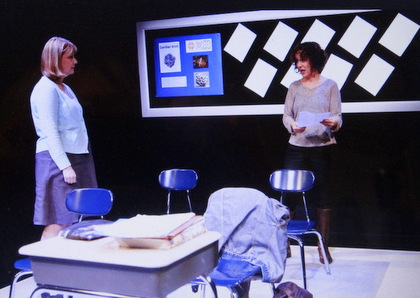
L to R: Dara O'Brien and Karen Leiner in Gidion's Knot by Johnna Adams, directed by Austin Pendleton. Photo by Carol Rosegg.

L to R: Dara O’Brien and Karen Leiner in Gidion’s Knot by Johnna Adams, directed by Austin Pendleton. Photo by Carol Rosegg.

Humans are self-deceivers; they often avoid confronting painful truths. When/if their frauds lead to catastrophe, then they are forced to look at how their self-duplicity created the consequences. With self-deception, there is the inevitable manipulation of others and the abusive “passing the blame” of one’s hated flaws onto these victims who may or may not suspect the manipulator’s ulterior motives. If the victims are enablers, they accept the blame and help push the abuser into their catastrophe. Ideally, the sooner one confronts the horrific inner Gorgon of truth, the better. Confrontation leads to enlightenment and growth. Delay, brings stony emotions, obfuscations, and more lies, until there is collapse, self-destruction, or madness.

In her play Gidion’s Knot, Johnna Adams explores how a mother and a fifth grade teacher dance around the “truth” of an incident which involves Gidion who was in Heather Clark’s fifth grade public school class. The dance provokes mother Corryn (Karen Leiner), and teacher Heather (Dara O’Brien), to inadvertently lay bare their souls in an interesting power manipulation. Rather than confront their inner Gorgon, and help one another, they pity, judge, condemn, project, and appear cold-hearted: all acts of self-deception and obfuscation. As the play records their convolutions, we, the audience, try to unravel the mystery of what happened to Gidion and what is happening in the present between the two women. But our attempt to unravel the knots of lies and truths remains feeble. In a fog we wonder about the significance of what we are seeing and question if these characters will ever acknowledge their inner Gorgon, thus destroying its power over them.

Playwright Johnna Adams has contrived a complex, hyper-charged conundrum of a play. Directed with precision, insight and sensitivity by Austin Pendleton, Gidion’s Knot leaves one spinning about the characters’ manipulations and duplicities as it examines the issue of social and parental responsibility. I cannot envision many other directors who so aptly could have created an atmosphere to elicit the marvelous performances. Because of the team’s united efforts this amazing production thrills and provokes.

Dara O'Brien in Gidion's Knot by Johnna Adams, directed by Austin Pendleton at 59E59 Theaters. Photo by Carol Rosegg.

Dara O’Brien in Gidion’s Knot by Johnna Adams, directed by Austin Pendleton at 59E59 Theaters. Photo by Carol Rosegg.

Pendleton’s talents adhere with the vivid, alive portrayals by actors Karen Leiner and Dara O’Brien. Their creation is a continuous thrumming of palpable tension that keeps us engaged. Can the mysteries be solved given the complexities and needs of the characters?  Pendleton’s, Leiner’s and O’Brien’s masterful work illuminates the charades, blinding rationales, and subtle justifications the characters use to avoid their miserable inner truths. We recognize how Corryn’s and Heather’s self-deceptions have lead to catastrophe. Will these women see the light and help one another or resort to recriminations and judgements enabling and fomenting the inevitability of another disaster?

As the actors and director elucidate these points, the entanglements intensify. The more we attempt to extricate the truths, the more we are caught up in the characters’ rationalizations and self-fraud. We empathize because we are looking at ourselves. We realize that for them, there may be no way out except to live with an inner morass that will worsen. Unlike a Gordian Knot, an allusion aptly used by the playwright, the knot Gidion has created cannot be cut.

For the setting and backdrop Adams uses a conventional educational system and an atypical parent-teacher conference. Along the way she touches upon the issues of our present public educational system’s cultural assumptions about curriculum, appropriate behavior, and the responsibility of the parent, child, teacher, and system to produce learning. She also infers how these assumptions may run counter to the true nature of learning as art and how such learning prompts the finest art. Though parts of the play might appear to be contrived, (i.e. Gidion’s act, Corryn’s choice to put Gidion in a public school, the absence of communication between the school and parent), the playwright tries to smooth over the glitches with the characters’ logical explanations. Just at the point where one might find the contrivance an obstacle, Pendleton and the actors patch up the holes with brilliant performance art that is completely “in the moment.” We are swept up by the life we see and don’t give the contrivance much  thought.

L to R: Karen Leiner and Dara O'Brien in Gidion's Knot. Photo by Carol Rosegg.

L to R: Karen Leiner and Dara O’Brien in Gidion’s Knot. Photo by Carol Rosegg.

The playwright focuses Gidion’s Knot around Corryn’s interaction with Heather during the conference. When Corryn first enters the classroom, we believe she is misplaced because Ms. Heather Clark is shocked that she’s come. Corryn tells her she is there to discover the reasons why Gidion, a brilliant student, has been given a suspension by Ms. Clark. She wants to understand what happened to her son and figure out the motivations for his behaviors. We suspect there is more to her initially benign response because of Heather’s amazement at her presence. As Corryn probes Heather for answers, she becomes hostile and aggressive, and the underlying tensions between the parent and the teacher grow. Corryn’s acidic comments push Heather Clark into retreat mode with long periods of silent acquiescence as she takes in Corryn’s opprobrium. Throughout the exchanges we wonder who is being truthful, who is avoiding reality and why is the “bullying” necessary?

Karen Leiner in Gidion's Knot by Johnna Adams, directed by Austin Pendleton at 59E59 Theaters. Photo by Carol Rosegg.

Karen Leiner in Gidion’s Knot by Johnna Adams, directed by Austin Pendleton at 59E59 Theaters. Photo by Carol Rosegg.

Little by little, the playwright unfolds the mysteries. We find out why Heather Clark is shocked to see Corryn in her classroom. However, this initial revelation is only the beginning. Gidion has left a knot to unravel about his behavior; we search for answers about the extent to which Corryn and Heather might have been culpable in effecting Gidion’s nullifying actions. The playwright adeptly guides the audience through the teacher’s and parent’s perspectives. From Corryn’s perspective we want to know more from Heather Clark. Surely, the teacher understands what happened to Gidion. We understand Corryn’s need to manipulate, browbeat, and abuse the truth from Heather. However, we know from Heather’s reticence that she is protecting someone and is keeping certain situations in her classroom confidential. Aligning with Heather’s professional perspective, then, she appears to be in the right. We assume that Corryn is too emotionally invested to see clearly and rationally. But who is Heather protecting? Heather? The principal? The children? Gidion? Corryn? And from what?

Because of the superb performances which ooze strain and inner turmoil, we yearn to understand and this suspense keeps our attention. As more of the complications are revealed, the less truth we know. The more vitriol Corryn expresses, the farther she moves from inner understanding of herself and her impact on her son. The more Heather Clark enables Corryn’s bitter “truth” seeking with her spare explanations, the less we understand about Gidion’s motivation and Heather’s part in it. Was Gidion’s suspension truly justified? Or was it an example of the public education system curtailing sensitivity, artistry, and creativity as suggested by Corryn? Does the letter that Corryn finds in Gidion’s desk reveal he has been damaged by classmates? Or is there a deeper, hidden truth which will have ramifications upon Corryn’s understanding of herself and her son?

Throughout the play we are riveted because we are off balance. We do not know who is “fronting” whom. By the conclusion we are uncertain and that is the best we can hope for because the characters are inscrutable. We should not be projecting our own failed, misplaced assumptions on them. The issues of where parental responsibility and social responsibility begin and end are not resolved. We do understand that the educational system presented by the playwright (somewhat contrived) is not ready to deal with who or what Gidion is, but then neither is Corryn. Lastly, there is Gidion. In fifth grade, he is past the age of accountability. To what extent does the final culpability rest with him?

Gidion’s Knot was performed at 59E59 Theaters in a limited engagement.

This review first appeared on Blogcritics.

A Play About the JFK Assassination: ‘Witnessed by the World’ by Ronnie Cohen and Jane Beale

Photo is a still taken from the renown Zapruder film of the movie of the assassination of JFK.

Photo is a still taken from the renown Zapruder film of the movie of the assassination of JFK.

The assassination of President John F. Kennedy is perhaps the most written-about event of the 20th century, with over 800 books alone devoted to parsing the details of the how and why of the assassination and the alleged subsequent cover-up. Some books justify the evidence produced in the Warren Commission Report, which found Lee Harvey Oswald to be Kennedy’s sole murderer. Many reputable writers and investigators, including the 1960s District Attorney of New Orleans, James Garrison, meticulously and logically disputed the Warren Report’s conclusions.

The mainstream media ridicules “conspiracy theorists,” who put forth the idea that a cabal of conspirators were responsible for Kennedy’s murder and wanted him “out of the way” for various political reasons. Witnessed by the World written by Ronnie Cohen and Jane Beale and directed by Karen Carpenter provides an interesting spin on the assassination and the “conspiracy theory” decriers. It is informative, taking into consideration that there are those in subsequent generations who know little about the assassination and the major players connected to it.

The playwrights have cleverly avoid didacticism and preachiness. They posit information about the assassination through dialogue between an older journalist, Joan Ross (an excellent Charlotte Maier), enthralled with the research she has done about the assassination, and the younger, uninterested, uninformed screenwriter, Ira Basil (Max Gordon Moore in a good counterpoint), who is working with her on a writing project. Information is also revealed through the play’s developing action. We follow Joan and learn about the assassination as she channels information from her leads into discussions with the screenwriter, a friend, and her sources.

L - R Charlotte Maier and Bob Ari (Aaron Spencer), in Witnessed by the World by Ronnie Cohen & Jane Beale, Directed by Karen Carpenter

L – R: Charlotte Maier and Bob Ari (Aaron Spencer), in Witnessed by the World,  written by Ronnie Cohen & Jane Beale, directed by Karen Carpenter. Photo by Douglas Denoff.

At the outset, the play shows the black and white TV clip of the Jack Ruby shooting of Lee Harvey Oswald, which was the first live mass media murder viewed by millions. (There were no warning ratings preventing young children from watching the live coverage and later the incessant replaying of Oswald’s painful collapse after the bullet did its work.) We are in shock as the viewers at the time were in shock seeing Ruby conveniently smash the possibility that any trial of Kennedy’s alleged killer would take place.

If Ruby was a hero, performing the role of Oswald’s executioner, he was not released for his “good deed.” The mysterious incongruity is that Ruby received the death penalty after his first trial. This was overturned in a Texas appellate court. He was waiting for a second trial when he died of cancer in a Dallas hospital. Had he been threatened not to disclose the mystery of his relationships and background connections to mobsters, the CIA, Oswald and others? Though he was interviewed by Dorothy Kilgallen toward the end, Kilgallen never lived to “blow the lid off the JFK assassination” as she said she would.

Cohen and Beale explore these mysteries and others as Joan investigates Ruby’s early background and teen years to help Ira Basil finish a screenplay about Jack Ruby and the mystery surrounding his ties to organized crime and visits to Cuba. Though Ira warns Joan that she must not write about or investigate Ruby’s connection to the JFK assassination, Joan on her own recognizance pieces together information she learns from Jack Ruby’s sister, Eileen Kaminsky (an exceptional and believable Lois Markle). After Joan and Eileen become close, Eileen gives Joan a box of items which no one knows about. Ruby had given them to Eileen for safekeeping. Each item is a potential clue, a possible missing puzzle piece that Joan can use to create a logical picture of Ruby, his ties to organized crime figures and answers to the questions about why he killed Oswald.

L - R, Bob Ari and Joe Tapper (Joe Capano), in Witnessed by the World, by Ronnie Cohen & Jane Beale, Directed by Karen Carpenter

L – R: Bob Ari and Joe Tapper (Joe Capano), in Witnessed by the World, written by Ronnie Cohen & Jane Beale, directed by Karen Carpenter. Photo by Douglas Denoff.

As Joan’s investigation proceeds, she is spurred on with potential answers about the assassination. We are interested and happy to go along for the ride which she keeps hidden from Ira. However, when Ira discovers information which throws Joan’s character into muddy waters, we can see the headlines above her name “conspiracy theory nut,” a twist which is panicking Ira. He manages to continue  working with her because he has grown closer to her and for personal self-interest: he will continue to receive the information she has given him about Ruby. They work well together on the screenplay which appears to portend lucrative possibilities.

In the midst of the Ira-Joan scenario, there is a detour down a dark road. Joan confides in friend Aaron Spencer (an appropriate and capable Bob Ari) about the screenplay and her secret investigation of Ruby’s mob connections, and in turn, the JFK assassination. Aaron, who is confronting financial difficulties and is forced to make some debt arrangements with shady mob characters, is told by Joe Capano (a smiling, insidious Joe Tapper) that he knows an old “uncle” in the criminal network who knew Ruby. Aaron  shares the information with Joan, who tries to arrange a meet up with this “uncle,” to confirm the final threads of logic she is sewing together about how Ruby was connected to the JFK assassination. These threads tie in Ruby’s connections to mob figures, Sam Giancana, Carlos Marcello, Santo Trafficante and others.

Aaron discourages Joan about the meet up, but it has been arranged by Joe Capano who tells Aaron that  Uncle Tony is anxious to talk to Joan. Joan is thrilled after years of research and hard work in overcoming the resistance of recalcitrant sources. She is exuberant because she knows she is going to be able to blow the lid off the Kennedy assassination with the final confirmation of testimony from Uncle Tony.

L - R, Charlotte Maier and Lois Markle (Eileen Kaminsky), in Witnessed by the World by Ronnie Cohen & Jane Beale, Directed by Karen Carpenter

L – R: Charlotte Maier and Lois Markle (Eileen Kaminsky), in Witnessed by the World, written by Ronnie Cohen & Jane Beale, directed by Karen Carpenter. Photo by Douglas Denoff.

The play is a vital go-see-it for a number of reasons. It will be informative for those who are unfamiliar with the Kennedy assassination and the time period. The play provides a quick and dirty clip sheet of one element of the possible assassination conspirator network that will not be found through mainstream media, except the History Channel offerings. Highlighted is information which includes a growing body of research about the history of our government’s political machinations during the cold war and the extent that the intelligence community was willing to go to insure the US retained the upper hand against Communist leaders. The play is well constructed and keeps the audience engrossed about a period of our history which is crucial to understanding the present.

However, the play does manifest issues; some of the contrivances are problematic. The contrivance of character and dialogue to get out the information (an older journalist and a younger screenwriter unfamiliar and uninterested about the assassination) works because it is subtle and well crafted into the conflict and action of Joan’s investigation of Ruby. We can overlook it because it melds seamlessly with relaying the background information to the audience. But the character complication, that Aaron happens to be in financial trouble and just happens to be involved with mobsters who knew Ruby and who are still alive, is less seamlessly written into the play’s action.

Tthe contrivance of the naivete of Joan’s character cannot be overlooked. We understand that she is a brilliant investigative reporter who is putting the pieces together and who knows the score about the individuals connected with the assassination. We believe she is a hard hitting and uncompromising journalist and a thorough researcher. Her ingenuousness with her sources, for example overlooking the shady character of who she is dealing with seems incongruous and is not credible.

L - R, Charlotte Maier, Bob Ari, Max Gordon Moore, in Witnessed by the World by Ronnie Cohen & Jane Beale, Directed by Karen Carpenter

L – R: Charlotte Maier, Bob Ari, Max Gordon Moore, in Witnessed by the World, written by Ronnie Cohen & Jane Beale, directed by Karen Carpenter. Photo by Douglas Denoff.

Would the playwrights have created even more tension…would the play have been more striking if Joan implies she knows the risks involved, but takes them anyway? Would this be a more heroic Joan, one more in keeping with who she is? If, yes, then, the conclusion would be more tragic, more appropriate, and of course, more ironic. Though the acting is excellent and the ensemble work holds together beautifully, it is a lot to ask of Charlotte Maier to reconcile the contradictions of Joan as a naive yet hard-hitting journalist. It is not as if her naivete has been intimated throughout the play as a tragic flaw. It is artificial, contrived. If Joan was portrayed as one who knows she is taking a risk but she does it anyway because there is a moral imperative…the truth must be revealed? This portrayal is logical, noble and in keeping with Joan’s character. It elevates the play to a greater reality. How many have risked their lives to tell the truth?

The great tragedy in the assassination of JFK is that the only justice the assassins, and there were more than one as the Senate Select Committee designated (which later puppets attempted to decry) is that justice was never served. The country, though never above corruption and villainy which our past is filled with, suffered many blows afterward. The most crucial misery was that the indomitable spirit of the American people was dampened. HOWEVER, IT WAS NOT EXTINGUISHED. If this is what was intended, and if the MO was to increase profits and gain lucre, then so be it. The perpetrators did that. They have reaped their reward. And the full weight of their actions will fall on their heads.

The play, which enjoyed its New York Premiere at 59E59 Theaters is a reminder that the JFK case, despite what one apologist wrote, IS NOT CLOSED. IT WILL NEVER, EVER BE CLOSED. SO THERE IS NO “CASE CLOSED” ABOUT THE JFK ASSASSINATION, no matter how much one may assert that we should all just not think about it.  The magic bullet theory which fatuously has been used as proof that only Oswald was the killer and that there was NO conspiracy is, in fact, THEORY. Theory is not fact; it is hypothesis. Once the argument is raised to “belief” then theories are allowed in and by their nature, are uncertain. The best we can say is it is a 50% / 50% chance there was a conspiracy. The true perpetrators have gotten away with murder, probably not for the first time. Hopefully, for the last.

The review first appeared on Blogcritics.

The Tribute Artist by Charles Busch

L to R: Cynthia Harris and Charles Busch in The Tribute Artist by Charles, presented by Primary Stages at 59E59 Theaters. Photo by James Leyenes

L to R: Cynthia Harris and Charles Busch in The Tribute Artist by Charles, presented by Primary Stages at 59E59 Theaters. Photo by James Leynse.

Buying and selling Manhattan real estate! It’s all about being in the right place at the right time with the right clients. If the opportunity to sign a deal on a most fabulous place in Greenwich Village just dropped in your lap, you’d probably leap at it. What if it involved a smidgeon of shadiness and a soupcon of fraud?

The Tribute Artist by Charles Busch presents a hilarious scenario of three rather desperate, down on their luck characters, one attractive and potentially nefarious thief, and a $12 million dollar townhouse whose occupant has recently died. From soup to nuts, this two act play is a cleverly written comedy that is beautifully acted by the ensemble cast and tightly directed by Carl Andress. Charles Busch, a Drama Desk Award winner  for “Career Achievement as Playwright and Performer,” once again delights with his impeccable timing and comic genius in a play that skirts the edges of farce. The Tribute Artist’s trending humor, themes and ironies are incisive and just shy of brilliant.

The play opens to the sumptuous living room of a Greenwich Village townhouse where we meet grand dame Adriana (the lively and funny Cynthia Harris), the alleged homeowner. We appreciate Adriana’s sulfuric wit which she states, “is not nastiness, but my European sense of irony.” This upper crust lady is a former clothing designer and she is entertaining her down-to-earth and frenetic real estate broker, Rita (the excellent Julie Halston), who may or may not broker the townhouse sale. Jimmy (Charles Busch) a recently fired Las Vegas drag queen, who prefers to be called a “celebrity tribute artist,” is staying with Adriana for a while. When we are introduced to Rita and Jimmy, both are modeling Adriana’s designer clothing and Jimmy is modeling one of her wigs. Rita and Jimmy have been long time friends and they enjoy Adriana’s hospitality as she fills in details from her past which, unbeknownst to them, are portentous to their future. When they all fall asleep from rather too much drink, the scene shifts to morning and the comedy and plot complications jolt into the most interesting of wonderful possibilities.

Charles Busch as Jimmy impersonating Adriana in The Tribute Artist by Charles Busch presented by Primary Stages at 59E59 Theaters. Photo by James Leynse

Charles Busch as Jimmy impersonating Adriana in The Tribute Artist by Charles Busch presented by Primary Stages at 59E59 Theaters. Photo by James Leynse

During the night, Adriana has passed; she did say she was dying, but Jimmy and Rita didn’t believe her. No one will inherit this lovely house and it will end up in the hands of the government since there are no inheritors and no will. The path appears to be clear that Adriana wants the house sold and is exerting her will that this should be exacted by those who are present. They are a perfect combination:  a real estate broker and a female impersonator who just happens to have in his repertoire all the greats from Marilyn Monroe to Betty Davis. Impersonating “Adriana” will be easy.  Jimmy and Rita talk themselves into the devilish plan (a hilarious segue), plotting that Jimmy will become Adriana for the time it takes Rita to sell the house. In the clear, they will split their “winnings” fifty/fifty. They even have the perfect resolution for how to deal with Adriana’s remains. Through their euphoria, they both agree that they may have forgotten something, only they aren’t sure what.

What they’ve forgotten shows up in the next scenes, creates havoc and additional conundrums. The plot complications humorously involve the real heirs who will take the townhouse away from Rita and Jimmy.  The inheritors are Adriana’s late husband’s loathsome relatives, niece Christina (a perfectly overwrought Mary Bacon) and grandniece Rachel Oliver (a fine Keira Keeley). An additional complication involves one of Adriana’s former lovers, the sexy and very masculine Rodney (Jonathan Walker in a hysterical performance). Somehow Rita and Jimmy deal with these “interlopers” and Jimmy’s impersonation of Adriana goes swimmingly for a time until Rodney throws the switch that could overturn their peaceful coexistence. Once again the elements of farce are stepped up with the added suspense that Rodney may be up to something worse than the “silly little fraud” that Rita and Jimmy had hoped to commit.

L to R: Kiera Keeley, Charles Busch, Julie Halston, Mary Bacon, Jonathan Walker in The Tribute Artist by Charles Busch, presented by Primary Stages at 59E59 Theaters. Photo by James Leynse.

L to R: Keira Keeley, Charles Busch, Julie Halston, Mary Bacon, Jonathan Walker in The Tribute Artist by Charles Busch, presented by Primary Stages at 59E59 Theaters. Photo by James Leynse.

While spinning these humorous events, the playwright carefully weaves in issues of class, gender, identity and social injustice. He does this with wit and subtle undercurrents of poignancy in keeping with the comedic pacing. Added to the glee, Jimmy unleashes his repertoire of old-time celebrity actresses with snippets of dialogue from their most famous scenes. Rosalyn Russel, Katherine Hepburn, Betty Davis and others show up and aptly spout “wisdom” to heighten the madness. In his impersonations Busch is at the apex of his powers. His “Running Wild” is superb. If you don’t know which actress performed the song from which iconic film, then you’ll have to get yourself to 59E59 Theaters where the production is being performed. Rita will clue you in to the impersonations just in case you were born after 1980.

The playwright ties up all the complications and reveals the inner workings of each character reinforcing one of the main themes: one never knows how things will out in the end. In Busch’s iteration the phrasing is more poetic. The production will be running until March 16th. It is being presented by Primary Stages at 59E59 Theaters.

The review first appeared on Blogcritics. Click Here.