Blog Archives

‘The Imaginary Invalid’ With Bill Irwin, Marvelous Fun

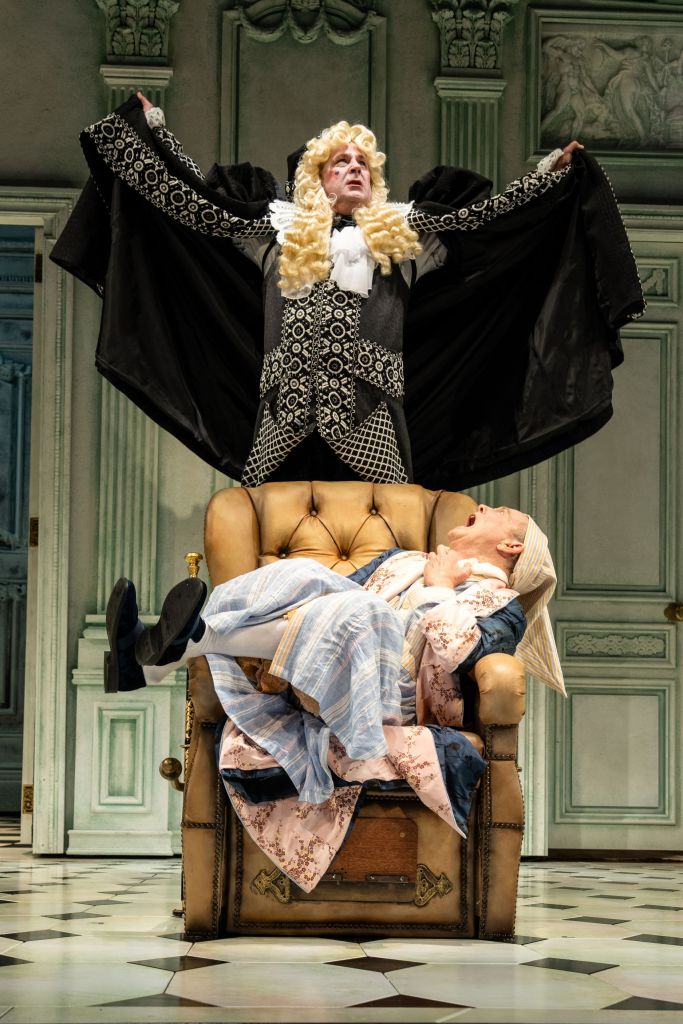
Standing, Brooks Ashmanskas, seated, Bill Irwin in 'The Imaginary Invalid' (Joan Marcus)
Standing, Brooks Ashmanskas, seated, Bill Irwin in The Imaginary Invalid (Joan Marcus)

If laughter does good like a medicine, The Imaginary Invalid by Molière adapted by Bill Irwin from a translation by Doug Skinner will set your body humming with health and joy. The French farce with its roots in commedia dell’arte premiered in 1673 when a sick Molière played the hypochondriac lead Argan, finished the fourth performance giving it everything he had, then collapsed and died at home hours later. With that ironic send-off, the play has lasted for over 350 years, securing the playwright’s legacy with his other globally produced works.

This cleverly wrought production directed by Brandon J. Dirden currently runs at the Todd Haimes Theater until November 22, 2026. It is a treat to see this classic lovingly handled with precision by cast and creatives who obviously appreciate its satiric whimsy and trenchant current themes.

Bill Irwin, the clown prince of theater who brings his background at Ringling Brothers to his performances (pacing, mime and rhythm), leads a fine ensemble. These include Rachel Bloom, Brooks Ashmanskas, Dylan Baker, Hiram Delgado, Crystal A. Dickinson, Ava Lalezarzadeh and Daniel Croix Henderson. Portraying the wealthy Argan who spends a fortune on his persuasive doctor’s regimens and medicines, Irwin superbly delivers his humorous portrayal of Argan, balancing authenticity with innate comic timing. His high stakes investment in the character’s belief that without the doctors’ treatments and prescriptions he would be dead in three days, Irwin presents the field upon which the ensemble zanily frolics.

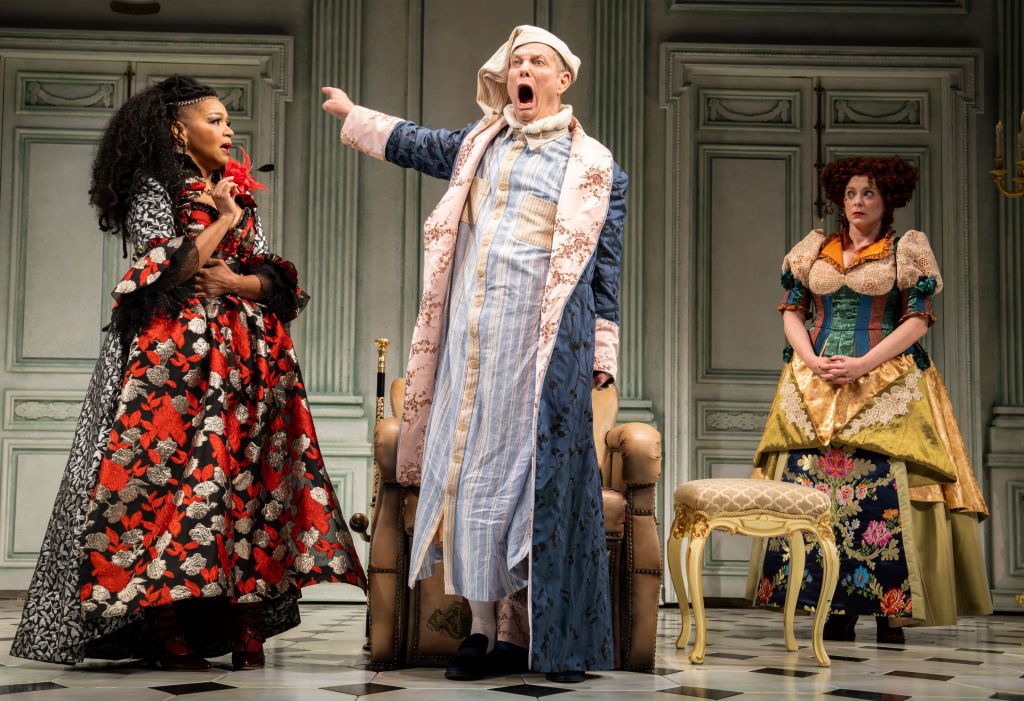
(L to R): Crystal A. Dickinson, Bill Irwin, Rachel Bloom in 'The Imaginary Invalid'  (Joan Marcus)
(L to R): Crystal A. Dickinson, Bill Irwin, Rachel Bloom in The Imaginary Invalid (Joan Marcus)

With a nod to commedia dell’arte and the Commedia Francise, a prologue which is a dumb show (pantomime), lays out the events of the play and dresses the stage with Beowulf Boritt’s ingenious, period, scenic design. The masked, robed Pantolone character gets the audience’s attention, striking a long staff on the stage floor. Then, with the staff he strikes the traditional Trois Coups which summons the actors to begin the play. The actors’ seamless movements, directed by Lorenzo Pisoni, whisk the mesmerized audience from the digital age to the 17th century’s comedy of manners.

Subsequently, masked, robed doctors pull long, red ribbons from Pantalone’s robe, symbolizing the bleeding treatment practiced at the time. During that process, they pull into place the walls and the ceiling, and add the simple pieces of furniture to create the home of Argan and playing space for the actors. Through the hustle and bustle, Irwin invisibly takes his position center stage in a modernish recliner. The robed, masked actors crowd around and dress him, back to the audience, then swivel him around. Lo and behold Irwin has transformed into the iconic hypochondriac!

Spinning its magic the play builds and explodes with satire and farce into a morality tale about obsessions with quack doctors, true and false love, and a brilliant, underestimated servant who saves the day, all in the 90 minute twinkling of an eye.

Economy and efficiency for maximum laughs are the watchwords for this production. The current, edgy dialogue serves as a counterpoint to the situation and subject matter, which Irwin’s adaptation smartly leaves in the 17th century. However, to streamline the play, Irwin removes the customary “interludes,” balletic dances, that lengthen Molière’s work into three acts. Also, Irwin removes the ancillary scene with the younger daughter Louison, who Argan interrogates for information about his daughter, her sister, Angelique. Removing the scene doesn’t impact the plot development or themes.

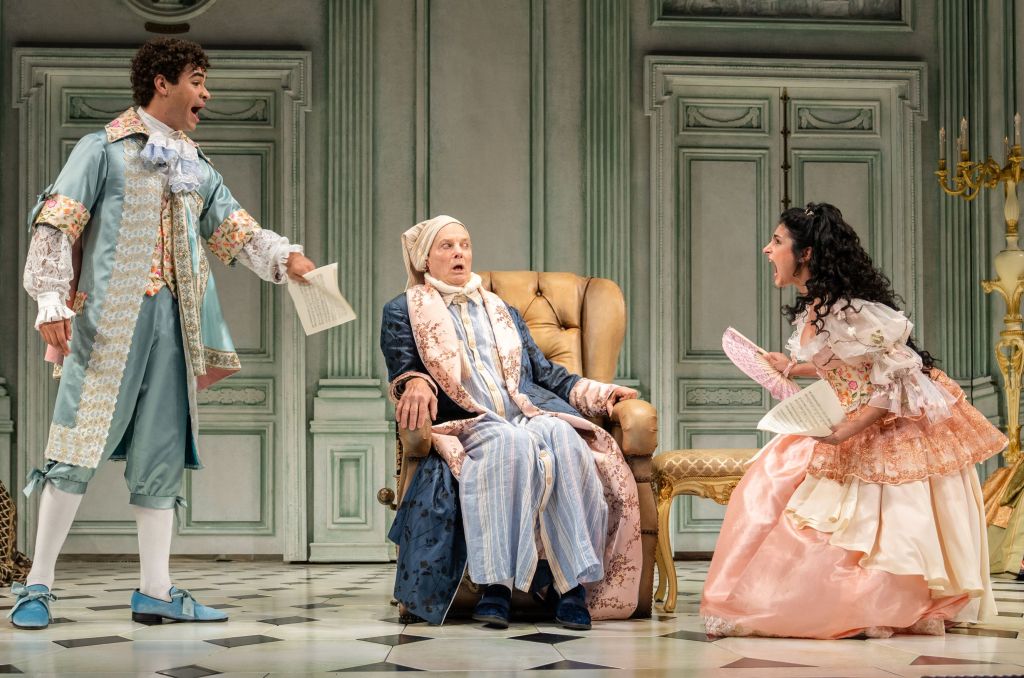
(L to R): Daniel Croix Henderson, Bill Irwin, Ava Lalezarzadeh in 'The Imaginary Invalid'  (Joan Marcus)
(L to R): Daniel Croix Henderson, Bill Irwin, Ava Lalezarzadeh in The Imaginary Invalid (Joan Marcus)

Essentially, Irwin keeps the structure and the problems driving the forward momentum of the play. For example, customary at the time wealthy families set up arranged marriages which Argan does with a satiric twist. The marriage he proposes is not an economic arrangement because no one needs financial assistance. Instead, it erupts from Argan’s desire to indulge his hypochondria and always have a doctor, or two or three at the ready. Dr. Diafoirus (Brooks Ashmanskas) and son Thomas (Hiram Delgado) are the brother and nephew of Dr. Purgon (Brooks Ashmanskas), Argan’s primary physician. If his daughter Angelique (the lovely Ava Lalezarzadeh) marries Thomas, Argan presumably will have 24/7 access to all three doctors.

In the funny scene when Thomas first meets Angelique, we learn in coded language that he can hardly wait to have children and is practicing by himself, alone. The reference to masturbation lands, LOL. Additionally, Thomas argues a thesis against the circulation of the blood and against the obsession with “cleaning of wounds” prior to surgery. Thus, we know how ineffective, even dangerous he is, especially because he stubbornly believes in his own righteousness. Thomas appears as the 17th century equivalent of a 21st century dweeb.

Though Argan’s word is law, the lovely Angelique loves Cleante (Daniel Croix Henderson). With Toinette’s help and understanding, the couple hope to pledge themselves to each other.

Wisely, Irwin includes the singing scene between Angelique and her love Cleante (Daniel Croix Henderson). Humorously, they sing an opera in codes to each other in front of Argan and the others. The audience, clued into their love “gets” it. Of course the fun turns into laughs as Argan gets annoyed and ends up foolishly ridiculing himself. Thus, he continues to push the marriage between Angelique and Thomas. As the complications heighten when Argan’s wife Beline (Crystal A.Dickinson) insists Angelique go to a nunnery, the suspense builds. Who will help Angelique marry the man of her dreams and not the slow-witted, unappealing Thomas?

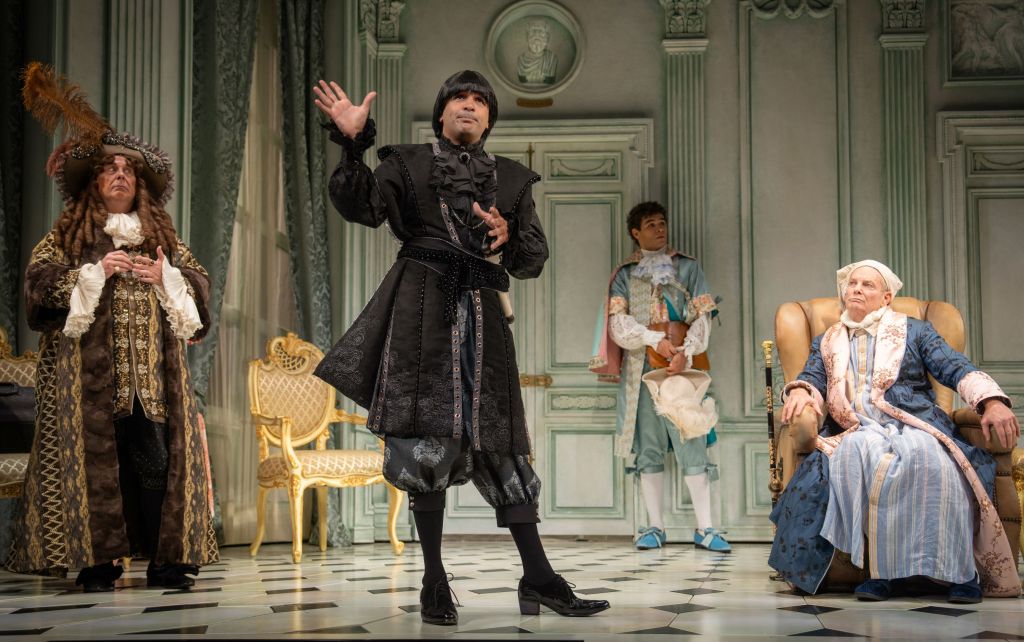
Brooks Ashmanskas portrays both brother doctors, refining the ‘”likeness” of each. However, despite differences in long, curly period wigs (Nikiya Mathis), variations in stance, speech, demeanor, costuming (the excellent Karen Perry), we note they are one in the same. With ironic intention, we recognize their same pompousness, foppishness and presumptuousness of erudition. Casting the fine, comic actor in both roles gives the audience more time to appreciate his send up of greedy doctors, and enhances the themes.

(L to R): Brooks Ashmanskas, Hiram Delgado, Daniel Croix Henderson, Bill Irwin in 'The Imaginary Invalid'  (Joan Marcus)
(L to R): Brooks Ashmanskas, Hiram Delgado, Daniel Croix Henderson, Bill Irwin in The Imaginary Invalid (Joan Marcus)

For example, the irony of casting Ashmanskas to play the younger brother Dr. Diafoirus and the older Dr. Purgon who appear in different scenes reveals how their exploitive, unscrupulous natures run in the family. As we expect, Thomas copies his charlatan father and uncle. Indeed, Delgado stokes laughter when Thomas explains his approach in never moving from the “Ancients” fixed methods into the discovery method. The family prefers to “practice” not at court where they would be held accountable for their bad, dangerous remedies since the king and courtiers expect cures. The Purgon clan only concerns themselves with proper form, not cures. Thus, they treat their own private patients whom they’ve cultivated. These patients, like Argan are gullible “cash cows,” Toinette (Rachel Bloom) counsels Argan who ignores her.

The brothers overcharge for the simple treatments like enemas, bleeding and purgatives which cause vomiting. As Beralde (the excellent Dylan Baker), Argan’s brother chides, the fact that Argan lives after all their harmful regimens proves his healthy constitution. But Argan is enamored of being ill and enjoys the attention and sympathy it brings from his second wife, the gold-digger Beline (Crystal A. Dickinson). Obviously, she plots with Bonnefoy (Hiram Delgado) to disinherit Angelique and extract as much cash as possible while Argan lives. Then, she inherits all of it after he dies. Argan’s foolishness must be countered before Angelique ends up evicted and in a convent. Will the conniving Beline win?

In fact Beline and the doctors work double time to part Argan from his money. Thus, three themes stand out in the play’s unraveling. First, golddiggers marry sick men to easily inherit. Second, doctors over charge for treatments that don’t work. Third, the course of true love never runs smoothly. These and others unspool with histrionics and hilarity. Additionally, Moliere’s theme that education can be meaningless unless put to effective use, threads throughout. Clearly, the anecdote appears to be in addition to Beralde’s dictum to “rest, ” would be to observe and watch. Observation like that accomplished by Bloom’s Toinette and Baker’s Beralde provides the wisdom to expose the difference between the liars, the frauds and the caring truth tellers. Thus, to see fact from fiction, we must watch what “they” do, not what they say. In that The Imaginary Invalid rings most true for us today.

The Imaginary Invalid runs 1 hour 30 minutes at the Todd Haimes Theater through November 22, 2026
roundabouttheatre.org.


‘Agnes’ by Catya McMullen (AMC’s ‘Dietland’), at 59E59 Theaters, NYC Review

Hiram Delgado, Mykal Monroe, Laura RamadeiAgnes, Jenna Worsham, 59E59 Theaters,Catya McMullen

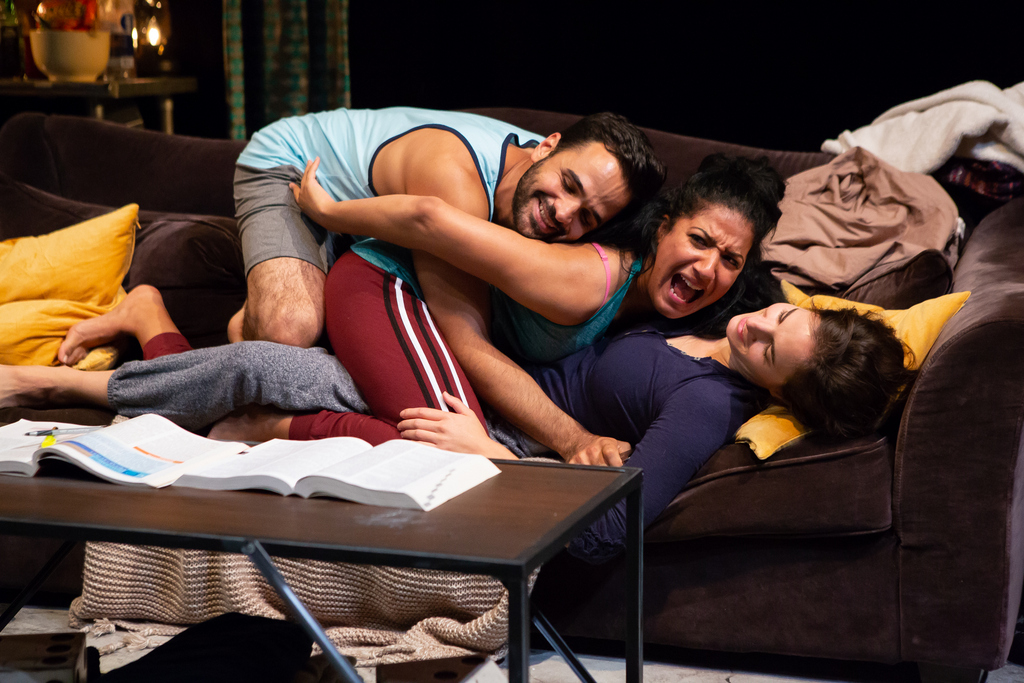
(L to R): Hiram Delgado, Mykal Monroe, Laura Ramadei in ‘Agnes,’ presented by Lesser America in association with Hugh Hayes, written by Catya McMullen, directed by Jenna Worsham at 59E59 Theaters (Hunter Canning)

With hurricane season upon us, the intriguing production of Agnes appears timely, ably directed by Jenna Worsham at 59E59 Theaters.

Four New York City 20-somethings burrow in their apartment and into each other while weathering the titular hurricane. Invited by zany Ronan to crash with former friends since her “A” evacuation zone leaves her homeless for the night, Anna joins the reunion/party, where hidden emotions and jealousies collide, and confrontations reveal secrets aching for revelation.

As the characters reformulate their mutual relationships, they develop new relationships with themselves too. Though satisfying resolutions never come easily, the process of getting there presents itself. And like all storms, eventually the hurricanes within and without dissolve, with clearer weather ahead.

The 90-minute one-act opens after dynamic, rocking music subsides. Charlie enters a cluttered, homely, shared apartment. John Edgar Barker portrays the emotionally complex and Asperger-challenged Charlie with sustained believability. His performance throughout is well-executed, thoughtful, and finely tuned.

Charlie carefully pulls out a box from the shelf above the bed, flips through the audio tapes inside and selects one. As he listens to “Subject 37, Lorraine,” the taped interview soothes him. Stepping into the light as the tape plays, “Lorraine” (Claire Siebers) relates her experiences in a physical storm which symbolically aligns with her personal troubles. Though we don’t realize it yet, one of McMullen’s themes is unwinding as, inevitably, these quirky individuals fall over each other as they struggle with their own internal hurricanes.

John Edgar Barker, Mykal Monroe, Hiram Delgado, Laura Ramadei, Agnes, Catya McMullen, 59E59 Theaters

L to R): John Edgar Barker, Mykal Monroe, Hiram Delgado, Laura Ramadei in ‘Agnes’ by Catya McMullen at 59E59 Theaters (Hunter Canning)

Upon seeing that Charlie has returned from parts unknown, his younger sister June ferociously welcomes him back. As June, Laura Ramadei adheres with precision to apt emotional modulations and delivers an overall spot-on, nuanced performance. Though June remains on tenterhooks questioning Charlie’s whereabouts, her expressions of mild outrage reveal heavy concern. Obviously, she has cast herself as his caretaker, a role Charlie’s older self chafes at.

Nevertheless, Charlie’s vacant, aloof responses to her and rebuffs of physical affection indicate familiar ground. Their relationship is strained. The pull and twists of sibling love combined with intense overprotectiveness grates on Charlie. Finally, we learn through McMullen’s quippy, well-crafted dialogue that Charlie’s Asperger’s locks him away from normal behavior, social interactions, and intimacy. Indeed, the syndrome predisposes him from easily relating to others, including sister June. By degrees the playwright, director, and excellent ensemble reveal the rationality of June’s behavior toward her brother. Yet we also realize that her dependence on being the nurturer stifles both of their individuality and autonomy. Where will their struggle end?

laire Siebers, John Edgar Barker, Agnes, Catya McMullen, Jenna Worsham, 59E59 Theaters

Claire Siebers, John Edgar Barker in ‘Agnes’ written by Catya McMullen, directed by Jenna Worsham at 59E59 Theaters (Hunter Canning)

This conflict and other issues explode in the presence of Anna, June’s former lover. Delightfully portrayed by Claire Siebers, Anna lures all around her, with moment-to-moment emotional content that shines from within, outward. As Anna seduces us and the others, June’s current lover, the feisty Elle (Mykal Monroe), becomes outraged fearing she’ll lose June. As the brilliant medical student, Monroe is Ramadei’s foil. Their interactions ring with authenticity.

Threatened by Anna’s beauty, seductiveness, and joy, Elle confronts June. When June ameliorates her rage with affection and sex, Elle succumbs. The storm subsides momentarily. But dark clouds still fly overhead, for June will most likely not move to another state with Elle as Elle completes her studies. Anna, who has just moved near them, threatens the end of June’s and Elle’s relationship if June stays in New York.

The conflict climaxes when Charlie expresses his attraction to Anna. Intriguingly, the ancient story of experienced lover shepherding the inexperienced acolyte unfolds. Charlie asks her for help in expressing his loving emotions for her sexually. Will she rebuff one who makes his need and innocence so sweet, so insistent? What of her former relationship with June and perception of herself? How will Charlie feel if she rejects him, or loves him then leaves him?

The situation becomes the powderkeg that blows open June’s underlying feelings about her relationships with Charlie, Elle, Anna, and herself. It explodes Charlie’s relationship with June and sets it on a different course. Anna is the catalyst and change agent. Blown back into their lives via the necessity of finding a haven (this symbolism thrums), she adds her unique complexity to their human dynamic. However, being with them throws open the doors to the random. Like the random effects of the weather, she may break, and the relationships between and among the individuals may be destroyed. Only empathy and communication will salve the wounds.

Laura Ramadei, Mykal Monroe, Agnes, 59E59 Theaters

(L to R): Laura Ramadei, Mykal Monroe, ‘Agnes,’ 59E59 Theaters (Hunter Canning)

Ironically, Charlie who yearns for meaningful connection does communicate with Anna. But June waits in the wings seemingly without the understanding or the ability to “let her older brother grow up on his own.” In a confusing flood of emotions, Anna is evicted from June’s safe haven into Hurricane Agnes the next day. Though the air clears, it is time to survey the damage. Indeed, the situation among June, Elle, and Charlie will never be the same.

As for Ronan, who attempts to negotiate his own breakup with his wife, that remains for the sunshine. Hiram Delgado’s Ronan effervesces with vibrancy and pathos. As the peacemaker who cannot attain peace with his own wife, he introduces the catalyst (Anna). However, he cannot halt the chain of events. Nevertheless, his humor steers the group and provides some measure of riotous sanity. Delgado’s is a stand-up performance.

Claire Siebers, John Edgar Barker, Agnes, Catya McMullen, Jenna Worsham, 59E59 Theaters

Claire Siebers, John Edgar Barker in ‘Agnes’ written by Catya McMullen, directed by Jenna Worsham at 59E59 Theaters (Hunter Canning)

The play’s centerpiece message is that Charlie’s condition represents in exaggerated form the human condition. Especially in these times, one of humanity’s failures centers on crippled relationships and the lack of meaningful connections. With inflexibility comes the inability to stand in another’s shoes or perceive the sanctity of another’s viewpoint. The brilliant yet socially “backward” Charlie recognizes these failings within himself and seeks to correct them. The others only reflect their incapacity to empathize with those closest to them. The hard truth of communication necessitates that one listen and put aside one’s own needs. Charlie appears to be the only one in Agnes who fervently tries. And through their fears, he attempts to lead his sister to understand.

Ironically too, Charlie symbolizes the best of humanity. Indeed, he does this despite his stilted, abrupt, truth-blurting observations (many of them humorous). Despite his social inadequacies, he is brutally aware of himself. Though he doesn’t readily show emotional connection and appears without emotional tenor, his awareness of others is acute. Finally, we note the importance of openness and empathetic listening.

In this tour-de-force, which is sometimes humorous, sometimes spellbindingly real, Worsham and the cast riffing on McMullen’s deft writing remind us of underestimated human verities. It is a pleasant irony that the character who appears most socially dysfunctional recognizes and explores the greatest of human truths.

Not to give too much away, do look for thematic connections with the characters Charlie interviews. The metaphors and symbolism are particularly apt. Agnes is a must-see.

Kudos to the design team: Angelica Borrero (sets), Cheyenne Sykes (lighting), Daniel Melnick (sound), and Nicole Slaven (costumes). Agnes runs at 59E59 Theaters until 29 September. Visit the website for tickets.