Blog Archives
‘A Statement’ With the Excellent Paul Rudd, Amy Ryan, Paul Giamatti, John Turturro at NYFF 2026
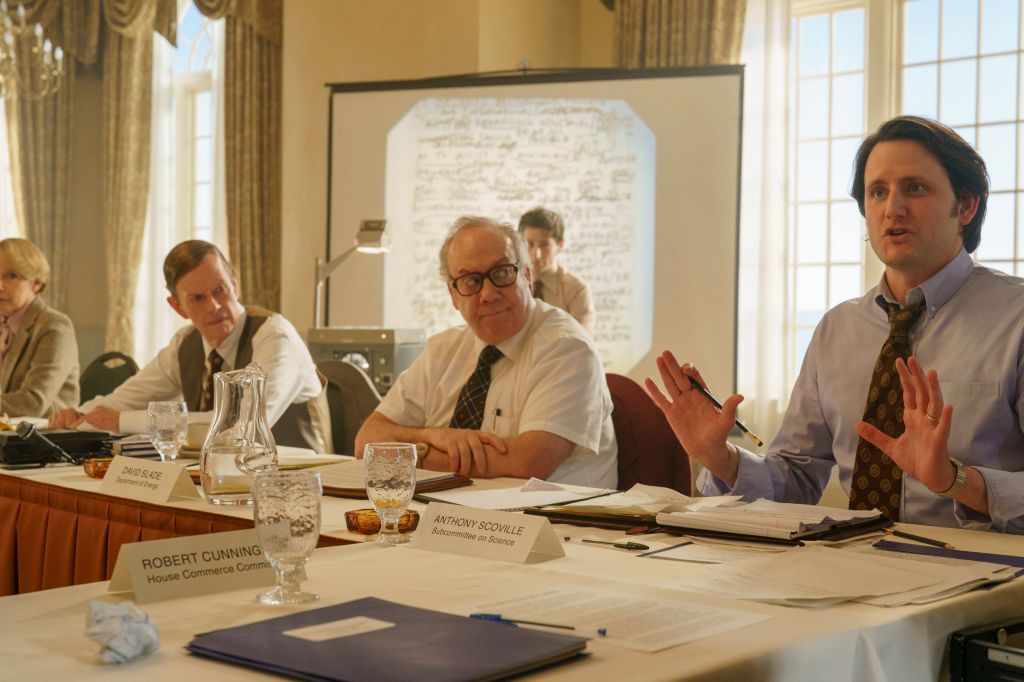
With a superb ensemble who keep the potentially dry content popping, A Statement director, Tom McCarthy, crafts a drama with comedic elements. This important film by McCarthy, who also crafted the superb Spotlight in 2015, examines the historic weekend-long meeting congress commissioned about global warming. At this conference congress tasked participants to respond to a dire report on the environmental impact of fossil fuels. McCarthy’s A Statement made its world premiere in the Spotlight section of New York Film Festival 2026,
The director and fellow screenwriters Noé Debré and Thomas Bidegain use original verbatim transcripts of the 36-hour meeting recorded by a stenographer into an archived document over five hundred pages long. Additionally, they adapt Nathaniel Rich’s book Losing Earth:A Recent History for information and basics about the weekend conference that took place in late October 1980, days before the presidential election. However, for almost half of the film, the writers use the transcripts to chronicle the word for word interactions, arguments, agreements, disputes and stalemates among twenty scientists, activists and policymakers portrayed by a celebrated cast.
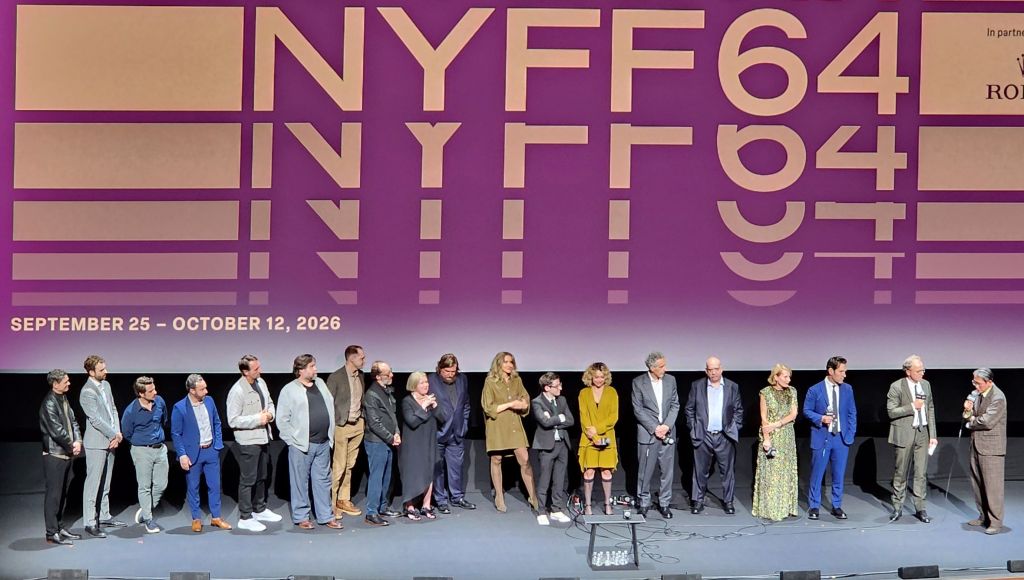
Paul Rudd as Clean Air Act advisor and moderator Tom Jorling opens the film with Evan Pet,ers as Friends of the Earth activist Rafe Pomrance who helps him set up the layout of tables into a large square. Between the battles and discussions Jorling counsels Peters not to “come off” like a ton of bricks, but listen and wait until he confronts the arguments that will arise.
As the others arrive, we note key experts with clout and empowerment. These include Paul Giamatti as Energy Department director David Slade and John Turturro as M.I.T. nuclear engineer and environmentalist, Dr. David Rose.
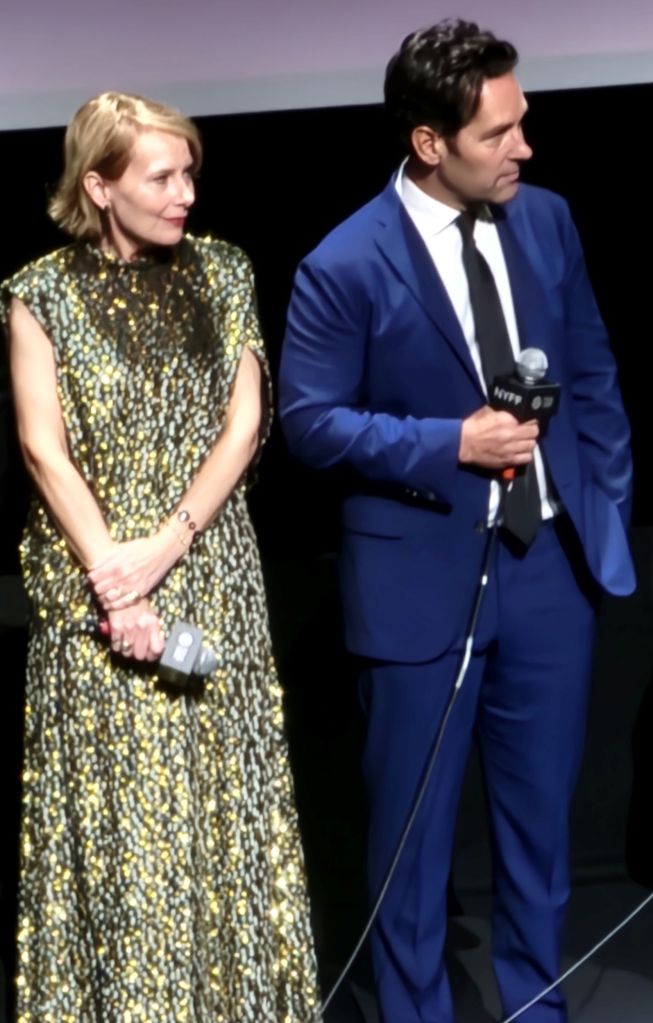
Playing lesser but dynamic roles, key women include two experts and the stenographer Bernadette (Nina Arianda). Amy Ryan portrays Annemarie Crocetti, the public-health scholar who sat on the National Commission on Air Quality. Tatiana Maslany, portrays law professor Edith Brown Weiss. Both women interject comments periodically. Oftentimes, the men patronize and dismiss them into silence. Meanwhile, Rose and Slade hold center stage with directed, if cynical remarks about players who might be obstacles to the conference members proposed actions. Nevertheless, Crocetti and Brown-Weiss convey impassioned arguments toward the conclusion of the film.
Throughout the individuals present suggestions and counter with rational cogent arguments as they discuss the effects of carbon emissions from fossil fuels. As the actors portray real individuals in their own words, we note this historic moment in time, more forward thinking than the present bogged down in misinformation and corporate greed of Big Oil. All in this group acknowledge fossil fuels’ carbon emissions’ catastrophic impact on the environment. Viewing this historic bi-partisan acceptance of scientific facts, one wonders how the propaganda and misinformation discounting climate change ever took hold to ignore science.
Thus, in late October with Jimmy Carter still president, the group collaborates. Under the limited time constraint, the experts from various backgrounds attempt to achieve consensus in wording their policy statement to congress. Because they agree about the dire report, their mission of how to address the dangers of carbon dioxide emissions seems facile enough. However, achieving consensus about the wording of the statement draws rancor and fractiousness among the participants. Oftentimes, the back and forth annoyances and ironic responses, thanks to the actors, provoke laughter. Their frustrations at spinning their wheels and going nowhere produces even more humor.
As the clock ticks and the hours count down, the tension increases. When experts like activist Pomerance come up with suggestions about how best to deal with limiting carbon emissions, Turturro’s Rose and Giamatti’s Slade reveal the complexities Pomerance has not anticipated. Indeed, his activism though passionate and noble reveals a lack of knowledge. Rose and Slade provide the hard truths, yet acknowledge Pomerance’s moral conscience. Clearly, the participants respect one another and learn from each other, but they are far from their goal.
McCarthy knows how to take the transcripts word for word and convert them into dialogue that integrates with the narrative. Also, he expertly shepherds the actors’ performances and employs an acute cinematography of close ups to capture the right pacing for edits of eye rolls or body language.
Additionally, he frees the characters from the conference room in the hotel and stages them in side meetings. For example, characters walk on the hotel beach and discuss various points. In a humorous segment Dr. Rose breaks with his erudite, professorial persona and crashes a wedding bringing other conference members with him during a fun break. Thus, McCarthy maintains audience interest and we become invested in the characters and hope that they can write a definitive statement that congress can work with to save the planet.
The film’s focus on this historical conference with the reasoned comments of the participants fascinates and appalls as a horrific reminder of our country’s retrograde position since then. How quickly did partisan disagreement about global warming spark a reversal of regulations spiking the use of fossil fuels and avoiding effective mitigation of carbon emissions? The liberal progressivism heard in the participants’ comments acknowledging climate dangers contrasts with the Trump administration’s vitiating climate change as a hoax. Clearly, the administration uses the hoax argument to justify corruptly bowing to the oil lobby and exiting the Paris Climate Agreement. Then, in October, 1980, the truth mattered even if the experts couldn’t agree what to do about it. Now, the truth is a lie.
Perhaps the fact that the participants failed to gain consensus in the wording of the “statement” speaks to the human tragedy of the current administration’s expedient inaction. Meanwhile, the clock keeps ticking.
A Statement will be released in theaters later in the year or in 2027. For a look at the film’s write-up on the NYFF 2026 site go to https://www.filmlinc.org/nyff2026/films/a-statement/
‘Doubt: a Parable’ The Revival With Liev Schreiber and Amy Ryan is Exceptional
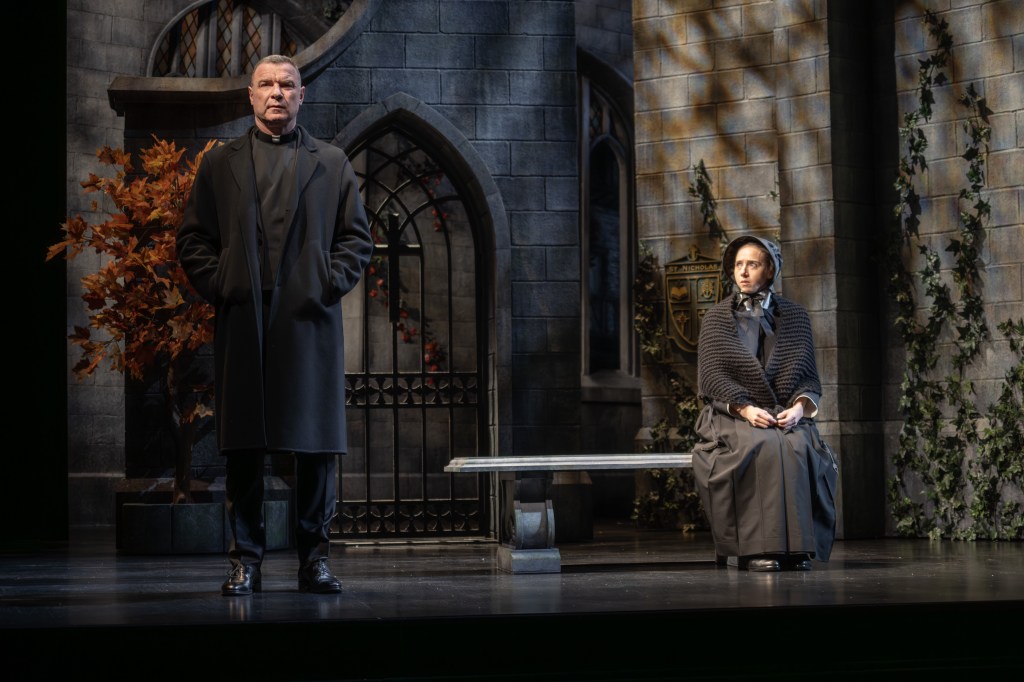
If nothing is certain but uncertainty, then “doubt” is a natural state, as genius quantum physicist Werner Heisenberg in his uncertainty principle postulated. However, in the realm of faith, “doubt” may be a blasphemy as scripture encourages Christian adherents to “walk by faith, not by sight,” believing fervently, blindly in God and His truths. Such is the position that Sister Aloysius Beauvier (Amy Ryan) initially presents in John Patrick Shanley’s Doubt: a Parable ably directed with specificity and edginess by Scott Ellis.
Doubt, currently in its first revival on Broadway since it premiered in 2005 continues to be a controversial powerhouse exposing embarrassing infelicities about the Catholic Church and the patriarchy.
In this beautifully acted revival running with no intermission at Todd Haimes Theatre, we note how the play emphasizes many of the divisive cultural issues at stake today though the setting is 1964, the Bronx, New York. However, Shanley nails the timeless sticky problems operating then and now with institutions that are incapable of policing themselves when they are run by men. Specifically, the play delves into church sponsored schools. Their male dominated hierarchy and paternalism shuffled off the harder tasks of teaching, learning and administration to the women. In this instance, the Sisters of Charity do the scut work in “collaboration” with the diocese in the fictional St. Nicholas Church.
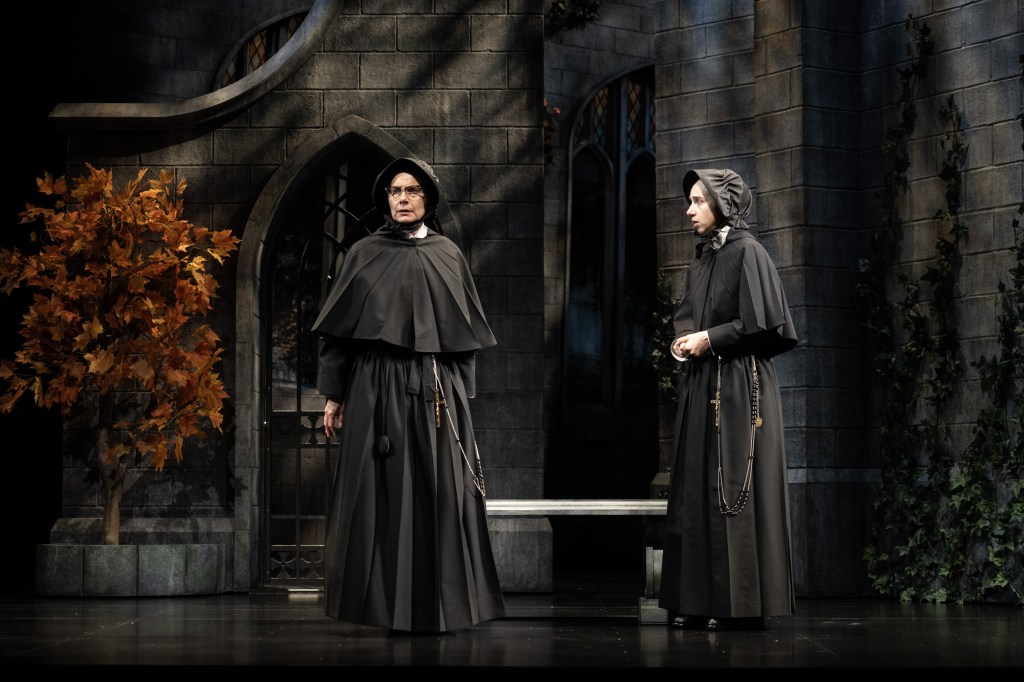
To highlight his themes Shanley contrives a situation among three religious adherents who influence children toward or away from Catholic tenets. These include the charismatic Father Flynn (Liev Schreiber), pastor of St. Nicholas, the school principal, Sister Aloysius, and neophyte teacher and nunm Sister James (Zoe Kazan). Their dynamic interplay reveals age-old issues about the best and worst of human nature, goodness, egotism, arrogance, the need to control through guilt and fear, inability to discern lies from truth, gender inequality and hypocrisy.
Doubt opens with Schreiber’s Father Flynn addressing the audience as his congregation, preaching a sermon on the opportunities of having doubt as a part of the bonds of faith. Father Flynn’s sermon frames the play’s arc of development and the subject becomes the driving force as each character confronts their uncertainties about what is right, decent, truthful as they project their own inner weaknesses onto the behavior of each other. Importantly, their uncertainties reveal a crises of their faith in God to move them through the darkness. Instead of allowing God’s love to unify them, darkness, suspicion and doubt overcome them.
The second scene opens on the office finely outfitted by David Rockwell’s wood paneled set design on a turntable which later revolves to show a pleasant Garden and backdrop of the city beyond. Sister Aloysius unleashes her intentions and suspicions on Sister James in the confines of her principal’s office. Ryan’s Sister Aloysius is a martinet who runs a tight ship with a stern, icebox demeanor. In her spot-on, nuanced portrayal of the nun, Ryan never shines forth Christ’s light and love and remains largely an emotionless cipher until the conclusion. To her credit, Ryan never pushes Sister Aloysius’s austere attitude over the edge, but breathes feeling and life into her persuasiveness and her determination with fervency.
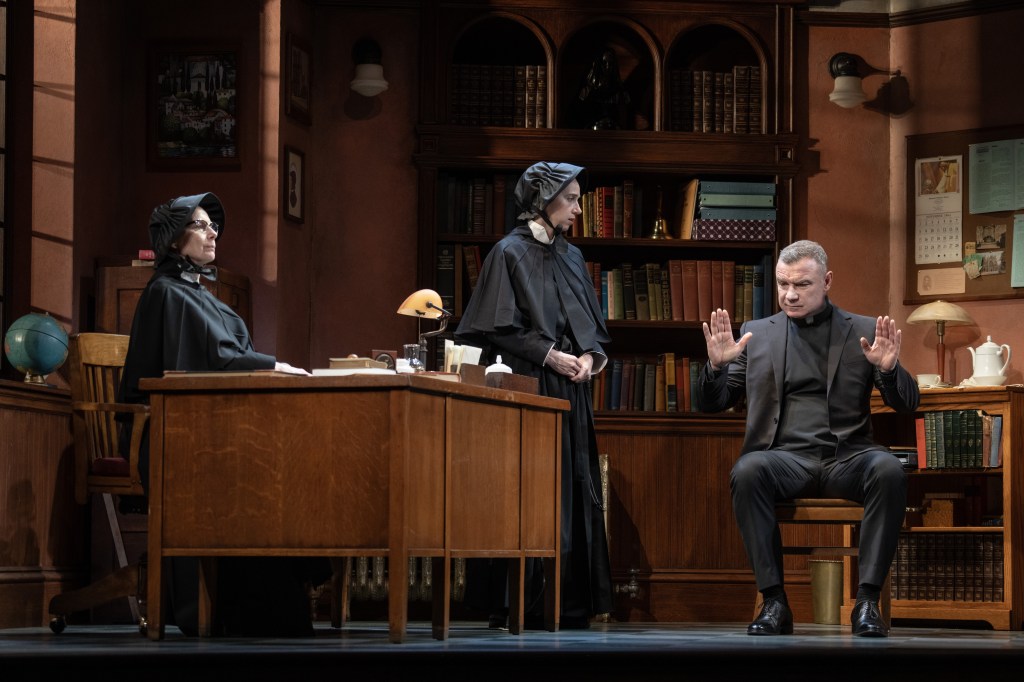
On the other hand, Father Flynn (Liev Schreiber) the priest, who is the pastor of St. Nicholas, manifests an openness, intelligence, flexibility, forward thinking personality and sense of irony. He and Sister Aloysius appear to be opposites in character, though both fabricate and lie; Father Flynn to drive home themes in his sermons, Sister Aloysius to “get at” the truth. The lighthearted, yet controlling Father conducts the physical education program and religion at the school. Both Sister Aloysius and Father Flynn follow the hierarchy and answer to the Monseigneur. This remains an obstacle for Sister Aloysius because she deems the elder cleric “other worldly” to a fault. She tells the young neophyte Sister James (Zoe Kazan), that he “doesn’t know who the president of the United States is.” Yet, here men rule.
A problem for the manipulative, coercive Sister Aloysius, the Monseigneur will dismiss any issue she brings to him, unlike another cleric she confided in at St. Boniface who believed her word and got rid of a priest Sister Aloysius implies was a pederast. Suspicious about Father Flynn, and questioning the personal purpose of his sermon about “doubt,” Sister Aloysius picks at Sister James like a feather pecking chicken who dominates hens by pecking them to draw blood because she enjoys its taste.
Preparing her victim for maximum influence, Aloysius criticizes Kazan’s Sister James. She derides her showboating as a teacher, her enthusiasm about her subject, her kindness to the students. She discourages Sister James’ relaxed atmosphere in her classes. After reducing the young nun to tears, she directs the neophyte to be emotionless and watchful about anything untoward. We learn later, as Sister James confides in Father Flynn, that the older nun has stolen her joy about teaching and has contributed to her bad dreams and loss of peace. This irony is not lost on us today, when religion is used as a hammer and sickle to browbeat and slice up the condemned populace to contort their lifestyles to politicized religious tenets popular over 120 years ago.
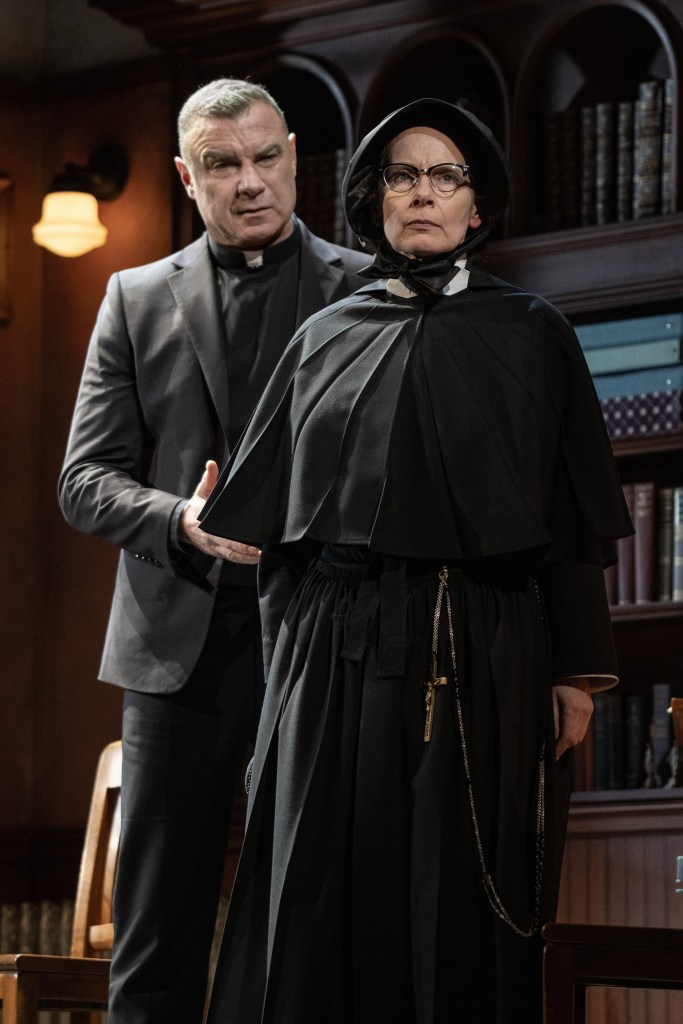
Sister James becomes the perfect foil for the imperious, commanding Sister Aloysius to manipulate and play upon in the tug of war between Sister Aloysius and Father Flynn. Initially, the “war” appears grounded in a difference in philosophies and life approaches between progressivism vs. conservatism. However, the divisiveness between them takes a sinister turn and explodes as Sister Aloysius gives rise to her suspicions that Father Flynn is grooming Black student Donald Muller for pederasty by giving him alcohol in the sacristy. It is an accusation that is proven only in her imagination.
Sister James is like a deflated ball tossed about in the storm that rages between Sister Aloysius’s determination to expose and evict Father Flynn from the church and Father Flynn’s insistence he is telling the truth and has done nothing wrong. In a climactic scene between them, Flynn’s denials and pleadings with her to count the cost to Donald, him and herself and to amend her convictions and threats because of a lack of proof, go on deaf ears. She has converted herself into the “anointed.” She would make those of the Inquisition proud, except they never would listen to a female.
To complicate the matter Sister Aloysius meets with the Black child’s mother, Mrs. Muller (the superb Quincy Tyler Bernstine). Mrs. Muller expresses that she is thankful Father Flynn has become her child’s protector. If Donald stayed in his previous school, he “would have been killed” by the bullies. Sister Aloysius dismisses Mrs. Muller’s backstory about her son’s beatings by his father for “being that way.” Instead, the principal is self-righteous and gratified that her determination has led to Donald Muller’s being dismissed from the Altar Boys, which Mrs. Muller explains devastated Donald.
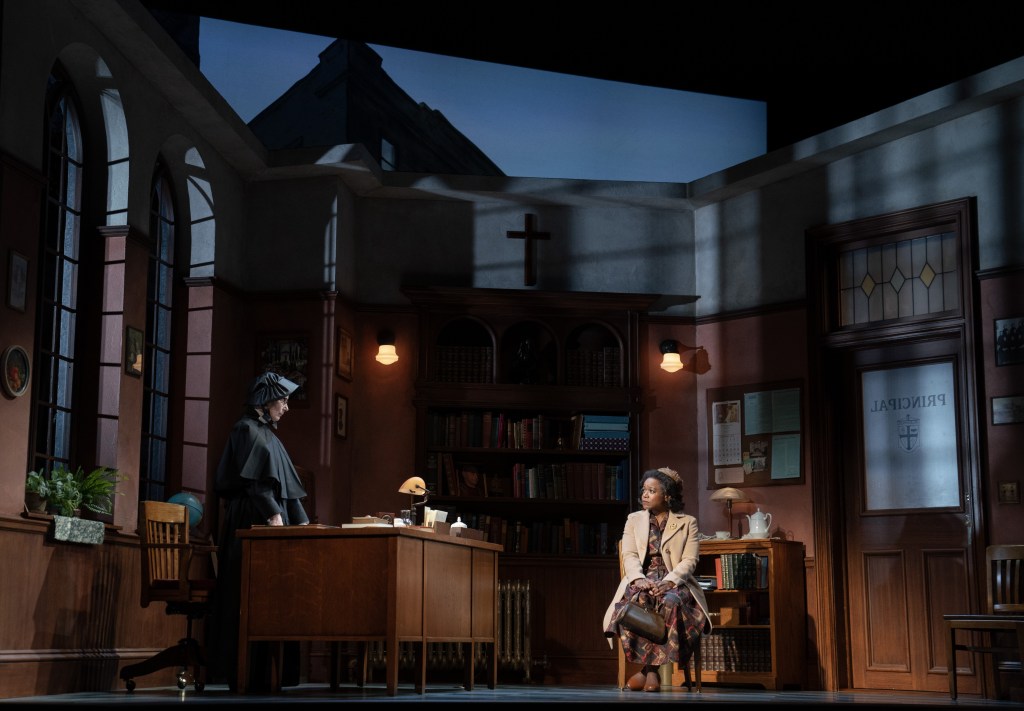
Mrs. Muller leaves with the assurance that Donald will be able to finish out the few months left, but Sister Aloysius is not satisfied and won’t be satisfied until Father Flynn has been exposed and kicked out of the priesthood. Because she is the assiduous hunter of her prey, Father Flynn, we become sympathetic to his cause and Sister James’ acceptance that he is innocent of Sister Aloysius’ allegations. However, the Catholic Church since 2000 has been expelling priests for pederasty and has paid great sums of money in damages to men who testified years later to being abused by priests’ sexual predation.
So, Father Flynn may be a pederast and Sister Aloysius may be correct in her “gut instinct” that he is a predator. Enter Werner Heisenberg. Uncertainty reigns without proof and admission of guilt and an act of contrition and repentance which Schreiber’s stalwart, assertive Father Flynn will never yield up.
The performances and direction are uniformly terrific as is Ellis’ pacing and vision which leaves the audience in a breathtaking conclusion and Sister Aloysius upended and overturned in her philosophy and life approach. Thanks to Linda Cho’s appropriate costume design, Kenneth Posner’s lighting design and Mikaal Sulaiman’s sound design, and Charles G. LaPointe’s hair & wig design, Doubt resonates with currency. As mentioned before, David Rockwell’s scenic design, first with a gorgeous cathedral interior setting for St. Nicholas, then with its turntable sets is appropriate for a place of peace which, by contrast, echoes with torment, division and fear.
The complexity of suspicion, accusation and innocence remind us of our time, and of the insistence of liars to demand they are right on little proof when the stakes are high. In the play’s instance careers may be upended, reputations are at stake, and individuals are harmed for the sake of one’s suspicions of imagination. Today, it is no less shattering that lies are the pylons which shore up candidacies to achieve power by any means necessary, even if it means the destruction of nations, citizens, the government. In its timeless themes about assessing truth when the professing upright religious protect liars, fantasists and themselves from accountability, Doubt is a profound must-see.
Doubt. Todd Haimes Theater, 42nd St between 7th and 8th with no intermission until April 21st. roundabouttheatre.org.

