Blog Archives
‘Schmigadoon!’ LOL Spoof, of a TV Spoof of the Golden Age of Musicals, Comes Home to Broadway
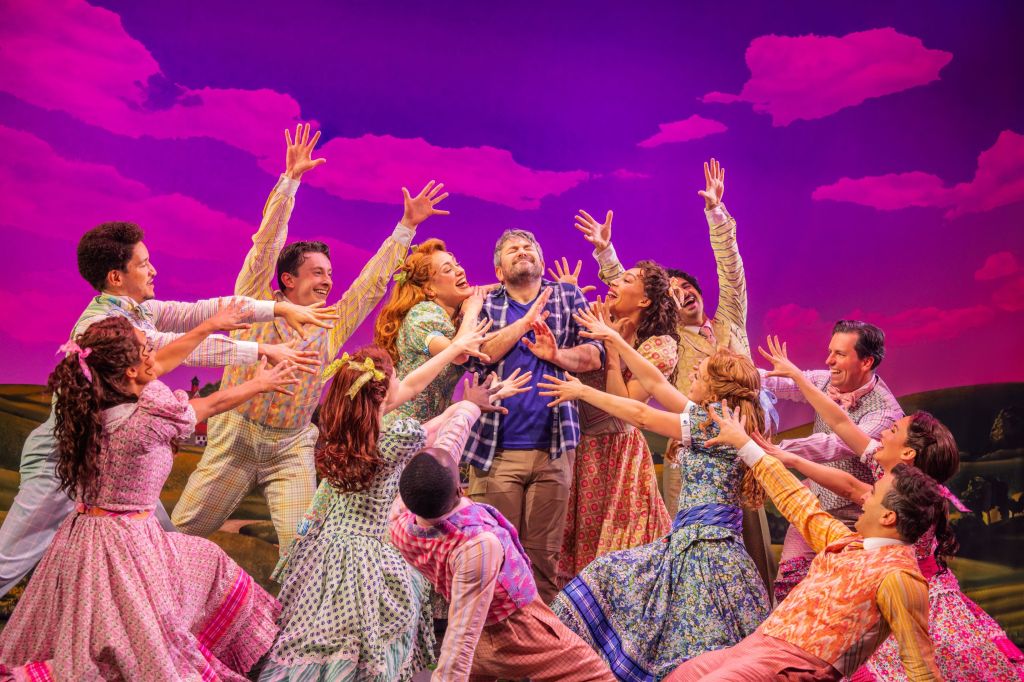
Based on the Apple TV Plus series first season, with book, music and lyrics by Cinco Paul, Schmigadoon is a celebratory spoof of iconic musicals of the 1940s-1950s. With clever twerks of plot, characters, musical phrasing, and acrobatic, balletic dancing from these Golden Age musicals, and a lot of original overlay, this heavenly production, directed by Christopher Gattelli, is where it belongs, Broadway’s the Nederlander Theater. Currently, the world premiere of Schmigadoon! is spreading its joy with an end date through Sept. 6, 2026.
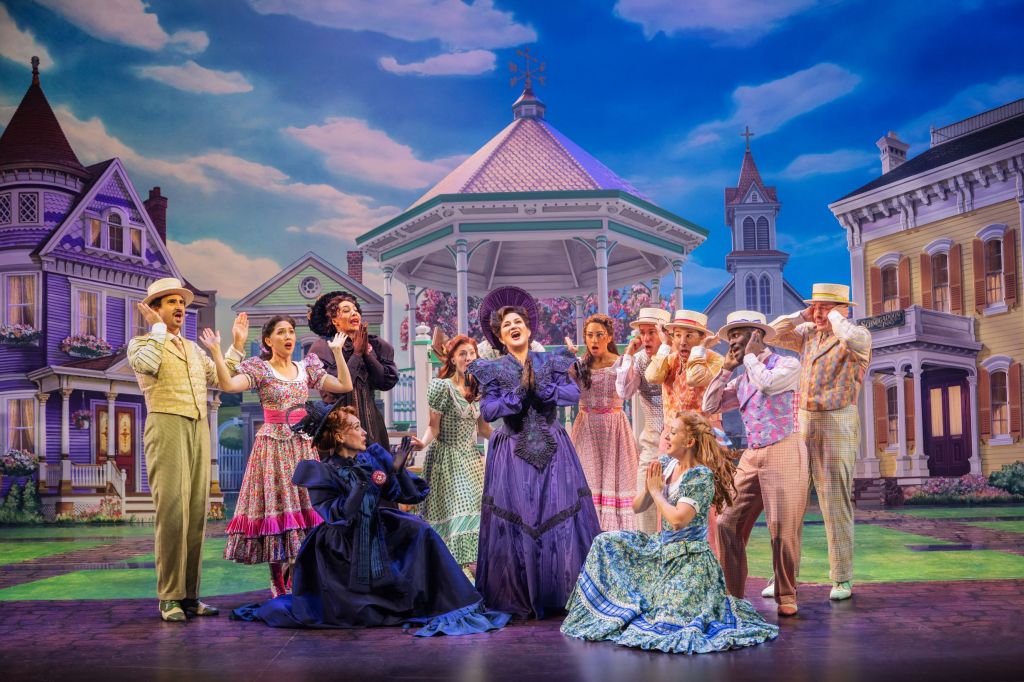
Topped off with fanciful, colorful 1918 (The Music Man) period costuming by Linda Cho, whimsical scenic designs of a magical forest, a Schmigadoon town square surrounded by the beautiful facades of Victorian houses, a carnival barker’s Tunnel of Love ride (Carousel) and more by Scott Pask, one’s spirits are uplifted. We don’t want Josh Skinner (Tony award nominee for Beetlejuice, Alex Brightman) and Melissa Gimble (Sara Chase, The Great Gatsby) to leave the fairy-tale “take-off” of Brigadoon. This is especially so after enjoying the introductory song “Schmigadoon,” meeting the wacky town characters, hearing the vibrant chorus, “wowing at” the set and costumes, and experiencing the apparent peace and happiness Mayor Menlove (Brad Oscar) promises. And then there’s the gorgeous carney Danny Bailey (Max Clayton), who comes on to Melissa in “You Can’t Tame Me,” later that evening, reminiscent of Billy Bigelow in Carousel (1945). Well, well.
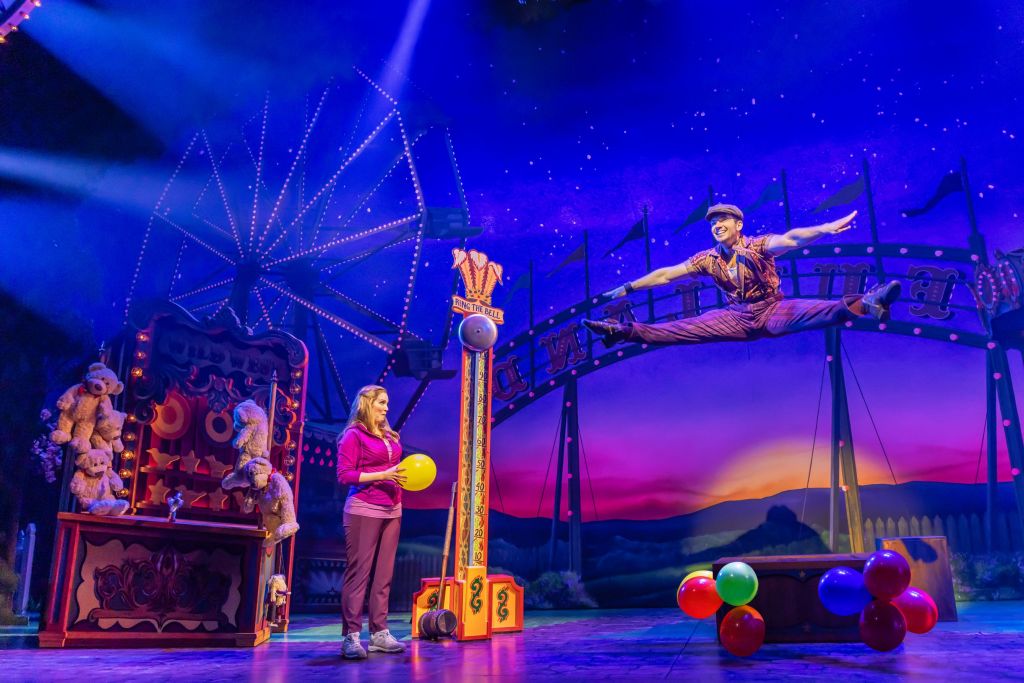
Alex Brightman’s orthopedic surgeon Josh is believable as the typical, unromantic, scruffy-bearded male who can’t dance, won’t sing and dislikes musicals where folks sing and dance for no logical reason. He prefers reality and sports to fantasy and “magic” which run counter to his scientific mind.(His type is a spoof in itself.) Sara Chase’s pediatrician is perfect as his opposite. Not only does she deliver babies (the union of love) she’s a romantic who loves musicals. Despite Josh’s dislike, she attempts to share her enjoyment of dancing, singing and romance by making Josh sit through the 1952 film of the most realistic, integrated musical of them all, Singing in the Rain. But she fails to convince Josh musicals are important precisely for the reasons Josh finds them odious. You need a break from reality now and then and love, passion, romance, poetry, singing and dancing provide a welcome respite from the stress and angst of daily pressures, don’t you.? Josh doesn’t buy it, yet.
So when their wanderings in the forest, arguing about Josh not dancing with her at a couple’s retreat, land them in the anachronistic Schmigadoon, Josh is beside himself when the band strikes notes for a song and dance number. He is also pissed that the innkeeper prodded by Ana Gayster’s Mildred Layton forbids Josh to room with Melissa because it’s not respectable in 1918. Only with marriage are “relations” permitted. That and no Wi Fi pings Josh to a fever pitch saying, “I hate this place,” as he pushes Melissa to leave after the waitress and townspeople sing about the delicious “Corn Pudding” for breakfast. A problem arises when Melissa joins in a verse of melody she finds easy to sing as if she belongs there with the chorus which is strange and wierds out Josh who must get home ASAP.
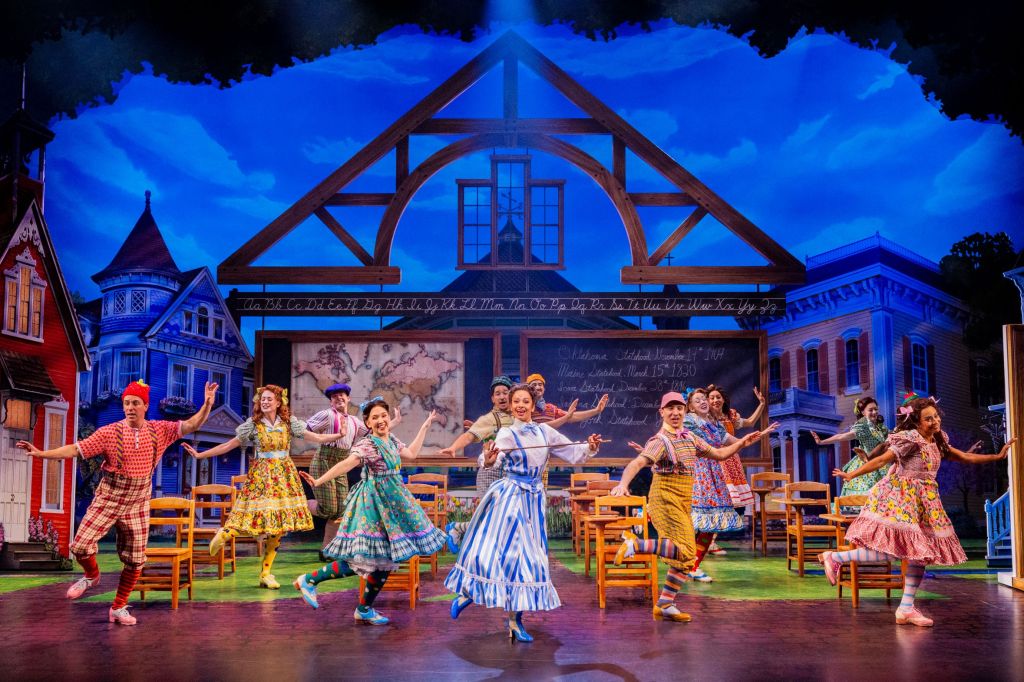
He especially is thrilled to go over the bridge from fantasy into reality, except that’s not happening. Every time they try, it turns them back to Schmigadoon. After their umpteenth time, they question the universe about this anomaly. A Leprechaun appears. He sings that they can only leave if they’ve found their true love. “But ’til ye’ve found it ye must stay, where life’s a musical every day!” Both Josh and Melissa are stunned at seeing the mythic figure. Using his scientific mind and deductive powers of reasoning, Josh concludes that they can’t be each other’s true love. This is particularly concerning when they test the magic by saying they love each other, but still are returned to Schmigadoon.
As they argue now about what true love is, enter the townspeople who moderate their fight in “Lover’s Spat,” then lead them back to Schmigadon because they are homeless and have nowhere else to go. With the motivation to return home, they split up and go on the hunt to find their “true love” since Josh is convinced that their coupling isn’t “true love.” For a man used to employing the scientific method, Josh misses the cognitive dissonance of his actions to find his true love in a fairy-tale musical, but we have a good laugh at his expense..
During twists and turns of adventure and song, more musicals are represented. Josh ends up with Betsy (McKenzie Kurtz) at the point of her father, Farmer McDonough’s, shotgun. But he is saved and falls for Emma Tate (the golden-voiced Isabelle McCalla). The schoolteacher with her brother Carson (Ayaan Diop) providing the latest town intel, ping character twists from The Music Man providing the romance for Josh in the hope that Emma is his true love to bring him home.
For her part Melissa establishes a bond with carney Danny Bailey (Max Carter is wonderful) which blows up when he shoots himself with his own gun unwittingly during a “robbery” to get money for their baby, though Melissa is not pregnant (a send up of Billy Bigelow in Carousel). But she does fall for Doc (Ivan Hernandez) who is older and a stern type like Colonel Von Trapp from The Sound of Music. She even gets to provide an instructive lesson in female anatomy to a pregnantt out of wedlock couple in “Baby Talk” that follows the tune of “Do, Re, Me,.” The scene is riotous.
This mayhem is brought to another level by Gaysteyer’s Mildred Layton with her anti-DEI campaign to remove self-outing, gay, Mayer Menlove, (Brad Oscar brings down the house with his reveal). “Tribulation” reminiscent of the “Ye Got Trouble” in The Music Man sends the production is “off the charts” LOL. But the truth unfolds eventually and Josh and Melissa’s enlightened “modern” energy bring renewal to the antiquated town’s old-fashioned ideas about love and sex. Positive changes and evolutions occur and with these interactions, Josh and Melissa are changed through wisdom they learn and share.
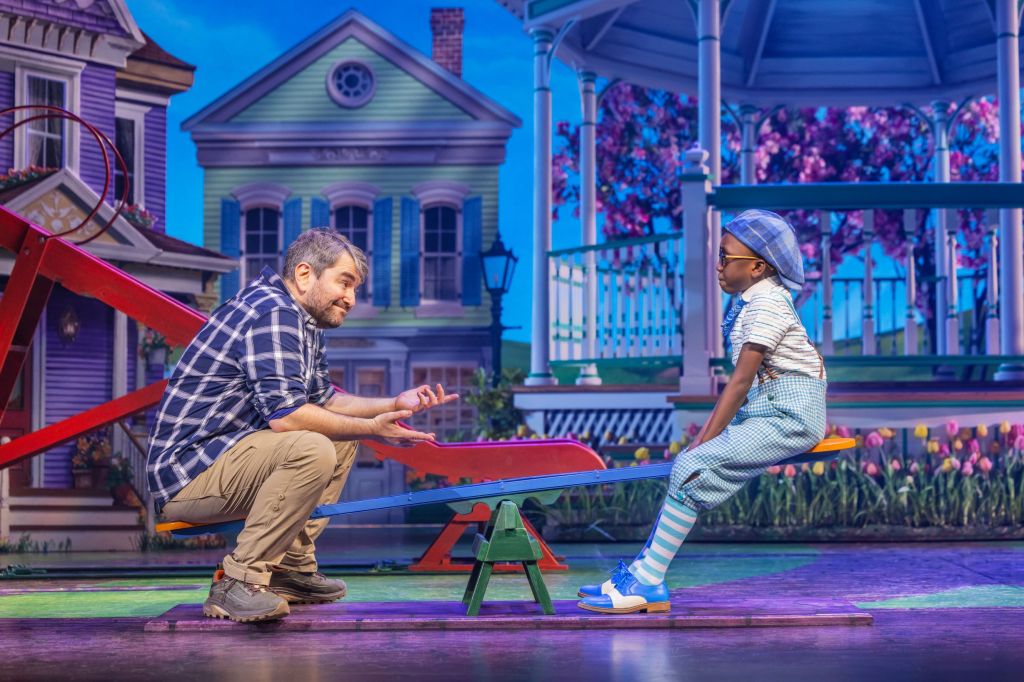
Paul’s tweaks to the musicals reveal his admiration and reverence for one of this country’s finest contributions to the arts historically, the American musical. The enthusiasm of the principals, the authenticity inhabiting their portrayals allows the audience to empathize because the characters are not superficially drawn or cartoonish. This is especially true of Alex Brightman’s Josh at the conclusion in his astounding moment of realization where reality and romance and hope merge in his soul. At that moment Brightman reaches an apex, proving that serious moments can convey theme with beauty in a hilarious production. It is all a matter of superbly balanced tone and meaning which Paul and Gattelli achieve in this memorable musical of musicals.
Schmigadoon! runs 2 hours 30 minutes with one intermission at the Nederlander Theater through September 6, 2026 schmigadoonbroadway.com.
‘Mrs. Doubtfire,’ a Family Musical Comedy That Is Present and Sorely Needed
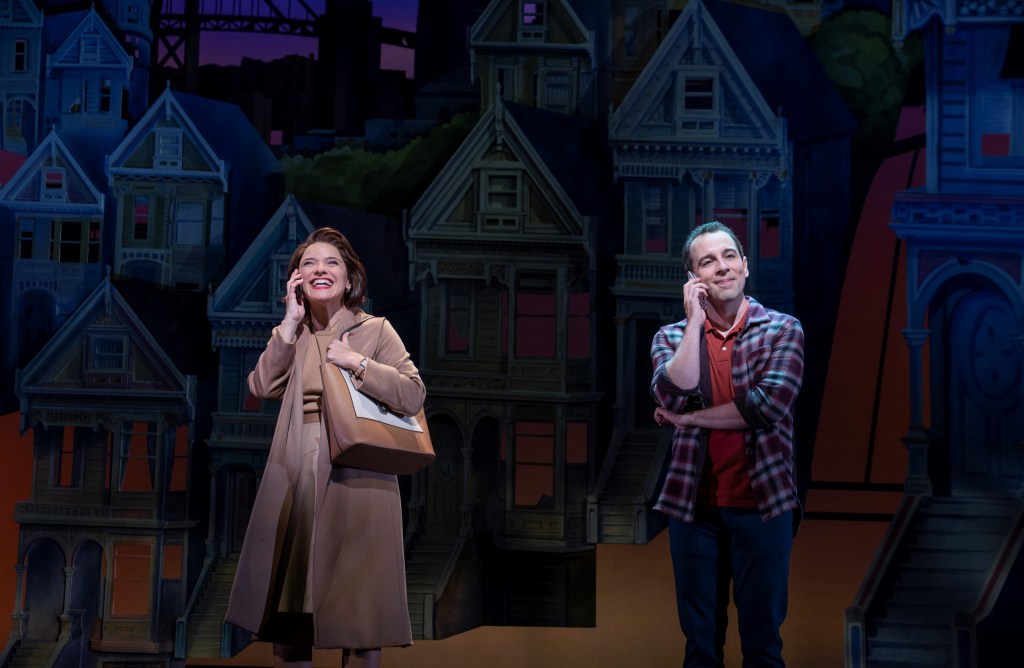
It is to the credit of the producers and creative team that they have taken another approach to the iconic 1993 film Mrs. Doubtfire (starring beloved Robin Williams) by enhancing its vibrant situational humor with emotional musical resonance in an adaptation currently on Broadway at the Stephen Sondheim Theatre. Thankfully, Doubtfire (music and lyrics by Wayne Kirkpatrick and Karey Kirkpatrick; book by Karey Kirkpatrick and John O’Farrell) reminds us of the vitality of timeless verities, unity despite division, love despite differences, compromise toward the best solutions possible. Mrs. Doubtfire reveals that with love and faith all things can work together. And a sense of humor helps.
How the actors, director, technical team configured the book and music to emphasize these themes is the focus of this reviewer. If you are looking to be entertained by Doubtfire opprobrium, stop reading now. I thought the production of Mrs. Doubtfire, shepherded by the always fine director Jerry Zaks, hits its mark. Audiences are loving it, if critics are twisting its worth unjustly and inanely to make it their footstool to appear “clever” and in vogue.
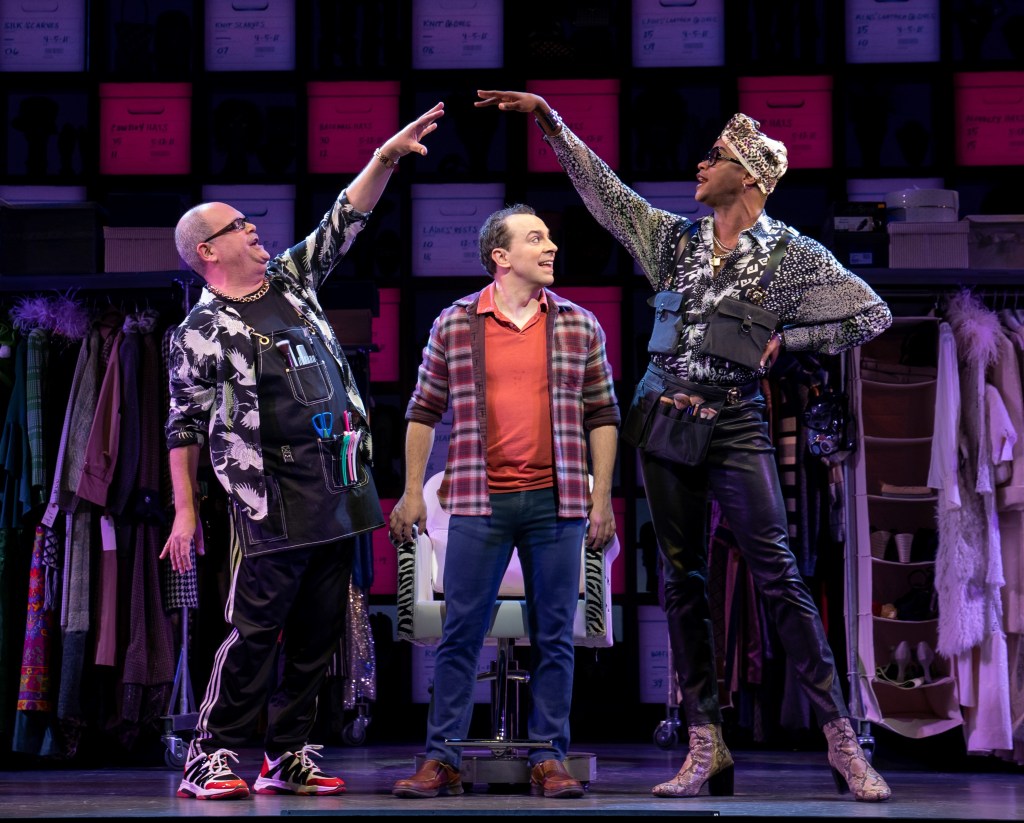
Based on the titular Twentieth Century Studios Motion Picture, the Broadway adaptation deepens the comedy and characterizations of Daniel, Miranda and the children with its musical numbers (“I Want to be There,” “What the Hell,” “Let Go”). In these we understand the emotional price and the grind that a family endures in the grip of a painful divorce when it is too arduous to work through the seemingly limitless difficulties.
Lydia, the eldest daughter, leads the ensemble, Miranda and Daniel to expose the conflict between her parents and indicate how it is derailing all of their lives. This happens during a photograph sitting Miranda has arranged in the hope of cataloguing the kids’ ages. Daniel upends Miranda’s wish for a family photo when his shenanigans, which are funny and endearing, work the opposite effect on Miranda and ultimately destroy the photographer’s camera, disappearing any chance for a photo. Lydia (the excellent, on-point Analise Scarpaci) and the others note the handwriting on the wall and imminent divorce in the opening song “What’s Wrong With This Picture.”

The irony is that Miranda wants a reassuring picture of a happy family, and Daniel, despite himself, is not able to give that photo, representative of the family she wants. Both parents are disunited, not in sync, skewed. One is reminded of the Facebook photos people post of themselves, i.e. the “wildly loving couple” who behind closed doors, is completely miserable. Fronting on Facebook and inciting jealousy in their “friends” is the only modicum of happiness they can suck out of the relationship which is doomed.
Likewise, the symbolism of the scene and the song are clear; the differences between this couple run deep into life approaches and right brain, left brain schematics. Miranda is organized and ambitious, intending to be her own entrepreneur. Daniel, a voice actor is highly imaginative, creative, his own person and all heart. The kids are the bridge, but instead of being the way to cross over and make the most of each parent’s attributes to benefit the family dynamic, the “adults” exploit the kids who become the linchpin to make each other miserable, incapable of navigating productive “family” roles and interactions. Each sees the other as “obstructive” and wants the other to be more like their own perspective of a “Dad” and a “Mom.” Their inflexibility is ultimately self-destructive and as in many families makes divorce inevitable.

Lydia gets it; her parents and siblings are in denial; the ensemble concurs in the refrain. Daniel is belittled and made to appear unfit by Miranda who casts herself in the role of mother superior, a termagant. She ironically justifies herself, placing the blame on Daniel’s behavior, annoyed that “he” has made her into the woman she “swore she’d never be.” Clearly, both are revving each other’s engines and are at fault, but circumstance, Daniel’s fears and Miranda’s overwrought nature lay the brunt of the fault at Daniel’s door, and he accepts this, a clue to his heart and future flexibility to change.
When he breaks her rules by taking the kids out of school to have a birthday party for son Christopher (the appropriately gangly, awkward Jake Ryan Flynn) and a stripper shows up by mistake, Miranda is provoked beyond forgiveness. It will take a miracle for Miranda to ever compromise with Daniel again. Thus, the set up for the miracle of Mrs. Doubtfire is born after the divorce is finalized by the end of the song “What’s Wrong With This Picture.” However, the irony of Daniel’s wacky “picture” continues when unsuspecting Miranda hires him for the Nanny position and his appearance and gender is skewed but not his heart. The photograph metaphor which threads throughout (Daniel is even removed from Miranda’s photo wall) is finally corrected by the musical’s end (“As Long As There is Love”).

Miranda (the lyrically voiced Jenn Gambatese who gives a nuanced performance showing Miranda’s growth in forgiving Daniel) remains unmoved when Daniel pleads his case in family court to receive joint custody in “I Want to Be There.” As Daniel, Rob McClure’s petition to the judge is beautifully heartfelt and stirring. Indeed, throughout, McClure’s skills (singing, voices, break dancing, dancing, rapping, looping, hand puppeteering) and exhaustive energy and enthusiasm in a role that requires he be present in season and out are incredible. He makes Mrs. Doubtfire his own, and as a result she is authentic and real.
This authenticity McClure conveys to the hilt so that you forget he IS Doubtfire and are surprised when he isn’t. This switcheroo becomes all the more hysterical when he uses the voice of Daniel, dressed up as the plump but extremely agile elderly Scotswoman and then reverts to Doubtfire’s voice when he is in the role of himself as Daniel. This occurs a number of times i.e. auditioning for Miranda on the phone, with son Christopher when he blows his cover and as he prepares for a surprise visit by court liaison officer Wanda Sellner (the extraordinarily voiced Charity Angel Dawson) who is checking his apartment to make sure it is fit for visitation with his kids.
When we see the transformations and costume (Catherine Zuber) wig (David Brian Brown) make-up and prosthetic changes (Tommy Kurzman) which occur in the twinkling of stage time’s eye, we are amazed at the “seamless” effort it takes. Kudos to the team for making it so. The switches are humorous and crucially revealing: each time McClure’s Daniel redeems himself being Mrs. Doubtfire, we know it is for the love of his children and to gain his self-respect. Though the deception is morally questionable, it is forgivable because his portrayal is award winningly brilliant and endearingly wise. Ultimately, it is the step which fosters understanding, allows Miranda breathing room to be her own person, and brings the family closer together.

Humorously wonderful scenes occur throughout. One is when Daniel calls on his brother Frank (the hysterical Brad Oscar) and his partner Andre (the magnetic J. Harrison Ghee) for help to make him into the iconic Nanny that Miranda cannot refuse. After costumers and hair and wig designers Frank and partner Andre run through a roster of amazing women (female ensemble members show up as Cher, Jackie O., Donna Summers, Diana Spencer, etc.) that emerge from their talented fingertips in “Make Me a Woman,” Daniel avers that his role is a Scottish born widow past 60. Changing course, they produce versions of their perception of iconic women of a certain age who are the antithesis of the glamorous fashion icons that paraded across the stage minutes before.
Out come tall, diesel men dressed in the same outfit (a forerunner of Doubtfire’s) pronounced to be Janet Reno, Eleanor Roosevelt, Margaret Thatcher, Julia Child and a masked Oscar Wilde in a farcical getup. The irony is hysterical: it twits Andre’s and Frank’s viewpoint and disdain of the unfashionable but formidably strong women as not being the “feminine” ideal. The idea of what constitutes a “woman” and genderism is turned on its head by Andre and Frank, which reveals lightening wit that certainly will offend some critics because it is daringly in your face.
Tragically, what is “politically incorrect” in one part of the country is searingly popular in another; so the criticism of the production being outdated in terms of genderism is slim-sighted, considering that culturally/geographically not even sections of New York City maintain the current “correct” views (i.e. Staten Island, Beach Channel, Breezy Point) related to gender. Many in these areas, including upstate New York (one of the supposedly most liberal states) take offense at “political correctness.” What to do?

In another LOL scene when Frank and Andre visit Daniel to deliver an additional wig for his new Nanny role, Wanda Sellner (the coldly autocratic court appointed officer) visits Daniel’s apartment, interrupting Frank and Andre’s mission. What ensues is a fast-paced quartet of dramatic irony as Frank, Andre and Daniel try to front an increasingly suspicious Wanda Sellner about whose sister the elderly woman is and why Daniel as Doubtfire (who has lost his prosthetic device out the window) won’t look directly at Wanda Sellner, which he finally does with banana creme pie on his face that makes him unrecognizable.
That the audience has been let in on the truth about Doubtfire’s gender, his “losing face-out the window” and Frank’s shouting nervously to cover his lies, makes the scene all the more riotous. Dawson is superb in her fierceness which escalates the humorous tension that the men and the audience feel as they fear Sellner’s hound-like nose will sniff out Daniel’s deception.
Brad Oscar’s priceless screaming delivery is tuned to rhythmic sonority with assists by straight woman Charity Angel Dawson and J. Harrison Ghee to bring on the belly laughs. Their crack-fire delivery accompanies Rob McClure’s costume and voice switches portraying two individuals at once in split second lag time. The tension only subsides with the audience’s audible sigh of relief, when Andre (Ghee) posing as the FBI on a phone call to Sellner rescues Daniel from Sellner’s adversarial, witchy clutches which gain steam and develop in Act II.

Zaks’ direction to shepherd the quartet’s superb pacing achieves a rhythm that is glorious and pitched for gales of laughter. By this point the audience is rooting for Rob McClure’s Daniel, taken over by his incredible sincerity and loving father/mother, man/woman Mrs. Doubtfire. Indeed, men do well as women, a gender trope that one must not miss if one is “getting it all in,” “going with the flow” and not luxuriating and indulging one’s sensibilities in offense at the genderisms the writers play off of. Importantly, another theme underscored by Mrs. Doubtfire is that that rigidity (from the political right or the left) whether it be in forcing others to adhere to one’s expectations or deeming “the way one should be” provides no easy answers or road to compromise. It indeed takes time and openness and flexibility and kindness for compromises to be reached.
Daniel masters Miranda in an area of vulnerability by making himself invaluable as the Nanny and housekeeper assuming motherly roles, while Miranda stokes her entrepreneurial skill. Additionally, he attempts to satisfy his court requirements to maintain a job, securing one as a janitor for a TV station. It is in this scene that we are introduced to an outdated children’s program which steers us into hilarity provided by the exceptional Peter Bartlett as Mr. Jolly. As Jolly, Bartlett bumbles and fumfers telling time with puppets Ratty and Mousey. His producer boss Janet Lundy (the stone-faced, funny Jodi Kimura) groans about being fired unless the Mr. Jolly Show is updated to snap and pop. Bartlett’s pauses, musing and timing as the near doddering Mr. Jolly is smack down LOL organic. This scene is cracker-jack great!

In attempting to bring order out of chaos at the Hillard home, as Doubtfire, Daniel sets the kids doing their homework (turning off their phones, etc.) and receives cooking lessons from Chefs Amy, Ann and Louis who appear from his tablet magically to show Doubtfire how to cook a “nutritious, delicious meal,” in record time, including how to spatchcock a chicken. In “Easy Peasy” Rob McClure and the ensemble in well coordinated, rapidly timed moves gyrate around the stage. He grandly catches a chicken and sticks of butter that fall from the ceiling as the ensemble sings and dances. During this wild cook-off, look for the hysterical pharmaceutical commercial break by a Rectisol Doctor (David Hibbard) complete with list of side effects including death.
The meal which smokes Daniel out (a take-off on the film when Williams sets Doubtfire’s breasts on fire) gives him an appreciation for Miranda’s home cooked meals. Failing once more, he orders take out which he then arranges in a finely set table for Miranda, the kids and her work partner Stuart who intends to be her beau. The hilarity ends in revelation; he lost his place at the table, and Mrs. Doubtfire won’t replace him there. He has the growing realization that he will never be back at that table as their Dad, and in fact Doubtfire is an encumbrance to what he really wants, back in Miranda’s good graces. The impetus becomes if he is to see his children at all as their Dad and not the character he has created, he must get a job that can pay an affordable living wage.

The opportunity arises when beat box artist Loopy Lenny, a guest on the Mr. Jolly Show, leaves his “loop machine” which Daniel cannot resist playing with as he mops the area. In “About Time,” Daniel loses himself in remastering a cooler version of telling time with Ratty and Mousey that crackles with his exceptional voice skills. Upon hearing his genius at work Janet Lundy is impressed to offer him the possibility of a job on the show. With hope of this new job, Daniel digs in as Mrs. Doubtfire having reversed all he had contributed to making a disaster as their Dad. In “Rockin’ Now” Mrs. Doubtfire leads the ensemble in Daniel’s self-affirmation, lifted out from Miranda, his kids and Frank and Andre’s perception of him as a loser. He sees himself as a brilliant fixer and vital, purposeful individual.
A number of points are made during this hysterical number where McClure’s mobility with 30 pounds of rubber dancing and twirling Doubtfire’s plaid skirt is beyond funny and delightful. One is that Daniel could only change and express his loving heart with a wall of rubber separating him from those who saw him negatively and didn’t know how to encourage his goodness (a shortcoming of theirs). Secondly, as a character he is able to do that which he resisted as Daniel, who continually provoked Miranda. Conning her and the kids is a weird kind of payback proving he is as superior as she presented herself to be. However, when Lydia and Christopher discover who is under the rubber, the question remains, how long will Daniel be able to front Miranda and Sellner who hold the power of his rights as a father?
In Act II the risks of discovery become greater as Lydia and Christopher watch their father pull off Mrs. Doubtfire as a plus size model, showing Miranda’s sportswear line as he and the Ensemble models sing and dance in “The Shape of Things To Come” for an audience of buyers and store representatives. Dressed in a colorful skimpy outfit revealing a sports line for “all shapes and ages,” once again Daniel’s phenomenal talents save the day and get deep pocket customers for Miranda kicking off her entrepreneurship. In the song’s lyrics, the shift from actors with BMI 20 figures proud to look in the mirror to Mrs. Doutfire’s 30 BMI figure that can do extraordinary moves is a telling slap in the face to the guilt inducing diet and weight loss industry: a great irony.
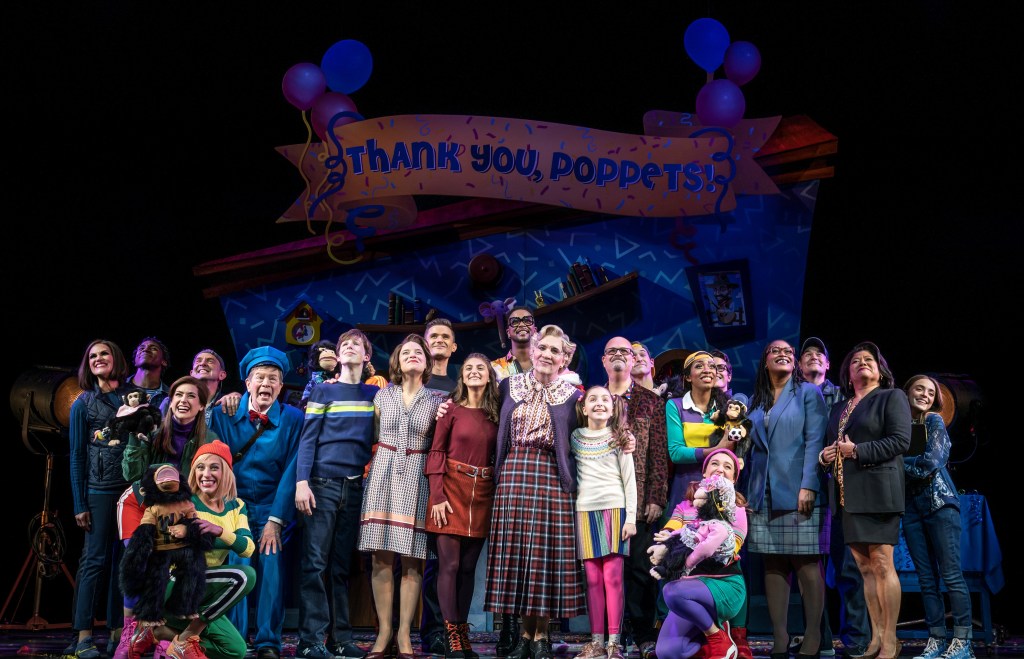
Mrs. Doubtfire has made a world of difference for Miranda who is beginning a relationship with Stuart (“Big Fat No”) and resolving the end of her relationship with Daniel (“Let Go”) who is miserable (“Clean Up The Mess”). In a conundrum obstructed by having to be Mrs. Doubtfire as he grows invisible with his children, he faces a reckoning with Sellner who puts together the viral Doubtfire sports model video and other information she receives from Miranda about Daniel. The reckoning begins in Sellner’s office when Daniel is supposed to appear with “his sister” Mrs. Doubtfire and turns into a surreal scene with Sellner as a magical, witchy type spirit proclaiming his doom in “Playing With Fire.”
Charity Angel Dawson pulls out all the stops wailing retribution for him in a shimmery red/orange dress against a fiery backdrop as a chorus line of Doubtfires send off Lydia, Chris and Natalie (Avery Sell) away from him presumably forever. Then the ensemble Doubtfires close in on him, singing the refrain, “The Truth Will Make You Free,” while sweeping their brooms in a haunting dance as Sellner sings her glory. And eventually the power of Sellner’s presence and voice along with the Doubtfires circling, engulf him dressing him in the hated Doubtfire costume and persona. The backdrop and set returns him to Miranda’s house where the final arrangements are set in motion for his big reveal that ends the charade once and for all (“He Lied to Me,” “Just Pretend”).
However, the truth with his reveal results in his redemption and Miranda’s acknowledgement that his true heart had to masquerade as Doubtfire for a time to show her and him what he was capable of. Additionally, with his new job on a TV Show starring Mrs. Doubtfire, the family is reminded of Daniel’s goodness. With the help of Sellner who shows her true colors and acknowledgement of Daniel’s love for his children, Miranda is convinced that Daniel must see and take care of Natalie, Christopher and Lydia with a joint custody arrangement (“As Long As There is Love”).
I have nothing but praise for Mrs. Doubtfire which is a whirlwind of emotion, comedy, farce, genius pacing, singing, dancing and crisp dialogue acutely directed and performed by the prodigiously talented Rob McClure who is breathtaking, as the other actors shine equivalently in their roles to assist him. The music, a combination of pop, hip hop, ballad and more functions to raise the emotional stakes at each turning point and grows from Daniel’s and Miranda’s struggle with each other. Mrs. Doubtfire’s book is well adapted by Kirkpatrick and O’Farrell and runs deep in this production because of the songs (Kirkpatrick and Kirkpatrick) their symbolism, the hybrid comical farce and continual pushing of the envelope to embrace Daniel’s guilt and imagination (“Playing With Fire”) (“Easy Peasy”).
Kudos to Ethan Popp for musical supervision, arrangements and orchestrations. Special kudos to Lorin Latarro for her choreography. Both bring a myriad of new elements to Mrs. Doubtfire and make it shine greater than the film.
The technical aspects (movable sets) are well devised for speed, and are well thought out and wrought for the quick scene changes and farcical, magical moments mentioned. Kudos to David Korins (scenic design) and Philip S. Rosenberg (lighting design) and Brian Ronan (sound design) as well as aforementioned Catherine Zuber, David Brian Brown and Tommy Kurzman. I loved the lighting and outlines of the cityscape, the Hillard household and touches needed for the success of various scenes (“Easy Peasy”).
The production is a superb adaptation combining the known and the new. It should be seen a few times because inevitably, there is so much to glean you will miss the symbolism and the profound characterizations which appear stereotypical initially, but are resonant and vital as are the themes mentioned. For tickets and times go to their website: CLICK HERE.
Annie Golden Kills in ‘Broadway Bounty Hunter,’ A Rollicking, Musical Hybrid
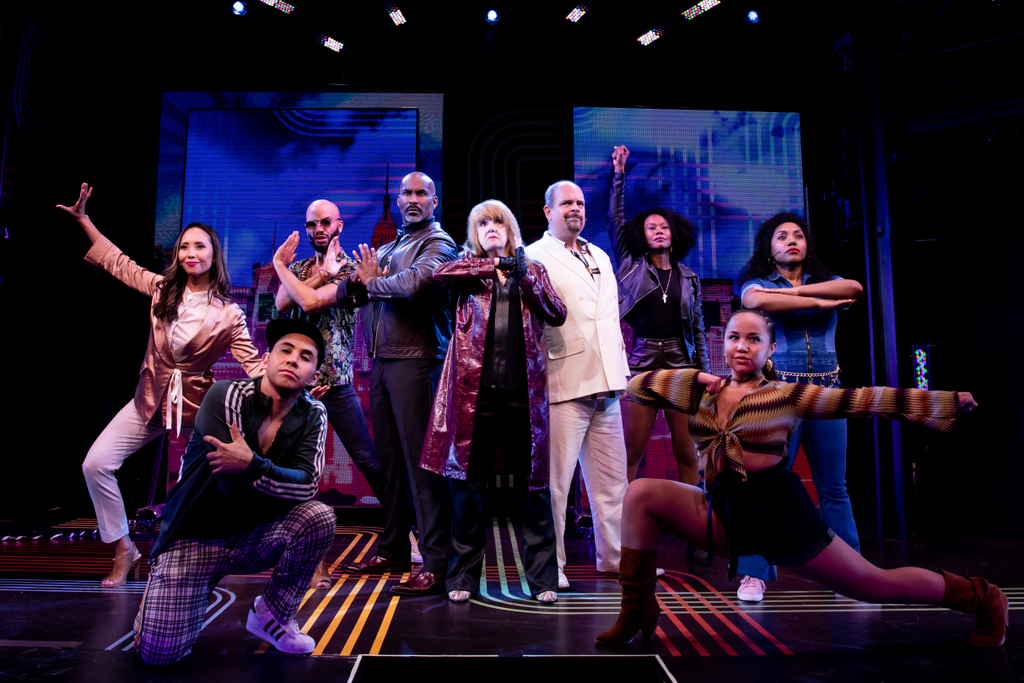
The Company of ‘Broadway Bounty Hunter,’ Music and Lyrics by Joe Iconis, Book by Joe Iconis, Lance Rubin and Jason Sweettooth Williams, directed by Jennifer Werner (Matthew Murphy)
Broadway Bounty Hunter starring the inimitable Annie Golden (Orange is the New Black for six seasons) is a musical comedy that gyrates into the stratosphere with hijinks galore. and a plot that careens to an apotheosis of self-fulfillment for the atypical, underdog, heroic bounty hunter characters. The just comeuppance for the white, privileged, male villain with a greedy, malevolent and double dealing heart (the excellent Brad Oscar) feels right by the conclusion of the production, though he has Broadway connections and was once a sensitive, artistic type until he turned to the “dark side.”

The Company of ‘Broadway Bounty Hunter,’ Music and Lyrics by Joe Iconis, Book by Joe Iconis, Lance Rubin and Jason Sweettooth Williams, directed by Jennifer Werner (Matthew Murphy)
With Music and Lyrics by Joe Iconis (Be More Chill) and Book by Joe Iconis and long time collaborators Lance Rubin (Bloodsong of Love) and Jason Sweettooth Williams (Be More Chill) the production is a hard one to “categorize!” That is its hybrid grace, for it defies description and is a meld of farce, satire, comedy and musical that keeps one riveted by divergences into adventurous, road-trip sequences and action that hypes up the humor and suspense, all the while having a blast and twitting itself. If that “description” appears over-the-top,” the show is just that, and its entertainment and production values are larger-than-life with the excitement and exuberance of a musical that is off-beat wild.
Yet, it begins on a dark, depressing note. Annie, an out of work actress and apparent “has-been,” as “A Woman of a Certain Age,” goes to an audition and is insulted and demeaned by the audition monitor, director and another actress she meets there. The opening number is choreographed and staged by the exceptional Jennifer Werner to encompass the entire theater. The ensemble takes on the roles of various New York City street folks. It is they who take up the cry that Annie later refrains, “they’re not giving no free rides,” to “kick you off the stage,” when you’re a “woman of a certain age.”

Omar Garibay, Jared Joseph, Badia Farha, Christina Sajous, Jasmine Forsberg, ‘Broadway Bounty Hunter,’ Music and Lyrics by Joe Iconis, Book by Joe Iconis, Lance Rubin and Jason Sweettooth Williams, directed by Jennifer Werner (Matthew Murphy).
This unhealthy dose of reality is a slap in the face to every women in the audience over forty and that is the point of revealing where Annie is in her life: in the pits, at rock bottom, in the valley of the shadow of death. Can it get any worse? It does, happy female campers!
After swallowing this bitter dose of time and place in her life, Annie goes back to her seedy apartment and her answering machine of dire messages and the coming blackout of her lights being shut off for non payment of bills. It is then she realizes it’s over for her in the song “Spin Those Records.” Her only solace is talking and singing to the resplendent Charlie, the picture of her Broadway producer husband, who died over ten years ago. As she attempts to persevere to get to the next refrain of the song “I won’t spin those records anymore,” the ensemble echoes her lament that her success has long faded and the songs she once sang in glory have now “forgotten her.”
That the real Annie Golden who has turned the trope of “woman of a certain age” on its head with her success in Orange is the New Black, is not lost on her fans in the audience who cheer her on. And that is the point of the first two songs; the successful Annie Golden can sing these (and she can belt with roaring power) with a hint of mournful acknowledgement that “it is done,” because it isn’t! This is the salvation and humor and hope, which is a major theme of this production. It is never done! It is never over! And surprises do come right around the corner and improve one’s circumstances. But you must persevere for their “coming.”
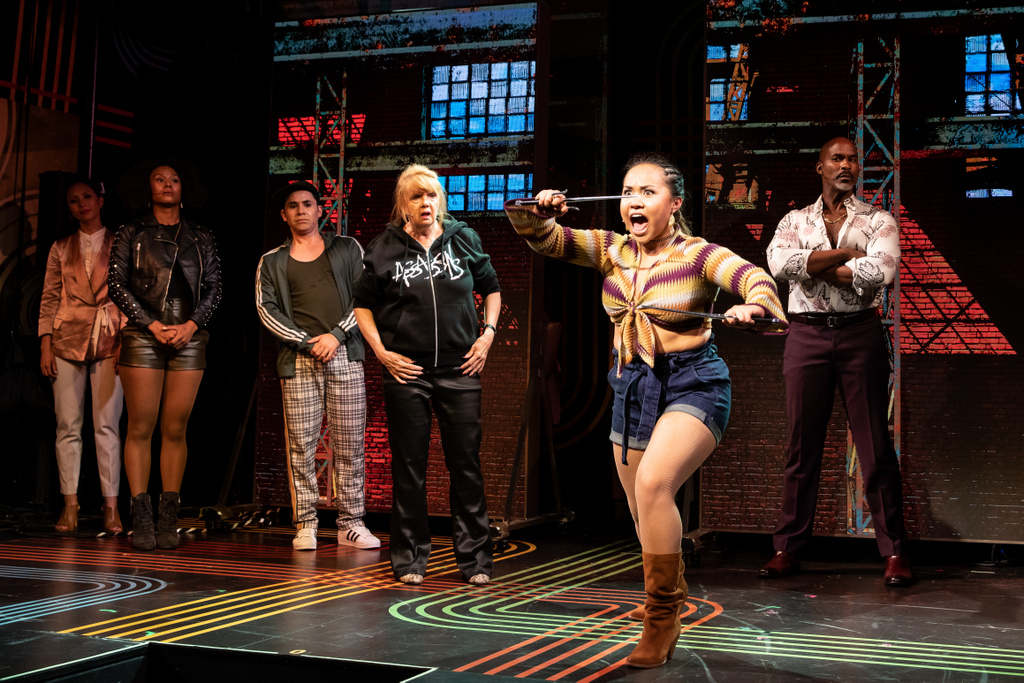
Jasmine Forsberg, and the company of ‘Broadway Bounty Hunter,’ Music & Lyrics by Joe Iconis, Book by Joe Iconis, Lance Rubin and Jason Sweettooth Williams, directed by Jennifer Werner (Matthew Murphy)
Annie’s “apparent” nemesis is that “the matrix” of privilege in the institutions of the patriarchical system (whether it be in the entertainment industry, politics or global corporate control) would dictate and select who and what can be successful, mostly white men; in the entertainment industry, young, white and thin. Nevertheless, the labels and definitions the institutions place can be overcome and twerked by redefinition and a revolution that embraces multiculturalism and defies ageism, which this production does! Though the setting is the past, the production speaks with its whole heart to the present! BRAVO!
With fervor, inspiration and a little “help” from your friends and colleagues who face the same conditions, you can prosper and thrive with effort, drive and enthusiasm. Considering that only the few “fit” the “success” labels, the great majority who don’t are allies. It is only a matter of perceiving this to be true and working to bring it into reality. Iconis, Rubin’s and Sweettooth Williams’ message is especially uplifting and forward thinking in this wannabe retrograde time of Trumpism.

(L to R): Jared Joseph, Jasmine Forsberg, Annie Golden, Christina Sajous, ‘Broadway Bounty Hunter,’ Music and Lyrics by Joe Iconis, Book by Joe Iconis, Lance Rubin, Jason Sweettooth Williams, directed by Jennifer Werner (Matthew Murphy)
The creators and director are masters of reversals. They turn inside out “the matrix” that would keep us inside “the box,” and keep audiences lulled into the traditional expectations of musical plot, spectacle and character so they don’t necessarily have to look for the profound. Iconis, Rubin and Sweettooth Williams are grand at going upside down and striking deep notes about our culture and society. This production from its funky, stylized music of the 70s and 80s found in Blaxploitation films like Shaft, Super Fly, Foxy Brown, Coffy, etc., to its kung fu, martial arts choreography (by Jennifer Werner) replete with nunchucks (chuka sticks) staffs and surround-action movement and staging with the ensemble abundantly using the audience aisles, soars with energy and excitement. And if you look for vital themes, they are everywhere from #metoo, to image fascism and silent oppression that doesn’t “exist,” until it slams you in the face.
Because we follow Annie to the outer depths of the Mariana Trench of emotional devastation, we are ready to soar with her to the heights of a new career as a “bad ass” bounty hunter hired by Shiro Jin (the classic, cool, deadly Emily Borromeo). We empathize readily with Annie as she accepts “Shiro’s Proposition” without completely understanding the how and the why of it. We cheer her on as Annie becomes accomplished in martial arts skills with the other bounty hunters. And when she gains confidence and bravery learning her “killer moves” and employing acting techniques to sharpen her inner “rage,” we thrill for her.
Ironically, by this point we realize this Bounty Hunter business is no joke. Annie automatically accepts her “mission impossible” to locate, confront and “take out” the despicable, drug pusher, pimp daddy killer with the hot name Mac Roundtree (the funny Brad Oscar). But what is a sweet “woman of a certain age” doing? Well, she does have the help of a strong, uber powerful, yet soft-hearted, sensitive partner Lazarus (the winning, gorgeous-voiced Alan H. Green).
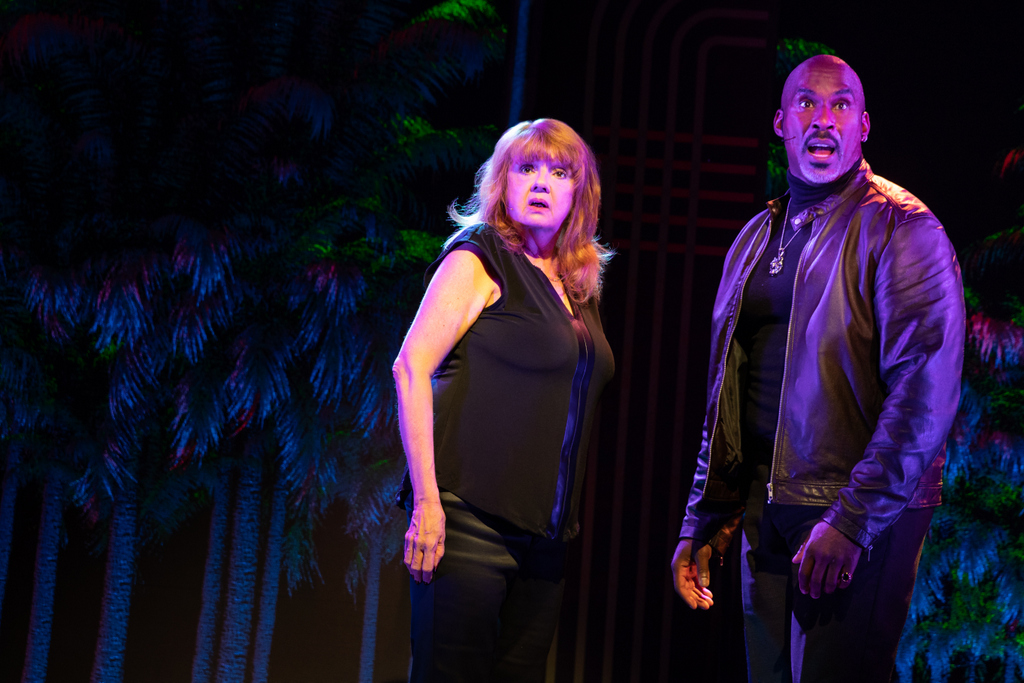
Annie Golden, Alan H. Green, ‘Broadway Bounty Hunter,’ Music and Lyrics by Joe Iconis, Book by Joe Iconis, Lance Rubin and Jason Sweettooth Williams, directed by Jennifer Werner (Matthew Murphy)
In the song “Mac Roundtree Theme Song,” Brad Oscar is the dirty, rotten scoundrel who will front them and “not go easily” against Annie and Lazarus, especially on his home turf in Ecuador. With this shades of the film Scarface, in the foreground, we understand the stakes have been raised and Roundtree is worse than Shiro Jin has let on to Annie and Lazarus. Indeed, their boss may be sacrificing Annie for her own agenda to kill Roundtree. Furthermore, Lazarus and Annie are counter intuitive partners; Lazarus finds her hard to accept and she is dismissive of him. Just before they end up at Roundtree’s mansion in the jungle, Lazarus does confront his demons with the ensemble’s help in”Feelings.” Alan H. Green is just plain out hysterical as he sings Lazarus’ inner angst.
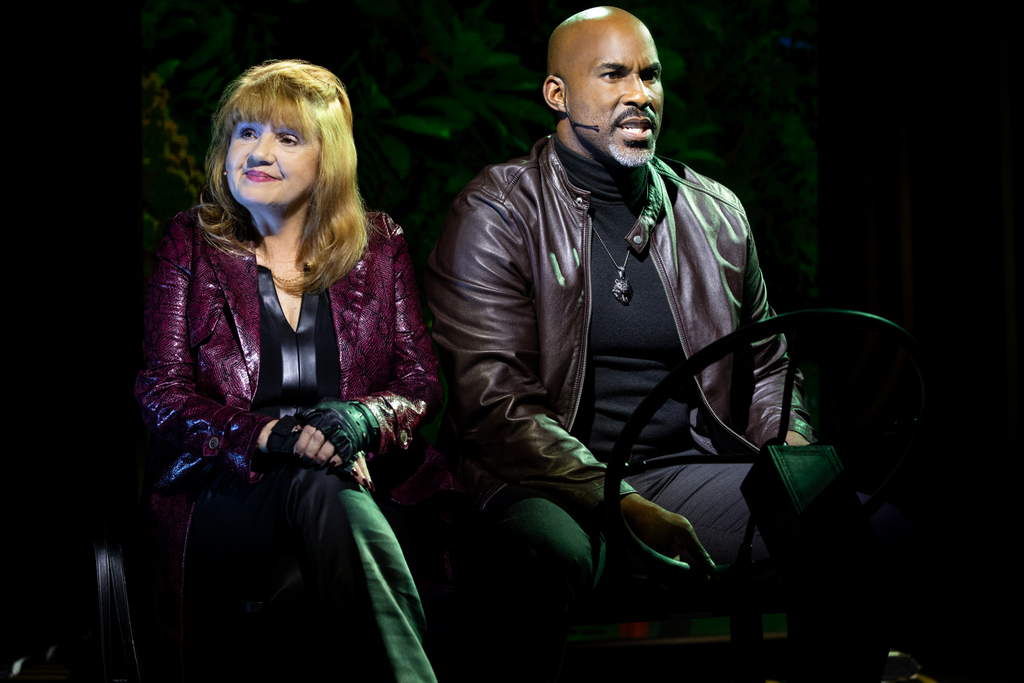
Annie Golden, Alan H. Green, ‘Broadway Bounty Hunter,’ Music and Lyrics by Joe Iconis, Book by Joe Iconis, Lance Rubin and Jason Sweettooth Williams, directed by Jennifer Werner (Matthew Murphy)
As they confront Roundtree’s allurements/prostitutes who gain information about the man and woman are who have come to Roundtree’s empire, the ensemble pulls out all the stops and performs the smashing “The Song of Janessa.” And it is then that the creators, once more, interject two twists in characterization and plot as the arc of development spins into an unexpected direction. Lazarus and Annie discover with a brief touch of the hand, they are attracted to one another (“Aint No Thing”). The second dynamic twist I will not reveal because it is a delicious reversal of a reversal and this is no spoiler alert. Suffice to say that Annie and Lazarus make a fascinating discovery which brings the production to an insightful and intensifying end of Act I. When Act II lifts into the heavens you are ready to hold beats and join Annie and Lazarus for the more surprises.

(L to R): Alan H. Green Brad Oscar, Annie Golden, ‘Broadway Bounty Hunter,’ Music and Lyrics by Joe Iconis, Book by Joe Iconis, Lance Rubin, Jason Sweettooth Williams, directed by Jennifer Werner (Matthew Murphy)
The production flies high with the performances that are campy, yet heartfelt. Standouts are the principals, Green, Golden and Oscar. The ensemble in movement, dance with powerful voices is exceptional. Thanks to Werner’s direction and choreography the show leaps from scene to energetic scene to the jazzy, funky, pop score beautifully rendered by Geoffrey KO, with Charlie Rosen’s Music Supervision & Orchestrations. Just great!
I also enjoyed the fine use of projection and video by Brad Peterson whose designs were the best I’ve seen Off Broadway. They melded with the Lighting Design by Jules Fisher and Peggy Eisenhauer and both sparked up and enhanced the tone and style of this musical, especially in the fight scenes, and Lazarus’ driving his sweet truck sequence. Kudos to Michael Schwelkardt for functional, clever scenic design, Sarafina Bush’s costume design (especially for the ensemble during “The Song of Janessa”) and Cody Spencer’s excellent sound design.
Broadway Bounty Hunter is at the Greenwich House Theater on 27 Barrow Street until 15 September. Reimagined, it moved from Barrington Stage Company where it had a critically acclaimed, sold-out run, to land in the city where the story of Annie Golden begins and ends triumphantly after she goes to South America to deal with a hardened drug pusher criminal. The production will probably have legs and continue to move. Regardless, if it goes uptown, it is a must see that is a unique, enjoyable ride into the past future. Female Bounty Hunters need to do more bad ass kicking the patriarchy before the election cycle is done. For tickets and times CLICK HERE.

