Blog Archives
‘Corruption,’an Important Play at Lincoln Center Theater, Mitzi E. Newhouse

Corruption‘s well paced reimagining of the UK phone hacking scandal involving Rupert Murdock’s News Corp. empire is written by JT Rogers (Oslo) and directed by Bartlett Sher (Oslo). The hybrid drama/comedy is enjoying its premiere off Broadway, Lincoln Center Theater at the Mitzi E. Newhouse. Rogers’ epic chronicle exposes key individuals employed by News Corp who follow a dangerous ethic: the ends justify the means. These media players believe that corporate profits legitimize any deleterious impact the media may have on the victims they exploit.
In the era of US fake conservative news, Roger’s two act play trenchantly reminds media consumers that malignant CEOs of companies monopolize and weaponize power and influence to oppress human rights. Ultimately, they direct global political affairs to their profitable advantage. Even if the companies harm the populace, and there are lawsuits, in the corporations’ ethos, it’s OK as long as the bottom line is not irreparably damaged. Corruption reveals that there are always ambitious and warped lackeys at the ready, like Rebekah Brooks (the excellent Saffron Burrows), who may engineer or accept malign acts for the company’s betterment.
Based on Tom Watson and Martin Hickman’s book Dial M for Murdock: News Corporation and the Corruption of Britain, Rogers’ play is an exhaustive and detailed examination of the players and insider events which reveal the cover up of News Corp’s employees illegally trashing the privacy of 11,000 citizens. These not only included celebrities. Reporters used “information” illegally sourced from politicians and ordinary people alike. With this material reporters sensationalized stories for maximum shock value. When they couldn’t get enough truth or facts to fill a teaspoon, they made up lies out of whole cloth.

During the unspooling of the play’s events, we learn that no one was considered too great or too small to smear and damage, as long as the effect produced was eyeballs glued to the tabloids, specifically “The News of the World” headed up by Rebekah Brooks CEO of News International.
The play is at its edgy, sharp best when Rogers dramatizes the conflict between key adversaries Rebekah Brooks (Saffron Burrows), and Tom Watson (Toby Stephens), as well as their allies and foes. For Brooks, problematic allies she manipulates are legal counsel Tom Crone (Dylan Baker), and Rupert’s son, James Murdoch, (Seth Numrich) in addition to Prime Minister Gordon Brown (Anthony Cochrane). For Watson, major allies include Martin Hickman, friend and reporter for the Independent (Sanjit De Silva), the lawyer representing hacking victims, Charlotte Harris (Sepideh Moafi), and Siobhan, Watson’s wife (Robyn Kerr).
There are forty-six characters portrayed ably by thirteen actors. Rogers sacrifices in-depth characterization, in part, to relay the sweeping phone hacking story that energizes his themes. In the forefront is the imperative that a free, vital press, unhampered by a company’s profit motive, is essential to produce the facts and information which enable a democracy to function. That way citizens can make informed decisions to improve the social good and hold bad actors to account. However, to receive such news and information, the populace must be educated and knowledgeable. It is up to them to reject a diet of calumny, lies, and sensationalistic fabrications that support anti-science “the earth is flat” stupidities, and “in your face” political propaganda and nihilism.

Escapist tabloid journalism which exploits the “sickness” of others in a voyeuristic display to make the reader feel better with their lot, capitalizes on the lowest bar in human nature. Rupert Murdoch’s News Corp revels in feeding the populace trash for high profits, then projects that citizens are to blame for demanding such fare. This is an affirmation that the character Rebekah Brooks suggests at the play’s conclusion. In her final commentary, she justifies the necessity of The News of the World with a presumption that without the tabloids’ profitable journalism, there would be no other journalism. “The
profits from my papers allow the papers you read to exist. There is no journalism without my journalism.”
However after careful consideration Rogers’ Corruption shows that Brooks and Murdoch’s tabloids and his faux “news” empire normalized indecency, negative propaganda and lies in order to control and gain power. The playwright’s overriding question is whether Murdoch and Brooks truly provided a necessary service or negatively frayed the social fabric of goodness because of their own greed and rapacity.
The play opens at Rebekah Brooks’ wedding reception, where Rogers introduces the ambitious woman that Rupert Murdoch trusted to make him money. In a private room, newly appointed head of News Corp UK, James Murdoch, and Brooks go head to head. They argue about the direction of News Corp’s future. James Murdoch asserts that the print division barely makes money. From James, we learn that Brooks has clawed her way through the ranks to be editor of The Sun, a powerful position which gives her equal footing to counter his arguments.
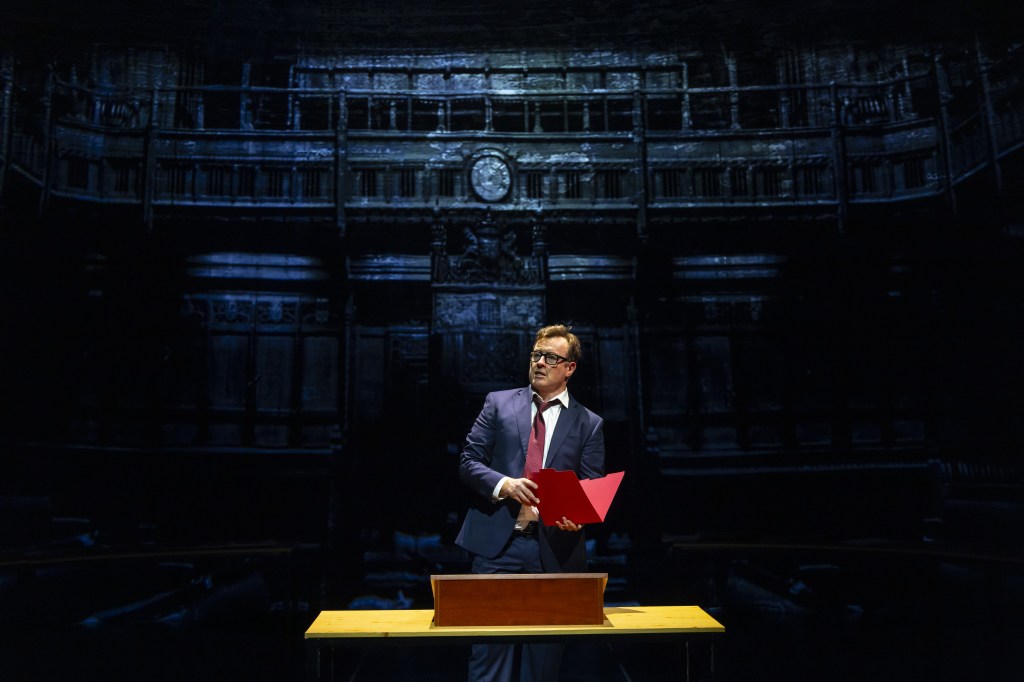
Numrich’s Murdoch states that technology, digital media, and TV are where News Corp will be in the future because print journalism is a relic of the past. Brooks argues that her print division fuels all other journalism. At the end of the scene James Murdoch congratulates her on her new appointment as CEO of News International. Father Rupert Murdoch trusts her with the responsibility of continuing the profitability of all the Murdock tabloids. She will not let papa down.
Throughout the play, Rogers highlights the nefarious brilliance of Brooks who maintains the efficacy of the scurrilous tabloids and stops at nothing to ensure they add to the soaring profits of News Corp. No wonder why old school Rupert Murdoch loves her more than his son, and does everything to keep her near, even after the scandal blows up in their faces.
In attempting to cram in salient details, Rogers keeps scenes short. Sher directs the action at a seamless, brisk pace with minimal set design by Michael Yeargan. The tech crew interchanges and rearranges tables between scenes to provide the change of setting and atmosphere of alacrity. The staging reflects the rapid and shifting state of the “news” media, hyped up on digital steroids. It predominately features multiple TV screens onstage and at the top of the proscenium. The screens show various news clips and shows during that time. The blinking screens are purposefully a distraction from the dialogue. When text messages are posted, we see the quotes projected on the back wall via 59 Productions projection design.

Ironically, with the media constantly flickering at us, the audience becomes numbed to the visuals and eventually ignores them. One of the takeaways of Sher’s staging is that the media overload we are expected to negotiate and be aware of on our phone screens numbs us and in fact dulls our awareness. It becomes harder to keep up or understand the complexity of events that are reduced to a few words of soundbites and quickly edited visuals. Without that complexity of understanding, facile, wrong opinions are formed and judgment is skewed toward the superficial assumption and wrong conclusion.
Companies like News Corp rely on tabloids to offer a contrast to the in-your-face screens which mesmerize and numb. The tabloids give the reader the semblance of “controlling” the information that they have bought in print. However, the opposite is true and, as Rogers’ drama proves, the tabloids are filled with mostly exploitation pieces that masquerade as factual and realistic. Understanding and depth are sacrificed for the superficial and shocking.
During the the first act, we note Brooks and News Corp’s power. Brooks gently threatens Prime Minister Gordon Brown to fire Tom Watson (his labor MP who has been his hatchet man). She warns Brown that the story she is releasing about Watson will create havoc and implies if Brown doesn’t get rid of him, it may take down the Labor Party and Brown with it by association. Brooks jokes that Brown is “running the country, isn’t he?” Indeed, maybe he isn’t, if Brooks is leveraging lies to force Brown to fire Watson.

Brooks wields tremendous power as a kingmaker and king breaker. She operates with impunity, because no one has the courage to investigate or litigate against “The News of the World’s” defamation, lies, calumny and payoffs. We learn the tabloids’ shock and scandal value are critical to blackmail. Brooks and the tabloid intimidate almost everyone who is anyone in the culture and society of the UK.
Watson confronts Brown about Brooks’ political hit job. Sher has the actual headlines projected on the backstage screen, “Treacherous Tom Watson,” “Mad Dog Trained to Maul,”etc. Brown soft pedals Watson by saying no one believes the lies that Watson “registered pornographic websites under other politicians’ names.” However, Brooks doesn’t retract the lies as other UK papers do. Siobhan, Tom’s wife, insists that Tom lay low in parliament and say nothing because she is tired of the negative PR and the outrage and stalking that has hounded them and terrified their son. Watson quiets down in parliament in the next scene and we see how Brooks gets her way now and in the future when News Corp backs the Tory Party candidate James Cameron to win.
Though Brooks has sucked the life and power out of Watson, he sues and his fury converts to action as he teams up with his friend Martin Hickman from the Independent and other allies after learning the police quashed an investigation into phone hacking. Brooks and Andy Coulson, the heads of News International disavow any knowledge of the hacking, despite documents that link hired investigator Glen Mulcaire’s (Dylan Baker), illegal acts to News International reporters.

The fact that only Mulcaire goes to jail while Andy Coulson is promoted to director of communications for David Cameron and the Torys spurs Watson and his team to apply pressure via Twitter, blog posts and other social media questioning why the police backed off the investigation. Not only do they elicit the help of a wealthy individual who had been hacked and slimed, eventually, they pull in the New York Times to cover their story. Watson’s team brings into view how Brooks and her cohorts have destroyed the lives of ordinary citizens and caused destruction and misery for profit.
In the very long first act which is expositional, perhaps some of the details and/or scenes may have been edited and reworked. The second act moves quickly to a satisfying resolution as The News of the World, Coulson and Brooks are held accountable. However, the punishment is a mere slap on the wrist for Coulson-four months in prison. Brooks is found innocent of all charges. Though Murdock closes down Brooks’ tabloid, after a time, she is keeping things humming elsewhere.
When the question arises, what did they all go through hell for, it is Watson’s wife Siobhan who encourages Tom to continue to stand up for the truth. Only with persistent fighting against the maelstrom of lies will the truth ever be seen. One can only hope.

Corruption is an important play about the Murdoch empire that reveals how News Corp steamrolled through the UK first to gain extraordinary power which then was used to blossom evilly in the US. Leaping across the pond News Corp’s malignant MO impacted the 2016 US presidential election by helping to install the incompetent, unqualified, Donald Trump as president. His negligent, derelict actions during the COVID-19 pandemic had serious global economic impact and social repercussions that many countries are still reeling from today.
Fox News in the US perpetuated Donald Trump’s making COVID-19 a political crises. Tragically, this political emphasis actually spread the contagion and made it difficult to ameliorate, especially in the southern United States. If the UK had acted to contain News Corp and hold it accountable with massive financial fines and more severe punishments, it may have paused News Corp’s Brooks, Coulson and others and curtailed its power and influence in the US
Rogers raises important questions in Corruption. What price do we pay for the decency and dignity of privacy? For those who violate our right to privacy, shouldn’t the punishment be severe because it is a crime of violence on our persons, a metaphoric rape and humiliation, especially if the citizens are not celebrities getting paid for their fame?
Though the play has infelicities, the acting, direction and pacing allow the themes to shine. It is these in our time that resonate most fiercely, especially as we face the AI fabrication of photographs, voices and more.
Corruption. Lincoln Center Theater at the Mitzi E. Newhouse. The play is two hours forty minutes with one intermission. https://www.lct.org/shows/corruption/schedule/
Broadway Theater Review (NYC): ‘Bernhardt/Hamlet’ Starring Janet McTeer, a Stunning Portrayal
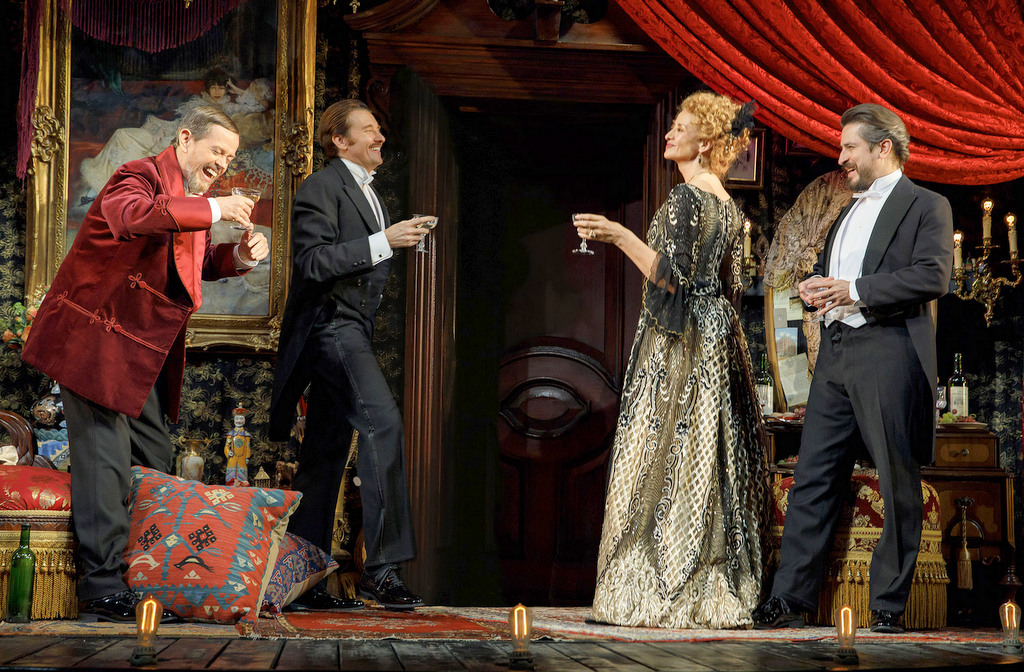
(L to R): Dylan Baker, Jason Butler Harner, Janet McTeer, Matthew Saldivar in ‘Bernhardt/Hamlet’ by Theresa Rebeck, directed by Moritz von Stuelpnagel (Joan Marcus)
Theater scholars, dramatists, and actors are familiar with the legend of French actress Sarah Bernhardt (1844-1923), referred to as “The Divine Sarah.” Renowned for her indomitable theatrical greatness, she lived and breathed drama, melding her life and her art so that each informed the other. Alluding to this synergy of living artistry, Theresa Rebeck’s play Bernhardt/Hamlet explores the French actress’s acclaimed reinterpretation of the role of Shakespeare’s Hamlet, which she imbued with her own maverick genius and courage. Examining the actress’s work, the play, thrillingly directed by Moritz von Stuelpnagel, shows us thematic parallels to our times.
As Sarah Bernhardt circa 1897, confronting Shakespeare’s best-known character, Janet McTeer’s dynamism astounds. Her Bernhardt is a whirlwind of delight and shimmering brilliance. She propels the light and dark of human ethos with a range that bounds and swirls and captivates. In short, McTeer infuses her Bernhardt with an infinite variety of emotional hues so that we believe how and why Oscar Wilde referred to her as “the Incomparable One.” Additionally, we appreciate that Bernhardt was not only a visionary in enforcing her will to create opportunities for herself. For women who witnessed her heroism, she drove the platform of freedom, despite and because of a culture and society expressly controlled by men.

Dylan Baker, Janet McTeer in ‘Bernhardt/Hamlet,’ Roundabout Theatre Company (Joan Marcus)
Rebeck intimates that Bernhardt accomplished what every female actress covets. The actress intrepidly portrayed the complexity and angst of Hamlet’s human spirit with the realism of the mysterious feminine gone rogue, as only an exotic like Bernhardt could do. From her affairs with some of the crowned heads of Europe, to her re-imagining herself through her relationships with authors and playwrights, Bernhardt proved her exceptionalism. Continually, as she gained power and fame, she pushed the envelope of female propriety. And amazingly, the public adored her for it.
However, when she takes on the role of Hamlet to bring it to a larger, more profitable theater, her closest allies sound warnings. Edmond Rostand is one such ally. Jason Butler Harner skillfully portrays the poetic, conflicted author of Cyrano de Bergerac, who worked with and wrote for Bernhardt. Her lover in the play (a relationship that was rumor in real life), he must choose between his career and hers. Of course this is an irony. Rarely did women have the opportunity to have choices as Bernhardt did. In this instance, the hard choice becomes Rostand’s with regard to their work on Hamlet.
We see that the two consume each other in their relationship, which is a blessing and a curse. Harner’s potent by-play with McTeer when he challenges her “demented idea” of rewriting the iambic poetry in Hamlet’s speeches is particularly striking. His forcefulness stands against McTeer’s indomitable will in Rebeck’s exceptional characterizations. Their equivalent passion reveals the high stakes for each. Thus we appreciate the inevitability of their partnership taking a turn after he becomes famous with Cyrano and she moves on with an interpretation of Hamlet sans poetic rhythm and written by others.

Jason Butler Harner, Janet McTeer in ‘Bernhardt/Hamlet’ directed by Moritz von Stuelpnagel, written by Theresa Rebeck (Joan Marcus)
The other ally who opposes Bernhardt’s endeavor is critic Louis, played by the stalwart and stentorian Tony Carlin. He argues with and attempts to influence Rostand in an important scene. Here we see the dangerous, shifting ground Bernhardt must negotiate as Louis questions her Hamlet choice. Perhaps the scene could be less expositional, but it is a necessary one for advancing the stakes and presenting the seeds of themes.
For example, women’s stage roles traditionally remained weak asides to fascinating, dominant male protagonists. Male roles, complex and intelligent, provided the driving dynamic that women’s roles did not. To take on a man’s role, a woman must have the power and even greater acumen and ambition to accomplish it well. Unsurprisingly, both men question whether Bernhardt has the chops to meet the Hamlet challenge.
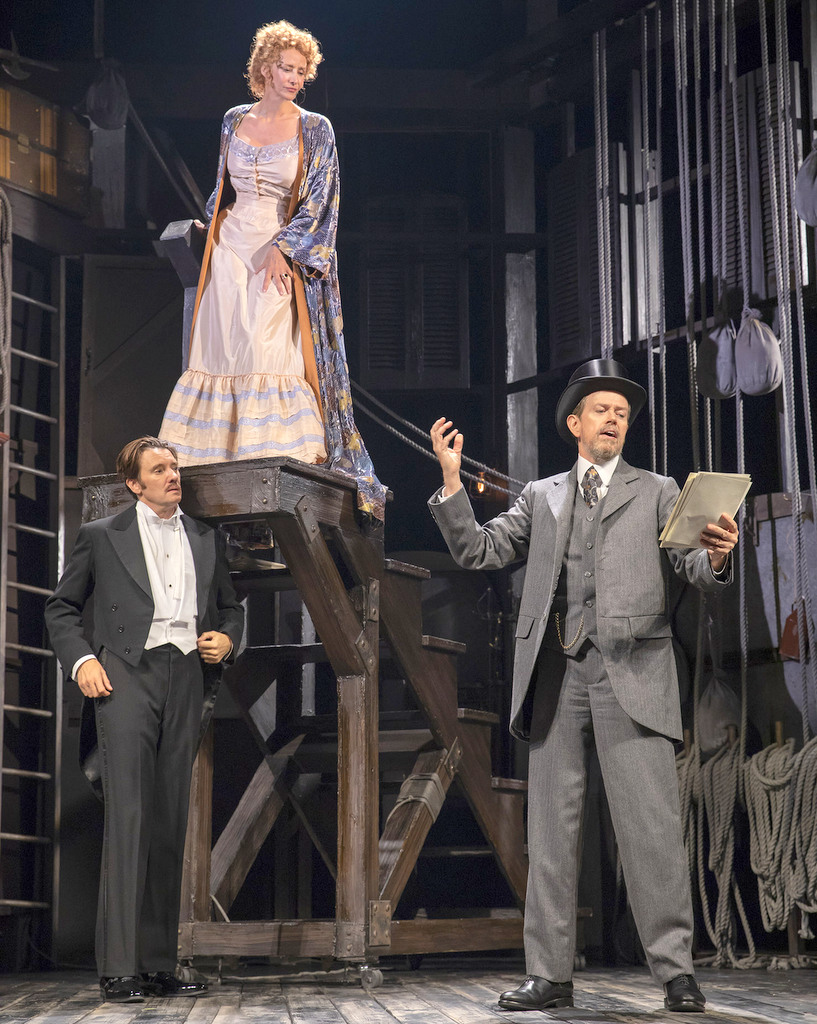
(L to R): Jason Butler Harner, Janet McTeer, Dylan Baker in ‘Bernhardt/Hamlet’ (Joan Marcus)
Through the real-life characters of Rostand and Louis, the playwright highlights the conflicts and problems McTeer’s Bernhardt faces. Additionally, Rebeck shows us how the staging, costuming, and promotion of this new, interpretative Hamlet must be conquered.
Wonderful in supporting roles are Dylan Baker, Matthew Saldivar, and the fine Brittany Bradford as actress Lysette. Baker portrays Constant Coquelin, Bernhardt’s acting contemporary and friend. Notably, Baker gets to have fun playing Hamlet’s father in a hysterical rehearsal scene. Experienced in the role himself, Coquelin guides Bernhardt as a quasi acting coach. Coquelin’s wisdom and sound judgment reflect his greatness as an actor. Eventually, Coquelin took on the role of Cyrano with great success. Baker’s versatility shines in his speeches as Cyrano, Hamlet’s father, and various roles including the great Coquelin himself.
Saldivar portrays Alphonse Mucha, whose artistic skills must beautify Bernhardt’s poster productions. Humorously, he expresses his upset with the task at hand. Indeed, Bernhardt’s hair, her clothing, her stature as Hamlet must enthrall and entice paying customers, a novel feat even for one of his skill. He cannot easily produce advertising artwork that will please Bernhardt, himself, and his public. Thus, as Bernhardt navigates new ground with her incredible decision to play Hamlet, so must Mucha and the others in her circle deal with the “dire” consequences. What a delicious conundrum her “simple” need to play Hamlet creates for these men whom she frustrates yet enthralls!

(L to R): Janet McTeer, Brittany Bradford in ‘Bernhardt/Hamlet’ (Joan Marcus)
The symbolism presented by Bernhardt’s desire to enforce her will upon the culture electrifies. Subtly, when she donned the pants in Hamlet, Bernhardt symbolically freed all women from fashion folkways. Her pants-wearing signals a needed change. Women’s mores were held fast by paternalism and manifested subtly in binding corsets, bustles, and long sleeved-high collared blouses. Worn even in heat waves, these sometimes smothered the wearers, who died of heat prostration. Fashion trends, as painful as they were, laid subservient female stereotypes at women’s feet. And they dared not transgress them. Do such trends abide even today? Sometimes.
In Rebeck’s characterization of Bernhardt, the more restrictive the “thou shalt not,” the more the actress embraced it, conquering fear. In her revolutionary behavior she dismantled the “double standard.” And because she did this with aplomb, sophistication, joie de vivre, and the audacity of wit and whimsy, who could censure her? As she developed her dramatic art, she empowered herself. Memorably, McTeer takes this characterization and with precision lives it in two acts. She evokes the marvelous “Divine Sarah” and makes her a heroine because she can. How McTeer creates her Bernhardt with adroit skill, subtle intelligence and determination is a Bernhardt-like feat.
What a breathtaking reminder of magnificent women in this twisted, political tide of times. Assuredly, Rebeck’s work (McTeer’s speech to this effect rings out beautifully) remains vital and insistent. With commanding power, McTeer’s Bernhardt corrects the historical record, striking forever at the literary and dramatic canon with a tight phrase. She proclaims to Rostand that she will not play the “flower.” The night I saw the production, the women in the audience applauded these words. “I was never a flower, and no matter how much you loved how beautifully I played the ingenue, it was always beneath me. It is beneath all women.”
This moment electrifies. For though women may be compared to flowers, they are not flowers. And Bernhardt, like all women, understands. For women are power brokers, however hidden, however “passive.” Regardless of how much men nullify this truth, “woke” women grew and grow to learn and champion it. And many achieved and achieve momentous feats even from the position of “second.”
Bernhardt captured opportunity and molded destiny so it served her, not the other way around. Strengthening and illuminating her own identity, she wrote her own history, not the one the culture intended to write for her and but couldn’t. McTeer’s inspiring depiction proclaims this with every card in the deck. Indeed, when Bernhardt says about Hamlet, “I do not play him as a woman! I play him as MYSELF,” we glean the full truth of her meaning.
Rebeck wisely selects the most vital of Hamlet’s speeches. Their themes meld aptly with Bernhardt’s conundrums. Indeed, Bernhardt is “a rogue and peasant slave.” At the time she rehearses that speech, she, like Hamlet, divines how an actor uses his skills to portray a character. The double meanings are ironic. But unlike Hamlet, Bernhardt is active, assertive. As Hamlet struggles with acting crazy to hide the knowledge of the truth of his father’s murder, she struggles with a Hamlet too passive to kill. Indeed, the humor comes in watching Bernhardt’s frustration at portraying an “inactive” Hamlet who comes up with philosophical obstacles to delay killing Claudius.
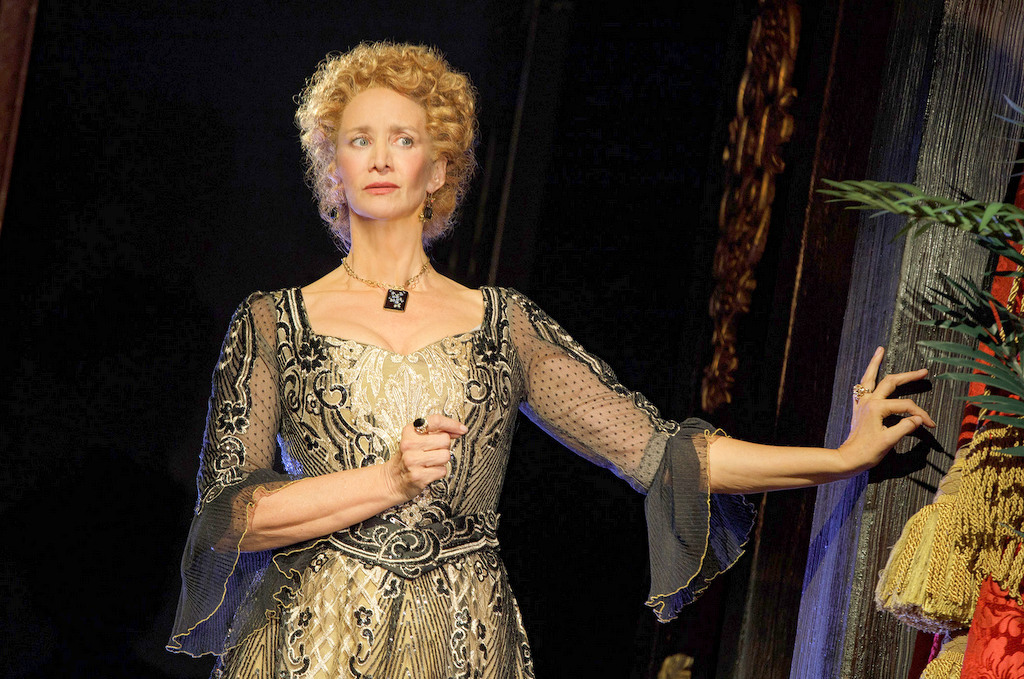
Janet McTeer in ‘Bernhardt/Hamlet’ by Theresa Rebeck, directed by Moritz von Stuelpnagel (Joan Marcus)
Rebeck interweaves in a complex way Hamlet’s speeches to emphasize Bernhardt’s conflict in deciding how to approach and interpret the role. One must work to catch all the ironies. So revisiting the play to enjoy this profound rendering is worthwhile.
Through active dialogue, we learn of Bernhardt’s promotional savvy and ability to reinvent herself for every decade. Naturally, this excites comparisons to today’s long-lasting actresses and others who could learn a thing or two from Bernhardt. Without fear, she capitalizes on rumor, innuendo, and extraordinary behavior that’s verboten for women. Cleverly, she makes critics her friends and generously remembers those who might have turned enemies.
Never an invisible woman, she will play men’s roles. In an affirmation about playing Hamlet and being a woman, she states to Rostand: “Where is his greatness? Where? Is it not in his mind, his soul, his essence? Where is mine? What is it about me you love? Because if in our essence we are the same, why am I otherwise less?”
Thus, Rebeck’s choice of this pivotal, “make or break” moment in Bernhardt’s career is an inspired, complicated one. The turning point reveals the grist, bravery, and revolutionary fervor Bernhardt required of herself to overturn centuries of dramatic tradition. Bernardt’s choice to conquer the greatest role written for men propels her to theatrical heaven. It is sheer artistic genius in a time when women were the “incapable,” “inferior” ones mastered by man’s sham invincibility. Bernardt/Hamlet through the seminal performances of McTeer and the ensemble informs and encourages us to realize that Shakespeare also speaks of women when Hamlet says, “What a piece of work is man. How noble in reason…”
Assuredly, kudos go to the spectacular artistic team. I particularly loved the sets (Beowulf Boritt), costumes (Toni-Leslie James), and hair (wig design by Matthew B. Armentrout). Lighting is by Bradley King and original music and sound design by Fitz Patton.
Bernhardt/Hamlet will be a multiple award winner. It is a must-see TWICE! This Roundabout Theatre Company production runs at the American Airlines Theatre on 42nd Street. The show until 11 November. Visit the Roundabout website for schedule and tickets.
 CAROLE DI TOSTI