Blog Archives
‘Girl, Interrupted,’ This Play With Music is Stunning and Memorable
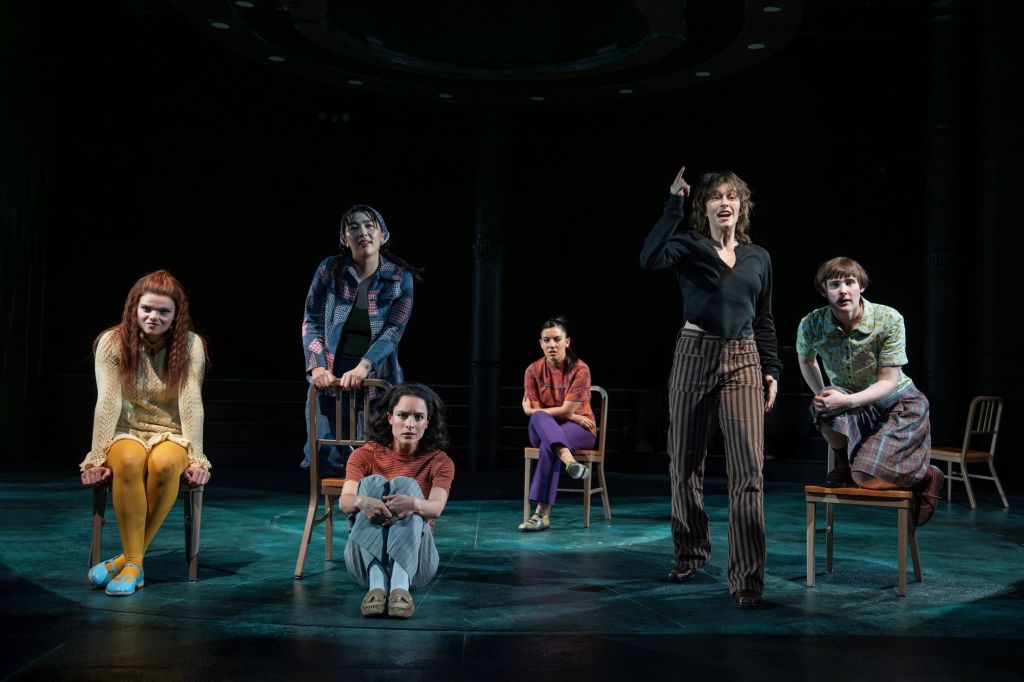
Matyna Majok’s adaptation of Girl, Interrupted, based on Susanna Kaysen’s titular memoir resonates with lyrical, haunting music by Aimee Mann. The production has been extended yet again until July 12, 2026 and is currently at the Public’s Martinson Hall. The play’s somber music of ballads and gentle, low key blues songs strikes with its cadences and simple, clear lyrics. Both heighten personal identification with the characters. The music informs the acting and is the linchpin that makes the production riveting.
Susanna (Juliana Canfield of Sterophonic) narrates her journey through McLean as she bumps up against women her age and ultimately crashes into acknowledging she was depressed and tried to kill herself. Initially opaque about the reason why she lands in the psychiatric hospital, she finds comfort in her fellow patients and the cultured and gentle roommate Grace (Mia Pak), who sings-shares that the upscale institution was a temporary home for Robert Lowell, James Taylor, Sylvia Plath and Ray Charles until they got back on their feet.
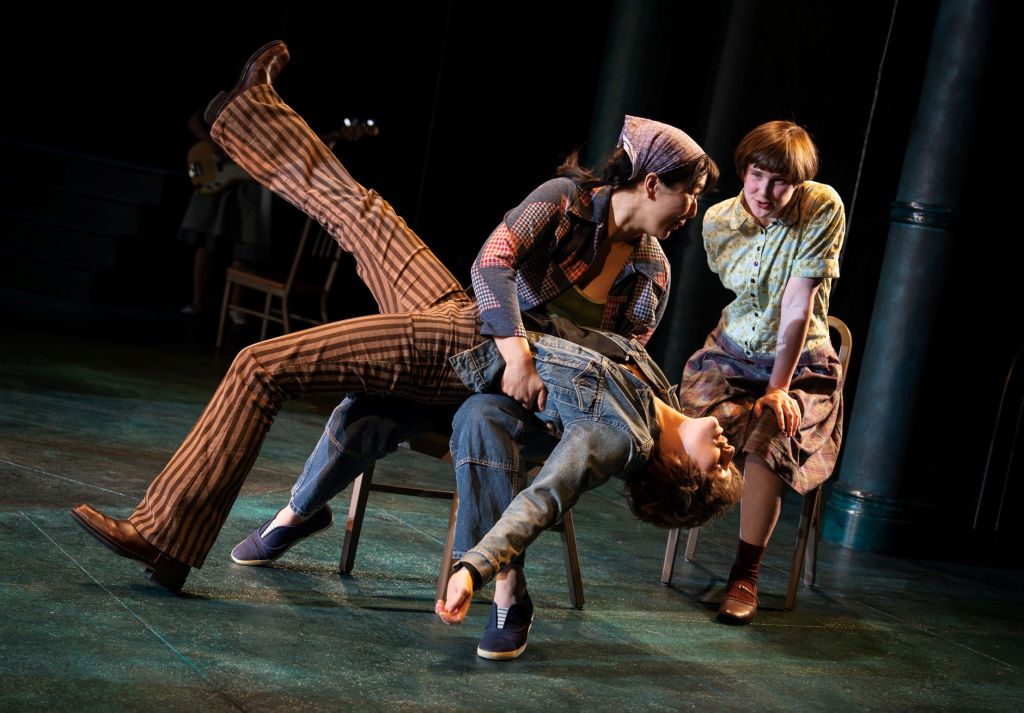
As she sings Grace infers that their experiences at McLean might find their way into a book because Susanna mentioned she is a writer. Ironically, it would seem that artists, writers and musicians not “right” with the world have passed through McLean and something changed in their lives, though Susanna quips that Sylvia Plath should have gotten a refund. Plath committed suicide; the “place didn’t work for her.”
Over the span of two hours in dots minimal set design, which includes a wired circular cage raised in a spiraling pattern above the stage that threatens where they may go if “warranted,” we discover why five patients and Susanna have checked themselves into McLean or were committed. We learn that all don’t fit into the society and have defaulted to various means of self-abuse, perhaps punishing themselves for not adjusting to what others want them to be.
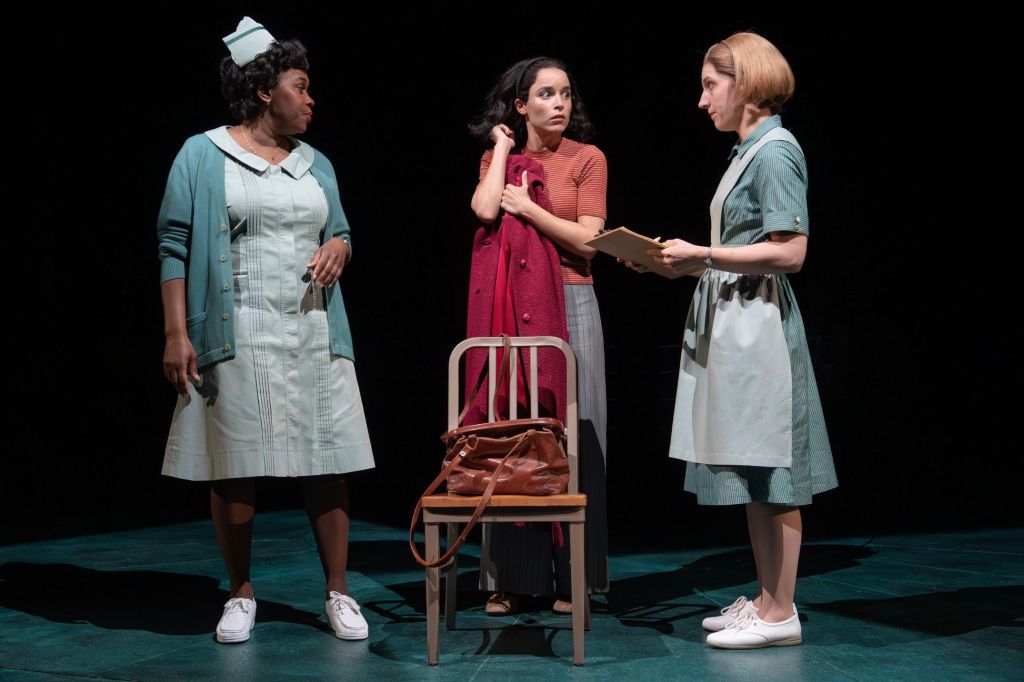
Directed by Jo Bonney the staging is strong and stylized in a set with few props that relies on Heather Gilbert’s excellent lighting design. The ensemble’s lovely voices reinforce the themes of Majok’s adaptation in the poignant timber of Mann’s soulful notes.
Lisa (singer./song writer King Princess in a sexy, fluid, dynamic portrayal) challenges the others and provides an electric spark of rebellion against an outer world of madness that all the girls appreciate, especially when she escapes to freedom only to be dragged back inside. Like Lisa, each of the girls makes their own attempts at freedom which in the translation of their actions against themselves reveals the extent they feel imprisoned by pain, isolation and self-rejection. We learn Polly (Sally Shaw brought down the house when she sang) poured gasoline over herself to “burn out” the shame and “get rid of” the person she believes herself to be. Tori (Gabi Campo) is dumped in McLean by her parents who insult her and blame her for their problems then take her to “Mexico” where she “shoots speed” because she can’t get what she needs from her parents or presumably anyone.
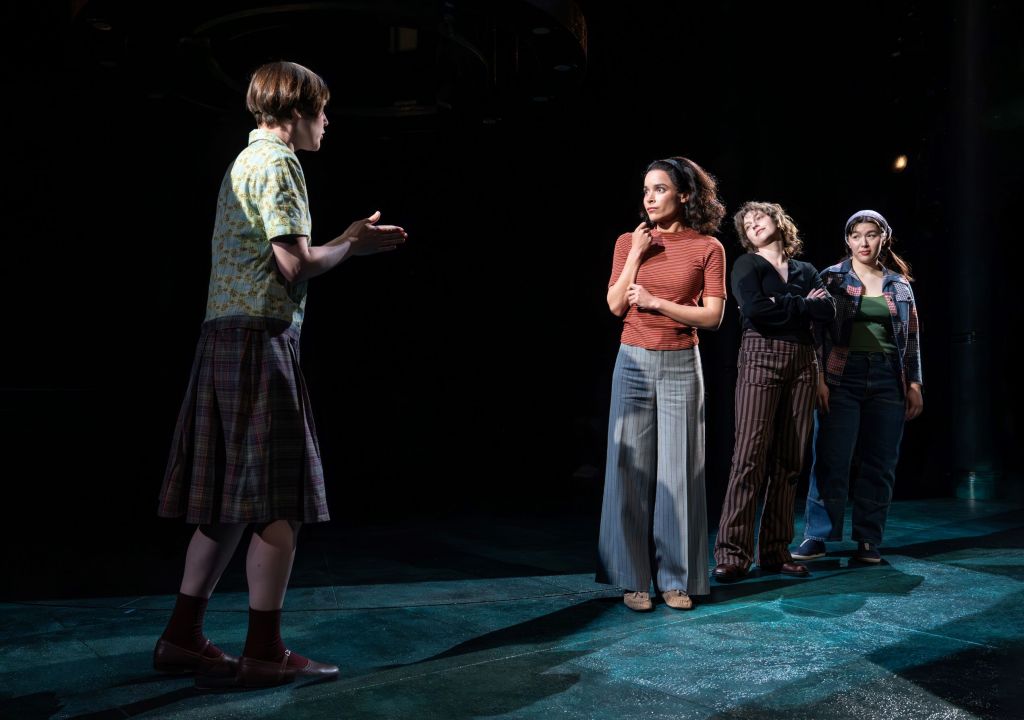
Daisy (Katherine Reiss), who goes to McLean as a “seasonal event,” is perhaps the most tragic of all having an incestuous relationship with her father. Her food obsession manifests the relationship in a disturbing way and there is nothing that can be done to help her. Likewise, Grace falls apart and it is frightening for the other girls to see her disturbed state when they visit her. Though Tori is forced to leave, she knows she will resort to her drug addiction. Polly is bound up and imprisoned by the sheaths of her scar tissue. Only Lisa and Susanna remain sentient as the others they are close to “drop like flies.”
Susanna is stuck in McLean and accepts being there for almost two years getting therapies and speaking with Dr. Wick (Emily Skinner) without a “plan” for her life, knowledge of what is “wrong with her,” or why she feels the way she does. However, she learns something about many asylums and mental institutions. Susanna discovers it is easy to get into McLean, but it is nearly impossible to get out, even if one signs oneself in or agrees with someone signing her in as she did with a doctor after a fifteen minute interview.
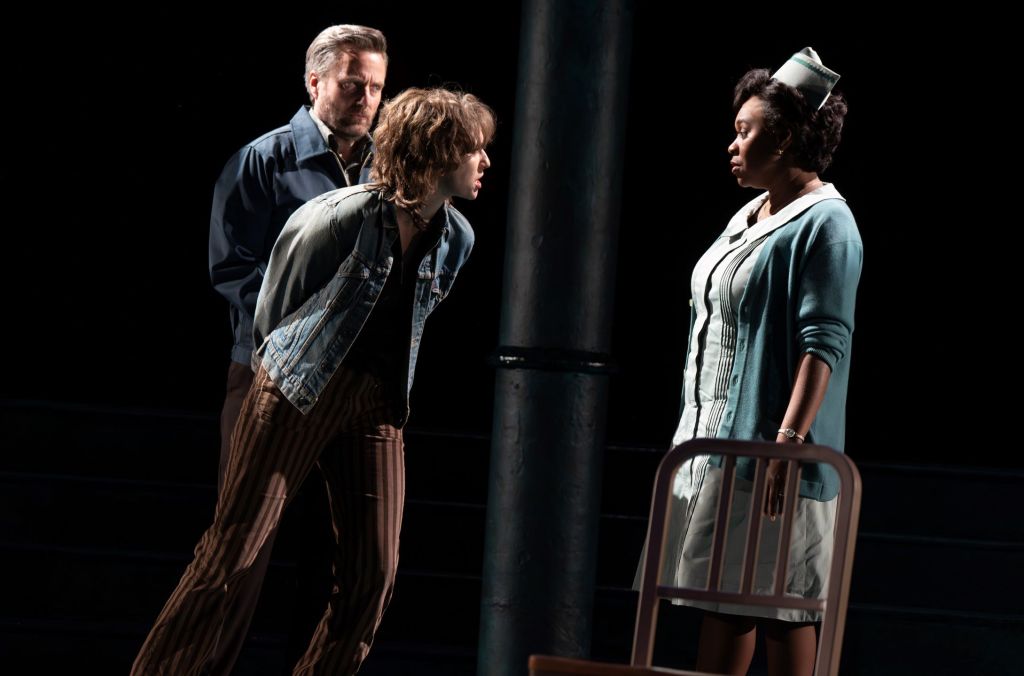
After almost two years, something happens and she finds a way out, not because she has confronted herself and heals, but because her way out, “marriage,” is acceptable to the doctors and patriarchal institution. It is obvious her decision is strongly motivated by “fitting in.” In other words, the culture and society only accept women who obey, women who don’t rebel or resist, women who fit into the roles men have proscribed for them. She can be released into the hands of her husband, regardless of the fact that this may be a terrible decision.
Majok’s conclusion has a spiral circularity that satisfies as Susanna finally realizes what she needed to know about herself years later during a visit at the Frick Museum looking at Vermeers with her bored husband. The event is symbolic and ties in the play’s development neatly. Susanna has an epiphany looking at a Vermeer painting, really looking at it, without allowing another’s perspective to cloud her own.
Canfield does a fine job throughout, assisted by an excellent ensemble. Her interpretation of “I See You,” at the conclusion where Susanna is finally visible to herself without the filters of the world’s view is especially resonant and current.
Girl, Interrupted runs 110 minutes with no intermission at the Public Theater’s Martinson Hall. https://publictheater.org/productions/season/2526/girl-interrupted/
‘The Cher Show’, a Joyous Celebration of The Power of Hope and Persistence

Stephanie J. Block as Star and the cast of ‘The Cher Show,’ (Joan Marcus)
Did you ever think you “knew” all you wanted to know about someone only to find out wonderous inspirations about them? No, I am not referring to our current president in the White House. I am referring to a feminine icon who has established herself as a tour de force for women through six decades, blowing past generational limitations and showing the way to “become” before Becoming (Michelle Obama’s glorious best-seller) was fashionable. Well, Cher, the Pop Goddess Warrior I never quite “got” is a superlative example of how no woman should allow anyone to tell her “it can’t be done!” It can be done! Regardless of how much the words are repeated, it is felt experience which sparks these words to life.. And it is the essence of this felt experience of overcoming that makes The Cher Show a celebration of women’s ability to thrive despite men telling them they cannot!

Stephanie J. Block as Star in ‘The Cher Show,’ Book by Rick Elice, Music Supervision by Daryl Waters, Directed by Jason Moore (Joan Marcus)
The musical hybrid (partial rock/pop concert, theatrical bio, cultural chronicle) sports a comprehensive book by Rick Elice and superb Music Supervision, Orchestrations and Arrangements by Daryl Waters. The must-see production is a mind blowing, entertainment ride down memory lane for the older crowd, and an earth shattering, eye-popping celebration of feminism (3rd and fourth wave) for the younger crowd.
Predominately, the production evidences how women (yes, there is only one Cher, but jump on the inspiration train, “bitches”) can rock it, take their power and express it with individuality, beauty and sometimes “foul-mouthed” grace. Especially now with the government shutdown standoff, the production is what we need to strengthen our comprehension of how women climb mountains though others attempt to pull them away from the top echelons of power (go Nancy Pelosi, Democratic Speaker of the House in 2019).

Jarrod Spector as Sonny Bono, Teal Wicks as Lady in ‘The Cher Show,’ directed by Jason Moore, Book by Rick Elie, Music Supervision, Orchestrations & Arrangements by Daryl Waters (Joan Marcus)
The Cher Show slam-bangs cultural fashions through the decades with spectacular Costume Design by Bob Mackie (portrayed by Michael Berresse). And it also pings the most meaningful signature songs of Cher’s life starting relevantly with “If I Could Turn Back Time” with the mature Cher (Stephanie J. Block) singing us back into the past to reveal her story through song.
Some songs are effected with striking dance numbers (“Dark Lady” is exceptional with Choreography by Christopher Gattelli) and staging. Actually, all of the songs really pop thanks to Daryl Waters, Jason Moore and the ensemble. There is the thrum and whirl of shimmering beauty as Bob Mackie’s gorgeous costumes, Lighting Design (Kevin Adams), Set Design (Christine Jones and Brett J. Banakis) and the song and dance numbers uplift and rouse. Guaranteed, the staging, light show, musical arrangements, legendary Cher characterizations will rock you to the point that you will be keeping the beat with your feet, though your body’s in your seat, just barely! By the end you will be standing.

Micaela Diamond and cast in ‘The Cher Show,’ book by Rick Elie, Music Supervision Daryl Waters, directed by Jason Moore (Joan Marcus)
The show re-imagines the essence of Cher’s career highlighting critical moments in her life. The approach to understanding Cher’s development arc, is well fashioned by Rick Elice’s book. And it is reinforced by Billboard scoring the songs Cher hit recorded through six decades of Billboard charts. Aptly shepherded by director Jason Moore, The Cher Show relates Cher’s story in Cher’s grand, elliptical style through flashback and emotional flash-forward. The action is fast paced, not only covering an equivalent of three lifetimes but probing richly into what makes Cher “Cher,” if one is prepared to see it. Women will most probably note the emotional resonances more strongly than men.
Through brief, coherent snippets, Star unifies the show and directs the action. The excellent Stephanie J. Block portrays the mature Cher who speaks from a perspective of wisdom as she gives sage advice. Block whose voice is perhaps most like Cher’s, sings many of the sensitive, powerful songs in the Cher repertoire (i.e. “Believe”). Star introduces her younger selves Lady (the wise-cracking divorcee) and Babe (the sweet child and teenage songstress who meets Sonny) portrayed by Teal Wicks and Micaela Diamond. Each derivative of Cher is one element of a dynamic triumvirate that ushers in the whole portrait we need to understand the musical life and background of the legendary Diva. Together they establish the ethos of the performer as person and vice-versa. All three are vocal powerhouses. They reflect mannerisms, voice timber, comedic delivery, singing expressions and more as an echo of Cher, and not an impersonation.

(L to R): Teal Wicks, Stephanie J. Block, Micaela Diamond, ‘The Cher Show,’ Book by Rick Elice, directed by Jason Moore, Music Supervision, Daryl Waters (Joan Marcus)
In her discussions with her mom Georgia Holt (a beautiful job by Emily Skinner) we learn of her early suffering and how music helped her overcome. By degrees, we discover she had dyslexia which made her shy and isolated her at school as bullies teased her about her being stupid and her “weirdness” being an Armenian. Interchanges which occur throughout various turning points in each decade reveal how her mother was her pillar of strength to guide her until Cher stood on her own in her career. Skinner’s mom poignantly and humorously encourages her daughter to overcome through her singing. Cher affirms her mother’s importance in her life especially after her step-father leaves. Apparently, she never knew her father.
Interestingly, Sonny Bono is perhaps a father figure, at first, who helps her grow up until she realizes her complete dependence on him must change. Thus, the production moves to the when and where of the duo who became Sonny and Cher and the evolution of some of Sonny and Cher’s greatest hits (for example “Baby Don’t Go,” “I Got You Babe,”). Sonny’s friendly, vibrant personality (gorgeously voiced Jarrod Spector gives a nuanced, charismatic portrayal) devolves under the pressure of ambition and fear. When Sonny caves to greed and Napoleonic impulses which hamper their relationship, Cher discovers Sonny completely controls their financial arrangements. A victim of the male chauvinism of the time, Cher conquers her fears of being on her own and goes solo, a first step in her confrontation with the male dominated recording industry and glass ceiling barring her own vision of herself as an entrepreneur.

Jarrod Spector, Micaela Diamond, ‘The Cher Show,’ Book by Rick Elice, Music Supervision Daryl Waters, directed by Jason Moore (Joan Marcus)
As a central point of Cher’s “becoming,” this segment of the production delves into the honesty and authenticity of the peaks and valleys of her relationship with Sonny, their money woes and excesses, and their emotional, psychological and personality differences that manifested during the making of The Sonny and Cher Comedy Hour and after their divorce when they got back together, with the Sonny and Cher Show. The latter featured Cher’s new lover and eventual husband for a time, Greg Allman (Matthew Hydzik). Cher always remained friendly with Sonny because of their daughter Chastity. And indeed, though the reference is humorous, the production covers Sonny’s passing. Stephanie Block’s Cher intimates her love for him has a measure of forever in it, as she delivers her memorial speech at his funneral which is poignant.
After Cher determines to continue her solo career, she in effect jettisons relationships with famous singers and focuses on herself (“men are a luxury, like dessert.”) However, as this musical highlights the turning points in her life, we note her new iterations of her image and show business persona. She moves upward expanding her levels of success. Some of these activities include her accomplishments on Broadway, in film and on concert tours. Throughout, we understand how her love relationships fueled her artistic and creative powers. And this is so even after the love appears to be gone. For life goes on.

‘The Cher Show,’ the cast, Book by Rick Elice, directed by Jason Moore, Music Supervision by Daryl Waters (Joan Marcus)
The musical works on a number of levels. One can merely sit back and enjoy the dazzling spectacle and resplendent sensory stimulation. One can also appreciate the more profound and clarifying moments which reveal how this woman dealt with problems, love, sadness, heart-break, financial valleys (Cher sold hair products on TV at one point) show business/celebrity horrors and her sickness (her Adrenal Glands weren’t working). In short the emotionalism of life’s torques and jarring shatterings that we all must confront, work through, learn from to enrich our souls, Cher experiences and uses for her evolving artistry. The musical numbers especially, reflect the highs and the lows, the career successes and comebacks. And floating off in the narrative slips Star, Lady and Babe. Together they reveal the loneliness, fear and upsets, they must confront with each other as pals. It works for me. How can an autonomous woman not give good counsel to herself after a few marriages, divorces, children, career upsets, etc.?

Jarrod Spector in ‘The Cher Show,’ directed by Jason Moore, Music by Daryl Waters, Book by Rick Elice ((Joan Marcus)
The songs represent Cher’s inner and outer life. Indeed, The Cher Show reflects that her singing helped to sustain her and take her to the next level in her career. And it is that which has made her legendary. She has topped Billboard Charts for six decades and garnered over 200 awards. The only one that has escaped her thus far is the Tony which she may win as one of the producers of The Cher Show. That would mean she has won an Emmy, a Grammy a Tony and an Oscar (EGOT), the grand slam of show business awards.
The irony is that as she evolves, as the production intimates, she must confront herself as a fantastical maverick icon of celebrity, who enforces her own kind of elusive magical realism. This makes for great copy, but it also moderates the chance for love and relationships. Block’s Star best establishes the emotionalism of this realization as she thrillingly sings “Believe.”

(L to R):Matthew Hydzik, Emily Skinner, Jarrod Spector, Micaela Diamond, Stephanie J. Block, Teal Wicks, Michael Berresse, Michael Campayno in ‘The Cher Show’ (Joan Marcus)
To its credit the production uncovers what lies underneath the fun, glamor, fashionable trend-setting songstress who became an actress, producer, author and philanthropist. Thus, in its strongest moments we see the peeling back of the layers to the raw core of Cher’s angst, depression and fear that happens whenever she comes to a crossroads. In the musical are the seeds of why Cher is alone but not lonely. She has discovered that she must be her own person away from Sonny and Greg Allman and Rob Camilletti (Michael Campayno). It is in the moments of misery, financial distress, heart break that we most empathize with Cher. And it is after these moments that she lifts herself up from the abyss and soars to inspire us once more and take us with her to another level.
The mythic humanity and pathos reflected in the music especially is what makes this a rich, nuanced show. But be careful. You may be caught up experiencing all the glittering excess, that you will miss the layers. How is it possible that we are seeing an older woman defy Hollywood age barriers, gender strictures and male domination issues? This show stomps down these overarching mores. It reveals Cher’s “belief,” and sheer force of will that she demonstrates in spades. This is especially so in the number “The Beat Goes On” which Micaela Diamond sings. The song symbolizes the beats of will, synchronized to destiny that brought Cher to accomplish the unthinkable in film. As as an “older” woman she won an Oscar and Golden Globes variously for Moonstruck, Mask and Silkwood. Ultimately, Cher learns autonomy is best and moves to her own beat which she drums out for herself again, and again, despite whichever love relationship she is in.
The Cher Show is breaking records of human happiness for both men and women at the Neil Simon Theatre on 52nd Street. It captures the essence of who Cher is, and who she always was and will be, a magical, one-of-a kind, self-defining woman.
Kudos (I loved the Hair & Wig Design by Charles G. LaPointe) to all who have made this a must-see production which runs with one intermission. For tickets you can go to the website, CLICK HERE.

