Blog Archives
Jon Bernthal, Ebon Moss-Bachrach in ‘Dog Day Afternoon’ Humorous, Riveting
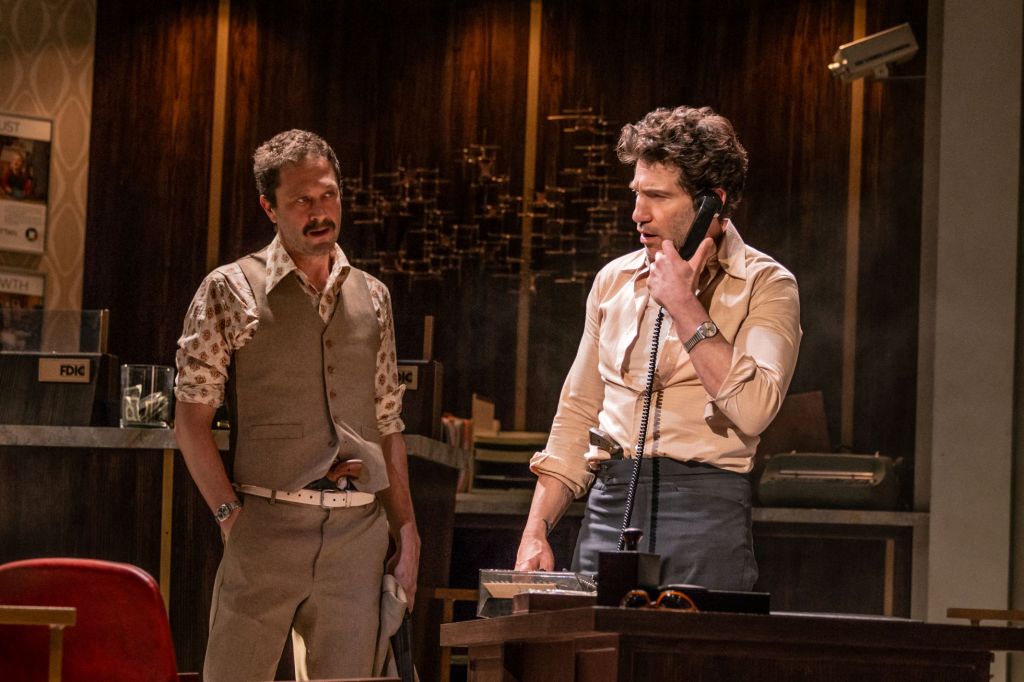
Murphy’s Law (what can go wrong, will go wrong) upends the plan of 3 bank robbers reduced by one who is high on drugs, forgets a shot gun and leaves in a panic literally sh&tting his pants, while apologizing for being unable to do any of what Sonny (Jon Bernthal) asked him. Also, he didn’t bring the getaway car, but took the subway instead. If this isn’t the makings of a gonzo, botched, bank heist, it just may be the makings of a riotous play. However, don’t compare it to the film it is based on.
Sonny can’t believe that the evacuating Ray Ray (Christopher Sears) dumped their well-made plans into the toilet. Indeed, what other situations will be turned over in the Broadway premiere of Dog Day Afternoon at the August Wilson Theater running through July 12, 2026? Directed by Rupert Goold (Ink), Stephen Adly Guirgis (Pulitzer-prize winning Between Riverside and Crazy) wrote the script. He based it on the article “The Boys in The Bank” written by P.F. Kluge and Thomas Moore, published by Life Magazine, and the titular Warner Bros. film directed by the impeccable Sidney Lumet. The production softens the film’s tension and danger and adds humor that provokes raucous laughter.
I’ve resisted the temptation to compare the urgency and depth of the iconic 1975 film with this production that leans heavily on irony and humor to convey a wild situation in a 1972 New York City, itself under siege. More enlightened critics have drawn contrasts and found the play seriously wanting. Judging from the audience’s response the night I saw the production, Adly Guirgis and Goold succeeded in creating a vehicle for friends Bernthal and Moss-Bachrach (TV series The Bear) who elucidate Sonny and Sal with their exceptional talents. They emphasize the “haywire” in a bank heist inspired by real events.
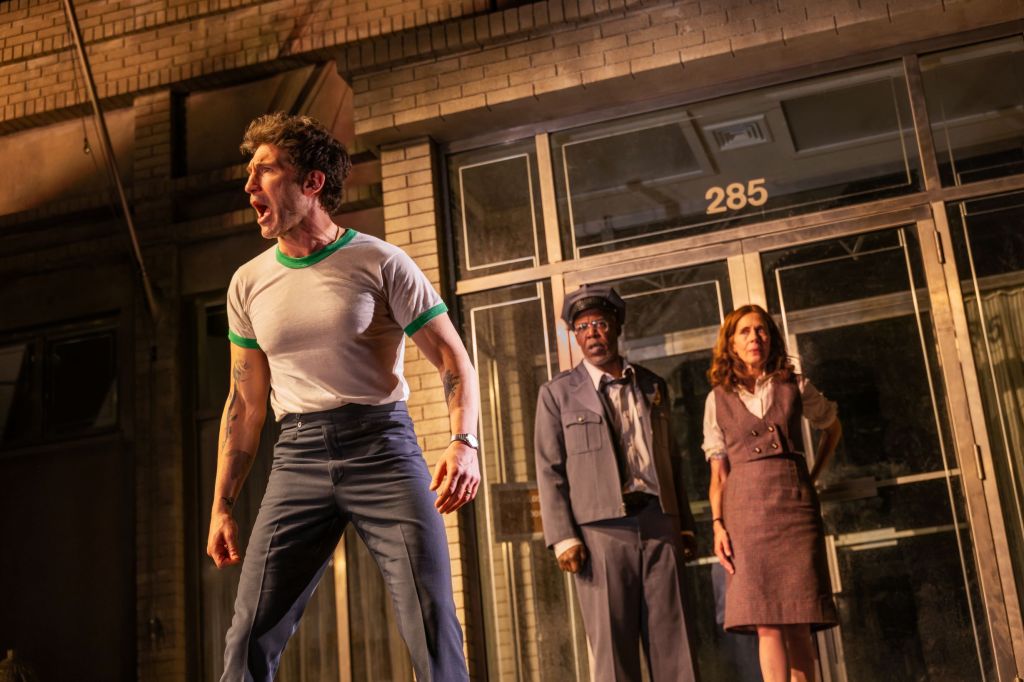
Gould and Adly Guirgis have kept the setting of Brooklyn, 1972 with a few updates in ideas and language (oligarchs substituted for the rich). However, the tone of the play is vastly different from the film which critiqued the social issues looming throughout the decade and became a landmark for cultural reform by creating sympathy for its LGBTQ characters. In this production Sonny’s wife is played convincingly with humor and pathos by Eseban Andres Cruz to reveal Sonny’s explosive relationship and foreshadow the inevitable conclusion.
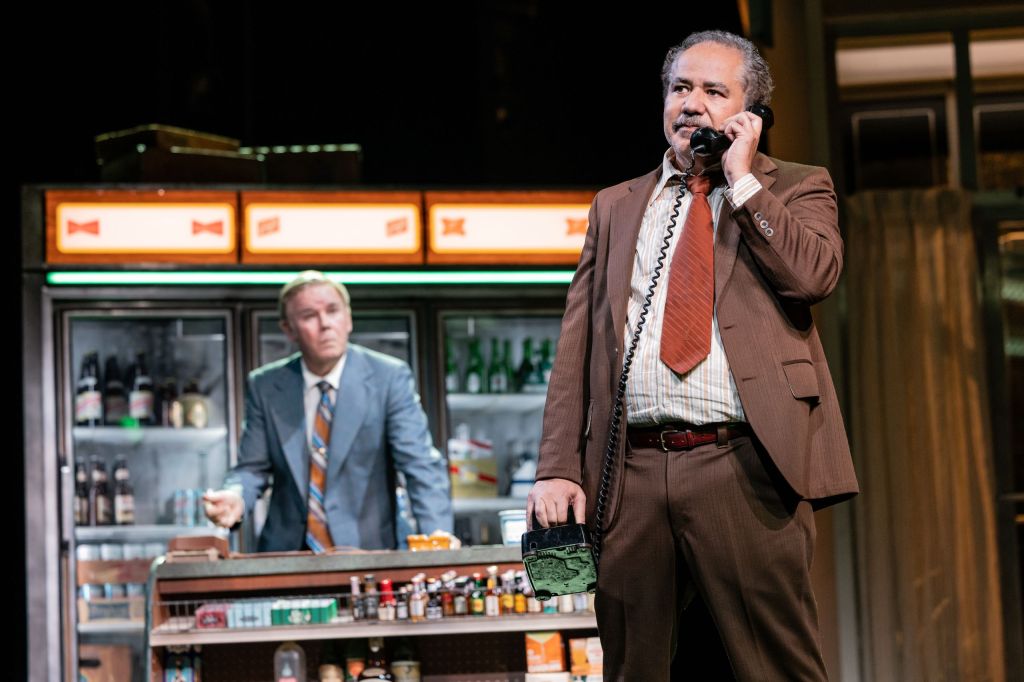
In light of the state of the world’s particular horrors, the play’s memorializtion of that time in a deteriorating New York City becomes eerily soothing. The tone that borders on farce feels safe. We can look at a less problematic time where decency abides. It’s in the character of Detective Fucco (John Ortiz), and Colleen (Jessica Hecht) and security guard Mr. Eddy. And it’s reflected in Sonny. Ironically, the sinister, cynical, cold cruelty of the FBI’s Sheldon (Spencer Garr), reflects today’s cynical law enforcement. Overall, the production succeeds with its sometimes riotous approach, sterling performances by Bernthal, Ebon Moss-Bachrach, Hecht, Ortiz, fine ensemble work, and period set, lighting, great music selections and sound design (David Korins, Isabella Byrd, Cody Spencer).
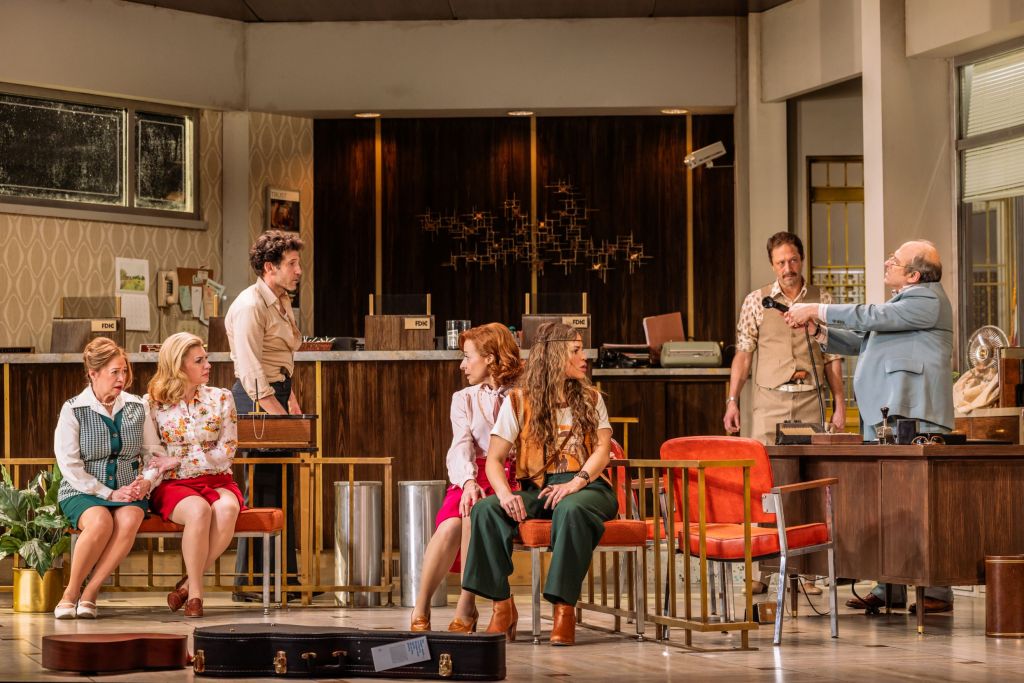
The set design features a revolving stage which effects the exterior 1972 bank facade on the streets of Gravesend, Booklyn. The stage swivels to the bank’s interior of teller’s stations, seating area adjacent to the office manager’s desk and a view into the vault upstage.This set design effectively engages the audience when Sonny steps outside to address the crowd in the play’s most theatrically satisfying moment. Outside the bank Bernthal’s Sonny dynamically, humorously chides the cops. He invites the crowd (audience members) to participate, rousing their enthusiasm. Various passages of Adly Gurirgis’ seminal writing resonate for us today as Sonny’s works the crowd who identify with his truth.
Cops in the audience aisles point their guns at Sonny while he says, “All this show of force — all this shit — it ain’t for me! They don’t need a whole army of blue bozos to put two in the back of my head — bag me, tag me — this is for you people! Make no mistake. They wanna scare you!” As we cheer him on, Hecht’s Colleen encourages him with the word “Attica!” which he shouts arms raised in remembrance of the prisoners and hostages who unjustly were shot by law enforcement in the 1971 riots.
The one-off jokes arise from the situations that Gould pulls off with fine pacing. Bernathal explores Sonny’s vitality, electric energy and sociability as the mastermind manipulator who thinks on his feet, corrects what goes wrong as it happens, all the while capitalizing on helpers like flirtatious older Colleen who becomes a friend. She is LOL when she decides it’s more fun to stay behind, though Sonny offers her the chance of being the first released hostage. Ironically, the other tellers joke amongst themselves that the one least liked should go first. This is the most adventure they’ve had in their lives. Clearly, they believe Sonny when he repeatedly assures them no one will die, a statement that runs counter to what Sal and Sonny privately agreed to.
Because of the light-handed approach, there is a reduction of the overall tension and danger which essentially has been left to the character of Sal (Ebon Moss Bachrach) to convey. Additionally, Sonny and Sal are pitted against the dark, insulting Sheldon and Feds as the enemy, a current theme today. Moss Bachrach thoughtfully portrays emotionally broken Sal as the former convict with PTSD from his prison experiences. His attendant nihilism has left him with two bad choices: worse crimes (Sonny’s hair-brained robbery) or suicide vengeance, taking others with him. Even though Mr. Eddy was accidentally shot when Ray Ray dropped the gun, having guns in an armed bank robbery in which a security guard was shot, means more prison time that Sal tells Sonny he won’t do.
As circumstances progress, the more the charismatic Sonny shines socially even creating a weird Stockholm Syndrome effect with Colleen (Jessica Hecht), the more Sal loses the bond he thought he formed with Sonny. Abruptly, Sal ends Sonny’s love fest. With an edgy brutality he stomps out the congenial atmosphere and stomps on the donuts that John Ortiz’s Detective Fucco gets them. It’s an important moment when the fun stops and the audience are reminded of what he is capable, though Sonny might not be as desperate.
When Lorna (Wilemina Olivia-Garcia) tries to calm him with a Boston creme doughnut, we are frightened when he says, “I’m not your friend. He’s not your friend. And this — this ain’t no fuckin’ picnic, got it?” We realize Sal has chosen and will probably stir that choice unless the congenial Sonny with his positivity and charisma convinces him to calm down. Sal’s speech to Sony about his speaking “words” in a manipulation resonates with power. He’d like to believe Sonny about a helicopter escape, but he can’t because he knows all too well Sonny is a con artist and his words don’t ring true.
Dog Day Afternoon runs 2 hours 15 minutes through July 12 at the August Wilson Theater, Manhattan; dogdayafternoon.com.
‘Summer, 1976’ Laura Linney and Jessica Hecht are Terrific

Summer, 1976 at the Manhattan Theatre Club’s Samuel J. Friedman Theatre is predominately two solo performances with a few dynamic interchanges, the principal one occurring at the conclusion. The static, expository “play,” directed by Daniel Sullivan, occurs in the minds and reflections of Diane (Laura Linney) and Alice (Jessica Hecht). Through their discourse, we learn how they established a close friendship over a summer which gradually fades into memories when Diane moves away a few years later. If not for the brilliant, authentic performances by Linney and Hecht, and the enlightened direction by Sullivan, one might think that “the dramatic event” that supposedly initiates the conflict never occurs. Nor does the conflict occur manifestly. However, the performances and direction overcome the lack of theatricality, and make Summer, 1976 interesting enough thematically to put this on one’s radar to see.
One of the key themes that playwright David Auburn (Proof) explores in Summer, 1976, is how the right connections, though brief in the span of a lifetime, may vitally change one’s development and help individuals evolve in a direction they might never have taken without such influence. Diane and Alice become friends who, for no particular reason, share their memories revealing this thematic point in this stylized storytelling that alternates back and forth from Diane and Alice as each reflects and remembers. Through their perspectives as reliable/unreliable narrators, they discuss themselves and each other, sometimes offering conflicting details, leaving us to decide for ourselves who is the more accurate storyteller, if it even matters. During the course of their reveries, we note there are more similarities than differences between them, if we carefully tease out the deeper levels in their personalities.
Superficially, Diane has an immaculate house and is a foodie, with some quirky lapses in her perfection. Interestingly, she is unconventional in one regard. She carelessly becomes pregnant having a fling with a man who wasn’t “all that,” and who she dismisses from her life so she can raise her daughter alone. She doesn’t give much thought that Gretchen might need a father, but is confident within herself not to be desperate for a man at her side. which would cause more stress and complication. Besides, Diane has enough inherited money to raise her without worries and continue with a quasi-serious art career which Alice encourages.
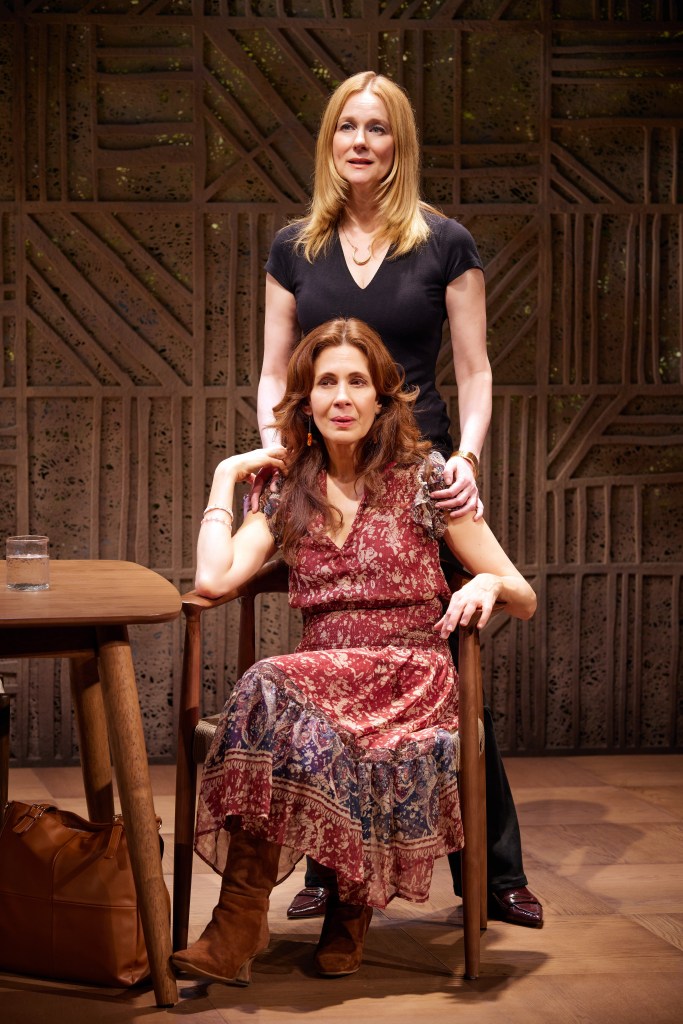
Alice points out that Diane’s work reminds her of Paul Klee’s. Diane confesses that she used to be influenced by Klee, but has moved on. Diane never finishes her art pieces, a revelation which Diane eventually confides to us and discusses with Alice. For her part Alice doesn’t think Diane’s art is very good, precisely because they are unfinished. We learn this through Alice’s commentary after Diane makes various disclosures.
Alice contrasts with Diane. Her housekeeping is messy. None of the furniture matches and she isn’t a foodie or an excellent chef as Diane is. Also, Alice is a laid back housewife who helps husband Doug, He doesn’t make much money as a college professor and their lifestyle reveals it. In those days women could still live (not comfortably) on one salary. Doug and Alice manage, though Diane notes that they don’t have style, class or much dynamism. Ironically, staying at home doesn’t encourage Alice to be a superior housewife or foodie. What she does all day is take care of her daughter and Doug, read and clean up the house as best as possible, when it moves her .
These superficial differences would stand in the way of their becoming best friends, if their daughters were not thrown together at the beginning of the summer. Because their daughters adore one another and beg Diane and Alice for play dates, the mothers reluctantly get together to please Gretchen and Holly. It is during these hot days of summer, Diane and Alice move beyond the surface to reveal deeper elements about themselves and their circumstances to forge a beneficial relationship.
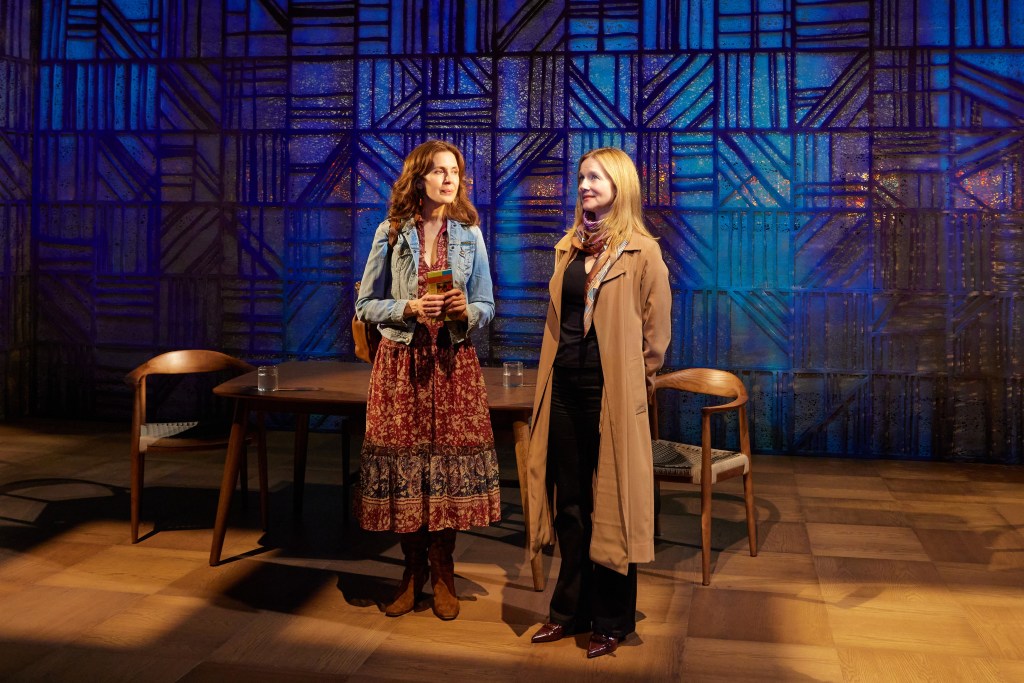
Auburn uses narration and the women’s solo reveries to reveal their lives. However, it is the nuanced performances and portrayals by Linney and Hecht that elevate this play and make us interested in these two women, who live unadventurous outer lives. The actors land on the humor of their confessions and judgmental criticism (only given to the audience) about each other. It is only when the women take day trips, the first to an antique store where Diane buys Alice a Bauhaus desk, that their relationship takes off. Afterward, we note that there is a soulful simpatico that they seem to have with each other that transcends their differences.
That soulfulness is brought to the fore during two crucial events that Linney’s Diane and Hecht’s Alice reflect upon. During one summer day Diane has a wicked migraine. Alice lovingly nurtures her and gives her time generously, as Diane attempts to overcome the waves of pain. In supervising the situation while Diane writhes in pain, Alice even allows Gretchen to watch the TV channels Diane doesn’t permit normally. However, this situation warrants it because, as Diane suggests, she can’t deal with her daughter and a migraine at the same time. In Diane’s perspective, Alice’s comfort and care saves her life and the migraine goes away the next day. However, a thread has been woven between the two women that never dissolves, despite their not keeping up the relationship in later years.
Diane helps Alice when she has an argument with Doug that blows up into a full on discussion about divorce. Alice takes Holly and seeks solace from Diane, who readily gives it and comforts her. Diane always thought Doug boring and she encourages Alice to consider other possibilities. Even when Alice resolves to herself emotionally that she and Doug can work out their marriage, Diane offers her place to stay to regroup. This is an offer that later could have become a living arrangement, however, Alice is faithful to Doug and never takes her up on it.

Another theme that comes up when Alice stays the night with Diane is happiness. Diane asks Alice if she is happy, but Alice is more concerned with “keeping up appearances” and trying to make the marriage work after Doug tells Alice he “can’t do this any more.” The idea that people can’t make people happy and rarely does anyone find sustained happiness is something Alice considers as a result of her conversation with Diane that evening. Certainly, it influences Alice in her relationship with Doug, and they eventually divorce in 1978, after Diane moves away.
During the summer and their weekly dinners in the fall, they gradually see each other less and less during 1977 because Alice is engrossed with saving her marriage. However, Diane’s wisdom helps Alice.
At one point Diane lightly suggests they should just travel together and have adventures. Alice’s traditionalism and conventionalism won’t permit it. It is as if Diane intuits Alice and Doug’s marriage will end, but Alice is not ready to admit it. For Holly’s sake she must go through the arduous process of salvage that is fruitless anyway. The possibilities of their close friendship remaining and becoming something more becomes swallowed up in Alice’s conservatism and her fear about leaving Doug. Her inner conflict prevents her from considering other possibilities and freeing herself. Ironically, by the time Alice and Doug divorce and she is free, Diane has left.
Almost a decade later, both women are in New York City. When Alice sees the banner featuring Diane’s works on exhibit, she goes inside the gallery and they meet and discuss how their circumstances have changed. Alice is a middle school English teacher. Diane has become a professional artist who finally finishes her work. When they say their farewells and Alice expresses that she misses Diane and gives her a hug, Diane’s response is “matter-of-fact,” and distant. She reveals to the audience that Gretchen has moved back in with her, has a drug dependency and perhaps made a suicide attempt. She reveals none of this to Alice which is unclear why. When considering if she misses Alice, she reminisces that they were close only for that summer and that is why they drifted apart completely when Diana left and Alice divorced in 1978. Diana even suggests that perhaps it is the memories that she misses.
The final meeting and hand off are fascinating because we note that Diane dismisses Alice, yet gives herself away when she says that Alice is the only one she sends her “art cards” to annually for a decade then stops. Alice loves them and assumes she sends them to everyone, but never replies back. That Diane only sent them to her is momentous. The relationship was important to her for her artistic development. Furthermore, considering Diane and Alice have no partnerships, though Alice admits there were men, but nothing spectacular, we are left wondering that perhaps in a time when the culture wasn’t as oppressive for female-female relationships, they might have had a deep and abiding love. By the play’s end, we understand that their candle of friendship may have nearly blown out, nevertheless they have contributed to each other’s lives and careers beyond measure. Perhaps, it may be rekindled again if one of them takes the step forward.
Summer, 1976 occurs in the undercurrents, the aside comments to the audience, and the subtext. There are the nuanced perspectives and the unspoken spoken. Nothing is manifest. Sullivan’s superb direction and the stellar Linney and Hecht fascinate, in this character study of two women who subtly influence each other to evolve and grow. One day when they are ready, they may possibly reaffirm their connection in the future after their New York meeting. The rest is uncertain as is true to life.
The scenic design (John Lee Beatty) is a minimalist latticed backdrop through which Japhy Weideman’s lighting design flips on the turn of events in their storytelling with beautiful hues. Linda Cho’s costume design is aptly pegged to the characters and Auburn’s characterization. Kudos to Jill BC Du Boff’s sound design, Hana S. Kim’s projection design and Greg Pliska’s original music which elucidates Sullivan’s stylized vision.
Summer, 1976 runs with no intermission, but Linney and Hecht with prodigious authenticity keep the audience rapt and the time becomes transcendent. For tickets and times go to their website https://www.manhattantheatreclub.com/shows/2022-23-season/summer-1976/

