Blog Archives
Elevator Repair Service’s ‘Ulysses’ by James Joyce, a Review
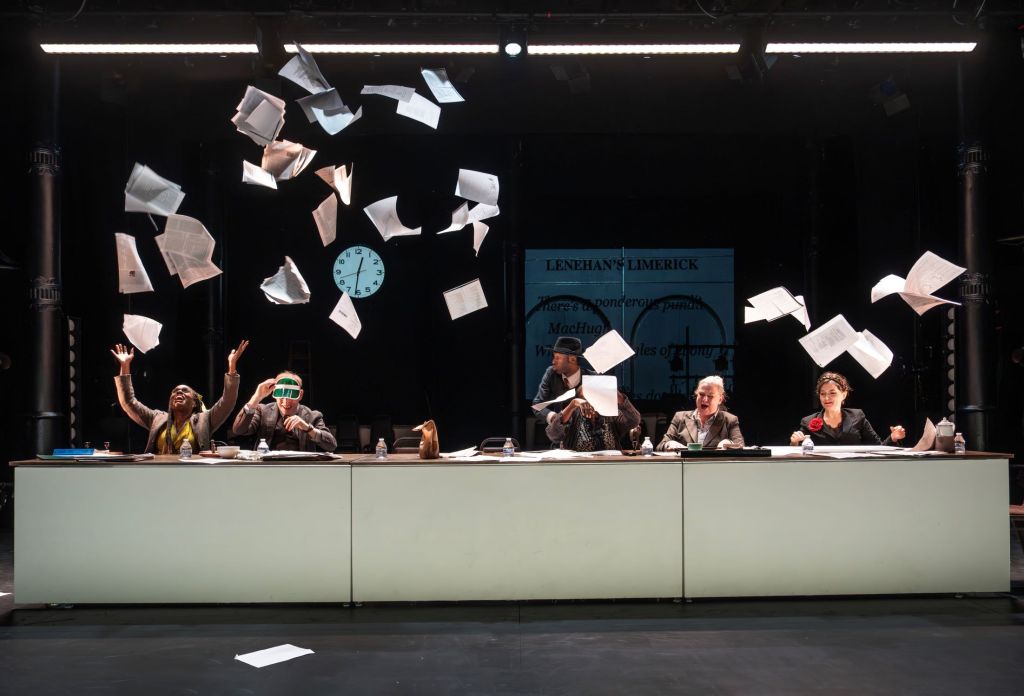
Elevator Repair Service became renowned when they presented Gatz, a verbatim six hour production of F. Scott Fitzgerald’s The Great Gatsby at the Public, as part of the Under the Radar Festival in 2006. Since their remarkable Gatz outing, they have followed up with other memorable presentations. It would appear they have outdone themselves with their prodigious effort in their New York City premiere of James Joyce’s opaque, complicated novel Ulysses. The near three-hour production directed by John Collins with co-direction and dramaturgy by Scott Shepherd, currently runs at The Public Theater until March 1, 2026.
At the top of the play Scott Shepherd introduces the play with smiling affability and grace. He directly addresses the audience, reminding them that “not much happens in Ulysses, apart from everything you can possibly imagine,” and that it happens in the span of a day beginning precisely at 8 a.m,, Thursday June 16, 1904 in Dublin, Ireland. Before Shepherd dons the character Buck Mulligan who appears at the beginning of the novel, he discusses that in the “spirit of confusion and controversy” (labels by critics), Joyce’s day in the life of three characters will be read with cuts in the text. Elevator Repair Service elected to remove Joyce’s text to redeem the time. The cuts are indicated by the cast “fast forwarding” over the narrative.
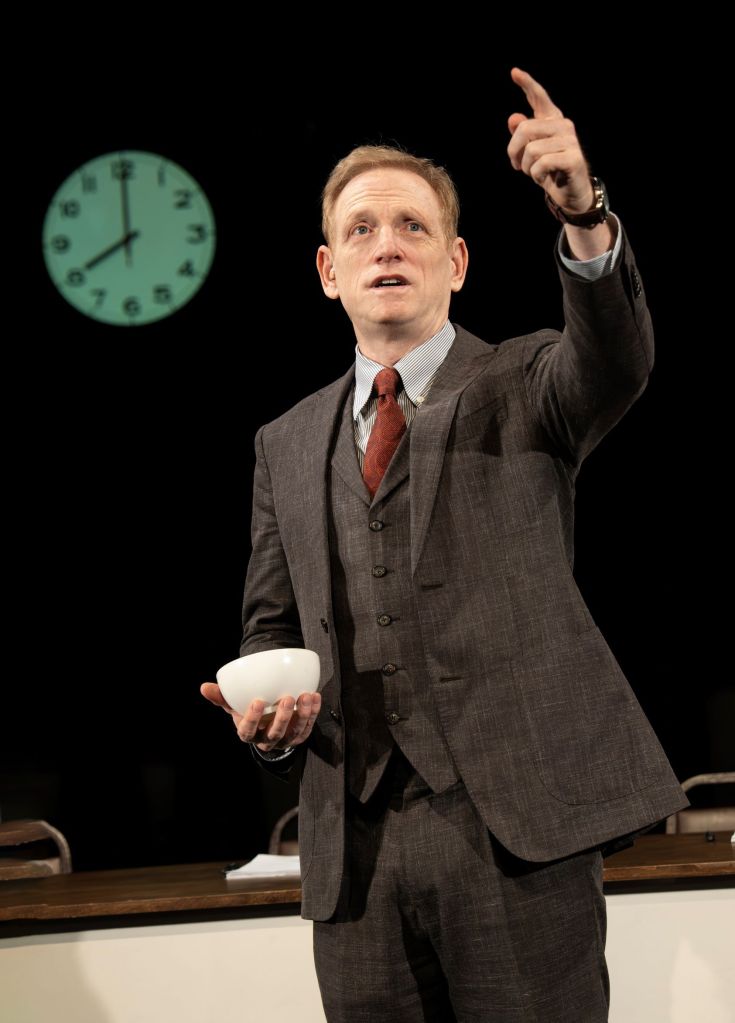
Collins and the creative team cleverly effect this “fast forwarding” with gyrating, shaking movement and action. Ben Williams’ design replicates the sound of a tape spinning forward. To anyone who may be following along with their own copy of the novel, the “fast forward” segments are humorous and telling. However, the cuts pare away some of the details and depths of character Joyce thought vital to include in his parallel of Dublin figures with the most important characters of the Odyssey: home returning hero Odysseus, long-suffering wife, Penelope, and warrior son, Telemachus.
After Shepherd’s introduction, Ulysses moves from a sedentary reading with multiple actors into a fully staged and costumed production as it progresses through the day’s events principally following Stephen Dedalus (Chisopher-Rashee Sevenson), who represents Telemachus, Leopold Bloom (Vin Knight), as Odysseus, and Molly Bloom (Maggie Hoffman) as Penelope.
The events illuminate these characters, and the cast superbly theatricalizes the novel’s humor, whimsy and farce. Some scenes more successfully realize Joyce’s playfulness and wit better than others. For example when Bloom decides to go to another pub after seeing the sloppy, gluttonous patrons of the first bar, the cast revels in portraying the slovenly, grotesque Dubliners. slobbering over their food. Additionally, the scene where Bloom faces his deepest anxieties shows Knight’s Bloom giving birth to “eight male yellow and white children.” Director Collins hysterically stages Bloom’s “labor” with Knight in the birthing position, legs apart, as Shepherd “catches” eight baby dolls he then throws to the attending cast members.
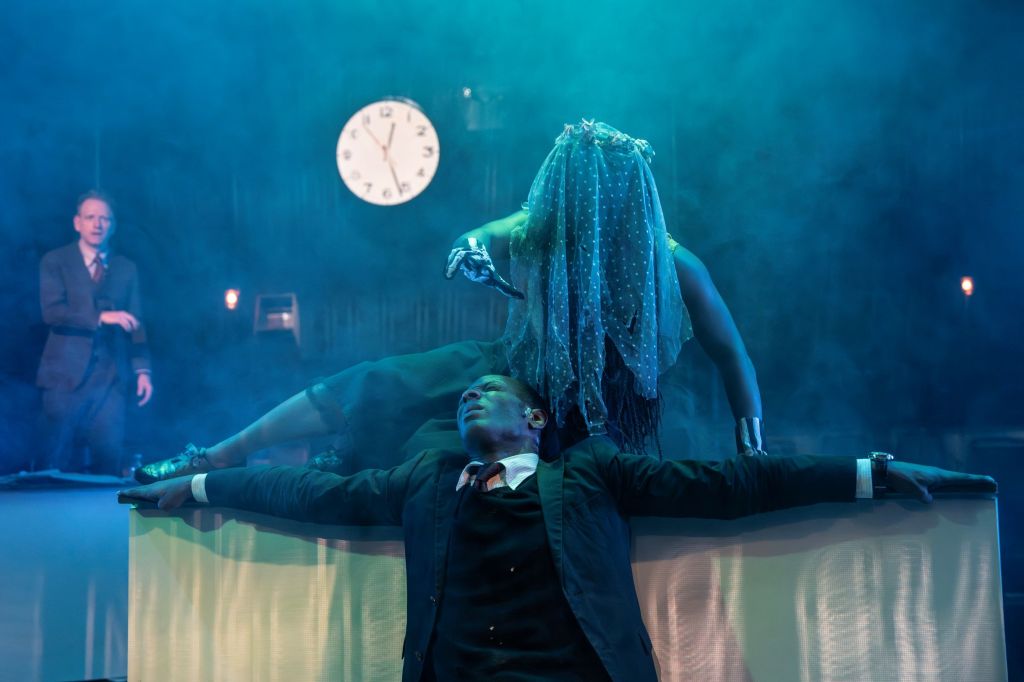
As costumes and props are added to the staging, we understand Leopold Bloom’s persecution as an outsider and a Jew. Also, wee note Stephen Dedalus as the writer/poet outsider who eventually joins Bloom, a father figure, who Bloom takes home for a time until Dedalus leaves to wander the night alone. Chistopher-Rashee Stevenson portrays the young Dedalus, a teacher whose unworthy friends lead him to drink and misdirection. Dedalus grieves his recently deceased mother and toward the end of the play has a nightmare visitation by her frightening, judgmental ghost.
For those familiar with the novel, the cast becomes outsized in rendering the various Dubliners that Knight’s Bloom and Stevenson’s Dedalus encounter. The dramatization is ultimately entertaining. We identify with Bloom as an Everyman, an anti-hero, who tries to get through the day in peace, while dismissing the knowledge that his wife Molly cuckolds him. Though he hasn’t been intimate with her since their baby Rudy died, he is unsettled that she conducts an affair with Blazes Boylan in their marriage bed at home. Somehow, Bloom has discovered that Molly who is a singer will be meeting with Boylan at 4 p.m. that afternoon. On his journey through the day he avoids confronting Boylan as they carry on with their activities around Dublin.
The ironic anti-parallel to the Odyssey, on the one hand, is that Molly Bloom is far from a Penelope who physically remained loyal to Odysseus, where Molly has an affair. On the other hand, late at night as Bloom sleeps with his feet awkwardly next to her face, we understand that Molly still loves Bloom and is emotionally and intellectually loyal. In her stream of consciousness monologue, seductively delivered by Maggie Hoffman, Molly arouses herself with memories of her relationship with Bloom when they were first together. It was then that she transferred a seed-cake from her mouth to his, sensually expressing her love.
Collins’s staging of the scene is humorous and profound. It defines why Molly has been present in Bloom’s consciousness throughout his strange journey traversing the streets of Dublin until he eventually finds his way home to her bed later that evening.
For those unfamiliar with Joyce’s novel, they will find the events and people a muddled hodgepodge that clarifies then becomes opaque, like a light switch turning on and off. Characters swap places with each other as seven actors take on numerous parts in a sometimes confusing array. Only Bloom, Dedalus and Molly stand out, true to Joyce’s vision for Ulysses for they embody Joyce’s themes about life. Thus, Bloom and Dedalus move through the day with flashes of brilliance, revelation, connection, irony and dread. Their reactions interest us. And Molly Bloom in her ending monologue puts a capstone on the vitality and beauty of a women’s perspective, as she experiences the sensuality and power of love for Bloom through reminiscence.
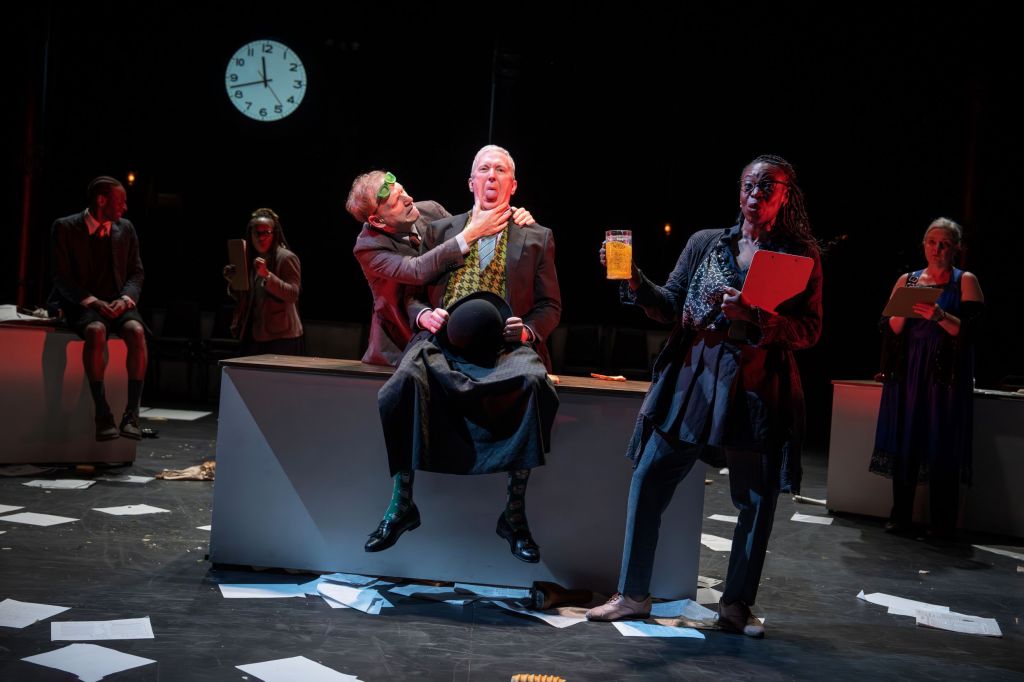
The costume design by Enver Chakartash reflects the time period with a fanciful modernist flourish that gives humor and depth to the personalities of the characters. For example Blazes Boylan (Scott Shepard) who has the affair with Molly wears a straw hat, outrageous wig and light suit that aligns with his jaunty gait. The scenic design by DOTS is minimalist and functional as is Marika Kent’s lighting design and Mathew Deinhart’s projection design. Most outstanding is Ben Williams’ acute, specific sound design which brings the scenes to life and follows the text adding fun and delight.
By the conclusion the audience is spent following the challenge of recognizing Joyce’s Dublin and the three unusual intellectuals and artists who he chooses to explore. Elevator Repair Service has elucidated the novel beyond what one might endeavor to understand reading it on one’s own. Importantly, they’ve made Ulysses an experience to marvel at and question.
Ulysses runs 2 hours 45 minutes with one intermission at the Public Theater through March 1, 2026. https://publictheater.org/productions/season/2526/ulysses
‘Baldwin & Buckley at Cambridge’ at the Public, Review

Baldwin & Buckley at Cambridge, the 1965 debate of James Baldwin and William F. Buckley, Jr. at the Cambridge Union, University of Cambridge, UK is receiving its New York Premiere at The Public Theater. You need to see this production presented by Elevator Repair Service (Gatz, The Sound and the Fury) for many reasons. First, it’s vitally important for us in this present moment to hear and understand Baldwin’s criticism about our nation from the perspective of an articulate novelist, playwright, essayist, poet, identified as one of the greatest Black writers of the Twentieth Century. The production, which captures the debate in its entirety, will also help you understand Baldwin’s realistic acknowledgement of American attitudes and sensibilities, many of these carryovers to our present society and divisive culture, whether we are loathe to admit it or not.
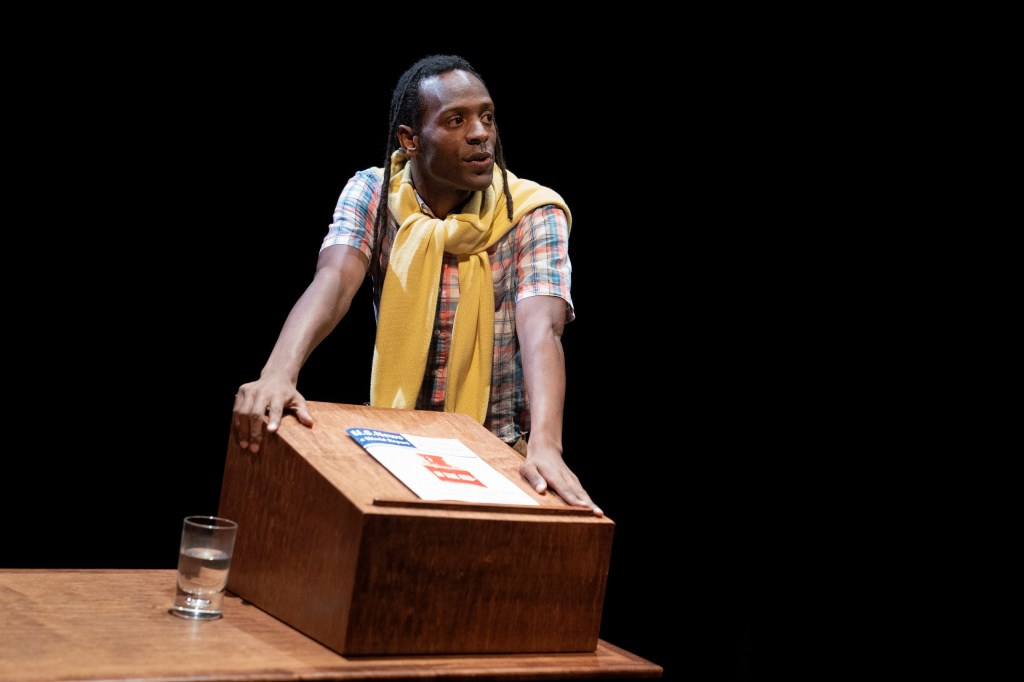
The unadorned, bare bones production highlights the arguments Baldwin and Buckley presented at Cambridge in response to the question, “Has the American Dream been achieved at the expense of the American Negro?” With a minimalist set, two desks, chairs, lamps staged with the audience on three sides at the Anspacher Theater, the evening replicates the words if not the tone, ethos or dynamic drama of Baldwin (Greig Sargeant) and Buckley (Ben Jalosa Williams) in their face-off.
It is a worthy triumph of ERS to re-imagine these two titans, one eloquently speaking for Black America, the other a conservative writer and National Review founder. The latter supported a slow walk of desegregation which Blacks must “be ready for,” and were “not yet ready for.” Baldwin’s and Buckley’s perspectives reflected national attitudes, especially after the legislative gains made for Blacks in 1954, 1964 and 1965 which Baldwin didn’t trust because the power structures of the South and North didn’t adequately enforce the laws. In viewing their comments now, as our nation experiences “in-your-face” racism and discrimination, that would overthrow all gains (revealed in striking down Roe vs. Wade and most of the 1965 Voting Rights Act) the concepts in the debate between Baldwin and Buckley are highly relevant and worthy of review.

The inherent drama of the debate, its electric personages, and the crisis of the time eludes the actors and the director. Indeed, perhaps the task is impossible without sufficient artistry, and imagination to suggest what once was, the frenetic and feverish times of the country that in 1965 saw the Watts riots, which Baldwin alludes to at the end of his speech.
When Baldwin and Buckley debated, America was still fighting segregation in the deep South, the effects of which Cambridge student Mr. Heycock (Gavin Price on Saturdays) discusses to introduce Baldwin’s arguments. He mentions statistics quoted by Martin Luther King, Jr. when they conducted a protest supporting voting rights in Alabama. Heycock states, there were more Negroes in jail for protesting than on the voting rolls. He enumerates other statistics. These identified the extent to which Blacks had been excluded from the White society’s opportunities and their aspirations to achieve the American Dream: jobs with benefits, college educations, economic prosperity, home ownership and more.

As both Heycock and later Sargeant’s Baldwin make clear during their fact-laden presentations, in no way was the Black experience in America “separate but equal” to that of Whites. Their lives, their worlds, their perspectives, opportunities and approach to daily living was anything but equivalent.
Though this was especially so in the South, the quality of life disparities also were prevalent in Northern cities like New York, Detroit, Chicago, Los Angeles. There, Blacks were shoveled into the projects branded as a Utopian “urban renewal.” Actually, there was no renewal, as Blacks were crowded into broken-down buildings and crime-ridden ghettos, where rats flourished and the garbage spilled over into the streets. All of these points, Sargeant’s Baldwin mentions, disputing that Blacks have an equal opportunity in achieving the “American Dream,” which is obtain by Whites at Black’s expense.

The debate is a historic call to remembrance and worthy as such, which is why it bears being watched on YouTube, after seeing the Public’s production, directed by John Collins. The YouTube video reveals the unmistakable ambience of Cambridge and the scholars and students present in their formality and sobriety, laughing at Baldwin’s wit and wisdom and sometimes laughing with ridicule at Buckley’s pompousness and stumbles into bigotry.
Indeed, what is absent from the Public Theater production is this sense of moment. Missing is the ambience of setting and the nature of the audience which played a role in relaying the importance of the Baldwin and Buckley debate. These two giants in their own right honored Cambridge with their presence and concern, conveying American voices and perspectives. The gravitas is lacking in the production and is a possible misstep. Though an announcement is made as to the setting, more should have been done to convey the place and time. With a minimum of dramatization, the production wasn’t as dynamic as it could have been.

Creatively conveying time and place was not the choice of ERS or director Collins. Thus, Baldwin & Budkley at Cambridge is uneven. In structure and format the production follows the original debate. The elements are modernized, costumes in modern dress, not the black bow tie and suit worn for the formal Cambridge debate.
Also, somewhat confusing is that Price’s Heycock acknowledges the Lanape Indigenous Tribe who owned the land the Public Theater rests on. Then immediately he segues into the original debate structure. Perhaps as is done with other productions at the Public, a voice over by Oskar Eustis honoring the Lanape would have been less confusing. The separation of the present America from the debate setting is needed so the audience might reflect on the history of the land. After a pause, the setting of Cambridge, 1965 could then be established.
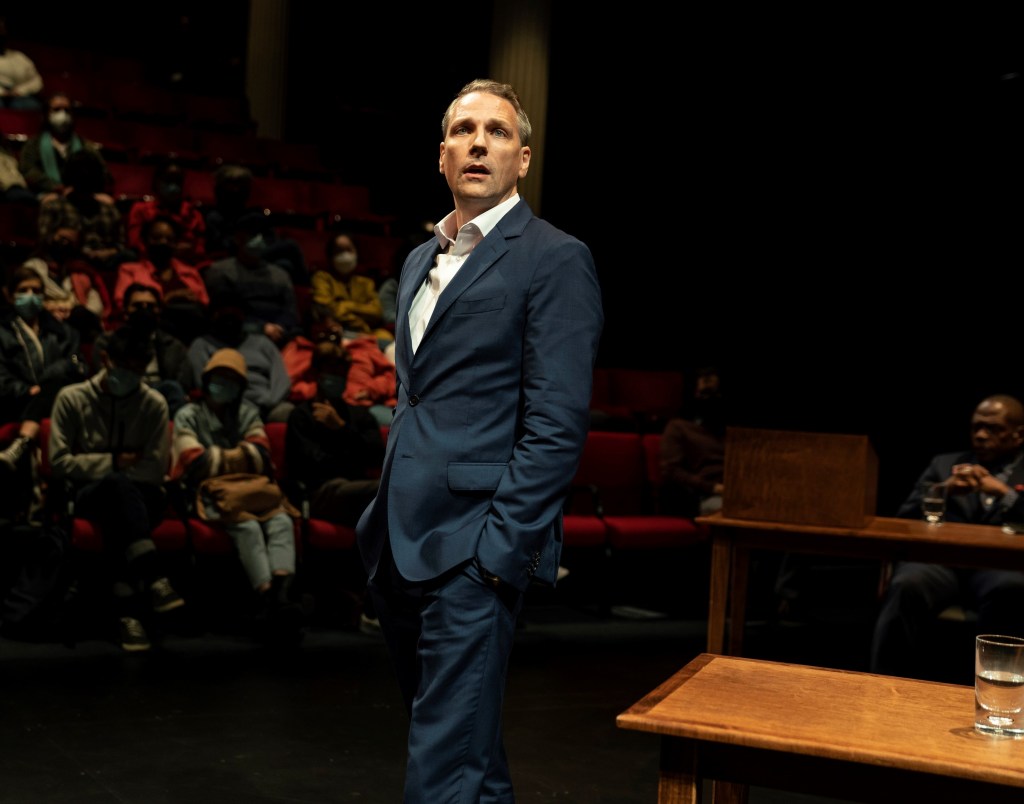
When Heycock finishes his introduction, Cambridge student Mr. Burford (Christopher-Rashee Stevenson) introduces Buckley’s argument, that it is not true that “the American Dream has been achieved at the expense of the American Negro.” To refute this Mr. Burford points out that 35 Black millionaires have achieved the American Dream. This justification that Blacks have attained the dream and not at the expense of Blacks is an example of the convoluted logic that will follow in Buckley’s confused and misdirected arguments.
Burford’s belittling statement in ignoring the huge unequal and disproportionate number of the few wealthy Blacks to numerous wealthy Whites deserves laughter and ridicule. Interestingly, the audience at the Public didn’t respond, as bigoted as the comment was. Possibly the lack of context of time and place contributed to an absence of audience engagement with Burford’s obnoxious statement and at other times during the performance.
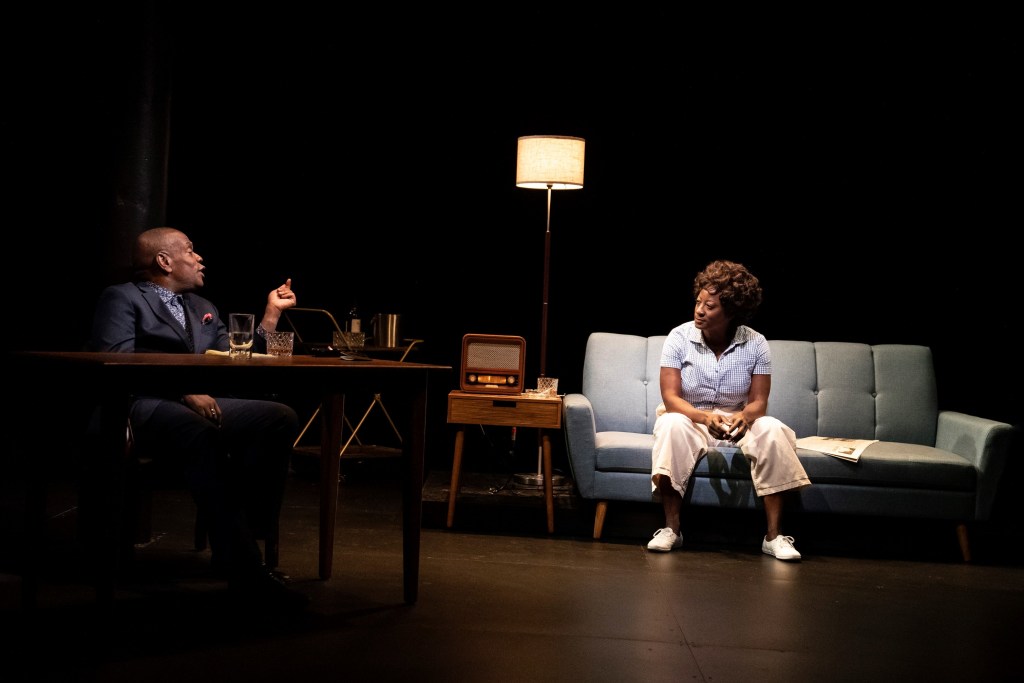
Identifying the number of Black millionaires, while ignoring the large percentage of Blacks who live in poverty, evidences the superficiality of Buckley’s arguments which follow Burford’s introduction. As Williams’ Buckley launches into his presentation, we understand that the reality that Baldwin just portrayed about the Black experience in America, will in no way enter in to Buckley’s discussion. Indeed, he dismisses and ignores Baldwin’s brilliant conceptualizations, something which Baldwin intuits that the White culture does to perpetuate the status quo. Throughout his presentation Buckley doesn’t acknowledge that White culture controls, creates and dictates the Black experience. In no way is Baldwin’s picture of reality confronted by Buckley in his disjointed and at times abstruse speech.
Buckley diverges from Baldwin’s statements so that he does not dispute that the American Dream exists at the expense of Black exploitation. He ignores Baldwin’s dense discussion that the American Dream by its very nature in the White culture’s understanding nullifies its existence if Blacks are to be a part of it. For the American Dream to exist, Baldwin suggests from the White perspective, Blacks must be excluded and given little opportunity to achieve it. Blacks can’t be a part because it necessitates exploitation of themselves. Baldwin’s point is that the dream only exists for Whites. Blacks are a part only in so far that they are at the bottom of the power structure, the foundation upon which Whites step up and rise, taking with them all the spoils, all the opportunities.

Sargeant’s Baldwin is wry and not as nuanced, expressive and dramatic as he might have been. On the other hand, Williams’ Buckley is vital, stirring and engaging. Clearly, in the Public Theater production, Buckley won. I found myself dropping out as Sargeant’s portrayal missed important beats. Williams’ sharp edginess and movements kept my interest. Conversely, Price’s Heycock was portrayed with vitality. Stevenson’s Burford was adequate.
Interestingly, after the debate Sargeant’s Baldwin sits with friend and playwright Lorraine Hansberry (Daphne Gaines). Their interchange reveals their close friendship. Unfortunately, the scene is too brief and should have delved deeper. At the very end, Sargeant takes off the mantle of Baldwin in his most authentic moment. He acknowledges the company’s own politically incorrect historic racism when ERS cast White actors to play Black roles in their early versions of The Sound and the Fury. To identify a past that we are still trying to become free of, even the most well meaning of us, seems counterproductive, guilty and fearful. I look forward to a time when theater moves beyond this stance which in itself is disingenuous and “protests too much.”
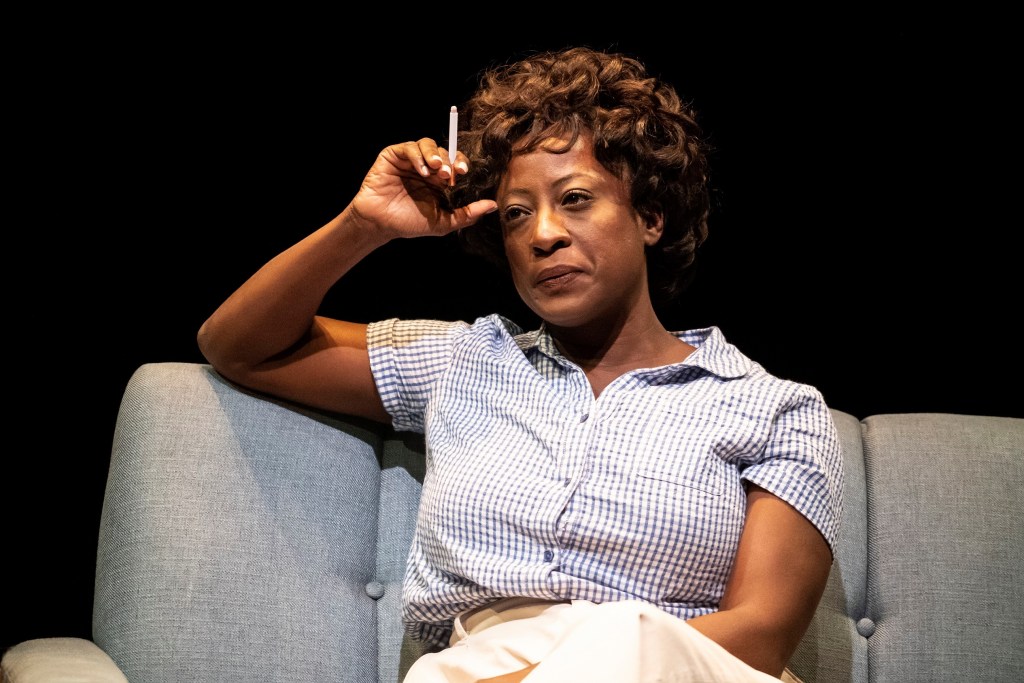
Clearly, at this time it is appropriate that the debate of Baldwin & Budkley at Cambridge be re-imagined. We are at a crossroads. This is not 1965. We are not in Cambridge, however, the ideas from our racist past that were entrenched, have been redeemed as useful and justifiable for us in the present. At no other time in history having attained what we thought was racial progress, have we been so duped by the residual racism that existed culturally into believing it was harmless. Its dangers have always been there and liberals have been blind to it despite warnings by Black and Brown critics.
Baldwin knew, he saw. The Black reality and White world were as clear as day. He understood that the White reality was convinced of its craven rightness to oppress and suppress Blacks to achieve White agendas at Black expense. Today, this horrific White reality is most visible in law enforcement abuse of Blacks, in the broken justice system that incarcerates Blacks disproportionately, in the exclusion of Blacks in corporate empires, in every institution that harbors systemic racism.
And the economic oppression is growing worse to include everyone except the .001%. These truths existed sub rosa for decades as the gap between the wealthy and everyone else widened. However, it took an egregious and criminally-minded opportunist in former president Donald Trump to justify and promote a resurgence of open hatreds branding the necessity of racist oppression, and authoritarianism ruling the underclasses, using media PR of lies and obfuscation.
For that final reason, Baldwin & Budkley at Cambridge is an extremely vital production which must be seen. For tickets go to their website: https://publictheater.org/
 CAROLE DI TOSTI