Blog Archives
‘Smash,’ Fabulous Send up of a Musical Comedy About Marilyn Monroe
Smash
Chatting with two theater critics beforehand, who referenced the 2012 NBC television series also called “Smash,” I was initially distracted. The TV series set in the present revolved around two aspiring actresses who compete for the role of Marilyn Monroe in a Broadway-bound musical called “Bombshell,” about Marilyn Monroe. Apparently, the TV series which devolved into a musical soap opera, lasted two seasons then was cancelled. Since I never saw the series, I tried to ignore the critics’ comments. I fastened my seat belt and settled in to watch the revamped production in its current run at the Imperial Theatre with tickets on sale through January 4, 2026.
I had no reason to”fasten my seat belt.” Smash is a winner. Superbly directed by Susan Stroman, a master of comedic pacing and the quick flip of one-liners, Smash is a resounding must see, retaining little of the TV show with the same title. I adored it and belly-laughed my way through the end of Act I and throughout Act II.
Into the first act when Ivy Lynn (the grand Robyn Hurder), introduces her Method Acting coach, Susan Proctor (the wonderfully funny Kristine Nielsen channeling Actors Studio Paula Strasberg), I embraced the sharp, ironic and often hysterical, theater-referenced send-ups. The book by Bob Martin & Rick Elice is clever and riotous, pushing the true angst of putting on a big Broadway musical and spending millions to make it a success. Martin and Elice’s jokes and the characterizations of Nielsen’s Susan Proctor and director Nigel, the LOL on point Brooks Ashmanskas (The Prom), who tweaks the gay tropes with aplomb, work. Both actors’ portrayals lift the arc of the musical’s development with irresistible comedic riffs shepherded by Stroman’s precise timing.

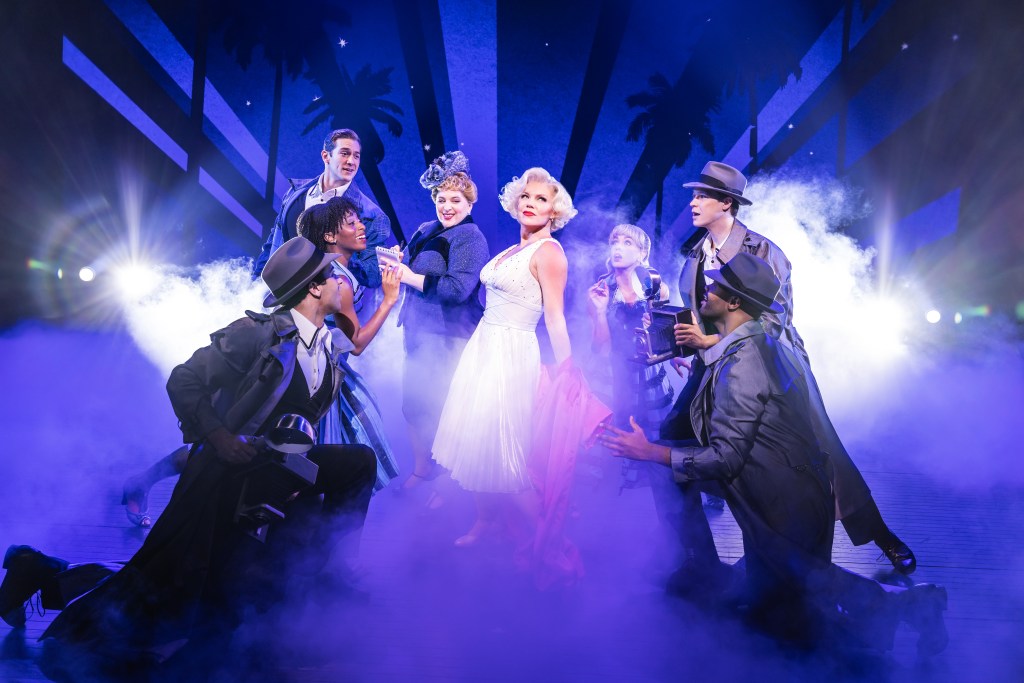
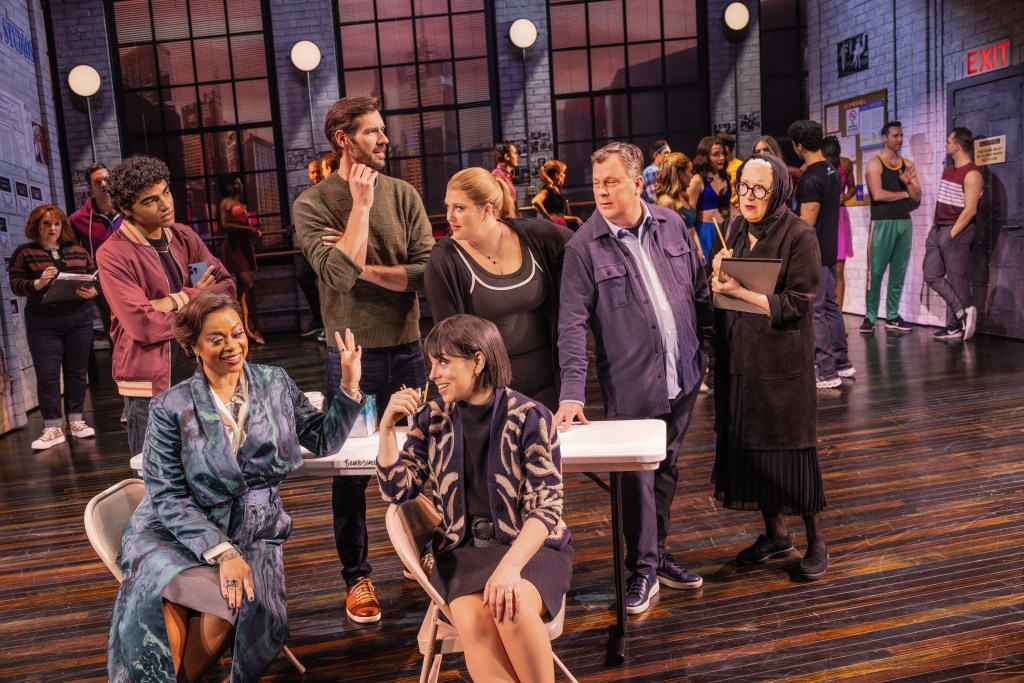
The music had me at the opening with the vibrant fantasy number, “Let Me Be Your Star,” sung by Robyn Hurder, whose lustrous voice introduces Marilyn and her fandom which the creators attempt to envision with fully costumed performers singing for their musical, “Bombshell,” the Marilyn Monroe story. Then, the scene shifts to the rehearsal room where we meet the creative team who imagined the previous number and scene. Ashmanskas’ director/choreographer Nigel humorously bumps heads with writer/lyricist/composer-husband and wife team Tracy (Krysta Rodriguez) and Jerry (John Behlmann).
Also present, is his associate director and Nigel’s right arm, the golden voiced Chloe (Bella Coppola). She runs interference and puts out fires, even covering for Ivy Lynn and understudy Karen (Caroline Bowman), during an audience invited presentation. Why Ivy Lynn and Karen can’t go on is hysterical.
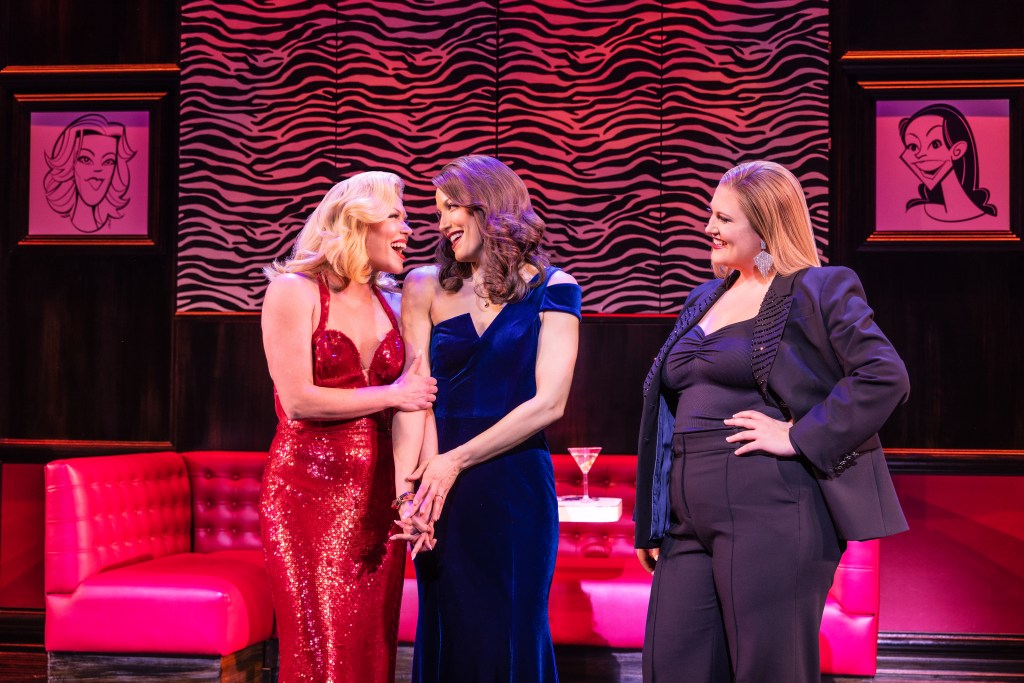
The music by Marc Shaiman, lyrics by Scott Wittman and Marc Shaiman, and the choreography by Joshua Bergasse are upgraded from the TV series with a curated selection of songs to align with the comedic flourishes. The musical numbers and dances cohere perfectly because the performers rehearse for their show “Bombshell.” With music supervision by Stephen Oremus, an 18-piece orchestra charges the score with vibrant dynamism. Featured are some of Shaiman’s brassiest tunes, orchestrated by Doug Besterman. Lyricist Wittman seals the humor and advances the plot. All provide grist for Bergasse’s choreography. Hurder manages this seamlessly as she sings, breathes heartily and dances while the male dancers whip and flip Ivy as Marilyn around. Of course, all smile with effortless abandon despite their exertions.
Importantly, Martin and Elice’s book sports farcical, riotous moments. These build to a wonderful crescendo by the conclusion. By then we realize we’ve come full circle and have been delighted by this send up of the wild ride these creatives went through to induce the belly-laughing “flop,” we’re standing, cheering and applauding. It’s the perfect ironic twist.
Indeed, once the audience understands the difference in tone from the TV series, largely due to Nielsen’s Proctor (she’s dressed in black mourning {Marilyn?} from head to foot), and Ashmanskas’ Nigel, Smash becomes a runaway train of hilarity. This comedy about unintentionally making a musical flop (unlike the willful intent in The Producers), smartly walks the balance beam by giving the insider’s scoop why “Bombshell” probably never finds a home on Broadway. One of the reasons involves too many chefs trying to make a Michelin starred dish without really understanding how the ingredients meld.
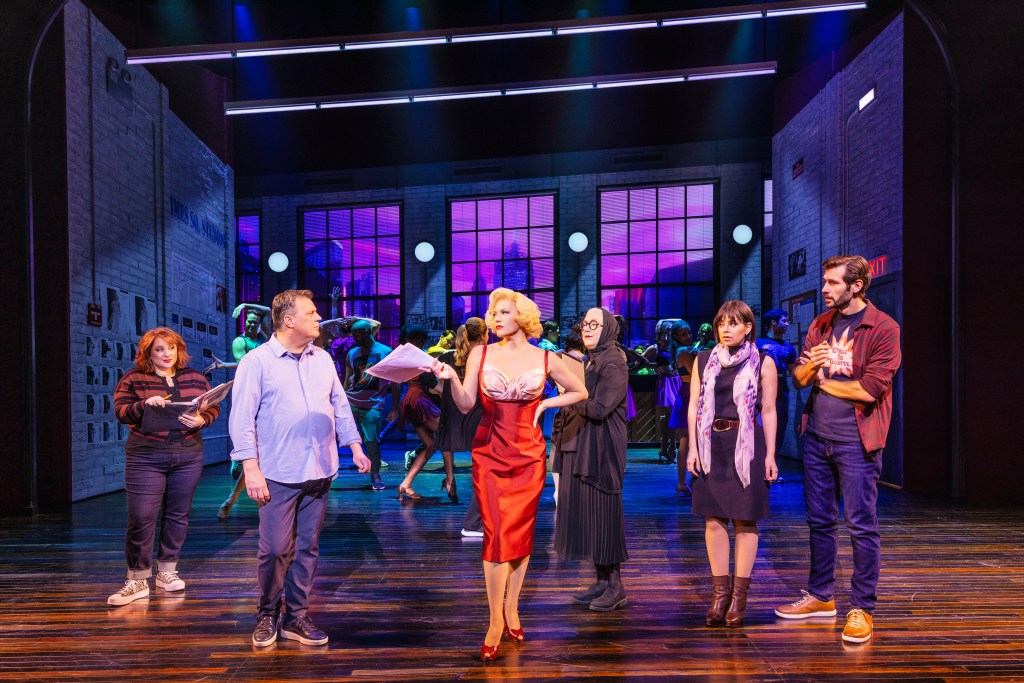
Nielsen’s Proctor dominates Ivy Lynn to the point of transforming the sweet, beloved actress into the “difficult,” “tortured soul” of diva Marilyn. The extremes this conceit reaches is beyond funny and grounded in truth which makes it even more humorous. Without giving too much away, there is a marvelous unity of the book, music and Hurder’s performance encouraged by Nielsen’s Marilyn-obsessed Proctor. We see before our eyes the gradual fulfillment (Proctor’s intention), of “Marilyn,” from superficial, bubbly, sparkly “sex bomb,” to soulful, deep, living woman produced by “the Method.” Of course to accomplish this, the entire production as a comedy is upended. This drives Nigel, Tracy and Jerry into sustained panic mode, exasperation and further LOL behavior especially in their self-soothing coping behaviors.
Furthermore, Producer Anita (Jacqueline B. Arnold), forced to hire Gen Z internet influencer publicist Scott (Nicholas Matos), to get $1 million of the $20 million needed to fund the show, mistakenly allows him to get out of hand, inviting over 100 influencers to Chloe’s serendipitous cover performance. The influencers create tremendous controversy which is what Broadway musical producers usually give their “eye teeth” for. Publicity sells tickets. But this controversy “backfires” and creates such an updraft, even Chloe can’t put the conflagration out. The hullabaloo is uproarious.

The arguments created by the influencers and their followers (in a very funny segment thanks to S. Katy Tucker’s video and projection design), cause huge problems among the actresses and forward momentum of “Bombshell.” Karen, Ivy Lynn’s friend and long time understudy, who has been waiting for a break for six years, watches Chloe become famous overnight for her cover. Diva Ivy Lynn who IS Marilyn is so “over the moon” jealous and threatened, she breaks up her close friendship with Karen and turns on cast and creatives, prompted by Nielsen’s Proctor who keeps up Ivy Lynn’s energy with a weird combination of mysterious white pills and even weirder “Method” tips.
Thus, the musical “Bombshell” becomes exactly what the creatives swore it would never become and someone must be sacrificed. Who stays and who leaves and what happens turns into some of the finest comedy about how not to put on a Broadway flop. Just great!
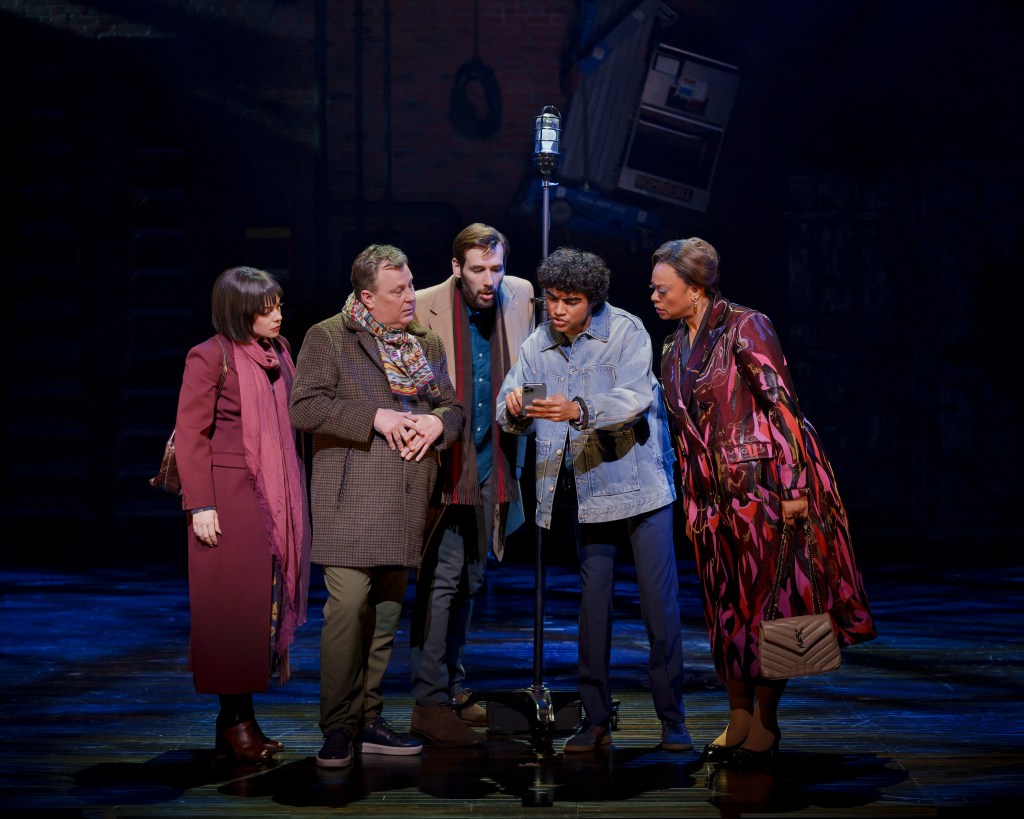
Smash is too much fun not to see. What makes it a hit are the superb singing, acting and dancing by an expert ensemble, phenomenal direction and the coherence of every element from book to music, to the choreography to the technical aspects. Finally, the show’s nonsensical sensible is brilliant.
Praise goes to those not mentioned before with Beowulf Boritt’s flexible, appropriate set design, Ken Billington’s “smashing” lighting design, Brian Ronan’s sound design, Charles G. LaPointe’s hair and wig design, and John Delude II’s makeup design.
Smash runs 2 hours, 30 minutes, including one intermission at the Imperial Theatre (249 West 45th street). https://smashbroadway.com/
‘The Collaboration,’ Paul Bettany and Jeremy Pope are Brilliant as Andy Warhol and Jean-Michel Basquiat

Whether you are an art aficionado, fan or critic, The Collaboration, by Anthony McCarten about Andy Warhol and Jean-Michel Basquiat’s joint effort to produce paintings together is an astonishing, dynamic production. Starring Paul Bettany (an Inspector Calls-West End) and Jeremy Pope (Choir Boy) and directed by Kwame Kwei-Armah, the two-act play currently runs at the Samuel J. Friedman Theatre, extended until 5 February. This production which hails from the Young Vic Theatre is not to be missed.
Warhol’s and Basquiat’s alliance was an unusual meld for both artists, who were at different points in their careers and who, according to McCarten in the first act, were a thesis/antithesis in their personal lives, perspectives and personalities. Because Warhol and Basquiat are icons who helped transform the art world as unique and indelible fixtures in their own right, The Collaboration is of seminal importance. Not only does the work identify aspects of the artists’ individual and collective graces, it also inspires further exploration into the lives of these individuals and their synergistic and productive relationship.

Bettany and Pope’s prodigious acting skills and Kwame Kwei-Armah’s superb direction in helping them tease out memorable details of emotion, gesture and nuance allow the actors to live and breathe their characters onstage. Bettany and Pope are a pleasure to watch in their authenticity as their portrayals by the second act lift toward the heavens into the phenomenal. They inhabit Warhol and Basquiat with vulnerability and humanity. So comfortably do they don the artists’ ethos, one forgets the play is a stylization and evocation of two mythic figures who attained immortality in spite of themselves.
Indeed, the production takes us on a fantastic journey with intermittent elements of realism that all the more enhance the beauty and tragedy of these men, whose lives were cut short. Though Andy Warhol lived to be 58 years-old, Jean-Michel died of an overdose of heroin at twenty-seven. At the conclusion McCarten suggests that their individual and collective work and their ability to inspire and whimsically play off one another are an irrevocable, immutable and timeless gift to all of us.
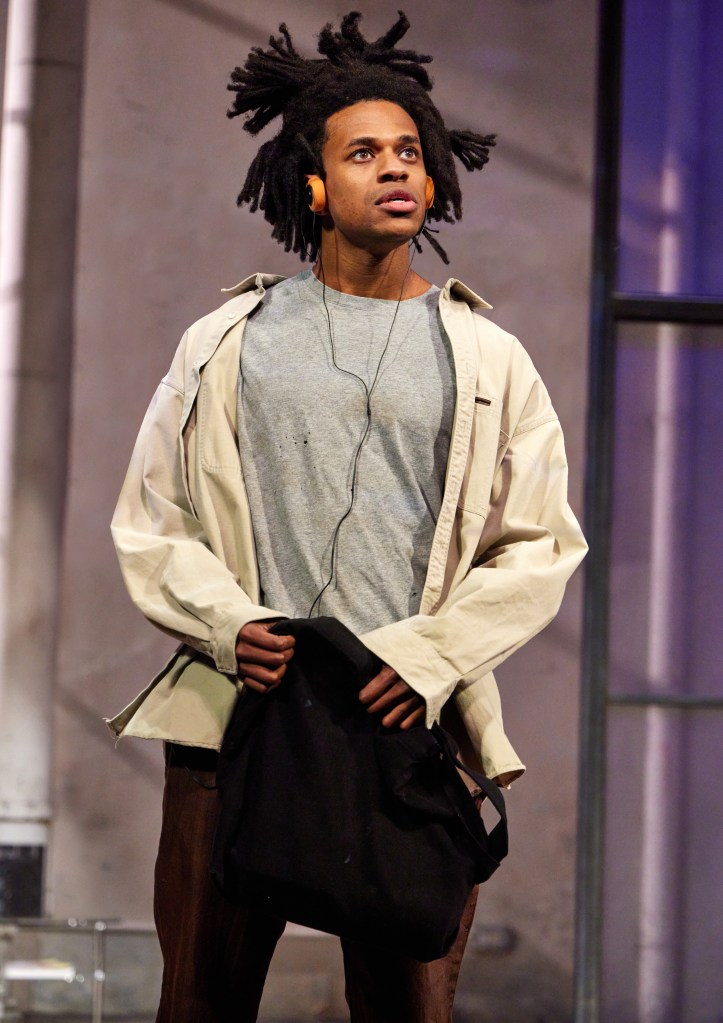
The award-winning playwright (known for films The Theory of Everything {2014) Two Popes {2020} and the book writer of A Beautiful Noise) grapples with revealing their combined efforts in the short period of time they worked together. Indeed, the cultural mystique and reputation that precedes these men sometimes gets in the way. The more one knows about Warhol and Basquiat, the more frustrated one may become with McCarten’s presentation of their relationship, whose closeness is developed in filmed events of Bettany and Pope doing activities together, projected on the backstage wall and side walls during the intermission between Act I and Act II. Thus, if one leaves to get a drink or take a trip to the bathroom, the vital aspects of how Warhol and Basquiat’s relationship develops and how the men bond over time will be missed.
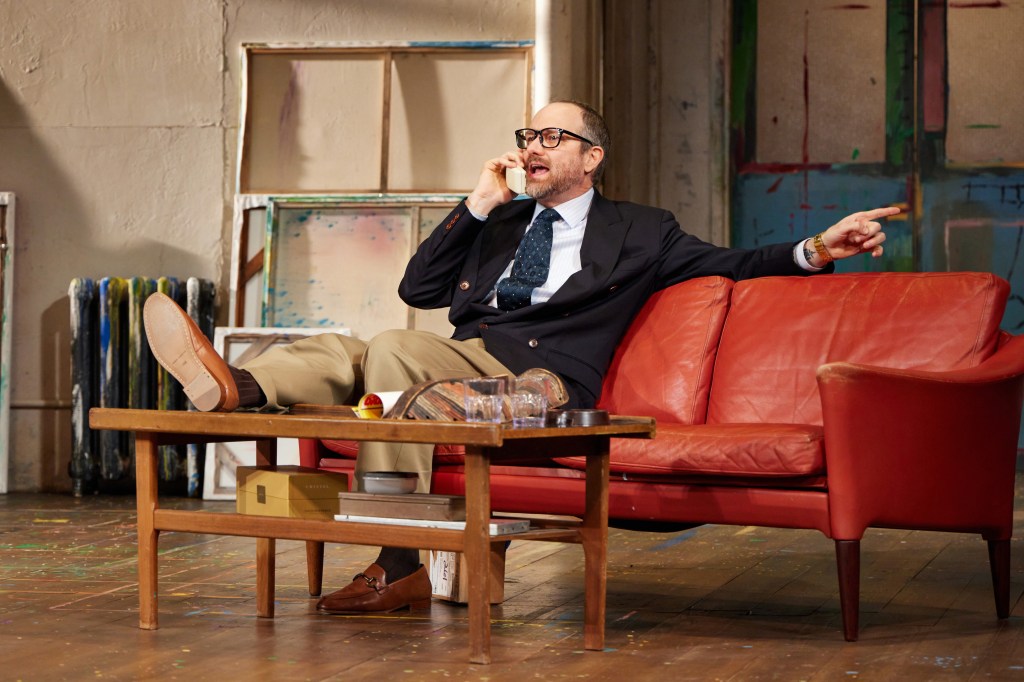
McCarten first introduces us to Warhol who visits the gallery of Bruno Bischofberger (Erik Jensen’s accent at times trips over itself). There, Andy inspects Basquiat’s paintings as Bruno attempts to sell him on his idea of a collaboration. Though Bruno makes it seem that Basquiat is “dying” to work with Warhol, we discover this isn’t the case. Bruno is massaging Andy’s ego. In his exchange with Bruno, Andy views 24 of Basquiat’s paintings which unfortunately we never see. Bettany looks out into the audience to “view” Basquiat’s work, as we imagine what Andy sees and watch his expressions of shock, excitement, amazement and jealousy, all in Warhol’s inimitable stylistic phrasing and being. Bettany captures the characteristic Warhol exclamations “gee,” “oh,” and retains enough of the soft spoken and demur air that we’ve seen in films of Andy Warhol that bring us toward acceptance of his portrayal, which deepens as the play embodies their philosophical tension working together.

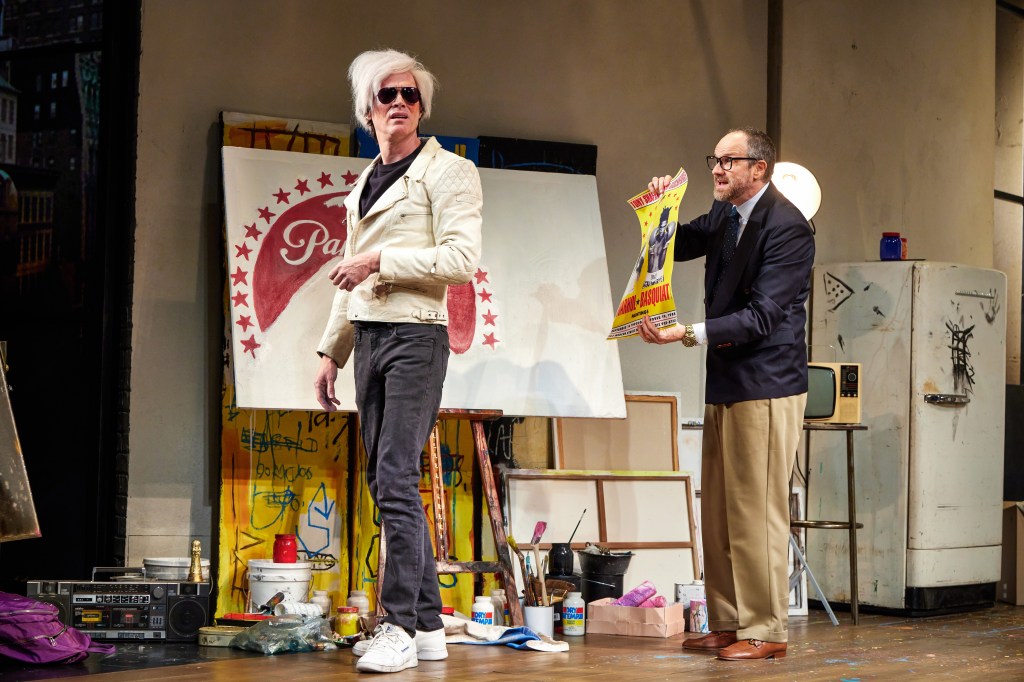
Bruno is the catalyst for their collaboration. And it is Bruno who comes up with the concept of how to market the exhibition of their works with a poster of both in boxing shorts with Jean-Michel’s chest exposed and Andy’s chest covered in a black T-shirt, as they hold up their boxing gloves ready for their match up of paintings on Mercer Street in New York City.
To persuade a reluctant Andy, Bruno uses flattery and guilt. He chides the avid filmmaker that he hasn’t picked up a brush in years. When Andy shrugs off Bruno’s flattery with self-deprecation that his reputation “is in tatters,” and “no one loves him any more,” Bruno wisely counters Andy’s defense and makes him think. Bruno suggests that it is Andy who doesn’t return the love given to him, an idea that intrigues Andy because it divulges arcane, inner knowledge about his soul which may be accurate. Bruno has hooked Andy toward working with Jean-Michel. But he is completely drawn in when Andy realizes that this is a golden opportunity to employ his skills as a filmmaker and interviewer. He will film their collaboration and record it for posterity.

After Andy leaves Bruno’s gallery, Basquiat keeps his appointment with Bruno and we see how the art dealer works his persuasion to lure Jean-Michel to accept Andy as an artist-partner. Like Andy, Jean-Michel is not convinced. In fact, he is nonplussed at the idea of painting with a world renowned artist and is suspicious and recalcitrant, suggesting that Andy is mechanistic and repetitive and his prints lack soul. With the same push-pull, parry and thrust that he experienced with Andy, Bruno cajoles and uses reverse psychology on Jean-Michel. He is not willing to take “no” for an answer, though Jean-Michel accuses him of exploitation when Bruno suggests the project is monumental and will have “art lovers lined up from the gallery door to JFK.”

Bruno stirs Jean-Michel on collaborating with Andy, using flattery and the unction that Andy really wants to work with Jean-Michael, though we have just witnessed that this is not true. Jean-Michel states he has nothing to say to Andy because they don’t “speak the same languages,” and he is not here to “bring Andy back from the dead.” Bruno, a master of human nature who pings Jean-Michel’s underlying vanity and competitiveness, finally reels him in with the discovery that Andy thinks Jean-Michel is “a threat to his entire understanding of art.”
The humor in both artist’s exchanges with the art dealer is organic, and the presentation of Bettany’s Warhol and Pope’s Basquiat are strikingly similar in their susceptibility to compliments, their egotism, their underlying insecurity with arrogance (Basquiat) and self-disdain (Warhol). As we watch the apparent tensions unfold, it is clear that Warhol and Basquiat may be sparring partners, but theirs is a match that is too coherent and intuitive not to work. Of course the idea that this will bring in tons of cash and, as Basquiat suggests, the bankers will be happy, emphasizes the themes of art’s pure expression versus art exploitation, and art as a business versus the pleasure and necessity to create art which drives both Andy and Basquiat. Meanwhile, as the inveterate money-minded dealer, Bruno encourages this promotional collaboration to harness their ambition and turn it into profits.

During Andy’s and Jean-Michel’s individual exchanges with Bruno dueling for advantage, themes and details in the artists’ lives surface. Andy’s mention of Valerie Solonas’ assassination attempt in 1968 that nearly took his life and caused him to look over his shoulder, expecting to be killed again is poignant and humanizing. The humanizing details continue throughout both acts and help to inform our understanding of the similarities between Warhol and Basquiat in their childhood experiences, for both were influenced by their mothers toward art, drawing and painting.
After the prologue with Bruno, the first act predominately takes place in Andy’s studio as the artists become familiar with each other, discuss their viewpoints, the idea of branding, what Andy’s art attempts and what Jean-Michel attempts with his art. Finally, they agree about what to paint and Andy sneaks in his filming as Jean-Michel paints and answers Andy’s questions. By the second act which takes place in Jean-Michel’s loft/studio/apartment, both artists have become close revealed in the film projections during intermission. At a crucial point in the second act and at Jean-Michel’s suggestion, they challenge each other good naturedly to take off their shirts and expose their wounds.
It is a profound, humbling, bonding act. The icons are human and terribly vulnerable. We see Jean-Michel’s extensive surgical scar where he was injured, run over by a car. He had to recuperate for a long time, a trial which his mother got him through when he was 7-years-old by encouraging him to look at Grey’s Anatomy and draw what he saw to inspire his healing process. And we see Andy’s corset which he must wear to hold his organs in place and above it the long, disfiguring scars criss-crossing his torso, where the surgeons had worked feverishly to save his life from Valerie’s bullet which she shot into him at point blank range.
The second act evolves into an explosion of love and rancor between the two artists. When former girlfriend Maya (Krysta Rodriguez) comes to Jean-Michel’s place to settle up a financial arrangement with Jean-Michael, Andy tells her about their mutual friend Michael Stewart who is in a coma, beaten unrecognizable by cops because he was painting graffiti. Maya returns with the news of Michael’s death and pleads with Basquiat to go to the lawyer’s office with her to give testimony proving the cops murdered Michael. Basquiat refuses. Instead, he gives her the Polaroids of Michael’s mutilated face and body.
Jeremy Pope’s Basquiat transforms into raw nerve endings of emotion in a heart wrenching explanation why he can’t go to the lawyer’s office. The jitters, the nerves, the frenetic energy that need to be displaced because of Jean-Michel’s painful identification with Michael as a fellow sufferer who has just passed is Jeremy Pope’s tour de force throughout the rest of the act.
Basquiat reminds Maya and Andy of the heartless reality of Black racism and oppression evidenced in police brutality against Michael. The spirit of hate and bigotry murdered Michael and that same spirit is ranging to murder him, as he, too, painted graffiti at one point early in his career. Pope conveys Basquiat’s tortured grief at the loss of his beautiful friend. He is torn between wanting to help the Stewart family and preserve his own life and destiny. When Basquiat accuses Andy of indirectly killing Michael, who he was trying to heal with his painting, not understanding, Andy is shocked at Basquiat’s recriminations.

McCarten reveals what painting means to Basquiat and how he perceives art’s power in this tremendous scene that hearkens back to Basquiat’s childhood when he encouraged his own healing by drawing “healthy” organs from illustrations in Grey’s Anatomy. Painting is his way of controlling, resurrecting life, defining power constructs and capturing racism symbolically to effect its change. When Basquiat tries to evoke healing for Michael spiritually, Andy’s commercial, material filming destroys the spiritual power to heal his friend who dies. Thus, for Basquiat painting is totemic and primal, sacred and holy while Andy, tortured by Basquiat’s questions reveals that art to him is an escape from self-loathing into an austere identity which only momentarily eradicates the deformed ugliness he is.
Ironically, at the core of their art, MarCarten suggests they symbolize and do different things. Andy films/records history to understand the creative process and see humanity, while never accepting his own. Basquiat employs the creative process to heal himself and others. One process is not better than the other, nor are they mutually exclusive. As their “collaboration” proves, both are integral to each other. Combined, they establish the inherent beauty and singularity of both.

This incredible scene extends into a dance between Andy and Jean-Michel who pushes Andy to validate and reveal himself as he pretends to film him, though Basquiat has destroyed all of Andy’s films of their collaboration. Once again Bettany’s Warhol and Pope’s Basquiat challenge each other in a rivalry that can never be equal because Andy is not Black. Though he suffers discrimination because he is gay, their bond has limitations. Andy leaves then comes back apologetically though Basquiat has been cruel to him. And it is in the last minutes of the play that there is a touching reconciliation. The inevitability of their lasting artistic achievement is brought to the fore.
To effect the characters, the director’s vision and the creative team’s execution of it works well. Warhol’s and Basquiat’s wigs thanks to Karicean “Karen” Dick & Carol Robinson and Anna Fleischle’s costuming are on-point. Fleischle’s minimalist scenic design of white walls serves to intimate Bischofberger’s gallery, Warhol’s Studio on Broadway and Union Square, and Basquiat’s loft apartment/studio on Great Jones Street. Props and paintings and works and furniture are added and taken away accordingly. Basquiat’s digs in the second act require the greatest set-up, as he lives in cluttered disarray, unlike Andy’s studio which is neat, clean and “almost sterile.”

The second act reveals magnificent writing and magnificent acting. Throughout the concept of modern arts’ evanescence, that “everyone thinks they can do it,” and discussions of art critics attempting to nail down their work then toss it aside, are fascinating and richly profound. That both men were exploited and learned to then exploit themselves to become their own business models has currency for us today. Of course they became masters at self-exploitation. Considering that Basquiat’s brilliant light shined momentarily to leave a massive body of work and Warhol’s frenetic energy blasted an even more massive collection, their painting together was genius.
Because Warhol and Basquiat have been branded with their own mythology and entrepreneurship, understanding who they were, understanding their relationship remains elusive. Such comprehension cannot be gleaned in one play, nor should one expect to. However, McCarten creates a masterwork that Bettany and Pope use as a jumping off point to portray the divine and weak in both characters. They are stunning, beautiful, transcendent. Thus, to describe The Collaboration as a “biodrama,” as some critics have done, is wholly inadequate. Rather the play is McCarten’s vision enhanced by Kwame Kwei-Armah’s sensitive and profound acknowledgement of two artistic geniuses who collided in the tension of trying to do the impossible. And as a result of this collision, they formed something new. They integrated their own styles of art in these partnership paintings that embodied resonating themes at the core of their own lives.
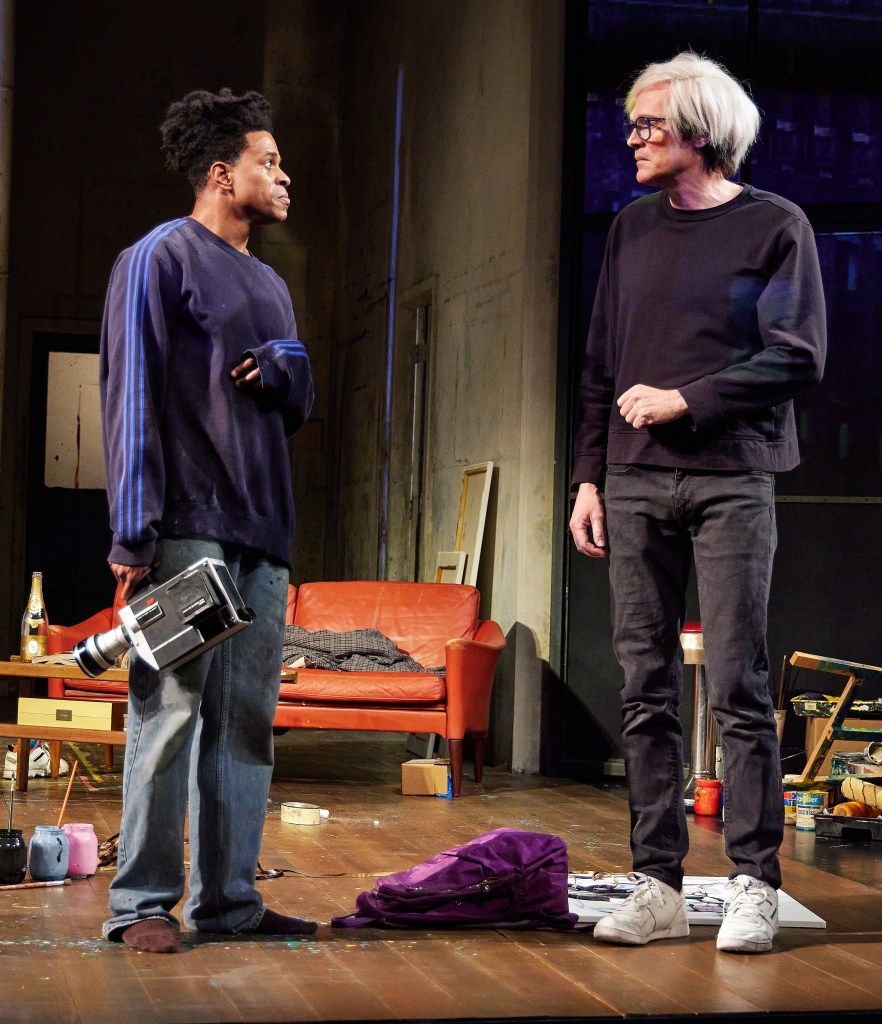
As the final sardonic irony at the play’s conclusion, while Bettany’s Warhol and Pope’s Jean-Michel paint into immortality, we hear the voice of an auctioneer, representative of the art world now on steroids, directional from what it was like when they were alive in the 1980s. Their work together is valued in the multi-millions, the irrevocable exploitation of both.
Kudos to Ben Stanton’s lighting design, Emma Laxton’s sound design, Duncan McLean’s projection design and Ayanna Witter-Johnson’s original music. For tickets and times go to their website https://www.manhattantheatreclub.com/shows/2022-23-season/the-collaboration/
 CAROLE DI TOSTI