Blog Archives
‘The Imaginary Invalid’ With Bill Irwin, Marvelous Fun
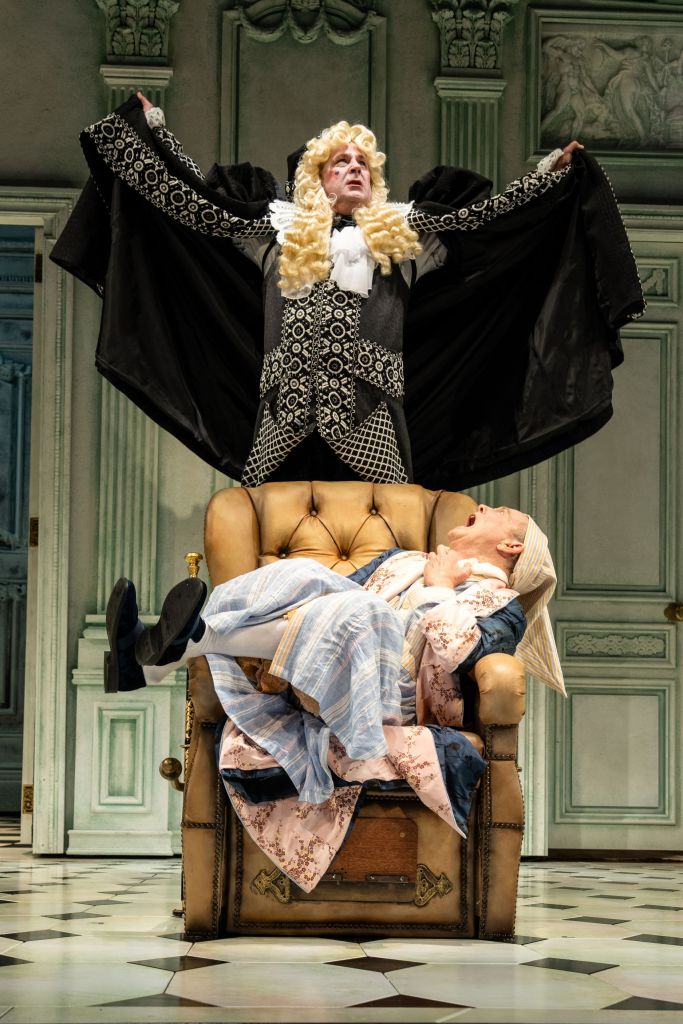
If laughter does good like a medicine, The Imaginary Invalid by Molière adapted by Bill Irwin from a translation by Doug Skinner will set your body humming with health and joy. The French farce with its roots in commedia dell’arte premiered in 1673 when a sick Molière played the hypochondriac lead Argan, finished the fourth performance giving it everything he had, then collapsed and died at home hours later. With that ironic send-off, the play has lasted for over 350 years, securing the playwright’s legacy with his other globally produced works.
This cleverly wrought production directed by Brandon J. Dirden currently runs at the Todd Haimes Theater until November 22, 2026. It is a treat to see this classic lovingly handled with precision by cast and creatives who obviously appreciate its satiric whimsy and trenchant current themes.
Bill Irwin, the clown prince of theater who brings his background at Ringling Brothers to his performances (pacing, mime and rhythm), leads a fine ensemble. These include Rachel Bloom, Brooks Ashmanskas, Dylan Baker, Hiram Delgado, Crystal A. Dickinson, Ava Lalezarzadeh and Daniel Croix Henderson. Portraying the wealthy Argan who spends a fortune on his persuasive doctor’s regimens and medicines, Irwin superbly delivers his humorous portrayal of Argan, balancing authenticity with innate comic timing. His high stakes investment in the character’s belief that without the doctors’ treatments and prescriptions he would be dead in three days, Irwin presents the field upon which the ensemble zanily frolics.
With a nod to commedia dell’arte and the Commedia Francise, a prologue which is a dumb show (pantomime), lays out the events of the play and dresses the stage with Beowulf Boritt’s ingenious, period, scenic design. The masked, robed Pantolone character gets the audience’s attention, striking a long staff on the stage floor. Then, with the staff he strikes the traditional Trois Coups which summons the actors to begin the play. The actors’ seamless movements, directed by Lorenzo Pisoni, whisk the mesmerized audience from the digital age to the 17th century’s comedy of manners.
Subsequently, masked, robed doctors pull long, red ribbons from Pantalone’s robe, symbolizing the bleeding treatment practiced at the time. During that process, they pull into place the walls and the ceiling, and add the simple pieces of furniture to create the home of Argan and playing space for the actors. Through the hustle and bustle, Irwin invisibly takes his position center stage in a modernish recliner. The robed, masked actors crowd around and dress him, back to the audience, then swivel him around. Lo and behold Irwin has transformed into the iconic hypochondriac!
Spinning its magic the play builds and explodes with satire and farce into a morality tale about obsessions with quack doctors, true and false love, and a brilliant, underestimated servant who saves the day, all in the 90 minute twinkling of an eye.
Economy and efficiency for maximum laughs are the watchwords for this production. The current, edgy dialogue serves as a counterpoint to the situation and subject matter, which Irwin’s adaptation smartly leaves in the 17th century. However, to streamline the play, Irwin removes the customary “interludes,” balletic dances, that lengthen Molière’s work into three acts. Also, Irwin removes the ancillary scene with the younger daughter Louison, who Argan interrogates for information about his daughter, her sister, Angelique. Removing the scene doesn’t impact the plot development or themes.
Essentially, Irwin keeps the structure and the problems driving the forward momentum of the play. For example, customary at the time wealthy families set up arranged marriages which Argan does with a satiric twist. The marriage he proposes is not an economic arrangement because no one needs financial assistance. Instead, it erupts from Argan’s desire to indulge his hypochondria and always have a doctor, or two or three at the ready. Dr. Diafoirus (Brooks Ashmanskas) and son Thomas (Hiram Delgado) are the brother and nephew of Dr. Purgon (Brooks Ashmanskas), Argan’s primary physician. If his daughter Angelique (the lovely Ava Lalezarzadeh) marries Thomas, Argan presumably will have 24/7 access to all three doctors.
In the funny scene when Thomas first meets Angelique, we learn in coded language that he can hardly wait to have children and is practicing by himself, alone. The reference to masturbation lands, LOL. Additionally, Thomas argues a thesis against the circulation of the blood and against the obsession with “cleaning of wounds” prior to surgery. Thus, we know how ineffective, even dangerous he is, especially because he stubbornly believes in his own righteousness. Thomas appears as the 17th century equivalent of a 21st century dweeb.
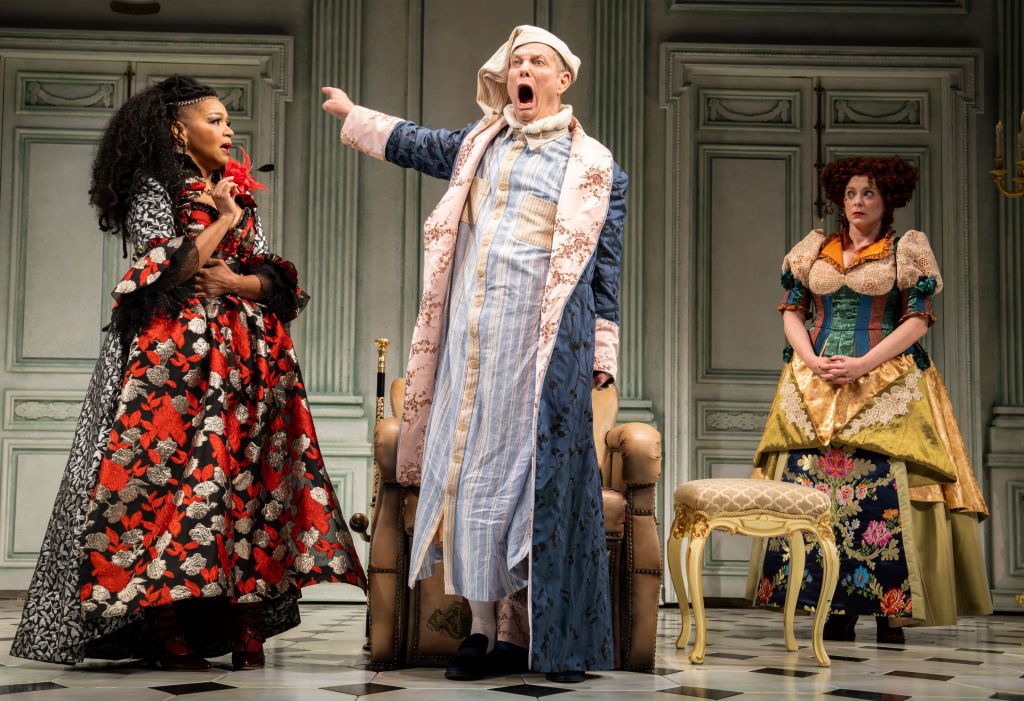
Though Argan’s word is law, the lovely Angelique loves Cleante (Daniel Croix Henderson). With Toinette’s help and understanding, the couple hope to pledge themselves to each other.
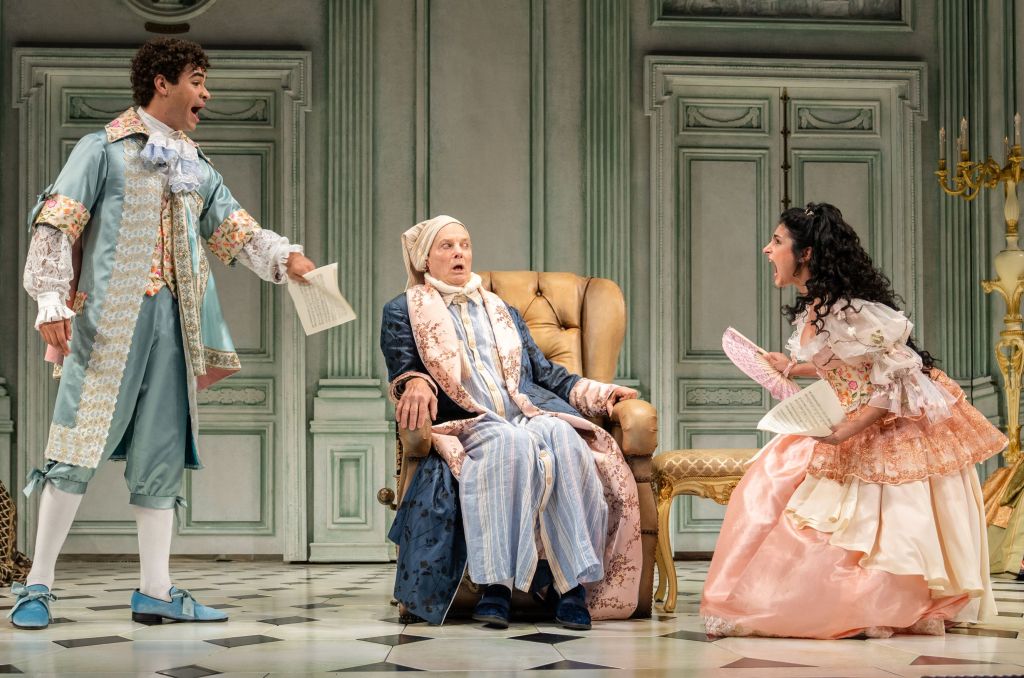
Wisely, Irwin includes the singing scene between Angelique and her love Cleante (Daniel Croix Henderson). Humorously, they sing an opera in codes to each other in front of Argan and the others. The audience, clued into their love “gets” it. Of course the fun turns into laughs as Argan gets annoyed and ends up foolishly ridiculing himself. Thus, he continues to push the marriage between Angelique and Thomas. As the complications heighten when Argan’s wife Beline (Crystal A.Dickinson) insists Angelique go to a nunnery, the suspense builds. Who will help Angelique marry the man of her dreams and not the slow-witted, unappealing Thomas?
Brooks Ashmanskas portrays both brother doctors, refining the ‘”likeness” of each. However, despite differences in long, curly period wigs (Nikiya Mathis), variations in stance, speech, demeanor, costuming (the excellent Karen Perry), we note they are one in the same. With ironic intention, we recognize their same pompousness, foppishness and presumptuousness of erudition. Casting the fine, comic actor in both roles gives the audience more time to appreciate his send up of greedy doctors, and enhances the themes.
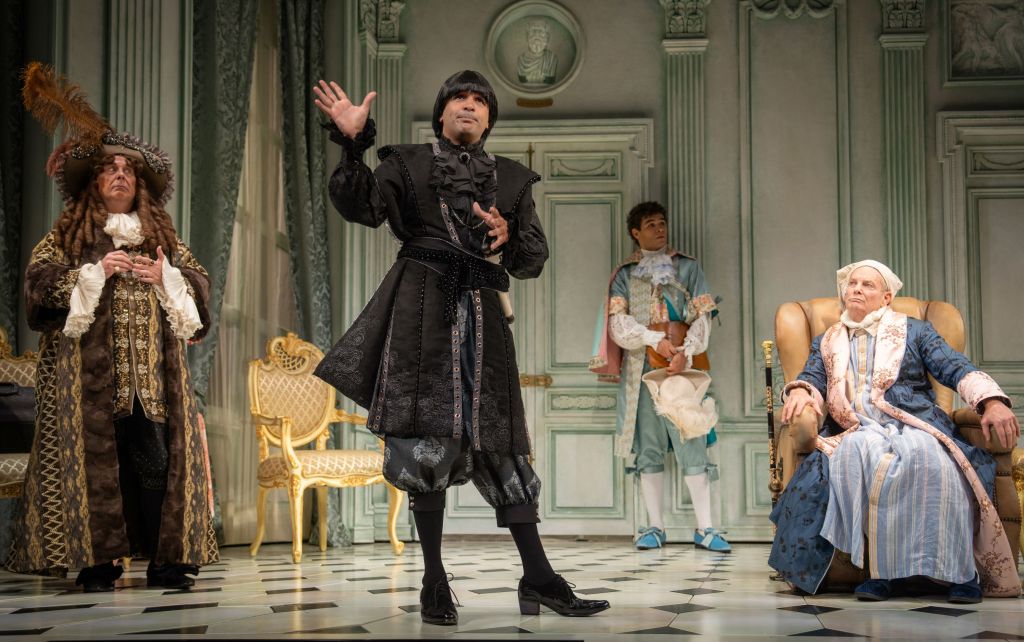
For example, the irony of casting Ashmanskas to play the younger brother Dr. Diafoirus and the older Dr. Purgon who appear in different scenes reveals how their exploitive, unscrupulous natures run in the family. As we expect, Thomas copies his charlatan father and uncle. Indeed, Delgado stokes laughter when Thomas explains his approach in never moving from the “Ancients” fixed methods into the discovery method. The family prefers to “practice” not at court where they would be held accountable for their bad, dangerous remedies since the king and courtiers expect cures. The Purgon clan only concerns themselves with proper form, not cures. Thus, they treat their own private patients whom they’ve cultivated. These patients, like Argan are gullible “cash cows,” Toinette (Rachel Bloom) counsels Argan who ignores her.
The brothers overcharge for the simple treatments like enemas, bleeding and purgatives which cause vomiting. As Beralde (the excellent Dylan Baker), Argan’s brother chides, the fact that Argan lives after all their harmful regimens proves his healthy constitution. But Argan is enamored of being ill and enjoys the attention and sympathy it brings from his second wife, the gold-digger Beline (Crystal A. Dickinson). Obviously, she plots with Bonnefoy (Hiram Delgado) to disinherit Angelique and extract as much cash as possible while Argan lives. Then, she inherits all of it after he dies. Argan’s foolishness must be countered before Angelique ends up evicted and in a convent. Will the conniving Beline win?
In fact Beline and the doctors work double time to part Argan from his money. Thus, three themes stand out in the play’s unraveling. First, golddiggers marry sick men to easily inherit. Second, doctors over charge for treatments that don’t work. Third, the course of true love never runs smoothly. These and others unspool with histrionics and hilarity. Additionally, Moliere’s theme that education can be meaningless unless put to effective use, threads throughout. Clearly, the anecdote appears to be in addition to Beralde’s dictum to “rest, ” would be to observe and watch. Observation like that accomplished by Bloom’s Toinette and Baker’s Beralde provides the wisdom to expose the difference between the liars, the frauds and the caring truth tellers. Thus, to see fact from fiction, we must watch what “they” do, not what they say. In that The Imaginary Invalid rings most true for us today.
The Imaginary Invalid runs 1 hour 30 minutes at the Todd Haimes Theater through November 22, 2026
roundabouttheatre.org.
‘Smash,’ Fabulous Send up of a Musical Comedy About Marilyn Monroe
Smash
Chatting with two theater critics beforehand, who referenced the 2012 NBC television series also called “Smash,” I was initially distracted. The TV series set in the present revolved around two aspiring actresses who compete for the role of Marilyn Monroe in a Broadway-bound musical called “Bombshell,” about Marilyn Monroe. Apparently, the TV series which devolved into a musical soap opera, lasted two seasons then was cancelled. Since I never saw the series, I tried to ignore the critics’ comments. I fastened my seat belt and settled in to watch the revamped production in its current run at the Imperial Theatre with tickets on sale through January 4, 2026.
I had no reason to”fasten my seat belt.” Smash is a winner. Superbly directed by Susan Stroman, a master of comedic pacing and the quick flip of one-liners, Smash is a resounding must see, retaining little of the TV show with the same title. I adored it and belly-laughed my way through the end of Act I and throughout Act II.
Into the first act when Ivy Lynn (the grand Robyn Hurder), introduces her Method Acting coach, Susan Proctor (the wonderfully funny Kristine Nielsen channeling Actors Studio Paula Strasberg), I embraced the sharp, ironic and often hysterical, theater-referenced send-ups. The book by Bob Martin & Rick Elice is clever and riotous, pushing the true angst of putting on a big Broadway musical and spending millions to make it a success. Martin and Elice’s jokes and the characterizations of Nielsen’s Susan Proctor and director Nigel, the LOL on point Brooks Ashmanskas (The Prom), who tweaks the gay tropes with aplomb, work. Both actors’ portrayals lift the arc of the musical’s development with irresistible comedic riffs shepherded by Stroman’s precise timing.

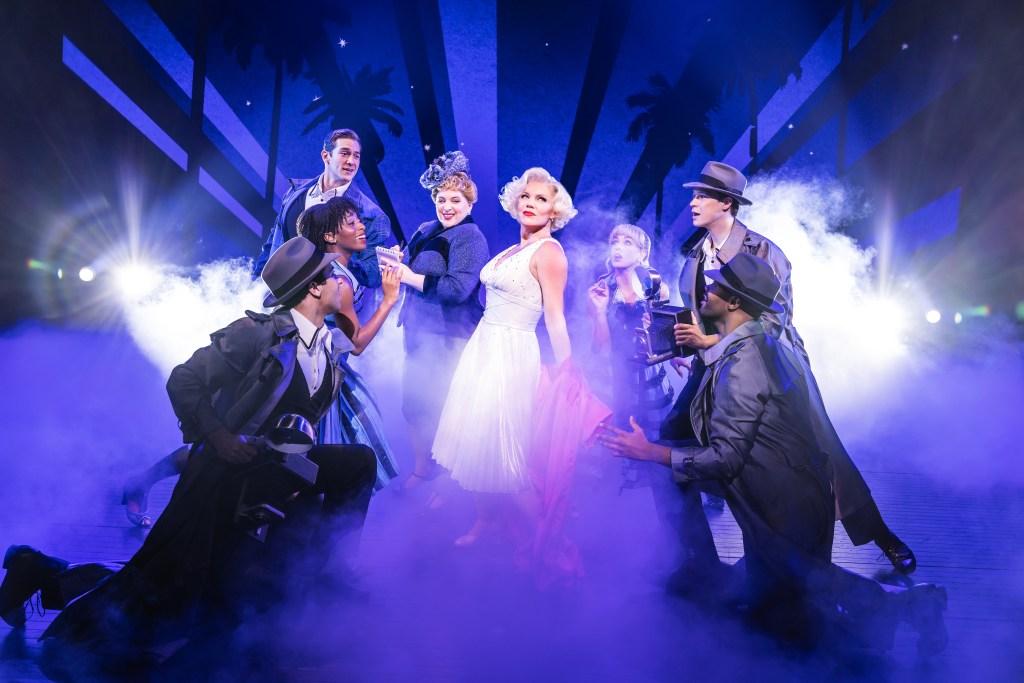
The music had me at the opening with the vibrant fantasy number, “Let Me Be Your Star,” sung by Robyn Hurder, whose lustrous voice introduces Marilyn and her fandom which the creators attempt to envision with fully costumed performers singing for their musical, “Bombshell,” the Marilyn Monroe story. Then, the scene shifts to the rehearsal room where we meet the creative team who imagined the previous number and scene. Ashmanskas’ director/choreographer Nigel humorously bumps heads with writer/lyricist/composer-husband and wife team Tracy (Krysta Rodriguez) and Jerry (John Behlmann).
Also present, is his associate director and Nigel’s right arm, the golden voiced Chloe (Bella Coppola). She runs interference and puts out fires, even covering for Ivy Lynn and understudy Karen (Caroline Bowman), during an audience invited presentation. Why Ivy Lynn and Karen can’t go on is hysterical.
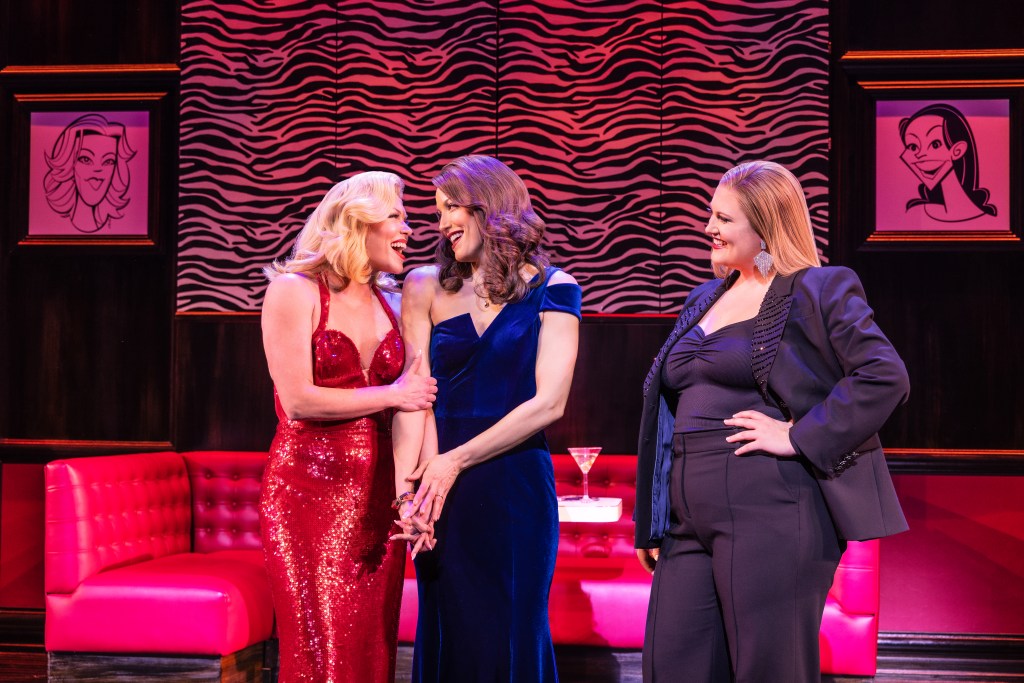
The music by Marc Shaiman, lyrics by Scott Wittman and Marc Shaiman, and the choreography by Joshua Bergasse are upgraded from the TV series with a curated selection of songs to align with the comedic flourishes. The musical numbers and dances cohere perfectly because the performers rehearse for their show “Bombshell.” With music supervision by Stephen Oremus, an 18-piece orchestra charges the score with vibrant dynamism. Featured are some of Shaiman’s brassiest tunes, orchestrated by Doug Besterman. Lyricist Wittman seals the humor and advances the plot. All provide grist for Bergasse’s choreography. Hurder manages this seamlessly as she sings, breathes heartily and dances while the male dancers whip and flip Ivy as Marilyn around. Of course, all smile with effortless abandon despite their exertions.
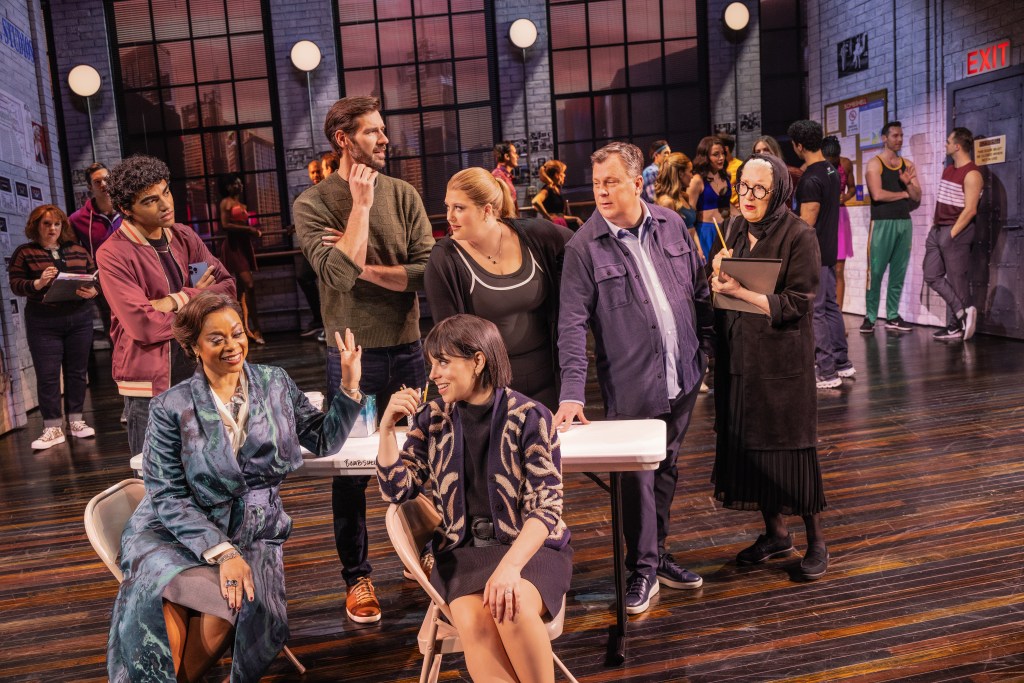
Importantly, Martin and Elice’s book sports farcical, riotous moments. These build to a wonderful crescendo by the conclusion. By then we realize we’ve come full circle and have been delighted by this send up of the wild ride these creatives went through to induce the belly-laughing “flop,” we’re standing, cheering and applauding. It’s the perfect ironic twist.
Indeed, once the audience understands the difference in tone from the TV series, largely due to Nielsen’s Proctor (she’s dressed in black mourning {Marilyn?} from head to foot), and Ashmanskas’ Nigel, Smash becomes a runaway train of hilarity. This comedy about unintentionally making a musical flop (unlike the willful intent in The Producers), smartly walks the balance beam by giving the insider’s scoop why “Bombshell” probably never finds a home on Broadway. One of the reasons involves too many chefs trying to make a Michelin starred dish without really understanding how the ingredients meld.
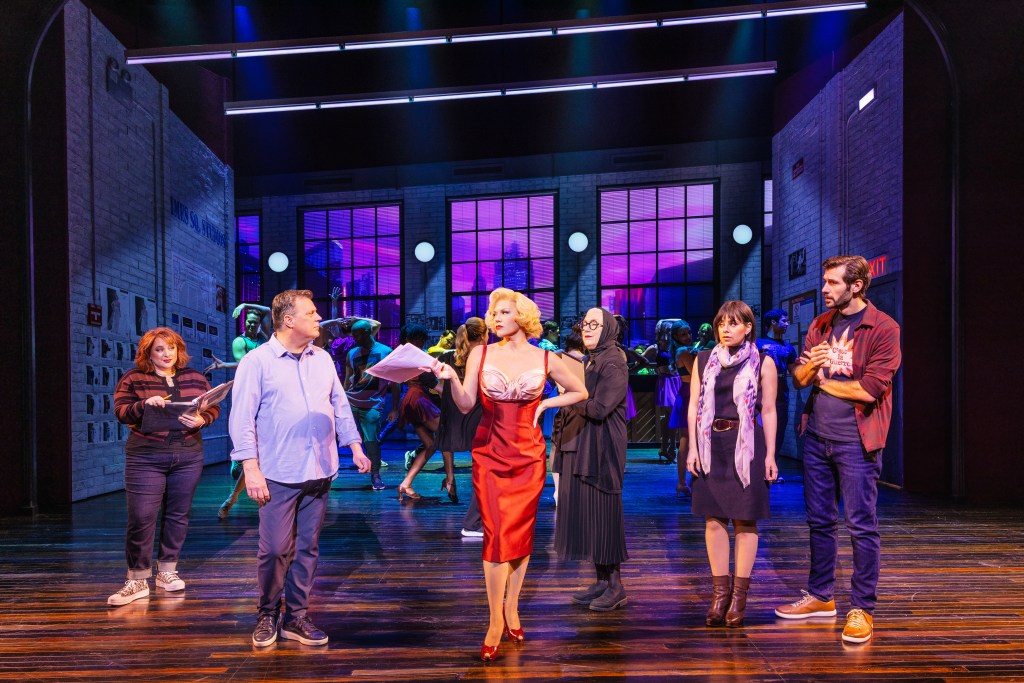
Nielsen’s Proctor dominates Ivy Lynn to the point of transforming the sweet, beloved actress into the “difficult,” “tortured soul” of diva Marilyn. The extremes this conceit reaches is beyond funny and grounded in truth which makes it even more humorous. Without giving too much away, there is a marvelous unity of the book, music and Hurder’s performance encouraged by Nielsen’s Marilyn-obsessed Proctor. We see before our eyes the gradual fulfillment (Proctor’s intention), of “Marilyn,” from superficial, bubbly, sparkly “sex bomb,” to soulful, deep, living woman produced by “the Method.” Of course to accomplish this, the entire production as a comedy is upended. This drives Nigel, Tracy and Jerry into sustained panic mode, exasperation and further LOL behavior especially in their self-soothing coping behaviors.
Furthermore, Producer Anita (Jacqueline B. Arnold), forced to hire Gen Z internet influencer publicist Scott (Nicholas Matos), to get $1 million of the $20 million needed to fund the show, mistakenly allows him to get out of hand, inviting over 100 influencers to Chloe’s serendipitous cover performance. The influencers create tremendous controversy which is what Broadway musical producers usually give their “eye teeth” for. Publicity sells tickets. But this controversy “backfires” and creates such an updraft, even Chloe can’t put the conflagration out. The hullabaloo is uproarious.

The arguments created by the influencers and their followers (in a very funny segment thanks to S. Katy Tucker’s video and projection design), cause huge problems among the actresses and forward momentum of “Bombshell.” Karen, Ivy Lynn’s friend and long time understudy, who has been waiting for a break for six years, watches Chloe become famous overnight for her cover. Diva Ivy Lynn who IS Marilyn is so “over the moon” jealous and threatened, she breaks up her close friendship with Karen and turns on cast and creatives, prompted by Nielsen’s Proctor who keeps up Ivy Lynn’s energy with a weird combination of mysterious white pills and even weirder “Method” tips.
Thus, the musical “Bombshell” becomes exactly what the creatives swore it would never become and someone must be sacrificed. Who stays and who leaves and what happens turns into some of the finest comedy about how not to put on a Broadway flop. Just great!
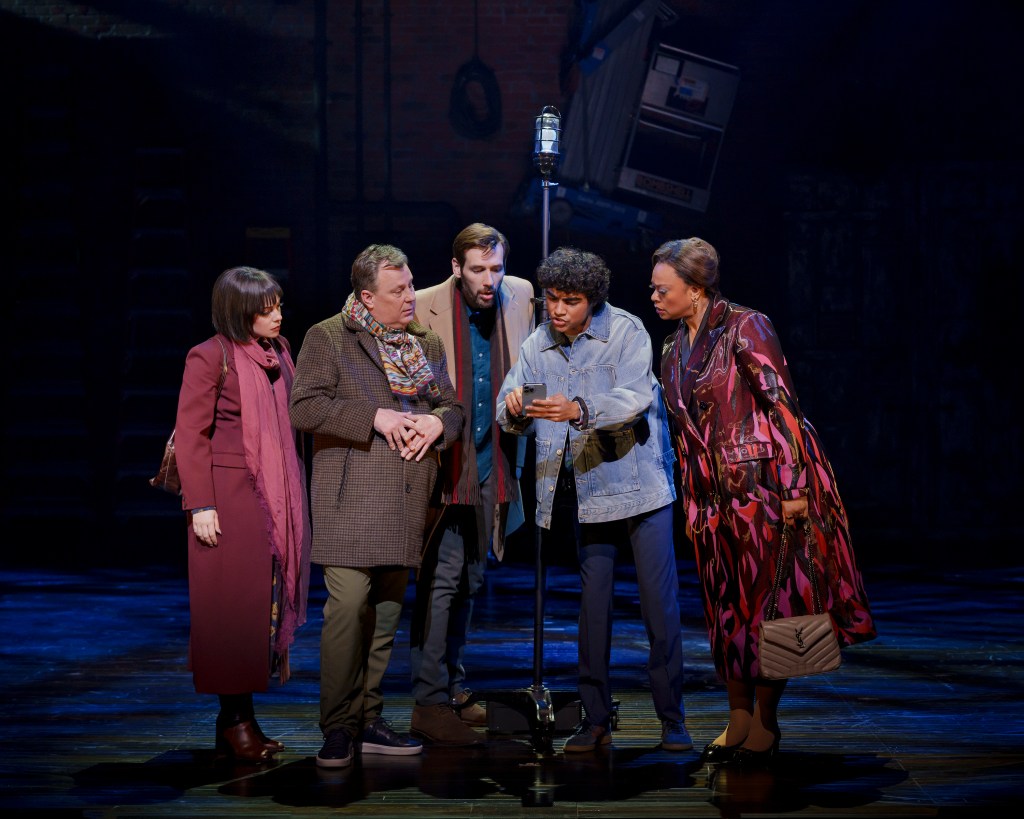
Smash is too much fun not to see. What makes it a hit are the superb singing, acting and dancing by an expert ensemble, phenomenal direction and the coherence of every element from book to music, to the choreography to the technical aspects. Finally, the show’s nonsensical sensible is brilliant.
Praise goes to those not mentioned before with Beowulf Boritt’s flexible, appropriate set design, Ken Billington’s “smashing” lighting design, Brian Ronan’s sound design, Charles G. LaPointe’s hair and wig design, and John Delude II’s makeup design.
Smash runs 2 hours, 30 minutes, including one intermission at the Imperial Theatre (249 West 45th street). https://smashbroadway.com/
‘The Prom,’ A Musical Comedy That Soars With Positivity and Truth
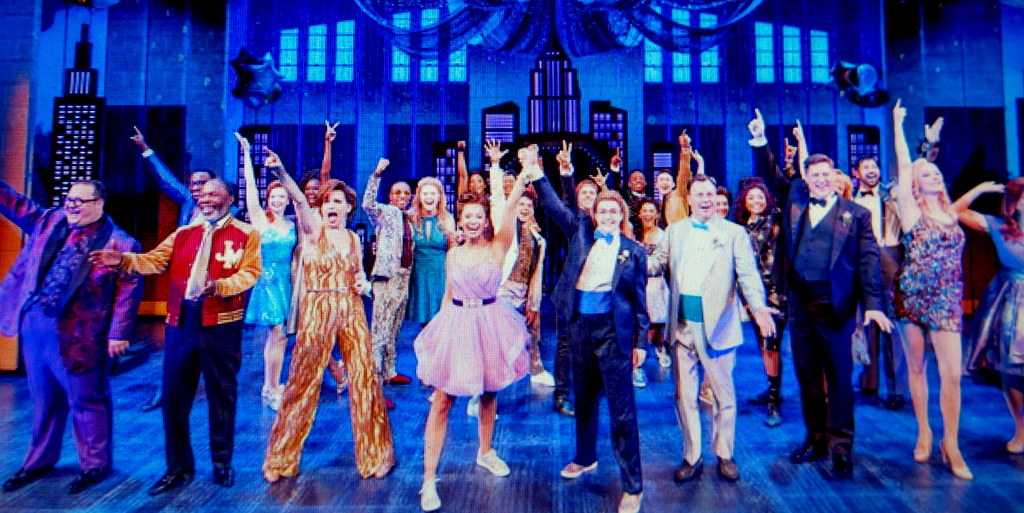
The cast of ‘The Prom,’ Book by Bob Martin & Chad Beguelin, Music by Matthew Sklar, Lyricsy by Chad Beguelin, Directed and Choreographed by Casey Nicholaw (Deen van Meer)
Even if you never went to your own high school prom and can’t imagine wanting to, The Prom directed and choreographed by Casey Nicholaw, currently at Broadway’s Longacre Theatre is a celebration of joy and life that you would be comfortable with. In fact just for its sheer hilarity, exuberance, and wisdom, you would eagerly sign up for the high school prom decorations committee. From its timing-perfect acting, to the evolution of characterization, and ingenious “true-to-life” story-line delivered in dialogue with dollops of zazzzzz, this musical comedy is thematically trenchant and expansive. Thanks to its talented creatives who know how to please and bring in the jokes at two hours and change with one intermission. The Prom is saavy, poignant and politically current with immutable themes that resonate for all time.
The notion of a “prom” unifying a senior class for the last time before they take off to “parts unknonwn” beyond the cliff of their community, is antiquated. But it is a tradition that the “in” crowd and “cool” kids in various schools in the US of course exploit to champion their supremacy over the rest of the school’s social groups. Naturally, for girls it is the height of achievement to be able to go with a date and buy a gorgeous dress with all the trimmings including matching color co-ordinated cumberbund for the guy’s tux and baseball cap. For those outcasts and isolates who have had to endure the humiliation and often sub rosa bullying and excoriation of their classmates precisely because they are “EWWWWW,” and would never be able to either ask someone or be asked, “the prom” is synonymous with pain, torment, Nazi-style fascist sadism which ultimately reverts to self-flagellation for the isolate’s not measuring up and having one’s place on the sunny side of high school superiority and popularity.

‘The Prom,’ Book by Bob Martin & Chad Beguelin, Music by Matthew Sklar, Lyricsy by Chad Beguelin, Directed and Choreographed by Casey Nicholaw (Deen van Meer)
The high school structure of placing students in same-age-related grades causes such emotional debacles and crucibles of misery, not only with regard to “the prom,” but with regard to stratification of achievement levels and every aspect of the daily life of the high school student. But what happens if you are not only a social outcast, but one with a gender proclivity that is UBER “EWWWW” in a setting where religious folks in a Red state culture believe your very nature, identity and being is a sin? Such is the conundrum and very real stakes for Emma (sensitively and realistically portrayed by the golden-voiced Caitlin Kinnunen) As a high school senior of a small high school in Indiana, Emma must suppress her year and one-half relationship with Alyssa (Isabelle McCalla is superb as Emma’s waffling sub rosa girlfriend) which they both intend to make manifest when they go to their prom together. But when the PTA led by Alyssa’s mom (the heartfelt and many-sided Courtenay Collins) discovers that Emma intends to bring a same sex girlfriend (she does not know it is her daughter-surprise, surprise), she protests and creates a ban. And Emma protests creating a stir.
This real-life situation of gay teens being barred from attending their proms with same sex partners has occurred all over the US and as recently as in 2017, Buffalo, New York. Most specifically when it happened to Constance McMillen of Itawamba Agricultural High School, in Mississippi, McMillen sued because her rights were violated. And when the ban was lifted and she attended her scheduled prom, the district had a surprise waiting for her right out of Mitch McConnell’s and the Republican Party’s playbook. (Check this article on McMillen.)
With Trumpism, gender discrimination, misogyny, racism and nativism have gained a legitimacy as certain social groups glance back fondly to the days of Jim Crow and attempt to enforce their fascist agenda on the rest of US citizenry who are patriots and believe in upholding the constitution. That Bob Martin, Chad Beguelin and Matthew Sklar have allowed the prom banning of LGBTQ groups to inspire them to write a musical comedy which explores the heights and depths of Trumpist-type discriminatory acts with grace, style, laugh-riot humor and profound wisdom (without making reference to Trump, or the new Trump party) is prestidigitation on a grand scale. For they inspire unity, hope and love with the same tools that adversarial groups use to promote hate and division.
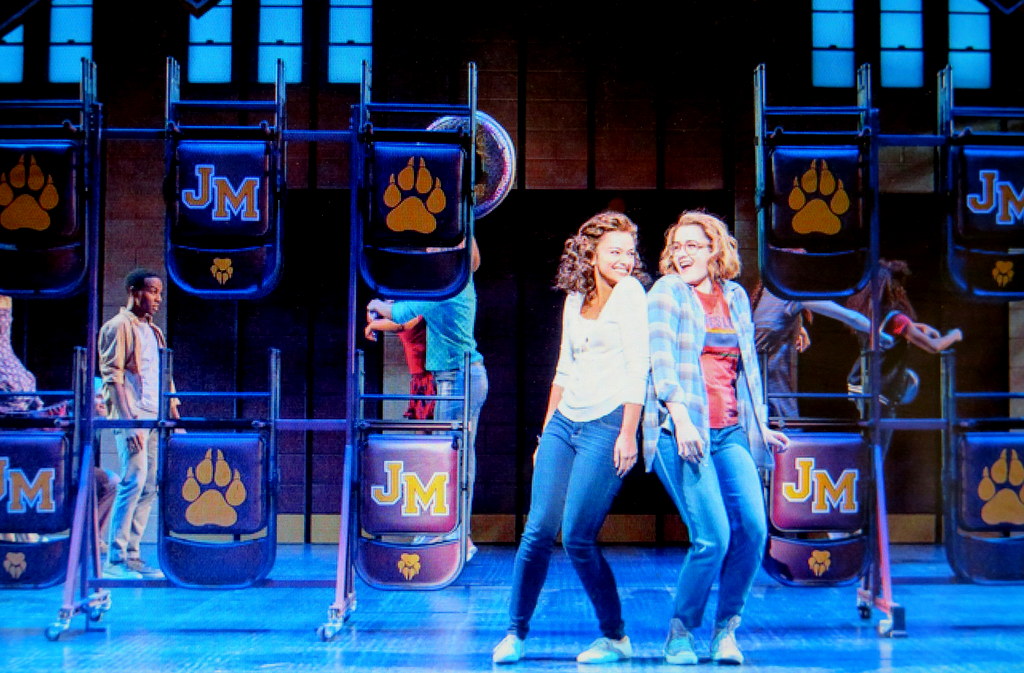
(L to R): Isabelle McCalla and Caitlin Kinnunen in ‘The Prom,’ Directed and Choreographed by Casey Nicholaw,(Deen van Meer)
And what is the vehicle they use to initiate a way into the LGBTQ hair-raising problems of a small Indiana high school and Emma’s fight? Theatricals! Thespians who represent some of the finest, award-winning celebrity narcissists on Broadway. And these even bring their Tonys and Drama Desks to impress the motel manager to give them a better room. Of course, not only are they not recognized, the crushing humiliation they experience in a town that could care less about them is enough to make even a narcissist more lovable and heart-warming.
Martin, Beguelin and Sklar begin in New York City with the Broadway stars backstage after a performance which closes immediately when they receive a horrific New York Times review. The critic was particularly humiliating when they referred to the headliners as “unlovable narcissists.” The joke is priceless for it recalls another celebrity narcissist who also cannot be insulted and refuses to change.
The narcissists are the fabulous Beth Leavel as Didi Allen the Diva Queen extraordinaire with a gorgeous belt (We hear it in the song “The Lady’s Improving), and her co-star in infamy the “bring-down-the-house” high flier, Brooks Ashmanskas as Barry Glickman whose vibrant and hysterical “Barry is Going to the Prom,” hints at the 30-years-ago miseries of high school and the affirmation of love wiping tears away years later.

The Prom,’ Cast and Christopher Sieber, Book by Bob Martin & Chad Beguelin, Music by Matthew Sklar, Lyricsy by Chad Beguelin, Directed and Choreographed by Casey Nicholaw (Deen van Meer)
The attention starved thespians are accompanied by Angie (the excellent Angie Schworer whose dance/voice number “Zazz” is just wonderful) and Trent Oliver (Christopher Sieber’s fantastic “Love Thy Neighbor” with the ensemble is the gobsmacking point of the show). Along with producer Sheldon Saperstein (Josh Lamon’s timing is spot-on) this motley crew goes on the road to resurrect their brand, recover from the criticisms in the Times article by battering down the unjust doors of the discriminatory high school to join Emma’s cause. They determine that this “self-less act” of “making a difference,” “doing good for the world” will lift their reputations and give them some positive publicity.
Of course they exacerbate the horror of the initial situation for Emma and create a chaotic shambles riling up the parents of the PTA who demand the interlopers be removed and leave. When Emma succeeds in her lawsuit proving her civil rights cannot be violated, the PTA and student body contrive a solution, represented by the song “Tonight Belongs to You/Us” sung by the ensemble at the end of Act One. The number is mesmerizing, wildly frenetic (the dance moves are spectacular) and enthralling. And then the chill comes to us in a terrifying realization of the song’s true message sung by a predatory, vampirish-sounding refrain “the night belongs to us.” Clue, the cool crowd, the money, the power players who attempt to devour and suck the blood of the little people who suffer their callous and unconstitutional injustices. Emma’s Broadway “helpers” prove anything but and Emma is worse off than before the show crowd showed up!
This is a superior high point to end Act One, for there must be change; such injustice cannot continue. Enter the answer which turns the religious institutional crowd on its ear and enter artistic empathy. The result is a beautiful cathartic Greek style elevated comedy of triumph in Act Two which provides a more than satisfying and very adult addendum to proms everywhere in the US.
Yes, some of the problems are not resolved, just like in life. And the townspeople still must grapple with their prejudices. These have taken years to simmer and boil and do not retreat overnight. Alyssa’s mom Mrs. Green must confront the pain of a truth she doesn’t want to see with her daughter. The hatreds and bullying will continue, but this hiatus of joy has begun to ameliorate it. Ironically, the ones who have benefited greatly (the celebrity narcissists) have stepped up and contributed their grist to making the prom one that everyone will remember. Interestingly, they have evolved and developed into less self-absorbed individuals who perhaps have begun to understand another level of success beyond the wins they’ve received in their careers.
I loved this show for its incredibly energetic performances by all of the cast and the ensemble. There is not one who isn’t superb or who isn’t “on point” and “moment-to-moment.” I loved the book and the accompanying musical numbers which remain insightful and carry the themes and story-line forward to the powerful message of the show. Indeed, some of the songs are stand alones with lovely melodies and rising lyrics: “Dance With You,” and “Unruly Heart,” are especially meaningful.
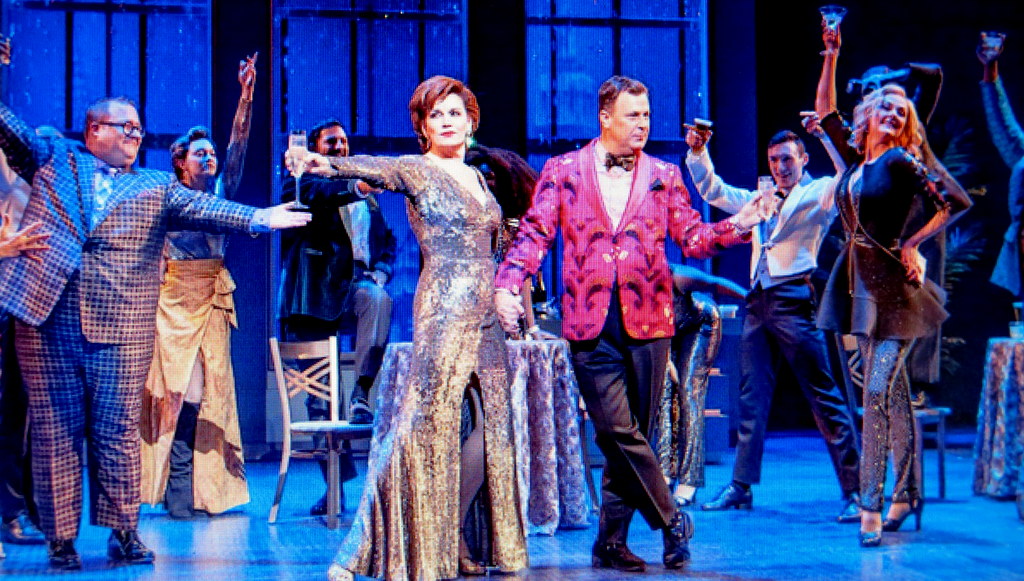
Beth Leavel, Brooks Ashmanskas and the Cast in ‘The Prom,’ Book by Bob Martin & Chad Beguelin, Musi by Matthew Sklar, Lyrics by Chad Beguelin, Directed and Choreographed by Casey Nicholaw (Deen van Meer)
The Prom presents the realms of hope and faith in people’s goodness. It encourages us to take a stand for what is right regarding human dignity, respect and decency. Without politicizing or rankling, it cleverly portrays elements of our nation’s weaknesses from the self-absorbed celebrity elite, to the equally self-absorbed and self-righteous conservatives. Both must modify and one way this will occur is for each social group of the nation to come together, get out of their comfortable locations and visit the hinterlands or “sin city.” The production makes a case for laughing at oneself and not taking one’s beliefs too seriously to forget the dignity of others, regardless of their beliefs. And perhaps especially because of their beliefs, they must be given a hearing. How many times must we say this to begin to do it? We need to stop cannibalizing ourselves.
The final song “It’s Time to Dance,” argues for each and every one of us to be our own creations, to define ourselves to be as truthful as possible on journeys of grace and openness, and without arrogance that masks fear or belligerence to “prove” a point.
The production is superb in its thematic encouragement/reinforcement for young and old: 1)to be the best of who one can be; 2)to take charge of one’s own life and not wait for others to act for us; 3) to bravely do one’s part to establish a world of tolerance and inclusion through communication and empathy.
The creators are not presenting ideas that are puerile and simplistic. If one just stops for two minutes and considers the rise of white terrorist incidents in the last two years that go against the fabric of our nation’s tenets, then one realizes how much our culture needs to witness these themes again and again. On the surface The Prom is a fun ride and you leave the theater humming the songs. But underneath the laughter and fun is the poignant message expressed with ebullience by the ensemble and Christopher Sieber’s Trent Oliver with rousing spirits in the song, “Love Thy Neighbor.” If only…but for the shining last quarter of the show, the cast convinces us of the truth and possibility of putting aside behaviors that divide. What a crazy great message that all of us imperfect, flawed individuals need to remember to dance at our own “prom” (our own way of walking) every day and invite a host of other smiling individuals to promenade with us!
Kudos go to the artistic team which makes this production a resounding you want to come back to see a few times: Jack Viertel (Original Concept) Scott Pask (Scenic Design) Ann Roth (Costume Design) Matthew Pachtman (Costume Design) Natasha Katz (Lighting Design) Brian Ronan (Sound Design) Josh Marquette (Hair Design) Milagros Medina-Cerdeira Mary-Mitchell Campbell (Music Supervisor, Vocal Arrangements) Larry Hochman (Orchestrations) Meg Zervoulis (Music Director) and John Clancy, Glenn Kelly and Howard Joines for their musical coordination, additional orchestrations and arrangements.
The Prom (Longacre Theatre on West 48th between 7th and 8th) has one 15 minute intermission. You can purchase tickets by CLICKING HERE.

