Blog Archives
‘Becky Shaw’ Brilliant Acting, in a Mind-blowng Play
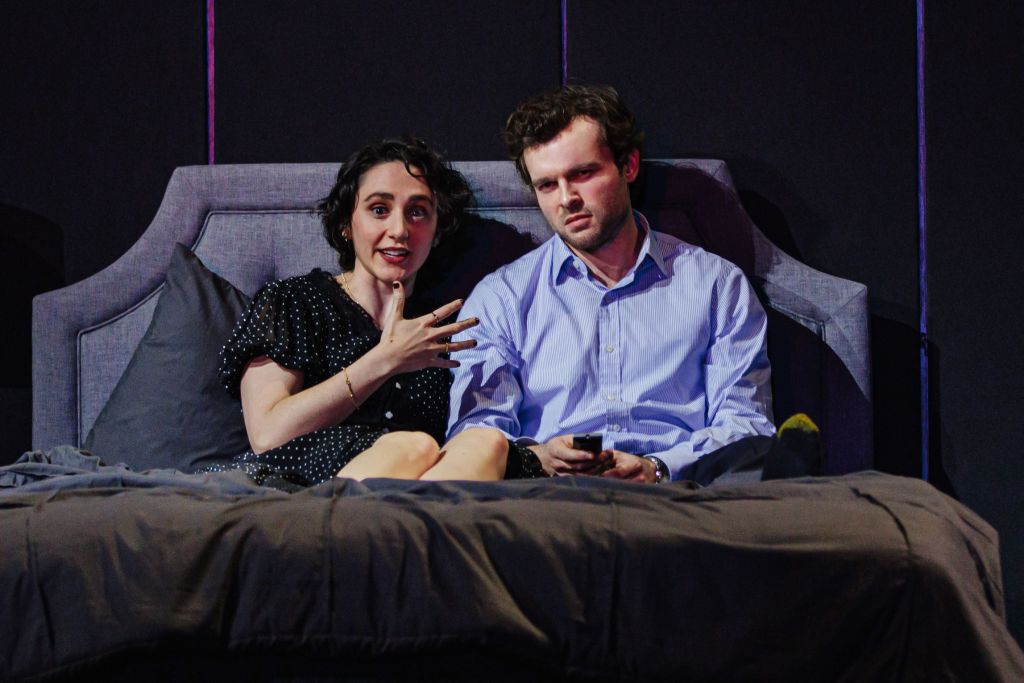
Becky Shaw is titled for the female character who shows up one-third of the way into the play written by two-time Pulitzer Prize finalist Gina Gionfriddo. The character Becky Shaw is the linchpin that sets the hellish interactions in motion as the wheel goes round in this profoundly drawn comedy of dark complications. When the pieces of the puzzle fit at the conclusion revealing who the play is actually about, the revelation shatters. Perhaps the adage people are hell (a theme of Jean Paul Sarte’s No Exit) has validity here. For by the conclusion we certainly see the hell continuing into the future of all the characters Gionfriddo sets in motion in her tight, sardonic, superbly woven comedy. Smartly directed with pace by Trip Cullman, the Broadway premiere of Becky Shaw currently runs at the Helen Hays Theater through June 14, 2026.
We expect the opposite of darkness at the top of the play as Gionfriddo brightly introduces us to the sharp retorts and humorous thrust and parry between family/friends Suzanna (Lauren Patten), a psychology grad student and Max (Alden Ehrenreich), a money manager handling her recently deceased father’s estate. It turns out these two have been like family for over twenty years for Max was adopted by her father. So they grew up together and know each other’s insides and outsides and count on each other in a symbiotic way for emotional support and purposefulness. Max runs interference for Suzanna, helping her with her imperious, controlling mother Susan (Linda Emond), who, to Suzanna’s disgust, has taken up with a younger opportunistic man because she has money and needs him emotionally, sexually and psychologically.
During Suzanna’s and Max’s discussion of Susan, her man and the family’s dwindling finances, we understand how domineering, remote and unavailable Susan is when she drops by Suzanna’s room to talk to her daughter and Max. After her snide remarks to Suzanna, Susan makes her demands known, ignores Max’s explanation why funds had been siphoned from the family business by their accountant, and leaves after stating she will be taking Lester with her to dinner and everywhere else, especially her bed. Bereft at losing her father though he passed four months ago, Suzanna turns to Max for comfort. And he is there for her in a way he never was before, assuring her it will not change their relationship.
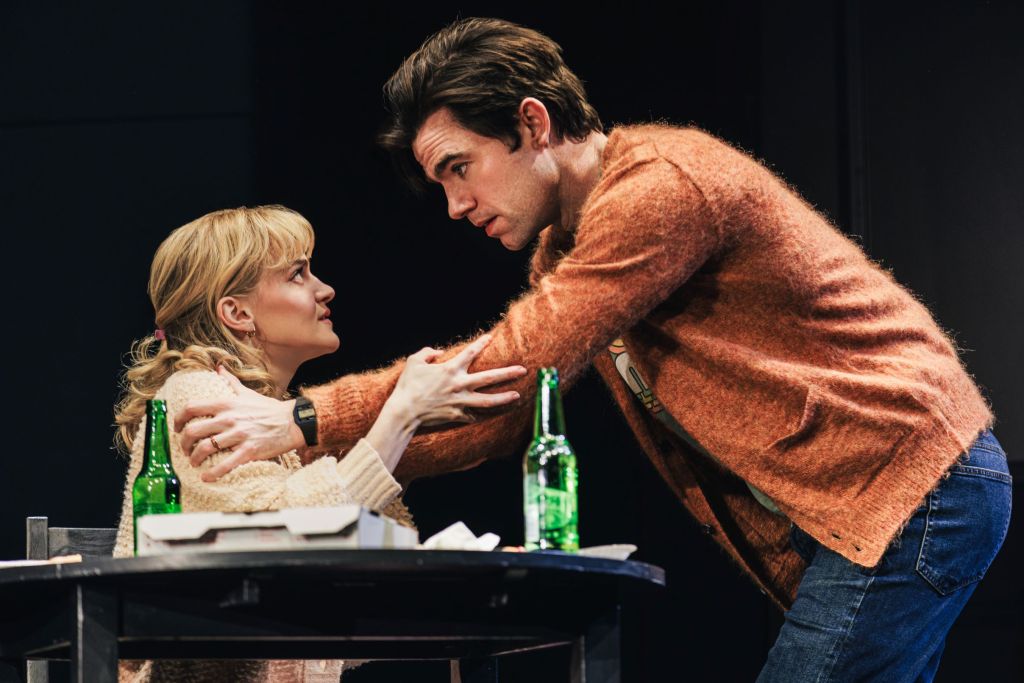
Because of their close family dynamic, Max’s comedic, ironic responses as the wiser person and Suzanna’s dependence on him, though there is only one year difference in age, sets up the next step into intimacy. This doesn’t surprise and seems natural when Max assures Suzanna sex is not as she suggests “epic,” and it doesn’t have to change anything as they make love. Unexpectedly, the stage crew upends Max who initially watches with surprise then helps them as they move in tables and chairs and rearrange the room (David Zinn’s excellent, symbolic design displaying Cullman’s insightful vision.). Max exits following Suzanna as the former hotel room in New York City becomes Suzanna’s apartment in Rhode Island, months later. Strangely during the set up, a skier in a jazzy, hot outfit zooms across the stage. In the next scene we understand this transition.
The scene opens into a modest apartment with the same dark walls as the hotel room reflecting the lack of prosperity and luxury because of the family’s diminishing finances. However, we expect to see Suzanna and Max follow up their new found intimacy in better digs since Max has money, but that’s not the case. Gionfriddo effects a bend in the characters’ journeys when we note Suzanna has a new man whom she met on the ski slopes. In a whirl wind romance, she marries the younger office worker and unproven writer Andrew (Patrick Ball), on the rebound from Max and mourning her father’s death. Andrew manages to distract her, somewhat, but thing have indeed upended from Max and Suzanna’s sexual encounter which was “epic,” after all.
Suzanna’s needy personality forces her to move from the familiar Max who loves her but hesitates, to Andrew, whose kindness and savior complex propels her with little thought to permanently coupling. This marriage to someone she doesn’t know opens the door to Becky Shaw (Madeline Brewer), Andrew’s co-worker, a college drop-out though obviously smart. Down on her luck, with little money, no car and the desperation to prove herself less of a loser at thirty-five because of bad life choices, Becky Shaw manipulates others with an eerie, savvy, innocence.
Andrew’s savior complex draws him to needy women like a dog to bacon, so he listens to Becky’s problems. With Max nearby in Boston on business, Suzanna and Andrew arrange a double date with independent, prosperous Max and the needy, pretty Becky. Knowing the sardonic, Max as intimately as she does, with his no nonsense snarkiness and duty-bound obligation to her mother, we wonder how Suzanna could set Max up after their intimacy. Additionally, how could she agree to Andrew’s co-worker who is more Andrew’s equal than Max’s? Without thought Andrew and Suzanna agree to this date for Becky and Max clearly for their own ulterior reasons whether they realize it or not. Max’s hilarious, blunt comment about Becky’s dress (Kate Voyce’s costumes) dials up the initial introductions to tense, though Suzanna and Andrew front for her. But the double date fizzles because of a complication with Susan. So Becky and Max go out on a town Max doesn’t know and Becky can’t afford.
Gionfriddo’s characterizations are incredibly rich, nuanced and perceptive. Humorously apparent are the foibles of people trying to extricate themselves from emotional mine fields while endangering themselves the more they attempt escape. And so it goes for the men who fall prey to Becky Shaw’s steely velvet machiavellian femininity and Suzanna’s hapless fear of being alone.
The introduction of Becky Shaw into the family dynamic brings another turning point. Becky’s smarmy desperation has found new, welcome ground upon which to seed itself. Cleverly, she mines an unfortunate incident that happens on their dinner date, which she exploits as an irresistible damsel in distress who needs salvation twice. One salvation is from the upsetting incident which she believes Max mishandled. The second is from inconsiderate Max who is not particularly empathetic or responsive to her charms to answer her numerous phone calls and soothe her soul. With his behavior as proof that she is a loser, her desperation sends her to the brink. She must be rescued from her misery, and the white knight to do it is Andrew, who feels guilty for introducing her to Max and is thus responsible to help her get over her distress and impulse to self-harm.
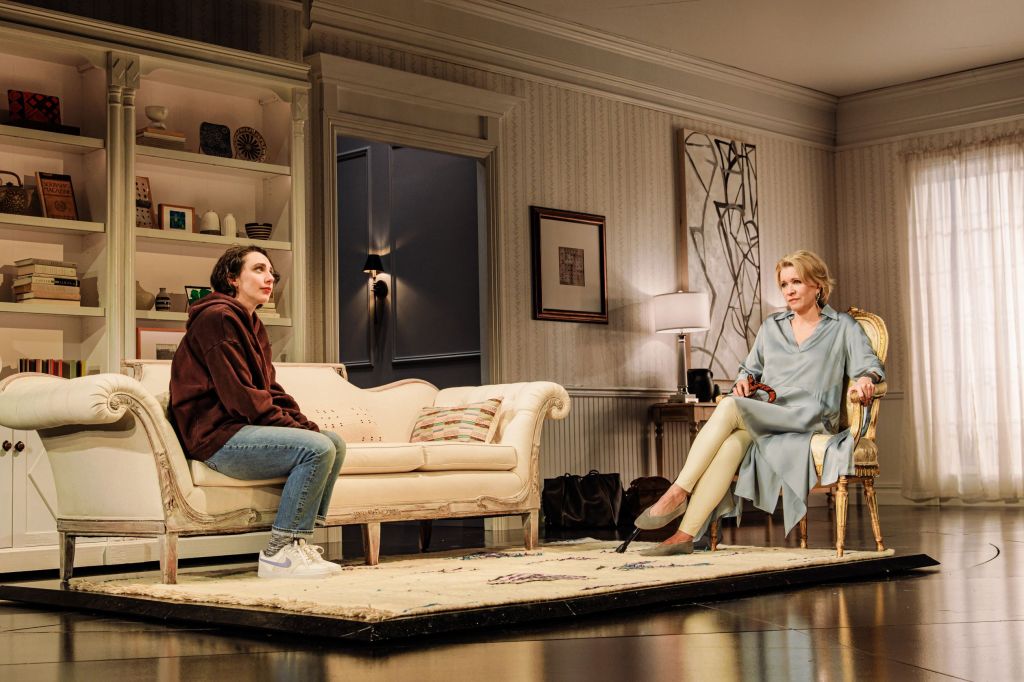
Meanwhile, when Suzanna’s fear of losing Andrew to Becky manifests, she involves Max. She chides him for Andrew’s sake and on Becky’s request. The mounting chaos erupts like a volcano. It will take someone of Susan’s ironic gravitas and queenly stature to “save the day.” With her threat to Suzanna that Andrew may cheat on her, to allowing Becky to wait at the house instead of at the train station so she can be around Max, Susan encourages the same dependency, fear and desperation she feels with Lester to be unleashed on Max and Suzanna via the subtle machinations of Becky and Andrew. For future entertainment to assuage her chronic illness, Susan will referee and make presumptuous determinations about the two couples.
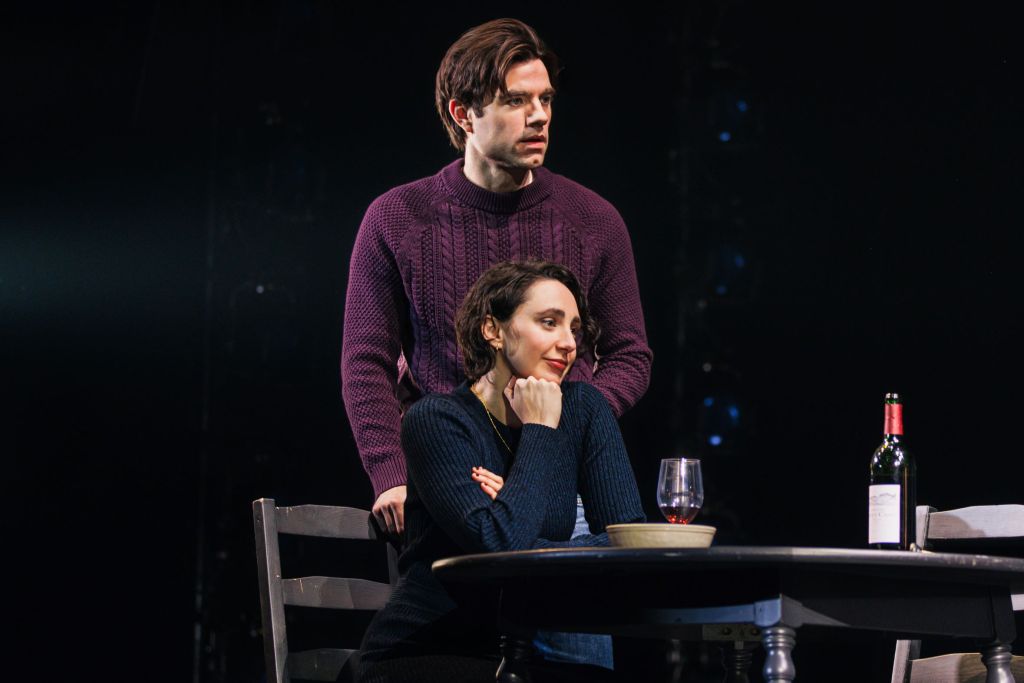
If not for the exceptional ensemble, and perfect timing of one liners and Cullman’s expert shepherding of the actors, Gionfriddo’s work would not soar into the heavens as it does. Cullman’s vision, especially the changing of scenes (Stacy Derosier’s lighting and M.L.Dogg’s sound design) conveys themes and symbolism. The contrast between the darkness of the city hotel rooms and the couple’s apartment against the creme colored beige decor and appointments of Susan’s upscale house in Richmond, Virginia reminds us of the safety and security of wealth even on the downhill slide to someone like Becky who is on the edge of poverty.
Financial problems create desperate individuals who prey upon those with money. The irony at the conclusion is that Max has the wealth and holds the cards, but he becomes the most vulnerable to be exploited, not only financially but psychically. Alden Ehrenreich gives an amazing portrayal of a character who we feel has the most to lose. Predators Becky and Andrew will bind up Max and Suzanna with each manipulation, demand and velvet gloves of domination, as Susan watches and criticizes. What we’ve seen is only the beginning.
Becky Shaw runs 2 hours 25 minutes through June 14 at the Helen Hayes Theater. 2st.com.
‘Jagged Little Pill,’ on Broadway is Electric, Dazzling in Its Power, Scope and Complexity
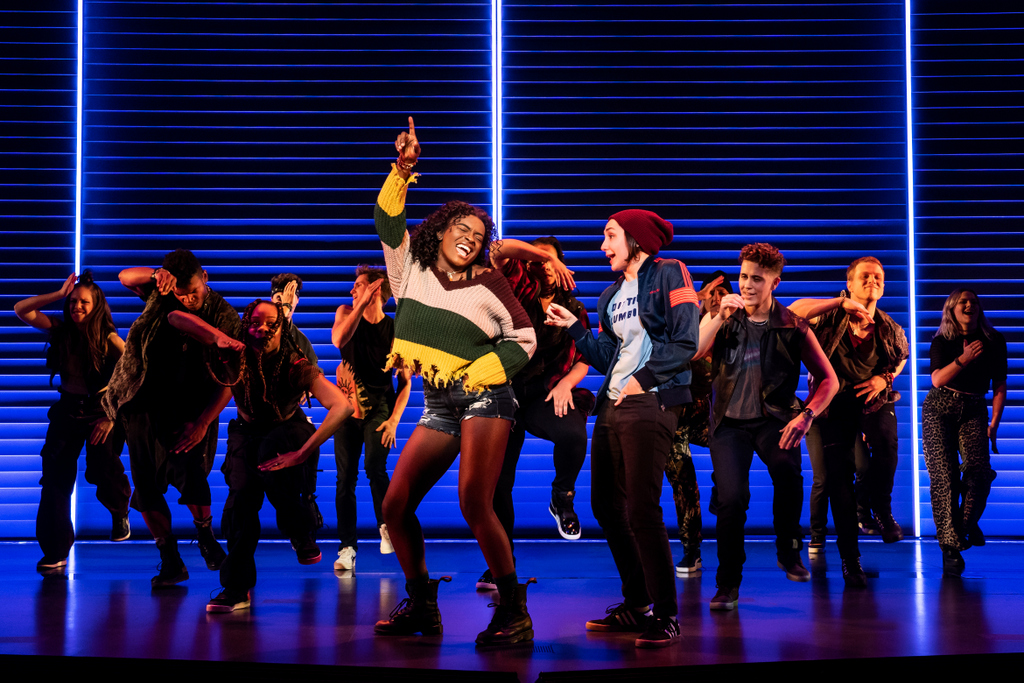
Celia Rose Gooding, The Company, in ‘Jagged Little Pill,’ book by Diablo Cody, music by Alanis Morissette, directed by Diane Paulus (Matthew Murphy)
Alanis Morissette’s album “Jagged Little Pill” reached the stratosphere as one of the best selling albums of all time almost twenty-five years ago. The reason is clear. In its contradictions, biting satire and themes it resonated with its global audience, topping the charts in 13 countries worldwide. With that appeal behind it, the notion that the music might land in a stage production was a given, especially if a superlative writer could write an exciting book so the right director would then eventually shepherd the production to Broadway.
And so it happened. Diablo Cody, multiple award-winning writer of the film Juno (2007), synchronized her sardonic fresh, perspective with Morissette’s bile-dripping, alternative rock songs featured on the 1995 album. The meld effected the gyrating musical that premiered at American Repertory Theater, Harvard University in 2018, exquisitely and brilliantly directed by Diane Paulus. The creative team’s synergy further transformed the production into the present dynamo which opened at the Broadhurst Theatre in early December.
How is the musical Jagged Little Pill not just another teenage-angst-driven-juked-up melodramatic foray into identity, social acceptance and self-love? The glossy superficiality of the pumped up, unmemorable, alternative, post-grunge, pop rock light, the stuff that “OK” musicals are made of, is nowhere to be found in Jagged Little Pill. This is because of the grainy, raw vitality of Morissette’s and Glen Ballard’s music, supervised, orchestrated and arranged by Tom Kitt, with additional music by Michael Farrell and Guy Sigsworth.

(L to R): Celia Rose Gooding, Derek Klena, Elizabeth Stanley, Sean Allan Krill, ‘Jagged Little Pill,’ book by Diablo Cody, music by Alanis Morissette, directed by Diane Paulus (Matthew Murphy)
On the contrary, the production, that some affectionately liken to a jukebox musical, defies that definition. First, there is its particularity. It is hard-edged and profound; the arc of Cody’s story spirals and complicates as she lays bare the Healy family while satirizing the underlying mores of the tony community where they live. Additionally, the finely tuned characterizations penetrate with authentic details. Their development draws us into the realm of gnawing secret addictions and the currently overripe, hellish thrall of Oxycodone, brand name OxyContin.
Whether we know of the relentlessness of this drug from experiences of friends, family members, neighbors or ourselves, we empathize with the characters as they confront its lethal power in a felt irrevocability. We’ve seen countless news stories and films on the subject, like the HBO documentary This Drug Can Kill You (2017). We’ve heard of the extremities of addiction resulting in the destruction of family bonds, the tenor of which Cody examines through the characterization of mother Mary Jane Healy her protagonist.

Celia Rose Gooding, The Company, in ‘Jagged Little Pill,’ book by Diablo Cody, music by Alanis Morissette, directed by Diane Paulus (Matthew Murphy)
And what of the story of the wife and mother who broke her arm and kept on breaking it to justify prescriptions of oxycodone? Typical of addicts desperate for the opioid. Prescription meds addicts even have committed robbery and murder. (See article on David Laffer) Of course the drug should be taken off the market and banned but big pharma would lose money in its profitability; addicted middle and upper class women can afford to pay. Why give up on a good thing even when doctors now curtail its use which pushes addicts to the street where they buy OxyContin laced with poisonous Fentanyl for the trip of a lifetime?
Why don’t such individuals “get help” especially when they can afford it? Indeed! Help is the last step in the journey of the addicted. It implies that the family interacts with each other because they must be the main support system of the addict. Cody’s Healy family members do not interact much. They live quiet lives of desperation, seeking their own “thing” when we first meet them, though by all appearances from their home, to their lifestyles to their social connections, these folks “have it together.” Even adopted Frankie Healy (the spectacular Ceila Rose Gooding) is a mess, though you would never suspect it, because she asserts her powerful personality as a young, black woman who is assured in her gay relationship with Jo (the adorable, rockin’ Lauren Patten who sings Morissette’s signature number “You Oughta Know” to a standing ovation).

Lauren Patten, The Company, in ‘Jagged Little Pill,’ book by Diablo Cody, music by Alanis Morissette, directed by Diane Paulus (Matthew Murphy)
How are the posted social media photos of the Healys as the smiling, joyous family fakes it? The image is more important than the reality. And if the image looks good enough, maybe the family members will believe it’s true. How can we fault them at the time of Trumpism, when the president and his family and his supporters do the same, sporting the “best” of everything, from perfect presidential behavior, to perfect relationships with his staff, who are loyal to him because he is filled with grace? Such perfection has not been seen since the “savior.” Likewise, the Healy family’s “perfection” in the view of their friends and neighbors is non-pareil.
The Healys, as representatives of most suburban middle families, traffic in mendacity though such cowardice destroys. As it turns out, lying is the mother of addiction. And addictions salve the soul. With pornography, sex, oxycodone, adderall, alcohol, heroin, etc., life’s miseries become doable and for a time “everything is beautiful.” Of course such duplicity can only go on for so long before the veil is ripped and the ugliness shows through. In the production the songs “All I Really Want,” Hand in My Pocket” and “Smiling,” clue us into the lies. However, the family keeps their secrets from each other until there is a turning point acutely rendered at the end of Act I during the songs “Wake Up” and “Forgiven.”
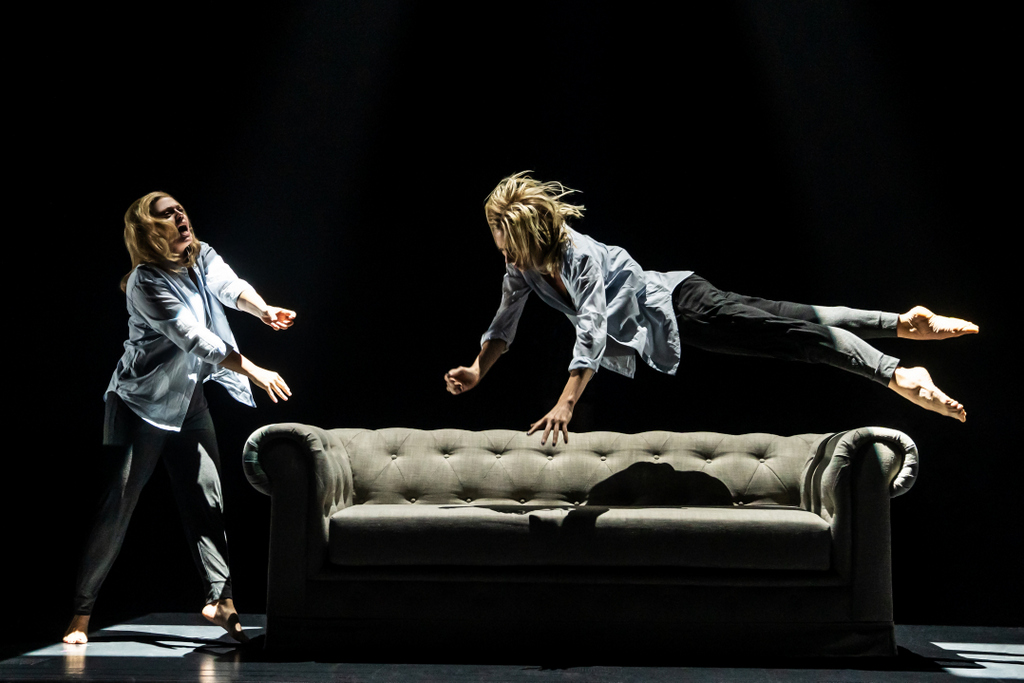
(L to R): Elizabeth Stanley, Heather Lang, ‘Jagged Little Pill,’ book by Diablo Cody, music by Alanis Morissette, directed by Diane Paulus (Matthew Murphy)
The growing divide in each of the characters eventually earthquakes. The one who is the glue holding the family together, perfect mother and wife Mary Jane (the gobsmacking Elizabeth Stanley) gets shaken to her core. The precipitating factor is oxycodone, but Mary Jane’s issues run silent and deep. The drug only suppresses and numbs her from acknowledging the soul gnawing canker worm that eats away at her image of perfection while she bleeds like an open wound inside.
As the musical follows the unraveling conflicts between Mary Jane and husband Steve (Sean Allan Krill) son Nick (Derek Klena) and adopted daughter Frankie (Gooding), other hot button issues come to the fore sweeping the family up in their detritus. These include but are not limited to our paternalistic rape culture, Evangelical Christianity’s homophobia, pornography addiction which deadens intimacy between couples, and black-white cultural bias to name a few.

Nora Schell, The Company, in ‘Jagged Little Pill,’ book by Diablo Cody, music by Alanis Morissette, directed by Diane Paulus (Matthew Murphy)
In the well crafted book, music and thoughtful lyrics, Cody and Morissette reinforce an ancient folkway of family structure; there often is little communication beyond functional superficialities. Sadly, profound communication belies self-awareness and soul authenticity. In such a family unit where obfuscation and a general lack of will to work together as a family become routine, addiction is easy. Finding a life worth living individually and with one’s family becomes impossible. The “impossibility” impinges on the family structure and each individual family member as the situation worsens for all.
And so it goes for wife Mary Jane and Steve. Though Steve does make an attempt to reach out to her, she rebuffs him. So it goes for Nick, the “perfect” son (Klena’s rendition of “Perfect” is excellent), who lives out his parent’s dreams not his own, and for Frankie, who is “all that” proud. Each self-deceives. Each is distracted by the race for perfection and by their manic avoidance of failure and the recognition of their faults, which comprise their endearing humanity. In fearing the stigma of being a “loser” (each family member defines it differently and never discusses their own perceptions until the end), each launches off into their own journey of error which impacts the family as a whole. When they become aware of their self-delusions (the exceptional song “Wake Up”), it is a boon that they and other characters come to grips with by the play’s conclusion (in the song “You Learn”).
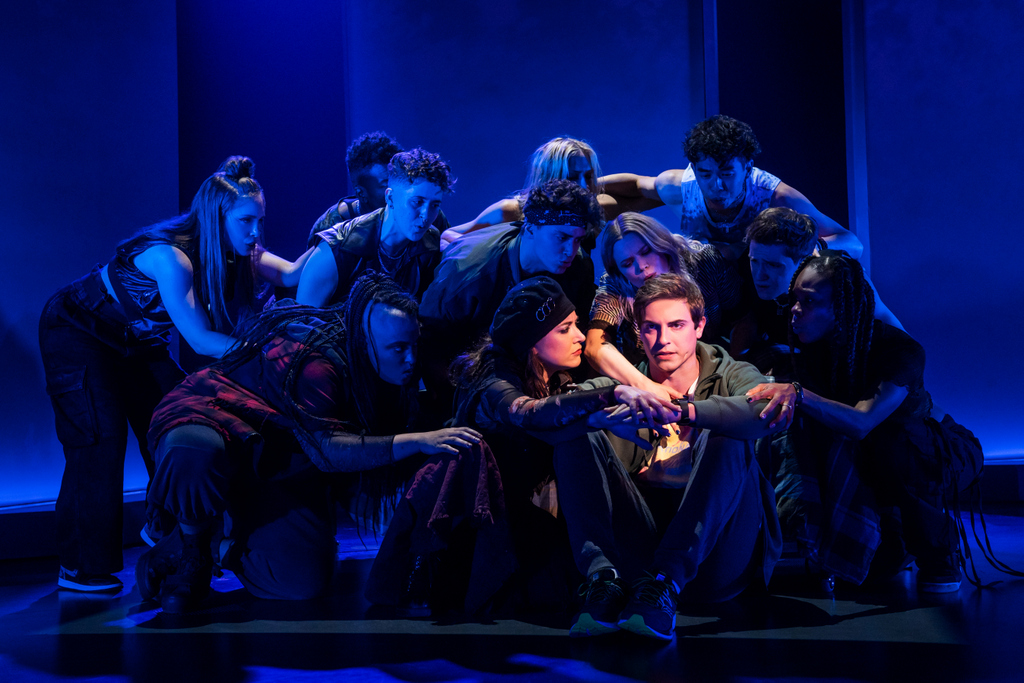
Derek Klena, The Company, in ‘Jagged Little Pill,’ book by Diablo Cody, music by Alanis Morissette, directed by Diane Paulus (Matthew Murphy)
Whether rich or poor, young or old, life is learning, and of course with learning comes change, pain and reconciliation. But first as the linchpin of the family, Mary Jane experiences the long and grueling events in her relationships. She begins first with her addicted alter-ego, then her children and husband. Through trial and error she learns to explode the self-deception, lies, defensiveness and powerlessness conveyed to her family, who become estranged from her as she embraces the drug as her panacea (this is terrifically rendered in movement during the song “Unforgiven”).
But before any of the family learn that their arrogance and attempt at perfection is delusion, they have to be awake to register they are fantastical creatures on a racetrack toward oblivion. The wonder of Cody’s book is that she has Steve and Nick on the road to awareness before Mary Jane, and Frankie who is blinded by her interest in Phoenix (Antonio Cipriano), which destroys Jo (“Your House”).

Derek Klena, The Company, in ‘Jagged Little Pill,’ book by Diablo Cody, music by Alanis Morissette, directed by Diane Paulus (Matthew Murphy)
We note the disintegration of Mary Jane’s soul, whose behaviors are out of the addict’s playbook. Elizabeth Stanley crafts her characterization with nuanced sensitivity and empathy. She inhabits the ethos of the addict as the drug’s deadly chemicals subvert her being. Stanley is in the moment, from moment to moment with her lyrical voice and nuanced devolution. Our concern and identification with Mary Jane is elicited by Stanley’s prodigious talent.
The same may be said for the actors who inhabit the family members: Ceila Rose Gooding’s Frankie- activist and hypocrite blind to her own foibles; Sean Allan Krill’s loving, caring husband who stands by Mary Jane and reveals he wants to help her become well ( “Mary Jane”), though he is a “work-a-holic” and has an addiction to pornography and masturbation.
Cody has rounded out these characters and the actors thread their depth through the eye of the acting/singing needle. All have gorgeous voices. No less talented is Derek Klena. Klena’s emotional crisis (whether to jeopardize his life path and testify to a rape he saw or keep it a secret along with his unhappiness living his parents’ goals for his life), is heartfelt. Initially, it is Nick who sounds the alarm about his family; Kitt’s orchestrations manifest this twice in a long note from a brass instrument (is it an A or C?), almost like a harbinger that a turning and reckoning must happen or they all will be immeasurably harmed.

Elizabeth Stanley, The Company,Jagged Little Pill, Diablo Cody, Alanis Morissette, Diane Paulus (Matthew Murphy)
Paulus’ staging and her vision, and Sidi Larbi Cherkaoui’s movement to evoke the characters’ emotions are smashing. The characters’ inner rage and torment and Mary Jane’s double mindedness about her addiction’s seduction and her love of self-destruction (“Uninvited”), are clarified in the movement and the dance. Paulus has staged the characters in various scenes so that they are propelled in circles using the props (desks, walls). The effect reveals their confusion and inability to straighten out and to seek emotional life paths that are not dead ended in circularity. Paulus/Cherkaoui also integrate break-dance movement with the songs as a metaphor, representing the emotional inner churning and rage of the characters. Paulus makes sure that the character rage and their emotional circularity are cogently integrated with Riccardo Hernandez’s scenic design and Justin Townsend’s lighting design.

The Company of Jagged Little Pill, book by Diablo Cody, music by Alanis Morissette, directed by Diane Paulus (Matthew Murphy)
The frame of the house in lines of light in various colors abides throughout. Its symbolism recalls how the structure of family and home and what family members experience there, is carried everywhere into relationships, into school, into work, into social activities. Justin Townsend’s lighting design is effective as it is used to reflect emotions. For example, Jo’s fury in “You Oughta Know” is aligned with Townsend bathing the stage in red. Patten’s Jo is fabulously wild; the injustice she feels about Frankie’s demeaning mistreatment is a show stopper made all the more wonderful by Townsend’s lighting and Cherkaoui’s movement.
Additionally, “Wake Up,” and “Forgiven” (as the family members’ backs to the walls of their own making spin them around), are particularly stunning. In these numbers and in “Predator,” “Uninvited” and “Mary Jane,” Paulus, the company and creative team pull out all the stops. And “No” by Kathryn Gallagher as Bella (she has been raped by Nick’s friend), singing with the support of the company, should be taped and played for every Sex Ed. class in high schools: the signs are especially noteworthy.
At its heart Jagged Little Pill is about family. It is provocative, in your face, striking, salient. If one considers how easy it is to couple and how hard it is to move toward a kind, generous, integrative family who works on their failures by loving in overdrive, Cody’s Healy family, portrayed in its jaggedness is a superb textured unit. As a key theme, there is always hope for redemption and reconciliation, Cody suggests, for them, for us.
Add Alanis Morissette’s music, with Kitt’s orchestrations, Paulus’ metaphoric, symbolic staging, the amazing performers, the lighting and brilliantly minimalistic and always seamless and mobile scenic design, Jagged Little Pill is a musical worthy of the nearly twenty-five year wait for these creatives to bring this sterling production together. It is the right season for Jagged Little Pill to take flight with this cast, Cody’s sheer audacity and Paulus scaling the mountaintops of her craft.
I’ve said enough. See it with your eyes wide open and enjoy it awake. It is an experience you won’t easily forget. For tickets and times CLICK HERE.

