Blog Archives
‘Babe,’ Theater Review: Marisa Tomei, Rocking Through to the Next Phase
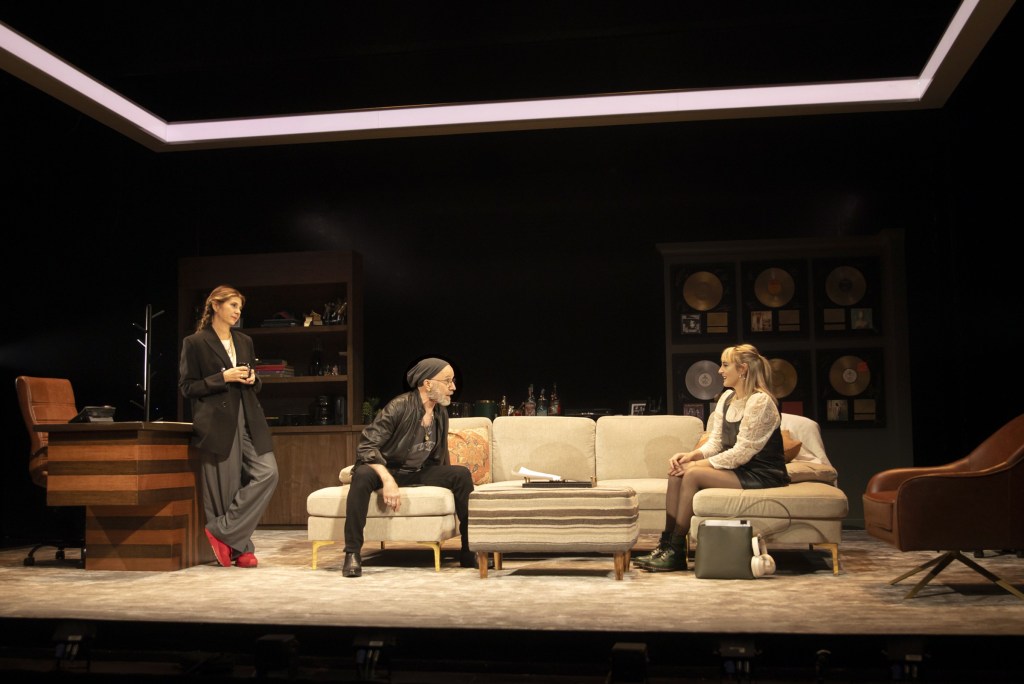
Babe
Can people change? Or do they just flip their perspectives and deceive themselves to believe they’re “evolving?” In the New Group presentation of Babe, written by Jessica Goldberg, directed by Scott Elliott, Abigail (Marisa Tomei), is Gus’ (Arliss Howard), invaluable collaborator in the music industry. The comedy/drama focuses on a number of current issues using Abby and Gus’ relationship as a focal point to explore the landscape of shifting political correctness, power dynamics, generational conflicts, delayed self-actualization, and more. With original music by the trio BETTY, Babe runs approximately 85 minutes with no intermission at the Signature Center until December 22nd.
Treading lightly on Gus’ rocky ground, Abby has been instrumental in maintaining their successful, collegial relationship for thirty-two years, though at a steep, personal price. She hasn’t acknowledged the sacrifice to herself or been inspired to make a change until the confident, twenty-nine year old, Katherine, interviews with Gus, while Abby monitors their conversation and tries to give him clues when to end his political incorrectness. Katherine’s poise and forward attitude develops during the play as the catalyst which ignites a fire that turns into a conflagration between Gus, Abby and Katherine by the conclusion.

Tomei’s astute Abby is sensitive and insightful
Tomei’s astute Abby provides the sensitivity and insight into the zeitgeist that electrifies fans and brings in the gold records, a number of which hang on the walls of Gus’s chic office (sleek, versatile set design by Derek McLane). The producing legend now in his 60s, but fronting his hip, “with-it” ethos in his tight, black pants, chains, stylized beret, and black leather jacket (Jeff Mahshie, costume design), is at “the top of his game,”and on a down-hill slide, indicated by the sensitivity-training Abby references he has had to withstand. We learn it has been ordered by patriarchal, music company head Bob, who also needs to correct himself, but is powerful enough not to. The hope is with Abby’s continual guidance, and the training, Gus’ boorish, self-absorbed, toxic maleness and unrestrained egotism, encouraged at the company by the other men in the past, will refine. Not a chance, as old dogs refuse to learn new tricks.
As groundbreaking, protective and vital as Abby has been to Gus, the two A & R reps, who have discovered and fashioned some of the most successful solo artists in the business, are not equal in stature, success or monetary rewards. Abby’s discovery of Kat Wonder epitomizes these disparities between her boss Gus, and her, as his second. The only woman in the company for years, Abby suffered through the vulgar and abusive patriarchy, a fact she admits late in the play. To her credit, she managed to gain Gus and the others’ respect and esteem. They keep her around because, as Gus suggests, they think she is like them. We learn by degrees that this is because she is silent and as apparently sedate as her bland, grey pants, white top and black jacket. She is unobtrusive and remains professional, the perfect “Girl Friday,” who allows them to “let it all hang out,” without judging their behavior or making them feel like pigs.
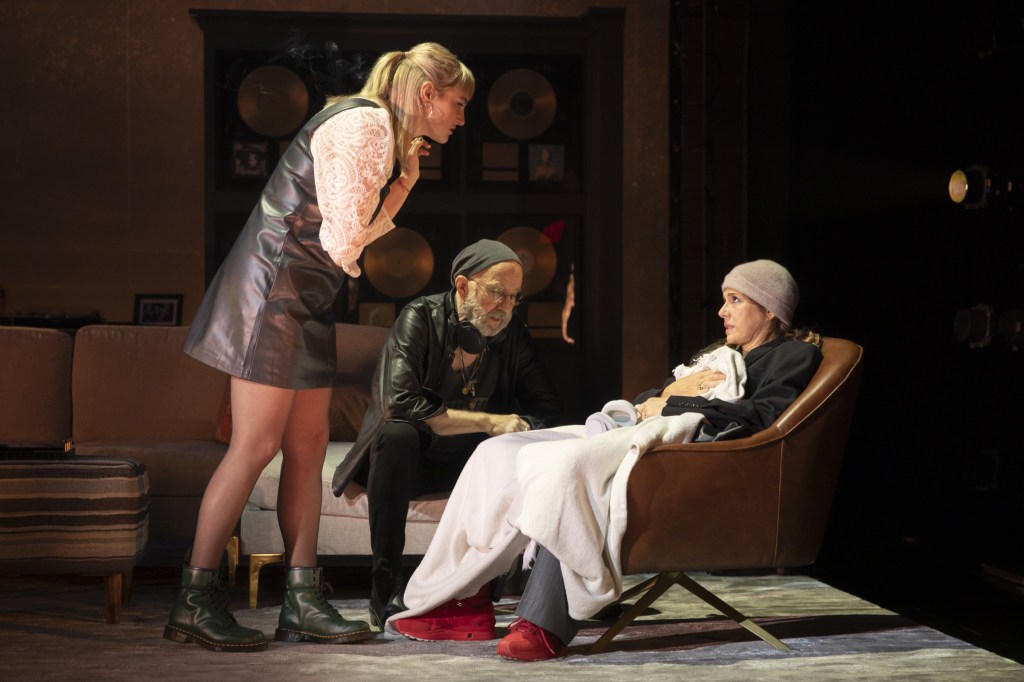
Abby is shut out of receiving credit for her sterling efforts
For her pains to participate, Abby didn’t receive credit on any of the Kat Wonder albums, an “invisible” co-producer. Nor did she share in the spoils as Gus did with global residences and a townhouse he forces the staff to meet in at his convenience, instead of the conference room.
However, ignoring Gus as “all that,” Katherine conflicts with his philosophy, his pronouncements, his ideas. If opposites attract, these two are an exception. Gus sees Katherine’s cultural approaches as pretentious and immaterial (vegan he is not). Katherine is gently oppositional as she pitches herself, her education and background. Interestingly, Katherine sees Abby as a hero to admire. In the initial meet-up, Katherine recognizes Abby from a photo Abby appears in with phenom of the time, “Kat Wonder” at CBGB.Admiring Abby and fawning over her after the interview, Katherine tells Abby that she has been her inspiration to get into the business and wanted to be her.
As obnoxious as Katherine’s forward presumptuousness is, her confidence and appearance remind Abby of Kat Wonder, whose wild grace and energy haunts her throughout the play. Kat appears in her imagination in flashbacks at varying, crucial turning points, with Gracie McGraw doubling for Kat Wonder. These memories of their time together direct Abby toward self-realization and an eventual confrontation with Gus about his unjust treatment of her. This is obviously a painful realization which Abby eventually allows, despite acknowledging Gus’ platonic love, and respect. His concern for her is apparent when he sits with her during a very uncomfortable chemo treatment for her breast cancer.
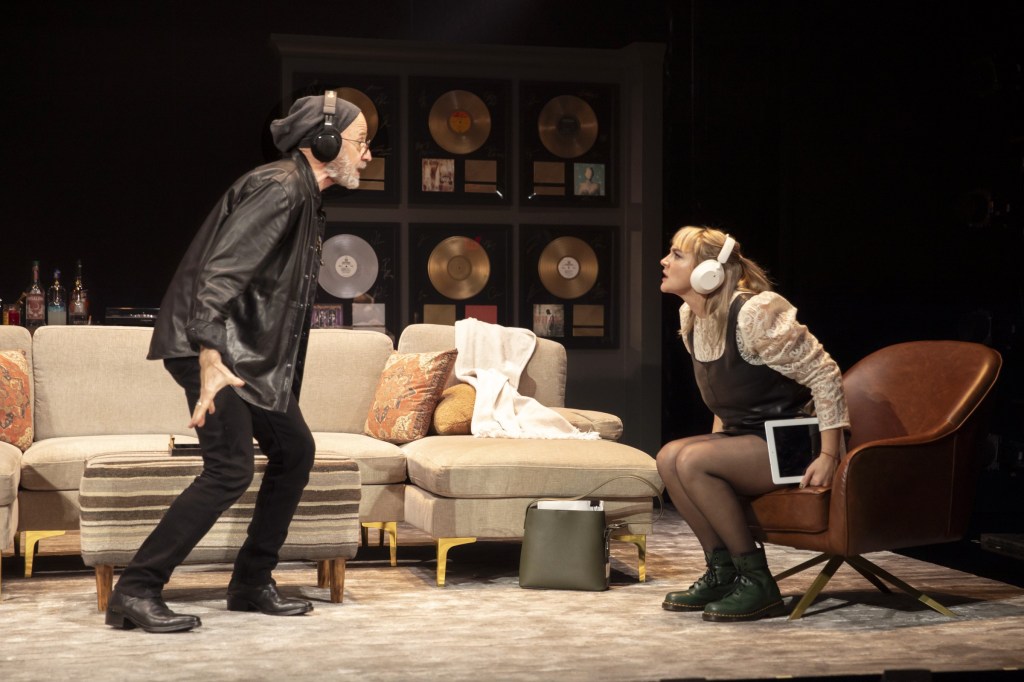
Katherine visits Abby in an unusual get-together
After Katherine again attempts to rise in the company in another interaction with Gus, she visits Abby at her apartment (McLane’s set design again shines in the transition from Gus’ office to Abby’s apartment and back). They listen to music and Katherine asks Abby probing questions. Then they rock out to music and she dances with Abby, at which point Katherine pushes herself on Abby. Abby is forced to rebuff her because any relationship between them is inappropriate. Nevertheless, this trigger, Goldberg implies, impacts Abby. Abby’s remembrance of her relationship with Kat brings her into a deepening realization of herself because of her experiences, including feeling responsible for Kat Wonder’s death, and being shut out of the glory of notoriety as producer who discovered grunge-rocker Kat.
Abby’s realizations about what she has allowed emotionally, which may have contributed to her physical illness and stress, coupled with a twist that Katherine generates, bring about a surprising conclusion. However, Abby’s response to the final events is the most crucial and important. Maybe it is possible in one’s middle age to forge a new path and become one’s own self-proclaimed star.
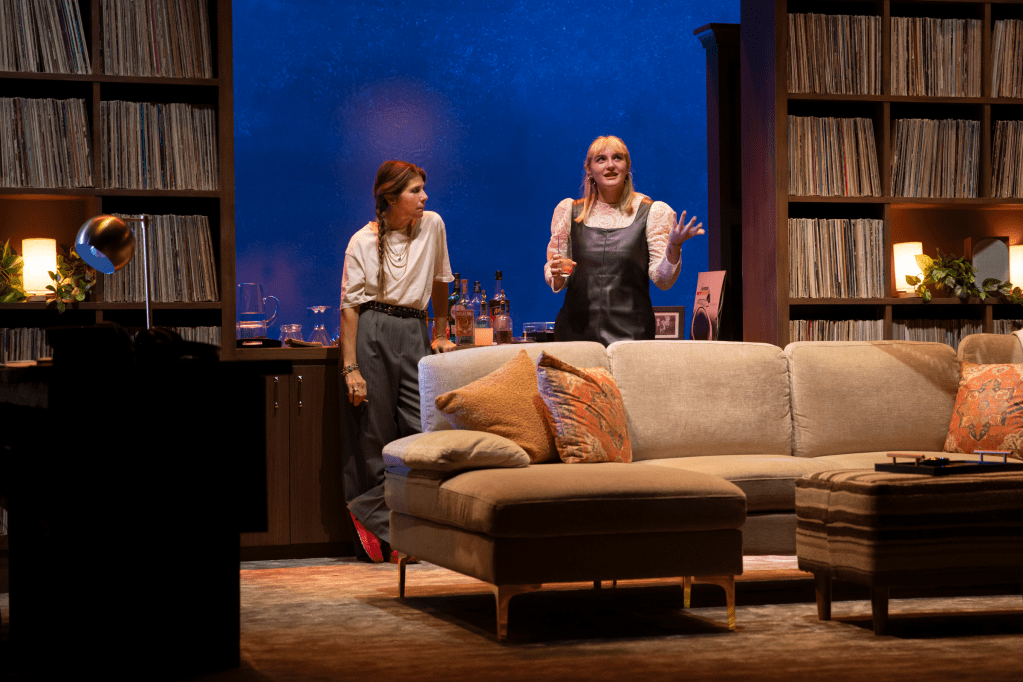
The ensemble melds with authenticity and flair
The actors convey their characters with spot-on authenticity, aptly shepherded by Elliot’s direction. Arliss Howard manages to break through Gus’ character with a winning charm and matter-of-factness, which throws dust in the audience’s eyes, even after Katherine corrects his back-handed compliment of her as a “smart girl.” Marisa Tomei as Abby is imminently watchable and versatile as she moves from quiet restraint, to the throes of physical and emotional suffering. The development and culmination of her rage and satisfying expression of it in rocking-out with Kat Wonder is powerful especially at the conclusion. As always Tomei gives it the fullness of her talent, rounding out the Abby’s humanity despite Goldberg’s thin characterization.
Gracie McGraw’s portrayal of Kat Wonder, the 1990s grunge rocker who embodied “centuries of female rage,” before she self-destructed is too brief, perhaps. Much is suggested in Kat’s and Abby’s relationship, but remains opaque. However, we do get to see McGraw’s Kat cut loose. And the memory is so alive and vibrant, it encourages Tomei’s Abby to be her own rock-star, wailing out her repressed rage by the conclusion of Babe. And the women in the audience wail with her, especially now, after the election.
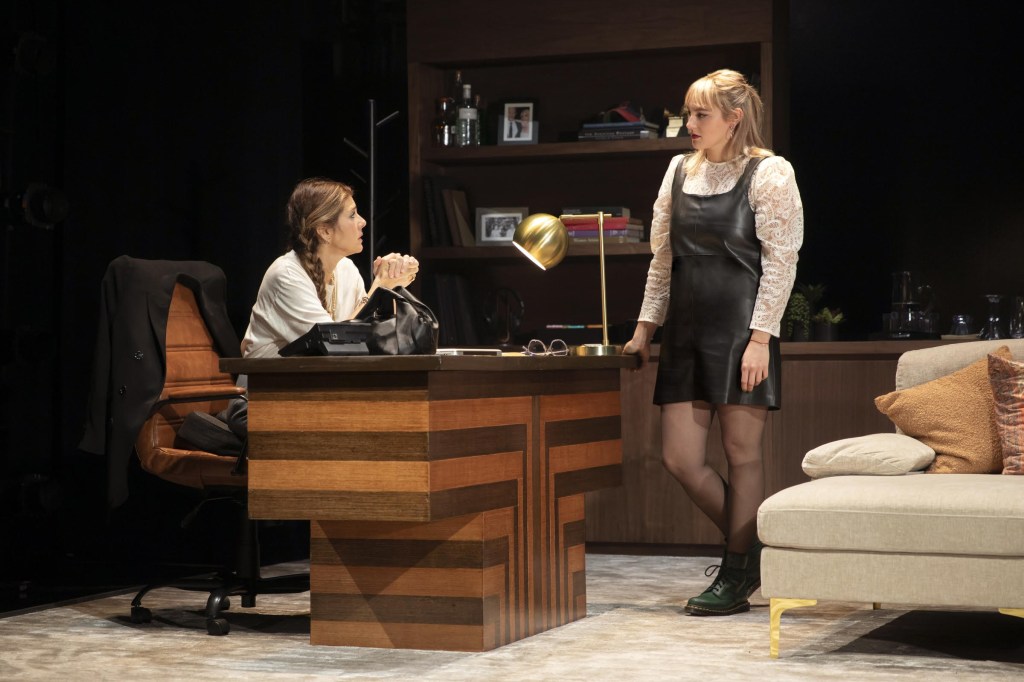
Babe covers many interesting points. To what extent has music been egregiously shaped by the current technologies? What damage has been done as the music and entertainment industry, hypocritically shaped by cultural politics, only creates artificial boundaries on the surface that don’t penetrate the noxious back room parties and behaviors which have given rise to worse abuses? Another issue defines the difficulties of compromise and corruption which spans every institution, every industry. To be a part, one has to be complicit, and then be satisfied with less of a reward because others hold the power and money and make up the rules. Babe scratches the surface and leaves food for thought. The performances are noteworthy and should be seen.
Kudos to the creatives not mentioned before which include Cha See (lighting design), Jessica Paz (sound design), Matthew Armentrout (hair and wig design), and not enough of BETTY’S original music.
Babe runs 85 minutes with no intermission at the Signature Center.
‘The Rose Tattoo,’ Marisa Tomei Is Tennessee Williams’ Fiery, Sensual Serafina, in a Stellar Performance

Marisa Tomei in ‘The Rose Tattoo,’ by Tennessee Williams, presented by Roundabout Theatre Company (Joan Marcus)
Atmosphere, heat, the heavy scent of roses, candles, mysticism, undulating waves, torpid rhythms, steamy melodies, fantastical rows of pink flamingos, a resonant altar of the Catholic Madonna. These elements combine to form the symbolic backdrop and evocative wistful earthiness that characterize Roundabout Theatre Company’s The Rose Tattoo at American Airlines Theatre.
Tennessee Williams playful, emotionally effusive tragic-comic love story written as a nod to Williams own Sicilian lover Frank Merlo, is in its third revival on Broadway in a limited engagement until 8th December (the Catholic date of the Feast of the Immaculate Conception). Reflecting upon Marisa Tomei’s portrayal of Serafina in The Rose Tattoo, this is an ironic, humorous conclusion in keeping with the evolution of her character which Tomei embraces as she exudes verve, sensuality, fury, heartbreak and breathtaking, joyful authenticity in the part.
If any role was made for Tomei, divinity and Tennessee Williams have placed it in her lap and she has run with it broadening the character Serafina Delle Rosa with astute sensitivity and intuition. Tomei pulls out all the stops growing her character’s nuanced insight. She slips into Serafina’s sensual skin and leaps into her expanding emotional range as she morphs in the first act from grandiose and joyful boastfulness to gut-wrenching impassioned sorrow and in the second act to ferocity, an explosion of suppressed sexual desire and its release. All of these hot points she elucidates with a fluidity of movement, hands, limbs, head tosses, eye rolls which express Serafina’s wanton luxury of indulgent feeling and effervescent life.
The contradictions of Serafina’s character move toward a hyperbolic excess of extremes. When speaking of her husband Rosario and their relationship, their bed is a sanctum of religion where they express their torpid love each night. She effuses to Assunta (the excellent Carolyn Mignini) how she mysteriously felt the conception of her second child the moment it happened. A rose tattoo like the one her husband Rosario wore on his chest appeared like religious stigmata without the dripping blood. And it burned over her heart, a heavenly sign, like others she receives as she talks to the statue of the Madonna, and remains a worshipful adherent to Mother Mary, praying and receiving the anointed wisdom whenever necessary.

Marisa Tomei, Emun Elliott in ‘The Rose Tattoo,’ by Tennessee Williams, presented by Roundabout Theatre Company (Joan Marcus)
Rosario’s family is that of a “baron,” though Sicily is the “low” country of Italy and an area fogged over with undesirables, thieves and questionable heritages as the crossroads of Europe. We know this “baron-baroness” is an uppity exaggeration from the looks on the faces of her gossipy neighbors and particularly La Strega (translated as witch) who is scrawny, crone-like and insulting. Constance Shulman is convincing as the conveyor of Ill Malocchio-the evil eye. Her presence manifests the bad-luck wind that Assunta refers to at the top of the play and to which Serafina superstitiously attributes the wicked event that upends her life forever.
Williams’s characterization of Serafina is brilliant and complex. Director Trip Cullman and Tomei have effected her intriguing possibilities and deep yearnings beyond the stereotypical Italian barefoot and pregnant woman of virginal morals like Our Lady. It is obvious that Tomei has considered the contradictions, the restraints of Serafina’s culture and her neighbors as well as her potential to be a maverick who will break through the chains and bondages of her religion and old world folkways after her eyes are opened.
We are proud that Serafina disdains the gossiping neighbors with the exception of Assunta and perhaps her priest. Though Serafina’s world does not extend beyond her home, the environs of the beach, her daughter Rosa (Ella Rubin) and Rosario, a truck driver who transports illegal drugs under his produce, she is a fine seamstress. And in her business interactions with her neighbors and acquaintances, we note that she has money, is industrious, resourceful and a canny negotiator.
It makes sense that Rosario (whom we never see because he is a fantasy-Williams point out) treats her like a baroness filling their home with roses at various times to reassure her of her grandness. And the poetic symbol of the rose as a sign of their love and the romance of their relationship is an endearing touch, reminiscent of the rose tattoo on his chest signifying his commitment to her. At the outset of the play, a rose is in Serafina’s hair which she wears waiting for Rosario to come home. As she does, we believe she is fulfilled in their love and the happy status of their lives in a home on the shores of paradise, the Gulf Coast of Mississippi.
What is not manifest and what lurks beneath becomes the revelation that all is not well, that her Rosario is not real, but is an illusion. Typical of Williams’ work are the undercurrents, the sub rosa meanings. The rose is also a symbol of martyrdom, Christ’s martyrdom. And it is this martyrdom that Serafina must endure when word comes back that Rosario has been killed, burned in a fiery crash which warrants his body be cremated. Unfortunately, the miraculous son of the burning rose on her chest that appeared and disappeared, she aborted caused by the extreme trauma of Rosario’s death.
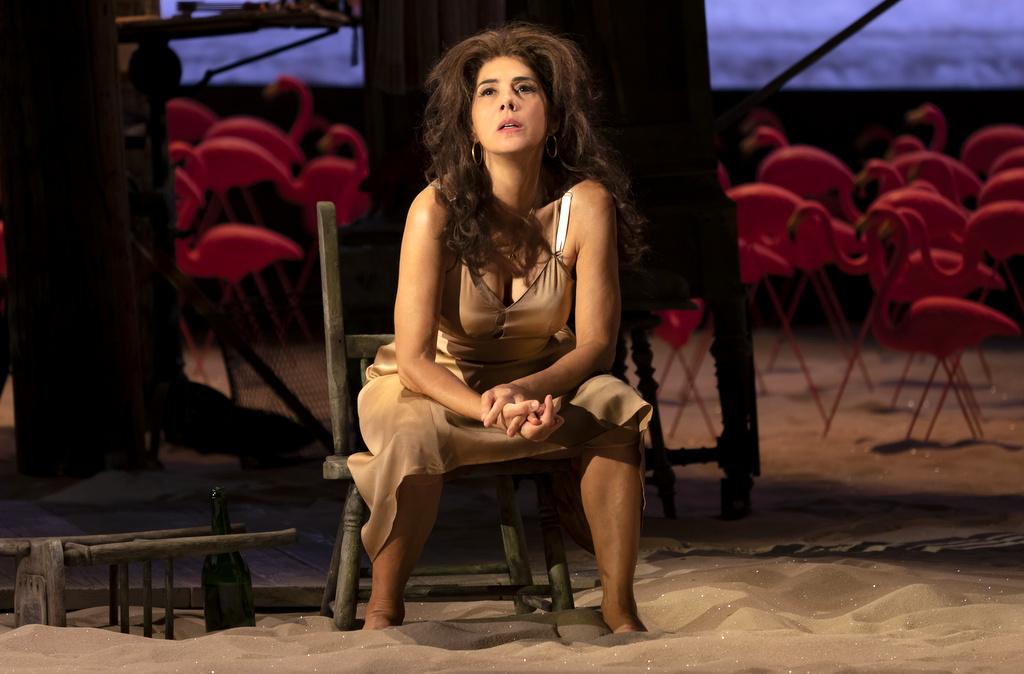
Marisa Tomei, Emun Elliott in ‘The Rose Tattoo,’ by Tennessee Williams, presented by Roundabout Theatre Company (Joan Marcus)
The rose as Williams’ choice symbol is superbly complex. For Rosario’s rose tattoo also represents his amorous lust for women, one of whom is Estelle Hohengarten (Tina Benko) who asks Serafina to make a gorgeous, rose-colored silk shirt for “her man.” When Estelle steals Rosario’s picture behind Serafina’s back, we know that Rosario led a double life and we are annoyed at Estelle’s arrogance and presumption to ask his wife to make such a gift shirt. But in William’s depth of characterization for Estelle, most probably Rosario is also philandering on Estelle who, to try to keep him close, gives him expensive gifts like hand-made silk shirts.
Williams clues us in that her faith and passion for Rosario has blinded her judgment and overcome her sharp intellect and wisdom. In fact it is an idolatry. Her religion stipulates that no human being should be worshiped or sacrificed for. Serafina’s excessive personality has doomed her to tragedy, betrayal and duplicity with Rosario. Ironically, his death is her freedom, but she must suffer his and her son’s loss ,a burden almost too great to bear, even for one as strong as Serafina who does become distracted, unkempt and uninterested in life.
Because Rosario, the wild rose with thorns is not worthy of Serafina’s love, after his death there is only pity for the cuckholded Serafina and a finality to her exuberant life until the truth of who Rosario really was lifts her into a healthy reality. Tomei’s breakdown is striking and Williams creates the tension that in weeping for the “love” of her life who indeed has betrayed her, she will be wasting herself. He also affirms the huge gulf between her ability to live again and her lugubrious state which continues for three years as she mourns an illusion.
The question remains. Will she come to the end of herself? The romantic fantasy held together with the glue of her faith and the enforced, manic chastity of her old world Italian mores must be vanquished. But how? It is in the form of the charismatic and humorous Alvaro Mangiacavallo. But until then Serafina withers. Isolating herself, she implodes with regret, doubt, sorrow and dolorous grief, as well as anger at her daughter Rosa who wants to live and find her own love like her mother’s.
The mother-daughter tensions are realistically expressed as are the scenes between Tomei and Jack (Burke Swanson) Rosa’s boyfriend, which are humorous. Altogether, the second act is brighter; it is companionable comedy to the tragedy of the first act.
When she meets Alvaro, in spite of herself, she responds with her whole being to his attractiveness. As they become acquainted, she accepts his interest in her for what she may represent; a new beginning in his life. It is a new beginning that he tries to thread into her life to resurrect her sexual passions and emotions of love. Thus, he pulls out all the stops for this opportunity to win her, even having a rose tattooed upon his chest in the hope of taking Rosario’s place in her heart.

Marisa Tomei, Emun Elliott in ‘The Rose Tattoo,’ by Tennessee Williams, presented by Roundabout Theatre Company (Joan Marcus)
Emun Elliott is spectacular as the clownish, emotionally appealing, lovable suitor who sees Serafina’s worth and beauty and attempts to endear himself to her with the tattoo. Along with Serafina’s discovering Rosario’s betrayal, Elliott’s portrayal of Alvaro solidifies and justifies why Serafina jumps at the opportunity to be with him. He is cute. He is real. He is as emotional and simpatico as she is. He is Sicilian and above all, he is available and interested in her. It is not only his steamy body that reminds her of Rosario’s, but she is attracted to his humor, sensibility and sensitivity of feeling which mirrors hers.
After discovering Rosario’s duplicity, understanding Alvaro’s concern and care for three women dependents and his honesty in admitting he is a buffoon disarms Serafina. Alvaro’s strength and lack of ego in commenting that his father was considered the village idiot is an important revelation for her as well. Indeed, as she views who he is, she senses that his humility and humorous self-effacement is worth more than all of Rosario’s boastfulness that he was a baron which he wasn’t.
As the truth enlightens her, Tomei’s Serafina evolves and sheds the displacement and her sense of confusion and loss which was also a loss of her own imagined “secure” identity as Rosario’s “wife.” Wife, indeed! Rosario’s mendacity made her into a cuckhold and a brokenhearted fool over a man who was not real. At least Alvaro is real. The comparison between the men reinforced with Rosario’s unfaithfulness, which she can now admit to herself, prompts her to reject the religion that kept her blinded and the antiquated mores that made her a fool and kept her alone and in darkness.
Shepherded by Cullman, Elliott and Tomei create an uproarious, lively and fun interplay between these two characters who belong together, like “two peas in a pod” and have only to realize it, which, of course, Alvaro does before Serafina. Tomei’s and Elliott’s scenes together soar, strike sparks of passion and move with the speed of light. The comedy arises from spot-on authenticity. The symbolic poetry, the shattering of the urn, the ashes disappearing, the light rising on the ocean waves (I loved this background projection) shine a new day. All represent elements of hope and joy and a realistic sense of believing, grounded in truth for both protagonists.
Tomei, Elliott, Cullman and the ensemble have resurrected Williams’ The Rose Tattoo keeping the themes current and the timeless elements real. Duplicity, lies, unfaithfulness, love and the freedom to unshackle oneself from destructive folkways that lead one into darkness and away from light and love are paramount themes in this production. And they especially resonate for our time.
I can’t recommend this production enough for its memorable, indelible performances especially by Elliott and Tomei shepherded with sensitivity by Cullman. The evocativeness and beauty of the staging, design elements and music add to the thematic understanding of Williams’ work and characters. Kudos goes to the creative team: Mark Wendland (set design) Clint Ramos (costume design) Ben Stanton (lighting design) Lucy Mackinnon (projection design) Tom Watson (hair and wig design) Joe Dulude II (make-up design). Bravo to Fiz Patton for the lovely original music & sound design.
The Rose Tattoo runs with one intermission at American Airlines Theatre (42nd between 7th and 8th) until 8th December. Don’t miss it. For tickets and times CLICK HERE.
 CAROLE DI TOSTI