Blog Archives
‘The Piano Lesson’ is a Striking Revival That Delivers Exceptional Acting, Acute Direction and Prodigious Mastery
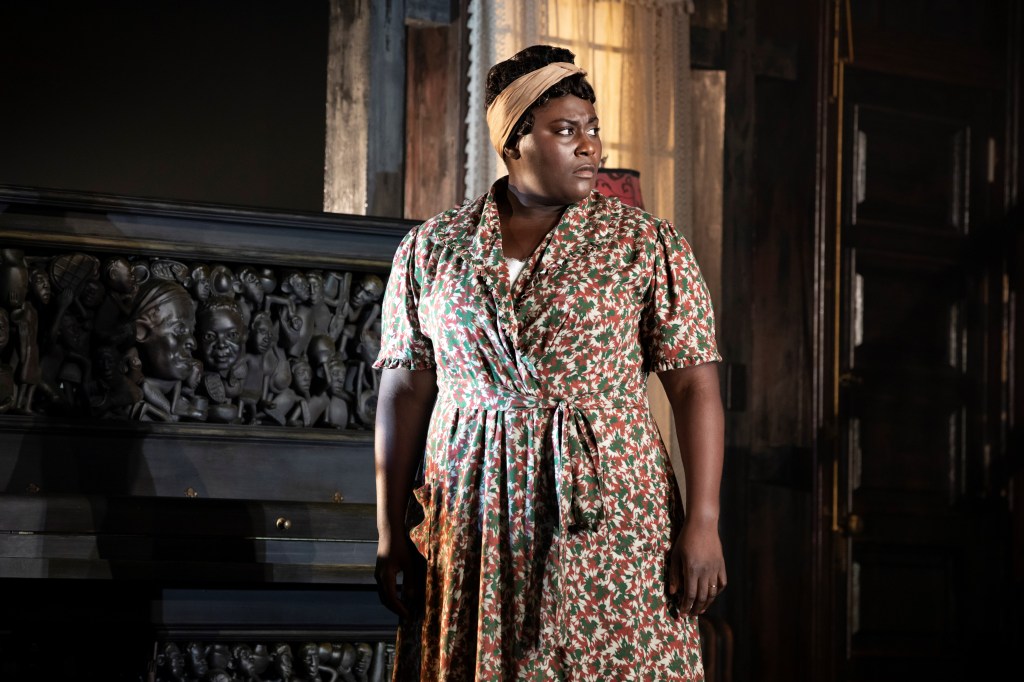
How do we reconcile a past of misery, torment and devastation? Do we bury it or embrace the goodness our ancestors brought to bear as they raised us? Do we take the next steps to rise up to the inner glory they encouraged, or mourn in resentment never exorcising the anguish that seeped into our psyches? In August Wilson’s richly crafted Pulitzer Prize-winning play The Piano Lesson, currently running at the Ethel Barrymore Theatre, the character Berniece (superbly portrayed by Danielle Brooks) must reconcile herself to her past and become the conduit that translates legacy into new beginnings for her family and her daughter.
The Piano Lesson symbolizes how African Americans must approach their painful history of slavery as a planting field which may give birth to strong generations that carry new hope and opportunity for a positive future. Additionally, in this production directed by Latanya Richardson Jackson, Wilson suggests what that future might be with an uplifting conclusion where family understanding and unity are restored after nefarious forces steeped in colonial, paternalistic folkways and institutional racism, sought to keep the family divided and conquered.

August Wilson’s play debuted on Broadway in 1990, not only winning the Pulitzer Prize but also winning the Drama Desk Award for Outstanding Play, as well as the New York Critic’s Circle Award for Best Play. The Piano Lesson which takes place in Pittsburgh, 1936 is one in a collection of 10 plays in Wilson’s American Century Cycle. Each of the plays, set in a different decade, chronicles African American struggles and triumphs as various families move away from the remnants of slavery and its impact from 1900 through the 1990s. The work has enjoyed three revivals, one Off Broadway in 2013 and the two Broadway outings (1990, 2022).
This outstanding revival features seminal performances by a superb ensemble and a clarifying vision about the play by the director. Each actor brings vitality and authentically to manifest the roiling fear and oppression that still hangs over the lives of characters Berniece (Danielle Brooks) Boy Willie (John David Washington) and family uncles Doaker (Samuel L. Jackson) and Wining Boy (Michael Potts) as they attempt to move beyond their traumatic past. It is a slavery past where ancestors saw toil and heartache and a recent past where Berniece and her family saw violence, bloodshed and anything but a peaceful passing to ancestral graves.

Events come to a head when Boy Willie visits the family for the first time in three years since Berniece lost her husband Crawley. Boy Willie comes with a vital personal mission so he braves his sister Berniece’s ire because he is at a turning point in his life. Berniece and Boy Willie have been estranged because she blames him for Crawley’s death. Tired of sharecropping for others, Boy Willie leaps when he is offered an opportunity where he, too, can embrace the “American Dream.” In an ironic twist he would be purchasing land his ancestors worked as slaves made available after the slave master’s descendant, the head of the Sutter family, fell down a well and died. Boy Willie’s purchase would allow him to end being exploited by others so he might work to lift himself to a better life.
However, he needs to raise more cash to complete the land deal, so he intends to sell their family heirloom, a beautifully carved upright piano which is housed in Uncle Doaker’s Pittsburgh home where Berniece and her 11-year-old daughter live. As is often the case with inheritances, there are family squabbles about how to dispose of various items. The piano not only is valuable materially, it symbolizes the family’s history and legacy, which is both beautiful and terrible. An ancestor carved the faces of family members on it to soothe the slave master’s wife who was missing her slaves that were traded for the piano. Over the years, the piano has become the family totem that conveys a spiritual weight and emblematic preciousness. Wilson signifies this when Boy Willie and friend Lymon find it nearly impossible to lift by themselves.
Berniece understands the piano’s significance to the depths of her soul and refuses to allow Boy Willie to remove it. For seven years after their mother died, Berniece stopped playing it to honor her mother’s remembrance. Though only Maretha (played by Jurnee Swan at the performance I saw) and Uncle Wining Boy play it, Berniece justifies keeping it because of Mama Ola Charles. Mama Ola daily polished it “til her hands bled, then rubbed the blood in…mixed it up with the rest of the blood on it” and mourned over the tragic loss of her husband, Boy Charles who was murdered after he stole it and hid it to retain its ownership. He believed if the Sutter family kept the piano, they symbolically “lorded” it over the Charles family, who they would oppress as their ersatz slaves, if not physically, then psychically and emotionally.
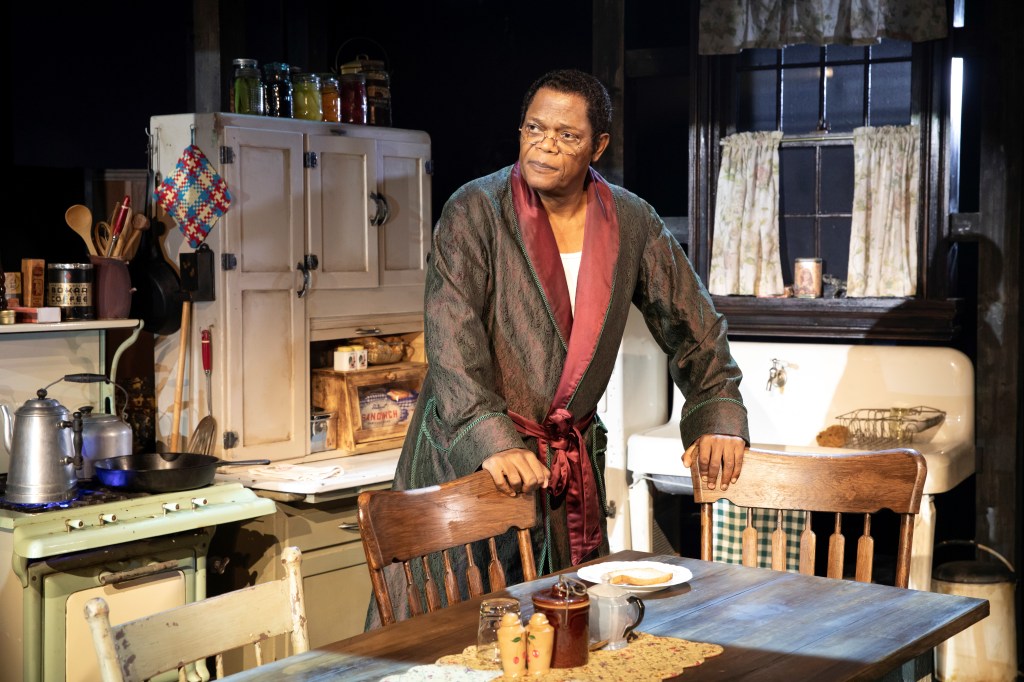
Gradually, Samuel L. Jackson’s Doaker reveals the story of the piano’s history since slavery days. With understated reverence as an explanation why Berniece will never let it go, he discusses how the carvings of each ancestor and their stories reside there as a remembrance of their identity and the sacrificial death of his brother Boy Charles, who first imbued the piano with the symbolic and spiritual significance of their family’s legacy of forward momentum.
Jackson’s Doaker and Danielle Brooks’ Berniece superbly translate the importance of this magical object with nuance and power that gives rise to our understanding why the ancestral spirits are hovering in the piano’s majesty in a battle that becomes otherworldly between the Sutter and the Charles family. It is a battle which has been continuing revealed at the top of the play with Boy Willie’s excited, impassioned entrance and reflected in Beowulf Boritt’s incredible set of Doaker’s simple four room house whose spare roof timbers exposed to the sky appear to be split and separating.
Indeed, the Charles family is a house divided by disagreement, disharmony and mourning tied in and caused by the racial discrimination, and inequitable economic opportunities intended to keep African Americans entrenched in poverty and peonage. To be free of Sutter oppression the Charles family must move away from the Sutters’ (symbolic of white racists) murderous, thieving behaviors, exploitive folkways and lack of empathy for others. They must free themselves from materialism, selfishness and criminality that has destroyed their humanity, as Brook’s Berniece expresses in her indictment of the men in her immediate family, including her dead husband Crawley.

Boy Willie’s presence at this point in time after Sutter is found at the bottom of a well is intriguing. Has Sutter’s wicked ghost driven him up to trouble Berniece about the piano despite its legacy? Or does he just want to make a better life for himself as he suggests? Berniece believes he pushed Sutter to his death, knowing the Sutter land would be put up for sale. Though Washington’s Boy Willie makes a convincing argument that he is not a murderer and Pott’s colorful Wining Boy suggests it’s the vengeful “Ghosts of the Yellow Dog” that caused Sutter’s fall to his death, Berniece is not convinced. Boy Willie’s presence has brought confusion and turmoil, exceptionally rendered by Washington’s Boy Willie, who appears so impassioned about selling the piano, he acts like a man possessed.
Additionally, Boy Willie’s obviation of the importance of the piano as their family legacy is answered with his apology to Berniece as if that is enough because he will sell it regardless. That answer isn’t enough for her. However, Boy Willie insists forcefully almost manically that he will use the land and make something with it, even though the deal is by word of mouth and could be another bamboozle by the Sutter family as Uncle Wining Boy suggests.

That the ghost of Sutter appears to members of the family around the same time that Boy Willie appears is more than a coincidence. That Boy Willie is the only one who doesn’t see the ghost is also more than a coincidence. Berniece, Doaker, Maretha and Wining Boy see the ghost who has been manifesting on the second floor above where Boritt’s roof timbers separate, threatening with well-paced grinding sounds (Scott Lehrer) to split the house up and fragment it completely.
Why doesn’t Boy Willie see Sutter’s ghost? Has Boy Willie become an instrument of the Sutter family, influenced/possessed by Sutter’s ghost to continue the tradition of theft, exploitation and bloodshed (the chains of slavery days) luring Boy Willie with the dream of being “his own boss?” The longer Boy Willie stays to sell a truck load of watermelons, the more the arguing and airing of grievances continues, intermingled with wonderful songs they sing, the first led by Jackson’s Doaker and the last by Potts’ Wining Boy who made a profitable living which he couldn’t sustain playing piano and cutting a few records.
However, nothing will ameliorate Boy Willie’s lust for the money the piano will bring. Finally, when push comes to shove, Berniece and Doaker do take out their guns ready to shoot Boy Willie if he and his friend Lymon (Doron JePaul Mitchell when I saw the show) remove the piano.
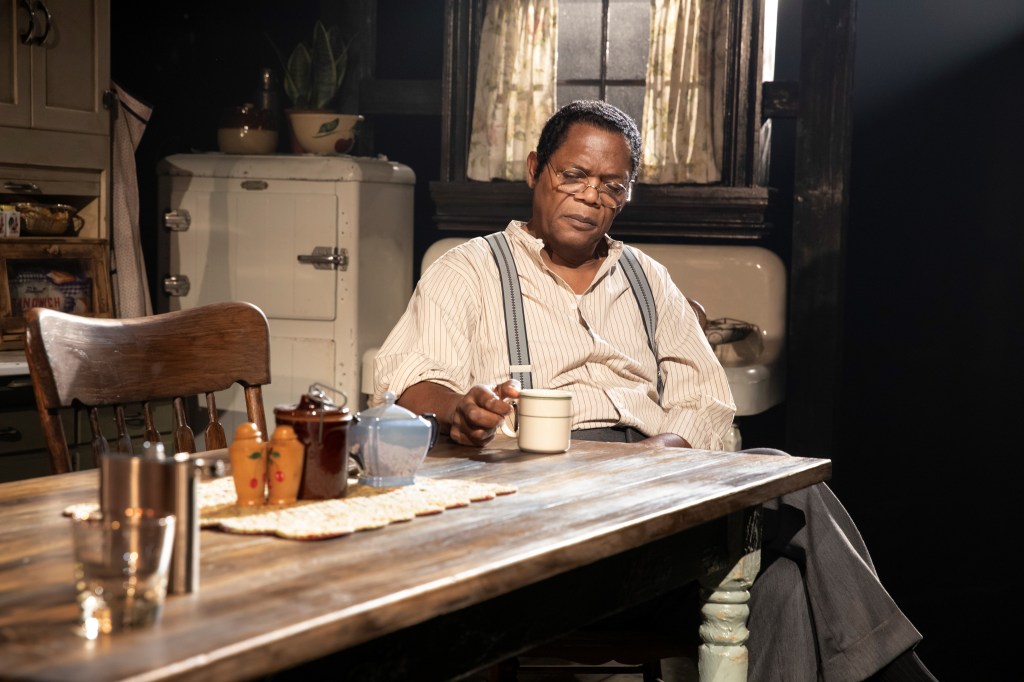
Brooks’ Berniece is so fervent that we believe she will shoot her brother to protect her ancestors’ legacy whose symbolism and spiritual strength she has embraced during Boy Willie’s importuning her to give it up. Washington’s Boy Willie is every inch her equal, stoked by the Sutter relative with the lure of land and his own ambition, like the Biblical Esau, willing to sell his birthright without any guarantees. Brooks and Washington are perfect foils and deliver amazing performances. Jackson’s Doaker and Pott’s Uncle Wining Boy present the stabilizing, humorous counterbalance to the frenzied brother and sister. If not for Wining Boy’s playing the piano at that heightened moment when Berniece has the gun, she would shoot Boy Willie, and Sutter’s ghost would have triumphed, completely destroying the family. Jackson’s direction and the timing of Potts and Samuel L. Jackson’s interference and distractions round out the incredible drama that moves toward the last scene of the play.
It is then that all the characters acknowledge the ghost of Sutter’s presence in the grinding sound of the house being pulled asunder by the warring spirits which also represent the values which the families prize. These are the values which Boy Willie must decide on. Should he be like the Sutters or raise up his own family’s legacy as Doaker has learned to do as a trainman and as Berniece has done steadfastly living one day at a time? Does Boy Willie have the resolve to shake off destructive forces and slowly carve out a life for himself with a lasting peace? At the top of the play Washington’s Boy Willie is so possessed by the Sutter’s offer and righting the past exploitation of his family, he can’t wait to follow them down the same pathways. However, Washington’s Boy Willie does change and is redirected.

Encouraged by everyone who feels the presence of Sutter’s ghost, preacher Avery (Trai Byers-another superb performance) who Berniece has been seeing, attempts to cast out the pernicious Sutter. He fails. Only Berniece calling on the help of her ancestors’ spirits who assist in the spiritual battle overcomes the ghost of Sutter’s presence and hold over their family. As she sings and plays the piano, on the second floor we watch the impact of her prayers and the Charles family’s spirits on Boy Willie as Washington manifests the struggle with Sutter’s ghost. As his body arches over then releases, we note that Sutter’s ghost, its tormenting lures that possessed Boy Willie leave. The two siblings are finally in agreement with Doaker and Wining Boy that what Sutter represents has no place in their family. As it leaves Boy Willie, miraculously, the house is made whole. With a grinding sound and the final sighting and restitution of the Ghosts of the Yellow Dog (you have to see the play to understand what happens) the separated timbers rejoin. It’s an incredible effect and magnificent, symbolic realization of Wilson’s immutable themes, about family unity in reconciliation with the past to move forward, thanks to the creative team, wonderful actors and Jackson’s direction.
Jackson’s staging and use of special effects (Jeff’s Sugg’s projection design, Lehrer’s sound design, Japhy Weideman’s lighting design, Boritt’s fabulous set) convey Boy Willie’s struggle, exorcism and redemption from the tradition of oppression, bloodshed and materialistic selfishness that have corrupted the Sutters and work to corrupt him and completely divide his family. He is only able to gain strength to be released when Brooks’ Berniece accepts how the legacy of past can be turned into a positive future by becoming the conduit of the ancestral spirits. It is their beauty, sanctity and strength that rise up to lead her, Maretha and the others forward, if they allow themselves to be led.
Boy Willie and Berniece join hands in unity. His demeanor transforms into calmness. He no longer wants to sell the piano, understanding that his family history and his identity are in unity. With the house returned to wholeness, the wicked impulses will no more occlude the lives of Berniece, Boy Willie and the others. Now they can move forward and carve their own history in the reality of their lives.
Throughout Wilson raises questions whether Boy Willie got revenge on Sutter for having his father burned alive and the question of whether he killed him to get the land in an ironic triumph. Another question is whether the Sutters are serious about selling the land to Boy Willie given the history between the two families. In the production these questions are emphasized by director Jackson’s vision of the themes and characterizations of this complicated work brought to a phenomenal apotheosis at the conclusion. However, as in life, ambuity is the spice that keeps us enthralled along with the chilling presence of the supernatural hovering.
This is a one of a kind production that exceptionally realizes August Wilson’s intent with every fiber of the artists’ prodigious efforts. I have nothing but praise for what they have done and will do for the run of the play.
For tickets and times to see this living masterpiece go to their website: https://pianolessonplay.com/
‘Richard III’ Shakespeare in the Park, a Stunning Achievement

For sixty years the Public Theater has kept its mission to offer free Shakespeare in the Park to educate and entertain in the finest of historical traditions that explore Shakespearean theater. This year as in previous years there are two productions Richard III and As You Like It offered in the lovely environs of the Delacorte.
Richard III explodes on the stage with energy and vibrance sported by an amazing and diversely talented cast overseen with stark determination, elegance and astute attention to detail by Tony nominated director Robert O’Hara (Slave Play) in his debut at the Delacorte. The production runs until July 17th, and is a must see event. So plan accordingly. You don’t want to miss what will surely be an award winner whose cracker jack design team blasts one’s socks off with beauty, majesty and thematic coherence.

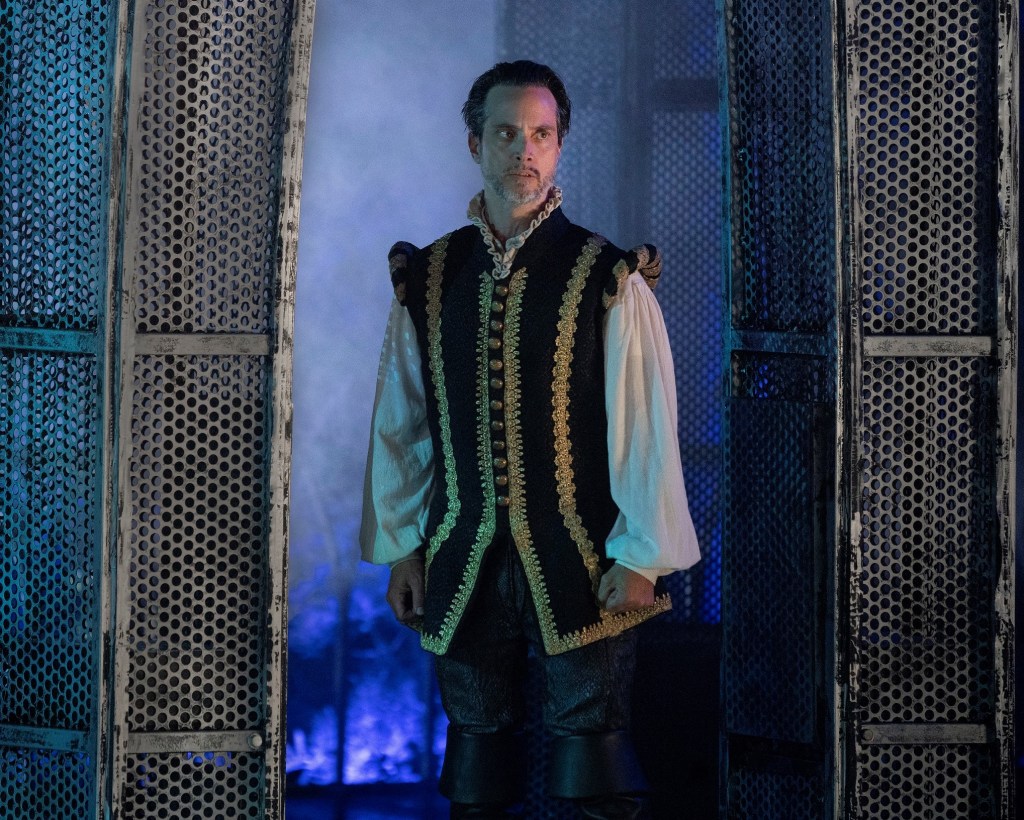
From the moment Richard III kills Henry VI in a striking, surprising, violent moment on the circular platform center stage, to the end when Richard III in warring armor is killed, Danai Gurira doesn’t miss one beat in her authentic, dynamic and spot-on performance. Pinging every nerve of the malevolent genius of Richard, she never hesitates or pulls back. Throughout she wryly, intelligently gives sideways glances and makes ironic comments to the audience, who she wins over as we enjoy watching her unfold her wicked plans. This, Gurira does with humanity and a comfortable, cavalier attitude sans anger which comes later when her fears grow to maintain her crowning success and the kingdom. Indeed, she compels us to giver her license to endear us to her, as she gradually owns her enemies and seduces us with her frank, honestly expressed intentions.

Of course, these are given to us with jocular aplomb and sly smiles. Meanwhile, she lies, cheats, steals power acting the innocent and bereaved victim as a posture, then winks at us, letting us in on the joke of her machinations of which she is most proud. For with Richard, it’s all about the journey to the crown, not the receiving of the power. Like others we have seen in recent years, once power is attained, she is loathe to keep it and struggles ineffectively and incompetently to maintain what all at court and the officials know she has obtained illegally and through horrible treachery. The parallels to Donald Trump, Gurira and O’Hara have made clear, even gestures of success as she points to the audience as Trump often does and gyrates with a fist pump. At this point in time, the hypocrisy becomes comical, yet Gurira manages to keep the humanity, working an incredible balance and tone via O’Hara’s direction and the ensembles’ magnificent work.
I found this above all to be amazing about Gurira’s performance. We watch enthralled as norm after norm is broken. But we are mesmerized because she doesn’t hesitate nor flinch by caving to hypocrisy and morality. It is only until the last scenes when a cavalcade of haunting spirits of kinsmen and once loyal subjects occupy her nightmares that overwhelming guilt reveals she has a conscience and thus, her blood is required to sacrifice herself as she has sacrificed others.

In Richard’s first speech, Gurira complains of the court that glories in peace, something she throws off because that is not her way of being. This first admission of flaws opens us up to hear more as she aligns herself with the deformity of war which better hides her deformity. It is no small consolation to her that peace and court parties and rejoicing show her up to be a social outcast to beauty, civility, and courtly manners. Thus, we deformed are encouraged to empathize with her as outcasts of royalty, not able to prove lovers, but as she embraces herself will prove herself to be a most incredible, hypnotic villain.
And strangely we marvel as she gleefully seduces her enemy Queen Anne (Ali Stroker) who attempts to kill her, though half-heartedly to instead becomes Richard’s wife seduced and bedded with vanity, though Richard has killed her father and husband. Richard amiably spreads self-hatred wherever he goes. Those he seduces to compromise their integrity, end up hating themselves for their weakness in allowing themselves to be duped, like Queen Anne, his brothers, Lord Hastings, Queen Elizabeth and others.

How is it possible that Gurira’s Richard is so disarming? Perhaps because there is no feeble intention. All is to Richard’s purpose; thus, he will not party, he will plot vengeance and death to suit his ambitious hunger for power. As Richard, Gurira with “innocent” convictions declaims will be done and we are mesmerized to note whether she does it. And indeed goodly servants of the kingdom (Lord Buckingham-Sanjit De Silva, Lord Stanley-Michael Potts, Lord Hastings-Ariel Shafir, Catesby Ratcliffe-Daniel J. Watts) assist Richard in his plotting, taking on his evil without compunction, acting like good dogs.
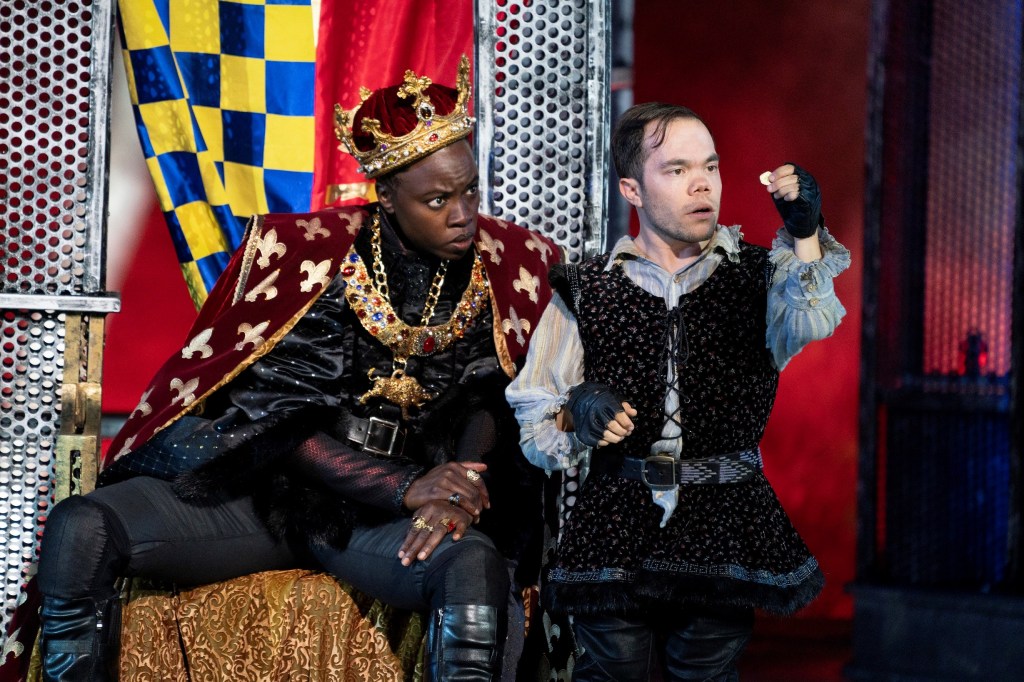
Of course we are reminded of the adage: evil flourishes when good men do nothing. Here, the once good men plot evil, infected by evil and the spoils promised. They fall under Richard’s spell and promises, but some of them end up dead. Richard’s loves are unreliable; the moment their loyalty seems wobbly, they are dispatched to hell or heaven which is a trap door that springs open in the stage floor billowing mists and clouds which one may interpret widely.
Like horrific dictator Adolf Hitler who declaimed in Mein Kampf what he purposed with the help of henchmen he rewarded, and like other despots whose clear-eyed intentions of massacre and genocide are propelled by justifications unstopped by guilt, people stood back and watched. It is incredible that leaders/enemies observing wickedness didn’t believe what these criminals and serial killers publicly said they would do. They didn’t take them seriously until it was too late. Indeed, oftentimes, the press and important political figures or royalty were on the side of the wicked, misinterpreting their actions precisely because the wicked were upfront and to the purpose (like Putin). They believed that the despot’s honesty assured they could be controlled. But as good people watched and hypocritically lied to themselves in allowing these, like Richard III to flourish, they destroyed themselves and thousands of others.

O’Hara’s attention to them is incredibly clear. His shepherding of the ensemble to relay it with great understanding is beyond breathtaking.
Thus, ironically O’Hara and Shakespeare cast the audience as citizens who are taken in and brainwashed by Richard’s mien and stance of confidence and unaffected presentment that she will succeed. We go along on the journey and follow her plotting and gaining results while sounding no alarm. Watching Gurira’s performance, one understands the imprints of bloody despots like Cuba’s “liberator” Fidel Castro and the “bloodless,” bullying machinations of failed politicos like Donald Trump. With brilliant cunning, charm and winning manipulations, such malevolents stun and disarm their prey, exploit and drain their energy, ply them with sweet poisonous promises, then toss them away as chaff to be destroyed after they’ve been bled dry of their use. And if they find that that their loyalty is waning, as Richard does with the admirable, obedient Hastings (the superb Ariel Shafir) then they reverse course and viciously attack without mercy.

Thus, by degrees we watch Richard revel in sickly brother’s (King Edward IV-Gregg Mozgala) downward fall into death as he further divides him from George who is thrown in the tower where eventually he and the Princes and others, including his wife Anne go before they are killed expediently by Richard’s lackeys. But not before Queen Margaret (Sharon Washington) excoriates all those who have killed and let blood run as she curses them with magnificence and majestic bearing. She does this in a rant that the audience applauded as Sharon Washington walked off, head held high as if to note, yes, what I declare will come to pass. Thus, Queen Margaret adjures that Queen Elizabeth will lose her sons to violence and like she, Margaret, will have lost husband, sons, crown, kingdom and be forced to live out her years in misery and mourning.

Queen Margaret saves the best for last. Richard shall die heavy in sin, unredeemed, unable to sleep, haunted by bloody deeds, seeing those killed in nightmares. Washington returns to continue her cursing diatribe in the second part of Richard III, and the audience thrilled to her speech which she pronounced with conviction. Of course her curses that all fear come to pass, despite Richard’s insults and references to her as a witch and a hag. Richard’s epithets don’t penetrate Margaret’s soul because she has endured so much misery in the loss of her husband, crown son, family. What are the slanders of a villain who all know to be a villain that is powerless to do anything against her?
Gurira’s incredible performance as the titular Richard III is one of the best I have seen. After her Richard gains the throne the paranoia and anger sets in and she wipes out more kinsmen and loyal Lords who she suspects of treason. It is a fascinating transformation from slinking deceiver to furious despot.

Of course the irony that Richard cannot be happy even after he has the crown because he is afraid he will lose it, becomes the obsession that takes him over and changes his character toward self-destruction. The journey of enjoyment has ended and now the hell, anger, fear and punishment of self and others blossoms evilly. As Richmond (Gregg Mozgala) threatens with growing armies, Richard has nightmares that frighten him more than when he commanded evil deeds awake. In Richard’s last speech, “There is no creature loves me, And if I die no soul will pity me” in which he attempts to rouse himself out of great despair at seeing the ghosts of those he killed who are coming for him in revenge, Guriara is magnificent. I found myself empathizing with this miserable creature who believed she could get away with nefarious deeds and not have her conscience convict her. Would these current despots of the world have such a conscience to convict them as Richard’s? Happy thought.

Robert O’Hara vision and astute guidance makes this an exciting and imminently watchable and glorious production with accompanying vibrant and stirring music and light. There is great humor in many of the scenes clarified by the pacing and delivery set up by the ensemble and director. The set design, royal gothic pointed arches fixed on the revolving turntable which reveals change of scene, time and place, wonderfully manifests the substance, mood and tone of the scene as well as reinforces the action. With the blood letting of war in the last moments of fighting, superbly stylized with just enough actors to represent the warring factions, the arches have veins of blood lines, ironic yet symbolic of the gore shed on the battlefield. In other scenes the arches turn blue, gold, various colors, the turntable spins as the actors are placed between. The sets and music that align with the action are spectacular because all cohere seamlessly.

The creatives who have explored O’Hara’s vision so masterfully are Myung Hee Cho (scenic design) Dede Ayite (costume design) Alex Jainchill (lighting design) Elisheba Ittoop (sound design and original music) Nikiya Mathis (hair and wig design) Teniece Divya Johnson/Jeremy Sample (fight directors) Neil Sprouse (director of artistic sign language–beautiful, poetic, effecting and relational hand movements) Byron Easley (movement director) Teniece Divya Johnson (intimacy director) Alexander Wylie (prop manager).
Check the Public Theater’s Free Shakespeare in the Park website for details to this unforgettable production of Richard III. CLICK HERE
‘The Prom,’ A Musical Comedy That Soars With Positivity and Truth
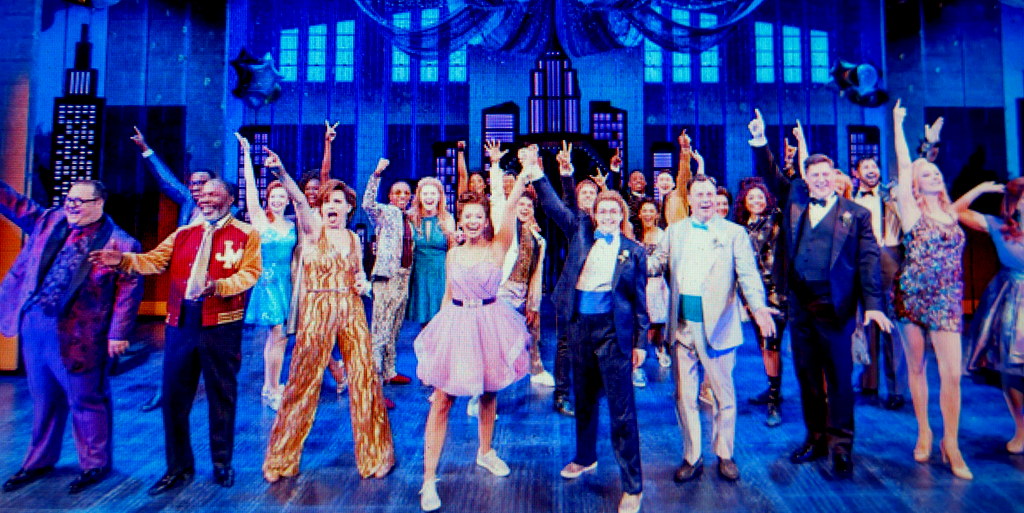
The cast of ‘The Prom,’ Book by Bob Martin & Chad Beguelin, Music by Matthew Sklar, Lyricsy by Chad Beguelin, Directed and Choreographed by Casey Nicholaw (Deen van Meer)
Even if you never went to your own high school prom and can’t imagine wanting to, The Prom directed and choreographed by Casey Nicholaw, currently at Broadway’s Longacre Theatre is a celebration of joy and life that you would be comfortable with. In fact just for its sheer hilarity, exuberance, and wisdom, you would eagerly sign up for the high school prom decorations committee. From its timing-perfect acting, to the evolution of characterization, and ingenious “true-to-life” story-line delivered in dialogue with dollops of zazzzzz, this musical comedy is thematically trenchant and expansive. Thanks to its talented creatives who know how to please and bring in the jokes at two hours and change with one intermission. The Prom is saavy, poignant and politically current with immutable themes that resonate for all time.
The notion of a “prom” unifying a senior class for the last time before they take off to “parts unknonwn” beyond the cliff of their community, is antiquated. But it is a tradition that the “in” crowd and “cool” kids in various schools in the US of course exploit to champion their supremacy over the rest of the school’s social groups. Naturally, for girls it is the height of achievement to be able to go with a date and buy a gorgeous dress with all the trimmings including matching color co-ordinated cumberbund for the guy’s tux and baseball cap. For those outcasts and isolates who have had to endure the humiliation and often sub rosa bullying and excoriation of their classmates precisely because they are “EWWWWW,” and would never be able to either ask someone or be asked, “the prom” is synonymous with pain, torment, Nazi-style fascist sadism which ultimately reverts to self-flagellation for the isolate’s not measuring up and having one’s place on the sunny side of high school superiority and popularity.

‘The Prom,’ Book by Bob Martin & Chad Beguelin, Music by Matthew Sklar, Lyricsy by Chad Beguelin, Directed and Choreographed by Casey Nicholaw (Deen van Meer)
The high school structure of placing students in same-age-related grades causes such emotional debacles and crucibles of misery, not only with regard to “the prom,” but with regard to stratification of achievement levels and every aspect of the daily life of the high school student. But what happens if you are not only a social outcast, but one with a gender proclivity that is UBER “EWWWW” in a setting where religious folks in a Red state culture believe your very nature, identity and being is a sin? Such is the conundrum and very real stakes for Emma (sensitively and realistically portrayed by the golden-voiced Caitlin Kinnunen) As a high school senior of a small high school in Indiana, Emma must suppress her year and one-half relationship with Alyssa (Isabelle McCalla is superb as Emma’s waffling sub rosa girlfriend) which they both intend to make manifest when they go to their prom together. But when the PTA led by Alyssa’s mom (the heartfelt and many-sided Courtenay Collins) discovers that Emma intends to bring a same sex girlfriend (she does not know it is her daughter-surprise, surprise), she protests and creates a ban. And Emma protests creating a stir.
This real-life situation of gay teens being barred from attending their proms with same sex partners has occurred all over the US and as recently as in 2017, Buffalo, New York. Most specifically when it happened to Constance McMillen of Itawamba Agricultural High School, in Mississippi, McMillen sued because her rights were violated. And when the ban was lifted and she attended her scheduled prom, the district had a surprise waiting for her right out of Mitch McConnell’s and the Republican Party’s playbook. (Check this article on McMillen.)
With Trumpism, gender discrimination, misogyny, racism and nativism have gained a legitimacy as certain social groups glance back fondly to the days of Jim Crow and attempt to enforce their fascist agenda on the rest of US citizenry who are patriots and believe in upholding the constitution. That Bob Martin, Chad Beguelin and Matthew Sklar have allowed the prom banning of LGBTQ groups to inspire them to write a musical comedy which explores the heights and depths of Trumpist-type discriminatory acts with grace, style, laugh-riot humor and profound wisdom (without making reference to Trump, or the new Trump party) is prestidigitation on a grand scale. For they inspire unity, hope and love with the same tools that adversarial groups use to promote hate and division.
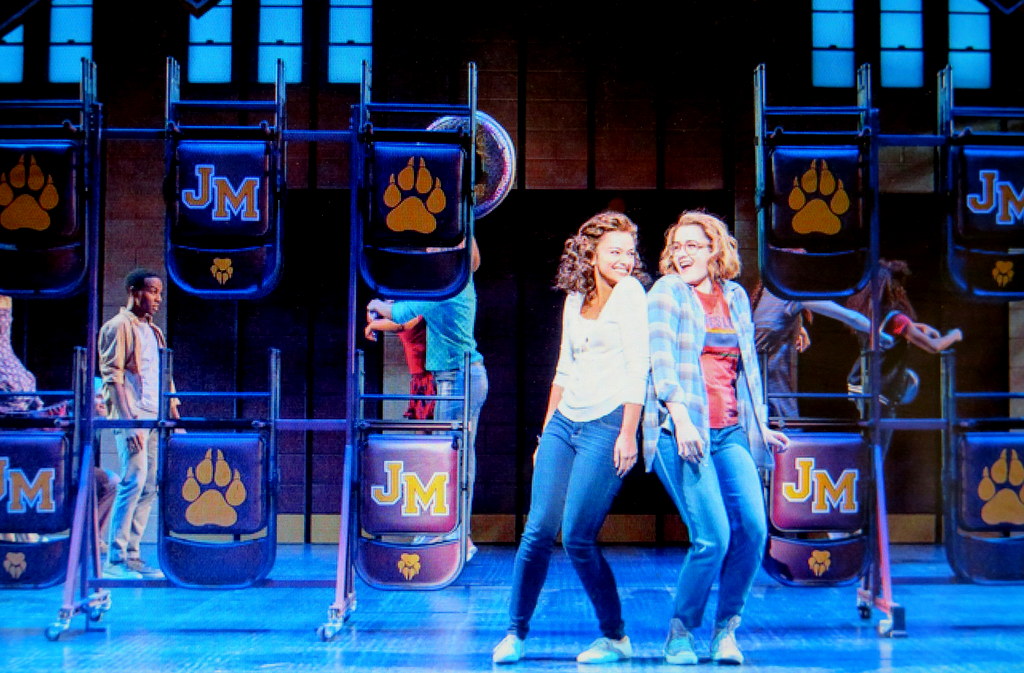
(L to R): Isabelle McCalla and Caitlin Kinnunen in ‘The Prom,’ Directed and Choreographed by Casey Nicholaw,(Deen van Meer)
And what is the vehicle they use to initiate a way into the LGBTQ hair-raising problems of a small Indiana high school and Emma’s fight? Theatricals! Thespians who represent some of the finest, award-winning celebrity narcissists on Broadway. And these even bring their Tonys and Drama Desks to impress the motel manager to give them a better room. Of course, not only are they not recognized, the crushing humiliation they experience in a town that could care less about them is enough to make even a narcissist more lovable and heart-warming.
Martin, Beguelin and Sklar begin in New York City with the Broadway stars backstage after a performance which closes immediately when they receive a horrific New York Times review. The critic was particularly humiliating when they referred to the headliners as “unlovable narcissists.” The joke is priceless for it recalls another celebrity narcissist who also cannot be insulted and refuses to change.
The narcissists are the fabulous Beth Leavel as Didi Allen the Diva Queen extraordinaire with a gorgeous belt (We hear it in the song “The Lady’s Improving), and her co-star in infamy the “bring-down-the-house” high flier, Brooks Ashmanskas as Barry Glickman whose vibrant and hysterical “Barry is Going to the Prom,” hints at the 30-years-ago miseries of high school and the affirmation of love wiping tears away years later.

The Prom,’ Cast and Christopher Sieber, Book by Bob Martin & Chad Beguelin, Music by Matthew Sklar, Lyricsy by Chad Beguelin, Directed and Choreographed by Casey Nicholaw (Deen van Meer)
The attention starved thespians are accompanied by Angie (the excellent Angie Schworer whose dance/voice number “Zazz” is just wonderful) and Trent Oliver (Christopher Sieber’s fantastic “Love Thy Neighbor” with the ensemble is the gobsmacking point of the show). Along with producer Sheldon Saperstein (Josh Lamon’s timing is spot-on) this motley crew goes on the road to resurrect their brand, recover from the criticisms in the Times article by battering down the unjust doors of the discriminatory high school to join Emma’s cause. They determine that this “self-less act” of “making a difference,” “doing good for the world” will lift their reputations and give them some positive publicity.
Of course they exacerbate the horror of the initial situation for Emma and create a chaotic shambles riling up the parents of the PTA who demand the interlopers be removed and leave. When Emma succeeds in her lawsuit proving her civil rights cannot be violated, the PTA and student body contrive a solution, represented by the song “Tonight Belongs to You/Us” sung by the ensemble at the end of Act One. The number is mesmerizing, wildly frenetic (the dance moves are spectacular) and enthralling. And then the chill comes to us in a terrifying realization of the song’s true message sung by a predatory, vampirish-sounding refrain “the night belongs to us.” Clue, the cool crowd, the money, the power players who attempt to devour and suck the blood of the little people who suffer their callous and unconstitutional injustices. Emma’s Broadway “helpers” prove anything but and Emma is worse off than before the show crowd showed up!
This is a superior high point to end Act One, for there must be change; such injustice cannot continue. Enter the answer which turns the religious institutional crowd on its ear and enter artistic empathy. The result is a beautiful cathartic Greek style elevated comedy of triumph in Act Two which provides a more than satisfying and very adult addendum to proms everywhere in the US.
Yes, some of the problems are not resolved, just like in life. And the townspeople still must grapple with their prejudices. These have taken years to simmer and boil and do not retreat overnight. Alyssa’s mom Mrs. Green must confront the pain of a truth she doesn’t want to see with her daughter. The hatreds and bullying will continue, but this hiatus of joy has begun to ameliorate it. Ironically, the ones who have benefited greatly (the celebrity narcissists) have stepped up and contributed their grist to making the prom one that everyone will remember. Interestingly, they have evolved and developed into less self-absorbed individuals who perhaps have begun to understand another level of success beyond the wins they’ve received in their careers.
I loved this show for its incredibly energetic performances by all of the cast and the ensemble. There is not one who isn’t superb or who isn’t “on point” and “moment-to-moment.” I loved the book and the accompanying musical numbers which remain insightful and carry the themes and story-line forward to the powerful message of the show. Indeed, some of the songs are stand alones with lovely melodies and rising lyrics: “Dance With You,” and “Unruly Heart,” are especially meaningful.
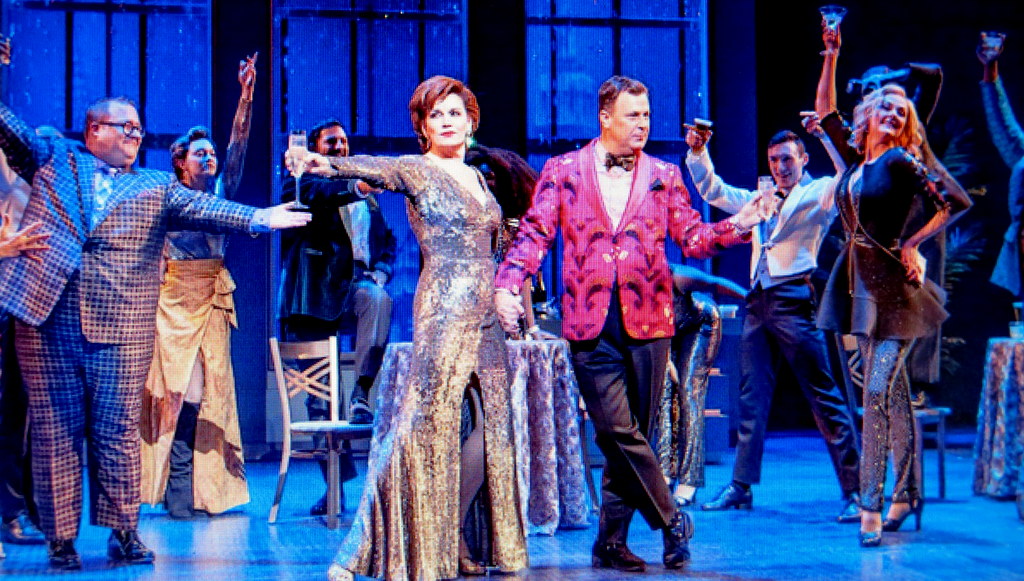
Beth Leavel, Brooks Ashmanskas and the Cast in ‘The Prom,’ Book by Bob Martin & Chad Beguelin, Musi by Matthew Sklar, Lyrics by Chad Beguelin, Directed and Choreographed by Casey Nicholaw (Deen van Meer)
The Prom presents the realms of hope and faith in people’s goodness. It encourages us to take a stand for what is right regarding human dignity, respect and decency. Without politicizing or rankling, it cleverly portrays elements of our nation’s weaknesses from the self-absorbed celebrity elite, to the equally self-absorbed and self-righteous conservatives. Both must modify and one way this will occur is for each social group of the nation to come together, get out of their comfortable locations and visit the hinterlands or “sin city.” The production makes a case for laughing at oneself and not taking one’s beliefs too seriously to forget the dignity of others, regardless of their beliefs. And perhaps especially because of their beliefs, they must be given a hearing. How many times must we say this to begin to do it? We need to stop cannibalizing ourselves.
The final song “It’s Time to Dance,” argues for each and every one of us to be our own creations, to define ourselves to be as truthful as possible on journeys of grace and openness, and without arrogance that masks fear or belligerence to “prove” a point.
The production is superb in its thematic encouragement/reinforcement for young and old: 1)to be the best of who one can be; 2)to take charge of one’s own life and not wait for others to act for us; 3) to bravely do one’s part to establish a world of tolerance and inclusion through communication and empathy.
The creators are not presenting ideas that are puerile and simplistic. If one just stops for two minutes and considers the rise of white terrorist incidents in the last two years that go against the fabric of our nation’s tenets, then one realizes how much our culture needs to witness these themes again and again. On the surface The Prom is a fun ride and you leave the theater humming the songs. But underneath the laughter and fun is the poignant message expressed with ebullience by the ensemble and Christopher Sieber’s Trent Oliver with rousing spirits in the song, “Love Thy Neighbor.” If only…but for the shining last quarter of the show, the cast convinces us of the truth and possibility of putting aside behaviors that divide. What a crazy great message that all of us imperfect, flawed individuals need to remember to dance at our own “prom” (our own way of walking) every day and invite a host of other smiling individuals to promenade with us!
Kudos go to the artistic team which makes this production a resounding you want to come back to see a few times: Jack Viertel (Original Concept) Scott Pask (Scenic Design) Ann Roth (Costume Design) Matthew Pachtman (Costume Design) Natasha Katz (Lighting Design) Brian Ronan (Sound Design) Josh Marquette (Hair Design) Milagros Medina-Cerdeira Mary-Mitchell Campbell (Music Supervisor, Vocal Arrangements) Larry Hochman (Orchestrations) Meg Zervoulis (Music Director) and John Clancy, Glenn Kelly and Howard Joines for their musical coordination, additional orchestrations and arrangements.
The Prom (Longacre Theatre on West 48th between 7th and 8th) has one 15 minute intermission. You can purchase tickets by CLICKING HERE.
 CAROLE DI TOSTI