Blog Archives
‘Chess,’ a Terrific Aaron Tveit, Lea Michele, Nicholas Christopher Electrify a Less Troubled Book
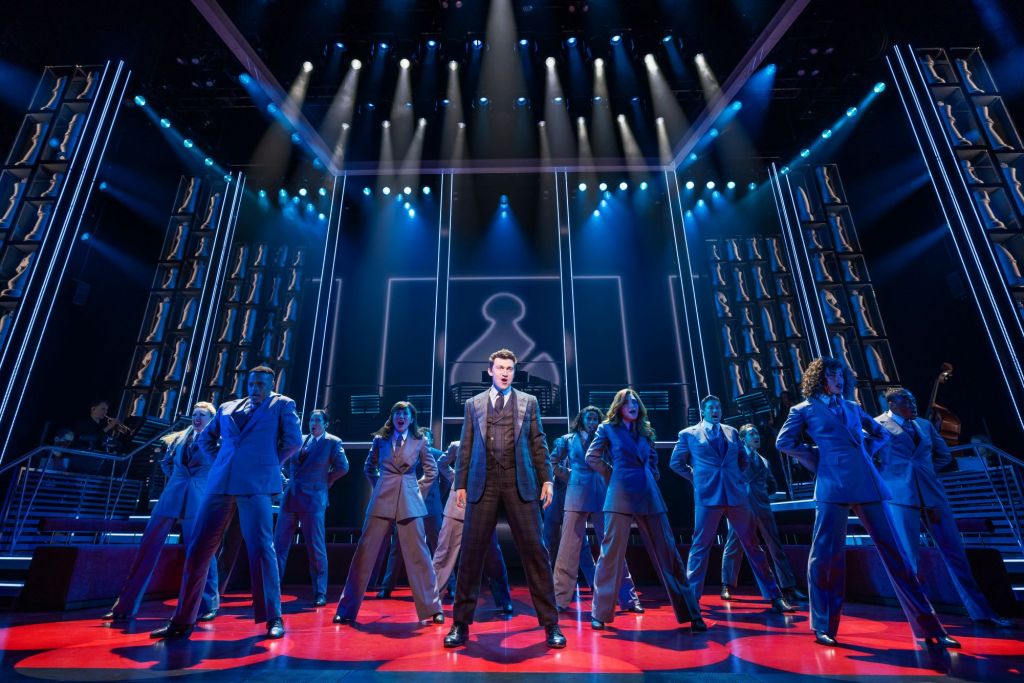
In all of the adventures of the musical Chess, from concept album to initial production in the West End (1986), to its Broadway premiere (1988), concerts, revivals, recordings and tours up to the present, there might be an object lesson in how to develop a winning book. The memorable score by Abba’s genius collaborators, Benny Andersson and Björn Ulvaeus will always resonate. But the musical with lyrics by Ulvaeus and Rice, and new book by Danny Strong may have alighted on the merry-go-round of success never to return to a troubled past. The musical currently runs at the Imperial Theatre until May 3rd.
In its current iteration, the Broadway revival, starring three powerhouses in the lead roles, makes Tim Rice’s idea about a Cold War musical more coherent and interesting. This seems especially so if one lived through the hell of President Reagan’s escalating nuclear arms race with the Soviet Union, and saw the 1983 TV movie The Day After (about nuclear annihilation). Watched by 100 million viewers in one sitting, the TV movie, also watched by Reagan, allegedly influenced him against continuing proliferation.
Strong’s book ties in to the arms race, SALT talks, CIA and KGB compromises, and a controversial, frightening event (Able Archer ’83). All become aligned with two chess matches and chess gambits played by the Soviets and Americans to enable communications during a dangerous time in the 1980s, when nuclear war seemed imminent and chess was used as a form of negotiation to save face and make deals (“Difficult and Dangerous Times”).
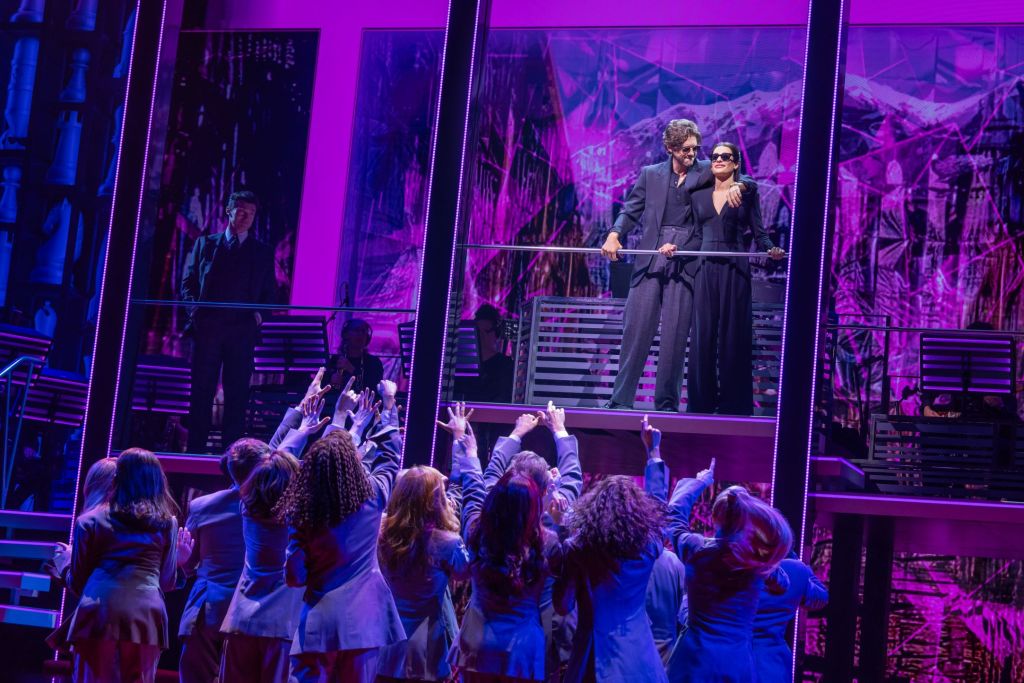
To frame the story, clarify the events with a through-line, and provide a critique, Strong presents this version of Chess through the perspective of an omnipotent narrator, The Arbiter, superbly played by Bryce Pinkham. Snapping his fingers to move the action, he introduces the players, as he selects and explains the events which the company enacts. Invariably, he shares his opinions. Accordingly, the characters subtly move around like chess pieces (the metaphor) in the Cold War game.
This is an important conceit that can be overlooked as one becomes caught up in the powerful music, well choreographed dances, and love triangle between Freddie (Aaron Tveit), Florence (Lea Michele) and Anatoly (Nicholas Christopher). We thrill to their sterling voices and the ensemble’s striking dances. Amidst the glory, the emotion and the angst, Bryce Pinkham’s Arbiter holds the Cold War musical together and gives it a new coherence. He dishes up humor and irony as he tosses off snarky one-liners that sometimes relate the events of the past to events in the present. In one aside he infers the US and NATO countries are in a second Cold War.
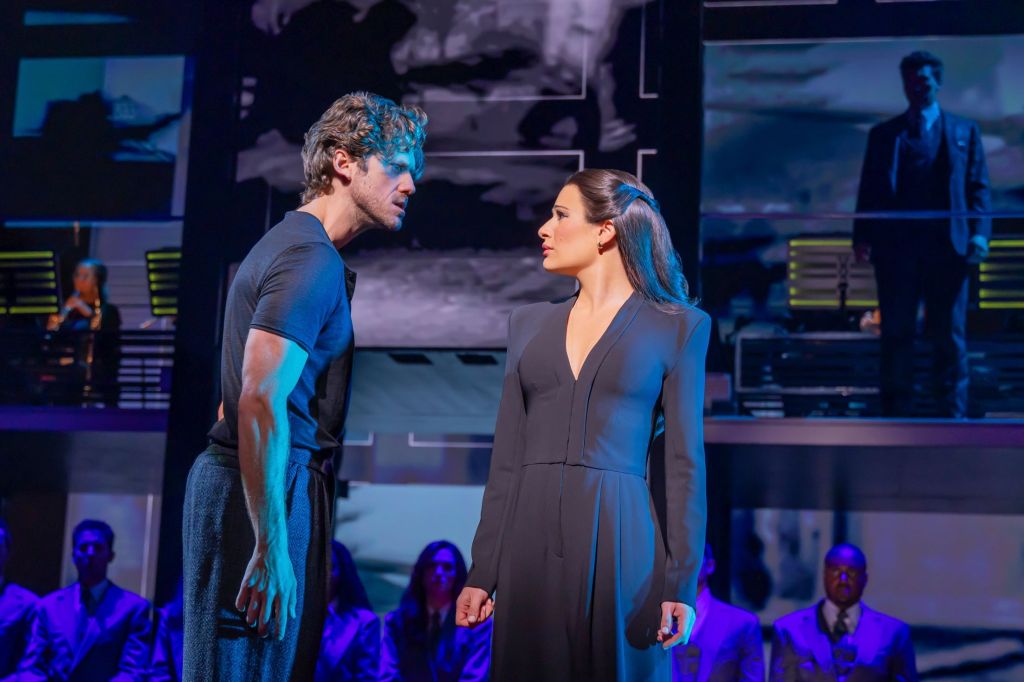
Accompanied by the ensemble, Pinkam’s Arbiter presents a wild and woolly number in which he introduces himself as a new character, and critiques his song (“The Arbiter”) with a confident, “I’m going to crush it.” Pinkham does “crush it,” then his character arbitrates the first chess match between Freddie and Anatoly. After the match Freddie’s Second, Florence, eventually falls out of love with wired Freddie (“Pity the Child #1), and into love with the depressive Anatoly (“Where I Want to Be”). The struggle for all to remain on an even keel against the backdrop of the spy games creates the musical’s tension and generates the fabulous songs.
In Strong’s book whether one agrees with the character’s attitude or not, Pinkham’s Arbiter presents clarity and the symbolism that the Soviets vs. the Americans “Cold War” was an overarching chess match containing a series of smaller chess matches between the players, even between Anatoly’s two love interests, his wife, Svetlana (Hannah Cruz) and Florence. Their powerful duet (“I Know Him so Well”), strikes gold in Act II. After Anatoly defects to England and lives with Florence, he plays against the Soviet champion Viigand in Bangkok (Act II), which underscores the frightening Able Archer 83 event.
In Strong’s version, the CIA agent Walter de Courcey (Sean Allan Krill), and KGB agent and Anatoly’s chess mentor Alexander Molokov (Bradley Dean), negotiate compromises and deals behind the scenes of the first match and the second. Of course, this is for the purpose of winning the larger game of chess which is a deescalation of nuclear weapons to insure the safety of the planet. Indeed, there were real chess matches between the countries, and Pinkham’s Arbiter infers this with his suggestion that some of these events are true. The video projections go a long way toward filling in the gaps in information and de-mystifying what happened during the time befor the Berlin Wall fell.
Chess is acutely, incisively directed by Tony-award winner Michael Meyer (Swept Away, Hedwig). Meyer stages many of the numbers with the concert style approach. Kevin Adams’ lighting design of blues, reds, purples, yellows, effectively dramatizes the dynamic between and among the specific characters, the Soviets and Americans, and the shift of settings, i.e. Bangkok in Act II.
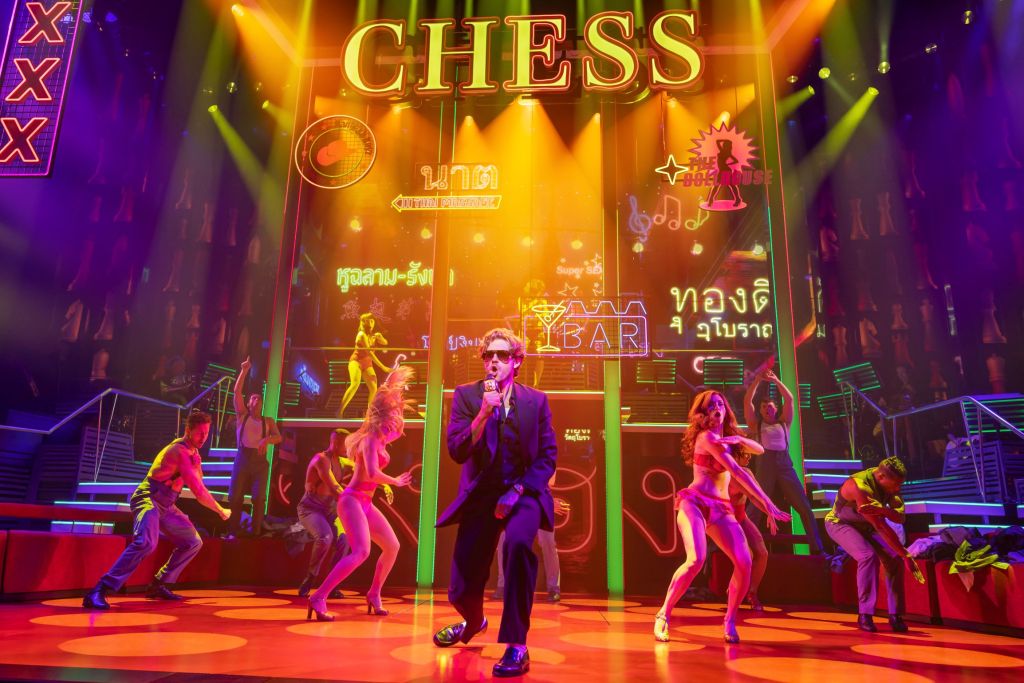
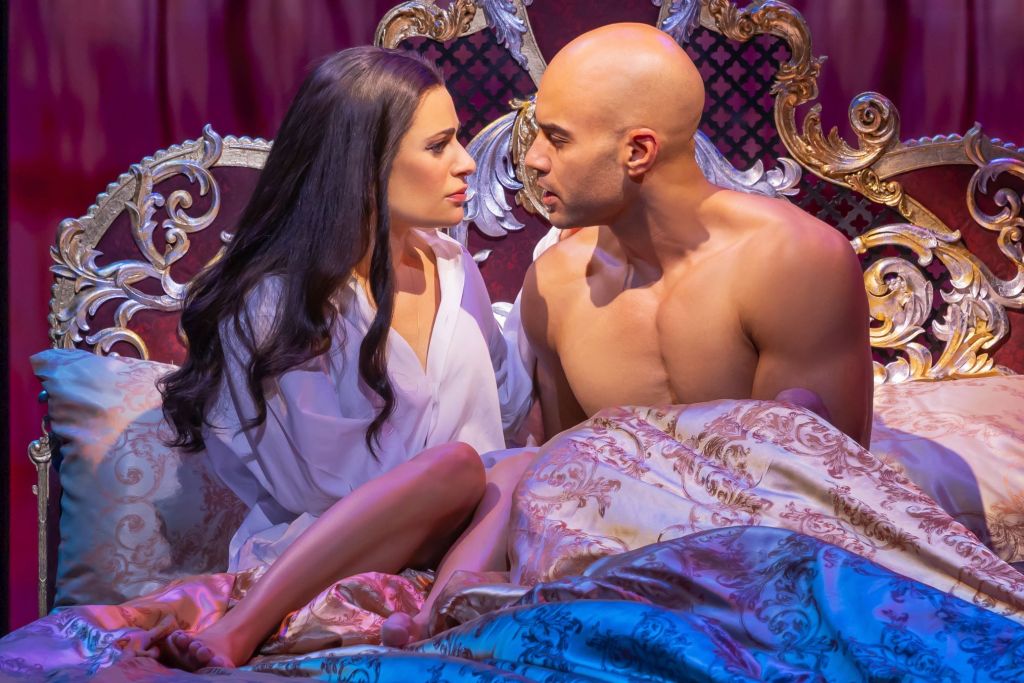
David Rockwell’s multi-tiered scaffolding enhanced by neon and chrome gives the production a stark, period look which is softened for an intimate bedroom scene between Florence and Anatoly with minimal props. Video by Peter Nigrini enhances the historical background needed to provide context, i.e. the Hungarian Revolution, or add interest. Lorin Latarro’s energetic, at times mannered (“Difficult and Dangerous Times” ), at times wild, erotic (“One Night in Bangkok”), energetic movement and dance enhance the ensemble’s pivotal numbers. These reflect the stereotypical thinking of that time, the cold war policy and the feverish, hot, atmosphere in Bangkok where the second chess match is held.
Appropriately, the ensemble’s tailored, grey suits (Tom Broecker), reflect the somberness of countries at war with the threat of their antagonisms heating up. The leads in dark colors contrast with the ensemble, and Anatoly’s wife dressed in maroon “leather.”
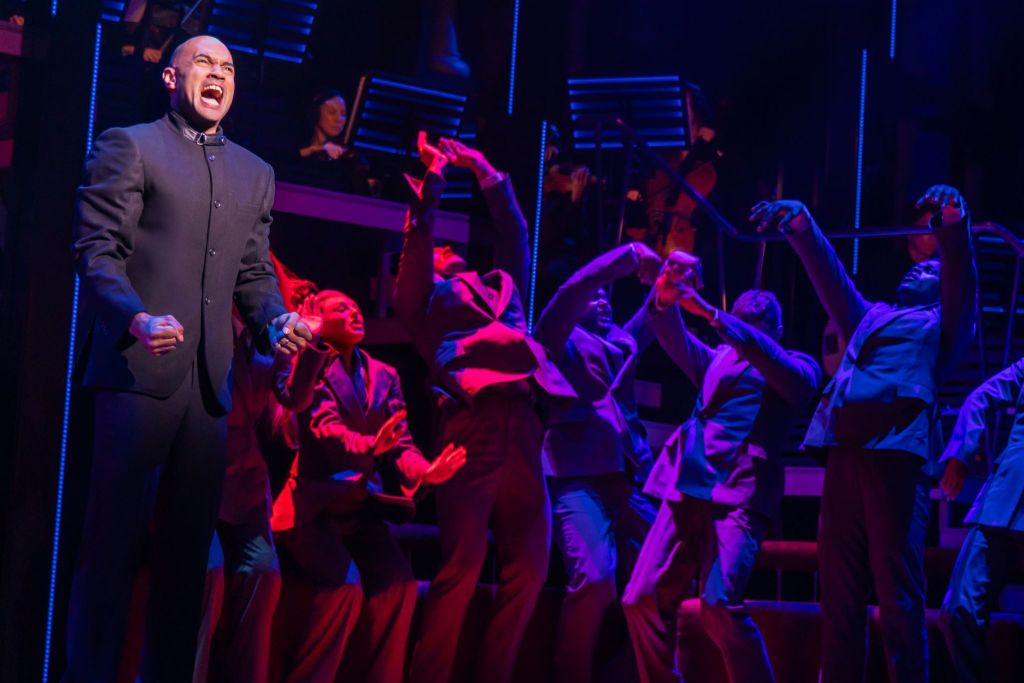
The phenomenal score played by an 18-20 piece orchestra with Ian Weinberger’s musical direction, and Anders Eljas and Brian Usifer’s orchestrations power up the ballads, pop rhythms and near operatic ensemble numbers gloriously. Finally, the orchestra, carefully positioned onstage by the back wall, is always witnessed by the audience who engages with it.
The sexy “One Night in Bangkok” received applause of recognition by the audience with the first notes of the charted global hit song (1984-85), as the exotic dancers and Tveit rocked Latarro’s movements with mastery. The superbly performed numbers by Tveit (“Pity the Child #2”), Michele (“Someone Else’s Story,” “Nobody’s Side”) and Christopher’s “Where I Want to Be” and “Anthem,” sung with the ensemble, are show-stoppers.
Finally, as the games conclude and presumably the first Cold War is over, Pinkham’s Arbiter sings “One Less Variation.” Then, Tveit, Michele, Christopher, Pinkham and the company end with the warning lyrics from “Nobody’s on Nobody’s Side”: “Never stay (a minute too long), don’t forget the best will go wrong, nobody’s on nobody’s side.”
Chess runs 2 hours 45 minutes with one intermission through May 3 at the Imperial Theater. chessbroadway.com.
‘Stiller & Meara: Nothing is Lost’ Ben Stiller Honors his Parents’ Legacy @NYFF
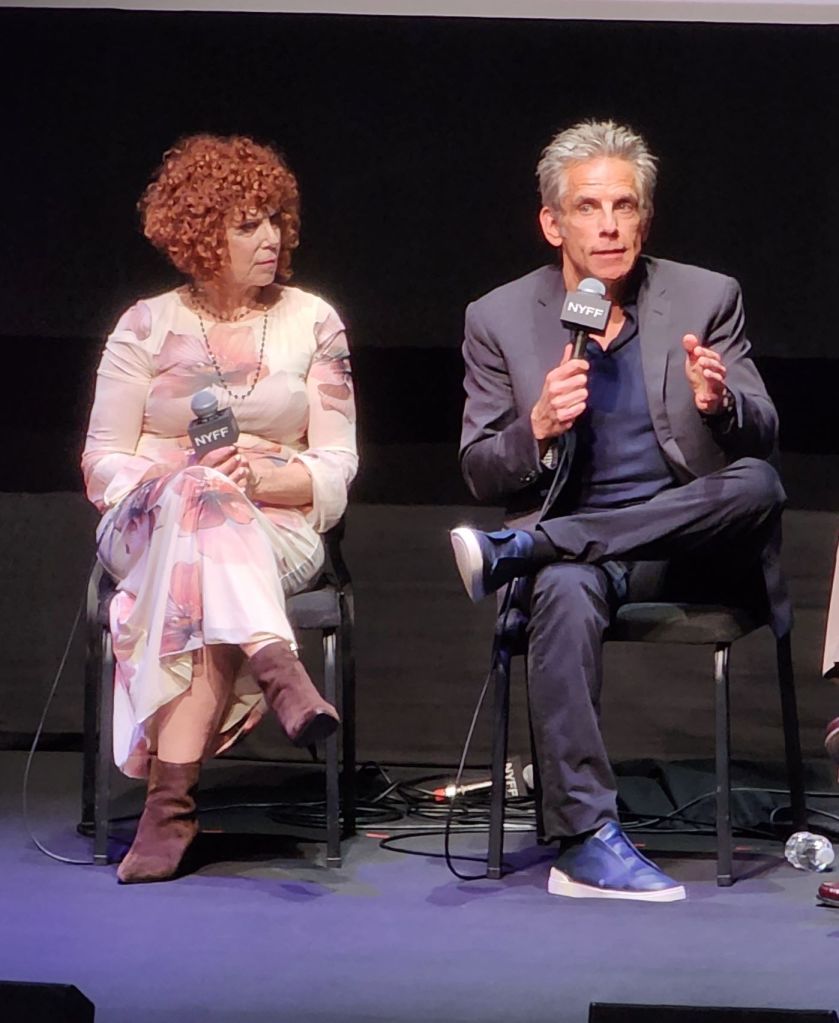
In the Q and A after the screening of his documentary about his parents, Ben Stiller quipped “…my parents who couldn’t be here, I hope they’re OK with it. There’s no way to really check on that. I hope the projector doesn’t break.” Well, the projector didn’t break and no rumbling of thunder, falling lights or crashing symbols happened. So, they must be “OK” with the film. Certainly, the audience showed their pleasure with long applause and cheers. In one section near me they gave a standing ovation for Stiller & Meara: Nothing is Lost.
Ben and Amy Stiller’s film collaboration about their parents, directed by Ben Stiller, screened in its World Premiere in the Spotlight section of the 63rd NYFF. Employing their experience in the entertainment industry, Ben Stiller (comedian, actor, writer, director, producer) and sister Amy Stiller (comedian, actress) explore their parents’ impact on each others’ lives and careers to then influence their children’s lives. In the latter part of the film we note this multigenerational family project also includes Stiller’s wife, Christine Taylor Stiller; and his children Ella and Quinlin Stiller.
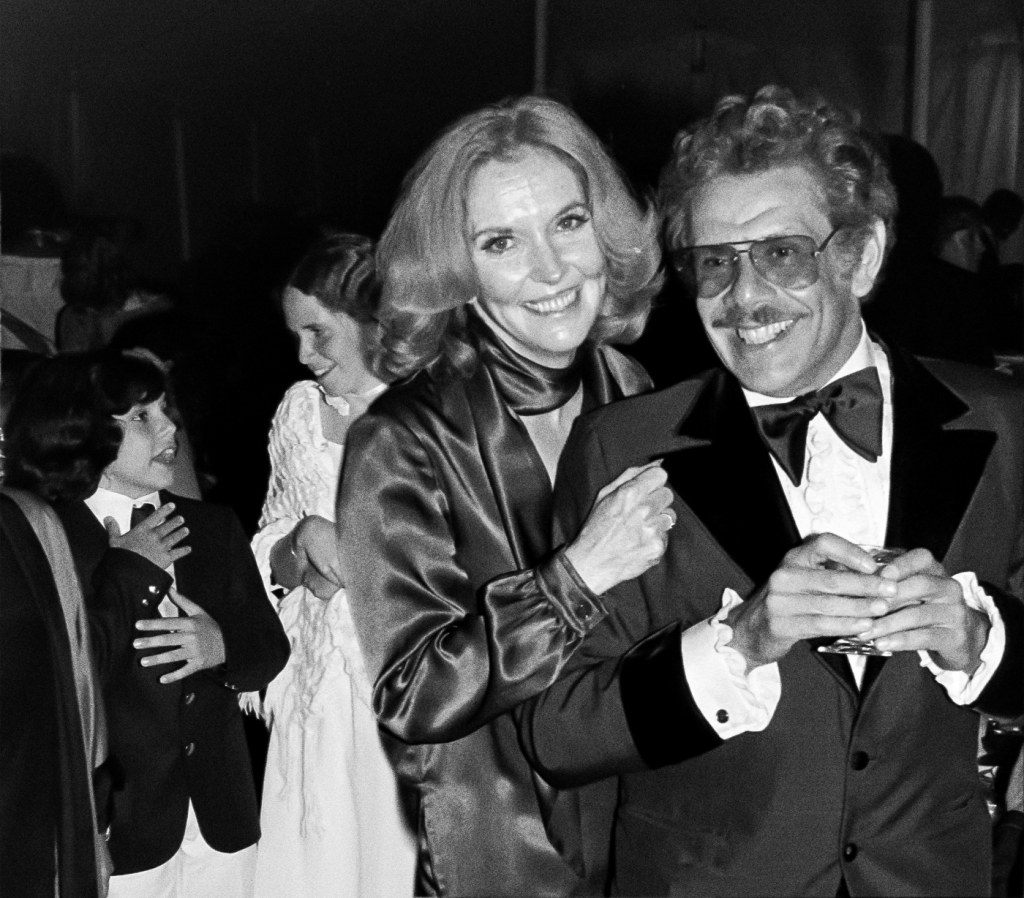
However, in order to begin to tell the story of three generations of Stillers, the siblings reach back before their parents’ marriage and their births. From that vantage point they first examine how Jerry Stiller and Anne Meara met. Then they explore how Jerry and Anne shared their interests and talents. Recognizing that they could work together, they created the successful comedy duo that Ed Sullivan first invited on his show in April of 1963.
Enamored of them as performers and people because their ethnic and religious backgrounds mirrored Sullivan and his wife’s, Stiller and Meara returned to the show again and again. Because they were funny and made their comedy relationship/marriage sparkle, they were a hit. In reflecting on this, Stiller shows a number of clips from the archives and even meets with Steven Colbert at the theater named for Ed Sullivan (the Ed Sullivan Theater in New York City). The two of them discuss what it must have been like to audition live as unknowns and hit the ground running on a nationally aired program that millions watched every week.
Using clips from that show, and other TV shows, films, theater and more, Stiller cobbles together a delightful, honest, intimate and funny chronicle of his parent’s marriage on and off camera. The director delves into their unique styles and talents which gave them their comedy act. Stiller insists that his dad struggled to be funny and constantly had to work at it. On the other hand his mom found humor naturally and could “ad lib” humorous riffs effortlessly. His dad so admired this about her talent.
Importantly, Stiller captures the history of that time which contributes to our understanding of the nation’s social fabric. Their work historically reflected 60s humor that appealed then but still has an appeal today. Though they worked together and refined their act for years, eventually, they worked separately. Stiller discusses how and why this happened. Essentially because they wanted different things and were their own people, they tried their own TV shows. Then other opportunities came their way.
Humorously, his documentary reflects his parents’ relationship so it became difficult to know when the comedy act ended and where their real marriage began. Perhaps it was a combination of all and/or both. Since his Dad saved tons of memorabilia (photos, programs, reviews, clips, tapes, videos, home movies) from their lives, Ben makes good use of these artifacts.
Additionally, Stiller reveals the more personal and intimate aspects of himself and Amy growing up with his parents. Principally, he uses this perspective to show the parallels with his parents’ relationship as he briefly looks at his marriage with his wife and relationship with his children. One segment has interviews with Christine, Ella and Quin. Importantly, he relates their perceptions with his attitude toward his parents growing up.

This project that began after Jerry Stiller died in 2020 and took five years to complete saw Stiller and his wife Christine through a separation and getting back together again. Stiller looked at how his parents kept their marriage together through the pressures of performing together. That reflection influenced him in his relationship with Christine.
As Stiller worked on selecting how to approach the film with the material left to him and his sister, a concept came to him about legacy. Indeed, the documentary forms a portrait of a family whose legacy of humor, creativity and prodigious hard work has passed down from generation to generation.
In short the film reveals that Stiller and his sister Amy are humorous acorns that don’t fall far from their ironic and funny parental oaks. Amy and Ben’s sharp wit from his mom and dogged perfectionism from his Dad, come into play in the creation of this film. Mindful that all of his family’s lives are in his hands, with poetic consideration Stiller’s profile of those most dear to him is heartfelt, balanced and emblematic of a gentler, loving, kinder time. We need to see examples of this more than ever. To read up on the film description and to see additional photos, go to the NYFF website. https://www.filmlinc.org/nyff/films/stiller-meara/
An Apple Original Films release, look for Stiller & Meara: Nothing is Lost in select theaters on October 17, 2025. It receives wide release on October 24th.
‘Late Fame’ Starring Willem Dafoe, 63rd NYFF
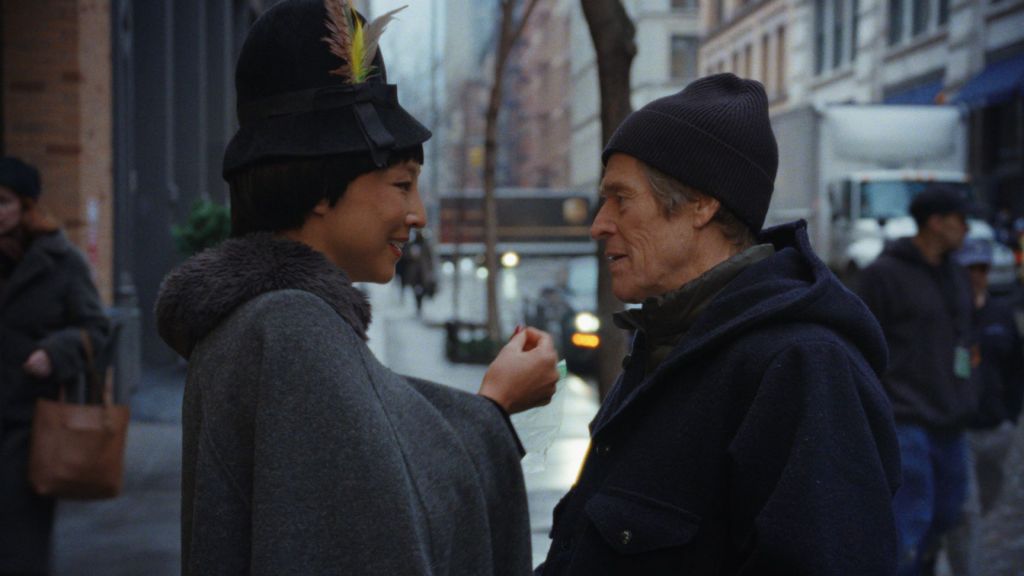
Adapted from the Arthur Schnitzler novella Late Fame, screenwriter Samy Burch (May/December) and director Kent Jones (Diana) shine a light on the West Village and Soho (circa 1970s) and Soho now at the height of its commercialization and development. With the incredible backdrop of factory buildings and West Village apartment buildings turned into fashionista haunts, and cobblestone streets still creating their unique atmosphere, a superb Willem Dafoe portrays the sensitive, once lauded poet Ed Saxburger. The craggy young man who had the world at his feet with the publication of his poetry book Way Past Go eventually gave up his typewriter to earn a modest living with a secure pension as a postal worker.
What happens to the passionate fire required to write poetry that gets published during a time when poetry was the lingua franca of the Village artist milieu, and Soho was the coolest place to be? If old soldiers fade away, does the same happen to promising poets whose work is well regarded but little read, then forgotten?
Late Fame investigates this phenomenon with atmosphere, nuance, irony and heart. It is Jones’ love letter to downtown Manhattan, vastly changed with remnants of its old beauty and undeveloped glory which made a comfortable home to artists of all stripes in the 1970s. Then, Dafoe’s character Ed Saxburger came East, spurred by the thought of fitting in with the artist colonies in Manhattan at that time.
The film which is in the Main Slate section at New York Film Festival is buoyed up by sterling performances from those assisting Dafoe, as he negotiates his empathetic protagonist who is stoic, reserved and charming, and a bit lost as he welcomes yet questions with open eyes his acceptance by a group of well-heeled twenty-somethings, who turn out to be poseur artists. Their mission is to recapture the ethos of Gregory Corso, Allen Ginsberg and others, but they are sorely out of their depth and lack the talent, grist and life wounds to do so.
The film unspools with Saxburger’s rediscovery by this exotic group of young would-be writers and philosophers branding themselves “the Enthusiasm Society.” An effete, wealthy Wilson Meyers (the excellent Edmund Donovan), leads the group of retrograde misogynists and artistes. When Saxburger asks where he found his book, with wide-eyed irony and pride, Meyers tells Saxburger he bought it at “Foyle’s on Charing Cross Road.” Indeed, Meyers uses Saxburger’s book as the equivalent to a museum piece around which Meyer centers his exploitation and cause célèbre.
On further discussion to introduce himself Meyers cavalierly asserts his and the Enthusiasm Society’s purpose to “stand against negativity” and the monetization of everything,” a mission that unravels when Saxburger gets to know him. Key to who they are, is that they distance themselves from lower lights, “the influencer culture, cellphone obsessed and technology maniacs.” These they excoriate, all the while imbibing the same waters because no one is paying attention. However, Saxburger is.
For example Meyers’ stunning, unhip apartment in the village, funded by his parents, is technologically outfitted to the max. The other members are equally flush, supported by their parents, a far cry from the struggling, self-made artists that they emulate. However, their hypocrisy and unawareness of self that Saxburger notes quietly, he puts aside momentarily. He is drawn in by their allurement as they gush over him.
Their earnestness could be worse. At least they aspire to be like legends of the past, so Saxubrger allows himself to be caught up in their artificial world, until the revelations come fast and furious after a poetic recital where various members read at a venue Myers procures. The actors portray these fellows as more of an Oxford-like clique of wannabe creatives who are callow, literary sophisticates. In their aspirations they will never achieve what Saxburger did as he struggled and was celebrated in reviews, even if for a bright moment that he himself extinguished by moving on.
Though these individuals are largely focused on the masculine, they allow the actress and singer Gloria (a fine Greta Lee) to float among them as the girlfriend of one or more of the members. When Ed finally joins the Enthusiasm Society live and they introduce Gloria, her flamboyance and mystery is a treat for Ed. She is more akin to him as an older, wiser, financially strapped actress who, like Ed, knows what it is to struggle for her craft. Unlike Ed, she may hold on longer because she is an opportunist who knows how to play the game. In his authenticity and truth, Saxburger probably said, “It’s enough. I’ve got to eat and support myself.”
Cleverly, Jones features Gloria front and center during a performance of Kurt Weill and Bertolt Brecht’s “Surabaya Johnny.” A chanteuse, Sally Bowles “divine decadence” type, Gloria lures Ed who finds her attractive, opaque and mysterious, unlike the others. During a brief scene they do drugs together and frolic down the streets, a nostalgic nod to the past.
Greta who is supposed to read poetry during the recital appears to be too overwrought to be able to credibly do it. Part of her act, however, she pulls through at the last minute stunning the audience. Finally, Saxburger reads his own work beautifully, though an audience member references his age, albeit tucked into a compliment. The shout out reminds him of where he was and now is with this ersatz glitterati. It’s a desultory in between.
Though Saxburger has a family back home and a brother dying, he stays in New York and doesn’t return to visit. That ground is never covered by Jones or the screenwriter. However, it substantiates that when Saxburger left his family and made a new life for himself in Manhattan.
In the present that life includes a culturally rich apartment with bookcases filled with books that he’s read, a nice touch by the set designer. Also, his group of working class friends that he plays pool with who don’t know his poetic past or his literary interests, have helped distract him from what was. We do see when he can’t write a new poem for the recital that his artistry has been put on indefinite hold. But it’s OK. Beyond these elements, this is a film about brief moments in time where the light shines and then dims only to shine once more before it goes out.
Jones’ work is noteworthy for the stellar performances. Dafoe who inhabits the role perfectly is sensational, and Lee and the others provide the foundation from which Dafoe easily and seamlessly establishes this intriguing and heartfelt character.
Tickets are still available at https://www.filmlinc.org/nyff2025/films/late-fame/
‘Call Me Izzy’ Jean Smart Triumphs in her Broadway Return

It was a wise casting choice to engage Jean Smart for Call Me Izzy, written by Jamie Wax. Call Me Izzy currently runs at Studio 54 until August 17th. The beloved “Hacks” star, a Six-time Emmy Award winner and Tony nominee is drawing fans who are delighted to see her after a two-decade absence from Broadway.
The 90-minute play is aptly shepherded with fine pacing and staging by Sarna Lapine. This is especially so once Izzy moves from the bathroom where she is forced to write in secrecy. The director’s collaboration with Smart and the technical team reveal a woman’s life under siege in a horrific marriage.
With supporting lighting effects by Donald Holder, compressed interior scenic design and haunting, exterior forest projection by Mikiko Suzuki MacADAMS, the production is nuanced and profound. Though the play does feel contrived in its development, overall, the production is memorable for Smart’s performance and the technical elements that highlight the play’s themes. Even Smart’s costumes (long flannel shirts and jeans by Tom Broecker) and the original music composition by T Bone Burnett and David Mansfield cohere with the characterization and suggest the South.
Smart portrays Izzy in a moment-to-moment solo performance. She takes on the voices of various characters as she relates Izzy’s story. Throughout, Smart shimmers as a powerhouse of feeling, evoking empathy and emotion. Though at times the accent she uses wasn’t clear, (Beth Lake’s sound design), enough of the humor broke through. Smart’s illuminating portrayal of the Louisiana poet who lives in a trailer park with a mean, abusive husband, did override any artificiality that distracted me.
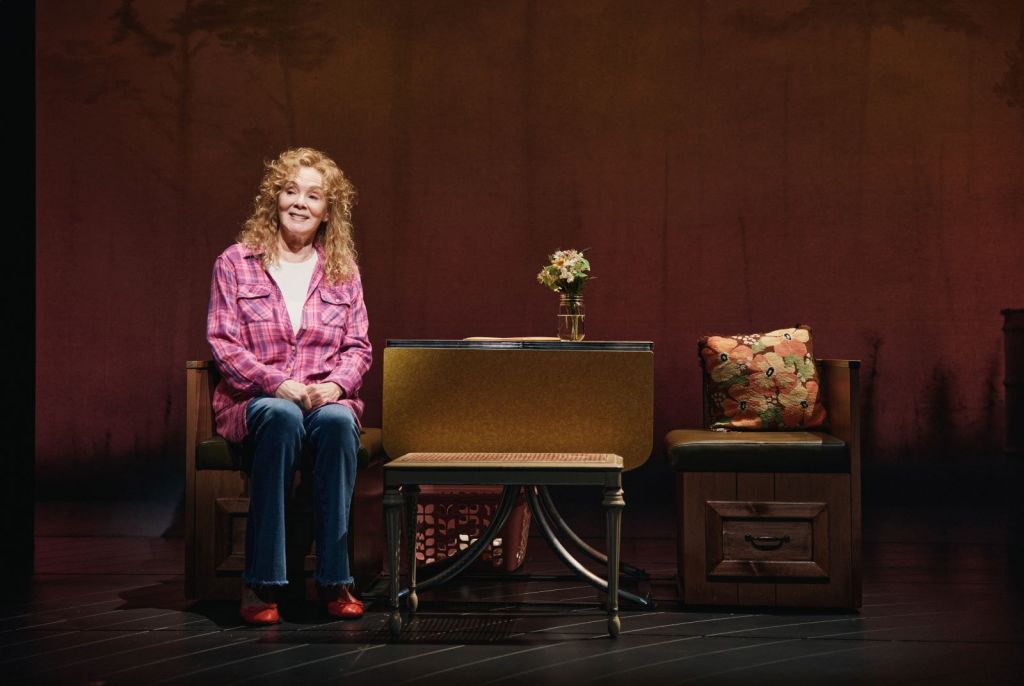
Nevertheless, because of the setting and background details, one can easily figure out the direction of events after the first fifteen minutes. Additionally, the play’s predictability and Izzy’s self-victimization, provoked when she stays with the violent Ferd for years, strain one’s patience. Thank goodness for the talented Jean Smart whose affability and humility lead one to hope for Izzy, despite knowing what the inevitable, dire conclusion will be.
As a housewife in rural Louisiana in 1989, Izzy adores writing, even though it must be in secret away from Ferd’s prying eyes. With exuberance she explains her first inspiration to write, her high school teacher who encouraged her, and a neighbor who takes her to a nearby library where Izzy reads Shakespeare and writes a sonnet. Over the years she fills her journals which she hides away in a back closet because Ferd despises such “uppity ways.” Clearly, as his possession she must remain on his intellectual level. Thus, he prevents her attending college though it might improve their lives. And a monetary award she wins to pursue a writing residency is her curse to be punished, not their blessing.
Izzy writes to express her feelings. Married to Ferd since her 17th birthday, initially they enjoyed each other, prospered and moved to a more upscale trailer park abutting a forest. As Izzy discusses their relationship we note that he gradually meets her attempt to establish her identity through poetry with violence. Tip-toeing around Ferd, Izzy learns to live an inner life apart from him. Whenever she or others inadvertently reveal her talents, Ferd takes offense. He interprets her work as treason and beats her. At a particularly crucial turning point, he takes all of her journals and burns them. He forces her to watch her words, which symbolize her lifeblood, “go up in smoke.” Izzy says with his act he has killed her.
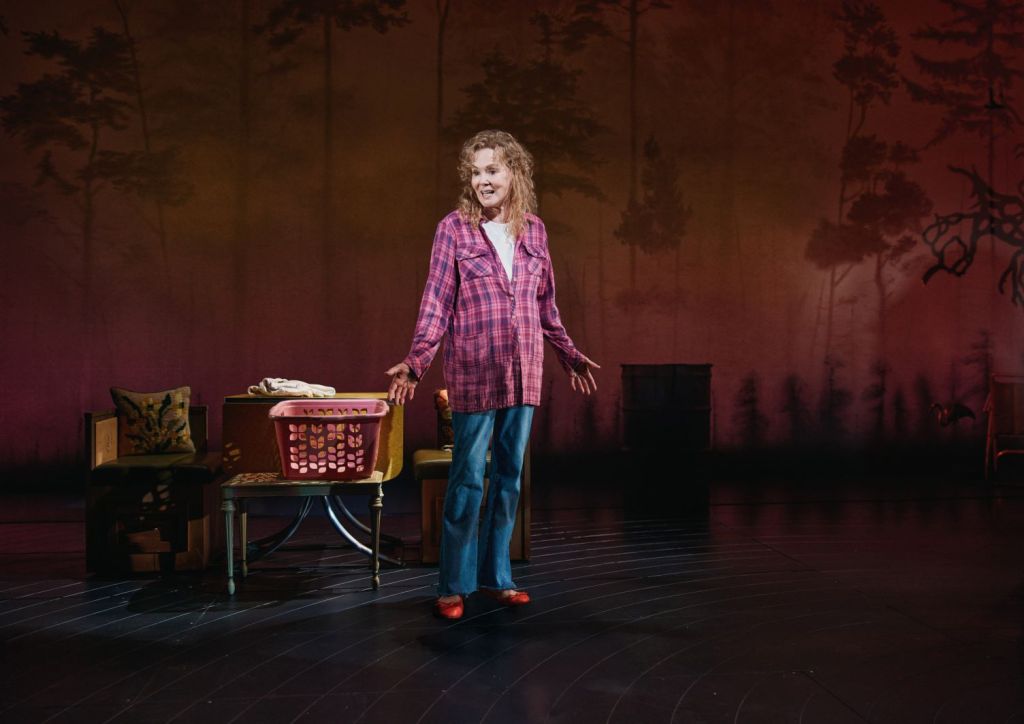
Ferd controls. Izzy lets him believe he is the lord and master, and she bows to his every whim. What sustains her? The inner resilience she receives by writing poetry.
Izzy persists after he burns her journals. Covertly, she evolves herself, her reading and writing. It is why she is in the bathroom discussing the blue tablets she puts in the toilet tank at the top of the play. She shows us how she writes in the bathroom of the cramped trailer. In fact a good deal of the play takes place in the bathroom where she can be alone in quiet to write, think and speak to us.
Mikiko Suzuki MacAdams’ scenic design aptly walls off a bathroom and squeezes in an oversized toilet with a lid that serves as a “table” where Izzy writes on toilet paper. The sonnet and other poems are wadded up and hidden in a Tampax box in a cabinet. The toxically masculine Ferd would never look there. The irony of the bathroom setting is a wonderful touch. In its small space Izzy finds the solace of her wide imagination.
Unfortunately, her writing is not enough. Izzy is a product of the folkways of her culture and her upbringing. Unable to escape them they influence her final actions at the play’s conclusion.
The subject matter of Call Me Izzy is important now more than ever. However, Izzy’s passivity is difficult to experience. It is why, when Smart’s Izzy expresses an interest in leaving Ferd, the audience cheers her on. Too little, too late; we must be tortured by Izzy’s last choice which leaves an uncertain ending.
Call Me Izzy runs 1 hour 30 minutes through August 17th at Studio 54. callmeizzyplay.com.
I
‘Buena Vista Social Club™’ is Phenomenal, Theater Review

If you are a world music lover, you don’t need any introduction to the “Buena Vista Social Club,” a group of Cuban musicians that Cuban producer and musician Juan De Marcos González, brought together in a recording studio in Cuba to eventually release an album in 1997. González is to be credited for his passion to capture the striking beauty and spirit of traditional Afro-Cuban music of the Buena Vista Social Club, while some of the members were still alive and able to perform and record in 1996.
Surprising everyone, the Buena Vista Social Club musicians, who had been a hit in the 1950s and disappeared after the Cuban Revolution, created a smoking hot album in 1997 that won a Grammy in 1998. Subsequently, they were the subject of the documentary initiated by musician/songwriter Ry Cooder and filmed by Wim Wenders, that rocked the BVSC into the stratosphere of global fame by 2000, when the documentary was nominated for an Academy Award.
The Atlantic Theater Company’s musical, Buena Vista Social Club™ is based on the titular documentary with references to Buena Vista Social Club: Adios, a second documentary filmed in 2016. The superb musical, directed by Saheem Ali (Fat Ham), has as its creative consultant David Yazbek (The Band’s Visit). With book by Marco Ramirez and music by the Grammy Award winners known as the Buena Vista Social Club, the production currently runs with the ebullient magnificence of songs, brilliant tonal hues, dances and movements at the Linda Gross Theater with one intermission until 21st of January. The Buena Vista Social Club™ is a touch of paradise with Afro-Cuban rhythms and sonority that are unforgettable.
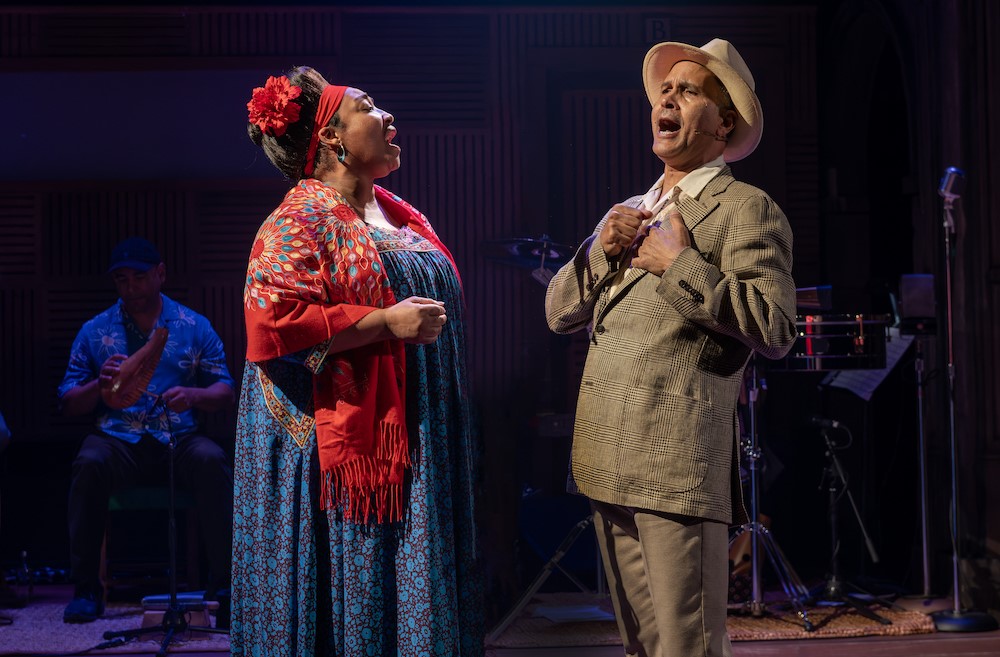
When you see it, and you must, you will not be able to sit still. The music fills you with its joyous power and heartfelt beauty. The production which extends beyond the crass label of “jukebox musicals” gives a reverential bow to the album, the documentaries and importantly, the magnificent musicians and singers who were vaulted to a success they had never known when they started out.
The production, loosely narrated by Juan De Marcos (Luis Vega), boasts a song list that is steeped in the incredible social club’s rhythms and cadences that spiritually manifest the history and diversity of the Cuban people. At the opening, De Marcos, who stands in Egrem Studios-the Old Havana music studio where musicians in the 1990s still record states, “A sound like this, it tends to travel.” His prophetic remarks reference how Buena Vista Social Club’s songs resonated and still resonate throughout the world today, even though most of the original members of the BVSC have passed. Only Omara Portuondo, the National treasure of Cuba, still sings and tours.
The key to opening the lock on the social club that dissolved with all the social clubs that Castro disbanded to end discrimination in Cuban society is Omara Portuondo. As the musical indicates, her notoriety and fame in Cuba allows her to serve as the bridge between the traditional musicians no longer heard and herself who is very much in the Cuban music scene in the 1990s and today.
Thus, the musical focuses on Omara and flashes back and forth from the past to the present in recounting her history with the BVSC, as well as introducing the members, and revealing how they were a part of the popular social club in a Cuba whose segregated clubs prevented various groups from singing and dancing together. The musical’s arc of development unspools as De Marcos attempts to interest Omara in making a recording of the musicians from long ago, who are still alive to keep the torch of Cuban folk music vibrating and lighting the way for musicians and fans of a younger generation.

Initially, when Vega’s, De Marcos approaches her, Omara (Natalie Venetia Belcon), is not interested because she doesn’t sing with a live band anymore. Her attitude is cold, aloof and proud, but later, we discover this hard shell fronts for deep pain underneath, concerning her alienation from her sister and niece because of the Revolution and the US embargo barring any exchange of visitors between the two countries. Recording the album would bring up tenuous memories. However, her dismissal of De Marcos on the surface appears to be because she is famous and he is an unknown, who intends to exploit her beloved renown for his own purposes.
Cleverly, De Marcos plays one of her old recordings with the BVSC. Only then, reflecting back to the past, does she relent and give her stipulations for the recording. First, she must be the voice that’s front and center, as De Marcos writes the arrangements. Second, she must be in control to select the singers and musicians. Thus begins the process, conveyed with humor and pathos, that Omara and De Marcos use to bring back the members of the BVSC, so that they are able to record together and reestablish the vitality, importance and universality of Afro-Cuban music, making them a global phenomenon.
The musical is an important tribute to revitalizing how the BVSC Afro-Cuban stars were incredible singers and musicians. It also intimates in the flashbacks and lovely balletic dances featuring the Young Omara (Kenya Browne), and her sister Haydee (Danaya Esperanza), the historical, social schemata of a diversely segregated Cuba, referencing its importance in the Slave Trade, the divisions between the rich and the poor, as well as Castro’s plan to bring equality to the country that backfired and instead created a hell and misery for the Cuban people. This was especially so after the revolution and the flight of wealthy Cubans and middle class off the island.

As is pointed out as a major theme, which indicates the segregation still is manifest concerning Cuba, the division became forever known as “the ones who stayed” and braved out the situation in their mother country, and the “ones who left” and went to various parts of the United States and elsewhere.
Crucially, Omara is an important symbol of transition and the voice and the bridge between the rich and the poor, the socially upscale strata of Cuban society, and the segregated, representing the traditional Cuba with which all Cubans can identify, if they put their prejudices away. Indeed, in this musical, the character of Omara magnifies the best of Cuban culture. She recalls the past and weds it to the present, in the tears and pain of the loss of family and her sister Haydee, who died before she was ever able to see her again. Because Omara was already famous, she was able to negotiate travel as she employed her talents on tour. This mobility was not possible for the other BVSC musicians who were not as famous, and lived under the oppression of segregation and poverty before and ironically, after, in Castro’s Cuba.
Obviously, the ones like Omara who had mobility or the thousands of others who left, had some money to establish themselves elsewhere, even though they lost their lands and businesses to Castro’s “communistic” usurpation. It is a wealth Castro didn’t share with the Cubans who stayed, reminiscent of Vladimir Putin’s behavior toward the Russian people in today’s Russia. Like a predominance of the Russian society, the Cubans who stayed were impoverished and the musical references that during the “Special Period” when the dissolved U.S.S.R. split up, there was no longer any “communistic” aid to Cuba. Thus, the people starved.
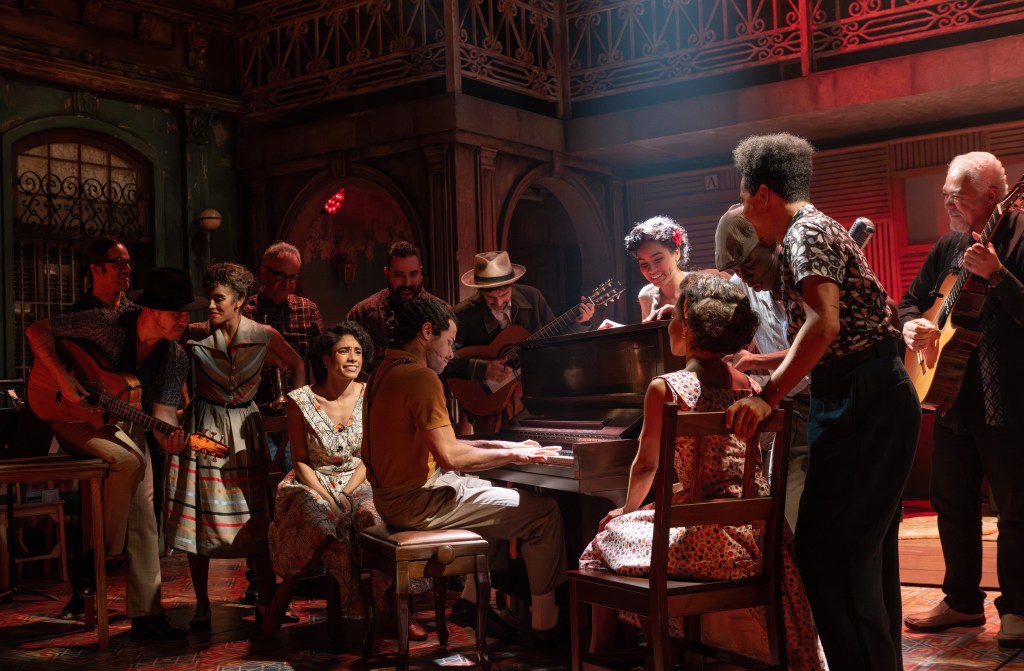
The hope of recording an album with BVSC members was to earn a bit of money, as many of the musicians and singers we meet and learn about in their relationships to Omara and the club were barely scraping by from day to day. During the production we meet the incredible individuals who Omara was close to and sang with in the 1950s when they were young and in 1996 during the recording. These include the charming, funny Compay (Julio Monge), the sweet, loving Ibrahim (Mel Seme), the wonderful pianist Ruben (Jaindardo Batista Sterling) and Eliades (Renesito Avich).
The seminal moments of the production however, meld the present to the past, revealing how Omara connected with each of the BVSC members in the flashbacks with the Young Omara and the Young Haydee. The musicians/singers include the Young Compay (Jared Machado), the Young Ibrahim (Olly Sholotan), and the Young Ruben (Leonardo Reyna).
The balletic sequences with dancers portraying the Young Omara and Young Haydee, choreographed by Patricia Delgado and Justin Peck, developed and directed by Saheem Ali. These sequences seamlessly and stylistically reveal the differences in opinions between the sisters, regarding the BVSC which Haydee feels is beneath her. Also revealed in these flashback dance sequences, is Omara’s sadness in losing her sister and family forever because of the Revolution and US Embargo. As Belcon’s Omara sings of her feelings, the poignance of her expressiveness resonates with all Cubans and punctuates the cruel punishment visited upon the people by both governments, revealing the malevolence of political machinations. However, it is in the power of the songs that the Cuban people thrive and with dignity transcend the brutality.
The BVSC playlist is sung in the native tongue of the BVSC, and on one level doesn’t need translation because the music “speaks” for itself. However, the musical’s closed captions in Spanish, should also have had an English counterpart. In English, the lyrics can relate the historical culture of the Cuban people which is referenced throughout in the English dialogue and storyline. English closed caption lyrics, as well as Spanish, would convey the complete picture of the BVSC and its tremendous importance socially, politically (their democratic diversity should not be diminished), and spiritually.
The BVSC’s immutable human values conveyed in their incredibly poignant rhythms and music is what resonates and draws in fans globally in an egalitarian message that makes sense and that most human beings yearn for. Politics and the power hungry divide to conquer. The music of the people soars, uplifts, transcends hardship and unifies. This production’s value is priceless and the ensemble of musicians and singers are fabulous in memorializing the Buena Vista Social Club for all time.
The creative team brings the director’s vision together in a beautifully stylized way that breathes life into the real musicians and singers who made up the BVSC (1950s, 1996). These creatives include Arnulfo Maldonado (sets), Dede Ayite (costumes), Tyler Micoleau (lighting), Jonathan Deans (sound), J. Jared Janas (hair, wigs & makeup), Dean Sharenow (music supervisor), Marco Paguia (music director, orchestrations & arrangements), Javier Diaz, David Oquendo (additional arrangements), the swings and band.
The company of Buena Vista Social Club™, Atlantic Theater Company, 20th Street between 8th and 9th. https://atlantictheater.org/production/buena-vista-social-club/
 CAROLE DI TOSTI