Blog Archives
NYBG ‘Orchid Show, Mr. Flower Fantastic’s Concrete Jungle’ Part One
Mr. Flower Fantastic’s Concrete Jungle
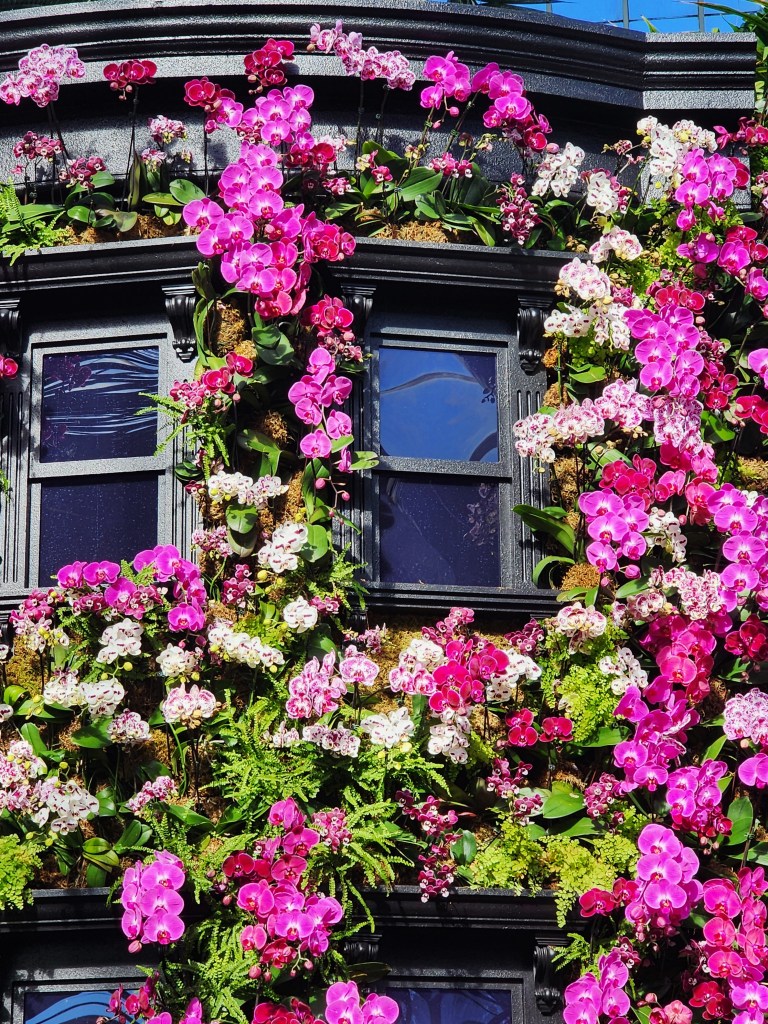
A Love Letter to New York in Stunning Orchids until April 26, 2026
The metaphor for New York City as a “concrete jungle” has been used in the past, sometimes with negative connotations that implied ugly buildings, few green spaces, tall skyscrapers stealing light and air, and danger lurking around every corner.
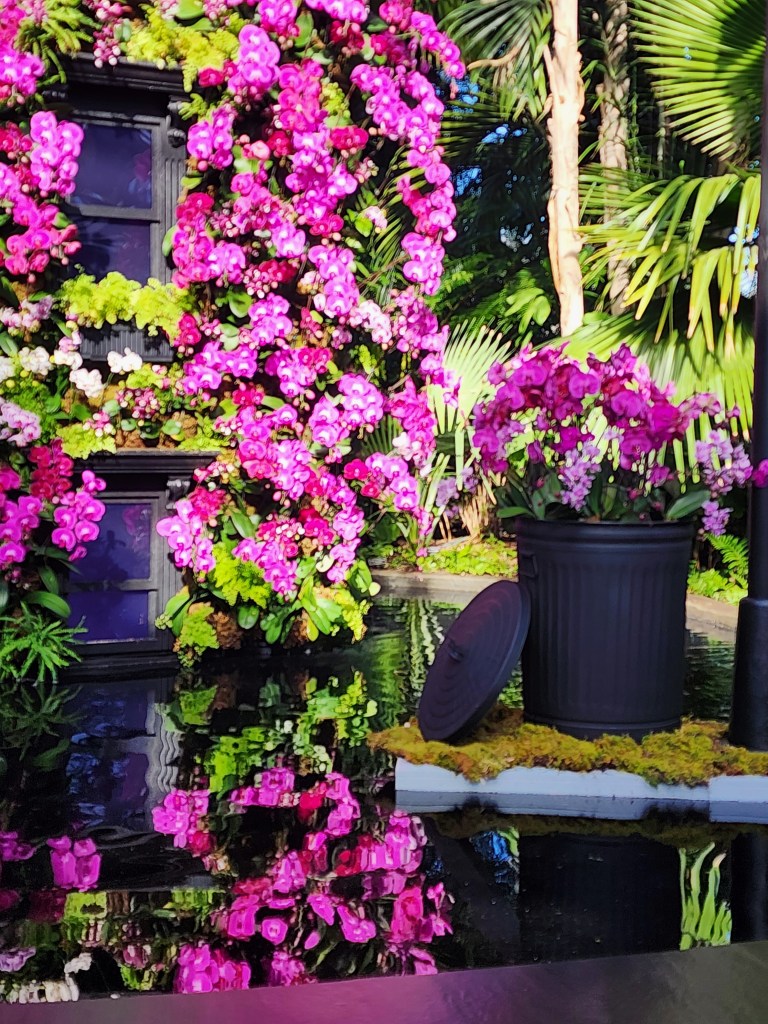
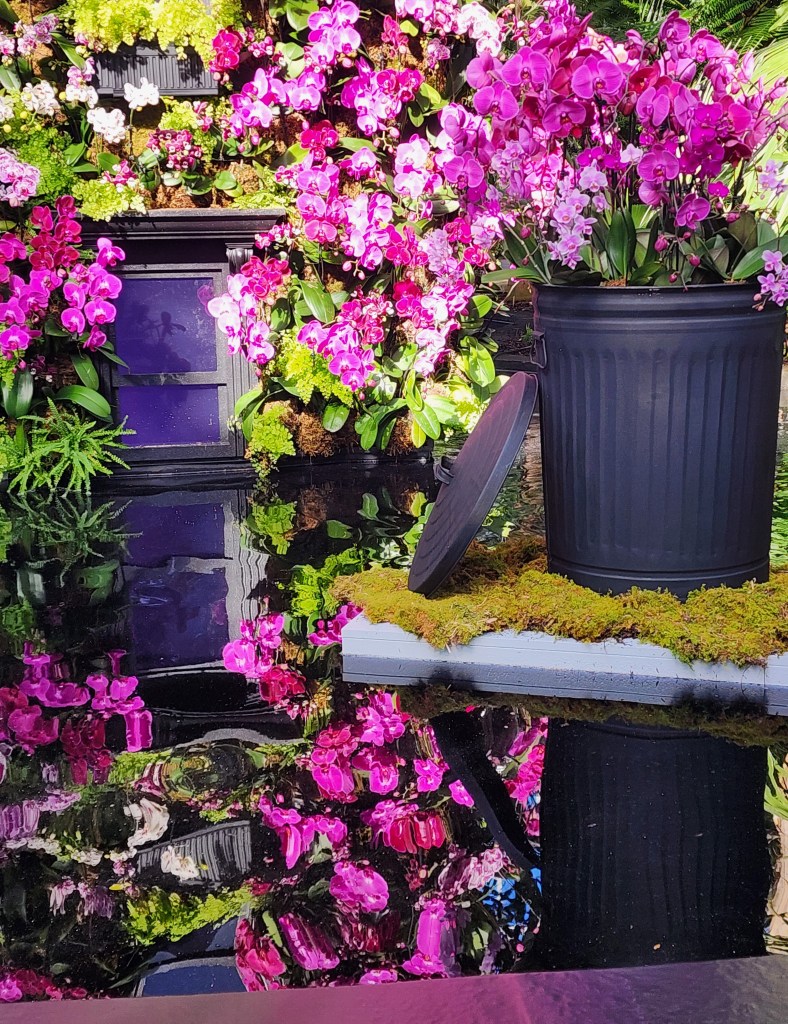
But that conception of the city has long gone with the disappearance of the rotary phone. Alicia Keys’ Empire State of Mind “Concrete Jungle” blew it up forever (https://www.youtube.com/watch?v=FPggPjkoCjE) as did her autobiographical Broadway show Hell’s Kitchen.
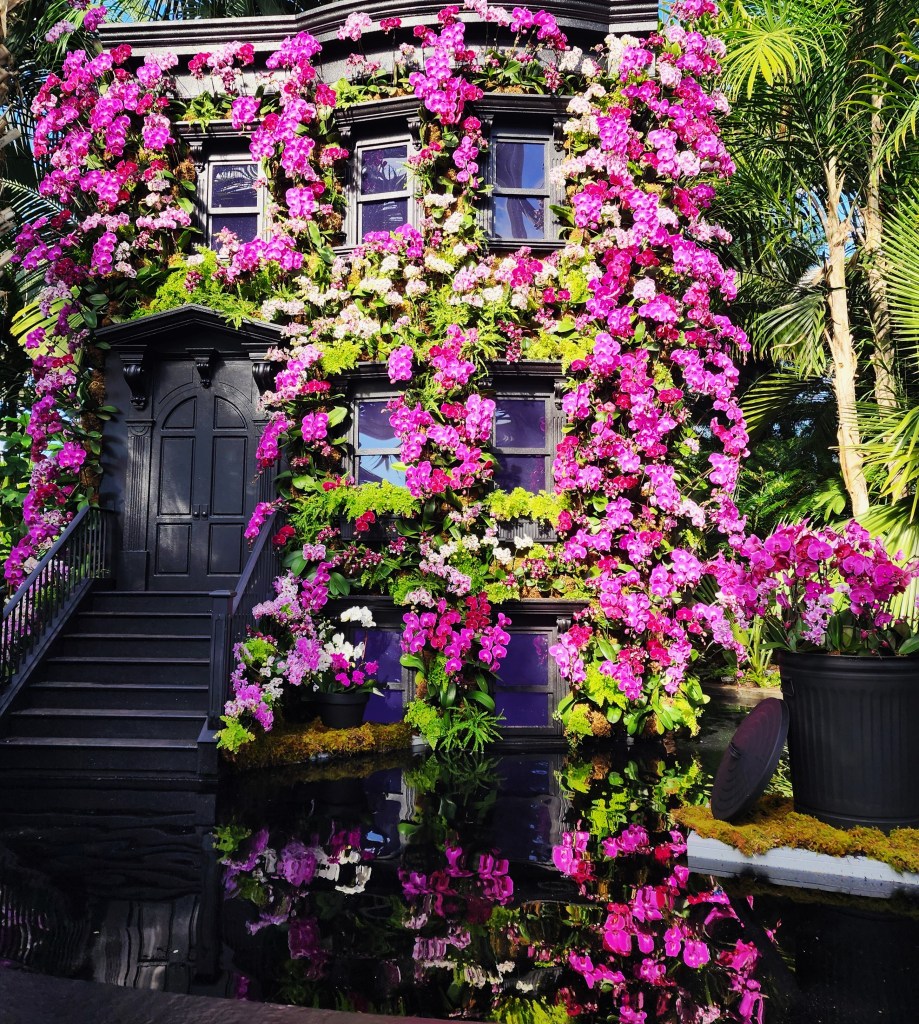
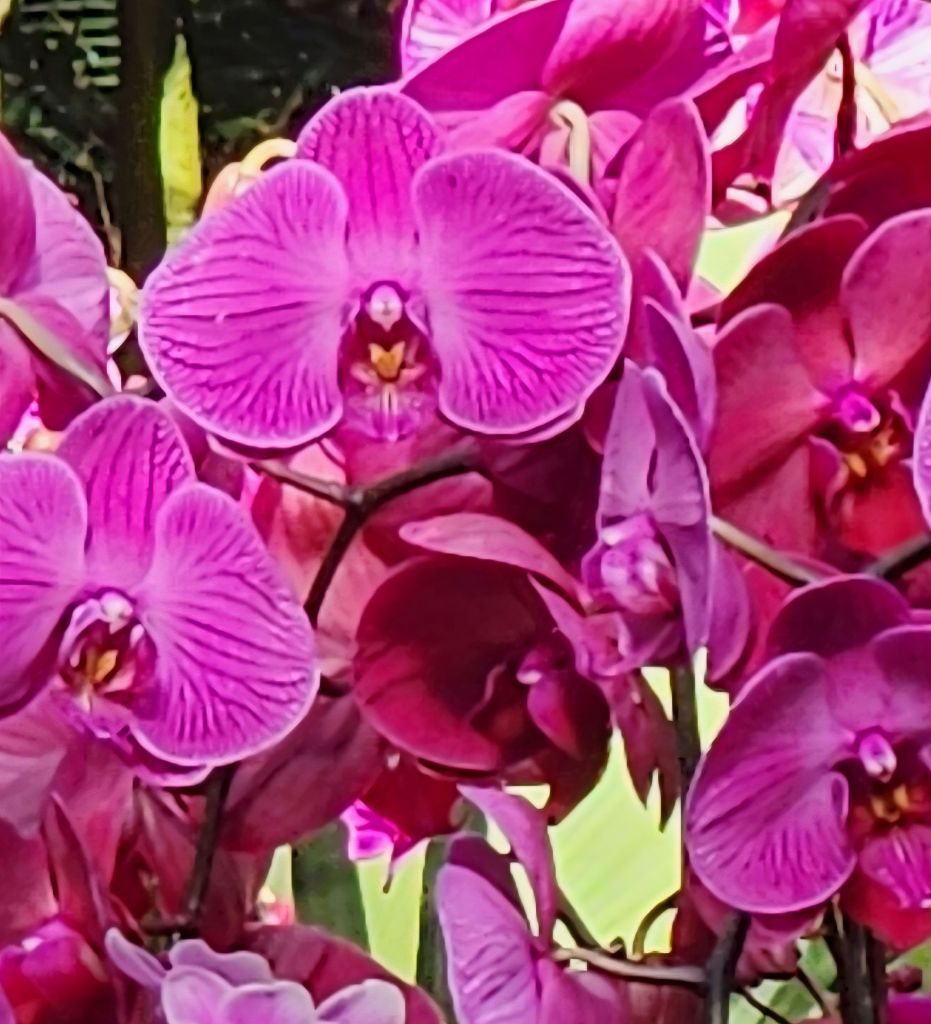
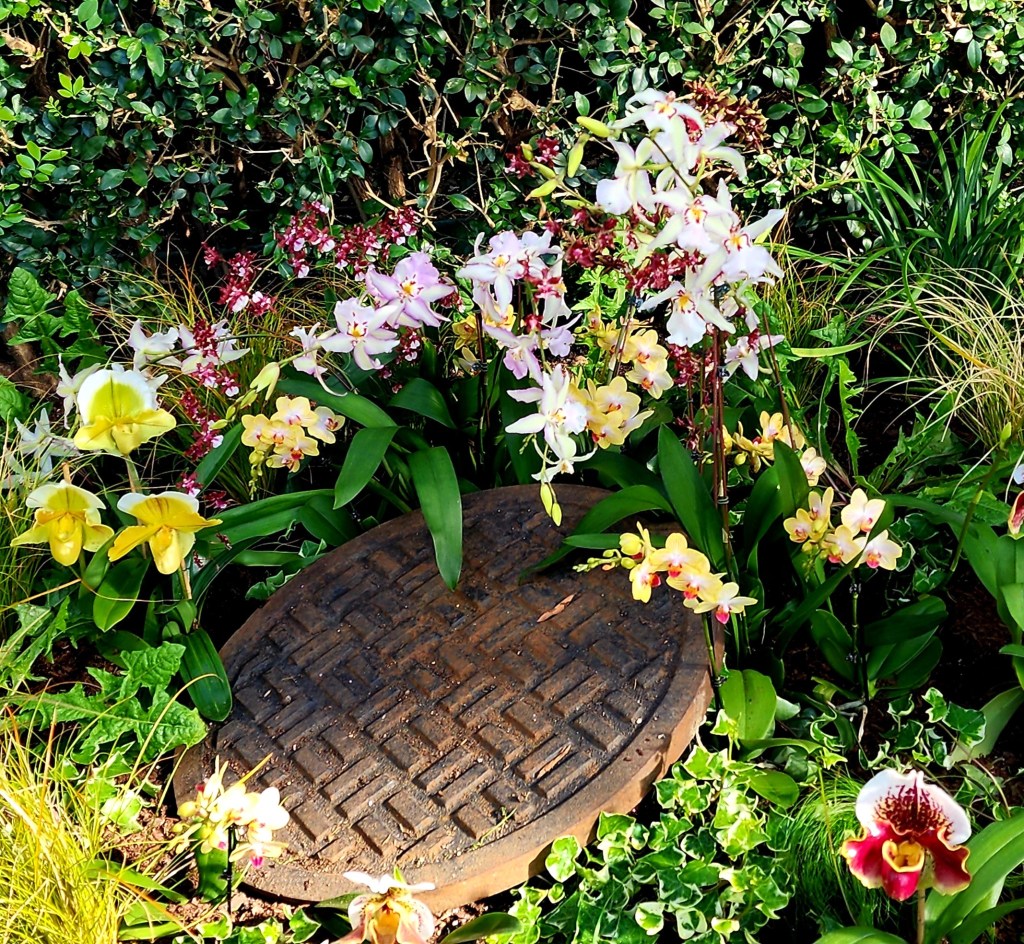
Embodying Key’s song’s beauty and excitement, world-renown, in-demand, floral artist, Mr. Flower Fantastic, presents his view of the city in floral pageantry at NYBG. The show is his love letter to New York with captivating cityscapes punctuated with gorgeous, vibrant, many-hued orchids amidst design sculptures and supporting botanical arrangements that highlight familiar objects and places. The ebullient, fun displays present aspects of city life that all city dwellers take for granted and tourists may completely overlook.
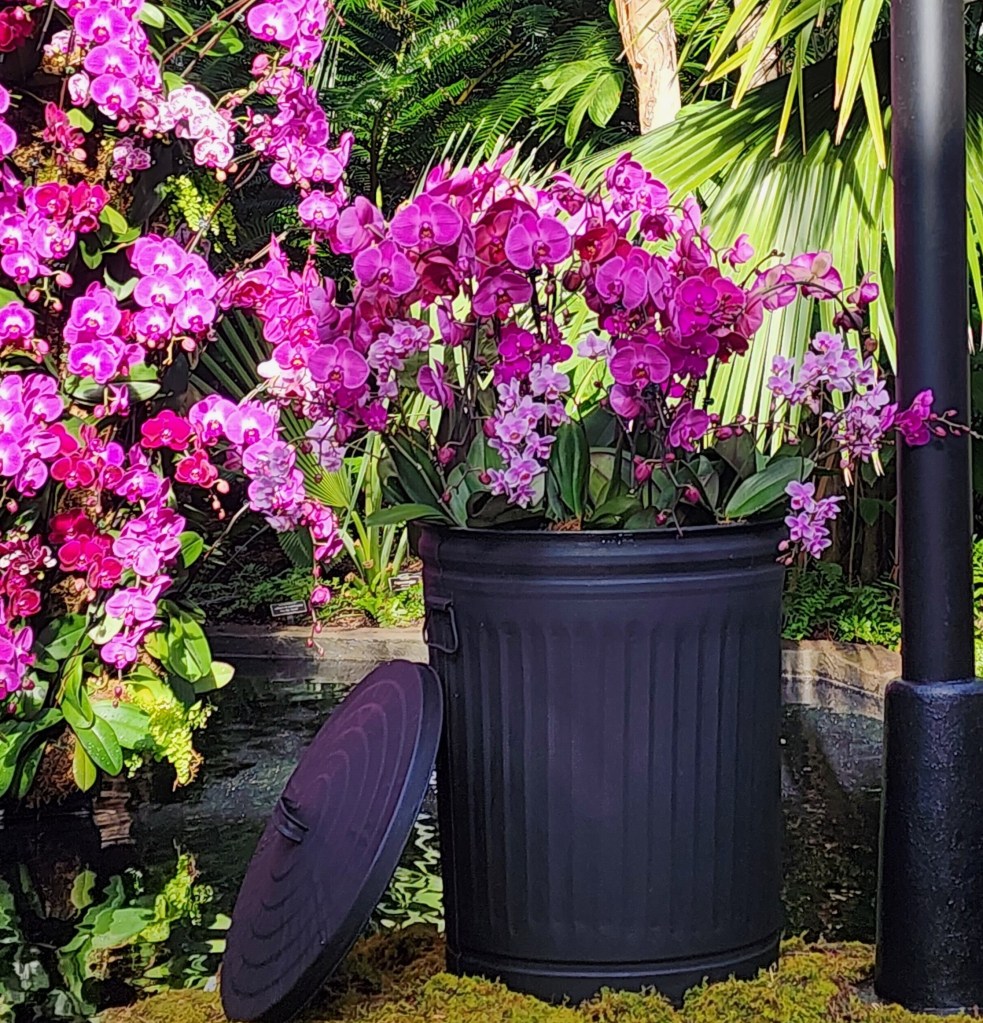
In the Palms of the World Gallery, Mr. Flower Fantastic designs moth orchids flowing over and around the iconic townhouse found throughout each of the boroughs of the city.
Who is the show’s creator?
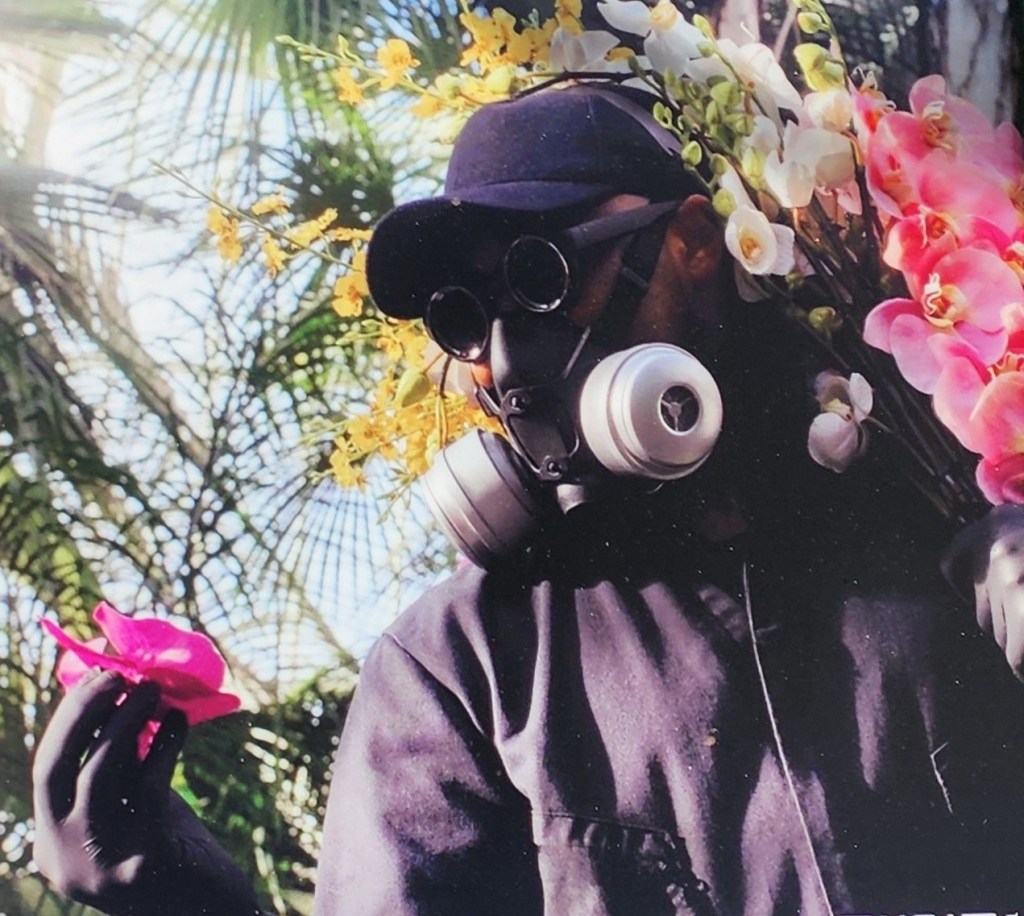
Mr. Flower Fantastic or MFF is one of the most in-demand floral artists in the world, known for transforming flowers into bold, sculptural pieces. Oftentimes, these meld art, fashion, and pop culture. As art comes in a variety of forms, Mr. Flower Fantastic has selected flowers as his medium. This selection carries an irony. Mr. Flower Fantastic is allergic to flowers. In response to this consequence, he embraces his allergies and turns this weakness into his brand strength.
Though his “fantastic” choice of his name and brand is outsized and attention grabbing, yet he is anonymous. You won’t be able to imprint him with facial recognition software because he wears a mask (respirator) and gloves reconciling his allergies with his passion for flowers instilled in him when he was a child. The respirator and gloves embody his style and charisma and allow him to focus on the floral medium as his message with anonymity. The unknown known is his identity.
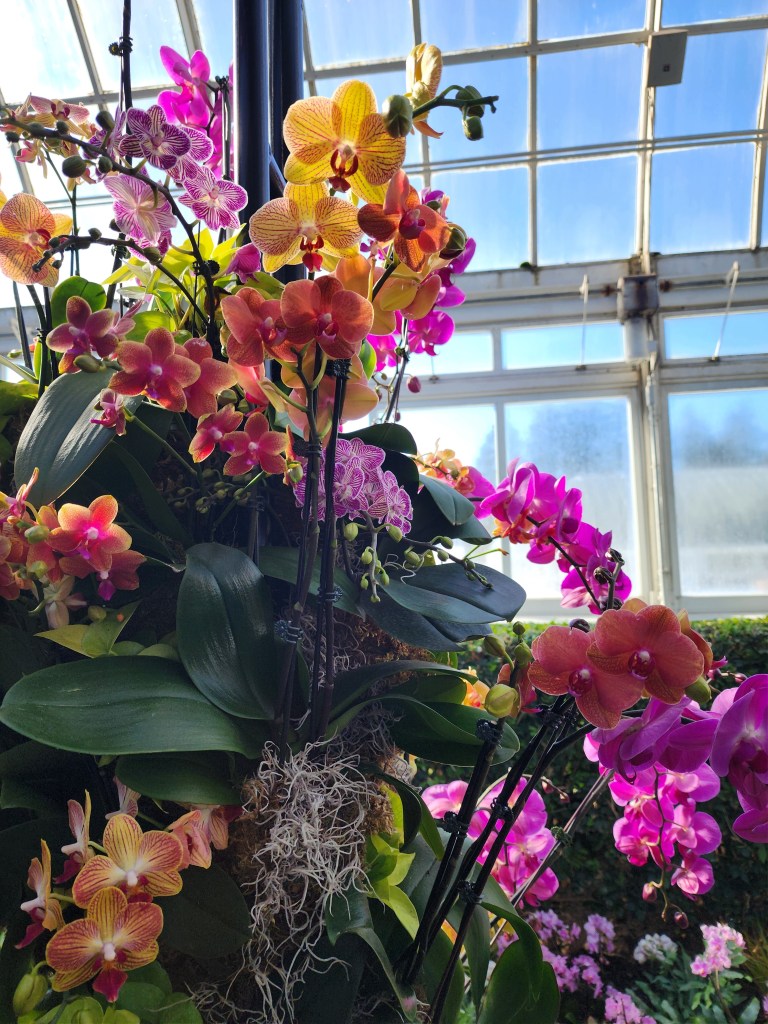
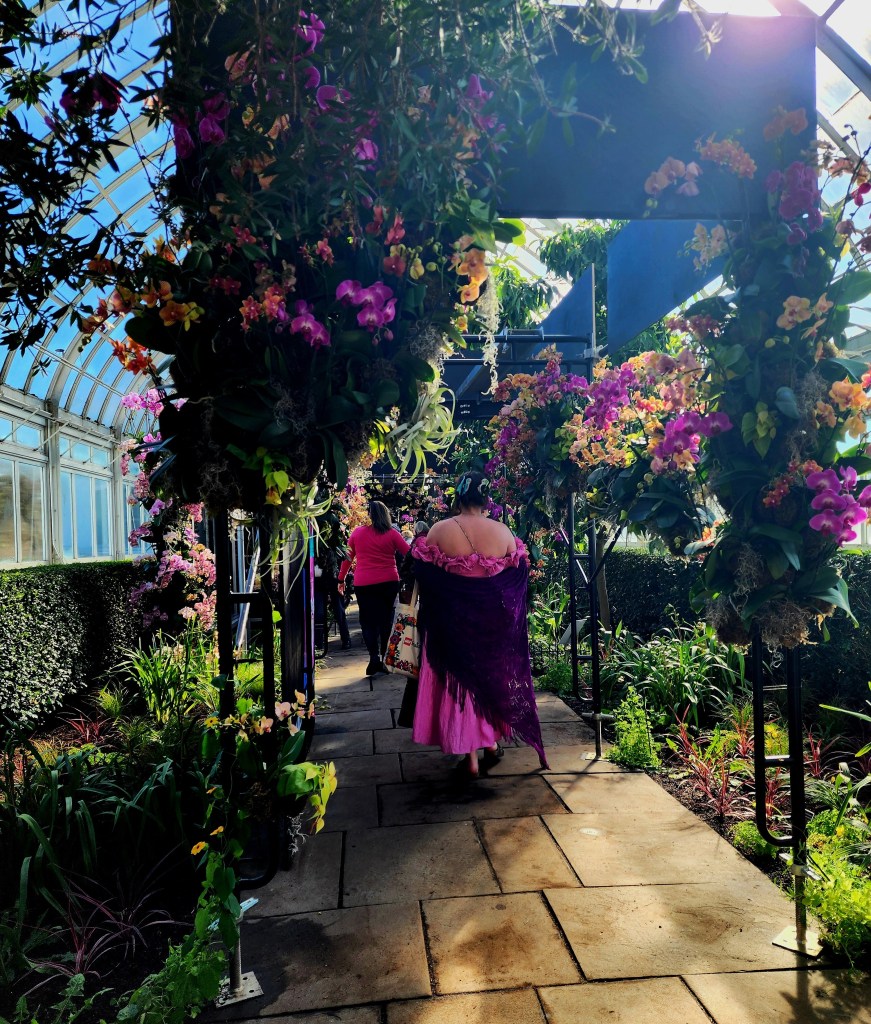
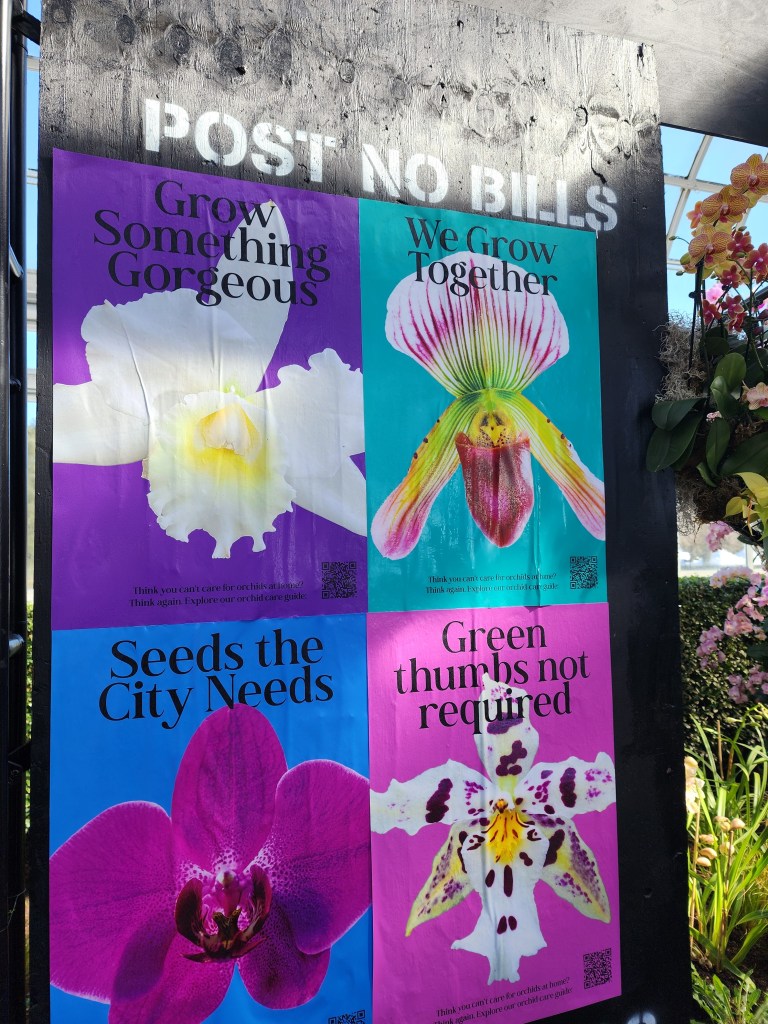
The creator and NYBG staff selected a variety of showy blooms to cheer us through one of the colder winters in memory. His reiminaging is a lovely meld of “concrete” and green jungle to uplift us and make us smile for its cleverness and whimsy.
Stay tuned for PART II of my CONTINUED COVERAGE of the fantastic NYBG The Orchid Show Mr Flower Fantastic’s Concrete Jungle. In the meantime, check out the programming being offered connected to the show including dates for Orchid Evenings on the NYBG website. https://www.nybg.org/event/the-orchid-show-mr-flower-fantastics-concrete-jungle/
Also, if you would like to check out MFF’s website to look at previous shows and/or items for sale, check this website: https://www.mffstudio.com/
Schedule your plans for a number of visits to the The Orchid Show, Mr. Flower Fantastic’s Concrete Jungle. There is a lot to see that couldn’t be covered in just one post, thanks to the ingenuity of NYBG staff and MFF. The show ends April 26, 2026.
NYBG Holiday Train Show® Joyfully Presents a Magical Winter Wonderland
The 34th NYBG Holiday Train Show® runs until Jan 11, 2026
The 34th NYBG Holiday Train Show® opened November 15, 2025 to fanfare, excitement and large crowds with families and delighted children eagerly moving through the galleries of the Enid A. Haupt Conservatory. The exquisite botanical train theater shines its way into the New Year and closes on Sunday, January 11, 2026.

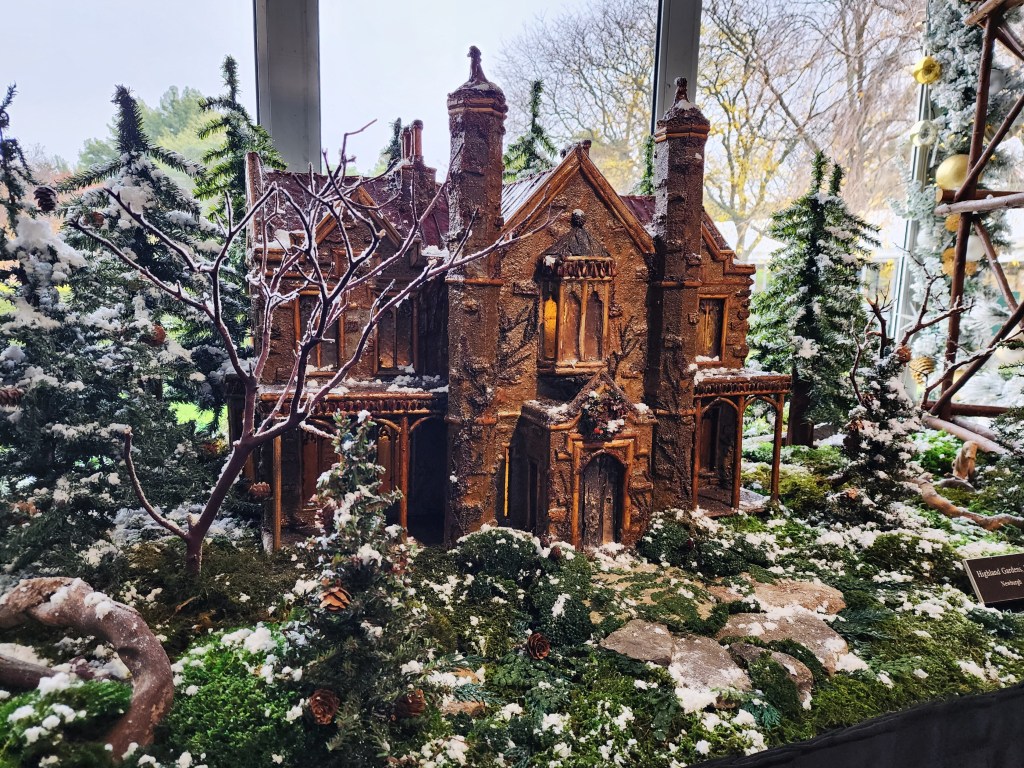

The enchanting train displays reflect beloved seasonal traditions. The show offers something for everyone—with two ways to experience it: day or night. In the daytime, families are welcome. More than 30 G-scale model locomotives and trolleys whizz and hurtle through a showcase of nearly 200 twinkling replicas of renowned New York architecture. During select evenings Holiday Train Nights invites visitors to see lighted, celebratory show one through a different lens. Sparkling nighttime at the Enid A. Haupt Conservatory is extraordinary.
So The Holiday Train Show® ties the past with the present and history with modernity in the exhibits which center around thematic locations. Look for exhibits featuring landmarks in the Bronx, Brooklyn’s Coney Island, Queens and Staten Island. Look for the New York City bridges that connect the boroughs with Manhattan. Look for replicas featuring famous landmarks in the lower Hudson River Valley, as well as downtown Manhattan.
In the Central Park displays there is the new addition, the Delacorte Theatre. The Delacorte was recently refurbished to expand its offerings of the Public Theater’s Free Shakespeare in the Park. Applied Imagination celebrated the completion of the Theater with this replica.
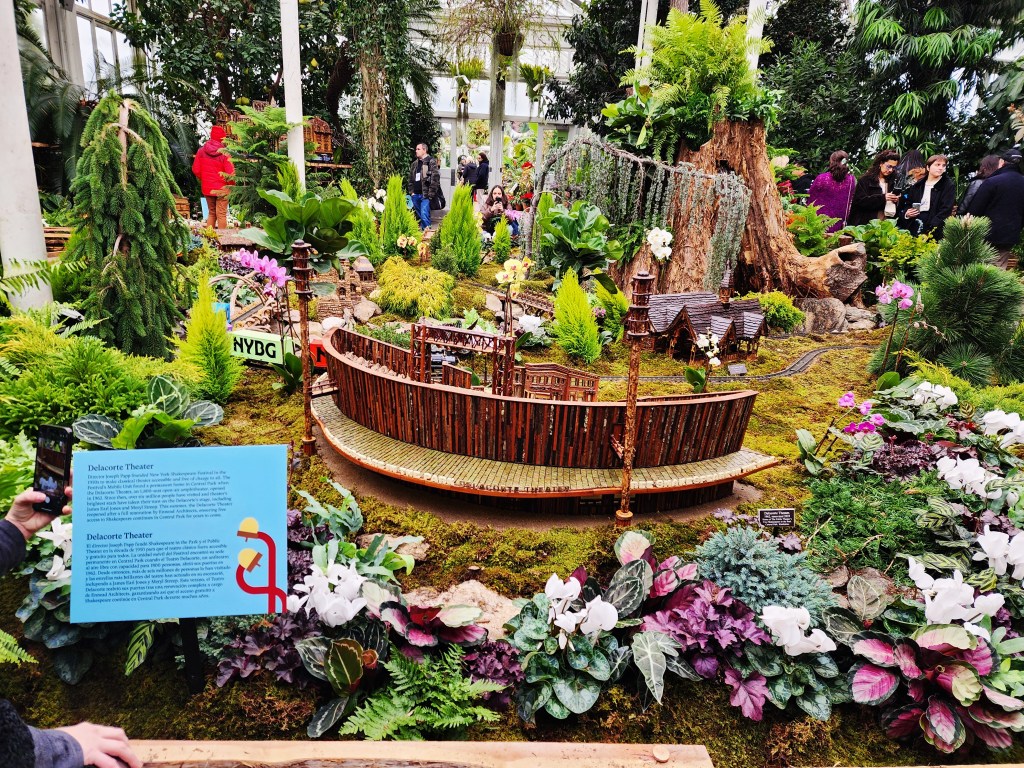

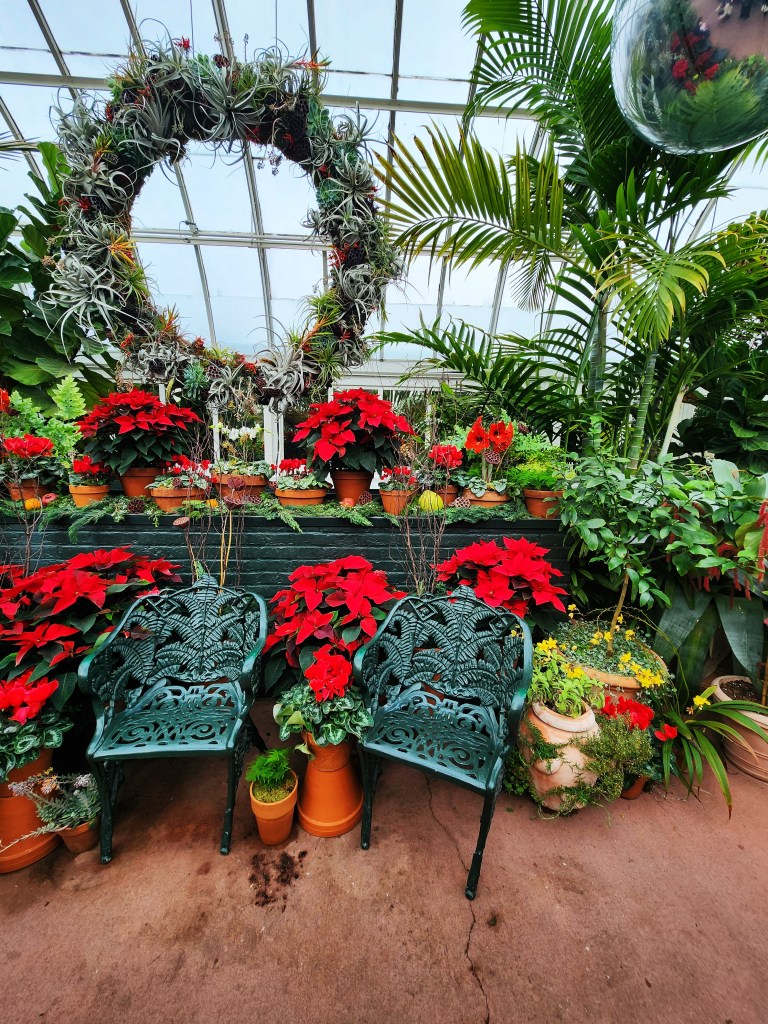
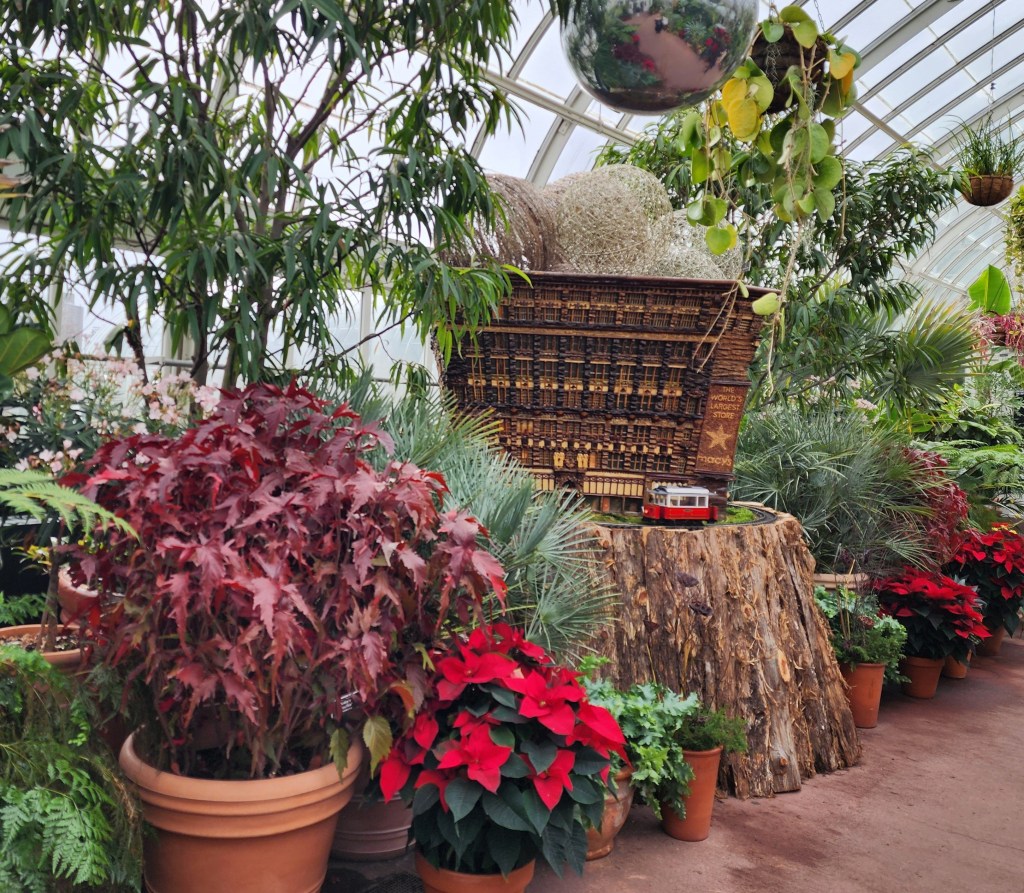

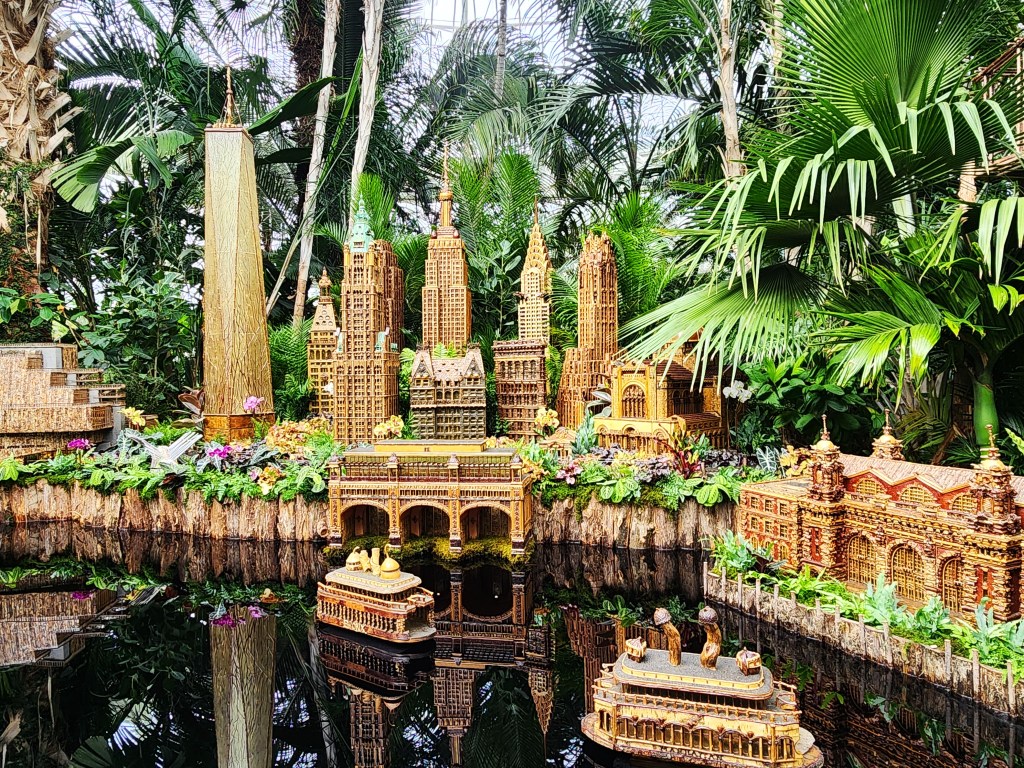
In the Palms of the World Gallery, check carefully and you will see the Oculus, One World Trade Center, the Statue of Liberty, St. Bartholomew’s Church, the Woolworth Building and another new addition, the Whitney Museum in the display featuring historic structures old and new.
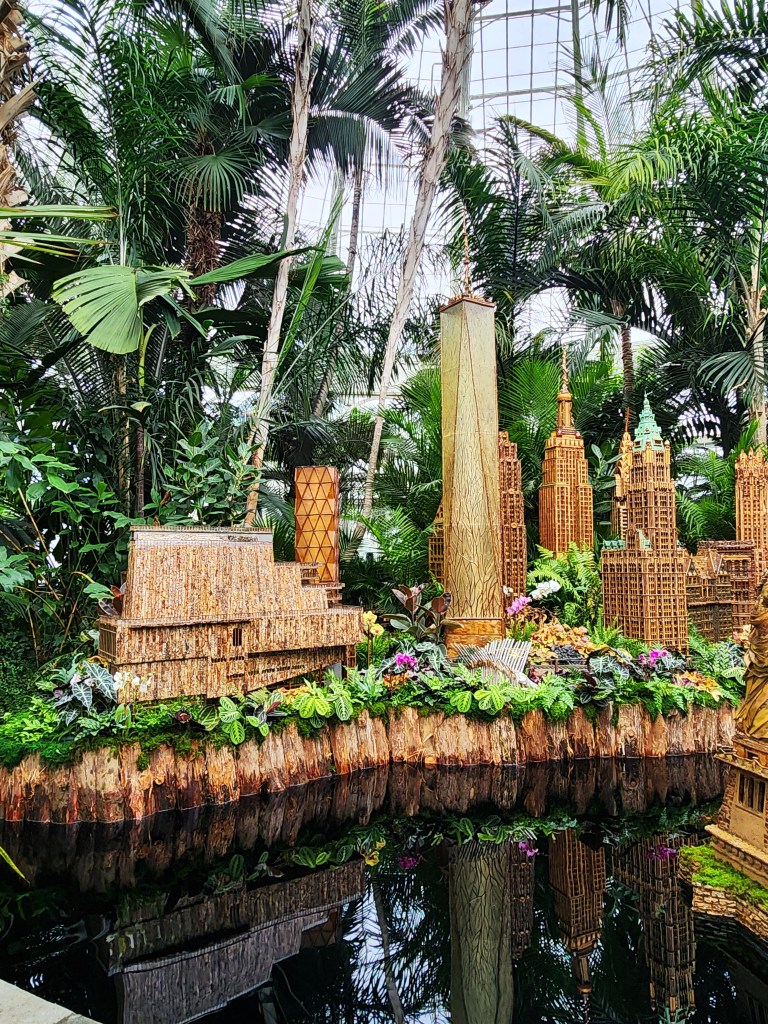
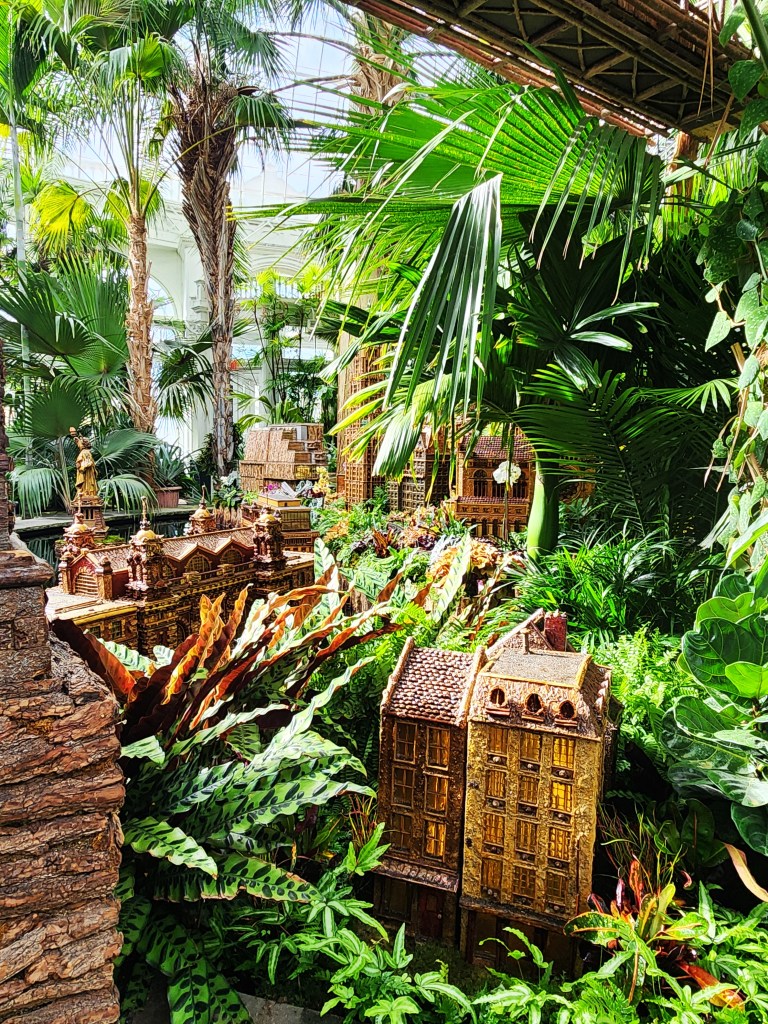

To see the real magic which defies your imagination, get up close to view the construction of the artistically crafted masterpieces. Each one has been configured to scale painstakingly and ingeniously assembled from plant parts. The roof of a building might be shelf fungi.

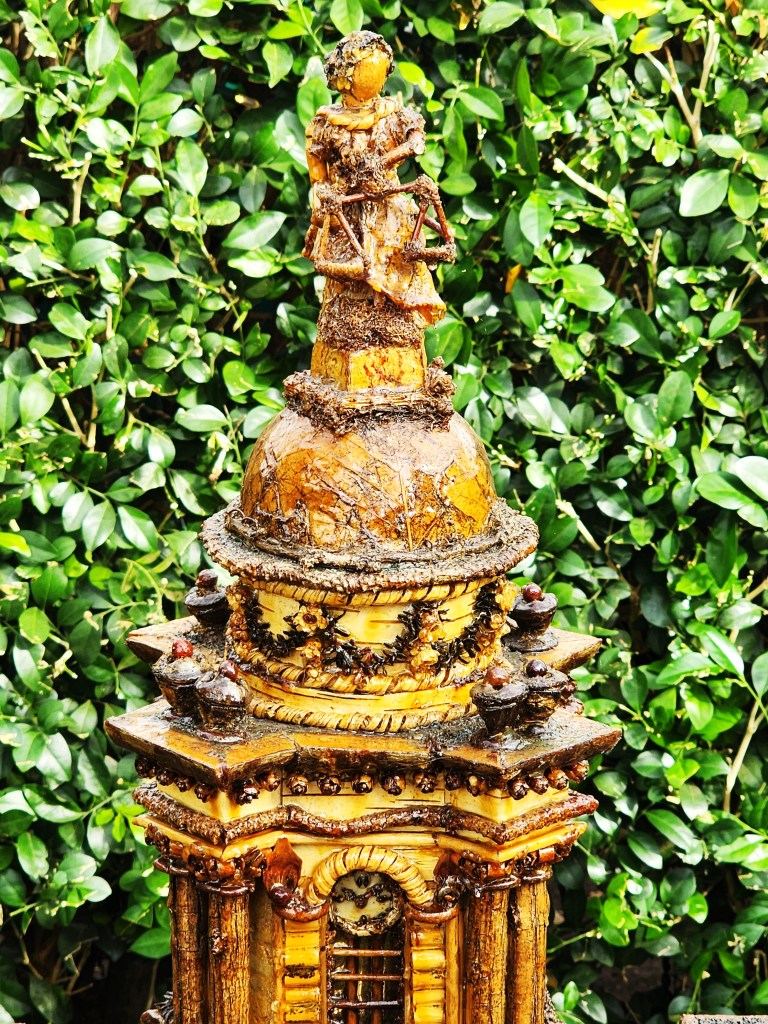

There are leaves, palm fronds, pinecones, cinnamon sticks, seed pods, acorns, twigs used for fine details as larger pieces are shaped into cornices, columns and stone blocks. It’s mind-blowing when you discover that a pistachio shell was used to meticulously detail an angelic statue.


All of the incredible building designs of the miniatures created by Applied Imagination, highlight the immense importance of plants in our world. Indeed, nature’s flora inspires some of the finest, most uplifting of architectural designs that comfort and support humanity. Plants are vital not only to our physical well being (the rain forests are the lungs of the planet), they are vital to our psychic and emotional well being.
In this outside exhibit, trains chug along with their heavy loads (i.e. acorns, seed pods) around mountains and fanciful, gigantic toadstools and fungi adding an outdoor wonderland to the indoor wonderland of magic. Notice the whimsical train car, and the mushroms out of Alice in Wonderland. And look for the woodland creatures tucked away in a mountain or peering down at you from a train trestle.


Whether young or old the NYBG Holiday Train Show® continues to spark wonder in generations of visitors. It’s one of the City’s best way to celebrate the season with all your loved ones.
For the evenings you can enjoy seasonal beverages as you stroll through the twinkling lights of the exhibition,. And don’t forget to stop in at the NYBG Shop to pick up that gift for that hard to buy friend or family member. Not only does the NYBG Shop have lovely and unique gifts, if you are a member, show your card for the discount.
As you enjoy the Garden at night dance to the holiday classics and sing along with performers as they croon the Christmas pop favorites. You can also enjoy sweet and savory bites for purchase, or stop at the “Bar Car” which features a 21+ bar at the Hudson Garden Grill Patio.

Holiday Train Nights offer their unique experiences from 7 to 10 p.m. on November 22, 28, and 29, 2025; December 6, 12, 13, 19, 20, 21, 26, 27, 28, and 29, 2025; and January 2, 3, and 10, 2026; 7 to 10 p.m. Holiday Train Nights are ticketed through NYBG’s presenting partner Fever. Tickets start at $39 for Non-Members purchasing for groups of four or more, with 20% off for NYBG Members, and free entry for children under the age of 2. For more information, visit https://www.nybg.org/holiday-train-nights/.
.
‘Van Gogh’s Flowers’ at New York Botanical Garden is Magnificent


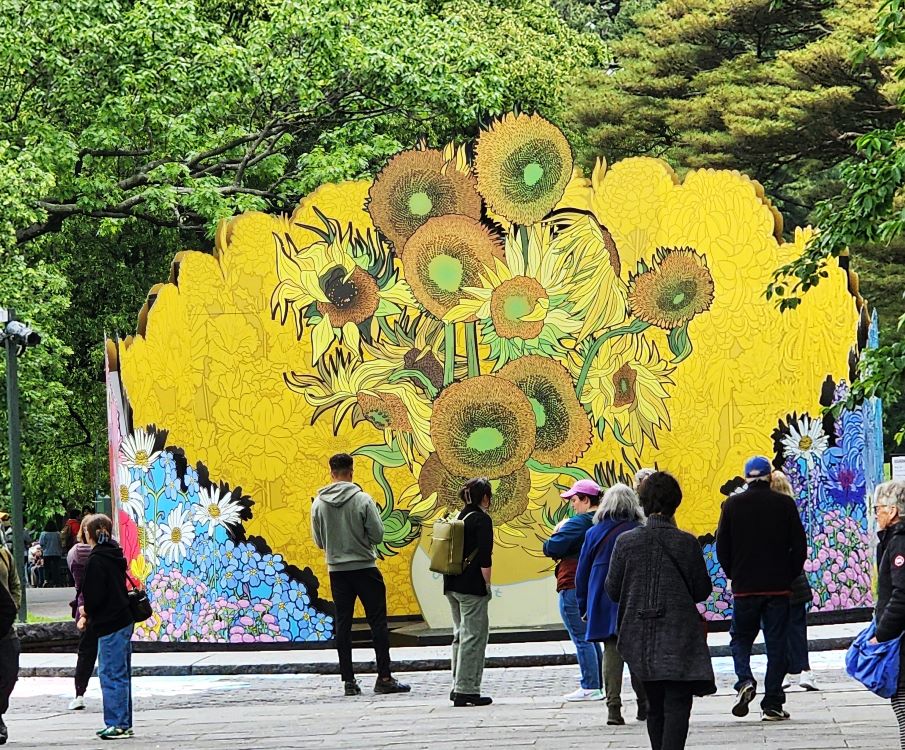
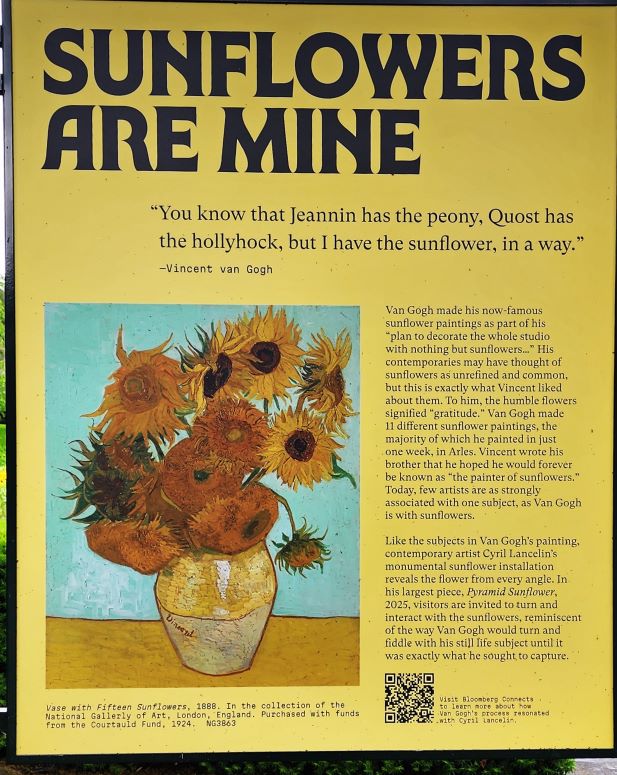
Van Gogh’s Flowers (May 24 through October 26, 2025)
Vincent van Gogh needs no introduction to art lovers. Happily, for them and even for those not acquainted with the iconic painter, the New York Botanical Garden’s spring exhibit Van Gogh’s Flowers is stunning. The memorable exhibit celebrates the work of the Dutch painter who decided to become an artist at 27-years-old.


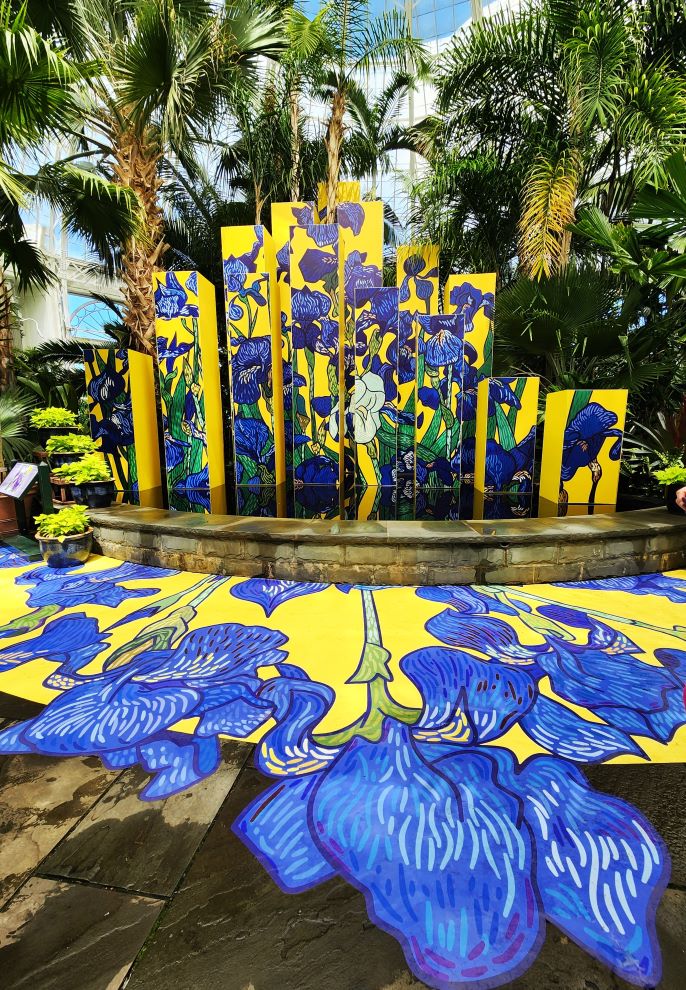
His was a decision that changed his life and the art world forever, according to the Vincent Van Gogh Museum in its discussion of Van Gogh’s life and journey toward the elusive greatness he never was able to realize while he was alive. Van Gogh’s Flowers runs from May 24 through October 26, 2025. The exhibit is not to be missed, principally because it highlights the way Van Gogh captured still lifes of flowers through his unique expression of color, light and form.

Reading through the stories of Van Gogh listed with various paintings on the Van Gogh Museum’s website, one is able to discover interesting facts about the junction of Van Gogh’s life and work. On the subject of flowers, the museum contains some of his floral still lifes. It’s fun to compare them with the specific paintings that inspired artists Amie J. Jacobsen, Graphic Rewilding’s Catherine Borowski and Lee Baker, and immersive artist, Cyril Lancelin.


All three contemporary artists contribute to the NYBG exhibit Van Gogh’s Flowers using their own mediums of expression.
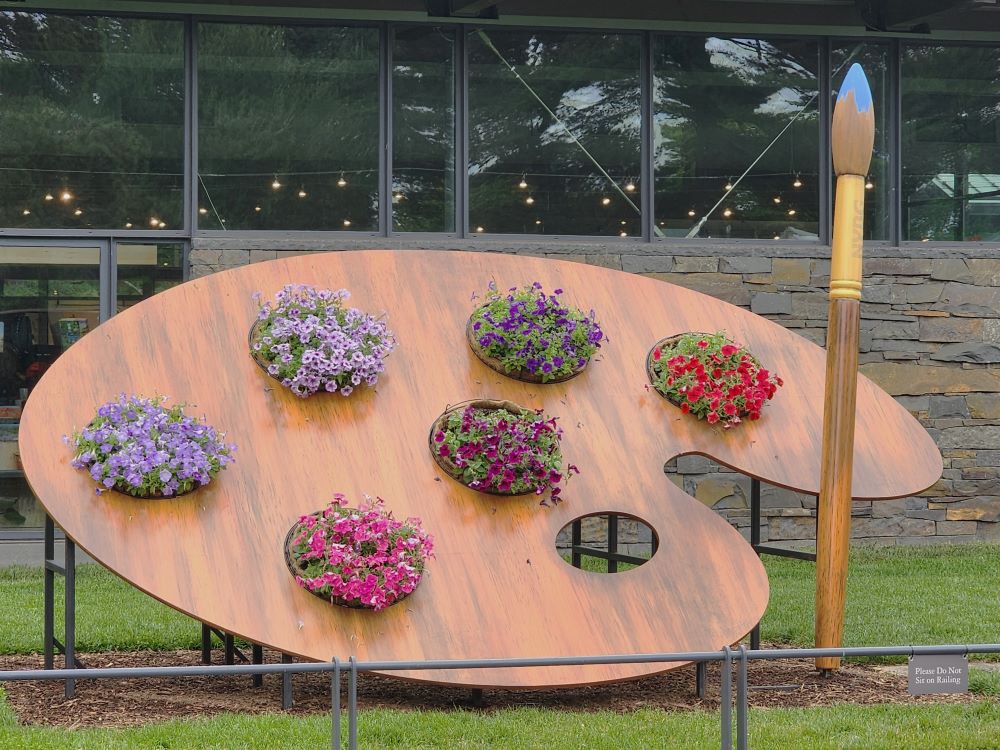
Visiting NYBG Van Gogh’s Flowers, one will want to read all of the signage with the quotes Van Gogh spoke during his lifetime to learn more about the mythic painter. The signage also pinpoints the designs of the featured artists found in the Enid A Haupt Conservatory walkways, in the indoor and outdoor reflecting pools and in the great plaza lawn. Van Gogh’s influence on them and on artists globally is a study in genius and the immutable verities that touch humanity and ground it in the pleasure of beauty and nature to move our souls out of ourselves into another way of being and consciousness.

Apparently, along his journey, Van Gogh painted flowers as a commercial venture, as he heard that such paintings were popular and lucrative. In Paris Van Gogh painted over 35 still life paintings of flowers, hoping that they would sell.
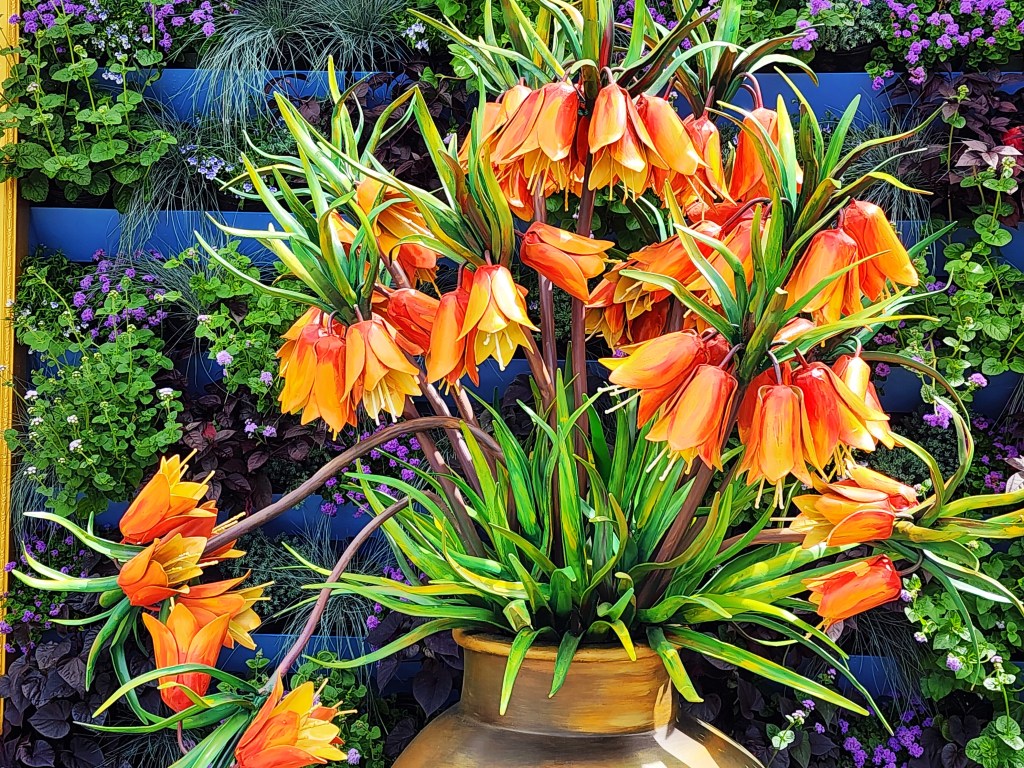

However, he had little luck selling them even though paintings of flowers were trending. His brother Theo wrote to their mother telling her that to help him, acquaintances would bring flowers for Van Gogh to paint every week.

After he ventured to the South of France, Van Gogh, whose intellect and mentality were always fragile, had a breakdown. It took him about a year to recover in a sanatorium at Saint-Rémy-de-Provence where he painted scenes he saw from his room. Interestingly, he didn’t paint the bars on the windows, perhaps signifying that in his creative spirit he was free as he was in his paintings as his mode of expression. Before and after recovering from his extended illness Van Gogh painted sunflowers (in Arles nearby), which to him symbolized gratitude. He used the color yellow extensively delighting in it. These and other details are found on the signage of the NYBG exhibit.
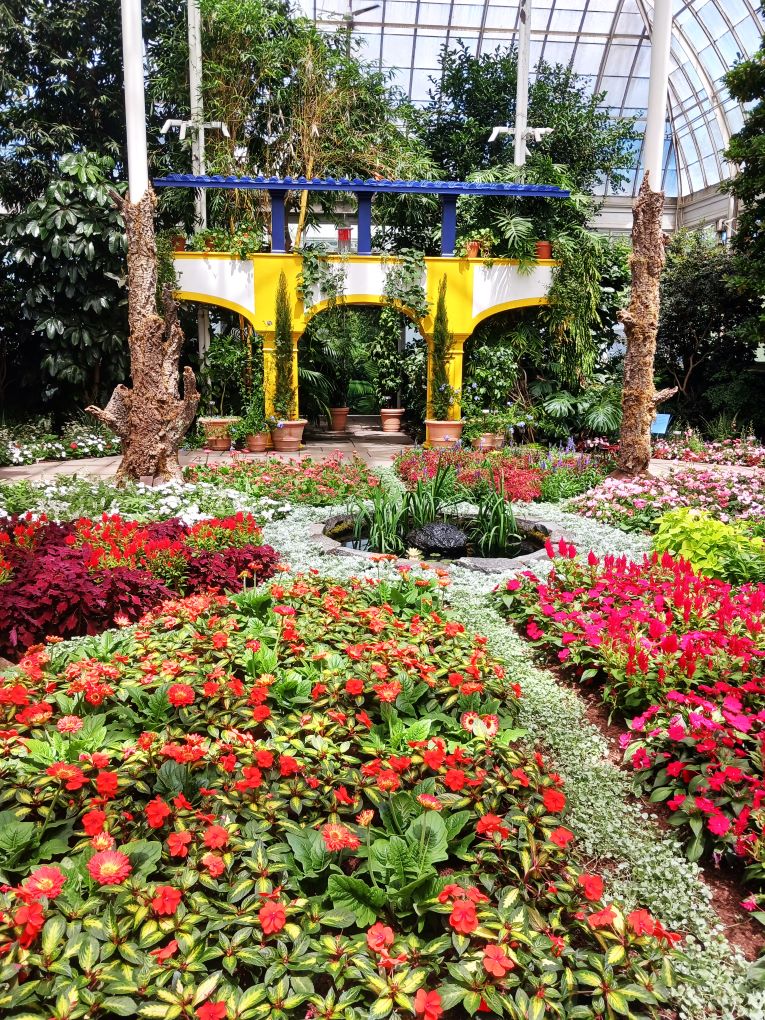
The NYBG exhibit features a placard of Van Gogh’s painting of the courtyard of the hospital at Saint-Rémy-de-Provence where Van Gogh found rest and recuperated as best he could. The showcase rotunda of the Enid A. Haupt conservatory features a reflection of Van Gogh’s courtyard painting with a similar structure suggested and the amazing plantings which are in a circular arrangement segmented florally like the spokes of a wheel. Just breathtaking.
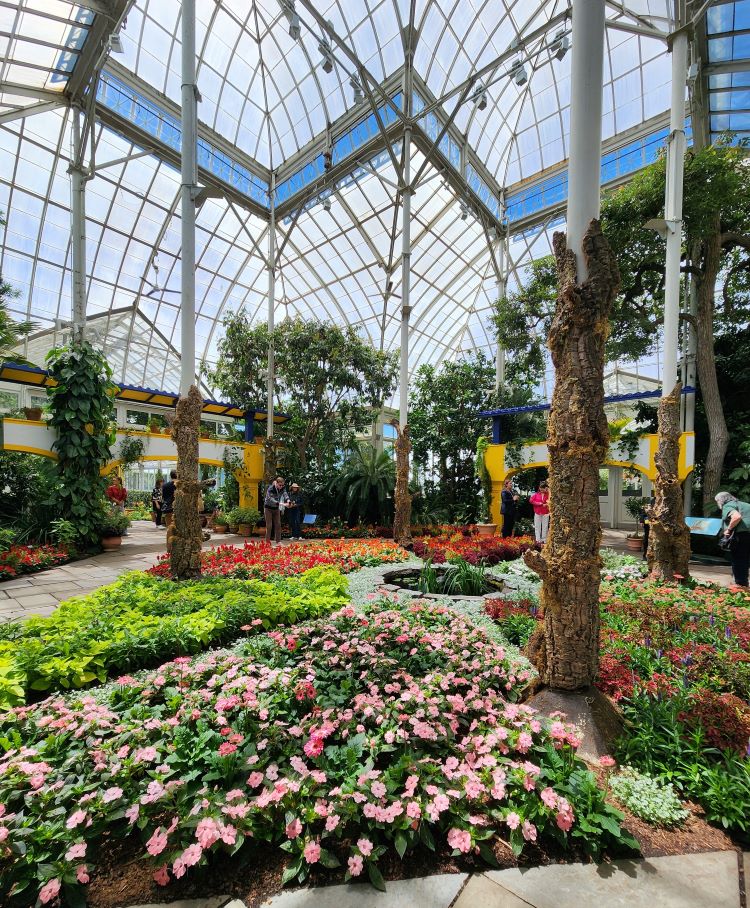
At the Garden, the paintings that inspired the artists Amie J. Jacobsen, Catherine Borowski and Lee Baker, and Cyril Lancelin are brought to life situated in gorgeous botanical displays along with the contemporary artists’ work.

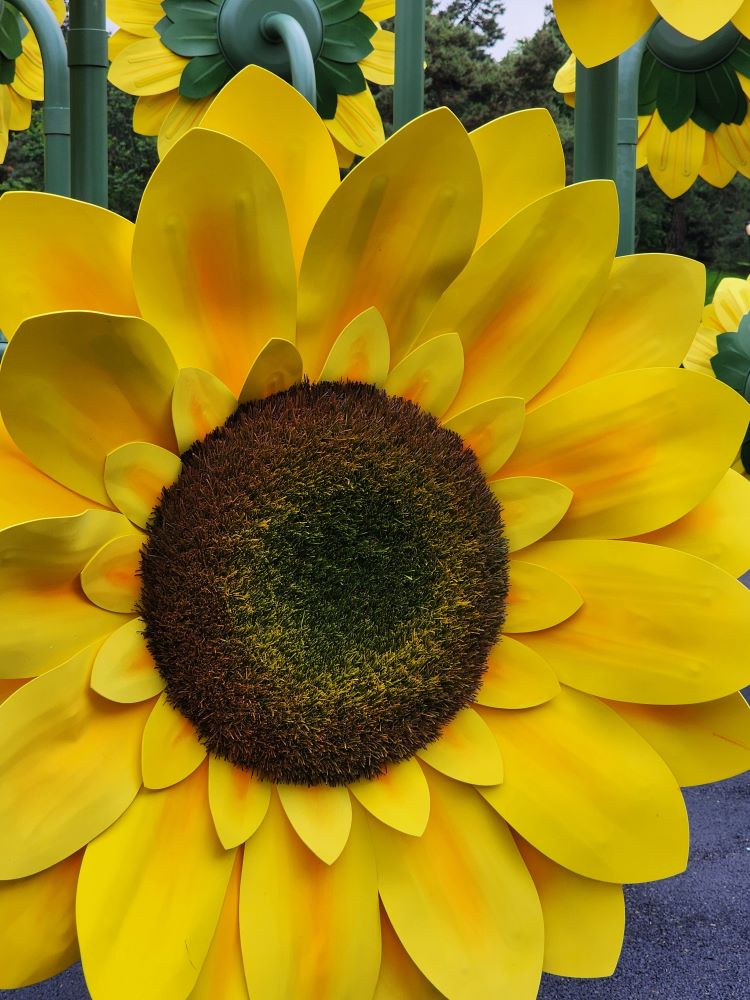
Thanks to Cyril Lancelin, visitors can walk along a pathway that meanders through plantings of real and sculptured sunflowers (by Lancelin), a symbolic reflection of what Van Gogh found healing and restorative. For him sunflowers meant “gratitude.”
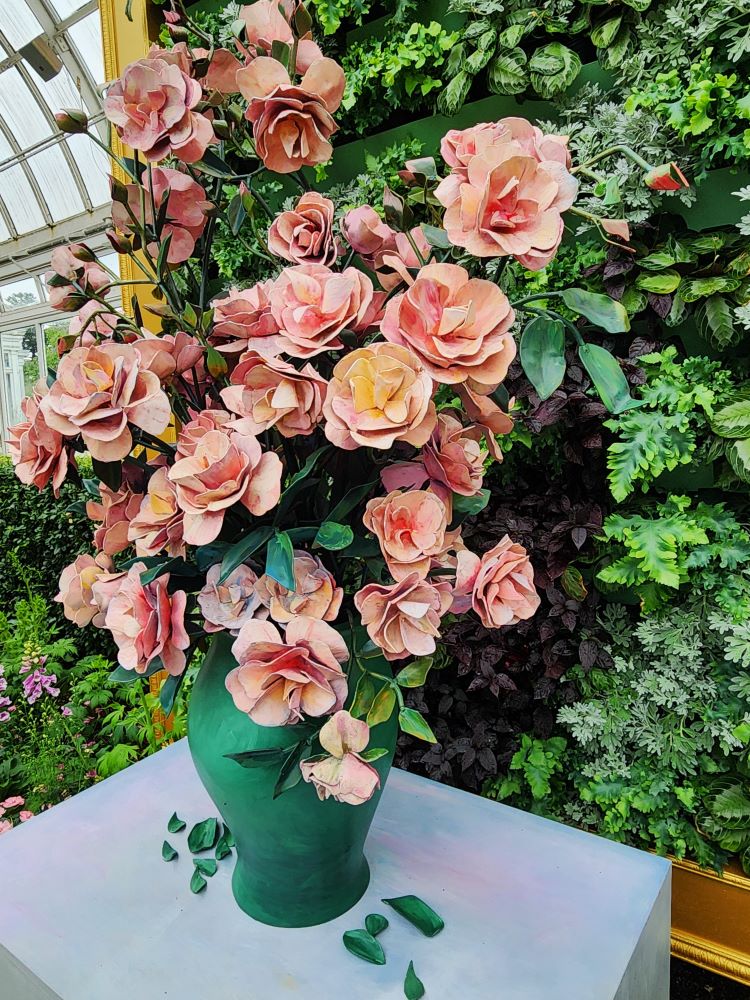

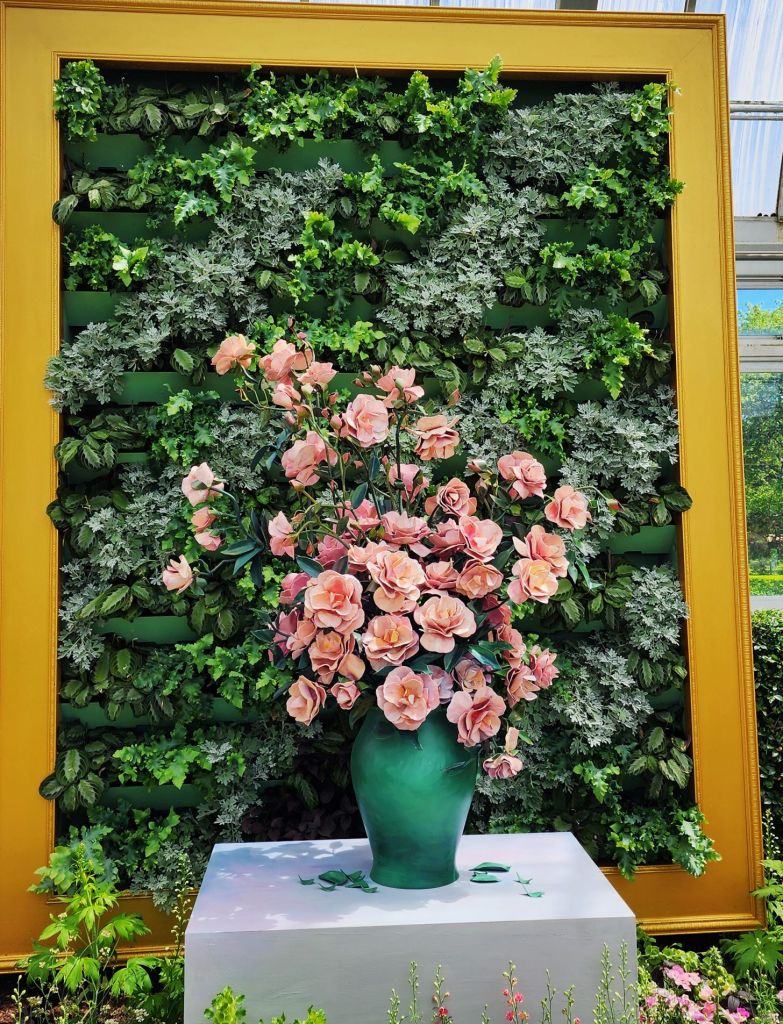
Vincent left the mental hospital in May 1890, he headed north to Auvers-sur-Oise. He met several artists there and continued painting fields, always using his beloved yellow. Then, one day in agitation, the story goes, he shot himself in a wheat field and died of his wounds some days later.

Van Gogh’s incredible legacy was a large body of art works: over 850 paintings and almost 1,300 works on paper. Visitors to NYBG’s Van Gogh’s Flowers will come to a new appreciation of how the natural world inspired Van Gogh. Most museums boast at least two or three of Van Gogh’s paintings which at auction command millions of dollars. In 1987 one version of Sunflowers sold for $37. 85 million. Today, those in the art world suggest the sunflower series of paintings would be in the hundreds of millions.
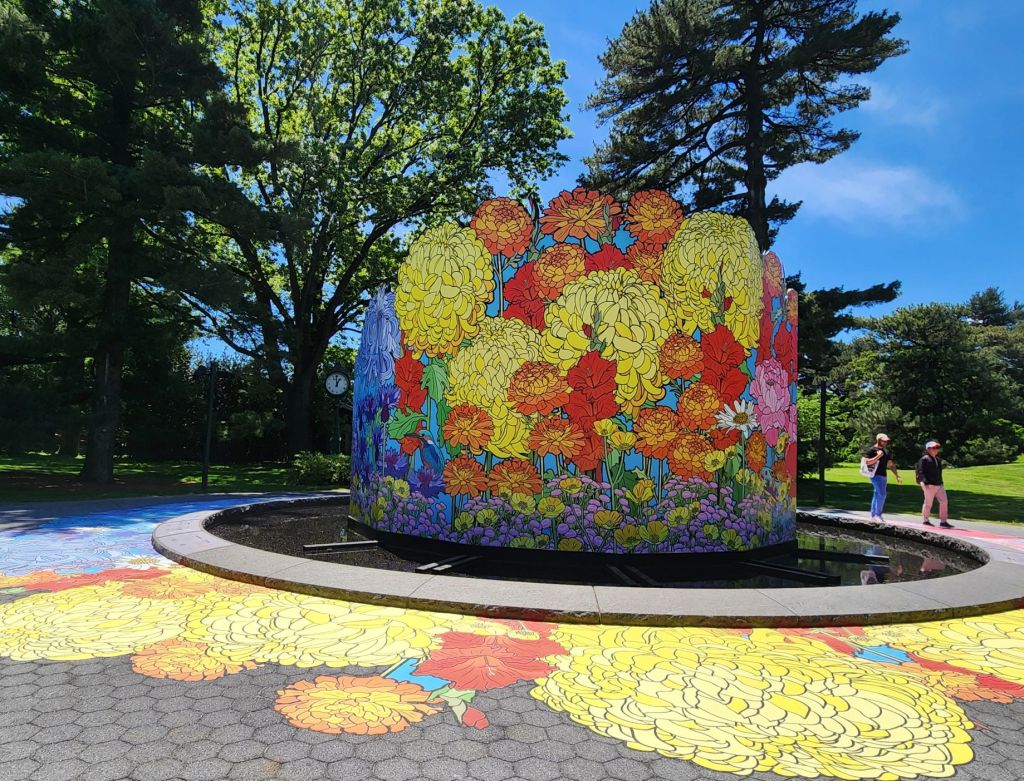

This amazing NYBG exhibit is a complete celebration of Van Gogh reflected in all of its programming. Complementary daytime programming on select dates during Van Gogh’s Flowers will offer engaging, interactive experiences, such as “Plein Air Drop-In and Paint,” engaging NYBG visitors’ creativity.
On select dates, Starry Nights will offer exhibition viewing in the glow of evening, with music and performers, drinks and food available for purchase. Conditions-permitting, after-dark Van Gogh-themed drone shows will take place on May 30, 31st and June 6th. These shows are New York City’s first at a cultural institution—bringing Starry Night to life before your eyes.
Finally, visitors can immerse themselves in the LEGO Botanical Garden pop-up. They can enjoy the hands-on make-and-take experience including a mini-Van Gogh sunflower creation.
For more information about this wonderful show and programming during the exhibit, go to the website, https://www.nybg.org/event/van-goghs-flowers/?gad_source=1&gad_campaignid=22428050313
The Marvelous New York Botanical Garden ‘Holiday Train Show®’
All Aboard!
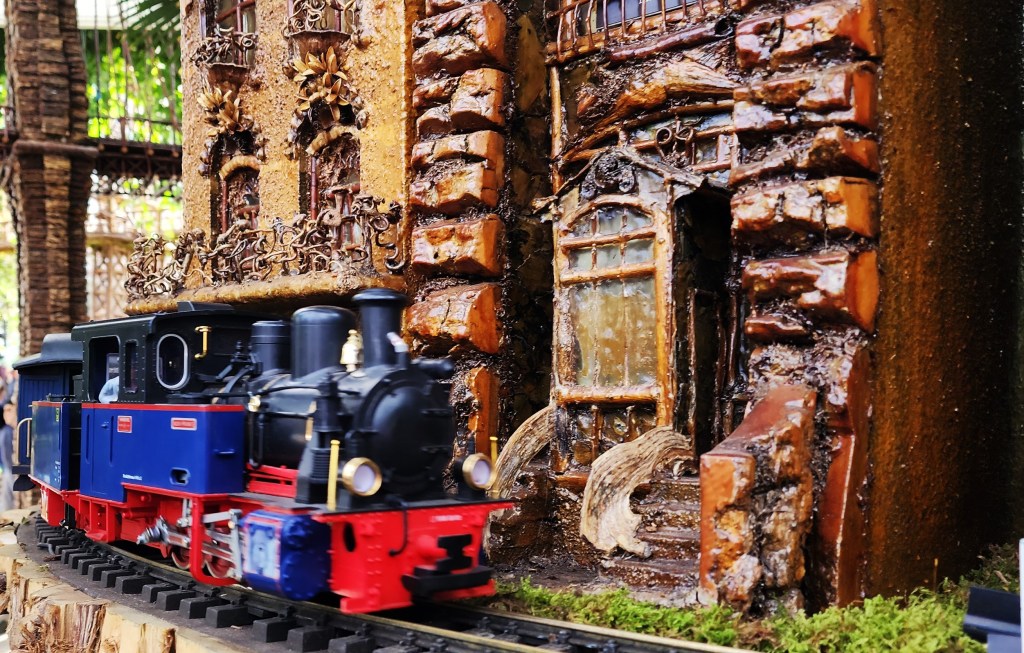


Now in it’s 33rd year, the magical NYBG Holiday Train Show® has arrived. This most thrilling and fun experience for families and friends runs from Saturday, November 16, 2024 through Monday, January 20, 2025.
Enid A. Haupt Conservatory exhibits
NYC favorite the Holiday Train Show® boasts G-scaele model trains zipping, racing and rollicking through galleries of the Enid Haupt Conservatory amidst gorgeous, rainbow hued plantings set to complement New York landmarks in miniature from NYC’s five boroughs to historic places in the beautiful Hudson Valley.


These replicas (i.e. Poe Cottage, the Park Avenue Armory, LuEsther T. Mertz Library, Cooper Union) are wonders in themselves because Applied Imagination’s creative team constructs them entirely of plant parts.
Practically every train type is represented from1880s American steam engines to modern freight and passenger trains with diesel engines, to trolleys and whimsical cars.


Woodland outdoor display
The woodland outdoor display created last year is an enchantment for all.


Trains chug around whimsical mountain structures on the ground and high above on trestles so that high visitors may walk under the bridges. The landscape is filled with forest animals and creatures, winter-interest plants and marvelous fungi.
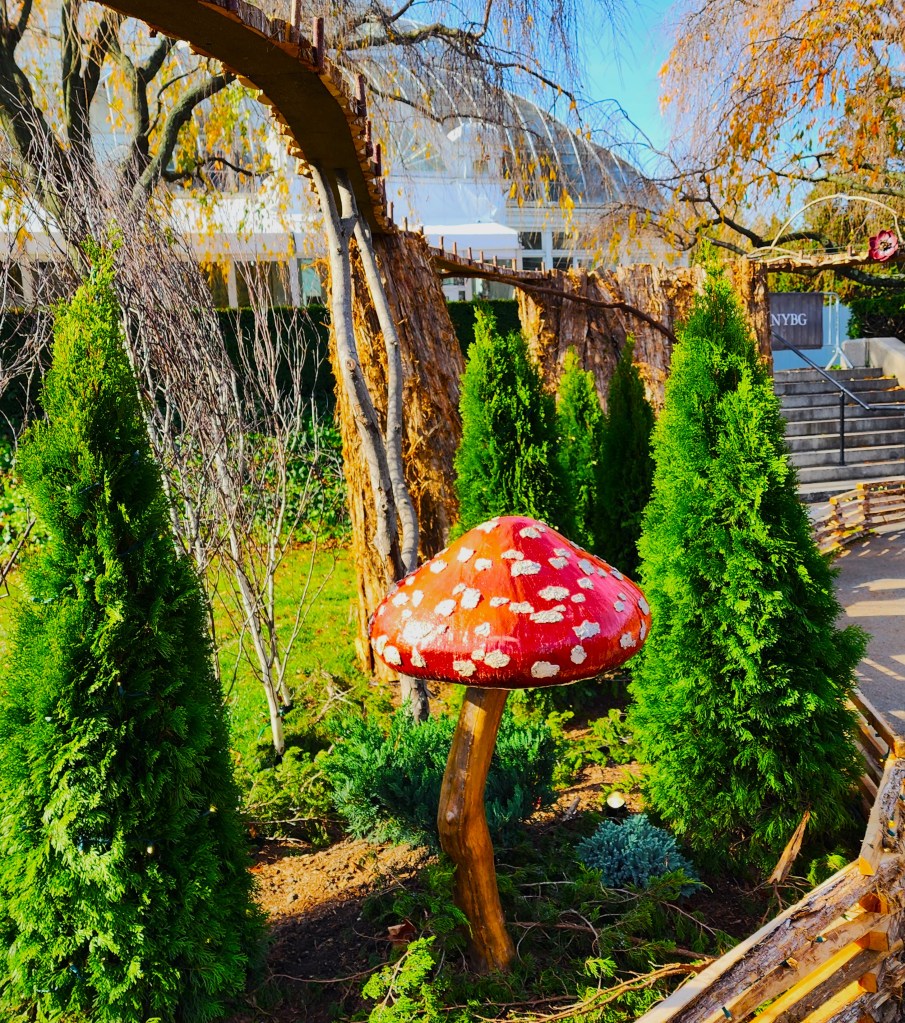
All these and more enchantments unfold on the conservatory Lawn begging to be seen, like the owl perched above looking down on laughing children and smiling adults.


Events
NYBG and Tea Around Town
This year NYBG has partnered with Tea Around Town, a sightseeing tour bus that serves afternoon tea and brings the excitement and delight of the season from Manhattan to NYBG. First, join Tea Around Town’s festive journey to NYBG’s Holiday Train Show®. On the bus you will enjoy special teas, delicious treats and merriment served by elves aboard a beautifully decorated bus that celebrates the season. Disembarking from the bus, you will walk through the Holiday Train Show exhibits appreciating the craftsmanship and skill of Applied Imagination’s ingenious team and the clever botanical designs of the NYBG staff.

The Tea Around Town bus will run Tuesdays in November and December, and Thursdays and Sundays from November 19th through January 20th. The bus departs from Central Park South at 11 a.m. and leaves NYBG at 3 p.m. to return to Manhattan. Also, in November and December, Tuesdays and Thursdays, 1-2:30 p.m., Santa and an elf will be on-site in NYBG’s Leon Levy Visitor Center for photo opportunities with visitors.
Holiday Train Nights
Everyone enjoys another favorite event of the NYBG Holiday Train Show® at Holiday Train Nights. There is nothing more mysterious and beautiful as the glowing colored lights in the evenings where another atmosphere takes over the Garden landscape and inside the Enid A. Haupt Conservatory. Viewing the replicas twinkling with lighting from within and without. Enjoy listening or bopping along with holiday classics and Christmas pop favorites sung by performers in the Locomotive Lounge of the Visitor Center. Enjoy sweet and savory bites, spiked cider cocktails and mocktails, and hands-on gingerbread decorating your own for purchase.

Holiday Train Nights take place on 16 select evenings. Ten of them are for adults only from 7 to 10 p.m. Six of the evenings are for all ages from 6 to 9 p.m. Holiday Train Nights are ticketed through NYBG’s presenting partner Fever.

For adults
During adult Holiday Train Nights adults age 21 and older will be able to view the Train Show under an entirely different evening aura. There is also festive food and curated cocktails available for purchase. The dates are as follows: Saturday, Novembr 21; Friday, November 29; Saturday, November 30; Saturday, December 7; Friday, December 13; Saturday, December 14; Saturday, Decembr 28; Saturday, January 4; Saturday, January 11; and Saturday, January 18.
For families
All ages can enjoy Holiday Train Nights with hands-on activities on the following dates: Friday, December 20; Saturday, December 21′ Sunday, December 22; Monday, December 23; Thursday, December 26; and Friday, December 27.
More coverage will appear on this blog about NYBG Holiday Train Show. For additional information visit https://www.nybg.org/
New York Botanical Garden Debut Exhibition ‘…things come to thrive…in the shedding…in the molting,’ Artist Ebony G. Patterson
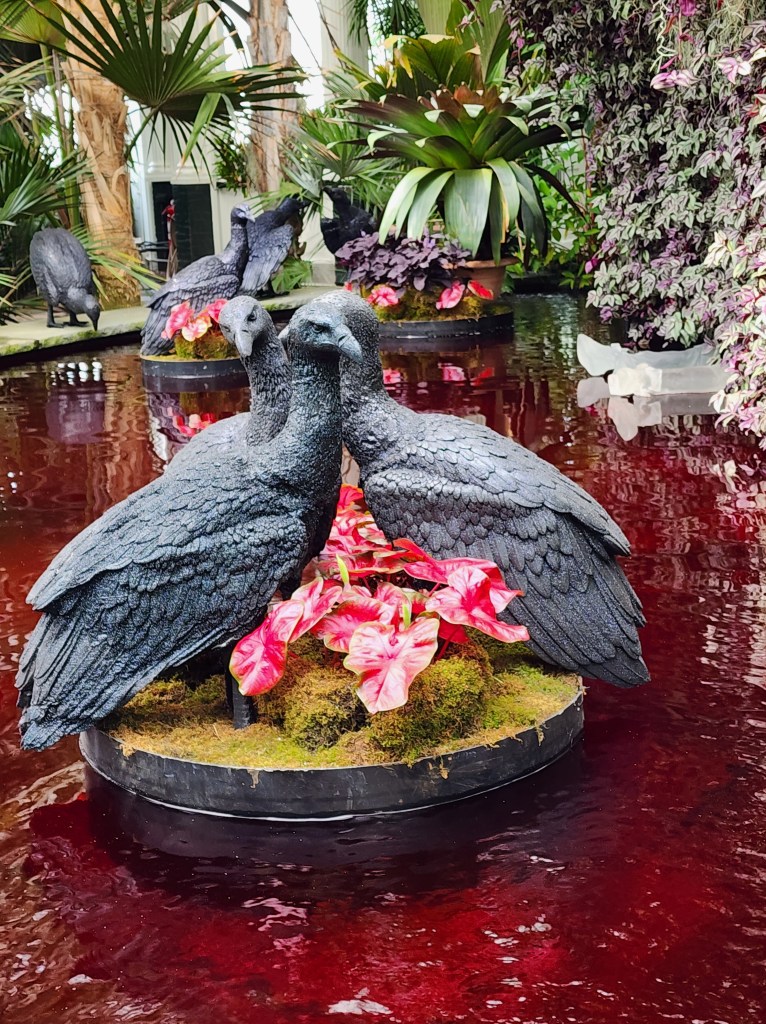
New York Botanical Garden and visual artist Ebony G. Patterson have been collaborating for a year or more about Patterson’s new site-specific work which is a maverick first for the Garden. Entitled …things come to thrive…in the shedding…in the molting… Patterson focuses her unique vision in an exhibition of tensions, using living and preserved plant collections as its material and inspiration. In her examination of gardens as a metaphoric site of birth and the journey to the molting, shedding and death to be reborn again, her expression has found new meaning and is, as all artists hope, an important trigger to enhance revelation and the appreciation of our place in history on this planet in our expression and love of gardens.

Her approach specifically relates to how the visible/invisible (sub rosa), desirable/undesirable are manifested in how past and present inhabitants attempt to exert control over the natural world via the design and selection of plants for gardens.
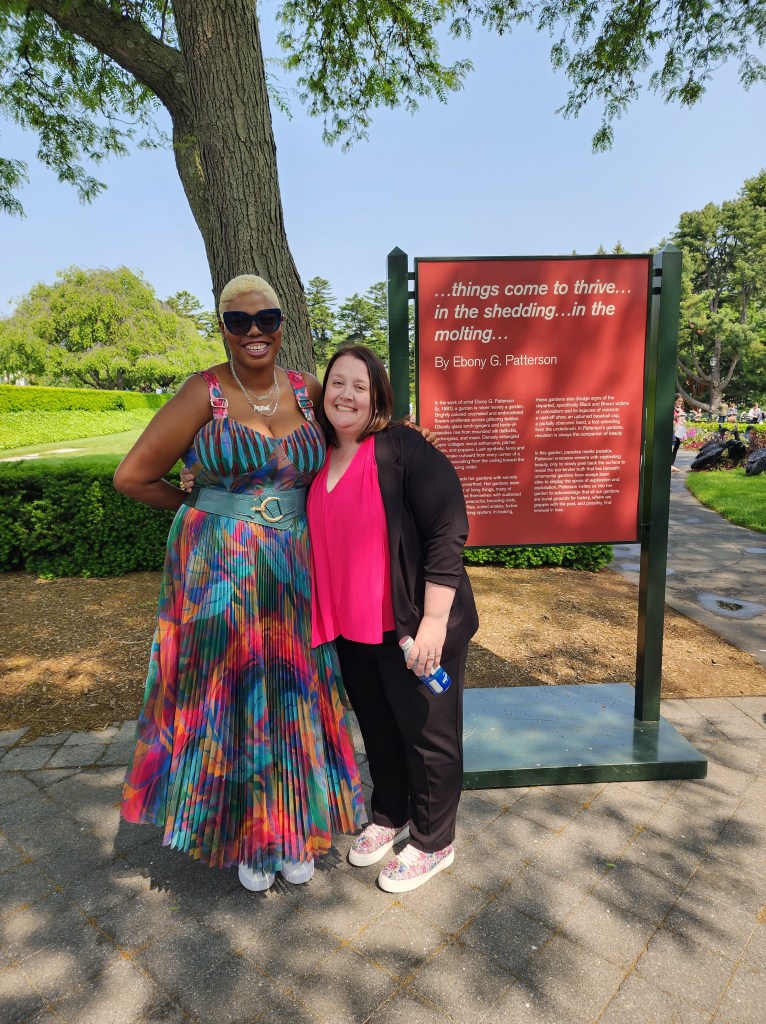
Patterson’s site-specific exhibition of sculptural and horticultural installations represents a few firsts. She is the first visual artist to embed with the New York Botanical Garden for an immersive residency. Working directly with the Garden’s grounds and collections she created an original conceptual arrangement that includes sculptures, installations and interventions with living plants to bring a message of impact that is highlighted in the Palms of the World Gallery, the staging rotunda and the walkway gallery between those two showcase galleries in the Enid A. Haupt Conservatory. Her visual artistry is also displayed outside the Conservatory in the lawn landscape as well in the Mertz Library Building on the 6th floor. The exhibition is on view Saturday, May 27 through Sunday, September 17, 2023.
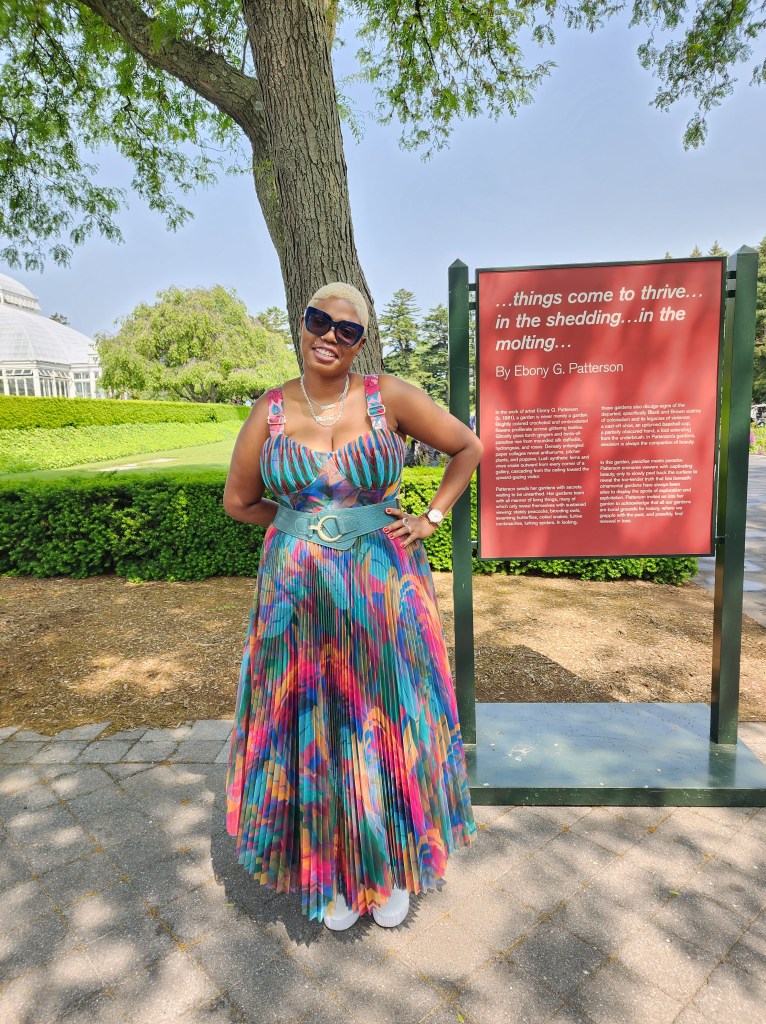
The concept that life is cyclical and mirrors that “eternal” process is present throughout Patterson’s exceptional presentation. Living beauty doesn’t last. However, the regenerative process is what remains. Ultimately, it is that regenerative process that is beautiful and sacred. In order for the beauty of the butterfly to emerge, the ugly caterpillar must first go through its necessary transformative steps, some of them painful, after which it eventually emerges with its wings for its first flight. Likewise, wildlife, living plants and human beings go through processes of “molting,” “shedding” and “decay” in order to revive, regenerate, heal and eventually die, to then transition in another consciousness. Even what appears to be “the end,” is not a full finality, but can be cause for celebration of new life or supplying elements that create and sustain life.


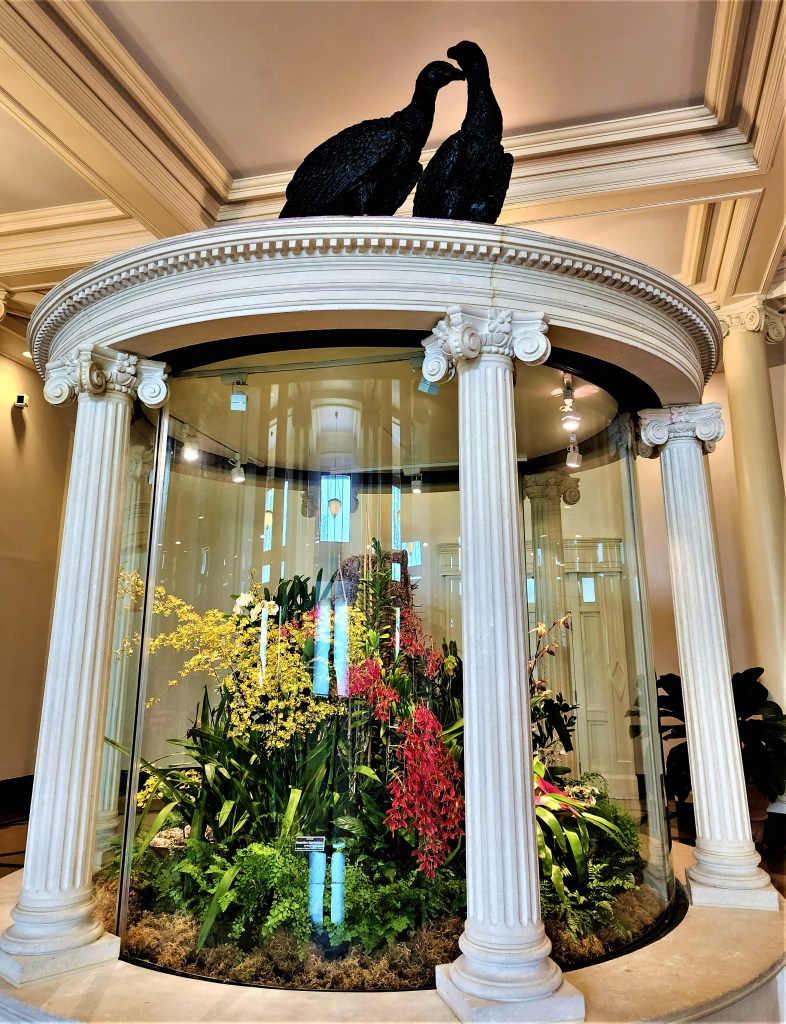
Patterson positions the loveliness of a selection of plants against sculptures which remind us that when they decay, there is the clean up crew that comes along to make way for the regeneration and rebirth. Thus, sculptures of black vultures (400 in all in four different positions) populate the landscape. A usual symbol of death and dying, certainly macabre, Patterson’s use of them, especially in the Palms of the World Gallery, the walkway and the showcase rotunda is a stark metaphor. If they are the ugliness and fearful example of nature and ultimately the planet’s world garden which is not “perfection,” they are a necessary element of purification because decay if left untended creates disease. The clean-up crew of vultures, insects, etc., takes care of the bodies that are decaying, picking their bones clean. Thus, they receive nourishment and the earth’s soil, etc., receives the nourishment from what the vulture’s don’t consume, i.e. bones leach out their phosphorous and other elements after weathering.


In Patterson’s attempt to realize new symbolism of the processes of life, death and regeneration with the backdrop of gardens, she also includes the impact this has had on her Jamaican roots which historically go back to slavery and colonialism with the Triangular Trade-sugar, molasses, rum, slaves. Historically, only the wealthy were able to create gardens. The poor and working class didn’t own swaths of land; rather they were the workers and the slaves on the land and in the gardens, until slavery was abolished and its remnants finally extirpated. Colonialism was white privilege from Europe, brought to the United States. The ending of colonialism and its representation in the ordered gardens of wealth took place during the twentieth century. Remnants of colonialism have been decaying ever since, as individuals acknowledge its horrific and miserable past (the invisible) while having created some of the most lasting and historic structures and dualistic civilization (the visible).


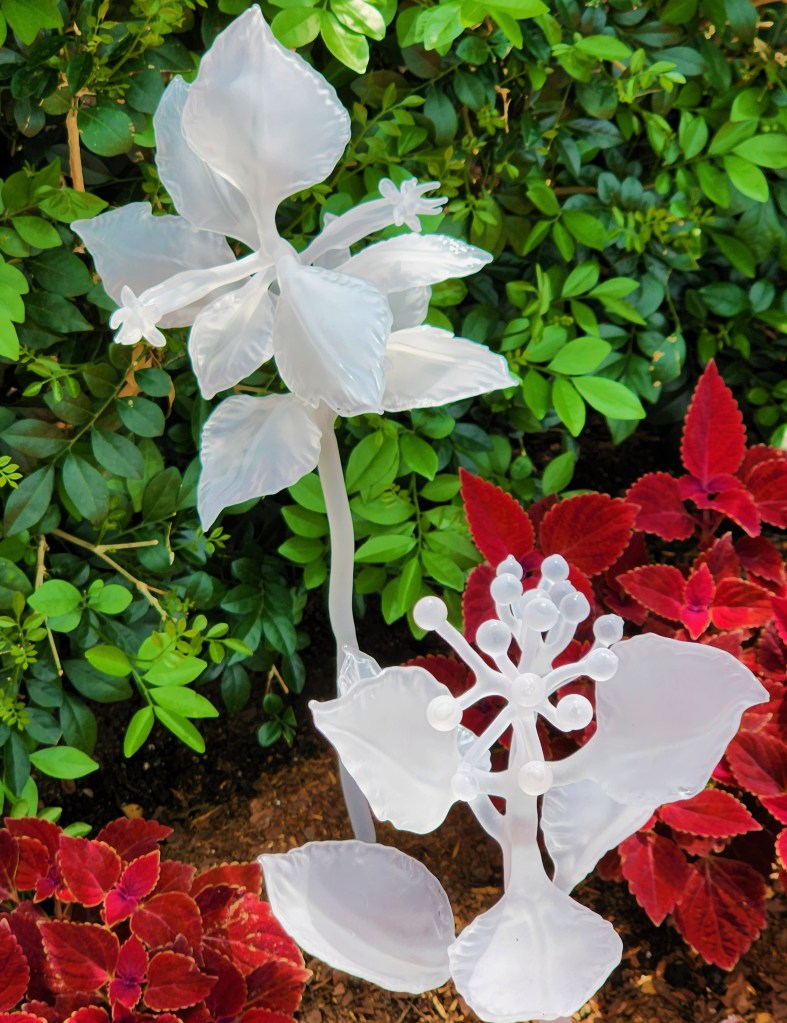
These notions are represented in the showcase rotunda where the white, glass, male feet are protruding upside down in pots of floral plantings. What lies underneath is the entire body that is being consumed by the insects and bacteria in the soil. On the surface are what the body pushes up, the flowering multiple-hued beauty of the plantings in circular pots. Thus, symbolized is the shedding of white colonialism and the power structures that once “lived” and “flourished,” but now are in a state of decay. On another level community gardens are taking over and the wealthy in the UK (which prospered from slavery and ruled in the 1700s) can no longer afford to maintain the gardens without a “free” worker force. Instead, many of the colonizers and wealthy estates have been donated to trusts and museums and paid workers are creating gardens. This is a form of regeneration.

According to Patterson, “The opportunity to work directly within the New York Botanical Garden, using its collections and landscape as inspiration, provided the opportunity to bring many elements of my practice together.” She continued, “I’ve long worked with the idea of gardens, but this direct intervention allowed us to begin to literally peel back the landscape to look, not only at the plans on the surface, but also explore what lies beneath, and the generative life cycles that sustain the entire ecosystem.”

She particularly focused on the “Plants and animals that clean, regenerate, and consume as an act of care. These are necessary for the survival of the entire ecosystem. This reality of the garden is often not highlighted and celebrated, an experience that is paralleled in many areas of society and a tension at the heart of my practice overall.”

Jennifer Bernstein, CEO and The William C. Steere Sr. President of The New York Botanical Garden, stated the following about the installations. “Ebony G. Patterson’s exhibition at the Garden marks an exciting moment for us as an institution, as we were able to provide a platform for one of the most compelling artists of our time to explore the complex symbolism of gardens and the fractured human relationship with nature. She added, “Patterson’s work will entice, disarm, and provoke visitors, and we look forward to the dialogue and conversations that will unfold.”
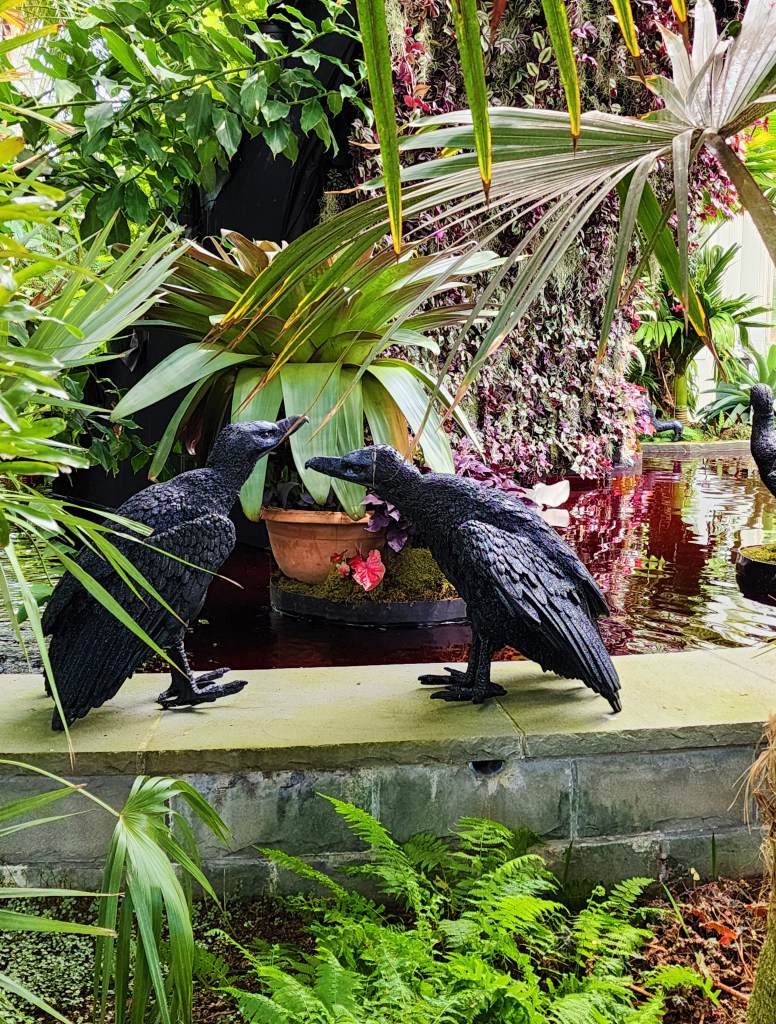
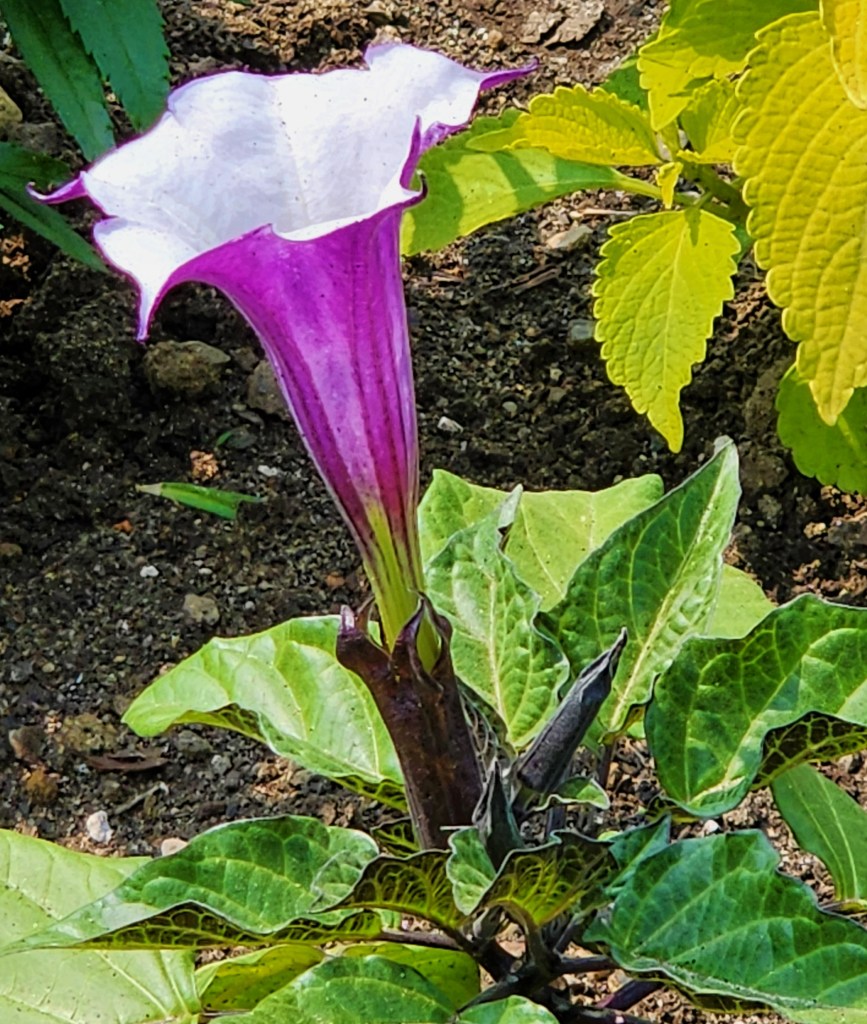
After perusing the hundreds of glittering vultures featured among blood-red, woumd-like ruptures (symbolic of the bloodshed of the enslaved) that interrupt an expanse of light purple foxgloves, lime-green zinnias, coleus and other blooms, you will enter the rotunda showcase gallery. Look up. You will see a cast-glass-and-hydrostone white peacock which focuses the installation from the rotunda to the Palms of the World Gallery. Symbolically, Patterson conceived of the peacock looking backward on its trailing tail, imaginatively unfolding an immersive garden of plants with variegated foliage. These include caladium, hypoestes, red begonias and impatiens.

Everpresent are the vultures cleansing and purifying the decay. In memorium to extinct species, there are ghostly cast-glass plants which Patterson researched in NYBG’s William and Lynda Steere Herbarium. These plants are plant placeholders, made one-of-a-kind. The species they symbolize are plants which were once alive, and now are unable to regenerate. All living things are sacred and if codified, will never truly be extinct, but will be photographed or illustrated as a reminder of the impermanence and sanctity of living structures.

Continuing the imaginary unfolding tail of the peacock, we enter the Palms of the World Gallery where there is a foliage wall reflecting in the pool. One sees various plantings including ipomeas, silver-inch plants and love-lies-bleeding. Again there is the symbolism of blood and lives sacrificed for wealth as a subtext and hidden meaning of gardens. Underneath the surface of the loveliness-there is brutality and ugliness. Indeed, nature in its feeding and living can be predatory, as well as gorgeous, a major theme of Patterson’s installation.
The secrets of decay are the subtext, always a contrast to the lush colorful and luxurious face of greenery and rainbow colors. But these plants, too, will wither and their bodies will be used as nutrients for bacteria to enrich the soil which can then burgeon with new growth when there time has arrived. Interestingly, Patterson has included the male glass figure, legs protruding out from the wall into the symbolic “blood pool.” This white glass sculpture halved by the plant wall is perhaps metaphoric of nature’s resilience against human control of gardens. It also may symbolize colonialism’s demise as the regrowth and power of nature always maintains control because of the process of birth, living, dying, decay and regeneration.



In the Mertz Library Building on the 6th floor one may see Patterson’s latest works on paper. Look closely, you will see those helpmates of plants, pollinators, and cleaners of decay, flies and spiders and cockroaches. The patterned entanglements are dense and complex. If you look closely snakes, plants, insects, human figures, butterflies can be teased out of the paper mesh which represents a vast and massive ecosystem curiously interdependent and synergistic. Her works trigger one’s thoughts and suggest subtext and hidden, symbolic meanings and associations. Patterson nudges one to look deeper at organization in nature which is more vastly unknown as discoveries currently happen. With humility researchers have discovered the vast communication system of trees, not only in their root systems, but in the ambient atmosphere. Patterson suggests the inter-connectedness of all things and the circular process which cycles.


The mixed media paper collages from the 2022 series studies for a vocabulary of loss combine highly-textured, torn, and reconstituted botanical illustrations and photographs of lilies, bird-of-paradise, carnivorous pitcher plants, mushrooms, stylized vines, scorpions and highly patterned human arms. These series of works are suggestive of funerary wreaths. There is renewal in loss and beauty in the process which is continuously revolving.
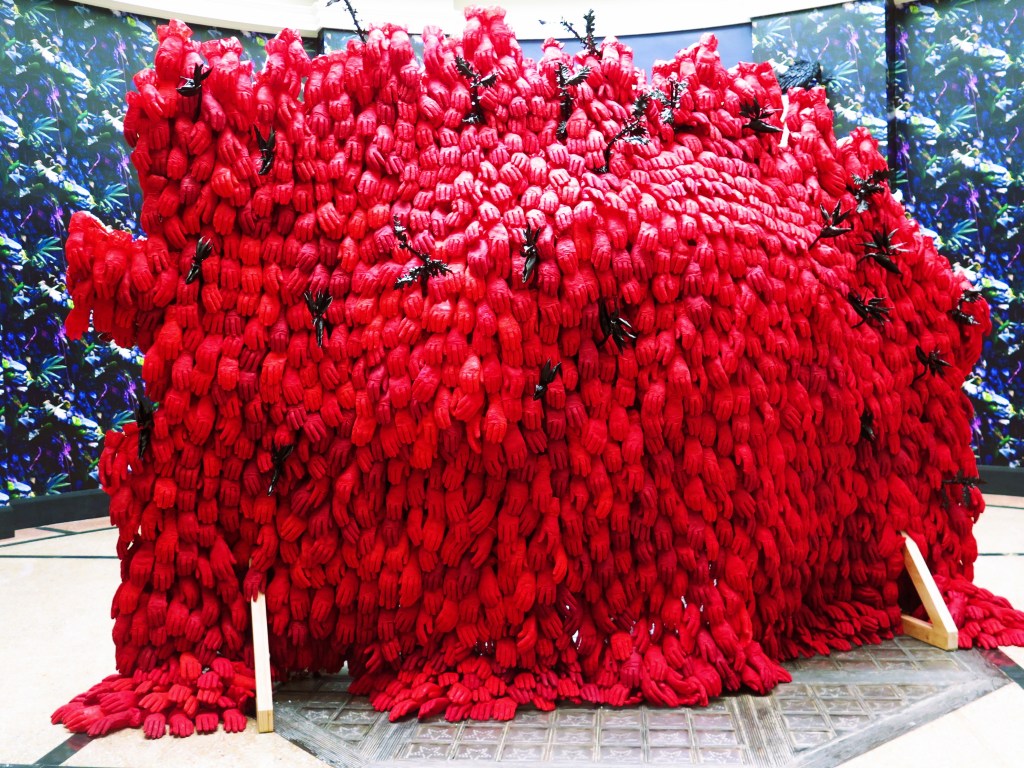
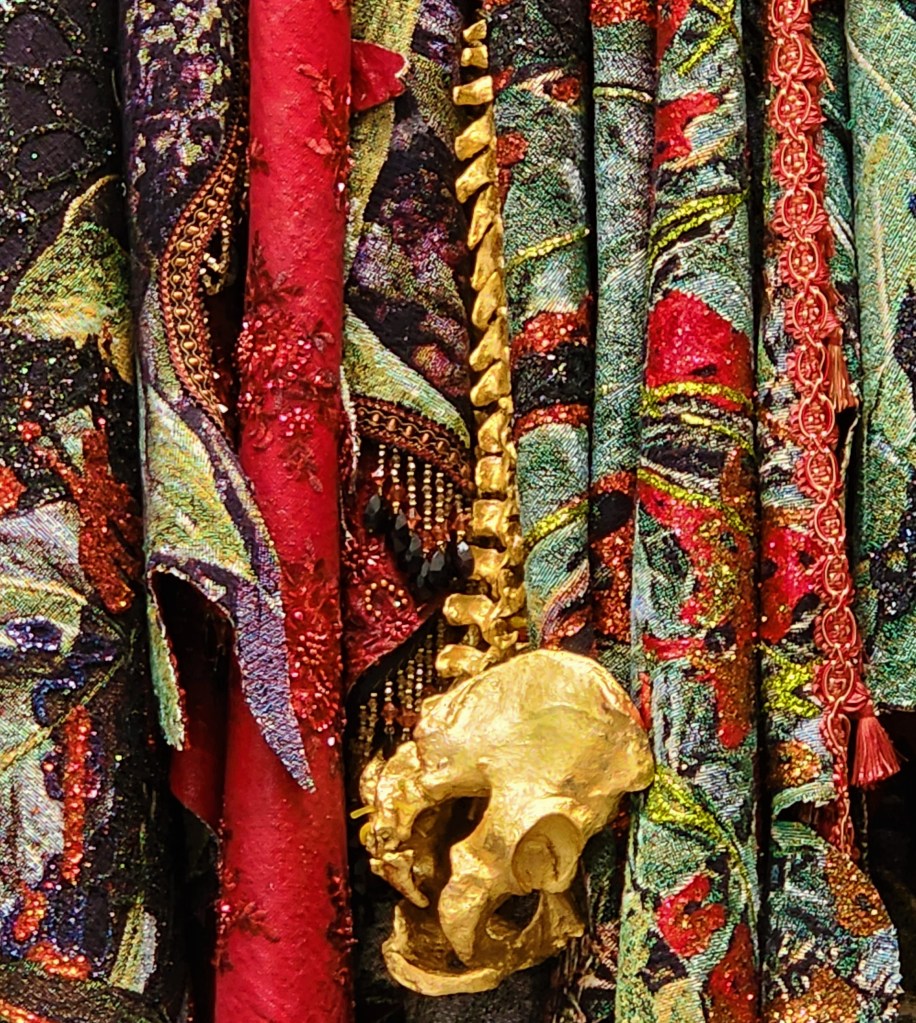
Additionally, there is Patterson’s fascinating installation “Fester.” The rotunda space has wallpaper of repeating patterns to suggest a nighttime garden and a central installation. On one side is a wall, the other side is surprising.Viewed in the round, the reverse side of the wall represents the freshly wounded earth with a cascade of over 1,000 red lace gloves, their root-like fingers revealing cast-glass thistles and cast-metal monstera leaves. Perhaps represented in the mass of blood red hands-a sacrifice of slavery and labor, there are black hands reaching out. And on the other side are the textiles, tapestries of rapturous hues hanging from the wall, partially concealing gold-leafed skeletal forms. The associations are rife. From picking cotton to making textiles, the labor is intensive. When it was free, colonizers and slave-holders made a ton of money, perhaps so much money, their spines turned to gold. Patterson’s work is so rich and imaginative, it stimulates a riot of symbolic concepts.
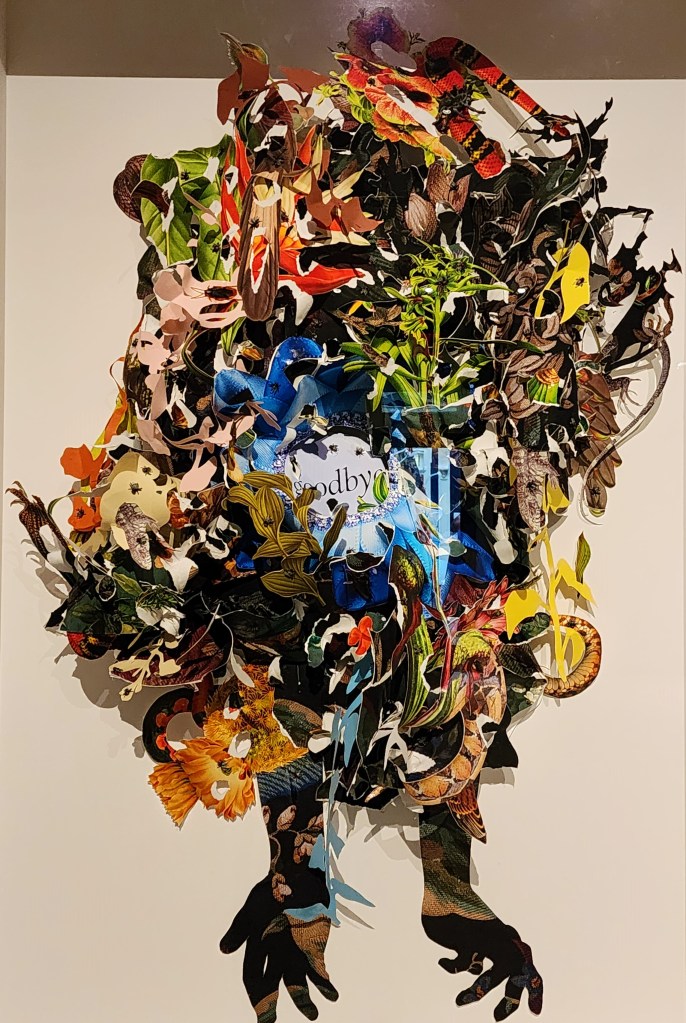
I also was intrigued to find Patterson’s work loaded with irony. I found myself laughing at the sharp contrasts and striking symbols. Her unique vision is refreshing and macabre and joyful and humorous and reflective of the cycles of living species.

Who is Ebony G. Patterson? The artist received her BFA in painting from Edna Manley College of Visual and Performing Arts in Kingston, Jamaica (2004), and an MFA in printmaking and drawing from the Sam Fox School of Design and Visual Arts at Washington University in St. Louis (2006). She has taught at the University of Virginia and Edna Manley College School of Visual and Performing Arts and has served as Associate Professor in Painting and Mixed Media at the University of Kentucky. Her work is in the collections of institutions including 21c Museum and Foundation, Louisville, Kentucky; Lost Angeles County Museum of Art, Los Angeles, California: Nasher Museum, Duke University, Durham, North Carolina to name a few. She is also exhibited in the Whitney Museum of American Art. Co-Artistic Director, along with curator Miranda Lash, Prospect.6 New Orleans,will open in Fall 2024.
For programming and tickets to this thought provoking exhibition, go to the NYBG website
‘Around the Table: Stories of the Foods We Love’ New York Botanical Garden’s Major Exhibition Through September 11, 2022

When we think back to our grandparents’ and parents’ cuisine, what comes to mind? Whatever generation we are, the foods we were served as children on holidays or perhaps daily indicate the family heritage. And once we discuss heritage foods, inevitably there are similarities and differences among cultures, though they might be as wide-ranging as Europe to India.

The New York Botanical Garden’s latest exhibition Around the Table” Stories of the Foods We Love, is all about our culture heritage and the heritage of others by examining the cuisine. And no matter how one views the cuisine, at its most basic foundation we find plants.
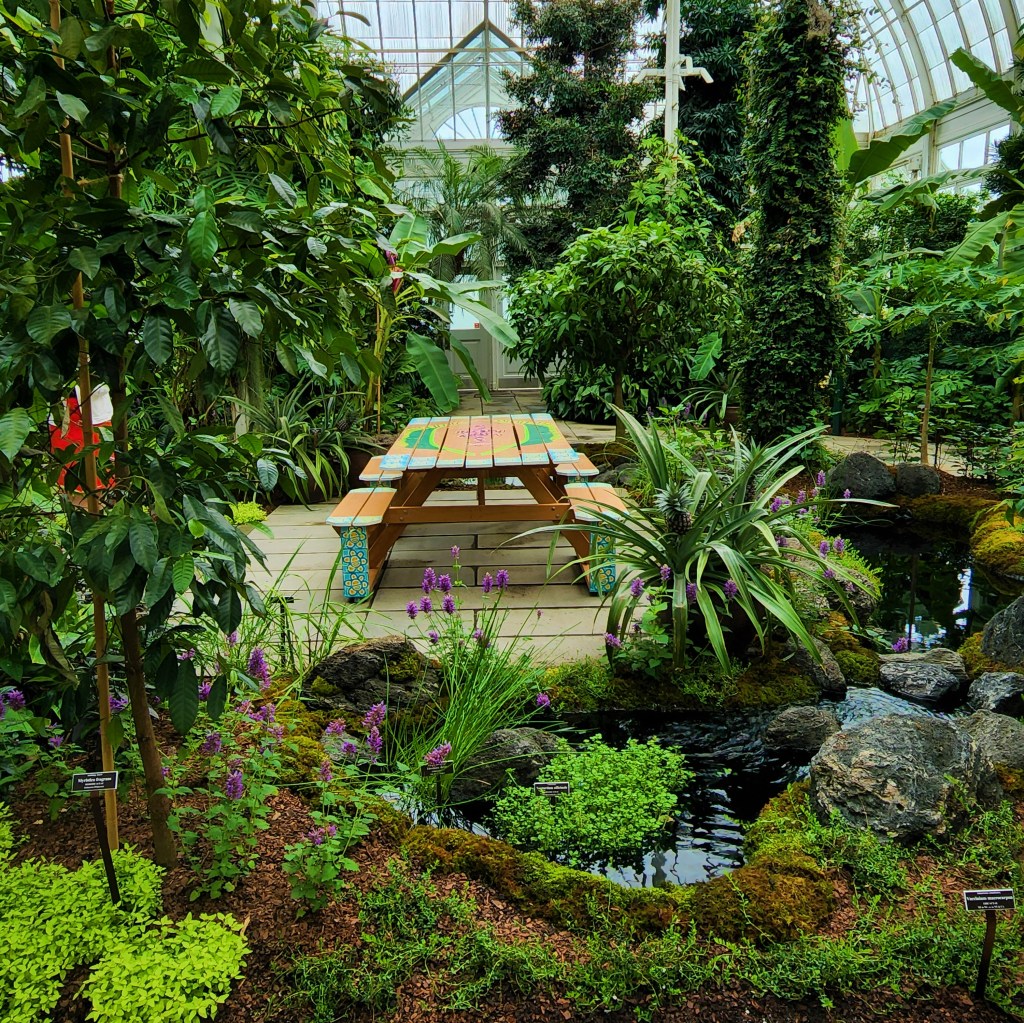
For those unfamiliar with farms and growing seasons, seeds and techniques to produce the most healthful, successful gardens of fresh fruits and vegetables, this exhibition is for you. Also, for those who come from a background whose cultural heritage was steeped in orchards and vegetable gardens as mine was, the exhibit is a chance to reconnect with and add to knowledge already in one’s mental and emotional bank account.
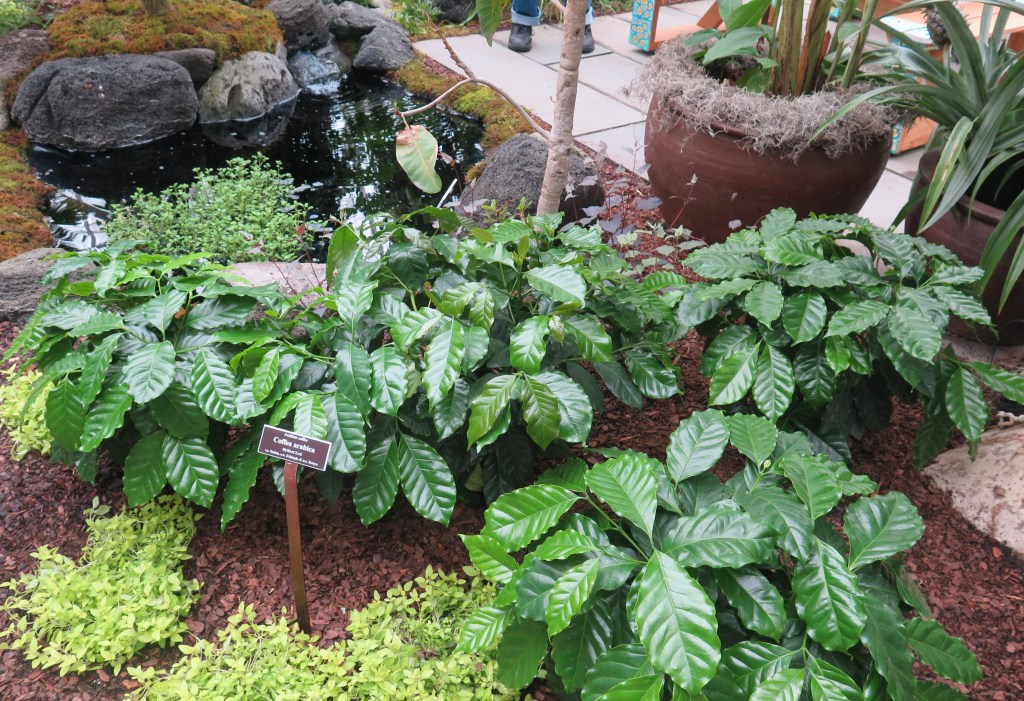
The plantings found throughout the 250 acres reveal the art and science of food traditions, many dating back to millennia and the beginning of the growth of civilizations throughout the world. Though the plants have been developed through experience by people culturally and historically, many of the plants from ancient cultures have also been modified scientifically to what they are today. Much of the history of cuisine relates to migration and travel. As people moved throughout the world, they brought their cultural understanding of plants with them to retain and perfect their food traditions.
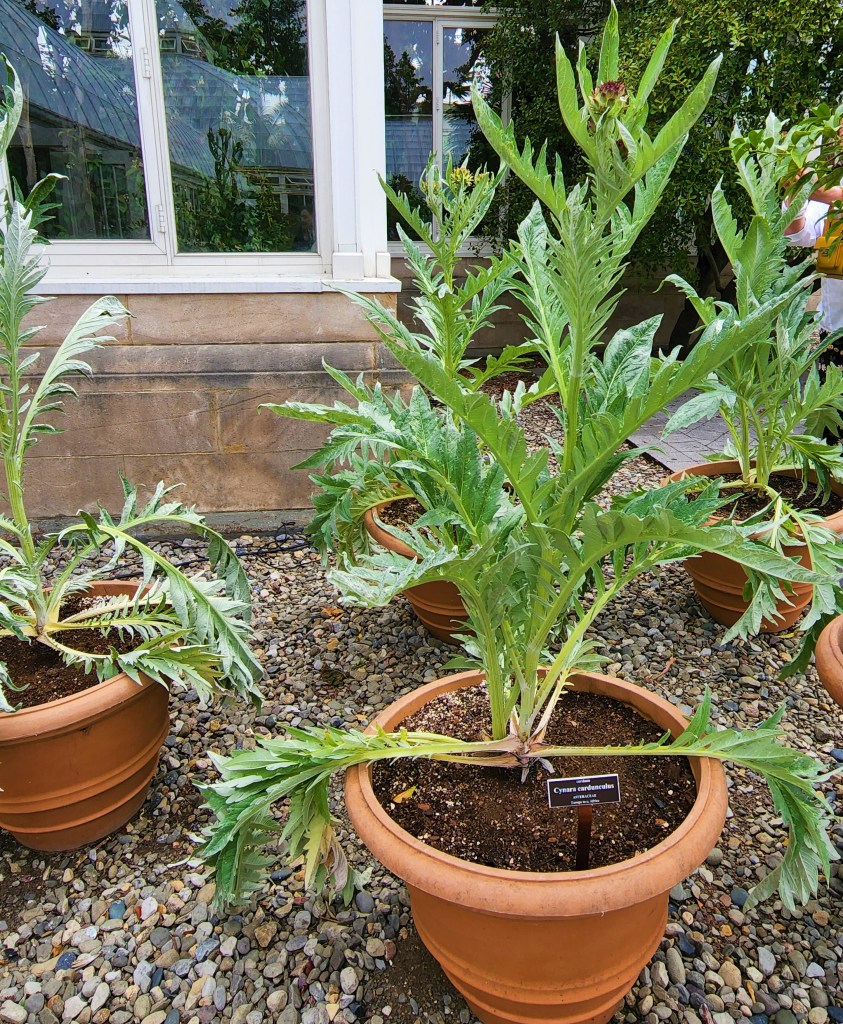
Importantly, the NYBG exhibit acknowledges the cultural heritages of food cuisine and highlights the aspect of travel and migration that brought plant species to the Americas and species that were in the Americas to European in cross cultural migration.
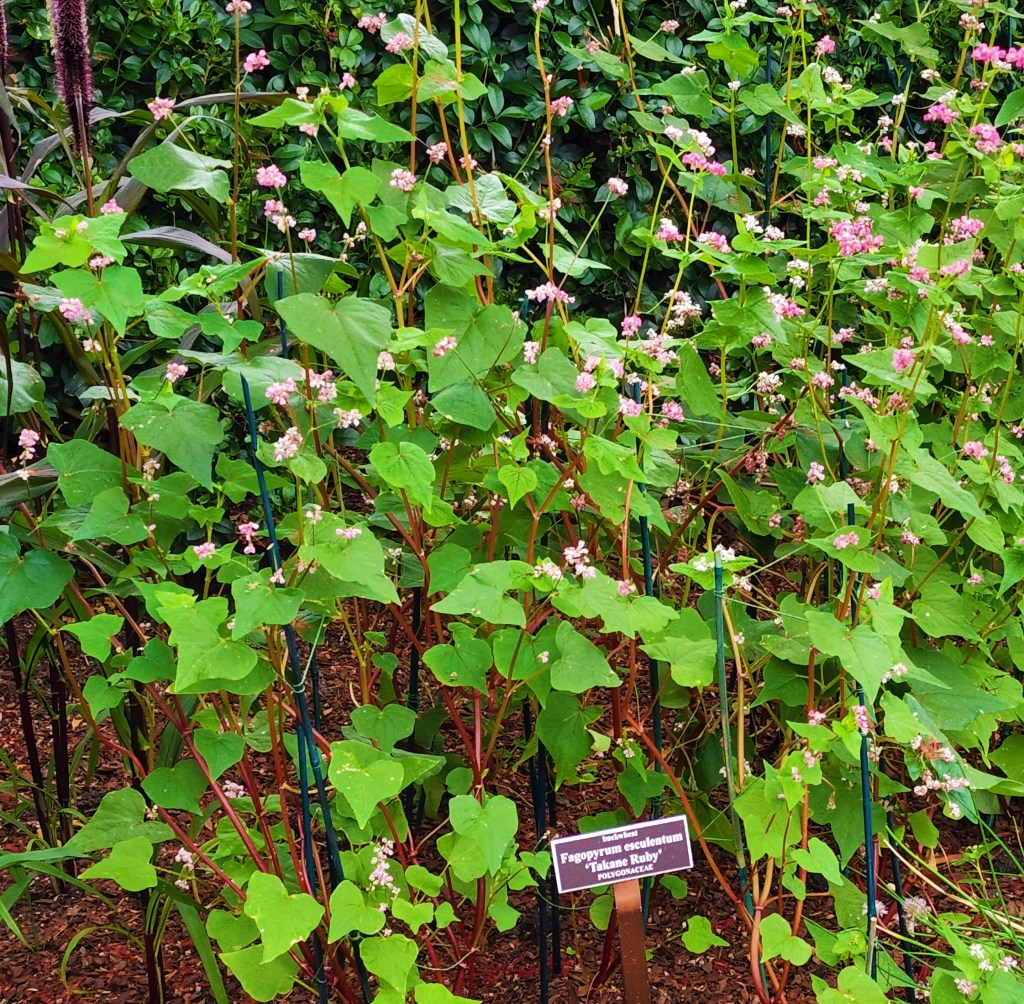
Found in various plantings in the Enid A. Haupt Conservatory which separate into three installations, we note the diverse and wide variety of living edible plants that are used in cuisines from Asia to South America, from Africa to Europe.

When one looks carefully, one finds the plants that are the basis of staples we cannot do without, like coffee, chocolate, sugar, flour and plants that nourish the animals that provide the meat we eat, for example the plants that produce the grains and corn fed to cattle, pigs, chickens and sheep.
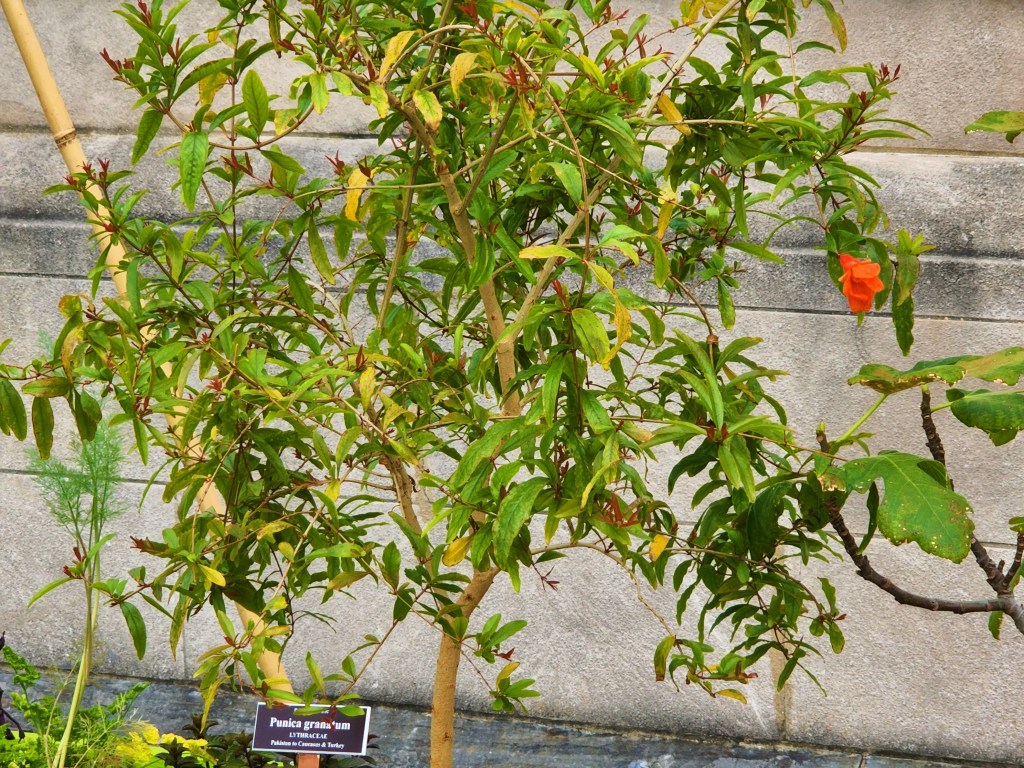

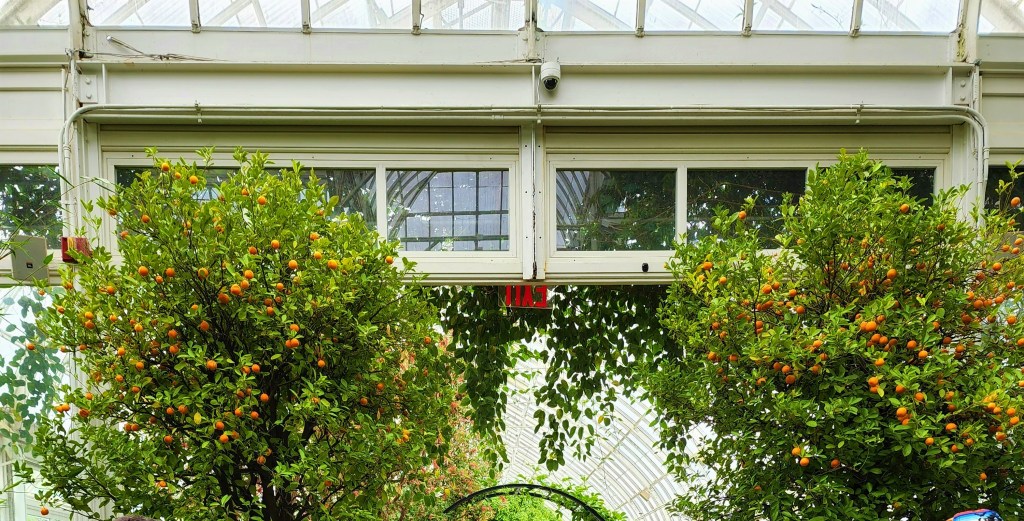
The displays of edible plants include hundreds of varieties including peppers, squash, cabbage, beans, grains, corn, banana, sugarcane, taro, breadfruit, fruit (tomatoes) and more.
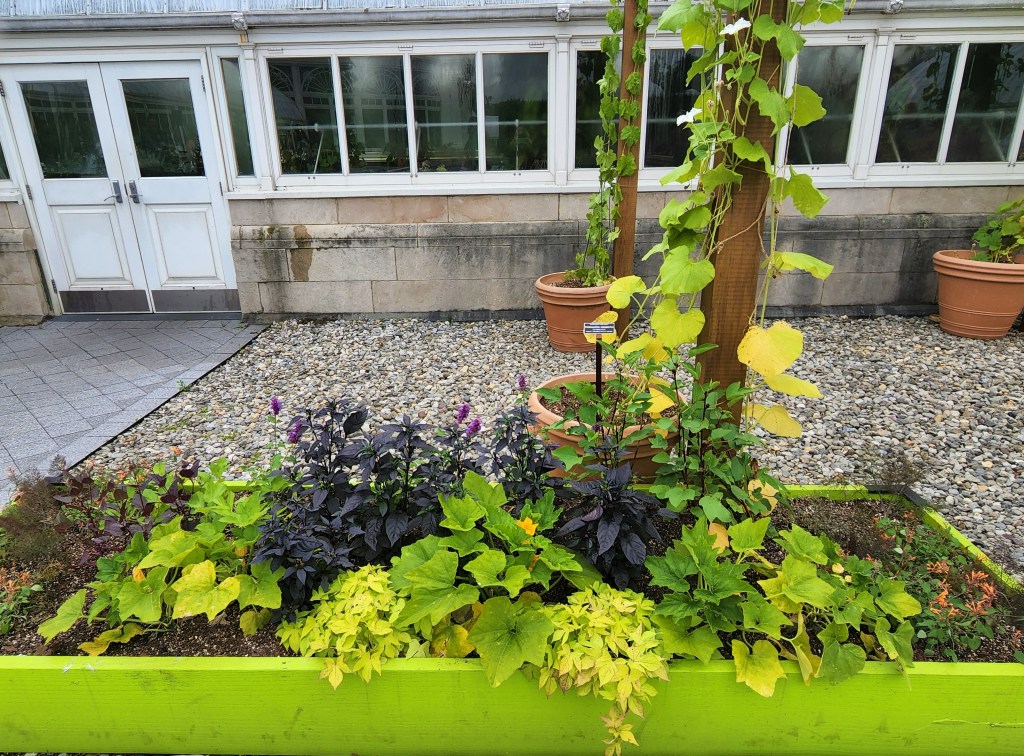


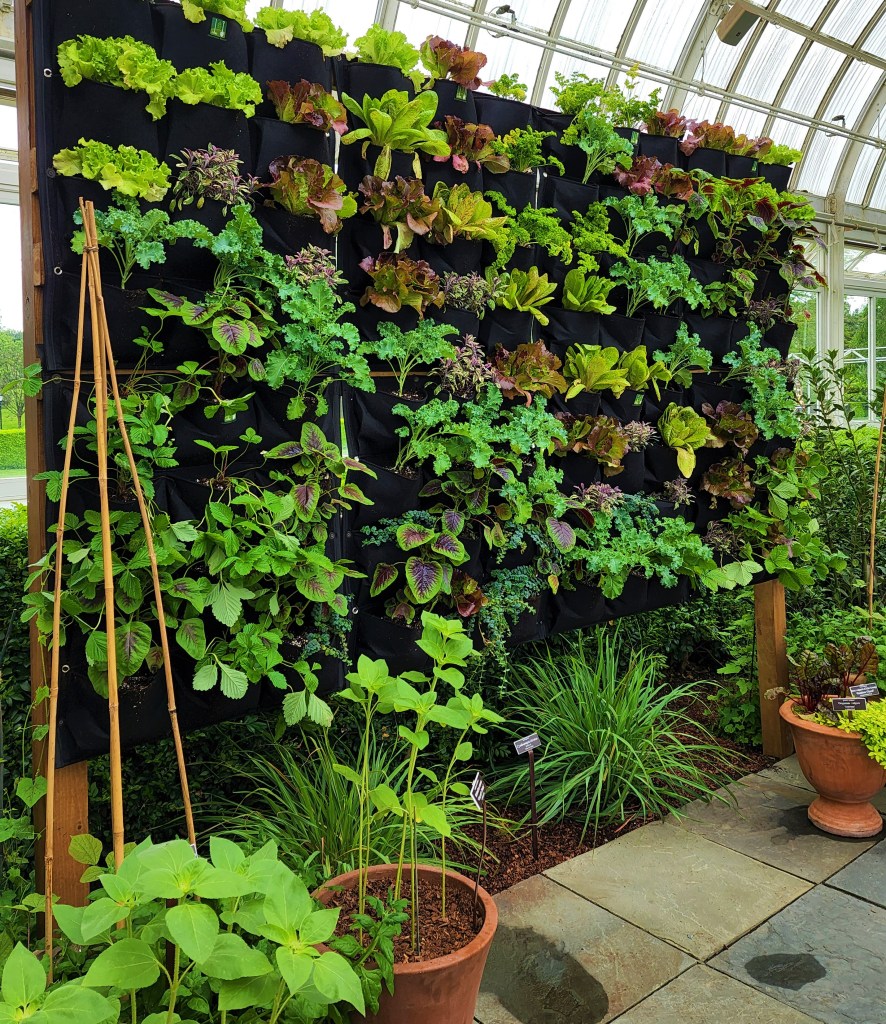
In the Conservatory’s Seasonal Exhibition Galleries is the assortment of edible herbaceous plants and fruit-bearing trees growing in containers, entwined in overhead trellises and creating green walls for compact urban spaces.
The Conservatory Courtyards present fig, citrus, olive and apple trees and reveal plants suited to tropical regions like rice, taro, mango, banana, manioc and breadfruit.
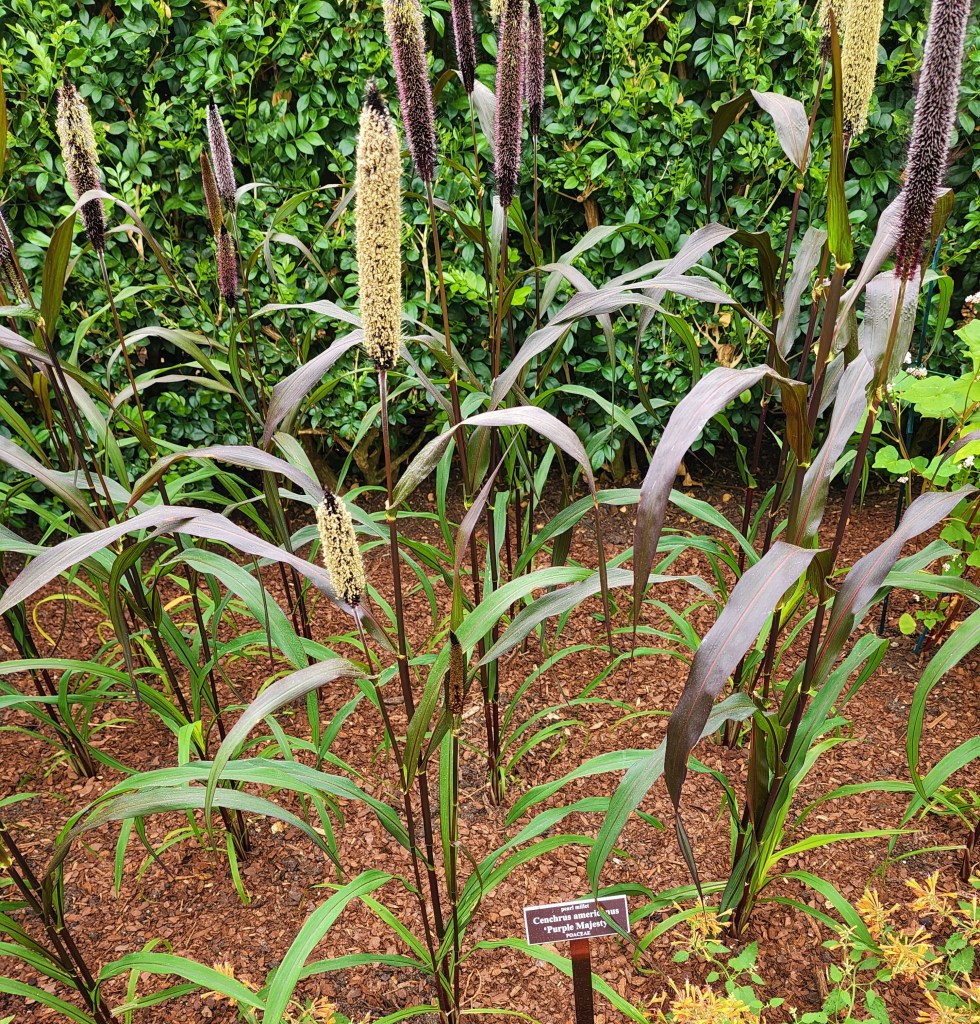

Look for the pearl millet, the nightshade section (tomatoes, peppers, and the herbs associated with them like basil). There is also a spirit garden indicating many of the plants used to create beer, wine, rum, liquors and the cork associated with the preservation of spirits and wines.

One of the more interesting installations is on The Conservatory Lawn. It has been transformed into a field of dwarf sorghum and barley. These traditional grains align with our climate and allow us to view the sowing, nurturing, harvesting and replanting over mini seasons. If you visit in early June and stop back at the end, you will be amazed at the growth of the height of the plants.
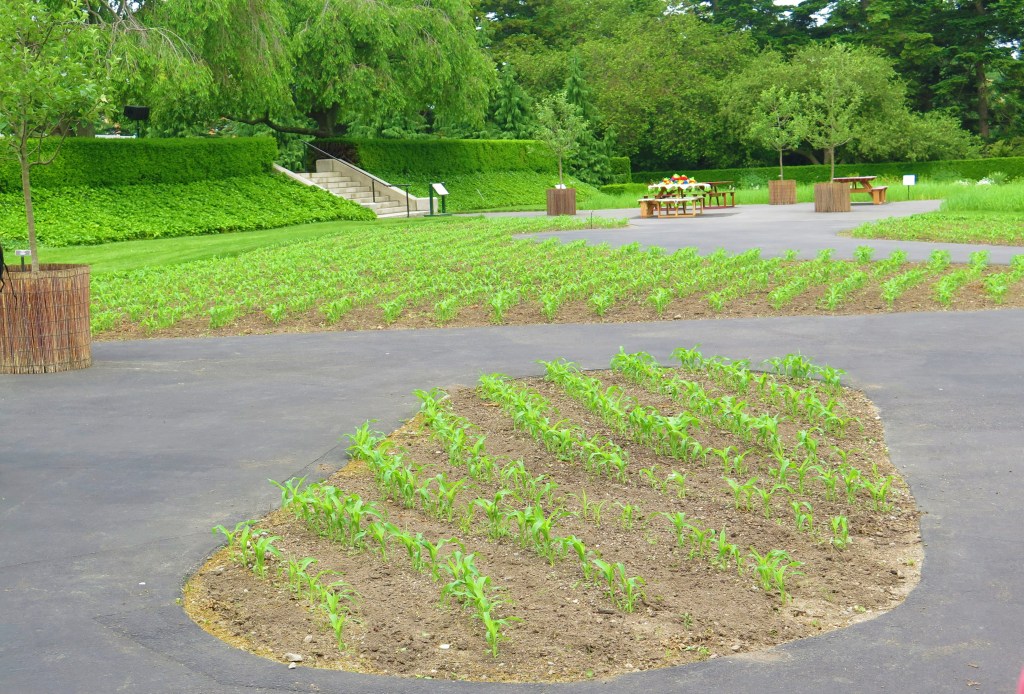
Interspersed among these plantings you will find picnic tables beautifully decorated by local artists that add a colorful effect amidst the field of green.

The Garden selected 30 artists living or working in the Bronx and they designed the tables that highlighted food themes from “Around the Table.”

These artistic works can be found outside and inside the LuEsther T. Mertz Library Building as well as throughout the grounds.


If you examine the table tops you will note edible plants that embody their own cultural heritage and significance and inspire the sharing of personal stories of foods traditionally served at holidays and celebrations.

It is through foods, most especially we are more open to understanding cultures different from our own.

In another section of the extensive exhibition, make sure to visit the African American Garden at the Edible Academy. The installation is entitled African American Garden: Remembrance & Resilience. It is curated by Dr. Jessica B. Harris, America’s leading scholar on the foods of the African Diaspora.

When you move along the walkways to look at the beds planted, you will be fascinated to connect with the plants that highlight African American culture and foods, gardening histories and tidbits about early Americana. The African American Garden features the contribution of essential plants to our collective history.
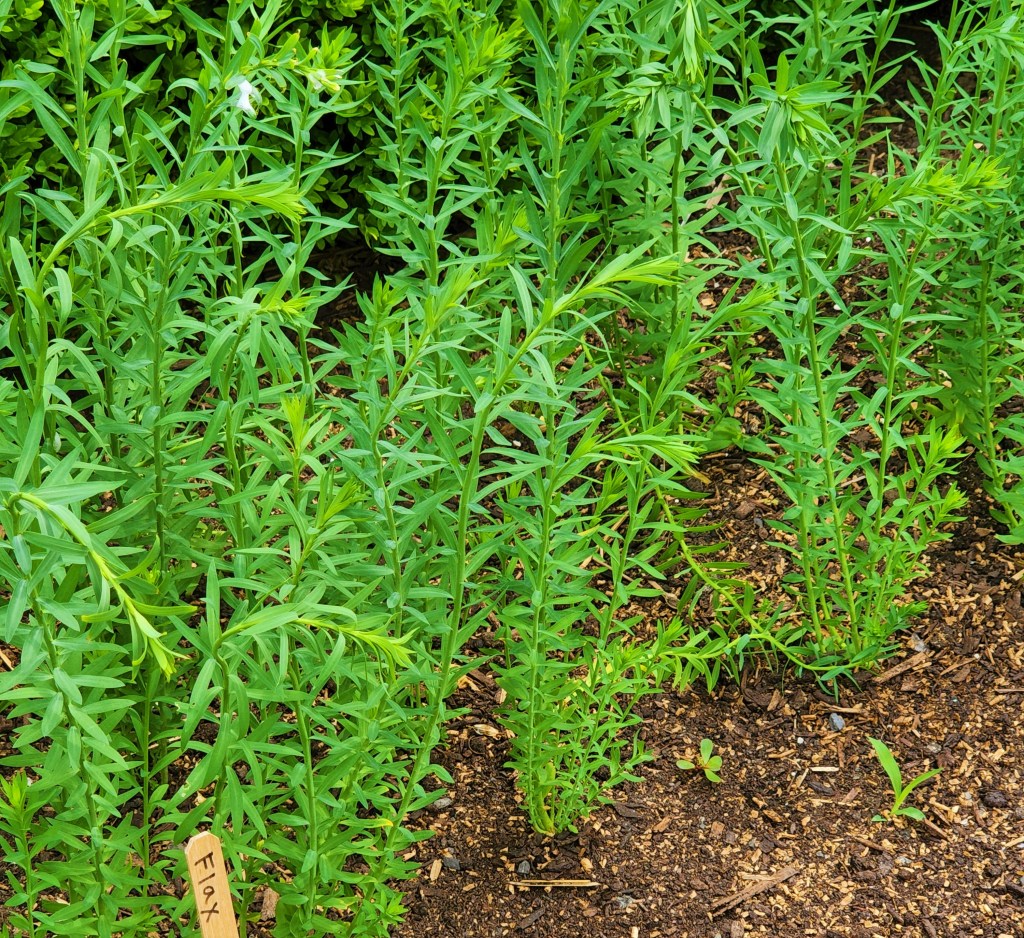
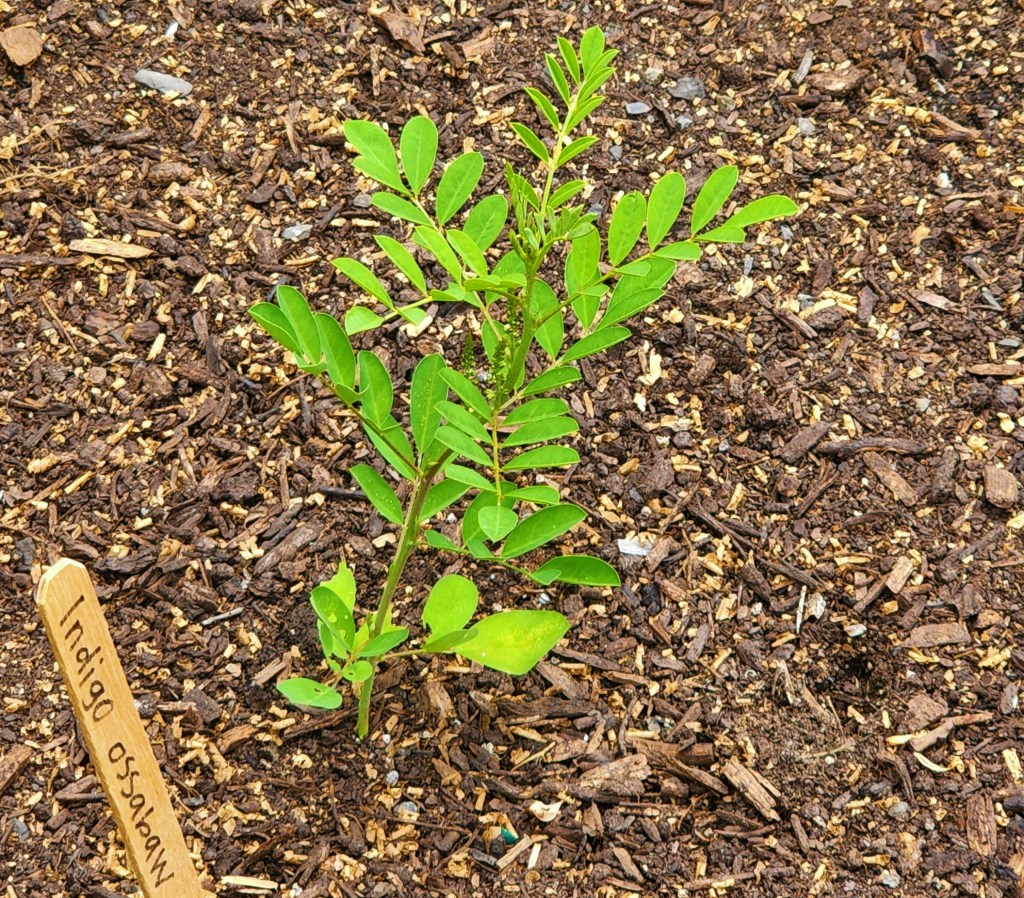

Dr. Harris worked with historians, heritage seed collectors, and NYBG’s Edible Academy staff to lay out a sequence of eight garden beds arranged in a semi-circle. These represent a celebration of African American food, plantings, and ongoing contributions to our country’s plant and food culture.
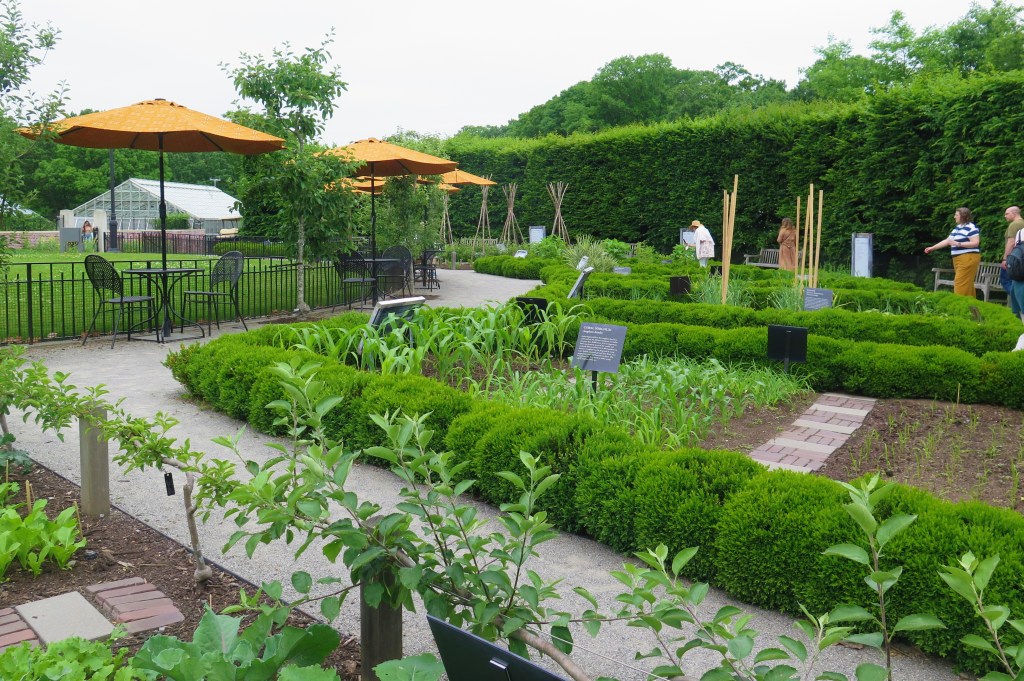

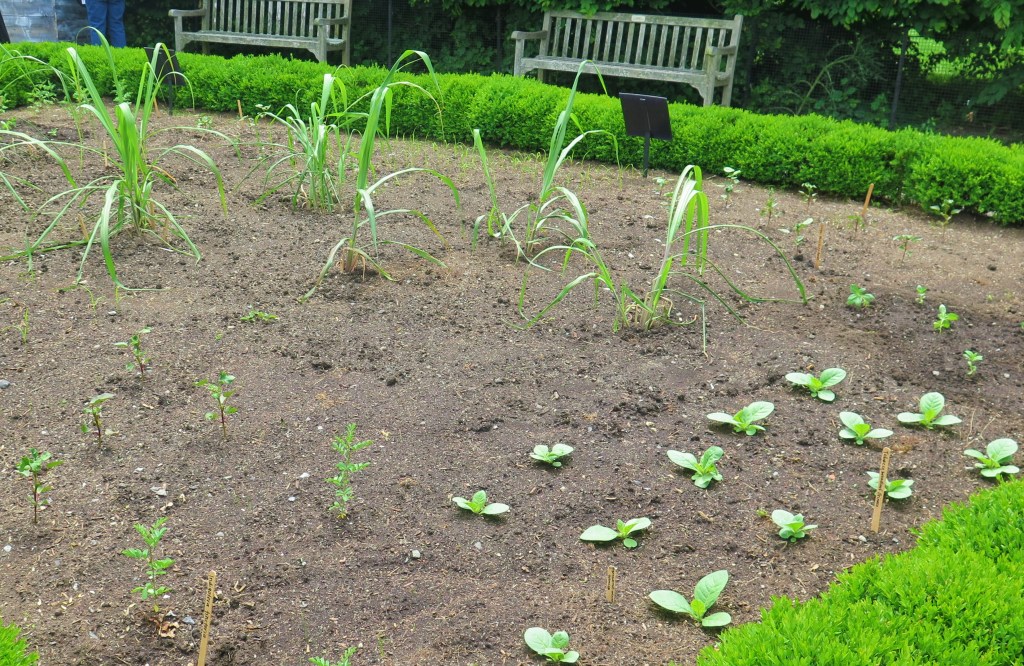

The experience includes an orientation center, shaded seating and a Hibiscus Drink Station. Stop by the drink station to cool yourself off with a taste of Roselle, sweetened or unsweetened.

With it saunter along the Poetry Walk curated by Cave Canem Foundation.
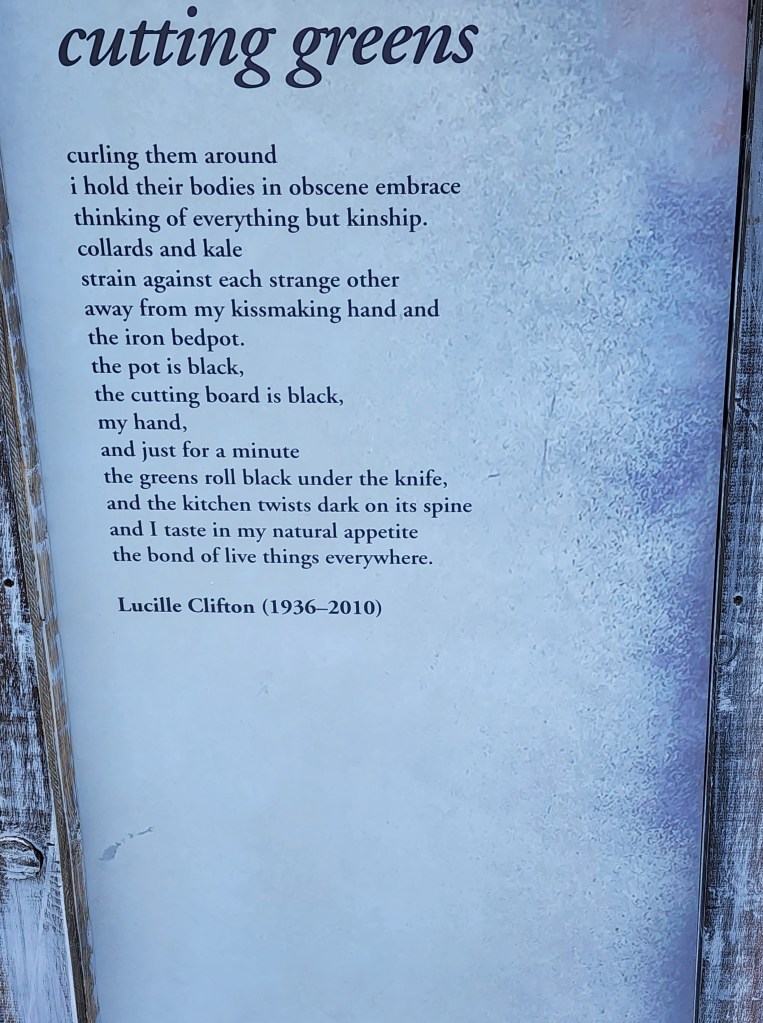
The Cave Canem Foundation is the premier home for Black poetry that is committed to cultivating the artistic and professional growth of African American poets.

Finally, visit the LuEsther T. Mertz Library Building Art Gallery to see the works of contemporary Colombian-American artist Lina Puerta in her exhibit on the first floor. It is entitled Lina Puerta: Accumulated Wisdom.

The artist highlights and gives voice to the invisible farm workers who labor in the fields for low pay and long hours. Throughout the country they are the voiceless abused by corporate owners who have exploited their labor. Without their labor where would populations be? Read Tomatoland by Barry Estabrook, an expose of agribusiness in Florida and how slave labor keeps the tasteless tomatoes coming to market.


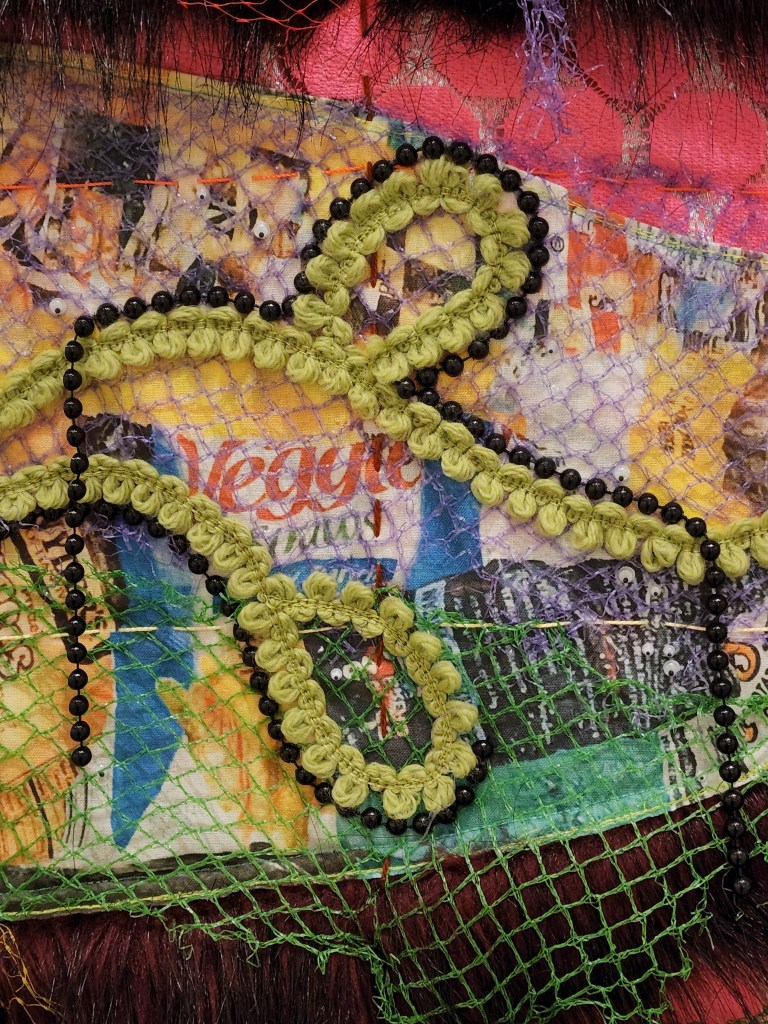
Puerta’s mixed-media sculptures, installations, collages, handmade paper paintings, and wall hangings are strikingly beautiful. They speak of farm workers and reveal the relationship between nature, the human-made and ancestral knowledge related to plants.

The materials she uses range from textiles and handmade paper to found, personal, and recycled objects.
This exhibit has an abundance of activities for adults, family and children alike. There are artist-designed table tours, food demonstrations, themed weekend celebrations to name a few.
Look out for A Seat at the Table on Saturday, June 18, 10 a.m. – 12 p.m. Two thrilling sessions will explore how Black farming informs American history and culture in New York City and across the country. Natalie Baszile, author of We Are Each Other’s Harvest, joins Dr. Jessica B. Harris, food historian and scholar, for the discussion at Ross Hall, “Celebrating the African American Farmer.” In “Stories from the Farm,” moderated by NYBG Trustee Karen Washington (farmer, urban gardener, food advocate, activist) will lead a multigenerational panel discussion devoted to stories of Black farmers from many perspectives urban and rural, North and South.
For complete programming on this incredible exhibition, Around the Table: Stories of the Foods We Love, to to the NYBG website by clicking HERE.
‘Jeff Leatham’s Kaleidoscope’: Orchid Show 2022, New York Botanical Garden’s Spectacular Horticultural Theater
Jeff Leatham’s Kaleidoscope Runs February 26 – May 1, 2022
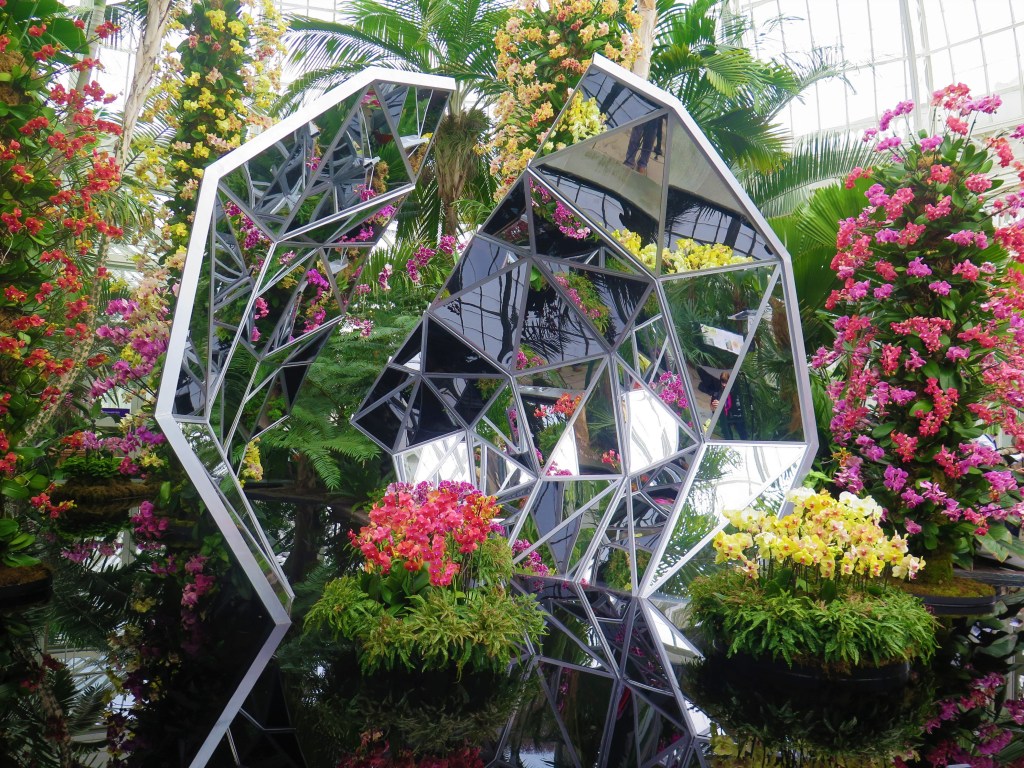
Lifestyle icon and floral designer to the stars (Oprah Winfrey, Cher, Dolly Parton, etc.), has returned for an encore presentation to the New York Botanical Garden after the show which he created in 2020 had to be curtailed because of the COVID-19 pandemic safety procedures and quarantine throughout the nation. But Leathem has reimagined the imagery of Kaleidoscope and once again the Enid A. Haupt Conservatory and its various galleries are shimmering in a pageantry of color-rich orchids of every shape, size and variety. If you love orchids, this is a show to see for its gorgeous delights.


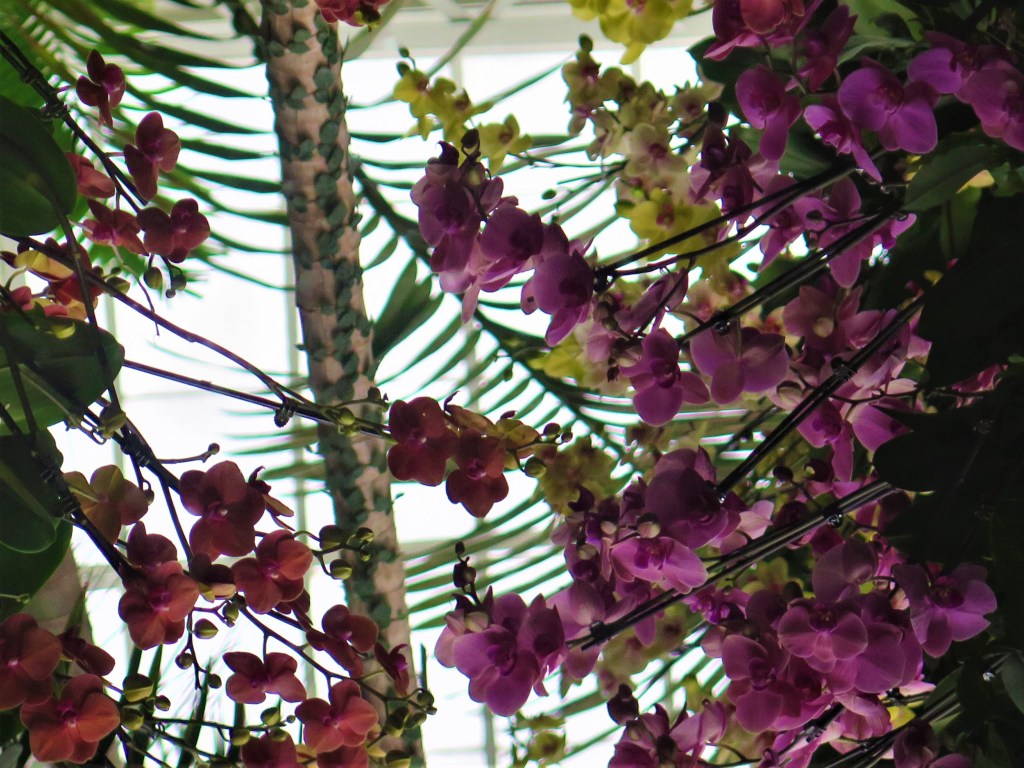
Lifestyle icon and floral designer to the stars (Oprah Winfrey, Cher, etc.), has returned for an encore presentation to the New York Botanical Garden after the show which he created in 2020 had to be curtailed because of the COVID-19 pandemic safety procedures and quarantine throughout the nation. But Leathem has reimagined the imagery of Kaleidoscope and once again the Enid A. Haupt Conservatory and its various galleries are shimmering in a pageantry of color-rich orchids of every shape, size and variety.
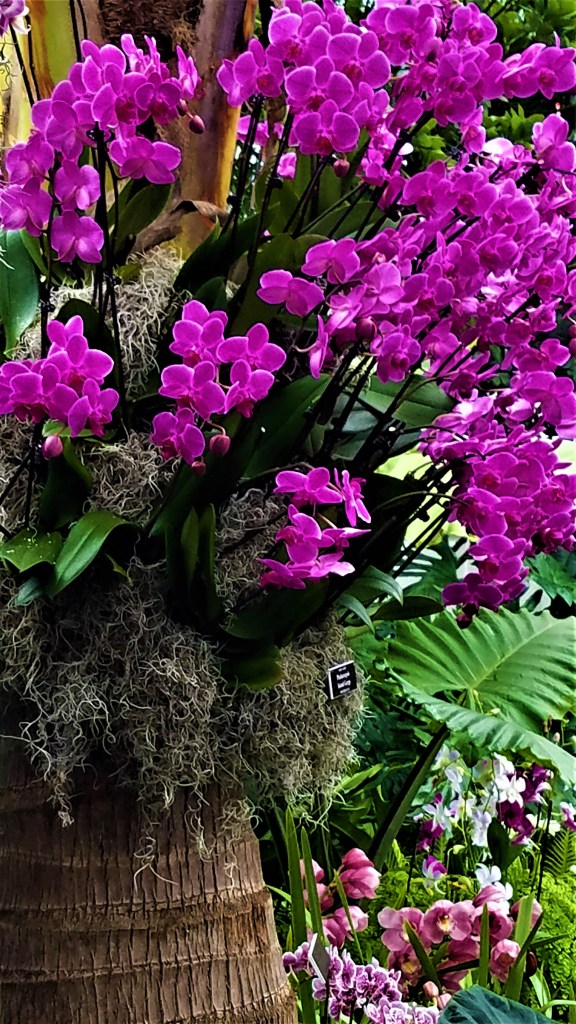
Jeff Leatham said, “I am thrilled to bring Kaleidoscope back to the New York Botanical Garden in 2022. Much like when you look into a Kaleidoscope, the view is never the same.”

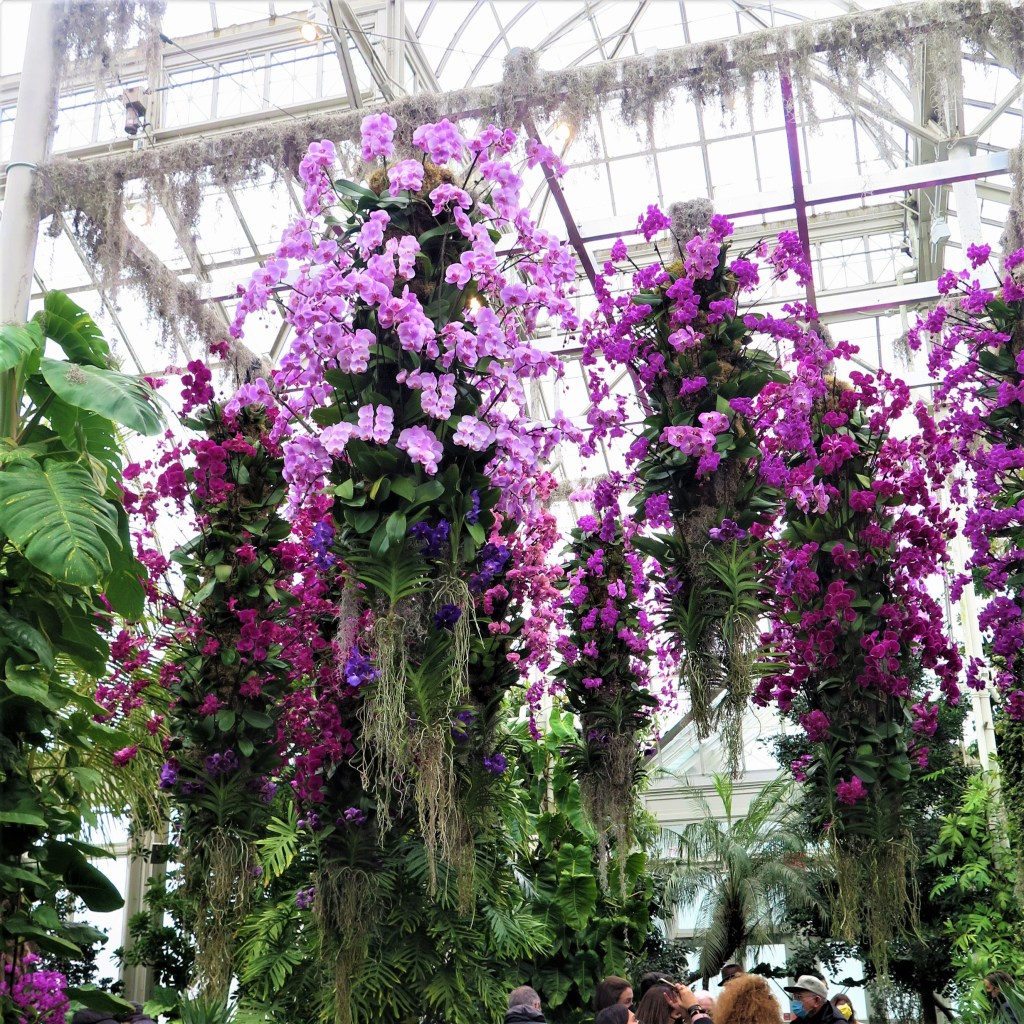
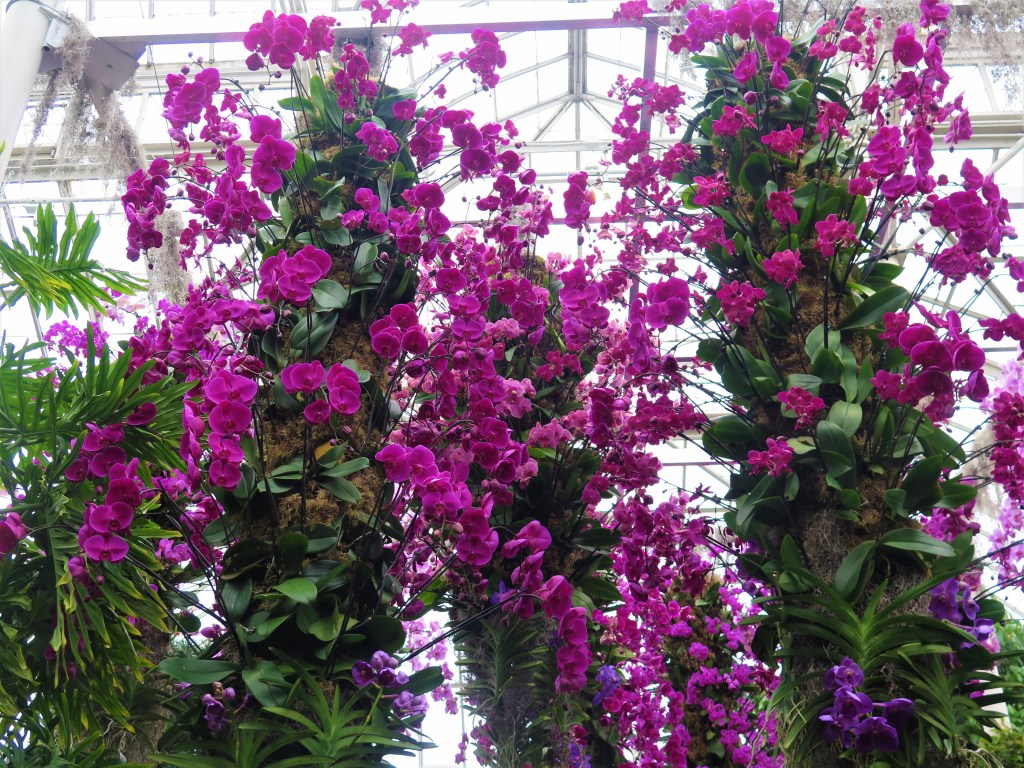
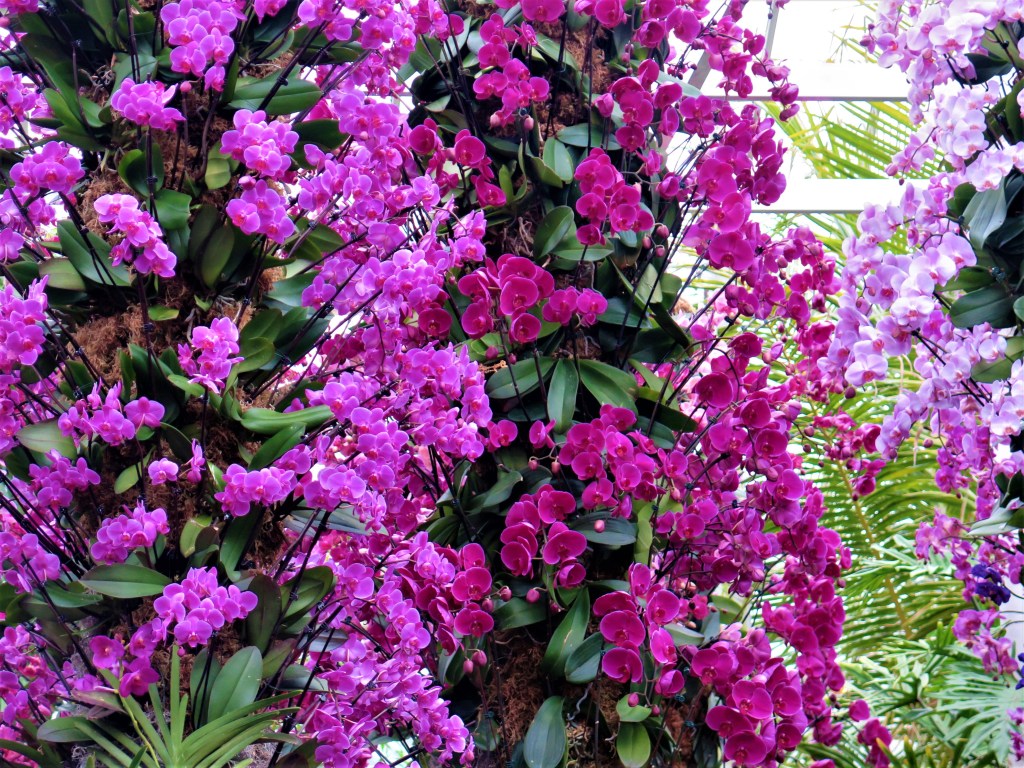
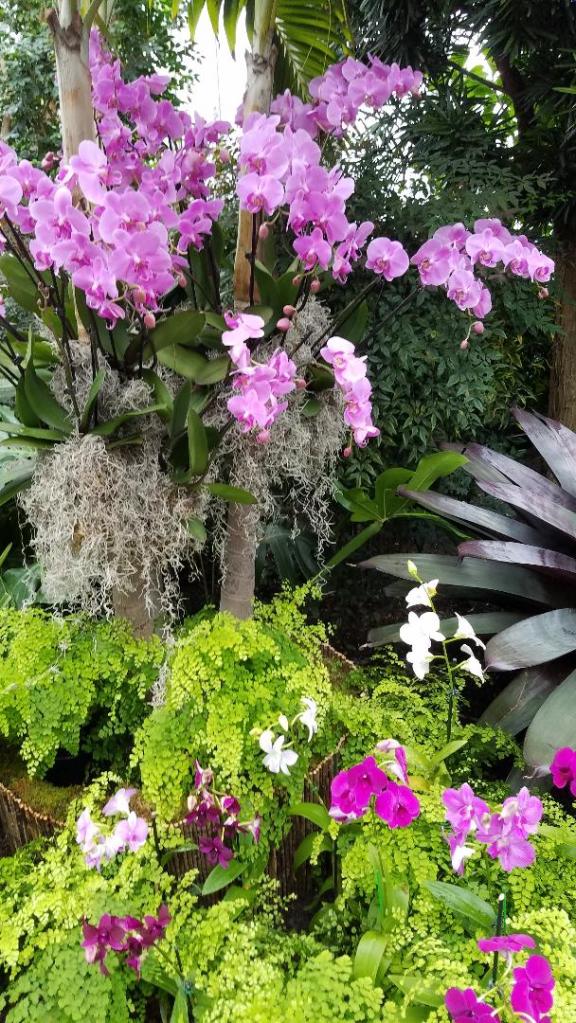
Kaleidoscopic, with rich, multi-various hues, orchids compose the largest family of plants in the world. They number from 28,000-30,000 natural species and from 150,000 hybrids. Botanists and horticulturalists are constantly coming up with new derivations inspired to craft hybrids. And these they sometimes name them for individuals and celebrities. Jeff Leatham has a hybrid Vanda named after him and Awkwafina (comedic rapper and award winning actress) has her own orchid named after her zaniness. These orchids were featured in previous orchid shows at NYBG in 2019 and 2020.
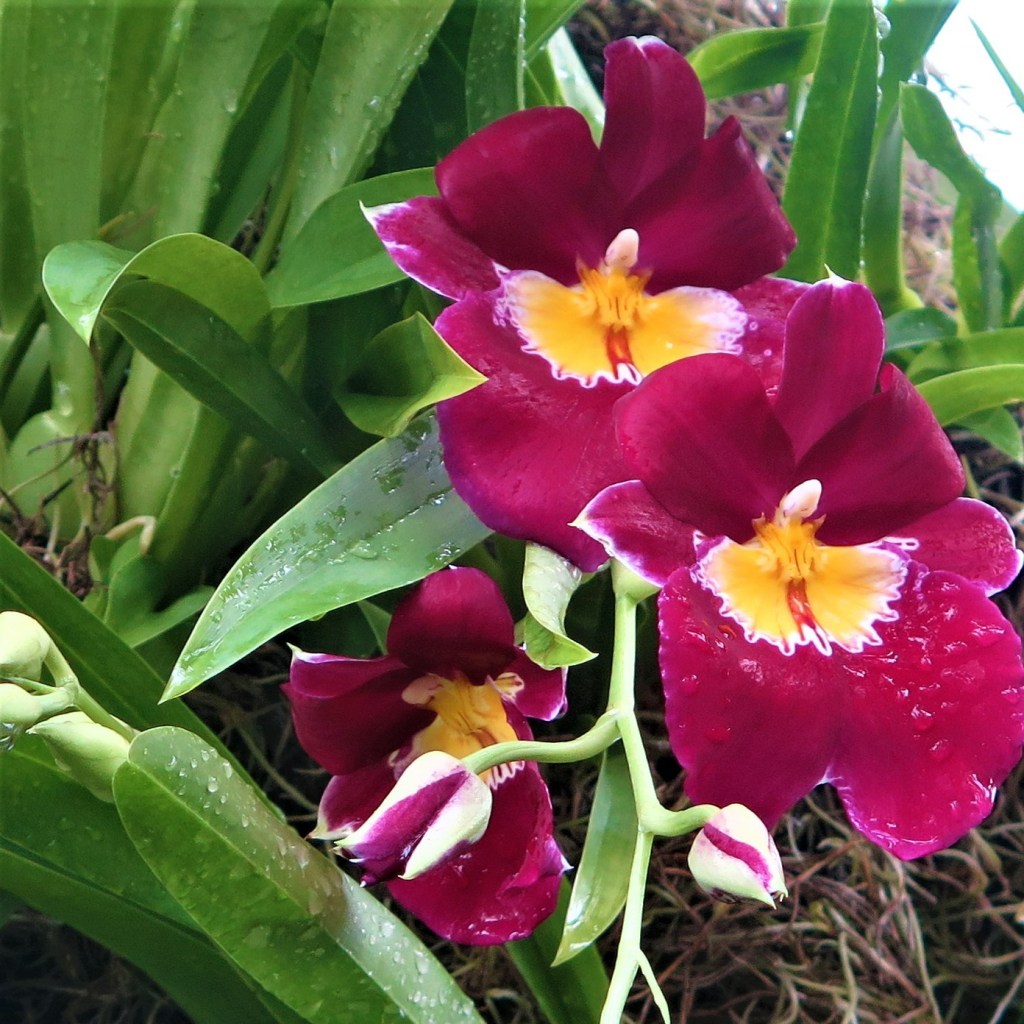

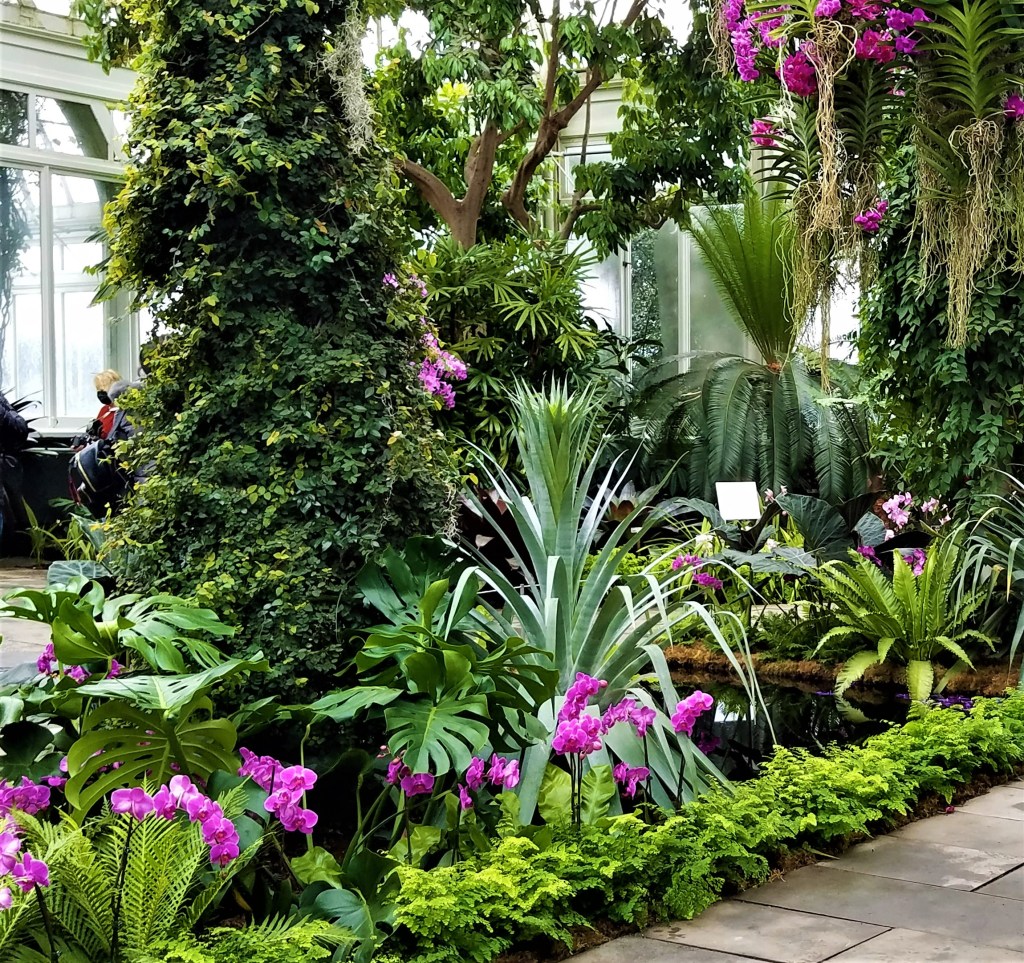


Orchids were assembled from the finest growers in the world in January and early February as the NYBG beds were graded and prepared for the 2022 Orchid Show. Leatham worked with horticulturalists from NYBG and Marc Hachadourian, the Senior Curator of Orchids who advised what orchids would last longest for various displays and what could be replaced to keep the displays looking fresh until May 1st when the show closes. The plantings and design took two weeks.
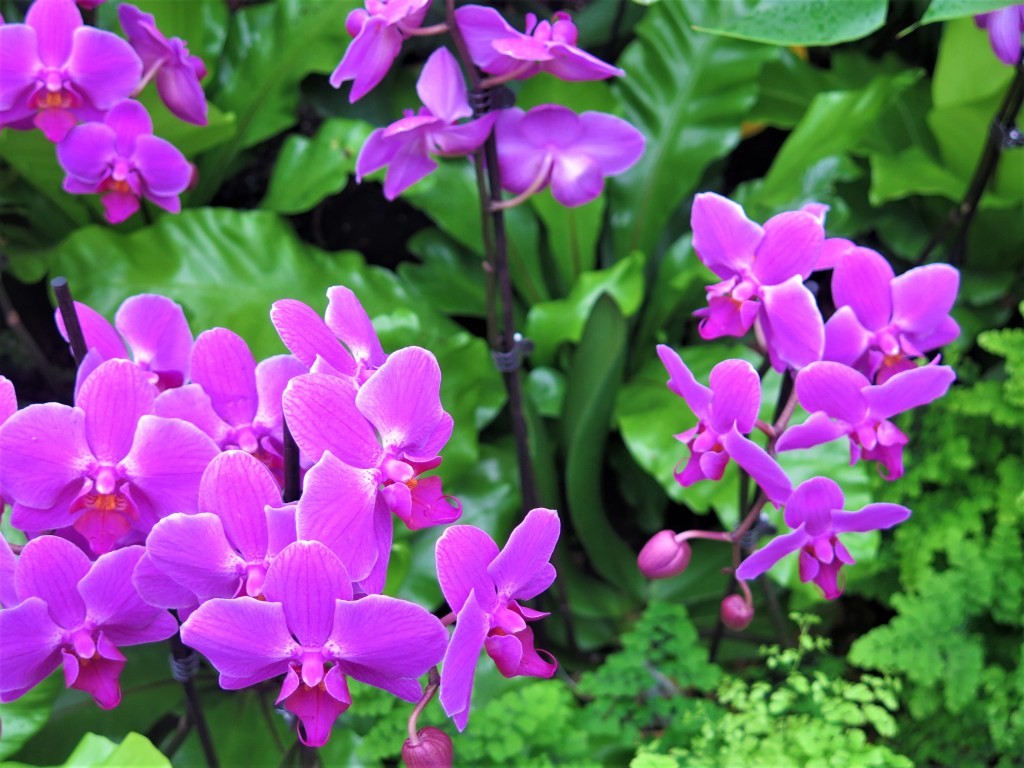
Jeff Leatham’s work is a meld of his love for flowers and his passion for design. His displays are dramatic, vibrant and memorable. He integrates his arrangements seamlessly with his settings. Jeff has produced striking displays in Paris for two decades. In 2014 he was knighted with the Ordre des Arts et des Lettres, the highest honor for artists and others who have made a significant contribution to French culture.

On select Fridays and Saturdays in March and April, adults 21 and over can experience the exhibition at night with music, cash bars and food available for purchase ORCHID EVENINGS WILL TAKE PLACE: MARCH 26, APRIL 2, 9, 16, 22, AND 23, 2022; 7-10 p.m.

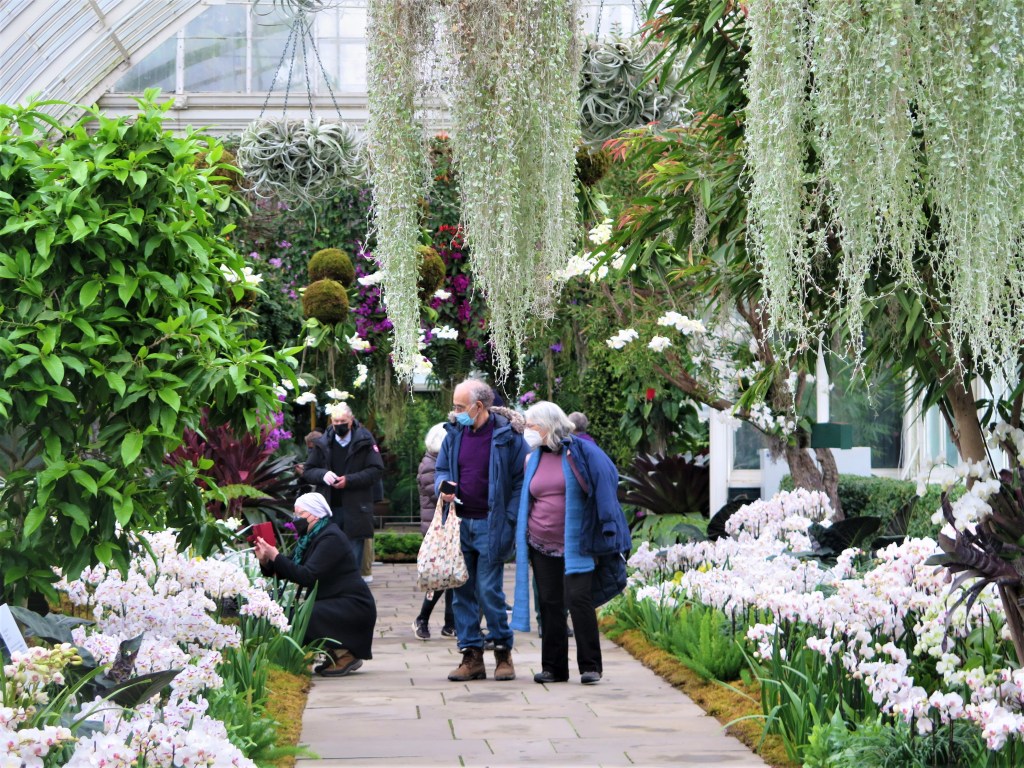

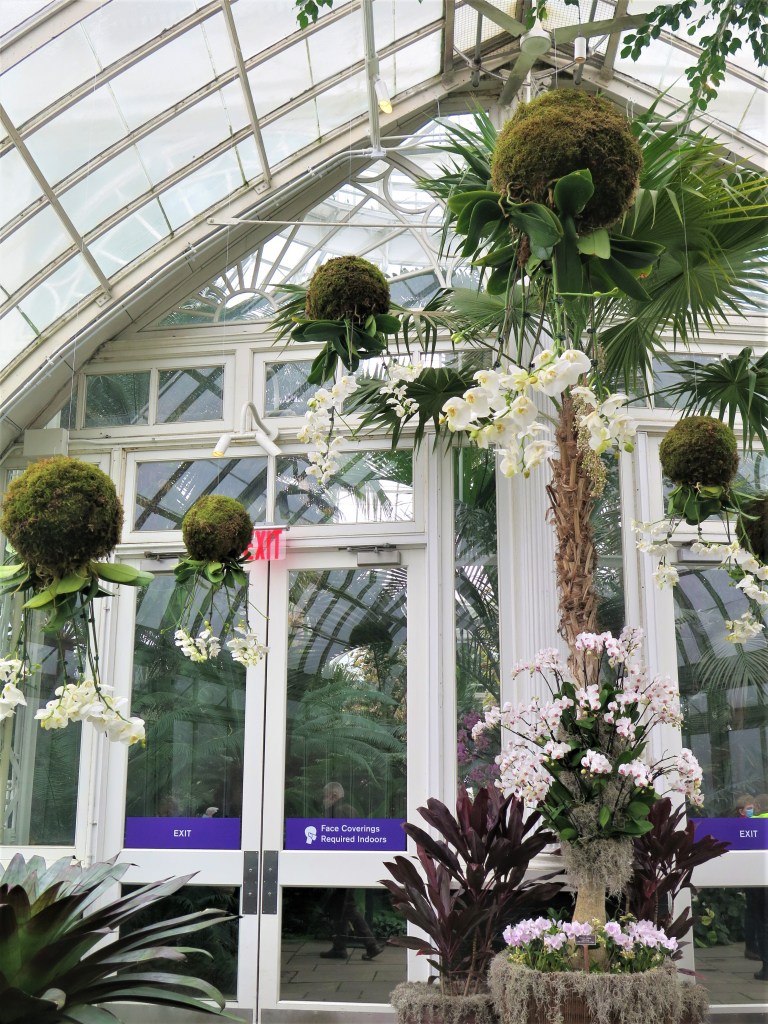
At NYBG Shop, Orchid Show visitors can purchase Jeff Leatham’s publications: Flowers by Jeff Leatham, Flowers by Design, and Jeff Leatham: Visionary Floral Art and Design. These are best-selling design books globally.
For more information about the 19th Annual Orchid Show: Jeff Leatham’s Kaleidoscope visit https://www.nybg.org/event/the-orchid-show/
‘Lotus,’ by Carole Di Tosti, Photos by Gwen Greenthal
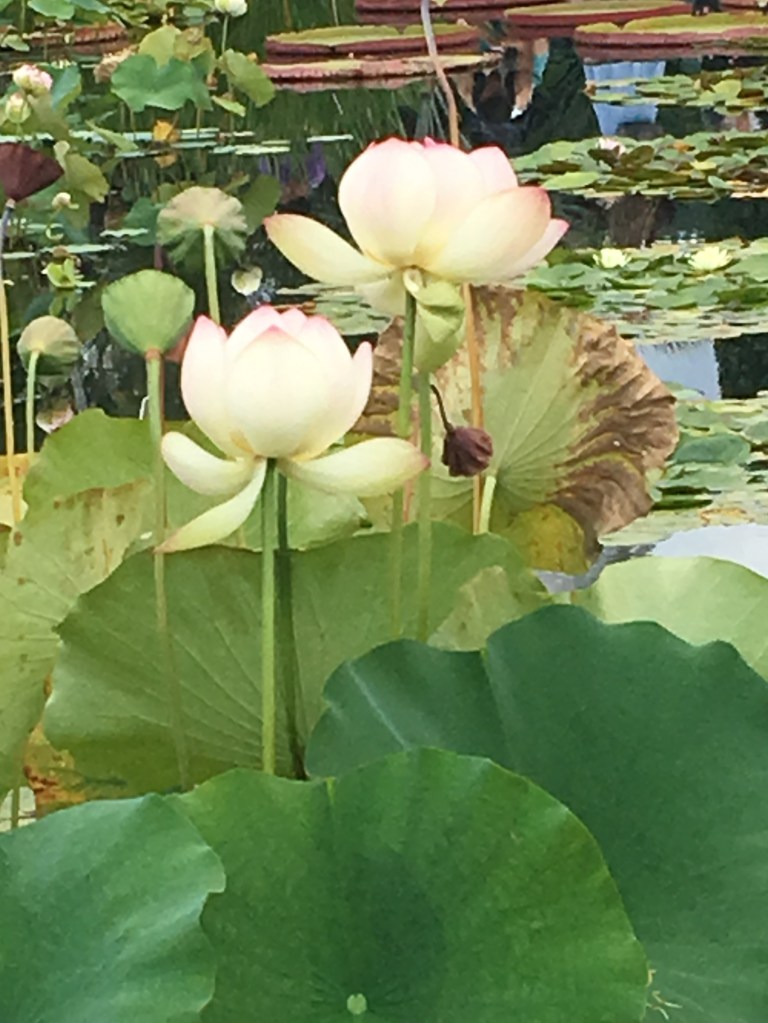
In my newly released book of sonnets Light Shifts, there are five featured sections. In ‘God in Nature,’ there are two sonnets about Lotuses, one opening the section, the other closing it. I considered adding pictures, then realized that unless they could be duplicated via Kindle digital (they don’t show well) that the photos would be misrepresented. Photographer Gwen Greenthal’s photos are too lovely to be distorted. When Amazon moves to hard cover and upgrades the technology to include exact facsimiles of photos, I will consider it. To check out Light Shifts, go to my books page: https://caroleditostibooks.com/

LOTUS
The fragrance fragile, hints of frankincense.
The buds so creamy, shaded tapering pinks.
The petals seek the sun in recompense.
From watery darkness muddy roots did drink.
Enfolded in the torpid dank and slime
With faith that soon its glorious day will come,
It waits in dormancy then slowly climbs,
In skyward grace to bask in citrine sun.
How many of your kind just stayed below,
Devoid of spark to seek the spiritual light?
How many not ignited by God’s flow
Of love, instead did die in wilted blight?
A miracle each risen Lotus bloom,
A wealth of glorious life born in the gloom.
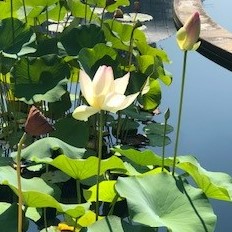
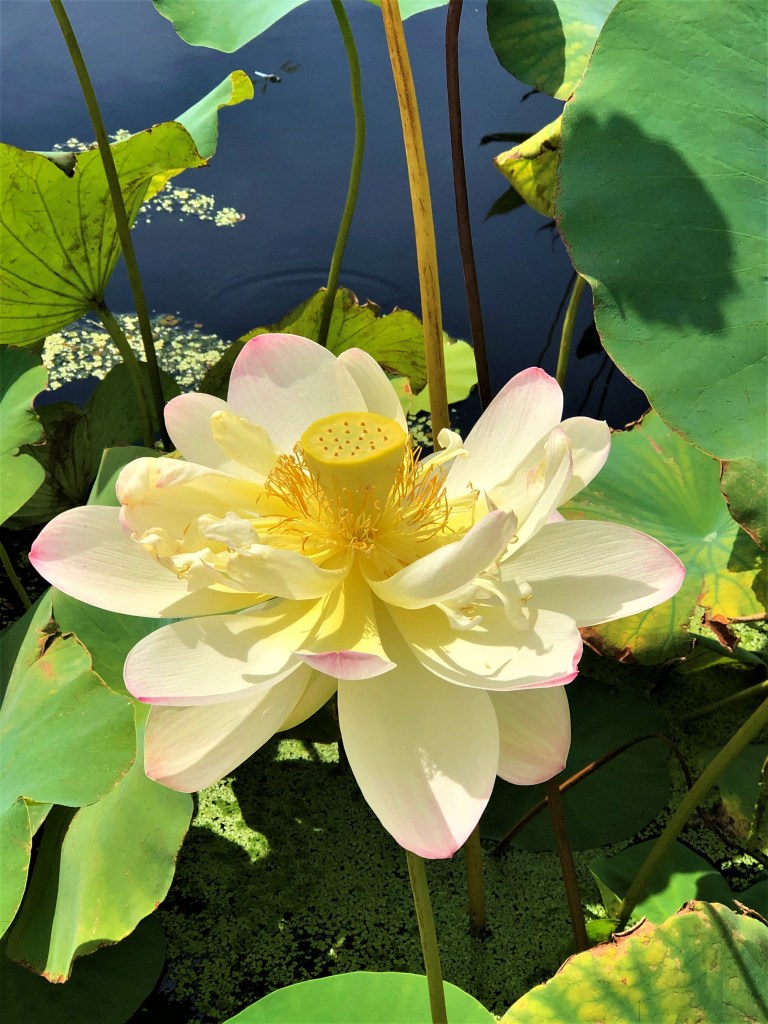
Lotuses are represented in the literature of most cultures in the world. Their beauty and transience (two-day blooms) retain philosophical symbolism associated with purity, fertility, compassion, transformation, and spiritual enlightenment. Its scientific name is Nelumbo nucifera. It is referred to as Sacred lotus and Indian lotus. Sacred lotus has long been used as a food source and ingredient for traditional herbal remedies. Plant parts contain neuroprotective agents that interact with specific targets to inhibit Alzheimer’s disease (AD).
New York Botanical Garden Orchid Show Tickets on Sale February 3, 2022
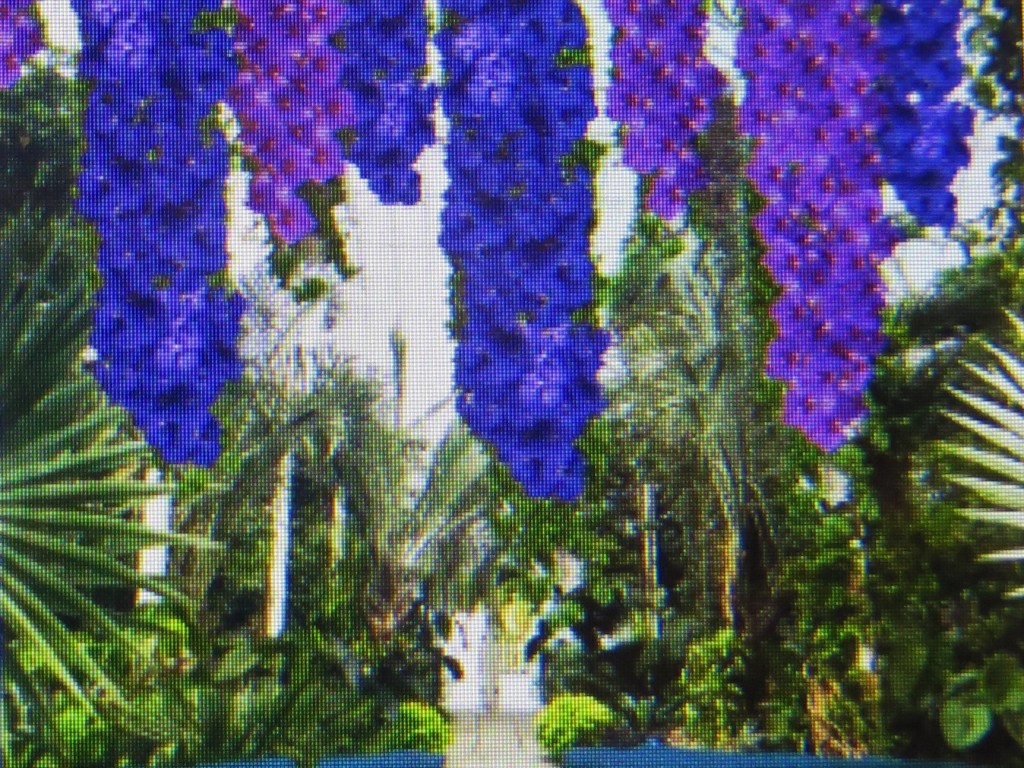
The 19th NYBG Orchid Show is burgeoning into a hopeful springtime event two years after the 2020 Orchid Show was halted due to COVID-19. The popular exhibition will be on view from February 26 through May 1, 2022, and I am excited to announce that it is reopening with Jeff Leatham’s Kaleidoscope. The extraordinary exhibit by lifestyle icon and floral designer to the stars will be a reimagining of his glorious, bold, vibrant creations with dazzling, new twists as a celebration of renewal and persistence.

Leatham’s creative genius will transform each gallery of the exhibition in the Enid A. Haupt Conservatory into a different color experience. Imagine you are immersed in the heart of a botanical kaleidoscope. And if you venture through the galleries at different times during the day from the morning light to the afternoon sun which casts a uniquely different glow on the orchids and foliage, indeed the colors are ever changing, the hues shadowed and dusky as the sun sets. All of the variables of light and shade and the great selection of stunning orchids and their hues are Jeff Leatham’s palette.
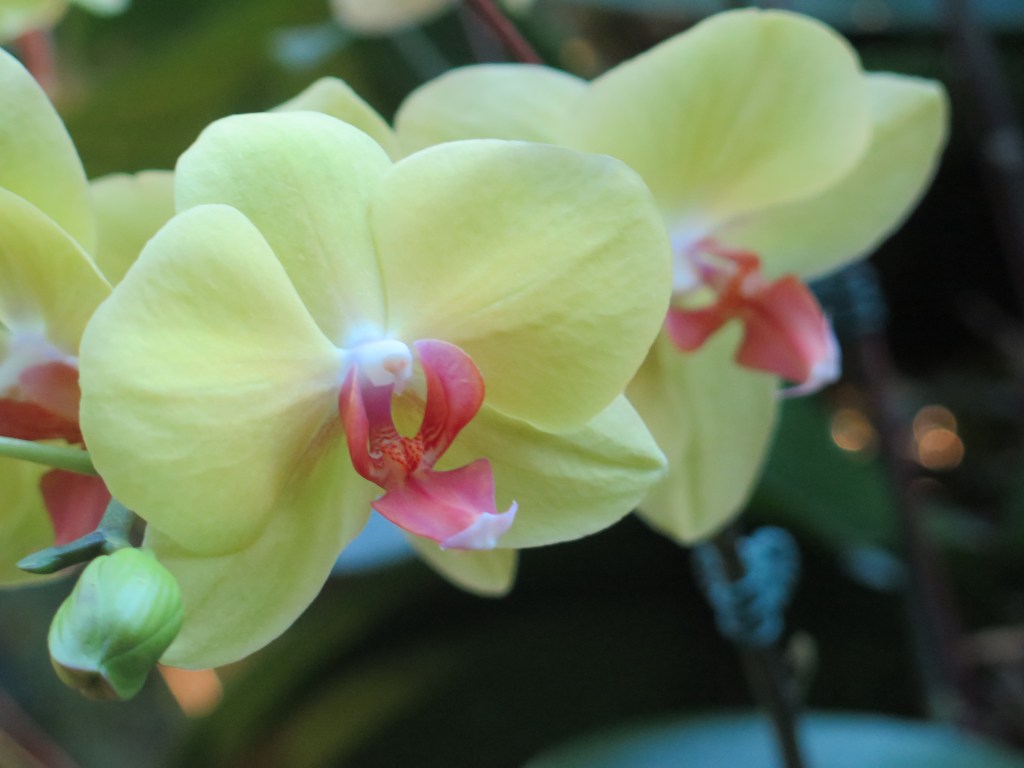
Working with horticulturists from NYBG, including Senior Curator of Orchids Marc Hachadourian, Leatham
selects orchids from NYBG collections as well as from some of the finest growers in the world. Keeping the kaleidoscope theme in mind, Leatham’ orchid towers of orange, yellow and green, the undulating fields of white and overhead plumes of purple combined with artistic embellishments will dazzle visitors as they saunter on walkways of beauty arranged as horticultural pageantry.

Amazing and unique orchids, one of the largest species of plants in the world, are always represented at the NYBG Orchid Show and this year is no exception. For those more scientifically minded, they may note orchids of seemingly every conceivable shape and provenance, iconic hybrids as well as rare specimens under glass. The configurations and arrangements all are designed by the artistry of the affable and renowned Leatham whose shows are one-of-a-kind amazements. This year’s Orchid Show may have the same name as the 2020 Orchid Show, but Leatham’s exhibit promises to be evocatively different. That is who Jeff Leatham is and movement, grace and forward thinking creations are his brand.

On select Fridays and Saturdays in March and April, adults 21 and over can experience the exhibition
at night with music, cash bars, and food available for purchase. Magical Orchid Evenings will take place on March 26, April 2, 9, 16, 22, and 23, 2022; 7–10 p.m.
Tickets will be available at https://www.nybg.org/visit/admission/
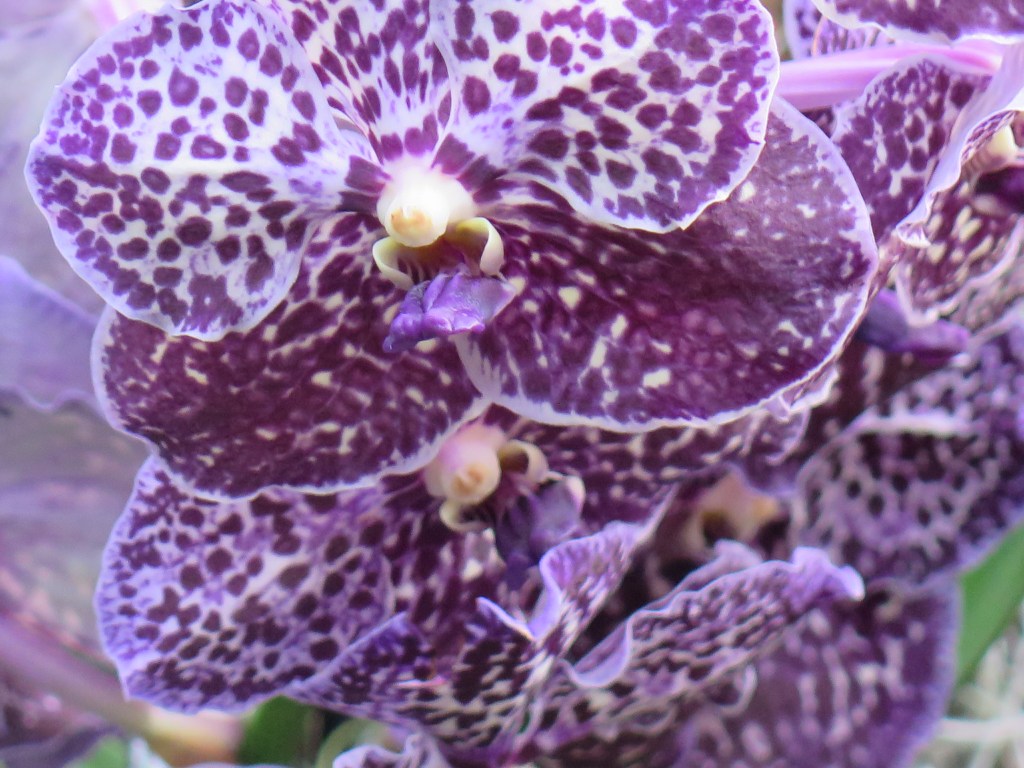
At the New York Botanical Garden Shop, visitors of the Orchid Show have the opportunity to select from thousands of top-quality orchids that are available for purchase. Some of these include exotic, hard-to-find specimens for connoisseurs to elegant yet easy-to-grow varieties for beginners, along with orchid products and books.

Jeff Leatham is the award-winning artistic director of the Four Seasons Hotel George V, Paris. He has studios at the Four Seasons Hotel Philadelphia at Comcast Center. Also, he has a studio at the Four Seasons Hotel Los Angeles at Beverly Hills.
His work combines his love for flowers and his passion for design. Using shape, color, and simplicity, his creations are dramatic, bold, unforgettable statements that are always an integral part of the setting. His clients include Dolly Parton, Tina Turner, Cher, Oprah Winfrey and others. His publications—Flowers by Jeff Leatham, Flowers by Design, and Jeff Leatham: Visionary Floral Art and Design are best-selling design books worldwide
For more information about The Orchid Show: Jeff Leatham’s Kaleidoscope, visit http://www.nybg.org/event/the-orchid-show/
New York Botanical Garden’s GLOW and The Holiday Train Show® Are Not to be Missed


The winter season is in full swing with the NYBG’s 30th Year Milestone Celebration of The Holiday Train Show® (Saturday, November 20, 2021 – Sunday, January 23, 2022 from 10 a.m. – 6 p.m.)
The beautiful exhibit which features over 1 mile of train track and a 360 degree surround space in an added gallery is a favorite of New Yorkers. This year’s show features new additions to its collection which now number over 191 miniature structures of New York City and New York State landmarks.
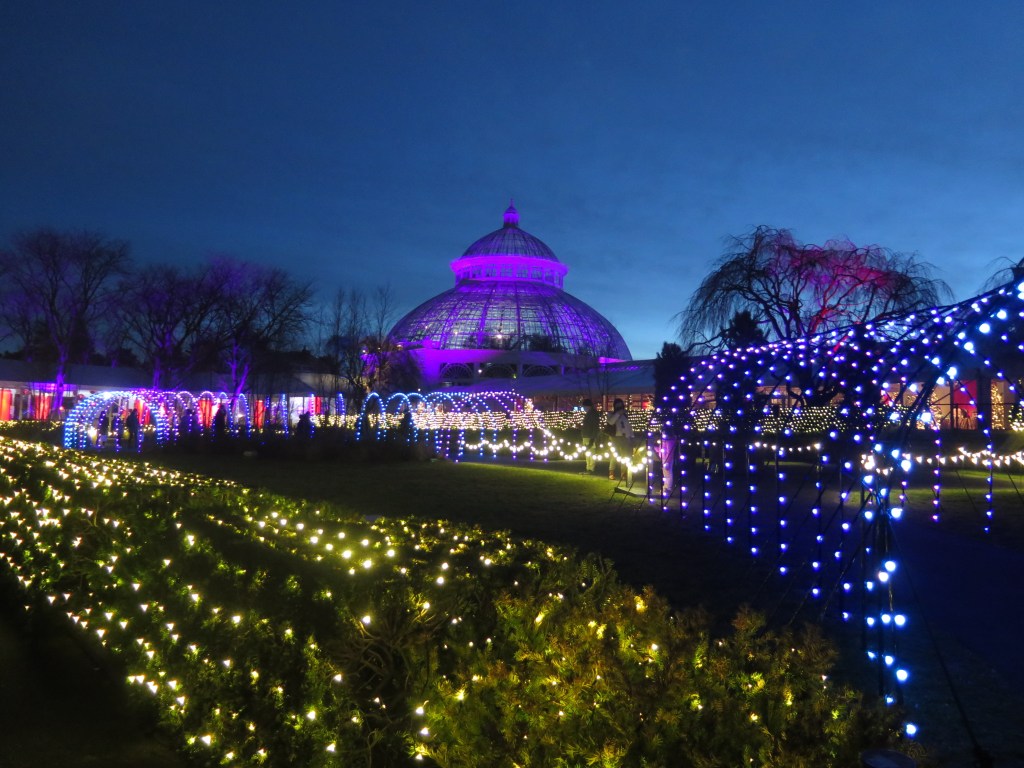
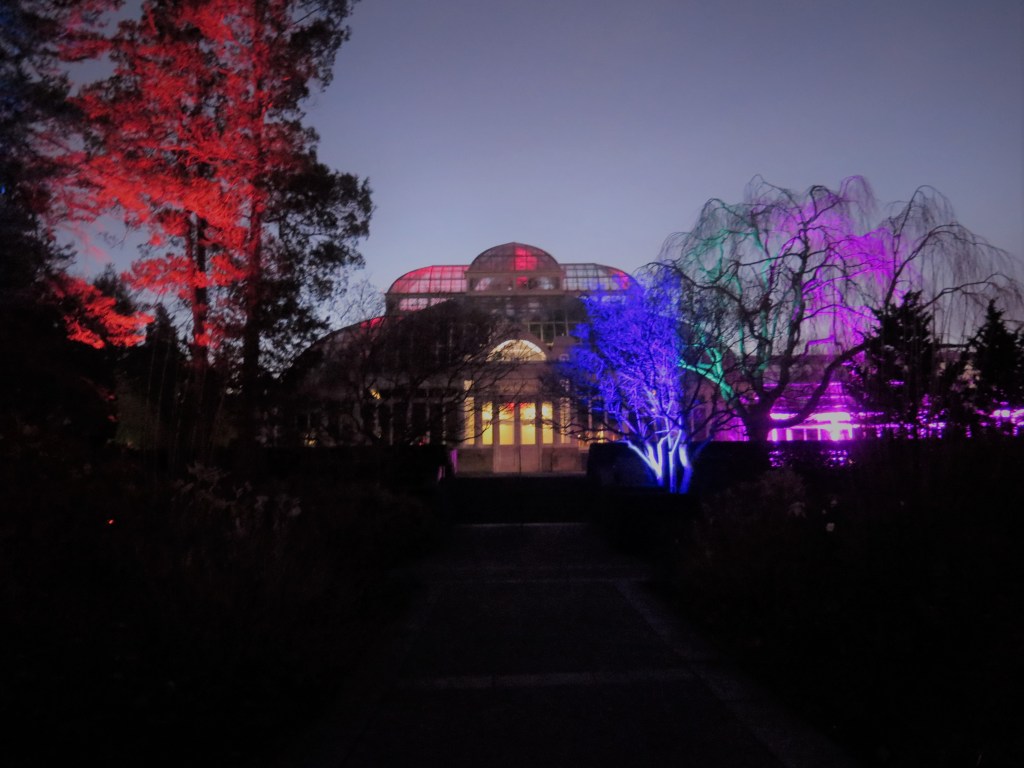
Once again as part of the Train Show on a new combination ticket is the expanded light exhibit GLOW. As the sun sets and the moon rises on select dates, family and friends can wander through the Garden’s festively illuminated landscape and enjoy the 1.5 mile color-and-light extravaganza that begins at 5 pm and ends at 10 p.m.
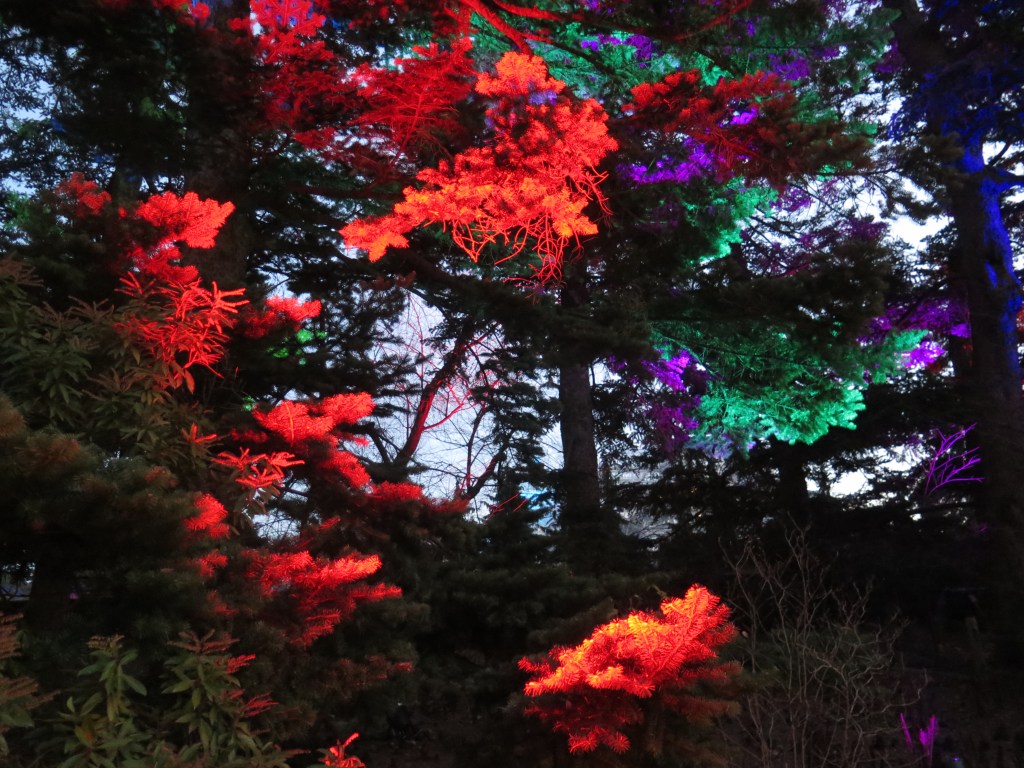
Tickets are available for the following dates: Thursday, December 23, Sunday, December 26 – Thursday, December 30. In January, these dates are available: Saturday, January 1, January 6, 7, 8, 14, 15, 21, 22.
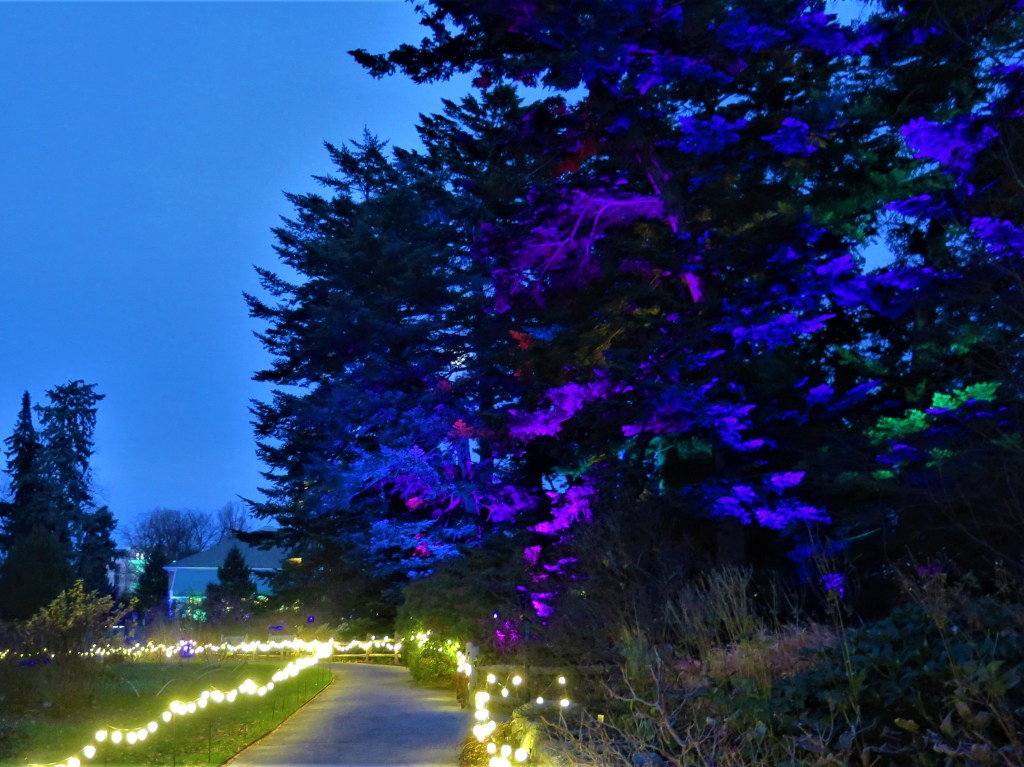

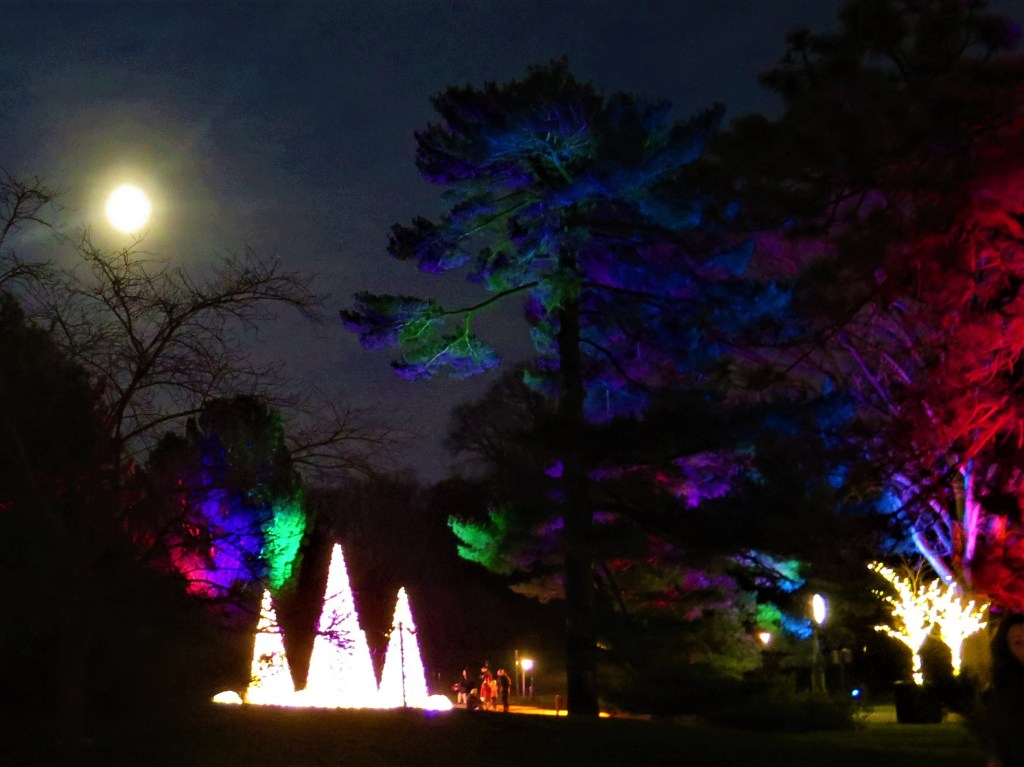

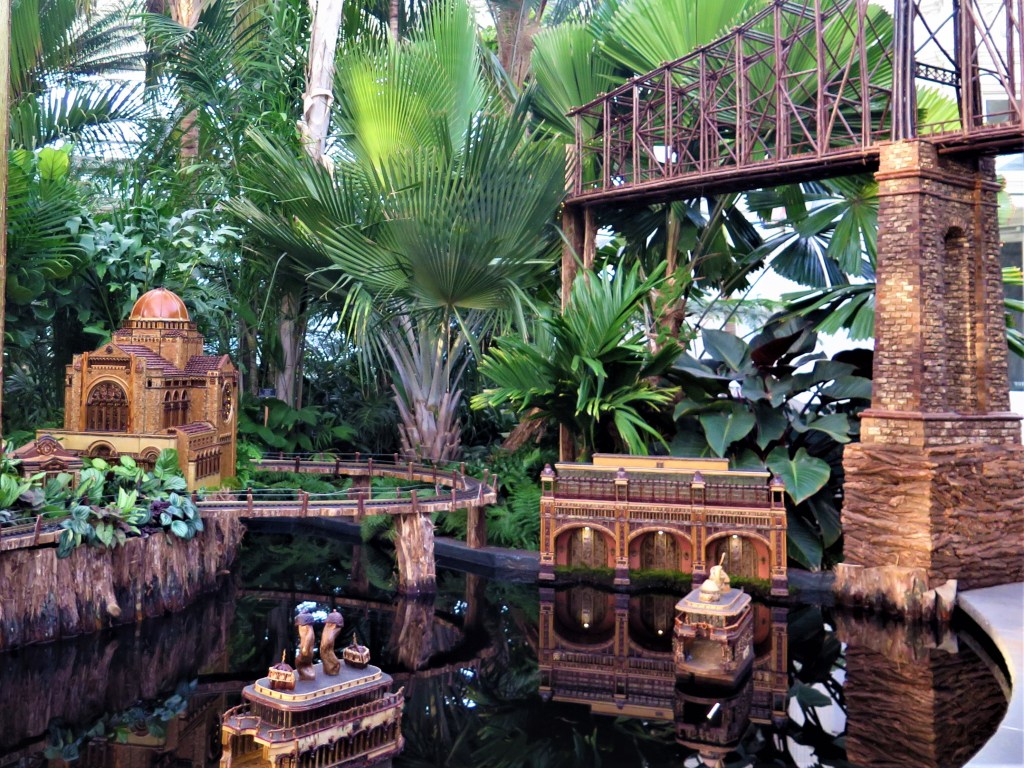
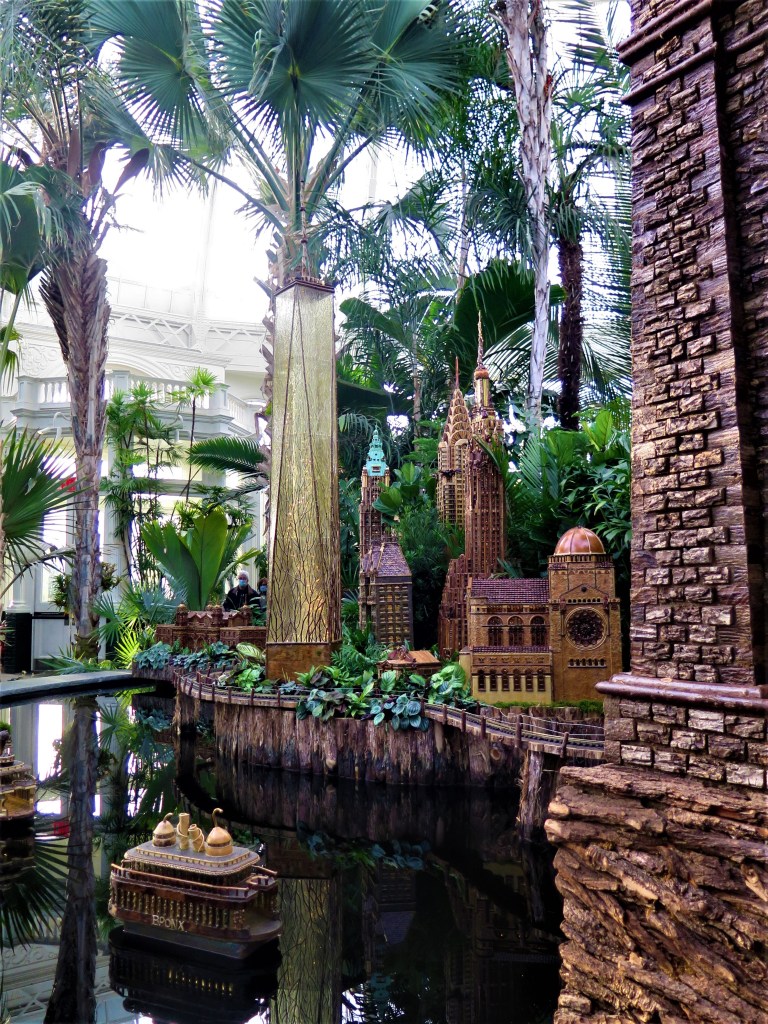
When you buy your combination ticket for NYBG GLOW and the Holiday Train Show® expect to be dazzled on two fronts. Indoors, you will enjoy the shimmering lights that ethereally pierce through the foliage of lovely plantings and New York replicas of Applied Imagination’s architectural structures perfectly arranged so that a variety of old model trains, trolleys, whimsical streetcars can speed by the miniature iconic New York landmarks.

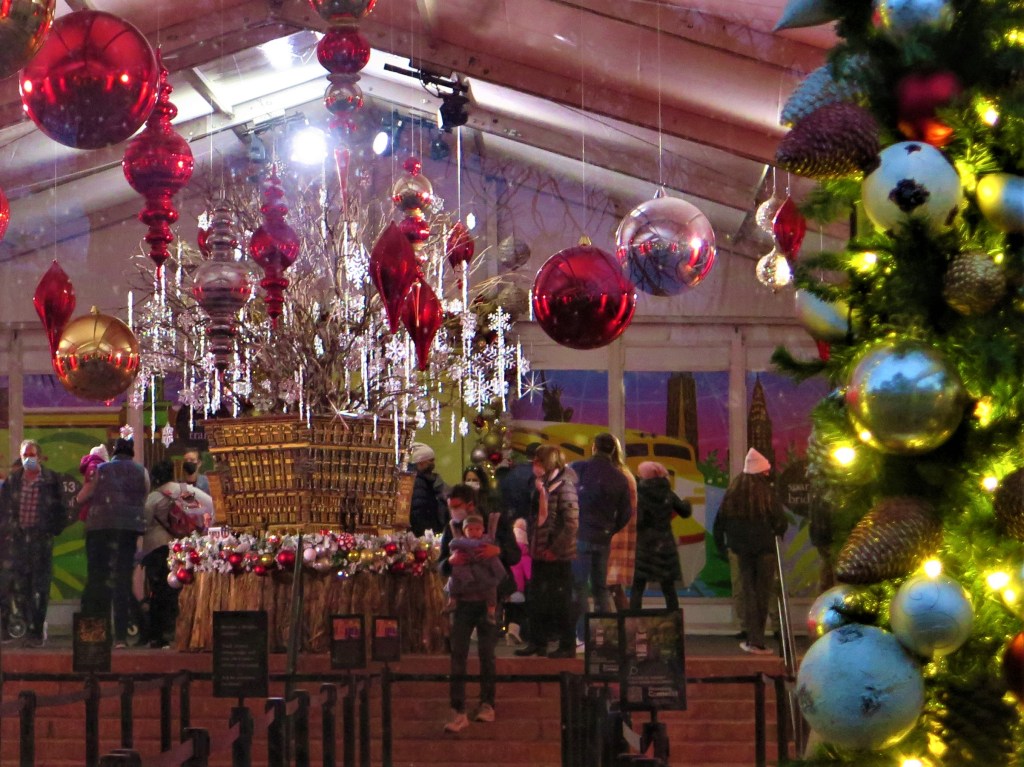
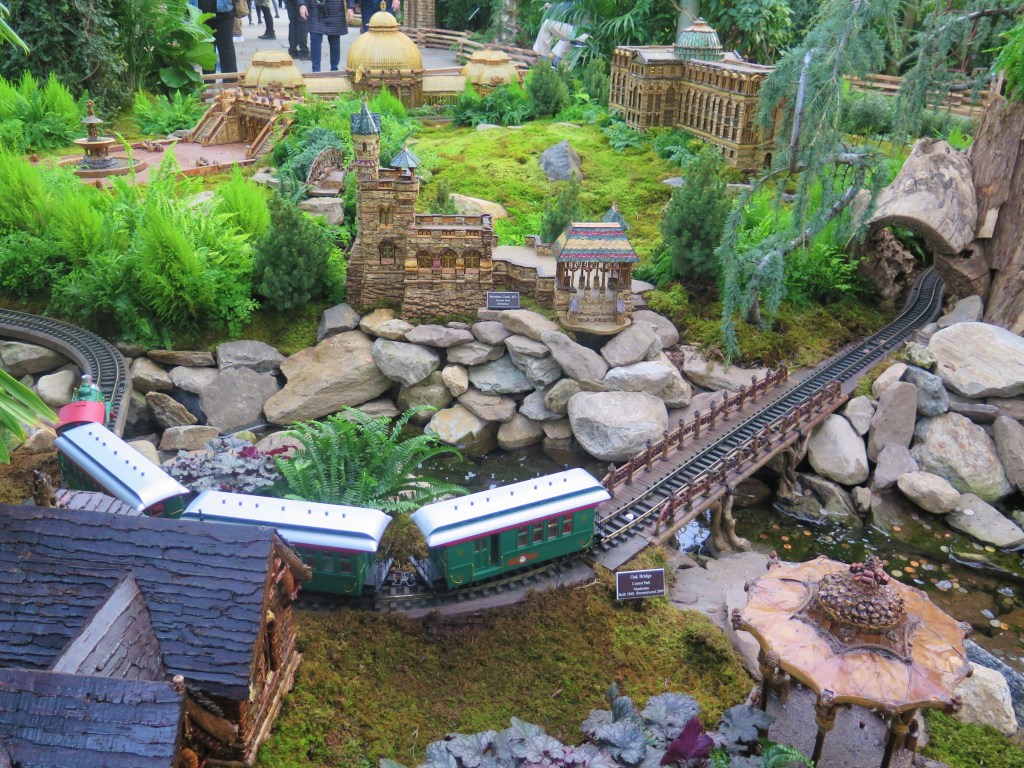

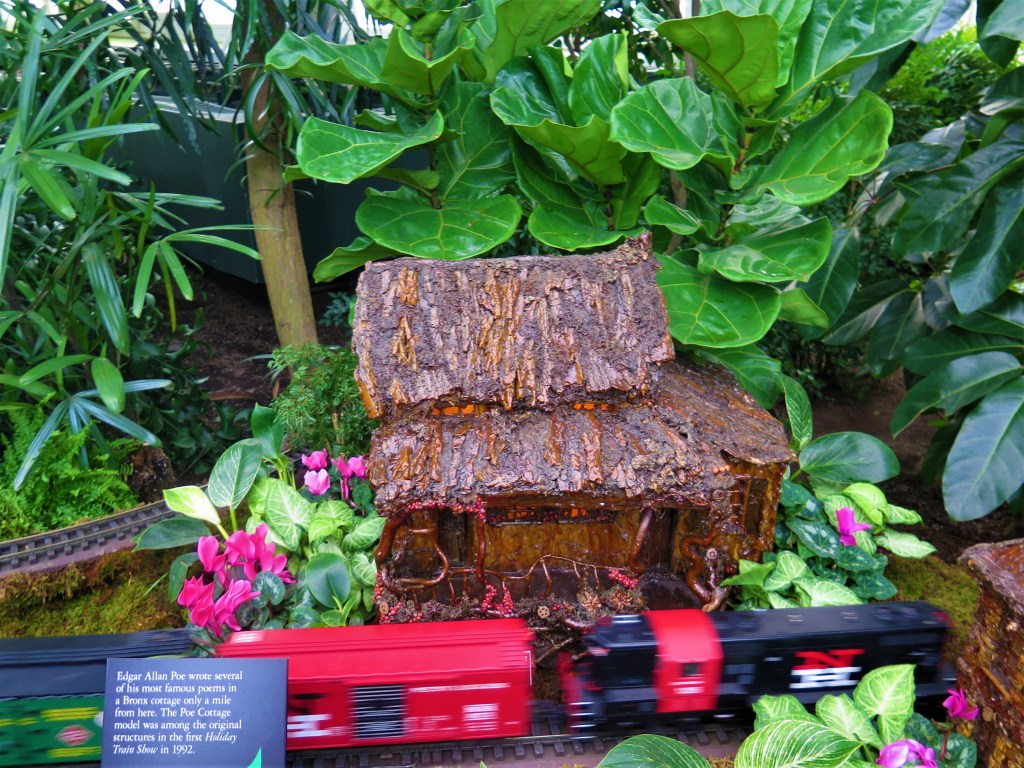
And along the outer garden pathways, you will be entranced by the beauty of the striking colors projected against the landscape of trees, bushes and buildings forming colorful patterns of light against the shadows. I went on a moonlit night and the effect was spectacular.
For The Holiday Train Show® look for the new additions celebrating the 30th year of the exhibit.
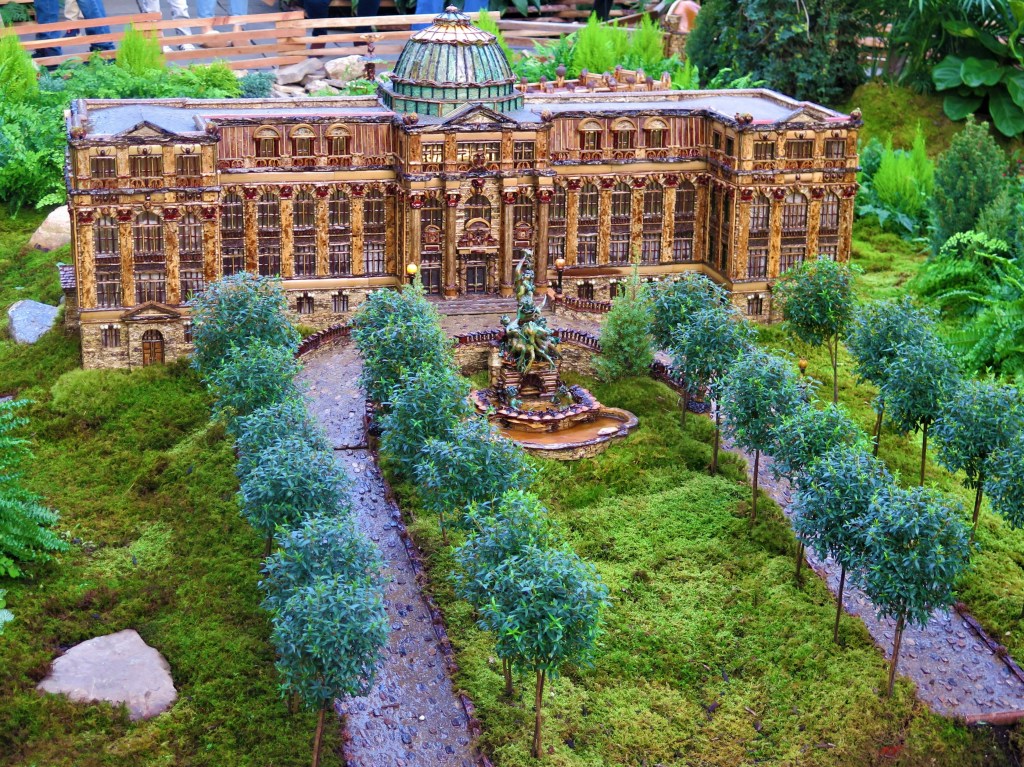
Showcased are the replicas of the LuEsther T. Mertz Library Building, the Lillian Goldman Fountain of Life, and the John J. Hoffee Tulip Tree Allee, collectively designated a New York City Landmark in 2009. The Allee that leads up to the LuEsther T. Mertz Library is comprised of four rows of distinguished native trees that were planted beginning in 1903 and have grown to a great height.
When I spoke to NYBG staff and Laura Busse Dolan, the CEO of Applied Imagination, she mentioned that the Tulip Tree Allee replica in front of the LuEsther T. Mertz Library Building are live topiary myrtle trees very ingeniously sculpted to scale.

The Mertz Library is the most important botanical and horticultural library in the world. It houses more than 11 million archival items spanning 10 centuries. In a style reminiscent of a Roman Baroque palace and capped with a green copper dome, architect Robert Gibson designed the striking building in 1901.
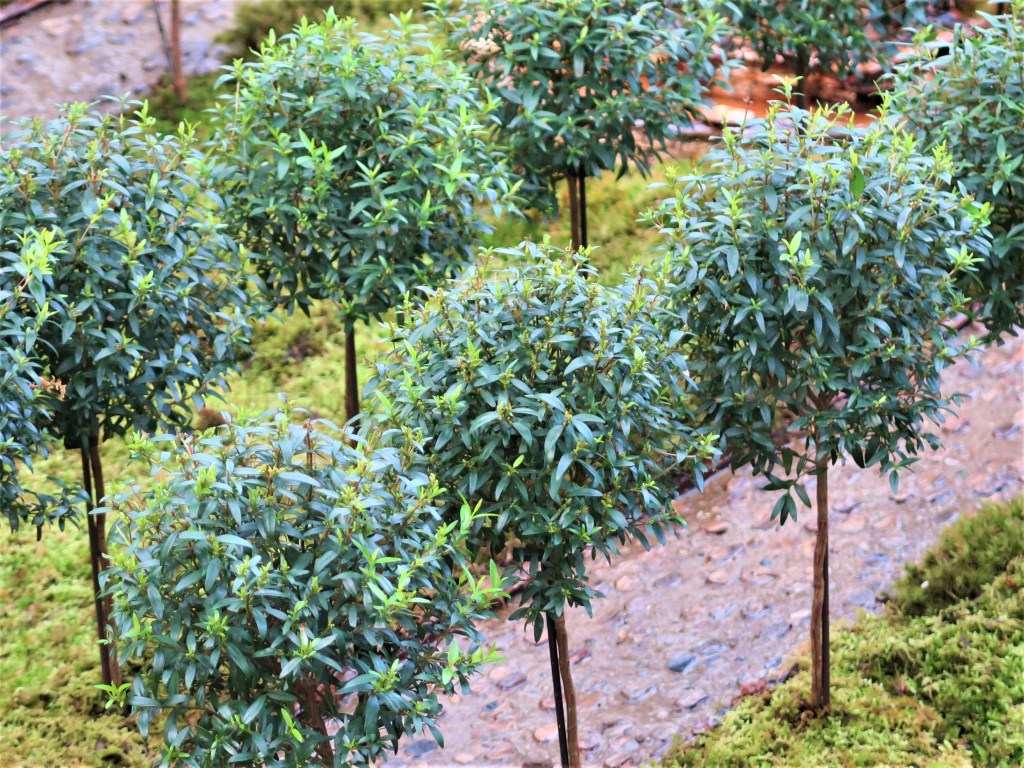

The Applied Imagination miniature is constructed with natural materials; the facade is made of horse chestnut bark, representing the structure’s stone blocks. Accented by mahogany pods, cinnamon pods and black walnuts (donated by a patron of NYBG) the replica is a beauty in its own right, worthy of the 900 to 1000 hours for its fabrication.


A part of the display, The Goldman Fountain of Life is the dramatic composition of mythical figures in front of the Library. American Renaissance sculptor Charles E. Tefft designed the fountain in 1905. It was restored in 2005, 100 years later. Like the real fountain, the replica mirrors the Beaux-Arts sculptures including charging seahorses, a lively nymph and a startled mermaid and merman. These figures are covered in tobacco leaves with grape vine tendrils for their hair. Incredibly, the fountain’s basin is created from large shelf fungus.

Some interesting facts about the structures featured in this year’s exhibit that you may not know are as follows. The Lillian and Amy Goldman Stone Mill, one of my favorite NYBG buildings dates around 1840 and can be rented out for weddings and other catered affairs. It was designated a New York City Landmark in 1966 and a National Historic Landmark in 1976. Applied Imagination’s team used tobacco leaves, cork, alder seeds, grape vine tendrils, and Brazilian and turkey tail fungi to the replica.

The Enid A. Haupt Conservatory features prominently on the other side of the display with the LuEsther Mertz Library Building. The Conservatory which is also a New York City Landmark is considered one of the most superb glasshouses of its time. Lord & Burnham Company completed its construction in 1902. Comprised of 11 interconnected galleries that feature different habitats and plant specimens from around the world, the conservatory also features seasonal galleries, presenting annual floral displays and special exhibitions highlighting world renowned artists. The replica finished in 2014 was constructed of birch bark, cinnamon bark curls, wheat husks and acorn caps. The cupola rests on a ring of large pine cone scales and is topped by a mahogany seedpod and lotus seedpod. If you take the time to look closely, you will recognize these plant parts and gain a new appreciation of the genius Applied Imagination manifests in is miniature structures.
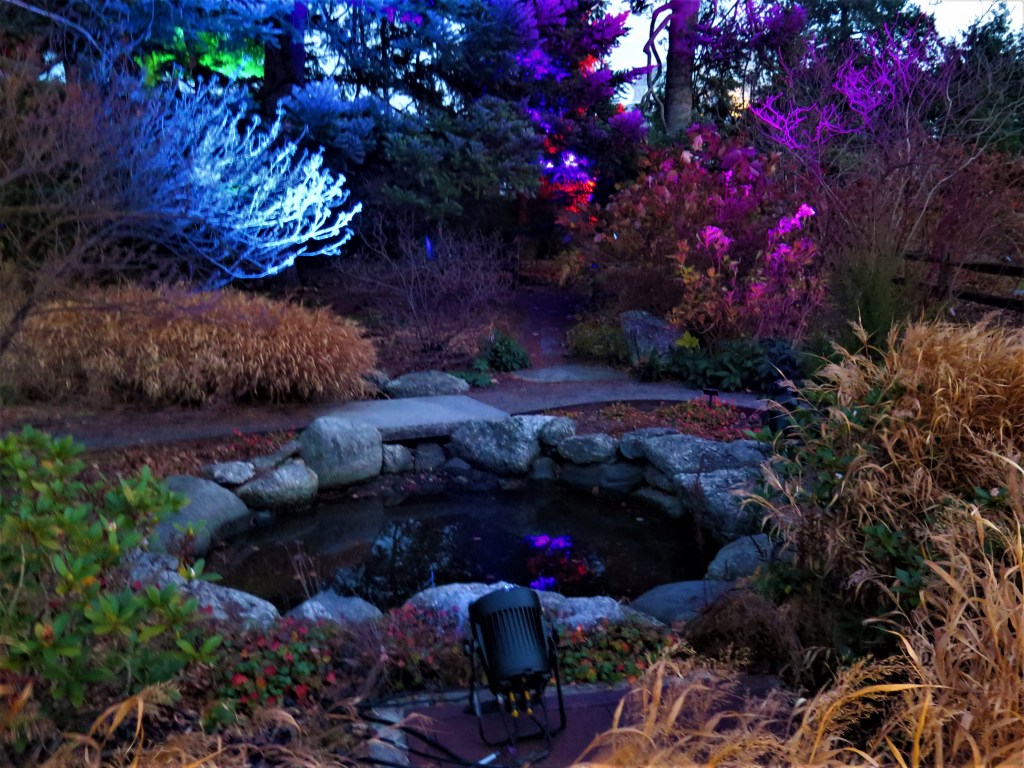

The NYBG The Holiday Train Show® has included the seven bridges around the New York City area. Model trains and trolleys trundle along the tracks along the train trestles. the tallest replica is The Brooklyn Bridge that comes in at 16 feet. Even Hell’s Gate Bridge is included.

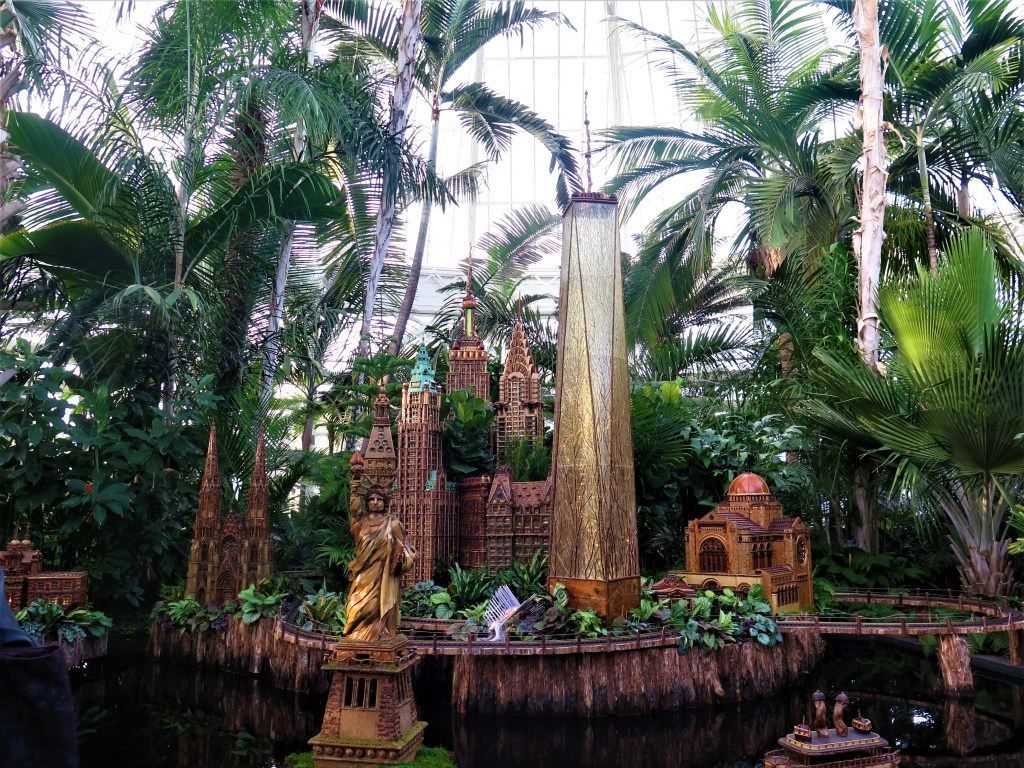
Downtown Wall Street area is one of the favored exhibits that New Yorkers enjoy seeing as the recognize the iconic buildings which include the Woolworth Building, the ferry building, the Oculus and One World Trade Center. The Staten Island Ferry and Statue of Liberty replicas are recognizable globally.


NYBG’s 30th Year Milestone Celebration of The Holiday Train Show® on a combination ticket with GLOW runs from (Thursday December 23, 2021 – Sunday, January 23, 2022 from 10 a.m. – 6 p.m.) For tickets and times (and by now, you should purchase a membership, you know you always wanted to) go to their website by CLICKING HERE.
 CAROLE DI TOSTI