Blog Archives
‘In the Hand of Dante,’ Starring Oscar Isaac, Gerard Butler, Gal Gadot at Tribeca, a Wild, Suspenseful Thriller
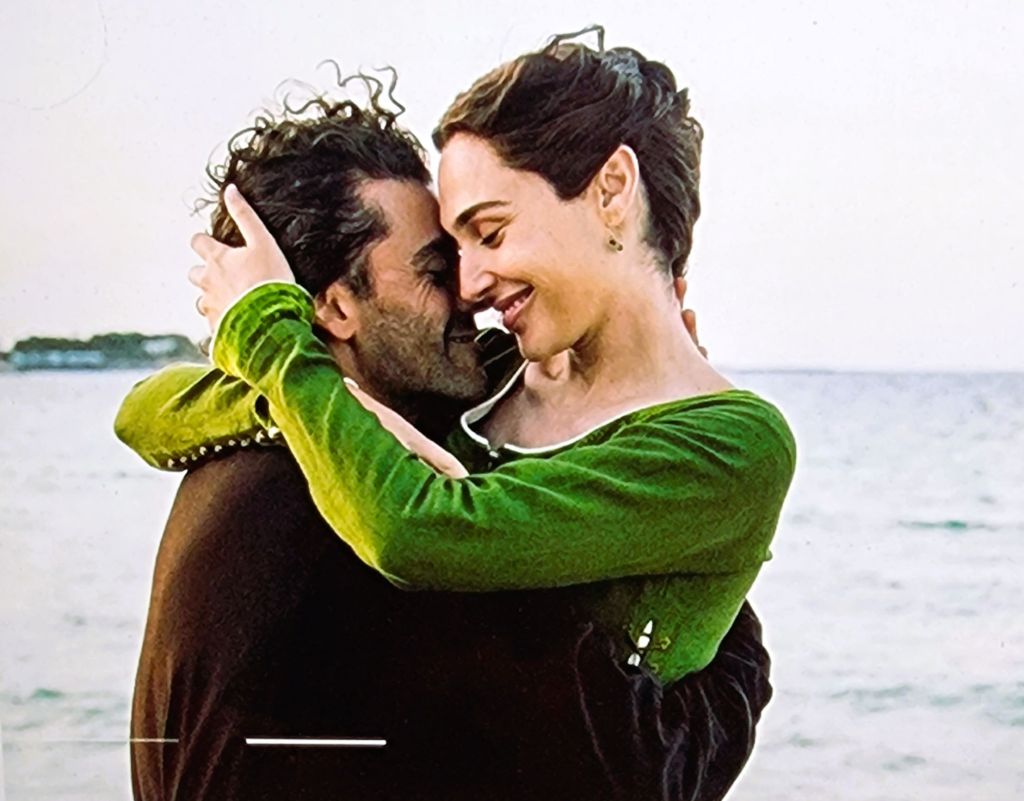
In the Hand of Dante
In the Hand of Dante, Julian Schnabel’s poetic, darkly ironic and seemingly quixotic film gives a nod to Dante Alighieri and author Nick Tosches (1949-2019). The film made its New York City premiere at Tribeca Festival in the Spotlight Narrative category. According to Schnabel in the Q and A after the film screening, Tosches, a fan of the 14th-century genius, knew a lot about Dante and his work. A self-proclaimed expert, Nick Tosches fictionalizes himself as the protagonist of his novel which Schnabel adapted with co-writer Louise Kugelberg. Like Dante Alighieri’s Divine Comedy, or Nick Tosches titular work, Schnabel’s unique and mesmerizing film does not give itself over to facile understanding.
As in his previous cinematic outings (At Eternity’s Gate, Basquiat), Schnabel teases out phenomenal performances from his lead actors. In this instance the magnificent Oscar Isaac in the dual role of Dante and fictionalzed writer Nick Tosches centers an extraordinary cast. They give authentic, performances sometimes in type, other times, frightening and surprising. Gal Gadot, John Malkovich, Gerard Butler, Louis Cancelmi and Sabrina Impacciatore round out the main cast. Martin Scorsese shows up bearded and wigged but unmistakable as Isaiah, who mentors Dante.
Al Pacino’s Uncle Carmine spells out a key theme
Adding the pièce de résistance and with only a few lines, Al Pacino as Uncle Carmine at the film’s beginning counsels the Young Nick (Ibrahim Elouahabi). After an event that Nick confesses to him, Pacino’s Carmine explains how to distinguish spiritual holiness (life affirming) from religious hypocrisy (the way of death).
Pacino’s performance anchors the film’s themes about good and evil, sincerity and untrustworthiness. Uncle Carmine provides a life lesson that adult Nick carries with him to measure whether his own actions are good or evil. Learning this proper discernment from his youth, Nick is able to confront the devils of hell he meets during the film with inner resolve and hope. As he moves through their perfidy, he follows a path up toward the light, affirming self-love, so he can recognize love when it happens. By the conclusion Nick escapes the metaphoric inferno that Gerard Butler’s Louie and the others despise as much as they despise themselves and their unredeemed lives.
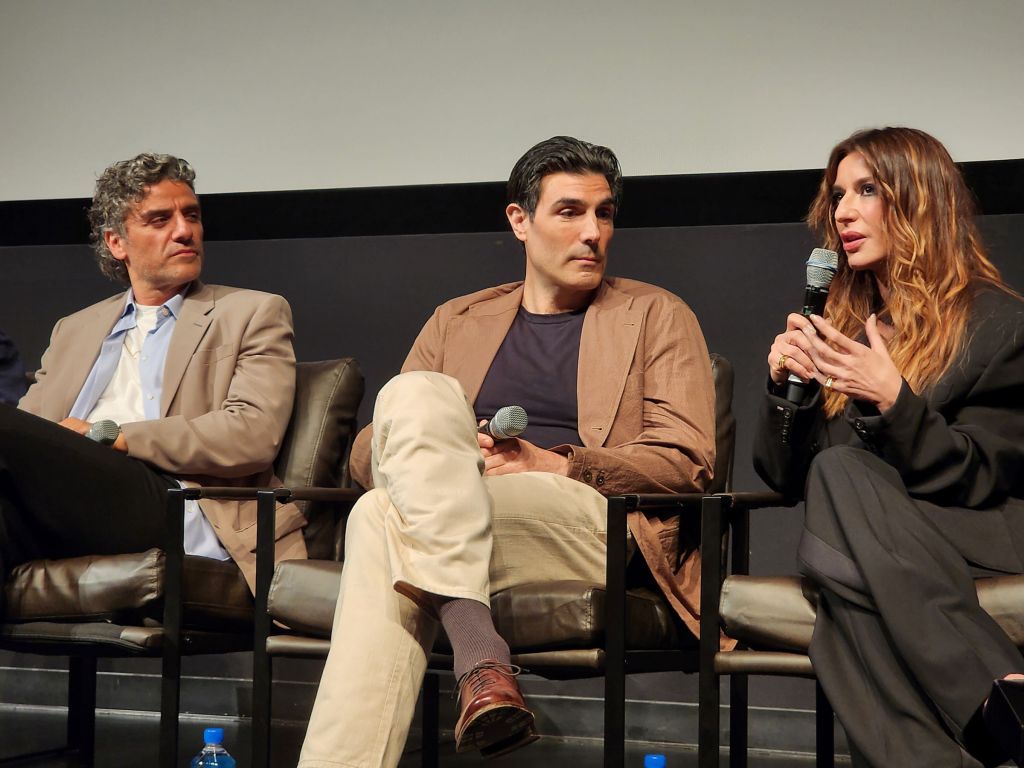
In the Hand of Dante defies easy description
The thought-provoking film defies easy description. Interestingly, to clarify Schnabel uses a symbolic color scheme to differentiate present action in the 21s century from the 14th century (1300s) when Dante lived and wrote. He uses black and white film for the gritty, dark, criminal, underbelly which manifests evil, the infernos of human nature. Such infernos blaze globally from New York City to Venice, to Palermo and other cities in Italy. Specifically, the black and white scenes manifest wickedness that Nick must negotiate to get out alive, using his life-long learning and Dante’s glorious work.
Beautiful vibrant colors of the sky, ocean, rock formations and settings of Italy represent the 14th century Renaissance when Dante lived in Florence. The sets interior and exterior, period-looking costumes, hairstyles, etc., exquisitely capture his time. After the government exiles Dante, he receives counsel, and gets help and inspiration to write his masterwork, The Divine Comedy. The sage Isaiah (Martin Scorsese) directs, inspires and guides Dante. And his friend (Louis Cancelmi also portrays Lefty) provides the money to sustain Dante to write after his exile. These color scenes with Dante thematically represent light, hope, goodness and the exaltation of artistic creation to redeem human nature.
Louise Kugelberg co-wrote the film with director Schnabel
Using Tosches titular novel as a springboard, Schnabel and co-writer Louise Kugelberg interlace concepts about life, art and the melding of the two in Schnabel’s historical thriller-romance. Clearly, Schnabel delights in the profound philosophical and esoteric, represented by the characters Dante and his mentor Isaiah. Yet, he contrasts their heavenly notions with the most bleak, vile and deplorable behaviors of criminally monstrous characters like the brutal Louie (a fantastic Gerard Butler) and treacherously smiling Joe Black (Malkovich).
Nick lives Dante’s poem when he entangles himself with Black, a mobster who buys and sells valuable art works on the black market. As a sardonic example of his nature, Joe Black owns the Rembrandt self-portrait because of its value. But he hates it. Black tasks Dante expert Nick to accompany Louie on his adventure to steal Dante’s original manuscript reputed to be with a Palermo mob boss. The criminal network in Palermo planned to make a fortune if indeed, Dante wrote the handwritten manuscript. Nick will authenticate it. Allured and not completely aware of the infernos (greed, lust, murderous double-crossing intent, etc.) roiling inside these criminals, Nick accepts the job.
The soul journey across time
Elegantly alternating between Nick’s modern-day New York and Dante’s renaissance world in parallel, In the Hand of Dante reveals Nick/Dante’s soul journey across time. From the torments to the heavens, from brutality to gentility, the appreciation and mystical understanding of oneself comes through love’s guidance. Nick’s authenticating the manuscript leads to revelations about the meaning of love, truth and morality. He establishes a relationship with Julietta (Gal Gadot) his assistant.
In parallel, Dante who ignored his wife Gemma (Gadot) takes her into consideration after their exile. As Dante did writing his masterpiece by risking all to then return to Gemma, Nick risks his life to arrange a new life with Julietta. Separated by 700 years, both men take the journey realizing the intimacy of The Divine Comedy as a reflection of their own lives. Dante made this revelation when he created The Divine Comedy, Schnabel suggests, centuries ago. In pursing the poem’s authentication and chaos that follows, Nick emerges from a hellscape with mob monsters to receive a similar revelation.
To check the Tribeca Fesival’s synopsis of The Hand of Dante see the website. https://tribecafilm.com/films/in-the-hand-of-dante-2026. The Hand of Dante streams on Netflix at the end of the month.
‘The Sign in Sidney Brustein’s Window,’ Lorraine Hansberry’s Mastery of Ideas in a Superb Production

Oscar Isaac’s Sidney Brustein in Lorraine Hansberry’s most ambitious play, The Sign in Sidney Brustein’s Window (directed by Anne Kauffman) never catches a break. Hansberry’s everyman layman’s intellectual is in pursuit of expressing his creative genius and achieving exploits he can be proud of. When we meet him at the top of Hansberry’s masterpiece, which is full of sardonic wisdom, sage philosophy and political realism, Sidney is a flop looking for a reprieve. This revival, first produced on Broadway in 1964, was tightened for this Broadway revival (one noticeable end sequence with Gloria was shaved, not to the play’s betterment). Currently running at the James Earl Jones Theatre with one intermission, the production boasts the same stellar cast in its transfer from its sold out run at BAM’s Harvey Theatre in Brooklyn. The production is in a limited run, ending in July.

It is to the producers’ credit that they risked bringing the play to a Broadway audience, who may not be used to the complications, the numerous thematic threads, the actualized brilliance of unique characterizations and their interrelationships, and Hansberry’s overall indictment of the culture and society. Sign is a companion piece to her award-winning Raisin in the Sun. It explores the root causes why the Younger family is where it is socially and economically. Vitally, it examines the political underpinnings of institutional oppression and discrimination via reform movements, symbolized by the efforts of Brustein and friends who promote the reform candidacy of Wally O’Hara.

To focus her indictment of the perniciousness of political and social oppression, Hansberry examines the vanguard of reformists, Greenwich Village artists, activists and journalists who are emotionally/philosophically ready to make social/economic change of the type that the Younger family in Raisin in the Sun yearns for. However, these Greenwich Village mavericks are the least equipped tactically to sidestep co-optation and the political cynicism of the power-brokers. They realize too late that the money men will fight them to the death to maintain a status quo which inevitably destroys the vulnerable and keeps families like the Youngers and drug addict Willie Johnson struggling to survive.

The Sign in Sidney Brustein’s Window is timeless in its themes and its characterizations. When we measure it in light of current social trends, it is fitting that the play transcends the history of the 1960s in its prescience and reveals political tropes we experience today. Additionally, it suggests how far society has declined to the point where cultural and political co-optation (a principal theme) have been institutionalized via media that skews the truth unwittingly. The result is that large swaths of our nation remain oblivious to their exploitation and dehumanization, ignorant that they are the pawns of political parties, who promise reform then deliver regression. In short they, like Sidney Brustein and his friends, are seduced to hope in a better world that reform politicians say they will deliver. But when they win, through a plurality of votes from a diverse population, they renege on their promises and continue to do what their “owners” want, which is to “screw” the little people and deprive them of power and a “place at the table.”

Hansberry’s setting of Greenwich Village is specifically selected as one of the hottest, most forward-thinking, “happening” areas in the nation. Brustein’s apartment is the focal point where we meet representative types of those found in sociopolitical/cultural reform movements. His community of friends are activists who believe their friend and candidate Wally O’Hara (Andy Grotelueschen), is positioned to overturn the Village’s entrenched “political machine.” Sidney, reeling from his bankrupted club, which characterized his cultural/intellectual ethos (idealistically named Walden Pond after Henry David Thoreau’s book), purchases a flagging newspaper (The Village Crier) to once again indulge his passion for creative expression. He does this unbeknownst to his wife Iris (Rachel Brosnahan), a budding second-wave feminist who waitresses to support them financially. She chafes at her five-year marriage to Sidney, shaking off his definitions and the identities he places on her, one of which is his “Mountain Girl.”
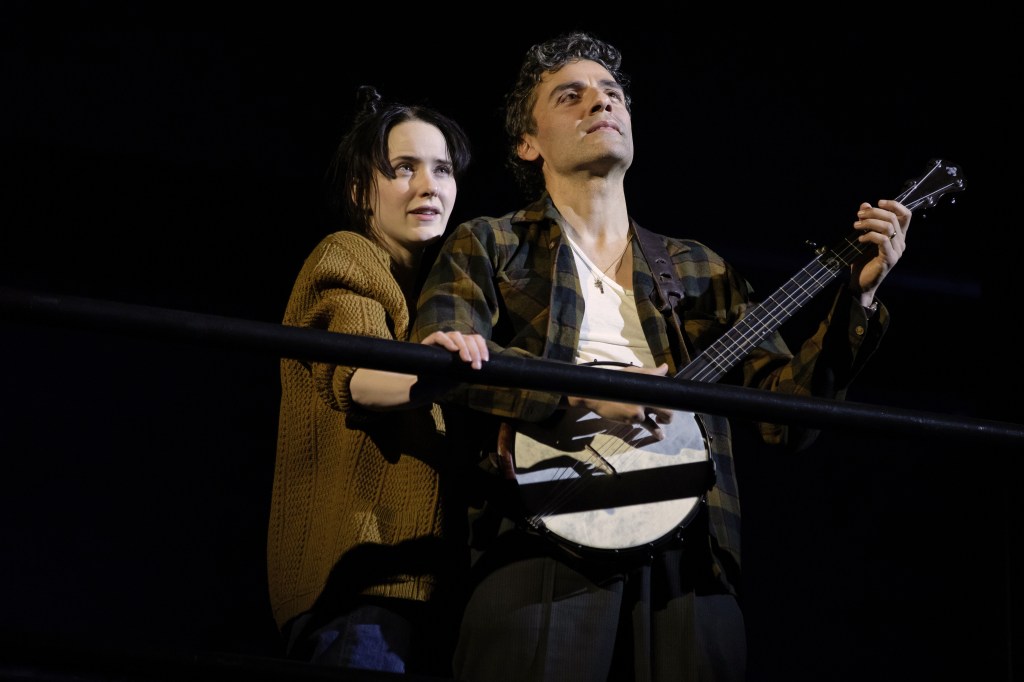
Activist and theoretical Communist (separated from the genocidal Stalinist despotism) Alton (Julian De Niro), drops in with O’Hara to encourage Sidney to join the crusade to elect O’Hara with the Crier’s endorsement. Sidney declaims their persuasive rhetoric and assures them that he will never get involved in political activism again. However, as events progress, his attitude changes. We note his friends, including artist illustrator Max (Raphael Nash Thompson), stir him to support O’Hara with his excellent articles. Sidney, mocked by Iris about his failures, is swept up in the campaign. When he hangs a large sign in his window that endorses O’Hara, his adherence to push a win for the “champion of the people” increases in fervency.

The sign symbolizes his hope and his seduction into the world of misguided activism, but its meaning changes over the course of the play. Hansberry doesn’t reveal the exact moment that Sidney decides to take up the “losing cause” after he disavowed it. However, his fickle nature and passion to be enmeshed in something “significant” with his friends helps to sway him.
In the first acts of the play, Hansberry introduces us to the players and reveals the depth of her characterizations as each of the characters widens their arc of development by the conclusion. We note the development of Mavis (Miriam Silverman), Iris’ uptown, bourgeois, housewife sister, who is married to a prosperous husband and is raising two sons. We also meet David Ragin (Glenn Fitzgerald), the Brustein’s gay, nihilistic, absurdist playwright friend, who lives in the apartment above theirs and is on the verge of success. Both Mavis and David, like Sidney’s other friends, twit him about Walden Pond’s failure. Mavis and Iris are antithetical in values and Mavis views her sister and brother-in-law as Bohemian specimens to be observed and secretly derided as entertainment. We discover Mavis’ bigotry when she opposes the union of their sister Gloria (Gus Birney), a high class call girl, to Alton, the young light-skinned Black friend.

The genius of this work is in Hansberry’s dialogue and the intricacies of the characterizations. It is as if Hansberry spins them like tops and enjoys the trajectory she creates for them, which ultimately is surprising and sensitively drawn. Organically driven by their own desires, we follow Sidney and Iris’ family machinations, pegged against the backdrop of a political campaign that could redefine each of their lives so that they could better fulfill their dreams and purpose. However, the campaign never rises to the sanctity of what a true democratic, civic, body politic should be. Indeed, the political system has been usurped in a surreptitious coup that the canny voter “pawns” are clueless about.

Tragically, instead of political power being used to combat the destructive forces Hansberry outlines, some of which are discrimination, drugs, law-enforcement corruption, economic inequity and other issues that impact the Brustein’s and their friends’ lives, O’Hara and his handlers have other plans. But first, they cleverly convince the voters a win is unlikely and they pump them up to believe in the possibility of an O’Hara success that would be earth-shattering and revolutionary. This, we discover later, is a canard. The “revolutionary coup” can never occur because the political hacks control everything, including Sidney’s paper which they exploit to foment support for O’Hara. How Hansberry gradually reveals this process and ties it in with the relationships-between Iris and Sidney, Alton and Gloria, Iris and Mavis and the other friends-is a fabric woven moment by moment through incredible dialogue that pops with quips, peasant philosophy, seasoned wisdom, and brilliant moments that evanesce all too quickly.
By the conclusion, the solidity of the characters’ hopes we’ve seen in the beginning have been dashed to fold in on themselves. Both Iris and Sidney learn to reevaluate their relationship with each other and their misapplication of self-actualization, which allowed a tragedy to happen. Likewise, Alton’s inflexibility about his own approach to his place in an exclusionary, oppressive culture ends up contributing to a tragedy that might have been prevented. In one way or another, these characters particularly, along with David’s self-absorbed nihilism, contribute to Gloria’s death.
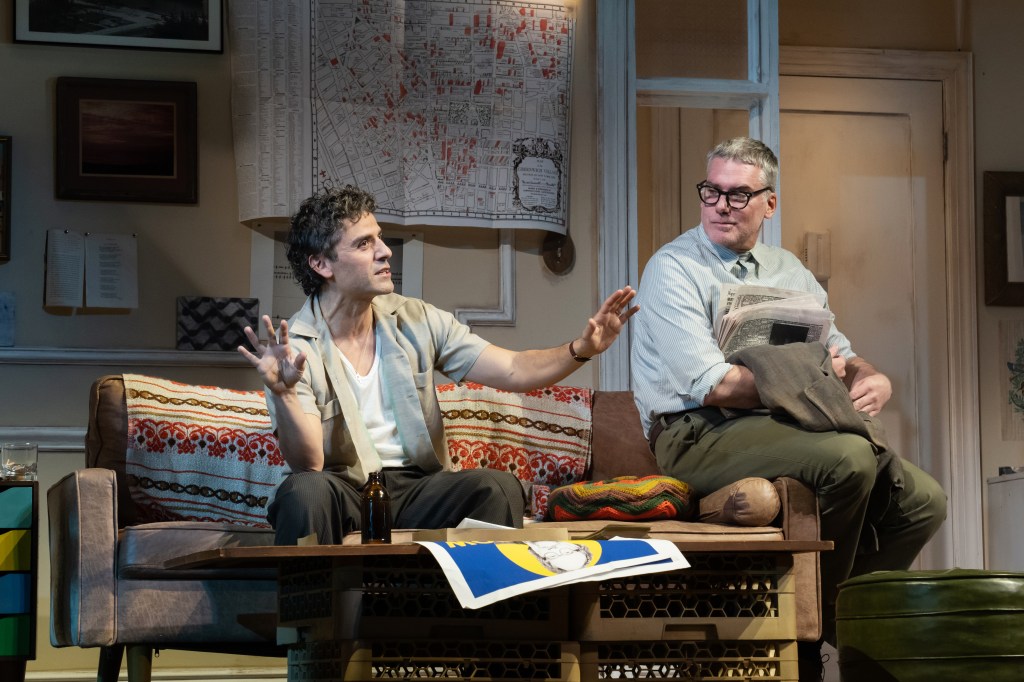
Symbolically, Hansberry points out that love and concern for other human beings is paramount. Too often, relatives, friends and cultural influences contribute to daily tragedies because human nature’s weaknesses in “missing the signs” contort such love and service to others. Ironically, politics, whose idealized mission should be to reform and make the culture more humane, decent and caring, is often hijacked by the powerful for their own agendas to produce money and more power and control. The resulting misery and every day tragedies accumulate until there is recognition, and the fight begins to overcome the malevolent, retrograde forces that O’Hara and his cronies represent.
This, Sidney vows to do with his paper and Iris’ help in a powerful speech to O’Hara proclaiming a key theme. To be alive and not spiritually, soulfully dead, one must be against the O’Haras of the world and the forces of corruption. To support them is to support death and dead things. To recognize how the power-brokers peddle death, one must discern their lies and avoid being lured into their desperate cycle of destruction, which they control to keep the populace oppressed, hopeless and suicidal.
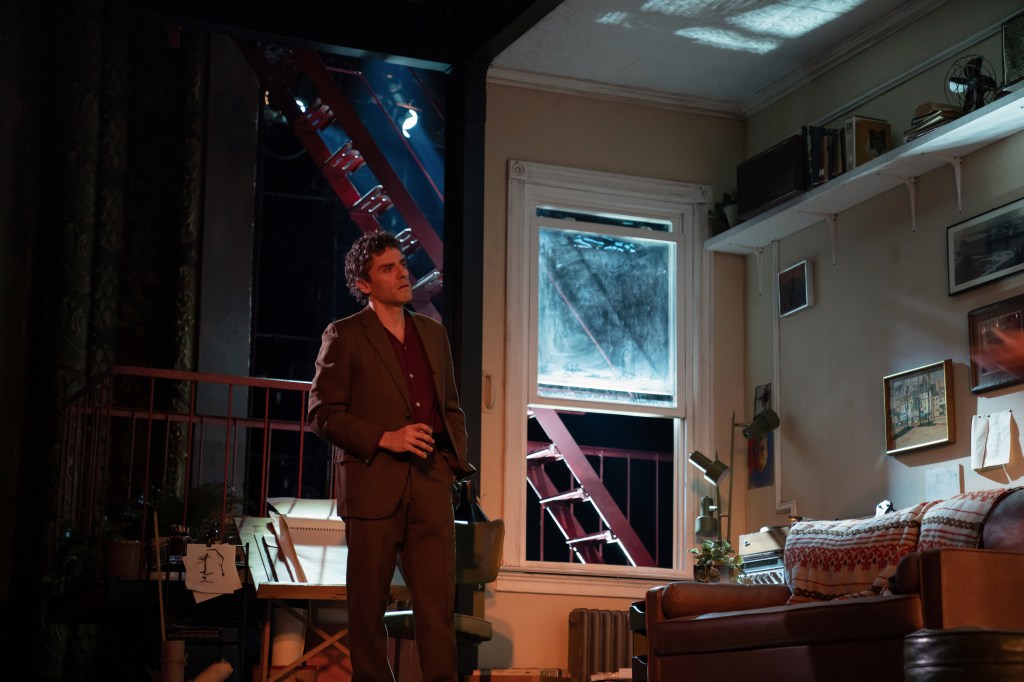
The actors’ ensemble work is superior. Both Isaac and Brosnahan set each other off with authenticity. Miriam Silverman as Mavis hits all the ironies of the self-deprecating housewife, who has suppressed her own tragedies to carry on. And Julian De Niro’s speech about why he cannot love or marry Gloria is a powerhouse of cold, calculating, but wounded rationality. Hansberry has crafted complex, nuanced human beings and the actors have filled their shoes to effect their emotional core in a moving, insightful production that startles and awakens.
The play must be seen for its actors, direction, and the coherent artistic team, which perfectly effects the director’s vision for this production. These artists include dots (scenic design), Brenda Abbandandolo (costume design), John Torres (lighting design), Bray Poor (sound design), and Leah Loukas (hair & wig design).
This must-see production runs under three hours. For tickets and times go to their website https://thesignonbroadway.com/

