Blog Archives
‘Late Fame’ Starring Willem Dafoe, 63rd NYFF
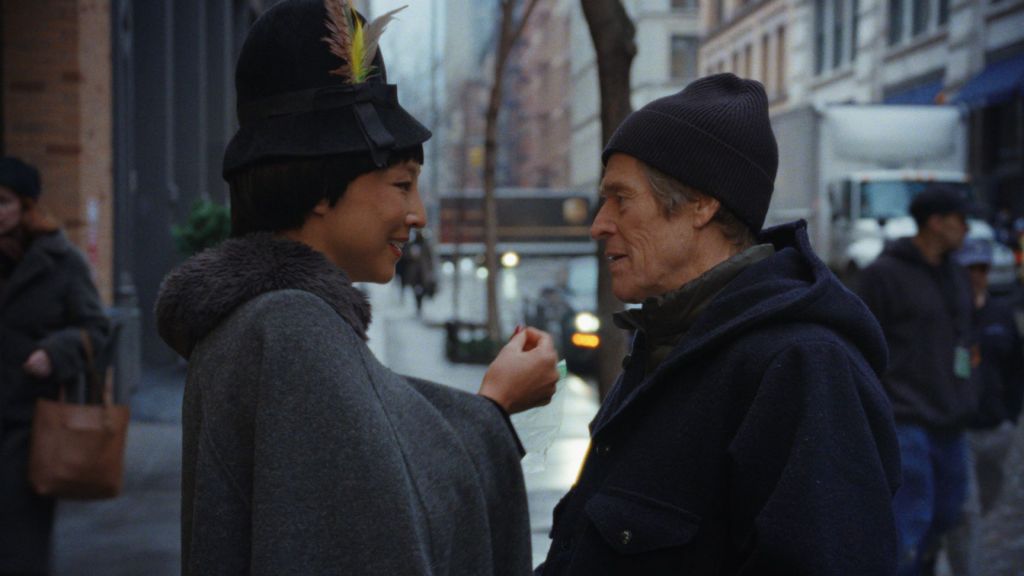
Adapted from the Arthur Schnitzler novella Late Fame, screenwriter Samy Burch (May/December) and director Kent Jones (Diana) shine a light on the West Village and Soho (circa 1970s) and Soho now at the height of its commercialization and development. With the incredible backdrop of factory buildings and West Village apartment buildings turned into fashionista haunts, and cobblestone streets still creating their unique atmosphere, a superb Willem Dafoe portrays the sensitive, once lauded poet Ed Saxburger. The craggy young man who had the world at his feet with the publication of his poetry book Way Past Go eventually gave up his typewriter to earn a modest living with a secure pension as a postal worker.
What happens to the passionate fire required to write poetry that gets published during a time when poetry was the lingua franca of the Village artist milieu, and Soho was the coolest place to be? If old soldiers fade away, does the same happen to promising poets whose work is well regarded but little read, then forgotten?
Late Fame investigates this phenomenon with atmosphere, nuance, irony and heart. It is Jones’ love letter to downtown Manhattan, vastly changed with remnants of its old beauty and undeveloped glory which made a comfortable home to artists of all stripes in the 1970s. Then, Dafoe’s character Ed Saxburger came East, spurred by the thought of fitting in with the artist colonies in Manhattan at that time.
The film which is in the Main Slate section at New York Film Festival is buoyed up by sterling performances from those assisting Dafoe, as he negotiates his empathetic protagonist who is stoic, reserved and charming, and a bit lost as he welcomes yet questions with open eyes his acceptance by a group of well-heeled twenty-somethings, who turn out to be poseur artists. Their mission is to recapture the ethos of Gregory Corso, Allen Ginsberg and others, but they are sorely out of their depth and lack the talent, grist and life wounds to do so.
The film unspools with Saxburger’s rediscovery by this exotic group of young would-be writers and philosophers branding themselves “the Enthusiasm Society.” An effete, wealthy Wilson Meyers (the excellent Edmund Donovan), leads the group of retrograde misogynists and artistes. When Saxburger asks where he found his book, with wide-eyed irony and pride, Meyers tells Saxburger he bought it at “Foyle’s on Charing Cross Road.” Indeed, Meyers uses Saxburger’s book as the equivalent to a museum piece around which Meyer centers his exploitation and cause célèbre.
On further discussion to introduce himself Meyers cavalierly asserts his and the Enthusiasm Society’s purpose to “stand against negativity” and the monetization of everything,” a mission that unravels when Saxburger gets to know him. Key to who they are, is that they distance themselves from lower lights, “the influencer culture, cellphone obsessed and technology maniacs.” These they excoriate, all the while imbibing the same waters because no one is paying attention. However, Saxburger is.
For example Meyers’ stunning, unhip apartment in the village, funded by his parents, is technologically outfitted to the max. The other members are equally flush, supported by their parents, a far cry from the struggling, self-made artists that they emulate. However, their hypocrisy and unawareness of self that Saxburger notes quietly, he puts aside momentarily. He is drawn in by their allurement as they gush over him.
Their earnestness could be worse. At least they aspire to be like legends of the past, so Saxubrger allows himself to be caught up in their artificial world, until the revelations come fast and furious after a poetic recital where various members read at a venue Myers procures. The actors portray these fellows as more of an Oxford-like clique of wannabe creatives who are callow, literary sophisticates. In their aspirations they will never achieve what Saxburger did as he struggled and was celebrated in reviews, even if for a bright moment that he himself extinguished by moving on.
Though these individuals are largely focused on the masculine, they allow the actress and singer Gloria (a fine Greta Lee) to float among them as the girlfriend of one or more of the members. When Ed finally joins the Enthusiasm Society live and they introduce Gloria, her flamboyance and mystery is a treat for Ed. She is more akin to him as an older, wiser, financially strapped actress who, like Ed, knows what it is to struggle for her craft. Unlike Ed, she may hold on longer because she is an opportunist who knows how to play the game. In his authenticity and truth, Saxburger probably said, “It’s enough. I’ve got to eat and support myself.”
Cleverly, Jones features Gloria front and center during a performance of Kurt Weill and Bertolt Brecht’s “Surabaya Johnny.” A chanteuse, Sally Bowles “divine decadence” type, Gloria lures Ed who finds her attractive, opaque and mysterious, unlike the others. During a brief scene they do drugs together and frolic down the streets, a nostalgic nod to the past.
Greta who is supposed to read poetry during the recital appears to be too overwrought to be able to credibly do it. Part of her act, however, she pulls through at the last minute stunning the audience. Finally, Saxburger reads his own work beautifully, though an audience member references his age, albeit tucked into a compliment. The shout out reminds him of where he was and now is with this ersatz glitterati. It’s a desultory in between.
Though Saxburger has a family back home and a brother dying, he stays in New York and doesn’t return to visit. That ground is never covered by Jones or the screenwriter. However, it substantiates that when Saxburger left his family and made a new life for himself in Manhattan.
In the present that life includes a culturally rich apartment with bookcases filled with books that he’s read, a nice touch by the set designer. Also, his group of working class friends that he plays pool with who don’t know his poetic past or his literary interests, have helped distract him from what was. We do see when he can’t write a new poem for the recital that his artistry has been put on indefinite hold. But it’s OK. Beyond these elements, this is a film about brief moments in time where the light shines and then dims only to shine once more before it goes out.
Jones’ work is noteworthy for the stellar performances. Dafoe who inhabits the role perfectly is sensational, and Lee and the others provide the foundation from which Dafoe easily and seamlessly establishes this intriguing and heartfelt character.
Tickets are still available at https://www.filmlinc.org/nyff2025/films/late-fame/
‘Van Gogh’s Flowers’ at New York Botanical Garden is Magnificent


Van Gogh’s Flowers (May 24 through October 26, 2025)
Vincent van Gogh needs no introduction to art lovers. Happily, for them and even for those not acquainted with the iconic painter, the New York Botanical Garden’s spring exhibit Van Gogh’s Flowers is stunning. The memorable exhibit celebrates the work of the Dutch painter who decided to become an artist at 27-years-old.


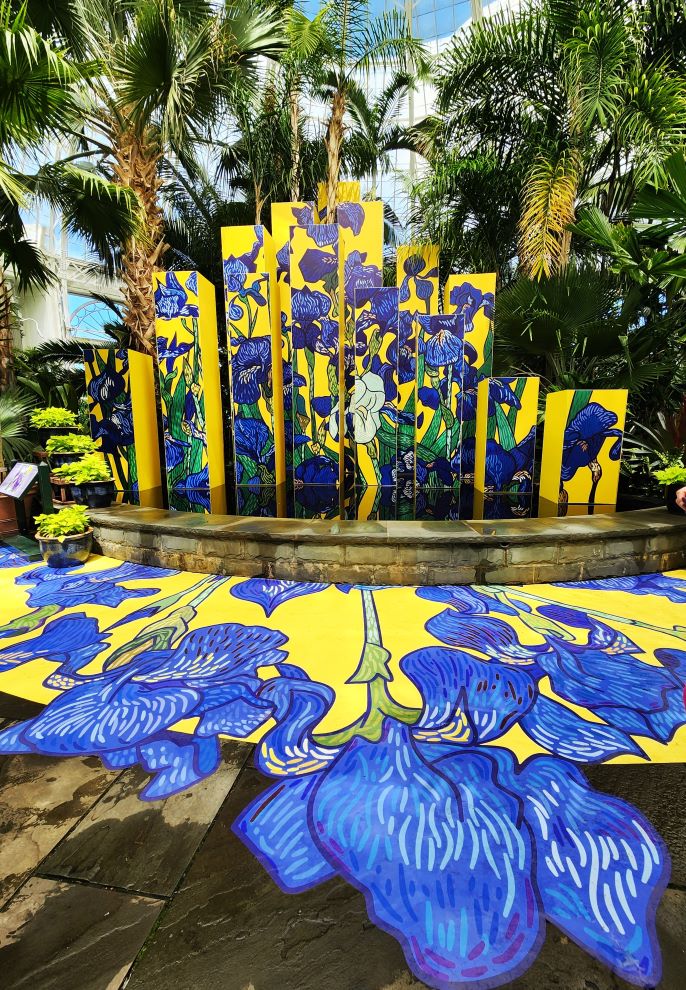
His was a decision that changed his life and the art world forever, according to the Vincent Van Gogh Museum in its discussion of Van Gogh’s life and journey toward the elusive greatness he never was able to realize while he was alive. Van Gogh’s Flowers runs from May 24 through October 26, 2025. The exhibit is not to be missed, principally because it highlights the way Van Gogh captured still lifes of flowers through his unique expression of color, light and form.

Reading through the stories of Van Gogh listed with various paintings on the Van Gogh Museum’s website, one is able to discover interesting facts about the junction of Van Gogh’s life and work. On the subject of flowers, the museum contains some of his floral still lifes. It’s fun to compare them with the specific paintings that inspired artists Amie J. Jacobsen, Graphic Rewilding’s Catherine Borowski and Lee Baker, and immersive artist, Cyril Lancelin.


All three contemporary artists contribute to the NYBG exhibit Van Gogh’s Flowers using their own mediums of expression.
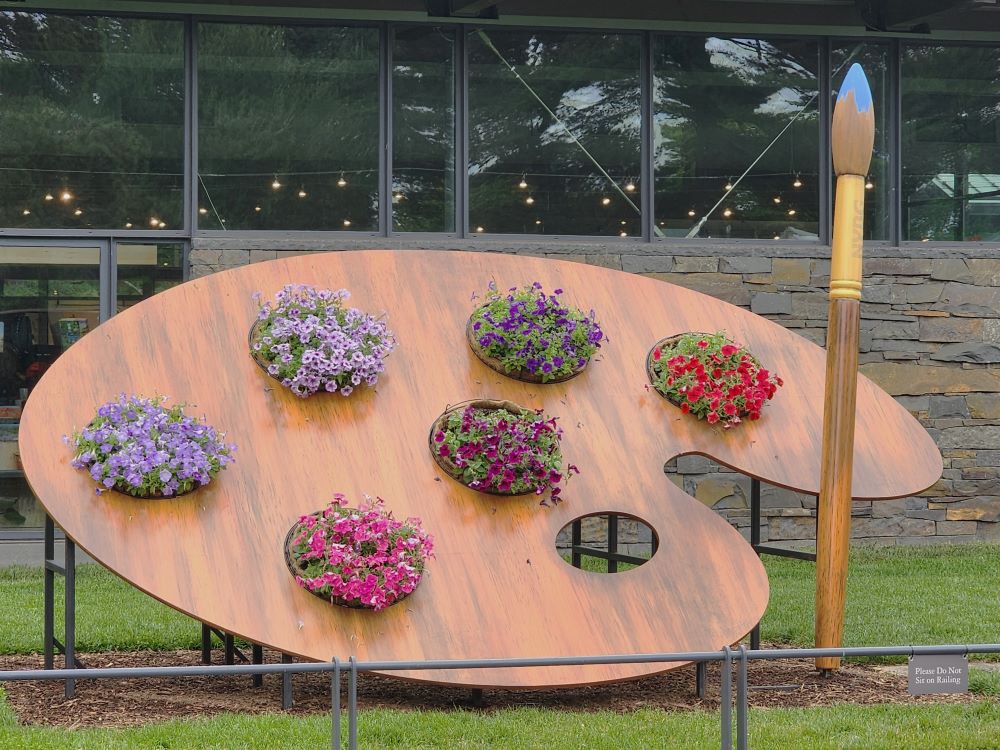
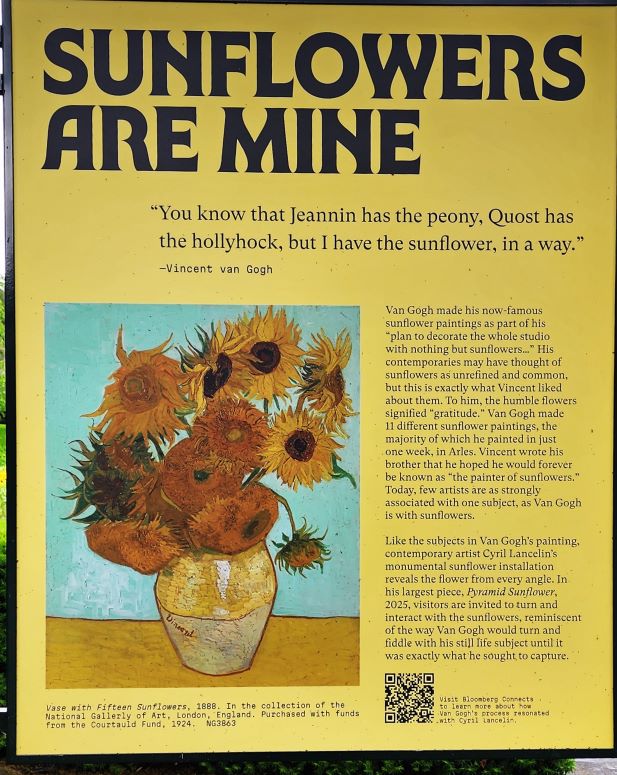
Visiting NYBG Van Gogh’s Flowers, one will want to read all of the signage with the quotes Van Gogh spoke during his lifetime to learn more about the mythic painter. The signage also pinpoints the designs of the featured artists found in the Enid A Haupt Conservatory walkways, in the indoor and outdoor reflecting pools and in the great plaza lawn. Van Gogh’s influence on them and on artists globally is a study in genius and the immutable verities that touch humanity and ground it in the pleasure of beauty and nature to move our souls out of ourselves into another way of being and consciousness.

Apparently, along his journey, Van Gogh painted flowers as a commercial venture, as he heard that such paintings were popular and lucrative. In Paris Van Gogh painted over 35 still life paintings of flowers, hoping that they would sell.
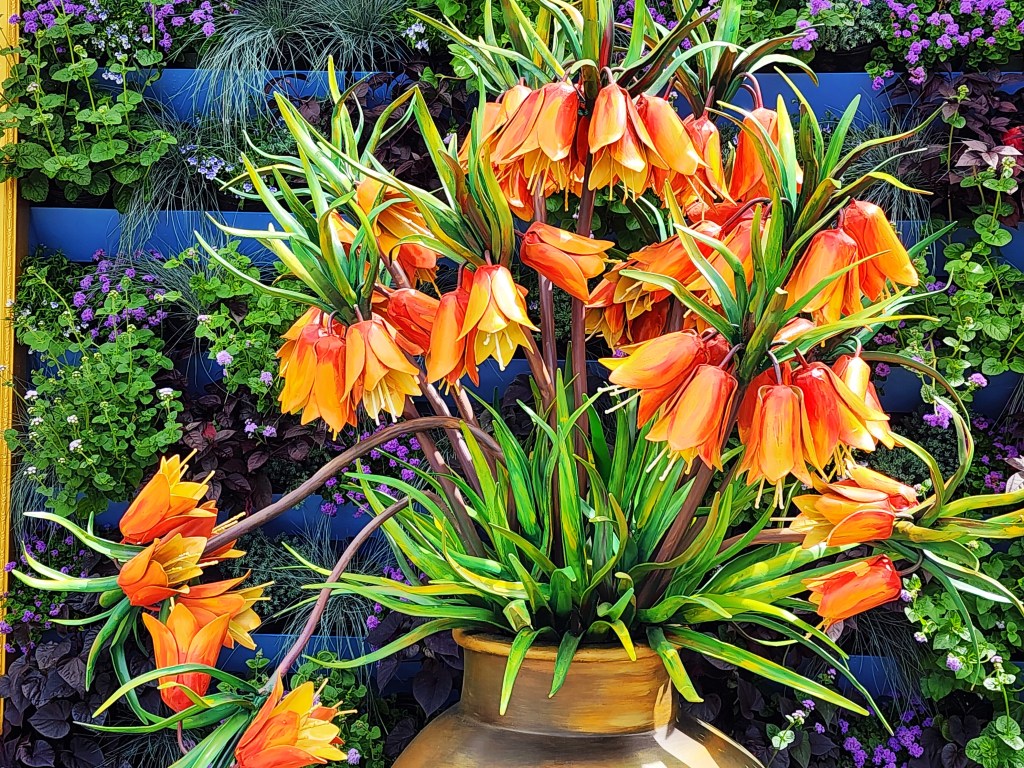

However, he had little luck selling them even though paintings of flowers were trending. His brother Theo wrote to their mother telling her that to help him, acquaintances would bring flowers for Van Gogh to paint every week.

After he ventured to the South of France, Van Gogh, whose intellect and mentality were always fragile, had a breakdown. It took him about a year to recover in a sanatorium at Saint-Rémy-de-Provence where he painted scenes he saw from his room. Interestingly, he didn’t paint the bars on the windows, perhaps signifying that in his creative spirit he was free as he was in his paintings as his mode of expression. Before and after recovering from his extended illness Van Gogh painted sunflowers (in Arles nearby), which to him symbolized gratitude. He used the color yellow extensively delighting in it. These and other details are found on the signage of the NYBG exhibit.
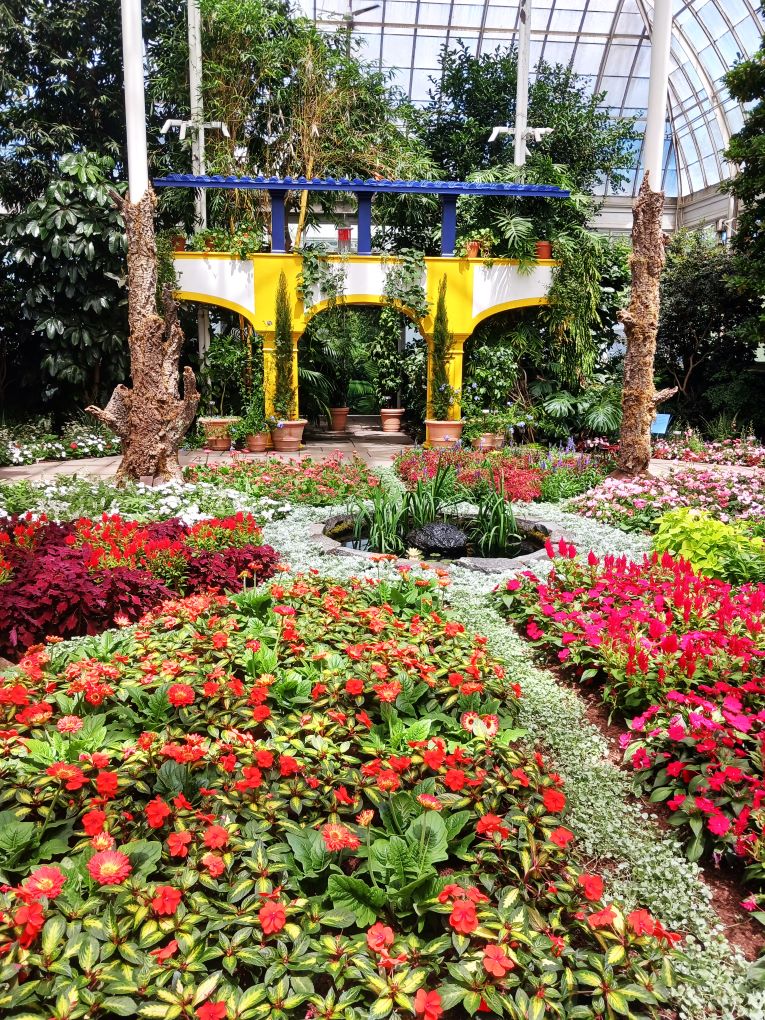
The NYBG exhibit features a placard of Van Gogh’s painting of the courtyard of the hospital at Saint-Rémy-de-Provence where Van Gogh found rest and recuperated as best he could. The showcase rotunda of the Enid A. Haupt conservatory features a reflection of Van Gogh’s courtyard painting with a similar structure suggested and the amazing plantings which are in a circular arrangement segmented florally like the spokes of a wheel. Just breathtaking.
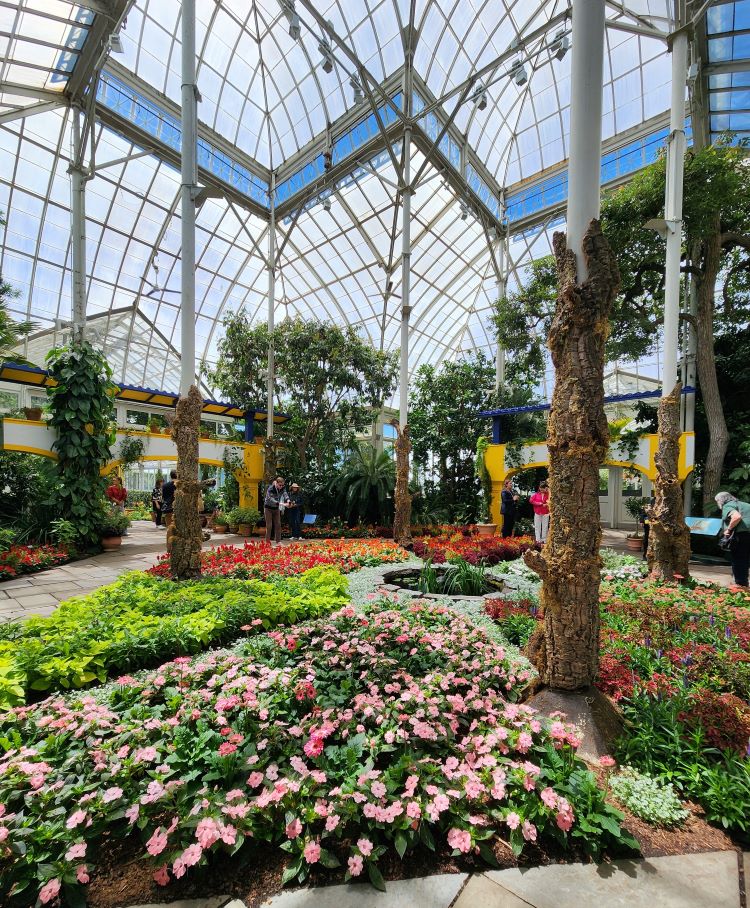
At the Garden, the paintings that inspired the artists Amie J. Jacobsen, Catherine Borowski and Lee Baker, and Cyril Lancelin are brought to life situated in gorgeous botanical displays along with the contemporary artists’ work.

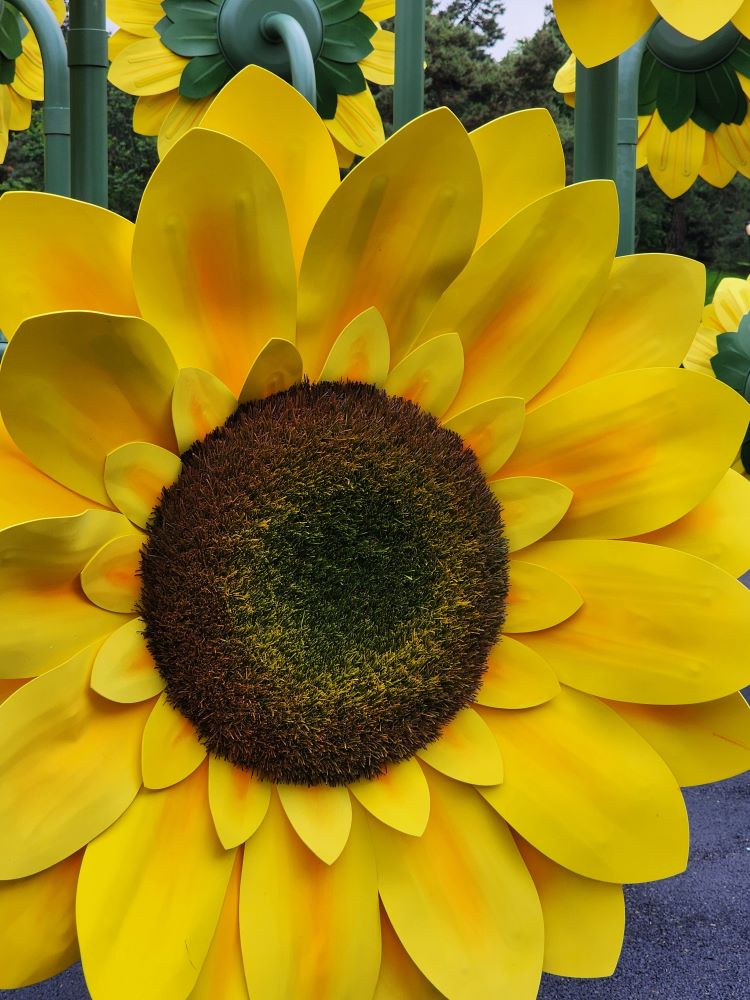
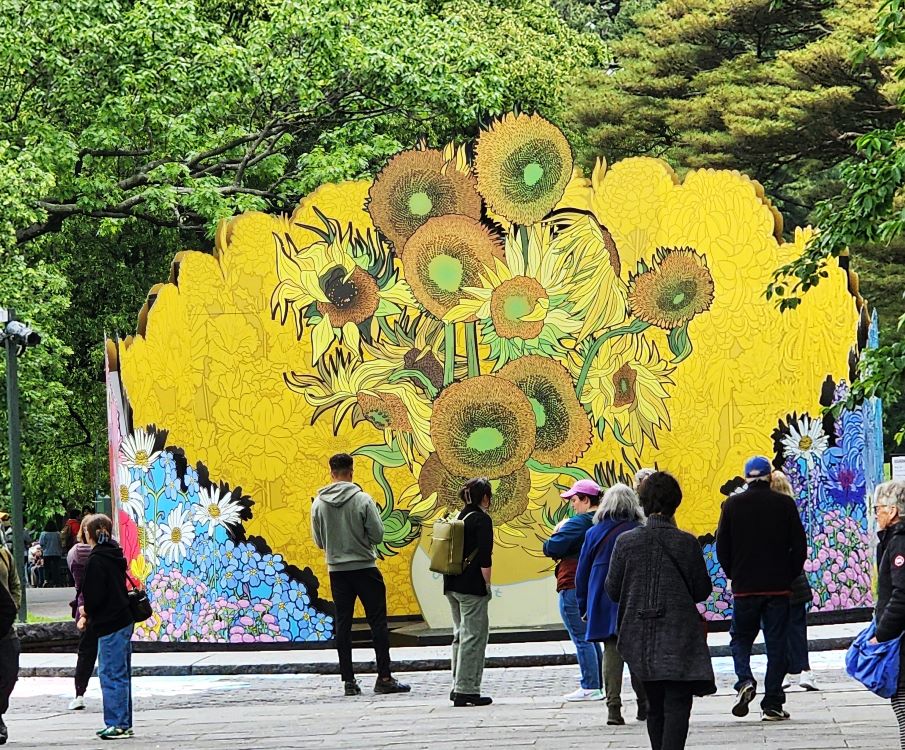
Thanks to Cyril Lancelin, visitors can walk along a pathway that meanders through plantings of real and sculptured sunflowers (by Lancelin), a symbolic reflection of what Van Gogh found healing and restorative. For him sunflowers meant “gratitude.”
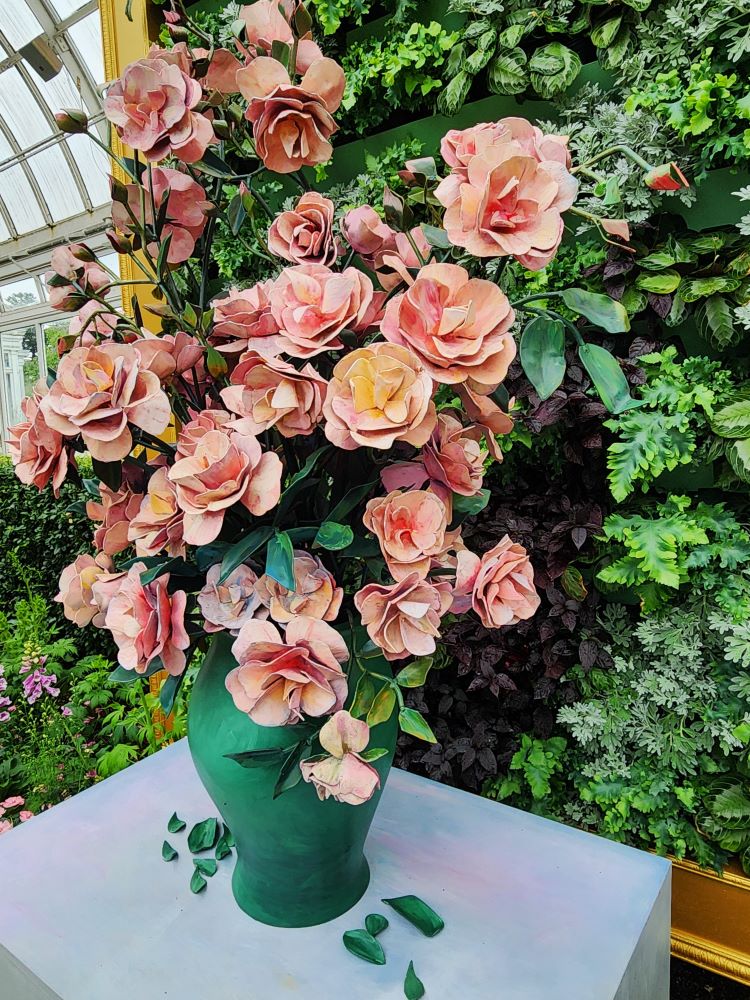

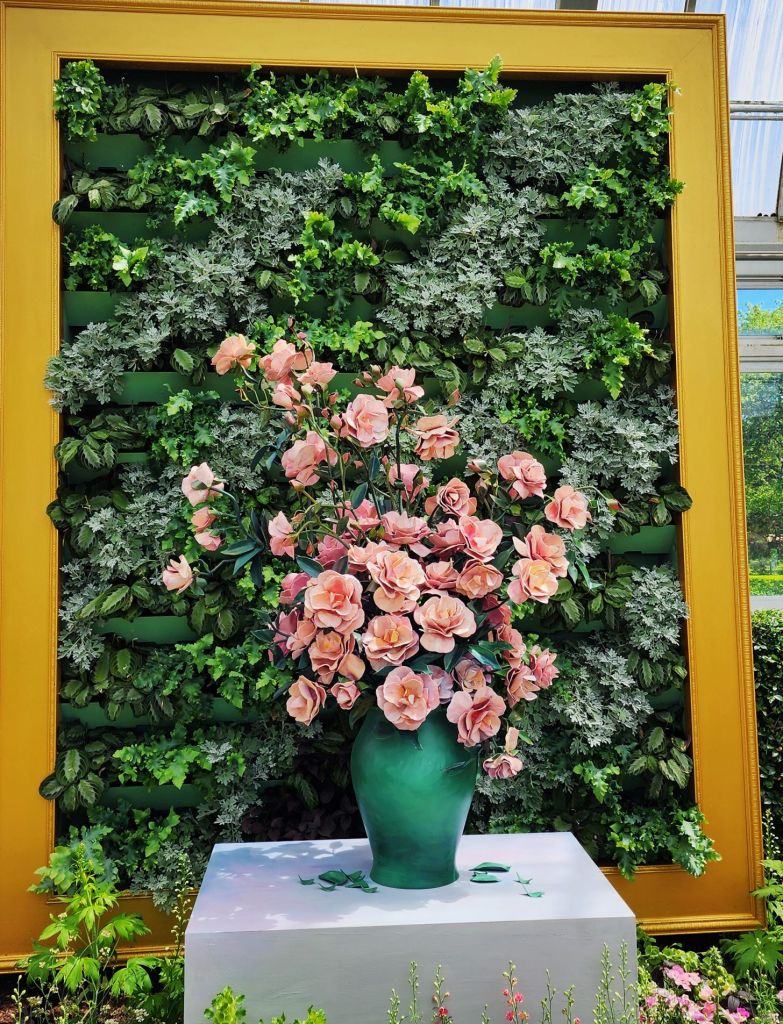
Vincent left the mental hospital in May 1890, he headed north to Auvers-sur-Oise. He met several artists there and continued painting fields, always using his beloved yellow. Then, one day in agitation, the story goes, he shot himself in a wheat field and died of his wounds some days later.

Van Gogh’s incredible legacy was a large body of art works: over 850 paintings and almost 1,300 works on paper. Visitors to NYBG’s Van Gogh’s Flowers will come to a new appreciation of how the natural world inspired Van Gogh. Most museums boast at least two or three of Van Gogh’s paintings which at auction command millions of dollars. In 1987 one version of Sunflowers sold for $37. 85 million. Today, those in the art world suggest the sunflower series of paintings would be in the hundreds of millions.
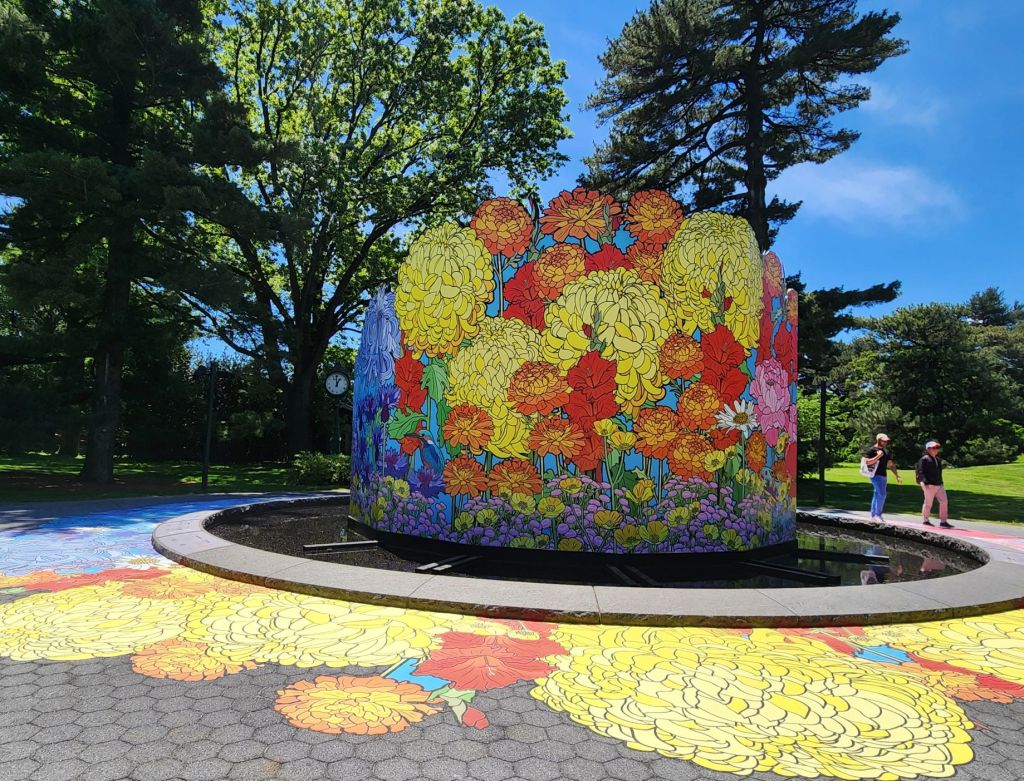

This amazing NYBG exhibit is a complete celebration of Van Gogh reflected in all of its programming. Complementary daytime programming on select dates during Van Gogh’s Flowers will offer engaging, interactive experiences, such as “Plein Air Drop-In and Paint,” engaging NYBG visitors’ creativity.
On select dates, Starry Nights will offer exhibition viewing in the glow of evening, with music and performers, drinks and food available for purchase. Conditions-permitting, after-dark Van Gogh-themed drone shows will take place on May 30, 31st and June 6th. These shows are New York City’s first at a cultural institution—bringing Starry Night to life before your eyes.
Finally, visitors can immerse themselves in the LEGO Botanical Garden pop-up. They can enjoy the hands-on make-and-take experience including a mini-Van Gogh sunflower creation.
For more information about this wonderful show and programming during the exhibit, go to the website, https://www.nybg.org/event/van-goghs-flowers/?gad_source=1&gad_campaignid=22428050313
 CAROLE DI TOSTI