Blog Archives
‘Ragtime’ is Magnificent and of Incredible Moment
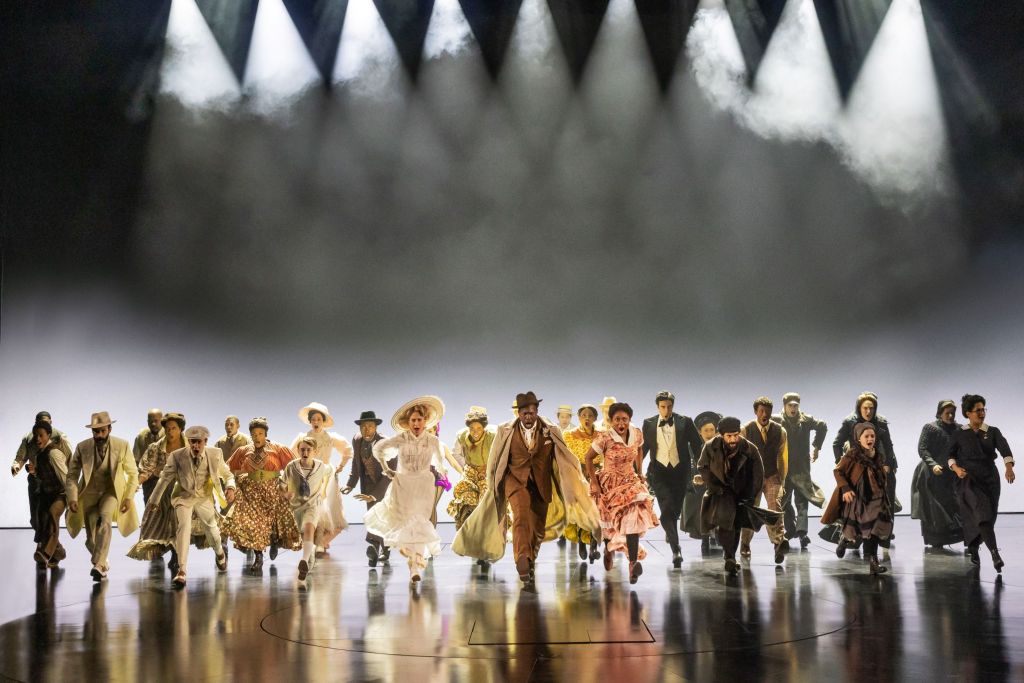
Between the time Lear DeBessonet’s Ragtime graced New York City Center with its Gala Production in 2024, until now with the opening of DeBessonet’s revival at Lincoln Center, our country has gone through a sea change. The very core of its values which uphold equal justice, civil rights and due process are under siege. Because our democratic processes are being shaken by the current political administration, there isn’t a better time to revisit this musical about American dreamers. Ragtime currently runs at the Vivian Beaumont Theater until January 4.
DeBessonet has kept most of the same cast as in the City Center Production. The performers represent three families from different socioeconomic classes. In each instance, they face the dawning of the 20th century with hope to maintain or secure “life, liberty and the pursuit of happiness,” in a country whose declaration asserted independence from its king. In affirming “We hold these truths to be self-evident; that all ‘men’ are created equal,” America’s promises to itself are fulfilled by its citizens. Ragtime reveals who these citizens may be as they strive toward such promised freedoms.
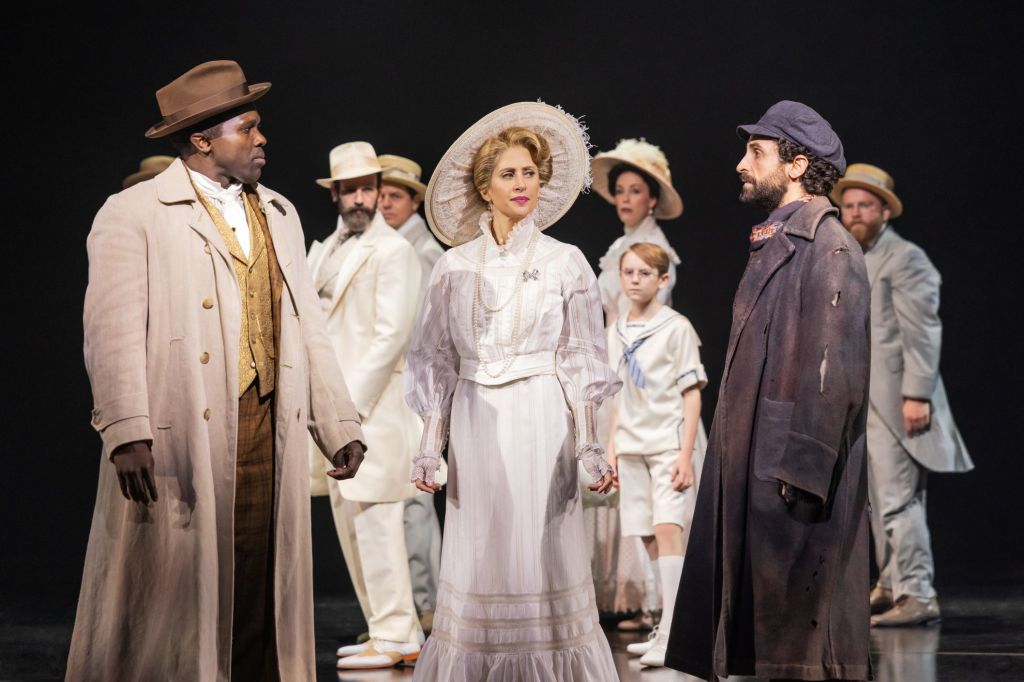
Above all Ragtime is about America, the saga of a glorious and terrible America, striving to manifest its ideals and live up to them, despite overarching forces that would slow down and halt the process.
Based on E. L. Doctorow’s classic 1975 historical novel, and adapted for the stage by Terrence McNally (book), Stephen Flaherty (music), and Lynn Ahrens, (lyrics), Ragtime‘s immutable verities are heartfelt and real. As such, it’s a consummate American musical. DeBessonet’s production celebrates this, and superbly presents the beauty, tragedy and hope of what America means to us. In its concluding songs (Coalhouse’s “Make Them Hear You,” and the company’s “Ragtime/Wheels of a Dream”), the performers express a poignant yearning. Sadly, their choral pleading is a stunning and painful reminder of how far we have yet to go to thoroughly uphold our constitution.
The opening number “Ragtime,” introduces the setting, characters and suggested themes. Here, DeBessonet’s vision is in full bloom, from the lovely period costumes by Linda Cho, David Korins’ minimally stylized scenic design, DeBessonet’s staging, and Ellenore Scott’s choreography. As the company sings with thrilling power and grace, they gradually move forward to take center stage. They are one unit of glorious interwoven diversity and destiny. The audience’s applause in reaction to the soaring music and stunning visual and aural presentation, heightened by a bare stage, emotionally charged the performers. Thematically, the cast had an important mandate to share, a cathartic revelation of the sanctity of American values, now on the brink of destruction.
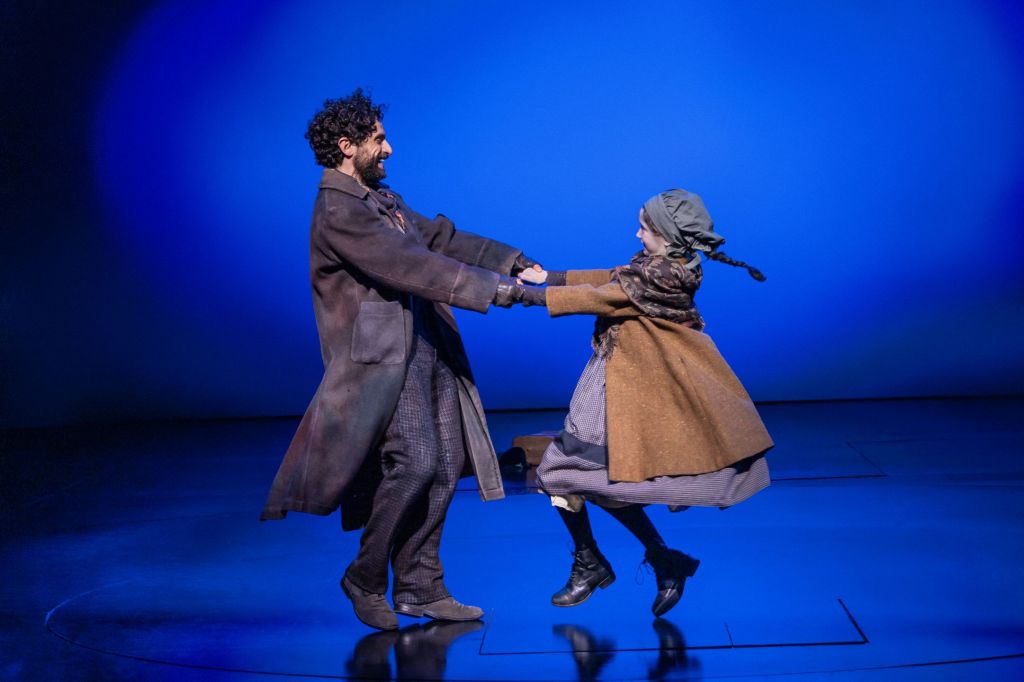
Watching the unfolding of events we cheer for characters like the talented Harlem pianist and composer of ragtime music, Coalhouse Walker, Jr. (the phenomenal Joshua Henry). And we identify with the ingenious, Jewish immigrant Tateh (the endearing Brandon Uranowitz). Tateh must succeed for the sake of his little daughter (Tabitha Lawing), despite their impoverished Latvian background. Likewise, we champion Mother (the superb Caissie Levy), who reveals her decency, kindness and skill, running the house, family and business. She must fill in the gap while her husband (Colin Donnell), goes on a lengthy expedition to the North Pole as a man of the privileged, upper class patriarchy.
The musical also reflects the other side of America’s blood-soaked history, best represented by characters along a continuum. Their misogyny, discrimination and greed often overwhelm, victimize and institutionalize innocents in the name of a just progress. These include tycoons like J.P. Morgan, Henry Ford, and the garden variety racists that brutalize Coalhouse Jr. and his partner Sarah (the fine Nichelle Lewis), in the name of order and security. Finally, to inspire all, the musical includes wily entrepreneurs like Harry Houdini (Rodd Cyrus), social justice advocates like Emma Goldman (the wonderful Shaina Taub), and accepted reformers like Booker T. Washington (John Clay III). All these individuals make up the living fabric of America.
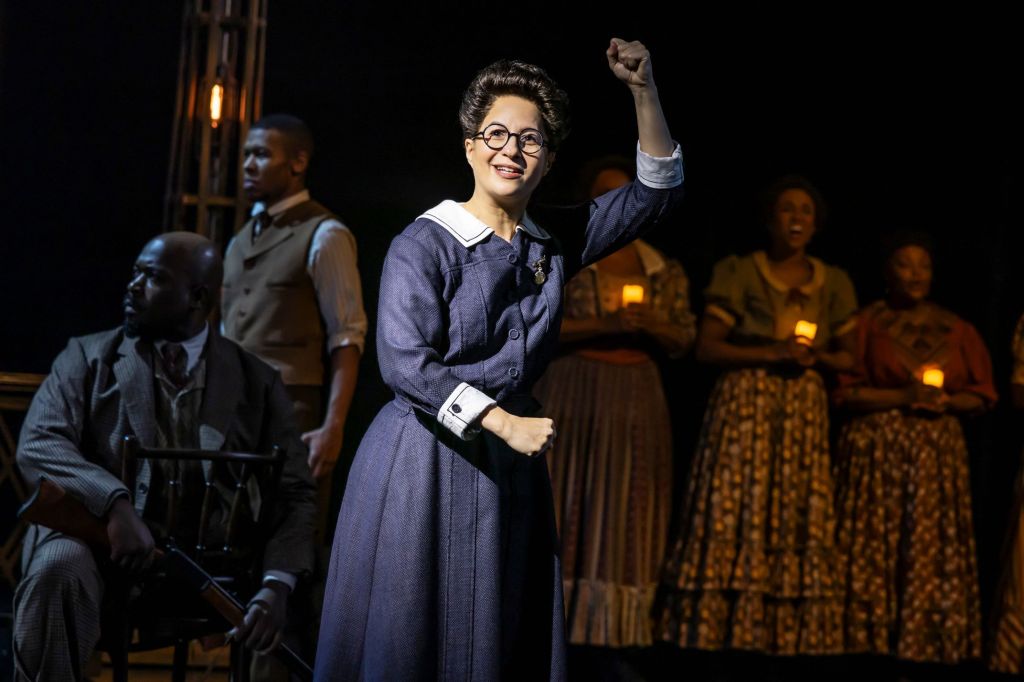
At its most revelatory, Ragtime exposes elements of our present as the continuation of entrenched issues never resolved from our past. Despite our great strides in nuclear fission and quantum computing, retrograde darkness still lurks in the nation’s beating heart, in its violence, in its human rights inequities. Clear-eyed, incisive, DeBessonet’s spare choices about spectacle and design, and her focus on great acting and singing by the leads and ensemble, ground this masterwork.
Ragtime begins with an interesting unexplained entrance: a winsome and beautiful Black male child in period dress frolics across a bare stage. At the conclusion the circle comes to a close and he appears again. We discover who he is and what he symbolizes in a stark, crystallizing moment of elucidation. After the opening number (“Ragtime”), Mother’s adventure as head of her household begins when Father leaves (“Goodbye My Love”). Her helpers include her outspoken, prescient, son Edgar (Nick Barrington), her younger brother (Ben Levi Ross), and her opinionated, crotchety father (Tom Nelis).
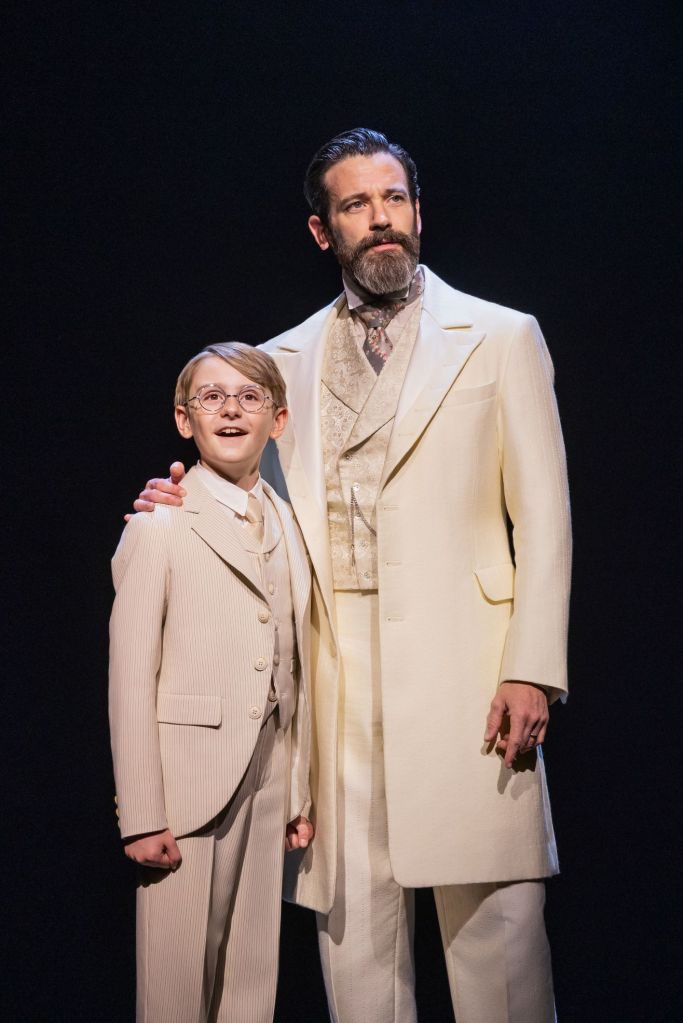
However, the peace and serenity of their lives become interrupted when Mother discovers an abandoned baby in her garden. After much deliberation, Mother takes in the infant and traumatized mother, Sarah. Clearly, this startling act of redemption never would have occurred if Father was present. As an assertion of Mother’s right to make her own decisions, her grace becomes a turning point in the lives of the baby’s father, Coalhouse, and his love, Sarah. Apparently, Coalhhouse left Sarah to travel for his career, not knowing she was pregnant. He was pursing his dream of being a singer/composer of the new ragtime music.
By he time Coalhouse searches for Sarah to eventually find and woo her back to him, we note the tribulations of Tateh, who tries to survive using his artistic skills (like Harry Houdini). And we note the moguls of a corrupted capitalism, i.e. Ford, Morgan (“Success”), who Emma Goldman accuses of exploitation. They keep the workers and society oppressed and poor.
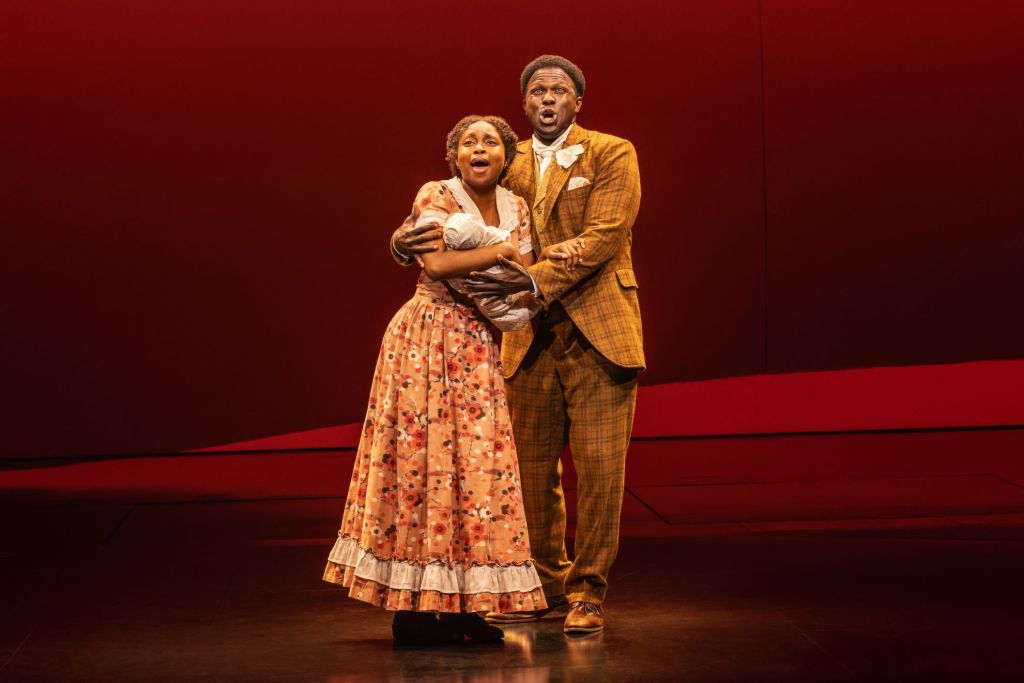
Using his charm and daily persistence (“he Courtship,” “New Music,”), Coalhouse wins Sarah back. In a dramatic, dynamic moment, Henry’s Coalhouse sings with emotion, “Sarah, come down to me.” When Lewis’ Sarah descends, their fulfillment together is paradise. The stunning scene like the ones that follow, i.e. “New Music,” and especially Henry and Lewis’ “Wheels of a Dream,” where Coalhouse and Sarah sing to their son about America, are hopeful and heartbreaking. Again, the audience stopped the show with applause and cheers as they periodically did throughout the production.
On the wave of Coalhouse and Sarah’s togetherness and love reunited, we forget the underbelly of a dark America that looms around the corner. It does appears during Father’s reunion with Mother after his lengthy voyage.
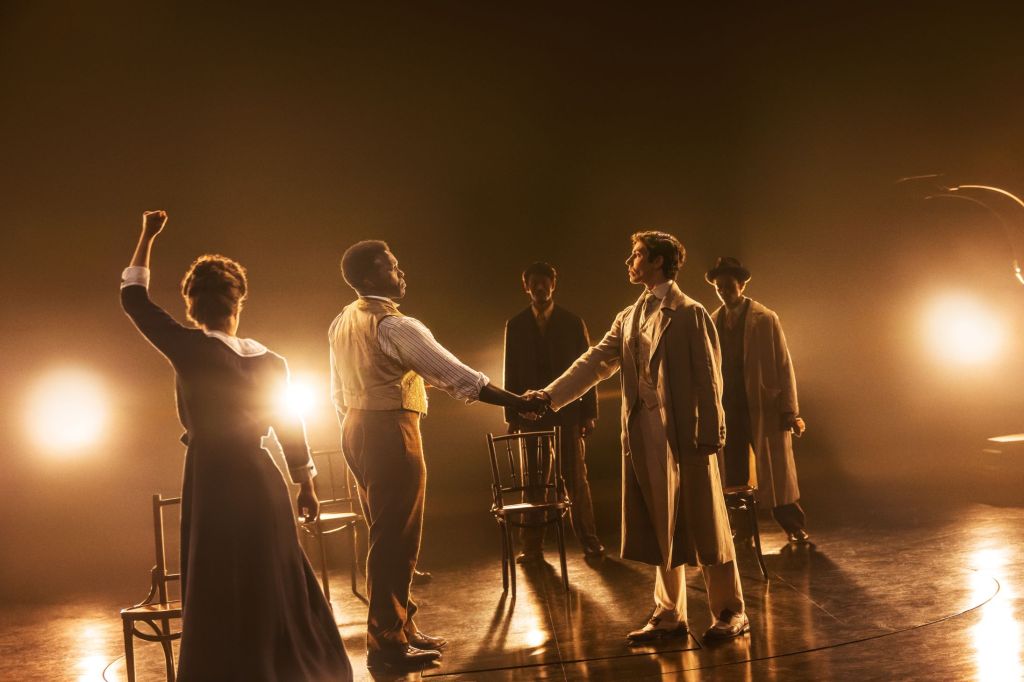
Unhappily, Father returns to a household in chaos with Sarah, Coalhouse and the baby under his roof. He can’t imagine what “got into” his wife and makes demeaning remarks about the baby. His conservative, un-Christian-like attitude upsets Mother. She defends her position and replies with demure, feminine instruction. Interestingly, her comment indicates she will not heel to him like the good lap dog she was before he left. As with the other leads, Levy’s performance is unforgettable in its specificity, nuance and authenticity.
Clearly, the characters have made inroads with each other bringing socioeconomic classes together during events when activists like Emma Goldman and Booker T. Washington make their mark and reaffirm equality. As a representative of the wave of immigrants coming to America from other teeming shores, Uranowitz’s Tateh steals our hearts and pings our consciences, thanks to his human, loving portrayal. Despite his bitterness in having to brace against the poverty he came to escape, he tries to overcome his circumstances and with ingenuity and pluck continually perseveres. Uranowitz’s Tateh particularly makes us consider the current government’s cruel, unconstitutional response toward migrants and immigrants today.
Act II answers the conflicts presented in Act I, leaving us with a troubling expose of our country’s heart of darkness. Yet, the musical uplifts bright halos of hope with the return of the adorable Black male child. We discover who he is and understand his mythic symbolism. Also, we learn the fate of the characters, some justly deserved. And the audience leaves remembering the cries of “Bravo” that resounded in their ears for this mind-blowing production.
Ragtime
With music direction by James Moore Ragtime runs 2 hours 45 minutes with one intermission through Jan. 4 at the Vivian Beaumont Theater lct.org.
Tribeca Film Festival Review 2018: ‘Every Act of Life,’ Looking Into the Brilliant Terrence McNally

(L to R): Director Jeff Kaufman, Terrence McNally, ‘Every Act of Life,’2018 Tribeca FF World Premiere Special Screening and Q & A, Moderator Frank Rich, unpictured (Carole Di Tosti),
Terrence McNally is a theatrical force of nature, though with his incredible humility in an age of self-promotion, he would be the last to admit it. With a career spanning six decades and major, ground-breaking successes on Broadway and Off, in film and television, and multiple theater awards every decade, the man is a dynamo, beloved by actors whose careers he has vaulted, actors whom he collaborates with in a symbiotic relationship again and again. At 80, he is still working, attending productions (I saw him in the audience of the musical production of the most Tony nominated musical SpongeBob SquarePants this summer.) and launching off into new projects, even as I write this.
The World Premiere Every Act of Life directed and written by Jeff Kaufman was given a special screening at Tribeca Film Festival 2018, with luminaries, actors and McNally himself attending for the Q and A afterward. In this formidable documentary about a formidable American playwright, Kaufman presents McNally’s career and personal life. From start to finish Every Act of Life is an intriguing and well-thought-out chronicle cobbled together with interviews, archived photos, video clips, well-researched facts, details, memorabilia and well-placed commentary by actors, directors, producers and McNally himself. The documentary is especially revealing in its presentation of how one individual’s love and passion for the theater, opera, music and art has impacted our culture and brought us together in a forward momentum of shared communication and understanding.

Tyne Daly (‘Mothers and Sons’ and ‘Master Class’), Nathan Lane (‘Love! Valor! Compassion!’ ‘The Lisbon Traviata,’ ‘ It’s Only a Play’)2018 Tribeca FF World Premiere and Special Screening and Q & A (Carole Di Tosti)
Beginning with his early plays and traveling right up to his most recent work, Kaufman lays out the seminal moments and turning points that have slowly fostered the personality and character of this mild-mannered and charmingly authentic persona that McNally is today. Early influences on his life McNally credits to his English teacher in Corpus Christi who encouraged him to write and attend schools outside of the area. But his love of musicals and Broadway, were initially inspired by his parents, transplanted New Yorkers, who brought him all the way from Texas to New York to see a few smash musicals with towering figures like Gertrude Lawrence in The King and I and Ethel Merman in Annie Get Your Gun.

Terrence McNally, ‘Every Act of Life,’ 2018 Tribeca FF World Premiere Special Screening and Q & A (Carole Di Tosti)
The excitement and enchantment of live theater musicals were imprinted on his memory. And this love abides with him to this day as he continues to collaborate on musicals writing the book for numerous hits like The Kiss of the Spider Woman (1992), Ragtime (1996), The Full Monty (2000), The Visit (2001), Catch Me If You Can (2011), Anastasia (2017). He has also sharpened his wits and taken up collaborating on opera, for example in 2015, the production of Great Scott (music by Jake Heggie), premiered at Winspear Opera House in Dallas, Texas. He is a veritable tornado when it comes to writing new plays and collaborating with composers on musicals and operas.

Chita Rivera appeared in McNally’s ‘The Rink,’ (1984) ‘The Kiss of the Spider Woman,’ (1992, 93, 94) ‘The Visit,’ (2004). Tribeca FF 2018, World Premiere Screening and Q & A, ‘Every Act of Life.’Chita Rivera appears in Kaufman’s film about McNally. Here Chita Rivera appears at a 2018 LPTW event (Carole Di Tosti)
Following his English teacher’s advice, McNally attended Columbia University and was further shepherded by professors like Lionel Trilling for literature and Andrew Chiappe who steered him in the basics by having McNally and others read every work by Shakespeare in the order of their composition. After Columbia, McNally through a serendipitous introduction via The Actor’s Studio, cruised with John Steinbeck and family around the world as he tutored Steinbeck’s two young sons. This was another incredible experience which was to shape McNally’s writing career and broaden his horizons as well as establish his relationship with Steinbeck who inspired his writing. From these adventures he later fashioned the first act of And Things That Go Bump in the Night. Additionally, Steinbeck asked him to write a libretto for a musical adaptation of his novel East of Eden. One doesn’t know what one can do until a great American novelist like John Steinbeck asks you to do it.

F. Murray Abraham, ‘Every Act of Life,’ 2018 Tribeca FF World Premiere and Special Screening and Q & A (Carole Di Tosti)
Back in New York City, McNally used his connections at the Actor’s Studio to begin to workshop his nascent one-act plays. And it was in New York that he met the brilliant playwright Edward Albee who was just coming into his own. After a four-year tempestuous relationship during which Albee wrote The American Dream and Who’s Afraid of Virginia Woolf, they parted ways and McNally’s career began to take off gradually in theater, television and in film as he wrote screenplays for versions of his works first performed on Broadway and Off Broadway.

(L to R): Terrence McNally, Edward Albee, ‘Every Act of Life,’ 2018 Tribeca FF World Premiere Screening and Q & A (Carole Di Tosti)
Various tidbits appear in Kaufman’s documentary that fascinate. Some of the impressions are telling. He became addicted to alcohol and at a time when no one could admit to being gay, McNally confronted the oppressions of the culture and created some of the most insightful, poignant and endearing works related to the LGBT community and relatives confronting the AIDS epidemic. These include the TV miniseries Andre’s Mother for which he won an Emmy and later his Mothers and Sons starring Tyne Daly based upon the miniseries. Additionally, Lips Together, Teeth Apart, as well as an inside look at gay relationships for which he won his second Tony Award, Love! Valor! Compassion! also feature topics about confronting gender prejudice.

Joe Mantello, ‘Every Act of Life,’ 2018 Tribeca FF World Premiere Screening and Q & A (Carole Di Tosti)
Always concerned about the deep side of the human condition and striving above it, McNally first landed on the map when he was recognized for his portrayal of female-male relationships among the working classes (Frankie and Johnnie in the Claire de Lune) which was adapted into a screenplay starring Al Pacino and Michelle Pfeiffer. McNally’s versatility and humanity encompasses play topics that run the continuum. What is most important to him is human connections and the realization that we are together in this “thing” referred to as life. The beauty of our ability to connect, express love, overcome personal issues and adversity, with an assist from art and theater makes all the difference in discovering our purpose and fulfillment.
McNally’s dogged fight for LGBTQ rights at a time when it was most unfashionable and nearly anathema is an incredible achievement, considering the forces and money behind the attempt to liquify LGBTQ rights in the noxious march toward inhumanity and darkness led by the political conservative right-wing. Kaufman highlights the struggle. He also reveals how McNally overcame his addiction to alcohol and on that subject includes an amazing anecdote. Angela Lansbury’s love and honesty prompted her to speak directly to McNally to the effect that he must stop destroying himself. Indeed, she feared this most talented playwright, librettist and screenwriter would die an early death. Her influence and other factors eventually sent him down the road to wellness, where others were not as willfully fortunate.
What I appreciate in the film is McNally’s candor in discussing his “flops.” Of course, one might say that there are no flops in a playwright’s repertoire, only stepping stones which help them achieve their hard won success.

2018 Tribeca FF World Premiere Screening and Q & A, ‘Every Act of Life,’ (L to R): Jeff Kaufman, Terrence McNally, Tyne Daly, Nathan Lane, Joe Mantello, F. Murray Abraham (Carole Di Tosti)
Kaufman highlights McNally’s award-winning work (the musicals- The Kiss of the Spider Woman-1992 and Ragtime-1997 and his plays, Love! Valor! Compassion!-1994, Master Class-1995 and Dedication or The Stuff of Dreams-2005). The most incredible feature of this segment of the documentary is the commentary by living legends and McNally friends and collaborators, Chita Rivera, Nathan Lane, John Glover, Tyne Daly, John Kander, F. Murray Abraham, Joe Mantello, Angela Lansbury, Christine Baranski, Audra McDonald and many more. Indeed, the film is a who’s who of McNally’s posse, as well as a chronicle of his prodigious work ethic and love of theater, opera, ballet and music. His talents and breadth of knowledge about the Arts are absolutely staggering. And Kaufman gives us a historical perspective that is continually fresh and exciting.

Terrence McNally, ‘Every Act of Life,’ 2018 Tribeca FF World Premiere Screening and Q & A, (photo courtesy of the film)
I loved this film. I am familiar with McNally’s work having seen a number of his musicals and comedies on Broadway and Off. I split my sides enjoying them. However, Kaufman digs deep into the revelation of the anointed genius of this most wonderful of playwrights who connects the heavens to humanity with his words, impressions and inspirations, and joins us together in what can be compared to a holy act of communion in the theater. The film is a must see, and you will especially enjoy hearing how McNally and friends worked together to create some of the finest, most enduring works of American theater which in the future will surely be identified as classics.

‘Every Act of Life,’ Q and A, Tribeca FF 2018 with (L to R) Jeff Kaufman, Terrence McNally, Tyne Daly, Nathan Lane, Joe Mantello, F. Murray Abraham, moderated by Frank Rich who is not pictured (Carole Di Tosti)
Epilogue
After the World Premiere Screening there was a Q and A moderated by Frank Rich, who was a longtime critic of theater at The New York Times. McNally made an incredible admission during the Q and A. Even though he has a prodigious body of work trailing in his wake, he never really considered himself a playwright or a successful one at that, until a few years ago. I was gobsmacked. Such is the talent and evolving genius of this artist.
That Frank Rich was moderating individuals he has sometimes dunned in his previous job as New York Times Theater critic was a bit of an irony. He long held sway as THE Times CRITIC until 2011. Often he was acerbic and unwieldy in his self-aggrandizement and pretensions to be THE VOICE of theater, backed by the “heft” of The Times. After I accomplished some gentle research for this review, I discovered a note in Wikipedia on Kiss of the Spider Woman (musical) that bears sounding since the main subject of this film is American Theater and Terrence McNally as one of the fountains where we might go for a revitalizing drink..
It seems that in 1990 Kiss of the Spider Woman was being workshopped at “New Musicals” at the Performing Arts Center SUNY at Purchase. New Musicals‘ goal was to create, develop and provide a working home for sixteen new musicals over four years. When New York critics heard that the play was being workshopped in its initial production, they wanted to see it. Unfortunately, they couldn’t be persuaded not to review it despite the fact that producers, etc., were testing the waters to see what needed ironing out. Frank Rich and other critics filed “mostly negative reviews” of this initial workshopping of Kiss of the Spider Woman. Sadly, New Musicals, whose mission was honorable and vital for American theater and especially New York Theater, blew out and folded after the fiasco with Kiss. Don’t get me started on the state of American Theater and why it is that way.
Thankfully, two years later a producer developed Kiss of the Spider Woman. It went on in Toronto and The West End where it won An Evening Standard. It finally came back to the US where it received 7 Tony Awards and 3 Drama Desks and ran 904 performances, despite Rich’s reviews. Ultimately, the American public became the arbiter of the production.
American Theater has lost ground for many reasons and indeed, the gatekeepers, critics and money people have, for all intents and purposes, shot it to hell and drained its lifeblood. With the rise of Social Media, for good or ill, digital platforms and word of mouth continue to lift up productions so that their lasting value might be revealed to give them staying power. But it is enough? Rich went on to feather his own nest. Kiss of the Spider Woman found its audience. New Musicals is no more. And so it goes. In light of these events Every Act of Life is an important documentary about the history of American theater, and a master creator who has thrived in spite of changing times.
 CAROLE DI TOSTI