Blog Archives
‘Smash,’ Fabulous Send up of a Musical Comedy About Marilyn Monroe
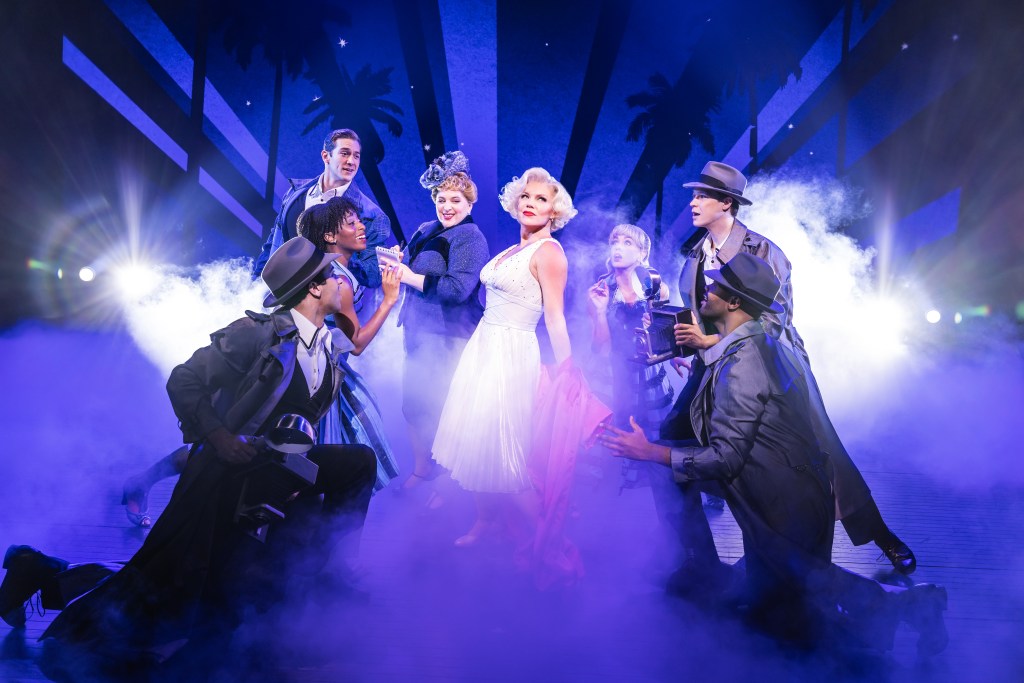
Smash
Chatting with two theater critics beforehand, who referenced the 2012 NBC television series also called “Smash,” I was initially distracted. The TV series set in the present revolved around two aspiring actresses who compete for the role of Marilyn Monroe in a Broadway-bound musical called “Bombshell,” about Marilyn Monroe. Apparently, the TV series which devolved into a musical soap opera, lasted two seasons then was cancelled. Since I never saw the series, I tried to ignore the critics’ comments. I fastened my seat belt and settled in to watch the revamped production in its current run at the Imperial Theatre with tickets on sale through January 4, 2026.
I had no reason to”fasten my seat belt.” Smash is a winner. Superbly directed by Susan Stroman, a master of comedic pacing and the quick flip of one-liners, Smash is a resounding must see, retaining little of the TV show with the same title. I adored it and belly-laughed my way through the end of Act I and throughout Act II.
Into the first act when Ivy Lynn (the grand Robyn Hurder), introduces her Method Acting coach, Susan Proctor (the wonderfully funny Kristine Nielsen channeling Actors Studio Paula Strasberg), I embraced the sharp, ironic and often hysterical, theater-referenced send-ups. The book by Bob Martin & Rick Elice is clever and riotous, pushing the true angst of putting on a big Broadway musical and spending millions to make it a success. Martin and Elice’s jokes and the characterizations of Nielsen’s Susan Proctor and director Nigel, the LOL on point Brooks Ashmanskas (The Prom), who tweaks the gay tropes with aplomb, work. Both actors’ portrayals lift the arc of the musical’s development with irresistible comedic riffs shepherded by Stroman’s precise timing.

The music had me at the opening with the vibrant fantasy number, “Let Me Be Your Star,” sung by Robyn Hurder, whose lustrous voice introduces Marilyn and her fandom which the creators attempt to envision with fully costumed performers singing for their musical, “Bombshell,” the Marilyn Monroe story. Then, the scene shifts to the rehearsal room where we meet the creative team who imagined the previous number and scene. Ashmanskas’ director/choreographer Nigel humorously bumps heads with writer/lyricist/composer-husband and wife team Tracy (Krysta Rodriguez) and Jerry (John Behlmann).
Also present, is his associate director and Nigel’s right arm, the golden voiced Chloe (Bella Coppola). She runs interference and puts out fires, even covering for Ivy Lynn and understudy Karen (Caroline Bowman), during an audience invited presentation. Why Ivy Lynn and Karen can’t go on is hysterical.
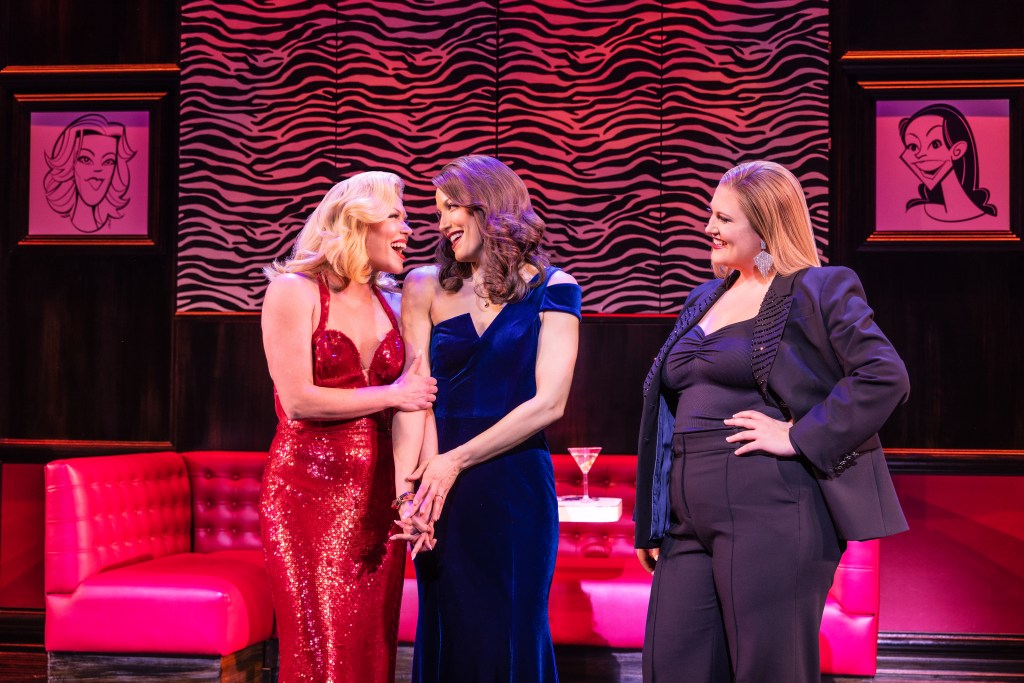
The music by Marc Shaiman, lyrics by Scott Wittman and Marc Shaiman, and the choreography by Joshua Bergasse are upgraded from the TV series with a curated selection of songs to align with the comedic flourishes. The musical numbers and dances cohere perfectly because the performers rehearse for their show “Bombshell.” With music supervision by Stephen Oremus, an 18-piece orchestra charges the score with vibrant dynamism. Featured are some of Shaiman’s brassiest tunes, orchestrated by Doug Besterman. Lyricist Wittman seals the humor and advances the plot. All provide grist for Bergasse’s choreography. Hurder manages this seamlessly as she sings, breathes heartily and dances while the male dancers whip and flip Ivy as Marilyn around. Of course, all smile with effortless abandon despite their exertions.

Importantly, Martin and Elice’s book sports farcical, riotous moments. These build to a wonderful crescendo by the conclusion. By then we realize we’ve come full circle and have been delighted by this send up of the wild ride these creatives went through to induce the belly-laughing “flop,” we’re standing, cheering and applauding. It’s the perfect ironic twist.
Indeed, once the audience understands the difference in tone from the TV series, largely due to Nielsen’s Proctor (she’s dressed in black mourning {Marilyn?} from head to foot), and Ashmanskas’ Nigel, Smash becomes a runaway train of hilarity. This comedy about unintentionally making a musical flop (unlike the willful intent in The Producers), smartly walks the balance beam by giving the insider’s scoop why “Bombshell” probably never finds a home on Broadway. One of the reasons involves too many chefs trying to make a Michelin starred dish without really understanding how the ingredients meld.
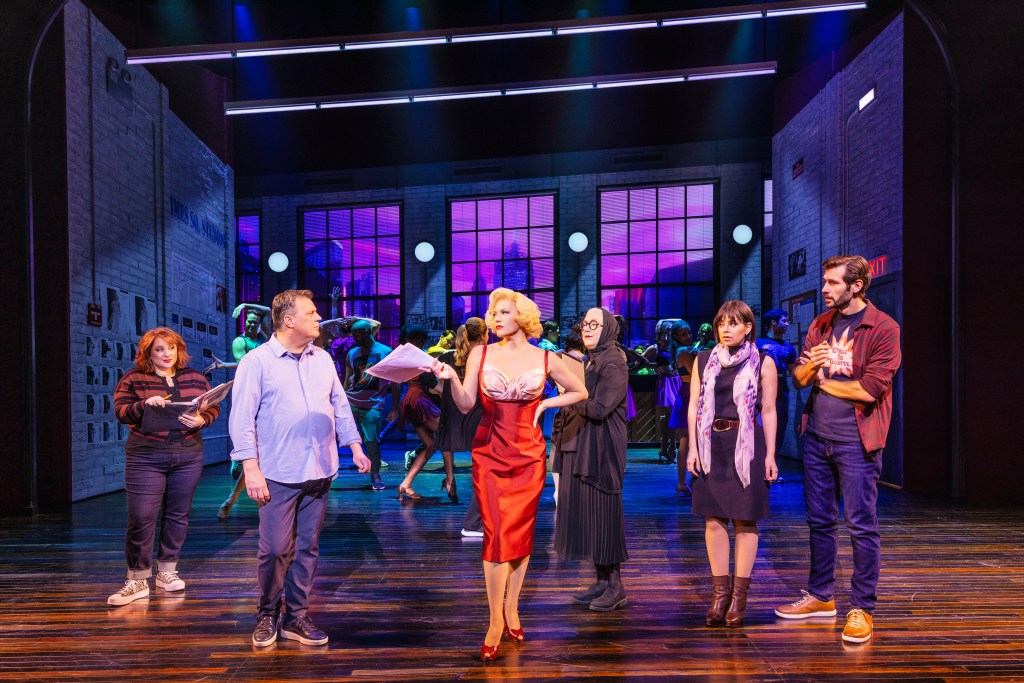
Nielsen’s Proctor dominates Ivy Lynn to the point of transforming the sweet, beloved actress into the “difficult,” “tortured soul” of diva Marilyn. The extremes this conceit reaches is beyond funny and grounded in truth which makes it even more humorous. Without giving too much away, there is a marvelous unity of the book, music and Hurder’s performance encouraged by Nielsen’s Marilyn-obsessed Proctor. We see before our eyes the gradual fulfillment (Proctor’s intention), of “Marilyn,” from superficial, bubbly, sparkly “sex bomb,” to soulful, deep, living woman produced by “the Method.” Of course to accomplish this, the entire production as a comedy is upended. This drives Nigel, Tracy and Jerry into sustained panic mode, exasperation and further LOL behavior especially in their self-soothing coping behaviors.
Furthermore, Producer Anita (Jacqueline B. Arnold), forced to hire Gen Z internet influencer publicist Scott (Nicholas Matos), to get $1 million of the $20 million needed to fund the show, mistakenly allows him to get out of hand, inviting over 100 influencers to Chloe’s serendipitous cover performance. The influencers create tremendous controversy which is what Broadway musical producers usually give their “eye teeth” for. Publicity sells tickets. But this controversy “backfires” and creates such an updraft, even Chloe can’t put the conflagration out. The hullabaloo is uproarious.

The arguments created by the influencers and their followers (in a very funny segment thanks to S. Katy Tucker’s video and projection design), cause huge problems among the actresses and forward momentum of “Bombshell.” Karen, Ivy Lynn’s friend and long time understudy, who has been waiting for a break for six years, watches Chloe become famous overnight for her cover. Diva Ivy Lynn who IS Marilyn is so “over the moon” jealous and threatened, she breaks up her close friendship with Karen and turns on cast and creatives, prompted by Nielsen’s Proctor who keeps up Ivy Lynn’s energy with a weird combination of mysterious white pills and even weirder “Method” tips.
Thus, the musical “Bombshell” becomes exactly what the creatives swore it would never become and someone must be sacrificed. Who stays and who leaves and what happens turns into some of the finest comedy about how not to put on a Broadway flop. Just great!
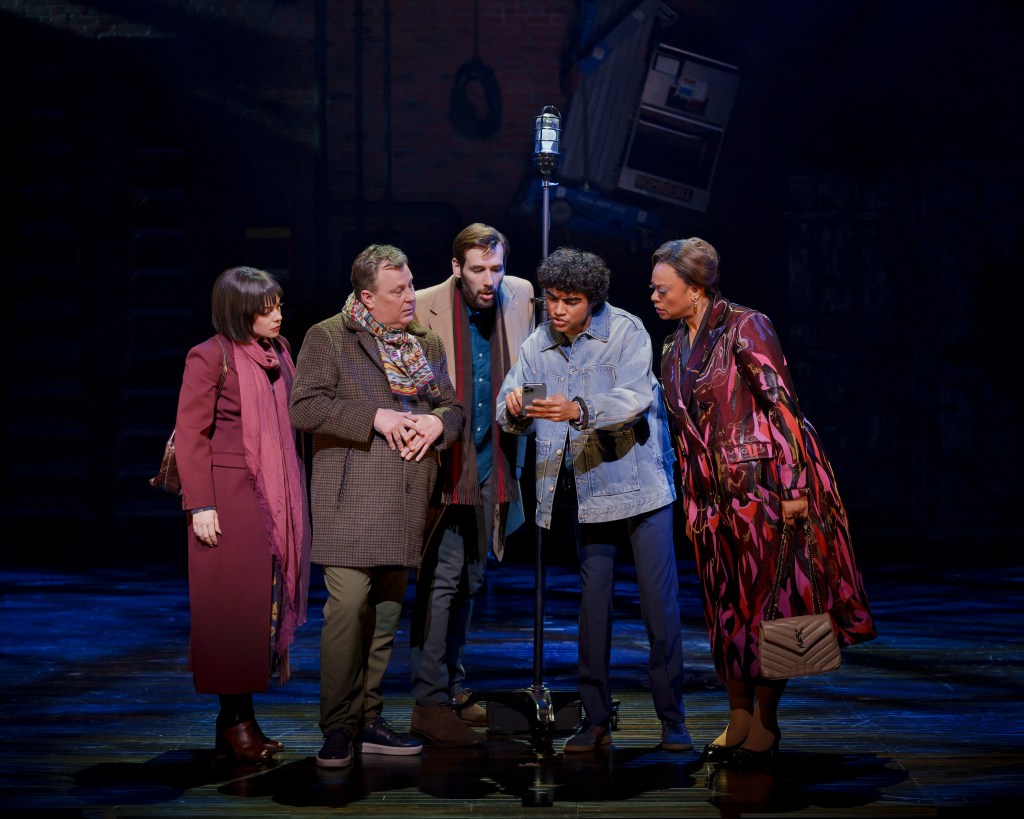
Smash is too much fun not to see. What makes it a hit are the superb singing, acting and dancing by an expert ensemble, phenomenal direction and the coherence of every element from book to music, to the choreography to the technical aspects. Finally, the show’s nonsensical sensible is brilliant.
Praise goes to those not mentioned before with Beowulf Boritt’s flexible, appropriate set design, Ken Billington’s “smashing” lighting design, Brian Ronan’s sound design, Charles G. LaPointe’s hair and wig design, and John Delude II’s makeup design.
Smash runs 2 hours, 30 minutes, including one intermission at the Imperial Theatre (249 West 45th street). https://smashbroadway.com/
‘A Beautiful Noise’ Review: The Neil Diamond Musical is a Triumph

How does one take the measure of a man toward the end of his life? Does one examine his relationships with others or does one examine the relationship he has with himself? In The Neil Diamond Musical, A Beautiful Noise, directed by Michael Mayer, currently at the Broadhurst Theatre, book writer Anthony McCarten (The Collaboration, Two Popes) approaches the question using the conceit of a therapeutic doctor/patient relationship.
To McCarten’s credit this complex bio-musical is unlike typical jukebox theater in its positioning of two protagonists: the older Neil of the present with the younger Neil in the past. Driven by this patient/therapist conceit, the musical incorporates Diamond’s songs with flashbacks centered around Diamond’s inspiration for their writing with the added heft of a hero quest. As Diamond unfolds himself to his doctor, certain topics can’t be discussed. He is keeping a part of himself in the shadows. Only through this complex journey into the past will his true identity emerge and be reconciled with his torments. Importantly, we learn through the melding of storytelling and songs why Neil Diamond was inducted in the Songwriters Hall of Fame (1984) and The Rock and Roll Hall of Fame (2011). We also learn the sacrifice that it took for him to be who he is.
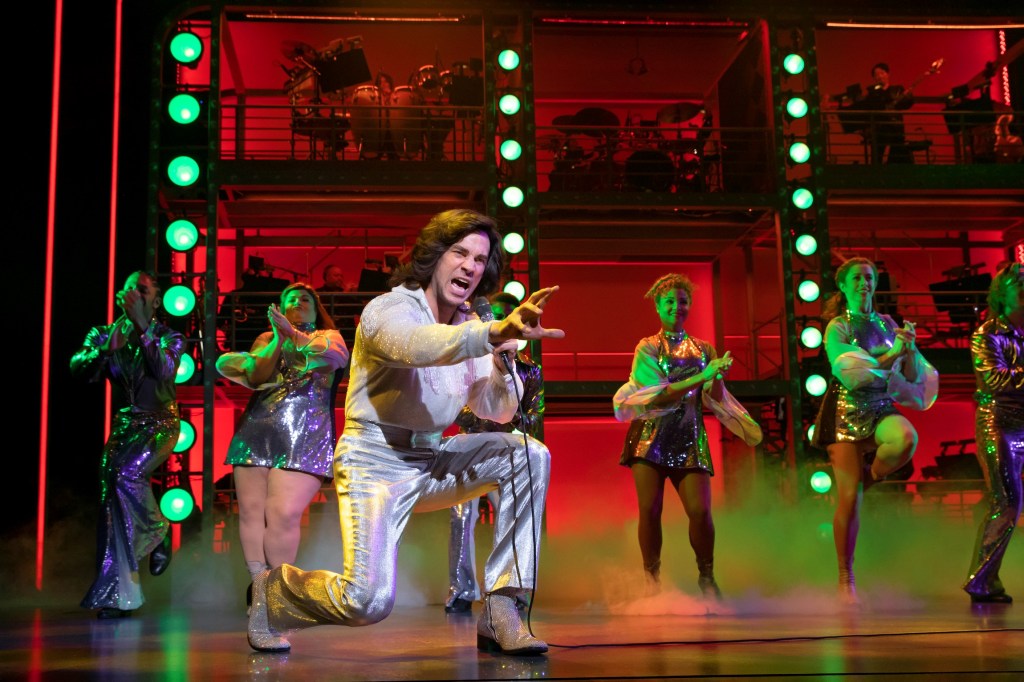
The doctor/patient motif that provides a thrilling excavation into Diamond’s life and career is cleverly crafted. For weeks a psychologist (Linda Powell) has sessions with a reluctant present-day, older Neil Diamond (the superb Mark Jacoby) who goes to her so that he might examine his inability to interact with his third wife Katie and his children. They have told him that “he’s hard to live with.” Is he? Diamond doesn’t know and on some level, he doesn’t care and prefers to brood (perhaps about his Parkinson’s diagnosis). After a number of sessions (three brief scenes) during which Diamond the elder says little, the psychologist produces his songbook, The Complete Lyrics of Neil Diamond. She does this in the hope of engaging him to discuss songs which he has said reflect his life. In this way maybe a door will be opened into Diamond’s psyche to clear up the issues he is having with his family relationships and most importantly, in his relationship with himself.
Jacoby’s Diamond begins to engage with the psychologist as she reads from the book’s cover that he has 40 of the Top Forty Hits and 129 million of his albums have been sold. When she suggests that they discuss what some of the songs mean to him, he rejects her idea and humorously is piqued that she only is familiar with one of his songs out of his 39 albums. However, when she mentions that title, it strikes a sensitive nerve and he doesn’t want to discuss what it means to him. Unable to leave this “therapy” to please his wife, we understand that he chafes at being controlled, but out of love for Katie and the kids, puts up with the doctor and therapy sessions which have, thus far, proven fruitless.
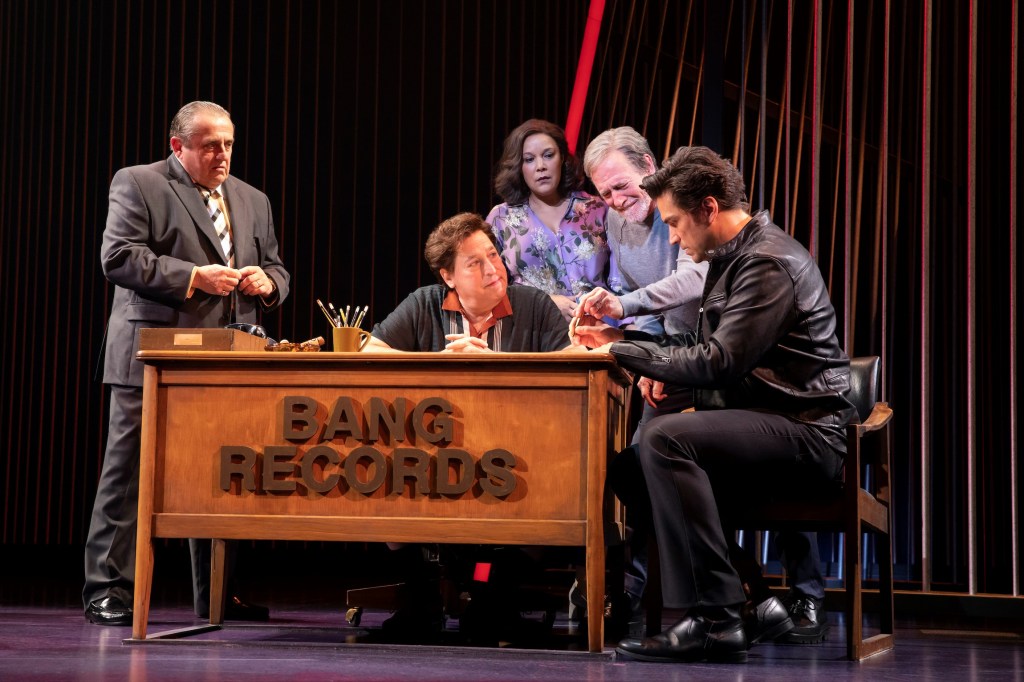
When the doctor gives him the songbook and suggests that he pick out a song and talk about it, as he rifles through the pages, he notes his proud accomplishments. We hear the “Opening Montage” of a few of his hits. It is as if a genie has been released from his memory as he peruses the book, then shuts it, perhaps because the memories of what was are too painfully overwhelming. But ambivalently, he opens the book again commenting, “what a beautiful noise.” As he remembers, a back up group sings “Beautiful Noise,” and the young Neil Diamond (Will Swenson in an exhilarating performance) appears and sings with them to a backdrop full of glorious light and sound. The song includes an overlapping combination of riffs from some of his classic hits, signature songs which Swenson’s Diamond sings with lustrous power and energy.
The singers who symbolize Diamond’s concept of “The Beautiful Noise” with this song and throughout various numbers are Paige Faure, Kalonjee Gallimore, Alex Hairston, Jess LeProtto, Tatiana Lofton, AAron James McKenzie, Mary Page Nance, Max Sangerman, MiMi Scardulla and Deandre Sevon. They sing backup and dance the journey of Neil’s life and career as the songs explore and reveal his flaws in his relationships, most importantly the one he has with himself. The “Noise” who accompany him are as diverse as the street people who Diamond writes for. It is they and their ancestors who have “Come to America” to seek the American Dream that Neil Diamond himself represents. The play is a revelation of this which we learn at the conclusion of the production, when Jacoby’s Neil discusses the loneliness and fears of his childhood. Only then is he able to reconcile his identities past and present.

After the opening musical reverie, the older Neil then returns to reality in the doctor’s office. These positive remembrances have made Jacoby’s Neil comfortable enough to answer the doctor’s questions about writing his first song in Flatbush, Brooklyn for his high school girlfriend Jaye (Jessie Fisher) who he marries. During this exchange he refers to his escape into music and how he was obsessed with writing and performing songs to “get out of Flabtush.” Ironically, we learn throughout the musical that Flatbush is the place he seems to be forever escaping, before and after he becomes famous. His reasons for running are revealed by the older Neil at the conclusion. McCarten has fashioned the reason as his quest to acknowledge his true worth which will help him achieve peace with himself, Katie and the children
McCarten’s book sets up the paradigm and structure of older Neil digging deeper into his past. As he flashes back and forth in time with younger Neil, who manifests the songs inspired by his life, The Neil Diamond Musical, A Beautiful Noise takes off. Act I showcases Diamond’s rise to fame in the 1960s. Act II follows with his touring and concert glories as his career achieves stunning heights in producing 39 albums, while his personal life after two divorces and an empty bank account are in the abyss. We are delighted to travel back and forth from present to past to present as Jacoby’s Neil frames the journey to Powell’s therapist through flashbacks, as the vibrant, Swenson’s Neil enacts the “dream” and makes it reality.

Guided by the doctor’s questions, Jacoby’s Neil relates his experiences beginning at Aldon Music where he meets Ellie Greenwich (Bri Sudia) in a humorous few scenes, getting his feet wet under her guidance. In one scene he pitches a slower version of “I’m a Believer.” She hears its possibility and voila she sells it to The Monkeys for a hit. Neil’s career is growing as he receives his first gold record. He is a success writing for the Monkeys, but it’s not enough. The older Neil illustrates the part of Neil that is never satisfied. The song is “silly,” he says. However, the doctor points out the depth in the song’s lyrics, a depth which indicates no part of Neil was ever occluded by commercialism. His own poetic voice always showed through in his songs.
Jacoby’s Neil softens with Powell’s therapist. He shares how he moved from writing songs for others to performing them. In a flashback, we note that Ellie believes he is “that good,” when he sings how “Kentucky Woman” should be performed during a “Demo Medley.” Because he needs to develop his performance skills, Sudia’s Ellie has him gain experience at the Bitter End in New York City. After singing a set (“Solitary Man,” Cracklin’ Rose”) Paul Colby (Michael McCormick) gives him $9.00 and asks the shy Neil to return. It is here that young Neil opens up to attractive fellow singer Marcia (Robyn Hurder). He tells her that he enjoys performing live for this, his first time. The uplifting experience strengthens and changes him. It allows him to express a vibrant, alive part of himself he has not acknowledged or thought himself capable of.
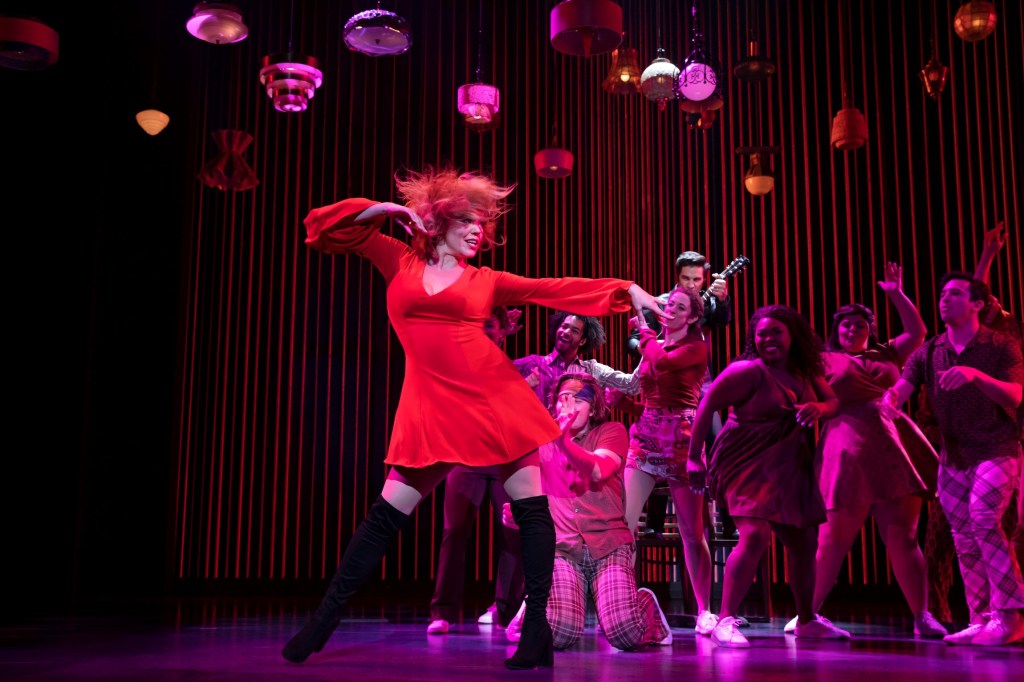
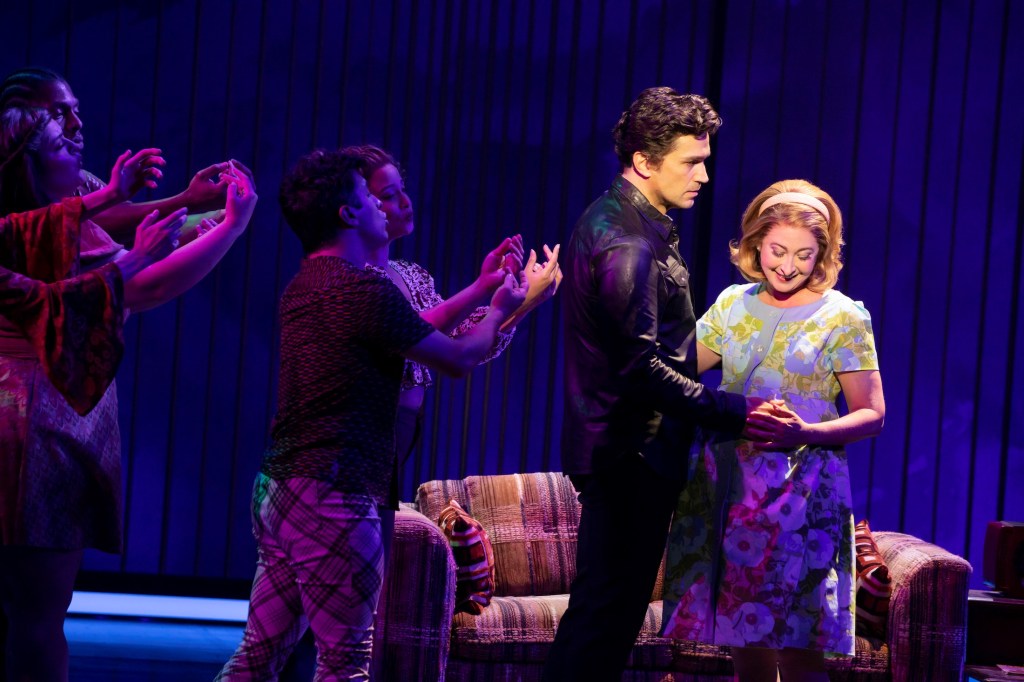
We understand how this turning point shapes Diamond into the dynamic performer he eventually becomes with Marcia’s encouragement. Hurder’s Marcia suggests he write more upbeat songs that everyone can identify with. In this flashback segment, she and Neil sing “Song Sung Blue” which intimates how their growing romantic relationship is forged by his need to establish himself in a fruitful career and release his poetic and musical talents to become a success.
McCarten then shifts the flashback to the present in the doctor’s office. Jacoby’s Neil doesn’t want to discuss how his involvement with Marcia while Jaye is pregnant with their second child upends his marriage. Neil fights with the doctor not to remember what is painful that is revealed in songs he wrote at that time. These include songs about being torn between his wife and his mistress. Clearly, he is overwhelmed with guilt having grown close to Marcia who assists him with his career. It is a sore point and he isn’t ready to do the emotional work looking at why he took a self-destructive turn by reviewing how this angst came out in his songs.
So when the doctor settles upon a classic hit created around that time, (which Robyn Hurder dances to in a bright red sexy costume when “Cherry Cherry” is performed) the older Neil jumps at the chance to talk about the creation of his song for “the mob.” These flashback scenes become the humorous high point of Act I. We are intrigued as the older Neil characterizes working with Bang Records as “the biggest mistake of my life.”
Ellie introduces Neil to Bert Berns (Tom Allan Robbins) who runs Bang Records, while Mob Boss Tommy O’Rourke (Michael McCormick) funds the company. In a flashback Swenson’s Neil makes a deal with them to produce hits, if they then produce more artistic songs like “Shilo,” which may not be hits. Though O’Rourke agrees, McCormick’s O’Rourke humorously indicates he has no intention of keeping his promise. In a scene where time stops, the older Neil tries to prevent younger Neil signing on with Bang Records by trying to take the pen away. Older Neil fails and younger Neil signs and is controlled by them. He must produce three hits or end up in peril of his or his family’s lives.
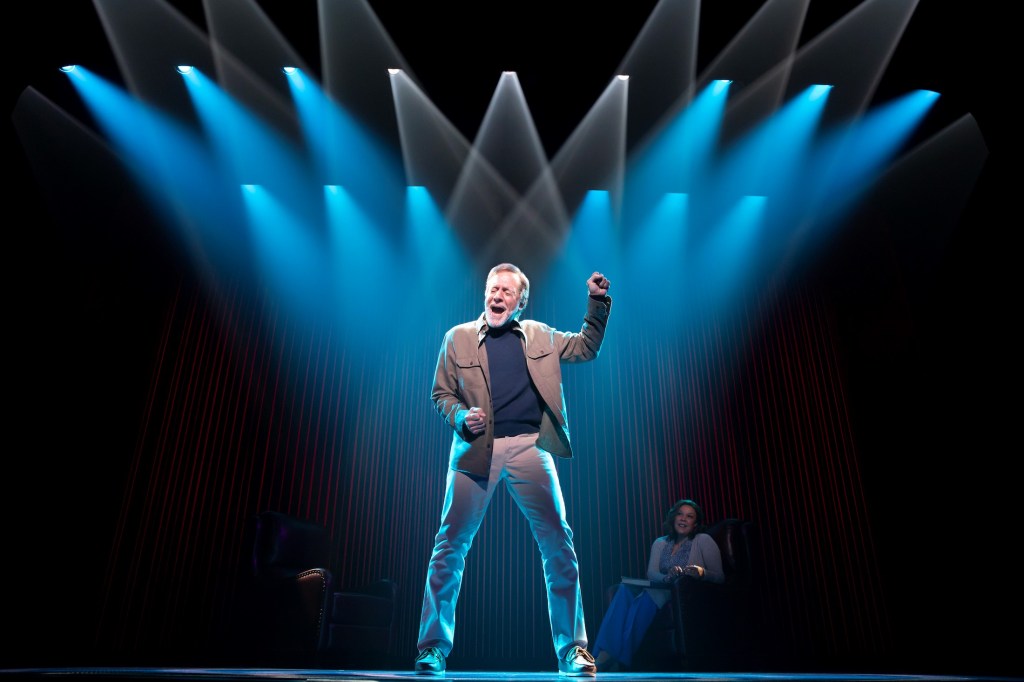
In revealing how younger Neil is torn between Jaye and Marcia, the musical number with the Noise “Cherry Cherry” rocks it as the number physicalizes Neil’s quandary first with Jaye and then moving toward Marcia until he is with her. As Fisher’s Jaye sings “Love on the Rocks,” with Swenson’s Neil begging her to stay, she asks if he loves Marcia. At this point the question is moot.
Neil’s exciting foray into success as he fulfills his contract to mob controlled Bang Records reaches its dramatic high point played out in a dingy Memphis motel, where he retreats to write and get away from the gun happy O’Rourke. Jacoby’s Neil reveals how he was under tremendous pressure to create or suffer the dire consequences. O’Rourke has the Bitter End bombed to send Neil “a message.” Older Neil shares how in Memphis after days of rain, the symbolic sun comes out. He credits the inspiration to “God” coming into the motel room, sealing his children’s future and his own. In thirty minutes the metaphoric dark clouds clear (dark clouds are used as a symbol throughout) and Neil writes one of his signature songs. Act I ends with the rousing “Sweet Caroline.” During their song performance the audience went wild the night I was there. The audience, and Swenson and the Noise “reach out, touching me, touching you.” Theirs is an electric connection that younger Neil is not able to muster with his wife Jaye and their children.

Act II begins with the persona Neil Diamond, who is now famous. Director Mayer has Swenson’s Diamond rise on a platform surrounded by lights and glory with a “Hollywood Squares” type layered set with the band in various “squares.” Clearly, Neil is becoming the award winning legend, singing “Brother Love.” Subsequently, through the older Neil’s retelling, we note that Swenson’s Diamond, with dazzling, sparkling sequins runs from concert to concert, fulfilling the destiny that he dreamed of in Flatbush, Brooklyn, the place that controls his psyche, the place he still runs from. This is especially so even though his concerts sell out with greater fandom than the Rock & Roll King Elvis. In the next decades with Marcia in twenty-five years of marriage, he has it all, friends with the Redfords, a Malibu home and money raining down. Where his first marriage to Jayne dissipated with “love on the rocks,” his marriage to Marcia quietly implodes during phone calls, separate lives and acknowledged disinterest. This is manifest with Hurder’s Marcia and Swenson’s Neil with “You Don’t Send Me Flowers,” in a lovely rendition.
At their divorce, Diamond gives Marcia everything and continues to work. Jacoby’s Neil tells us a few years pass and he meets third time lucky Katie and establishes a family. But the diagnosis has brought him to a place of reckoning at the therapist’s office. And we are back in the present when Powell’s therapist asks the question about Neil’s feelings of being alone, an emotion which permeates many of his songs. During this segment Mark Jacoby’s quiet resolve and recalcitrance breaks open in expansive revelation.
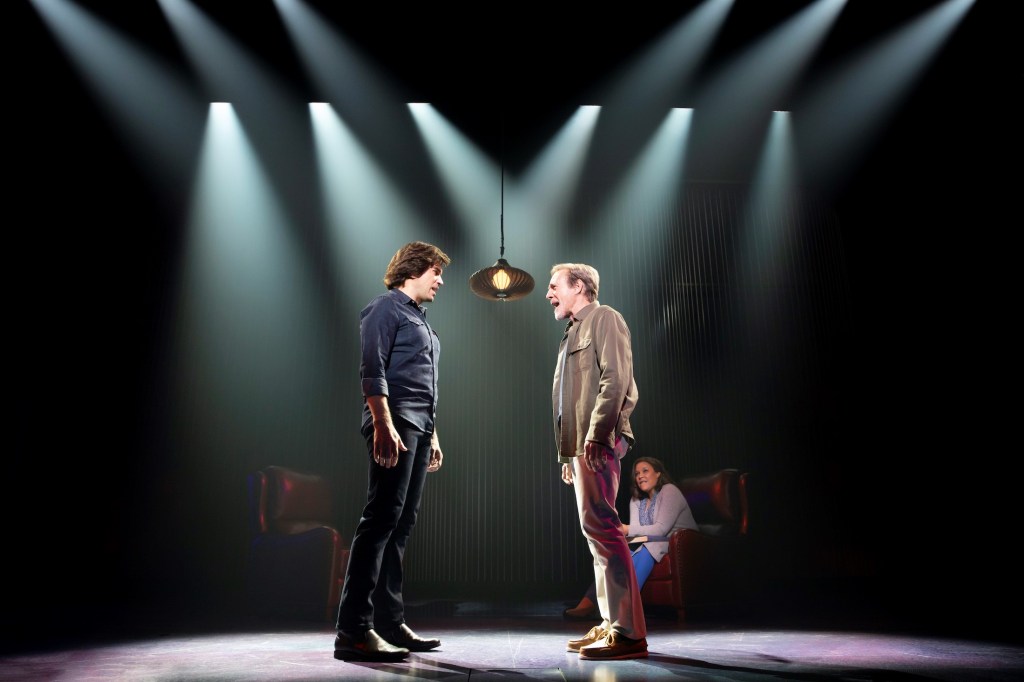
For the first time we hear him sing filled with the depth of years of repression to claim his self-affirmation in “I Am I Said.” Jacoby hits it out of the ball park and brings the entire journey into completion as Swenson’s Neil joins him and the two identities are conjoined. It is an astounding, brilliant piece of writing coupling the elements and characters bringing them into sharp focus. The power of the moment hinges on Jacoby’s portrayal of Neil which is heartfelt, touching and human. The conclusion memorably coalesces the dream coming to its full humanity in Neil Diamond. Merging his identity as a performer and as a cultural prophet he gains a new understanding of his emotions from the past viewing them with the comfort in the present reality of who he is and what he has accomplished.
Directed by Michael Mayer with Steven Hoggett’s choreography and Sonny Paladino’s music supervision and arrangements and the near-perfect performances, this astounding and prodigious effort is bar none. Above all it is a tribute to Neil Diamond the performer and Neil Diamond, the man, like all of us, broken by his own inner fears and isolation which is an integral part of his creative spirit and artistic genius. The breadth of the songs included in the show which reveal that Diamond mastered pop, rock, country and blues indicates why in addition to his awards is also an honoree at the Kennedy Center Honors and a recipient of the Grammy Lifetime Achievement Award (2018).

Importantly, The Neil Diamond Musical, A Beautiful Noise probes themes that reveal how driving ambition and talent shadow an artist’s personal life. In chasing the dream it is sometimes difficult to fully enjoy one’s success. In his resolution at the conclusion, Jacoby’s Neil understands the importance of this and expresses gratefulness at all the directions, all the roads his life has gone down.
There are a few critical junctures that don’t quite work and sometimes the staging and sound were problematic for those not seated direct center. But these details are overshadowed by the ingenuity of the book, the resonance and gorgeousness of Diamond’s music, the energetic, believable performances and the organic, modern and retro dances. Jacoby’s Neil who is listening and participating as he watches Neil’s own reflections manifest before him, never flags in his portrayal in a difficult, complex role. Neither does Swenson who’s evocation of Diamond is an intimation of his attitude and spirit and not an imitation. Hurder, Powell, Fisher and Sudia are excellent and Sudia is flexible doing double time as younger Neil’s mom. Robbins and McCormick fulfill their portrayals with humor and kudos to them for taking on additional roles.
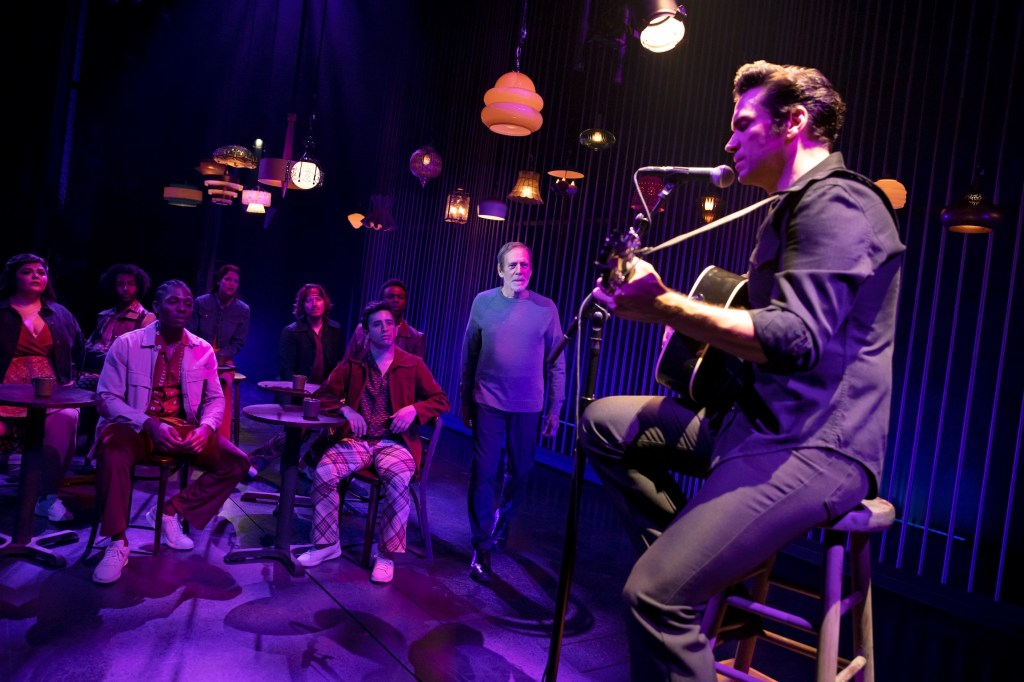
David Rockwell’s scenic design, Emilio Sosa’s costume design, Kevin Adams’ fine lighting design and Jessica Paz’s sound design work to deliver an amazing production. Noted are Luc Verschueren’s hair, wig & makeup design and Annmarie Milazzo’s vocal design. Bob Gaudio, Sonny Paladino & Brian Usifer delivered the superb orchestrations and Brian Usifer is responsible for incidental music and dance music arrangements.
If Neil Diamond’s music doesn’t rock for you, see it for the performances and spectacle. If you adore Neil Diamond, what are you waiting for? Go to their website for tickets and times https://abeautifulnoisethemusical.com/
.
t
‘Moulin Rouge! The Musical’ Celebrates the Seductive Delights of the Iconic Venue in a Sumptuous Feast for the Senses

(L-R): Jacqueline B. Arnold, Robyn Hurder, Holly James, Jeigh Madjus in Moulin Rouge! The Musical, book by John Logan, Music Supervision, Orchestrations, Arrangements & Additional Lyrics by Justin Levine directed by Alex Timbers (Matthew Murphy)
The moment you enter the Al Hirshfeld Theatre, a paradise of sensuality embraces your soul and immerses you in the suggestion of hedonistic pleasure. Immediately, you are “eyes wide open,” moving along a course where anything is possible, even an after hours engagement with one of the male, female or transgender perfections of beauty, scantily but tastefully adorned, who saunter on the catwalks and peer out at you from the stage. Undulating rhythms and sensual music in this Bohemian, Paris, Left Bank cabaret/theater/dance hall soothe and allure. The luxurious red and gold appointments, the deep cherry and red velvet variegated stage curtains, the banquets, chandeliers, gleaming brass, the golden cherubim all whisper romance, sex, excitement and a whirlwind of indulgence. Whoever you are, you will be encouraged to understand that you can achieve your vision of an exalted life, a life where freedom, truth, beauty and love raise you above a bruising and squalid reality out there on the dark streets.
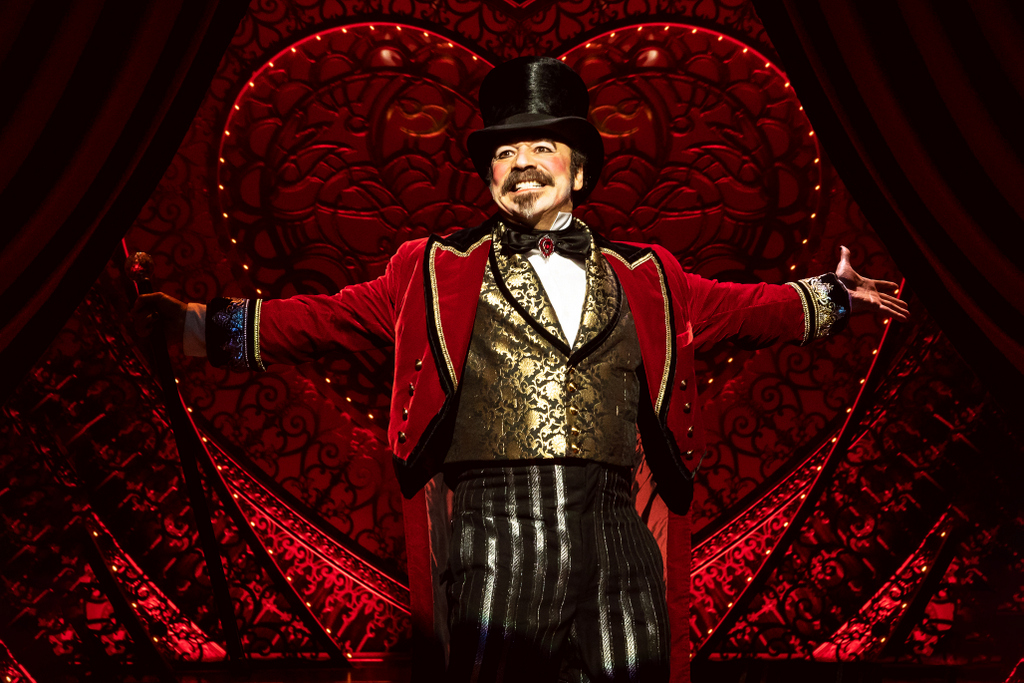
Danny Burstein in Moulin Rouge! The Musical, directed by Alex Timbers (Matthew Murphy)
This is the Moulin Rouge Club at Moulin Rouge! The Musical. Expect the finest in fantasy and escapism. If your intellect and imagination are ripe to receive, you will never be the same again! As you sense this revelation La Chocolat (Jacqueline B. Arnold), Nini (Robyn Hurder), Arabia (Holly James), Baby Doll (Jeigh Madjus), parade their “stuff” and throatily grind to the beats as they torch out “Lady Marmalade,” in an unforgettable opening number joined by the ensemble. This full throttle ignition is brilliantly conceived with grand style and prodigious effort by the creative team. My God, what a triumph!
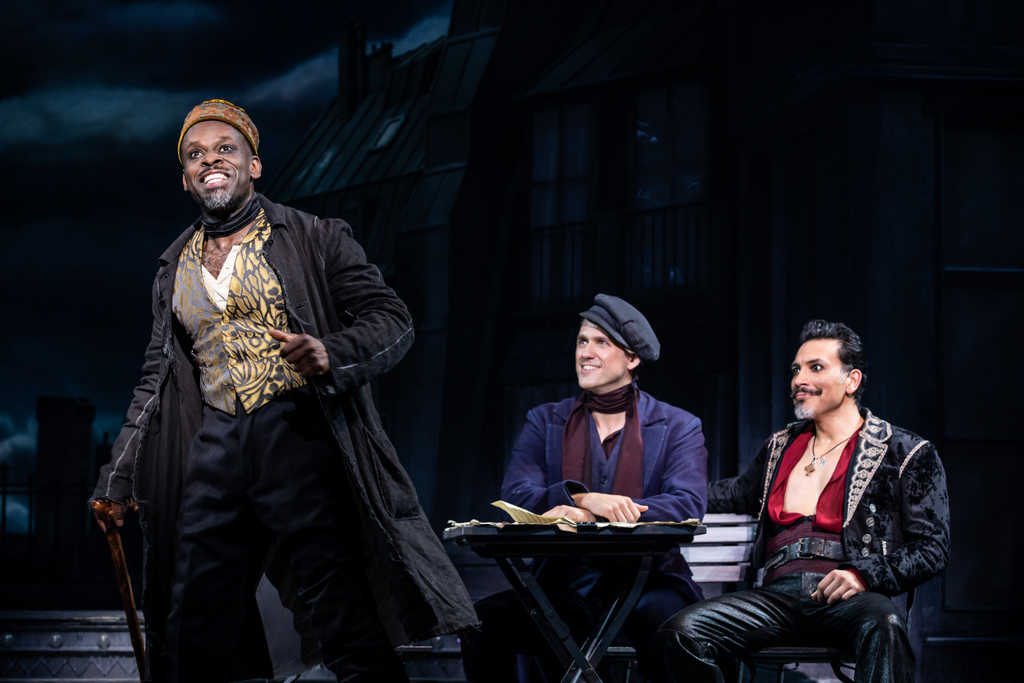
(L to R): Sahr Ngaujah, Aaron Tveit, Ricky Rojas in Moulin Rouge! The Musical, directed by Alex Timbers (Matthew Murphy)
The production directed by the illimitable Alex Timbers, with a clever book by John Logan (based on the 2001 Twentieth Century Fox Motion Picture written by Baz Luhrmann and Craig Pearce, directed by Baz Luhrmann), with “to-die-for” music supervision, orchestrations and arrangements by Justin Levine is a towering majestical remembrance of what never was but might have been during La Belle Époque in Paris and specifically at the fin de siè·cle. From the on-point luxurious, sexy, ravishing costumes by Catherine Zuber to the energetic, aggressive, dance numbers choreographed by Sonya Tayeh, this musical is a non stop festival. “Bad Romance” is especially gravitating as a thrilling, energetic, “lemme consume your lips,” head to head, face-off with couples gyrating to the hot Lady Gaga song which thematically epitomizes the romance among the principal couples: The Duke of Monroth (Tam Mutu), Satine (Karen Olivo), Christian (Aaron Tveit), and the lesser lights: Santiago (Ricky Rojas), and Nini (Robyn Hurder), all of whom are sensational in voice, and character portrayals.
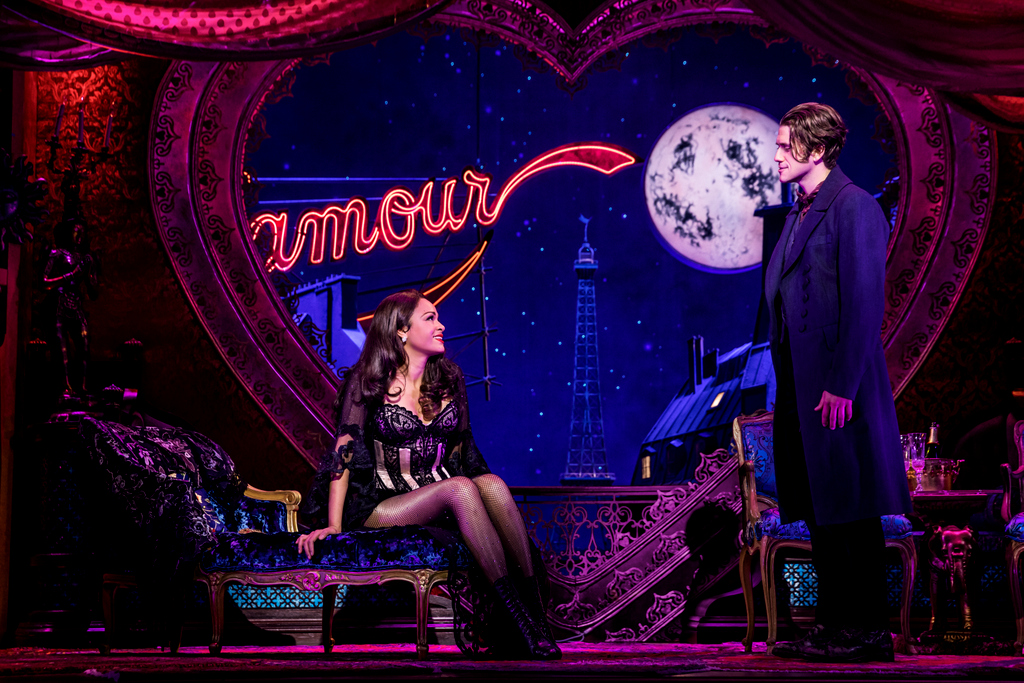
Karen Olivo Aaron Tveit in Moulin Rouge! The Musical, directed by Alex Timbers (Matthew Murphy)
Baz Luhrmann and Catherine Martin provided their creative services to the production which is an update of their ground-breaking, award-winning film Moulin Rouge (2001). And indeed, the basic arc of development inspired by a meld of characters and plots from Giuseppe Verdi’s opera La Traviata and Giacomo Puccini’s La Boheme remains with added tweaks of humor, phantasm and fun, delivered by incredible performances, perhaps the most preeminent charismatic, chameleon of of them all being the gobsmacking Danny Burstein.
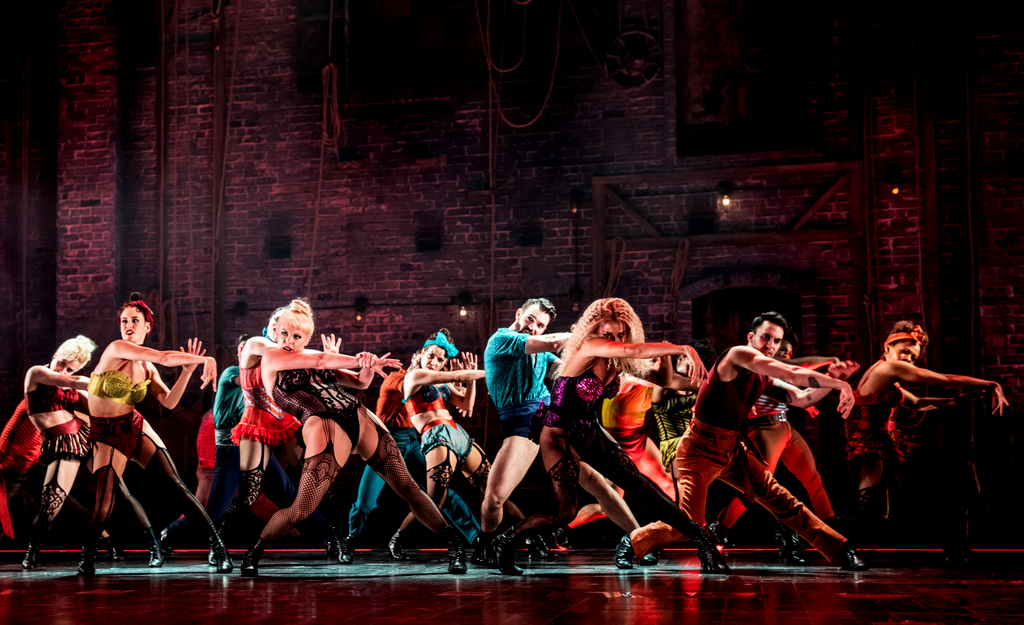
The Company, Moulin Rouge! The Musical, directed by Alex Timbers (Matthew Murphy)
Burstein is a mesmerizing scene stealer. Amidst the splendiferous sets (Derek McLane), and shimmering, vibrantly lit (Justin Townsend), festivities, Burstein, as the club’s artistic owner/showman Harold Zidler, is the “God-like” host of confabulation. And he is damn good at it, in fact so adorable that we understand how and why Harold has kept his “chickens” together through thick and the current financially thin stage of the Moulin Rouge Club’s history. As Burstein’s Harold winningly controls our imaginations and guides the glory and spectacle, we willingly follow him believing he has our best interests at heart because to him there is no sin, no judgment. Within this space and for this night, we are free to be our fantasies.
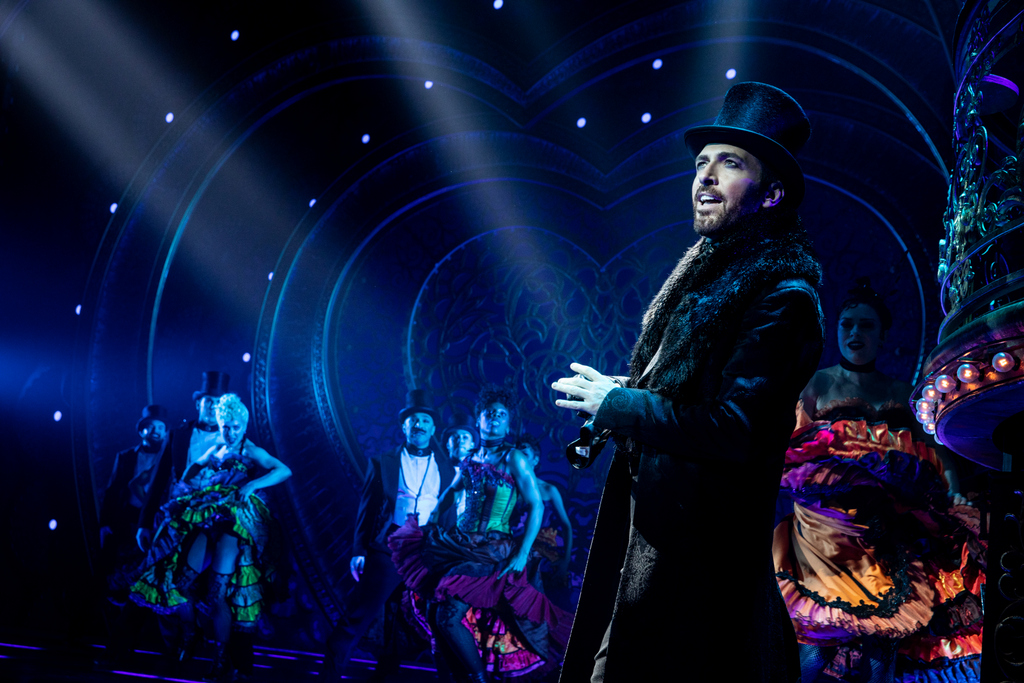
Tam Mutu in Moulin Rouge! The Musical, directed by Alex Timbers (Matthew Murphy)
What this production does exceedingly well is reveal that the Moulin Rouge Club into which Zidler has put his heart, soul and every red hot cent he owes is an artistic production down to the lavish sets and well-heeled orchestra. And he and the ensemble live for this art. Thus, Burstein’s performance is a revelatory genius of Zidler’s dedication and desperation. Motivated by his craft and concern for his artistic family, his character’s steely sweetness is genuine, his charm and love is pure without oily ingratitude or predatory insidiousness. Above all he makes clear in the behind the scenes discussions with Olivo’s Satine, that his desire is to supply his patrons’ complete enjoyment so his company will survive and remain off the streets and away from the impoverished hellishness they all came from.
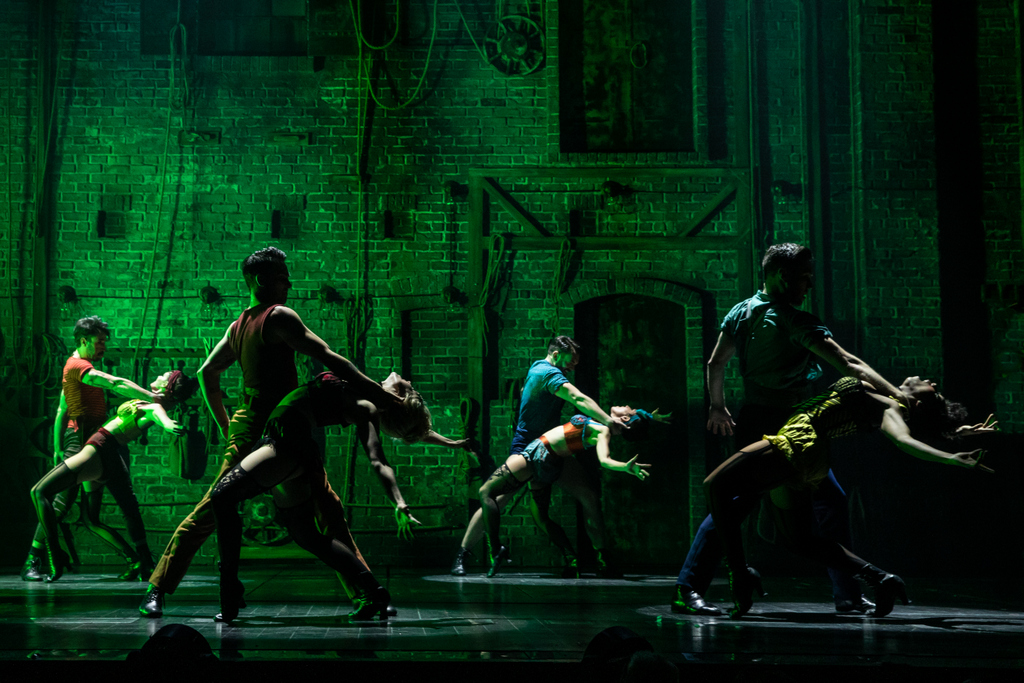
Moulin Rouge! The Musical, The Company, directed by Alex Timbers (Matthew Murphy)
Likewise, Satine’s love for Zidler and her company of friends and compatriots, one of whom is the great painter Toulouse-Lautrec (the very fine, grounded Sahr Ngaujah), reveals they understand the club’s liquidity is their life and happiness. Thus, Satine’s characterization is profound. She is the “read deal:” she is their salvation, their mother, their friend, their life-blood, their sacrifice. The sense of love and community among the ensemble is palpable so we believe Burstein’s Harold when he insists that Satine should “go to hospital,” as her friends insist as well. Without her, they are lost.
Karen Olivo’s Satine is a sensual, hot, earth-mother and high-class courtesan, experienced, wise, unmoved. She is not an ethereal beauty, but dominant, solid in will, though failing in flesh. She is a perfect symbol to represent what Harold’s artistic creation stands for, a lotus risen from the mud into full flower which will fade quickly. Olivo’s fullness of voice soars during her duets with Tveit’s Christian who is her equal in range, power and sensitivity. “The Elephant Medley” (the love song riff mash-up they sing in her boudoir as a “come-on” and “let-down”), that has been enhanced with additional numbers is just smashing.
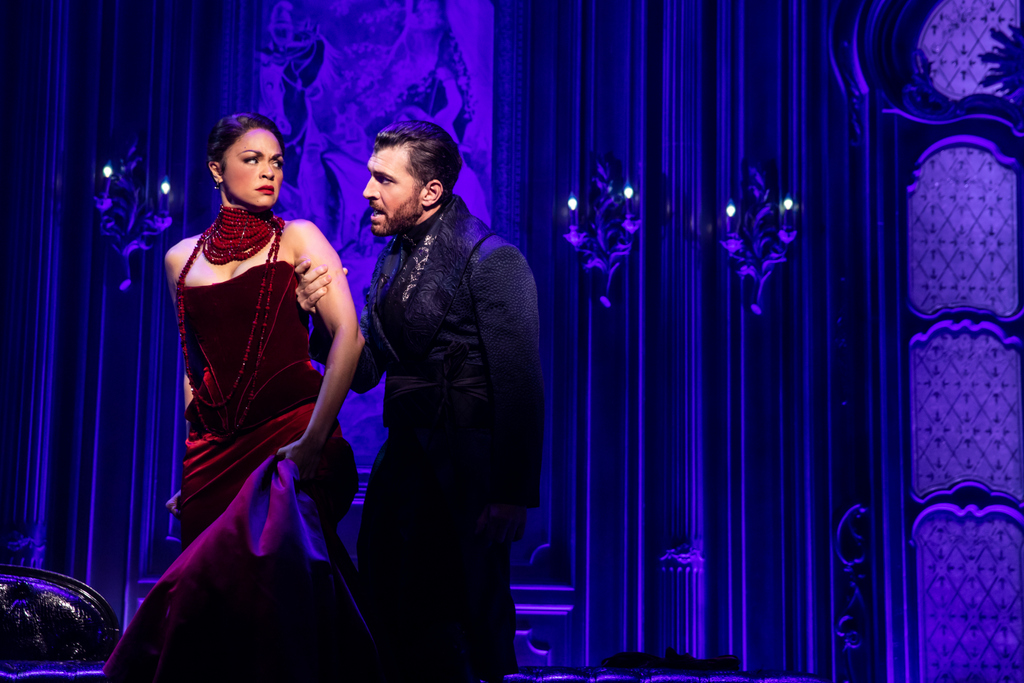
Karen Olivo, Tam Mutu, Moulin Rouge! The Musical, directed by Alex Timbers (Matthew Murphy)
Her introduction by Zidler as the “jewel” of the Moulin Rouge Club as she descends on a trapeze singing the “Diamond Medley” symbolizes her ethos and the club’s centrality as a necessity in the hearts of a society at that time and perhaps for all time. Escapism is in; it always was and always will be. The more authentic the fantasy, the better. And Satine, like Zidler, are exceptional conveyors. Their importance is an equivalent to their patrons’ happiness. Thus, she is fitting as a timeless symbol of the club; their interwoven stories will always resonate and instruct with wisdom, which like a diamond shines but cuts.
Obviously, Logan’s book adapted from Luhrmann’s and Craig Pearce’s film, reflects depth in its simple story of artists attempting to survive in a carnivorous world, as they use their charms and love inducements to glean wealthy backers. And all goes well, until the artists are hoisted on their own petard of humanity, and they fall fatally in love, and others fall fatally in lust with them. As cultural icons, artists cannot be owned or even possessed. (a not so subtle message to philistines everywhere). Satine and Zidler belong to their art, themselves and the world, as Ngaujah’s Toulouse-Lautrec affirms despite The Duke of Monroth’s insistence that Monroth owns the club and all its performers. This is another intriguing theme. When art is put in the hands of philistine owners, it crumbles for they lack the talent, will and spirit to create. Instead, they should uplift the brilliance of creators like Zidler. He knows how to draw the crowds but lacks the finances to sustain the Moulin Rouge Club.
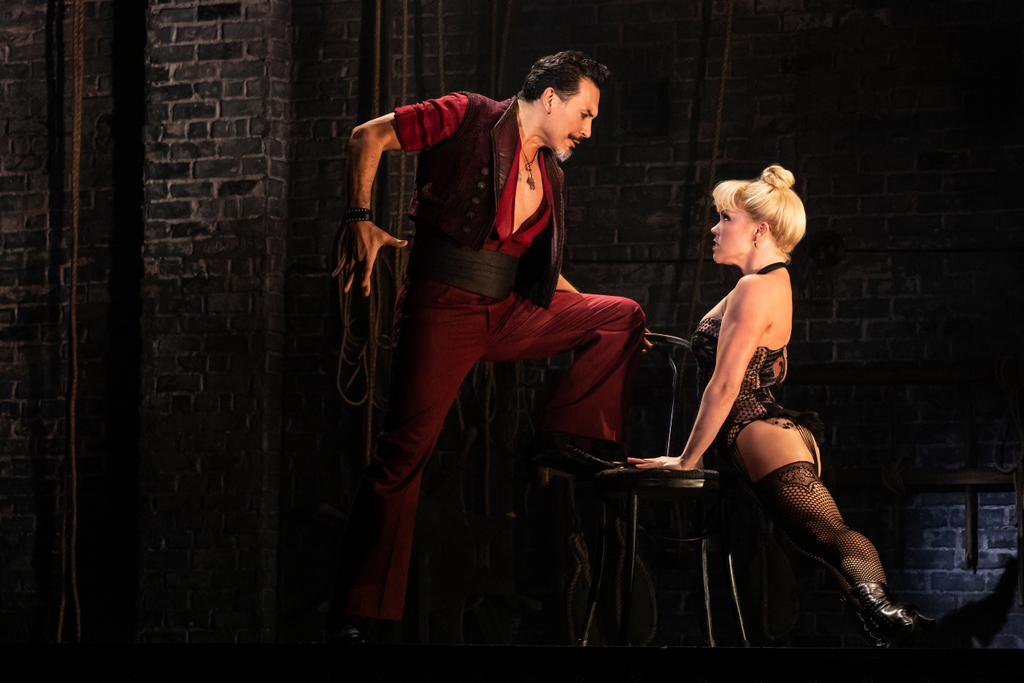
Ricky Rojas, Robyn Hurder, Moulin Rouge! The Musical, directed Alex Timbers (Matthew Murphy)
The scenes when Lautrec and the company rehearse and Mutu’s Duke attempts to assist are particularly to the point and humorous. Monroth’s ego gets in the way after he senses he has lost Satine to Christian. Yet, he is willing to keep her despite her lack of affection for him. And his jealousy rises to spoil the show, as Christian’s jealousy rises to provoke the Duke. Yet, the show must go on, but how? Satine, once more must “save the day,” but she is not immortal.
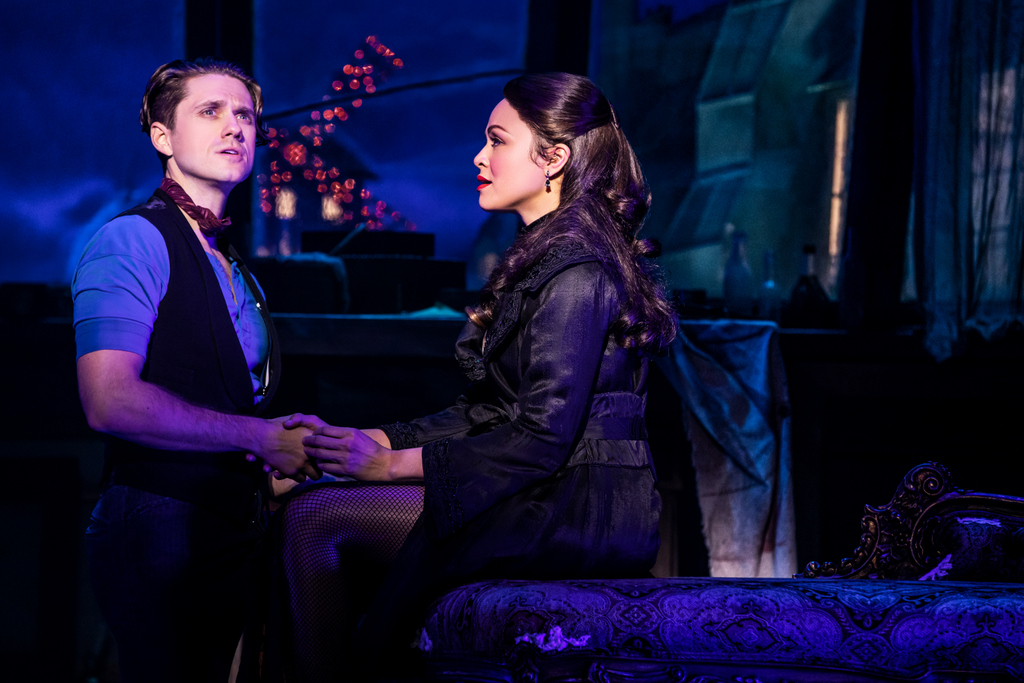
Aaron Tveit, Karen Olivo, Moulin Rouge! The Musical, directed by Alex Timbers (Matthew Murphy)
As rivals for her love and lust Tveit’s Christian and Mutu’s Duke are worthy. The intricacies of plot which involve Satine’s eventual love for the innocent and consumed Christian, and sexual enticement of the Duke are woven adroitly. Particularly delightful are Mutu’s mash-up of Mick Jagger’s songs (his “Sympathy for the Devil” could have gone on longer). And the conversion of lyrics to a male orientation for Rihanna’s “Only Girl” are hilarious. Mutu manages to be wicked but sexy and seductive. His intentions are insidious but he retains the exceptionalism of aristocracy that assumes privilege from generational wealth that goes back centuries. Importantly, it is the humor in Mutu’s depiction that keeps him interesting and edgy and not loathsome, which is in keeping with the comedic tone of the production.
As a keen and successful rival, Tveit expertly tweaks the humor related to Christian’s, creating his compositions in the funny scene when he first befriends Lautrec and Santiago. He does this with expert timing and together the three render their exchange into pure farce. His “Ohio” demeanor evolves by the conclusion from a “lad” to a man who “comes into his own.” He is every inch the authentic lover. His duets with Satine in which they both feed song refrains to each other are happily playful, suggestive and grounded. And in the delivery of his last songs, Tveit is amazing, heartfelt, sonorous. As a couple in a loving affair that grows into something more, Tveit and Olivo strike powerful resonances.
Nothing more can be lauded about Mouline Rouge! The Musical except that the sound design by Peter Hylenski was on point, balanced, targeted. I heard words from well known songs that I never “got” before, for example Katy Perry’s “Firework,” which Olivo sends into the heavens as a PURE WOW! Thus, I could greater appreciate the character development, the themes, symbols, the ironies, the true riches of this mythic production because the song mash-ups and medleys were crystal clear.
This is a Broadway show in the true spirit of New York City’s greatness. To see these performers, you should get tickets immediately and order another set to revisit a month or two out. I guarantee that seeing it again, you will note many other elements that you missed the first time around as you peel back layers. If you can’t see it again, some of the music is on YouTube. Check for updates.
The show runs with one intermission at the Al Hirschfeld Theatre on West 45th street. For tickets and times CLICK HERE.
The cast album is currently available for streaming at https://smarturl.it/MRtheMusical
 CAROLE DI TOSTI