Blog Archives
‘A Man of No Importance’ at CSC, a Superb Revival
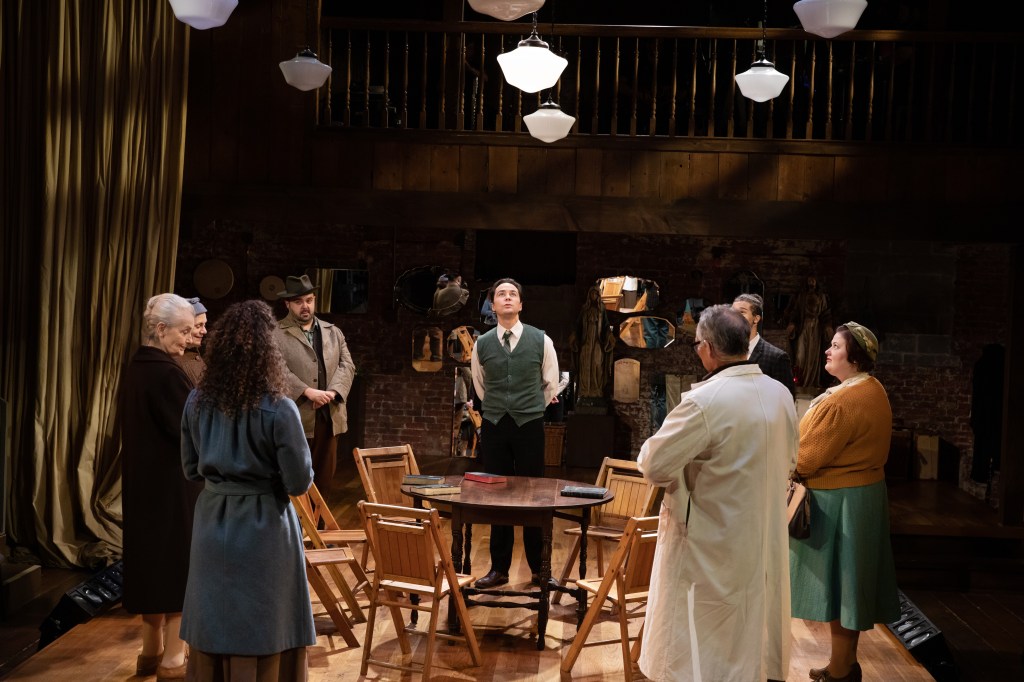
In its second Off Broadway go-round (Lincoln Center in 2002) Terrence McNally’s book and Stephen Flaherty’s music with Lynn Ahrens’ lyrics of A Man of No Importance directed and designed by John Doyle, is currently at CSC until 18 of December. The production is Doyle’s unaffecting and warm goodbye as Artistic Director of CSC. The uplifting, poignant musical appropriately reminds us of the vitality of theater, whether it be in an office space or a majestic 1500 seat house on 42nd street. Unlike the titular film A Man of No Importance is based on (1994, starring Albert Finney, written by Barry Devlin, produced by Little Bird) live theater is interactive. The audience spurs on the actors in a kinetic, telepathic bond that is incredibly enjoyable once opening night jitters are put to rest.
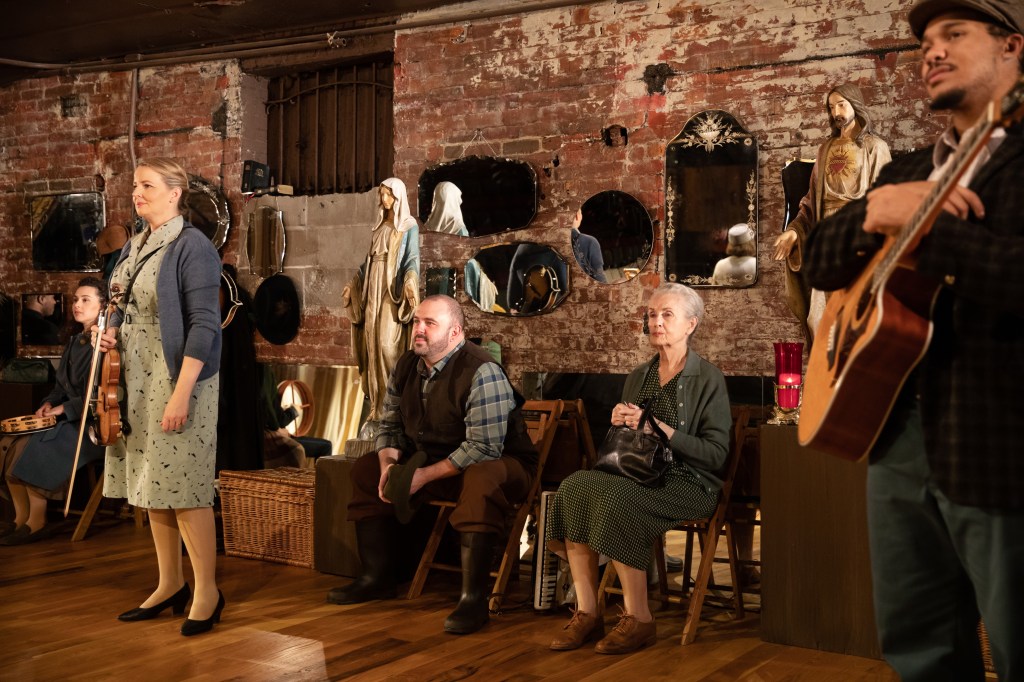
This most probably is what keeps protagonist Alfie, a DIY theater director of Dublin’s St. Imelda’s Church players inspired and engaged, though their performances are reportedly terrible. And it is why he is wickedly devastated when Father Kenny (Nathaniel Stampley) closes down their production of Salome, because it is inappropriate and untoward for a community church theater show, though the story is right out of scripture. Actually, by the end of the production we learn that the butcher, Mr. Carney (Thom Sesma), who is one of their amateur troupe, complained to Father Kenny that Salome was tantamount to pornography because he had a small role and that pissed him off.
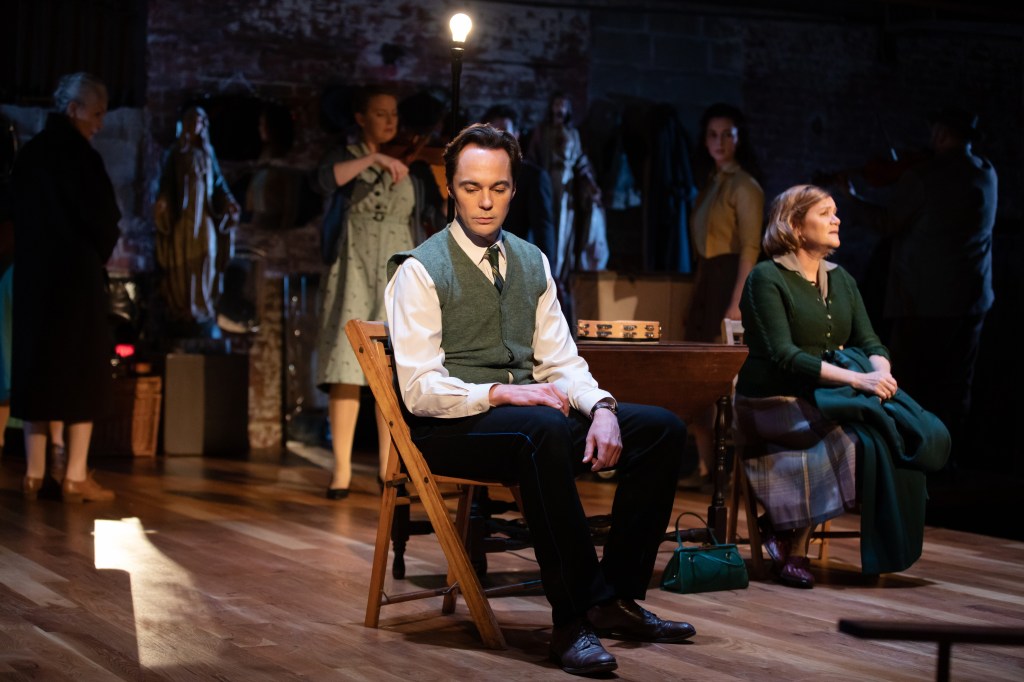
Alfie (portrayed by the likable and heartfelt Jim Parsons) apart from his love and spirit guidance by Oscar Wilde, who encourages him to read poems while at his job as a conductor on a Dublin bus, is a closeted, sensitive gay man. He lives with his domineering sister Lily (the always superb Mare Winningham) in their small apartment, where he keeps a raft of books and tests out his gourmet international recipes on her unadorned, “Irish stew palette.”
The year is 1964 before the cultural revolution, “free love,” mini skirts, The Beatles phenomenon and a relaxation of Catholicism’s strictures that didn’t really happen until decades later. Then, the Republic of Ireland was repressed and oppressed by doctrine that made it look more like the radical, right-wing conservative anti-LGBTQ, anti-abortion, red state swamp areas of the American South in 2022. Because of such cultural dispossession, Alfie lives in a fantasy world of art, theater and poetry. He remains inspired by his spiritual advisor, fellow Irishman Oscar Wilde, as he tries to improve the lives of those around him, whether at his job as a conductor, at home with his sister, or at the church, directing his St. Imelda Players.
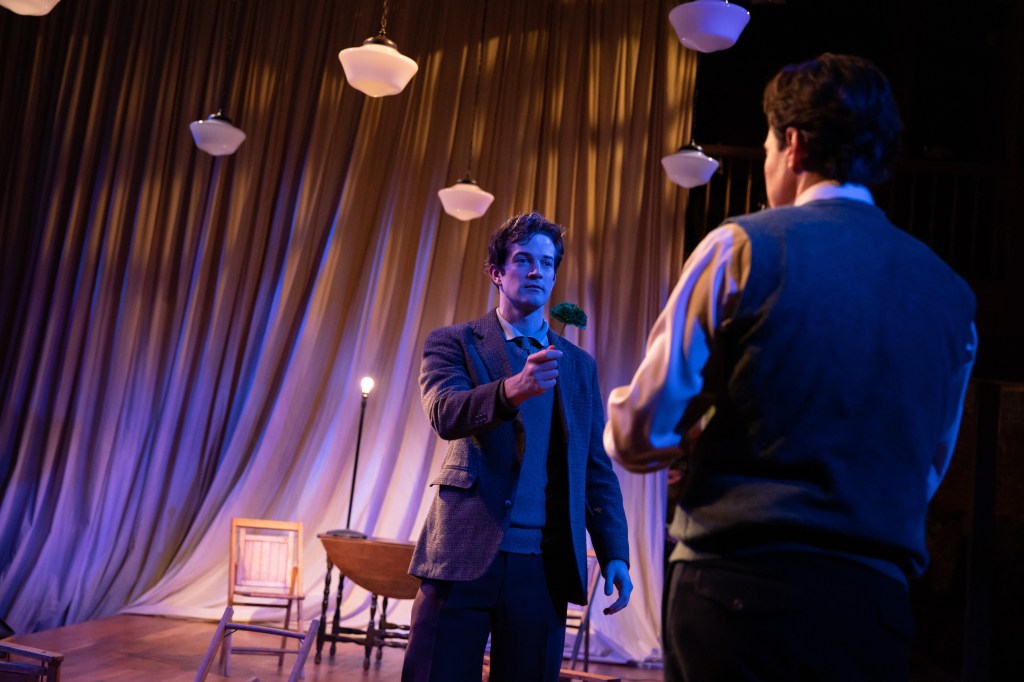
When Father Kenny closes down their amateur troupe, Alfie is quite bereft, until the St. Imelda Players decide to perform a play of the events that have brought them to where they are at the finish line in the present (1964) with no winning trophy. But instead of directing them, Alfie will be the star of their play.
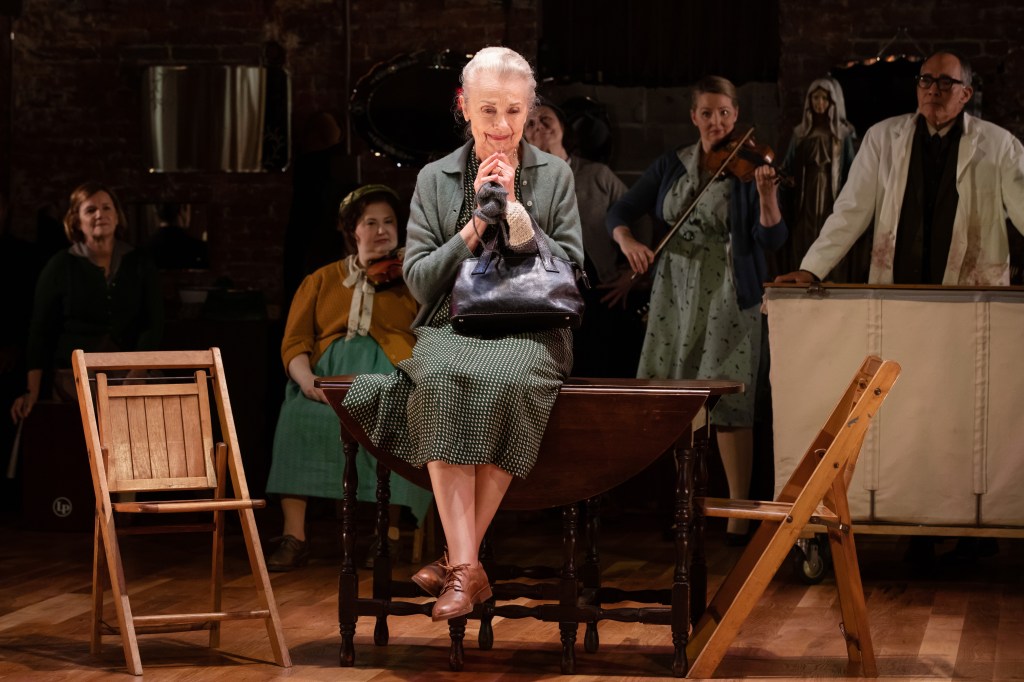
Cleverly, McNally, Flaherty and Ahrens adjusted and adapted the film as a flashback sandwiched by the present. The church players become the Greek chorus who engineer the events of the play, streamlining them into the action that happened at St. Imelda’s before Father Kenny shuttered their company. They sing songs that embody the emotional feeling and turning points of those events. These songs include the conflict between and among the characters, personal confessions and revelations, and the positive message that they gain from what they’ve learned together. They introduce Alfie as their star, then perform the tuneful, ironic opening number, “A Man of No Importance,” in celebration of their beloved friend and director who is their hero, integral to all of their lives. We learn by the conclusion of their musical, that to them, he is a man of great significance.

Doyle has staged the musical with an approach to DIY theater, reflective of what the St. Imelda Players might effect. The props are cleverly selected, i.e. a drum is used as the bus steering wheel. The actors use minimal furniture to create the environs where the events occur. Chairs suggest the bus that conductor Alfie is on with the driver, the affable and lively Robbie Fay (A.J. Shively, whose “The Streets of Dublin” rocks it). The players become the bus passengers with a new passenger Adele, the lovely voiced Shereen Ahmed catching the attention of Alfie as he quotes from a poem by his spirit mentor Oscar Wilde. By the end of their ride, The St. Imelda Players complete singing the titular “A Man of No Importance.”
As the players give us a tour of Alfie’s life in Dublin, we drop in on him with sister Lily, who is happy to discover that Alfie has found interest in a woman. She sings”Burden of Life” as an answer to her prayers so that perhaps now Alfie can settle down, and she can be free of taking care of him. Mare Winningham is humorous and vibrant as she takes on the role of Lily. A Catholic woman, she and the others in the troupe miss all the cues that her brother just might not be into women. When this finally comes out later, she reassures him in the song “Tell Me Why” that even though he is gay, she loves him anyway and he should have told her.
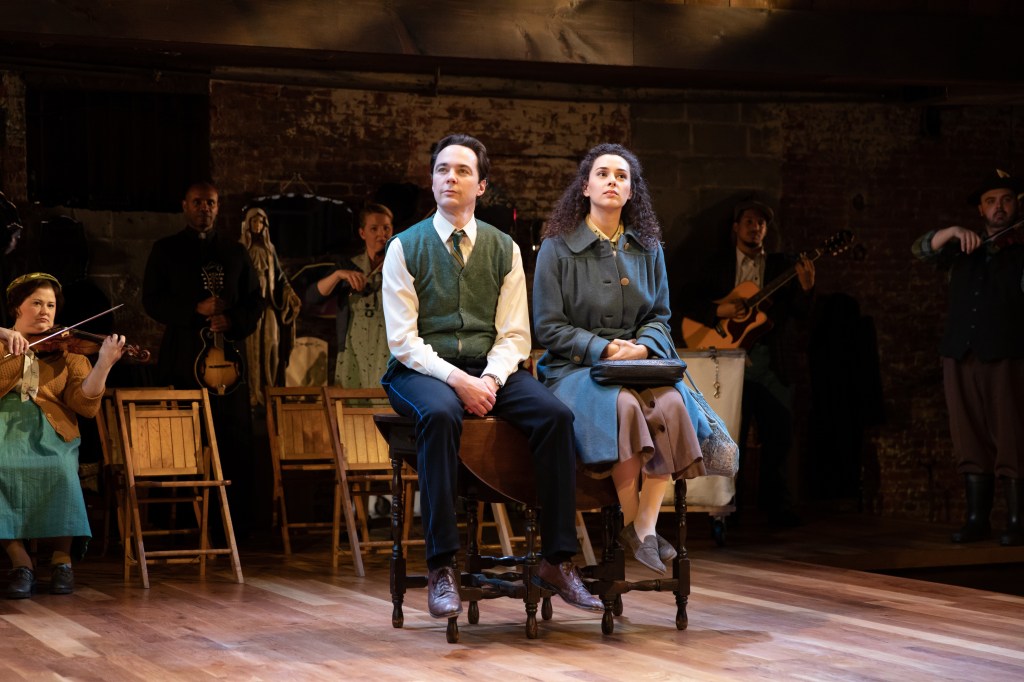
Alfie’s interest in Adele is not because her beauty entices him romantically. He thinks she is perfect for the role of Salome. Though she avers and refuses the part initially, Alfie is persuasive and she finally relents. It is his hope to have the handsome Robbie play the part of John the Baptist, perfectly cast to act with Adele. Robbie puts him off and instead invites him to come to the pub (the wonderful “The Streets of Dublin”). Alfie accompanies Robbie and makes a fool of himself singing “Love’s Never Lost” in front of Robbie’s friends. Embarrassed, Alfie leaves, further disturbed at Breton Beret’s (Da’Von T. Moody) interest in him. Additionally, he’s confounded by the “love that dare not speak its name,” a love that he feels for his “Bosie,” as he imagines Robbie to be. (Bosie refers to Lord Alfred Douglas, Wilde’s lover.)
Alfie can only admit this inner conflict as he looks at himself in a mirror encouraged by Oscar Wilde (Thom Sesma). He sings the lyrical “Man in the Mirror” as a way to work through his emotions to achieve self-acceptance. Parsons approaches Alfie’s inner conflict with yearning and honesty, confessing in a dream-state to the persecuted and vilified Oscar Wilde, a man who understands the torment he goes through.
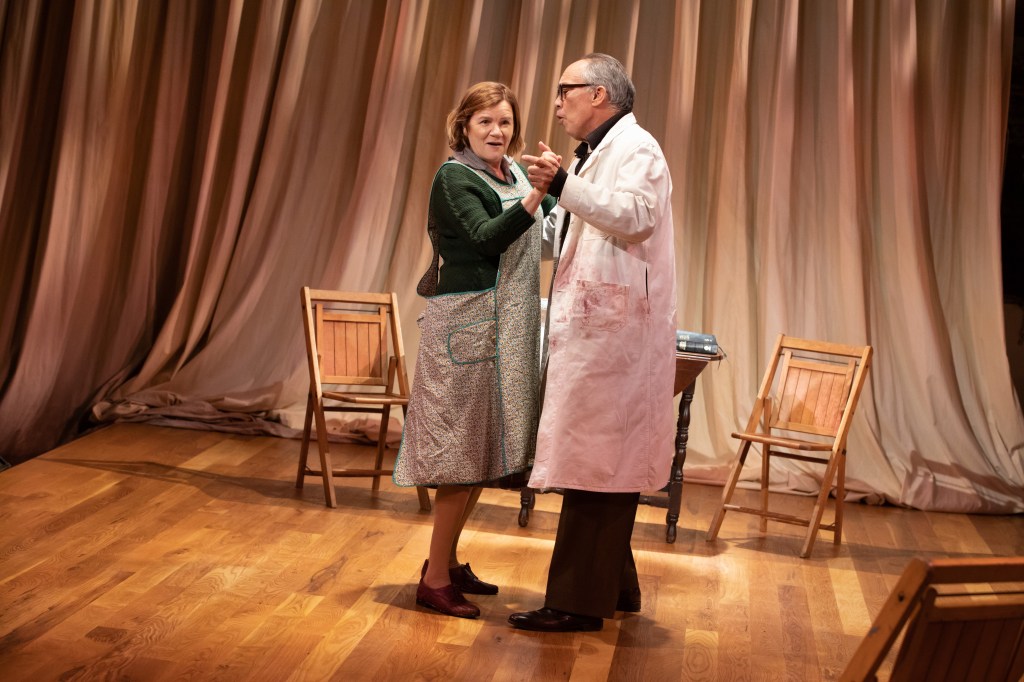
Spurred by her discussion with Mr. Carney about Alfie’s weirdness (“Books”), Carney’s insistence that Salome is pornography, and his pressure to marry, which Lily puts off using Alfie as an excuse, Lily makes an attempt as a matchmaker. She invites Adele home for a meal that Alfie has cooked. Afterward, Alfie walks Adele home and as a friend, he gets her to admit she has “someone.” Her tears suggest that there is a reason her boyfriend is not with her. To reassure her Alfie calms her with another beautiful ballad, “Love Who You Love.” As she leaves, Alfie bumps into Breton Beret who propositions him. Alfie wisely restrains himself. His intuition is correct but his unresolved conflict between his shame at being gay and his longing to find someone to be with is a devastation in a Catholic country where being a homosexual is a mortal sin requiring repentance and conversion. Interestingly, he imagines Oscar Wilde encourages him by suggesting that the only way to remove temptation is by giving in to it.
In Doyle’s production the musical is streamlined to eliminate an intermission and keep it as one continuous series of events that move with swiftness, as players would effect their version of what happened, without including every detail. There are fewer players and most of them are incredible musicians that round out the small band tucked away in a second floor balcony against the back wall of the CSC playing area, where the audience abuts on three sides. Thanks to Bruce Coughlin (orchestrations), Caleb Hoyer (music director) Strange Cranium (electronic music design) the music arrangements, Doyle’s staging and the players’ vocal work is gorgeous, and seamlessly, perfectly wrought in configuring the St. Imelda’s Players’ production. Indeed, they are much better than they’ve jokingly been described.

After the turning point (“Love Who You Love” carries the theme) the players reveal that Adele can’t continue with her lines as Salome because the words convict her soul. She can’t act a role where she’s supposed to be innocent and virginal, because in real life, she’s a fallen woman, who had intercourse out of wedlock and now is pregnant. Full of guilt and remorse her punishment is self-torment and humiliation. She must emotionally suffer the rest of her life because abortion is out of the question and the father won’t marry her to make the baby legitimate. The church and the oppressive paternalistic folkways of the culture vilify her with unworthiness and condemnation.
Catholicism hangs over the heads of the characters like a dirge of annihilation and judgment. Adele will have to go home to receive help from her parents to raise the child. Meanwhile, Mr. Carney also uses religious folkways to shut down the play. To add insult to injury, Robbie feels condemned by Alfie when Alfie unwittingly interrupts Robbie and Mrs. Patrick (Jessica Tyler Wright) making love in the bus garage. Feeling the weight of the sin of adultery, Robbie insults Alfie and judges Alfie’s life is without love, an accusation that torments Alfie because he loves Robbie.
Alfie can never reveal this love to him because it would drive Robbie away. Though Alfie has attempted to confess to Father Kenny (“Confession”) he can’t bring himself to reveal his great sin and thus is damned with guilt. As a result of the conflict of loving someone who would never love him, and being accused by that same person as being unloving, Alfie throws caution to the winds. He engages with Breton Beret who has been waiting for the opportunity to make himself look like a real man by beating up a “poof.”

Clearly, the film (1994) was made at a time when the Catholic church was dealing with its own sexual sins which finally came to the fore in the world wide expose of pederasty in the church around 2002. However, the film/musical sets the events back in the 1960s before any of the cultural revolutions took place. Nevertheless, to understand the full force of Catholicism condemnation of homosexuality, check the numbers of gay men who were abused as Alfie is abused by the likes of Breton Beret, or look at the numbers of Catholic gay men committing suicide because they couldn’t reconcile their feelings with their religion. Also, read up on the Republic of Ireland’s approach toward girls who got pregnant out of wedlock in the book Philomena (also a fabulous film with Judi Dench). Or read the stories of the Magdalene Laundries, captured in the film The Magdalene Sisters. The brutality of the paternalistic Catholic folkways winked at male adultery like Robbie’s and swept it under the rug as “boys will be boys.” As for gays or women with babies born out of wedlock, the humiliation, shame and condemnation was a cruelty that destroyed lives.

In the book of the musical McNally is not heavy handed with Catholicism in its iteration at St. Imelda’s community church. The musical has a light touch and religion appears to take a back seat, if we are not aware of the entrenched history of the church and its devastation on its believers. Rather, it is understated with Robbie’s anger at being discovered by Alfie, and Adele’s tears when the father of her child abandons her after he takes what he wants. Alfie gets the worst of it because he is discovered as a homosexual by the police who come to save him from being beaten to death by Beret. But the rub is he can’t press charges for assault because public opinion against “poofs” is more reprehensible than a physical assault. In fact it is intimated that Beret gets backroom laughs and cheers for beating up a homosexual who fell for his enticement.
McNally, Flaherty and Ahren configure the church’s worst folkways to be the sub rosa driving force for all of the humiliation, self-condemnation and torment that makes the conclusion so incredibly vital to A Man of No Importance. Thanks to Doyle, the performers and the creative team’s talents, the conclusion is uplifting and poignant for us today with a message of love and acceptance that is never old. It is the true spirit of Christmas in this “Happy Holidays” season, and in the United States needs to be proclaimed from the rooftops. In its quiet and unassuming way, A Man of No Importance is a trophy winner.
Kudos to Ann Hould-Ward (costume design), Adam Honore (lighting design) and Sun Hee Kil (sound design) and the entire cast and creative team who bring Doyle’s vision to life. The excellent must-see A Man of No Importance is at CSC until 18 December. For tickets and times go to their website: https://www.classicstage.org/current-season/a-man-of-no-importance
‘Frankie & Johnny in the Clair de Lune,’ Audra McDonald and Michael Shannon Keep it Profound!

‘Frankie and Johnny in the Claire de Lune’ written by Terrence McNally and directed by Arin Arbus starring Audra McDonald and Michael Shannon, at the Broadhurst Theatre New York (Deen van Meer)
Audra McDonald and Michael Shannon directed by Arin Arbus spike Terrence McNally’s 1980s New York City “romance for the ages” Frankie & Johnny in the Clair de Lune with organic authenticity and powerhouse performances. Both actors cleverly negotiate the difficulties of comedy by not playing for humor. Their characters are driven by overt and subterranean desires, and in that they are humorous. In not pushing for laughs, a grave danger in a play (the laughs change every night based upon a thousand audience variables) the actors come up with the most unexpected and surprising riffs. Considering that these moments are emotionally based, this shows their consummate technique and absolutely glorious listening/effecting. They are among the most talented and superlative of actors in portrayals that are precisely shepherded with adroit skill by Arbus to release their profound and moving sensibilities.
On a superficial level, we assume we know the play which was also made into a film starring Al Pacino and Michelle Pfeiffer (1991); it’s been revived in New York City, most recently with Edie Falco and Stanley Tucci in 2002.
In this current time of sexting and posting fleshly photos on Social media “private” and then being hacked into and displayed, the play is downright quaint, even with the nudity. And yet these actors and the director transcend the quaintness, elevate the current thematic mores/trends/folkways, of romance and find the beauty of individuality which is what Terrence McNally strives for in Frankie & Johnny in the Claire De Lune.
What is it about this night, this couple? Distinction despite their “apparent” inconsequentiality in the era of Trumpism! With each other, their particularly shines. McNally brings this into intriguing relief, smartly realized by Arbus, Shannon and McDonald. Their humanity and what makes them who they are inherently is unique and poignant, as they confront the human condition of loneliness, doubt, self-torment and pain in relationships that have decayed like rotten fruit.
The play raises fascinating themes. One is that we underestimate our exceptionalism or convert it into a fear of the unknown in ourselves and a fear of our possibilities. In New York City (the setting of the play is NYC, 1980s) where over 8 million people live and work, the impulse is to maintain a familiar invisibility negotiating the sheer mass of people. Apart from this, many live their lives attempting to be like others in their social groups, even in their “intimate relationships” to the point where they don’t acknowledge soul differences nor respect them.

‘Frankie and Johnny in the Claire de Lune’ written by Terrence McNally and directed by Arin Arbus starring Audra McDonald and Michael Shannon, at the Broadhurst Theatre New York (Deen van Meer)
McNally explores this exceptionalism in two seemingly ordinary lower middle class individuals (a waitress, a short-order cook) that no one would find interesting, especially when folks are striving to become rich in an age of “greed is good.” McNally spins the vitality of these two by examining their depth, prompted by Johnny’s compulsion to realize the opportunity before him with Frankie; this active movement on his part creates the dynamic of their growing involvement with each other and shifting perception about themselves.
After intense love making, Johnny stops himself from disengaging from Frankie. Instead, he does not ignore her and dismiss what has just happened, which Frankie would prefer. He goes deep. In attempting to communicate with her to make sense of who they can be together, he finally explains his “vision” to a radio host convincing him to play the most beautiful music to get Frankie to connect with him. Johnny tells him (in Frankie’s hearing) that he stopped himself from the “usual rosary,” i.e. thinking of “the million reasons” why he should not love Frankie, why they wouldn’t work out.
The irony is that Johnny pursues what is on another level. They’re physical manifestation of love was “perfect.” And that is an indication of possibilities, of recognizing what is profound within each of their souls. Johnny senses her uniqueness. And for that reason he will not follow the path he followed many times before – forgetfulness, dismissal, staying superficial. With the courage of his convictions, he persists in attempting to persuade her to do the same: to go deep.
Johnny’s action which creates the arc of development has little to do with a repeat performance of “sex” and all to do with seeing each other on a soul/spiritual level. From Johnnie’s perspective, if they can achieve that, their relationship will be able to build and grow. It’s what Johnny means about “connection,” that ethereal thing that can happen during making love, but not always. He and Frankie have experienced it and for some reason Frankie fears or is defensive about a continued intimacy with conversation. In attempting to have Frankie “connect” with him again, Johnny intuits that they need to hear the music of transcendence to take them out of the mundane. That he hopes will ease the way back for her to engage on that other level once more. Indeed, it is that level on which the finest, most truthful relationships are based.
To miss the depth of what is happening between the characters is not doing justice to McNally’s play or the performances and direction. This is the focus that remains alive and present in this wonderful revival. Johnny believes in that profound level of connection. Frankie fears, eschews and resists it. McDonald and Shannon make us care why these two behave in their “compulsions.” They make us care whether they can become the couple for “all time,” “Frankie and Johnny.”
What I particularly appreciate is how McNally has reverse troped the characters of Frankie and Johnny in the backdrop of a culture which is uber jaded regarding “love” and “romance.” Arbus, Shannon and McDonald have mined the gold in McNally’s ironic twists and tweaks.
Here, the man wants intimacy, love and bonding. The woman just wants sex, a slam, bam, thanks, see ya. Frankie is beyond skeptical and doubtful about Johnny. She closes him out, doesn’t hear what he is saying, doesn’t “connect,” until after she slaps him.
Because of Frankie/Audra McDonald’s revelatory inner authenticity-her resistance to Johnny/Shannon’s importuning her to “go deep,” warning alarms go off. If one has studied or read the M.O. of abused women, they should “get” McDonald’s Frankie’s impulsive, defensive reactions and nervousness. She has been abused in a way that has damaged her psychically so that all bets for true intimacy are off. She can’t allow herself to take that risk again, regardless of the physical “something” between them. That can be dismissed as sex, nothing more which is precisely what Frankie seeks to do, but Johnny will not let her get away with it.

‘Frankie and Johnny in the Claire de Lune’ written by Terrence McNally and directed by Arin Arbus starring Audra McDonald and Michael Shannon, at the Broadhurst Theatre New York (Deen van Meer)
McNally’s characterization of Frankie resonates even more strongly today. Current sexual predation numbers despite all the #MeToo publicity and positive directions have not decreased. Physical/sexual abuse transcends economic and social class backgrounds. Wives of billionaires are abused as are women of partners of lower socioeconomic classes. Often women who have been abused cannot be intimate. They will have sex and may seek it out as a form of control. But the abuse must be worked through before intimacy becomes welcome.
Abuse from a former partner we discover is making Frankie resist Johnny which she reveals in Act II. Some have suggested the play can be done in one act. The intensity of the characterizations has eluded these critics; Frankie’s violence and then revelation about why she reacts as she does must come full bore in the modulations after the radio host plays a transcendent song that will “connect” them. And by the conclusion as we follow the journey of how they both work through their psychic damage, we see they are together and perhaps “perfectly” as Johnny suggests in Act I.
The development is crucial and needs the breadth that McNally gives it. At the end of Act I when Frankie appears to be persuaded by Johnny to become intimate in the way he wishes, she “controls” and pushes him to have sex which we discover at the beginning of Act II “fails.” Johnny’s “failure” is humorously rendered by the actors. However, this “failure” also reveals that “the connection” between them still isn’t trusted by Frankie. That doesn’t stop Johnny from persisting, and they both become adorable and familiar to each other in their gradual revelation of the truth of themselves.
McDonald’s portrayal of McNally’s Frankie is right-on: her fear of intimacy, her insistence to control sex, to control him is paramount. Her abusive reaction to him is also spot-on. Her breakthrough effected by both actors beautifully as Shannon stops the abuse and kisses the hand that slapped him is an important turning point. We know something happened to her in the past; Johnny senses it and is lovingly helping her work through it. His attempt to connect with her is scintillating. It is an irony that she converts the beauty of this moment back to sex and “wanting him.” In showing her “desire”, she is actually pushing him away. No wonder Johnny’s “manhood” fails him. He wants more than a little friction! Shannon is just terrific in effecting this with sensitivity and great feeling.
In Act II Johnny has another hurdle after she reveals she has been abused. He must convince her to move beyond the need to control using sex, and recognize that between them there is the opportunity for something transcendent and profound. In their uniqueness, such riches are available to them because of who they are together. This is rare, it isn’t possible for others and how fortunate/destined they are that they have “found” each other.
This sensitivity from a guy who seeks to make a connection on another level and eventually understands how to do this with a beautiful song to “get there,” is mind-blowing. One might say cynically, “Men are just not like this!” “The playwright is gay and writing his own fantasy male.” Or these characters are simply beyond the pale and this is a modern “fairy-tale!” Well, that is missing McNally’s searing point which Arbus and the actors have elicited in this production. This is possible. But what one must risk is failure, or being ego-less. Risking the pain of failure is frightening, especially if one has gone down that road before.

‘Frankie and Johnny in the Claire de Lune’ written by Terrence McNally and directed by Arin Arbus starring Audra McDonald and Michael Shannon, at the Broadhurst Theatre New York (Deen van Meer)
Arbus, Shannon and McDonald apply their brilliant talents seamlessly. The actors convince us Frankie and Johnny are possible because of the actors’ stunning and detailed inner logic which simmers with backstory. If it is possible for them, it might be available for other “Frankie and Johnny’s” in a universe of lonelyhearts. Their relationship is a beacon and a warning not to be like married couples who married out of fear and never “connected,” or who were matched up by others because they were “perfect” for one another, only they weren’t.
Perhaps one of the strongest themes of this production is found by looking at how Frankie and Johnny evolve together “magically” to achieve a level that many couples don’t achieve. The play begs the question, why are Frankie and Johnny so stellar and original? Why can’t their evolution be the norm, not the exception?
The reasons are multitudinous. But one of the reasons is that our culture and society warps men and women with platitudes and tropes and gender annihilation in some quarters. “Men don’t cry.” “Don’t be gay, be a manly man.” “Women are best being quiet and looking pretty.” Women who are feminists are feminazis. Women must look only a few ways to be feminine and beautiful.
The fact that the nullifying stereotypes behind such commentary still exist today is appalling; and now there is a Trumpist backlash that embraces such thought. On social media and beyond, there is an actual collective of Incels. On the opposite side of the spectrum, sexual predation and abuse are as old as time, and paternalism and misogyny. It is tragic that there is a necessity for a #MeToo movement because of the misogyny and paternalism inherent in our folkways and mores.
Frankie and Johnny in the Claire de Lune flies in the face of all this noise. It reminds us of the humanity of individuals, not of the stereotypes of genders. This production encourages us to look into the souls of individuals and make those priceless connections which rebel against that which would attempt to defile the bounty of our humanity by slopping it on the trash heap of stereotypes and labels. Bravo, to McNally’s original vision and Arbus,’ Shannon’s and McDonald’s adherence to it, allowing the themes of the play to soar along with the incredible portrayals of these wonderful characters.
Kudos to all the artistic creatives: Riccardo Hernandez (Scenic Design) Emily Rebholz (Costume Design) Natasha Katz (Lighting Design) Nevin Steinberg (Sound Design) J. Jared Janas (Hair, Wig & Makeup Design) Claire Warden (Intimacy & Fight Director).
Frankie and Johnny in the Claire de Lune runs with one intermission at the Broadhurst Theatre (44th Street between 7th and 8th) in a limited engagement until 25th August. For tickets and times go to their website by CLICKING HERE.
Tribeca Film Festival Review 2018: ‘Every Act of Life,’ Looking Into the Brilliant Terrence McNally

(L to R): Director Jeff Kaufman, Terrence McNally, ‘Every Act of Life,’2018 Tribeca FF World Premiere Special Screening and Q & A, Moderator Frank Rich, unpictured (Carole Di Tosti),
Terrence McNally is a theatrical force of nature, though with his incredible humility in an age of self-promotion, he would be the last to admit it. With a career spanning six decades and major, ground-breaking successes on Broadway and Off, in film and television, and multiple theater awards every decade, the man is a dynamo, beloved by actors whose careers he has vaulted, actors whom he collaborates with in a symbiotic relationship again and again. At 80, he is still working, attending productions (I saw him in the audience of the musical production of the most Tony nominated musical SpongeBob SquarePants this summer.) and launching off into new projects, even as I write this.
The World Premiere Every Act of Life directed and written by Jeff Kaufman was given a special screening at Tribeca Film Festival 2018, with luminaries, actors and McNally himself attending for the Q and A afterward. In this formidable documentary about a formidable American playwright, Kaufman presents McNally’s career and personal life. From start to finish Every Act of Life is an intriguing and well-thought-out chronicle cobbled together with interviews, archived photos, video clips, well-researched facts, details, memorabilia and well-placed commentary by actors, directors, producers and McNally himself. The documentary is especially revealing in its presentation of how one individual’s love and passion for the theater, opera, music and art has impacted our culture and brought us together in a forward momentum of shared communication and understanding.

Tyne Daly (‘Mothers and Sons’ and ‘Master Class’), Nathan Lane (‘Love! Valor! Compassion!’ ‘The Lisbon Traviata,’ ‘ It’s Only a Play’)2018 Tribeca FF World Premiere and Special Screening and Q & A (Carole Di Tosti)
Beginning with his early plays and traveling right up to his most recent work, Kaufman lays out the seminal moments and turning points that have slowly fostered the personality and character of this mild-mannered and charmingly authentic persona that McNally is today. Early influences on his life McNally credits to his English teacher in Corpus Christi who encouraged him to write and attend schools outside of the area. But his love of musicals and Broadway, were initially inspired by his parents, transplanted New Yorkers, who brought him all the way from Texas to New York to see a few smash musicals with towering figures like Gertrude Lawrence in The King and I and Ethel Merman in Annie Get Your Gun.

Terrence McNally, ‘Every Act of Life,’ 2018 Tribeca FF World Premiere Special Screening and Q & A (Carole Di Tosti)
The excitement and enchantment of live theater musicals were imprinted on his memory. And this love abides with him to this day as he continues to collaborate on musicals writing the book for numerous hits like The Kiss of the Spider Woman (1992), Ragtime (1996), The Full Monty (2000), The Visit (2001), Catch Me If You Can (2011), Anastasia (2017). He has also sharpened his wits and taken up collaborating on opera, for example in 2015, the production of Great Scott (music by Jake Heggie), premiered at Winspear Opera House in Dallas, Texas. He is a veritable tornado when it comes to writing new plays and collaborating with composers on musicals and operas.

Chita Rivera appeared in McNally’s ‘The Rink,’ (1984) ‘The Kiss of the Spider Woman,’ (1992, 93, 94) ‘The Visit,’ (2004). Tribeca FF 2018, World Premiere Screening and Q & A, ‘Every Act of Life.’Chita Rivera appears in Kaufman’s film about McNally. Here Chita Rivera appears at a 2018 LPTW event (Carole Di Tosti)
Following his English teacher’s advice, McNally attended Columbia University and was further shepherded by professors like Lionel Trilling for literature and Andrew Chiappe who steered him in the basics by having McNally and others read every work by Shakespeare in the order of their composition. After Columbia, McNally through a serendipitous introduction via The Actor’s Studio, cruised with John Steinbeck and family around the world as he tutored Steinbeck’s two young sons. This was another incredible experience which was to shape McNally’s writing career and broaden his horizons as well as establish his relationship with Steinbeck who inspired his writing. From these adventures he later fashioned the first act of And Things That Go Bump in the Night. Additionally, Steinbeck asked him to write a libretto for a musical adaptation of his novel East of Eden. One doesn’t know what one can do until a great American novelist like John Steinbeck asks you to do it.

F. Murray Abraham, ‘Every Act of Life,’ 2018 Tribeca FF World Premiere and Special Screening and Q & A (Carole Di Tosti)
Back in New York City, McNally used his connections at the Actor’s Studio to begin to workshop his nascent one-act plays. And it was in New York that he met the brilliant playwright Edward Albee who was just coming into his own. After a four-year tempestuous relationship during which Albee wrote The American Dream and Who’s Afraid of Virginia Woolf, they parted ways and McNally’s career began to take off gradually in theater, television and in film as he wrote screenplays for versions of his works first performed on Broadway and Off Broadway.

(L to R): Terrence McNally, Edward Albee, ‘Every Act of Life,’ 2018 Tribeca FF World Premiere Screening and Q & A (Carole Di Tosti)
Various tidbits appear in Kaufman’s documentary that fascinate. Some of the impressions are telling. He became addicted to alcohol and at a time when no one could admit to being gay, McNally confronted the oppressions of the culture and created some of the most insightful, poignant and endearing works related to the LGBT community and relatives confronting the AIDS epidemic. These include the TV miniseries Andre’s Mother for which he won an Emmy and later his Mothers and Sons starring Tyne Daly based upon the miniseries. Additionally, Lips Together, Teeth Apart, as well as an inside look at gay relationships for which he won his second Tony Award, Love! Valor! Compassion! also feature topics about confronting gender prejudice.

Joe Mantello, ‘Every Act of Life,’ 2018 Tribeca FF World Premiere Screening and Q & A (Carole Di Tosti)
Always concerned about the deep side of the human condition and striving above it, McNally first landed on the map when he was recognized for his portrayal of female-male relationships among the working classes (Frankie and Johnnie in the Claire de Lune) which was adapted into a screenplay starring Al Pacino and Michelle Pfeiffer. McNally’s versatility and humanity encompasses play topics that run the continuum. What is most important to him is human connections and the realization that we are together in this “thing” referred to as life. The beauty of our ability to connect, express love, overcome personal issues and adversity, with an assist from art and theater makes all the difference in discovering our purpose and fulfillment.
McNally’s dogged fight for LGBTQ rights at a time when it was most unfashionable and nearly anathema is an incredible achievement, considering the forces and money behind the attempt to liquify LGBTQ rights in the noxious march toward inhumanity and darkness led by the political conservative right-wing. Kaufman highlights the struggle. He also reveals how McNally overcame his addiction to alcohol and on that subject includes an amazing anecdote. Angela Lansbury’s love and honesty prompted her to speak directly to McNally to the effect that he must stop destroying himself. Indeed, she feared this most talented playwright, librettist and screenwriter would die an early death. Her influence and other factors eventually sent him down the road to wellness, where others were not as willfully fortunate.
What I appreciate in the film is McNally’s candor in discussing his “flops.” Of course, one might say that there are no flops in a playwright’s repertoire, only stepping stones which help them achieve their hard won success.

2018 Tribeca FF World Premiere Screening and Q & A, ‘Every Act of Life,’ (L to R): Jeff Kaufman, Terrence McNally, Tyne Daly, Nathan Lane, Joe Mantello, F. Murray Abraham (Carole Di Tosti)
Kaufman highlights McNally’s award-winning work (the musicals- The Kiss of the Spider Woman-1992 and Ragtime-1997 and his plays, Love! Valor! Compassion!-1994, Master Class-1995 and Dedication or The Stuff of Dreams-2005). The most incredible feature of this segment of the documentary is the commentary by living legends and McNally friends and collaborators, Chita Rivera, Nathan Lane, John Glover, Tyne Daly, John Kander, F. Murray Abraham, Joe Mantello, Angela Lansbury, Christine Baranski, Audra McDonald and many more. Indeed, the film is a who’s who of McNally’s posse, as well as a chronicle of his prodigious work ethic and love of theater, opera, ballet and music. His talents and breadth of knowledge about the Arts are absolutely staggering. And Kaufman gives us a historical perspective that is continually fresh and exciting.

Terrence McNally, ‘Every Act of Life,’ 2018 Tribeca FF World Premiere Screening and Q & A, (photo courtesy of the film)
I loved this film. I am familiar with McNally’s work having seen a number of his musicals and comedies on Broadway and Off. I split my sides enjoying them. However, Kaufman digs deep into the revelation of the anointed genius of this most wonderful of playwrights who connects the heavens to humanity with his words, impressions and inspirations, and joins us together in what can be compared to a holy act of communion in the theater. The film is a must see, and you will especially enjoy hearing how McNally and friends worked together to create some of the finest, most enduring works of American theater which in the future will surely be identified as classics.

‘Every Act of Life,’ Q and A, Tribeca FF 2018 with (L to R) Jeff Kaufman, Terrence McNally, Tyne Daly, Nathan Lane, Joe Mantello, F. Murray Abraham, moderated by Frank Rich who is not pictured (Carole Di Tosti)
Epilogue
After the World Premiere Screening there was a Q and A moderated by Frank Rich, who was a longtime critic of theater at The New York Times. McNally made an incredible admission during the Q and A. Even though he has a prodigious body of work trailing in his wake, he never really considered himself a playwright or a successful one at that, until a few years ago. I was gobsmacked. Such is the talent and evolving genius of this artist.
That Frank Rich was moderating individuals he has sometimes dunned in his previous job as New York Times Theater critic was a bit of an irony. He long held sway as THE Times CRITIC until 2011. Often he was acerbic and unwieldy in his self-aggrandizement and pretensions to be THE VOICE of theater, backed by the “heft” of The Times. After I accomplished some gentle research for this review, I discovered a note in Wikipedia on Kiss of the Spider Woman (musical) that bears sounding since the main subject of this film is American Theater and Terrence McNally as one of the fountains where we might go for a revitalizing drink..
It seems that in 1990 Kiss of the Spider Woman was being workshopped at “New Musicals” at the Performing Arts Center SUNY at Purchase. New Musicals‘ goal was to create, develop and provide a working home for sixteen new musicals over four years. When New York critics heard that the play was being workshopped in its initial production, they wanted to see it. Unfortunately, they couldn’t be persuaded not to review it despite the fact that producers, etc., were testing the waters to see what needed ironing out. Frank Rich and other critics filed “mostly negative reviews” of this initial workshopping of Kiss of the Spider Woman. Sadly, New Musicals, whose mission was honorable and vital for American theater and especially New York Theater, blew out and folded after the fiasco with Kiss. Don’t get me started on the state of American Theater and why it is that way.
Thankfully, two years later a producer developed Kiss of the Spider Woman. It went on in Toronto and The West End where it won An Evening Standard. It finally came back to the US where it received 7 Tony Awards and 3 Drama Desks and ran 904 performances, despite Rich’s reviews. Ultimately, the American public became the arbiter of the production.
American Theater has lost ground for many reasons and indeed, the gatekeepers, critics and money people have, for all intents and purposes, shot it to hell and drained its lifeblood. With the rise of Social Media, for good or ill, digital platforms and word of mouth continue to lift up productions so that their lasting value might be revealed to give them staying power. But it is enough? Rich went on to feather his own nest. Kiss of the Spider Woman found its audience. New Musicals is no more. And so it goes. In light of these events Every Act of Life is an important documentary about the history of American theater, and a master creator who has thrived in spite of changing times.
 CAROLE DI TOSTI