Blog Archives
‘The Honey Trap,’ Irish Rep’s Acclaimed Production Returns

Subscribe to continue reading
Subscribe to get access to the rest of this post and other subscriber-only content.
The Fine June Squibb Heads up the Stellar Cast of ‘Marjorie Prime’

When Marjorie Prime by Jordan Harrison opened Off Broadway in 2015, starring Lois Smith, it appealed as science fiction. Since then the use of various forms of artificial intelligence to support human behavior have become ubiquitous.
Reinforcing this new reality the playwright and director Anne Kauffman dusted off the prescient family drama and shined it up for its Broadway premiere with few changes to the script. Maintaining the prior production values, director Anne Kauffman works with set designer Lee Jellinek, sound designer Daniel Kluger and Ben Stanton’s lighting design to create the almost surreal and static atmosphere where AI takes over the lives of a family and exists for itself in the last scene.
The production runs at the Helen Hayes Theater with the superb cast of June Squibb, Cynthia Nixon, Danny Burstein and Christopher Lowell through February 15. They are the reason to see the revival.
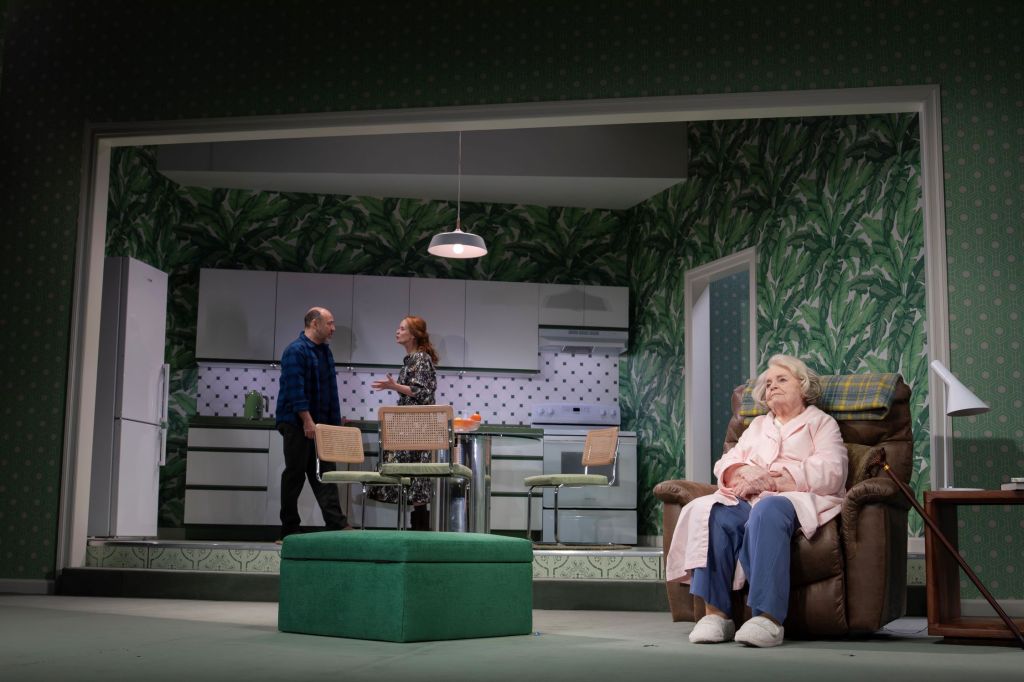
On one level the excellent performances outshine the themes of Marjorie Prime which deal with death, identity, the grieving process, artificial intelligence and more. The science fiction aspect of the play, so striking before, has diminished.
Yet, Harrison’s conceit that AI holograms might be used to reconcile the death and loss of a loved one still fascinates a decade later. Our culture fights death and aging with its emphasis on ageless appearance, looking 25-years-old at the chronological age of 90-years-old. Some other cultures have a healthier approach, viewing the acceptance of death and aging as a normal part of life cycles. However, with technological advancements, regardless of the culture or country, AI will have its uses in the battle against disease, dying, death and mourning.
The “Primes,” in Marjorie Prime are the spitting image of loved ones at a particular time in their lives. Created by the company Senior Serenity to help the bereaved get through inconsolable grief, Marjorie’s family believes a holographic duplicate of husband Walter will help her adjust to his death. The replica keeps her engaged, sentient and interactive, unlike passively watching TV.
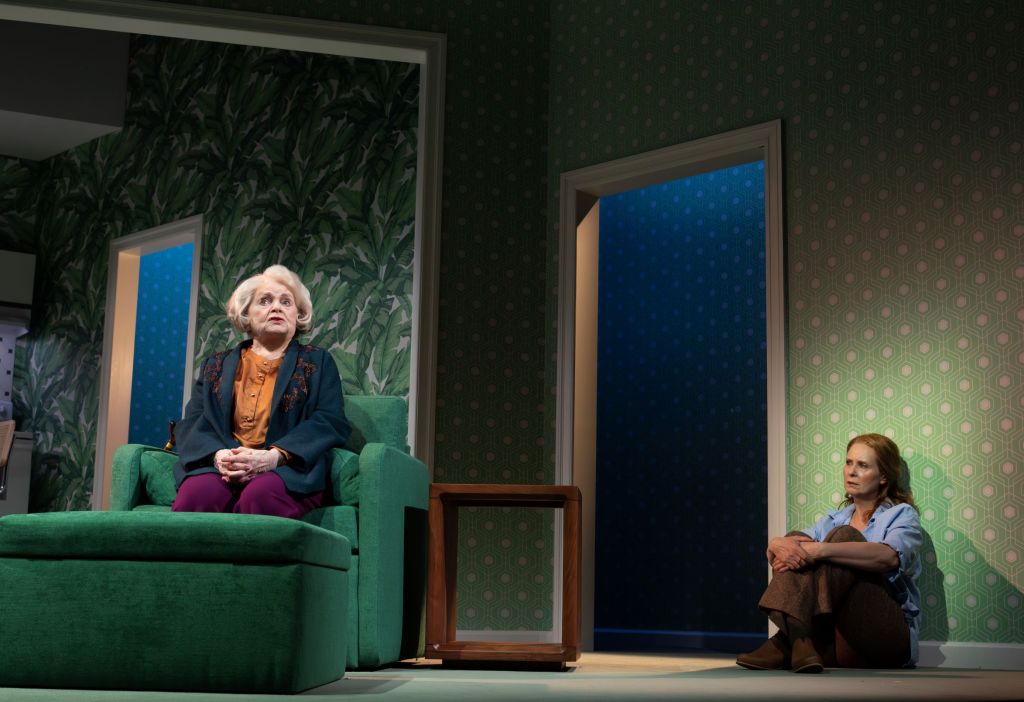
Walter Prime (Christopher Lowell) duplicates the younger, good-looking Walter in his thirties. Happily, he reminds her of the distant past, not the more recent, sick and dying Walter. The hologram’s programming and presence also help stir Marjorie’s memory, complicated with dementia. A work in progress, Walter Prime evolves based on the information that 85-year-old Marjorie (June Squibb), her daughter Tess (Cynthia Nixon), and son-in-law Jon (Danny Burstein), give him about Walter and Marjorie’s life together.
Thus, at the top of the play Walter Prime and Marjorie discuss movies they went to, for example, My Best Friend’s Wedding, which Marjorie has forgotten until Walter tells her the synopsis. The spry 96-year old Squibb, who made her Broadway debut playing one of the strippers in Gypsy (1959), portrays the spicy, funny, confused, chronologically younger woman with a failing memory, an irony that amused me to no end. Squibb is just terrific.
As Marjorie’s identity and memory dim, Walter Prime builds up the identity of Walter with her help. However, Harrison’s play raises questions about this process and never answers them. For example, how much information has Walter Prime been fed prior to his engagement with Marjorie, Jon and Tess? How can Marjorie be expected to keep track of information from before their marriage into their elderly years with her failing memory? Won’t she feed him incorrect details?
Indeed, facts and details shift and Marjorie confuses the truth. An imagined past becomes easier to accept with one’s husband “Prime” fed information by others. This problem never resolves. Neither does Tess’s incomplete acceptance of Walter’s function to stimulate Marjorie, the supposed benefit that Senior Serenity, the company that made him, affirms. The impatient, edgy Tess doubts Walter’s usefulness, but the upbeat Jon thinks that he helps improve Marjorie’s engagement and memory.
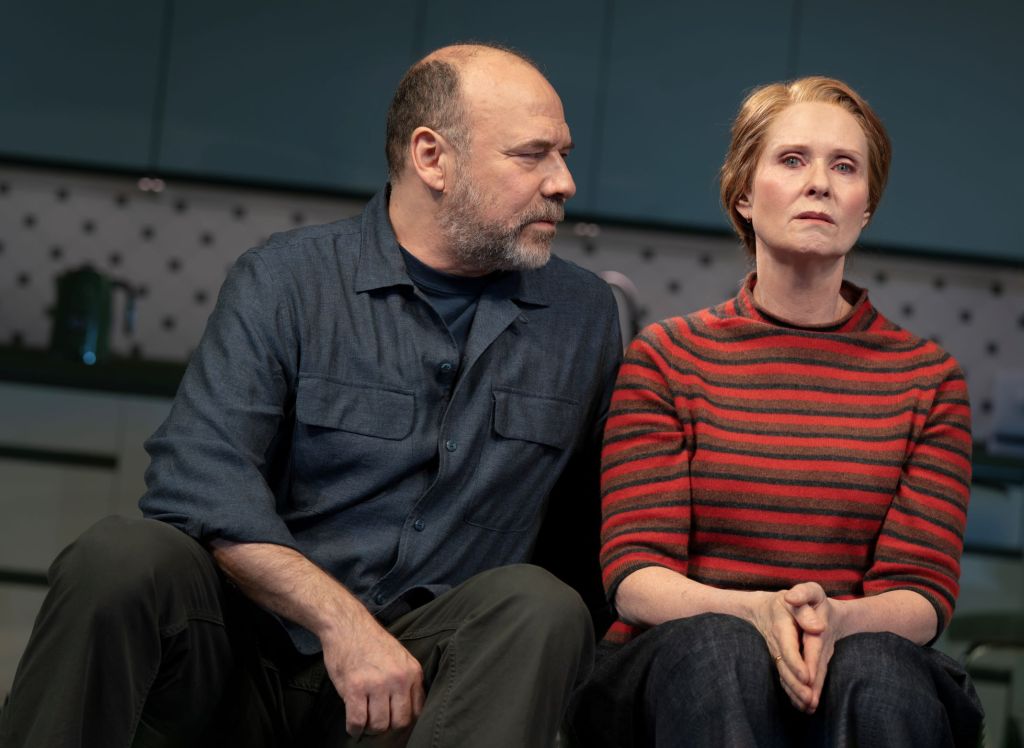
When Walter Prime’s presence annoys Tess, Jon accuses her of jealousy. Does Marjorie prefer Walter over Tess, who must nag her mother to eat and “obey” her in the reversal of mother/daughter, parent/child roles? Losing her autonomy Marjorie must rely on Tess and Jon in her living arrangements and personal care needs.
As Jon, Marjorie and Tess converse in Jellick’s minimalist, living room-kitchen combination that lacks futuristic style, Walter Prime sits on a sofa in the living room. He waits in a “listening mode” ready to interact when needed.
For his part Jon is positive about Walter’s impact on Marjorie. As the scene progresses, Tess mentions after an interval that her mother surprisingly recalls a situation long buried in pain. We learn the specifics of this later in the play. Some of the action referred to happens off stage. (i.e. Tess and Jon take Marjorie to the hospital after a fall).
Guided by the “Primes,” who Harrison sequences to move the action forward, time jumps. Marjorie has died and Jon and Tess engage Marjorie Prime to help console Tess and move her through her bleak depression and grief at her mom’s passing. After that we learn through Jon’s conversation with Tess Prime what transpired with Tess. In the various scenes Nixon’s Tess gives a heartbreaking speech about her mother, memory and imagination which sets up the rest of the play. Burstein’s Jon listens and responds with an uncanny authenticity. Both are superb.
Since the “Primes” “live” forever in holographic form until someone decommissions them, they occupy the home in the last scene. Jon is elsewhere, so Walter, Tess and Marjorie converse among themselves having been given life from their human counterparts as an ideal, evolved “being.” Eerie perfection.
Marjorie Prime runs 1 hour 15 minutes with no intermission at the Helen Hayes Theater on 44th Street until the 15 of February. 2st.com.
Kara Young and Nicholas Braun Fine-Tune Their Performances in ‘Gruesome Playground Injuries’

What do people do when they have emotional pain? Sometimes it shows physically in stomach aches. Sometimes to release internal stress people risk physical injury doing wild stunts, like jumping off a school roof on a bike. In Rajiv Joseph’s humorous and profound Gruesome Playground Injuries, currently in revival at the Lucille Lortel Theater until December 28th, we meet Kayleen and Doug. Two-time Tony Award winner Kara Young and Succession star Nicolas Braun portray childhood friends who connect, lose track of each other and reconnect over a thirty year period.
Joseph charts their growth and development from childhood to thirty-somethings against a backdrop of hospital rooms, ERs, medical facilities and the school nurse’s office, where they initially meet when they go to seek relief from their suffering. After the first session when they are 8-year-olds, to the last time we see them at 38-year-olds at an ice rink, we calculate their love and concern for each other, while they share memories of the most surprising and weird times together. One example is when they stare at their melded vomit swishing around in a wastepaper basket when they were 13-year-olds.

How do they maintain their relationship if they don’t see each other for years after high school? Their friends keep them updated so they can meet up and provide support. From their childhood days they’ve intimately bonded by playing “show and tell,” swapping stories about their external wounds, which Joseph implies are the physical manifestations of their soul pain. After Doug graduates from college, when Doug is injured, someone tips off Kayleen who comes to his side to “heal him,” something he believes she does and something she hopes she does, though she doesn’t feel worthy of its sanctity.
Joseph’s two-hander about these unlikely best friends alludes to their deep psychological and emotional isolation that contributes to their self-destructive impulses. Kayleen’s severe stomach pains and vomiting stems from her upbringing. For example in Kayleen’s relationship with her parents we learn her mother abandoned the family and ran off to be with other lovers while her father raised the kids and didn’t celebrate their birthdays. Yet, when her mother dies, the father tells Kayleen she was “a better woman than Kayleen would ever be.” There is no love lost between them.
Doug, whose mom says he is accident prone, uses his various injuries to draw in Kayleen because he feels close to her. She gives him attention and likes touching the wounds on his face, eyes, etc. Further examination reveals that Doug comes from a loving family, the opposite of Kayleen’s. Yet, he may be psychologically troubled because he risks his life needlessly. For example, after college, he stands on the roof of a building during a storm and is struck by lightening, which puts him in a coma. His behavior appears foolish or suicidal. Throughout their relationship Kayleen calls him stupid. The truth lies elsewhere.

Of course, when Kayleen hears he is in a coma (they are 28-year-olds), after the lightening episode, she comes to his rescue and lays hands on him and tells him not to die. He recovers but he never awakens when she prays over him. She doesn’t find out he’s alive until five years later when he visits her in a medical facility. There, she recuperates after she tried to cut out her stomach pain with a knife. She was high on drugs. At that point they are 33-year-olds. Doug tells her to keep in touch, and not let him drift away, which happened before.
Joseph charts their relationship through their emotional dynamic with each other which is difficult to access because of the haphazard structure of the play, listing ages and injuries before various scenes. In this Joseph mirrors the haphazard events of our lives which are difficult to figure out. Throughout the 8 brief, disordered, flashback scenes identified by projections on the backstage wall listing their ages (8, 23,13, 28, 18, 33, 23, 38) and references to Doug’s and Kayleen’s injuries, Joseph explores his characters’ chronological growth while indicating their emotional growth remains nearly the same, as when we first meet them at 8-years-old. In the script, despite their adult ages, Joseph refers to them as “kids.”
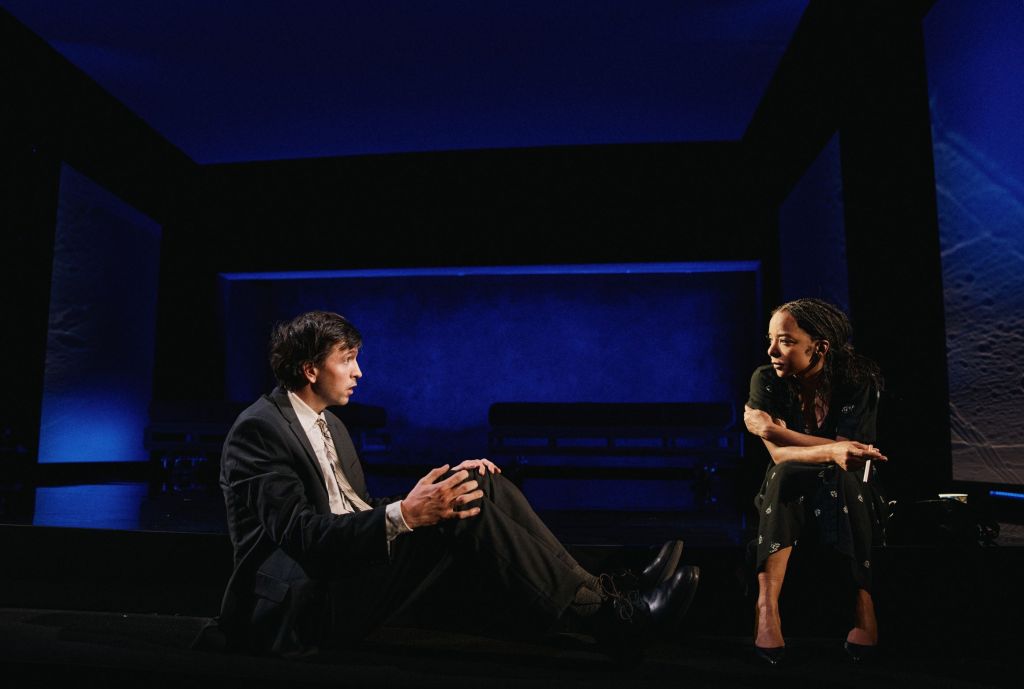
Toward the end of the play via flashback (when they are 18-year-olds), we discover their concern and love for for each other and inability to carry through with a complete and lasting union as boyfriend and girlfriend. When Doug tries to push it, Kayleen isn’t emotionally available. Likewise when Kayleen is ready to move into something more (they are 38-year-olds), Doug refuses her touch. By then he has completely wrecked himself physically and can only work his job at the ice rink sitting on the Zamboni.
Young and Braun are terrific. Their nuanced performances create their characters’ relationship dynamic with spot-on authenticity. Acutely directed by Neil Pepe, we gradually put the pieces together as the mystery unfolds about these two. We understand Kayleen insults Doug as a defense mechanism, yet is attracted to his self-destructive nature with which she identifies. We “get” his protection of her because of her abusive father. One guy in school who Doug fights when the kid calls her a “skank,” beats him up. Doug knows he can’t win the fight, but he defends Kayleen’s name and reputation.
The lack of chronology makes the emotional resonance and causation of the characters’ behavior more difficult to glean. One must ride the portrayals of Young and Braun with rapt attention or you will miss many of Joseph’s themes about pain, suffering and the salve for it in companionship, honesty and love.
In additional clues to their character’s isolation, Young and Braun move the minimal props, the hospital beds, the bedding. They rearrange them for each scene. On either side of the stage in a dimly lit space (lighting by Japhy Weideman), Young and Braun quickly fix their hair and don different costumes (Sarah Laux’s costume design), and apply blood and injury-related makeup (Brian Strumwasser’s makeup design). In these transitions, which also reveal passages of time in ten and fifteen year intervals, we understand that they are alone, within themselves, without help from anyone. This further provides clues to the depths of Joseph’s portrait of Kayleen and Doug, which the actors convey with poignance, humor and heartbreak.
Gruesome Playground Injuries runs 1 hour 30 minutes with no intermission through 28 December at the Lucille Lortel Theater; gruesomeplaygroundinjuries.com.
‘The Other Americans,’ John Leguizamo’s Brilliant Play Targeting the American Dream Extends Multiple Times
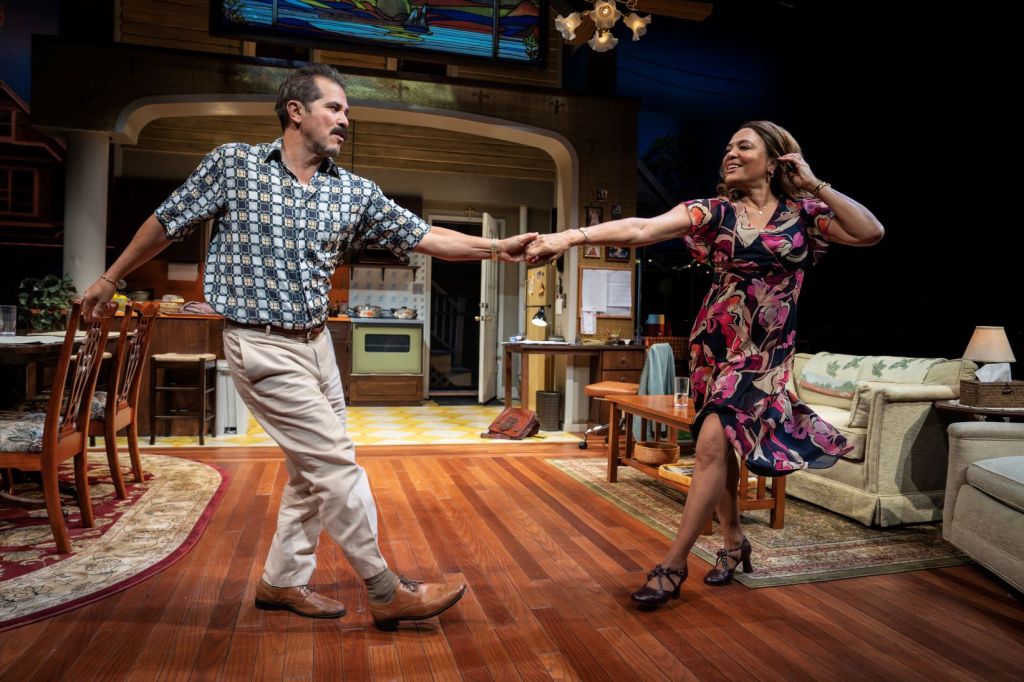
After a long career in every entertainment venue from films, to TV, to theater, Broadway, Off Broadway, etc., the prodigious work by the exceptional John Leguizamo speaks for itself. Now, Leguizamo tackles the longer theatrical form in writing The Other Americans, extended again until October 24th at the Public Theater.
Superbly directed by Ruben Santiago-Hudson, the theatrical elements of set design, lighting, costumes speak to the 1990s setting and cultural nuances. The following creatives developed a smart, stylish representation of the Castro household (Arnulfo Maldonado-set design, Kara Harmon-costumes, Justin Ellington-sound, Lorna Ventura-choreography).
Perhaps Leguizamo’s play could be tweaked to tighten the dialogue. All the more to have it shine with blinding, unforgettable truths sounding the alarm for immigrants in this nation. If tightened a bit, the complex, profound play would land perfectly as the unmistakable tragedy it inherently is. However, in its current iteration, Leguizamo gets the job done. The powerful play with comedic elements resonates to our inner core as a nation of immigrants and especially for Latinos.
Clearly, Leguizamo’s characterizations and themes add to the canon of classics that excoriate and expose the corrupted myth of the American Dream as a lie fitted to destroy anyone who believes it. That immigrants make the sacrifices they do to embrace it, is the ultimate tragedy.
Nelson Castro (played exquisitely by John Leguizamo), born in Jackson Heights from Columbian ancestry, embraces the American Dream. His wife Patti (the amazing Luna Laren Velez), from her Puerto Rican heritage, not so much. Patti’s values lead to loving her family and friends with devotion. Daughter, Toni (Rebecca Jimenez), who will marry the solid but nerdy Eddie (Bradley James Tejeda), looks to fit in as a white woman. The younger Nick (Trey Santiago-Hudson) was like his dad and took advantage of others, fiercely competitive. However, an incident changed him forever.
As the play unfolds, Leguizamo deals with the central question. To what extent have the warped values of the predominant culture negatively impacted this Latino family? From his first speech on we note that these twisted values have lured Nelson. The ethos-scam to get ahead-guides Nelson like a veritable North Star. He uses “getting over” as the key reason to provide for his family. This excuse rots everything under his power.
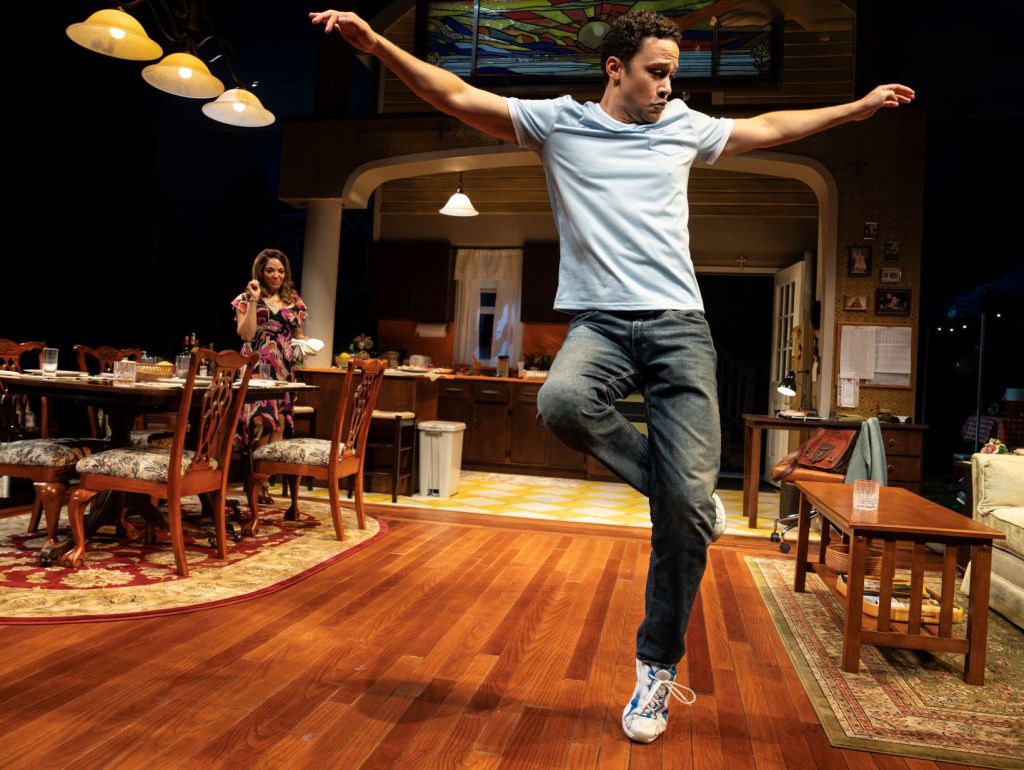
For example, Nelson acts the part of the upwardly mobile success story who always has a deal on the table ready to go. The irony is not lost on us when Nelson hypes a deal with a real estate big wig. Meanwhile, the mogul lives off his reputation for ripping off minorities. Sadly, Nelson admires the mogul’s pluck and con abilities. He ignores how this can potentially harms Latinos.
Mirroring the sick culture and society that values money and material prosperity over people, Leguizamo’s tragic hero tries to wheel and deal to get ahead. Making bad decisions, he overextends himself. Meanwhile, he encourages Nick and Toni to follow his lead. His overweening pride as the patriarch drives him to assume the mantle of a power player. Indeed, the opposite is true. During the process that causes him to fail and lie about it, he compromises his integrity and family’s probity and sanctity. That he willfully blinds himself to the consequences of his beliefs and suppresses his intelligence and good will to fit in, is the final heart breaker.
As in the classic tragic hero, Nelson’s pride also dupes him into a psychotic circularity to believe he has no recourse. Of course he believes the wheels have been set in motion against him by the society’s bigotry and discriminatory values. He should recognize and reject the society that uplifts such values because they support doing whatever necessitates getting ahead. The entire rapacious structure promotes financial terrorism and, whenever possible, it must be rejected. However, Nelson can’t reject it because he can’t help himself from being seduced. Instead, he persists in a prison of his own making, digging his family grave, on a collusion course of self-destruction.
Sadly, he internalizes the society’s inhumanity and makes it his own, a self-hating Latino. Because he adopts this construct because he loathes his immigrant self, he tries to create a new identity apart from his inferior ancestry. Thus, he moves to Forest Hills away from Jackson Heights where he lived “like an immigrant” in a place where cockroaches multiplied.

Finally, as we watch Nelson struggle to assert this new identity in a flawed, indecent, racially institutionalized culture (represented by Forest Hills and what a group of kids did to his son in high school), Leguizamo’s play asserts an important truth for immigrants. Internalizing and adopting the culture’s corrupt, sick, anti-human values is not worthy of immigrants’ sacrifices. This theme is at the heart of Leguizamo’s play. In his plot development and characterizations Leguizamo reveals his tragic hero chases after prosperity and upward mobility. The incalculable loss of what results-losing what it means to be human-isn’t worth it. If one does not weep for Leguizamo’s Nelson at the play’s conclusion, you weren’t paying attention.
To exemplify his themes, Leguizamo uses the scenario of the Castros, an American Latino family. They move from the homey, culturally diverse Jackson Heights to the white, Jewish upscale, racist enclave of Forest Hills. At the outset of the play Nelson, a laundromat owner, awaits his son’s return from a psychiatric facility. Patti has cooked up her son’s favorite dishes. Not only does this reveal her care and concern for her son, her comments to Nelson show her nostalgia for the Latin foods and people of their original Jackson Heights neighborhood in Queens.
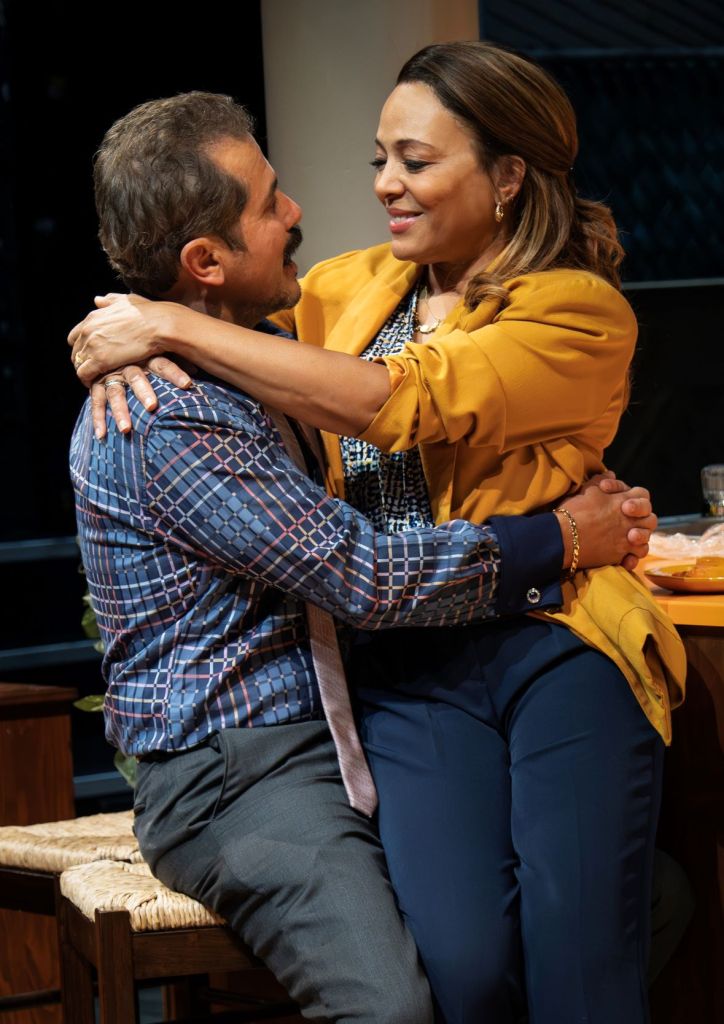
By degrees Leguizamo reveals the mystery why Nick was in a facility. Additionally, the playwright brilliantly explores the conflicts at the heart of this family whose parents put their stake in their children, chiefly son Nick to get ahead financially in the Castro business. To recuperate, the doctors partially helped Nick with medication and therapies.
However, on his return home months later, he still suffers and has episodes. Patti sees the change in his dislike of his old favorite foods (symbolic). Not only does he reject meat, he rejects Catholicism and turns to Buddhism. Because a girl he met at the facility influences him, he moves away from his Latin roots. Later, we learn he loves and admires her and they plan to live together. However, he doesn’t look at the difficulties of this dream: no money, no family support.
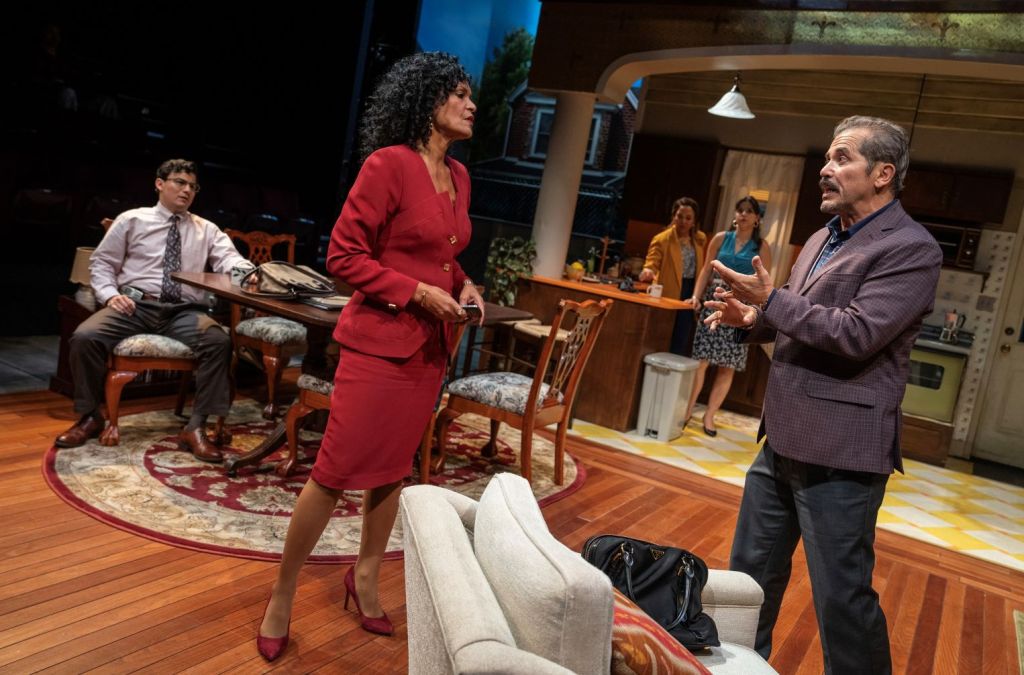
The family conflicts explode when Nick attempts to be truthful with his parents. In his conversation with his mother we learn the horrific details of the beating he received in high school, why it happened, and how it led to episodes in college. Wanting to move beyond this through understanding, Nick learns in therapy that he must talk to his father. Nelson refuses to acknowledge what happened, and becomes a stalemate to Nick’s progress.
Additionally, his doctor supports Nick’s getting out from under the family’s living arrangements. Inspired, Nick yearns to create a life for himself away from their control to be his own person. Ironically, he follows in his father’s footsteps wanting to create a new identify for himself. Yet, he can’t create this identity unless he confronts the truth of what happened to him in high school and talks to his father. Unless he understands the extremely complex issues at the heart of his father’s tragedy, they won’t move forward together. Nelson must understand that he hates his own immigrant being and has embraced sick, twisted corrupt values which he never should have pushed on his family.
Meanwhile, in a fight with Nelson, Nick demonstrates what may really be happening to him. Though he survived the high school beating with a baseball bat, he most probably suffers from what doctors have come to understand as TBI (traumatic brain injury). With TBI the individual suffers debilities both physically and emotionally. When Nelson questions the efficacy of the treatment Nick received from doctors who didn’t really know what was happening to Nick, Nelson is on the right track. But the science had to catch up to Nelson’s observations.
Meanwhile, the problems relating to Nick needing the right help from his parents and his doctors, Nelson’s financial doom and the future of this Latino family under duress are answered in a devastating, powerful conclusion.
There is no spoiler. Leguizamo elegantly and shockingly reveals this family as a microcosm of the ills of our culture and society. Additionally, he sounds the warning for immigrants. If they don’t recognize and refuse the twisted folkways of the “American Dream,” they may lose their self-worth and humanity for a for a lie.
The Other Americans runs 2 hours 15 minutes including an intermission at The Publica Theater until November 23, 2025. https://publictheater.org/theotheramericans
‘The Weir’ Review: Drinks and Spirits in a remote Irish Pub
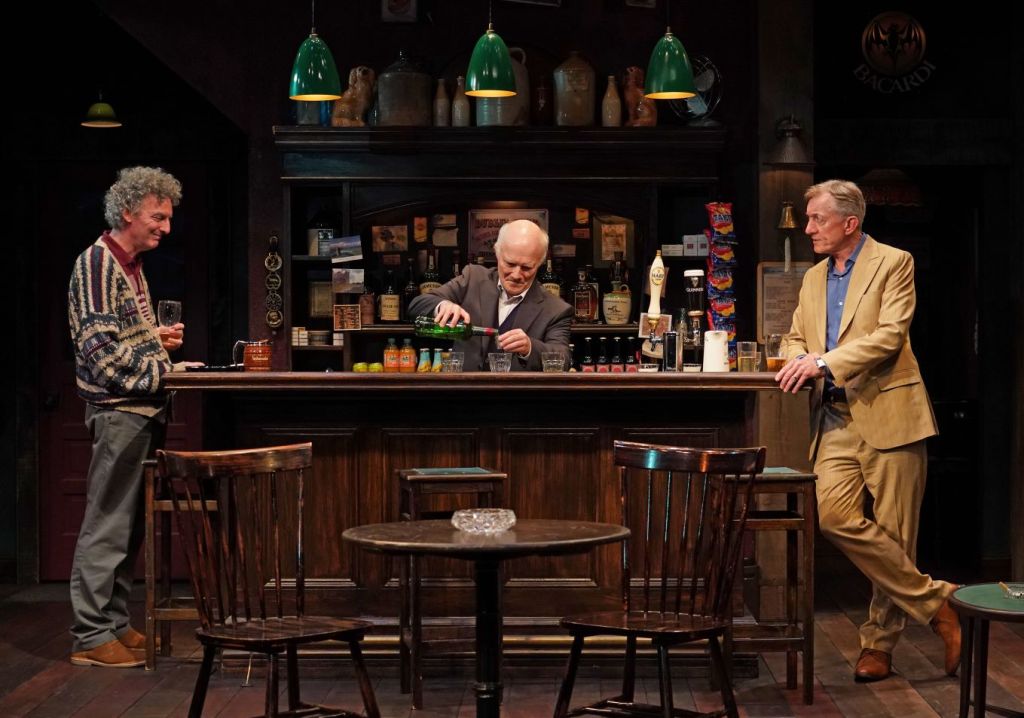
Conor McPherson’s The Weir currently in its fourth revival at Irish Repertory Theatre has evolved its significance for our time. It captures the bygone Irish pub culture and isolated countryside, disappeared by hand-held devices, a global economy and social media. Set in an area of Ireland northwest Leitrim or Sligo, five characters exchange ghostly stories as they drink and chase down their desire for community and camaraderie. Directed with precision and fine pacing by Ciarán O’Reilly, The Weir completes the Irish Rep’s summer season closing August 31st.
Charlie Corcoran’s scenic design of the pub with wooden bar, snacks, bottles, a Guinness tap and heating grate is comfortable for anyone to have a few pints and enjoy themselves at a table or nearby bench. With Michael Gottlieb’s warm, inviting lighting that enhances the actors’ storytelling, all the design elements including the music (Drew Levy-sound design), heighten O’Reilly’s vision of an outpost protective of its denizens and a center of good will. It’s perfect for the audience to immerse itself in the intimacy of conversation held in non-threatening surroundings.
On a dark, windy evening the humorous Jack drops in for drinks as a part of his routine after work at the garage that he owns. A local and familiar patron he helps himself to a bottle since he can’t draw a pint of Guinness because the bar’s tap is not working. Brendan (Johnny Hopkins) owner of the pub, house and farm behind it informs him of this sad fact. But no matter. There are plenty of bottles to be had as Jim (John Keating) joins Jack and Brendan for “a small one.” The entertainment for the evening is the entrance of businessman Finbar (Sean Gormley), who will introduce his client Valerie to the “local color,” since she recently purchased Maura Nealon’s old house.
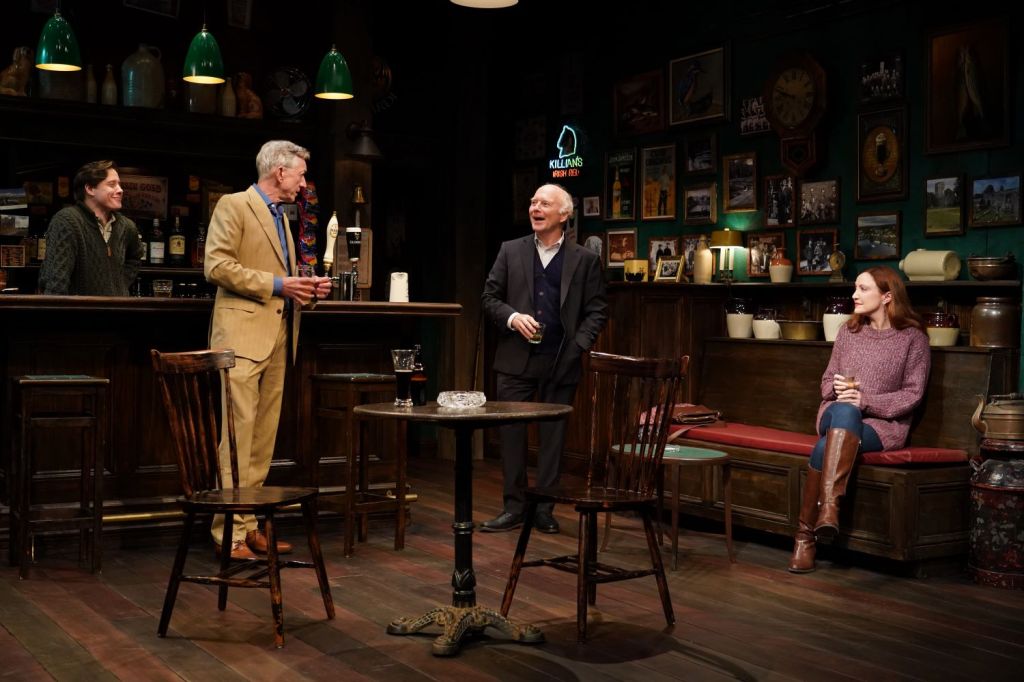
Initially, Jack, Jim and Brendan gossip about the married Finbar’s intentions as he shows up the three bachelors by escorting the young woman to the pub. Jim, caretaker of his mom, and Jack are past their prime in their late 50-60s. Brendan, taken up with his ownership of the pub and farm, is like his friends, lonely and unmarried. None of them are even dating. Thus, the prospect of a young woman coming up from Dublin to their area is worthy of consideration and discussion.
McPherson presents the groundwork, then turns our expectations around and redirects them, after Finbar and Valerie arrive and settle in for drinks. When the conversation turns to folklore, fairy forts and spirits of the area, Valerie’s interest encourages the men to share stories that have spooky underpinnings. Jack begins his monologue about unseen presences knocking on windows and doors, and scaring the residents until the priest blesses the very house that Valerie purchased.
Caught up in his own storytelling which brings a hush over the listeners (and audience), Jack doesn’t realize the import of his story about the Nealon house that Valerie owns. Thankfully, the priest sent the spirits packing. Except there was one last burst of activity when the weir (dam) was being built. Strangely, there were reports of many dead birds on the ground. Then the knocking returned but eventually stopped. Perhaps the fairies showed their displeasure that the weir interfered with their usual bathing place.
Not to be outdone, Finbar shares his ghost story which has the same effect of stirring the emotions of the listeners. Then, it is Jim who tells a shocking, interpretative spiritual sighting. Ironically, Jim’s monologue has a sinister tinge, as he relays what happened when a man appeared and expressed a wish, but couldn’t really have been present because he was dead.
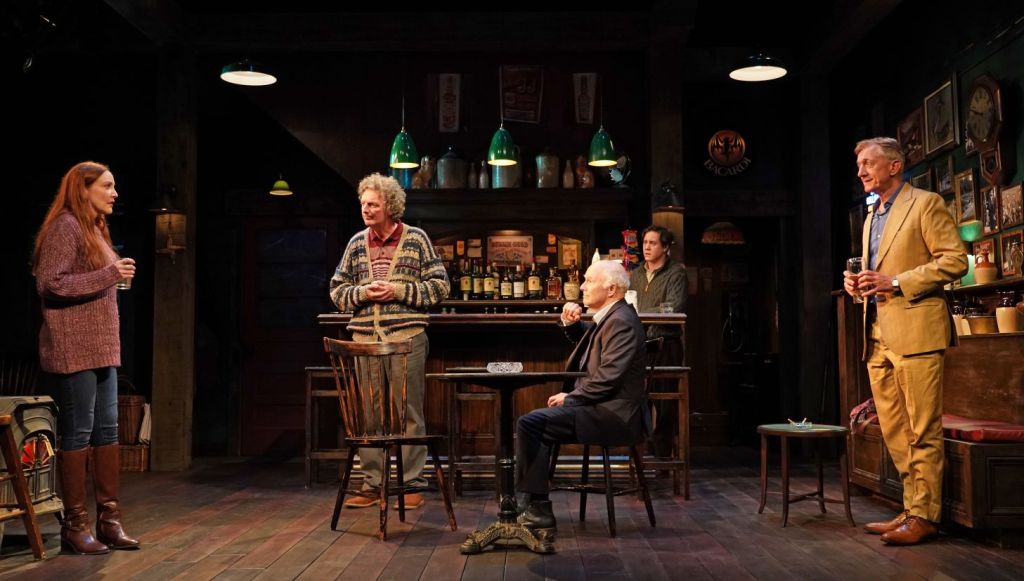
As drinks are purchased after each storyteller’s turn, the belief in the haunting spirits rises, then wanes as doubts take over. After Jim tells his story about the untoward ghost, Valerie goes to the bathroom in Brendan’s house. During her absence Finbar chides all of them. He regrets their stories, especially Jim’s which could have upset Valerie. With Jack’s humorous calling out of Finbar as a hypocrite, they all apologize to each other and drink some more. By this point, the joy of their conversation and good-natured bantering immerses the audience in their community and bond with each other. I could have listened to them talk the rest of the night, thanks to the relaxing, spot-on authenticity of the actors.
Then, once more McPherson shifts the atmosphere and the supernatural becomes more entrenched when Valerie relates her story of an otherworldly presence. Unlike the men’s tales, what she shares is heartfelt, personal, and profound. The others express their sorrow at what happened to her. Importantly, each of the men’s attitudes toward Valerie changes to one of human feeling and concern. Confiding in them to release her grief, they respond with empathy and understanding. Thus, with this human connection, the objectification of the strange young woman accompanied by Finbar at the top of the play vanishes. A new level of feeling has been experienced for the benefit of all present.
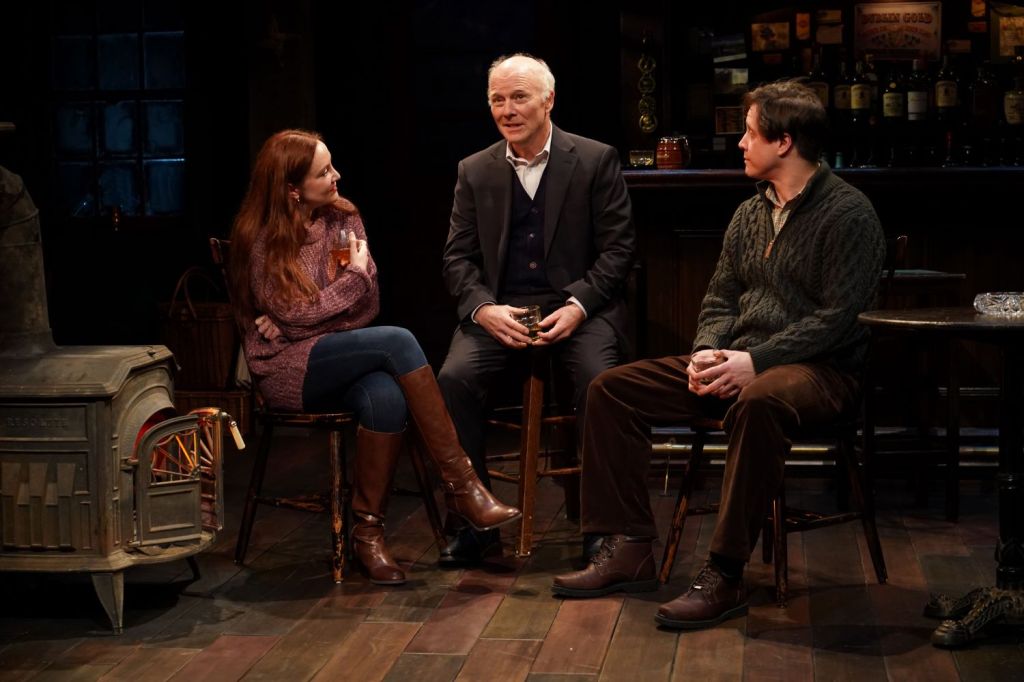
After Finbar leaves with Jim, McPherson presents a surprising coup de grâce. Quietly, Jack shares his poignant, personal story of heartbreak, his own haunting by the living. In an intimate emotional release and expression of regret and vulnerability, Jack tells how he loved a woman he would have married, but he let her slip away for no particularly good reason. Mentoring the younger Brendan not to remain alone like he did, Jack says, “There’s not one morning I don’t wake up with her name in the room.”
McPherson’s theme is a giant one. Back in the day when the world was slower, folks sat and talked to each other in community and conviviality. With such an occasion for closeness, they dispelled feelings of isolation and hurt. As they connected, they helped redeem each other, confessing their problems, or swapping mysteries with no certain answers.
As the world modernized, the ebb and flow of the culture changed and became stopped up, controlled by outside forces. Blocked by fewer opportunities to connect, people retreated into themselves. The opportunities to share dried up, redirected by distractions, much as a dam might redirect the ebb and flow of a river and destroy a place where magical fairies once bathed.
McPherson’s terrific, symbolic play in the hands of O’Reilly, the ensemble and creative team is a nod to the “old ways.” It reminds us of the value of gathering around campfires, fireplaces or heating stoves to tell stories. As companions warm themselves, they unfreeze their souls, learn of each other, and break through the deep silences of human suffering to heal.
The Weir runs 1 hour 40 minutes with no intermission at Irish Repertory Theatre (132 West 22nd St). https://irishrep.org/tickets/
‘Pericles’ by Fiasco Theater a Joyful, Redemptive Must-See at CSC

Fiasco Theater’s Pericles presented by CSC is one of William Shakespeare’s works written in the twilight of his career that reveals a “hero” who the fates torment and play with until it is enough, and he receives his wish of a fulfilled life with family. The production directed by Ben Steinfeld is stylized and cleverly wrought, advancing storms, shipwrecks, kidnappings and more with the ingenuity and charm joyfully delivered with as little forced spectacle as possible, yet with an intriguing, bold and seamless minimal set and prop design. Currently at CSC until March 24, this is a must see which Fiasco has brought for us to appreciate.
Steinfeld is Gower, the troubadour whose tale this is. Through his music, lyrics and poetry he sets up the play and requires the audience to use their imagination to become involved with Pericles of Tyre’s harrowing and amazing adventures of a lifetime. Steinfeld’s Gower introduces every section and gives a summation of events essentially cluing in and reminding the audience to stay focused and attentive. He leads the cast in song initially and establishes the mood for each of the acts, making sure to recap the events in rhyme after the audience returns from the 10 minute intermission before Act 2.
There are four actors who portray Pericles and give their timber to each scene and adventure that Pericles experiences as he goes on a hero’s journey learning wisdom, perseverance, patience and fortitude, struggling to overcome whatever Fortune brings.
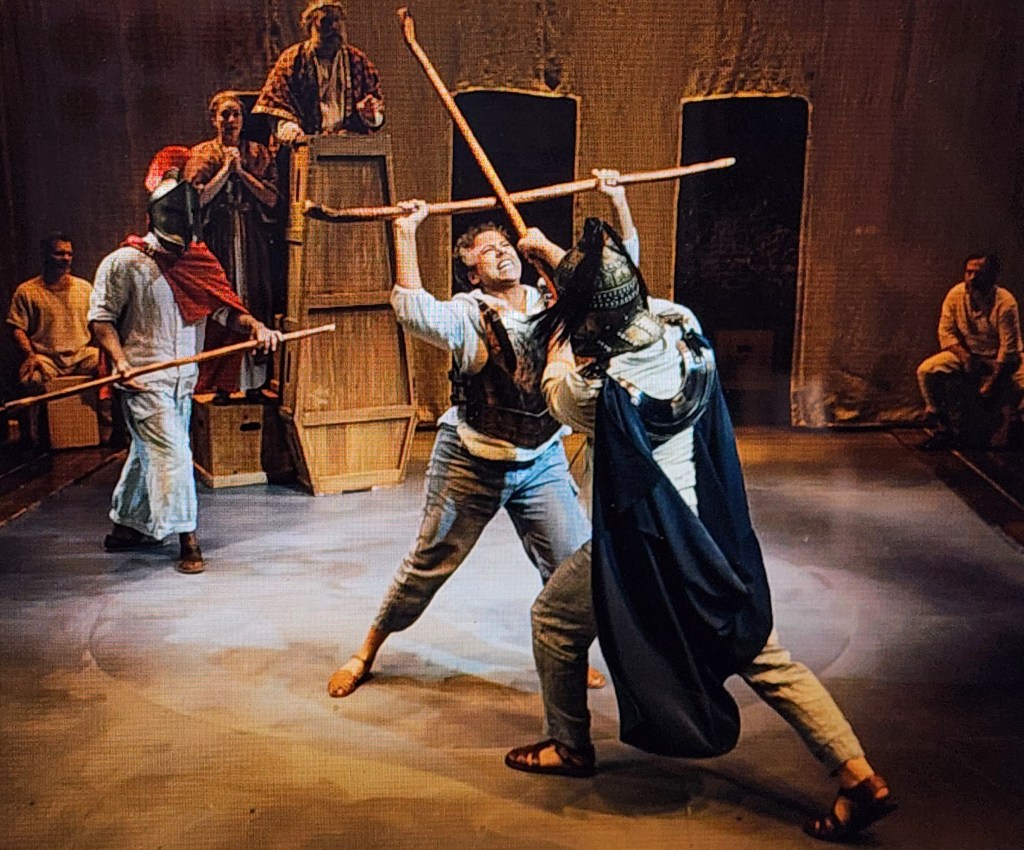
The first Pericles is Paco Tolson who journeys to the kingdom of Antioch where he must solve a riddle to marry King Antiochus’ (Noah Brody) beautiful daughter (Emily Young). If he doesn’t solve the riddle, he forfeits his life and hangs like the other suitors in the public square which the creative team and actors simplistically yet fearfully stage with staffs and boxes/crates. Hearing the riddle, Pericles shows his brilliance apart from all the suitors who have courted the king’s daughter and died. He understands King Antiochus’ treachery. The riddle infers the king’s incestuous relations with his daughter, who he will never give to a suitor.
Upon realizing this horrid circumstance, Pericles also realizes his own fate. Either way, if he reveals the riddle and exposes the king’s sin to public humiliation or doesn’t, he’s a dead man.
Making his excuses, Pericles ends up escaping Antiochus’ kingdom. He intuits the king will figure out why he left and come after him, so Pericles goes on a journey to Tarsus where King Cleon (Devin E. Haqq) and Dionyza (Titiana Wechsler) make their home and suffer through the dire misery of famine that has struck their lands. Knowing their plight, Pericles brings corn to Tarsus’ starving people and saves them from death. Forever grateful, King Cleon makes Pericles revered and celebrated in the land with friendship and goodness. However, we learn that kings are political and variable and circumstances change to sever the friendship.

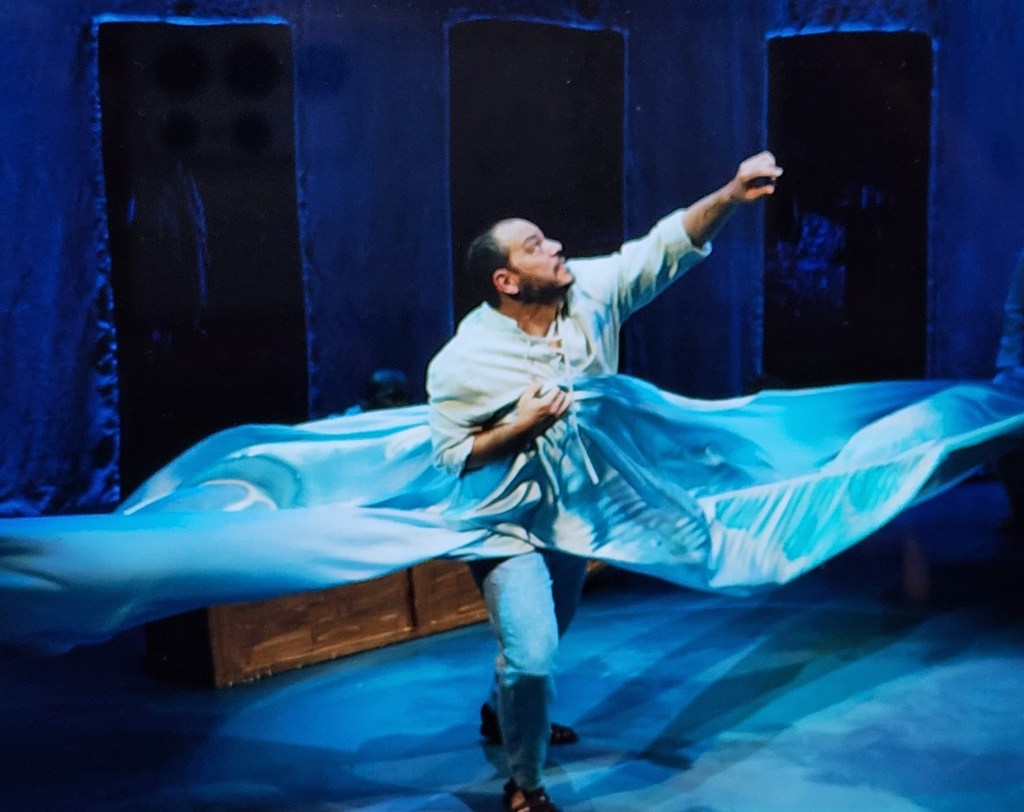
For the moment in his life’s travels Pericles is unaware of the possibility of deceit and betrayal. Called back to his home in Tyre by the administrator he left in charge, Helicanus (Paul L Coffey), Pericles once more bares himself to Neptune’s wrath on the fickle Mediterranean where the god upends and destroys his ship. Fiasco Theater’s inventiveness of Pericles braving the storm’s fury (Mextly Couzin’s lighting design and the Fiasco’s production design), using a bolt of cloth to suggest the tempestuous waves, maintains the stylized, roughly-hewn playfulness of the production. The soft, shimmery cloth symbolizing the waves belies the irony of Pericles’ situation on the roiling sea.
Pericles loses everything but his life and is washed up on the shores of Pentapolis. There, he is at the mercy of the fishermen who find him and change his fortune with happy information. Pentapolis is ruled by the goodly King Simonedes, (the humorous Andy Grotelueschen), a pleasant reversal of the kings who have gone before.
Shakespeare contrasts the kingdoms and their kings: the first is a lecherous murderer, the second variable in deceit and this third king. The fun loving Simonedes is popular even to the lowly fishermen who tell Pericles that the king holds a tournament and feast for his daughter’s birthday. The celebration is so that Thaisa (Jessie Austrian) may find suitors among the knights who joust for her. When Pericles’ armor washes ashore, the fishermen encourage him to compete for the king’s daughter. Shakespeare makes it a key point that though he is a stranger (an migrant) in their midst, he receives their country’s hospitality and mirth.
Pericles wins the jousting matches, performed with the sames staves Fiasco used to suggest the suitors’s hanging in Antioch. It is an example of how the theater company employs the props efficiently and meaningfully to emphasize themes of power, leadership and control. Through their variable exchange we note the contrast between the kingdoms and their rulers’ leadership, either deceitfully tyrannical or happily beneficent.
After the tournament, King Simonedes invites all the knights for a feast. The wooden crates which have been used as a throne, to circumscribe walls, etc., are now used to effect a long feast table. And there, Pericles (Titiana Wechsler portrays Pericles in this segment) gains the king’s favor and the love of Thaisa.

For his pains and pleasure, the Simonedes playfully uses reverse psychology to have the couple declare their love to each other by pretending to forbid their union. Jokingly, he reveals his pleasure at their marriage which produces an heir. In the next scene we see that a pregnant Thaisa, and husband Pericles (Noah Brody in this version) go on an ocean voyage back to Tyre to check on his kingdom.
Again, there is a storm at sea and dire circumstances. Thaisa who dies in childbirth must be thrown overboard to steady the ballast or the ship will sink. Pericles prepares her coffin with spices and jewels with a note to whomever finds the coffin to bury his wife whom he greatly loves. The child who was born as Thaisa died Pericles names Marina. To redeem the time, Pericles leaves Marina with those who revere him in the land of Tarsus. King Cleon and Dionyza promise to care for Marina like she is their own, while he returns to rule Tyre.

The staging of the scene where Marina is given to King Cleon is simultaneously juxtaposed with the fate of Thaisa whose coffin washes ashore at Ephesus. The director makes excellent use of the space at CSC to clarify what happens. As Pericles hands over baby Marina to his friends, a woman with powers of healing (Tatiana Wechsler with hair down in flowing priestly robes) restores Thaisa back to life. So thankful is Thaisa that she becomes a devotee of Diana and officiates at her temple. Meanwhile, Pericles is heartbroken and grieves his dead wife but joys that his child is being raised well. As fate would have it, during the fifteen years Marina has been brought up with the daughter of Dionyza, things grow problematic.
Dionyza envies Marina’s beauty and talents and decides she must be murdered for the sake of her own daughter, so their child will shine if the glory of Marina is removed. Though Cleon opposes Dionyza’s evil act, he is powerless to stop her. But just as Marina is about to be killed, pirates kidnap her and thwart the murder. In the following sequences, Gower shifts the mood once more and the riotous humor of how Marina’s chastity is used to great effect proves comical in a brothel run by Bolt (Andy Grotelueschen) and Bawd (Jessie Austrian). There, Emily Young’s Marina turns away the lusty, hot clients who are horrified that she pushes her virginity onto them and attempts to make them Diana (the feminist of the time) devotees. Of course the irony is that Thasia, her mother, is back in Ephesus praying as a Diana devotee.
In the second act, Fiasco’s farcical skills shine and the atmosphere shifts from Fate’s woes to merriment at those lecherous males who should be ridiculed for their unseemliness. However, when it is least expected, Pericles, who returns to Tarsus to bring his daughter back to Tyre to rule with him, discovers through Cleon that Marina drowned. Indeed, King Cleon and his wife have betrayed Pericles’ goodness and there is no punishment for them as there was for King Antiochus who the gods burned up. It would seem that incest is the worst crime when it begets murder. Dionyza’s intention of murder the wicked pirates interrupted; it is an irony is that the pirates evil act is turned around for goodness. Dionyza’s envy and murderous intention the gods leave to her and Cleon’s consciences to seek redemption.
Inconsolable that she is gone, Pericles (an excellent David E. Haqq in the last, most emotional segment) will not speak and is dead in spirit. How events change magically to effect Pericles’ reunion with his wife and daughter is poignant and heart-rending, if not fanciful in hope. Interestingly, Shakespeare makes abundant use of the Deus ex Machina (the gods interrupt evil fate to save the hero) in Pericles. As Gower and the cast conclude the tale of Pericles, King of Tyre, we are uplifted by the grace of a happy ending, and the redemption offered to Marina, Pericles and Thaisa because of their goodness, devotion to the values of truth, generosity, decency and steadfastness.
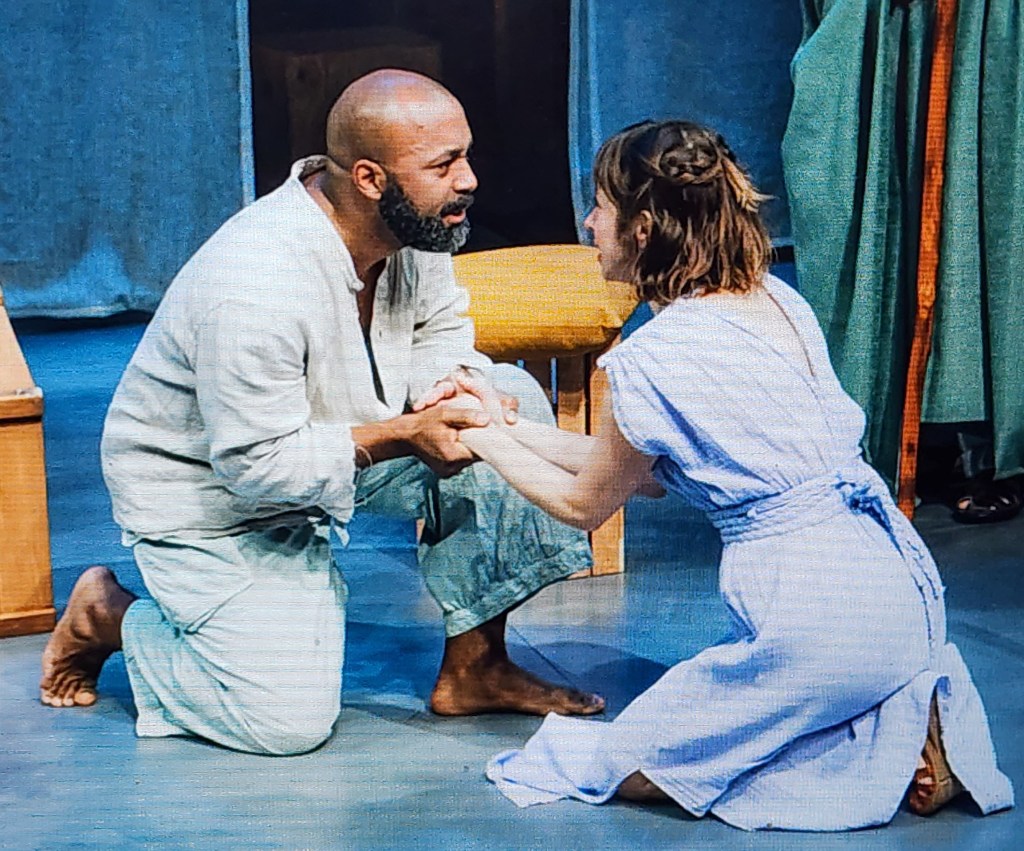
The strengths of this production include the fine ensemble’s seamless acting which provides the coherence throughout, even though the character of Pericles has four actors which was initially confusing. The whimsical and at times farcical, lighthearted approach toward myth-making and storytelling through music, rhyme, dance and song are superbly balanced throughout. The stylization is the correct choice for a play that gyrates throughout voyage, disaster, and roller coaster storms that metaphorically parallel human joys and sorrows.
That the play has been spurned as silly and not worthy of being produced has been a misread of the depth of one of Shakespeare’s most trenchant latter plays. The life theme is an important one. For those who patiently endure, they gain wisdom in temperance and the power to face and overcome trials of their faith. The obstacles help one all the more appreciate and be grateful for a life that acknowledges human beings live on the brink of peril every moment of their lives. To be numb to that knowledge is to live a zombie death in life.
This is a must-see, for the music, songs, fantasy, laughter and fanciful, profound truth-telling.
Pericles. CSC, 136 E 13th St between Third and Fourth Avenues. Closes March 24th. https://www.classicstage.org/pericles/
‘Buena Vista Social Club™’ is Phenomenal, Theater Review

If you are a world music lover, you don’t need any introduction to the “Buena Vista Social Club,” a group of Cuban musicians that Cuban producer and musician Juan De Marcos González, brought together in a recording studio in Cuba to eventually release an album in 1997. González is to be credited for his passion to capture the striking beauty and spirit of traditional Afro-Cuban music of the Buena Vista Social Club, while some of the members were still alive and able to perform and record in 1996.
Surprising everyone, the Buena Vista Social Club musicians, who had been a hit in the 1950s and disappeared after the Cuban Revolution, created a smoking hot album in 1997 that won a Grammy in 1998. Subsequently, they were the subject of the documentary initiated by musician/songwriter Ry Cooder and filmed by Wim Wenders, that rocked the BVSC into the stratosphere of global fame by 2000, when the documentary was nominated for an Academy Award.
The Atlantic Theater Company’s musical, Buena Vista Social Club™ is based on the titular documentary with references to Buena Vista Social Club: Adios, a second documentary filmed in 2016. The superb musical, directed by Saheem Ali (Fat Ham), has as its creative consultant David Yazbek (The Band’s Visit). With book by Marco Ramirez and music by the Grammy Award winners known as the Buena Vista Social Club, the production currently runs with the ebullient magnificence of songs, brilliant tonal hues, dances and movements at the Linda Gross Theater with one intermission until 21st of January. The Buena Vista Social Club™ is a touch of paradise with Afro-Cuban rhythms and sonority that are unforgettable.
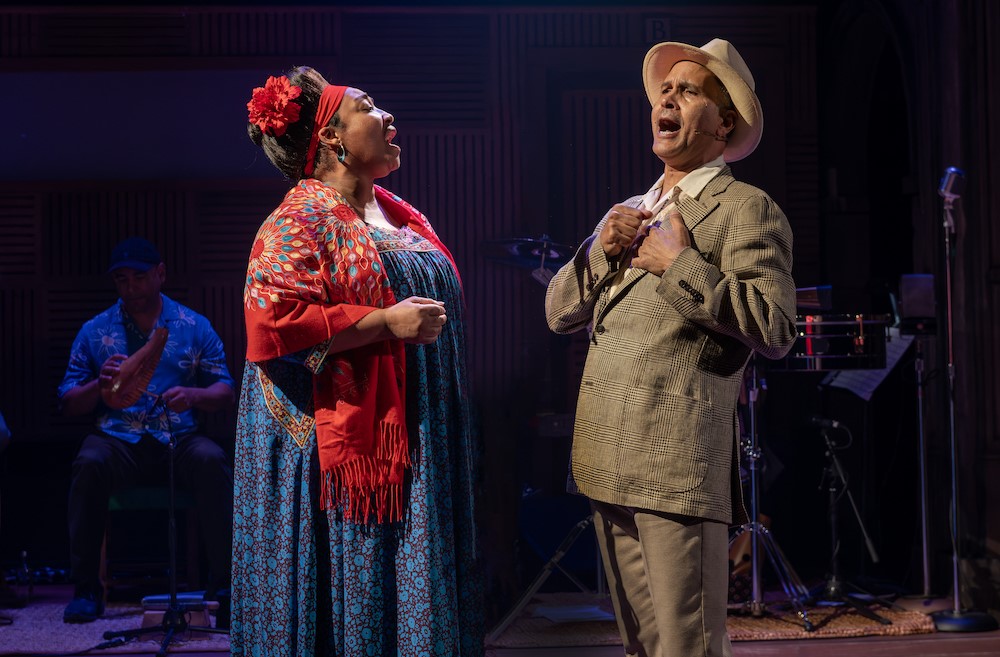
When you see it, and you must, you will not be able to sit still. The music fills you with its joyous power and heartfelt beauty. The production which extends beyond the crass label of “jukebox musicals” gives a reverential bow to the album, the documentaries and importantly, the magnificent musicians and singers who were vaulted to a success they had never known when they started out.
The production, loosely narrated by Juan De Marcos (Luis Vega), boasts a song list that is steeped in the incredible social club’s rhythms and cadences that spiritually manifest the history and diversity of the Cuban people. At the opening, De Marcos, who stands in Egrem Studios-the Old Havana music studio where musicians in the 1990s still record states, “A sound like this, it tends to travel.” His prophetic remarks reference how Buena Vista Social Club’s songs resonated and still resonate throughout the world today, even though most of the original members of the BVSC have passed. Only Omara Portuondo, the National treasure of Cuba, still sings and tours.
The key to opening the lock on the social club that dissolved with all the social clubs that Castro disbanded to end discrimination in Cuban society is Omara Portuondo. As the musical indicates, her notoriety and fame in Cuba allows her to serve as the bridge between the traditional musicians no longer heard and herself who is very much in the Cuban music scene in the 1990s and today.
Thus, the musical focuses on Omara and flashes back and forth from the past to the present in recounting her history with the BVSC, as well as introducing the members, and revealing how they were a part of the popular social club in a Cuba whose segregated clubs prevented various groups from singing and dancing together. The musical’s arc of development unspools as De Marcos attempts to interest Omara in making a recording of the musicians from long ago, who are still alive to keep the torch of Cuban folk music vibrating and lighting the way for musicians and fans of a younger generation.

Initially, when Vega’s, De Marcos approaches her, Omara (Natalie Venetia Belcon), is not interested because she doesn’t sing with a live band anymore. Her attitude is cold, aloof and proud, but later, we discover this hard shell fronts for deep pain underneath, concerning her alienation from her sister and niece because of the Revolution and the US embargo barring any exchange of visitors between the two countries. Recording the album would bring up tenuous memories. However, her dismissal of De Marcos on the surface appears to be because she is famous and he is an unknown, who intends to exploit her beloved renown for his own purposes.
Cleverly, De Marcos plays one of her old recordings with the BVSC. Only then, reflecting back to the past, does she relent and give her stipulations for the recording. First, she must be the voice that’s front and center, as De Marcos writes the arrangements. Second, she must be in control to select the singers and musicians. Thus begins the process, conveyed with humor and pathos, that Omara and De Marcos use to bring back the members of the BVSC, so that they are able to record together and reestablish the vitality, importance and universality of Afro-Cuban music, making them a global phenomenon.
The musical is an important tribute to revitalizing how the BVSC Afro-Cuban stars were incredible singers and musicians. It also intimates in the flashbacks and lovely balletic dances featuring the Young Omara (Kenya Browne), and her sister Haydee (Danaya Esperanza), the historical, social schemata of a diversely segregated Cuba, referencing its importance in the Slave Trade, the divisions between the rich and the poor, as well as Castro’s plan to bring equality to the country that backfired and instead created a hell and misery for the Cuban people. This was especially so after the revolution and the flight of wealthy Cubans and middle class off the island.

As is pointed out as a major theme, which indicates the segregation still is manifest concerning Cuba, the division became forever known as “the ones who stayed” and braved out the situation in their mother country, and the “ones who left” and went to various parts of the United States and elsewhere.
Crucially, Omara is an important symbol of transition and the voice and the bridge between the rich and the poor, the socially upscale strata of Cuban society, and the segregated, representing the traditional Cuba with which all Cubans can identify, if they put their prejudices away. Indeed, in this musical, the character of Omara magnifies the best of Cuban culture. She recalls the past and weds it to the present, in the tears and pain of the loss of family and her sister Haydee, who died before she was ever able to see her again. Because Omara was already famous, she was able to negotiate travel as she employed her talents on tour. This mobility was not possible for the other BVSC musicians who were not as famous, and lived under the oppression of segregation and poverty before and ironically, after, in Castro’s Cuba.
Obviously, the ones like Omara who had mobility or the thousands of others who left, had some money to establish themselves elsewhere, even though they lost their lands and businesses to Castro’s “communistic” usurpation. It is a wealth Castro didn’t share with the Cubans who stayed, reminiscent of Vladimir Putin’s behavior toward the Russian people in today’s Russia. Like a predominance of the Russian society, the Cubans who stayed were impoverished and the musical references that during the “Special Period” when the dissolved U.S.S.R. split up, there was no longer any “communistic” aid to Cuba. Thus, the people starved.
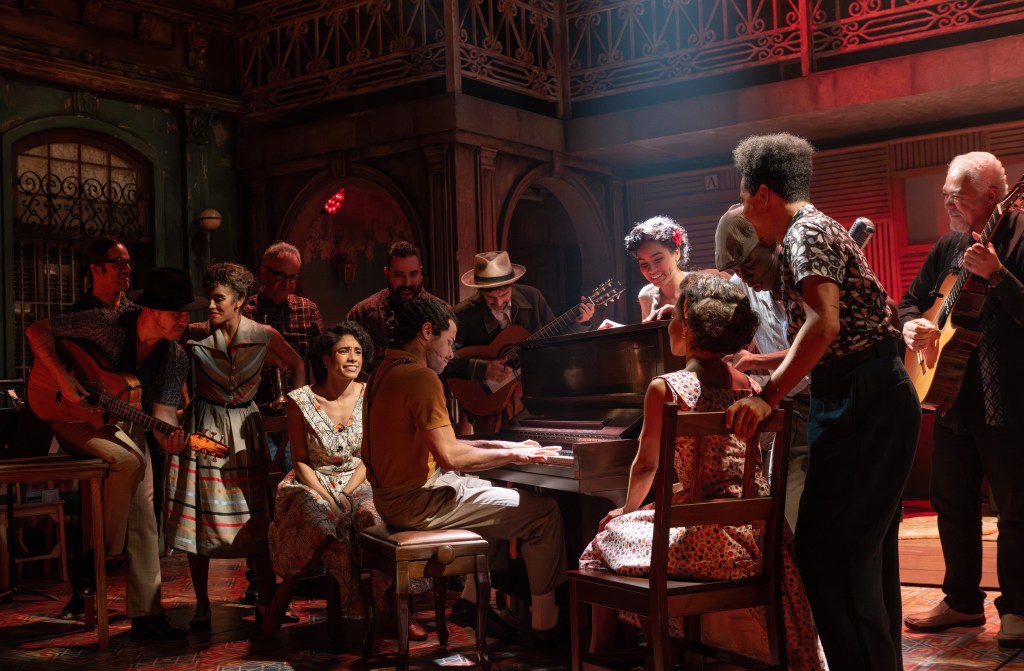
The hope of recording an album with BVSC members was to earn a bit of money, as many of the musicians and singers we meet and learn about in their relationships to Omara and the club were barely scraping by from day to day. During the production we meet the incredible individuals who Omara was close to and sang with in the 1950s when they were young and in 1996 during the recording. These include the charming, funny Compay (Julio Monge), the sweet, loving Ibrahim (Mel Seme), the wonderful pianist Ruben (Jaindardo Batista Sterling) and Eliades (Renesito Avich).
The seminal moments of the production however, meld the present to the past, revealing how Omara connected with each of the BVSC members in the flashbacks with the Young Omara and the Young Haydee. The musicians/singers include the Young Compay (Jared Machado), the Young Ibrahim (Olly Sholotan), and the Young Ruben (Leonardo Reyna).
The balletic sequences with dancers portraying the Young Omara and Young Haydee, choreographed by Patricia Delgado and Justin Peck, developed and directed by Saheem Ali. These sequences seamlessly and stylistically reveal the differences in opinions between the sisters, regarding the BVSC which Haydee feels is beneath her. Also revealed in these flashback dance sequences, is Omara’s sadness in losing her sister and family forever because of the Revolution and US Embargo. As Belcon’s Omara sings of her feelings, the poignance of her expressiveness resonates with all Cubans and punctuates the cruel punishment visited upon the people by both governments, revealing the malevolence of political machinations. However, it is in the power of the songs that the Cuban people thrive and with dignity transcend the brutality.
The BVSC playlist is sung in the native tongue of the BVSC, and on one level doesn’t need translation because the music “speaks” for itself. However, the musical’s closed captions in Spanish, should also have had an English counterpart. In English, the lyrics can relate the historical culture of the Cuban people which is referenced throughout in the English dialogue and storyline. English closed caption lyrics, as well as Spanish, would convey the complete picture of the BVSC and its tremendous importance socially, politically (their democratic diversity should not be diminished), and spiritually.
The BVSC’s immutable human values conveyed in their incredibly poignant rhythms and music is what resonates and draws in fans globally in an egalitarian message that makes sense and that most human beings yearn for. Politics and the power hungry divide to conquer. The music of the people soars, uplifts, transcends hardship and unifies. This production’s value is priceless and the ensemble of musicians and singers are fabulous in memorializing the Buena Vista Social Club for all time.
The creative team brings the director’s vision together in a beautifully stylized way that breathes life into the real musicians and singers who made up the BVSC (1950s, 1996). These creatives include Arnulfo Maldonado (sets), Dede Ayite (costumes), Tyler Micoleau (lighting), Jonathan Deans (sound), J. Jared Janas (hair, wigs & makeup), Dean Sharenow (music supervisor), Marco Paguia (music director, orchestrations & arrangements), Javier Diaz, David Oquendo (additional arrangements), the swings and band.
The company of Buena Vista Social Club™, Atlantic Theater Company, 20th Street between 8th and 9th. https://atlantictheater.org/production/buena-vista-social-club/
‘Parity Productions Champions Women and Transgender Artists’

Through the window onto a new reality. Parity Productions launch was hosted by Janos Aranyi and Theresa Llorente in their beautiful home overlooking Gramercy Park. Photo by Carole Di Tosti
Criticism of women advocating for equal pay, equal voice and equal command over their destiny has been easily dismissed by men and their willing women sycophants who have slimed women with the “F” word as “feminist” ideologues. Any momentum to provide women with the opportunity to excel has always been demeaned as “unnecessary” and has been met with resistance.
That is as it should be. Resistance is more productive than hypocritical co-optation which lulls individuals into believing they have made progress when actually they have been running the perimeters of zero.
In the arts, in live theater and in film there has been tremendous resistance to hire women behind the scenes as directors, playwrights, designers, technicians, et. al. And gender inequality is rife in front of the camera as well, with male dominated film subjects, lead characters, stories and well funded blockbusters taking all of the pie and male dominated companies reaping heavy proceeds leaving the crumbs to women lackeys lining up at the back of the bus. (Jennifer Lawrence is in a minority of one with few female colleagues even nearing her status)
A recent Variety article identified gender inequality is not only a plague in the US film and entertainment industry but it is as endemic in Europe as well. If we don’t understand why and how this has happened, we stand the chance of never equalizing gender roles in the arts.

There was a cocktail hour where guests mingled and were welcomed by Ludovica Villar-Hauser and her team of collaborators at Parity Productions.
Paul Feig (Spy, Bridesmaids, Ghostbusters), who was honored at the 6th Annual Athena Film Festival with their “Leading Man Award” because of his outspoken stance and support for women, spoke about the under-representation of women in the arts. He labeled it as the “banality of evil.” In other words this has not been an overtly “wicked” and intentional act on the part of men in power.
Feig implied that gender inequity has been borne out of negligence, out of a lack of attention to necessity…the necessity to recognize and reward women for their incredible talents and contributions. That banality is part of the continuance of gender dominance and the comfort of the “young/old boy’s network,” which speaks a “common language” as it comfortably objectifies women. It is these issues and others that have spurred on an unconscious dismissal of women and the passing over of those who are not ready gender cronies.
As for those who have an active mentor or help-meet to give them the 10 legs up they need to begin to compete? There are vastly too few men willing to act as mentors. Women are the ones who must mentor each other as has been occurring with conferences like Women in the World.
Opening remarks by Founder and Artistic Director of Parity Productions, Ludovica Villar-Hauser. Photo Carole Di Tosti
Indeed, the government is taking notice. There has been a call to investigate gender discrimination against women directors in the film industry which hopefully will be carried over into theater and the entertainment arts, though the recent cry has been that things have been getting better for women in the theater. Really?
Thanks to the resistance in the entertainment industry, whether intentional or not, women are joining advocacy groups and creating their own teams to combat the gender inequality in the entertainment arts like never before.
We Do It Together is an example of a global non-profit which has been created to finance and produce films centered around women and dedicated to the empowerment of women.
Others groups like Parity Productions are NYC based with a global reach. They are organizing and strengthening themselves with unity and coherence of purpose by establishing their own opportunities increasing women and transgender representation in the arts so that gender equality is the rule, not the exception.

(L to R): Ludovica Villar-Hauser, Founder and Artistic Director, Parity Productions, actress Elizabeth Jasicki, getting ready to present from her one woman tour-de-force ‘Village Stories’ at the Parity Productions launch. Photo by Carole Di Tosti
The launch of Parity Productions on Monday May 16, 2016, is noteworthy because it is one of the more accessible ventures in a city known for being difficult to break into at all levels of the entertainment matrix. Parity Productions according to its Founder and Artistic Director, Ludovica Villar-Hauser is the “first organization to combine the art of theater with advocacy for women and transgender artists.” The company mission looks to produce new works and has pledged to hire at least 50% women and transgender artists on every production as well as supporting other productions that have pledged to do the same.
Parity Productions has been blessed that the estate of Sylvia Sleigh has made a donation of 25 rare works of art in the name of Sylvia Sleigh who was a progressive, Welsh-American artist. Sleigh represented equality of subject and treatment of men and women in her art. Her works are being offered for sale as part of the fund raising initiative and can be purchased through the Parity Store (click here).
Shows that Parity Productions will be presenting for the 2016 season are the delightful Village Stories in the summer and the historical Household Words in the fall. Both represent an intriguing and complex look into the place of women striving against paternalism in the past and how that perspective has ramifications for both men and women in the present. To get a heads up on ticket sales, click HERE.
 CAROLE DI TOSTI