Monthly Archives: February 2022
‘Jeff Leatham’s Kaleidoscope’: Orchid Show 2022, New York Botanical Garden’s Spectacular Horticultural Theater
Jeff Leatham’s Kaleidoscope Runs February 26 – May 1, 2022

Lifestyle icon and floral designer to the stars (Oprah Winfrey, Cher, Dolly Parton, etc.), has returned for an encore presentation to the New York Botanical Garden after the show which he created in 2020 had to be curtailed because of the COVID-19 pandemic safety procedures and quarantine throughout the nation. But Leathem has reimagined the imagery of Kaleidoscope and once again the Enid A. Haupt Conservatory and its various galleries are shimmering in a pageantry of color-rich orchids of every shape, size and variety. If you love orchids, this is a show to see for its gorgeous delights.



Lifestyle icon and floral designer to the stars (Oprah Winfrey, Cher, etc.), has returned for an encore presentation to the New York Botanical Garden after the show which he created in 2020 had to be curtailed because of the COVID-19 pandemic safety procedures and quarantine throughout the nation. But Leathem has reimagined the imagery of Kaleidoscope and once again the Enid A. Haupt Conservatory and its various galleries are shimmering in a pageantry of color-rich orchids of every shape, size and variety.

Jeff Leatham said, “I am thrilled to bring Kaleidoscope back to the New York Botanical Garden in 2022. Much like when you look into a Kaleidoscope, the view is never the same.”





Kaleidoscopic, with rich, multi-various hues, orchids compose the largest family of plants in the world. They number from 28,000-30,000 natural species and from 150,000 hybrids. Botanists and horticulturalists are constantly coming up with new derivations inspired to craft hybrids. And these they sometimes name them for individuals and celebrities. Jeff Leatham has a hybrid Vanda named after him and Awkwafina (comedic rapper and award winning actress) has her own orchid named after her zaniness. These orchids were featured in previous orchid shows at NYBG in 2019 and 2020.





Orchids were assembled from the finest growers in the world in January and early February as the NYBG beds were graded and prepared for the 2022 Orchid Show. Leatham worked with horticulturalists from NYBG and Marc Hachadourian, the Senior Curator of Orchids who advised what orchids would last longest for various displays and what could be replaced to keep the displays looking fresh until May 1st when the show closes. The plantings and design took two weeks.

Jeff Leatham’s work is a meld of his love for flowers and his passion for design. His displays are dramatic, vibrant and memorable. He integrates his arrangements seamlessly with his settings. Jeff has produced striking displays in Paris for two decades. In 2014 he was knighted with the Ordre des Arts et des Lettres, the highest honor for artists and others who have made a significant contribution to French culture.

On select Fridays and Saturdays in March and April, adults 21 and over can experience the exhibition at night with music, cash bars and food available for purchase ORCHID EVENINGS WILL TAKE PLACE: MARCH 26, APRIL 2, 9, 16, 22, AND 23, 2022; 7-10 p.m.




At NYBG Shop, Orchid Show visitors can purchase Jeff Leatham’s publications: Flowers by Jeff Leatham, Flowers by Design, and Jeff Leatham: Visionary Floral Art and Design. These are best-selling design books globally.
For more information about the 19th Annual Orchid Show: Jeff Leatham’s Kaleidoscope visit https://www.nybg.org/event/the-orchid-show/
‘The Daughter-in-Law,’ by D.H. Lawrence is Superb! Theater Review

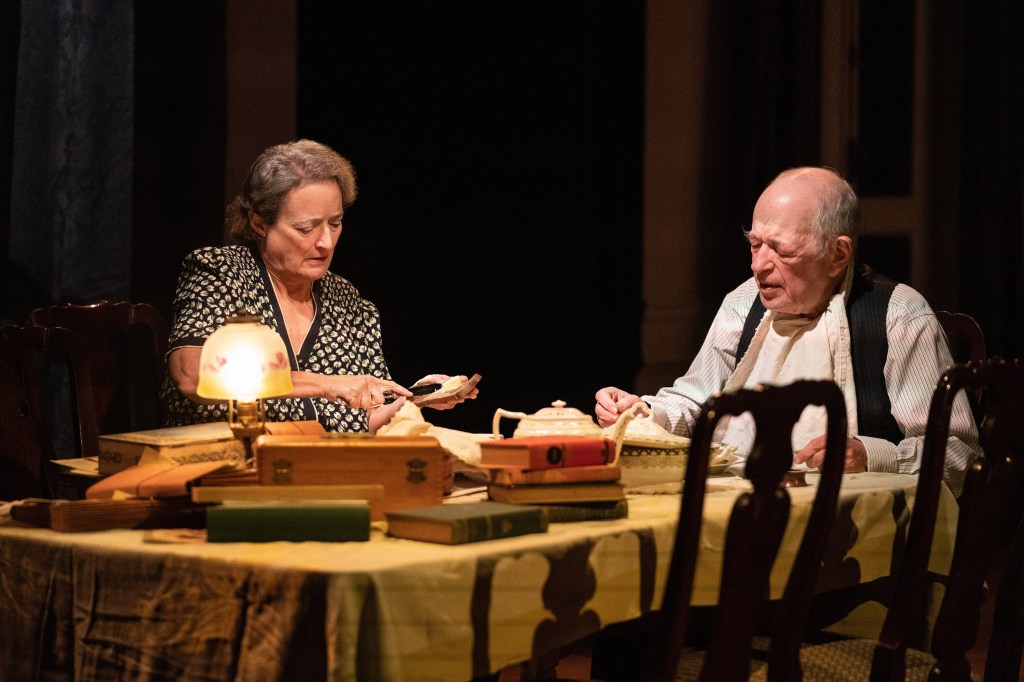
D.H. Lawrence is rarely known for his plays. However, British critics have noted that he was a master playwright, and if discovered as such earlier in his life, he would have been appreciated for his dramas, however maverick and forward-thinking. One such incredibly rich play is being presented by the always excellent Mint Theater Company, who enjoys bringing to life rare jewels in drama that have often been overlooked. The Daughter-in-Law is one of these gems.

Directed by Martin Platt The Daughter in Law presents an amazing portrait of an independent woman, Minnie (Amy Blackman), a former governess married to a collier (coal miner), Luther Gascoyne (Tom Coiner). The couple live in a mining town near his mother’s (Mrs.Gascoyne-Sandra Shipley) home where his brother Joe (Ciaran Bowling), also a collier, works with him in East Midlands England.

The setting is autobiographical and akin to where D.H. Lawrence’s father worked and where he and his siblings lived with their mother (reminiscent of Minnie), who had cultural aspirations for Lawrence, and who inspired him in his studies. Lawrence’s play evolves into conflicts among the characters. These are rich in thematic evolution that comes to some resolution by the end of the play after the colliers riot against scab workers during a strike. Interestingly, the themes involve gender roles, class, economic inequity and familial love. Also, Freudian tropes between mothers and sons, an issue that Lawrence often investigated, receives a hearing in this realistic and beautifully acted production that Platt has tautly directed, so it remains provocatively, emotionally, tense throughout.
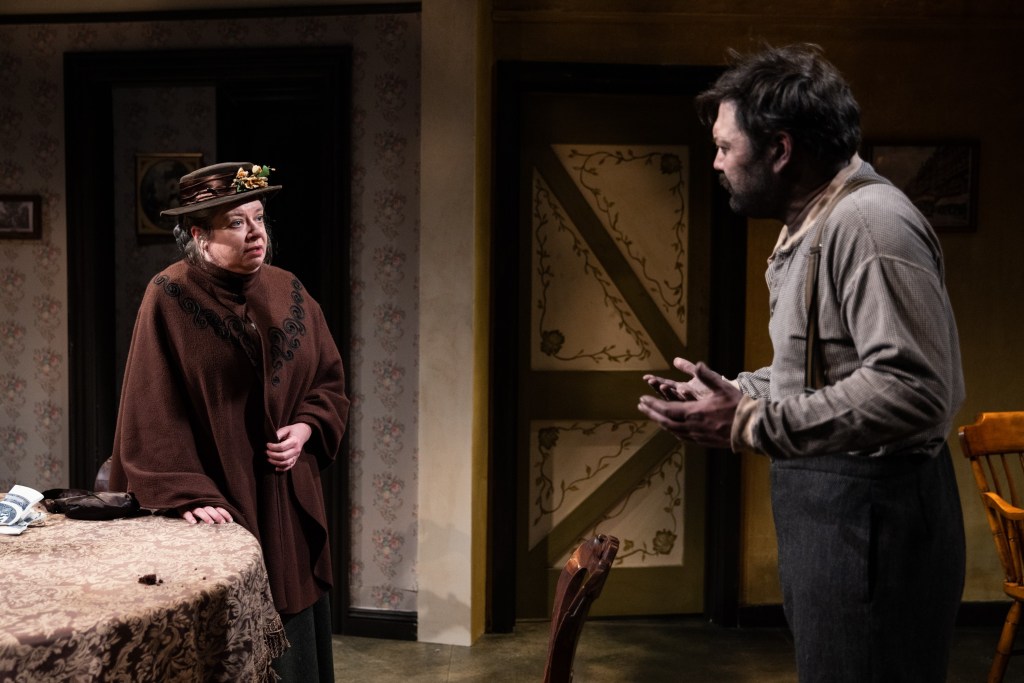
To a fault, the actors have been schooled in the Midlands accent which provides realism and creates the audiences’ attentive stir to understand all that the characters communicate. At times, this takes getting used to. However, the actors portray the characters’ emotional feeling sincerely and authentically, so that one understands, even though one may not be able to translate word for word what the characters say.

Nevertheless, when Joe (the vibrant Ciaran Bowling), enters sporting an arm in a sling and his mom (the dynamic and authentic Sandra Shipley), fusses over him with his dinner and probes what happened with receiving a disability check, we understand their close relationship, and we also understand that mother and son mutually care for each other, living under the same roof, watching out for each other, while other family have gone on to make their own lives.

The hard conditions of the mines remind us of the corporate structure which Lawrence reveals has changed little over one hundred years later. The owners receive all the benefits, and the workers are given low wages and are subcontracted out to keep them hungry and off-balance, so they are unsure of where they stand in the company’s graces. Joe and his brother, like their father before them, were at the mercy of the owners; and their father died as a result of an accident we find out later in the play. This undercurrent of workers vs. owners is the driving undercurrent and reveals that the misery of need and want is what impacts the families who live and depend on coal mining for their survival.
During lively dinner conversation, Joe tells his mother that his attempt to receive a check for his broken arm has been rejected. His manager tells his version of “the acceptable truth” of what happened to Joe, so that it is Joe’s fault that he was injured, because he was “fooling around.” It was not that he was injured on the job because of some dereliction of another worker or the mine. Lawrence strikes at the inequality of the haves and have nots and the managers who make sure to protect their employers. Thus, we feel for Joe and his mother, who are not destitute, but who struggle economically. If any stress comes to either of them, they are a few steps away from the equivalent of the poorhouse. Such is their economic and class level.

Into the background of this economic insecurity and potential working class impoverishment comes Mrs. Purdy (the convincing and excellent Polly McKie), a neighbor who brings disturbing news. Her daughter, who she describes as rather a simple girl, is pregnant. And after avoiding the direct truth until Mrs. Gascoyne drags it out of her, Mrs. Purdy lays the blame at the feet of Luther, who married Minnie seven weeks before. Mrs. Gascoyne pushes Mrs. Purdy cleverly off on Luther and Minnie, especially Minnie since she has brought some money into the marriage and can afford to pay Mrs. Purdy and her daughter off for their silence and for Bertha’s upkeep with the baby. This suggestion is made after Joe and Mrs. Purdy verify that Luther was seeing Bertha Purdy, something that Mrs. Gascoyne didn’t realize because Luther kept it under the radar and wasn’t serious with her.
Assurances are made to Mrs. Purdy that she must see Luther and Minnie at their house, since Minnie has received an inheritance that Mrs. Gascoyne insists should be used to pay off Mrs. Purdy. This malevolent and resentful suggestion is disputed by Joe whose empathy for his brother and Minnie is greater than his mother’s. As Mrs. Gascoyne discusses Luther’s marriage to Minnie in demeaning terms, it is obvious that she resents the “high and mighty” Minnie ending up with her son. She tells Mrs. Purdy that it’s because he is the only one she could get.
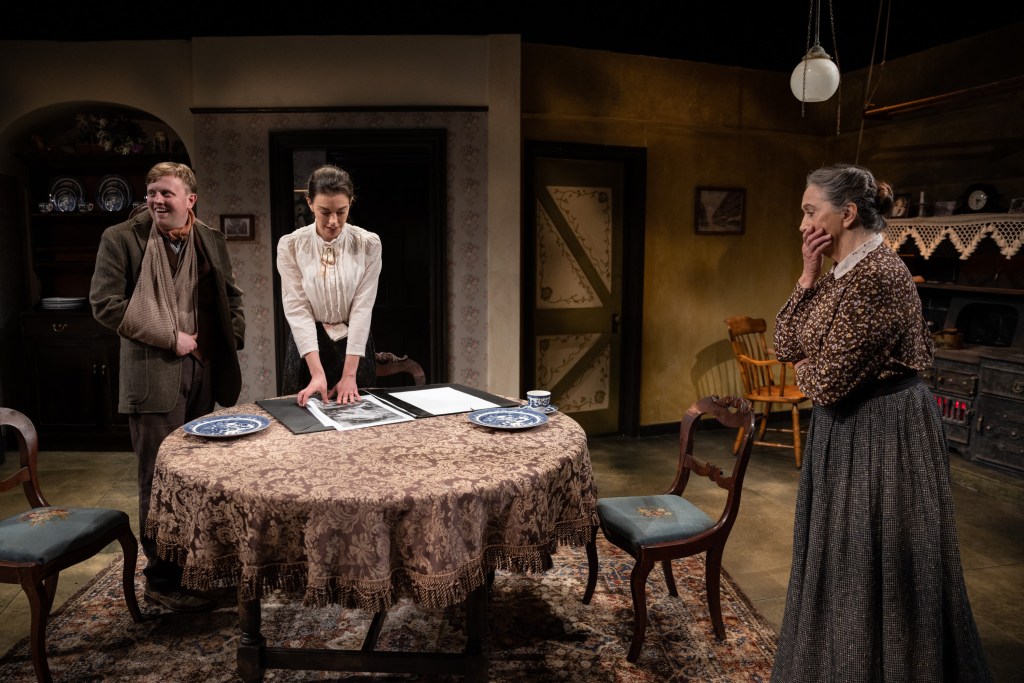
At this point not meeting Minnie, we wonder who this snotty woman is and side with Mrs. Gascoyne because we have gotten to know this nurturing, motherly type who obviously cares about her children. Based on Lawrence’s brilliant dialogue characterizing Minnie through the eyes of Mrs. Gascoyne, we believe that this snobby woman who thinks she’s “better” than the colliers and their families is pretentious. Also, we believe that she is so desperate, she doesn’t love Luther, but she just wants not to be an old maid.
Interestingly, Lawrence allows this portrait of Minnie to remain, until we see her relationship with the two brothers unfold. Gradually, her characterization is revealed and her strength, power, indomitable wisdom and love for Luther becomes apparent but with twists and turns, ups and downs by the the end of the play. But first, she must stand up and upend her mother-in-law’s presumptive discriminatory attitude against her, and then wait for the right moment to forgive her so that the two of them become closer.

Platt’s direction in keeping us wondering how Minnie will react when she discovers Luther has a child on the way is subtle and yet eventful, as Lawrence provides surprises and unusual events which keep us enthralled. Mrs. Purdy tells Luther about the child, but Joe manages to drive Minnie out of the house so that she leaves before Mrs. Purdy confronts her with the “truth.”
In an ironic twist it is Luther, who returns much later drunk, guilty and ready to be rejected. He picks a terrible fight with Minnie, then in humiliation covered over with bravado, he reveals that he has gotten Bertha with child. Interestingly, Minnie remains calm and collected, non judgmental and rational, presenting the idea that the child may not be Luther’s, but another man’s. Nevertheless, Luther becomes churlish and obnoxious, which prompts her to call him out for his meanness, especially when he suggests that Bertha was nicer to him than Minnie.
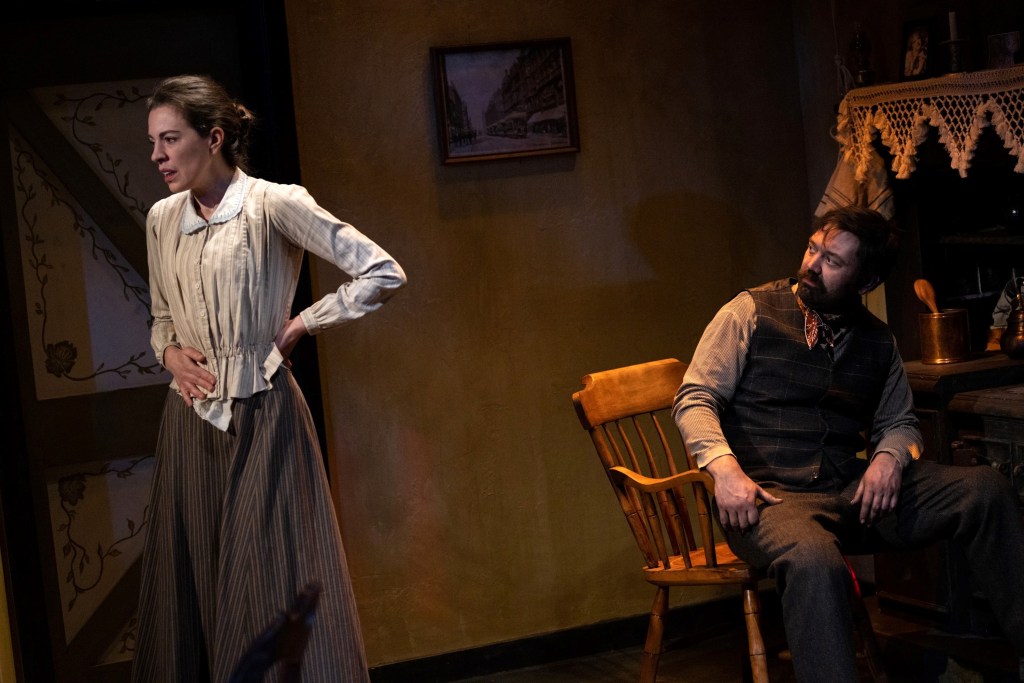
The actors do an exceptional job in raising the stakes and increasing the argument and tension between Minnie and Luther, so that we don’t know whether or not they will break up, Minnie will leave, whether Luther will have to return to his mother or both of them will end up bloodied and bruised as they come to blows. In Lawrence’s characterizations of Minnie and Luther, their relationship becomes explosive and we aren’t sure whether it’s because of class differences, economic differences (she came from a bit more money than he and he may resent it) gender role assumptions (Minnie has worked for herself and made her own money) or something else. Interestingly, we don’t consider that they may love one another, feel hurt and pain that they might lose each other, or are emotionally trying to settle out their own feelings.
The actors are just exceptional in revealing this marvelous nuance and the director has shepherded them so that we are off balance in attempting to figure out how they really feel about each other. One of the high points of the play comes when Minnie confronts her mother-in-law and indicates that she has not allowed either of her sons to become men. Minnie points out that she has babied them so that they remain shells and are forced to rely on her emotionally and psychically which has destroyed them and made them weak. Interestingly, Joe agrees with Minnie. And he indicates this situation emotionally has debilitated him and at times has left him suicidal. Ciaran Bowling, Sandra Shipley and Amy Blackman are wonderful in this confrontation scene.

Amy Blackman as Minnie gives an amazing and powerful performance. She is stalwart and strong as she stands up to Sandra Shipley’s mother-in-law who manages to be infuriating and yet very human and poignant as a woman who is needy and relies on the ties amongst her and her sons. Tom Coiner as Luther is frightening and brutal as well as weak and sheep-like when he finally admits his love and dependence on Minnie.
Lawrence concludes the play surprisingly by revealing what has been at stake all along. It is a complicated and intricate conundrum that he presents and then the revelation clearly indicates that there was no mystery. This is how a couple is settling into themselves and separating from every other family member to cling to each other as they define themselves in the most important relationship of their lives.

This wonderful production should be seen for many reasons, principally because D.H. Lawrence has written a great play with nuanced characters in striking relationships that are unfamiliar to us that the Mint Theater Company has presented in this superb revival. The intricate details of setting, the props, the coal stove that is the hearth, the set design, down to the food and plates that show Minnie’s aspirations to being middle class, manifest a reality that makes us identify with these individuals. Kudos to the tremendous effort on the part of Bill Clarke (sets), Holly Poe Durbin (costumes), Joshua Larrinaga-Yocom (props), Jeff Nellis (lights), Original Music & Sound (Lindsay Jones).
The Daughter-in-Law comes in at two and one-half hours and is at New York City Center, Stage II. For tickets and times go to their website: https://www.nycitycenter.org/pdps/2021-2022/the-daughter-in-law/
‘Prayer for the French Republic,’ Haunting, Current, Universal
Shifting in flashback between (2016-2017) and (1944-1946) set in two different Parisian apartments, Prayer for the French Republic (currently at Manhattan Theatre Club) by Joshua Harmon (Bad Jews), directed by David Cromer (The Band’s Visit), focuses on a Jewish family’s concerns about identity, safety and security in a country that they’ve called home for five generations. The backdrop of their apprehensions then and now is an uncertain world where humanity’s fears and needs turn increasingly predatorial. Capitalizing on such fears, political actors mine the unbalanced, raw emotions of deranged citizens, to create scapegoats which help grow their power and popularity. Whether left or right politically, oftentimes the scapegoats are religiously or ethnically engineered.
Such was the case in France during Hitler’s fascist occupation and the Vichy government’s cooperation with the roundup of French Jews that were murdered or sent off to concentration camps. Such is the case in France in recent years where attacks against Jewish citizens have multiplied, stirred up by opportunistic, right-wing, fascistic politicos ravenous for power.
As an overseer, Patrick Salomon (Richard Topol), connects the ancestral ghosts from the past, his great grand parents, Irma and Adolph Salomon, grandfather Lucien and his father Pierre, still living, as a bridge from the past to the present. In the present are Patrick, his sister Marcelle Salomon Benhamon, husband Charles and their adult children, Daniel and Elodie. The play is Patrick’s meditation on five generations of family. Patrick redefines what being a Jew in France means, as he narrates the saga of their Parisian Jewish identity and magnifies it in light of the age-old conundrum Jews historically confront throughout the ages. To survive do they assimilate, or do they risk the danger of standing apart as they embrace their religious beliefs?
As the play progresses, these questions expand and complicate against the current global crises (climate, socio-political, economic). What do Jews do in response to severe persecution? Do they embrace their identity, suffer and die valiantly resisting? In the name of living do they become invisible, marry out of their religion to avoid the turmoil, danger and abuse that comes with the trajectory of uncertain social unrest that Jews inevitably find themselves in the midst of? Do they emigrate to “certain” safety?
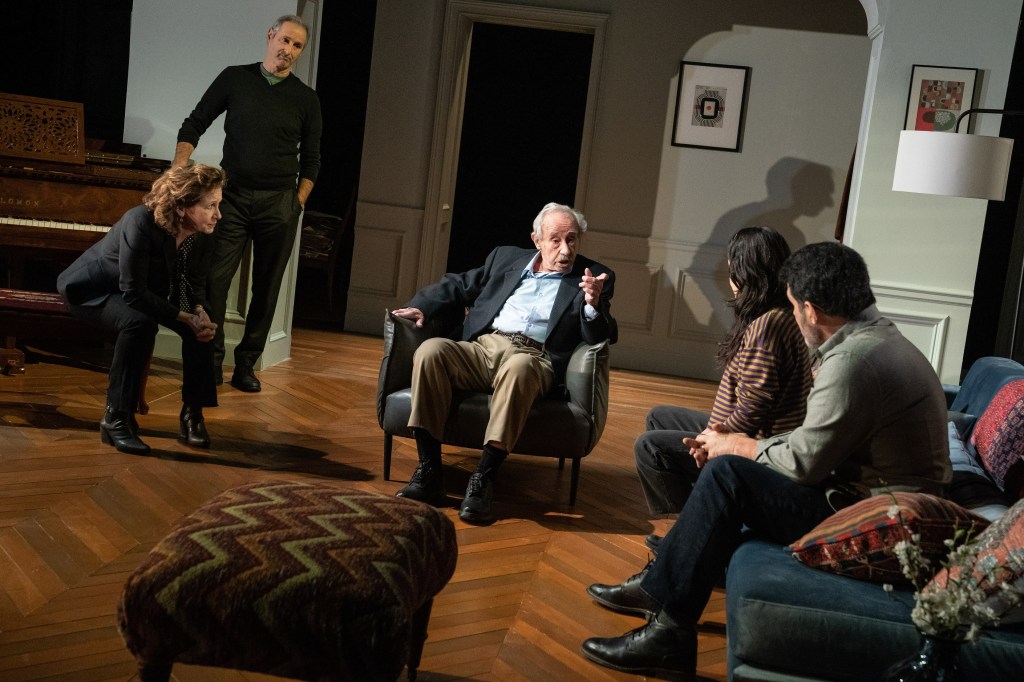
Interestingly, before the last generation of the Salomon family makes any final decisions, they confront their father Pierre and present him with their conundrum. Would he go with them, for example, to a safer place with other Jews in Israel? Who better than their father, a survivor of the atrocities of Auschwitz, can ,advise them about their future? Indeed, he made his decision years ago, married a Christian woman and didn’t keep up Jewish tradition, intentionally. He remained safely in Paris raising Marcelle and Patrick without keeping ancient Jewish traditions. And until Marcelle married an Algerian Jewish emigre, they didn’t keep them either.

Patrick (the superb Richard, Topol whose easy, relaxed persona is confidently relatable and empathetic), introduces the Salomon family to the audience and discusses their business operating a store where they attempt to sell beautiful pianos that are no longer viable in modern society. Patrick brings us into 2016 to view his closest relatives, sister Marcelle (Betsy Aidem), brother-in-law, Charles (Jeff Seymour), their bi-polar daughter Elodie (Francis Benhamou), and son Daniel (Yair Ben-Dor). The cross-section of their lives begins as Marcelle (Betsy Aidem in a fine, layered performance), becomes acquainted with her guest, Molly (the clear-eyed, authentic Molly Ranson), a non-practicing Jewish, distant cousin from NYC.
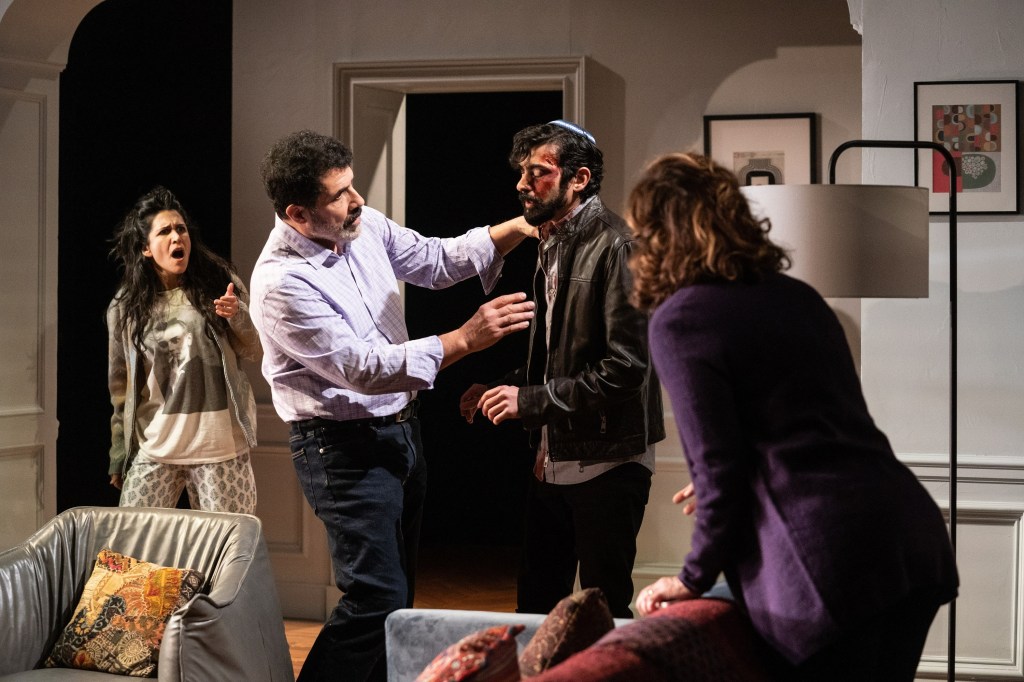
Their humorous exchange ends when Daniel comes in bleeding and an uproar begins in the household. He has been attacked in a hate crime where the young men who assaulted him yell out epithets because he has obviously distinguished his religious identity with a kippah. The arguments ensue and we discover that neither Marcelle nor Charles make an obvious show of their Judaism and that Daniel is the only Orthodox one in the family. Molly watches the scene unfold and learns as we do about family dynamics.
Daniel recently became Orthodox. He doesn’t even want to go to the police to identify his beating as a hate crime. Though Marcelle insists, Daniel makes excuses that he didn’t see his attackers and the police won’t do anything about it. All land on the fact that it will only exacerbate matters in the society and spread more fear. The discussion is closed when Daniel insists Marcelle light Shabbat candles.
The scene deftly shits to the past, as we note that ancestry (the ghosts of time past), runs concurrently and influences the Salomons in the present. The spirits of their forebears come to life, and we watch the characters in their small Parisian apartment in 1944, having a conversation about their children and other family who escaped France rather than stay, which other family did. As Irma (Nancy Robinette), and Adolphe (Kenneth Tigar), wait safely in their apartment, away from the horrific persecution of Jews throughout the Third Reich occupied countries, of which France is one, they pray that Lucien and Young Pierre are safe in the mountains. This is what Adolphe encourages Irma to believe. As they pray that Lucien and Pierre will come home to their apartment in Paris, hope sustains them.
Patrick connects present and past during these moments. He ruminates about what his great grandparents, grandparents and father went through, touching upon the conversations they may have had and the rationing they went through. Furthermore, he reveals the family’s penchant for argument and debate before decisions are made. Adolphe humorously suggests that at the reunion when family is together, after ten minutes of peace there will be arguing and fighting and crying. We marvel that Irma and Adolphe can sit there and imagine what it will be like after liberation. We discover later that most of the family who didn’t escape to Cuba or elsewhere died. Adolphe’s fantasy is a manifestation of hope to uplift Irma. Their safety in Paris affords them this luxury of hope; meanwhile, Jews died in the millions.
How are they alive? Patrick relates that the superintendent of the building didn’t give Adolphe and Irma up to the Gestapo during a roundup. Thus, both escaped in that rarest of occasions; they were protected by other French people. However, at this point, they don’t know the fate of their son Lucien (Ari Brand) and their grandson Pierre (Peyton Lusk) who may have fallen into the hands of the Nazis and ended up gassed in a concentration camp. But Adolphe and Irma live in faith securely, waiting their return.
In the segue back to the present Molly and Daniel form an attachment. Daniel explains why he has become Orthodox when the family never was. He discusses the attacks at the newspaper Charlie Hebdo and the killing of four Jews at the Kosher Supermarket in Paris as proof that the hate crimes against Jews are increasing. On a hopeful note, he tells Molly that the peace marches against the violent attacks were massive, and Prime Minister Manuel Valls stood with the Jews against Benjamin Netanyahu, who told them to leave France and come to Israel. Valls encouraged belief in the French Republic stating, “If 100,000 Jews left, there would be no more France; the Republic of France would be a failure. Daniel points out that Jews left, but only a tiny fraction; the rest stayed. He affirms that always it is a matter of choice. Jews stay in France because they love their nation and have faith in the French people.

It is this concept of choice that carries through the rest of the play in the decision whether to escape persecution and hate crimes or stay and fight with courage and resistance. But slowly, this family because of the past losses, attenuates their faith in the French Republic.
First, it is Charles who rebels against staying in France after we hear the prayer for the French Republic spoken in a voice over in French and English when Charles and Daniel go to the synagogue. The Jews loyally support the French Republic, though some, like Charles, feel it is a waste of time. As father and son walk home, Charles notices the stares of disdain and anger at Daniel’s assertion of his religion. Charles insists, “I can’t take it any more.”
Once again the family is up in arms presenting arguments. Marcelle refuses to leave, decrying the beauty of their life in France. Fed up Charles wants to go to Israel. He remembers the persecution he experienced in Algeria where everyone got along when he was a child, but later socio-political forces disrupted the social fabric. Indeed, he has no allegiance to France. He doesn’t have the history, as Patrick puts it, that Jews have been in France for over 1000 years and have made a way for themselves there.
The discussion and wrangling back and forth between Aidem’s Marcelle and Jeff Seymour’s Charles is powerful and strident. We are riveted by the danger in Charles’ tone, of hidden subtext that is palpable and his fervor to believe there is safety in Israel, though that isn’t necessarily a rational conclusion because of the terrorism there as well.

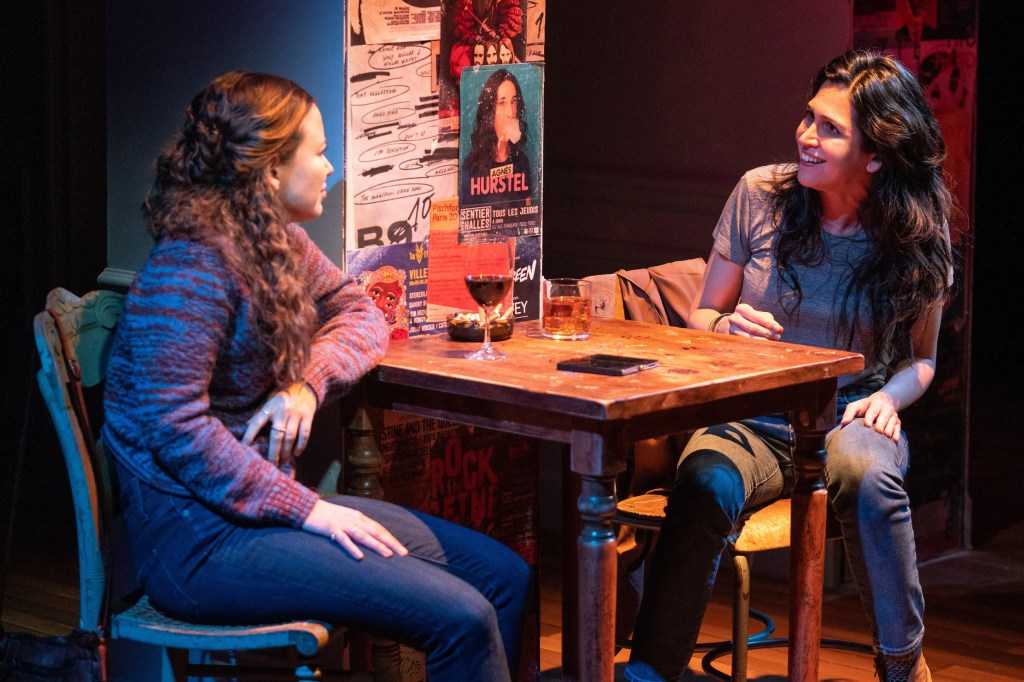
The argument carries over when Molly and Elodie go to a Dive Bar. Francis Benhamou’s Elodie rant against Molly Ranson’s Molly is humorous and as powerfully strident as Charles’ argument with Marcelle. Elodie gives forth, illustrating Molly’s hypocrisy when she argues against Israel’s Palestinian settlements. Elodie’s point drives deeper to human nature. There are the power-hungry and the occupiers; how does one resist not becoming power-hungry as a matter of security? Molly’s criticism belies historic U.S. colonization and oppression of everyone but white males. Elodie indicates that finger pointing is useless.
Eventually, both manage to reach common ground on a personal, familial level. Humanity takes precedence in their discussion when Elodie explains that Daniel became Orthodox because of a girl. Revelation of his vulnerability opens the door to Molly’s and Daniel’s relationship. It also opens the door to Marcelle’s fury because she believes that Molly has taken advantage of her son’s vulnerability.
Nothing is resolved even after Charles and Daniel return from a trip to Israel to look at living arrangements and social culture. Charles gives in; he affirms wherever Marcelle is, he will stay with her. Daniel proclaims that he didn’t want to go to Israel, but just accompanied his distraught father to help him. The playwright indicates the confusion and the stress that accompanies the hassle of confronting danger in one’s daily life, as this family feels they are under siege since Daniel paraded his Jewishness. But it is understandable because the family has a history of loss and death at the hands of French fascism. Furthermore, fascists like Marine Le Pen (Deputy of the French National Assembly), and her right-wing conservative political group don’t readily disavow fascism.
As the scene shifts to the past, Lucien and Young Pierre return from the camps bringing the horrific information that family was lost. Lucien is overcome in the telling of it. Ari Brand’s performance is appropriately drained, inwardly devastated but holding it together as best he can. It is Young Pierre who eventually expresses how his father’s hope saved him. Peyton Lusk gives an incredible portrayal of the PTSD of a young person returning from an unspeakable experience. But as Lusk explains how he survived, once again comes the affirmation that hope is how people survived the persecution, attacks and killing, as community and family helped family. For Lucien always told Young Pierre that they would make it.
But it is in the final act when the dam bursts with a traumatic episode for Marcelle, who by degrees has given up on her beloved Paris. It occurs at the symbolic Passover Seder, a remembrance of when God wrought miracles to help the Israelites escape slavery in Egypt. At the celebration, when they arrive at the “opening of the door to let the angel in,” Marcelle becomes hysterical like Charles did weeks before. She, too, has a “can’t take it any more” moment and refuses to open the door, terrorized that a Marine Le Pen engineered terrorist will enter and kill them.
The scene is shocking. Betsy Aidem’s performance is riveting as are the other actors. Harmon establishes centuries old horror of death at the hands of haters. Though the idea seems ridiculous, recently a woman was burned alive in her apartment in Paris.
That Harmon has conjoined Marcelle’s terror with the symbolic traditional night commemorating their escape from persecution and oppression is an apotheosis. In an irony of twisted emotion, Marcelle gives in to the terrorists who want Jews gone from “their” country, the most grievous insult of all. It is an incredible message because Marcelle’s fear destroys her ability to believe in God’s protection, a basic fact of her religion. She believes in God’s protection only if she flees, like the Jews of ancient history. The hatred of others intellectually and representationally in various select acts of violence has overwhelmed Marcelle’s ability to feel secure in her own religion, her own apartment, her own country, her own identity. She must leave.
Of course it is a sardonic fact that her family’s escape will be to one of the most dangerous countries on the planet. Patrick raises the issue about the security question in Israel. Indeed, physical security must have as its precursor intellectual and philosophical security in the Golden Rule of “do unto others,” democratic values, an ideal that France attempts to follow and does with exceptions, better than other countries. Certainly, in Israel’s West Bank, the Golden Rule does not abide for Palestinians who are treated as “the other” and are oppressed and have no rights under Netanyahu’s ultra right wing, increasingly anti-democratic government.
Harmon’s play is filled with thesis/antithesis arguments, and this is a family that generationally loves a worthy argument with well supported logic and details. Patrick takes the position that the Republic of France will stand by its ideals and that there is nowhere safe globally, moment to moment; not Israel, not the United States, not Europe, the Middle East, Asia, etc. Human hearts are not safe.
To counter his sister he correctly asserts that the fascistic government of Marine Le Pen will be voted down and the Republic will persist. Harmon’s point is well taken. There are those across the globe who value equanimity in greater numbers than those whose megalomania and craven hate seeks the death of others for power. However, his commentary falls on deaf hears; Marcelle has made up her mind to go to Israel where their Jewish identity may be expressed freely with little fear of reprisal by crazies. For her France has nullified her existence as a Jew.

Whether she will feel safe in Israel relies on hope and sacrifice. In Israel they have to start all over again. They will have sacrificed their careers, friends, culture, language, everything for the hope of a safety and security that is never guaranteed. If they are on a bus that terrorists decide to blow up in Tel Aviv, there is no way to stop that. But Marcelle is convinced, turning 180 degrees from her position at the play’s beginning. Fear possesses her soul and she makes decisions based on it.
In the final segment of the play the argument takes further flight with elderly father Pierre (Pierre Epstein is eloquent in this last speech to the family). If they leave, it is their choice, but he will not go with them. Having the freedom to choose and not be compelled is vital to his identity. Ironically, by giving into their fear, they have compelled and oppressed themselves. Pierre who has seen the worst of the camps and survived, knows the difference of experiencing the worst. His children and grandchildren have not and they don’t want to. That is why Marcelle compels them to leave, though such an event happening again is a probability off the charts. But no one dares speak that to her, not even her own brother.
The performances are sterling and sensitive, at times funny, and always compelling. The canny direction by Cromer to “get it all down” and thrill the audience with ideas and concepts is just great. I particularly enjoyed the Set Design by Takeshi Kata that designated the differences between present and past efficiently and seamlessly. The Lighting Design by Amith Chandrashaker provided the ephemeral, soft, wistful tone of the past and stark contrast with bright light that magnifies the present. Kudos to the other creatives, Sound Design by Lee Kinney & Daniel Kluger, Original Music by Daniel Kluger.
Prayer for the French Republic is revelatory and insightful in questioning our arrogance to believe we, who are transient beings on this planet, have an identity and home, knowing mortality comes to all of us physically. He also twits our assumptions about safety and security, the difference between life’s enjoyments and living an existence permeated by psychological fear. Above all he designates in a Republic, there is the right to choose one’s destiny, free from personal harm because, if applied, the rule of law secures it. But if it is not exercised, then what? Harmon asks the questions through lives, relationships and situations that embody them in seeing the Salomon family live in the past and present. If one delves deeply enough and contemplates like Topol’s Patrick does, one sees the answers can only be individual and personal. No one can answer for someone else.
This is a wonderful play dramatically rendered. It should be seen, especially if you enjoy thought-provoking plays that move swiftly on emotional power. For tickets and times go to their website https://www.manhattantheatreclub.com/shows/2021-22-season/prayer-for-the-french-republic/
Prayer for the French Republic has transferred to Broadway and will run until February 18th at the Samuel J. Friedman Theatre. Look for my review of the Broadway production on Blogcritics.org.
‘After Image’ Poetry Book by Mary Turley-McGrath

In her fourth collection of poetry After Image, Mary Turley-McGrath focuses on reflections about her natural surroundings as they stir the soul in inspiration, and provide peaceful meditations and kernels of wisdom to feed the spirit. Mary Turley-McGrath’s lyricism is lush. Her images crystallize feeling and leave one in evocative remembrance of places, perhaps never seen, but hazarded by her luminous figures, i.e. “avian sky etchings” (“Mumuration”) “…then beamed a chaos of dappled, flickering shadows on alders, beech and birch, like disco strobe lights” (“Diorama”).
These illusive images of sight and sound, fleeting fragments, sift and ping one’s thoughts. They are savory spice on the tongue, at once striking and delectable. Her work must be revisited for these gem moments, satisfying and complete, a textured whole unto themselves.

The poet has organized her poetry collection bringing together disparate, yet familiar thematic and human elements in ‘Tesserae,’ ‘Annaghmakerrig’ and ‘Winter Poems.’ In the first section there are poems of loss supplanted by what is found, and history’s movement estranging one from his or her life, until revelation comes. Mary Turley-McGrath also references war and dislocation, of the desecration of the familiar into a dissolved identity that refugees struggle to overcome. And she contemplates works of art and ancient architecture as they land in powerful images she crafts beautifully. I particularly enjoyed “The Cordoba Scrolls.”
In the ‘Annaghmakerrig’ section the poet encapsulates the feeling evoked by the amazing Tyrone-Gutherie Centre, its shimmering lake, the shy wildlife, the lush environs, captivating in all seasons. It was there Mary Turley-McGrath stayed during a residency awarded to her as the winner of the Trócaire/Poetry Ireland Competition in 2014. And it was there, pursuing my own journalistic writing, that I connected with Mary and we exchanged information and discussed our work.

Because I am familiar with the lovely environs, this section particularly resonated. Her poems brought the visions of the Big House and cottages set against the 500 acre wooded estate and alerted me to the varieties of birds that I did not see when I was there, because I focused on other activities. Her specificity and well drawn figures of speech align me with new eyes as I read this section. I see the gorgeousness of the gardens and grounds, the many varieties of trees, the effects of the light on the lake, the shadows and darkness. Above all, with each of her poems I retain the comfort and peace that encourages artistic inspiration, enlightenment and wisdom.

I particularly loved “A Heron” enlarged to philosophical ruminations about the Bennu bird of Egyptian myth. Yet, all of the poems are profound in their meaning. In wisps and fragments they remind me of the Tyrone Gutherie Center, Annaghmakerrig in that time I visited. Every time I pick up After Image, I revisit beauty in my mind’s eye, in the rereading of this glorious section.
‘Winter Poems’ is a collection of impressions of darker feelings, bleaker tones, absence, loss and evacuation caused by war’s devastation. Some of these poems, as in the other sections, reference art. ‘In Black and White’ is a nod to the photographic work of Josef Sudek, who captured Prague and its environs after the two wars. And ‘Evening’ is a fitting close in remembrance of the inequity of those casualties of war thrown into conflicts and the darkness, displaced from their homes as the poet references a new age Aeneas.
After Image is a quiet read that comforts with its beauty and airy, yet profound quality. Nevertheless, its undertones remind us there is so much work to do to soothe those terrorized by present upheavals. Amidst the loveliness of the natural landscape, humans have made their impact. It must be for the good. We cannot afford anything else.
Hugh Jackman’s Indelible, Winning Con in ‘The Music Man,’ Just Unbeatable!’
Historically, America is the land of con artists and showmen. Do you know the difference? As a relatable example there is David Hannum who in the 1850s bought the “Cardiff Giant,” a stone statue he unwittingly believed to be real (the giant fake was made in Iowa). As did its previous owner, Hannum charged admission for viewings. When P.T. Barnum (Hugh Jackman portrayed Barnum in The Greatest Showman) couldn’t purchase the Cardiff Giant for $50,000, he made his own plaster statue, called Hannum’s statue the fake, and charged more money, advertising his as the “real” one. Hannum sued Barnum and referring to Barnum’s patrons said, “There’s a sucker born every minute,” not realizing he, too, had been duped. The suit failed when the originator of the hoax “came clean.” Interestingly, all three entrepreneurs probably kept the money “they earned” providing a thrilling show. In keeping with the great cons of America, history is silent about whether patrons got their money back.
This exploration of that type of con is at the core of Meredith Willson’s The Music Man, which I’ve come to appreciate on another level with this revival at the Wintergarden Theatre, starring Hugh Jackman and Sutton Foster. Along with these romantic leads are Shuler Hensley, Jefferson Mays, Jayne Houdyshell and Marie Mullen. All are Tony Award winners. All give humorous, memorable performances in this fanciful, exuberant, profoundly conceived production (directed by Jerry Zaks and choreographed by Warren Carlyle), about small town America, its bucolic, “nothing is happening here” townsfolk, and the burgeoning love between two needy, flawed individuals, who grasp at hope in each other.
With book, music and lyrics by Meredith Willson and story by Meredith Willson and Franklin Lacey, the great con is spun by a magic-making, uber-talented, artiste extraordinaire that all fall in love with by the conclusion (including the audience). That is all except non-believer, malcontent salesman Charlie Cowell (the excellent, hyper-caustic Remy Auberjonois who was in Death of a Salesman). He’s the “villain” who seeks vengeance to expose Hill as a wicked, flim-flam man.
Hugh Jackman is spot-on in his modern interpretation of the Professor Henry Hill “brand” of “music man.” He and Zaks really get this character, so that Jackman makes it his own, as he exudes the energy-packed, brilliant, larger-than-life, loving individual that you want to stay with, wherever he takes you. After seeing his performance, I believe in pied pipers, who don’t need music to make you theirs.
The criticism that he is not edgy is questionable. If Jackman’s Hill were sinister, few would believe his sincerity in a small town that prides itself on suspicion and being “Iowa Stubborn.” Would the women be so taken with his graceful, smooth, charmingly flirtatious manner? He is a swan among the ungainly, quacking mallards and especially his nemesis, the punchy, exasperated, malaproping Mayor Shinn (the always hysterical and exceptional Jefferson Mays), who gaslights the town with his own con. That this genius craftsman of BS has an irresistible delivery reveals Jackman enjoying expanding the graceful Professor in pure entertainment, with every precious breath and every savvy movement he expends, as he inhabits his refreshing version of Professor Harold Hill for the ages.

Hill’s seductive, adorable, spirited demeanor is dangerously addictive. The happy-go-lucky showman is all about getting others to believe in and enjoy themselves. From that elixir, there is no safe return and the crash, if there is one, is emotionally devastating. How Zaks, Jackman, the cast and creative team spin this rendering is solid and logical throughout, giving this extraordinary revival a different feel, understanding and vision, that should not be underestimated or ignored.
Throughout the dance numbers, which are beautifully conceived with wit and substance, Jackman’s lead is ebullient, light, lithe. This is especially so during his convincing, playful seduction in the number “Marian the Librarian” (Warrent Carlyle’s ballet in soft shoe tempo is just great). Jackman’s sensual, boyish suppleness contrasted with Sutton Foster’s stiff reticence in Marian counterpoint are superb together.
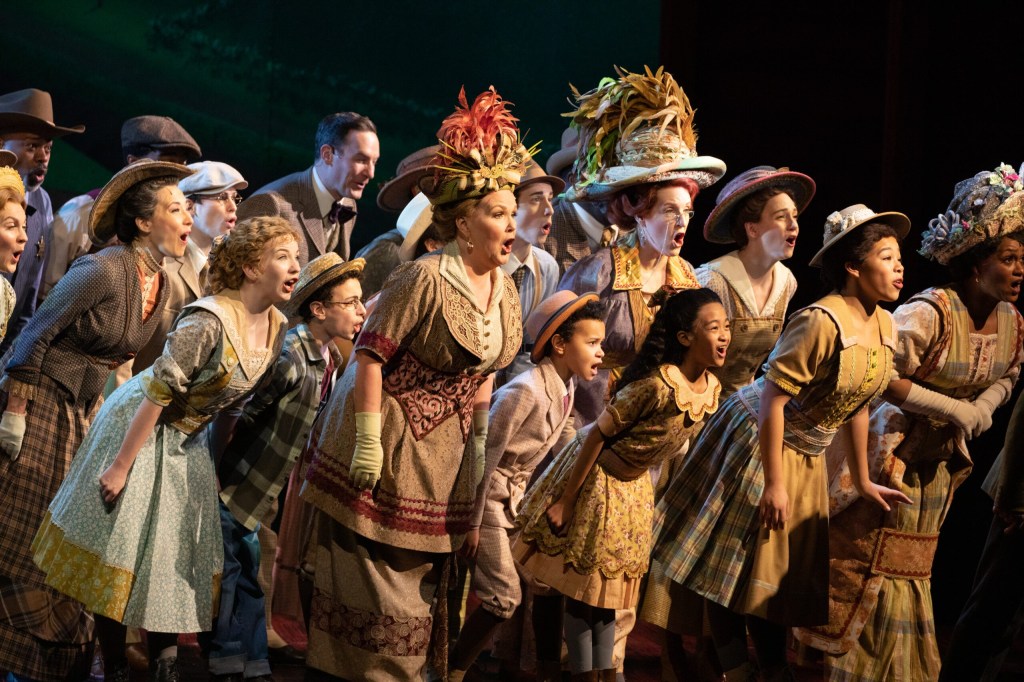
For the song identifying the Iowan’s walled stronghold against strangers (“Iowa Stubborn”), Hill’s great challenge, Zaks stages River City citizens huddled together in a circular clump with stern looks and unsmiling determination. Initially, with Hill they pride themselves on being cold steel like Marian, who is even more icy remote than they are. However, because of Charlie Cowell’s challenge, that Iowa territory is impossible for salesmen, Hill takes the bait and rises to the occasion. He plies his delightful winsomeness with enough sincerity and great good will to surreptitiously penetrate their pride.
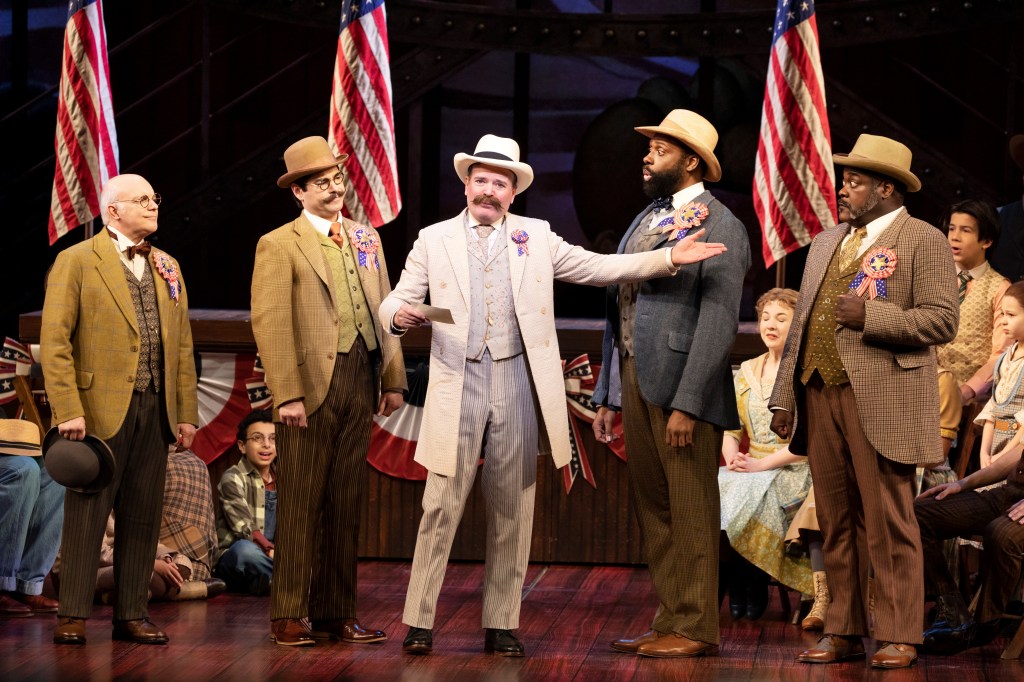
Not only are the townsfolk splintered from their stubborn resolve because of his contagious enthusiasm, his youthfulness retains a sociability that is able to connect with young and old. Indeed, Hill offers them something that no one else who has come to their town has ever offered: happiness, hope, fantasy, the power to believe; to think something is so and it becomes so (the “Think System” re-framed from “the power of positive thinking”). Jackman’s Hill is a practiced master at human nature-buffeted by life’s heart-breaks, that create the foundation in the soul, that hungers to believe in something or someone. Of course, he is a master at this, because he, first and foremost, is starving, a clue to this Hill portrayal, upon which turns the arc of development and all the character interactions. It is also the theme of “Sadder But Wiser Girl,” that he sings in knowing “wisdom” with buddy Marcellus Washburn (the excellent Shuler Hensley).
The brilliance of this production is that Hill’s charismatic delivery of the dangerous idea is palpable, adorable and expansive. As apparently unrealistic as Hill’s disarming positivity is, it is like manna from heaven for these homely folks, who cannot resist just a taste. And Jackman’s Hill enjoys spoon feeding it to them like sugar, until they are hooked. Interestingly, he also is hooked…on their joyous response to him.
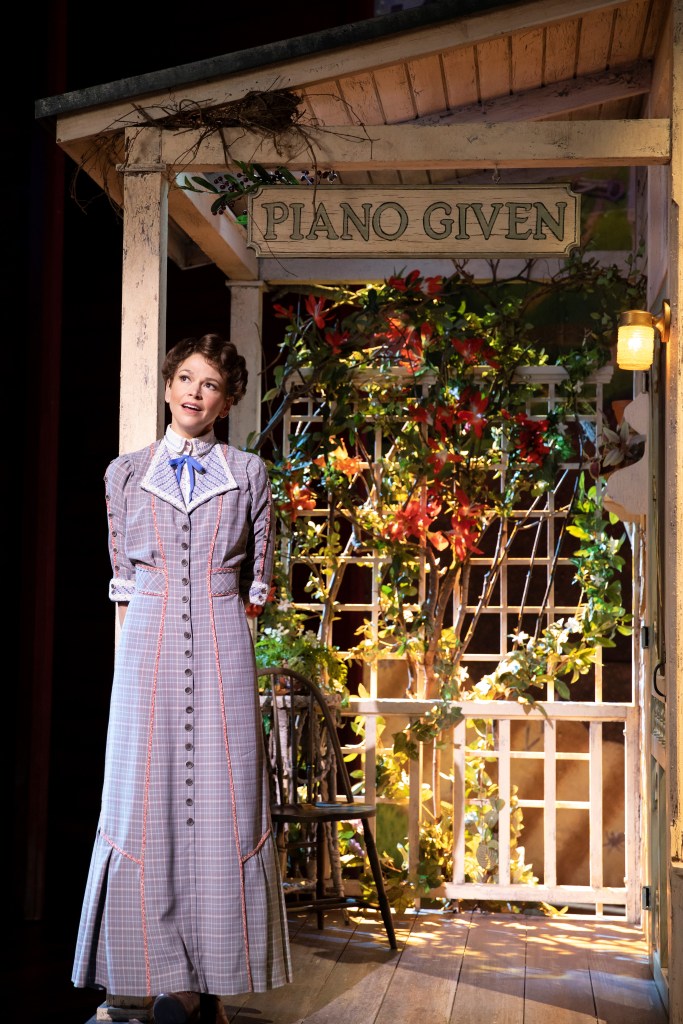
In his backdoor discussions with his comrade in arms, the affable and in love Marcellus, the winning Professor Hill has no disdain or ridicule for those he mesmerizes. He enjoys the challenge (more in the style of 110 in the Shade’s rainmaker Bill Starbuck), of instilling confidence in others and, in return, receiving what he needs, enjoyment, fun, affirmation. He is the antithesis of the bombastic, arrogant traveling salesman loudmouths like Charlie Cowell and the others in the rhythmically pounding opening train number “Rock Island.” (another superb staging by Zaks, et. al.)
Willson reveals the vital difference between them and Hill, as they ride the rails and complain about how hard their job is because of encroaching progress. What an incredible opening scene that gives the set up (costumes, staging, sets, music, sound, tone, tenor). Challenged by their comments that Iowa is an impossible territory, Hill shows himself up to the task, gets off the train, turns to the audience and presents Professor Harold Hill. Just looking at Jackman’s unabashed, open smile and shining spirit, we believe as Mrs. Paroo does, that he can do nearly anything, even if it is getting her very shy son Winthrop to speak, which he does, as Winthrop flows forth in a burst of excitement and emotion that never stops afterward in “Wells Fargo Wagon.”

His product, unlike Charley Cowell’s and the others, is intangible. Thus, taking folks’ money is done quickly, painlessly for much more is being given, including a loving manner and wish to spread joy. In this version of Hill it is his endearing vulnerability to love that Jackman makes believable in his deepening interactions with Marian, whose loving support he has, before the two of them realize it. Jackman and Foster construct this surprising discovery beautifully in the Footbridge scene (“Till There Was You,” and the melding of the relationship as they conjoin their singing of the double reprise “Goodnight My Someone” and “Seventy-Six Trombones”).
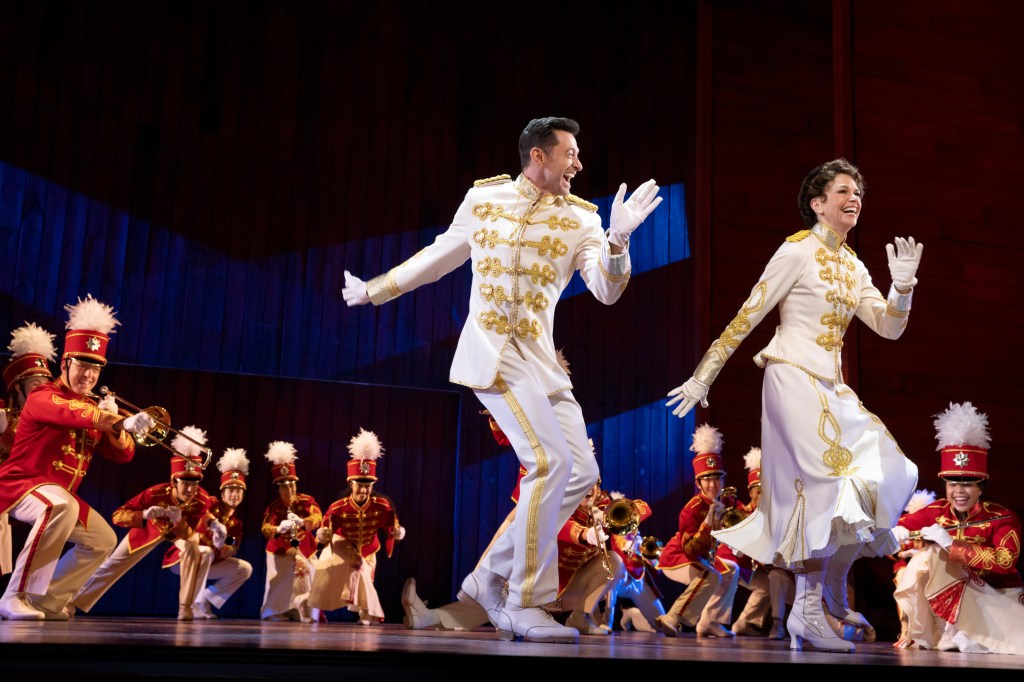
The town’s seduction is inevitable after “Ya Got Trouble” and “Seventy-Six Trombones,” an incredible dance number (and pantomimed instrumentation), that Jackman and the cast just kill. River City has “swallowed his line” (the fishing metaphor is used throughout), as does young Winthrop (Benjamin Pajak in a show stealing performance), who is thrilled when his mother, like the other townspeople, signs on for instruments, uniforms and instruction books to form the showy band Hill promises for the absolute thrill of it. That they must learn to play is subtly whisked off until “later,” the “will-o-the-wisp” magic Jackman’s Hill seamlessly performs.

Hill is gloriously, attractively spell-binding. He draws the town to him bringing togetherness and good will, that goes a long way to diffuse the backbiting of the women against Marian’s standoffishness (“Pick-a-Little, Talk-a-Little”). He helps to mend the ladies’ divisiveness, which further draws Marian to them and himself. Humorously, he unifies feuding officials in the exquisite harmony of a barbershop quartet, that they can’t seem to get enough of, once he starts them off on the right chords (“Sincere,” “Goodnight Ladies,” “Lida Rose”). One by one each potentially thorny group falls under Hill’s flirtatious, delectable, gentle power and inspirational artistic encouragement. Talk about soft power flying under the radar, he hits folks’ hearts for a bullseye every time.
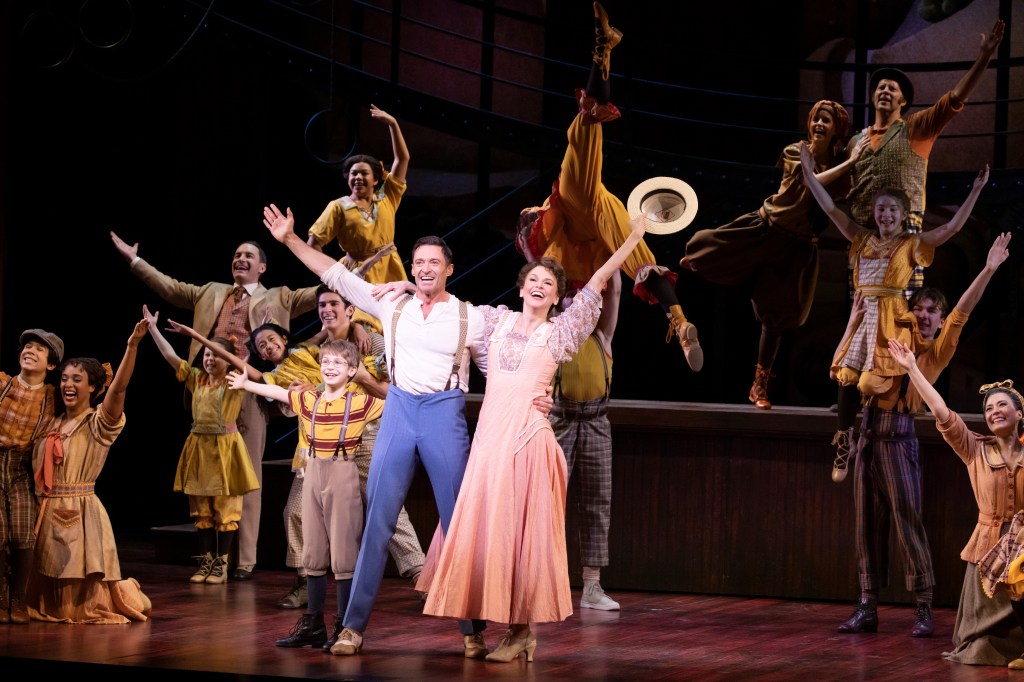
In beautifully staged moments by Zaks, we see Hill’s influence on the Mayor’s wife, Eulalie Shinn and her friends, who create dance numbers and other entertainments. Jayne Houdyshell as Shinn is marvelous and LOL in her dancing and primping poses, after Hill’s maximum attentions. The costuming for these scenes is exceptional. Throughout, the costumes are a take-off of 1912 fashion but with the variety of patterns, in some scenes earthen tones, other scenes fun hats, shoes and accoutrements, thanks to Santo Loquasto, who also did the scenic design.
Marian’s costumes are straight-laced without frills by comparison; her hair (Luc Verschueren for Campbell Young Associates), like the other ladies is in fashion, an up-sweep like her mother’s, Mrs. Paroo (the wonderful Maureen Mullen). Attention in this detailed crafting reveals Marian’s restraint, her career and character, providing the subtext and interesting contrast to the other open-handed, more extravagantly dressed woman. Eulalie and her hens are encouraged to believe in themselves in Hill’s sincere admiration as they ooze his charm back at him and titter. In the case of Marian’s response to Hill’s starlight, she moves from grimace to smile to grin.

Importantly, the women are drawn into Hill’s net, however, it’s mutual. Jackman’s Hill is having a rollicking time becoming enamored of them. This portrayal makes complete sense. Because he is lured by their, acceptance and trust in mutual feeling, he is unable to escape when the love net closes around him. Jackman and Zaks have broadened that net to include the townspeople’s acceptance and love as well as Marian’s, her mother’s and Winthrop’s. Zaks shepherds the actors to forge that budding love and trust with specificity and feeling each time they share a scene (i.e. the fishing scene with Hill and Winthrop).
Fear has no place in Hill’s magical world. So when it attempts to enter in the form of Mayor Shinn’s grave doubts about Hill (though Shinn’s motives are financially suspect), he is misled by Marian and his officials, who by this point in time, understand Hill is bringing new life to the community. Thus, they allow themselves to be distracted away from Shinn’s mission to verify Hill’s identity. It’s apparent that with the exception of Mayor Shinn, whose agenda Hill upends by dunning his new pool table, the town’s spirited happiness is heartfelt. One wonders what their lives were like before his enchantments blinded them? Or did he give them a new way of seeing? And what was Hill’s life like traveling one step ahead of the sheriff before he hit River City, an unintentional stop on his route to anywhere U.S.A.?
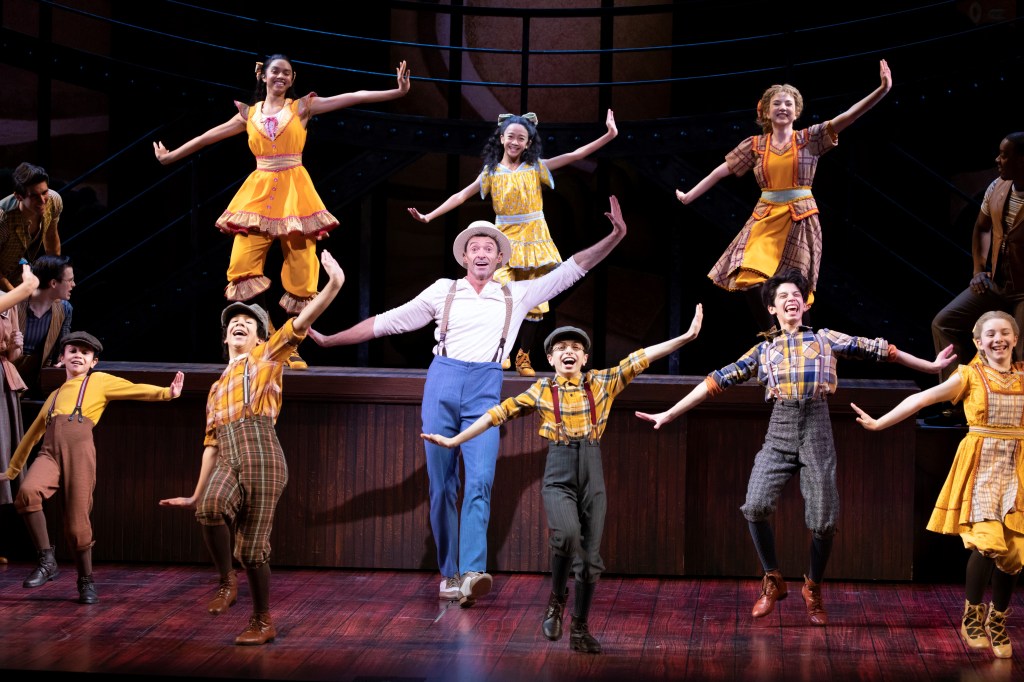
Clues are revealed in the large set backdrops of the Grant Wood style paintings (Regionalism, note the painting “American Gothic”), that are at once simplistic and complicated in their being two-dimensional, brimming with sub-text. These brilliantly reveal the time, place and characters with details of tone, tenor and color. This is especially so against the green rolling hills Grant Wood backdrop, where the tiny, animated, red, Wells Fargo Wagon races down a hill in the distance as it approaches River City. The audience gasped in awe at the ingenious contrivance. Then, they gasped even louder as the “larger-than-life” Wells Fargo Wagon materialized on stage. Pulled by a well-groomed, shiny-coated, smallish-looking “Clydesdale,” Hill beamed atop the wagon as it stopped, the cast sang “The Wells Fargo Wagon” exuberantly, and Jackman rhythmically tossed out the brown, paper wrapped “instruments.” Poignantly, Pajak’s Winthrop sings, lisp and all, completing the effect. Pure dynamite!
This is the show’s “Singing in the Rain,” moment. It is the still point in time that clarifies and represents the whole; action, event, music, symbolism, lighting and spectacle reveal the theme and its significance to the characters and audience. It is here that we understand the treasure that Hill brings, the heightened glory he coalesces in a happening that the townspeople and a now confident Winthrop, (whom we fall in love with along with Hill), will never forget. And for that reason, Marian destroys the evidence that can sink Hill. It’s a stirring, fabulous end to Act I.

By the beginning of Act II, Hill’s invested emotional interest in Marian is revealed in “Shipoopi,” the silly-grand singing and dance number with the entire cast, and colorful, striking costumes, led by Marcellus, who reveals his contentment with his wife. As friend and confidante Marcellus is also Hill’s foil. Living a fulfilled life in a small town, his life contrasts with the emptiness of Hill’s tired wanderings. This is underscored through Hill’s previous interactions with Marcellus, in their fine duet “The Sadder But Wiser Girl,” and brief discussion of his former inability to settle down which Marcellus encourages him to do in River City because he can introduce him to a lovely girl. However, Hill has already met a lovely girl, who rejects him, but as we note at the top of the musical, Hill enjoys a challenge. Jackman nails Hill’s bravado with class, nuance and balance, never over-doing it. He will have Marian and she will have him.
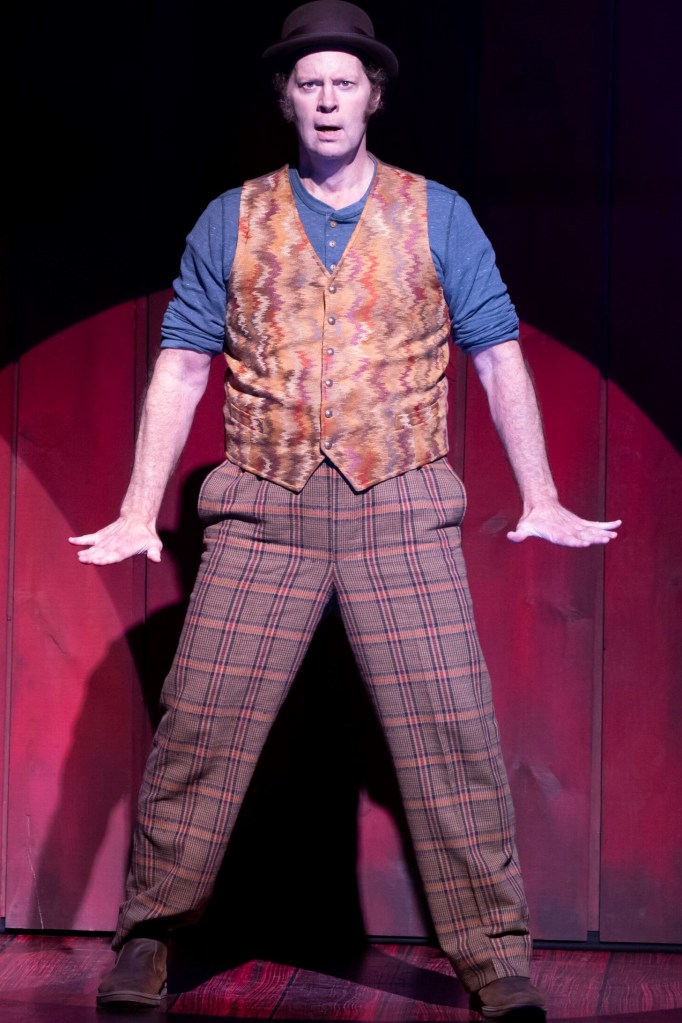
Sutton Foster’s Marian is the challenge Hill finds stimulating. She falls in love, her hard-heart melting in attenuating stages: after Mother Paroo’s pressure in “If You don’t Mind My Saying So,” her own internal pressure in “Goodnight, My Someone” and “My White Knight,” in Hill’s sweetly, gorgeous “bad-boy” pestering in, “Marian the Librarian,” and most importantly, after she sees Hill’s beloved influence on Winthrop (“Wells Fargo Wagon,” the fishing scene, “Gary Indiana”). As Marian, Foster’s change of heart toward Hill is superbly wrought by degrees; her stance and body gradually relaxing as they dance in “Shipoopi.” And the relationship Foster and Jackman forge in its progressive development toward love is believable and touching. By the time the scene with the kiss arrives, their bond is manifest; the long kiss, wistfully enjoyed by Jackman fans, brought faint and not so faint audience gasps; the longing and hunger in the characters dangerously apparent.
For love’s reality is an obstacle to his “safety” that Hill acknowledges (“Till There Was You” reprise). Charlie Cowell intends to provoke the town to scourge Hill with a “tar and feathering.” It is at this point that Marcellus’ injunction that Marian is doing the conning and Hill has to leave or be damned, resonates. But he can’t leave; he must face the music or rather, lack of it.
Foster shines as she attempts to gaslight sexual predator Auberjonois’ Cowell with flirting and a kiss. And in the realistic fight scene (one punch is always sufficient), between Cowell and Hill, the professor vindicates Marian’s reputation that Cowell besmirches. I love how Foster sexually presents herself to Cowell, breaking the third wall and eliciting the audience’s encouragement; she twits the scene for all its worth.
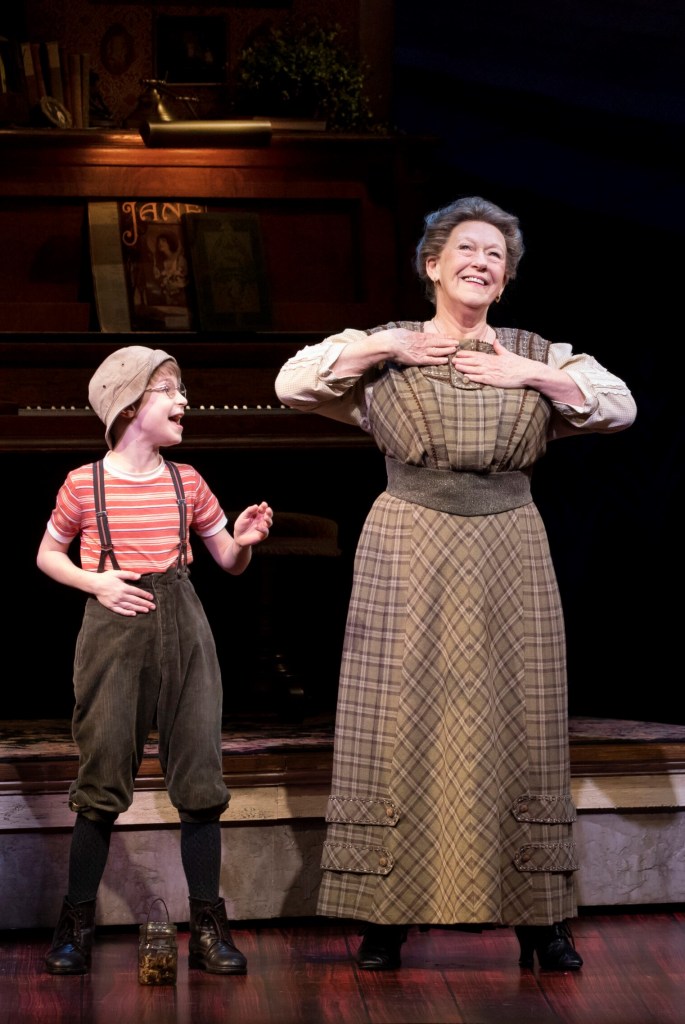
But the con is over. Humorously and ironically, Hill is a victim of Mother Paroo’s use of his “Think System.” And of course, his own need to be loved traps him. Thus, he admits the truth to an upset Winthrop, who forgives him as does Marian. Brother and sister encourage Hill to quickly escape, not realizing the music man wants to stay despite the jeopardy. The sacrifice of the three for each other is perfection. When Hill is arrested, Jackman’s emotional response in the scene is smashing, as is the drama created by Pajak, Auberjonois, Foster and the other cast members. The question remains. Will the town forgive Hill, as Marian and Winthrop have? Will they acknowledge that he has given them something more priceless than a boy’s band? Perception is everything.
In this revival the intentionally “un-dangerous,” genius, entrepreneur professor, like those entrepreneurs of the Cardiff Giant, created a daily thrill. Specifically, Hill’s music man encourages the town to launch out on a new road. It turns into their own growth and ultimate benefit in merging community, good will and love. In exchange for instruments and uniforms, he has bestowed the citizens with an ineffable gift (that Marian and Eulalie Shinn encourage the others to stand for). As Mayor Shin sees their unity and hears his son play, Hill’s “Think System” catches communal fire. The joy and warmth that Hill gave is returned; he is loved and forgiven. And Charlie Cowen leaves a sadder and unrepentant man.

In the end scene as the perception of the townsfolk moves from what is to what each parent thinks/imagines Hill’s orchestral direction to be with love, the miraculous occurs. Hill is redeemed as the band emerges in sound and sensory vision. Announcing the Finale, Winthrop/Pajak blows a vibrant, bold horn. The cast emerges in full band regalia, sings, plays and dances, with Foster and Jackman front and center, leading the charge. Dazzling fun, profoundly realized.
The Music Man is a spectacle that is incredibly rich with visual movement and vibrancy, striking hues and emotional musical grist brought together with sterling performances that are divine brush strokes. The story is a faceted jewel, the characters inhabited by these multi-talented acting greats are uniquely American. The sound/music delivery-technical and vocal is as fine as can be. I heard every word, the glorious harmonies, spun out rhythms and witty lyrics in the compelling choral numbers (“Rock Island,” “Ya Got Trouble,” Shipoopi,” “Pick-a-Little, Talk-a-Little,” “Marian the Librarian,” Seventy-Six Trombones”). What a pleasure, especially in the large musical numbers; this has not always been the case on Broadway (post-pandemic and certainly not pre-pandemic).
The Smithsonian Institution ranks The Music Man as one of the “great glories of American popular culture.” When it premiered on December 19, 1957, it was a smash hit that ran 1375 performances. It won five Tony Awards including Best Musical. The original cast album held the number one position on the
Billboard charts and stayed on the album charts for 245 weeks. The recording won the first-ever Grammy Award for Best Original Cast Album.
In this amazing revival all of the main actors are Tony Award winners. Sutton Foster is a two-time Tony Award winner. Hugh Jackman is a two-time Tony Award, Grammy Award, and Emmy Award-winning star. Director Jerry Zaks is a four-time Tony Award winner and Choreographer Warren Carlyle is a Tony Award winner. The creative team is equally sterling and award studded. It includes four-time Tony Award winner Santo Loquasto (Scenic & Costume Design), five-time Tony Award winner Brian MacDevitt (Lighting Design), Tony Award winner Scott Lehrer (Sound Design), Luc Verschueren for Campbell Young and Associates (Hair, Wigs, & Makeup Design), Tony Award winner Jonathan Tunick (Orchestrations), David Chase (Vocal and Dance Arrangements), and Patrick Vaccariello (Musical Director).
This production with this cast, director, choreographer and technical team will never happen again in your lifetime. Considering what the cast, crew and production team went through to present The Music Man opening night this February 10th, 2022, it has been a labor of love that underscores every dance step, every note played, every trill, every laugh by the actors, the musicians, everyone. It is a one-of-a-kind revival that is breathtaking. Do what you can to see it. I will go again if I can get tickets. Here is their website for arrangements. https://musicmanonbroadway.com/
Mifune Festival at Film Forum: ‘High and Low’

Film Forum’s four week festival screening of 33 films starring iconic Japanese actor Toshirō Mifune (1920-1997) and directed by Akira Kurosawa kicks off Friday, February 11 and ends on 30th of March at Film Forum. What is amazing about this festival is that not only are Kurosawa’s masterpieces included like Rashomon, Seven Samuri, High and Low, Yojimbo and Hidden Fortress, but also found are Kurosawa’s and Mifune’s rarities and rediscoveries in 35mm. These have been imported from the libraries of The Japan Foundation and The National Film Archive of Japan. For the entire schedule of films go to their website: https://filmforum.org/series/toshiro-mifune

A favorite film in Japan, but not that well known in the U.S., unless you are a Akira Kurosawa and Mifune fan, is High and Low. In this hybrid crime thriller and human drama, we see a different aspect of Toshirō Mifune’s acting versatility and concentration in inhabiting an uncharacteristic role, that of a modern, wealthy Japanese executive Kingo Gondo. Director Kurosawa’s layered unveiling of the strike zone of danger is a slow boil that begins with a meeting of shoe company executives that are plotting to undermine the owner of the company by pooling together their shares. By the end of the film, the company and the executives, especially Gondo are in completely different places, having gone through an unforgettable trauma that changes their lives.

Gondo, a creative entrepreneur, intends to outwit the other executives by buying up more shares in the company alone, than they have pooling their shares together. He refuses to go along with their manufacturing vision because they, mirroring American corporate values, intend to squeeze out greater profits by making an inferior product. His values are high-minded: make beautiful, unique and high quality shoes which have good value for their money. He argues with the executives believing that long term, the company will be better served through his vision of raising the bar and maintaining the company’s integrity.
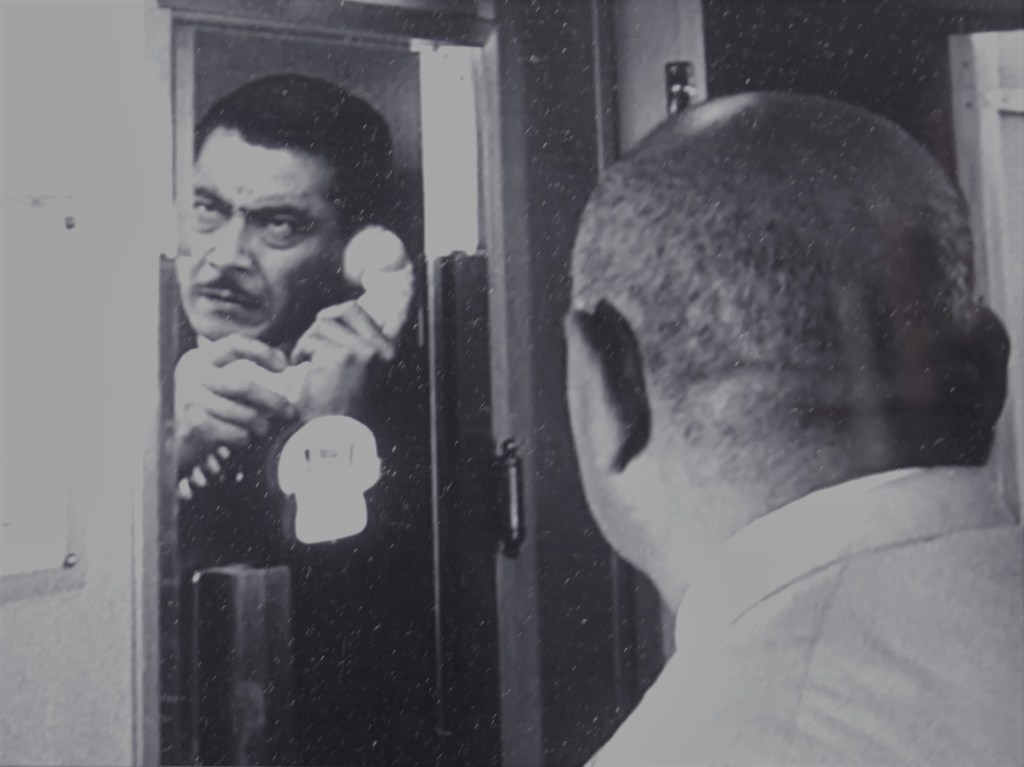
The executives disagree and close him out of their deal. However, he intends to put his own plan into effect by gathering the money for a leveraged buyout to own over half the shares of the company, by mortgaging his house. At the point where he is about to send his assistant to finalize the deal, he receives a phone call from a kidnapper, who has mistakenly taken his chauffeur’s son Shinichi instead of his own son Jun. However, it is no consolation that the kidnapper wants a “king’s ransom,” for a child who is lower middle class, because the child is his son Jun’s friend.

Using the money to purchase the shoe company instead of paying the ransom for a helpless, frightened child is morally reprehensible. He realizes word will get out to the press that he values money over the life of a child, a position of moral bankruptcy. One way or another he will lose. Either his soul will become hardened as he places material things above a human life, or he will lose money but have saved the life of a child who is not his own son. Such grace is heroic and beautiful, even saintly. What will Gondo decide? It is a typical Kurasawa dilemma that his protagonists always have to choose between a rock and a hard place.
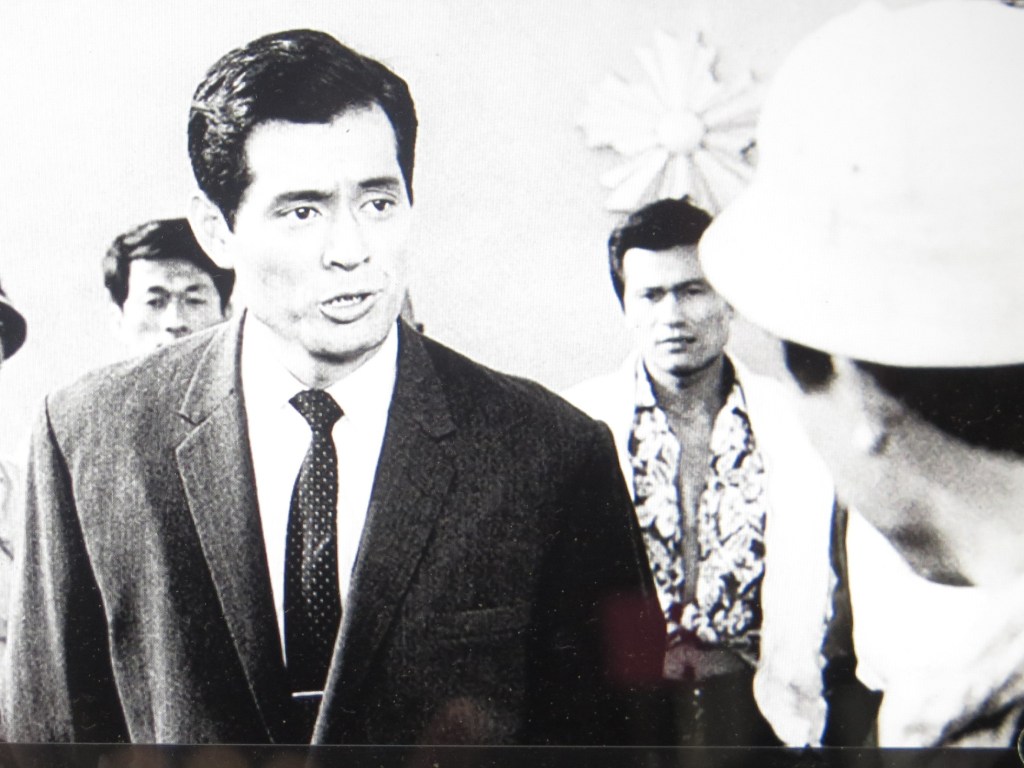
Initially, Gondo is not going to pay the ransom with the money he put together for the buyout. He thinks perhaps he can borrow other money from the bank to tide himself over. The plot thickens and turning points occur frequently. Despite the kidnapper telling Gondo not to call them, the police become involved. They assure him that they will help him get the money back. That, coupled with his wife and the chauffeur’s pleading as well as his own son questioning where his friend Shinichi is, persuades him not to go through with the money deal. Instead, he will give the money to the kidnapper at a specified place, following his instructions. However, first, as they tape record the kidnapper’s voice, they try to find his location as well as verify that the child has not been killed. The suspense and tension increases as the stakes lengthen and we wonder if the child will be killed.
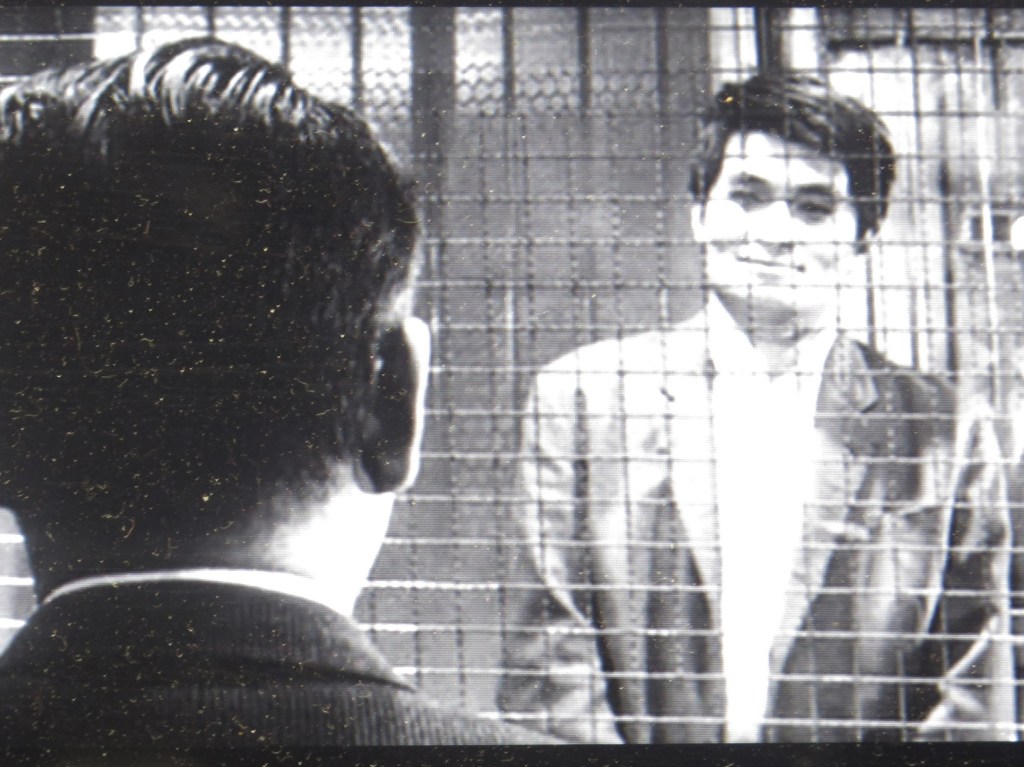
In the second part of the film, Kurosawa’s specificity lays out the step by step plan the police use to eventually put together the clues that lead to the identity and place of the kidnapper. On the phone, the kidnapper spills that he is sweltering down in the city ready to die of heat prostration, while he looks up at the cool, beautiful house of Gondo, high atop the cliff overlooking the city. That detail and others, like the sound of the train where the suitcase with the money is supposed to be dropped off and clues that Shinichi gives the police about the place where he was taken, gradually provide the net that the police draw around the kidnapper.
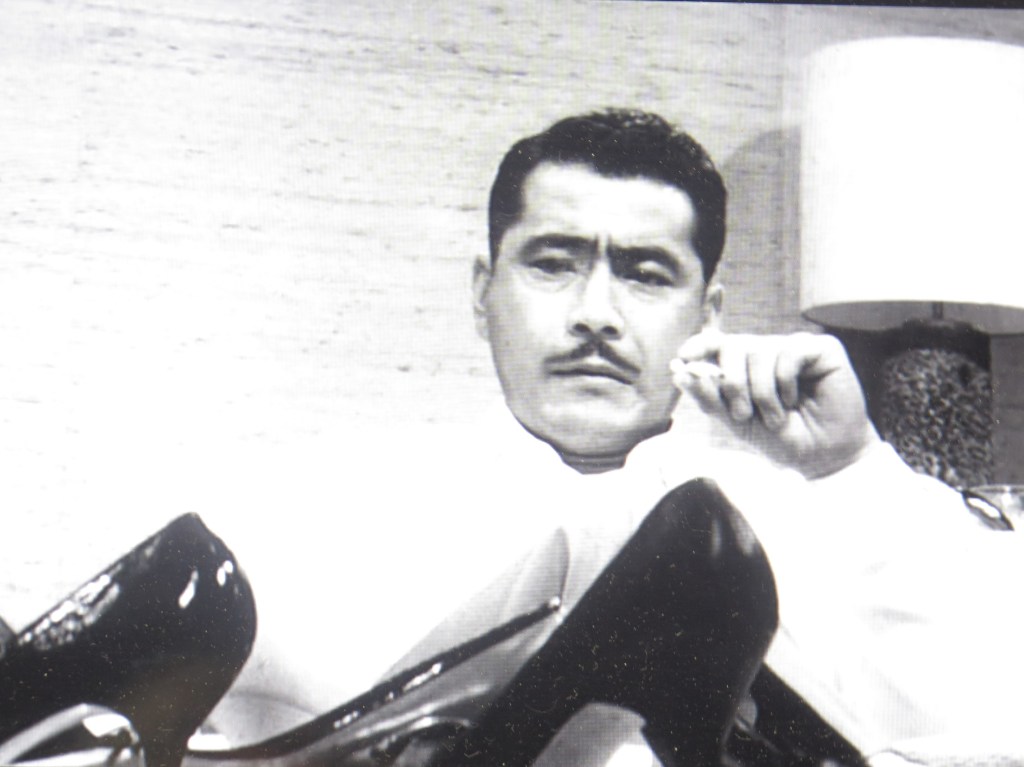
The good news is that Shinichi is returned and the money exchange goes smoothly. However, the bad news is that the police eventually find the dead bodies of the accomplices who were keeping Shinichi in a house by the beach. Thus, the police are in a dead heat with the kidnapper, finding clues then arriving at a literal dead end. Meanwhile, as the cat and mouse game continues, Gondo loses everything, forced out of the company because his assistant told the executives of his planned double cross leveraged buyout. Gondo’s creditors demand the collateral in lieu of the debt and he is forced to auction off everything. However, his story is widely reported and he is viewed as a hero and selfless executive which raises his reputation and worthiness to the heavens, while the other executives/owners of National Shoe Company are scorned and excoriated.

As the wheels of fate turn, lowering Gondo materially, yet raising him morally and strengthening his soul spiritually, the now wealthy kidnapper becomes emotionally unhinged by a stratagem the police detectives use, after they autopsy the accomplices who died of a heroin overdose. The detectives trick the kidnapper by making him think the accomplices are still alive; they give him a note demanding more ,heroin. Through this ruse and going undercover into the most crime ridden street of Yokohama, full of prostitutes and addicts, investigators locate the kidnapper who has given a prostitute a lethal dose of heroin to test it out. Threading this evidence with the kidnapper’s showing up at the accomplices’ house believing them still alive, the police arrest him and jail him with sufficient evidence. Finally, as the last stick of furniture is taken from Gondo’s house, too late, the police recover the money with only a nominal amount missing.
Thus, from wheel to woe to back again, Gondo’s character has gone through the trials and sufferings of a Job. Mifune gradually becomes more stoic by the end of the film. His character has experienced the strengthening of his faith in himself, justice, karma and superb police work. The most amazing section of the film and the acting occurs when Gondo visits the kidnapper who by this point reveals himself to be a raving lunatic.

The kidnapper, a young medical intern laughs with ridicule at Gondo until Gondo tells him he is better off as the executive of a smaller shoe company where he can use his own vision and ideas to influence the quality and worthiness of the product. He is starting over again which is fine with him. Indeed, Gondo, regardless of whether he is high or low, learns to be steady and temperate. On the other hand, the kidnapper and murderer is completely unbalanced. Unlike Gondo who can be abased or abounded in life and remain a stolid rock, the kidnapper breaks down and screams in utter lunatic rage and pain. It is a shocking and incredibly memorable scene. One of the greatest acting performances by two actors that I’ve seen in any film. Absolutely unforgettable.
This is Kurosawa at his suspenseful and profound best. From the arc of Gondo’s admirable personal development, to the uplifting of the themes of quality over commercialism, sacrifice over greed, timeless and immutable values are presented as behaviors to emulate. Contrasting the personality of the kidnapper and killer who is psychotic for money and motivated to “get rich at the expense of others,” we are reminded of another path individuals take. Kurosawa offers both up for us to choose: the light and the dark, the ethical samuri vs. the twisted, psychotic who turns inward and self-destructs. This is ultimately, “the high and the low.”
These portraits are breathtaking in another must-see Mifune/Kurosawa collaboration. Don’t miss it. For tickets and times see below, and go to the Film Forum website: https://filmforum.org/series/toshiro-mifune
High and Low at Film Forum
Saturday, February 19 at 8:00
Wednesday, March 2 at 2:30
Tuesday, March 8 at 12:40, 7:50
Phylicia Rashad, Brandon J. Dirden in ‘Skeleton Crew,’ Workers vs. Corporates, a Worthy Fight at Manhattan Theatre Club
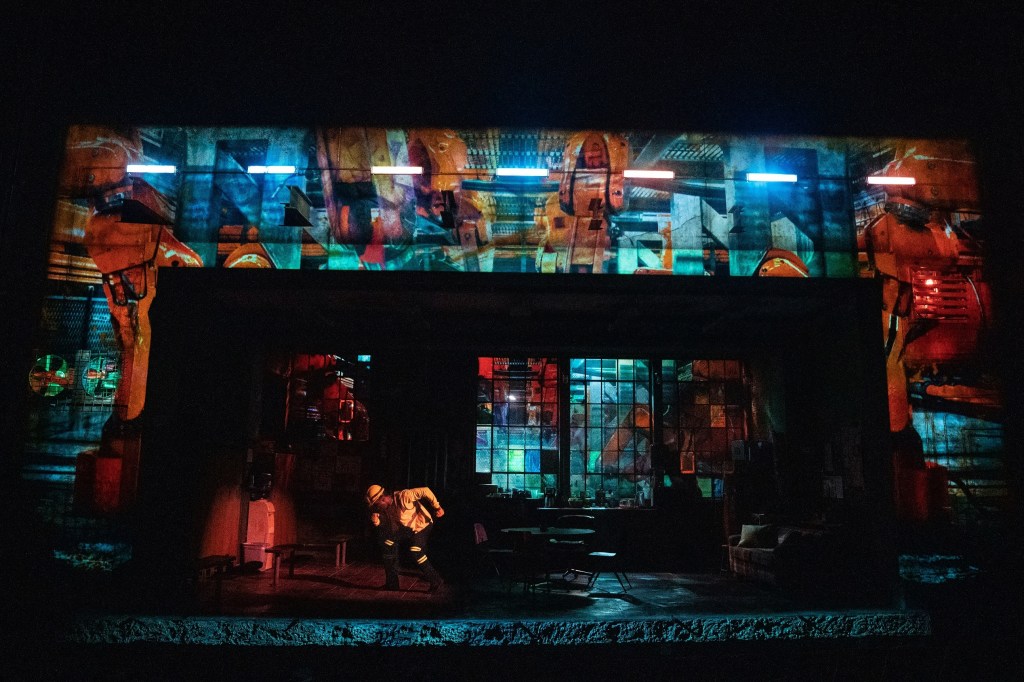
From the symbolic and representative opening salvos of gyrating piston Adesola Osakalumi, whose break dancing suggests the automation which is rendering the human scaling at the auto-stamping factory obsolete, to the well-hewn set by Michael Carnahan (the dusty, run-down, cold, shabby staff room where employees enjoy down-time) we understand that the four person skeleton crew in the Detroit plant will be ghosted as soon as budgetary financial reckonings are made by upper management. This is 2008 Detroit, US during the economic mortgage mess when investment bank Bear Stearns collapses and is bought over by JPMorgan Chase and Lehman’s a 150-year old booming institution goes belly up. People are losing their homes and living in their cars and cheesy motels in Florida. And, it is worse in Detroit whose booming success of the 1960s is a bust by the 1990s and there’s one plant left that is barely churning out product.
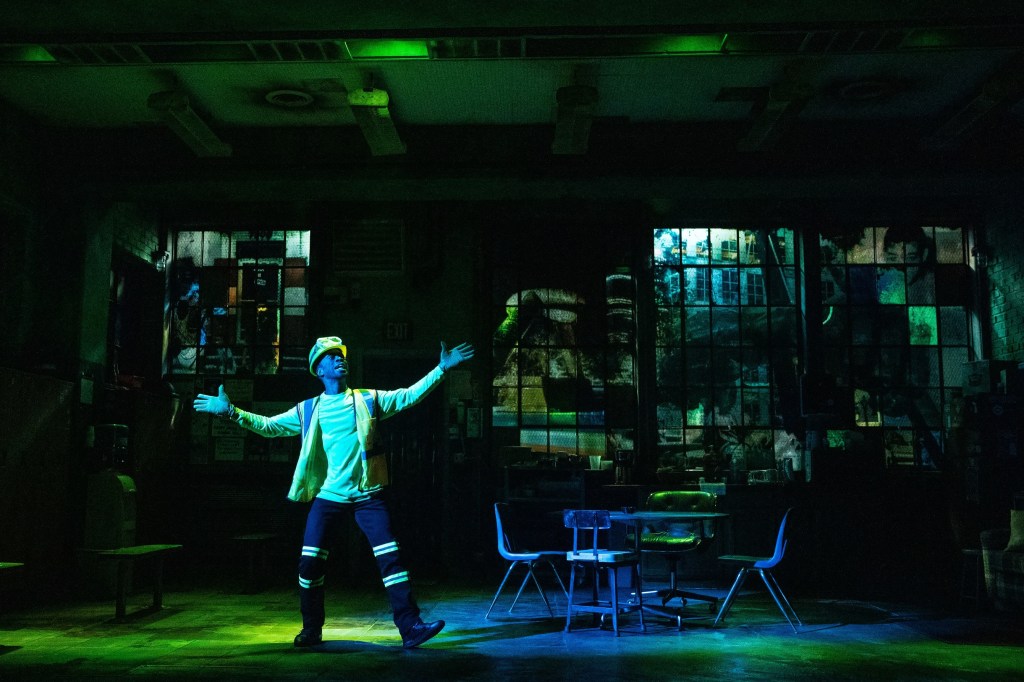
Skeleton Crew directed by the superb Tony Award® winner Ruben Santiago-Hudson, currently in revival at Manhattan Theatre Club after its intimate presentation Off Broadway at the Atlantic six years ago, hints at the tour de force Dominique Morisseau meant the last segment of her Detroit Project to be. The trilogy (The Detroit Project) is about Detroit’s life and times before and after the Reagan outsourcing debacle toppled the city from its glory as the country’s industrial fountain of youth. It includes Detroit-’67, Paradise Blue and Skeleton Crew.
The play has been given a glossy uplift using video projections of the robotic machinery of the assembly line etc. (excellent design by Nicholas Hussong). Coupled with the music (Rob Kaplowitz’s original music & sound design, and Jimmy Keys’ original music & lyrics) at the beginning and between salient scenes, we note the encroaching modernized doom that hammers the employee work force into unrecognizable bits, hyper-downsized from its greatness when Detroit was in its manufacturing heyday. The digital video projections supplant proscenium curtains which would normally frame the stage. As such, the plant’s relentless, driving automation is the outer frame of the stage and encapsulates the action and interactions in the staff room where workers take their breaks from the repetitive and monotonous production line.
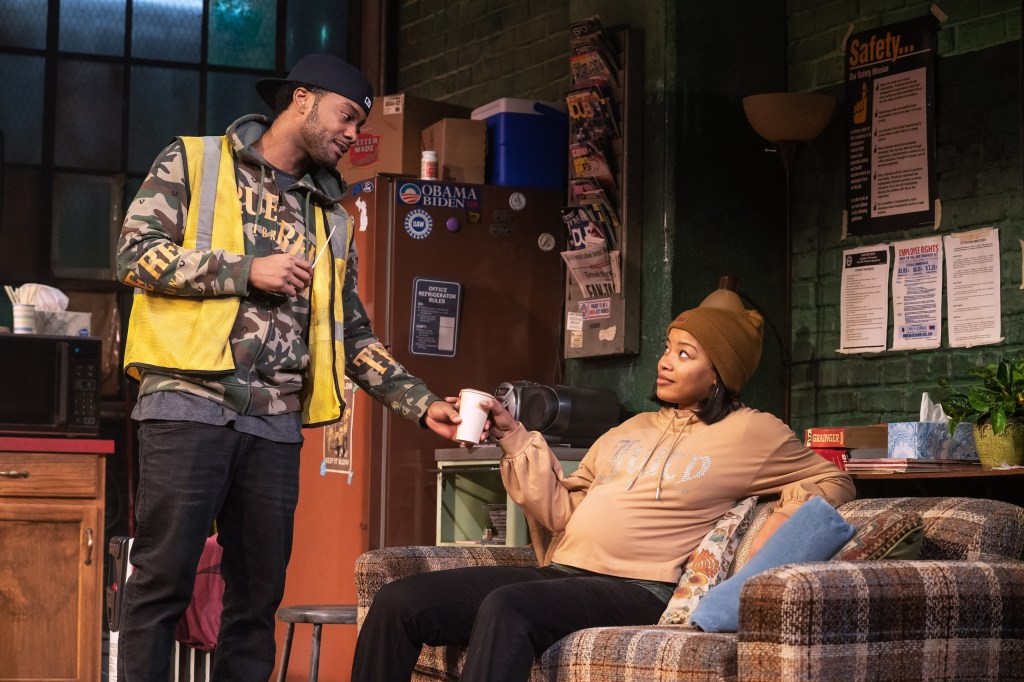
The contrast Morisseau’s dualism creates is trenchantly thematic. The defined “wasted, decrepit humans” are pitted against inevitable “progress” which especially grinds down the people whose loyalty and dedication to the industry have been turned against them. These management diminished unfortunates, like Faye (Tony Award® winner Phylicia Rashad) whose once magnificent efforts are discounted as “unprofitable,” didn’t see the “handwriting on the wall” to prepare for another career after working for the company 29 years in the hope of getting a “great” retirement package. Faye and others trusted the corporates to have their best interests and welfare at heart.
As Morisseau indicates in her characterization of Faye, stand-up employees projected their worthiness, values and integrity on their slimy directors and CEOs, mistakenly assuming they would be rewarded for hard work and effort. Ironically, it is the elite corporates who are the unworthy, lazy, greedy, un-Americans who made America “un-great” through Reagan’s tax laws that allowed them to outsource profits by closing plants and establishing factories anywhere but the United States.
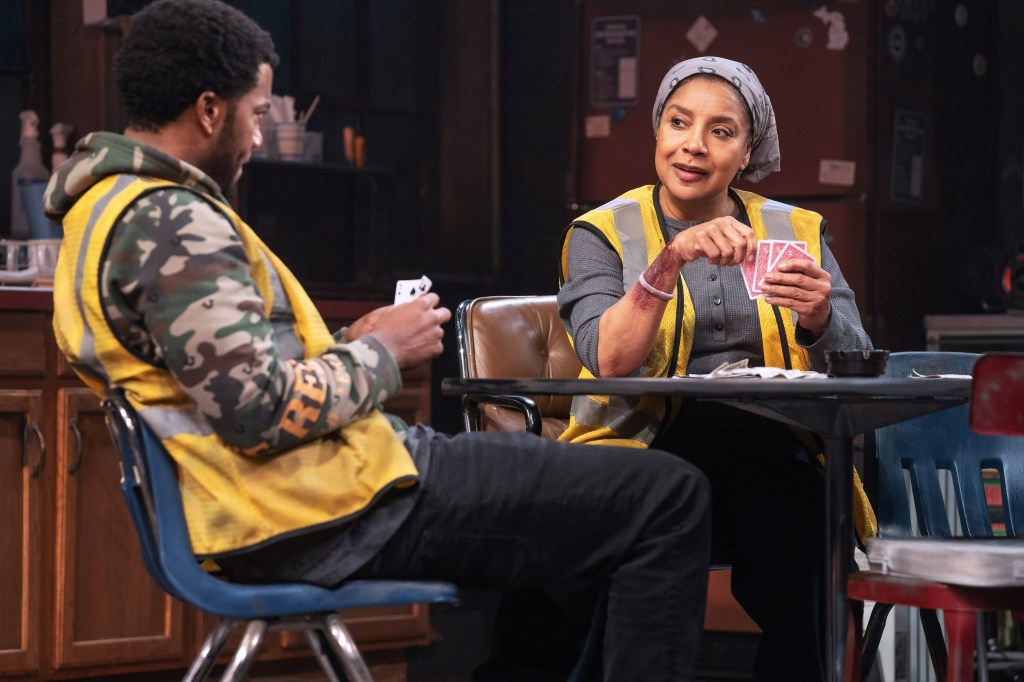
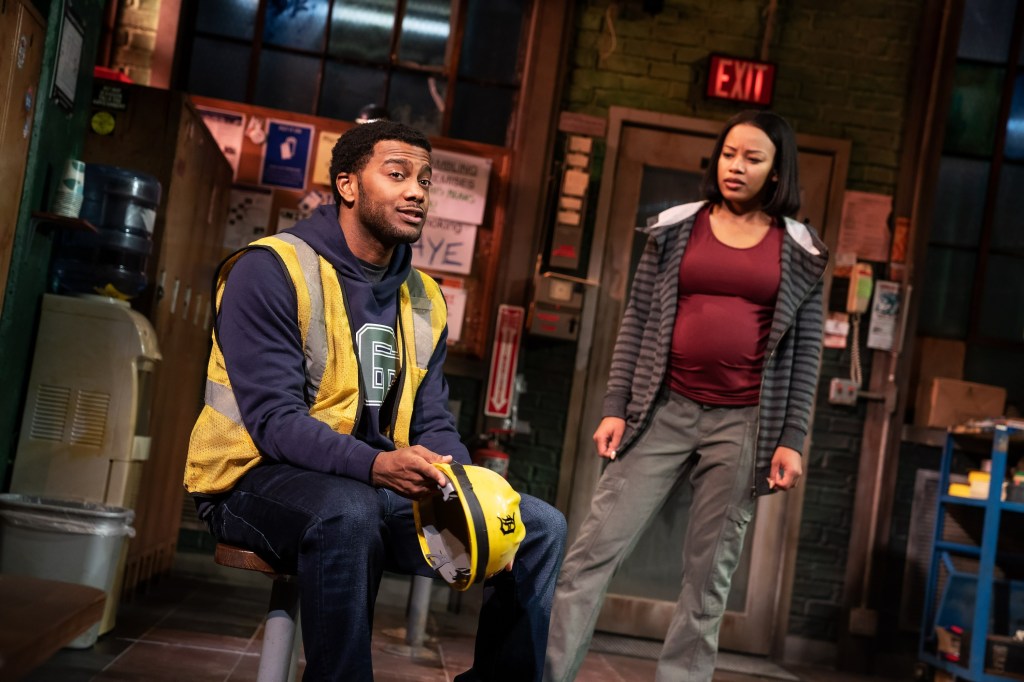
In view of the current debacle with supply chain issues, inflation and absence or overpricing of medical product needed to fight the ongoing health disaster (COVID-2022) which incompetent, do-nothing Republicans have fueled as a political stratagem, Skeleton Crew‘s themes are profound and incredibly current. The problems fourteen years later from the setting (2008, Detroit) are even worse with expanding economic inequality, oppression of the workforce, whether white or blue-collar, by oligarchic elites herding the intellectually infirm white supremacists with misdirection against the democratic institutions that could save them. The seeds of the current destructive forces are evidenced in Morisseau’s setting with the ghosting of Detroit’s last automotive plant where supervisor Reggie (the wonderful Brandon J. Dirden) Union Representative Faye (Phylicia Rashad) the energetic Dez (Joshua Boone) and the pregnant Shanita (the excellent Chanté Adams) work and stress out with each other in unity.
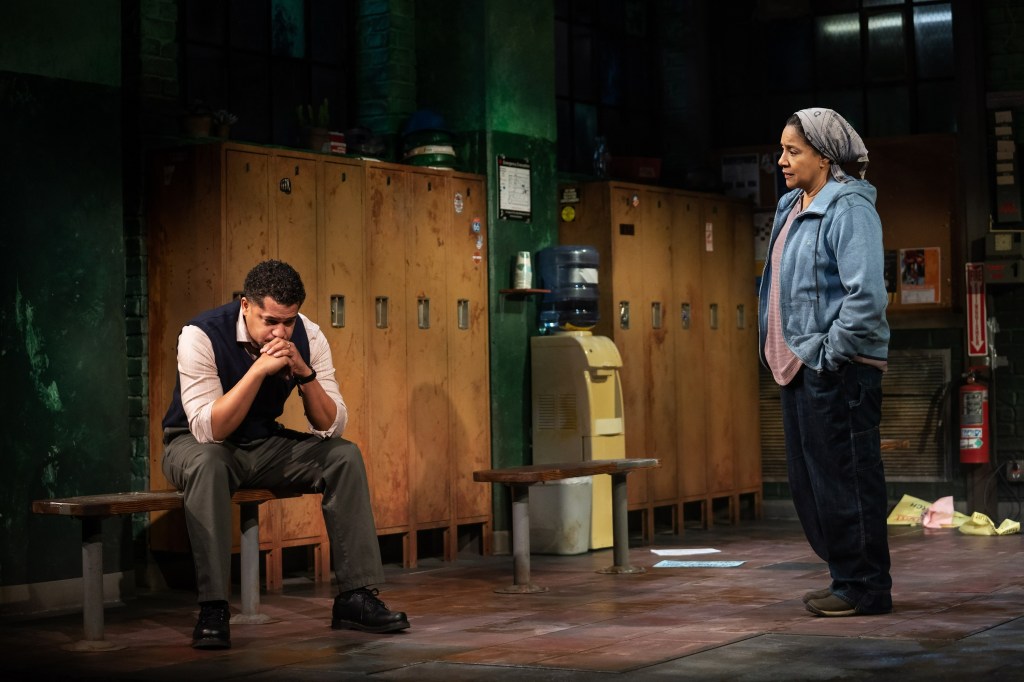
Within this framework we follow the devolution and evolution of these four who signify Morisseau’s special individuals who are the backbone of the nation. It is these who the elites would erase. Their ability to hope and thrive is sorely tested against the annihilating backdrop of demeaning corporate abuse which demands personal strength and communal support to over-leap it. With Morisseau it’s the people vs. “the corporate machine,” and as Morisseau spins the conflicts caused by the plant closure, personal self-destruction or revitalization are the direction for Faye, Dez, Shanita and Reggie, who prove to be likeable working class heroes with huge cracks and flaws that we recognize in ourselves.
Reggie who has been practically raised by Faye as family-she got him the position where he rose to management-is pressured and strained. He’s forced to walk a fine line, knowing what his bosses plan to do. Yet he must not tip their hand which would panic the workforce to strike or leave before the current contracted work is completed. Oppressed to enforce nit-picking rules, Reggie argues with Dez who may or may not be stealing and who sees him as a cold-hearted puppet of corporate.
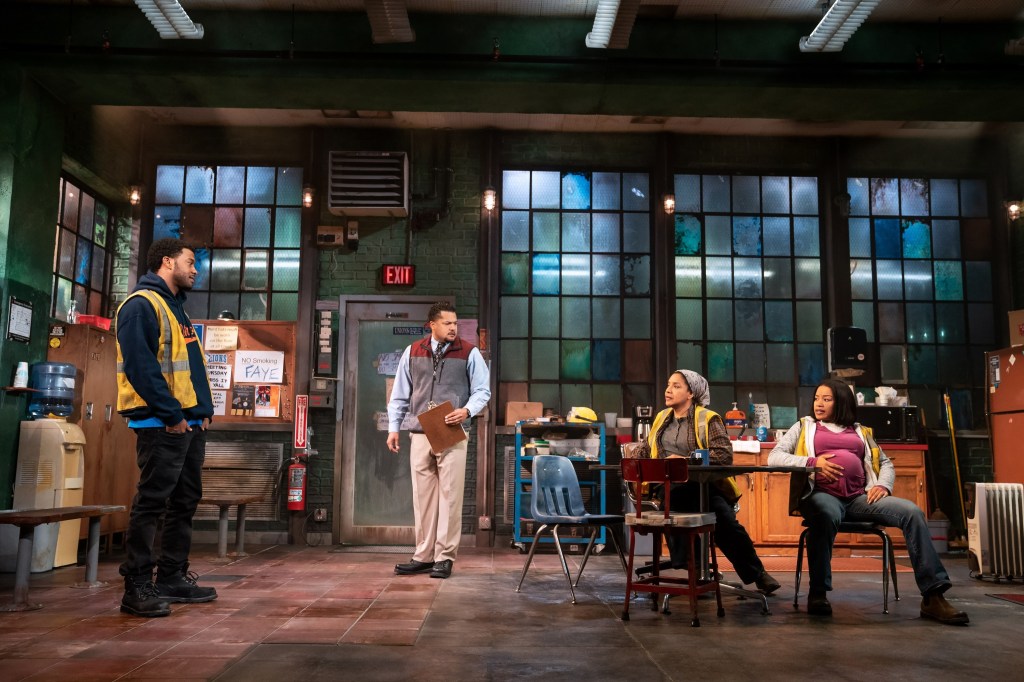
Likewise Reggie emotionally wrestles with Faye who must protect her union workers and herself deciding whether to retire early, which would mean an income loss after retirement. Shanita is pressured emotionally after she is dumped by her baby’s father. She faces being the sole support of her child. She enjoys working at the plant, though she’s a cog in the wheel, but she feels proud for her contribution to making product. Nevertheless, she is strained working and bearing up with her pregnancy, making doctor’s appointments and saving up money before and after she takes time off from the job she loves.
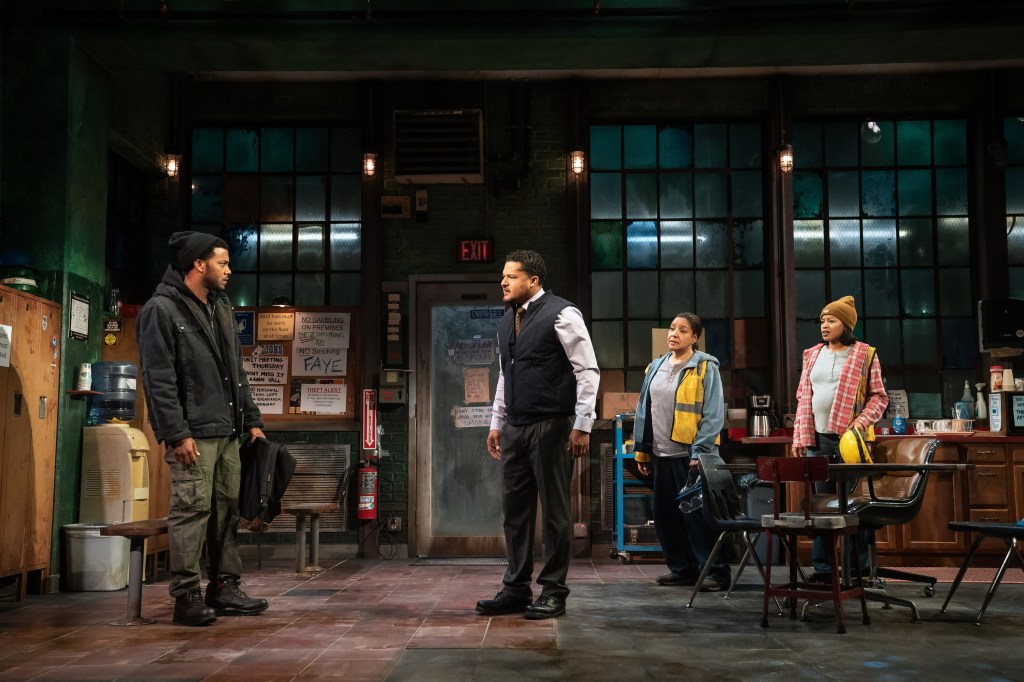
Morisseau excavates each of their struggles with authentic dialogue that is at times humorous, and powerful/poetic as the characters present their positions. Importantly, the playwright extends the reality of what it is to hold a decent job with benefits that is being pulled out from under the worker because the owners’ obscene profits aren’t big enough and government isn’t holding them to account. Thus, as the play progresses and we understand each of the characters’ dreams, we credit Dez for attempting to start his own business with friends, and we hope for Shanita’s child, in light of the nightmares she’s having over the uncertainty of her future. Additionally, we understand Reggie’s position though we expect him to stop his haranguing of the others and stand up to his bosses. We are thrilled when he finally does.
Interestingly, Faye, who appears to be the most solid and reliable is confronting her own devastation in addition to the cancer remission she is going through. Morisseau gradually unfolds each of the characters’ issues and at the end of Act I brings Dez and Reggie’s relationship to a turning point where Dez is about to be fired. When Faye steps in and counsels Reggie to stand up for Dez and the other workers, we question whether Reggie has the guts to or whether he will be a sell-out. The irony is Faye is great at negotiating and encouraging others, but she is lousy at taking care of herself. The revelation of this is poignant, and Morisseau opts to make every audience member put themselves in Faye’s shoes as she, too, “walks the line” between wanting to live or just throw in the towel and give up.
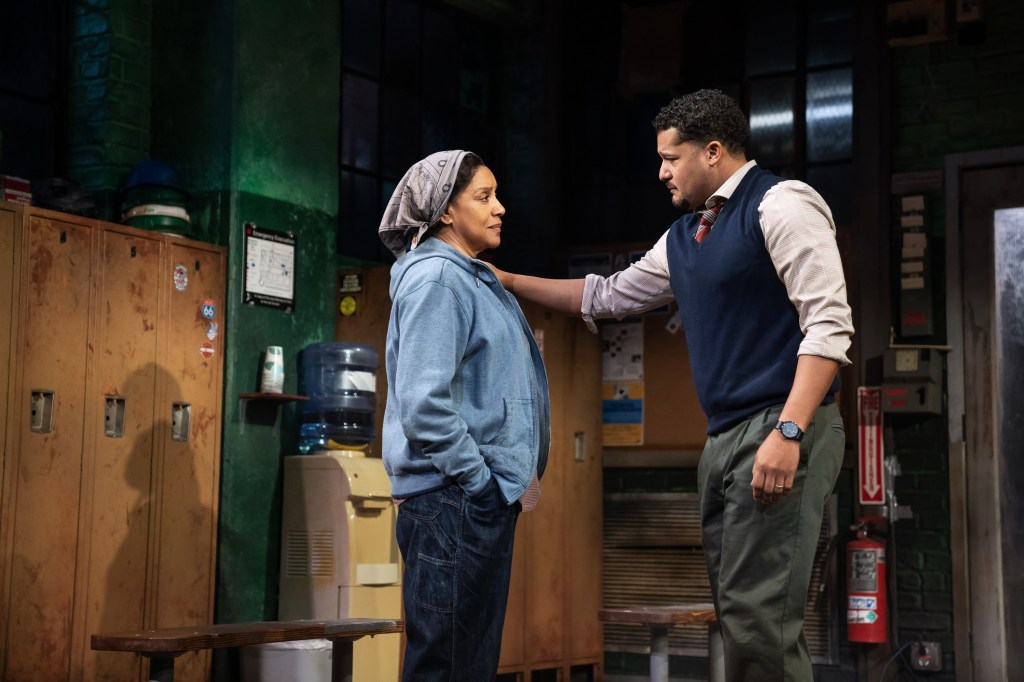
This is a strong ensemble piece and the acting is finely wrought. Unfortunately, some of the humor was lost on me because the actors weren’t always projecting in the cavernous space of the theater. Please actors, project and enunciate! Nevertheless, the passion and presence of Phylicia Rashad along with her counterpoint Brandon J. Dirden was heartfelt. The relationship they create reveals bonds that run deep into love and sacrifice. And the surprising relationship that blossoms between Boone’s Dez and Adams Shanita is beautifully effected by their graded, nuanced performances.
Ruben Santiago-Hudson understands Morisseau’s themes down to his soul’s bone marrow. The play’s visual elements represent the most vital of her themes and the characters are ourselves. We cannot help but be concerned for the conflicts the play presents which seem everpresent and unchanging. The current administration’s hope to “Build Back Better” during this time would appear to rectify the external circumstances of such characters who jump off the stage at us and populate our society. But the same corporate structure that Reggie fights is so entrenched, that soul progress is for the little people, these who are Morisseau’s besties. Perhaps that is the consolation. As for the corporate elites? As Reggie and Dez intimate, they are they’re own soul destruction. And that too is its own tragic consolation.
Kudos to the technical team mentioned above and Emilio Sosa’s costume design, Rui Rita’s lighting design, Adesola Osakalumi’s choreography and Cookie Jordan’s hair and wig design.
Morisseau’s play is dynamite in the hands of Hudson the artistic/technical team and these superb actors. This is a must-see. For tickets and times go to their website: https://www.manhattantheatreclub.com/shows/2021-22-season/skeleton-crew/
Mifune Festival at Film Forum: ‘I Live in Fear’ Screens Friday 11th, and February 18th, 19th

Film Forum’s four week festival screening of 33 films starring iconic Japanese actor Toshirō Mifune (1920-1997) and directed by Akira Kurosawa kicks off Friday, February 11 and ends on 30th of March at Film Forum. What is amazing about this festival is that not only are Kurosawa’s masterpieces included like Rashomon, Seven Samuri, High and Low, Yojimbo and Hidden Fortress, but also found are Kurosawa’s and Mifune’s rarities and rediscoveries in 35mm. These have been imported from the libraries of The Japan Foundation and The National Film Archive of Japan. For the entire schedule of films go to their website: https://filmforum.org/series/toshiro-mifune
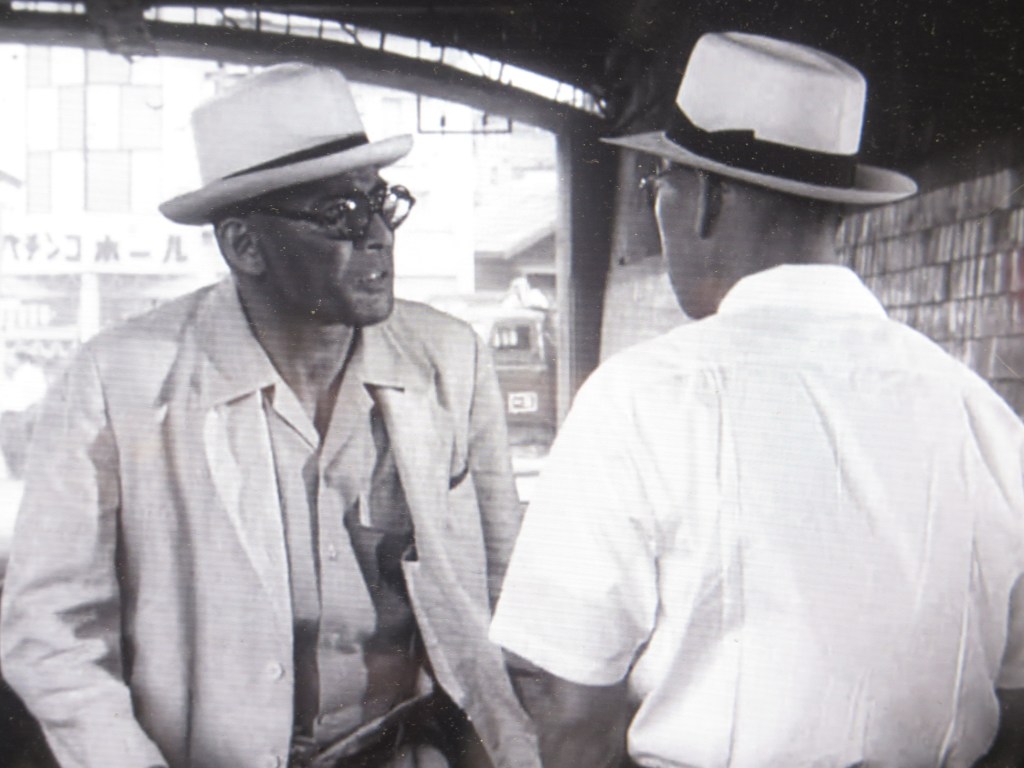
Unless you go to Japan, or Martin Scorsese and film restoration foundations secure and restore them, you will not be able to see these rare rediscoveries in the Kurosawa/Mifune lexicon. Over the years these films have been given short shrift, occluded by the others that achieved legendary status because they were presented at the right time and place. Nevertheless, the rare ones must be examined and appreciated, not only for their subject matter, but for the earliest performances of Mifune and acute direction of Kurasawa, who also wrote the original screenplays that reveal another view of Japan after WWII. Looking closely, you will find that Mifune was always focused on inhabiting his characters, even before that was completely understood in the cinematic world globally as it is today.
After working in the Aviation Division in the Aerial photography unit during World War II, Mifune arrived at Toho Studios in 1947. He was searching for a photographer’s assistant job since he had worked in his father’s photography shop before the war. Young contract director Akira Kurosaws identified Mifune’s uniqueness and striking features. It takes talent to see the possibilities in others. Kurosawa’s talent lay in recognizing opportunity when Mifune came on the studio lot. Years later, Kurosaw admitted that without Mifune, he would have had no great films. Their artistic teamwork and collaboration produced a phenomenal raft of Japanese cinematic work that has landed on list after list of world cinema greats.
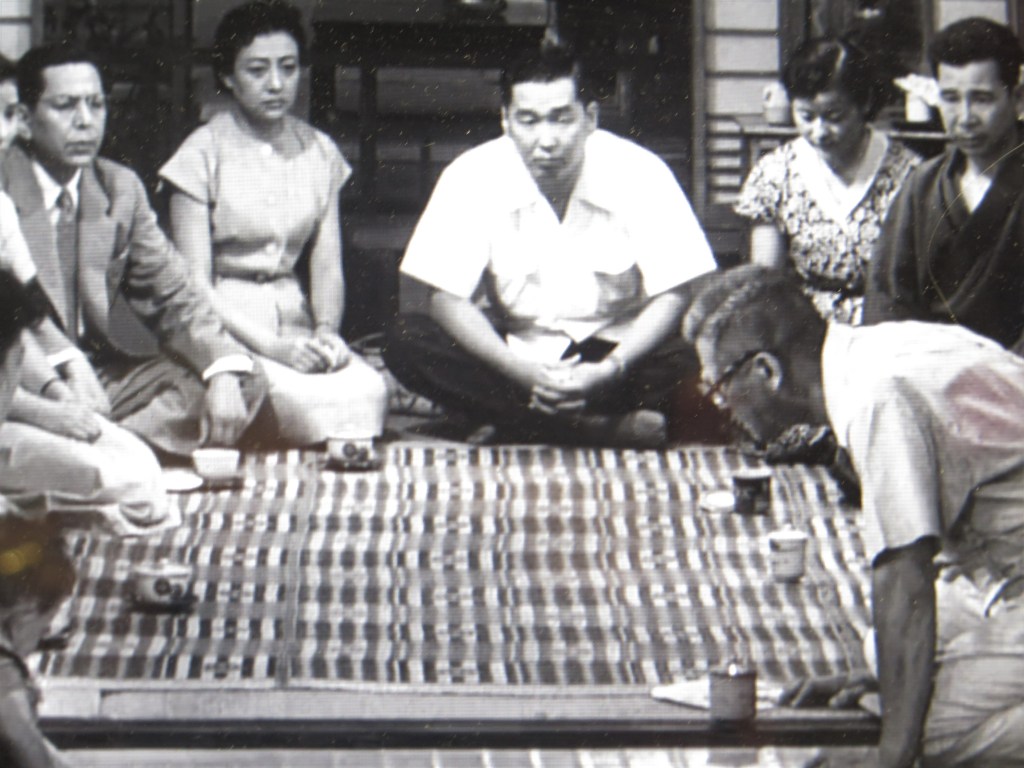
I Live in Fear (Record of a Living Being) Screening at Film Forum
Friday, February 11 at 12:40, 4:55, 9:10
Friday, February 18 at 12:30
Saturday, February 19 at 2:50
I Live in Fear (Record of a Living Being) is one Kurasawa’s and Mifune’s overlooked films. Mifune (35) in the challenging role of a 70-year old foundry owner is taken to court by his wife and family to determine his mental competence as patriarchal fiduciary in control of his sizable fortune and company operations. Alarmed by the the bombing of Hiroshima and Nagasaki, the radiation threats with 200 bomb tests in the Pacific Ocean and elsewhere, Kiichi Nakajima increasingly is obsessed with the safety of his family (even his mistresses and children) who he intends to move to Brazil, away from the trade winds blowing the clouds of radiation to Japan’s shores, and possibilities of future H-bomb explosions in their backyard. The family, especially the sons, refuse to leave, despite their father’s authority and leadership success. They assert their standing by obviating their father’s wishes and fears, rendering him a mentally infirm nullity. They insist upon the convenience of their fine lives at home in Japan, rather than to adjust to an uncertain environment without friends or familiar resources in Brazil.
The framework of the film is from the perspective of appointed Domestic Court Counselor Dr. Harada (the excellent Takashi Shimura) who takes time off from his dental practice to arbitrate the suit Nakajima’s wife takes up against her husband. The wife is in turmoil, torn between overthrowing Japanese cultural mores and obeying her sons, or standing with her husband against her children’s petition to take fiduciary authority. Nakajima, indulging his obsession about radiation, has been damaged by the devastation of the bombs dropped in Japan and even reveals PTSD (a prescient observation by Kurosawa) by recoiling to flashes of lightning during a thunder storm. His family uses his fears to justify the declaration of incompetence and senility. In a thoughtful, meditative performance by Takashi Shimura, the dentist considers all sides and acknowledges that all Japanese fear the bomb and radiation for good reason. Nakajima’s panic and obsession is more rational than his grasping family would credit him for.
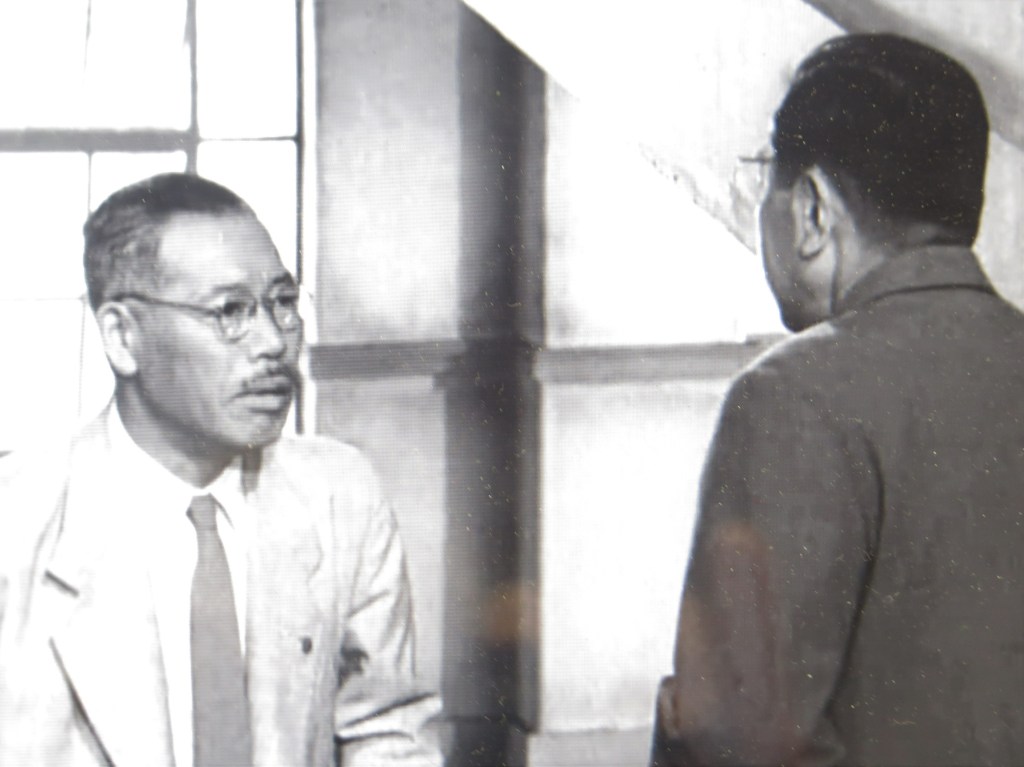
Kurosawa draws the conundrums and human struggle with empathy and richness, revealing that all players have their own agendas, though there is logic and reason for their manipulations. Nevertheless, the father, who indulges his fears goes a step too far; he effects an event, that in his mind will hasten along the move to Brazil, but works the opposite result. Kurosawa reveals the overarching irony that the fear of destruction, too, is a kind of destruction that harms its fearful creator/perpetrator. This is a Shakespearean trope and the film, if seen through the lens of Dr. Harada, truly rises to mythic levels. Consider Japan as the test case, the bombing ground zero of a Christian Church; it is the sacrificial lamb to reveal the results of nuclear disaster in 1945 and possibly forever. This is especially so since weapons of mass destruction have yet to be eliminated so they do no harm anywhere on this planet. We just don’t think about it, nor does Nakajima’s family. Ironically, as a symbolic “crazy” Everyman, that is all that Nakajima thinks about.
Mifune’s performance is authentic and tragic as the shuffling patriarch whose vision is repudiated and vacated because it requires the sacrifice of the familiar and comfortable. That they cannot achieve a compromise, that the family appear to be grasping and cruel is one vital element of this most noxious of all family struggles about who controls the inheritance. And pitted against the sons’ selfish avarice is Nakajima’s obsessive, insistence that the radiation and the dropping of another H Bomb and nuclear proliferation will annihilate them unless they mitigate against it by moving away (South America has yet to establish nuclear facilities, so Kurasawa reveals his character’s judgment wasn’t unsound.)

Kurosawa once again presents the untenable and impossible situation where there are no winners, no heroes, only fools and philosophers, who watch the deaf, dumb and blind act like chaotic rats in a cage. Interestingly, this is not history back in the Samuri days. But the Japanese in homely family terms are mundane 20th century Samuri, fighting threats beyond their control, that the governmental leaders themselves have allowed to proliferate to dangerous global levels, caught in power games, knowing full well what a nuclear disaster means. That is the theme and subject matter conveyed by the extraordinary performance of Mifune, who becomes the symbol for human awareness under oppression, considered demented and feeble, though he is the lone, ignored voice in the midst of his family’s oblivion. Either he is a fool or he is acutely sentient, despite the hopeless situation he faces alone to confront the danger for life on this planet with the only rational action being to flee.
Avoiding/protesting against this proliferation of imminent destruction (certainly the effects of radiation in the cancer rates) deemed an insanity or an obsession of the incompetent, is monstrous. Yet, Kurosawa through his actors’ performances, and the way he presents Nakajima’s terror of a fact that the Japanese lived and suffered with is made more real as his family discounts it and him as nuts. The conundrum of either attempting to confront apocalyptic destruction or pretending it doesn’t exist and living one’s life without reflection, becomes more than a philosophical question in this brilliant, layered film which can be appreciated at its most human levels. At once it is about a family taking the reins of authority and control of the money, somewhat heartlessly because they have a great reason to. On the other hand, their justification for their greed is as senseless and heartless as one of the son’s explanations that we all have to die sometime; don’t sweat the bomb and the radiation that is killing you slowly. Don’t sweat the possibility of a few more Chernobyls or Three Mile Islands? Indeed.

The ending of the film is certainly a gem. This is a spoiler alert. Against his better judgment, Dr. Harada declares Nakajima febrile and demented. After Nakajima admits to criminal measures, after he has been ignored, lost his money, power, authority, family, he still clings to the idea that Japan (indeed symbolizing the planet) is in danger of annihilation. He is placed in an institution where his daughter says that finally he will be safe. She localizes danger only to her father’s mind. In her kind words, she epitomizes the extent of the family’s blindness and deafness.
Of course, Nakajima is not safe anywhere. And he is more tormented than ever. As he looks out the window at the sun, he proclaims that the earth is burning: the effects of a bomb drop or radiation. Or as Kurosawa leaves it up to the viewer, maybe the guy is just uber confused. In the final symbolic shot, the screen perfectly split by a stairway in the asylum, Nakajima’s daughter with a baby on her back walks up and Dr. Harada moves down the stairs. The profound Dr. Harada stops in thought. And, attempting to divine his thoughts, perhaps we remember one of the psychologist’s statements about Mifune’s poignant, desperate Nakajima: “Is he crazy or are those who are unperturbed in an insane world the crazy ones?” Then Harada continues and only the sound of his steps echoes after him, leaving us with this metaphoric film that is even more current for today with the shot of the sun and Mifune’s cries of “burning,” referring to radiation proliferation, nuclear warfare and more trenchant global warming which Kurosawa couldn’t have foreseen unless he was uncanny.
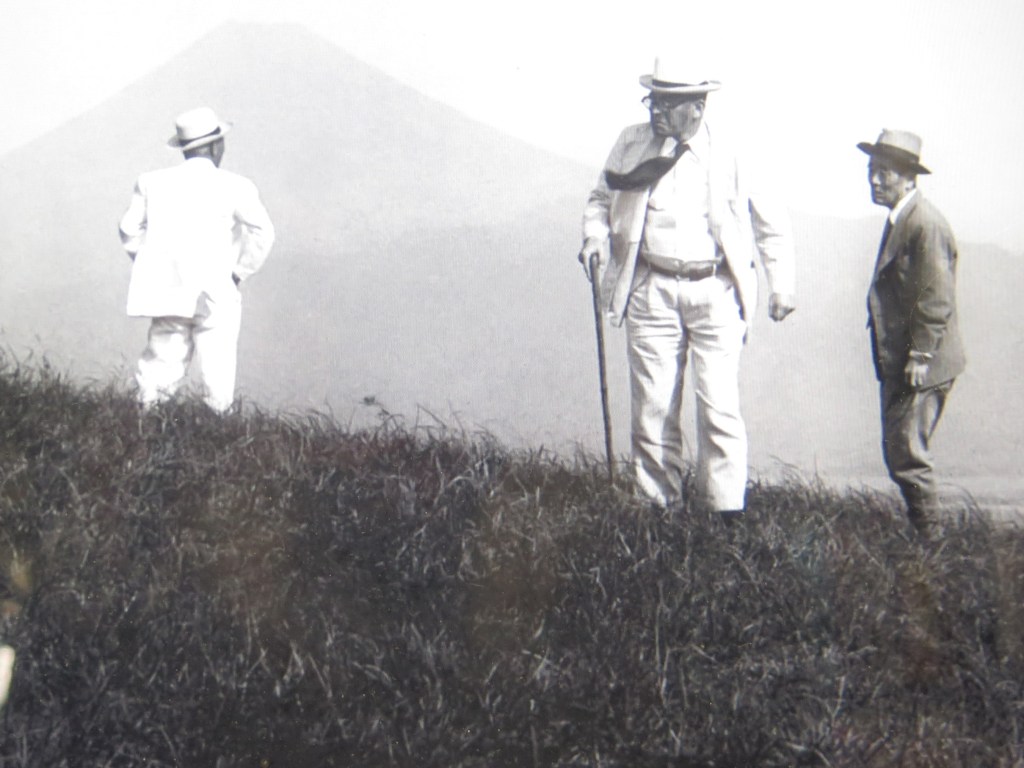
Kurosaw’s original works are his most personal and vital. His characterization of the foundry owner through casting Mifune is brilliant. Who better than a vital, energetic, powerful, younger actor to contain that vibrance and compact it into the habitation of a much older body. And then to create the dynamism of the elite Nakajima who has lived a full privileged life, only to see its possibilities smashed by a terrifying uncontrollable chain reaction of explosions with the power to disintegrate all life? Mifune delivers the intensity of that understanding in his manifested physical panic and especially in the last statements he makes about burning.
In Record of a Living Being (I live in Fear) Mifune and Kurosawa have outdone themselves, not with flashy action, but with understatement and symbol. Kurosaw boldly affirms nothing can keep us safe, not the government, not the institutions that once conveyed us from birth to death. They can’t when science and industry (or digital technology) have taken us on a trajectory that is little understood until it is too late, and then, the effects are ignored. For tickets to see this must-see film, go to: https://filmforum.org/series/toshiro-mifune
Mifune Festival at Film Forum Part II

Film Forum’s Mifune Festival originally titled MIFUNE 100 is running at Film Forum from February 11 through 30 of March. The four week long commemoration of genius Japanese actor Toshirō Mifune’s centennial year in 2020 (he was born on April 1, 1920) was delayed because of the Pandemic. With the infection rate subsiding and as attendance at the festival will require vaccination and masking, the decision was made to open the retrospective on the legendary actor this year. Importantly, for film buffs, the Mifune Festival includes rarities and rediscoveries in 35mm imported from the libraries of The Japan Foundation and The National Film Archive of Japan. It has been programmed by Bruce Goldstein, Film Forum’s Director of Repertory Programming, and Japanese film scholar Michael Jeck.
The 33 films being screened, many of which feature Mifune’s seminal collaboration with director Akira Kurosawa are masterpieces which continue to influence global filmmakers to this day. The commentary in Part II gives a brief review of Mifune and Kurosawa’s collaborations on two films Kurosawa made in 1950, one of which catapulted Kurosawa and Mifune to global stardom and a premier place in global film history. To purchase tickets go to Film Forum’s website: https://filmforum.org/series/toshiro-mifune. For my previous discussions on Mifune’s first films collaborating with Kurosawa (Snow Trail, Drunken Angel and Stray Dog) go to my website: https://caroleditosti.com/2022/02/09/mifune-festival-at-film-forum-february-11-march-30/
Part II

Scandal (1950) Film Forum Screenings
Sunday, February 13 at 12:40
Monday, February 14 at 3:00
In this 35mm courtesy of the Japan Foundation, Kurosawa presents successful painter motorcyclist Ichirô Aoye (Toshirō Mifune) and attractive singer Miyako Saijo (Shirley Yamaguchi) who meet at a mountain resort with no interest in each other except as casual acquaintances because they principally concerned in furthering their careers. Predatory scandal monger photographers read into their innocent conversation, take photos and show them to their editors and owner of Amour Magazine who, in tabloid fashion right out of Enquirer and Rupert Murdock’s fake entertainment fabrication machine, align the painter and singer as lovers. It’s fabulous profit making copy! Who cares if the story is accurate or not. By the time they may have to retract, they will have boosted their readership and followership and made more money than if they suggested there was nothing untoward between the two. Unlike most celebrities at the time and even today, who ride on the crest of the publicity without taking action, when Aoye sees his photograph and Saijo’s plastered on walls, billboards and “newspapers” as well as the cover of Amour Magazine, he decides to sue for libel.
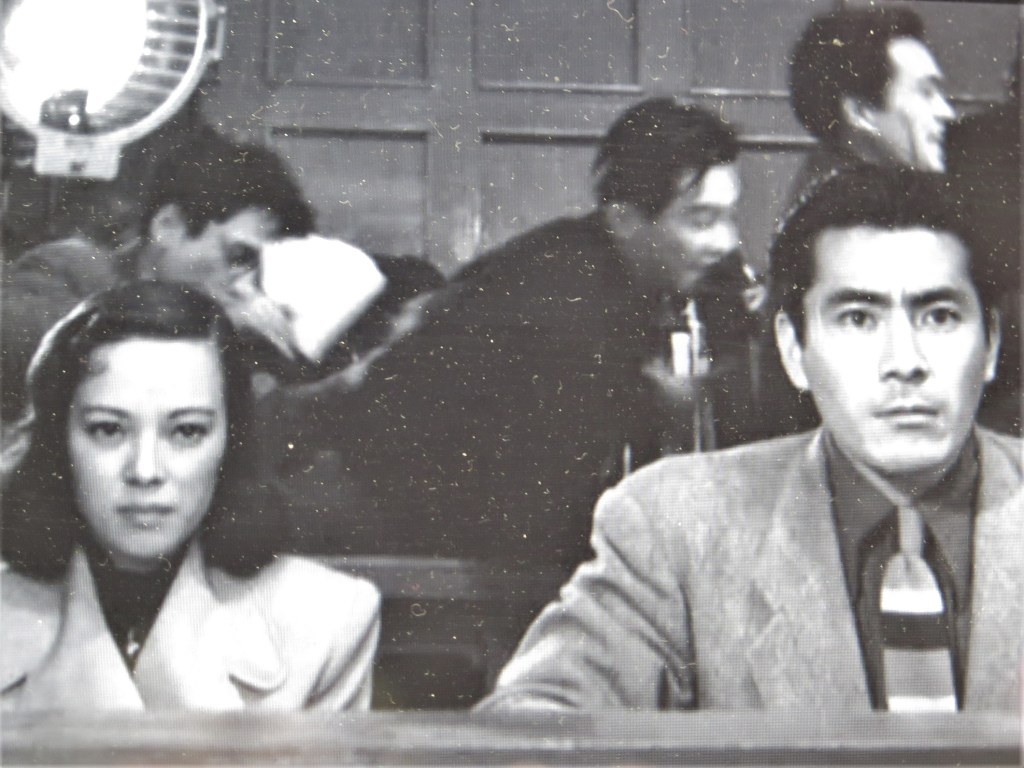
Enter Otokichi Hiruta (Takashi Shimura) a craven attorney with a weak character and affinity for alcohol and gambling. Hiruta convinces Aoye that he will do a great job with the case and hold Amour Magazine’s editors and owner accountable. When Aoye checks out Hiruta’s decrepit office and sees the racing papers, he understands immediately who Hiruta is and recognizes his capabilities are subpar, recognizing his friend suggestion’s not to hire this dangerous man has merit. However, visiting Hiruta’s home, Aoye meets Hiruta’s wife and angelic daughter Masako (Yôko Katsuragiho). She has been trying to recover from Tuberculosis for years and is incapacitated in bed. Overcome with sympathy and a sense of duty to help the family where Hiruta obviously fails, Aoye allows Hiruta to take his case for the sake of Masako.

Corruption and predation breeds lies and bribes. Aoye, an artistic personality, yet a successful painter is not bluffed by Hiruta, yet he gives him the benefit of the doubt and says he has faith that Hiruta will do the “right thing.” Aoye cares more to encourage Masako, who tells him her father has a good heart but is a weak man and Aoye agrees with her as both hope his nature improves. However, after days in court Hiruta doesn’t even cross examine witnesses properly. However, Hiruta’s weakness is so acute as it is beyond the pale even for Masako who can no longer abide by what she knows to be of her father’s character and unethical behavior in tanking Aoye’s and Saijo’s libel suit.

The tension and frustration we feel is palpable, even horrific, for it is apparent that Hiruta will not change his demeanor in prostituting himself to Amour Magazine despite stabbing his client in the face in betrayal. Meanwhile, Amour Magazine’s owners and editors appear to be sanctified and just. We groan that this is one more instance where the corrupt smash down the ethical and righteous, that evil, slime humanity colludes and conspires to overthrow what is ethical and right making this world a greater cesspool than it already is. This is Kurosawa at his finest thematically! The mendacity of the press that Kurosawa reveals in 1950 remains unchanged; to say this film is prescient is an understatement.

Kurasawa’s direction of the actors and capture of the close-ups of the empathetic, kind Mifune, humiliated but firmly corrupt Shimura and broken-hearted, angel Katsuragiho are genius. Indeed, the performances of the steadfast, quiet, likable Mifune’s Aoye and the wormy, egregious Shimura who grovels in guilt, but does nothing to correct himself, engage us throughout, heightened by the performance of Katsuragiho who is the innocent, sacrificial lamb. Thus, the film’s tragic turning point which reveals Kurosawa’s felt, profound knowledge of human nature, salvation, redemption and damnation carries us through to the end and especially the suspenseful last fifteen minutes of the film which becomes a reckoning. Thematically, Kurosawa’s work undergirded by his great actors is timeless and especially vital for us today.
Rashomon (1950) Film Form screenings
Friday, February 11 at 2:55, 7:10
Wednesday, February 15 at 5:35
Friday, March 4 at 3:50
Saturday, March 5 at 12:40
Wednesday, March 9 at 6:00
Thursday, March 10 at 12:40, 5:10
Perhaps one of the most memorable of all examples of cinematic story telling is Akira Kurosawa’s Rashomon, based on Ryunosuke Akutagawa’s short story “In a Grove,” which includes other elements of Akutagawa’s other short story, Rashōmon.” Kurosawa who based his screenplay on Akutagawa’s work twits our comprehension of individual perception and perspective and even twits the film medium itself as an alternate way of understanding our lives in story form.

Five stories are told in Kurosawa’s film, including the philosophical frame of universal focus that contains the other stories within it. The frame setting is a broken-down Shinto Temple, evidence of a faith diminished and destroyed by the encroaching inviolate social constructs and corrupted values in the Heian period Koyoto (794-1185). A Woodcutter (the always wonderful Takishi Shimura) and a priest (Minoru Chiaki) appear shell shocked and stunned as they wait under cover of the temple (symbolic irony) for a furious thunderstorm to pass.

A commoner (Kichijirô Ueda) joins them to get out of the rain and the Woodcutter and priest relate the story of the testimony they’ve just heard at a trial of a Samuri’s murder. The irony is that the priest and the Woodcutter are less disturbed by the killing and rape than by the accounts of the bandit, the raped wife of the murdered Samuri and the psychic who allows the Samuri to speak through her to relate what “really” happened in the grove where a life was taken. Then Kurosawa in flashback allows the three who were involved in the murder to confess their story of what happened.
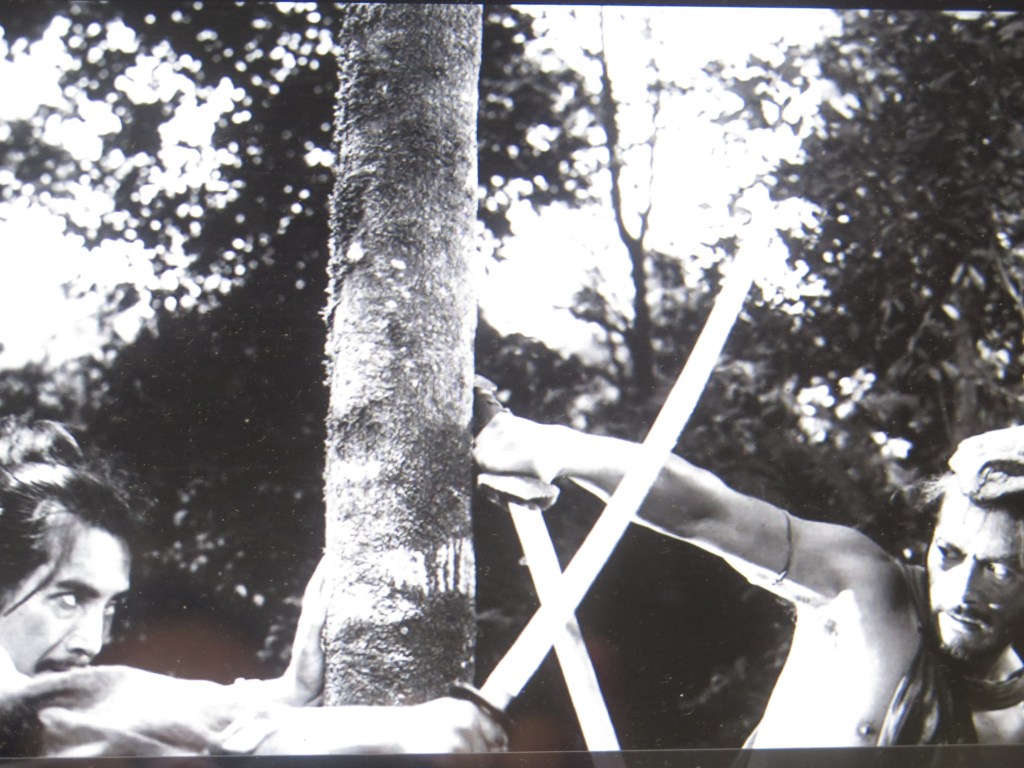
As each of the witnesses relate their stories, they cast themselves as the heroes of their own myths reflecting the finest aspects of the identity they wish to present, coupled with the codes and values they hope to emphasize, thus manifest to persuade the judges and all present they are the truth teller. Thus, told from the perspective and identity of the bandit, the wife, and the dead Samuri’s spirit, the stories wildly diverge. The only thing agreed upon is that there was a rape and the Samuri was killed. However, whether the wife yielded to the bandit is a matter of question and how the Samuri was killed, whether it was in an unconscious rage by the wife, noble harikari by the Samuri or a valiant combat between the Samuri and the bandit is up for grabs. Not even Solomon the Judge of Israel, the most wise judge of all time could rule in this case where the truth is amorphous and vague and either everyone is lying or one individual is telling the truth.

Considering that someone is going to be punished for the death of the Samuri, no one is pointing the finger at the others for causing the Samuri’s death. This is what perplexes the Woodcutter and the priest. Meanwhile, the practical commoner doesn’t quite understand how clever each of the story tellers are and calls them liars. He misses the conundrum posed. For the three players in this triumvirate of truth-telling take responsibility for killing the Samuri upon themselves. Whether this is a ruse to escape punishment, a conspiracy of silence or an example of the nihilistic ego which places nobility and honor of identity ahead of safety and security from capital punishment is equally opaque. Ironically, what is also disturbing to the priest and Woodcutter who can only exclaim that what they witnessed was terrible is that the truth and accuracy are not considered a worthy value. Rather each of the individual’s beings are paramount. And the truth of what happened has little to do with the bandit, wife and Samuri who are caught up in their own sentience which may not represent factual reality, if there is such a thing.
Finally, the Woodcutter tells his version of the story which proves that the three were lying. In his version their proud identities are shattered and the wife, murdered Samuri and bandit are reduced to the pathetic, pitiable human creatures they are. Interrupting the Woodcutter, a baby’s cries prompt the commoner to steal the items left with the baby and ditch the baby with the priest. We are ba ck to the present and the frame of universal humanity.

The Woodcutter chides the commoner for theft who then turns around and accuses the Woodcutter of stealing the pearl handled dagger that was lost in the chaos, stating that all men are liars and thieves motivated by their own personal agendas. With that exclamation point of the truth about humanity, the commoner leaves, self-satisfied he knows it all and doesn’t need to hear any of the priest’s sermons. Desolate, the priest is ready to renounce his faith and purpose, but the Woodcutter tells him he’ll take the baby and care for it. The priest believes he will harm the baby until the Woodcutter says he has six children at home. What is one more? Faith is restored, the rain stops, the sun comes out, but there are still clouds in the sky, typical Kursawa’s philosophical take on what will come.
Kurosawa’s direction of the three players as the killer of the Samuri is powerful and to that their performances are sustained throughout. MIfune glares into the camera and shrieks out the story as the bandit Tajōmaru. He gleefully and wildly laughs taking pride in the murder, full of happiness that the wife (Machiko Kyō) gives herself to him on their first kiss. As he shakes and terrorizes he is brilliant and we understand how a woman might be mesmerized by his famous reputation as Tajōmaru the fierce bandit, attracted and repelled, but softened when he employs his powers of seduction. Mifune’s performance rises to the myth of Tajōmaru and electrifies as Kurasawa makes use of the straight-on camera shot of Mifune cross-legged, then close-ups of him flashing eyes and teeth to horrify and delight. No wonder this sterling performance captivated audiences globally then and now.
Likewise, as the wife Machiko Kyō is convincing and equally terrifying in her incessant weeping and wailing conveying the great harm the violation has done to her soul. Additionally, the husband’s cruelty after her rape is even more damaging emotionally for he blames her with his eyes and spurns her as the rotten goods that he will never touch again. The adaption of Boléro by Maurice Ravel by Fumio Hayasaka is as relentless as her emotional devastation and hysteria, signifying her loss of self, world of beauty, sanctity and safety. Interestingly, Kurasawa interchanges the cinematography varying it from that used with the bandit, implying the helplessness, the softness and the tragedy of the wife.
As the Woodcutter and the psychic who is wonderful relate “what happens” again Kurosawa changes up the shots and varies to close-ups except with the Samuri whom he mostly has in medium shots. However, with the psychic who is inhabited by the dead Samuri’s spirit, he uses close-up to maximum terrifying advantage.
Rashomon put Kurosawa, Mifune and the others on the global map of cinema for all time. It continually makes film lists of cinema greats. At the time it won The Golden Lion at the Venice Film Festival and an equivalent Academy Award for Best Foreign Language Film. Don’t miss Rashomon or the other films at Mifune Film Forum Festival. For tickets and times go to the Film Forum website: https://filmforum.org/series/toshiro-mifune
‘Mifune Festival’ at Film Forum February 11-March 30

Part I
Mifune, a four-week festival of 33 films is celebrating the legendary Japanese actor Toshirō Mifune at Film Forum from February 11 through March 30. Co-presented by the Japan Foundation, the series features 16 of Mifune’s collaborations with iconic director Akira Kurosawa in what has been identified as one of the most seminal actor-director partnerships in film history. The duo produced some of the greatest masterpieces of world cinema. And Kurosawa’s films continually serve as an imprimatur for global directors mesmerized by Kurosawa’s cinematic storytelling. Indeed, Kurosawa once admitted that without Mifune, he would have no great films.
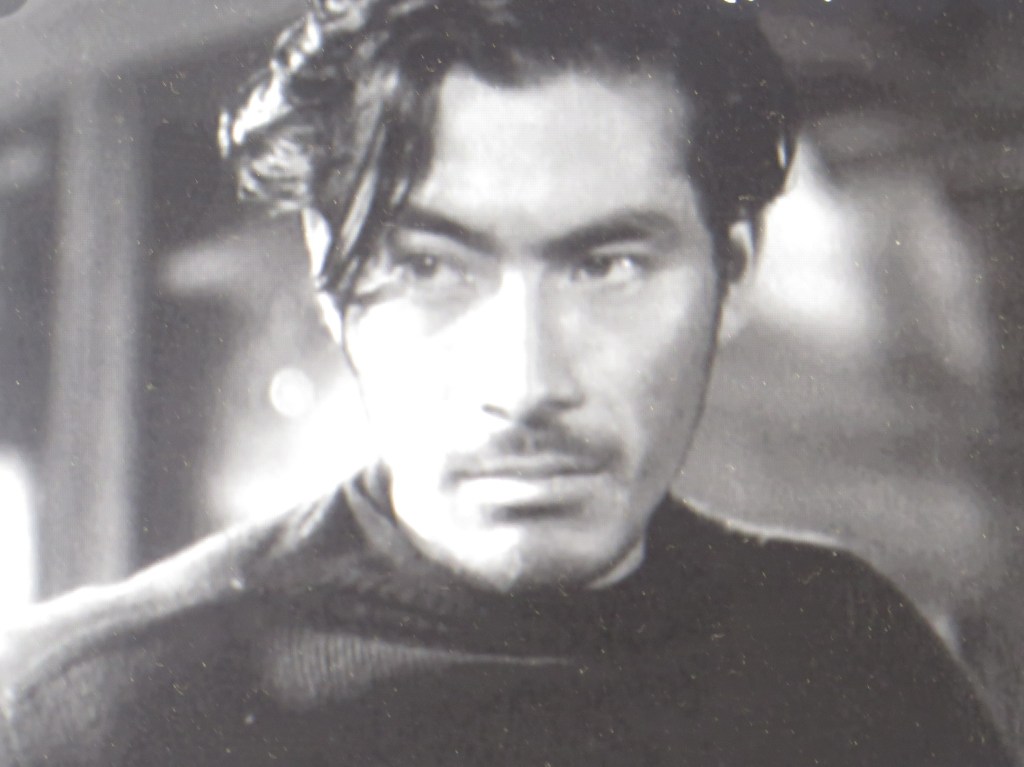
Postponed due to the COVID-19 pandemic, the festival, originally titled MIFUNE 100, planned to commemorate Mifune’s centennial year in 2020; the actor was born on April 1, 1920. After two years, the decision was made to open the retrospective on the legendary actor. Film Forum Mifune Festival includes rarities and rediscoveries in 35mm imported from the libraries of The Japan Foundation and The National Film Archive of Japan. It has been programmed by Bruce Goldstein, Film Forum’s Director of Repertory Programming, and Japanese film scholar Michael Jeck.
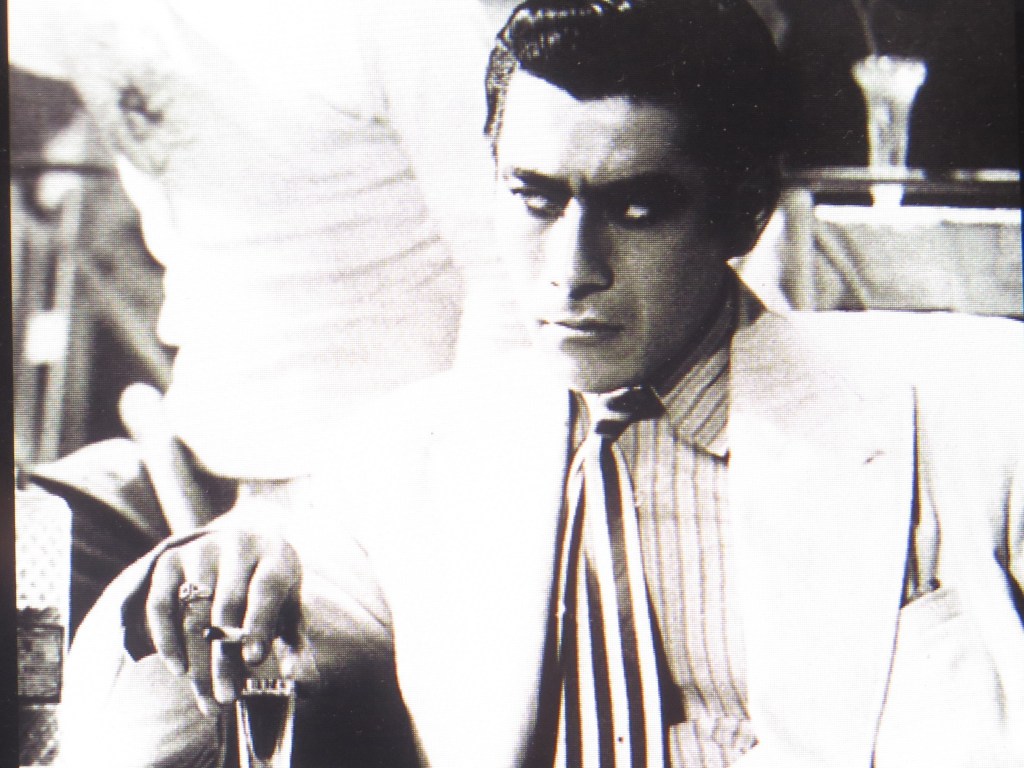
This first in the series of articles gives an overview of select Kurasawa films that featured a young Mifune with another seminal actor Takashi Shimura, who often plays the foil to Mifune’s gruff, crude, deep-voiced characterizations. Highlights include a brief synopsis of each film and some points about the cinematography, scenic design and acting. The discussion moves in the film chronology from 1947-1949, beginning with Snow Trail (1947) Drunken Angel (1948) and Stray Dog (1949). In Part II you will find coverage for subsequent Mifune films including Rashomon (1950) which catapulted Mifune and Kurasawa to worldwide acclaim and awards and opened doors to further celebrity, dramatic risk and intriguing opportunities that historically shaped the cinematic art for decades. Film Forum Website for the MIFUNE FESTIVAL https://filmforum.org/series/toshiro-mifune
SNOW TRAIL (1947) At Film Forum: Tuesday, February 15 at 12:40, 6:00
Kurasawa casts Takashi Shimura (Nojiro) and Toshirō Mifune (Eijima) as escaped bank robbers, who with a third older accomplice retreat to the snow covered mountains to hide, though their impossible journey is besieged by one trial after another. Kurasawa configures the robbers with unique personalities and then pulls a switch when they confront the hellish conditions of traversing in six foot snow drifts along sheer mountain cliffs, and their older accomplice falls to his death taking his portion of stolen money with him. This is a wake up call for both Nojiro and Eijima and an important turning point where we empathize with these individuals as they realize the hopelessness of their situation from which they most probably will not get out alive.
All seems lost as the actors struggle against the mountain’s death grip. Kurasawa’s perfectly balanced scenic design and cinematic shots of the dominance of the mountain terrain, the deep snows, isolation and the freezing temperatures threaten their every step. As neophytes against nature’s cold, blasting fury, we see in their faces their yearning for life and sadness that it is over for them. Shimura especially gains our sympathy, but then a miracle occurs. They stumble upon a lifeline, a ski trail which eventually leads them to a resort where its hosts, a grandfather and his young granddaughter, entertain ski expert Honda (Akitake Kôno). It is there in this warm, congenial company where the fibers of the robbers’ characters are revealed and we note Kurasawa’s philosophical perspective teased in through the dialogue and emotional fear and pain of Mifune’s Eijima and Nojiro’s growing grace.
As Nojiro pulls away from Eijima, appreciating the sweetness of the little granddaughter, who reminds him of the daughter he lost, Eijima becomes more crude, violent and angry with him, attempting to dislocate his accomplice from their kindness. After all, Nojiro, masterminded the robbery, but from his icky sentimentality at the granddaughter, Eijima fears Nojiro lost his resolve to escape. It is in these scenes where we see the menace, bluster and extraordinary vitality of Mifune’s acting dynamism. How their characterizations diverge toward inner redemption and damnation as they attempt to scale the mountains after blackmailing Honda to guide them generates suspense, tension and danger. These elements heighten as Honda saves their lives repeatedly but must close down when he breaks his arm and is shot in the leg.
Mifune and Shimura are the perfect duo. Their technique and Kurasawa’s close-ups and medium shots provide the light and the dark, the hope and the desolation that propel the characters’ emotional turmoil up the mountain of fate in this survival story of good and evil that is layered, intricate and metaphysical. Against the mountain, their doom, with Kôno’s Honda bestowing the rope lifeline, symbolic of the code of community and friendship (the mountaineers code) it is up to each of them to work cooperatively to save each other from destruction. This is the lesson of redemption and hope that only one of the robbers learns and with that knowledge, gains the strength to be accountable for his actions.
Drunken Angel (1948)
At Film Forum: Saturday, February 19 at 12:40
Sunday, February 27 at 6:00
Monday, February 28 at 12:40
Tuesday, March 1 at 8:20
Wednesday, March 2 at 5:50
Thursday, March 10 at 2:45
Drunken Angel is Kurosawa’s examination of the soul’s demise to self-destruction. For this journey Kurosawa casts Takashi Shimura as the alcoholic Dr. Sanada and Mifune as Matsunaga a member of a Yakuza gang who controls the area but is evicted from his power when the boss exploits him then puts another in power until Matsunaga self-destructs. Dr. Sanada’s office is by a pond of chemicals and slime which Kurosawa sneaks in as symbolic of the entire community as the cesspool of humanity. The pond water which makes others sick, is likened to the values that make humanity sick: greed, exploitation and selfishness.
Interestingly, Sanada whose character weakness makes him a drunkard, has a kind heart and attempts to make a difference with these individuals who are worse off than he. As his patient, Matsunaga who has tuberculosis doesn’t follow his instructions, though if he did, he would be able to survive, maybe thrive. Sanada has a young female patient who he is helping to heal. However, Matsunaga lacks the will to help himself, regardless of how much Dr. Sanada badgers him not to drink and take care of himself. Clearly, Dr. Sanada puts up with Matsunaga’s manner, invests himself in the gangster attempting to help though the people who surround Matsunaga don’t care if he lives or dies and contribute to making him sicker.
Once again, Mifune’s performance as the soul destroyed gangster who Dr. Sanada sees as worthy to be helped is masterfully, carefully revealed, especially in his revelation that Matsunaga doesn’t have the energy or will to follow Sanada’s instructions, and allows himself a slow suicide. Theirs is an amazing duel of emotions: impatience, helplessness and withering bravado, frustration and love. The symbolism revealed in the scenic design of the various environments and the shot compositions of the dance hall, Dr. Sanada’s tight office, the close-ups of the emotional weariness of Mifune’s Matsunaga and the frustration and anger of Shumira’s doctor is superb. Despite the soul filth of the criminals who oppress, theirs is a relationship that appears noble. Sanada’ concern for Matsunaga leads us to feel empathy that he is dying, caught in his own sorrowful web of sickness and destruction that he let into his spirit when he gravitated toward the criminals in the hope of being “someone” others might respect. It is Matsunaga’s tragedy and the tragedy of all the self-annihilating criminal class, the theme of this superb film.
Stray Dog (1949)
Monday, February 14 at 8:10
Friday, February 18 at 2:40
Sunday, February 20 at 12:40
Thursday, February 24 at 5:50
Wednesday, March 9 at 8:10
Stray Dog is Japan’s first film noir crime procedural influenced by Jules Dassin’s script of The Naked City with Kurosawa’s signature philosophical commentary on the nature of the human soul in its travails through post-war Tokyo and beyond. Kurosawa sets the action in some of the most rubble-strewn sections of Tokyo in a clothes drenching heat wave before air conditioning cooled and refreshed. In every scene the pressure and struggle is evident in the scenic design and cinematography of the gritty, torn up city where vets, finding little work, join the Yakuza (gangster network).
Every character, every actor especially leads Takashi Shimura as Detective Satō, and Toshirō Mifune in an uncharacteristic but athletic portrayal as Detective Murakami, Kurosawa features with close-ups, dripping perspiration tear-drops down noses, chins and foreheads. White suits, dresses and hats show huge swaths of white cloth darkened with dingy, messy, wet stains. The heat Kurosawa uses as a character. And as a symbol, it represents the pressure and tension that Murakami (Mifune) puts himself under, obsessed with guilt that he isn’t up to the task of being a competent detective.
The driving incident occurs when neophyte Murakami, white suited and new to the job, has his Colt-45 pick pocketed while jostling against other sweltering passengers on a crowded streetcar. Realizing who stole it, Murakami charges after the thief on foot but eventually loses him. Thus, set in motion is the race against time to locate the stolen weapon. Murakami, who is shy and quiet with other detectives in the department, is ready to resign when he realizes that the gun was used to commit murder. His upright, honest and sincere attitude (fascinating to see Mifune’s humble versatility in comparison to previous criminal roles) is appreciated by the department head who assigns him to work with seasoned detective Satō (Shimura).
Together as a disparate but cooperative and congenial team they piece together the clues to those who can be traced through to the girlfriend (in an ironic, dramatic scene with her mother) of Yusa who commits two murders with the Colt-45. Look for the famous nearly 10-minute sequence shot by hidden camera in the city’s toughest black market as Mifune’s Murakami goes undercover to buy a gun on the black market and reveals the palpable anxiety and frustration at coming up against dead end after dead end. The taut thriller emotionally magnifies for Mifune’s Murakami, when Satō is almost fatally injured. Mifune is so authentic as he goes to pieces believing his gun killed his mentor and friend. Also, catch the superb dialogue at the conclusion when Satō encourages Murakami not to feel badly for Yusa. Shimura’s comment is eloquent, philosophical and pointed and Mifune’s response is memorable.
The schedule of films beginning the series on Friday, February 11th is as follows or go to the Film Forum website: https://filmforum.org/series/toshiro-mifune
RASHOMON (1950)
Friday, February 11 at 2:55, 7:10
Wednesday, February 15 at 5:35
Friday, March 4 at 3:50
Saturday, March 5 at 12:40
Wednesday, March 9 at 6:00
Thursday, March 10 at 12:40, 5:10
I LIVE IN FEAR (1955)
Friday, February 11 at 12:40, 4:55, 9:10
Friday, February 18 at 12:30
Saturday, February 19 at 2:50
 CAROLE DI TOSTI