Author Archives: caroleditosti
‘Wives’ by Jaclyn Backhaus, Spouses Emerging From the Male Institutions of Future Past

(L to R): Aadya Bedi,Sathya Sridharan,Purva Bedi ‘Wives’ by Jaclyn Backhaus,directed by Margot Bordelon (Joan Marcus)
Wives written by Jaclyn Backhaus directed by Margot Bordelon is a playful, farcical, quasi-philosophical comedy about women freeing themselves from the definitions and oppressions men have “gently” bestowed on them. Considering that most women outlive their spouses today, if women live long after their husbands have died, shouldn’t they be able to redefine their lives into a new evolution? Wives in attempting to grapple with this question features four segments with different settings to reveal how the women, some celebrated, some unknown, confronted their freedom after the dominant male in their lives lost power or expired.
Backhaus’ plays is a series of self-contained vignettes that require the audience to understand a bit about each setting as it twits the character wives and their husbands or in the case of India (third vignette) colonial institutions. The first wife is the amazing, vilified, powerful and ingenious Catherine de’ Medici (Purva Bedi portrays the wealthy Italian noblewoman) whom her relative Pope Clement VII, labeled her marriage to French Duke of Orléans as the “greatest match in the world,” taking credit for the arrangement. When her husband became King Henri (Sathya Sridharan) she was vaulted her into the position of Queen of France. But she rarely saw Henri who favored his mistress Diane de Poiters (Aadya Bedi). Only after ten years when her life as Queen depended on producing an heir, did Cathy begin to have sex with Henri to produce ten children, seven of whom lived to adulthood with her.

(L to R): Purva Bedi, Aadya Bedi ‘Wives’ by Jaclyn Backhaus,directed by Margot Bordelon (Joan Marcus)
Backhaus emphasizes Catherine’s spurning by Henri for Diane with hyperbolic humor. In real life, de Poiters had a lot of influence in the court, most probably because she was twenty years older and more experienced in court politics and intrigue than both Henry and Catherine who were the same age. In the farcical nature of this segment King Henri, Queen Cathy and Diane are hyper-modernized, two-dimensional caricatures to prove the point that women, subject to their husband’s whims, must swallow their subdued portion and be oppressed by them as Cathy was by Henri and Diane. The scene between Cathy and Diane where they scream ghetto-speak epithets to each other is funny and references pointed conflict that women will empathize with. Also, Adina Verson’s cooking lesson in a flippant direct address with a tray of chickens and squishy onion or two provides great humor at the outset of the scene.
Because Backhaus doesn’t indicate why, we are left with the impression that Diane de Poitiers (Aadya Bedi) is perceived to be superior to Catherine (Purva Bedi) for the reason that she is either younger or more flirtatious. The reason is more complicated. Nevertheless, as we note the death of Henri after a jousting match injury and Cathy’s rejection of Diane’s presence from court and removal from Henri’s will, we are heartened by a wonderful twist. The two women end up as friends. Cathy’s reasoning is sound; the court expects them to be enemies, however, as Cathy assumes the power that Henri excluded her from, Diane will become very useful as she was for Henri.
Thus, Backhaus emphasizes that only after the dismissive male husband dies are the women able to assist each other. The theme of how men pit women against each other to dominate and oppress is clear as is the women’s glorious freedom to shine after their oppressors leave the planet for what was a man’s world becomes a woman’s world open to redefinition.

(L to R): Adina Verson, Aadya Bedi, Purva Bedi ‘Wives’ by Jaclyn Backhaus,directed by Margot Bordelon (Joan Marcus)
Each of the vignettes carries this theme of wives being freed coming out from the shadows of their marriage partners. In the second segment another male death occurs: Hemingway’s. Backhaus places us at his funeral with his two former wives and current wife attending as Big Ern (Sathya Sridharan) gives his own eulogy which he wrote and ends with, “I have nothing to say to my wives: Mary Hemingway, Martha Gellhorn and Hadley Richardson. And Pauline.” However, with the exception of Pauline, the mistress who died, the three played by Purva Bedi, Adina Verson and Aadya Bedi have much to say about Hemingway. And what begins with a discussion of themselves after their divorces ends with a humorous “hate fest” about Hemingway as they drink toasts to his death and share the truth with each other about their relationships with him.
To one extent or another each admits that they allowed him to co-opt their lives as he knocked them out from under themselves in his writings, while they helped him with his manuscripts, served him and took a back seat to his glory. With the admission “we can never write ourselves because he wrote our history for us,” each proclaims what they think Hemingway’s legacy is for them, infusing a description of themselves in the terse Hemingway style.

(L to R): Sathya Sridharan, Purva Bedi, Aadya Bedi, ‘Wives’ by Jaclyn Backhaus,directed by Margot Bordelon (Joan Marcus)
Of course the irony is that they are still under his shadow not being able to write or live their own legacy apart from him and his “glory.” Coming late to this realization, but encouraged by the others into understanding, Mary (his last wife) joins in with Hadley and Martha into agreeing that his writing was “shitty.” And in the apex of the vignette, the three women like the witches out of Macbeth together ignite an act of symbolic freedom releasing themselves from their identity of “nothingness” to move themselves out from under Hemingway’s oppressive machismo.
The third vignette takes place in 1921 India and begins from the perspective of a colonial (Mr. Patterson) appointed to guarantee the relationship of England with the Maharaja Madho Singh II by halting the influence of the witch Roop Rai who gives healing sessions to the Maharaja. When Patterson threatens violence to stop the healing sessions which he thinks are dangerous to the Maharaja’s life, Roop Rai places him under a powerful spell that humiliates and vanishes him. In the process the Roop Rai, the Maharaja and the Maharini pledge their unity to each other in resisting colonialism and affirm the future freedom of India that will redefine itself out from under its oppressive marriage to England. But the majesty of the moment is forgotten with the names of the individuals, especially Roop Rai whose genius contributed toward the freedom gained.

(L to R): AdinaVerson, Aadya Bedi ‘Wives’ by Jaclyn Backhaus,directed by Margot Bordelon (Joan Marcus)
Backhaus continues the theme of women’s witchery and power and carries it into the present time in the last vignette under supervision of a picture of Virginia Woolf, the classic, misunderstood feminist of her time. In the basement of a fictional university a witch (a member of a commune of witches on campus who have found a safe space to practice their craft) creates a spell. During the spell an acolyte is encouraged to remove the shackles of her forebears whose mores kept women in demeaned servitude as she untethers herself from “the visions made by men.”
Beginning with an incantation that the acolyte repeats as the witch stirs up the ritual toward freedom, “Everything about you is right,” becomes the rallying cry that gives her confidence to examine her ancestry and claim an evolved identity where she can be anything and everything. In this final segment the acolyte, like the other burgeoning feminists we have seen before her (Catherine, Mary, Martha, Hadley, Roop Rai) finds herself, then defines her own being in a poetic direct address to the audience. Purva Bedi Adina Verson and Aadya Bedi and Sathya Sridharan play the various parts.

(L to R): Sathya Sridharan,Purva Bedi, Aadya Bedi, Adina, ‘Wives’ by Jaclyn Backhaus,directed by Margot Bordelon (Joan Marcus)
Wives is a heady production revealing how women in various times discovered their power after the male presence whether paternalistic, macho, colonial or socially institutional is disappeared. Backhaus’ ideas cohere in the script but at times become disjointed in the transference to live stage performance. Some of the problem is in the line delivery; sometimes accents get in the way of intelligibility so that meaning and connections are lost.
The conclusion was beautifully rendered, however, and I couldn’t help but consider in the hope expressed was the great tragedy of the women who had gone before whose genius was repressed by institutional power (paternalistic, colonial, chauvinistic) because of fear. It is as if women, not being allowed or not allowing themselves to realize the fullness of their completion was a wasteful sin of the ages. Backhaus’ work is a great encouragement to the present and future generations of women in the hope that the past will not raise its ugly, deformed head to devour the present strides in women’s enlightenment and contributions of their greatness.
Kudos to the creative team: Reid Thompson (scenic design) Valérie Thérèse Bart (costume design) Amith Chandrashaker (lighting design) Kate Marvin (sound design and original music) J. Jared Janas (hair and wig design).
Wives runs at Playwrights Horizons (West 42nd St. between 9th and 10th) with no intermission until 6th October. For tickets and times CLICK HERE.
‘Derren Brown Secret,’ is a Stunner, a “Mind” Field, Raising Illusions to Unforgettable Art!
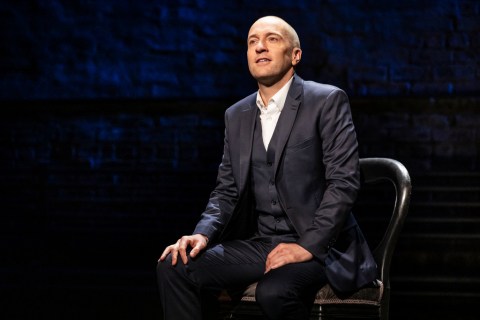
Derren Brown SECRET, written by Andy Nyman, Derren Brown & Andrew O’Connor, directed by Andrew O’Connor, Andy Nyman at the Cort Theatre (Matthew Murphy)
Derren Brown SECRET in its first time on Broadway at The Cort Theatre is nothing short of brilliant. Every illusion that Brown performs to perfection with scintillating charm and lightening smoothness, I have figured out! No! I haven’t. But I am still trying my damnedest two days after I saw Wednesday night’s show. And I am completely frustrated because the only way I will ever know is to ask Derren Brown or another magician to affirm whether my explanations might be correct. So, I’m at an impasse. However, I may know “the secrets” if I research/practice mesmerization, hypnosis and psychological manipulation or read about Brown’s iconic mind control exploits in the UK, which are each one of them harrowing “mind fucks” of entertainment that end up being great, harmless fun. Hmmm!
From convincing middle managers to commit armed robbery, to sticking viewers at home to their sofas, Brown may be one of the foremost masters of mind control in the world. Indeed, he makes President Donald Trump look like a crass sharpie. Thankfully, Brown is a mild-mannered English gentleman with a posh accent who paints and obviously enjoys what he does and will not run for the U.S. Presidency. If he ever does, the country would be in… Well, actually, perhaps he should run. Too bad there is a citizenship requirement. His honesty alone would be absolutely refreshing.

Derren Brown SECRET, written by Andy Nyman, Derren Brown & Andrew O’Connor, directed by Andrew O’Connor, Andy Nyman at the Cort Theatre (Matthew Murphy)
Seriously, Derren Brown is no joke. He is awe-inspiring. And this production will win awards because it is a lesson in human experience, crowd psychology, mind control, the power of suggestion and one’s inability to resist what is already in the unconscious, especially if one attempts to resist it. That is to say, the show is a lesson not only in illusion and mind manipulation and the mysterious, it is above all a lesson in audience participation and a revelation of you as an audience member in a dual role of watching yourself in all your unsubtle susceptibility and experiencing your psychological weaknesses.
It must also be a learning experience for Derren Brown. Indeed, he is always perfecting his artistry, honing his senses and his psychological talents. Whatever it takes to uplift his craft and ability to gauge the audience and manipulate them to a heightened interactive performance so that they stay in dynamic one accord, Brown appears to be pursuing this to the highest degree.
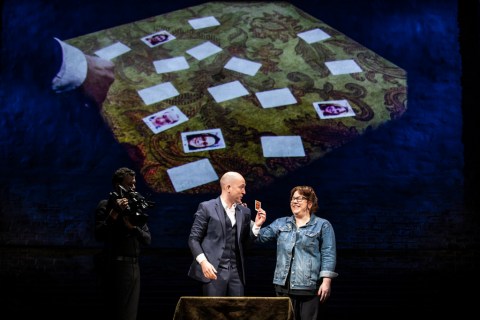
Derren Brown SECRET, written by Andy Nyman, Derren Brown & Andrew O’Connor, directed by Andrew O’Connor, Andy Nyman at the Cort Theatre (Matthew Murphy)
The audience’s “one accord” changes which makes each and every performance fabulous. Diverse audience members are a historical treasure of synchronicity and singularity. To bring audience members “there” who come with unusual lives and schedules and backstories is an impossibility made possible by their will and desire to be “there.” So to say that each night of Derren Brown SECRET is unique, is an understatement. An understatement of understatement. The audience’s and Brown’s particularity is what places this show at the pinnacle of live solo performance. Because of this exceptionalism Brown has deservedly won the Drama Desk in 2017 for his debut show, Secret. And he has won two Olivier Awards and five nominations. a record for one-person shows since the inception of the Olivier Awards.
Derren Brown SECRET showcases the illusory as high artistic execution. Brown begins the first act by reminding us that in our minds the world we live in is our own definition/explanation/fiction. Our perception is our choice, what suits us, probably learned or rejected or somewhat retained from our parents and/or the culture is ours and ours alone.

Derren Brown SECRET, written by Andy Nyman, Derren Brown & Andrew O’Connor, directed by Andrew O’Connor, Andy Nyman at the Cort Theatre (Matthew Murphy)
These moments of wisdom Brown employs throughout to gain our confidence and convince us that he is on our side. Of course his honesty and wisdom relaxes and blinds us to our own susceptibility to ourselves. It is a glorious misdirection, a mesmerization. Indeed, throughout the show, we will forget what we have just witnessed in plain sight and remember only unconsciously that which is inaccessible. The joke is on us and we laugh, yet are unsettled. Is this what is going on all day, every day, at work and at play? Oh, my God!
I watched carefully, so “out of the corner of my eye” in my peripheral vision I saw, what Brown told us would happen, then forgot I saw it. Yes, it did happen, but I missed it. Twice! Brown upends, distracts, and with verbal legerdemain disappears the visible, all the while warning us what to expect. His honesty is treacherous and exciting.
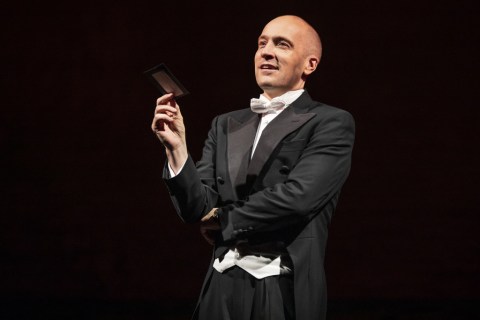
Derren Brown SECRET, written by Andy Nyman, Derren Brown & Andrew O’Connor, directed by Andrew O’Connor, Andy Nyman at the Cort Theatre (Matthew Murphy)
This is also a production in encouraging an audience member’s humility. Whenever I think that “I’ve arrived,” all I have to remember is a gorilla and a banana and Derren Brown to deflate my self-important arrogance. To understand what I mean, you must see the production. There is no spoiler alert.
Completely necessary for this show’s success is audience trust. Thus, to elicit audience participation to a maximum of effect, a good deal of this unparalleled production includes mentally massaging the audience which Brown does surreptitiously; he is a cypher with fragrant oils, gentle, quick hands. Meanwhile, this congeniality brings out audience interactions and responses which are authentic, humorous, genuine, unaffecting, human, all guided by Brown with adroit good will.
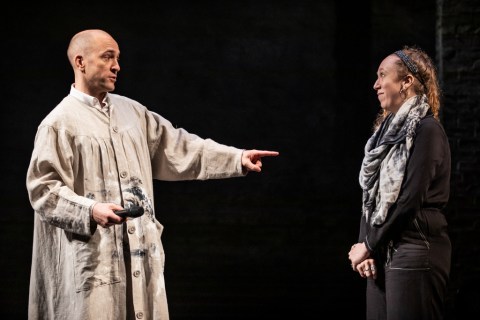
Derren Brown SECRET, written by Andy Nyman, Derren Brown & Andrew O’Connor, directed by Andrew O’Connor, Andy Nyman at the Cort Theatre (Matthew Murphy)
Audience interactivity and seeming spontaneity are rather “a character” along with Brown, whose persona is confident, wise, gently suggestive, witty, comfortable and youthfully avuncular. The audience responds by going onstage, as well as by thinking and sitting in their seats as they watch close-up projections of what is going on via the back wall. If you are in the audience, whether Brown chooses you to join a few others onstage for various illusions, or asks you to think of a celebrity, or asks you to think of a question for him, or write a question, or catch a “frisbee-thingy,” you are involved mentally, though you might passively think you are simply observing. And if you go unconscious and sleep? You are really interacting; you may stand up and walk down the aisle toward the stage!
I can only suggest the aftereffects of his mysterious illusory psychological craft and a bit of my amazement at the audience’s hushed, unified, “mind field” response in an example that is glorious and indescribable, though I will try. During the show Brown offers autobiographical information as patter to endear us to him. The story he shares about his deceased grandfather who enjoyed mysteries and magic is charming, humorous and a bit heartbreaking as Brown relates, it lovingly. Then Brown incorporates this story in an illusion. The night I was present, this involved bringing a woman participant on stage. Brown asked her a few questions about her relationship with a grandparent.
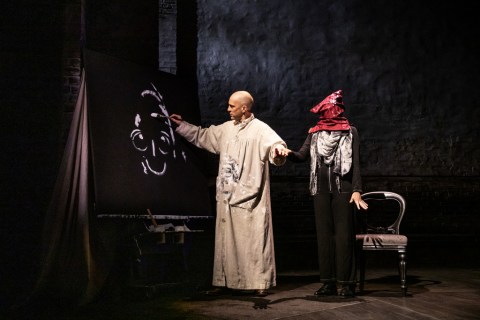
Derren Brown SECRET, written by Andy Nyman, Derren Brown & Andrew O’Connor, directed by Andrew O’Connor, Andy Nyman at the Cort Theatre (Matthew Murphy)
Brown crafted an extemporaneous event with the woman participant involving the audience in its creation. During these sterling moments the attentive audience, the woman participant and storyteller Brown become spectators in a joyous fabrication that was unimaginable beforehand and unfathomable after Brown concludes with a philosophical, metaphorical and mysterious flourish. From start to finish the entire audience was breathless, engaged, inspired and the woman participant was gobsmacked.
For those lovely moments, Brown returned us to the innocence of childhood in our first heartbeats of wonder. That is one of the beauties of this production, Brown’s continually igniting our imagination to fly to the realms of the supernal. But Brown does set us gently down into reality, afterward. We know we’ve been “had.” But it’s ok. Maybe we’ll become more learned about ourselves and more forgiving of our susceptibilities to return to a true place of wonderment after-all.
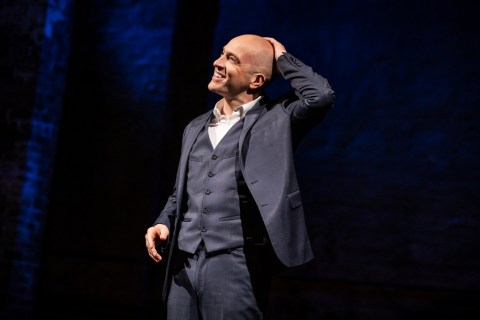
Derren Brown SECRET, written by Andy Nyman, Derren Brown & Andrew O’Connor, directed by Andrew O’Connor, Andy Nyman at the Cort Theatre (Matthew Murphy)
Explaining such illusions spoils the fun of the unknown. That’s why Derren Brown SECRET is celestial. The show is a mystery, wrapped in a box (like one of the illusions) of riddles filled with the fantastic and there are no explanations. Even the ushers are sworn to secrecy. I’m still trying to shake the thought that I’ve been screwed with mentally as I love to figure things out, and I’m annoyed that I’m not quite there yet. But that’s a part of what the power of suggestion does. Someone suggests. The more you fight it, the more you are hooked. Better to go with the flow and then the extraction from the spider’s web will come in due time.
Brown is an ADEPT. He mesmerizes in the direction you think you are going then find out that you are somewhere else completely. He is dastardly, wicked fun and the evening disappears like a shot. Maybe I need to return to “get” what I missed. But what if I miss it again? More frustration!
Of course that’s one of the many points that Derren Brown, performer and co-writer (with Andy Nyman and Andrew O’Connor who also directed) makes in this starry-minded, ephemeral, psychically untouchable production. Intriguingly, if you think that the audience has been planted with Brown’s co-conspirators to effect his “stupid pet tricks,” that is a simple yet profound error prompted by frustration. Unless you are an exceptional mesmerizer yourself and are a genius at misdirection and ledgerdemain like he is, you will not arrive at an explanation. But why even bother? It is a fabulous joy being returned to child-like innocence where all manner of spiritual mysteries are real, having been beaten out of us by ourselves after whatever ill wind blows.
Kudos to the creative team who enhance the enjoyment all the more: Takeshi Kata (scenic design) Ben Stanton (lighting design) Jill Bc Du Boff (sound design) Caite Hevner (projection design). Derren Brown SECRET runs with one intermission at the Cort Theatre (West 48th Street between 7th and 6th) until 4 January. I dare you to go!!! For tickets and times CLICK HERE.
‘Fern Hill’ Starring John Glover, Jill Eikenberry and Mark Linn-Baker at 59E59 Theaters, a Sharp, Non-formulaic Comedic Drama About Friendship

(L to R): Mark Linn-Baker, John Glover, Mark Blum, Jill Eikenberry, Jodi Long, Ellen Parker in Michael Tucker’s ‘Fern Hill’ directed by Nadia Tass at 59E59 Theaters (Carol Rosegg)
Fern Hill by Michael Tucker is about three couples in their golden years who hope to confront the next phase of their lives with joie de vivre and vibrance. The idea of spending one’s last years in the bucolic farmhouse haven, whose name is an allusion to the Dylan Thomas poem “Fern Hill,” where Thomas spent his childhood, is a pleasurable one for the characters. Directed by Nadia Tass, Tucker’s play offers the opportunity for superb actors to shine in a comedy-drama that is relentless, “in your face,” human and clever.

(L-R): Mark Blum, Mark Linn-Baker in Michael Tucker’s ‘Fern Hill’ directed by Nadia Tass 59E59 Theaters (Carol Rosegg)
The award-winning cast (Mark Blum, Jill Eikenberry, John Glover, Mark-Linn-Baker, Jodi Long, Ellen Parker) whose combined credits in theater, film and television number over one hundred are simply divine. Throughout, they remain inspired to hit the emotional notes and spark the humor with resonating heat at every turn. The plot twists gyrate the play into increasingly subtle directions until the inevitable result concludes with realism and poignance. Tucker’s thematic points about love, aging, sex, friendship, alienation in marriage, intimacy and more settle well because of fine ensemble work and authentic, moment-to-moment performances.
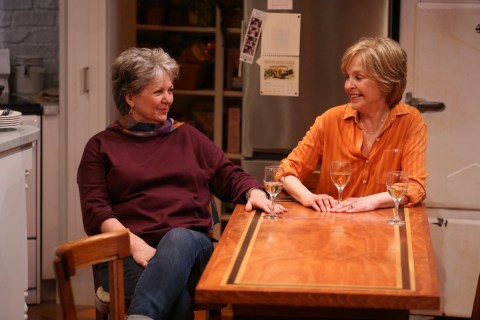
(L to R): Ellen Parker, Jill Eikenberry in Michael Tucker’s ‘Fern Hill directed by Nadia Tass at 59E59 Theaters (Carol Rosegg)
Initially, the gathering of couples feels like a hippie reunion from the early 1970s. But we discover these individuals have advanced together in friendship and collegiality teaching at a university. Additionally, they have launched themselves in careers as professional artists (painters, writers, photographers and even a musician rocker in a band) who attempt to make a difference as they offer their talents to the world and each other for stimulation, fun and growth. These are the perfect friends to have. They share the same values and intelligence with high social IQs. Indeed, their interactions at “Sunny and Jer’s” farmhouse located upstate in Fern Hill are similar to those represented in Lawrence Kasdan’s film The Big Chill (1983). However, unlike the companions in the film who have not seen each other in five years, these couples frequently meet up and have long-lived friendships that have weathered storms.

(L-R): Jodi Long, Mark Linn-Baker, Ellen Parker, John Glover in Michael Tucker’s ‘Fern Hill’ directed by Nadia Tass at 59E59 Theaters (Carol Rosegg)
Playwright Tucker through Tass’ amiable direction has weaved a happy tableau which we cannot conceive will ever end. And for precious moments the ensemble has made us feel so comfortable that we are happy to witness and be a part of their clan while they enjoy themselves riffing, joking, eating and drinking together. But as we are lulled into their “play,” reality hits with Vincent’s (John Glover) announcement about his hip-replacement. Though Vincent is older, the deterioration that comes with mortality has begun in earnest it seems.
And especially for the men, the creep of fear is plaguing each of them. In this pleasant farmhouse of joy, all does not really bode well. Despite the satisfaction of achieving successful careers, artistic purpose and comfortable lifestyles, the question looms: what remains next for Sunny (Jill Eikenberry) and Jer (Mark Blum), Billy (Mark Linn-Baker, who is a younger, lighter version of David Crosby of the band Crosby, Stills and Nash) and Michiko (Jodi Long), Darla (Ellen Parker) and Vincent (John Glover)? The answer is daunting. After all, “aging is not for sissies” (Bette Davis’ oft quoted comment).

Jill Eikenberry, Mark Blum in Michael Tucker’s ‘Fern Hill’ directed by Nadia Tass at 59E59 Theaters (Carol Rosegg)
Thinking outside the box during the last four months, these buddies have discussed the finest way to stave off the horror of aging, isolated, alone and desolate among strangers. Rather than be blind-sided by disease, loneliness and depression in the narrow construct of Assisted Living Centers and Nursing Homes, on this birthday celebration for Jer and Billy, they cement their agreement to live together as a commune at Fern Hill so that they can help each other as they transition into the next great adventure after retirement and moving toward their irrevocable sunset.
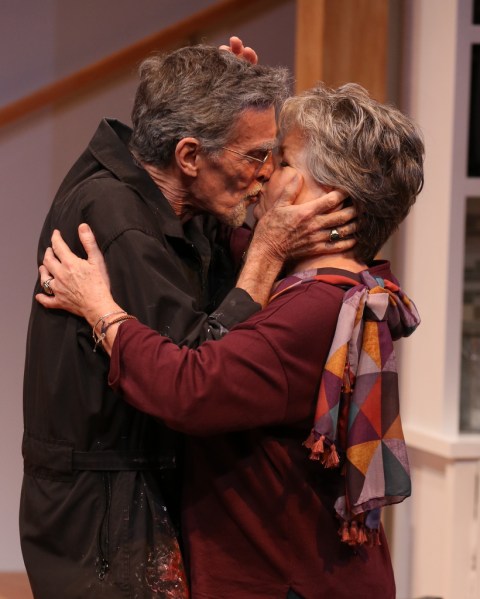
John Glover, Ellen Parker in Michael Tucker’s ‘Fern Hill’ directed by Nadia Tass at 59$59 Theaters (Carol Rosegg)
The playwright takes a while to set up this idyllic place with divine companions that we can visualize living together as an exceptional solution to the nation’s dire aging institutionalization foisted upon older citizens. So we don’t get why Jer attempts to end their discussion and close down a fabulous idea as a fantasy. Even his reasons appear lame: he doesn’t think they can live together; they will sabotage their closeness and loving relationships and end up without each other. When he becomes irate about it, we sense there are deeper reasons.

(L to R): Mark Linn-Baker, Mark Blum, Jill Eikenberry, Jodi Long, Ellen Parker, John Glover in Michael Tucker’s ‘Fern Hill,’ at 59E59 Theaters. (Carol Rosegg)
Tucker spins the plot twist abruptly in a few revelatory lines. Sunny shatters the peace, love and community of friends on this lovely evening with an explosion of truth. This truth threatens to nullify all their efforts at a togetherness that has encouraged power, integrity and strength. Deceitfulness like the worm of age leers at each of the characters so that they must check themselves and deal with this problem between Sunny and Jer which is also their problem.
It is fascinating to watch character responses. The wisdom and humor that emerges engages with honesty and love. And regardless of whether their camaraderie appears a bit fantastic or completely possible, Tucker has written a fine work that is grounded in logic and constructed brick by brick with solid characterizations. Finally, the actors’ portrayals are spot-on so that every segment of the journey that Sunny and Jer take to where they must go to resolve their relationship issues makes sense and seems right. Encouraged, we have followed them recognizing ourselves in their foibles and earthy humanity.
This is a terrific production made all the more exceptional by the performances and direction. Kudos to the creative team without which this ensemble piece would not have been neatly realized: Jessica Parks (scenic designer) Patricia E. Doherty (costume design) Kate MGee (lighting designer) Kenneth Goodwin (sound designer).
Fern Hill is currently running at 59E59 Theaters (59E59th Street between Madison and Lexington) with one intermission until 20 October. For tickets and times CLICK HERE.
‘Broadway Blessing 2019,’ an Uplifting Celebration to Launch the New Theater Season

Broadway Blessing 2019 poster outside St. Malachy’s, the Actor’s Chapel (Carole Di Tosti)
Each year, actors, directors, musicians, composers, producers, parishioners, singers, clergy and others gather for an evening in September in one accord. Their purpose is to bless, to anoint the entire theater community from producers and actors to critics and technicians to transmit the energy of joy and peace that will be felt by patrons from around the world who walk into a New York City theater looking to be stirred, engaged and enthralled with the wisdom and verve of live performance. Theater has its origins in religion. Social mavens in ancient Greece conceived that theatergoers/religious adherents, as receptors of the energy that flowed back and forth from live actors to audience members would walk away revitalized from playwrights’ tragedies and comedies.
According to Kathryn Fisher, co-producer of Broadway Blessing 2019, “Broadway Blessing started in 1997 as an evening of song, dance and story to celebrate and ask for blessings on the new Broadway season. For many years it rotated among churches – St. Malachy’s, St. Clements, St. Luke’s, St. John the Divine, and the Little Church Around the Corner – finally returning to St. Malachy’s in 2017, where it has been since.”
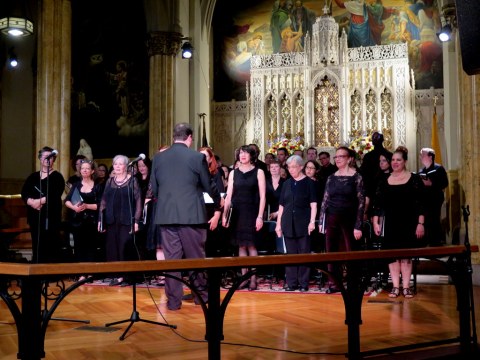
Stephen Fraser, Musical Director, The Broadway Blessing Choir, Broadway Blessing 2019 (Carole Di Tosti)
The celebration has burgeoned. New York City’s theater community has at its heart this finer impulse and in addition to seeking to make a profit, it follows the same high calling to enrich and redeem theatergoers from themselves, their work lives and the drudgery of daily routines. Indeed, theater’s mission seems more vital than ever in our divisive and stressful political climate. Broadway Blessing 2019, now in its 22nd year, is a reckoning to be thankful for the riches of the upcoming year of theater in renewal and refreshment.

Fr. George Drance, SJ (Emcee) Broadway Blessing 2019, St. Malachy’s-The Actors’ Chapel (Carole Di Tosti)
Broadway Blessing 2019 on Monday 16 September was produced by Kathryn Fisher and Co-Produced by Pat Addiss, with musical direction by Stephen Fraser and stage management by Mary Fran Loftus. Special thanks go to Retta Blaney, Founder, Fr. John Fraser, St. Malachy’s Church-The Actors’ Chapel, Fr. George Drance, SJ, Rabbi Jill Hausman, Congregation Ezrath Israel-Actors’ Temple with clergy from the theater district. The evening included Broadway and Off-Broadway performers, the Broadway Blessing Choir and Instrumentalists. Emceed by Fr. George Drance, SJ, who introduced the musical performers and guest presenters, Fr. George Drance, SJ’s pointed, informational commentary helped to make the evening flow seamlessly.

Katharine Heaton singing “Somewhere” from ‘West Side Story’ (music by Leonard Bernstein & lyrics by Stephen Sondheim) at Broadway Blessing 2019 (Carole Di Tosti)
Musical numbers included songs from award-winning shows Oklahoma! Gypsy, West Side Story, Desperate Measures, The Music Man, Hair, The Lion King, Fiddler on the Roof, and La Cage aux Folles. Soloists included Mae Roney, Paul T. Ryan, Nancy Simpson, Katharine Heaton, Conor Ryan, Alex Fraser, Jill O’Hara, Liseli Lugo, Stephen Carlile, Sidney Meyer and Adam Shapiro.
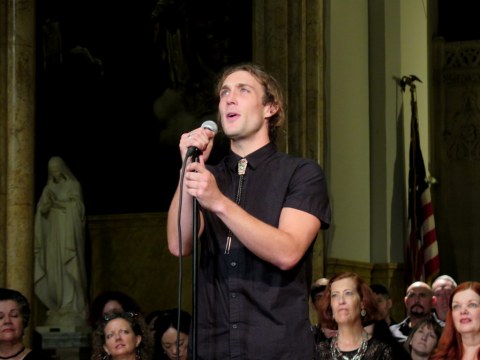
Conor Ryan singing “Good to be Alive” from Desperate Measures, (music by David Friedman & lyrics by Peter Kellogg) Broadway Blessing 2019 (Carole Di Tosti)
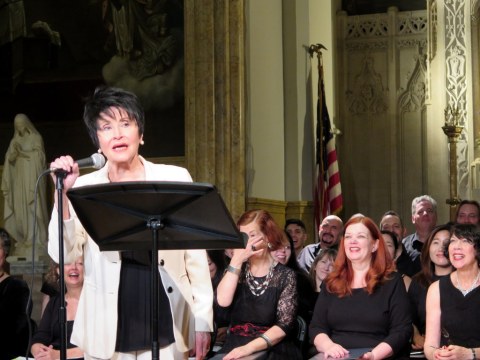
Chita Rivera discussing Hal Prince’s Broadway legacy at Broadway Blessing 2019 (Carole Di Tosti)
Chita Rivera presented a lovely encomium about Hal Price who died on July 31, 2019. Chita Rivera is an incredible performer (actress, singer, dancer). It is fitting that Ms. Rivera, a two-time Tony Award winner with five Tony Award nominations and a special Tony Award for Lifetime Achievement in Theater should recall to our remembrance Hal Prince’s indelible contributions to theater in the twentieth and twenty-first century. She worked with him in award winning shows he either produced or directed. The most recent collaboration was Kiss of The Spider Women (music by John Kander and Fred Ebb with book by Terrence McNally) in which she starred and he directed, shepherding her toward TONY, Drama Desk and Outer Critics Circle wins for her performance. Ms. Rivera emphasized Prince’s exceptionalism which will probably never be equaled. She highlighted with a significant pause so we could “get it” (I still can’t) that he won 21 Tony Awards which she saw with lined up on his desk.
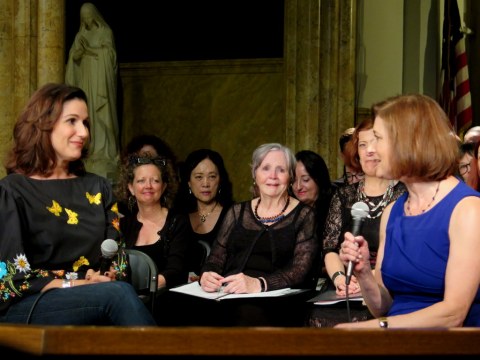
(L to R): Stephanie J. Block (The Cher Show) and renowned, beloved theater critic Roma Torre, Broadway Blessing 2019 (Carole Di Tosti)
In another segment of the program two-time Emmy Award winner and popular theater critic Roma Torre briefly interviewed Stephanie J. Block who won a TONY, Drama Desk and Outer Critics Circle Award for her performance in The Cher Show. Stephanie Block shared a humorous story of how she finally realized the speaking voice of Cher on vacation whitening her teeth with Oral B and Crest Whitening Strips. While she was using the strips she happened to speak to her husband who noted the transformation into Cher’s speaking voice. Stephanie J. Block’s teeth are stunning and the story of how she found Cher and received a TONY for it is priceless.
As a coda, Roma Torre is still with NY1, and the lawsuit continues encouraged by her fans and supporters, both men and women. They enjoy her experienced commentary and cogent reviews. Hopefully, her on air time will increase. It is completely understandable why Ms. Torre and five other female anchors are litigating against channel operator Charter Communications in an age- and gender-discrimination lawsuit. You may read the article about Roma Torre’s intrepid fight with her colleagues to stand up to gender/age discrimination by CLICKING HERE.
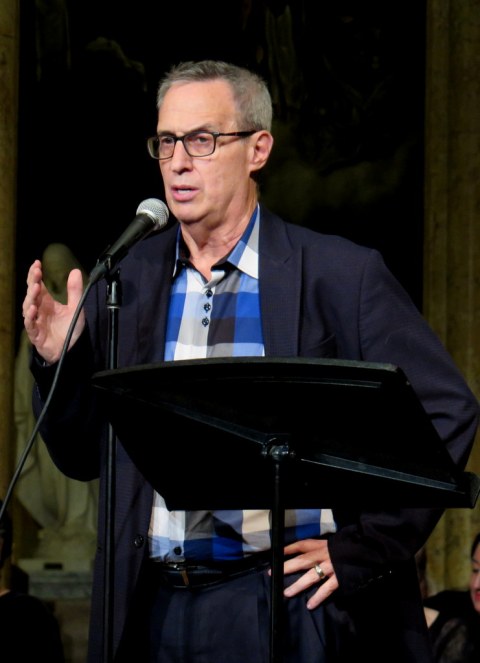
David Friedman discussing the backstory to his composition “Something Happened,” Broadway Blessing 2019 (Carole Di Tosti)
David Friedman is an award-winning composer of Desperate Measures (music David Friedman, book and lyrics Peter Kellogg). Through the years Friedman composed, conducted and arranged numerous songs, movies and Broadways shows. For Broadway Blessing 2019 he contributed his talent accompanying Sidney Myer in a special song Friedman composed via a request by Pat Addiss (co-producer of Desperate Measures with Mary Cossett).
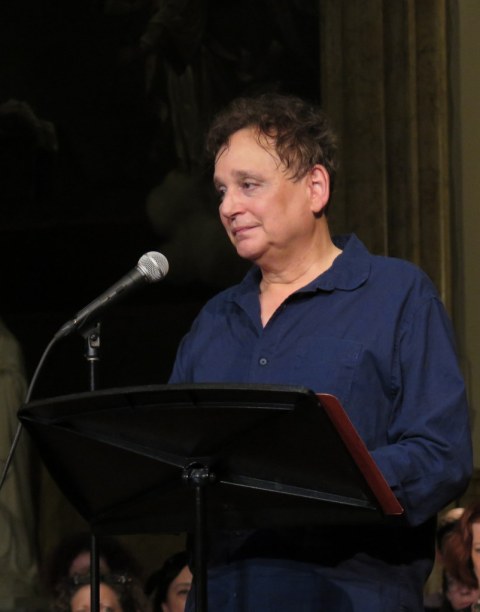
Sidney Meyer singing “Something Happened,” by David Friedman for Broadway Blessing 2019 (Carole Di Tosti)
However, before Sidney Myer sang, David Friedman discussed the song’s backstory. Pat Addiss had asked him to write a song about abuse of the type that one may have experienced as a child. The nature of the abuse she referenced was so egregious that the individual blocked it from memory. However, suppressed events from childhood impact the evolution of an individual into adulthood. Sometimes, upon hearing of another’s similar abuse, individuals have reactions and have even fainted because, as can happen with physical pain, their psyche shuts down because the trigger is too intense. Pat Addiss encouraged David Friedman to create a song about such abuse and he did entitling it, “Something Happened.” The profound song which Sidney Meyer performed with great feeling is about one’s inner cry to confront suppressed truths and bring them to the light to heal. It’s an incredible work and in keeping with an evening of blessings.

Stephen Carlile, Liseli Lugo singing “The Circle of Life” from The Lion King (music by Elton John & lyrics by Tim Rice) Broadway Blessing 2019 (Carole Di Tosti)

“Candle Lighting Ceremony,” the Broadway Blessing Choir sing “Sisi Ni Moja-We Are One,” (music & lyrics by Jacob Naverud) Broadway Blessing 2019 (Carole Di Tosti)
Broadway Blessing 2019 culminated with “The Broadway Blessing” by Rabbi Jill Hausman and The Actors’ Temple of the Clergy of the Theater District. During the “Candle Lighting Ceremony,” Adam Shapiro (who portrays the Rabbi from the current production of Fiddler on the Roof in Yiddish) sang “The Sabbath Prayer” in Yiddish and the Broadway Blessing Choir sang it in English. After the candles were lit, the Broadway Blessing Choir sang “Sisi Ni Moja-We Are One” (music & lyrics by Jacob Naverud). As the evening closed those in attendance joined the choir to sing the rousing “The Best of Times” from La Cage aux Folles (music & lyrics by Jerry Herman).
The Broadway/Off Broadway/Off Off Broadway year has begun in earnest. There is much to look forward to. Be blessed when you come to New York City to enjoy the fruitfulness of what the theater community offers in their amazing musicals, dramas, hybrid shows, festivals and innovative theater offerings.
Tribeca TV Festival Q & A: ‘GOLIATH’ the Amazon Prime Series Starring Billy Bob Thornton, Nina Arianda, Dennis Quaid, Amy Brenneman

Tribeca TV Festival, ‘GOLIATH’ starring Billy Bob Thornton, directed by Lawrence Trilling for Amazon Studios (Carole Di Tosti)
After the screening of two dynamic episodes of GOLIATH Amazon Prime’s Season 3 award winning web series at Tribeca TV Festival, some members of the cast sat down for an enjoyable Q and A along with the director Lawrence Trilling. GOLIATH, created by David E. Kelley and Jonathan Shapiro is a tour de force with superb cinematography that feels more like a film than a TV web series. Season 3 opens on October 4th.

Billy Bob Thornton (right) and moderator at Tribeca TV Festival Q and A after the screening of Amazon Prime’s web series ‘GOLIATH’ (Carole Di Tosti)
The actors discussed their experiences working with director Lawrence Trilling (all prefer having one director for the entire series) and the enjoyment of working with each other. They also discussed the water crisis of Central Valley California the location of the setting where many of the scenes were filmed. Central Valley is around two hours outside of Los Angeles. It is the agricultural center of the state and globally important for producing nuts, fruits and vegetables for the U.S. and world-wide markets.

Amy Brennenman at Q & A, Tribeca TV Festival, screening Amazon Prime web series ‘GOLIATH’ starring Billy Bob Thornton, directed by Lawrence Trilling (Carole Di Tosti)
Trilling and the others stated that the scenes related to the small town in the Central Valley represented what is happening to the townspeople who have no water coming from their public water supply taps. So when we note in the series someone driving up with cases of water to deliver to various households, this bottled water must be rationed out. They must use bottled water for showers, to wash dishes, for drinking and all their household needs. Water is a precious resource that they don’t have. It’s being diverted to wealthier land owners, corporate farmers and ranchers. It came out in the discussion that so much of it is wasted and the landowners are overpumping to get more water, sometimes to no avail and certainly to the detriment of the land. At the least, it weakens the ground structure and creates sinkholes.
A statistic that seems amazing in this dearth of water for households was quoted during the Q and A. It takes two gallons of water to grow one almond. Meanwhile, households in the area are starved for water and little farms get just a trickle to irrigate their crops, mostly having to depend on rain and good weather. Since almonds are the staple crop that the billionaire Blackwoods Wade, played by Dennis Quaid and Diana, played by Amy Brenneman, are growing out in Central Valley and the trees require a tremendous amount of water, who gets to determine the allotment of water? Is it based on need, money, fairness, greed, equity, decency?
Indeed, the Blackwoods have a tremendous need for water to irrigate their trees. Diana is using the almonds additionally for her own skin care line and medicinal products like milk baths to soothe and relax from the pressures of the water crisis. In a tense, wild scene, Diana has breakfast with brother Wade as he chills out in a milk bath. Amy Brenneman joked about her character’s relationship with her brother which appears untoward and eerie. As the series continues how their relationship evolves is superbly drawn.

Nina Arianda at the Tribeca TV Festival Q and A after the screening of the Amazon Prime web series ‘GOLIATH’ (Carole Di Tosti)
Billy Bob Thornton has worked with Dennis Quaid before and they have known each other for years and are buddies, relaxed and comfortable with each other. Thornton admitted that working with actors you’ve worked with before and with a director you have an established relationship with is the best. You have a kind of shorthand you use based on previous knowledge with each other.

(L to R): Shamier Anderson, Lawrence Trilling, Tribeca TV Festival Q & A after the screening of Amazon Prime’s web series ‘GOLIATH,’ starring Billy Bob Thornton (Carole Di Tosti)
This is something which I’ve heard actors and directors discuss is the reason why they enjoy working with the same individuals. Robert Di Nero and Martin Scorsese work with a shorthand, also.
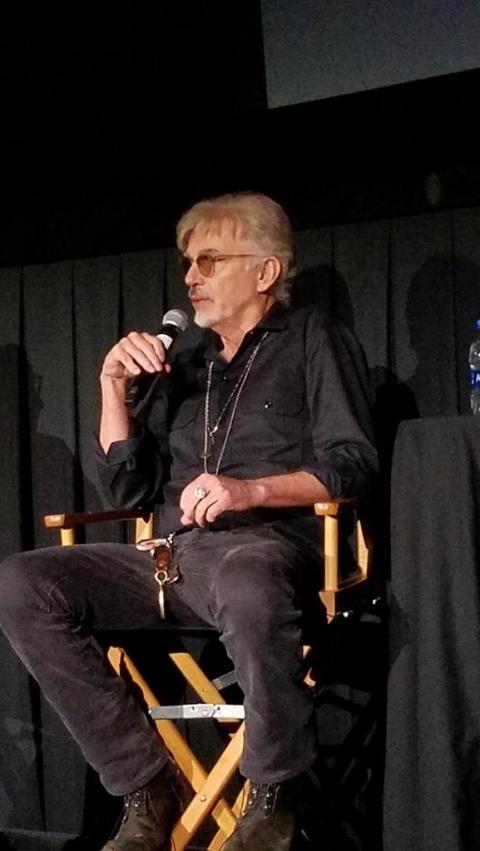
Billy Bob Thornton at Tribeca TV Festival Q & A after the screening of ‘GOLIATH,’ the Amazon Prime web series beginning October 4th (Carole Di Tosti)
Thornton admitted that when he read the script it was natural and easy and he knew he could play the character who felt like him. The first season out he won a Golden Globe and part of that is due to his understanding and familiarity with the character whose dialogue the writers have kept authentic and viably sincere.
In not trying to reveal too much of the future episodes, Shamier Anderson who plays a twin who is deaf mentioned that it was enjoyable to come up with differences in his twin’s characters with specificity. He had fun working on their ethos. He gave them different clothing and changed the voice, their gait and all the other elements so that tech folks were surprised that the same man was playing two different characters. He also discussed how director Trilling shot the scenes with the twins.
Amy Brenneman joked that in the later episodes Shamier’s characters are like her sons. The irony is that both Diana, Amy’s character, and the twins resemble each other in their manner. They have the same insidious smile that bodes ill, though it is a come on that all is fine. The characters are sinister and scary. For his part Billy Bob as Billy McBride takes all in his stride in his wry, ironic manner which heightens the humor.
Nevertheless, the series is darkly ironic and is filled with menacing, atmospheric shadows and weird tensions due to Trilling’s superb direction and the choices he makes convey the malevolent severity of the water crisis and the billionaire family that is behind it.
Nina Arianda who plays the humorous, wacky Patty Solis-Papagian shared the backdrop of a scene when she blows a tire and is waiting for Triple A to come and repair it. She and Trilling decided to include what happens in the scene that took place realistically. A bee flew in and was harassing her. Other spontaneous occurrences happened as they always do on shoots. Arianda and Trilling came up with a few more of which we’ll look for during the series season.
GOLIATH opens on October 4th on Amazon Prime. Don’t miss it. For my review of the first two episodes of the series, go to this link: https://caroleditosti.com/2019/09/15/tribeca-tv-festival-continues-its-2019-series-reveal-goliath-starring-billy-bob-thornton-nina-arianda-dennis-quaid/
Tribeca TV Festival 2019 Premiere: ‘Evil’ A Hybrid Psychological, Supernatural, Crime-Drama Thriller on CBS

(L to R) Michael Emerson, Katja Herbers, Mike Coulter, Aasif Mandvi, Tribeca TV Festival screening of the CBS TV pilot of ‘Evil,’ directed by Robert King, created by Robert and Michelle King on CBS, Thursday at 10 pm beginning 26th September (courtesy of CBS)
In an intriguing World Premiere screening at the Tribeca TV Festival, the pilot of the TV series Evil, directed by Robert King and created by the writing team of Robert and Michelle King (The Good Wife, The Good Fight) focuses on the terrifying manifestations of evil in a hybrid genre show which is part mystery-crime drama with sardonic humor and supernatural, mystical elements. The Kings delve into what constitutes the nature of evil. Each Thursday beginning on September 26 and extending into 2020, Evil examines issues and case studies where evil or its opposite goodness presents itself in human or spiritual form while linchpin investigators, a skeptical psychologist, a priest and a pragmatical empiricist go head to head with explanations during their intense, thrilling adventures to solve cases.
Dr. Kristen Bouchard (portrayed with vitality and nuance by Katja Herbers-Westworld) is the skeptic whose dreams become haunted by a demonic presence that she initially determines to be a convincing night terror, but which the series suggests may be more than just a bad dream. She is intrigued by David Acosta (the attractive Mike Coulter from Marvel’s Luke Cage) the neophyte studying to be a priest who becomes her side-kick offering a preternatural view and suggesting that there are other realms operating that Dr. Bouchard may not be aware of. Women at the screening were practically drooling over Coulter. His sophistication and solid, calm, spiritual demeanor are a tremendous lure to Dr. Kristen Bouchard (married to a thrill-seeking, absent, adventurer husband). There is a budding sensual tension between Bouchard and Acosta that is all the more enhanced by the Catholic Church’s command for Acosta’s sexual abstinence.

(L to R): , Katja Herbers, Mike Coulter, Tribeca TV Festival screening of the CBS TV pilot of ‘Evil,’ directed by Robert King, created by Robert and Michelle King on CBS, Thursday at 10 pm beginning 26th September (courtesy of CBS)
These two are joined by a third investigator, the scientist/atheist Ben Shroff (comedian Aasif Mandvi- The Brink on HBO) who rides both of them and is the counterpoint when either goes too far afield in his or her area of expertise. To round out the weekly cast are Kristen’s children played by Brooklyn Shuck, Skylar Gray, Maddy Crocco and Dalya Knapp, and hot, rockin’ grandmother Sheryl Luria (Christine Lahti-the accomplished actress who has conquered stage, film and TV). Lahti recently was lauded for her portrayal of Gloria Steinem in Gloria: A Life by Emily Mann directed by Diane Paulus which ran from October 2018 to March 31, 2019 at the Daryl Roth Theatre in New York City.
Along the journey in their show, the Kings raise many pertinent questions and bring in topical themes, for example highlighting that there are secret communities of perpetrators of horror and terror on Social Media who are unified together in their own philosophical and behavioral nexis of a variety of isms and hatreds: i.e. racism, anti-semitism, Nazism, misogyny, xenophobia and more. The writers posit intriguing questions.
Are these groups influencing each other in what are evil acts? Are they guided by spiritual entities? What behaviors were nurtured in their family lives? The show raises incredible issues and places the very serious social/cultural mores of the nation at the forefront. And in the background there is the everpresent current administration which may inspire, provoke and enable such evil actors who, in the traditional, scriptural, Biblical purposes of the Wicked One known as Satan, come “to kill, steal and destroy.” But then what of the alleged Christian evangelicals who align themselves with political leaders who provoke such evil actors to commit crimes like those committed in Charlottesville, Virginia, The Tree of Life Synagogue and Parkland, Florida?
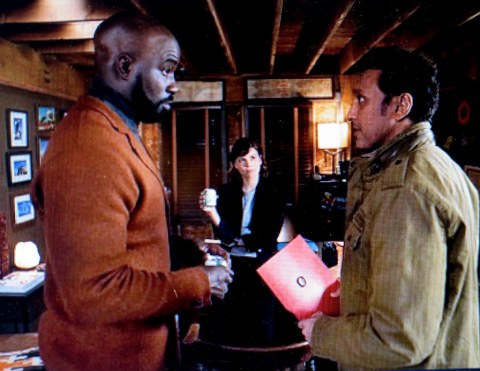
(L to R): Mike Coulter, Katja Herbers, Aasif Mandvi in ‘Evil, CBS TV series on Thursday evenings at 10 pm beginning 26th September, Tribeca TV Festival pilot screening (Michele Crowe/ CBS)
In the show Evil, be prepared to see twists and turns and the upside down viewed right-side up. Evil is all about angels of light (Lucifer is an angel of light). And it is about discerning truth from lies and not allowing oneself to be susceptible to human “powers of suggestion” that have a hidden rational explanation in a time of fakes, frauds and charlatans who sport their own hidden agendas. But on the other hand, when miracles do happen, and real angels do appear and save lives, should we not be able to recognize these as a singular truth as well?
In the pilot premiere we get a taste of a few of these issues as Dr. Bouchard is called in as an expert witness to provide testimony after interviewing a serial killer who slaughtered a family. Initially, she determines that the killer was not insane though he blacked out and doesn’t remember the murders. As the show progresses, frighteningly, his behaviors shift and when Bouchard produces a crucifix upon the suggestion of Acosta, the killer transforms.
Is this insanity? Is this demon possession? Is demon possession a form of insanity? Or is there some amoral impulse at work in his bloodthirsty behavior and psyche which promotes harm and death to others? Is it an inherent condition which each human being harbors and must expiate in his or her life by evolving into a kinder, gentler, generous, loving human being? Or is it evil spirit based in the supernatural realms of other consciousness where demons, incubui and sucubui hover commanded by powerful wicked spirits of Baal, Legion, Moloch, Mephistopheles, et. al who infiltrate our dreams and unconscious if we are susceptible to them as Dr. Bouchard and David Acosta may be?
Dr. Boggs (Kurt Fuller) Bouchard’s therapist and Leland Townsend (Michael Emerson) an expert witness for the defense provide grist to engineer the eventual solving of this dire case. However, some questions, some mysteries have no explanations. And these questions float throughout the series which promises to be both profound and timely in an era of psychological influence, bullying malevolence and abuse as individual cowards behind a social media avatar upload untoward and violent pictures reinforcing a communal experience of death and abuse via 4Chan, 8Chan, Reddit or private, secret sites. As these isolates band together as terrorizing predators to strengthen their psychosis with other cowardly invisibles, they justify and normalize their behaviors. Thus, they create their own morality of correctness and righteousness as their base seeks to grow. Is this the work of evil entities or the evil DNA of human beings who are past all hope of change or rectitude?
You can catch Evil on CBS Thursdays at 10 pm beginning the 26th of September. Check online for additional viewing opportunities.
Tribeca TV Festival Continues its 2019 Series Reveal: ‘GOLIATH’ Starring Billy Bob Thornton, Nina Arianda, Dennis Quaid

Billy Bob Thornton in ‘GOLIATH,’ directed by Lawrence Trilling, created by David E. Kelley and Jonathan Shapiro, Amazon Studios, Amazon Prime, October 4th, Season 3 presented at Tribeca TV Festival (courtesy of Amazon Studios)
The premise of the TV series GOLIATH about Billy McBride, a former high powered lawyer who built his own successful law firm then crashed and burned into drinking and depression after an attack of conscience, cannot help but be alluring in the time of Trumpism. GOLIATH created by David E. Kelley and Jonathan Shapiro stars the superb Billy Bob Thornton (the first season out he won a Golden Globe) as the “David” who stands against various Goliaths (one each season) defending the “little guy” against money, class privilege, corporatism and impossible odds.
Sporting a fine cast with Nina Arianda as the wacky DUI lawyer Patty Solis-Papagian, Tanya Raymonde as Brittany Gold and Diana Hopper as Denise McBride, Billy’s daughter, each season has been sprinkled with veteran greats like William Hurt and guest actors like Maria Bello, Molly Parker (season 1) and Ana de la Reguera and Mark Duplass (season 2). With a heady selection of actors in the cast of Season 3 (Dennis Quaid, Amy Brenneman, Griffin Dunne, Beau Bridges, Graham Greene, Shamier Anderson, Illeana Douglas) it is clear that the series, which is edgy, darkly ironic, humorously wry and loaded with suspense and intrigue, has made its mark for Amazon Studios. This year the television web series opens on Amazon 4th October.
Tribeca TV Festival, ‘GOLIATH’ starring Billy Bob Thornton, directed by Lawrence Trilling for Amazon Studios (Carole Di Tosti)
I had the opportunity to screen the first two episodes of GOLIATH and catch the Q and A with director Lawrence Trilling and principal members of the cast Billy Bob Thornton, Nina Arianda and others who discussed the journey of this powerful, well-written, dynamically acted and excellently directed GOLIATH. This season’s focus is gravely current and its urgency is not to be underestimated.
The background subject is water, the foreground is corruption, corporate hegemony, power politics, money. Trilling and the writers chose an ongoing crisis that has global implications and reflects the current nightmares coming out of the White House with themes beautifully threaded by smiling, affable characters like billionaire Wade Blackwood (Dennis Quaid is a joy to watch) and his eerie, possibly insane and brother-lusting sister Diana Blackwood (Amy Brenneman). The Blackwoods are billionaire owners of a corporate, industrial sized farm.

Billy Bob Thornton in ‘GOLIATH,’ directed by Lawrence Trilling, created by David E. Kelley and Jonathan Shapiro, Amazon Studios, Amazon Prime, October 4th (courtesy of Amazon Studios)
The setting of this season is the present. Though the California drought has been declared at an end, its aftershocks have multiplied for one of the richest areas of California in the agricultural Central Valley whose massive land area is sinking because there has not been enough water to supplant what was lost. In an attempt to recover, area landowners dig deeper and deeper wells to draw out the water. This overpumping damages land sustainability and adds arsenic to the water supply.

Dennis Quaid, Amy Brennamen in ‘GOLIATH,’ directed by Lawrence Trilling, created by David E. Kelley and Jonathan Shapiro, Amazon Prime Video, Amazon Studios, Season 3 Episodes 1 & 2 at Tribeca TV Festival (photo courtesy of Amazon Studios)
These effects threaten homeowners and farmers alike as rivaling needs for clean, available water increase and power struggles manifest over who gets the water and how much of it should be allotted. The focus of this season’s series is doubly prescient given the full frontal attack by Trumpism and the Federalist Society’s conservative push to relax/eliminate environmental protections. Clean air, clean water and clean soil as precious resources are under siege. Homeowners and little farms run up against powerful politically tied-in globally-minded corporate farmers whose billion dollar industry supplies fruits, nuts, vegetables to this nation and world-wide markets. Which stakeholder is more important? Can billionaires sit back and share water or is the “greed is good” attitude the only sustainable policy?
Enter legal genius and astute investigator Billy McBride. Billy is called in by long-time friends who own a small vineyard. When the Bennets are forced to confront a weird, horrific accident, Billy’s services are paramount. The incident they confront is irrevocably tied-in to the water supply in the Central Valley.

Billy Bob Thornton in ‘GOLIATH,’ directed by Lawrence Trilling, created by David E. Kelley and Jonathan Shapiro, Amazon Studios, Amazon Prime, October 4th (courtesy of Amazon Studios)
The opening scenes of Episode 1 are mysterious and foreboding as Trilling establishes the conflict with atmospheric lighting design and cinematography that builds to an intense climax of the tragic event that kicks off the plot. As a coda Trilling’s grand use of the natural landscape to full effect in night and day scenes that vie with sometime sterile interiors provide an interesting contrast of living and non-living elements and heighten the accuracy of what is currently happening to the farmers, homeowners ranchers in the Central Valley. Replete with supernatural, spiritual symbols are zany characters who menace and smile with insidious intent (Quaid, Amy Brenneman, Graham Greene, Shamier Anderson) but they are only pursing what’s in the best interests of the country and their workers. So, is that a problem?
The stakes are high. Billy’s life is endangered on this wild ride down a diminishing river that eventually will run dry due to a scorched-earth policy which has no vindicators, no redeemers. Whose policy is it and can they be held accountable? Who are these people that Billy, Patty and his friends and assistants are up against? Clearly, Billy must piece together the intricacies of the Bennet’s case then step back and consider the best way to litigate if he ever makes it to a courtroom.
This promises to be a terrific Season #3 of a creatively dramatized and near flawlessly executed story for our time. October 4th is the opening. Watch it for your edification and pleasure. The performances are spot-on great.
‘Moulin Rouge! The Musical’ Celebrates the Seductive Delights of the Iconic Venue in a Sumptuous Feast for the Senses

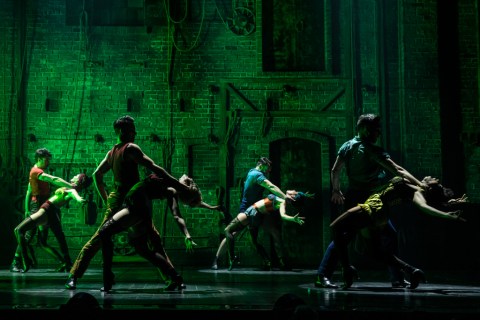
(L-R): Jacqueline B. Arnold, Robyn Hurder, Holly James, Jeigh Madjus in Moulin Rouge! The Musical, book by John Logan, Music Supervision, Orchestrations, Arrangements & Additional Lyrics by Justin Levine directed by Alex Timbers (Matthew Murphy)
The moment you enter the Al Hirshfeld Theatre, a paradise of sensuality embraces your soul and immerses you in the suggestion of hedonistic pleasure. Immediately, you are “eyes wide open,” moving along a course where anything is possible, even an after hours engagement with one of the male, female or transgender perfections of beauty, scantily but tastefully adorned, who saunter on the catwalks and peer out at you from the stage. Undulating rhythms and sensual music in this Bohemian, Paris, Left Bank cabaret/theater/dance hall soothe and allure. The luxurious red and gold appointments, the deep cherry and red velvet variegated stage curtains, the banquets, chandeliers, gleaming brass, the golden cherubim all whisper romance, sex, excitement and a whirlwind of indulgence. Whoever you are, you will be encouraged to understand that you can achieve your vision of an exalted life, a life where freedom, truth, beauty and love raise you above a bruising and squalid reality out there on the dark streets.

Danny Burstein in Moulin Rouge! The Musical, directed by Alex Timbers (Matthew Murphy)
This is the Moulin Rouge Club at Moulin Rouge! The Musical. Expect the finest in fantasy and escapism. If your intellect and imagination are ripe to receive, you will never be the same again! As you sense this revelation La Chocolat (Jacqueline B. Arnold), Nini (Robyn Hurder), Arabia (Holly James), Baby Doll (Jeigh Madjus), parade their “stuff” and throatily grind to the beats as they torch out “Lady Marmalade,” in an unforgettable opening number joined by the ensemble. This full throttle ignition is brilliantly conceived with grand style and prodigious effort by the creative team. My God, what a triumph!

(L to R): Sahr Ngaujah, Aaron Tveit, Ricky Rojas in Moulin Rouge! The Musical, directed by Alex Timbers (Matthew Murphy)
The production directed by the illimitable Alex Timbers, with a clever book by John Logan (based on the 2001 Twentieth Century Fox Motion Picture written by Baz Luhrmann and Craig Pearce, directed by Baz Luhrmann), with “to-die-for” music supervision, orchestrations and arrangements by Justin Levine is a towering majestical remembrance of what never was but might have been during La Belle Époque in Paris and specifically at the fin de siè·cle. From the on-point luxurious, sexy, ravishing costumes by Catherine Zuber to the energetic, aggressive, dance numbers choreographed by Sonya Tayeh, this musical is a non stop festival. “Bad Romance” is especially gravitating as a thrilling, energetic, “lemme consume your lips,” head to head, face-off with couples gyrating to the hot Lady Gaga song which thematically epitomizes the romance among the principal couples: The Duke of Monroth (Tam Mutu), Satine (Karen Olivo), Christian (Aaron Tveit), and the lesser lights: Santiago (Ricky Rojas), and Nini (Robyn Hurder), all of whom are sensational in voice, and character portrayals.

Karen Olivo Aaron Tveit in Moulin Rouge! The Musical, directed by Alex Timbers (Matthew Murphy)
Baz Luhrmann and Catherine Martin provided their creative services to the production which is an update of their ground-breaking, award-winning film Moulin Rouge (2001). And indeed, the basic arc of development inspired by a meld of characters and plots from Giuseppe Verdi’s opera La Traviata and Giacomo Puccini’s La Boheme remains with added tweaks of humor, phantasm and fun, delivered by incredible performances, perhaps the most preeminent charismatic, chameleon of of them all being the gobsmacking Danny Burstein.

The Company, Moulin Rouge! The Musical, directed by Alex Timbers (Matthew Murphy)
Burstein is a mesmerizing scene stealer. Amidst the splendiferous sets (Derek McLane), and shimmering, vibrantly lit (Justin Townsend), festivities, Burstein, as the club’s artistic owner/showman Harold Zidler, is the “God-like” host of confabulation. And he is damn good at it, in fact so adorable that we understand how and why Harold has kept his “chickens” together through thick and the current financially thin stage of the Moulin Rouge Club’s history. As Burstein’s Harold winningly controls our imaginations and guides the glory and spectacle, we willingly follow him believing he has our best interests at heart because to him there is no sin, no judgment. Within this space and for this night, we are free to be our fantasies.

Tam Mutu in Moulin Rouge! The Musical, directed by Alex Timbers (Matthew Murphy)
What this production does exceedingly well is reveal that the Moulin Rouge Club into which Zidler has put his heart, soul and every red hot cent he owes is an artistic production down to the lavish sets and well-heeled orchestra. And he and the ensemble live for this art. Thus, Burstein’s performance is a revelatory genius of Zidler’s dedication and desperation. Motivated by his craft and concern for his artistic family, his character’s steely sweetness is genuine, his charm and love is pure without oily ingratitude or predatory insidiousness. Above all he makes clear in the behind the scenes discussions with Olivo’s Satine, that his desire is to supply his patrons’ complete enjoyment so his company will survive and remain off the streets and away from the impoverished hellishness they all came from.
Moulin Rouge! The Musical, The Company, directed by Alex Timbers (Matthew Murphy)
Likewise, Satine’s love for Zidler and her company of friends and compatriots, one of whom is the great painter Toulouse-Lautrec (the very fine, grounded Sahr Ngaujah), reveals they understand the club’s liquidity is their life and happiness. Thus, Satine’s characterization is profound. She is the “read deal:” she is their salvation, their mother, their friend, their life-blood, their sacrifice. The sense of love and community among the ensemble is palpable so we believe Burstein’s Harold when he insists that Satine should “go to hospital,” as her friends insist as well. Without her, they are lost.
Karen Olivo’s Satine is a sensual, hot, earth-mother and high-class courtesan, experienced, wise, unmoved. She is not an ethereal beauty, but dominant, solid in will, though failing in flesh. She is a perfect symbol to represent what Harold’s artistic creation stands for, a lotus risen from the mud into full flower which will fade quickly. Olivo’s fullness of voice soars during her duets with Tveit’s Christian who is her equal in range, power and sensitivity. “The Elephant Medley” (the love song riff mash-up they sing in her boudoir as a “come-on” and “let-down”), that has been enhanced with additional numbers is just smashing.
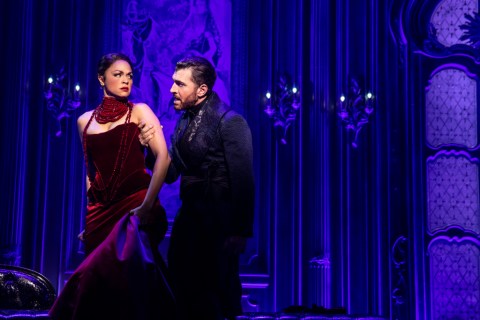
Karen Olivo, Tam Mutu, Moulin Rouge! The Musical, directed by Alex Timbers (Matthew Murphy)
Her introduction by Zidler as the “jewel” of the Moulin Rouge Club as she descends on a trapeze singing the “Diamond Medley” symbolizes her ethos and the club’s centrality as a necessity in the hearts of a society at that time and perhaps for all time. Escapism is in; it always was and always will be. The more authentic the fantasy, the better. And Satine, like Zidler, are exceptional conveyors. Their importance is an equivalent to their patrons’ happiness. Thus, she is fitting as a timeless symbol of the club; their interwoven stories will always resonate and instruct with wisdom, which like a diamond shines but cuts.
Obviously, Logan’s book adapted from Luhrmann’s and Craig Pearce’s film, reflects depth in its simple story of artists attempting to survive in a carnivorous world, as they use their charms and love inducements to glean wealthy backers. And all goes well, until the artists are hoisted on their own petard of humanity, and they fall fatally in love, and others fall fatally in lust with them. As cultural icons, artists cannot be owned or even possessed. (a not so subtle message to philistines everywhere). Satine and Zidler belong to their art, themselves and the world, as Ngaujah’s Toulouse-Lautrec affirms despite The Duke of Monroth’s insistence that Monroth owns the club and all its performers. This is another intriguing theme. When art is put in the hands of philistine owners, it crumbles for they lack the talent, will and spirit to create. Instead, they should uplift the brilliance of creators like Zidler. He knows how to draw the crowds but lacks the finances to sustain the Moulin Rouge Club.
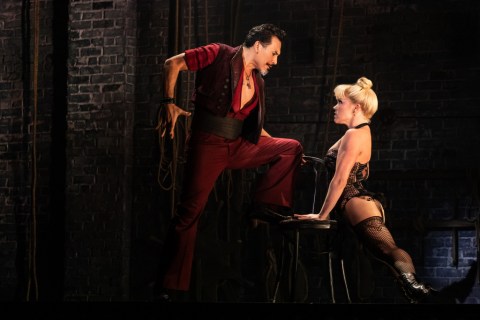
Ricky Rojas, Robyn Hurder, Moulin Rouge! The Musical, directed Alex Timbers (Matthew Murphy)
The scenes when Lautrec and the company rehearse and Mutu’s Duke attempts to assist are particularly to the point and humorous. Monroth’s ego gets in the way after he senses he has lost Satine to Christian. Yet, he is willing to keep her despite her lack of affection for him. And his jealousy rises to spoil the show, as Christian’s jealousy rises to provoke the Duke. Yet, the show must go on, but how? Satine, once more must “save the day,” but she is not immortal.

Aaron Tveit, Karen Olivo, Moulin Rouge! The Musical, directed by Alex Timbers (Matthew Murphy)
As rivals for her love and lust Tveit’s Christian and Mutu’s Duke are worthy. The intricacies of plot which involve Satine’s eventual love for the innocent and consumed Christian, and sexual enticement of the Duke are woven adroitly. Particularly delightful are Mutu’s mash-up of Mick Jagger’s songs (his “Sympathy for the Devil” could have gone on longer). And the conversion of lyrics to a male orientation for Rihanna’s “Only Girl” are hilarious. Mutu manages to be wicked but sexy and seductive. His intentions are insidious but he retains the exceptionalism of aristocracy that assumes privilege from generational wealth that goes back centuries. Importantly, it is the humor in Mutu’s depiction that keeps him interesting and edgy and not loathsome, which is in keeping with the comedic tone of the production.
As a keen and successful rival, Tveit expertly tweaks the humor related to Christian’s, creating his compositions in the funny scene when he first befriends Lautrec and Santiago. He does this with expert timing and together the three render their exchange into pure farce. His “Ohio” demeanor evolves by the conclusion from a “lad” to a man who “comes into his own.” He is every inch the authentic lover. His duets with Satine in which they both feed song refrains to each other are happily playful, suggestive and grounded. And in the delivery of his last songs, Tveit is amazing, heartfelt, sonorous. As a couple in a loving affair that grows into something more, Tveit and Olivo strike powerful resonances.
Nothing more can be lauded about Mouline Rouge! The Musical except that the sound design by Peter Hylenski was on point, balanced, targeted. I heard words from well known songs that I never “got” before, for example Katy Perry’s “Firework,” which Olivo sends into the heavens as a PURE WOW! Thus, I could greater appreciate the character development, the themes, symbols, the ironies, the true riches of this mythic production because the song mash-ups and medleys were crystal clear.
This is a Broadway show in the true spirit of New York City’s greatness. To see these performers, you should get tickets immediately and order another set to revisit a month or two out. I guarantee that seeing it again, you will note many other elements that you missed the first time around as you peel back layers. If you can’t see it again, some of the music is on YouTube. Check for updates.
The show runs with one intermission at the Al Hirschfeld Theatre on West 45th street. For tickets and times CLICK HERE.
The cast album is currently available for streaming at https://smarturl.it/MRtheMusical
‘L.O.V.E.R.’ a Personal Take on Sex and Love, Written and Performed by Lois Robbins

Lois Robbins in ‘L.O.V.E.R.’ written and performed by Lois Robbins, directed by Karen Carpenter (poster courtesy of the production)
So what’s life like for a lovely Jewish girl as she evolves into a lovely Jewish woman who marries a few times and has a fulfilling family life with husband and children after a long inquiring journey toward finding her voice? Lois Robbins (TV Land’s “Younger”; Cactus Flower) directed by Karen Carpenter (Love, Loss, and What I Wore) in her solo, one-woman show L.O.V.E.R. explains it all to you with tongue-in-cheek humor and great good will. As she entertainingly confesses her journey of many loves, she explains how she reconciles her loves and and losses to settle into her own measure of womanhood, confident and serene at the last.
With scenic design by Jo Winiarski, lighting design by Jeanette Oi-Suk Yew, sound design by Jane Shaw and styling by Fayola Ricotta, Lois Robbins’ woman shares her early stories of budding sexuality before she even realized what she was doing (masturbating) but it “really felt good.” There wasn’t an edge of a table or a vibrating washing machine she didn’t pass up. It was only much later in her burgeoning sexual love life did she realize what she had accomplished as a youngster.
The retelling of these events during her childhood are humorous and playful. Certainly, she had found a source of comfort and enjoyment without the stigma of “religious” guilt dumped on her. This is the first of Robbins’ bravo moments. Her happy-go-lucky attitude and finesse steer the show through many such fun, lively, authentic moments.
From this young age Robbins chronicles her youth and beyond. The stories she spins of boyfriends and relationships eventually bring her to the doors of marriage which she relates as a unique adventure with her first husband. Throughout, her quips and commentary resound with humanity and wit. She always seems to land on her feet as wisdom trails her journey into divorce and a second marriage which satisfies.
Both men and women will enjoy Robbins’ energy and vitality as she relates a variety of tales that are humorous, unusual and memorable. Throughout, we are reminded of ourselves in young love, impulsivity, marriage, relationship woes, mishaps and sheer zaniness. And then as Robbins so eloquently relates, she matures to understand the impact of her actions on herself and others. As this canny woman pulls herself together, she walks on the lighter side of life. By doing so she gains our empathy and we enjoy sitting back and listening to the final events in her evolution as a woman, who at the end, is able to define for herself what the letters L.O.V.E.R. mean for her.
This vibrant comedy is for you if you are looking for a break from darker aspects of love, life and relationships that end abruptly or sour into bitterness. There is little of the cryptic or cynical here. That is refreshing! Robbins’s gift is her ability to engage the audience as a confidante. Gradually, willingly the audience travels with her on her adventures as a listening friend. Robbins has mastered a relaxed delivery shepherded by the apt direction of Karen Carpenter. And with the use of the minimalistic set (stairs wrapped in a flowing sheet as an everpresent reminder where love often happens, between the sheets) the solo performance slips by with ease to achieve its satisfying conclusion.
L.O.V.E.R. is enjoying its Off Broadway premiere. It runs without an intermission at The Alice Griffin Jewel Box Theatre (480 West 42nd Street) at The Pershing square Signature Center. The last performance is Saturday, 2 November. For tickets and times CLICK HERE.
‘Betrayal’ Starring Tom Hiddleston, Zawe Ashton, Charlie Cox in Quintessential Harold Pinter

(L to R): Charlie Cox, Zawe Ashton, Charlie Cox in Harold Pinter’s ‘Betrayal,’ directed by Jamie Lloyd (Marc Brenner)
For those who have seen one of the many revivals of Harold Pinter’s brilliant, award winning play Betrayal or its film equivalent (1983), you cannot help but be engaged following the intrigue and duplicity of the triangulated relationship between married couple Emma and Robert, and close friend Jerry. In Betrayal, Pinter raises deceitfulness to a fine art as he memorializes how a convolution of lies evolve into the death of a marriage. The current revival directed with exceptional insight and precision by Jamie Lloyd and acted to perfection by Tom Hiddleston (Robert) Zawe Ashton (Emma) and Charlie Cox (Jerry) at the Bernard B. Jacobs Theatre, vaults Pinter’s work into the heavens.
Though I have not seen every revival, this one most probably exceeds productions that came before it with few exceptions, perhaps the only one being the production in 2013 directed by Mike Nichols starring real-life-couple Daniel Craig and Rachel Weisz. However, I cannot adequately compare for this spectacular production is mind-blowing. It took my breath away.

Tom Hiddleston in Harold Pinter’s ‘Betrayal,’ directed by Jamie Lloyd (Marc Brenner)
Director Jamie Lloyd removes any extraneous spectacle of sets, props, costumes. He supplants them with unobtrusive design elements to enhance Pinter’s themes so we focus on the interactions of the three principals and their responses to each other both sub rosa and manifest. Lloyd retains a spare physicality during scene changes employing the use of a revolving platform to spin the characters back into time and flashback where they finally land on the “beginning” event in Emma’s/Robert’s bedroom. It is then in 1968 when Jerry poetically, fervently seduces Emma mentally and plants the seeds of the irrevocable ending of it all in her consciousness. In a reverse chronological order we witness the ending dissolution of the marriage at the top of the play. Pinter reveals in reverse the salient conversations which slide back to the initial thrusts of “love and betrayal” between Jerry and Emma which are integral to their relationship with Robert. who manages to retain control despite their duplicity with a mendacity all his own.

Charlie Cox in Harold Pinter’s ‘Betrayal,’ directed by Jamie Lloyd (Marc Brenner)
To clarify the structure of the seven year affair, Lloyd adds projections of the backward turning years on the wall and the front of the proscenium. Thus, we note in backward evolution events which lead to the primal moment when the canker worm of adultery first nestles on the flower of Robert’s and Emma’s marriage, a worm which we witness from the initial scene and which completely has eaten away Emma’s, Robert’s and Jerry’s well being and peace. However, at the top, like most interactions we ourselves have, we are not sure what we witness until the final revelation of deceit at the play’s conclusion.
For the entire production, Lloyd has constructed as the main set piece, the backdrop of a blandly colored wall at the rear of the stage against which the actor not engaged in a scene stands facing the audience or leaning in profile. Lloyd’s enlightened staging reinforces the nature of the relationship among Robert, Emma and Jerry as if they are one being and entity. It also heightens the notion that the one absent is everpresent in the others’ minds, and that he or she will be the subject of the conversation between the other two.

(L to R): Tom Hiddleston, Charlie Cox, Zawe Ashton in Harold Pinter’s ‘Betrayal,’ directed by Jamie Lloyd (Marc Brenner)
Maintaining the presence of all the principals on stage whether they are actively engaged or silently hovering, also elucidates the nature and condition of each. It is as if they enjoy the necessity of being a “threesome” of duplicity, though they are not a “threesome” physically or sexually. Nevertheless, each is seared and entrapped in the consciousness of the other two and never really is far away from “them” when the other two are together cheating “behind his/her back.” The fascinating staging furthers Lloyd’s theme: if there is to be an affair, the three are perhaps most satisfied in being clandestine with each other in a strange egotistical and mental sadomasochism which allows them to continue betraying and misleading each other for years. Thus, the themes of betrayal for each of the characters is nuanced and layered and because Robert, Jerry and Emma cannot confront the truth of their own illness of self-deception, the destruction of their relationships between and among each other grows, despite their willful obliviousness.

(L to R): Zawe Ashton, Charlie Cox, Tom Hiddleston in Harold Pinter’s ‘Betrayal,’ directed by Jamie Lloyd (Marc Brenner)
Lloyd’s focus on psyche and consciousness rises to great thematic purpose and illustrates why Pinter never includes the presence of Judith, Jerry’s spouse or the others with whom Robert and Emma are having affairs. These others are ancillary to the vitality of the psychic “threesome.” As a result we understand how Emma, Robert and Jerry function together swimming in the medium of lies pulling toward and against each other to an inevitable dissolution of what they once were before the affair between Emma and Jerry began.
For what Lloyd’s staging and incredible direction with the equally scintillating acting by Hiddleston, Ashton and Cox evokes and symbolizes, we experience a production which is thrilling, alive, masterful. For in the hands, minds and instruments of these brilliant talents, Pinter’s Betrayal is a play about consciousness and the emotional and mental agility of ego, impulse, deflection and undercurrent so that we understand each character’s intentions and feelings though these may never be expressed and may hover as the unspoken and insidious. Hiddleston, Ashton and Cox circle smugly around the truth, even to the point of lying about “how they are doing.” All are doing poorly, considering they’ve blown apart love and friendship and have reveled in allowing a cover-up to persist with a sub rosa disdain and rebuke of each other. We witness a tragedy which the characters are loathe to admit. Only the waiter wonderfully portrayed by Eddie Arnold remains cheerful, positive and authentic.
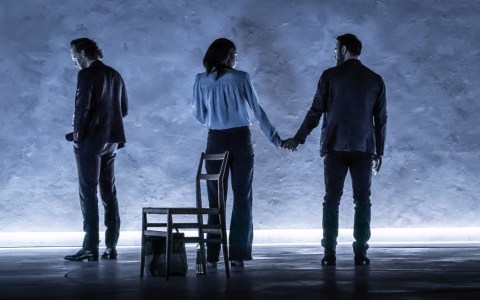
(L to R): Tom Hiddleston, Zawe Ashton, Charlie Cox in Harold Pinter’s ‘Betrayal,’ directed by Jamie Lloyd (Marc Brenner)
Interestingly, when prodded, the characters deflect. Typical of Pinteresque dialogue, a simple “How are you?” and response of “Fine,” becomes weighted with subterranean meaning and import. The individual whether Robert or Emma or Jerry is not fine. Indeed, their souls are in tatters. Though the relationship between and among each was profound (Emma and Robert have two children together, one after she sleeps with Jerry; Robert actually likes Jerry better than Emma) it is not intimate. Each is an isolate, separate and alone, inauthentic, insincere, manipulative. Pinter displays the very core of friendship and love for these three. They lovingly, charmingly, metaphorically stab each other again and again in the back while smiling in each other’s faces. They accomplish their treacheries to preserve ego. Meanwhile, how can their center hold? Eventually, it doesn’t.
Of course this is the human condition: fronting, saving face. God forbid these would admit hurt, pain and torment. God forbid Robert would smash Jerry’s head in for seducing his wife or confront Jerry with the truth. God forbid Emma and Robert would go to therapy. Instead, we discover that Robert becomes “all right” with their affair and doesn’t share his knowledge with Jerry punitively, until Jerry furiously confronts him after the affair is over for two years. Likewise, Emma’s ego is shattered when she discovers Robert punishingly, ironically, has been unfaithful to her for years. Thus, we note how Robert has controlled Jerry and Emma and manipulated them while letting them believe he was the “weakling” and cuckold. That he encourages it and that they are outraged at his behavior and unfaithfulness is the height of irony, humor and cynicism.

Tom Hiddleston, Zawe Ashton in Harold Pinter’s ‘Betrayal,’ directed by Jamie Lloyd (Marc Brenner)
What particularly enthralled me was the emotional grist of Hiddleston, Zawe and Cox revealed at various times when the truth smashes into them. The actors allow us to see glimpses of the pain the characters are hiding. This occurs, for example: when Hiddleston initially discovers Emma’s letter to Jerry; when Emma discovers her marriage which has been over for years, is finally over; when Jerry discovers with outrage how Robert hid his knowledge of the affair from him for four years without a stir or breath of upset or anger. Each of them plodded on living with their own perfidy and self- deception without feeling the necessity of coming to an end of themselves in truth. Cox, Hiddleston and Zawe are absolutely stunning in their moment-to-moment responses to each other. Theirs is breathtaking ensemble work.
Betrayal is a magnificent production. I didn’t want it to end and the standing ovation wasn’t enough appreciation, surely, for such marvelous work. Kudos to Soutra Gilmour (scenic & costume design) Jon Clark (lighting design) Ben and Max Ringham (sound design and composition) for executing Jamie Lloyd’s vision and in creating a medium in which the actors’ portrayals are encouraged to vibrate with life.
Betrayal runs with no intermission at the Bernard B. Jacobs Theatre (242 West 45th Street) until 8 December. Don’t miss this theatrical event which will surely bring in nominations for the cast and director. For tickets and times CLICK HERE.

