Category Archives: Broadway
Bobby Cannavale, James Corden, Neil Patrick Harris Are LOL in ‘Art’
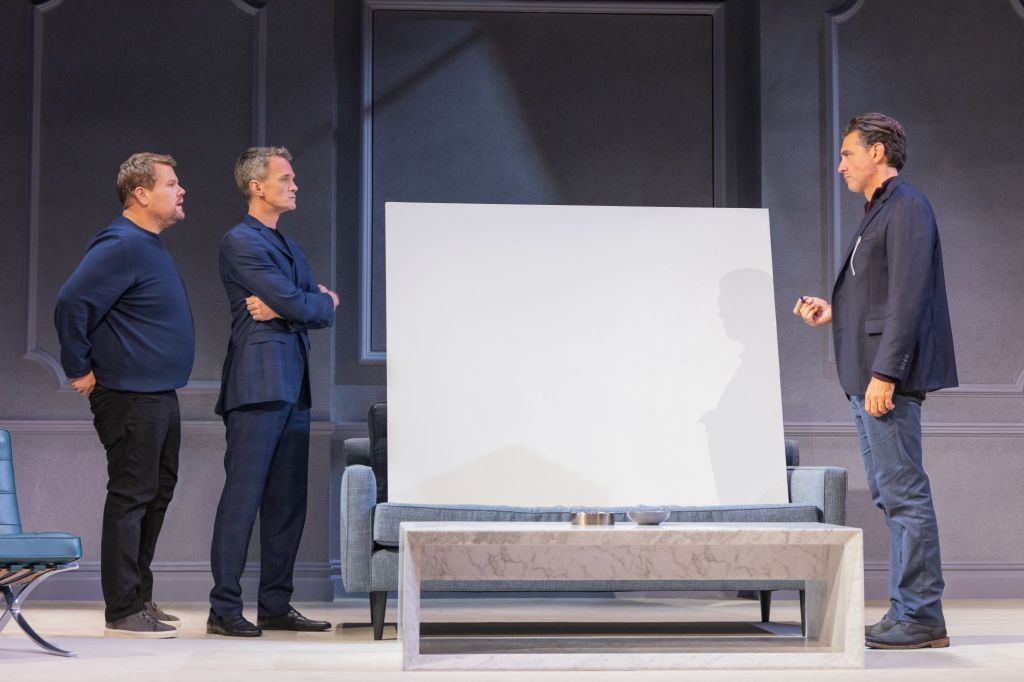
Superb acting and humorous, dynamic interplay bring the first revival of Yasmina Reza’s Tony-award winning play Art into renewed focus. The play, translated from the French by Christopher Hampton, is about male friendship, male dominance and affirming self-worth. Directed by Scott Ellis, the comedy with profound philosophical questions about how we ascribe value and importance to items considered “art” as a way of bestowing meaning on our own lives resonates more than ever. Art runs until December 21st at the Music Box Theatre with no intermission.
When Marc (Bobby Cannavale) visits his friend Serge (Neil Patrick Harris) and discovers Serge recently spent $300,000 dollars on a white, modernist painting without discussing it with him, Marc can’t believe it. Though the painting by a known artist in the art world can be resold for more money, Marc labels the work “shit,” not holding back to placate his friend’s ego. The opening salvo has begun and the painting becomes the catalyst for three friends of twenty-five years to reevaluate their identity, meaning and bond with each other.
As a means to reveal each character’s inner thoughts, Reza has them address the audience. Initially Marc introduces the situation about Serge’s painting. After Marc insults Serge’s taste and probity, Serge quietly listens, makes the audience, his confidante and expresses to them what he can’t tell Marc. In fact Serge categorizes Marc’s opinion saying, “He’s one of those new-style intellectuals, who are not only enemies of modernism, but seem to take some sort of incomprehensible pride in running it down.” As Serge attempts to pin down Marc reinforcing Marc’s lack of expertise or knowledge about modern art, he questions what standards Marc uses to ascribe his valuable painting as “this shit.”
At that juncture Reza emphasizes her theme about the arbitrary conditions around assigning value to objects, people, anything. Without consensus related to standards, only experts can judge the worth of art and artifacts. Obviously, Marc doesn’t accept modernist experts or this painter’s work. He asserts his opinion through the force of his personality and friendship with Serge. However, his insult throws their friendship into unknown territory and capsizes the equilibrium they once enjoyed. The power between them clearly shifts. The white canvass has gotten in the way.
During the first thrust and parry between Marc and Serge in their humorous battle of egos, the men resolve little. In fact we learn through their discussions with their mutual friend Yvan (James Corden), they think that each has lost their sense of humor. The purchase of the painting clearly means something monumental in their relationship. But what? And how does Yvan fit into this testing of their friendship?
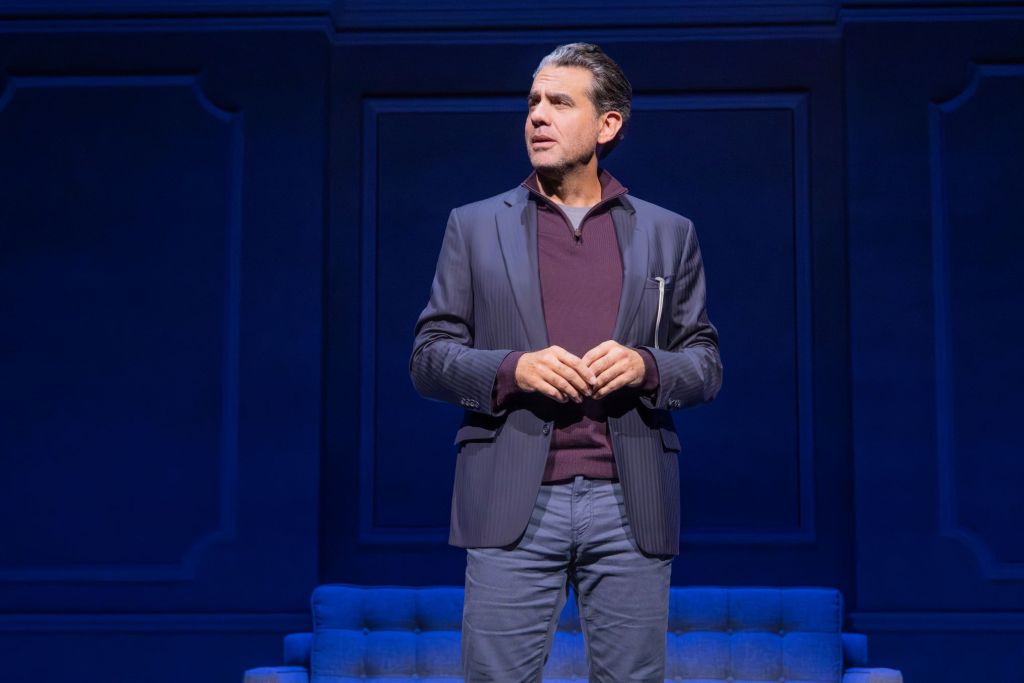
Marc’s annoyance that Serge purch,ased the painting without his input, becomes obsessive and he seeks out Yvan for validation. First he warns the audience about Yvan’s tolerant, milquetoast nature, a sign to Marc that Yvan doesn’t care about much of anything if he won’t take a position on it. During his visit with Yvan, Marc vents about Serge’s pretensions to be a collector. Though he knows he can’t really manipulate Yvan about Serge because Yvan remains in the middle of every argument, he still tries to influence Yvan against the painting.
Marc believes if Yvan tolerates Serge’s purchase of “shit” for $300,000, then he doesn’t care about Serge. Tying himself in knots, Marc considers what kind of friend wouldn’t concern himself with his friend getting scammed $300,000 for a shit panting? If Yvan isn’t a good friend to Serge, at least Marc shows he cares by telling Serge the painting is “shit.” Without stating it, Marc implies that Serge has been duped to buy a white canvass with invisible color in it he doesn’t see based on BS, modernist clap trap.
In the next humorous scene between Yvan and Serge, knowing what to expect, Yvan sets up Serge, who excitedly shows him the painting. True to Marc’s description of him, Yvan stays on the fence about Serge’s purchase not to offend him. However, when Yvan reports back to Marc about the visit, he disputes Marc’s impression that Serge lost his sense of humor. In that we note that Yvan has no problem upsetting Marc when he says that he and Serge laughed about the painting. However, when Marc tries to get Yvan to criticize Serge’s purchase, Yvan tells him he didn’t “love the painting, but he didn’t hate it either.”
In presenting this absurd situation Reza explores the weaknesses in each of the men, and their ridiculous behavior which centers around whose perception is superior or valid. Additionally, she reveals the balance inherent in friendships which depend upon routine expectations and regularity. In this instance Serge has done the unexpected, which surprises and destabilizes Marc, who then becomes upset that Yvan doesn’t see the import behind Serge’s extreme behavior.
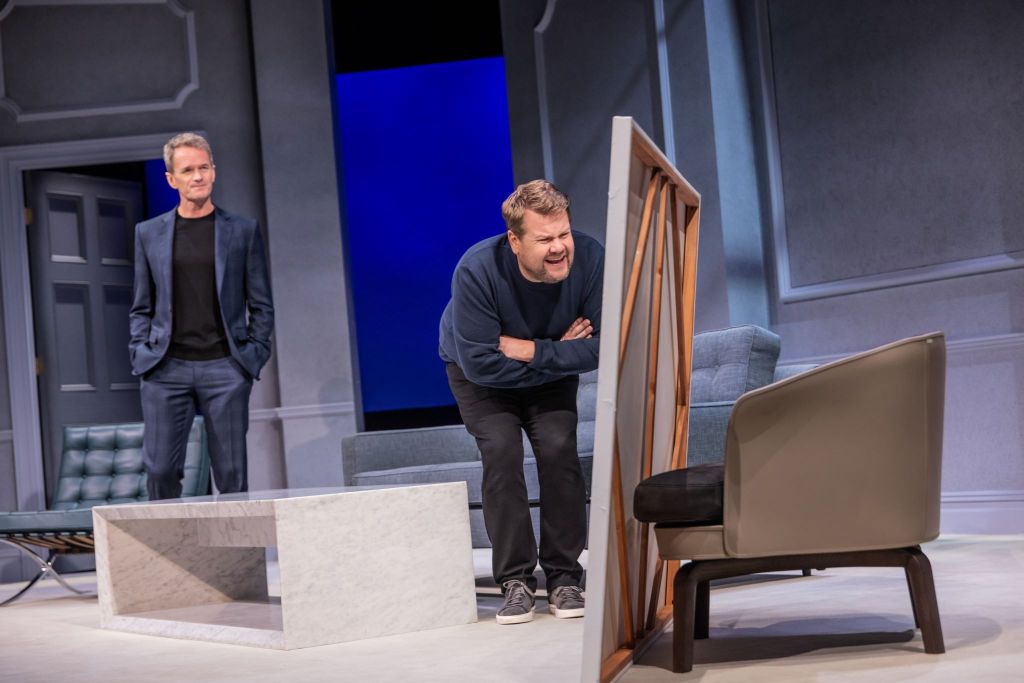
Teasing the audience by incremental degrees prompting LOL audience reactions, Reza brings each of the men to a boiling point and catharsis. Will their friendship survive their extreme reactions (even Yvan’s noncommittal reaction is extreme) and differences of opinion? Will Serge allow Marc to deface what he believes to be “shit” for the sake of their friendship? In what way are these middle-aged men asserting their “place” in the universe with each other, knowing that that place will soon evanesce when Death knocks on their doors?
The humorous dialogue shines with wit and irony. Even more exceptional are the actors who energetically stomp around in the skins of these flawed characters that do remind us of ourselves during times when passion overtakes rationality. Each of the actors holds their own and superbly counteracts the others, or the play would seem lopsided and not land. It mostly does with Ellis’ finely paced direction, ironic tone, and grey walled set design (David Rockwell), that uniformly portrays the similarity among each of the characters’ apartments (with the exception of a different painting in each one).
Reza’s characters become foils for each other when Marc, Serge and Yvan attempt to assert their dominance. Ironically, Yvan establishes his power in victimhood.
Arriving late for their dinner plans, Corden’s Yvan bursts upon the scene expressing his character in full, harried bloom. His frenzied monologue explodes like a pressure cooker and when he finishes, he stops the show. The evening I saw the production, the audience applauded and cheered for almost a minute after watching Corden, his Yvan in histrionics about his two fighting step-mothers, fiance, and father who hold him hostage about parental names on his and his fiance’s wedding invitations. Corden delivers Yvan’s lament at a fever pitch with lightening pacing. Just mind-blowing.
The versatile Neil Patrick Harris portrays Serge’s dermatologist as a reserved, erudite, true friend who “knows when to hold ’em and knows when to fold ’em.” Cannavale portrays Marc’s assertive personality and insidiously sardonic barrel laugh with authenticity. Underneath the macho mask slinks inferiority and neediness. Together this threesome reveals men at the worst of their game, their personal power waning, as they dodge verbal blows and make preemptive strikes that hide a multitude of issues the playwright implies. They are especially unwinning at successful relationships with women.
Reza’s play appears more current than one might imagine. As culture mavens and influencers revel in promoting and buying brands as a sign of cache, the pretensions of superiority owning, for example, a Birkin bag, bring questions about what an item’s true worth is and what that “worth” means in the eye of the beholder. Commercialism is about creating envy and lust and the illusion of value. To what extent do we all fall for being duped? Does Marc truly care that his friend may have fallen for more hype than value? Conclusively, Yvan has his own problems to contend with. How can he move beyond, “I don’t like it, I don’t hate it.”
As for its own value, Art is worthwhile theater to see the performances of these celebrated actors who have fine tuned their portrayals to a perfect pitch. Art runs 1 hour 35 minutes with no intermission through Dec. 21 at the Music Box Theater. artonbroadway.com.
‘The Queen of Versailles,’ Fabulous Kristin Chenoweth Makes Dreams Realities

If the road to excess leads to the palace of wisdom (quote by English poet William Blake), do people know when they’ve reached their limit? When is enough enough? According to the themes of the new musical The Queen of Versailles, currently at the St. James Theatre, knowing this depends upon the seeker.
In the clever, sardonic musical, based on Lauren Greenfield’s titular documentary film and the life stories of Jackie and David Siegel, the question of excess and how to measure it shines into the darkness of American culture, conspicuous consumption, surgically enhanced, plastic looks, and meretricious values. With an ironic, humorous, no holds barred book by Lindsey Ferrentino, and music and lyrics by Stephen Schhwartz, the Siegel’s riches to more riches story, including the 2008 mortgage debacle, takes center stage. By the conclusion, the audience leaves shaken and maybe stirred, either with a bad taste in their mouths or with the prick of guilt in their consciences.
At its finest, The Queen of Versailles inspires the audience to peer into their own values and behavior and evaluate their souls to correct. Ultimately, it asks, do the Siegels have a worthwhile life or have they allowed their childhood poverty to overwhelm their good sense and inner emotional well being? Despite its ripe fun Ferrentino’s book and Schwartz’s music encourage a hard look at crass, materialistic greed that blinds the rich from using their largess for the social good. Lastly, it questions do the representative Siegels count the cost to live the oversized billionaire’s lifestyle which causes harm? To what extent has their craven indulgence choked off their lifeblood to their own destruction?
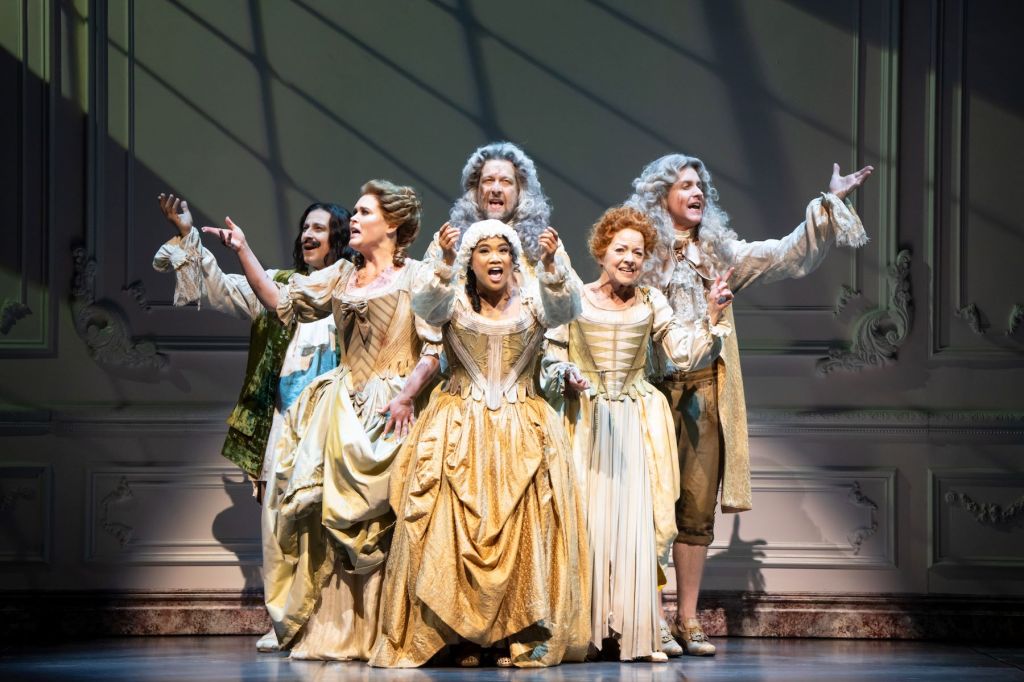
Starring an endearing, heartfelt and bubbly Kristin Chenoweth as the materially insatiable Jackie Siegel, and F. Murray Abraham as billionaire workaholic David Siegel, the New York premiere which has an end date of March 29, 2026, rings with disturbing truths. It’s farcical, dark elements present many themes. Chief among them is the theme that the Siegel’s shiny ostentation hides a sad emptiness that can never be fulfilled.
Framing the Siegel’s story with the key meme of Versailles, the mansion in France that 17th century Louis XIV, built as a memorial to his majesty, the opening scene and song (Pablo David Laucerica is King Louis XIV) replete with period chandeliers, furniture, costumed butlers and maids reveals how and why the Sun King built his palace on swampland (“Because I Can”). Without giving thought to the inequities in French society that necessitated the economic gap between royalty and its impoverished, destitute subjects, Jackie and David want one.
In a quick switch to the present (2006) we see the Siegel’s Versailles in progress. With construction scaffolding in the background and a documentary film crew in the foreground, Chenoweth’s Jackie glows as she sings “we want to have the very best for the biggest home in America because we can.” The fluid set design with appropriate props and pieces by Dane Laffrey, who also does the video design, brings perfect coherence to the Siegel’s intentions. It connects the idea of royal wealth manifest in Louis XIV’s lavish excess to their rich/famous lifestyle which reeks of tawdriness. Thanks to Michael Arden’s staging and direction and Cristian Cowan’s costumes, and Cookie Jordan’s hair and wig design, the shifts from the present to the court of Louis XIV and back solidly establish the trenchant themes of this profoundly current musical.
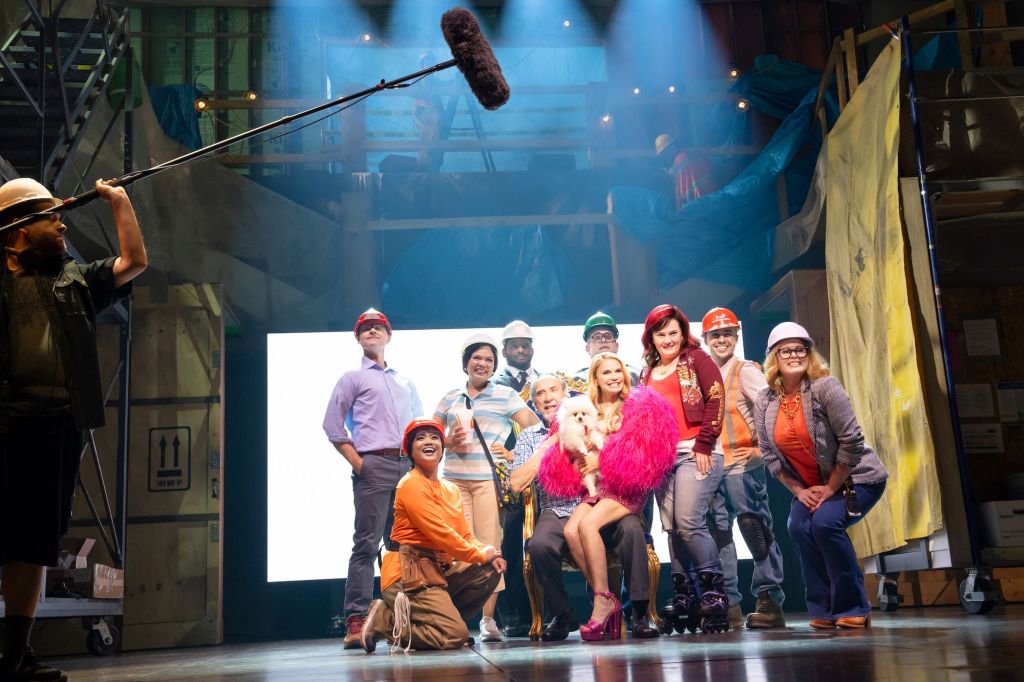
Presuming themselves American royalty, the Siegels hope to replicate a modern-day Versailles, like their mentor king. Indeed, they will best him. Their Versailles has whatever the family wants. This includes a jewelry-grade gem stone floor, an in-house Benihana (with all those tossed shrimp because David doesn’t like to stand on line), a spa, a pool with a stained glass roof, and a family wing with numerous bedrooms and bathrooms so Jackie doesn’t lose track of her seven kids.
After this opening salvo that mesmerizes like any show about the “lifestyles of the rich and presumptuous,” we discover that Jackie didn’t always come from wealth. In fact her story mirrors the old Horatio Alger “rags-to-riches” fable that Alger shaped into the American Dream, which abides today and which also influenced F. Scott Fitzgerald’s take on it in The Great Gatsby. Jackie, albeit a female dreamer, buys into the concept that if she pulls herself up with determination, works hard and does good works, she can lift herself into the upper classes.

We see how this manifests in the next segment of Chenoweth’s 17-year-old version of Jackie with her parents Debbie (Isabel Keating) and John (Stephen DeRosa) in their humble Endwell, New York home. Debbie and John count on Jackie to continue to work as many jobs as possible to become rich and famous like the titular show they watch together. Singing the song “Caviar Dreams,” a ballad that expresses beautifully a female Alger hero, we “get” Jackie’s drive and pluck to work day and night to achieve an engineering degree at IBM, then kick the job to the curb because it won’t give her wealth fast enough.
As she “keeps on thrustin” she makes a bold turn into marriage with alleged banker Ron (Michael McCorry Rose), who disappoints when he drags her to the Everglades, and opposes her Mrs. Florida win. When he physically abuses her, despite her pregnancy, Jackie leaves. Singing “Each and Every Day” beginning when Victoria is a baby, the scene switches to the present at the construction site and the teenage Victoria (the excellent Nina White) enters. Chenoweth’s Jackie soulfully finishes the song to Victoria in an important transitional moment. We understand Jackie as a survivor who loves her firstborn, who she claims saved her life.
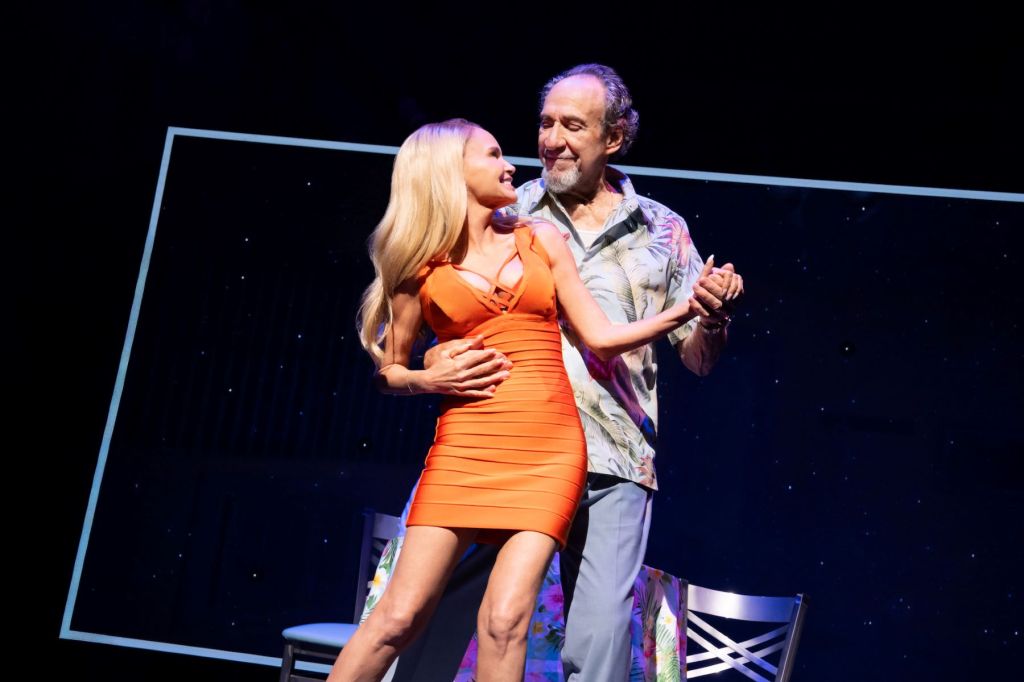
Not only does Jackie not look back, we learn she and baby Victoria lived in an apartment which “barely fit the baby’s crib and Jackie’s sleeping bag.” However, always “thrustin’ forward,” she recognizes opportunity when she goes to a party where she meets David Siegel, the CEO of Westgate Resorts. As it turns out, his impoverished childhood was similar to hers and left him with dreams of extreme wealth. F. Murray Abraham does justice to David throughout, first as a “cowboy” in the wild west of timeshares as son Gary (the fine Greg Hildreth) sings with the ensemble “The Ballad of the Timeshare King.” Occasionally, for emphasis, Abraham’s David chimes in with irony.
For example, David’s sales force make “one hundred percent of their sales on the first day.” Gary sings, “George W.’s president now, thanks to David Siegel.” When folks can’t afford the timeshare, Siegel helps them with financing from his bank, so the ensemble sings joyfully, “Yippee-I-owe-you-owe-we-owe.” We recognize the sardonic humor for David’s dishing out sub-prime mortgages to “anyone who breathes.” Of course this adds to the mortgage crises of 2008 which taxpayers foot the bill for. Eventually, the sub-prime loans bring his empire to the brink of bankruptcy as the crash swallows whole billionaires like David.

At that point, Jackie and David have been married with children and are two years into the Versailles construction having cycled through songs of their outsized wedding (“Trust Me”), a honeymoon trip to Versailles bringing back a scene of King Louis XIV and his courtiers. Smartly, Ferrentino and Schwartz reinforce their themes by joining past and present in the reprise “Because I Can and the “Golden Hour.”
However, conflict looms on the horizon. Though David and Jackie live their wildest dreams and birth child after child, daughter Victoria feels miserable, insular and ugly. “I know mom wishes I was prettier,” she sings in the poignant “Pretty Wins.” And in Act II in the superb “Book of Random” Victoria sings from her journal, the thoughts that she keeps hidden. Unlike her mother Victoria grounds herself in her current feelings of sadness brought on by reality, escapism fueled by drug addiction and scorn for their damaging and excessive lifestyle. However, when Jackie’s niece Jonquil (Tatum Grace Hopkins) arrives and Jackie takes her in, we think that Victoria has someone to confide in.
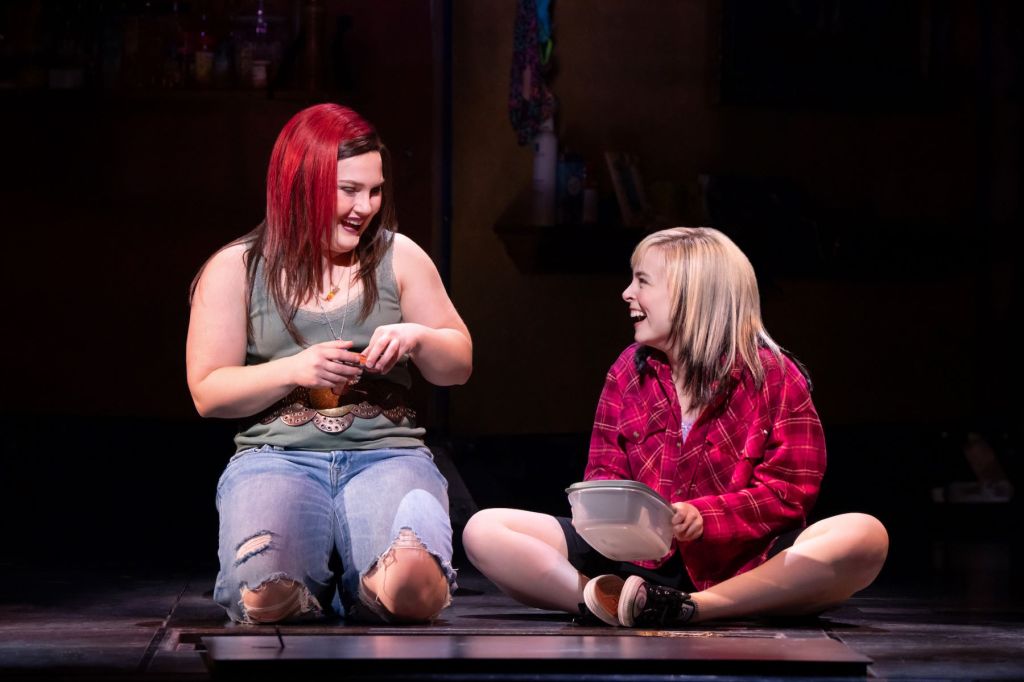
But Jonquil doesn’t understand Victoria’s dislike of Jackie’s appetite for more. And it doesn’t help Victoria that Jonquil becomes a clone of Jackie (“I Could Get Used to This.”). Ironically, when the crash happens and Victoria hears of the talk that they will sell Versailles to keep David from going belly up, she feels relief. In a farce-filled scene in the 17th century Versailles, with some of the most ironic lyrics, the Sun King chides the Siegels and Americans in the song “Crash.” “You thought you’d be egalitarian, let peasants own their own homes in some altruistic plan. Well, what were you expecting from a choice so rash? Crash…”
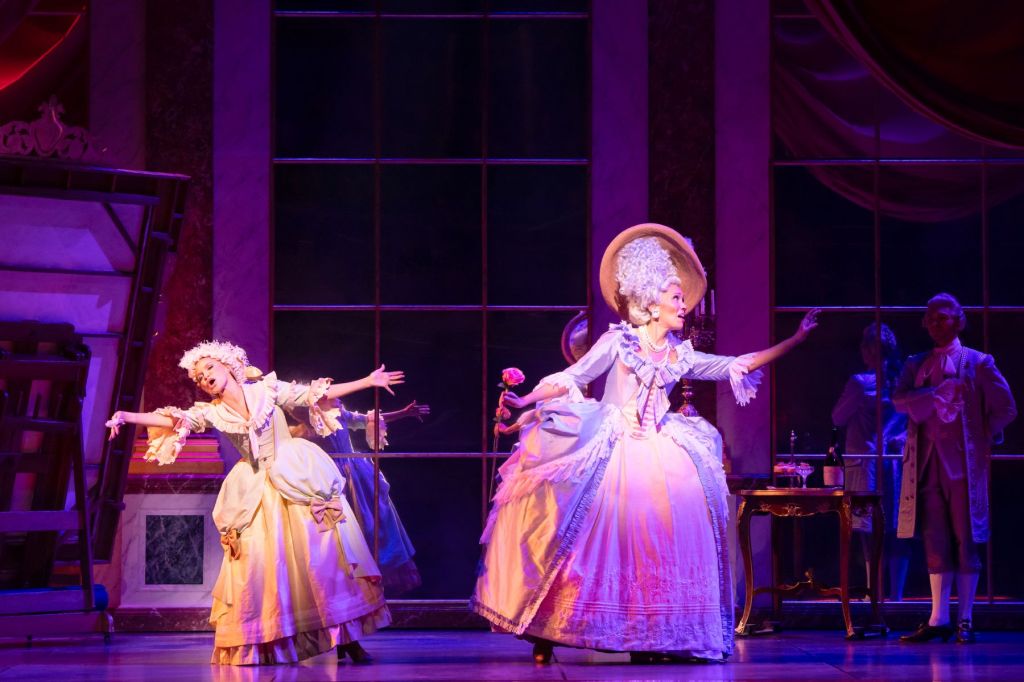
At the end of Act I, we have only Jackie’s spunk and perseverance (“This is Not the Way”), and David’s connections to rely on to bail them out of bankruptcy and foreclosure. Act II reveals that deus ex machina saves them when the government (taxpayers) bail out billionaires and banks. Naturally, the little people with no safety net lose their shirts. Where the peasants of France revolted against their royals (there is a humorous scene with the luckless Marie Antoinette on her way to the guillotine), in America, no one goes to jail because the banks and firms are “too big to fail.”
At the end of Act II, in a scene with King Louis XIV, in a reprise of “Crash,” King Louis and his courtiers sing as Marie Antoinette says “goodbye.” Here, Schwartz’s lyrics and tune underscore a crucial theme. America’s Aristocracy has cleverly worked it out that “democracy” will prevent revolutions. How? The rich have peasants “thinking they’re tomorrow’s millionaires; that you’re special privileges will someday soon be theirs.” And the ensemble adds, “No blade across the throat for you. Instead it seems your peasant class will all turn out to vote for you!” Thus, with no accountability for wrecking the economy and countless lives, the rich get richer, and Jackie and David, out of bankruptcy, continue building Versailles.
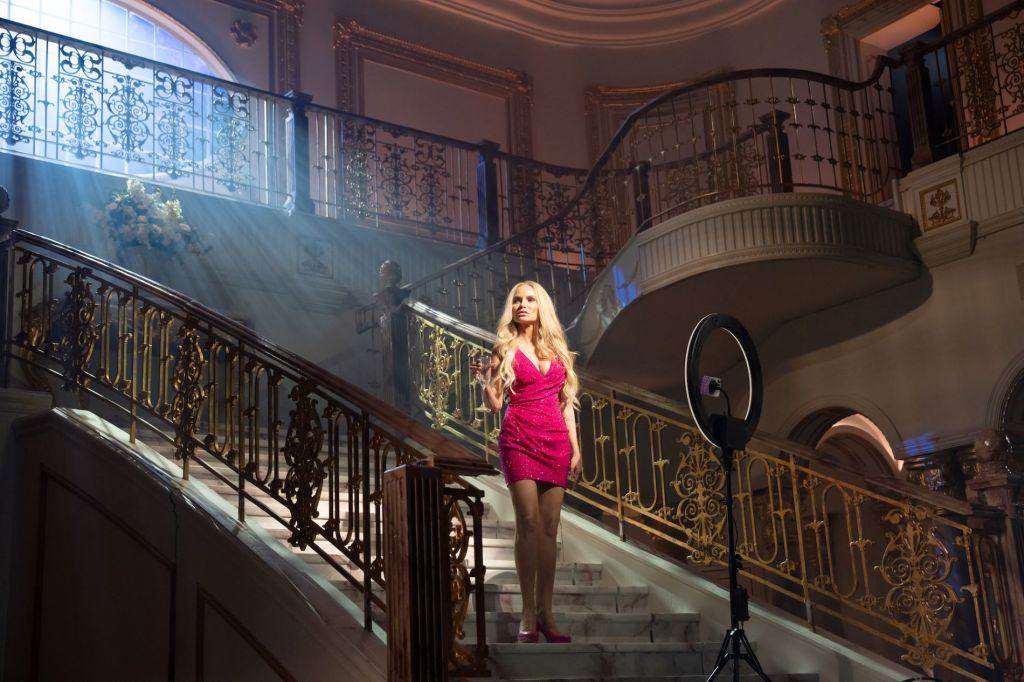
However, in all of the mayhem of trying to regain solvency, the Siegels sacrifice a family member. If material empires go on for centuries, flesh and blood does not. The unreality of excess belies mortality. But some folks never learn. Schwartz and Ferrentino ironically underscore this as Chenoweth’s Jackie holds a glass of champagne standing in front of a ring light. She speaks to a social media audience and hopes that, like her, they get their “champagne wishes and caviar dreams.”
The Queen of Versailles runs 2 hours 40 minutes with one intermission at the St. James Theatre. https://queenofversaillesmusical.com/
Keanu Reeves, Alex Winter carry Ted and Bill into the adventure of ‘Waiting for Godot’

Referencing the past with Bill and Ted’s Excellent Adventure movie series, something has happened. Bill (Alex Winter) and Ted (Keanu Reeves), who long dropped their younger selves and reached maturity in Bill and Ted Face the Music (2020), have accomplished the extraordinary. They’ve fast forwarded to a place they’ve never been before in any of their adventures. An existential oblivion of uncertainty, Samuel Beckett’s Waiting for Godot.
There, they cavort and wallow in a hollowed out, megaphone-shaped, wind-tunnel (Soutra Gilmore’s clever set design). The gaping maw is starkly, thematically lighted by Jon Clark. Ben & Max Ringham’s sound design resonates the emptiness of the hollow which Winter’s Valdimir and Reeves Estragon fill up to the brim with their presence. And, among other things, Estragon loudly snacks on invisible turnips and carrots, and some chicken bones.
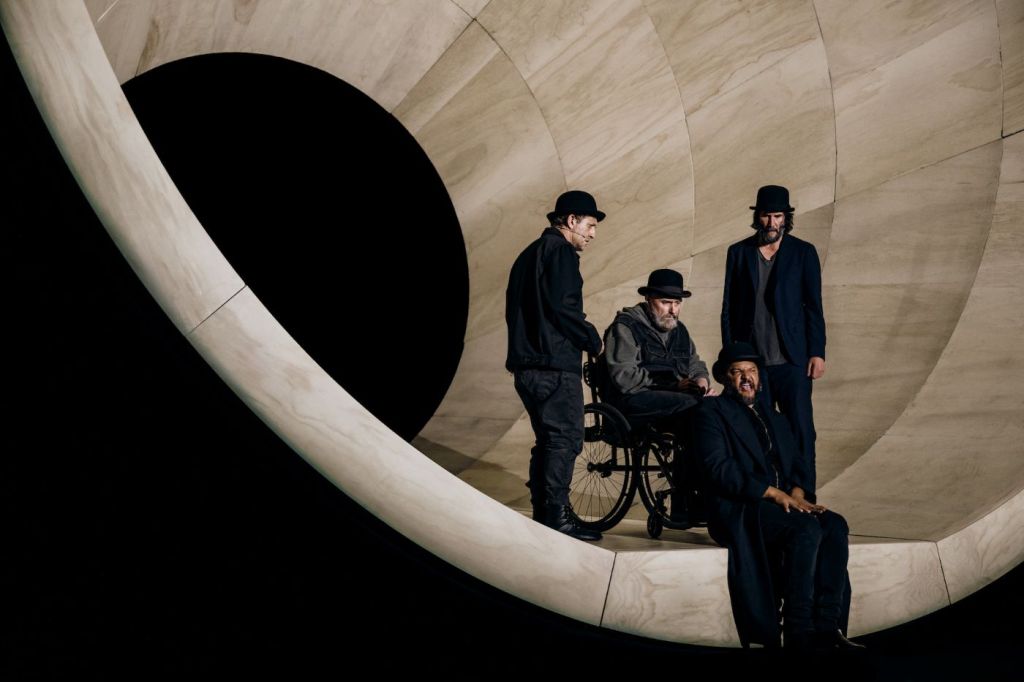
Oh, and a few others careen into their empty hellscape. One is a pompous, bullish, land-owning oligarch with a sometime southern accent, whose name, Pozzo, means oil well in Italian (a superb Brandon J. Dirden in a sardonic casting choice). And then there is his slave, for all oligarchs must have slaves to lord over, mustn’t they? Pozzo’s DEI slave in a wheelchair, seems misnamed Lucky (the fine Michael Patrick Thornton).
However, before these former likenesses of their former selves show up and startle the down-on-their luck Vladimir and Estragon, the two stars of oblivion wait for something, anything to happen. Maybe the dude Godot, who they have an arrangement with, will show up on stage at the Hudson Theatre. Maybe not. At the end of Act I he sends an angelic looking Boy to tell them he will be there tomorrow. A silent echo perhaps rings in the stillness of the oblivion where the hapless tramps abide.

Despite the strangeness of it all, one thing is certain. Bill and Ted are together again for another adventure that promises to be like no other. First, they’ve landed on Broadway, dressed as hobos in bowler hats playing clowns for us, who happily watch and wait for Godot with them. And it doesn’t matter whether they tear it up or tear it down. The excellent novelty of these two appearing live as Didi (Vladimir) and Gogo (Estragon), another dimension of Bill and Ted, illuminates Beckett.
Keanu Reeves’ idea to have another version of their beloved characters confront Samuel Beckett’s tragicomical questions in Waiting for Godot seems an anointed choice. It is the next step for these bros to “party on,” albeit with unsure results. However, they do well fumfering around in this hollowed out world, a setting with no material objects. The director has removed the tree, the whip, or any props. Thus, we concentrate on their words. Between their riffs of despair, melancholy, hopelessness and trauma, they have playful fun, considering the existential value of life. Like all of us, if they knew what circumstances meant in the overall arc of their lives, they wouldn’t be so lost.
Director Jamie Lloyd, unlike previous outings (A Doll’s House, Sunset Boulevard), keeps Beckett’s script without alteration. Why not? Rhythmic, poetic, terse, seemingly repetitive and excessively opaque, in their own right, the spoken words ring out, regardless of who speaks them. That the characters of Bill and Ted are subsumed by Beckett’s Didi and Gogo makes complete sense.
What would they or anyone do if there was no intervention or salvation as occurs fancifully in the Bill and Ted adventure series? They’d be waiting for salvation, foiled and hopeless about the emptiness and uselessness of existence without definition. Indeed, politically isn’t that what some in a nation of unwitting, passively oppressed do? Hope for salvation by a greater “someone,” when the only possibility is self-defined, self-salvation? How long does it take to realize no one is coming to help? Maybe if they help themselves, Godot will join in the work of helping them find their own way out of oblivion. But just like the politically passive who do nothing, the same situation occurs here. Godot is delayed. Didi and Gogo do nothing but play a waiting game.

From another perspective eventually unlike political passives they compel themselves to act. And these acts they accomplish with excellent abandon. They have fun.
And so do we watching, listening, wondering and waiting with them. Their feelings within a humorous dynamic unfold in no particular direction with a wide breadth of expression. Sometimes they want to hang themselves to end the frustration. Sometimes, bored, they engage in swordplay with words. Sometimes they rage. Through it all they have each other. And despite wanting to separate and go their own ways, they do find each other comforting. After all, that’s what friends are for in Jamie Lloyd’s anything is probable Waiting for Godot.
In Act I they are tentative, searching their memories for where they are and if they are. Continually, they circle the truth, considering where the one is who said they were coming. However, the situation differs in Act II because the Boy gave them the message about Godot.
In Act II they cut loose: chest bump, run up and down their circular environs like gyrating skateboarders seamlessly navigating curvilinear walls. By then, the oblivion becomes familiar ground. They relax because they can relax, accustomed to the territory. And we spirits out there in the dark, who watch them, become their familiar counterparts, too. Maybe it’s good that Godot isn’t coming, yet. They may as well while away the time. Air guitar anyone? Yes, please. Reality is what we make it. Above all, we shouldn’t take ourselves too seriously. In the second act they don’t. After all, they could turn out like Pozzo and Lucky. So they do have fun while the sun shines, until they don’t and return right back to square one: they wait.

As for Pozzo and Lucky a further decline happens. In Act I Lucky gave a long, unintelligible speech that sounded full of meaning. In Act II Lucky is mute. Pozzo, becomes blind and halt, dependent upon Lucky to move. He reveals his spiritual and physical misery and haplessness by crying out for help. On the one hand, the oppressor caves in on himself via the oppression of his own flesh. On the other hand, he still exploits Lucky whom he leads, however awkwardly. The last shreds of his bellicosity and enslavement of Lucky hang by a thread.
Pozzo has become only a bit less debilitated than Lucky, whereas before, his identity commanded. Fortunately for Pozzo Lucky doesn’t revolt and leave him or stop obeying him. Instead, he takes the role of the passive one, while Pozzo still acts the aggressor, as enfeebled as he is. The condition happened in the twinkling of an eye with no explanation. Ironically, his circumstances have blown most of the bully out of him and reduced him to a pitiable wretch.
Nevertheless, Didi and Gogo acknowledge Pozzo and Lucky’s changes with little more than offhanded comments. What them worry? Their life-giving miracle happened. They have each other. It’s a congenial, permanent arrangement. After that, when the Boy shows up to tell them the “bad” news, that Godot has been delayed, yet again, and maybe will be there tomorrow, it’s OK. There’s no “sound and fury” as there is in Macbeth’s speech about “tomorrows.” We and they know that they will persist and deliver themselves and each other into their next clown show, tomorrow and tomorrow and tomorrow.
If one rejects the comparison of this version of Waiting for Godot with others they may have seen, that wisdom will yield results. To my thinking comparing versions takes the delight out of the work. The genius of Beckett is that his words/dialogue and characters stand on their own, made alive by the personalities of the actors and their choices. I’ve enjoyed actors take up this great work and turn themselves upside down into clown princes. Reeves and Winter have an affinity and humility for this uptake. And Lloyd lets them play, as he damn well should.
In the enjoyment and appreciation of their antics, the themes arrive. I’ve seen greater and lesser lights in these roles. Unfortunately, I allowed their personalities and their gravitas to distract me and take up too much space, crowding out my delight. In allowing Waiting for Godot to settle into fantastic farce, Lloyd and the exceptional cast tease out greater truths. These include the indomitably of friendship; the importance of fun; the tediousness of not being able to get out of one’s own way; the uselessness of self-victimizing complaint; the vitality and empowerment of self-deliverance, and the frustration of certain uncertainty.
Waiting for Godot runs approximately two hours five minutes with one intermission, through Jan. 4 at the Hudson Theatre. godotbroadway.com.
‘Punch’ Makes its Vital Impact on Broadway
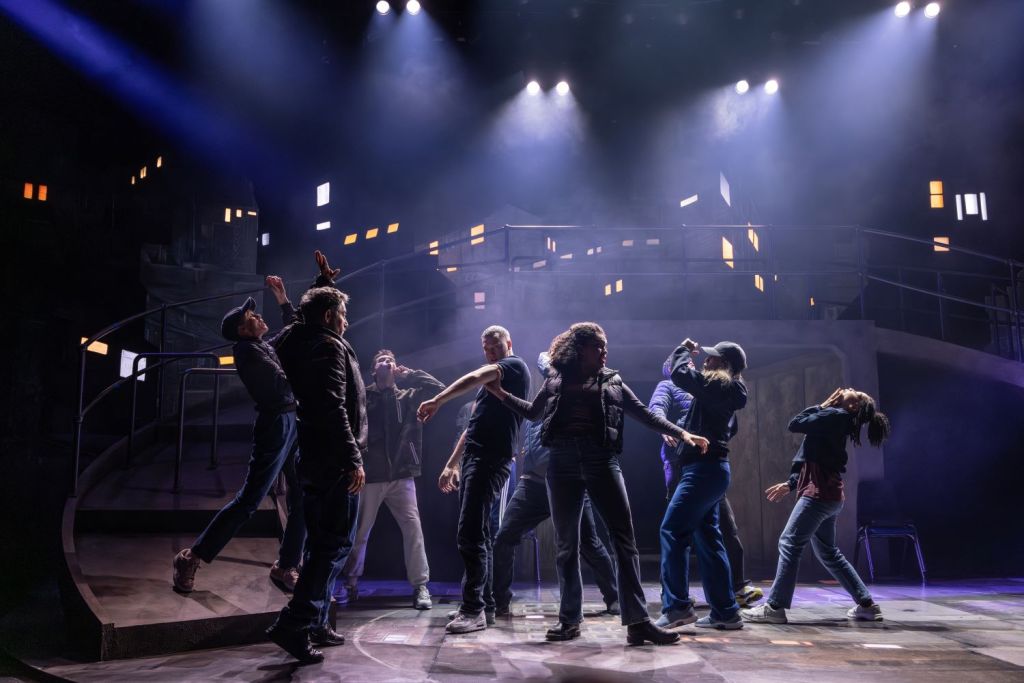
In 2025 when US citizens witness violence by those who profess patriotism, conservatism and religious fervor, one must look past the cognitive dissonance for clarity and understanding. Though the setting of Punch is Nottingham, England between 2011-2025, it is representative. The initial events might have happened in the US or any other country where punches are thrown as a right of passage for strapping young men. For these reasons Punch at Manhattan Theatre Club arrives at a crucial time.
Importantly, the heartfelt drama explores trending social concepts and themes that impact our cultural well being. The play presses hot button issues with vitality and energy. It examines the ethos of violence as the evidence of weakness. It explores how accountability for wrongdoing must be a part of rehabilitation or the likelihood of rehabilitation decreases. Finally, through the arc of the protagonist’s transformation, the play reveals that restorative justice can promote self-forgiveness and healing.
Based on Jacob Dunne’s book Right from Wrong, playwright James Graham with crystal clarity squares off against the confusion associated with brawling as thrilling, fun and justifiable. The play identifies the societal constructs that in the last decade have been infused with political nuance to exploit division and violence. Such constructs lift up physical assault as an emblem of masculinity. Likewise, they demean and dismiss kindness, compassion and empathy as true measures of strength and power.
Through Graham’s well-articulated characterizations of Jacob (the sensational Will Harrison), whose one punch kills James, and James’ mom Joan (the equally sensational Victoria Clark), we learn that redemption, forgiveness and hope are not empty words bandied about after violent acts that kill. Made alive by spiritual goodness, the process of redemption and forgiveness can manifest positive results. And with hope and persistence, nihilistic behavior can be turned around.

The two act structure of Punch stylized by minimal sets and props put to suggestive use seems front-loaded with exposition in the first act. In the prologue Graham carefully creates the circumstances moving from the present to Jacob’s past during the fateful night that changed his life. In the present Jacob barely is able to articulate what happened to a facilitator and “circle group” in an initial therapy session. To them he describes the night of Raf’s birthday celebration and the reasons how and why the confrontation with a stranger upends his life.
Principally through his precise descriptions, the choreographed action via Leanne Pinder’s movement direction, and director Adam Penford’s staging of Jacob and his mates, we understand how and why the killing happened. After they celebrate with drugs and pub crawls, his friends scatter in various directions planning to meet up later. Jacob runs into a girl, Claire (Camila Canó-Flaviá) and has a brief flirtation. Then, Raf phones him for some “action” going down at Yates’ Bar in Market Square. For Jacob, “You always step in, your mate, my mates, your people.”
Sadly, Jacob allows himself to be Raf’s and his friends’ tool. Jacob describes that he arrives at Market Square where they wait for him but they take no responsibility for their own provocation. Helping his “mates” Jacob slams a man with his fist during what he assumes to be a brawl. With one blow, he knocks down the guy he doesn’t know whose name he discovers later is James. It is a punch that lasts forever, symbolized effectively in a freeze frame tableau and directed lighting.
In the first act the events move to James’ parents David (Sam Robards) and Joan (Victoria Clark), who deal with James’s condition and eventual diagnosis that he can’t just sleep off being drunk in the ER. Through a series of acute, brief questions, Joan queries David why James needs hospitalization. We divine he received a severe concussion. Subsequently, a diagnosis comes. A brain bleed requires James to have surgery. However, he never regains consciousness. After a decision to pull him off life support, his parents review how and why their giving, gentle, twenty-eight year old son died.
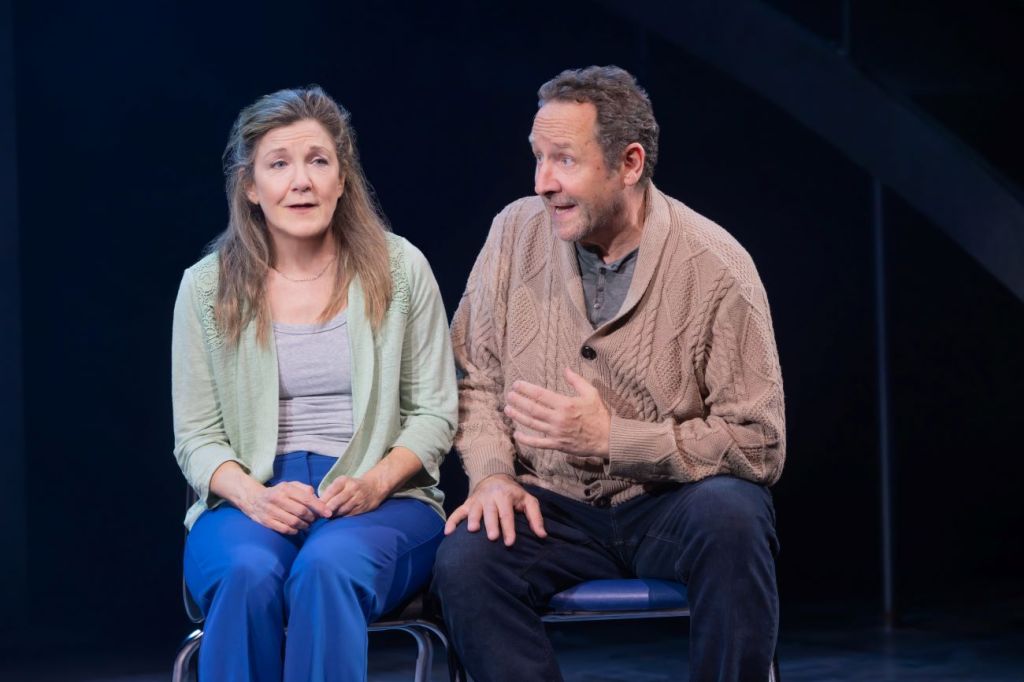
In his circle group, Jacob discusses his childhood, parents divorce, change of living arrangements and choice of friends in school. Jacob makes the point that his early decisions to choose one group of friends over another directly influenced his life negatively. Additionally, trouble in his school work because of autism adds to his alienation from school, his feelings of inferiority and need to fit in with “his mates.” For them engaging in violence bonds them together in a show of masculinity and power.
These scenes and Jacob’s discussing his jail time and encouragement by convicts to seek revenge on Raf for tipping off the police alternate with scenes between David and Joan. The couple discuss wonderful memories of James, the trial, appeals for a tougher sentence for their son’s killer and the underestimation of the “one punch” that frequently causes death. In another turning point, Joan discusses the uselessness of the situation where she feels no relief. In seeking relief, she ends up in a program called “restorative justice.” During the program she communicates with Jacob who is encouraged by his social worker (Camila Canó-Flaviá) and parole officer (Lucy Taylor).
Segments of the first act might have been streamlined and tightened as the repetition of scenes with Jacob and his mates become tiresome. The second act moves more quickly. It profoundly deals with Jacob’s self-realizations and transformation prompted by communication with David and Joan. The three, who agree to participate in the British restorative justice system communicate through letters. At this point Jacob is out on parole after 14 months. David and Joan question him about the circumstances of the fateful night. In the last scenes, they meet face to face and Jacob asks for forgiveness.
Harrison and Clark with the assistance of a fine ensemble (who take on many roles) breathe life into the characters and make them identifiable. The power of the play lies in the performances. Harrison’s move deeper into the emotions of Jacob as he seeks relief, redemption and forgiveness astounds. Clark’s Joan makes one admire James’ mother’s spiritual strength. She recognizes that she cannot live with hate and resentment toward her son’s killer. By seeking to understand and have hope for Jacob’s future, she gives birth to the possibility that Jacob can make something of himself. That satisfies her so that her own son’s sacrifice gains meaning in Jacob’s redemption.
The adaptation from narrative to drama requires theatricality. At times, the dialogue doesn’t deliver and must be activated. In the shuffling into action some scenes are awkward and need tweaking. Some might have been removed altogether. Overall Punch rides the zeitgeist of the moment. Its performances elevate its timeless themes and strike us with their vitality and power.
Punch runs approximately 2 hours and 30 minutes with one intermission at the Samuel J. Friedman Theatre until November 2nd. https://www.manhattantheatreclub.com/shows/2025-26-season/punch/
‘Pirates!’ Is a Riot With David Hyde Pierce, ARGH!
Pirates! The Penzance Musical Set in The Big Easy
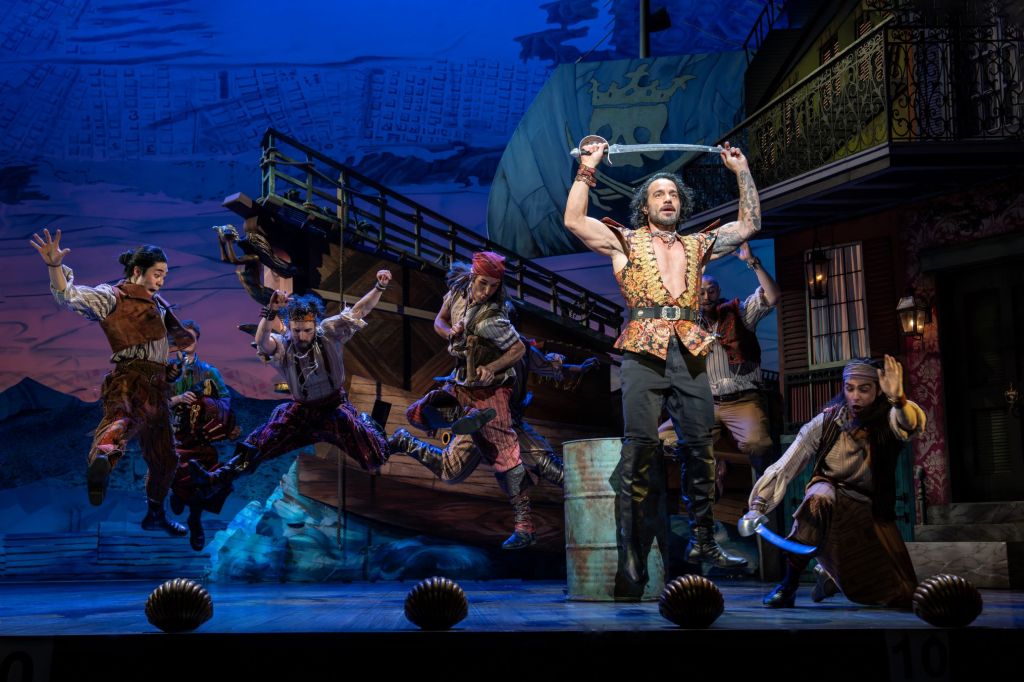
The revival of Pirates of Penzance, the comedic operetta with music by Arthur Sullivan and libretto by W. S. Gilbert, has been transformed into Pirates! The Penzance Musical. Indeed, it has been hauled overseas from Penzance, England to New Orleans, Louisiana for a riotous update by Rupert Holmes with new orchestrations by Joseph Joubert and Daryl Waters. It is currently revving up exuberance and laughter at Roundabout’s Todd Haimes Theater.
Holmes attempts to spin the setting changes by having a “real” Gilbert (David Hyde Pierce, who also plays Major General Stanley), and Sullivan (Preston Truman Boyd, who also plays the sergeant of Police), take the audience into their confidence in the show’s prelude. They discuss why they brought the musical to premiere and tour US cities. Importantly, they relate their enchantment with post-Reconstruction New Orleans which inspired them to “pirate” the colorful flavor of the music in the French Quarter and adapt it to various songs in the musical. Indeed, all of the scenes take place in and around the atmospheric New Orleans (even a graveyard) that represents the varied ethnic and cultural ethos of the city.
This is where fantasy takes over and “reality” is dumped by the wayside. New Orleans (1880s) notoriously expanded white supremacy (the White League was the racist organization that benefited from the eventual Jim Crow legislation, Plessy v Ferguson) despite its multicultural population, after Reconstruction ended in 1877.
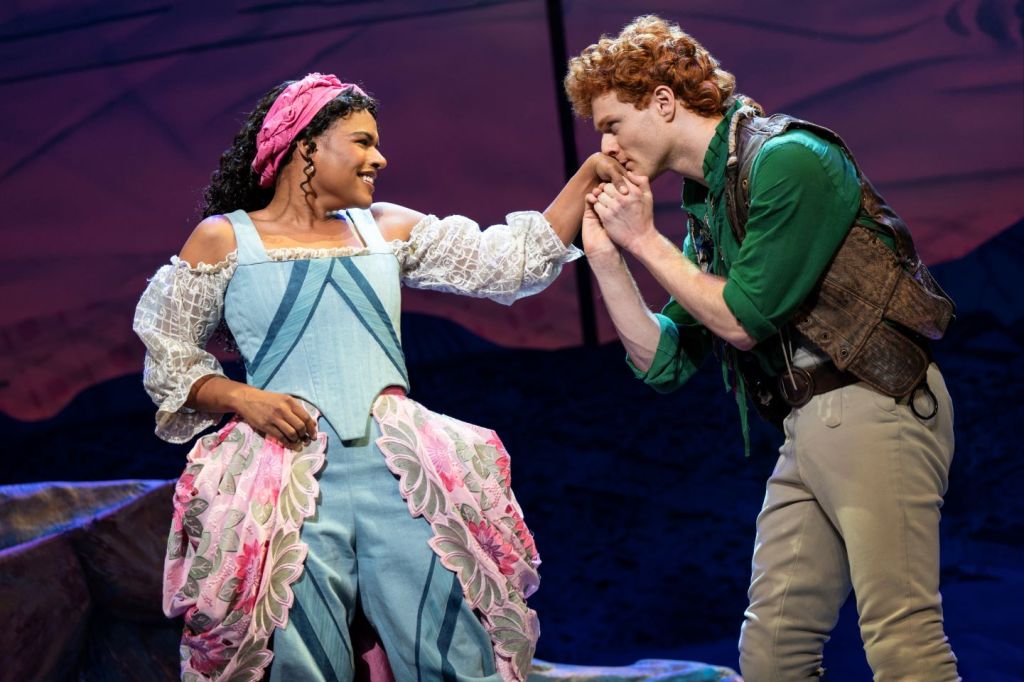
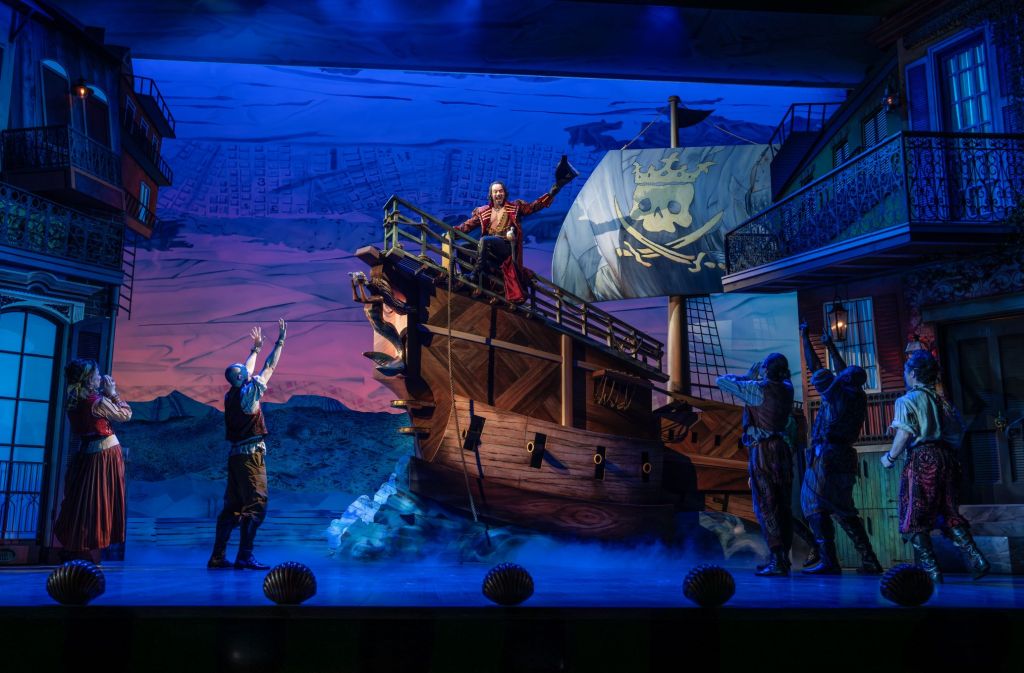
Nevertheless, as facts are stretched to fantasy, the casting of Major General Stanley’s daughters along a racial divide in contrast to the pirates must suspend one’s imagination into the realm of farce and pure entertainment. Actually, Holmes’ version would do well in a current MAGA South adverse to being aligned with “woke” or “critical race theory,” as it throws history out the window. However, the production makes New Orleans “historical” in its wonderful costuming (Linda Cho) and David Rockwell’s scenic design of the pirate ship that Karimloo makes his rope-swinging, spectacular entrance from.
As farce Holmes’ reworking is top notch for humor. His desire to update the musical and appeal to current audiences is understandable because Gilbert and Sullivan’s work (first brought to the US in 1878) is extraordinary, British ironic and extremely clever. It is especially appreciated if one is able to launch into the nooks and crannies of its brilliant and humorous lyrics. Though I was able to look at the script, for those who must rely on the ensemble to enunciate the lyrics, especially in the choral numbers, one loses much in the translation. However, the driving music and director Scott Ellis’ staging and frenetically paced action mitigates that loss.
In keeping with reimagining a New Orleans’ vibe that is more Southern down home than British witty, the production sports a different tenor than a superb but traditional revival produced at The Public Theater in 1981, starring Kevin Kline, Linda Ronstadt and Estelle Parsons. That Pirates of Penzance was gloriously captured on film in 1983. For a contrast, it would be delightful to revisit the film then see the Roundabout’s lighthearted production.
Maintaining the general plot of Gilbert and Sullivan’s 1878 operetta, “Pirates!” unfolds the story of the hapless and innocent Frederic (the excellent Nicholas Barasch). In the antiquated fashion of indentured servitude, Frederic is duty-bound by his deceased father to be the apprentice to the Pirate King (the gymnastically vigorous, organically funny and gorgeously voiced and appearanced Ramin Karimloo). Ironically, the Pirate King is derelict in his piracy (we discover why at the conclusion), as he incompetently leads his band of “spurious” pirates NOT to plunder, kill or steal.
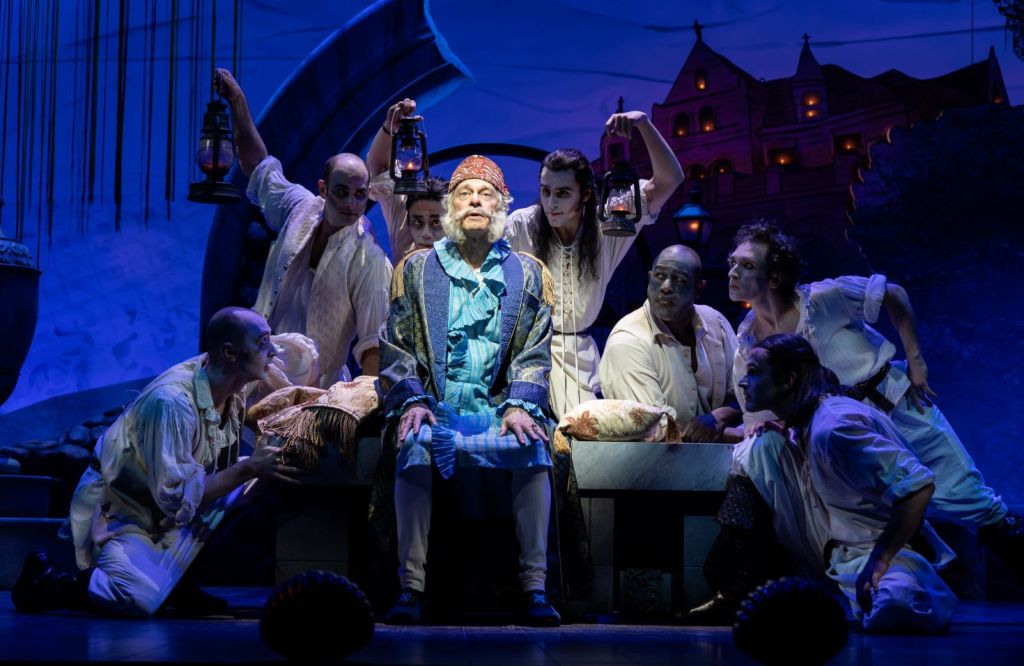
Thus, residing with the pirates and following the dereliction of duty promoted by the Pirate King, Frederic eventually completes his service on his twenty-first birthday. It is then the Pirate King frees him so he can go ashore, join law abiding society and kill every pirate he was colleagues with during his long servitude. Of course, his freedom doesn’t go as planned because of a mathematical miscalculation, and the conflict turns in another direction teetering on debacle until it is righted.
Additionally, in between meting out justice, Frederic plans to find a bride, though marrying a younger woman will break Ruth’s heart because he promised to be with her for the rest of his life. But information enlightens him and makes Frederic change his promise to Ruth, especially after he meets the lovely Mabel (Samanta Williams) and they pledge their love for each other. However, as with a common Shakespearean theme, for Frederic and Mabel, “The course of true love never runs smoothly.” And it is in the kinks and gyrating turns that the comedy reaches its heights.
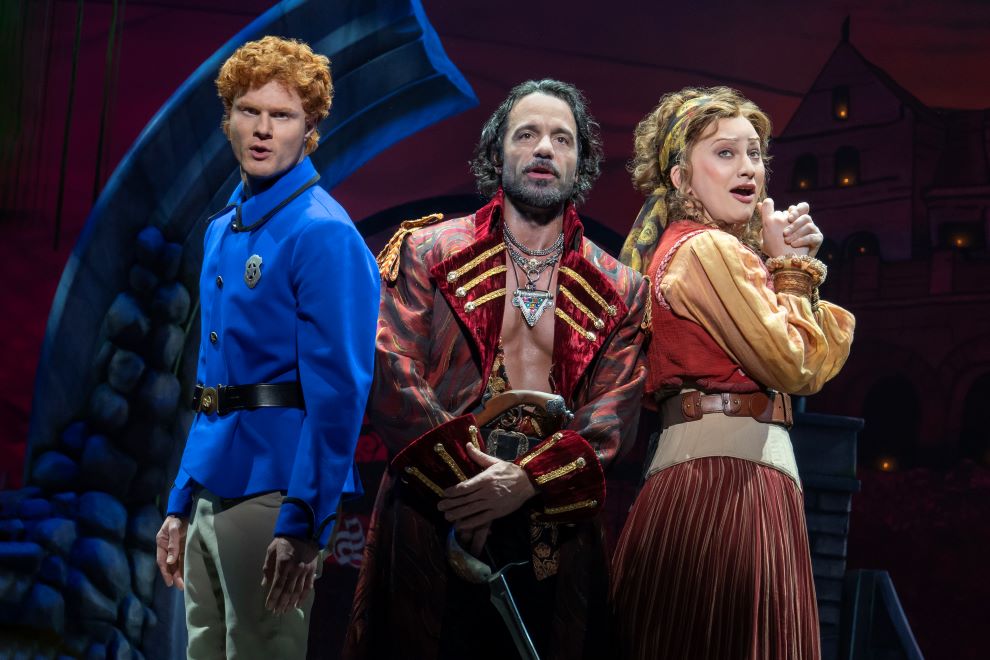
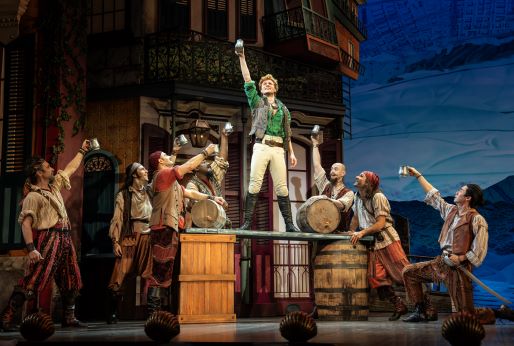
The comedy also is delivered with David Hyde Pierce’s exceptional performance of Major-General Stanley, which he acts with complete aplomb and authenticity. Pierce enunciates every word clearly and thus unrolls the stuffy, effete, sincere Major-General with dedicated determination. Considering Pierce is doing double time as Gilbert performing the Major-General, his ironic demeanor is the vehicle which is a natural for the British Gilbert’s stiff upper lip delivery. And it is hysterical. His is a really well-thought out performance as is Monsoon’s and Karimloo’s, which is memorable for his leaps over barrels, leaps onto tables and veritable sailing in the air during various numbers. Humorous as well, he is outrageously good as he pings the Pirate King’s vulnerability falling for the plight of the orphaned who into his sphere of influence.
To his credit, Holmes has put his imprint on Gilbert and Sullivan with this reinvention and has even tucked in numbers from other Gilbert and Sullivan operettas (HMS Pinafore, The Mikado and Iolanthe) to fill in and round out the characterizations and establish bridges seguing action from one sequence to the next. For characterization, in Act II, we learn more about the emotions of lovelorn and Frederic-spurned pirate wench Ruth (featuring the versatile talents of Jinkx Monsoon-two-time winner of “RuPaul’s Drag Race”). Bemoaning her fate away from her unrequited love interest Frederic, she sings “Alone and Yet Alive” with lyrics adapted from the song in The Mikado.
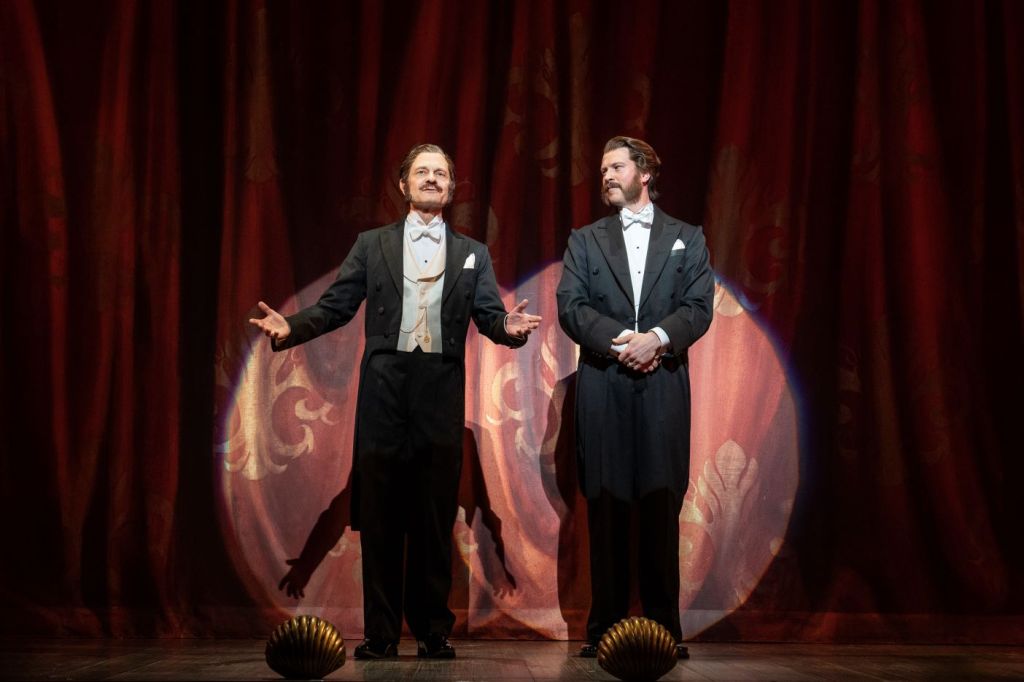
It is Holmes’ bold move to create empathy for Ruth, add coherence and deepen the emotion in the fun frolic. Jinkx Monsoon does a fine job in keeping balance with humor and pathos so we understand Ruth’s heart-felt loss, yet appreciate how she encourages herself to make the best without a particular “someone.”
Waters’ orchestrations and Joubert’s music direction strike various phrasings which are current New Orleans (not the setting of the post-Reconstruction town). These include blues, jazz, Creole notes and rhythms, Dixieland and much more. There is even an ersatz funeral New Orleans style music which is thrown in for good measure. And Mardi Gras season comes upon the pirates as they “let the good times roll.”
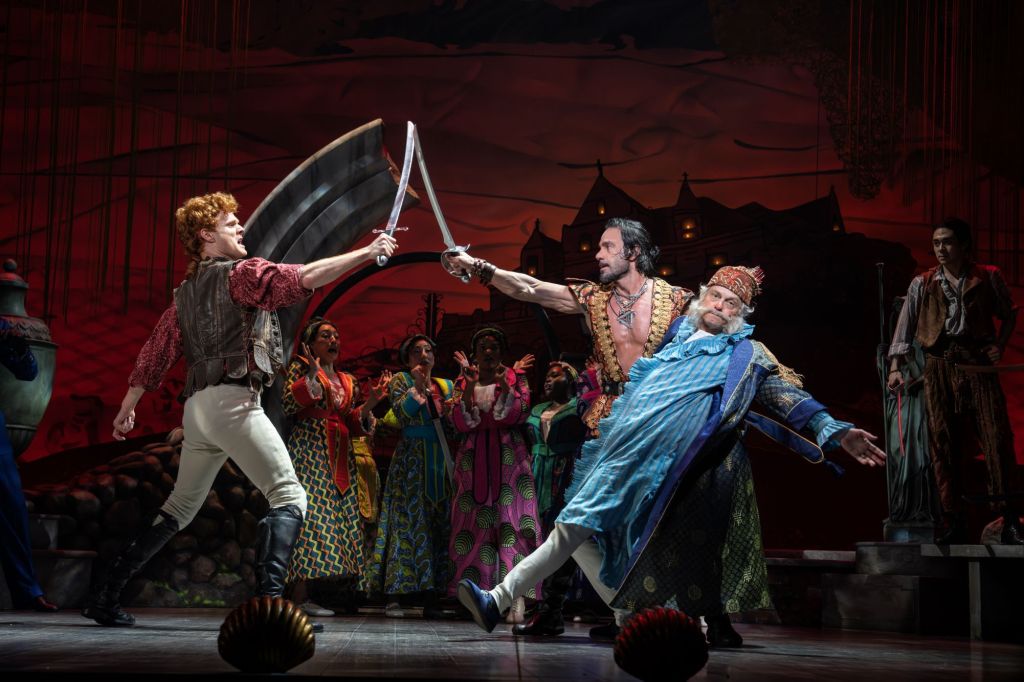
Finally, I enjoyed the washboard number at the end of Act I (“We Sail the Ocean Blue” from HMS Pinafore) for its cleverness and rhythmically united efforts by the entire cast. And the conclusion is a fantasy finale which uplifts the Trump, Musk, MAGA hated DEI lyrics “integrated” into “He Is an Englishman” from HMS Pinafore, which is a sardonic joke in itself, which I completely adored. This is in your face Broadway. If the Bill of Rights doesn’t apply, then nowhere on the globe and in the former British Empire or American is humanity safe. I completely appreciate Holmes’ sardonic and charming approach with a wit that Gilbert and Sullivan would have approved of.
I just loved this reimagining as a farce with fantastic elements, all with a point. See it.
Pirates! The Penzance Musical runs 2 hours, 15 minutes with one intermission until July 27 at the Todd Haimes Theater. roundabouttheatre.org.
‘Real Women Have Curves’ is a Sensational Adaptation With an Underlying Moral Imperative
Read Women Have Curves
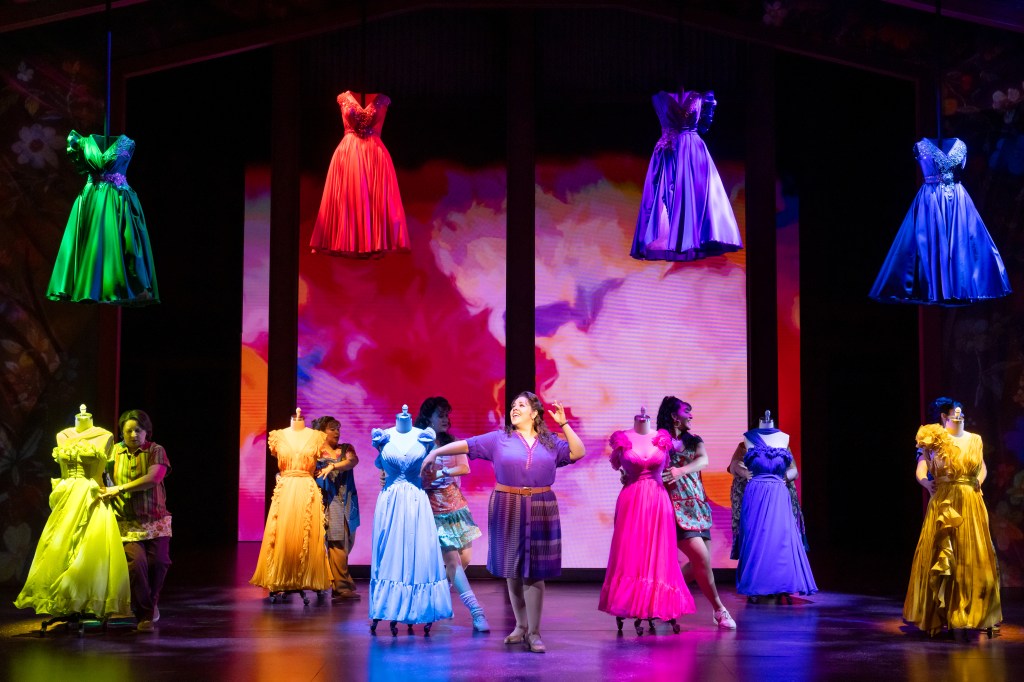
Based on Josefina López’s titular play, and the 2002 HBO film adaptation starring America Ferrera, Real Women Have Curves, at the James Earl Jones Theater, is an exuberant, humorous, beautifully colorful fun-fest with underlying messages about past Republican immigration policies, discrimination, fat-shaming, Latinx cultural iconography, female empowerment, self-love, and making the American Dream one’s own. Delighting the audiences, the production also is vitally historic in reminding us of the great sacrifice those who seek a better life make when they leave their native country for an unwelcoming nation.
Though the musical is set in Los Angeles, 1987, it has tremendous currency during the debacle of the Trump administrations’ kidnapping, trafficking and incarceration of migrants in concentration camps out of the country, illegally without due process. This unlawful, brutal practice misnamed deportation (which mandates due process), is being noted as a crime against humanity by many groups, including the United Nations and The Hague. The musical’s themes and plot contrast between the past and the present, where the current derelict, corrupt administration would degrade the United States by violating the 5th amendment to the constitution.
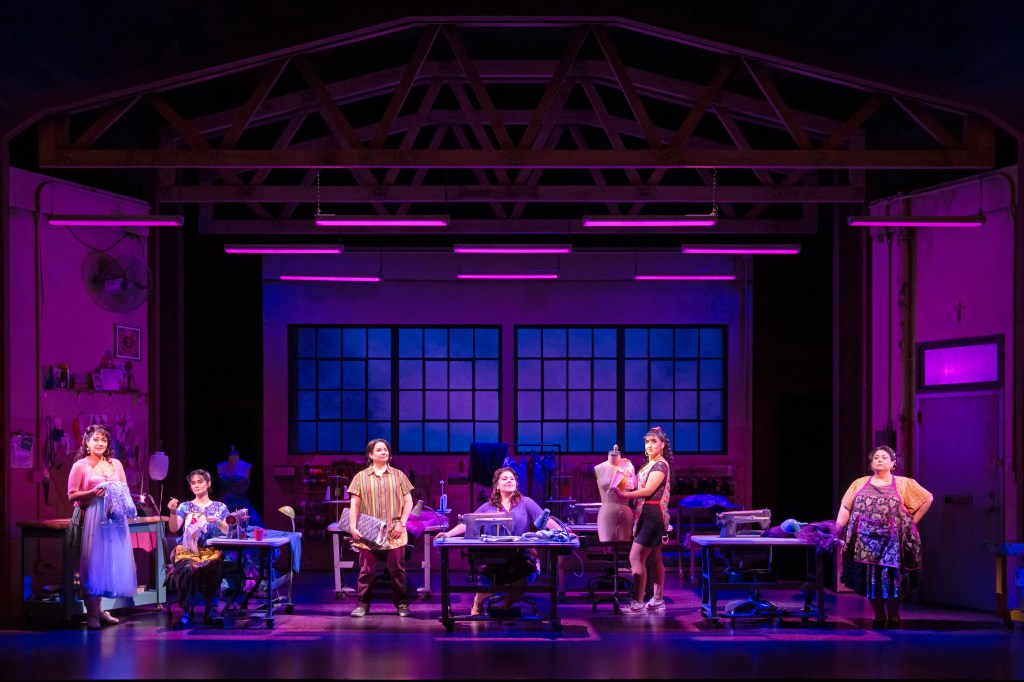
The Tony-nominated score by Grammy® Award–winning singer-songwriter Joy Huerta (known as half of the pop duo Jesse & Joy), was written with Benjamin Velez. Both wrote the music and lyrics and are also responsible for orchestrations and arrangements. With the book by Lisa Loomer (Distracted) and Nell Benjamin (Mean Girls), music supervision by Nadia DiGiallonardo (Waitress), and choreography and direction by Tony® winner Sergio Trujillo (Ain’t Too Proud), these creatives have knocked it out of the ballpark. to make the show a winner.
Coupled with the superb performances and ensemble work by the cast, the ebullience is catching and it’s impossible not to hum along, or sway in one’s seat with many of the upbeat, message-filled numbers (“Make It Work,” “De Nada,” “Oy Muchacha,” “Adios Andres,” and “Real Women Have Curves.”). We feel immediate empathy with the likable, endearing and ironically humorous Mexican women of various ages, who dream of establishing themselves in prosperity despite the incredibly long work hours at two or three jobs, the social obstacles of being “the other” culturally, and the daily threat of being deported back to their own country, a dangerous prospect.

At the outset, we note the key conflict is between mother and daughter, 18-year-old Ana García (Tatianna Córdoba), and her mom, Carmen (Justina Machado). Ana was born in the United States and has constitutional birth-right citizenship. Her older sister Estela (Florencia Cuenca), was born in Mexico. To improve their situation, father Raul (Mauricio Mendoza), found work in Los Angles and eventually moved the three of them to Boyle Heights, and stayed with persistence and tolerance of discrimination. As they prospered, Carmen and Raul subsidized Estela’s dress business, all the while raising the younger Ana to adopt American ways, but never forget her heritage.
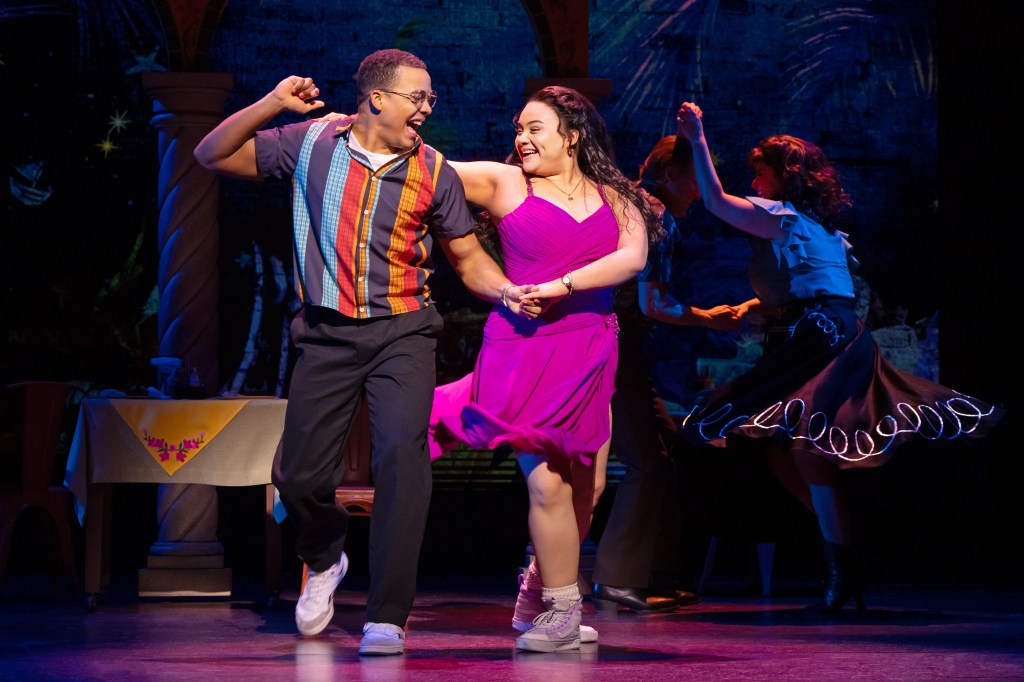
As the only American citizen, Ana excels in school, graduates with honors and as an aspiring journalist with a summer internship, applies to Columbia University where she receives an acceptance and full scholarship. At her internship with a local paper where she practices her journalism skills pro bono to gain valuable experience, she meets Henry (the superb Mason Reeves), and forms an adorable attachment. Aye, if Carmen knew about Columbia and Henry, she would hit the roof.
Of course Carmen, unsettled by their illegal status fears deportation and intends to keep the family together, just in case. Carmen’s plans are why Ana can never tell her mother about her great news that she has climbed the first rung of her dreams in her full-ride scholarship to Columbia in New York City. Now, it’s only a matter of going, regardless of Carmen’s stubbornness to keep Ana at home. When she finally does tell her, Carmen is beyond herself.
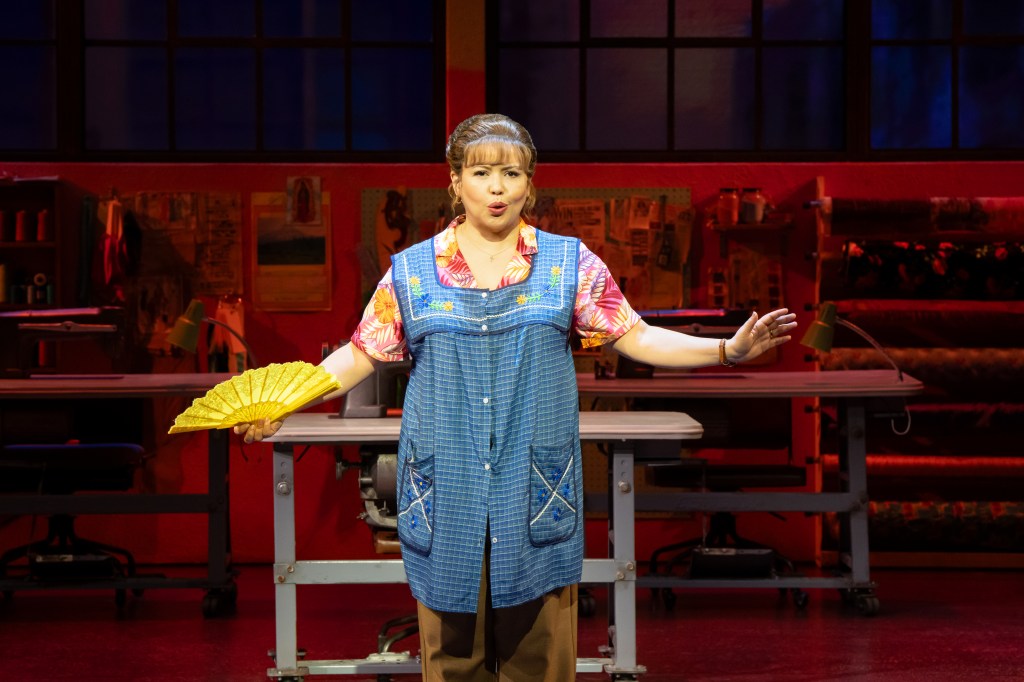
The chief reason why Carmen can’t let her go concerns their status. If they are picked up by INS, Ana’s birthright citizenship will possibly save them. The question becomes will Ana choose her dreams or put them on hold and stay with her family in support. However, if she waits, she may never get another opportunity like a free-ride to expensive Columbia again. Ana does tell sister Estela who encourages her; they agree behind Carmen’s back she should wait to tell Carmen.
In a second conflict which involves their prosperity in their business and their immigration status, Estela’s dress shop receives a fabulous order for 200 dresses. The order is from the well-connected, elite-looking, stylish Mrs. Wright (Claudia Mulet when I saw the production). Mrs. Wright gives the order under the condition that unless they are finished in three weeks, she won’t pay Estela and will take the dresses the dressmakers did finish. Thrilled to work with Mrs. Wright for her buyer contacts-a chance to increase their opportunities-Estela agrees to Mrs. Wright’s handshake contract, despite the fact that it is an onerous and shady arrangement. The dressmakers are thrilled and agree to work hard (“Make It Work”). Carmen suggests that Ana can help them get the job done and learn to sew.
However, as we find out into Act 2, Estela has taken a tremendous risk. A second question arises as the suspense increases. Will they be able to get the dresses in on time? As a further obstacle, while they are progressing, there is a loud explosion. Next door an illegal factory with undocumented workers is raided. In panic and fear, the dressmakers turn the lights off and remain in the darkness until there is quiet. It’s a moment of great tension for everyone.
After the lights are on and the danger passes, the 19-year-old Itzel (Aline Mayagoitia), from Guatemala has an asthma attack. Ana takes her to the roof to “breathe,” with a change of scene and humor to recoup. There they sing “If I Were a Bird.” It’s an important turning point in the musical as we empathize with the women, understanding the horror migrants live with to follow their dreams.
Every day Estela goes to the shop is a day they might be raided. The risks they take to survive and try to carve out a place for their families is fraught with struggle and sacrifice, but they persist. Seeing this from the perspective of the undocumented, though it was during the time of Republican President Ronald Reagan is historic. Reagan offered Amnesty as a path to citizenship, the antithesis of what current MAGA politicos and the Trurmp administration offer.
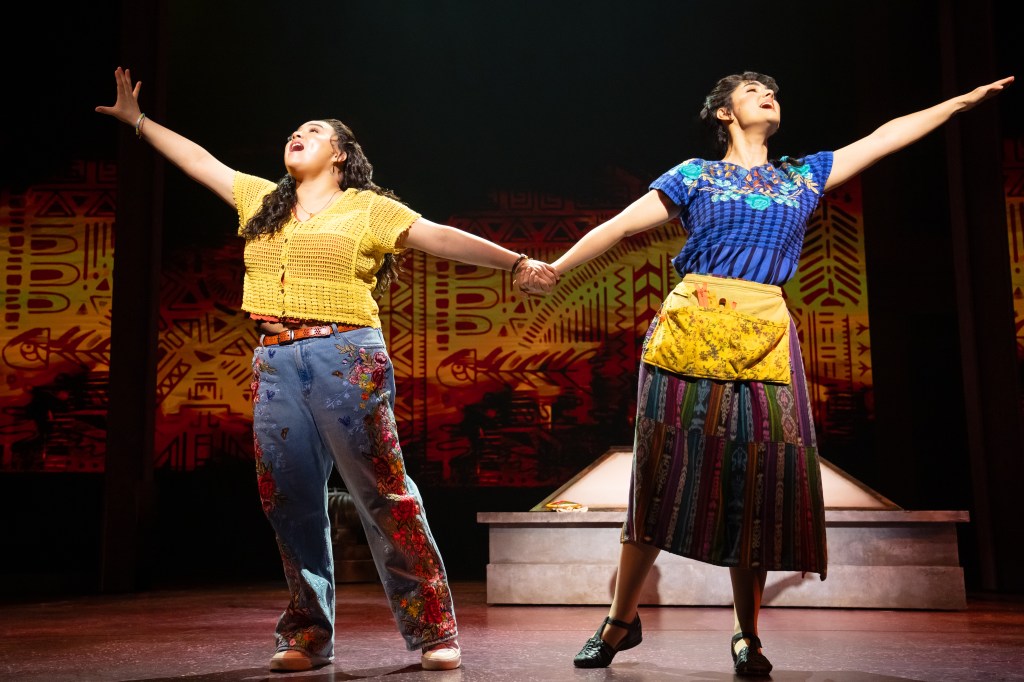
Instead, the current administration kidnaps and trafficks. It isn’t deportation, for deportation mandates due process first. The administration kidnaps and trafficks for the sole purpose of getting white supremacist votes. They sadistically enjoy the cruelty and brutality. Thus, the kidnapping, etc. without due process “shows” machismo as the MAGAS embrace hatred and discrimination against those of color. The Trump administration even supports death threats against judges who give migrants constitutional due process. Was this person inaugurated as he said he accepted his “oath?”
The INS raid in the musical is truly horrific. A hush fell over the audience as they “got it.” I couldn’t help but think how much more duress the migrants and the dreamer generations have experienced from the 1990s to today. Not only is there no path, citizenship is near impossible unless “extra” means are used to open the doors, as they were with Elon Musk and his brother and Melania Trump. All came here illegally.
As if to underscore the cruelty that has been exponentially increased during the present administration, making it unrecognizable as Republican, the announcement at the end of Act I is terrifying. The sweet, funny Itzel has been picked up by INS. In Act II when Ana tries to help her after she finally locates Itzel in a bleak detention center (Arnulfo Maldonado’s set design), where she is receiving due process. INS is willing to turn Itzel over to Ana if she will be her sponsor. It’s an impossibility. Though Ana’s an American citizen, she can do nothing without jeopardizing her family and the other women. It’s a Catch-22 situation, so she says good bye, is insulted by the guard and leaves Itzel to the unsympathetic and demeaning prison keepers.
After this difficult scene, Carmen announces she is “eating for two,” and is “pregnant.” But the women tell her it is menopause. The scene uplifts with unifying details women can empathize with as they mourn getting older. The ensemble riffs and joke, sharing their names for their “monthly;” Carmen’s is “Andres.” “Adios Andres,” an upbeat song with riotous lyrics helps bring them together to move on because there is nothing else they can do for Itzel without jeopardizing themselves. As they work on finishing the order, it gives rise to a terrific bonding song, “Real Women Have Curves.”
During the titular song, the women disrobe in order to encourage one another to love themselves and dispel the body shaming plasticity of the white culture’s mores to be television-ready thin (BMI 18), young, stylish, non-ethnic. Hispanic cultures find it hard to assimilate into the fat is hateful value, though Carmine beats up and body shames Ana for needing to lose weight, which obviously is a form of emotional abuse. And as we learn with the humorous “Real Women Have Curves,” and “Adios Andres,” extra pounds never stopped the women from enjoying their sexuality. When Ana puts aside her mother’s criticism of her weight, she establishes a budding relationship with fellow journalism intern Henry in a riotous scene (“Doin’ It Anyway”).
However, the beauty of the song “Real Women Have Curves” is the ensemble’s assertion that they are the normal ones and not the white culture’s anorexic leaning, surgery-enhanced women like Mrs. Wright. One after the other, the dressmakers stand singing in their underwear. This symbolizes gaining their power to throw off fat shaming. The audience went wild and perhaps some in the balcony joined them by tearing off their blouses/t-shirts. All this to express that a majority of the social culture is tired of the sickness/anorexia inducing emphasis of a fascist appearance ideal, now stoked with diabetes drugs, a different kind of “shooting up” from other drugs that previously addicted and decreased appetite and speeded up metabolism (cocaine).
The ensemble knocks it into the next galaxy with this number, beautifully staged and choreographed by director Sergio Trujillo. Afterward, the women become even more energized and Ana gains the confidence to approach Henry and be intimate with him in a later scene.
Meanwhile, the stakes are raised. Estela receives a call from Mrs. Wright who is pulling the contract because they lost a worker to INS. When Wright arrives, she attempts to take the dresses and pay Estela nothing. How does Mrs. Wright know they lost a worker? Mrs. Wright implies she knows much about their community. In other words, she has spies, has exploited undocumented worker factories and turns the situation cruelly to her advantage.
The character of Mrs. Wright, is a subtle counterpoint to the other characters. We learn she was also a migrant, but assimilated and internalized some of the worst of American “values”-the love of money and the necessity of adopting arrogance and branding herself a success. As Wright explains, she turned her back on her roots, changed her appearance to fit in with white women’s fascist and oppressive “can’t be too rich or too thin” mantra. They eat little and are on a constant diet. We learn at the conclusion that Mrs. Wright married up. We don’t know if he is older and uglier with money, but we do know she is ferociously determined and not averse to exploiting the illegal status of Estela and her undocumented dressmakers.
As a character foil, Mrs. Wright provides Ana’s most excellent ridicule. Ana stands up to her, using her power as a journalist. She traps her into keeping the date and time for delivery when Wright attempted to cut it short and steal from the women because they had no leverage. Ana shows she has leverage and uses her brilliance to force Mrs. Wright to uphold her end of the contract in a very funny, satisfying scene.
Perhaps most importantly as an understated conflict there is the tension of what it means to be from a different culture and have to assimilate in order to “get along.” How much must one adapt to the culture to fulfill one’s dreams? How much must one retain of one’s identity to gain one’s power but not be “too ethnic” to be a success?
Real Women Have Curves is just sensational in revealing these complex issues with humor, grace and power. It shines a beacon on all of Americans as migrants, some of whom have stupidly “forgotten” their heritage. Indeed, today, some like Mrs. Wright become lost in the process of “shedding” their unwanted ethnic identity, even to the point of “color-correcting” their appearance. In their self-loathing, they uplift artificiality, fashioning themselves into an AI generated, surgery-enhanced image. In such a culture with such warped values and “amnesia,” is it any wonder that the current political administration with an abundance of former plastic-looking TV personalities, with little qualifications or merit, support migrants and some green card holders being brutalized, kidnapped, trafficked and stripped of their basic human rights?
Look for the layers in Real Women Have Curves. From technicals to performances there is perfection and coherence: set design (Maldonado), Natasha Katz’s lighting design, the sensational costume design (Wilberth Gonzalez & Paloma Young), John Shivers’ sound design, Hana S. Kim’s video design, and Krystal Balleza & Will Vicari’s hair, wig & makeup design. Their collaboration with Trujillo’s vision of Lisa Loomer and Nell Benjamin’s book and Joy Huerta and Benjamin Velez’ music and lyrics make this a must-see many times over.
Real Women Have Curves runs 2 hours 20 minutes with one intermission at the James Earl Jones Theater. realwomenhavecurvesbroadway.com.
‘Maybe Happy Ending,’ Breathtaking With Darren Criss, Helen J Shen
Maybe Happy Ending
“Memento Mori!” The Stoics created this phrase meaning “remember you must die.” Human beings can be incredibly oblivious to their own mortality, especially when they are young. Indeed, it gets worse as one ages in the attempt to forestall looking old to remain “forever young.” But what does that have to do with robots Oliver (Darren Criss) and Claire (Helen J Shen), simulated, digital human beings who run on technological parts and have operating systems, batteries, chargers, chips, etc.? As it turns out “memento mori” is the linchpin of Maybe Happy Ending, currently at the Belasco Theatre until January 2026.
As with all things, even with long-lived elements like tellurium-128, the second law of thermodynamics applies: all things move from order to chaos, entropy. Heat dissipates into cold. Things fall apart. Things come to an end. It’s irrevocable. And at this point there’s not a damn thing one can do but live life to the fullest, if memento mori..
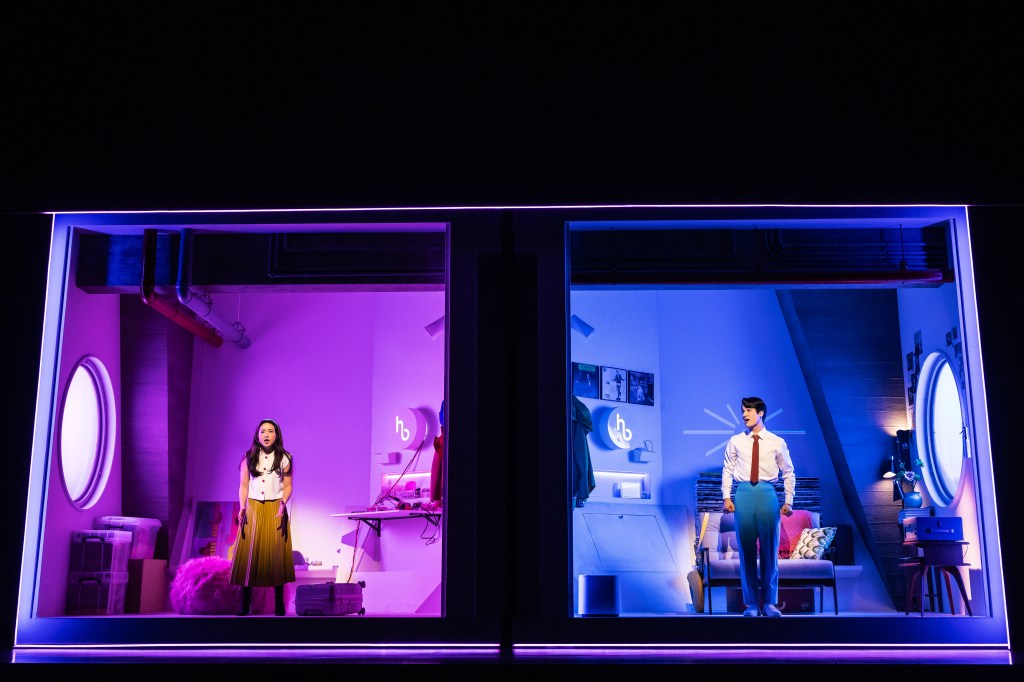
It is Claire, an advanced Model 5 robot, who is sleek, beautiful, witty and programmed to understand most things, who essentially reminds Oliver that things come to an end.
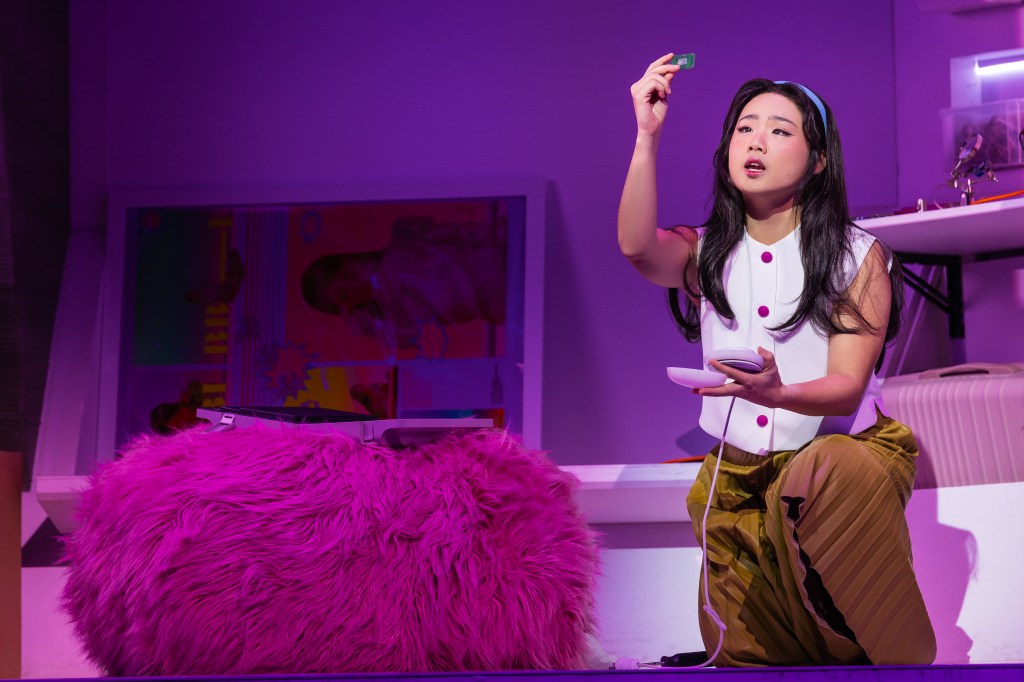
But Oliver doesn’t really get it. Oliver is a less smoothly functioning and quirky-kinky-glitchy robot Model 3. The earlier, older model is more simplistic and durable, programmed to be upbeat, decorous, sweet. He is the perfect companion, friend, son, but unaware about the deeper, more painful qualities and attributes of human beings and the natural order of the known world and his place in it. Innocent, and cheerful, he doesn’t seem to understand the cycles of wheel and woe, peaks and valleys and the end of things, for example humans, relationships, devices, himself. But by the conclusion of this incredible heart-rending musical, Oliver learns about himself. He learns what he is capable of, guided by Claire’s empathy, wisdom and heart.
The year is 2064 on the outskirts of Seoul, Korea when we meet Oliver and Claire, Helperbots (think android servants), once hired out by their manufacturer to assist their human owners with daily tasks. However, a blip has occurred for Oliver and Claire whose existence and purpose has changed. Their antiquated operating systems can no longer be upgraded. Replacement parts are scarce or discontinued. The company has with consideration allowed them to spend their purposeless, remaining days in a retirement home in the Helperbot Yards until they come to the end of themselves.
The set design of their rooms at the Helperbot Yards is imagined cleverly by Dane Laffrey via bright lighting in their rooms (Ben Stanton’s design), surrounded by darkness. Neon tube sliding panels separate and feature Claire’s and Oliver’s rooms side by side, or in movement, like a split screen effect. The rooms are color coordinated. Claire’s belongings are pink and lavender with saturated lighting effects. Oliver’s room appointments are mostly neutral influenced by his owner with blue lighting effects. The colors ironically signify their genders, recalling an innocence that belies their knowledge and Claire’s deeper understanding of human beings. As they grow closer, the saturated lighting effects sometimes alternate.
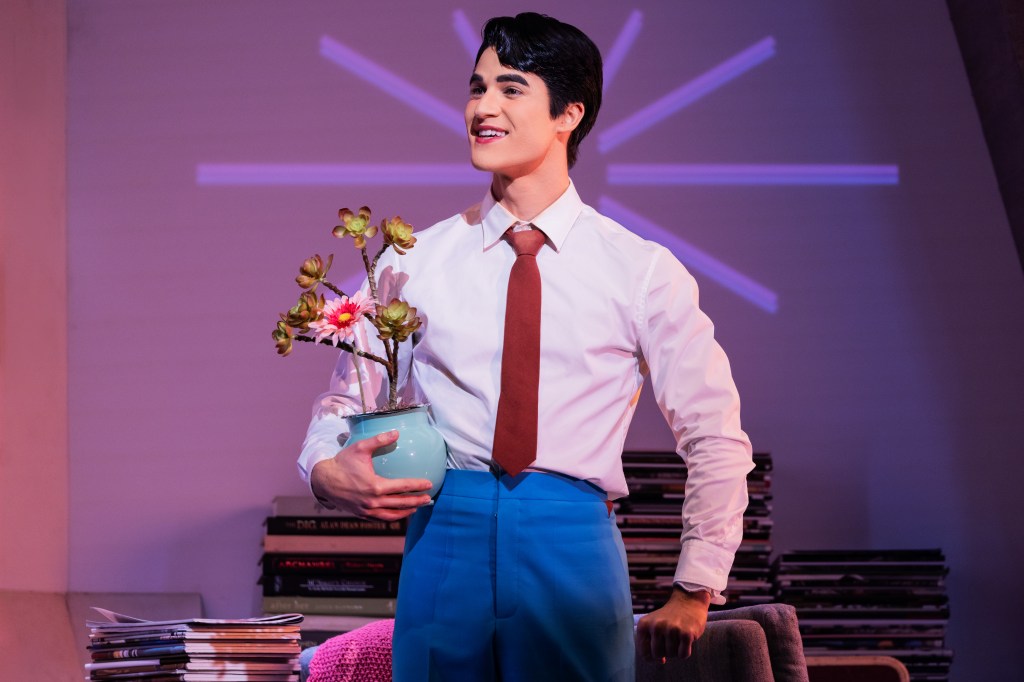
Laffrey’s scenic and additional video design, along with Ben Stanton’s lighting design and George Reeve’s video design cohere perfectly with director Michael Arden’s vision and tone, effected by Hue Park’s book and lyrics and Will Aronson’s book, lyrics and music, which is sonorous, mellifluous and lovely.
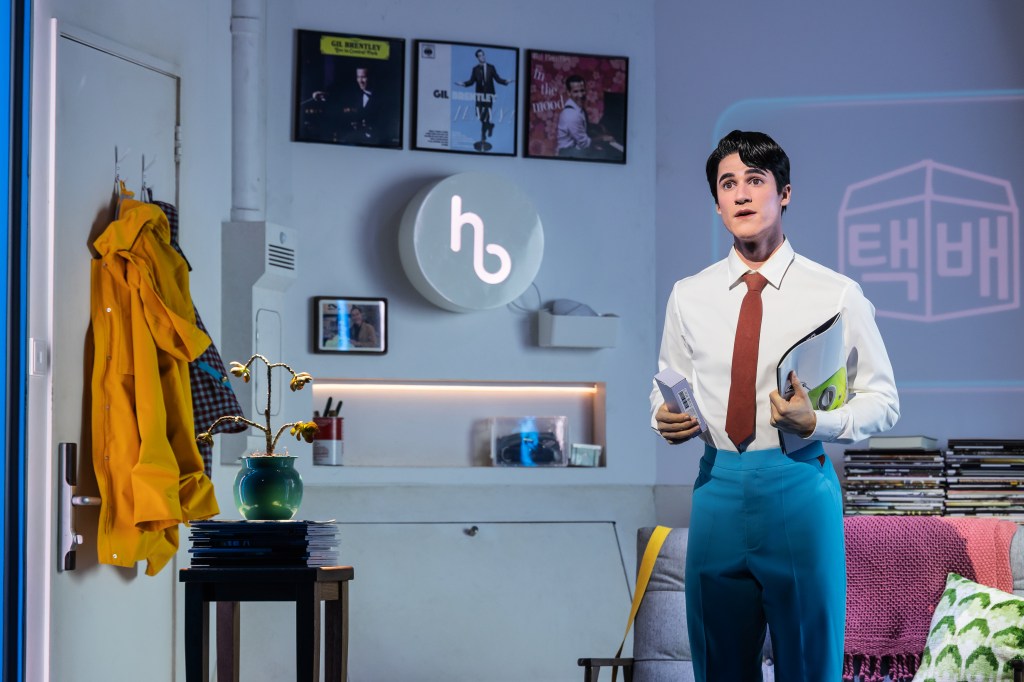
Oliver appears Model 3 robotic with slicked down helmet-headed hair, (Craig Franklin Miller’s hair & wig design), obvious reddish lips and paste skin tone (Suki Tsujimoto) and a perfectly tailored, boyish outfit by Clint Ramos. Claire’s pleated skirt and white blouse are simple, and flowing in more natural colors as the later models were designed to appear real; her hair and make-up coordinate and appear natural. The vibrant color and Ramos’ costumes cohere with the color schemes, save Claire’s initial outfit, though she wears a colorful jacket when they travel.

The design features represent the robotic and real worlds stylized appropriately. The real world is dimly lit and in shadow; the natural setting is somber, subdued and minimal. There is no sense of futuristic design consonant with James’ preference of retro mirrored in his acoustic music taste. James and his son (both played by Marcus Choi) naturally. Likewise, singer Gil Brentley appears in fall toned period clothing of the 50s. Sometimes with a microphone, perhaps in a club where he once performed, Brentley sings four songs solo in simple lighting. Finally, the forest scene is magically lit, captivatingly stylized, romantic and “to die for,” which is the point.
Peter Hylenski’s sound design is balanced for Deborah Abramson (music supervision), and the songs are lyrical, the harmonies in the duets gorgeous. Both Criss and Shen have voices that convey the tone of light, love and beauty. The cool jazz numbers sung by the excellent Dez Duron as singer Gil Brentley are seamlessly mixed into the action as a counterpoint to it and commentary on it.

Of the two robots, Shen’s astute, ironic Claire is the more aware, having experienced poignant and hurtful events with her beloved owner who gave her up. We get to see this via amazing digital projections and a hologram (George Reeve’s video design), as Claire revisits memories to fill in the puzzle pieces of a mystery Oliver needs to have solved. Claire is canny, smoothly sophisticated and not easily duped. There is little that she can’t figure out. On the other hand, Oliver is oblivious about why he is where he is. Oliver believes that his beloved owner and friend James will be coming to take him to wherever he has gone so they may resume their relationship which makes both of them happy.
With Oliver’s first song, “World Within my Room,” Will Aronson and Hue Park establish the situation of his isolated living arrangement which he doesn’t mind, convinced James will come for him. He is contented in his own confined world with his friend, the plant HwaBoon, his jazz records, an old-fashioned record player, all given to him by James, a jazz aficionado who converted Oliver to love jazz too. Indeed, Oliver gets to enjoy monthly jazz magazines James has sent to him which Oliver receives via a mail chute. His only interaction over the years is a remote bot (a voice over), that interacts with him if he requests something i.e. a replacement part that has not yet been discontinued.
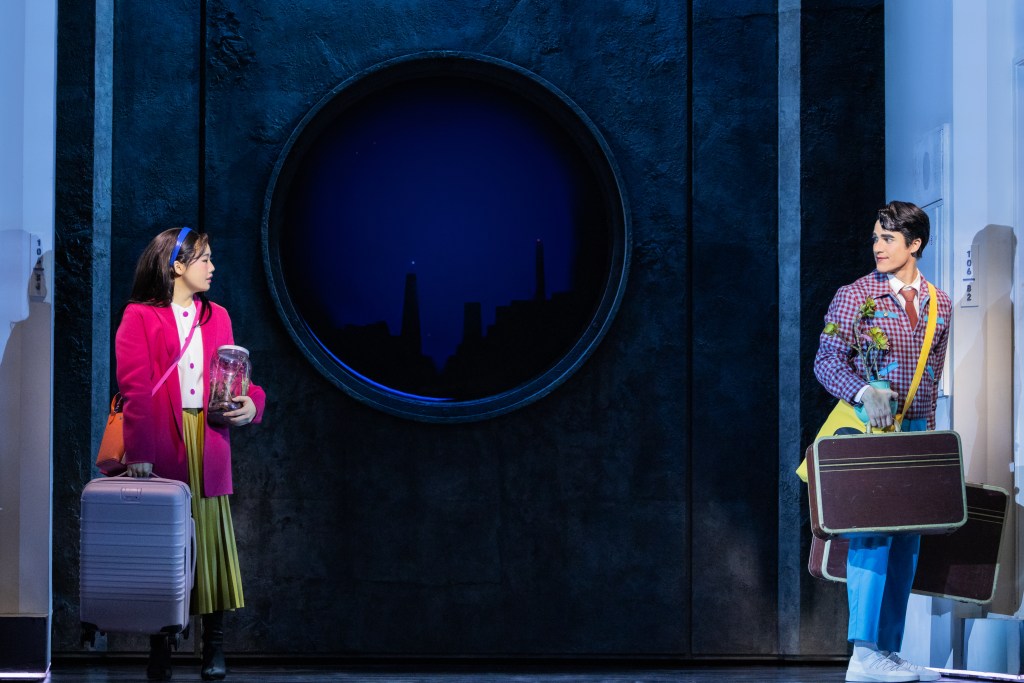
Twelve years go by, then there is an urgent knock that displaces Oliver and his contented isolation. Claire, who lives across the hall, needs a charge because the advanced Model 5s need charging more frequently or they freeze up, as Claire does, arm lifted in the midst of knocking. Oliver is too jarred by a live interaction intruding on his solipsistic existence to immediately answer the door. When he finally does relent, she is stationary, silent, frozen, and he must pick her up and carry her into his room to charge her up (literally and figuratively). Look for all of the double entendres, sly, winking humor, symbolism and metaphors about human existence, human love, human experience and forever love and happiness.
After Oliver “charges” Claire, she takes the lead, as the female model’s advanced assertiveness prompts her to. She queries him, and finding out about James, understands what has happened, but is empathetic enough to wisely counsel Oliver, sometimes with humorous snark about himself. Additionally, she dispels the competitiveness Oliver has about being the less sleek, smart and advanced model. However, she is less durable, a fault he continually throws in her face. Eventually, as Claire repeatedly returns to borrow his charger, one day she cleverly arranges to stop their routine, knowing the less flexible Oliver will freak out about it. Of course, she is correct, and when he begins to seek her out, their relationship faces a turning point and they are off and running to become more involved with each other’s wants, needs and hopes.
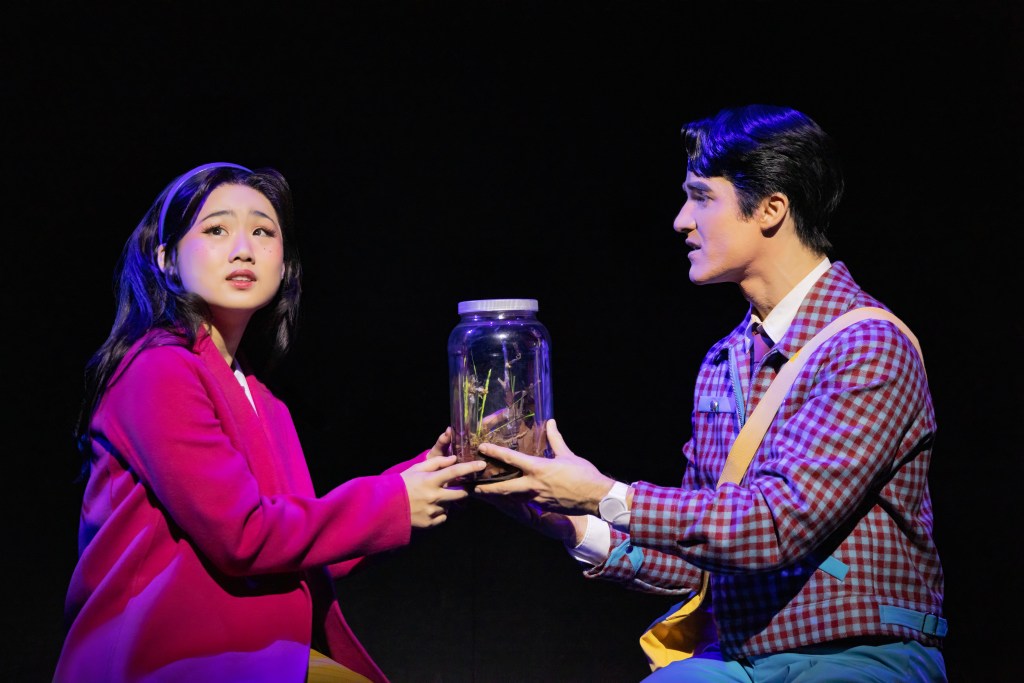
Claire and Oliver’s growing connection is a series of cataclysmic sequences that explode upon the audience’s consciousness. These are taken out of every romantic playbook of “boy meets girl” etc. However, it’s in reversal as Claire is the catalyst. Importantly, there is no equivalence because these robots can’t have emotions, can they? They’re weird, the situation is anomalous, but for the song (“Why Love?”) as a lyrical remembrance at the top of the musical, we don’t quite get it. We think, “OK, theirs is a peculiar and funny meet-up.” Importantly, though they look youthful, they are “discontinued,” seniors in a retirement home, useless, waiting to fall apart (think of “all the lonely people” whether in nursing homes or under sick-bed isolation).
Eventually, the realization hits the audience that they are looking at themselves. There will be an arrow strike into the heart and perhaps the tears or the discomfort will follow, if not at earlier junctures, yet, it will follow. The story and its incredibly coherent, metaphoric rendering in every technical and live-wired aspect (especially performances), by the creatives are designed to penetrate any cynical, hardened emotions and break your heart.
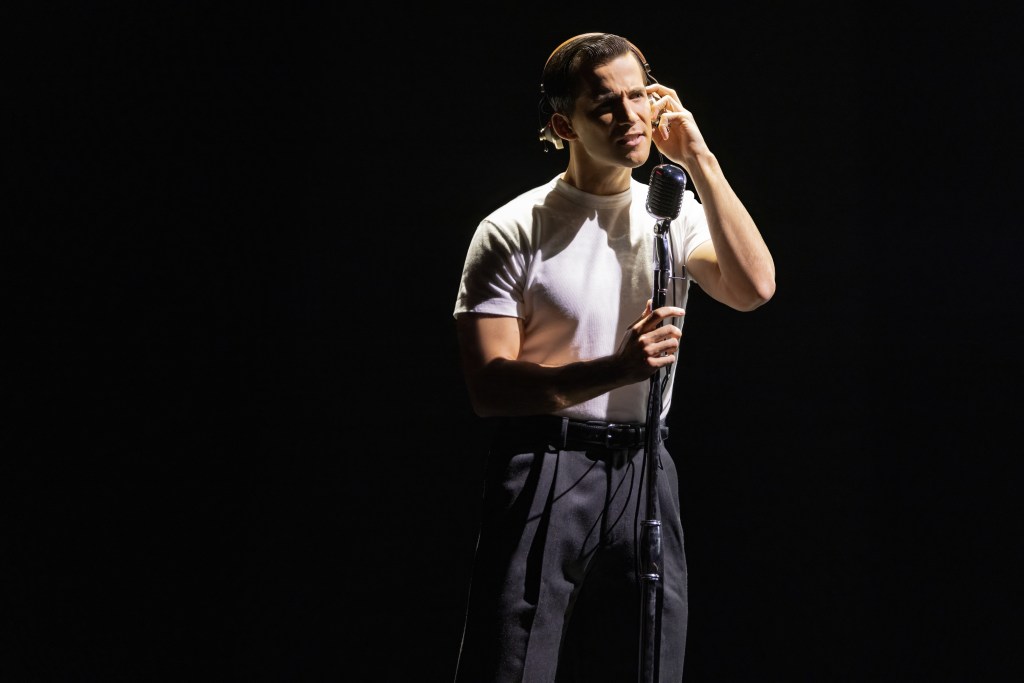
The parallel between Claire and Oliver’s story and variations of our own stings as does the song “Why Love?” sung gorgeously by Duron’s Gil Brantley. The song that James loved (he gave the Gil Brantley record to Oliver), opens the musical and concludes it, a question answering with the question. And we learn its meaning as we know it from our own lives and the journey of Claire and Oliver, as they get to know each other. The irony of these characters and their discoveries about themselves and each other is that we will more readily identify precisely because they are robots. By removing their “humanity,” the intensity of the parallels to human experience crystallizes. You “get it” in revelation, and by then, you are a goner.
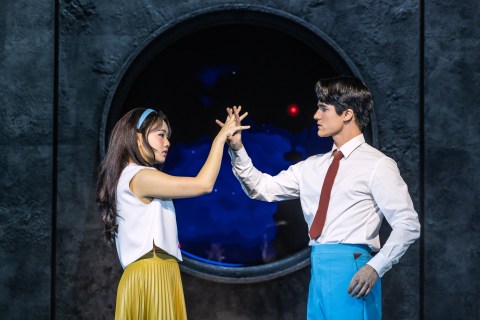
Michael Arden’s shepherding of Criss and Shen ingeniously unfolds and stages their relationship dynamic throughout, moving from their box-like, enclosed, limited existence to a forest field, in a nighttime sky of fireflies (an achingly beautiful sequence lit exquisitely by Ben Stanton). Enlightened from their adventurous “road trip,” they go back home with a new, expansive perspective and realization of their deep connection to each other, a duplication of human experience which they can laugh at as robots, yet sorrow over, for it, and they are perishable.
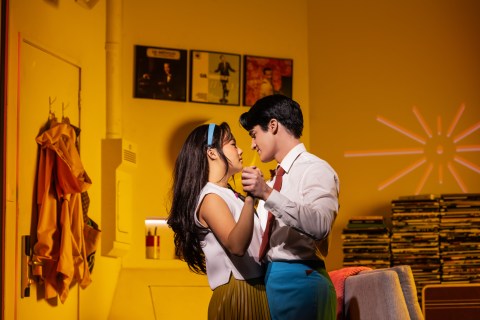
The characters and situation are counterintuitive as are the incredible performances of Criss as the more authentically robotic and Shen’s more progressively human. But by the conclusion both have evolved to decide whether to remember their love or not, knowing there is no way around the second law of thermodynamics. Even robots die. But in this instance, the more durable Oliver will be around with the memories of their love a lot longer than Claire. A decision must be made.
Maybe Happy Ending is not a story about robot love. It is a story about us. Our humanity. Our mortality. Our inability to comprehend loss, and love, and relationships, and other human beings, and emotional pain, and hurt, and tolerance of these experiences, not having the first clue about what they truly are, as we are forced to go through them, sometimes kicking and screaming
If you don’t see Maybe Happy Ending, you are missing an incredible, theatrical event, taking a deep dive into your own humanity through identification with “robots” who just kill it. They will delight, entertain and wreck you emotionally. If that doesn’t appeal, then see it to appreciate its splendiferousness as a gobsmacking, award winning, uniquely, amazing musical.
Maybe Happy Ending runs 1 hour, 45 minutes with no intermission at the Belasco Theatre (111 West 44th Street) until January 2026. https://www.maybehappyending.com/
ENCHANTING, SPELLBINDING, HEART-STOPPING, MOVING, TOUCHING, OVERWHELMING, INTENSE, HEART-RENDING
Maybe Happy Ending runs with no intermission 1 hours 45 minutes. at the Belasco Theatre (131 West 44th Street). https://www.maybehappyending.com/

Jonathan Groff is Phenomenal in ‘Just in Time’

Oftentimes, singers have the gift of reconstituting songs and making them iconic, then become celebrated for doing it. One example is Bobby Darin (1936-1973), who took the droll, sluggish “Mack the Knife” from Kurt Weill’s Three Penny Opera, and with a jazzy, upbeat swing, gave it a reverential life of its own. A singer, songwriter, and actor, Darin ambitiously sang all music styles from swing to folk, from rock and roll to country music. He played three instruments, won two Grammy awards and a Golden Globe in a fifteen year period before he left this earth, only to win more awards posthumously. For his efforts, he was inducted into the Rock and Roll Hall of Fame (1990) and the Songwriters Hall of Fame (1999).

The chronicle of his life manifested a candle burning at both ends to accomplish whatever he could in his short lifespan. Just in Time starring Jonathan Groff as Bobby Darin shines a spotlight on what made Darin a consummate performer, as he reinvented his career by adjusting to the times. Key to this production is Groff’s winning, adorable persona and uplifting and empathetic approach to portraying Darin’s mystique.
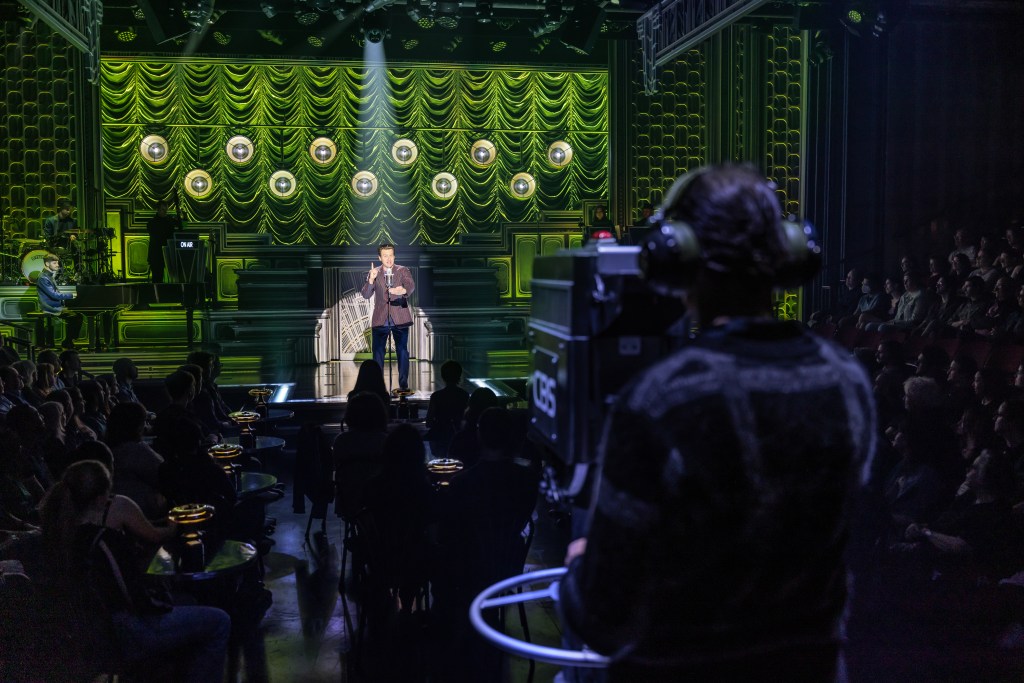
With an 11-piece band accompanying him and fine orchestrations by Andrew Resnick, this is an incredible show right out of the gate, though the book by Warren Light and Isaac Oliver based on an original concept by Ted Chapin cannot cover all of the salient information about Darin’s life for purists. However, it indeed is enough and a must-see. The exceptional Just in Time, developed and directed by Alex Timbers currently runs until November 30th at Circle in the Square.
To represent Darin’s ethos the production places the star in his favored venue, the nightclub. With set design by Derek McLane, Justin Townsend’s lighting design and Peter Hylenski sound design, Circle in the Square Theatre is transformed into both an exclusive nightclub and swank, intimate cabaret. There, Groff singularly portrays Darin’s trajectory in what has perhaps wrongly been limited as a “jukebox bio musical.”

The stunning sets around which Groff and the cast perform and enact more intimate scenes, open another aspect of the Darin persona. The immersive nightclub with two sections also converts to other settings with the use of a scrim and props. The floor area holds a cabaret-style seating arena where Groff and the others act amidst the patrons seated at tables. The multi-tiered stage of steps includes a dancing area banked on either side by the band, led by Andrew Resnick. Resnick plays piano, and supervises the music he has arranged which is vibrant, updated, resonant and heady.
Groff performs in both areas, but the showpiece numbers are on the higher levels where Darin’s Sirens dance, sing and perform with him in finely tuned, tightly choreographed numbers by Shannon Lewis. Darin’s glittering, alluring assistants include Valeria Yamin, Christine Cornish and Julia Grondin. Interestingly, theirs is an economy of movement as they surround Groff/Darin and join him with verve and style within the multi-levels of the set.

This design is exceptional and reflects the tenor of restraint, an ironic, perhaps meaningful limitation. Darin had severe health issues throughout his life and the knowledge that death was near, a terrible psychological/emotional/physical limitation, nevertheless spurred him on with a driving urgency. Darin pushed himself and everyone around him. He was about, “having a lot of living to do” because of his rheumatic heart. Despite his “mother’s” (the wonderful Michele Pawk), adjurations that the doctor told him nonsense that he would die in his teenage years, Darin took the doctor’s warnings “to heart.” He daily lived with death, and using the warning like a stoic’s “memento mori,” inspired himself to “live to the fullest.”

If anything, that is a theme of Just in Time. It is a riff on the idea that our time is limited and we must make the most of it with the gifts we have, as Bobby Darin did.
Just in Time originated as The Bobby Darin Story, a series of five concerts in 2018 at the 92nd Street Y, starring Groff as Darin. Since then its book and Timbers’ development and direction manifested a production with flowing, urgent forward momentum. Groff/Darin freezes the action with a “snap of his fingers” to add briskly paced narrative humor. These asides and direct addresses to the audience unfold Darin’s life story between upbeat club numbers dated for the time, but redirected for our time via Resnick’s arrangements. The entire production is set up as a series of night-club acts, and a stage performance to familiarize non fans with the man and his career.

However, before we discover Darin’s ambition and death-spur that propelled him, Groff is introduced as himself and assumes the relaxed, dressed to the nines (Catherine Zuber’s costume design), carefree, Groff-styled night-club persona. Groff twits the audience, making them his confidante, grounding it for his future direct addresses that will follow as a device that cycles through Darin’s life events briskly. These cover his childhood, the start of his career writing songs for Connie Frances, their relationship and break-up, his hits, the record company bosses, his revolutionary stylization of “Mack the Knife” and beyond to his relationship and marriage to Sandra Dee, its end, and his reinvention after he goes bankrupt.
As Groff zips and zags through the retrospective of Darin’s too brief life, we follow the whirlwind. Occasionally, we glimpse through the pull back of the curtain into his failing health, as Groff’s Darin initializes the stresses of his broken marriage and the revelation of a family secret that devastated him and most probably impacted his health.

In the opening set up of crooning songs “This Could be the Start of Something Big,” “Just in Time,” and lead in to the story of Darin’s life with the vamp of “Beyond the Sea,” Groff’s interpretations are sensational. Then, the audience is off and running with Groff’s self effacing line, “Whether you’re a fan of Bobby Darin, or one of the twelve people who watched “Mindhunter” – it doesn’t matter how I got you. All that matters is that you’re here and, tonight, you’re mine.”

And no joke, that’s the truth. We go with Groff down Darin’s memory lane, meeting his sweetheart that was not to be, Connie Francis (the sensational Gracie Lawrence), his “sister” always concerned for his health (Emily Bergl), his loving, show business influential “mother” (Michelle Pawk), and wife Sandra Dee (Erika Henningsen), among others who fill in various roles (Joe Barbara, Lance Roberts, Caesar Samayoa). As swiftly and smoothly as the first act spools, the second act covers his relationship with Sandra Dee, giving it short shrift, along with Darin’s political endeavor helping Bobby Kennedy’s presidential campaign. Darin was present at the Ambassador Hotel and suffered another devastation at Kennedy’s death.

The show concludes with Groff/Darin, back in the nightclub where he fits best after a few years of resettlement. As the final capstone song, the production ends with “Once in a Lifetime/That’s All” as Groff powerfully, forcefully pulls out all the stops and his closest family and friends give remarks upon learning of Darin’s death after open heart surgery. Groff concludes with poignant remarks, “Every breath we take is a gift we get to open. It isn’t enough. And yet, it is so much.” Groff back in his own skin, makeup off, in his own robust soul, passionately ends the gobsmacking evening with, “Thanks for spending this time with us. Goodnight. I love you.” And the audience gives love back with a resounding standing ovation.
Just in Time is a fabulous seduction, memorializing the life and times of Bobby Darin through Jonathan Groff’s being and perspective. To say he channels Darin limits the depth of the production. The separation between the men is always present and that is what makes this production rise above a “jukebox bio musical.” None of the songs are jukebox, but reformulated. None of the patter and narrative are crassly biographical, but more at symbolic and synoptic, like a review with song twists to elucidate the events and key turning points throughout Darin’s life. Time and effort have been taken to thoughtfully render the production’s success to a new crowd of Darin fans.
Just in Time runs 2 hours 25 minutes with one intermission at Circle in the Square. https://justintimebroadway.com/
‘Stranger Things: The First Shadow,’ Stunning, Thrilling, High Wired

Stranger Things: The First Shadow
The ordinary and extraordinary contrast in this theatrical prequel set around 27 years before the Duffer Brothers’ Netflix series Stranger Things begins. Kate Trefry wrote the two-act supernatural, sci-fi-thriller origin story of fearsome Henry Creel’s genesis of terror. The story was originated by the Duffer Brothers, Jack Thorne (Harry Potter and the Cursed Child), along with Kate Trefry. For those familiar with the series, no introduction is needed to the theatrical presentation currently at the Marquis Theatre. The production transferred from the West End in London to Broadway where it opened on April 22nd. For an example of some of what you’ll see on Broadway, albeit with a West End cast, except for the superb Louis McCartney who reprises his role as Henry Creel, check out the 2024 West End Trailer.
For those unfamiliar with the series, the production can stand alone, though audience members must remain quick-witted to follow the rapidly paced, brief, myriad scenes directed by Stephen Daldry and co-directed by Justin Martin to catch onto the macabre identities of the wicked paranormals that struggle to inhabit the otherwise hapless Henry Creel, a victim of being in the wrong place at the wrong time. The plot development of Stranger Things: The First Shadow riffs off Season 4 of the Netflix series, which is set in 1986, and features the nefarious Vecna, the “evolved” Henry we are introduced to as a struggling victim in this Broadway production set in 1959.

However, there is another layer and flashback to WWII which is the phenomenally brilliant opening of this production. This event illuminates how all of the series’ horrific, paranormal folly began.
Trefry and the gobsmacking creative technical team take us back to a weird rumble in the space time continuum that happened in 1943 that we see live on the stage and surrounding us as photographers circle up and down the aisles of the theater to film an incalculable experiment. Trying to gain an advantage over Nazi Germany, scientists attempt to make a US battleship invisible as a new weapon to evade the German submarines patrolling the waters, yet have it capable of firing at and destroying German U boats. In the process the “invisibility” experiment fails and there is a devastating explosion which breaks into the multiverse fabric of time’s layers and results in the extraordinary and the unexplainable of “Stranger Things.”

It would seem all men onboard the U.S.S. Eldridge are lost. Hold that thought for later in Act II. One of them is alive and “the government” via mercenary scientist (conspiracy theorists will love this), Dr. Brenner (the frigid, android-like Alex Breaux), takes advantage of what happens to the body of the only remaining naval officer who survived the catastrophe. (Well, after all, the officer volunteered for the experiment-no liability lawsuits by “family” possible.)
This astounding feat of technical illusion at the top of the production is breathtaking and prepares the audience for more of the same at the directors’ fever-pitch pacing throughout. Awards will certainly go to the teams that create the supernatural horror-illusions. The visual-effects design is by Jamie Harrison and Chris Fisher (“Harry Potter and the Cursed Child”). The video design and visual effects are by the 59 company. Additionally, with Paul Arditti’s sound design and Jon Clark’s lighting, the production becomes an animated, frightening, “telekinetic” wonder.

After this terrifying, immersively staged flashback, we step forward to 1959 in boring, mundane Hawkins, Indiana, a contrasting setting and hopeful place of refuge. There, Henry moves with his parents Victor (T.R. Knight), Virginia (Rosie Benton) and younger sister Alice (Azalea Wolfe on Saturday evenings). Henry’s paranormal talents, apparently unwelcome yet alluring, have allowed him to harm someone in his previous high school during a macabre event. This prompted the “perfect” family to leave and seek peace elsewhere. However, the circumstance involving Henry upset his mother, Virginia. She counsels Henry to repeat when he becomes anxious, “It’s not real. I’m normal. I’m Henry Creel.”
Part of the enjoyment of the uncanny horribleness of it all is how Henry attempts to be “normal,” but founders miserably at it. He is so, so creepy and preternatural. McCartney is just too good as an embattled, “terrified of himself” Henry.

As an isolated and lonely individual who only feels comfortable playing his radio, Henry fortunately does meet someone in his current high school with whom he can share a bond. Patty Newby (Gabrielle Nevaeh), is adopted and is emotionally abused by her father, and insulted by the high school students. As an obvious outsider, she and Henry (McCartney’s shy, weird, strange, pale, electrically-wired persona is incredibly effected), find solace in one another. Henry uses his powers to help her imagine and then “dream-manifest” her mother, who she discovers is alive. On the other hand, Patty helps deter Henry from submitting to the encroaching evil forces by inspiring him with her affection and attention.
In a tie-in to the plot as pets are being killed and students become involved in investigating the “whodunit,” the play includes the youthful versions of the older TV characters familiar to fans of the series. Patty’s brother, Bob (Juan Carlos), is the pudgy brainiac and the founder of the Hawkins High A.V. Club, instrumental in locating the source energy where “something is going on,” and turns out to be Henry’s house where indeed, more than something is going on. The police chief’s son, James Hopper Jr. (the endearing, funny Burke Swanson), and the high-pitched, theatrical Joyce Maldonado (a frenetic Alison Jaye), also form a bond. Joyce is the director of the play that brings Henry and Patty together. Joyce and Hopper, Jr. join efforts with Bob to find the pet killer to get a $100 reward (a lot of money back in the day).

Additionally, the three help Patty discover what happened to her father, Principal Newby, after he went with Victor Creel to confirm his daughter Patty and Henry were “hanging out” (a “no-no”), at the Creel house. When Principal Newby grabs daughter Patty to take her home, the wicked being attempting to overtake Henry rises up and Vecna (what Henry evolves to later in the 4th series), thunders loudly, “She’s ours.”
As Henry struggles to reject the evil, the scene culminates with a bloody attack. Though Bob, Hopper, Jr. and Joyce believe that Victor Creel is the animal killer, we anticipate the growing malevolence is overtaking Henry, and Patty, who says she is not afraid, is in danger. This becomes especially so when the others and Patty discover her father, Principal Newby, has been savaged and no one knows quite what happened. However, after he is given “mouth-to-mouth” he proclaims, “Find the boy. Save the boy.” as his bloodied, vacant eyes stare out of blackened, emptied sockets. Like blind, prophet Tiresias out of Greek mythology, Principal Newby prophesies save Henry or doom them all. But save him from what? From whom?
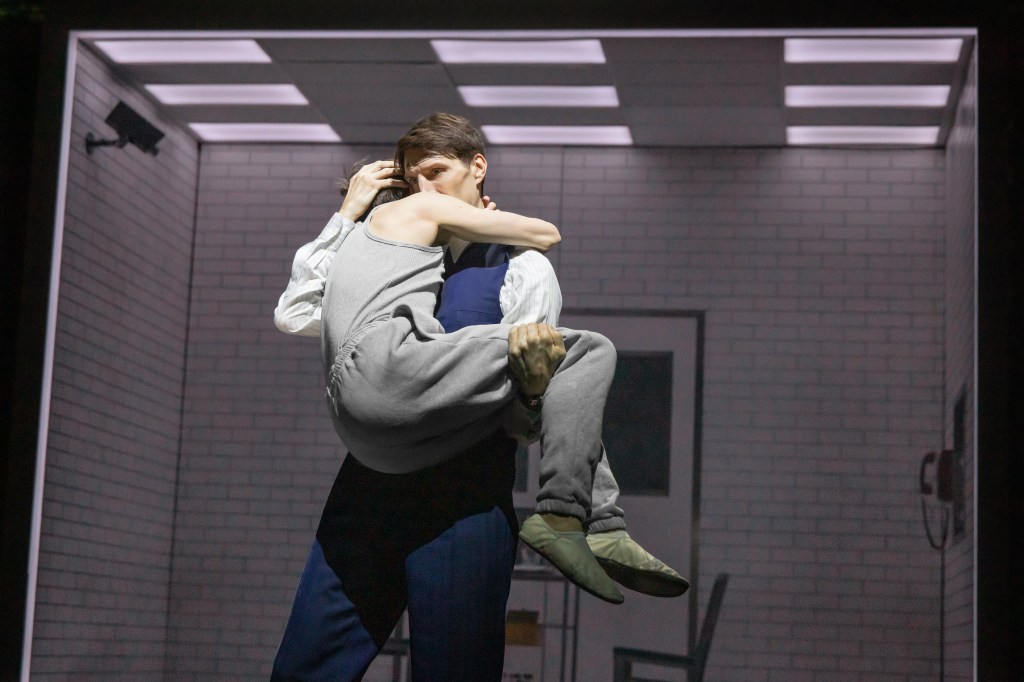
Aware that her son needs help, her husband can’t deal with his PTSD from WWII traumas and a terrible murderous event he caused, Virginia calls up specialist Dr. Brenner. He will be the one to help Henry as the good doctor takes Henry away into his care and where he conducts interesting lab tests and experiments to divine his preternatural behavior. Little does Virginia realize what Dr Brenner’s help entails and how she just made the worst decision of what is left of her life, her daughter’s life and her family’s sanctity and safety. With Dr. Brenner’s introduction, the intermission comes and the audience is stunned and exhausted wondering how Act II can be whipped up with an even greater accelerent into chaos and frightfulness.
No need to wonder. The creative team pulls out all the stops for Act II to explode and technically materialize the creatures and the themes that grace the series. By then we understand that Henry no longer exists. Like many we see today in our culture and society, he has been completely subsumed by another identity altogether. And it isn’t kind, decent, loving or generous. It is a horrible, paranormal, deplorable.

This is an incredible production which resounds visually and aurally long after you have left the Marquis Theatre. Louis McCartney steals the show as Henry. You can’t take your eyes off him expecting the best or the worst. His performance is brilliantly conceived. Gabrielle Nevaeh as his second, for a time, is empathetic and we are happy to see that she makes it through to the end. The ensemble does a fine job of tossing the ball back and forth to the one with the greatest scenes to steal. And the effects are more than breathtaking, along with the superb set design (Miriam Buether), period costume design (Brigitte Reiffenstuel), and Daldry and Martin’s staging and direction. You will be wondering how the effects were achieved, but then you also wondered in the same way when you saw Harry Potter and the Cursed Child.
Stranger Things: The First Shadow is a spectacle and in every way a credit to the series with a budget to prove it. It runs 2 hours 45 minutes with one intermission at the Marquis Theater on 46th St. between 7th and 8th. If you love the franchise don’t miss it. If you are not one for the macabre, the chill-thrill-shocker ride to hell and nightmares, see it anyway. It is a phenomenon for the technical skill displayed. As such productions like this don’t come around very often and should be appreciated for the artistry and skill to employ digital wizardry more easily accomplished in the film and TV medium than in its conversion to theatrical stagecraft. strangerthingsonstage.com.
‘Old Friends’ the Fabulous Sondheim Revue with Bernadette Peters and Lea Salonga

Who doesn’t adore Stephen Sondheim’s mastery of the Broadway musical, mentored to him by lyricist and playwright Oscar Hammerstein II? I am loathe to admit I am late to the Sondheim party, not being familiar with all of his musicals. However, the marvelous Old Friends revue, currently running at Manhattan Theatre Club’s Samuel J. Friedman Theatre is a superb opportunity for fans old and new to celebrate Stephen Sondheim’s genius and rediscover some of his greatest songs. But don’t wait too long to get down to the Friedman. Old Friends is in a limited engagement which ends June 15th unless it receives an extension.

Who better to give tribute to Sondheim’s genius than friends who starred in Sondheim’s productions? In the current revue these include some of the cast who were most recently in the Los Angeles production of Old Friends in its North American premiere (February 13 through March 9, 2025). They reprized their roles in the Broadway transfer in March which opened on April 8th. Additionally, Peters and Salonga reprized their roles from London’s West End where Stephen Sondheim’s Old Friends played in a limited engagement at the Gielgud Theater until January 6, 2024. The history of how this production evolved is fascinating. See below snippets from the West End production to get an idea of what you’ll be seeing on Broadway.
With their voices, power and humor Bernadette Peters and Lea Salonga are perfect celebrants of the Sondheim cannon. Cameron Mackintosh wasn’t the first to come up with a revue of Sondheim’s songs. That was Hal Prince’s “Side by Side by Sondheim” in 1976. Then Cameron Mackintosh convinced Stephen Sondheim an update of his music was needed and created “Putting It Together” in 1993. “Stephen Sondheim’s Old Friends” is the third revue and the first one in over 30 years in the US after its run in London.
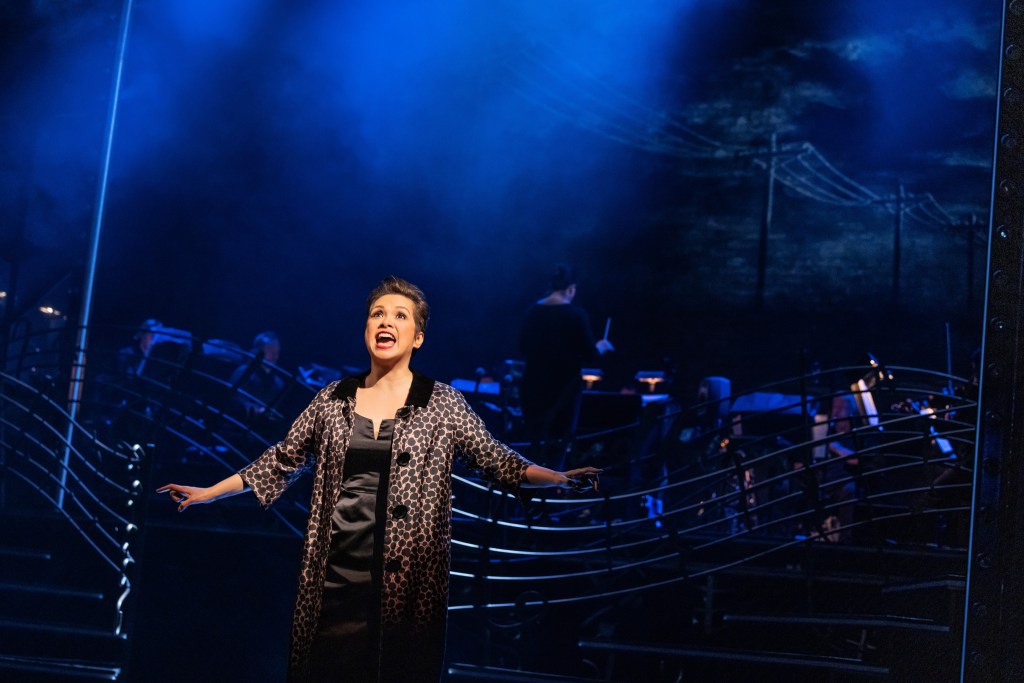
Following the typical format of revues Old Friends doesn’t stray too far, and for some, that will be a joy. However, what makes this production special is not the selection of songs (41), but who brings out new interpretations amidst a backdrop of various suggestive sets alluding to the shows, i.e. Sweeney Todd, West Side Story, Into the Woods, Sundays in the Park With George, Follies (thanks to Matt Kinley’s scenic design) and George Reeve’s projection design. Vitally, there is a segue into clips of “the man” himself and photographs which strike the heart and make one want to read everything that’s out there about Stephen Sondheim.

Jill Parker’s costume design is clever and thoughtful. For example she features Bernadette Peters in a red cape, ready to fend off Jacob Dickey’s wolf with perky ears, giving both performers the fuel to be humorous and endearing in “Hello LIttle Girl” from Into the Woods. Peters makes the most of her comedic funny bone when warranted. She is imminently watchable and mesmerizing. Though the production features Parker’s sleek and front slit gowns-a-glitter, silk jackets and tuxedos, whether show-inspired costumes or concert level TV variety show type costumes, they give off a sheen and a comfort level of old-fashioned nostalgic glamour that is soothing in these rough times heading for what many fear will be a tariff-created depression.

The production holds the emphasis on songs from “Sweeney Todd,” “Company,” “Follies” and “Into the Woods.” Actually ‘”Sweeney Todd” has the largest song selection and the most elaborate looking set design even down to the pies, oven, and barber’s chair where Sweeney slits a fellow’s throat. Stefan Musch’s wig, hair, and make-up design along with Parker’s costumes for Sweeney Todd are appropriately period grotesque making Jeremy Secomb a scary Sweeney and Lea Salonga a crazily macabre Mrs. Lovett. They do a bang up job albeit with a malevolent twist and accent on horror in “A Little Priest” that is less comical than I’ve seen performed in the latest revival in 2023, starring Josh Groban. However, considering the song is without the context, it works well by itself.

With direction and musical staging by Matthew Bourne the segues between songs run smoothly and the numbers in front of an elaborate show curtain with arches of light and lighted graduated steps when the curtain opens to see the 14-piece orchestra, provide the set for Bourne and choreographer Stephen Mear to stage the glamorous portion of the revue. With original orchestrations by Jonathan Tunick, Stephen Metcalfe’s musical arrangements soar with harmonic lyricism. Warren Letton’s lighting design and Mick Potter’s sound design are near perfect enhancing the overall technical aspect of the production.
Performing with song and dance in front of the curtain provides the time for set changes. Songs from Company, and Merrily We Roll Along are featured simply with the highlights on the performer. For example Peters and Salonga sing “Side by Side,” as the show opener with a quick segue to full stage as the curtain opens for “Comedy Tonight” by the two stars, Jason Peycooke, Gavin Lee and the Company wearing shimmering Roman-style drapes over gowns and tuxedos.
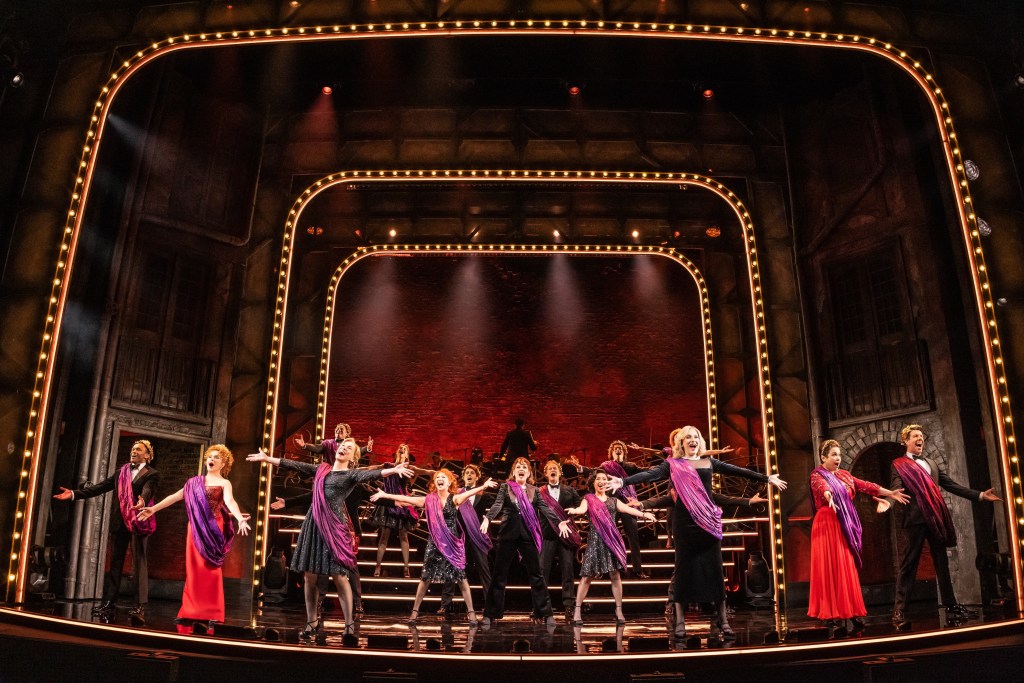
Particularly strong numbers involve the 17 cast members singing and dancing the songs “Company,” “Into the Woods,” “Comedy Tonight,” and of course “Sunday” from Sundays in the Park with George, whose scrim of the painting appears as the set piece to close Act I before the intermission. Seeing Georges Seurat’s painting is always a stunning visual effect.
Wonderful interpretations of “Send in the Clowns” by Peters,”Ladies Who Lunch,” by Beth Leavel, “I’m Still Here,” by Bonnie Langford (who does an amazing split to conclude the kick line number), and “Everything’s Coming Up Roses,” by Salonga prove the power of the music in the specific instrument and personality of the performer. “Being Alive,” then “Side by Side” as the finale are superb capstones to conclude the joyous and heartfelt evening that is a tribute to the greatness of Stephen Sondheim. Now I’m going online to order his biography by Meryle Secrest.
Old Friends runs at The Samuel J. Friedman, 2 hours and 45 minutes, including a 15-minute intermission. https://sondheimoldfriends.com/

