Blog Archives
‘Fear of 13’ Starring Adrien Brody in an Incredible Tour de Force
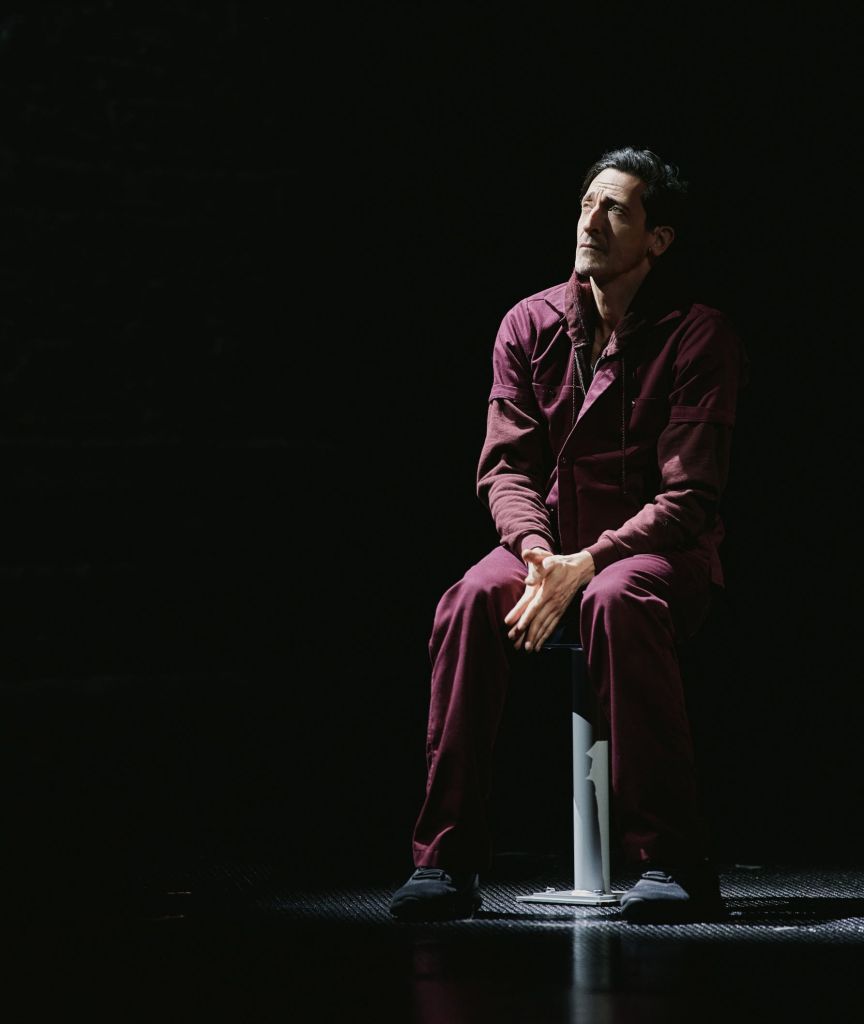
Based on the titular 2015 documentary directed by David Singon, The Fear of 13, directed by Davd Cromer is a prison drama with twists that upends easy assumptions. With Adrien Brody portraying Nick Yarris who spent years on death row. Brody is assisted by the wonderful Tessa Thompson as Jacki Miles, Yarris’ friend, confidante and spiritual lover until she isn’t. The two portray individuals who help each other and then acknowledge they must end their relationship because they have had enough of waking up to dreams that have no hope of manifesting. Currently, the play runs at the James Earl Jones Theater through July 12, 2026.
Written by Lindsey Ferrentino the production opens against a dark stage with a spotlight on Brody who speak as an everyman, Man 1. He discusses the nature of time’s variability: “a blisteringly fast thing, where in the blink of an eye – ten years are gone from your life, but the next week is agony.” “… then you look out the window …and it takes all day for the sun to go down…”
This theme about time relates to Brody’s Yarris who has an intimate, hyper-conscious knowledge of time as an inmate on death row. It is in this setting that we experience events through his perspective and the horrors of incarceration on the death row cell block in a prison in the state of Pennsylvania. On death row where time can’t be “done,” it exists in a state of suspension. On the one hand “time is of the essence,” as the appeals process runs for years and the men like Yarris wait for exoneration or execution. On the other hand, when the final result is achieved, it’s a matter of days to the inmate’s release or death.
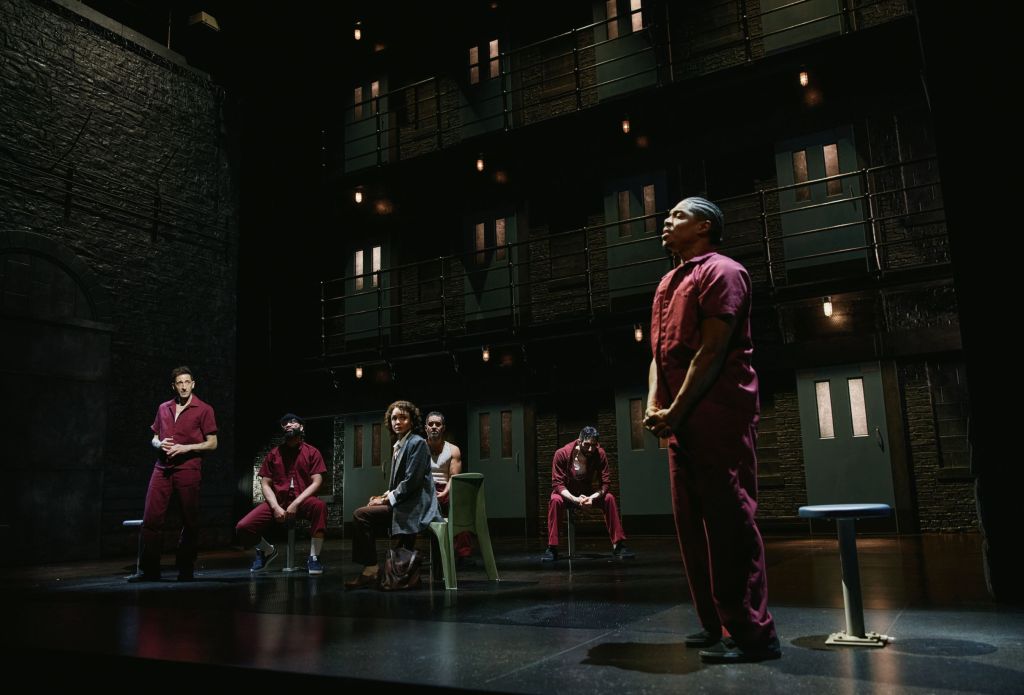
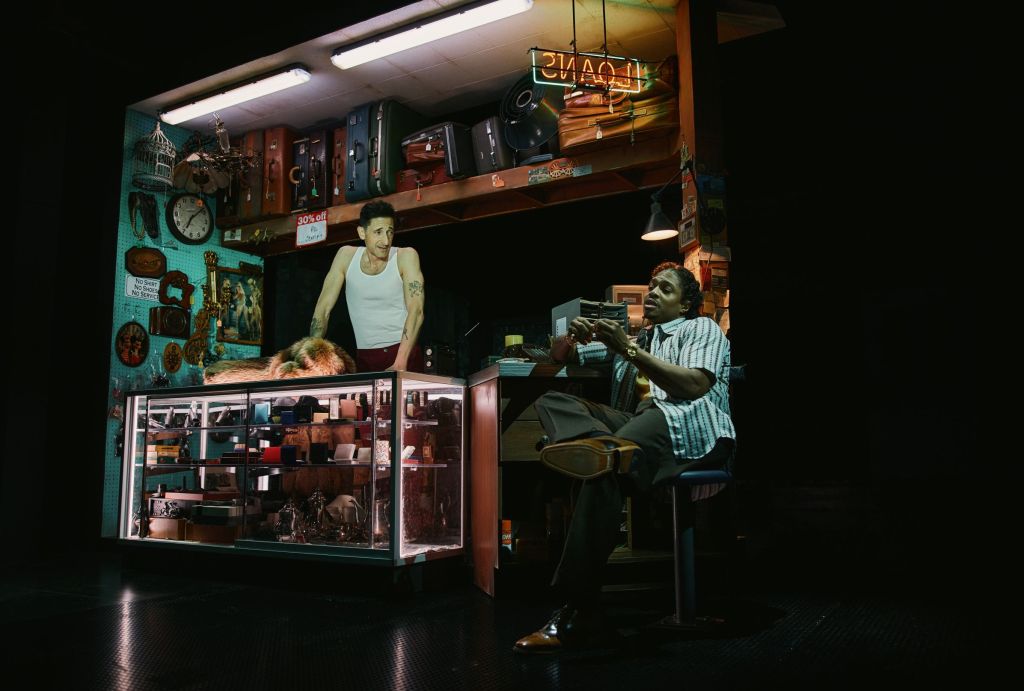
We learn about Nick Yarris’ time constructs as the play unfolds and the lights come up on death row, Arnulfo Maldonado’s black, wall cell block with lights by designer Heather Gilbert suggesting the men housed behind the impassive doors closing out freedom. Against this backdrop, the plays events unfold in flashback as Nick Yarris relates his amazing story to Jacki Miles. Cromer stages various events in scenic vignettes with props (Tessa’s home, a pawn shop) but the bulk of the scenes take place against the dark, prison backdrop. Jack’s ability to speak to volunteer Jacki is one of the miraculous occurrences that happen to Nick, who was just out of teenagehood when he received his death sentence.
Ironically, the theme about time reflects the play’s pace. Toward the conclusion from Yarris’ perspective time slows to a crawl. But in the beginning time moves at a clip. Yarris relates events that Cromer theatricalizes when volunteer Jacki Miles visits and eventually has sessions with Yarris alone, becoming a friend. Cromer stages his visits with Jacki stylistically with minimal fan fare, as he stages Nick’s interactions with his appellate lawyer Beau Mullen (Victor Cruz) and others. Nick’s interactions in the prison setting are powerful and terrifying, thanks to Cromer’s direction and the ensemble’s superb acting.
During Nick’s one hour visits with Jacki, he tells her that death row used to be a place where they were buried alive, as Lieutenant Walker (Jeb Kreager) tells him, “you’re already dead.” The inhumanity he experiences is egregious and the play advocates for an end to the death penalty as punishment, as well as an end to the horror of the traumatic, abusive prison atmosphere and barely livable conditions. To make matters worse, when Nick first arrives, there is no redress; there is no communication between or among prisoners or others. When Nick is encouraged to speak by Walker after he’s told he can’t and Nick answers “yes” out of politeness, Walker punches him in the stomach.
Nick tells Jacki about the brutality and sadism of the guards who abuse the inmates to instill hopelessness and fear to keep them in line. He intimates the guards’ personal satisfaction at beating those who can’t fight back to bolster their “masculinity.” Of course the guards allow the prisoners to harm each other and don’t protect them.
When Nick describes a brutal murder he witnessed in the shower, Nick asks whether Jacki believes him. She hesitates. He tells her his assigned appellate lawyer Mullin didn’t believe him either. When Nick mentions he’s been waiting 7 months for the appeal process to begin, Mullin tells him coldly, “Before you go on, know that I am a Christian… and an officer in the U.S. Army, and so I fully support the death penalty.” Then Mullin tells Nick, “You are guilty due to overwhelming evidence.” The play turns into the abyss as we watch hope leave Nick and are swayed to believe Mullin’s comments that Nick raped and murdered a woman. Nick doesn’t speak or communicate to anyone for two years. Years later when Nick shares Mullin’s comment with Jacki, she leaves abruptly and we note she realizes she is speaking to a killer and a rapist. Why would she ever return?
However, she does. As Thompson’s Miles continues to visit Nick, though she questions herself, she drives miles to see him. Clearly, a bond forms and as a result Nick is able to tell her how everything changed when they found drugs in the music room and gay lovers Wesley and Butch, who were in the men’s choir, were moved into their cell-block temporarily. Brody’s Nick moves between the present with Thompson’s Jacki to the past as he relates the situation between Wesley (Ephraim Sykes) and Butch (Michael Cavinder). The scene is powerfully drawn and theatricalized, thanks to the superb acting by Sykes and Cavinder and the ensemble who sings creating a high point emphasizing how Nick’s hope is stirred. Even the guards change after the event. Communication is allowed and volunteers like Jacki are brought in.
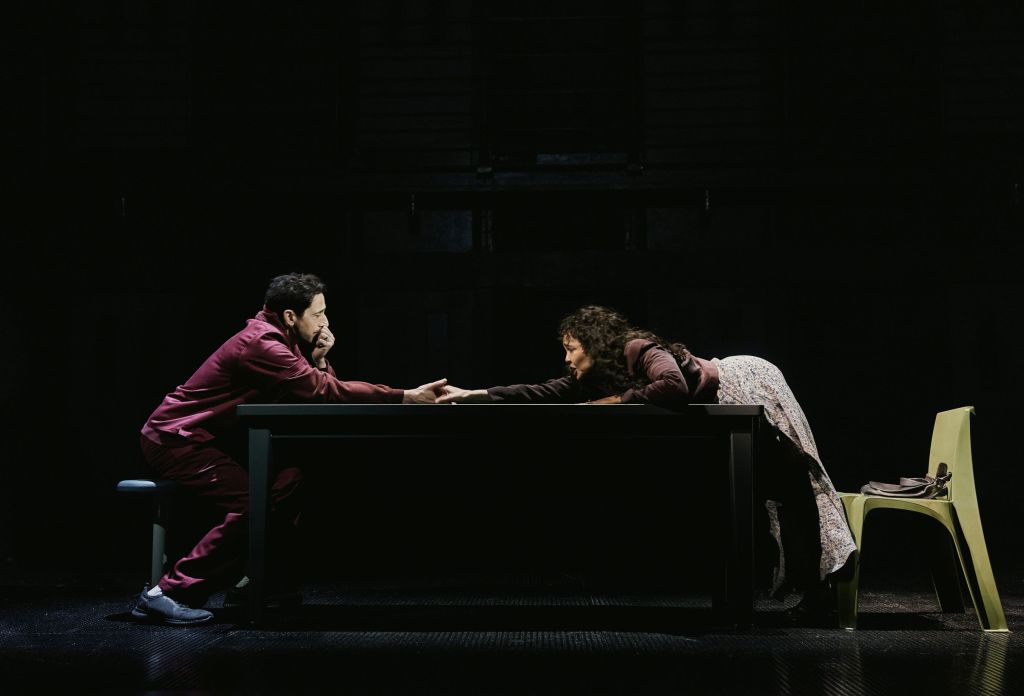
The events well staged by Cromer are thrilling and more adventures follow as Brody actualizes Nick’s story and makes us hope that Nick, who says he is innocent, gets off on DNA evidence. Brody is mesmerizing, heartfelt, amazing. Thompson gives him a superb performance to exchange emotional resonance against. Brody conveys the extremity of emotions that Nick goes through with each encounter as he smashes into the penal system and shocked, we empathize with him. We learn how Nick is able to maintain his psychological well-being because he reads voraciously. It is his reading which brings his discovery in 1988 about DNA being used. Nick, tells Jacki he is innocent. And he affirms his innocence saying, “If DNA is getting people convicted, why can’t it get people released?” Then he tells Jacki, “I love you.”
The interaction is another turning point in a series of unexpected occurrences, one of which is Nick’s incredible escape during a sheriff’s transfer which the ensemble humorously activates. Unfortunately, the adventure ends up in Nick’s arrest and return to death row. But gradually, Nick reveals his life to Jacki and together they work to unravel “the evidence” that Mullin said was overwhelmingly against him, but which they find out is non-existent. Then, the action and events slow down to stasis. Mullin employs the use of DNA evidence and we understand that Mullin is right when he says the process can take a long time. But undeterred, Jacki’s and Nick’s love blossoms. She receives his calls from home and their hopes and anticipation lead to a marriage in prison.
The problem is neither Nick nor Jacki understand the import of Mullin’s words about the DNA process. And it is at this juncture when the play has been unfairly criticized for dropping its pace. At this point the themes about time’s variability apply and “ten years are gone from your life, but the next week is agony.” It is at this juncture that we realize how “it takes all day for the sun to go down.” We and the characters agonize. Yet, Nick cannot reveal his deepest secret to Thompson’s Jacki: the mystery of how and why he ended up doing drugs, getting kicked out of his house, stealing cars and getting arrested by a cop which led to his incarceration on death row. Sadly, she never finds out. But we do and in Nick’s revelation of trauma and darkness, his salvation comes.
The Fear of 13 runs 1 hour 50 minutes with no intermission through July 12 at the James Earl Jones Theater. thefearof13broadway.com.
.
‘The Queen of Versailles,’ Fabulous Kristin Chenoweth Makes Dreams Realities

If the road to excess leads to the palace of wisdom (quote by English poet William Blake), do people know when they’ve reached their limit? When is enough enough? According to the themes of the new musical The Queen of Versailles, currently at the St. James Theatre, knowing this depends upon the seeker.
In the clever, sardonic musical, based on Lauren Greenfield’s titular documentary film and the life stories of Jackie and David Siegel, the question of excess and how to measure it shines into the darkness of American culture, conspicuous consumption, surgically enhanced, plastic looks, and meretricious values. With an ironic, humorous, no holds barred book by Lindsey Ferrentino, and music and lyrics by Stephen Schhwartz, the Siegel’s riches to more riches story, including the 2008 mortgage debacle, takes center stage. By the conclusion, the audience leaves shaken and maybe stirred, either with a bad taste in their mouths or with the prick of guilt in their consciences.
At its finest, The Queen of Versailles inspires the audience to peer into their own values and behavior and evaluate their souls to correct. Ultimately, it asks, do the Siegels have a worthwhile life or have they allowed their childhood poverty to overwhelm their good sense and inner emotional well being? Despite its ripe fun Ferrentino’s book and Schwartz’s music encourage a hard look at crass, materialistic greed that blinds the rich from using their largess for the social good. Lastly, it questions do the representative Siegels count the cost to live the oversized billionaire’s lifestyle which causes harm? To what extent has their craven indulgence choked off their lifeblood to their own destruction?
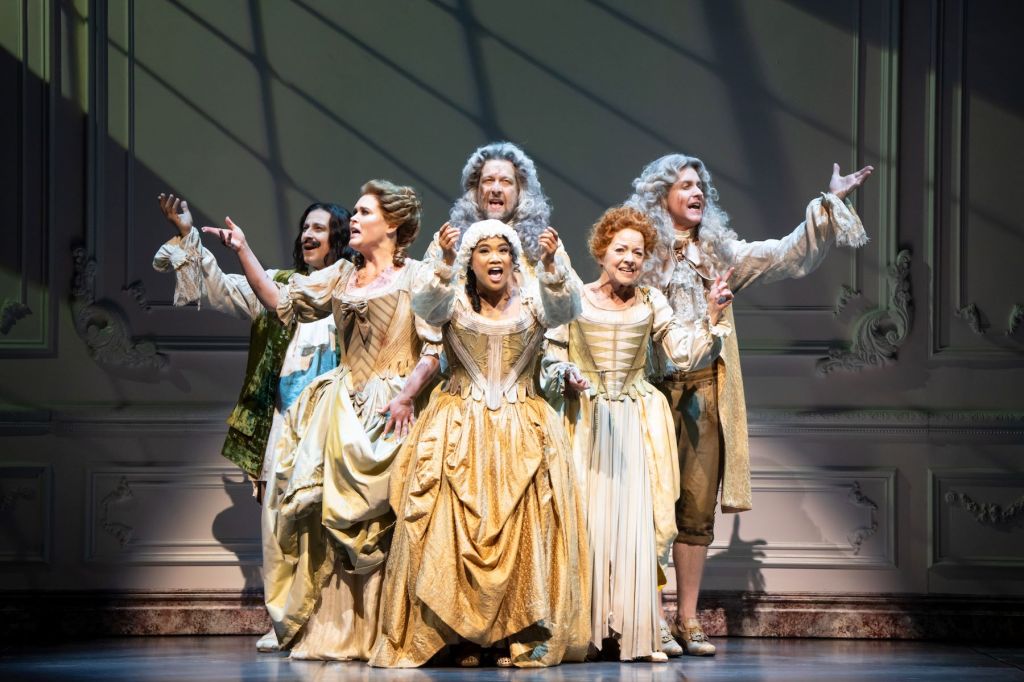
Starring an endearing, heartfelt and bubbly Kristin Chenoweth as the materially insatiable Jackie Siegel, and F. Murray Abraham as billionaire workaholic David Siegel, the New York premiere which has an end date of March 29, 2026, rings with disturbing truths. It’s farcical, dark elements present many themes. Chief among them is the theme that the Siegel’s shiny ostentation hides a sad emptiness that can never be fulfilled.
Framing the Siegel’s story with the key meme of Versailles, the mansion in France that 17th century Louis XIV, built as a memorial to his majesty, the opening scene and song (Pablo David Laucerica is King Louis XIV) replete with period chandeliers, furniture, costumed butlers and maids reveals how and why the Sun King built his palace on swampland (“Because I Can”). Without giving thought to the inequities in French society that necessitated the economic gap between royalty and its impoverished, destitute subjects, Jackie and David want one.
In a quick switch to the present (2006) we see the Siegel’s Versailles in progress. With construction scaffolding in the background and a documentary film crew in the foreground, Chenoweth’s Jackie glows as she sings “we want to have the very best for the biggest home in America because we can.” The fluid set design with appropriate props and pieces by Dane Laffrey, who also does the video design, brings perfect coherence to the Siegel’s intentions. It connects the idea of royal wealth manifest in Louis XIV’s lavish excess to their rich/famous lifestyle which reeks of tawdriness. Thanks to Michael Arden’s staging and direction and Cristian Cowan’s costumes, and Cookie Jordan’s hair and wig design, the shifts from the present to the court of Louis XIV and back solidly establish the trenchant themes of this profoundly current musical.
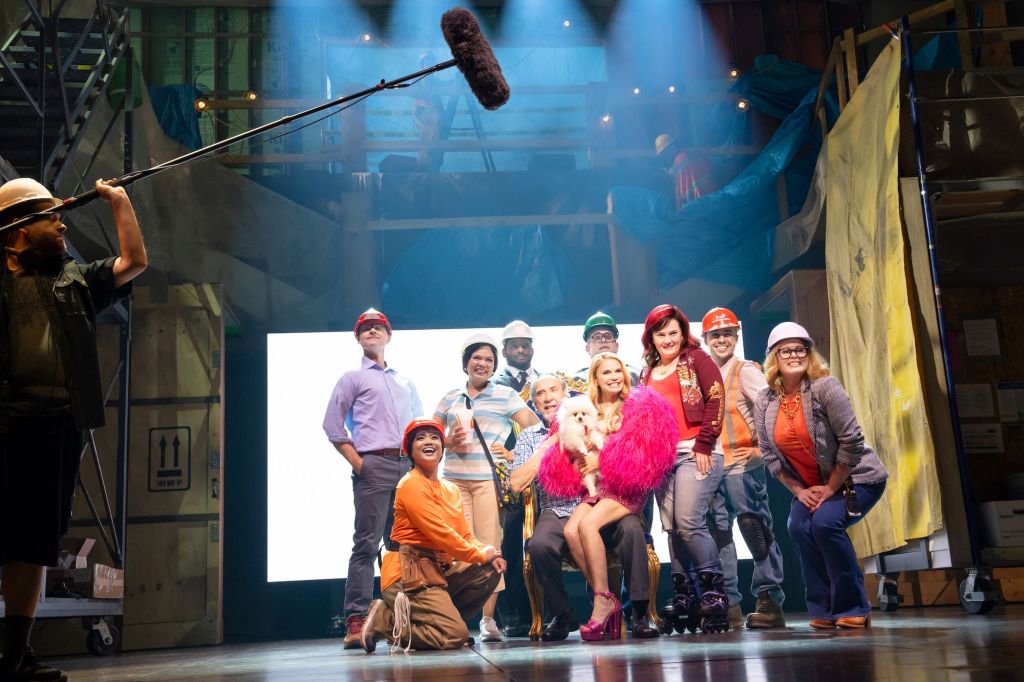
Presuming themselves American royalty, the Siegels hope to replicate a modern-day Versailles, like their mentor king. Indeed, they will best him. Their Versailles has whatever the family wants. This includes a jewelry-grade gem stone floor, an in-house Benihana (with all those tossed shrimp because David doesn’t like to stand on line), a spa, a pool with a stained glass roof, and a family wing with numerous bedrooms and bathrooms so Jackie doesn’t lose track of her seven kids.
After this opening salvo that mesmerizes like any show about the “lifestyles of the rich and presumptuous,” we discover that Jackie didn’t always come from wealth. In fact her story mirrors the old Horatio Alger “rags-to-riches” fable that Alger shaped into the American Dream, which abides today and which also influenced F. Scott Fitzgerald’s take on it in The Great Gatsby. Jackie, albeit a female dreamer, buys into the concept that if she pulls herself up with determination, works hard and does good works, she can lift herself into the upper classes.

We see how this manifests in the next segment of Chenoweth’s 17-year-old version of Jackie with her parents Debbie (Isabel Keating) and John (Stephen DeRosa) in their humble Endwell, New York home. Debbie and John count on Jackie to continue to work as many jobs as possible to become rich and famous like the titular show they watch together. Singing the song “Caviar Dreams,” a ballad that expresses beautifully a female Alger hero, we “get” Jackie’s drive and pluck to work day and night to achieve an engineering degree at IBM, then kick the job to the curb because it won’t give her wealth fast enough.
As she “keeps on thrustin” she makes a bold turn into marriage with alleged banker Ron (Michael McCorry Rose), who disappoints when he drags her to the Everglades, and opposes her Mrs. Florida win. When he physically abuses her, despite her pregnancy, Jackie leaves. Singing “Each and Every Day” beginning when Victoria is a baby, the scene switches to the present at the construction site and the teenage Victoria (the excellent Nina White) enters. Chenoweth’s Jackie soulfully finishes the song to Victoria in an important transitional moment. We understand Jackie as a survivor who loves her firstborn, who she claims saved her life.
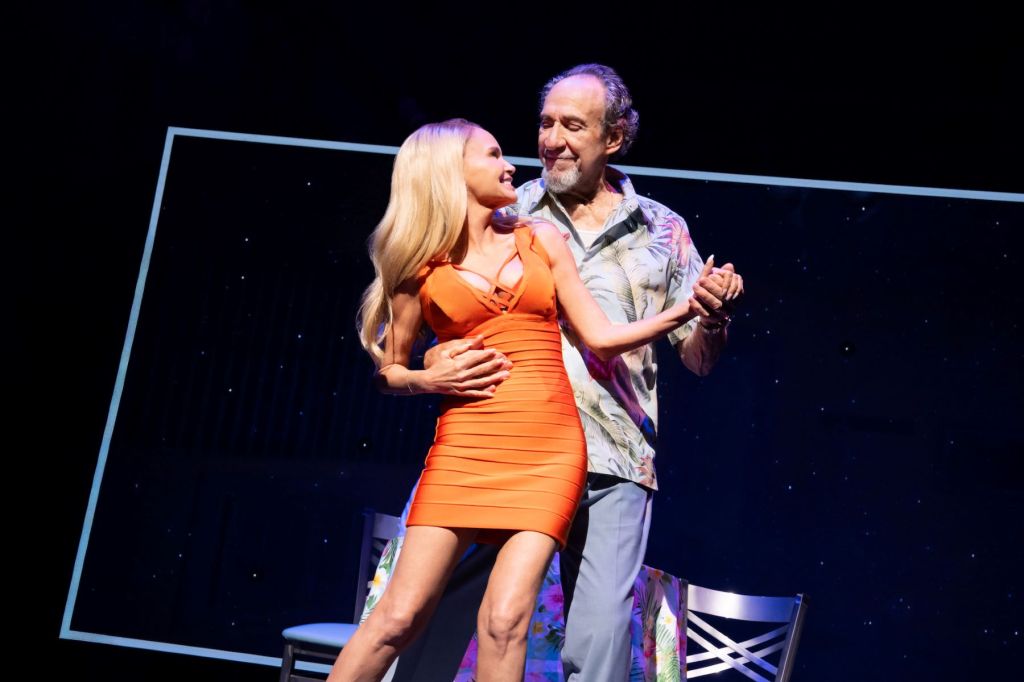
Not only does Jackie not look back, we learn she and baby Victoria lived in an apartment which “barely fit the baby’s crib and Jackie’s sleeping bag.” However, always “thrustin’ forward,” she recognizes opportunity when she goes to a party where she meets David Siegel, the CEO of Westgate Resorts. As it turns out, his impoverished childhood was similar to hers and left him with dreams of extreme wealth. F. Murray Abraham does justice to David throughout, first as a “cowboy” in the wild west of timeshares as son Gary (the fine Greg Hildreth) sings with the ensemble “The Ballad of the Timeshare King.” Occasionally, for emphasis, Abraham’s David chimes in with irony.
For example, David’s sales force make “one hundred percent of their sales on the first day.” Gary sings, “George W.’s president now, thanks to David Siegel.” When folks can’t afford the timeshare, Siegel helps them with financing from his bank, so the ensemble sings joyfully, “Yippee-I-owe-you-owe-we-owe.” We recognize the sardonic humor for David’s dishing out sub-prime mortgages to “anyone who breathes.” Of course this adds to the mortgage crises of 2008 which taxpayers foot the bill for. Eventually, the sub-prime loans bring his empire to the brink of bankruptcy as the crash swallows whole billionaires like David.

At that point, Jackie and David have been married with children and are two years into the Versailles construction having cycled through songs of their outsized wedding (“Trust Me”), a honeymoon trip to Versailles bringing back a scene of King Louis XIV and his courtiers. Smartly, Ferrentino and Schwartz reinforce their themes by joining past and present in the reprise “Because I Can and the “Golden Hour.”
However, conflict looms on the horizon. Though David and Jackie live their wildest dreams and birth child after child, daughter Victoria feels miserable, insular and ugly. “I know mom wishes I was prettier,” she sings in the poignant “Pretty Wins.” And in Act II in the superb “Book of Random” Victoria sings from her journal, the thoughts that she keeps hidden. Unlike her mother Victoria grounds herself in her current feelings of sadness brought on by reality, escapism fueled by drug addiction and scorn for their damaging and excessive lifestyle. However, when Jackie’s niece Jonquil (Tatum Grace Hopkins) arrives and Jackie takes her in, we think that Victoria has someone to confide in.
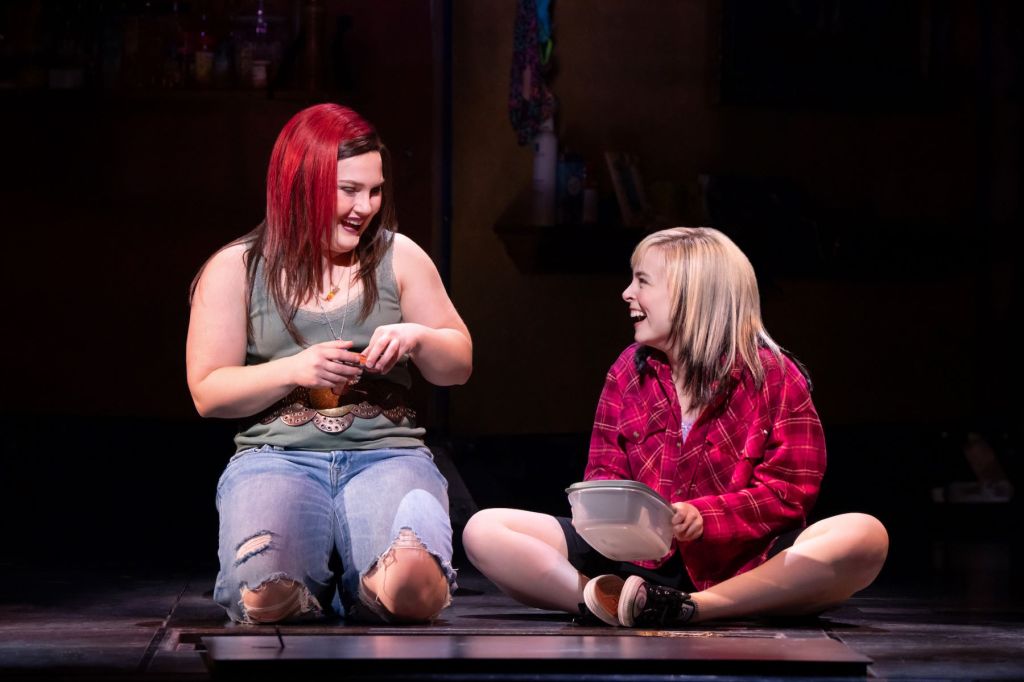
But Jonquil doesn’t understand Victoria’s dislike of Jackie’s appetite for more. And it doesn’t help Victoria that Jonquil becomes a clone of Jackie (“I Could Get Used to This.”). Ironically, when the crash happens and Victoria hears of the talk that they will sell Versailles to keep David from going belly up, she feels relief. In a farce-filled scene in the 17th century Versailles, with some of the most ironic lyrics, the Sun King chides the Siegels and Americans in the song “Crash.” “You thought you’d be egalitarian, let peasants own their own homes in some altruistic plan. Well, what were you expecting from a choice so rash? Crash…”
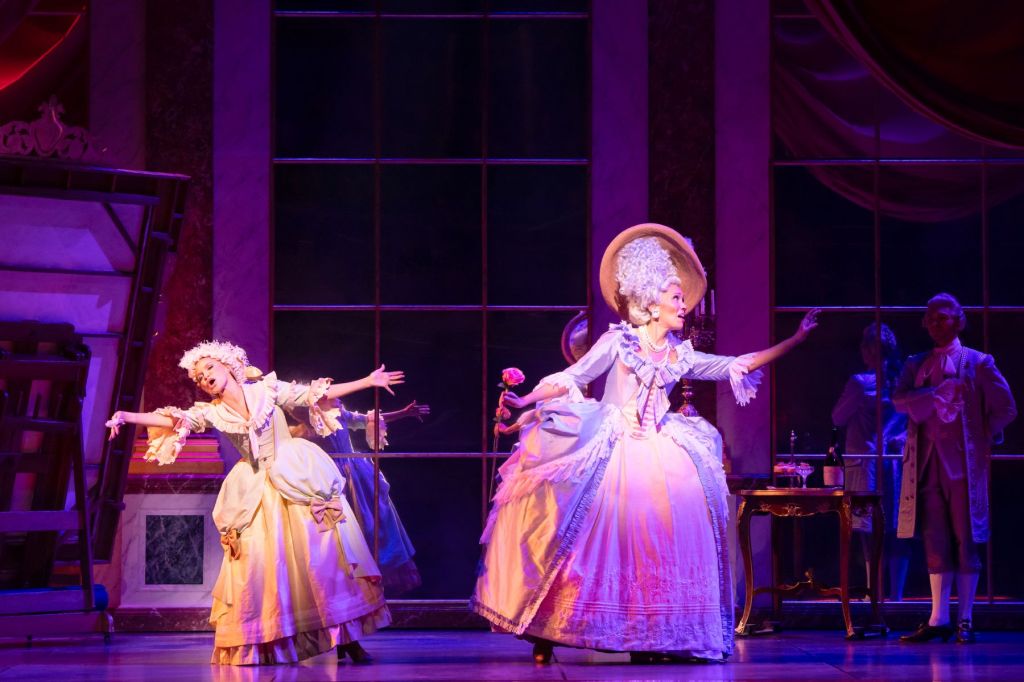
At the end of Act I, we have only Jackie’s spunk and perseverance (“This is Not the Way”), and David’s connections to rely on to bail them out of bankruptcy and foreclosure. Act II reveals that deus ex machina saves them when the government (taxpayers) bail out billionaires and banks. Naturally, the little people with no safety net lose their shirts. Where the peasants of France revolted against their royals (there is a humorous scene with the luckless Marie Antoinette on her way to the guillotine), in America, no one goes to jail because the banks and firms are “too big to fail.”
At the end of Act II, in a scene with King Louis XIV, in a reprise of “Crash,” King Louis and his courtiers sing as Marie Antoinette says “goodbye.” Here, Schwartz’s lyrics and tune underscore a crucial theme. America’s Aristocracy has cleverly worked it out that “democracy” will prevent revolutions. How? The rich have peasants “thinking they’re tomorrow’s millionaires; that you’re special privileges will someday soon be theirs.” And the ensemble adds, “No blade across the throat for you. Instead it seems your peasant class will all turn out to vote for you!” Thus, with no accountability for wrecking the economy and countless lives, the rich get richer, and Jackie and David, out of bankruptcy, continue building Versailles.
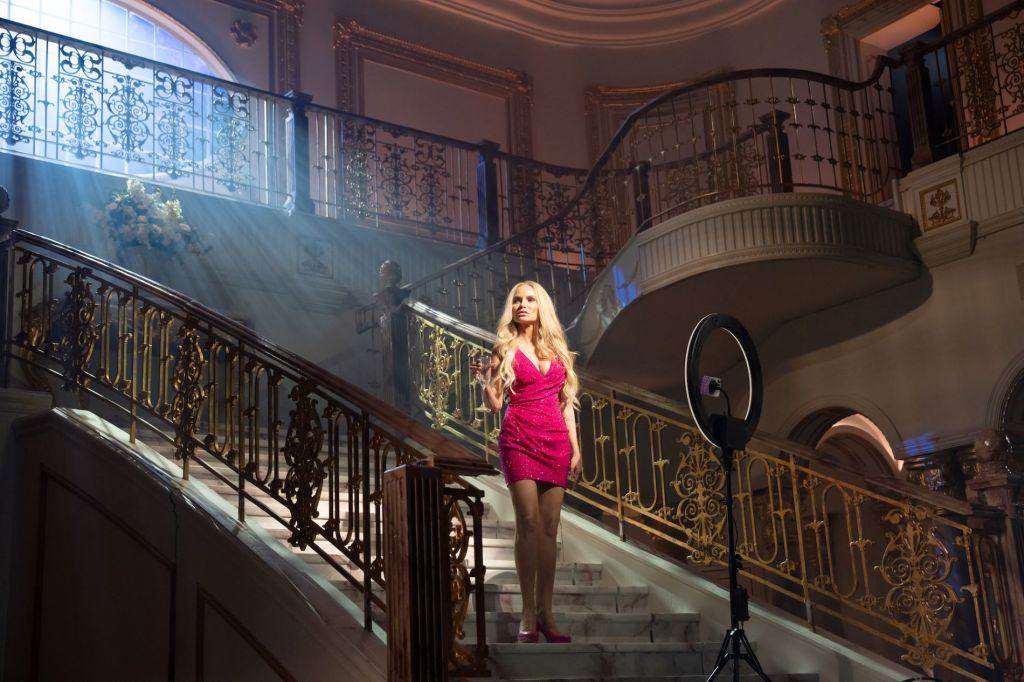
However, in all of the mayhem of trying to regain solvency, the Siegels sacrifice a family member. If material empires go on for centuries, flesh and blood does not. The unreality of excess belies mortality. But some folks never learn. Schwartz and Ferrentino ironically underscore this as Chenoweth’s Jackie holds a glass of champagne standing in front of a ring light. She speaks to a social media audience and hopes that, like her, they get their “champagne wishes and caviar dreams.”
The Queen of Versailles runs 2 hours 40 minutes with one intermission at the St. James Theatre. https://queenofversaillesmusical.com/

