Category Archives: Broadway
‘Leopoldstadt,’ Tom Stoppard’s Brilliant Chronicle of Family Holds a Trenchant Warning

In five acts spanning the years from 1899 through 1955, Tom Stoppard focuses on a wealthy, Jewish, Viennese family as they navigate the turbulent waters of social and cultural transformation in Leopoldstadt. Stoppard’s latest play begins at the turn of the century and moves through two World Wars. In it the playwright heightens the most salient themes about antisemitism, social responsibility, discrimination, human rights, family, ancestry and ever-changing political power structures which promote tribalism.
Stoppard weaves these concepts into the story of the multi-generational Merz and Jakobovicz families. With a panoramic view, Stoppard shadows their journey forward and backward as Jews, who attempt to maintain their identity and place in the culture and society of Vienna, Austria. Stoppard’s masterwork which first premiered in London, is currently in its Broadway run at the Longacre Theatre, coming in at 2 hours, 10 minutes with no intermission. Leopoldstadt, directed by Patrick Marber, is one of Stoppard’s finest works.
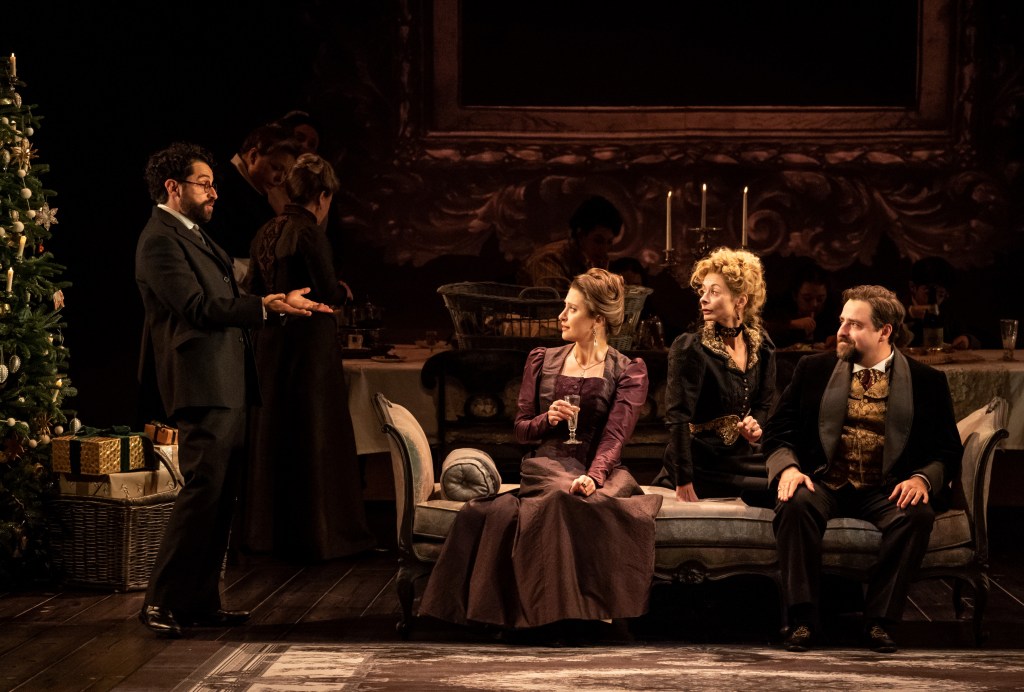
When we meet the members of the two families in the large Merz drawing room as they celebrate Christmas 1899, Hermann Merz (David Krumholtz) affirms that they can be grateful for Emperor Franz-Joseph’s new freedoms. For over fifty years as Jews, they have said goodbye to “wearing a yellow patch and stepping off the pavement to make way for an Austrian.” They must only withstand discrimination “now and then.” Wealthy textile manufacturer Hermann, baptized a Christian, has married the elegant and lovely blonde-haired Gretl (Faye Castelow), who is having her likeness painted by the foremost artist of the Vienna Succession, Gustav Klimt.
During the conversations we note the prosperity and culture of these two families, who inhabit the same social circles as the foremost professionals and artists in Viennese society. They name-drop Mahler, Schoenberg, Schnitzler and Freud. Hermann affirms his evolution as a Jew. “My grandfather wore a caftan, my father went to the opera and wore a top hat, and I have the singers to dinner-actors, writers, musicians.” Professor Ludwig Jakobovicz (Brandon Uranowitz) is a patient of Sigmund Freud and interested in his own dreams. Ludwig shows his theoretical mathematical prowess by questioning Hermann and Gretl’s son Jacob about Riemann sums. Doctor Ernst Jakobovicz (Aaron Neil) is meeting the lecturers for a Christmas drink. This is protocol, for he is a Christian.

To emphasize his full embrace of the cultured Vienna as the Promised Land, Hermann repudiates any interest as a Jew in Theodore Herzl’s Zionist idea of a liberal state in Palestine. Ludwig agrees that no one would want to go to the desert, certainly not the Jews who are part of Austrian bourgeois high society. Obviously, Hermann is not prejudiced. He practices the dictum that Jews in business should to be opened-minded to all cultures and religions to expand their opportunities, if they are to succeed. We discover later in the play, that success is paramount in Hermann’s life. With forward momentum, Hermann’s wealth and cultural aspirations have been bolstered by his marriage to his Christian wife Gretl. He is the first Christian of Jewish descent in the family.
However, Grandma Emilia (Betsy Aidem) reminds Hermann of the cost of his sacrifice for his children to be Christian. He has thrown over what he should have valued most, family and ancestry. But it’s no matter. Attitudes toward Jews have shifted. Grandma Emilia points out that once “hated as Christ-killers, Jews are now hated for being Jews.” Illustrating how much Hermann has changed for the sake of his career, Ludwig supports her comment with the terrible reality: he will always be a Jew. Grandma and Ludwig toast to a future territory for Jews, where they might be safe. That their wish comes true after the horrific Holocaust and murder of millions gives us chilling pause. However, safety, even in modern Israel, is elusive.
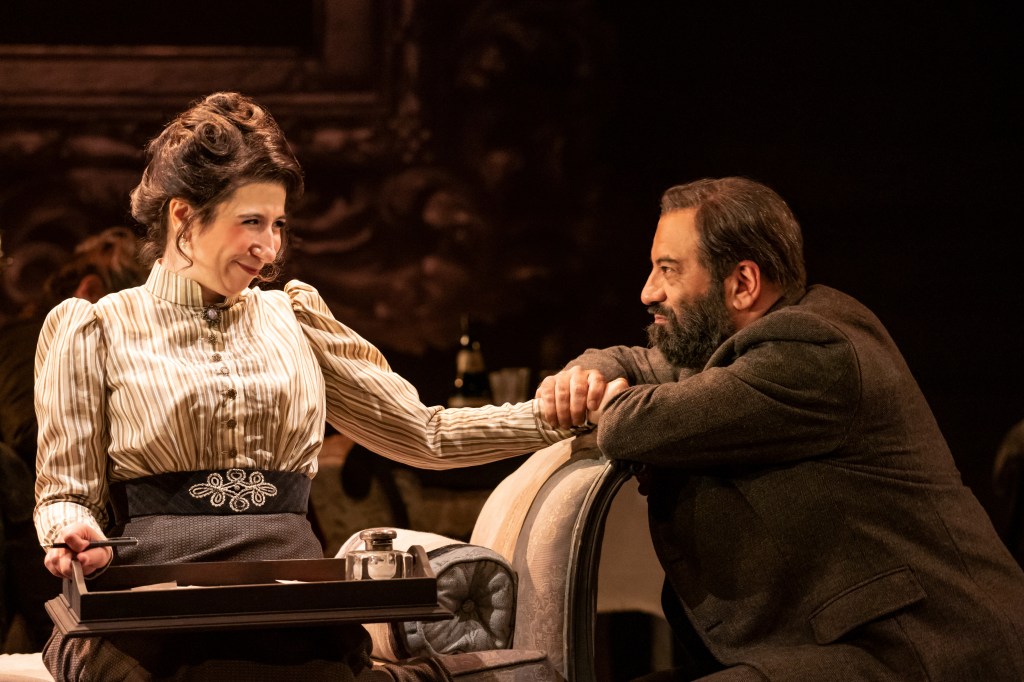
In this first act Stoppard has laid out the ground rules, intimating how the principle theme, “it can happen here and it can happen again,” will come to resonate as an irrevocable truth. As a family member states toward the play’s end, “barbarism can’t be eradicated by culture.” Indeed, the rational is often supplanted by the irrational. In the subsequent acts we understand how this becomes a reality for the two Jewish families in the play. They ignore the burgeoning antisemitism in Vienna. Ineffectively, they attempt to navigate around it by sticking together and celebrating tradition, until it is too late to leave.

In Act 2 (1900) Stoppard unspools his themes to reveal that the discrimination that Hermann refers to runs deeper than “now and then.” Fritz (Arty Froushan), an Austrian dragoon, eschews the younger Jewess Hanna and falls in love with the older Gretl, Hermann’s wife. They carry on an affair for a time, until she tells him she must break it off because Klimt’s painting of her will be finished, and she will be recognized sneaking around with him. When Fritz boasts about his affair making a Jewish slur in the company of gentlemen and in Hermann’s presence, Hermann initially doesn’t realize Gretl is Fritz’ lover. He thinks Fritz is insulting Gretl and attempts to recover their honor by proposing a duel. Refusing to engage Hermann because he is a Jew, Fritz insults him further by telling him his military status forbids him dueling with Jews.
Humiliated and doubly stripped of his honor, Hermann must bow to Friz, whose antisemitism holds sway. This prejudice is a warning that Hermann will always be an inferior in a culture that despises his heritage. Though Fritz’s rejection saves Hermann’s life, Hermann is gravely affronted and embittered because he doesn’t consider himself a Jew. However, Hermann later exploits the situation to his and his family’s advantage, after he realizes that Gretl and Fritz have had an affair. Ironically, being identified as a Jew upsets Hermann more than his wife’s infidelity. From this moment afterward, the situation worsens for Viennese Jews and members of these two families.

In subsequent acts we see the families experiencing events with less emphasis on the culture, as they uplift the Jewish traditions to humorous effect because they are not religious. For example, Stoppard has them confuse the banker Otto with the Mohel who is late to Nathan’s brit milah, as Sally runs to and fro conflicted about her son’s painful circumcision. She is not mindful about the symbolism of the circumcision, which means he is bound to God. Instead, she wants him to “be like his father,” following tradition. Interestingly, her decision is fateful. Stoppard intimates the importance of his being bound to God at the conclusion of the play.
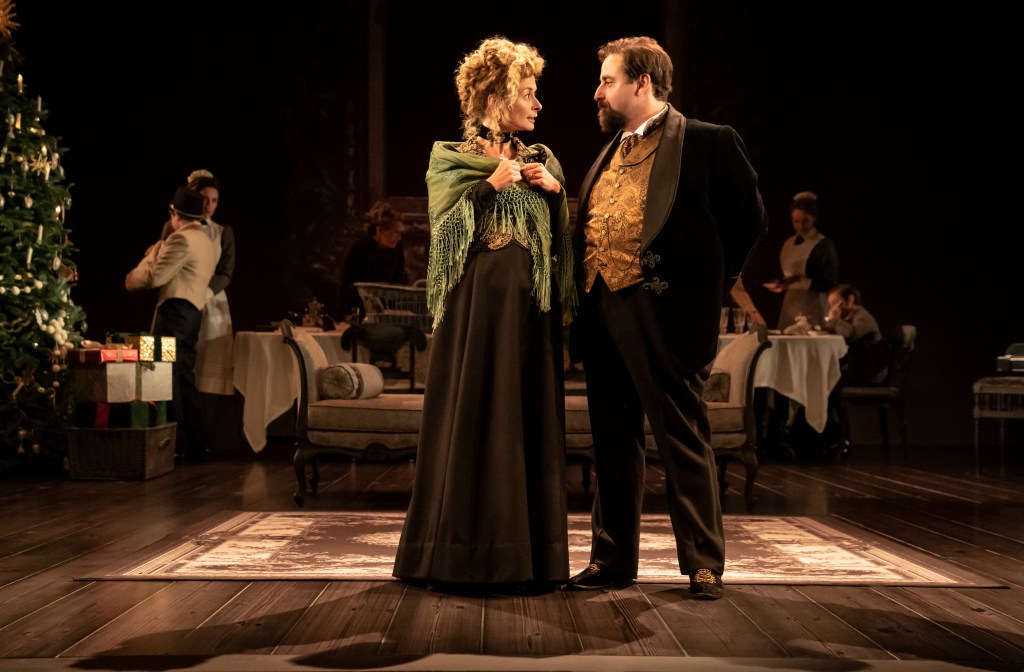
Richard Hudson’s set design manifests the transformations in the society and family fortunes from 1899 to 1955, as we note the movement in time from Belle Époque opulence (1899, 1900) to spare minimalism after World War I (1924) to the Anschluss (annexation) of Austria, and Krystallnacht (night of broken glass, 1938), after the room is stripped of valuables. Finally, the once elegant drawing room is completely bare and stark, when we come upon the reunion of three remaining family members in 1955 (Act 5). However, we are reminded of the once glorious decor via flashback to the 1900 Seder of Act II, when Rosa remembers her shame at forgetting where she hid the afikomen (a symbol of redemption). The scene in Act 5 then flashes forward, as Rosa enumerates the family members murdered by the Nazis, family she couldn’t get out because of quotas, though as a citizen of the United States, she was willing to sponsor them on her meager salary. Stoppard’s irony about Rosa losing the afikomen runs parallel to her inability to save any of her family from dying at Auschwitz.

It is Gretl, clueless about the Seder and the afikomen’s meaning, who produces another matzo to calm everyone, though the ceremony’s meaning is blown apart. In later years Gretl has brain cancer. She dies, unable to save herself or Hermann with her Christianity. Hermann’s conversion is not recognized under the race laws of a unified Austria/Germany. Like Ludwig said, regardless, Hermann is a Jew. The ancestors he has rejected are irrevocably his relatives through blood ties. However, he doesn’t fully realize he has rejected one world for entrance into another. But he remains in “no man’s land,” without a ‘territory,” because the anti-Semites will not allow him to gain entry.

Effectively using the drawing room set to reveal the Merz family’s dwindling fortunes with fewer and fewer adornments as time marches on, the family members age before our eyes, though there are always four of the youngest generation present to carry on the bloodline. Stoppard continues building on the themes he introduced in Act I, as political and social issues become more complex after the fall of the Austro-Hungarian Empire. In the aftermath of WW I the losing nations rally and attempt to recoup their power. Austria becomes a Republic overrun by various political parties (communists, democratic socialists, nationalists), who struggle for ultimate control.

In Act 3 (1924) as the family is in an uproar with Nathan’s brit milah, Hermann makes arrangements with his banker Otto to adjust to gyrating markets in an Austria roiling with the demands of WWI reparations payments. Otto (humorously, ironically mistaken for the Mohel), warns Hermann about the country’s nationalistic future. Austrians are voting for uniting Austria and Germany to “restore their destiny together as one Christian nation leading in science and culture.” Where will the Jews fit in? When Hermann questions this, Otto suggests that class war turns people against each other, but nationalism binds them together. Austria is embracing German nationalism as its own. As they conclude the discussion, Nathan’s circumcision is cheered by family.
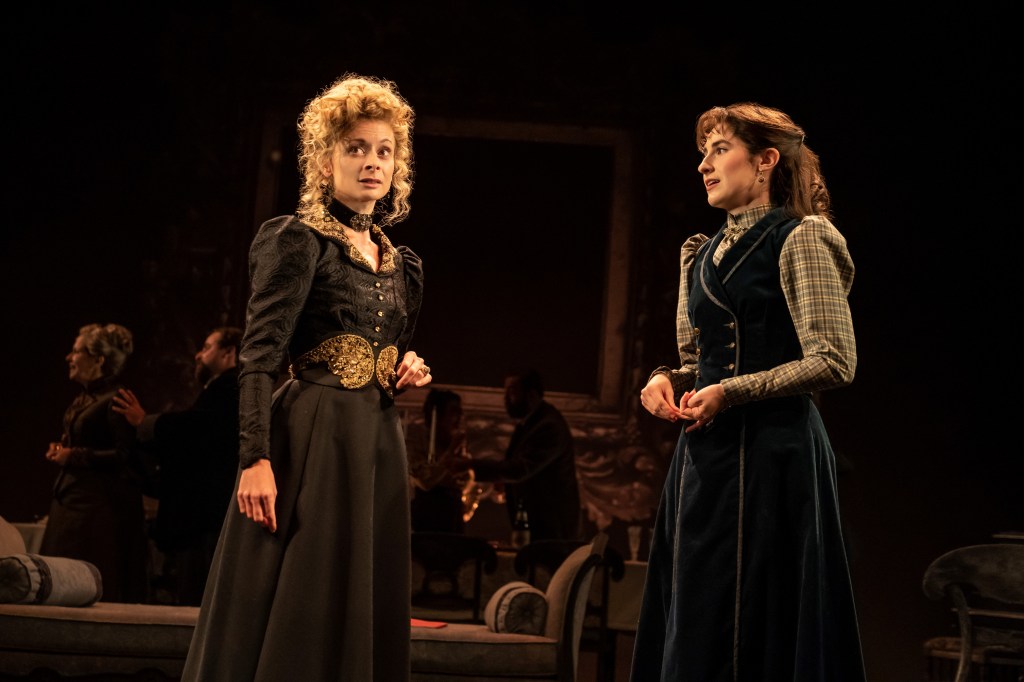
The celebration has an air of ironic doom. As one more Jewish male is bound to God, it is one more Jew who will be subjected to oppression and persecution in a society that will strengthen itself by excluding him as “the other.” In a seamless movement between Act 3 and Act 4, the circumcised Nathan emerges fourteen years later and stands in the street, looking at the sky to see bombers flying overhead. The family has not immigrated to another country. Only Rosa is in New York. The net is closing in on them.
As predicted by Otto and intimated by Ludwig, things have gotten worse and are heading backward toward the time when yellow patches were worn on clothing in the 1830s in the Jewish ghetto of Leopoldstadt. The drawing room is stripped of valuable items and Klimt’s painting of Gretl is gone, as the family gathers once more united for strength and information.

Act 4 (1938) is the devastation of an Austria in lockstep with Hitler’s despotism, manifesting even greater antisemitism than that shown in Berlin, which still allows Jews to go to cafes, movies, etc. The underlying discrimination which appeared to be residual is no longer sub rosa in Austria. That which Hermann and others said wouldn’t happen again, is striking up the band in their faces, indecently, aggressively, proudly. But what are they doing about it?
Percy (Seth Numrich), a journalist and fiancee of Nellie (Tedra Millan), tells them that as Jews, they are political refugees. They are subject to quotas dictated by 32 countries that met at a conference to discuss what to do about receiving Austrian Jews. Particularly appalling is the antisemitism in the countries who shrink their quotas to receive Jews based upon the will of the trade unions. Members of the family hear that their cultured friends and colleagues are leaving on special visas. Shouldn’t they also leave?

Stoppard intermingles Percy’s admonitions with Sally (Sara Topham) reading Grimm’s fairy tales to the children (an ironic symbol), while Ludwig discusses the knots on a cat’s cradle puzzle with Leo and Nathan. The juxtaposition of their calm interactions with the children, and Percy’s insistence that Nellie must marry him and leave her parents to then help family immigrate to England, creates tension. As Ernst adds his information, the suspense increases. In treating writers and artists and interpreting their dreams, Dr. Freud senses the underlying tribal chaos to come. He decides to leave. Additionally, Ernst discusses Klimt’s wild paintings for the university that suggest, on a subliminal level, that the “rational is at the mercy of the irrational,” and “barbarism will not be eradicated by culture.” Once in fashion, the paintings are considered subversive.
In a vast and growing conservatism, Klimt’s art is labeled as nonsensical and offensive. The labels are a harbinger of the Third Reich’s future confiscation of valuable paintings, censored then banned as decadent. It is a ruse to steal millions of dollars of valuable art, that wealthy Jewish merchants and families purchased in the golden years of cultural blossoming. As the “now and then” discrimination has increased, culture has been supplanted by tribalism and propaganda that “proves” Jews’ dirty genetic inferiority. Not only does Dr, Freud leave, so do other bright lights, once the “toast” of Viennese culture and society.

Percy tells them the discrimination will only worsen.Nellie ignores him and insists that things will get better. As if to punctuate Percy’s accuracy, an Austrian civilian (Corey Brill) with a swastika armband abruptly enters. He checks their racial identity as Jews and stipulates that Hermann is not exempt from his blood heritage. He insults Ernst for “hanging around” and doesn’t allow him to accompany his wife Eva to the mental asylum, though she is deaf and blind. After the Civilian harasses and demeans the children with epithets, he directs Hermann to sign over the business to the state because he has used it to commit crimes (convenient lies to justify theft). As the Civilian leaves, he warns them they are to be evicted the following day and can only take one suitcase with valuables under 15 reichsmarks. It is then Hermann discusses how he has protected his business from legal confiscation and tells the family they must go to live in Leopoldstadt. As sounds of “the night of broken glass” increase, little Heini plays on his toy piano to drown out the terror, a symbol of culture’s diminutive power against barbaric acts of tyranny.

One hundred years before, the Merz and Jakobovicz family’s ancestors were forced to wear a yellow patch of exclusion that justified the limitations of their easy movement in Viennese society. Only for a brief period were the Merz and Jakobovicz’s free, thanks to Emperor Franz Joseph. Sadly, they were duped because the hatred and antisemitism was always bubbling underneath, despite their great contributions creating an amazing culture. At this point, Grandma Emilia’s adjurations come home to roost. Jews are hated for their bloodline, a fact which Hermann nor the others can accept. That they are not Orthodox nor very religious makes their bloodline even more damnable. Stoppard’s irony hits with a double impact.

In the last act (1955) during the reunion of American Aunt Rosa (Jenna Augen), Nathan (Brandon Uranowitz), and Englishman Leo (Arty Froushan), we watch these family members attempt to reconcile their different experiences as Jews during the Holocaust. Rosa and Nathan almost indict Leo for not understanding the heartbreak they’ve experienced. Only until Leo remembers an incident in the drawing room, when Ernst stitched a wound on his hand after he broke a cup, does he remember the family, the drawing room, Ludwig and the cat’s cradle. It is then Leo breaks down in tears at the revelation of feeling. It is then that he begins to understand the import and impact of the Holocaust and the hatreds that stole his family from him.
The three conclude with uncertainty about Austria which acts the innocent victim, though many complicit Austrians were guards in concentration camps and helped round up Jews for transports to the camps. Aunt Rosa, who purchased Hermann’s apartment, vows to get back what was stolen, Klimt’s painting of Gretl. Nathan counters that there will be difficulty proving the painting’s provenance. As Aunt Rosa, Leo and Nathan look over the family tree, they review family members (Ernst, Gertl, Hermann, Jacob, Eva,Hanna, etc.), we’ve come to know and empathize with. Many of these died, at Auschwitz. Some died in Vienna, one committing suicide in Leopoldstadt, one committing suicide after the war is over. Their deaths are a poignant, heartbreaking devastation. The doom, revealed in dreams and in artists’ works, warned what was to come. There were many warnings. Family members ignored them at their own peril.

There is much about this production that is astounding. The opening act is spectacular, as we see the beauty of that time in Vienna, thanks to Richard Hudson’s scenic design, Brigitte Reiffenstuel’s costume design, Neil Austin’s lighting design, Adam Cork’s sound design and original music, and Isaac Madge’s projection design. Because of the efforts of the creative team, we recognize how two World Wars smashed the greatness of the people and their contributions of genius to enlighten and uplift. The society that benefited, boiled up with masochistic barbarism to devour that genius. Thus, in seeing the panorama of this time period (1899-1955) through the lives of family members, it becomes clear how the demonization of groups, injustice and war set back civilization in unthinkable ways.
Leopoldstadt encapsulates the questions that many have asked, and it answers them. If the Jews had not been “free” under Emperor Franz Joseph, would they have been able to do the exploits they accomplished? The subsequent Acts 2-5 reveal the answer, and affirm the political brutality and will to destroy encouraged by the prejudiced, the barbarians, the tribalists. By oppressing/destroying others to effect a genocide, what exactly is gained? Is not the annihilation of talent and brilliance for all time an irrevocable loss for humanity?

Stoppard’s work is filled with ironies and quotes that resound with pithy fervor. A final irony is that the most Jewish one in the family is Leo (Leopold), who was taken to England by his mother Nellie, and Percy, his stepfather. His own father was killed by Austrians. However, Leo doesn’t realize his ancestry, which his mother fearfully kept from him. Instead, he conveniently identified with England and all its blessings, “a top country,” while eschewing its most horrific acts of “still upper lip” genocide, colonialism and crass exploitation of “inferior” non white cultures. When Nathan tells Leo that both his parents and both sets of grandparents were Jewish, it is a revelation. That Leo receives it, at a point when he can most appreciate it, is poignant. For as he joins Nathan and Rosa in remembering those lost, he begins to understand his own history and identity.

As a minor criticism of the production, in Act 4, the scene when the Civilian and two police enter, the action is restrained. The acting in that section of Act 4 (from all involved), lacked the fervor necessary to reinforce the point that the once enlightened Austrians have revealed themselves to be barbarians. A greater intensity might have strengthened the conclusion and the emotional empathy for the family stolen from Nathan. That intensity then would reinforce the contrasting triumph and truth residing in Nathan, the only one who made it out of Auschwitz to give his testimony that the Holocaust is not a fiction.
Leopoldstadt is an incredible achievement. Kudos to the director Patrick Marber and the creative team who explored the director and Stoppard’s vision. And kudos to the fine actors who portrayed Stoppard’s characters. Their work warns us about ourselves and our penchant for escaping damning, painful, inconvenient truths. The production is horrifically current in revealing that denialism and silence in all its forms will be exploited by opportunistic, political criminals, for whom tribalism and barbarism are the only way to get what they want.
To see this magnificent work, go to their website: https://leopoldstadtplay.com/
‘Death of a Salesman,’ Starring Wendell Pierce, Sharon D Clarke in Dynamic, Powerful Performances
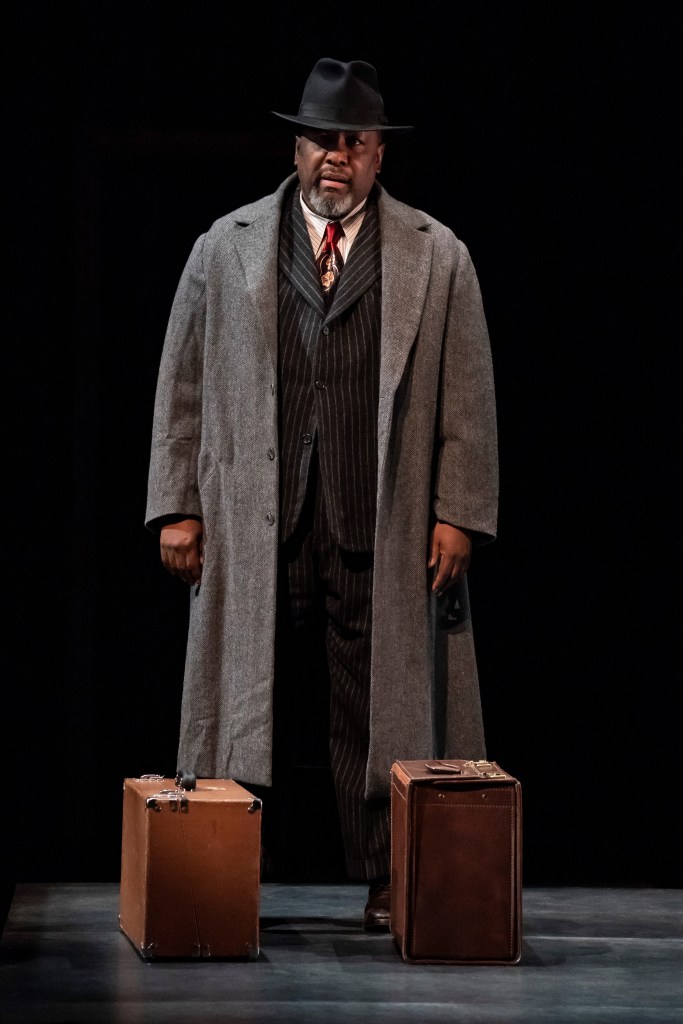
Director Miranda Cromwell has given Arthur Miller’s Death of a Salesman another go round in a revival elucidating the most salient features of Miller’s modern tragedy. Cromwell’s version, currently at the Hudson Theatre, reminds us that as a classic of the 20th century, the play’s themes are timeless, and Loman’s fall is representative of what the powerless man experiences every day of his life.
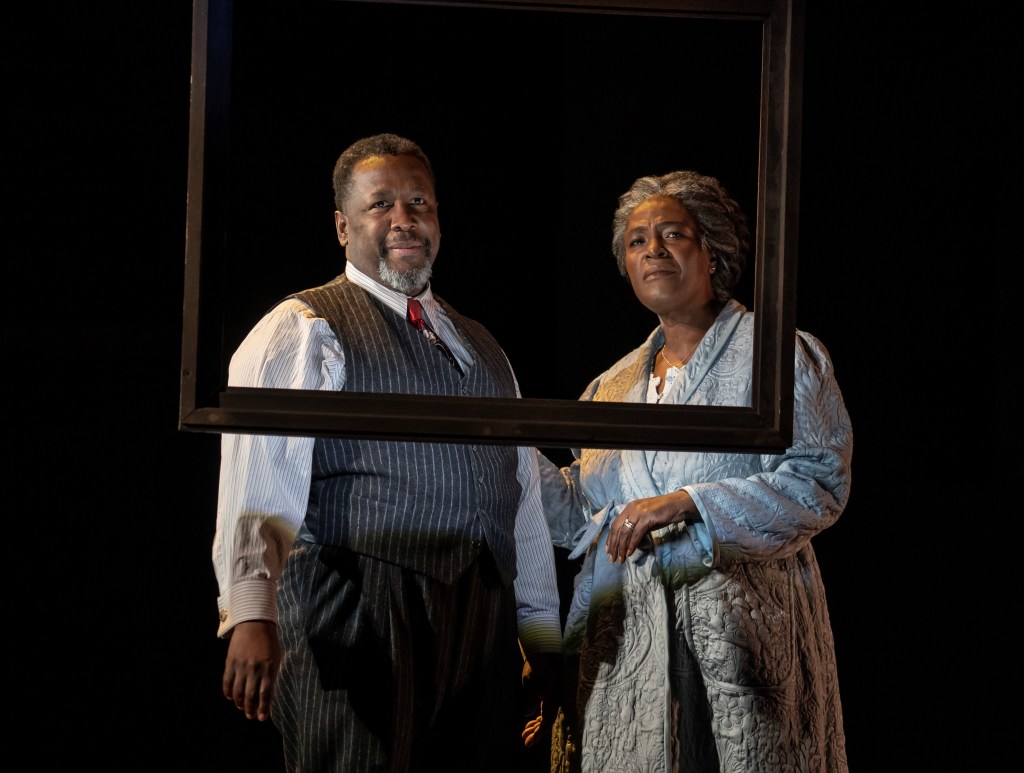
Starring the dynamic, stirring Wendell Pierce as Everyman Willy Loman and Sharon D Clarke as wife Linda, the cast and creatives provide a dramatic and thought provoking view of Miller’s American family. With tremendous currency Cromwell’s version explores the heartfelt tragedy of the diminishing patriarch whose foibles are easily identifiable and relatable to our lives.
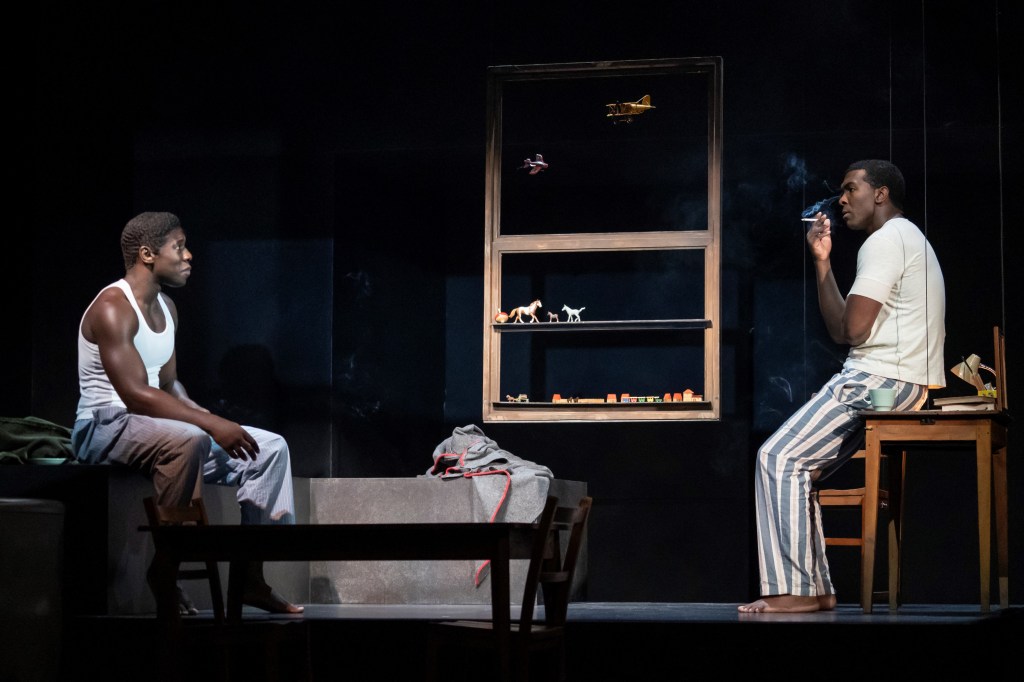
From beginning to the conclusion Cromwell shepherds her remarkable cast in a unique reexamination of Willy and Linda Loman, a husband and wife team who cling to falsehoods and illusions for the sake of each other to get to the next day. Fatefully, Willy’s end is irrevocable and Miller’s play expertly imagined by the director reveals the steps which ensure that Willy’s train wreck life moves with increasing devastation to come to the “end of the line,” Willy’s complete breakdown and suicide. Miller’s characterizations are heightened in this revival brought to life from moment-to-moment by the ensemble all of whom are spot-on sensational.
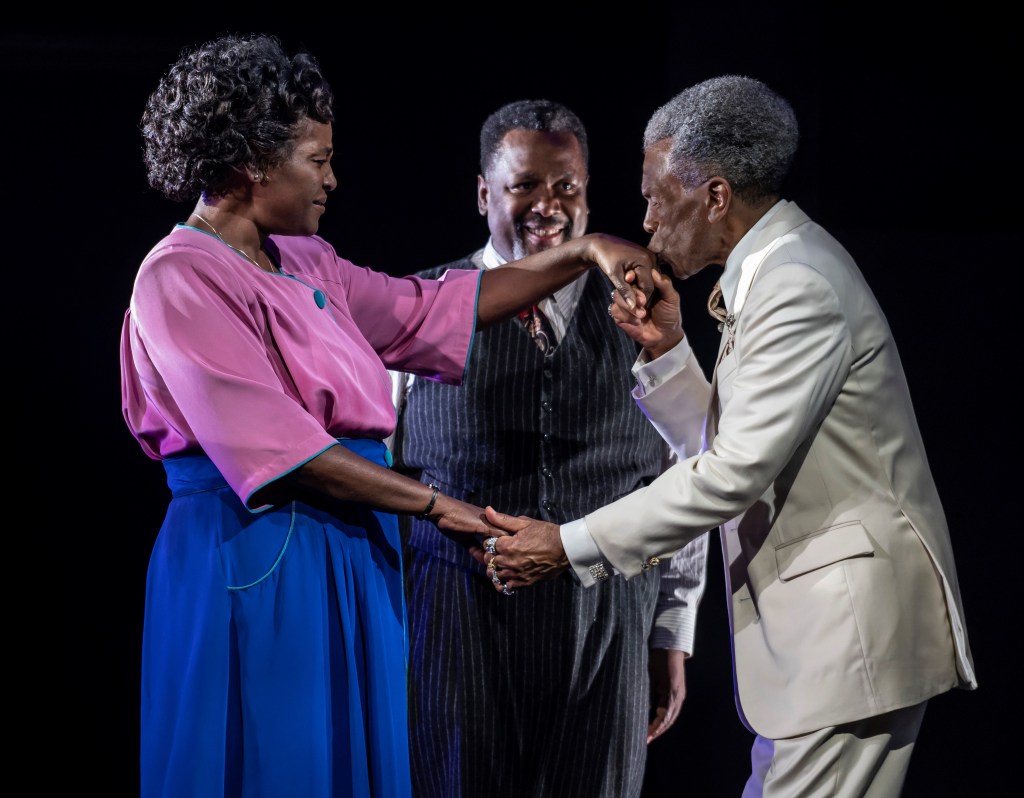
Particularly wonderful, Pierce’s Loman spools out Willy’s loss of power, self-esteem and confidence as he clings to his fantasies and is beaten by memories of his past failures. These become more stark and tormenting until until his ghostly guide, the wonderful, stately André De Shields as Ben, encourages him toward the “proposition” (a life insurance payout) he can’t refuse.
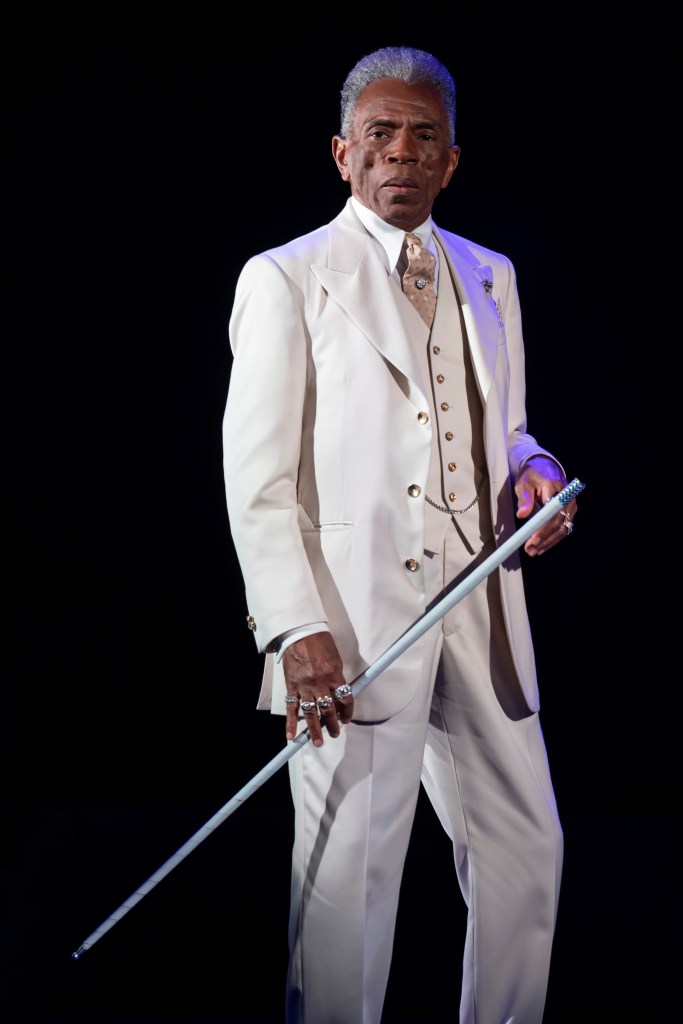
Cromwell’s, staging, Jen Schriever’s lighting design and Mikaal Sulaiman’s sound design relay Willy’s searing flashback visions. Pierce’s Willy makes these physical as if they slash his mind so that he is forced to respond with fury, as he attempts to stop the fears and guilt that drive him toward insanity. Clarke’s Linda kindly couches Willy’s lies and bombast with her own obfuscations and illusions. She is frustrating and infuriating for pandering to Willy’s babble. That Pierce’s Willy ignores and berates her and Clarke’s Linda puts up with him out of love is typical of such relationships of endurance and suffering. However, it becomes obvious that Linda fronts Willy and hides her underlying hopelessness and fear which she confesses to their sons Biff (Khris Davis) and Hap (McKinley Belcher III). Thus, Linda is two people. The loving wife to her husband who puts up with his abuse. And the truthful mother who upbraids her children and seeks their help with her ill husband.

Indeed, Linda knows Willy is desperate and on the brink of suicide. However, she spins her own conundrum. Fatalistically she watches Willie, expecting him to finish himself off in the basement. Yet, at the conclusion she dupes herself into believing Biff exacerbates and is the cause of Willie’s torments. Believing that Biff and Hap’s absence will relieve Willy and he will be “OK,” her delusion contributes to Willy’s suicide as she “lets him go.” Even at the end, she can barely confront what she knew was coming all along. She questions it. Clarke’s Linda can’t process his suicide and is still oblivious to the lies he’s told her to glorify his life. This is so even after Biff in his revelation scene exposes the family as predicate liars. Clarke’s Linda is numbed to realizing the truth of who Willie is. Throughout Clarke’s vital acting reveals a woman at sea going only so far in her realizations, then pulling back just short of making a difference for her entire family. Pierce and Clarke authentically create the type of marriage that reveals how blind love is, especially when it is slathered with lies and illusions.
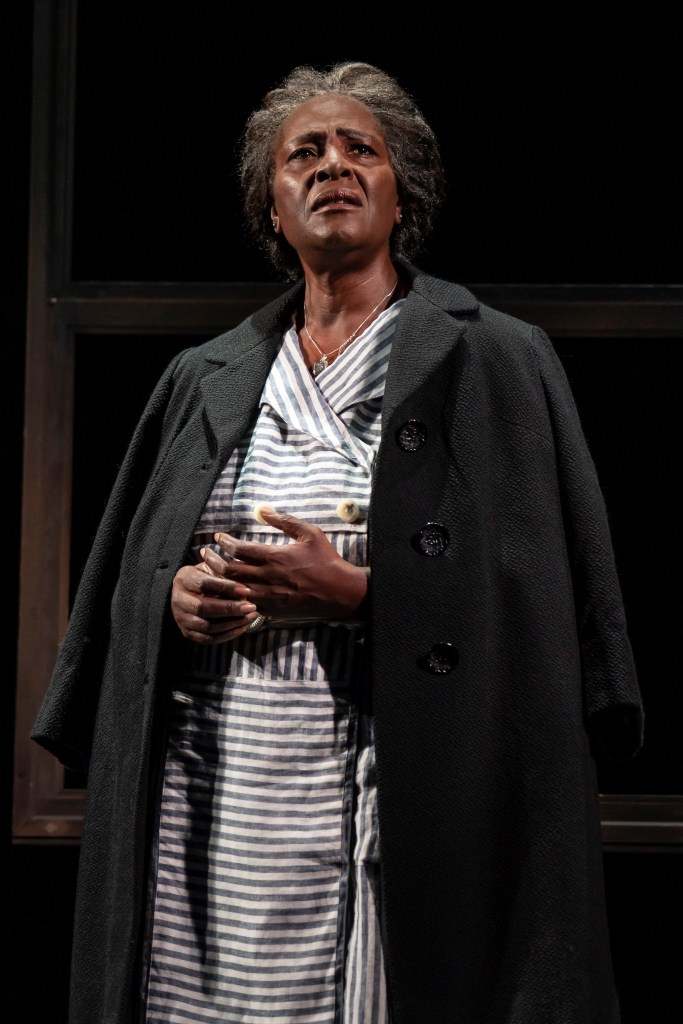
The morass Willy and Linda have built for each other and their children has so entangled the family, they cannot bear to be around each other for the continuous gaslighting and exaggerations. Willy responds to thirty-four-year-old Biff in extremes ranging from insult to encouragement and mostly argument if Biff doesn’t agree and bow to his “judgment.”
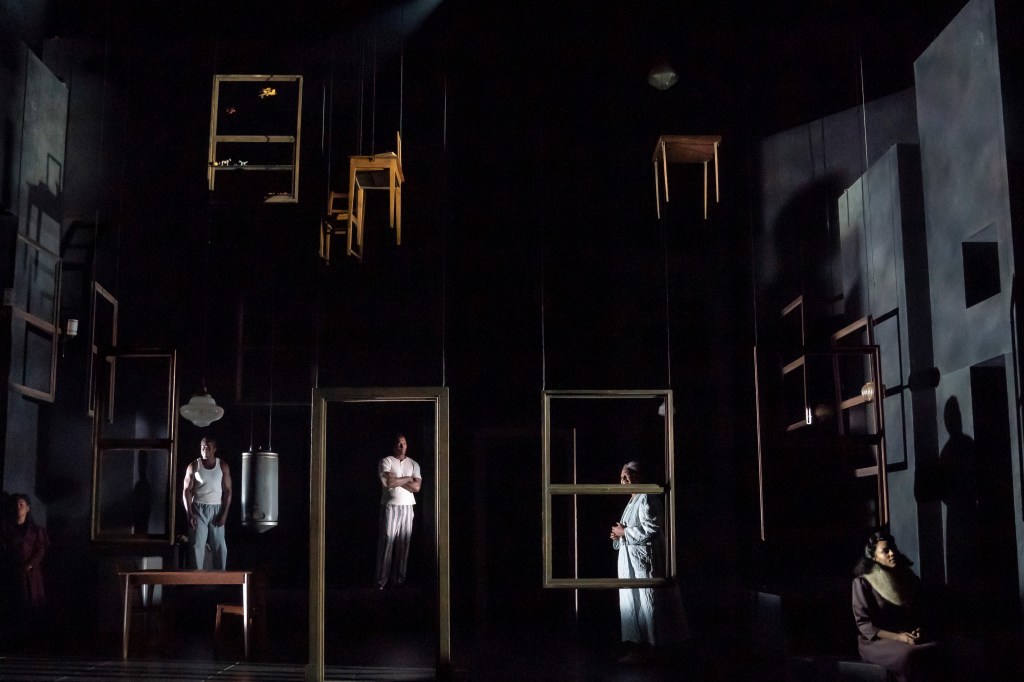
Pierce’s Willy pitted against Davis’ vibrant and soulful Biff works with authentic poignance. Revealing their relationship built on lies, Cromwell with acute minimalism sets up the climactic flashback when Biff, encouraged by Willy to ignore his studies, fails math and runs to Willy in Boston for help. Finding Willy with another woman devastates Biff. It demeans Linda and shows Willy’s life with family is a sham since he can’t uphold his marriage vows. In a dynamic scene between the two actors Pierce’s Willy uses pretense to con his son and overwhelm Davis’ Biff from understanding the facts. But Biff realizes who his father is and can’t forgive him, feeling terrible for Linda. Crying, Biff leaves, forever sealing Willy’s guilt that he has destroyed Biff’s life and proven himself a fraud.

For his part Belcher III’s Hap is a convincing “chip off the old block,” on steroids. He follows in Willy’s footsteps and abides in his own delusions that he’ll make a success of himself, though he can’t admit he is at a low rung in the hierarchy of his company. Belcher III and Davis work hand in glove as the two brothers, one selling himself 24/7, the other seeking his identity and finally discovering it. Biff, the hero of Miller’s play because he faces the truth and confronts the family with their lies, courageously admits he has hit rock bottom. Too resounding for Willy to accept, it is one more torment slashing Willy’s mind. Davis, especially as the truthful Biff in the last scenes is superb.
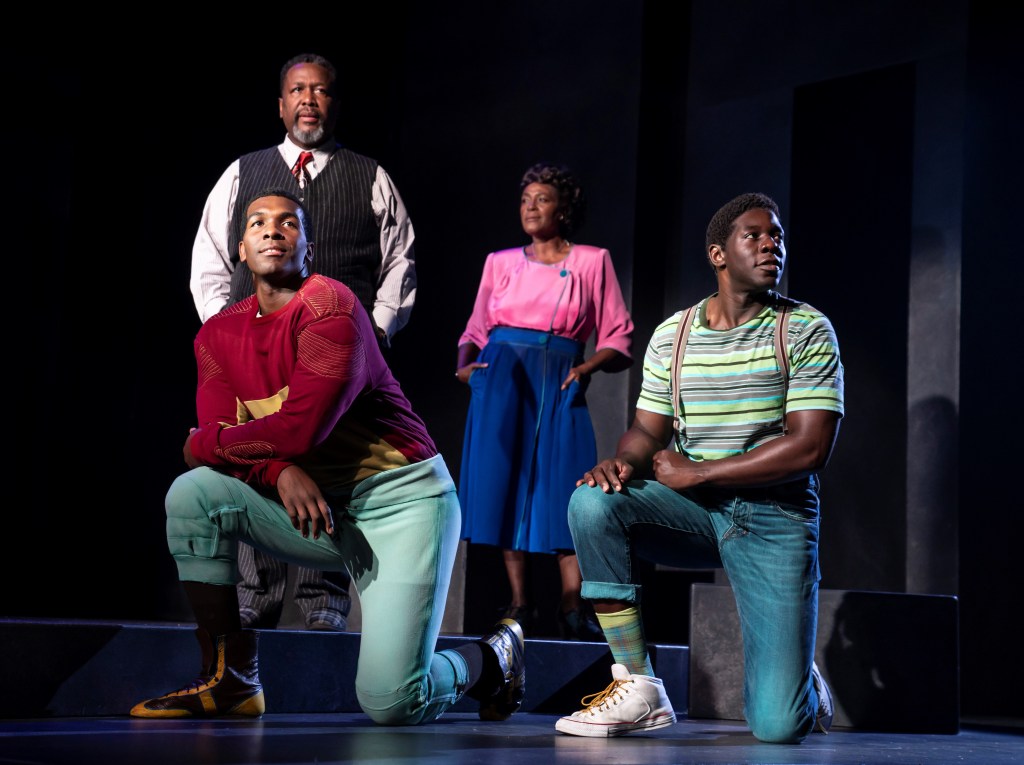
During the flashbacks, Hap, Biff, Linda and Willy enliven the family interactions and dynamics along with neighbor Charley (Delaney Williams in a terrific portrayal), and son Bernard (Stephen Stocking masters the young and the older Bernard with solid acting chops). Charley and Bernard are admirable and kind; their decency in the face of Willy’s insults is smashing. Williams and Stocking are another team to round out this fine ensemble, all of whose work is authentic and beautifully synergistic.

For example Pierce and Davis’s performances along with Lynn Hawley as The Woman perfectly render Biff and Willy’s destruction of their relationship with the awkwardness of a naked expose, as Biff and The Woman catch up Willy blabbering in his lies. Also, as we do during the flashbacks of the family, including the high school days with the excellent Williams and Stocking, we follow, engrossed with the Loman family as we “get” how the fabric of their lives unravels, and we realize why Willy’s suicide comes when it does.
Willy’s breakdown is Pierce’s gradual tour de force with each flashback, each event showing how Willy is brought closer to the brink until he can take no more. Miller reveals that much could have happened to stop him. However, the obfuscations and self-delusions are so great, only Biff could help. But it is too late. Biff can only save himself. Not even the hero can save Willy from his ghostly dreams to die “the death of a salesman” with a fulfilled proposition of $20,000 for his family, a fallen hero after all.
The scenic design by Anna Fleischle is minimalistic and suggestive with wooden frames introducing Willy and Linda. Unadorned furniture suggests Hap and Biff’s bedroom, Howard’s office, the hotel room, etc., revealing the play unfolds mostly in flashback at crucial points in Willy’s past in his memories. The flashback scenes are without framing and the staging is free formed, revealing Willy’s flights of fancy that make him happy. The guilt and fear torments are staged accordingly as Willy attempts to escape himself but can’t. The change in time Cromwell has reflected in the costume changes (co-costume designers Anna Fleischle, Sarita Fellows) of Linda, Biff, Hap, Charlie and Bernard. Only Willy wears the same outfit, always his suit whether jacket on or off, a salesman to the last.
Cromwell uses funeral music in the beginning and at the ending to frame the play about Willy’s life. This structural unity adds grace and embodies the concept of Willy’s death and the life he lives elucidated to reveal why he commits suicide. However, Charlie exonerates Willy and suggests, “nobody dast blame this man. A salesman has got to dream. It comes with the territory.”
This revival is illuminating and fresh, a must-see, especially for its performances and enlightened direction. For tickets and times go to their website: https://www.thehudsonbroadway.com/whatson/death-of-a-salesman/
‘Topdog/Underdog,’ The Cons’ Slow Walk Into Violence

Suzan-Lori Parks’ revival of her Pulitzer Prize winning Topdog/Underdog currently at the Golden Theater measures all the worst elements of America’s love affair with hustlers, grifters, swindlers, confidence men and bamboozlers. Clever con artists encourage the falsehoods of the American Dream, the greatest con ever, that prosperity buys happiness. Brothers Booth (Yahya Abdul-Mateen II), and Lincoln (Corey Hawkins), have bought into the idea that to be “the man” they must do the con, in other words, financially “make a killing” easily and quickly.
Oftentimes, the admirer of the confidence game identifies with the artistry of the hustler, who dupes his mark because he plays upon his vulnerabilities. Of course, the fan never believes that he could be the sucker who falls for the scam. Thus, arrogance and self-deception increase his susceptibility to the con artist’s fraud. Bamboozlers at the top of their game sense the weaknesses of their pigeons (greed, dishonesty, vanity, opportunism, lust, compassion, credulity, desperation and naïveté). They mine them like gold to bring their con home.

Topdog/Underdog reveals Parks’ sardonic genius, as she plays her audience with irony upon irony. Under the apt direction of Kenny Leon and his creative team we are sucked in to the long con as Parks prompts us to laugh at her brilliantly conceived characters Lincoln and Booth, expertly played by Hawkins and Abdul-Mateen II. Parks and Leon draw us into the illusion the characters create, as the hustler (Lincoln or Booth?), slowly lures his mark and exploits his vulnerabilities. The unfolding of the long con happens through a series of short cons where Lincoln and Booth circle each other, get the upper hand, then lose it as they temporarily fall for each others’ lies and posturing. However, one must look closely through the humor and the repartee because what is happening is the draw down to “make a killing.” Who the final winner is depends on how you see it.

Thematically, Parks uses the concept of the confidence game to expose the American culture’s hustle, primarily of Blacks, and of all who are not wealthy. Parks ridicules sub rosa all who believe they escape the oppressive economic structure which cons Lincoln and Booth to commit fraud, lie and steal. Indeed, the “unoppressed” don’t have to engage in such “criminal” behaviors to survive. Instead, they are duped into perpetuating the demeaning economic system and its institutions, only to create a different form of oppression in their lives, one that is harder to detect, and difficult to overcome.
Thus, as the audience watches Lincoln and Booth shred, front, insult and play each other as chumps, they sit smugly back laughing and missing the point. Parks, the con master, tapping their vulnerabilities has them on. This is especially so if the audience believes that not being of color exempts them from oppression. For in her primal message in this amazing work, Parks challenges us to empathize with the characters to fully understand how the profound racial themes, ironies and symbolism of Topdog/Underdog relate and interlock with the oppressive systems that hoodwink us and govern our lives.

The cleverly constructed two-hander, shepherded by Leon and performed with perfection by the actors, fascinates with dynamic, power shifting twists from beginning to conclusion. Lincoln is the older brother and the apparent “top dog.” He has what Booth wants, the talent and artistry to “make a killing” at three-card monte. However, Lincoln doesn’t “touch the cards” since the demise of one of his sidekicks in their scam that used to pull in $1000 a day. Lincoln’s teammate got shot. so Lincoln lays low and stops hustling. We discover this at the top of the play as Booth importunes his brother to teach him his moves and continually pesters him throughout Act I and II to join him and make tons of money at three card monte. Lincoln tells Booth he is done with the grift and involved with something else. However, Lincoln is blind to the import of what he’s chosen to do.
After his life fell apart and he lost his wife and his apartment, Lincoln was dislocated, a shadow of his former “cool” self, without wads of cash at his disposal. Desperate for money, at his wits end, Lincoln demeans himself by taking a job that racially exploits his dignity. Lincoln grovels for his money by sitting in a penny arcade dressed up as Abraham Lincoln, while visitors pay to shoot him. Booth finds the job despicable. He intuits that his brother is being “played” by his bigoted boss and the racists that pay to be the assassins of a black facsimile of President Abraham Lincoln. Part of Lincoln’s costume, along with the beard, hat and long coat of the type President Lincoln wore is the make up which is white face paint.

Parks’ irony in depicting the character of Lincoln is layered and upon examination, both humorous and tragic for many reasons. Lincoln playing Lincoln who “freed the slaves” out of convenience in the power struggle of the Civil War is a deprecating self-effacement and loss of empowerment for the once talented hustler. Lincoln’s white face is a further diminution into enslavement and toadying to “the man.” You can’t get much lower than a Black man putting on white face in an egregious parody which has him assume the role of his oppressor who conned the culture with his signing of the Emancipation Proclamation.

The irony that President Lincoln wanted to send all the Blacks back to Africa doesn’t matter to Lincoln, whose lack of knowledge and desperation damn him to willingly accept the demeaning job which erodes his confidence and self-determination. Additionally, his small salary given to humiliate him by “playing” a president who was the dubious “savior” of Blacks and was hated by Southern bigots, who possibly have come to ridicule him, reveals the extent to which Lincoln is in bondage to the white power structure. That he tells Booth it’s an easy job is Parks’ further thematic irony. Indeed, it is easy to be hoodwinked by “the man,” to internalize oppression and enjoy it because it is safer than to struggle and stand up against it. Lincoln has integrated slavery into his being. He represents one type of Black man in the society who works for a pittance in a job not worth his dignity.
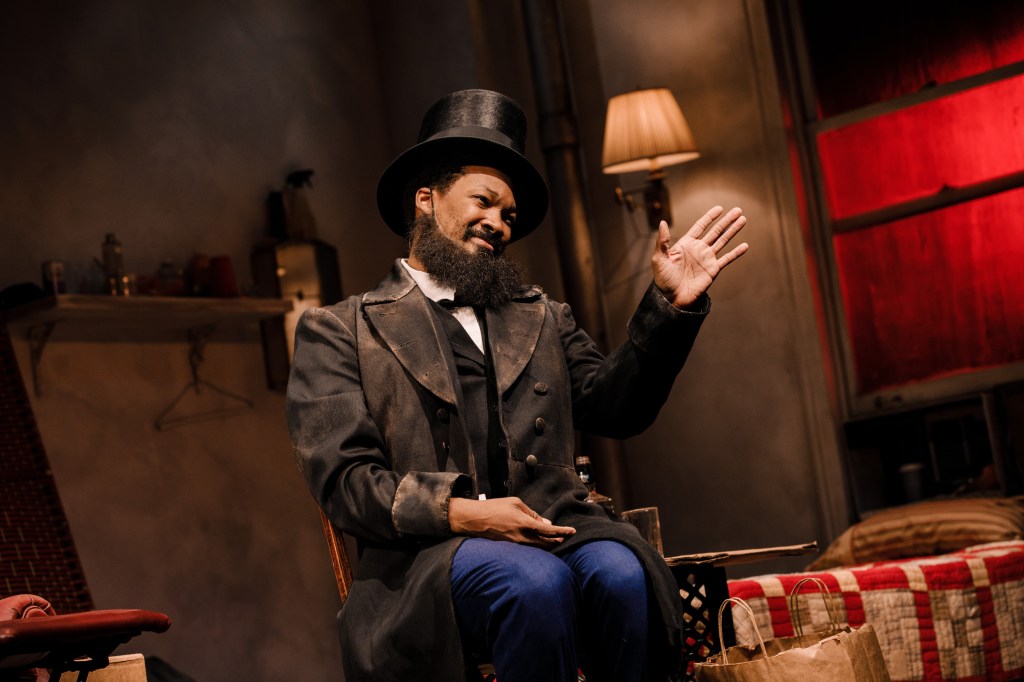
Already, we understand that Parks is having us on, as she has us on about the names of these brothers which their father gave them as a crude and blasphemous joke. It intimates one will murder the other at some point in their miserable lives. As Booth and Lincoln discuss their parents and upbringing, we realize it is a continuation of dis-empowerment, self-effacement and abuse in a continuum, Parks suggests, hearkens back to slavery days. Their parents have passed down to them a diminished life, where they believe dignity and empowerment are only achieved in perfecting “the con.”
Every aspect of their existence reflects their bondage to cultural oppression and impoverishment of opportunity. Lincoln and Booth live together in one raggedy, shabby room in a boarding house without a sink and a toilet. Arnulfo Maldonado’s pointed, superb set design speaks of the realistic poverty and destitution that discloses they are one level above homelessness. The few pieces of furniture and other items most probably are cobbled together from found objects on the street or those stolen, “boosted” by Booth which is his main hustle. It is Booth’s room, so he gets to sleep in the bed that looks like it was pulled from a 1940s psychiatric hospital shown in old black and white films. The recliner where Lincoln sleeps is uncomfortable without a mattress, pillow or blanket.

The beauty of this play is in deciding who the mark is for the long con, as the con artist lures him by degrees and allows him to think he is winning. It is also in understanding the degrees of subtly Parks uses to develop the manipulations of the brothers from their initiation of the first “throw down of the cards” metaphorically, to the last winning hit at the play’s conclusion in Act II. The actors ply their on-point artifice by degrees. Importantly, in Act I they both appear to be genuine and organic as the brothers congenially front each other and appear generous. Booth shares his boost of clothes with Lincoln. Lincoln shares his paycheck to cover the rent, food, etc. However, as the game is on and we get to know each brother, the tension mounts especially as Booth insists upon teaming up with Lincoln in the grand hustle, which Lincoln refuses to do throughout the play. Seemingly without intention, Lincoln’s refusal is a come-on, which makes Booth all the more hungry for Lincoln to engage with him.

In a progression of ironic comments Hawkin’s Lincoln lays bare Abdul-Mateen II’s Booth and his braggadocio about his “girlfriend” Grace. On the other hand, Booth massages Lincoln’s pride in his hustling expertise. He builds him up so he can then compete with him and indicate he, too, is an adept. Then, eventually he will take him down as he hoists Lincoln on his own arrogant petard. Theirs is a constant thrust and parry, dodge and pivot, shuck and jive. By the conclusion they slash and burn with cruelty. As the older brother, Hawkins’ Lincoln appears wiser. However, depending upon our interpretation and Parks’ ambiguity, which allows for a number of possibilities, his wisdom is turned on its head.

Both actors superbly intimate the growing rivalry via the subtext between the brothers. Lincoln’s talent is always in control of the thrust and parry required to lure in the stooge. This riles competitive Booth. Though neither understands their own identity, nor their place as pawns-suckers in the overall scheme of things, Booth has a better understanding of the white oppression that keeps Blacks demeaned. Lincoln has a greater understanding of human nature. Instead of uniting to benefit each other, both are debilitated by their own loss of machismo and pride, their self-confidence stripped by their upbringing and the surrounding culture. In attempting to get it back through “the con,” they only fall in the abyss. They don’t understand the extent to which they are duped by the economic system and its vast inequities. The only thing that Lincoln fully understands is that he is talented enough to rig the game of three card monte and win. It is this he attempts to teach Booth, who fails and answers Lincoln’s grift in the only way he knows how.

Parks indicates that both brothers are blind to their own entrenchment in the falsehoods of the power structure which suggests one can “get ahead” by any means necessary. Of course, ignorance of the game and not knowing one is being played is 90% of “the man’s” success. That the culture’s long con pits the players against each other, sometimes to the death, as in the case of Lincoln’s sidekick is a danger which rightly gave Lincoln pause. But Lincoln’s hands and ego, spurred on by Booth, are “itching” to throw the cards again. That he is “one of the best” is his tragedy.
Both of the brothers con each other until the game is over. Their persistence results in the fated ending which Parks intimates is an inevitability given the cultural context in which Black men, like Lincoln and Booth, attempt to survive. The way to figure out the winning card in the game of three-card monte is to watch the first move of the hustler’s hand at the outset. Lincoln sarcastically tells this to Booth in the last scene of the play, as he demeans his little brother with his perfect moves. Though Lincoln presents his mastery to Booth, both brothers are chumps, duped by the white patriarchy to see each other as “the enemy.”

They don’t understand their place in the culture because they lack the knowledge of the past. Without that knowledge they are conned into scamming money as a way to be in control and get power. However, the cultural long con is so viciously rigged against them and all the classes, even brothers turn against each other to prove themselves. It is a psychotic, racist society that perniciously strips Black men of their beauty and vitality, then entices them to self-destruction by getting them to believe they can win in a game that has been rigged against them from before the time they were born. In Topdog/Underdog Parks indicts the racist culture and condemns its wickedness in establishing, fueling and perpetuating the long con that annihilates.
Parks’ metaphor of cons as it relates to our culture is even more current today than when the play premiered on Broadway in 2001. As Lincoln and Booth try to get over to make it to the next day, they are representative Black men. On a fast track to hell, the brothers can’t win for losing. The economic and social system won’t let them succeed. They are fated to play each other until both are played out. Parks reveals with her trenchant use of the names that since the Emancipation of the Slaves, the con of freedom was just that, a con. For Blacks freedom is a bitter “pie in the sky” lure. The lure persists today more than ever as institutions are set up for the corporations and the uber wealthy to be the winners. Politicos use the long con to dupe their constituents that they will help them be prosperous. Considering that our freedoms are currently under siege from political con artists who lie, cheat and steal, thumbing their nose at the judicial system, Park and Leon’s production is horrifically in the moment.

The play’s symbolic themes are conveyed in Lincoln and Booth’s stylized world, rendered astutely by Maldonado, Dede Ayite’s costumes, Allen Lee Hughes’ lighting, and Justin Ellington’s sound design. Within that world are the deceptions that we think don’t apply to us. Yet, using Lincoln as her mouthpiece, Parks reminds us about what is key. “You win only if ‘the man’ lets you.” The power structure, the patriarchy, the haves will draw you with the short con so you stay to play the long con, where they attempt to take it all, even your illusions of democracy.
Parks brilliant play reminds that all of us are marks subject to the game controllers of the corrupt culture that values money over people. As Lincoln and Booth do, we guide our lives based on the lies of prosperity, of money equaling happiness, as we sacrifice the most important verities in our lives (love, family, friendship), to “get over” and prove we are “somebody.” Following this paradigm to its ridiculous conclusion, the “top dogs” of the culture are the most duped. They have ultimately rigged the game against themselves.

If Parks’ microcosm of the events that occur between the brothers is stretched to the macrocosm, no one wins. In fact the game destroys everyone who plays it. The controllers ultimately lose, because the values that make up the foundation of the game, that prizes money over people, are illusory. The controllers, too, are people, buying into the lie that money is more valuable than their own lives. Thus, the “top dogs” destroy the possibilities for their own goodness and benefit by harming others who are valuable human beings. Indeed, the “top dogs” are more blind, deaf and dumb than Lincoln and Booth. And ironically, with all their power and money, they are worthless. It is the brothers who we care about and with whom we identify and cry with, thanks to Hawkins and and Abdul-Mateen II’s wonderful performances.
Kudos to all the creative team who make this production scintillate with life. Once again these include Arnulfo Maldonado (scenic design), Dede Ayite (costume design), Allen Lee Hughes (lighting design), Justin Ellington (sound design), Don’t miss Hawkins and Abdul-Mateen II’s superb performances in this gripping and matchless play. For tickets and times go to their website: https://topdogunderdog.com/tickets/
‘1776,’ The Revival Revolutionizes our Insights and Revitalizes an Appreciation for our Nation
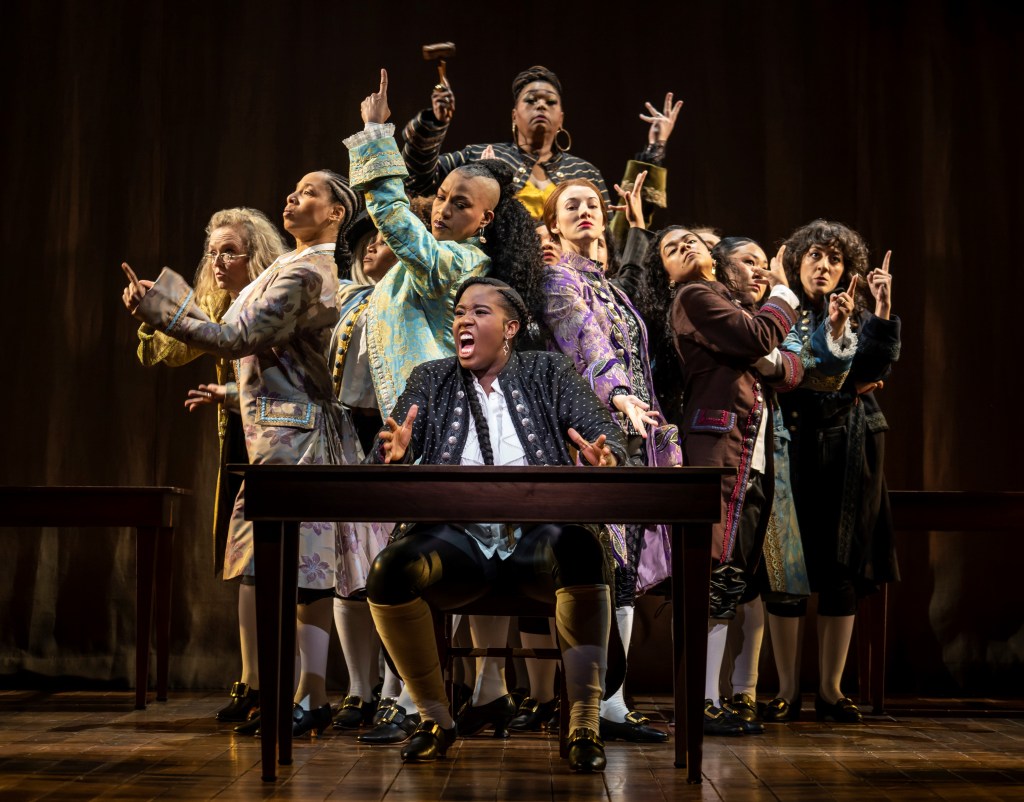
The original Tony award-winning musical ‘1776’ with music and lyrics by Sherman Edwards and book by Peter Stone is for all time an exceptional distillation of events memorializing with artistic license the most salient moments of how the Declaration of Independence was eventually drafted and signed. With the force of a new and treasonous law established by a country that was first formed in the minds of an elite group of white, male land owners, the physical document was a presumptuous act of rebellion. Many disagreed with it. Those without property in the 13 colonies, i.e. women, Native Americans, slaves, white laborers and others, whose lives wouldn’t change much either with rule by propertied colonists or rule by King George III, most probably didn’t care.
In Jeffrey L. Page and Diane Paulus’ revival of the musical 1776 at the American Airlines Theatre, the directors revolutionize the play’s casting with inclusion of those not represented in the forging of the Declaration of Independence. As a remembrance of the excluded and an indication of “how far we’ve come culturally,” the directors cast multi-racial actors who are female, nonbinary and transgender in the roles of the white, male founders normally cast in Edwards and Stone’s 1776.
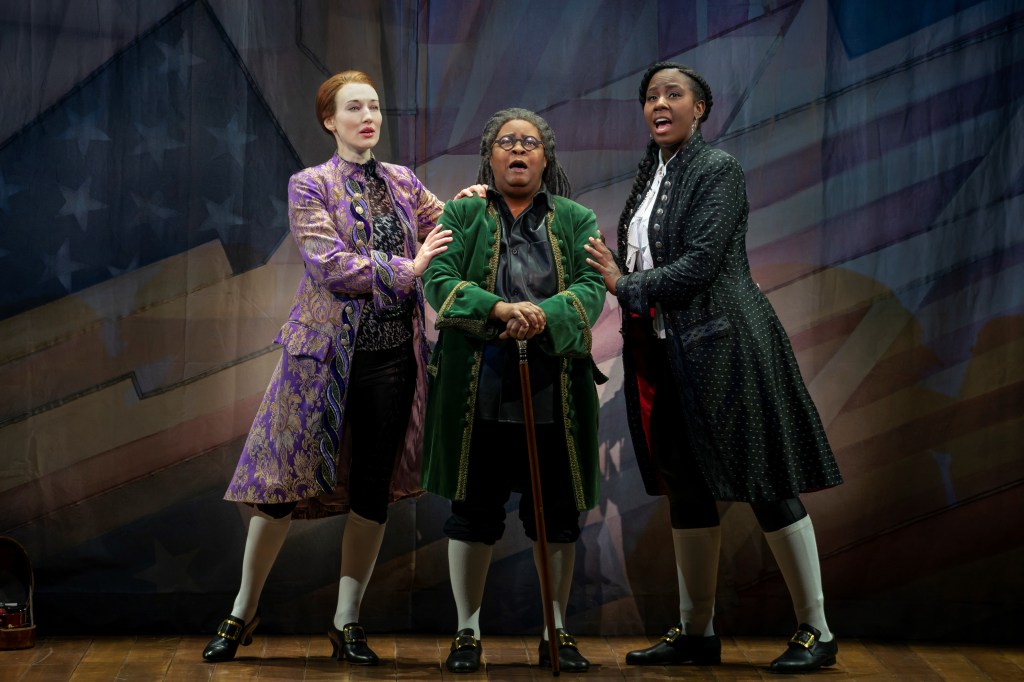
Led by the “obnoxious” John Adams portrayed by the exceptional Crystal Lucas-Perry (“Sit Down John”), 1776 begins as the Second Continental Congress, after months of delay (“Piddle, Twiddle, and Resolve”), finally gets down to confronting whether or not to declare independence from England’s King George III and establish America as a sovereign nation. Massachusetts delegate Adams encouraged by Dr. Benjamin Franklin (the wonderful, wry Patrena Murray) are continually rebuffed by British leaning colonists led by Pennsylvania’s John Dickinson (Carolee Carmello gives a powerful and nuanced performance as the opposition).
When it appears they are moving forward, it is suggested that approval must be unanimous, which John Handcock, President of the Congress (a commanding Liz Mikel) agrees with in order to prevent any of the colonies siding with England, incurring a civil war. Adams and Franklin join together with Virginia’s Thomas Jefferson (Elizabeth A. Davis) the recalcitrant author of a formal Declaration of Independence. The opposition continues with delays, though Franklin, Adams and Jefferson manage to pull in others as the typical manipulations of congress continue.

Washington’s difficulty with raising an army and keeping it equipped and fed is the bad news brought by the Courier (Salome B. Smith), as the Courier sings about soldiers dying on the battlefield while delegates listen with guilt and horror (Smith’s powerfully rendered “Momma, Look Sharp”). South Carolina’s Edward Rutledge (Sara Porkalob) indicts the hypocritical and self-righteous Northern colonies, reinforcing that they, too benefit from the Triangular Slave Trade (the show-stopping “Molasses to Rum”).
Infuriated, Rutledge walks out of the session and won’t return until an anti-slavery clause in the preliminary Declaration of Independence is removed. Unanimity seems far away. Yet, Adams, encouraged by wife Abigail (Allyson Kaye Daniel) throughout (“Yours, Yours, Yours”) and with the help of Franklin and Jefferson and changing results by Washington, make concessions and revisions. Finally, all agree to sign and we see their iconic signatures projected on the curtain at the conclusion.
Page and Paulus’ casting inversion ends when they cast females in the roles of Martha Jefferson (Eryn LeCroy) and Abigail Adams (Allyson Kaye Daniel) with Daniel dressed in a colorful turban and African shift. From a positive perspective, the casting adds new interpretations and vitality, if one isn’t so well acquainted with or enamored of the original musical as to be offended with its “tampering.” Assuredly, 1776, regardless of iteration, stands on its own as a dynamic, ingenious musical.
Importantly, each unique rendering, illuminates additional perspectives. Each version should yield a new appreciation for the Founding Fathers’ humanity and blindness, which still exists today in American attitudes that have carried over for generations from a racist past that cannot be ignored by culture wars of political convenience. However, this latest 1776 outing pegged to our present generation must give pause for its daring. If one viewpoint is modified, the version has done its job. For Page and Paulus’ revival affirms that the essential concepts in the elite, propertied white men’s minds were the immutable verities of spirit that ultimately, if allowed to, transcended demographic differences to help us arrive at the expanding social and cultural contracts we have today in most of the country.
The revolutionary casting provokes humor and thoughtfulness. Interestingly, it often evokes a celebration of the success of the “American experiment.” Specifically, with a pregnant female Thomas Jefferson (Elizabeth A. Davis is expecting and plays the violin exquisitely) the birthing of a nation takes on an ironic and humorous meaning, especially during the song sung by Adams, Franklin and the company entitled “The Egg.” In Act II after Jefferson writes the preliminary document and Adams decides that the eagle will best symbolize the new nation, they suggest that they are like midwives to an egg hatching. During the rousing, cleverly re-imagined song, a video of the new nation’s history to come is projected on a curtain behind the actors. As the multi-cultural nation spools historical events in the future, the pregnant Elizabeth A. Davis’ Jefferson fiercely accompanies with riffs on the electric violin.
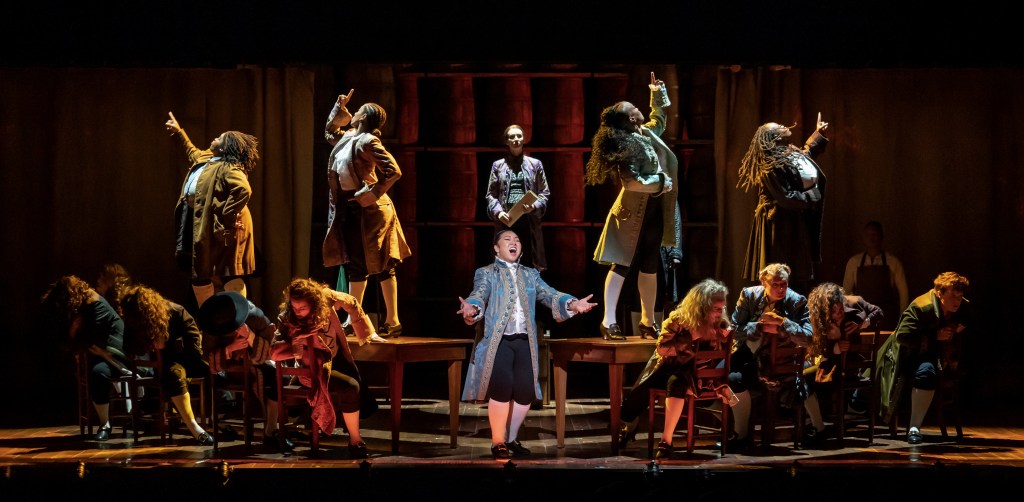
Indeed, we see what has been birthed from past to present. Our nation’s potential is amazing thanks to spiritual concepts which move beyond definition in this revelatory 1776.
The actors reveal their beautiful voices and superb acting talents during other numbers staged imaginatively. Many are standouts, however a few deserve special mention. “Momma, Look Sharp” sung by Salome B. Smith, with Tiffani Barbour and the company is a show stopper as is “Molasses to Rum” sung by Sara Porkalob. The latter song humbles the Northern colonists who participate in the Triangular Slave Trade. In pointing out the blindness of hypocrisy, the should humble everyone today who has a mobile phone, uses a laptop, wears a diamond, eats certain foods, for they have a slave footprint and participate in some for of wage slavery.
Does this new iteration work? What are the directors and actors intending to express with this revolutionary casting approach to a beloved musical? And it is beloved. One only has to read YouTube comments connected with the film version and various songs that users have uploaded, to discover that Americans trot out the filmed version of 1776 (released in 1972) occasionally. Some even claim to watch the film on July 4th to reaffirm their patriotism and appreciation of this nation with its viewing. Thus, fans of the original will perhaps bristle at this version.
However, for younger audiences, the zaniness of the production, its show-stopping numbers and the audacity of this bold cast will appeal. When at times, some of the numbers take on an irreverent, spoofy quality (“He Plays the Violin”) they will find the overall effect amusing. After all, the overarching meaning of Edwards and Stone’s musical cannot be lost, because the script and song lyrics adhere to the original. Also, there is a salient addition with Abigail’s March 1776 letter to her husband, widely quoted as a statement for women’s rights. Abigail reminds him to include women in their endeavors in her adjuration to “remember the ladies.” In spirit and irony, Page and Paulus answer Abigail’s call, devoting the entire production to female, nonbinary and transgender actors.
Thanks to choreography by Jeffrey L. Page and free flowing staging by Page and Paulus, the musical is heavily stylized and stripped of spectacle and intricate set design. One is able to concentrate and align the events and their significance to our history then and now. Costumes by Emilio Sosa intimate the setting and the respective colonists. After the principals enter wearing modern clothing, with Sosa’s magic, they cleverly turn white socks into stockings, black leggings into colonial breeches, then slip into square-toed buckle shoes of the period. Their intricate and lovely frock coats differentiate the colony each represents and reveal the varied styles of our country’s Northern, Mid-Atlantic and Southern colonies.
What Edwards and Stone’s musical did in 1969 was remind Americans of their beginnings, during a time of social upheaval and divisiveness. Then, the musical may have recalled our Founding Fathers’ desire for self-governance as the populace questioned policies that escalated an unpopular war in Viet Nam, which to many seemed hypocritical because it interfered with another nation’s right to choose its own government.
Likewise, this revival seems appropriate at a time of divisiveness and polarization. When our rights are under siege (the right to privacy under Roe vs. Wade, along with the gutting of voting rights), once again we need to be inspired toward true patriotism, taken from our Founding Fathers’ rebellion against despotic and autocratic-acting King George III. Importantly, we need to hearken back to the time when our Founders established the path toward a constitutional democracy, which forces ranging in this nation today appear to want to jettison.
Thus, the musical’s cast solidifies that the “American experiment” of a nation of liberty, accepting of all races, creeds, genders, colors is burgeoning, even though in some places this version might not fall coherently and seamlessly in every moment of the production. The revolutionary cast concept cannot be easily dismissed. Nor can this version be glibly criticized for confusing history or the ideas.
If one reads extensively of the time during the Declaration of Independence and the Founding Fathers, it is clear that great artistic liberty was taken by Edwards and Stone to dramatize the Declaration’s signing in 1776. For example there are inaccuracies in the character of Adams who describes himself as obnoxious as the others concur in the expertly staged and performed opening number that establishes conflict. The description of “obnoxious” is contrary to what David McCullough suggests in his biography of Adams, who was well respected by his compatriots.
The historical inaccuracies are in the service of dramatization. Likewise, the casting of this version is historically inaccurate. However, as a musical for our time and nation, whose democracy appears to be hanging in the balance, it is extremely relevant and in keeping with the immutable spirit of freedom. Whether fans of the original will like it, hopefully, will not deter from their understanding of how the original and this present version are in concert with the nature and substance of a “declaration of independence.”
Kudos to Scott Pask’s fine set design, Jen Shriever’s lighting design, David Bengali’s projection design, John Clancy’s orchestrations Ryan Cantwell’s music direction, AnnMarie’s vocal design, Dean Sharenow-music coordinator and the other creatives who helped to bring this version to life. For tickets and times go to their website: https://www.roundabouttheatre.org/get-tickets/2022-2023-season/1776/
‘Cost of Living’ Broadway Review: Are Lives Lived Well or Wasted?

What price do we place on our own inherent value? What is the rock bottom cost we have to pay to live with dignity and be fulfilled emotionally, physically, materially? These subtle questions as well as questions about our need for respect and life-giving emotional and spiritual connection compose the themes of Martyna Majok’s well-acted four-hander, Cost of Living directed by Jo Bonney currently, at the Samuel J. Friedman Theatre.
The 2018 Pulitzer Prize-winning play originally debuted at the Williamstown Theater Festival in 2016, and appeared off Broadway in Manhattan Theatre Club’s production at New York City Center in 2017. Currently, Manhattan Theatre Club presents Majok’s Broadway debut, adapting to the larger stage and stretching out the precisely appropriate scenic design of the various New Jersey apartments of differing economic scale by Wilson Chin. From the ensemble Gregg Mozgala and Katy Sullivan originated their roles of the differently abled John and Ani. Kara Young as Jess and David Zayas as Eddie portray the able bodied caretakers who learn what physical and emotional skills are required to help the differently abled deal with the most intimate and personal body functions when they cannot.
The actors make a terrific ensemble despite a play that has flawed construction and sometimes is unnecessarily confusing during the first hour of the two hour play which speeds by in some parts and slow walks in others. But for the exceptional performances one wouldn’t completely understand the import of the present immediate timeline of the first scene as it connects to the last scene. Both provide the frame that holds together the substance of the rest of the events which take place in flashback four months prior.
Thanks to the superb David Zayas who portrays Eddie, an out of work truck driver and former alcoholic who is clear-eyed and specific in his discussion of his wife who has passed, we eventually unravel the mystery of events which take place between Eddie and wife Ani (Katy Sullivan), Jess (Kara Young) and John (Greg Mozgala) that unspool in the past and spin into the present changing the direction of circumstances for Eddie and Jess.

If Majok didn’t order the play as a frame with flashbacks, the relationships of the couples would have popped even more than they do. However, it is a way to hide the contrivances that promote surprise and twists in Majok’s exploration of the relationships between Jess and John, Ani and Eddie. These twists set up the concluding scene which effects the most beautiful and resonating of Marjok’s themes of connection and communication. The last scene is the uplifting high-point of the play, carefully shepherded by Bonny and wonderfully acted by Zayas and Young.
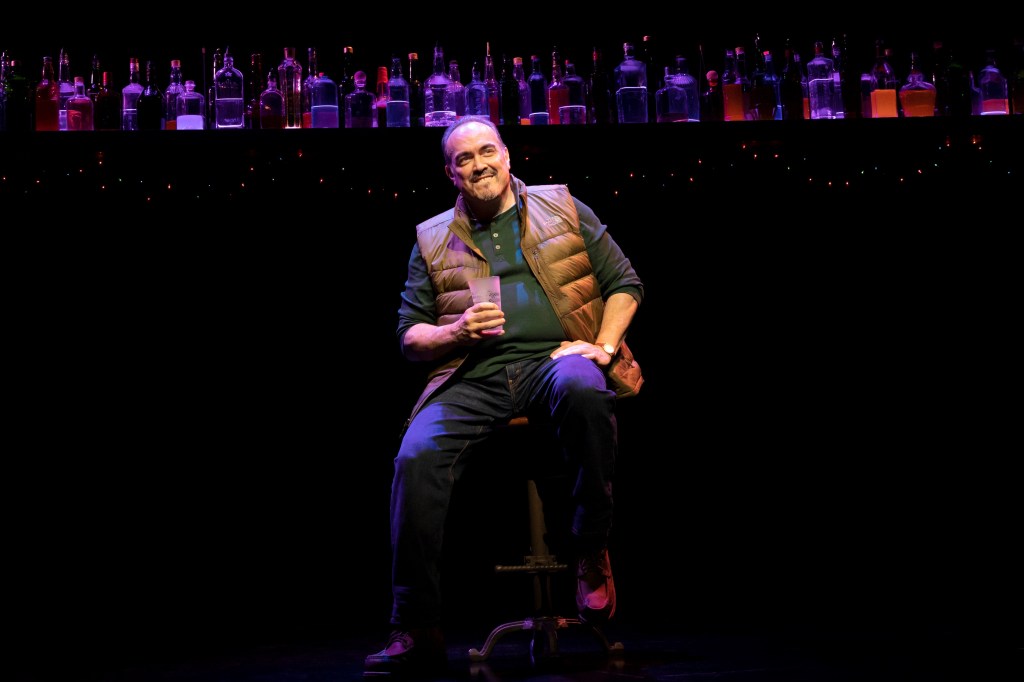
The structural difficulty occurs in the initial scene with Eddie’s solo speech to an unidentified individual (the audience) in the setting of a bar with a lovely row of shining alcohol bottles decoratively strung with Christmas lights. Eddie tells us the hipster bar is in chic Williamsburg, Brooklyn where he has been enticed from Bayonne, New Jersey by cheeky texts. The anonymous individual was given his deceased wife’s phone number which Eddie used to text her to not feel so desolate and alone. After being pestered by the texter into curiosity and a desire to stave off loneliness, Eddie decides to accept the offer to meet at the Williamsburg bar on the snowy night in December.

Zayas’s Eddie, in this sprawling introductory opening scene, where he relays some of his backstory about his alcoholism and split with his wife, remains charming, funny and generous. He easily wins us over by offering us (the anonymous guy in the bar) a drink for listening to him as he promises not to launch into the doom and gloom he feels since his wife died. We go along for the pleasant ride, not realizing when he leaves that this is a prologue, one section of the frame in the immediate present. Thus when the scene switches completely to another setting (thanks to Wilson Chin’s upscale scenic design representing John’s apartment) we don’t realize we are in a flashback four months earlier in another situation. We discover it when the director and the playwright unfold the dialogue introducing two characters unrelated to Eddie.
This might easily have been clarified with a notation in the program of setting change. Prosaic and uncool? Hardly. For the purpose of clarification and the heightening of the vital themes and arc of the relationships which the playwright presents and explores, the details would have launched us into the profound characterizations earlier to appreciate the depth of the play. Thus, we must catch ourselves up in the time switch to a flashback that this is John’s apartment in Princeton at a time in September.

Jess (Kara Young) and John (Greg Mozgala) are complex individuals coming from completely different socioeconomic backgrounds and physical and emotional states, key points for what later unfolds. By degrees we learn that Jess and John went to Princeton where John’s stylish apartment is located. John is a wealthy grad student with cerebral palsy (Mozgala has cerebral palsy). Jess graduated with honors and now works in bars where her tips are large. However, she needs the caretaker job John offers for additional money. As both do the interview dance, we are struck by Jess’ unadorned personality and direct authenticity. John must win us over as he comes off as a presumptuous ironist who is taken with himself.
Whether his personality is a pose to cover for extreme inferiority in a culture and society that prizes the beautiful, athletic, young and whole, or his wealth has allowed him to leverage his superior act, we realize that both Jess and John act in control. Like any relationship, even a work one, trust must be gained and built up. Jess is guarded and wary; John is overly confident and wry.

In the next scene switch from John’s apartment in Princeton, we meet Eddie’s wife Ani who is alive at this point in the flashback which she states takes place in September. She is in her new apartment where she will live with outside help. She is a quadriplegic, having suffered a horrific car accident in the previous months where surgeries saved her life but couldn’t restore her use of her arms and both legs which were amputated at the knee. Obviously, Ani is infuriated with Eddie and curses him out as a matter of course, trying to get him to leave. He is moved by her condition and feels guilty and responsible for being with another woman, a cause of their separation and filing papers for divorce. However, because they are still legally together, she is on his insurance. And he kindly suggests she stay on it even after they are divorced.
The play by degrees establishes the warmth of feeling between Ani and Eddie, Jess and John as the caretakers help the differently abled shower, bathe and finish their personal toilet. The intimacy of the activities are matched by the honesty of their conversations so we are struck by the humanity and concern shared by each individual in the couple who helps the other in an exchange. Anit gives Eddie emotional support as he helps her physically. Jess receives a listening ear in John as she becomes adept at transferring him to the shower seat and helps him cleanse himself.
We learn more about Jess’ immigrant background, her mother’s returning home because of financial difficulty and her struggle to send money home to her, during John’s and Jess’ time together. With the once married couple, the former love between Eddie and Ani is still evident but it has changed and deepened. Eddie could just move away from Ani. However, he emotionally needs to be with her and is happy that he can help her and watch her when the agency and nurse call on him because her regular caretakers sometimes cancel.
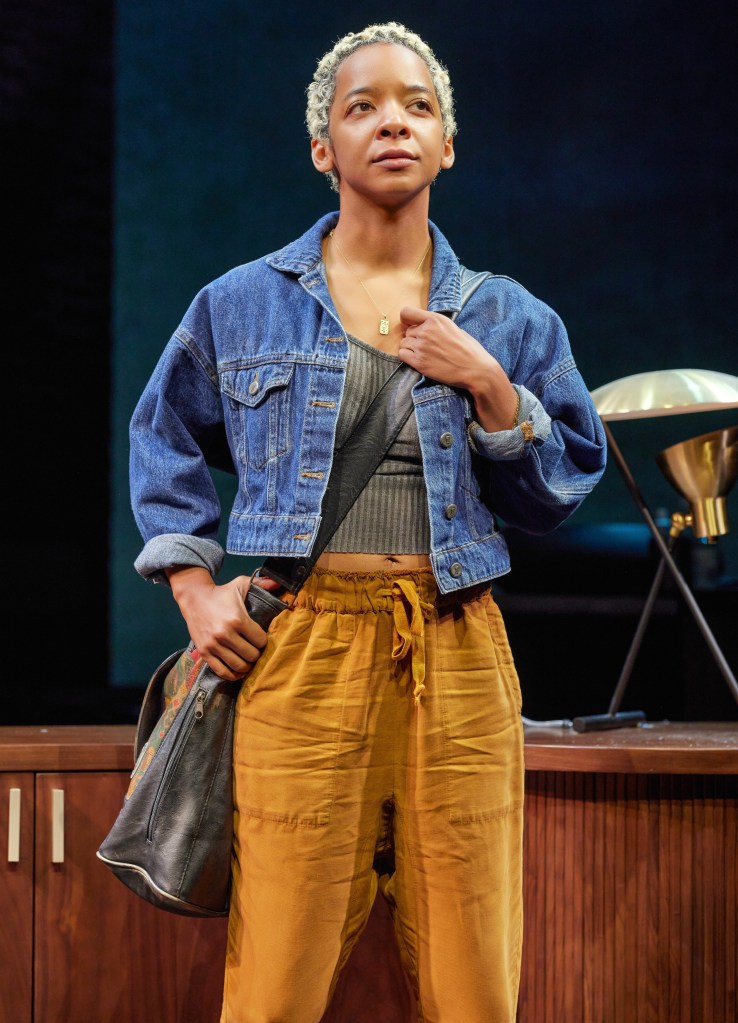
The dynamic relationships created by the superlative actors make this play ring out with hope, even though in the last two flashbacks, the darkness comes and we fear for the characters we have come to like. Also, selfishness is revealed in one of the characters whose clever manipulations are completely unexpected and underestimated. It is a shocking and hurtful reveal and the character never recovers our good will because he has made himself unworthy of it. This twist is seamlessly drawn as Majok plucks at our heart strings and upends our expectations. However, the last scene between Zayas’ Eddie and Young’s Kar is perfection in dialogue, acting, direction. In the actors’ living each moment, we realize why there is nothing like theater.
Cost of Living reminds us of our weaknesses and the consolation that if one feels lonely, all experience the ache even those partnered up. It is a fact of life that neither money nor marriage can salve; it is the cost of being alive, for we are each in ourselves individual and alone. However, only communication, truth and honesty with others can light the way for connection that is sincere and life affirming. It is then that the cost of being alive is worthwhile.
Kudos to Jessica Pabst (costume design) Jeff Croiter (lighting design) Rob Kaplowitz (sound design) Mikaal Sulaiman (original music) and Thomas Schall (movement consultant).
For tickets and times go to their website: https://www.manhattantheatreclub.com/shows/2022-23-season/cost-of-living/
‘The Kite Runner’ Resounds With Poignancy and Profound, Personal Intimacy.
Rarely in life do we have the opportunity for second chances, to reverse the most dire, pitiful and hateful moments of our lives and transform them with aching hope toward acts of kindness, decency and courage. This resurrection of hope toward faith in God is integral to Matthew Spangler’s adaptation of The Kite Runner, based on the best-selling novel by Khaled Hosseini, currently running at the Helen Hayes Theater on 44th Street in New York City.
Acutely, The Kite Runner is a story of relationships. These abide between father and son, between servant and master, between friends who are in fact brothers. There is also the relationship the individual has with himself. In the instance of the protagonist Amir (portrayed with aplomb and fearless generosity by Amir Arison), this relationship reveals his struggle as a divided self, unable to overcome his sin of cowardice, fear and guilt that leads to self-betrayal and betrayal of those who love him.

In the play the relationships are further tested against the backdrop of a an economically, culturally and politically roiling Afghanistan, where Pashtuns (Sunni Muslims) have historically oppressed Hazaras (Shi’a Muslims). When the monarchy, which has managed to control the economic, religious and political divides eventually topples in 1975, chaos follows. This chaos spawns the major conflict of the play as Pashtuns and Hazaras attempt to survive in the new political landscape.
However, before that de-stabilization occurs, we witness the peaceful, prosperous life of Amir with his father Baba (Faran Tahir), though Amir feels that sometimes his father hates and despises him as a weakling. Baba is a wealthy businessman, who retains his servant Ali (Evan Zes), and his son Hassan (Eric Sirakian), like members of his family for forty years, despite their being lower class Hazaras. Baba and Amir are non- practicing Westernized Pashtuns. Years later when Amir returns on a mission of redemption and forgiveness, an Afghani driver characterizes him and Baba as “tourists,” superficially Afghani. Since Baba raises Amir without attention to strict religious observances and pretensions about class, the closeness and love between Baba and Ali and their sons is heartening.

In fact the beautiful friendship the boys have in a then peaceful Afghanistan is so well acted by Arison’s Amir and Eric Sirakian’s Hassan, that we nearly forget Amir’s warning comments at the top of the play, “I became what I am today at the age of twelve. It’s wrong what you say about the past about how you can bury it, because the past claws its way out.” Amir, who narrates throughout makes these comments in San Francisco almost twenty-five years later as a warning salvo before he relates the flashback of haunting events with Hassan. These are events with which we identify because of their intense poignancy and emotional grist that transcend culture, language, religious and classist differences. These seminal and particularly resonant scenes of Amir’s life with Hassan, fly like kites to the heart of our shared human experiences, revealing psychic flaws and mortal humanity.
After Amir’s warning comments, director Giles Croft’s vision of an idyllic, happy Afghanistan before the political upheavals is poetically suggested and elucidated as Amir’s wistful memories with the ensemble onstage. Croft employs the kite and sail metaphor in the props and scenic design to link Amir from the kites he watches being flown in San Francisco in 2001, as the threaded memory that brings him back to his time in Kabul, Afghanistan in 1973.

Arison takes on the mannerisms and stance of a younger self as he plays “cowboys and Indians” with his friend Hassan, who importantly remains the same age throughout the play in his enthusiastic, vibrant and noble self. Of course, this is as it must be because this is Amir’s memory of Hassan, who disappears, never to be seen again, after the negatively defining incident that impacts Amir’s life for twenty-five years.
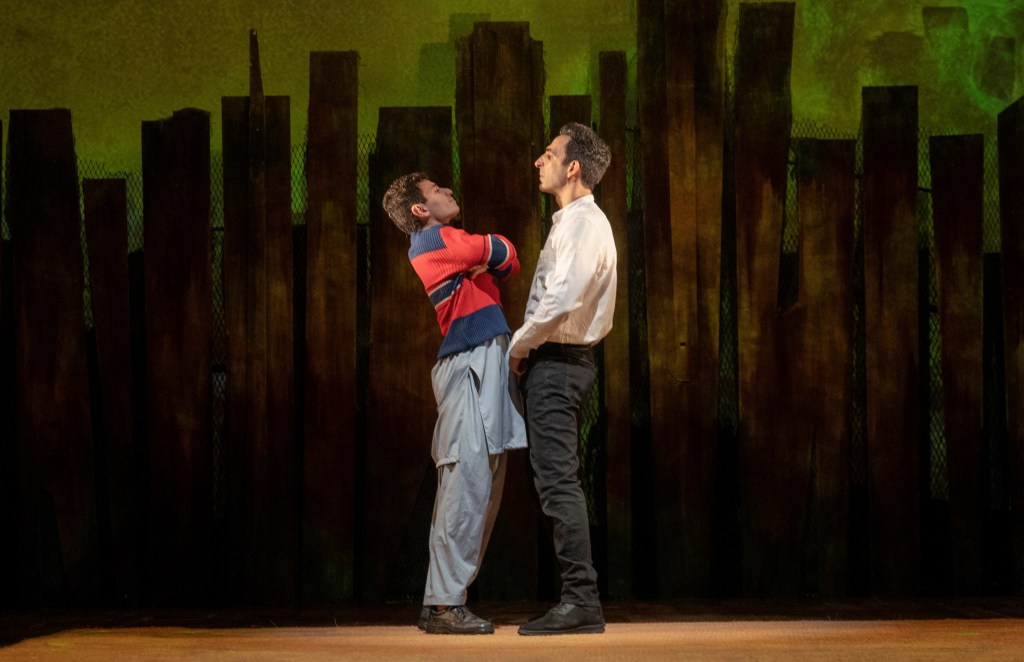
Tabla Artist Salar Nader provides the melodic drumming as Arison’s Amir narrates and steps in and out of the action seamlessly against Barney George’s minimalist scenic design, a fence, enhanced by William Simpson’s projection design and Charles Balfour’s lighting design. These artistic elements effect various places along Amir’s journey into self-torment which takes him from Afghanistan to the US, then back to Afghanistan and back again to the U.S.

Croft establishes the setting in the flashback as an elusive but powerful memory. Spangler uses the dialogue in Farsi as Amir and Hasan play, which conveys the beauty of the time and the poetic rhythms of the language. It is rarely used afterward, except for an exclamatory effect or a “hello” or “goodbye.” We enjoy the bond of these two boys who have gone beyond their classes and religions to find the spiritual element which always remains but which Amir loses after his self-described sin and act of infamy against Hassan, Ali and Baba. But caught up in the joy of their youthful and free relationship, we forget what Amir says that he buried in his past that claws him back. We join them in play, as the literate Amir carves their names in a pomegranate tree as the Sultans of Kabul. And Amir reads to Hassan from a favorite story about which we discover later ironically relates to Hassan’s and Amir’s relationship to Baba.
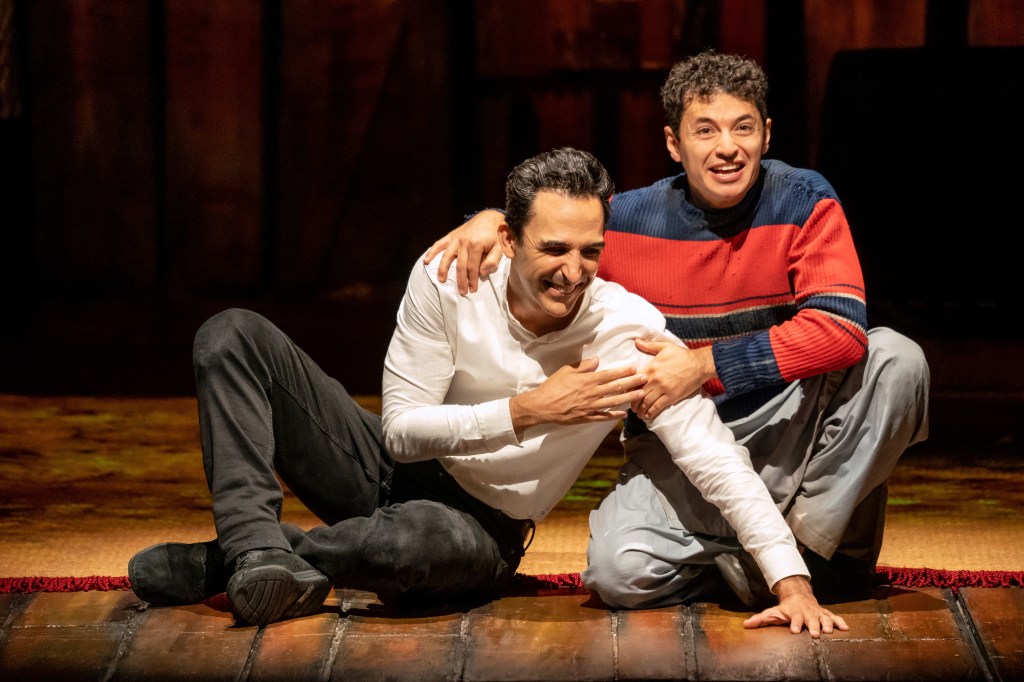
We get a flavor of this pleasant Afghanistan from these elements along with the two pieces of patterned curtain arranged prettily as two halves of a sail reminiscent of a kite as a backdrop for certain scenes. Amir familiarizes us with his relationship with Hassan as his friend who is one year younger. Yet, he indicates that always there is the distinction that Hassan is a servant, though Baba appears to love him, showering him with the same presents for his birthday that Amir receives. One gift we see is a cowboy hat which, of course, Amir has to put on and wear also.
Like two peas in a pod, the boys are motherless; Amir’s mother died giving birth to him, which Amir credits being one reason for Baba’s anger at him. And Hassan’s mother ran away to join a troop of actors and musicians, which was a fate worse than death in Afghanistan. Thus, both fathers must raise their sons without wives, though Baba has girlfriends and comes home late ignoring Amir who is lonely and insecure. Amir’s sole comfort comes from his friendship with Hassan. On the other hand, Ali is always there for Hassan, who has an inner core of strength, love and confidence.
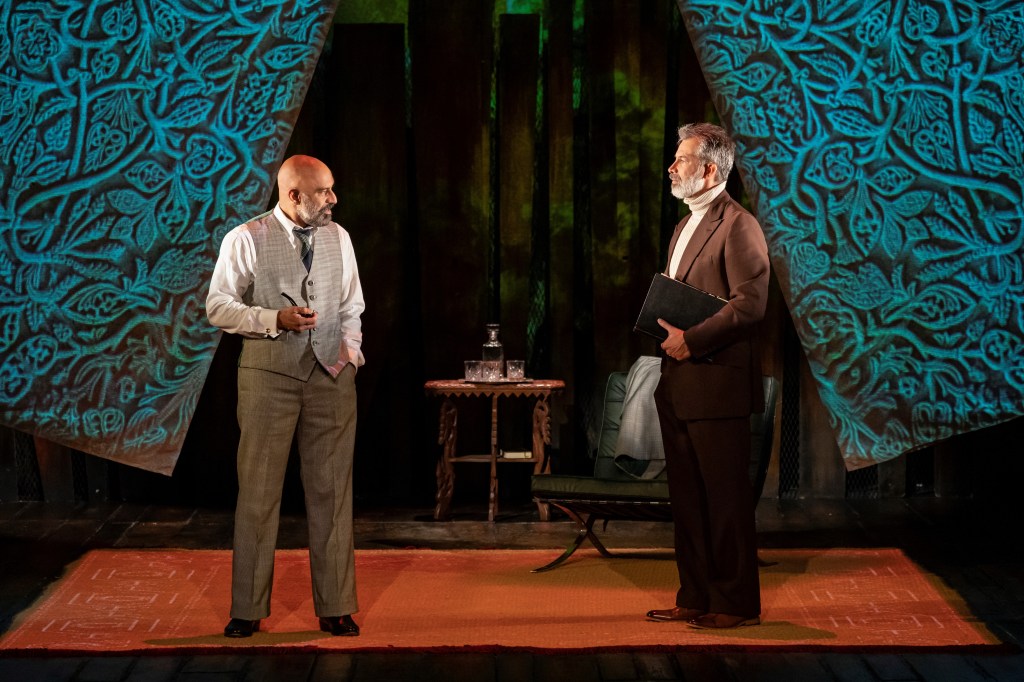
Spangler’s characterizations run deep and the actors make the most of the nuances in conveying the explanation of why Amir behaves as cruelly as he does. Though Hassan demonstrates love and faithfulness to Amir, whom he considers his best friend, Amir is incapable of returning this honor. Thus, as the myth goes, when Hassan learned to speak, the first word he said was “Amir.” For Amir the tragedy is that he has to understand and accept the love and faithfulness that Hassan has for him. He doesn’t. To our chagrin, though Arison makes Amir likeable, we discover that Amir is incapable of showing love and loyalty to anyone. So when the boys meet up with Assef (Amir Malaklou), a bigoted Pashtun bully, Amir behaves like a coward wussy, while Hassan fearlessly protects them both with his attitude, his innate courage and confidence. Also, he is a crackerjack with his slingshot which helps save the day.

Crofts stages the kite fighting tournament as the high point of Hassan’s and Amir’s relationship with excitement and verve, as the actors pantomime the cutting of the kite strings. Hassan, as the best kite runner, anticipates where the last “enemy” kite will fall. Securing that kite will be the prize that forever emblazons Amir and Hassan as the best team at kite fighting. However, when Hassan runs after the blue kite, Asseff and his gang intercept him. Asseff cannot brook losing the tournament to an unworthy blood polluted Hazaras. To punish and humiliate Hassan, he demeans him sexually in a cultural defilement and sin, which Amir hears happening from a hidden position. Amir is too frightened to help Hassan beat off the gang, because he believes himself to be too much of a wussy to stand up to Assef’s tyranny. Amir runs away, embarrassed and ashamed. What would Baba think?

After this incident on the day that Amir achieves his father’s praise for winning the tournament, he is desolate. Amir yearns for an elusive peace and freedom from guilt and self-torment in not helping Hassan. Amir’s sin of cowardice and lie of omission blossoms into overwhelming self-recrimination that causes him to project his self-hatred onto Hassan. Rather than to face the truth of his own inner weakness, he accuses Hassan of theft, one of the worst acts Baba says a man can commit. When questioned, Hassan admits he has stolen to protect Amir from Baba’s wrath, because both Ali and Hassan understand the reason why Amir has dishonored them.
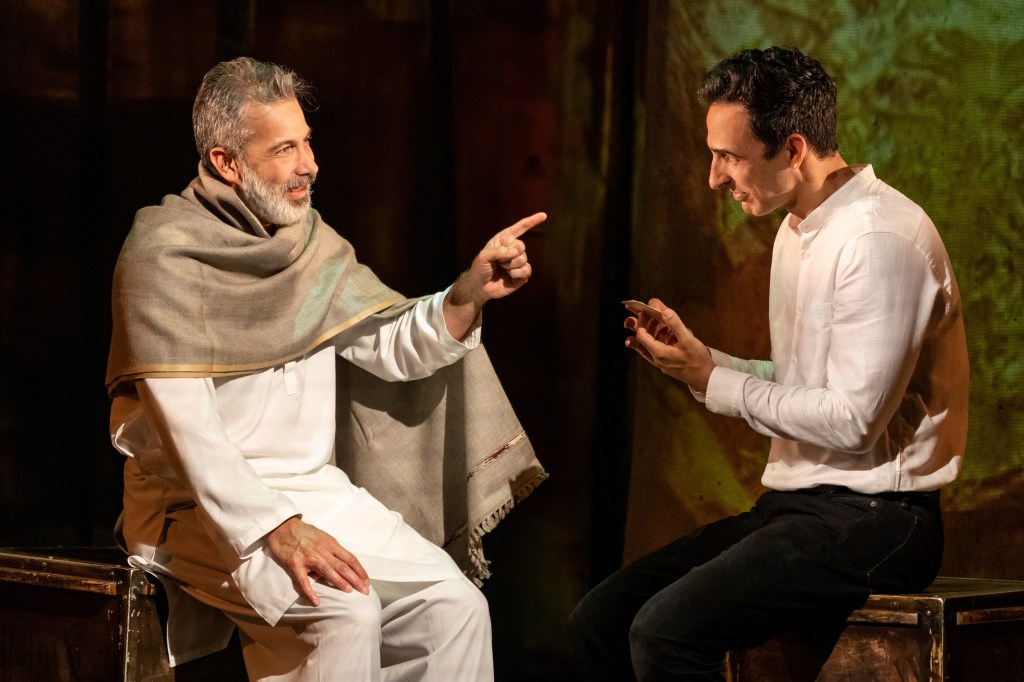
Baba forgives Hassan the theft and expects Ali and Hassan to go on as before. However, Ali and Hassan leave the household to maintain their honor. Ironically, Amir is even more ashamed of his wickedness because once again, Hassan has protected him out of the strength of sacrificial love in a move that is Christ-like. Amir’s is a monstrous act because Hassan the younger, the “low class” Hazaras is the more honorable, kinder and more loving person. Amir must face that he is a two-fold liar, a coward and an unworthy human being.
Amir’s unconscious guilt and self-recrimination consign him to a life of self-torment, until he allows himself to be redeemed by a call from Baba’s former business partner Rahim Khan (Dariush Kashani) who tells him, “Come see me. There is a way to be good again.” This is the opportunity to make amends to Hassan’s son Sohrab. Wisely, Croft casts Eric Sirakian as Hassan and Sohrab. Sirakian is absolutely terrific in both roles. And in Act II when Sohrab begs not to be taken to an orphanage where he will be harmed, he breaks your heart.

Interwoven in the relationships of Spangler’s adaptation are all the Shakespearean verities and vices elevated: sacrificial love and forgiveness, betrayal of self and those closest to us, unforgiveness, sadism and wanton cruelty leveled on an innocent who sacrifices himself for love and friendship. And these processes are pitted against the fateful opportunity to reverse the course of personal destiny and transform self-loathing to empowerme,nt, love and acceptance. Amir eventually is brought to his second chance in Act II. Interestingly, it is the time of the Taliban ascendancy to the point of despotic tribalism and murder.
Though he doesn’t believe in the religious observances, Assef’s bullying psychotic nature has found its true purpose to torture and kill in Taliban Afghanistan. That Amir must face his old demons of guilt, cowardice and fear to confront his nemesis Assef, fight him and escape with Sohrab, who Assef has kidnapped, is an incredible journey toward Amir’s personal closure and reconciliation with God.

If anything The Kite Runner underscores Amir as an Everyman, who reaches the bottom of his own personal abyss to seek forgiveness which helps him understand the meaning of “brotherly” love, the sacrificial love that his childhood friend Hassan (the marvelous, heartfelt Eric Sirakian) unquestioningly, gracefully bestows upon him.
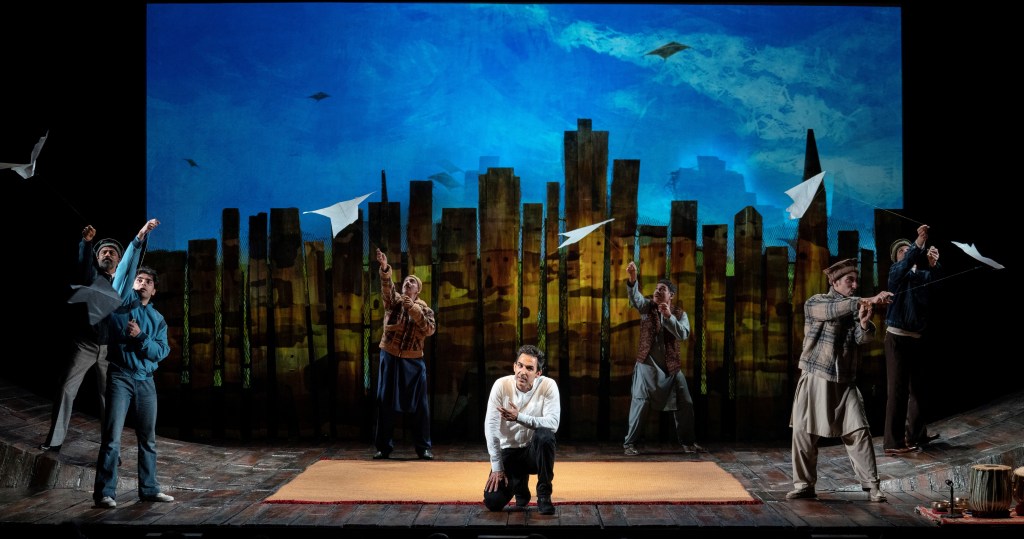
This imagistic, stylized production fades in and out of the epic in its cultural scope and breadth of events that take place between 1973 and 2001 in Afghanistan from monarchy, to republic, to communist coup, to Russian invasion, and Taliban takeover. Amir’s journey moves to Pakistan and San Francisco then back and forth again. With brief phrases of language at the beginning and sprinkled here and there, that reflect cultural authenticity, the fateful story emerges. Amir narrates and we witness vignettes that explore Amir’s evolution as a worthy human being. Arison does a yeoman’s job with a challenging role that spans decades and keeps him onstage until the intermission, then brings him back until the conclusion. With the music of the tabla drums, the singing bowls and the schwirrbogen, we find the rhythms of the culture always pulsating, to remind us of the vitality of history and ancestry.
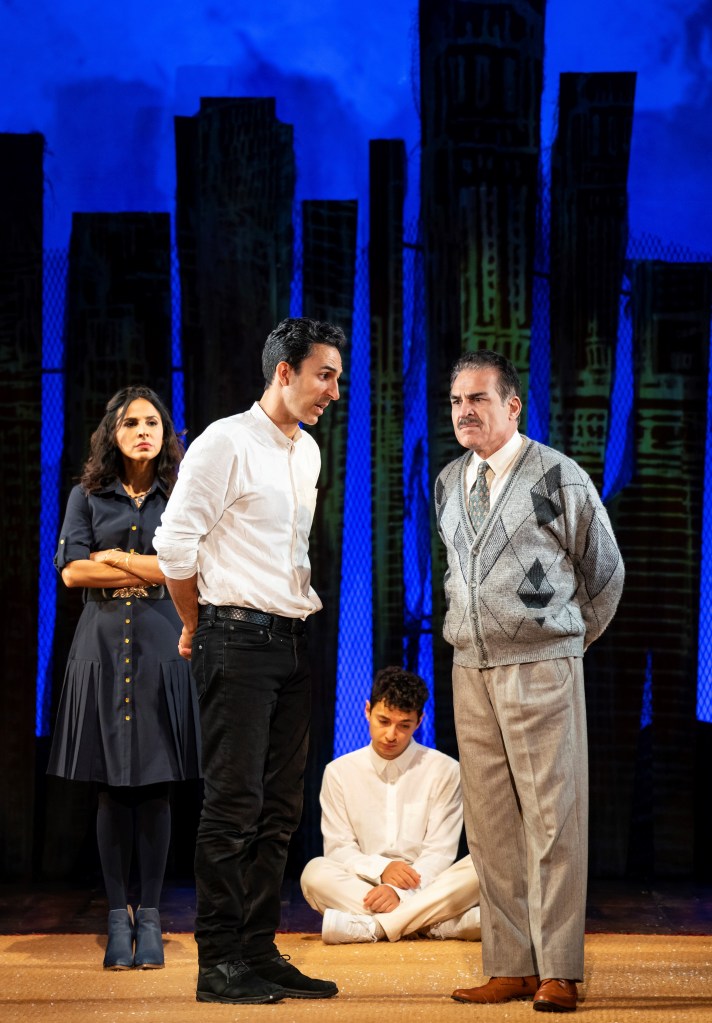
This is a fine adaptation and resounding, soulful production whose themes are immutable and current. Praise goes to the ensemble and Giles Croft who shepherds them to move like a synchronized pageant. Kudos goes to the Drew Baumohl (sound design), Jonathan Girling (composer and music supervisor), Kitty Winter (movement director) and Salar Nader (tabla artist and additional arrangements), as well as the other creatives previously mentioned.
The Kite Runner is at the Helen Hayes Theater for a limited engagement that ends 30 October. This is one not to miss for its acting, its stunning vibrance, poignancy and heart. For tickets and times go to their website: https://thekiterunnerbroadway.com/
‘Mr. Saturday Night,’ Billy Crystal, David Paymer, Dazzle With Comedic Genius and Heart
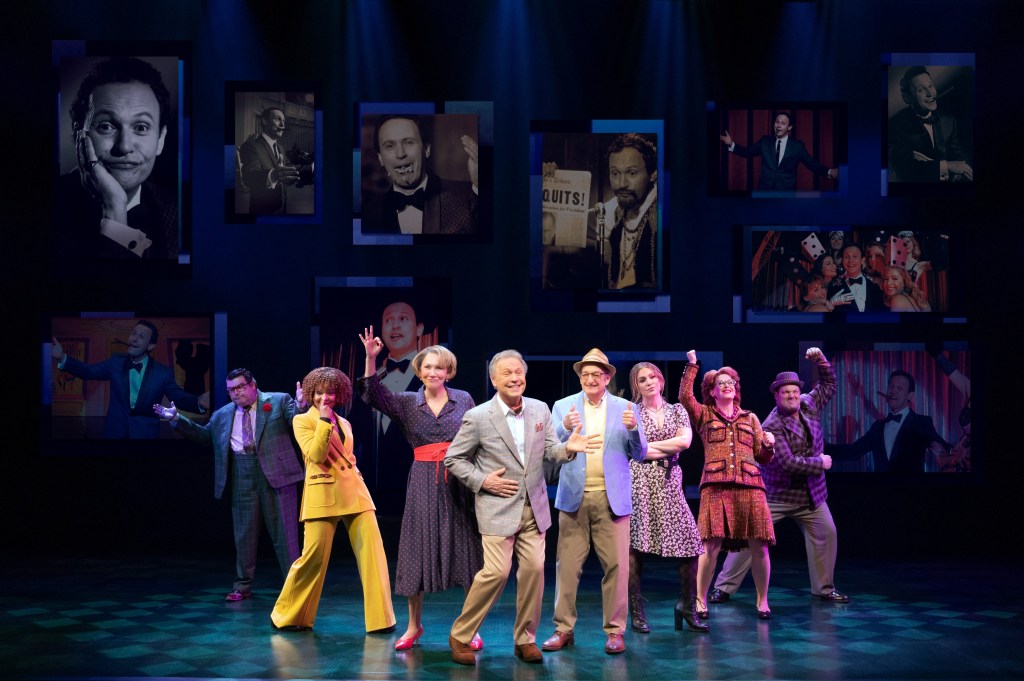
Billy Crystal’s reshaped Mr. Saturday Night at the Nederlander Theatre, directed with acute sensitivity by John Rando is based on Crystal’s 1991 Oscar nominated titular film. This production “hurts!” (in today’s parlance “kills:). Crystal embodies “Mr. Saturday Night” from head to toe. In the two act musical Buddy Young, Jr. (Crystal) luckily faces the opportunity of a second chance in his waning comedian years. With this do over, he gets to reexamine how he sabotaged his career with the hope of regenerating it. Most importantly, he faces the opportunity to revitalize his estranged relationship with his brother Stan (David Paymer reprises his Oscar nominated film role) and his non existent relationship with daughter Susan (the golden voiced and superb Shoshana Bean).
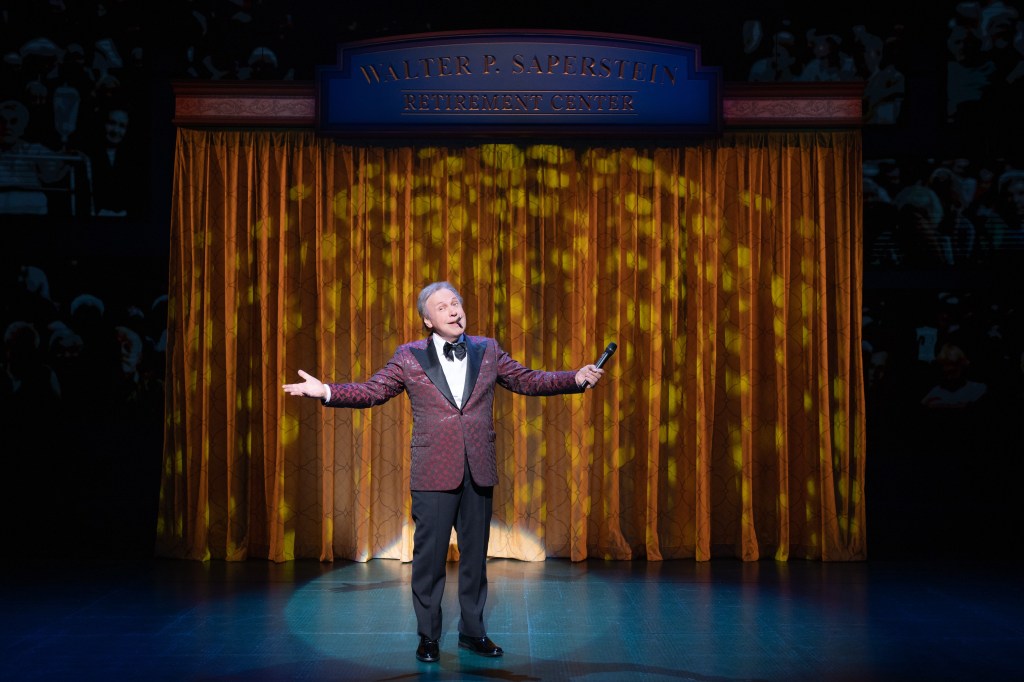
We all love second chances because we need so many of them. Buddy is no exception as the writers fashion his character to bump up against chance after chance. Indeed, in flashbacks from present to past to present, we note that as Buddy’s ego explodes with his successes, he eventually blows every chance that comes his way. When it is announced that he has died on TV (a symbolic reaffirmation of hope for a resurrection) Buddy plunges into the opportunity with the help of agent Annie Wells (Chasten Harmon covered by Tatiana Weschsler the night I saw the musical). The dramatic problem arises. Perhaps Buddy has gained the wisdom to retrieve the lost golden ring of success and once more establish himself. But what if he hasn’t?
This caveat is the crux of the conflict and arc of development. Can Buddy get out of his own way long enough to be the best human being he can be, absolving himself of past regrets with humility and aplomb? You’ll just have to see this reconfigured Mr. Saturday Night to find out
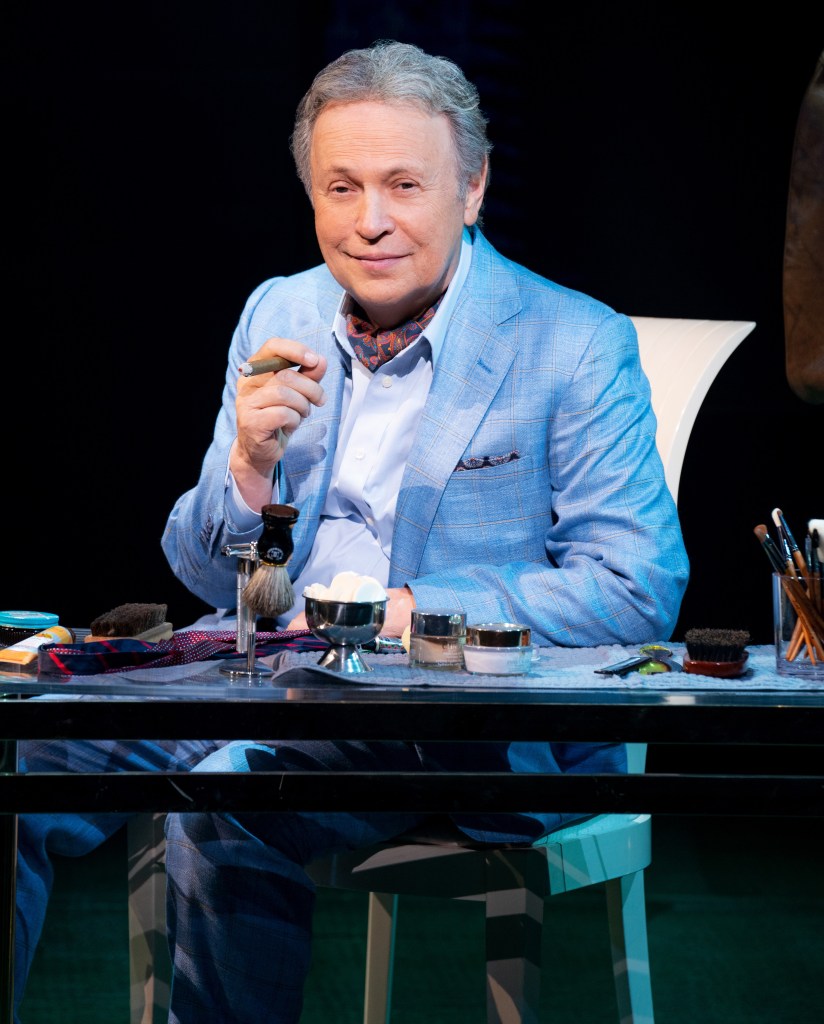
Crystal, himself is receiving a new thrust of fame in this upward moving transition in his career as a Broadway star going for his second Tony Award. He won a special Tony for 700 Sundays) doing what he enjoys, performing in front of a live audience every night. The production, despite a few twitches, is an absolute joy to see, and Crystal is the ebullient muse of hilarity, pattering jokes with lightening speed and seamless grace.
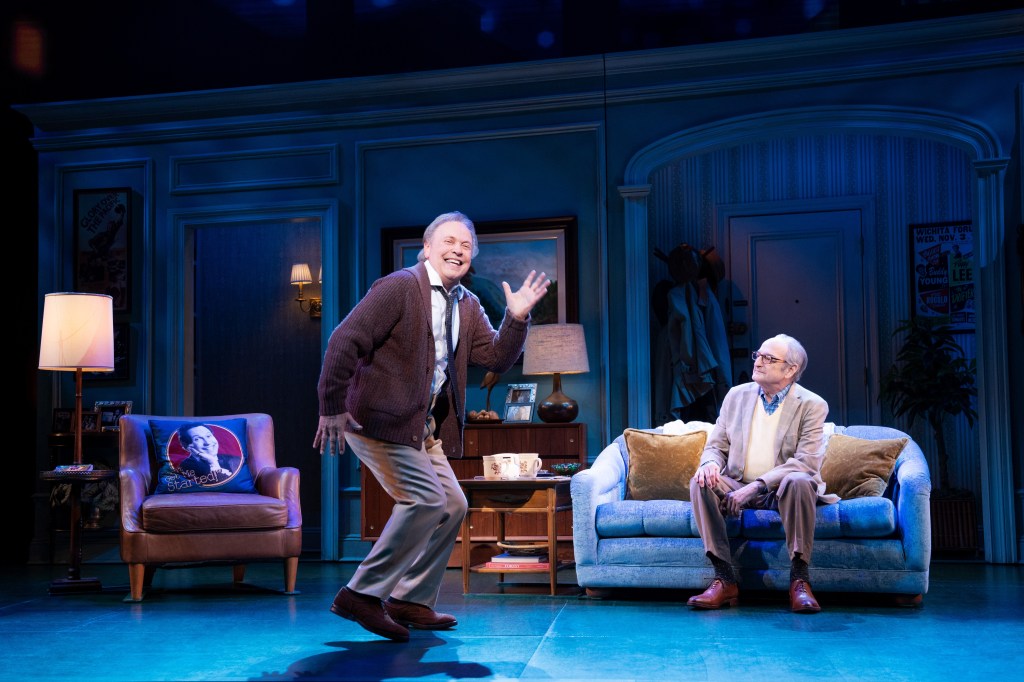
Reprising his role with Paymer, Crystal is the former Borscht Belt comedian, who once had a successful TV show until he didn’t. Paymer is his long suffering brother/manager/agent who was generous with his own salary during their heyday, but barely has enough to treat his girlfriend to a pricey dinner. Randy Graff does a fine job as wife Elaine, encouraging Bean’s Susan to “give her father a break.” “Putting up with her father is something Susan finally shutters with maturity and firmness, prompting Buddy to reassess, reevaluate and recalibrate or lose her love. The scene between Bean and Crystal against the warm background of the projections of the NYC brownstones and the doorway to Susan’s apartment and new relationship with her Dad is beautifully done.
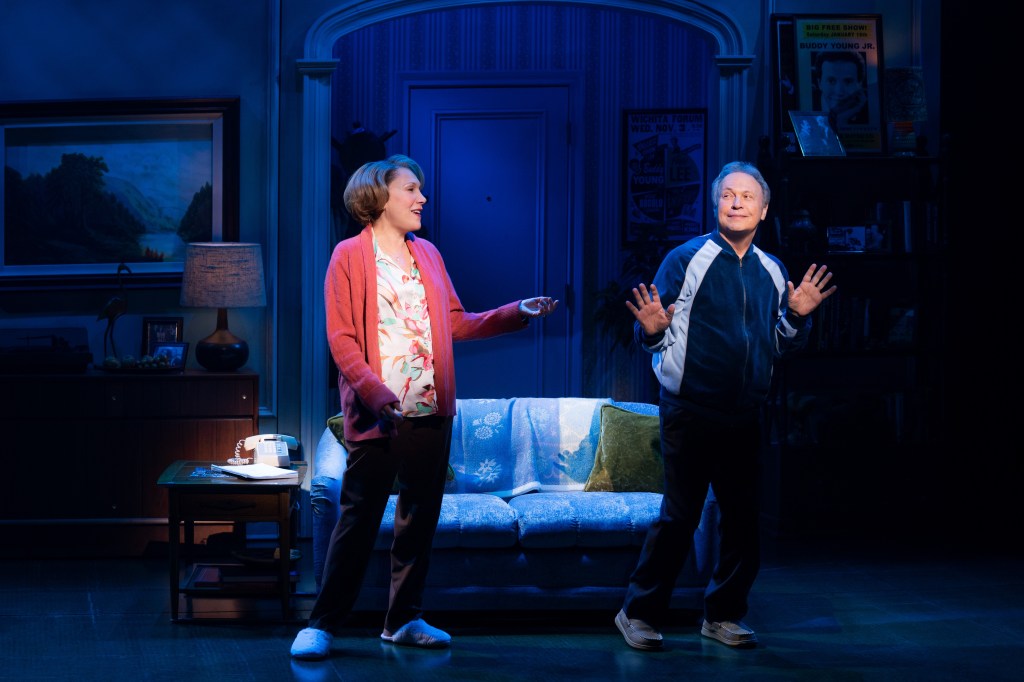
The production combines an endearing and poignant update with LOL vibrance. It soars with Crystal’s outstanding performance where he sings and dances, as one would expect seventy-something Buddy Young, Jr. to crow out a tune and jubilantly hop and skip some mildly energetic dance steps, sans flips, strenuous tap or break dancing. Indeed, Paymer and Crystal deliver their enjoyment “I Still Got It,” and companionship together and also dig deep when their characters hit the abyss: Paymer in the exceptional “Broken,” and Crystal in the profound “Any Man But Me.” Surprising, endearing, adorable, belly-laughing, fun, thoughtful and appealing, the principals are a team and appear to have fun making the audience laugh in a time when we desperately need to apolitically chortle and “fall out” in a life-affirming way.
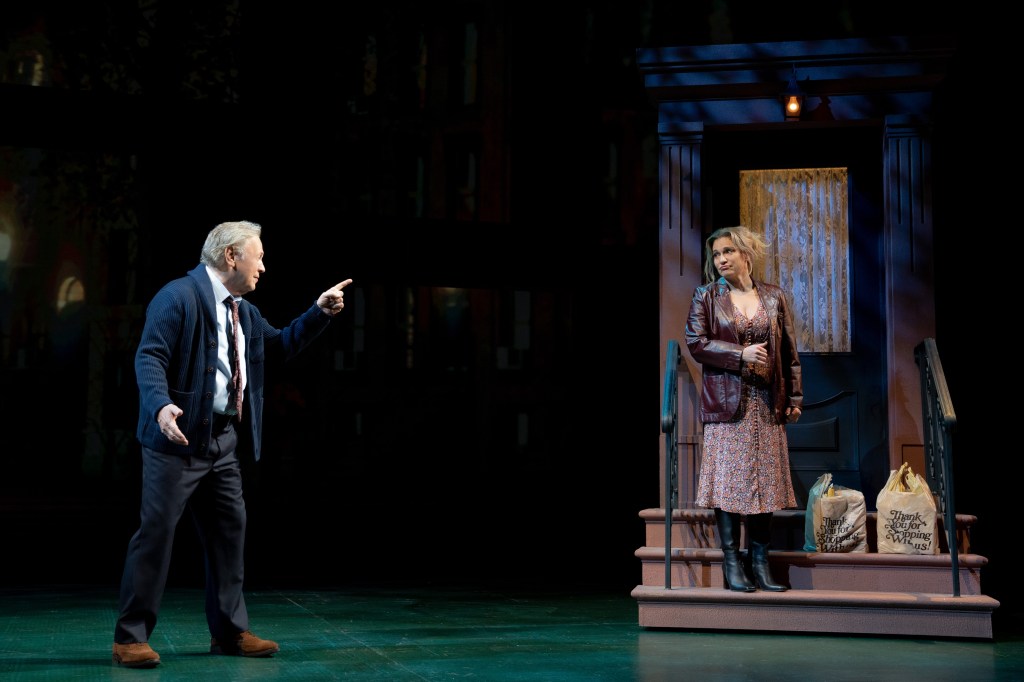
With Book by Billy Crystal, Lowell Ganz and Babaloo Mandel, Music by Jason Robert Brown and Lyrics by Amanda Green, the production has been nominated for five 2022 Tonys, including Best Musical, Book, Score (Brown and Green), Leading Actor in a Musical (Crystal), and Featured Actress in a Musical (Bean). What is marvelously stranger than fiction is that the film, if one reads the “critics” was not “the bomb,” it did not “kill” and it did not, in Buddy’s words “hurt them.” It flopped. Crystal and his creative team are to be credited for courage and gumption to try again, this time as a Broadway musical, one of the most difficult of creations and during an ongoing pandemic that no one likes to acknowledge.

However, this is Mr. Saturday Night’s persevering second chance. With the added lift of the music and dance, and overall nostalgic silliness of 50s TV bits, where actors dress in hot dog costumes, cigarette boxes, etc., (Jordan Gelber, Brian Gonzales, Mylinda Hull) Mr. Saturday Night offers a retrospective on a history younger audiences don’t know. Also, it is an encomium to comedians who were huge greats in their time, some of whose stars still shine in films on Turner Classic Movies and black and white TV reruns.
The musical also highlights the importance of the Borscht Belt circuit in the Catskills, where comedians and entertainers could credibly try out their material and look for opportunities like Buddy did when he “covered” for Milton Berle at Farber’s. As the musical flashes back to Buddy, Stan and Elaine as twenty-somethings, we discover it is at Farber’s that he lands the gig that launches his successful career and Stan’s as agent and manager. The flashback also reveals how he met Elaine (Graff manages to be a convincing younger version of Elaine) whom he unwittingly “stole” from Stan in a a sour note between the brothers. Thus, the characterization and arc of development eventually reveal head on undercurrents of the strife between Crystal’s Buddy and Paymer’s Stan as a loop of pain which the actors convincingly inhabit and play battling each other.
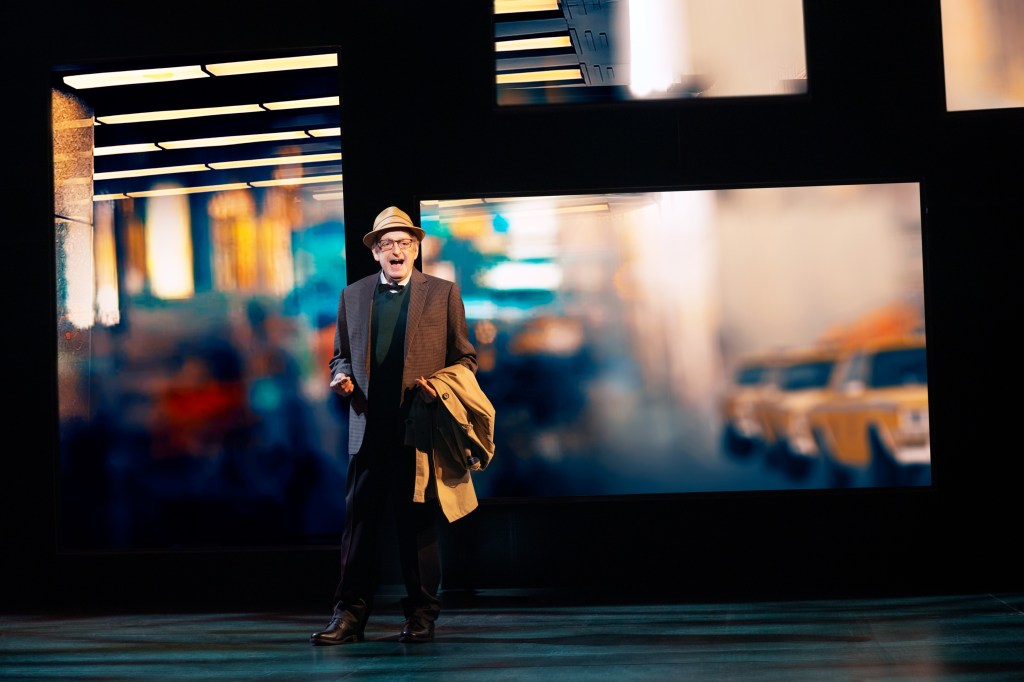
All these events with his brother, long suffering wife and broken-hearted but defiant daughter reveal the depth of the characters. They also illuminate reasons for Buddy’s self-torment, ambition and feelings of inferiority all of which are the fountain of his comedy which is part insult comedy, part ironic defense, and the type of ridicule which makes angels laugh. But when it’s directed at the individual in question, it hurts for real as dismissive one upmanship. Buddy has a tough time differentiating Shakespeare’s, “All the world’s a stage,” and is continually making his entrance and never pausing long enough to realize he needs to exit.
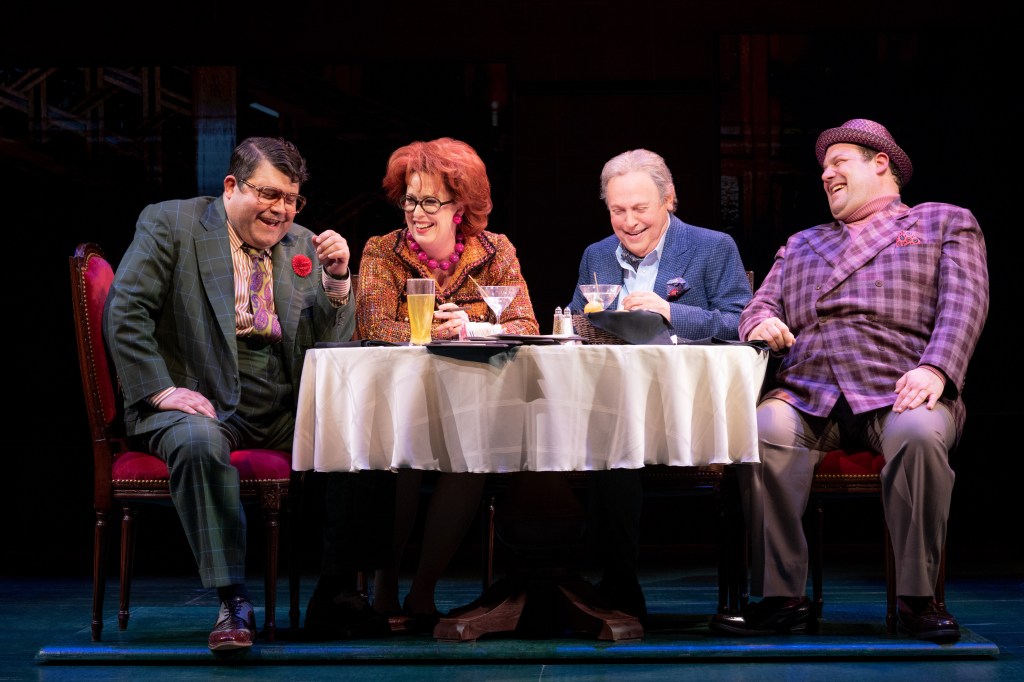
In an important scene with agent neophyte Annie (the fine Wechsler), Crystal’s Buddy gets to praise his comedy mentors. We note on the walls of the Friar’s Club and in projections a wide expanse of brilliant funny men and a few women of high humor. Buddy’s rant implies Annie should know the greats and this inspires her to do her research, then work like the devil to help Buddy get something which turns out to finally land as a part in a film. The role is funny and incredibly poignant and it requires Buddy audition, which he does. But after all the angst rehearsing and auditioning and blowing a chance at closeness with his daughter, his “big opportunity” is destroyed when the role is given to Walter Matthau. Bummer. Crystal handles this earth shattering moment with an ethos that’s believable Buddy. What he’s lost isn’t recoverable, for the loss isn’t just this part, its his mountainous history of regrets.
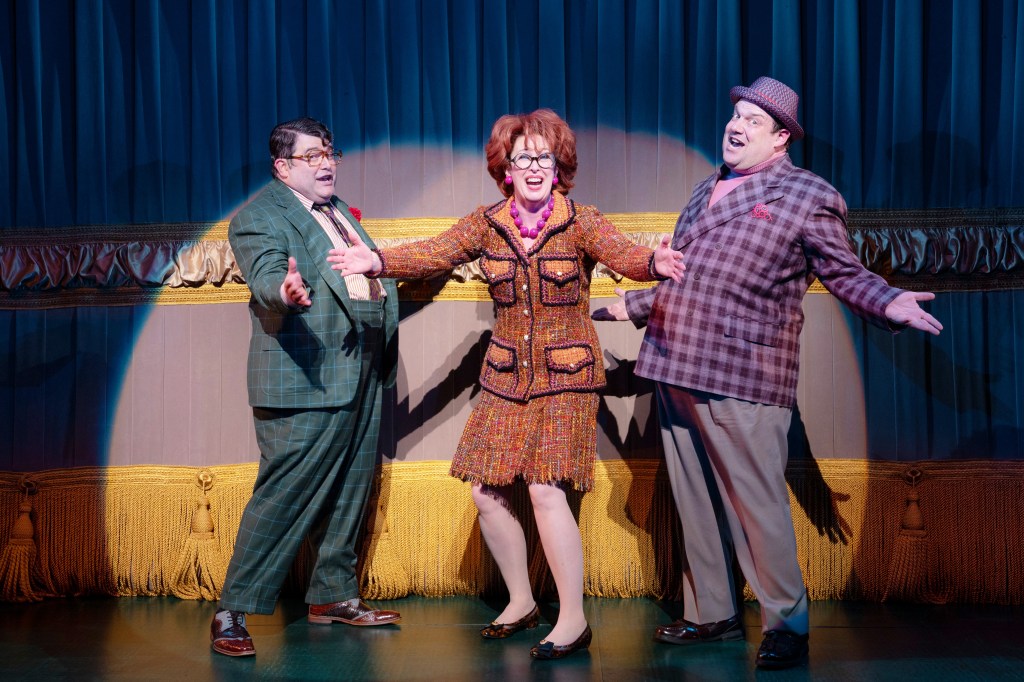
Unlike the film which referenced the comedian’s waning years from a younger man’s perspective (Crystal was in his forties, ironically “old” at that time), this Mr. Saturday Night shines in the age appropriate sequences. Interestingly, it is their younger portrayals by Paymer and Crystal as the twenty-somethings, that seem a stretch with wigs (Charles G. Lapointe) and make-up that don’t quite cohere.
However, when the flashback to Farber’s arrives, we’ve been prepped with jokes by the opening number “We’re Live” (Jordan Gelber, Brian Gonzales, Mylinda Hull). Then Buddy does his act at a retirement home (“A Little Joy”), which is a laugh riot. And by then, we’ve become acquainted with the premise, the announcement of Buddy’s death on TV, and his “new lease on his career” as agent Susan-Tatiana Wechsler sings “There’s a Chance, ” and excited Buddy and Stan sing and move to “I still Got It.” So, what’s a bad hair day for the two men returning to their younger days measured against the overall success of the well paced Act I that moves even more briskly through Act II and the conclusion after which Crystal takes a few audience questions? Well…(said with an upward lilt of a Jewish accent).
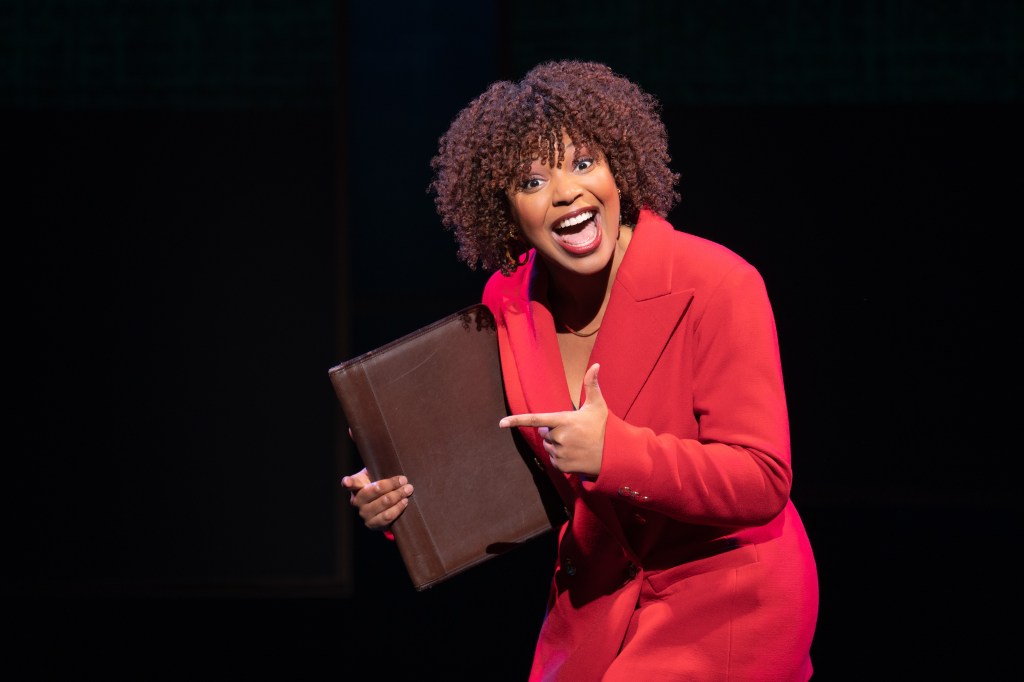
The themes of aging and regrets not answered, second, third and fourth chances, familial reconciliation, and redemption even for the incorrigible, spin in and out with a bow and a wink, superbly subtle. The sets of Buddy and Elaine’s home, Faber’s, the paneled Friar’s Club and the old time TV Studio designed by Scott Pask are spot-on, as is the costume design by Paul Tazewell & Sky Switser enhanced by Kenneth Posner’s lighting design and Kai Harada’s superb sound design. The Video & Projection Design is smashing, reminiscent of divided screens from the period, creating various effects pegged to the emotion of the scene.
The choreography by Ellenore Scott is just enough for this type of show and the actors are at ease and comfortable with their steps and movement. As silly as Elaine’s wishful thinking about leaving for “Tahiti” is, Graff pulls it off looking debonair and adorable. Thanks to Jason Robert Brown’s Arrangements and Orchestrations, David O’s Music Direction and Kristy Norter’s Music Coordination, the tone and tenor of the music fits with the book by Crystal, Ganz and Mandel, with Green’s lyrics. The time, effort and love shows, as all is held together by John Rando’s direction. Wow!
Get your tickets to this must-see show. You are not going to see this production with this cast again. For tickets and times go to their website: https://mrsaturdaynightonbroadway.com/
‘Funny Girl’ the Broadway Revival Starring Beanie Feldstein, Ramin Karimloo, Jane Lynch, Jared Grimes

Funny Girl has been successfully presented in the UK’s West End in revival (2016, book by Harvey Fierstein), in Paris, and in regional theater. However, producers have been loathe to consider a full-on Broadway revival until now. This is so for numerous reasons, not the least of which Barbra Streisand, who originated the role as a relatively unknown 21-year-old in 1964, inevitably draws acute comparison with anyone daring to try the part on for size.
Streisand was Fanny Brice in a confluence of personality, genius talent, comedic flair and pure drive. Though she didn’t win the Tony for Best Lead Actress in a Musical (1964 when Funny Girl opened), she won the best actress Oscar for the 1968 film adaptation. It was a satisfying recognition after her tremendous work in making Fanny Brice and Funny Girl legendary. Her connections to the role, and association with the show’s signature songs became inviolate. So it is a good thing that Funny Girl is in play in this revival; perhaps more revivals will come in the near future.
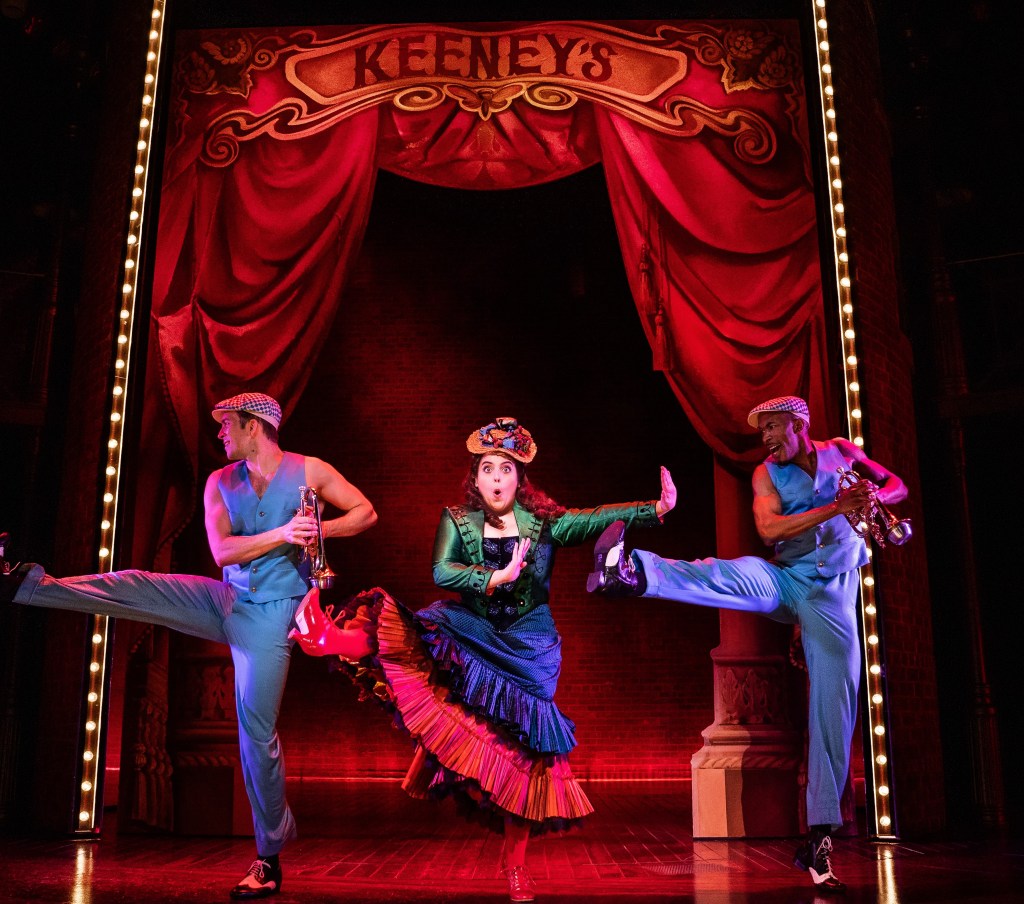
That said it takes a courageous sensibility to attempt to transmogrify the role of the Fanny Brice Ziegfield Follies star away from Streisand’s iconic work, in this first Broadway revival. Kudos go to Beanie Feldstein who stars with Ramin Karimloo, Jared Grimes and Jane Lynch in the Jule Styne (music), Bob Merrill (lyrics), Isobel Lennart (book), Harvey Fierstein (revised book), Funny Girl revival directed by Michael Mayer. Currently, the production runs at the August Wilson Theatre.
Beanie Feldstein has the appropriate determination to portray “the greatest star.” Nevertheless, during specific moments, she appears to be overwhelmed by the complex and profounder transitions the role requires as Fierstein’s book travels in flashback from the opening scene where Fanny gets ready to go onstage. The flashback of her memories follow how she moved from childhood to teen rising star to successful Follies celebrity who becomes an icon in her time. Uncloaked is her first anointing from gambler Nick Arnstein who compliments her on her talent. And as her star rises she becomes worthy of their budding relationship and blossoms, as his star dims and his wealth diminishes. By that time they’ve married.
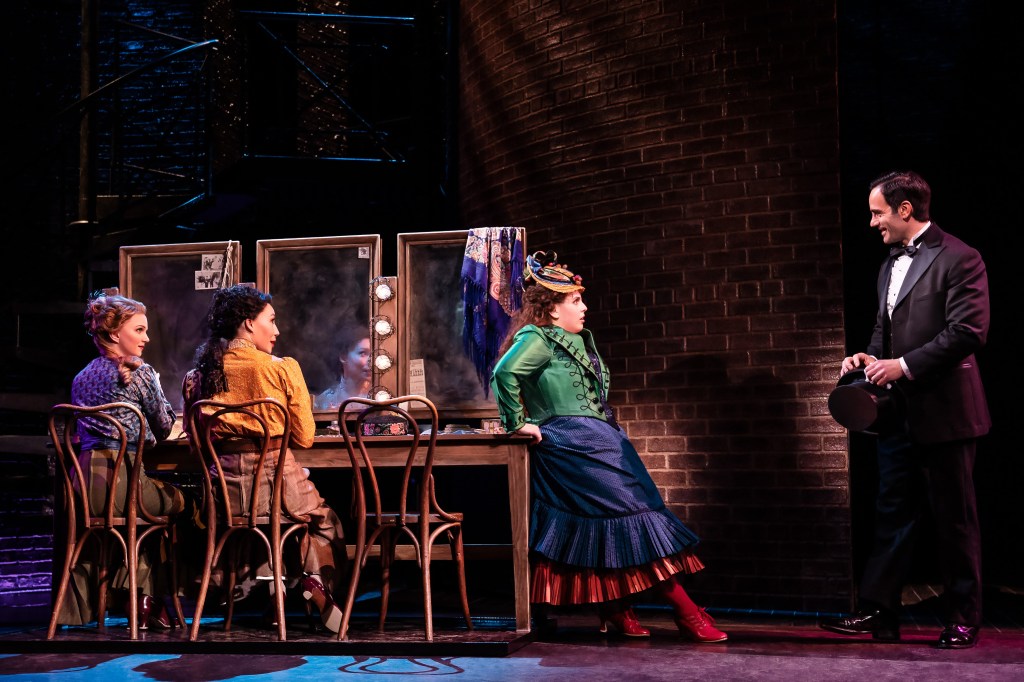
Feldstein is not new to challenges. She debuted on Broadway as Minnie Fay in Hello Dolly (2017). And she has been appreciated and noted for the humorous Booksmart and Lady Bird, and in her role as Monica Lewinsky in Impeachment: American Crime Story.
In the role of Fanny Brice she is uneven at best, at worst out of her kin, vocal acumen, acting talent, comfort/confidence zone. When she teams up with others (“I’m the Greatest Star” (“Reprise), “His Love Makes Me Beautiful,” “You Are Woman, I Am Man,” “Sadie, Sadie,” “Rat-Tat-Tat-Tat”), she shines with capability and confidence. When she carries the song on her own (“Who Are You Now?” “I’m the Greatest Star,” “People,” “The Music That Makes Me Dance”), she skates on thin ice.
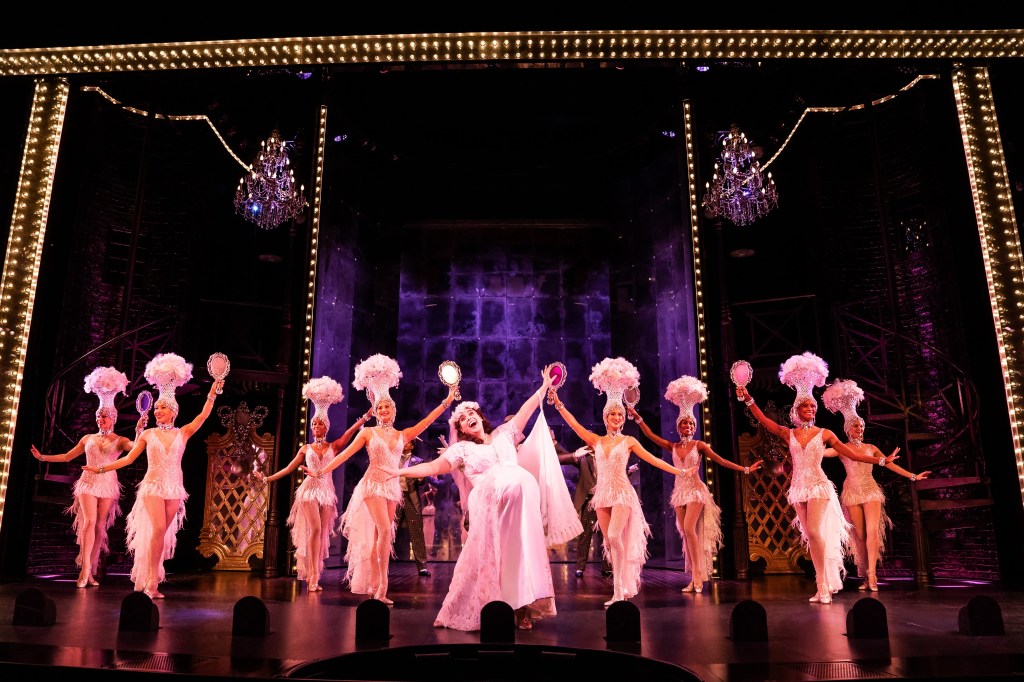
Not fervent with authenticity and the intensity that the role requires with songs like “People” which Fanny sings to convince herself to let go and love Nick Arnstein, who her mother has suggested is a criminal, she isn’t quite believable. However, with the ensemble, Jared Grimes’ wonderful Eddie Ryan and Ramin Karimloo’s suave, alluring Nick Arnstein, Feldstein relaxes and has more fun. Also, with the exuberant Jane Lynch (not necessarily believable as a pushy, Jewish mother), she overcomes herself and more comfortably inhabits the role.
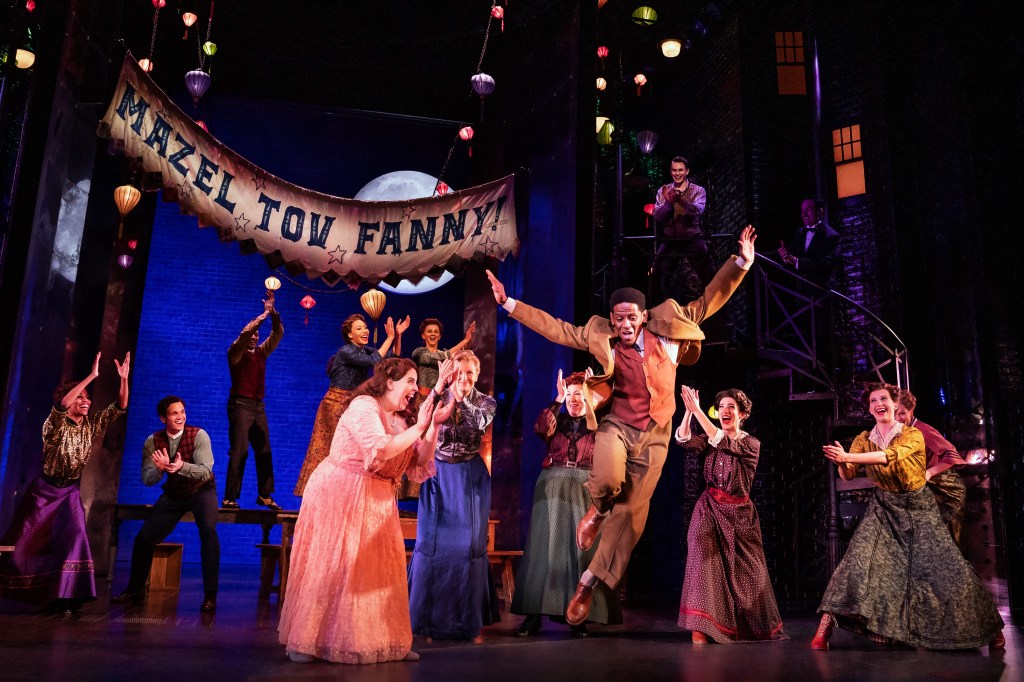
Sometimes Feldstein’s sweet singing went a tad flat momentarily in the first act and became a distraction to the events undergirded in the song. In her attempt to make Fanny Brice her own, certain schtick works if it glimmers, strikes, then vanishes. When it becomes repetitive, the humor loses its “funny.” As such, the youthful Fanny, the bumbling Fanny and the fake pregnant Fanny are clever. She is appropriately, broadly a ham (“His Love Makes Me Beautiful”). As Feldstein takes off on the visual, risque joke, the audience adores it and their adoration sets Fanny off into Fanny Brice stardom, all Beanie believable.
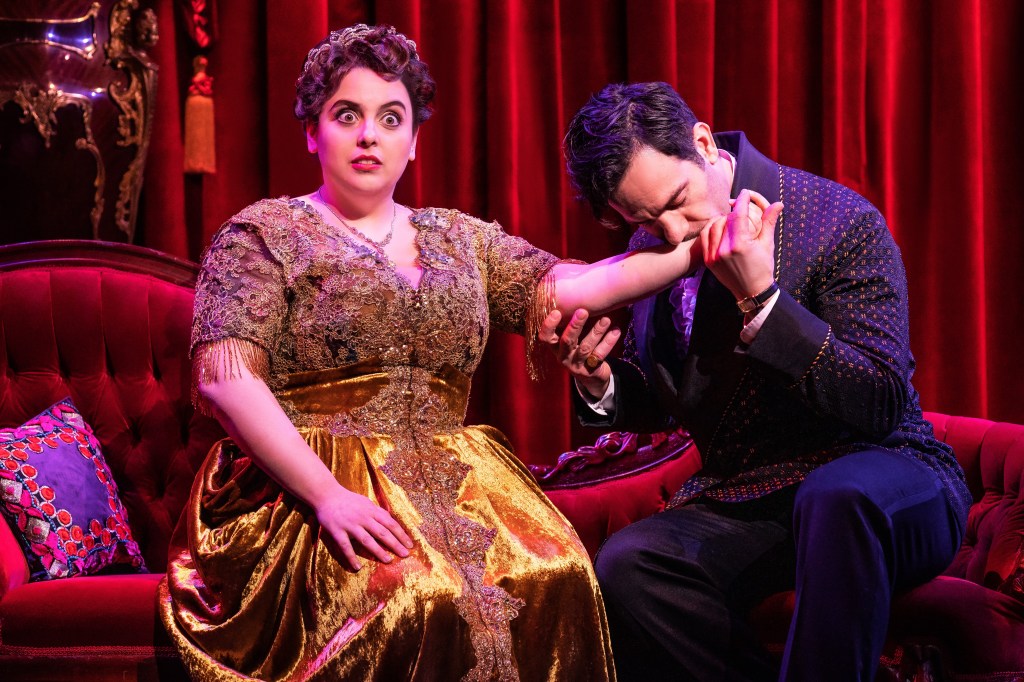
The flashback of the cute, adorable, wide-eyed innocent Fanny, the gutsy star-driven dreamer with heart (“I’m The Greatest Star”), works for a season. When she meets Nick and is with him for a while,, she doesn’t quite transition to charming, sensual, intriguing funny, the lure which entices Nick. Thus, their relationship never moves beyond the girlish Fanny who transforms into the Fanny who is a star that is beyond Nick in success, talent and charm. At some point the “Star is Born” meme should come alive when she exceeds Nick in grace and beauty as a Follies “Great.” Feldstein never quite pulls that off. Nor does she manifest the pain Fanny experiences when Ramin’s Nick and she part ways which leads into the overcomer Fanny who transcends, heartbroken but triumphant.
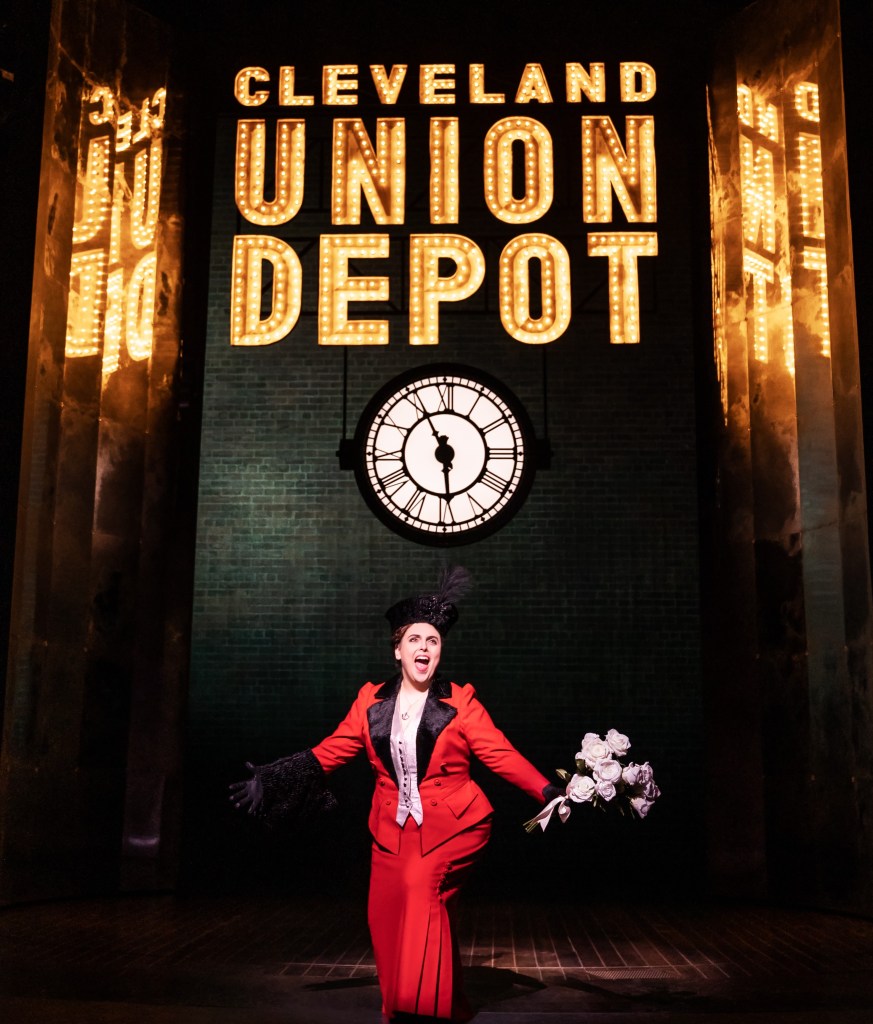
Karimloo’s Nick is gorgeous, fit, debonair and experienced. This superficial ethos lures Fanny like bread does to fresh water fish. In their scenes and songs (“I Want To Be Seen With You,” “You Are Woman, I Am Man,” “Who Are You Now,” and You’re a Funny Girl” that Nick sings alone), both actor’s make sense of these scenes because Karimloo plays the seducer, the lover, the partner who acts upon her as the receiver. Feldstein doesn’t have to do much but “fall” into his arms and be under his spell. And that is easy to do. The women in the audience are standing in her shoes enamored of Karimloo’s aura and sterling voice.
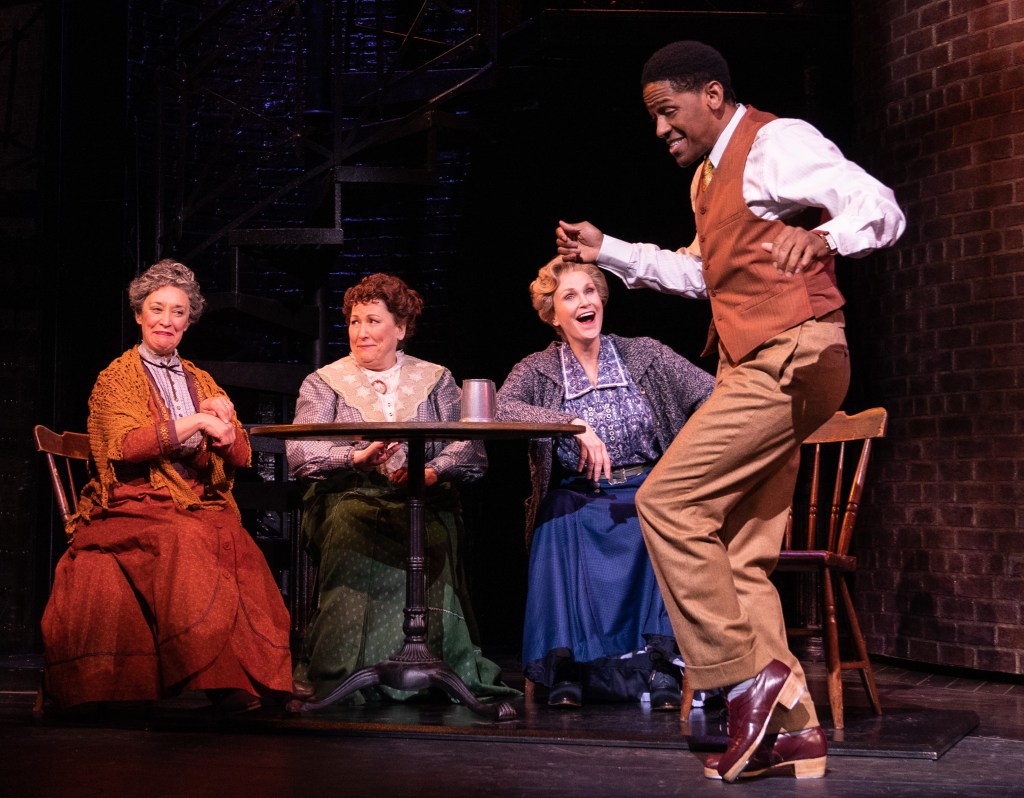
However, the complications of their marriage, seem static and should be predictable but are not emotional as Feldstein’s Fanny doesn’t register that her relationship is dissipating with Nick after she becomes a “Sadie.” Despite all the lovely set appointments by David Zinn’s scenic design for their Long Island home, the irony is manifest. It is not a home because it lacks warmth as Nick’s concern about money takes over.
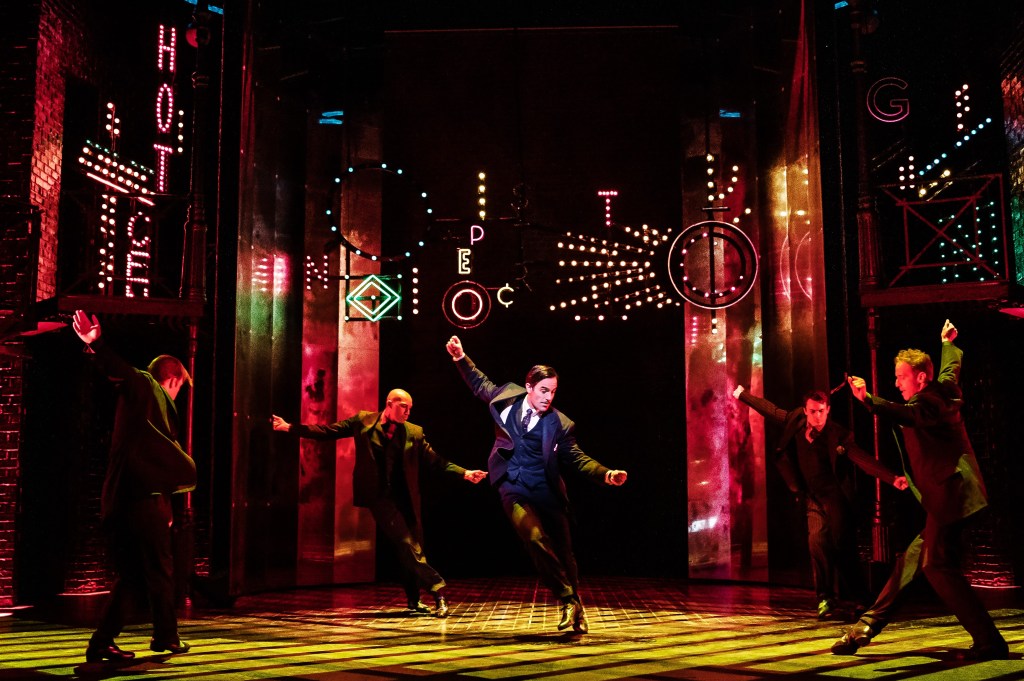
Eventually, even Karimloo (who beautifully sings throughout and does a bang-up job in “Temporary Arrangement”), when Nick sings about his going off by himself to make money…has difficulty with latter scenes between himself and Feldstein. When Feldstein’s Fanny attempts to save their marriage by outtricking a trickster, his response to Fanny’s gambit is interesting, if not lackluster. Nick’s reckless gambling has placed him out of Fanny’s status and wealth. Feeling emasculated when his project goes bankrupt, he is driven back to his criminal ways to recoup, which he never can because he lands himself in jail. The urgency between them in the parting scenes right before his prison sentence and after fall flat. We don’t care all that much about her heartbreak because Feldstein’s Fanny doesn’t seem to either by the “Finale.”
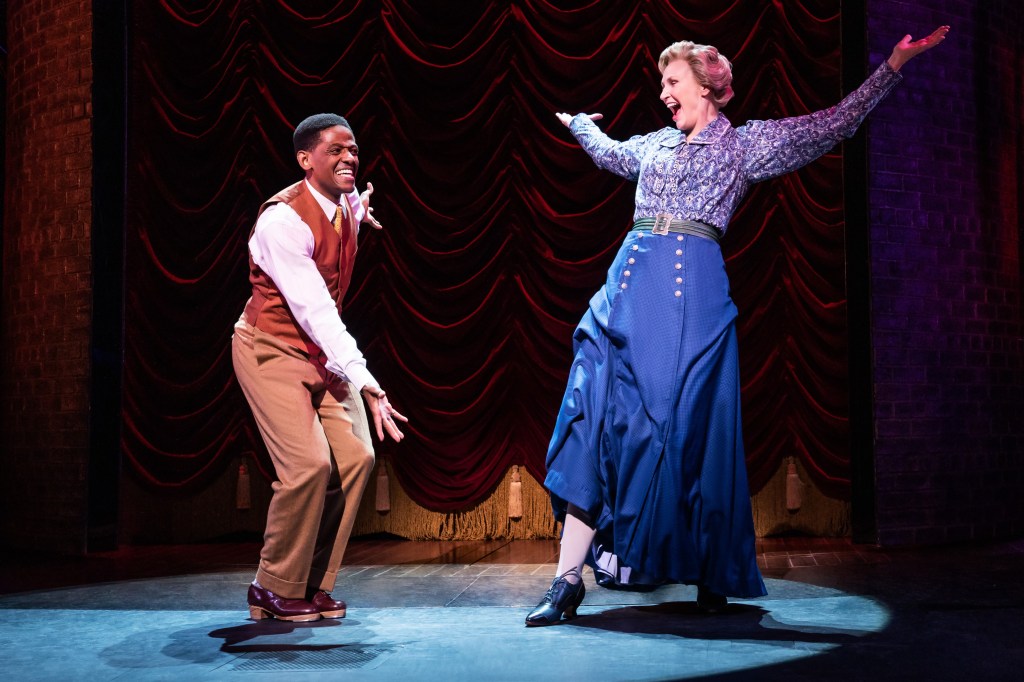
The book has been revised by Harvey Fierstein to streamline Act II which is a fine change-up. Fierstein transfers “Who Taught Her Everything She Knows?” sung by Mrs. Brice (Jayne Lynch) and Eddie Ryan (Jared Grimes) to the second act. Both are super conveyors of good will and have a blast together during the number. Indeed, Lynch’s and Grimes’ numbers are noteworthy as they possess the stage with grace, aplomb and enjoyment that the audience appreciates.
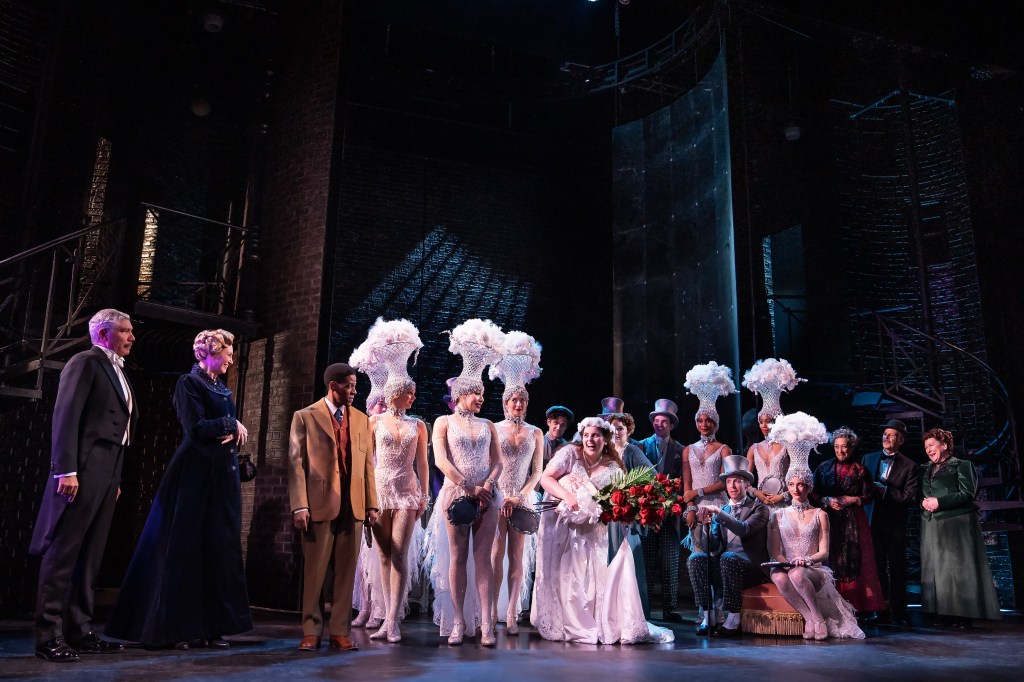
Jared Grimes’ tap is non pareil and brings down the house. Grimes is helped by tap choreographer, Ayodele Casel, who also succeeds in creating a number in which Feldstein shines with the ensemble (“Rat-Tat-Tat-Tat”). Overall the choreography by Ellenore Scott is strongest and most fun in the Ziegfeld numbers supported by the extraordinary costumes by Susan Hilferty with her expansively winged butterflies, shimmering chorus (“Rat-Tat-Tat-Tat”), bridal outfit in “His Love Makes Me Beautiful,” and in Fanny Brice’s outfits nearing the end of the production, reflecting the progressing years after the flashback ends. All are enhanced by the lighting design by Kevin Adams and Brian Ronan’s sound design.
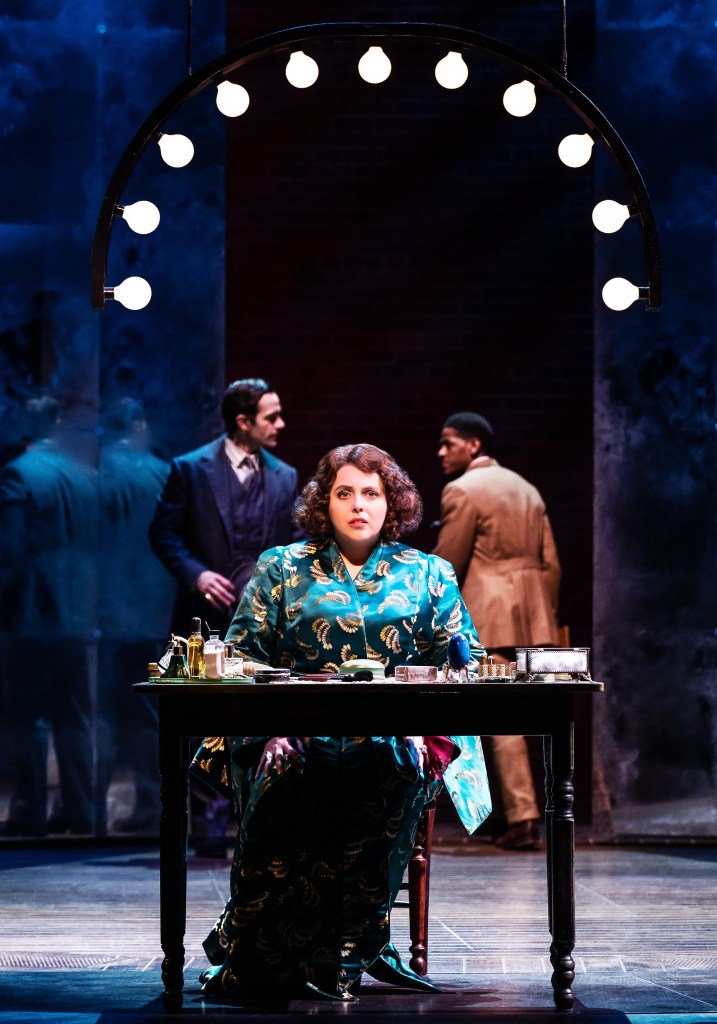
If you have not seen the West End revival of Funny Girl in the UK or at a regional theater, this production bears seeing for a number of reasons. Fierstein’s revised book is excellent and gives a lot of play to the characterization of Nick Arnstein. The entire company and the leads’ team work shines. The music is wonderful and the historic figure of Fanny Brice, a woman who made her career at a time when women had power in theater is something to be reminded of. Brice went on to more success in the entertainment industry in later years. Her life is one to remember.
Final mention must be made about the superb musical team. They include Michael Rafter’s music supervision and direction, Chris Walker’s orchestrations, Alan Williams’ dance, vocal and incidental music arrangements, Carmel Dean’s and David Dabbon’s additional arrangements, and Seymour Red Press’s and Kimberlee Wertz’s music coordination.
The show runs with one intermission. For tickets and times go to their website: https://funnygirlonbroadway.com/
Daniel Craig and Ruth Negga in ‘Macbeth’ a Stark, Thematic Whirlwind to Chill and Confound

Intentional contradictions abound in the production of William Shakespeare’s Macbeth currently enjoying a packed house in its limited run at the Longacre Theatre. Directed by Sam Gold, starring the inimitable Daniel Craig as the titular witch-doomed protagonist and superlative Ruth Negga as his feral, treachery-inspiring wife, the presentation is bold, daring, dramatic, enthralling, surprising, weird, completely irregular and defiant of critical examination.
Yet, the critics have had a field day, a bit reminiscent of Peter O’Toole’s production of Macbeth (1980), that critics ridiculed immodestly. However, the audience found O’Toole and the cast mesmerizing, and packed the Old Vic each night. Gold’s Macbeth is packing the Longacre Theatre despite venom-tongued, snarky criticism.

Macbeth theatrical productions have sprung up as star vehicles for Patrick Stewart, Alan Cummings, James McAvoy and Ethan Hawke to name a few. With each revival, each iteration of Macbeth, there have been intriguing conceptualizations. And this is as it should be, whether in modern dress, in an insane asylum or as this current production, on a stage stripped of showy spectacle, except for some of the Macbeth’s costumes, especially Lady Macbeth’s by Suttirat Larlarb. Gold’s bare stage, the back wall painted black, and Christine Jones’ minimalist set design (save the backdrop against which Macduff and Macbeth fight in the last scene), resemble a rehearsal space. There, the players strut and fret on the Longacre stage, for two hours and twenty minutes. Their discourse is audience directed interaction with resonant, beautifully delivered soliloquies by Macbeth, Lady Macbeth and others, i.e. Ross. Indeed, as Ross, Phillip James Brannon steals the scene where he describes the wanton blood-letting of Macduff’s family by Macbeth.
From the moment witches Maria Dizzia, Phillip James Brannon and Bobbi Mackenzie appear at their kitchen worktable and stovetop making preparations and cooking up their stew (which has a distinctive odor of root vegetables), in this pre-scene before the play, nothing is as what it seems (a key theme). The audience chats. The lights are on. Ushers seat audience members. Many ignore the casually dressed characters whose costumes have less distinction than the audience apparel. It is apparent that Gold is upending our expectations about Macbeth’s movers and shakers, the witches. These are homely, benign-looking creatures of no consequence, “cooking up a storm or two.”

Along with the theme that everything is in reverse (fair is foul, foul is fair), and appearances are not to be trusted, the fog machine (carried by various players) symbolizes misdirection and gaslighting. The fog and mist serves a twofold purpose: to create scenes of foreboding and an atmosphere of doom because reality and truth are indecipherable to the players. Unpredictability is another theme this production brings in from beginning to end. Nothing is assured, no action of the characters is staid; only the lines spoken in various accents are dependably Shakespeare’s (though truncated) in this interpretation which doesn’t quite follow the play’s usual format and dialogue with precision.
Gold shepherds his actors to take liberties, break the fourth wall, at times appear to ad lib, use anachronisms and coy props, like a can of beer for a gallows laugh and employ the acutely strange. For example he has Paul Lazar in a switch off from his role of trusting King Duncan take off his bloody “fat” vest and strip down to his shorts to “become” the porter who receives Macduff (Grantham Coleman) and Lennox Michael Patrick Thornton. All is at the hazard and then it is not. There is comedy in the tragic and a hysterical mania flows throughout. If this is confounding, it is purposeful. The kingdom in chaos and confusion reigns everywhere. Without clarity and leadership Scotland falls prey to a treacherous usurper who transforms the realm to one of darkness, uncertainty, moral weakness, corruption and lies all of whose troubling turbulence will not be easily stemmed. The witches have generated all of these elements.

The witches cook; we ascertain their “agreement.” As they plot, we recognize that the events are being determined, unseen and unknown way before the witches manifest themselves on the heath. By the time they appear to Macbeth and Banquo (Amber Gray), they’ve completed the brew which the witches make Banquo and Macbeth drink, alluring their souls and psyches forever to their fates, ineluctable, irrevocable.
In dramatic irony with emphasis, Gold allows us to see the witches’ power and control. This is something that King James I would have believed, something that Shakespeare wrote for him. I never understood the extent of their power before, thinking they trick Macbeth with the power of suggestion. In Gold’s vision, the witches’ plot has been a while in the making, in another realm and beyond the awareness of all the characters. Thus, we are reminded that before majestic events occur, there are forces at work that may never be understood or gleaned. However, that doesn’t mean that because they are unknown, they don’t greatly influence the events. Gold emphasizes this notion with his pre-play action of the witches.

Additionally, before they state the over arching theme of this production “fair is foul and foul is fair, hover through the fog and filthy air,” at the beginning of the play, out comes Michael Patrick Thornton in antic humor. He discusses the superstition about stating the name of Macbeth onstage, violating the dictum it must not be mentioned and should only be referred to as “The Scottish Play.” After getting audience laughs, Thornton gives an interesting discourse on, James I, King of England and Scotland, his obsession with witches and witch burnings, and Shakespeare’s writing three of his finest tragedies during The Bubonic Plague, where he and others in Europe had to “shelter in.” Macbeth was written during the Plague.
This and more Thornton relates effectively with humor, pacing and irony, addressing the audience as himself, though he later portrays Lennox, a murderer and the messenger of doom for Macbeth. The transition from Thornton in the present to the increasingly serious past events and spell-casting witches is masterfully seamless as we are taken to the hanging and death of a traitor who has admitted and repented his treason against the king, something Macbeth will never do.
The timeless currency of the play abides. Gold (as some critics suggested he should) doesn’t specifically reference the events going on globally (2022) via scenic design or props. He doesn’t need to; the parallels are manifest. The play’s greatness is in its revelation of the best and worst of human nature revealed in the dialogue, events and fine performances by Craig, Negga and the other leads.
Negga’s Lady Macbeth reveals her wicked heart’s desire in her soliloquies. These prepare us for the extent to which she must manipulate her husband by any means necessary, including insulting his manhood and demeaning his fears of failure and pangs of conscience. Not understanding that he is terrorized about the significance of his terrible deeds, she upbraids him for fleeing Duncan’s bedchamber carrying the bloody daggers with him which evidence his guilt. It is as if he begs to be caught and punished for what he’s done; the scene between Negga and Craig is effective and authentic.

By this point the couple has become divided by intent and the consequence of their actions; Macbeth feels the dire results coming, Lady Macbeth does not let it impact her. The shift is clear and Gold never brings them together again with affection. In this first part Lady Macbeth swamps Macbeth’s nobility. She stirs up his acknowledged desire for the throne, despite his rational judgment that no good result will come of killing Duncan, his kinsman and his guest.
As Macbeth, Craig’s, doubt, confusion and fear before killing Duncan and his shock and horror afterward are straightforward and powerful. Likewise, Negga’s Lady Macbeth is steely as she mentally fashions his will and bends it to hers. Pointedly, after both are crowned, Craig’s Macbeth and Negga’s Lady Macbeth accurately reveal the dissolution of their self-respect and love for each other. Craig’s Macbeth becomes obsessed by the negative results his inner guilt has forewarned. After his crowning the witches’ prophecies “fog” his judgment provoking his jealousy that Banquo’s heirs will be on the throne and his will not. Lady Macbeth’s distraction grows after she chides Macbeth at the banquet, the last time they will be purposefully together. She is not apprehending Banquo’s ghost that plagues Macbeth’s mind because of the witches’ prophecy of Banquo’s heirs. At the end of Act I, the witches’ plot is in full force. It submerges any decency left in this once august couple, who now grow emotionally isolated from each other, locked in their own soulful torture chambers.
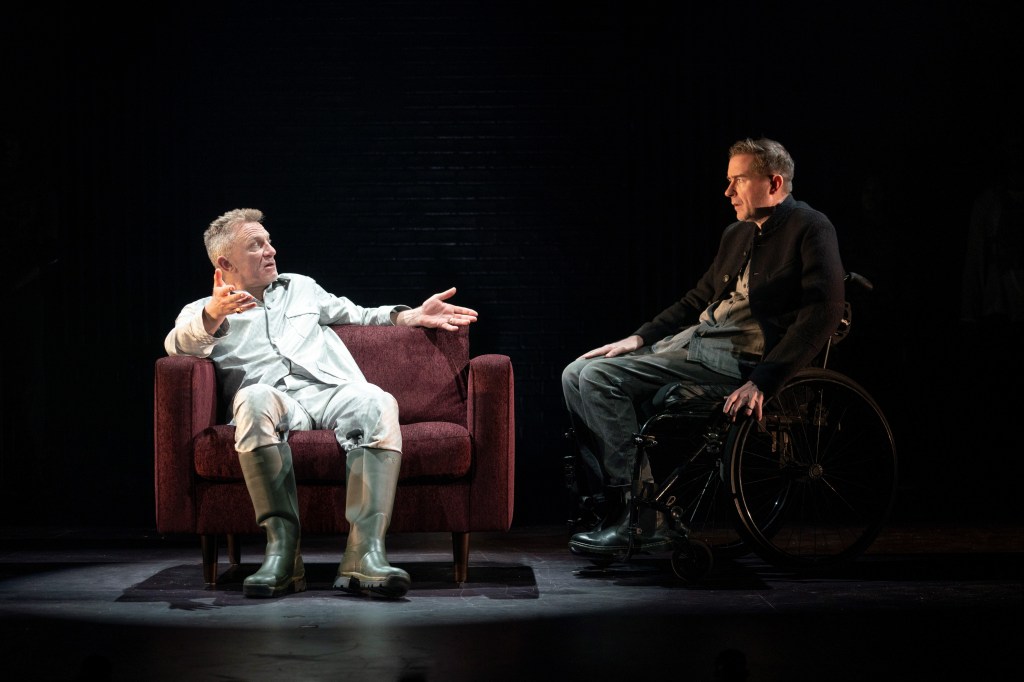
Gold’s direction of Macbeth and Lady Macbeth at this juncture in their relationship (showing no affection only rancor), indicates that the regicide, whether they want to admit it or not, has been the defining movement of their lives. Everything afterward is a counting down to their deaths. Craig’s performance reveals scene by scene, soliloquy by soliloquy the evanescence of courage with wanton carelessness and cheek (one example is when he gets the beer and drinks it). After he witnesses Banquo’s ghost he admits he is “stepped in blood so far, should I wade no more, returning would be tedious go’er.” Thus, “blood will have blood;” he allows his unrestrained lust for power to expand its corruption and visits the witches for affirmation, which he is duped to believe they give him. But what seems fair, is really foul.
Interestingly, following Shakespeare, Gold and his creative team suggest that the seeds of evil are planted by spiritual forces way before Macbeth’s self-treachery and vengeful violent nature become visible. The corruption and wickedness blossom imperceptibly, then accrue with coverups and lies (symbolized by fog and mist). The more the despotic tyrant doesn’t achieve his goal, the more he furiously lusts to accomplish it with the “help” of the witches who give him an illusory prophecy that he is immortal. This sustains him unstopped by his countrymen, until Macduff (Grantham Coleman) kills him. Indeed, tyrants like Macbeth are never satisfied. When Banquo’s son Fleance (Emeka Guindo) escapes Macbeth’s killing, thwarted, Macbeth shifts his path. Murderous revenge becomes his goal.

Craig manifests Macbeth’s transitions, superbly moving from guilt in refusing to go back to the King’s chamber to smear the chamberlains with Duncan’s blood, to raging at the audacity of Banquo’s ghost coming out from and around the banquet table, returning again and again in a scene that is chillingly effective. And when he attempts to secure his kingdom and learns that Malcolm and Macduff left for England to conspire against him, he has no compunctions about wiping out innocent Macduff’s family in revenge (another powerful scene). He has lost it; logically his blood-lust and terrorism only will inflame his enemies even more and give them license to turn his own subjects against him.
Indeed, blood will have blood, the recurring theme. Negga’s nightmare isolation is acutely staged and rendered as Lady Macbeth envisions blood stains that can never be cleansed from her hand…soul. In this version, Gold and the actors helped me better understand Shakespeare’s behind the scenes look into the human mind, soul and heart of a serial murderer and political tyrant and his unwitting, power-hungry ambitious wife. With brilliance Gold and the actors relay the process of how the wicked couple are snared by conscience then incited by megalomania to never repent. They select the path of emotional self-violation and we get to watch them unravel.

After the bloody combat between Macduff (Grantham Coleman) and Daniel Craig’s Macbeth renders Macduff victorious, Macduff defers to Malcolm (Asia Kate Dillon) as the King of Scotland. In conclusion she takes the power her father rightly bestowed upon her in the play’s beginning.
SPOILER ALERT. Gold truncates Malcolm’s dialogue so she doesn’t invite Macduff and the other thanes to Scone for her crowning. Interestingly, the play continues as an epilogue of irony. The actors put off their roles, fling themselves on the floor, take a well deserved break, and pass around bowls of “gruel” to each other that the witches prepared (offstage). The cast eats their portions silently as the audience watches, (it looks unappetizing). As they eat Bobbi Mackenzie (a witch and Macduff’s slaughtered child) soothingly, lyrically sings Gaeynn Lea’s originally composed song for Macbeth, “Perfect.” The last lines are:
“Tragedy’s viewed through its own lens; but just out of frame sits an old friend, watching our choices play out in the end, returning each other to where we began. Wish I had known it wasn’t meant to be, wasn’t meant to be perfect.”

This may be interpreted in many ways; an ironic apology for what we’ve witnessed as Macbeth’s failure that turned out badly. Indeed, as an “every person” such horrific behaviors can’t “be” perfect, ever. On the other hand it is humanity’s evolutionary process to continue and since we all are mortal, attempting to live forever, as Banquo and Macbeth attempted, the song/play speaks to human foibles. The message emphasizes imperfection, life’s disjointedness and entropy. Every murderous, cataclysmic, bloody, debacle where a despotic nature’s worst impulses for power, regency, a new Russian empire are allowed to be acted out, it is not meant to be…perfect and will not be. Thus, the despot needs to give it up sooner rather than later and save lives in the process. In another interpretation the actors wind down in their community with each other as they seal their commitment to take up their parts and “die another day.”
Shakespeare affirms the sanctity of life and the balance of evil and good in the thoughts of the noble, courageous yet monstrous Macbeth and his Lady as they bring about their own retribution and justice. Their own being effects their demise: Lady Macbeth commits suicide; Macbeth by giving himself over to the process of evil after his regicide. In reality, we can never know the inner thoughts of a Vladimir Putin or Stalin or Hitler. We can only guess at their fears, paranoias and heart’s desires. In Macbeth we have the luxury of understanding the tragedy of their rise and fall.
This is a unique production thanks to Gold, the cast, the superbly effective lighting design by Jane Cox, sound design by Mikaal Sulaiman, special effects by Jeremy Chernick and projection design by Jeanette Ol-suck Yew. Also, the original music by Gaelynn Lea is amazing. For atmospheric effects I particularly enjoyed the crashing revelations (i.e. lighting, sound, etc.) when the ambiguity of the witches’ prophecies clarify (i.e. how Birnam wood comes to Dunsinane). Additionally, kudos to Sam Pinkleton’s movement. Coupled with lighting, sound and special effects the chilling atmosphere of opaqueness and obscurity with the fog machines (which signified the theme of cover ups, lies, obfuscation of “truth”) was strengthened. David S. Leong’s direction of the violence was effected believably in service to the theme of blood will have blood.
This Macbeth will not be duplicated in your lifetime with this community of individuals. It is an incredible experience. For tickets and times go to the website: https://macbethbroadway.com/
‘American Buffalo,’ Explodes in its Third Broadway Revival With Phenomenals Fishburne, Rockwell and Criss
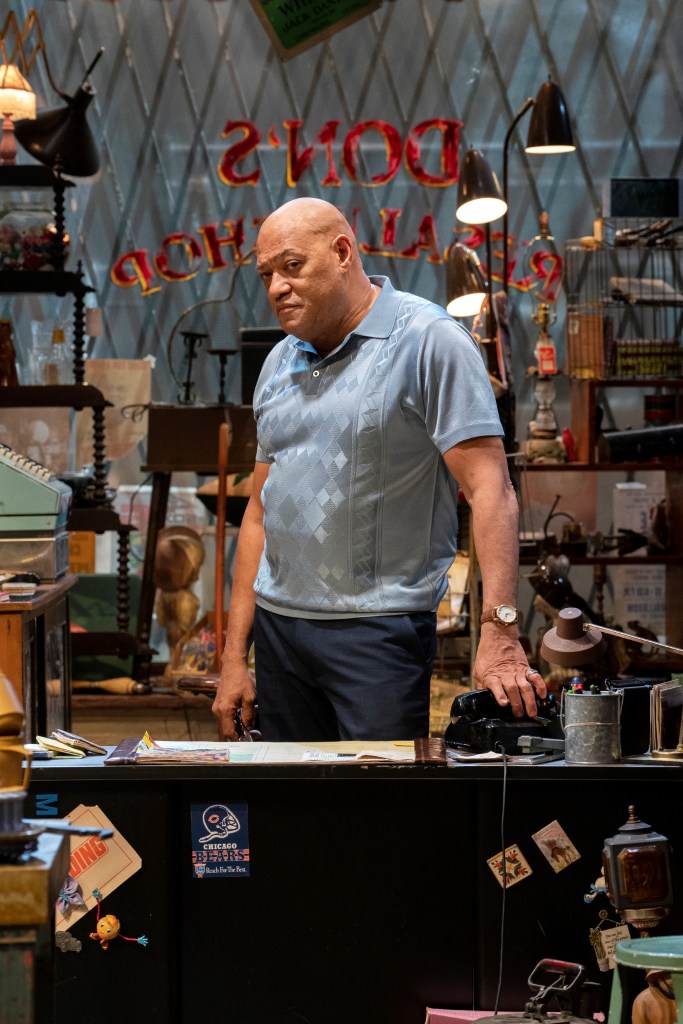
David Mamet’s American Buffalo, first presented on Broadway in 1977 with Robert Duvall as Teach followed with three Broadway revivals. The 1983 revival starred Al Pacino as Teach, the 2008 revival starred John Leguizamo. Eluding the Tony award each time, but garnering multiple Tony and Drama Desk nominations, the 1977 production did win a New York Drama Critic’s Circle Award for Best American Play.
Perhaps Neil Pepe’s direction of this third revival of the American classic, currently at Circle in the Square will bring home a few Tonys. It is a sterling production of Mamet’s revelatory, insightful play about the American Dream gone haywire for a couple of wannabe criminals whose concept of friendship and getting over test each other’s mettle.
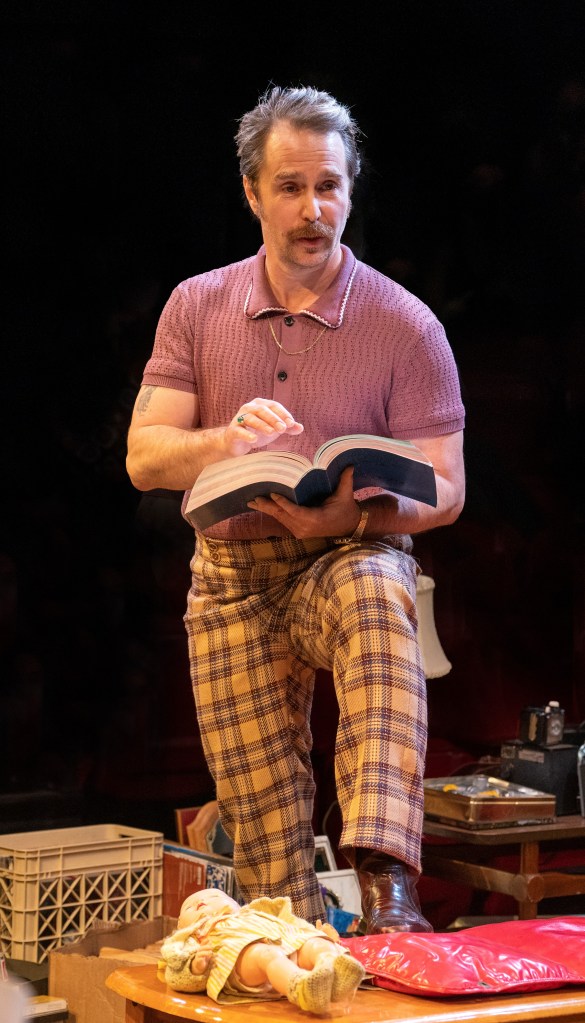
The cast is more than worthy to line up with Mamet’s dynamic, vital characterizations. The actors are seamlessly authentic in the roles of Donny (Laurence Fishburne), Teach (Sam Rockwell) and Bobby (Darren Criss). I didn’t want the play to end, enjoying their amazing energy and finding their portrayals to be humorous, poignant, frightening, intensely human and a whole lot more. Their depth, their interaction, their careful interpretation of each word and action that appeared flawlessly real is so precisely constructed in their performances, it is incredibly invigorating and a justification for live theater-why it is and why it always will be.
Mamet’s early writing is strong and singularly powerful as evidenced in American Buffalo. The play involves a string of events that happen over the course of a day in Don’s Resale Shop which is a hazard of incredible junk for the ages, fantastically arrayed by Scott Pask’s talents as scenic designer. The play opens at the height of drama (we think), when Donny upbraids Bobby about the right protocol to take regarding “doing a thing” as a preliminary action in a future plan they will endeavor. Then the developmental action sparks upward and never takes a breath in the crisp, well-paced Pepe production.

Immediately, we note Fishburne’s paternal and fatherly approach to Darren Criss’ innocent, boyish, “not too swift” acolyte into how to be sharp in business and not let “friendship” get in the way. Donny’s mantra relates throughout American Buffalo. As we watch his interaction with Bobby, we can’t help but see the organic humor in their characters which are contradictory and perhaps disparate from us in intention, discourse, values, initially, but are our brothers in humanity, whether we admit it or not.

At the outset it is impossible not to align ourselves empathetically with these acting icons, each of them award winners with a long history of prodigious talent over decades of experience in film, TV and stage. They are a pleasure to watch as they inhabit these characters, that are a few class steps above Maxim Gorky’s Lower Depths‘ denizens. LIke Gorky’s underclass, these “higher in stature” nevertheless live in their dreams as they deal with the very real and shabby circumstances of their lives. Thus, junk doyen Donny is the wise businessman who, by the play’s end belies all of the instructions he relates to Bobby at the beginning. And Bobby who intently listens to show Donny how much he is willing to learn to remain in his favor, learns little because he has let Donny down at the outset when he is “yessing” him with wide-eyed reception.

As a counterweight to the teacher-pupil, father-son relationship and manipulation between Donny and Bobby, the manic, feverish Teach throws around his knowledge, experience, street smarts and volatile “friendship.” He is their foil, their activator, their stimulator, their inveterate “loser” with a talent for braggadocio and despondency, and clipped epithets about the other denizens in their acquaintance. He is an apparent backstabber and one to watch as someone who sees themselves as dangerous, but botches his self-awareness and presumption to greatness at every turn.
Rockwell knows every inch of Teach and performs him with gusto and relish. He is integral to this team of exceptional actors that Pepe directs to high flashpoints of authenticity and spot on immediacy. This is collaboration at its best. From the layout of their characters’ plans in Act I to the consequences of the plan’s execution in Act II, the still point of behavior is the crux of what Mamet’s Buffalo presents with crushing ruthlessness.
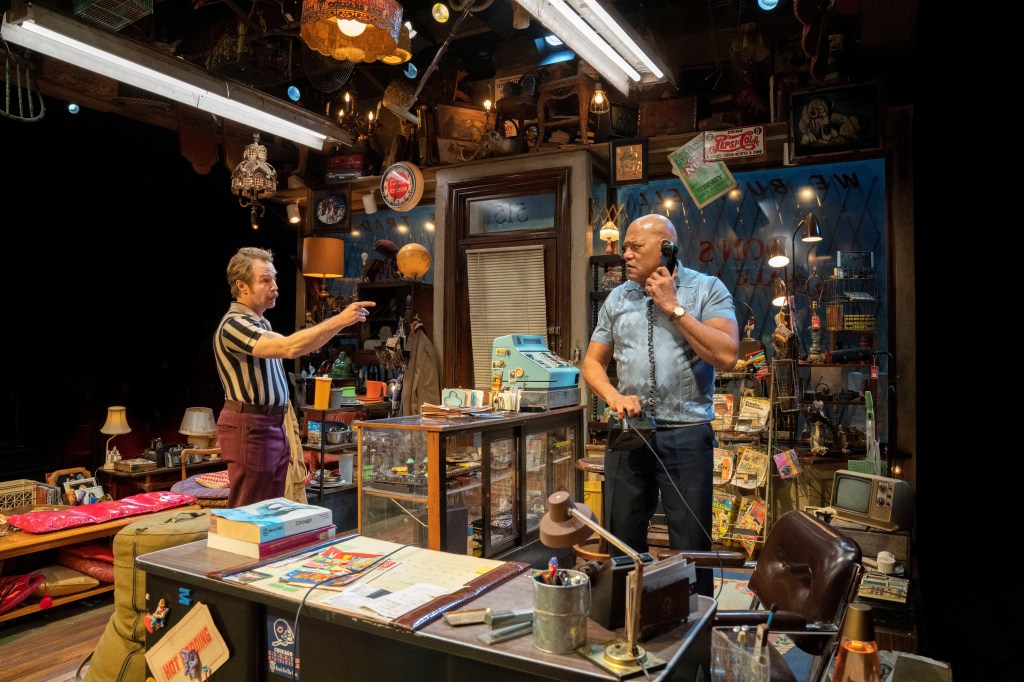
Examples abound throughout, but are particularly manifest in Act II. It is there that Rockwell’s Teach releases the anger within the character to reveal his self-destruction, self-loathing and disappointments. Rockwell’s Teach lashes out, only to be topped by Fishburne’s essentially kind and fatherly Donny, who erupts like a volcano at Teach in a shocking display of force. The drama in the second act is so alive, so expertly staged by J. David Brimmer as Fight Director, if Teach had moved an inch more slowly than he did, he would have been badly injured by the essentially good-natured but seriously, no-joke Donny. The altercation is a work of art, incredibly precise in its build up of the characters’ emotions, then release.
Likewise, Teach’s explosion against Bobby is devastating in another way. Brutal and exacting, Teach exploits Bobby as his victim. Using him as a backboard to release his fury and self-loathing, he redirects Donny to believe Bobby and another individual have double-crossed Donny and Teach in their plot to steal, undercutting Teach’s and Donny’s deal. Bobby’s attempt is feeble as he tries to verbally defend himself against Teach’s relentless onslaught, borne out by Teach’s years of inner frustration which have encompassed failure after failure. Teach won’t hear Bobby. Enraged at himself and his own assumed victimization, as he spews venom on the double-crossing Bobby and his “accomplice” to incite Donny, his violence crashes in a high, then a low.

Once again, the frenemies are tragic counterparts in a social class that is hurting. Teach’s rage is otherworldly. Bobby’s sorrowful reception of it without fighting back is heart-breaking. Criss is just smashing. I wanted to run up with alcohol and bandages to help stem the external wounds, knowing Bobby’s soul harm is irreparable. Through both brutalizations by Fishburne’s Donny and Rockwell’s Teach, the audience was silent in tension and anticipation. And then the mood breaks and here comes humor and apologies and I won’t spoil the rest.
The togetherness and human bonds displayed are as rare as the American Buffalo head rare coin Donny believes he had and lost. The coin lures the three who are governed by dreams of wealth, like iron pyrite. The resultant failure of their plans, emotional devastation and self-harm is never dealt with. Only Donny’s soothing of the situation is a partial rectification. Interestingly, whatever the type of friendship Teach, Donny and Bobby have will be strengthened by the thrill of the gambit, the crooked deal, the need to “get over” to salve lives that exist without purpose, overarching destiny or moment, except to move toward death, with “a little help from their friends.”

This portrait of Americana is particularly heady and current. Though the play is apolitical, it does speak to class, the macho bravado of making plans and screwing up, the lure of illegality as cool, and the consolation provided by the older wiser individual who the younger men are fortunate to befriend, though he is a subtle manipulator and user, as they all are in the game of “getting over.”
In American Buffalo Mamet suggests this game is as American as the American Buffalo, as American as apple pie, as American as the right to bear arms. Indeed, it is in the soil and the soul of our culture and we cannot escape it, though we may not embrace the ethic and ethos of the “art of the steal,” especially when law enforcement comes knocking. Nevertheless, the play suggests a fountain from which to drink and either be poisoned by the perspective, refreshed, nourished, but never bored. For that reason and especially these acting greats, this production should not be missed.
Kudos to Tyler Micoleau’s lighting design, Dede Ayite’s costume design and all the technical creatives whose efforts are integral to Neil Pepe’s vision for this third revival. For tickets and times go to their website: https://americanbuffalonyc.com/

