Category Archives: NYC Theater Reviews
Broadway,
‘Life Sucks’ by Aaron Posner, a Punchy, Waggish ‘Uncle Vanya’ Update That Keeps You Laughing, Starring Austin Pendleton

(L to R): Kimberly Chatterjee, Michael Schantz, Stacey Linnartz, Austin Pendleton, Nadia Bowers, Barbara Kingsley, Jeff Biehl in ‘Life Sucks,’ directed by Jeff Wise (Russ Rowland)
Life Sucks by Aaron Posner, presented by Wheelhouse Theater Company in its New York Premiere is a knee-slapping, aisle-rolling riot. The adroitly rendered production directed by Jeff Wise boasts superb ensemble acting, edgy, rapid-fire pacing, scintillating vibrance and abject fun as the audience is raked over the coals of rejection and dragged through emotional torments, trials and tribulations of love, lust and allurement. And for dessert at the end of every scene and act, you’ll enjoy over-sized irony wrapped in a continual joke fest.
Who are the actors and characters that satisfy the audience’s need for mirth in our hour of great need when the blackened pages of the redacted Mueller Report loom over our plebeian, miserable heads? They may be found as a variation of characters from Anton Chekhov’s Uncle Vanya but with an update for all seasons within the USA or the U.K. in the twenty-first century.
What happens when you set a number of miserable, bored, ungrateful and psychically damaged characters in a room with each other? Anton Chekhov investigated this over 100 years ago and directors and actors have been doing the same ever since. Within a modernized version that simulates the structure and most of the characterizations, Aaron Posner presents his examination of such individuals all the while twitting them with a droll and LOL sardonic perspective.
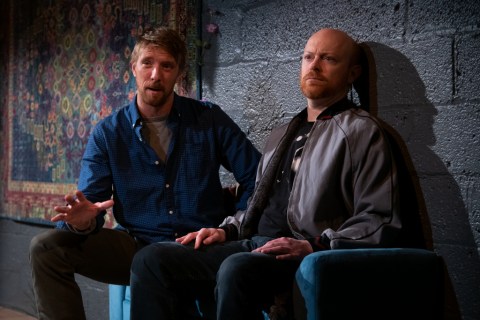
(L to R): Michael Schantz, Jeff Biehl in ‘Life Sucks,’ directed by Jeff Wise, The Wild Project, Wheelhouse Theater Company (Russ Rowland)
Uncle Vanya’s humorously morose, whiny, masochistic victim is portrayed by the completely heartfelt (especially at the conclusion) and totally believable Jeff Biehl who steers the production blaring out Uncle Vanya’s shredded inner life so we completely identify that yes, “Life Sucks!” The original quote attributed to Stephen King’s Pet Sematary reads with the horrific refrain, “Life sucks, then you die.” (SPOILER ALERT-do not read the last sentence) However, in the play Posner saves us from the inevitable exclamation point for Uncle Vanya.
The unobtrusive, slighted, self-critical Sonia (Chekhov’s Sonya) is portrayed by the adorable Kimberly Chatterjee who manages to tone down her adorableness just enough for us to not consider why the attractive Dr. Aster (Chekhov’s Astrov-played by Michael Shantz with mirey depressiveness) elects to frantically, humorously lust after Ella who spurns him, rather than to seek the comforting arms of the sweet, cute, funny Sonia.
Ella (in Chekhov, Yelena) portrayed with exceptional wit by Nadia Bowers, during narcissistic moments of externality, considers herself to be the “IT” girl with the overwhelming problem of attracting men and women she doesn’t want. All the males are entranced with her, especially because she is married to the elderly professor, Sonia’s Dad, played by the inimitable Austin Pendleton who is her counterpart in self-loathing, but for different reasons.

Austin Pendleton, Nadia Bowers in ‘Life Sucks,’ directed by Jeff Wise, Wheelhouse Theater Company, The Wild Project (Russ Rowland)
Pendleton is expertly hysterical, yet completely believable as he expresses that Ella’s image of her outward appearance and confidence mirrors the professor’s inner intellect and image of himself. Nevertheless, both are devastated; she by her own self-loathing and lack of psychic confidence and emotional wholeness, and he by his irreversible condition of O.L.D. How Posner’s elucidates their relationship is humorous and reminds us how and why opposites attract and then whip each other for it with great similarity.
Interestingly, it is the marriage of “ocelot” Ella with the professor that Uncle Vanya and Dr. Aster find a “come on” because “they” believe themselves to better for her than the professor. This obvious disconnect of the marriage between Ella and the professor frustrates both men. It also sends the crabby, murderous Vanya into rages and mordant behavior which of course is authentically funny. The self-confident but despondent doctor acts out his lust on Ella without asking permission, is rewarded, then verbally rejected. Interestingly, he takes this in stride. Can he do anything else when she refuses to run away with him?
The object of Vanya’s and the doctor’s desires portrayed with affability and outer confidence by Nadia Bowers, too, is filled with annoyance and frenzy that is driven by her compromised psychic state. She has everything any woman could want and can’t get out from under her own misery. Neither love nor lust satisfies and not even Pickles’ (Stacey Linnartz is the perfect foil for Bowers) alluring kiss can offer Ella any hope of lifting her out of herself.

(L to R): Nadia Bowers, Michael Schantz, Barbara Kingsley, Stacey Linnartz, Austin Pendleton in ‘Life Sucks,’ directed by Jeff Wise, The Wild Project (Russ Rowland)
Only Babs-Chekhov’s character Maria (the sane and moderate Barbara Kingsley) seems to be at a steady, “Goldilocks,” emotional state. Within she appears to have achieved self-contentment. She is the Zen Mother and well-meaning philosopher/artist and mother to Vanya. She appears grounded and whole. As foils go, Barbara Kingsley is measured and with near perfection, she rounds out this well shepherded, sterling ensemble as she manages to corral her son (the prickly Biehl) with intelligence.
What I particularly enjoyed was how each character engages the audience in their solo moments with a genuineness so acute that one believes the real actor behind the mask stands emotionally/psychically naked before us. This direct address channeling is difficult to achieve sans actors’ expertise, relaxed confidence, witty, ironic tenor, and, of course, damned superb writing. For example, I saw another production recently with uneven performances especially in the solo sections which didn’t ping with authenticity. The contrast between the two productions was striking with regard to the actors’ solos.
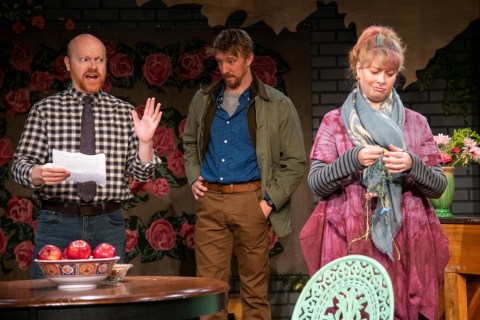
(L to R): Jeff Biehl, Michael Schantz, Stacey Linnartz in ‘Life Sucks,’ directed by Jeff Wise (Russ Rowland)
Life Sucks is a treasure which should be extended, if possible. This New York Premiere by Wheelhouse Theater Company just brings down the house! It will engage you like no other production this spring. It achieves a trinity of excellence in the writing, ensemble work and direction. All cohere seamlessly and the high points resonate and recede with the undulations of life’s joys and self-indulgent sorrows. Surely, the themes are clear; there are some things that cannot be changed. And the petulance of not wanting to make the best of our own personal situations is sheer foolishness.
Special recognition to the designer creatives who include Brittany Vasta (Scenic Design) Christopher Metzger (Costume Design) Drew Florida (Lighting Design) Mark Van Hare (Sound Design).
Life Sucks runs with one intermission at The Wild Project (195 E. 3rd St) until 20 April. For tickets go to their website by CLICKING HERE.
‘Oklahoma!’ Cool Convolution, a Review

The cast of Rodgers & Hammerstein’s ‘Oklahoma!’ directed by Daniel Fish, Circle in the Square (Little Fang)
Rodgers and Hammerstein II’s Oklahoma has come to New York City again. This slimmed down (cast) production directed by Daniel Fish initially opened at St Anne’s Warehouse with accompanying servings of chili and cornbread during the intermission. It gained steam to open at Circle in the Square with a multi-talented, vibrant cast, some of whom shine with resplendence. These include the principals: the transcendent, mesmerizing Damon Daunno as Curly, Rebecca Naomi Jones as Laurey, with salient assists by Mary Testa (Aunt Eller) the adorable Ali Stroker (Ado Annie) the sensitive, menacing Patrick Vaill (Jud Fry) the humorously clueless James Davis (Will Parker) and the funny, always on-point Will Brill (Ali Hakim).
Green Grow the Lilacs, (1930) by Lynn Riggs is the play source for the original 1943 version of Rodgers & Hammerstein II’s Oklahoma! Riggs’ (a mixed-race white and Native American-Cherokee) text provides the lyrical, wistful opening that Rogers and Hammerstein II used as inspiration for the lyrics to the iconic song, “Oh, What a Beautiful Morning.” Cowboy Curly McClain opens the “innovative-for-its-time” musical with this serenade which is an advertisement to win over Aunt Eller and Laurey Williams who he wants to ask to the evening box social.
The corn, cattle, sky, “give off a golden emanation that is partly true and partly a trick of the imagination, focusing to keep alive, a loveliness that may pass away,” Rogers and Hammerstein II’s original script states in the stage directions lifted from Riggs. Inherent in Curly’s hopefulness that “everything will go his way,” regarding Laurey Williams, is the possibility that it won’t.

Damon Daunno, Mary Testa in Rodgers & Hammerstein II’s ‘Oklahoma!’ directed by Daniel Fish at Circle in the Square (Little Fang)
In fact the moment he ends the song, his interchange with Laurey sparks reality. Things are upended where she is concerned and indeed, the loveliness that he enjoyed for a moment has passed. Already, the themes have been presented: uncertainty, impermanence and imperfections caused by tricks of the imagination. Foreshadowed? Continual struggle ahead for Curly’s and Laurey’s relationship and for Oklahoma which is about to become the 46th state.
These themes of impermanence and imperfection coupled with the struggle for survival and the mitigating force of love which may or may not last or help, are important ones. This is especially so for the main characters Curly and Laurey who strive, argue and sacrifice for each other. Though by the play’s conclusion they fulfill their love in marriage which they celebrate with Oklahoma’s statehood, harbingers of change forebode on the horizon. Curly will become a farmer which he knows little about and in twenty-three years his community will be facing drought, deprivation, dust bowl storms and bankruptcy as the “land that is grand” fails them because of their own inability to properly husband it.
Some of this nightmare future in a place that will not fulfill its beautiful mornings is incipient in the plot development of Green Grow the Lilacs and Rodgers and Hammerstein II’s musical. The dark days ahead are certainly revealed by the end of Fish’s Oklahoma! which is thought-provoking, intriguing but also convoluted.
Fish does not change the script, except for the physical fight scene between Jud and Curly. Curly doesn’t fall on his knife; there is a pistol. But the use of design elements lighting/darkness (Scott Zielinski) staging (Fish) scenic design (Laura Jellinek) costume design (Terese Wadden) special effects (Jeremy Chernick) projection design (Joshua Thorson) and sound design (Drew Levy) morph the basic immutable tenets of Oklahoma! to reflect Fish’s circulatory vision. I found this at times confusing and at cross-purposes with characterizations and themes.

Damon Daunno, Rebecca Naomi Jones in Rodgers & Hammerstein II’s ‘Oklahoma!’ directed by Daniel Fish (Little Fang)
In this re-imagined Oklahoma! these are largely re-directed, sifted and filtered revealing the underpinnings of a tenuous social culture which we are encouraged to become a part of. Indeed, the lights are on with the exception of a lovely, sensual and intimate scene between Laurey and Curly and a few other scenes where the design hues change or there is total darkness.
However, despite the lighting touch of inclusiveness, Fish’s social dynamic isn’t completely realized. For example there is no clear referent to Native Americans (30 tribes inhabited the territories by the time of the play) in the community that the designers create of family-style tables sporting chili-filled crock pots that surround the playing area. There is not one eagle feather, moccasin or soft, beaded belt, headband or any obvious identifying cultural accoutrements. In this alternating stylized/realistic version of Oklahoma! this appears to be an oversight along with the reality that also appears to be diminished: laws did not protect women who were men’s chattel once married. (And the EPA amendment has still not been passed!)
In his emphasis of the conflict that grows to a great malevolence between Curly (Damon Daunno) and Jud Fry (Patrick Vaill) Fish uses design elements (darkness, sound effects, projections) and particular staging. The result impacts and twists the characterizations in the service of presenting a culture and community rather than individuals. This diminishes the inner conflicts of the characters and hinders the elucidation of themes that could lift the audience’s understanding of immutable principles of good and evil. In this version goodness is sometimes hard to come by.
Specifically, in the smokehouse scene, Fish douses the lights and then uses close up projections of the faces of Duanno and Vaill to create tension and menace. Damon Daunno as Curly and Patrick Vaill’s Jud speak in miked whispers; the effect reveals surreptitious treachery on the part of both characters. The song “Poor Jud is Dead” has a completely different tenor. It appears that Curly is as wicked intentioned, as Jud, perhaps even more so as he encourages Jud to think suicide might yield the love and companionship he seeks, an abject lie for an outsider and miscreant like Jud. Any potential humor in this scene is removed. Curly who should be the bigger person becomes the weaker in his jealousy of a man he criticizes after Jud threatens him.
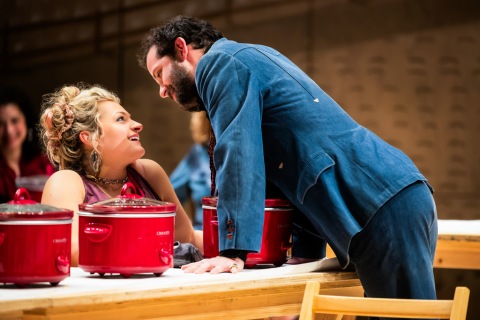
Ali Stroker, Will Brill in Rodgers & Hammerstein II’s ‘Oklahoma!’ directed by Daniel Fish, Circle in the Square (Little Fang)
In this version the scene is a disconnect. It throws down the brokenness of Jud and Curly which ends in their ominous shooting in the dark which Aunt Eller investigates and breaks up as the lights come on. The way Fish renders it, the scene makes us reflect that perhaps Curly is just better at hiding his rapaciousness toward Laurie with more enhanced social graces. His jealously unsettles him that Laurie selects Jud to be with; rather than to confront this, his childish pride takes over.
Because of the overall tone of the scene, the congenial, affable musician and expert singer and guitar player Curly who formerly delighted us, seems an incongruity in his behavior toward Jud. Granted, the scene is a difficult one for tone and tenor to strike a balance with humor. However, when the scene reveals characterizations tweaked without humor, the effect is disturbing. Curly is made unlikable and Jud becomes pitiful and wormy, in addition to being unlikable. All these machinations are over a woman? Do they even see Laurie’s identity? Or is Laurie an objectified symbol of conquest their male egos compete over? Considering Jud’s position in the community (which he himself has effected) there is no competition; why is Curly so upended?
Laurie’s characterization in this version is made shallow. Eliminated is the dream dance sequence where Laurie chooses to sacrifice herself to be with Jud in order to save Curly’s life. The love element is missing and is replaced with an incongruous solo dance (albeit Gabrielle Hamilton is an incredible, lovely talent). The thrust of why Laurie should “lay low” in her feelings for Curly are suggested in “People Will Say We’re in Love.” She must be careful around Jud; she must prevent gossip that would get back to Jud, yet suggest her true feelings for Curly to him. We find this out as she confesses how Jud is stalking her and she hears sounds of him under her window. It is not only because she is undecided about Curly, but it is also because she fears Jud and senses he will not tolerate a relationship between her and Curly. This is muddled in Fish’s version of Oklahoma!
Without the dream dance sequence with Curly, Jud, Laurie and their dream counterparts to illuminate Laurie’s inner struggle and sacrifice, all of the subsequent plot development, foreshadowing of danger and tensions between Laurie, Jud and Curly fall short of the bulls-eye. The coherence and through line become disjointed. I found the solo dance confusing and unrelated to Laurie’s conflict with Jud who haunts her dreams.

Cast of Rodgers & Hammerstein II’s ‘Oklahoma!’ directed by Daniel Fish (Little Fant)
The tensions in the character of Laurie, the strain and indecision about Curly made little sense to me without the interpretation of her dream to clarify. It seemed she was being a petulant tease to frustrate and torment Curly who is adorable and cares for her. Why shouldn’t she go with him? That she is sacrificing herself to protect him from Jud is a powerful justification why she doesn’t. It should not be undercut. Meanwhile, the laws don’t protect Laurie as a woman or discourage Jud’s potential stalking behavior. She thinks she can negotiate the situation and keep Jud “at bay” by going with him. She must be her own strong woman and handle things her way, keep Jud around as useful to Aunt Eller, and somehow discourage Jud. Her tenuous position and personal strength are de-emphasized in this version.
When her decision to manipulate Jud and save Curly backfires, Jud seeks her out though she attempts to avoid him. Being near her encourages Jud to enact what he has most probably imagined all along, sexual intimacy. However, Fish’s version complicates. To add to the incongruity, the director chooses to place Laurie and Jud in darkness. Jud’s attempts at intimacy are not visible. We hear sounds between Jud and Laurie but they do not sound like a struggle and Laurie never screams “No,” or “Stop.” Is she returning his kisses out of her own “hot” desires for intimacy? We can’t tell.
Meanwhile, the maladjustment and menace in Jud is apparent from the outset and underscored throughout. The pictures of nude women he has up in the smokehouse reveal a warped sensibility toward women and unfilled expectations. That he doesn’t know the difference between love or sex is manifest in his obsession for Laurie. That he might force himself on her is clearly foreshadowed in her fear and his threats against Curly being with Laurie. Why it is called into question with a “lights-out” scene between Laurie and Jud? This is not conducive to clarifying their characterizations.

James Davis, Ali Stroker Patrick Vaill (far right looking on) in Rodgers & Hammerstein II’s ‘Oklahoma!’ Daniel Fish, Circle in the Square (Little Fang)
Not being able to “see” what happens raises questions. Is Laurie enticed by Jud or is he misreading her? Is this a #metoo moment (an anachronism) in a time when men did what they pleased with women and rarely answered for it unless they were a different race? In the original script and other versions, it is a definite #metoo moment, that perhaps even Justice Brett Kavanaugh might acknowledge. (Well, maybe not.) The power and profound meaning of this is lost in this version. The justification for Laurie having the courage to throw Jud off the property is obviated as is her evolution as a character who has seen the light. Sadly, her insults of Jud seem harsh, if he has not grossly pushed himself on her.
Overall, the scene between them should be to the purpose that “he has gone too far,” and has misinterpreted her kindnesses to him as interest. Other Oklahoma! versions portray Laure’s characterization with coherence and logic. The attempted molestation empowers Laurie to kick him off the property. She draws the line; she will sacrifice herself no longer to protect Curly from Jud’s wickedness. She is no longer afraid which is a big step for her. In 1907 the law will not protect her, she will ask Curly to. It is a risk she takes. Does she have another choice?
It is an important moment and it has been re-characterized, supplanting it with the concept that Jud can’t catch a break and everyone in the community isolates and rejects him unfairly. That Jud creates the situation for himself is buried in this version. That he is the cause of his own problems, a truth he refuses to acknowledge or attempt to correct, is obscured. Jud is his own victim, the point of the humor in the song Curly initiates about him. His whines and resentments are weaknesses as is his impulse for revenge. (Unfortunately, upon closer inspection in modern day parlance he might be a Trump supporting sexual pervert, Incel or a Uni-bomber type in the making. UH OH. Have I gone too far?)

Damon Daunno in Rodgers & Hammerstein II’s ‘Oklahoma!’ (Little Fang)
Jud cannot get up and over his jealousy of Curly and obsession with Laurie. Curly doesn’t let his jealousy overtake him nor is he obsessed with Laurie; he loves her. There is a difference. Fish’s version muddies the contrasts between the two men. Curly understands himself and Jud. Jud lacks the will to understand that he is on the road to suicide or murder and doesn’t appear to want to select another path.
But rather than to reach out for help and crawl out of his hole to stop festering (Curly’s description of his behavior) he feeds his resentments and his victimization and remains apart, except when he can purchase “The Little Wonder” to harm Curly and when he goes to the social event to be with Laurie. He ignores his own faults and blames an unloving, heartless community which apparently has been a routine of his in his past. The fact that Fish’s casting of Jud does not reflect a member of another ethnic or racial group apart from this generally friendly community makes this all the more puzzling. We can only conclude he brings about his own demise, a tragedy of the human condition.
Fish slices away at the substance of the two protagonist’s inner conflicts that make them endearing and readily identifiable to us. He modifies Jud’s characterization which confuses, and de limits his character, draining him from being the self-harming tragic figure he is. Thankfully, the humor and relationships between Ado Annie (Ali Stroker) and her lovers Ali (Will Brill) and Will Parker (James Davis) brighten and thrill, all because of the excellent actors’ exuberance. They provide the fun, frolic and wise counterparts to Laurie’s and Curly’s sturm und drang. Directors impose their visions on productions and that is fine. But it should be effected with coherence, logic, clarity and balance. To my feeble mind, this version didn’t satisfactorily land.
This is especially so at the conclusion of Fish’s Oklahoma!. SPOILER ALERT! (Do not read this section; go to the last paragraph) The climax occurs not in Jud falling on his knife, but in Curly shooting him with a gun Jud gives him. (I couldn’t see this with Jud’s back to me…problematic staging.) Jud’s blood splatters Curly’s and Laurie’s white wedding outfits. This is the gruesome wedding present Jud bestows on them effected by Curly. The audience shock is palpable. That is the point, albeit gratuitous since Curly has Laurie and he should not be jealous or feel malevolently toward Jud. Thus, this intentional shooting of Jud appears strange; but because of the staging, I couldn’t see the death scene action, just the blood splattering.
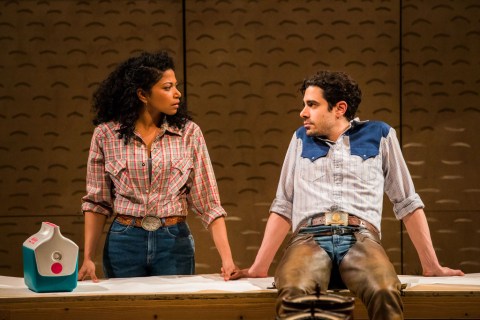
Rebecca Naomi Jones, Damon Daunno in ‘Oklahoma!’ directed by Daniel Fish, Circle in the Square (Little Fang)
The trial afterward becomes unjust justice of folks not wanting federal law (though they are now a state). Indeed, the entire community of cowpokes, farmers and their gals that many of the audience have broken cornbread with are complicit in vindicating Curly of Jud’s questionable death. Of course Jud is free of Curly and Laurie, but for the rest of their lives, remembrances of their wedding day are tainted by his blood.
The point is well taken. Regardless, the vital fact is that now Curly and especially Laurie are free of Jud who threatened their lives and personal sanctity. That the town forgives him and gives Curly a second chance is their justice. Indeed, only the audience was around to “see” the dark clouds in the scene between Curly and Jud. However, at the conclusion when Curly sings “everything’s going my way,” for Oklahomans, and audience members who know the state’s history in the 20th century, this is a supreme irony.
Fish, the cast and the creatives are to be lauded for taking the risks they did to reformulate Oklahoma! Kudos especially goes to the Orchestra: Nathan Koci, Joe Brent, Brett Parnell, Hilary Hawke, Sarah Goldfeather, Leah Coloff, Eleonore Oppenheim, John Miller.
All involved did a superb job in effecting Fish’s vision. That the incongruities and convolutions in this version were startling to me is of little consequence.
The original version and subsequent versions retain the depth and continuity of characterization, though the musical may be flawed if the directors do not accommodate for how the roles of Native Americans were seminal in the evolution of Oklahoma to statehood. But people will continue to see Oklahoma! because of its place in the historical musical canon. This version should be seen because of Fish’s conceptualizations and the creative designers’ and ensemble’s live performance spectacle which audience members will, at the last, appreciate.
Oklahoma! runs for two hours and forty-five minutes with one intermission at Circle in the Square (1633 Broadway…50th Street). For tickets go to the website by CLICKING HERE.
‘Oklahoma!’ Cool Convolution, a Review
The cast of Rodgers & Hammerstein’s ‘Oklahoma!’ directed by Daniel Fish, Circle in the Square (Little Fang)
Damon Daunno, Mary Testa in Rodgers & Hammerstein II’s ‘Oklahoma!’ directed by Daniel Fish at Circle in the Square (Little Fang)
Damon Daunno, Rebecca Naomi Jones in Rodgers & Hammerstein II’s ‘Oklahoma!’ directed by Daniel Fish (Little Fang)
Ali Stroker, Will Brill in Rodgers & Hammerstein II’s ‘Oklahoma!’ directed by Daniel Fish, Circle in the Square (Little Fang)
Cast of Rodgers & Hammerstein II’s ‘Oklahoma!’ directed by Daniel Fish (Little Fant)
Rebecca Naomi Jones, Damon Daunno in Rodgers & Hammerstein II’s ‘Oklahoma!’ directed by Daniel Fish, Circle in the Square (Little Fang)
James Davis, Ali Stroker Patrick Vaill (far right looking on) in Rodgers & Hammerstein II’s ‘Oklahoma!’ Daniel Fish, Circle in the Square (Little Fang)
Damon Daunno in Rodgers & Hammerstein II’s ‘Oklahoma!’ (Little Fang)
‘Nantuket Sleigh Ride’ by John Guare, Starring John Larroquette, Directed by Jerry Zaks

(L to R Downstage): Adam Chanler-Berat, John Larroquette, Grace Rex (upper level L to R): German Jaramillo, Clea Alsip, Douglas Sills, Will Swenson, Jordan Gilber, Tina Benko in ‘Nantucket Sleigh Ride,’ by John Guare, directed by Jerry Zaks, Mitzi E. Newhouse (T. Charles Erickson)
Sage, pithy, philosophical quotes taken from the stories in Jorges Luis Borges’ Labyrinths serve as the humorous grist that flavors and drives the witty and complex Nantuket Sleigh Ride by John Guare, currently at Lincoln Center Theater’s Mitzi E. Newhouse. The delightful hybrid play (mystery, comedy, fantastical dream-like elements and wonderful “come to life” Rene Magritte painting ‘La Durée Poignardée’ [‘Time Transfixed’]) has an adroitly crafted, labyrinthine structure beautifully clarified with sets and projections by David Gallo and costumes by Emily Rebholtz
Jerry Zaks shepherds the ensemble with an impeccable sense of comedic pacing and precise staging to elucidate the characters and maintain a humorous, coherence throughout, while unraveling the mysteries. The artistic designers with Guare’s and Zaks’ prodigious collaboration help to make Sleigh Ride a whopping, helluva journey through the mind and life of the one-hit playwright Edmund Gowery, during the summer of 1975, a monumental time which changed the course of his life, seemingly forever. From then until the present, Gowery suppressed his artistic sensibilities, left playwriting and sought the empirical, material world of making lots and lots of money.
John Larroquette portrays Gowery with relaxed authenticity and a droll, witty moment-to-moment presence. As Gowery Larroquette navigates remembrances of the summer of 1975, with aplomb. And noting that memory is a filter of age, wisdom and a myriad of emotions, Larroquette deftly filters these-the surprise, upset, fear and concern as he steps from narrator back to the past as actor in his memory. Guare’s vehicle of conveyance using present, filtered memory and past is striking, and Laroquette manages to bridge the changing time referents believably. His older narrative persona channels his youthful self with wry, pointed irony.

Stacey Sargeant, John Larroquette in ‘Nantucket Sleigh Ride,’ directed by Jerry Zaks, written by John Guare (T. Charles Erickson)
We easily accept these filters and joyfully follow Edmund (Mundie) on his madcap, convoluted adventures into the past as he introduces us to a “wicked” cast of characters. These include his mistresses, one of whom cheats on him with her husband (Tina Benko), insidious husbands (Douglas Sills, Jordan Gelber) an earnest, heartbroken lover (Will Swenson), a betraying and betrayed actress wife/lover (Clea Alsip) two kids Poe and Lilac (Adam Chanler-Berat, Grace Rex) the spirit of Jorge Luis Borges who wafts in and out of Mundie’s dreams with salient quotes (German Jaramillo), a cryonically challenged Walt Disney (Doublas Sills), who braves the summer heat of Gowery’s dreams to discuss a venture with him…and a few celebrities.
During the process of remembrance (the events enacted), Larroquette’s Gowery processes the mysterious circumstances of 1975 and grasps the opportunity to blossom into a caring individual who is sensitive to all forms of the truth, especially if it brings peace to others. By the play’s conclusion, through Gowery’s evolution, we understand that some nightmares (reference Borges) can work to one’s advantage, if we are flexible enough to learn from them. With enthusiasm Gowery experiences a resurrection of the artistic and imaginative part of himself. The younger persona which demonstrated a selfishness and self-dealing nature has been drowned reliving the “Nantucket Sleigh Ride.” (No spoiler alert here about what this means. See the play; it’s super.)

(L to R): Clea Alsip, Will Swenson, German Jaramillo, John Larroquette, Tina Benko in ‘Nantucket Sleigh Ride’ directed by Jerry Zaks, written by John Guare (T. Charles Erickson)
How Guare effects this plot structure of present, to flashback past, to dream sequence, to flashback past, to present tweaked with Borges’ tropes and quotes, contributes to the humor and entertaining zaniness of this play with a purpose. The dynamic begins at the top of the play and segues with a usual device which Guare makes more intriguing. Edmund Gowery finishes a congratulatory phone call about his reference as a playwright in the New York Times Sunday crossword puzzle. The symbolism is smart. He’s a clue in a crossword. But who indeed is Edmund Gowery who left off the stresses of success after his first and last Broadway hit Internal Structure of Stars, a “luminous memory play” influenced by Borges?
When his secretary (Stacey Sargeant) brings in his own lost copy of Borges’ Labyrinths (one of the most influential books of Gowery’s life) two frantic adults come into his office: Poe (Adam Chanler-Berat) and Lilac (Grace Rex). Both are pale-faced, limp and emotionally squeezed, but they demand that Gowery tell them about the summer of 1975, which was a time in their lives that was fraught with trauma so severe that they cannot remember what happened to them. For Poe and Lilac it is a “time transfixed.” Their lives cannot resume unless the darkness of the past is lightened with the truth from Gowery’s lips.
The irony is that the summer of 1975 for Gowery also is a “time transfixed,” a disaster which he never worked through, but just circumvented by emotional suppression. If he helps the desperate Poe and Lilac, he must dredge up the nightmares which contributed to the death of his playwriting career and forced him on the unenlightened, yet lucrative path of “convincing people to sell things they love to buy things they don’t want.”

(L to R): John Larroquette, Will Swenson in ‘Nantucket Sleigh Ride,’ directed by Jerry Zaks, written by John Guare (T Charles Erickson)
Running from himself and Poe and Lilac by escaping into the bathroom, Gowery considers. Out of his memory comes Guare’s inimitable, wacky flashback of Gowery’s summer with Poe, Lilac and the others. By the time he decides to give Poe and Lilac what they want, he emerges from the bathroom a more contented man. He has reconciled himself and brought us along as his understanding and empathetic companions. Now, he is able to initiate Poe’s and Lilac’s understanding of their past and move them off the immobilizing still point of trauma.
I enjoyed Guare’s writerly memes and ironic quips, and his use of Borges’ quotes for humor, plot development and revelation of themes. The production is a farcical, mystery romp, but it is also a profound look at reconciliation, second chances, working through trauma and evolving beyond pain if one has the determination to do so.
The two tiered staging as a focal point of elucidation is excellent and the Magritte room, clever. I loved how German Jaramillo’s blind Borges (a truthful metaphor of his inner sight) escorts the chugging locomotive (an element reflective of Borges’ magical realism) off stage as Mundie’s journey moves toward closure of one labyrinth and heads off to lead Gowery into another. The final labyrinth which restores us to the present and Gowery’s lovely reconciliation with Poe and Lilac.
From acting to direction to artistic design (see above and Howell Binkley-Lighting) (Mark Bennett-Original Music and Sound) Nantucket Sleigh Ride delivers. Thanks to the balanced and vibrant work of the ensemble, Larroquette’s wry likeableness, Adam Chanler-Berat and Grace Rex’s humorous transformation from kids to thirty-somethings and the wonderful, stylized German Jaramillo as Borges, this is a must-see for its grace, humor, depth and ironies all of which should not be underestimated.
Nantucket Sleigh Ride runs with one intermission at the Mitzi E. Newhouse at Lincoln Center Theater. For tickets and times go to their website by CLICKING HERE.
‘What the Constitution Means to Me,’ Heidi Schreck in a Vibrant and Revelatory Evening on Broadway

Heidi Schreck (writer, performer) ‘What the Constitution Means to Me,’ directed by Oliver Butler (Joan Marcus)
Heidi Schreck workshopped What the Constitution Means to Me over a number of years. Her efforts and overwhelming audience responses have taken the production from Off Broadway to Broadway’s The Helen Hayes Theater. Presented by The Clubbed Thumb, True Love Productions and New York Theatre Workshop, What the Constitution Means to Me, written/performed by Schreck, directed by Oliver Butler, offers a striking look at a document we should be familiar with since it governs and compels our every waking moment.
What audience members will discover during the presentation is that the devil is in the details, the interpretation of laws in the amendments and laws decided by the Supreme Court: the crucial ones related to Schreck’s personal life, she reviews.
As Schreck affirms, Supreme Court interpretations shift despite public opinion, depending upon the power brokers who control the narrative…a trend in the decades since Regan. We have seen the court move the values of this country from the decency and humanity of the 1960s liberalism to restrictive Federalist society conservatism led by Antonin Scalia and Clarence Thomas, and to what today may only be described as retrograde rightist extremism. Just a few days ago, the court made a decision in Bucklew v. Precythe that a torturous death was OK during capital punishment, setting a horrific precedent.
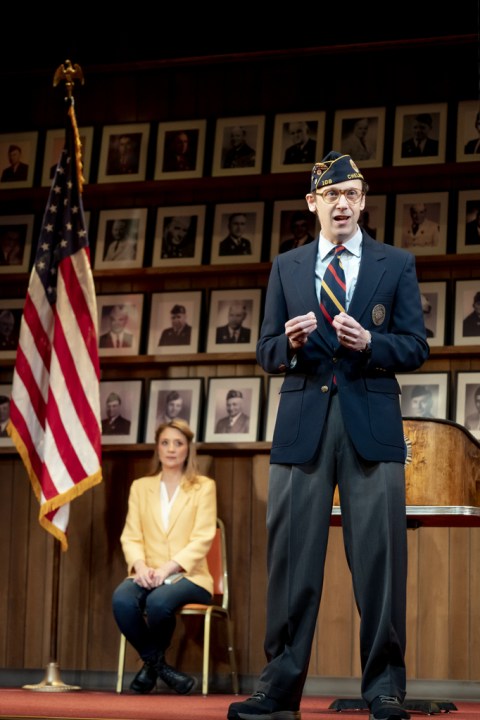
Mike Iveson, Heidi Schreck in ‘What the Constitution Means to Me,’ directed by Oliver Butler (Joan Marcus)
Schreck offers a riveting opportunity to revisit vital segments of the document which has established our rights as citizens at a time when these very rights are under threat by an administration which demonstrates little respect for it or the rule of law. Nor does the current administration or president abide by the oath of office which is to uphold the constitution whose amendments he has no qualms about challenging in the courts or in the press.
Clearly, because of the chaos and divisiveness in our culture (which Schreck references a number of times with great humor) seeing this production is a civic and moral imperative which should be made mandatory for high school students. Not only are Schreck and the other cast members Rosdely Ciprian (a 15-year-old) and Mike Iveson humorous and exuberant, the material is highly entertaining and extremely informative. It is a fabulous and exciting way to learn about our constitution. Indeed, the president, vice-president and cabinet should see the production.
Schreck introduces us to many facets of our diamond document by organizing the development of the production in an intriguing way. She refers to the time when her mother, a debate coach, encouraged her to compete in speech contests at American Legion Halls across the nation on the topic of “how the constitution related to her personal life.” Reconstructing her speeches which she gave as a teenager to collect money for college, Schreck turns back time to her fifteen-year-old self. She converts the audience to white, older, male legionnaires and fires away with the help of legionnaire Mike Iveson who times segments of her speech and times her discussions of a selected amendment.
All of these she relates to her own life and thus the lives of women impacted by the constitution for over two centuries. Indeed, women, Native Americans, free blacks, slaves weren’t even recognized as citizens from its creation by white property owners. Schreck follows the arc of development in the progress of women as non citizens under the constitution to the non-passage of the ERA (Equal Rights Amendment) today.

Rosdely Ciprian in ‘What the Constitution Means to Me,’ directed by Oliver Butler (Joan Marcus)
She touches upon the injustices toward all except the white, male, property owners, and the later revisions in the amendments, particularly the 14th amendment. She revisits the Dred Scott Decision and its reversal in the Emancipation Proclamation and the reasons why Lincoln had writers solidify the 13th amendment with the 14th amendment. She references the Chinese Exclusion Act and how it related to the 14th amendment’s clauses on immigration (shades of our present). And all of this she accomplishes with humor and good will.
During Schreck’s discussions she emphasizes seminal information related to women’s rights, the Equal Rights Amendment, what amendments engendered Roe v. Wade, the ironic and humorous stories related to the legalization of birth control and staggering statistics which reveal that men’s violence against women is alive and brutalizing the “fairer sex.” For example three women are murdered each day by a male partner in this country. One in three women are sexually assaulted during their lifetimes and one in four are raped during their lifetimes.
It doesn’t mentor sterling male behavior that the president has been accused of raping minors (see Jeffrey Epstein). One whistlebloewer who was going to go public about her experiences with Epstein and Trump withdrew because she was threatened with death. Nor does it help that Supreme Court Justice Kavanaugh faced tremendous controversy at his nomination hearing from women who accused him of sexual abuse and even rape. Oh well, “Boys will be boys.” (sardonic irony) He was given a pass.
Schreck also discusses the details of Castle Rock v. Gonzales…again in the service of paralleling what happened in her family, to her mother and grandmother. In Castle Rock v. Gonzales, the Supreme Court ruled that the 14th amendment no longer protects women against a violent male partner if the police feel they don’t want to intervene between a wife and husband who has sworn he will kill her and her children.

Heidi Schreck, ‘What the Constitution Means to Me,’ directed by Oliver Butler (Joan Marcus)
Later in the production Schreck discusses how her grandmother who survived an abusive, pederastic second husband via “Covert Resistance,” finally had the courage to run after him when he kidnapped Schreck’s mom and her other siblings to kill them. But it was Schreck’s mom who called the police on him. This was before Castle Rock v. Gonzales. Today, would the police respond as they did then?
One number Schreck states I had not heard before. More American women have been killed by a violent partner in the last century than men who have died in wars including 9/11. She makes it a point to affirm “killed by a male partner,” not just “killed.” That today, the law/government does not protect women against a partner’s violence, staggers one’s being.

(L to R): Rosdely Ciprian, Mike Iveson, Heidi Schreck, ‘What the Constitution Means to Me’ (Joan Marcus)
All of this information is presented in the service of personalizing the importance of the constitution to Schreck’s life and thus, to our lives. It is mind-blowing! Always fascinating she discusses how her maternal ancestors bowed down under the oppressions of the rule of law which didn’t cotton to women’s rights and as a result, women at the time sustained violence and abuse. For example her great great grandmother who was a bride purchased from “Matrimonial Times,” for $75.00, at 37-years-old died in a mental institution. On the death certificate, the cause was “melancholia.” Schreck infers she most probably ended up shattered by a relationship with her abusive logger husband.
In the last segment of the show Schreck and Rosdely Ciprian go head-to-head in a debate about whether we should abolish our “negative rights constitution” (it prevents the government from encroaching on our liberties) and perhaps establish a “positive rights constitution” (one that guarantees human rights to all for healthcare, equal economic opportunity, etc. like the constitutions of Germany and South Africa). How they debate (guided by Mike Iveson who times them) is just plain fun. Iveson encourages loud audience participation and cheering. And Rosdely Ciprian is an absolute spitfire.
What the Constitution Means to Me is a peppery, unique and delightful evening out. It is also slap-in-your-face get “woke” time in what Schreck reveals to us about who we are and where we’ve come from. The dense material is lightly driven by Schreck so that you remember the salient points. And all of this is presented with great good will in the hope that we become civic-minded. We must not allow the current crop of old, white, male, rich prototypes like those who created the document to perpetrate another act of violence against women. Men and women must prevent them from turning us out among the denizens of the deep without protection into a retrograde past. As women go, so go their men and families; men will suffer even more than women.
With the latest turn of the Supreme Court to rightest extremism, this is not just fantasy. But to consolidate power, it is in the best interests of the Federalist Society (that Antonin Scalia championed) and the extremist right to push the Supreme Court to such ultra right positions on cases and denude the majority of citizens of their human rights.
Sadly, to overturn Roe v. Wade and other laws that have empowered women will be active tyranny against lower class women. Schreck points out that wealthy women, (politicians’ mistresses, celebrities, etc.) always got abortions and always will regardless of legality. Money places them above the law. However, to cruelly nullify women’s souls and minds from making decisions about their own bodies is an evangelical act against God. Only He has power over all people’s minds and souls. That white men would usurp that power is tantamount to exercising a power which is the opposite of His love and mercy.
Kudos to all the creatives like Rachel Hauck (Scenic Design), Michael Krass (Costume Design) Jen Schriever (Lighting Design) Sinan Refik Zafar (Sound Design) who helped to make this a wonderful, must-see production that is an imperative for old and young alike. What the Constitution Means to Me runs without an intermission in an extension until 24 August. It is at The Helen Hayes Theater (44th Street, between 7th and 8th). For tickets go to the website by clicking HERE.
‘The Cradle Will Rock’ at CSC, Directed by John Doyle

(Visible): Sally Ann Triplett, Ian Lowe,Lara Pulver (center) Kara Mikula in ‘The Cradle Will Rock,’ directed by John Doyle, CSC (Joan Marcus)
Once the insidious and malevolent corrupt buy their way into the halls of power, it seems impossible to oust or destroy them. However, The Cradle Will Rock by Marc Blitzstein, directed and designed by John Doyle currently at CSC, reminds us that all is not hopeless. Indeed, corruption and those who revel in the money and preeminence it fosters must irrevocably crash to their doom as their sphere of influence which propagates great harm eventually is overthrown by the just. Indeed, there are always a glorious few who face great risk for the greater public good.
This sleek version of The Cradle Will Rock, Director Doyle fashions using the template of the original production which employed no elaborate spectacle (see this article about the original production). The actors are staged so that they move in toward the piano and outward and in the round (the CSC playing area which is actually a square surrounded by the audience). The pianists (I was impressed by their talent and the number of the cast some who play with exquisite grace.) also do double duty and sing beautifully as members of the ensemble.

(L to R): Ken Barnett, David Garrison in ‘The Cradle Will Rock,’ at CSC, directed by John Doyle (Joan Marcus)
The entire play is sung as a quasi opera, in a Bertolt Brecht style with ferocity and near didacticism. The subject matter of how dirty money is used to fuel predation and victimize the culture is worthy for this stylization. Cradle’s themes are mythic; its protagonists and antagonists timeless. The arc of development elevates the plot to the spiritual warfare of good vs. evil. We watch how the uncorrupted-awoke fight to bring truth and majestical courage to the souls of the unenlightened. This is done in the hope of empowering and freeing them of their subservience to power domination and demeaning cult worship of the “leader.”
The Brechtian music effected by the pianists and ensemble pounds out the plot and themes which clearly resonate for us today. In every corner of the world, we note representative Mr. Misters (the warlord of Steeltown) akin to dictators, autocrats, warlords.

(L to R): Rema Webb, Sally Ann Triplett, Ian Lowe in ‘The Cradle Will Rock,’ directed by John Doyle, CSC (Joan Marcus)
In the setting of Steeltown, USA, the 1930s during the height of the depression, Mr. Mister, we learn from those whom he’s battered and destroyed (Harry the druggist-Tony Yazbeck) gained power and control through devious means. The action takes place over one night in a Steeltown jail during an action to unionize. When Moll (Lara Pulver) is thrown in jail rather than to give her favors to a corrupt cop (Eddie Cooper), she is befriended by Harry the druggist. In flashback scenes the ensemble enacts, we learn how Mr. Mister (David Garrison) surreptitiously grabbed power. Harry explains Mr. Mister’s machinations to the mistakenly jailed Liberty Committee (the ensemble). They are Mr. Mister’s fandom anti-union support group, who wait for Mr. Mister to bail them out; they are not as police thought part of the pro-union protest.

Lara Pulver in ‘The Cradle Will Rock,’ directed by John Doyle, CSC (Joan Marcus)
The flashbacks identify how any corrupt power broker operates…surreptitiously, without the light of truth being shined on their oppressive, coercive, fraudulent actions. Thus, the ensemble reveals the events of how Mr. Mister’s wife (Sally Ann Triplett) buys support and influence to solidify his power network corralling important institutions like the press (Editor Daily-Ken Barnett), the church (Reverend Salvation-Benjamin Eakeley) the factory and social organizations.
Harry points up the ruthlessness of Mr. Mister who killed a newly elected union leader and his family in a fire bombing and caused Harry to lose his business and drop into hopelessness and despair. Of course the irony is in not blowing the whistle on Mr. Mister and risking death for his testimony, Harry ends up being destroyed in a living death by Mr. Mister who coerces him into his own mewling self-destruction. Indeed, the revelatory theme is better to die a martyr in the hope of bringing down evil than sustain a living death while the corrupt grow and evolve like monsters engulfing all in their path to get what they want which never includes the public good.
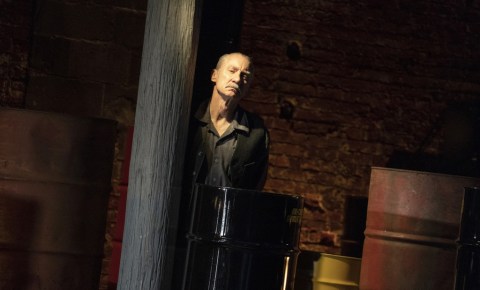
David Garrison in ‘The Cradle Will Rock,’ directed by John Doyle, CSC (Joan Marcus)
Eventually, all of the prominent and influential members of Steeltown join Mr. Mister’s fandom Liberty Committee and this entrenched power structure runs roughshod over the “little people.” We learn for example that Mr. Mister bullies and commands others like President Prexey (Ken Barnett) to adhere to and foment his political policies. We also learn of cover-ups of accidents despite witnesses (Rema Webb) because of Mr. Mister’s negligence. His lack of accountability is legend which he keeps in the shadows buying off the press and threatening others with harm if they “spill the beans.”
The heroes of Cradle, Moll who is a conduit and listener of truth, Harry who knows the truth but waits too late to reveal it, Ella Hammer who witnessed a death and cover-up and courageous union leader Larry Foreman (Tony Yazbeck in an ironic choice for he also plays the devastated Harry). The union leader activist is arrested and brought to the jail for distributing leaflets. All of these individuals stand against the Liberty Committee whom they try to persuade against Mr. Mister.
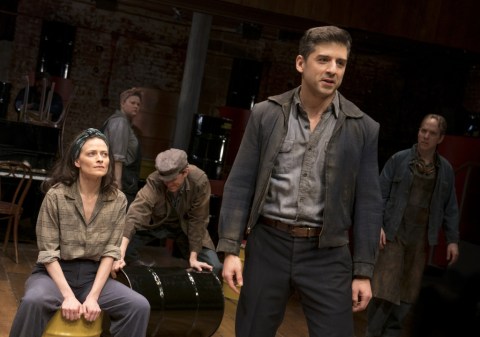
(L to R): Lara Pulver, Kara Mikula, Benjamin Eakeley, Tony Yazbeck (foreground), Ian Lowe in ‘The Cradle Will Rock,’ directed by John Doyle, CSC (Joan Marcus)
However, when Mr. Mister comes to free the committee from jail, we understand that his fan base has neither the intelligence, the spiritual will, the courage, nor the understanding to recognize that a nefarious, demoralizing, psychotic sociopath is a danger to their own well being and freedom. The title of the Liberty Committee is a sardonic Orwellian touch for they are too blind to be free. Blitzstein’s work is one sardonic trope after another. As for the duped committee, they live trapped in their outer material selves, not in their souls or extended consciousness, mind, will.
Meanwhile, Mr. Mister also offers to bail out Larry Foreman. Accepting the bail money has a price: join Mr. Mister’s extended perfidious enterprise and work against the union, a work to enslave the community, not free it. Foreman rejects Mr. Mister’s offer. The Liberty Committee excoriates/ridicules him for his courage which they interpret as stupidity. But Foreman who takes the high road and remains in jail makes a sterling prophecy to himself and to us. With defiance he predicts that Mr. Mister’s oppressive, corrupt power over Steeltown will end.
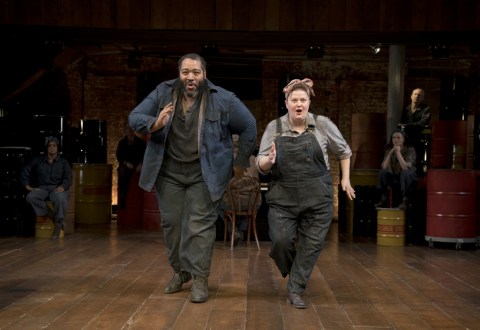
Eddie Cooper, Kara Mikula in ‘The Cradle Will Rock,’ directed by John Doyle, CSC (Joan Marcus)
Indeed, the implication is clear in every century, in every time and place. The warning for such infantile autocrats who must control all at their own whim like a petulant child is “The Cradle Will Rock!” And as surely as the wind blows with increasing strength, that cradle inevitably, will fall bringing down dictator baby.
This production certainly speaks for our time and we may take heart, if we wish, that Larry Foreman’s prophecy is an inevitability. I enjoyed the minimalism of props which the actors use seamlessly. And I enjoyed the use of greenbacks which dominate the scenes to illustrate how Mr. Mister’s wife, et. al buys his influence from those equally corrupt who take the money and support his rise in exchange for their freedom of choice to stop him.
The greenbacks which eventually end up in a big pile (the symbol of velvet destruction) in the center of the playing space, are left by the head of the Steelworker’s Union, Larry Foreman. He cannot be bought. The money is an appropriate symbol of what can make human beings like Mr. Mister and his minions in Steeltown pernicious, callous, hardened and wicked.

(L to R): Tony Yazbeck, Lara Pulver, Rema Webb in ‘The Cradle Will Rock,’ directed by John Doyle, CSC (Joan Marcus)
“Apparently” fewer in number, there are those like Moll, Harry the druggist, Ella Hammer and Larry Foreman who eschew the “love of money” to kill/defraud/lie/steal for it or be complicit with those who do. How many have the strength of purpose, unction and anointing to do follow their heroic example and create a better world? Many, though it appears to be easier to go the way of Mr. Mister’s Liberty Committee. By the conclusion it is to the unseen “many” of like minded individuals that Larry Foreman makes his prophecies. In them lies the hope of the fierce wind that will rock the cradle.
Blitzstein’s work initiated as a result of the debacle of The Great Depression, then and now highlights how economic inequality was and is a by-product of power elites who purchase institutions (religious, press, law enforcement, industry, social networks) to hold sway. In a time of economic prosperity it is impossible to corral people to do one’s bidding. Thus, the push for economic equality, the production reveals, encourages a strong and stable social system which discourages autocracy, plutocracy, dictatorship, “one-man rule.” Indeed, who pushes the culture in order to exacerbate economic inequality which is the lifeblood of instability and divisiveness? Who indeed!
This is a fine production thanks to these talented actors: Ken Barnett, Eddie Cooper, Benjamin Eakeley, David Garrison, Ian Lowe, Kara Mikula, Lara Pulver, Sally Ann Triplett, Rema Webb, Tony Yazbec. Doyle’s direction/staging/design is spot-on. And kudos go those creatives responsible for Costume Design (Ann Hould-Ward) Lighting (Jane Cox, Tesse James) Music Supervisor (Gregg Jarrett) Associate Scenic Design (David L. Arsenault) Associate Costume Design (Amy Price).
Here is a caveat for this production. The lyrics to the songs are gems. The voices of the actors, the gemcutters. The more precisely enunciated with authenticity, the more beautiful the overall piece of jewelry (the song). Indeed, we long for exquisite, priceless pieces. At times, the gemcutters in the production, were imprecise; the song lyrics were garbled. When the cutters were precision sharp and clear, the songs soared and thrilled. This is a potentially stunning production which fell a bit short for that reason and that alone.
Nevertheless, it is a must-see as a trenchant allegory for our time. The Cradle Will Rock runs with no intermission about 90 minutes. The show closes on 19 May. You can purchase tickets at their website by CLICKING HERE.
‘The Tragedy of Julius Caesar,’ a Thrilling Re-imagining of Shakespeare’s History/Tragedy

The Company of ‘The Tragedy of Julius Caesar,’ directed by Shana Cooper (Henry Grossman)
A few years ago the Public Theatre did a sardonic version of Julius Caesar using directed ridicule to lay bare some parallels between Caesar’s power grab with that of the new Trump administration. In that iteration blonde, pompous Caesar wore a dark suit and long, red tie and Calpurnia flounced around in designer clothing. The allusions were clear as were the themes. Overweening power unchecked in a representative government leads to civil strife, chaos and future oppression. Though Theatre for a New Audience’s rendition of Julius Caesar offers no such national twists, the production’s finely tuned staging, set design, incisive acting by the principals and superb use of the ensemble ratchet the themes of political intrigue and civil strife to a much more nuanced and foreboding level.
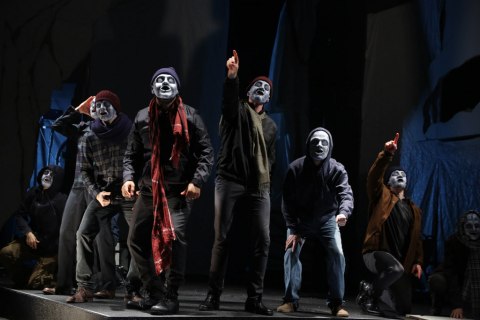
Ensemble of ‘The Tragedy of Julius Caesar,’ directed by Shana Cooper, Theatre for a New Audience (Gerry Goodstein)
This version is novel in costume design, sound design and scenic design with sterling efforts by Raquel Barreto (costumes) Sibyl Wickersheimer (set) Paul James Prendergast (sound). Though the costumes are predominately in modern dress, the impact of the characters’ roles is inherent in their design. The masks and wigs headgear of the ensemble are dramatic and eye-catching in the opening scene with the crowds celebrating the Feast of Lupercal. The same occurs later during Brutus’ and Mark Antony’s funeral orations.
The director Shana Cooper brilliantly employs the ensemble during the mob scenes and crowd scenes in Act I and Act III and then in the battle scenes in the last acts. The staging is riveting and in the first half of the play, the ensemble enacts the lower class plebeians with acute meaning and power. The mob action is a vital aspect not only of the arc of development in the action of Julius Caesar, but also as emblematic of Shakespeare’s themes about governance, leadership and control of the public will.

Brandon J. Dirden as Brutus in ‘The Tragedy of Julius Caesar,’ Theatre for a New Audience, directed by Shana Cooper (Henry Grossman)
For example Caesar (an appropriately arrogant Rocco Sisto) is a master manipulator of the crowd which he plays upon like “the actors in the theater” according to the humorous Caska (the ironic, churlish Stephen Michael Spencer). Of course their will is Caesar’s command and it is how and why he will be “crowned” by the senators who understand the extent to which Caesar has gained the people’s trust and love. Shana Cooper conveys this theme of crowd manipulation trenchantly. For the first time in the numerous productions I have seen of Caesar, she most coherently understands Shakespeare’s portrayal of the crowd as a preeminent character.
How the crowd/rag-tag people are manipulated by Caesar, Brutus and Antony recalls how every charismatic leader gains and maintains power: he/she infuses the will of the people with the direction of his/her own desires, neatly disguised. Though Brutus (Brandon J. Dirden is superb as the high-minded, conflicted betrayer of his friend), launches himself into the pulpit at Caesar’s funeral, his honesty doesn’t allow him to use the clever, ironic rhetorical strategies of Mark Antony (Jordan Barbour is super as the passionate rogue who stirs the emotions of the mob). Antony’s duplicity as he turns the crowd away from praising the “honorable” Brutus to damning him is a masterwork of leadership genius.

Brandon J. Dirden, Rocco Sisto in ‘The Tragedy of Julius Caesar,’ Theatre for a New Audience (Henry Grossman)
Mark Antony enrages the crowd into seething, blind violence for his self-dealing purposes. The speech is one of Shakespeare’s greats and Barbour does it justice. As counterpoints to each other in this Act III climax of Caesar’s funeral, Dirden’s Brutus and Barbour’s Antony reveal exceptional talents in voice and in their living moment-to-moment in the skins of these admirable and incredible Romans, whom we come to appreciate as leaders of that time, far occluding current politicians of our time.

Jordan Barbour, ‘The Tragedy of Julius Caesar,’ Theatre for a New Audience, directed by Shana Cooper (Henry Grossman)
The contrasting scenes which feature the wives of the leaders, Calphurnia (Tiffany Rachelle Stewart) and Portia (Merritt Janson) indicate the human side of Caesar and Brutus away from their roles as leaders of the people. In their importuning their husbands, both Stewart and Janson are sensitive and heartfelt.
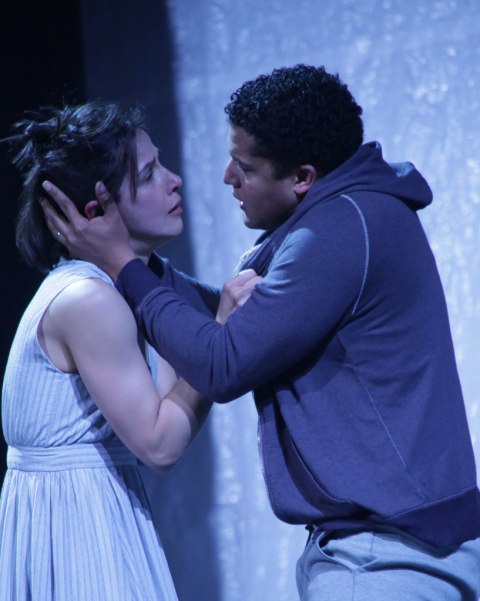
Merritt Janson, Brandon J. Dirden in ‘The Tragedy of Julius Caesar,’ directed by Shana Cooper, Theatre for a New Audience (Gerry Goodstein)
The power and beauty of Portia’s pleas to get Brutus to tell her his secrets lest she only be his “harlet” and not his “true wife” is a standout. Cooper’s astute direction of Portia who reaches behind Brutus to take his knife and give herself the wound which convinces him to “tell all,” is cogent and precise. Merritt Janson and Brandon J. Dirden rock the house in this poignant, well-wrought scene which reveals their love and concern for each other and which also gives credence to why Portia kills herself violently after Brutus flees Rome.

Tiffany Rachelle Stewart, Rocco Sisto in ‘The Tragedy of Julius Caesar,’ directed by Shana Cooper (Henry Grossman)
Likewise, the love and concern expressed in the bath scene between Calphurnia and Caesar is well thought out and delivered. We are heartened that Calphurnia has discovered a “face-saving” way to convince Caesar not to go to the senate. But all ends in the exchange between proud Caesar and Calphurnia after she is foiled by the clever Decius (an exceptional Barret O’Brien who is on point throughout this high energy scene as well as before and after the assassination). She wilts like a dead flower as Caesar chides her for his caving in to her fears; and at that moment, Caesar is a dead man unless he accepts the truth of warnings of the Soothsayer and Artemidorus.
Calphurnia’s angry cry after Caesar’s death in waving the bloody scarf at her husband’s corpse is the perfect acting choice. Indeed, how many times do wives correctly advise their husbands who ignore them only to be proven right after it is too late? If Caesar had only listened to her, she would not be staring down at his mangled body, mourning him.

Jordan Barbour, Tiffany Rachelle Stewart, Rocco Sisto, ‘Tragedy of Julius Caesar,’ directed by Shana Cooper, Theatre for a New Audience (Gerry Goodstein)
Cooper’s staging of the conspirators around Caesar before and during the assassination is enlightened and sizzles with power. A brilliant touch which may rankle traditionalists is that Antony brings Calphurnia to Caesar’s funeral so she may respond, with anger, remorse and tears. It is the epitome of logic that reveals Antony’s character and foreshadows the future. She is one more prop that Antony uses to manipulate the crowd to such mutiny that in the next scene they beat to death a poor innocent poet (Armando McClain) in an amazingly choreographed scene.
The direction of the ensemble and principals throughout the first part of the play creates tension and engagement with great purpose in elucidating themes. For example as Antony works his mischief to stir the crowd to bloodshed so “mothers will but smile when they see their sons quartered…” Cooper has Caesar rise with the help of Calphurnia and walk off. This is prodigious direction/staging. Symbolically, we understand that Caesar’s spirit has been evoked/resurrected by Antony to roam the land seeking vengeance in the capture or death of the conspirators and all those in concert with them. This ghost of Caesar threads through to the final Acts and foreshadows Caesar’s haunting Brutus at various times and finally when he appears in Brutus’ tent and embraces him before the disastrous battle of Philippi.

Rocco Sisto, Brandon J. Dirden in ‘The Tragedy of Julius Caear,’ Theatre for a New Audience (Henry Grossman)
The last acts of Julius Caesar have been characterized as throw-away. Not so in this production which has streamlined and strengthened them. The argument between Brutus and his once close friend now “enemy” Cassius, Matthew Amendt (Cassius) and Dirden (Brutus) deliver with power. As Cassius, Matthew Amendt’s portrayal is spot-on, though at times I felt he could project more. This is not the conniving Cassius we witnessed in the first act. Amendt’s Cassius is hurting, disturbed, humanized. On the other hand, Brutus has become a bellicose emotional lightening rod. As the two quarrel, we empathize with Cassius and then we discover why brutish Brutus is attacking his former close friend, now fellow soldier.

(L to R): Matthew Amendt, Brandon J. Dirden, ‘The Tragedy of Julius Caesar,’ Theatre for a New Audience (Henry Grossman)
Cooper avoids the problems with the last acts also by consolidating characters to keep the character list leaner than the original play. She also exemplifies and symbolizes how the spirit of vengeance and war range against each other in stylized battle scenes which are exceptionally choreographed by Erika Chong Shuch with the ensemble in modern army camouflage and make-up.
These scenes especially heighten the excitement, tension and energy. Also, they manifest and represent the sheer adrenaline expended during wartime. The fact that Cooper uses no blood or physical violence is symbolic more of the spirit of war that seems eternally present in every era. In their actions the ensemble steps in unison, in their arm, hand, leg movements and gestures in military fashion without weapons.

Stephen Michael Spencer, Matthew Amendt (prone) in The Tragedy of Julius Caesar,’ (Henry Grossman)
The overall effect is frightening in what it suggests, the fierce will and hot determination to war against one’s countrymen who were once brothers/colleagues. The lighting effects are exceptional thanks to Christopher Akerlind especially in these scenes. The music and sound are portentous.
The bloody assassination scene is contrasted with the stylized battle scenes which have no direct physical contact or blood. The pivotal character is Caesar, a god. Stabbed thirty-three times, he bleeds; no other character does. Symbolic parallels are drawn between animals sacrificed to predict the future, or gain favor with the gods or heal a nation. The contrasts and irony emphasized in this Tragedy of Julius Caesar are dire; the republic is not healed, but destroyed with his bloodletting. And the bloodless fighting of the ensemble indicates that the spirit of power domination, and war as an effective tool of “dominion” is integral to human society and must be checked through wise governance.

Julian Remulla, Brandon J. Dirden in ‘The Tragedy of Julius Caesar,’ Theatre for a New Audience (Henry Grossman)
Caesar is the sacrifice. By the time his spirit of vengeance has consumed all who would stand in the way of peace, 100 senators are dead, even the most rational and erudite Cicero. And his vengeance won’t be finished until Octavius (the martial Benjamin Bonenfant) purges his enemies and becomes Caesar Augustus. (Emperor Augustus decreed August 15 should be celebrated as his festival Ferragosto. From that time to this, all Italy closes down to celebrate.)
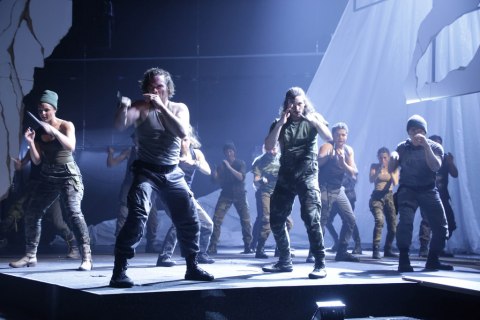
The company of ‘The Tragedy of Julius Caesar’ (Gerry Goodstein)
The production concludes with the stylized choreography and the comments that Brutus killed for the good of Rome. But Cooper’s staging makes clear that the killing will continue. Thematically, we acknowledge that the spirit of war, political intrigue and vengeance will carry through Augustus’ reign and beyond.
Cooper’s production best highlights Shakespeare’s inherent prophecy that war and assassination as political exigencies are perhaps inevitable. The show which runs until April 28th is a must-see for its daring risks that shake tradition, elucidate new concepts and provide exciting, vibrant theater. You can purchase tickets to The Tragedy of Julius Caesar which runs with one intermission at the Polonsky Shakespeare Center (Ashland Place Brooklyn, NY) by CLICKING HERE.
‘Ain’t Too Proud, The Life and Times of the Temptations’ is Just WOW!
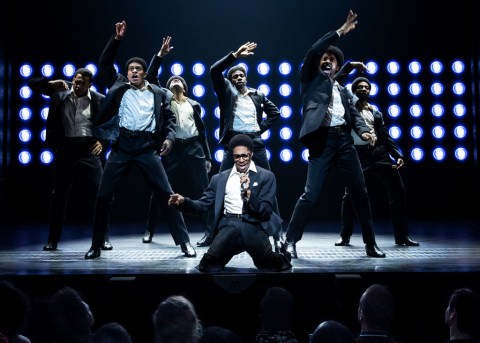
Ephraim Sykes (kneeling) and the cast of ‘Ain’t Too Proud’ (Matthew Murphy)
At the Imperial Theatre for 2 and 1/2 hours, there are musical numbers and dance moves that will so send you into the realms of the fabulous, I doubt you will want to come down to earth. The magic, history, poignance and joy displayed by the production company creatives of Ain’t Too Proud, are bar none. The show is one of the best on Broadway.
Special accolades go to Des McAnuff for his seminal direction and staging and Sergio Trujillo for choreography. But the rising glory must land on the actors and ensemble responsible for the breathtaking portrayals of the “Classic 5 Temptations,” Derrick Baskin (as Otis Williams) James Harkness (as Paul Williams) Jawan M. Jackson (as Melvin Franklin) Jeremy Pope (as Eddie Kendricks) and Ephraim Sykes (as David Ruffin), not the least of which include those portraying the additional Temps. These are just fantastic, the “stuff that dreams are made of.”
By the conclusion of Ain’t Too Proud, I felt like I had spent time with loving family who passed, but for a moment were returned to me by an act of grace so I might delight in the music of a pivotal time in the tumultuous 1960s. Brought back to life by the astute genius and prodigious talents of the performers, one more uniquely magnificent than the other, each manifested the perfection of golden-voices and harmonies synced to fluid gestures.
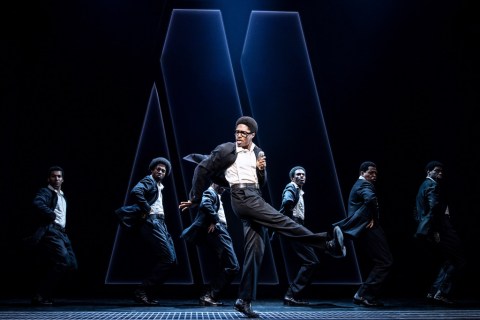
Christian Thompson, Saint Aubyn, Ephraim Sykes, Jeremy Pope, Derrick Baskin, and Jawan M. Jackson in ‘Ain’t Too Proud, directed by Des McAnuff (Matthew Murphy)
The story of The Temptations in Ain’t Too Proud (book by Dominique Morisseau based on the The Temptations by Otis Williams with Patricia Romanowski) is crucial to understanding our country’s vitality in progress through grinding work and sacrifice. And it is a reminder of how the human spirit can strive in the face of prejudice and discrimination to overcome and burgeon into greatness. The production highlights the personal sacrifice it took to be world renown, as Otis (Derrick Baskin) reveals very poignantly at the conclusion what happened in his life and in the lives of each of the “Classic 5.” And it is a story of possibilities, forgiveness and reconciliation.
Most importantly, Ain’t Too Proud is the chronicle of two individuals who united in a vision to transform The Elgins into The Temptations and ultimately crossover artists who would be play in London and other cities off US shores. Founder/organizer/creative genius in his own right, Otis Williams was the “engine who could.” He is still going strong as the last of the “Classic 5.” He is still creating and has established the 24th iteration of The Temptations whose name he owns. The other individual is Berry Gordy. He is the maverick, genius promoter, visionary of the Motown label who had more hits and strategies up his sleeve than Houdini (one of them was songwriter Smokey Robinson of The Miracles) coupled with an acute sense of the historical and cultural timing to create his own brand of
When Williams and Gordy met in the men’s room of a place where Gordy was scouting talent, Williams introduced himself and lightening struck. R & B, and the future of soul was indelibly made and both men’s destiny as well as the destiny of black people in our nation was shaped forever by these two future Rock and Roll Hall of Famers: Gordy in 1988, Williams in 1989 as a Temptation.

The cast of Broadway’s ‘Ain’t Too Proud (Matthew Murphy)
Motivated by money and the example of Civil Rights leaders like Martin Luther King Jr., Gordy understood that one way to best racism was through music. He helped to make those who sported the Motown label (The Supremes, The Miracles, The Temptations, The Commodores, Marvin Gaye, and so many more) ambassadors of good will. This was during a time when there was little good will to be had because of racial divisions and bigotry especially from those who embraced generational hatreds fomented by the Southern planter class. Jim Crow had even filtered to the North with redlining neighborhoods separating communities into wholly white or wholly black.
The planter class who lost their lucrative “peculiar institution” along with their place of gentrified greatness after the Civil War, whipped up the discriminatory sentiments of economically impoverished or working class whites. These wealthy brainwashed whites to believe they shared a common heritage in being “white.” The irony was, none of the wealthy ever sat down to eat with the economically challenged whites or associated with them in the same society or culture. They were kept far away in the “low rent districts” on the other side of the railroad tracks near the town dumps or sewage treatment plants.
When Gordy has the Temptations tour parts of the South and their bus is shot at and nearly stopped (if it had been they wouldn’t have made it to the next day) we see the extent of the Jim Crow hatreds. These echoes from the past unfortunately have currency for us today. The show reminds us that we have progressed, but must remain steadfast with what has been accomplished, which certainly The Temptations and Berry Gordy’s incredible vision helped to achieve.
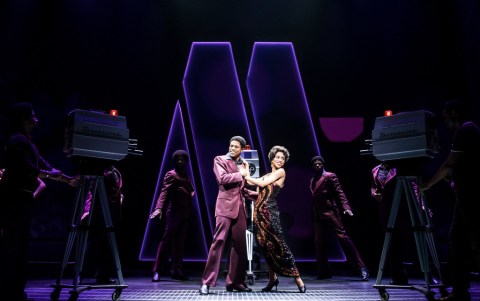
Jeremy Pope and Candice Marie Woods (center) and the cast of ‘Ain’t Too Proud,’ directed by Des McAnuff (Matthew Murphy)
Ain’t Too Proud’s book by Dominique Morrisseau is based on the book The Temptations by Otis Williams with Patricia Romanowski. The show features the music and lyrics from “the legendary Motown Catalog.” These elements plus the grist and hard work to bring them together in one ineffable, miraculous meld make this a sensational production. As I walked out after the standing ovations, I saw folks still sitting in the audience either chatting excitedly or just staring off in delighted appreciation in awe at what they had just experienced.
What makes this such a sterling production is that the incredible performances of the “Classic 5” (Baskin, Harkness, Jackson, Pope, Sykes) are brought to life singing favorites in the chronological order of their growth and evolution. Otis Williams (Baskin) narrates this development, and we follow him as he leads us through the arc of their glory to become the #1 stars of the Motown label. The songs are recognizable. Some favorites include “Baby Love,” “Ball of Confusion” “For Once in My Life,” “Get Ready,” “If You Don’t Know Me by Now,” “My Girl.” As Otis (Baskin is just gobsmacking as he weaves the threads through to the present day) relays each event in their various lives, we see the parallels with the appropriate songs.
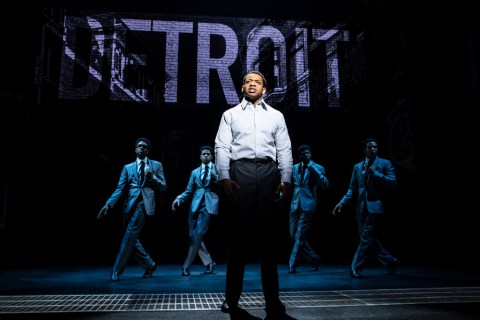
Ephraim Sykes, Jeremy Pope, Derrick Baskin (forground) Jawan M. Jackson, and James Harkness in ‘Ain’t Too Proud,’ directed by Des McAnuff, book by Dominique Morisseau, based on the book ‘The Temptations’ by Otis Williams with Patricia Romanowski (Matthew Murphy)
So special is this song selection that pegs the songs to the emotional resonance of the group’s life situations! When we hear the backstory or see the dynamic of their personal relationships, the songs vibrate with energy and transcendence. This is powerfully effected with “Cloud Nine,” “I Wish It Would Rain,” “What Becomes of the Brokenhearted,” and “War.”
Another thrilling element of the production is its retrospective of the 1960s, and how through the reflection of music, our culture and history changed forever. Music and transformation was mirrored during the 1960s movements, The Civil Rights and Peace Movements, as well as the Cultural and Sexual/Gender Revolution. The songs parallel, symbolize and manifest that time. Their lyrics and beauty, however, are for all time.

(L-R) Derrick Baskin, Jawan M. Jackson, Jeremy Pope, James Harkness, and Ephraim Sykes (front) in ‘Ain’t Too Proud,’ directed by Des Manuff (Matthew Murphy)
The director Des McAnuff folds in The Temptations’ viewpoints about Detroit’s unrest, Martin Luther King’s assassination and the rise of drugs which were flooding college campuses and spreading like a flood in all parts of the music scene. The film clips and projections of the Detroit riots, the marches, the King Jr. assassination are integral to the story of the Temptations.
Primarily, the show is a loving encomium for the “Classic 5” Temptations who were the founders of the original chart-busting group. It is also a reveal about how the genius of Motown and the transcendent talents of these five prodigiously hard-working performers shaped cultural attitudes against racism and prejudice at a time when the South was still lynching blacks, and when assassinations of Malcolm X, the Kennedys and Martin Luther King Jr. rocked the nation, fomenting profound sadness and hopelessness.
Through all of it, is the ineffable sound of this group and its add-ins as some left and others came back. After a decade out on their own, Kendricks (Pope) and Ruffin (Sykes) returned to perform. All the while The Temptations soared to Top 100 charts and even bested The Supremes’ position at Motown. Their music was the golden thread that transformed national attitudes toward race and reinforced that as citizens we can be decent. The Temptations drew opposing sides away from polar extremes. They encouraged that the shared love of R & B can take us beyond division and hatred.
Special kudos go to Orchestrations by Harold Wheeler and Music Direction and Arrangements by Kenny Seymour. Recognition also goes to Robert Brill (Scenic Design) Paul Tazewell (Costume Design) Howell Binkley (Lighting Design) Steve Canyon Kennedy (Sound Design) Peter Nigrini (Projection Design) and other creatives whose collaborations make the production a smash hit out of the park.
Ain’t Too Proud is at The Imperial Theatre (249 West 45th Street). This must-see show runs with one intermission. For tickets go to their website by CLICKING HERE.
‘Kiss Me Kate,’ Kelli O’Hara is a Lustrous, Assertive Kate in Roundabout’s 2019 Revival
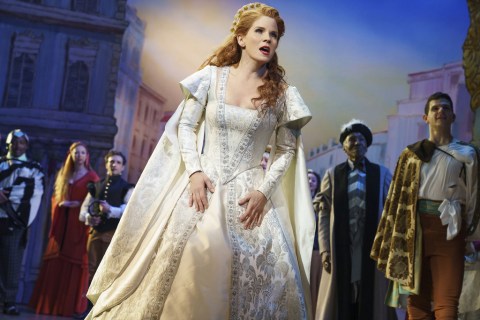
Kelli O’Hara and the company of ‘Kiss Me Kate,’ 2019 Roundabout Revival music by Cole Porter, book by Sam and Bella Spewack, directed by Scott Ellis, choreography Warren Carlyle, music direction by Paul Gemignani (Joan Marcus)
Keeping in mind the importance of women’s progress during our current retrograde throw-down of conservative political churlishness, Roundabout’s Kiss Me Kate revamps misogyny and turns it on its head in this ingenious 2019 Broadway revival that leaves audiences cheering and wanting more.
Specifically, that is more of the gorgeously orchestrated Cole Porter music/songs interpreted with soulfulness, energy and vibrance by multi-talented artisan-actors; more of Choreographer Warren Carlyle’s physically pyrotechnical, gravity-defying dance numbers with a few finger-snapping, staccato tapping jazz bits slid in-between; more of the stylized old-style musical tenor and atmosphere that relaxes and massages us into a pleasant two hour reverie, especially after a few logical tweaks to enhance plot relevance; just more!
This is an exhilarating production that soars, reaches to the heavens and by the conclusion, sets us back down with the fun of its whimsical, good will and twerking tidbits of political grist in the form of a general and allusions to the Truman/Dewey presidential race. Cast principals and ensemble, good shepherd-director Scott Ellis, and Paul Gemignani’s music direction have all found their synergy together in a delightful meld. The production does not promise to be anything but what it is, entertainment joy with dollops of well-placed wisdom and irony with currency (the joke about guns). Wisely, dare you ask for “anything more” in a time of chaotic political imbroglios? Hardly.

The Company of ‘Kiss Me Kate,’ 2019 Roundabout Revival directed by Scott Ellis, Music by Cole Porter, Book by sam and Bella Spewack (Joan Marcus)
The book has been lightly delivered from its gender awkwardness by Amanda Green’s added material, but the ironic, farce in substance remains. Sam and Bella Spewack’s play within a play structure features the Bard of Avon’s notorious satire of Italian machismo and subversive “femininity” framed by a divorced theatrical couple’s real-life story parallel. Indeed, truth is stranger than fiction when the zany hi-jinks of actress Lilli Vanessi and her ex-husband producer Fred Graham attempt to tame each other’s egos while staging their theater come-backs in a Baltimore production of Taming of the Shrew.
Drawn to each other like moths to flames, they know how to allure and provoke their best and worst aspects in the name of “the show must go on” until it can’t, then does at the point of a gun. In this both Kelli O’Hara and Will Chase find a superb stride together, especially during the reminiscences of their former relationship in “Wunderbar” and the remembrance of love which dies hard for Lilli in “So in Love,” which Kelli O’Hara sings with poignance, grace and open-throated, sonorous glory.
It is one of the high points of O’Hara’s portrayal as Lilli, echoed by the refrain sung by Will Chase’s Fred when Lilli leaves him and the show to marry General Howell (a fine Terence Archie). She claims she wants to end her theater career to be General Howell’s demure, passive hausfrau as he campaigns for Vice-president on the Republican Dewey ticket. However, once a Diva, never a hausfrau!

Kelli O’Hara, Will Chase in ‘Kiss Me Kate,’ 2019 Roundabout Revival, directed by Scott Ellis (Joan Marcus)
There are role upheavals and flipped switches. Lilli discovers Fred’s mistress machinations in a misunderstanding which turns into another betrayal of her abiding love for him. But where she may have once played the victim during their divorce, she steps into empowerment during the production of Shrew. And this prompts Lilli to become his equal while giving Fred his comeuppance during a very physical and hysterical tit-for-tat, kick-for-slap sequence as they enact the wooing scene between Katharine and Petruchio in Shrew before an unwitting, live, Baltimore audience. (us)
The ironies of the play within a play structure are just great. For example in the “violent” wooing scene which turns very real between Lilli and Fred, their “in-the-moment” spontaneity with loads of improvisation is an actors’ dream come true. Lilli and Fred are keeping their portrayals of Katharine and Petruchio fresh and alive which helps to make the Baltimore production of Shrew a hit that even thugs enjoy. The New York audience doing double-duty as the 1940s Baltimore audience cracks up being in on the humorous uptake between Lilli and Fred who pummel each other as Kate and Petruchio.
Chase and O’Hara’s acting skills explode causing a LOL laugh riot. The scene is marvelous and deeper than one might imagine for the double-take on reality and acting. O’Hara and Chase act Lilli and Fred, acting Katharine’s and Petruchio’s spontaneous, improvised reactions to each other as they go off script. They must “act” spontaneous and “moment-to-moment” and of course O’Hara and Chase do, manifesting their character’s anger from within, without pushing for laughs. This is exceptional work made to appear “easy.” It is not! Coupled with their unparalleled vocal instruments, their songs together are superb.

Kelli O’Hara, Will Chase, 2019 Roundabout Revival ‘Kiss Me Kate,’ music by Cole Porter, Sam and Bella Spewack (book) directed by Scott Ellis (Joan Marcus)
Altogether, the song and dance numbers are fabulous Cole Porter. Act I musical numbers which are standouts include the scenes from Shrew particularly those that take place in The Market Square in Padua. “Tom, Dick, or Harry” is a sexual dance romp with suggestive moves that are hysterically ingenious emphasizing “grinds” on the word “Dick.” Singing and dancing are just super with Stephanie Styles, Corbin Bleu, Will Burton and Rick Faugno. Their use of a bench as a dance prop over which they become airborne, absolutely astounds. Their balletic leaps mirror Olympic- style athleticism. Just gobsmacking choreography which Styles, Bleu, Burton and Faugno sail through. I was exhausted watching them.
Kelli-Lilli-Katharine’s “I Hate Men” resonates as does Will-Fred-Petruchio’s “Were Thine That Special Face.” As Lilli, who portrays Katharine, gradually confronts the mistakes she made with Fred, she expresses this learning in Katharine’s “I Hate Men.” Meanwhile, Fred notes this new Lilli and once more is entranced with her which he evidences through Petruchio’s “Were Thine That Special Face.” Chase and O’Hara reveal how their Shrew roles impact the evolution of Lilli’s and Fred’s characters on a deeper level which will eventually bring them closer by the conclusion. Their development is subtle character change; look for it. Loved it!
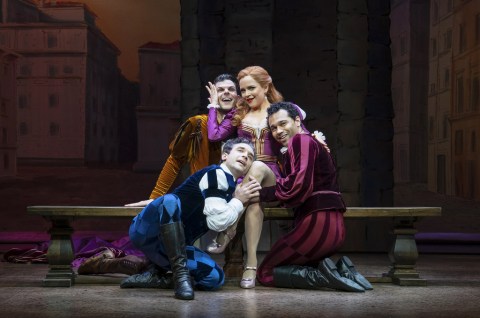
(Clockwise from the bottom): Rick Faugno, Will Burton, Stephanie Styles, Corbin Bleu in ‘Kiss Me Kate,’ 2019 Roundabout Revival, directed by Scott Ellis (Joan Marcus)
Meanwhile, the show must go on, but which show? The one in front of the curtain or the more fascinating one behind the curtain? Then, BAM! There is no curtain/separation between the principals acting Shrew and their real lives, a hazard of the theatrical profession. Making “all the world a stage” even sweeps up the thugs (the excellent John Pankow and Lance Coadie Williams) who come to collect a gambling debt that Bill Calhoun (the wonderful Corbin Bleu who is triple-threat incredible) pawns off on Fred.
In a clever twist to keep the thugs at bay and Lilli from leaving the production, Fred has them don Shrew costumes and accompany Lilli everywhere on stage in the hope the show will go on and the thugs will take the Box Office in payment for the gambling losses. When they and the entire cast conclude Act I with the rousing and funny “Kiss Me Kate,” (O’Hara’s solo aria and the shooting of piccolo-bird are adorable) they too get in on the act, gun-a-blazing, feathers flying as the curtain falls
Though Act II begins with the incongruous “Too Darn Hot,” (when it is hot, no one wants to move) the dance/song number is so spectacular that the realm of the fantastic takes over. Corbin Bleu leads the dance team and then taps down the house with his unparalleled energy and brilliance. The Porter music is sultry, the acrobatic dance and tap number so sweep up the audience, beauty arrives. It is this ensemble’s highpoint number in the play, among the many sterling numbers. Despite the heat/movement incongruity, the singers/dancers’ investment in strutting their wares with every fiber of their physical and emotional well being, just overwhelms. Sensory enjoyment evaporates one kind of “heat” and supplants it with another, excitement.

The company of ‘Kiss Me Kate,’ 2019 Roundabout Revival (Joan Marcus)
In Act II, Fred/Petruchio’s “Where Is the Life That Late I Led” reveals the duality inherent in Fred’s change-over to eventually accept that he loves Lilli and regrets their break-up and her leaving forever. This becomes clear when Fred takes advantage of the General’s stereotyping of women by demeaning Lilli behind her back in a last ditch attempt to keep her near him in the show.
We dislike the General’s misogyny and his referral to the future Mrs. General Howell as “the little woman.” Of course Fred already sees the handwriting on the wall for Lilli’s upcoming disastrous marriage to the General. Indeed, Lilli is her “own person” which the General will force her to reorient to himself as his career will overshadow hers. He, not she, is the star of the country. The scenes between the General and Lilli point up the dichotomy between the theatrical life and the “helpmeet” life the General requires.

(L to R): John Pankow, Will Chase, Lance Coadie Williams in ‘Kiss Me Kate,’ directed by Scott Ellis (Joan Marcus)
The fabulous “From This Moment On,” is performed by Lilli and the General with energetic, almost frenetic confidence. Lilli sings with determination that she is leaving the theater to be the wifely ambassador for the General’s campaign. Fred looks on with skepticism. O’Hara’s interpretation belies that she isn’t convinced that marrying the General is the right move, though the General is completely clueless, a harbinger of their relationship. Does she or doesn’t she? You’ll just have to see the production if you are unfamiliar with Kiss Me Kate.
Special mention must be given to the following numbers which were audience favorites: “Bianca” featuring the memorable talents of Corbin Bleu as Bill with the ensemble beautifully supporting him, and “Brush Up Your Shakespeare” with the erudite thugs played by John Pankow and Lance Coadie Williams instructing the Baltimore/NYC audience about what a boon Shakespeare’s works/words/poetry is to impress. Both songs are crowd pleasers, choreographed, staged, performed exceptionally.
The scenic design by David Rockwell featuring the backstage brick wall leading to the dressing rooms, quaint warmly glowing lighting (Donald Holder’s varied Lighting Design is super) and back alley all lead to ready identification with the dancers and actors who become family by the end of the show. The dressing rooms are attractive and functional and the sets for Taming of the Shrew are painted in light pastel whimsy which contrasts with the dark backstage brick alley of Baltimore theater reality. Even the Shrew curtain including the credits designed by producerGraham is well thought out.
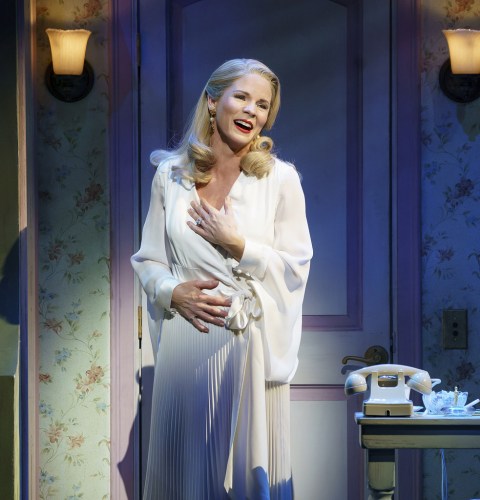
Kelli O’Hara in ‘Kiss Me Kate,’ 2019 Roundabout Revival, directed by Scott Ellis (Joan Marcus)
There is a savvy alignment with the wittiness of the show, as well as the divergences in the lives of the ensemble, the principals and the fantasies they create as artists. The costumes (Jeff Mahshie) likewise, are gorgeous, appropriate, piquantly colorful, from star dressing gowns to Italian city-state fashions of the wealthy Baptista and friends, and wooing Petruchio. The Hair and Wig Design is no less masterful.
Finally, one number “Always True to You in my Fashion” by Stephanie Styles (with a dumb blonde, Judy Holiday, upper register voice) as Lois Lane, I thought slipped past the gender update. The song “boasts” stereotypical tropes of the gold-digger, the girl with lucre on her mind and in her heart. Lois Lane is an opportunist who makes her way from wealthy men to pursue acting. She has an affair with Fred to land a part in the show and is his occasional plaything that upsets Lilli.

Will Chase in ‘Kiss Me Kate,’ 2019 Roundabout Revival, directed by Scott Ellis (Joan Marcus)
Lois Lane (the antithesis of Superman’s reporter love interest) finally ends up with Bill Calhoun (Corbin Bleu) who manages to love her despite her roaming ways (“Why Can’t You Behave,” “Bianca.”). Initially, I found this nymphet sex kitten character who sniffs after money, jewels and wealth, rankling. Then I realized that she uses sex to empower herself and the duped men fall weakly for it every time, it seems, except for Bill who’s poor. Even presidents have fallen prey to such clever women and embarrassed themselves. Indeed, she is integral to this revival and is perhaps the longest living female character type in the history of womankind.
This 2019 revival of Kiss Me Kate runs with one intermission and is just “too damn good” to miss, especially if you adore the voices of the principals Kelli O’Hara and Will Chase and the breathtaking dance talent of Corbin Bleu. The updates make sense and are appreciated as is the reaffirmation that farce and the fantastic are good like a medicine. The production runs until 2nd June.
‘The Cake’ Directed by Lynne Meadow, at Manhattan Theatre Club

Debra Jo Rupp in ‘The Cake,’ directed by Lynne Meadow, written by Bekah Brunstetter at MTC (Joan Marcus)
The Cake written by Bekah Brunstetter is a deliciously humorous look at love and prejudice with twists that harken back to the Supreme Court ruling which sided in favor of Masterpiece Cakeshop which refused to to bake a cake for a gay couple. The setting is not Colorado, however, it is North Carolina, and there is a similar response about baking for a gay couple.
Indeed, one of the themes of The Cake touches upon the current backlash by religious groups against the LGBTQ community and gay marriage. However, by the conclusion the playwright reinforces that love and decency can drive out divisiveness and bigotry, leading to mutual respect among groups with divergent orientations and beliefs.
Della (Debra Jo Rupp) owns her own bakeshop and is a fabulous baker of confections, specialty cakes, cupcakes, cookies and other desserts, all of which she bakes from scratch in her shop in Winston-Salem, North Carolina. As she introduces herself with her sunny, sociable and sweet personality, we recognize why she selected this particular business to showcase herself.
Dessert baking is fun. Cakes and confections are feel good, comfort foods in a state that is less concerned about waist-lines and more concerned about family gatherings and get togethers. A cake will satisfy as the crowning glory of any party and Della’s recipes are unique and fabulous.
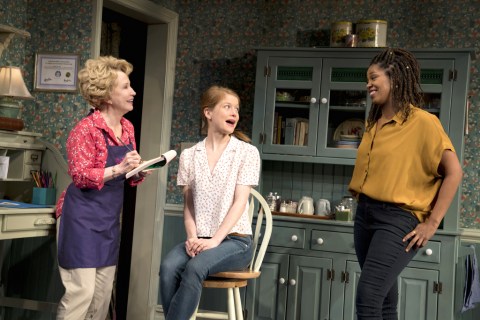
(L to R): Debra Jo Rupp, Genevieve Angelson, Marinda Anderson in ‘The Cake,’written by Bekah Brunstetter, directed by Lynne Meadow for MTC (Joan Marcus)
Furthermore, Della is not timorous about sharing her recipes because most people who ask for them don’t follow them to the exact drop of liquid or sift of dry ingredients. Della affirms that’s why her cakes are so delectable. When she bakes the cakes that she has crafted for greatness, she follows the recipe directions and comes out with beauty every time. She further endears us in this opening sequence when she tells a customer that she is going to be a contestant and compete with others on The Great American Baking Show, the most watched baking show on CBS.
Debra Jo Rupp is a joy to watch, as she takes every line in this opening sequence and makes it her own with spontaneity, authenticity and sincerity, so that we long to taste a piece of her wonderful cake and feel the love vibrating from her. If mom baked and cooked with love, surely Della does the same. She is so affable and winning, we are completely taken in by her hospitality. We forget that she lives in the south, has lived there her whole life and most probably and at the least harbors residual racism and bigotry or at best is in a state of confusion like a good part of the southern United States regarding the LGBTQ community which cannot be reconciled with their religious beliefs.
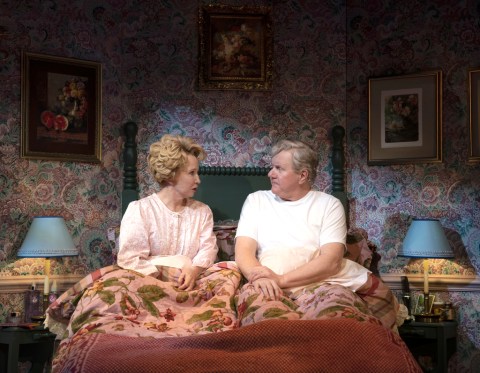
Debra Jo Rupp, Dan Daily in ‘The Cake,’ directed by Lynne Meadow, written by Bekah Brunstetter for MTC (Joan Marcus)
However, the worm turns soon enough when Northerner Macy, a lovely black journalist enters the shop. During the course of the conversation, Macy turns down a taste of Della’s cake and goes into a rant about the food industry putting sugar in everything to addict consumers who are getting so fat that childhood obesity and diabetes are at the highest rates ever in the history of the nation. Immediately, we understand that beneath the lovely bakery confections there is an underlying toxicity and harm to one’s health. Macy has shaken us awake and alerted us that perhaps Della is a bit too sugary for our Northern sensibilities.
When the conversation continues and Della claims she is not concerned about politics but just concerned with her cakes, Macy comments: “Isn’t ambivalence as evil as violence?” Bam! We get the alarming picture. As a typical Southern woman who votes as her husband tells her and doesn’t think about the hypocritical values of Christianity rejecting a woman’s right to choose while obviating all responsibility toward children beyond the fetus stage, Della’s love charms appear to ring hollow. We wonder, where does she stand with her love if not in support of children and her baking?
Macy’s loaded, thematic-laden remark ratchets their communication into an embarrassing stalemate: Della leaves to check on her pineapple upside down cake and Macy oogles the piece of cake Della cut for her to try, but doesn’t touch it. Clearly, Della and Macy are at opposite ends of the political and religious spectrum and never the twain shall meet. Then Jen enters with a wedding binder to visit her mother’s old friend Della and the play launches off into a number of fascinating, complicated directions that stretch Della’s patience and religion, and hurt Jen’s feelings almost to a breaking point.

(L to R): Debra Jo Rupp, Genevieve Angelson in ‘The Cake,’ written by Bekah Brunstetter, directed by Lynne Meadow (Joan Marcus)
However, clarity, understanding and growth come when Jen discusses why she is who she is and how she has come to make the decision to marry Macy and live with her, despite Macy’s father’s censure and opprobrium. When Jen and Macy ask Della to bake their wedding cake for them and attend their party, Della’s husband, in typical “good ole boy” fashion, puts his foot down as the man of the house.
Though Della attempts to get around him, he remains steadfast. Taking her cues from her deep conversation with Jen about being a woman, Della attempts to ignite the fires that once burned in Tim’s heart. Indeed, it is obvious that Jen’s and Macy’s conversations with Della have touched a growth nerve and this in uncovers the flaws in her marriage with Tim.
Della is forced to sift herself and reconfigure a new recipe of care and concern with her husband and her daughter’s friend Jen. It is in her desire to be a good, decent person that we discover where Della’s love and heart is as she works things out with her husband and reconsiders her religious beliefs. Her love which is rooted deep grows toward becoming more open-minded.
The Cake is a compact, well-written, beautifully acted, sensitive play that resonates with vitality for our time. Marinda Anderson as Macy portrays the lucid, flexible and mature womanly partner of the equally sensitive and hopeful, upbeat Jen. As Jen Genevieve Angelson, measures beat for beat Anderson’s well-thought-out depiction.
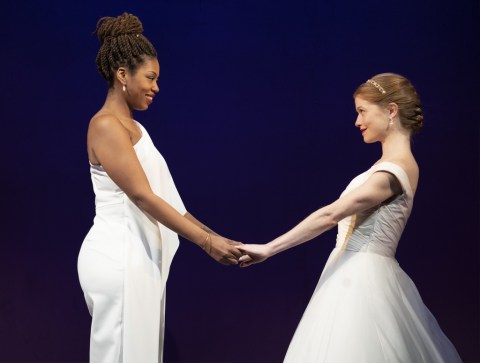
Marinda Anderson, Genevieve Angelson in ‘The Cake,’ written by Bekah Brunstetter, directed by Lynne Meadow (Joan Marcus
Dan Daily as Tim, Della’s husband, is both jarring in his domineering attitude, then later loving and humorous in his sensitivity toward his wife. The section where he reveals the issue that has been undermining his confidence in their relationship is excellent. Debra Jo Rupp’s Della is particularly poignant when she tries to engage with Tim and he is incapable of responding and tells her so. This is a wonderful lay up to the surprisingly humorous event which occurs between them later in the play.
Lynne Meadow’s sterling direction keeps the pacing and the humor alternating in time with the quiet, thoughtful powerful moments. These moments underscore the themes about how to bridge the gaps in our viewpoints when friendships are at stake. The artistic elements and revolving set design serve the importantly intimate scenes between Tim and Della and Jen and Macy. Allowing us to view their relationships, we note there isn’t much difference regarding the couples as they attempt to further their understanding and love of each other. I was particularly heartened by the portrayal of Tim and his love for Della. Whether in straight or gay hearts, love abides with need. And this results in the uplifting and satisfying conclusion of The Cake.
Special kudos to John Lee Beatty for his superb scenic design (too bad there were no real cakes there, but at the bar the night I saw the production, there was a vanilla cake). And kudos to Tom Broecker for Costume Design (the wedding outfits are perfect), Philip S. Rosenberg for Lighting Design, John Gromada for Original Music and Sound Design and Tommy Kurzman for Hair, Wig & Makeup Design.
This is a winning production that you will enjoy. It runs with no intermission for 90 minutes at the Manhattan Theatre Club’s New York City Center Stage 1 (131 West 55th Street between 6th and 7th). For tickets CLICK HERE.
 CAROLE DI TOSTI