Blog Archives
These ‘Fallen Angels’ are Beautiful, Starring Rose Byrne and Kelli O’Hara
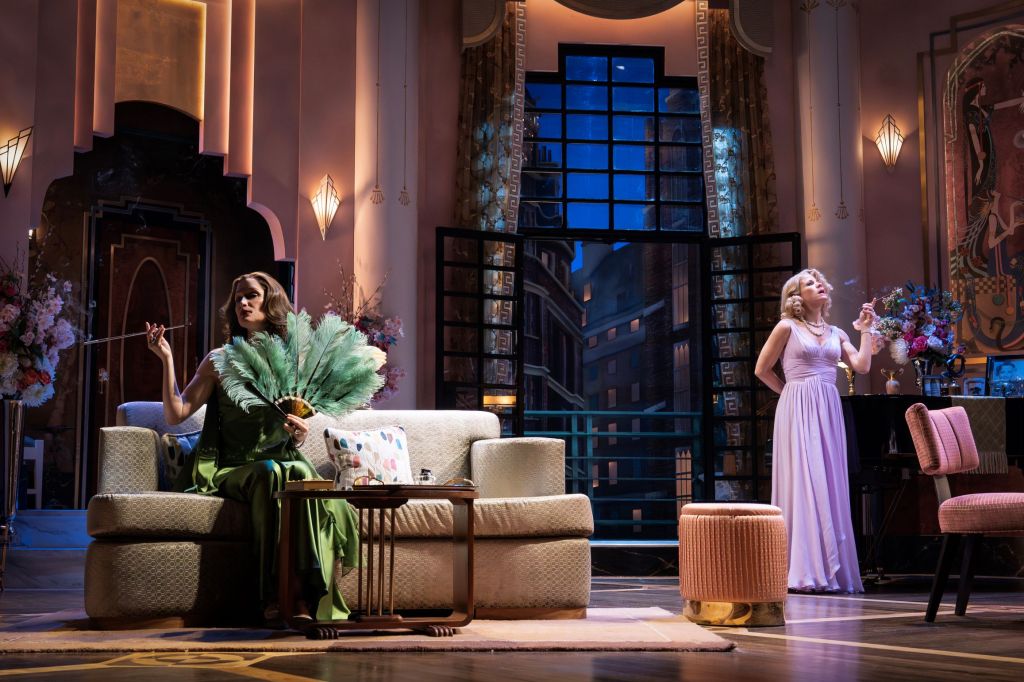
When Noël Coward’s comedy Fallen Angels was first performed in London, an official who was a censor in the Lord Chamberlain’s office denied its license because the married female characters had licentiously cavorted in premarital sex and planned to commit adultery. Only until the Chamberlain personally intervened, was the hilarious, slapstick comedy given its license and performed.
Far from being an “unpleasant play,” as critics suggested in 1923, Coward’s early work reveals his ingenious wit and love of turning situations on their heads. In this, Julia Sterroll (Kelli O’Hara) and Jane Banbury (Rose Byrne), riotously turn to alcohol to get up the courage to see Maurice, an old beau both were madly in love with at different times. When their affairs with Maurice ended, they married spouses who were the opposite of their lover and settled down. But the aftershocks of their love are very much ever present and cause the old friends to be jealous of one another, which they keep just under the surface of their close relationship. Then the “green-eyed monster” rears its ugly head when Maurice announces he is coming to visit them turning their settled lives inside out with riotous consequences. Fallen Angels is currently spreading its joyous, madcap delight at the Todd Haimes Theater through June 7, 2026 in a limited engagement.
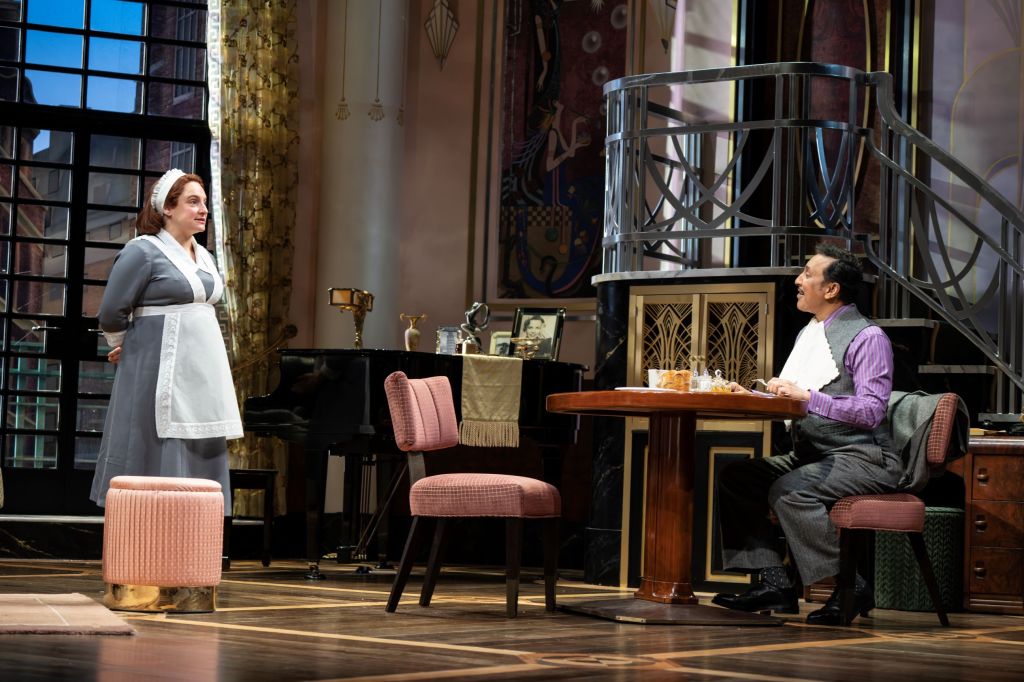
O’Hara’s Julia and Byrne’s Jane are left to their own entertainments when husbands Fred (Aasif Mandvi) and Willy (Christopher Fitzgerald) go off on an overnight golf outing. After a relaxed breakfast with Fred before he leaves for golf, Julia brings up a divorce reported in the papers. With this theme of the end of love announced, Julia tells Fred she loves him but is not in love with him, Fred avers. His ego is upset that the passion and sex have gone out of the relationship, and companionship has taken its place as Julia suggests. Coward has cleverly set up the farcical conceit which he will play upon with wit, whimsy and alcohol, throughout the comedy because as it turns out, Jane feels similarly about her husband Willy.
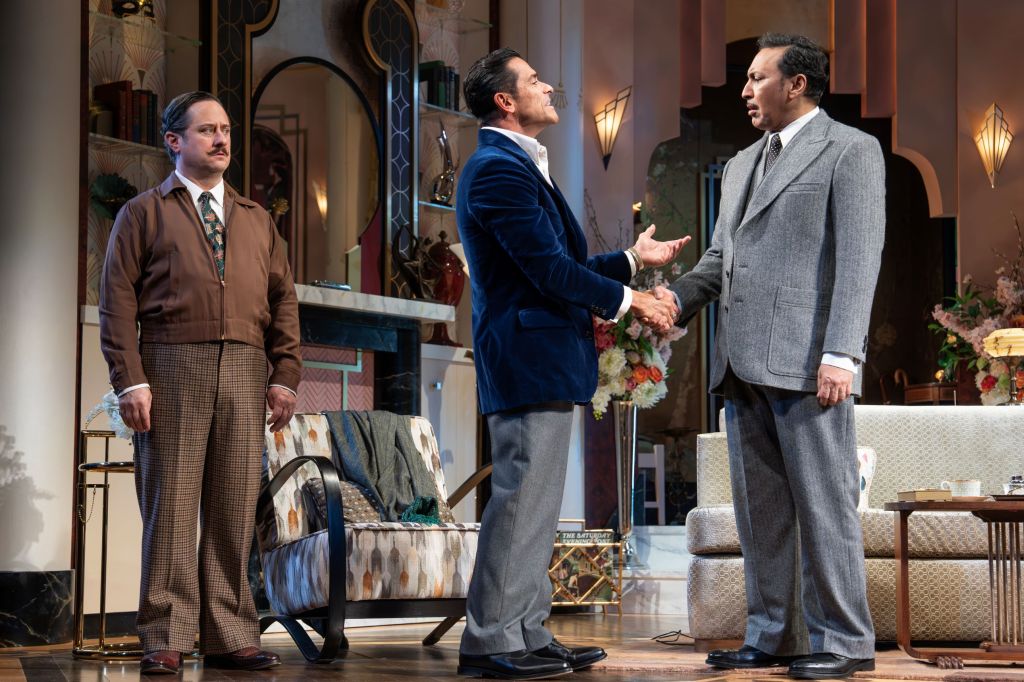
Are the women teasing their spouses or are they serious about Julia’s suggestion she is not in love with Fred and Jane’s presentment that disturbs Willy? Clearly, the men don’t feel the same and still love their wives, they believe, and passionately. And why not? O’Hara ad Byrne are lovely. On the other hand their husbands, thanks to hair and make up by David Brian Brown and Victoria Tinsman, are not gorgeous Leo DiCaprio types to swoon over. They have aged and are not their wives physical equivalents.
Not only is this a casting coup, by director Scott Ellis, it ridicules a patriarchal, cultural more in relationships and marriage about what is appropriate. It is incumbent upon lovely women to pretend that average looking men are “sexy” and “attractive,” if they have money and status. Clearly, the money and status are the alchemy that transforms the men’s looks. Also, clearly, Julia and Jane are younger than their husbands, another more that Ellis’ casting takes a swipe at.
After all, a wealthy older man with money is not to be seen with a status-downer, i.e. a fat, older woman (sorry, this is the psycho culture). The younger, more beautiful the woman he is with (eye candy), the more the average-looking man’s status and attractiveness increases. Of course the absurd end result of this is one-sided. Heaven forbid, if women practice the same and seek out younger men or more attractive men around their age as Maurice is. Abomination! Ellis takes advantage of these unspoken cultural folkways and enhances Coward’s wit because of his choice of the attractive TV persona he casts to play Mauice Duclos, their old flame, who is to- die-for-adorable in comparison to their husbands. He causes the fallen angels to fall more quickly and deeper into the abyss of “shame.”
Julia and Jane have married up for money. They have most probably compromised and settled for Fred and Willy, though if the situation was right, they easily would have gone with Frenchman Maurice if he proposed. Their husband’s wealth and status are revealed from their lifestyles, thanks to David Rockwell’s set design, a lovely Art Deco apartment with a balcony, large paintings, columns, appointments, and an eye-popping chandelier.
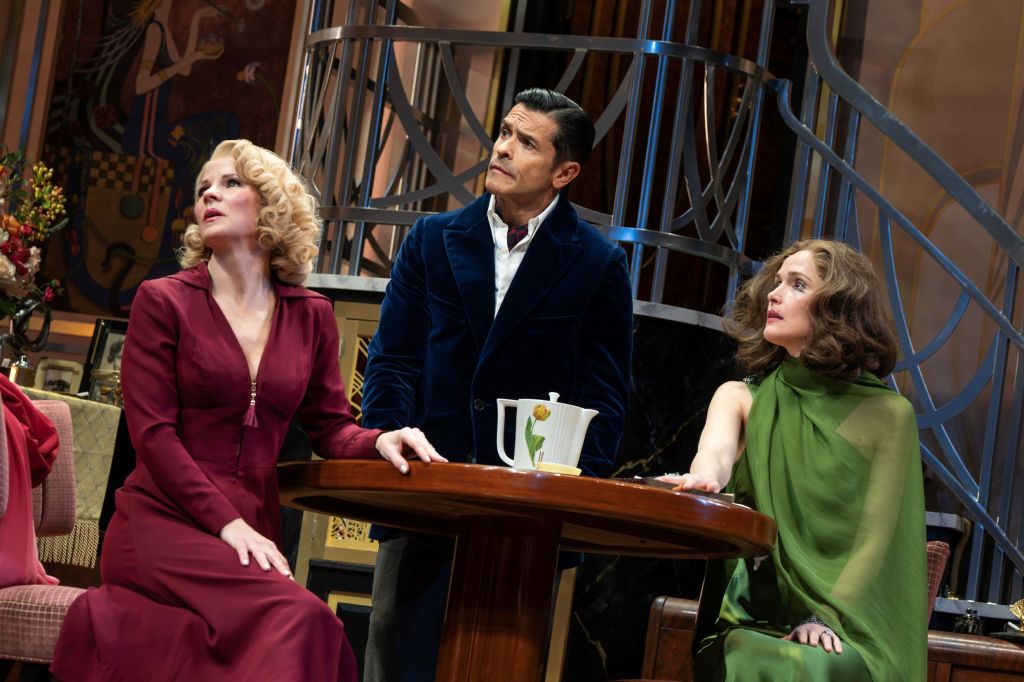
Their period costumes, dressing gowns, street clothes, evening gowns and accessories, designed by Jeff Mashie, show their personalities and economic status. Only Byrne could wear the deep emerald green, silky, long gown to cavort around in and look totteringly-elegant as the champagne, wine and cocktails wreck her balance. O’Hara’s pratfalls include sliding belly-front down a flight of stairs in a lavender gown with cinched waist and chiffon, floor-length skirt. She is beyond riotous. Both are dressed to the nines after having blown up their imaginations with expectation of the passion to come with their former lover.
Saunders (Tracee Chimo), their prodigiously qualified and hyperbolically talented servant bests then at every turn of a glass of alcohol. Chimo’s Saunders, a new hire, is smashing in the role of the foil, the straight woman whose sincerity at showing up the “angels” with her knowledge of piano, opera, languages, her prior appointments to exotic places, her infinite talents, and her expertise as a chef and efficient servant is breathtaking. Saunders deserves every tuppence she makes and reveals she is five times more accomplished than the leisure trad wives Jane and Julia who, by comparison, are useless toys, perishing of boredom. Chimo’s Saunders also has preternatural hearing and anticipates where Jane and Julia are going, a function of her job, which they find annoying because all they discuss is Maurice. Indeed, Saunders must not hear them go on and on. This sets up more Coward wit when the women change the subject to outrageous topics to throw off Saunders’ sniffing out their over-the-moon conversation about Maurice’s visit, which they fear will never come and must get drunk to salve their over-excited imaginations at the mere thought of him.
The mayhem and gradual explosion of their drunken riot is beautifully timed, staged and wrought. Byrne and O’Hara are world-class comedians.
The hilarity really explodes after the set up when the women wait for their beloved Maurice to appear before dinner, singing his praises, and drinking, and singing his praises during dinner, and drinking, and singing his praises, and drinking after dinner. As they drink, eat and swoon over Maurice, they are interrupted by phone calls which drive them to more drink because everyone but Maurice calls. Finally, even they become overwrought with their own fantasies and turn against each other, the jealousy manifesting. Jane stumbles and storms out. Julia is beside herself thinking Jane is meeting Maurice behind her back which ratchets the excitement and wild comedy toward the heavens.
Who will calm the situation down? Not the husbands. In shock at Jane’s treason Julia spills the beans to Willy, who conveniently shows up moments after Jane huffs out. He questions where his wife is. At the height of the chaos, when Fred and the wayward, back-stabbing Jane return, there’s another twist. The two women unite to fawn off their husbands’ probing queries about their antics. It is then that Coward, perfectly read by Scott Ellis, reveals the pièce de résistance. In walks the stunning Maurice, every inch the living fantasy brought to life in Mark Consuelos, who is having the time of his life. The audience was thrilled to see him. Indeed, he is Julia’s and Jane’s equivalent, but not for marriage, for love and passion.
Interestingly, the implication is that neither Julia or Jane would be adverse to a ménage à trois, if the situation wandered in that direction. Coward suggests this inherent possibility at the conclusion when Jane and Julia follow Maurice upstairs to see his apartment. (Ironically, he has moved into their building.) This most probably was another unspoken reason why the British censor withheld the comedy’s license. Seventy years later since Fallen Angels appeared in the U.S. the play has found its moment.
Fallen Angels runs 1 hour 30 minutes with no intermission at the Todd Haimes Theater though June 7, 2026. roundabouttheatre.org.
‘Days of Wine and Roses,’ Truthful, Poignant, a Stunning Triumph

Alcohol is different from other addictive drugs. It’s a part of our culture and integral to events around professional and social situations. It’s legal and easy to purchase. But for those who can’t “live” without it, alcohol is both a blessing and a curse. Days of Wine and Roses currently at Atlantic Theater Company until July 16th encapsulates the joy and emotional horror of the drinking disease. The production is a complicated, profound, assailable to the senses, cathartic must-see.
Adam Guettel’s music and lyrics spin out the anatomy of alcoholism in the dynamic of a couple’s relationship. The couple, portrayed by the exceptional Kelli O’Hara and Brian d’Arcy James, are forced to confront their psychological weaknesses manifested by their alcoholism. Guided by Craig Lucas’ book, Guettel relays the extremes of euphoric addiction and its impact on the emotions of the characters with his expressionistic score and lyrics that appear to be lighthearted and lyrical but mirror undercurrents of desperation and loneliness.

Lucas nails down Joe and Kirsten’s alcohol dependent relationship dynamic with precision and poignancy. He carries it through to the point when d’Arcy James’ Joe Clay comes to the end of himself. Out of love he waits and hopes for O’Hara’s Kirsten to want to recover from alcoholism. This uncertain state promises to usher in a long, hard wait for Kirsten to admit she is ill and needs help.
Directed by Michael Greif, Days of Wine and Roses is a journey of devolution and evolution that displays the characters’ emotions of exuberance, sorrow, unforgiveness, self-discovery, redemption, self-annihilation, humiliation and love. Above all, it reflects the tragedy and joy of human experience, either confronting one’s individual consciousness or running from it, until one finally acknowledges that they must change or kill themselves.

Based on the titular 1958 teleplay by JP Miller and the 1962 Warner Bros. film, the musical is produced by special arrangement with Warner Bros. Theatre Ventures. Importantly, once again it brings together the successful Lucas and Guettel team who created The Light in the Piazza. Kelli O’Hara, who sang the lead in that Broadway production, encouraged this project.
Key to understanding this musical that is set in 1950 and lightly references the cultural mores of the time (sexism and paternalism) is that Alcoholics Anonymous’ 12 step program (never named) identifies alcoholism as a disease and not just a “drinking problem.”

The production frames how Joe and Kristen’s love blossoms with their drinking. It acutely underscores that the disease elevates their mood and pleasure centers (“There I Go,” “Evanesce” “As the Water Loves the Stone”) with pernicious allurement. Indeed, it is the linchpin to how they initially become involved with each other and why Kristen refuses to stay with Joe and her daughter after he combats his illness by meeting with other alcoholics to stop his self-destructive patterns.
The characters’ dynamic is emphasized when they meet at a business party on a yacht in the East River. A nondrinker, Kristen eschews alcohol. On the other hand Joe persists in getting her to be his drinking buddy. She resists him and his advances because she doesn’t like the taste of alcohol nor his smarmy, belittling, fake PR patter and persona.

It is only when she upbraids him and he apologizes for “starting off on the wrong foot” that she relents and suggests they leave. Her honesty and authenticity charm Joe and allow his better self to emerge. Together at a quiet restaurant, they discover qualities in each other that they can appreciate and adore.
As they establish a friendship, Joe introduces her to a Brandy Alexander (she loves chocolate) and she discovers her subsequent enjoyment of the buzz it gives her. This drink and others draw her to Joe as they gradually become boozy partners, who “in their continual high,” eventually marry and have a daughter, despite her father’s (the excellent Byron Jennings) disapproval and distrust of Joe. She and Joe have made a commitment to each other. Determined, O’Hara’s Kirsten will not allow her father Arensen to sway her from establishing a family with her lover and partner in drinking.

As Kirsten, Kelli O’Hara creates a complex portrayal of a woman whose drinking subterfuge eventually splits open her soul weakness after seven years of marriage and taking care of their daughter Lila (Ella Dane Morgan). Covertly, she sneaks drinks as she completes household chores and plays with Lila. O’Hara’s “Are You Blue,” “Underdeath and “First Breath” (the latter sung with Morgan’s Lila) reveal the roiling undercurrents of unhappiness and her attempts to deal with depression as the absent Joe, who works in Houston, barely keeps himself functioning at a job that requires he drink to entertain clients.
Brian d’Arcy James’ vibrant, alcohol-alluring, loving Joe allows her to take the lead, while he cleverly introduces her to a new world of drinking, fun and happiness. He draws her to him and maintains their closeness and joy, but such adventures are always fueled by alcohol. Initially, like any disease that manifests slowly, they convince themselves they are in control and live together as a successful family.

However, all is upended the seventh year of their marriage. A spectacularly destructive circumstance set off by Kirsten’s alcohol blackout destroys what they have built together (conveyed fearfully thanks to Lizzie Clachan’s sets, Ben Stanton’s lighting and Kai Harada’s sound). As their family spirals downward, their only hope of rehabilitation lies under her father’s condemning watchfulness, when they plead for his help and he gives them food, shelter and work in his greenhouse business.
The arc of their destruction is born out of their compulsions, one of which is their susceptibility to the pleasure of alcohol, the other, the belief they can ignore their desire to harm themselves and each other as addicts.

After months of sobriety, Joe breaks down, buys alcohol and offers it to Kirsten (“Evanesce” reprise), then goes completely “off the rails” (“435”) looking for a bottle he has hidden in the greenhouse. In anger at himself for his weakness and fury in not finding the bottle, he becomes rebellious. Turning against his judgmental father-in-law who has given them a chance, Joe destroys the greenhouse that Arnesen has made into a profitable business. When he finds the bottle, he drinks himself unconscious and lands on his back in the hospital on the brink of death.
Kirsten and Arnesen refuse to believe this is a disease that has no cure except through a way provided by a volunteer who is also an alcoholic, Jim Hungerford (David Jennings). Jim belongs to an association of alcoholics who understand that the only path away from the disease is through meetings, readings and the community of others who need each other’s help and camaraderie. Arensen dismisses Joe’s attempt at reconciliation and recovery. He bans Joe from his presence as an evil influence. The family are on their own in a dingy apartment as Joe allows himself to be helped by Jim while Kirsten refuses to admit she needs help and rejects Jim’s offers.

The apex of their relationship involved the ecstasy of alcohol. Kirsten appeals to Joe’s love and the remembrance of the fun they had (“Morton’s Salt Girl”) with a soft shoe in salt poured on the floor, created by Sergio Trujillo and Karla Puno Garcia. The song attempts to rekindle the magic when they enjoyed being drunk together. However, Joe’s eyes have been opened and Jim’s voice resides in his heart with the growing strength that he can conquer his illness. Sadly, Kirsten interprets this as rejection and a killing off of their love. She criticizes Joe for making her feel ashamed of herself and victimizing her with guilt and pain.
As Joe affirms his confidence that he can change to Jim in the powerful “Forgiveness” Joe and Lila cling to each other and KIrsten eventually stays with her father whose judgment, though problematic, is better than the humiliation and weakness she feels around Joe, who is passionate about healing and recovering. Now Joe’s love in sanctimony drives her away.

Days of Wine and Roses is poignant and current for our time, taking us beyond the beautiful period costumes by Dede Ayite and hair design by David Brian Brown. Kelli O’Hara is affecting and brilliant. Her operatic, rich and plaintiff voice in the concluding songs elicits our empathy. Her aloneness and sorrow at losing her partner to sobriety is intensely human and real. Her rejection of Joe’s help and love beyond the haze of alcohol is frightening.
Brian d’Arcy James is superb in reveling the nuances of determining his own confidence to overcome his addiction. Yet, he mines Joe’s attempt to balance the authenticity of being happy with his sober self with his love for Kirsten without their alcohol infusions. Together these amazing actors bring home the production leaving the audience with a confluence of feelings that will not be easily forgotten.
Kudos to the ensemble and the technical creatives and Greif’s direction and vision. With additional kudos to music director Kimberly Grigsby, Adam Guettel’s orchestrations and Jamie Lawrence’s additional orchestrations.
Days of Wine and Roses runs one hour and forty-five minutes with no intermission. For tickets and times go to the Atlantic Theater Company website https://atlantictheater.org/production/days-of-wine-and-roses/
‘Kiss Me Kate,’ Kelli O’Hara is a Lustrous, Assertive Kate in Roundabout’s 2019 Revival
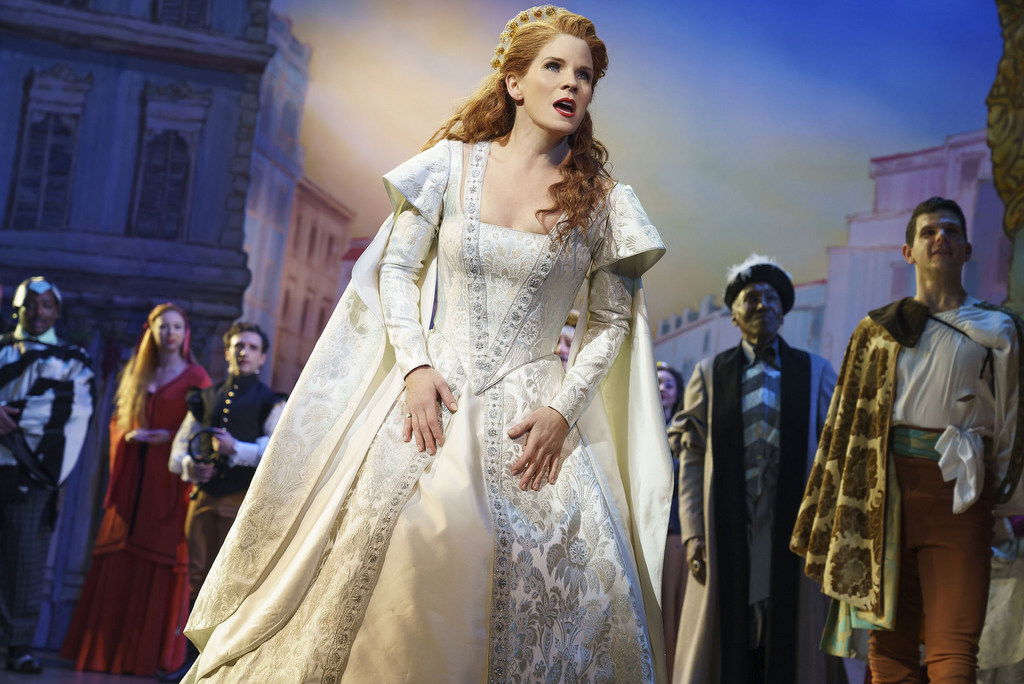
Kelli O’Hara and the company of ‘Kiss Me Kate,’ 2019 Roundabout Revival music by Cole Porter, book by Sam and Bella Spewack, directed by Scott Ellis, choreography Warren Carlyle, music direction by Paul Gemignani (Joan Marcus)
Keeping in mind the importance of women’s progress during our current retrograde throw-down of conservative political churlishness, Roundabout’s Kiss Me Kate revamps misogyny and turns it on its head in this ingenious 2019 Broadway revival that leaves audiences cheering and wanting more.
Specifically, that is more of the gorgeously orchestrated Cole Porter music/songs interpreted with soulfulness, energy and vibrance by multi-talented artisan-actors; more of Choreographer Warren Carlyle’s physically pyrotechnical, gravity-defying dance numbers with a few finger-snapping, staccato tapping jazz bits slid in-between; more of the stylized old-style musical tenor and atmosphere that relaxes and massages us into a pleasant two hour reverie, especially after a few logical tweaks to enhance plot relevance; just more!
This is an exhilarating production that soars, reaches to the heavens and by the conclusion, sets us back down with the fun of its whimsical, good will and twerking tidbits of political grist in the form of a general and allusions to the Truman/Dewey presidential race. Cast principals and ensemble, good shepherd-director Scott Ellis, and Paul Gemignani’s music direction have all found their synergy together in a delightful meld. The production does not promise to be anything but what it is, entertainment joy with dollops of well-placed wisdom and irony with currency (the joke about guns). Wisely, dare you ask for “anything more” in a time of chaotic political imbroglios? Hardly.
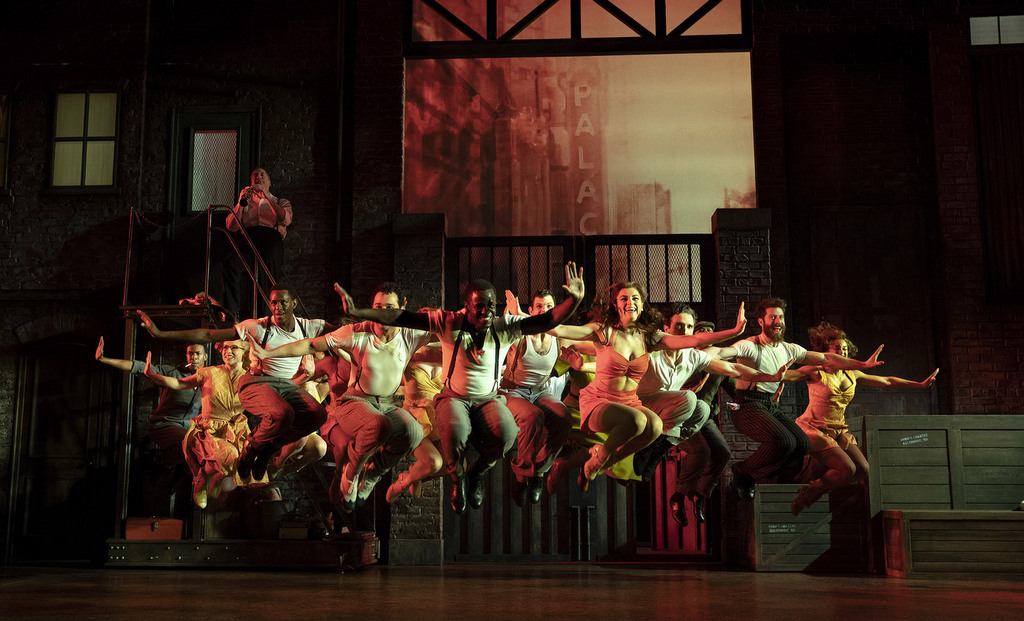
The Company of ‘Kiss Me Kate,’ 2019 Roundabout Revival directed by Scott Ellis, Music by Cole Porter, Book by sam and Bella Spewack (Joan Marcus)
The book has been lightly delivered from its gender awkwardness by Amanda Green’s added material, but the ironic, farce in substance remains. Sam and Bella Spewack’s play within a play structure features the Bard of Avon’s notorious satire of Italian machismo and subversive “femininity” framed by a divorced theatrical couple’s real-life story parallel. Indeed, truth is stranger than fiction when the zany hi-jinks of actress Lilli Vanessi and her ex-husband producer Fred Graham attempt to tame each other’s egos while staging their theater come-backs in a Baltimore production of Taming of the Shrew.
Drawn to each other like moths to flames, they know how to allure and provoke their best and worst aspects in the name of “the show must go on” until it can’t, then does at the point of a gun. In this both Kelli O’Hara and Will Chase find a superb stride together, especially during the reminiscences of their former relationship in “Wunderbar” and the remembrance of love which dies hard for Lilli in “So in Love,” which Kelli O’Hara sings with poignance, grace and open-throated, sonorous glory.
It is one of the high points of O’Hara’s portrayal as Lilli, echoed by the refrain sung by Will Chase’s Fred when Lilli leaves him and the show to marry General Howell (a fine Terence Archie). She claims she wants to end her theater career to be General Howell’s demure, passive hausfrau as he campaigns for Vice-president on the Republican Dewey ticket. However, once a Diva, never a hausfrau!
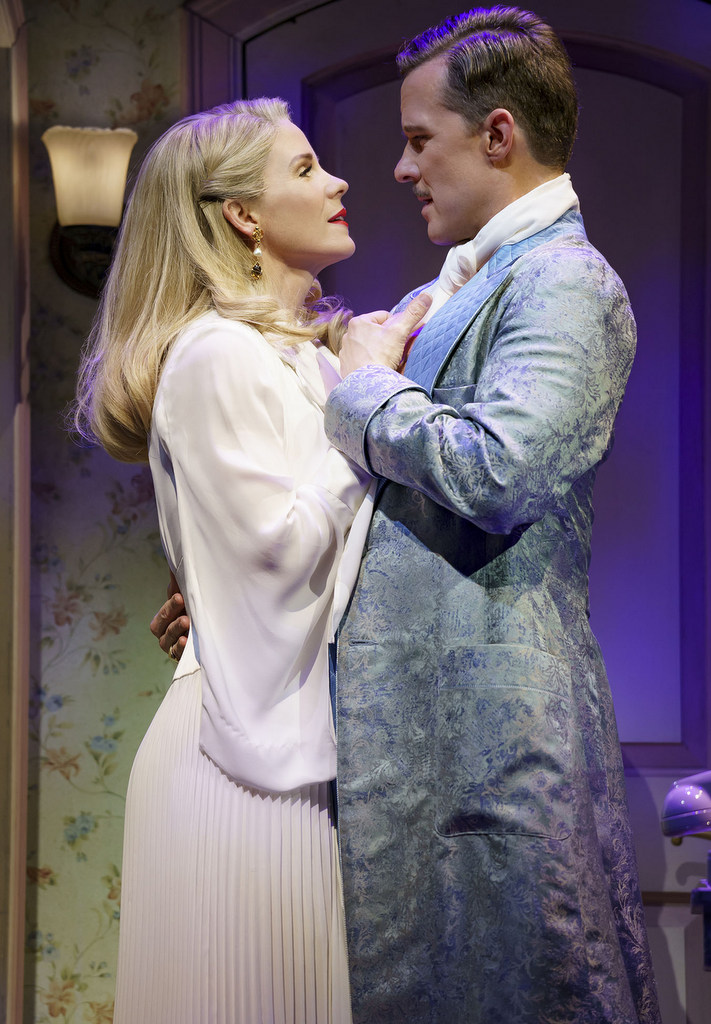
Kelli O’Hara, Will Chase in ‘Kiss Me Kate,’ 2019 Roundabout Revival, directed by Scott Ellis (Joan Marcus)
There are role upheavals and flipped switches. Lilli discovers Fred’s mistress machinations in a misunderstanding which turns into another betrayal of her abiding love for him. But where she may have once played the victim during their divorce, she steps into empowerment during the production of Shrew. And this prompts Lilli to become his equal while giving Fred his comeuppance during a very physical and hysterical tit-for-tat, kick-for-slap sequence as they enact the wooing scene between Katharine and Petruchio in Shrew before an unwitting, live, Baltimore audience. (us)
The ironies of the play within a play structure are just great. For example in the “violent” wooing scene which turns very real between Lilli and Fred, their “in-the-moment” spontaneity with loads of improvisation is an actors’ dream come true. Lilli and Fred are keeping their portrayals of Katharine and Petruchio fresh and alive which helps to make the Baltimore production of Shrew a hit that even thugs enjoy. The New York audience doing double-duty as the 1940s Baltimore audience cracks up being in on the humorous uptake between Lilli and Fred who pummel each other as Kate and Petruchio.
Chase and O’Hara’s acting skills explode causing a LOL laugh riot. The scene is marvelous and deeper than one might imagine for the double-take on reality and acting. O’Hara and Chase act Lilli and Fred, acting Katharine’s and Petruchio’s spontaneous, improvised reactions to each other as they go off script. They must “act” spontaneous and “moment-to-moment” and of course O’Hara and Chase do, manifesting their character’s anger from within, without pushing for laughs. This is exceptional work made to appear “easy.” It is not! Coupled with their unparalleled vocal instruments, their songs together are superb.
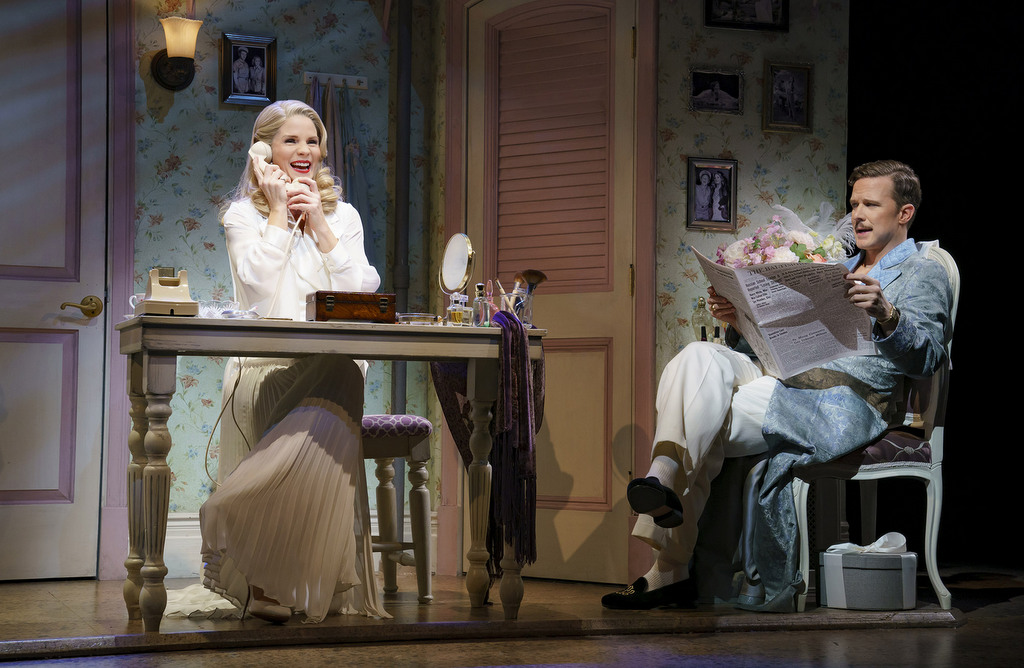
Kelli O’Hara, Will Chase, 2019 Roundabout Revival ‘Kiss Me Kate,’ music by Cole Porter, Sam and Bella Spewack (book) directed by Scott Ellis (Joan Marcus)
Altogether, the song and dance numbers are fabulous Cole Porter. Act I musical numbers which are standouts include the scenes from Shrew particularly those that take place in The Market Square in Padua. “Tom, Dick, or Harry” is a sexual dance romp with suggestive moves that are hysterically ingenious emphasizing “grinds” on the word “Dick.” Singing and dancing are just super with Stephanie Styles, Corbin Bleu, Will Burton and Rick Faugno. Their use of a bench as a dance prop over which they become airborne, absolutely astounds. Their balletic leaps mirror Olympic- style athleticism. Just gobsmacking choreography which Styles, Bleu, Burton and Faugno sail through. I was exhausted watching them.
Kelli-Lilli-Katharine’s “I Hate Men” resonates as does Will-Fred-Petruchio’s “Were Thine That Special Face.” As Lilli, who portrays Katharine, gradually confronts the mistakes she made with Fred, she expresses this learning in Katharine’s “I Hate Men.” Meanwhile, Fred notes this new Lilli and once more is entranced with her which he evidences through Petruchio’s “Were Thine That Special Face.” Chase and O’Hara reveal how their Shrew roles impact the evolution of Lilli’s and Fred’s characters on a deeper level which will eventually bring them closer by the conclusion. Their development is subtle character change; look for it. Loved it!
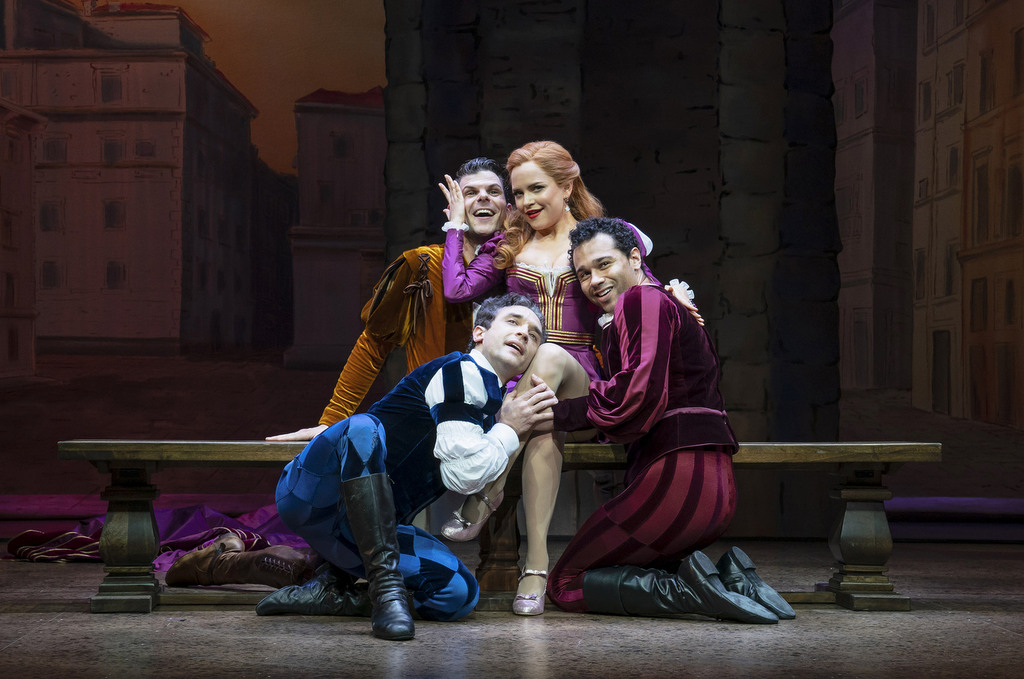
(Clockwise from the bottom): Rick Faugno, Will Burton, Stephanie Styles, Corbin Bleu in ‘Kiss Me Kate,’ 2019 Roundabout Revival, directed by Scott Ellis (Joan Marcus)
Meanwhile, the show must go on, but which show? The one in front of the curtain or the more fascinating one behind the curtain? Then, BAM! There is no curtain/separation between the principals acting Shrew and their real lives, a hazard of the theatrical profession. Making “all the world a stage” even sweeps up the thugs (the excellent John Pankow and Lance Coadie Williams) who come to collect a gambling debt that Bill Calhoun (the wonderful Corbin Bleu who is triple-threat incredible) pawns off on Fred.
In a clever twist to keep the thugs at bay and Lilli from leaving the production, Fred has them don Shrew costumes and accompany Lilli everywhere on stage in the hope the show will go on and the thugs will take the Box Office in payment for the gambling losses. When they and the entire cast conclude Act I with the rousing and funny “Kiss Me Kate,” (O’Hara’s solo aria and the shooting of piccolo-bird are adorable) they too get in on the act, gun-a-blazing, feathers flying as the curtain falls
Though Act II begins with the incongruous “Too Darn Hot,” (when it is hot, no one wants to move) the dance/song number is so spectacular that the realm of the fantastic takes over. Corbin Bleu leads the dance team and then taps down the house with his unparalleled energy and brilliance. The Porter music is sultry, the acrobatic dance and tap number so sweep up the audience, beauty arrives. It is this ensemble’s highpoint number in the play, among the many sterling numbers. Despite the heat/movement incongruity, the singers/dancers’ investment in strutting their wares with every fiber of their physical and emotional well being, just overwhelms. Sensory enjoyment evaporates one kind of “heat” and supplants it with another, excitement.
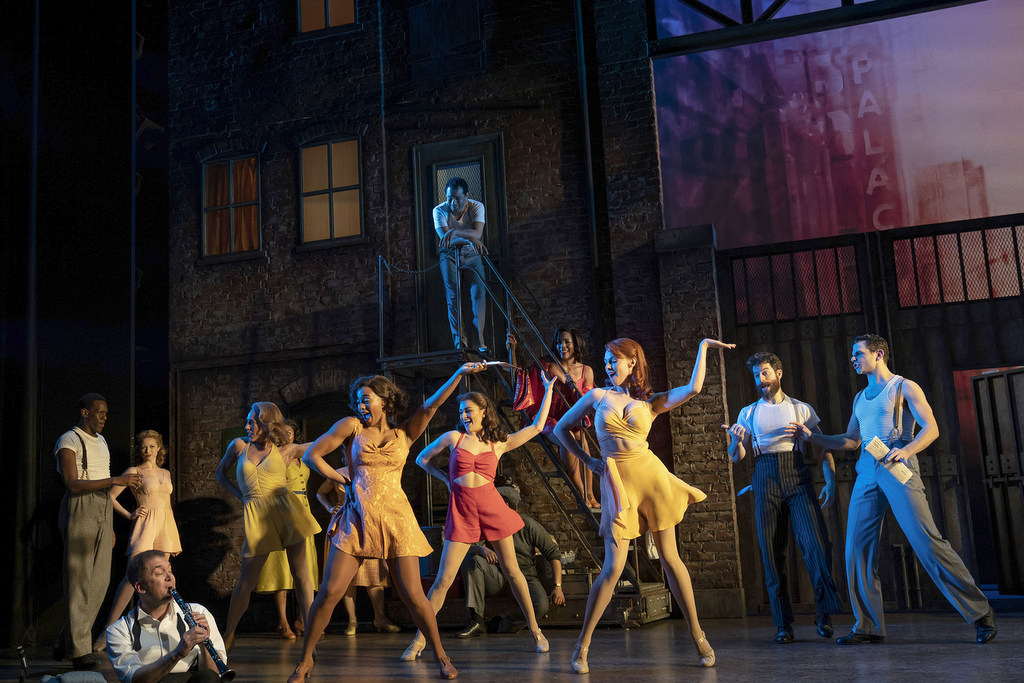
The company of ‘Kiss Me Kate,’ 2019 Roundabout Revival (Joan Marcus)
In Act II, Fred/Petruchio’s “Where Is the Life That Late I Led” reveals the duality inherent in Fred’s change-over to eventually accept that he loves Lilli and regrets their break-up and her leaving forever. This becomes clear when Fred takes advantage of the General’s stereotyping of women by demeaning Lilli behind her back in a last ditch attempt to keep her near him in the show.
We dislike the General’s misogyny and his referral to the future Mrs. General Howell as “the little woman.” Of course Fred already sees the handwriting on the wall for Lilli’s upcoming disastrous marriage to the General. Indeed, Lilli is her “own person” which the General will force her to reorient to himself as his career will overshadow hers. He, not she, is the star of the country. The scenes between the General and Lilli point up the dichotomy between the theatrical life and the “helpmeet” life the General requires.
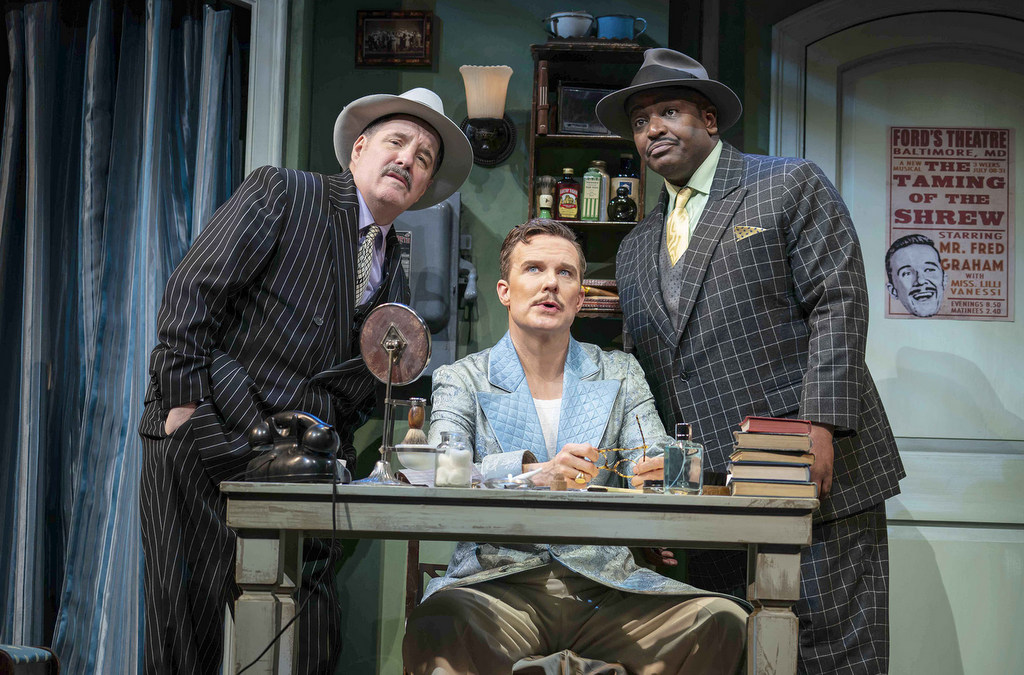
(L to R): John Pankow, Will Chase, Lance Coadie Williams in ‘Kiss Me Kate,’ directed by Scott Ellis (Joan Marcus)
The fabulous “From This Moment On,” is performed by Lilli and the General with energetic, almost frenetic confidence. Lilli sings with determination that she is leaving the theater to be the wifely ambassador for the General’s campaign. Fred looks on with skepticism. O’Hara’s interpretation belies that she isn’t convinced that marrying the General is the right move, though the General is completely clueless, a harbinger of their relationship. Does she or doesn’t she? You’ll just have to see the production if you are unfamiliar with Kiss Me Kate.
Special mention must be given to the following numbers which were audience favorites: “Bianca” featuring the memorable talents of Corbin Bleu as Bill with the ensemble beautifully supporting him, and “Brush Up Your Shakespeare” with the erudite thugs played by John Pankow and Lance Coadie Williams instructing the Baltimore/NYC audience about what a boon Shakespeare’s works/words/poetry is to impress. Both songs are crowd pleasers, choreographed, staged, performed exceptionally.
The scenic design by David Rockwell featuring the backstage brick wall leading to the dressing rooms, quaint warmly glowing lighting (Donald Holder’s varied Lighting Design is super) and back alley all lead to ready identification with the dancers and actors who become family by the end of the show. The dressing rooms are attractive and functional and the sets for Taming of the Shrew are painted in light pastel whimsy which contrasts with the dark backstage brick alley of Baltimore theater reality. Even the Shrew curtain including the credits designed by producerGraham is well thought out.
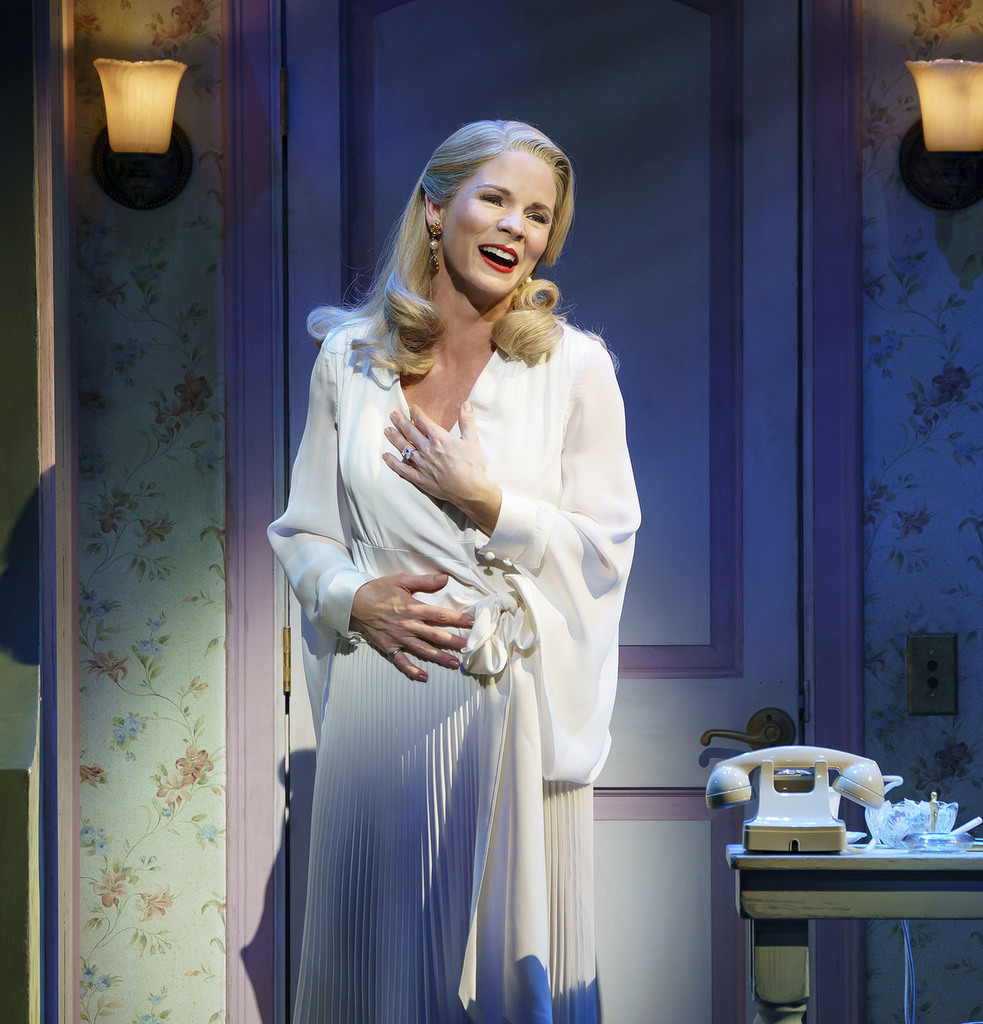
Kelli O’Hara in ‘Kiss Me Kate,’ 2019 Roundabout Revival, directed by Scott Ellis (Joan Marcus)
There is a savvy alignment with the wittiness of the show, as well as the divergences in the lives of the ensemble, the principals and the fantasies they create as artists. The costumes (Jeff Mahshie) likewise, are gorgeous, appropriate, piquantly colorful, from star dressing gowns to Italian city-state fashions of the wealthy Baptista and friends, and wooing Petruchio. The Hair and Wig Design is no less masterful.
Finally, one number “Always True to You in my Fashion” by Stephanie Styles (with a dumb blonde, Judy Holiday, upper register voice) as Lois Lane, I thought slipped past the gender update. The song “boasts” stereotypical tropes of the gold-digger, the girl with lucre on her mind and in her heart. Lois Lane is an opportunist who makes her way from wealthy men to pursue acting. She has an affair with Fred to land a part in the show and is his occasional plaything that upsets Lilli.

Will Chase in ‘Kiss Me Kate,’ 2019 Roundabout Revival, directed by Scott Ellis (Joan Marcus)
Lois Lane (the antithesis of Superman’s reporter love interest) finally ends up with Bill Calhoun (Corbin Bleu) who manages to love her despite her roaming ways (“Why Can’t You Behave,” “Bianca.”). Initially, I found this nymphet sex kitten character who sniffs after money, jewels and wealth, rankling. Then I realized that she uses sex to empower herself and the duped men fall weakly for it every time, it seems, except for Bill who’s poor. Even presidents have fallen prey to such clever women and embarrassed themselves. Indeed, she is integral to this revival and is perhaps the longest living female character type in the history of womankind.
This 2019 revival of Kiss Me Kate runs with one intermission and is just “too damn good” to miss, especially if you adore the voices of the principals Kelli O’Hara and Will Chase and the breathtaking dance talent of Corbin Bleu. The updates make sense and are appreciated as is the reaffirmation that farce and the fantastic are good like a medicine. The production runs until 2nd June.

