Category Archives: NYC Theater Reviews
Broadway,
‘Curse of the Starving Class’ by Sam Shepard at the Signature Theatre

Gilles Geary, Maggie Siff in Sam Shepard’s ‘Curse of the Starving Class,’ directed by Terry Kinney, The Pershing Square Signature Center (Joan Marcus)
Sam Shepard’s Curse of the Starving Class which appeared at the Public Theatre and won an Obie for Best New American Play during the 1976-1977 season, has been revived a number of times and is currently part of the Signature Theatre’s legacy program. Shepard often chronicled his family history weaving themes in and out of his “Family Tragedies.” These include dramas that are dynamic, intimate, intense dark plays: the titular play reviewed here, Buried Child (1979) True West (1980) Fool for Love (1983) and A Lie of the Mind (1985).
These dramas with often searing poetic elements and unusual twists, feature violent, dysfunctional familial relationships which are borderline insane but human. The emphasis on the destructive nerve endings of the human condition makes them sardonic and devastatingly humorous. The characters are representative of us, every-women, every-man despite their demographics. In the inner soul of the individuals, there is the same fear, want, loneliness and partition from their families that make them real, heartfelt and tragic. Their human “ilk,” is horrific yet understandable. Shepard’s characterization logic and Director Terry Kinney’s guidance of the actors to achieve these manifestation in this production are just superb.
In this first of the family series, Curse of the Starving Class, we note how a family rooted in farming and the land in rural California attempts to wrangle with their own emotional and psychological demons that have provided a wayward leading inheritance that they must either overcome or succumb to. Though each has the ambition to improve themselves, like Chekhovian characters who are out of place and time, they harbor their dreams while creating elaborate networks of self-destruction that divert their will and thwart their ability to manifest their goals into realities.

Maggie Siff in ‘Curse of the Starving Class,’ directed by Terry Kinney, written by Sam Shepard (Joan Marcus)
By the time Shepard’s characters amass the will and strength to better themselves, they select the wrong path. All ends in failure. Indeed, their own blood family members sabotage any possibility of their improvement. Worsening the situation the saboteurs explode with resentment-filled, passive aggressive rages that harm and incite the downward-spiraling over and over again.
The drama opens with a catastrophic explosion. The outer structure of the house splits apart. It is a symbolic rendering of an ancient and ancestral lesion that is ever-present in the bloodline of the family and can never be healed because there is no attempt to seek an intervention. This explosion reflects the curse of the family that they choose not to expurgate or exorcise because they don’t know how, nor do they have the tools to stop its cyclical repetition. The breaking apart of the house portends the threatening doom for each of the family members.
The lesion/curse is within each of them and spreads the horrific, hurtful, damage outward and among them. This trip wire provokes the other family members’ sadism and from day to night, torment and abuse infects like a poison (Weston, the father discusses this in a central aria) and destroys everything in its path.
In the family. which has managed to share the same space because they are not there together for one whole hour, there are a mother and father and two teenage children. The younger one is the intelligent Emma. The electric Lizzy Declement gives a performance that develops Emma from hope and contentment to resentment, rage, rebellion and spiritual devolvement. The older sibling is the dutiful Wesley who intends to maintain the farm and keep it a going concern despite the worsening conditions Weston’s addictions create. Wesley and Emma have hopes and dreams, though they do not necessarily include the family.
Emma’s efforts creating a school project indicate that she has ambition and the determination to “be somebody” in her life, if she can ever get away from the nullifying family and farm. After her mother and brother destroy her school project, she runs away on a horse that her mom says is crazy. She returns covered in mud and humiliated desperation. The horse (as emblematic crazy as her family) threw her off and dragged her “through the mud.”

(L to R): Gilles Geary, Andrew Rothenberg, Lizzy Declement in ‘Curse of the Starving Class by Sam Shepard, directed by Terry Kenney at the Signature Theatre (Joan Marcus)
This symbolic action forebodes how the family will treat her for attempting to rise above. After this, she makes negative, impulsive choices which will only exacerbate further damage. She and the other family members are practiced at this circularity, directing their decisions and actions from rage, depression and panic, rather than hope and peace.
Wesley (the dynamic and authentic Gilles Geary) who at the outset of the play and through the second act is trying to repair the door his father bashed in during a drunken, “out-of-control” binging rage-on, cares about the farm, the animals and the security of the family. His assiduous attempt to rebuild the door represents his desire to keep out animal or human interlopers and marauders who would steal from them or usurp the inheritance of the land which father Weston’s alcoholism threatens to encourage.
Weston (the superb David Warshofsky) an alcoholic, cannot lift the farm into thriving, organized prosperity. His relationship with his wife is abusive. Weston emphasizes he is a killer in his descriptions to his son about his role as a bombing pilot during the war. Most probably he is suffering from PTSD, though at the time Shepard wrote the play, this condition of returning combat VETS was never acknowledged. However, his entire destructive, hell-raising, yelling fits indicate he is most likely suffering from it. The culture didn’t help him after the war, and it, along with his negative learned behaviors contribute to the root of his self-hatred, despair and inability to get out from under his depressive, alcoholic malaise and lethargy.
Like the other members of her family the mother Ella (Maggie Siff portrays the mother with nuanced reality) negotiates the tense, hyper-aggressive atmosphere that each of them creates. She augments it by living in the fantasy of selling the property and running away. As her business person who would handle her affairs, she chooses a shyster who intends to defraud her.

(L to R): David Warshofsky, Maggie Siff, Gilles Geary, Esau Pritchett in ‘Curse of the Starving Class,’ directed by Terry Kinney, written by Sam Shepard (Joan Marcus)
The key factors that would make her motherly, accountability, a tidy home with food in the refrigerator, nurturing concern about each of the family members are absent. The refrigerator is empty and as she and the others discuss whether they are a part of the “starving class,” we understand that the empty refrigerator is symbolic. The culture at large deprives them of honor and respect and is the antithesis of soul nurturing. Thus, with their own inner weaknesses, it is nearly impossible for them to care for and nurture each other. Like her daughter who intends to escape, Ella plans to sell the house and take the kids to Europe, as fantastical as this dream is.
As Ella attempts to make arrangements behind Weston’s back, Weston, too, in a drunken fit thinks he makes a deal to sell the property and get a lot of money for it, but he is being defrauded. Wesley understands that the predators that want to buy their property will wreck the land, develop it and ruin its beauty while giving them a pittance, if that. The developers represent the meretricious empty mores influenced by the take over of corporate consumerism. And this consumeristic “curse” has displaced the country’s citizens from searching for the more profound values of life and has alienated them from their purpose and place in the universe, replacing it with being the slaves/pawns of wanton corporate America.
Thus, the land that once might have nurtured Weston and the family for a few generations, has been subject to Weston’s inner plague from the war which he attempts to ameliorate with alcohol, but can’t. And he receives no help from the greedy economic predators who see a mark and intend to take advantage of him.
The culture has failed him on many counts that he hasn’t the “where-with-all” to protect himself from the buzzards-the lawyers and real estate developers and thugs (Andrew Rothenberg, Esau Pritchett) who have entangled Weston with loans that they will extort and bully back from him. Any money that Weston gets from the sale of the property once his debts are paid off and the developers or other predators are done with him, will result in a negative balance.

(L to R): David Warshofsky, Gilles Geary in ‘Curse of the Starving Class,’ by Sam Shepard, directed by Terry Kinney (Joan Marcus)
Thematically, this production soars for its reality, authenticity and raw power. The Scenic Design by Julian Crouch is truly amazing in its functional and thematic purpose. The refrigerator is filthy; one wonders that the food kept in it is sanitary when it is eventually stocked. This adds to our horrified amazement when the starving Wesley ravages all the food in it after he kills the lamb with the intention of eating it. Indeed, his starvation as a member of the “starving class” represents the emotional hunger all of the family experience that manifests as ravenous physical hunger.
Though he and the others complain about not having food in the refrigerator, this “starvation” is not literal, it is soul starvation, spiritual starvation, cultural starvation. The society at large is responsible for this as Weston states and as Ella infers in her desire to go to Europe to escape; indeed, Europe is a place that is culturally rich and can provide unique stimulation.
Sadly, their daily lives have little spiritual or psychic sustenance and when Wesley and Emma attempt to satisfy their inner longings with hope, the other family members come around and either take it away (as Weston/Ella do in attempting to sell the farm) or piss on it (literally, in the case of Emma’s project which Wesley ruins with his urine).
Shephard shows that his characters are so deprived and so used to being deprived and “starving” they starve themselves and each other of love, familial companionship, warmth, compliments, joy, humor, the list is long and comprehensive. As a representative family in this country after WWII, they manifest the status quo. And this is so regardless of economic class, though Shepard uses them, a lower middle class family, to illustrate his themes which actually transcend class when they are viewed from a more profound level.

Maggie Siff in ‘Curse of the Starving Class,’ directed by Terry Kinney, written by Sam Shepard (Joan Marcus)
The acting of the principals is spot-on, moment-to-moment. All of them hit the bulls-eye as they evoke our empathy, pathos, fear, disapproval, shock and horror. The climax is particularly upsetting, but it is also understandable. All are responsible and have contributed to each other’s demise. As they pursue their own desperate goals and desires to escape from their inner masochistic, nihilistic impulses, they collapse in on themselves. Because they are not nurtured to do so, they never reach out to help or to receive help from those who might take them out of their misery.
Terry Kinney guides this production meticulously and has found the right artistic designers to collaborate with to portray Shepard’s tragic almost nihilistic vision from which there is no escape. The costume design by Sarah J. Holden, the lighting design by Natasha Katz, the sound design and original music by Rob Milburn and Michael Bodeed (just wow) and William Berloni’s lamb round out this production and do justice to Shepard’s legacy as a playwright uncovering the underbelly of this nation’s ills in this family microcosm.
Curse of the Starving Class runs with one intermission at the Pershing Square Signature Center on 42nd Street between 9th and 10th. It has been extended until 2nd June. For tickets and times CLICK HERE.
‘Feral,’ Brits Off Broadway at 59E59 Theaters

‘Feral’ devised by Tortoise in a Nutshell and directed by Ross MacKay, produced by Tortoise in a Nutshell / An Original Co-Production with Cumbernauld Theatre for Brits Off Broadway at 59E59 Theaters (Amy Downes)
Tortoise in a Nutshell, an Edinburgh-based visual theater company has finally been able to coordinate with 59E59 Theaters for its 2019 Brits Off Broadway season. The company, which first premiered Feral at the 2012 Edinburgh Fringe Festival, is a multi-award-winning group which combines film, and digital theatricals. These include watching the technicians as performers create a show with pre-set miniature pieces which they then animate to tell a story.
The company which travels far and wide and has presented its works not only in the UK, but also in Denmark, Austria and Mexico enjoys creating productions that are unique, innovative and impossible to categorize. Feral in its U.S. Premiere is one such production that combines a use of miniature puppetry, small digital video cameras, live camera action projected on a screen. The productions include background lighting of the set pieces and sound effects as well as a mixed musical score that enhances the story-telling.

‘Feral’ devised by Tortoise in a Nutshell and directed by Ross MacKay, produced by Tortoise in a Nutshell / An Original Co-Production with Cumbernauld Theatre for Brits Off Broadway at 59E59 Theaters (Amy Downes)
Feral, which Tortoise in a Nutshell is presenting in an original co-production with Cumbernauld Theatre, focuses on a family. Sister Dawn, brother Joe and their mum live in a town by the sea. They are symbolic and representative as is their town whose “town fathers” decide to allow developers to come in and open a “Supercade.”
What happens as a result of this development becomes disastrous. The picturesque landscape eventually is marred by the types of people who come to the “Supercade.” The quaint shops and daily life of the town’s citizens are wrecked and increasingly law enforcement must be called in to stop muggings, thefts, violent crimes, sexual assaults and general vandalism that occurs. Additionally, it is suggested that the developers used chicanery to bribe the officials or worm their way into the area. This corruption has been overlooked and the Supercade occludes everything. Though we don’t know whom, someone has probably become very rich at the expense of the citizens undermining the tenor and gracefulness of a once peaceful place.

‘Feral’ devised by Tortoise in a Nutshell and directed by Ross MacKay, produced by Tortoise in a Nutshell / An Original Co-Production with Cumbernauld Theatre for Brits Off Broadway at 59E59 Theaters (Amy Downes)
The townspeople attempt to protest what is going on to little effect. And the once lovely beginnings have tragic endings as the wildness in human nature takes over spurred on by the Supercade. However, the production doesn’t end on a completely nihilistic note. There is always hope.
The ingenuity of Feral is not in the “what” but in the “how.” Process is everything with this theater company. The miniatures used are tiny by comparison to average sized puppets. This enhances our interest in them. The model town is all of a piece, the same type of delicate architecture and color and made from the same materials. The beauty of this work is in how the collaborators put the setting together and effect the characters operation in it.

‘Feral’ devised by Tortoise in a Nutshell and directed by Ross MacKay, produced by Tortoise in a Nutshell / An Original Co-Production with Cumbernauld Theatre for Brits Off Broadway at 59E59 Theaters (Amy Downes)
It takes a while for the town and its individuals to be introduced by the cast (Alex Bird, Jim Harbourne, Aaran Howie, Matthew Leonard and Ross Mackay) who build the setting with the houses and shops and then place the inhabitants in their appropriate settings or work the music and background sound effects. This set-up is an important part of the presentation because we see the Hair Shop, the Bakery, the Lighting Shop, the Church, etc., the typical patrons and even some of the animals as familiar, homely residents. We readily identify.
As the cast completes the initial set it up, we do appreciate how adorable the miniatures appear and the camera work that focuses on them in close-up so that we are present on the same level with the characters. Thus, we become a part of what can only be described as a sweet, functioning, bucolic, little piece of heaven where the inhabitants are contented and enjoy their placement there in the universe.

‘Feral’ devised by Tortoise in a Nutshell and directed by Ross MacKay, produced by Tortoise in a Nutshell / An Original Co-Production with Cumbernauld Theatre for Brits Off Broadway at 59E59 Theaters (Amy Downes)
However, we only see the externals. The presentation never proceeds into anything deeper within the individuals. It is a parable with a larger symbolic focus, that of the microcosm reflecting the macrocosm. In miniature, the cast, creative team and production team have engendered what happens when a town’s equilibrium is upset by development that has, at its basis, corruption and malfeasance. And when the goals do not align with human beings’ needs, desires and well being, catastrophe occurs.
In Feral the wild impulse is diverted in the goal to make money without consideration for how the “development” whether it be digital-technological (the iPhone, Facebook, Amazon) or a material “play-land,” “Gentleman’s Club” or casino will impact the community at large. Thus, we understand that the inhabitants are acted upon by unforeseen forces that in the guise of “developmental prosperity” actually foment destruction as a by-product. The wild impulses the entertainment is designed to exploit for money overwhelm. Once the Supercade opens, entropy lopes in and takes over.
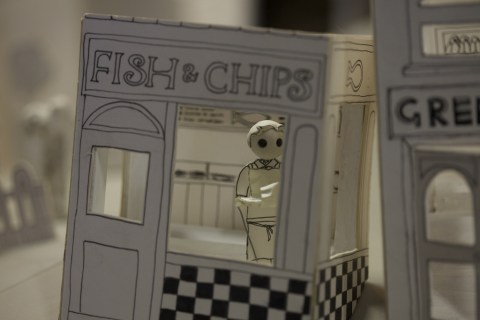
‘Feral’ devised by Tortoise in a Nutshell and directed by Ross MacKay, produced by Tortoise in a Nutshell / An Original Co-Production with Cumbernauld Theatre for Brits Off Broadway at 59E59 Theaters (Amy Downes)
Feral is obviously a labor of love by the creative team: Amelia Bird (Scenic Design) Simon Wilkinson (Lighting Design) and Jim Harbourne (Original Music and Sound Design) and theri director Ross Mackay. Their innovative, human-friendly designs immediately convey the audience into the creators’ world of imagination. To its credit, the designers work to make the audience an integral part of the ongoing events as the camera angles move our vision from a distant perspective closer and closer into Dawn’s and Joe’s house to see their kitty cat and close to see the interiors of the various shops. The camera moves our vision into the beauty parlor, around the park and pier and into an adorableness that includes our watching a cute squirrel fed daily by the pastor of the town church.
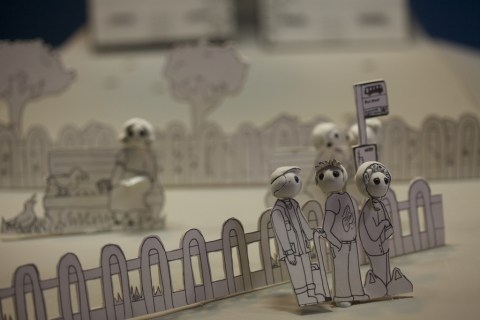
‘Feral’ devised by Tortoise in a Nutshell and directed by Ross MacKay, produced by Tortoise in a Nutshell / An Original Co-Production with Cumbernauld Theatre for Brits Off Broadway at 59E59 Theaters (Amy Downes)
Thus, as we identify with this mini corner of the universe, we are engaged and become concerned when the “Supercade” is built despite protest. Most probably money changes hands surreptitiously for the entertainment palace to be built. It is then the themes shift to the macrocosm as we consider what has transpired in the last 10 years almost exponentially along waterfronts and elsewhere.

‘Feral’ devised by Tortoise in a Nutshell and directed by Ross MacKay, produced by Tortoise in a Nutshell / An Original Co-Production with Cumbernauld Theatre for Brits Off Broadway at 59E59 Theaters (Amy Downes)
Such displacing, nefarious development is happening in too many cities and towns across the globe. Those who have the most to lose are overcome by those who have the money and power to do what they want and not be held accountable for the damages. Indeed, though it is not clear in this production, most developers live in their own bucolic paradise surrounded by three-acres, with security teams, gates and high walls to keep out the “riff-raff” whom they prey upon to fund their selfishness, the “riff-raff” being these townspeople who just want to live life with some modicum of happiness..
Feral is imaginative, particular and profound if not disconcerting. The creators’ process is complicated but it delivers a simple metaphor of our times in identifiable human terms. Bravo to both the creative team listed above and the production team Andrew Gannon (Technical Diretor) and AEA Stage Manager (Alyssa K. Howard).
Tortoise in a Nutshell’s Feral runs for 50 minutes with no intermission at 59E59 Theaters until 9 June. For tickets and times go to their website by CLICKING HERE.
‘Fiddler on the Roof,’ in Yiddish, a Powerhouse of a Production

Steven Skybell, ‘Fiddler on the Roof’ in Yiddish, Joel Grey (Matthew Murphy)
When Fiddler on the Roof premiered on Broadway in 1964 (winning 9 Tony awards) it took the theater world by storm and the larger world with gradual stealth augumenting to an avalanche of global premieres and subsequent revivals. With the original cast starring the wildly zany Zero Mostel as Tevye the milkman, the wryly funny Bea Arthur (the future Golden Girl) as Yente, and Austin Pendleton as Motl Kamzoyl, the Tailor, the production was set in humorous stone and held a warm place in countless hearts. It ran with various casts for nearly eight years, went on tour and was made into an Oscar winning film.
Since then Fiddler (Book by Joseph Stein, Music by Jerry Bock, Lyrics by Sheldon Harnick) has been in revival mostly every year either in the U.S. or somewhere in the world in high schools, colleges or regional theater. The most recent revival landed on Broadway (2016) in a stellar production starring Danny Burstein with an emphasis on the poignant issues enveloping growing populations of displaced refugees and immigrants.

(L to R): Raquel Nobile, Rosie Jo Neddy, Rachel Zatcoff, Stephanie Lynne Mason, Samantha Hahn, ‘Fiddler on the Roo’ in Yiddish, directed by Joel Grey (Matthew Murphy)
Accordingly, the revivals reflect the times and the current social attitudes. Into this day that echoes anti-semitic chants, “Jews will not replace us” by white supremacist marchers in Charlottesville, Virginia and recent attacks against US synagogues, comes a revival of Fiddler on the Roof in Yiddish that is monolithic. The Yiddish National Theatre Folksbein’s production in Yiddish has supertitles in English and Russian. In its authenticity of language and grounding in the ethnicity inherent in Sholem Aleihem’s source material on which it’s based, the production which effuses the choreography of Jerome Robbins with Staś Kmieć’s additions, is one for the ages in its transcendent humanity and spiritual resonance.
What is it about this Fiddler that is unlike all others? Directed by the superb, insightful Tony/Oscar award winner Joel Grey, the production is a moral imperative! It is for our time and all time in its simplicity, grace and spare, unadorned beauty and emotionally taut, intimate, soul crushing power.

Steven Skybell, ‘Fiddler on the Roof’ in Yiddish, directed by Joel Grey (Matthew Murphy)
Grey’s vision personalizes and authenticates the complexity of faith as it moves Tevye (an unparalleled Steven Skybell) through the challenges of negotiating the daily uncertainties of life in a rapidly changing world, while retaining the core values of his religious beliefs that have been codified for thousands of years (exemplified in the gorgeous number “Shabes Brokhe” (Sabbath Prayer).
Tevye’s, is the iconic hero’s journey of life’s rhythms, of the wheel and woe and back again. By distilling the musical to its most searingly gut-wrenching, basic elements, Grey has elevated Tevye and his family to a timeless universality. With levity and poignancy Grey stirs us to empathize with the characters’ plight, as we experience the “happiness and tears” reflected throughout and especially in the song “Tog-any, Tog-oys” (“Sunrise/Sunset”). The number, rendered with sonorous beauty by Tevye, Golde (the golden, lyrical soprano Jennifer Babiak) and the company just before the Russian officials effect a mini-pogrom is a harbinger of things to come.
Tevye and his family and village speak in Yiddish though at the time in a place like “Anatevke” (Anatevka) they also most probably spoke German and Russian as well. An interesting derivation turns up in the song Tevye sings to his God, “Ven ikh bin a Rotshild”) the translation of which is “If I Were a Rothchild.” The irony of Tevye’s dreaming to be like the uber wealthy Rothchild banking family who were also Jewish is hysterical. Would he sacrifice his faith for money? Would he have to? Indeed! Skybell’s rendition of this funny, poor man’s lament to God is priceless.

Jackie Hoffman as Yente in ‘Fiddler on the Roof’ in Yiddish, directed by Joel Grey (Matthew Murphy)
The question becomes: is the Yiddish a distraction making it more difficult to engage with the characters? The irony is we pay attention because the language is unfamiliar and we must not take anything for granted. As we begin to pick up words read from the supertitles on panels to the right/left of the stage, we connect with another time and place, which materially is unlike our own, while discovering that the characters symbolically represented are like ourselves.
The supertitles in English and Russian from the Yiddish Translation by Shraga Friedman (first performed in Israel in the 1960s) reinforce our understanding along with the actors’ gestures (Skybell is particularly superb) expressions and crystal clear intentions. The ensemble is letter perfect in its portrayals. Additionally, Yiddish is one of the most onomatopoetic of languages; its very sounds convey the meanings which we counterintuitively glean. During the song and dance numbers, the plosive consonants and guttural, rolled rrrrrs express a vibrancy and excitement which adds to their energy and joy.
Of course, it helps that the actors are wholly present and “in-the-moment.” The audience can’t help but be engaged and enthralled as we employ more of our senses, so as not to miss a word or thought for fear of losing out.
Importantly, Joel Grey has brilliantly shepherded this production and has acutely grounded it in the power of fundamental principles of equanimity. We are precisely aware that the production’s underscored intrinsic values encourage all people to overcome and move through the dark times. These are the basic truths which we cling to as we live our lives in Anatevke, Russia 1905 or NYC 2019. In this essentially clear-eyed, genuine, heartfelt production, faith and love emerge like pillars of fire; they guide Tevye and his daughters, and drive the arc of the play’s development.
During the course of the play Tevye learns ancient faith and modern love are not mutually exclusive; they are one. Steven Skybell’s Tevye (Skybell’s is an inspired, precise, brilliant portrayal of the witty journeyman) exercises faith daily in his discussions and personal relationship with God. Love, Tevye discovers by witnessing how it blossoms in his daughters’ lives and marriages. In a touching moment that lingers with sweetness Skybell’s Tevye and wife Golde (Jennifer Babiak) sing about what love is in their personal relationship. “Libst Mikh, Sertse?” (Do You Love Me). They discover that they have been bonded in love which has provided the security and contentment which helps them weather a hardscrabble existence, partners to the last.
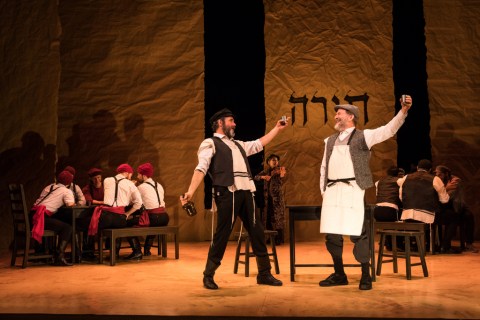
Steven Skybell, Bruce Sabath in ‘Fiddler on the Roof’ in Yiddish, (Matthew Murphy)
Both faith and love embody the instrumental forces which drive the uneducated milkman and his family toward hope despite uncertainty. By the conclusion of the production, we understand that only with faith and love can they confront the anti-semitism of the Russian Orthodox community which fearfully has expelled them. Only with faith and love can they move on stoically without bitterness, believing that it will be better in their new home in America because they have each other. And Tevye, by keeping his fervent relationship with God, will continue to keep his balance as “a fiddler on the roof” despite the precarious times they will face in the new world with possibly more persecution and discrimination.
Wisely, Grey strips all unnecessary elements that Fiddler on the Roof might represent as a “Broadway show,” and solidifies the themes and alternating tenor and moods of laughter and sadness with a minimalist set, whose backdrop of parchment and cloth panels retains the most important word in the play and the only word which is not in Yiddish.
It is in Hebrew, painted in black Hebrew letters across the central banner. And it symbolizes what in effect Tevye looks for when he talks to an invisible God whom he must believe hears him and through received wisdom, answers Tevye. It is the Hebrew word signifying The Torah, God’s truth, God’s guidance to navigate a world which is in constant upheaval and is often hostile. It is particularly during intimate and animated discussions with God that Skybell’s Tevye depends upon his faith to provide the enlightenment he needs to make the right decisions for himself and his family. Every one of these discussions Tevye has, we believe that he believes God listens. These conversations imply the depth and irrevocability of Tevye’s faith and are a crucial part of the profoundness of this production.

Bruce Sabath, Kirk Geritano, Lauren Jeanne Thomas, Michael Einav, Mikhl Yashinsky, Adam B. Shapiro, Bobby Underwood, DRew Seigla, Steven Skybell, Fiddler on the Roof in Yiddish, Joel Grey (Matthew Murphy)
But faith is a private matter between a man and/or woman and his/her God. So Tevye to explain himself in communal terms that relate to the society in which he lives, employs the simile to explain how he withstands his hard scrabble life. He does it precariously like “a fiddler on the roof” while conveying a bit of his own musical identity. And he’s able to stand living on the edge because of “one Torah, one God, one word…tradition.” As the ensemble joins in the song”Traditsye” we are introduced to Tevye’s ethnic cultural folkways that have existed in Anatevka for generations. We presume these “traditions” are reflected in The Torah.
Interestingly, during the course of the play, we, Tevye and the community learn that the folkways of Anatevka are not necessarily God’s ways of the Torah. In fact, they can be abused and lead to misery, as even Yente implies with her unhappy marriage and as we discover with the other unhappy marriages in the village, i.e. Leyzer-Volf’s marriage to Frume Sore who was a bitter woman. In fact, we and Tevye learn there can be happiness in marriage if there is love. And that is what God is all about.
As Motl (the fine Ben Liebert) suggests with wisdom given to him by Tsaytl (Rachel Zatcoff), “even a tailor deserves a little happiness.” Tevye after an enlightened discussion with God, and his daughter and Motl, throws off a stubborn adherence to Anatevka’s folkways, and follows a greater wisdom and acceptance because he loves his daughter and wants her to be happy in her marriage to a man she loves.

Steven Skybell, Company, ‘Fiddler on the Roof’ in Yiddish, directed by Joel Grey (Matthew Murphy)
Reinforcing that love is God’s way, Motl’s faith is strengthened. Having the courage to stand up to Tevye and step out in faith for Tsaytl’s hand is miraculous, like the Biblical miracles (manna in the wilderness, etc.). He sings the vibrant “Nisimlekh-Veniflo’ oys” (Miracle of Miracles), the greatest miracle being that God has made the way for him to marry Tsaytl, serving as a beacon of light for the rest of the town.
To assuage and convince Golde of the rightness of this decision, Tevye has “Der Kholem” (The Dream). With the skills of this adroit company, in one of the marvelous highpoints of the production. Frume Sore is a larger than life spirit, a fiend (on stilts) with oversized body looming in a shrouded, wild costume, witchy hands, wild hair and exaggerated, ghostly make-up. She is wonderful and the company echoes her screams and questions with humorous frightfulness. As Tevye recounts the dream and the ensemble enacts it, Frume Sore portends a curse on Tsaytl if she marries Leyzer-Volf. It is so horrifying, Golde wants her daughter to avoid any curse; and receive the blessing her sweet spirit ancestor bestowed on the marriage. In this incredible scene, the traditional folkway of the matchmaker making a match is vitiated and love becomes the preeminent value.
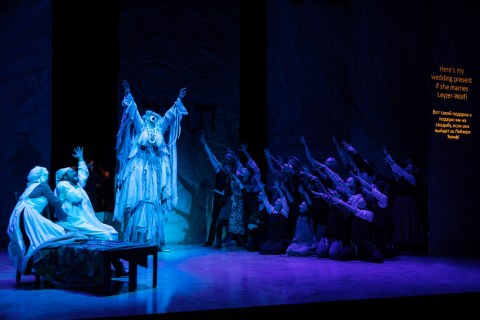
(L to R): Steven Skybell, Jennifer Babiak, Jodi Snyder, Frume Sore and Company, Fiddler on the Roof in Yiddish, Joel Grey (Matthew Murphy)
This production clearly makes a distinction between faith of the Torah and folkways of Anatevka. Grey beautifully effects this through lighting, Skybell’s forceful discussions with his God, the sets (the backdrop panels) and the staging. Tevye’s faith and relationship with the God of The Torah who gives enlightened wisdom is not the same as the ancestral cultural folkways of Anatevka which have sprung up and been integrated from the surrounding society for economic purposes.
The learned Pertshik (the wonderful Drew Seigla) infers that love supersedes the matchmaker Yente (the wry, saleswoman of unappealing spouses-Jackie Hoffman). The Rabbi indirectly affirms this at the wedding at Tevye’s insistence by wisely not ruling on it. Nevertheless, the underlying message is that matchmakers are not in the Torah; God puts love in the hearts of people for each other. Tevye later confirms for Pertshik’s future marriage with Hodl, the old ways don’t apply as he evokes the metaphor of Adam and Even whose matchmaker was God. Another tradition that has little to do with the Torah is mixed dancing. Petshik dances with his beloved Hodl declaring it is not a “sin” which the Rabbi confirms. It is not in the Torah (the guide). And the men and women dance inspired by Tevye and Golde to initiate the dance which begins and incredible dance celebration at Tsaytl’s and Motl’s wedding.
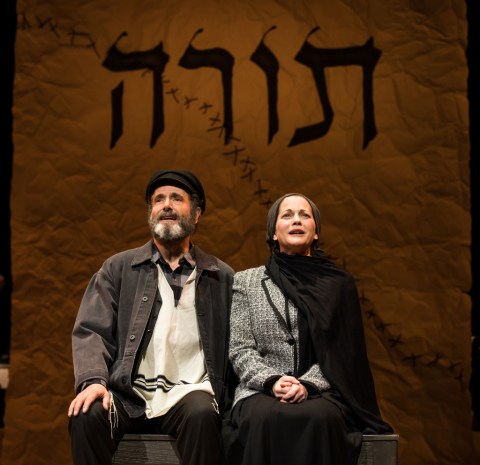
Steven Skybell, Jennifer Babiak, ‘Fiddler on the Roof’ in Yiddish, directed by Joel Grey (Matthew Murphy)
Grey’s genius in selecting the painted Hebrew word “The Torah” as the focal point of the setting is so logical it’s breathtaking. The symbolism is magnificent. Not only is Tevye guided by his faith in God during trying times when the traditions they have followed for centuries are being overthrown by modernism. We, likewise, are being instructed in Tevye’s trials of faith. We, too, receive the wisdom he gains after he wrangles with God over vital decisions concerning his daughters’ marriages.
Indeed, this overarching theme of The Torah, God’s guidance, is present throughout as the panel never moves, never is taken down. That is why when the Russian constable comes in and his officers wreck the celebration and one of them tears the panel with the word Torah, it is horrifically chilling. To not be able to actively practice their faith threatens their ethos; they will be evicted. But why stay in a place tears out the very fabric of who they are? Though in the next act the panel has been sewed where it has been ripped, “the handwriting is on the panel.” The warning the constable has been giving to Tevye is coming to pass. And not even Khavele’s (Rosie Jo Neddy) relationship with Russian Orthodox Fyedke (Cameron Johnson’s dancing is spectacular) can save Tevye and the community from eviction.

Steven Skybell in ‘Fiddler on the Roof’ in Yiddish (Matthew Murphy)
This blow to his relationship with God, Tevye cannot brook. That his daughter would be with one of that faith is a death. This is not a custom, this goes much deeper and is a great trial. However, Goldie and his daughters will work on him, as is obvious when they say goodbye. Meanwhile, the dance sequence as Tevye mourns the loss of Khavele in the song “Khavele” (Khavele) is beyond poignant.
Every decision Grey has made informs the profound themes in this work and emphasizes what is vital for life to thrive despite loss. This is exemplified in the simple, uniform, dark tables and chairs which structure the scenes in Tevye’s home, the wedding hall, Motl Kamzoyl’s shop, the Russian/Jewish mixed cafe where Tevye meets Leyzer-Volf and they sing the marvelous “Lekhayim” (To Life, Lekhayim) and the Russians join in with vigorous, athletic dancing that is so joyful and celebratory, that for a tiny moment we actually think that the Russians and the Jews can have peace. Also the accoutrements-props, like candles, a washbasin, drinking glasses, the milk pales and cart-without a horse, etc., are used to round out the action when needed.
The message is clear. The material objects of life are movable and transient. The Torah, God’s guidance is forever for those who seek it and believe they receive His answers, as the vibrantly alive, humorous, enthusiastic “man for all seasons,” Steven Skybell’s Tevye believes he does.
Another superb element of this production is the use of the lovely fiddler portrayed by Lauren Jeanne Thomas whose portrayal is not to be underestimated, but is beautifully soulful and evocative. When Tevye is having a crisis and must go to his God for a talk, the nimble, sylph-like graceful Der Fidler (Lauren Jeanne Thomas as the fiddler) leans in slyly, sweetly and dances around Tevye as her playing soars with the poignance of the melody of “Traditsye,” as the music swells with the custom which is falling away. These moments are absolutely heartbreaking for Tevye must call upon his faith to guide him through the uncertainty, confusion and darkness. And of course as they leave Anatevke singing their song about a place they’ve identified with and can do no longer, Tevye motions for the Der Fidler to go with them. The customs of the Russian village they leave behind. But The Torah, God’s guidance is with them forever.
The production is a spiritual revelation that is extraordinary and miraculous. Special kudos to the orchestra, conducted by Zalmen Mlotek and Associate Conductor Andrew Wheeler. Just wow.
Fiddler on the Roof in Yiddish runs with one intermission at Stage 42 (42nd St. between 9th and 10th) until 5 January. For tickets and times go to the website by CLICKING HERE.
‘The Plough and the Stars’ by Sean O’Casey, the Sean O’Casey season at the Irish Repertory Theatre
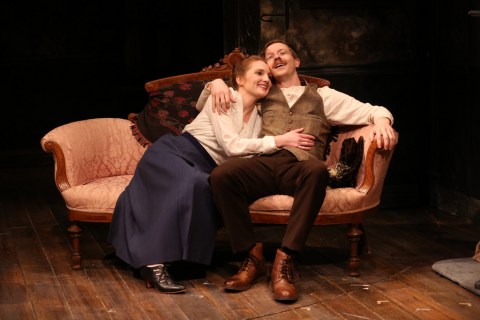
Clare O’Malley, Adam Petherbridge, Irish Repertory Theatre’s ‘The Plough and the Stars’ (Carol Rosegg)
When it premiered at The Abbey Theatre in 1926, The Plough and the Stars initially opened to acclaim. However, word got out that O’Casey had written a play critical of Irish nationalism and religion, and the acclaim turned to disapprobation. O’Casey elected to focus on the hapless Dubliners, many women and children, who had been swept up in the bloodshed of the Easter Rising of 1916. During the five days of fierce fighting between the British and the Irish Citizen Army and Irish Republican Brotherhood, the British who had brought in heavy artillery, machine guns and bombshells with over nine times the troop strength of the Irish converted central Dublin and the tenements where citizens lived into a war zone. Because of the hundreds of citizen fatalities and thousands injured, the Irish rebels surrendered to save the city. The British took revenge with arrests and summary executions of the organizers, sealing the ill-will of Ireland and guaranteeing the irrevocability of Irish Independence.

Maryann Plunkett, Clare O’Malley, Irish Repertory Theatre, ‘The Plough and the Stars,’ by Sean O’Casey, directed by Charlotte Moore (Carol Rosegg)
In this last production of the Dublin Trilogy, the Irish Repertory Theatre, which has presented an amazing season of Sean O’Casey’s works, ends with its most masterful and emotional production to date. Directed by Charlotte Moore, O’Casey’s The Plough and the Stars remains a sterling and representative human drama that soars into the heavens with the timeless message that there are no victors when members of the human family take up arms and kill each other. Assuredly, it is the innocent trying to make it to the next day, who become the casualties of violent conflicts. Those who die achieve a final peace; the living have to deal with the horrible memories and consequences of the aftermath of war.
The actors expertly shepherded by Moore effect O’Casey’s themes with emotional grist and power. As an ensemble their work together is exquisite, paced, focused, present. Because of their attention to moment-to-moment living onstage, the impact that rises from scene to scene and especially in the last scenes when the conflict and suspense are greatest are breathtakingly real and tragic.

James Russell, Irish Repertory Theatre’s ‘The Plough and the Stars,’ directed by Charlotte Moore, written by Sean O’Casey (Carol Rosegg)
The play follows the homely interactions of tenement dwellers in the latter part of 1915 and during the Easter Rebellion of 1916. These scenes of the every day lives of the tenement dwellers draw our empathy. In their discussions we become apprised that there are marches and meetings of various Irish groups who are gathering to amass political sentiment in support of the hoped for Irish rebellion and move toward independence. The meetings which have gained fervent advocates eventually come to a head and the play’s action shifts to events in Dublin during Easter Week 1916. It is then that O’Casey most acutely and poignantly reveals how these horrific events impact the lives of the Dubliners who live and hide in the tenements as they are shelled, shot at and warred against by the British Tommies who attempt to quash the rebellion.
In the first part of the production we note how O’Casey illustrates the divisions among the Irish citizens living in one lower middle class Dublin tenement. These characterizations develop and remain the focal point of the play. Some of the Dubliners have antithetical political affiliations like protestant, pro-British Bessie Burgess (the wonderful Maryann Plunkett who gives a heartfelt, frenzied, emotional portrayal throughout). Bessie’s son fought and died with the British as a Dublin Fusilier during early battles of The Great War. Her expressed rage and fury at the supporters of Irish Independence is understandable, though the other tenants think she is loathsome. Indeed, by the play’s end O’Casey’s twist of characterization proves her a formidable human being; and Maryann Plunkett brings this out in spades.

(L to R): Michael Mellamphy, Sarah Street, Harry Smith, Robert Langdon Lloyd, Irish Repertory Theatre’s ‘The Plough and the Stars,’ by Sean O’Casey, directed by Charlotte Moore (Carol Rosegg)
Others, like fiesty Peter Flynn (the humorous Robert Langdon Lloyd), the life-worn Mrs. Gogan (the fine Una Clancy) and Fluther Good (Michael Mellamphy is spot-on in his rousing portrayal of the carpenter who represents the typical working man) empathize with the Irish cause of independence as Catholics. Meanwhile, The Young Covey (the excellent James Russell) is the critical, anti-religious, acerbic intellectual who strafes the cause of independence with his caustic remarks. He is frustrated that the socialist cause he advocates has been redirected from the Worker’s of the World uniting to overthrow the capitalistic system.
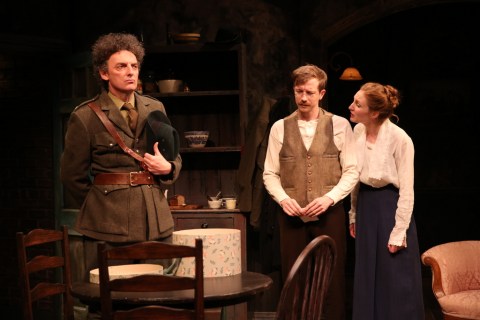
(L to R): John Keating, Adam Petherbridge, Clare O’Malley, Irish Repertory Theatre’s ‘The Plough and the Stars,’ by Sean O’Casey (Carol Rosegg)
Much of the humor in the first part of the play centers around O’Casey’s identification of the cross section of individuals who are disparate from one another in beliefs, religion and intellectual ethos. Yet they live in Dublin tenements and make up the culture and society of the city as they remain economically oppressed and without a voice in the government. We laugh as they carp and criticize each other to the extent that one wonders how the country will unite against the British at any level. Into this convulsed and funny hodgepodge of characters come the newly weds, the sweet, romantic Nora (Clare O’Malley gives a fervent, emotional and powerful performance throughout) and husband Jack (the sensitive and forceful Adam Petherbridge) who eventually, despite Nora’s surreptitious attempts to prevent this, is proudly made Commandant in the Irish Citizen Army.

(L to R): Meg Hennessy, Clare O’Malley, Irish Repertory Theatre’s ‘The Plough and the Stars,’ by Sean O’Casey (Carol Rosegg)
Jack, infuriated that Nora withheld information of his promotion out of fear for his death, argues with her vehemently. Indeed, her self-interest and duplicity push him right into the arms of his mates. The scene where she admits she lied is dynamic and powerful. O’Casey’s characterizations are authentic and the actors (O’Malley and Petherbridge) are so letter perfect that we imagine such scenes playing out in households throughout Dublin and in a universal sense that this occurs in every war fought regardless of politics or nation. The timeless quality of war as a sacrifice of innocents is everpresent and beautifully rendered thematically in this scene.
As Young Covey, Fluther and Flynn meet and have drinks in a Public House after listening to speakers and continuing to listen to them from inside the pub, we meet additional Dublin denizens who will be impacted by the coming rebellion. These are the “lady of the night” Rosie Redmond (Sarah Street) and the Bartender who also plays Sargent Tinley (Harry Smith). In this interlude at the pub, the tension outside is rising and we note the success of the march and the rousing political speeches meant to mobilize the crowds.

Adam Petherbridge, Clare O’Malley, Irish Repertory Theatre’s ‘The Plough and the Stars,’ by Sean O’Casey (Carol Rosegg)
When Jack and his mates come into the pub and conclude the scene with their nationalistic cries, they wave the flag (The Plough and the Stars, and the Tricolor Flag of Irish Independence). As these volunteers uphold their allegiance to a free Ireland, they put their family, wives and homes second. Nora is abandoned and forgotten as Ireland becomes Jack’s family.
In the next scenes that take place during the Easter week, April 1916, the irony of Jack’s heady, ebullient nationalistic sentiment is pitted against the frightful horrors that these volunteers and tenement dwellers face in the violence during the five days they confront heavy artillery and machine guns. The booming sounds are heard in the distance. Nora who looks for Jack to bring him home (an ignominious, selfish and cowardly action from Jack’s perspective) proclaims that she sees the fear in the Irish soldiers’ eyes while the soldiers she meets tell her she is shaming Jack.

(L to R): Una Clancy, Maryann Plunkett, Irish Repertory Theatre’s ‘The Plough and the Stars,’ by Sean O’Casey (Carol Rosegg)
In this fabulously directed scene that is tense, frightful, poignant and rage-filled, Nora struggles physically with Jack to keep him with her. And Bessie screams epithets and insults at Jack, Captain Brennan (John Keating) and the wounded dying Lieutenant Langon (Ed Malone). At the height of the drama, Jack berates Nora for attempting to keep him from fighting the cause, then he and the others leave to look for a doctor. Bessie who has a turn of empathy for Nora brings her safely inside, then runs for a doctor to help Mrs. Gogan’s dying daughter Mollser (Meg Hennessy). Kudos to the superb ensemble and the principals whose urgency and focus create the incredible tension in the scene. The audience is enthralled throughout.
As marvelous as Act III is, O’Casey’s climax in Act IV is without parallel and Moore and the actors are beyond exceptional in bringing the conclusion to its final glowing draw-down. O’Casey hammers his themes. These, he has seeded earlier in the play. In the final act they foment with the growing chaos which sweeps up various individuals unwittingly caught in the rebellion, i.e. The Woman from Rathmines (Terry Donnelly). Everyone who can be represented is. O’Casey reveals the tragedy and futility of innocents dying as they are mistaken for “the enemy.” In this last act of this most incredibly paced and dramatically written of his plays, we understand the genius of his message to humanity, which has been ignored and will continue to be ignored long into the next century.
There is no spoiler alert. You will just have to see how the conclusion unfolds ironically in this must-see production which is truly magnificent and fiercely trenchant and timely. I cannot praise this production with high enough encomiums for the director and cast except to say it will be a damn shame if you miss it.
Charlie Cororan (Scenic Design) Linda Fisher and David Toser (Costume Design) Michael Gottlieb (Lighting Design) Ryan Rumery and M. Florian Staab (Sound Design) and Ryan Rumery (Original Music) and others on the artistic team do a superb job in bringing about the authenticity of this production.
The Plough and the Stars (with one intermission) and the entire Dublin Trilogy can be seen until 22nd June at the Irish Repertory Theatre (132 West 22nd). For tickets and times go to the website by CLICKING HERE.
‘King Lear’ Starring Glenda Jackson, a Royal Performance at the Cort Theatre

John Douglas Thompson and Glenda Jackson in ‘King Lear,’ directed by Sam Gold (Brigitte Lacombe)
William Shakespeare’s King Lear directed by Sam Gold is a must-see for its principal performances and its particular, stylized artistic design (scenic, sound, costume) which cleverly emphasizes the themes, symbolism and metaphors of the play. Above all, you should not miss Glenda Jackson who is a gobsmacking dynamo as the king who throws off the shackles of corruption and confronts his mortality to gain the wisdom of foolishness.
Jackson fits the titular role like it is made of her own flesh. This is a “once upon a lifetime” production that is astute, profound, if sometimes opaquely realized with regard to integrating Philip Glass’ music. Nevertheless, the director’s vision and design suggests overarching themes about appearance vs. reality, lies vs. truth, duplicity vs. authenticity, wisdom in madness and madness in wisdom.
Throughout, Jackson is a magnificent, who always rises to perform with sentience and power. Her Tony award winning portrayals in Edward Albee’s Three Tall Women last year were unforgettable. Likewise, her performance in King Lear follows with equal ferocity and fervor.

Pedro Pascal, Jayne Houdyshell in ‘King Lear,’ directed by Sam Gold (Brigitte Lacombe)
Shakespeare’s characterization of the foolish king is among the most searing, poignant and challenging of roles. Only someone with the breadth, knowledge, sensitivity and prodigious talent like Ms. Jackson’s should attempt it. And that is why, from a woman’s perspective, her performance of this man who is a king and a fool is almost counterintuitive. It is no ready coincidence that Jackson’s Lear exemplifies a startling emotional grist that moves the king’s ethos from corruption to madness to wisdom with breathtaking logic and moment-to-moment life.
In her every action, every breath and movement, every grimace and expression of inner torment and fury, we search out Lear’s evolving humanity as we feel his pain and empathize with him. Shakespeare’s characterization of Lear engineers the development of the play.
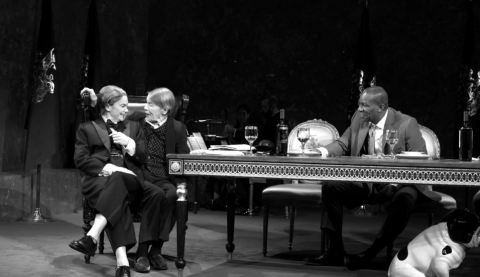
(L to R): Ruth Wilson, Glenda Jackson, John Douglas Thompson in ‘King Lear’ (Brigitte Lacombe)
It is Lear who creates the self-destructive vortex and whirls violently in it during the arc of his soul journey, buffeted by its abuse, yet buoyed up by a stalwart inner core of moral outrage and self-righteous fury. It is the recognition of his own corrupted judgment and the expose of his daughters’ wickedness that keeps him from drowning in complete madness. He is kept from this abyss by the Earl of Kent (the exquisite john Douglas Thompson) his Fool (Ruth Wilson in a humorous turn) the supportive Earl of Gloucester (the poignant and superb Jayne Houdyshell) and Gloucester’s son Edgar (Sean Carvajal) in a beautifully rendered performance) who becomes like the Biblical lunatic to escape the wrath of the court.

Sean Carvajal in ‘King Lear,’ directed by Sam Gold (Brigitte Lacombe)
After Lear spurns his third daughter Cordelia (Ruth Wilson) his daughter Goneril (the excellent Elizabeth Marvel) and daughter Regan (the equally fine Aisling O’Sullivan) presumptuously usurp his authority. They command that he heel to their authority, despite his generous bestowal of wealth and lands upon them. Rather than accept his retinue that follows him to his daughters’ castles, they provoke their father’s wrath to pursue their own agendas.
Maintaining his nobility and identity, Jackson’s Lear refuses to “live” under their terms. Homeless, he braves the stormy abyss of his own soul damnation reflected in the harsh elements with the help of his Fool and the Earl of Kent, disguised as a servant. Ruth Wilson’s Fool comforts Lear, chides him and peppers his rages at Goneril’s and Regan’s ignominous treatment with humorous jibes and quips which strip Lear of his courtly pretensions. Indeed, the Fool guides him toward humility and brings this lofty king into an endearment with his own “base” but noble humanity.

Pedro Pascal, Jayne Houdyshell in ‘King Lear’ (Brigitte Lacombe)
Gold’s version of Lear stylizes the trope that Cordelia and the Fool are similar by having Wilson expertly play both parts. If this is, in Lear’s mind, an unconscious projection of remorse, self-flagellation and wish fulfillment to forgive his loving Cordelia and keep her near, the doubling of roles is sensible. Certainly, Cordelia is the only daughter who loves him. Thus, it is appropriate that Cordelia-the Fool leads the foolish old man into wisdom to help perfect his soul and expurgate the corruptions he has internalized, surrounded by treacherous courtiers and family in a lifestyle that has caved in his better person.
During Lear’s journey into the dark storms of mental uncertainty deranged by a gilded, false life in the gaudy kingdom that he must leave behind (mentally) to grow, he stumbles upon his real self. Centered in truths he never experienced before in his court, Lear strives to maintain his autonomy and identity. He eventually comes to realize what is important in his life-his humanity/mortality/liability to err in judgment which he is able to forgive as he presents himself as “a foolish old man.”

(L to R): John Douglas Thompson, Russell Harvard, Michael Arden, in ‘King Lear’ (Brigitte Lacombe)
Gold’s decision (Miriam Bljether’s Senic Design) to regale the court in pretentious splendor hints at a surface gloss and artificiality/artfulness that distracts from confronting the underlying wickedness and greed in Lear’s court and kingdom. They are “dressing to impress” to cover up the incompetence, nihilism and emptiness within themselves. All that glitters is fool’s gold; it lacks value and worth in an inherently weak kingdom whose underlying principles (if there are any) do not guard against self-destruction and annihilation. Thus, in the stylization the director reveals the seeds of corruption and foreshadows the devolution of the kingdom that will follow hard and fast.
In this setting of “fool’s gold” we meet the commanding Lear and his three daughters at a celebration during which the string quartet stuffed into a corner plays the gorgeous music (original music by Philip Glass) which the courtiers and family neither acknowledge nor appreciate but treat as background noise to be ignored as they raise their voices over it. The family’s general lack of appreciation for their lavish lifestyle and their dismissal of the importance of the depth of their royal duties is reflected in their reaction to all the court accoutrements including a most civil tea service later in the play, held at an incongruent and ridiculous time and place. They are the arrogant, the privileged. Only Cordelia differs.
Thus, when Cordelia reminds the court of her loyalty to her father invested in her role as his daughter, we take this to heart. Do the others, after receiving their inheritance realize the obligations their father’s gift entails?

Elizabeth Marvel in ‘King Lear’ (Brigitte Lacombe)
Hardly. Regan and Goneril from the outset are principally concerned with “getting all they can” through false pretense. They could care less about the rights and duties invested in their father’s gift of an early inheritance. It is no small wonder that Goneril and Regan rail about Lear’s visits with his soldiers. They want the inheritance with no strings attached, wishing to be free of their father forever. Rather than pay homage and give extended hospitality to a vibrant, authoritative king, they take advantage of his public punishment of Cordelia and suggest that he is off balance. It follows that they will provoke his wrath and become his enemies, so that their unconscious desire that he dies sooner rather than later becomes a reality.
An overarching metaphor the director emphasizes throughout the play, is the irony of incongruence-in the court’s lack of probity and unseemly excessiveness. Incongruence is everywhere represented by the “out-of-place” music at the celebration and elsewhere, music which never quite melds throughout the arc of the play’s development. The “over-the-top,” ostentatious, meretricious faux “gold” walls and the formal outfits (Ann Roth-Costume Design) exchanged for less formal ones as the kingdom devolves and the characters’ wicked selves are exposed, also appear incongruous as they are presented. So do the huge ceramic dog and lion.

Russell Harvard, Aisling O’Sullivan in ‘King Lear’ (Brigitte Lacombe)
The gilt walls are present throughout the play with a similarly hued curtain that characters stand before during various scenes (a further emphasis of the themes of incongruity and fool’s gold or an idea that Shakespeare often uses that appears in The Merchant of Venice: “all that glitters is not gold”). The “fool’s gold” walls and audience curtain are the ironic, anomalous backdrop against which the characters are measured and either found wanting in that they exemplify the trope or are antithetical to it.
These artistic elements reflect the malfeasant influence his daughters and husbands have over Lear, an influence which is shaken out of him on his stormy journey coming to the end of himself.

(L to R): Jayne Houdyshell, Glenda Jackson in ‘King Lear,’ directed by Sam Gold (Brigitte Lacombe)
As the daughters and their husbands abuse the kingdom for their own nefarious ends all becomes rubble, wrecked by the familial divisions and war. The walls are the only remnants of the former “glory” of the court perhaps suggesting a universal concept. This kingdom is finished, but the spirit of duplicity (faux gold) of leaders’ pretense which they use to control their minions is present in every age. Eventually, by the conclusion the back gold wall takes on a different hue changed by shifts in lighting. Interpret this as you will, the hue doesn’t gleam, but suggests small points of light (starlight?) amidst characters comments (i.e. Kent: ‘The stars above us govern our condition”).
In the fateful universe of Shakespeare’s play, the arrogant, self-centered human beings are thwarted in the pursuit of their own wicked desires which are founded upon worthless principles (“fool’s gold”) and lies. This development is evident in the characterizations of Goneril, Edmund, Regan, the Duke of Cornwall. The other characters (Edgar, the Duke of Albany) who do not follow their lust for power rise to triumph. As object lessons, Cordelia, Kent, Gloucester, Lear are caught up in the hazard, subjects of poignant tragedy.

Glenda Jackson in ‘King Lear,’ directed by Sam Gold (Brigitte Lacombe)
And it all begins in the “golden” court, when Lear pronounces his inheritance to his inherently wicked daughters enticing them to flatter him in a misaligned quid pro quo as if to prove his greatness and their fealty to him. Goneril and Regan oblige him; Cordelia does not. In that fell act, treason and wickedness are exposed. The wrong daughters receive the bulk of the inheritance, the right daughter is disinherited. The world is in chaos, turned upside down as duplicity usurps love and order.
Lear makes a public show of Cordelia’s punishment sealing his misaligned judgment which the others see may be further abused. Indeed, Lear’s malignity is revealed in a court which embraces and exploits it. And this evil sets in motion the parallel plot with the Earl of Gloucester and his treacherous, conniving son Edmund (the wonderful, insidious Pedro Pascal) who usurps brother Edgar’s inheritance and place in his father’s affections and legal authority.

Glenda Jackson in ‘King Lear,’ directed by Sam Gold (Brigitte Lacombe)
In this secondary plot the illegitimate Edmund, who despises the goodness of his father, lies on his brother Edgar who is forced to escape with his life and go into hiding disguised as the madman beggar “poor Tom.” It is only when Lear, Kent and the Fool meet up with Edgar and take shelter in a hovel does Lear begin to understand his condition in light of poor Tom who is much worse off. In this beggar lunatic, he sees his true ethos without the vanities of the world and his court.
Lear journeys through his “madness” gaining wisdom and gradually throws off the misaligned corruptions of the “courtly mind,” represented by the “fool’s gold” set design. Lear becomes the humble, kingly fool. These scenes among Lear, the Fool, Kent and Edgar are particularly wonderful. The scenes between Carvajal’s Edgar and Houdyshell’s Earl of Gloucester when the blind Earl seeks his death are magnificently rendered by Houdyshell and Carvajal and incredibly touching and poignant.

Ruth Wilson in ‘King Lear,’ directed by Sam Gold (Brigitte Lacomb)
Thus, the deeper evils of this court once hidden in the hearts of Goneril and Regan and her husband and Edmund, feed on themselves and grow as the villains wreck everything to gain the advantage, an advantage which is never sustained with the good sense and order to keep it. The director correctly has the nihilistic Goneril, Regan, The Duke of Cornwall and Edmund contribute to demolishing all order in the kingdom symbolized by the ripped up set interiors as the court is rocked from within and without by war. Considering that they annihilate their inheritance and the goodness of Lear’s gift to them, portraying their father as their enemy, that evil which was hidden by glamour and civility explodes full bore by the play’s conclusion.
Goneril’s mocking lasciviousness expresses her unrestrained wildness “going over to the dark side.” Marvel’s development of characterization is superb. Likewise O’Sullivan’s Regan as the raging, screaming shrew (evolving from the sweeter sister at the outset) appears even more “off the beam” crazy than her father, Lear. And so does her husband the Duke of Cornwall (Russell Harvard’s signing is emotionally powerful) whose rage is at times inarticulate and can only be expressed with frantic signing and frustrated slamming.
By the end, the court reaches its true level of craven wantonness. The debased Goneril and Edmund have sordid sex on the floor reveling in the chaos and rubble. Regan and Edmund plot against Goneril in the disordered wreckage which no one bothers to clear out. Cornwall is stabbed as the actors pick their way around the debris of the once “glorious” court, followed by Regan’s poisoning by Goneril for Edmund’s love. The director again reinforces the theme that wicked amorality has no tenability nor the substance to sustain order. As those who deserve to rule, Edgar and the Duke of Albany (Dion Johnstone) prove themselves wise and just in restoring a kingdom ruined by greed, lies, usurpation, corruption and treachery.

Glenda Jackson in ‘King Lear’ (Brigitte Lacombe)
In his humbled, state after the madness of wisdom shines a truth he has learned, Lear states a key theme about his royal court: “robes and furr’d gowns hide all.” In another quote he states: “plate sin with gold, and the strong lance of justice hurtless breaks.” To “plate” sin with gold (as he had allowed) makes justice weak and breaks it.
By the end Lear gains the revelations of foolish wisdom for he has humbled himself with self-recriminations of his pride at discounting Cordelia’s goodness. We are uplifted by his reconciliation with Cordelia. We rejoice with him as she forgives him, and sorrow with him at her death which he follows with his own. In all of these emotional modulations of this iconic human being that is the recovered foolish king, Ms. Jackson just wipes out the audience.
Ms. Jackson accomplishes this because from the first scene to the last she assumes the mantle of the salty, unhoused, unbridled, tragic Lear and never strays in her focus and determination. As Ms. Jackson’s Lear comes to the end of himself, he manifests the truth that he is, as all men (and women) are great and small, a fool. In this human portrayal, we recognize we too are the kingly fools of our own universe. And we stink of our own mortal desires, mistakes, frailties. And perhaps that is in itself our royalty of revelation. It doesn’t get any better than that!
King Lear runs with one twenty minute intermission, three and one-half hours at the Cort Theatre (48th St.) You may find tickets and times at the website by CLICKING HERE.
‘Be More Chill,’ is a Mind-Blasting Musical Comedy

Will Roland and the cast of ‘Be More Chill,’ Music and Lyrics by Joe Iconis, Book by Joe Tracz, directed by Stephen Brackett, choreographed by Chase Brock (Maria Baranova)
From its clever sets, to its powerful performances to its high-energy music and interesting development of the “coming of age” nano-technology enhanced “hero” journey, the Broadway musical Be More Chill is unforgettable entertainment. The show trends deeper than what some critics have posited and throws a number of curve balls, morphing away from the prototypical “teen angst” genre plot-lines, that have been around since forever.
The production, based on the titular novel by Ned Vizzini (2004) with music and lyrics by Joe Iconis and book by Joe Tracz is a frenetic, suspenseful, thrill-ride, propelled by the powerful, gorgeous voices of the ensemble. Tiffany Mann, who portrays Jenna Rolan, and George Salazar who portrays the “hero’s” friend Michael Mell are anointed knockouts, Will Roland the “hero-anti-hero” who takes us on his mental journey to Be More Chill, convinces roundly as he morphs from plaintive, outsider, loser, underdog to the suave, perfection-laced, enviable top cat of his New Jersey high school social hierarchy. Stephanie Hsu is Christine his conscience, his authentic “other half” his love interest. This glorious, well choreographed (by Chase Brock), vibrant production is cleverly shepherded by Stephen Brackett.
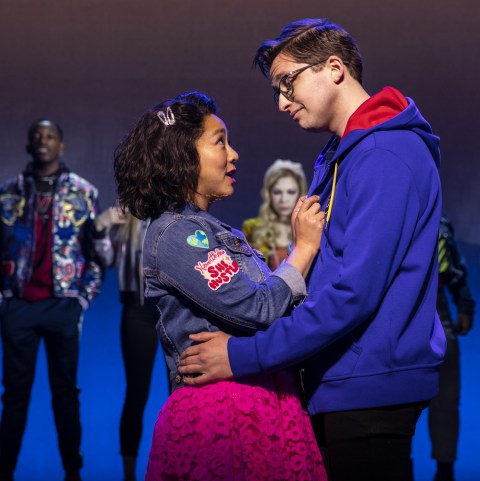
Will Roland, Stephanie Hsu, ‘Be More Chill,’ Music and Lyrics by Joe Iconis, Book by Joe Tracz, directed by Stephen Brackett, choreographed by Chase Brock (Maria Baranova)
The storyline is an ironic spin-out and twitting/send-up of recent techno-films and social media hype fueled by Instagram and Twitter. It gyrates with ancillary references to computer geeks and dweebs, Incels and dorks and the power domination of digital dictator wannabes, A.I. and computers that animate with a H.A.L. complex (reference to the super computer in Stanley Kubrick’s film 2001: A Space Odyssey).
The story is futuristic modern, and almost believable as we consider scientific advancements in nano-technology and chip implantation. The MO of seeing people and events through one fascist perspective is also given a spin. This stance that reflects the most unenlightened of our cultural folkways, demeaning humanity and cauterizing empathy by categorizing individuals as “winners or losers,” is ridiculed. Be More Chill shreds the superficiality and unreality of success values mirrored in our cultural institutions, for example, the fashion industry, the advertising industry, the financial industry, etc. which dictate what it means to be “with it” or “beautiful” or “chill.” These values are impossible but for their added purpose to insure profitability and competition between and among genders and ethnic groups. Such success values have been employed as a tool of fascism to decry human beings’ souls and spirits and perpetuate divisions among people instead of emphasizing our shared humanity. This theme is emphasized and the protagonist learns about this by the conclusion.

Will Roland, George Salazar in ‘Be More Chill, Music and Lyrics by Joe Iconis, Book by Joe Tracz, directed by Stephen Brackett, choreographed by Chase Brock (Maria Baranova)
The thematic threads initiate in a seemingly simplistic plot of “loser kid wants to fit in.” Not! In “More Than Survive” Jeremy Heere (the sensitive Will Roland) identifies how he defines himself as a loser; he has internalized the greater cultural values and applied them to his own individual situation. Though the milieu is high school, “the loser” metaphor Jeremy uses to abuse and torment himself is everywhere in the larger culture, the macrocosm, which the high school reflects as a microcosm. It has even been expressed with vehemence in the culture of the current White House, and especially to denigrate individuals “viewed” as enemies.
This irony enhances the production’s currency and amplifies the theme that this designation of identity (winners vs. losers) should be anathema. Looking deeper, we note in the production that the winner/loser construct is employed by the miserable protagonist Jeremy, who internalizes the cultural success mores then tortures himself with them because he continually falls short in his own perception. And the construct is employed by the unscrupulous SQUIP (the wicked, manipulative Jason Tam) to manipulate, con and gain power. Unfortunately, whether for young or old, rich or poor, the construct promulgates noxious values that destroy inner peace and force individuals to further harm themselves to stop that destruction in a tragic cycle. This is one of many vital truths that by the conclusion Jeremy begins to understand as he moves on his journey deeper into his own psyche and soul and attempts to heal.

(L to R): Katlyn Carlson, Lauren Marcus in ‘Be More Chill,’ Music and Lyrics by Joe Iconis, Book by Joe Tracz, directed by Stephen Brackett, choreographed by Chase Brock (Maria Baranova)
We “get” the hell and misery Jeremy experiences as an “invisible nothing” who is tormented by bully Rich Goranski (the excellent Gerard Canonico) in the high school bathroom. Jeremy just wants to make it to the next day without pain. And he wants to be with Christine (the quirky, adorable and versatile Stephanie Hsu) who adores being in plays. We catch the humor and irony as she sings with fervor “I Love Play Rehearsal.” Jeremy follows her to audition for the school play but is overawed by her presence.
When Rich offers him an opportunity to become “visible” to himself and others, Jeremy is intrigued. He must do something to annihilate that loser part of himself which he interprets as ugly to others and himself. He gets “assistance,” but not through alcohol, opioids, drugs, joining white supremacist groups, cults, etc., or other means that individuals use to nullify their pain and seek comfort and/or acceptance. The “assistance” he gets is appealing for a “geek,” “nerd,” potential “Incel” like Jeremy, but as it turns out, it appeals to anyone who is not in touch with their own being.
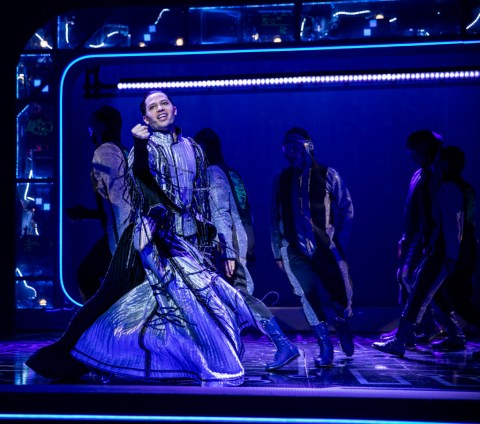
Jason Tam and the cast of ‘Be More Chill,’ Music and Lyrics by Joe Iconis, Book by Joe Tracz, directed by Stephen Brackett, choreographed by Chase Brock (Maria Baranova)
The assistance comes in the form of a SQUIP (Super Quantum Unit Intel Processor) that Rich tells him about in “The Squip Song.” Though Jeremy has a close friend Michael with whom he discusses swallowing this illegal, pill-like processor from Japan, he ignores Michael’s counsel and encouragement in “Two-Player Game.” This rousing song with projections, lighting and multicolored staging frames, places the two friends within the “Apocalypse of the Damned,” Level 9 video game during which they pledge friendship to “catch each other’s backs.” Such pledges turn upside-down; Michael has greater inner strength. Jeremy succumbs to his weaknesses and seeks the change he believes the SQUIP can bring him in the song “Be More Chill.”
The SQUIP (Jason Tam in a superbly nuanced and mesmerizing performance) animates and becomes the guide through Jeremy’s own self-made virtual reality game in his mind. Only Jeremy visualizes, syncs with and “processes” the SQUIP who mentors him in how to negotiate the high school social strata and knock out “adversaries” with such aplomb they become his friends. To converse with him in Jeremy’s mind the SQUIP conforms to whatever celebrity or anime Jeremy chooses, if he doesn’t like the default mode which is Keanu Reeves (a send-up of the film franchise The Matrix-1999, The Matrix Reloaded-2003, etc.).

Jason Tam, Will Roland, Lauren Marcus, ‘Be More Chill,’ Music and Lyrics by Joe Iconis, Book by Joe Tracz, directed by Stephen Brackett, choreographed by Chase Brock (Maria Baranova)
In this funny scene, the SQUIP offers to change to other personas, i.e. Beyonce, Batman or a sexy anime cat girl with a tail. Jeremy identifies with the default mode Reeves. Tam is hysterical as he replicates Reeves and dresses in outfits suggested by The Matrix (thanks to the hot, clever costume design by Bobby Frederick Tilley II). Tam’s SQUIP speaks and moves like Reeves, but with sinister tinges of evil, dark insinuation. He is charming and Tam mines just enough enough of the SQUIP’s likability to make him adorable fun. Tam’s performance is “over-the-top” fabulous in its nuanced development and march toward nefariousness.
By degrees, the SQUIP helps Jeremy transform into another being; his optic nerve changes and Jeremy jettisons his dweeby glasses. He uncannily behaves with such perfection, he masters the right conversation for every social interaction, thus he manipulates every person, regardless of circumstance to get what he wants. No girl is too “Stacy” for him as they perceive him as a Chad (Incel-speak for master-race male and female physical types). Brooke (Lauren Marcus) and Chloe (Katyln Carlson), who are both “Stacys” find him attractive and attempt to be with him in the song “Do You Wanna Ride?” which Marcus and Carlson sing with humorous, ripe suggestion.

(L to R): Katlyn Carlson, Tiffany Mann, Lauren Marcus in ‘Be More Chill,’ Music and Lyrics by Joe Iconis, Book by Joe Tracz, directed by Stephen Brackett, choreographed by Chase Brock (Maria Baranova)
However, Jeremy doesn’t feel comfortable in this new persona until the SQUIP gradually brainwashes him to release his personality including his ethics, kindness and sensitivity to achieve “success.” We see how the SQUIP in “Be More Chill Part 2,” Sync Up” and “Upgrade” gets off on the power-trip of dominating Jeremy’s every thought. Using the SQUIP’s advice to overcome his fears and suppress his true self, Jeremy lacks the understanding and confidence to accept his own individuality.
Though Jeremy learns to obey all the SQUIP’s commands (he reminds us of a well-tuned robotic psychopath…especially in the latter part of ACT II) Jeremy still can’t manipulate Christine to like him (“A Guy That I’d Kinda Be Into.”) Her authenticity, perceptiveness and rejection of superficial values give her the power to rise above and sit in her own confidence. By the end of Act I Jeremy is convinced that he must “give it his all,” ignore his friend Michael and eliminate all elements of Jeremy 1.0 (“the old school analog”) and upgrade himself to give “popularity” a try (“Loser Geek Whatever”). Accepting the SQUIP completely, in his virtual reality game, he is “ready player 1” (a reference to the titular film by Spielberg). The lyrics to the song reference acceptance of a noxious narcissistic attitude when Jeremy sings, “I’ve earned the right to selfishly, be all for one and one for me.” Of course, it is this attitude the other students desire. Like Jeremy, they are unhappy and miserable feeling like they are their own definition of “losers.”

The company of ‘Be More Chill,’ Music and Lyrics by Joe Iconis, Book by Joe Tracz, directed by Stephen Brackett, choreographed by Chase Brock (Maria Baranova)
By Act II the SQUIP goes full throttle in uber control mode. This develops in an explosion that reveals the hidden conflicts and the dangers of “the SQUIP UNIVERSE” which entraps, then metastasizes so the other students (who are “tired of being the person that everyone thinks they are”) are synced together. Tam’s SQUIP effectively sings how this can occur in “The Pitiful Children.” Meanwhile, the SQUIP has become the full blown psychopathic dictator who will “not be shut down” or kicked out of Jeremy’s or others’ psyches easily. This metaphoric symbolism is iconic. How does one remove internalized fascist values that have been growing in cultural social consciousness since before we were born?
In a worsening irony, it appears that Jeremy has moved over toward becoming a robotic anti-human manipulator. He even refers to his father as a loser from his exalted, narcissistic height of success. Mr. Heere, the excellent Jason Sweettooth Williams who plays multiple roles, brings down the house with George Salazar’s Michael in “The Pants Song” as they join forces to restore Jeremy to “his right mind.” Another “bring down the house number” Salazar sings by himself is “Michael in the Bathroom.” Salazar’s fury, hurt, shock, manifests palpably so that we completely empathize with Michael. All of us have been where he has been emotionally. Salazar rocks the song with dignity and power.

George Salazar in ‘Be More Chill,’ Music and Lyrics by Joe Iconis, Book by Joe Tracz, directed by Stephen Brackett, choreographed by Chase Brock (Maria Baranova)
The production was workshopped regionally, shaped, with prodigious effort and its music shared cleverly on Social Media before it landed Off Broadway in a limited run and sold-out crowds at the Pershing Square Signature Center. It has been adroitly enhanced for its open-ended run on Broadway. The stylized sets remind one of a video game that we enter with the cast. And the production is highly metaphoric. Like Jeremy, we are the protagonists of our own video games/films/plays. This metaphor is realized and extended throughout this production’s artistic design.
Kudos to Beowulf Boritt (Scenic Design) Bobby Frederick Tilley II (Costume Design) Tyler Micoleau (Lighting Design) Ryan Rumery (Sound Design) Alex Basco Koch (Projection Design) Dave Bova (Wig and Make Up Design) J. David Brimmer (Fight Diretor) Michael Aarons (Music Coordinator) Emily Marshall (Music Direction and Vocal Arrangements) Charlie Rosen (Music Supervision and Orchestrations) Chase Brock (Choreography).
Special praise for Alex Basco Koch’s projections which suggested brain synapse patterns, processing chips, electrical pulsations, video games and more.
Be More Chill runs with one intermission at the Lyceum Theatre (149 West 45th Street) in an open ended run. You can buy tickets and see times on their website by CLICKING HERE.
‘Gary,’ With Nathan Lane, Kristine Nielsen, Julie White, Bringing You Tears in Laughter
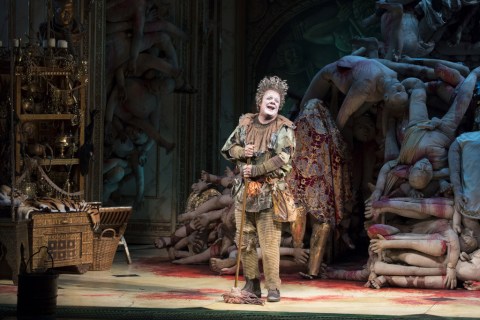
Nathan Lane in ‘Gary,’ written by Taylor Mac, directed by George C. Wolf at the Boothe Theatre (Julieta Cervantes)
Gary by Pulitzer Prize finalist for Drama, Taylor Mac and directed by the prodigiously talented George C. Wolfe is WACK! (translation: cosmically brilliant, riotous, sardonic in dark and light) This uproarious “Sequel to Titus Andronicus” (Shakespeare’s first and bloodiest tragedy) is a brutal, intense, intimate play about body parts and indelicate body processes we don’t discuss in polite conversation with The Queen. Rich in themes and characterizations with a clever, twisty plot that surprises, it is also about much more.
To give us a handle in how to approach the mood and tenor of Gary, Carol (the sensational Julie White) comes in front of the once glorious, now shabby curtain and addresses the audience in Shakespeare’s favorite verse, rhyming iambic couplets. As Carol validates the how/why that Titus Androicus deserves a sequel, suddenly she spurts blood from a hole where her throat has been slit during the roiling events of the former play.
The absurdity of her discussion about a sequel that is more craven with gore than the original (while spurting blood) is titanically ironic and bounteously funny! Already, the playwright has set the mood and tenor between the horrific and rambunctious, as Carol’s unsuccessful attempts to stem the red flux poises the audience on a balance beam of tragedy and comedy. If this is the first of the production’s many moments of shock and awesomeness, we’re in for the long and the short of it. Let the rollicking fun begin!

Kristine Nielsen, Nathan Lane in ‘Gary,’ directed by George C. Wolf, written by Taylor Mac (Julieta Cervantes)
Conceivably, after every holocaust of war and massacre, someone has to clean up and set things “straight” again. In her wobbly, blood draining state, Carol brings up the curtain to reveal the debacle of bloodshed at the conclusion of Titus Andronicus. Then she totters off to bleed to death. The mounds and mounds of bodies piled up from the coup are staggering. There is one central mound of bodies to be processed, another pile of processed bodies and another under a sheet. Thanks to Santo Loquasto’s scenic design, everywhere you look there is the attempt to organize rotting flesh in the Roman banquet hall that is a temporary storage place of the dead. These number among them rich and poor, wealthy elites, citizens, officials, soldiers, rulers and others swept up in fierce fighting, civil war, apocalypse. Death does not discriminate.
The feast of death poetically will slide into a feast of celebration, for in a day, the hall will be the site of the new Emperor’s inauguration, another power transition. Into this macabre scene comes Gary (the incredible Nathan Lane who is a riot beyond description) a former clown who juggled live pigeons to little acclaim and no success. Things are looking up for Gary; he has a new job as a servant for the court. But what a job!
Having escaped a near death experience at the executioner’s hand by a lightening stroke of genius, Gary ends up in the hall for he told the executioner he would help tidy up the catastrophe of gore by doing maid service. Little does he realize what cleaning up corpses entails, and when head maid Janice (the magnificent, moment-to-moment Kristine Nielsen) begins to show him, he recoils, reconsiders his choice and redirects his “ingenuity” in a different direction. He will not stay there long; he will rise up and go beyond maid service. He will become a Fool, the wisest of the Emperor’s counsel.

Nathan Lane in ‘Gary,’ directed by George C. Wolf, written by Taylor Mac (Julieta Cervantes)
Meanwhile, Janice must teach loafer Gary the tricks of death’s work in the flesh. Grand experience has inured her to dealing with corpses, for she’s been cleaning up after each of the Roman wars for a long time. And Rome has been battling for decades. As Janice instructs Gary in “cleaning,” her fiendish efficiency at pummeling the gas out of the bodies to extract their farts is Nielsen at her hysterical best. Her antic machinations are real and horrifyingly, and equally LOL humorous, as she drains noxious body fluids showing Gary the difference between siphoning out the blood, and pushing out the poo. Lane’s Gary is priceless in his response to Nielsen’s Janice. The two actors are the perfect counterparts to make us roll in the aisles at their irreverence and seriousness.
From the outset, we understand Mac’s themes of class elitism and domination as the two maids disagree, fight and create their own rank to dominate, even as ridiculous as it is to fight over lead maid and subordinate. From the characters’ quips, jibes, demands, insults and resistances, we learn how beaten down the lower classes are through these prototypical plebeians who are the invisible, the disposable. But then again their disagreement if given latitude may rise to add their corpses to the pile and who then would be left to clean up the mess? The human condition to power over others defies class. There must be something better than this!
Though recovery from his near death experience sent him to a place of hell and damnation with Janice presiding as head monster maid, Gary holds to his enlightened state. He considers; maybe he can save the world and make it better, to stem the tide of wars and bloodshed. His revelation spurs him to attempt to convert Janice to his cause and show her there is something better in life than pumping poo and expelling gas from cadavers.

Julie White in ‘Gary,’ written by Taylor Mac, directed by George C. Wolf (Julieta Cervantes)
But Nielsen’s Janice is an incontrovertible martinet. What’s worse is she’s excellent at her job. She actually takes pride in her efficiency and refuses to revolt against the current social “order” or rise above it. She eschews and belittles Gary’s ambitions. She is insistent about keeping her place at the bottom of the social strata so she can stay alive even if she is a fart expeller. But as Gary questions the “life” she is leading, his presence and argumentative logic wear her down. As she processes the bodies and argues and commands Gary, she erupts with aphorisms and sage comments indicating that perhaps there is a shaking going on in her soul. Perhaps dealing with death has made her wise after all and prone to hope as well.
Carol shocks Gary and Janice joining the scene, having survived bleeding to death in a second near death experience to match Gary’s. She adds to the hilarity by confessing her “sin” that she missed an opportunity to save a life. With distraught fervor, White’s Carol cries out a refrain of her “sin” at pointed moments during the conversation with Janice and Gary. Each time she erupts in a whining cry (no SPOILER ALERT, SEE THE PLAY) she is marvelously, brilliantly funny. And yet, we feel for her and “know” we would not have behaved so cruelly and cowardly as she did. (NOT!) But she, too, can be inspired to change.
White, Lane and Nielsen send up his extraordinary satire on death and the tragedy of the human condition to fear, hate, revenge and murder. And finally, they do what Gary persuades them to, with Janice convinced of the rightness of his enlightened suggestions. The characters create an “artistic coup” and turn the tragedy of humanity (in Titus Andronicus) into an absurd comedy sequel, where the audience laughs at itself and reverses the cycle of hatred, killing and violence.

Nathan Lane, Kristine Nielsen in ‘Gary,’ directed by George C. Wolf, written by Taylor Mac (Julieta Cervantes)
Indeed, Mac and Gary parallel in their intentions, as Gary states in creating his artistic coup, that it’s an “onslaught of ingenuity that’s a transformation of the calamity we got here. A sort of theatrical revenge on the Andronicus revenge.” Thus, this ‘Sequel to Titus Andronicus’ is a comedy bubbling up from a tragedy and the production ends with hope sparked from a clown and mid-wife who had a second chance at life to encourage a maid who was enduring a living death.
Though the pallid, fake, pokey corpses are stripped or dressed as Romans and the setting is in the latter days of the Roman Empire, Mac’s message is clear. This is us! This is now! The more ridiculous-looking and absurd the “cadavers” appear, the more death and war hover in the “unreality” of the piles of staged dummy corpses. In displaying the morbidity of violent effects, the production is precisely pacifist. But it is also a “Fooling.” So…interpret as you will.
Mac, with acute, dark wit creates his new Mac-genre-“Fooling” and reminds us how we “play” with our own mortality and that of others by taking our lives for granted. As invisible as one may feel in light of the culture’s social and political corruptions, there is always hope. There is always something one may do to rise above and use one’s genius to help others. The fact that Gary plans an “artistic revolt” to convert tragedy into comedy suits for our time.

Kristine Nielsen in ‘Gary,’ directed by George C. Wolf, written by Taylor Mac (Julieta Cervantes)
The production rises to the heavens buoyed up by the fabulous talents of acting giants Nielsen, Lane and White shepherded by the superb Wolf. I could write volumes about this work and the humane, sensitive and completely organic performances by Nathan Lane, Kristine Nielsen and Julie White that are “over-the-top” impeccable. I cannot imagine anyone else in their hyper-hilarious, exhaustive, and energetic portrayals.
Wolf and the artistic team display the playwright’s vision and sound the alarm with energetic gusto. Can we luxuriate in continued economic class struggles, power dominations which set up the inequities between the rulers and the ruled? Why must the “inconsequential” and “invisible” under classes continuously put up with what their “betters” have wrought to satisfy their own lusts, while destroying most everyone else and above all themselves in the process? It is a wasted institutional genocide that no one escapes. Are we not better than this? The characters try to prove they are. Bravo to the actors for bringing them to loving life.
This production is profound. Its humor is beyond hysterical, of the type that makes you laugh through your tears, and cry laughing. Its loving stroke will blind you and make you see again. In its irreverence, cataclysmic indifference about the dead, and twitting of the frailties of humanity’s proclivity to murder, exact revenge and make war, it is an indictment of the “upper” classes (the audience is mentioned as part of the court) and vindication of the lower classes who put up with them. In short it is irreverently ingenious. Every arrogant, billionaire narcissist should see this “Fooling.”
Kudos to Santo Loquasto (Scenic Design) Ann Roth (Costume Design) Jules Fisher and Peggy Eisenhauer (Lighting Design) Dan Moses Schreier (Sound Design).
Gary runs without an intermission at the Boothe Theatre (222 West 45th Street) until 4 August. For times and tickets go to the website by CLICKING HERE.
‘Hillary and Clinton’ Starring Laurie Metcalf and John Lithgow

(L to R): Zak Orth, Laurie Metcalf, John Lithgow in ‘Hillary and Clinton,’ directed by Joe Mantello, written by Luas Hnath (Julieta Cervantes)
Hillary and Clinton by Lucas Hnath, directed by the acute, clever Joe Mantello, currently at the Golden Theatre, begins with hypotheticals. Women live their lives in hypotheticals. What Ifs! And this is how the playwright has his character Hillary, who neither looks like nor effects the ethos of Hillary Clinton (played by Laurie Metcalf in a stunning, invested portrayal) opens her discussion in a relaxed “down-to-earth,” “behind the veil” confession to the audience. She posits a “What if?” supposition that there are “infinite possibilities” in our universe.
Hnath wrote the play when Barack Obama was in the full swing of his presidency. Considering what occurred during the 2016 election, Hnath’s play is doubly prescient and its underlying themes resonate more loudly than ever. In 2019 despite #Metoo, perhaps because of it, as much as we’d like to, we cannot pretend that women and men have equality in our culture, especially in light of a Trump presidency which is a throwback to women’s oppression in various forms that echos throughout American History.
For many women, “What if” doesn’t really get a chance to soar to a triumphant conclusion because there are an infinite number of “not possibles” preventing it. The sheer will that is required for women to overstep the “not possibles” is shattering. This is even so in an alternate universe of cultural equanimity, where it is a given that women succeed in obtaining leadership positions because men always lay down their egos and encourage them to do so.
Hnath subtly spins themes about paternalism and gender folkways in his subtle yet not so subtle fictional/nonfictional work. He does this aptly by hypothesizing about one of the most brilliant, competent and ambitious of women in the “free” world living today. Like no other in the political arena, Hillary Clinton embodies the possibilities of power and the smash downs to achieve it. Why is this, Hnath asks sub rosa? He answers this by factualizing his perception of Hillary Clinton’s relationship with Bill Clinton in the service of reminding us about women leadership and competence, about male ego and dominance, about the underlying primal realities of paternalism and male oppression and womens’ attempts to overcome.
At the play’s opening, an always on point Laurie Metcalf as Hillary, posits the probability that on another planet earth somewhere in our universe of “infinite possibilities” there is a Hillary running for the Democratic Party nomination during the 2008 primaries. Hillary, in competition with a man named Barack is losing. With Mark Penn (Zak Orth portrays the shambled-looking, frustrated and stressed campaign manager) Hillary attempts to determine the truth about why she is losing and how she will be able to recoup further losses if she can get more funds to refill her dwindling coffers.
After Mark offers explanations of her loss from his perspective, he indicates that perhaps it is not as bad as she suspects. The Obama campaign actually is daunted by her and has offered an opening for her to be his running mate when he is nominated if she drops out of the next two races and slowly fades away. Hillary interprets this to mean the Obama campaign is circling in for the “kill,” and expresses outrage that she might take such a deal. Despite Mark’s protestations she interprets it to mean she is going down for the count. Mark warns her not to call Bill for help and she promises not to.

Laurie Metcalf, Zak Orth in ‘Hillary and Clinton,’ directed by Joe Mantello, written by Lucas Hnath (Julieta Cervantes)
Twelve hours later, Bill (the wonderful Lithgow) who previously had been kicked off the campaign, shows up in New Hampshire to the starkly minimalistic hotel room (which indicates a lack of funds). When he swears they stayed there before, we consider perhaps this is a backhanded reference to his own campaign in the primaries which he successfully won. In small measure he is forcing her to “eat crow” that she needs him. Then he chides her and expresses his ire at having been thrown off the campaign by Mark.
Their clashes are revelatory. In these discussions they cover a myriad of intriguing subjects: her fear of losing, their lives together, his boredom, her personality, her lack of fire and warmth, that he exhausts her, references to his infidelity and strategies for the upcoming primaries to initiate wins. Some of the subjects are unfamiliar. Others we anticipate because we’ve heard talking heads discuss the Hillary “personality” problem.
Lithgow’s and Metcalf’s focused listening and responding to each other are particularly excellent during Hnath’s dynamic interchanges, well shepherded by Mantello. Importantly, in exploring the fictional/nonfictional complications of a marriage between two brilliant, competitive and ambitious individuals, Hnath reveals the conundrum. They need to be together, but also must be apart in their own identity and autonomy. In their wish to be themselves, they are also the couple in a shared unity and friendship which will end in uncertainty for Hillary and loss for Bill if they separate. The public trust has glued them together as one. Their bond is intangible and ineffable and Hnath particularly suggests this with great sensitivity.
Hnath grounds their arguments, thrusts and parries with homely marriage tropes which we identify and empathize with. They are intensely human, real, warm, vibrant, competitive, loving (their costumes suggest the “all masks off” feel). Underlying all of it are dollops of frustration, wrath, annoyance and fear thrown in for good measure.
Threaded throughout we understand that these two have a profound relationship based on many similarities and attractions based on differences. They have a mutual care and concern that is their greatest grace and their underlying curse. Indeed, Hillary, in anger wishes she could break away from the stench of Bill that follows her. But when he suggests to succeed she must get a divorce, she avers. It is a fascinating moment; for as she states, she knows that many would support this and believe this is the right action for her to take. However, she cannot; she states she will be with him forever. For that he is beyond grateful.
Into this mix is thrust the knowledge of a phone call between Hillary and Obama, during which Hillary accepted Obama’s offer to be his running mate. Upon this everything turns.

Laurie Metcalf, John Lithgow in ‘Hillary and Clinton,’ directed by Joe Mantello, written by Lucas Hnath (Julieta Cervantes)
When Bill steps into the campaign and gives her what she initially requested, he also oversteps his bounds causing rifts between Mark and Hillary. This causes a surprising series of events, one of which includes Barack coming to their hotel room to talk. Barack is portrayed by Peter Francis James in an interesting turn and resemblance to Obama in demeanor and stance. Barack confronts Hillary about the offer to be his running mate and the change in the fortunes of a race, after Bill becomes involved. He also reveals a tidbit of information that landed in his lap, information which will haunt the Clintons in the future.
There is no spoiler alert. You will have to see how Hnath arranges the chips to fall in this climax and how all of what we’ve seen before of their ties that bind, play out.
The play which expands on the premise of “infinite possibilities,” ends on it. From Hillary’s initial flipping of the coin that turns up a 50/50 heads/tails pattern of probabilities, we follow a series of events that decry any possibility of the coin toss dealing Hillary a winning hand. Hnath has brought us closer to explaining why she is not a winner this time, nor a winner in 2016, nor ever unless the earth tilts differently on its axis to produce another earth where Hillary somewhere “over the rainbow” on another earth is president.
Hnath allows us to fill in the unanswerable uncertainties and questions which he leaves open and encourages us to hope for in his poetic “on another earth Hillary is president.” For me this is heartbreaking especially now with the Mueller Investigation revealing a massive Russian warfare campaign to interfere with the election to put Trump in as the president, the results of which we are being deprived of in its full form. Indeed, Hillary lost the 2016 election on planet earth. She did this, perhaps for the reasons suggested intriguingly in the play.
However, Hnath’s powerful work and framing it with the backdrop of probabilities reveals more in what it doesn’t discuss because it was written before we understood what forces were ranging against the United States. Probabilities set up in coin tosses are random. What happened in Hillary Clinton’s 2016 loss (which is never alluded to in the play) is far from a probability. As more of the facts come out (despite the struggle to obfuscate and obstruct the report by the administration) her loss appears to be an inevitability…an inevitability which various illegal forces would go to extreme lengths to bring about.
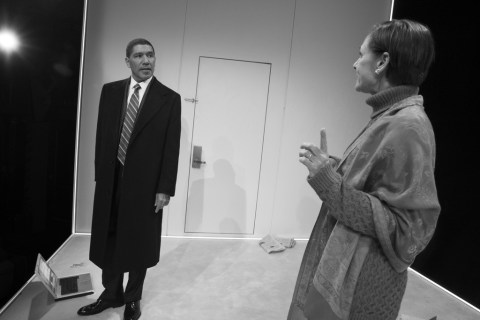
peter Francis James, Laurie Metcalf, ‘Hillary and Clinton,’ directed by Joe Mantello, written by Lucas Hnath (Julieta Cervantes)
That this production is being presented now at the height of the issues with the release of the Mueller Report Investigation and the DOJ? Well! This is fascinating and curious. And it leads me to this theme: there is more to what appears to be so, what pundits say is so and what “the facts” are depending upon who “owns” them. In Hillary and Clinton, Hnath presents the “What If” and allows us to consider what the character Hillary says about running again at some point. She would like to; she must understand how to get there to win.
This forces us to ponder what happened in 2016 and then the character Hillary brings us back to the coin toss which makes her president on another earth. We go with Metcalf’s Hillary for one second, then are dropped into the pit of reality. She isn’t president. And why not? Because of Bill? Because of her personality? Because of the Clinton Foundation? Because of paternalism? Because she is a woman? Sure!
But!
To my mind, Hillary Clinton’s loss was less about her personality and her relationship and Bill’s “stench” and more about what forces didn’t want her in and why not. All the ultra-conservative social media groups, Russian Intelligence institutions, Russian hackers, Republican Think Tank strategists, elite globalists and like-minded billionaire Americans were poised to prevent her win with systems “ON.” It was a monumental effort that is mind blowing. And very costly.
That’s why Hnath’s character Hillary tossing a coin at the beginning and conclusion of the play is brilliant in theme and profound message. It is frightening, heartbreaking and an eye-opener, however you frame the “What if.” There will never be a “What if” for Hillary. There is no alternate universe, earth or whatever. We must deal with what is and get to work about it.
Laurie Metcalf is gobsmacking; she’s nominated for a Tony, Drama Desk and Drama League for “Best Actress in a Play.” Lithgow is superb. Able assists, Zak Orth and Peter Francis James make this a play you must see. Hillary and Clinton will make you think; it will open your eyes. And as it did for me, it may break your heart.
Hillary and Clinton runs at the Golden Theatre (252 West 45th St.) until 21 July. It has no intermission. You can purchase tickets by going to the website and CLICKING HERE.
‘Tootsie’ is an Indescribably Delicious SMASH HIT

Santino Fontana and Company in ‘Tootsie,’ directed by Scott Ellis, Music and Lyrics by David Yazbek, Book by Robert Horn (Matthew Murphy)
Tootsie, the 1982 film based on the story by Don McGuire and Larry Gelbart and the Columbia Pictures motion picture produced by Punch Productions, starring Dustin Hoffman, is a multi-award winner which is sanctified for its time. The Broadway musical comedy with Music and Lyrics by David Yazbek and Book by Robert Horn has been a long time coming and the wait has been well worth it.
The production starring the likeable and prodigiously talented Santino Fontana is a wondrous addition to this amazing Broadway season. Fontana’s voice is incredible, his dead pan timing bar none, his negotiation of the complexity of this titular role could not be more spectacular. Director Scott Ellis shepherds Fontana and the cast with acuity and grace.

Lilli Cooper and Company in ‘Tootsie,’ directed by Scott Ellis, Music and Lyrics by David Yazbek, Book by Robert Horn (Matthew Murphy)
The Tootsie characterization has been cleverly updated to include superb jokes related to the #Metoo movement. Indeed, what was a maverick fluke in the 1980s film version about gender roles and sexual predation, certainly fits like a glove for our time. Its ridicule of various themes connected with political correctness about gender is cleverly managed. Regardless of left or right we scream with laughter about the self-righteousness of both positions. Tootsie balances on a median between extremes. This is a good thing.
For me, it is a welcome novelty after the mainstream media and social media have become the playland of political, click bait trolls, looking to garner hits and stir controversy. Tootsie is too adroitly written by Robert Horn for that. The only tweets and Instagram hits it will be receiving are for the sustained hilarity and classic comedic situations which bloom like roses in a never-ending summer of delight. I mention roses because the principals will be receiving bouquets for their virtuosity and excellence. Their stellar performances assisted by the equally adroit song and dance talents of the ensemble will run the gauntlet of award season flying high.
Generally, the plot is similar to the film with the major transformation that Michael/Dorothy is an excellent actor who primarily looks for theater work. As in the Michael of the film he is arrogant about his talent, and the conflict’s arc of development sparks when Michael interrupts director Ron Carlisle (Reg Rogers) during the rehearsal of a lousy play. Reg Rogers’ portrayal of the smarmy, oily potential predator who is a Bob Fosse-type without the talent is wonderfully funny.

Reg Rogers and Company in ‘Tootsie,’ directed by Scott Ellis, Book by Robert Horn, Music and Lyrics David Yazbek (Matthew Murphy)
Michael attempts to ingratiate himself with the director Ron Carlisle about his role in the ensemble. Ironically, Dorsey’s narcissism manifests in a twitting of the actors’ dictum: “There are no small parts, only small actors.” Michael suggests there is some confusion about his character’s backstory. When Carlisle tells him he is just in the ensemble and doesn’t require a backstory, Michael is the narcissist in his response.
The director’s outrage is spot-on hysterical and we feel little empathy for Michael who is fired outright. His arrogance and superiority have pushed him over the line as his agent (Michael McGrath) substantiates by firing him in a blow that is a touché! Michael knows he’s a mess, but lacks the power or wisdom to understand what to do about his external crisis, not realizing it’s best solved by changing internally.

Sarah Stiles in ‘Tootsie,’ directed by Scott Ellis, Book by Robert Horn, Music and Lyrics by David Yazbek (Matthew Murphy)
Santino Fontana sings “Whaddya Do” attempting to negotiate his angst at being unemployable. We are unimpressed by his fledgling sign of despair in this song which doesn’t go to the root cause. He must learn much more about himself; he is not there yet. A crucial moment occurs when Sandy visits and informs him about a job she plans to audition for, then has a “slight” breakdown discussing it (“What’s Gonna Happen”). Michael gets the idea to morph into Dorothy Michaels (“Whaddya Do reprise) and audition for the job, having to suppress his male ego in a “female” body to disguise his loathsome face.
To get the role which seems highly unlikely, he’ll be Nurse Juliet in the ridiculous sequel to Romeo and Juliet entitled Julie’s Curse, an outlandish dog of a play that will most probably close opening night. As Michael auditions with “Won’t Let You Down,” Santino Fontana’s voice soars in triumph and realization. During the song, he gives birth to his female ethos and rounds out the personality of Dorothy Michaels housed in a “truck driver’s” body.

(background): Julie Halston, Reg Rogers (foreground): Santino Fontana in ‘Tootsie,’ directed by Scott Ellis, Book by Robert Horn, Music and Lyrics by David Yazbek (Matthew Murphy)
The production never returns to a moderate balance after this, though it has been set-up by a rollicking warm up with Sarah Stiles’ amazing work (more about that below). One reason why the show is a winner is that it glides into the heavens with the organic characterizations, the plot twists, turning points and two love stories (the second one is a ripping hoot thanks to the adorable John Behlmann as naively obtuse Max Van Horn who falls in love with Dorothy/Michael.
The actors’ pacing has been timed with precision to deliver the superbly engineered and crafted one-liners arising from the action and characterizations. The audience never recovers from these, swept up in the hysteria and barely catching their breaths for the next joke. The play is well-structured, building toward the two climaxes, one at the end of Act I and the other near the conclusion of Act II.

John Behlmann in ‘Tootsie,’ directed by Scott Ellis (Matthew Murphy)
The principle theme, that Michael Dorsey has grown as a human being with the help of releasing his feminine side is winsomely revealed as a “la, la, la,” in the film, downplayed for its vitality and power. Santino Fontana does a phenomenal job in bringing this theme to the fore in his solos with his rich sonorous voice. The music strengthens this theme and others. We are reminded that males are ashamed to acknowledge emotions in the company of other males. Today’s retrograde social currents about the bullying “macho male” in the White House who is “cool male” in his indecency makes Tootsie an important show for our time.
A lot of the humor arises with the gender switching. The songs reveal softer scenes as Dorothy must negotiate “his” love for Julie Nichols (Lilli Cooper). The two actors have some wonderful moments as budding BFFs. Their conversations ring true for us today and Julie’s characterization has also been rounded out with profound depth in the writing and in Cooper’s winning portrayal. Julie is a modern, wise woman who does not cave in to the director who attempts to smooze her with his position. She remains steadfast to her career and does not marry.

Andy Grotelueschen in ‘Tootsie,’ directed by Scott Ellis (Matthew Murphy)
The only “feminine woman attitude” the show allows is Michael/Dorothy’s Southern accent and this is an ironic blind. Supported by wealthy producer Rita Marshall (the excellent Julie Halston who pulls out all the stops) Michael/Dorothy takes a stand with the help of the ensemble and Julie. Dorothy Michaels reconfigures the show into one that is a going to be a shining hit (don’t ask how). The producer, Julie and the other actors appreciate Dorothy, though the director is angrily flummoxed. But Carlisle is masking chauvinism in his heart which we infer by his actions toward Julie. However, Carlisle’s producer is a woman who supports Dorothy’s “female” intuition about the play and her gumption to suggest revisions.
Michael’s acting talent and suggestions are given a hearing and used. Juliet’s Curse is transformed into a hit. By the end of Act I, “everything’s coming up roses” and Fontana’s Dorothy pridefully encourages himself by crowing out “Unstoppable.”
The song is a brilliant, humorous irony. Actors through experience, learn not to make presumptions about their future, out of sane superstition. (Sandy takes this to the reverse extreme.) Michael is headed for a fall. Like all of us do at one point or another, he does something to destroy his own success. As he attempts to recover, he digs a deeper hole for himself.
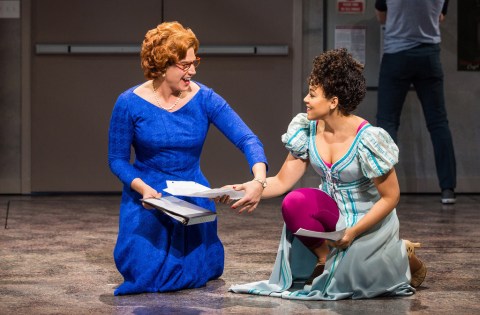
Santino Fontana, Lilli Cooper, ‘Tootsie,’ directed by Scott Ellis (Matthew Murphy)
Roommate Jeff (Andy Grotelueschen) who has been waiting for him to choke, gleefully beats him over the head with his stupidity in the second funniest song of the production, “Jeff Sums it Up” at the top of Act II. Grotelueschen’s performance in this scene (with Fontana as the straight man) is THE MAX! Grotelueschen’s portrayal as the “frustrated” friend Jeff is visceral. His timing is 100%. The effect generates our sidesplitting, roaring laughter. We are down with both Jeff and Michael.
As Michael crashes and burns Greek comedy style., we intuit that the worst is coming. It is only a matter of time before Dorothy’s drag act will be exposed.
I didn’t expect to be so impressed, by this clever reworking of Tootsie, especially with regard to the music. However the songs are damned funny and the music doesn’t draw attention to itself as some composers are wont to do. Indeed, the music serves the story; the lyrics and music meld like white on rice.

Santino Fontana and Company, Tootsie, directed by Scott Ellis (Michael Murphy)
I examined hawk-like whether any songs appeared to just take up space because “after all it’s a musical comedy” and “a song is needed,” etc. NO! Indeed, all the best moments spring from the characters and portrayals. These spur the conflict and create riotous fun. I am hard pressed to critique any of the musical numbers as ancillary or humor killing. A few are extraordinary and a few are memorable pop songs with a beginning, middle and end that doesn’t wander into nothingness.
The two songs you won’t remember (because you’ll be rolling in the aisles) are sung by Michael Dorsey’s friends, his roommate Jeff (Andy Grotelueschen) in the second act and his actress friend Sandy Lester (Sarah Stiles) in the first act. Both songs are organically based in the characterizations. They concern human emotions that are so identifiable that the specifics don’t matter.
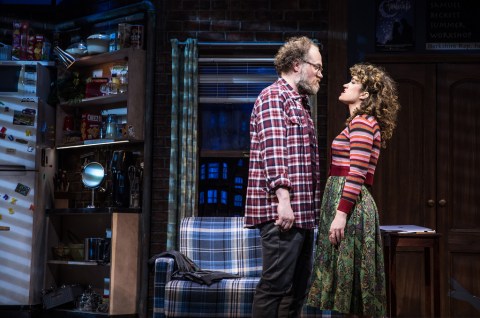
Andy Grotelueschen, Sarah Stiles in ‘Tootsie,’ directed by Scott Ellis, Book by Robert Horn, Music and Lyrics by David Yazbek (Matthew Murphy)
For example, in the song “What’s Gonna Happen!” Sandy takes off into a rant about her life as an actress, a state she apparently goes through before auditions. Her imagination terrorizes her into believing in a future and events that don’t yet exist. As she escalates her “crazy,” she explodes. She spews clouds of fear in a musical mixtape of strung together happenings that reach a level of frenzy that is beyond any drug to cure it.
Sarah Stiles is drop dead fabulous. Gobsmacking! We get it! We have been our own terrorists like Sandy, whipping our anxieties to an inner insanity of fear predicting our own nonexistent events. It is our brilliant healing that we find it uproarious to see and hear someone dare to express their delusions ALOUD in a rant more wacko than ours. The song and music are perfect; Stiles’ portrayal is 100 percent. Scott Ellis’ direction and staging elicit this exceptional moment, one of many in this humorously glorious production that kills it again and again.
I have not deeply belly-laughed this much during a Broadway show, except for British productions where the timing is as perfect as it gets. Never during a musical. I have nothing more to say, except you will regret not seeing Santino Fontana, Lilli Cooper, Sarah Stiles, John Behlmann, Andy Grotelueschen, Julie Halston, Michael McGrath and Reg Rogers, every one of them a gem and together, miraculous.
Kudos to Brian Ronan’s Sound Design-I heard every word which is vital for the clever lyrics. Mentions go to David Rockwell (Scenic Design) William Ivey Long (Costume Design) Donald Holder (Lighting Design) Paul Huntley (Hair and Wig Design) Angelina Avallone (Make-Up Design) David Chase (Dance Arrangement for their coherent artistry.
Tootsie runs at the Marquis Theatre with one intermission. For times and tickets, go to their website by CLICKING HERE.
‘Beetlejuice’ Argh! DEMONS! on Broadway
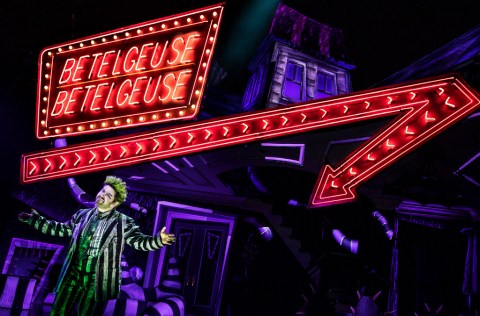
Alex Brightman in ‘Beetlejuice,’ directed by Alex Timbers, Music & Lyrics by Eddie Perfect, Book by Sott Brown & Anthony King (Matthew Murphy)
It is one thing to see the outrageous big kahuna on a tablet, your phone or even on a beautiful Samsung 146″ Modular TV in the safety and security of your living room. It is quite another to witness him live and in person at the Winter Garden Theatre sporting green mold and rot. Yes, that ethos of evil Beetlejuice, Tim Burton’s imminently genius evocation of all things hellish, demonic and flat-out-funny. has come to Broadway. This theatrical extravaganza from soup-to-NUTS is based on the Geffen Company Picture, the titular fan favorite cult film starring Michael Keaton and Winona Ryder (story by Michael McDowell & Larry Wilson).
To see the musical comedy Beetlejuice with Music/Lyrics by Eddie Perfect and Book by Scott Brown and Anthony King, come prepared with crosses, bibles and whatever else it takes to prevent that arch fiend from possessing you. But if you dare risk it, drop all notions of restraint and be prepared to fall into laughter.
The production stars the hysterical and wildly cryptic Alex Brightman as the beloved, infernal monster Beetlejuice. Sophia Anne Caruso is the dour, morbid Lydia, whose belt becomes as brave as her bravura performance to resist marrying the redolent demon costumed in hell’s black and white striped prison garb with greenish tinges (a William Ivey Long costume). Rounding out the principals are Rob McClure as Adam, Kerry Butler as Barbara, Adam Dannheisser as Lydia’s Dad, Charles, and Leslie Kritzer as Delia, the girlfriend.
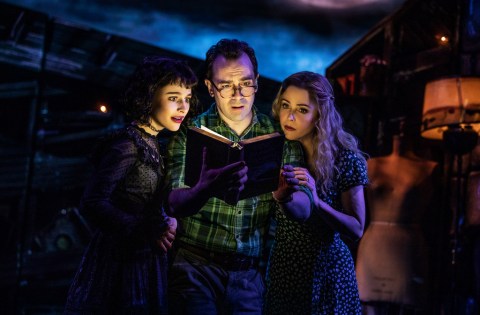
(L to R): Sophia Anne Caruso, Rob McClure, Kerry Butler in ‘Beetlejuice,’ Music & Lyris by Eddie Perfect, book by Scott Brown & Anthony King, directed by Alex Timbers (Matthew Murphy)
If you are a great fan of Tim Burton’s creative genius and his enlightened vision of the “Netherworld” and the malevolent, frightful spirits that populate it, you will not be disappointed by this glorious iteration that replicates them with the brilliance of twitting itself in the process. The creative designers, director Alex Timbers, ensemble, and even the ushers who escort you down the aisles of the theater (decked out with luminescent green and otherworldly trimmings) have worked prodigiously to make the production shine. And it appears that they have had all the fun in the world doing so. Certainly, the ghosts of Broadway must be happy, for the audience fans of the film, are over the top beside themselves with joy.
There’s a lot to be thrilled about. The puppetry is spectacular thanks to Michael Curry. I was happy to see the sandworm is alive and well arriving in varicolored clouds of sulfur and brimstone. Likewise the Scenic Design by David Korins, Kenneth Posner’s Lighting Design and Peter Hylenski’s Sound Design effects a supernatural realm and crashes it into reality, as does Jeremy Chernik’s Special Effects Design and Michael Weber’s Magic and Illusion Design. Because of their off-the-charts artistry, Beetlejuice’s command of the other worldly in defiance of time and space is satisfying. The haphazard, off-kilter and ultra modern design interiors and appointments of Lydia’s haunted home (from purple to silver and black after Beetlejuice takes over in Act II) are equally smashing.
Alex Brightman’s exuberance, authenticity and zaniness carries the production from the outset solidified by the tenor and mood of the opening number. His easy interaction with the audience is an assist to the funny and brilliant send up of our nascent fears about death and dying which he blasts away by landing that subject squarely in our laps so we might ridicule its “power” with him.

Alex Brightman in ‘Beetlejuice,’ directed by Alex Timbers (Matthew Murphy)
It’s an important opening, well-staged and acutely directed by Alex Timbers. Brightman’s demon clown cavorts; with joie de vivre he stomps down death, mournfulness and morbidity, all the while reminding us we’re dead folks, eventually. He and we are thus driven to rollicking laughter about our immortal presumptions!
Beetlejuice is our Virgil (our guide in the encounters with Morpheus and Legion minus the philosopher’s wisdom and grace) and we walk in the place of Dante (the poet of The Inferno). We are without Dante’s talent, but we retain hope and a penchant for having fun. Indeed, on this amazing journey with the fracasing Beetlejuice we do learn some secrets from him; yes, he reveals a wacky wisdom and astutely nefarious preeminence. This is especially so as he attempts to come back to life through delightful acts of chicanery and cunning misdirection to connive Lydia into marriage. After all, she too has talents; she’s the only one alive who can see him and traverse the realms of life and death.
Beetlejuice’s humorous introduction is an excellent counterpoint to the morbid reality of the scene that follows with Lydia in the graveyard. There, the stereotypes of the cemetery, rainy day, black clothing and umbrellas bring us to what Beetlejuice made us laugh about, Death. But in Lydia’s case, it is horrific, sad. Its fearful aftereffects include the yawning absence of the loved one it snatches away.
As Lydia mourns her mother in song, it is a let down, albeit an appropriate initiation of the play’s actions. Timbers’ staging and William Ivey Long’s costuming are effective in conveying the gravity of the macabre and the brutal “death process” with coffins, funerals and interments so we empathize with Lydia’s loss. Thankfully, there are comical touches which thread humor from the previous scene with Beetlejuice, whom we miss.

Alex Brightman, Sophia Anne Caruso in ‘Beetlejuice,’ (Matthew Murphy)
The plot is morphed from the film with songs to propel Lydia’s emotional moments and to introduce the characters of Barbara and Adam, owners of the house who meet an untimely death that Beetlejuice predicts, as he guides us through the events he directs to get himself resurrected. Kerry Butler and Rob McClure as the young couple become more interesting as they work with Lydia to overthrow Beetlejuice’s insidious intentions spurring on the dynamic conflict of the story.
Sophia Anne Caruso’s portrayal of Lydia is appropriate mouse at the outset as she sings in a near whine at the funeral, overwrought by her mom’s death. She becomes intriguing when she grows furious and insistent that her father Charles (Adam Dannheisser) will not even refer to his wife by name. Her empowerment increases after Charles brings along “life coach” Delia (the LOL Leslie Kritzer) to the house to assist him with his business development sales. She rebuffs Delia and then becomes rebellious when she finds her in her Dad’s bed. Lydia’s rebellion and loyalty to her mother’s memory blossoms into the secondary conflict.
The production builds rather slowly to develop these conflicts and characters; perhaps some of the songs of Act I drag. But if it’s in the service to form a contrast with Beetlejuice whose vibrant presence flings across the stage with unpredictability and surprise, then OK. Importantly, the build-up to the last scene of Act I is a fury of chaos as “Beetlejuice, Beetlejuice, Beetlejuice” usurps control and the house guests are possessed. Most humorous is the duplicitous Delia (Leslie Kritzer) whose Zen vibe flies out the window as she burps in shock, “Day-O,” and sings other phrases of “The Banana Boat Song”with the gyrating ensemble.

Leslie Kritzer, Adam Dannheisser in ‘Beetlejuice,'(Matthew Murphy)
This scene is smashing. We are delighted that Beetlejuice turns the world upside down as he breaks hell loose from its normally restrained moorings in the natural world. The handwriting is on the wall! Clearly, no one in the household stands a chance against him and his Legion. That is, unless Barbara, Adam and Lydia come up with a plan to thwart him.
Act II delightfully catapults one scene into the next as Beetlejuice attempts resurrection and Lydia seeks her mother. The cracked, funny characters of the Netherworld from the film pop out when Lydia travels there to seek her mom. But when she returns, she is anointed to escape hell’s clutches, so she successfully scrambles, racing away from demon football players and the cadaverous Juno (the funny Jill Abramovitz). All this is a power point presentation build-up to the riotous and satisfying last scenes of the play. This is no spoiler alert. You will just have to be brave, ignore the critics and see what happens. Unless you have forgotten how to laugh, you will roll in the aisles with delight.

Alex Brightman in ‘Beetlejuice’ at the Winter Garden Theatre (Matthew Murphy)
The production is a frolic of ingenuity in its reproductions of Burton’s artistic design genius with enhancements that are novel thanks to the show’s creators and artistic team. Importantly, the musical retains the originally stylistic elements that worked to make the film into a cult classic. Fans are especially looking for this.
Where it is uneven is in setting the conflicts in Act I. Some of the songs seem lackluster and overlong. The strength of this musical comedy is in its tantalizing reproduction of the best of the film and how it threads the action and startling themes related to Beetlejuice’s intentions to resurrect himself. How he lets us in on his scheme then guides us through his process is the central focus. Beetlejuice and Lydia hold the strongest dynamic. Their developing characterizations are key. Brightman and Caruso rise to the level required for this with their extensive acting and musical talents, especially in the second act. Brightman’s performance is gobsmacking throughout; Caruso’s voice is sensational. The ensemble rounds out the performances adding fun and humor with great energy.
Beetlejuice is a LOL ride and must-see especially if you saw the film a number of times and appreciate its wit and originality.That is duplicated here with tantalizing twists as it leaps into life so disparate from the digital flats. The production runs at the Winter Garden Theatre on Broadway. For times and tickets go to their website by CLICKING HERE.

