Category Archives: Off Broadway
‘Dig’ by Theresa Rebeck, Caring for Plants and People, Review
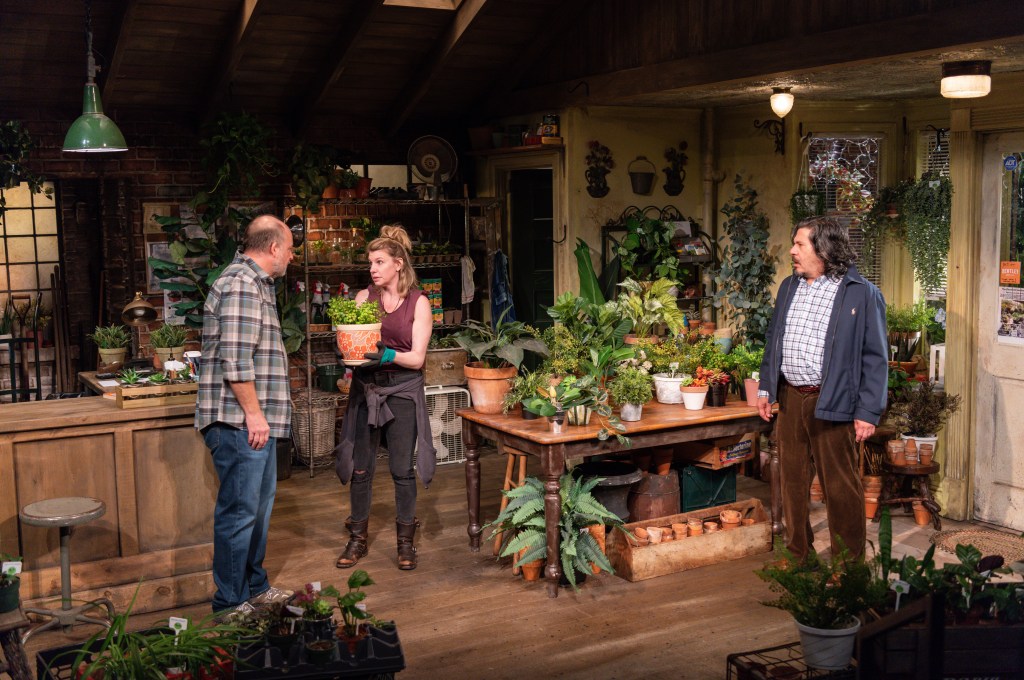
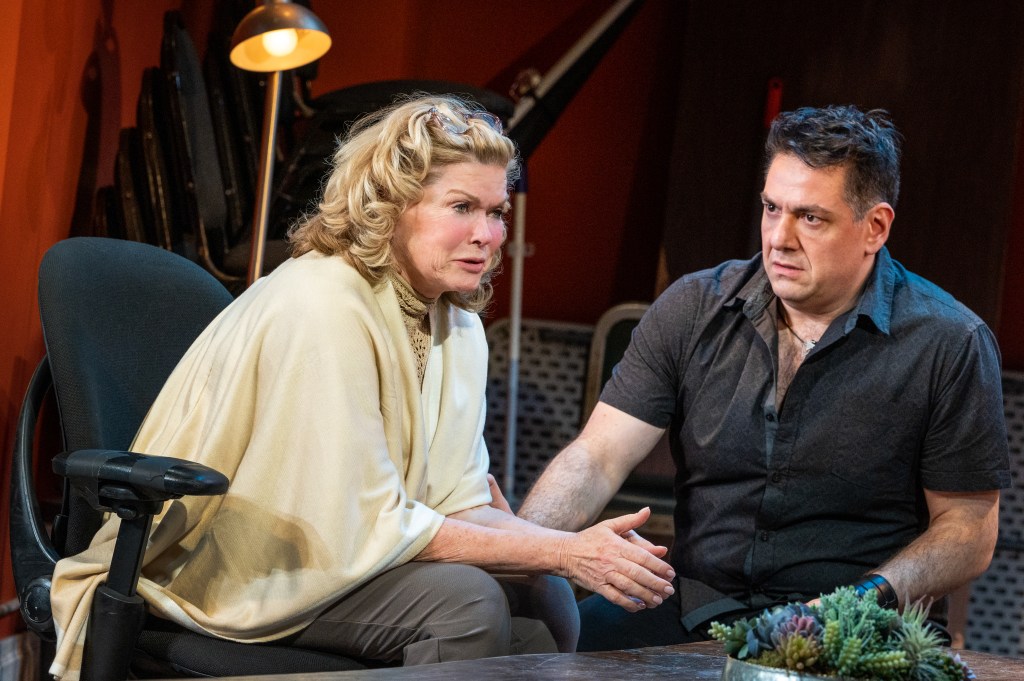
In her comedy/drama Dig Theresa Rebeck (Bernhardt/Hamlet) examines the transformative moments that happen imperceptibly to individuals, when no one is paying attention and they are least expected. With serendipity and the synergy of human need, responsiveness and emotional immediacy, the energy for change becomes the forward momentum of this superb, exceptionally acted and directed production. Rebeck, wearing two hats as director and writer, effects a powerful character dynamic in the play, which first premiered at the Dorset Theatre Festival in Vermont, and is now enjoying its New York City Off- Broadway premiere at Primary Stages, 59E59 Theaters.
With striking characters that Rebeck displays in their quirky, raw humanity, gradually stripped away to their bloody core in an identifiable, magical coalescence, the themes of hope and resurgence are unveiled. That this happens in a small town which is imploding for want of commercial viability, and to an insular shop owner in need of a personal revolution, is all the more engaging.
Importantly, in Dig, Rebeck prods us to recall verities of redemption and reconciliation, which abide in all of our lives. Second chances are possible, regardless of how dire or malevolent the circumstances appear in the lives of the damaged, lost and hurting.

The setting for hope and transformation is fitting. It is the plant shop, “Dig,” where set designers Christoper Swader and Justin Swader have done a magnificent job in displaying wall to wall greenery, and later, as the characters spark to life and regeneration, floral beauty. Roger is the reticent, thoughtful owner who has created “Dig.” He controls his singular botanical world, is knowledgeable about plants, and is an amateur botanist who has a “knack” with encouraging dying plants back to life. Healthy and unhealthy plants are a perfect metaphor for the human condition, and Rebeck with tongue-in-cheek amply uses this metaphor selectively and profoundly.
The playwright initiates this metaphor and other concepts in the opening scene between Roger (Jeffrey Bean in a brilliant, nuanced performance), and his longtime friend, Lou (Triney Sandoval effectively portrays his feisty and catalytic counterpart). Lou has abused a plant Roger gave him with the unwitting behavior of a plant neophyte. He’s underwatered and overwatered the “elephant ears” to it’s last “breath.” As Roger chides him like a school teacher, Rebeck’s humor gains traction. Immediately we understand the relationship between Lou and Roger and the otherworldly importance plants have in Roger’s life. After scolding Lou, he assures him that he will salvage the dying plant. Lou is relieved.

The action redirects when Lou’s daughter Megan (the terrific Andrea Syglowski), speaks up in defense of Roger about the money he gave Everett (Greg Keller in a humorous, off-beat turn) to buy them coffees. Megan, who has quietly disappeared into the background, sitting near the door, is barely noticeable because of her withdrawn posture. Additionally, she is overshadowed by the lively, antic banter between Lou and Roger. Clearly, there are undercurrents in Lou’s neglect of the plant and Roger’s gentle upbraiding. Concurrently, Lou’s suspicion of Everett, Roger’s truck driver, who Lou says smokes pot, is a criticism which chafes Roger.
Lou’s neglectful plant care and his guilty response have more meaning we discover later, when the parallels between caring for plants and caring for human beings comes to the fore. Likewise, Roger’s permissiveness with Everett comes back to “hit him in the face” like a bad karma rash.

In this initial exchange Rebeck has laid the foundation for the interactions among Roger, Lou, Megan, Everett, and Molly (the fine Mary Bacon), who drops in a bit later looking for tulip bulbs. Like strategically placed dominoes that topple and swerve around corners, do complicated gyrations and elaborate tricks, the characters’ knock and shuffle against each other with various encounters, emotional explosions, jealousies and eventual quietude, which Rebeck brings to a poignant and satisfying conclusion at the end of the two hours and one intermission.
How she effects this character sleight of hand, under-girded by the superb actors, leaves the audience feeling they’ve experienced a series of events with surprisingly disparate individuals who, are somehow similar. Each attempts to affirm their identity and place in a life that may or may not have meaning for them, save Roger who is perhaps ahead of the others in finding his place, though the town is dying like a poorly cared for plant. Into this mirror of humanity, we note the pain and struggle of finding a way to understand others, when not all of their truth has been revealed.

Megan, fresh out of prison and rehab is living with Lou, her adoptive father, who has taken care of her for her entire life. She lives with him because she has no money and nowhere else to go. She is responsible for an accident during which she killed her son through negligence. Confused, filled with guilt, Megan tried to end her own life and failed.
This backstory is revealed gradually by discovery through the comments the other characters make about Megan when she isn’t in their presence. Rebeck’s skill in disclosing who Megan and her father are, their close relationship, and the town’s response to Megan’s responsibility in the accidental death of her son, is effected with power and realism. It is a sad tale that has hushed up the community and left Megan with few friends except for the comfort of her father, her trying, martinet-like AA group, and Roger, Lou’s best friend.
Apprised of Megan’s story, Roger is tentative and gentle with her. But he is bewildered when Megan screams at a customer for being nosy about recognizing her (most probably in the news reports on TV). In a follow up of her anger, Megan curses Everett and forces her father to leave before they’ve enjoyed their coffees. Her fury is shocking, however Roger takes it in his stride and defends her against gossip which Everett repeats. It is in Roger’s and Everett’s discussion we learn the way which Megan accidentally caused her son’s terrible death.

In this pivotal scene the stakes are unveiled and Megan’s volatile, unbalanced personality which Lou has confided to Roger places her on a knife’s edge. However, Megan returns the next day to apologize to Roger and is manipulative in wanting to ingratiate herself with him for a job. Interestingly, the job would make her feel useful; she does not want to be paid. And though Roger says he needs no one and rejects her, she pushes her way in, immediately demonstrating her usefulness by potting a plant, Perhaps, she can make a difference in the shop, can stabilize her life and reinvigorate Roger’s life as well.
In her actions, we are watching Megan throw herself a lifeline. Drawn to something in Roger’s nature, perhaps his empathy and his incredible weirdness in caring for his plants and in setting up his environment which is soothing and peaceful, she attempts to try something different.

That Roger allows her into his life to “disturb his peace,” and assist him for no pay, is something that Lou objects to out of fear for his friend. He knows her unreliability and feels guilt for Megan’s causing the accident. Furthermore, with her alcoholism, unless controlled, she can “fly off the handle” and explode into a frenzy.
In a protective mode, Roger recognizes that she is willing to change and work toward improving herself with her apology. It is unmistakable that she took responsibility for acting improperly. Her humility to change is again affirmed for Roger when Molly comes into the store and Megan apologizes to Molly and accepts Molly’s invitation to a prayer meeting at church.
In Act II “all’s well that ends well,” until it isn’t. By that point the shop is blooming with lovely flowers and Roger has fired Everett for his pot smoking antics in the truck and his disrespectful, judgmental attitude about Megan. In an argument which Roger won, Roger suggests his critical attitude toward Megan is unfair because the details surrounding her son’s death were uncertain. Roger has feelings for Megan. And though she senses it and tries to advance their relationship beyond friendship, we learn that Roger has spurned her attentions.

It is in this act when her former husband Adam ((David Mason’s portrayal is potent and searing), tracks her down to to confront her about their son’s death. Once again, Roger defends her. However she stops him and forces him to leave so she can hash out the issues with Adam. This revelatory scene is another turning point where we understand their relationship in an explosion that Roger cannot mitigate or influence. It is up to Megan to deal with the shreds of her life that remain, with the only intervention that might heal her-Roger and the plant store-which she has influenced and helped to make thrive in the fading town. But there are obstacles. Everett resents her taking his place. And in an underhanded, slick seduction, his actions influence her to leave so he can get back into Roger’s good graces.
Rebeck and her cast and creatives have put together a smashing work whose honesty and power is breathtaking. DIG is a refreshing, bold, funny and poignant production which defies easy definition.
In magnifying Rebeck’s vision, the superb design team worked overtime. They include Christopher Swader and Justin Swader (scenic design), Fabian Fidel Aguilar (costumes), Mary Ellen Stebbins’ atmospheric, mood-suggesting lighting design and Fitz Patton’s original music and and sound design. These creatives give the production the medium which allows the actors to seamlessly move and inhabit their characters with humor and probity.
DIG is memorable and metaphoric and profound. In a limited engagement until October 22nd, it is not to be missed. For tickets and times go to their website https://primarystages.org/shows/current-season/dig/
‘Infinite Life’ by Annie Baker, a Review
The premise of award-winning Annie Baker’s play Infinite Life, premiering off-Broadway at Atlantic Theater Company’s Linda Gross Theater, is that pain is the crux of life. Directed by James Macdonald, the production focuses on individuals who deal with pain along a continuum from heart-wrenching emotional angst to stoical virtuousness. Regardless of how they confront their suffering, it is never, ever easy. Indeed, most of the time, the pain endured by the characters we meet in Baker’s play foments a nightmare world of shattering identities, where the characters can’t recognize themselves through the agony.
Baker exemplifies this concept superbly with her characterization of Sofi (Christina Kirk) at various segments throughout her ironic, profound work. Through Sofi’s emotional outbursts and wild, antic, verbal expressions of sexuality, we understand the humiliation and self-loathing that often accompanies the resistance to pain’s annihilation of self, which Sofi and other patients acknowledge.
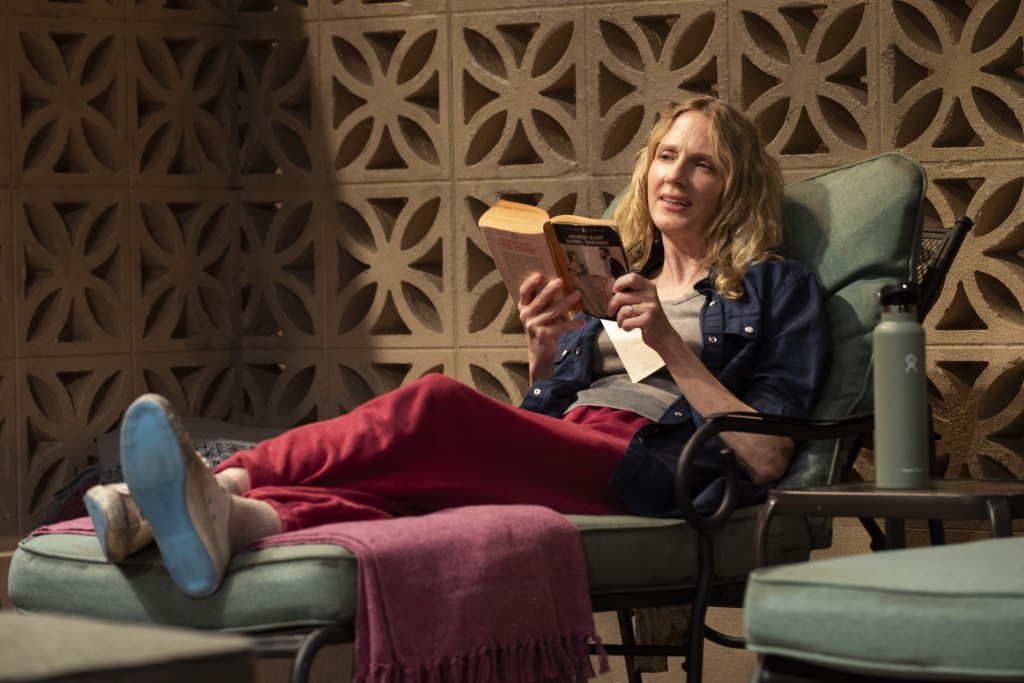
At the top of the play, Sofi converses with Eileen (Marylouise Burke), who walks very very slowly as she joins Sofi in the resting area where they become acquainted. It is then, we begin to understand where they are and why, when Eileen asks about Sofi’s fasting. Armed with a book she is reading, George Elliot’s Daniel Deronda, (an ironic, related, situational reference), Sofi answers Eileen’s simple questions haltingly, which indicates she may not want her “peace” or privacy disturbed by the talkative, fellow patient.
With just a smidgen of dialogue, Baker introduces elements which arise throughout the play and form the nexus around which Baker invites salient questions about consciousness and the synergy of mind, body, psyche and emotions. Key questions encompass the philosophical conundrum of what the characters must do with and for themselves in this “infinite life” of self, from which there is no escape, and fleeting happiness exists in an unwitting past where there was no physical torment caused by disease.
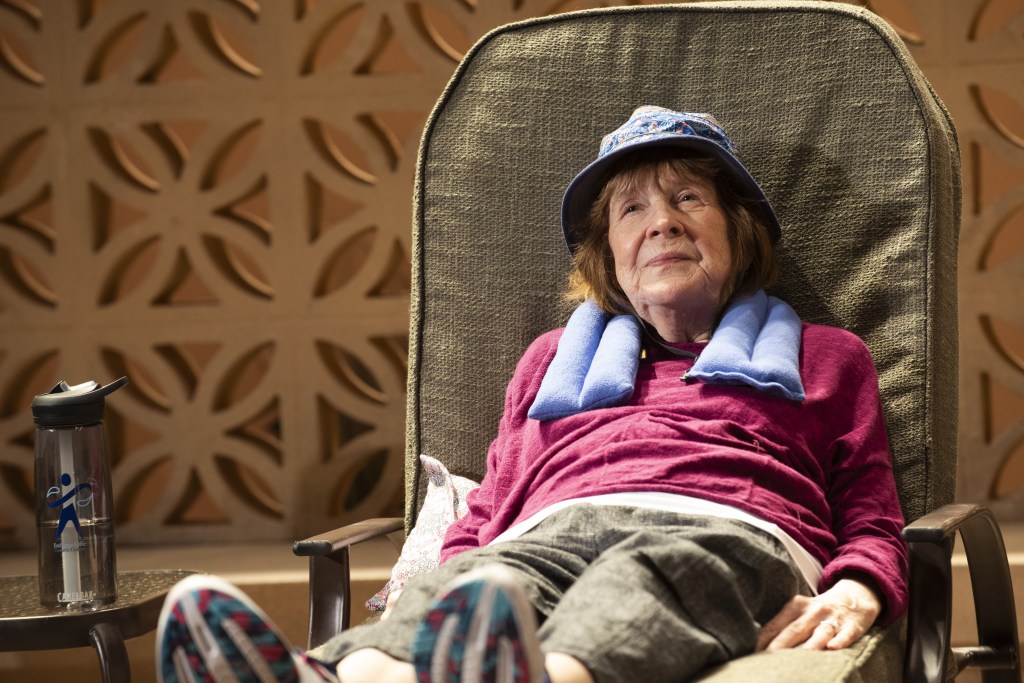
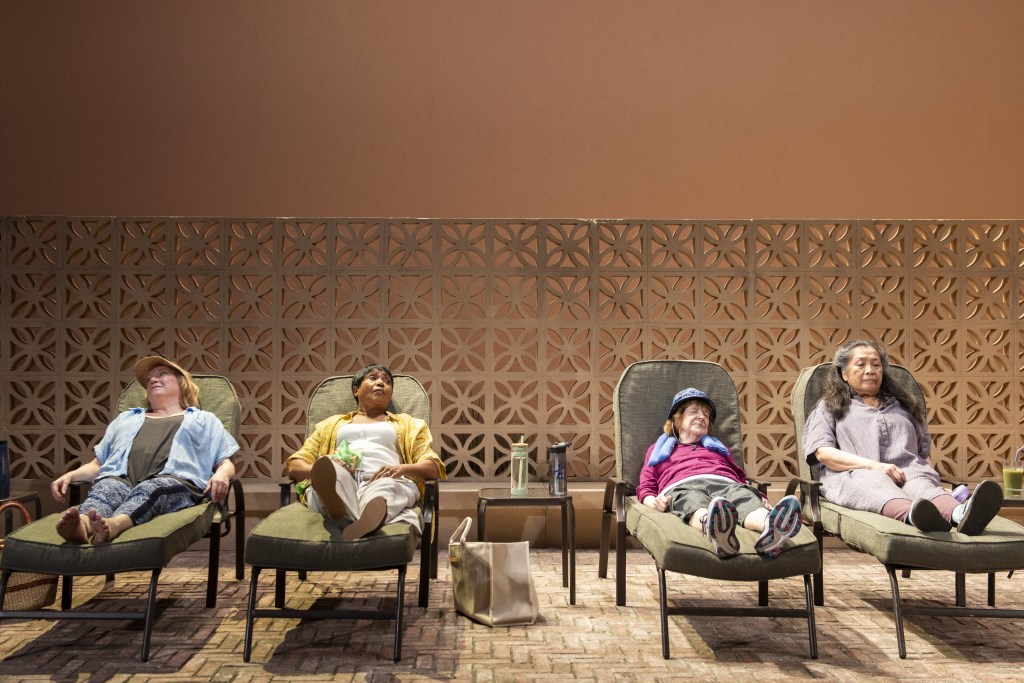
In a slow, dense, heavy unspooling, Baker introduces us to six characters, five women and one man. The women are dressed in casual workout clothes, loungewear and flowing tops (Ásta Bennie Hostetter’s costumes). These indicate the state of treatment they are in, whether “working it,” seeking comfort or relaxing.
The setting is an unadorned, outdoor space with scruffy, lounge chairs they recline on, bordered by a cheap, latticed, concrete block wall (scenic design by dots). We come to learn this area is the patio or balcony of an alternative healing clinic, that was once a motel. The entire production takes place in this outdoor area that overlooks a parking lot with a bakery wafting aromas of fresh bread from across the street that the characters comment on.
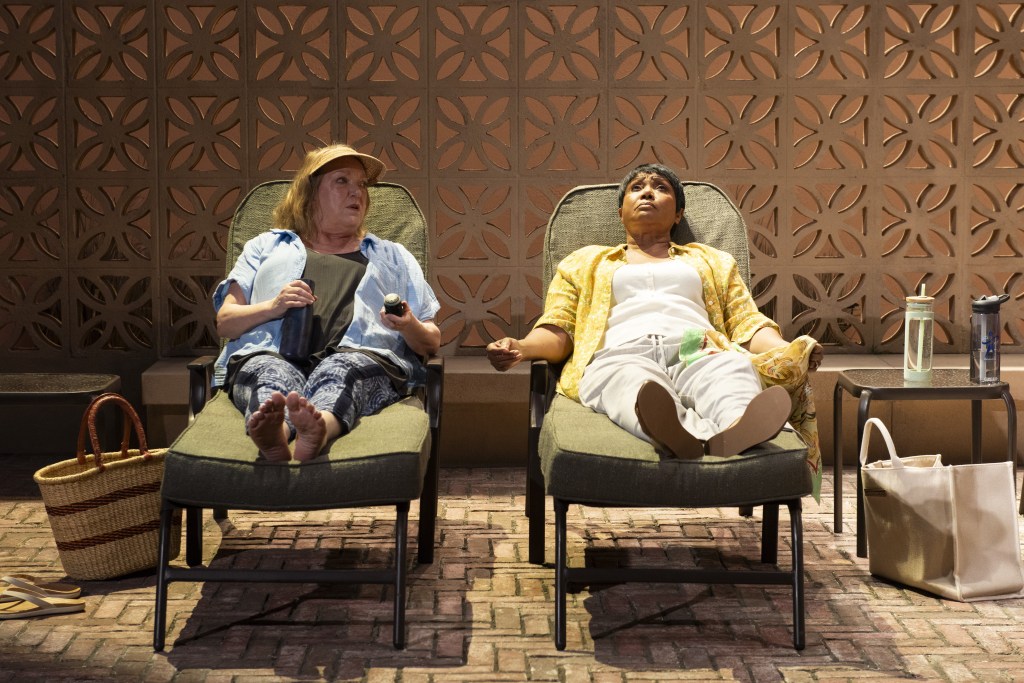
Here, as they “take the air, sun and dark night sky,” the women and man who have various maladies share the unifying, dire reality that they are in terrific pain with illnesses that have no solid cure and will probably reoccur. A variety of upbeat attitudes, modified hopelessness, positivity and stoicism resound through their conversations to distract themselves and each other. The conversations reveal the tip of the iceberg, below which the pain they endure alone, unseen, fills their days and nights.
Admirably, perhaps, these patients look to mitigate and heal seemingly without chemicals (no Oxycontin) or conventional medical methods. Nelson (Pete Simpson), who arrives late to the sunbathing scene, shirtless and attractive, has colon cancer which returned after surgery and mainstream treatment. He opts to try the alternative therapies at the clinic for twenty-four days, he confides to Sofi. He’s determined to follow in the footsteps of a friend who received relief at the clinic.

Sofi graphically shares the type of pain she has that involves her sex organs and has no cure which intrigues Nelson as a weird “come on.” Perhaps it is, but it is also her intriguing and extended cry for help in their scenes toward the play’s end. Likewise, Nelson shares graphic, intimate experiences with his colon blockage that involve tasting his own fecal matter. They share their nightmare world and appear to comfort one another, for a moment in time.
Their scenes together become a high point that intimates the possibility of intimacy but dead ends as far as we see and know. Both characters skirt the edges of hopelessness. Sofi doesn’t think she can make it through what the pain requires of her to sustain, which includes the dissolution of her marriage because of a mistake she made. Nelson implies that if his condition remains static, he will plunge back into radiation treatment and conventional medicine. Both appear hapless, buffeted by the circumstances of their body, beyond which they may or may not ever regain an illusion of control.
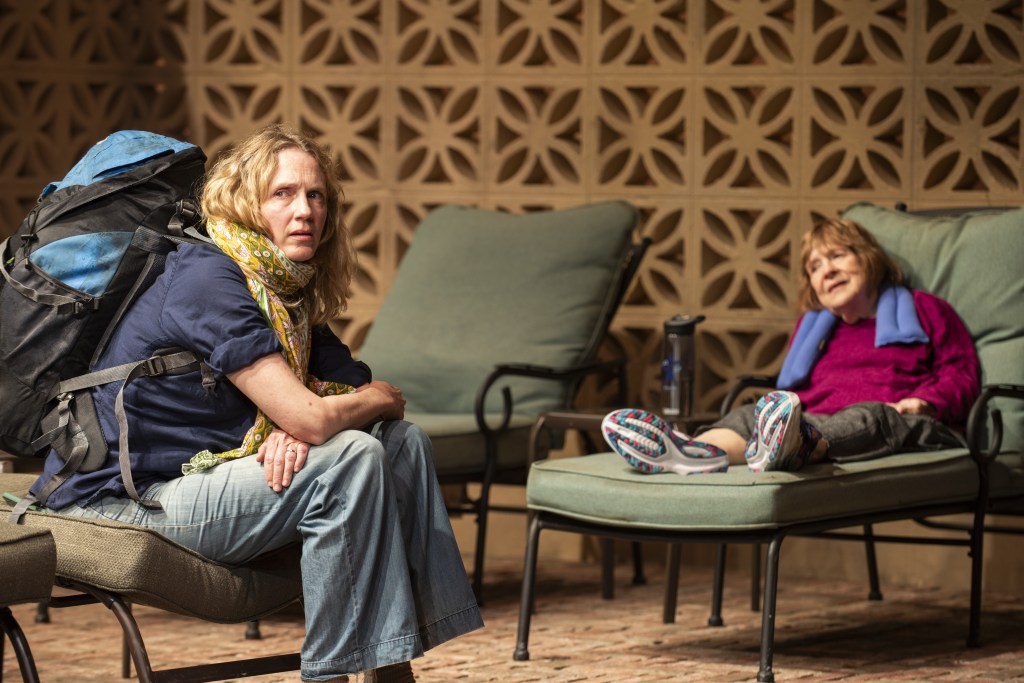
Through their journey toward relief, the patients have signed on to be put through their paces. The regimen and therapy that Sofi, Eileen, Elaine (Brenda Pressley), Ginnie (Kristine Nielsen), Yvette (Mia Katigbak) and Nelson have agreed to, require they fast, sleep, rest outdoors, drink concoctions fashioned for their various conditions, do passive activities like read, meditate, pray and, if they wish, rest and commune with each other in the common area, if their will and energy occasion it.
Over the first few days, each woman shares her condition and counsels Sofi, the newest arrival in their midst. For example they discuss that the second and third days are the worst, that after she pukes bile she’ll feel better, and she’ll get past her hunger and grow used to the fasting, etc. Narrating the time passages almost at random, Sofi announces hours or minute differentials before the next conversational scene occurs, as the women continue seamlessly sharing from where they left off hours before. Director James Macdonald’s staging is symbolically passive and static.
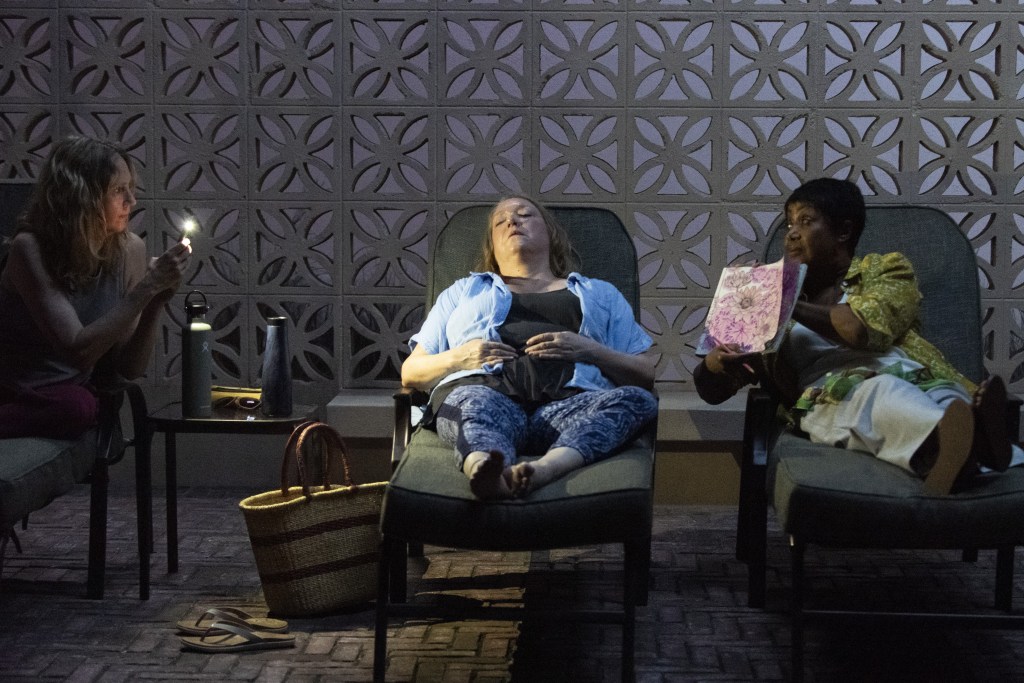
The effect is a linear, unceasing continuation as though time is not passing at all, and we are in an ever present present, a side effect of horrific pain. However, Sofi and lighting designer Isabella Byrd’s lighting, which switches from sunlight to darkness, disabuse us that time is standing still for these sufferers. Time marches on and drags them and their pain with it, as Sofi reminds us, though nothing appears to be happening on a material level. On a cellular, spiritual level it may be quite a different story; perhaps there is healing and mitigation though it isn’t readily visible to the naked eye.
As we become more familiar with Baker’s pain managers, we learn they are at various stages of their treatment, and marvel that some, like Yvette, are alive, despite their multiple conditions. Hers are numerous with exotic names along with the medication she lists was given to her during and after her bladder removal, cancers, catheterizations, and chemical poisoning side effects from all the doctors’ interventions.

Interestingly, Yvette is the most stoic and accepting that she will face whatever agony comes her way. The exhaustive list of her illnesses is an affirmation of the human will to “make it through” to the next day, where she will continue to suffer. There is valor in that, as Yvette’s will persists. Sofi is her counterpoint and is desperate and potentially, if things don’t change, suicidal.
The women’s conversation is banal and reminiscent of Samuel Beckett’s plays, which find characters waiting opaquely and uncertainly, though here, Baker defines that the treasure they wait for is healing, an absence of the excruciating terror in their physical bodies. Yet, though we watch and listen to what appears to be stasis, sometimes, the characters in spite of themselves, are humorous and ridiculous.
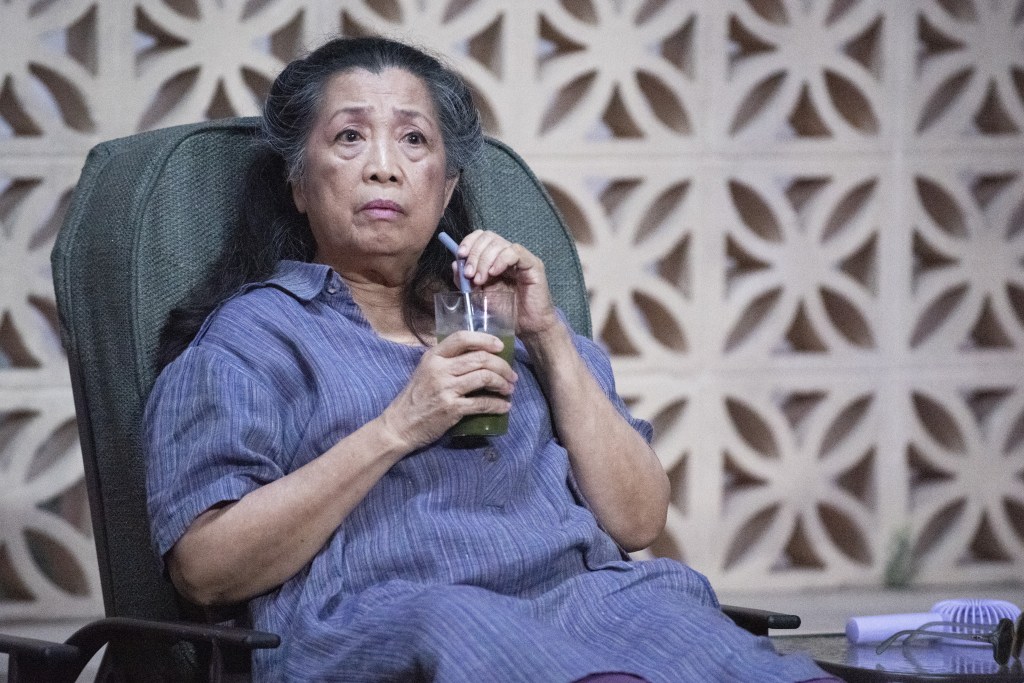
This is especially so when sexual topics arise and go nowhere useful, and some raw sexual language that Sofi uses unwittingly discomforts Eileen, who is a Christian. For example Mia’s Yvette discusses her second cousin who narrates pornography online for the blind, which prompts a discussion of how it is possible for the blind to react to described sexual acts.
In another segment Ginnie initiates a conversation about a pirate who rapes a young girl who commits suicide. The story is part of a philosophical teaching taken from one of Zen Master Thich Nhat Hanh’s books. The provocative question Ginnie asks all to think about concerns the Zen Master’s statement that people are the pirate and the rape victim. The thought that are are capable of equal parts of sadism and masochism spirals into absurd and clever responses in a beautifully paced repartee between Nielsen’s Ginnie and Mia’s Yvette.
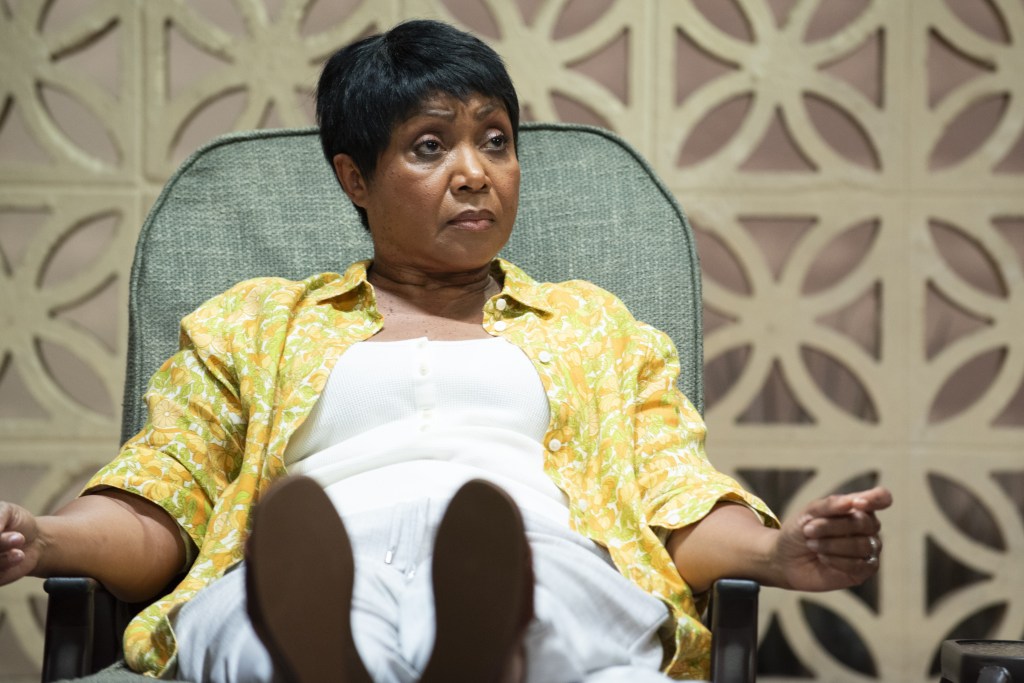
Following Baker’s “less is more,” undramatic plot where little appears to happen, director James Macdonald’s vision synchronizes with a minimalist, spare, unremarkable set design (dots design studio) befitting a place of transition, a way station after which patients will move back to their homes to continue healing, seeking treatment or dying. The overall shabbiness of the place, coinciding with the external, static situation of pain endurance, indicates the de-emphasis on the material surroundings. Instead, the focus is on the spiritual, deeper consciousness where the inner healing takes place sight unseen and manifests physically when the characters leave, for they’ve achieved some sort of relief. Perhaps some, but not all. Some are still there and in hell.
The minimalist structure is the receptacle for the weighty philosophical, tinged with metaphysical ideas that the characters express between the arduous moments of waiting. Baker has them burst out with pithy statements universal to us all, reminding us that beneath the ordinary, difficult, daily hours each of us sustains, there is the painful construct that we are dying while we’re living. The glorious part is the absence of pain. Eileen says in a difficult moment of agony, “a minute of this is an infinity.” The unfortunate part is if illness and pain comes, there is the bracing life lesson that sickness reminds the sufferer. It is what Beckett’s character said in Endgame, and a statement he repeated. “You’re on earth. There’s no cure for that.”

Baker is fascinating upon reflection, reading the script. With the live production the dialogue was sounded spottily because of the theater’s acoustics, the unequally distributed sound design and low conversational tones of the actors, during various segments. Audience left remained in stark silence while audience right rippled with responses of laughter, throughout during the production I saw in preview. Pulitzer Prize winner Baker is known for her pauses and silences in the dynamic among the characters, which in this play added gravity and profound undercurrents. However, in the performance, the silences were noticeably from audience left as audience right chuckled in delight.
The lack of audience reaction because of sound design difficulties was obvious. Interior pain is more easily expressed on film with close-ups. In an attempt to express their pain’s trembling terror, some actors chose to moderate their projection downward into quietude. Throughout, Mia Katigbak and Kristine Nielsen could be heard. Marylouise Burke managed to get around the conversational tones with a haspy, raspy voice which carried.
Similarly, the other superb actors were present during their important moments that conveyed the play’s themes. However, the audio was not sustained, as it should have been. Ironically, I noted even the young man seated next to me leaned forward on the edge of his seat, and not because the suspense was overwhelming. He was straining to hear. Apparently, this is not a problem for director James Macdonald, though it was for audience members whose experience was less than stellar, unfortunately, for a play which, after its reading, I found to be exceptional, profound and thought-provoking.
Infinite Life runs at Atlantic Theater Company. It is a co-production with the National Theatre. For tickets visit the Box Office at the Linda Gross Theater on 20th Street between 8th and 9th Avenues. Or go to their website https://web.ovationtix.com/trs/cal/34237?sitePreference=normal
‘The Half-God of Rainfall’ at NYTW, Review

Inua Ellam’s epic poem The Half-God of Rainfall, has been brought to life with theatrical grist at New York Theater Workshop. Currently running until 20th August, the reconfiguration of Greek, Yoruba archetypes and myths are merged against a modern backdrop of an Olympic basketball champion born of mixed raced parents, a simple Nigerian woman Modúpé (Jennifer Mogbock) and the Greek god of thunder Zeus (Michael Laurence).
Their fantastic progeny is the half-god Demi (Mister Fitzgerald). It is his exploits and the overthrowing of the patriarchy which the actors narrate, illustrate, move through and reimagine during the 90 minute spectacle of sight, sound and movement that is strongest and most exhilarating during the last 15 minutes of production.
Ellam’s poem is ambitious as is director Taibi Magar’s vision for The Half-God of Rainfall’s breadth and scope. Interestingly, the very nature of the foundational myths of the Western world vs. African folklore and tradition collide like tectonic plates during an earthquake. Thus, when god of thunder Sango (Jason Bowen) loses the competitive race against Michael Laurence’s Zeus and must yield his finest prize Jennifer Mogbock’s Modúpé, Zeus’ rape and the birth of their son Demi is symbolic of the traditions of war between conquerors and their conquered. Rape was and still is a subduing weapon of war, legitimized as acceptable spoils of conquest.
Without a father, raised by his mother, Demi is typically disadvantaged and rejected by his peers, despite his apparent supernatural gifts as a demigod. Eventually, as a Marvelesque hero of stature and statuesque build, Demi receives the fullness of his powers and becomes a basketball great on the Golden State Warriors team. There, he learns about other demigods whose talents suppressed in their natural lives shine in competition as his do.

However, his greatness eventually becomes known to his father Zeus, whose machismo and fiercely tyrannical spirit compels him to confront his son. Will Demi be able to schmooze his father and encourage him to receive his son with paternalistic pride? Or will another result occur where he overthrows the oppressor culture and vaunts his mother’s African traditions? Which identity will Demi embrace and will he be able to meld the two and tease out the best in both mythic and cultural traditions? These themes and conundrums are answered by the conclusion.
As the poem/dramatization progresses, the other deities contribute to chronicling the high points of Demi’s story. These gods include Zeus’ wife Hera (Kelley Curran), Elegba (Lizan Mitchell), and Osún (Patrice Johnson Chevannes). Peppered throughout with philosophical wisdom and historical reference points of Greek and Western colonial oppression, the dramatized poem emphasizes that the conquerors treat their subjects with opprobrium, alienation and objectification. Additionally, the deities reveal that like rape, cultural assimilation is a weapon of war. Diluting the cultural artifacts, language and human traits of a race are the ultimate form of conquest and annihilation.
Ellams’s poetry is both rhythmic and expositional. The actors hone a fine sense of the poetic beats in each segment bringing the meaning into focus. Their storytelling is elucidated by Riccardo Hernandez’ scenic design, Stacey Derosier’s lighting design, Mikaal Sulaiman’s sound design and Tal Yarden’s projection design. The actors don Linda Cho’s costumes as a part of the action comfortably aligning themselves with their various roles as they move in and out of their characters seamlessly.
Beatrice Capote’s Orisha movement and choreography flows and indeed could have been incorporated much more, especially during the characters’ presentational narratives. Likewise, Orlando Pabotoy’s movement direction might have been integrated more to enhance the spoken-word which the actors direct to the audience as they tell Demi’s story.

Striking are the immersive elements, of creative design, for example the use of shimmering blue cloth which the actors use to effect undulating water. The beautiful projections suggest the majesty of the cosmos the gods inhabit. Other multi-hued projections reflect both the ethereal and the manifest world of the earth which Demi attempts to inhabit and conquer in his own right. Likewise, the falling rain is a palpable effect to ground us in this realistic yet stylized piece where the director elicits how phantasms are present in the reality we see, and think we know, but do not.
Overall, the actors effect emotional intensity especially at the conclusion. Because there are fewer scenes of interaction between the characters, one wonders if the first half of the production might have benefited with more movement and character dynamic rather than the actors’ direct addresses to the audience.
However, Magar brings the events to a satisfying conclusion as Mogbock’s Modúpé vindicates her own humanity and the cultural, historic, African traditions bringing release and redemption. The finish is as startling as the heartfelt events that prompt Mogbock’s Modúpé’s final, relentless actions.
The actors and creative team have generated a unique experience so that Ellams’ epic narrative leaps off the page and into one’s imagination with their fine stagecraft. For tickets and times go to the NYTW website https://www.nytw.org/show/the-half-god-of-rainfall/
‘Orpheus Descending,’ One of Tennessee Williams Most Incisive Works-a Searing Triumph
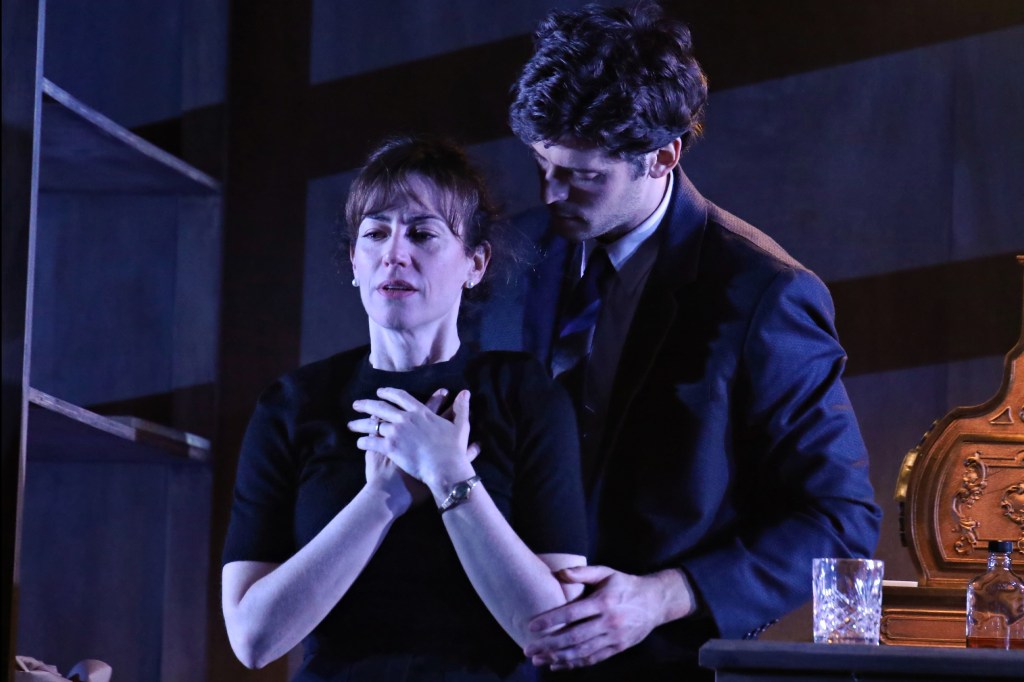
The hell of the South abides in Erica Schmidt’s revival of Orpheus Descending, currently running at Theatre for a New Audience in Brooklyn until August 6th. Tennessee Williams’ poetically brazen work about the underbelly of America that reeks of discrimination, violence, bigotry and cruelty seems particularly regressive in the townspeople of the rural, small, southern, backwater of Two River County, the setting Williams draws for his play.
This production is raw in its ferocity, terrifying in its prescience. It reminds us of the extent to which racists and bigots go feeling self-righteous about their loathsome behaviors when the culture empowers them. The director shepherds the actors to give authentic portrayals that remind us that death lurks in the sadistic wicked who seek to devour those whom they may, especially when their targets have peace and happiness, and step over the line (what the bigots hypocritically think is the line).
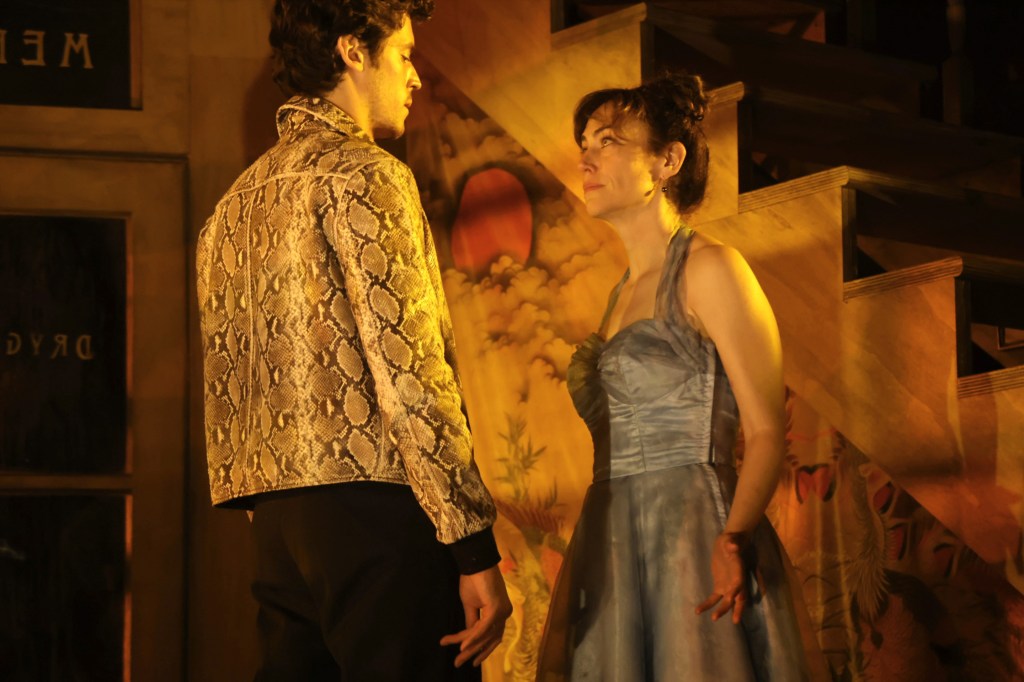
At the top of the play, we immediately note that stupidity and hypocrisy exude from the pours of most of the homely white characters. Sheriff Talbot and the wealthy Cutrere family are the chief representatives and purveyors of white supremacist, conservative law and order, which is as natural and welcome as white on rice.
Williams’ brilliant but lesser known work is based on the Orpheus and Eurydice myth. However, Williams updates the allusion and spins it into metaphoric gold transposing the heroic characters into artists, visionaries and fugitives, who rise wildly above the droll deadness of their environs or are delivered from them, as is Lady (Maggie Siff) who is brought to life during her relationship with Val (Pico Alexander). During the course of Val’s and Lady’s dynamic relationship with each other, they seek to cleanse and overcome their past heartbreaks and regrets and move upward toward redemption, reclamation and new beginnings with each other’s help.

The banal atmosphere conveyed by Amy Rubin’s spare, angular, cage-like design of the Torrence dry goods store is an appropriate setting where most of the conflict and interplay among the characters takes place. Its ugly, hackneyed blandness, lack of vibrancy and straight-edged corners symbolize Lady Torrence’s desolate life with the hypocritical, vapid townspeople and her infirm, brutal, racist, hoary-looking husband Jabe Torrance (the irascible, excellent Michael Cullen).
The other two sections of the set, the confectionery (stage left) and the storage area behind the curtain (stage right), Rubin suggests with minimalism. The confectionery and the storage area symbolize the other aspects of Lady’s character that are not governed by Jabe and the destructive, deadening, Southern folkways. The confectionery eventually outfitted with lanterns symbolizes her hope for renewal and reclamation. The intimate, barely lit, storage area where Val sleeps symbolizes the fulfillment of her desire for love.
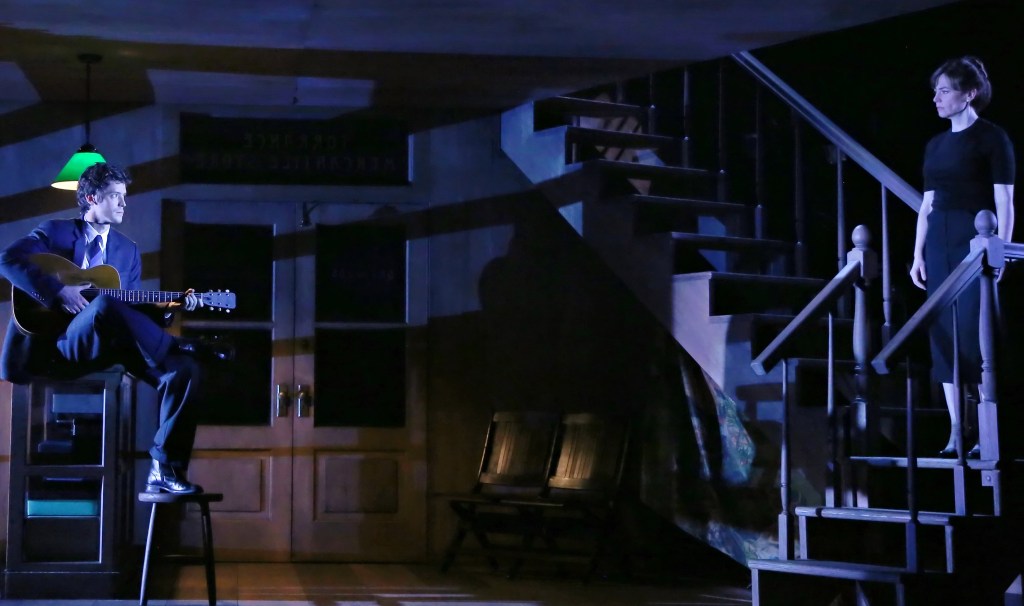
Center stage is the store and above it the Torrence bedroom, both subscribed by walls which pen Lady in. Along with Jabe, the store’s visitors suck her life-blood dry with the exception of Val and Vee (Anna Reeder), a Cassandra-like character. Above the store, Jabe lies in bed dying. Empty of kind words, Jabe communicates his bile and bitterness by pounding his cane on the floor from his sick bed. It is an ominous foreboding alarm that one imagines the master sends to his slave when he commands something from them immediately.
Into Two River county’s washed-out “neon,” “low-life” mediocrity comes the contrasting light and beauty of the guitar artist/entertainer, the stunning and untouchable Val Xavier. Pico Alexander makes the role his own, portraying Val with grace and alluring, angelic innocence befitting “Boy,” the nickname the assertive, feisty Lady gives him. Siff is sterling and likable as she grows vivacious as their bond develops. Siff’s scene where she reveals she is committed to loving Val, despite not wanting to admit needing him is just smashing.
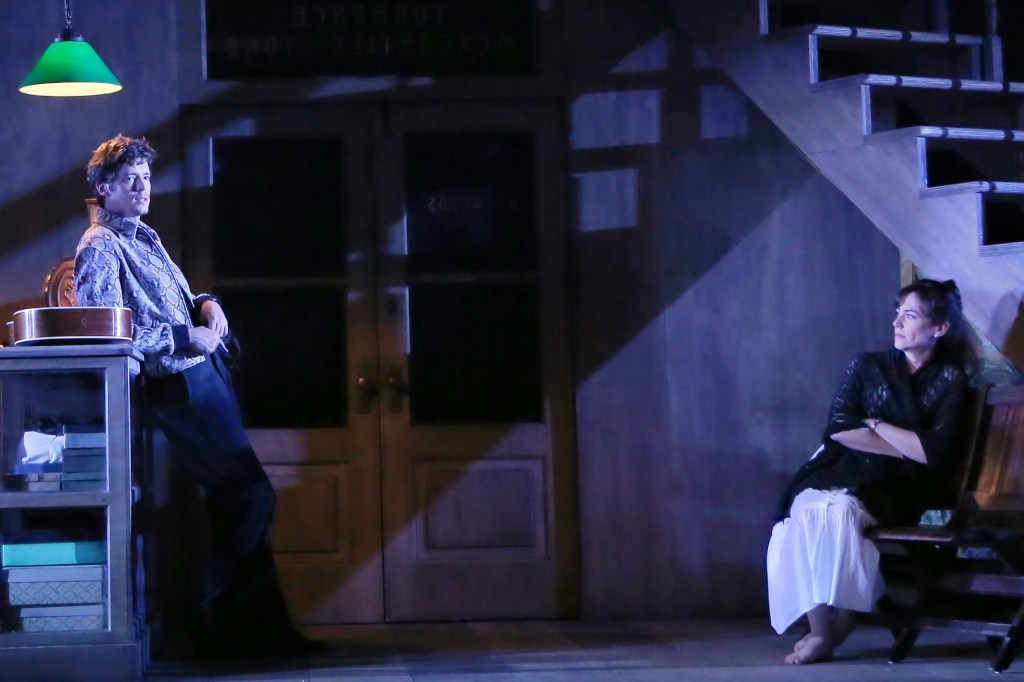
Val illuminates the spaces he enters and shatters the peace of Dolly Hamma (Molly Kate Babos) and Beulah Binnings (Laura Heisler) when he drops by the Torrence store on Vee Talbott’s suggestion that Lady Torrence might give him a job. As he waits patiently for Jabe and Lady to arrive from the hospital after Jabe’s unsuccessful operation, Jabe’s cousins Dolly and Beulah “eye him” while they prepare a celebration for Jabe’s return.
Vee (the fine Ana Reeder), a spiritual visionary born with second sight, accompanies Val and introduces him to the other women hanging around, one of whom is Carol Cutrere (the superb Julia McDermott), a rebellious hellion whose outsized antics and screaming of the Chocktaw cry with Uncle Pleasant, the conjure man (Dathan B. Williams), make the other women apoplectic. Clearly, Carol is an outsider like Val and Lady, only saved by her last name.
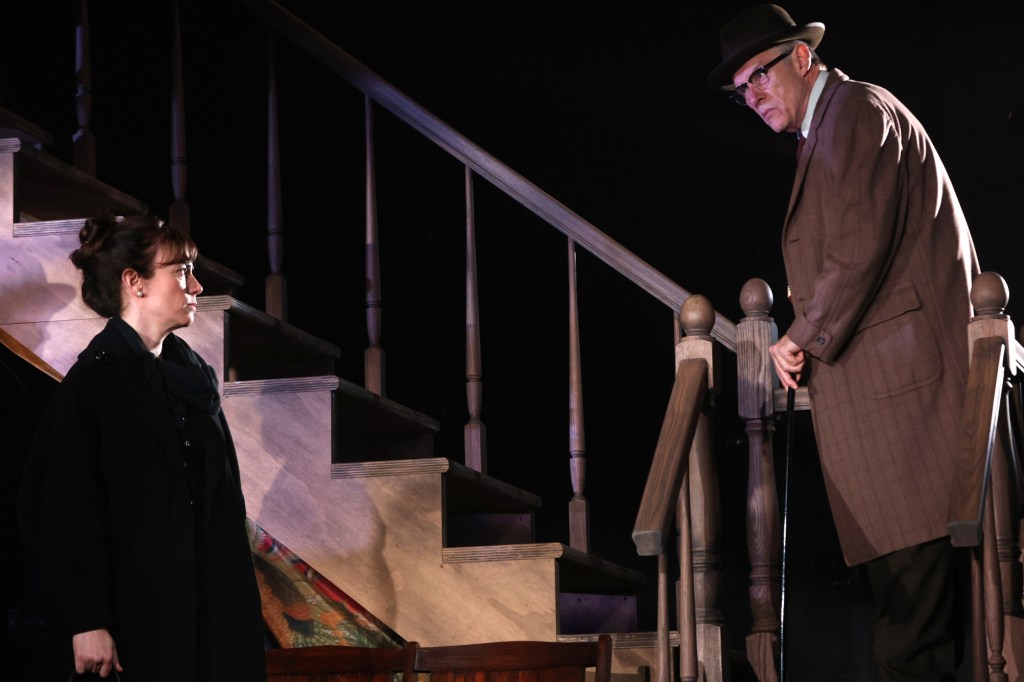
As Vee relates the visions that form the basis of the painting she brings for Jabe to encourage his healing, we note she doesn’t fit in either. If she weren’t married to Sheriff Talbott (Brian Keane) her eccentric ways would banish her from the “polite society” gathered in the store, rounded off by gossip mongers, Sister Temple (Prudence Wright Holmes) and Eva Temple (Kate Skinner), who sneak up the wooden steps to check out Jabe’s bedroom before he and Lady return.
Schmidt stages these opening scenes of William’s claustrophobic setting and characters to maximum effect, clustering the women at the counter and bringing Carol and Uncle Pleasant downstage for their chant and evocation. Downstage is where Carol cavorts, delivers a few soliloquies, and wails her outrage and sorrow as an encomium at the play’s conclusion.
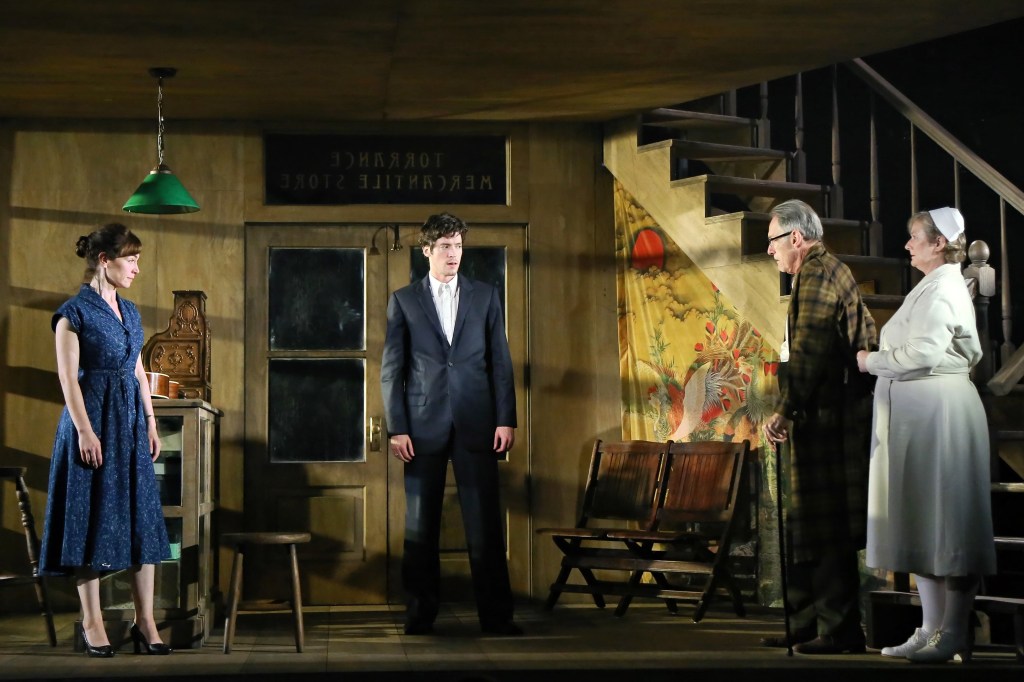
By the time Jabe and Lady arrive and Jabe retires upstairs, we have an understanding of the desolate elements and competing life forces that will drive the conflict forward. Additionally, Williams has the gossips share Lady’s terrible backstory that involves the KKK torching her father’s wine garden, and his gruesome death burning alive in the conflagration because not one firetruck or patron came to his aide.
All this was because he violated the towns’ mores and unwritten law serving wine to “ni$$ers. Implied by Jabe later in the play, the “Wop” had too much life in him and had to be cut down to size and made destitute. Interestingly, Lady’s determined father decided he’d rather burn alive trying to salvage his life’s work than accept poverty and brutality in a death-filled culture. For Lady, the acorn doesn’t fall far from the oak. She decides to take a stand against Jabe and his sadistic brutality than run away with Val.
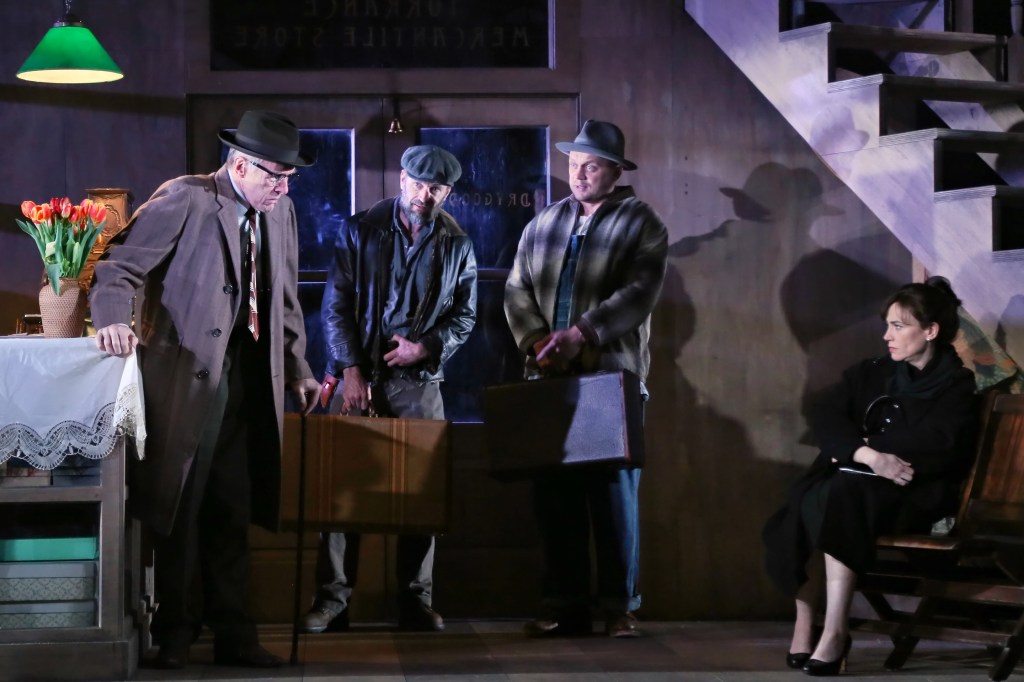
Alexander’s Val and Siff’s Lady establish their relationship gradually with Siff aggressively taunting Val’s appeal to women, one of whom is McDermott’s live-wire Carol. As their comfort level with each other grows, the two bond over Val’s description of a bird that is so free it never corrupts itself by touching the ground and only does so when it dies. Lady expresses her desire for such freedom, and after their discussion is abruptly interrupted by Jabe’s pounding, we note a greater lightheartedness within Lady. Val’s presence is the freedom and wildness that she craves.
Indeed, we note her mood is uplifted every time Lady has a quiet conversation with Val. The actors have the privilege of organically inhabiting these memorable characters with ease to deliver some of the most figuratively elegant and coherently rich dialogue found in all of Williams’ works. One of their most powerful scenes concerns Val’s description of the corrupt world and his own corruption. He counters it by sharing how his “life’s companion,” his guitar and his music, cleanses his impurity and makes him whole again.
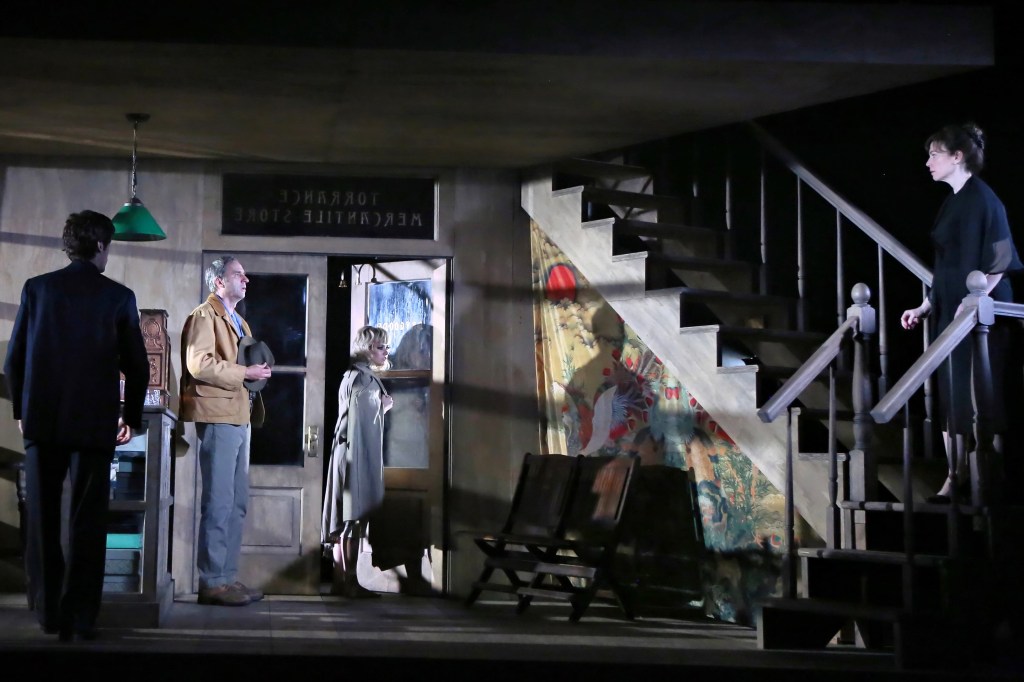
As Val settles in and she begins to rely on him, we realize that her inspiration and actions to reopen the confectionery (Schmidt use of the lanterns descending in the stylized space, stage left) run parallel to Val’s regenerative influence over her. He has ignited her hope and desire to be resurrected from the ashes of the burning, the town’s hatred and racism, and Jabe’s enslavement and ownership of her mental and emotional well being.
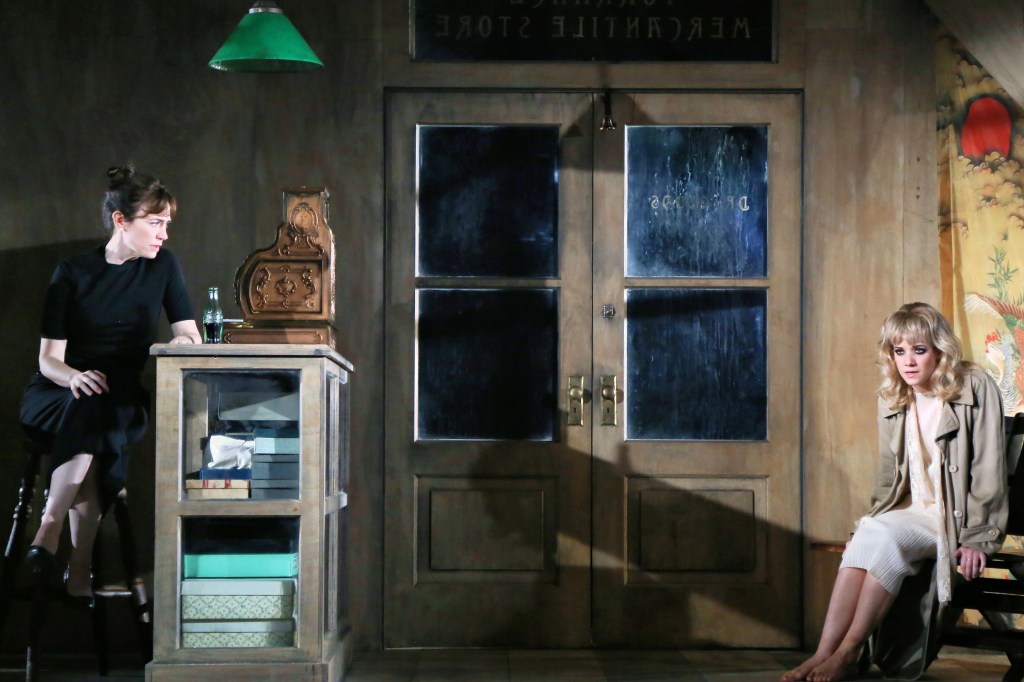
In his characterization of Jabe, Williams reveals the psychosis of the Southern Red Neck confederates turned white supremacists that lost the Civil War but persist in acting as if they won it, especially with regard to their racism and hatred of Blacks and “the other,” (immigrants). In Schmidt’s version, we see that Jabe’s attitudes and the attitudes of the other men presciently foreshadow the current MAGA Republicans’ penchant to be brutal and criminally sadistic because their “power” gives them the right, regardless of the truth of the circumstance or the legality. Certainly, Jabe has the power and white supremacist friends (Sheriff Talbot) to back up his actions with impunity.
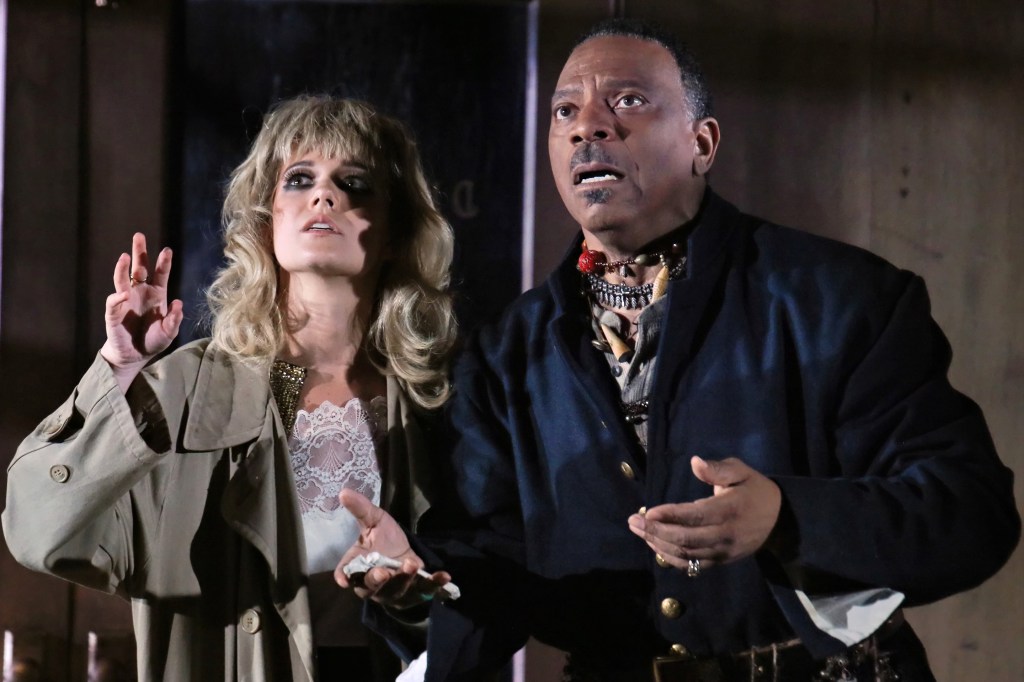
Thus, as Lady has told Val, she “lives” with Jabe, a figure of death who makes sure to stomp down her happiness or agency every chance he gets. In fact each time Val and Lady seek each other’s company for verbal comfort, Jabe almost intuits that she is uplifted away from his presence and claws and pounds (with his cane) his way back into her mind and emotions with his demands. She always goes running to him, for in her soul, she feels she has no other options.
The turning point arrives when Jabe comes downstairs to exert himself over the cancer that is killing him and perpetrate some new malignity against her, which appears to be the only pleasure he has. His emotions are pinged to remembrance when he views the loveliness of the confectionery and the new life that has inspired it (Val). It is then he strikes at Lady provoking her past reason, a white supremacist sadist to the last.
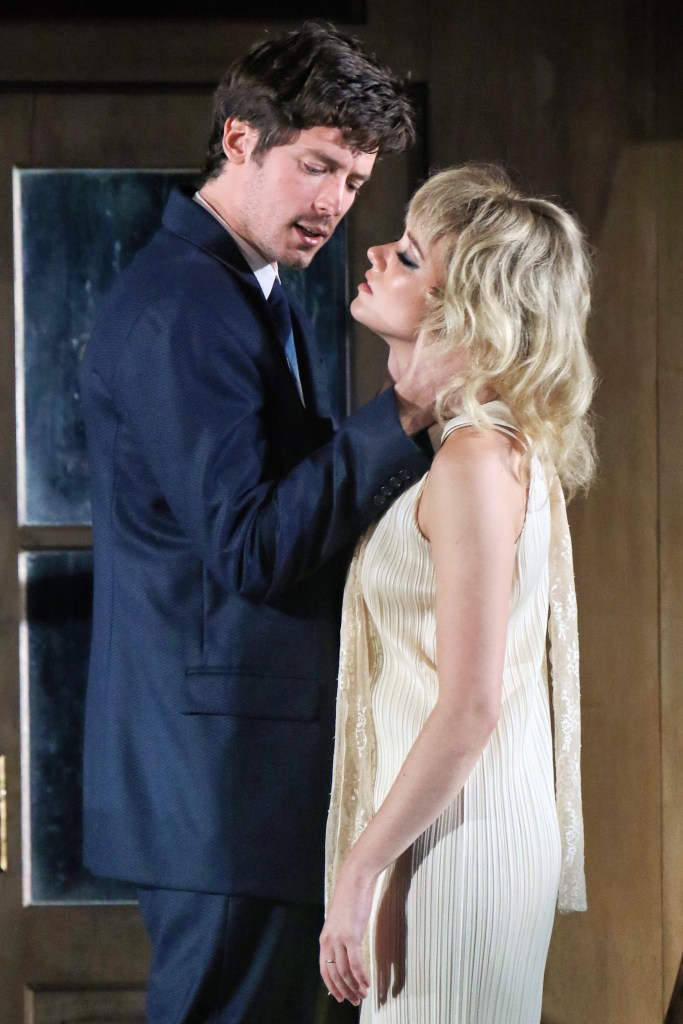
There are no spoilers. What transpires is Williams’ reaffirmation of the modern day tragedy that resulted daily in the Jim Crow South when white supremacists asserted they won the Civil War with every Black person they lynched using law enforcement to cover for them. In the play Williams also infers how this happens in the inhuman, abusive prison system which prompts men to escape and uses the escape as the justification for their killing.
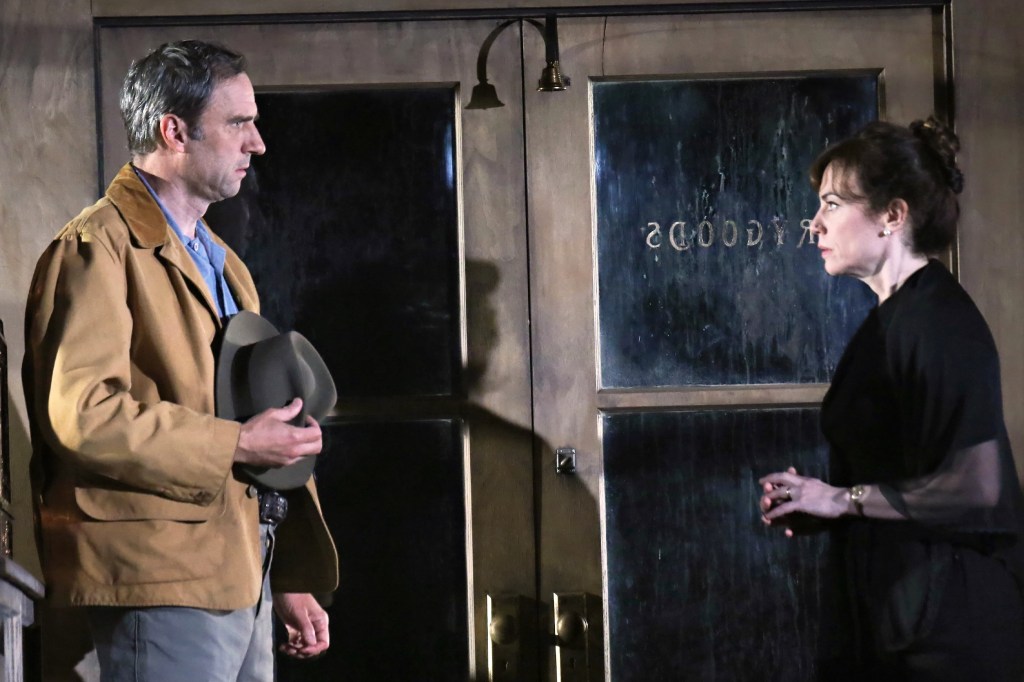
Schmidt and her team have created a production that is bold in revealing Williams’ trenchant themes about death, life, hatred, bigotry, racism and the utter wicked sadism and evil that would keep such a culture going even if the culprits, like Jabe, suffer and are eaten alive by their own hatred. In revealing Williams’ prescient themes that apply for us today, we note that a racist culture cannot be confronted when the power is held by the racists and bigots. Indeed, one must escape the purveyors of death and leave their sphere of influence, if there is no federal oversight or punishment for law breaking. If there isn’t accountability, the individuals, will do as they please, and like despots bend their underlings to their will as death dealers.
Kudos to the creative team which includes Jennifer Moeller’s costume design, David Weiner’s lighting design, Cookie Jordan’s hair and wig design and Justin Ellington’s original music and sound design.
The production concludes August 6th. Don’t miss it for its profound characterizations beautifully acted, acute ideas Schmidt suggests with her fine direction and the technical production values that bring Williams’ stark truths to bear on us today. For tickets and times go to their website https://www.tfana.org/visit/ticket-venue-policies
‘Days of Wine and Roses,’ Truthful, Poignant, a Stunning Triumph

Alcohol is different from other addictive drugs. It’s a part of our culture and integral to events around professional and social situations. It’s legal and easy to purchase. But for those who can’t “live” without it, alcohol is both a blessing and a curse. Days of Wine and Roses currently at Atlantic Theater Company until July 16th encapsulates the joy and emotional horror of the drinking disease. The production is a complicated, profound, assailable to the senses, cathartic must-see.
Adam Guettel’s music and lyrics spin out the anatomy of alcoholism in the dynamic of a couple’s relationship. The couple, portrayed by the exceptional Kelli O’Hara and Brian d’Arcy James, are forced to confront their psychological weaknesses manifested by their alcoholism. Guided by Craig Lucas’ book, Guettel relays the extremes of euphoric addiction and its impact on the emotions of the characters with his expressionistic score and lyrics that appear to be lighthearted and lyrical but mirror undercurrents of desperation and loneliness.

Lucas nails down Joe and Kirsten’s alcohol dependent relationship dynamic with precision and poignancy. He carries it through to the point when d’Arcy James’ Joe Clay comes to the end of himself. Out of love he waits and hopes for O’Hara’s Kirsten to want to recover from alcoholism. This uncertain state promises to usher in a long, hard wait for Kirsten to admit she is ill and needs help.
Directed by Michael Greif, Days of Wine and Roses is a journey of devolution and evolution that displays the characters’ emotions of exuberance, sorrow, unforgiveness, self-discovery, redemption, self-annihilation, humiliation and love. Above all, it reflects the tragedy and joy of human experience, either confronting one’s individual consciousness or running from it, until one finally acknowledges that they must change or kill themselves.

Based on the titular 1958 teleplay by JP Miller and the 1962 Warner Bros. film, the musical is produced by special arrangement with Warner Bros. Theatre Ventures. Importantly, once again it brings together the successful Lucas and Guettel team who created The Light in the Piazza. Kelli O’Hara, who sang the lead in that Broadway production, encouraged this project.
Key to understanding this musical that is set in 1950 and lightly references the cultural mores of the time (sexism and paternalism) is that Alcoholics Anonymous’ 12 step program (never named) identifies alcoholism as a disease and not just a “drinking problem.”

The production frames how Joe and Kristen’s love blossoms with their drinking. It acutely underscores that the disease elevates their mood and pleasure centers (“There I Go,” “Evanesce” “As the Water Loves the Stone”) with pernicious allurement. Indeed, it is the linchpin to how they initially become involved with each other and why Kristen refuses to stay with Joe and her daughter after he combats his illness by meeting with other alcoholics to stop his self-destructive patterns.
The characters’ dynamic is emphasized when they meet at a business party on a yacht in the East River. A nondrinker, Kristen eschews alcohol. On the other hand Joe persists in getting her to be his drinking buddy. She resists him and his advances because she doesn’t like the taste of alcohol nor his smarmy, belittling, fake PR patter and persona.

It is only when she upbraids him and he apologizes for “starting off on the wrong foot” that she relents and suggests they leave. Her honesty and authenticity charm Joe and allow his better self to emerge. Together at a quiet restaurant, they discover qualities in each other that they can appreciate and adore.
As they establish a friendship, Joe introduces her to a Brandy Alexander (she loves chocolate) and she discovers her subsequent enjoyment of the buzz it gives her. This drink and others draw her to Joe as they gradually become boozy partners, who “in their continual high,” eventually marry and have a daughter, despite her father’s (the excellent Byron Jennings) disapproval and distrust of Joe. She and Joe have made a commitment to each other. Determined, O’Hara’s Kirsten will not allow her father Arensen to sway her from establishing a family with her lover and partner in drinking.

As Kirsten, Kelli O’Hara creates a complex portrayal of a woman whose drinking subterfuge eventually splits open her soul weakness after seven years of marriage and taking care of their daughter Lila (Ella Dane Morgan). Covertly, she sneaks drinks as she completes household chores and plays with Lila. O’Hara’s “Are You Blue,” “Underdeath and “First Breath” (the latter sung with Morgan’s Lila) reveal the roiling undercurrents of unhappiness and her attempts to deal with depression as the absent Joe, who works in Houston, barely keeps himself functioning at a job that requires he drink to entertain clients.
Brian d’Arcy James’ vibrant, alcohol-alluring, loving Joe allows her to take the lead, while he cleverly introduces her to a new world of drinking, fun and happiness. He draws her to him and maintains their closeness and joy, but such adventures are always fueled by alcohol. Initially, like any disease that manifests slowly, they convince themselves they are in control and live together as a successful family.

However, all is upended the seventh year of their marriage. A spectacularly destructive circumstance set off by Kirsten’s alcohol blackout destroys what they have built together (conveyed fearfully thanks to Lizzie Clachan’s sets, Ben Stanton’s lighting and Kai Harada’s sound). As their family spirals downward, their only hope of rehabilitation lies under her father’s condemning watchfulness, when they plead for his help and he gives them food, shelter and work in his greenhouse business.
The arc of their destruction is born out of their compulsions, one of which is their susceptibility to the pleasure of alcohol, the other, the belief they can ignore their desire to harm themselves and each other as addicts.

After months of sobriety, Joe breaks down, buys alcohol and offers it to Kirsten (“Evanesce” reprise), then goes completely “off the rails” (“435”) looking for a bottle he has hidden in the greenhouse. In anger at himself for his weakness and fury in not finding the bottle, he becomes rebellious. Turning against his judgmental father-in-law who has given them a chance, Joe destroys the greenhouse that Arnesen has made into a profitable business. When he finds the bottle, he drinks himself unconscious and lands on his back in the hospital on the brink of death.
Kirsten and Arnesen refuse to believe this is a disease that has no cure except through a way provided by a volunteer who is also an alcoholic, Jim Hungerford (David Jennings). Jim belongs to an association of alcoholics who understand that the only path away from the disease is through meetings, readings and the community of others who need each other’s help and camaraderie. Arensen dismisses Joe’s attempt at reconciliation and recovery. He bans Joe from his presence as an evil influence. The family are on their own in a dingy apartment as Joe allows himself to be helped by Jim while Kirsten refuses to admit she needs help and rejects Jim’s offers.

The apex of their relationship involved the ecstasy of alcohol. Kirsten appeals to Joe’s love and the remembrance of the fun they had (“Morton’s Salt Girl”) with a soft shoe in salt poured on the floor, created by Sergio Trujillo and Karla Puno Garcia. The song attempts to rekindle the magic when they enjoyed being drunk together. However, Joe’s eyes have been opened and Jim’s voice resides in his heart with the growing strength that he can conquer his illness. Sadly, Kirsten interprets this as rejection and a killing off of their love. She criticizes Joe for making her feel ashamed of herself and victimizing her with guilt and pain.
As Joe affirms his confidence that he can change to Jim in the powerful “Forgiveness” Joe and Lila cling to each other and KIrsten eventually stays with her father whose judgment, though problematic, is better than the humiliation and weakness she feels around Joe, who is passionate about healing and recovering. Now Joe’s love in sanctimony drives her away.

Days of Wine and Roses is poignant and current for our time, taking us beyond the beautiful period costumes by Dede Ayite and hair design by David Brian Brown. Kelli O’Hara is affecting and brilliant. Her operatic, rich and plaintiff voice in the concluding songs elicits our empathy. Her aloneness and sorrow at losing her partner to sobriety is intensely human and real. Her rejection of Joe’s help and love beyond the haze of alcohol is frightening.
Brian d’Arcy James is superb in reveling the nuances of determining his own confidence to overcome his addiction. Yet, he mines Joe’s attempt to balance the authenticity of being happy with his sober self with his love for Kirsten without their alcohol infusions. Together these amazing actors bring home the production leaving the audience with a confluence of feelings that will not be easily forgotten.
Kudos to the ensemble and the technical creatives and Greif’s direction and vision. With additional kudos to music director Kimberly Grigsby, Adam Guettel’s orchestrations and Jamie Lawrence’s additional orchestrations.
Days of Wine and Roses runs one hour and forty-five minutes with no intermission. For tickets and times go to the Atlantic Theater Company website https://atlantictheater.org/production/days-of-wine-and-roses/
‘The Comeuppance,’ a Pre-Reunion Reunion of Five Friends and Death, Theater Review
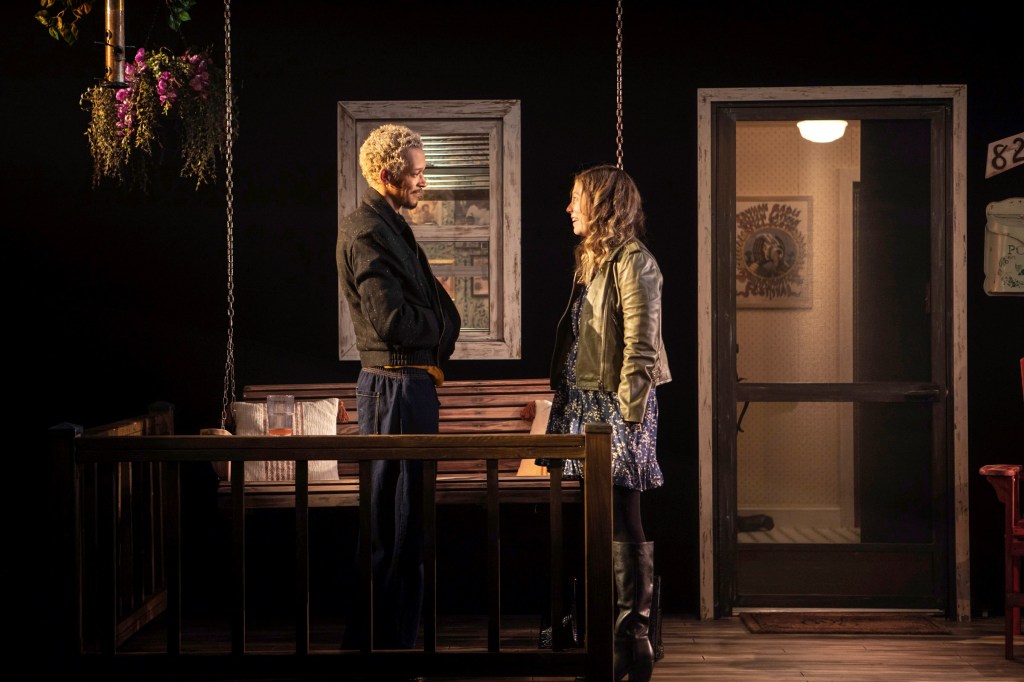
In The Comeuppance by Branden Jacobs-Jenkins, directed by Eric Ting, old friends meet for a pre-reunion reunion at the home of Ursula (the superb Britney Bradford), who has organized a party to celebrate before she sends off friends to their twentieth reunion. In an extension of its World Premiere at the Signature Theatre, the comedy with somber, stark elements was extended until July 9th by popular demand.
Jacobs-Jenkins’ (Appropriate, An Octoroon) themes are timely. The ensemble was spot-on authentic and natural. In his two hour play with no intermission millennials admit the consequences of living with unsound decisions made in the less scrupulous years of their youth. Sooner or later, there is a “comeuppance.” One cannot escape the inevitability of oneself and one’s mortality, as Death, who like a sylph inhabits each of the characters, periodically reminds us.

To effect this principle theme of death in life and the transience of all things, Jacobs-Jenkins places thirty-somethings in a backyard with drinks, weed and a loaded, shared past. They once were part of a high school friend group called M.E.R.G.E.: Multi Ethnic Reject Group. Jacobs-Jenkins allows them to go at each other (Emilio’s bitterness is apparent), as they bond over a perceived closeness, which may not have existed after all.
But first, Death introduces himself after slipping into the soul of the protagonist Emilio (Caleb Eberhardt), who has the most difficult time struggling to let the past remain in the past so he can create a better life for himself. As he does with all the characters, Death speaks through Emilio. He warns the audience he is always lurking in omnipotence, with a complete understanding of who human beings are, including the audience members, which he crudely, fearfully reminds us of, once more at the conclusion.

Since last they met, Emilio, Caitlin (Susannah Flood), Paco (Bobby Moreno) and Kristina (Shannon Tyo) have established careers, been to war, gotten married and had kids. Each in their own way has confronted loss, confusion, cultural chaos and most recently COVID-19. We learn that all have been under an emotional siege. Some are sustaining the sociopolitical chaos that Emilio points out better than others, as they either ignore it, reflect upon it, or allow their own lives and difficulties to blot it out of their consideration.
Interestingly, the generous Ursula, whose home, inherited after her grandmother’s death, has been offered up for the celebration, becomes the first to manifest the ravages of millennial time and aging. She has lost her sight in one eye, having contracted diabetes. She tells the others that she is not up to going to the reunion and they may stay as long as they like at her party.

As Emilio, Caitlin and Ursula wait for the others, Emilio’s irritability spills out in humor against Caitlin, whom he once dated in high school. She has married an older man who is a Trumper, which upsets Emilio. Their two children her husband has from a first marriage appear to be doing well: one is finishing college, the other is beginning a career. Thanks to the actors who present their characters with moment, as the characters cath up their lives, the segment never completely falls into tedium. The characters reacquaint as they step into familiarity with Ursula reminding them of M.E.R.G.E codes they used in high school.
During this segment Death manifests a presence in the monologues from Ursula and Caitlin. They heighten their soul revelations and reflect another aspect of their ethos that is not apparent on the surface.

When Kristina, a doctor with “so many kids” arrives bringing her cousin Paco, who once dated Caitlin and treated her badly, the hilarity increases. It is driven to its peak with the characters’ fronting as a means of getting their “land legs” with each other. By this point the drinks and weed have kicked in and Emilio confronts Paco. whom he clearly distrusts and despises. More revelations erupt and we note Paco’s and Kristina’s individual unhappiness. Once again, Death inhabits Kristina and Paco and expresses their soul’s interior.
Throughout the play Jacob-Jenkins contrasts the material realm and the illusory fitted by human delusion that these individuals have “all the time in creation” to live their lives against the immutable truth of life’s impermanence. Speaking with quietude and without passion, Death assures us he “has their number.” He matter-of-factly reminds us that entropy is king. Things fall apart; human bodies, human relationships, all we hold dear is smothered in half-truths and lies, for we die.

Then the limo arrives and with it well-worked confusion. Ursula goes off to the reunion that Emilio never attends. With the door locked against him and all his buddies gone, he sleeps on the porch, a hapless, solitary and alone soul who needs to “get himself together” emotionally, expiate the past and forgive himself for his failings.
When Ursula returns, we learn the extent of the lies of omission as Eberhardt’s Emilio allows the truth to flow and Ursula shares with him what she couldn’t reveal before. Then Death through Emilio takes his final “comeuppance.” While she “sleeps in her mind” he expresses that his target is Ursula in the immediate future. He discusses that how she will end up is exactly as her friend Caitlin fears. Despite Emilio’s offering to marry and take care of her, Ursula puts him off because she has someone. It turns out, it’s another poor decision for both of them.
Branden Jacobs-Jenkins has woven an interesting conceptual piece that is uneven especially in segments where there is too much ancillary discussion by characters. There is an overabundance of unnecessary detail that impede the forward momentum of the dynamic that occurs on the porch of their lives. In these sections, I dropped out. Perhaps wise editing would make the segments more vital and immediate.
Nevertheless, the actors are terrific. They make the most of the unevenness that drives the play toward the characters’ acknowledgement of duality: of experiencing life and watching and reflecting oneself living it in the knowledge that they are mortal.
The difficulty of this duality is dealing with the reality of Death. In the play it is animated through the characters for our benefit. However, in their lives, it is ever-present in the form of gun massacres, the war in Iraq and Afghanistan, political subterfuge and sabotage in January 6th which attempted to signal in the “death” of our democracy. All of these, Death’s cultural possessions, have brought the characters’ millennial generation to the brink, Emilio acknowledges. That and their body’s frailty is their comeuppance, Ursula suggests.
Though each generation has had its cataclysms, it is the millennials “no way out” that Emilio especially confronts while the others seem to ignore it, save Ursula. Unfortunately, our culture doesn’t do death well and entertainment capitalizes on its particularly gruesome features in the proliferation of horror stories and films. Jacobs-Jenkins counters this aspect, making it a homely creation of back porches. And as he reminds us no one “gets out alive,” at least there is humor. We can laugh on our way out of life’s conundrums, miseries toward Death’s grasp.
Look for this play to be produced elsewhere. And check out their website for more information at https://signaturetheatre.org/
‘Primary Trust,’ the Hope of Friendship Through The Trauma of Being Alone

Small town life can be incredibly boring and static. However, for those who experienced unaccountable pain and trauma, the peace and quiet may be precisely what is needed to achieve a balanced state. In Eboni Booth’s sensitive, profound drama Primary Trust, currently at Roundabout Theatre Company until July 2nd, the playwright investigates humans in their ability to heal from trauma.
For some, getting beyond the pain of emotional loss requires a particular kind of remedy. Kenneth (William Jackson Harper), a resident of Rochester suburb, Cranberry, New York, has found the ability to withstand loss through his mind and will’s resilience to nurture itself with hope and friendship.
Kenneth addresses the audience directly relating a sweetness and shy vulnerability that is immensely likable. He introduces the town and his friend Bert to the audience with ease and authenticity. When there is a segue in thought and feeling, a bell rings as an accompaniment by musician Luke Wygodny who also plays the cello and other instruments before the play begins and during salient turning points.

Harper’s Kenneth takes his time to gather his thoughts as he confesses to us. His need to share his story resonates. Clearly, his story is momentous and universal. Praise goes to William Jackson Harper who engages us with his humanity. Additionally, Eboni Booth’s simple word craft in structuring likable, recognizable, human characters in this small town is amazing. With fine direction by Knud Adams, who shepherds Harper’s Kenneth and the supporting actors, we become captivated and empathize with Kenneth though we may have little in common with him.
Kenneth shares his experiences about “what happened” to him at a turning point in his life when he is thirty-eight years old. He gives us background and reviews his daily routine in Cranberry, New York focusing on the high point of his day after work, when he spends the evening at Wally’s, a typical tiki bar/restaurant. There, he joins his BFF Bert (Eric Berryman) and they drink Mai Tais and share jokes and stories. Their affection and warmth is genuine as they reminisce about past experiences in the joyful atmosphere of booze and camaraderie.

However, apart from their bonding daily at Wally’s and their race, the men are very different. Kenneth works at a bookstore and has been invaluable to his boss, Sam (the on-point Jay O. Sanders) doing bookkeeping, clerking and various chores. Bert on the other hand has an office job, a wife and children, whom he leaves to be with Kenneth in the evenings. It is around about this time that reality fuses with the ethereal, and logic is throw out the window. How the playwright, director and Harper’s portrayal of Kenneth massage us to accept this maverick dramatic element is a testament to their talent and genius.
Kenneth explains that his friend Bert is invisible, imaginary. In other words his BFF can only be seen by him (and of course us). Thus, we become intimates. In confiding to us, Kenneth trusts us to share his secret, in the hope we will not judge him and “turn off” because he’s “wacky.”

Sam is aware that Bert is Kenneth’s imaginary friend. When he tells Kenneth he is selling the store and relocating for health reasons, he makes it a point to reference Bert. He suggests when Kenneth looks for another job, he shouldn’t allow Bert to intrude on the interview. Nor should he share with prospective employers that Bert is his imaginary friend. The implication is that they will think Kenneth is deranged. That we accept Bert as imaginary and go along for the ride is creditable to the playwright, director and actors.
Sam’s news about closing his store is an earthquake. Kenneth discusses the impact on his life with Bert and a new Wally’s waitress Corrina (April Matthis). Though Sam’s move shakes Kenneth, it is an opportunity. He is forced to end the nullifying status quo must. Change occurs in Kenneth’s discussions with Bert and Corrina, who suggests the bank Primary Trust is looking to hire tellers. When Kenneth applies for a job and speaks with Clay who is the branch manager (Jay O. Sanders), all goes well. Humorously, Bert accompanies him to the interview and prompts Kenneth’s winning responses which seal the deal. Clay hires him and he becomes one of the best employees of the bank.

However, Kenneth must confront a transition moving in his soul. The stirrings begin when he and Corrina as friends move beyond Wally’s to a lovely French restaurant. In a humorous turn Jay O. Sanders is the French waiter who serves them. It is in this new expansive world with Corrina that possibilities open up for Kenneth. For the first time, Kenneth doesn’t meet Bert at Wally’s It is another earthquake that rocks him off the status quo of his insular life. There is no spoiler alert. You’ll just have to see this heartfelt production to discover what happens next.
William Jackson Harper is absolutely terrific in a role which is elegantly written for the quiet corners of our minds. The supporting cast are authentic and vital in filling out the life that Kenneth has made for himself to help him emerge out of his cocoon and begin to fly. The playwright’s courage to present an extraordinary friendship which serves Kenneth to bring him to a point of sustenance until he launches into success is beautifully, subtly conveyed. Thanks to the ensemble, who make the unbelievable real, Kenneth’s “small life” in its human drama is important to us.

Thus, when Kenneth explains his upbringing to Corrina toward the end of the play, his revelation stuns. The clues coalesce and we “get” who he is, understanding his brilliance, his tenacity and perseverance. It brings to mind the character of Jane Eyre (in the titular novel), whose dying friend tells her, “You are never alone. You have yourself. ” The playwright takes this notion further to suggest, when you feel you can’t trust yourself, primarily, you can always elicit an imaginary friend who is closer than a brother or sister, until it is time for them to leave. It is through this “primary trust” one survives through heartbreak, trauma, isolation and death.
Primary Trust‘s fantastic qualities enliven the themes and remind us of the importance of doing no harm as we negotiate aloneness in our own soul consciousness. Kenneth chose his friend wisely. He relates how this occurs to Corrina who listens, the active ingredient of his budding friendship with her.
Kudos to the set designer Marsha Ginsberg,Isabella Byrd’s lighting design, Mikaal Sulaiman’s sound design, Qween Jean’s costume design, Niklya Mathis’ hair & wig design and Like Wygodny’s original music which to tonally balance the production. The mock up of the town square offered a metaphoric quaint suburb at a time before the technological explosion and cell phones when people listened to each other live and as Kenneth does created conversations with ethereal friends. The set design and music created the atmosphere so that we readily accept Kenneth’s and Bert’s friendship and its significance with wonder and surprise.
For tickets and times to see Primary Trust, go to their website https://www.roundabouttheatre.org/get-tickets/2022-2023-season/primary-trust/performances
‘Wet Brain’ by John J. Caswell, Jr., a Review

A family in crisis with no way out except love and forgiveness, is the focal point of the play Wet Brain by John J. Caswell, Jr. Directed by Dustin Wills (award-winning director of Wolf Play) the drama is presented by Playwrights Horizons and MCC Theater until June 25. The production reveals the knotty human condition in all its raw, ugly, ironic and humorous digressions, as siblings attempt to confront their father’s alcoholic illness and cope with the intense stress each experiences related to the situation as they interact with each other.
Wet Brain is the vernacular for Wernicke-Korsakoff syndrome (WKS). WKS occurs when alcoholism strips the body of necessary nutrients, vitamins and enzymes as the alcoholic depletes himself of food in exchange for his preferred “liquid diet.” The brain disorder is caused by chronic vitamin B1 (thiamine) deficiency found in those whose long-term, heavy drinking has ravaged their bodies and minds beyond repair, until death comes to “heal” them.

At the top of the play brother Ricky (the fine Arturo Luis Soria) returns home after a number of years to help sister Angelina (Ceci Fernandez) and brother Ron (Frankie J. Alvarez) find the proper way to care for their father Joe (Julio Monge). In this highly pressurized situation the siblings, who carp and criticize each other, must determine the best path for their father’s last months on the planet. This is a tall order. Joe is in and out of reality and takes heart from his “outer-space” fantasies.
He hallucinates? Because reality is so dire, Joe has found an escape route in his imagination. If he can only acculturate his children to his softer way of imagining, perhaps this will foster understanding. Maybe, but Joe is barely speaking and he belongs in an assisted living center with a memory care unit. However, Joe isn’t even on Social Security Disability and he allowed his medical insurance to lapse. Regardless, they can’t afford such a high end place. It is better if he stays at home and they have help come in.

Joe’s lack of balance makes him susceptible to falls. He walks with a severely disabled gait and ends up on the floor part of the time he is with them. He has a hard time keeping down food and vomits. His speech is garbled, though at times he is sentient and recognizes his children if he isn’t on a space fantasy. Among his other handicapping conditions, he soils himself at times and the cleanliness of his home and person is approaching nil. However, he manages to function in keeping himself close to his old friend vodka, which he stashes in Dasani bottles to “get over” on no one except himself.
Angie, who has been living with him can no longer cope with caring for him, keeping the house clean and studying for coursework to become a nurse. Thus, she calls Ricky who hasn’t seen her, his father and Ron for years. It is not a happy homecoming for Ricky or his siblings.
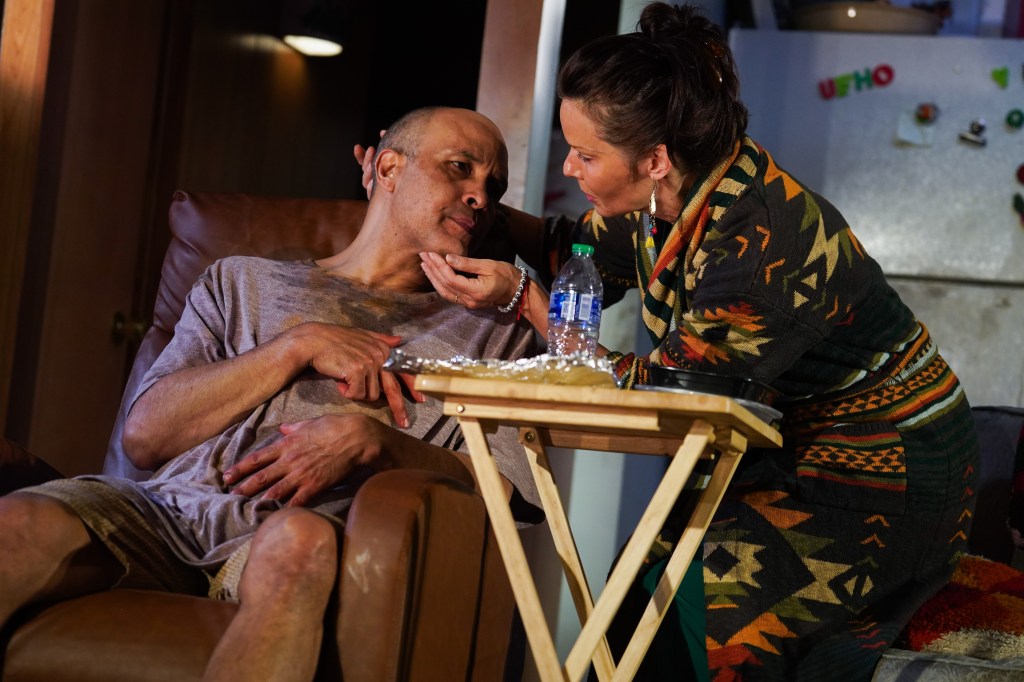
Of the three children, Ricky, who is gay, appears the most humane and empathetic, though Angie has been the stalwart, engaged member of the family, living with her father which she finally admits is beyond her. As the siblings resolve the situation, we understand the nuances of the dynamic that drove Ricky away from a home that was unaccepting and abusive because he is gay. Both Ron and Joe, who are close and worked together in their family business, found Ricky’s homosexuality loathsome. Nevertheless, Ricky has an MBA and has made something of himself. It is his presence that is the catalyst to finalize Joe’s care.
Casewell, Jr.’s drama with sardonic elements is approachable, if one enjoys insult comedy. The siblings shred each other, especially at the top of the play and reveal the horrific abuse they most probably experienced growing up, for they dish it out to each other. They communicate, not necessarily to be heard or understood, but talk at each other. Nor do they easily understand what each other has been going through. Instead, they are reactive and defensive and childish. Both Angie and Ron, themselves are psychologically, emotionally and physically damaged. Staying in the area where they grew up has not been a healthful choice.

How do the debilitated judgmental take care of each other and an acutely disabled father, living with the knowledge that their mother hanged herself because of her own mental illness? They lean on the one who had the perspicacity to leave the toxic environment and become moderately successful and accepting and loving of himself.
The most interesting section of the production occurs during Joe’s “outer-space sequence,” terrifically designed by Kate Noll (scenic design) with the help of Cha See’s lighting design, Nick Hussong’s projection design and Tei Blow and John Gasper’s sound design. The segment is highly symbolic and metaphoric.

During the scene, the siblings, Joe and their mother Mona interact and have a “heart-to-heart.” Mona, who returns as a ghost or another configuration of Joe’s space-time warp, initially hangs in the middle of her brood, and husband. All are able to communicate with each other clearly and soundly. In this sequence, the actors seemed most comfortable in the skins of their characters. They listened to each other with authenticity. The section is so striking in its coherence, the other sections of the play which relay the background exposition seem insignificant by comparison. The fantastic scenes of Joe’s imagination hold more theatricality and drama, thanks to the creative team and direction, then the scenes between the siblings. Importantly Joe’s fantastic reverie is the turning point, after which the characters become more human.
At the conclusion, when Ricky leaves, we note that the house is in order and a caretaker, Crystal (Florencia Lozano also plays Mona), stays with Joe to watch over him. In his imagination, Mona has returned to him for in the final scene, the caretaker moves close to Joe, almost as if they are about to kiss. Indeed, the development moves from the chaos at the top of the play, where we don’t very much like these siblings, to a peaceful resolution. During the play’s development, all have become more loving and accepting, stirred by the experiences with their father and each other. To bring about a resolution for him, they focused on one goal: to have their father cared for in his own home. The ending is uncertain, yet satisfying and filled with hope.

Dustin Wills’ shepherding of his creatives makes the theatrical and technical aspects of the production shine. The designs are coherent standouts that adhere with Will’s vision, from the complexity of the house and its props, to the sometimes sinister trees dwarfing the home, especially when Cha See eerily lights them. The revolving platform upon which the house is built shifts seamlessly and reflects the changes in the relationships among the siblings and their father.
The grinding sounds, the strange twists of darkness and sharp contrasts with light suggest the alternating states of consciousness in Joe’s mind and in the comprehension of the siblings. The irony is that with Joe, it is easy to understand that his condition has impacted his state of consciousness and his apprehension of reality. More subtle is how the siblings are also impacted by Joe’s perspective, most of all Ron, who is closest to him.
Wills’ direction brings Caswell, Jr.’s play to life as the actors nuance their characters. This is one to see if dysfunctional families and interesting characterizations are on your radar. What lifts the character dynamics from the boring repetition of victimization, blame and ranting and makes them interesting is how Wills and Caswell, Jr. integrate Joe’s hallucinations into a reality that is a soothing “what if” at the play’s high point. That it symbolizes a modicum of love and forgiveness is important. If the interrelationships declined, the play would have devolved into unsatisfying melodrama.
For tickets and times to Wet Brain which has no intermission, go to their website https://www.playwrightshorizons.org/shows/plays/wet-brain/
‘The Fears,’ Meditation vs. Inner Chaos, a Review

Where do you go when psychiatric therapy, group therapy, self-medication (alcohol, food, weed, etc.), prescribed medications, and other mainstream therapies don’t help you out of severe depression from psychic trauma and PTSD? You try the Buddhist center in New York City. In The Fears written by Emma Sheanshang, directed by Dan Algrant, currently running on the Irene Diamond Stage at The Pershing Square Signature Center, we are ironically entertained and drawn in to the emotional, traumatized, yet hysterical responses of seven individuals. Each attempts to reconcile their angst and anxiety together in five Buddhist meditative sessions over the course of five weeks.
The Buddhist practice led by Maia (Maddie Corman) follows the striking of the singing bowl, meditation in silence. Then individual members “touch in” and share their miseries, joys, or angers from the previous week. Part of the irony and humor of these sessions is in becoming acquainted with the individual stakeholders Rosa (Natalie Woolams-Torres), Katie (Jess Gabor), Fiz (Mehran Khaghani), Mark (Carl Hendrick Louis), and Suzanne (Robyn Peterson). Each unique individual is introduced to new member Thea (Kerry Bishé ), who has not received an email about the rules of the sessions and is flying blind. We, along with Thea, learn the quirky rules set up to guide the meditation and group dynamic as it unravels to a turning point during each session.
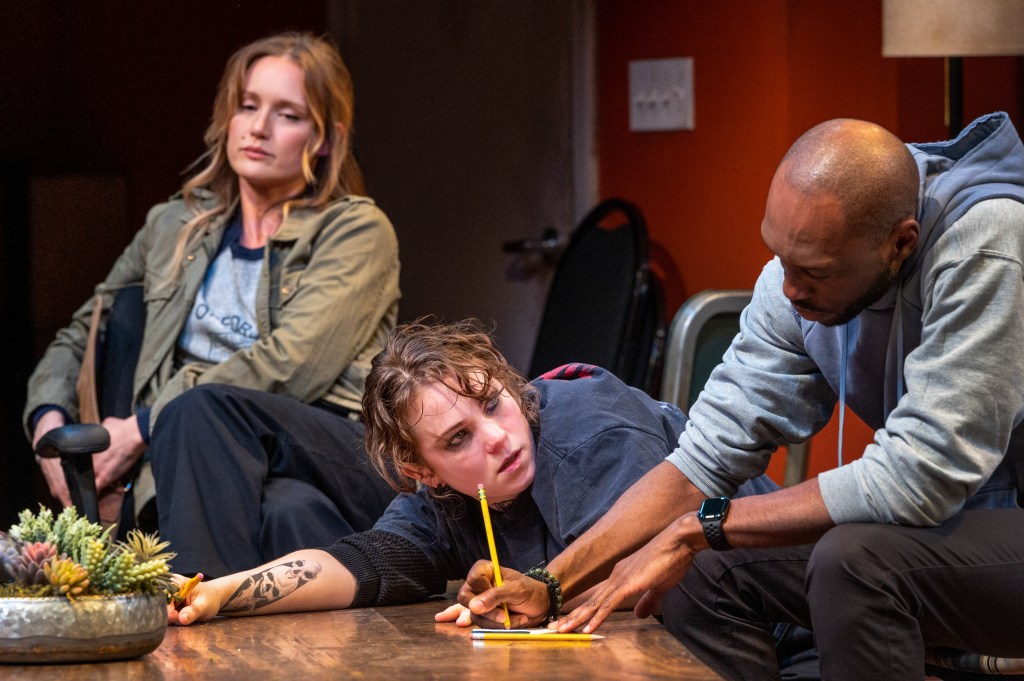
First, there are no apologies necessary for anything one does. Second, no discussion of the past is encouraged. Each of the members must stay “in the room” and in the moment to ground themselves with the here and now of their feelings. Third, no group member can ask questions of other members. Additionally, the group leader guides any member having problems with suggestions, for example to plant a tree (this never occurs), or in one instance, the inner child method–the adult version of the group member speaks to her inner child version– as the rest of the group’s inner children watch and learn.
For example, Rosa (Natalie Woolams-Torres) is subject to panic attacks and doesn’t do marital discord (conflicts between group members). Anything sets her off and raises her inner pressure. When she spirals upward in a fear, as she flails about her husband’s obliviousness to her panic attack at a christening, the controlled, calm Maia humorously brings her down by reminding her to “breathe,” and “stay in the room.” When these exhortations don’t work, she finally has Big Rosa address her inner child (Little Rosa), via a pillow who stands in for Little Rosa. Maia expertly guides her with questions, as the group members look on approvingly, while Big Rosa tells Little Rosa she’s safe, can go to another room, go for a walk, or go anywhere. Thea has gotten a eyeful as have we, except Thea doesn’t find it as humorous as the audience does.

The various members “touch in” after Rosa comes down from her attack. Katie “took a shower.” It’s apparently a big step for her because the others cheer her improvement. Fiz discusses that his sister dared to invite him to her wedding. Group members know he has issues with his parents. His father raped him as a tween, and when he told his mother, she refused to believe it and had him put in juvenile detention. His wounds are still raw, though he has been “healing.” Nevertheless, when Suzanne suggests that his sister’s invitation is a positive move, he blows up and asks if Suzanne is insane, a touchy question because all of them are off the charts from their traumas.
Also a sex abuse survivor, Suzanne attempts to defend herself. The interchange escalates humorously. Peterson’s Suzanne and Khaghani’s Fiz are invested in their emotions, and it’s crucial that the actors sustain the right balance of tone, sincerity and timing. or the scene could be deadly and fall flat. However, with apt direction and superb acting, the result is hilarity with no small thanks to Algrant, who knows how to make this hybrid dramedy pop. Additionally, the dialogue is choice with one-liners built in so that the actors (Khaghani is a comedian), cleverly measure the dead-on delivery.
The heated exchange between Fiz and Suzanne prompts Maia to intervene and call “weather on the ones.” Gauging the “emotional atmosphere” each is feeling, the group members weigh in with “misunderstood,” “fear,” “anger,” etc., and the brewing storm subsides as they stay “in the room in real time,” and don’t nurture hurts from the past.
Sheanshang raises the emotional stakes higher when Thea tries to describe how Alexander the Great is responsible for a traumatic attack that happened to her. Initially, no one gets it and there’s confusion, until later in the play she describes the incident that terrorized her. The playwright’s clever script is both poignant and funny. She has pared down the lines yet has given enough backstory with the individuals to supply an inherent humor as they briefly describe the traumatic event which they are suppressed from discussing when the session gets underway, but not before.
The playwright thematically reminds us that humanity is boiling over with trauma and oftentimes, takes itself too seriously. However, the trauma cannot be suppressed because it is devastating; finding humor and having a gallows laugh about it is paramount. Interestingly, watching the group members surf the waves of their watery emotions, and explode despite Maia’s attempts to keep the ship on an even kee,l reveals the irony in attempting to control the chaos with “Buddhist” practice, which is a 20th century, Western appropriation of an Eastern religion, which requires an entirely different mind-set.
The religion has existed for thousands of years and its “practice,” through the Western lens and mind has been twerked. The practitioners ignore that it has been superimposed over Western, cultural psychoses and promulgated by various gurus (one of whom we later discover was a sex predator himself). Sheanshag twits the sessions and exposes the West’s arrogance and privilege in its appropriation. Her dialogue and Algrant’s direction land the play with the right tonal balance, which makes for a profound, yet comedic production. Incisively, it reveals the desperation of each of the characters, especially Maia, to find some modicum of peace, that the culture and society do not readily offer.

The actors are superb, and as they erupt with emotion, Dan Algrant has them work seamlessly in tandem with impeccable timing for maximum humor. Sheanshang has crafted the characters with such specificity, and uniqueness, we understand how they have become practiced to trust in Maia’s cues and guidance so that they follow it like herded cows. The only one who doesn’t get it is the outlier-newcomer Thea, who “didn’t get the email,” and thus, is introduced to the “rules” in real time as we are. This element keeps us engaged and provides vitality and surprise about what will happen next.
As group leader, Maia’s response to various members as she guides them, is a non-response of “Mmmmm,” which becomes loaded with meaning after we follow various characters’ issues. As the play progresses in humor and sobriety, we discover that each of the group members have experienced sexual abuse which has traumatized them, so that they rely on each other for comfort and the camaraderie of understanding. However, they aren’t allowed to discuss the specifics of the abuse because it happened in the past, and they must remain in the present. Because of the active dynamic going on in the sessions, we don’t miss learning about their past. It is enough to understand that their wounds spill into the presen,t regardless of how hard they try to “Mmmmm.”
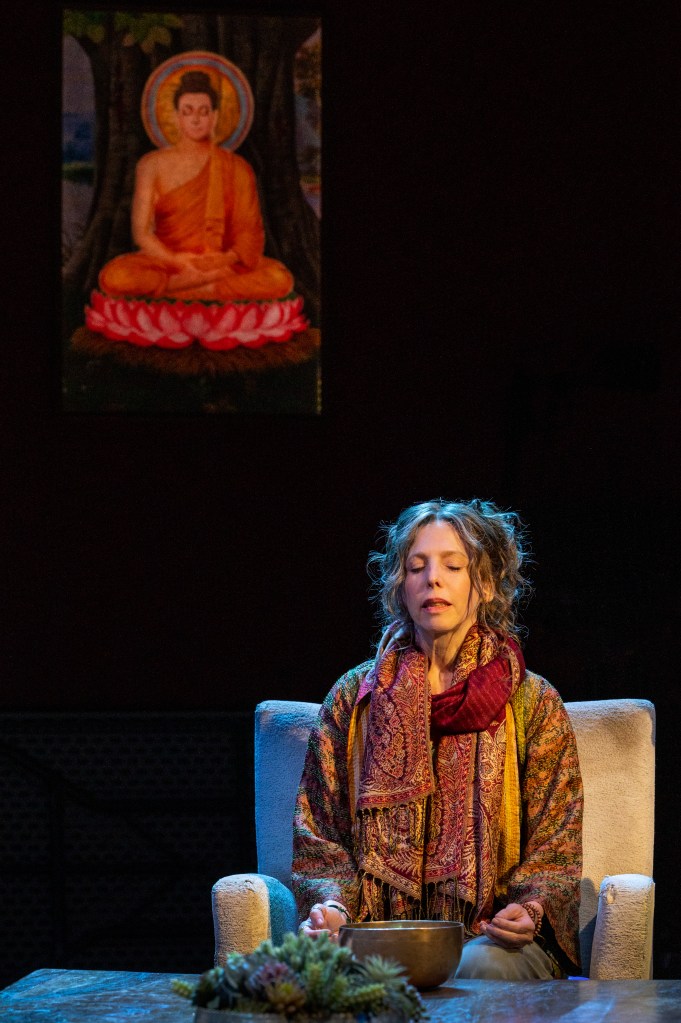
How each of the group members relates to the others remains funny and toward the end of the play becomes volatile. The techniques that Maia uses are successful only in so far that group members believe them to be. However, Thea reveals a few secrets and asks questions which throw a monkey wrench into their “smooth” sessions. And when Katie, who the others believe has joined a satanic cult, leaves after an emotional outburst, it sets the rest of the group members at each others throats. Even Maia who has the “air” of a female yogi, loses control of them and herself in a chaotic epiphany. After her outburst, she is forced to confront herself with the groups’ encouragement, as she reveal a truth she has suppressed to delude herself “nothing happened.”
The success of Sheanshang’s work is in its twists and moment-to-moment “presence” which the actors keep alive and bubbling. All of them have been beautifully shepherded into a believable ensemble of traumatics, which can be set off at any time. And, they are. The secrets revealed by Thea, Maia and Katie cause the group to go off the rails, until Maia is encouraged to hold a session which brings them and the audience back down to earth for a fitting conclusion. The necessity of restoring calm succeeds. As her depth of feeling reaches out and encourages healing, the audience members join in as well. The conclusion is poignant and the theme that every person faces their own PTSD events in their lives becomes clear. Ironically, as much as each of us would like to “get better,” and “be healed,” in an ironic comment, Thea says, “You’re on earth. There’s no cure for that.”

The quote from Samuel Beckett is the play’s principle theme. Knowing that human beings can’t escape having been shaped by horrors in their past, they are grateful for moments of shared peace which bring them outside of their emotional chaos. And in that peace they may find renewed purpose, as they acknowledge it is enough to bring power to reconcile such events with the help of others.
Kudos Jo Winiarski’s scenic design, David Robinson’s costume design (Maia’s and Goth Katie are particularly interesting), Jane Shaw’s sound design, Jeff Croiter’s lighting design, and Jimmy Goode’s wig, hair and make-up design (especially for Maia and Katie). The Fears presented by Steven Soderbergh (Academy Award winner for the film Traffic), is performed without an intermission. For tickets go to their website: https://thefearsplay.com/
‘How to Defend Yourself’ at New York Theatre Workshop
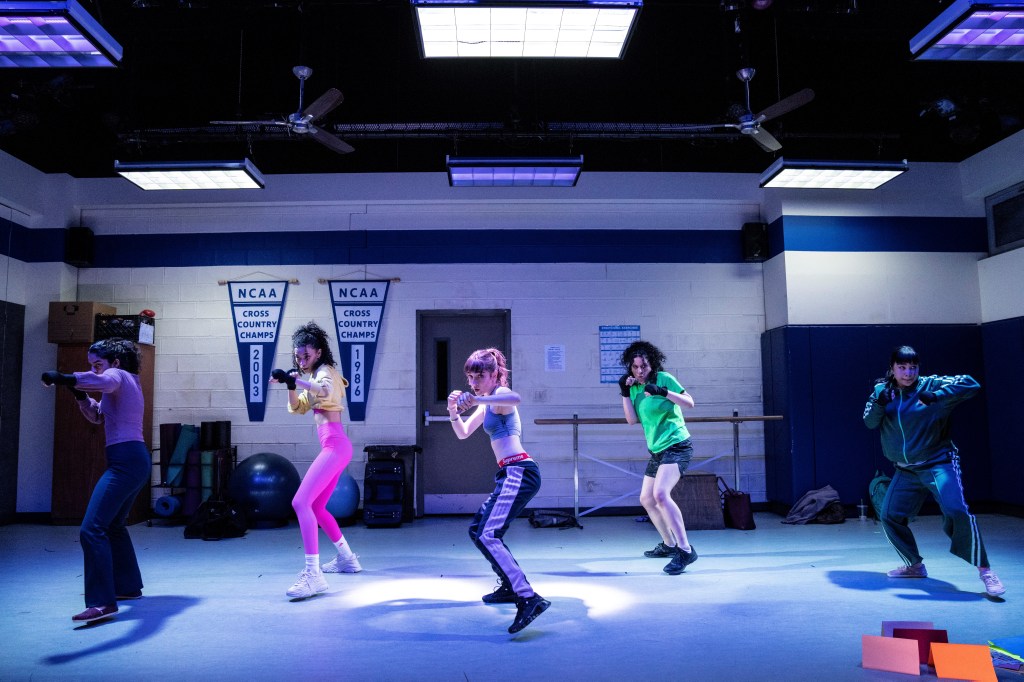
In this decade of sexual extremes on a continuum from paranoia, political correctness, libertine licentiousness, the billion dollar pornography industry and casual permissiveness, one in four women is violated, sexually assaulted or physically/emotionally abused. As a strategic defense #metoo has been appropriately employed culturally, but it also has been wrongfully magnified as a double-edged sword of vengeance. In Liliana Padilla’s play How to Defend Yourself, currently at New York Theatre Workshop, following a successful 2020 run at Chicago’s Victory Gardens Theatre, Padilla confronts important issues about personal safety both emotional and physical. Incisively co-directed by the exceptional Rachel Chavkin, Liliana Padilla and Steph Paul, the hybrid comedy drama explores consent and the litigated definitions of rape and harassment, which shift based upon geographical location, accuser and victim.
With the setting as a torpid and tumultuous college campus, when individuals are beginning to define their goals, dreams and intentions, sexuality and choices remain fluid. A decision to be with someone can lead to devastation, especially around stimulants, alcohol and drugs at a testosterone-fueled frat party, where young women are pressured to compromise themselves. At the top of the play we are introduced to women in a self-defense class started by college junior Brandi (Talia Ryder). The confident, black belt, with social media videos of herself disarming a bully with a gun, is a self-appointed, self-defense instructor. Brandi decides to teach students the ways to protect themselves, after sorority sister Susannah is raped and hospitalized. The assault happened at a frat party.

Much of the enjoyment of Padilla’s play is becoming acquainted with the buoyant women and two young men in the class. They reveal their humorous attitudes as they attempt to navigate a culture whose roiling currents are being defined from moment to moment, often dislocating both men and women. All genders of that age group may be easily overcome by intimate circumstances, which they assume they have control over but don’t.
Brandi, whose self-assurance, determination to do good and organized, talented, physical skills, not only looks dancer-fit, but is also lovely. Admired and accepted by her peers, she is a member of a hot sorority and has the cache to hold self-defense sessions. These attract a few neophytes who are there to learn self-defense. Some are there for other reasons.
Brandi runs her sessions circumspectly with precision. She expects her peers to evolve toward her confidence level, so they understand that “anything can be used as a weapon,” and primarily, “their own bodies are weapons.” Kara (Sarah Marie Rodriguez), joins her BFF for moral support and fun, but she lacks Brandi’s skill set. Kara assists Brandi with chatter and chalkboard drawings in the college gym space (finely designed by You-Shin Chen), where Brandi holds classes.
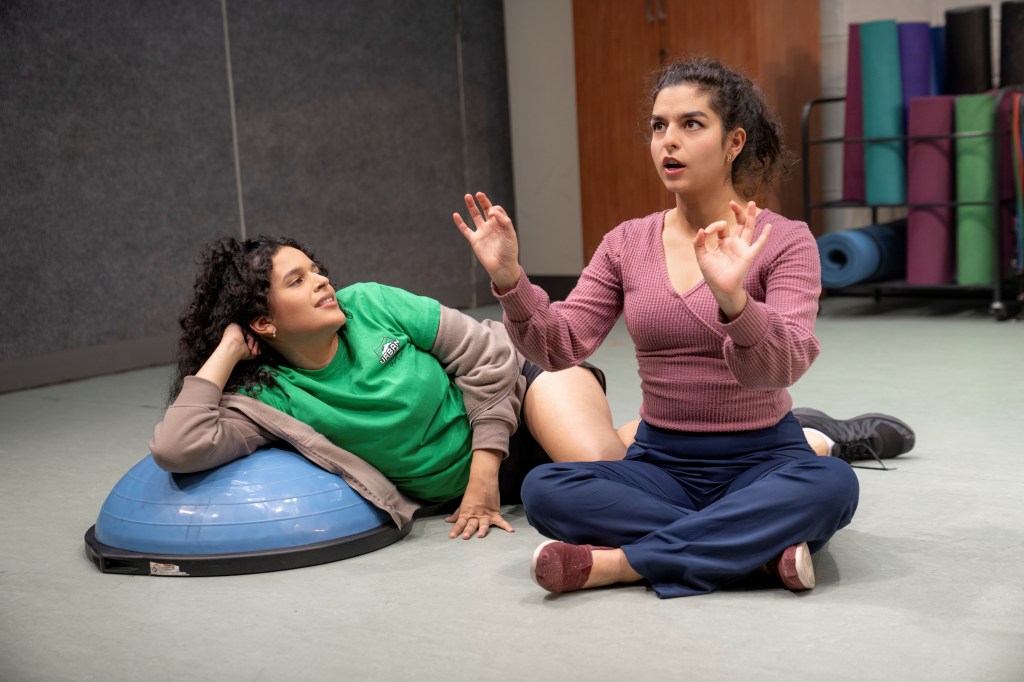
Two students, who drift in anxious to get started, arrive before Brandi. We learn that freshman Diana is obsessed about defending herself against guns. Her BFF Mojdeh follows fast in her orbit. Humorous and sociable Diana ((Gabriela Ortega at the top of her game), and Mojdeh (Ariana Mahallati), are primarily there to get closer to Brandi, who is a Zeta Chi, the sorority they would like to rush. It escapes them that the group think atmosphere of sororities and fraternities are precisely the communities that can be toxic and abusive. However, Mojdeh craves being identified as “cool.” She seeks the hot, popular individuals to ride their coattails and achieve acceptance. For her, this is the fastest way to self-love. On the other hand, Diana appears to be self-content, and is humorous in how she fetishizes guns to the point where by the the end of the play, she indulges her passion.
The last young woman to join Brandi’s sessions is Nikki (Amaya Braganza). Her entrance provokes laughter because she appears super shy, hesitant and awkward. Throughout, she is mysterious and reticent, until the conversation opens up, and she admits she gave a “blow job” to a guy in a gasoline station. When Brandi and Kara attempt to kindly excuse her humiliating, crass behavior as a mistake, she states that she was fine with it, and it was her idea. Whether she is lying or fronting is difficult to surmise. Hiding behind “it’s OK,” is oftentimes the default response because it is too messy to get into, who is responsible, who is to blame and what forced sex means.

Kara indirectly insults Nikki by stating that she also has made such “mistakes.” Nikki is nonplussed, revealing the differences in attitudes between the two young women. Clearly, the circumstances around sexual behavior are extremely complex and not easily understood. Subsequently, Padilla’s characters veer off topic into personal discussions about what forms of touching make them uncomfortable, and what physical boundaries work.
The play reveals that the idea of self-defense encompasses more than just a physical way of being. Young men and women are at sea with regard to “growing up” with a sexual identity that is forced upon them by the culture and their friends. Oftentimes, as Jayson Lee’s Eggo suggests, they are clueless about what is the right or wrong way to conduct themselves, have relationships and fall in love. Sexuality isn’t necessarily the main ingredient that holds people together.
To add substance to the mix, Padilla includes the male perspective, having Brandi invite two fraternity brothers, Andy (Sebastian Delascasas) and Eggo (Jayson Lee). They are “down” with #metoo and are supportive of Susannah during her recuperation and rehabilitation from the stress of her assault. To add to the complexity, their fraternity brother has been criminally charged which has put the entire fraternity on “high alert.” To distinguish themselves from the “sexual abuser types” roaming their campus, Andy and Eggo hysterically ply their sanctimonious “we support women” front, the moment they enter the room and introduce themselves. Years in prison hovers over the head of their fraternity brother, and they are “running scared” that any of their behaviors might be interpreted as predatory. Their loud, moralistic approach toward women is “over-the-top,” and we expect they will marching in the next women’s protest to encourage female empowerment.

Padilla’s themes are not lost on us. Sexualized images and behaviors, part of the landscape of American culture in the entertainment industry and fashion industry, were shattered by #metoo. The nascent revolution that sprang up after the Harvey Weinstein debacle shuttered a billion dollar company and gave pseudo power to women for a time, only in the parts of the country which are not Republican and are “woke.” In other areas, the men act as they please, and the women go along with it, especially if they are proving they are not “socialist lefties.”
In the play, the characters are diverse: three persons of color, a Mexican-American, an Iranian-American and two whites. They are stuck with having to deal with “woke” culture, especially after the campus assault. Importantly, there is a discussion in the middle of the play about what consent means. Additionally, the question about having to always check with a partner about boundaries is raised. Kara blows up the discussion with her suggestion that there is nothing wrong with wanting S and M sex. To avoid the confusing topic, which adds another complex component about individual sexual behavior, Brandi calls her out for being inappropriate.
Clearly, Kara has issues with alcohol and wanting to be hurt. This hints at her subterranean troubles that are never revealed. We note such problems, when she doesn’t join in the physical sessions because she got “wasted” the previous evening. On the other hand, she isn’t embarrassed about sharing her enjoyment of rough sex. Apparently, she also enjoys the shock value of telling others about herself, though it is counterproductive to her BFF’s purpose in holding the class. From this turning point onward, the situations in the self-defense class run off the rails.
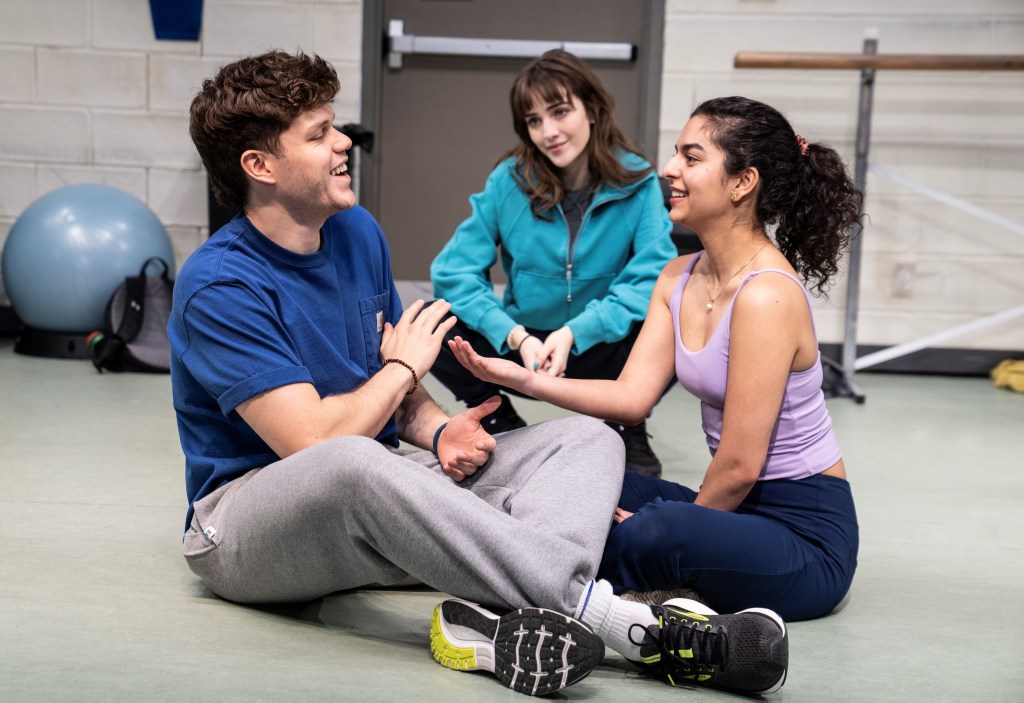
The most interesting segments of the production are the self-defense moves that Brandi teaches (well choreographed by Steph Paul, movement director), and the physical fight routines they accomplish together (at the guidance of Rocio Mendez). Late in the play there is a fight that breaks out between Diana and Kara that is well staged. The fight exemplifies that ego, charm and pride are competitive forces that stir up internal problems within the young women. These spill out in violence. Between Diana and Kara, there exists an intuitive impulse to dislike each other. That disgust eventually dissipates after Diana smashes the provocative Kara in the face, ironically proving that Kara does seek physical abuse.
The staging for the defense practice scenes works seamlessly and is powerful and exciting to watch. The movements are pitched to music, which pumps up the characters and reveals they are gaining confidence about themselves. Additionally, when Brandi suggests they pair off to practice techniques, for example, how to break an attacker’s wrist grip, the results are simultaneously wrought and the overlapping dialogue and action make for fascinating comparisons.
There are surprising turns throughout. Diana and Mojdeh discover things about each other that set their relationship on a different path so that they can’t be close anymore. Kara and Brandi have a disagreement about Susannah, and Andy reveals a secret to Eggo that he has been harboring since the attack on Susannah. This upsets them and dislocates their sense of well being even more. When Andy asks what he should do, Eggo is at a loss. We understand there are no easy answers with regard to human sexuality and situations worsen as a result of “not knowing what to do.” Finally, after a number of sessions where Brandi’s “students” have progressed, and she feels she has made inroads into helping them feel safer, Nikki upends her assumptions and disturbs everyone with an event that she describes.
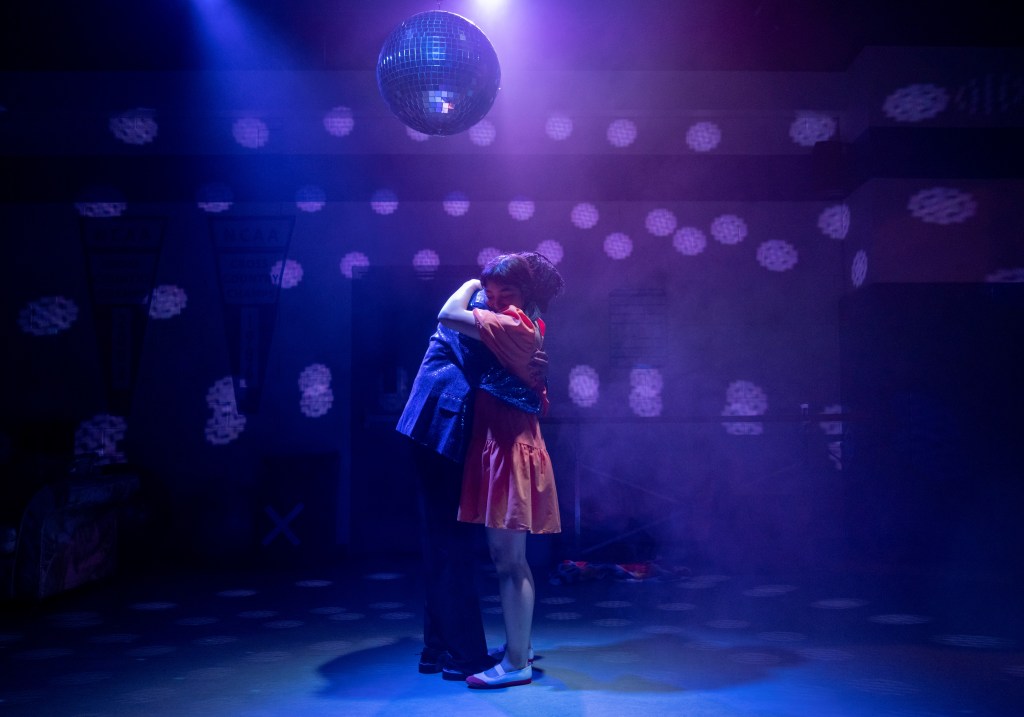
The thematic conclusion moves through flashbacks in the characters’ stages of adolescence. The directors show the individuals at three parties during their teen years, which move backward in time to a birthday party when they were in elementary school. The parties reveal the wildness from the drinking and sexual exploration when they were in high school. In the last party they end up in the sweet innocence of their elementary school days. The contrast of how they seek sexual experience that emerged from a time of innocence is stark and mind blowing.
For the rapid set changes You-Shin Chen, Stacey Derosier lighting designer, Izumi Inaba costume design and Mikhail Fiksel’s sound design create a frenetic party atmosphere. And the lovely tableau at the end reveals that the progression of their identities has sprung from love, security, family and well being. One might think that these create an assured line of defense to thwart any attack that might ever happen.
However, Padillia posits that security is never guaranteed. Though we may use our bodies as weapons, or learn self-defense, random and not so random acts of violence happen in a culture that uplifts violence. Diana feels forced to arm herself with a licensed gun as an answer to that violence. Tragically, the subtext of her statement about guns plays out daily in our society, revealing the play’s devastating currency. Its themes about our physical and psychic vulnerability in an arbitrary and violent world resonate with power.
Co-directors Rachel Chavkin, Liliana Padilla & Steph Paul are responsible for the strengths of the production, especially its staging and thematic depth. Their vision about the questions the play raises leaves us with even more questions and no clear answers. The actors are uniformly excellent and the physicality and staging of the various defense sessions make one want to get up and join the cast to try out all the moves.
How to Defend Yourself is a humorous, weighty production, whose trenchant themes give us pause, thanks to the vision and talent of its creatives. For tickets and times go to their website https://www.nytw.org/show/how-to-defend-yourself/tickets/
 CAROLE DI TOSTI