2021 SXSW Film Festival Review ‘Demi Lovato: Dancing With The Devil’ in its World Premiere

What takes Demi Lovato: Dancing With The Devil beyond the interest of pop music fandom is its unabashed honesty without pandering to sensationalism. Directed and cobbled together with interviews of friends and family, Ratner creates a film which succeeds as an intense biopic of Lovato’s addiction crisis. With input from icons like Elton John, Christina Aguilera, and work colleagues like Will Farrell, Ratner shows a women in revolution and evolution. Assuredly, covering all bases the filmmaker grills her creative team, rehab coach, trainers, new manager Scooter Braun. Then Ratner blows up the celebrity image and brand to shatter the Lovato myths. If teens follow her as a role model and advocate for mental health, eating disorders and sobriety, Lovato’s revelations take her mission to a new level of relevance.

The film hits it out of the park by showing Lovato’s pathos in picaresque. Ratner divides the action in four, non-linear, acutely edited segments. And in a heightened alert, he begins with the months in 2018 when it all went wrong. Of course during the course of the film the full poignancy is that Lovato affirms it had gone wrong for a long time. However, she, her friends, family and team had bought into the “devil’s dance” that obsessive control answered her internal problems. Thus, her determination and teamwork convinced her that as long as she stayed slender and sober, she remained healthy. Sadly, she fooled everyone, especially herself. Her choices belied her ability to handle deep-rooted emotional and psychological issues. Past trauma whether conscious or unconscious bled into the present and tortured her.

Distress intensified to overwhelm Lovato with misery and the need to self-medicate. As these internal pressures pushed her to open the floodgates, Lovato suffered a drug relapse. Each of Ratner’s segments touch upon her addictive OCD personality. The documentary’s overarching themes about the fatal flaws that come with celebrity deification crash into the human factor. Inevitably, Lovato believed her own BS. Vulnerable, her unresolved life and death problems infiltrated her daily struggles.
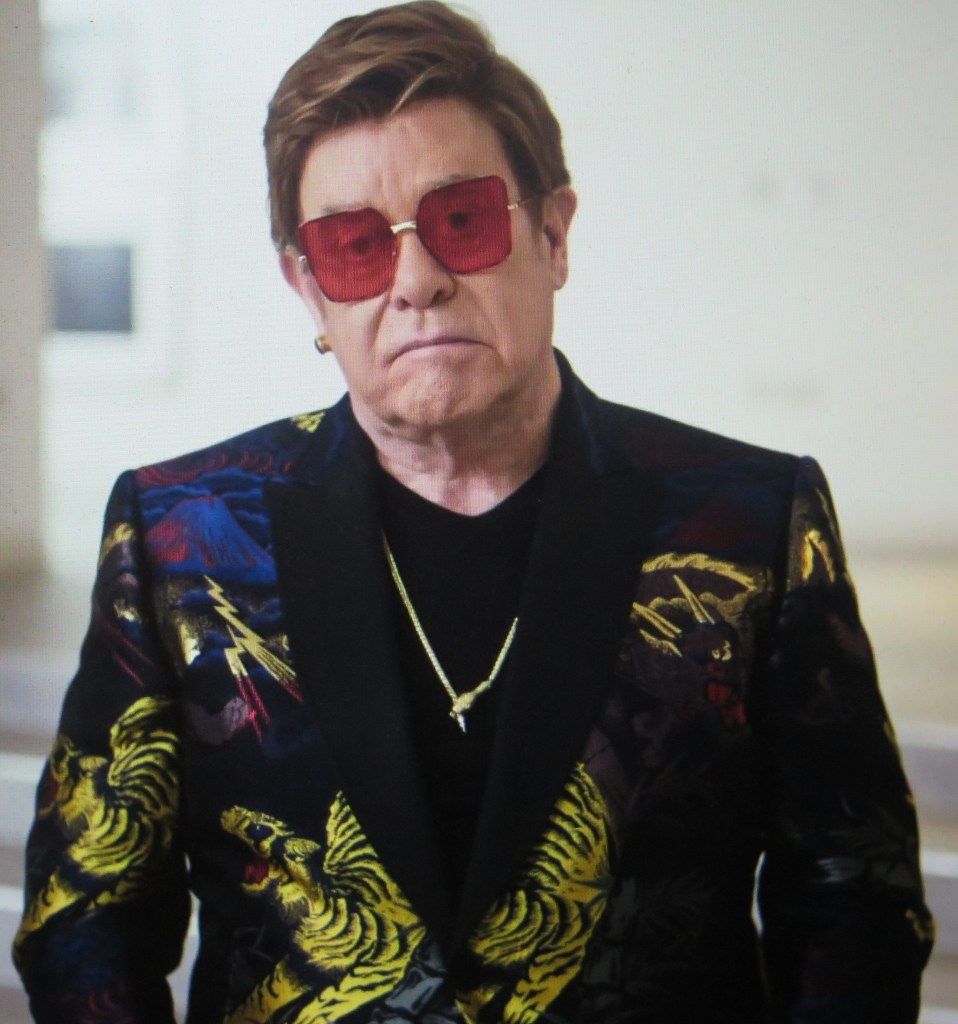
Ratner selects various clips of Lovato commentary. In the more salient ones she discusses how she lived on the edge seeking destruction in secret silence, despite being surrounded by loving individuals. Examples abound. Lovato’s discusses regrets about her father’s ignoble drug death alone, his body found decomposing. And she relates that she never worked through sexual traumas (a rape by a co-celebrity, etc.). Though the “me” aspect of the documentary sometimes slogs from “reveal” to “reveal” without variation, Ratner keeps Lovato’s story uplifting. In the final analysis Lovato moves to summarize what she’s learned. And we find comfort in empathizing with her journey into a hell of her own making to emerge into healing.

Ratner nearly completed an earlier a documentary on Lovato in 2018. Filmmakers employ the footage of the earlier film to compare Lovato’s state of mind. As highlights of her Tell Me That You Love Me World Tour shine the shimmering Lovato, current footage reveals the truth of her condition during that time. Especially after her overdose, the filmmaker contrasts her promises and affirmations against her current truthful revelations. Even in this age of lying her statements shock. So many of her statements resound as obfuscations as she points out her hidden misery, pain and anger. Amidst this backdrop of illusions about being well when actually heading forward on a collusion course, her voice sounds incredible. Ratner includes a sound clip of her mother Dianna De La Gaza in June 2018, one month before Demi’s overdose. De La Gaza tells Demi, her voice is “the best ever.” At the height of her talents, death comes knocking and nearly takes her.


During the tour Lovato fronted all the positives to maintain the good girl sobriety image. She fooled those closest to her. But the tour documentary of 2018 never got off the ground with the exception of salvage clips. Instead Ratner and Lovato split open her guts and set the record straight bravely and boldly in Dancing With The Devil. Lovato confesses she did drugs unbeknownst to her friends and team. After celebrating her choreographer Dani Vitale’s birthday, Demi called a drug dealer. Early morning, when none of her friends or team were around, Lovato sabotaged herself, her life, her career, her self-love and her agency. She overdosed on a mega combination of crack cocaine, heroin and OxyContin laced with Fentanyl. These she chased with alcohol. Meanwhile, she remembered later that the drug dealer had non consensual sex with her and abandoned her. Ten more minutes from discovery, she would have died.

In this first part of the four part series, we understand how driven and obsessed Lovato pushed her beyond her limit for wellness. Ironically, her abstemiousness actually fueled her desire to jump off the merry-go-round of sobriety. Ratner even includes the physician who saved her life. And he discusses just how miraculous her recovery was, but not without costs. Lovato’s overdose caused brain damage: she had a heart attack and three strokes. And the twenty-four hour period after she was found by an assistant was touch and go with her fans, family and friends praying for her.

Now, she is able to laugh with friends. But the film is also revelation to fans that Dani Vitale who fans blamed for Demi’s overdose was wrongfully blamed. Vitale received death threats and lost her career, teaching jobs and everything that was meaningful to her because of the rumors she had given Lovato the drugs. A lie. So in setting the record straight, those who worked for Lovato and her new manager like Scooter Braun also go on record to do right by her after this incident.

However, from her sisters Madison and Dallas, her mother Dianna and her step father as well as her friends, all agree Demi has to want to be sober and drug free. It is up to her. And appointing monitors to make sure she didn’t eat any cake or cookies and didn’t do alcohol was not a balance she could live with. Indeed, it sent her in the opposite direction. Meanwhile, friends Matthew Scott Montgomery and Sirah have been through Demi’s hell with her, suffering their devastation wondering if she would make it to the next day. Now they joke that at least she is 28; she made it past the curse of the twenty-seven year olds of Brian Jones, Jimi Hendrix, Janis Joplin, Kurt Cobain and, Jim Morrison, Jean-Michel Basquiat and Amy Winehouse.

The documentary is a cautionary tale for all those who start out in beauty pageants. If they as child stars possess the talent to parlay their success to accomplish world wide tours at twenty-five, the exposure can be treacherous. The overriding question becomes emotionally and psychically can they withstand all that the music industry siphons out of its celebrities? Lovato is back on course with her career. However, she considers her unconscious flirtation with suicide. Importantly, she recognizes she must confront herself during the journey of reclamation and accept herself as her own best friend.
Demi Lovato: Dancing With the Devil airs on YouTube from 23 March.
‘End of The Line: The Women of Standing Rock’ 2021 Athena Film Festival Review

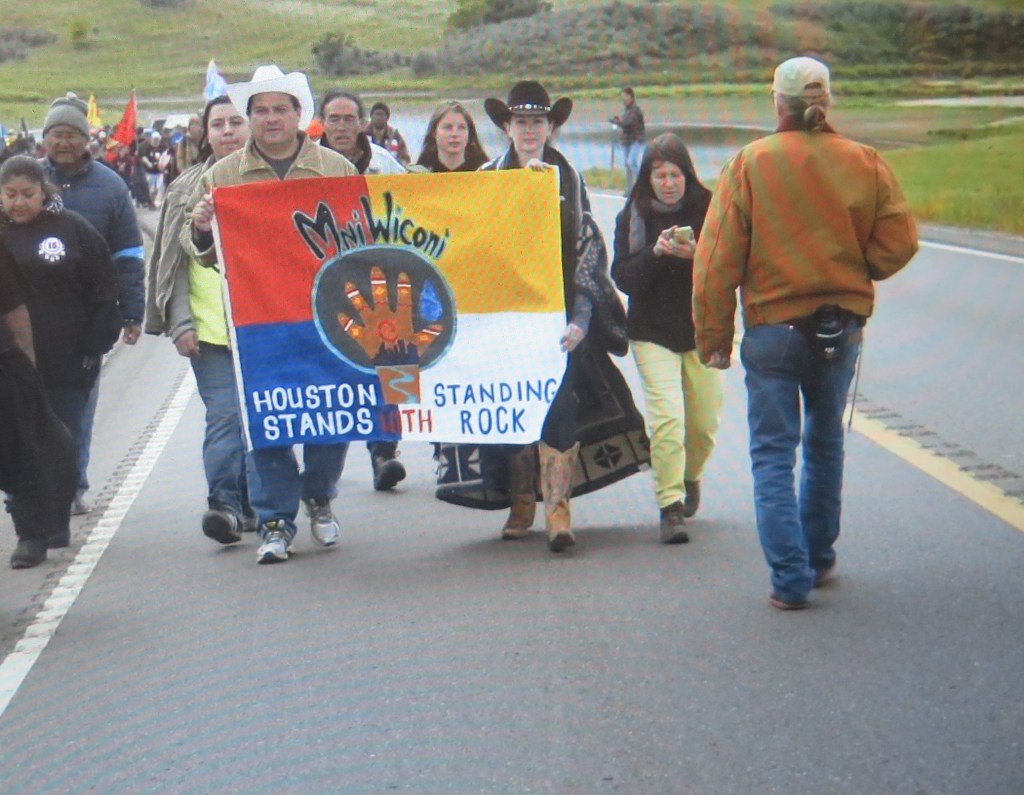
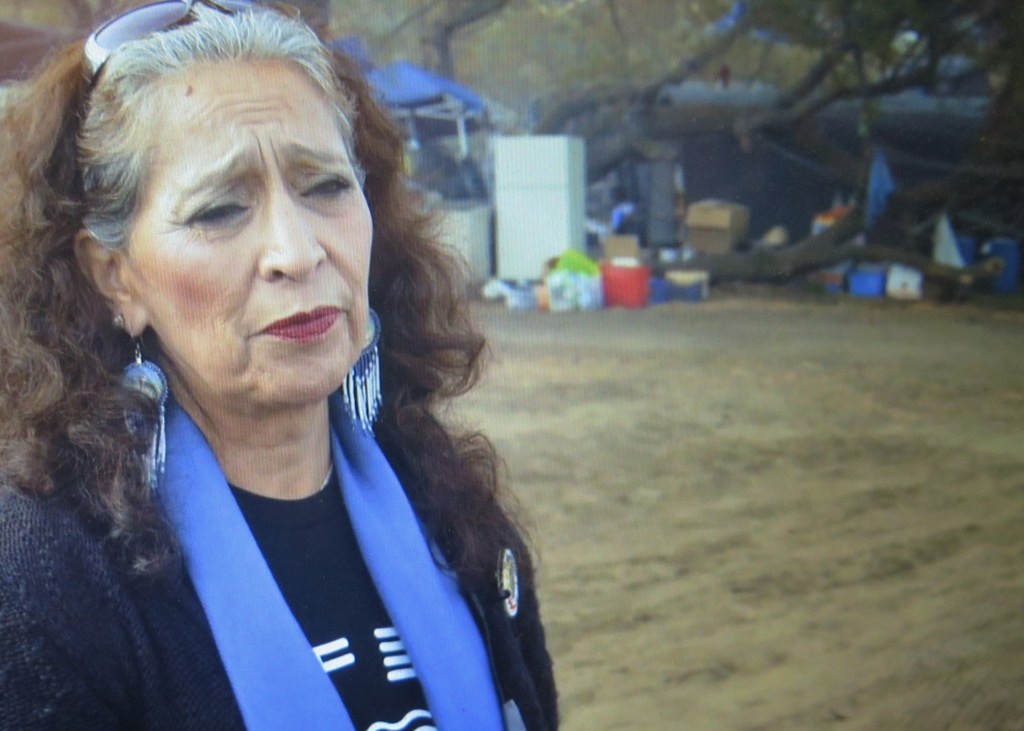
End of The Line: Women of Standing Rock directed and produced by Shannon Kring, is an epic, historic film. Using cinema verite, on the ground style cinematography, Kring follows protest activities of the largest gathering of Indigenous Peoples in the US as they take a stand against the exploitation of their lands given to them in an agreed upon treaty of 1851 by representatives of the U.S. government. This is a film about the women of the Nakota, Dakota and Lakota tribes, who with their men and families, gathered together to stop the destruction of the Missouri River by an oil company, Energy Transfer Partners responsible for the Dakota Access Pipeline.

She focuses principally on grassroot activities of water protectors Wasté Win Young, Phyllis Young, Ladonna Brave Bull Allard, Pearl Daniel-Means, Linda Black Elk, Ph.D. and Madonna Thunder Hawk. As the movement grows and they gain the moxie as empowered women to forge ahead and take this fight to the world, we revel in the courage, stamina and bravery to fight the good fight until they reach the goal.
The Dakota Access Pipeline is the 1,172-mile-long (1,886 km) underground oil pipeline in the United States. It begins in the shale oil fields of the Bakken formation in northwest North Dakota and continues through South Dakota and Iowa to an oil terminal near Patoka, Illinois. Together with the Energy Transfer Crude Oil Pipeline from Patoka to Nederland, Texas, it forms the Bakken system. Extraction of the oil depends on fracking, an extremely dangerous procedure to the environment. The entire fossil fuel process condemns the area land and water and increases global warming aka Climate Change aka known as extreme weather actions.

Announced to the public in June 2014, the almost $4 billion dollar project took off after informational hearings for landowners ending in 2015 that did not include Native Americans who had rights to the land. Dakota Access, LLC, controlled by Energy Transfer Partners, started constructing the pipeline in June 2016. Other companies have minority interests in the pipeline. The pipeline, completed by April 2017 became commercially operational on June 1, 2017 under the Trump administration.

Kring focuses the documentary on the women of the Indigenous peoples between the time that the pipeline bulldozers showed up on Standing Rock Reservation until the time that protestors and activists were evicted and the camp pulled down. Also Kring covers the aftermath reflecting on the camp’s power to bring unity and the actions that the Indigenous Americans have undertaken afterward. She examines the strength, resilience, inner power and intelligence of Native American women who have their s*%t together to finally say “enough is enough.” Willing to die for the great purpose to keep the water in the Missouri River clean and unpolluted as it feeds into the water supply of 18 million Americans, the film shadows and highlights water protectors as they maintain their goals in the light of hypocrisy of the Army Corp of Engineers under the Obama Administration. The film also explores the actions of the women beyond the Trump administration.
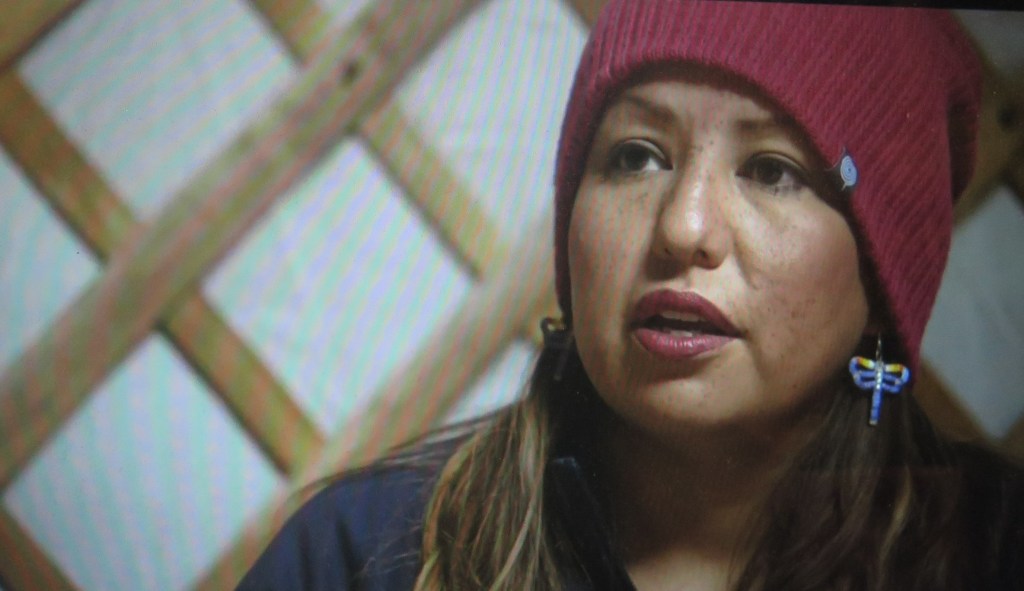
When the standoff is concluded and arrests are made, the coalition of men and women, but led by women decide to go to the UN and European conferences to announce they elicit support in their financial tactics to overwhelm the tyranny of Donald Trump’s quid pro quos with the Dakota Access Pipeline Company. Interestingly, their interests align with climate change activists against fossil fuel development. And thus far in their “Divestment Movement,” they have 1000 divestment commitments made by companies to for a total of over $11.4 trillion worldwide to relinquish use and exploitation of fossil fuels in a forward thrust toward massive projects in renewable energy
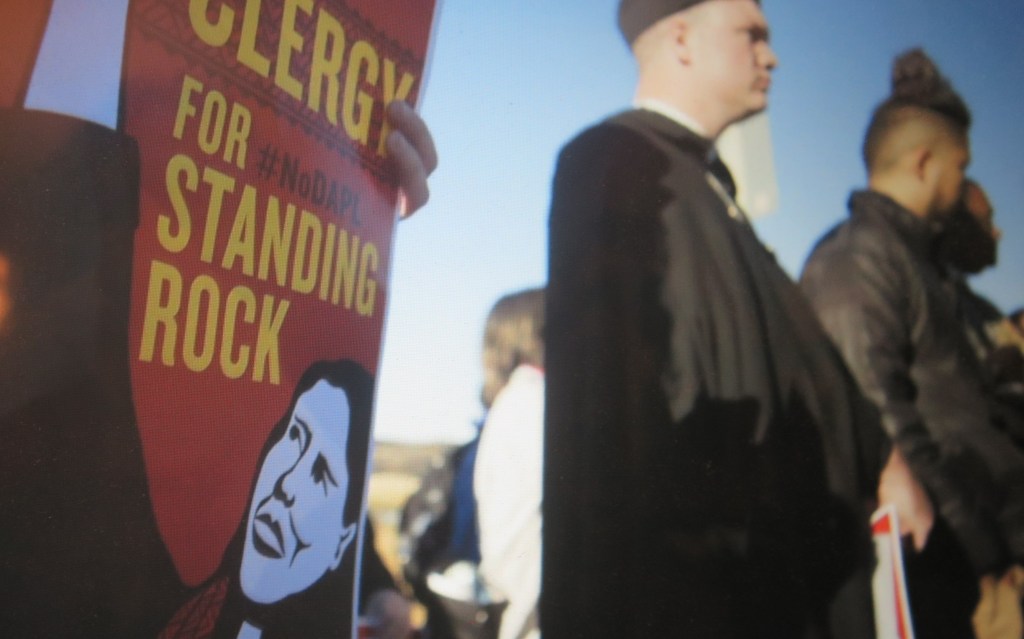
Kring interviews key water protectors. She follows their protest movements at Standing Rock Reservation Camp as they peacefully and without weapons pray and protest to stop the exploitation of their land and advertise the dangers of the pipeline to their water supply which relies on the cleanliness of the Missouri River. During the process, the Obama Administration’s Army Corp of Engineers is supposed to complete an impact statement. As the water protectors wait on them, the Dakota Access Pipeline moves in. No agreements were made between the Indigenous tribes in the area. And the PR company for the pipeline accuses the tribes of being out-of-state and not directly impacted by the pipeline. Those lies are smashed as the stand-in continues and Democracy Now takes photographs and videos of the abuse of the Native Americans at the hands of the goons hired by the pipeline to run roughshod and with impunity over the land to lay the pipe.
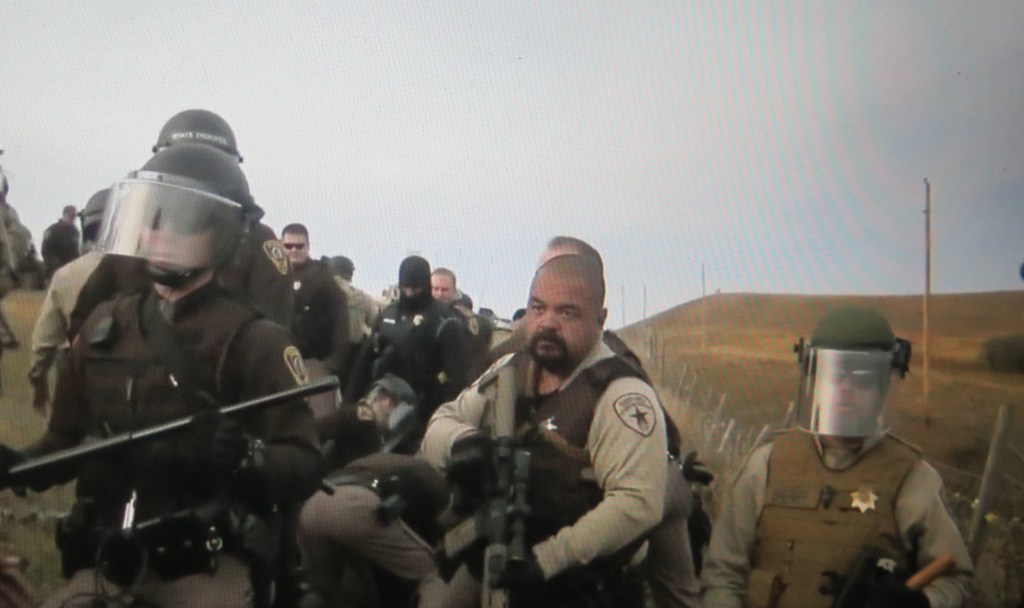
The photographs go viral. And the Nakota, Lakota and Dakota are joined by Viet Nam Vets,Vets of recent wars and environmental activists to fight for the sanctity of water from the Missouri to remain clean from oils leaching into it. All told 15,000 people from around the world protested, staging a sit-in for months. And when they couldn’t resist at their camp on the site of the pipeline and were evicted and arrested in the final days, they took their fight to protests in Washington D.C., and spoke before the U.N. and in global conferences.

Interview clips from a scientist reveals that the pipeline is dragged underground through the land to get to its destination. This movement creates breaches which are inevitable with the dragging and placement. Sadly, they are subject to weathering cracks and spring leaks which are practically undetectable until there is a massive accident. Pipelines are notorious for these and over the years in residential areas have created oil pools on lawns creating losses in the millions of housing and costing a fortune to clean-up.
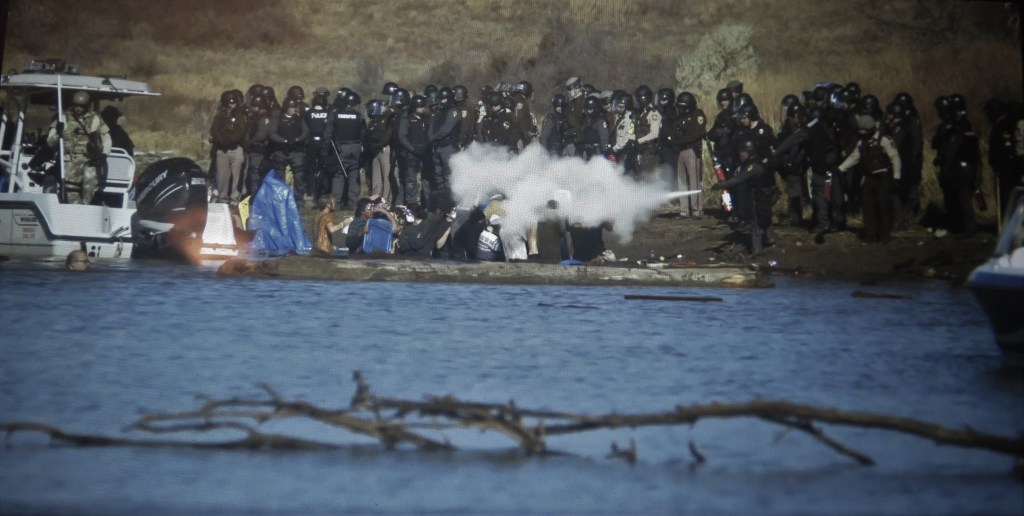
Kring provides the appropriate background was she asks the right questions from the women who know the subject of the pipeline and its impact blindfolded. When Dakota Access Pipeline was denied access to lands near Bismarck, North Dakota because the possibility of the wealthy commuynity’s water might be polluted and destroyed by pipeline leaks, The Pipeline company petitioned to situate the pipe in a better area where there weren’t any people.

What they refused to research and what the Army Corp of Engineers didn’t look into was the impact on the environment. The pipeline construction and the potential for an oil disaster afterward is typical of any fossil fuel extraction abuse of the land. First, the extraction of the oil from the shale is a disaster of pollution. Secondly, with any oil leaks from the pipeline, the flora and fauna is crippled and destroyed. One of the water protectors discusses that medicinal plants and edible plants that provide forage for wildlife will be polluted and destroyed.
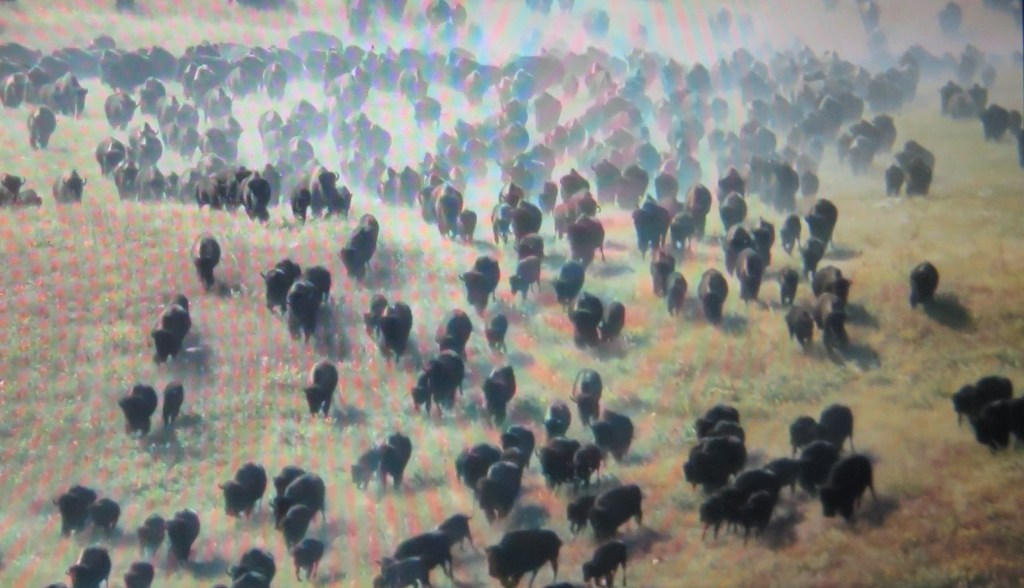
She cites other examples when Native American land was invaded and the flora and fauna was decimated. The near extinction of the Buffalo as a plains animal is one of thousands of examples of what happened when settlers came in and exploited everything they found like dumb brutes not bothering to understand what their impact was having. Furthermore she emphasizes that the pipeline itself is potentially in violation of a number of national acts: Clean Water Act, Clean Air Act to name a few. Equally important, the Pipeline Company was desecrating Native American land: Lakota, Nakota, Dakota. Indeed, running through ancestral lands and graveyards, the pipeline was a desecration.

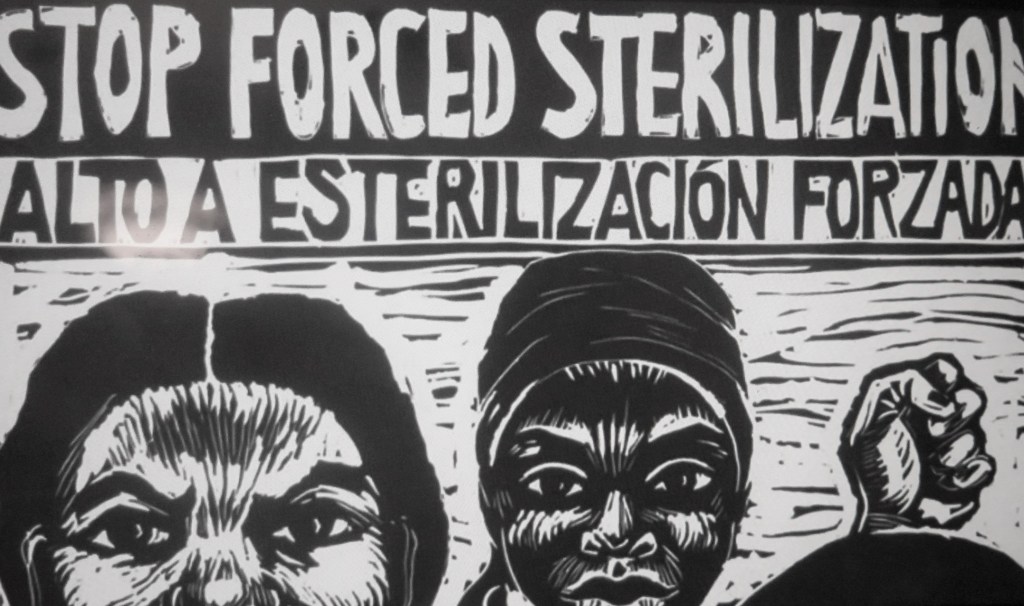
Kring’s documentary reveals that these women understand their history and how it entwines with the scourge of colonialism. References to the abuses of schooling Native Americans in Christian schools, sterilization programs, sexual abuse by male clerics and forcing adoptions of children out of wedlock were endemic to Indigenous Peoples in America. Thus, every protest and every fight is an attempt to take their power back.

The women indicate that they’ve learned the power of keeping their language and customs alive for their children to provide them a nest of comfort, solidarity and the understanding to be proud of their ancestry of Sitting Bull, Rain in the Face and Crazy Horse. Importantly, they recognize the deficiency of colonials, who have forgotten who they are and the culture they came from. Thus, wanting and desperate, colonials have no right to strip Native Americans from their culture, language, land and artifacts. These are sacred treasures of Native Americans. Only now do the women understand the pride of their tribe and their cultural place at the beginning of America.

This is a film you’ll want to see. It is streaming at Athena Film Festival until 31st of March. Click here for tickets. Click below to get a taste of what you might miss if you don’t see it. https://athenafilmfestival.com/
‘The 8th’ Athena Film Festival Review

The 8th, a superb documentary, now screening at the Athena Film Festival, catalogues up close the last year of the Irish Republic’s Women’s Movement working to repeal The 8th amendment to their constitution. It is a superb historical capsule of how women activists and women’s right’s leaders in the Irish Republic diligently fought for and won against the Catholic Church, religious groups and politicians who attempted to hold on to the amendment that they passed in 1983.
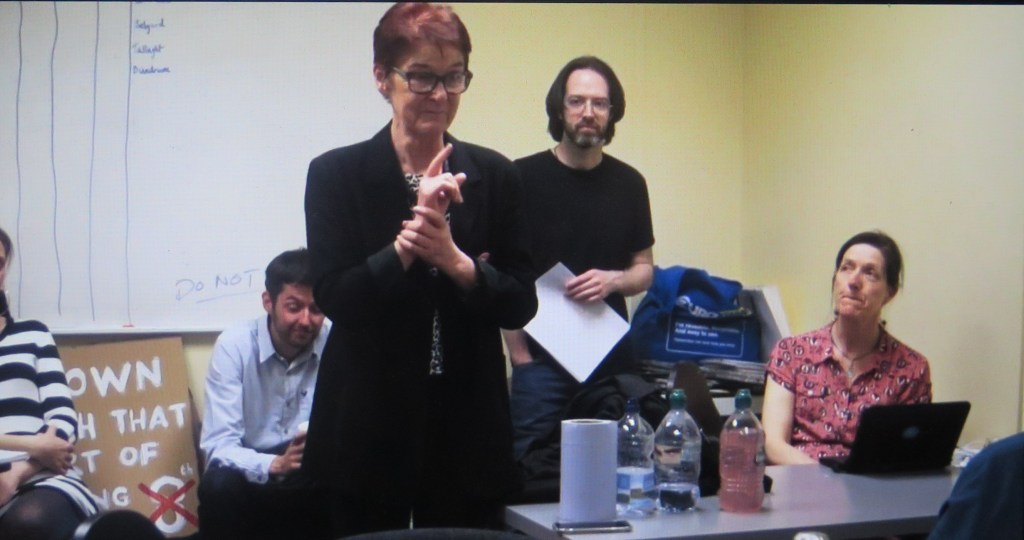
The Eighth Amendment of the Constitution Act 1983 was an amendment to the Constitution of Ireland which inserted a subsection recognizing the equal right to life of the pregnant woman and the unborn. As a result the 8th banned abortions, the abortion pill and forms of contraception. It abrogated a woman’s right to make decisions about her own body. It did not give her access to reproductive healthcare if it involved terminating a pregnancy. Unborn fetuses had the same right to life as women, though there is Biblical scripture that is against this.***
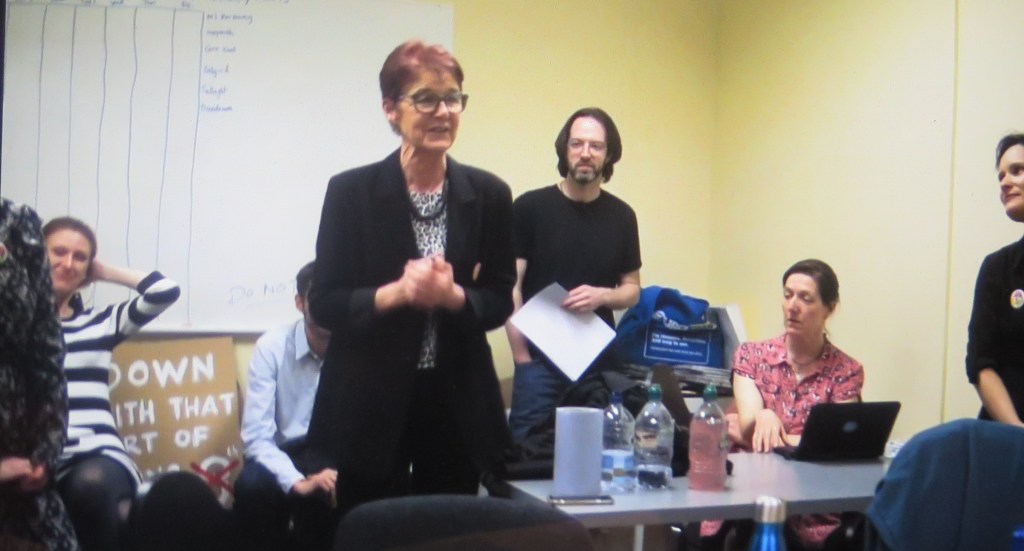
Directed by Aideen Kane, Lucy Kennedy and Maeve O’Boyle with interviews and cinema verite style on the ground, in the moment cinematography we understand so much about the repeal the 8th movement. We are there with the marches and moments of doubt, concern and angst. And we understand the great good will and joie de vivre of women and men in 2017-2018 who dug deep to do their part to overturn one of the most restrictive laws on abortion in the world. The film identifies how the uplifting struggle unified the Irish Republic like no other cause before it. Eschewing former tactics that remained unproductive, and employing the ideas of care and compassion, activists sifted through 35 years of onerous, oppressive experiences mothers faced under the 8th and spotlighted them to the populace.

One of the essential fallacies that the Catholic Church, politicians and women’s groups who supported them used to terrorize the populace in the past using Christianity’s 10 commandments to cover for the raw power and control of politicians and the Church, was the unborn fetus. An unborn fetus under twelve weeks cannot be sustained outside the women’s body. So it was exploited and used as a weapon for political and religious power. Those who supported the 8th proclaimed that a fetus was a whole human being with the same rights as the adult woman who carried it. The fetuses were lifted up as equal to women, an abject lie that is not Biblical.
The law in effect asserted that if a woman could get pregnant at child- bearing ages they had no rights above those of a fetus. In other words, they were equivalent. There were a few exceptions, for example the risk of the life of the mother and child. But if the child’s heart beat was found, there could be no abortion, even if the mother was dying, or the child contributed to the mother dying. A woman having the same rights as fetuses, means there is no choice. Woman and fetus are one and the same. The law removed a woman’s right to think for herself and reduced her to silence under the Republic of Ireland.
The concept is preposterous and defies reality which indicates it is a power grab and uses the irrational and emotional to remove any logical debate. The vote which allowed the Church, government and hooked in women’s groups to reduce women to the unborn, was passed by 66% of the population in 1983. Paternalism and the oppression of women had reached an all time high under this law, making fetuses and women subjects of the state, a blasphemy to God and Christianity in removing women’s freedoms and in effect self-determination of their souls.
Ironically, the Church was under its own siege as babies bodies were unearthed in the septic tanks of a mother/child home and the abuses of the Madeline Laundries were shown on film. Then the massive pederasty and abuse sandal of clerics abuses boys for decades pointed up the hypocrisy of the Church. Who were they to legislate for women when they themselves were abusive, hyper-wicked and dangerous to their own parishioners?

That they were guilty of abusing women with this law as they had been abusing men and women for decades helped to change the populace’s opinions about the Church. This cruel and unusual punishment of not giving women access to reproductive healthcare was petitioned against countless times by women activists. Even the UN in recent years declared women not being given the right to healthcare and a legal abortion was egregious discrimination against women and a human rights violation.
Filmmakers highlight the negative impact of the harsh laws of the 8th with clips of marches and activism. Thousands of women ended up going to the UK for their healthcare and abortions yearly. In one instance of rape a 14-year-old was prevented from going to the UK. She was suicidal. The rape was familial and she threatened to kill herself. Finally, the High Court allowed it. But by the time she arrived, she was under such duress she had a miscarriage. Women’s groups were outraged and petitioned for changes but the main law held.

In another case, a pregnant Indian mother Savita Halappanavar who was ill with sepsis asked for an abortion. But because there was a heart beat, she died of sepsis. The doctor was afraid of an jail sentence, so rather than to act and give her the abortion she asked for, he waited and she died. Filmmakers highlight the marches around Savita’s death and the injustices in such cases.
But the most vital parts of the film follow specific activists, self-described glitter-activist Andrea Horan. She and others worked hard to get out the vote going door to door. Horan had a sign painted on the wall of her shop. Filmmakers have clips of her talking to women about the issues like allowing abortions of fetuses with severe debilities as they die of these issues in the womb.
Importantly, filmmakers also highlight and shadow the wonderfully vibrant and energetic academic Ailbhe Smyth who has been at the forefront of the Women’s Liberation Movement during each feminist wave starting in the 1970s. She is the equivalent of the U.S. Gloria Steinem having worked tirelessly for women and Women’s Rights in the Irish Republic. She founded and spearheaded so many groups it makes one’s head spin. This, including establishing a Women’s Studies program in U.C.D. (University College Dublin)
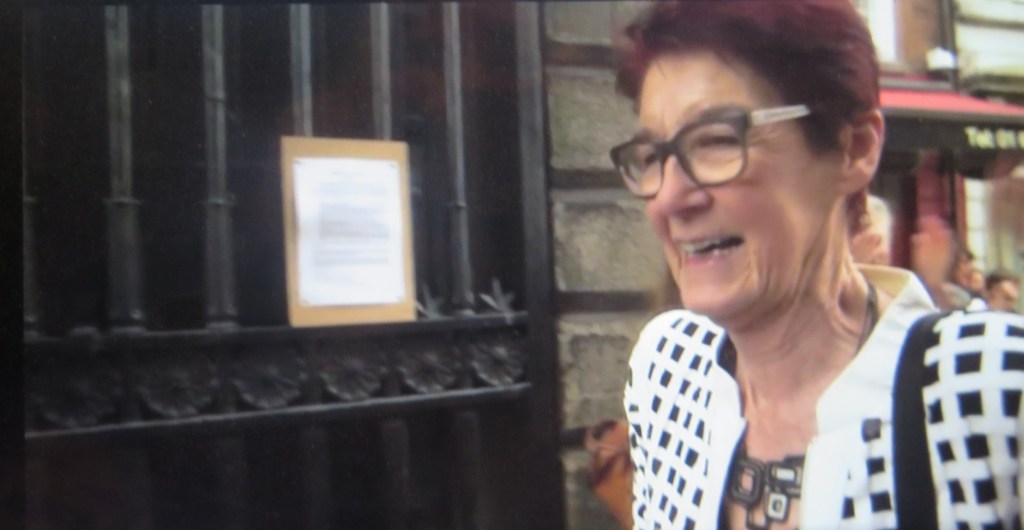
In the last months working to repeal the 8th, Ailbhe Smyth is the key leader that others look to. Filmmakers reveal her sense of humor, her inner strength, her openness and authenticity, her driving hard work to win the votes. One can’t help but fall in love with her. She with the help of collaborators who felt that this campaign to repeat the 8th most importantly was a campaign of compassion and concern for women’s reproductive healthcare. To stop the thousands yearly going to the U.K. for abortions, if the law was repealed, they would have access in their own country. Interestingly, that the Republic of Ireland allowed itself to be shamed and judged by the U.K., really is beyond the pale.
Filmmakers also interview those who vote for keeping the 8th. The arguments against the repeal are thin. And in the case of one journalist, she hangs her “no” vote on the example of her friend getting an abortion and regretting it. Of course, the instances where women are driven to extreme action to travel spending time, money and effort because the government doesn’t think they deserve the right to choose another path are ignored and overlooked. The religious argument and pictures of fetuses are used; filmmakers didn’t gratuitously include these. However, in the hearts of some, the life of the unborn is even more worthy to fight for than an adult woman with a formed mind and soul that clerics deem wicked.

As the countdown to the day of the vote arrives after the debates, filmmakers do a superb job of transferring the excitement and jubilation. Indeed, it is palpable. Ailbhe Smyth and others are joyously expectant and the moment of historic change is real. There is no going back, ever. The Republic of Ireland entered the 21st century and this was like the shot heard round the world. The Republican Party of the U.S. is on notice, despite its conservative court.
The law was signed by the President of Ireland on 20 December 2018, after being approved by both Houses of the Oirechtas, legalizing abortion in Ireland. Abortion services began 1 January 2019.
In a quote that says it all an activist said, “We will end what has been described as an English solution to an Irish problem’. Our women will no longer need to travel abroad to access abortions, and we will no longer need to import abortion pills illegally and without access to medical care or support.
Look for The 8th online or screening at the Athena Film Festival. It is a jubilation and must-see.
https://athenafilmfestival.com/
***http://www.achristianapologistssonnets.com/2016/03/womens-right-to-choose-christs-untrap.html
2021 SXSW Film Festival Review ‘Executive Order’ in its World Premiere

Executive Order, ‘Medida Provisória,’ the dynamic, often poetic dystopian thriller shot on location in Rio de Janeiro, Brazil, draws one in with its immediacy. Though set in the distant future, its contemporary issues and alignment with the BLM movement, reparations for cultures formerly oppressed by slavery, and the authoritarian deportation of immigrants by the former Trump administration resonate with horrific, thematic fury.
Directed by Lázaro Ramos, written by Ramos and Lusa Silvestre with co-writers Aldri Anunciação and Elisio Lopes Jr., the writers based the film on the play “Namíbia, Não!” byAldri Anunciação (2009-2011). The narrative feature (in Portuguese, with English subtitles) won an award for best screenplay at Indie Memphis Film Festival. Judges at Moscow International Film Festival and Indie Memphis FF nominated Ramos, a renowned actor and first time filmmaker, for Best Narrative Feature.

The music, oftentimes poetic, unique script, cinematography and spot-on acting talents (Alfred Enoch, musician/actor Seu Jorge, Taís Araújo, Mariana Xavier) indicate why the film won awards. Most probably more awards will follow through this film festival season at 2021 SXSW and elsewhere.
From the outset the opening scenes alert us to trouble ahead. We discover that the high-melanins (the word black has been banned from the culture’s wordspeak) have been cheated out of reparations indemnifying a 500 year-old history of slavery. Mrs. Elenita, selected as the symbolic representative to receive reparations to indemnify the country’s history of slavery, never receives payment. The government locks her out of the bank and breaks the promises it made. Later, Antonio overhears an official claim that giving reparations would bankrupt and crash the economy. Indeed, the official identifies the problem. As the Western Hemisphere’s largest population of people with African ancestry, Brazil paying indemnities to approximately 75 million out of 211 million-plus inhabitants would rock the nation.

Attorney Antonio (Alfred Enoch) sues the government for reneging on its promises to high-melanins. He requests an alternate compensation program. This sets in motion an increasingly noxious series of events to thwart the just payment of indemnifications.
Initially, the writers include satire and comedy presenting the positions of the officials and city council versus the discussions of Antonio, his journalist/blogger friend and roommate Andre (Seu Jorge) Capitu, (Taís Araújo) Antonio’s pregnant wife, and Andre’s white girlfriend (Sarah Mariana Xavier). The humor and satire increases when the government offers a volunteer program to “go back from where they came from.” This would substitute for monetary reparations. This program instituted by the “Ministry of Return” sounds as sinister and wicked as all the deportation programs for immigrants throughout recent history.

Against this backdrop Antonio, Andre, Capitu and Sarah appear successful as middle class contributors of society. Surely, they’ve moved up the social and economic ladder to establish their right to remain in the country of their choosing. Their birthright stamped on their passports gives credence to this. However, as the net closes around them, circumstances change and worsen.
Initially, the classy volunteer program to entice high-melanins to leave includes a “one way ticket” to their dream spots in Africa. There, they may settle in a country of their choice. The scene where “volunteers” choose various countries (one selects Hawaii) becomes humorous, considering a number of them don’t even look “high-melanin.” And some even attempt to use the “return yourself” program to vacation in desirable luxurious areas.
Of course, the campaign to “return yourself,” remains a failure because of its inefficiency and inability to lure and successfully repatriate the thousands of “high-melanins” back to Africa. Brazilians refuse to go because of their positions of social comfort with their language, culture, family and friends. Africa remains a continent with countries as remote, unfamiliar and unappealing as Antarctica. The arguments to stay mirror the arguments Frederick Douglass used with U.S. President Lincoln who suggested to Douglass that the United States might send back freed African slaves to Africa. However, the slave catchers and the Southern planters and others did such a fine job of wiping out the former slaves’ culture, language and society that almost all of the slaves on U.S. shores after 100 years didn’t know their ancestry.
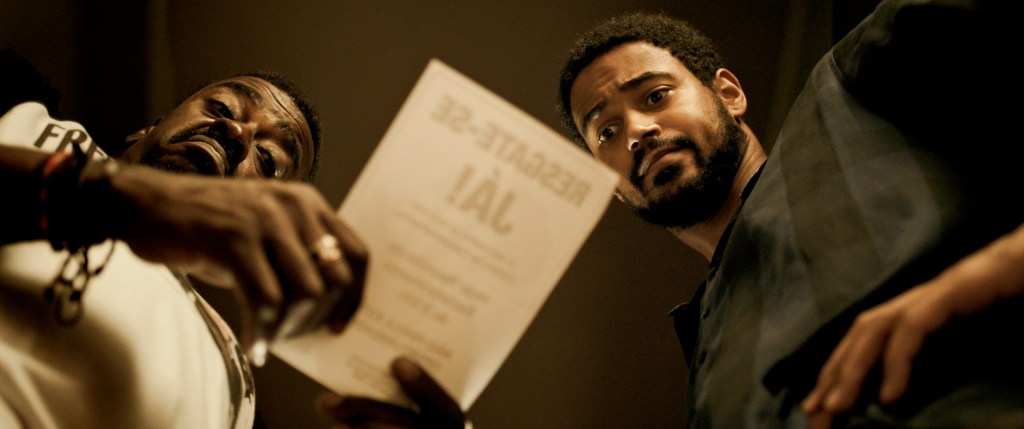
Not finding even Angola (formerly colonized by Portugal) comforting, the high-melanins go nowhere and the conditions of institutional racism persist and become terrifying. Indeed, the government employs authoritarianism and passes Executive Order 1888 to legally deport its high-melanin population using law enforcement and armed guards to round them up and send them away. (1888 is the year that Brazil abolished slavery)
We assume that the deportations succeed and the high-melanins arrive at their destinations. But we never see this and we don’t witness holding pens or detention centers. Filmmakers emphasize scenes of individuals, rounded up against their will, running from police, being beaten in the “catchings.” With regard to the removals, we note the chaos, confusion and heavy-armed tactics. Also, filmmakers reveal the wickedness of the government officials as cogs representing the banality of evil. Finally, the deportations occur swiftly so no outside countries intervene. Themes of genocide, the holocaust, the injustice of deportation, racism, discrimination rise to a haunting level.

However, the Ministry of Return loses control of its “smooth operation.” Problems occur with the “hold-outs” and a resistance movement strengthens as Antonio and Andre hide out in their apartment building. They attempt to remain strong despite the officials and European types attempting to starve and dehydrate them. Additionally, they turn off their power and block their cell communications. Filmmakers add a convenient loophole so that the police cannot storm buildings to pull out the resisters.
An additional problem occurs when Antonio’s wife Capitu, a doctor, goes into hiding in an Afro-Bunker as part of the resistance to avoid capture. Some of the most poetic and striking scenes occur in this place of refuge. The conflicts between Antonio and Andre heighten the dramatic tensions in their relationship. As they attempt to survive, they spur their own resistance movement that goes digital, gains global attention and inspires the nation.
Executive Order grapples with vital themes and contemporary topics making it acute, insightful and powerful. Strengthened by its superb performances, non-stop tension and excitement, filmmakers excel in their cinematic storytelling. Additionally, the high concept builds in the fear factor that this surreal story happens in parts of China, Russia and elsewhere on the planet currently. The film empowers toward human rights advocacy and social justice.
This must-see film can be found at 2021SXSW platforms. Look for it at its roll-out online.
LIVECHAT / EXECUTIVE ORDER @ SXSWLivechat with Director / Co-writer Lázaro Ramos Thursday, March 18 at 3:00pm PDT / 5:00pm CDT / 6:00pm EDT
2021 SXSW Film Festival Review ‘The Oxy Kingpins’
The documentary The Oxy Kingpins currently screening online at the 2021 SXSW Film Festival is an important film which highlights the Opioid Crisis and more importantly defines the medical industrial complex’s role in addicting the US. to its toxic, lethal drugs. Within the Oxy network are the pharmaceutical manufacturers, distributors, retailers, hospitals, doctors, pain clinics and street dealers who ride the OxyContin train for its mega profits.

The documentary emphasizes that the big pharma corporations who are responsible for killing Americans, have walked between the raindrops and not been brought to task, criminally or civilly. In their cool towers above the fray, the CEOs are the unseen criminals. Meanwhile, it is the users, dealers, doctors and pharmacists, like little fish in the wide net, who are caught, tried and convicted for their abuse and often illegal and unregulated distribution of OxyContin (oxycodone). Nevertheless, the pharmaceutical companies have encouraged the distributors to find loopholes in regulations for distribution. In not adhering to the regulations, opioid use has run amuck and the towns where this has been felt the most have been devastated.
Co-directed and produced by Brendan Fitzgerald and Nick August-Perna, the excellent documentary lays the blame where it should be placed. It advocates for criminal as well as civil penalties leveled on the knowing perpetrators who seek to addict their clients then absolve themselves of any guilt or responsibility while raking in their ill-gotten gains. Again and again, the theme of profits over people comes to the fore. Also, as a sub theme we note that a conservative government reduces the need for regulations and their enforcement at the behest of lobbyists. The filmmakers remind us that political parties who eschew enforcing regulations, only hold the “little people” accountable. This is doubly destructive for it punishes by abusing the public with harmful chemicals it should protect it from. Secondly, it expects that they foot the bill cleaning up the mess the unregulated corporations caused to begin with.
The filmmakers get on the inside of the crisis by elucidating the trail of evidence from dealer all the way up to manufacturer revealing that at the highest levels the willful, deceitful and criminal negligence of corporations are directly responsible for the Opioid Epidemic. Fitzgerald and August-Perna state at the end that 700,000 Americans from 1999 -2019 have lost their lives to opioid overdoses or attenuating deaths.

The documentarians reveal the most salient information by interviewing attorney Mike Papantonio and shadowing him cinema verite style as he collects information for the case he is bringing against pharmaceutical companies and distributors. He is joined with a legion of attorneys who are working the case along with Nevada attorney Bob Eglet who is trying the case in Nevada because the laws are more favorable to obtaining documents as part of a public health crisis. If they can win it in Nevada, that will open the doors to win similar cases in other states.
Through interviews, brief cinema verite shots of the Nevada courtroom with plaintiffs and defendants, interviews with various dealers and one former user, we understand what is at stake with the “Big Three” corporations who are the OXY Kingpins of the title. These are drug makers McKesson, AmeresourceBergen and Cardinal Health. Along for the ride are CVS, Walgreens and perhaps others like Walmart may be added.
These are the invisibles one wouldn’t readily associate with the opioid crisis because initially it was Purdue Pharma owned by the Sackler family that has been sued and held civilly liable, though there is a disagreement about the amount of the penalties and whether the company should operate in another form. Nevertheless, like the “Big Three” the Sackler family has not been charged with any criminal penalties associated with their pushing their formula of OxyContin and heavily marketing it to doctors emphasizing that it was a non-addictive pain reliever. Unsuspecting doctors and pharmacists initially believed that the drug was non-addictive. In other words, the Sackler family has not been criminally convicted or even charged with the fraud they perpetrated to addict and kill for the sake of billions.

By the time those in the business of pain relief discovered OxyContin’s properties, they became addicted to the profits. Sadly, the cost to cities, towns and rural communities across the nation has been in the trillions of dollars. The corporations responsible for the crisis expect the American taxpayer to clean up their toxic disaster and have lied in hearings to congress as tobacco CEOs lied with practically the same rhetoric. When asked about accountability, the CEO OF McKesson, John Hammergren, the CEO of Cardinal Health, George Barrett, and the CEO of AmeresourceBergen, Steve Collis, to a man said they “did not believe their company contributed” to the opioid epidemic.
Nevertheless, as Alex, former dealer who landed in prison insists, the CEOs of these pharmaceutical companies are the biggest drug pushers of OxyContin. Not only should the companies be held accountable civilly for the devastation leveled on families, the CEOs should be tried criminally. The intent for the suit in Nevada is to do just that on April of 2021.
Alex, now a legal businessman, ran his OxyContin business from Miami, the drug capital of the US. Alex provides the background information of how dealers like him moved from weed to heroin to OxyContin and back to heroin. And he discusses how addicted patients get fake scripts that pharmacists fill. And doctors write scripts like dispensing candy. Alex was on the lowest level in the network of how OxyContin manufacturing, distribution and retailing exploded to the point of abuse. He, the other former dealers who went to prison, Jay, the Cowboy, and user Anne affirm that it is always the “little people” the DEA is interested in. Federal agencies avoid dealing with the manufacturers and distributors who are in effect “legal” drug pushers.
The OXY Kingpins provides a valuable perspective, revealing the impact of corporations on our society’s ill-health and how willing they are to addict and destroy us for billions of dollars. This is made all the more egregious if they can put amoral, hedonistic and wanton CEOs who are concerned only about the corporation’s bottom line at the power points of the company. Look for this documentary at 2021 SXSW screening platforms and when it comes live.
WINNER! 2021 London International Filmmaker Festival ‘Garden District’

UPDATE: GARDEN DISTRICT WON IN THREE CATEGORIES:
BEST FILM/ OLEY SASSONE
BEST ACTOR/ BRYAN BATT
BEST ACTOR/ BARRET O’BRIEN
The charm and loveliness of old world New Orleans upended by new world vitality and determination characterizes the the short film Garden District, screening in competition at the 2021 London International Filmmaker Festival. Money isn’t funny and the Dubonnet family who has recently buried filthy rich patriarch, Peter Dubonnet is thrown into a crises of relative inheritance. Which heir becomes the executor of the estate? Will he or she be generous or grasping with the siblings in dispensing it?

Oh, and there is a catch. Peter changed the will, scribbling it in long hand with a recognizable signature. However, since nothing is irrevocable except death, this DIY will, written on a yellow sheaf of paper from a legal pad, is history. The long suffering matriarch Irene Dubonnet (Janet Shea) and her lover Clovis (Carl Palmer) will challenge the will and alter its main stipulation after one year.

It is then Peter conditioned that Irene must choose one heir from the list of family members. And it is clear Irene favors her failed artistic son Rooster Dubonnet (Bryan Batt). Perhaps after a year, Rooster will be sober enough to stand without swaying, while he expresses his talents, finishing his seascapes of poisonous and predatory sea creatures. Ah, yes. What does one do with the family members when dividing the estate, especially when the in-laws like Quint Legere (Barret O’Brien) have gambling debts with creditors who crush knuckles and smash kneecaps?

The Garden District is a deliciously wicked, tongue-in-cheek, good vs. evil romp in one of the most beautiful settings in the United States. It is conceived and written as a TV series by Rosary O’Neill based on her experiences as a 7th generation New Orleanian. Directed by Oley Sassone with a keen eye toward pacing, substance and rich production values, Sassone shepherds the actors to elicit nuance and irony with spot-on authenticity. Particularly strong is the scene between Shea and Batt as the mother attempts to force her son to understand the power she holds to dispense what is most precious to her upon him. Money! Because it’s easily gotten and his goals lie elsewhere, Rooster is not interested.

On another geographical parallel is her son-in-law Quint, whose desperation for funds to pay off his debts to gangsters and keep his body whole, riles and disgusts her. As Quint, O’Brien’s destructiveness and panic emanates from his soul. Addiction, whether it be alcohol or gambling snuffs out purpose, love and direction in these two foundering males. Interestingly, daughters, Kitten Dubonnet (Kelly Lind) and Jasmine may be overshadowed by their mother who dominates, now that Peter is dead. Most probably, it is the men, with the assistance of one of the daughters, who will attempt to exert their will, either through failure or connivance, upon an equally manipulative Irene Dubonnet, who must save herself or become their prey.

The Garden District’s mansion setting is spectacular; the production values are gorgeous; the music is sonorously effective and derivative. There is the relaxed charm and atmosphere of New Orleans that pervades the film. It’s a delicious feeling to become involved in the foibles of others who readily admit they are backed into a corner, or on the brink of the abyss, curious to take a leap, never to return. As a TV series, this looks to be a light and juicy winner that we ache for after the tribulations of COVID.

To get a taste of this up and coming TV series Garden District, go to the 2021 London International Filmmaker Festival online digital platform by CLICKING HERE. Become reacquainted with an insider’s look at the New Orleans’ upper crust to understand that money guarantees little and the love of money roots well in a garden of evil.
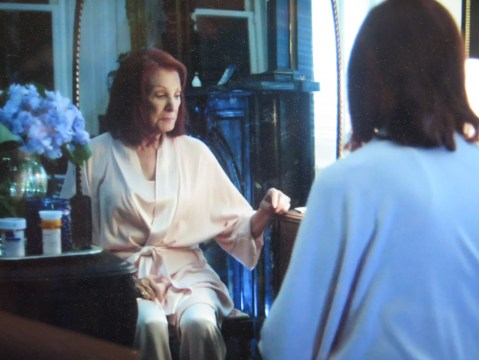
Garden District has been deservedly nominated for the following awards in the Shorts Category at the 2021 London International Filmmaker Festival.
- Best Short Film
- Best Director: Oley Sassone
- Best Lead Actor in a Short Film: Bryan Batt & Barrett O’Brien
- Best Lead Actress in a Short Film: Janet Shea
- Best Editing: Arvid Cristina
Athena Film Festival Review: ‘Dilemma of Desire’
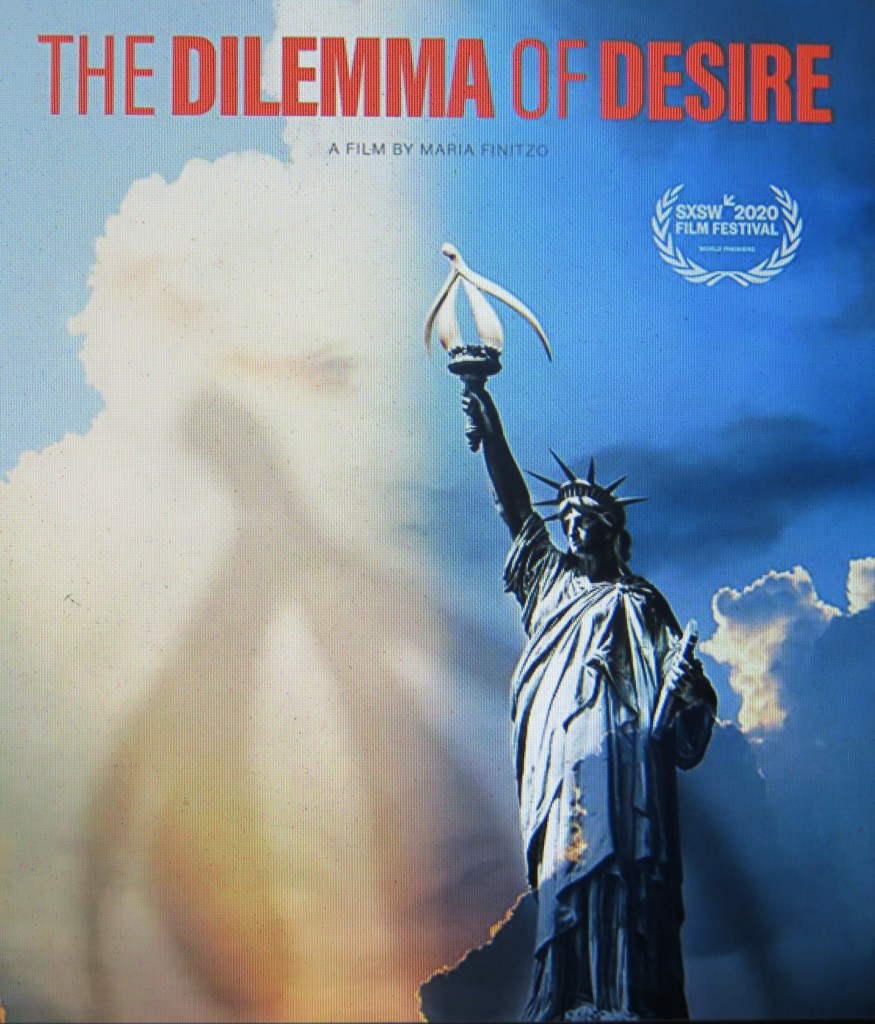
Maria Finitzo’s documentary The Dilemma of Desire, currently screening virtually at the Athena Film Festival, examines female sexuality and pleasure against the backdrop of the repressive, toxic and macho culture represented by the former Trump administration, QAnon, Trumpers, “Christians,” the paternalistic Republican Party and all caught up in the “normalcy” of misogynistic, homophobic, xenophobic and racist folkways. Interestingly, Democrats and other political parties are not exempt from an examination of the patriarchy in this film. The myths and follies of patriarchal thought and behavior are ancient and baked in by males, females and non gender described, who have bought into the lies of female sensuality for millennia.

More specifically, it has been males who define their own machismo by the ways that they oppress and control women. To dominate, whether for the profit motive or more psychological reasons, males and accepting females define conceptualizations of beauty, femininity, sensuality and the pleasure they are psychologically and scientifically able to seek based upon these confined and erroneous definitions. Finitzo, a two-time Peabody Award-winner blows apart the taboos and shameful strictures about how women must think, react and define their bodies and their sensuality. Focusing on four women who have broken open the boundaries in themselves to understand their bodies, Finitzo conducts extensive interviews with them as they help empower others in their journey deeper into their own sexuality and sensuality.

Finitzio approaches central themes that paternalism for centuries has rendered women powerless and voiceless, manifested in the simple act that women do not even understand or know their own sexual organs to be able to draw them. This lack of literacy about their sensuality and sexuality has been a revelation in the life and work of Sophia Wallace, whose work about “Cliteracy,” Finitzio uses as a focal point around which she creates the grist of this documentary about four women who in their own way are attempting to change folkways and cultural assumptions about female pleasure and desire.

Memed by artist Sophia Wallace, “Cliteracy” is the scientific knowledge that the clitoris is fundamental to the female orgasm. The lies that the vagina is the seat of desire is a myth propagated by males, for obvious reasons. When women have felt let down in sex with their partners, they have taken the shame and blame upon themselves. The educated male has countered this with his empathetic understanding that female genitalia is more complex and deserves its own attention during intimacy. If the male partner is not empathetic or understanding, women for centuries have been left to “endure” sex as a chore and do it to beget children which they alone have been tasked to raise until recent times. Women who have established intimate relationships with women have actually received much more sensual pleasure during their lifetimes. Thus, the idea that most women don’t experience vaginal pleasure during intercourse (only 25% do according to the scientific data Finitzio states in the film) is a much needed revelation that Dilemma of Desire emphasizes.

Using her interviewees as gatekeepers into this revelation, Finiztio chronicles key points about how the patriarchy has kept women in the darkness about their own bodies. The end result has been to hamper their freedom, their voice, their courage, their empowerment. The documentarian examines how Wallace is changing culture; how Dr. Stacey Dutton, a neuroscientist, enlightens medical science about the biology of the clitoris; how Dr. Lisa Diamond unravels outdated notions about women’s arousal; and how Ti Chang, an industrial designer, creates elegant vibrators for women that look nothing like the novelty toys in sex shops which are useless and created by men. To elucidate what these four have discovered, Finitzio interviews Umnia, Becca, Jasmine, Sunny, and Coriama who provide their life experiences about themselves and their relationships with men and women in their investigation of their own body’s capability of receiving pleasure.

Finitzio’s work is mind-blowing. She uses a maximum of effort to cobble together the interviews and create the backdrops that enhance the commentary of these truth-tellers. The cinematography, music and editing all enhance the overarching message that to be free, women must understand all parts of their being to appreciate all of who and what they can be. A defining moment comes when Sophia Wallace discusses what she heard from her cousin about her grandmother’s confession. Their grandmother had five children, but didn’t think she had ever experienced an orgasm or pleasure during sex. Meanwhile, of course, their grandfather’s experience was a sure thing. For Wallace, this was an eye-opening tragedy because her grandmother didn’t understand or enjoy what her body was capable of experiencing because she was intellectually, philosophically, culturally, sensually chained by the patriarchy whether wittingly or unwittingly.
This is a must-see film for men, women, non-binary, all who are walking around in a fleshly body and want to break free from the dilemma of desire that especially ties women up in knots and oppresses them in all of their being. The point is to understand and become “cliterate.” At least that opportunity must be allowed and Sophia Wallace’s work should be in a book, not just on a TEDTALK or as a conceptual museum piece in an art gallery. Thus far, book publishers are afraid to deal with such an important and culturally revelatory work. The excuse is that female editors are hesitant about sharing the information in book form with other females in the industry, for example libraries, universities. The fear exemplifies why “cliteracy” has remained in the realm of the arcane and it is a tragedy of oppression.
Finitzio’s film spotlights the core issues of this tragedy. And in due season, Wallace will be known globally in print as well as virtually for her work “Cliteracy.” Dilemma of Desire is screening on the Athena Film Festival website and other screening platforms. CLICK HERE FOR ALL THE ATHENA FILM FESTIVAL OFFERINGS INCLUDING THIS EXTRAORDINARY FILM.
Athena Film Festival, Toronto Film Festival: ‘Beans’

Beans Tracey Deer’s award winning narrative film, inspired by true events, is one of the superb offerings this year at the 11th Annual Athena Film Festival. Throughout March, Athena FF is holding digital Q and As, screenings, talks and more, all uplifting women in film’ and women’s leadership. It is the only women’s film festival in New York City, and sans pandemic it is held at Barnard College. Hopefully, Athena Film Festival will return live for its myriad activities, screenings, conferences, Q and As, parties and awards ceremonies in 2022.
The events in Beans and major thrust of the narrative are inspired by Tracey Deer’s own experiences as a young girl going through the cataclysmic trials of the Mohawk Resistance in the community of Kanesatake, near the Town of Oka, on the north shore of Montreal, Canada. Written by Tracey Deer and Meredith Vuchnich, Beans is a hybrid coming of age story and social justice film set against the backdrop of a 78-day standoff (11 July–26 September 1990) between Mohawk protesters, Quebec police, the RCMP and the Canadian Army. The standoff arose when without permission or negotiation Mohawk land was grabbed by developers who intended to expand a golf course and build condos on lands disputed since 1760 and which involved desecrating an ancient cemetery.

During this Oka Crisis, the character “Beans,” whose Indigenous Mohawk name is Tekahentahkhwa (played by the excellent Kiawentiio) learns to appreciate her identity as a Mohawk. She vies between accepting her mother’s wish for her to go to a tony white school to establish a better life for herself and hanging tough with cruel, bullying April (Paulina Alexis) who abuses and exploits Beans’ yearning for friendship using power dominance and browbeating to release her own inner torments.
Tracey Deer’s characterizations are spot-on, as are the actors who portray Beans, April, and Bean’s mom Lily (Rainbow Dickerson). All of the women are representative. Lily is attempting to raise her daughters, teach them successful values, yet negotiate her husband who is a protestor and warrior battling with his countrymen for Mohawk land rights. Beans is torn between her father’s fight and showing what tough resistance is and growing up to be a young woman apart from her mother’s selecting an identity for her and expanding beyond the “sweet-natured,” innocent, good girl.
As Beans worms her way into April’s cold heart by obeying her instruction, and accepting April’s toughening-up abuse, she learns the warrior way to be brash, bullying and fear-inspiring. However, when her eyes are opened to the difficulties April has with her family, Beans learns that becoming inured to pain and not expressing emotion is self-damaging.

Throughout Beans’ and her family’s journey through the, at times harrowing and punishing 78-day standoff, we see their courage in resistance.. They suffer brutalization from the surrounding community who is caught up in the events. The themes of the film about social activism in returning Indigenous lands back to the Mohawk, represent an ongoing struggle by various Indigenous populations who still fight against land grabs that began when European colonials first visited the Americas. For the Mohawk in this area of Quebec, the Provincial government and Canada have still not returned the land to them, though the cemetery is untouched and the golf course has not been expanded. Subsequently, the Mohawk still seek the lands which belong to them in this ancient dispute which continues to this day.
Beans was the opening night film in the festival. Look for it on IMBD and elsewhere for its performances, storyline and fine direction by Tracey Deer. It is deserving of the awards it won: three awards at festivals (Tracey Deer won VIFF for Best Canadian Feature Film). It was nominated for five other awards.
Reflections on ‘The Gardener’by Lanie Robertson, With a Stellar Cast in its World Premiere Online
Stacy Keach Zoom Theater, the “good friends of Lincoln Center Theater” is offering a free virtual event to benefit The Actor’s Fund. The world premiere of Lanie Robertson’s magnificent play The Gardener is streaming live until February 18, 2021 on this link. https://www.stacykeachzoomtheater.com/

Starring Ed Harris as Claude Monet, Stacy Keach as the Prime Minister of France, Georges Clemenceau, and Amy Madigan as Monet’s stepdaughter Blanche, the playwright spins out the days which become the turning point in the lives of Monet and Clemenceau as they reaffirm the closeness of their relationship as good friend,s who inspire each other to benefit the culture and world around them.
Robertson begins the play identifying elements that essentially intimate the cultural times in which both men, lived though not through specific dates. The chronology is abstruse. For example Monet has lost his wife Camille and his son, Jean which has devastated him. And he refers to these events and their impact on him as does his stepdaughter Blanche. At the top of the play we follow the discussion that Clemenceau has survived an assassination attempt which identifies the time around 1919 after WWI. After the assassination attempt which Monet and Blanche believe killed Clemenceau, he turns up jocularly alive to visit Monet. The painter is at Giverny, Monet’s studio and garden, which he is planting and developing and to which Monet refers as his true legacy.

Interestingly, Clemenceau doesn’t “get the love” Monet expresses about the flora and fauna of the garden environs which Monet works day and night, and has come to know as intimately as he knows his paint’s thickness on his variety of brushes. Clemenceau claims he prefers the city noises, uproar and busyness of street hustle and bustle and his life as a politician, journalist and Prime Minister of France.
Much is subtext and inference in this play which draws one into the mystery of these two icons. It may force one to look up more information about the time, Monet’s greatest of masterpieces and this statesman of France who was prickly, Republican (in the French sense of the word) a humanist, Monet’s good friend and lover of art. I cannot imagine a better selection of cast than Amy Madigan, Ed Harris and Stacy Keach who also acutely directed this vibrant production.

Of course though Clemenceau could not have foreseen the romance of Giverny for global tourism and posterity, art lovers and professionals alike understand the importance of Giverny’s gardens to Monet’s final works; the garden informed his painting and provided the inspiration and respite to innovate and be energized to the muses of the creative process. Thus, both Monet’s garden and his works have become synonymous with Monet’s complicated genius and artistry.
What is intriguing about Robertson’s The Gardener, which heightens this interplay of Monet’s artistic talent being dependent upon his skill as a gardener, is the vitality of Monet’s relationship with Clemenceau. Again, this is inferred as the great unspoken. It was Clemenceau who after Monet died, arranged for the display of Monet’s Nymphéas (Water Lilies) cycle which eventually ended up in 1927 at Orangerie, now Musée de l’Orangerie in Paris, France. Clemenceau understood the greatness of Monet’s intention to symbolize the hope of peace, and healing power of nature, light and solace of the garden to soothe and renew the souls of soldiers who returned emotionally and psychically deadened after the hellish abyss of WWI. Clemenceau’s attraction to Monet’s work and friendship, was reaffirmed in 1908 and lasted to the end of their lives. Robertson suggests Clemenceau sought Monet and his work for its power to revitalize and restore his being. The friends’ connection lies beyond the veil, in an ineffable, immutable bond. And if one investigates further, theirs was an agreed upon arrangement that was fated for all time.

What is not spoken of in the play, Robertson alludes to and the brilliant actors convey, inhabiting these iconic individuals. It is Monet’s Water Lilies masterpiece that he worked on for three decades and to which Clemenceau encouraged him to add panels. The day after the Armistice in 1918 was when Monet asked Clemenceau to take two panels which he signed on Victory day and offer them to the State. Clemenceau was the intermediary to have Monet’s “great decoration” displayed in the way Monet wanted, a display that he finalized the conceptualization of right after his son Jean died. Thus, when Harris as the bereft Monet discusses Jean’s death with Clemenceau and the sonorous and vital Amy Madigan as Blanche expresses her grandfather’s great grief and hers at Jean’s loss, we understand why Monet sent away everyone from his home. We understand his need to be alone for his final work to be finished. We understand (sorry for the spoiler alert) why Blanche leaves with Clemenceau. It is for the greatness of what is to come; and all contributed in their way to its becoming.

This “becoming” achieved its final form in the arrangement of the panels in the Orangerie as a panoramic frieze exhibited seamlessly to embrace the viewer in two elliptical rooms. The two panels at Clemenceau’s suggestion grew to 8, though Monet pledged more. But these 8 are the apotheosis of the Water Lilies cycle that Monet had begun thirty years before. He meant it to be his final contribution to the uplifting of France and perhaps for all time and for all of the world, as a monument to peace.
It has been said that Clemenceau encouraged Monet to create a total of 19 paintings some of which Monet destroyed. Indeed, Monet held them all back, hoping to achieve greater and greater perfection until he could work on them no longer, and his death released the paintings to Clemenceau in 1926. In1927 Clemenceau secured the 8 panels to establish the exhibit which is the impressionist’s monumental achievement, not necessarily appreciated nor understood by the public in 1927 or the next decade.

However, when one visits the Musée de l’Orangerie, one experiences the arrangement of Monet’s unique vision of form and color in a watery landscape that is sprinkled with waterlilies, shimmering ripples, willow branches, tree and cloud reflections, varying shades of light and dark green vegetation, all suggesting the ethereal qualities of light and air. Symbolized beautifully is the thread of life these natural elements that were conceived in Monet’s consciousness and then manifested in his garden which, for as long as it remains, imbues the eternal as does the “great decoration.”

Monet said about his creation, it is the “illusion of an endless whole, of a wave with no horizon and no shore.” Assuredly, the “elliptical shape of the rooms” suggests the mathematical symbol for infinity. The panels are a seamless continuum in time and space materialized. Likewise, Monet conceptualized his garden, planted, watered and cultivated the rich soils to express a beauty which he materialized using his vast array of knowledge of florals and accompanying plants to align the inner eye with the infinite, the eternal. His Garden and Monet’s exhibit in Musée de l’Orangerie are nonpareil.
This production is broadly relevant in its themes and scope. What better way to memorialize the message to remain uplifted through art in our time of mob violence at the Capitol, the horrifying insurrection against democracy, a noxious political divide and a pandemic. What could be better than to view the exchanges between two exceptional actors portraying cultural giants looking back to a similar time (the aftermath of the brutal WWI and the Spanish flu epidemic) as they worked to bring the hope of peace through the halo of artistic expression.

Harris, Keach and Madigan give brilliant performances re-imagining individuals we are barely acquainted with but know culturally. Memorable is Madigan’s humorous taking down of Harris’ Monet when as Blanche, she is outraged that Monet gives her pate to the cats, the sumptuous pate that she slaved. Her specific and factual description of what it took to make pate back in the day is marvelous. The actors convey the humanity of these greats at a still point in time that allows us to identify, engage and appreciate their friendship and the value of such friendships in times of great trouble.
The messages, themes and parallels of that time to this carry great relevance and currency for us today. Bravo and thanks to Robertson, Harris, Keach, Madigan and the creative team for this superb and unforgettable zoom theater experience. To see it CLICK HERE. https://www.stacykeachzoomtheater.com/ IT ENDS ON FEBRUARY 18, 2021. You will be happy you did. And after you finish watching, donate to The Actor’s Fund, CLICK HERE
New York Botanical Garden: Intimate ORCHID Spotlight Replaces Annual Exhibit

As a result of the pandemic, the New York Botanical Garden has changed its approach regarding its annual orchid exhibition. In keeping with safety and security for New Yorkers, Garden members and guests, the annual Orchid Show will return in 2022. As a replacement, the Garden is focusing on a personal and close-up view of orchids without the fanfare, showiness and crowds.

This year unusual orchids and other plants from NYBG’s permanent collections will be displayed in select galleries of the Enid A. Haupt Conservatory on February 20–April 4, 2021.

Continuing with reduced indoor capacity, The New York Botanical Garden (NYBG) is forgoing its traditional orchid exhibition presenting a limited Spotlight on Orchids and other permanent plant collections in the Enid A. Haupt Conservatory. A visit to select galleries of the Conservatory will reveal displays of orchids in brilliant white and striking colors set against the foliage of aroids, ferns, and bromeliads. The plantings highlight how the orchids might be found in nature as they blend seamlessly with their surroundings.

The approach brings attention to orchids in their habitats and emphasizes investigation of orchids as one of the largest of plant families in their their variety with differences in their shape, size and color to attract pollinators. Orchids thrive on every continent except Antarctica and can be found even the desert gallery of the Enid A. Haupt Conservatory.

As visitors walk through the various galleries, they will be able to view and explore unique orchids from NYBG’s renowned collections from around the world. The Garden is known for its rare orchids. Don’t forget to take a long, lingering look at the glass case between the galleries where many of the Garden’s rare and small orchids enjoy their special, controlled environment. Also, check out the artful floral creations. These are fashioned by Botanical Garden horticulturists. The creations combine expressive orchids from the popular Moth orchids (Phalaenopsis) to lady slippers (Paphiopedilum) with rocks, tree trunks, vines, and other found materials.

NYBG looks forward to the return of its annual Orchid Show in 2022.

The Spotlight on Orchids runs from Saturday, February 20, through Sunday, April 4, 2021; 10 a.m. to 5 p.m.

Tickets for Spotlight on Orchids is open to all visitors with the purchase of an advance, timed Garden Pass + Conservatory ticket, which includes access to the Enid A. Haupt Conservatory and outdoor gardens and collections. Click on http://nybg.org/visit for more information or tickets.
 CAROLE DI TOSTI