Harold Pinter’s The Caretaker at BAM
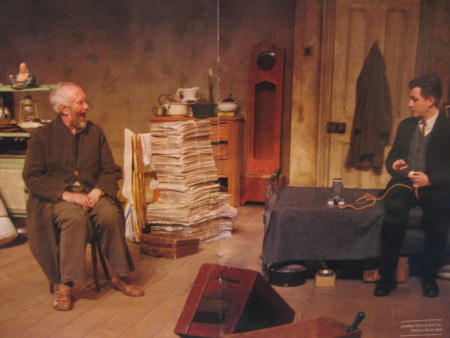
Jonathan Pryce as Davies and Alan Cox as Aston
Can we ever fathom the underpinning of our relationships with people, the power dynamics, the interplay which inevitably results in the childhood assertion to reign supreme in a parlay of king of the hill? Who dominates in such interplays: the weakest, the most dependent or the one whose presence physically menaces? Is there a power exchange where moment to moment the rapid shifts of control occur depending upon subtle behavioral quirks and personality siftings if the players’ wits are sharpened and prepared for the dynamism? Pinter examines the human power market in his subtly brilliant play The Caretaker now at Brooklyn Academy of Music’s the Harvey Theater through the 16th of June.
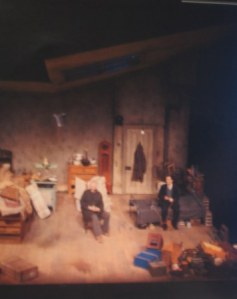
Jonathan Pryce and Alan Cox
The play starts benignly enough as a roughly hewn street fellow, Davies, played by the superlative Jonathan Pryce is offered shelter by a docile and reserved, mild-mannered, conservatively dressed younger man, Aston, played by the intensely gifted Alan Cox. Everything appears off kilter with the situation that slowly unfolds, down to the contradiction between the civil, kind demeanor of neatly dressed Aston, and the junk heap of a hoarder’s dwelling strewn with garbage dump remnants that Aston expects Davies to stay in for the night, though there is a leak over the bed he offers to Davies and a nearby open window blowing in the rain and wind on Davies’ head. But we gather that down on his luck, unkempt Davies will fit right in and be grateful for even these mean accommodations that have kindly been extended to him. What is amazing is that clean, well groomed Aston stays in the same filthy, rag tag room that Davies stays in. Amidst the heaps of refuse, Aston sleeps in a bed on the other side of the room; its proximity forces him to put up with Davies’ noisy, addled, anxiety ridden dream state which disrupts his own sleep and prompts him to wake up Davies to get him to stop, pissing off Davies. Clearly, we see the conflict points growing and remain perplexed by this weird chaos and at a loss to explain how either man puts up with the situation, though we do realize that perhaps, Davies has no choice and perhaps emotionally Aston has no choice either. Mano e mano, each man has removed the choice of the other in a strange interplay of dependence, want, need, despair and search for some consolation of the soul.
Over the course of the next days, Davies without authority, except as Aston’s appointed ad hoc caretaker, attempts to assert himself over his situation, commenting disgruntledly on the open window and the leak over his head but Aston remains quietly unmoved replying the room needs air. Nothing appears to change in the weather or situation so that Davies who is en route to get his papers and move on to a better life goes no where. Though we know little from the noncommittal Aston who moves with a perfunctory calmness, we sense that Davies may have an individual power of self that Aston may lack, though Aston’s kindness in extending even this shambled place to stay infers a subtle deeper power.
As the play progresses, the roles intensify in the direction which Pinter has initiated with the added complexity of the third member of the dynamic, Mick, played by exceptional Alex Hassell, younger, sinister, brooding brother of Aston. Uncertain as to who he is because of his prowling glare at the onset of the play, we discover his physical authority in the dwelling after Mick has attacked Davies and roughed him up physically in pursuing Davies purpose in the dwelling since Aston isn’t present at that point to tell Mick of his “hiring” Davies as ad hoc caretaker. The attack is both humorous and scary and as Davies is allowed to recover, we see another power dynamic being initiated between the younger brother and Davies. Unlike his relationship with Aston, Davies’ exchange with Mick appears on like footing. However, over the course of the next weeks, there are weird occasions when defying logic, Mick satisfies his joking urges and plays passive aggressive jokes on Davies, using his fears of the “blacks” next door. For example, he unscrews a light bulb so Davies is in the dark when he arrives. Then invisible Mick pops up and down, haunting Davies in the shadowy darkness, all the while completely unnerving the older man. Then a monstrous noise fills the room and we are startled into confusion and alarm for Davies who is cowing and screaming in hysterical panic. A minute later Mick with grinning nonchalance reveals the vacuum cleaner, explaining he wanted to get a bit of tidying up done about the place. Relieved, we laugh, quick to receive the inanity of Mick’s illogical explanation, ready, like Davies, to accept good will over malevolence and torment.
But who vacuums and tidies up in the dark? Indeed, if our wits are about us, we anticipate that Mick is capitalizing upon Davies’ anxieties to make a mockery of the older man while feigning his true motives. Like Davies, we ignore the signs, the incongruities, allowing ourselves to hope for goodness and kindness, for that is the initial situation: kindness was extended to Davies. We, like Davies rattle our minds attempting to gauge the power struggle between these two brothers, to “get on top of the situation.” And like Davies, we are hard pressed to do so becoming lost in a space that is surreal, vacuumed up into the day to day events without understanding, without clarity until our resistance deteriorates and we yield to the whirling merry-go-round of human existence and interaction that the brothers, too, circle in.
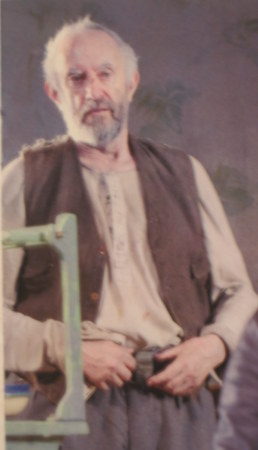
Jonathan Pryce
The dramatic high points are achieved when Aston reveals his loneliness, his otherness, his “apparent” insanity in a monologue where he reaches out for self-understanding and connection to the world in Davies who appears to be taking it in. We learn that Aston is an extremely sensitive type who, in sharing his perceptions with common folk at a cafe, perceptions that we would liken to those of an anointed adept or finely tuned artistic sensibility, ends up being sent to a mental hospital for observation. The result brings tragedy, a “problem” diagnosis and Electric Shock Treatment signed off by Aston’s mother because he is a minor. As Aston quietly relates the brutality of his resistance and the administration of the treatment we quiver in identification and sympathy, for we understand that something has been taken from Aston and nothing has been returned; he lives with a gaping wound that bleeds and cannot be stemmed, certainly not by interaction with Davies, who is too wounded himself to extend any sufficient help, emotional bandages or antidotes for soul pain and damage.
And from Aston’s revelation the chasm in the dynamic between Aston and Davies widens and Davies, unable to see himself in this man to empathize or reach out, turns to the brother, Mick who ironically appoints him caretaker, though incompetent Davies has poorly fulfilled the role given to him by Aston. We see Davies shift allegiance to Mick, whose claims of authority in the place are circumspect. And we recognize the wave of indulgence as Davies quickly tries to ingratiate himself with a man who may or may not be practical joking with him, convincing himself that he has successfully won over Mick who flatters him when Davies shows he can defend himself physically with a knife if Mick “tries to pull anything on him.”
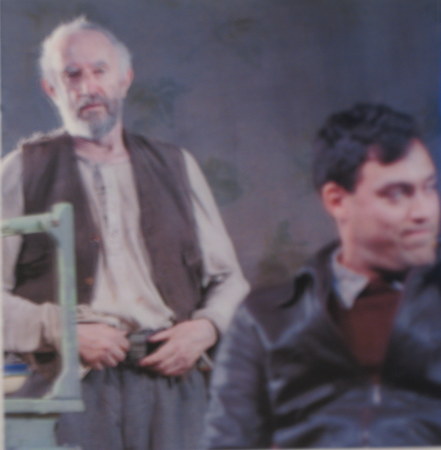
Jonathan Pryce as Davies and Alex Hassell as Mick
The dynamic of power, who controls, who attempts to gain the edge shifts and swirls and propels us; we’re spinning with these characters whose centers have not held and whose uncertainty of the upheavals between each other and their own personal confluence estrange them and us in bewilderment. And then in the cataclysm of the ending, for “it,” the turbines of spinning or whatever the “it” may be, must disengage, must stop. In “its” stoppage, we see. We understand how humans need. It is a deep, felt comprehension and we know that in their want, in their attempt to take, they fail miserably, unable to reach an empathy with others because they are alone.
This great understanding is achieved because of the brilliance of Pryce, Cox and Hassell. Their efforts are sublime, elevating humanity to divinity in all its weakness. They are devoted to living in each moment of uncertainty allowing this heavenly development of the active nonaction of Pinter’s unbelievable human rendering. This clearly is the best Pinter I have ever seen, its human truths are heartfelt and cathartic. I thought I was watching Greek tragedy. You cannot miss this production, but probably will as the seats are harder and harder to come by.
CQ/CX
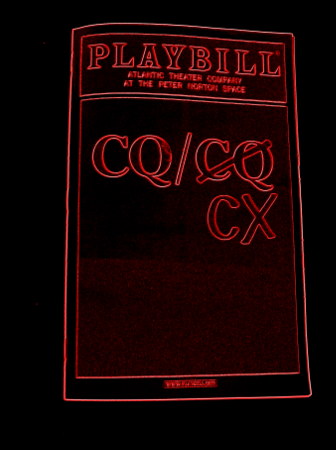 Imagine your writing career is about to take off. You’ve interned at the New York Times and by some straight miracle that you have helped to manipulate, you land a job there. You are ecstatic. But also imagine that you have a few character flaws you ignore. You lack focus; you are ambitious without the required determination and discipline to accomplish your goals; you are incapable of dealing with high pressured stress; you seek out “coping mechanisms” which encourage addictive, annihilating behaviors in the name of “dealing.” Perhaps this could describe any one of us during a period in our lives when we were in transition and were unable to self-correct. In CQ/CX* (which completed its run at the Atlantic Theater Company) it describes the personality of Jay Bennett, an intern who lands the prestigious job at The New York Times, then proceeds to blow up his life and career because of sloppy carelessness fueled by an indulgent penchant for alcohol, cocaine and self-destruction.
From the point we meet the character Jay Bennett as an intern, to the play’s conclusion after he has impaled himself and his two editors on the sword of fraud and plagiarism (cardinal sins of reportage) we painfully absorb the truth that an individual’s decline often carries with it many pivotal declensions that can either lead toward opportunity, or initiate doom. In Bennett’s case it is the latter: we watch silent and stunned as the miserable twine of the knave’s life unravels, becomes a scrawny tendril then breaks with the weight of error, plummeting the self-vicitimizer into the abyss of no return. And we come away understanding how someone, who is potentially addicted to failure can lure others into a web of deceit, despite their own better judgment.
Gabe McKinley’s writing is vital. Having served as a journalist for the New York Times, he witnessed the plagiarism incident of Jayson Blair, the disgraced journalist the play loosely is based on. By the time McKinley left the paper, accomplished a year’s research and wrote the play, he had sifted the events and dramatic energy of the individuals, creating characters, some composites, and others loosely based upon the major players (Blair). Then he created the arc of events that led up to the plagiarism and its impact. The result is a newsroom landscape peppered with complexity, humor and pathos. Integral to McKinley’s backdrop is his concentration on the Times as a renown institution facing this doomsday scenario: crumbling old media empire hobbles light years behind the new media reformation. McKinley reveals the extent to which these circumstances may have impacted how Bennett/Blair tweaked and exploited the editors’ and owner’s desire-concern to be trending and competitive.
Though we know the inevitable, we are engaged as events and characterizations unfold. Partly due to the excellent direction by David Leveaux and the ensemble acting, which remained moderated between tension and argument, McKinley reveals that in this institution, as in all institutions that have preceded themselves, there are those wise Cassandras who see potential disaster. And they are ignored as the “forward thinking” view preempts. So though we ironically have been warned the train wreck will occur, we draw close, interested in understanding the how and the why. Though we might not have worked in similar circumstances, we do know such problem scenarios and there is always the question, “Where did the players/me/my family go wrong?” McKinley provides answers, but they are not paramount. One must dig beyond the superficial and obvious reasons why this young reporter with problems was able to manipulate experienced editors who, themselves, didn’t check the facts (relates to the title) but took an expedient route.
The play’s message is prophetic: its warnings for readers and writers alike, emphatic (if one has the ears to hear and the eyes to see). There is a danger of trusting institutions which ride on the coattails of their former reputations. Independent internet news, social networking and the changing virtual paradigm have shifted news reporting away from the ethos of group think characteristic of large, venerated, news organizations. In a number of instances bloggers, writers, free lance journalists and professional experts in their fields have trumped such organizations with in-depth online pieces that have gone viral, eliciting a new meaning to the words, “breaking news.” This medium of independent online reporting has taken a pick axe to traditional media. In the past information might never have been revealed because of loyalties, cronyism and paternalistic decisions. Decisions not to report information were justified by such capstone logic that not reporting was for “the good of the country,” when in fact not reporting was blatant cover-up and protection of systems and individuals. In the past news institutions were hand maidens of politicians, governments and corporations, and few suspected this was the case. Only those on the inside had the power to know. Only they were well networked to keep the known, unknown.
The play shows the extent to which traditional media still clings to the “old way of doing things,” a dinosaur incapable of seeing its inevitable extinction. Couple this with the dumbing down of broadcast news to sound bytes as entertainment, overall, old institutional investigative reporting has become less and less substantive. The mastheads of ethical news tradition have been supplanted with the meaningless but urgent need to “get the story out,” to keep current and competitive with like organizations. And this is the ready made environment for someone like a Jay Bennett/Blair who can enter in and tell lie upon lie and weave deceit upon deceit while experienced editors, if they picked it up, didn’t put their foot down. In such circumstances how can INSTITUTIONAL INVESTIGATIVE JOURNALISM IN A FREE AND OPEN SOCIETY function, survive and grow stronger?
After rethinking McKinley’s work, it was evident to me that the playwight poses another underlying question for us in this virtual age of Youtube and social media and virtual exposure of lies. Do editors working for institutional new organizations prize reporters’ expertise and willingness to ask the difficult questions and give them the time to commit to the true investigations? Do editors encourage reporters after interviews to really “CQ/CX:” look for contradictions, half-truths and omissions and double check other sources against the first source? A lie is a lie and its exposure as a lie is substantive investigative reporting. To what extent are old media editors and owners encouraging their reporters to expose lies by those in power? Online sites are replete with information which contradicts and trumps institutional media news organizations that do expose lies by those in power. Shouldn’t traditional media do the same?
The plays suggests that The New York Times is an institution which may not be digging deeper, going farther, investigating, investigating, investigating. Lies have passed through (and still do, i.e. Dolores Kearns Goodwin, et. al) and because of this inconsistency, is it any wonder that a Blair/Bennett and others may audaciously crank out the falsehoods and get away it HOW MANY TIMES if no one calls them on it??? Certainly, some of the trusting New York Times readership do not know and rarely suspect this could occur. For some, the prestigious masthead is enough and because this paper said it, it must be so. The Times, according to the play, has encouraged such readership pretensions and coasted on its venerability. But this is not good enough. It needs an overhaul and thorough CQ/CX!
For when one considers the seriousness of lies and their acceptance, what is the fallout of such deterioration of fact checking for investigative journalism on the world stage? Where was investigative journalism on the WMD (weaspons of mass destruction) that were supposed to be one of the causes for going to war in Iraq? Political figures have sold themselves as experts and that has been enough validity for traditional reportage, when in fact, the individuals were sharing opinions not facts, spinning spin and there was no fact checking from “investigative” reporters/editors who didn’t ask the difficult questions. Reporters supported by editors took quotes and wrote stories without really dealing with the substance BEHIND the quotes to note the gaps, the contradictions, the half-truths, the omissions. And indeed, the play brings us to this last overriding question: to what extent were these large news organizations, representative old media, ever true exponents of a free press that was reliable, trustworthy and accurate AND NOT THE HAND MAIDEN OF POLITICAL AND CORPORATE INTEREST? Indeed how long has there been an unreliability with regard to CQ/CX; perhaps the Bennett/Blair incident is just the inevitable implosion of systemic corruption which has been happening for decades, a kind of “Decline and fall of the Roman Empire” cum old media?
This is the undercurrent of McKinley’s work and some may miss it if they are looking at the obvious. But then they are in good company. They are just like Jay Bennett’s editors who ended up having to resign because they didn’t dig deeper; they accepted what was expedient and they trusted the rightness of their own judgment in a wallow of group think instead of doing their own CQ/CX.
Though the play’s run is finished in New York, we certainly haven’t seen the last of its performance elsewhere. The subject is a timely one and as more episodes of fact checking problems arise, the play will surely carry legs in other areas of the country. Indeed, they may even be looking into its eventually going uptown New York closer to Broadway in the future.
McKinley: They’re both shorthand used during fact-checking at the Times. Editors would use CQ — an abbreviation for the Latin term Cadit Quaestio, meaning “question falls” — if a statement was correct. CX is shorthand for corrections, if something was false.
My Bite of the Apple Part I (Redacting Steve Jobs)

Apple, the forbidden fruit
Excited to buy my first iPhone? I guess. but it wasn’t an outer body experience as buying Apple products has been for some. Maybe that’s because I’m a techie fail, a black hole when it comes to understanding mother boards and code and building cloud infrastructure and sequencing networks. I can figure things out if directions are given to me? But that’s it. I am one step above tech illiterate doggie doo with a single digit IQ. So if you are an uptown geek, then you will probably stop reading right about now.
After I got the iPhone, was I ebullient, addicted, umbilical corded? Nah. Actually, since I had a Motorola as well, can you believe my iPhone became my secondary phone to use in case I needed to reference something online? I preferred my old MO, my laptop, my Motorola for calls, the iPhone for referencing. I didn’t like the touch screen so much and since I type at the speed of light, slowing to one finger “tough” could never approach any viable functioning beyond snail pace to input type. That made me pissy. So, I hobbled along in the comfort of the tech semi-dark ages. But I was acutely aware of the awe this gadget produced in others whenever I pulled it out to reference something. Swoons, gasps, exclamations of approval filled the air as if this thing gave me character and substance and not the other way round. Frankly, I thought it amusing at the time and felt somewhat flattered that I was almost “in.” (I had never been “in” in HS. In college as a hippie, yes…but HS has its own sting and that poison was difficult to expurgate.)

iPads I lusted over but balked at purchasing.
Was it this faux flattery that percolated my appetite to lust for another bite of the forbidden fruit? I thought about buying an iPad. Did I need it? Do I need another piece of jewelry (Most of it is in the safe deposit box.)? I thought, well, I could compose my news articles easily without dragging my laptop around. Granted my laptop was small, and it worked well…everything there that I needed. I admit it. The super hype about the iPads was irresistible and the reveal had my heart and head feening. And at times there were visceral urges that I just had (I mean short of waiting in line for three days. I’m not insane.) to have one of those fabulous, incredible, virtual portals that professionals would be sashaying around with them like progeny. But when I was up close and personal with an iPad my friend (a line waiter) had, I thought, but I love my laptop. Why do I need two cameras? Taking pictures with an iPad is so pretentious, like you want everyone to know it’s an iPad you are taking a picture with. Big deal. (I know, I know. I can hear the geeks moaning about my fecal cephalic lack of appreciation for the iPad’s prodigious design and flawless tech perfection.)
But once you have that first bite, you become hooked. Like a confused obeser who doesn’t know she’s full (I used to be obese; I can say that word.) I had to indulge and buy another Apple product. Maybe I’d even join the holy crowd and worship at the shrine of awesomeness, becoming an owner of Apple, you know, get a few shares? The company’s earnings were spectacular, market share flying high like a dirigible with iPhones and iPads selling so rapidly the company couldn’t keep up production. Global sales…mega, mega. I like, thousands of others, regretted not buying the company when it nearly went belly up and Jobs came back in glory to take it over again after the board kissed his feet and became his willing slaves. I wouldn’t buy a lot of stock, just enough (100 shares) for it to be a symbol that I endorsed everything Steve Jobs stood for as an enlightened, Renaissanced, man of goodness, a shining glory.
So I went to Apple and I looked at the iPad. But I balked at the point of purchase. I had a headache. Over the next few days, I looked at other tablets and smaller laptops. I discussed the iPad with as many geeks as I could. I hesitated. Like a hunger pang that abates, my lust fled. Not sure why. Maybe because I would have to pay for a lot of stuff I needed, buying from the iTunes store, cha ching? I was sick of doing that on the iPhone. The interface with Mozilla that was paramount, I would have to tweak. And I had issues with my iPhone which was slowing. And two cameras? What for two cameras? I had enough cameras I wasn’t using: 35 mm beauties and digitals (top of the line when they first came out).
So instead, I went for another Apple product, their top of the line wireless router that I could stream with from Montauk (I live in NYC). My uncontrollable appetite did rear her fat head, you see? But this bite left me with a bitter taste: it was unappetizing and I got indigestion. The router was really pricey and weird to put together. And I had a hell of a time configuring it to my PC. Annoyed at my tech incompetence and blaming my bad gut, I returned it and bought a well reputed router that a one-year-old could set up. And I left the rising market share of Apple stock for the birds of the air to pluck. But since my phone contract was up, I purchased the next generation iPhone, knowing I would use it minimally, relying on another phone. My appetite for this next bite, though not particularly nourishing or filling was vital to my ego, cultural sensibilities and ethos. I indulged my lust.

Apple Store, Grand Central Station
And then Steve Jobs died. I wrote an article for Technorati and saw the TV programs about his genius, reheard his Stanford speech for the hundredth time and admired the man who was like a mastermining god, the new savior who walked on tech waters. Again and again it was repeated, his ambition, his “drive for perfection” and his “we’ll never see his like again,” and his business acumen and ruthlessness, all wonderful praise for an icon that geeks wept over, no exaggeration. (There were folks unrelated to his family who sobbed over his loss.) It was only a day later after I muted all the static that it came to me. The geeks who owed their changed lives to Jobs? The change was all theirs and had little to do with the man or the gadgets and in fact, they might have become someone greater if not someone else despite him not because of his Apple. But irrevocably, they had tied their own identities with Jobs; they were him and he was them. And they rued the days ahead because how would they be able to function without him to market the wonder and the magic of their addiction and keep their lives meaningful?
And then after Jobs was in the ground a few months, the dam broke and the waters roiled. What had been dredged up in secret and silted and drained away with each reveal of the next generation iPad and iPhone product could be stemmed no longer. Enter Foxconn. And slowly by revelation of a different kind, we began to understand the identity of the king serpent who delivered the Apple to us to eat.
Galileo

We all are enamored of the astronomer/physicist who defied the Catholic church for a season, and though it was heresy taught that the earth was not the center of the solar system/universe, but that our sun was. F. Murray Abraham famed Academy Award winner for Amadeus and acclaimed Shylock in last year’s Classic Stage Company’s Merchant of Venice must have been enamored of Galileo as well because he plays the man with empathy and brilliance.
It is interesting that the director Brian Kulick and the company have chosen the Charles Laughton, Bertol Brecht collaborative translation of Brecht’s play Galileo. The director states that it was chosen in part because in 1947 when the play was premiered in Hollywood and had a brief later run on Broadway, this translation was meaningful in light of the nuclear age ushered in upon the world stage after Fat Man and Little Boy were dropped on Hiroshima and Nagasaki. The inevitable interplay on science’s impact on the culture was something that Brecht wrote as a concern of Galileo, how men would use the truth of science. It is a theme that artists and writers like Ray Bradbury and other science fiction writers and filmmakers have taken up again and again, even in works like Alien and Kubrick’s 2001 A Space Odyssey.
But Brecht’s version playing at the Classic Stage Company which has none of Brecht’s later additions about Galileo and the church resonates for us in its themes about the inflexibility of changing with the nature of truth, and the nature of truth itself being shaped by culture, history and expediency. Galileo’s life is picked up at the point when he is living with his daughter and is tutoring wealthy sons of land owners. Brecht clearly makes the point that one of Galileo’s foibles was his flesh, his enjoying life and eating and wine. And of course, this is the hook later in the play providing the rationale why Galileo was not the martyr that many “heretics” were at the time when he ran afoul of the Inquisition in teaching his truths and proofs about the motion of the spheres, teachings which some of the cardinals, themselves, acknowledged as accurate.
No, Galileo was not a martyr. He caved. And F. Murray Abraham imbues this fleshly hero with an empathy we can all understand. Would we not do the same as he? Who of us would perish for some scribblings that may or may not be used to enhance mankind at some future date. No. Galileo will recant and not burn. He enjoys his wine. His flesh is weak and if the truth burns instead of him? Then, at least he will be able to get to his next meal and glass of wine, enjoying its taste.
But the price he pays brings a skein of bitterness, rejection of his students (interesting that they do not offer to burn with him for receiving the blasphemous teachings) the daily remembrance of his cowardice for his papers have been confiscated, and he must cope with the permanent guest in his house who guards him from writing anything down. So our genius is imprisoned in his home and his mind, unable to further any of his discoveries.
I do not advocate spoilers. So you won’t read what happens here. Get a copy of the play. Brecht is a brilliant playwright, though this might not be his most superlative play. (Mother Courage and Her Children is better.) Don’t count on seeing this version. If you have connections, perhaps you will be able to get a ticket, though it will be difficult unless you know the director or F. Murray Abraham. The performance is completely sold out.
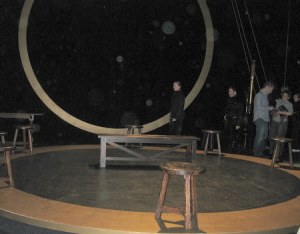
I would have loved to go again, but I’ll just have to remember, rereading this review, how splendid the supporting cast was and how human and alive F. Murray Abraham’s performance was. The circular stage, a sphere, naturally and the globes of the solar system hanging from the ceiling were an effective backdrop to the action of man at the center of the universe. It was only until Galileo’s discourses were noted far and wide that man was no longer front and center and the Age of Enlightenment propelled the sun to the center and knowledge, science and a different kind of truth began spinning outward farther and farther into space and time.
I couldn’t recommend this production enough. I do think that at some point other versions of Brecht’s Galileo will be picked up by other prodigious actors, who like a challenge and enjoy the thought that they can step into the cloak and mien of one of the most illustrious, brilliant and flawed of scientists, making us actually happy that he did not, like so many others fall into the loathsome clutches of the nefarious Inquisition.
By the way, it is interesting to note that Galileo in all his science believes in God and is God’s man. Only the truly brilliant, the ineffably brilliant are able to reconcile science and God, bringing them together in complement, not stretching them from one end of the universe to the other (That is a joke; the universe has no end…and maybe no beginning, since no one was around to observe the Big Bang. It’s a theory.)
To that effect and because I was inspired by the play and F. Murray Abraham’s performance, I did write a sonnet to celebrate.
Viewing the Manhattan skyline

There it is. The Manhattan skyline. I’ve lived here for 30 years and have never rued the day I moved to the city. The arts brought me here to Queens, one train stop away from downtown Manhattan. And the arts and culture keep me here. There is no location like this in the world, despite New York’s crazy occurrences like bed bug rampages and squirrel attacks on car engines and rabid racoons, and alligators and rats in the sewers… big ones. It is a city of dreams. And I belong here, for I am a dreamer.
A teacher I adored in high school told me, I’ll never forget his words, they are in my yearbook, “Dream big. Give it your all, and don’t let you stand in the way of making it.” Of course, he was talking about himself, but I understood what he meant because we were similar in many ways. First, we were immigrants, well, he was. Actually, I was first generation born of immigrants. Secondly, we had that thick ribbon of stubborn rebelliousness and independence. But his was sturdier than mine. I turned out to be rather a bit of a weak-willed wuss, caught by my gender to behave appropriately and give way it was a man’s world. But he was his own person, and traditional institutions rather dislike those who are independent spirited, regardless of how talented and inspiring to students they can be. He never received tenure, though he was perhaps the best teacher most in my class had ever had.
Well, I moved on. And years later, after living upstate, I returned to my land of dreams and eventually moved to New York City. Perhaps one of these days, like the song Summertime says, I’ll” rise up singing.” Spread my wings and cross over the threshold into Manhattan to live and have my being. And if that happens, then I will feel that I truly belong. And when I’m settled in, boxes unpacked, Persian carpets laid out, furniture moved in and my cat taking a nap, I’m going to leap up and anchored like a rock give a shout out, “Girl, it certainly feels good to be home!”*
*Home is the place where you feel the most comfortable in your own skin.
 CAROLE DI TOSTI