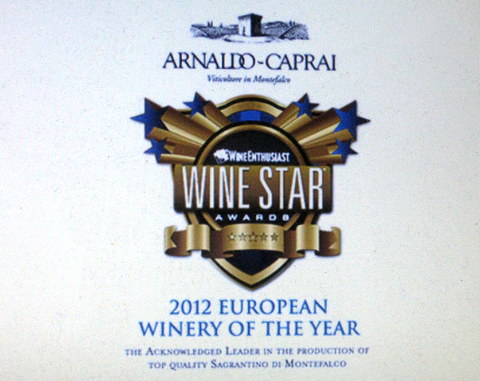
Wine Enthusiast Magazine Awards Arnaldo-Caprai Winery, “2012 European Winery of the Year.”
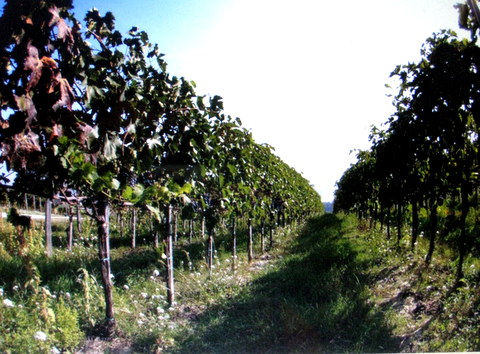
The Arnaldo-Caprai vineyards.
What does it take to be an award winning winery? Centuries. What contributes? Various factors, the terroir, changes in the wine making process, the winery’s sustainability and innovations, possible climate changes based on land changes and the regulations, protection and veneration of the social culture, government and owners/keepers of the harvest, their industry and efforts. Italy is an ancient land of wine making, dating from before the Romans. The social culture supported the grape harvests and enjoyed drinking wine daily; it was certainly better than water.
In current times, the 1700s, the growing of grapes and wine making was suited to Umbria, the “green heart of Italy” and Montefalco, where documents of the time noted that “fine and delicate wines were produced there in ‘beautiful and good’ vineyards.” So much was this the case that municipal sanctions were strengthened to maintain and sustain the culture of thriving, glorious vineyards and sumptuous wines. If you hampered a winery in its noble and sacred endeavors, you were in big trouble. In 1622 Cardinal Boncompagni, the Pontifical delegate in Perugia, threatened “capital punishment for anyone found cutting down grape vines.” Cutting down a plant was worthy of death? Such was the symbolism, of grape vines and the vitality of wine to the culture and the church.

The Arnaldo-Caprai vineyards in Montefalco
With this dictum in place, Montefalco was assured of continued abundant grape harvests and in good seasons and bad, productive, determined wineries. In the next two centuries, the place was considered “at the summit of the State for its wine production.” though even then, the cultivation of Sagrantino grapes, a varietal indigenous to the region, was destined to produce sparely. However, difficult their productivity, the Sagrantino vines were nevertheless preserved in ancient monasteries by wine-making monks.
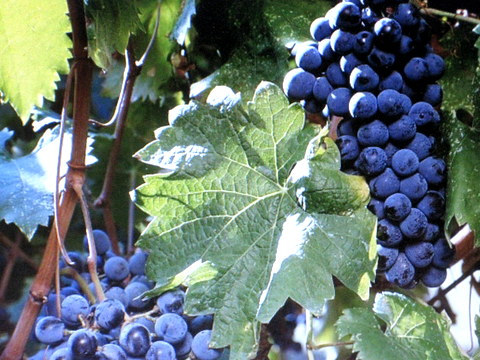
Sagrantino grape vines and characteristic leaves. Arnaldo-Caprai Winery
Interest in the Sagrantino grape waned after World War II and trends had changed by the 1960s. Perhaps because of its scarce productivity, the Sagrantino grape nearly disappeared from Umbrian vineyards. It was the dedication of a few courageous wine producers and perhaps their romantic imaginations and interest in the Sagrantino as an indigenous varietal that the D.O.C. label in 1979 and D.O.C.G label in 1992 officially sealed that the important tradition of these vines would continue. After this, the few Sagrantino vines still flourishing within the city walls of Montefalco were labeled and classified. The history of the grape had been preserved, and with research, it was assessed that some vines growing in the monasteries of St. Claire and St. Leonard dated between 1700 and 1800. Certainly, when the wine producers encouraged the sustainability of the Sagrantino vines, they were also preserving the sacred nature and lineage of the wine’s association.

The Sagrantino grape varietal of spare productivity.
It was in 1988 that Marco Caprai, son of Arnaldo Caprai began managing the Arnoldo-Caprai winery that had been producing unique, top quality, Umbrian wines. Because of the father’s and son’s passion and rich understanding of the local varietals, and Marco Caprai’s desire to expand the work and develop the winery and the indigenous grape, the Sagrantino, Marco Caprai partnered with the University of Milan. His goal was to research the neglected native Umbrian Sagrantino varietal.

With the collaboration and support of top local winemakers and sustained effort, Caprai and colleagues succeeded in transforming a relatively unknown indigenous grape to one that is world renown. Because of the connection to his ancestry, with his characteristic enthusiastic fervor, Capai expanded the winery to over 375 acres of vineyards. One of the keys to his great success was and is his selection of a first-rate team. The team worked and continue to work alongside him in both wine production and company management. Together, their efforts contributed to making The Arnaldo-Caprai winery the “acknowledged leader in the production of top quality Sagrantino di Montefalco, the wine produced exclusively from the Sagrantino grape.”
For his determination in working to pioneer and produce excellent wines of unique character and depth, Marco Caprai and the Arnaldo-Caprai Winery have garnered multiple awards and global recognition. A few examples include Winery of the Year – Gambero Rosso Slow Food 2006, and Best Winery of 2011 from the Italian Sommelier Association (AIS). Their Sagrantino di Montefalco has won awards up to the present.
Not satisfied resting on these laurels developing the Sagrantino, to global renown, currently Marco continues to assist in the development and reclassification of the Montefalco territory suitable for vineyards. He works in collaboration with the La Strada del Sagrantino Project, the prime force in engineering the marketing of the territory.
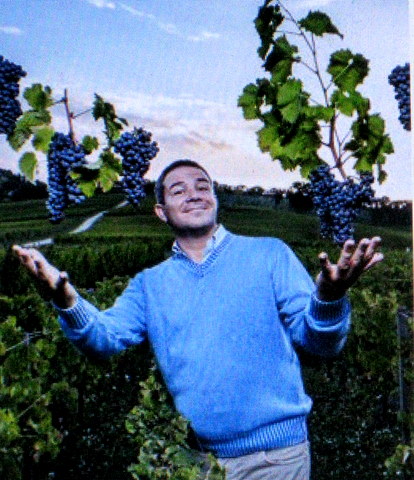
The irrepressible Marco Caprai. What grapes are those?
Photo courtesy of Wine Enthusiast Magazine, from the article by Monica Larner at the announcement of the Arnaldo-Caprai “European Winery of the Year Award.”
Marco is president of the Vinegrowers of the Provincial Agricultural Union of Perugia, as well as the president of the Association of Foodstuffs Industry of Perugia. He was formerly the director of the Consortium which protects and promotes authentic Montefalco wines and president of the Agri-Foodstuffs Center of Umbria Marco Caprai was presented with the Best Producer award by the Italian Sommelier Association.

Arnaldo-Caprai vineyards in the fall.
This year, the Arnaldo-Caprai Winery has been recognized by Wine Enthusiast Magazine, which is an industry leading publication founded in 1988 to bring consumers information about the world of wine through its reviews. The periodical, which has grown to become the world’s largest and most respected magazine devoted to wine and spirits, gives out annual “Wine Star Awards.” The magazine’s editors honor the year’s finest wineries and highlight the influential personalities who have contributed greatly to the world of wine, celebrating outstanding achievement both within that given year and over time.
Wine Enthusiast Founder, Chairman, Publisher and Editor Adam Strum explained the winery’s selection, “The innovative Arnaldo-Caprai Winery has helped revive Umbria’s indigenous grapes, bringing the wine region into the international spotlight for its production of Sagrantino di Montefalco.”
 Upon receiving notification of the award, Caprai said, “The Sagrantino grape has been my lifelong passion. I have dedicated my life to making Sagrantino a grape known worldwide and this award is a terrific testament to that effort. We’re honored to be chosen for such an important international award and to be in the company of some of the best wineries and wine personalities in the world.”
Marco and the Arnaldo-Capri Winery are now the toast of the town in recognition of being awarded the Wine Enthusiast‘s European Winery of 2012. On January 22, 2013, there was a Marco Caprai Producer Dinner at L’Artusi. Attendees enjoyed a delectable five course dinner with wine pairings. Marco is also being celebrated for his achievements by Roberto Paris and Il Buco Alimentari & Vineria in a private event the following week.
Can things get better than this? From the bit I have researched about this diligent, resourceful, innovative entrepreneur and fine wine artist, Marco Caprai, there are even better things on the horizon.
What is Slow Wine? Come to the Slow Wine Tasting in NYC on January 28th to Find Out!
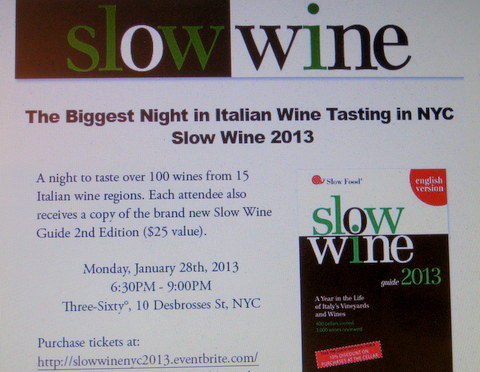
Slow Food NYC website
SLOW FOOD, SLOW WINE, WELLNESS
If you are living in the 21st century, you know the importance of wellness and healthy lifestyle as it integrates with the wellness of our planet. You also know that ecology is tied with food production, that increased carbon dioxide in our atmosphere is threatening all of our ecosystems, that ultimately every country is interrelated regardless of whether it is a failed state with a tiny carbon footprint or a prospering one responsible for chemical mega poisoning. Whether you are connected to enhancing the current paradigm shift, changing the negative impact of corporations, fighting against GMO salmon and wheat and corn and adulterated processed foods like pink slime, or whether you are a part of the problem, turning a blind eye to all of it, the quality of what you eat and drink over the next ten years will determine whether you stay well, or build up toxins that will eventually wreck your immune system shortening your life span.
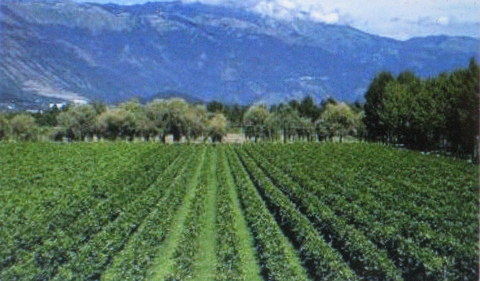
Conte Brandolini Winery is located in Vistorta, a small “borgo” within an agricultural estate in the heart of Western Fruili. The winery embraces Slow Wine concepts.

Nino Negri Winery’s “5 stelle’ Sfursat di Valtellina DOCG.” The winery embraces Slow Wine concepts.
BIRTH OF SLOW FOOD AND SLOW WINE
Did you know that this idea of countering toxic food intake and supporting healthy eco-agronomy actually began to boil over in the 1980s in Italy? As the economy of Italy improved in the 1970s-1980s and tourism burgeoned, Italian chic gave way to the lure of American globalism. Italy’s once fabulous cuisine was being thwarted by pandering to fast food franchises. Its ancient culinary traditions centering around home made and locally farmed deliciousness were being overrun by processed, chemicalized, adulterated convenience foods. If this continued, the land of sumptuous eating and wine-making would be no more. A vital aspect of Italy’s historical culture was at stake.

The Slow Food and Slow Wine website
Many understood the country was under a cultural siege and one of these was a culinary writer and journalist. Fast food was anathema to Carlo Petrini, who first came to prominence when he campaigned against the fast food chain McDonald’s opening near the Spanish Steps in Rome. Petrini’s successful activism prompted him to found a “slow food” and eventually “slow wine” movement initiating and establishing the importance of “eco-gastronomy.” In 1989 Petrini’s Slow Food nonprofit determined to influence producers and consumers in a paradigm shift away from processed, bland, unhealthful, chemical-ridden foods that Petrini recognized were destroying the gastronomy of the world. He spearheaded global advocacy starting in Italy to redirect food production back to Italy’s glorious agricultural past.
In two decades, his dream of protecting the biodiversity of the land and the cultural food traditions of Italy caught the imagination of many who saw the common sense of his platform. The movement has spread to more than 130 countries. The U.S. has the second largest chapter behind Italy which is the leader in the Slow Food and Slow Wine Movement. Just how does the movement make its impact guiding consumers’ food selections? Represented by the symbol of a snail (see the example given in the New York City Slow Food blog) restaurants or products approved by the Slow Food movement display the organization’s snail logo in their window or on their packages. Slow Food has also burgeoned into Slow Wines and wineries in Italy and elsewhere have employed the principles initiated by Carlo Petrini over two decades ago..

Assiduous grape selection after the harvest at the Nino Negri Winery…embracing the Slow Wine concepts.
The Slow Food precepts have encompassed the area of wines and wineries. Wineries in Italy and elsewhere have employed the vital factors initiated by Carlo Petrini over two decades ago. You will be able to taste Slow Wines from the wineries pictured here and many others at a grand tasting event in NYC. This year the Slow Wine Guide 2013 is presenting its latest edition on January 28th in New York City, January 30th in Miami and February 4th in San Francisco. To celebrate, Slow Wine and Vinitaly International are hosting this grand wine tasting.
SLOW WINE AND VINITALY INTERNATIONAL WINE TASTING EVENT (NYC)
For this wine tasting evening, Slow Wine’s collaboration with Vinitaly International offers an exceptional opportunity. Vinitaly holds the largest annual wine event in the world in Verona, Italy. Vinitaly’s expertise and presence assures that January 28th will be an unforgettable night in Italian wine tasting and education for New York City oenophiles and Slow Food and Slow Wine NYC members.

Slow Wine Guide, 2013 Attendees of the grand wine tasting event in NYC will receive a free copy of the Slow Wine Guide 2013 ($25 value)
Sagrantino grapes from the multiple award winning Arnaldo-Caprai Winery, which embraces Slow Wine concepts.
The Slow Wine Guide highlights the extent to which wineries follow the slow food, slow wine concepts. What’s a slow wine? Thirst Wine Merchants in Fort Greene Brooklyn describe it perfectly. It’s wine made from vineyards without pesticides or herbicides, and without chemical additives or flavors. Slow wines are made sustainably, organically, biodynamically. They are made on a small scale, from grapes grown in low-yielding, dry-farmed vineyards. Slow winemakers make their careful selection of grapes and harvest them by hand. No laboratory yeasts are used. Ambient yeasts allow the fermented grapes to naturally unfold revealing their distinct terroir (place of origin). New oak barrels (if necessary) are used with circumspection. The winemakers who follow these methods do it as has been done for centuries. There is no necessary certification, because winemakers believe this is in the best interest of preserving a tradition and making a great wine. In fact, this is the way my family members make wine, cherry liquor and lemoncello in my ancestors’ home town, Bagnoli del Trigno, Italy.
The vineyards of the Arnaldo-Caprai Winery, Wine Enthusiast Magazine’s 2012 European Winery of the year.
If you attend this Slow Wine tasting event, you will receive the added benefit of trying approved Slow Wines using the complimentary Slow Wine Guide 2013 to make your selections for future purchase. You will be tasting graciousness and supporting a movement which has taken hold and which will continue to grow exponentially as it gains critical mass against mechanized, adulterated, industrialized food and wine.
ABOUT THE SLOW WINE GUIDE
Like the 2012 guide, this year’s Slow Wine guide does not use a point system to evaluate wines. Instead, according to the Slow Wine US Tour article, wineries are judged “in their entirety, taking into consideration the wine quality, typicity and adherence to terroir, value, environmental sensitivity and ecologically sustainable viticultural practices.” wine connoisseurs, US industry producers, Italian wine aficionados and just your average oenophiles. Last year, The Slow Wine Guide 2012 debuted its first ever English-language edition in what was a compilation of expert reviews of Italian wineries, examining their production as it related to region and a myriad of other factors. This year’s Slow Wine Guide 2013 presenting its latest edition on January 28th in New York City, promises to offer interesting revelations and additions to last year’s guide.
SLOW WINE GUIDE SYMBOLS
Because Slow Wine was conceived to indicate the reality of the present Italian wine “landscape,” the guide presents reviews of 400 different wineries. Each of these wineries in Italy has been visited by Slow Food experts and their evaluations employ these symbols:
- The Snail (Slow Food symbol) indicates a cellar that has distinguished itself through its interpretation of sensorial, territorial, environmental and personal values in harmony with the Slow Food philosophy.
- The Bottle is attributed to cellars which reveal a consistently high quality throughout their range of wines.
- The Coin indicates great value.
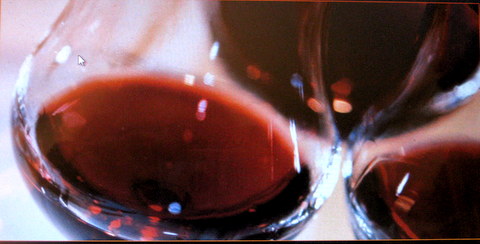
A wine from the Nino Negri Winery, embracing Slow Wine precepts.

The Conte Brandolini Winery has been in the Brandolini family since 1780. The Brandolini estate is beautiful and boasts a lovely villa and gardens.
The Slow Wine guide is published by Slow Food Editore (the publishing arm of Slow Food Italy) and distributed in the U.S. by Chelsea Green. Following the events, the book will be available for purchase nationally on Amazon.com and select retail stores throughout US.
Al Pacino on Broadway in Glengarry Glen Ross. You Missed a Phenomenal Production!
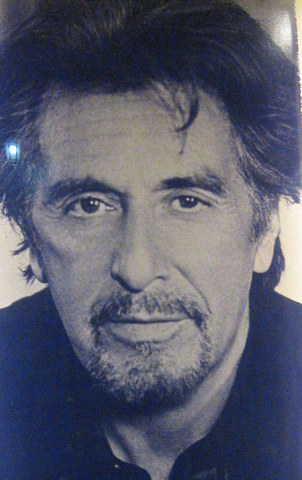
Al Pacino is a consummate actor. In the Broadway production of Glengarry Glen Ross (David Mamet won the Pulitzer in 1984) insightfully directed by Daniel Sullivan, Pacino shines. His portrayal of Shelly Levine is truthful, vital and empathetic. He is backed up by a superb ensemble of actors, each a bulls-eye in his own right. Together, the cast adheres beautifully like a religious mosaic. They are powerfully felt, moment to moment, vibrant, subtly manipulative yet outrageous. They overwhelm. And when you step back at the play’s conclusion to see the work they have wrought together, the impact of the production’s meaning smashes you like lightening.
This setting may be the Regan era economic corporate construct of 1983, but the play reminds that this is the seminal period that got us to 2013. The hapless characters are snared in a vise of proving their economic worth and are forced to predate their hapless victims. Through their struggles, we see how more than ever, as citizens and social creatures we are compelled to deal with the horrific results of corporate fascism, greed, corruption, callousness. As the characters game each other with slippery ploys and psychological maneuverings, we know the score, that the winners today are the losers of tomorrow, that ambition and greed are infinite and infinitely destructive, and that they, like Sisyphus who must roll the boulder up the mountain knowing he will slip and fall to the same result every time, are born to failure in a culture that is unrelentingly wicked. Indeed, even corporations, like Sisyphus, are beset by the ever-increasing need for profitability, cost cutting and downsizing to eliminate their “dead weight, useless eaters.” The play is timely, Mamet was prescient and the production is faithful in spooling out how devouring corporations, represented by the callous actions of Mitch and Murray, wipe out true industry and humanity.

Having played Ricky Roma in the film, Pacino pulls off a miracle in his Shelly Levine, a character who was once like Roma but whose soul has become seared and savaged by the daily press of demeaning “employment” that offers no uplift nor ignites any spark of hope. Pacino portrays Shelly as a shabby shadow of once brimming confidence, now smarmy with the unseemly rot of connivance and calculation that is required to prey upon clients, cornering and badgering them into purchases, regardless of their wants and needs. His Shelly is tired, desperate, mentally fogged, tipping a precarious balance of initial fight and bluster and later waning energy and soul death.

In his scene where Shelly flickers back to life in a last harrah which we discover has been prompted by his sordid theft in a deal with Dave Moss, Pacino’s delight barreling into the office announcing he has made the windfall kindles our enthusiasm. His commanding Williamson to ” Get the chalk and put me on the board,” (in competition for the cadillac) convinces us that Shelly isn’t a hack after all, he is the selling machine he used to be. This counterpoint becomes all the more devastating when we and Shelly discover the sale is a deception and the deceiver, swindler and liar has been hoodwinked. When the revelation comes that the old couple who signed the check in the coup de grace deal are broke, Pacino slumps physically, demeaned and deflated once more in failure. Prayed upon by his delusions, the reality hits him and us with ferocity as John Williamson, played with precision by David Harbour, twists in the knife deeper for the kill. Williamson takes a particular relish and glee asking Shelly about the couple’s apparent poverty, “Didn’t you see the way they were living?” and then snapping out in triumph, “They just like to talk to salesmen.” Pacino allows us to feel the desolation creeping back into Shelly’s soul. In his performance he wrenches all the emotional heft out of himself and enervates us with the power of living this character as we, with Shelly, victimized by the corporate ethos, cultural apathy and our own delusions about “making it” face his inevitable doom of hopelessness.
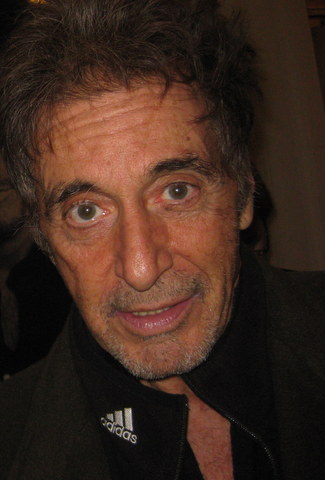
As John Williamson, David Harbour makes the perfect foil to Pacino’s Shelly. He has taken the role far from Kevin Spacey’s interpretation in the film. Spacey brilliantly plays Williamson as droll, dry, milktoast. Harbour is perfection, the golden-haired, relative of someone at Mitch and Murray brought in to cut the dead wood and mechanize people and sales for profitability. Harbour’s Williamson is overtly cruel and aggressive, loud and brash. He smarms Pacino’s Shelly, showing that middle managers, too, can play the game, conniving, manipulating, calculating, tormenting. We note Williamson’s slow deadliness as he listens to Shelly’s pleas, appears to be yielding, then with enjoyment backpedals, rejecting Shelly’s demands. He refuses to give Shelley the premium leads an intention he had all along, but with double speak he blames the result on Shelly’s selling failures as the rationale of denying him. Through this scene beautifully portrayed by Harbour and Pacino, we see the malevolence and self-victimization and cruelty in their representative dance driven by a market economy.
The symbol of middle management, Harbour aptly forges his character’s knowledge of the divide between the two classes of workers, the managers and the slaves. Harbour’s Williamson carries the banner of his bosses and will never put it in the hands of the underlings. He portrays this knowledge, in his attitude, his carriage, showing his superiority with dominant confidence, regardless of the slaves’ resentment. His impeccable characterization as the perfect bastard is unforgettable, one you must grovel to, yet can manifest hatred to, up to the point when you remember he has the power to decide your fate. Harbour’s Williamson is inviolate and trenchant, recognizable as every corporate middle management position, the henchmen of henchmen.
The second foil to Pacino’s Shelly is John C. McKinley as George Moss. McKinley relates Moss’ fury with exceptional intelligence. His rage is layered and he shows that the closer Moss comes to fulfilling his plan of conniving a co-worker to steal for him, leaving the colleague holding the bag, the more irate he becomes. McKinley’s duplicitous Moss games his colleagues and Williamson with bluster and bravado that is empty and filled with complaint. McKinley subtly weaves together Moss’ arrogance, rage and shadiness which we only understand later, having been connived by his rants and apparently legitimate condemnations against Mitch and Murray. McGinley’s Moss is dominant alpha in believing that not only can he best Mitch and Murray at their own level of rapaciousness and cruelty, but he can use the company’s desperate slaves to effect his plan to sell the premium leads to create a profit for himself.
We especially see McGinley’s brilliance during his “Fuck You” tirade. In this scene McGinley allows Moss’s presumptuous arrogance to ignite beautifully barreling out a crescendo of “Fuck yous,” to the staff and Williamson with a ferocity that becomes humorous. We revel in the depiction. It is comical and identifiable, for we have been at that same place of having to swallow so much crap, “Fuck You” sums up our primal scream of frustration. We feel McGinley’s empathy with Moss’s rage at being cornered by Mitch and Murray, snared by his dreams of “becoming rich” and himself for believing the lie. It is felt experience and we know that behind the rage is the despair that things will never change, for we can do little but be beholden to bosses’ emp0loyment at will. Can we select the alternative, joblessness and utter failure?
McGinley enacts the scene to intimate Moss’ self-deception at too readily believing his delusional plan will work. Once again comes the lightening crash as we realize Moss’ rage is at himself, another failure gone amuck. His “Fuck Yous,” are in actuality, “I fucked me.” He has screwed himself and has brought everyone down with him, except his enemy Mitch and Murray. They will thrive, continuing to grind slaves to bits because the climate is a desperate one and there is no protection for non-union workers. Ultimately, Moss and Shelly will be put in jail for their dreams.
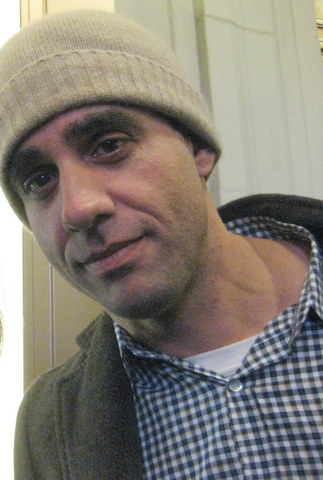
As Ricky Roma, Bobby Cannavale aptly steps up to the challenge of playing the character Pacino played in the film. His Roma is more direct, apparently honest and less slickly selling a fabulous concept to his mark. Cannavale’s Roma is portrayed with vibrancy and candor. We see that he doesn’t understand the desperation of Shelly, Moss and George Aaronow, played excellently as a counterpoint by Richard Schiff. Unlike Shelly and the others, he is the alpha, the star performer, on the top of the heap. We enjoy watching him finesse his prey, James (played by Jeremy Shamos) and are unnerved when Williamson blows the deal for him.
Cannavale’s portrayal brilliantly makes us want Roma to succeed, though it is counter to our sense of the Golden Rule and human decency. With his clever, likable depiction we admire Roma, his talents, his charm. We enjoy seeing him at work, forgetting the sale is a con until it fails and Shamos’ James leaves in fear. That reality crash snaps Cannavale’s Roma and it awakens us. The charm flees like James and Roma turns on Williamson. It is then Cannavale’s portrayal shows that behind Roma’s superb salesmanship is the same desperation and fear that have overtaken Shelly, Moss and Aaronow.
Though Roma is a winner today, he knows the future is bleak. Underneath the dominance is a painful understanding; he is out there on his own and the company he works for puts obstacles in his path and is incapable of providing the proper resources for him to effect his talents. It is only a matter of time before the premium leads will be given to a new top seller on the board. Cannavale intimates this understanding when Roma draws in Pacino’s Shelly and compliments him for his creative “crap slinging” on James. We are allowed to empathize with Cannavale’s Roma, after all, for like the others, has duped himself. The future is now. Little does he realize the game is up for all of them. With the leads gone, Roma will be joining his pals selling old leads that can’t be sold, as two of his colleagues, the one he planned to work, end up in jail.
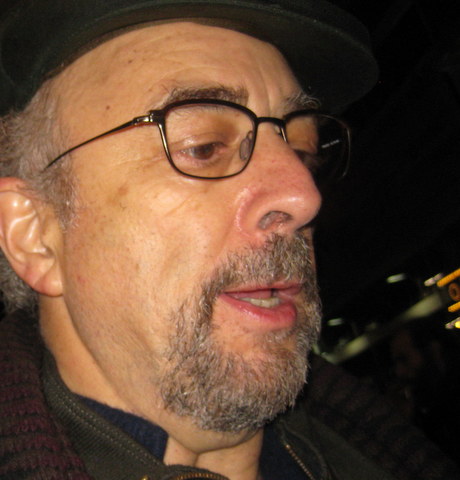
As the low key salesperson, Richard Schiff’s George is us. He listens to Dave, Shelly and Ricky with tired sensitivity, with every step of the way relating to fruitlessness of the struggle of each man. Yet he is the solid presence that tries and loses, not with grace, but with quiet resignation. Schiff’s George is exceptional. And his counterpoint characterization enhances the complexity of the dynamic in the struggle each character has with his own delusions of which George gracefully seems to be absent of. He has gotten to the bare reality and he puts up with it all until he, too, has to cry out with frustration. A superb performance, Schiff listens, is always present. Wonderful.
Mamet saw what many recognized yet tossed aside in their quest for the riches during the Regan era of corporate growth and shrinking unions and voiding worker’s rights. The productive, aggressive ones, the middle management henchmen and those like uber confident Ricky Roma would one day be on the refuse heap. Why? Even in the market, and with hedge funds, past performance guarantees nothing. Mamet’s work and this production are timeless and reveal that our cultural dynamic needs to change. Corporations must not be the feudal lords. We must not allow them power by handing over our imagination, creativity, personalities and dreams to them because we have swallowed the lie that survival is steeped in economic despair. We are more than “survivalists” and this is not a reality program, it a paradigm that we can end if we choose to. Sullivan’s and the casts’ production show that what people accept, they have. The lies and delusions they allow, ensnare them. It is a powerful message for all time. If you missed the production see the film and read this review again. You shouldn’t miss it a second time.
Chris Botti, Master Trumpeter and his Band at the Blue Note NYC.
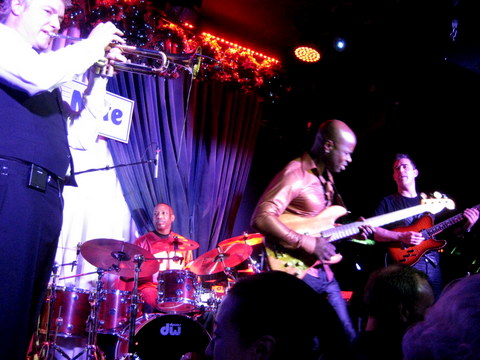
Chris Botti, Billy Kilson-drums, Richie Goods-bassist, Leonardo Amuedo-guitarist, Billy Childs-pianist (to the left not pictures)

Chris Botti with Billy Kilson on drums. First part of the show on January 6th
Whenever I see Chris Botti and his band at the Blue Note Jazz Club (NY) or at the Tiles Center in Westbury, Long Island, at Tanglewood, at Carnegie Hall or at the Saratoga Jazz Festival, venues where I’ve seen him perform live over the years, I’ve enjoyed watching the surrounding audience members. They are a pretty inclusive demographic bunch and their enthusiastic response always reminds me that timeless music resonates with most individuals, regardless of age, race, sex, even musical preference. Sure, we all have our favorite music styles. But some musicians are so exceptional in their craft and talent, that their technique bridges the great or lessert divides between jazz and pop, rock and classical, funk, hip-hop and blues.

Chris Botti, honing in on fabulous Billy Childs, December 27th show.

Billy Childs, pianist, composer, arranger, musical genius and Guggenheim fellow.

Caroline Campbell opening the number before Botti joins her in their duet playing Emmanuel.
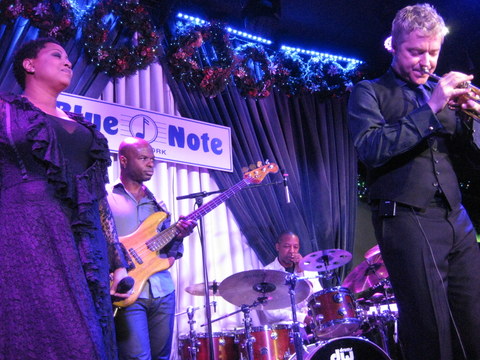
Lisa Fischer, Richie Goods, Billy Kilson and Chris Botti (December 27th)

Billy Kilson, Chris Botti, Leonardo Amuedo (December 27th)
Trumpeter extraordinaire, Chris Botti, at the top of his game is such a musician. What is interesting to me about Botti’s evolution during the time I’ve become familiar with his music (last 6 years) is that it is as if he has been seamlessly breezing from opportunity to opportunity, never looking back, never taking a pause to reevaluate where he is and where he intends to go. He is just on his way and there’s no stopping him.
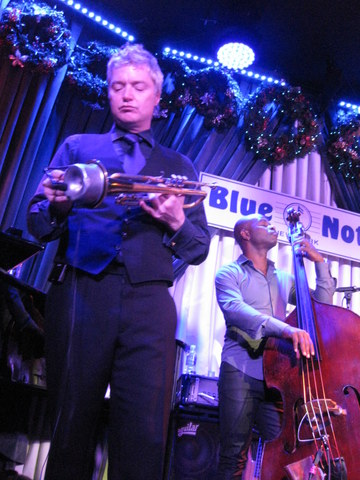
Digging the music as he attaches his mute. (December 27th) He asked his tour manager to bring his mute on Jan. 6th…he had left it upstairs in the Blue Note’s musicians’ lounge.
This dedication to craft is what appears to fuel Botti’s development. Certainly that and his work ethic have enabled him to move away from the stylistic niche where he began, perhaps to the chagrin of other musicians whose choices directed them along very different paths. However eclectic his music has become, touching upon everything from classical to pop to blues to jazz, in a melding fusion, it is his brand, his identity of being true to himself, that makes Botti a celebrated trumpeter with a global following. I would imagine in the next five years, he will be pushing the envelope and finding himself in places where even he will be amazed he has reached.

Chris Botti, Richie Goods, bassist, Billy Kilsonm drums
Chris Botti has been growing this world wide renown since having signed on to Columbia records in 2001. His work with Paul Simon, Sting and other artists like Michael Buble, Andrea Bocelli, Josh Groban, Yo Yo Ma, Steven Tyler, et. al., and recently Barbra Streisand, has increased his star power exponentially and garnered millions in record sales. He has won various awards and three of his albums made it to #1 on Billboard‘s jazz album chart. He has been nominated four times for Grammys, twice for albums Italia and In Boston. His latest work, Impressions, which has been nominated for a Grammy in the category of Best Pop Instrumental Album is an eclectic mix of jazz, pop and other genres including music by Chopin, Gershwin, Harold Arlen, R. Kelly, Randy Newman, others and a pair of songs co-written by Botti with Herbie Hancock and David Foster.
An integral part of Botti’s shaping his music is his incredible band with whom none of his evolution would have been possible or sure. For example in his 8th year performing at the renown jazz club The Blue Note (also in Milan, Tokoyo and Nagoya, Japan) the incomparable Billy Childs and Billy Kilson are Botti’s bedrock foundation. They have been with the Botti for years and have their own fan following and careers. Likewise, other band members have whirled in and out of Botti’s sphere, spinning their careers toward other venues for a season, like violinist Lucia Micarelli who, after an injury on tour with Botti, took time off to heal and ever since has been acting in HBO’s production about New Orleans after Hurricane Katrina, Treme.

Billy Childs listening as Botti discusses their welcome residency at the Blue Note.
Current band members who performed with Botti at the Blue Note for three weeks, 42 performances (two shows a day) also have toured with Botti up to 300 days of the year, unless other commitments took them away for a time. Lisa Fischer joined her old buddy Mick Jagger when he took The Stones on tour for six weeks and Botti had to make do in her absence.
Yet for those who tour with Botti, the Blue Note residency is a welcome respite. First and foremost in the band is Guggenheim fellow and three time Grammy winner, pianist/composer/arranger the phenomenal Billy Childs. Next is Mr. Awesomess, kick-ass drummer Billy Kilson. Amazing vocalist, Grammy winner and Rolling Stones singer for 18 years, Lisa Fischer has an operatic voice range, musicality and technique bar none. The virtuoso concert violinist Caroline Campbell, the youngest person to be inducted into the Pittsburgh Jazz Hall of fame, bassist, Richie Goods and versatile world renown guitarist Leonardo Amuedo have contributed their own unique talents and have enabled the group to soar on new wings.

Botti making an ironic joke in response to an audience member’s comment about Caroline Campbell’s beauty.
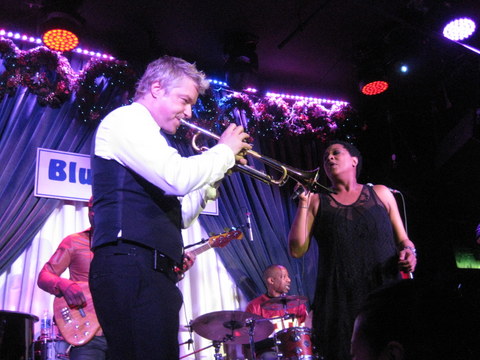
Chris Botti and the brilliant Lisa Fisher
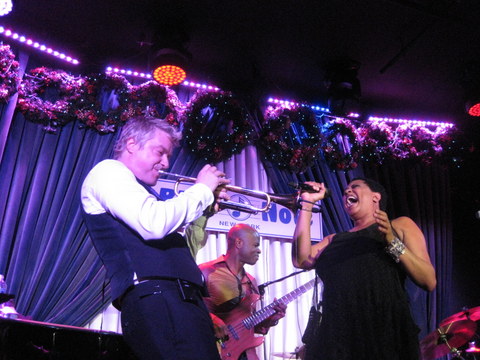
Fischer’s range melds beautifully with Botti’s sound.
Check out Botti’s website and the websites of band members Billy Childs, Billy Kilson, Lisa Fischer, Richie Goods, Leonardo Amuedo and Caroline Campbell for updates on performances and music albums. And be sure to watch the Grammys in February. After being nominated a number of times, this may be the year Botti takes home the gold.
From Westchester to NYC. New York Regional Theater’s Burgeoning Westchester Collaborative Theater
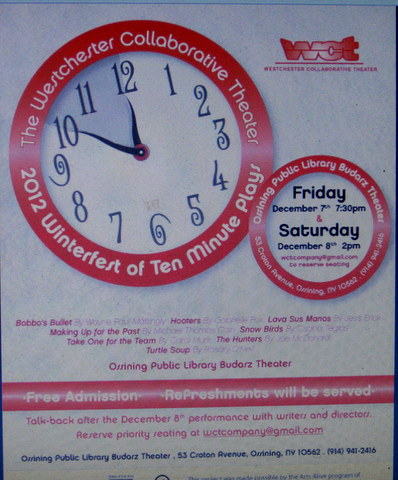
WCT Program, 2012 Winterfest of Ten Minute Plays
Regional Theater is the engine that drives original theatrical productions and puts them on the map, moving them toward greatness. If new plays are nurtured and developed with love, effort and artistry, eventually they may be shepherded to Broadway. This is especially true if the theatrical group has an esprit de corps and inspired guide to watch over the flock of artists and their offerings. The beauty of such non profit theater is that there are no chains shackling its creativity. Without the pressures of time and money weighing heavily upon it, the best regional theaters make the most of their incredible opportunity to experiment, innovate and collaborate with a fluid mix of playwrights, actors and directors.
This has been the case with Westchester Collaborative Theater, established in 2011 in Ossining, New York. Within the span of barely two short years, this regional theater group’s productivity has burgeoned like Jack’s magical beanstalk. WCT has produced Winterfest 2011 and Winterfest 2012. These events included a number of Ten Minute Plays, original offerings by WCT member playwrights…world premiers, acted and directed by professionals and aspirants. With a variety of individuals at the ready, a spirit of generous camaraderie infuses openness and flexibility not regularly accessible in the closed atmosphere of stuffy professional theater which is hesitant to take risks.
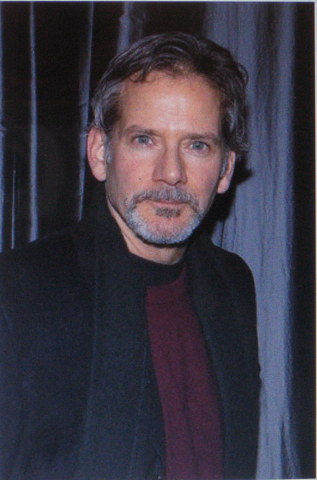
Campbell Scott, award winning actor and director, was a guest artist in November.
A blessing for WCT is its proximity to New York City, the theater hub of the world. Guest artists who live in the area, like comedian Robert Klein (last year) and in November of this year, well known actor and filmmaker Campbell Scott, are able to share their talent and expertise and serve as an inspiration to veteran performers and engaged newbees. The atmosphere at WCT is creative and non threatening, the overriding risk of lousy box office receipts absent. WCT thrives on donations, grants and the good will of patrons and the surrounding community. It is a labor of love won by the efforts of dedicated individuals like Executive Director, Alan Lutwin, who adore live theater and the living moments of performance art.
This year’s Winterfest follows on the heels of a productive year for the Westchester Collaborative Theater which included the scheduled Summerfest of One-Act play readings, monthly LAB with developmental readings and talk backs about select playwrights’ works in progress and a full length play reading. As a result of WCT’s labs, playwright/director Michael Thomas Cain was able to develop his play and present Enough’s Enough at La MaMa E.T.C. in NYC as part of the 2012 NY International Fringe Festival.
The works-in progress initiative for playwrights, directors and actors has been exciting. Each week guest artists with years of experience in the entertainment industry engaged in readings and talk backs. In November award winning actor and director, Campbell Scott (Victor Geddes with Julia Roberts in Dying Young and the protagonist of David Mamet’s The Spanish Prisoner, Co-director of the award winning film, The Big Night with Stanley Tucci) performed a reading of The Wife and the Widow Next Store by Richard Manichello. The playwright, screenwriter, actor, poet (penned the award winning Choices of the Heart for television) who wrote Agnes of God, John Pielmeier (he also wrote the screenplay for the film Agnes of God) was another guest artist in November who shared his experiences and contributions to the theater and television community.
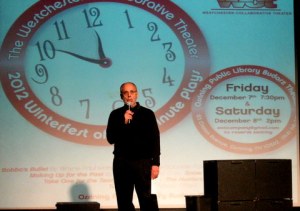
WCT Director, Alan Lutwin, introduces the 2012 Winterfest
This season’s 2012 Winterfest of Ten Minute Plays included new members, professionals and those whose love of theater, writing, directing and acting have kept them involved in regional theater in the New York City area. Many of the artists’ works have appeared in Drama festivals in New York City and around the nation. Of these, some have been semi-finalists or finalists at the festivals, nominees of major prizes and award winners of other venues.
One such notable is Richard Manichello, 30 years in the entertainment business (actor, producer, Artistic Director of Peekskill Playhouse) and an Emmy Award-winning director and writer of stage, film and television. Manichello directed two plays for the WCT Winterfest. The first was Hooters, written by playwright Gabrielle Fox. Fox’ plays have been produced throughout New York City and the metro region. Manichello also directed Lava Sus Manos by playwright Jess Erick.
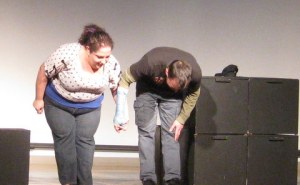
Hooters by Gabrielle Fox. Directed by Richard Manichello, with Jess Erick as Becca and Adam Glatzl as Sammy.

The Hunters by Joe McDonald, Directed by Matthew Silver. Janice Kirkel (left) as Eileen and Lorraine Federico as Rose.
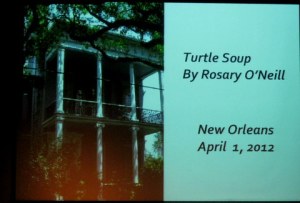
New Orleans Playwright, Rosary O’Neill’s Turtle Soup from White Suits in Summer. Directed by WCT actor and director Elaine Hartel.

Turtle Soup: Suzanne Ochs as Lucille (left) and Janice Kirkel as Aunt Jean.
Another professional, Rosary O’Neill, whose work was presented at the Winterfest, like Manichello, has weighty career experience and many awards and fellowships under her belt. O’Neill who is from New Orleans is a published/produced playwright (22 published plays) novelist, actor, director and retired Professor of Drama and Speech at Loyola University of New Orleans. The fourth edition of her textbook, The Actor’s Checklist, is used in schools nationwide. O’Neill founded the Southern Repertory Theatre in New Orleans and for many years was its Artistic Director, producing a number of the plays she had written. The comedic 10 minute play “Turtle Soup,” directed by Elaine Hartel (actor and director for WCT and other New York regional theater groups) was excerpted from O’Neil’s semi-autobiographical play about a wealthy family in New Orleans, White Suits in Summer.

Snow Birds by Csaba Teglas. Directed by Michael Thomas Cain with Jon Barb and Leslie Smithey
For more information about the Westchester Collaborative Theater’s 2012 Winterfest of Ten Minute Plays, the actors, directors and playwrights, or for information about membership in this active regional theater company, check their Facebook page, Westchester Collaborative Theater.
Not pictured, Take One for the Team by Carol Mark. Directed by Joe Albert Lima. With John Barbera as Will, Margie Ferris as Terri and Taku Hirai as Kevin.

Bobbo’s Bullet by Wayne Paul Mattingly. Directed by Joe Albert Lima. Left to right, Sara Beth Colten, Femi Alou, Pe’er Klein, Margie Ferris.
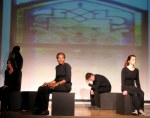
Lava Sus Manos by Jess Erick. Directed by Richard Manichello. From left to right, Femi Alou, Shelley Lerea, Tracey McAllister, Ryan Mallon, Mary Roberts.
Umbria Has Come to New York City. Only Two Weeks Left to Celebrate the Best of Umbria
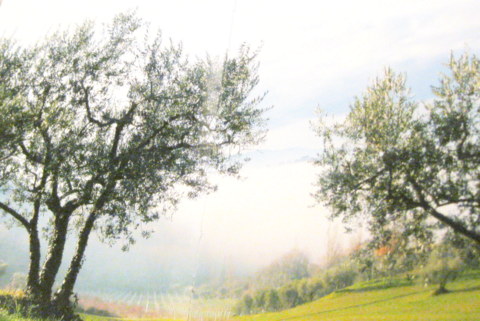
The beautiful Umbria: olive trees and valley beyond.
If you’ve traveled to central Italy and visited Umbria, you’ve explored the picturesque medieval villages, and enjoyed the breathtaking mountains and lush valleys of this “Green Heart of Italy,” or “il cuor verde d’Italia.” Umbria is known for its sumptuous cuisine (The wines and oil olive oil are exceptional.) remarkable artisan jewelry and Deruta ceramics. If you love fashionable cashmere knitwear, you know you will be able to purchase some of the most chic outfits in Milano, Italy. Well, Umbria is an important hub of a cashmere knitwear manufacturing district in Italy.

I Love Umbria Month in NYC
Though traveling to Umbria may be not in your immediate plans, you are fortunate because Umbria has come to the U.S. If you are in New York City the month of November until December 8, you will be able to experience the best of Umbria in various locations around the city like Eataly, Il Buco Alimentari & Vineria and Di Paolo’s Fine Foods.In an official proclamation Mayor Bloomberg has declared November “I Love Umbria Month!”For the rest of November until December 8th, the city will be hosting cultural and culinary events in celebration of the best that Umbria has to offer in its wine, ceramics, olive oil, cuisine, jewelry, even music.

The Sagrantino the signature grape found in Umbrian wine
Eataly’s restaurants are currently serving traditional Umbrian fare paired with Umbrian wines like the signature Sagrantino. Eataly chefs are hosting cooking classes that focus on typical Umbrian recipes. Their wine store is holding its final wine tastings the next two weeks on Fridays and Saturdays, and there will be tastings in La Piazza.
Additional trade and consumer tasting events have been featured at Il Buco Alimentari & Vineria in the heart of NoHo. Around the city, participating jewelers are still offering exquisite Umbrian jewelry. In Little Italy, Di Palo’s Fine Foods has hosted olive oil tastings and wine tastings, some of the finest from the region.

Eataly’s La Scuola, site of the luncheon
The month long festivities were heralded with the first of a number of events, a luncheon: Umbria, “A Land Rich in Time.” Held Wednesday, November 7th at Eataly’s La Scuola Grande, it was hosted by the Centro Estero Umbria(Umbria Trade Agency) and renown chef Lidia Bastianich. The sumptuous luncheon featured dishes typical of the region with Umbrian wine pairings. For the Antipasto, diners lunched on Chef Alex Pilas’ exceptional “Porcini con Crescione, Finocchio & Tartufo,” paired with a white wine of the region.

Marco Caprai and Dan Amatuzzi
Eataly’s wine director, Dan Amatuzzi, Marco Caprai of The Caprai estate and Marco Petrini, President of Monini North America, Inc., discussed Umbrian cuisine at length. Amatuzzi and Caprai explained the wine pairings for each dish and emphasized the Sagrantino as the signature Umbrian grape whose wine with its gripping tannins and ability to be aged for years makes it a classic of the region.
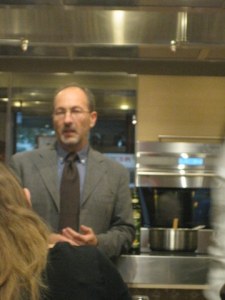
Marco Petrini
Petrini spoke about the olive oil produced as unique to Umbria in its mild, nutty taste profile that marries perfectly with porcini and legumes, ingredients widely used in Umbrian cuisine.
After the antipasto, guests enjoyed the Secondo which was Porchetta con Lenticchie Umbre. The combination of roasted pork resting on a bed of lentils prepared with Umbrian olive oil, nutty, fresh, smooth, and accompanying regional seasonings was a sensational meld of flavors. The dish was perfection and exemplary of the region’s select recipe for culinary delight.
To describe the Dolce course as tasty would be an understatement. The Torta Umbra all’Olio d’Oliva & Gelato was not cloyingly sweet, nor heavy as one might expect as it was made with Umbrian olive oil. The cake was light, airy and extremely flavorful; its gentility coupled well with the dessert wine, Tenuta Rocca di Fabbri, Sagrantino di Montefalco Passito DOCG 2005. The pairing pinged my palate and completed the progression of dishes with an intriguing finish, leaving me with thoughts of returning to such dishes and pairings again and again.

Porcini con Crescione, Finocchio & Tartufo

Porchetta con Lenticchie Umbre
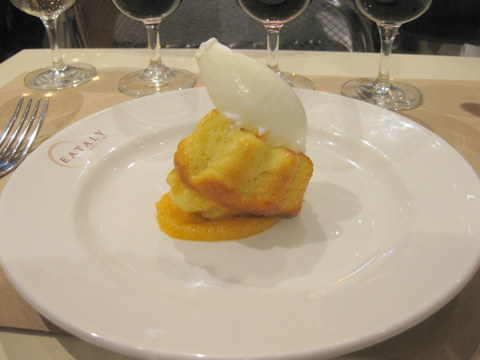
Torta Umbra all’Olio d’Oliva & Gelato
However, I will only be able to revisit Umbria until December 8th when the month long festivities in NYC come to a close. The event breakdown in depth can be found at the link for I Heart UImbria.
The schedule of the last two weeks follows below.
Week Three: (November 23-30) Focus on Truffles and Legumes
Week Four: (December 1-8) Focus on Cuisine
You will be missing out if you don’t make it to Eataly or one of the other venues during the “I Love Umbria” month’s remaining festivities. It’s not too late to enjoy a glass of Umbrian wine or dine on some superb Umbrian fare. You’ll be glad you did.

Grace on Broadway with Paul Rudd, Ed Asner, Michael Shannon
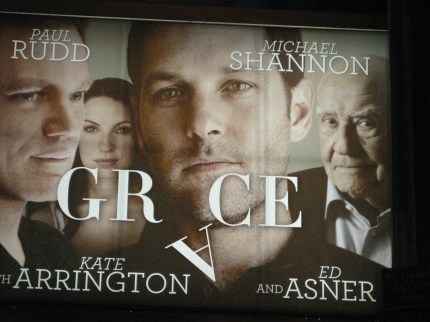 If you are an atheist, an agnostic, you despise so-called religious Republicans who are actually hypocrites, are intellectually gifted or are a native New Yorker, run to see Craig Wright’s play Grace, now at the Cort Theater. If you deem yourself a true follower of Christ spiritually (anti the political religious right) the play will resonate with you to a point and then, perhaps, as it did for me, it might skew off into a spiritual Neverland, making you wonder if the twisted logic was the playwright’s intent or his attempt to enliven the theatrical experience and create an uber-drama. Either way, the play, for me, became hyperbolic contrivance which made the ending/beginning/ending diminish the suspense and realism and crimped the development and emotional power of the characters and their relationships.
Steve (Paul Rudd) is a Christian who with Sara, his Christian wife (Kate Arrington) have moved to Florida where Steve is waiting to manifest the financial arrangements for a deal he has made with an investor. As the play unfolds, we see the relationship between loving husband and wife that appears to be perfect grows a few developing wrinkles as Steve waits for the financing to come through and Sara is left alone to her own devices which include becoming friendly with car accident disfigured, next door condo neighbor, Sam. Thrown into the mix for good pleasure is the friendly German exterminator guy, an unrecognizable (the audience didn’t applaud him when he entered as they did Rudd because he WAS THE CHARACTER and not Ed Asner) absolutely flawless Ed Asner as naturalized American citizen, Karl.
Steve’s success with his marriage and his relationship with Sara unravels as his business plans explode his dreams. He confronts a financial meltdown, litigation and loss of his wife. At the worst possible moment, Sara tells Steve she is leaving him for Sam because she and Sam love each other. During the build up to the crisis, there are critical lightening flashes and the actors freeze momentarily. These are pivotal moments where events could have gone differently, the playwright suggests, yet they did not because of…whatever: grace? lack of grace? the characters’ choices? Does it matter? These breaks “da da” add to the play’s pretension and reveal a muddled and unclear flirtation with theme that never blossoms into a true relationship What we should see and don’t is that the permutations of choices for the characters are innumerable, but the plot feels so fixed and artificial that the lightening flashes/turning points are woefully weak. They actually detract from the play’s import.
This is partly due to the playwright’s choice to begin the play at the end which diffuses curiosity and engagement and the suspense that the actors with their superb talents manage to create. The play’s construction as it stands is faulty because the playwright begins at a conventional high point and turns it on its head, making it a low point with Steve’s shooting himself at the outset. Why does the playwright begin with the ending? This is not Pinter’s Betrayal, a seamlessly constructed play which used the same contrivance of chronological event reversal with great subtly and integration of theme. Grace‘s chronological event reversal, then move to flashback and forward movement of events doesn’t really work with the thematic structure given the content. The obfuscation for the sake of clarity boggles. Is this or isn’t this the playwright’s comprehension of grace/lack of grace unfolding from missed opportunities and poor decisions?
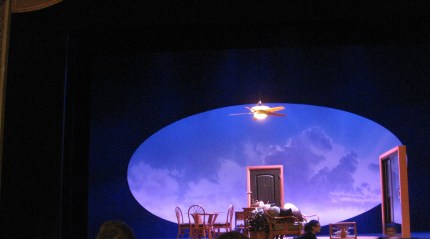
What continues after Steve’s opening suicide is a sort of cinematic reversal backwards. Rudd as Steve takes backward steps. The plot reverses the thread to Rudd/Steve shooting Sara which happened a minute before his own suicide. Then Rudd/Steve and Sara (Kate Arrington) literally step backward and next we see Steve shoot Sam which happened a minute before he shot Sara. Again, there are lightening flashes and character freezes and the stage darkens and the setting moves to a month or so prior. Now we are in a present moving flashback construct designed to show us what events occurred to lead to these three deaths. From then on, the action is forward and linear and we see how Steve and the others spun out of control in a series of pathetic events where they act upon each other to create their own dance of death. Even the hapless, atheistic Karl falls prey to Rudd’s graceless shooting spree at the moment when Karl is perhaps open to receiving grace, ready to believe after experiencing what is tantamount to a miraculous redemptive action, that, if not God, “there may be something” that caused the action. So Karl, too, ends up melodramatically dead. However, the flashback thread leaves off at the juncture where Steve/Rudd is pointing the gun. We know what follows. We have already seen it in the play’s opening. Despite our longing for a deus ex machina or Godly intervention to stay Steve’s mania for vengeance and an end to his faithless hopelessness, no one here receives grace. They die. (We don’t know if neighbors reported the shots, called 911 and in the intervening half hour three were saved. We do know that Rudd/Steve, who pointed the gun to his head is certainly dead.)
When thinking about grace and attempting to understand such a complicated concept, I am reminded of the brilliant film Nights of Cabiria. The character of Cabiria at the film’s end has experienced terrible treatment at the hands of fate or God. The man who was to marry her has robbed her and was going to kill her, though he does not, though she begs for death. Instead he leaves her alone with her utter shame and hopelessness. Destitute, alone as a former prostitute, she has nothing to fall back on, no family, education, nothing. She considers suicide, but something within her retreats: the mystery occurs. She receives the grace not to end her life, though she has every reason to do so. As she walks to who knows where in a dark wood, she comes across young people who are dancing, singing and celebrating a birthday. Through her tears, she receives whatever it is, grace (?) to smile and join them at their invitation. She is, her life is and we know she has received the grace to make it to the next day and the next and the next. Wow! No religious overtones, no religious sentiment, but you get it and you understand the human condition perfectly.
Frankly, I found if very hard to understand the playwright’s portrayal of Steve’s faith and Christianity connected with the lack of grace bestowed at the play’s beginning/end. I certainly cannot argue that his shootings and suicide have taken them all to a better world. That is not manifest in the play. The characterization of Steve is a conundrum of illogic. The irrationality a facile, thin and overused point of character taken from the mold of three decades of violent acts from Steven King’s villains. This is a mash, a combination of pedantic stereotyping of what liberals think the religious right are capable of and what their Christianity is all about.
Unfortunately, that’s too superficial, too pat and the stereotype too obvious and contrived. The dire warning fits into a precast mold. The characters’ “Christianity” is a glaring fault of the play upon which everything hinges. It didn’t have to be. Why include it? The playwright has given the logic for Steve, the everyman, to commit suicide: wife leaving him, business dreams destroyed, money robbed, defrauded by his own naive actions which were prompted by “faith,” facing litigation and the possibility of jail. He faces complete ruination. It’s enough to suicide the mildest of men. What the playwright has thrown into the mix is that fundamental Christians think “this isn’t supposed to happen to a person of faith.” Yet when it does and grace doesn’t come through, nor God, nor love, nor anything redemptive, he-Steve can’t handle it and exacts his revenge. His “faith” all along was a crutch, insincere or his killer nature buried by his “faith” surfaces. Enter the wacko religious mother in Carrie; enter the murderous religious villains whose “Christianity” has set them off to kill. It’s an atheist’s wet dream that not only is there no God, but the no God really sucks at being a no God. Well, somehow, this is all too obviously constructed for effect and it smells of the paint of too much puppet master and not with the apparent seamlessness of brilliant writing.
Because the characterization of Steve is so flawed, all the more magnificent praise goes to Paul Rudd, who with his SHEER GENIUS of talent and skill makes this wooden stereotype real, likable and amiable. Paul Rudd, courageously took on a part with so many holes, yet fills them up with back story and rationale to convey the character’s vitality. He makes what is nearly impossible, possible; he makes believable the character’s preaching and living his faith. Rudd portrays Steve’s belief his relationship with Sara lovingly yet with an undercurrent of fear. With great realism he portrays Steve’s belief in God and his hope. And Rudd “keeps the faith” until events spiral beyond his control, and we get to see Rudd’s brilliance as he spools down the character’s faith, sanity and hope. Of course, he is helped by the acting marvels of the rest of the cast, Asner, Shannon and Arrington who are all terrific. They make the play. If not for them and the director, Dexter Bullard, HELP ME JESUS!!!
Again, whether it is the fault of the plot which forces Rudd to leap to a tailspin downward, or how the character of Sara is drawn to skew precipitously downward in concerted contrivance, or the scene leading up to the shooting…these especially just didn’t make sense to me given the context of Christian faith (which is so paper thin here…that only Rudd’s in the moment breathing onstage makes it alive). And it is not enough to say that violence doesn’t make sense because it does. The playwright has stacked the deck to make sure that as everyman, Steve, has good cause to kill himself and his wife and everyone in his surroundings, regardless of whether he is angry at God or he just snapped. Except he is a Christian, and a serious one at that. He spouts off heavy spiritual montages in his urgency to convert or at least jangle the sensibilities of Karl and Sam toward faith. This incongruence between these speeches and his final actions echoes badly. It rings false. And that is an uber problem that the playwright never resolves in Steve’s characterization.
At the crux of the problem to me appears to be the playwright’s understanding of God, Christianity and the nature of the conversion that has happened to Steve and Sara. It is twisted and opaque to the point that the characters wander in the plot. The convolution is not in what they believe, but in that they were drawn incompletely to fit mechanisms in a contrivance. Da, da. Drum roll, “These are the wacked Christians.” It is OK to show wacked Christians. But for a writer to be pretentious, obvious and illogical about it is doing one’s craft a disservice. I certainly did not think that their faith as portrayed was at fault or insincere. In fact it was because of their sincerity of faith that I found the ending events written for “tragic” effect. It was a rush to create the spectacle of violence that led me to think that not only did the playwright not dig concepts of faith, spiritual conversion, the whole nine yards, he rendered it to fit his own notions. Unfortunately, the play suffers hugely, the characterizations are wobbly and illogical: Steve is a pathetic stereotype and his formerly timid wife, suddenly and within a month’s time, turns into a freewheeling, directed, courageous woman who renounces her vows and leaves Steve for Sam free of guilt, fear or self-reproach. This is rather a huge stretch, “Saaay what?”
Well, anyway, many in the audience should enjoy the characterizations because they easily fit into stereotypes. The obfuscation of faith, conversion and spiritual Christianity is so skewed and unclear, it will continue to promote the average audience member’s lack of understanding of Christianity/spiritual conversion, faith, agape love, etc. (See my opening sentence.) It is a boon for anyone who has a hatchet on for the Christian religion, is an agnostic or has had a few terrible run ins with hypocritical religionists and political religionists who are staunchly religious for purely monetary reasons.
Thank God for great direction. Thank God for brilliant performances by genius actors. That is GRACE, indeed! I so appreciated the efforts of Rudd, Asner, Shannon and Arrington who is lovely. She made real how she fell for Sam, even though I didn’t understand how she had the courage to leave Steve in a month’s time. Arrington, a magician, made me overlook that tremendous flaw in the play. The other actors’ logic and humanism made me over look the stumbling script. I knew Rudd, Asner and Shannon were absolutely great actors. I just didn’t know how great until I saw how they could take a play and characters that are ill conceived and create gems of life. Bravo to the cast and the director. You are truly masters of the craft! There is no praise great enough for the cast’s work and the director’s in how they transformed a lackluster, convulsed script into memorable theater. I will remember the phenomenal acting and direction. The play? Jesus H. Christ. It is forgettable. Do I sound confused? 😉
Gore Vidal: In Memoriam
I adore Vidal’s work. Read his American history series, his memoirs and his Caligula in addition to his books of essays. Saw The Best Man with James Earl Jones, John Larroquette, Candice Bergen twice on Broadway (2012) which is still garnering a wide audience, and viewed him whenever I could when he was on Charlie Rose and elsewhere.
I appreciated him only when I was older, after I’d read his work. In my youth, I thought him defensive and somewhat sad, viewing him in his arguments with Buckley (I am not or ever was a conservative) who bested him roundly and then litigated against him. Hmm. But they parted if not friends, in the last, with no legal bindings between them as Gore apologized truthfully, tweakingly telling Buckley he had joked calling him a “Crypto-Nazi.” If you think about it, it is bitingly funny while Buckley’s retort was not. Buckley got personal and farted an epithet toward Vidal’s gay sexual preference, revealing Buckley’s own homophobia and hovering cruelty which at the time carried a weight of legitimacy.
Today, viewing the video clip where Vidal and Buckley gnaw each other’s throats, Gore comes out ahead. Bravo, Vidal! You have withstood the test of time, as I truly believe will your writings. You are a genius and we are the better for it as Americans, having read your edgy, insightful thoughts. You were a beacon and now have quite blown yourself out. To me, you will always remain.
This sonnet is a tribute to him who I adore for his humor, his writerly acumen and his artistic genius. Your words live. Thanks.
GORE VIDAL
Acerbic, vitriolic, searing words,
In you fermented, then poured out, a draught
Of wine. We sipped refreshed the wisdom heard.
It quenched our ravaged souls and spirits wrought.
We culturally dispossessed? You raised us high.
Redeemed our history’s worth with wit and grace,
And literary gifts none could decry.
Your genius ne’r could Truman er’ displace.
Self-described emotionally cold were you
Patrician, righteous, prophet of the age,
To Buckley calumnious, to Mailer crude,
Tiresias: forthright, just, a humorous sage.
Your writings live, though Death choked off your time.
You lived a maverick’s life, one of a kind.
Killer Joe’s Gina Gershon, William Friedkin, Matthew McConaughey at NY Times Talks: Review

NY Times Talks
David Carr, Gina Gershon, Matthew McConaughey, William Friedkin
Tom Stoppard, Alan Rickman, Tilda Swinton, Colin Firth, Liam Neeson, Carrie Mulligan, Gary Oldman, Helen Mirren. I had seen these talented Brits live on the stage (Broadway or Off Broadway) and in film. I appreciated their brilliance, their humor, their uniqueness, their prodigious efforts! The New York Times Talks were a venue where I witnessed these actors with their vibrant spontaneity in live interviews. Prior to attendance, I anticipated each of these Times Talks with enthusiasm. I always walked away satisfied.
Today was different. I was going to see mildly talented American actors and a director who hadn’t hit it big since the dark ages before Twitter and Facebook. And on a blazing, torpid evening no less? Already, I was bored and annoyed with the prospects, especially since I wouldn’t be sneaking any digitals with my unobtrusive, insect-sized camera that could be whipped out and secreted away before anyone, least of all the officious, martinet ushers could bully me about it. Well, almost. At my last Times Talks go round, I was clipped by some weak mouthed serf to “not take photos.” At his muling whine I contemplated that the next time, if there was a next time, I’d get a press pass. Unfortunately, for this round of David Carr interviews with Gina Gershon, William Friedkin and Matthew McConaughey, I couldn’t get it together in time to call the publicity department.
So here I was a coolie nonentity and in this role, I did not enact the usual routine: go early, move down front, get ready for some fun. I was hot, tired and disgruntled, a sloppy frazzle after minding the gaps and evil perspirings of oversized Long Islanders sweltering and swining through Penn Station. Taking the train in from Kew Gardens was one more moted stupidity in addition to wearing a white Michael Kors outfit in a city where dirt grows on “the absence of colored” clothing like feathers on a chicken. What a crass ho-hum venture this promised to be: no Brits, no photos, probably no celebrity interludes (Often famous friends people the audience to shore up their buddies being interviewed and I would briefly speak to them). Rats for a crank of wasted time.
After I returned from the ladies room, noting flecks of black on my lower left pants leg, I gnashed teeth in my seat and waited for the non event. I didn’t know too much about the film Killer Joe. Nor was I hopped up about McConaughey’s latest career tweaks in embracing the “go forth and be sexy-naked” role in Magic Mike or his ominous shift to the wickedly nonchalant, indifferent, bad-ass law man Joe Cooper. I certainly hadn’t seen any of Friedkin’s opera direction, much of it far from New York’s Metropolitan Opera House and other city opera companies. His most recent endeavors were in Europe, and unless he was directing Verdi, a favorite of mine, I probably wouldn’t make it a point to go, reeling from all the other activities I’d engage in in Rome or other cities where his work might appear. Actually, I hadn’t watched a memorable Friedkin film in the last decade. But he was forgiven this because of his incredible direction of two of the most marvelous films to come out of the 1970s, the groundbreaking, spellbinding The Exorcist and The French Connection (for which he barely used a script and which won 5 academy awards including Best Picture and Best Director).
Reflecting back to the hover over the month’s New York Times Talks’ offerings, at the time I was making arrangements, I gamed seeing whether McConaughey was as ravishing as the media and friends seemed to think. I loved him in Amistad; the film was brilliant as a historical record of the event which, like an explosion, breached institutional slavery’s pitted walls in America. McConaughey played his lawyerly part beautifully, complementing Spielberg’s sterling actors’ ensemble, though the standout performances were Anthony Hopkins as John Quincy Adams and Spielberg find, Djimon Hounsou as Cinque.
No matter. Coming here was a mistake and now I must deal with it. Deal I did. I raged, annoyed at my unpreparedness. I vowed, if David Carr wasn’t striking fire and it was a total blackout of wits, I’d leave. Better yet, I’d catch up on my sleep, snoring my disdain to surrounding audience members. Turns out, I did take a blip when the talking heads disembodied themselves and Carr was as somnambulant as I. But overall, I’m glad I awakened for most of the discussion, if not to eventually see the NC-17 rated film, but because the director’s intellect and vision enlightened me and I enjoyed catching snippets of Gershon’s and McConaughey’s sage, scary talent in bringing the frighteningly human characters to life.
Killer Joe is based on a true story according to Friedkin. A hit man is engaged to kill a family member for their stash to pay off debts or the hiree will be killed. Tracey Letts, Pultizer Prize winning playwright of August, Osage County, (film slated to open in 2013) adapted the screenplay from his play Killer Joe (1993) which has been performed in NYC and in 15 countries around the world. Friedkin, Gershon and McConaughey couldn’t sail enough accolades toward Letts for his script’s edgy, sardonic humor and complex familial renderings. Each of the characters, in their attempts to strive beyond their trailer trash lives and aspirations entangle themselves deeper in their own webs. The more they struggle to break the gossamer/steel chains that stick them, the more they cocoon themselves in their own demise.
In typical Friedkinesque, the story telling is macabre and surprising as it bends the envelope toward laughter and bizarreness. The characters’ human weakness wacks us silly and when we watch reality unfold, glad “that it’s not us up there”, the circumstances wrap us in the Jerry Springer moment of upending comedy. We laugh though we shouldn’t, but we can’t help ourselves because these folks are just plain dumb-ass, ego-baited, desperation-cracked ninnies. It’s the kind of humor found in Pinter’s The Caretaker. Pinter is a playwright that Letts and Friedkin admire. It is no coincidence that the relationship dynamics of the Smith family and Sheriff Joe Cooper, coupled with their foolhardiness, which plunges them in their own fetid swamp are reminiscent of the characters and situations in Pinter’s plays.
Interesting that McConaughey and Gershon didn’t get the point of Killer Joe on a first read. They were ready to garbage the script, even though Friedkin was attached to the project. McConaughey changed his mind after a female friend pointed out the black (as in dark) comedy and suggested it was an amazing piece he should do. Like Gershon, he reconsidered the novel role as a boon because it was unlike any project he had accomplished before. Gershon realized she could empathize with Sharla Smith’s hungers, manipulations and mammoth insinuations as the character endeavors to reach her goals, regardless of the cost to others. Her character’s rawness and her miserable flame out were the icing on Gershon’s cake.
Friedkin praised his dream cast, including the vulnerable Emile Hirsch, the dead-pan funny Thomas Haden Church and vibrant Juno Temple for their gifted performances and right on appropriateness (mentioning he had not been as astute with his casting choices in other films). He credited McConaughey’s risk taking in accepting the role of Joe Cooper, which for him was contrarian and counterintuitive. Sheriff Cooper is emotionally cold, an unappealing killer on the surface. It was up to McConaughey to see his likeability and that wasn’t easy. Much easier to accept the roles he’s been doing since the 1990s. Friedkin bore out that McConaughey’s looks peg him for chick flicks. The next two generations of female audiences would appreciate his face and physique in tragic or happy love stories. Heck, he could easily age into sixty-seventy something romantic leads (He’s 42.) and directors would be thrilled to nail him on the cross of such senior lover man roles twenty years hence. McConaughey knows that and is swimming upstream against the current of big money. He reaffirmed the shift in role choices and voiced the need to vibrate his career with twists and turns constantly moving in other directions.
At this juncture in the Talks, I had zzzed off. McConaughey is absolutely stunning in person, much better looking than in film and Gershon is interesting, but the discussion was without steam, pepper or spice. My head was thrown back in the seat, my eyelids had drifted shut, my mouth was sliding open to distill rasping throat sounds. Then I chortled to wakefulness, startled by an audience stir and a demure announcement by a jaunty blonde in a black semi-bowler hat. She was standing to my left not four feet away and was interrupting David Carr’s monotone. Yeah! An intrusion upon the droning bees onstage. Could it be? Was she an ally in my indignation against fatuous ushers and pretentious Times’ policies? Yes! I mentally polished my middle finger, “Take that, New York Times Talks, ha, ha!”
The frenetic and pissy blonde in the black bowler was leveling up a forbidden digital camera, pointing it straight at Gershon and McConaughey. She ambled forward proclaiming, “I am a paparazzo and I am recording you here…muffle, argh, garble.” Audience eyes turned to look in the direction of the soft, feline voice and were struck deaf by the silence of the vision. The pretty, flouncy blonde, was jiggling her naked boobs. Her perky cream white breasts flapped prodigiously, her fur flew, as she stood proudly naked claiming her glory to Carr, Gershon, McConaughey and Friedkin. The ushers and audience, were stunned in a reverent suspension of disbelief. None of us got it, except maybe for the Gershon, McConaughey and Friedkin who remained wryly nonplussed, probably used to crazy public antics that appeared like stupid pet tricks when their stars crossed the heavens. Recovering from their cloudy haze, the ushers sprang into action. Three of them scrambled to block views of her blanched T & A, which were a stark contrast with that zany, obsidian hat and redness of her lipstick. I wiped the sleep from my fogged consciousness, grabbed my insect digital and snapped as many shots of the stage as I could. By that point the ushers were distracted, shuffling her away while peeking at her savory flesh full throttle. Amazing. No one laughed, though the incident was as wacky as the dark intent of Killer Joe. Either Friedkin or Carr quipped about how her appearance enlivened the dullness of the static camera interview, which “usually reaches a lull right about now.” Did someone hear me gently snoring in the background or see my head bobbing back in dreamland, I chuckled quietly to myself.
Onward soldiers. The rest of the “Talk” fled past with a rapidity I couldn’t gauge, beginning with Gershon wondering aloud why the woman characterized herself as a “paparazzo” as Friedkin, with erudition, supplied the derivation of the word. Then there were more particularly ominous film clips and it was time for audience questions. I thought the following information worthwhile. Friedkin did only one take for most of the scenes, throwing out the window all notions of arriving at perfection after 15-20 takes. The actors felt his immediacy created alertness and surprise; you were ready out the gate, like racehorses to the finish line, without the burden of stale repetition. Friedkin remarked that the first movie that inspired him to pursue film craft was Citizen Kane. And if he could even begin to make a film like that, well… Carr flattered him by saying he had. For me Citizen Kane and The French Connection are indeed art, but cannot be spoken in comparative terms.
Two questioners were notable in the responses they elicited. A lawyer commented that he thought Bernie, a McConaughey film, underrated and ignored by critics and fans was astounding. The actor was flattered into revealing that a potential career path he had chosen was the law. He had been accepted to law school then at the last, changed his mind and went to film school instead. Considering all the lawyer roles and law enforcement officers he has portrayed, the law remains with him.
A young and clothed female actor was brave to question what was needed to be an actor. McConaughey’s rapid retort, “Keep this in mind. There are no help wanted signs out there.” All three affirmed security is hired to “keep you out” of a tough business. Gershon did mention one needed to check one’s motives as to exactly why one would be an actor. Friedkin spoke like a director from the old studio system about the importance of “looks.” Indeed, one’s face does the casting or type casting. Actors have made money from appearing like Italian mobsters or heroes or beauties. Sadly, looks and appearance have held too much sway over the years. Oftentimes, those who have tremendous talents and gifts fade away, having fallen pray to resignation while others which much less talent but other elements make it. Friedkin waxed into a beacon of hope with this counsel. “One needs these three things to make it: 1)ambition, 2)luck 3)the Grace of God.” The last smacked me in the head. It was the first time I had ever heard a director mention the Grace of God in the context of “making it.”
Another questioner having to wait for one of Friedkin’s particularly long responses to be finished, jerked with anxiety and impatience until Carr finally called upon him. With tongue in cheek reference to bowler-hat blonde, Carr adjured the young, frail looking fellow not to disrobe. Well, that was enough for McConaughey and Gershon who encouraged him and the audience, giving the “go ahead” for more of the same, kind of to keep the naked flow going. If most of the women in the audience looked as good as the paparazzo, they might have bared breasts and butts and paraded for the cameras, talk about getting a shot at a few moments of fame. But it was not to be so for this shy crowd where I had the distinct impression that it would have been a public humiliation if anyone else were to follow the blonde’s lead.
So the audience feeling its limitations responded with a good natured-laugh, and when they quieted down, the young man in a squeaky high voice and jittery motions which were creepy, like the Golum in The Hobbit said, “Ms Gershon, you look radiant.” then bowed. He complimented McConaughey, bowed again, and to Friedkin he said something about still “shivering” from The Exorcist. When he bowed a third time, I thought the moon must have been ripe for peculiar human reactions this evening. Either a savant or an Asperger’s, he was certainly weird. But Friedkin with great grace showed kindness. He thanked the young man, saving the moment with aplomb and skill. In my book Friedkin scored big for that. He made my severe scrutiny something akin to Scout’s when she sanctioned Cunningham for pouring molasses all over his plate of food in To Kill a Mockingbird and Calpurnia upbraded her about treating guests hospitably. Friedkins’ sweetness chided me like a Calpurnia scolding
After a rough beginning, the evening waxed clear and the stars twinkled in a blue black sky. Thanks to the blonde, the breathtaking McConaughey whose intellect is consonant with his beauty, Gershon’s frankness and Friedkin’s sensitivity and brilliance, my exasperation had melted like mist in sunshine. But next time I will get a press pass.
Jonathan Pryce, Alan Cox, Alex Hassell, Live Talk at BAM Discussing The Caretaker by Pinter
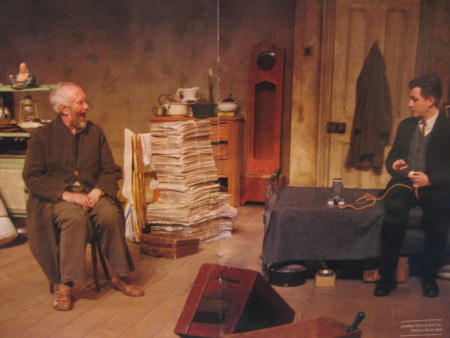
Jonathan Pryce as Davies and Alex Cox as Aston
BAM, is Brooklyn Academy of Music. It is Brooklyn’s premier showcase for productions which do not mirror the crass commercialism and faux quality of Broadway’s double digit IQ spectacles, excepting (A Streetcar Named Desire, Death of a Salesman, Seminar, The Best Man, Other Desert Cities, Leap of Faith superb, standout shows that I have seen this year) In addition to superlative global productions mounted by the Bridge Project (Kevin Spacey and Same Mendes’ American/British collaboration of touring works by Shakespeare-this year’s Richard III starring Spacey) and other global offerings from Russia, Australia and the United Kingdom: The Three Sisters, John Gabriel Borkman (with Alan Rickman and Fiona Shaw) and Gogol’s Diary of a Madman (with Geoffrey Rush) the season presents interviews and talks with cast members after performances.
This year I was blessed to see live sessions with Declan Donnelan, John Hurt and the cast of The Caretaker (see review) Jonathan Pryce, Alan Cox and Alex Hassell. These are precious gifts. I try to take advantage of the live sessions because the actors, after having expended their souls onstage, graciously share the remainder of their energies even though they must be drained of all emotional heft. It is their act of love and the celebration of an art form that will never die because it IS the reality show and anything that can happen will happen during a live performance and dealing with it is electric. I am there to celebrate with them.
Amazingly, each time (John Hurt, Alan Rickman, Fiona Shaw, et. al, Geoffrey Rush) after their performances, the actors have appeared as fresh as moments ago picked corn, carrying their great good will and humor with them despite the grind. I find that my love for live theater and appreciation of BAM has been strengthened each time I’ve stayed for discussion, so upon leaving, I secretly nod a special thank you to Dionysus, the patron of all great theater. Whenever I lust for an apartment in Manhattan, I think of BAM, the Hamptons and the US Tennis Open, locations which are très inconvenient for Manhattanites. I am thankful that I live in the second most fashionable section of Queens, artsy Kew Gardens and am to be envied: I have a car…HA, HA, HA, a wonderful perk that makes up for being estranged from Manhattan’s living spaces.
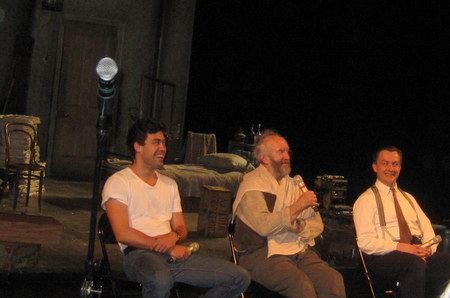
Alex Hassell (Mick) Jonathan Pryce (Davies) Alan Cox (Aston). Pryce just cracked up the audience.
On Thursday, May 24th, Pryce, Cox and Hassell managed to recoup from an incredible performance to face their worshipers (they received a lengthy standing ovation). How did they do it? I guess it was “The show must go on,” because many actors, Philip Seymour Hoffman, Angela Lansberry and James Earl Jones eschew this kind of thing. But the Brits are level headed about their theater, unlike some American celebrities who might be too incredibly shy, Method, wiped, or self-adulating to scrape the will to expose themselves for who they are in their own skins. With their long tradition of theater and Shakespeare who lived “in the midst of the common folk,” Brits and Aussies are notoriously self-effacing and unselfconscious when it comes to meeting fans. I wish that more American “celebrities” and/or actors were that way. That’s insecurity for ya.
As obtuse as the play can be if not acted superlatively (it was) this talk back was revelatory and insightful. Each of the actors reaffirmed the importance of living onstage and adhering to what was in the script which told all in telling little. Pryce had been with the production longer than Hassell and Cox and had even played the character of Mick in a 1980 production in England; he twitted Hassell that he was very good as Mick, garnering a laugh from the audience and a smile from his fellow actor. Pryce’s humorous touches were a pleasant surprise, but then his range and versatility as an actor spans The Comedians (1977, Broadway, a Tony) The Engineer in Miss Saigon for which his brilliant and controversial performance won him a second Tony (1992), to Lytton Strachey in Carrington, (1995) for which he won the Best Actor award at Cannes. Most recently he has played the governor in the three Pirates of the Caribbean films and began his scary, evil renown with the devil character in Somthing Wicked This Way Comes (1983). He was so convincing as Juan Peron in the film Evita with Madonna, I forget it was Pryce.
Pryce discussed the romanticism of the Davies character when Pinter first conceived of the play in the 50s. He is the tramp who lives like a gypsy wandering the roads and sleeping under the stars: perhaps representing every settled man’s hunger for freedom. But in the current times of harsh economies, foreclosures and rampant homelessness in cities across the globe, the actors upgraded the pressure each of the characters faces. Pryce said that the Davies character’s dark and desperate circumstances (the antithesis of the romantic, carefree tramp) framed Pryce’s internal emotional choices. And all of the characters at one point or another echoed that the play has taken on a darker meaning in our age of creeping poverty, political vapidness and lack of will to correct the gross inequities of wealth and power between and amongst economic classes.
Columbia University Pinter Scholar Professor Quigley moderated with wonderful questions.
At a prompting from moderator, Professor Quigley, Pinter scholar at Columbia University, Pryce shared his experience and remembrance as a child visiting his father in an institution like the one where Aston was committed. Pryce recalled his fears walking down long, silent corridors locked at each end, hearing the keys jangle in the door as the aides unlocked each door and relocked it. And when he saw his father in a bed with rows of beds around him filled with other men, he was afraid; it was a terrible emotional experience. He said he used those feelings to frame Davies’ character in part, because Davies is perhaps as mentally unwell as Aston is. “He says the craziest things,” said Pryce smiling and perhaps he could indeed end up in such a place (though nowadays, the shelters have become the even more dangerous institutions of the insane. It’s afer on the streets.) Pryce reaffirmed that in the laughter (Character interactions both times I saw the play drew audience laughs.) or the light, there is the darkness. In other words, as we laugh at the ridiculousness of the characters and situation, there is the fear, poignancy and knowledge that we are seeing the truth of ourselves.
In the question and answer sessions, Pryce was equally generous. Davies’ cries and angst-driven dreams that awaken Aston, Pryce said were triggered by memories of Pryce’s daughter who talked in her sleep when she was under stress and of course, was upsetting to him. And when one audience member in the question and answer session suggested that he was pushing for laughs, Pryce handled the insult beautifully, first pretending to ignore the man and then quipping they needed “get rid of him.” He then dealt with the idea of “pushing” as an actor not being something that serves the actor and his colleagues. However, having seen the play twice, I affirm that the play’s sentiment and revelation would have been completely lost if any of the actors, especially Pryce were untrue or “going for laughs.” Pryce found the emotional resonance to convey Davies’ desperation, his wants, his wounds, all unconscious to Davies, but visible to us through Pryce’s massive acting instrument.
Alan Cox as Aston in the question and answer session discussed the importance of following the action of the play which specifically states what each of the characters is doing. To keep the interactions fresh each night, Hassell, especially did not want to know how the others were interpreting something, because the characters don’t know this. Uncertainty reigns; unexpected reactions rule. It doesn’t inform the actor to be gummed up with extraneous interpretations upon interpretations. Cox did respond that inviting Davies in, Aston is generating a random act of human kindness, nothing more. What evolves is human dynamic, power struggle, spontaneity, craziness, because that’s who these people, especially Davies are. We catch glimpses, as we catch glimpses in life, never knowing for certain, never stating something is forever. It is constantly a state of flux. When Quigley quoted that Pinter said you shouldn’t necessarily believe everything that Aston says in his long monologue about being committed, Cox’s reply was wonderful, THE QUINTESSENTIAL superb actor’s reply. Well, I believe what is in the script. I believe that what Aston says he experienced, he experienced. And Hassell echoed those sentiments. To pin down an interpretation of Mick’s intentions is pointless. The more one attempts to convey and pin down one specific interpretation, the less real, the less dynamic the less comprehensible the character.
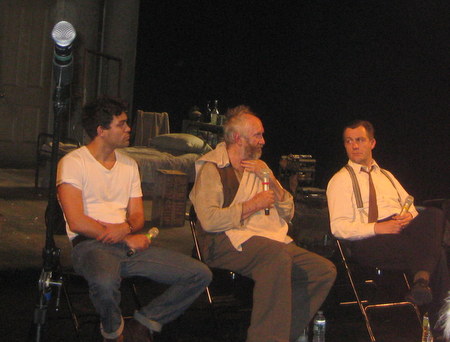
Hassell, Pryce, Cox discussing the darker aspects of the play trending now.
After their sharing with us, I understood why this production is so outstanding, so brilliant, clearly the best of Pinter I have ever seen done, and I have seen deadly, boring Pinter. And I have heard that when Pinter attempted to direct, there was too much of a “going for a result,” a stepping out to convey a particular theme. In this production, there was none of that. Because in life, we are not interpreting our roles and actions as we go along. WE LIVE THEM. WE ARE THEM. WE ARE FEAR, DESPERATION, HOPE, LONGING, WANT, NEED. We don’t editorialize about how this action can be interpreted this way, except in hindsight twenty years later when we realize what we were doing. If that indeed is what we were doing because hindsight has its own reality.
The shifting light and dark, truly, as Pryce said, creates our understanding, my understanding, for we are all different, and I walked away with different values and perceptions because of my background as did every individual in the audience. The actors respected the work and their talents to bring life to the stage. And they are so incredible, I imagine they are able to do this for the rest of the performance schedule until June 16th when the final curtain of The Caretaker falls. Well, I for one am gobsmacked I’ve seen such magnificence. What a joy.
 CAROLE DI TOSTI