Blog Archives
‘The Queen of Versailles,’ Fabulous Kristin Chenoweth Makes Dreams Realities
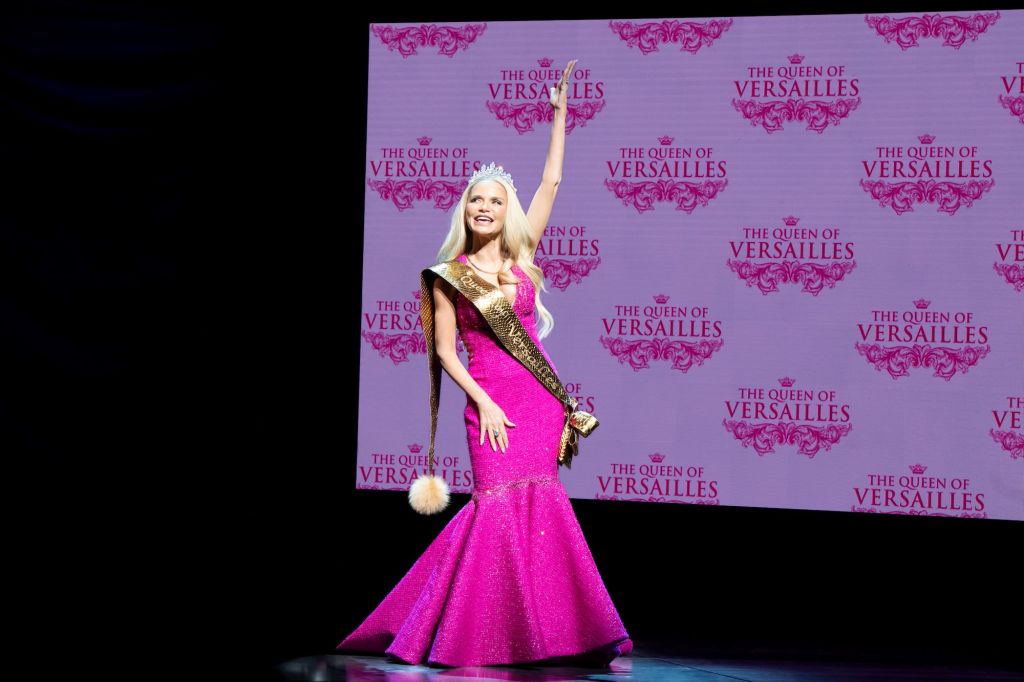
If the road to excess leads to the palace of wisdom (quote by English poet William Blake), do people know when they’ve reached their limit? When is enough enough? According to the themes of the new musical The Queen of Versailles, currently at the St. James Theatre, knowing this depends upon the seeker.
In the clever, sardonic musical, based on Lauren Greenfield’s titular documentary film and the life stories of Jackie and David Siegel, the question of excess and how to measure it shines into the darkness of American culture, conspicuous consumption, surgically enhanced, plastic looks, and meretricious values. With an ironic, humorous, no holds barred book by Lindsey Ferrentino, and music and lyrics by Stephen Schhwartz, the Siegel’s riches to more riches story, including the 2008 mortgage debacle, takes center stage. By the conclusion, the audience leaves shaken and maybe stirred, either with a bad taste in their mouths or with the prick of guilt in their consciences.
At its finest, The Queen of Versailles inspires the audience to peer into their own values and behavior and evaluate their souls to correct. Ultimately, it asks, do the Siegels have a worthwhile life or have they allowed their childhood poverty to overwhelm their good sense and inner emotional well being? Despite its ripe fun Ferrentino’s book and Schwartz’s music encourage a hard look at crass, materialistic greed that blinds the rich from using their largess for the social good. Lastly, it questions do the representative Siegels count the cost to live the oversized billionaire’s lifestyle which causes harm? To what extent has their craven indulgence choked off their lifeblood to their own destruction?
Starring an endearing, heartfelt and bubbly Kristin Chenoweth as the materially insatiable Jackie Siegel, and F. Murray Abraham as billionaire workaholic David Siegel, the New York premiere which has an end date of March 29, 2026, rings with disturbing truths. It’s farcical, dark elements present many themes. Chief among them is the theme that the Siegel’s shiny ostentation hides a sad emptiness that can never be fulfilled.
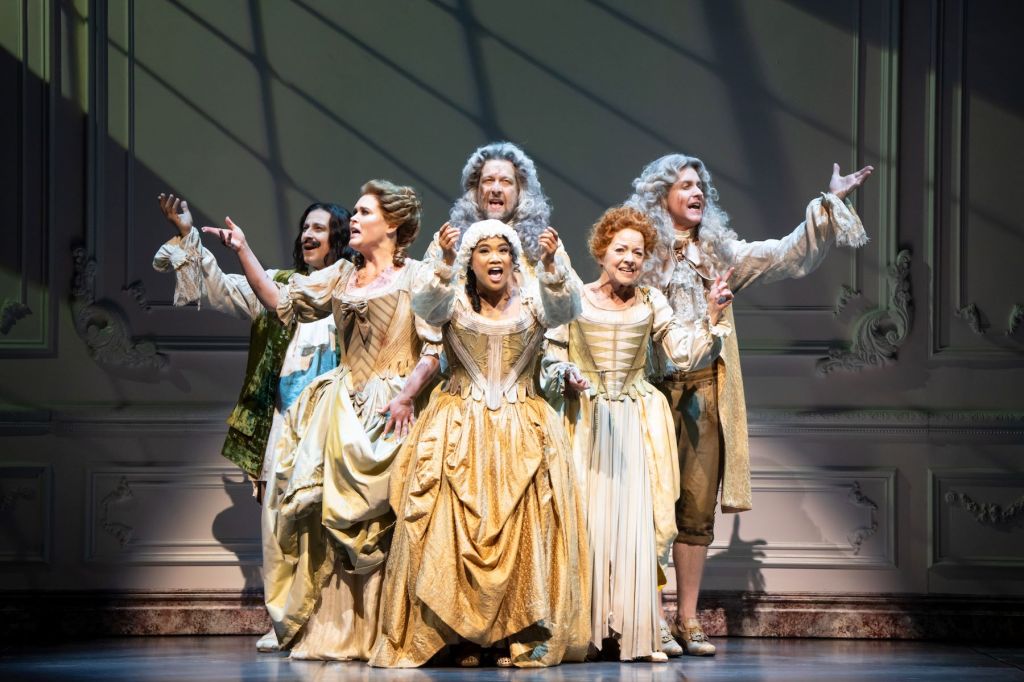
Framing the Siegel’s story with the key meme of Versailles, the mansion in France that 17th century Louis XIV, built as a memorial to his majesty, the opening scene and song (Pablo David Laucerica is King Louis XIV) replete with period chandeliers, furniture, costumed butlers and maids reveals how and why the Sun King built his palace on swampland (“Because I Can”). Without giving thought to the inequities in French society that necessitated the economic gap between royalty and its impoverished, destitute subjects, Jackie and David want one.
In a quick switch to the present (2006) we see the Siegel’s Versailles in progress. With construction scaffolding in the background and a documentary film crew in the foreground, Chenoweth’s Jackie glows as she sings “we want to have the very best for the biggest home in America because we can.” The fluid set design with appropriate props and pieces by Dane Laffrey, who also does the video design, brings perfect coherence to the Siegel’s intentions. It connects the idea of royal wealth manifest in Louis XIV’s lavish excess to their rich/famous lifestyle which reeks of tawdriness. Thanks to Michael Arden’s staging and direction and Cristian Cowan’s costumes, and Cookie Jordan’s hair and wig design, the shifts from the present to the court of Louis XIV and back solidly establish the trenchant themes of this profoundly current musical.
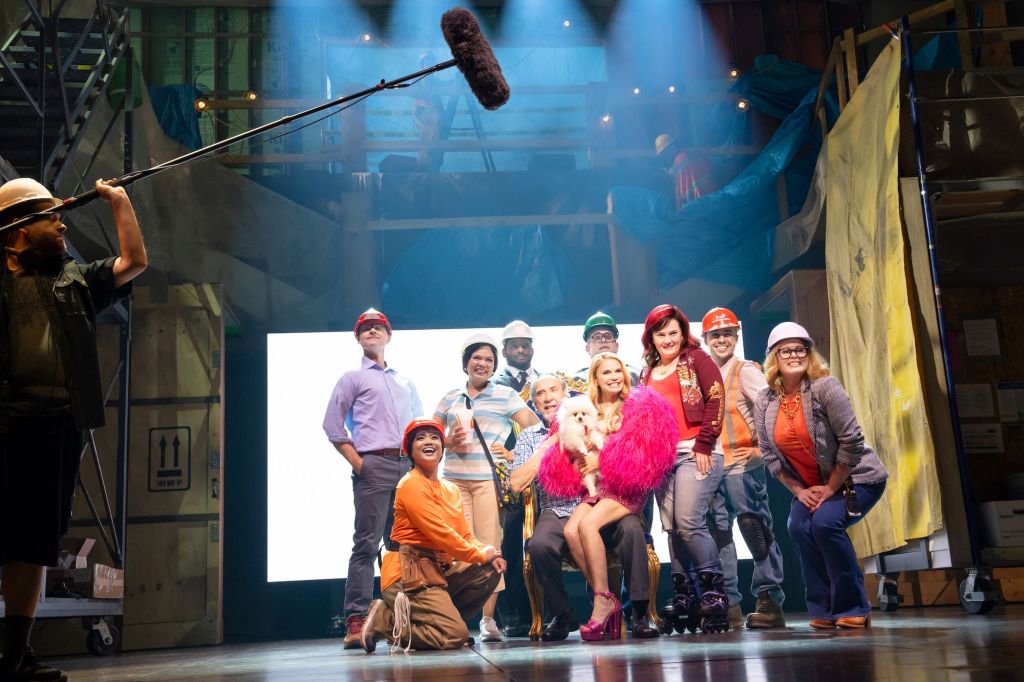
Presuming themselves American royalty, the Siegels hope to replicate a modern-day Versailles, like their mentor king. Indeed, they will best him. Their Versailles has whatever the family wants. This includes a jewelry-grade gem stone floor, an in-house Benihana (with all those tossed shrimp because David doesn’t like to stand on line), a spa, a pool with a stained glass roof, and a family wing with numerous bedrooms and bathrooms so Jackie doesn’t lose track of her seven kids.
After this opening salvo that mesmerizes like any show about the “lifestyles of the rich and presumptuous,” we discover that Jackie didn’t always come from wealth. In fact her story mirrors the old Horatio Alger “rags-to-riches” fable that Alger shaped into the American Dream, which abides today and which also influenced F. Scott Fitzgerald’s take on it in The Great Gatsby. Jackie, albeit a female dreamer, buys into the concept that if she pulls herself up with determination, works hard and does good works, she can lift herself into the upper classes.

We see how this manifests in the next segment of Chenoweth’s 17-year-old version of Jackie with her parents Debbie (Isabel Keating) and John (Stephen DeRosa) in their humble Endwell, New York home. Debbie and John count on Jackie to continue to work as many jobs as possible to become rich and famous like the titular show they watch together. Singing the song “Caviar Dreams,” a ballad that expresses beautifully a female Alger hero, we “get” Jackie’s drive and pluck to work day and night to achieve an engineering degree at IBM, then kick the job to the curb because it won’t give her wealth fast enough.
As she “keeps on thrustin” she makes a bold turn into marriage with alleged banker Ron (Michael McCorry Rose), who disappoints when he drags her to the Everglades, and opposes her Mrs. Florida win. When he physically abuses her, despite her pregnancy, Jackie leaves. Singing “Each and Every Day” beginning when Victoria is a baby, the scene switches to the present at the construction site and the teenage Victoria (the excellent Nina White) enters. Chenoweth’s Jackie soulfully finishes the song to Victoria in an important transitional moment. We understand Jackie as a survivor who loves her firstborn, who she claims saved her life.
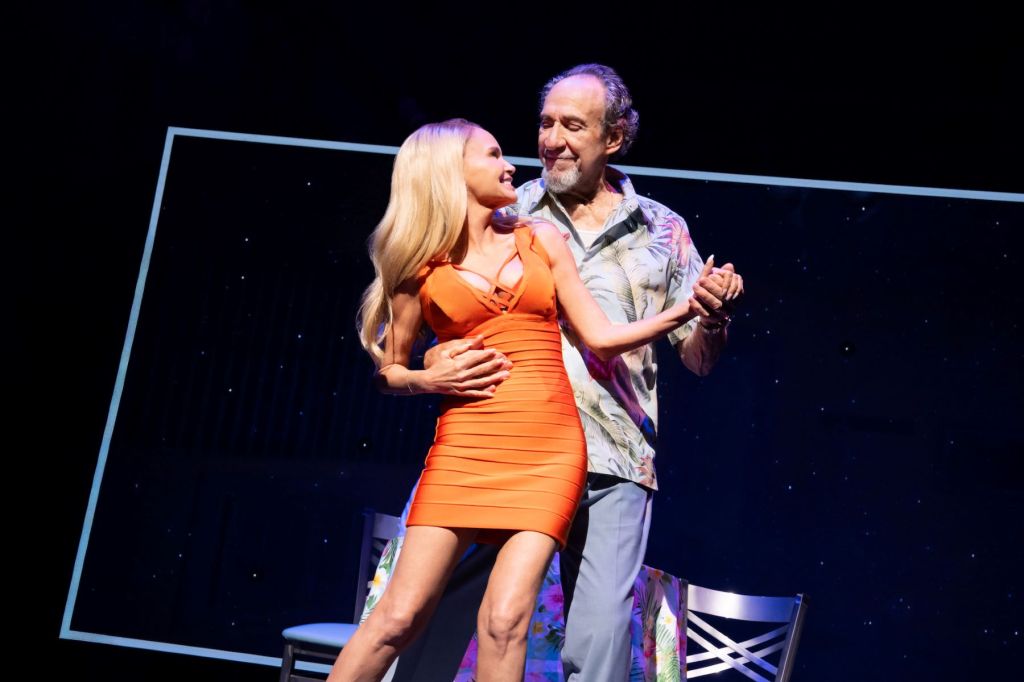
Not only does Jackie not look back, we learn she and baby Victoria lived in an apartment which “barely fit the baby’s crib and Jackie’s sleeping bag.” However, always “thrustin’ forward,” she recognizes opportunity when she goes to a party where she meets David Siegel, the CEO of Westgate Resorts. As it turns out, his impoverished childhood was similar to hers and left him with dreams of extreme wealth. F. Murray Abraham does justice to David throughout, first as a “cowboy” in the wild west of timeshares as son Gary (the fine Greg Hildreth) sings with the ensemble “The Ballad of the Timeshare King.” Occasionally, for emphasis, Abraham’s David chimes in with irony.
For example, David’s sales force make “one hundred percent of their sales on the first day.” Gary sings, “George W.’s president now, thanks to David Siegel.” When folks can’t afford the timeshare, Siegel helps them with financing from his bank, so the ensemble sings joyfully, “Yippee-I-owe-you-owe-we-owe.” We recognize the sardonic humor for David’s dishing out sub-prime mortgages to “anyone who breathes.” Of course this adds to the mortgage crises of 2008 which taxpayers foot the bill for. Eventually, the sub-prime loans bring his empire to the brink of bankruptcy as the crash swallows whole billionaires like David.

At that point, Jackie and David have been married with children and are two years into the Versailles construction having cycled through songs of their outsized wedding (“Trust Me”), a honeymoon trip to Versailles bringing back a scene of King Louis XIV and his courtiers. Smartly, Ferrentino and Schwartz reinforce their themes by joining past and present in the reprise “Because I Can and the “Golden Hour.”
However, conflict looms on the horizon. Though David and Jackie live their wildest dreams and birth child after child, daughter Victoria feels miserable, insular and ugly. “I know mom wishes I was prettier,” she sings in the poignant “Pretty Wins.” And in Act II in the superb “Book of Random” Victoria sings from her journal, the thoughts that she keeps hidden. Unlike her mother Victoria grounds herself in her current feelings of sadness brought on by reality, escapism fueled by drug addiction and scorn for their damaging and excessive lifestyle. However, when Jackie’s niece Jonquil (Tatum Grace Hopkins) arrives and Jackie takes her in, we think that Victoria has someone to confide in.
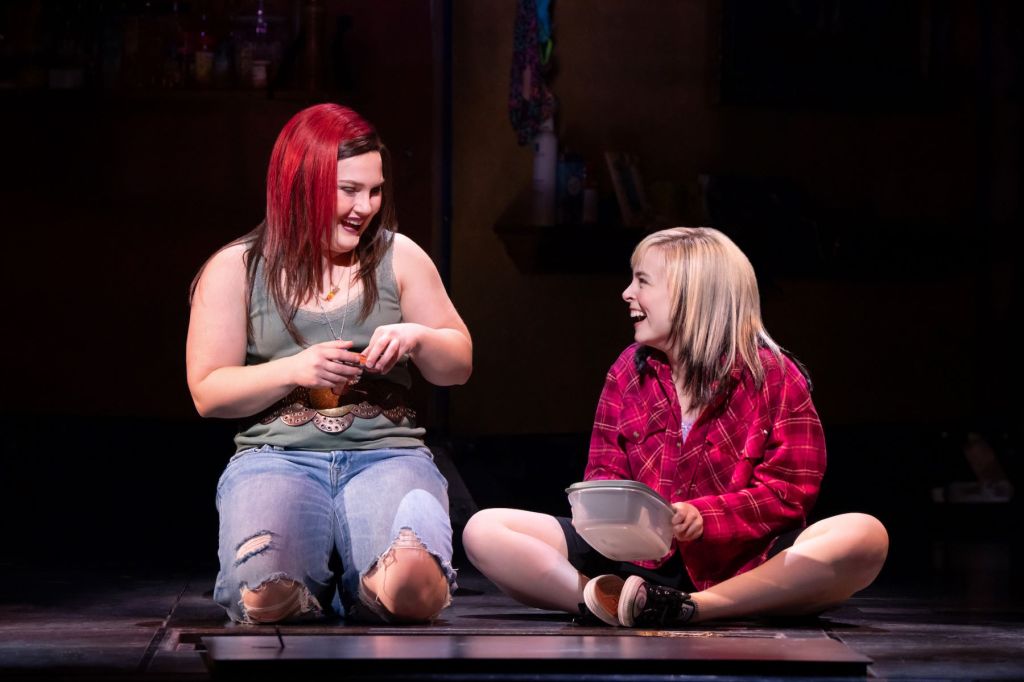
But Jonquil doesn’t understand Victoria’s dislike of Jackie’s appetite for more. And it doesn’t help Victoria that Jonquil becomes a clone of Jackie (“I Could Get Used to This.”). Ironically, when the crash happens and Victoria hears of the talk that they will sell Versailles to keep David from going belly up, she feels relief. In a farce-filled scene in the 17th century Versailles, with some of the most ironic lyrics, the Sun King chides the Siegels and Americans in the song “Crash.” “You thought you’d be egalitarian, let peasants own their own homes in some altruistic plan. Well, what were you expecting from a choice so rash? Crash…”
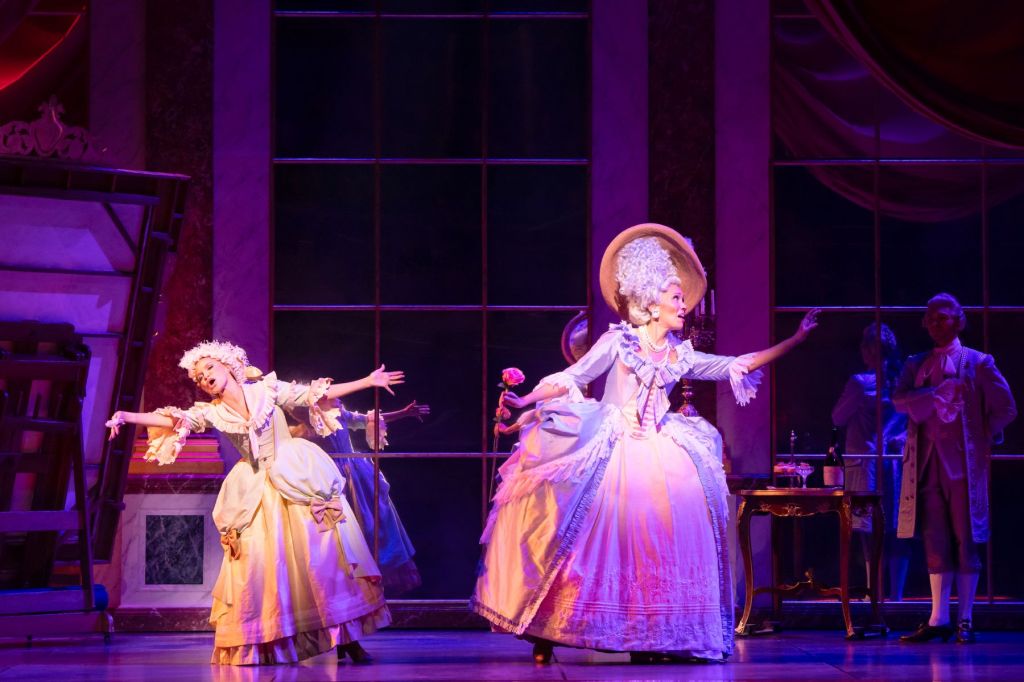
At the end of Act I, we have only Jackie’s spunk and perseverance (“This is Not the Way”), and David’s connections to rely on to bail them out of bankruptcy and foreclosure. Act II reveals that deus ex machina saves them when the government (taxpayers) bail out billionaires and banks. Naturally, the little people with no safety net lose their shirts. Where the peasants of France revolted against their royals (there is a humorous scene with the luckless Marie Antoinette on her way to the guillotine), in America, no one goes to jail because the banks and firms are “too big to fail.”
At the end of Act II, in a scene with King Louis XIV, in a reprise of “Crash,” King Louis and his courtiers sing as Marie Antoinette says “goodbye.” Here, Schwartz’s lyrics and tune underscore a crucial theme. America’s Aristocracy has cleverly worked it out that “democracy” will prevent revolutions. How? The rich have peasants “thinking they’re tomorrow’s millionaires; that you’re special privileges will someday soon be theirs.” And the ensemble adds, “No blade across the throat for you. Instead it seems your peasant class will all turn out to vote for you!” Thus, with no accountability for wrecking the economy and countless lives, the rich get richer, and Jackie and David, out of bankruptcy, continue building Versailles.
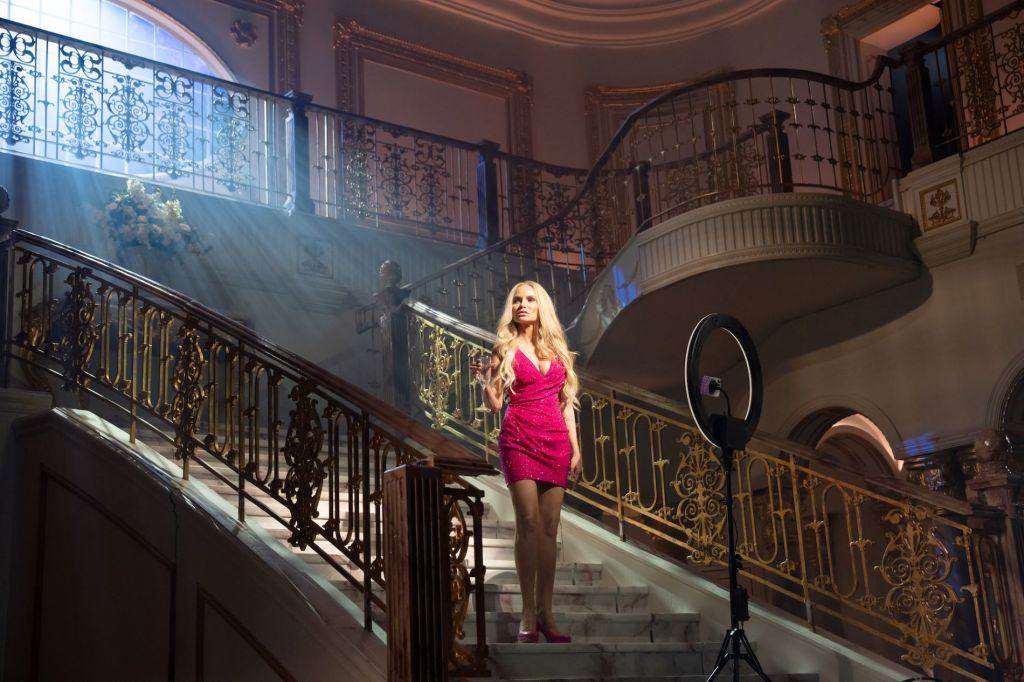
However, in all of the mayhem of trying to regain solvency, the Siegels sacrifice a family member. If material empires go on for centuries, flesh and blood does not. The unreality of excess belies mortality. But some folks never learn. Schwartz and Ferrentino ironically underscore this as Chenoweth’s Jackie holds a glass of champagne standing in front of a ring light. She speaks to a social media audience and hopes that, like her, they get their “champagne wishes and caviar dreams.”
The Queen of Versailles runs 2 hours 40 minutes with one intermission at the St. James Theatre. https://queenofversaillesmusical.com/
Tribeca Film Festival Review 2018: ‘Every Act of Life,’ Looking Into the Brilliant Terrence McNally

(L to R): Director Jeff Kaufman, Terrence McNally, ‘Every Act of Life,’2018 Tribeca FF World Premiere Special Screening and Q & A, Moderator Frank Rich, unpictured (Carole Di Tosti),
Terrence McNally is a theatrical force of nature, though with his incredible humility in an age of self-promotion, he would be the last to admit it. With a career spanning six decades and major, ground-breaking successes on Broadway and Off, in film and television, and multiple theater awards every decade, the man is a dynamo, beloved by actors whose careers he has vaulted, actors whom he collaborates with in a symbiotic relationship again and again. At 80, he is still working, attending productions (I saw him in the audience of the musical production of the most Tony nominated musical SpongeBob SquarePants this summer.) and launching off into new projects, even as I write this.
The World Premiere Every Act of Life directed and written by Jeff Kaufman was given a special screening at Tribeca Film Festival 2018, with luminaries, actors and McNally himself attending for the Q and A afterward. In this formidable documentary about a formidable American playwright, Kaufman presents McNally’s career and personal life. From start to finish Every Act of Life is an intriguing and well-thought-out chronicle cobbled together with interviews, archived photos, video clips, well-researched facts, details, memorabilia and well-placed commentary by actors, directors, producers and McNally himself. The documentary is especially revealing in its presentation of how one individual’s love and passion for the theater, opera, music and art has impacted our culture and brought us together in a forward momentum of shared communication and understanding.

Tyne Daly (‘Mothers and Sons’ and ‘Master Class’), Nathan Lane (‘Love! Valor! Compassion!’ ‘The Lisbon Traviata,’ ‘ It’s Only a Play’)2018 Tribeca FF World Premiere and Special Screening and Q & A (Carole Di Tosti)
Beginning with his early plays and traveling right up to his most recent work, Kaufman lays out the seminal moments and turning points that have slowly fostered the personality and character of this mild-mannered and charmingly authentic persona that McNally is today. Early influences on his life McNally credits to his English teacher in Corpus Christi who encouraged him to write and attend schools outside of the area. But his love of musicals and Broadway, were initially inspired by his parents, transplanted New Yorkers, who brought him all the way from Texas to New York to see a few smash musicals with towering figures like Gertrude Lawrence in The King and I and Ethel Merman in Annie Get Your Gun.

Terrence McNally, ‘Every Act of Life,’ 2018 Tribeca FF World Premiere Special Screening and Q & A (Carole Di Tosti)
The excitement and enchantment of live theater musicals were imprinted on his memory. And this love abides with him to this day as he continues to collaborate on musicals writing the book for numerous hits like The Kiss of the Spider Woman (1992), Ragtime (1996), The Full Monty (2000), The Visit (2001), Catch Me If You Can (2011), Anastasia (2017). He has also sharpened his wits and taken up collaborating on opera, for example in 2015, the production of Great Scott (music by Jake Heggie), premiered at Winspear Opera House in Dallas, Texas. He is a veritable tornado when it comes to writing new plays and collaborating with composers on musicals and operas.

Chita Rivera appeared in McNally’s ‘The Rink,’ (1984) ‘The Kiss of the Spider Woman,’ (1992, 93, 94) ‘The Visit,’ (2004). Tribeca FF 2018, World Premiere Screening and Q & A, ‘Every Act of Life.’Chita Rivera appears in Kaufman’s film about McNally. Here Chita Rivera appears at a 2018 LPTW event (Carole Di Tosti)
Following his English teacher’s advice, McNally attended Columbia University and was further shepherded by professors like Lionel Trilling for literature and Andrew Chiappe who steered him in the basics by having McNally and others read every work by Shakespeare in the order of their composition. After Columbia, McNally through a serendipitous introduction via The Actor’s Studio, cruised with John Steinbeck and family around the world as he tutored Steinbeck’s two young sons. This was another incredible experience which was to shape McNally’s writing career and broaden his horizons as well as establish his relationship with Steinbeck who inspired his writing. From these adventures he later fashioned the first act of And Things That Go Bump in the Night. Additionally, Steinbeck asked him to write a libretto for a musical adaptation of his novel East of Eden. One doesn’t know what one can do until a great American novelist like John Steinbeck asks you to do it.

F. Murray Abraham, ‘Every Act of Life,’ 2018 Tribeca FF World Premiere and Special Screening and Q & A (Carole Di Tosti)
Back in New York City, McNally used his connections at the Actor’s Studio to begin to workshop his nascent one-act plays. And it was in New York that he met the brilliant playwright Edward Albee who was just coming into his own. After a four-year tempestuous relationship during which Albee wrote The American Dream and Who’s Afraid of Virginia Woolf, they parted ways and McNally’s career began to take off gradually in theater, television and in film as he wrote screenplays for versions of his works first performed on Broadway and Off Broadway.

(L to R): Terrence McNally, Edward Albee, ‘Every Act of Life,’ 2018 Tribeca FF World Premiere Screening and Q & A (Carole Di Tosti)
Various tidbits appear in Kaufman’s documentary that fascinate. Some of the impressions are telling. He became addicted to alcohol and at a time when no one could admit to being gay, McNally confronted the oppressions of the culture and created some of the most insightful, poignant and endearing works related to the LGBT community and relatives confronting the AIDS epidemic. These include the TV miniseries Andre’s Mother for which he won an Emmy and later his Mothers and Sons starring Tyne Daly based upon the miniseries. Additionally, Lips Together, Teeth Apart, as well as an inside look at gay relationships for which he won his second Tony Award, Love! Valor! Compassion! also feature topics about confronting gender prejudice.

Joe Mantello, ‘Every Act of Life,’ 2018 Tribeca FF World Premiere Screening and Q & A (Carole Di Tosti)
Always concerned about the deep side of the human condition and striving above it, McNally first landed on the map when he was recognized for his portrayal of female-male relationships among the working classes (Frankie and Johnnie in the Claire de Lune) which was adapted into a screenplay starring Al Pacino and Michelle Pfeiffer. McNally’s versatility and humanity encompasses play topics that run the continuum. What is most important to him is human connections and the realization that we are together in this “thing” referred to as life. The beauty of our ability to connect, express love, overcome personal issues and adversity, with an assist from art and theater makes all the difference in discovering our purpose and fulfillment.
McNally’s dogged fight for LGBTQ rights at a time when it was most unfashionable and nearly anathema is an incredible achievement, considering the forces and money behind the attempt to liquify LGBTQ rights in the noxious march toward inhumanity and darkness led by the political conservative right-wing. Kaufman highlights the struggle. He also reveals how McNally overcame his addiction to alcohol and on that subject includes an amazing anecdote. Angela Lansbury’s love and honesty prompted her to speak directly to McNally to the effect that he must stop destroying himself. Indeed, she feared this most talented playwright, librettist and screenwriter would die an early death. Her influence and other factors eventually sent him down the road to wellness, where others were not as willfully fortunate.
What I appreciate in the film is McNally’s candor in discussing his “flops.” Of course, one might say that there are no flops in a playwright’s repertoire, only stepping stones which help them achieve their hard won success.

2018 Tribeca FF World Premiere Screening and Q & A, ‘Every Act of Life,’ (L to R): Jeff Kaufman, Terrence McNally, Tyne Daly, Nathan Lane, Joe Mantello, F. Murray Abraham (Carole Di Tosti)
Kaufman highlights McNally’s award-winning work (the musicals- The Kiss of the Spider Woman-1992 and Ragtime-1997 and his plays, Love! Valor! Compassion!-1994, Master Class-1995 and Dedication or The Stuff of Dreams-2005). The most incredible feature of this segment of the documentary is the commentary by living legends and McNally friends and collaborators, Chita Rivera, Nathan Lane, John Glover, Tyne Daly, John Kander, F. Murray Abraham, Joe Mantello, Angela Lansbury, Christine Baranski, Audra McDonald and many more. Indeed, the film is a who’s who of McNally’s posse, as well as a chronicle of his prodigious work ethic and love of theater, opera, ballet and music. His talents and breadth of knowledge about the Arts are absolutely staggering. And Kaufman gives us a historical perspective that is continually fresh and exciting.

Terrence McNally, ‘Every Act of Life,’ 2018 Tribeca FF World Premiere Screening and Q & A, (photo courtesy of the film)
I loved this film. I am familiar with McNally’s work having seen a number of his musicals and comedies on Broadway and Off. I split my sides enjoying them. However, Kaufman digs deep into the revelation of the anointed genius of this most wonderful of playwrights who connects the heavens to humanity with his words, impressions and inspirations, and joins us together in what can be compared to a holy act of communion in the theater. The film is a must see, and you will especially enjoy hearing how McNally and friends worked together to create some of the finest, most enduring works of American theater which in the future will surely be identified as classics.

‘Every Act of Life,’ Q and A, Tribeca FF 2018 with (L to R) Jeff Kaufman, Terrence McNally, Tyne Daly, Nathan Lane, Joe Mantello, F. Murray Abraham, moderated by Frank Rich who is not pictured (Carole Di Tosti)
Epilogue
After the World Premiere Screening there was a Q and A moderated by Frank Rich, who was a longtime critic of theater at The New York Times. McNally made an incredible admission during the Q and A. Even though he has a prodigious body of work trailing in his wake, he never really considered himself a playwright or a successful one at that, until a few years ago. I was gobsmacked. Such is the talent and evolving genius of this artist.
That Frank Rich was moderating individuals he has sometimes dunned in his previous job as New York Times Theater critic was a bit of an irony. He long held sway as THE Times CRITIC until 2011. Often he was acerbic and unwieldy in his self-aggrandizement and pretensions to be THE VOICE of theater, backed by the “heft” of The Times. After I accomplished some gentle research for this review, I discovered a note in Wikipedia on Kiss of the Spider Woman (musical) that bears sounding since the main subject of this film is American Theater and Terrence McNally as one of the fountains where we might go for a revitalizing drink..
It seems that in 1990 Kiss of the Spider Woman was being workshopped at “New Musicals” at the Performing Arts Center SUNY at Purchase. New Musicals‘ goal was to create, develop and provide a working home for sixteen new musicals over four years. When New York critics heard that the play was being workshopped in its initial production, they wanted to see it. Unfortunately, they couldn’t be persuaded not to review it despite the fact that producers, etc., were testing the waters to see what needed ironing out. Frank Rich and other critics filed “mostly negative reviews” of this initial workshopping of Kiss of the Spider Woman. Sadly, New Musicals, whose mission was honorable and vital for American theater and especially New York Theater, blew out and folded after the fiasco with Kiss. Don’t get me started on the state of American Theater and why it is that way.
Thankfully, two years later a producer developed Kiss of the Spider Woman. It went on in Toronto and The West End where it won An Evening Standard. It finally came back to the US where it received 7 Tony Awards and 3 Drama Desks and ran 904 performances, despite Rich’s reviews. Ultimately, the American public became the arbiter of the production.
American Theater has lost ground for many reasons and indeed, the gatekeepers, critics and money people have, for all intents and purposes, shot it to hell and drained its lifeblood. With the rise of Social Media, for good or ill, digital platforms and word of mouth continue to lift up productions so that their lasting value might be revealed to give them staying power. But it is enough? Rich went on to feather his own nest. Kiss of the Spider Woman found its audience. New Musicals is no more. And so it goes. In light of these events Every Act of Life is an important documentary about the history of American theater, and a master creator who has thrived in spite of changing times.
 CAROLE DI TOSTI