Blog Archives
‘Fear of 13’ Starring Adrien Brody in an Incredible Tour de Force
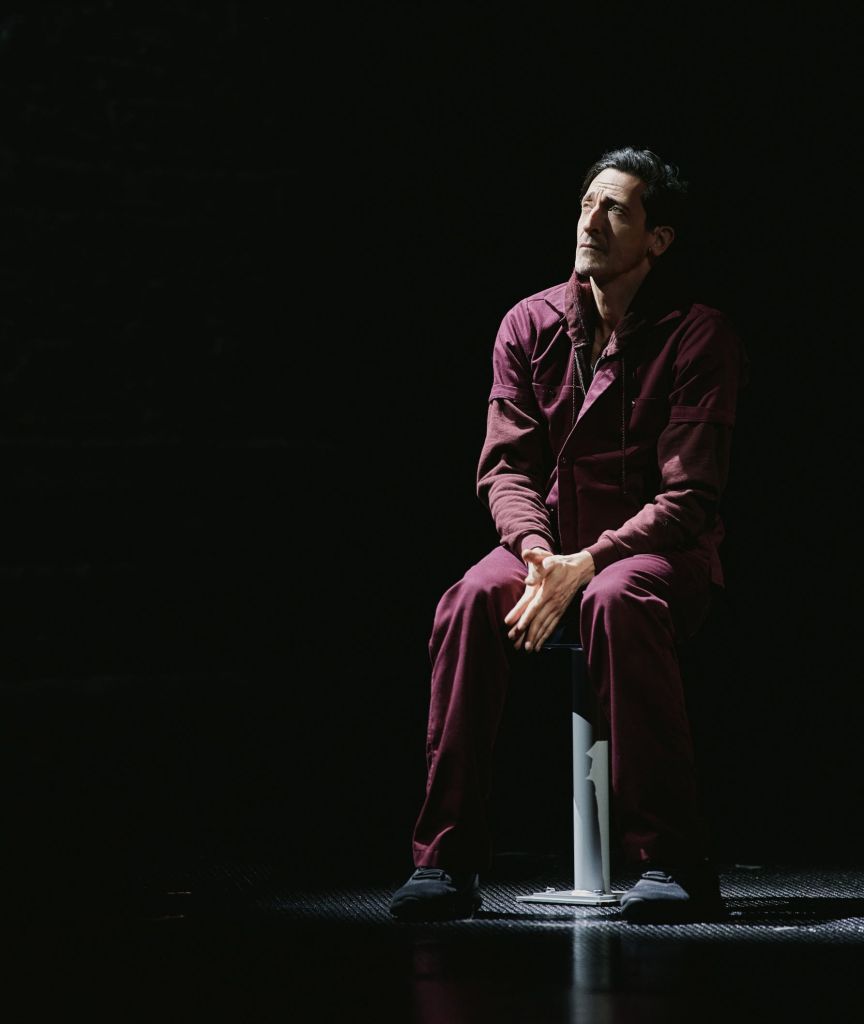
Based on the titular 2015 documentary directed by David Singon, The Fear of 13, directed by Davd Cromer is a prison drama with twists that upends easy assumptions. With Adrien Brody portraying Nick Yarris who spent years on death row. Brody is assisted by the wonderful Tessa Thompson as Jacki Miles, Yarris’ friend, confidante and spiritual lover until she isn’t. The two portray individuals who help each other and then acknowledge they must end their relationship because they have had enough of waking up to dreams that have no hope of manifesting. Currently, the play runs at the James Earl Jones Theater through July 12, 2026.
Written by Lindsey Ferrentino the production opens against a dark stage with a spotlight on Brody who speak as an everyman, Man 1. He discusses the nature of time’s variability: “a blisteringly fast thing, where in the blink of an eye – ten years are gone from your life, but the next week is agony.” “… then you look out the window …and it takes all day for the sun to go down…”
This theme about time relates to Brody’s Yarris who has an intimate, hyper-conscious knowledge of time as an inmate on death row. It is in this setting that we experience events through his perspective and the horrors of incarceration on the death row cell block in a prison in the state of Pennsylvania. On death row where time can’t be “done,” it exists in a state of suspension. On the one hand “time is of the essence,” as the appeals process runs for years and the men like Yarris wait for exoneration or execution. On the other hand, when the final result is achieved, it’s a matter of days to the inmate’s release or death.
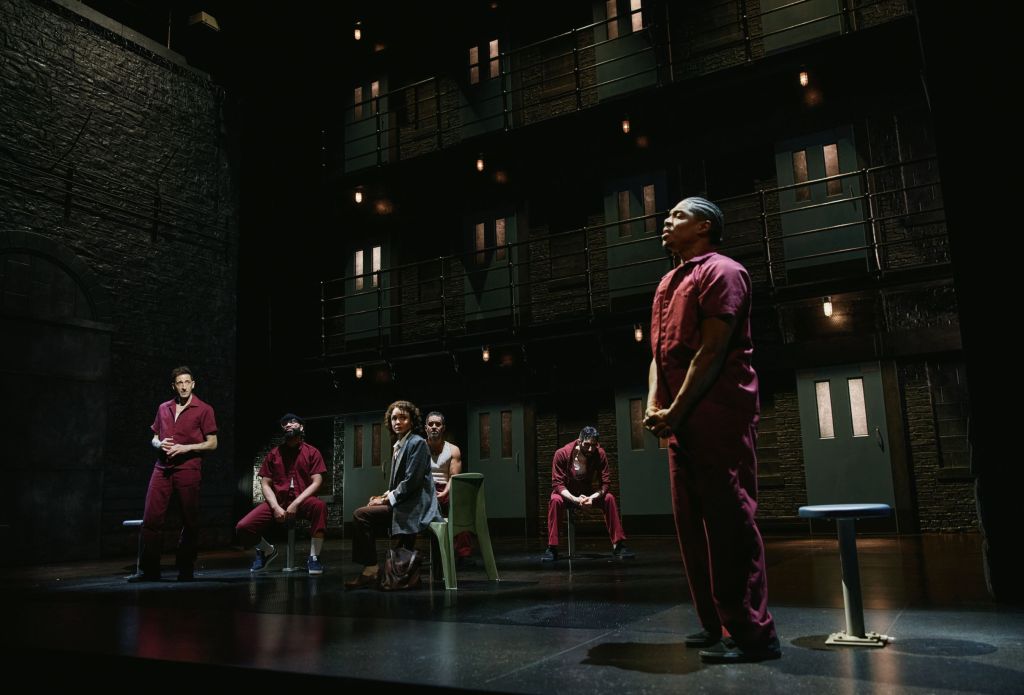
We learn about Nick Yarris’ time constructs as the play unfolds and the lights come up on death row, Arnulfo Maldonado’s black, wall cell block with lights by designer Heather Gilbert suggesting the men housed behind the impassive doors closing out freedom. Against this backdrop, the plays events unfold in flashback as Nick Yarris relates his amazing story to Jacki Miles. Cromer stages various events in scenic vignettes with props (Tessa’s home, a pawn shop) but the bulk of the scenes take place against the dark, prison backdrop. Jack’s ability to speak to volunteer Jacki is one of the miraculous occurrences that happen to Nick, who was just out of teenagehood when he received his death sentence.
Ironically, the theme about time reflects the play’s pace. Toward the conclusion from Yarris’ perspective time slows to a crawl. But in the beginning time moves at a clip. Yarris relates events that Cromer theatricalizes when volunteer Jacki Miles visits and eventually has sessions with Yarris alone, becoming a friend. Cromer stages his visits with Jacki stylistically with minimal fan fare, as he stages Nick’s interactions with his appellate lawyer Beau Mullen (Victor Cruz) and others. Nick’s interactions in the prison setting are powerful and terrifying, thanks to Cromer’s direction and the ensemble’s superb acting.
During Nick’s one hour visits with Jacki, he tells her that death row used to be a place where they were buried alive, as Lieutenant Walker (Jeb Kreager) tells him, “you’re already dead.” The inhumanity he experiences is egregious and the play advocates for an end to the death penalty as punishment, as well as an end to the horror of the traumatic, abusive prison atmosphere and barely livable conditions. To make matters worse, when Nick first arrives, there is no redress; there is no communication between or among prisoners or others. When Nick is encouraged to speak by Walker after he’s told he can’t and Nick answers “yes” out of politeness, Walker punches him in the stomach.
Nick tells Jacki about the brutality and sadism of the guards who abuse the inmates to instill hopelessness and fear to keep them in line. He intimates the guards’ personal satisfaction at beating those who can’t fight back to bolster their “masculinity.” Of course the guards allow the prisoners to harm each other and don’t protect them.
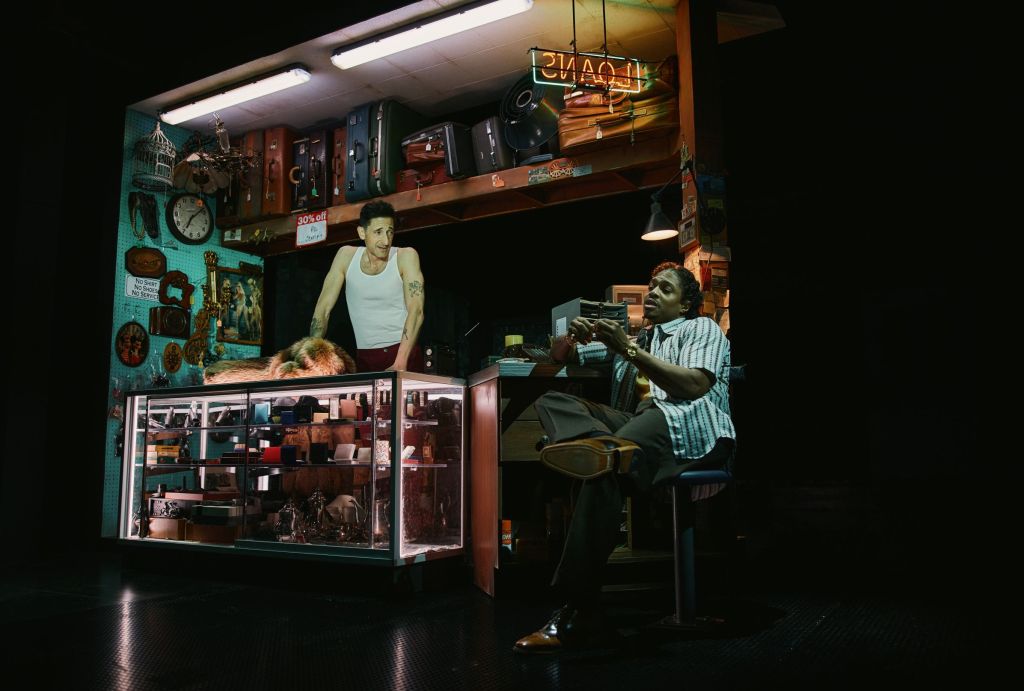
When Nick describes a brutal murder he witnessed in the shower, Nick asks whether Jacki believes him. She hesitates. He tells her his assigned appellate lawyer Mullin didn’t believe him either. When Nick mentions he’s been waiting 7 months for the appeal process to begin, Mullin tells him coldly, “Before you go on, know that I am a Christian… and an officer in the U.S. Army, and so I fully support the death penalty.” Then Mullin tells Nick, “You are guilty due to overwhelming evidence.” The play turns into the abyss as we watch hope leave Nick and are swayed to believe Mullin’s comments that Nick raped and murdered a woman. Nick doesn’t speak or communicate to anyone for two years. Years later when Nick shares Mullin’s comment with Jacki, she leaves abruptly and we note she realizes she is speaking to a killer and a rapist. Why would she ever return?
However, she does. As Thompson’s Miles continues to visit Nick, though she questions herself, she drives miles to see him. Clearly, a bond forms and as a result Nick is able to tell her how everything changed when they found drugs in the music room and gay lovers Wesley and Butch, who were in the men’s choir, were moved into their cell-block temporarily. Brody’s Nick moves between the present with Thompson’s Jacki to the past as he relates the situation between Wesley (Ephraim Sykes) and Butch (Michael Cavinder). The scene is powerfully drawn and theatricalized, thanks to the superb acting by Sykes and Cavinder and the ensemble who sings creating a high point emphasizing how Nick’s hope is stirred. Even the guards change after the event. Communication is allowed and volunteers like Jacki are brought in.
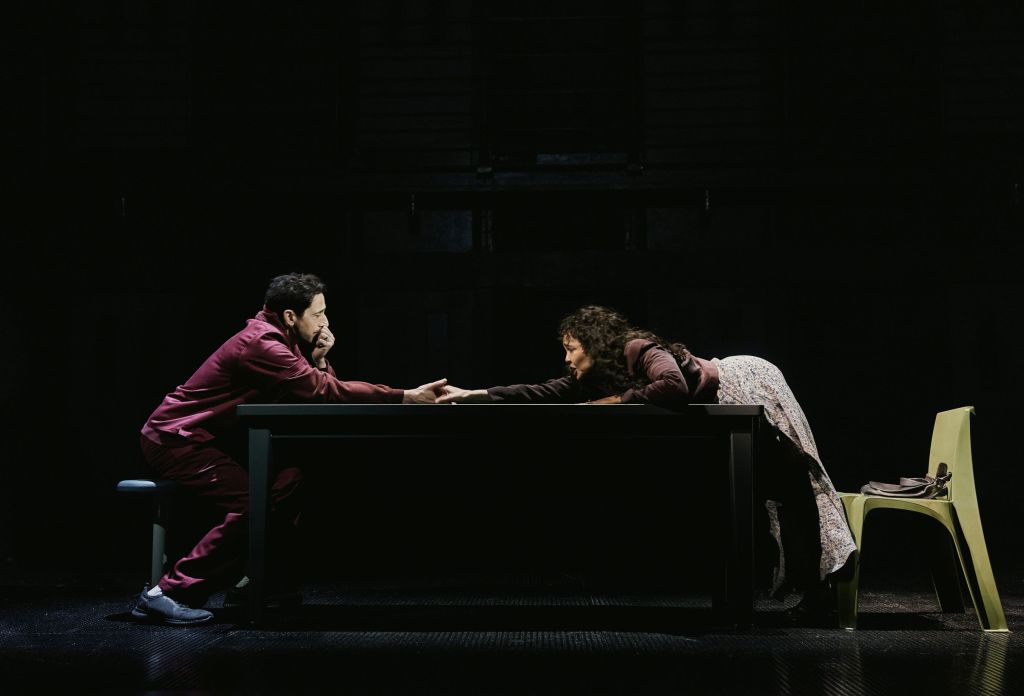
The events well staged by Cromer are thrilling and more adventures follow as Brody actualizes Nick’s story and makes us hope that Nick, who says he is innocent, gets off on DNA evidence. Brody is mesmerizing, heartfelt, amazing. Thompson gives him a superb performance to exchange emotional resonance against. Brody conveys the extremity of emotions that Nick goes through with each encounter as he smashes into the penal system and shocked, we empathize with him. We learn how Nick is able to maintain his psychological well-being because he reads voraciously. It is his reading which brings his discovery in 1988 about DNA being used. Nick, tells Jacki he is innocent. And he affirms his innocence saying, “If DNA is getting people convicted, why can’t it get people released?” Then he tells Jacki, “I love you.”
The interaction is another turning point in a series of unexpected occurrences, one of which is Nick’s incredible escape during a sheriff’s transfer which the ensemble humorously activates. Unfortunately, the adventure ends up in Nick’s arrest and return to death row. But gradually, Nick reveals his life to Jacki and together they work to unravel “the evidence” that Mullin said was overwhelmingly against him, but which they find out is non-existent. Then, the action and events slow down to stasis. Mullin employs the use of DNA evidence and we understand that Mullin is right when he says the process can take a long time. But undeterred, Jacki’s and Nick’s love blossoms. She receives his calls from home and their hopes and anticipation lead to a marriage in prison.
The problem is neither Nick nor Jacki understand the import of Mullin’s words about the DNA process. And it is at this juncture when the play has been unfairly criticized for dropping its pace. At this point the themes about time’s variability apply and “ten years are gone from your life, but the next week is agony.” It is at this juncture that we realize how “it takes all day for the sun to go down.” We and the characters agonize. Yet, Nick cannot reveal his deepest secret to Thompson’s Jacki: the mystery of how and why he ended up doing drugs, getting kicked out of his house, stealing cars and getting arrested by a cop which led to his incarceration on death row. Sadly, she never finds out. But we do and in Nick’s revelation of trauma and darkness, his salvation comes.
The Fear of 13 runs 1 hour 50 minutes with no intermission through July 12 at the James Earl Jones Theater. thefearof13broadway.com.
.

