Blog Archives
‘Babe,’ Theater Review: Marisa Tomei, Rocking Through to the Next Phase
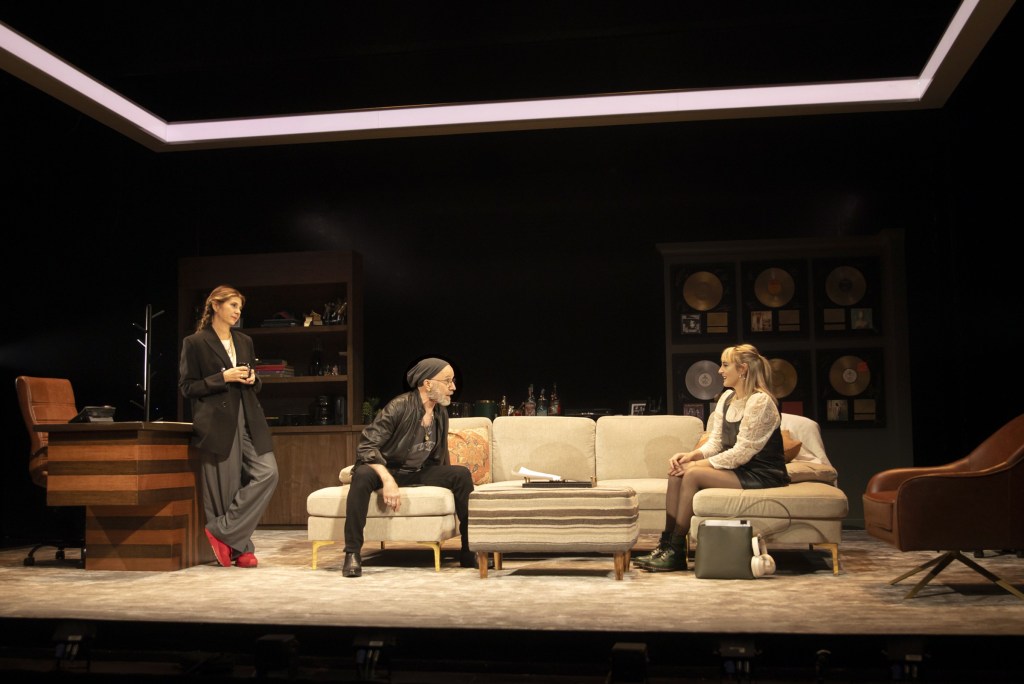
Babe
Can people change? Or do they just flip their perspectives and deceive themselves to believe they’re “evolving?” In the New Group presentation of Babe, written by Jessica Goldberg, directed by Scott Elliott, Abigail (Marisa Tomei), is Gus’ (Arliss Howard), invaluable collaborator in the music industry. The comedy/drama focuses on a number of current issues using Abby and Gus’ relationship as a focal point to explore the landscape of shifting political correctness, power dynamics, generational conflicts, delayed self-actualization, and more. With original music by the trio BETTY, Babe runs approximately 85 minutes with no intermission at the Signature Center until December 22nd.
Treading lightly on Gus’ rocky ground, Abby has been instrumental in maintaining their successful, collegial relationship for thirty-two years, though at a steep, personal price. She hasn’t acknowledged the sacrifice to herself or been inspired to make a change until the confident, twenty-nine year old, Katherine, interviews with Gus, while Abby monitors their conversation and tries to give him clues when to end his political incorrectness. Katherine’s poise and forward attitude develops during the play as the catalyst which ignites a fire that turns into a conflagration between Gus, Abby and Katherine by the conclusion.

Tomei’s astute Abby is sensitive and insightful
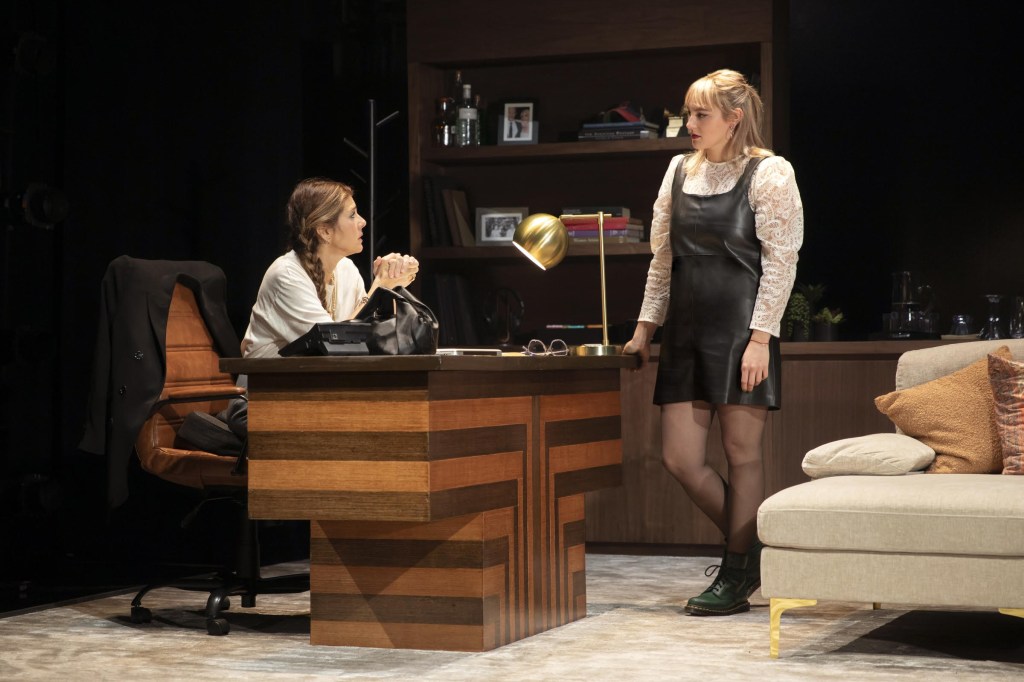
Tomei’s astute Abby provides the sensitivity and insight into the zeitgeist that electrifies fans and brings in the gold records, a number of which hang on the walls of Gus’s chic office (sleek, versatile set design by Derek McLane). The producing legend now in his 60s, but fronting his hip, “with-it” ethos in his tight, black pants, chains, stylized beret, and black leather jacket (Jeff Mahshie, costume design), is at “the top of his game,”and on a down-hill slide, indicated by the sensitivity-training Abby references he has had to withstand. We learn it has been ordered by patriarchal, music company head Bob, who also needs to correct himself, but is powerful enough not to. The hope is with Abby’s continual guidance, and the training, Gus’ boorish, self-absorbed, toxic maleness and unrestrained egotism, encouraged at the company by the other men in the past, will refine. Not a chance, as old dogs refuse to learn new tricks.
As groundbreaking, protective and vital as Abby has been to Gus, the two A & R reps, who have discovered and fashioned some of the most successful solo artists in the business, are not equal in stature, success or monetary rewards. Abby’s discovery of Kat Wonder epitomizes these disparities between her boss Gus, and her, as his second. The only woman in the company for years, Abby suffered through the vulgar and abusive patriarchy, a fact she admits late in the play. To her credit, she managed to gain Gus and the others’ respect and esteem. They keep her around because, as Gus suggests, they think she is like them. We learn by degrees that this is because she is silent and as apparently sedate as her bland, grey pants, white top and black jacket. She is unobtrusive and remains professional, the perfect “Girl Friday,” who allows them to “let it all hang out,” without judging their behavior or making them feel like pigs.
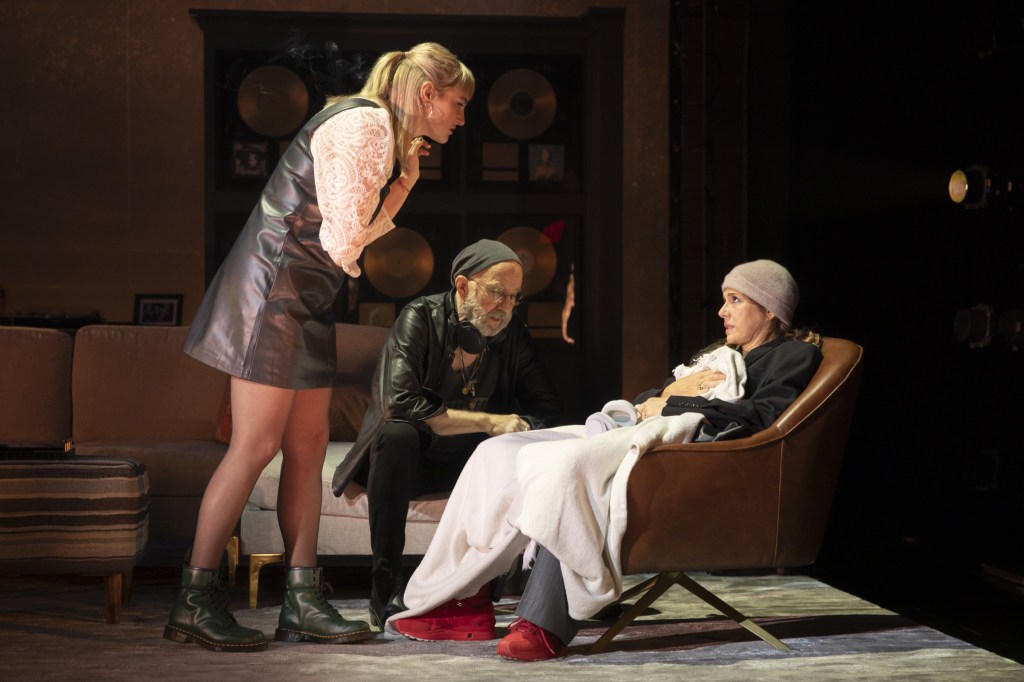
Abby is shut out of receiving credit for her sterling efforts
For her pains to participate, Abby didn’t receive credit on any of the Kat Wonder albums, an “invisible” co-producer. Nor did she share in the spoils as Gus did with global residences and a townhouse he forces the staff to meet in at his convenience, instead of the conference room.
However, ignoring Gus as “all that,” Katherine conflicts with his philosophy, his pronouncements, his ideas. If opposites attract, these two are an exception. Gus sees Katherine’s cultural approaches as pretentious and immaterial (vegan he is not). Katherine is gently oppositional as she pitches herself, her education and background. Interestingly, Katherine sees Abby as a hero to admire. In the initial meet-up, Katherine recognizes Abby from a photo Abby appears in with phenom of the time, “Kat Wonder” at CBGB.Admiring Abby and fawning over her after the interview, Katherine tells Abby that she has been her inspiration to get into the business and wanted to be her.
As obnoxious as Katherine’s forward presumptuousness is, her confidence and appearance remind Abby of Kat Wonder, whose wild grace and energy haunts her throughout the play. Kat appears in her imagination in flashbacks at varying, crucial turning points, with Gracie McGraw doubling for Kat Wonder. These memories of their time together direct Abby toward self-realization and an eventual confrontation with Gus about his unjust treatment of her. This is obviously a painful realization which Abby eventually allows, despite acknowledging Gus’ platonic love, and respect. His concern for her is apparent when he sits with her during a very uncomfortable chemo treatment for her breast cancer.
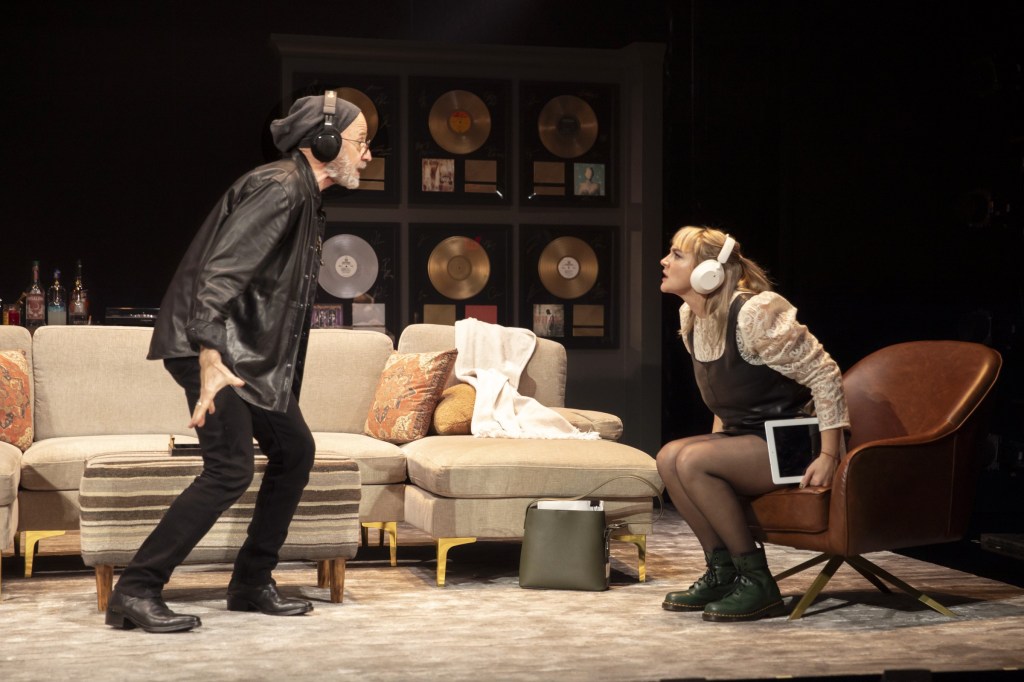
Katherine visits Abby in an unusual get-together
After Katherine again attempts to rise in the company in another interaction with Gus, she visits Abby at her apartment (McLane’s set design again shines in the transition from Gus’ office to Abby’s apartment and back). They listen to music and Katherine asks Abby probing questions. Then they rock out to music and she dances with Abby, at which point Katherine pushes herself on Abby. Abby is forced to rebuff her because any relationship between them is inappropriate. Nevertheless, this trigger, Goldberg implies, impacts Abby. Abby’s remembrance of her relationship with Kat brings her into a deepening realization of herself because of her experiences, including feeling responsible for Kat Wonder’s death, and being shut out of the glory of notoriety as producer who discovered grunge-rocker Kat.
Abby’s realizations about what she has allowed emotionally, which may have contributed to her physical illness and stress, coupled with a twist that Katherine generates, bring about a surprising conclusion. However, Abby’s response to the final events is the most crucial and important. Maybe it is possible in one’s middle age to forge a new path and become one’s own self-proclaimed star.
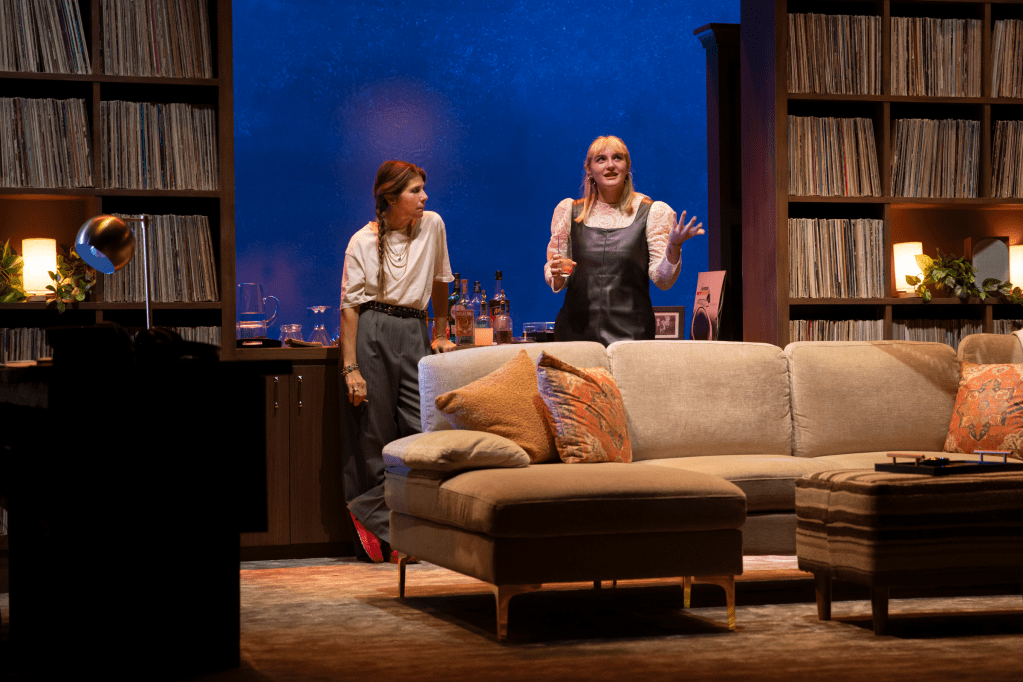
The ensemble melds with authenticity and flair
The actors convey their characters with spot-on authenticity, aptly shepherded by Elliot’s direction. Arliss Howard manages to break through Gus’ character with a winning charm and matter-of-factness, which throws dust in the audience’s eyes, even after Katherine corrects his back-handed compliment of her as a “smart girl.” Marisa Tomei as Abby is imminently watchable and versatile as she moves from quiet restraint, to the throes of physical and emotional suffering. The development and culmination of her rage and satisfying expression of it in rocking-out with Kat Wonder is powerful especially at the conclusion. As always Tomei gives it the fullness of her talent, rounding out the Abby’s humanity despite Goldberg’s thin characterization.
Gracie McGraw’s portrayal of Kat Wonder, the 1990s grunge rocker who embodied “centuries of female rage,” before she self-destructed is too brief, perhaps. Much is suggested in Kat’s and Abby’s relationship, but remains opaque. However, we do get to see McGraw’s Kat cut loose. And the memory is so alive and vibrant, it encourages Tomei’s Abby to be her own rock-star, wailing out her repressed rage by the conclusion of Babe. And the women in the audience wail with her, especially now, after the election.
Babe covers many interesting points. To what extent has music been egregiously shaped by the current technologies? What damage has been done as the music and entertainment industry, hypocritically shaped by cultural politics, only creates artificial boundaries on the surface that don’t penetrate the noxious back room parties and behaviors which have given rise to worse abuses? Another issue defines the difficulties of compromise and corruption which spans every institution, every industry. To be a part, one has to be complicit, and then be satisfied with less of a reward because others hold the power and money and make up the rules. Babe scratches the surface and leaves food for thought. The performances are noteworthy and should be seen.
Kudos to the creatives not mentioned before which include Cha See (lighting design), Jessica Paz (sound design), Matthew Armentrout (hair and wig design), and not enough of BETTY’S original music.
Babe runs 85 minutes with no intermission at the Signature Center.
‘The Seven Year Disappear,’ Mother-Son Relationship Chaos as Performance Art
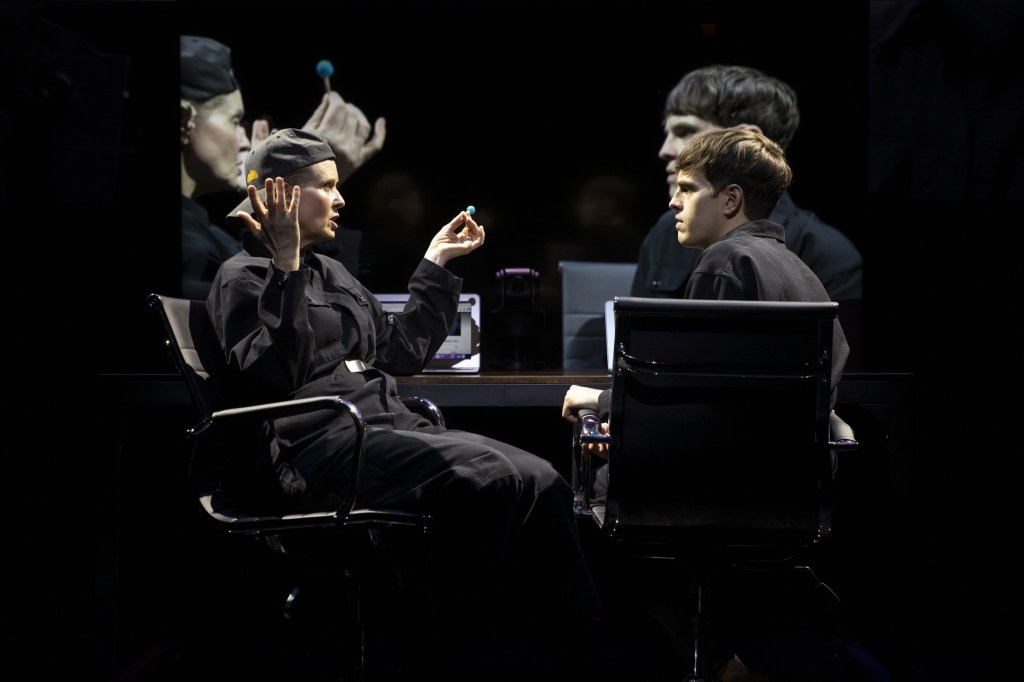
In The Seven Year Disappear, Jordan Seavey (Homos, or Everyone in America), creates celebrated, bi-polar, performance artist Miriam (Cynthia Nixon), and her gay son Naphtali (Hebrew for “my struggle, my strife”), played by Taylor Trensch, to elucidate the darkness in a mother-son relationship when the personalities are hyper creative and high strung. Issues especially evolve when the artists, like Miriam, are complex, self-centered, demanding, assertive and exceedingly ambitious. Indeed, Miriam’s perspective and being blur the boundaries of normalcy and reality and engulf everything and everyone close to her, mostly her son.
Currently running as a World Premiere at the Signature Center, The Seven Year Disappear with no intermission concludes its limited run on 31st of March.
Directed by Scott Elliott with assists by Derek McLane’s scenic design, Rob Milburn & Michael Bodeen’s excellent sound design, Qween Jean’s costume design (workman’s black coveralls and boots), and John Narun’s projection design, which together, keep the audience stirred and engaged, The New Group’s presentation of Seavey’s comedic drama intrigues. There are no easy answers. Complication rules the day, and the overall structure of systematic flashbacks of titled events in three movements, slips backward in time, with four brief returns to the present year, 2016, then back again, to unspool the ominous artistic relationship between Miriam and Naphtali over a twenty-six year period.

The two-hander relies on the dynamic performances of Nixon and Trensch. The wrangling mother and son strike high points of Naphtali’s life, during the time when Miriam disappears for seven years (2009-2016). Her premeditated disappearance, a publicity stunt, happens right after funds have been raised for the first half of her commission as a performance artist in a project to be presented at MOMA. When Miriam goes missing, Naphtali contacts the NYPD and does all he can to relocate her, to no avail. She doesn’t want to be found and perhaps has elicited the help of MOMA to increase the suspense and excitement of her invisibility as performance art, that is a hardship especially to Naphtali. For her, it is a triumph. She will emerge to acclaim when she is ready, and then, present the key moments of her invisibility.
Leaving Naphtali to fend for himself with little money from 2009 through 2016 when she “returns,” he is forced to get a job and apartment and struggle on his own after being dependent on her. For emotional sustenance to fill in the void his mother’s absence has left, he engages with numerous unusual people, all of them portrayed by Cynthia Nixon, using various physical and vocal changes, as he searches for Miriam and irons out his own life. Naphtali is full of questions and feelings of victimization where he sometimes helps himself to drugs and alcohol and attempts to confront her abandonment, which has always been a fact of his life.
MIriam’s durational disappearance is another demonstration of her dislocation from motherhood which initiates when she left four-year-old Naphtali alone at the zoo watching penguins. She leaves him to pursue a drink with Wolfgang, who becomes her intimate partner for a time, then years later becomes Naphtali’s sexual lover for a time during Miriam’s disappearance. Ironically, when Wolfgang is concerned about the young Nephtali in the zoo, Miriam comments, “He’ll be fine.” As it turns out, leaving him traumatizes Naphtali, who never gets over it. We learn it sets him up for a lifetime of his mother’s leaving, which he never conquers.

Clearly, unlike Miriam’s rival, Marina Abramović, one of the most renown performance artists in the world, who chose not to have children, Miriam has Naphtali. However, she refuses to sacrifice her art for her son. Instead, we learn that she exploits him by incorporating him in her work as a durational performance artist. When he is older, he allows her to continue using him, even becoming her manager in order to be close to her, which he says is the only way he gains her attention.
However, Miriam’s seven year disappearance is a piece de resistance, a capstone to shake the art world, which reveals her dedication and wildness in her artistry to effect a total invisibility. On another ironic level, leaving her son and manager behind to go incommunicado is a cheap, attention getting stunt. If it is a cost to her, we don’t see it. We do see the pain it causes Naphtali.
Clues to what Miriam is doing appear throughout the drama which reveals the more pretentious side of the durational performance art world, which we note impacts her son, not necessarily others, as Marina Abramović’s performances do. Where Miriam’s rival has put herself through grueling feats to test her physical, psychic and mental strength to acclaim and positive impact, Miriam’s disappearance doesn’t function positively, though it forces Nephtali to appear to become more independent.
However, during the seven years, everyone Nephtali sees or meets for support (Wolfgang-a sexual father figure, Brayden-a gay lover, Tomas-a gay lover, Kaitlyn-his manicurist, Aviva-an actress, Michael-a gay priest who conducts sex orgies, Nicole-a detective), is a reflection of his mother. Indeed Cynthia Nixon portrays each of these characters.
Thus, though Miriam has “flown the coop,” she is very much present in Nephtali’s life and emotional and psychic imbalances. To say that Miriam’s parenting skills leave much to be desired is an understatement. Her strident character, arrogance, unapologetic nature, and “take or leave it” attitude blaming God for making her this way, only reinforces Marina Abramović’s quote that Seavey includes in the play’s script, which perhaps should appear in the production projected on a backdrop but doesn’t.

‘I had three abortions because I was certain that [having a child] would be a disaster for my
work. One only has limited energy in the body, and I would have had to divide it.’
– Marina Abramović
MIriam, clearly, has difficulty dividing her energies. Thus, she rationalizes using Naphtali to uplift her art at his expense. We learn she has done this cruelly, sadistically with performance art Seavey slyly references. With the artistic endeavors after the disappearance is over, Miriam hopes to achieve a redemptive artistic reconciliation, once again at Naphtali’s expense, though she sells it to him as an equalizer. She claims it will center on Naphtali as a co-partner in making her new performance art to finish MOMA’s commission, as they present their divergent experiences separated during her “seven year disappear.”
However, as we learn piecemeal, in reverse chronology what happens between the mother and son, taking it all in, the result is structural chaos in Naphtali’s life that he is in bondage to. Their relationship is a devastation. And the bits and pieces of performance art evident in the play (at the beginning when Nixon and Trensch stare at each other from across the table), Nixon’s various characterizations pitted against Trensch’s searching, enhanced in closeups by John Narun’s projection design, leave the audience enervated not uplifted.
The Seven Year Disappear is one to see for its performances and play structure. The mother-son relationship disturbs and gives one pause. Nixon’s Miriam is stark. Taylor Trensch’s portrayal is empathetic. Together, they evoke a work which is memorable and unique.
The Seven Year Disappear. The Alice Griffin Jewel Box Theatre, The Pershing Square Signature Center
480 W 42nd Street https://thenewgroup.org/production/the-seven-year-disappear/
‘The Seagull/Woodstock, NY’ Review

The Seagull by Anton Chekhov is a favorite that receives productions and has been made into films, an opera and ballet performed all over the world. Some productions (with Ian McKellen at BAM in 2007) have been absolutely brilliant. What’s not to love about Chekhov with his dynamic and ironic character interactions, sardonic humor, enthralling conflicts that unspool gradually, then conclude with an ending that explodes and carries with it devastation and heartbreak. These elements cemented in Chekhov’s work since its initial production in 1896 represent what Chekhov himself described as a comedy.

Thomas Bradshaw, an obvious lover of Chekov’s The Seagull, has updated and adapted Chekhov’s work in the world premiere The Seagull/Woodstock, NY presented by The New Group. The playwright, who has previously worked with director Scott Elliott (Intimacy, Burning) has configured the characterizations, entertainment industry tropes, humor and setting in the hope of capturing Chekhov’s timelessness to more acutely evoke our time with trenchant dark ironies that are laughable. As he slants the humor and pops up the sexuality, which Chekhov largely kept on a subterranean level, Bradshaw has added another dimension to view the themes of one of Chekhov’s finest plays. Directed by Scott Elliott with a cast that boasts Parker Posey, Hari Nef, David Cale, Nat Wolff, Aleyse Shannon and Ato Essandoh as the principal cast, The Seagull/Woodstock, NY, at the Pershing Square Signature Theater has been extended to April 9th.

The play’s action takes place in a bucolic area in the Hudson Valley. Woodstock is the convenient “home away from home” of celebrities who live, work and fly between Los Angeles and Manhattan, and who feel they need to take a break between jobs, or just take a break from the stress of performance and helter skelter pressures and BS of the industry. The house where they retreat to is peopled by the family, caretakers, guests and a neighbor. The individuals are based on Chekhov’s characters, brother Soron, sister, actress Arkadina and son Constantine, who Bradshaw has renamed Samuel (David Cale) Irene (Parker Posey) and Kevin (Nat Wolff). Chekhov’s Trigoren, Arkadina’s lover, Bradshaw renames William, who is portrayed by Ato Essandoh. Nina, whose Chekhov name Bradshaw keeps is portrayed by Aleyse Shannon. Chekhov’s Masha becomes Bradshaw’s Sasha (Hari Nef).
In his update Bradshaw streamlines some of Chekhov’s dialogue and upturns the emphasis of conversation into the trivial without Chekhov’s character elucidation, as he spins these individuals into his own vision. The cuts truncate the depth of the characters, making them more shallow without resonance or humanity with which we might identify on a deeper level. However, that is Bradshaw’s point in relaying who they are and how they are a product of the noxious culture and the times we live in, unable to escape or rectify their being.

For example the initial opening conversation between Samuel (David Cale) and Kevin (Nat Wolff) loses the feeling of the protective bond between uncle and nephew scored with nuance and fine notes in Chekhov’s Seagull. Additionally, in their discussion of actress Irene, Kevin’s criticism of his mother emphasizes her faults and superficiality. In the Chekhovian version, the son expresses his feelings of inferiority in the company of the artists at his mother’s gatherings. Because of the son’s admissions we immediately understand his inner weakness and hopelessness, feelings which set up the rationale for his devastation of Nina’s abandonment and his suicide attempts later in the play.
Chekhov’s characterization of the actress and mother is tremendously subtle and cleverly humorous. Bradshaw’s iteration of the celebrity actress, her lover, the ingenue Nina and Irene’s brother become lost in the eager translation into comedy without the emotional grist and grief which fuels the humorous ironies of human frailty. Again, as we watch Bradshaw’s points about these individuals which reflect our modern selves, we laugh not with them ruefully, but at them for their obnoxiousness and blind hypocrisy.

Such points appear to be inconsequential and minor, however, the overall impact of Bradshaw’s characterizations makes them appear to be stereotypes of artificiality rather than individuals who are believably sensitive, vulnerable and hypocritical so that we care about them, yet find humor in their bleakness. Irene adds up to a figure of sometime cartoonish arrogance and pomposity without the sagacity and nobility of Chekhov’s Arkadina, who nevertheless is intentionally “oblivious” to herself out of desperation, hiding behind her facade, which on another level reveals a tragic individual. The same may be said for the characters of William and Nina who deliver the forward momentum of the work in their relationship that symbolically and sexually culminates in a bathtub on the stage where Nina previously masturbated as a key element of Kevin’s play. Their characters remain artificial and shallow, and the play’s conclusion and Nina’s collapse follows flatly without the drama and moment so ironically spun out in Chekhov’s Seagull.
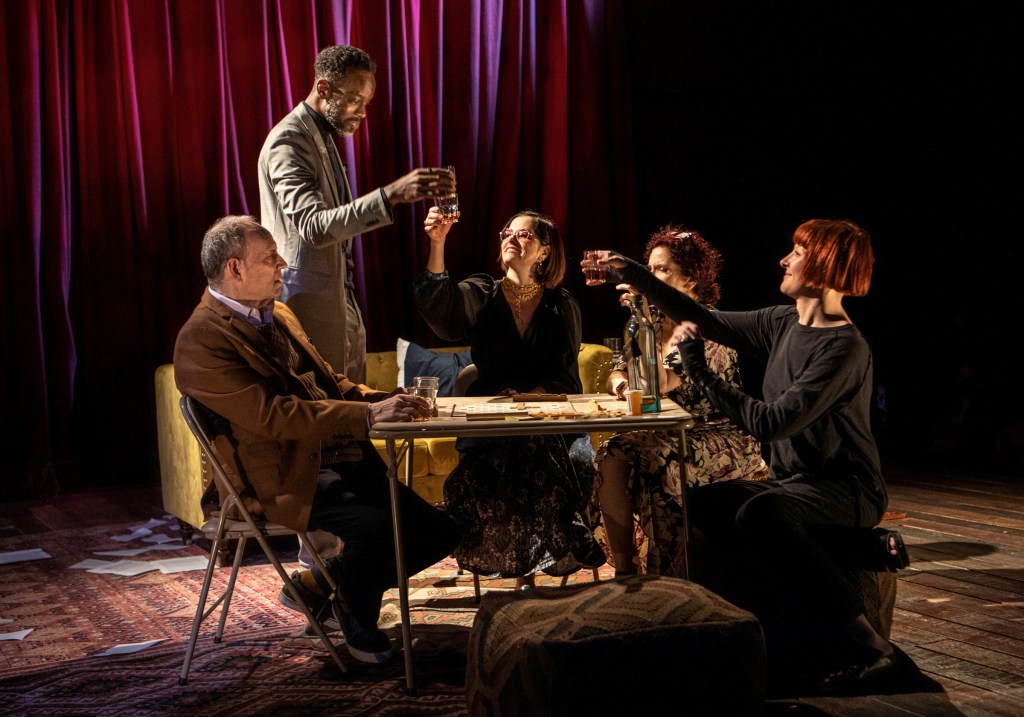
Indeed, the meaning of Bradshaw’s work is clear. There has been a diminution of artistic greatness and sensibility, moment and nobility in our cultural ethos, which makes these players as inconsequential and LOL as he has drawn them. They are caricatures who wallow in artificiality and purposelessness, not of their own making. They have been caught up in the tide of the times and the vapid culture they seek to be celebrated in. That some of the actors push for laughs which don’t appear to come from organic, moment-to-moment portrayals makes complete sense. Theirs is a high-wire act and anything is up for grabs. Whatever laughter can be teased out, must be attempted. That is who these people are in The Seagull/Woodstock, NY.
Though the actors (especially Posey who portrays Irene with the similitude of other pompous, self-satisfied characters we’ve come to associate her with) attempt to get past the linearity of Bradshaw’s update, they sometimes become stuck, hampered by the staging, the playing area and direction whose action perhaps might have alternated between stage left and stage right (the audience is on three sides). Most of the action and conversation (facing the upstage curtain where Kevin puts on his play in the first act) takes place stage right. Since the set is minimalist and stylized with rugs, chairs and other props forming the indoor and outdoor spaces, the stage design might have been more fluid so that the various conversations were centralized. Unfortunately, some of the dialogue became swallowed up and the actors didn’t project to accommodate for the staging.
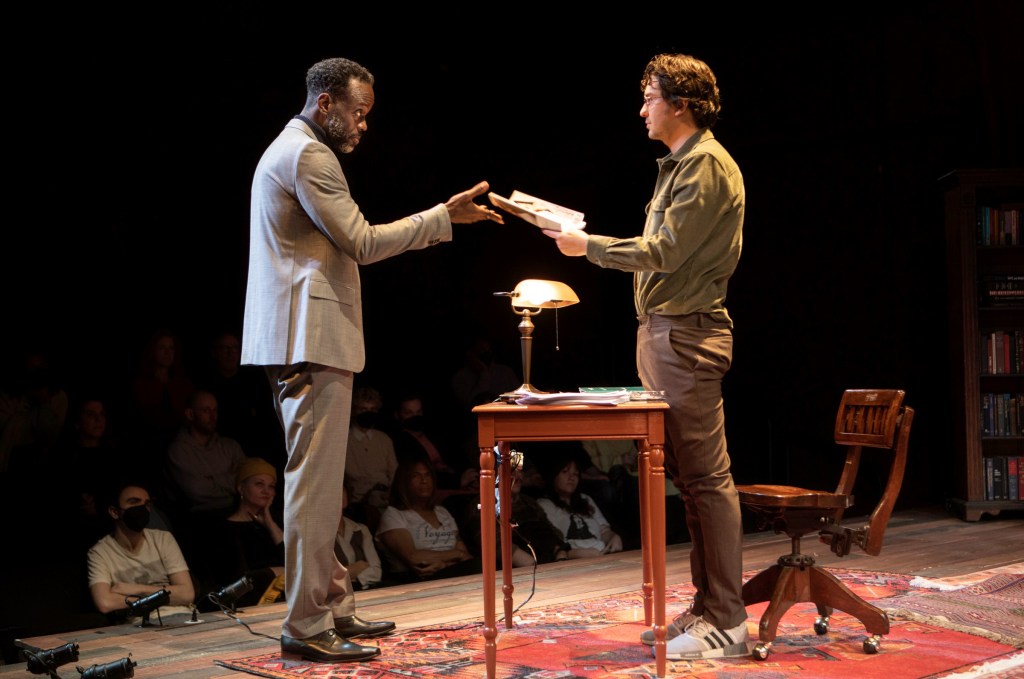
Only Nat Wolff’s portrayal of Kevin rang the most real and authentic. However, this is in keeping with the overall conceit that the playwright and director are conveying. Wolff doesn’t push for laughs and his portrayal of Kevin’s intentions are spot on. As a contrast with the other characters, he is a standout and again, this appears to be Bradshaw’s laden message. Kevin is driven to suicide by the situation, his mother, William’s remote selfishness and Nina’s devastation which she has brought upon herself. He is happier to be away from them. And perhaps Irene will be relieved, after all is said and done, that he has finally succeeded to end his misery. As Bradshaw has drawn her and as the director and Posey have characterized her, Irene has an incredible penchant for obliviousness.

At times the production is uneven and the tone is muddled. At its worst The Seagull/Woodstock, NY is a send up of Chekhov’s The Seagull that doesn’t quite make it. At its finest Bradshaw, Elliott and the ensemble reveal the times we live in are destroying us as we attempt to escape but can find no release nor sanctuary from out own artificiality and meaninglessness, as particularly evidenced in the characters of Irene, William and Nina. Only Kevin appears to have true intentions for his art but is stymied by the crassness of those considered to be exceptional but are mediocre. As in all great artistic achievement, only time is the arbiter of true genius. Perhaps Kevin’s time for recognition will come long after Nina, Irene and William are dead.
The creative team for The Seagull/Woodstock, NY includes Derek McLane (scenic design) Qween Jean (costume design) Cha See (lighting design) Rob Milburn & Michael Bodeen (sound design) UnkleDave’s Fight-House (fight and intimacy director). For tickets and times go to the website https://thenewgroup.org/production/the-seagull-woodstock-ny/
‘Bob & Carol & Ted & Alice,’ A Musical Comedy Based on the Titular Motion Picture

Joél Pérez, Anna Nogueira, Jennifer Damiano, Michael Zegen in Bob & Carol & Ted & Alice, based on the Columbia Pictures motion picture written by Paul Mazursky and Larry Tucker, music by Duncan Sheik, book by Jonathan Marc Sherman, lyrics by Duncan Sheik and A Asmanda Green, musical staging by Kelly Devine, direted by Scott Elliott at the Pershing Square Signature Center (Monique Carboni)
Bob & Carol & Ted & Alice based on the Columbia Pictures film written by Paul Mazursky and Larry Tucker, with music by Duncan Sheik, book by Jonathan Marc Sherman and lyrics by Duncan Sheik and Amanda Green is a lightly satiric, musical comedy, with mellow, soulful music. The production, like its titular film counterpart, hearkens back to an easier time before AIDS, STDS, the debacle of the Viet Nam War and the cultural stresses afterward, when the country faced chaotic divisiveness that was not easily answered by later political administrations.
Directed by Scott Elliott, the production is a delight with adorable actors portraying the thirty-something married couples Carol (Jennifer Damiano) and Bob (Joél Pérez), Ted (Michael Zegen) and Alice (Ana Nogueira) who try to redefine themselves according to the hot pants, younger generational trends which tout the rejection of binding sexual mores and strictures.

(L to ): Joél Pérez, Jennifer Damiano Bob & Carol & Ted & Alice, based on the Columbia Pictures motion picture written by Paul Mazursky and Larry Tucker, music by Duncan Sheik, book by Jonathan Marc Sherman, lyrics by Duncan Sheik and Amanda Green, musical staging by Kelly Devine, direted by Scott Elliott at the Pershing Square Signature Center (Monique Carboni)
This was the time of open marriages, when free love was being embraced as revelational. Various generations either looked askance in horror or savored the sex with hallucinogens and weed. So instead of rotting in aging and being left behind, Bob and Carol take a break from the kids, go to a New Age type resort, and embrace the “new” concepts of this inner freedom and tranquility.
Bob and Carol begin the arc of the story development and conflicts after they return from their growth experience at the retreat (like Esalen) led by the director (who is also the band leader) portrayed by Suzanne Vega. The experience “opens” them up to a new world of freedom using the techniques we have all come to know today (meditation, primal screams, intense feeling expressions, etc.).
They return home believing that the experience translates into their daily lives by allowing them to understand their values, their “ethos,” and their capacity to break away into new experiences. Of course one of the most important is extending the boundaries of their marriage and expanding themselves to include acceptance of their partner’s actions whatever they may be. Bob initiates this extension by having sex, in an unfaithful act, which surprisingly Carol accepts and answers with one of her own. Both affirm, “It was just sex, not love.”
For Ted and Alice who essentially watch and don’t indulge, their learning is vicarious, but they can’t move beyond the boundaries of their own morals and sensibility of love. They judgmentally remain within the strictures of their marriage vows and monogamy. The contrast between the two couples is telling: here are the liberals and the conservatives. But beneath each conservative heart is the quest to be liberal. And in this production, it is no less so.

Suzanne Vega in Bob & Carol & Ted & Alice, based on the Columbia Pictures motion picture written by Paul Mazursky and Larry Tucker, music by Duncan Sheik, book by Jonathan Marc Sherman, lyrics by Duncan Sheik and Amanda Green, musical staging by Kelly Devine, direted by Scott Elliott at the Pershing Square Signature Center (Monique Carboni)
As you watch the events unfold and empathize with the characters along their journeys of self-discovery, you can’t help but fall a bit in love with them. They are so cute in their questioning searches as they soldier on to their discoveries with quasi-comical seriousness. Watching liberal couple Bob and Carol explore the outer limits of love and marriage, extramarital affairs, infidelity, sexuality and enlightened contrast between love and sex, we are along for their ride because it is neither shocking nor lustful, nor pornographic. It just is.
Considering what has transpired between then (1969) and now, the perniciousness of sexual plagues and wildness of Studio 54 that gave rise to them, which followed the “free love” generation, by comparison, these couples are sweet neophytes. The production mirrors this laid-back pleasantness in mood and tone delivered by Sheik’s balancing music, sung with fluidity, smoothness and grace by Grammy winner Suzanne Vega, and with melodic lyricism by the ensemble.
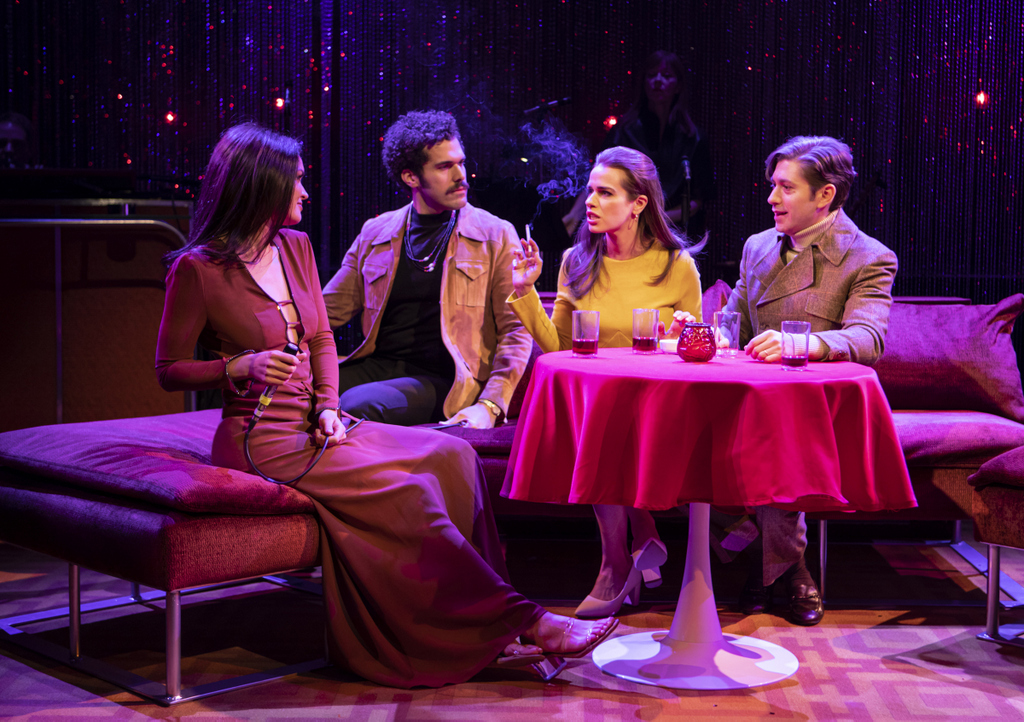
(L to R): Jennifer Daimiano, Joél Pérez, Anna Nogueira,, Michael Zegen in Bob & Carol & Ted & Alice, based on the Columbia Pictures motion picture written by Paul Mazursky and Larry Tucker, music by Duncan Sheik, book by Jonathan Marc Sherman, lyrics by Duncan Sheik and Amanda Green, musical staging by Kelly Devine, direted by Scott Elliott at the Pershing Square Signature Center (Monique Carboni)
The characters’ “new” sexual endeavors infuse the production with the mild raciness of the 1969 film. The original which spawned a later TV show was a comedy satire about the cultural mores transformation. A success at the box office, it did have Oscar-winning nominations for the actors who played Ted (Elliot Gould) and Alice (Dyan Cannon).
Overall, Bob & Carol & Ted & Alice is a retrospective and homage to the the culture and class who dipped in lightly with just their toes as they approached the swirling currents of social change. However, they never took the plunge into the deep end of promiscuity, three-ways, pornography, open marriage and divorce. They accomplished just enough to stimulate themselves, then slid back into their comfort zones measuring their lives with coffee spoons as they dabbled with introspection.

(L to R): Ana Nogueira, Jennifer Damiano in Bob & Carol & Ted & Alice, based on the Columbia Pictures motion picture written by Paul Mazursky and Larry Tucker, music by Duncan Sheik, book by Jonathan Marc Sherman, lyrics by Duncan Sheik and Amanda Green, musical staging by Kelly Devine, direted by Scott Elliott at the Pershing Square Signature Center (Monique Carboni)
Sheik’s music and the ironic Suzanne Vega as band leader, “mistress of ceremonies” reintroduce for our time a derivation of pop’s easy listening. As the overarching guiding light of threaded musical commentary, Suzanne Vega’s lilting, sensuous voice showcases the four characters as she editorializes their journey beginning with Bob and Carol’s stay at the retreat and their “enlightened” return when they share their enlivening experiences with their conservative friends Ted and Alice.

Ana Nogueira, Michael Zegen in Bob & Carol & Ted & Alice, based on the Columbia Pictures motion picture written by Paul Mazursky and Larry Tucker, music by Duncan Sheik, book by Jonathan Marc Sherman, lyrics by Duncan Sheik and Amanda Green, musical staging by Kelly Devine, direted by Scott Elliott at the Pershing Square Signature Center (Monique Carboni)
But as the bonds between the couples loosen, the audience becomes intrigued. Ted and Alice warm up to their friends’ “exploits.” Bob and Carol appear sophisticated, cool and free in their “open” marriage. The men and women separately sing about and discuss their sexuality with their spouses. This leads each to consider their lives with their partners. The songs eventually reveal that each couple is inspired to reaffirm their love for each other.
But we know what’s coming: “monkey see, monkey do”! Humorously, the two couples push the envelope by spending a night together in the bedroom with interesting results. Ultimately, they discover the vitality of loving one individual with intimacy and true spiritual bonding. This can only happen when each member of the couple reveals that they are vulnerable and need help to receive the intimacy and beauty of love from their spouse.

The cast of Bob & Carol & Ted & Alice, based on the Columbia Pictures motion picture written by Paul Mazursky and Larry Tucker, music by Duncan Sheik, book by Jonathan Marc Sherman, lyrics by Duncan Sheik and Amanda Green, musical staging by Kelly Devine, direted by Scott Elliott at the Pershing Square Signature Center (Monique Carboni)
The production is enjoyable and a throwback to a simpler time when all seemed right with loving just one individual in a satisfying marriage. In our tumultuous social and political fabric that is too frightening to contemplate and whose nightly news and snarky, edgy, social and cultural reports are the antithesis of entertainment, this the production is fun. Thus, the concept of “the open marriage” which Bob and Carol investigate with Ted and Alice with the quips and satiric jokes laced in and clever writing by Jonathan Marc Sherman’s book becomes a pleasant and satisfying relief.
There is no heavy lifting here, nothing more profound and mysterious than how and why we fall in love with each other which is a wonderful “thing” to contemplate. It is the wonder that engages us and immerses us in another time. And as we contemplate and review this historical retrospective of the social and cultural mores of the 1960s, we also enjoy the costumes and the California dreaming liquidity of the music so that we are able to ride on the waves of the production’s serenity.
The ensemble and director have established the right tenor for the comedic elements. And Sheik’s music is subtly, appropriately emotional as the characters search themselves and each other to understand the mysteries of love how and why they love.
Special kudos to Kelly Devine’s musical staging and to the following creatives: Derek McLane (scenic design) Jeff Mahshie (costume design) Jeff Croiter (lighting design) Jessica Paz (sound design). Additional kudos to Duncan Sheik for the orchestrations, Jason Hart for music supervision, vocal arrangements and additional orchestrations and Antoine Silverman for music coordination.
The New Group’s presentation of Bob & Carol & Ted & Alice runs with no intermission until 22nd March. For tickets and times CLICK HERE.
‘Happy Talk,’ by Jesse Eisenberg, Starring Susan Sarandon, Marin Ireland

(L to R): Daniel Oreskes, Susan Sarandon, Nico Santos in ‘Happy Talk,’ directed by Scott Elliott, written by Jesse Eisenbert (Monique Carboni)
In Happy Talk by Jesse Eisenberg, adroitly directed by Scott Elliott, stealthy desperation that unravels into a high stakes gambit between employer Lorraine (Susan Sarandon) a Jewish community theater actress/housewife, and home health caretaker, Ljuba (Marin Ireland) climaxes by the end of the play. From the outset Eisenberg infers frenetic undercurrents in the dynamic between the two women. Lubja is the “happy,” compliant, illegal Serbian help and Lorraine negotiates the care of two individuals while she attempts a fantastic pretense that all is “well,” for the sake of the household. Both are fronting.
From their interactions at the top of the play, we divine a synergistic relationship between Ljuba and Lorraine. Ljuba is meticulous with Lorraine’s mom in her caretaking duties. Not in the country legally, Ljuba confides that she hopes to become a citizen via a green card marriage so that she might bring her daughter to the United States for a better life. Lorraine, whom we realize later in the play, is one step away from a nervous breakdown, has an upbeat attitude with Ljuba whom she treats as a friend. Importantly, she attempts to cheer up dour husband Bill, whose agonizing, degenerative MS is a depressive death sentence. Lorraine’s bedridden, incontinent mother is slowly dragging herself into the afterlife with Ljuba’s attentive care, feeding, changing and monitoring her. But in Lorraine’s daily existence, her mother is an afterthought, amidst her preparations for her role as “Bloody Mary” in the Jewish Community Center’s South Pacific.

(L to R): Nico Santos, Susan Sarandon, Marin Ireland in ‘Happy Talk,’ by Jesse Eisenberg, directed by Scott Elliott (Monique Carboni)
Eisenberg’s arc of development between and among the characters is pegged to the gradual revelation of the deeper “ethos” of these two women and how they balance the precariousness of their daily emotional struggles to manage their inner tension and stress. They do this with “happy talk.” Though other songs from South Pacific are played with ironic intent during the dramatic interludes (“Bali H’ai,” “Twin Soliloquies,” Some Enchanted Evening,” and “I’m Gonna Wash That Man Right Outa My Hair”) Eisenberg references the titular song sung by Bloody Mary. Initially, the analogy that Lorraine should be cast as Bloody Mary seems weird. But as the play unfolds, we understand the parallels of characterization flavored with trenchant sardonic humor. Both characters manifest underlying themes of manipulation, exploitation and desperation.
As the events unfold we realize that both Lorraine and Ljuba act to encourage themselves away from reality. One is easily recognizable because she wears “drama” on her sleeve and rambles on about the intentions and nuances of her role as Bloody Mary with her “co-star” Ronny (the fine Nico Santos). Ljuba is a joyful cipher who is unmasked by Jenny (Tedra Millan) Lorraine’s wrath-filled daughter whose condemnation of Lorraine is delivered in a rapid-fire series of punches. Jenny encourages Ljuba to be her real self, a painful prospect considering her circumstances.

(L to): Marin Ireland, Susan Sarandon in ‘Happy Talk,’ by Jesse Eisenberg, directed by Scott Elliott (Monique Carboni)
The intrigue in this production is in its authenticity of Sarandon’s and Ireland’s, staged “happiness.” They mask their interactions with each other while they choke down their true feelings. Ljuba fears deportation. Lorraine fears losing everything to her husband’s sickness and death.
But as Eisenberg displays the characters in the first half, with the exception of taciturn Bill (the excellent Daniel Oreskes) there is no hint of debacle, desolation or tension. Lorraine and Ljuba are cheerful, “open,” convivial and warm and seem to genuinely care for each other. Lorraine’s “over-the-top” narcissism about her acting chops and Ljuba’s sweet generosity and friendliness incite humor. In their interplay Lorraine’s self-aggrandizement about acting appears shallow and we laugh at her presumptive “greatness.” Of course the irony that Susan Sarandon, who has a mile-long list of credits, praises her talent is rich. And Ireland playing hand maiden as an actress of lesser years and experience is equally ironic.
The plot thickens when Lorraine matches up Ljuba to Ronny as her green card husband and they create a backstory together complete with photographs, dates and events. There are twists and turns; the tension increases. We witness the severity of Bill’s illness and pain. Also, we note that Lorraine refuses to confront her mother’s illness and impending mortality. She avoids even looking in on her and only does so after daughter Jenny berates her about it.
Jenny’s sneaky arrival through the back garden sliding doors gyrates the play in another direction and twerks the cheerful atmosphere and humor. Tedra Millan drips bile as she notes the pretense between her mother and Ljuba. Her appalling relationship with Lorraine whom she hasn’t seen in six months becomes apparent, and we are swept into her authenticity, amazed at her reaction to Lorraine.

(L to R): Susan Sarandon, Marin Ireland in ‘Happy Talk’ by Jesse Eisenberg, directed by Scott Elliott (Monique Carboni)
As Millan’s Jenny unloads a condemnatory rant in a fusillade of excoriations, with a self-justified tone of recrimination, she announces her permanent move to Costa Rica. Her brief visit to her grandmother and expression of love to Bill are almost ancillary. Her shooting target is Lorraine.
As divaish as Lorraine has been, Jenny assumes center stage; she a drama queen like her mother but with the intention to destroy. She shreds her mother until Lorraine has had enough and kicks her out, but not before Ljuba upbraids her. Nevertheless, Jenny has poisoned the well, and we look at the principals with a different perspective. Perhaps Jenny has clear-eyed vision in her suggestion that Ljuba is too compliant, too congenial in putting up with her mother. Perhaps Lorraine has another agenda in assisting Ljuba to obtain a green card marriage with Ronny.
In this highpoint of the play, the actors’ transformations are nuanced and real. Sarandon’s inner torment and guilt resonate with us and we shift toward her with empathy when she breaks down then recoups to carry on suppressing her pain so she will be able to go on. It’s an important moment during which Sarandon’s Lorraine becomes humanized.
Our estimation of Ljuba steps up when she defends Lorraine against what can only be a described as tragic hatred revealing traumatic hurt that Jenny has experienced growing up with Lorraine as her mother. Since we only hear Jenny’s side and see a humbled, guilty Lorraine who acts like a wounded animal, we cannot divine the truth. But we are on notice and watchful for additional signs of clarification.
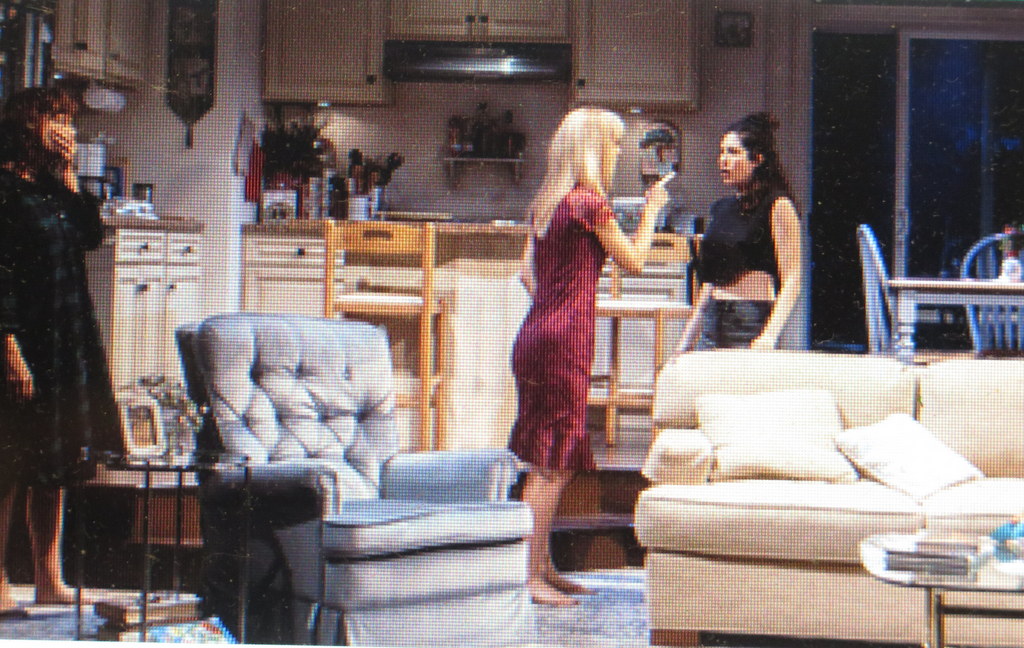
(L to R): Susan Sarandon, Marin Ireland, Tedra Millan in ‘Happy Talk,’ by Jesse Eisenberg, directed by Scott Elliott (Monique Carboni)
Ireland and Sarandon play off each other like a chef and a sous chef that reverse the power dynamic now and again. The irony and sardonic humor laden with various tropes of middle class lifestyles gilding the darker aspects a “comfortable” life are jerked back at the end of the play. It is then we see the desperation and understand how economic hardship is the perennial wolf at the door. No amount of well meaning goodness can be sustained when the situation becomes a matter of life and death. Fear, panic and selfishness take over. And to survive, one must go along with what fate has dished up however terrible. When the masks are dropped, all becomes rotten and real and the “happy talk,” ends.
Happy Talk is a must see for the performances and the clever writing which changes on a dime to the unexpected and concludes with searing force into tragic collapse. The characterizations are grounded in the currency of the times and remind us that manipulations and secret agendas seek their own level of opportunity. The victims often have little recourse in the hands of unlikely predators whom one never sees coming.
Kudos to Derek McLane (Scenic Design) Clint Ramos (Costume Design) Jeff Croiter (Lighting Design, Rob Milburn and Michael Bodeen (Sound Design) Leah J. Loukas (Hair, Wig, Makeup Design).
Happy Talk presented by The New Group is at the Pershing Square Signature Center (42nd Street between 9th and 10th) until 16 June. For tickets and times at their website CLICK HERE.

‘Buried Child’ The New Group Production Starring Ed Harris and Amy Madigan

(L to R): Ed Harris and Paul Sparks in Sam Shepard’s “Buried Child,” directed by Scott Elliott, Off-Broadway at The New Group. Photo credit: Monique Carboni.
Secrets are the bricks that layer the foundations of family histories. Such secrets may serve as supportive bonds to keep a family together through trials and catastrophes. They may spur families to create protective walls against a foreboding and nullifying social order. They also may imprison family members in a bottomless well of pain. What is hidden often then develops a dark, spiritual life of its own to create havoc until family members finally confront its reality.
Sam Shepard’s profound, Pultizer Prize-winning tour de force Buried Child is The New Group’s new production directed by Scott Elliott, currently at The Pershing Square Signature Center. It explores the devastation when what lurks underneath becomes an implement family members use to hack at each others’ souls. As they provoke one another and stir up whirlpools of misery, what has been concealed is eventually unearthed and they must confront the fear of its loathsomeness. Only then can they employ their strength to either reconcile with the past and heal, or die.

(L to R): Paul Sparks, Ed Harris, Amy Madigan in Sam Shepard’s “Buried Child,” directed by Scott Elliott, Off-Broadway at The New Group. Photo credit: Monique Carboni
At the outset, we are introduced to the paterfamilias, Dodge (ironic name choice), sitting on the sofa as if he occupied this space without purpose and there is nowhere else for him to go. Dodge (Ed Harris) is nearly invisible.
Certainly he melds into the shabby interior of the house and the worn furniture. Except for the occasional cough and accompanying sip of whiskey from a bottle he hides under his blanket, we wouldn’t notice anything significant about his presence until he converses with his wife Halie (Amy Madigan), who is upstairs getting ready for an outing. Their exchange becomes funny when Dodge mocks her pretensions and her suggestions, i.e. for their son Bradley to cut Dodge’s hair, which Bradley always butchers. Dodge’s wit and clever personality indicate that though he may now appear to be down-and-out, he once may have been a man to be reckoned with. He well plays the role of nagged husband, tolerant of Halie’s persistent, shrill commentary about everything from the weather to son Tilden, who makes his entrance soon after Halie tells Dodge to take his pill.
The brilliance of this play is in its suggestive, interpretative aspects; it is opaque and ambiguous, yet clearly sounds a bell of alarm. Characters present bits and pieces of information like a reversed puzzle. Truths slip in and out like whispers. Unveilings abide in the off-beat comments and actions of Tilden (a terrific Paul Sparks) and Bradley (the fine Rich Sommer), and in the contradictions posed by Dodge about the past and present. Glimmers of light reveal key themes about the flawed nature of human beings and their unsatisfying relationships, of the oppressiveness of fearful secrets that are not allowed to be uttered or expurgated, of the resulting soul sickness that chokes off vitality.
As Shepard brings this family to us through their conversations and clashes, we divine the background story, of a brokenness that overwhelms all of the sons and Dodge, and of a protective, hard lacquer that glistens from Halie’s persona as she steps quickly through time without looking to the right or left and especially not into the past.

(L to R): Rich Sommer, Taissa Farmiga, Paul Sparks in Sam Shepard’s “Buried Child,” directed by Scott Elliott, Off-Broadway at The New Group. Photo credit: Monique Carboni.
Tilden, once an All-American halfback, is child-like, dense, withdrawn: these may be weaknesses caused by that “trouble in Mexico” a while ago. The obstreperous Bradley was careless with a chainsaw and chopped off his leg.
Bradley’s movement “to go far” has ended; he must wear a prosthetic device to go anywhere. The most promising son, Ansel, died in the military, and Halie, who meets with inoffensive, smarmy Father Dewis (Larry Pine) to discuss the placement of his statue in the community, brings the priest in for tea and stirs havoc. Clearly, Halie has sought religion to stave off the darkness.
Shepard’s writing is precisely rendered. He wanders his characters through a filtered catastrophe that they have long suppressed. Their meanderings with each other are filled with humor, thematic layers, poetry, and symbolism. The dramatic action is interior; when Tilden, Bradley, or Halie appear, disappear, and interact, the molecules have been stirred, the atmosphere changes, and tensions strain. There is the sometimes gentle, sometimes antagonistic sparring among the four. And Dodge is central; he grounds all who enter and leave with brusque ease. He is the family linchpin, and only he will be able to exhume what sickens in all of them when the time is ready.
(L to R): Taissa Farmiga, Ed Harris, Rich Sommer, Amy Madigan, Larry Pine in Sam Shepard’s “Buried Child,” directed by Scott Elliott, Off-Broadway at The New Group. Photo credit: Monique Carboni.
Shepard’s grand metaphor of the harvest, sown in the past and now ready to be picked and enjoyed, is spiritual, interpretive, and surreal. It is a harvest seen and recognized by some in the family and not others, much as truth and circumstances are perceived and interpreted individualistically. Shepard combines this metaphor with an even greater one, a human embodiment of the harvest in the characterization of Vince (Tilden’s son whom no one initially acknowledges or seems to remember), and his girlfriend Shelly (Taissa Farmiga is appropriately sharp and intrusive), whose curiosity eventually prompts Dodge to reveal that which has been rotting the foundations of their family relationships and particularly Dodge’s soul.
(L to R): Taissa Farmiga, Nat Wolff, Ed Harris in Sam Shepard’s “Buried Child,” directed by Scott Elliott, Off-Broadway at The New Group. Photo credit: Monique Carboni
That Vince (a portentous and dangerous Nat Wolff) and Shelly appear at precisely the right moment when the crops are ready to be harvested is a singular mystery answered by the play’s conclusion. Dodge finally discloses the secret of the fields and acknowledges that he is no longer afraid; it is then that the reckoning comes. Shepard emphasizes in Buried Child that there indeed is a season for everything. And regardless of whether we want to acknowledge it, the ripeness of fulfilled truth eventually is visited on a family, though it may skip a generation or two.
This is a magnificent production, prodigiously acted by the ensemble cast and brilliantly conceived, staged, and designed by Scott Elliott and his team. The production throbs with tension. The undercurrents vibrate throughout. Above all the character portrayals balance evenly to create a living portrait of the poignancy of human families.
Ed Harris resides in Dodge with sustained concentration and moment-to-moment precision, even as the audience shuffles in and fumbles around for their seats (before the play begins). Harris embodies the character’s rough-edged, blunt and ironic persona and it is difficult to take one’s eyes off of him. His seamless sliding underneath Dodge’s skin is without equal. Amy Madigan as Halie is his perfect counterpart, striking and glorious one moment and in the next shrew-like and high-pitched as if stretched to the point of breaking.
Indeed, Elliott has guided this cast into taut perfection; Ed Harris, Amy Madigan, Paul Sparks, Taissa Farmiga, Rich Sommer, Nat Wolff and Larry Pine would not be as alive in their characters as they are if the balance and the pressure were not tuned to a proper pitch by each actor’s work.
Buried Child is beyond memorable. It is is one for the ages. The New Group production runs until April 3 at Pershing Square Signature Center.
 CAROLE DI TOSTI