Blog Archives
‘The Accompanist,’ Starring Susan Sarandon and Aubrey Plaza at Tribeca Festival

The Accompanist
Zach Woods’ The Accompanist begins with slow consideration. It shows the untenable situation between 9-year old Emily and her aging grandfather. In its world premiere in the “Spotlight Narrative” section at the 25th Tribeca Festival, Woods’ emotional film stars powerhouses Susan Sarandon as Sylvia and Everly Carganilla as Emily. From the moment Sarandon makes her entrance, the portrayal of the zany, loving and perceptive character anchors the film. Carganilla and the other actors seamlessly align with her. Both Sarandon and Carganilla create an authentic, believable relationship in spite of Woods going off in a few fantastical scenes that needed to be tweaked to cohere with the tone and ethos of the family drama that has humorous undertones.
Clearly, Grandpa Martin Molido (Kevyn Morrow gives a superb performance) is increasingly unable to function because of memory loss. However, with no assistance from his deceased wife and daughter, he tries his best to take care of Emily. Understanding the situation Emily assumes a parental role and makes sure her grandfather takes his medication. Essentially, she fills in the gaps in their increasingly stressful living arrangement. However, in a turning point scene that is harrowing and painful, the straw has broken both of their backs. His dementia presents a danger to himself and Emily and this troubles, panics and overwhelms them both.
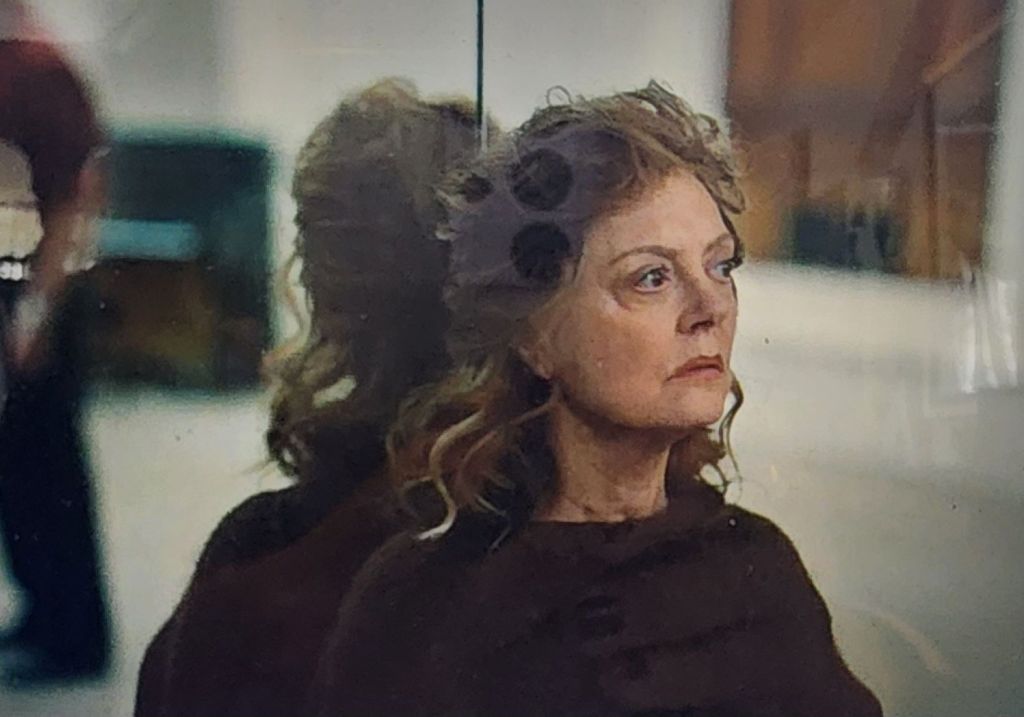
Emily and Grandpa need saving
The deus ex machina arrives in the form of Aubrey Plaza, who expertly portrays Sarah, a neurotic child welfare agent who screws up royally. Mishandling the situation and causing chaos, she kidnaps Emily, misreading Grandpa Molido’s actions and escalates an emotional confrontation. During the scene the audience reacted loudly, annoyed at her belligerent tyranny. They gave a smattering of applause when later in the film Plaza’s Sarah profusely apologizes for her dysfunctional behavior and harm in misreading the situation. Wood’s beautifully directed scene is so harrowing among Grandpa, Emily and Sarah, we feel Emily’s and Grandpa’s trauma.
After Sarah drops Emily off at foster care parent Sylvia’s house to keep Emily safe for the night, we expect Emily to run away to try to gain control and return to her grandfather by any means possible. This sets up Sarandon’s challenge to win over Emily. How she does this with empathy, understanding and humor highlights the growing bonds in their relationship. Their dialogue and interactions are particularly heartfelt and bring relief to a tense situation that the audience empathizes with.

Sylvia gets involved with Emily emotionally then resists it
Ironically, in using humor and “witchy” playfulness to engage Emily, Sylvia falls for her own trap. Both “people who really need people” find each other. However for Sylvia the fear of loss (she buried a daughter who died from anorexia) stops her from imagining a permanent relationship with a surrogate granddaughter. Emily is the age of a granddaughter her own daughter might have given birth to if she conquered her anorexia. For any permanence to take place, Sylvia must exorcise her daughter’s ghostly hauntings. Unless she confronts and reconciles her guilt, pain and sorrow, she cannot commit to caring for another, especially one as endearing, intelligent and loving as Emily.
Themes of loss, trauma, reconciliation
In a theme of the film the characters experience trauma, loss and heartbreak which must be reconciled before they can move on. Woods reveals this in interesting ways as they attempt to meld past to present. Emily takes off in a panic to escape the awful circumstances of feeling abandoned. She seeks out comfort with her grandfather in the hospital. But when his dementia intensifies, she runs away to their now abandoned home in a wishful return to the past whose reality has long disappeared.
Sylvia envisions her daughter in pleasant moments of her childhood and in scenes less integrated with their relationship and more with Nadia’s illness. Woods and Gardner’s revelation of adult Nadia’s struggle with anorexia symbolized by Emma Farnell-Watson’s dance scenes magnificently conveys the hell and self-torment she goes through and most probably puts Sylvia through. Sylvia’s severe trauma in Nadia’s loss also manifests in haunting sounds that Emily can intuit. This occurs in a scene where Sylvia watches teen Nadia (Olivia Edward) struggle to improve her ballet performance, chided by teacher Oscar (John Rothman). Both Emily and Sylvia must confront their losses and accept the painful reality to move into the future together and help each other heal.
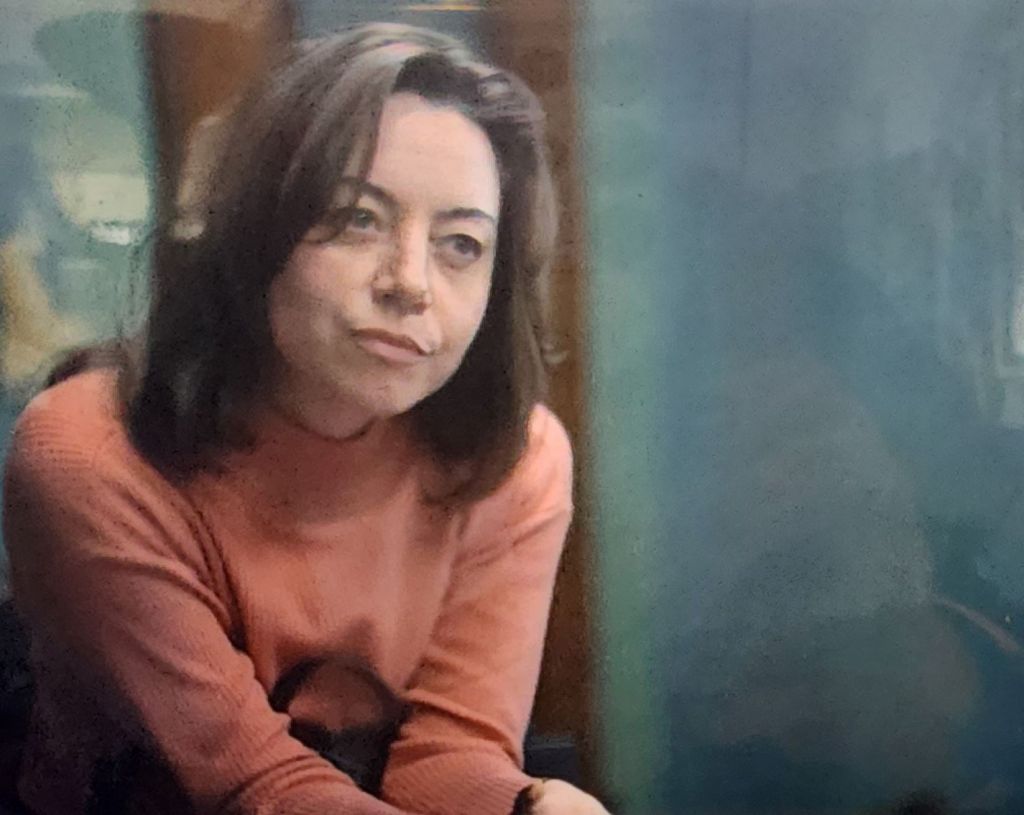
Wood’s direction.
Woods’ direction of the realistic scenes involving panic and fear strike the most resoundingly. When the characters feel and act cornered with no relief on the horizon, we identify with these universal human experiences that Woods, who also co-wrote with Brandon Gardner effectively creates. His venture into the surreal falls flat because of its generality. If he had pegged moments of bonding specific to the characters he so beautifully defined and the actors so finely performed (other than the flying sequence which didn’t work for me though I understand the symbolism) the film might have soared even more than it did.
For his feature debut Woods, known for his acting in The Office, centers this family drama around symbolic truths about relationships, love, letting go and the fearlessness needed to face the unknown around every corner of our lives. The knock out performances sing with hope and unexpected wonder. Little in this film is predictable, especially when Wood’s direction draws the character relationships into lasting bonds, then halts the progress allowing the characters’ inner obstacles to emerge.
Tickets are still available at the Tribeeca Festival website. https://tribecafilm.com/films/accompanist-2026
‘Happy Talk,’ by Jesse Eisenberg, Starring Susan Sarandon, Marin Ireland

(L to R): Daniel Oreskes, Susan Sarandon, Nico Santos in ‘Happy Talk,’ directed by Scott Elliott, written by Jesse Eisenbert (Monique Carboni)
In Happy Talk by Jesse Eisenberg, adroitly directed by Scott Elliott, stealthy desperation that unravels into a high stakes gambit between employer Lorraine (Susan Sarandon) a Jewish community theater actress/housewife, and home health caretaker, Ljuba (Marin Ireland) climaxes by the end of the play. From the outset Eisenberg infers frenetic undercurrents in the dynamic between the two women. Lubja is the “happy,” compliant, illegal Serbian help and Lorraine negotiates the care of two individuals while she attempts a fantastic pretense that all is “well,” for the sake of the household. Both are fronting.
From their interactions at the top of the play, we divine a synergistic relationship between Ljuba and Lorraine. Ljuba is meticulous with Lorraine’s mom in her caretaking duties. Not in the country legally, Ljuba confides that she hopes to become a citizen via a green card marriage so that she might bring her daughter to the United States for a better life. Lorraine, whom we realize later in the play, is one step away from a nervous breakdown, has an upbeat attitude with Ljuba whom she treats as a friend. Importantly, she attempts to cheer up dour husband Bill, whose agonizing, degenerative MS is a depressive death sentence. Lorraine’s bedridden, incontinent mother is slowly dragging herself into the afterlife with Ljuba’s attentive care, feeding, changing and monitoring her. But in Lorraine’s daily existence, her mother is an afterthought, amidst her preparations for her role as “Bloody Mary” in the Jewish Community Center’s South Pacific.

(L to R): Nico Santos, Susan Sarandon, Marin Ireland in ‘Happy Talk,’ by Jesse Eisenberg, directed by Scott Elliott (Monique Carboni)
Eisenberg’s arc of development between and among the characters is pegged to the gradual revelation of the deeper “ethos” of these two women and how they balance the precariousness of their daily emotional struggles to manage their inner tension and stress. They do this with “happy talk.” Though other songs from South Pacific are played with ironic intent during the dramatic interludes (“Bali H’ai,” “Twin Soliloquies,” Some Enchanted Evening,” and “I’m Gonna Wash That Man Right Outa My Hair”) Eisenberg references the titular song sung by Bloody Mary. Initially, the analogy that Lorraine should be cast as Bloody Mary seems weird. But as the play unfolds, we understand the parallels of characterization flavored with trenchant sardonic humor. Both characters manifest underlying themes of manipulation, exploitation and desperation.
As the events unfold we realize that both Lorraine and Ljuba act to encourage themselves away from reality. One is easily recognizable because she wears “drama” on her sleeve and rambles on about the intentions and nuances of her role as Bloody Mary with her “co-star” Ronny (the fine Nico Santos). Ljuba is a joyful cipher who is unmasked by Jenny (Tedra Millan) Lorraine’s wrath-filled daughter whose condemnation of Lorraine is delivered in a rapid-fire series of punches. Jenny encourages Ljuba to be her real self, a painful prospect considering her circumstances.

(L to): Marin Ireland, Susan Sarandon in ‘Happy Talk,’ by Jesse Eisenberg, directed by Scott Elliott (Monique Carboni)
The intrigue in this production is in its authenticity of Sarandon’s and Ireland’s, staged “happiness.” They mask their interactions with each other while they choke down their true feelings. Ljuba fears deportation. Lorraine fears losing everything to her husband’s sickness and death.
But as Eisenberg displays the characters in the first half, with the exception of taciturn Bill (the excellent Daniel Oreskes) there is no hint of debacle, desolation or tension. Lorraine and Ljuba are cheerful, “open,” convivial and warm and seem to genuinely care for each other. Lorraine’s “over-the-top” narcissism about her acting chops and Ljuba’s sweet generosity and friendliness incite humor. In their interplay Lorraine’s self-aggrandizement about acting appears shallow and we laugh at her presumptive “greatness.” Of course the irony that Susan Sarandon, who has a mile-long list of credits, praises her talent is rich. And Ireland playing hand maiden as an actress of lesser years and experience is equally ironic.
The plot thickens when Lorraine matches up Ljuba to Ronny as her green card husband and they create a backstory together complete with photographs, dates and events. There are twists and turns; the tension increases. We witness the severity of Bill’s illness and pain. Also, we note that Lorraine refuses to confront her mother’s illness and impending mortality. She avoids even looking in on her and only does so after daughter Jenny berates her about it.
Jenny’s sneaky arrival through the back garden sliding doors gyrates the play in another direction and twerks the cheerful atmosphere and humor. Tedra Millan drips bile as she notes the pretense between her mother and Ljuba. Her appalling relationship with Lorraine whom she hasn’t seen in six months becomes apparent, and we are swept into her authenticity, amazed at her reaction to Lorraine.

(L to R): Susan Sarandon, Marin Ireland in ‘Happy Talk’ by Jesse Eisenberg, directed by Scott Elliott (Monique Carboni)
As Millan’s Jenny unloads a condemnatory rant in a fusillade of excoriations, with a self-justified tone of recrimination, she announces her permanent move to Costa Rica. Her brief visit to her grandmother and expression of love to Bill are almost ancillary. Her shooting target is Lorraine.
As divaish as Lorraine has been, Jenny assumes center stage; she a drama queen like her mother but with the intention to destroy. She shreds her mother until Lorraine has had enough and kicks her out, but not before Ljuba upbraids her. Nevertheless, Jenny has poisoned the well, and we look at the principals with a different perspective. Perhaps Jenny has clear-eyed vision in her suggestion that Ljuba is too compliant, too congenial in putting up with her mother. Perhaps Lorraine has another agenda in assisting Ljuba to obtain a green card marriage with Ronny.
In this highpoint of the play, the actors’ transformations are nuanced and real. Sarandon’s inner torment and guilt resonate with us and we shift toward her with empathy when she breaks down then recoups to carry on suppressing her pain so she will be able to go on. It’s an important moment during which Sarandon’s Lorraine becomes humanized.
Our estimation of Ljuba steps up when she defends Lorraine against what can only be a described as tragic hatred revealing traumatic hurt that Jenny has experienced growing up with Lorraine as her mother. Since we only hear Jenny’s side and see a humbled, guilty Lorraine who acts like a wounded animal, we cannot divine the truth. But we are on notice and watchful for additional signs of clarification.
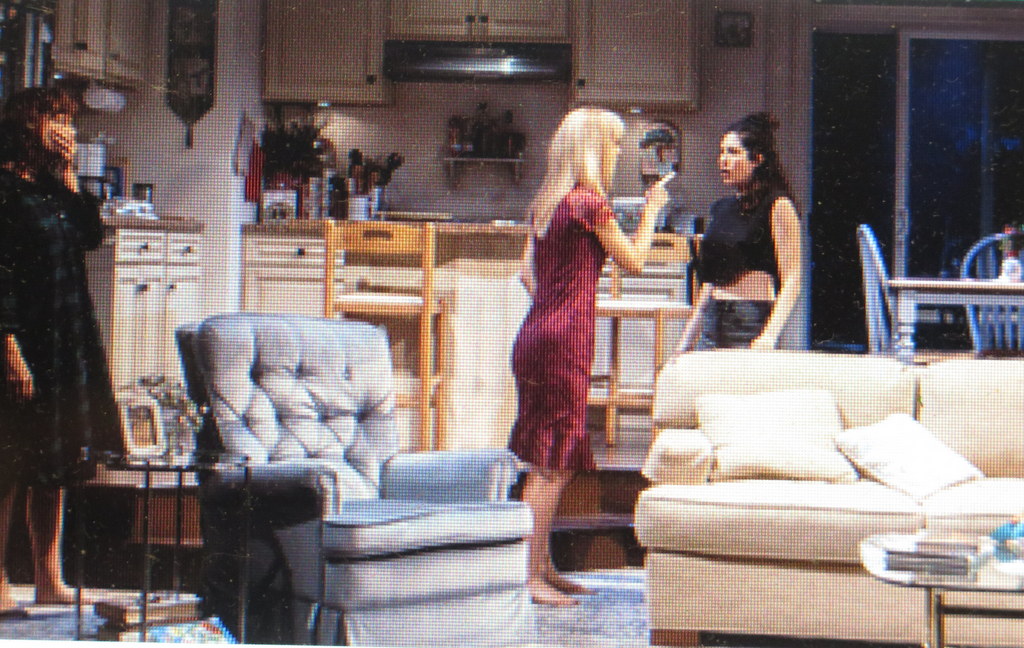
(L to R): Susan Sarandon, Marin Ireland, Tedra Millan in ‘Happy Talk,’ by Jesse Eisenberg, directed by Scott Elliott (Monique Carboni)
Ireland and Sarandon play off each other like a chef and a sous chef that reverse the power dynamic now and again. The irony and sardonic humor laden with various tropes of middle class lifestyles gilding the darker aspects a “comfortable” life are jerked back at the end of the play. It is then we see the desperation and understand how economic hardship is the perennial wolf at the door. No amount of well meaning goodness can be sustained when the situation becomes a matter of life and death. Fear, panic and selfishness take over. And to survive, one must go along with what fate has dished up however terrible. When the masks are dropped, all becomes rotten and real and the “happy talk,” ends.
Happy Talk is a must see for the performances and the clever writing which changes on a dime to the unexpected and concludes with searing force into tragic collapse. The characterizations are grounded in the currency of the times and remind us that manipulations and secret agendas seek their own level of opportunity. The victims often have little recourse in the hands of unlikely predators whom one never sees coming.
Kudos to Derek McLane (Scenic Design) Clint Ramos (Costume Design) Jeff Croiter (Lighting Design, Rob Milburn and Michael Bodeen (Sound Design) Leah J. Loukas (Hair, Wig, Makeup Design).
Happy Talk presented by The New Group is at the Pershing Square Signature Center (42nd Street between 9th and 10th) until 16 June. For tickets and times at their website CLICK HERE.
 CAROLE DI TOSTI