Blog Archives
Theresa Rebeck, Presented by League of Professional Theatre Women at NYPL for the Performing Arts at Lincoln Center
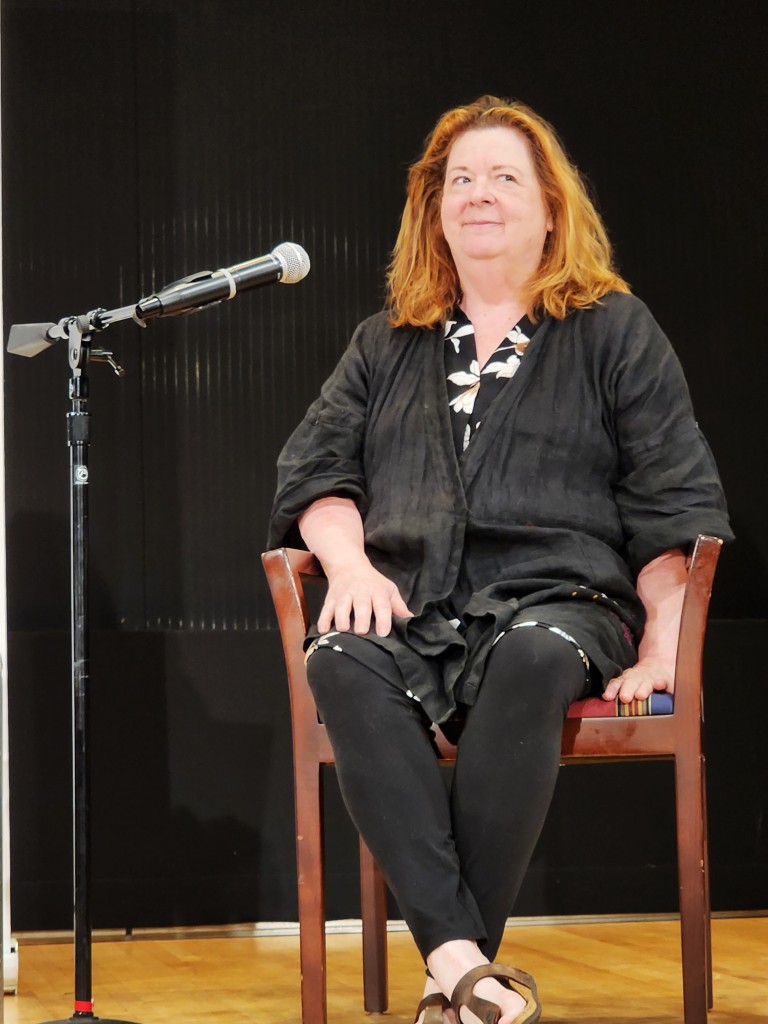
Theresa Rebeck. If the name doesn’t sound immediately familiar, chances are you do know Theresa Rebeck’s work from Broadway, off-Broadway, television, films or literature. A prolific writer, she is the most produced female playwright of her generation. Her work is presented throughout the United States and internationally. Her Broadway credits include I Need That (starring Danny DeVito), Bernhardt/Hamlet (starring Janet McTeer), Dead Accounts (starring Norbert Leo Butz), Seminar (starring Alan Rickman), and Mauritius (starring F. Murray Abraham). Her off-Broadway productions are numerous.
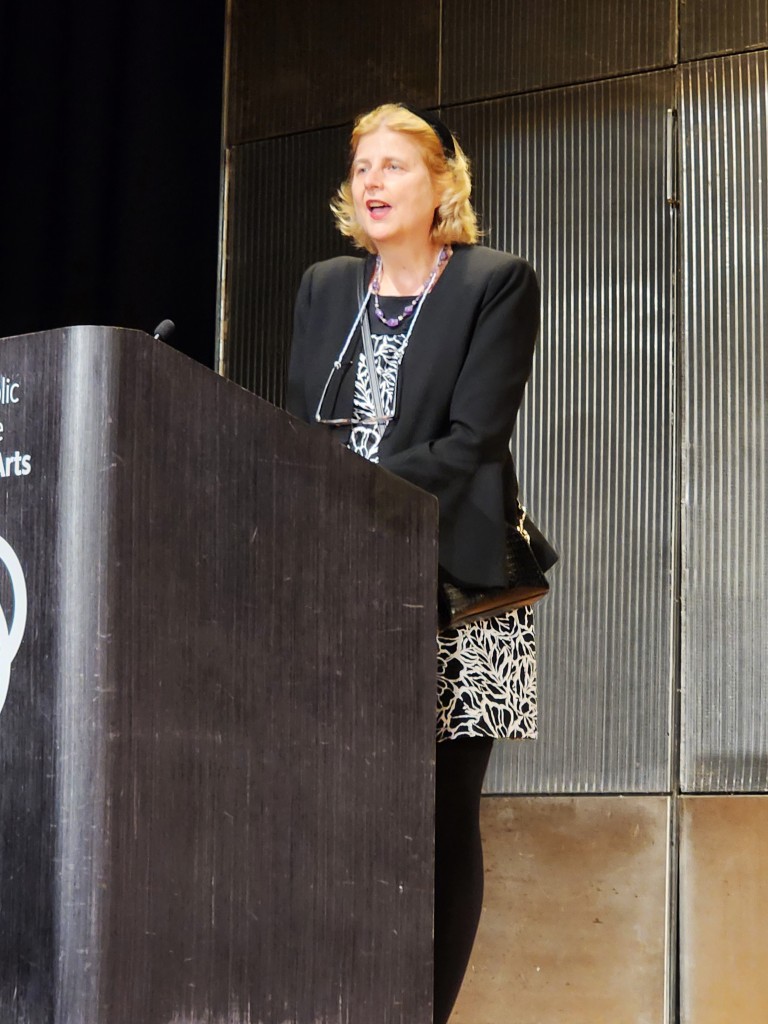
It was a pleasure to hear and see her live in an event sponsored by the League of Professional Theatre Women, Monday, June 3, 2024 at the New York Public Library for the Performing Arts, Lincoln Center’s Bruno Walter Auditorium. Interviewed by her close friend and producer Robyn Goodman (Avenue Q-Tony Award 2004, In the Heights-Tony Award 2008), Robyn founded Aged In Wood Productions in 2000. Their discussion was taped and is part of LPTW’s Oral History Project to preserve visual records of interviews of august women in the theater. The event was produced by director and producer Ludovica Villar-Hauser. A video of the event can be found in the Library’s TOFT Archive.
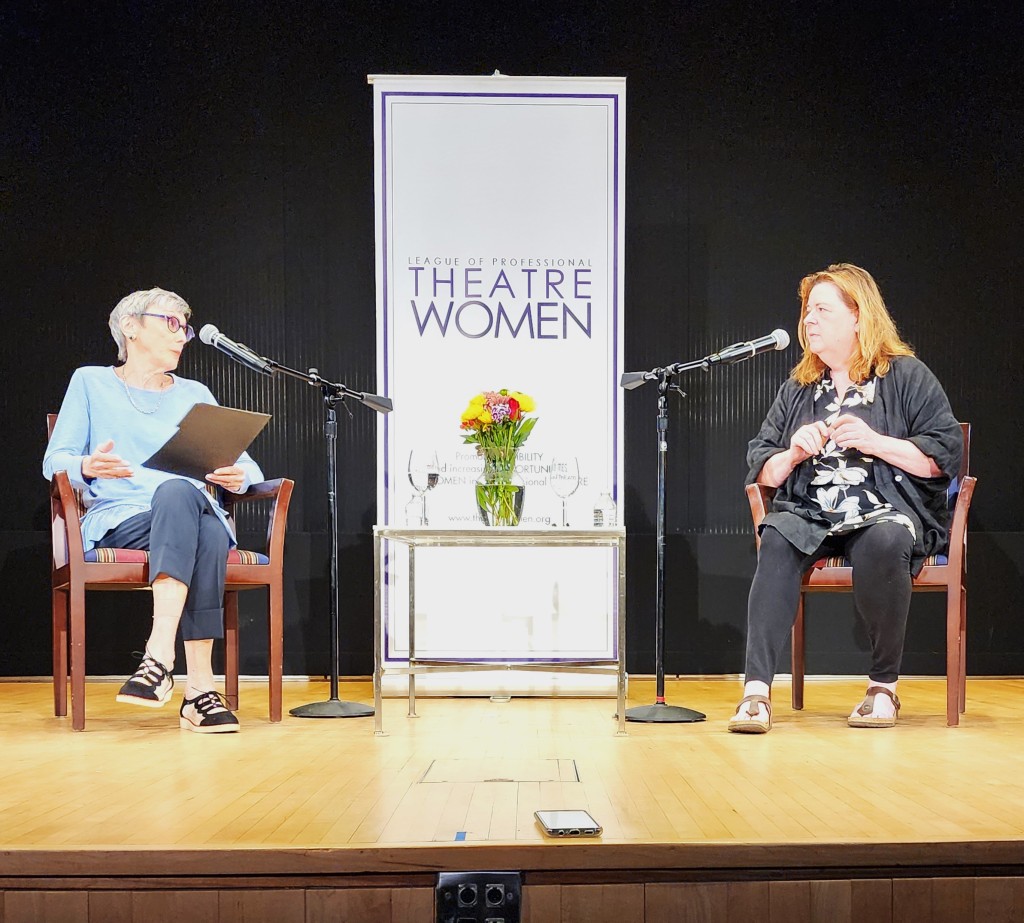
For the members of LPTW, Theresa Rebeck needed no introduction. Robyn Goodman began by asking general questions about Rebeck’s early life, and her background tie-ins to themes which often arise in her plays. This brief post focuses on a few salient highlights of the interview.
Born in Ohio, Rebeck grew up in an “ultra Republican, ultra Catholic” world. Receiving a Catholic education throughout, she graduated from Ursuline Academy in 1976 and continued with her Catholic education, graduating from the University of Notre Dame in 1980.
With irony and humor, Rebeck confided, “My parents didn’t want me to go to any East Coast School because they were afraid I’d lose my faith.” She shared that as a child, at times she went on a bus to see theater productions. Even at a young age, she venerated playwrights, thinking them gods. To her, Shakespeare, Moliere, Arthur Miller and Tennessee Williams were fantastic. She joked that she was already into theater and drama before she got out of grade school.

After Rebeck began acting in earnest at Ursuline Academy, she told her mother “I think I want to be a playwright.” Rebeck got laughs when she joked about her mother’s response, “She turned grey.”
Interestingly, during her freshman year at Notre Dame, Rebeck was invited to a very religious group who was holding a prayer meeting. It was “really spooky,” and the people were “really religious.” Rebeck sensed something “dark and weird going on.” They were speaking in tongues and talking about women being subservient so that everyone “should know their place.” She quipped, “After ten minutes I wanted to go back to my dorm room.” However, she wasn’t sure how to get back.
This was an introduction to members of “People of Praise,” the religious community Supreme Court Justice Amy Cony Barrett has been a member of since birth. “People of Praise,” is associated with the Catholic charismatic renewal movement, but is not formally affiliated with the Catholic Church. Rebeck’s experience at the prayer meeting and listening to the group’s tenets sent her fleeing in the opposite direction. “People of Praise” appears to be unrepresentative of Rebeck’s Catholic upbringing which has well served her life and work.

As a tie-in, Robyn Goodman read a quote from the award-winning playwright Tina Howe (Coastal Disturbances, Pride’s Crossing), who died last year at 85-years old. Howe said of Rebeck that her “Catholic upbringing has had a profound imprint on her work,” and there’s “a moral heart to Theresa.” According to Howe, “She’s a force of nature who always carries her altar with her.”
When Robyn Goodman asked Theresa, “Do you see this in your work?” She responded, “I do.” Rebeck then grounded the history of theater with the idea of faith as an inherent meld. She claimed she is “one of those people” who thinks that the theater is “holy territory.” And she says of herself, “I’m always a person that points out that theater was a religious ceremony.”
In ancient civilizations the dance and tribal ritual and ceremonial presentation had a deep spiritual and religious basis. With the Greeks who allowed even the slaves to take off from work to participate, theater was a celebration of the god Dionysus, and there were annual play festivals and competitions. Rebeck suggested that in various cultures, there was the shaman or priest, and sitting right next to him was the playwright. For Rebeck, “The gathering of people to share stories and identify with the stories is powerful.”
In responding to Robyn Goodman’s question about her transformation to professional theater, Rebeck mentioned her first production was Spike Heels (1993), that Goodman produced at Second Stage Theater. It starred Kevin Bacon, Tony Goldwyn, Saundra Santiago and the great Julie White. “My husband was in it,” quipped Rebeck. Theresa is married to Jess Lynn, and together they have two children.

Goodman asked if the production and notoriety changed her life, especially the good reviews. Rebeck suggests that with the critics peppering her with questions, “It was like watching all the senators grilling Anita Hill.” One of the questions they asked, was, “Are you going to write a book?” Frank Rich compared Spike Heels to the film Pillow Talk. According to Rich, Kevin Bacon was Gig Young, etc.
Four months later, David Mamet’s Oleanna, which premiered in Cambridge, Massachusetts, appeared off- Broadway at the Orpheum Theater. Frank Rich reviewed it and Rebeck noted Rich’s review. He commented that after the Anita Hill-Clarence Thomas fiasco on Capitol Hill, “finally someone wrote a play about sexual harassment.” Rebeck’s response was tellingly frustrated. She shared her feelings about his comment. “Hey! You saw a play about sexual harassment written by a women and you didn’t notice.”

It was “a different time,” Rebeck said, as she discussed how she reacted to the male/female power issues. “You go along with it, get mad when you go home and try to discuss it, and you’re incoherent.” With Rich’s comment about Oleanna, Rebeck says,”I thought, ‘Come on, this isn’t about sexual harassment. This is a women lying about sexual harassment.'” Rebeck affirmed with Goodman that women were fighting for their place and stature at the time, so it was “very important to produce plays like that.” Rebeck suggested, “I was way ahead of my time,” which received an appropriate laugh.
Goodman pointed out another quote about Rebeck’s writing in that she often writes about “betrayal, treason and poor behavior, a lot of poor behavior.” To that Theresa agreed that many playwrights write about “poor behavior.” Goodman added that Rebeck also writes about class and power shifts.
Rebeck discussed her experiences with productions on Broadway and off-Broadway. In fact, she suggested that she began directing because after the effort and time spent writing a play, she got tired of the release process, after her initial involvement with the production. She went to the table reads, heard design presentations and answered questions people asked. Then came the “thank yous” and she would leave. Rebeck didn’t want to be at the side of “the main event.” She wanted total involvement.

She enjoyed working on Dig, which she also directed and which received wonderful reviews. “I’m so proud of it. It was a good experience.” It is important to Rebeck that the creators have work that they can claim as their own. She enjoys working collaboratively when people are respectful.
Goodman and Rebeck appear to have a shared view of how people negotiate successfully in the “real world.” They negotiate with a sense of morality. Goodman shared the quote which political parties, especially the Trump MAGA Party, eschew as anathema. “If you make the truth your friend, it can’t come and eat you alive.” Rebeck and Goodman agree that a clear, moral point of view in plays, musicals and literature is vital.
Theresa suggested that her alma mater Brandeis University also grounded her toward presenting a clear, moral point of view in her work. She received her three graduate degrees from Brandeis: her MA in English in 1983, a MFA in Playwriting in 1986, and a PhD in Victorian era melodrama in 1989. Fittingly, Rebeck pointed out, that on the seal of Brandeis University are the words, “Truth even unto its innermost parts.” The university president decided to surround the shield on the seal with the quote about truth which is from Psalm 51. Rebeck noted that she recognized the seal on the podium (though it wasn’t clear at that point that it was Brandeis), hearing/seeing a clip of Ken Burns deliver his trenchant Keynote Address to Brandeis University’s 2024 undergraduate class during the 73rd Commencement Exercises. If you haven’t heard any of his speech, you can find it on YouTube. It is definitive and acute.

Rebeck affirms that “writing plays is about people” in the hope to understand “human brilliance and failure.” Of course at times there’s “political content.” However, at the heart it’s about people and human behavior.
In responding to Goodman’s question related to critics, Rebeck agreed that sometimes reviews are devastating and that her husband goes through the process with her. She mentioned that there can be five wonderful or enlightening critiques, and then there is the “crazy” review which is off kilter and seemingly out of nowhere, and people are “foaming at the mouth.” Sometimes, there is that one review while other critics and audiences love the work.
At one point Rebeck thought, “Why do they hate me?” Then, she realized if there’s one outlier, then there isn’t coherence. She mentioned that for a long time people only cared about and quoted the “paper of record.” Of course the irony was that there were many different critics and opinions. The diverse voices and viewpoints are exciting and especially vital for our time. That one opinion held sway and could make or break a play was “damaging to the psyche of the community.” She affirmed, “Now, it’s less dire.”
Rebeck spoke of an incident with a young producer who acted as if there was only one paper that mattered, historically, the “paper of record.” This individual said, based on one review, “Well, the reviews were bad.” Rebeck gave them a reality check. She said that a producer should never act like there is one reviewer who speaks for all critics. To obsess about one review is to bury oneself in negativity and recriminations. She told the producer, “Don’t do that!”
Indeed, Rebeck’s point is well taken. Historically, other critics bought into the prestige factor of “the paper of record,” denigrating their own voices and viewpoints, and bowing to the one review that allegedly spoke for all critics. In this day of book bannings, culture wars and rewriting history, such an approach is tantamount to critics mentally censoring themselves as inferiors. If there is a consensus about a play, that speaks volumes. One “determination” by one critic, regardless of how much he or she is paid, shouldn’t be the “word from on high” that the critics, theater professionals or the public “should” listen to and take to heart.
Rebeck and Goodman are expanding their winning teamwork. They’ve joined together on the musical Working Girl, based on the titular1988 Twentieth Century Fox motion picture written by Kevin Wade. Aimed for Broadway, the musical is presented by special arrangement with Buena Vista Theatrical. Writing the book, Rebeck discussed how she loves working with Tony-winning, composer-lyricist Cyndi Lauper (Kinky Boots), who is writing the score. Tony winner Christopher Ashley (Come From Away) is directing. Producers include Goodman and Josh Fiedler of Aged in Wood Productions, and Kumiko Yoshii.
Rebeck created Smash for NBC and briefly discussed a few highs and lows of working on the showbiz dramatic series. She liked Stephen Spielberg. Since Smash, she has been especially enamored of musical theater. Working Girl is a project that involves collaboration. To have to write a play singularly and then give it to a composer and lyricist is something Rebeck wasn’t interested in doing. She and the team are reimagining and updating the classic. It’s an exciting approach because it also emphasizes women working together and supporting each other on their “climb to the top.” With the political climate as it is, the musical is profoundly important.

One of the themes of the evening was that especially after COVID-19, theater has changed. Theaters around the country are in deep financial trouble. Robyn Goodman suggested that Broadway has gotten out of hand. The business is completely different than what it was two decades ago. Now, to mount a production viably, it costs $25 million dollars. It’s all about the money and finding backers.
As for budding playwrights, Rebeck advised that festivals are a good venue as a place to begin and get noticed. Indeed, 10 minute play festivals allow the creative team to put on “a beautiful event” for little or no money. One can even write a short one-act play and submit it to a one-act play festival. This is a boon for the playwright, who needs to learn how the process works and see the audience’s response to the play. That is an imperative for beginning playwrights.
Rebeck’s plays are published by Smith and Kraus as Theresa Rebeck: Complete Plays, Volumes I, II, III, IV and V. Acting editions are available from Samuel French or Playscripts. For a complete listing of all of her work you can find Theresa Rebeck on her website: https://www.theresarebeck.com/ Robyn Goodman’s website is https://www.agedinwood.com/about
Visit The New York Public Library for the Performing Arts at Lincoln Center, the Library’s TOFT Archive to see the digital recording of the evening. For more information about the TOFT Archives, see this link. https://www.nypl.org/locations/lpa/theatre-film-and-tape-archive To learn more about LPTW, check out their website. https://www.theatrewomen.org/
‘Downstairs,’ a Sanguine Thriller Starring Tyne Daly and Tim Daly

Tim Daly, Tyne Daly in Primary Stages’ production of Theresa Rebeck’s ‘Downstairs,’ directed by Adrienne Campbell-Holt (James Leynse)
Theresa Rebeck’s Downstairs is a hybrid drama-mystery, a thriller with sly, humorous overtones. As usual the playwright’s particular and complex characterizations startle with their humanity and angst. And the myriad themes that Rebeck tackles in Downstairs reverberate with currency.
Directed with acute precision and depth by Adrienne Campbell-Holt, and starring siblings Tyne Daly and Tim Daly as well as John Procaccino, Downstairs is a tour-de-force about relationships, wickedness masking as truth, second chances, hope, and the interior and unseen ebb and flow that happens in all evolving souls.
Written especially for the Daly siblings, the play exudes cleverness and wry import. She opens the intriguing story on the trash-heap of an unfinished basement, a workshop cellar with a couch and a few tables. Teddy (Tim Daly’s strikingly alive portrayal uplifts with power) emerges from the bathroom. As he carries on with the morning ritual of waking up, making coffee, and brushing his teeth, we understand that he has slept in the basement and is perhaps living there. Then Irene (the exquisitely versatile Tyne Daly, who is just extraordinary in this portrayal of the mousey, oppressed wife) comes down the basement steps and confronts him. She attempts to understand why he needs to be staying in their cellar.
From their conversation Rebeck reveals their prior estrangement and background circumstances since their mother died some years before. Notably, the forthright Teddy reveals his upset that their mother left Irene with the inheritance, which he deems unfair. They fill their discussion with questions that neither quite answers. Irene refuses to discuss how Teddy became disinherited. This exchange unsettles us. Their tense interplay appears shows us siblings who at this juncture cannot be described as showing good will toward each other.

Tyne Daly, Tim Daly in ‘Downstairs’ presented by Primary Stages at the Cherry Lane Theater in New York. The play, by Theresa Rebeck is directed by Adrienne Campbell-Holt and also features John Procaccino (not pictured) (photo by James Leynse)
Nevertheless, as they continue Teddy discloses that he has been poisoned by malevolent people at work. His truthful admission, though bizarre, opens Irene’s heart. She shifts from being defensive to accepting her brother’s plight and wanting to help him.
Throughout these initial exchanges, we make assumptions about Teddy’s mental and emotional condition and life’s circumstances. Evasive and scattered, he appears to have suffered a breakdown. Surely, he faces a crossroads in his life, especially if his sanity remains in question. But the brilliance of Downstairs is that nothing is what it appears to be. Neither the situation, the characters, nor the development of the conflicts play out the way we anticipate. Rebeck takes us for a dangerous ride fraught with suspense which remains far from the mundane family story we thought we had signed up for.
For example, the reconciliation between Irene and Teddy after their mother died is anything but mundane. Irene’s marriage and financial situation, which initially appear comfortable, normal, and steady, are a deception for numerous reasons that Rebeck reveals with adroit, painstaking details of characterization. We become enlightened about Teddy’s erratic “craziness” and quirky genius. And the estranged relationship between the siblings has little to do with each of them. Indeed, as the present veneers slip away and they connect with their deeper emotions, we discover the real culprit of their alienation.
Their inner emotions drive the energy and action. The actors craft their portrayals so carefully and sensitively, we identify and hope for Irene and Teddy. As they confess their truths to each other, Teddy listens and supports Irene’s confrontation of the lies within herself so she may heal. In her evolution, enlightenment, self-deception, and growth, Tyne Daly’s Irene soars. Her gradual empowerment with Teddy’s help thrills and engages us. Tim Daly’s Teddy displays individuality, bravery, and truth that can call down deception, corruption, and evil, uplifting us. Together, they beautifully manifest their eventual understanding that the ties that once bound them can be reconstituted. And this is so even though the world and the wicked have worked overtime to break their spirits and wreck their souls.

Siblings Tim Daly, Tyne Daly in ‘Downstairs,’ written by Theresa Rebeck, directed by Adrienne Campbell-Holt, presented by Primary Stages, Cherry Lane Theatre (James Leynse)
John Procaccino’s amazing portrayal of Gerry, Irene’s husband, creates the perfect foil for Irene and Teddy. He inhabits Gerry with sensitivity, finding the character’s motivation without going for result. Procaccino’s mastery of Gerry’s sinister presence is authentic and believable. This is not a spoiler. You will just have to see Downstairs to marvel at how these superlative actors work together to breathe life into Irene, Teddy, and Gerry.
In this wonderful production, the unexpected peeks around the corner of every scene. By degrees the story goes through many turns and twists. The more the truth of Irene’s marriage is revealed to her by Teddy, the more open she becomes with her brother and he with her. Rebeck gradually unfolds the mysteries. In the last scenes we finally understand what has separated them from the love they once held for each other.
Throughout this tautly suspenseful work, the playwright captures seminal themes. These include women’s empowerment, familial love, the vitality of childhood bonds, and the saving grace of compassion and goodness. There are numerous messages that echo for us today in the cultural morass between reality and fabrication, truth and lies, visibility and invisibility. I especially enjoyed the moment-to-moment, slow reveal of the struggle between good and evil, enlightenment and cover-up, and the extent to which we betray ourselves with self-deception. The title symbolizes and brings together many of these rich them
Downstairs is a must-see for the sterling performances and for Adrienne Campbell-Holt’s directorial craft. Each of these sends you to the edge of your seat and equally touches your heart. Look for the profundities that will wash over you long after you have left the Cherry Lane Theatre. Kudos also go to Narelle Sissons (Set Design), Sarah Laux (Costume Design), Michael Giannitti (Lighting Design), M.L. Dogg (Sound Design), and Leah Loukas (Wig Design).
Downstairs, a Primary Stages presentation, runs through 22 December at the Cherry Lane Theatre. Tickets are available online
Broadway Theater Review (NYC): ‘Bernhardt/Hamlet’ Starring Janet McTeer, a Stunning Portrayal
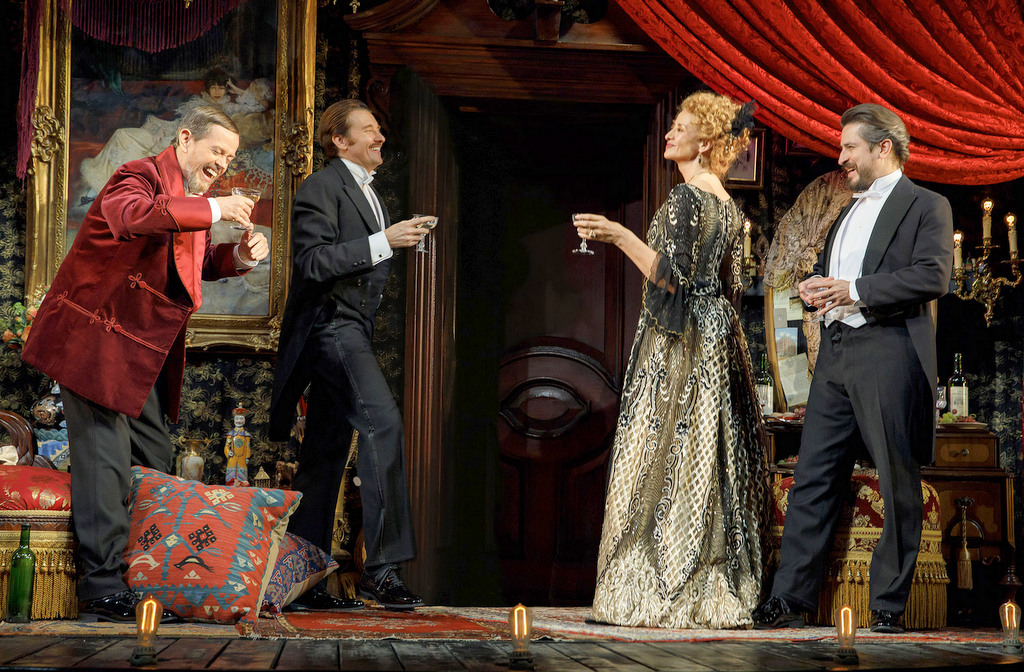
(L to R): Dylan Baker, Jason Butler Harner, Janet McTeer, Matthew Saldivar in ‘Bernhardt/Hamlet’ by Theresa Rebeck, directed by Moritz von Stuelpnagel (Joan Marcus)
Theater scholars, dramatists, and actors are familiar with the legend of French actress Sarah Bernhardt (1844-1923), referred to as “The Divine Sarah.” Renowned for her indomitable theatrical greatness, she lived and breathed drama, melding her life and her art so that each informed the other. Alluding to this synergy of living artistry, Theresa Rebeck’s play Bernhardt/Hamlet explores the French actress’s acclaimed reinterpretation of the role of Shakespeare’s Hamlet, which she imbued with her own maverick genius and courage. Examining the actress’s work, the play, thrillingly directed by Moritz von Stuelpnagel, shows us thematic parallels to our times.
As Sarah Bernhardt circa 1897, confronting Shakespeare’s best-known character, Janet McTeer’s dynamism astounds. Her Bernhardt is a whirlwind of delight and shimmering brilliance. She propels the light and dark of human ethos with a range that bounds and swirls and captivates. In short, McTeer infuses her Bernhardt with an infinite variety of emotional hues so that we believe how and why Oscar Wilde referred to her as “the Incomparable One.” Additionally, we appreciate that Bernhardt was not only a visionary in enforcing her will to create opportunities for herself. For women who witnessed her heroism, she drove the platform of freedom, despite and because of a culture and society expressly controlled by men.

Dylan Baker, Janet McTeer in ‘Bernhardt/Hamlet,’ Roundabout Theatre Company (Joan Marcus)
Rebeck intimates that Bernhardt accomplished what every female actress covets. The actress intrepidly portrayed the complexity and angst of Hamlet’s human spirit with the realism of the mysterious feminine gone rogue, as only an exotic like Bernhardt could do. From her affairs with some of the crowned heads of Europe, to her re-imagining herself through her relationships with authors and playwrights, Bernhardt proved her exceptionalism. Continually, as she gained power and fame, she pushed the envelope of female propriety. And amazingly, the public adored her for it.
However, when she takes on the role of Hamlet to bring it to a larger, more profitable theater, her closest allies sound warnings. Edmond Rostand is one such ally. Jason Butler Harner skillfully portrays the poetic, conflicted author of Cyrano de Bergerac, who worked with and wrote for Bernhardt. Her lover in the play (a relationship that was rumor in real life), he must choose between his career and hers. Of course this is an irony. Rarely did women have the opportunity to have choices as Bernhardt did. In this instance, the hard choice becomes Rostand’s with regard to their work on Hamlet.
We see that the two consume each other in their relationship, which is a blessing and a curse. Harner’s potent by-play with McTeer when he challenges her “demented idea” of rewriting the iambic poetry in Hamlet’s speeches is particularly striking. His forcefulness stands against McTeer’s indomitable will in Rebeck’s exceptional characterizations. Their equivalent passion reveals the high stakes for each. Thus we appreciate the inevitability of their partnership taking a turn after he becomes famous with Cyrano and she moves on with an interpretation of Hamlet sans poetic rhythm and written by others.

Jason Butler Harner, Janet McTeer in ‘Bernhardt/Hamlet’ directed by Moritz von Stuelpnagel, written by Theresa Rebeck (Joan Marcus)
The other ally who opposes Bernhardt’s endeavor is critic Louis, played by the stalwart and stentorian Tony Carlin. He argues with and attempts to influence Rostand in an important scene. Here we see the dangerous, shifting ground Bernhardt must negotiate as Louis questions her Hamlet choice. Perhaps the scene could be less expositional, but it is a necessary one for advancing the stakes and presenting the seeds of themes.
For example, women’s stage roles traditionally remained weak asides to fascinating, dominant male protagonists. Male roles, complex and intelligent, provided the driving dynamic that women’s roles did not. To take on a man’s role, a woman must have the power and even greater acumen and ambition to accomplish it well. Unsurprisingly, both men question whether Bernhardt has the chops to meet the Hamlet challenge.
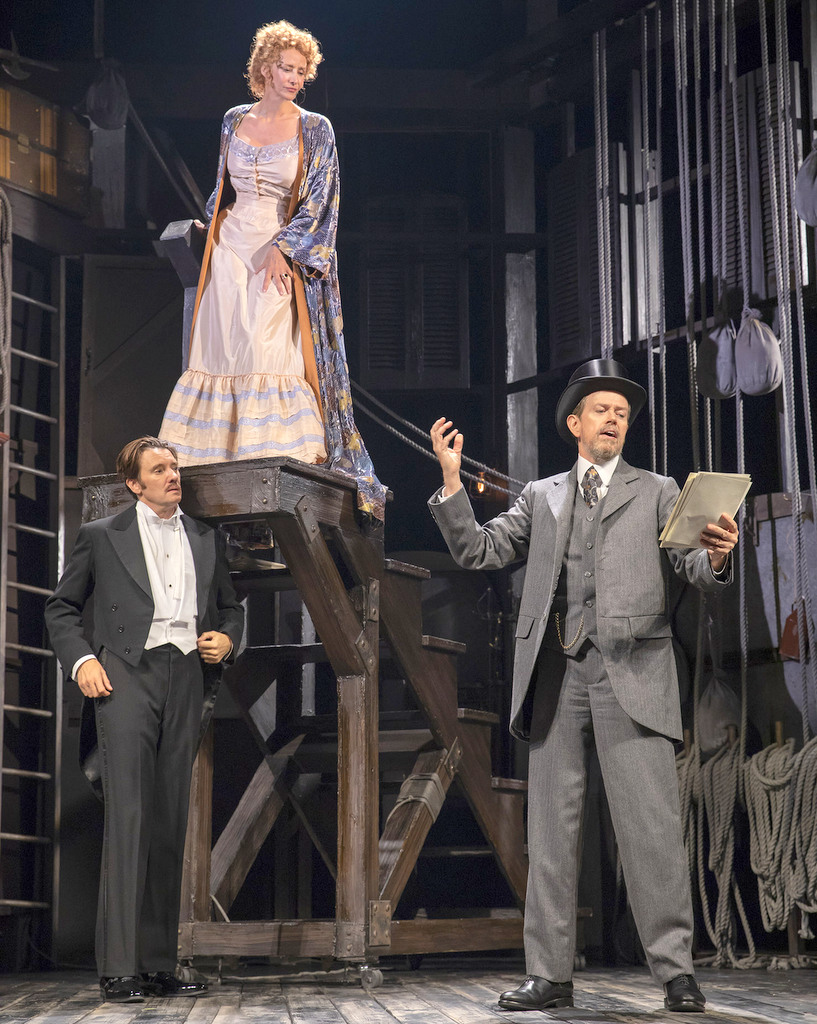
(L to R): Jason Butler Harner, Janet McTeer, Dylan Baker in ‘Bernhardt/Hamlet’ (Joan Marcus)
Through the real-life characters of Rostand and Louis, the playwright highlights the conflicts and problems McTeer’s Bernhardt faces. Additionally, Rebeck shows us how the staging, costuming, and promotion of this new, interpretative Hamlet must be conquered.
Wonderful in supporting roles are Dylan Baker, Matthew Saldivar, and the fine Brittany Bradford as actress Lysette. Baker portrays Constant Coquelin, Bernhardt’s acting contemporary and friend. Notably, Baker gets to have fun playing Hamlet’s father in a hysterical rehearsal scene. Experienced in the role himself, Coquelin guides Bernhardt as a quasi acting coach. Coquelin’s wisdom and sound judgment reflect his greatness as an actor. Eventually, Coquelin took on the role of Cyrano with great success. Baker’s versatility shines in his speeches as Cyrano, Hamlet’s father, and various roles including the great Coquelin himself.
Saldivar portrays Alphonse Mucha, whose artistic skills must beautify Bernhardt’s poster productions. Humorously, he expresses his upset with the task at hand. Indeed, Bernhardt’s hair, her clothing, her stature as Hamlet must enthrall and entice paying customers, a novel feat even for one of his skill. He cannot easily produce advertising artwork that will please Bernhardt, himself, and his public. Thus, as Bernhardt navigates new ground with her incredible decision to play Hamlet, so must Mucha and the others in her circle deal with the “dire” consequences. What a delicious conundrum her “simple” need to play Hamlet creates for these men whom she frustrates yet enthralls!

(L to R): Janet McTeer, Brittany Bradford in ‘Bernhardt/Hamlet’ (Joan Marcus)
The symbolism presented by Bernhardt’s desire to enforce her will upon the culture electrifies. Subtly, when she donned the pants in Hamlet, Bernhardt symbolically freed all women from fashion folkways. Her pants-wearing signals a needed change. Women’s mores were held fast by paternalism and manifested subtly in binding corsets, bustles, and long sleeved-high collared blouses. Worn even in heat waves, these sometimes smothered the wearers, who died of heat prostration. Fashion trends, as painful as they were, laid subservient female stereotypes at women’s feet. And they dared not transgress them. Do such trends abide even today? Sometimes.
In Rebeck’s characterization of Bernhardt, the more restrictive the “thou shalt not,” the more the actress embraced it, conquering fear. In her revolutionary behavior she dismantled the “double standard.” And because she did this with aplomb, sophistication, joie de vivre, and the audacity of wit and whimsy, who could censure her? As she developed her dramatic art, she empowered herself. Memorably, McTeer takes this characterization and with precision lives it in two acts. She evokes the marvelous “Divine Sarah” and makes her a heroine because she can. How McTeer creates her Bernhardt with adroit skill, subtle intelligence and determination is a Bernhardt-like feat.
What a breathtaking reminder of magnificent women in this twisted, political tide of times. Assuredly, Rebeck’s work (McTeer’s speech to this effect rings out beautifully) remains vital and insistent. With commanding power, McTeer’s Bernhardt corrects the historical record, striking forever at the literary and dramatic canon with a tight phrase. She proclaims to Rostand that she will not play the “flower.” The night I saw the production, the women in the audience applauded these words. “I was never a flower, and no matter how much you loved how beautifully I played the ingenue, it was always beneath me. It is beneath all women.”
This moment electrifies. For though women may be compared to flowers, they are not flowers. And Bernhardt, like all women, understands. For women are power brokers, however hidden, however “passive.” Regardless of how much men nullify this truth, “woke” women grew and grow to learn and champion it. And many achieved and achieve momentous feats even from the position of “second.”
Bernhardt captured opportunity and molded destiny so it served her, not the other way around. Strengthening and illuminating her own identity, she wrote her own history, not the one the culture intended to write for her and but couldn’t. McTeer’s inspiring depiction proclaims this with every card in the deck. Indeed, when Bernhardt says about Hamlet, “I do not play him as a woman! I play him as MYSELF,” we glean the full truth of her meaning.
Rebeck wisely selects the most vital of Hamlet’s speeches. Their themes meld aptly with Bernhardt’s conundrums. Indeed, Bernhardt is “a rogue and peasant slave.” At the time she rehearses that speech, she, like Hamlet, divines how an actor uses his skills to portray a character. The double meanings are ironic. But unlike Hamlet, Bernhardt is active, assertive. As Hamlet struggles with acting crazy to hide the knowledge of the truth of his father’s murder, she struggles with a Hamlet too passive to kill. Indeed, the humor comes in watching Bernhardt’s frustration at portraying an “inactive” Hamlet who comes up with philosophical obstacles to delay killing Claudius.
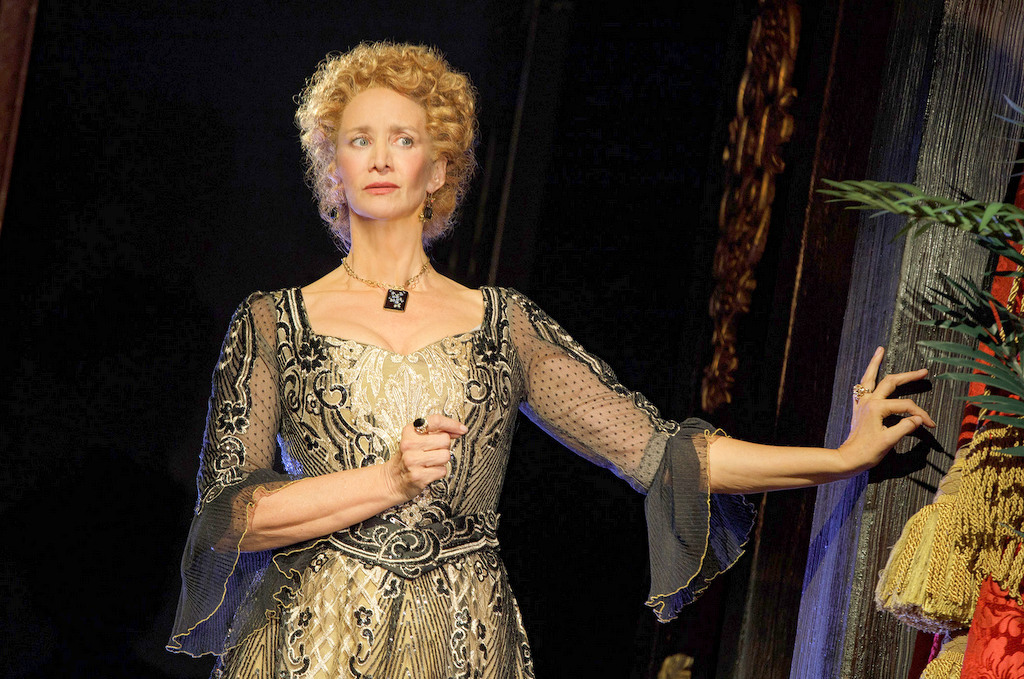
Janet McTeer in ‘Bernhardt/Hamlet’ by Theresa Rebeck, directed by Moritz von Stuelpnagel (Joan Marcus)
Rebeck interweaves in a complex way Hamlet’s speeches to emphasize Bernhardt’s conflict in deciding how to approach and interpret the role. One must work to catch all the ironies. So revisiting the play to enjoy this profound rendering is worthwhile.
Through active dialogue, we learn of Bernhardt’s promotional savvy and ability to reinvent herself for every decade. Naturally, this excites comparisons to today’s long-lasting actresses and others who could learn a thing or two from Bernhardt. Without fear, she capitalizes on rumor, innuendo, and extraordinary behavior that’s verboten for women. Cleverly, she makes critics her friends and generously remembers those who might have turned enemies.
Never an invisible woman, she will play men’s roles. In an affirmation about playing Hamlet and being a woman, she states to Rostand: “Where is his greatness? Where? Is it not in his mind, his soul, his essence? Where is mine? What is it about me you love? Because if in our essence we are the same, why am I otherwise less?”
Thus, Rebeck’s choice of this pivotal, “make or break” moment in Bernhardt’s career is an inspired, complicated one. The turning point reveals the grist, bravery, and revolutionary fervor Bernhardt required of herself to overturn centuries of dramatic tradition. Bernardt’s choice to conquer the greatest role written for men propels her to theatrical heaven. It is sheer artistic genius in a time when women were the “incapable,” “inferior” ones mastered by man’s sham invincibility. Bernardt/Hamlet through the seminal performances of McTeer and the ensemble informs and encourages us to realize that Shakespeare also speaks of women when Hamlet says, “What a piece of work is man. How noble in reason…”
Assuredly, kudos go to the spectacular artistic team. I particularly loved the sets (Beowulf Boritt), costumes (Toni-Leslie James), and hair (wig design by Matthew B. Armentrout). Lighting is by Bradley King and original music and sound design by Fitz Patton.
Bernhardt/Hamlet will be a multiple award winner. It is a must-see TWICE! This Roundabout Theatre Company production runs at the American Airlines Theatre on 42nd Street. The show until 11 November. Visit the Roundabout website for schedule and tickets.
 CAROLE DI TOSTI