These ‘Fallen Angels’ are Beautiful, Starring Rose Byrne and Kelli O’Hara
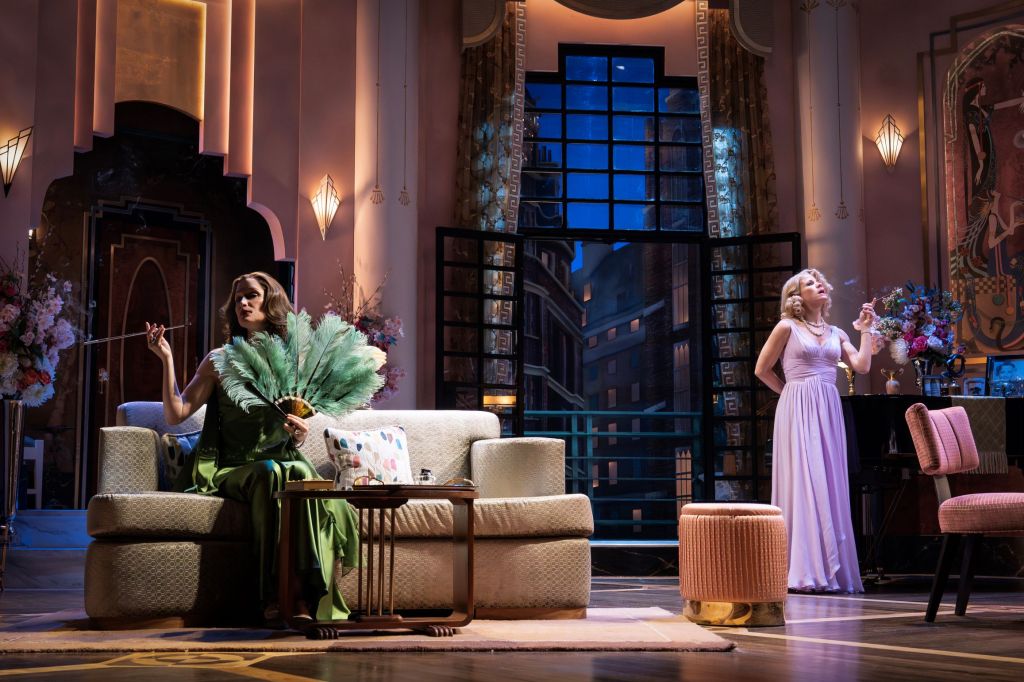
When Noël Coward’s comedy Fallen Angels was first performed in London, an official who was a censor in the Lord Chamberlain’s office denied its license because the married female characters had licentiously cavorted in premarital sex and planned to commit adultery. Only until the Chamberlain personally intervened, was the hilarious, slapstick comedy given its license and performed.
Far from being an “unpleasant play,” as critics suggested in 1923, Coward’s early work reveals his ingenious wit and love of turning situations on their heads. In this, Julia Sterroll (Kelli O’Hara) and Jane Banbury (Rose Byrne), riotously turn to alcohol to get up the courage to see Maurice, an old beau both were madly in love with at different times. When their affairs with Maurice ended, they married spouses who were the opposite of their lover and settled down. But the aftershocks of their love are very much ever present and cause the old friends to be jealous of one another, which they keep just under the surface of their close relationship. Then the “green-eyed monster” rears its ugly head when Maurice announces he is coming to visit them turning their settled lives inside out with riotous consequences. Fallen Angels is currently spreading its joyous, madcap delight at the Todd Haimes Theater through June 7, 2026 in a limited engagement.
O’Hara’s Julia and Byrne’s Jane are left to their own entertainments when husbands Fred (Aasif Mandvi) and Willy (Christopher Fitzgerald) go off on an overnight golf outing. After a relaxed breakfast with Fred before he leaves for golf, Julia brings up a divorce reported in the papers. With this theme of the end of love announced, Julia tells Fred she loves him but is not in love with him, Fred avers. His ego is upset that the passion and sex have gone out of the relationship, and companionship has taken its place as Julia suggests. Coward has cleverly set up the farcical conceit which he will play upon with wit, whimsy and alcohol, throughout the comedy because as it turns out, Jane feels similarly about her husband Willy.
Are the women teasing their spouses or are they serious about Julia’s suggestion she is not in love with Fred and Jane’s presentment that disturbs Willy? Clearly, the men don’t feel the same and still love their wives, they believe, and passionately. And why not? O’Hara ad Byrne are lovely. On the other hand their husbands, thanks to hair and make up by David Brian Brown and Victoria Tinsman, are not gorgeous Leo DiCaprio types to swoon over. They have aged and are not their wives physical equivalents.
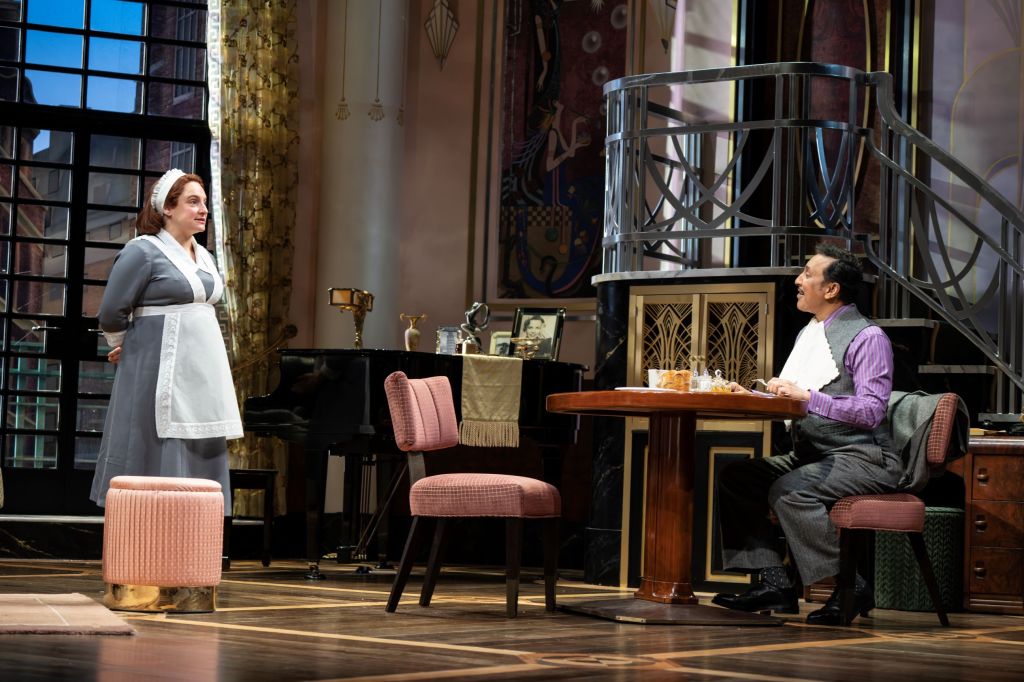
Not only is this a casting coup, by director Scott Ellis, it ridicules a patriarchal, cultural more in relationships and marriage about what is appropriate. It is incumbent upon lovely women to pretend that average looking men are “sexy” and “attractive,” if they have money and status. Clearly, the money and status are the alchemy that transforms the men’s looks. Also, clearly, Julia and Jane are younger than their husbands, another more that Ellis’ casting takes a swipe at.
After all, a wealthy older man with money is not to be seen with a status-downer, i.e. a fat, older woman (sorry, this is the psycho culture). The younger, more beautiful the woman he is with (eye candy), the more the average-looking man’s status and attractiveness increases. Of course the absurd end result of this is one-sided. Heaven forbid, if women practice the same and seek out younger men or more attractive men around their age as Maurice is. Abomination! Ellis takes advantage of these unspoken cultural folkways and enhances Coward’s wit because of his choice of the attractive TV persona he casts to play Mauice Duclos, their old flame, who is to- die-for-adorable in comparison to their husbands. He causes the fallen angels to fall more quickly and deeper into the abyss of “shame.”
Julia and Jane have married up for money. They have most probably compromised and settled for Fred and Willy, though if the situation was right, they easily would have gone with Frenchman Maurice if he proposed. Their husband’s wealth and status are revealed from their lifestyles, thanks to David Rockwell’s set design, a lovely Art Deco apartment with a balcony, large paintings, columns, appointments, and an eye-popping chandelier.
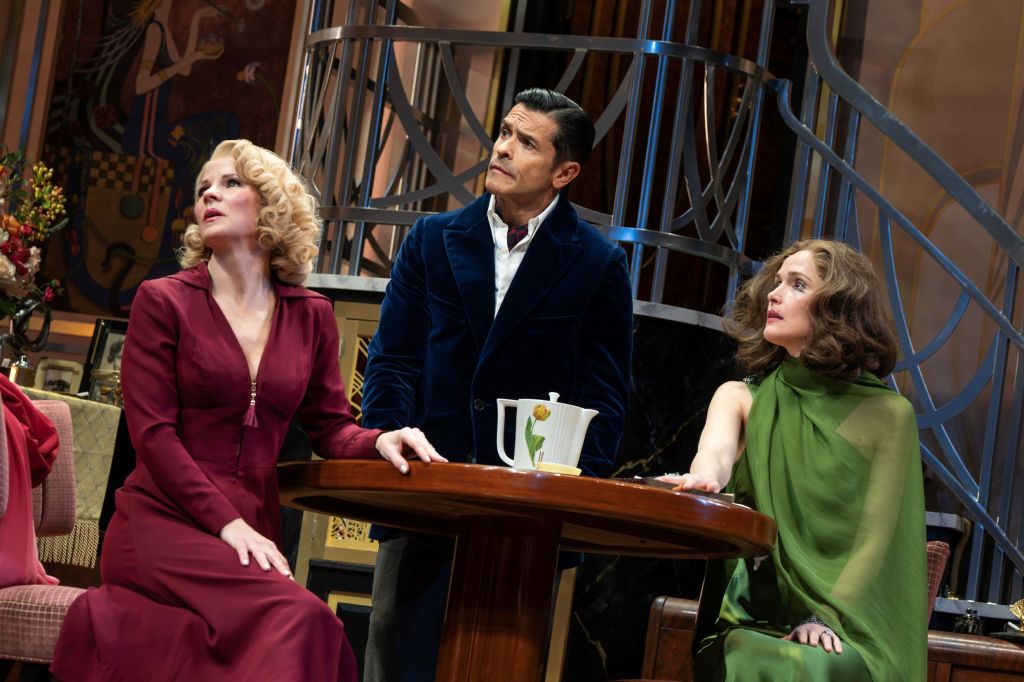
Their period costumes, dressing gowns, street clothes, evening gowns and accessories, designed by Jeff Mashie, show their personalities and economic status. Only Byrne could wear the deep emerald green, silky, long gown to cavort around in and look totteringly-elegant as the champagne, wine and cocktails wreck her balance. O’Hara’s pratfalls include sliding belly-front down a flight of stairs in a lavender gown with cinched waist and chiffon, floor-length skirt. She is beyond riotous. Both are dressed to the nines after having blown up their imaginations with expectation of the passion to come with their former lover.
Saunders (Tracee Chimo), their prodigiously qualified and hyperbolically talented servant bests then at every turn of a glass of alcohol. Chimo’s Saunders, a new hire, is smashing in the role of the foil, the straight woman whose sincerity at showing up the “angels” with her knowledge of piano, opera, languages, her prior appointments to exotic places, her infinite talents, and her expertise as a chef and efficient servant is breathtaking. Saunders deserves every tuppence she makes and reveals she is five times more accomplished than the leisure trad wives Jane and Julia who, by comparison, are useless toys, perishing of boredom. Chimo’s Saunders also has preternatural hearing and anticipates where Jane and Julia are going, a function of her job, which they find annoying because all they discuss is Maurice. Indeed, Saunders must not hear them go on and on. This sets up more Coward wit when the women change the subject to outrageous topics to throw off Saunders’ sniffing out their over-the-moon conversation about Maurice’s visit, which they fear will never come and must get drunk to salve their over-excited imaginations at the mere thought of him.
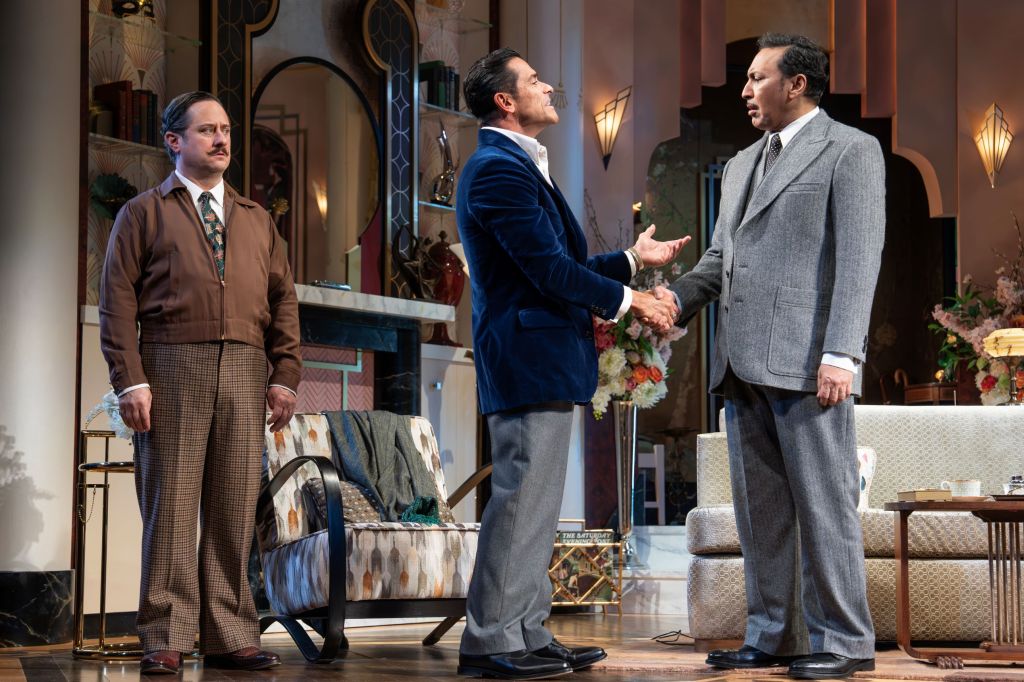
The mayhem and gradual explosion of their drunken riot is beautifully timed, staged and wrought. Byrne and O’Hara are world-class comedians.
The hilarity really explodes after the set up when the women wait for their beloved Maurice to appear before dinner, singing his praises, and drinking, and singing his praises during dinner, and drinking, and singing his praises, and drinking after dinner. As they drink, eat and swoon over Maurice, they are interrupted by phone calls which drive them to more drink because everyone but Maurice calls. Finally, even they become overwrought with their own fantasies and turn against each other, the jealousy manifesting. Jane stumbles and storms out. Julia is beside herself thinking Jane is meeting Maurice behind her back which ratchets the excitement and wild comedy toward the heavens.
Who will calm the situation down? Not the husbands. In shock at Jane’s treason Julia spills the beans to Willy, who conveniently shows up moments after Jane huffs out. He questions where his wife is. At the height of the chaos, when Fred and the wayward, back-stabbing Jane return, there’s another twist. The two women unite to fawn off their husbands’ probing queries about their antics. It is then that Coward, perfectly read by Scott Ellis, reveals the pièce de résistance. In walks the stunning Maurice, every inch the living fantasy brought to life in Mark Consuelos, who is having the time of his life. The audience was thrilled to see him. Indeed, he is Julia’s and Jane’s equivalent, but not for marriage, for love and passion.
Interestingly, the implication is that neither Julia or Jane would be adverse to a ménage à trois, if the situation wandered in that direction. Coward suggests this inherent possibility at the conclusion when Jane and Julia follow Maurice upstairs to see his apartment. (Ironically, he has moved into their building.) This most probably was another unspoken reason why the British censor withheld the comedy’s license. Seventy years later since Fallen Angels appeared in the U.S. the play has found its moment.
Fallen Angels runs 1 hour 30 minutes with no intermission at the Todd Haimes Theater though June 7, 2026. roundabouttheatre.org.

Posted on April 22, 2026, in Broadway, NYC Theater Reviews and tagged Aasif Mandvi, alaska, Christopher Fizgerald, Fallen Angels, Kelli O'hara, Mark Consuelos, Noël Coward, photography, racee Chimo, random-thoughts, Rose Byrne, school, technology. Bookmark the permalink. Leave a comment.


Leave a comment
Comments 0