Author Archives: caroleditosti
Elevator Repair Service’s ‘Ulysses’ by James Joyce, a Review
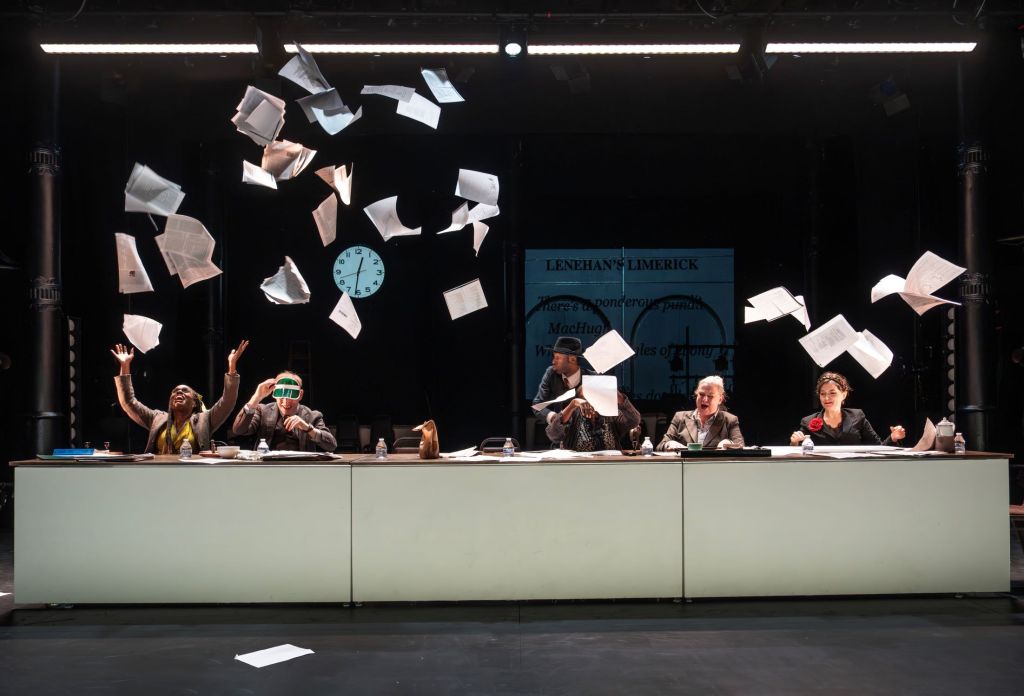
Elevator Repair Service became renowned when they presented Gatz, a verbatim six hour production of F. Scott Fitzgerald’s The Great Gatsby at the Public, as part of the Under the Radar Festival in 2006. Since their remarkable Gatz outing, they have followed up with other memorable presentations. It would appear they have outdone themselves with their prodigious effort in their New York City premiere of James Joyce’s opaque, complicated novel Ulysses. The near three-hour production directed by John Collins with co-direction and dramaturgy by Scott Shepherd, currently runs at The Public Theater until March 1, 2026.
At the top of the play Scott Shepherd introduces the play with smiling affability and grace. He directly addresses the audience, reminding them that “not much happens in Ulysses, apart from everything you can possibly imagine,” and that it happens in the span of a day beginning precisely at 8 a.m,, Thursday June 16, 1904 in Dublin, Ireland. Before Shepherd dons the character Buck Mulligan who appears at the beginning of the novel, he discusses that in the “spirit of confusion and controversy” (labels by critics), Joyce’s day in the life of three characters will be read with cuts in the text. Elevator Repair Service elected to remove Joyce’s text to redeem the time. The cuts are indicated by the cast “fast forwarding” over the narrative.
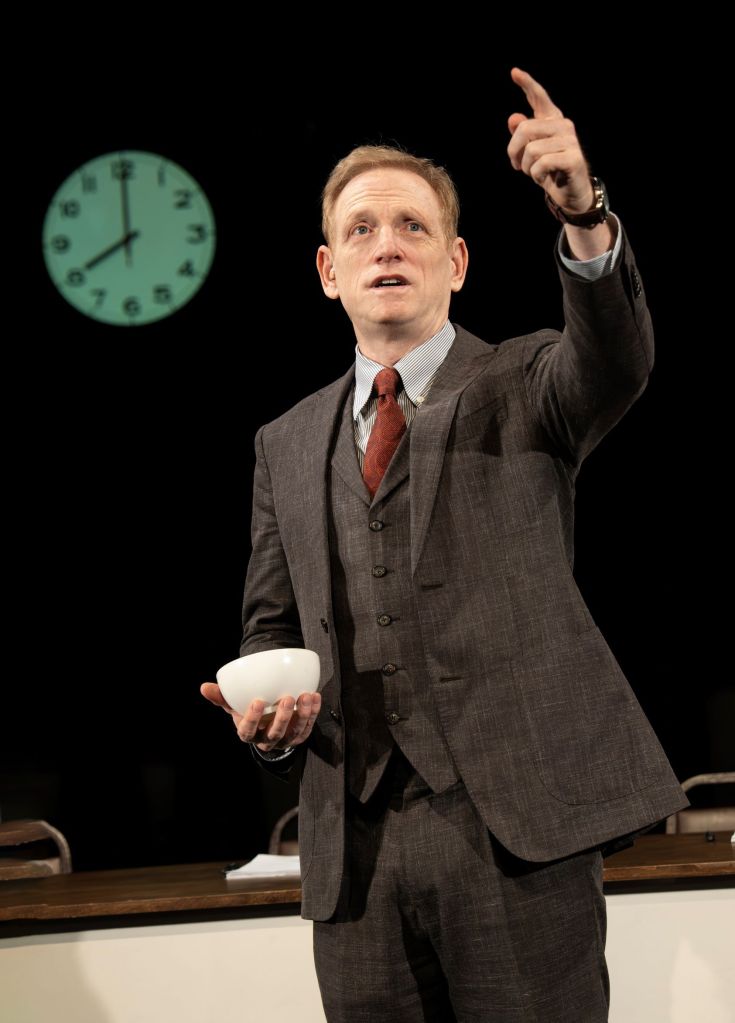
Collins and the creative team cleverly effect this “fast forwarding” with gyrating, shaking movement and action. Ben Williams’ design replicates the sound of a tape spinning forward. To anyone who may be following along with their own copy of the novel, the “fast forward” segments are humorous and telling. However, the cuts pare away some of the details and depths of character Joyce thought vital to include in his parallel of Dublin figures with the most important characters of the Odyssey: home returning hero Odysseus, long-suffering wife, Penelope, and warrior son, Telemachus.
After Shepherd’s introduction, Ulysses moves from a sedentary reading with multiple actors into a fully staged and costumed production as it progresses through the day’s events principally following Stephen Dedalus (Chisopher-Rashee Sevenson), who represents Telemachus, Leopold Bloom (Vin Knight), as Odysseus, and Molly Bloom (Maggie Hoffman) as Penelope.
The events illuminate these characters, and the cast superbly theatricalizes the novel’s humor, whimsy and farce. Some scenes more successfully realize Joyce’s playfulness and wit better than others. For example when Bloom decides to go to another pub after seeing the sloppy, gluttonous patrons of the first bar, the cast revels in portraying the slovenly, grotesque Dubliners. slobbering over their food. Additionally, the scene where Bloom faces his deepest anxieties shows Knight’s Bloom giving birth to “eight male yellow and white children.” Director Collins hysterically stages Bloom’s “labor” with Knight in the birthing position, legs apart, as Shepherd “catches” eight baby dolls he then throws to the attending cast members.
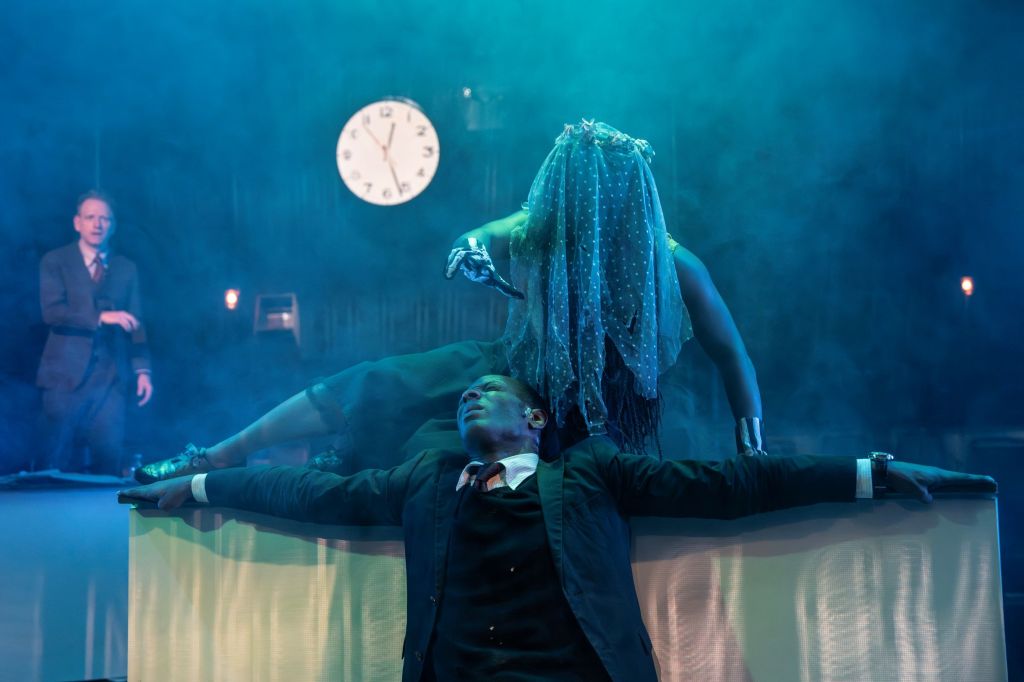
As costumes and props are added to the staging, we understand Leopold Bloom’s persecution as an outsider and a Jew. Also, wee note Stephen Dedalus as the writer/poet outsider who eventually joins Bloom, a father figure, who Bloom takes home for a time until Dedalus leaves to wander the night alone. Chistopher-Rashee Stevenson portrays the young Dedalus, a teacher whose unworthy friends lead him to drink and misdirection. Dedalus grieves his recently deceased mother and toward the end of the play has a nightmare visitation by her frightening, judgmental ghost.
For those familiar with the novel, the cast becomes outsized in rendering the various Dubliners that Knight’s Bloom and Stevenson’s Dedalus encounter. The dramatization is ultimately entertaining. We identify with Bloom as an Everyman, an anti-hero, who tries to get through the day in peace, while dismissing the knowledge that his wife Molly cuckolds him. Though he hasn’t been intimate with her since their baby Rudy died, he is unsettled that she conducts an affair with Blazes Boylan in their marriage bed at home. Somehow, Bloom has discovered that Molly who is a singer will be meeting with Boylan at 4 p.m. that afternoon. On his journey through the day he avoids confronting Boylan as they carry on with their activities around Dublin.
The ironic anti-parallel to the Odyssey, on the one hand, is that Molly Bloom is far from a Penelope who physically remained loyal to Odysseus, where Molly has an affair. On the other hand, late at night as Bloom sleeps with his feet awkwardly next to her face, we understand that Molly still loves Bloom and is emotionally and intellectually loyal. In her stream of consciousness monologue, seductively delivered by Maggie Hoffman, Molly arouses herself with memories of her relationship with Bloom when they were first together. It was then that she transferred a seed-cake from her mouth to his, sensually expressing her love.
Collins’s staging of the scene is humorous and profound. It defines why Molly has been present in Bloom’s consciousness throughout his strange journey traversing the streets of Dublin until he eventually finds his way home to her bed later that evening.
For those unfamiliar with Joyce’s novel, they will find the events and people a muddled hodgepodge that clarifies then becomes opaque, like a light switch turning on and off. Characters swap places with each other as seven actors take on numerous parts in a sometimes confusing array. Only Bloom, Dedalus and Molly stand out, true to Joyce’s vision for Ulysses for they embody Joyce’s themes about life. Thus, Bloom and Dedalus move through the day with flashes of brilliance, revelation, connection, irony and dread. Their reactions interest us. And Molly Bloom in her ending monologue puts a capstone on the vitality and beauty of a women’s perspective, as she experiences the sensuality and power of love for Bloom through reminiscence.
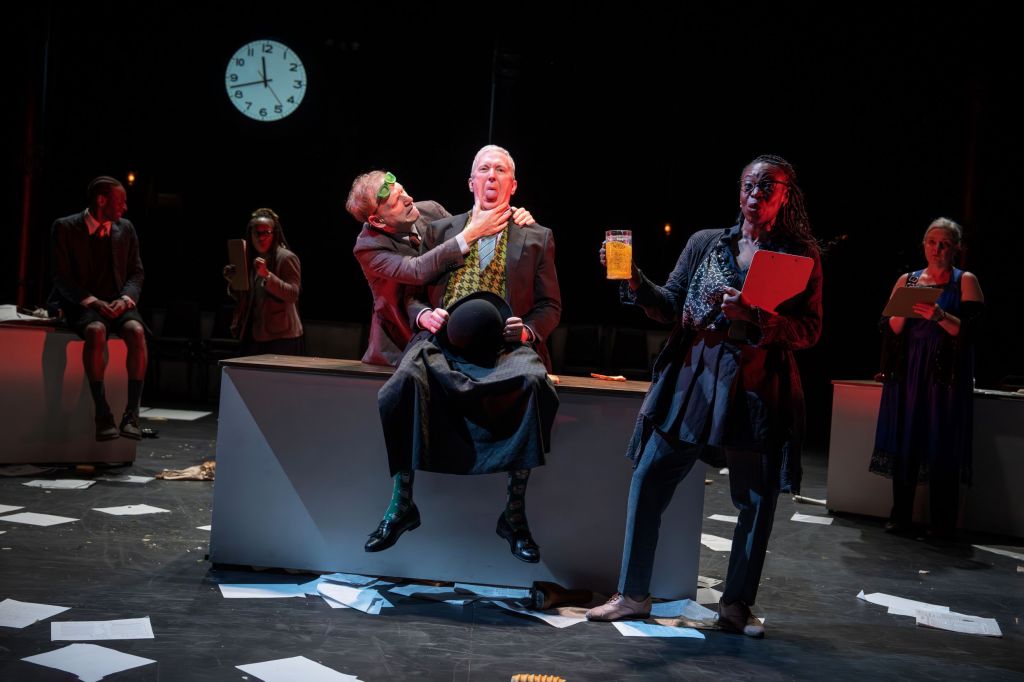
The costume design by Enver Chakartash reflects the time period with a fanciful modernist flourish that gives humor and depth to the personalities of the characters. For example Blazes Boylan (Scott Shepard) who has the affair with Molly wears a straw hat, outrageous wig and light suit that aligns with his jaunty gait. The scenic design by DOTS is minimalist and functional as is Marika Kent’s lighting design and Mathew Deinhart’s projection design. Most outstanding is Ben Williams’ acute, specific sound design which brings the scenes to life and follows the text adding fun and delight.
By the conclusion the audience is spent following the challenge of recognizing Joyce’s Dublin and the three unusual intellectuals and artists who he chooses to explore. Elevator Repair Service has elucidated the novel beyond what one might endeavor to understand reading it on one’s own. Importantly, they’ve made Ulysses an experience to marvel at and question.
Ulysses runs 2 hours 45 minutes with one intermission at the Public Theater through March 1, 2026. https://publictheater.org/productions/season/2526/ulysses
NYBG ‘Orchid Show, Mr. Flower Fantastic’s Concrete Jungle’ Part One
Mr. Flower Fantastic’s Concrete Jungle

A Love Letter to New York in Stunning Orchids until April 26, 2026
The metaphor for New York City as a “concrete jungle” has been used in the past, sometimes with negative connotations that implied ugly buildings, few green spaces, tall skyscrapers stealing light and air, and danger lurking around every corner.


But that conception of the city has long gone with the disappearance of the rotary phone. Alicia Keys’ Empire State of Mind “Concrete Jungle” blew it up forever (https://www.youtube.com/watch?v=FPggPjkoCjE) as did her autobiographical Broadway show Hell’s Kitchen.

Embodying Key’s song’s beauty and excitement, world-renown, in-demand, floral artist, Mr. Flower Fantastic, presents his view of the city in floral pageantry at NYBG. The show is his love letter to New York with captivating cityscapes punctuated with gorgeous, vibrant, many-hued orchids amidst design sculptures and supporting botanical arrangements that highlight familiar objects and places. The ebullient, fun displays present aspects of city life that all city dwellers take for granted and tourists may completely overlook.

In the Palms of the World Gallery, Mr. Flower Fantastic designs moth orchids flowing over and around the iconic townhouse found throughout each of the boroughs of the city.

Who is the show’s creator?

Mr. Flower Fantastic or MFF is one of the most in-demand floral artists in the world, known for transforming flowers into bold, sculptural pieces. Oftentimes, these meld art, fashion, and pop culture. As art comes in a variety of forms, Mr. Flower Fantastic has selected flowers as his medium. This selection carries an irony. Mr. Flower Fantastic is allergic to flowers. In response to this consequence, he embraces his allergies and turns this weakness into his brand strength.

Though his “fantastic” choice of his name and brand is outsized and attention grabbing, yet he is anonymous. You won’t be able to imprint him with facial recognition software because he wears a mask (respirator) and gloves reconciling his allergies with his passion for flowers instilled in him when he was a child. The respirator and gloves embody his style and charisma and allow him to focus on the floral medium as his message with anonymity. The unknown known is his identity.



The creator and NYBG staff selected a variety of showy blooms to cheer us through one of the colder winters in memory. His reiminaging is a lovely meld of “concrete” and green jungle to uplift us and make us smile for its cleverness and whimsy.
Stay tuned for PART II of my CONTINUED COVERAGE of the fantastic NYBG The Orchid Show Mr Flower Fantastic’s Concrete Jungle. In the meantime, check out the programming being offered connected to the show including dates for Orchid Evenings on the NYBG website. https://www.nybg.org/event/the-orchid-show-mr-flower-fantastics-concrete-jungle/
Also, if you would like to check out MFF’s website to look at previous shows and/or items for sale, check this website: https://www.mffstudio.com/
Schedule your plans for a number of visits to the The Orchid Show, Mr. Flower Fantastic’s Concrete Jungle. There is a lot to see that couldn’t be covered in just one post, thanks to the ingenuity of NYBG staff and MFF. The show ends April 26, 2026.
‘The Honey Trap,’ Irish Rep’s Acclaimed Production Returns

Subscribe to continue reading
Subscribe to get access to the rest of this post and other subscriber-only content.
Carrie Coon and Namir Smallwood are Frightening in Tracy Letts’ ‘Bug’

She’s a cocktail waitress. He’s a Gulf War vet. When they get together they create an unforgettable relationship in Tracy Letts’ sometimes comedic, mostly compelling psychological drama Bug, currently making its Broadway premiere at Manhattan Theater Club’s Samuel J. Friedman Theatre through February 8, 2026. Aptly directed by David Cromer for a maximum thrill ride, Agnes (Carrie Coon) and Peter (Namir Smallwood) gain each other’s trust in a world that increasingly threatens to destroy them.
Stellar performances by Coon (The White Lotus, The Gilded Age) and Smallwood (Pass Over on Broadway) carry the production through a slow build first act into the harrowing intensity and climactic finish of the second.
Letts’ chilling drama unfolds in a motel room on the outskirts of present-day Oklahoma City. Scenic designer Takeshi Kata features a typical mundane bedroom with cream colored walls and complementary cheesy lamps and appointments that spell out Agnes’ challenged socioeconomic position. By the second act, after a time interval during which Agnes and Peter panic and go through stages of emotional terror, the room’s once benign look transforms to a place whose inhabitants are under siege.
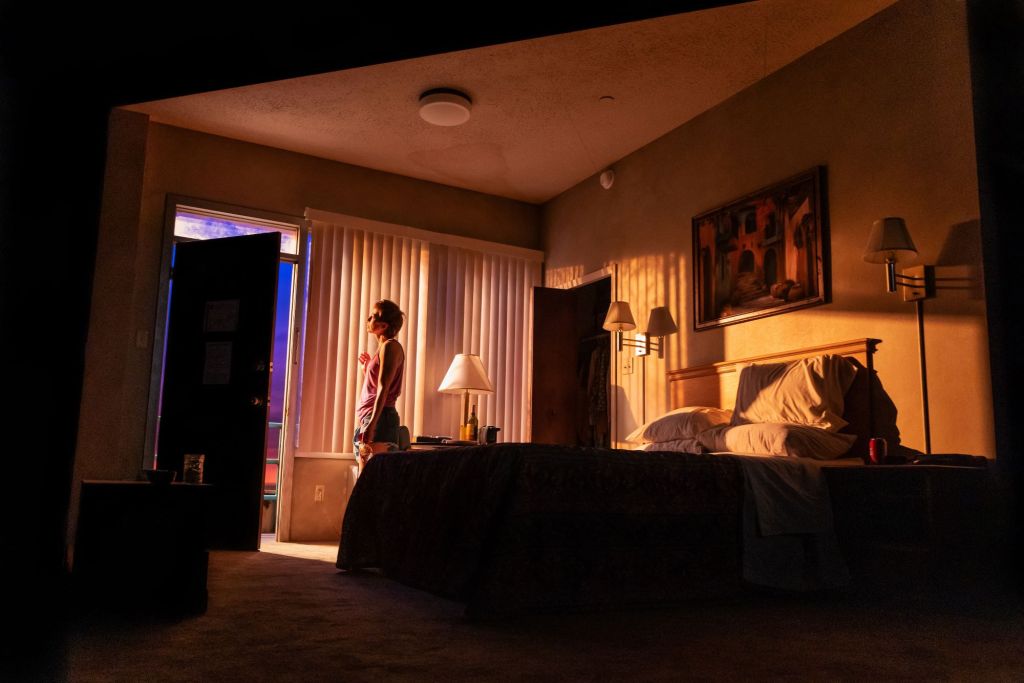
At this point Kata’s design shocks. It is then we understand how badly the situation has progressed in the minds of the characters .
At the top of the play we meet Agnes who lives in the motel room hiding out from her violent former husband Jerry Goss (Steve Key) an ex-convict. As Coon’s Agnes and her lesbian biker friend R.C. (Jennifer Engstrom) do drugs, R.C. warns Agnes to protect herself against Jerry whose prison release she questions because he is dangerous.
Ironically, Agnes asks about the background of the stranger using her bathroom. R.C. vouches for Smallwood’s Peter who she brought with her as they make their way to a party that R.C. also invites Agnes to. While R.C. is on the phone with personal business, Peter assures Agnes he is “not an axe murderer,” and expresses an interest in her.
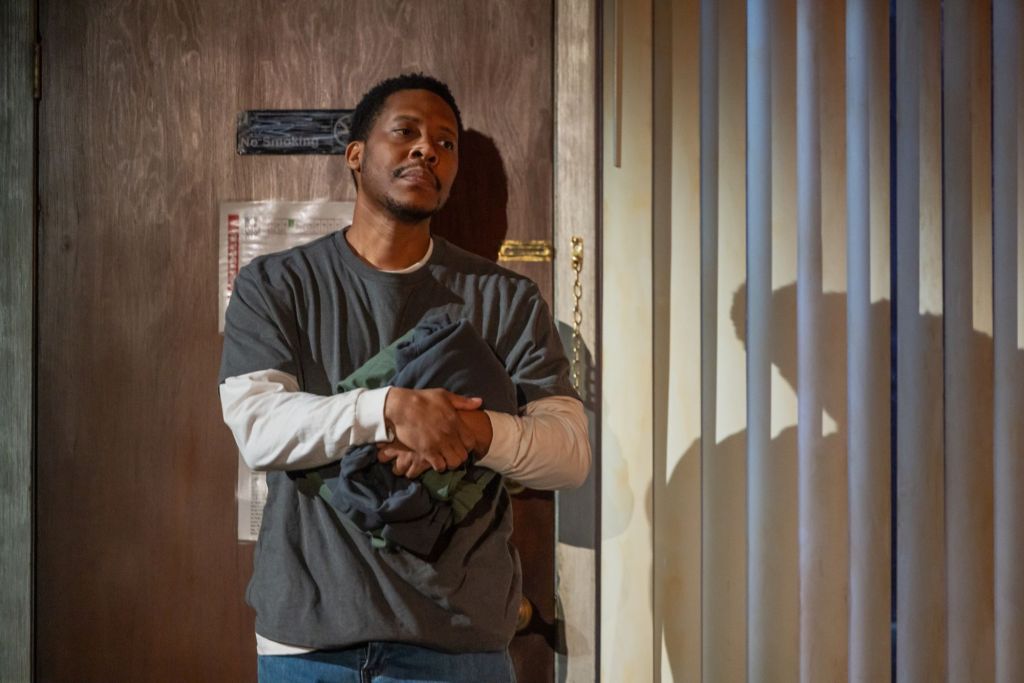
Instead of going to the party with R.C., both Agnes and Peter decide to hang out together and talk, feeling more comfortable getting to know each other than being in a larger crowd. It is during these exchanges and Peter’s staying overnight at Agnes’ invitation that her emotional neediness clarifies. When Jerry shows up, they argue and he hits Agnes. After Jerry leaves, Peter’s attentiveness draws her closer to him. As Agnes and Peter settle in and do drugs, they share secrets and bond. Increasingly Agnes’ perspective shifts. She accepts Peter’s world view and personal reality despite its extremism.
Though Peter says he should go, Agnes uses his hesitation to encourage him to stay, insisting upon it. She makes a symbolic gesture that clever viewers will note conveys her acceptance of Peter because of her emotional desperation more than a belief in his perspective and backstory.
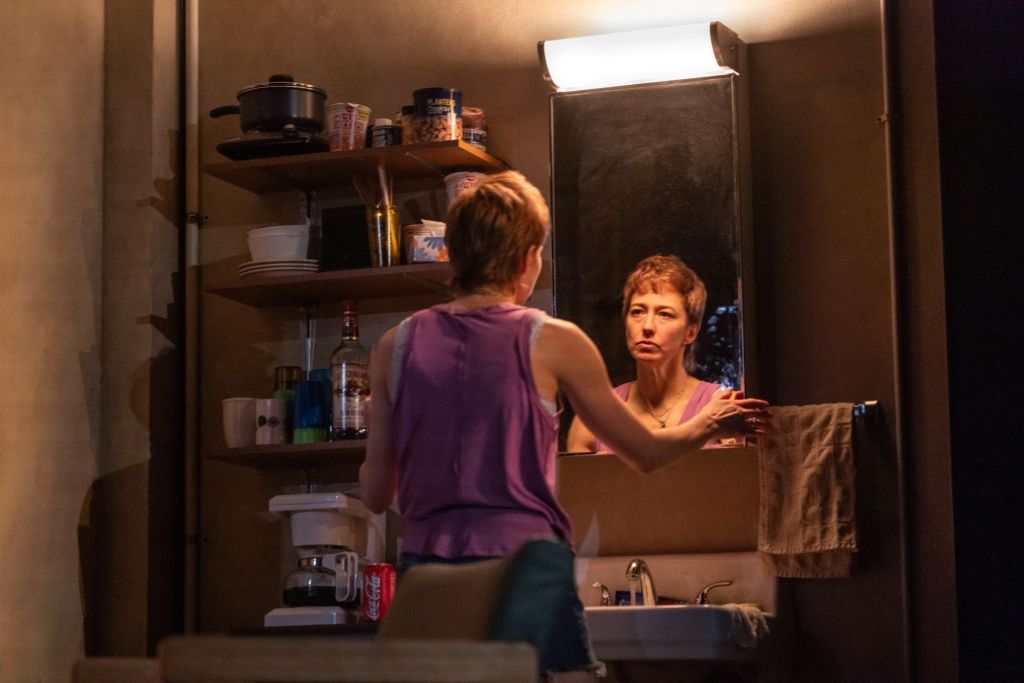
In the next act we see the extent to which Peter has made himself comfortable living with Agnes whose resolve against being with Jerry has strengthened because of her relationship with Peter. Because their concern and care for each other resonates with trust, Peter relaxes into himself. He examines his blood under a microscope and finds “proof” of a conspiracy theory that the government uses military vets and unsuspecting individuals as guinea pigs to experiment on. With convoluted half-truths about government cover-ups related to the war in Iraq, Oklahoma City bombing, the Tuskegee syphilis experiment and more, he panics, fearful that aphids bite him and Agnes, feed off their blood and infest their living space.
Convinced that egg sacks have been planted in him by doctors who also monitor and follow him with helicopters because he has gone AWOL, he persuades Agnes to accept his “bug” theory that he grounds in explanations. Together, they plan a way out of the infestation which has taken over their bodies and minds.
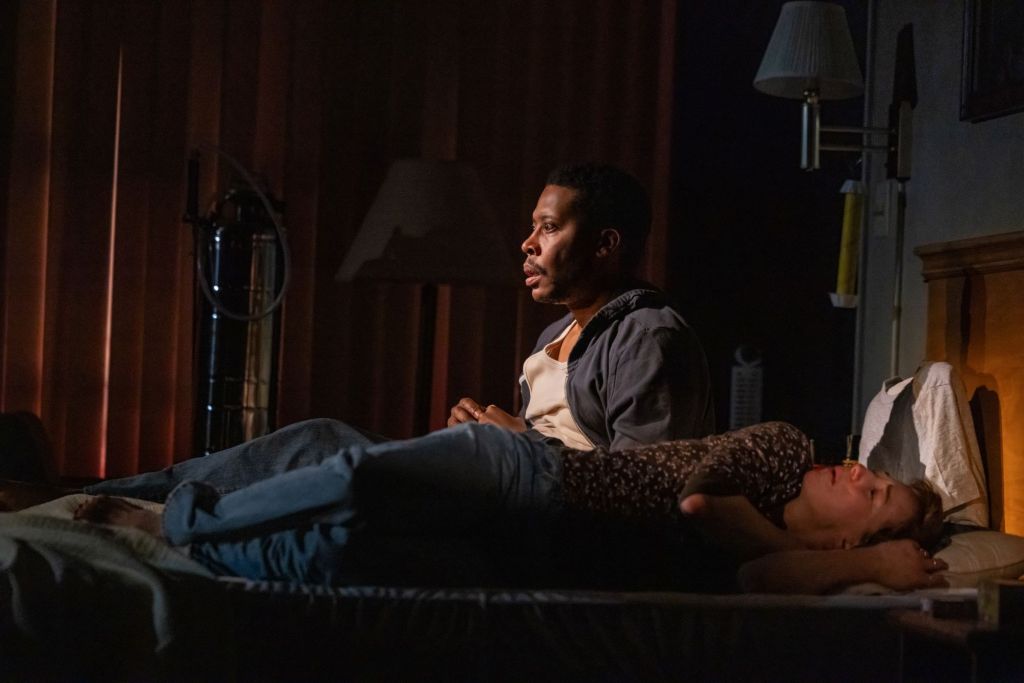
To complicate matters Dr. Sweet (Randall Arney) shows up and explains Peter’s medical case with R.C. and Jerry to legitimize taking Peter back with him to “Lake Groom.” Letts offers the intriguing possibility that there may be many truths about this situation. But without independent investigation and research, belief takes over. Whether Peter is part of an experiment and a guinea pig or not, Agnes expresses her love for him comforted by their bond which gives her life meaning. Within the horror of the infestation, they have found their emotional sustenance. Their relationship is their sanctuary from life’s pain.
Cromer’s vision and his shepherding of the fine performances by Coon and Smallwood make this stylized production all too real and terrifying. Thematically current, with various cultural attitudes related to government cover-ups, and conspiracy theories stoked by the questionable motives of those in power, the creative team’s efforts (Heather Gilbert’s lighting design, Josh Schmidt’s sound design) hit the sweet spot of relevance.
Though written decades ago, in Bug Letts intimates how and why certain women embrace what others deem to be their partner’s extremist perspectives. Wounded and seeking love, women like Agnes more easily accept their partner’s ideas, rather than search for facts and proof to dispute them. Governmental cover-ups of the truth fan the flames of extremist belief systems. The consequences can be socially and culturally devastating.
Bug runs 1 hour and 55 minutes with one intermission at the Samuel Friedman Theatre ( 47th St. between 7th and 8th) https://www.manhattantheatreclub.com/shows/2025-26-season/bug/
The Fine June Squibb Heads up the Stellar Cast of ‘Marjorie Prime’

When Marjorie Prime by Jordan Harrison opened Off Broadway in 2015, starring Lois Smith, it appealed as science fiction. Since then the use of various forms of artificial intelligence to support human behavior have become ubiquitous.
Reinforcing this new reality the playwright and director Anne Kauffman dusted off the prescient family drama and shined it up for its Broadway premiere with few changes to the script. Maintaining the prior production values, director Anne Kauffman works with set designer Lee Jellinek, sound designer Daniel Kluger and Ben Stanton’s lighting design to create the almost surreal and static atmosphere where AI takes over the lives of a family and exists for itself in the last scene.
The production runs at the Helen Hayes Theater with the superb cast of June Squibb, Cynthia Nixon, Danny Burstein and Christopher Lowell through February 15. They are the reason to see the revival.
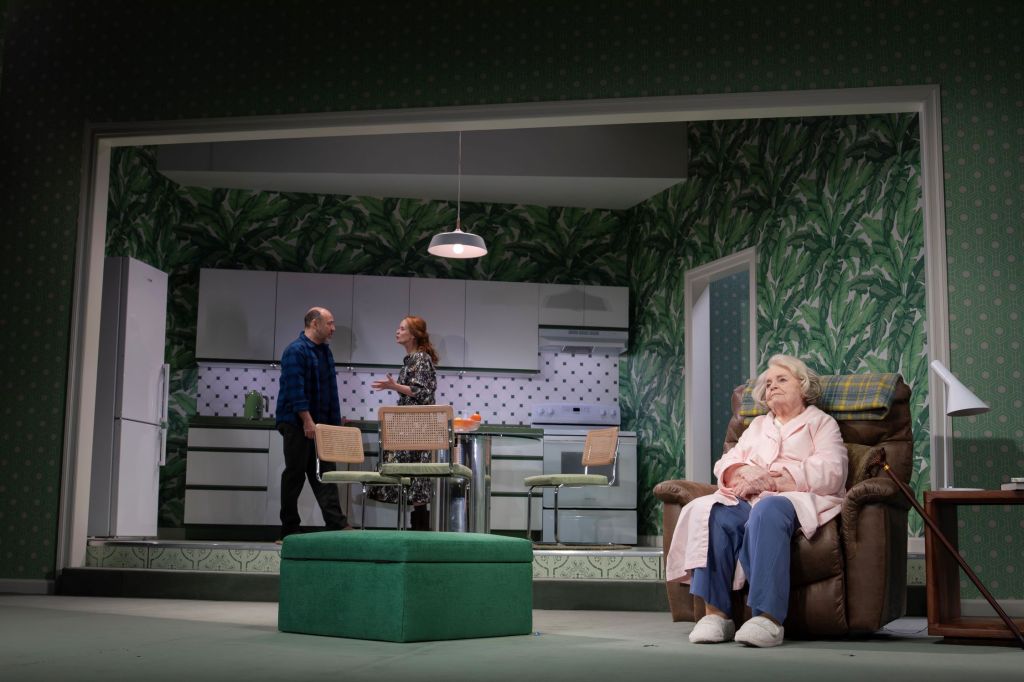
On one level the excellent performances outshine the themes of Marjorie Prime which deal with death, identity, the grieving process, artificial intelligence and more. The science fiction aspect of the play, so striking before, has diminished.
Yet, Harrison’s conceit that AI holograms might be used to reconcile the death and loss of a loved one still fascinates a decade later. Our culture fights death and aging with its emphasis on ageless appearance, looking 25-years-old at the chronological age of 90-years-old. Some other cultures have a healthier approach, viewing the acceptance of death and aging as a normal part of life cycles. However, with technological advancements, regardless of the culture or country, AI will have its uses in the battle against disease, dying, death and mourning.
The “Primes,” in Marjorie Prime are the spitting image of loved ones at a particular time in their lives. Created by the company Senior Serenity to help the bereaved get through inconsolable grief, Marjorie’s family believes a holographic duplicate of husband Walter will help her adjust to his death. The replica keeps her engaged, sentient and interactive, unlike passively watching TV.
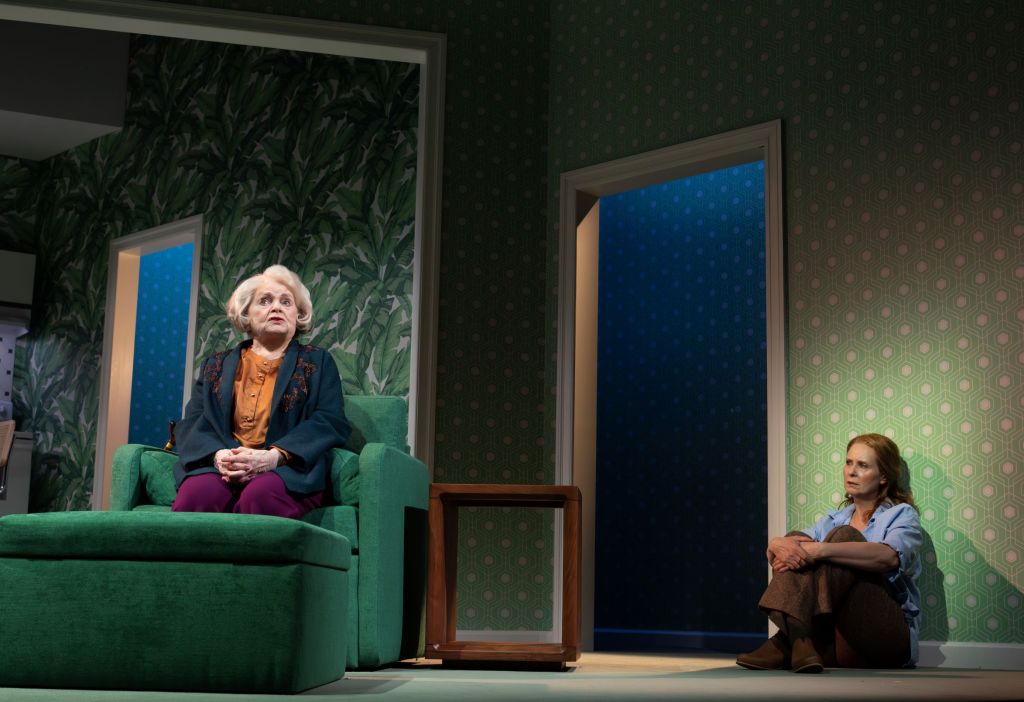
Walter Prime (Christopher Lowell) duplicates the younger, good-looking Walter in his thirties. Happily, he reminds her of the distant past, not the more recent, sick and dying Walter. The hologram’s programming and presence also help stir Marjorie’s memory, complicated with dementia. A work in progress, Walter Prime evolves based on the information that 85-year-old Marjorie (June Squibb), her daughter Tess (Cynthia Nixon), and son-in-law Jon (Danny Burstein), give him about Walter and Marjorie’s life together.
Thus, at the top of the play Walter Prime and Marjorie discuss movies they went to, for example, My Best Friend’s Wedding, which Marjorie has forgotten until Walter tells her the synopsis. The spry 96-year old Squibb, who made her Broadway debut playing one of the strippers in Gypsy (1959), portrays the spicy, funny, confused, chronologically younger woman with a failing memory, an irony that amused me to no end. Squibb is just terrific.
As Marjorie’s identity and memory dim, Walter Prime builds up the identity of Walter with her help. However, Harrison’s play raises questions about this process and never answers them. For example, how much information has Walter Prime been fed prior to his engagement with Marjorie, Jon and Tess? How can Marjorie be expected to keep track of information from before their marriage into their elderly years with her failing memory? Won’t she feed him incorrect details?
Indeed, facts and details shift and Marjorie confuses the truth. An imagined past becomes easier to accept with one’s husband “Prime” fed information by others. This problem never resolves. Neither does Tess’s incomplete acceptance of Walter’s function to stimulate Marjorie, the supposed benefit that Senior Serenity, the company that made him, affirms. The impatient, edgy Tess doubts Walter’s usefulness, but the upbeat Jon thinks that he helps improve Marjorie’s engagement and memory.
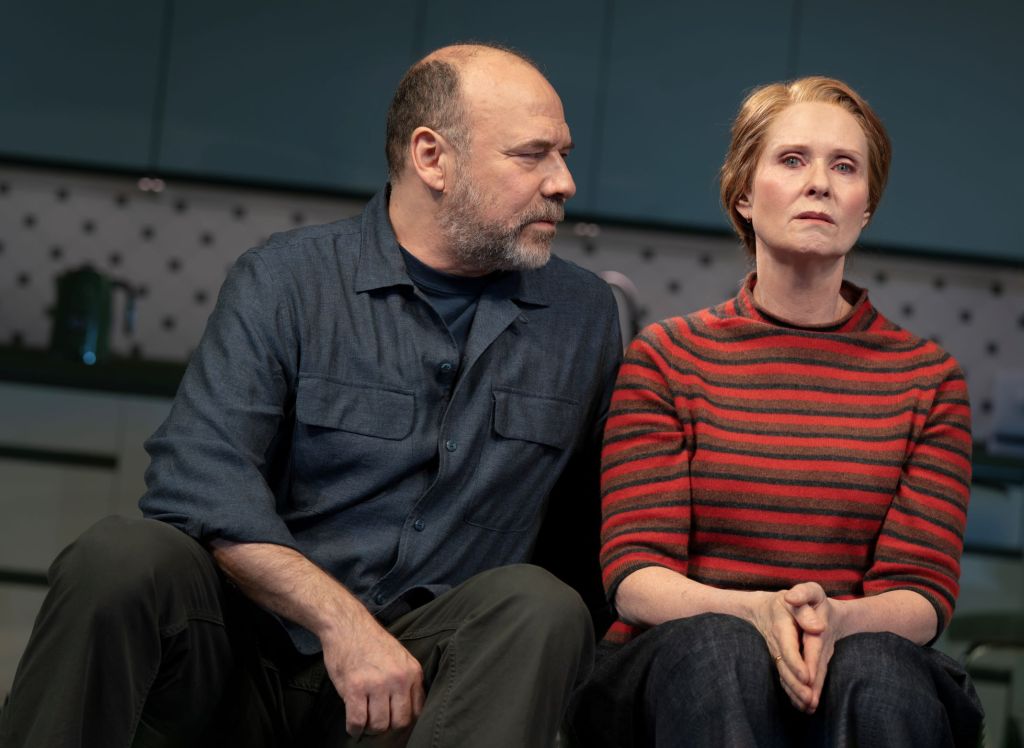
When Walter Prime’s presence annoys Tess, Jon accuses her of jealousy. Does Marjorie prefer Walter over Tess, who must nag her mother to eat and “obey” her in the reversal of mother/daughter, parent/child roles? Losing her autonomy Marjorie must rely on Tess and Jon in her living arrangements and personal care needs.
As Jon, Marjorie and Tess converse in Jellick’s minimalist, living room-kitchen combination that lacks futuristic style, Walter Prime sits on a sofa in the living room. He waits in a “listening mode” ready to interact when needed.
For his part Jon is positive about Walter’s impact on Marjorie. As the scene progresses, Tess mentions after an interval that her mother surprisingly recalls a situation long buried in pain. We learn the specifics of this later in the play. Some of the action referred to happens off stage. (i.e. Tess and Jon take Marjorie to the hospital after a fall).
Guided by the “Primes,” who Harrison sequences to move the action forward, time jumps. Marjorie has died and Jon and Tess engage Marjorie Prime to help console Tess and move her through her bleak depression and grief at her mom’s passing. After that we learn through Jon’s conversation with Tess Prime what transpired with Tess. In the various scenes Nixon’s Tess gives a heartbreaking speech about her mother, memory and imagination which sets up the rest of the play. Burstein’s Jon listens and responds with an uncanny authenticity. Both are superb.
Since the “Primes” “live” forever in holographic form until someone decommissions them, they occupy the home in the last scene. Jon is elsewhere, so Walter, Tess and Marjorie converse among themselves having been given life from their human counterparts as an ideal, evolved “being.” Eerie perfection.
Marjorie Prime runs 1 hour 15 minutes with no intermission at the Helen Hayes Theater on 44th Street until the 15 of February. 2st.com.
Kara Young and Nicholas Braun Fine-Tune Their Performances in ‘Gruesome Playground Injuries’

What do people do when they have emotional pain? Sometimes it shows physically in stomach aches. Sometimes to release internal stress people risk physical injury doing wild stunts, like jumping off a school roof on a bike. In Rajiv Joseph’s humorous and profound Gruesome Playground Injuries, currently in revival at the Lucille Lortel Theater until December 28th, we meet Kayleen and Doug. Two-time Tony Award winner Kara Young and Succession star Nicolas Braun portray childhood friends who connect, lose track of each other and reconnect over a thirty year period.
Joseph charts their growth and development from childhood to thirty-somethings against a backdrop of hospital rooms, ERs, medical facilities and the school nurse’s office, where they initially meet when they go to seek relief from their suffering. After the first session when they are 8-year-olds, to the last time we see them at 38-year-olds at an ice rink, we calculate their love and concern for each other, while they share memories of the most surprising and weird times together. One example is when they stare at their melded vomit swishing around in a wastepaper basket when they were 13-year-olds.

How do they maintain their relationship if they don’t see each other for years after high school? Their friends keep them updated so they can meet up and provide support. From their childhood days they’ve intimately bonded by playing “show and tell,” swapping stories about their external wounds, which Joseph implies are the physical manifestations of their soul pain. After Doug graduates from college, when Doug is injured, someone tips off Kayleen who comes to his side to “heal him,” something he believes she does and something she hopes she does, though she doesn’t feel worthy of its sanctity.
Joseph’s two-hander about these unlikely best friends alludes to their deep psychological and emotional isolation that contributes to their self-destructive impulses. Kayleen’s severe stomach pains and vomiting stems from her upbringing. For example in Kayleen’s relationship with her parents we learn her mother abandoned the family and ran off to be with other lovers while her father raised the kids and didn’t celebrate their birthdays. Yet, when her mother dies, the father tells Kayleen she was “a better woman than Kayleen would ever be.” There is no love lost between them.
Doug, whose mom says he is accident prone, uses his various injuries to draw in Kayleen because he feels close to her. She gives him attention and likes touching the wounds on his face, eyes, etc. Further examination reveals that Doug comes from a loving family, the opposite of Kayleen’s. Yet, he may be psychologically troubled because he risks his life needlessly. For example, after college, he stands on the roof of a building during a storm and is struck by lightening, which puts him in a coma. His behavior appears foolish or suicidal. Throughout their relationship Kayleen calls him stupid. The truth lies elsewhere.

Of course, when Kayleen hears he is in a coma (they are 28-year-olds), after the lightening episode, she comes to his rescue and lays hands on him and tells him not to die. He recovers but he never awakens when she prays over him. She doesn’t find out he’s alive until five years later when he visits her in a medical facility. There, she recuperates after she tried to cut out her stomach pain with a knife. She was high on drugs. At that point they are 33-year-olds. Doug tells her to keep in touch, and not let him drift away, which happened before.
Joseph charts their relationship through their emotional dynamic with each other which is difficult to access because of the haphazard structure of the play, listing ages and injuries before various scenes. In this Joseph mirrors the haphazard events of our lives which are difficult to figure out. Throughout the 8 brief, disordered, flashback scenes identified by projections on the backstage wall listing their ages (8, 23,13, 28, 18, 33, 23, 38) and references to Doug’s and Kayleen’s injuries, Joseph explores his characters’ chronological growth while indicating their emotional growth remains nearly the same, as when we first meet them at 8-years-old. In the script, despite their adult ages, Joseph refers to them as “kids.”
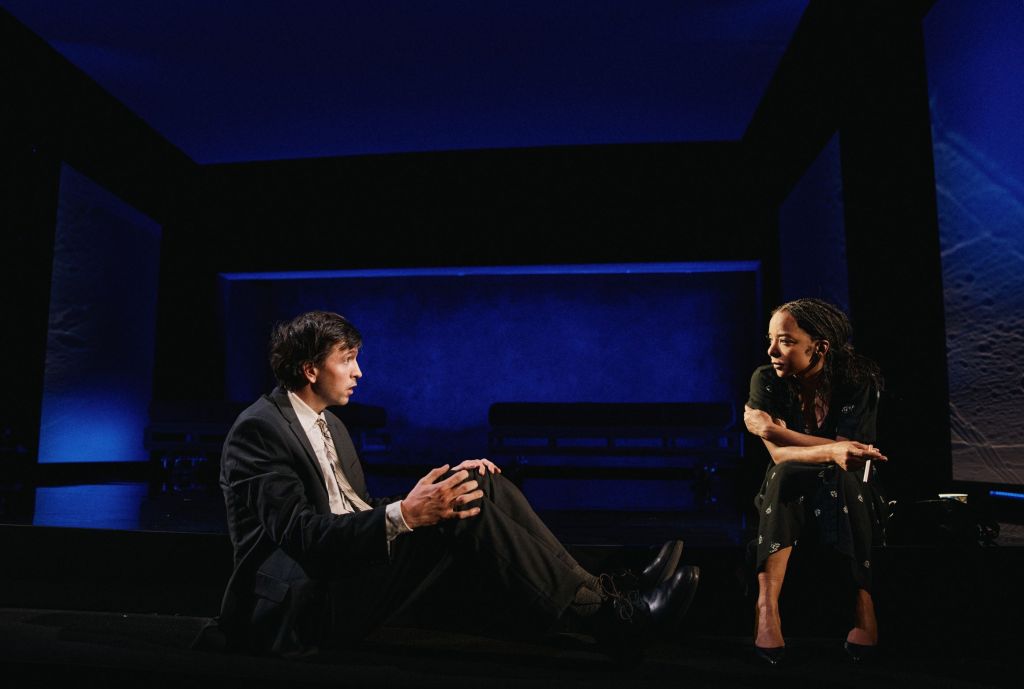
Toward the end of the play via flashback (when they are 18-year-olds), we discover their concern and love for for each other and inability to carry through with a complete and lasting union as boyfriend and girlfriend. When Doug tries to push it, Kayleen isn’t emotionally available. Likewise when Kayleen is ready to move into something more (they are 38-year-olds), Doug refuses her touch. By then he has completely wrecked himself physically and can only work his job at the ice rink sitting on the Zamboni.
Young and Braun are terrific. Their nuanced performances create their characters’ relationship dynamic with spot-on authenticity. Acutely directed by Neil Pepe, we gradually put the pieces together as the mystery unfolds about these two. We understand Kayleen insults Doug as a defense mechanism, yet is attracted to his self-destructive nature with which she identifies. We “get” his protection of her because of her abusive father. One guy in school who Doug fights when the kid calls her a “skank,” beats him up. Doug knows he can’t win the fight, but he defends Kayleen’s name and reputation.
The lack of chronology makes the emotional resonance and causation of the characters’ behavior more difficult to glean. One must ride the portrayals of Young and Braun with rapt attention or you will miss many of Joseph’s themes about pain, suffering and the salve for it in companionship, honesty and love.
In additional clues to their character’s isolation, Young and Braun move the minimal props, the hospital beds, the bedding. They rearrange them for each scene. On either side of the stage in a dimly lit space (lighting by Japhy Weideman), Young and Braun quickly fix their hair and don different costumes (Sarah Laux’s costume design), and apply blood and injury-related makeup (Brian Strumwasser’s makeup design). In these transitions, which also reveal passages of time in ten and fifteen year intervals, we understand that they are alone, within themselves, without help from anyone. This further provides clues to the depths of Joseph’s portrait of Kayleen and Doug, which the actors convey with poignance, humor and heartbreak.
Gruesome Playground Injuries runs 1 hour 30 minutes with no intermission through 28 December at the Lucille Lortel Theater; gruesomeplaygroundinjuries.com.
‘The Baker’s Wife,’ Lovely, Poignant, Profound
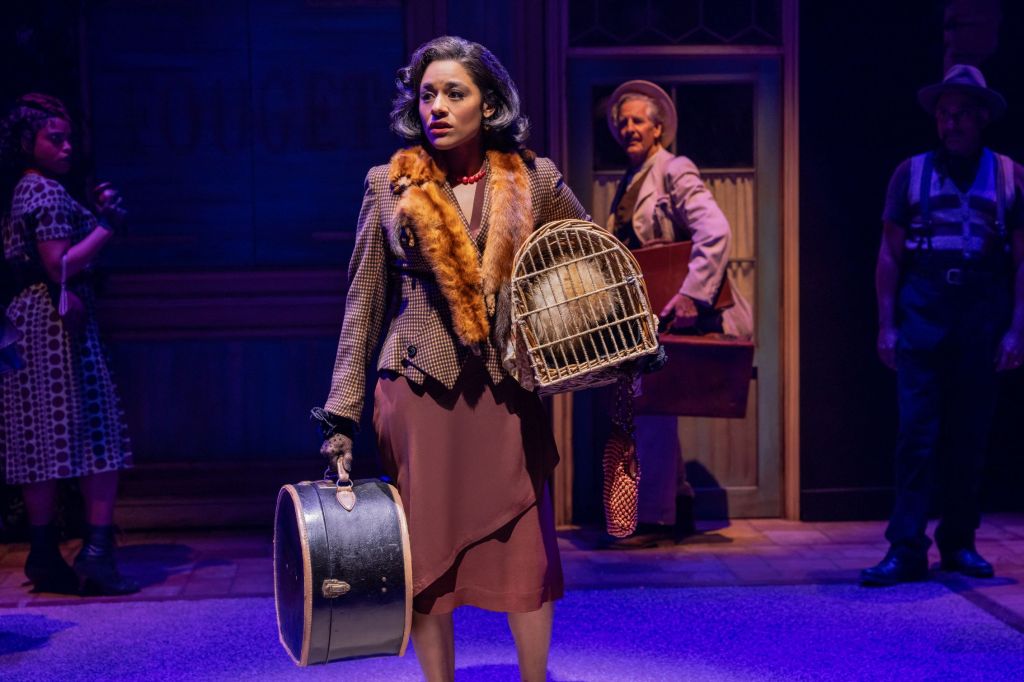
It is easy to understand why the musical by Stephen Schwartz (music, lyrics) and Joseph Stein (book) after numerous reworkings and many performances since its premiere in 1976 has continued to gain a cult following. Despite never making it to Broadway, The Baker’s Wife has its growing fan club. This profound, beautiful and heartfelt production at Classic Stage Company directed by Gordon Greenberg will surely add to the fan club numbers after it closes its limited run on 21 December.
Based on the film, “La Femme du Boulanger” by Marcel Pagnol (1938), which adapted Jean Giono’s novella“Jean le Bleu,” The Baker’s Wife is set in a tiny Provençal village during the mid-1930s. The story follows the newly hired baker, Aimable (Scott Bakula), and his much younger wife, Geneviève (Oscar winner, Ariana De Bose). The townspeople who have been without a baker and fresh bread, croissants or pastries for months, hail the new couple with love when they finally arrive in rural Concorde. Ironically, bread and what it symbolically refers to is the only item upon which they readily agree.
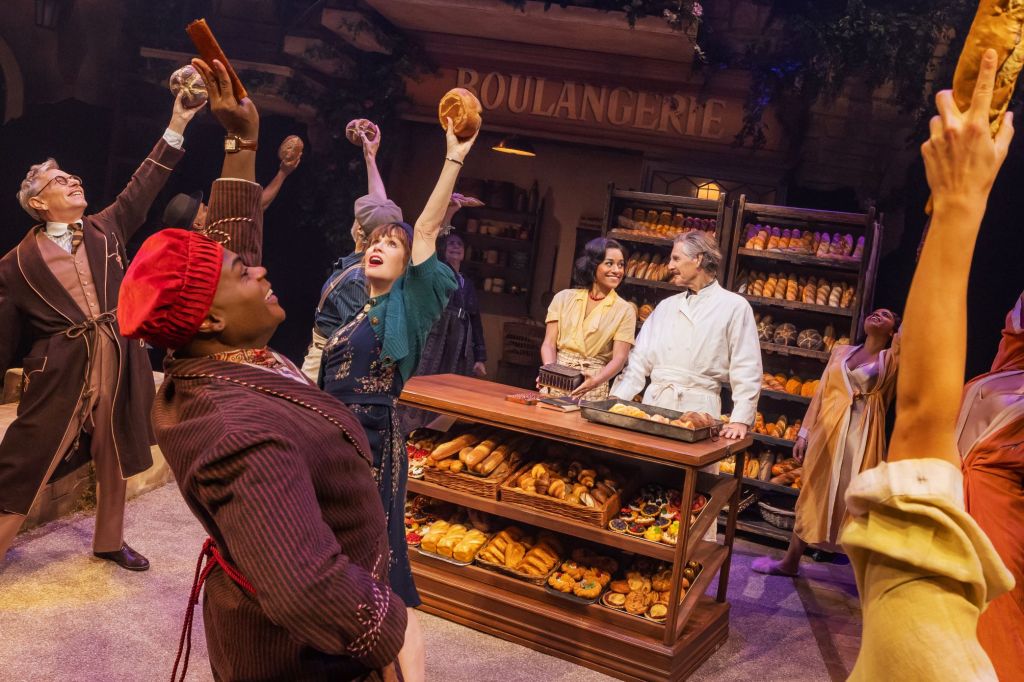
If you have not been to France, you may not “get” the community’s orgasmic and funny ravings about Aimable’s fresh, luscious bread in the song “Bread.” A noteworthy fact is that French breads are free from preservatives, dyes, chemicals which the French ban, so you can taste the incredible difference. The importance of this superlative baker and his bread become the conceit upon which the musical tuns.
Schwartz’s gorgeously lyrical music and the parable-like simplicity of Stein’s book reaffirm the values of forgiveness, humility, community and graciousness as they relate to the story of Geneviève. She abandons her loving husband Aimable and runs away to have adventures with handsome, wild, young Dominique (Kevin William Paul), the Marquis’ chauffeur. When the devastated Aimable starts drinking and stops making bread, the townspeople agree they cannot allow Aimable to fall down on his job. The Marquis (Nathan Lee Graham), is more upset about losing Aimable’s bread than the car Domnique stole.
Casting off long held feuds and disagreements, they unite together and send out a search party to return Geneviève without judgment to Aimable, who has resolved to be alone. Meanwhile, Geneviève decides to leave Dominique who is hot-blooded but cold-hearted. In a serendipitous moment three of the villagers come upon Geneviève waiting to catch a bus to Marseilles. They gently encourage her to return to Concorde, affirming the town will not judge her.

She realizes she has nowhere to go and acknowledges her wrong-headed ways, acting like Pompom her cat who also ran off. Geneviève returns to Aimable for security, comfort and stability, and Pompom returns because she is hungry. Aimable feeds both, but scolds the cat for running after a stray tom cat in the moonlight. When he asks Pompom if she will run away again, DeBose quietly, meaningfully tells Bakula’s Aimable, she will not leave again. The understanding and connection returns metaphorically between them.
Director Gordon Greenberg’s dynamically staged and beautifully designed revival succeeds because of the exceptional Scott Bakula and perfect Ariana DeBose, who also dances balletically (choreography by Stephanie Klemons). DeBose’s singing is beyond gorgeous and Bakula’s Aimable resonates with pride and poignancy The superb ensemble evokes the community of the village which swirls its life around the central couple.

Greenberg’s acute, well-paced direction reveals an obvious appreciation and familiarity with The Baker’s Wife. Having directed two previous runs, one in New Jersey (2005), the other at The Menier Chocolate Factory in London (2024), Greenberg fashions this winning, immersive production with the cafe square spilling out into the CSC’s central space with the audience on three sides. The production offers the unique experience of cafe seating for audience members.
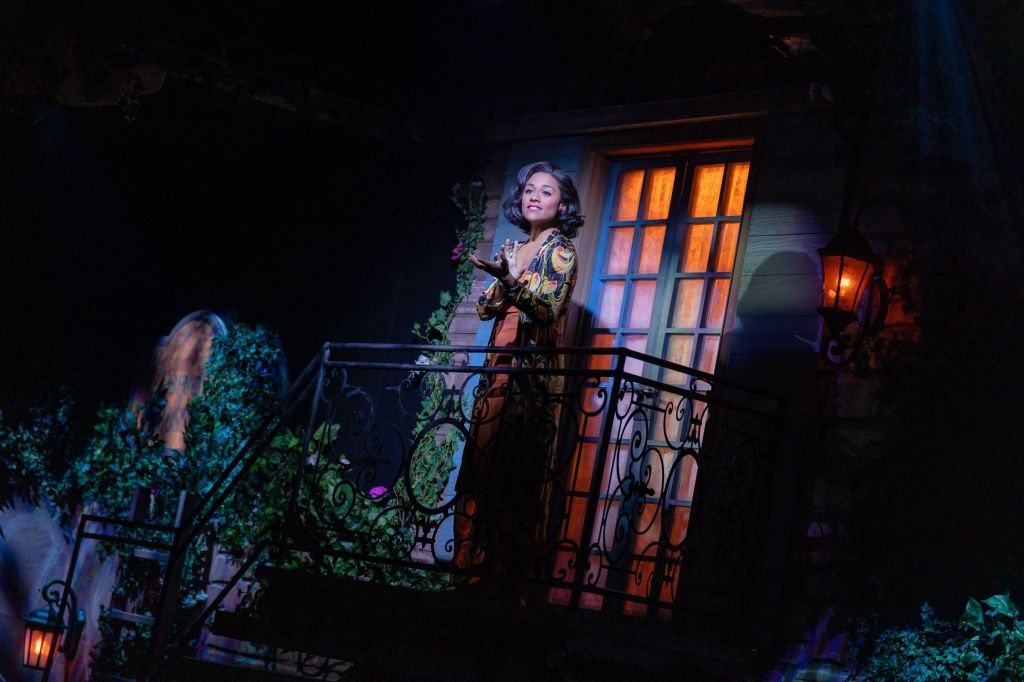
Jason Sherwood’s scenic design creates the atmosphere of the small village of Concorde with ivy draping the faux walls, suggesting the village’s quaint buildings. The baker’s boulanger on the ground floor at the back of the theater is in a two-story building with the second floor bedroom hidden by curtains with the ivy covered “Romeo and Juliet” balcony in front. The balcony features prominently as a device of romance, escape or union. From there DeBoise’s Geneviève stands dramatically while Kevin William Paul’s Dominique serenades her, pretending it is the baker’s talents he praises. From there DeBoise exquisitely sings “Meadowlark.”
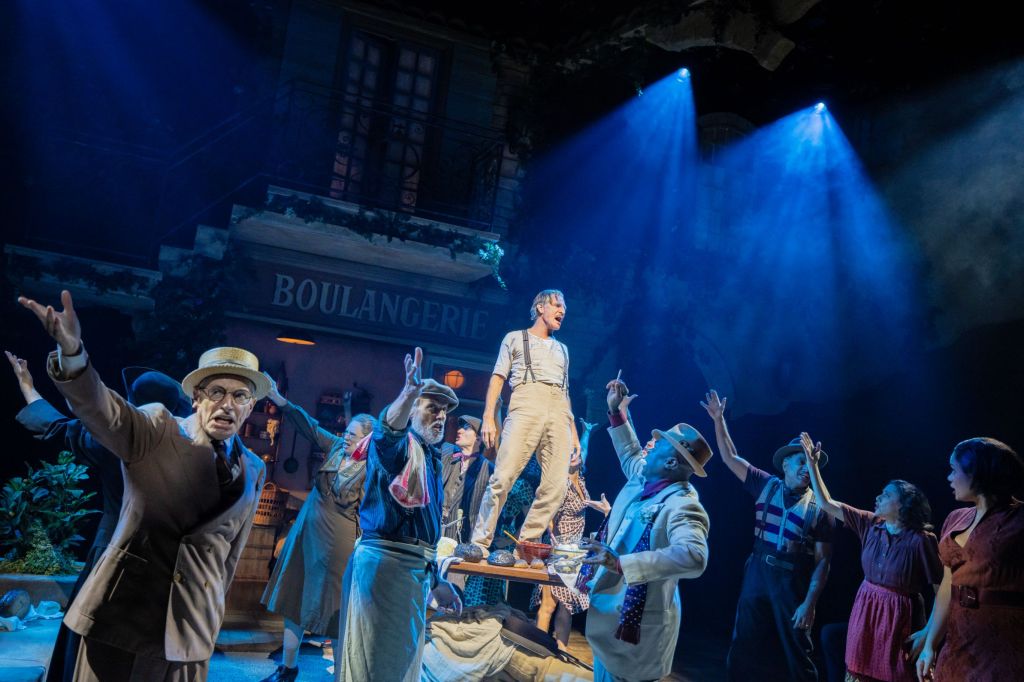
Greenberg’s vision for the musical, the sterling leads and the excellent ensemble overcome the show’s flaws. The actors breathe life into the dated script and misogynistic jokes by integrating these as cultural aspects of the small French community of Concorde in the time before WW II. The community composed of idiosyncratic members show they can be disagreeable and divisive with each other. However, they come together when they attempt to find Geneviève and return her to Aimable to restore balance to their collective, with bread for their emotional and physical sustenance.
All of the wonderful work by ensemble members keep the musical pinging. Robert Cuccioli plays ironic husband Claude with Judy Kuhn as his wife Denise. They are the cafe owning, long married couple, who serve as the foils for the newly married Aimable and Geneviève. They provide humor with wise cracks about each other as the other townspeople chime in with their jokes and songs about annoying neighbors.
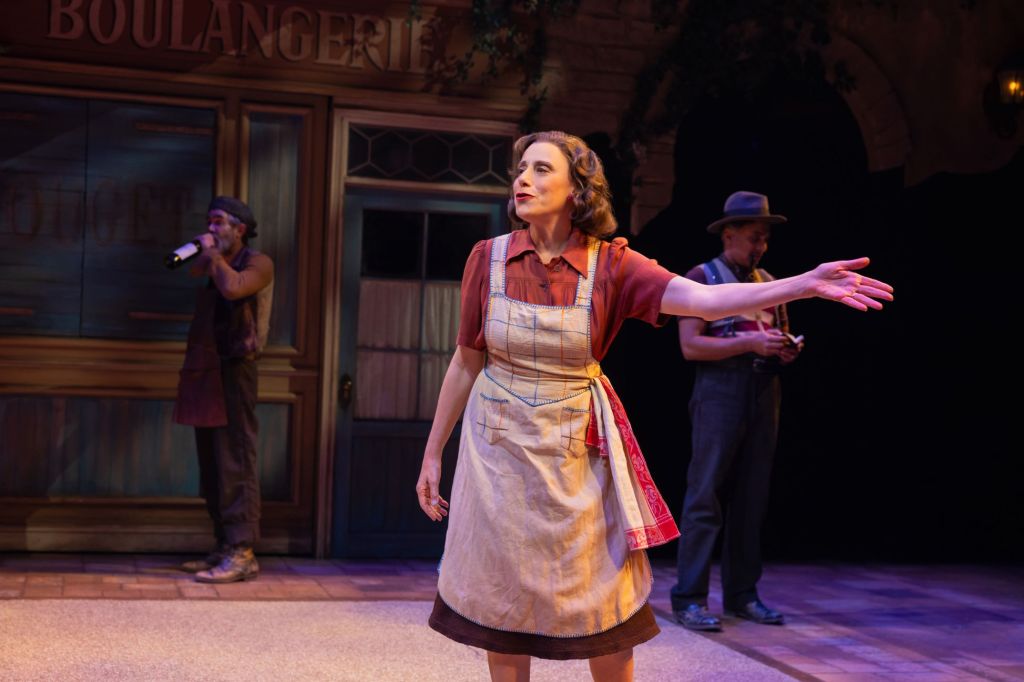
Like the other townspeople, who watch the events with the baker and his wife and learn about themselves, Claude and Denise realize the lust of their youth has morphed into love and great appreciation for each other in their middle age. Kuhn’s Denise opens and closes the production singing about the life and people of the village who gain a new perspective in the memorable signature song, “Chanson.”
The event with the baker and his wife stirs the townspeople to re-evaluate their former outlooks and biased attitudes. The women especially receive a boon from Geneviève’s actions. They toast to her while the men have gone on their search, leaving the women “without their instruction.” And for the first time Hortense (Sally Murphy), stands up to her dictatorial husband Barnaby (Manu Narayan) and leaves to visit a relative. She may never return. Clearly, the townspeople inch their way forward in getting along with each other, to “break bread” congenially as a result of an experience with “the baker and his wife,” that they will never forget.
The Baker’s Wife runs 2 hours 30 minutes with one intermission at Classic Stage Company through Dec. 21st; classicstage.org.
Lesley Manville and Mark Strong are Mindblowing in ‘Oedipus’
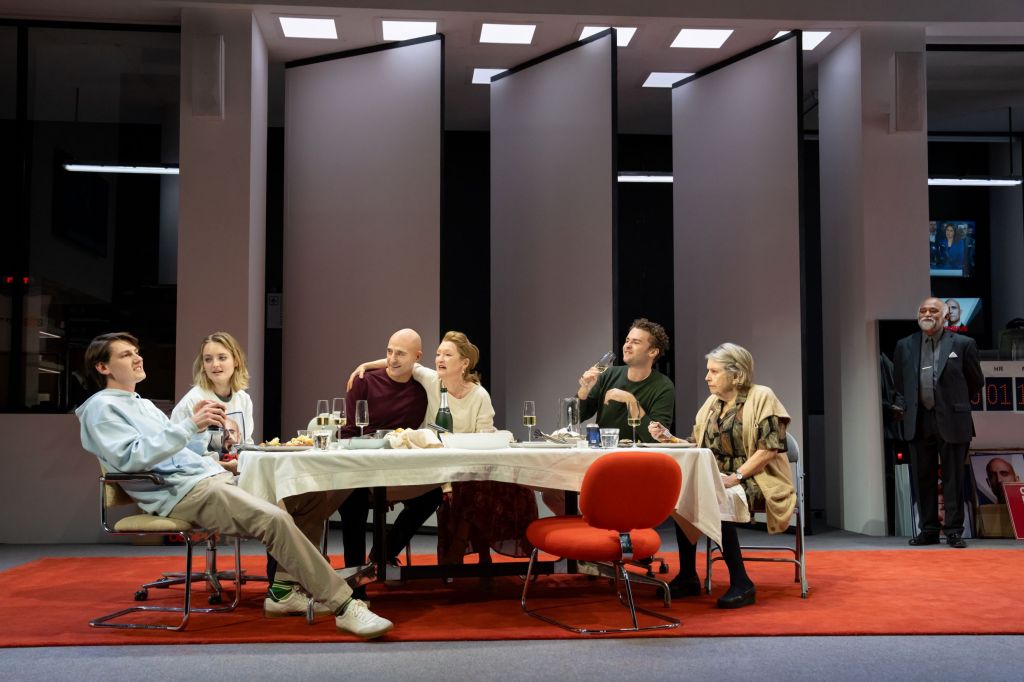
Just imagine in our time, a leader with integrity and probity, who searches out the truth, no matter what the cost to himself and his family. In Robert Icke’s magnificent reworking of Sophocles’ Oedipus, currently at Studio 54 through February 8th, Mark Strong’s powerful, dynamically truthful Oedipus presents as such a man. Likewise, Lesley Manville’s lovely, winning Jocasta presents as his steely, supportive, adoring help-meet. Who wouldn’t embrace such a graceful couple as the finest representatives to govern a nation?
Sophocles’ classic Greek tragedy, that defined the limits of the genre and imprinted on theatrical consciousness the idea that a tragic hero’s hubris causes his destruction, evokes timeless verities. In his updated version, Icke, who also directs, superbly aligns the characters and play’s elements with today’s political constructs. Icke retains the names of the ancient characters. This choice spurs our interest. How will he unravel Sophocles’ amazing Oedipus tragedy, especially the conclusion?
Cleverly, he presents Oedipus as a political campaigner of a fledgling movement that over a two-year period gains critical mass. The director reveals Oedipus’ backstory in a filmed speech to reporters on the eve of the election. The excellent video design is by Tal Yarden.
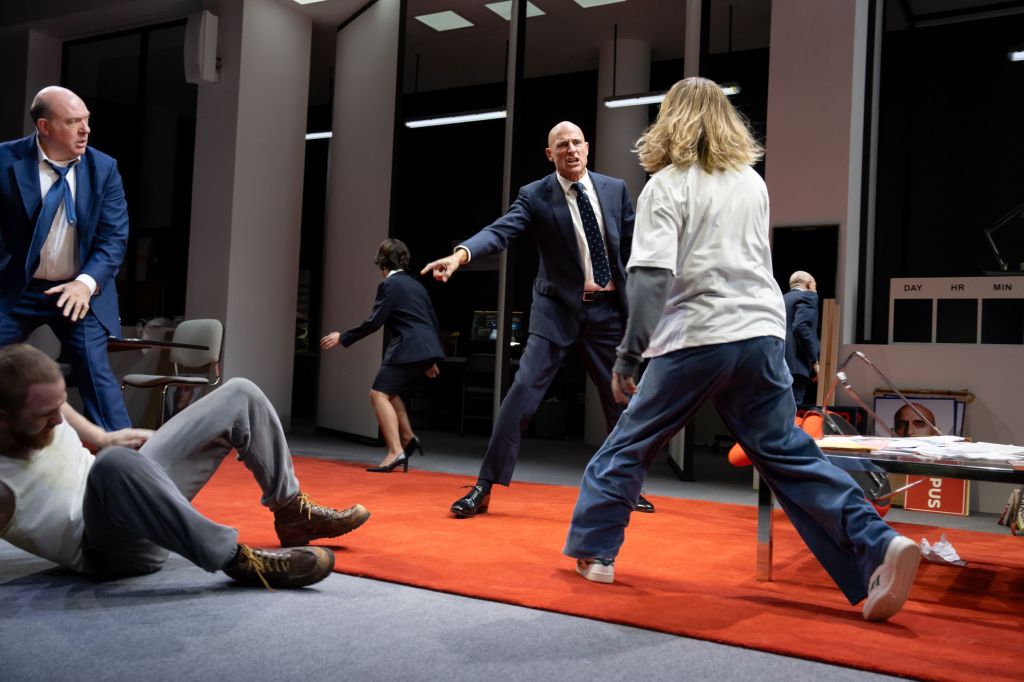
During his speech Oedipus goes off book and makes promises. Though his brother-in-law Creon (the fine John Carroll Lynch) tries to stop him, proudly Oedipus shows himself a man of his word. He galvanizes the crowd when he states he will expose the lies of his opponents. Not only will he reveal his birth certificate (an ironic reference to President Obama), he will investigate the mysterious death of Laius. The former leader from decades ago married Jocasta when she was a teenager. After Laius’ death, Oedipus meets and marries Jocasta despite their age difference. Over the years they raise three children: Antigone (Olivia Reis), Eteocles (Jordan Scowen) and Polyneices (James Wilbraham).
How has Oedipus become the people’s candidate? Without ties to the political system, he speaks a message of reform and justice. Indeed, he will override the corrupt, derelict power structure. Former leaders served their rich donors and let the other classes suffer. Oedipus runs on a mandate of equity and change.
After Oedipus’ speech, the curtain opens to reveal the campaign headquarters that staff gradually dismantles as the campaign phase ends. To signify the next phase the countdown clock, placed conspicuously in scenic designer Hildegard Bechtler’s headquarters, ticks away the seconds down to the announcement of the winner. As the clock ticks toward zero (an ironic symbol), the contents of the campaign war room are removed like the peeling of an onion to its core. As the destined announcement of the winner nears, gradually, the revelation of Oedipus’ true identity happens. Icke has synchronized both concurrently.
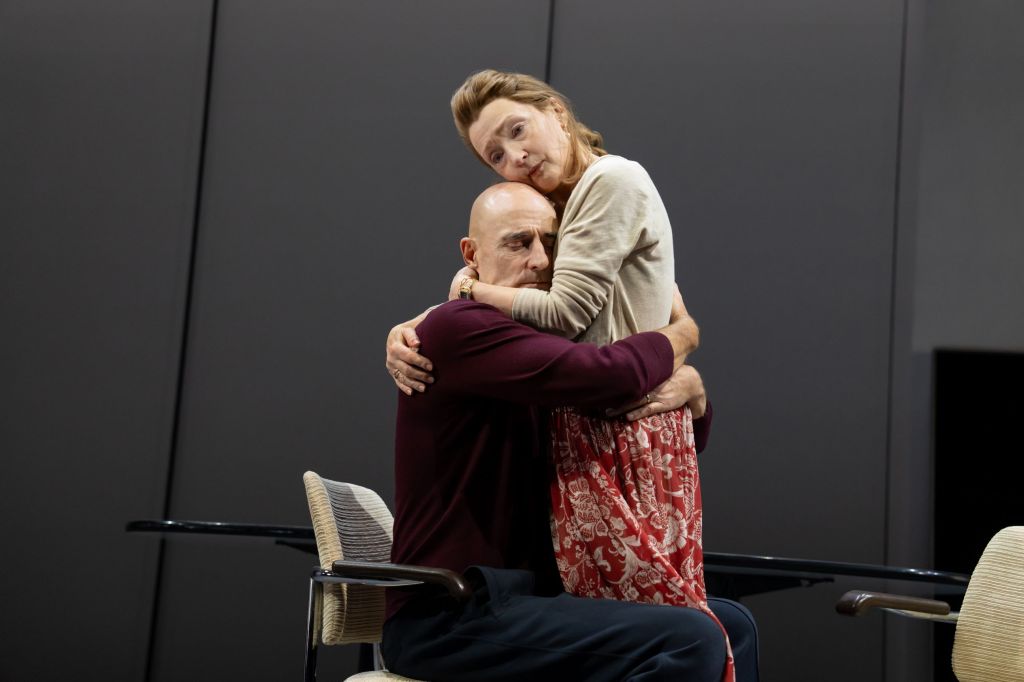
Icke’s anointed idea to shape Oedipus as a newbie politician, whose actions and words are singularly unified in honesty, resonates. He represents the iconic head of state we all yearn for and believe in, forgetting leaders are flesh and blood. Of course Icke’s flawed tragic hero, like Sophocles’ ancient one, results in Oedipus’ prideful search for the truth of his origin story and Laius’ cause of death.
Oedipus’s determination is spurred by the cultist future-teller Teiresias (the superb Samuel Brewer). His authoritative and relentless drive to prove Teiresias wrong, despite warnings from Creon and Jocasta, shows persistence and courage, positive leadership qualities. On the other hand, Oedipus doesn’t realize his search has a dark side and his persistence is stubbornness prompted by a prideful ego. This stubbornness causes his destruction. His pride leaves no way out for him but punishment.
Because the truth is so horrid, Strong’s Oedipus can’t suffer himself to cover it up. In searching to validate his true self, he discovers the flawed human that Teiresias proclaims. Indeed, he is more flawed than most. He is lurid; a man who killed his father, married his mother, and had three children born out of love, lust and incest. He can never be the leader of the nation. He must hold himself accountable after he sees his debased true self. How Mark Strong effects Oedipus’ self-punishment is symbolic genius. Clues to Jocasta’s end are sneakily tucked in earlier.
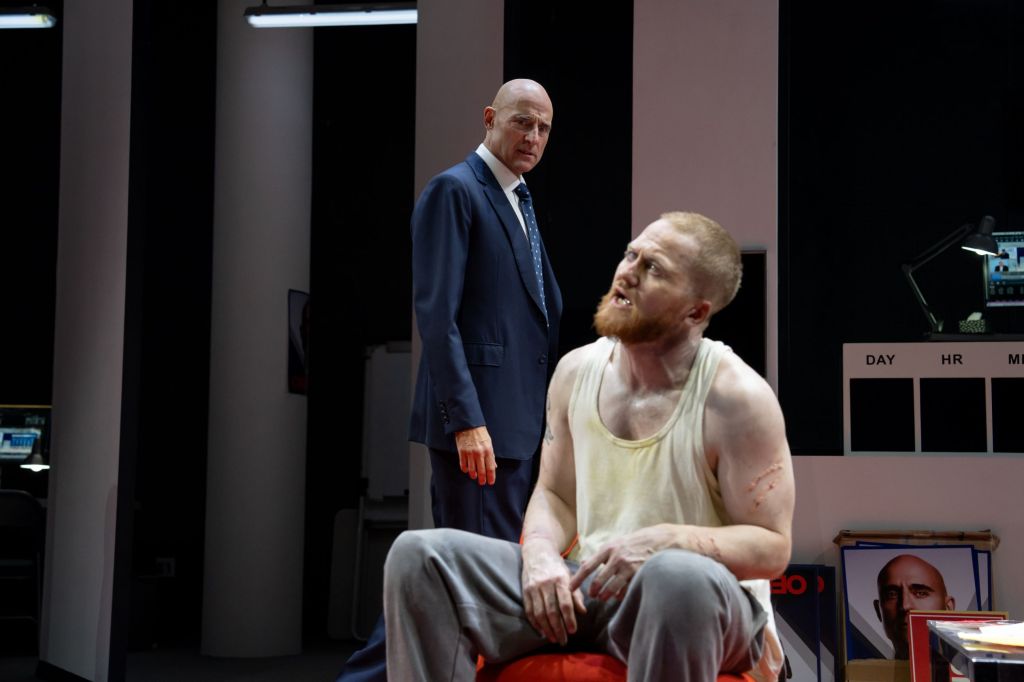
Because of Icke’s acute shepherding of the actors, and the illustrious performances of Manville, Strong and Brewer, with the cast’s assistance, we feel the impact of this tragedy. The love relationship between Jocasta and Oedipus, drawn with two passionate scenes by Manville and Strong, especially the last scene, after they acknowledge who they are with one, long, silent look, devastates and convicts.
Those who know the story feel a confluence of emotions at the irony of mother and son lustily loving and pursuing their desire for each other off stage, while Oedipus delays speaking to his mother Merope (Anne Reid). Manville and Strong are extraordinary. Both actors convey the beauty, the wildness, the uniqueness and enjoyment of their characters’ love, that is unlike any other.
In the last scene when Strong and Manville untangle from their hot grip, clinging to each other then letting go, they acknowledge their characters’ unfathomable and great loss. Manville’s Jocasta crawls away to reconcile the enormity of what she has done. In her physical act of crawling then getting up, we note that fate and their choices have diminished their majestic grace. Their sexual likeness to animals, Oedipus ironically referenced earlier with family at the celebration dinner. Through the physical staging of the final sexual scene, Icke recalls Oedipus’ earlier comparison.
As a meta-theme of his version Icke reminds us of the importance of humility. The more humanity presents its “greatness,” the more it reveals its base nature.
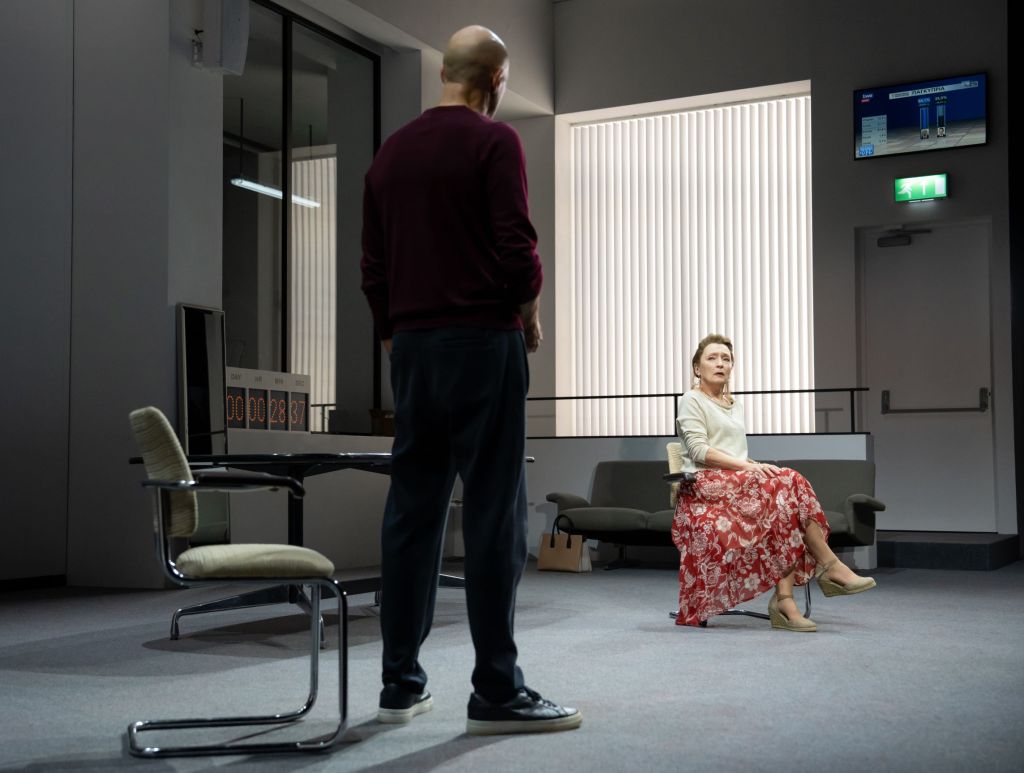
All the more tragedy for Oedipus’ supporters and the unnamed country. Because fate catches up with him and conspires with him to cut off his acceptance of the position he rightfully won, the nation loses. All the more sorrow that the truth and his honest search is what Oedipus prizes, even more than his love for Manville’s Jocasta, the brilliant, equivalent match for Strong’s Oedipus.
Rather than live covertly hiding their actions, both Oedipus and Jocasta hold themselves accountable with a fatalistic strength and nobility. Initially, we learn of her strength as Jocassta tells Oedipus about her experience with the evil Laius (a reference to current political pedophiles and rapists). We see her strength in her self-punishment. Likewise, Oedipus’ strength compels him to face his deeds where cowards would cover up the truth, step into the position and govern autocratically censoring and/or killing their opponents who would “spill the beans.” Oedipus is not such a man. It is an irony that he is a moral leader, but is unfit to lead.
Icke’s masterwork and Manville and Strong’s performances will be remembered in this great production, filled with ironic dialogue about sight, vision, blindness and comments that allude to Oedipus and Jocasta’s incestuous relationship and downfall. Those familiar with the tragedy will get lines like Jocasta’s teasing Oedipus, “You’ll be the death of me,” and her telling people she has four children: “two at 20, one at 23, and one at 52.”
Though I prefer Icke’s ending in darkness with the loud cheers of the supporters, I “get” why Icke ends Oedipus in a flashback. In the very last scene the date is 2023, the beginning of the end. We watch the excited Oedipus and Jocasta choose the rented space (the stripped stage) for their campaign headquarters. The time and place mark their disastrous decision which spools out to their destruction two years later. I groaned with Jocasta’s ironic comment, “It feels like home.”
Her comment resonates like a bomb blast. If Oedipus had not had the vision of himself as the ideal, righteous leader with truth at his core, the place where they are “at home” never would have been selected. Oedipus, a humble mortal, never would have run for high office.
Oedipus runs 2 hours with no intermission at Studio 54 though February 8. oedipustheplay.com.
‘Liberation’ Transfers to Broadway Solidifying its Excellence
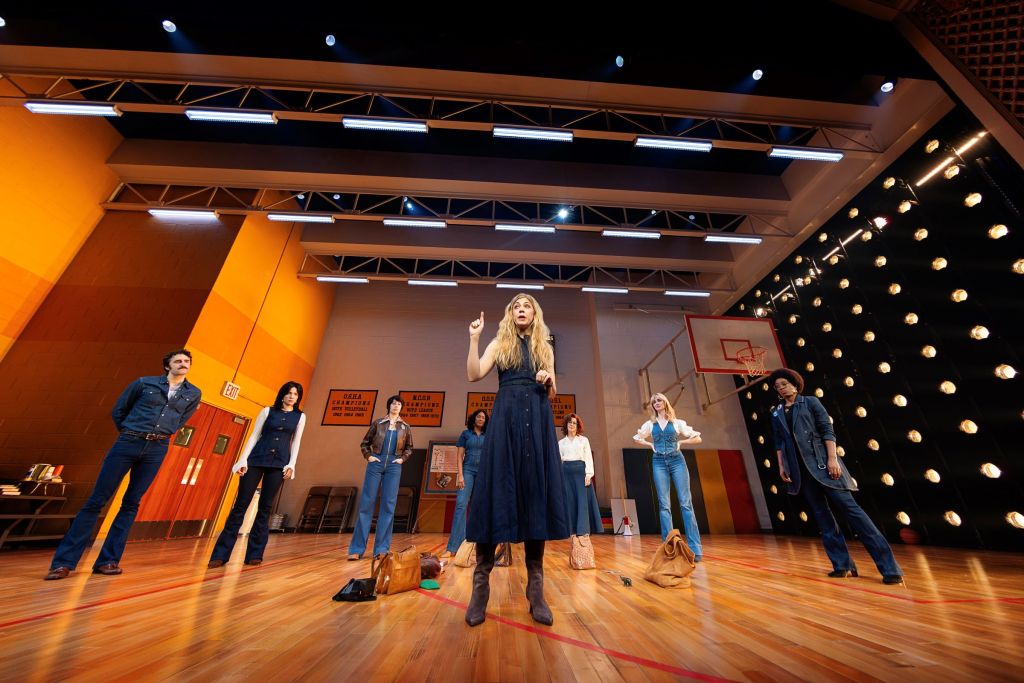
Bess Wohl’s Liberation directed by Whitey White in its transfer to Broadway’s James Earl Jones Theater until January 11th doesn’t add references to the 2024 election nor the disastrous aftermath. However, the production is more striking than ever in light of current events. It reaffirms how far we must go and what subtle influences may continue to derail the ratified ERA (Equal Rights Amendment) from becoming settled law.
To draw parallels between the women’s movement then and now, Wohl highlights the “liberation” of the main character/narrator Lizzie, an everywoman, with whom we delightfully identify. With Lizzie (the superb Susannah Flood) we travel along a humorous journey of memory and self-reflection as she evaluates her relationship to her activist mom, who gathered with a community of women in Ohio, 1970 to “change the world and themselves.”
Wohl’s unreliable, funny narrator, directs the action and also is a part of it. The playwright’s smart selection of Lizzie as a device, the way in to tell this elucidating story about women evolving their attitudes, captures our interest because it is immediate. Her understanding is ours, her revelations are ours, her “liberation” is also ours. Lizzie shifts back and forth in time from the present to 1970-73, and back to the present. One of the questions she explores concerns why the women’s movement cascaded into the failures of the present?
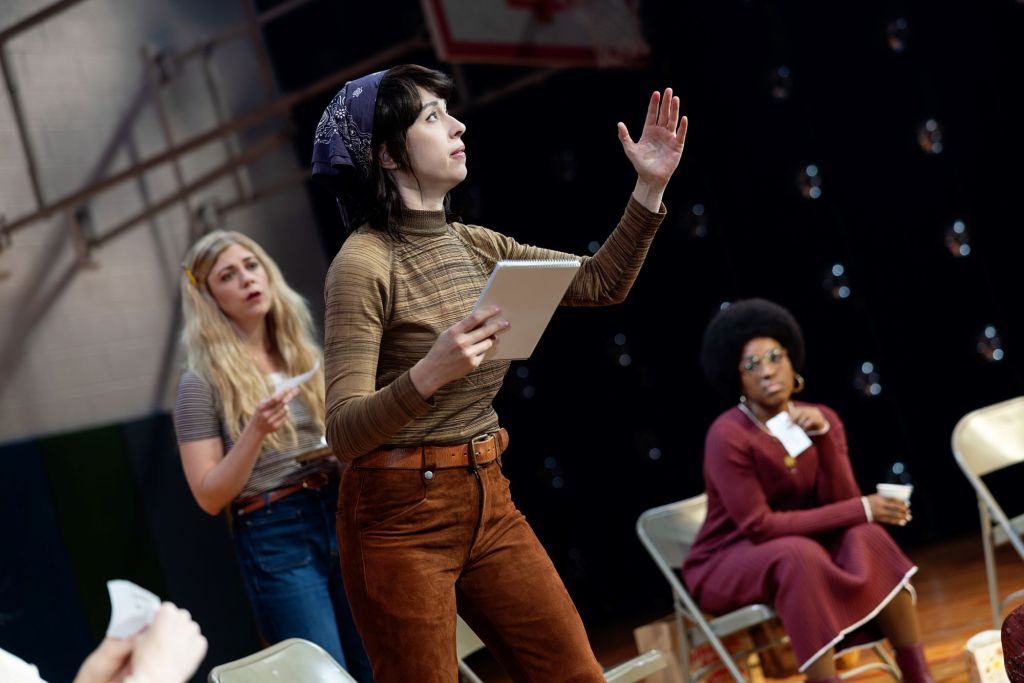
Assuming the role of her mother, Lizzie enacts how her mom established a consciousness-raising group. Such groups trended throughout the country to establish community and encourage women’s empowerment. Six women regularly meet in the basement basketball court at the local rec center which serves as the set throughout Liberation, thanks to David Zinn’s finely wrought stage design. The group, perfectly dressed in period appropriate costumes by Qween Jean, includes a Black woman, Celeste (Krisolyn Lloyd), and the older, married Margie (Betsy Aidem).
Having verified stories with her mom (now deceased), and the still-living members of the group, Lizzie imagines after introductions that the women expansively acknowledge their hope to change society and stand up to the patriarchy. As weeks pass they clarify their own personal obstacles and their long, bumpy road to change, with ironic surprises and setbacks.
For example, Margie voices her deeper feelings about being a slavish housewife and mother. After months of prodding, her husband actually does the dishes, a “female” chore. Margie realizes not only does she complete housework faster and better than he, but her role as housewife and nurturer satisfies, comforts and makes her happy. Betsy Aidem is superb as the humorous older member, who introduces herself by announcing she joined, so she wouldn’t stab her retired husband to death.
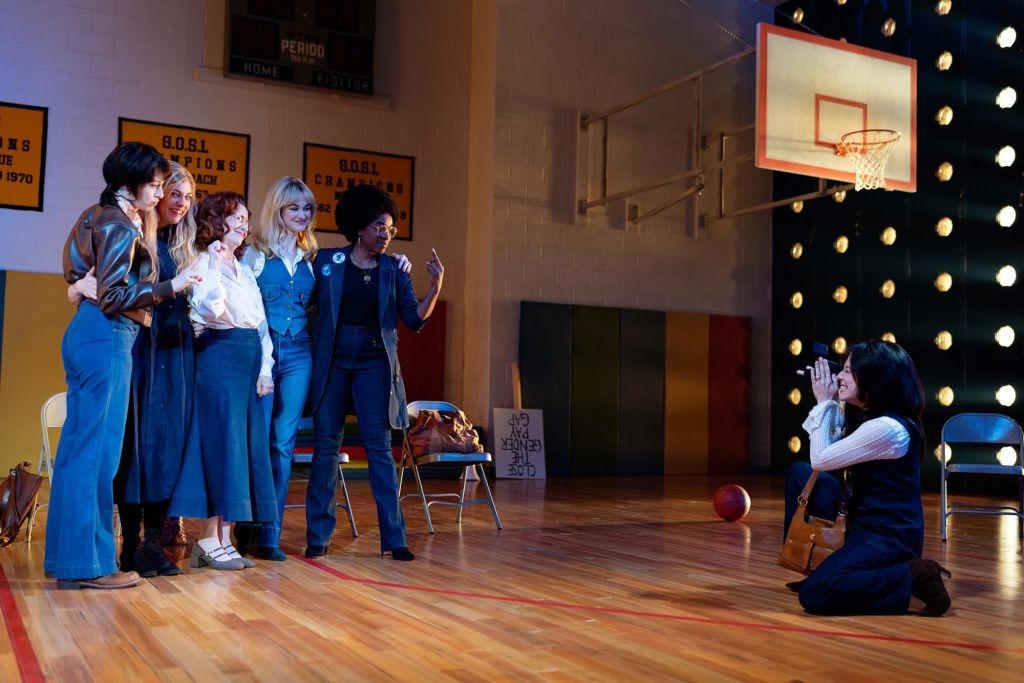
Some members, like Sicilian-accented Isidora (Irene Sofia Lucio), and Lloyd’s Celeste, belonged to other activist groups (e.g. SNCC). Circumstances brought them to Ohio. Isidora’s green-card marriage needs six more months and a no-fault divorce, not possible in Ohio. Celeste, a New Yorker, has moved to the Midwest to take care of her sickly mom. The role of caretaker, dumped on her by uncaring siblings, tries her patience and stresses her out. Expressing her feelings in the group strengthens her.
Susan (Adina Verson) is an activist burnt out on “women’s liberation.” Frustrated, Susan has nothing to say beyond “women are human beings.” She avers that if men don’t treat women with equality and respect, then women’s activism is like “shitting in the wind.”
Lizzie and Dora (Audrey Corsa) discuss how they suffer discrimination at their jobs. Despite her skill and knowledge Lizzie’s editor demeans her with “female” assignments (weddings, obituaries). Dora’s boss promotes men less qualified and experienced than Dora. Through inference, the playwright reminds us of women’s lack of substantial progress in the work force. Very few women break through “glass ceilings” to become CEOs or achieve equal pay.
Act I engages because of the authentic performances and various clarifications. For example, Black women have a doubly difficult time at overturning the patriarchy. Surprisingly, at the end of the act a man invades their space and begins shooting hoops. Is this cognitive dissonance on Lizzie’s part for including him? Have women so internalized male superiority that they become misdirected back to the societal default position of subservience? Is this what thwarted the movement?

When Lizzie refers to the guy as Bill, her father (Charlie Thurston), we get the irony. How “freeing” that her mom meets her dad as she advocates for liberation from male domination, only to be dominated by an institution (marriage) constructed precisely for that purpose.
Act II opens with additional dissonance. To extricate themselves from the psychological trauma of men’s objectification of their bodies, the women free themselves from their clothes. Sitting in the nude, each discusses what they like and dislike about their bodies. The scene enlivened heterosexual men in the audience, an ironic reinforcement of objectification. We understand that these activists try to overcome body shame that our commercial culture and men use to manipulate women against themselves and each other (surgical enhancements, fillers, face lifts, etc.). On the other hand the scene leaves a whiff of “gimmick” in the air, though Whitney White directs it cleverly.
After the nude scene Lizzie reimagines how her mom and Bill fell in love. To avoid discomfort in “being” with her father, she engages Joanne (Kayla Davion), a mother who drops into the rec room looking for her kids’ backpacks. Through Bill and Joanne’s interaction, we note the relationship that Lizzie keeps secret. When Lizzie finally reveals she is engaged, the dam bursts and each of the women reveals how they have been compromising their staunch feminist position. One even admits to voting for Nixon with a barrage of lame excuses.
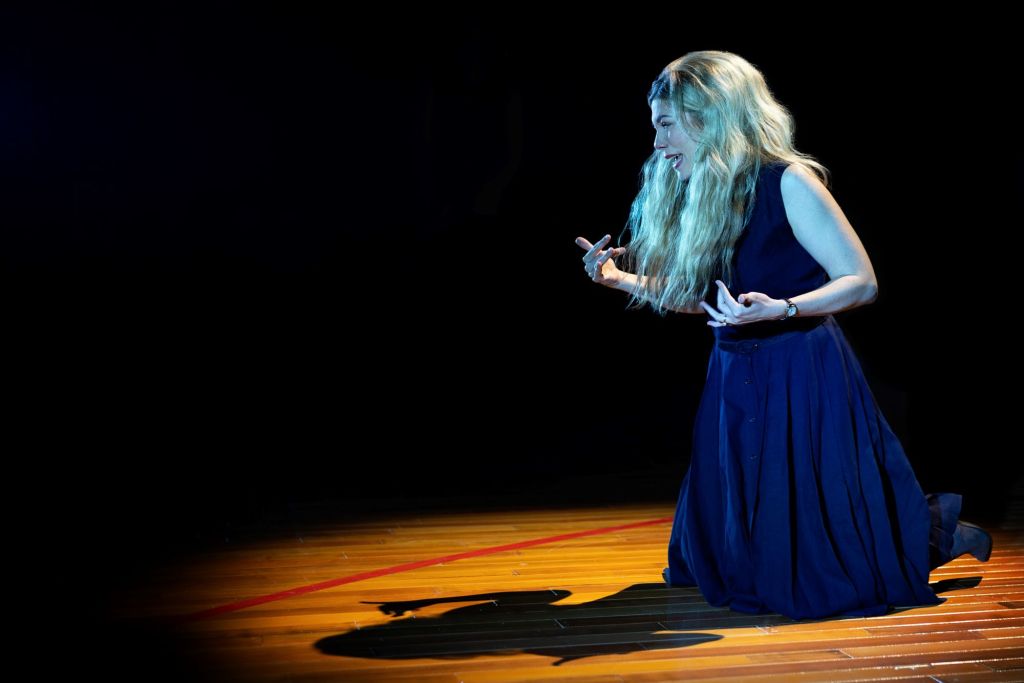
This scene is a turning point that Lizzie uses to explore how women in the movement may have sabotaged themselves at advancing their rights. Reviewing her mother’s choice to get married and co-exist as a feminist and wife, Lizzie reimagines a conversation with her deceased mother played by Aidem’s Margie in an effecting performance. When Lizzie asks about her mom’s happiness, Margie kindly states that Lizzie has gotten much of her story wrong.
Lizzie condemns feminism’s failures. This is the patriarchy, internalized by Lizzie, speaking through her. With clarity through Margie’s perspective, Wohl reminds us that all the stages of the feminist movement have brought successes we must remember to acknowledge.
Lizzie realizes the answer to whether one might be “liberated” and fall in love and “live equitably” within an institution which consigns women to compromise their autonomy. It depends upon each individual to make her own way. Her investigation about her mother’s consciousness-raising group establishes the first steps along a journey toward “liberation,” that she and the others will continue for the rest of their lives.
Liberation runs 2 hours, 30 minutes with one intermission at the James Earl Jones Theater through Jan. 11th. liberationbway.com
‘Diversion.’ Nurses under Pressure, Forgotten Heroes in Crisis, Review

In Scott Organ’s Diversion, the break room of a hospital intensive care unit is a place to let off steam. It is also the location where crimes happen and perps are exposed. Organ cleverly uses this setting for his 90 minute play in an extended run at the Barrow Group’s Studio Theater until December 21st.
The play’s tensions increase after Organ introduces us to four nurses who we later discover negotiate their own personal traumas, while assisting others to live or die. Though we don’t see their trauma, we hear about it and hear about how they may attempt to overcome it through opioids. When their own supply runs out, one or more may have stolen the hospital’s medications to satisfy their addiction. However, the program monitoring the opioids is impossible to bypass without triggering an investigation.
We learn of the conflict when the head nurse Bess (Thaïs Bass-Moore) tells the staff that their unit has been targeted. One or more of the nurses or doctors have diverted drugs. Bess offers to get the individuals into a program to clean up if they quietly come to her first before the company investigator, Josephine (Colleen Clinton), discovers who they are and turns them over to the police.
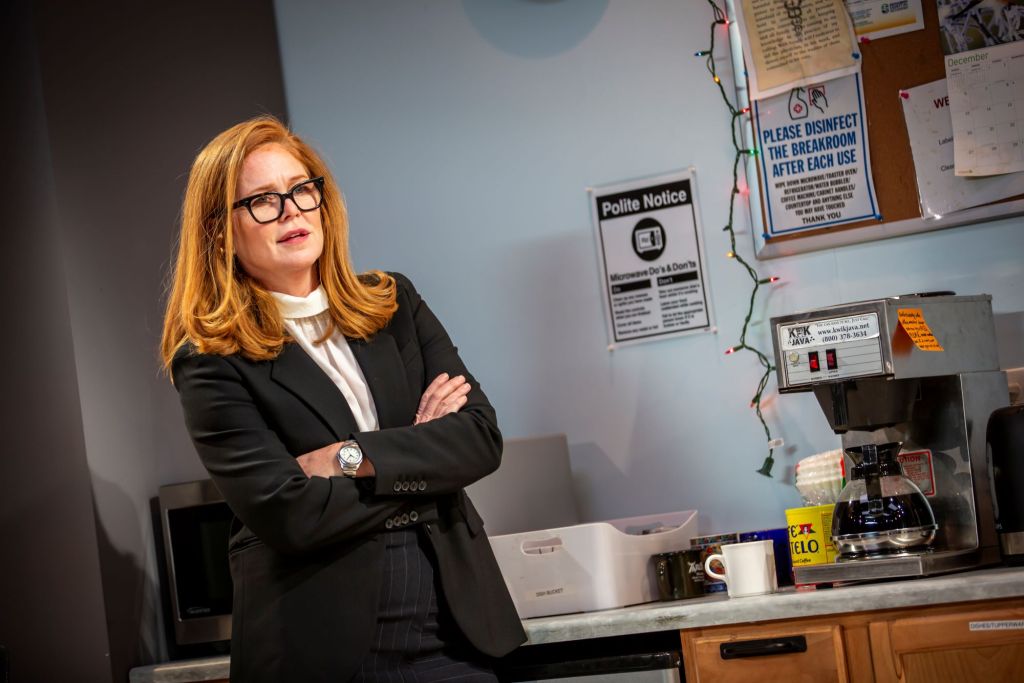
Having been through a disruptive investigation 8 years before when medications were taken, Bess shares her distress. She looks to experienced staff member Emilia (Tricia Alexandro) for help to be her “eyes and ears.” Josephine, a former nurse herself, attempts wisdom and a friendly approach to glean proof she refers to as “data,” by having informal conversations with the staff members. From her perspective, all are suspects, each may have diverted. She will not stop until she proves who the culprit is.
The youngest and least experienced nurse is Mandy (West Duchovny). She keeps late hours, always seems exhausted, and catches up on her sleep in the break room, a clue. The only male of the group, Mike (Connor Wilson), shows his hand when he discusses the street value of a fentanyl patch. The edgy, angry Amy (Deanna Lenhart), insults Josephine publicly to her face, but hypocritically shares the compromising life problems of other staff members to Josephine behind their backs.

Emilia, the kindest, most compassionate of the group is recently divorced and recovering from the psychological stresses of working through COVID’s long hours, extraordinary emotional demands and understaffed conditions. However, she does admit to Amy that Josephine’s presence is disruptive and adds to their stress, when they should be able to take their breaks from ICU high anxiety in peace.
No one confesses. However, Organ does reveal the addict at the end of Act I. Instead of judgment, Organ’s sympathetic characterizations and the actors’ acute ensemble work create empathy. We easily identify with the individual who is filled with regrets and self-recrimination. In Act II, when they still do not confess, we understand that the cost is too great, as they try to handle their addiction on their own, unsuccessfully. When Josephine closes in to identify the culprit/culprits, Organ allows us to feel what it is like to be a good person stuck in a tunnel of pain and darkness with no way out.

Organ’s poignant, suspenseful and humanly engaging drama has strong elements of comedic relief so we appreciate the relationship dynamic among the nurses which is both tense and humorous. Importantly, the play’s subject matter is topical. It focuses on nurses as the heroes of healthcare. They have been underestimated, underappreciated and, like military veterans, ill-used without proper support. Of course, the opioid epidemic should be front and center in light of our failing healthcare system which is under duress and about to be further de-funded with impactful cuts to Medicaid and possibly Medicare.
Though the production might have run without an intermission to heighten the suspense, director Seth Barrish incisively shepherds the excellent cast for maximum understanding and empathy. The set, costumes, props and lighting cohere with what one imagines of a hospital ICU break room for staff, who seek its respite without gaining comfort, especially since they are suspects of an investigation that can have no happy outcome.
Diversion
The play runs 95 minutes with one intermission through December 21, 2025 at The Barrow Group Performing Arts Center, Studio Theater (520 8th Ave, 9th floor). Barrowroup.org
 CAROLE DI TOSTI