Author Archives: caroleditosti
‘West Side Story,’ The Brilliant Revival Stokes Profoundly Moving Revelations For Our Time

Dharon E. Jones Amar Ramasar in ‘West Side Story,’ based on a conception by Jerome Robbins, book by Arthur Laurents, music by Leonard Bernstein, lyrics by Stephen Sondheim, directed by Ivo Van Hove ( Jan Versweyveld)
West Side Story based on a conception by Jerome Robbins with book by Arthur Laurents, music by Leonard Bernstein (orchestrations by Sid Ramin, Irwin Kostal) and lyrics by Stephen Sondheim is a groundbreaking classic that garnered awards when it opened on Broadway in 1957 to a flurry of praise and glory. Its overwhelming success continued when it was made into the 1961 titular film winning 10 Academy Awards. Since then it has seen numerous global productions and has been revived on Broadway twice in 1980, and in 2009 with Spanish lyrics and dialogue weaved into the English Libretto.
Once again in revival directed by the maverick sensation Ivo Van Hove (Network, The Crucible) and choreographed by Anne Teresa De Keersmaeker, West Side Story has proven its timelessness with Van Hove highlighting its immutable themes. Van Hove’s direction sounds these thematic notes with his stylistic tuning fork to ping the deepest chords of human nature with which we must identify, as he explores the mortal boundaries of love, tribalism, power, bigotry, alienation, fear, self-loathing and hatred.
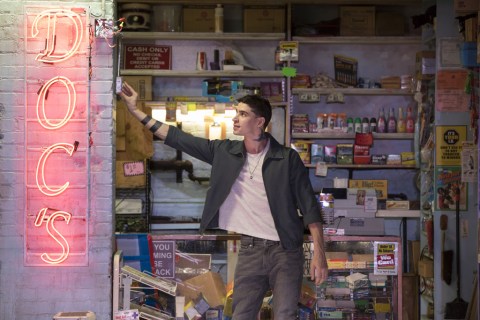
Isaac Powell in ‘West Side Story,’ based on a conception by Jerome Robbins, book by Arthur Laurents, music by Leonard Bernstein, lyrics by Stephen Sondheim, directed by Ivo Van Hove (Julieta Cervantes)
Van Hove’s modernization of West Side Story should not be underestimated. He unravels the underlying perils of “the outsider” theme that resonate with currency for us today. He gives this principal conceptualization a novel rendering by employing video projection (video design by Luke Halls) and the “close-up” to elicit an intimacy and connection with the characters not readily available before. The intimate portrayals of the Sharks and Jets (delivered by close-up) as well as their objectified view that encompasses their using the entire stage, reflects the insider and outsider viewpoint. In the intimate view these individuals are young men, hurting, afraid, alone. In the outsider view they are non-human, throw-away people who have embraced the world of criminality and violence because that gives them a rush of comfort in power and identity that the culture denies to them.
For example in the Prologue we meet in close-ups the key players: Riff (the fabulous Dharon E. Jones) of the Sharks, Bernardo (his marvelous equivalent Amar Ramasar) of the Jets, and their gang members. We note their proud and stalwart personas; they could be CEOs of a company in another time and place. We see their branding, the combat gear of their identities: their piercings, their haircuts, the intricacy of their tattoos. And beyond that as the camera pans the two tribes, we note their sneering bravado, their violence and something else behind their staring eyes-perhaps fear.
These Prologue close-ups in real time, before the tremendous opening number of the stylized, vigorous fight sequence in which a Jet is injured, humanize the erstwhile stereotyped ethnicity of the “Puerto Rican” Sharks and their urban, mixed race counterpart, the Jets. They appear interchangeable. Van Hove’s enlightened casting suggests they are not bonded by ethnicity since there are black, white, Latino members in both gangs, but by inner necessity. They cling to their tribe out of fear, isolation, alienation and the trauma of cultural self-loathing, of being outside, of being the “other.”

Dharon E. Jones and the cast of ‘West Side Story,’ based on a conception by Jerome Robbins, book by Arthur Laurents, music by Leonard Bernstein, lyrics by Stephen Sondheim, directed by Ivo Van Hove (Jan Versweyveld)
We especially note the need to belong in the “Jet Song” which answers the call to be a part of something “bigger” than oneself, even if it is bloodthirsty and destructive. By extension, the Sharks are mixed race and indistinguishable from the Jets except that they “came” from Puerto Rico.
With the exception of a few scenes and songs where the backdrop is black and a rainy mist falls down to perhaps symbolize the eternal/immutable/spiritual, the video design-both live and pre-recorded prevails throughout. The events are streamlined and strengthened. The arc of development moves over a two-day period and falls into the resolution we all know is coming, but still remains surprising and poignant. The song “I Feel Pretty” has been excised and the cut gives the musical an edgier, less digressive, less whimsical feel, which the song conveyed almost as an afterthought. That song in particular is off tenor with Van Hove’s dark vision of this lurid, scary world the gangs occupy, a vision which messages the nihilism of impoverished youth/citizens in this time of Trumpism, I.C.E., Black Lives Matter, The Wall, all of whose memes appear at various and pointed junctures in the production.
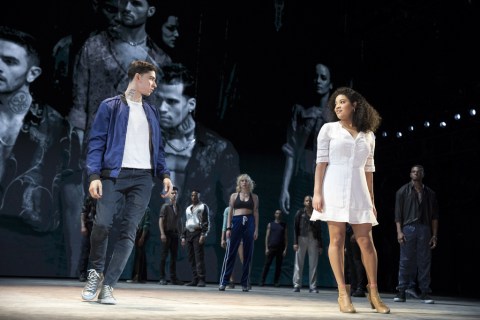
Isaac Powell and Shereen Pimentel in ‘West Side Story,’ based on a conception by Jerome Robbins, book by Arthur Laurents, music by Leonard Bernstein, lyrics by Stephen Sondheim, directed by Ivo Van Hove (Julieta Cervantes)
Thus, we note how the Sharks and Jets attempt to gain a position of power through violence to carve out a place where they can feel safe walking and being. Certainly, in the video projection of dark, lonely streets, a stylized version of the threatening landscape in each of the gang member’s minds, it is revealed that fear surrounds them and they must posture and swagger and image themselves into courage while inside they are cowering children.
For the Sharks, carving out a plot of land is acceptance in the country that views them as trash. As the cast sings “America” and the exceptional Yesenia Ayala as Anita and Amar Ramasar as Bernardo vocally duel out their positions for or against the US, Van Hove’s projections are pointed and riveting. These encompass haunting images of a damaged Puerto Rico left ripped and forgotten after the negligent response of the US to Hurricane Maria. The projections represent the truth; the dance number and song reveals the courage of Anita to hope and the realism of Bernardo to highlight the discrimination and bigotry of third and fourth generation citizens against them. Throughout, Van Hove uses the projections in juxtaposition with the staging to encourage a novel understanding of how the inner person and their outer image operates. We see the two perspectives- the truth and a presentation of the image that is hoped will help one survive in a forbidding city.
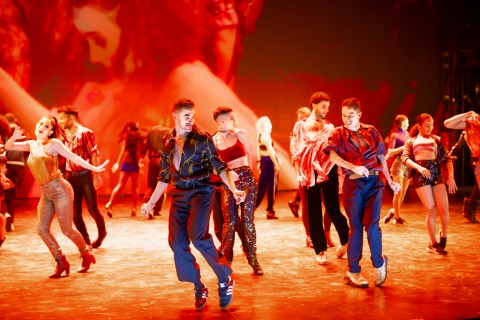
The Company, ‘West Side Story,’ based on a conception by Jerome Robbins, book by Arthur Laurents, music by Leonard Bernstein, lyrics by Stephen Sondheim, directed by Ivo Van Hove (Jan Versweyveld)
The clips of devastation of Puerto Rico are inter cut with various related video clips, one of the final ones referencing miles and miles of the wall at the southern border. The wall is the everpresent reminder that outsiders/illegals are potential thugs and criminals, regardless of their status as asylum seekers, regardless of their status as US citizens. Of course the irony, as Van Hove’s striking version indicates, through the attitudes of Lt. Shrank (Thomas Jay Ryan) and Officer Krupke (Danny Wolohan) that both Sharks and Jets are the unwanted trash, not just the Sharks. That is why they struggle against each other to maintain “face,” and identity in their gang until they are dead and the soil they have struggled over that has rejected them is forced to accept their corpses.
The one group that is missing from this production which I never realized before is missing for a great reason: the dominant social class of conservative “haves.” It is this notably absent elitist tribe that has made the country a pressure cooker of rejection, a blight and a hard climb to the top of the lower middle class for both wandering tribes. It is this group that indirectly encourages tribalism as an answer for those who have little hope for the future and are made to feel as outcasts and criminals who belong in jail (“Gee, Officer Krupke”-the projections during this number are just spot-on).

Isaac Powell and Shereen Pimentel in ‘West Side Story,’ based on a conception by Jerome Robbins, book by Arthur Laurents, music by Leonard Bernstein, lyrics by Stephen Sondheim, directed by Ivo Van Hove ( Jan Versweyveld)
The song sung terrifically by Action (Elijah A. Carter) and the Jets reveal they cannot escape from the dominant white culture’s prophecy about them as criminals. As they internalize the perspective of the dominant culture and law enforcement, their self-annihilation is a self-fulfilling prophecy. Though Action and the Jets tell the Officer to “Krup” himself, it isn’t enough. Their trajectory is fated and doomed, especially without mentors to guide them away from their self-loathing. That Tony and Maria become swept up in their misery unable to break completely free from their own posse and families is the tragedy we have come to hope against.
The director’s use of “larger-than-life” video shakes, stimulates, references and enhances the symbolism and profound human depth of the star-crossed lovers and their “posses.” The projections against the entire back wall of the stage sometimes in split screens of twenty portraits of gang members, sometimes in engaging medium shots of Doc’s drugstore (“Something’s Coming”) and the sweatshop (renamed from the bridal shop) where Maria and her friends work reveal the homely mores which Tony and Maria accept apart from the gang members’ identity and lifestyle.

Isaac Powell and Shereen Pimentel in ‘West Side Story,’ based on a conception by Jerome Robbins, book by Arthur Laurents, music by Leonard Bernstein, lyrics by Stephen Sondheim, directed by Ivo Van Hove ( Jan Versweyveld)
I particularly enjoyed how the close-ups of Maria and Tony in the intimacy of their alone time after he discovers her name worked. First, both Shereen Pimentel and Isaac Powell are vibrant, passionate and in-the-moment, practically every moment. Van Hove’s staging and Powell’s rendition of “Something’s Coming,” and “Maria” particularly shine. Powell’s voice, interpretation and movement are uplifting. In “Tonight” he appears as light as a feather; it is, a full expression of the exhilaration of his love for Maria. I have not seen anything like his performance; he is mesmerizing reaching the highs, lows and devastation of believing that Maria has been killed. He is so there, he brings us there with him. Superlative! Magnificent!
Maria is bubbling over warmth, passionate in her love scene with Powell which was a videoed close-up which made total sense and was an expression of their intimacy as they become “one” and exclude the world they were born into and have decided to leave. Pimentel’s fury after Tony is killed is so convincing, she makes you believe she will shoot all of the guilty, conferring upon herself the roles of judge, jury and executioner, thereby convicting them of his death.

Amar Ramasar, Yesenia Ayala, and the cast of ‘West Side Story,’ based on a conception by Jerome Robbins, book by Arthur Laurents, music by Leonard Bernstein, lyrics by Stephen Sondheim, directed by Ivo Van Hove ( Jan Versweyveld)
The projections carry the metaphoric journey of the outsider, the trash, the unwanted in a through-line of our time, of all time in the import of tribalism’s necessity in a culture that kicks these kids to the bottom and stands in the way of allowing others to find peace, love and happiness. This isn’t just about warring tribes; it’s about seeking power and domination, the easier, faster way out cultural hell than using intellect, logic and wisdom, the qualities amassed through experience, overcoming obstacles and time-worn trial and error.
The Sharks and the Jets, indistinguishable ethnically, are yet distinguishable through costume designer An D’Huys fine designs and color coordination. However, notable is that the Sharks and Jets are brothers of the same ethos who should be helping each other climb upward, instead of fulfilling the white culture’s perceptions of them as violent criminals. By the time we meet them in the video close-ups of the Prologue, we know it is too late. As young men and women, they have few tools at their disposal (wisdom-gained through experience) to thrive as they seek to establish who they are. After all, it is an alien society of adults who eschew them or culturally disavow what they are as tattooed, pierced, hoodlum criminals.
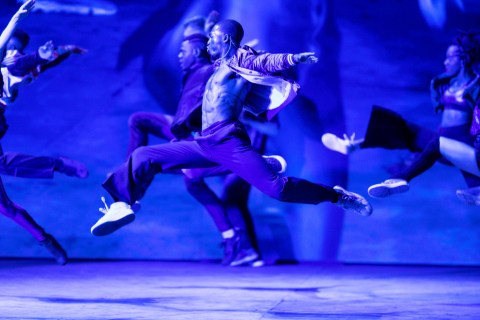
Dharon E. Jones and the cast of ‘West Side Story,’ (Jan Versweyveld)
Sadly, their choices to achieve are few. They can either “die young in a blaze of self-annihilating triumph and leave a good-looking corpse” or live the defeatist life of a self-quarantined, cowardly wussy to avoid the gangs. In Ivo Van Hove’s production, sociocultural economic inequality encourages these tribes toward the genocidal thing to do. That Tony and Maria find each other and love is miraculous. The scene where Van Hove and Anne Teresa De Keersmaeker stage the couples moving off together revealing love as an answer to the culturally encouraged nihilism and self-destruction is particularly touching and hopeful.
This version of West Side Story is a shining example of how structure, form, substance and profound understanding merges to make elevated art. Van Hove cleverly uses the projections and the live staging of the actors/characters in tandem; one informs the other, whether it is to enhance the symbols and themes, to emphasize the characterizations or to detail intimacy. What is communicated is remarkable and unforgettable. Coupled with the acting, singing, movement and the dance numbers by Anne Teresa De Keersmaeker are filled with athleticism that is so appropriate to the characters. All of this contributes to making the production indescribable- breathtaking, stunning, gobsmacking are an understatement. And the music is luscious, gorgeous, fabulous, thanks to Jonathan Tunick (orchestrations) and Alexander Gemignani (music supervisor & director).
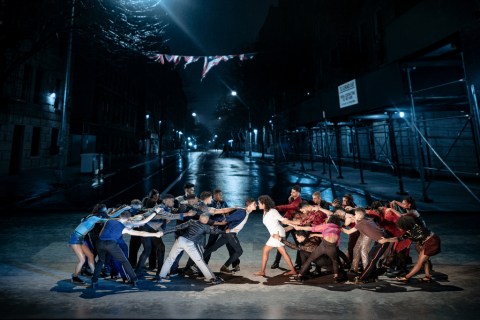
The company of ‘West Side Story,’ based on a conception by Jerome Robbins, book by Arthur Laurents, music by Leonard Bernstein, lyrics by Stephen Sondheim, directed by Ivo Van Hove (Jan Versweyveld)
There is so much more. I’ll just finish with… I also loved the staging/choreography where Maria and Tony are striving to move toward each other pulling against the need of their tribes. The piled-on movement is gripping, sinewy, a tug of war that they will defy for they love each other. Wonderful. And at the end they are pulled apart heaven and earth dividing them until…
The creative team are exceptional artists: Luke Halls (video design) Tom Gibbons (sound design) An D’Huys (costume design). Also superlative are Quinn Matthews as video director, Eric K. Yue as director of photography, Taylor Shung as video producer, Jan Versweyveld for his scenic design and lighting design.
There is nothing else to state except you must see this production. It is an event that does more than entertain. It grabs your heart and makes you understand your humanity and compassion. West Side Story is at the Broadway Theatre (1681 Broadway) running with no intermission until 6th September. For tickets and times CLICK HERE.
‘Incantata’ by Paul Muldoon, Starring The Masterful Stanley Townsend at The Irish Rep
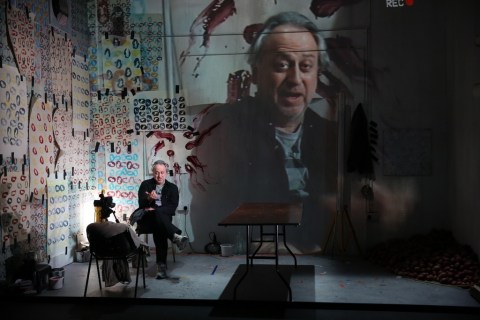
Stanley Townsend in ‘Incantata’ by Paul Muldoon, directed by Sam Yates in its U.S. premiere at the Irish Repertory Theatre (Carol Rosegg).
Incantata by Paul Muldoon is an encomium, a memorial to American artist Mary Farl Powers, Muldoon’s one-time partner and forever friend who resides somewhere in the memories of his imagination. Written in verse that is rhythmic, reminiscent of the stanzaic form popularized by W.B. Yeats, Incantata, currently at the Irish Repertory Theatre until 15 March, has been fashioned by director Sam Yates and actor Stanley Townsend into a staged production that dramatizes the speaker’s lament, remembrance and praise of his former lover.
Muldoon’s forty-five stanza poem is a “quiet” elegy turned on its head; the speaker known as “The Man,” rages and rants, pivots and emotes poignance and sorrow that Powers did nothing to stem her lifeblood draining away, gnawed by breast cancer which caused her untimely death. For indeed, in her perspective it was “pre-determined.” The Man doesn’t detail the specifics of why she thought this, only that she believed that the cancer might be treatable with alternative therapies. For her, these treatments did not work. Indeed, her death was determined by her own hand by not going for mainstream medical treatment which The Man believes could have saved her.
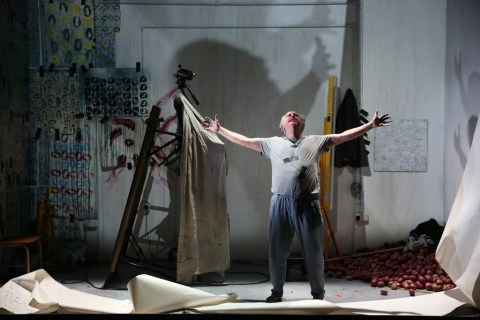
Stanley Townsend in ‘Incantata’ by Paul Muldoon, directed by Sam Yates, in its U.S. premiere at Irish Repertory Theatre (Carol Rosegg).
To bring Muldoon’s fervid poetry into a staged monologue, director Sam Yates shepherds Stanley Townsend with actions that appear to be organic and intrinsic to Powers. She was essentially a print artist who also worked in cast paper and paper sculpture. She mentored other artists (non printmakers) to bring their work into the mediums of etching and lithography. She helped to found the Graphic Studio.
Before The Man-Muldoon’s poetic speaker (Stanley Townsend) takes the stage, we note an artist’s studio where his/her works hang, prints cascading down in repeated patters of various colors. Until The Man picks up a potato and carves it out and employs it to create his colorful artistic patterns, we do not realize that the massive pile of red-skinned potatoes on the far corner of the studio opposite the artist’s wall of work has anything to do with creating the prints which hang there.

Stanley Townsend in ‘Incantata’ by Paul Muldoon, directed by Sam Yates, in its U.S. premiere a Irish Repertory Theatre (Carol Rosegg).
Through Townsend’s felt authenticity and live, on-stage printmaking, Yates staging, and the use of live camera projections which focus on “The Man,” or becomes a stand-in for an objective Powers who bestows her criticism, always there is a florid pouring out of raw emotion. In his soul grief, love, and too many emotions to categorize because they are not neatly rendered or subdued by logic, we gauge the impact of Powers on The Man’s life. Townsend’s and Yates’ collaboration yields an intriguing, enthralling and ever-present, moment-to-moment happening that is emotional art and equivalent to myth-making.
To symbolize Powers’ artistic endeavors and the nature of art’s power to heal and effect the transference of love, Townsend’s The Man actively creates prints using a potato cut, instead of a woodcut. He produces a multicolored series of duplications of form comprising prints from each show. First, the potato’s use is fascinating. It is also referenced in the poem: a “potato-mouth,” that “mouth as prim and proper as it’s full of self-opprobrium.” This reference moves in a refrain to references of the lazy, indolent character Belacqua in Dante’s Inferno and by extension to Samuel Beckett’s stories employing the character Belacqua. The Man, Muldoon’s speaker “crouches” with Belacqua, and then in an extrapolation to Beckett’s Pozzo and Lucky of Waiting for Godot attempts to discern what is, in fact, unknowable.

Stanley Townsend in ‘Incantata’ by Paul Muldoon, directed by Sam Yates, in its U.S. premiere at Irish Repertory Theatre (Carol Rosegg).
Such are the characteristics of Townsend’s “Man” who attempts to reason with himself about Powers’ fateful decision and blames her for it, yet wonders at the courage or fatalism of it. Perhaps it is a miserable turnaround because by rejecting treatment that may have saved her, Powers deprived the world of her additional art and her teaching presence at the Graphic Studio.
With this evocation of Powers (her vitality helped to establish the Graphic Studio Dublin and drive it from its basement inception to a huge warehouse) not even the memories and reminiscences can be pinned down. Much of their time together in Dublin and Belfast remain elusive fragments. Evanescent phrases are the moments in time that Muldoon/The Man had with Powers consigned to memories of “great big dishes of chicken lo mein and beef chow mein” and of “what’s mine is yours and yours is mine.” Of “all that is left” of their life together, he lists in a series of things they did, places they went, and flowers they saw, like oxlips and cowslips that had personal, intimate, visual meaning.
How does one even codify into a magical intoning, the essence of another human being and represent with words the relationship that resulted from the ephemeral bonds of love, remorse, argument, and the creative fountain of artistic impulse that the relationship engendered? One puts it on stage to dramatize it. Incantata has found its home in the drama.
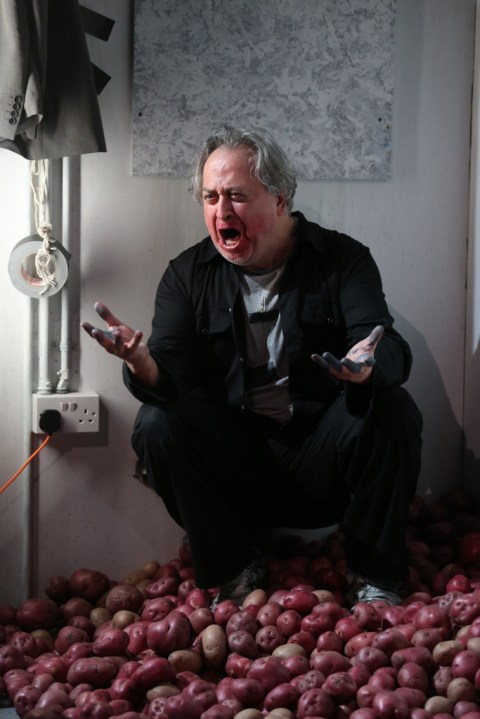
Stanley Townsend in ‘Incantata’ by Paul Muldoon, directed by Sam Yates, in its U.S. premiere at Irish Repertory Theatre (Carol Rosegg).
Muldoon’s speaker, The Man, infused with Stanley Townsend’s riveting performance remains an incantation to Power’s art, and to art, and the creative impulse that manifests in the arts. That manifestation is born and borne of suffering and is as simplistic, revelatory and symbolic as a bird picking up a “strand of bloody wool from a strand of barbed wire in the aftermath of Chicamauga or Culloden” most probably to use it to build a nest. By referencing two bloody battles, Chicamauga, the second bloodiest battle of the American Civil War and the battle of Culloden where the British quelled the Jacobite uprising, The Man reveals that in the extremis of pain and death, art can be birthed to bring healing and new life, or as Muldoon/The Man aptly states, “a monument to the human heart that shines like a golden dome among roofs rain-glazed and leaden.”
Townsend’s enlivening performance, succinctly directed by Yates brings Muldoon’s incantation of love, death, remorse, mourning, art and the creative impulse which seeks to heal to a striking dramatic iteration. This is a production which bears seeing a few times because of Townsend and because of the richness of the poem’s language, which I had the good fortune to examine.
Special kudos go to the following creative artists who helped stir the pot into its enchanting evocation: Rosanna Vize (set & costume design) Paul Keogan (lighting design) Sinéad Diskin (sound design) Jack Phelan (video design) Teho Teardo (composer).
Incantata is in its U.S. premiere on the Francis J. Greenburger Mainstage at the Irish Repertory Theatre (22nd St. between 6th and 7th). It runs with no intermission until 15th March. For tickets and times CLICK HERE.
‘Lady G: Plays and Whisperings of Lady Gregory’ at The Irish Repertory Theatre
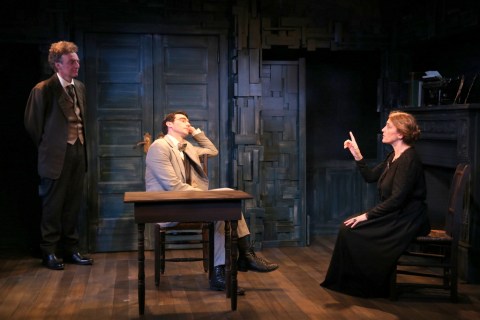
(L to R): John Keating, James Russell, Úna Clancy in Irish Rep’s ‘Lady G: Plays and Whisperings of Lady Gregory’ by Lady Augusta Gregory with additional material by Ciarán O’Reilly, directed by Ciarán O’Reilly (Carol Rosegg)
What do William Butler Yeats, John Millington Synge, Sean O’Casey, AE, George Bernard Shaw, George Moore and Katharine Tynan have in common? Their initials are carved on a tree growing on the property of Coole Park, Gort, in County Galway, the estate Lady Gregory inherited after the death of her husband Sir William Henry Gregory.
That is just one of the tidbits told by the spirit of Lady Gregory (1852-1932) who inhabits the production Lady G: Plays and Whisperings of Lady Gregory currently at the Irish Repertory Theatre until the 22nd of March. Written by Lady Augusta Gregory with additional material by Ciarán O’Reilly and directed by Ciarán O’Reilly, the delightful production reveals the life and times of one of the venerable, wry-humored progenitors of the Irish Literary Revival and co- founder of The Irish Literary Theatre and the Abbey Theatre with William Butler Yeats and Edward Martyn.

Úna Clancy, , Irish Rep’s ‘Lady G: Plays and Whisperings of Lady Gregory’ by Lady Augusta Gregory, with additional material by Ciarán O’Reilly, directed by Ciarán O’Reilly (Carol Rosegg)
The production stars Úna Clancy as the lively and candid Lady Gregory who fills out another role in Lady Gregory’s play “McDonough’s Wife at the end of Act II. James Russell portrays a variety of roles and is the humorous Mike McInerney in Lady Gregory’s, “Workhouse Ward” and the Sheep shearer in “McDonough’s Wife.” Russell is erudite and reserved in his portrayal of the philosophical literary genius, poet, playwright William Butler Yeats. And he is the kindly, avuncular Sir William Gregory who was Lady Gregory’s senior by thirty-five years.
We learn they had a son Robert, the pride of their lives whose death Robert mystically foreshadowed in a dream which his cousin also mysteriously had. He died during WWI in a play crash in a death which his mother like any devoted mother never could reconcile easily. Sir William Gregory attempted to practice noblesse oblige for the suffering Irish people under his care at a time when it was least appreciated. And his actions Lady Gregory implies were mischaracterized and reshaped to satisfy another agenda.

(L to R): Terry Donnelly, Úna Clancy, , Irish Rep’s ‘Lady G: Plays and Whisperings of Lady Gregory’ by Lady Augusta Gregory, with additional material by Ciarán O’Reilly, directed by Ciarán O’Reilly (Carol Rosegg)
Terry Donnelly of the lyrical voice, spot-on authenticity and versatility portrays Anne Horniman friend of the literary lights who helped fund the Irish National Theatre Society. Terry Donnelly also portrays Mary Sheridan, Lady Gregory’s influential, native-speaking Irish nanny who teaches her about the history and folklore of the area. Donnelly constantly surprises with her characterizations as Honor Donohoe in Gregory’s “Workhouse Ward,” and portrayals of Widow Quin, the Narrator, Marian and the character of the Hag 1 in “McDonough’s Wife.”

John Keating, Irish Rep’s Lady G: Plays and Whisperings of Lady Gregory’ by Lady Augusta Gregory with additional material by Ciarán O’Reilly, directed by Ciarán O’Reilly (Carol Rosegg)
John Keating rounds out this exceptional ensemble with versatility and humor portraying notaries Wilfred Blunt, Edward Martyn, John Quinn, George Bernard Shaw and Sean O’Casey. He is hysterical and nuanced as Michael Miskell the down-and-out companion of Mike McInerney who wheedles McInerney to remain in impoverishment when he might have stayed with his well-off sister Honor Donohoe (Terry Donnelly). And he is the poignant and raging McDonough who returns from his journeys to discover that the townspeople have eschewed his wife as an “outsider.” Their rejection is particularly loathsome because she dies in childbirth and no one in the xenophobic community wishes to join together to memorialize her passing or help bury her. Dark are Lady G’s themes of bigotry, alienation, shame and guilt in the revelatory “McDonough’s Wife.”
The personification of the Irish literary greats and the effect of their productions (the story of Synge’s Playboy of the Western World is particularly acute and ironic) is fascinating. Their discussions reveal the history of the period memorably with gusto. Gregory’s emblematic presence delivered with good will by Clancy makes the narrative of Lady Gregory’s life ring with truth.
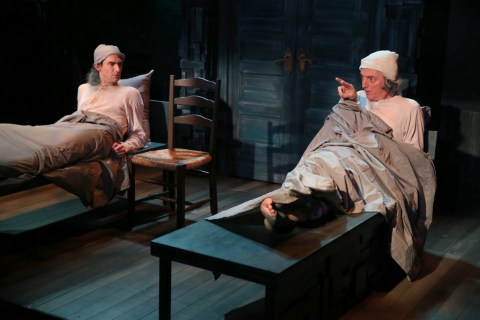
(L to R): John Keating, James Russell,, Irish Rep’s Lady G: Plays and Whisperings of Lady Gregory’ by Lady Augusta Gregory with additional material by Ciarán O’Reilly, directed by Ciarán O’Reilly (Carol Rosegg)
This production is many things: a historical encomium, a mini-revival of Irish playwrights, an affirmation and revisiting of that vital Irish literary renaissance in the early twentieth century and beyond. Importantly, it is a celebration of a woman who accomplished much for Irish theater and cemented the connections between Ireland and the United States, something which Americans need to be reminded of.
The added material by O’Reilly with Lady Gregory’s own words from her autobiography and published journals and from insightful articles by professors and researchers into the amazing time, O’Reilly cobbles together thoughtfully and humorously. The actors enliven the true to life artists, but O’Reilly’s narrative spoken by Gregory with various quotes from real personages coheres dramatically so that the audience remains engaged.
Critically, O’Reilly adds the two productions written by Lady Gregory which reveal her breadth and scope from humorous dialogue and conflict in “The Workhouse,” (finely engendered by director and actors) to the reality of the isolation and xenophobia of the the community where “MDonough’s Wife” takes place. The drama of the latter reflective of the bigotry of isolated communities regarding anyone from another social spectrum i.e. their inability to embrace with Christian grace “the other” has currency for us today. Gregory hit upon a strain of the human condition that is pernicious and seems everpresent despite the hope of religion to expurgate it.

(L to R): Terry Donnelly, Úna Clancy, , Irish Rep’s ‘Lady G: Plays and Whisperings of Lady Gregory’ by Lady Augusta Gregory, with additional material by Ciarán O’Reilly, directed by Ciarán O’Reilly (Carol Rosegg)
I thought the set was functional and symbolic; the dark green walls with nooks and crannies was where actors sat in character waiting to add their portrayals to the grand stew that was being created. Seamlessly, the set afforded them the opportunity to don costumes secreted there so that they could quickly step into the 22 roles the four actors portrayed with authenticity. The inclusion of the tree with the famous initials of Yeats, et. al and the music, lighting and sound effects added to the production’s appeal.
Clancy’s natural rapport with the audience is expertly directed and developed. The idea to incorporate Lady Gregory’s ritual practice of distributing a Barm Brack to her cast and the audience was fun. The cast distributed the Barm Brack (the delicious fruitcake was moister and less adamantine than the one my Irish-American aunt made) to us. It was a perfect treat after the humorous, ironic conclusion of “Workshouse Ward,” at the end of Act I.
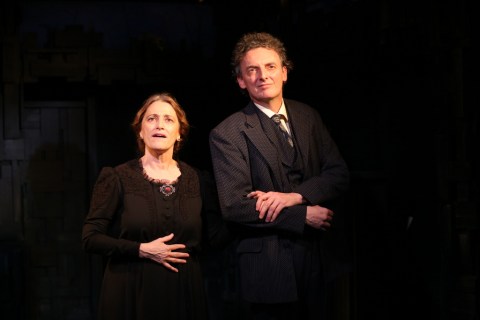
Úna Clancy, John Keatin in, Irish Rep’s ‘Lady G: Plays and Whisperings of Lady Gregory’ by Lady Augusta Gregory with additional material by Ciarán O’Reilly, directed by Ciarán O’Reilly (Carol Rosegg)
This production is a gem and I do think that educationally it needs to find an audience because of its revelations and historical grist regarding Irish literary history. Above all it is a memorialization and celebration of Lady Gregory, her works, her amazing friends. And, if you like, you may consider taking a trip to the West Country of Ireland to visit Coole Park. There, you will still see the walled garden and “The Autograph Tree” with the initials of Sean O’Casey, William Butler Yeats, George Bernard Shaw, John Millington Synge, AE and others, and be able to imagine a time when these writers enjoyed a unique camaraderie and received sustenance for their souls in a little piece of heaven on earth.
Noted are the creative team: Charlie Corcoran (set design) David Toser (costume Design) Michael O’Connor (lighting design) M. Florian Staab (sound design).
Lady G: Plays and Whisperings of Lady Gregory runs with 1 intermission at the Irish Repertory Theatre’s W. Scott McLucas Studio Theatre (22nd St. between 6th and 7th) until 22nd March. For tickets and times CLICK HERE.
‘Anatomy of a Suicide’ by Alice Birch at Atlantic Theater Company

(L to R): Carla Gugino, Vince Nappo, Celeste Arias, ‘Anatomy of a Suicide, by Alice Birch, directed by Lileana Blain-Cruz (Ahron R. Foster)
In Anatomy of a Suicide written by Alice Birch directed by Lileana Blain-Cruz, the playwright examines suicide’s ancestral relativities between and among mothers and daughters. Underlying the developmental arc and structure of her complex play, Birch examines many questions. Two which appear to pertain the most directly are the following. What is the likelihood that a mother’s depressive, suicidal personality may be inherited as part of the familial DNA passed down through generations? If a mother commits suicide, what is the likelihood that her daughter will be unable to overcome the death impulse to follow her mother’s example, unconsciously nurtured by her mother to that end?
Currently running at Atlantic Theater Company’s Linda Gross Theater, Birch’s Anatomy of a Suicide won the Susan Smith Blackburn Prize in 2018. Indeed, her approach to the topic is structurally unique and worthy of the tremendous efforts of the cast and director to reveal the mysterious bond between mothers and daughters that moves them in the direction of soul immolation.
Birch displays three generations of mothers and daughters: Carol (Carla Gugino) her daughter Anna (Celeste Arias) and Anna’s daughter Bonnie (Gabby Beans) on stage concurrently in real time. She unwinds their characters until they reach their apotheosis. They exist in different decades in the 20th and 21st century but appear before us in the present. Each mother anticipates the depressive ethos of her daughter in some of her interactions with others: spouse, friend, family.

Carla Gugino, Jason Babinsky in ‘Anatomy of a Suicide,’ by Alice Birch, directed by Lileana Blain-Cruz (Ahron R. Foster)
Birch sets these three components of the depressive state in each character on stage simultaneously with their ancestral counterparts by defying the space/time continuum. As each character depicts her own manifestations of her condition, sometimes the dialogue overlaps repetitively as if a time warp occurs and you are allowed to see how the mother has impacted the daughter in the future (i.e. how Carol impacted Anna). Usually, Birch features a key vignette with one character while the other two draw inward. For example while Anna has a scene with a doctor, Carol is occupied in an action, i.e. cutting apples, smoking, etc. and Bonnie is involved in her own action. When their dialogue overlaps and there is a synchronicity of time and space, a still point of connection occurs.
Birch uses this structure of simultaneity, rhythmic dialogue, repetition and overlap to stimulate the audience’s dissection and analysis of the characters. Perhaps it is to understand how suicidal depression in the case of this family leaps genetically (?) telepathically (?) from mother to daughter without knowing the etiology of each woman and specifically how or if such a transmission occurs. Birch depicts Carol’s, Anna’s and Bonnie’s depressive, addictive and emotional isolation in events unique to each and not in chronological order, but always simultaneously. However, though we see the symptoms and reactions which are the tip of the iceberg, we never know the rationale why these women are suicidal because it is unknowable. It is unconscious. Thantos, the death impulse exists in each of us, as does eros, the life impulse. Why does one overcome the other in these women is not what concerns Birch. That it is there in this family group is enough to investigate and atomize.

Carla Gugino in ‘Anatomy of a Suicide,’ by Alice Birch, directed by Lileana Blain-Cruz (Ahron R. Foster)
For Carol and Anna the suicidal impulse is acute at the outset of the play. Carol’s husband John (Richard Topol) confronts her about her bandaged/sliced wrists and her thoughtful accommodation for him to have enough dinners for a week or so, which she has cooked and frozen for him to thaw out after her death. Such premeditation is crystal clear; she has thought about what she will do and planned for it, yet she tells John everything is “fine.” Later in her segments the evidence mounts and we understand why “it is fine.”
For his part, John confronts her with great passivity, an element of her depressive state she perhaps wishes to conclude with finality. Divorce would not be final enough, we learn in a subsequent later vignette that is companionable to a simultaneous event with Anna and Bonnie. Nevertheless, John is frightened, yet incompetent to handle her. Through various scenes he cannot read her or cogently, effectively deal with her flattened affect that hides the dark abyss within. Carol’s various scenes unfold tied not to a time order but to a thematic familial order with her daughter Anna and Granddaughter Bonnie who demonstrate their own angst: Anna in her relationship with her spouse Jamie (Julian Elijah Martinez) and Bonnie in her interest and relationship with Jo (Jo Mei ).

(L to R): Gabby Beans, Jo Mei in ‘Anatomy of a Suicide,’ by Alice Birch, directed by Lileana Blain-Cruz (Ahron R. Foster)
A telling event occurs during Carol’s pregnancy and after baby Anna is born. We and John understand that she will never have another child; sex is not pleasurable and she is only staying in the marriage to raise their daughter. Each vignette reinforces Carol’s intense emotional interior trauma that Carla Gugino’s brilliantly flickers to the surface through the character’s strained, straight-lipped smile, wooden responses and modulated, refined voice.
What happened to her, to Anna, to Bonnie? Why are they depressed? Does the historical cause matter if it is genetic, a brain disorder or some other causation that is beyond the kin of the medical profession? Interventions are tried to no avail: shock therapy, perhaps rehab for Anna for her drug addiction. Nothing works. No human interaction satisfies to stem the death impulse.
We realize Carol is fine when she succeeds in achieving her goal in life. By the end of her scenes (she is staged on the far left as the progenitor mother of depression in the 20th century) we come to understand why Carol responds as she does to John that she is “fine.” Her mind is made up. She has planned and most probably will continue to plan and justify her suicide to herself because her pain is relentless, without limit, infinite as long as she is in her body. Thus, when we finally learn that she has killed herself, it is anti-climactic. The same is not true for Anna who, in her vignettes, gyrates between anxiety and calm, hyperactivity and peace with husband Jamie.

(L to R): Carla Gugino, Ava Briglia, Celeste Arias, Jo Mei, Gabby Beans in ‘Anatomy of a Suicide,’ by Alice Birch, directed by Lileana Blain-Cruz (Ahron R. Foster)
Regardless, Birch blindsides us and Carol’s and Anna’s spouses with their suicides to end the roiling hell within. For Carol we know it is coming, yet when we hear of it surprisingly tucked into a conversation, we remember her memorial to herself, “I’m fine.” Anna’s suicide is as Anna is, dramatic.
At the outset of the play when Carol and John have their discussion about Carol’s suicide attempt and she affirms she’s “fine,” Celeste discusses with a doctor friend (Vince Nappo) the necessity for an injection in a frenetic insistence to charm him. The doctor knows what she wants and ignores her despite her lightening responses and “hail good fellow well met” justification for it. Her heightened state, during which she discounts how she broke her arm, is like an episode of rapid recycling in a bi-polar disorder patient. In their synchronized scenes, obviously, both women display warning signs that they are ripe for suicide, but in their own personalities and iterations which are antithetical.
Perhaps, Birch posits one clue for Carol’s and Anna’s dark intentions and eliminates it for Bonnie. Carol’s and Anna’s intolerable misery is exacerbated when they become pregnant and have their daughters. Does this symbolize the end of their lives? Indeed, Celeste’s nihilism appears even greater than Carol’s and her commitment to killing herself happens in hyperbole part of the up/down of her life that Birch reveals is her nature. On the other hand Bonnie solves the problem of mother/ daughter suicidal ideation carried to her through an inherited gene pool. A doctor, Bonnie makes a canny choice about relationships and doesn’t put herself in the position of her grandmother and mother. But perhaps she is her father’s daughter, not her mother’s. Again the etiology is never clarified, not that it should be.

Julian Elijah Martinez, Celeste Arias, ‘Anatomy of a Suicide,’ by Alice Birch, directed by Lileana Blain-Cruz, Atlantic Theater Company (Ahron R. Foster)
The play intrigues with the everpresent present of three women in the same family reflecting how they respond to the unchanging underlying death impulse as it manifests with synchronicity in Carol, Anna and Bonnie over time, yet also with different and particular iterations based upon each individual woman. Staged simultaneously across three time periods, we think we can understand the suicidal threads in these characters and especially that Bonnie doesn’t physically move a hand against herself.
At times refocusing which vignette to watch to break through the overlapping dialogue was challenging. However, the uniform superb acting drew out the sequences appropriately and the pacing of the dialogue was letter perfect so that the key lines to be repeated resonated with rhythmic precision.

(L to R): Carla Gugino, Miriam Silverman in ‘Anatomy of a Suicide,’ by Alice Birch, directed by Lileana Blain-Cruz, (Ahron R. Foster)
The set whose three walls are painted a green-blue color and beset with complementary plants appears vibrant on first inspection. However, the wash basin in Carol’s space which looks like those in a doctor’s office with the high curving faucet, and a bathtub with similar faucet in Anna’s space convert the set toward the clinical and sterile. This is so despite the ensemble bringing in tables to suggest dinners with friends and other activities.
The set puts one on notice that this will not be a typical play about suicide with its recumbent, empathetic emotionalism. This will be as unique as the title implies and a detached, observational approach will be employed. Indeed, as we follow Birch’s presentation and the director’s shepherding of a truly superb cast, we become like scientists viewing, as if under glass familial fault-lines that break the family. It is an empty exercise and we are no closer to understanding another element of a mysterious anti-life position of human beings: the urge, necessity, the repeated will in some families, in this play mothers and daughters, to end their lives.
By the end of the play, we remain detached. Such detachment about the most violent act one can take against oneself is frightening. But the play encourages objectification for a reason. Objectification in our culture contributes to feelings of isolation. Being or feeling “the other,” not belonging, not communicating in a felt empathetic way to bridge one’s “aloneness” in pain are states of misery. Yet, for these mothers to put their daughters in that state indicates they were hopeless. It is the height of objectification, not having empathy for oneself to live to the next day. Birch’s work enlightens and devastates.
Noted are Mariana Sanchez (sets) Kaye Voyce (costumes) Jiyoun Chang (lights) Rucyl Frison (sound) Hannah Wasileski (projetions) Tommy Kurzman (wig, hair & makeup).
Anatomy of a Suicide runs at the Atlantic Theater Company (336 West 20th) with no intermission until 15th March. For tickets and times CLICK HERE.
‘The Orchid Show: Jeff Leatham’s Kaleidoscope’ at the New York Botanical Garden

‘The Orchid Show: Jeff Leatham’s Kaleidoscope,’ NYBG 18th Orchid Show (Carole Di Tosti)
The New York Botanical Garden’s Orchid Show is in its 18th glorious year and it is amazing. One reason why is because of this year’s show designer, the imminently creative original Jeff Leatham.

Jeff Leatham posing with his orchid sculpture at the NYBG ‘The Orchid Show: Jeff Leatham’s Kaleidoscope,’ NYBG 18th Orchid Show (Carole Di Tosti)
Board members from the NYBG were familiar with Jeff Leatham’s work and thought he would be a great fit for the NYBG orchid show since his floral designs encompass orchids, the loveliest of flowers. When he was contacted, he jumped at the opportunity enthusiastically, visited the Garden in July, solidified his ideas and arrangements were made.

‘The Orchid Show: Jeff Leatham’s Kaleidoscope,’ DETAIL, NYBG 18th Orchid Show (Carole Di Tosti)
If you have been to Paris, France and stayed at The Four Seasons Hotel Georges V, you will see Jeff’s designs. He is their award-winning artistic director. He also has studios at the Four Seasons Hotel Philadelphia at Comcast Center and the Four Seasons Hotel Los Angeles at Beverly Hills. Jeff Leatham is a renowned lifestyle icon and impeccable floral designer to the stars.

Jeff Leatham and Carrie Rebora Barratt, Ph.D., CEO and President of NYBG pictured at ‘The Orchid Show: Jeff Leatham’s Kaleidoscope,’ NYBG 18th Orchid Show (Carole Di Tosti)
If you asked him as a teenager what he wanted to do with his life, he would have said he wanted to be a model. Interestingly, his career has morphed into something more profound, but it includes a form of modeling as well because Jeff often photographed with his unique designs.

‘The Orchid Show: Jeff Leatham’s Kaleidoscope,’ DETAIL, NYBG 18th Orchid Show (Carole Di Tosti)
At twenty-four Jeff began his career with the Four Seasons starting with flower petals. It was then he knew he had found his raison d’etre with floral design. He has been with them ever since exploring his passion for design and flowers.. His one-of-a-kind displays move in the realm of the dazzling spectacular that integrates with whatever the setting is. His creations include sculptures and these and his floral displays manifest the symbolic, bold and dramatic use of color and shape, yet embody an elegant simplicity.

‘The Orchid Show: Jeff Leatham’s Kaleidoscope,’ DETAIL, NYBG 18th Orchid Show (Carole Di Tosti)

‘The Orchid Show: Jeff Leatham’s Kaleidoscope,’ DETAIL, NYBG 18th Orchid Show (Carole Di Tosti)
Jeff Leatham’s designs are completely original and stand out as such. Individuals who want to hire him to feature a design for their wedding that is like “so-and-sos,” Jeff, with a smile on his face will gently tell the individual that they should hire that designer. He will evolve a creation that is particular. Indeed, his signature, one-of-a-kind designs are his brand and people have come to know right away whether a floral design is a Jeff Leatham or not.

‘The Orchid Show: Jeff Leatham’s Kaleidoscope,’ DETAIL, NYBG 18th Orchid Show (Carole Di Tosti)
Jeff has produced his incredible floral exhibits in Paris for almost two decades and is so enamored by the French that in 2014 he was knighted with the Ordre des Arts et des Lettres, the highest honor for artists and those who make vital contributions to French culture. Jeff has appeared on television featuring his creations. His clients include Cher, Dolly Parton, Tina Turner, Oprah Winfrey, His Holiness the Dalai Lama and many others. They appreciate the specialness of his designs.

‘The Orchid Show: Jeff Leatham’s Kaleidoscope,’ NYBG 18th Orchid Show (Carole Di Tosti)
For the 18th annual Orchid Show, Jeff Leatham decided upon the theme of the kaleidoscope. He commented that he receives inspiration from kaleidoscopes because they represent infinity. The patterns and colors shift, never repeating themselves in variations that are starkly unique and particular; and they go on forever, the mutable immutable.

Marc Hachadourian, Senior Orchid Curator pictured with blue Vandas peeking from behind him at ‘The Orchid Show: Jeff Leatham’s Kaleidoscope,’ NYBG 18th Orchid Show (Carole Di Tosti)
After the decision that the tent that had been up for The Holiday Train Show® would be taken down not to house the orchid exhibition, Karen Daubmann (Associate Vice President for Exhibitions and Public Engagement) mentioned in a brief chat with me that the staff and those involved with The Orchid Show like Senior Curator of Orchids, Marc Hachadourian were satisfied that this year’s orchid extravaganza with Jeff as lead designer, would encompass the entire conservatory.

‘The Orchid Show: Jeff Leatham’s Kaleidoscope,’ NYBG 18th Orchid Show (Carole Di Tosti)
Jeff worked the kaleidoscope theme beautifully, interweaving different colors staged with complementary hues in every gallery of the conservatory, save the Palms of the World Gallery. And the tunnel joining the two segments of the conservatory is the culmination of all the hues displayed in a fun and whimsical light show.

‘The Orchid Show: Jeff Leatham’s Kaleidoscope,’ NYBG 18th Orchid Show (Carole Di Tosti)
As you walk in the designated entrance that begins the exhibit, you will see the original, unique sculpture that Jeff created in his studio at the Four Seasons Hotel Georges V in Paris. Marc Hachadourian discussed with me that Jeff used his own orchid supplier from Europe for this gobsmacking living exhibit that shimmers with light and eye-popping purples, blues, pinks, fuchsias, complementary hybrid orchids with speckled white, purplish-black color combinations, whites and matching color derivative coordinates of Vanda orchids. These astounding Vandas are companioned with the popular and longer lasting phalaenopsis. The effect is visually breathtaking.

‘The Orchid Show: Jeff Leatham’s Kaleidoscope,’ DETAIL, NYBG 18th Orchid Show (Carole Di Tosti)
This first show gallery emphasizes the most myriad variety of Vanda orchids, that I’ve seen. They are happily perched up high so that they may flow down from a mammoth, laddered, rectangular trellis suspended from the show gallery ceiling. They are the perfect orchid for this structure because of their amazingly long roots and tendrils that soak up the moisture from the surrounding environment and require a flow of air around them. The effect with the Vandas sparking the color and the long roots hanging from the four-rung metal structure depending from above with the reflecting sculpture below offers a contrast. Vibrant colors are paired with their pale whitish roots that appear ethereal and lacy. It’s almost as if a garment fabricator sewed lines of lace to flow down from each mounted orchid. It’s a brilliant way to show the Vandas.

‘The Orchid Show: Jeff Leatham’s Kaleidoscope,’ DETAIL, NYBG 18th Orchid Show (Carole Di Tosti)

‘Orchid Show: Jeff Leatham’s Kaleidoscope,’ rear view of the orchid sculpture DETAIL, NYBG 18th Orchid Show (Carole Di Tosti)
The sculpture is an orchid fountain mirror that reflects white light, the combined color of all the colors of the rainbow. It is the centerpiece in the round, underneath the metal ladder structure of striking orchid hues and flowing, lacy, filament roots. It is an intriguing and unique concept which gives the orchid sculpture a refracting power similar to a lustrous diamond. Jeff designed this for the Garden. And with the resplendent colors of the Vandas and coordinating phalaenopsis draped on the various rungs with accompanying greenery of the phalaenopsis leaves, you are left gazing with wonder at this stunning and memorable piece of living theater.

‘The Orchid Show: Jeff Leatham’s Kaleidoscope,’ DETAIL, NYBG 18th Orchid Show (Carole Di Tosti)
Present in this remarkable array of beauty are the Garden plants, ficus trees, shrubs, ferns that normally make their home at the Garden. Added are the bromeliades which Jeff has used as a representative of their own powerfully sculpted forms that are rich and lush in nature.

Bromeliade,’The Orchid Show: Jeff Leatham’s Kaleidoscope,’ NYBG 18th Orchid Show (Carole Di Tosti)
And on one of the plantings is the Vanda sunanda orchid named after Jeff Leatham by Ansu Vanda, an orchid nursery in the Netherlands in 2017. By naming this orchid after Jeff, the nursery hoped to celebrate and honor his indelible work that has enhanced floral design globally.

Vanda sunanda orchid named after Jeff Leatham, ‘The Orchid Show: Jeff Leatham’s Kaleidoscope,’ NYBG 18th Orchid Show (Carole Di Tosti)

Vanda sunanda orchid named after Jeff Leatham, ‘The Orchid Show: Jeff Leatham’s Kaleidoscope,’ DETAIL,NYBG 18th Orchid Show (Carole Di Tosti)
Orchids in this genus of the orchid family are available in every color of the rainbow. Jeff noted for us the almost black purple that speckles this Vanda named for him.

‘The Orchid Show: Jeff Leatham’s Kaleidoscope,’ NYBG 18th Orchid Show (Carole Di Tosti)
Jeff commented that he has a passion working for orchids because each seems to have its own unique and distinct personality that you want to feature and highlight. The orchid family is the largest family of plants in the world. There are 30,000 orchids in the wild. Growers in their ingenuity have hybridized over 100,000 orchids. They remain perhaps the most popular flower because of their exotic beauty, their tongue and face that entice moths and other insects to pollinate them. Orchids grow in every continent in the world except Antarctica. With global warming and the record warm temperatures in parts of the continent, this may change.

Gallery “Grasslands,” ‘The Orchid Show: Jeff Leatham’s Kaleidoscope,’ NYBG 18th Orchid Show (Carole Di Tosti)

Gallery “Grasslands,” ‘The Orchid Show: Jeff Leatham’s Kaleidoscope,’ Paphiopedilum, DETAIL, NYBG 18th Orchid Show, (Carole Di Tosti)
As you move through the conservatory, you will note Jeff’s interesting use of color. Next to the orchid sculpture gallery you move into “grasslands.” There you will note the displays of slipper orchids (Paphiopedilum) and Cymbidiums in bursts of yellow and white and a few slipper orchid hybrids tucked in with brownish faces.

‘The Orchid Show: Jeff Leatham’s Kaleidoscope,’ Cymbidiums DETAIL, NYBG 18th Orchid Show (Carole Di Tosti)
There is an abundance of greenery looking indeed like tall grass as the cymbidiums flourish with their waxy large blooms and spiky leaves.

Desert Blues, ‘The Orchid Show: Jeff Leatham’s Kaleidoscope, NYBG 18th Orchid Show, (Carole Di Tosti)
The next gallery is the desert terrain devoted to the Garden’s permanent display of desert plants. Jeff has an appreciation for the colors of the cacti and succulents and exotic desert flora in these two galleries.

Desert Blues, ‘The Orchid Show: Jeff Leatham’s Kaleidoscope, NYBG 18th Orchid Show, (Carole Di Tosti)
He has placed coordinating cobalt blue bamboo poles to draw the eye-line upward. For the first time, I looked up at the tops of the magnificent cacti that I had never appreciated before. Normally, I would have raced through this area without the appreciation of the immense variety that the Garden has in its desert display.

‘The Orchid Show: Jeff Leatham’s Kaleidoscope, NYBG 18th Annual Orchid Show (Carole Di Tosti)

‘The Orchid Show: Jeff Leatham’s Kaleidoscope, NYBG 18th Orchid Show (Carole Di Tosti)
Moving downward to the other part of the conservatory, Jeff Leatham painted the backdrop of the room that leads to the tunnel grey. He coordinated gorgeous pink and red lined hybrid phalaenopsis with unusual succulents for another amazing effect.

‘The Orchid Show: Jeff Leatham’s Kaleidoscope,’ NYBG 18th Annual Orchid Show (Carole Di Tosti)

‘The Orchid Show: Jeff Leatham’s Kaleidoscope,’ NYBG 18th Annual Orchid Show,(Carole Di Tosti)
The grey background makes the colors of the plants pop. And in the display cases he did the same, drawing the eye inward to note the contrast using grey bamboo poles in a simplistic design invoking minimalism. Leatham uses Spanish Moss to tie in the concept of the design of lace filaments that depend downward and recall the Vandas flowing roots in the main show exhibit with the orchid fountain.

‘The Orchid Show: Jeff Leatham’s Kaleidoscope,’ NYBG 18th Annual Orchid Show (Carole Di Tosti)
I love how every segment of the show in each of the galleries picks up design ideas in the previous galleries and threads them through the show in shape, color, pattern, materials to present a unified conceptualization.

‘The Orchid Show: Jeff Leatham’s Kaleidoscope,’ NYBG 18th Annual Orchid Show (Carole Di Tosti)

‘The Orchid Show: Jeff Leatham’s Kaleidoscope,’ NYBG 18th Annual Orchid Show (Carole Di Tosti)

‘The Orchid Show: Jeff Leatham’s Kaleidoscope,’ NYBG 18th Orchid Show (Carole Di Tosti)
In the Rainfroest Gallery, gorgeous green moss covering the rocks, the splashes of orchid color most naturally represent how orchids grow in the wild. Again the pinks and yellows from the previous galleries are represented. The orchids selected for their sizes and shapes are different from those that have gone before. Along the winding path is a celebration of less popular orchids that are harder to grow as if they might be found tucked away in a secluded forest’s mossy plot. These include a variety of Paphiopedilum and delicate snow drop orchids and others.

‘The Orchid Show: Jeff Leatham’s Kaleidoscope,’ NYBG 18th Annual Orchid Show (Carole Di Tosti)
As the trail winds into a break, Jeff once again employed his sense of color to effect beauty. He had a structure painted a cherry color that threaded through the pinks and fuchsias of the phalaenopsis of the main gallery orchid fountain display.

‘The Orchid Show: Jeff Leatham’s Kaleidoscope, a rare Vanda, NYBG 18th Orchid Show, (Carole Di Tosti)
Included in the show is the gallery where the most rare species of orchids are kept in a glass case. A number of these orchids may eventually be extinct since their habitats have been destroyed by development, deforestation and blatant disregard and inattention to the importance of conservation. The Garden is a world leader in plant research and conservation, using traditional and cutting-edge tools to discover, understand, and preserve Earth’s vast botanical diversity. They have saved orchids sent to them recovered from illegal orchid poachers.

‘The Orchid Show: Jeff Leatham’s Kaleidoscope,’ Sunrise/Sunshine Gallery, NYBG 18th Annual Orchid Show (Carole Di Tosti)
I was sorry to see that The Orchid Show: Jeff Leatham’s Kaledoscope was coming to an end with the last two galleries. Jeff named the gallery with the fountain and hanging vines, Sunrise/Sunshine because of the bursting orange and yellows and whites. The fountain is still in the center, but it has been covered over by moss with a potted fern as the crown of glory.

‘The Orchid Show: Jeff Leatham’s Kaleidoscope,’Sunrise/Sunshine Gallery, NYBG 18th Annual Orchid Show (Carole Di Tosti)

‘The Orchid Show: Jeff Leatham’s Kaleidoscope,’ NYBG 18th Annual Orchid Show (Carole Di Tosti)

‘The Orchid Show: Jeff Leatham’s Kaleidoscope,’ Sunrise/Sunshine Gallery, NYBG 18th Annual Orchid Show (Carole Di Tosti)
This gallery and the last one are every bit as amazing as the former galleries. Jeff stated that he wanted “every gallery to be a different color experience as visitors move through them.” And that this experience would be reminiscent of “looking into a kaleidoscope.” We all have seen kaleidoscopes as children.

‘The Orchid Show: Jeff Leatham’s Kaleidoscope,’ NYBG 18th Annual Orchid Show (Carole Di Tosti)

‘The Orchid Show: Jeff Leatham’s Kaleidoscope,’ NYBG 18th Annual Orchid Show (Carole Di Tosti)
And with technology advancements, the designs are more elaborate than ever. Jeff stated that members and visitors to the Garden have seen the interiors of the Conservatory. But he wanted their experience to be different. “I want them to look through them (the galleries) like never before.” And in the last gallery, all the hues that Jeff displayed throughout the show are represented and the threads of designs are repeated. It’s like you’re looking through that kaleidoscope. However, it’s a living breathing wonderland of what reflects the infinite in color, texture, scent and myriad patterns. Just grand.
There are many events that pair up with the 18th Annual Orchid Show featuring the work of one-of-a-kind floral artist Jeff Leatham that you will not want to miss. The show runs from February 15 through April 19, 2020. For specific programming go to the NYBG website by CLICKING HERE.
‘Chekhov/Tolstoy Love Stories’ at The Mint Theatre, Two Masters’ Perspectives of Love, Adapted by Miles Malleson

Alexander Sokovikov, Brittany Anikka Liu in ‘The Artist,’ adapted by Miles Malleson from “An Artist’s Story” by Anton Chekhov, Chekhov/Tolstoy Love Stories (Maria Baranova)
“One of the most diversified talents in the British theatre,” Miles Malleson (1888-1969) was enamored of Leo Tolstoy and Anton Chekhov, who had formed a bond in the latter years of their lives; Chekhov, the younger pre-deceased Tolstoy, the elder by six years–Tolstoy died in 1910. Admiration of these two great Russian writers inspired Malleson to create theatrical adaptations of short stories by Tolstoy and Chekhov. From Tolstoy’s parable “What Men Live By” Malleson adapted Michael. From Chekhov’s “An Artist’s Story,” Malleson configured The Artist.
The Mint Theatre Company has featured Malleson’s plays before (i.e. Unfaithfully Yours) considering Malleson to be a playwright worthy of recalling to our social theatrical remembrance. In the first offering of the season, The Mint has coupled the British playwright’s dramatic adaptations of Chekhov’s and Tolstoy’s one acts because their themes relate to love. In The Artist, directed by Jonathan Banks, Chekhov via Malleson ironically presents romantic love that never has the opportunity to blossom and rejuvenate, but is cut off before its time. In Michael directed by Jane Shaw, Tolstoy via Malleson uncovers truths related to the nature and power of agape love. The Mint Theatre Company’s production of Chekhov/Tolstoy Love Stories is currently at Theatre Row.
Presenting The Artist and Michael back-to-back offers the audience the opportunity to examine how each of the plays evokes themes about love, spirituality, redemption and revelation. Additionally, one identifies the contrasting social classes represented by the setting and characters of each one act. Each play identifies the perspective of the writers who were interested about what was accessible to the Russian social classes. Tolstoy, a nobleman often wrote about the worthiness of the lower classes who are represented by the characters in Michael. On the other hand Chekhov, whose grandfather was a serf, centered his greatest works on Russian gentry on the brink of an era of change (The Russian Revolution).
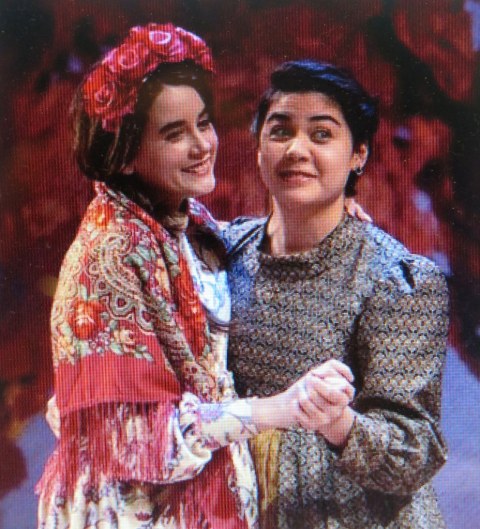
(L to R): Anna Lentz, Brittany Anikka Liu in ‘The Artist,’ adapted by Miles Malleson from “An Artist’s Story” by Anton Chekhov, Chekhov/Tolstoy Love Stories (Maria Baranova)
In keeping with Chekhov’s proclivities, The Artist takes place on a Russian estate run by a fine, elevated family of women who are intellectual and well regarded. These include the Mother (Katie Firth) and her two daughters. The elder daughter is the teacher Lidia (Brittany Anikka Liu) who is heavily involved with helping improve the status of the peasants. The youngest is the teenage dreamer Genya (Anna Lentz). An artist Nicov (portrayed by Alexander Sokovikov) visits often and the play opens as he paints his landscape while he interacts with Genya who listens to his philosophical justification of the importance of art over social reformation of the peasant class. Nicov and Lidia who represent antithetical views, argue continually. Thus, Nicov finds Genya’s unformed, youthful attentiveness an entrancement over Lidia’s disparagement of the useless function of Nicov’s art.
The characterizations of Nicov and Genya are reminiscent of Chekhov’s characters from his full-length plays, absent the conflict and tensions inherent in Chekhov’s full formed works. Malleson’s characterizations in The Artist are lukewarm and superficial. There is little heat and light as their should be when Nicov argues with Lidia to set up the drama and tension when he expresses his justifications to a sympathetic Genya with whom he falls in love and who returns his love.
The low-key tension and conflict of Malleson’s characterization is not helped by the lackluster performances. The spark of fire between Genya and Nicov that prompts the sardonic ending and Nicov’s felt and empathetic loss is missing. Nicov’s rant as delivered by Sokovikov is telling; Sokovikov does much of the heavy lifting with authentic responses from Katie Firth. Brittany Anikka Liu as the caring and forceful teacher/reformer in conflict with Nicov should be brighter, more ironic. Their interplay could even be darkly humorous. However, the love between Genya and Nicov is not believable. Thus, the impact of the Chekhovian sardonic ending is rendered impotent.

(L toR): Katie Firth, Vinie Burrows, Malik Reed, J. Paul Nicholas, in ‘Michael,’ adapted by Miles Malleson from “What Men Live By” by Leo Tolstoy, directed by Jane Shaw, ‘Chekhov/Tolstoy Love Stories’ (Maria Baranova)
Michael directed by Sound Designer Jane Shaw, making her directorial debut, employs more fluid light and music as the setting reverts to a peasant’s hut and the characters sing. The backdrop shifts. In The Artist, it is a painted tree filled with autumn leaves, signifying the season and symbolism of Nicov’s waning years. In Michael the design becomes the long, intricate white roots (interestingly lighting by Matthew Richards) of the tree. The symbolism of the lower classes is perhaps being suggested. It is the underclass (the tree’s roots) that supports and is the lifeblood of the middle and upper classes (the trunk, branches, leaves). Without the roots of the peasant class from which all humanity has derived, the upper classes can’t be sustained.
In Michael, the conflict arises when a homeless beggar (Malik Reed) is brought in by Simon (J. Paul Nicholas) and the wife (Katie Firth) must decide whether he should stay or be thrown out because they have barely enough for themselves and Aniuska (Vinie Burrows). The decision is made to let him stay. The scene shifts to a year later. We see the family is being sustained by Michael, the beggar who does not speak because he works as a cobbler for the peasant family. When a Russian Nobleman (Alexander Sokovikov) arrives and requires boots, the circumstances change. Michael makes a mistake with the boots, but it turns out to be a prescient action. That evening his learning is complete and finally Michael reveals who he is, why he is there and what he has learned about pity and empathy which is agape love. It is what we should live by.
The performances in Michael adhered more completely. Reed’s performance was soundly delivered undergirded by the ensemble. Malleson’s adaptation of the Tolstoy short story provided more dramatic tension and mystery. The staging and props added interest to engage the audience more completely, along with Oana Botez’s variable costuming, i.e. the nobleman’s coat and hat contrasted with the peasants’ outfits.
The pairing of the two one acts by the Russian writers who were contemporaries via Malleson is an enlightened decision if imperfectly rendered. It is the landed gentry in The Artist who remain unfulfilled by love, in effect harming the artist. They deprive him of rejuvenating love, and negatively impact his purpose to bring uplifting pleasure with his art. In Michael, the affirmation of the goodness of the peasant class (a Christian precept in the Beatitudes) is brought to them by Michael. He shares with them the wisdom that they have received through empathy/pity. It is the vitality of agape love that will sustain them.
In contrasting the two classes, the landed gentry is much worse off than the peasant class, a notion that Nicov suggests to Lidia to no avail. Lidia is convinced that (as in later years during the didactic polemic of the revolution) reform is imperative, art is useless. Meanwhile, the reforms and revolutions as they came did great harm which persists (one might argue) to this day. On the other hand making art is a necessity for the middle and upper classes to help them understand empathy and love, something the blessed poor, according to Tolstoy, are ready to receive and do take in as,the very potency which sustains them.
Chekhov/Tolstoy Love Stories runs until 14th March at Theatre Row (42nd Street). For tickets and times CLICK HERE.
Listed are the creative team: Roger Hanna (sets) Oana Botez (costumes) Matthew Richards (lights) Jane Shaw (original music and sound) Natalie carney (props).
‘The Sabbath Girl’ by Cary Gitter, Directed by Joe Brancato at 59E59 Theaters

(L to R): Angelina Fiordellisi, Lauren Annunziata in ‘The Sabbath Girl, by Cary Gitter, directed by Joe Brancato at 59E59 Theaters (Carol Rosegg)
What happens when Jewish orthodoxy and strict mores find intermarriage with someone of another faith verboten? Depending upon the orthodoxy of the Jewish community, this may be a serious issue. Cleverly, Cary Gitter, under the superb direction of Joe Brancato, keeps the difficult elements of love between a single Catholic woman and divorced, Orthodox Jewish man at bay in the lively, well-paced, delightful The Sabbath Girl currently at 59E59 Theaters. The production presented in its New York City premiere by Penguin Rep Theatre runs a slim 85 minutes with no intermission.
The romantic comedy’s tone and tenor skirts the dramatic in the opening scene when Nonna (portrayed exquisitely by Angelina Fiordellisi) visits with her beloved granddaughter Angie (the adorable Lauren Annunziata). Nonna checks on Angie to see how she is adjusting to her new apartment. In the process as is her custom, she chides Angie about not being in a love relationship. Angie assures Nonna she is a “modern woman,” perhaps a bit of a feminist. And she insists she doesn’t need a man to make her happy. She has her budding career, which encompasses her waking moments and keeps her busy. We note that Angie is ambitious, industrious and smart, especially since she intends to translate her success into even greater achievements.

(L to R): Lauren Annunziata, Jeremy Rishe in ‘The Sabbath Girl, by Cary Gitter, directed by Joe Brancato at 59E59 Theaters (Carol Rosegg)
Thus begins the theme of traditionalism vs. modernism framed by familial relationships. Gitter expands the themes around this conflict during the course of the play. With humor and irony, she drives the arc of the plot neatly and swiftly to a satisfying resolution.
An additional conflict in Angie’s life centers around the men she encounters as potential love interests. Throughout the play, when her Nonna visits to examine how her “love life” is going, Angie sweetly dismisses Nonna’s “traditionalist” suggestions about falling in love with the “right person” and hearing the “music of love” in her soul. Angie’s feminist bent is to negotiate and affirm her own definitions of what affection, love and marriage might be for her life. Gitter’s characterization of Angie also includes that she is rebounding from a failed relationship where her former boyfriend lied and cheated on her. In other words if she will become involved with someone, he will have to convince her he is unlike the cad she was with.
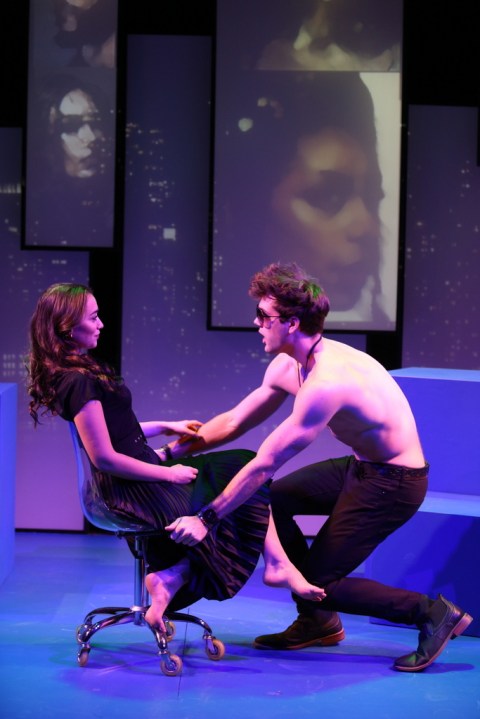
(L to R): Lauren Annunziata, Ty Molbak in ‘The Sabbath Girl’, by Cary Gitter, directed by Joe Brancato at 59E59 Theaters (Carol Rosegg)
The first man she encounters is Seth (Jeremy Rishe) an Orthodox Jewish gentleman who discovers his former Shabbos goy has moved and Angie is now his neighbor. A Shabbos goy is a Yiddish term for a non Jew who is asked by Jews to perform actions that are forbidden to them on Saturday, the Sabbath, i.e. turning on lights, electrical devices, etc.. Seth explains to Angie that his other neighbor was his regular Shabbos goy. Since Angie is his new neighbor, he asks her to turn on his air conditioning. They share a few insights and he leaves. However, Seth, who, too, is recovering from a bad relationship can’t get Angie out of his mind.
For her part Angie is uninterested in Seth because there is someone else on her horizon with whom she has art in common. This man is the awesome and cool Blake (Ty Molbak) an artist that Angie wishes to exhibit in her gallery, but who is holding out for the best offers from galleries in the city. Blake wears dark glasses to fuel his image. He manipulates Angie and claims that she will have to “woo” him before he exhibits in the gallery.
Nonna, like a fairy godmother who is gentle, funny and sweet, guides Angie and encourages her against Blake and toward Seth. Of course our own weaknesses sometimes lead us to be enamored of individuals who will hurt us, and reject others for whom we are well- suited. Angie is initially attracted to Blake and assesses that Seth is not her type and his religion is a barrier which she is not interested in climbing over.

(L to R): Jeremy Rishe, Lauren Singerman in ‘The Sabbath Girl, by Cary Gitter, directed by Joe Brancato at 59E59 Theaters (Carol Rosegg)
How the playwright turns these developments on their head becomes the focal point in the action, with complications added by Rachel (Lauren Singerman) Seth’s sister after Angie begins to return Seth’s interest in her. Rachel is another aspect and voice of traditionalism. But unlike Nonna, hers is predicated not on love, but on fear. On the one hand, she wants her brother to move on with life after his divorce and dismiss the recriminations he feels against his parents who forced a marriage on him that he lacked the courage to prevent. Yet, traditionally, she believes Seth should be with a nice, safe, Orthodox Jewish girl, and she has the right woman for him. Furthermore, Rachel’s interference in her brother’s life is rather witchy. She discourages his interest in Angie and encourages him to return to his community in Riverdale that he moved away from prompted by the negativity and depression of his divorce.
Another complication is Blake’s facade of unreality. It masks his troubled nature and his doubts about where he is going with his art. Ultimately, when he is unmasked, his artistic ambivalence and his relationship with another woman deep six his moving forward with Angie as a love interest and as an exhibiting artist. It appears that despite Nonna’s good will, cheerfulness and her advice to Angie about hearing the music of love, her granddaughter is going to be alone. Indeed, both Seth and Blake turn away from her.

(L to R): Lauren Annunziata, Jeremy Rishe in ‘The Sabbath Girl, by Cary Gitter, directed by Joe Brancato at 59E59 Theaters (Carol Rosegg)
This is no spoiler alert. You will just have to see this endearing romantic comedy to discover how Gitter resolves the conflicts and discovers answers for those who are bound by traditions whether self-imposed or externally imposed by cultural mores that perhaps are less stringent than one might imagine. One has only to test the boundaries of love to understand whether such external mores enhance living as they are supposed to, or nullify it which runs counter to love. Also, one must reject the traditionalism of believing if love failed once, it will fail again because one is incapable of finding it. Sometimes, love arrives in the most surprising ways.
The ensemble brings home the laughter seamlessly and the jokes centered about being Jewish and Jewish men are particularly hysterical. For the staging (set design by Christopher and Justin Swader) boxes are employed to suggest Angie’s apartment, Seth and Rachel’s Knish shop, the gallery and more. The presentation is supplemented by apt video projections and music between various scene changes in an interesting, fanciful way. The props that serve to key in changes in the development of Angie’s relationship with Seth and Blake are well appointed and symbolic.
Gitter’s themes about love transcending internal and external traditions are important reminders in this social time of divides: progressive vs. reactionary. By the end of the play, Angie learns that Nonna was more progressive than Angie thought she was because of Angie’s inflexibility about relaxing her perceptions of men. Likewise, Rachel is taught a lesson by her brother and learns to relax her own inflexibility as Seth begins to hope his life will turn away from despair.
Kudos to the creative team who brought Brancato’s vision of Gitter’s humorous play to the stage: Christopher & Justin Swader (scenic designers) Gregory Gale (costume designer) Todd O. Wren (lighting designer) Matt Otto (original music/sound designer) Yana Birÿkova (projection designer) Buffy Cardoza (properties).
The Sabbath Girl is just what is needed to brighten our hearts and spirits during the doldrums of February. You may see The Sabbath Girl at 59E59 Theaters (59E59th St. between Madison and Park) before it closes on 8th March. For tickets and times CLICK HERE.
‘Bob & Carol & Ted & Alice,’ A Musical Comedy Based on the Titular Motion Picture
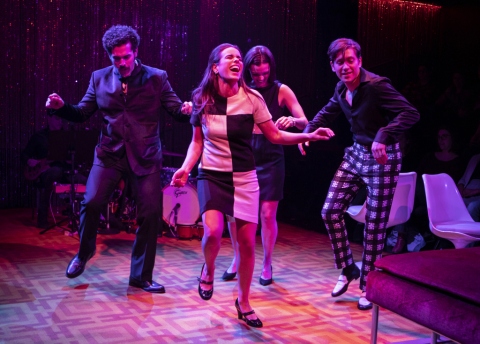
Joél Pérez, Anna Nogueira, Jennifer Damiano, Michael Zegen in Bob & Carol & Ted & Alice, based on the Columbia Pictures motion picture written by Paul Mazursky and Larry Tucker, music by Duncan Sheik, book by Jonathan Marc Sherman, lyrics by Duncan Sheik and A Asmanda Green, musical staging by Kelly Devine, direted by Scott Elliott at the Pershing Square Signature Center (Monique Carboni)
Bob & Carol & Ted & Alice based on the Columbia Pictures film written by Paul Mazursky and Larry Tucker, with music by Duncan Sheik, book by Jonathan Marc Sherman and lyrics by Duncan Sheik and Amanda Green is a lightly satiric, musical comedy, with mellow, soulful music. The production, like its titular film counterpart, hearkens back to an easier time before AIDS, STDS, the debacle of the Viet Nam War and the cultural stresses afterward, when the country faced chaotic divisiveness that was not easily answered by later political administrations.
Directed by Scott Elliott, the production is a delight with adorable actors portraying the thirty-something married couples Carol (Jennifer Damiano) and Bob (Joél Pérez), Ted (Michael Zegen) and Alice (Ana Nogueira) who try to redefine themselves according to the hot pants, younger generational trends which tout the rejection of binding sexual mores and strictures.
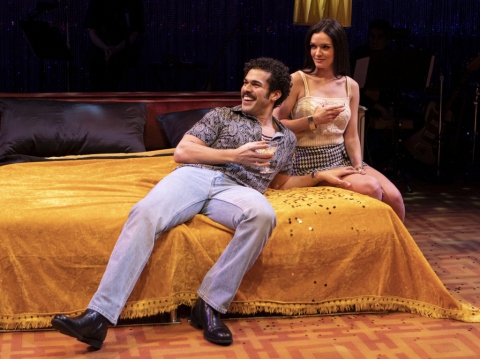
(L to ): Joél Pérez, Jennifer Damiano Bob & Carol & Ted & Alice, based on the Columbia Pictures motion picture written by Paul Mazursky and Larry Tucker, music by Duncan Sheik, book by Jonathan Marc Sherman, lyrics by Duncan Sheik and Amanda Green, musical staging by Kelly Devine, direted by Scott Elliott at the Pershing Square Signature Center (Monique Carboni)
This was the time of open marriages, when free love was being embraced as revelational. Various generations either looked askance in horror or savored the sex with hallucinogens and weed. So instead of rotting in aging and being left behind, Bob and Carol take a break from the kids, go to a New Age type resort, and embrace the “new” concepts of this inner freedom and tranquility.
Bob and Carol begin the arc of the story development and conflicts after they return from their growth experience at the retreat (like Esalen) led by the director (who is also the band leader) portrayed by Suzanne Vega. The experience “opens” them up to a new world of freedom using the techniques we have all come to know today (meditation, primal screams, intense feeling expressions, etc.).
They return home believing that the experience translates into their daily lives by allowing them to understand their values, their “ethos,” and their capacity to break away into new experiences. Of course one of the most important is extending the boundaries of their marriage and expanding themselves to include acceptance of their partner’s actions whatever they may be. Bob initiates this extension by having sex, in an unfaithful act, which surprisingly Carol accepts and answers with one of her own. Both affirm, “It was just sex, not love.”
For Ted and Alice who essentially watch and don’t indulge, their learning is vicarious, but they can’t move beyond the boundaries of their own morals and sensibility of love. They judgmentally remain within the strictures of their marriage vows and monogamy. The contrast between the two couples is telling: here are the liberals and the conservatives. But beneath each conservative heart is the quest to be liberal. And in this production, it is no less so.
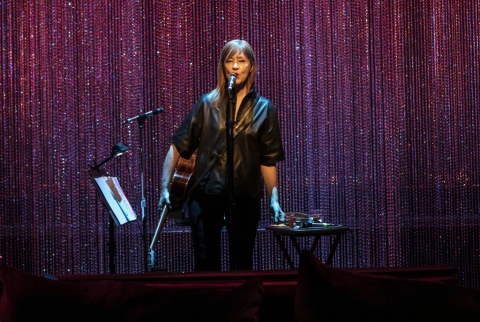
Suzanne Vega in Bob & Carol & Ted & Alice, based on the Columbia Pictures motion picture written by Paul Mazursky and Larry Tucker, music by Duncan Sheik, book by Jonathan Marc Sherman, lyrics by Duncan Sheik and Amanda Green, musical staging by Kelly Devine, direted by Scott Elliott at the Pershing Square Signature Center (Monique Carboni)
As you watch the events unfold and empathize with the characters along their journeys of self-discovery, you can’t help but fall a bit in love with them. They are so cute in their questioning searches as they soldier on to their discoveries with quasi-comical seriousness. Watching liberal couple Bob and Carol explore the outer limits of love and marriage, extramarital affairs, infidelity, sexuality and enlightened contrast between love and sex, we are along for their ride because it is neither shocking nor lustful, nor pornographic. It just is.
Considering what has transpired between then (1969) and now, the perniciousness of sexual plagues and wildness of Studio 54 that gave rise to them, which followed the “free love” generation, by comparison, these couples are sweet neophytes. The production mirrors this laid-back pleasantness in mood and tone delivered by Sheik’s balancing music, sung with fluidity, smoothness and grace by Grammy winner Suzanne Vega, and with melodic lyricism by the ensemble.
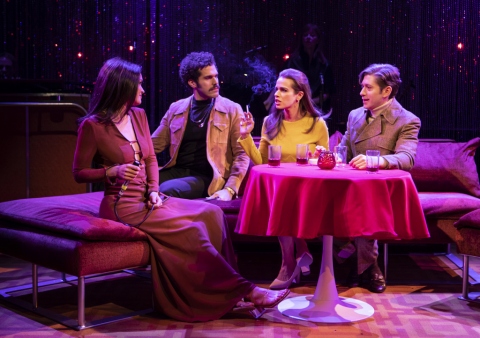
(L to R): Jennifer Daimiano, Joél Pérez, Anna Nogueira,, Michael Zegen in Bob & Carol & Ted & Alice, based on the Columbia Pictures motion picture written by Paul Mazursky and Larry Tucker, music by Duncan Sheik, book by Jonathan Marc Sherman, lyrics by Duncan Sheik and Amanda Green, musical staging by Kelly Devine, direted by Scott Elliott at the Pershing Square Signature Center (Monique Carboni)
The characters’ “new” sexual endeavors infuse the production with the mild raciness of the 1969 film. The original which spawned a later TV show was a comedy satire about the cultural mores transformation. A success at the box office, it did have Oscar-winning nominations for the actors who played Ted (Elliot Gould) and Alice (Dyan Cannon).
Overall, Bob & Carol & Ted & Alice is a retrospective and homage to the the culture and class who dipped in lightly with just their toes as they approached the swirling currents of social change. However, they never took the plunge into the deep end of promiscuity, three-ways, pornography, open marriage and divorce. They accomplished just enough to stimulate themselves, then slid back into their comfort zones measuring their lives with coffee spoons as they dabbled with introspection.
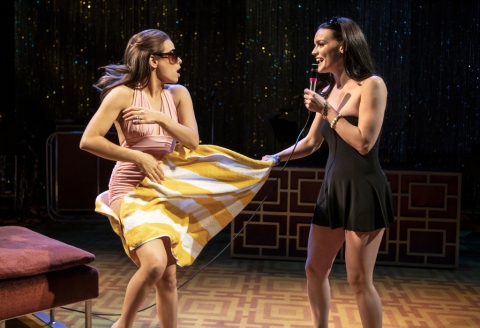
(L to R): Ana Nogueira, Jennifer Damiano in Bob & Carol & Ted & Alice, based on the Columbia Pictures motion picture written by Paul Mazursky and Larry Tucker, music by Duncan Sheik, book by Jonathan Marc Sherman, lyrics by Duncan Sheik and Amanda Green, musical staging by Kelly Devine, direted by Scott Elliott at the Pershing Square Signature Center (Monique Carboni)
Sheik’s music and the ironic Suzanne Vega as band leader, “mistress of ceremonies” reintroduce for our time a derivation of pop’s easy listening. As the overarching guiding light of threaded musical commentary, Suzanne Vega’s lilting, sensuous voice showcases the four characters as she editorializes their journey beginning with Bob and Carol’s stay at the retreat and their “enlightened” return when they share their enlivening experiences with their conservative friends Ted and Alice.
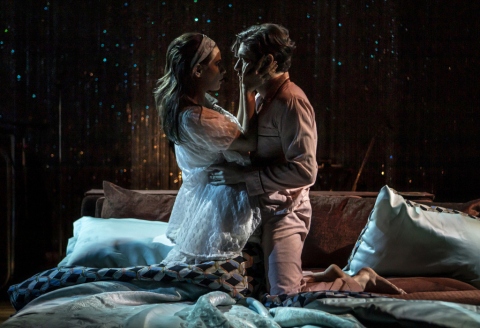
Ana Nogueira, Michael Zegen in Bob & Carol & Ted & Alice, based on the Columbia Pictures motion picture written by Paul Mazursky and Larry Tucker, music by Duncan Sheik, book by Jonathan Marc Sherman, lyrics by Duncan Sheik and Amanda Green, musical staging by Kelly Devine, direted by Scott Elliott at the Pershing Square Signature Center (Monique Carboni)
But as the bonds between the couples loosen, the audience becomes intrigued. Ted and Alice warm up to their friends’ “exploits.” Bob and Carol appear sophisticated, cool and free in their “open” marriage. The men and women separately sing about and discuss their sexuality with their spouses. This leads each to consider their lives with their partners. The songs eventually reveal that each couple is inspired to reaffirm their love for each other.
But we know what’s coming: “monkey see, monkey do”! Humorously, the two couples push the envelope by spending a night together in the bedroom with interesting results. Ultimately, they discover the vitality of loving one individual with intimacy and true spiritual bonding. This can only happen when each member of the couple reveals that they are vulnerable and need help to receive the intimacy and beauty of love from their spouse.
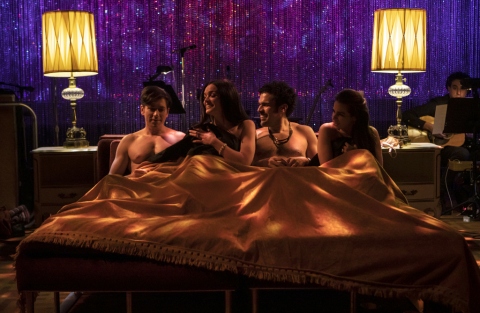
The cast of Bob & Carol & Ted & Alice, based on the Columbia Pictures motion picture written by Paul Mazursky and Larry Tucker, music by Duncan Sheik, book by Jonathan Marc Sherman, lyrics by Duncan Sheik and Amanda Green, musical staging by Kelly Devine, direted by Scott Elliott at the Pershing Square Signature Center (Monique Carboni)
The production is enjoyable and a throwback to a simpler time when all seemed right with loving just one individual in a satisfying marriage. In our tumultuous social and political fabric that is too frightening to contemplate and whose nightly news and snarky, edgy, social and cultural reports are the antithesis of entertainment, this the production is fun. Thus, the concept of “the open marriage” which Bob and Carol investigate with Ted and Alice with the quips and satiric jokes laced in and clever writing by Jonathan Marc Sherman’s book becomes a pleasant and satisfying relief.
There is no heavy lifting here, nothing more profound and mysterious than how and why we fall in love with each other which is a wonderful “thing” to contemplate. It is the wonder that engages us and immerses us in another time. And as we contemplate and review this historical retrospective of the social and cultural mores of the 1960s, we also enjoy the costumes and the California dreaming liquidity of the music so that we are able to ride on the waves of the production’s serenity.
The ensemble and director have established the right tenor for the comedic elements. And Sheik’s music is subtly, appropriately emotional as the characters search themselves and each other to understand the mysteries of love how and why they love.
Special kudos to Kelly Devine’s musical staging and to the following creatives: Derek McLane (scenic design) Jeff Mahshie (costume design) Jeff Croiter (lighting design) Jessica Paz (sound design). Additional kudos to Duncan Sheik for the orchestrations, Jason Hart for music supervision, vocal arrangements and additional orchestrations and Antoine Silverman for music coordination.
The New Group’s presentation of Bob & Carol & Ted & Alice runs with no intermission until 22nd March. For tickets and times CLICK HERE.
‘The Commons’ by Lily Akerman at 59E59 Theaters

(L to R): Julia Greer, Olivia Khoshatefeh, Ben Newman, Ben Katz, ‘The Commons,’ written by Lily Akerman, directed by Emma Miller, at 59E59 Theaters (Carol Rosegg)
How does one survive in New York City without being subsidized by one’s parents while making a modest income to pay the rent on a 300 square foot studio that is half of one’s income? One has housemates. That way one can afford a larger space at a reduced cost and actually be able to enjoy a finer lifestyle. There are problems, though. As the human numbers augument to share the space, conflicts arise as each must accommodate and subvert their own idiosyncrasies and proclivities to compromise with their housemates, especially when sharing the common areas (kitchen, bathroom, etc.). In the mix and melding of personalities who live together, what can result may be funny, dramatic or challenging, but it is never dull. And for some it sure beats living ALONE!

Ben Katz, Olivia Khoshatefeh in ‘The Commons,’ by Lily Akerman, directed by Emma Miller at 59E59 Theaters (Carol Rosegg)
Lily Akerman’s World Premiere comedy The Commons, presented by The Hearth and directed by Emma Miller, explores what happens when particular housemates attempt to survive in an environment of diminishing resources and increasingly complex habitats with limited space. In the play we note how the living situation becomes pressurized and the individuals become stressed by the mundane ordinary. Miniscule issues balloon to paramount proportion when housemates attempt to share responsibilities though there is no one in the lead and all must decide by gaining consensus. Housemates must “take up the slack” for each other, set rules, then hold each other accountable when there are violations. Something as simple as doing the dishes or making bread takes on significant heft and can cause hurt feelings and oppressed wills, unless individuals have the maturity and equanimity to reach viable agreements.

(L to R): Julia Greer, Olivia Khoshatefeh in ‘The Commons,’ by Lily Akerman, directed by Emma Miller at 59E59 Theaters (Carol Rosegg)
Akerman examines four characters Robyn (Ben Newman) Janira (Olivia Khoshatefeh) Dee (Julia Greer) and Cliff (Ben Katz) and sets them interacting with and against each other as they confront homely situations like cleaning, dish washing, making bread and struggling against a mouse invasion. Akerman adds a fifth character, Anna (Olivia Abiassi) who is a romantic interest for Cliff. Anna’s brief visit convolutes the mix of personalities who already strain to get along. None of the housemates are friends, so it becomes an unusual occasion when they decide to go out to a bar together and in another segment let loose and dance their stress away.
The vitality and comedy of the production resides in the fine acting of the ensemble who make the most seemingly ridiculous superficialities (a dirty stovetop burner) of mega importance with authenticity, as if the issue was a matter of “life and death.” The humor of dealing with a mouse that had to be killed and the tragedy of the creature losing its life as memorialized by Janira (Koshatefeh does a wonderful job with this comedic bit) is marvelous.
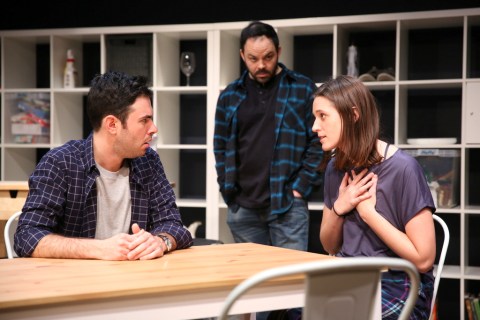
(L to R): Ben Katz, Ben Newman, Julia Greer in ‘The Commons,’ written by Lily Akerman, directed by Emma Miller, at 59E59 Theaters (Carol Rosegg)
As we chortle at the characters having to deal with their particular angst at the problem of living with others, we can’t help but note that their embroilios are telling. The common areas are the centers which carry the stress when a particular housemate like Cliff or Janira don’t act with accountability to the “whole.” As housemates attempt to resolve the issues the comedy rises and we identify with how humans act and react with guilt, excuses, judgment, subterfuge and inner upset as they attempt to manipulate the situation to their own satisfaction. Also, the philosophical approaches of each of the housemates become superimposed on the living situation for each. This is especially ironic as Robyn expresses his opinion that living with housemates communally is healthier than couples living and raising their family in isolation.
Aikerman’s play however, is about much more than the characters attempting to work out their living arrangements with compromises, meetings and rules enforcements. It is a metaphor for how we adjust to others “living on top of us” as sources and space diminish and we must decide whether we should open our borders or close them, accept refugees to forestall the humanitarian crisis or let them perish or ignore those who have been victimized by their own birth in third world countries. The Commons in microcosm is representative of the macrocosm. Behind the comedy bits and vignettes involving each of the characters in the hot seat, is the presentation of larger themes that Akerman highlights for all of us, whether we live in crowded cities with sparse affordable housing or less densely populated rural areas that hold few opportunities.

Ben Newman, Ben Katz in ‘The Commons,’ by Lily Akerman, directed by Emma Miller at 59E59 Theaters (Carol Rosegg)
Some of these questions follow on a symbolic level: In the looming portent of climate change relocation, how will populations accommodate each other as refugees move from areas of devastation? How will dwindling resources prompted by global warming and weather weirding impact societies, turning the haves against the have nots who knock at their doors for help? Will cultures readily share or will there be genocide of ethnic groups? Do ethics and morality abide if leaders ignore human standards of right and wrong and replace them with money and power as the enforcement of decision making? Will everyone benefit if cultures shift to a “might is right” ethos or is that one more way of introducing self-destruction into the parameters of global reorganization necessitated by climate chaos which is already manifesting?
The Commons at its funniest reveals the base responses and reactions of housemates accused of their mistakes which are funny because they are exaggerated. But what becomes obvious is the dynamic of accountability. The housemates are accountable and responsible to each other. Selfishness no longer cuts it when one’s dishes are always left clogging up the sink and one is gobbling down another’s food because he or she forgot to go shopping. The results are humorous. But the underbelly of this is dark. In order to survive and thrive, we must live with each other and be responsible for our own actions as we contribute to the goodness of everyone else. Only by doing that do we all make our lives purposeful and valuable.
To fully appreciate Akerman’s larger themes, one must lift The Commons above the characters’ petty details to note the moral treatises underneath. Like the housemates who adjust to each other and hold each other accountable for their actions and “pull together,” so must we as nations globally do our part as contributors to each others’ greater good. Shirking our responsibility through science denial, moral and ethical turpitude, and negligence will only come back to haunt us in the end.
Kudos to the creative design team with scenic design by Emma Finckel, costume design by Dara Affholter, lighting design by Victoria Bain and sound design by Caroline Eng. The Commons runs with no intermission at 59E59 Theaters until 23rd February. For tickets and times CLICK HERE.
‘Grand Horizons,’ a Ferociously Funny Vision of Senior Redefinition, Starring Jane Alexander and James Cromwell

(L to R): Ashley Park, Michael Urie, Jane Alexander, James Cromwell in ‘Grand Horizons,’ by Bess Wohl, directed by Leigh Silverman (Joan Marcus)
At last! There’s a new and improved perspective of “seniorhood” that doesn’t include steps up the ladder of infirmity and dementia: from independent living to the “Rose Court,” from memory care to the palliative slip-away into Hospice. Indeed, as we appreciate and glory over the vibrant humor and comedic power of situation and characters in Bess Wohl’s Grand Horizons, we learn a thing or two about “old folks” and “the younger generation” in this rollicking yet profound play.
First, age is attitude. Second, the older one becomes, the more one must think outside of the box, especially out of the type found in replicated, independent living housing. Third, the closer one gets to the “end,” the more one should “rage against the dying of the light.” Fourth, one can experience in one’s later years a vision of life that is freeing, one that destroys the cages we created our entire lives: for they are a mere facsimile of living. Indeed, contrary to seniors who settle for the cardboard, cookie-cutter artificiality of existence in vegetative, pre-fabricated places like Grand Horizons, Wohl reveals that it is possible to make life-affirming changes even at the age of 80 years-old as does her protagonist, Nancy, the amazing Jane Alexander.

Michael Urie, Maulik Pancholy in ‘Grand Horizons,’ by Bess Wohl, directed by Leigh Silverman (Joan Marcus)
The playwright’s brilliant script is cleverly paced by Leigh Silverman’s precise direction of the superb ensemble. Masters of the comedy of real, of humor springing from grounded, soulful authenticity, the actors led by Jane Alexander and James Crowmwell pop the quips, jokes, one-liners, twists and turns of phrase and mood to keep the audience laughter rolling in waves of joy. Wohl’s well-crafted writing absolutely sings with comedic grace and profound themes, sharply channeled by Silverman. These include the importance of breaking through the stereotypical concepts of aging, family, parenting, marriage, love, intimacy, individuality and autonomy.
The play’s situation is common enough. Nancy and Bill, a “typical,” retired, fifty-year married couple have taken the next steps toward their journey’s end by moving into an independent senior living community. Is it the replication of row after row of modestly, flimsily built homes in a vast similitude (Bryce Cutler’s projection design) that sets off Nancy? Or perhaps what triggers her is the whitewashed, pleasant kitchen/dining nook/living room interior of “peaceful” uniformity (Clint Ramos’ set design) though it is festooned by artificial greenery.
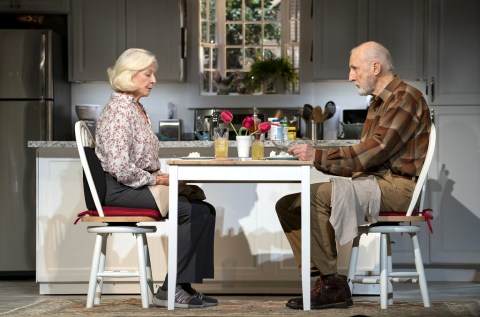
Jane Alexander, James Cromwell in ‘Grand Horizons,’ by Bess Wohl, directed by Leigh Silverman (Joan Marcus)
We learn later in a profound and symbolic irony, that the lovely plants don’t even have the opportunity to die bio-dynamically as a result of Nancy’s over or under watering. They just go on and on and on in lifeless “eternity.” Nancy’s eyes open to their fake permanence later in the play, after she has confronted herself, her children and Bill with the truth. Her ironic comment about their artificiality has to do with the realizations of her own growth.
The vast sterility of this community is only heightened by the play’s opening of Nancy’s and Bill’s dinner that is choreographed to reveal a mutually synchronized preparation that they execute silently with near robotic precision. Well, enough is enough in this perfect haven of deadness. I could hear Nancy’s thoughts as she looked at Bill as they, with synced movements in unison, took out their napkins, then began to drink and eat. What more could anyone their age wish want? They appear to have it all. But is this the exuberance of life we wish for?
At this point Alexander’s Nancy lets the desires of her heart explode from her lips and the train moves onto the express track and doesn’t stop until she achieves what she wants, sort of, by the play’s end. Jane Alexander’s delivery of the opening lines of conflict are spot-on humorous and ominous: “I think I want a divorce.”

Ashley Park, Ben McKenzie in ‘Grand Horizons,’ by Bess Wohl, directed by Leigh Silverman (Joan Marcus)
The excitement of what Nancy envisions to be on her grand horizon for the future is in imagining its open-ended possibilities, even if it is merely sitting in a restaurant and enjoying a meal by herself. Clearly, she wants no more imprisonment by the chains of coupling. She wants to know her own power, strength and autonomy apart from defining herself as Bill’s wife. As the play progresses, we discover she has already established her autonomy away from her family, though she has kept it secret. Interestingly, perhaps as a long awaited response, Bill is striking out on his own in this senior community by taking stand up comedy classes and enjoying a relationship with Carla (Priscilla Lopez). We learn later that this may be his response to what he has known all along of Nancy’s secrets.
As these details are gradually revealed we enjoy watching the incredulous sons, Brian (the wonderfully funny Michael Urie) and Ben (Ben McKenzie is the harried lawyer control freak who can’t relax). Both are shattered by the announcement of the divorce. Ironically, they don’t want their parents to leave their comfortable “mom” and “dad” roles to be individuals, redefining who they want to be. They want stasis, not for their parents’ happiness but for their own comfort and assurance. Brian’s and Ben’s perceptions of their parents living apart from each other are at odds with their parents’ expectations. For Nancy and Bill divorce will be a positive experience. The sons cannot wrap their heads around this, especially that Nancy is planning to live in an Air Bnb. Their mom in an Air BnB: a horror!

(L to R): Priscella Lopez, Jane Alexander in ‘Grand Horizons,’ by Bess Wohl, directed by Leigh Silverman (Joan Marcus)
Wohl takes advantage of this set-up in a refreshing way. In an ironic reversal, with the help of Jess (Ashley Park) Ben’s wife, Brian and Ben don the parental roles. They attempt to gauge what has recently happened, as they try to square away what mom and dad must do to resurrect the bloom on their long-dead marriage. Their failed attempts are humorous. Adroitly, the actors bounce off each of their characters’ stress-filled emotions with peppery dynamism and wit.
Brian’s neediness is easily identifiable throughout and is integral to his character as a theater teacher who creates 200 characters in The Crucible so “no kid will be left behind to feel left out.” It is Brian who is so dislocated by his parents’ future divorce, he worries about where he will spend Thanksgiving which is six months away. His sensitivity exceeds his parents’ emotionalism. The dichotomy is hysterical, yet heartfelt.

Michael Urie in ‘Grand Horizons,’ by Bess Wohl, directed by Leigh Silverman (Joan Marcus)
Ben’s eczema flares as he attempts to take control of where each of his parents will live. And then there is Jess providing the counseling so Nancy and Bill can return to their once affectionate times with each other. With Ben and Brian looking on with hope at Jess’ powers, the results that follow are riotous. As their visit with Bill and Nancy to persuade them not to divorce lengthens, Jess begins to look at her relationship with Ben differently as he reverts to Bill and Nancy’s son. Where has her husband gone or is this just hormones because she is pregnant?
The resistance of the younger generation to the divorce is a powerful obstacle which the parents find impossible to answer to their children’s’ satisfaction. It provides conflicts among the characters from which Wohl tweaks and teases thematic tropes. What are the phases and stages of our lives? How do we define them apart from cultural stereotypes and familiar roles that appear to offer comfort, but are actually binding and nullifying? What price do we pay to create our families and sacrifice for children with expectations that are unreasonable, or worse, false? From parenting to aging, no one can provide a guideline for what to do that will resonate completely with our individual lives. Every family, every person in that family is different. We fail, but perhaps it is worth it because we learn and if we are open to it, we heal.
Nancy’s desire for a divorce sets the entire family roiling except for Bill, who appears to remain calm. Of course Wohl is always pushing the envelope to get the maximum surprise and intrigue from her characters, who remain interesting and intensely human.

James Cromwell, Jane Alexander in ‘Grand Horizons,’ by Bess Wohl, directed by Leigh Silverman (Joan Marcus)
The audience’s gales of laughter organically spring from Nancy’s revelations that she has pursued her desires and dreams despite the intrusions of raising her two sons and making a home for her husband Bill. Indeed, the mother they believed she was, is not who she presented herself to be. She had another love. And when she expresses the importance of her closeness and intimacy with this lover to Brian (Urie brings down the house with his responses to her sexual descriptions) in the hope of explaining why she is leaving Bill, he cannot cope with understanding that his mother is perhaps a woman first.
This is something many children have difficulty with unless the parents, with good will and flexibility, help them to understand love, sexuality and intimacy. Bill and Nancy never considered going into these discussions with Brian and Ben because they never went there with each other. It is a telling irony that catches up with all of them at this juncture.
Clearly, Nancy runs deep as does Bill, who is a cypher that Wohl reveals by the conclusion, when we learn that both Bill and Nancy have kept intimacies and secrets to themselves. Yet, they do love one another. The humor and pathos come when we note how difficult it is for Ben and Brian to understand their parent’s particularities when they believed the packaged family meme that “togetherness is happiness.” That meme when they admit it, satisfied none of them, least of all their parents.
All of this eventually tumbles out after Brian, Ben and Jess visit, stay and don’t leave until Bill and Nancy politely tell them to go and reassure them that they are going to be all right. By the end of the play, Wohl opens the door to hope. Even if they live apart, maybe Bill and Nancy can begin to see each other outside of the roles that threatened to box them in “til death did them part.”
Grand Horizons is a mixture of uproarious fun and thoughtful poignance. Shepherded by Leigh Silverman’s vision the actors deliver, with sterling performances by Alexander and Cromwell and with high marks for McKenzie, Urie, Park and in secondary roles as Tommy (Maulik Pancholy) and Carla (Priscilla Lopez). Additional kudos to the creative team: Clint Ramos (scenic design) Linda Cho (costume design) Jen Schriever (lighting design) Palmer Hefferan (sound design) Bryce Cutler (production design).
Grand Horizons runs with one intermission at Second Stage Theater, The Helen Hayes Theater on 44th Street between 7th and 8th until March 1. For tickets and times to this LOL production CLICK HERE.

