Author Archives: caroleditosti
‘A Soldier’s Play,’ Bravura Performances by Blair Underwood and David Alan Grier

(L to R): David Alan Grier, Blair Underwood, Billy Eugene Jones in ‘A Soldier’s Play, by Charles Fuller, directed by Kenny Leon, Roundabout Theatre Company, American Airlines Theatre (Joan Marcus)
When the Negro Ensemble Company presented Charles Fuller’s A Soldier’s Play in its Off Broadway premiere in 1981, the production garnered a number of theater awards and Fuller won a Pulitzer Prize for Drama the following year. Norman Jewison directed the film version retitled A Soldier’s Story in 1984 where it was nominated for numerous awards. It has been produced in two revivals Off Broadway in subsequent decades. At last Fuller’s searing, profound work about race prejudice internalized has received its premiere on Broadway, thirty-nine years later. It is currently running at American Airlines Theatre.
With exceptional direction by the amazing Kenny Leon (Much Ado About Nothing, Shakespeare in the Park 2019) and sterling ensemble work headed up with masterful performances by David Alan Grier and Blair Underwood, A Soldier’s Play has come to Broadway with vibrant force and vigor. The dramatic arc of development revolves around solving a murder mystery. The body of Tech/Sergeant Vernon C. Waters (David Alan Grier portrays the unlikable, brutal, tragic Sergeant) is found with two bullet holes. The murder case is solved through flashbacks of scenes during the testimony of witnesses, narration and scenes unfolding in the present day 1944, Fort Neal, Louisiana.
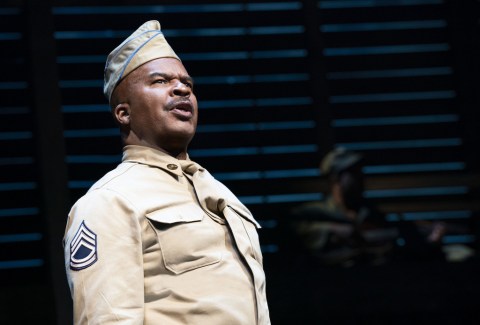
David Alan Grier in ‘A Soldier’s Play,’ by Charles Fuller, directed by Kenny Leon, Roundabout Theatre Company, American Airlines Theatre (Joan Marcus)
Captain Charles Taylor (Jerry O’Connell in a fine performance) and his superiors take precautions with the men of Waters’ platoon Company B, 221st Chemical Smoke Generating Company. They fear that Waters’ men may engage in revenge killings against red necks in the area of Fort Neal, Louisiana. It is not clear at the outset, but Waters may have been lynched by the KKK or good ole boys who intend to keep blacks bowing and scraping. Until his murder is investigated, and more is discovered about what may have happened, Waters’ men are guarded by MPs who surround their barracks so that none of them get entangled with white townspeople. Private Hensen suggests that the Klan killed Waters because lynchings have been happening since he arrived at Fort Neal. But he may have been murdered by white officers in a racial killing. As a result, commanding officers on the base have given the case a “low priority status,” and are ready to sweep all they discover under the rug.
The consideration makes sense in 1944 during WW II. At the Fort Neal and on every base in the U.S. military, black and white soldiers are segregated in their living quarters, platoons and companies. Service in the military is as discriminatory as the “separate but equal” oppressions of the Jim Crow South. In the day to day operations, the black companies are detailed with doing the scut work and menial assignments in order to confirm that they are the inferior race. Indeed, the men have not yet been sent to Europe to fight. This is another racist assumption that they cannot be trusted, but fit the stereotypic mischaracterization of blacks being lazy, shiftless, mentally slow and cowardly.
Fuller’s play focuses on the nullifying effects of racism as blacks attempt to rise in a culture that oppresses them, and counter-productively rejects or ignores their gifts and contributions. Using the lens of the past during WWII and the backdrop of segregation in the military, Fuller brilliantly emphasizes the psychological impacts of racism which creates annihilating divisions not only between blacks and whites, but especially between blacks and blacks. An inferred theme is that as the fascist Nazis did for Germany, these behaviors also, are incredibly destructive to “the master race.”

Blair Underwood in ‘A Soldier’s Play,’ by Charles Fuller, directed by Kenny Leon, Roundabout Theatre Company, American Airlines Theatre (Joan Marcus)
Fuller’s play reveals a richness of themes, characterizations and conflicts that timelessly reflect great currency for us today with underlying institutional racism and the increasing evidence of racism unleashed by the White House. Fuller also digs deeply into the black on black abuse and crime that evidences the internalization of white oppression and denigrating values and attitudes that blacks unconsciously accept as they seek to redefine themselves culturally apart from the mordant ethics of white culture.
Leon, highlights these themes with his superb direction and vision of Fuller’s play. His is a fascinating and nuanced iteration that includes symbolism and foreshadowing manifested by Allen Lee Hughes’ lighting design and the music rendered in song by the on-point cast, elucidated by the excellent sound design of Dan Moses Schreier. At appropriate junctures in the production, beginning from the outset, Leon has the soldiers in Company B sing. We come to understand later that they are mourning one of their own. The music ties them together in a unity that cannot be breached by the racist white officers.
However, this unity must be breached by Captain Richard Davenport (Blair Underwood) a lawyer assigned to the 343 Military Police Corp Unit, if he is to discover who murdered Waters. In a devastatingly powerful, psychologically sensitive and heartfelt performance, Underwood introduces us to the racial dynamic he must confront as he analyzes the situation with objective tolerance, restraint and courage. It is an irony that in Davenport’s encounters with white officers, who would abuse his rank and his education, he stands his own ground with dignity and grace, employing the full force of his culture’s weapons (including a rumor that Supreme Court Justice Thurgood Marshall is behind the investigation). No publicity is good publicity; if the case, which has been given low priority, is not handled properly, it could embarrass the military in a time of war.

Jerry O’Connell, Blair Underwood in ‘A Soldier’s Play,’ by Charles Fuller, directed by Kenny Leon, Roundabout Theatre Company, American Airlines Theatre (Joan Marcus)
Davenport, who is a maverick outlier, confounds the racist military officers who don’t know what to do with him and how to behave around him. He is a confident, self-realized, unbowed black man who is educationally superior to them, having achieved a law degree in addition to four years of college. Davenport’s talking “like a white man” and his staid nature and inner power particularly annoy Captain Taylor who dislikes that Davenport outranks him in intelligence and education, though they are on equal footing as Captains.
They disagree continually about Davenport’s mission, his competence, his confidence bucking the system and his insistence in interrogating and arresting white officers who might be charged with Waters’ murder. Underwood’s Davenport and O’Connell’s Taylor are authentic in their head-to-head arguments which intensify as Davenport incisively moves through his investigation. Both actors contribute to creating suspense and heightening the themes about why Waters was murdered, which gives rise to the underlying psychological and racial components that his murder reveals.

(L to R): J. Alphonse Nicholson, Rob Demery, McKinley Belcher III in ‘A Soldier’s Play,’ by Charles Fuller, directed by Kenny Leon, Roundabout Theatre Company, American Airlines Theatre (Joan Marcus)
Fuller’s depth of characterization, his wisdom and his clear-eyed perception of what it means to be black in the military and in America then and now is only enhanced and codified in this insightful rendering shepherded by Kenny Leon to perfection. Each of the relationships between and among the enlisted soldiers of Company B, Waters and the white officers reflect explosive, vital issues. The irony of the setting is that America, which is mandated to fight and destroy fascism, of course refuses to adequately confront its racist fascism at home. The white culture forces susceptible blacks to obviate their own identity and culture to embrace white culture to “thrive.” Of course by doing this, blacks must reject their own people, their own very being as they internalize the value of being white and act white to get ahead, destroying their very valuable spirit and the soul of blackness.
This mistaken assumption is exemplified by Sergeant Waters. David Alan Grier’s perceptive understanding of Waters reveals the character’s limitations and sorrows. His cruelty toward some of the men in his company is an outgrowth of venerating white values and not defining himself as having worth apart from the white cultural “successes”. Grier’s portrayal is complex and rich with nuanced meaning. He reveals Waters’ realization of how he has destroyed himself and others as the great tragedy of the play. He is stunning and sardonic in his provocation of the white officers, and it is then we realize that he cannot get untangled from the morass he has created in abusing himself and others. He has become the epitome as the white man’s creature who perpetrates the most pernicious elements of discrimination and hatred by oppressing himself and attacking his own people.

(L to R): Warner Miller, Nnamdi Asomugha, Blair Underwood, ‘A Soldier’s Play,’ by Charles Fuller, directed by Kenny Leon, Roundabout Theatre Company (Joan Marcus)
Grier’s Waters is miserable and is looking to be put out of this hell he has created. And the execution he cannot effect for himself in a suicide, he provokes another to accomplish for him. His death is paralleled with another in the production. The other death is senseless genocide that Waters prompts, of course, because daily, Waters must cut out his black identity from his own soul. And in a twisted, passive aggressive revenge against blacks, whom he sees as not rising to the white man’s standards, he obliterates them. It is a slow, horrific process of self-destruction and fraud that the men in his company recognize, but cannot articulate. If they could they might be able to beneficially codify how to stop the genocidal practice of destroying oneself to “fit in” which Waters exemplifies.
In addition to the exceptional performances already mentioned are the performances of J. Alphonse Nicholson portraying Private C. J. Memphis and Rob Demery portraying Corporal Bernard Cobb. Nicholson’s Memphis is sensitive, loving and accepting. His speech to his close friend Corporal Cobb (who, too, is kind and elucidating) is poignant and filled with longing. We immediately understand where he is going in his life and why; his choice is symbolic and consequential; it is the cry of freedom from strictures which have so bound up Waters as to make him daily harm himself and target those like Memphis and Cobb.

The Company in ‘A Soldier’s Play,’ by Charles Fuller, directed by Kenny Leon, Roundabout Theatre Company, American Airlines Theatre (Joan Marcus)
Waters’ act of provocation and Memphis’ act are different sides of the same coin. That their behavior is directed against themselves and the black race in genocidal acts caused by racism and fascism, runs to the soul of American and is Leon’s and Fuller’s indictment against white supremacy. Indeed, if we look hard and deep enough in our justice system, in our economic inequality, in our educational inequality, the same threads of injustice prevail today. They are frighteningly manifest in the fascism of white supremacists who look to find their “place in the sun” which they fear they have lost. It is an incredible irony considering that they are blind, deaf and dumb to their own cultural creations and backwash reflected by institutional racism and discrimination that ultimately is destroying the white culture along with the black in a nihilistic seething inhumanity.
The conclusion delivered by Underwood’s Davenport that sums up the case findings and aftermath is emotionally riveting. It is as heartfelt and poignant as Nicholson’s speech as Private C. J. Memphis. But where Memphis has chosen his decision, Davenport is both blessed and cursed with infinite understanding. Indeed, we see that his recounting of what has transpired in Fort Neal is a memorial to these individuals. Also, it is triumphant in its prophesy for the future of civil rights achievements and the hoped for end of racism and discrimination which has yet to be realized even to this day in America. And finally it is a cry of anguish from the depths of Davenport’s soul: of frustration, of anger, of a cry to the heavens for justice. The interpretations are many as a capstone to this incredible production whose themes are paramount for us today.
Thankfully, Fuller’s play and this production put these themes front and center. It is impossible not to feel them, see them, know them, especially in recognizing current attempts to destroy our imperfectly realized democratic form of government by moving it toward fascism and dictatorship.
Once again kudos to the ensemble acting whose unity and and realism helped to create a memorable, thrilling night at the theater. And kudos also go to the creative team: Derek McLane (set design) Dede Ayite (costume design) Allen Lee Hughes (lighting design) Dan Moses Schreier (sound design) Thomas Schall (fight choreographer).
The must-see A Soldier’s Play is running at American Airlines Theatre (42nd St. between 7th and 8th) with one intermission until 15 March. For tickets and times CLICK HERE.
‘My Name is Lucy Barton,’ Laura Linney Fuels a Richness of the Titular Character With Nuanced Depth
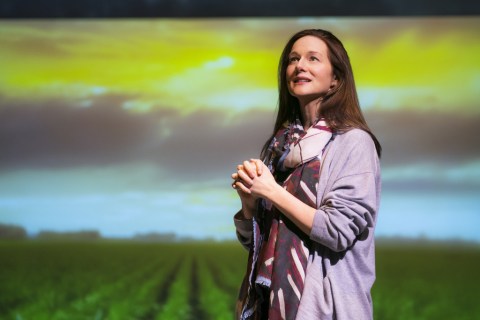
Laura Linney in My Name is Lucy Barton, by Elizabeth Strout, adapted by Rona Munro, directed by Richard Eyre, Samuel J. Friedman Theatre (Matthew Murphy)
In Manhattan Theatre Club’s presentation of My Name is Lucy Barton, Rona Munro’s adaptation of the bestselling novel by Pulitzer Prize winner Elizabeth Strout, nothing is obvious. Indeed, a comparison to the novel may be a misdirection from what has been achieved in this sterling production, acted in a solo performance by the unparalleled Laura Linney. Linney flawlessly manifests director Richard Eyre’s vision for the titular character, and in doing so enhances Munro’s fine adaptation and Strout’s incredible, heart-felt characterization.
As the lights dim, we gaze upon the minimalistically staged hospital room whose large 3 D window spreads to almost cover the entire back wall, an indication of its importance to reflect Barton’s memories through three time lenses. Throughout the 90 minute play, projections of location scenes (NYC brownstone, corn/soybean fields, etc.) will splay, each enhancing and signifying Lucy Barton’s life (materially and symbolically).
When, Linney makes her entrance, stage left, her vital presence smashes through the sterility of the room and the possibilities of what being hospitalized portends. Her walk is confident, forthright, determined, with perhaps a hint of ruthlessness (this relates to what a friend told her about her career). And from that moment on, Linney secures our focus with her character’s articulate, well-hewn descriptions. She bewitches us by infusing Lucy Barton’s masterful story-telling with spot-on passion and seemingly open-hearted truthfulness. Our attention remains transfixed, throughout. And, at times, during her intimate, heartbreaking monologue, the audience remains hushed and still, avidly gleaning revelatory peeks into Barton’s miserable childhood of poverty, loneliness and fear, while she grew, like the corn and soybean fields surrounding their ill-kempt, noisome home, into teenage-hood in Amgash, Illinois.

Laura Linney in My Name is Lucy Barton, by Elizabeth Strout, adapted by Rona Munro, directed by Richard Eyre, Samuel J. Friedman Theatre (Matthew Murphy)
Barton’s story is not particularly exciting or eventful in the “average” way. It begins in the vibrant, present day. The arc of development moves in flashback to the time when Barton was married with two daughters and, after an appendectomy, is weirdly unable to systemically recover her health. Barton’s story-telling is filled with mystery in its exploration of her relationship with her mother. Linney portrays both women and seamlessly steps from present to flashback, clearly designating the time intervals through Eyre’s staging, the mother’s Amgash accent and Munro’s pointed time transitions as Barton recalls or reflects on memories in the present time, then segues to the past for another dip into hope, loneliness and redemption.
Barton’s story is relatable to a cross-section of humanity, even the wealthy who suffer emotional trauma and abuse from parents. Some might argue Lucy Barton’s narrative transcends gender because it’s generalizable to relationships between parents and children, beyond stereotype and myth in the family dynamic. In other words, its sensitive, emotional and human universality appeals. What individual does not feel, if they dare to admit it, that their parents did not give them enough love, understanding, wisdom, material and spiritual protection that they hungered for at various points in their lives? What individual does not feel remorse at not being able to have lived happily, growing up in a “Father Knows Best” loving, emotionally magnanimous family experience? Indeed, how much more duress does one feel if one’s material and emotional well-being was continually jeopardized by parents/siblings, what has been described euphemistically as being a member of a dysfunctional family?
Munro’s adaptation retains Strout’s searing, uber-subtle fervency as Lucy relates “her story,” which we discover is an attempt to expurgate devastating emotional pain to reconcile past memories of dire consequence which she has suppressed and which might have killed her, but for her mother’s 5-day visit, when Barton’s hospital stay moved past the normal recuperation period: she can’t eat, has blockages and grows thinner and weaker. Barton’s husband, who has been too traumatized by death and dying in hospitals to visit her regularly, calls her mother who shows up “out-of-the-blue” and sits in a chair, at the foot of the bed eschewing a cot to be with her, 24/7.
It is during this life changing visit, that her mother relates stories about the neighbors or relatives, all of them attached with a negative, inferred lesson critical to Lucy’s life. It is also during this time and in the retelling of “her story” that Lucy recalls memories that are so unendurable, she cannot fully relate the details clearly. Interestingly, her mother also refuses to answer some of Lucy’s questions about the time when her children grew up. Her mother closes her eyes and pretends to sleep so Lucy doesn’t persist. There are some places where both dare not go, perhaps because the emotions are so incredibly raw, they might never recover their balance and attempted “control” over their lives.

Laura Linney in My Name is Lucy Barton by Elizabeth Strout, adapted by Rona Munro, directed by Richard Eyre, Samuel J. Friedman Theatre (Matthew Murphy)
Ancillary comments quietly expose a mountain of affection between Lucy and her mother, expressed uneasily by Lucy and in repressed undercurrents by her mother. Indeed, since Lucy’s marriage, they have been estranged. Clearly, though Lucy leaves this unspoken, the home where she grew up is noxious (it smells, it is freezing, it is stinks of loneliness and alienation). She has been relentless about never seeing her parents and gaining success as a writer, until she withers psychically and needs her mother’s love, as imperfect and ill-formed as it is. Her mother puts resentments aside and brings a healing balm; it’s time.
For nine years, her mother and father have never come to Manhattan and she hasn’t been home. Her parents resent that Lucy got a scholarship, went to college to become a writer, got married and left them in the morass of hopelessness and weirdness that they had to confront after she left: another unspoken self-recrimination against her/against them. They can hardly blame her for leaving, but resent her for doing it all the same. Her rejection of what they represent and her identity in their family unit is too much for her to bear. And then, she becomes ill; it is a metaphoric illness, systemic and psychic that requires a “healing touch and kindness” which her doctor delivers assisted by her mom.
Ironically, it is a testament of her mother’s love for her that she drops in (Lucy’s husband paid the plane ticket), despite her fear of flying to be Lucy’s much needed emotional support and prophetess who proclaims that Lucy will live, “though her marriage will have troubles.” A highpoint of reconciliation for her mom is her admission and apology about having to raise her three children under the strains of severe poverty (they eat molasses on bread regularly, can’t afford a warm or clean home, and are too poor for a TV).
Linney portrays her mother, at times humorously, with an Amgash, Illinois accent. Barton moves in “her story” from immediate present which is years after her parents have died, then flashes back as she reflects upon one of the most important moments. Linney’s transition from daughter to mother is seamless. As Barton’s mother she nudges Lucy to affirm her own life, despite the gnawing darkness and despair that threatens to overcome her and despite her material success which is a canard and no cover for the abyss within, unbeknownst to her.

Laura Linney in My Name is Lucy Barton, by Elizabeth Strout, adapted by Rona Munro, directed by Richard Eyre, Samuel J. Friedman Theatre (Matthew Murphy)
Eyre’s use of lighting (Peter Mumford) his staging and the projections (Luke Halls created the video design), bring in the other-worldly aspect of memory and remind us that Lucy Barton, as solid and stalwart and sincere as she appears to be, is the narrator of her own story. And all solo narrators embellish, exaggerate some details and leave gaping omissions. For all their ability to explain, the emotional content is so laden with stark bleakness, it cannot be accessed easily or articulated. Perhaps it takes a lifetime to do so or maybe never. Linney negotiates this with precision. Thus, the arc of Lucy’s story development as she discusses her relationship with her mother is a shining example of her ability to codify what she can live with (reflected in the hopefulness of the Chrysler Building the hospital window peers out on).
Indeed, Lucy Barton has made the building a beacon of success in her life, up from the oppression of her past, something her mother agrees with. And she has used that and other symbols (projections of corn fields, lightening sky), to manifest her identity as a successful writer who at this juncture is able to confront herself by going public. That is who Lucy Barton wants to be and that’s who she is.
Linney makes this unreliability, this shakiness brilliantly apparent. She allows it to pop up and back. She moderates it, especially when Barton cannot articulate the most traumatic memories of abuse in her past. And it flops back into the story-telling when she heartbreakingly remembers calling for her mom, as her daughter called for her when she saw the second plane crash into the World Trade Center. It is also apparent when Linney aptly philosophizes as Barton about the statue at the Metropolitan Museum of Art in the Sculpture Garden. The statue is of a distressed, starving father and his children. They only see him and are willing to sacrifice their own bodies and feed him to arrest his starvation. So bonded are children with their parents. So entangled will Lucy Barton always be with her mother, father and siblings. Because of them, she is Lucy Barton. Linney present with genius the authenticity of this character and makes it her own.
Kudos to all the creatives who worked on this production and brought it to life. In addition to those already mentioned are Bob Crowley (scenic and ccostume design) and John Leonard (sound design). My Name is Lucy Barton is running in a limited engagement at the Samuel J. Friedman Theatre (47th Street between Broadway and 8th Ave.) with no intermission until 29 February. It is a must-see for Laura Linney’s amazing portrayal and Eyre’s and Munro’s bringing home Elizabeth Strout’s best-selling novel with grace and power. For tickets and times CLICK HERE.
‘How to Load a Musket,’ a Striking Look at History by Talene Monahon at 59E59 Theaters
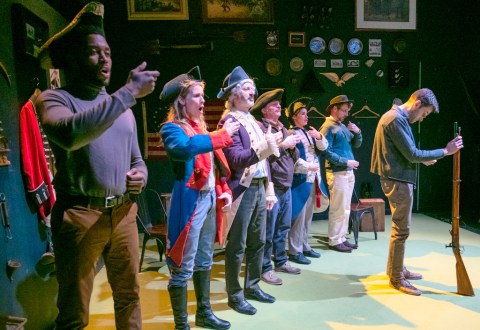
The Company, Adam Chanler-Berat in ‘How to Load a Musket,’ by Talene Monahon, directed by Jaki Bradley at 59E59 Theaters (Russ Rowland)
Why would anyone want to reenact the most bloody battles of American History? In the World Premiere of How to Load a Musket, currently at 59E59 Theaters until 26 January (unless it is extended which it should be) playwright Talene Monahon examines the nature and viewpoints of American citizens who devote time, energy, money and passion to acting out various historical wartime confrontations that founded and preserved our United States of America.
The play that Monahon configured relates perspectives based upon her interviews with reenactors in Massachusetts, New York and Virginia. With exceptional actors portraying the individuals she interviewed, director Jaki Bradley brilliantly stages a production that is vibrant, humorous, at times chilling and always memorable.
Monahan interviewed individuals addicted to portraying historic events principally those occurring during the Revolutionary War and the Civil War. What she discovered turned out to be fascinating portraits of a unique group of impassioned citizens who “got the bug” to participate in reenactments, some for the past thirty years. In her interviews, she gleaned their demographics, their interest in American history and their views about our country, formed during and after their extensive research and their activities with others to conduct reenactments for an audience of history and battle lovers.
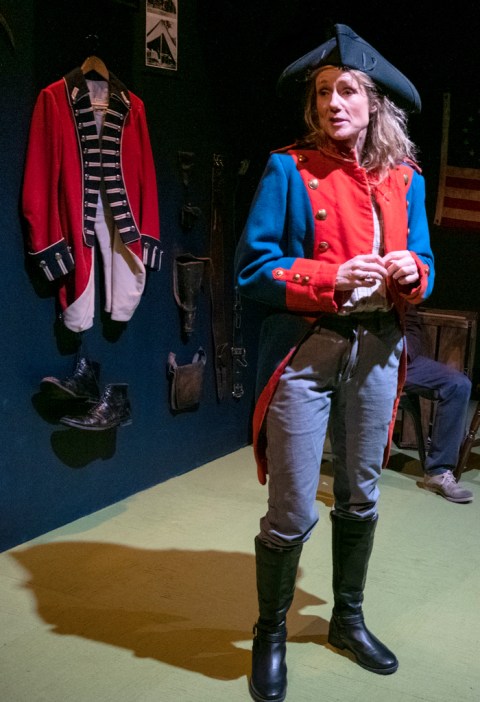
Lucy Taylor in ‘How to Load a Musket,’ by Talene Monahon, directed by Jaki Bradley at 59E59 Theaters (Russ Rowland)
The production entertains us with these quirky, odd individuals, who put on battle dress and show us how to load and shoot a musket. In initial sequences related to the Revolutionary War, individuals familiarize us with this clannish hobby and identify the levels of those who engage in the fun of it. There are those who went out and did extensive research and are incredibly serious about “getting back into the past,” to the point of attempting to relive it with accuracy. These folks eat hardtack, sew their own outfits and starve themselves as happened because Congress didn’t allot enough provisions for our soldiers during the Revolutionary War. And then there are the “Farbies.” These folks are not authentic or historically accurate. So as Larry says, “For some of us, as we get older, we want a little more comforts of home; so when my ten flap is closed at night, it’s not 1776. It’s 2015.”
We learn about the typical positions of reenactors, from those who play fifes, to those who portray George and Martha Washington, British soldiers and even King George. The sheer fun of it is escapism, to remove oneself from the stresses of modernity and imagine a time when the air and water were cleaner. Of course, that is the male perspective. One of the women reenactors, the fifes-woman (Lucy Taylor) reminds us that women died in childbirth, oftentimes, and there were horrific childhood diseases that killed, “back in the day”. The beauty of reenactments is that one can imagine oneself living in a desired time and place as another individual for a few hours, and yet return to the comforts of one’s modern life.

(L to R): Richard Topol, Nicole Villamil, ‘How to Load a Musket,’ by Talene Monahon, directed by Jaki Bradley at 59E59 Theaters (Russ Rowland)
From these interviewed the playwright teases out reactions fomented from the political climate, and the increasing social and cultural divide, after the 2016 election shifted participants’ attitudes and feelings. Their notions reflect the deepening discourse about the nation’s founders as slaveholders, the increasing acts of white supremacy under this presidency, and the confluence of racism and symbols of the confederacy, i.e. the flag, once thought harmless, now viewed by many as egregious remnants of our nation’s inglorious and inhuman past. Naturally, there are those who find these sentiments appalling, as if to nullify a history that is painful but moving in the progressive direction of “freedom for all.” Without the Civil War, no slaves would have been freed until many years later. The price paid, of course, is incalculable.
During the production which spans the years from Fall of 2015 through July 2017, and up to 2019, those interviewed discuss the present divisions in the country that reveal their roots in the Civil War, including the events in Charlottesville and the white supremacist marchers opposed to the “tearing down” of Robert E. Lee’s statue. Interestingly, for the first time ever after another reenactment, there is a bomb incident. This threatened violence for what once was a fun, staged event and hobby, indicates that spirits are darkening in the country. Those who are interviewed, note these changes with alarm.
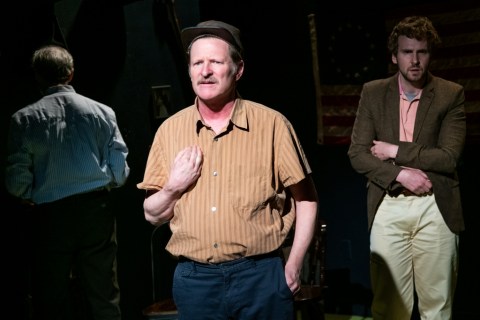
(L to R): Andy Taylor, Ryan Spahn in ‘How to Load a Musket,’ by Talene Monahon, directed by Jaki Bradley at 59E59 Theaters (Russ Rowland)
Cleverly, Monahon uses issues to raise questions and reveal themes. Some of these concern our ideas about the formation of our nation to gain freedom. Others reveal divergent perspectives of citizens from the South and North. Interestingly, the interviewed (who are “characters”) point out, after a Revolutionary War enactment, the idea that America is an experiment which may or may not last. Throughout, issues related to slavery and its attendant racism are brought up stirring questions about what this means for us today. The actors portraying real people are reflected through the prism of changing trends based upon our social climate. Vitally, the playwright reveals the cultural shift in how these individuals view what the reenactments mean to them during the past five years.

Adam Chanler-Berat in ‘How to Load a Musket,’ by Talene Monahon, directed by Jaki Bradley (Russ Rowland)
Eight actors portray the individual reenactors, switching into various parts. These are a cross-section: old, young, male, female, black, Hispanic, mother-son, father-son, educated, working class. The dialogue is lightly edited from the interviews. Essentially, the playwright quotes individuals verbatim. Thus, the accents, the humor, the chilling commentary ring with authenticity to reveal what folks in our country believe and think. Importantly, without the exceptional and adroit acting by the ensemble (Carolyn Braver, Adam Chanler-Berat, David J. Cork, Ryan Spahn, Andy Taylor, Lucy Taylor, Richard Topol and Nicole Villamil) who bring this production to its sweet spot, none of the import and power of the themes would resound as fully or shine as vitally, especially the theme about the encroaching violence in our culture.
The production from its scenic design (Lawrence E. Moten III) costumes (Olivia Vaughn Hern) lighting (Stacey Derosier) sound design (Jim Petty) original music (Zoe Sarnak) to staging is superior. Artifacts from the various periods of history adorn two walls of the set, including the costumes and hats the actors use throughout. Actors take their entrances and exists from three different sides of the set, two of which the audience surrounds as two sides of a rectangle; This is minimalistic and smart. The intimate setting allows the audience to feel a part of the action as the actors, at times, interact and directly address comments to them.
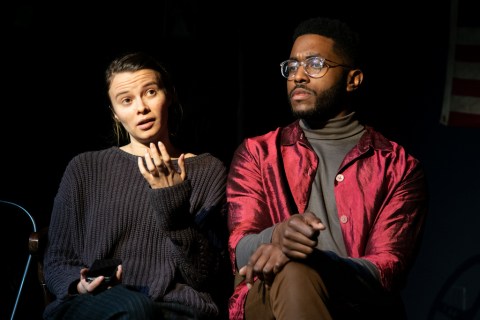
Carolyn Braver, David J. Cork in ‘How to Load a Musket,’ by Talene Monahon, directed by Jaki Bradley at 59E59 Theaters (Russ Rowland)
As a capstone to the ideas that are presented, Monahon introduces TM, the playwright, as a character (portrayed by Carolyn Braver). On a subway, TM and artist Dread Scott (David J. Cork) discuss the idea of genocide. An Armenian, she discusses its meaning to her (the Turks conducted a genocide and expulsion campaign against the Armenians (1914-1923). Indeed, as a black man Dread understands the meaning of genocide related to what happened during the American institution of slavery. As an important part of American History, he invites her to his proposed 1811 Slave Rebellion reenactment in New Orleans which TM attends two months after their subway meeting.
This powerful conclusion is telling. As an Armenian, TM is struck by Jeffrey’s (Richard Topol) use of the word “genocide” to indicate how he feels about his southern ancestry being vitiated with the removal of the confederate flag and statues of confederate soldiers from parks and federal buildings in the south. The application of Jeffrey’s “genocide” in juxtaposition with Dread’s idea to reenact the rebellion which has been removed from US history books and the Armenian genocide which has been largely left out of the History of Western Civilization is ironic. In a weird confluence, all have understood what being “wiped out,” means, and there is a unity. Perhaps, as Dread states at the end, it is a portentous recognition that “heroes in seeking liberation, receive mercy.” This is especially so in reenactments.
The production that rings with great truth provides a jumping off point for us to consider what our country means to each of us and how we can reconcile that meaning. Above all, the playwright, director and actors inspire us to broaden our understanding of aspects of our society beyond the stereotypic “Red States” and “Blue States” that we may not have considered before. As we question attitudes that may not resonate with ours, nevertheless, we must stand in each other’s shoes, especially those that we may have previously disdained.
How to Load a Musket is a must-see for its originality, ingeniousness and wonderful performances shepherded beautifully by Jaki Bradley. It is running with no intermission at 59E59 Theaters until 26 January. For tickets and times CLICK HERE.
‘Maz and Bricks’ by Eva O’Connor at 59E59 Theaters

(L to R): Eva O’Connor, Ciaran O’Brien in Fishamble’s ‘Maz and Bricks,’ by Eva O’Connor, directed by Jim Culleton, at 59E59 Theaters (Lunaria)
Maz and Bricks by Eva O’Connor takes place on a tram, and on the streets of Dublin over two days in 2017. Its setting is monumental because at this time, the campaign to repeal the Eighth Amendment of the Constitution of Ireland was at its height. Because of the popular support, reflected in the protests to repeal the amendment which banned abortion, the amendment was repealed in 2018, and a women’s right to make decisions about her own body was solidified under the law.
During the campaign, Maz, who is on her way to a massive protest in Dublin to repeal the constitutional abortion ban, meets Bricks. Their initial meeting filled with conflict and humorous, verbal smackdowns becomes the linchpin that changes both of their lives.
The production presented by Fishamble, The New Play Company, won an Olivier Award and is in its US premiere at 59E59 Theaters, as part of Origin’s 1st Irish. Experiencing the 80 minute production which has no intermission, a minimal, spare set and fine staging, one can understand why it is an award-winner. First, it is directed with precision and sensitivity by Jim Culleton. Secondly, O’Connor’s titular characterizations lure us with their vitality, and surprise us with their raw likeability. The play is well crafted with continually dynamic interchanges by the characters and an unadorned, satisfying, character-driven plot development, with powerful themes that hold currency for our times.

(L to R): Eva O’Connor, Ciaran O’Brien in Fishamble’s ‘Maz and Bricks,’ by Eva O’Connor, directed by Jim Culleton, at 59E59 Theaters (Lunaria)
Thanks to the superb performances by Eva O’Connor (playwright) who also performs Maz, and Ciaran O’Brien as Bricks, we are led on a journey that moves deeper into the minds and hearts of these individuals, as they become acquainted, gain interest in each other, bounce apart, then couple together in mutual respect and caring. By the conclusion of the production we note how “in the twinkling of an eye, at the last sound of the trumpet,” individuals can open up and help each other reach a place of authenticity and healing, that they did not realize they could reach in themselves alone.
Upon first meeting Maz and Bricks, we are struck by Bricks’ over-confidence, braggadocio and utterly loutish behavior during a phone conversation on a tram, which one needs ear plugs to ignore. When Maz calls Bricks out for his “wildly inappropriate behavior,” and reveals that she is finishing a placard about a nineteen-year-old who died because she couldn’t get a legal abortion, Bricks recoups himself, twits her and tries to smooth over Maz’s attitude by sharing details about his life. After this meeting where he discovers her name and tells her his, the characters, in open monologues to the audience, share their perspectives about the meeting and then describe the next steps as they make their way through their day’s events. Maz goes to the protest; Bricks goes to Lara’s (his X partner) to pick up Yas, his daughter, to take her to the zoo.
The monologues are in rhymes which rhythmically play out with vibrance and power, adding interest and keeping the audience focused at their novelty. Bricks describes how Lara prevents him from his seeing their daughter because she heard about his untoward behavior with her cousin. Bricks’ forthright manner, as he eventually tells the truth to Maz, is a turning point. The playwright exacts a shift in Bricks’ characterization from the lout to the individual underneath the mask. We note his vulnerability, insecurity and upset at not being allowed to be with his daughter, whom he loves. We understand that the cousin may have set him up, so that Lara might punish him using Yas, a cruel action. Desolate, Bricks ends up at the protest. He is just in time to stop Maz from getting into trouble throwing stones at the anti-abortion protesters.

Eva O’Connor in Fishamble’s ‘Maz and Bricks’ by Eva O’Connor, directed by Jim Culleton at 59E59 Theaters (Lunaria)
As they thrust and parry, with jibes and humor, O’Connor evolves the dialogue between these two flawed individuals. She heightens the monologues in a unique way so that the characters step away from the action, and with thoughtful, sometimes philosophical commentary, bring themselves to the next step in their relationship with each other. This is a clever device the playwright employs. It gives us the benefit of the characters’ inner thoughts to reveal their personalities and how their feelings relate to their resultant outer actions.
Thus, by degrees, we note the mystery of how Maz and Bricks, who appeared so antithetical to each other at the outset, find common ground with which to understand each other. They demonstrate that “opposites attract,” as Bricks indicates in his interest in Maz, who is unlike anyone he has ever known. However, once they find the raw and authentic centers of each other’s emotions, they realize they are not that different in their humanity and impulses toward decency.
The characters evolve in their relationship as they hang out with each other and spend the day. O’Connor uses their first interaction on the tram as a thematic prelude on a number of levels. She suggests that it is possible to compromise with others about political views, if one is open-minded and hopeful. That Bricks has an ulterior motive, turns into something deeper as Bricks tells us when he stops Maz’s stone throwing. He intuits that his interference, may lead to something between them. If not, he will crash and burn in humiliation. It is a risk he is willing to take.

(L to R): Eva O’Connor, Ciaran O’Brien in Fishamble’s ‘Maz and Bricks,’ by Eva O’Connor, directed by Jim Culleton, at 59E59 Theaters (Lunaria)
O’Connor’s characters grow more likeable in their interest and acceptance of each other, driven by acute direction and nuanced, spot-on performances by the actors. We believe that Maz and Bricks might care for each other in a world that is chaotic and filled with pain for them, as we later learn. However, in spite of the problems and turmoil that they must confront and do confront with each other’s help, theirs is a relationship worth saving and deepening.
In its conclusion Maz and Bricks is refreshing, satisfying and real. O’Connor presents themes about prejudice, open-mindedness, truthfulness and human dignity in respecting one another’s viewpoint and in “standing in another’s shoes.” It is a behavior that we sorely need to reflect upon and practice in the current, divisive, political climate in the U.S. and elsewhere around the globe.
Kudos to the creative team: Maree Kearns (set and costume design) Sinéad McKenna (lighting designer) Carl Kennedy (sound designer) who, with director Jim Culleton and the actors, have made this a must-see production. Maz and Bricks runs until 23 February at 59E59 Theaters, Theater B. This is one you won’t want to miss. For tickets and times, go to their website by CLICKING HERE.
‘Greater Clements,’ by Samuel D. Hunter at Lincoln Center Theater

(L to R): Nina Hellman, Judith Ivey, Ken Narasaki, Edmund Donovan,, Andrew Garman in ‘Greater Clements,’ by Samuel D. Hunter, directed by Davis McCallum (T. Charles Erickson)
Greater Clements, by Samuel D. Hunter, directed by Davis McCallum spotlights a dying town whose end comes “not with a bang, but with a whimper,” especially for those who have invested their sweat in its history to make a life there, however, insignificant and invisible. The production stars Judith Ivey as stalwart Maggie, whose emotional range is delivered with power and grist. The superb Edmund Donovan is her outlier son who is doomed to confront his psychological illness without the tools to manage himself successfully. Greater Clements reveals lives lived in quiet desperation before they fizzle out or implode in despair, while looking for for an exit from soul pain which never comes.
The play opens in darkness, thousands of feet below ground as a miner (we discover this is Joe-Edmund Donovan-who once gave mine tours) in his gear with one bright headlamp speaks about the Dodson Mine and a mining catastrophe in 1972. It was then his grandfather burned alive and a total of 81 men lost their lives. Immediately, in the darkness, we have a sense of foreboding, of a doomsday trajectory of the town and its people.
The scene shifts from the mine shaft to the bi-level set (Dane Laffrey’s creation) via an elevator that rises and falls to expose Maggie’s museum and mining tour office and bedroom in a later act. The elevator set is a neat contrivance, but it is view obstructing and unwieldy, notwithstanding the symbolism conveyed of the oppressive, confining and dangerous conditions the townspeople and miners lived with all of their lives.
Clements, a defunct mining center of Idaho whose largest mine closed 12 years before the setting of 2017, represents an every-town of the once booming industrial west before Reagan’s outsourcing, recent automation and current energy technologies siphoned off jobs, factories and hope. With no inspiration to transfer its prosperity toward tourism, or developing other resources, Clements has been “decommissioned” as a functioning town.
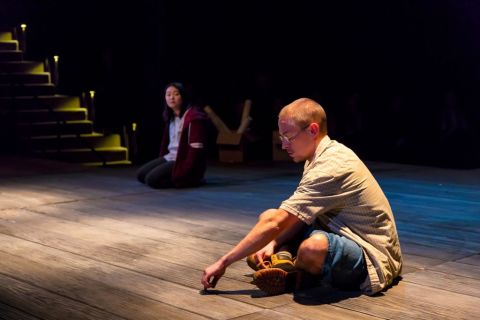
Haley Sakamoto, Edmund Donovan in ‘Greater Clements,’ by Samuel D. Hunter, directed by Davis McCallum (T. Charles Erickson)
Ironically, in a sort of self-immolation memorial, to keep away wealthy elites from other states who might take over and bring back the rosy bloom in its cheeks, town officials have voted to unincorporate Clements and remove all municipal services. The thought comes off as follows. “If we can’t make a go of it, we’ll do everything in our power to prevent you from trying. You want to try? Start from scratch!” The last indignity has been to deliver the town to the darkness from whence it came, as they turn off the juice to power the street lights and one, lone stoplight that once allowed a bustling downtown crowd to cross the street in safety.
The concept of removing Clements from the historical record, exemplifies a number of Hunter’s themes about such mid-west devastation since Reaganomics, which has been exacerbated with tax cuts to the wealthy, moving right up to today, while leaving places like Clements in the dust. The town, like many other areas in Red States, became mired in the past and never got out from under its own debris to prepare for a viable future. Rather than to be forward thinking, even after the mine shut downs, town fathers chose oblivion masochistically, like the places that sprung up during the gold rush, then dissolved into ghost towns, when the rich veins of ore dried up.
Maggie, who has kept the town’s history alive with her museum and her mine tours, has been forced to close down, in effect, removing Clements from historical significance and obviating its residents’ lives from remembrance. The retrenchment and immaturity of the attitudes of the town fathers, reflected by their choice to unincorporate, reveals the same rage, powerlessness and victimization that propels one into self-damaging choices.
Hunter subtly references the self-destructive attitudes of the Red States’ populace, like those in this Idaho town, that most probably put someone like Trump in power, believing he would keep his promise, perhaps to add “industrial” jobs to the economy; a canard. It is one of the ironies that Hunter slips in quietly that pervades throughout, as we watch the disintegration of the town and the lives that once made it a community and held it together. Clements has blown itself off the map rather than to persist. This of course leaves residents like Maggie no choice but to escape to restore their dignity to “make it to the next day.” We learn later of Maggie’s abyss of despair for she, too, voted with the town fathers in vengeance, almost as an unthinking afterthought.
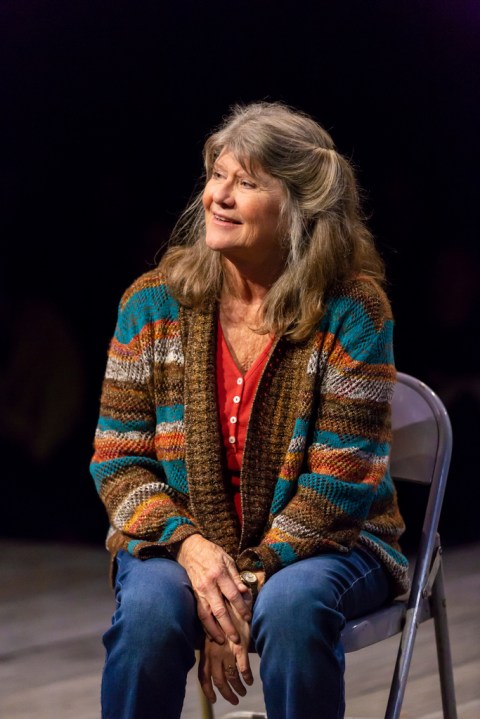
Judith Ivey in’Greater Clements,’ written by Samuel D. Hunter and directed by Davis McCallum (T. Charles Erickson)
The idea of being disconnected (unincorporated) from the future and each other is a theme which plays out in the relationships between and among the characters. Maggie, the sheriff (Andrew Garman) and her nosy neighbor Olivia (Megan Bartle) are among the individuals remaining who keep up an acquaintanceship, but do not go beyond the surface to discuss, at depth, issues related to the town’s death or their own aching problems. Maggie refuses to discuss much with Olivia, and when she is backed in a corner about her resentment about wealthy people buying up property, she finally reveals she hates the mine that killed her father and paid him low wages. That she is conflicted is an under statement. Her mine tours and “keeper of the flame” museum has put bread on her table. Indeed, her inner conflicts and regrets are many, and her lack of introspection about herself is the flaw which causes the final destruction for the family.
As the foil and main driver of the action, Joe, Maggie’s twenty-seven-year-old son is the one who will inherit Maggie’s and the town’s legacy. Maggie has brought him back to stay with her because she cannot let go. She feels alone and responsible for his well-being, since he ran off and was barely caring for himself in another state. Years before, when the mine closed, Maggie’s husband left her to run off with a gay man. She was forced to raise Joe alone which has been a tremendous burden that Joe reminds her of cannily and apologetically at various points throughout the play.
Joe has psychological debilities. He socially functions as a 15 year old, and in the past often got into trouble. As Joe attempts to communicate with his mother and reach some sort of settlement upon his return, we note their sturm and drang. It is apparent in Act III, during a heart to heart between them, that Joe has taken stock of himself and his situation with his mother, and indeed, is more knowledgeable than she. As the “fall guy” prodded by the sheriff, Olivia and his mother, and manipulated by Kel (Haley Sakamoto) who, herself, is a psychological mess, one can see the consequences of the impact of their own small-town behaviors which lead him on an unstoppable crash course toward an end zone for the opposite team.
Their mother/son relationship is the most gripping element of Greater Clements. Developing their character’s stresses and their attempt to communicate, despite their inner depression and hopelessness, becomes the linchpin of the drama and a tour de force between Ivey and Donovan. They are magnificent in these roles. Their emotional authenticity is spot-on. Maggie’s abject blindness about herself, and Joe’s self-awareness are heart-wrenching as we hope for them, yet know they do not really hope for themselves or each other. This is reflected throughout the play in its symbols (i.e. Joe’s grandfather’s watch which Joe prizes). The watch was pulled off the grandfather’s incinerated body after the mine catastrophe. The watch makes it through the Pacific Theater WW II and the mine’s fiery flames, but its crystal cracks when Maggie knocks it from its place on a shelf, out of nervous carelessness.
As Maggie is one of the last to leave Clements, she reaches out to a far light at the end of the tunnel for Joe and herself. She contacts a high school love, Billy (Ken Narasaki) with whom she tangentially maintained a relationship for the past fifty years. Billy and Kel, his granddaughter stay with Maggie and Joe. Problems develop which we intuit, but which Maggie in her rush to reformulate her relationship with Billy ignores until too late. An explanation for her fervor is revealed. Their love was banned by her father because of Billy’s ethnicity (Japanese American) and her father’s sensitivity to fighting the Japanese during WW II. Though Billy has cancer, he remains hopeful having conquered the disease the first time. Maggie remains nonplussed, and believes his well-meaning, cheerfulness. She is anxious to have some happiness in life which Billy will give her.

Judith Ivey, Ken Narasaki in ‘Greater Clements,’ by Samuel D. Hunter, directed by Davis McCallum (T. Charles Erickson)
Hunter and Ivey again highlight Maggie’s underlying flaws. Disconnected with herself and perhaps not fully working through despair at never really living life for herself, but living to nurse others, once again, Maggie appears to be doubling the load, not only having to care for Joe, but for Billy as well. This, despite Billy’s claims that he cares for her and doesn’t need a nurse. Regardless, because Maggie appears addicted to hardship, the likelihood that she will be involved in Billy’s care and troubles with Patrick, his alcoholic son, is great.
Ironically, it is Joe who questions her motive why she brought him back to a dead-end situation. Is Maggie like many women of her age and economic status, too afraid to strike out on her own, freely, to take care only of herself? Or is she comforted to feeling the only true purpose of her life is that of a nurturer who takes care of others, and when trouble comes, makes a botch of it? Hunter’s characterizations of Maggie and Joe are richly drawn, fueled by the fine performances. Billy and Kel serve as doorstops which open and close varying events. Joe’s developing closeness with Kel which ends in a backfire when she importunes him to take her down the mine shaft where they shouldn’t be, and then he later keeps secret her walk by herself, ends in further conflict and recrimination. Joe is picked on by the sheriff, Billy, Olivia and Maggie like a flock of chickens pecking at a bloodspot. He can’t please them, thus, he can’t please himself. All he can do is agree with them and apologize.
Billy and Maggie’s alone-time discussions reveal the red-neck prejudice of the area with residues still present against “the other.” Nearby is the Japanese-American internment camp which once housed Japanese Americans during WWII. In another irony of the play, now, Minidoka War Relocation Center is a National Historic Site accepting numerous visitors each year. Clements, once the largest mine center in the country, with a grand historic past, no longer exists except in its abandonment.
Hunter’s tone throughout portends disaster. The flaws of Maggie’s blindness plummet the characters into the rather long play’s tragic end. The rising and falling set that recedes into the darkness of the mine, and Maggie’s attempts to retrieve a former love that will most probably end in her despair, nursing him to his death, is a reality that she is shocked into realizing. Indeed, nothing can prosper in this place, which has willfully refused to enter the 21st century. Maggie should have left long ago. But that would require self-knowledge, the desire to free herself from her own enslavement and to hope for a better future. Hunter capstones the characters and rural America as he sees them and indeed, he points to the self-destruction and hopelessness that infuses them. It’s a warning we in the cities should not take lightly and which resonates at the conclusion, that all will not be “fine.”
Noted are Kaye Voyce (costumes) Yi Zhao (lighting) Fitz Patton (original music and sound). Greater Clements fills the heart and mind with its richness. It runs two hours, 55 minutes with two intermissions at The Mitzi E. Newhouse at Lincoln Center until 19th January. For tickets and times CLICK HERE.
‘Sing Street’ a Stirring Musical Adaptation of the Award-Nominated Titular Film

Brenock O’Connor (center) and company, Sing Street, book by Enda Walsh, music & lyrics by Gary Clark & John Carney, based on the film written and directed by John Carney, original story by John Carney & Simon Carmody, choreography by Sonya Tayeh, directed by Rebecca Taichman, NYTW (Matthew Murphy)
It’s 1982 Dublin, Republic of Ireland. The country is in a recession and there is no work anywhere. Those with mobility and ambition leave for London and the United States, while the Conors led by out-of-work architect Dad (Robert is played by Billy Carter) and his family exhaust their savings and downsize their lifestyles. The circumstances create drama for the lives of the struggling family of five in writer/director John Carney’s vibrant if thinly drawn theatrical adaptation of his 2016 film Sing Street, currently enjoying its run at New York Theatre Workshop until 26 January.
Based on Carney’s film, the comedy/musical with dramatic elements is directed by Tony Award winning Rebecca Taichman (Indecent 2017) with book by Enda Walsh, music and lyrics by Gary Clark and John Carney and choreography by Sonya Tayeh. The original story is by John Carney and Simon Carmody.
Sing Street has additional songs (others from the film have been pared), with selections from iconic tunes from New Wave and pop groups including songs by Depeche Mode, Spandau Ballet, Japan and others. And there are original songs, some of them from the movie, co-written by John Carney and Gary Clark (former lead of Scottish band Danny Wilson from the late 1980s).
Enamored by Carney’s film Taichman was inspired to adapt the film for the stage. She pursued the project, meeting Carney in London where additional conversations and meetings resulted in Enda Walsh writing a first draft of a libretto using the score from the film. The project evolved. There were more creative meetings and additional work periods and a refining of book and music with extensive development at New York Theatre Workshop that incorporated movement.
Considering that Carney and Walsh had brought together a theatrical adaptation of Tony Award Winning Once (from Carney’s 2007 film Once), beginning Off Broadway at NYTW (2011), and shifting to Broadway in 2012 (garnering 8 Tonys and other theater awards), the creative team appears golden. Will Sing Street follow the same trajectory as Once to land on Broadway when it is ready? Its incubation at NYTW looks to be moving it in the right direction.
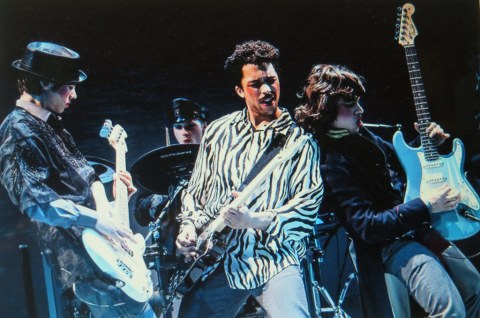
(L to R): Sam Poon, Anthony Genovesi, Jakeim Hart, Gian Perez in Sing Street, book by Enda Walsh, music & lyrics by Gary Clark & John Carney, based on the film written and directed by John Carney, original story by John Carney & Simon Carmody, choreography by Sonya Tayeh, directed by Rebecca Taichman, NYTW (Matthew Murphy)
As in Once, the actors are talented musicians/singers. They play a wide variety of instruments to make up the band that teenage Conor (Brenock O’Connor), seamlessly puts together to impress and lure Raphina (Zara Devlin), who presents herself as a “model.” Impressed, smitten by her look and demeanor, Conor invites her to appear in a music video with his band. Conor’s pitch is a stretch for he has no band and most probably Raphina who has dropped out of school to “become” a model is laying it on “thick” as well. But no matter; the die is cast, and the intrigue is on. Both have made each other the inspirational backboard upon which to encourage and solidify their dreams and hopes.
Since Conor’s family’s fortunes have spiraled downward, he must attend the reasonably tuitioned state-run Christian Brothers school on Synge Street (named after John Millington Synge the poet, playwright, prose writer, political radical and co-founder of the Abbey Theatre). That Conor decides to turn a curse into a blessing by morphing the name of “Synge” to “Sing” as part of the title of his band is his ingenious, if not ironic touch, because the venue where he must attend school is anything but desirable, initially. Nevertheless, as one of the many themes of the production, Conor pushes himself to the top of a coal heap and turns coal into diamonds withstanding the pressure he undergoes in the school and on this street.
The new environs are a far cry from Conor’s Tony elite Jesuit school where he fit in and did well. The headmaster of Christian Brothers, Brother Baxter (Martin Moran) is a martinet who challenges Conor at every turn, even to censuring him for defying the regulation color of his shoes (they must be black). Conor doesn’t have the money for new ones, but if he did, he would most probably spend it on something more uplifting and useful.
Their disagreements and Baxter’s unexplained wrath grow into a peaked conflict which could be deepened beyond Baxter’s one-sided characterization. He is, rather a stereotypical, cleric “bad-guy,” antagonist to Conor’s angelic-faced, innocent whom we root for unquestioningly because he’s heading up a boy-band with grand ambitions. What’s not to love about Conor? What’s not to dislike about Brother Baxter? Complexity is wanted.

Zara Devlin, Brenock O’Connor in Sing Street, book by Enda Walsh, music & lyrics by Gary Clark & John Carney, based on the film written and directed by John Carney, original story by John Carney & Simon Carmody, choreography by Sonya Tayeh, directed by Rebecca Taichman, NYTW (Matthew Murphy
Conor is also at odds with some outliers in the school community who bully him and beat him up, i.e. Barry (Johnny Newcomb), whom we discover to be gay and hiding under machismo thuggishness. Classically, his warped background and lack of self-knowledge or acceptance about who he is provokes his bellicosity. Walsh and Carney reveal his vulnerability in his scenes with Sandra (the superb Anne L. Nathan), rounding out his character and revealing his development.
Interestingly, it is the adversity reflected in the change of schools that forces Conor to rise to the occasion guided by his college-drop-out brother Brendan (the sensational Gus Halper), to establish his band (the most entertaining and delightful part of Act I). In the process of tackling obstacles to bring together clever and talented Eamon (Sam Poon), Kevin (Gian Perez), Larry (Jakeim Hart), Gary (Brendan C. Callahan), and Darren (Max William Bartos), Conor gains confidence and shares his enthusiasm and empowerment with his band members. The feelings are mutual. This bravado helps him in a face-off with Barry and eventually inspires him to stand up to Baxter’s niggling injustices. The climax of their conflict comes in Act II, after Baxter gives Conor and his “Sing Street Band” permission to enter The Inner-City Dublin School Band Contest, then sadistically punishes Conor by retracting his permission. Conor and the Band’s response is joyous.
Underscored throughout is Conor’s growing love relationship with Raphina, despite her threat to be pulled away to London by her boyfriend, and Conor’s deteriorating family situation as his father splits with his mother Penny (Amy Warren). Penny moves out to fulfill an affair with her boss. Conor’s sister Anne (Skyler Volpe), and older brother Brendan, who himself needs a resurrection into a new person since he can’t move himself to leave the house, are Conor’s support group. The scene where the family situation blows up rings with authenticity, and we are happy as is Brendan (Halper’s song at the finale is just terrific), that Conor is able to break away and leave with Raphina, enriched and enlivened by what he has accomplished on Synge Street, with “Sing Street.” Conor truly has reversed his fortunes and spun out a golden path for himself.
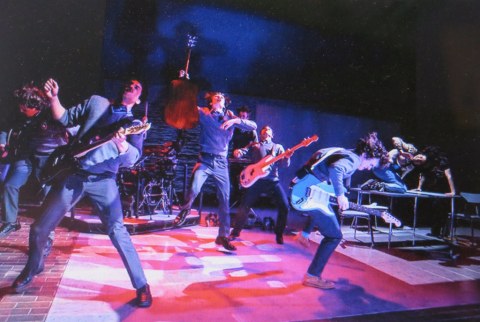
Brenock O’Connor (center right) and company, Sing Street, book by Enda Walsh, music & lyrics by Gary Clark & John Carney, based on the film written and directed by John Carney, original story by John Carney & Simon Carmody, choreography by Sonya Tayeh, directed by Rebecca Taichman, NYTW (Matthew Murphy)
The music and performances are steady, effervescent and fun; it is a joy to be returned to the 1980s era which was nothing short of vibrant. We are in a different environment with a projection of the Irish Sea beckoning in the background, the waters flowing at the conclusion of the production. The band’s movements/song performances are right-on and glorious, and it is a rally to watch O’Connor’s Conor work his magic with confidence spurred on by Halper’s Gus who is gobsmacking in the role as Conor’s caring older brother.
The love relationship that develops between Raphina and Conor is convincing; though indeed we wonder how much of Raphina’s riffs to Conor are a complete front job. What does the future have to offer for a female drop out who comes from a troubled family life? Love from someone as appealing, dynamic and ambitious as Conor is a miraculous gift. She would be a fool to spurn him.
In its verve, positive themes, joyful celebration of 1980s music and triumph over a time of doldrums in Dublin, Sing Street is illustrious and welcoming. Kudos to the creative team who helped the production morph from screen to stage. These include: Martin Lowe (music supervisor, orchestration & arrangements) Bob Crowley (scenic & costume design) Christopher Akerlind (lighting design) Darron I. West (co-sound design) Charles Coes (co-sound design) J. Jared Janas (hair & makeup design) Fred Lassen (music director).
Sing Street is running at NYTW until 26th of January. See it for its music, performances and overall joie de vivre. For tickets and times CLICK HERE.
‘London Assurance’ directed by Charlotte Moore at The Irish Repertory Theatre, a Rollicking Christmas Treat

(L to R): Colin McPhillamy, Elliot Joseph, Caroline Strang, Rachel Pickup, Robert Zuckerman, Evan Zes, Meg Hennessy, Brian Keane, Ian Holcomb, ‘London Assurance, by Dion Boucicault, directed by Charlotte Moore, Irish Repertory Theatre (Carol Rosegg)
London Assurance, the vibrant farce by Dion Boucicault, directed by Charlotte Moore at the Irish Rep is the perfect production for the Christmas season to keep the cheer bright. The acting is superb, the pacing of high jinx is acutely shepherded by Moore. Altogether, there is everything to like and enjoy and nothing to find fault with in this production which runs until 26 January.
A mix between a drawing room comedy and slapstick without the physicality but oodles of wordplay, Boucicault’s London Assurance also satirizes stock character types, social classes and the notions of marriage for convenience which were beginning to be blown away by the idea of love matches, at the time the play takes place Christmastime, 1841.
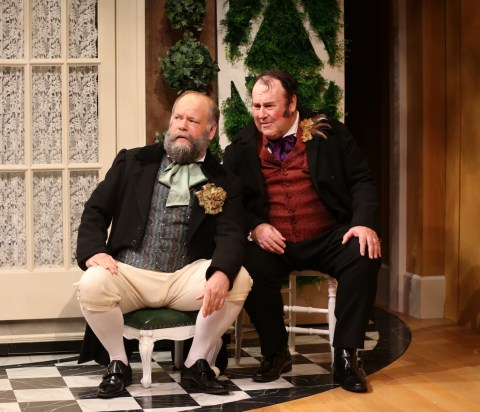
(L to R): Brian Keane, Colin MPhillamy in ‘London Assurance,’ by Dion Boucicault, directed by Charlotte Moore, Irish Repertory Theatre (Carol Rosegg)
The action begins when dissolute Charles Courtly (Ian Holcomb) arrives with his friend Dazzle (Craig Wesley Divino) in the morning hours after a night of hard drinking and partying. Charles lives with his father Sir Harcourt Courtly (Colin McPhillamy is perfection as the fop who is easily duped by his own puffery). Courtly believes his son to be the innocent, demure, hard-working student who eschews gambling and drinking. Charles is the antithesis. Servant Cool (Elliot Joseph) lies to protect Charles.

(L to R): Meg Hennessy, Caroline Strang in ‘London Assurance,’ by Dion Boucicault, directed by Charlotte Moore, Irish Repertory Theatre (Carol Rosegg)
After Dazzle and Cool carry Charles off in a drunken stupor, Sir Courtly enters in his dressing gown wishing for his breakfast. Courtly reminds Cool of the recent most important events of his life. He and his friend Max Harkaway (the fine Brian Keane) have arranged for the elderly Courtly’s marriage to Max’s young, beautiful niece Grace (Caroline Strang) in exchange for an obviation of debts, and her dowry. If Courtly or Grace nullifies the arrangement, Grace’s money will be Charles’ inheritance.
The arc of development involves the foiling of Courtly’s plans when all visit Max’ country estate in Gloucestershire where Courtly is supposed to finalize his engagement to Grace. Max has invited Dazzle and of course Dazzle brings along Charles for the adventure and fun the visit promises to be, though Sir Courtly doesn’t realize that Charles has joined the party. At Max’ estate, Grace meets a disguised Charles who poses as Augustus Hamilton to dupe his father who believes him to be home studying. Both Holcomb and McPhillamy pull off the bad disguise non-recognition and Sir Courtly’s dubious response to his son’s “lookalike” with great humor.

Caroline Strang, Ian Holcomb, in ‘London Assurance,’ by Dion Boucicault, directed by Charlotte Moore, Irish Repertory Theatre (Carol Rosegg)
Charles, ever the playboy, flirts with Grace unaware that she is his future mother. For her part Grace is sanguine about marrying Sir Courtly, but falls in a hot love with Charles. What are they to do? How can they put off Sir Courtly and Uncle Max Harkaway and effect their marriage to each other? By this point in the plot the playwright has drawn us in for Sir Courtly is no particular catch and to American audiences today, the idea of a woman having to drop her dowry in the lap of an elderly gentleman in order to survive is almost unthinkable, especially when the marriage has been arranged for her.
In the succeeding scenes we meet the lovely friends of Max, Lady Gay Spanker (the wonderfully comedic Rachel Pickup) and her ancient-looking husband Adolphus Spanker (Robert Zukerman draws many laughs with his outrage about his wife leaving him) who is vital, spry and a force of nature that Lady Gay Spanker loves as her protector. However, when Charles beseeches Lady Gay for her help to dissuade his father from sealing “the deal” with Max for Grace, Lady Gay thinks of a humorous idea to break up plans of Sir Courtly’s marriage.
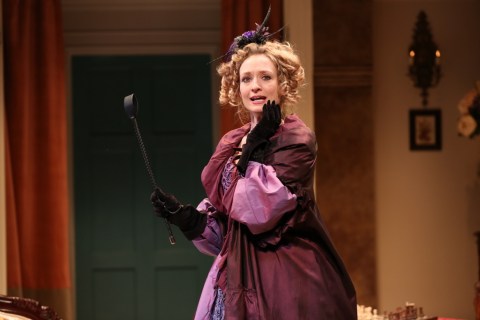
Rachel Pickup in ‘London Assurance, by Dion Boucicault, directed by Charlotte Moore, Irish Repertory Theatre (Carol Rosegg)
In great good fun she seduces the pompous Sir Courtly to fall in love with her behind her husband’s and Grace’s back. Sir Courtly who believes himself to be twenty years younger and on the cutting edge of fashion, is tricked by Lady Gay. He rushes after her to win her kisses and affection. Of course, when Spanker hears that his wife may separate from him, his reaction is hysterical. Meanwhile, Lady Gay is having the time of her life in harmless fun to help out two young lovers who doubt each other’s love. The complications rise and Lady Gay works her miracle for a good cause, until…
This is no spoiler alert. You will just have to see this humorous LOL production to appreciate how the playwright adds complex and humorous twists to the relationships and magnifies mishaps and errors raising the stakes and jokes to a delightful climax with a duel.

Colin McPhillamy, Rachel Pickup in in ‘London Assurance, by Dion Boucicault, directed by Charlotte Moore, Irish Repertory Theatre (Carol Rosegg)
Charlotte Moore’s sense of comedic timing, what does and doesn’t work has been engineered to a fine froth so that the actors appear to be these authentic, vivacious, funny individuals. I cannot imagine Colin McPhillamy, Ian Holcomb, Rachel Pickup, Robert Zukerman, Caroline Strang, Evan Zes (the funny conniving lawyer) Brian Keane, Craig Wesley Divino, Elliot Joseph and Meg Hennessy sounding and behaving any differently in real life than they do onstage. Their performances are stunning. Their timing is spot-on.
Interestingly, the cast has managed to portray their characters so that they are not “the types” they appear to be, but are funny because their traits are humorous. Evan Zes as the “sneaky, obtrusive” lawyer Mark Meddle dismissed by Meg Hennessy’s “go-to-girl” Pert, with the accusation of “slander” is an example. In the hands of these actors this is accomplished with seamless effort. Additionally, the actors handle the asides to the audience with an easy, intimate confessional tone that enhances the comedy. Finally, we enjoy the foibles of each character whom the actors have invested in with their perceptive, canny skills.
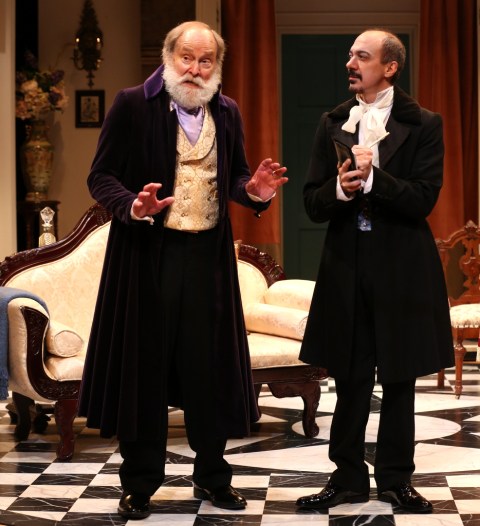
Robert Zuckerman, Evan Zes in ‘London Assurance, by Dion Boucicault, directed by Charlotte Moore, Irish Repertory Theatre (Carol Rosegg)
The sets sparkle with beauty and apparent luxury thanks to James Noone’s scenic design. The interiors are befitting of what one would expect of Sir Courtly’s and Max’s residences. Likewise, Sara Jean Tosetti’s costume design and Robert-Charles Vallance’s hair designs authenticate the period and social status of the characters with excellence. Lady Gay’s purples (I loved her costumes that reflected her expansive, lively character) matched with a lighter shade of purple for her husband’s cravat (?). As a couple they reflected a refined, spiffy, fascinating dynamic. Indeed the creative team’s techniques and strategies inspired by Charlotte Moore’s vision for the production were not overblown, but were “a Goldilocks.” Rounding out the team are Michael Gottlieb’s lighting desgin and M. Florian Staab’s sound design. The music was lighthearted and chosen for the splendid mood of the production.
Once again Irish Repertory Theatre proves its stalwart magnificence for the season with this marvelous comedy that Charlotte Moore, the ensemble and creative team have imbued with their joie de vivre and experience. If you don’t see it, you will have missed a special production. London Assurance runs with one intermission until 26 January. For tickets and times CLICK HERE.
‘Jagged Little Pill,’ on Broadway is Electric, Dazzling in Its Power, Scope and Complexity

Celia Rose Gooding, The Company, in ‘Jagged Little Pill,’ book by Diablo Cody, music by Alanis Morissette, directed by Diane Paulus (Matthew Murphy)
Alanis Morissette’s album “Jagged Little Pill” reached the stratosphere as one of the best selling albums of all time almost twenty-five years ago. The reason is clear. In its contradictions, biting satire and themes it resonated with its global audience, topping the charts in 13 countries worldwide. With that appeal behind it, the notion that the music might land in a stage production was a given, especially if a superlative writer could write an exciting book so the right director would then eventually shepherd the production to Broadway.
And so it happened. Diablo Cody, multiple award-winning writer of the film Juno (2007), synchronized her sardonic fresh, perspective with Morissette’s bile-dripping, alternative rock songs featured on the 1995 album. The meld effected the gyrating musical that premiered at American Repertory Theater, Harvard University in 2018, exquisitely and brilliantly directed by Diane Paulus. The creative team’s synergy further transformed the production into the present dynamo which opened at the Broadhurst Theatre in early December.
How is the musical Jagged Little Pill not just another teenage-angst-driven-juked-up melodramatic foray into identity, social acceptance and self-love? The glossy superficiality of the pumped up, unmemorable, alternative, post-grunge, pop rock light, the stuff that “OK” musicals are made of, is nowhere to be found in Jagged Little Pill. This is because of the grainy, raw vitality of Morissette’s and Glen Ballard’s music, supervised, orchestrated and arranged by Tom Kitt, with additional music by Michael Farrell and Guy Sigsworth.

(L to R): Celia Rose Gooding, Derek Klena, Elizabeth Stanley, Sean Allan Krill, ‘Jagged Little Pill,’ book by Diablo Cody, music by Alanis Morissette, directed by Diane Paulus (Matthew Murphy)
On the contrary, the production, that some affectionately liken to a jukebox musical, defies that definition. First, there is its particularity. It is hard-edged and profound; the arc of Cody’s story spirals and complicates as she lays bare the Healy family while satirizing the underlying mores of the tony community where they live. Additionally, the finely tuned characterizations penetrate with authentic details. Their development draws us into the realm of gnawing secret addictions and the currently overripe, hellish thrall of Oxycodone, brand name OxyContin.
Whether we know of the relentlessness of this drug from experiences of friends, family members, neighbors or ourselves, we empathize with the characters as they confront its lethal power in a felt irrevocability. We’ve seen countless news stories and films on the subject, like the HBO documentary This Drug Can Kill You (2017). We’ve heard of the extremities of addiction resulting in the destruction of family bonds, the tenor of which Cody examines through the characterization of mother Mary Jane Healy her protagonist.
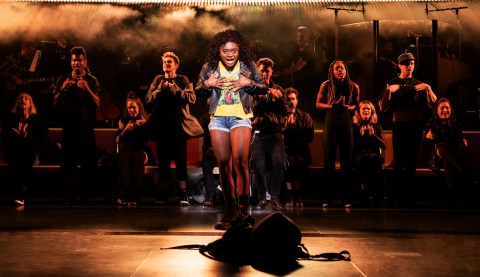
Celia Rose Gooding, The Company, in ‘Jagged Little Pill,’ book by Diablo Cody, music by Alanis Morissette, directed by Diane Paulus (Matthew Murphy)
And what of the story of the wife and mother who broke her arm and kept on breaking it to justify prescriptions of oxycodone? Typical of addicts desperate for the opioid. Prescription meds addicts even have committed robbery and murder. (See article on David Laffer) Of course the drug should be taken off the market and banned but big pharma would lose money in its profitability; addicted middle and upper class women can afford to pay. Why give up on a good thing even when doctors now curtail its use which pushes addicts to the street where they buy OxyContin laced with poisonous Fentanyl for the trip of a lifetime?
Why don’t such individuals “get help” especially when they can afford it? Indeed! Help is the last step in the journey of the addicted. It implies that the family interacts with each other because they must be the main support system of the addict. Cody’s Healy family members do not interact much. They live quiet lives of desperation, seeking their own “thing” when we first meet them, though by all appearances from their home, to their lifestyles to their social connections, these folks “have it together.” Even adopted Frankie Healy (the spectacular Ceila Rose Gooding) is a mess, though you would never suspect it, because she asserts her powerful personality as a young, black woman who is assured in her gay relationship with Jo (the adorable, rockin’ Lauren Patten who sings Morissette’s signature number “You Oughta Know” to a standing ovation).

Lauren Patten, The Company, in ‘Jagged Little Pill,’ book by Diablo Cody, music by Alanis Morissette, directed by Diane Paulus (Matthew Murphy)
How are the posted social media photos of the Healys as the smiling, joyous family fakes it? The image is more important than the reality. And if the image looks good enough, maybe the family members will believe it’s true. How can we fault them at the time of Trumpism, when the president and his family and his supporters do the same, sporting the “best” of everything, from perfect presidential behavior, to perfect relationships with his staff, who are loyal to him because he is filled with grace? Such perfection has not been seen since the “savior.” Likewise, the Healy family’s “perfection” in the view of their friends and neighbors is non-pareil.
The Healys, as representatives of most suburban middle families, traffic in mendacity though such cowardice destroys. As it turns out, lying is the mother of addiction. And addictions salve the soul. With pornography, sex, oxycodone, adderall, alcohol, heroin, etc., life’s miseries become doable and for a time “everything is beautiful.” Of course such duplicity can only go on for so long before the veil is ripped and the ugliness shows through. In the production the songs “All I Really Want,” Hand in My Pocket” and “Smiling,” clue us into the lies. However, the family keeps their secrets from each other until there is a turning point acutely rendered at the end of Act I during the songs “Wake Up” and “Forgiven.”
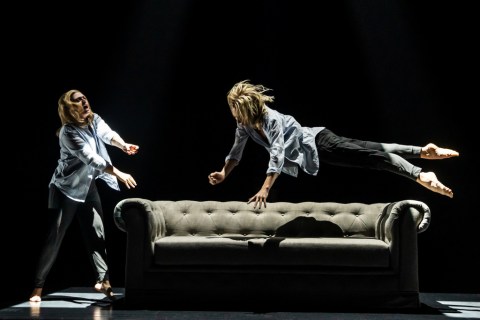
(L to R): Elizabeth Stanley, Heather Lang, ‘Jagged Little Pill,’ book by Diablo Cody, music by Alanis Morissette, directed by Diane Paulus (Matthew Murphy)
The growing divide in each of the characters eventually earthquakes. The one who is the glue holding the family together, perfect mother and wife Mary Jane (the gobsmacking Elizabeth Stanley) gets shaken to her core. The precipitating factor is oxycodone, but Mary Jane’s issues run silent and deep. The drug only suppresses and numbs her from acknowledging the soul gnawing canker worm that eats away at her image of perfection while she bleeds like an open wound inside.
As the musical follows the unraveling conflicts between Mary Jane and husband Steve (Sean Allan Krill) son Nick (Derek Klena) and adopted daughter Frankie (Gooding), other hot button issues come to the fore sweeping the family up in their detritus. These include but are not limited to our paternalistic rape culture, Evangelical Christianity’s homophobia, pornography addiction which deadens intimacy between couples, and black-white cultural bias to name a few.
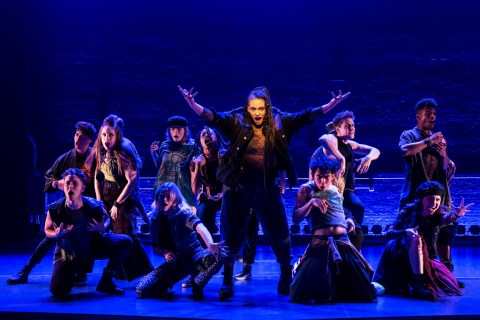
Nora Schell, The Company, in ‘Jagged Little Pill,’ book by Diablo Cody, music by Alanis Morissette, directed by Diane Paulus (Matthew Murphy)
In the well crafted book, music and thoughtful lyrics, Cody and Morissette reinforce an ancient folkway of family structure; there often is little communication beyond functional superficialities. Sadly, profound communication belies self-awareness and soul authenticity. In such a family unit where obfuscation and a general lack of will to work together as a family become routine, addiction is easy. Finding a life worth living individually and with one’s family becomes impossible. The “impossibility” impinges on the family structure and each individual family member as the situation worsens for all.
And so it goes for wife Mary Jane and Steve. Though Steve does make an attempt to reach out to her, she rebuffs him. So it goes for Nick, the “perfect” son (Klena’s rendition of “Perfect” is excellent), who lives out his parent’s dreams not his own, and for Frankie, who is “all that” proud. Each self-deceives. Each is distracted by the race for perfection and by their manic avoidance of failure and the recognition of their faults, which comprise their endearing humanity. In fearing the stigma of being a “loser” (each family member defines it differently and never discusses their own perceptions until the end), each launches off into their own journey of error which impacts the family as a whole. When they become aware of their self-delusions (the exceptional song “Wake Up”), it is a boon that they and other characters come to grips with by the play’s conclusion (in the song “You Learn”).
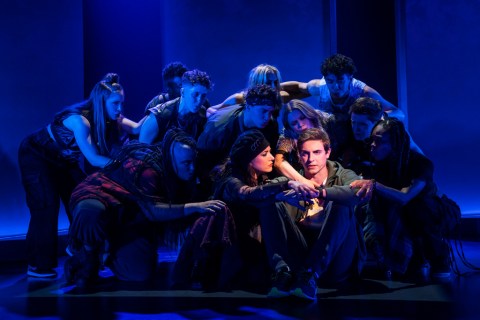
Derek Klena, The Company, in ‘Jagged Little Pill,’ book by Diablo Cody, music by Alanis Morissette, directed by Diane Paulus (Matthew Murphy)
Whether rich or poor, young or old, life is learning, and of course with learning comes change, pain and reconciliation. But first as the linchpin of the family, Mary Jane experiences the long and grueling events in her relationships. She begins first with her addicted alter-ego, then her children and husband. Through trial and error she learns to explode the self-deception, lies, defensiveness and powerlessness conveyed to her family, who become estranged from her as she embraces the drug as her panacea (this is terrifically rendered in movement during the song “Unforgiven”).
But before any of the family learn that their arrogance and attempt at perfection is delusion, they have to be awake to register they are fantastical creatures on a racetrack toward oblivion. The wonder of Cody’s book is that she has Steve and Nick on the road to awareness before Mary Jane, and Frankie who is blinded by her interest in Phoenix (Antonio Cipriano), which destroys Jo (“Your House”).

Derek Klena, The Company, in ‘Jagged Little Pill,’ book by Diablo Cody, music by Alanis Morissette, directed by Diane Paulus (Matthew Murphy)
We note the disintegration of Mary Jane’s soul, whose behaviors are out of the addict’s playbook. Elizabeth Stanley crafts her characterization with nuanced sensitivity and empathy. She inhabits the ethos of the addict as the drug’s deadly chemicals subvert her being. Stanley is in the moment, from moment to moment with her lyrical voice and nuanced devolution. Our concern and identification with Mary Jane is elicited by Stanley’s prodigious talent.
The same may be said for the actors who inhabit the family members: Ceila Rose Gooding’s Frankie- activist and hypocrite blind to her own foibles; Sean Allan Krill’s loving, caring husband who stands by Mary Jane and reveals he wants to help her become well ( “Mary Jane”), though he is a “work-a-holic” and has an addiction to pornography and masturbation.
Cody has rounded out these characters and the actors thread their depth through the eye of the acting/singing needle. All have gorgeous voices. No less talented is Derek Klena. Klena’s emotional crisis (whether to jeopardize his life path and testify to a rape he saw or keep it a secret along with his unhappiness living his parents’ goals for his life), is heartfelt. Initially, it is Nick who sounds the alarm about his family; Kitt’s orchestrations manifest this twice in a long note from a brass instrument (is it an A or C?), almost like a harbinger that a turning and reckoning must happen or they all will be immeasurably harmed.

Elizabeth Stanley, The Company,Jagged Little Pill, Diablo Cody, Alanis Morissette, Diane Paulus (Matthew Murphy)
Paulus’ staging and her vision, and Sidi Larbi Cherkaoui’s movement to evoke the characters’ emotions are smashing. The characters’ inner rage and torment and Mary Jane’s double mindedness about her addiction’s seduction and her love of self-destruction (“Uninvited”), are clarified in the movement and the dance. Paulus has staged the characters in various scenes so that they are propelled in circles using the props (desks, walls). The effect reveals their confusion and inability to straighten out and to seek emotional life paths that are not dead ended in circularity. Paulus/Cherkaoui also integrate break-dance movement with the songs as a metaphor, representing the emotional inner churning and rage of the characters. Paulus makes sure that the character rage and their emotional circularity are cogently integrated with Riccardo Hernandez’s scenic design and Justin Townsend’s lighting design.

The Company of Jagged Little Pill, book by Diablo Cody, music by Alanis Morissette, directed by Diane Paulus (Matthew Murphy)
The frame of the house in lines of light in various colors abides throughout. Its symbolism recalls how the structure of family and home and what family members experience there, is carried everywhere into relationships, into school, into work, into social activities. Justin Townsend’s lighting design is effective as it is used to reflect emotions. For example, Jo’s fury in “You Oughta Know” is aligned with Townsend bathing the stage in red. Patten’s Jo is fabulously wild; the injustice she feels about Frankie’s demeaning mistreatment is a show stopper made all the more wonderful by Townsend’s lighting and Cherkaoui’s movement.
Additionally, “Wake Up,” and “Forgiven” (as the family members’ backs to the walls of their own making spin them around), are particularly stunning. In these numbers and in “Predator,” “Uninvited” and “Mary Jane,” Paulus, the company and creative team pull out all the stops. And “No” by Kathryn Gallagher as Bella (she has been raped by Nick’s friend), singing with the support of the company, should be taped and played for every Sex Ed. class in high schools: the signs are especially noteworthy.
At its heart Jagged Little Pill is about family. It is provocative, in your face, striking, salient. If one considers how easy it is to couple and how hard it is to move toward a kind, generous, integrative family who works on their failures by loving in overdrive, Cody’s Healy family, portrayed in its jaggedness is a superb textured unit. As a key theme, there is always hope for redemption and reconciliation, Cody suggests, for them, for us.
Add Alanis Morissette’s music, with Kitt’s orchestrations, Paulus’ metaphoric, symbolic staging, the amazing performers, the lighting and brilliantly minimalistic and always seamless and mobile scenic design, Jagged Little Pill is a musical worthy of the nearly twenty-five year wait for these creatives to bring this sterling production together. It is the right season for Jagged Little Pill to take flight with this cast, Cody’s sheer audacity and Paulus scaling the mountaintops of her craft.
I’ve said enough. See it with your eyes wide open and enjoy it awake. It is an experience you won’t easily forget. For tickets and times CLICK HERE.
Network Film Festival, Culver City Film Festival Review: ‘Lullaby’

(top to bottom): Nicole Gut, Nicholas Ferrara, Susan Jane McDonald in ‘Lullaby,’ directed by Kae Fujisawa, written by Nicole Gut and Kae Fujisawa (Merciful Delusions Productions)
How many times have we walked by homeless people on the NYC sidewalk overbundled with blankets and towels in the wintertime? Did you toss change in their cup and walk away free from the guilt? Or did you have a conversation if you had a bit of time to spare, in a show of human decency?
I’ve often thought that the change didn’t begin to answer the loss of a life of connectedness that the individual experiences daily bracing against the elements as he or she determine to live on the streets. If the individual is an older person, I’ve wondered how they might have gotten there. Was it a downhill spiral from drugs or alcohol or not taking their meds? What do we do with their presence which represents a failure of our culture and government to care for its own? Do we walk by ignoring them as invisible people, throw change or when no one is looking use them for an occasion to unleash our devils within?

Ryan Mills, ‘Lullaby,’ directed by Kae Fujisawa, written by Nicole Gut and Kae Fujisawa, Network Film Festival, Culver City Film Festival (Merciful Delusions Productions)
Nicole Gut Executive Producer, Author, Songwriter, Composer, Actor, Singer considered these issues and wrote a short play about a woman who has lost her singing voice. Through a series of events the woman ends up living on the streets of New York with the hope of returning to herself one day. It is a day which never comes.
Lullaby premiered at the John Cullum Theatre at the American Theatre of Actors in Manhattan in New York on October 2018 as an entry for Paul Michael’s New Short Play Festival. The play was directed by Kae Fujisawa and was a success.
Ryan Mills, an actor in the production gave a hard and long look at what the team accomplished. He was convinced there was so much more to the story that must be told. With his insight and assistance, Nicole decided to transform LULLABY into a SAG narrative short film. Kae Fujisawa whose dedication and perceptiveness as a director who helped to shepherd the play to a home run would be the director and co-writer of the film. At that point events moved quickly. Nicole and Kae worked on the script to add complications and deepen the themes.
The resultant film from Nicole Gut’s titular short play Lullaby is a work they are proud of. It had a number of screenings, one at the Network Film Festival in New York City where it was well received. Nicole Gut garnered a Best Actress Nomination and Jack Utrata was nominated for Best Cinematography.
The film stars Ryan Mills as Brian Mills and Nicholas Ferrara as Michael Franklin who portray friends and near-do-wells who are ethically and morally challenged. Both, especially Brian, are unable to solve the overwhelming issues that threaten to destroy their lives. Alcohol is never a panacea to heal soul damage. In fact it exacerbates the damage and launches one into a place that is an abyss of misery and torment.

Susan Jane McDonald, Ryan Mills, ‘Lullaby,’ Network Film Festival, Culver City Film Festival, directed by Kae Fujisawa, written by Nicole Gut and Kae Fujisawa (Merciful Delusions Productions)
And so it goes for Brian and Michael who on a drunken spree come across a homeless woman and former singer Sarah Hughes (Nicole Gut) who has lost her voice. The alcohol overtakes Brian and Michael and they allow it to dominate their will, self-hood and decency. Sarah tries to defend herself, but her response provokes the men, especially Brian. We learn later why he moves against her with venom. Susan Jane McDonald as Brian’s mom reveals Brian’s untoward actions, which are deeply rooted in sorrow. Indeed, when old wounds do not heal, they bleed out onto other individuals and the reckoning is horrific for everyone involved, a reckoning which has no answer and no end.
I screened Lullaby at a private screening at Shetler Studios after the Network Film Festival. It was then I learned that the film was accepted to Culver City Film Festival as a narrative short and screened 6-12 of December. I can understand why. It is well conceived, acted and directed; the cinematography (by Jack Utrata) lighting and shot construction are cogent and propel the story and atmosphere of the film toward its ironic and eerie conclusion. Kudos to Nicole Gut, Kae Fujisawa, Jack Ultrata and other members of the team who worked to effect a story that has currency with our time.

Nicole Gut, Lullaby, Network Film Festival, Culver City Film Festival, directed by Kae Fujisawa, written by Nicole Gut and Kae Fujisawa (Merciful Delusions Productions)
The creative team intend to submit the film to additional festivals as they work on a full-length feature that promises to broaden the characterizations and themes. These center around issues of homelessness, bullying, psychological trauma, discrimination, and the mistaken assumptions that kindness is weakness and machismo shows one is powerful.
Lullaby screened at Culver City Film Festival in Los Angeles, California where it won the Best Short Suspense Award. To learn more about Lullaby on Instagram, go to @LullabySweetDreamsFilm. On Facebook CLICK HERE.
To become a part of the LULLABY team by donating to their Indie Go Go campaign, CLICK HERE.
For the Lullaby website to stay apprised of the events related to the film CLICK HERE.
‘Bar Car Nights,’ NYBG Holiday Train Show 2019, a Beautiful, Evening Event

Grand Central Stateion, 28th Holiday Train Show, Bar Car Nights, Applied Imagination (Carole Di Tosti)
Once again the New York Botanical Garden presents its train extravaganza to usher in New York City’s Holiday season. This year’s 28th Holiday Train Show® promises many unique features exhibited in an immersive indoor winter wonderland adjacent to the Enid A. Haupt Conservatory, while the palm dome of the conservatory undergoes refurbishment.

NYBG’s 28th Holiday Train Show, an immersive indoor winter wonderland, Applied Imagination (Carole Di Tosti)

NYBG’s 28th Holiday Train Show, Applied Imagination (Carole Di Tosti)

NYBG’s 28th Holiday Train Show, an immersive indoor winter wonderland, Applied Imagination (Carole Di Tosti)
The immersive wonderland housed in two, spacious, climate-controlled structures located on the conservatory lawn is a boon that highlights the amazing craft and ingenuity of Applied Imagination’s artisans. This year visitors may more easily walk around and get a close up view of how the natural plant part materials are made into gorgeous architectural structures that replicate buildings found throughout New York City and upstate New York.

‘Bar Car Nights,’ NYBG’s 28th Holiday Train Show, Applied Imagination (Carole Di Tosti)
Bar Car Nights which occur on select Fridays and Saturdays for adults 21 and over, prove to be a variation on the years I’ve attended before. The after-dark viewing of the Holiday Train Show® is the centerpiece of festive winter activities. The night I was there couples, friends and partners sauntered slowly down the aisles viewing the miniatures and identifying the plant parts that comprised doorways, windows, bricks, lintels, finials, entablatures, moldings and ornaments on facades of the mansions built during the Gilded Age.

Senator William Clark House, NYBG’s 28th Holiday Train Show, Applied Imagination (Carole Di Tosti)
One striking example is the The Senator William A. Clark House which was known as Clark’s Folly. Clark’s Folly cost $7 million to build at the time ($188,225,000 in current inflationary dollars) and was demolished twenty years later to make way for a luxury apartment building on 960 Fifth Avenue, one of New York City’s A-plus buildings filled with elites at “the pinnacle of what many consider world society.”

Downtown Manhattan, Oculus, 1 World Trade Center, The Statue of Liberty replicas, NYBG 28th Holiday Train show, Applied Imagination (Carole Di Tosti)

Downtown Manhattan, 1 World Trade Center, The Oculus, NYBG 28th Holiday Train Show, Bar Car Nights, Applied Imagination (Carole Di Tosti)
Applied Imagination’s (the creators of the models in Alexandria, Kentucky) attention to detail on these replicas is museum quality artistry. On a profound level, their work with the NYBG is a celebration of the history of New York that most New Yorkers are unfamiliar with and that codifies for all time the buildings that are representative of aspects of New York culture and society. Replicas include the newest iconic structures, like the Oculus in downtown Manhattan, and some of the oldest buildings in the city that date back to the 1700s (Queens). Poe cottage in the Bronx dates back to the early 1900s.

28th NYBG Holiday Train Show, ‘Bar Car Nights,’ Applied Imagination (Carole Di Tosti)
Each building was constructed with painstaking care from the most insignificant of plant parts, a twig, an acorn, a pistachio nut shell (KyKuit) barley and pepper flakes (Macy’s Building) over the twenty-eight years that visionary and founder Paul Busse conceived that it would be more intriguing and forward thinking to create replicas from bio-degradable, plant materials fitting for a garden or park around which trains would chug, zip and race past. Such miniature organic architecture is reminiscent of what Frank Lloyd Wright believed: that buildings should be in harmony with humanity and their environment.

28th NYBG Holiday Train Show, ‘Bar Car Nights,’ Applied Imagination (Carole Di Tosti)
Applied Imagination’s prodigious work on its miniatures manifests Wright’s philosophy on steroids with incredible finesse and joy. The evening I attended, I noted that the couples spent more time at the displays which they could easily approach. I heard exclamations as they recognized iconic landmarks that are featured prominently.

28th NYBG Holiday Train Show, ‘Bar Car Nights,’ New York Public Library, Applied Imagination (Carole Di Tosti)
One example was Yankee Stadium whose lights blazed against the outside backdrop of darkness, which peered in from the Garden’s towering conifers section. The Stadium is a favorite with the guys who recognize the Old Yankee Stadium which was torn down. Also, the quips usually follow about Yankee Stadium taking preeminence over The Mets Stadium which has yet to be represented in the show, nor is Ebbets Field which only those from the previous generations who lived in Brooklyn in the 1950s would remember that stadium which has since been torn down.

Yankee Stadium replica, NYBG 28th Holiday Train Show, Bar Car Nights, Thomas The Tank, Applied Imagination (Carole Di Tosti)

Jewish Museum, Bow Bridge, NYBG 28th Holiday Train Show, Bar Car Nights, Applied Imagination (Carole Di Tosti)
This year the main feature of the show is Central Park, some of whose structures have been given an uplift. Designed by landscape architects Frederick Law Olmsted and Calvert Vaux, Central Park is a miraculous wonder of the city that has seen a number of battles to keep it the way it was conceived (google Joseph Papp, Robert Moses). It is visited by more people than any other urban park in the United States and is a historical treasure which sports a wide variety of buildings and architectural elements which complement the natural setting.

28th NYBG Holiday Train Show, ‘Bar Car Nights’ (Carole Di Tosti)
Most importantly, Olmsted and Vaux’s “Greensward Plan” inspired cities across the country to set aside large open spaces as public parks with the intention of giving city residents respites from the heat, dust and sun-scorched open spaces absent trees which were cut down haphazardly for developer’s convenience and profits. Since then urban centers have noted the value of trees and cities like NYC under Mayor Michael Bloomberg are assiduous about their care, pruning and planting of trees in the city. To take one down is a major event that requires petitioning the city government.

Belvedere Castle, Central Park Display, NYBG 28th Holiday Train Show, Bar Car Nights, Applied Imagination (Carole Di Tosti)
Whether you visit The Holiday Train Show® in the daytime or the evening (which is actually when its mystery and beauty are®® most remarkable) you will see a number of changes in the Central Park display. The Belevedere Castle has been refurbished for this year’s show. The Castle was built as a Victorian “folly” (not having a utilitarian purpose) on the highest natural elevation in the park and includes Gothic, Romanesque, Chinese, Moorish and Egyptian motifs.

Bethesda Terrace, Angel of the Waters (center right) Naumburg Bandshell (left, Central Park Display, NYBG 28th Holiday Train Show, Bar Car Nights, Applied Imagination (Carole Di Tosti)
Bethesda Terrace opens on the Lake at the heart of Central Park with the Angel of the Waters sculpture crowning the Terrace’s lovely Bethesda Fountain. An interesting note is that the designer of the sculpture (Emma Stebbins-the first woman to receive a public art Commission in NYC) placed a lily in the angel’s hand to signify purity and recall the importance of Croton Reservoir and the Croton water system which supplies NYC with fresh, clean water since 1842 up until today.

The Dairy, Central Park Display, NYBG 28th Holiday Train Show, Bar Car Nights, Applied Imagination (Carole Di Tosti)
The Dairy has been enlarged and brightened. It is a replica of the Central Park “Dairy” built in 1870 as a place where children could enjoy a glass of fresh milk which was not easy to acquire in NYC at the time. The Naumburg Bandshell is a neo classical structure of cast concrete built in 1923. Performers Irving Berlin, Duke Ellington and the Grateful Dead have played there, though now it features mostly classical musicians and classical concerts. The Swedish Cottage Marionette Theater, the Old Bandstand, the Bow Bridge (the first cast-iron bridge in the Park) and Oak Bridge are in the Holiday Train Show®. The two bridges are new to the collection.

Gothic Arch, Central Park Display, NYBG 28th Holiday Train Show, Applied Imagination (Carole Di Tosti)
There are more than 25 G-scale model trains and trolleys that jet along nearly a half-mile of track past the history of NYC exemplified in these replicas of magnificent buildings from the 1700s to the 21st century. The five bridges towering over the heads of the visitors are constructed from plant parts and birch twigs then shellacked to maintain the life of the recreation. The bridges usually link into each borough that they grace: Manhattan Bridge, Brooklyn Bridge, Hell’s Gate, George Washington Bridge and the Queensboro Bridge.

NYBG 28th Holiday Train Show, Bar Car Nights, Applied Imagination (Carole Di Tosti)
Bar Car Nights are a favorite to experience in the Garden in the brisk, festive evenings during the seasonal delights of The Holiday Train Show®. You can purchase a spiked hot chocolate or Holiday specialty cocktail from one of the festive bars throughout the area. If you are interested in snacks, you may get an offering from the Bronx Night Market Holiday Pop-up (they have yummy pulled pork sandwiches and veggie menues). After you’ve eaten you may walk with your drinks to the artisan ice carving whose expertise will astonish you as he carves large figures in ice. There are festive performers, contortionists and acrobats from the American Circus Theatre doing balletic moves or flips; and in past years there have been stilt-walkers. After sauntering by the confers you will reach the Levon Levy Center where you may warm up at the handcrafted fire pits. And if you stop in to the Pine Tree Cafe, you can enjoy a sing along with dueling pianos. There is also dancing to DJ sets curated by Uptown Vinyl Supreme.

NYBG 28th Holiday Train Show, Bar Car Nights, Applied Imagination (Carole Di Tosti)

NYBG 28th Holiday Train Show, Bar Car Nights, Applied Imagination (Carole Di Tosti)
The Holiday Train Show® runs until January 26, 2020. The Garden is open Tuesday-Sunday, and Monday, December 16, 23, 30 and January 20, 10:00 am-6 pm. Extended hours are 10:00 s.m.-7:00 p.m. December 26 and 29. The Garden is closed all day December 25 and it closes at 3 p.m. on December 13 and 24.

NYBG 28th Holiday Train Show, Bar Car Nights, Applied Imagination (Carole Di Tosti)
Bar Car Nights run from 7-10:30 p.m. December 7, 14, 20, 21, 27 & 28, 2019. In January the evening hours are January 3, 4, 11 & 18, 2020. But a word to the wise. Go to Bar Car Nights if you can in December. January books up quickly because everyone piles on and they have to close down ticket sales because the Garden doesn’t want it to be ridiculously crowded with holiday visitors.

Enid A. Haupt Conservatory, 28th NYBG Holiday Train Show, Bar Car Nights, Applied Imagination (Carole Di Tosti)
There are so many activities at the Garden during the winter season and the presentation of The Holiday Train Show®, noting them all will make your head spin. I’ve mentioned a few here, but rest assured there are other events. The most popular events have add-ons and new events promise more enjoyment for the entire family. Some of these include the Evergreen Express events in the Everett Children’s Adventure Garden, Sounds of the Season Performances, Annual Bird Count (December 14, 2019, at 11:00 a.m.) The Poetry of Trains: Billy Collins and Young Poets (Sunday, December 15 at 2 p.m.) Holiday Favorites Film Festival, Winter Wonderland Tree Tour, Holiday Landmarks Tour, and All Aboard with Thomas & Friends™.

NYBG 28th Holiday Train Show, Bar Car Nights, Applied Imagination (Carole Di Tosti)
Members Holiday Shopping Weekend will be on December 14 and December 15. And members early morning access will be every weekend and December 26 & 27. If you don’t have a Garden membership, in these trying times, do your soul some good and purchase one. You will have free access to the Garden and depending on the type of membership, you will be able to bring a guest or guests and have access to free parking which can add up. You also receive a 20% on member shopping days, like December 14 & 15.

Additional Seating with Indoor/Outdoor effects, Hudson Garden Grill, NYBG 28th Holiday Train Show (Carole Di Tosti)
For additional information on exciting events and additional programming during The Holiday Train Show® CLICK HERE.

