Category Archives: Broadway
Daniel Radcliffe Smashes it in ‘Every Brilliant Thing’

Every Brilliant Thing starring the inimitable Daniel Radcliffe in a solo, interactive performance as The Narrator succeeds on many levels. The show has become a global phenomenon and has been performed for over a decade. Presented Off Broadway at the Barrow Street Theatre in 2014, it finally landed in its Broadway Premiere at the Hudson Theatre. The joyous, hybrid comedy/drama runs through May 24, 2026.
Written by British playwright Duncan Macmillan as an initial 15-minute monologue the play evolved into a longer work with Jonny Donahoe. Over the years culturally diverse cities and theater companies around the world performed the piece with male and female “Narrators,” tailoring the particularities of the list to various cultures, which playwrights included in the notes. These provide a fascinating and humorous read.
The usually triggering subjects of suicide and depression swallow easily because Radcliffe’s Narrator introduces the topic from the innocent perspective of a seven-year old. The production becomes an extended flashback of The Narrator’s life with delightful, often humorous audience participation seamlessly woven into his storytelling. Not understanding his mom’s profound desolation, The Narrator relates how he tries to joggle her out of depression during her initial hospitalization. He attempts this by giving her his “list of life’s brilliant things,” the first being “ice cream.”

The Narrator flashes back to key turning points related to his mom’s first act to take her own life. These parallel the expansion of “the list” which develops a life of its own. While eventually enumerating hundreds of thousands of great things, ironically, the narrator is no closer to understanding his mom’s mental state. Additionally, he is in denial about his own depressed, isolating behaviors and ignores his beloved partner when they try to alert him to go for help. However, recognition is the dawn of his enlightenment. With both sorrow and joy he confronts the devastating and untenable impact of his mom’s condition upon his and his father’s lives as the play ends.
What makes this production so special is its humanity, love and the encouragement conveyed by Radcliffe as he elicits enthusiasm from participating audience members. Because they’re thrilled to be a part of this experience on Broadway, the show manifests a unique, communal vibe. It begins when the first audience member shouts out in response to Radcliffe’s “#1,” their response, “ice cream.” They do this from the balcony, or the back row, or audience left, or wherever the person is who has the paper with #1 written on it.
Amazingly, Radcliffe sentience is tuned like a seismograph to audience members’ locations and responses and discomforts, if any. Prepared for the unpredictable with “in the moment” spontaneity, Radcliffe’s performance can’t be quantified. It’s breathtaking, ineffable, divine genius.
In addition to Radcliffe’s numbered shout-outs, he guides the participation of lucky folks who help him tell the segments of The Narrator’s life. These include a vet, a librarian, an old couple, his dad, his partner, his college professor that Radcliffe selects. Interestingly, The Narrator’s mother never appears. The enigmatic mom cannot be known, nor does anyone ever portray her.

The key players in his life circle around Radcliffe’s Narrator on stage. To their surprise Radcliffe sits next to a few of them or asks them to perform at crucial moments. In one example the vet gives his suffering dog a shot (a pen was used the night I saw it), to ease him out of the world. These electrifying moments happen magically as audience members anticipate being ready for anything as they stand before Radcliffe, who demonstrates great good will. They pay attention and listen acutely, taking their lead from him. What results brings humor, uplift and surprise. What happens comes at the whim of the audience members who Radcliffe entrusts to trust him in whatever they do together.
Directors Jeremy Herrin and Duncan Macmillan shepherd Radcliffe to prepare by selecting audience members as they arrive. Some might be visiting actors though there are no plants. The audience members’ parts scripted by the playwrights leave the freedom for ad libs, jokes and funny or somber retorts. Some of the unique responses even tickle Radcliffe. As he moves through The Narrator’s stages of development from teenager to adult, the list becomes an afterthought that he unearths unwittingly or others (his partner) give him. In reflection about his “childish” perspective, Radcliffe’s Narrator questions the list ‘s efficacy. Did it help to mitigate his mother’s extreme ups and downs? Did it startle his unemotional, undemonstrative father into a more responsive relationship with his family?
Clearly, the list’s intended result fails. But what does succeed are the positive unintended results of the list as a light that shines for however long because others he meets and befriends keep it going as an uplifting fulfillment of hope. For example the list even has a Facebook page that you might add to if invited.

One of the high-points of Every Brilliant Thing occurs when the Narrator meets his partner. In rehearsals, Radcliffe and the directors considered every contingency for the segment which moves The Narrator’s relationship from the first date, to a wedding, to a marriage to a split. The night I saw it, the lovely audience member he selected as his partner glowed. And Radcliffe’s energy played back the enthusiasm and transmitted it to the audience. The Narrator achieves a high not experienced before as his parents show their love and acceptance happily dancing at his wedding.
Another fun moment occurs when Radcliffe’s Narrator runs around the audience, attempting to “high five” everyone. However, his “manic” peak immediately craters into the downward spiral of a depressive state. Even the Narrator’s list in the hundreds of thousands of brilliant things can’t stop his “peaks and valleys” from happening like they happened to his mom.
The play must not be underestimated because of its elements of easy enjoyment. Powerful and understated themes of silence, and the inability of the sufferer and those impacted to connect, help or effectively confront the crisis, gently thread throughout. The fun comes with the audience’s effervescence. Yet, the playwrights take pauses identifying convenient truths and salient information tucked in by The Narrator when the audience takes a breath between laughs. What is known of the mind that takes its own life? The Narrator leaves many unanswered questions. Evident underneath is the pain which clarifies when no specific information about his mom, his parent’s relationship and The Narrator’s emotions ever comes.
Every Brilliant Thing runs 1 hour 10 minutes with no intermission, through May 24, 2026 at the Hudson Theater. everybrilliantthing.com. Running time: 1 hour 10 minutes.
Carrie Coon and Namir Smallwood are Frightening in Tracy Letts’ ‘Bug’

She’s a cocktail waitress. He’s a Gulf War vet. When they get together they create an unforgettable relationship in Tracy Letts’ sometimes comedic, mostly compelling psychological drama Bug, currently making its Broadway premiere at Manhattan Theater Club’s Samuel J. Friedman Theatre through February 8, 2026. Aptly directed by David Cromer for a maximum thrill ride, Agnes (Carrie Coon) and Peter (Namir Smallwood) gain each other’s trust in a world that increasingly threatens to destroy them.
Stellar performances by Coon (The White Lotus, The Gilded Age) and Smallwood (Pass Over on Broadway) carry the production through a slow build first act into the harrowing intensity and climactic finish of the second.
Letts’ chilling drama unfolds in a motel room on the outskirts of present-day Oklahoma City. Scenic designer Takeshi Kata features a typical mundane bedroom with cream colored walls and complementary cheesy lamps and appointments that spell out Agnes’ challenged socioeconomic position. By the second act, after a time interval during which Agnes and Peter panic and go through stages of emotional terror, the room’s once benign look transforms to a place whose inhabitants are under siege.

At this point Kata’s design shocks. It is then we understand how badly the situation has progressed in the minds of the characters .
At the top of the play we meet Agnes who lives in the motel room hiding out from her violent former husband Jerry Goss (Steve Key) an ex-convict. As Coon’s Agnes and her lesbian biker friend R.C. (Jennifer Engstrom) do drugs, R.C. warns Agnes to protect herself against Jerry whose prison release she questions because he is dangerous.
Ironically, Agnes asks about the background of the stranger using her bathroom. R.C. vouches for Smallwood’s Peter who she brought with her as they make their way to a party that R.C. also invites Agnes to. While R.C. is on the phone with personal business, Peter assures Agnes he is “not an axe murderer,” and expresses an interest in her.
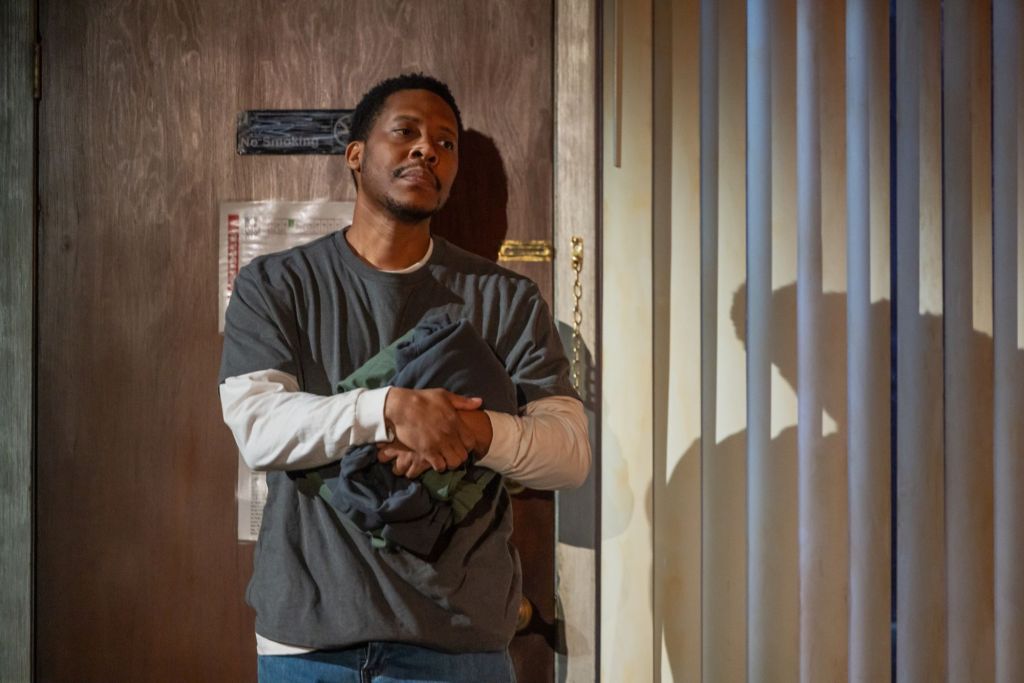
Instead of going to the party with R.C., both Agnes and Peter decide to hang out together and talk, feeling more comfortable getting to know each other than being in a larger crowd. It is during these exchanges and Peter’s staying overnight at Agnes’ invitation that her emotional neediness clarifies. When Jerry shows up, they argue and he hits Agnes. After Jerry leaves, Peter’s attentiveness draws her closer to him. As Agnes and Peter settle in and do drugs, they share secrets and bond. Increasingly Agnes’ perspective shifts. She accepts Peter’s world view and personal reality despite its extremism.
Though Peter says he should go, Agnes uses his hesitation to encourage him to stay, insisting upon it. She makes a symbolic gesture that clever viewers will note conveys her acceptance of Peter because of her emotional desperation more than a belief in his perspective and backstory.
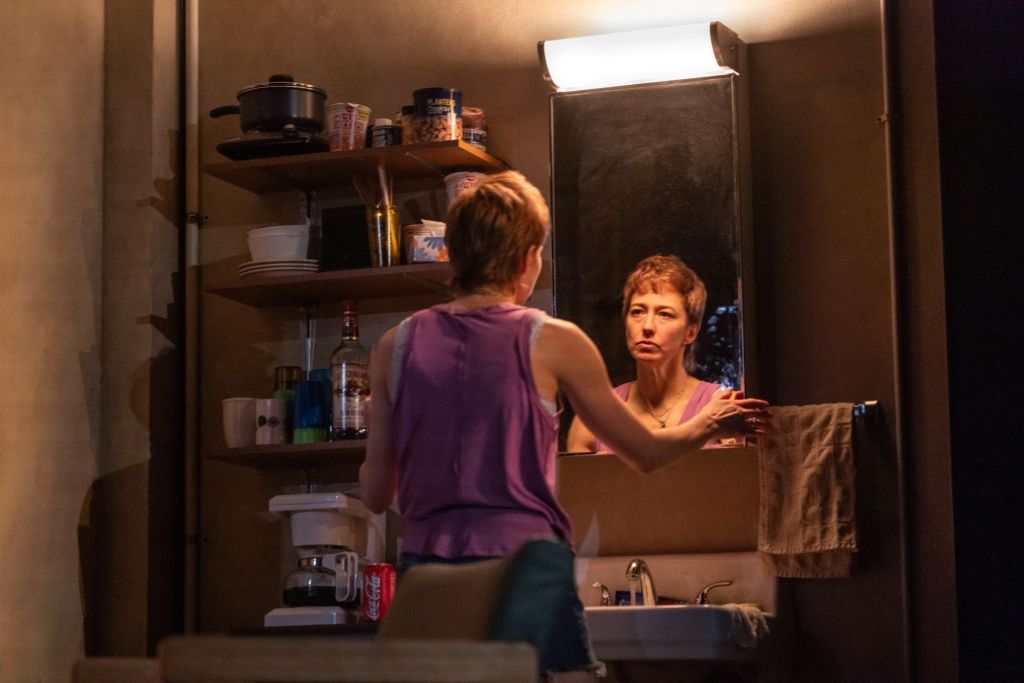
In the next act we see the extent to which Peter has made himself comfortable living with Agnes whose resolve against being with Jerry has strengthened because of her relationship with Peter. Because their concern and care for each other resonates with trust, Peter relaxes into himself. He examines his blood under a microscope and finds “proof” of a conspiracy theory that the government uses military vets and unsuspecting individuals as guinea pigs to experiment on. With convoluted half-truths about government cover-ups related to the war in Iraq, Oklahoma City bombing, the Tuskegee syphilis experiment and more, he panics, fearful that aphids bite him and Agnes, feed off their blood and infest their living space.
Convinced that egg sacks have been planted in him by doctors who also monitor and follow him with helicopters because he has gone AWOL, he persuades Agnes to accept his “bug” theory that he grounds in explanations. Together, they plan a way out of the infestation which has taken over their bodies and minds.
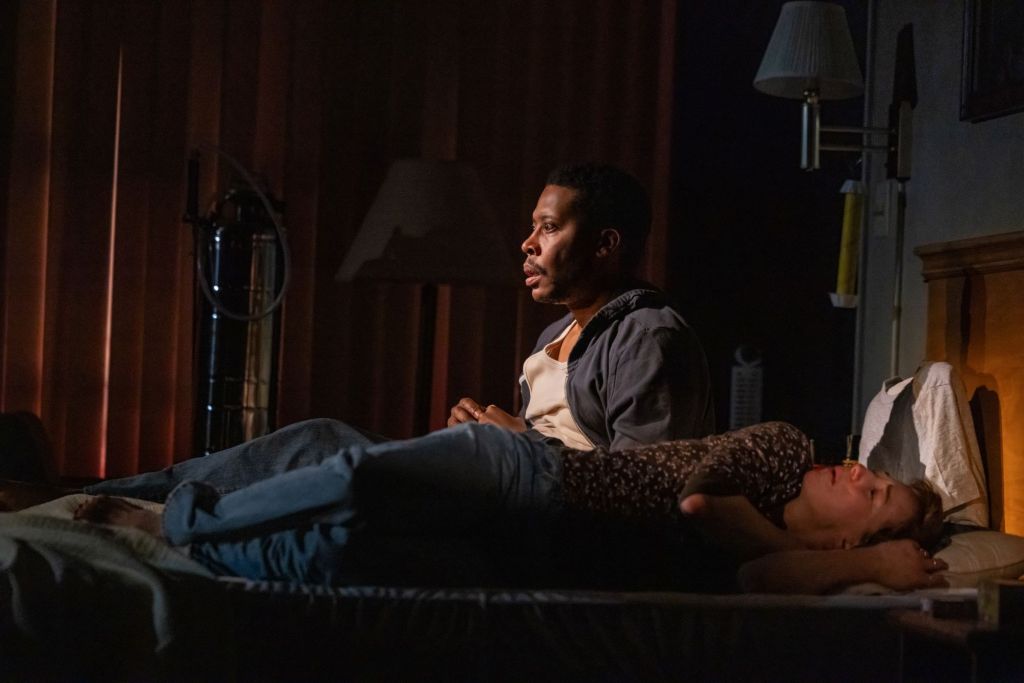
To complicate matters Dr. Sweet (Randall Arney) shows up and explains Peter’s medical case with R.C. and Jerry to legitimize taking Peter back with him to “Lake Groom.” Letts offers the intriguing possibility that there may be many truths about this situation. But without independent investigation and research, belief takes over. Whether Peter is part of an experiment and a guinea pig or not, Agnes expresses her love for him comforted by their bond which gives her life meaning. Within the horror of the infestation, they have found their emotional sustenance. Their relationship is their sanctuary from life’s pain.
Cromer’s vision and his shepherding of the fine performances by Coon and Smallwood make this stylized production all too real and terrifying. Thematically current, with various cultural attitudes related to government cover-ups, and conspiracy theories stoked by the questionable motives of those in power, the creative team’s efforts (Heather Gilbert’s lighting design, Josh Schmidt’s sound design) hit the sweet spot of relevance.
Though written decades ago, in Bug Letts intimates how and why certain women embrace what others deem to be their partner’s extremist perspectives. Wounded and seeking love, women like Agnes more easily accept their partner’s ideas, rather than search for facts and proof to dispute them. Governmental cover-ups of the truth fan the flames of extremist belief systems. The consequences can be socially and culturally devastating.
Bug runs 1 hour and 55 minutes with one intermission at the Samuel Friedman Theatre ( 47th St. between 7th and 8th) https://www.manhattantheatreclub.com/shows/2025-26-season/bug/
The Fine June Squibb Heads up the Stellar Cast of ‘Marjorie Prime’

When Marjorie Prime by Jordan Harrison opened Off Broadway in 2015, starring Lois Smith, it appealed as science fiction. Since then the use of various forms of artificial intelligence to support human behavior have become ubiquitous.
Reinforcing this new reality the playwright and director Anne Kauffman dusted off the prescient family drama and shined it up for its Broadway premiere with few changes to the script. Maintaining the prior production values, director Anne Kauffman works with set designer Lee Jellinek, sound designer Daniel Kluger and Ben Stanton’s lighting design to create the almost surreal and static atmosphere where AI takes over the lives of a family and exists for itself in the last scene.
The production runs at the Helen Hayes Theater with the superb cast of June Squibb, Cynthia Nixon, Danny Burstein and Christopher Lowell through February 15. They are the reason to see the revival.
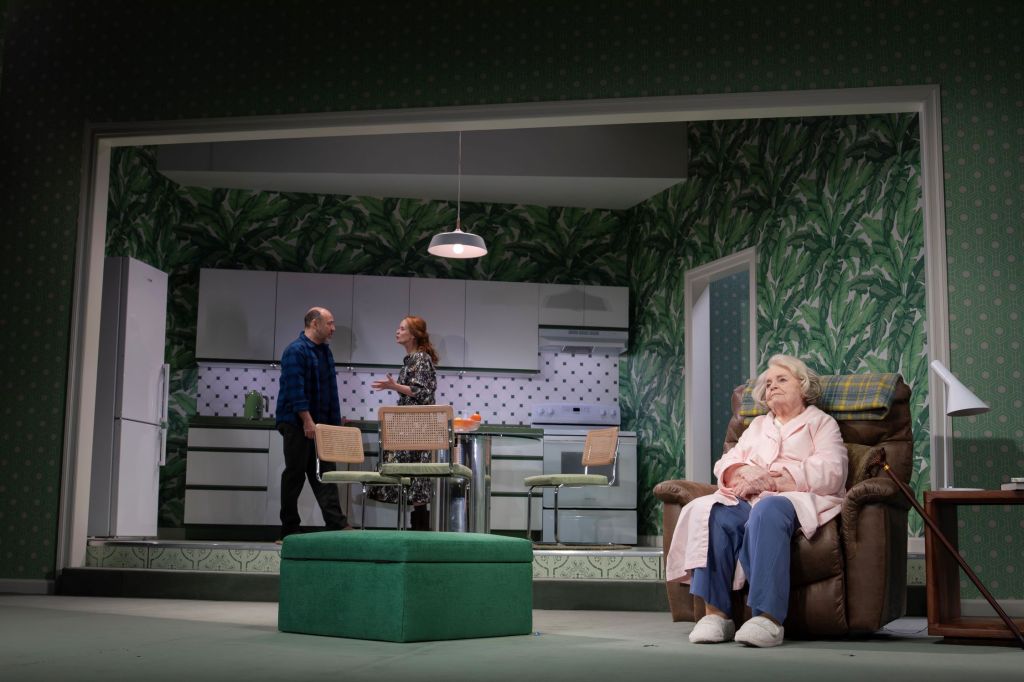
On one level the excellent performances outshine the themes of Marjorie Prime which deal with death, identity, the grieving process, artificial intelligence and more. The science fiction aspect of the play, so striking before, has diminished.
Yet, Harrison’s conceit that AI holograms might be used to reconcile the death and loss of a loved one still fascinates a decade later. Our culture fights death and aging with its emphasis on ageless appearance, looking 25-years-old at the chronological age of 90-years-old. Some other cultures have a healthier approach, viewing the acceptance of death and aging as a normal part of life cycles. However, with technological advancements, regardless of the culture or country, AI will have its uses in the battle against disease, dying, death and mourning.
The “Primes,” in Marjorie Prime are the spitting image of loved ones at a particular time in their lives. Created by the company Senior Serenity to help the bereaved get through inconsolable grief, Marjorie’s family believes a holographic duplicate of husband Walter will help her adjust to his death. The replica keeps her engaged, sentient and interactive, unlike passively watching TV.
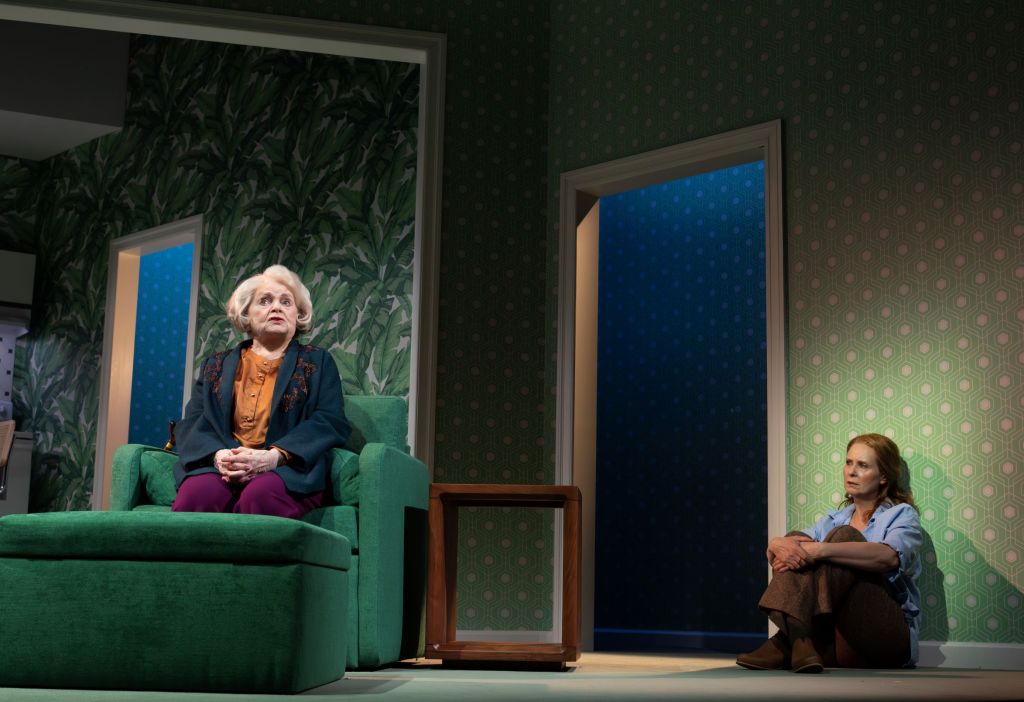
Walter Prime (Christopher Lowell) duplicates the younger, good-looking Walter in his thirties. Happily, he reminds her of the distant past, not the more recent, sick and dying Walter. The hologram’s programming and presence also help stir Marjorie’s memory, complicated with dementia. A work in progress, Walter Prime evolves based on the information that 85-year-old Marjorie (June Squibb), her daughter Tess (Cynthia Nixon), and son-in-law Jon (Danny Burstein), give him about Walter and Marjorie’s life together.
Thus, at the top of the play Walter Prime and Marjorie discuss movies they went to, for example, My Best Friend’s Wedding, which Marjorie has forgotten until Walter tells her the synopsis. The spry 96-year old Squibb, who made her Broadway debut playing one of the strippers in Gypsy (1959), portrays the spicy, funny, confused, chronologically younger woman with a failing memory, an irony that amused me to no end. Squibb is just terrific.
As Marjorie’s identity and memory dim, Walter Prime builds up the identity of Walter with her help. However, Harrison’s play raises questions about this process and never answers them. For example, how much information has Walter Prime been fed prior to his engagement with Marjorie, Jon and Tess? How can Marjorie be expected to keep track of information from before their marriage into their elderly years with her failing memory? Won’t she feed him incorrect details?
Indeed, facts and details shift and Marjorie confuses the truth. An imagined past becomes easier to accept with one’s husband “Prime” fed information by others. This problem never resolves. Neither does Tess’s incomplete acceptance of Walter’s function to stimulate Marjorie, the supposed benefit that Senior Serenity, the company that made him, affirms. The impatient, edgy Tess doubts Walter’s usefulness, but the upbeat Jon thinks that he helps improve Marjorie’s engagement and memory.
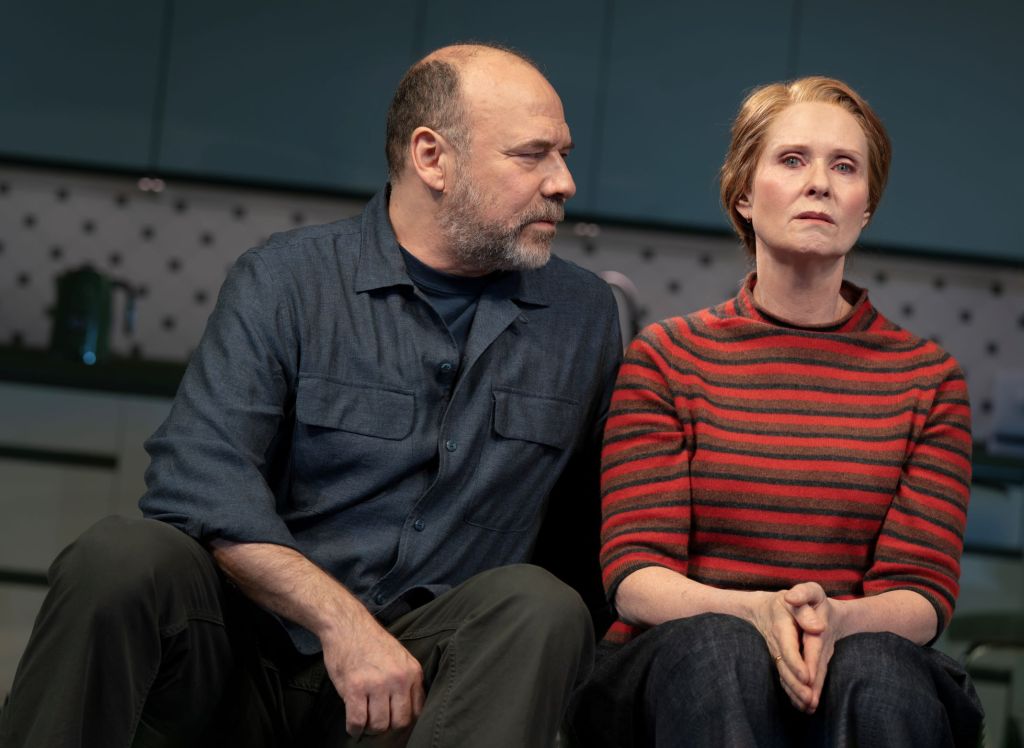
When Walter Prime’s presence annoys Tess, Jon accuses her of jealousy. Does Marjorie prefer Walter over Tess, who must nag her mother to eat and “obey” her in the reversal of mother/daughter, parent/child roles? Losing her autonomy Marjorie must rely on Tess and Jon in her living arrangements and personal care needs.
As Jon, Marjorie and Tess converse in Jellick’s minimalist, living room-kitchen combination that lacks futuristic style, Walter Prime sits on a sofa in the living room. He waits in a “listening mode” ready to interact when needed.
For his part Jon is positive about Walter’s impact on Marjorie. As the scene progresses, Tess mentions after an interval that her mother surprisingly recalls a situation long buried in pain. We learn the specifics of this later in the play. Some of the action referred to happens off stage. (i.e. Tess and Jon take Marjorie to the hospital after a fall).
Guided by the “Primes,” who Harrison sequences to move the action forward, time jumps. Marjorie has died and Jon and Tess engage Marjorie Prime to help console Tess and move her through her bleak depression and grief at her mom’s passing. After that we learn through Jon’s conversation with Tess Prime what transpired with Tess. In the various scenes Nixon’s Tess gives a heartbreaking speech about her mother, memory and imagination which sets up the rest of the play. Burstein’s Jon listens and responds with an uncanny authenticity. Both are superb.
Since the “Primes” “live” forever in holographic form until someone decommissions them, they occupy the home in the last scene. Jon is elsewhere, so Walter, Tess and Marjorie converse among themselves having been given life from their human counterparts as an ideal, evolved “being.” Eerie perfection.
Marjorie Prime runs 1 hour 15 minutes with no intermission at the Helen Hayes Theater on 44th Street until the 15 of February. 2st.com.
Lesley Manville and Mark Strong are Mindblowing in ‘Oedipus’
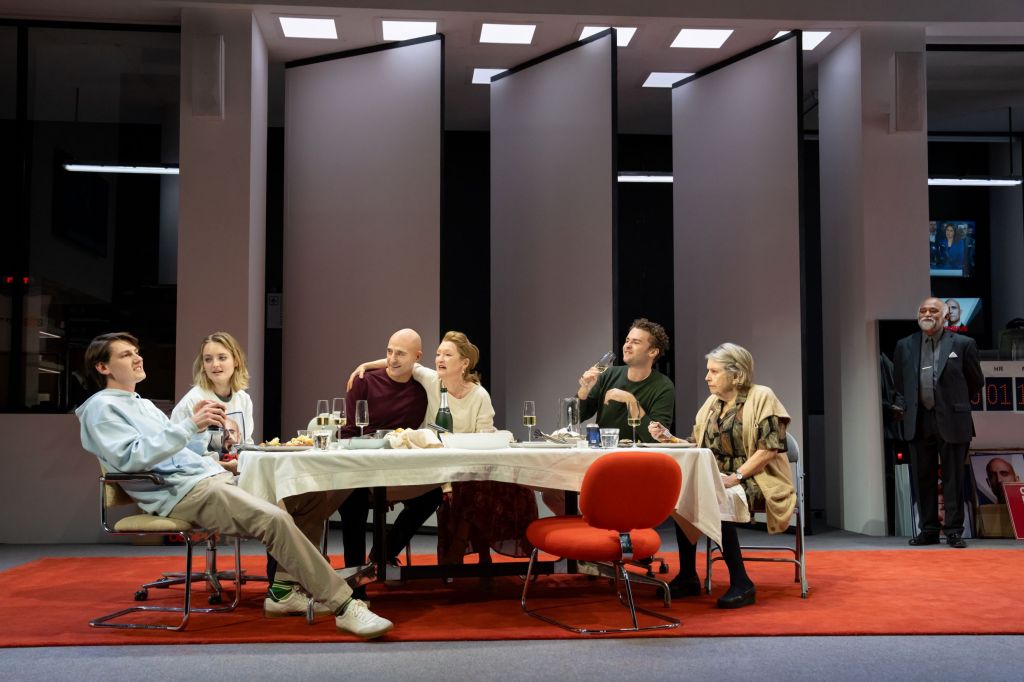
Just imagine in our time, a leader with integrity and probity, who searches out the truth, no matter what the cost to himself and his family. In Robert Icke’s magnificent reworking of Sophocles’ Oedipus, currently at Studio 54 through February 8th, Mark Strong’s powerful, dynamically truthful Oedipus presents as such a man. Likewise, Lesley Manville’s lovely, winning Jocasta presents as his steely, supportive, adoring help-meet. Who wouldn’t embrace such a graceful couple as the finest representatives to govern a nation?
Sophocles’ classic Greek tragedy, that defined the limits of the genre and imprinted on theatrical consciousness the idea that a tragic hero’s hubris causes his destruction, evokes timeless verities. In his updated version, Icke, who also directs, superbly aligns the characters and play’s elements with today’s political constructs. Icke retains the names of the ancient characters. This choice spurs our interest. How will he unravel Sophocles’ amazing Oedipus tragedy, especially the conclusion?
Cleverly, he presents Oedipus as a political campaigner of a fledgling movement that over a two-year period gains critical mass. The director reveals Oedipus’ backstory in a filmed speech to reporters on the eve of the election. The excellent video design is by Tal Yarden.
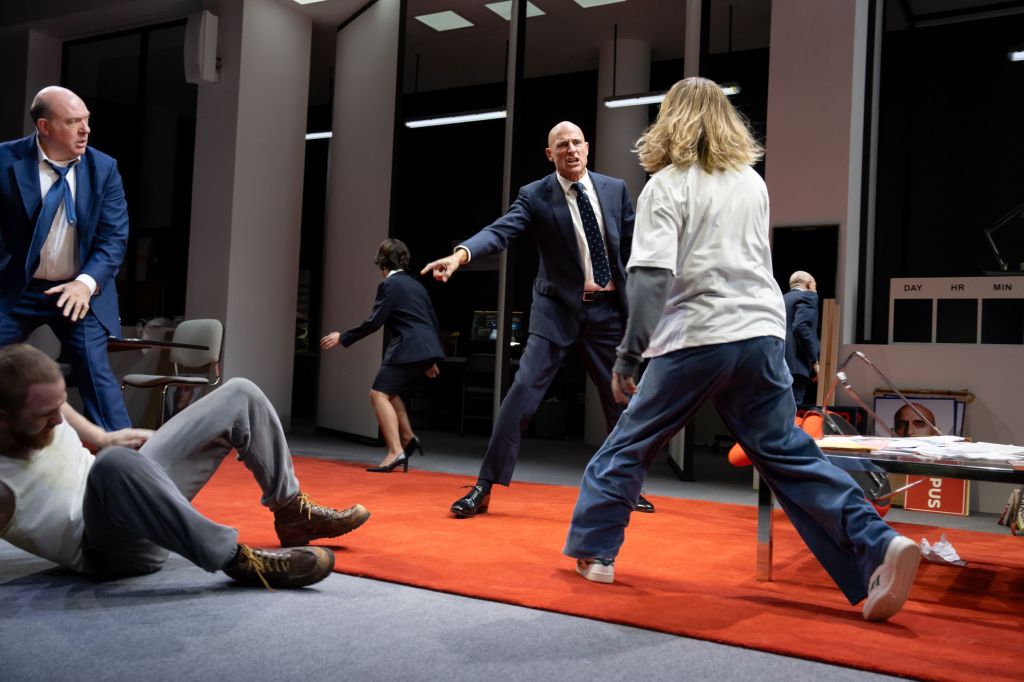
During his speech Oedipus goes off book and makes promises. Though his brother-in-law Creon (the fine John Carroll Lynch) tries to stop him, proudly Oedipus shows himself a man of his word. He galvanizes the crowd when he states he will expose the lies of his opponents. Not only will he reveal his birth certificate (an ironic reference to President Obama), he will investigate the mysterious death of Laius. The former leader from decades ago married Jocasta when she was a teenager. After Laius’ death, Oedipus meets and marries Jocasta despite their age difference. Over the years they raise three children: Antigone (Olivia Reis), Eteocles (Jordan Scowen) and Polyneices (James Wilbraham).
How has Oedipus become the people’s candidate? Without ties to the political system, he speaks a message of reform and justice. Indeed, he will override the corrupt, derelict power structure. Former leaders served their rich donors and let the other classes suffer. Oedipus runs on a mandate of equity and change.
After Oedipus’ speech, the curtain opens to reveal the campaign headquarters that staff gradually dismantles as the campaign phase ends. To signify the next phase the countdown clock, placed conspicuously in scenic designer Hildegard Bechtler’s headquarters, ticks away the seconds down to the announcement of the winner. As the clock ticks toward zero (an ironic symbol), the contents of the campaign war room are removed like the peeling of an onion to its core. As the destined announcement of the winner nears, gradually, the revelation of Oedipus’ true identity happens. Icke has synchronized both concurrently.
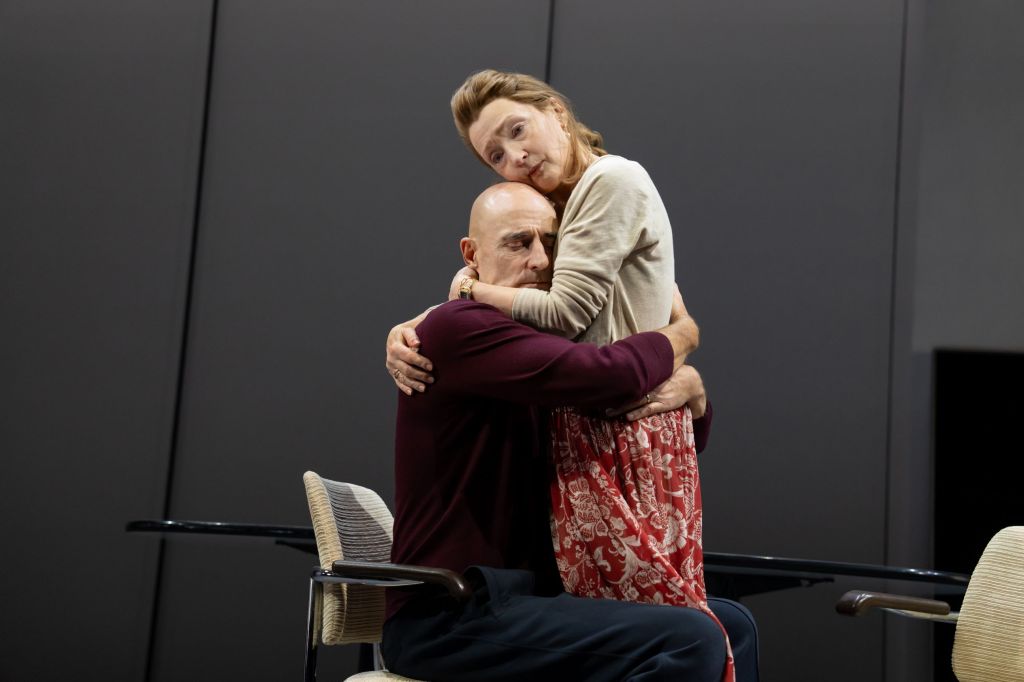
Icke’s anointed idea to shape Oedipus as a newbie politician, whose actions and words are singularly unified in honesty, resonates. He represents the iconic head of state we all yearn for and believe in, forgetting leaders are flesh and blood. Of course Icke’s flawed tragic hero, like Sophocles’ ancient one, results in Oedipus’ prideful search for the truth of his origin story and Laius’ cause of death.
Oedipus’s determination is spurred by the cultist future-teller Teiresias (the superb Samuel Brewer). His authoritative and relentless drive to prove Teiresias wrong, despite warnings from Creon and Jocasta, shows persistence and courage, positive leadership qualities. On the other hand, Oedipus doesn’t realize his search has a dark side and his persistence is stubbornness prompted by a prideful ego. This stubbornness causes his destruction. His pride leaves no way out for him but punishment.
Because the truth is so horrid, Strong’s Oedipus can’t suffer himself to cover it up. In searching to validate his true self, he discovers the flawed human that Teiresias proclaims. Indeed, he is more flawed than most. He is lurid; a man who killed his father, married his mother, and had three children born out of love, lust and incest. He can never be the leader of the nation. He must hold himself accountable after he sees his debased true self. How Mark Strong effects Oedipus’ self-punishment is symbolic genius. Clues to Jocasta’s end are sneakily tucked in earlier.
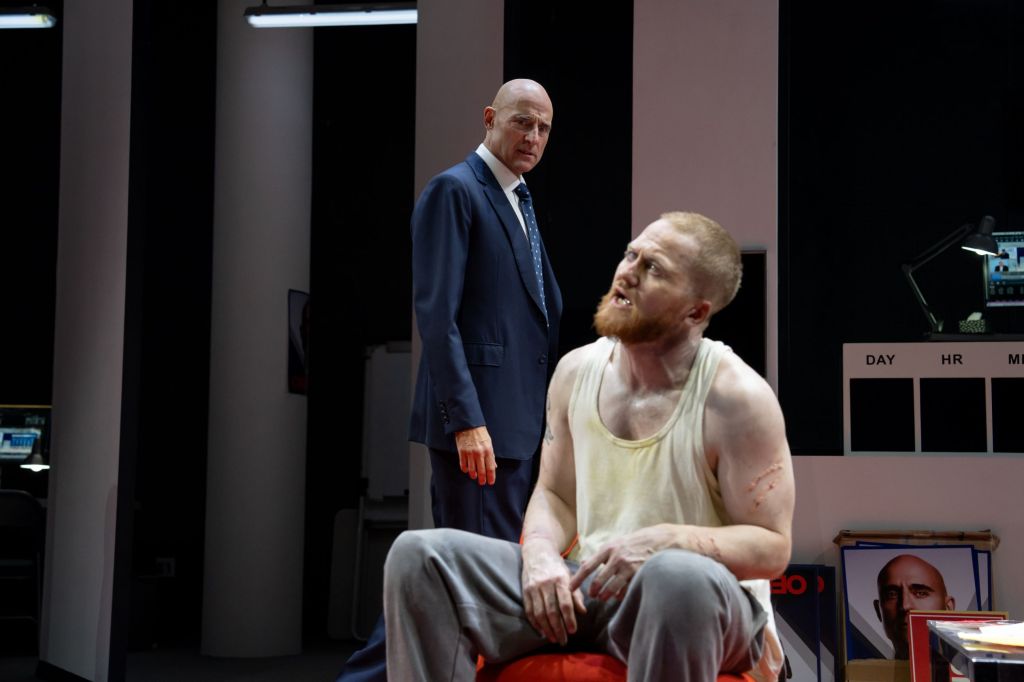
Because of Icke’s acute shepherding of the actors, and the illustrious performances of Manville, Strong and Brewer, with the cast’s assistance, we feel the impact of this tragedy. The love relationship between Jocasta and Oedipus, drawn with two passionate scenes by Manville and Strong, especially the last scene, after they acknowledge who they are with one, long, silent look, devastates and convicts.
Those who know the story feel a confluence of emotions at the irony of mother and son lustily loving and pursuing their desire for each other off stage, while Oedipus delays speaking to his mother Merope (Anne Reid). Manville and Strong are extraordinary. Both actors convey the beauty, the wildness, the uniqueness and enjoyment of their characters’ love, that is unlike any other.
In the last scene when Strong and Manville untangle from their hot grip, clinging to each other then letting go, they acknowledge their characters’ unfathomable and great loss. Manville’s Jocasta crawls away to reconcile the enormity of what she has done. In her physical act of crawling then getting up, we note that fate and their choices have diminished their majestic grace. Their sexual likeness to animals, Oedipus ironically referenced earlier with family at the celebration dinner. Through the physical staging of the final sexual scene, Icke recalls Oedipus’ earlier comparison.
As a meta-theme of his version Icke reminds us of the importance of humility. The more humanity presents its “greatness,” the more it reveals its base nature.
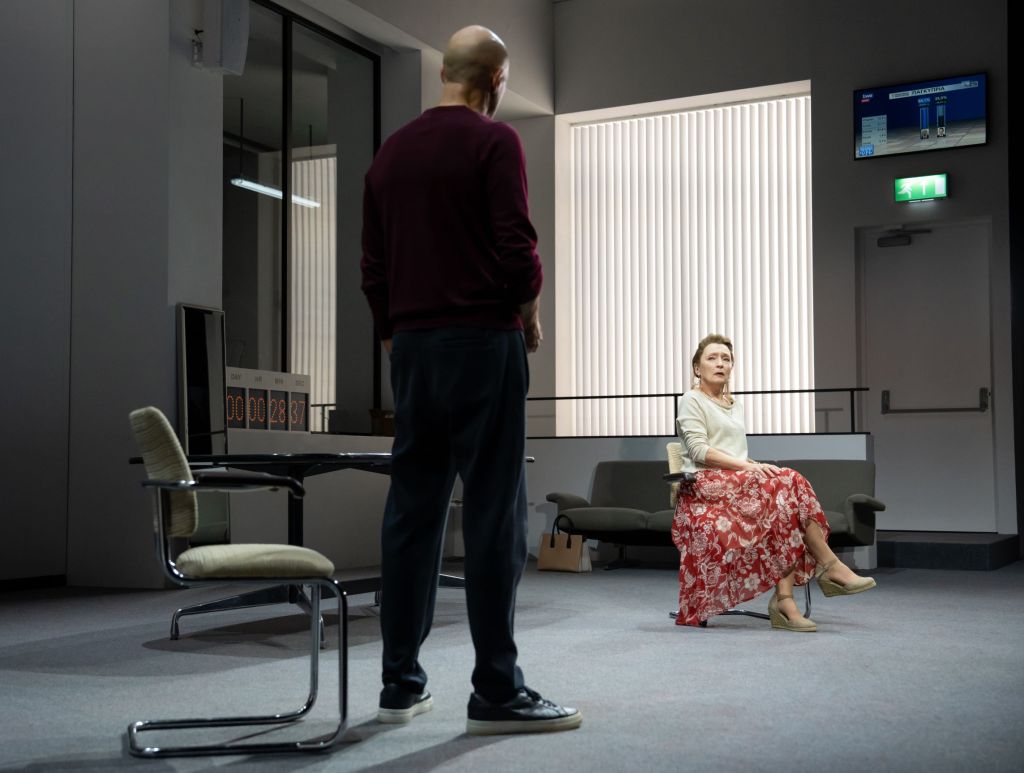
All the more tragedy for Oedipus’ supporters and the unnamed country. Because fate catches up with him and conspires with him to cut off his acceptance of the position he rightfully won, the nation loses. All the more sorrow that the truth and his honest search is what Oedipus prizes, even more than his love for Manville’s Jocasta, the brilliant, equivalent match for Strong’s Oedipus.
Rather than live covertly hiding their actions, both Oedipus and Jocasta hold themselves accountable with a fatalistic strength and nobility. Initially, we learn of her strength as Jocassta tells Oedipus about her experience with the evil Laius (a reference to current political pedophiles and rapists). We see her strength in her self-punishment. Likewise, Oedipus’ strength compels him to face his deeds where cowards would cover up the truth, step into the position and govern autocratically censoring and/or killing their opponents who would “spill the beans.” Oedipus is not such a man. It is an irony that he is a moral leader, but is unfit to lead.
Icke’s masterwork and Manville and Strong’s performances will be remembered in this great production, filled with ironic dialogue about sight, vision, blindness and comments that allude to Oedipus and Jocasta’s incestuous relationship and downfall. Those familiar with the tragedy will get lines like Jocasta’s teasing Oedipus, “You’ll be the death of me,” and her telling people she has four children: “two at 20, one at 23, and one at 52.”
Though I prefer Icke’s ending in darkness with the loud cheers of the supporters, I “get” why Icke ends Oedipus in a flashback. In the very last scene the date is 2023, the beginning of the end. We watch the excited Oedipus and Jocasta choose the rented space (the stripped stage) for their campaign headquarters. The time and place mark their disastrous decision which spools out to their destruction two years later. I groaned with Jocasta’s ironic comment, “It feels like home.”
Her comment resonates like a bomb blast. If Oedipus had not had the vision of himself as the ideal, righteous leader with truth at his core, the place where they are “at home” never would have been selected. Oedipus, a humble mortal, never would have run for high office.
Oedipus runs 2 hours with no intermission at Studio 54 though February 8. oedipustheplay.com.
‘Liberation’ Transfers to Broadway Solidifying its Excellence
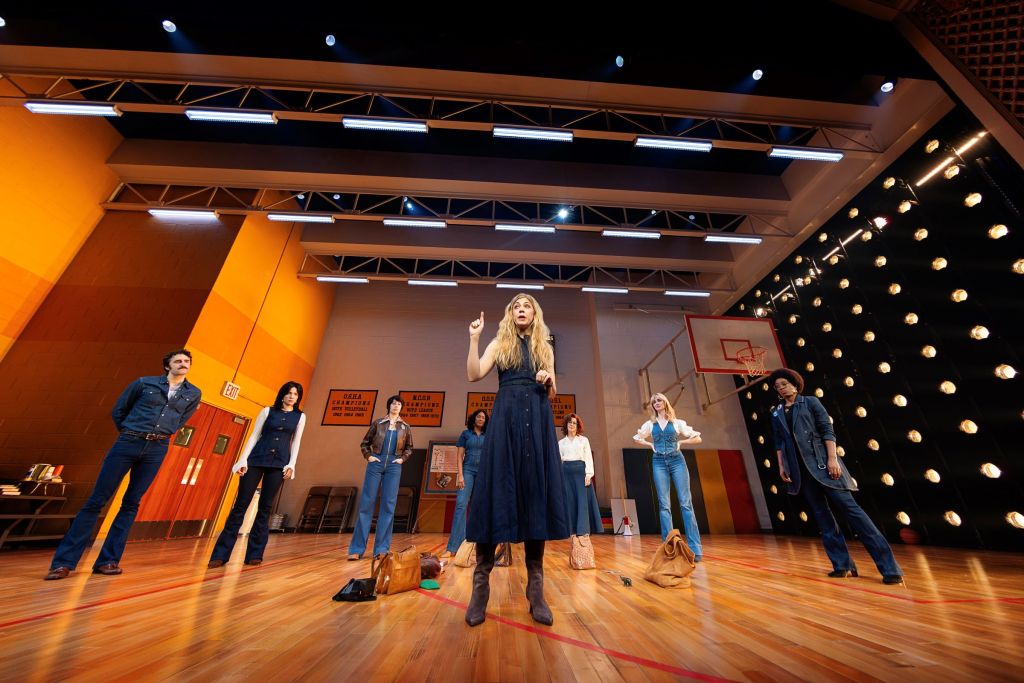
Bess Wohl’s Liberation directed by Whitey White in its transfer to Broadway’s James Earl Jones Theater until January 11th doesn’t add references to the 2024 election nor the disastrous aftermath. However, the production is more striking than ever in light of current events. It reaffirms how far we must go and what subtle influences may continue to derail the ratified ERA (Equal Rights Amendment) from becoming settled law.
To draw parallels between the women’s movement then and now, Wohl highlights the “liberation” of the main character/narrator Lizzie, an everywoman, with whom we delightfully identify. With Lizzie (the superb Susannah Flood) we travel along a humorous journey of memory and self-reflection as she evaluates her relationship to her activist mom, who gathered with a community of women in Ohio, 1970 to “change the world and themselves.”
Wohl’s unreliable, funny narrator, directs the action and also is a part of it. The playwright’s smart selection of Lizzie as a device, the way in to tell this elucidating story about women evolving their attitudes, captures our interest because it is immediate. Her understanding is ours, her revelations are ours, her “liberation” is also ours. Lizzie shifts back and forth in time from the present to 1970-73, and back to the present. One of the questions she explores concerns why the women’s movement cascaded into the failures of the present?
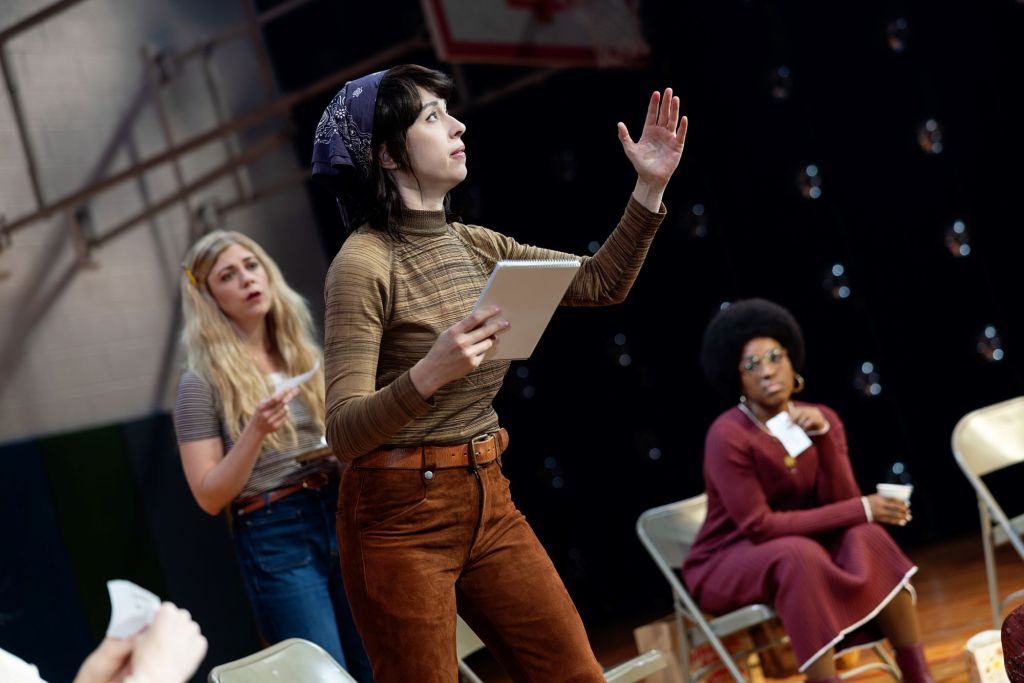
Assuming the role of her mother, Lizzie enacts how her mom established a consciousness-raising group. Such groups trended throughout the country to establish community and encourage women’s empowerment. Six women regularly meet in the basement basketball court at the local rec center which serves as the set throughout Liberation, thanks to David Zinn’s finely wrought stage design. The group, perfectly dressed in period appropriate costumes by Qween Jean, includes a Black woman, Celeste (Krisolyn Lloyd), and the older, married Margie (Betsy Aidem).
Having verified stories with her mom (now deceased), and the still-living members of the group, Lizzie imagines after introductions that the women expansively acknowledge their hope to change society and stand up to the patriarchy. As weeks pass they clarify their own personal obstacles and their long, bumpy road to change, with ironic surprises and setbacks.
For example, Margie voices her deeper feelings about being a slavish housewife and mother. After months of prodding, her husband actually does the dishes, a “female” chore. Margie realizes not only does she complete housework faster and better than he, but her role as housewife and nurturer satisfies, comforts and makes her happy. Betsy Aidem is superb as the humorous older member, who introduces herself by announcing she joined, so she wouldn’t stab her retired husband to death.

Some members, like Sicilian-accented Isidora (Irene Sofia Lucio), and Lloyd’s Celeste, belonged to other activist groups (e.g. SNCC). Circumstances brought them to Ohio. Isidora’s green-card marriage needs six more months and a no-fault divorce, not possible in Ohio. Celeste, a New Yorker, has moved to the Midwest to take care of her sickly mom. The role of caretaker, dumped on her by uncaring siblings, tries her patience and stresses her out. Expressing her feelings in the group strengthens her.
Susan (Adina Verson) is an activist burnt out on “women’s liberation.” Frustrated, Susan has nothing to say beyond “women are human beings.” She avers that if men don’t treat women with equality and respect, then women’s activism is like “shitting in the wind.”
Lizzie and Dora (Audrey Corsa) discuss how they suffer discrimination at their jobs. Despite her skill and knowledge Lizzie’s editor demeans her with “female” assignments (weddings, obituaries). Dora’s boss promotes men less qualified and experienced than Dora. Through inference, the playwright reminds us of women’s lack of substantial progress in the work force. Very few women break through “glass ceilings” to become CEOs or achieve equal pay.
Act I engages because of the authentic performances and various clarifications. For example, Black women have a doubly difficult time at overturning the patriarchy. Surprisingly, at the end of the act a man invades their space and begins shooting hoops. Is this cognitive dissonance on Lizzie’s part for including him? Have women so internalized male superiority that they become misdirected back to the societal default position of subservience? Is this what thwarted the movement?

When Lizzie refers to the guy as Bill, her father (Charlie Thurston), we get the irony. How “freeing” that her mom meets her dad as she advocates for liberation from male domination, only to be dominated by an institution (marriage) constructed precisely for that purpose.
Act II opens with additional dissonance. To extricate themselves from the psychological trauma of men’s objectification of their bodies, the women free themselves from their clothes. Sitting in the nude, each discusses what they like and dislike about their bodies. The scene enlivened heterosexual men in the audience, an ironic reinforcement of objectification. We understand that these activists try to overcome body shame that our commercial culture and men use to manipulate women against themselves and each other (surgical enhancements, fillers, face lifts, etc.). On the other hand the scene leaves a whiff of “gimmick” in the air, though Whitney White directs it cleverly.
After the nude scene Lizzie reimagines how her mom and Bill fell in love. To avoid discomfort in “being” with her father, she engages Joanne (Kayla Davion), a mother who drops into the rec room looking for her kids’ backpacks. Through Bill and Joanne’s interaction, we note the relationship that Lizzie keeps secret. When Lizzie finally reveals she is engaged, the dam bursts and each of the women reveals how they have been compromising their staunch feminist position. One even admits to voting for Nixon with a barrage of lame excuses.
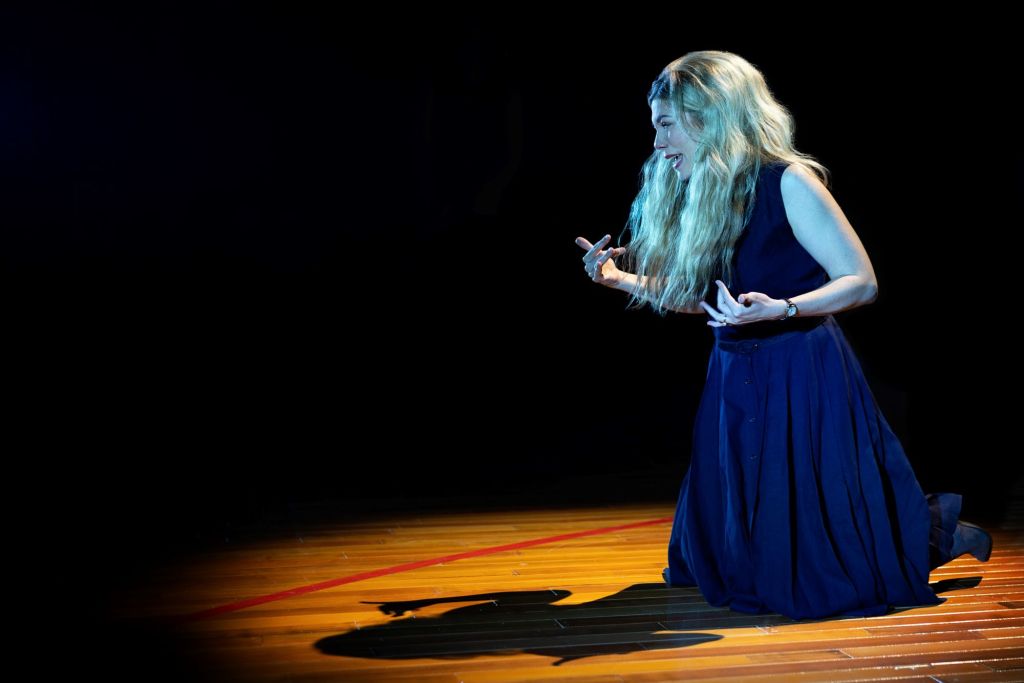
This scene is a turning point that Lizzie uses to explore how women in the movement may have sabotaged themselves at advancing their rights. Reviewing her mother’s choice to get married and co-exist as a feminist and wife, Lizzie reimagines a conversation with her deceased mother played by Aidem’s Margie in an effecting performance. When Lizzie asks about her mom’s happiness, Margie kindly states that Lizzie has gotten much of her story wrong.
Lizzie condemns feminism’s failures. This is the patriarchy, internalized by Lizzie, speaking through her. With clarity through Margie’s perspective, Wohl reminds us that all the stages of the feminist movement have brought successes we must remember to acknowledge.
Lizzie realizes the answer to whether one might be “liberated” and fall in love and “live equitably” within an institution which consigns women to compromise their autonomy. It depends upon each individual to make her own way. Her investigation about her mother’s consciousness-raising group establishes the first steps along a journey toward “liberation,” that she and the others will continue for the rest of their lives.
Liberation runs 2 hours, 30 minutes with one intermission at the James Earl Jones Theater through Jan. 11th. liberationbway.com
Laurie Metcalf is Amazing in ‘Little Bear Ridge Road’
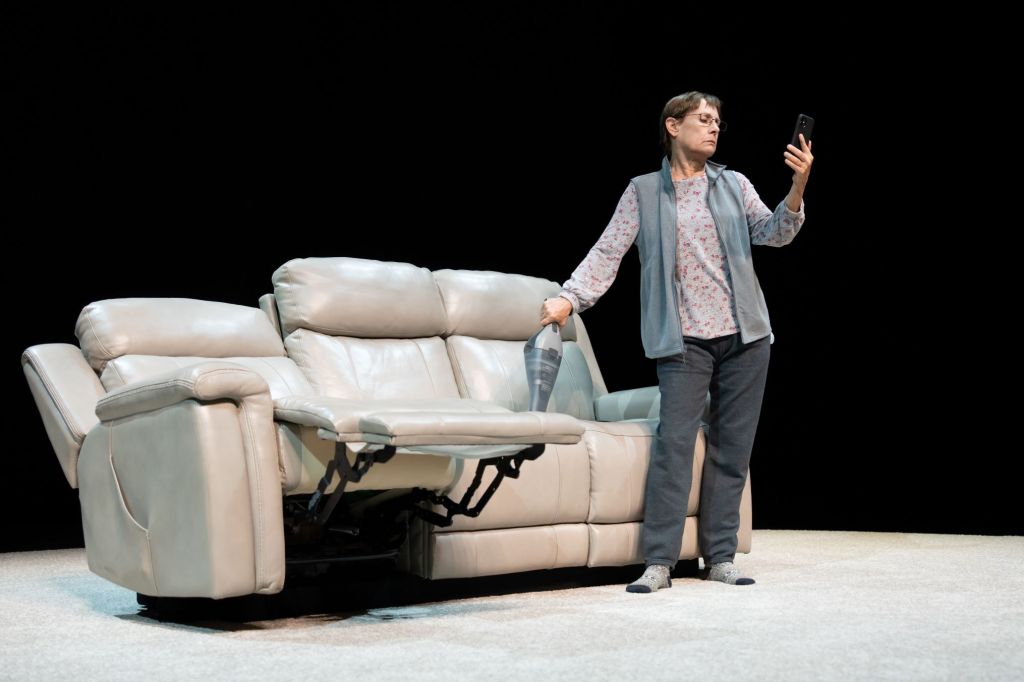
On 12 acres of property in Idaho on the top of the ridge, the sky is so intense it makes Ethan (Micah Stock) panicky because he feels that his life is insignificant against the vastness of the galaxy glittering before him. Sarah (Laurie Metcalf), Ethan’s aunt who owns the property and appreciates the nighttime view tells him she “thought once about buying a telescope, but you know. Then I’d own a telescope.” The audience laughter responding to Metcalf’s pointed, identifying statement that reveals her edgy, funny character peppers Samuel D. Hunter’s powerful, sardonic Little Bear Ridge Road currently at the Booth Theatre.
Metcalf is terrific as Sarah who delivers comments like darts hitting the bullseye and evoking laughter because her words are heavy with authenticity. Her statements convey meaning and pointedly eschew the gentility of polite conversation. Micah, Sarah’s nephew, is withdrawn, remote and masked, not only because the play begins during the COVID-19 pandemic, but because he wears his soul damage on the exterior with a covering of silence that withholds speech. Interestingly, these two estranged family members, one a nurse who doesn’t even nurture her own wounds, and the other, a self-damaged young man of thirty, who can’t really get out of his own way, eventually get along,
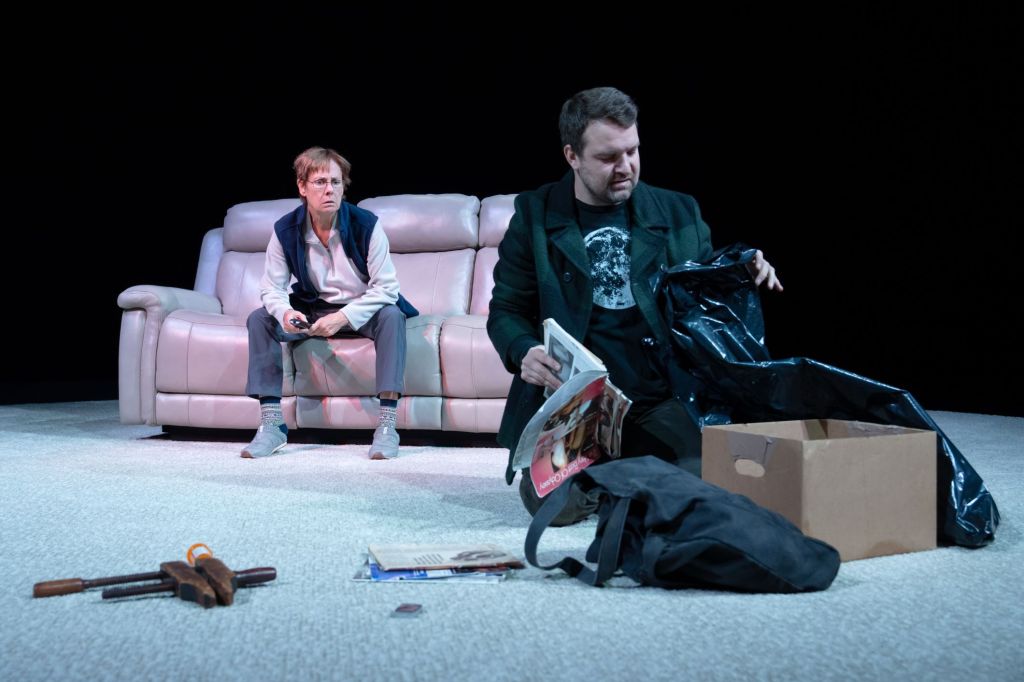
With this Broadway debut Hunter (The Whale, A Bright New Boise) weaves a poignant, humorous, fascinating dynamic. Metcalf and Stock inhabit these individuals with humanity and a fullness of life that is breathtaking.
Directed crisply with excellent pace and verve by Joe Mantello, Hunter’s comedic drama that premiered at Steppenwolf Theater Company, confronts human isolation and failed familial relationships. Hunter presents individuals who confuse self-supporting independence with misguided self-reliance. With spare, concise dialogue the playwright explores how Metcalf’s Sarah and Stock’s Ethan rekindle their sensitivity and open up while nursing their fractured, self-victimized souls, to help each other without acknowledging it as help.
Finally, Hunter’s dialogue has flourishes of well-placed poetic grace and rhythm. Within its meta-themes about human beings struggles with themselves, it’s also about knowing when to let go to encourage another’s growth.

Aunt Sarah and nephew Ethan have an ersatz reunion, when Ethan’s father, Sarah’s brother, dies and leaves the nearby house and estate to Ethan to dispose of. Estranged from his father and from her for a number of years, Ethan, who is gay, lived in Seattle with a partner, who emotionally abused him and self-medicated with a cocaine habit. Eventually, they split. Graduating from university with an M.F.A. in writing, Ethan has drifted, stunned by his devastating childhood where he was raised by an addict father, since Ethan’s mother abandoned the family when he was little. How does Ethan learn not to duplicate his problematic relationship with his father, with love relationships with other older men?
For her part Sarah remained in Idaho near where she was born and worked as a nurse during and after her husband left her. Fortunately or unfortunately, they had no children. This means that she and Ethan are the only Fernsbys left on the planet, dooming their family line to extinction, which according to Ethan seems pathetic. Selling her home in Moscow, Sarah tells Ethan she moved to a more remote area because “It suits me better. Not being around—people.”
With her prickly, self-reliance and proud stance refusing help, Sarah has taken care of her house and property, worked, organized documents and paperwork for Leon (Ethan’s dad, her brother). She generously gave Leon money to help him with his bills. When Ethan affirms that was a bad idea because his addict father used it for his meth habit, Sarah states she doesn’t know what he used it for. After all, Leon told her that he never did meth in front of Ethan. The truth lies elsewhere.

As the pandemic passes and circumstances improve, the relationship between aunt and nephew also improves. They communicate more intimately. They watch a TV series and comment about the characters. The dialogue is funny and Sarah and Ethan become family. Assumptions and mistaken views are dismissed and overturned. Realistic expectations fill in the gaps. A surprise occurs when Ethan meets and forms an attachment with James (the excellent John Drea).
Hunter uses James as a catalyst, who provokes a turning point to continue the forward momentum of the play. James comes from a more privileged, loving background and is studying at a nearby university to be a star-gazer for real, an astrophysicist. With eloquence James explains the magnificence of Orion’s Belt to Ethan, as it relates to our sun. Sarah welcomes him and encourages his relationship with Ethan, until once more circumstances gyrate in another direction, all perfectly unfolding with the emotion of the characters.
Mantello arranges the interlocking dynamic among Sarah, Ethan and then James, center stage on a “couch in a void.” From there the characters converse, sit, enter and leave stage right (to an invisible kitchen), stage left (to bedrooms). The recliner couch on a turntable platform in different positions establishes the passage of time between 2020 and 2022. Scott Pask’s set and the lighting by Heather Gilbert are symbolic and interpretive. Our focus becomes the characters and the actors’ exceptional portrayals as they struggle to find a home with each other and themselves, until the threads of grace in their alignment come to a necessary end.
After all, the Fernsbys have to have a legacy, if not in offspring, then in words. And the respite and connections they find together talking and watching TV on a “couch in void” becomes the place where Ethan’s legacy in writing is born, and the Fernbys legacy prevails.
Little Bear Ridge Road runs 1 hour 35 minutes with no intermission at the Booth Theater through February 15th littlebearridgeroad.com.
‘Chess,’ a Terrific Aaron Tveit, Lea Michele, Nicholas Christopher Electrify a Less Troubled Book
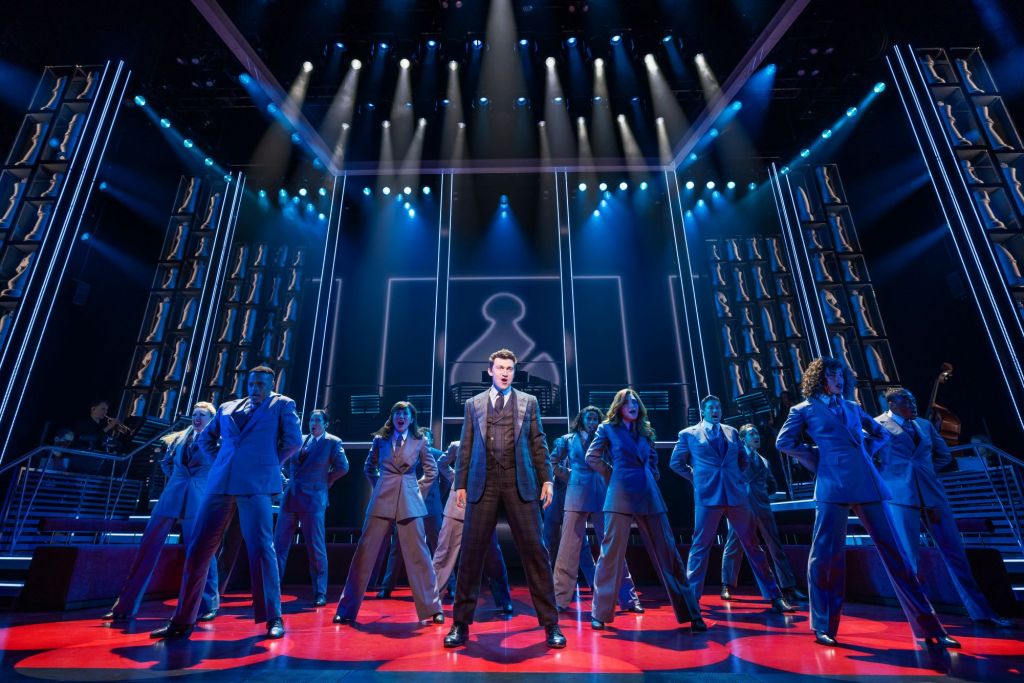
In all of the adventures of the musical Chess, from concept album to initial production in the West End (1986), to its Broadway premiere (1988), concerts, revivals, recordings and tours up to the present, there might be an object lesson in how to develop a winning book. The memorable score by Abba’s genius collaborators, Benny Andersson and Björn Ulvaeus will always resonate. But the musical with lyrics by Ulvaeus and Rice, and new book by Danny Strong may have alighted on the merry-go-round of success never to return to a troubled past. The musical currently runs at the Imperial Theatre until May 3rd.
In its current iteration, the Broadway revival, starring three powerhouses in the lead roles, makes Tim Rice’s idea about a Cold War musical more coherent and interesting. This seems especially so if one lived through the hell of President Reagan’s escalating nuclear arms race with the Soviet Union, and saw the 1983 TV movie The Day After (about nuclear annihilation). Watched by 100 million viewers in one sitting, the TV movie, also watched by Reagan, allegedly influenced him against continuing proliferation.
Strong’s book ties in to the arms race, SALT talks, CIA and KGB compromises, and a controversial, frightening event (Able Archer ’83). All become aligned with two chess matches and chess gambits played by the Soviets and Americans to enable communications during a dangerous time in the 1980s, when nuclear war seemed imminent and chess was used as a form of negotiation to save face and make deals (“Difficult and Dangerous Times”).

To frame the story, clarify the events with a through-line, and provide a critique, Strong presents this version of Chess through the perspective of an omnipotent narrator, The Arbiter, superbly played by Bryce Pinkham. Snapping his fingers to move the action, he introduces the players, as he selects and explains the events which the company enacts. Invariably, he shares his opinions. Accordingly, the characters subtly move around like chess pieces (the metaphor) in the Cold War game.
This is an important conceit that can be overlooked as one becomes caught up in the powerful music, well choreographed dances, and love triangle between Freddie (Aaron Tveit), Florence (Lea Michele) and Anatoly (Nicholas Christopher). We thrill to their sterling voices and the ensemble’s striking dances. Amidst the glory, the emotion and the angst, Bryce Pinkham’s Arbiter holds the Cold War musical together and gives it a new coherence. He dishes up humor and irony as he tosses off snarky one-liners that sometimes relate the events of the past to events in the present. In one aside he infers the US and NATO countries are in a second Cold War.

Accompanied by the ensemble, Pinkam’s Arbiter presents a wild and woolly number in which he introduces himself as a new character, and critiques his song (“The Arbiter”) with a confident, “I’m going to crush it.” Pinkham does “crush it,” then his character arbitrates the first chess match between Freddie and Anatoly. After the match Freddie’s Second, Florence, eventually falls out of love with wired Freddie (“Pity the Child #1), and into love with the depressive Anatoly (“Where I Want to Be”). The struggle for all to remain on an even keel against the backdrop of the spy games creates the musical’s tension and generates the fabulous songs.
In Strong’s book whether one agrees with the character’s attitude or not, Pinkham’s Arbiter presents clarity and the symbolism that the Soviets vs. the Americans “Cold War” was an overarching chess match containing a series of smaller chess matches between the players, even between Anatoly’s two love interests, his wife, Svetlana (Hannah Cruz) and Florence. Their powerful duet (“I Know Him so Well”), strikes gold in Act II. After Anatoly defects to England and lives with Florence, he plays against the Soviet champion Viigand in Bangkok (Act II), which underscores the frightening Able Archer 83 event.

In Strong’s version, the CIA agent Walter de Courcey (Sean Allan Krill), and KGB agent and Anatoly’s chess mentor Alexander Molokov (Bradley Dean), negotiate compromises and deals behind the scenes of the first match and the second. Of course, this is for the purpose of winning the larger game of chess which is a deescalation of nuclear weapons to insure the safety of the planet. Indeed, there were real chess matches between the countries, and Pinkham’s Arbiter infers this with his suggestion that some of these events are true. The video projections go a long way toward filling in the gaps in information and de-mystifying what happened during the time befor the Berlin Wall fell.
Chess is acutely, incisively directed by Tony-award winner Michael Meyer (Swept Away, Hedwig). Meyer stages many of the numbers with the concert style approach. Kevin Adams’ lighting design of blues, reds, purples, yellows, effectively dramatizes the dynamic between and among the specific characters, the Soviets and Americans, and the shift of settings, i.e. Bangkok in Act II.

David Rockwell’s multi-tiered scaffolding enhanced by neon and chrome gives the production a stark, period look which is softened for an intimate bedroom scene between Florence and Anatoly with minimal props. Video by Peter Nigrini enhances the historical background needed to provide context, i.e. the Hungarian Revolution, or add interest. Lorin Latarro’s energetic, at times mannered (“Difficult and Dangerous Times” ), at times wild, erotic (“One Night in Bangkok”), energetic movement and dance enhance the ensemble’s pivotal numbers. These reflect the stereotypical thinking of that time, the cold war policy and the feverish, hot, atmosphere in Bangkok where the second chess match is held.
Appropriately, the ensemble’s tailored, grey suits (Tom Broecker), reflect the somberness of countries at war with the threat of their antagonisms heating up. The leads in dark colors contrast with the ensemble, and Anatoly’s wife dressed in maroon “leather.”
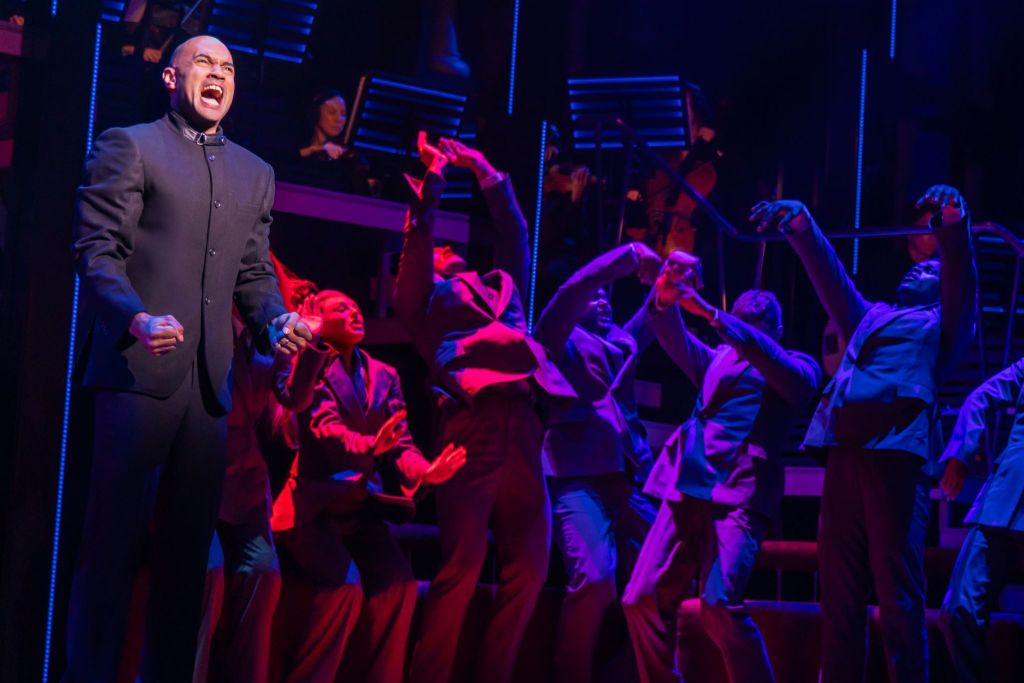
The phenomenal score played by an 18-20 piece orchestra with Ian Weinberger’s musical direction, and Anders Eljas and Brian Usifer’s orchestrations power up the ballads, pop rhythms and near operatic ensemble numbers gloriously. Finally, the orchestra, carefully positioned onstage by the back wall, is always witnessed by the audience who engages with it.
The sexy “One Night in Bangkok” received applause of recognition by the audience with the first notes of the charted global hit song (1984-85), as the exotic dancers and Tveit rocked Latarro’s movements with mastery. The superbly performed numbers by Tveit (“Pity the Child #2”), Michele (“Someone Else’s Story,” “Nobody’s Side”) and Christopher’s “Where I Want to Be” and “Anthem,” sung with the ensemble, are show-stoppers.
Finally, as the games conclude and presumably the first Cold War is over, Pinkham’s Arbiter sings “One Less Variation.” Then, Tveit, Michele, Christopher, Pinkham and the company end with the warning lyrics from “Nobody’s on Nobody’s Side”: “Never stay (a minute too long), don’t forget the best will go wrong, nobody’s on nobody’s side.”
Chess runs 2 hours 45 minutes with one intermission through May 3 at the Imperial Theater. chessbroadway.com.
Bobby Cannavale, James Corden, Neil Patrick Harris Are LOL in ‘Art’

Superb acting and humorous, dynamic interplay bring the first revival of Yasmina Reza’s Tony-award winning play Art into renewed focus. The play, translated from the French by Christopher Hampton, is about male friendship, male dominance and affirming self-worth. Directed by Scott Ellis, the comedy with profound philosophical questions about how we ascribe value and importance to items considered “art” as a way of bestowing meaning on our own lives resonates more than ever. Art runs until December 21st at the Music Box Theatre with no intermission.
When Marc (Bobby Cannavale) visits his friend Serge (Neil Patrick Harris) and discovers Serge recently spent $300,000 dollars on a white, modernist painting without discussing it with him, Marc can’t believe it. Though the painting by a known artist in the art world can be resold for more money, Marc labels the work “shit,” not holding back to placate his friend’s ego. The opening salvo has begun and the painting becomes the catalyst for three friends of twenty-five years to reevaluate their identity, meaning and bond with each other.
As a means to reveal each character’s inner thoughts, Reza has them address the audience. Initially Marc introduces the situation about Serge’s painting. After Marc insults Serge’s taste and probity, Serge quietly listens, makes the audience, his confidante and expresses to them what he can’t tell Marc. In fact Serge categorizes Marc’s opinion saying, “He’s one of those new-style intellectuals, who are not only enemies of modernism, but seem to take some sort of incomprehensible pride in running it down.” As Serge attempts to pin down Marc reinforcing Marc’s lack of expertise or knowledge about modern art, he questions what standards Marc uses to ascribe his valuable painting as “this shit.”
At that juncture Reza emphasizes her theme about the arbitrary conditions around assigning value to objects, people, anything. Without consensus related to standards, only experts can judge the worth of art and artifacts. Obviously, Marc doesn’t accept modernist experts or this painter’s work. He asserts his opinion through the force of his personality and friendship with Serge. However, his insult throws their friendship into unknown territory and capsizes the equilibrium they once enjoyed. The power between them clearly shifts. The white canvass has gotten in the way.
During the first thrust and parry between Marc and Serge in their humorous battle of egos, the men resolve little. In fact we learn through their discussions with their mutual friend Yvan (James Corden), they think that each has lost their sense of humor. The purchase of the painting clearly means something monumental in their relationship. But what? And how does Yvan fit into this testing of their friendship?

Marc’s annoyance that Serge purch,ased the painting without his input, becomes obsessive and he seeks out Yvan for validation. First he warns the audience about Yvan’s tolerant, milquetoast nature, a sign to Marc that Yvan doesn’t care about much of anything if he won’t take a position on it. During his visit with Yvan, Marc vents about Serge’s pretensions to be a collector. Though he knows he can’t really manipulate Yvan about Serge because Yvan remains in the middle of every argument, he still tries to influence Yvan against the painting.
Marc believes if Yvan tolerates Serge’s purchase of “shit” for $300,000, then he doesn’t care about Serge. Tying himself in knots, Marc considers what kind of friend wouldn’t concern himself with his friend getting scammed $300,000 for a shit panting? If Yvan isn’t a good friend to Serge, at least Marc shows he cares by telling Serge the painting is “shit.” Without stating it, Marc implies that Serge has been duped to buy a white canvass with invisible color in it he doesn’t see based on BS, modernist clap trap.
In the next humorous scene between Yvan and Serge, knowing what to expect, Yvan sets up Serge, who excitedly shows him the painting. True to Marc’s description of him, Yvan stays on the fence about Serge’s purchase not to offend him. However, when Yvan reports back to Marc about the visit, he disputes Marc’s impression that Serge lost his sense of humor. In that we note that Yvan has no problem upsetting Marc when he says that he and Serge laughed about the painting. However, when Marc tries to get Yvan to criticize Serge’s purchase, Yvan tells him he didn’t “love the painting, but he didn’t hate it either.”
In presenting this absurd situation Reza explores the weaknesses in each of the men, and their ridiculous behavior which centers around whose perception is superior or valid. Additionally, she reveals the balance inherent in friendships which depend upon routine expectations and regularity. In this instance Serge has done the unexpected, which surprises and destabilizes Marc, who then becomes upset that Yvan doesn’t see the import behind Serge’s extreme behavior.
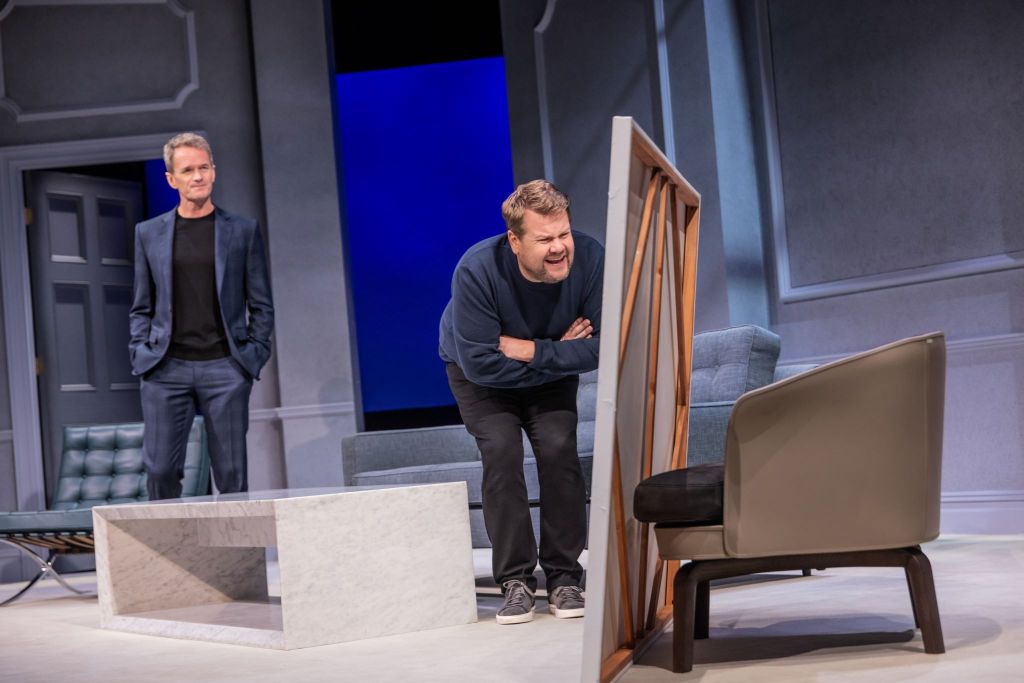
Teasing the audience by incremental degrees prompting LOL audience reactions, Reza brings each of the men to a boiling point and catharsis. Will their friendship survive their extreme reactions (even Yvan’s noncommittal reaction is extreme) and differences of opinion? Will Serge allow Marc to deface what he believes to be “shit” for the sake of their friendship? In what way are these middle-aged men asserting their “place” in the universe with each other, knowing that that place will soon evanesce when Death knocks on their doors?
The humorous dialogue shines with wit and irony. Even more exceptional are the actors who energetically stomp around in the skins of these flawed characters that do remind us of ourselves during times when passion overtakes rationality. Each of the actors holds their own and superbly counteracts the others, or the play would seem lopsided and not land. It mostly does with Ellis’ finely paced direction, ironic tone, and grey walled set design (David Rockwell), that uniformly portrays the similarity among each of the characters’ apartments (with the exception of a different painting in each one).
Reza’s characters become foils for each other when Marc, Serge and Yvan attempt to assert their dominance. Ironically, Yvan establishes his power in victimhood.
Arriving late for their dinner plans, Corden’s Yvan bursts upon the scene expressing his character in full, harried bloom. His frenzied monologue explodes like a pressure cooker and when he finishes, he stops the show. The evening I saw the production, the audience applauded and cheered for almost a minute after watching Corden, his Yvan in histrionics about his two fighting step-mothers, fiance, and father who hold him hostage about parental names on his and his fiance’s wedding invitations. Corden delivers Yvan’s lament at a fever pitch with lightening pacing. Just mind-blowing.
The versatile Neil Patrick Harris portrays Serge’s dermatologist as a reserved, erudite, true friend who “knows when to hold ’em and knows when to fold ’em.” Cannavale portrays Marc’s assertive personality and insidiously sardonic barrel laugh with authenticity. Underneath the macho mask slinks inferiority and neediness. Together this threesome reveals men at the worst of their game, their personal power waning, as they dodge verbal blows and make preemptive strikes that hide a multitude of issues the playwright implies. They are especially unwinning at successful relationships with women.
Reza’s play appears more current than one might imagine. As culture mavens and influencers revel in promoting and buying brands as a sign of cache, the pretensions of superiority owning, for example, a Birkin bag, bring questions about what an item’s true worth is and what that “worth” means in the eye of the beholder. Commercialism is about creating envy and lust and the illusion of value. To what extent do we all fall for being duped? Does Marc truly care that his friend may have fallen for more hype than value? Conclusively, Yvan has his own problems to contend with. How can he move beyond, “I don’t like it, I don’t hate it.”
As for its own value, Art is worthwhile theater to see the performances of these celebrated actors who have fine tuned their portrayals to a perfect pitch. Art runs 1 hour 35 minutes with no intermission through Dec. 21 at the Music Box Theater. artonbroadway.com.
‘The Queen of Versailles,’ Fabulous Kristin Chenoweth Makes Dreams Realities

If the road to excess leads to the palace of wisdom (quote by English poet William Blake), do people know when they’ve reached their limit? When is enough enough? According to the themes of the new musical The Queen of Versailles, currently at the St. James Theatre, knowing this depends upon the seeker.
In the clever, sardonic musical, based on Lauren Greenfield’s titular documentary film and the life stories of Jackie and David Siegel, the question of excess and how to measure it shines into the darkness of American culture, conspicuous consumption, surgically enhanced, plastic looks, and meretricious values. With an ironic, humorous, no holds barred book by Lindsey Ferrentino, and music and lyrics by Stephen Schhwartz, the Siegel’s riches to more riches story, including the 2008 mortgage debacle, takes center stage. By the conclusion, the audience leaves shaken and maybe stirred, either with a bad taste in their mouths or with the prick of guilt in their consciences.
At its finest, The Queen of Versailles inspires the audience to peer into their own values and behavior and evaluate their souls to correct. Ultimately, it asks, do the Siegels have a worthwhile life or have they allowed their childhood poverty to overwhelm their good sense and inner emotional well being? Despite its ripe fun Ferrentino’s book and Schwartz’s music encourage a hard look at crass, materialistic greed that blinds the rich from using their largess for the social good. Lastly, it questions do the representative Siegels count the cost to live the oversized billionaire’s lifestyle which causes harm? To what extent has their craven indulgence choked off their lifeblood to their own destruction?
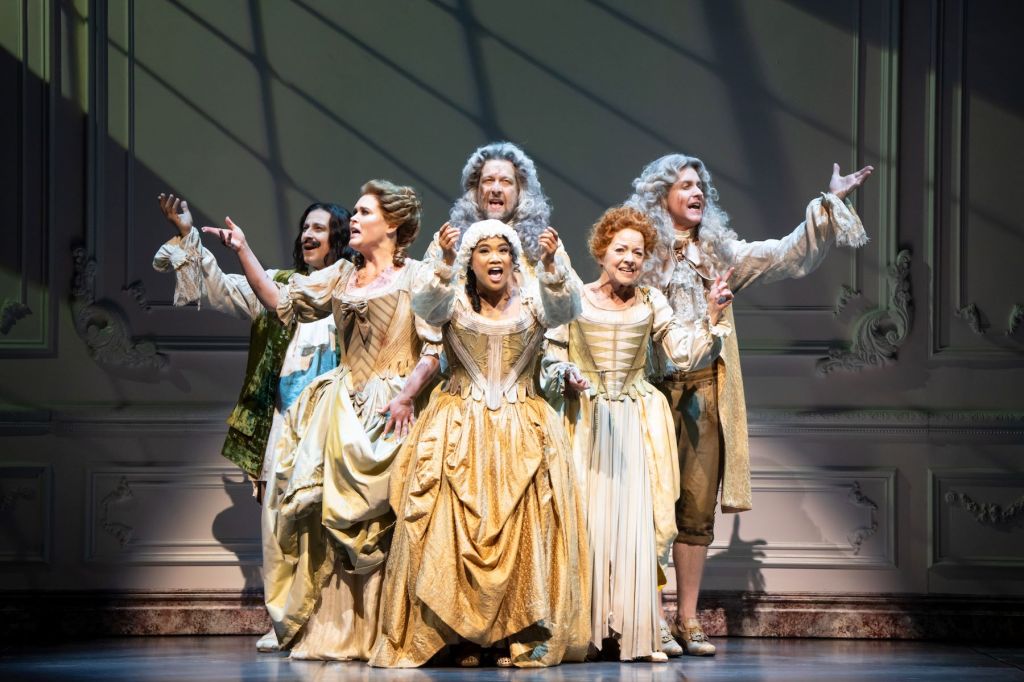
Starring an endearing, heartfelt and bubbly Kristin Chenoweth as the materially insatiable Jackie Siegel, and F. Murray Abraham as billionaire workaholic David Siegel, the New York premiere which has an end date of March 29, 2026, rings with disturbing truths. It’s farcical, dark elements present many themes. Chief among them is the theme that the Siegel’s shiny ostentation hides a sad emptiness that can never be fulfilled.
Framing the Siegel’s story with the key meme of Versailles, the mansion in France that 17th century Louis XIV, built as a memorial to his majesty, the opening scene and song (Pablo David Laucerica is King Louis XIV) replete with period chandeliers, furniture, costumed butlers and maids reveals how and why the Sun King built his palace on swampland (“Because I Can”). Without giving thought to the inequities in French society that necessitated the economic gap between royalty and its impoverished, destitute subjects, Jackie and David want one.
In a quick switch to the present (2006) we see the Siegel’s Versailles in progress. With construction scaffolding in the background and a documentary film crew in the foreground, Chenoweth’s Jackie glows as she sings “we want to have the very best for the biggest home in America because we can.” The fluid set design with appropriate props and pieces by Dane Laffrey, who also does the video design, brings perfect coherence to the Siegel’s intentions. It connects the idea of royal wealth manifest in Louis XIV’s lavish excess to their rich/famous lifestyle which reeks of tawdriness. Thanks to Michael Arden’s staging and direction and Cristian Cowan’s costumes, and Cookie Jordan’s hair and wig design, the shifts from the present to the court of Louis XIV and back solidly establish the trenchant themes of this profoundly current musical.

Presuming themselves American royalty, the Siegels hope to replicate a modern-day Versailles, like their mentor king. Indeed, they will best him. Their Versailles has whatever the family wants. This includes a jewelry-grade gem stone floor, an in-house Benihana (with all those tossed shrimp because David doesn’t like to stand on line), a spa, a pool with a stained glass roof, and a family wing with numerous bedrooms and bathrooms so Jackie doesn’t lose track of her seven kids.
After this opening salvo that mesmerizes like any show about the “lifestyles of the rich and presumptuous,” we discover that Jackie didn’t always come from wealth. In fact her story mirrors the old Horatio Alger “rags-to-riches” fable that Alger shaped into the American Dream, which abides today and which also influenced F. Scott Fitzgerald’s take on it in The Great Gatsby. Jackie, albeit a female dreamer, buys into the concept that if she pulls herself up with determination, works hard and does good works, she can lift herself into the upper classes.

We see how this manifests in the next segment of Chenoweth’s 17-year-old version of Jackie with her parents Debbie (Isabel Keating) and John (Stephen DeRosa) in their humble Endwell, New York home. Debbie and John count on Jackie to continue to work as many jobs as possible to become rich and famous like the titular show they watch together. Singing the song “Caviar Dreams,” a ballad that expresses beautifully a female Alger hero, we “get” Jackie’s drive and pluck to work day and night to achieve an engineering degree at IBM, then kick the job to the curb because it won’t give her wealth fast enough.
As she “keeps on thrustin” she makes a bold turn into marriage with alleged banker Ron (Michael McCorry Rose), who disappoints when he drags her to the Everglades, and opposes her Mrs. Florida win. When he physically abuses her, despite her pregnancy, Jackie leaves. Singing “Each and Every Day” beginning when Victoria is a baby, the scene switches to the present at the construction site and the teenage Victoria (the excellent Nina White) enters. Chenoweth’s Jackie soulfully finishes the song to Victoria in an important transitional moment. We understand Jackie as a survivor who loves her firstborn, who she claims saved her life.

Not only does Jackie not look back, we learn she and baby Victoria lived in an apartment which “barely fit the baby’s crib and Jackie’s sleeping bag.” However, always “thrustin’ forward,” she recognizes opportunity when she goes to a party where she meets David Siegel, the CEO of Westgate Resorts. As it turns out, his impoverished childhood was similar to hers and left him with dreams of extreme wealth. F. Murray Abraham does justice to David throughout, first as a “cowboy” in the wild west of timeshares as son Gary (the fine Greg Hildreth) sings with the ensemble “The Ballad of the Timeshare King.” Occasionally, for emphasis, Abraham’s David chimes in with irony.
For example, David’s sales force make “one hundred percent of their sales on the first day.” Gary sings, “George W.’s president now, thanks to David Siegel.” When folks can’t afford the timeshare, Siegel helps them with financing from his bank, so the ensemble sings joyfully, “Yippee-I-owe-you-owe-we-owe.” We recognize the sardonic humor for David’s dishing out sub-prime mortgages to “anyone who breathes.” Of course this adds to the mortgage crises of 2008 which taxpayers foot the bill for. Eventually, the sub-prime loans bring his empire to the brink of bankruptcy as the crash swallows whole billionaires like David.

At that point, Jackie and David have been married with children and are two years into the Versailles construction having cycled through songs of their outsized wedding (“Trust Me”), a honeymoon trip to Versailles bringing back a scene of King Louis XIV and his courtiers. Smartly, Ferrentino and Schwartz reinforce their themes by joining past and present in the reprise “Because I Can and the “Golden Hour.”
However, conflict looms on the horizon. Though David and Jackie live their wildest dreams and birth child after child, daughter Victoria feels miserable, insular and ugly. “I know mom wishes I was prettier,” she sings in the poignant “Pretty Wins.” And in Act II in the superb “Book of Random” Victoria sings from her journal, the thoughts that she keeps hidden. Unlike her mother Victoria grounds herself in her current feelings of sadness brought on by reality, escapism fueled by drug addiction and scorn for their damaging and excessive lifestyle. However, when Jackie’s niece Jonquil (Tatum Grace Hopkins) arrives and Jackie takes her in, we think that Victoria has someone to confide in.

But Jonquil doesn’t understand Victoria’s dislike of Jackie’s appetite for more. And it doesn’t help Victoria that Jonquil becomes a clone of Jackie (“I Could Get Used to This.”). Ironically, when the crash happens and Victoria hears of the talk that they will sell Versailles to keep David from going belly up, she feels relief. In a farce-filled scene in the 17th century Versailles, with some of the most ironic lyrics, the Sun King chides the Siegels and Americans in the song “Crash.” “You thought you’d be egalitarian, let peasants own their own homes in some altruistic plan. Well, what were you expecting from a choice so rash? Crash…”

At the end of Act I, we have only Jackie’s spunk and perseverance (“This is Not the Way”), and David’s connections to rely on to bail them out of bankruptcy and foreclosure. Act II reveals that deus ex machina saves them when the government (taxpayers) bail out billionaires and banks. Naturally, the little people with no safety net lose their shirts. Where the peasants of France revolted against their royals (there is a humorous scene with the luckless Marie Antoinette on her way to the guillotine), in America, no one goes to jail because the banks and firms are “too big to fail.”
At the end of Act II, in a scene with King Louis XIV, in a reprise of “Crash,” King Louis and his courtiers sing as Marie Antoinette says “goodbye.” Here, Schwartz’s lyrics and tune underscore a crucial theme. America’s Aristocracy has cleverly worked it out that “democracy” will prevent revolutions. How? The rich have peasants “thinking they’re tomorrow’s millionaires; that you’re special privileges will someday soon be theirs.” And the ensemble adds, “No blade across the throat for you. Instead it seems your peasant class will all turn out to vote for you!” Thus, with no accountability for wrecking the economy and countless lives, the rich get richer, and Jackie and David, out of bankruptcy, continue building Versailles.

However, in all of the mayhem of trying to regain solvency, the Siegels sacrifice a family member. If material empires go on for centuries, flesh and blood does not. The unreality of excess belies mortality. But some folks never learn. Schwartz and Ferrentino ironically underscore this as Chenoweth’s Jackie holds a glass of champagne standing in front of a ring light. She speaks to a social media audience and hopes that, like her, they get their “champagne wishes and caviar dreams.”
The Queen of Versailles runs 2 hours 40 minutes with one intermission at the St. James Theatre. https://queenofversaillesmusical.com/
Keanu Reeves, Alex Winter carry Ted and Bill into the adventure of ‘Waiting for Godot’

Referencing the past with Bill and Ted’s Excellent Adventure movie series, something has happened. Bill (Alex Winter) and Ted (Keanu Reeves), who long dropped their younger selves and reached maturity in Bill and Ted Face the Music (2020), have accomplished the extraordinary. They’ve fast forwarded to a place they’ve never been before in any of their adventures. An existential oblivion of uncertainty, Samuel Beckett’s Waiting for Godot.
There, they cavort and wallow in a hollowed out, megaphone-shaped, wind-tunnel (Soutra Gilmore’s clever set design). The gaping maw is starkly, thematically lighted by Jon Clark. Ben & Max Ringham’s sound design resonates the emptiness of the hollow which Winter’s Valdimir and Reeves Estragon fill up to the brim with their presence. And, among other things, Estragon loudly snacks on invisible turnips and carrots, and some chicken bones.
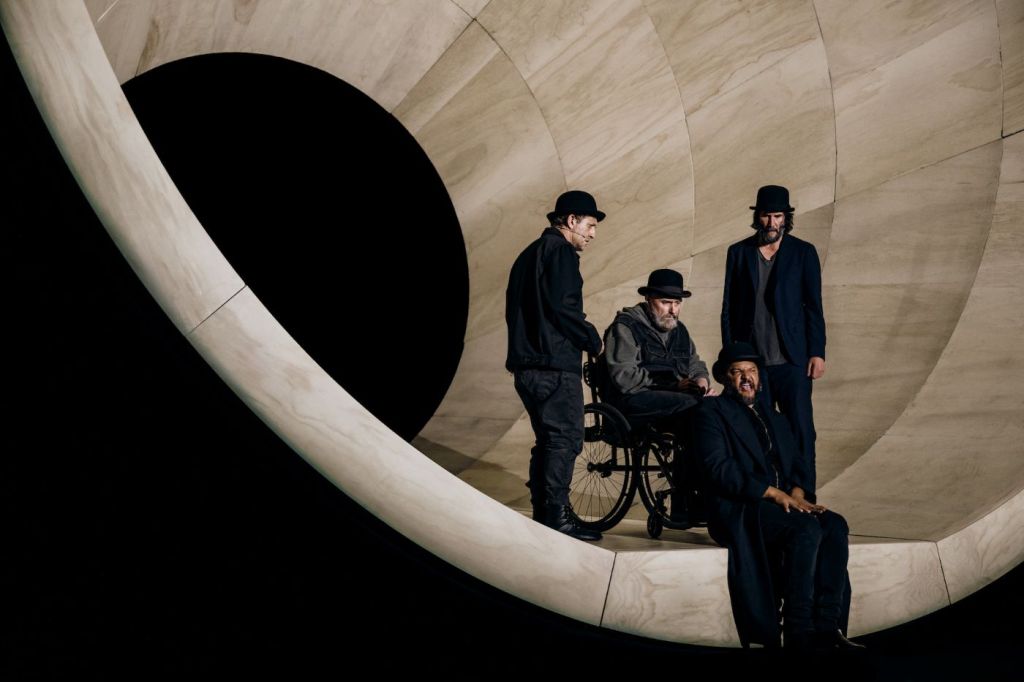
Oh, and a few others careen into their empty hellscape. One is a pompous, bullish, land-owning oligarch with a sometime southern accent, whose name, Pozzo, means oil well in Italian (a superb Brandon J. Dirden in a sardonic casting choice). And then there is his slave, for all oligarchs must have slaves to lord over, mustn’t they? Pozzo’s DEI slave in a wheelchair, seems misnamed Lucky (the fine Michael Patrick Thornton).
However, before these former likenesses of their former selves show up and startle the down-on-their luck Vladimir and Estragon, the two stars of oblivion wait for something, anything to happen. Maybe the dude Godot, who they have an arrangement with, will show up on stage at the Hudson Theatre. Maybe not. At the end of Act I he sends an angelic looking Boy to tell them he will be there tomorrow. A silent echo perhaps rings in the stillness of the oblivion where the hapless tramps abide.

Despite the strangeness of it all, one thing is certain. Bill and Ted are together again for another adventure that promises to be like no other. First, they’ve landed on Broadway, dressed as hobos in bowler hats playing clowns for us, who happily watch and wait for Godot with them. And it doesn’t matter whether they tear it up or tear it down. The excellent novelty of these two appearing live as Didi (Vladimir) and Gogo (Estragon), another dimension of Bill and Ted, illuminates Beckett.
Keanu Reeves’ idea to have another version of their beloved characters confront Samuel Beckett’s tragicomical questions in Waiting for Godot seems an anointed choice. It is the next step for these bros to “party on,” albeit with unsure results. However, they do well fumfering around in this hollowed out world, a setting with no material objects. The director has removed the tree, the whip, or any props. Thus, we concentrate on their words. Between their riffs of despair, melancholy, hopelessness and trauma, they have playful fun, considering the existential value of life. Like all of us, if they knew what circumstances meant in the overall arc of their lives, they wouldn’t be so lost.
Director Jamie Lloyd, unlike previous outings (A Doll’s House, Sunset Boulevard), keeps Beckett’s script without alteration. Why not? Rhythmic, poetic, terse, seemingly repetitive and excessively opaque, in their own right, the spoken words ring out, regardless of who speaks them. That the characters of Bill and Ted are subsumed by Beckett’s Didi and Gogo makes complete sense.
What would they or anyone do if there was no intervention or salvation as occurs fancifully in the Bill and Ted adventure series? They’d be waiting for salvation, foiled and hopeless about the emptiness and uselessness of existence without definition. Indeed, politically isn’t that what some in a nation of unwitting, passively oppressed do? Hope for salvation by a greater “someone,” when the only possibility is self-defined, self-salvation? How long does it take to realize no one is coming to help? Maybe if they help themselves, Godot will join in the work of helping them find their own way out of oblivion. But just like the politically passive who do nothing, the same situation occurs here. Godot is delayed. Didi and Gogo do nothing but play a waiting game.

From another perspective eventually unlike political passives they compel themselves to act. And these acts they accomplish with excellent abandon. They have fun.
And so do we watching, listening, wondering and waiting with them. Their feelings within a humorous dynamic unfold in no particular direction with a wide breadth of expression. Sometimes they want to hang themselves to end the frustration. Sometimes, bored, they engage in swordplay with words. Sometimes they rage. Through it all they have each other. And despite wanting to separate and go their own ways, they do find each other comforting. After all, that’s what friends are for in Jamie Lloyd’s anything is probable Waiting for Godot.
In Act I they are tentative, searching their memories for where they are and if they are. Continually, they circle the truth, considering where the one is who said they were coming. However, the situation differs in Act II because the Boy gave them the message about Godot.
In Act II they cut loose: chest bump, run up and down their circular environs like gyrating skateboarders seamlessly navigating curvilinear walls. By then, the oblivion becomes familiar ground. They relax because they can relax, accustomed to the territory. And we spirits out there in the dark, who watch them, become their familiar counterparts, too. Maybe it’s good that Godot isn’t coming, yet. They may as well while away the time. Air guitar anyone? Yes, please. Reality is what we make it. Above all, we shouldn’t take ourselves too seriously. In the second act they don’t. After all, they could turn out like Pozzo and Lucky. So they do have fun while the sun shines, until they don’t and return right back to square one: they wait.

As for Pozzo and Lucky a further decline happens. In Act I Lucky gave a long, unintelligible speech that sounded full of meaning. In Act II Lucky is mute. Pozzo, becomes blind and halt, dependent upon Lucky to move. He reveals his spiritual and physical misery and haplessness by crying out for help. On the one hand, the oppressor caves in on himself via the oppression of his own flesh. On the other hand, he still exploits Lucky whom he leads, however awkwardly. The last shreds of his bellicosity and enslavement of Lucky hang by a thread.
Pozzo has become only a bit less debilitated than Lucky, whereas before, his identity commanded. Fortunately for Pozzo Lucky doesn’t revolt and leave him or stop obeying him. Instead, he takes the role of the passive one, while Pozzo still acts the aggressor, as enfeebled as he is. The condition happened in the twinkling of an eye with no explanation. Ironically, his circumstances have blown most of the bully out of him and reduced him to a pitiable wretch.
Nevertheless, Didi and Gogo acknowledge Pozzo and Lucky’s changes with little more than offhanded comments. What them worry? Their life-giving miracle happened. They have each other. It’s a congenial, permanent arrangement. After that, when the Boy shows up to tell them the “bad” news, that Godot has been delayed, yet again, and maybe will be there tomorrow, it’s OK. There’s no “sound and fury” as there is in Macbeth’s speech about “tomorrows.” We and they know that they will persist and deliver themselves and each other into their next clown show, tomorrow and tomorrow and tomorrow.
If one rejects the comparison of this version of Waiting for Godot with others they may have seen, that wisdom will yield results. To my thinking comparing versions takes the delight out of the work. The genius of Beckett is that his words/dialogue and characters stand on their own, made alive by the personalities of the actors and their choices. I’ve enjoyed actors take up this great work and turn themselves upside down into clown princes. Reeves and Winter have an affinity and humility for this uptake. And Lloyd lets them play, as he damn well should.
In the enjoyment and appreciation of their antics, the themes arrive. I’ve seen greater and lesser lights in these roles. Unfortunately, I allowed their personalities and their gravitas to distract me and take up too much space, crowding out my delight. In allowing Waiting for Godot to settle into fantastic farce, Lloyd and the exceptional cast tease out greater truths. These include the indomitably of friendship; the importance of fun; the tediousness of not being able to get out of one’s own way; the uselessness of self-victimizing complaint; the vitality and empowerment of self-deliverance, and the frustration of certain uncertainty.
Waiting for Godot runs approximately two hours five minutes with one intermission, through Jan. 4 at the Hudson Theatre. godotbroadway.com.
 CAROLE DI TOSTI