Blog Archives
‘Birthright’ at MCC is Exceptional
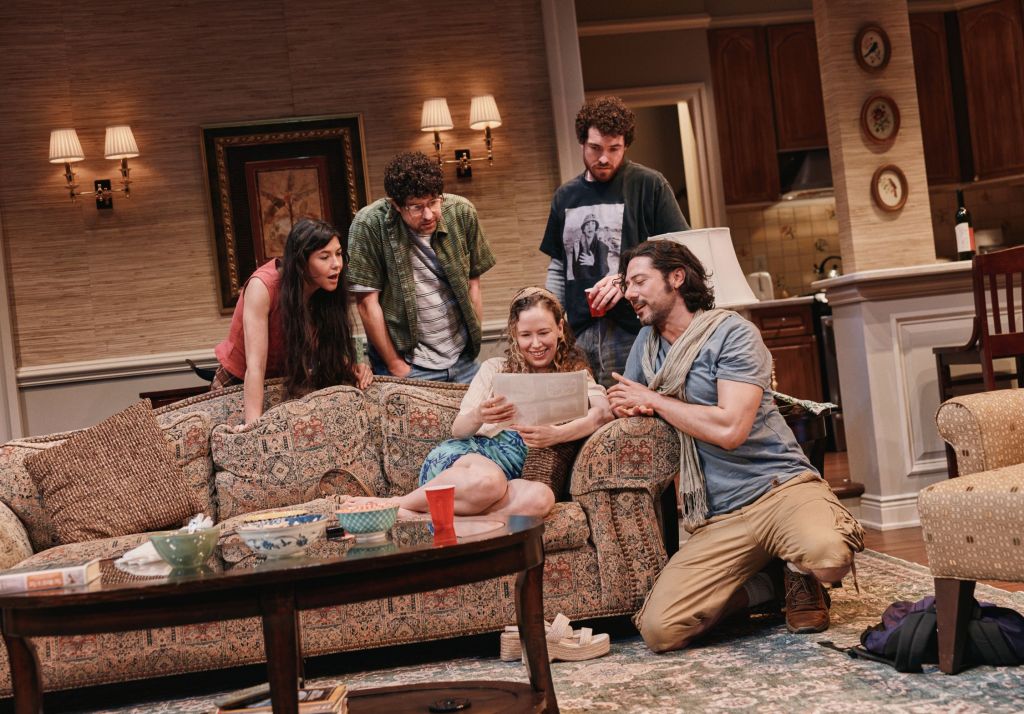
In Birthright writer Jonathan Spector tackles Jewish identity through the viewpoints of six friends as they evolve their relationship with each other after they return from a “Birthright” trip to Israel. Examining each of the characters over an extended time frame from 2006 through 2024, Spector reveals their psychic and spiritual growth as they confront the ever-changing dynamic of the political state of Israel, an increasingly violent and unsafe country.
Spector brilliantly integrates their emotional and personal backgrounds initially as twenty-somethings during the presidency of George Bush Jr. in 2006. After highlighting specific turning points he fast forwards to 2016 ten years later, during Hillary Clinton’s momentous campaign. The last segment settles on the salient points of their journey as they are still in touch with each other. The time quickly forwards through eight years to land in 2024, during the backdrop of President Joe Biden’s campaign, before he moved aside for Kamala Harris to run as the Democratic candidate.
Complex, insightful, philosophical, humorous, fascinating and profoundly human, Spector’s play strikes theatrical gold. Directed by TeddyBergman, Drama Desk nominated director, producer, actor, Birthright currently runs in an extension at MCC through August 23, 2026.
As he did with Eureka Day, the Tony Award-winning playwright presents controversies and explores various cultural opinions. His distinct characters, portrayed almost to near perfection by the ensemble, reveal perspectives that deepen and change over time. Each individual, raised in the cultural background of Judaism with its holiday traditions, foods, behaviors, language and concentration on identity, expresses their own brand of personal and political liberalism. Together, they eschew American conservatism and the Republican Party. In the last segment, we understand that they all deplore Benjamin Netanyahu’s leadership and AIPAC’s (wealthy Jewish donors) influence over congress.
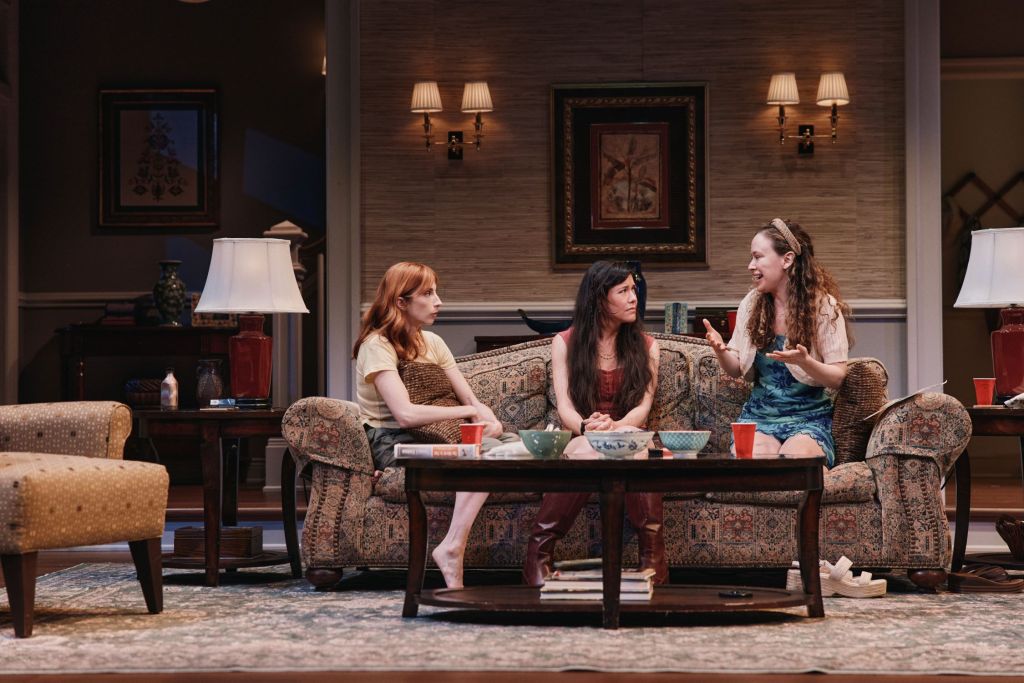
Indeed, some of the play’s humor derives from advancing political ironies cleverly using the flashbacks against our present as a medium. For example one of the characters comments that when “Hillary’s administration gets in, there will be job opportunities.” In another, an anecdote about a conservative father who voted Republican tells his son he may vote Democratic based on Kanye West’s comment that “Bush doesn’t care for Blacks,” evidenced by his dilatory response to Hurricane Katrina. The audience never loses track of the ironies of both statements and others. Indeed, years later West supports Republican Trump, then campaigns to divide Black votes from Biden to help Trump in the 2020 election. Throughout, Spector makes use of the characters’ assumptions about the future which blow up in their faces later in the play as “impossibilities” happen again and again, i.e. “one-third of the nation votes for Trump.”
The play opens at the reunion party that Chaya (Zoe Winters) holds for friends who recently returned from their trip to Israel. Birthright Israel gives Jewish adults between 18 and 26 years old an all expenses paid educational and fun trip to experience Israel as a “journey of a lifetime.” At Chaya’s parents’ house in a suburb of Washington, D.C. (with fine period appropriate set designs by Scott Pask), we first meet the brilliant, Israel-aware, gay Izzy (Molly Bernard), Chaya’s long-time friend. Next, we meet politically-minded blogger Noah (Eli Gelb), then drug-fueled musician Emerson (Nate Mann), recently expelled from his band for drinking. Arriving last, comes the philosophical, searching, profound Lev (Hale Appleman),
Also, we discover Chaya’s ulterior motive for the gathering; to dissuade Alona (Molly Ranson) from her rash decision to immigrate to Israel (“making aliyah”). Chaya spills that Alona lost her virginity to an IDF soldier during the trip. As Chaya tries to discourage her in front of the others, Emerson reveals the soldier sexually hooked up with a number of the other young women. Though this devastates Alona, we learn later the trip probably had the greatest impact on her because of her future decision to move there.
Interestingly, we learn the friends’ various attitudes about the trip’s inauthentic, unreal nature. The friends see through the propaganda about Israel to persuade young Jewish people to leave their birth countries. With the exception of Ranson’s Alona, all agree to one degree or another their established camaraderie fostered a bond with each other greater than any loyalty to Israel. Lev, who left the tour, felt, “it was all this like crafted Styrofoam,” like “seeing The Matrix.” Lev tells Izzy (who also felt the unreal situation), if I “wanted any kind of authentic experience, I had to get away from the trip.” After Lev disappears, he visits Jordan’s Petra, and Egypt. Also, he doesn’t miss the significance of the hours long lines for Palestinians to cross borders versus the fifteen minute line white tourists and others easily wait on. If Lev had not left the tour, he wouldn’t have seen this other alarming experience of Israel which he shares with Izzy.
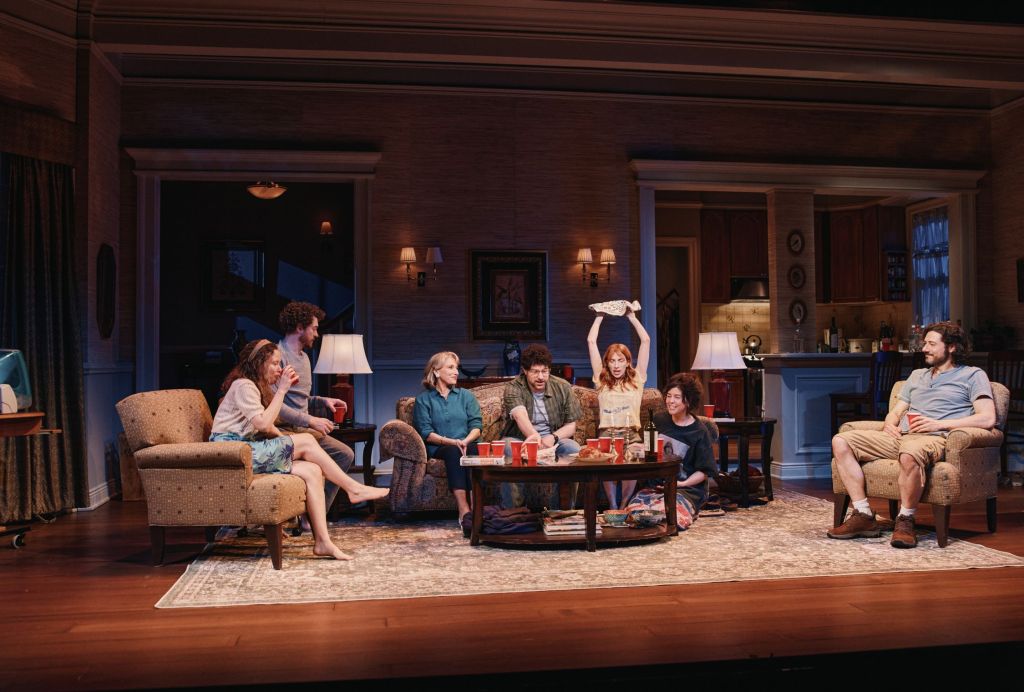
In the 2016 segment during another reunion at Chaya’s as they plan their toast for Alona’s wedding celebration the next day, we discover Alona and her husband are moving to Israel. From this meeting we understand the characters’ progress in search of something to strengthen their sense of purpose, despite personal successes or failures. For example married lawyer Izzy, at polar opposites with Alona, passionately speaks out against Israel’s apartheid. Chaya and Izzy question Alona’s Israel move in light of its moral ambiguity. As a citizen she will take part in the oppression and abuse of the Palestinians through her complicity by simply moving and living there. Will she stand for justice for Palestinians, or walk obliviously over their trail of tears?
Lev, who had spoken of his desire to become a rabbi years before drops out of school, gets married, divorced and beats himself up about not seeing his child as often as he likes. Noah quits The Washington Post and reinforces his online presence as a political influencer which eventually morphs into podcasting by 2024. Noah’s interest in Chaya which began after a brief affair on the trip continues despite Chaya’s marriage which heads toward divorce. Her work with the Obama administration ends and she takes on an organization to help Hillary get elected. Emerson seems the most lost at this point; unmarried, composing a few solo albums. But he stumbles into keeping kosher in spite of himself. All look forward to the hope of the first female president, some more avidly than others.
In the last segment, the downturn from hope and light into confusion and darkness becomes symbolized in the death of one of their number. Consequently, his loss raises the stakes of their relationships. The original bonds fostered during the trip have developed into love and an emotional concern and closeness which sustains them. Likewise, on another cultural, personal level, the devastating attack of Hamas on October7th, and the subsequent turmoil and chaos of finding the hostages amidst the daily bombing of the people of Gaza causes emotional devastation for Izzy, Chaya and Alona. And to various degrees, each friend questions the well-meaning values of the Judaism they were raised in versus Netanyahu’s bloody, never-ending punishment of Palestinian women and children.
What is the right path? Can the initial massacre justify the piles of bodies and annihilation and ethnic cleansing implicating the US government’s complicity supplying aid which includes weapons to Israel? Where did this begin? In Zionism as Izzy suggests or in the foundation of the state of Israel as a safe haven for outcast Jews in search of their birthright? And arguing whether the bloody slaughtering is or isn’t a genocide becomes a distraction while the incessant murdering continues. As Noah attempts to mitigate Izzy and Chaya’s arguments, Emerson arrives. He missed the funeral service. As it turns out he has arrived just in time for some food and community. And his surprising presence brings gasps from the audience.
As it turns out after years of wandering, in this 2024 reunion, the friends are brought together once again in a new way. And maybe just maybe Chaya and Noah will see their way clear to be with each other after all is said and done.
Birthright runs 3 hours 20 minutes through August 23, 2026 at MCC Theater; mcctheater.org.
Carrie Coon and Namir Smallwood are Frightening in Tracy Letts’ ‘Bug’

She’s a cocktail waitress. He’s a Gulf War vet. When they get together they create an unforgettable relationship in Tracy Letts’ sometimes comedic, mostly compelling psychological drama Bug, currently making its Broadway premiere at Manhattan Theater Club’s Samuel J. Friedman Theatre through February 8, 2026. Aptly directed by David Cromer for a maximum thrill ride, Agnes (Carrie Coon) and Peter (Namir Smallwood) gain each other’s trust in a world that increasingly threatens to destroy them.
Stellar performances by Coon (The White Lotus, The Gilded Age) and Smallwood (Pass Over on Broadway) carry the production through a slow build first act into the harrowing intensity and climactic finish of the second.
Letts’ chilling drama unfolds in a motel room on the outskirts of present-day Oklahoma City. Scenic designer Takeshi Kata features a typical mundane bedroom with cream colored walls and complementary cheesy lamps and appointments that spell out Agnes’ challenged socioeconomic position. By the second act, after a time interval during which Agnes and Peter panic and go through stages of emotional terror, the room’s once benign look transforms to a place whose inhabitants are under siege.
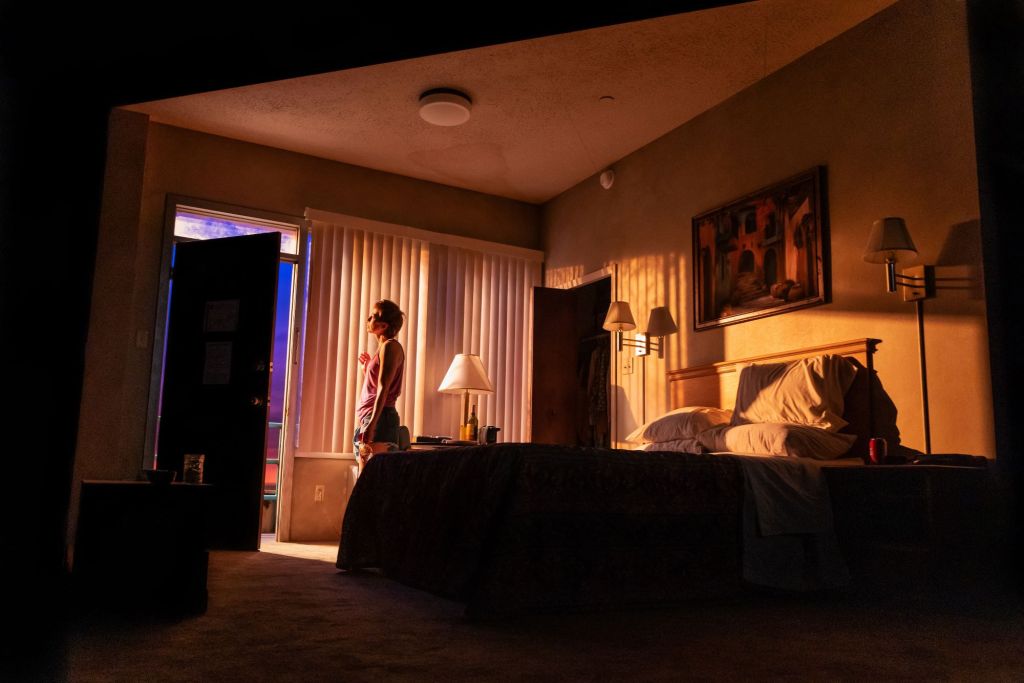
At this point Kata’s design shocks. It is then we understand how badly the situation has progressed in the minds of the characters .
At the top of the play we meet Agnes who lives in the motel room hiding out from her violent former husband Jerry Goss (Steve Key) an ex-convict. As Coon’s Agnes and her lesbian biker friend R.C. (Jennifer Engstrom) do drugs, R.C. warns Agnes to protect herself against Jerry whose prison release she questions because he is dangerous.
Ironically, Agnes asks about the background of the stranger using her bathroom. R.C. vouches for Smallwood’s Peter who she brought with her as they make their way to a party that R.C. also invites Agnes to. While R.C. is on the phone with personal business, Peter assures Agnes he is “not an axe murderer,” and expresses an interest in her.
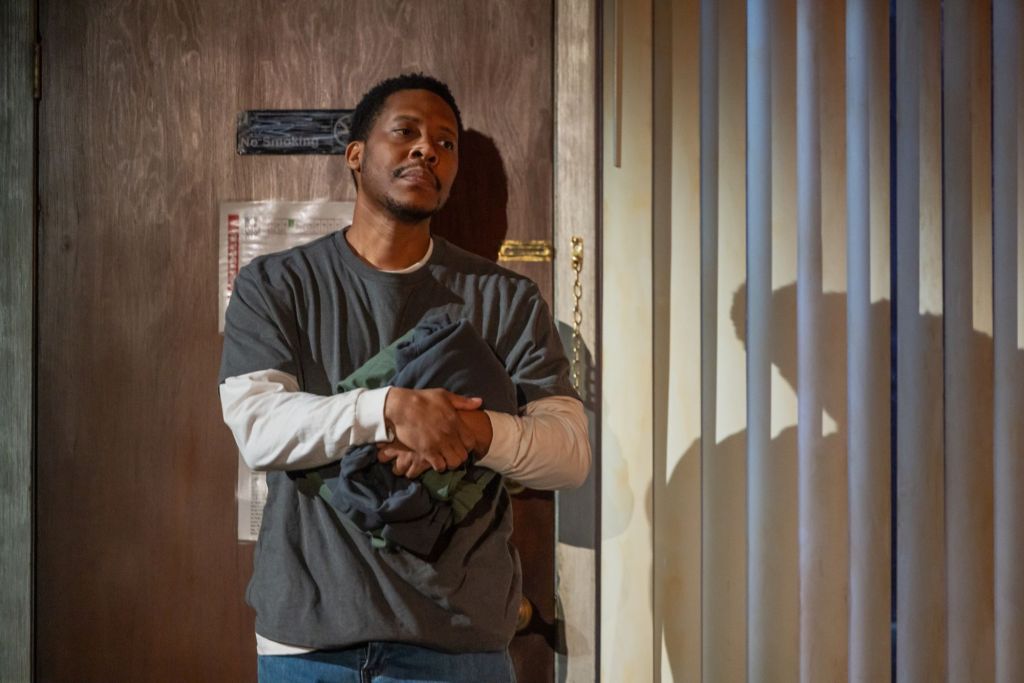
Instead of going to the party with R.C., both Agnes and Peter decide to hang out together and talk, feeling more comfortable getting to know each other than being in a larger crowd. It is during these exchanges and Peter’s staying overnight at Agnes’ invitation that her emotional neediness clarifies. When Jerry shows up, they argue and he hits Agnes. After Jerry leaves, Peter’s attentiveness draws her closer to him. As Agnes and Peter settle in and do drugs, they share secrets and bond. Increasingly Agnes’ perspective shifts. She accepts Peter’s world view and personal reality despite its extremism.
Though Peter says he should go, Agnes uses his hesitation to encourage him to stay, insisting upon it. She makes a symbolic gesture that clever viewers will note conveys her acceptance of Peter because of her emotional desperation more than a belief in his perspective and backstory.
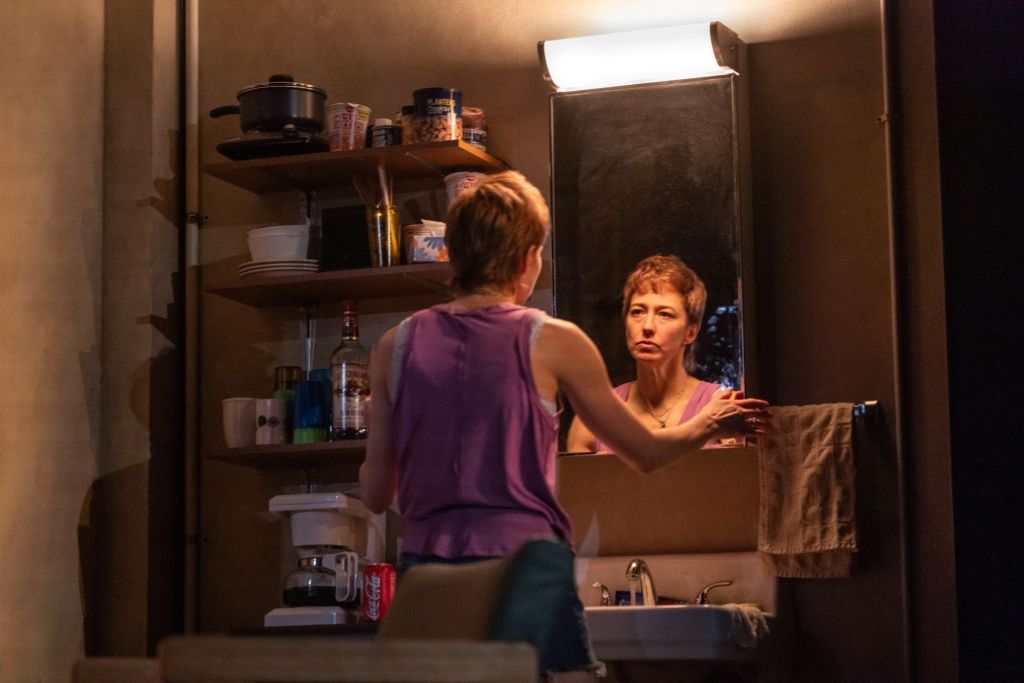
In the next act we see the extent to which Peter has made himself comfortable living with Agnes whose resolve against being with Jerry has strengthened because of her relationship with Peter. Because their concern and care for each other resonates with trust, Peter relaxes into himself. He examines his blood under a microscope and finds “proof” of a conspiracy theory that the government uses military vets and unsuspecting individuals as guinea pigs to experiment on. With convoluted half-truths about government cover-ups related to the war in Iraq, Oklahoma City bombing, the Tuskegee syphilis experiment and more, he panics, fearful that aphids bite him and Agnes, feed off their blood and infest their living space.
Convinced that egg sacks have been planted in him by doctors who also monitor and follow him with helicopters because he has gone AWOL, he persuades Agnes to accept his “bug” theory that he grounds in explanations. Together, they plan a way out of the infestation which has taken over their bodies and minds.
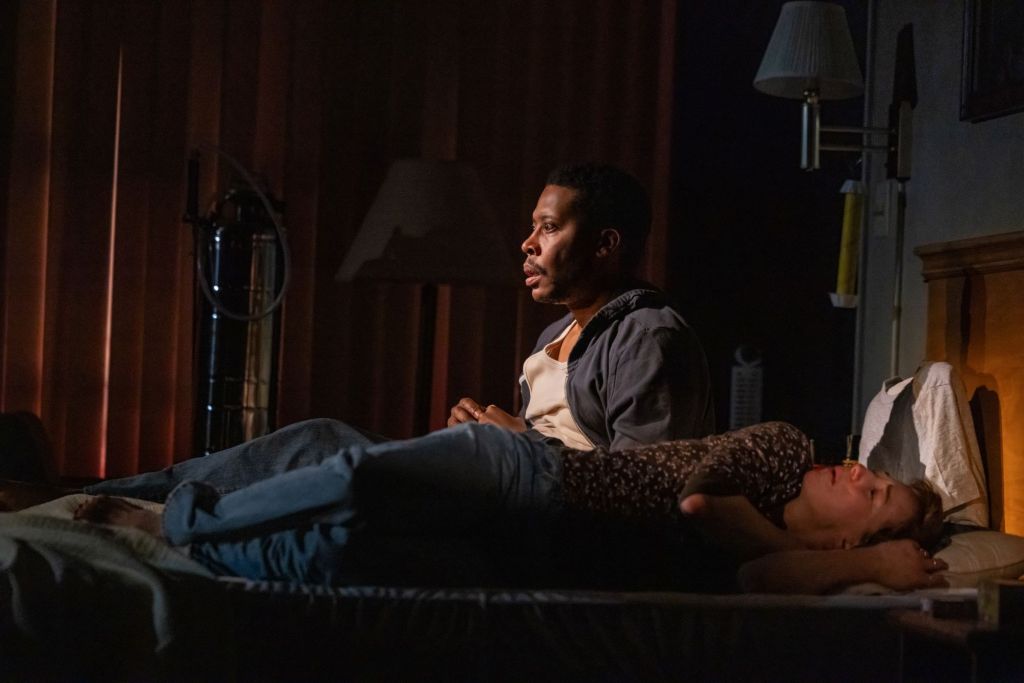
To complicate matters Dr. Sweet (Randall Arney) shows up and explains Peter’s medical case with R.C. and Jerry to legitimize taking Peter back with him to “Lake Groom.” Letts offers the intriguing possibility that there may be many truths about this situation. But without independent investigation and research, belief takes over. Whether Peter is part of an experiment and a guinea pig or not, Agnes expresses her love for him comforted by their bond which gives her life meaning. Within the horror of the infestation, they have found their emotional sustenance. Their relationship is their sanctuary from life’s pain.
Cromer’s vision and his shepherding of the fine performances by Coon and Smallwood make this stylized production all too real and terrifying. Thematically current, with various cultural attitudes related to government cover-ups, and conspiracy theories stoked by the questionable motives of those in power, the creative team’s efforts (Heather Gilbert’s lighting design, Josh Schmidt’s sound design) hit the sweet spot of relevance.
Though written decades ago, in Bug Letts intimates how and why certain women embrace what others deem to be their partner’s extremist perspectives. Wounded and seeking love, women like Agnes more easily accept their partner’s ideas, rather than search for facts and proof to dispute them. Governmental cover-ups of the truth fan the flames of extremist belief systems. The consequences can be socially and culturally devastating.
Bug runs 1 hour and 55 minutes with one intermission at the Samuel Friedman Theatre ( 47th St. between 7th and 8th) https://www.manhattantheatreclub.com/shows/2025-26-season/bug/

