Category Archives: Broadway
‘The Great Society,’ by Robert Schenkkan, Starring Brian Cox, Richard Thomas, A Triumphant Reminder of an Adult President

Brian Cox in ‘The Great Society,’ by Robert Schenkkan, directed by Bill Rauch (Evan Zimmerman for MurphyMade)
Lyndon Baines Johnson became president in a landslide vote in 1964. The wheeler dealer of the senate as Democratic Majority leader who could count votes and get bills passed, came from a hard scrabble childhood. He witnessed his father devastated by broken dreams. But President Johnson despite his crude ways, ferocious wit and uber competitiveness had the people of the nation at heart. Cramped and curtained as President Kennedy’s poor ‘ole boy, shunt ’em to the side Vice President, taking the reins of power after Kennedy’s death in 1963, President Johnson accomplished the impossible. He did what Kennedy hoped to do but couldn’t; he got the Civil Rights Act of 1964 passed.
In Robert Schenkkan’s Tony Award winning All The Way, LBJ is a man of destiny and reckoning. Played by Bryan Cranston who won the Tony Award for Best Actor in a Play, we follow the 36th president through passage of that iconic Civil Rights Act to his election campaigning. It was an amazing journey considering the obstacles of bigotry, racism and the obstructions by the Southern Democrats. Schenkkan’s play concludes with Johnson riding high on his success of the Civil Rights Triumph and his election win as the full term 36th president of the United States.
Directed by Bill Rauch who helmed All the Way, Schenkkan’s sequel, The Great Society is equally majestic in its revelations about Johnson as one who greatly desired to bring Franklin Roosevelt’s ideas of a more prosperous nation into being. With Johnson this was an obsession which Brian Cox realizes authoritatively and sensitively. As Cox’s Johnson lays out the policies of “the great society,” Schenkkan includes quotes from Johnson’s speeches where he affirms the principles of the constitution regarding economic equality, voting rights and other essential American freedoms.

(L to R): Marc Kudisch, Brian Cox in ‘The Great Society,’ by Richard Schenkkan, directed by Bill Rauch (Evan Zimmerman for MurphyMade)
What a joy to hear Cox’s superb delivery of Johnson’s own words. This is especially so in our time when the current president has laid siege to our election freedoms, demeaned freedoms guaranteed by the Bill of Rights and abrogated checks and balances with monarchic pronouncements and behaviors that as president, he can do “anything he wants,” and lift “presidential” criminality to new heights with impunity and the assistance of William Barr head of the Department of Justice. In The Great Society, the portrayal of Cox’ Johnson is a poignant reminder that there was a time in our history, when consensus between Republicans and Democrats could be reached. The play reminds us that Johnson knew how to compromise and work toward legislation that would improve the lives of American citizens. Above all he was an adult, he cared about those who were economically disadvantaged, he loathed racism, yet understood how to get his opponents on his side.
The arc of the play’s development chronicles Johnson’s four year term during which the country roiled with upheavals and protests that represented the raging tide of times. Schenkkan unfolds events from the mountaintop of Johnson’s win to his struggles through passage and implementation of the Voting Rights Act. Schenkkan reveals Johnson’s relationships with Civil Rights leaders from Ralph Abernathy to Stokley Carmichael to Martin Luther King Jr. to conflicts with Robert Kennedy and Governor George Wallace.
The actors who portray these celebrated individuals do an excellent job. Most acute and colorful in the development of their relationships with Cox’s Johnson are Grantham Coleman as Reverend Martin Luther King Jr. and Marchant Davis as Stokely Carmichael. Some of the most dynamic segments of the play are Johnson’s confrontations with Martin Luther King Jr. and the other iconic black activists to insure that blacks would be able to register and vote without being lynched or beaten. Dynamic arguments with all the important high stakes players move like a riptide as Johnson negotiates and spars with Martin Luther King Jr. (Grantham Coleman) Stokely Carmichael (Marchant Davis) Governor George Wallace (David Garrison) Robert Kennedy (Bryce Pinkham) Senator Everett Dirksen (Frank Wood) Richard J. Daley-Mayor of Chicago (Marc Kudisch )and others. Often at his side is Hubert Humphrey (the fine Richard Thomas) who serves as a counsel to him and could be looked upon loosely as his friend, a generosity not given to Johnson by the Kennedys when he was Vice President.

(L to R): Brian Cox, Bryce Pinkham in ‘The Great Society,’ by Richard Schenkkan, directed by Bill Rauch (Evan Zimmerman for MurphyMade)
Identifying searing events, (via video projections and archived photos, the “Bloody Sunday” march on Selma, Alabama, “Turnaround Tuesday” march, the march from Selma to Montgomery, Alabama, the Chicago protests, the Watts riots, etc.) Schenkkan reveals how Johnson attempted to balance all the invested players and handle the black – white unrest. With the Watts riots, he eventually brought in the California National Guard.
Brian Cox demonstrates Johnson’s forcefulness, vigor, passion and rationality with regard to his positions on civil rights and with regard to bringing in key influencers for other programs, like Dr. James Z. Appel (Marc Kudisch) head of the American Medical Association. Under Johnson’s term, medicare and medicaid were created and passed into law.
Interesting are his exchanges with Robert Kennedy portrayed with privileged aloofness and irony by Bryce Pinkham. The tensions between them are obvious and stem back from Johnson’s Vice Presidency. When Johnson is not surprised that Kennedy is looking to run in 1968, we understand his humorous reaction to that news. Kennedy uses Johnson as his bête noire on the war to gather support for his platform and candidacy. It is an ironic moment considering his brother was the first to send troops over to Viet Nam. The irony of this and horror of the Robert Kennedy assassination is shown representational style; Johnson’s reaction is telling.
If Johnson’s greatness as a president was in the passage of forward legislation to improve all of the citizens’ lives, Schennkan reveals the greatness is undone by his “Waterloo,” the Viet Nam War. Based on reports from Secretary of Defense Robert McNamara (Matthew Rauch) and head of U.S. forces in Viet Nam General William Westmoreland (Bryan Dykstra) Cox as Johnson shows the president’s mettle as he wrangles with the notion that the war will stop the spread of communism. Listening to them, he escalates troop deployments and engages in the bombing of North Viet Nam. These are steps on the road to the nation’s infamy.
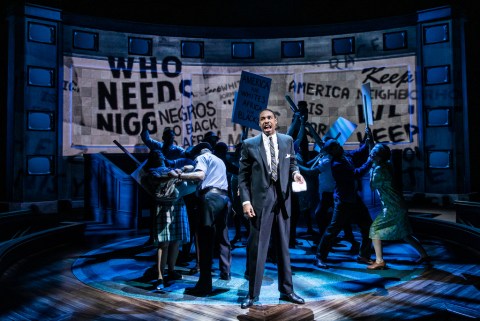
Grantham Coleman and company in ‘The Great Society,’ by Robert Schenkkan, directed by Bill Rauch (Evan Zimmerman for MurphyMade)
On a backdrop projection periodically listed are the ever increasing numbers of American dead and wounded. Indeed, as Johnson battles the two main issues of the day, civil rights and the war, we note that he, himself, is fighting his own war with himself whether more bloodshed will be useful or a travesty. We hear the rationale for escalation as we note the figures expand and rise up as protestors march and individual protestors represented by Quaker minister Norman Morrison (David Garrison) immolate themselves. (Buddhist monks also set themselves on fire to protest the war).
For those unfamiliar with this time in history, Schenkkan relays events with meticulous and accurate detail. Clearly, he identifies the seminal themes and concepts from which we still feel the impact today evidenced by the numbers of homeless Vets and suicides from that generation. We shudder as we witness Cox as Johnson be persuaded by Secretary of Defense Robert McNamara and General William Westmoreland knowing the numbers will continue to rise and behind each number is a family in mourning. Letters Johnson writes to families in condolence become a devastating scene. Schenkkan evidences Johnson’s turmoil which ironically reflects the growing divisiveness in the country. Money spent on the war and defense contractors could have been spent on his social programs which must be curtailed to make the budget. Johnson is stuck between a rock and a hard place with nowhere to go but the abyss, Schenkkan reveals.

(L to R): Angela Pierce, Richard Thomas Frank Wood, Robyn Kerr, Brian Cox, Marc Kudisch, Brian Dykstra in ‘The Great Society,’ by Robert Schenkkan, directed by Bill Rauch (Evan Zimmerman for MurphyMade)
An important feature of this production is in how the playwright and the director and ensemble coalesce our history with salient, acute representational actions that become a mentorship in what an adult president can be like. This reminds us of what we do not have today. Cox’s Johnson reveals a president who had the temerity not to seek re-election but wanted to extract himself from the rat wheel of the killing fields of Southeast Asia during a horror that fomented protests, divided his country and party. And it was particularly grating for him to hear college students’ chants, “Hey, Johnson what do ya say, how many kids did you kill today?”The words hit home because he knew they were true. He bore up under it badly remembering a time when he was popular and not despised.
Rather that to be elected for four more years, which he would have won, he stops and hands the opportunity to Hubert Humphrey. We laugh at his humor and the irony of what happened next: Richard Nixon (played by David Garrison). A key point in this production, look for it, reveals Nixon’s hunger for the presidency so that he put himself before the country and our soldiers. Treasonously, deceitfully Nixon upended the ongoing negotiations for peace with North Viet Nam by making an arrangement that peace would be accomplished after he got in office. Cox’s Johnson ironically nails him for this when Nixon comes in to assert himself in the Oval Office, even before he is inaugurated. The parallel to today in how the Trumpists were making quid pro quo deals even before they took the reins of power is clear.
When Johnson stated he would not run again and posed the reasons, what many believed would be better for the country, actually was worse, especially since Nixon stalled the peace negotiations with North Viet Nam, something that Johnson had believed in throughout his bombing policy. But a worse than Johnson took office and the implication in the play is that Johnson knew this as Cox portrays ironically when Nixon comes to visit before the transfer of power. In one of the most dramatic scenes Cox pulls out all stops to deliver Johnson’s ringing words: “I do not believe that I should devote an hour or a day of my time to any personal partisan causes. . . . Accordingly, I shall not seek, and I will not accept, the nomination of my party for another term as your President.” The ramifications of this in Nixon getting in, the country has paid for ever since.
Interestingly, Schekkan, Rauch, Cox and the ensemble reinforce American values, exemplified by what Johnson attempted in his plan for “the great society.” These values which Johnson fought hard to uphold against those like Governor George Wallace, Southern Democrats and Southern law enforcement whose bigotry Johnson understood, countermanded, and decried, become reinforced as the gold standard of the nation. Johnson was capable of dialogue with those who disagreed with him. And he was capable of bringing them to his side to realize and bring us closer to the tenets of the constitution and a “more perfect union,” if even for a time until the war upended the fullness of his efforts. The production uplifts these characteristics of Johnson as a patriotic American. And it indelibly reinforces this greatness as that which we must embrace if we are to define ourselves as a nation of equal opportunity for all.

Barbara Garrick, Brian Cox, ‘The Great Society,’ by Robert Schenkkan, directed by Bill Rauch (Evan Zimmerman for MurphyMade)
Finally, The Great Society has special import for us because what Johnson attempted was actually supported in a bi-partisan effort. Johnson not only looked out for the well being of the poor and the uneducated regardless of race or creed, he had the negotiating power and skill to bring his dreams into reality. He understood congress, and with his landslide victory, was able to bring many liberal Democrats with him to establish a foundation by which his social programs could be instituted and funded. He declared a “war on poverty” and attempted to eliminate institutional racial injustice. If not for the vicissitudes of the Viet Nam War, who knows what else may have been accomplished?
With passion, ingeniousness determination and sociability, Johnson attempted the impossible and managed to push through the most sweeping civil rights legislation and other legislation that benefited whole swaths of the nation which are still in practice today though Republican white supremacists continue to erode the Voting Rights Act with gerrymandering and strictures at polling places.
Cox authentically portrays Johnson with grace, humor, vitality and power. His masterful performance is an illumination which we need especially now.
The sum total of the benefits the 36th president brought to this nation (including the 25th Amendment) is laudatory. He also was driven into a war from which it has been impossible to recover. For that and other reasons he did not want to continue as president. Again, admirable. Importantly, the play reminds us that presidents and politicians do have the ability to stand for all of the people and to push for equal opportunity for the betterment of the general good. That used to be a value of this nation, a sign of patriotism, Americanism, something to strive for. How this current administration has strayed from those values with the help of the Trumpists and big money is earth-shattering. Schenkkan’s The Great Society is a warning we must not allow this erosion of democracy to continue.
The theme of this production is an imperative, and uplifting for us in these times. For this reason, the portrayals, the historical details and the crafting of events, Schenkkan’s portrayal of Johnson, beautifully delivered by Cox as a president of cultural hope and justice is a must see.
Special kudos to the design team. The projections, the archived photos and videos were well done. the scenic design melded well with the lighting. As for the costume design, yes, that is really how folks dressed! Notice, no red ties. Calling out: David Korins (scenic design) Linda Cho (costume design) David Weiner (lighting design) Victoria Sagady (projection design) Paul James Prendergast and Marc Salzbert (sound design) Paul James Prendergast (music).
The Great Society runs with one intermission at the Vivian Beaumont Theater Lincoln Center until 30th of November. For tickets and times CLICK HERE.
‘The Sound Inside,’ by Adam Rapp, Starring Mary-Louise Parker

Mary-Louise Parker, Will Hochman, ‘The Sound Inside,’ by Adam Rapp,directed by David Cromer (Jeremy Daniel)
How well do we know ourselves? If we don’t, then how can we truly discern others to help them, and get them to help us? Of course, that is if we indeed admit we need help! Adam Rapp (Pultizer Prize finalist for Red Light Winter 2006) touches upon themes of self-knowing, being, consciousness and the perception of others in The Sound Inside. Commissioned by Lincoln Center Theatre the play premiered at the Williamston Theatre Festival and now is at Studio 54 until 12th January.
Directed by David Cromer (Tony Award Winner for The Band’s Visit) and starring Tony® and Emmy® Award winner Mary-Louise Parker, with Will Hochman in his Broadway debut, the 90-minute production is spare and ironically humorous. Opaque, wisps of the mysterious slip into the arc of the play’s development. By the conclusion uncertainty is king; we must admit circumstances of character are unknowable as our understanding intrudes with imprecise interpretations about what the events may mean. Rapp strikes unusual timbers in this work and suggests the sounds we listen to inside of our minds and hearts remain elusive.
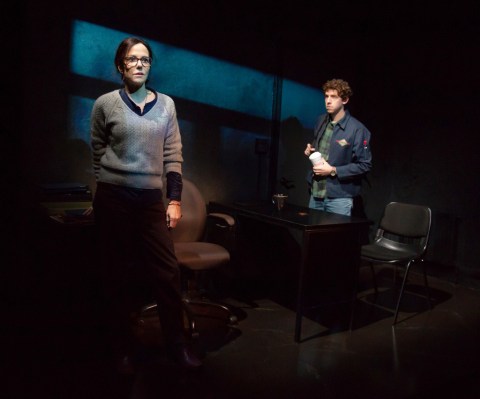
Mary-Louise Parker, Will Hochman, ‘The Sound Inside,’ by Adam Rapp,directed by David Cromer (Jeremy Daniel)
Rapp’s characterizations are drawn to entice. They loop around us and double in on themselves pinging our empathy. Despite their austere headiness and sometimes aloof demeanor, Rapp does allow Bella’s (Parker) and Christopher’s (Hochman) sensibilities to shine and soften as their relationship appears to deepen. With their responses to each other’s questions they attempt to connect and dissolve their gritty isolation. Parker and Hochman effect intriguing encounters with stirring, nuanced authenticity and exceptional feeling
The play begins and ends as a one-person narration, specifically with Bella’s direct address to the audience, a matter-of-fact revelation of her life up to and including her experience with a prodigy, a freshman in her writing class. Yale professor and writer, she initially elicits our attention speaking in complete darkness then gradually emerging from the shade as the spotlight grows brighter to finally make her visible. When she steps down front toward the audience, director David Cromer leaves the rest of the stage in darkness and shadow. It is as if she begins speaking from a vacuum, or a dark space somewhere in her own being and then seeks an audience of readers/listeners who will appreciate her story and remain with her while she tells her tale of self-discovery, healing and the uncertain apprehension of an individual who brings meaning into her life.

Mary-Louise Parker, Will Hochman, ‘The Sound Inside,’ by Adam Rapp,directed by David Cromer (Jeremy Daniel)
Cromer’s direction is pointed, symbolic and acute. With a minimalism of sets, he suggests Bella’s apartment, office and a local bar without distracting us from the most curious of relationships and events which occur between Bella and Christopher. The spareness and the directed lighting help to reinforce the dynamic tension between the teacher and her student.
Throughout, the director uses light and surrounding darkness interpretively. The symbolism of light and darkness assisted by Heather Gilbert’s excellent design suggests the intimacy of their conversation and undergirds the theme about never really knowing/ understanding the thoughts, consciousness and souls of others. Indeed, the lighting implies a possible theme, that we see others “through a glass darkly,” if they allow us to “see.” And if they do, it is merely bits and pieces of their larger unseen whole.
The lighting prepares us to be receptive to the personal stories that Bella and Christopher tell us as we watch their relationship move in a direction we cannot anticipate. We only know what they relate; we have no outside knowledge of the accuracy of what they express. Thus we must trust Bella and Christopher as narrators. However, Rapp twits us. We must also doubt them as he characterizes with vast indefiniteness, almost with a dream-like quality, though Bella appears more solid than Christopher.
Therein lies the rub! To what extent are Bella and Christopher reliable narrators? Both of them address the audience and discuss their perceptions of each other without particular effusion of feeling. Actually, we receive more from their interactions and the stories they have written.
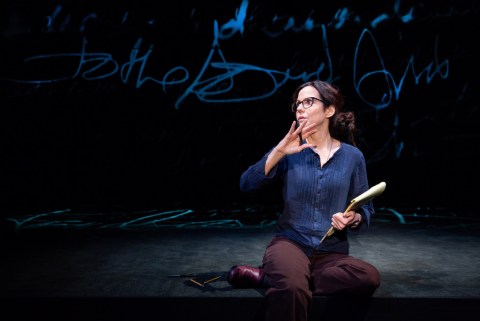
Mary-Louise Parker, Will Hochman, ‘The Sound Inside,’ by Adam Rapp,directed by David Cromer (Jeremy Daniel)
However, that too ends in an opaque blind because their stories which have autobiographical and symbolic components, are indeed, fiction. Yet, they are metaphorical and may even parallel their real lives and their portentous deaths.
Christopher details a synopsis of Bella’s novel whose character’s last name is the same as hers and who dies proving a point about the culture and human nature. Christopher relates the synopsis of his novel in which one of his protagonists (Shane) dies. The other character whose name is the same as Christopher’s takes Shane’s place and cares for his son whose name is the same as Bella’s protagonist who dies (Billy). In both Bella’s and Christopher’s novels, deaths occur and these complicate our understanding of Bella and Christopher because they are related to Bella’s narration of events about Christopher and her interactions with him.
In a further complication and twist, Christopher’s novel contains allusions to particular novels he’s read in Bella’s class: Crime and Punishment by Fyodor Dostoevsky, Catcher in the Rye by J. D. Salinger, etc., as well as a references to Christopher’s favorite book, Old Yeller by Fred Gipson. The reference to Wild Palms by William Faulkner a favorite of Bella’s and Christopher’s, Rapp uses as an allusion to The Sound Inside. In Rapp’s play the lives of Bella and Christopher are narratives of isolated individuals. These individuals are momentarily arrested from their aloneness on the venerable college campus where they connect, energize, impact one another then move on having made an indelible and irrevocable exchange which Rapp alludes to at the conclusion. You will just have to see The Sound Inside to find out what that is; no spoiler alert is coming to reveal the final impact of this play, shimmering with the ineffable, the uncertain, the intangible.

Mary-Louise Parker, Will Hochman, ‘The Sound Inside,’ by Adam Rapp,directed by David Cromer (Jeremy Daniel)
Rapp teases us with the references to celebrated novels and their tie-ins as well as the mystery of the final events of Bella’s narration about her relationship with Christopher: the help she needs from him and the help her gives her. All are under the penumbra of Bella’s story-telling which spins outward into a cloudy firmament. Indeed, as she importunes Christopher toward the end, she has “reached into a dark room for something.” Christopher helps her with her fateful request with an even more fateful response.
Parker’s Bella concludes with us emerging from her flashback into the present in her last address to the audience. She stands in the spotlight, the darkness of the park behind her. This is where she solicited us and sparked our curiosity at the top of the play, so we are back at a beginning. Throughout we remained rapt, engaged and constantly questioning. However, at the last in the park with Bella, we finally must accept what she has told us is both a reflection of her own consciousness and meaning and ours, in a meld of fiction, imagination and faith.
Parker and Hochman take us on this incredible journey toward connection reminding us of the impact we do have on others despite our assumptions to the contrary. Ironically, however, we cannot always state with certainty what that impact is or might be. In Rapp’s thrilling play, opacity and its companion uncertainty about human nature, knowing and consciousness are paramount.
That Rapp breaks the third wall to tell Bella’s then conjointly Christopher’s stories is vital. As we tell our own stories or write them, we constantly intrude to watch ourselves in the telling. Objectivity is a canard as is connection. Our consciousness is ours alone, a key theme of Rapp’s work. We can move parallel with others, but we move alone. After we come to the end of ourselves, the journey may be great fun. But along the way, as it is for Bella (until after she meets Christopher) and for Christopher, the pain of discovering identity, and settling comfortably into our consciousness tears us like a cancer which must be healed.
Kudos to Alexander Woodward (scenic design) David Hyman (costume design) Heather Gilbert (lighting design) Daniel Kluger (music and sound). The Sound Inside runs with no intermission at Studio 54 (West 54th Street between 7th and 8th). For tickets and times CLICK HERE.
‘The Rose Tattoo,’ Marisa Tomei Is Tennessee Williams’ Fiery, Sensual Serafina, in a Stellar Performance
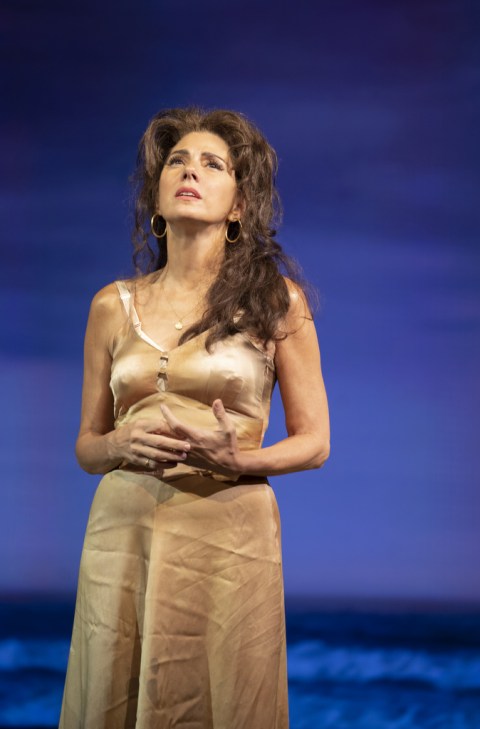
Marisa Tomei in ‘The Rose Tattoo,’ by Tennessee Williams, presented by Roundabout Theatre Company (Joan Marcus)
Atmosphere, heat, the heavy scent of roses, candles, mysticism, undulating waves, torpid rhythms, steamy melodies, fantastical rows of pink flamingos, a resonant altar of the Catholic Madonna. These elements combine to form the symbolic backdrop and evocative wistful earthiness that characterize Roundabout Theatre Company’s The Rose Tattoo at American Airlines Theatre.
Tennessee Williams playful, emotionally effusive tragic-comic love story written as a nod to Williams own Sicilian lover Frank Merlo, is in its third revival on Broadway in a limited engagement until 8th December (the Catholic date of the Feast of the Immaculate Conception). Reflecting upon Marisa Tomei’s portrayal of Serafina in The Rose Tattoo, this is an ironic, humorous conclusion in keeping with the evolution of her character which Tomei embraces as she exudes verve, sensuality, fury, heartbreak and breathtaking, joyful authenticity in the part.
If any role was made for Tomei, divinity and Tennessee Williams have placed it in her lap and she has run with it broadening the character Serafina Delle Rosa with astute sensitivity and intuition. Tomei pulls out all the stops growing her character’s nuanced insight. She slips into Serafina’s sensual skin and leaps into her expanding emotional range as she morphs in the first act from grandiose and joyful boastfulness to gut-wrenching impassioned sorrow and in the second act to ferocity, an explosion of suppressed sexual desire and its release. All of these hot points she elucidates with a fluidity of movement, hands, limbs, head tosses, eye rolls which express Serafina’s wanton luxury of indulgent feeling and effervescent life.
The contradictions of Serafina’s character move toward a hyperbolic excess of extremes. When speaking of her husband Rosario and their relationship, their bed is a sanctum of religion where they express their torpid love each night. She effuses to Assunta (the excellent Carolyn Mignini) how she mysteriously felt the conception of her second child the moment it happened. A rose tattoo like the one her husband Rosario wore on his chest appeared like religious stigmata without the dripping blood. And it burned over her heart, a heavenly sign, like others she receives as she talks to the statue of the Madonna, and remains a worshipful adherent to Mother Mary, praying and receiving the anointed wisdom whenever necessary.
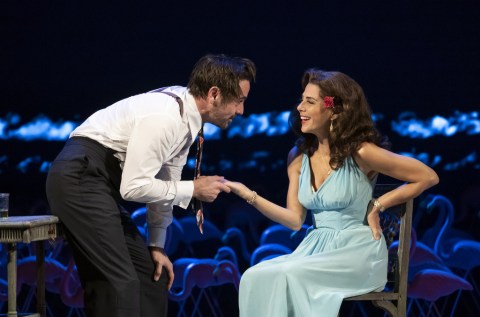
Marisa Tomei, Emun Elliott in ‘The Rose Tattoo,’ by Tennessee Williams, presented by Roundabout Theatre Company (Joan Marcus)
Rosario’s family is that of a “baron,” though Sicily is the “low” country of Italy and an area fogged over with undesirables, thieves and questionable heritages as the crossroads of Europe. We know this “baron-baroness” is an uppity exaggeration from the looks on the faces of her gossipy neighbors and particularly La Strega (translated as witch) who is scrawny, crone-like and insulting. Constance Shulman is convincing as the conveyor of Ill Malocchio-the evil eye. Her presence manifests the bad-luck wind that Assunta refers to at the top of the play and to which Serafina superstitiously attributes the wicked event that upends her life forever.
Williams’s characterization of Serafina is brilliant and complex. Director Trip Cullman and Tomei have effected her intriguing possibilities and deep yearnings beyond the stereotypical Italian barefoot and pregnant woman of virginal morals like Our Lady. It is obvious that Tomei has considered the contradictions, the restraints of Serafina’s culture and her neighbors as well as her potential to be a maverick who will break through the chains and bondages of her religion and old world folkways after her eyes are opened.
We are proud that Serafina disdains the gossiping neighbors with the exception of Assunta and perhaps her priest. Though Serafina’s world does not extend beyond her home, the environs of the beach, her daughter Rosa (Ella Rubin) and Rosario, a truck driver who transports illegal drugs under his produce, she is a fine seamstress. And in her business interactions with her neighbors and acquaintances, we note that she has money, is industrious, resourceful and a canny negotiator.
It makes sense that Rosario (whom we never see because he is a fantasy-Williams point out) treats her like a baroness filling their home with roses at various times to reassure her of her grandness. And the poetic symbol of the rose as a sign of their love and the romance of their relationship is an endearing touch, reminiscent of the rose tattoo on his chest signifying his commitment to her. At the outset of the play, a rose is in Serafina’s hair which she wears waiting for Rosario to come home. As she does, we believe she is fulfilled in their love and the happy status of their lives in a home on the shores of paradise, the Gulf Coast of Mississippi.
What is not manifest and what lurks beneath becomes the revelation that all is not well, that her Rosario is not real, but is an illusion. Typical of Williams’ work are the undercurrents, the sub rosa meanings. The rose is also a symbol of martyrdom, Christ’s martyrdom. And it is this martyrdom that Serafina must endure when word comes back that Rosario has been killed, burned in a fiery crash which warrants his body be cremated. Unfortunately, the miraculous son of the burning rose on her chest that appeared and disappeared, she aborted caused by the extreme trauma of Rosario’s death.

Marisa Tomei, Emun Elliott in ‘The Rose Tattoo,’ by Tennessee Williams, presented by Roundabout Theatre Company (Joan Marcus)
The rose as Williams’ choice symbol is superbly complex. For Rosario’s rose tattoo also represents his amorous lust for women, one of whom is Estelle Hohengarten (Tina Benko) who asks Serafina to make a gorgeous, rose-colored silk shirt for “her man.” When Estelle steals Rosario’s picture behind Serafina’s back, we know that Rosario led a double life and we are annoyed at Estelle’s arrogance and presumption to ask his wife to make such a gift shirt. But in William’s depth of characterization for Estelle, most probably Rosario is also philandering on Estelle who, to try to keep him close, gives him expensive gifts like hand-made silk shirts.
Williams clues us in that her faith and passion for Rosario has blinded her judgment and overcome her sharp intellect and wisdom. In fact it is an idolatry. Her religion stipulates that no human being should be worshiped or sacrificed for. Serafina’s excessive personality has doomed her to tragedy, betrayal and duplicity with Rosario. Ironically, his death is her freedom, but she must suffer his and her son’s loss ,a burden almost too great to bear, even for one as strong as Serafina who does become distracted, unkempt and uninterested in life.
Because Rosario, the wild rose with thorns is not worthy of Serafina’s love, after his death there is only pity for the cuckholded Serafina and a finality to her exuberant life until the truth of who Rosario really was lifts her into a healthy reality. Tomei’s breakdown is striking and Williams creates the tension that in weeping for the “love” of her life who indeed has betrayed her, she will be wasting herself. He also affirms the huge gulf between her ability to live again and her lugubrious state which continues for three years as she mourns an illusion.
The question remains. Will she come to the end of herself? The romantic fantasy held together with the glue of her faith and the enforced, manic chastity of her old world Italian mores must be vanquished. But how? It is in the form of the charismatic and humorous Alvaro Mangiacavallo. But until then Serafina withers. Isolating herself, she implodes with regret, doubt, sorrow and dolorous grief, as well as anger at her daughter Rosa who wants to live and find her own love like her mother’s.
The mother-daughter tensions are realistically expressed as are the scenes between Tomei and Jack (Burke Swanson) Rosa’s boyfriend, which are humorous. Altogether, the second act is brighter; it is companionable comedy to the tragedy of the first act.
When she meets Alvaro, in spite of herself, she responds with her whole being to his attractiveness. As they become acquainted, she accepts his interest in her for what she may represent; a new beginning in his life. It is a new beginning that he tries to thread into her life to resurrect her sexual passions and emotions of love. Thus, he pulls out all the stops for this opportunity to win her, even having a rose tattooed upon his chest in the hope of taking Rosario’s place in her heart.
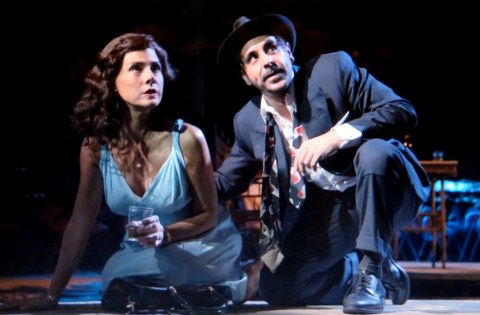
Marisa Tomei, Emun Elliott in ‘The Rose Tattoo,’ by Tennessee Williams, presented by Roundabout Theatre Company (Joan Marcus)
Emun Elliott is spectacular as the clownish, emotionally appealing, lovable suitor who sees Serafina’s worth and beauty and attempts to endear himself to her with the tattoo. Along with Serafina’s discovering Rosario’s betrayal, Elliott’s portrayal of Alvaro solidifies and justifies why Serafina jumps at the opportunity to be with him. He is cute. He is real. He is as emotional and simpatico as she is. He is Sicilian and above all, he is available and interested in her. It is not only his steamy body that reminds her of Rosario’s, but she is attracted to his humor, sensibility and sensitivity of feeling which mirrors hers.
After discovering Rosario’s duplicity, understanding Alvaro’s concern and care for three women dependents and his honesty in admitting he is a buffoon disarms Serafina. Alvaro’s strength and lack of ego in commenting that his father was considered the village idiot is an important revelation for her as well. Indeed, as she views who he is, she senses that his humility and humorous self-effacement is worth more than all of Rosario’s boastfulness that he was a baron which he wasn’t.
As the truth enlightens her, Tomei’s Serafina evolves and sheds the displacement and her sense of confusion and loss which was also a loss of her own imagined “secure” identity as Rosario’s “wife.” Wife, indeed! Rosario’s mendacity made her into a cuckhold and a brokenhearted fool over a man who was not real. At least Alvaro is real. The comparison between the men reinforced with Rosario’s unfaithfulness, which she can now admit to herself, prompts her to reject the religion that kept her blinded and the antiquated mores that made her a fool and kept her alone and in darkness.
Shepherded by Cullman, Elliott and Tomei create an uproarious, lively and fun interplay between these two characters who belong together, like “two peas in a pod” and have only to realize it, which, of course, Alvaro does before Serafina. Tomei’s and Elliott’s scenes together soar, strike sparks of passion and move with the speed of light. The comedy arises from spot-on authenticity. The symbolic poetry, the shattering of the urn, the ashes disappearing, the light rising on the ocean waves (I loved this background projection) shine a new day. All represent elements of hope and joy and a realistic sense of believing, grounded in truth for both protagonists.
Tomei, Elliott, Cullman and the ensemble have resurrected Williams’ The Rose Tattoo keeping the themes current and the timeless elements real. Duplicity, lies, unfaithfulness, love and the freedom to unshackle oneself from destructive folkways that lead one into darkness and away from light and love are paramount themes in this production. And they especially resonate for our time.
I can’t recommend this production enough for its memorable, indelible performances especially by Elliott and Tomei shepherded with sensitivity by Cullman. The evocativeness and beauty of the staging, design elements and music add to the thematic understanding of Williams’ work and characters. Kudos goes to the creative team: Mark Wendland (set design) Clint Ramos (costume design) Ben Stanton (lighting design) Lucy Mackinnon (projection design) Tom Watson (hair and wig design) Joe Dulude II (make-up design). Bravo to Fiz Patton for the lovely original music & sound design.
The Rose Tattoo runs with one intermission at American Airlines Theatre (42nd between 7th and 8th) until 8th December. Don’t miss it. For tickets and times CLICK HERE.
‘The Lightning Thief-The Percy Jackson Musical,’ a Stirring Adaptation of the Titular Rick Riordan Novel

(L to R): Kristin Stokes, Chris McCarrell, Jorrel Javier in ‘The Lightning Thief-The Percy Jackson Musical,’ book by Joe Tracz, Music & Lyrics by Rob Rokicki, adapted from the book by Rick Riordan, directed by Stephen Brackett at the Longacre Theatre (Jeremy Daniel)
It’s even in the Bible. Gods hung around with humans and children were born to them. Of course this caused issues for the children and the parent who was human, just like in real life single parent homes. But in mythology the god often went about his or her business coupling with other humans and abandoning each family he or she created. The parent who was a “god” was too busy to care for the “demi-god” who grew up feeling unwanted, confused, unloved. Thus, a whole race of weird “demi-gods” wandered among humanity and caused chaos because they had been damaged by their “god” parent and had the DNA (magic) to realize that they were “different” and could take it out on humanity when they were “pissed” off.

Chris McCarrell in ‘The Lightning Thief-The Percy Jackson Musical,’ Book by Joe Tracz, Music & Lyrics by Rob Rokicki, adapted from the book by Rick Riordan, directed by Stephen Brackett, Longacre Theatre (Jeffrey Daniel)
Some of these elements are the basis of Rick Riordan’s popular Percy Jackson and the Olympians series of books of which The Lightning Thief is the first novel and launching pad for the fun characters in the remaining Riordan books. Many of them are tied in to Greek Mythology. Riordan’s fantasy-adventure novels gave rise to two films with the titular Percy Jackson identifying as the demi-god protagonist: Percy Jackson and The Olympians, The Lightning Thief (2010) and Percy Jackson, Sea of Monsters (2013). When word got out that a theatrical production was being considered and TheaterworksUSA was involved, the rest is history.
Collaborators Joe Tracz who wrote the book and Rob Rokicki who wrote the music & lyrics, fashioned an already successful story-line to titillate and enthrall theatergoers. Their initial hour show evolved with more songs and extended book which morphed into the current production on Broadway at the Longacre Theatre, The Lightning Thief, The Percy Jackson Musical.
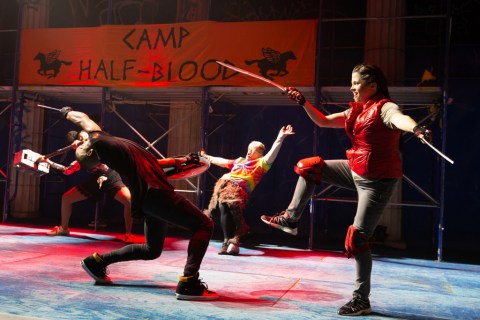
James Hayden Rodriguez, Sarah Beth Pfeifer and the Company in ‘The Lightning Thief-The Percy Jackson Musical,’ Book by Joe Tracz, Music & Lyrics by Rob Rokicki, adapted from the book by Rick Riordan, directed by Stephen Brackett, Longacre Theatre (Jeffrey Daniel)
If you and your children are fans of Riordan’s work, you must see this Broadway show whose adaptation of Riordan’s novel parallels many of the book’s elements. The production reinforces vital themes about life, purpose, goodness and evil working to create soul strength and character, ethics, and personal accountability. Indeed, the characters learn that they may have been left with a flawed creation warped by even more flawed gods when they war with each other. However, all is well because the demi-gods, have the talent and ability to rise above the chaos, and with determination, correct and perfect the world and themselves, teaching the gods a lesson or two.
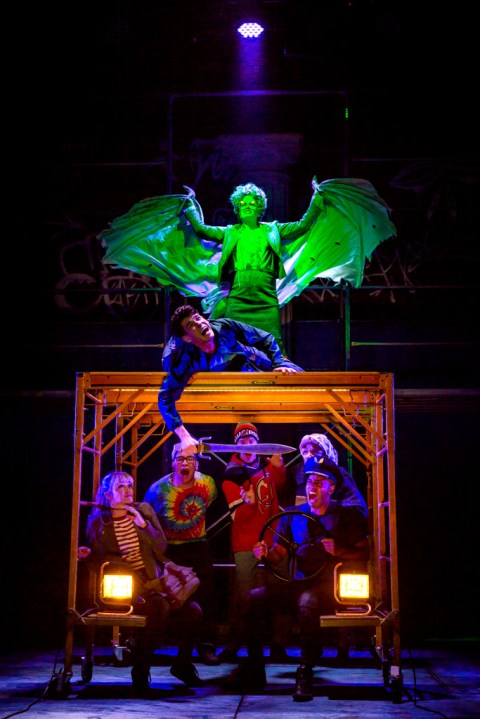
(L to R): Sarah Beth Pfeifer, Chris McCarrell (top) Kristin Stokes, Jorrel Javier, Ryan Knowles, Jalynn Steele, and James Hayden Rodriguez (bottom, left to right) in ‘The Lightning Thief-The Percy Jackson Musical,’ book by Joe Tracz, Music & Lyrics by Rob Rokicki, adapted from the book by Rick Riordan, directed by Stephen Brackett at the Longacre Theatre (Jeremy Daniel)
Tracz and Rokicki evolve these notions to an uplifting conclusion in The Lightning Thief, The Percy Jackson Musical which emphasizes that the principal characters and all of us must leave safety and security to face the unknown. Then, exercising their inner spiritual/magical powers, they must fearlessly overcome the real monsters that are out in the world. In the final song that the Company sings, “Bring on the Monsters,” never were truer words spoken for us today about the “monsters’ in human form roiling social currents and effecting chaos. That it is up to all of us to stand against wickedness and with hope, courage and wisdom thwart evil intentions wherever they may be, remains the mission for young and old, now and forever.

Chris McCarrell in ‘The Lightning Thief-The Percy Jackson Musical,’, Book by Joe Tracz, Music & Lyrics by Rob Rokicki, adapted from the book by Rick Riordan, directed by Stephen Brackett Longacre Theatre (Jeffrey Daniel)
The production’s adaptation is a fine one with segments of theatrical spectacle (i.e. lighting design by David Lander and hair wig & makeup design by Dave Bova, costumes by Sydney Maresca) brilliantly effected. The show is choreographed by Patrick McCollum’s who uses his talents to generate excitement. With joy and exuberance Stephen Brackett’s direction steers the production to emphasize valuable lessons to comfort, to uplift.
Magnificent is the energy and vibrance of the ensemble who don various wigs and costumes, accents and upper or lower register “voices” to portray gods, monsters, enemies and friends. The cast appears to be a multitude, however, only seven actors take on key parts. These include Jorel Javier, Ryan Knowles, Chris McCarrell, Sarah Beth Pfeifer, James Hayden Rodriguez, Sam Leicht, Jalynn Steele, Kristin Stokes, and the understudies whom I saw on Sunday evening, 20 October, T. Shyvonne Stewart and Izzy Figueroa.

Jorrel Javier, Chris McCarrell (top),Kristin Stokes, and James Hayden Rodriguez in ‘The Lightning Thief-The Percy Jackson Musical,’ book by Joe Tracz, Music & Lyrics by Rob Rokicki, adapted from the book by Rick Riordan, directed by Stephen Brackett at the Longacre Theatre (Jeremy Daniel)
The actors’ versatility is just grand and some are particular standouts investing their will and being to apply their full-throated vocal talents. One standout is Jorrell Javier who portrays both the hell-raising god of the Half-Breed Summer Camp (god of wine- Dionysus) and the friend and protector satyr-Grover, a character who is both lovable and self-effacing. For example Grover endearingly talks to squirrels in a segment during the protagonists’ hero quest. Since squirrels are ubiquitous, Grover’s talent proves invaluable as he, Percy and Annabeth move on their journey to discover the lightning thief, find where he has hidden the lightning BOLT and save Percy’s mother Sally from Hades and the underworld.
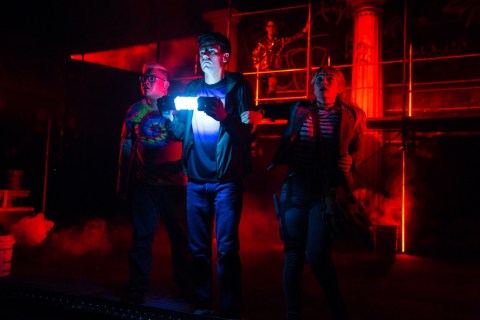
(L to R): Jorrel Javier, Chris McCarrell, Ryan Knowles (top), and Kristin Stokes in ‘The Lightning Thief-The Percy Jackson Musical,’ book by Joe Tracz, Music & Lyrics by Rob Rokicki, adapted from the book by Rick Riordan, directed by Stephen Brackett at the Longacre Theatre
(Jeremy Daniel)
The male and female leads played by Chris McCarrell (Percy Jackson) and Kristin Stokes (Annabeth) have powerful, sonorous voices, though sometimes their enunciation is wanting. For those adults unfamiliar with Riordan’s books and the films they spawned, this may be problematic. Indeed, the fans will breeze through the familiar humor, fun mythological modernization, and melodies sung with joy and verve by the actors. For those unfamiliar with the plot, themes and characters, clarity is crucial. To receive the greatest enjoyment and a resounding response from the audience, all of the words must be clearly sung as they were clearly spoken.
McCarrell’s Percy Jackson is wistful searcher, investigator, educational ner-do-well, sometime whiner. He’s upset that he is always expelled from school, initially for his challenging condition (he’s ADHD and Dyslexic) and secondarily for being in the “wrong place at the wrong time.” However, his mother (Jalynn Steele, u/s T. Shyvonne Stewart) encourages his furtive yearnings and he and she sing the uplifting “Strong,” keying in the theme that undergirds Percy throughout the play.
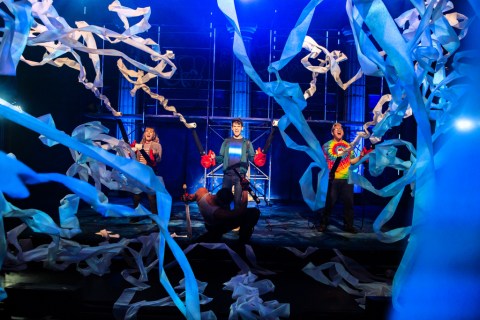
(L to R): Kristin Stokes, Chris McCarrell, and Jorrel Javier’The Lightning Thief-The Percy Jackson Musical,’ book by Joe Tracz, Music & Lyrics by Rob Rokicki, adapted from the book by Rick Riordan, directed by Stephen Brackett at the Longacre Theatre
(Jeremy Daniel)
As events steer Percy to his destiny (“The Minotaur/The Weirdest Dream”) and growing self-revelation, he learns that his trouble-maker status is caused by Poseidon’s enemies who scape-goat him and create havoc precisely because he is his father Poseidon’s son. His growing realization of the evil undercurrents around him augments throughout the production until he steps into his hero mantle in “Son of Poseidon,” confronts the real “lightning thief” and does battle in the present “The Last Day of Summer.”
The quest teaches Percy, Grover and Annabeth that life is filled with trials, but attitude and how you confront obstacles makes the difference so you are not the victim but are the hero. He and the effervescent Kristin Stokes as Annabeth (Athena’s daughter) go to battle with courage, grace and strength. They elicit the power to confront whatever the gods/monsters throw their way. The production concludes with the excellent “Bring on the Monsters.” Percy, Annabeth, Grover and the Company have matured to understand their true purpose on earth: confront the powers of evil that inhabit human nature and thwart their actions.
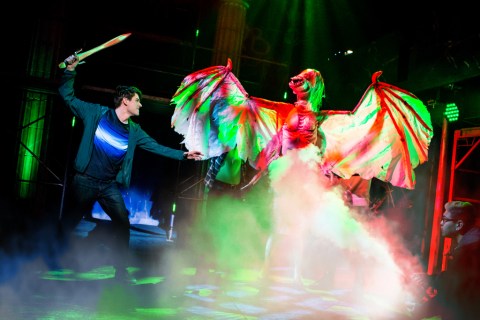
Chris McCarrell in ‘The Lightning Thief-The Percy Jackson Musical,’, Book by Joe Tracz, Music & Lyrics by Rob Rokicki, adapted from the book by Rick Riordan, directed by Stephen Brackett Longacre Theatre (Jeffrey Daniel)
The plot twists are intriguing, born on the wings of the music and lyrics. Especially strong are “The Oracle,” “Good Kid” and “Killer Quest!” which are sung by Percy and the Company and in the last number of the first act, (“Killer Quest”) by Percy, Annabeth, Grover and the Company. The themes of betrayal, true friendship, loyalty and the importance of the journey revealing one’s nature and identity are ripe and relate to all ages. Kudos to Tracz and Rokicki for touching upon the timeless verities of Riordan’s work as well as adding salient concepts that especially resonate today in our world of real human monsters.
The creative team deserves recognition for their designs. These coalesce around the lighthearted fantastic tenor of the production which reflects and symbolizes “the roadshow” genre in its rough sets, puppetry and effects in the realm of rustic illusory suggestion. Do not expect the wild, technical phantasmagoria of Beetlejuice. The show’s simplicity is charming and intentionally not “over the top” Broadway. It keeps one foot on the ground and melds the concepts of gods and monsters evocatively, not believably. Creatives are Lee Savage (scenic design) Sydney Maresca (costume design) David Lander (lighting design) Ryan Rumery (sound design) Achesonwalsh Studios (puppetry) Dave Bova (hair, wig & makeup design).
The Lightning Thief The Percy Jackson Musical runs with one intermission at the Longacre Theatre (220 West 48th Street). It closes on 5 January and tickets will be hard to come by as we near the holidays. For tickets and times CLICK HERE.
‘Linda Vista’ by Tracy Letts, a Sharp, Edgy Romp Through Sex, Love and Male Menopause

(L to R): Caroline Neff, Ian Barford, Troy West in ‘Linda Vista,’ written by Tracy Letts, directed by Dexter Bullard (Joan Marcus)
Steppenwolf’s production of Linda Vista by Pulitzer Prize and Tony Award® winner Tracy Letts is a wild ride through aging masculinity receding in a “heady” pattern like one found in male baldness. Once it begins, the decline is precipitous and unwieldy if not ragingly unattractive. Letts takes the “older” concept for a separated, licentious boy-man and runs with it to its hysterical, one-liners climax of symphonic madness. Then he concludes with a searingly poignant, light-shining breakthrough of hope for the protagonist who at the last shot becomes appealing and sensitively human.
Letts’ Linda Vista, with well time and paced direction by Dexter Bullard sports exceptionally crisp, crackling dialogue. Letts’ characters are mundane and real. However, Letts engages us by giving them sardonic, self-effacing, humorous lines and ripping authenticity. The protagonist, the soon-to-be-divorced philanderer Wheeler (Ian Barford builds warmth and humanity with evolving emotional grist) is just this side of the sad-sack in the titular film Marty (1955) about a guy who is single, alone and has high expectations of hooking up with a beauteous gal. What diverts Wheeler from the more empathetic Marty-type is his arrogance and his self-depricating humor which reveals he doesn’t think he isn’t “all that.” In fact he believes himself brilliant and quite the “ladies man,” though he avers the opposite.
Wheeler’s humor is a double-edged sword. It prevents him from blowing his brains out during the holidays or becoming a psychotic and isolated Incel. On the other hand it also prevents him from self-revelation and self-intimacy. He does not reflect on the source of his inner devastation and self-loathing which leads him to repeat destructive patterns and crash and burn up relationships.
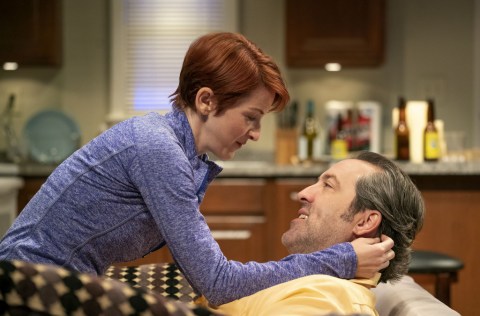
Cora Vander Broek, Ian Barford, ‘Linda Vista’ by Tracy Letts, directed by Dexter Bullard (Joan Marcus)
Letts’s characterization of this self-enfeebled boy-man who refuses to grow up pings of all the isms (ageism, sexism, chauvinism, etc.) which Wheeler buys into surreptitiously though he would be loathe to admit it up front. As a Caucasian male from a middle class background adhering to his demographic mores, he is manipulative and macho; empathizing with women is not “his thing.” Understanding is only to be exhibited to get somewhere with a woman. It never goes beyond skin deep!
Letts clues us into Wheeler’s basic flaws and male-privileged machismo attitudes at the top of the play as he comes on to his co-worker Anita (the excellent Caroline Neff). After she rebuffs him by stating she is trying to get herself together and can’t be involved with a “mess,” he quips manipulatively, “Thanks for saying ‘mess’ instead of ‘hot mess,’ which is a phrase I can’t stand.” Then Wheeler further adds, after thanking her for her honesty, “And he was humiliated.” Regardless of how forward and inappropriate his “come on” to a co-worker is, his humor endears and propels him into a seeming humanity. This is a blind as Letts adroitly underscores throughout the play.
Wheeler’s and Anita’s boss, Michael (the fine Troy West) is a foil to whom we compare Wheeler. Indeed, there are men who are so much worse than Wheeler. An unattractive and uber gross lecher, Michael ogles Anita’s breasts and makes demeaning, scurrilous comments about having sex with her. Thus, Wheeler’s light interaction and lunch invite shows him to be the proper angel with Anita. On the other hand Wheeler doesn’t chide or reprimand Michael for his salacious, untoward comments and indeed, is his sounding board and encourager behind Anita’s back. He has to learn better. In these scenes the LOL quips are proportionate to the EWW of West’s soul crippled Michael. Letts’ dialogue is masterful.
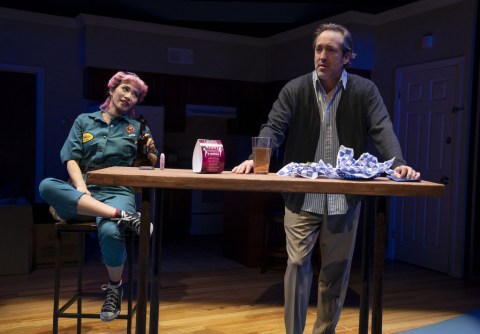
Chantal Thuy, Ian Barford, ‘Linda Vista,’ written by Tracy Letts, directed by Dexter Bullard (Joan Marcus)
Even though Wheeler tosses out sardonic replies that Michael accepts as good-natured ribbing put-downs, he doesn’t bother to call Michael out for his snide and self-damaging ridiculousness. Wheeler’s silence is agreement. It indicates that what Michael expresses, Wheeler thinks. Objectifying women doesn’t make for healthy male-female relationships. Indeed, it reflects an uncontrolled sickness of the soul. Boys will be boys turns into sick men will become sicker men. By the end of Linda Vista, Letts clarifies this theme roundly.
It is this graceful attempt at “being real” to avoid being honest and sincere that entrances Jules, a date/friend that Wheeler’s friends, couple Paul (Jim True-Frost) and Margaret (Sally Murphy) set him up with. Initially, Wheeler and Jules (the superb Cora Vander Broek) get along swimmingly and, naturally, after her own “hot mess” breakup, Jules falls hard for Wheeler and is intimate with him almost immediately. Their sex scene is hysterical (Vander Broek in particular) and surprisingly on point as they both try to complete their satisfaction. It is also revealing. Wheeler apparently as a fifty-something doesn’t need Viagra. But Jules in her thirties (a peak age for women’s sexuality) “needs something” because of her emotional issues.

(L to R): Cora Vander Broek, Ian Barford, Chantal Thuy in ‘Linda Vista’ written by Tracy Letts, directed by Dexter Bullard (Joan Marcus)
The twist is humorous and we begin to understand that underneath Wheeler’s “unrestrained libido” which brought him to betray his wife during an affair is a lurking fear. He needs to go deep but remains shallow and sex is an easy diversion. On the other hand Jules is authentic as she attempts her own “thing.” Clearly, they need to talk, but they don’t.
Letts’ Wheeler progresses toward some moment of epiphany by way of an episodic journey through women which he underestimates and relates to only as those he bounces across his intelligence and couples with sexually. He does not seem to perceive women as an opportunity, a ready and understanding help-meet with whom to learn and grow. Though the possibility for this occurs with Jules who encourages his photographic artistry, he eschews her attempt to go for the complicated. Conveniently, around the time that his relationship with Jules is about to take a turn into the profound, he throws her over for a twenty-something whose boyfriend dumped her and who initially needs a place to stay.
The scene where Wheeler breaks up with Jules is a cut-out of the “ending a relationship” break up scenes: the male blames himself for not being good enough for the female. This in itself is an ironic send up of the lies that human beings groove themselves into without thought or introspection. Naturally, the return cut-out appears. Jules confronts Wheeler with her suspicion that there is “another woman.” We understand that Wheeler most probably has repeated this scenario again and again before his marriage and during it. And perhaps Jules has repeated such a scene during her previous break-up. For the male, there is never another woman! However, with Wheeler (the irony of his name becomes more pronounced as Letts propels his character driven by his own blindnesses as a typical wheeler dealer in his relationships) as with other men, of course there is that other woman!

(L to R): Jim True-Frost, Cora Vander Broek, In Barford, Caroline Neff in ‘Linda Vista,’ directed by Dexter Bullard, written by Tracy Letts (Joan Marcus)
The “other woman” and unfaithfulness are the macho lines that men roll down. They must be unfaithful and encourage each other to do so. This is their ancient more, birthright, legacy, folkway; they can’t “leave home without it.” Then, what would “being male” turn into? The unthinkable, the impossible. Letts’ characterization of Wheeler slams all the tropes and to the seeing audience member, the sardonic quips that Wheeler employs schmooze him past any redemptive efforts to do the work to self-correct.
His friend Paul senses Wheeler’s avoidance and though Wheeler affirms at the top of the play he shouldn’t get involved with any woman as his divorce is being settled and he has been cut up about it, Paul ignores Wheeler. He understands his friend’s “needs” and more importantly, understands his machismo is at stake. What??? Is Wheeler going to join an Ashram and meditate to heal himself? Heaven forbid. He’ll move into the next relationship as unwhole, unhealthy and flawed as he is to once more be bowed and bloodied afterward. Perhaps Paul isn’t Wheeler’s true friend after all. Perhaps he too, like Wheeler, is blind.

(L to R): Jim True-Frost, Sally Murphy, ‘Linda Vista,’ directed by Dexter Bullard, written by Tracy Letts (Joan Marcus)
Obsessed with Minnie who is pregnant and lives with him, Wheeler throws himself into her youth and off-beat, exotic, defensive curtness. Also, with hysterical “cool cat” aplomb, he gets a tattoo, wears leather and chains and limps a lot because of the “amazing” sex (too funny). Paul, without encouraging or dissuading him has massaged him with the middle age, male menopausal meme to “enjoy” your life, “you only live once,” yada yada, which is precisely what Wheeler shouldn’t embrace. His life is within and why he is placing himself in situations which will result in further self-recrimination and self-loathing makes little sense. But Letts has chosen this as Wheeler’s path, for he is the American white “everyman.” God help him!
What Wheeler seeks is not in Minnie who is the apotheosis of a “hot mess.” Nevertheless, Wheeler becomes the convenient lump of clay she molds with sex and no strings attached. What is attached becomes heightened obfuscation, confusion and depression. Minnie is the perfect object, for with her Wheeler will batter his soul to oblivion which Minnie helps him do in a particularly poignant scene. On his knees Wheeler worships his idol like an oblivious and scorned mendicant.
Ian Barford pulls out all stops emotionally in the climactic scenes with Jules and Minnie who are equally superb. Indeed, after Jules delivers a spurning I am “strong” speech to Wheeler, women in the audience applauded and cheered. That scene in particular resonated as the actors hit the emotional notes beautifully. During these scenes for the first time, we understand Wheeler’s desperation. He is not seeking forgiveness from Jules or the need to be with Minnie or any woman. In his pleadings, Wheeler is looking for the last vestiges of escape and distraction from himself. But both women close their doors. Wheeler will have to confront his aloneness and ask the hard questions without his wall of humor to hide behind. Will he be able to do the work? It’s a completely different cycle for him.

Cora Vander Broek, Ian Barford, in ‘Linda Vista,’ written by Tracy Letts, directed by Dexter Bullard (Joan Marcus)
Letts has crafted a brilliant, hysterical and ironic expose of the male-female dynamic and social ethos engineered by our culture. The play hot buttons the seminal issues of the gender divide. Fear guides talented men and women toward using sex or gender as a distraction away from their core understanding of themselves. It is the key way human beings use humans as shiny objects to displace the looming inner abyss of misery and sadness. But eventually the morass of emotions rears its horrific head if individuals do not heed the storm warnings.
With memorable humor (the one liners are so incredibly, rhythmically honed to needle points that fly to their mark) nuanced characterizations and a refined episodic arc of development, the audience remains clear-eyed and engaged to note the varied themes. Letts’ good will evolves and reminds us to what is the salvation for many souls: employing the artist within each of us. Affirming that vital theme as true, I wholly applaud Linda Vista, the director-Dexter Bullard, and the moment-to-moment skills of the ensemble who have rendered this comedic, thought-provoking play into a meaningful evening of delight.
Kudos to Todd Rosenthal for his utilitarian scenic design, Laura Bauer for her costume design, Marcus Doshi for lighting design and Richard Woodbury for sound design (the irony of the jet fly-over was pointed and humorous). Linda Vista runs with one intermission at the Helen Hayes Theater on 44th Street between 7th and 8th until 10th November unless it is extended. For tickets and times CLICK HERE.
‘Slave Play’ by Jeremy O. Harris, An Explosive, Archetypal Look at Power, Sadomasochism and Oppression Through the Mythic Lens of “Black” and “White”

(L to R): Ato Blankson-Wood, Chalia La Tour, Joaquina Kalukango (kneeling), Irene Sofia Lucio, Sullivan Jones, Annie McNamara, Paul Alexander Nolan, and James Cusati-Moyer. in ‘Slave Play’ by Jeremy O. Harris, directed by Robert O’Hara (Matthew Murphy)
Slave Play by Jeremy O. Harris is a mind-bending, brain-slamming earthquake which will strike your soul and disturb you emotionally. Despite your desire to remain unaffected, you will react. Good live productions stir us. The finest plays rock us off our complacency and shatter our intellectual stasis. Slave Play, directed by Robert O’Hara, currently at the Golden Theatre, does that and more. Memorable and profound, it is the epitome of its sardonic genre. And in its ancient modernism, it rises to a level that melds tragedy and comedy.
The searing truths that run through Harris’ themes confound to a new clarity, especially if you see yourself as color blind and gender blind. Harris gouges out our assumptions and parades them in front of our unwillingness to perceive our hidden feelings about race, sex and power, teasing us in the process. By gaming his audience, Harris is all about stopping the games and taking off the masks. And he achieves this through the gyrations of his characters, three mixed-race couples who have sought therapy for their anhedonism (inability to feel pleasure-a symptom of depression and other ailments) with their partners.
The three couples sign up for “Antebelleum Sexual Performance Therapy” in order to expurgate their conflicts concerning race and sex that are ancient unconscious impulses or lesions borne from centuries of oppression in America from before the Civil War. It is an oppression that is in “black” and “white” unconsciousness that transcends skin color because the current society has historical remnants of the degradation of the “peculiar institution” which deformed the psyches of both masters and their slaves, the oppressors and the oppressed. Each couple suffers from these hidden twisted notions that they have ingested from living in American society. It has impacted them and they want a release from their suffering which manifests as alienation from their long-term partners.
This is a spoiler alert!

Joaquina Kalukango, Paul Alexander Nolan in ‘Slave Play,’ by Jeremy O. Harris, directed by Robert O’Hara (Matthew Murphy)
Only, you don’t know that at first. Indeed, initially as the play opens, we believe we are watching a scene from the antebellum South involving the abuses of the master slave relationships via sexual sadomasochism. With these scenes highlighting the sexual “play” of the marriage partners, Harris hits us between the eyes and in the core of our presumptions in the hope of laying bare the psycho-sexual racial myths that lurk in our souls.
Thus, everpresent in the scenic design by Clint Ramos is the plantation mentality: the desire to oppress and degrade employing the vehicles of sex. Using mirrors Ramos reflects the white southern archetype of the white antebellum plantation of Master MacGregor’s mansion that encircles the proscenium. Throughout most of the production, the projection of the white plantation remains in the background, symbolizing that we may think we have been released from our history, but it resides just below the surface of consciousness in our relationships and especially in our relationships with members of another race concerning issues of true intimacy and honesty.
It is in this plantation setting that the characters dig in to expose their sadomasochistic impulses from a racist past that they have unconsciously internalized and must expiate to heal their marriage relationships. Harris humorously twits the audience’s assumptions about black sexual prowess and sensuality in the opening scene with each mixed race couple as they play out their fantasies to free themselves of the bondages that hamper reaching a satisfying closeness with their partners.
Gary (Ato Blankson-Wood) and Dustin (James Cusati-Moyer) portray the gay couple who cannot please each other. They engage in the fantasy of master/slave verbal abuse donning fictional characters, Dustin as an indentured servant and Gary as a slave who has been put in charge of him. Through the play acting, Gary reaches fulfillment but in his response to this, he upsets Dustin. There is only a partial breakthrough, tenuous at best. They have not exorcised the notions that harm them.
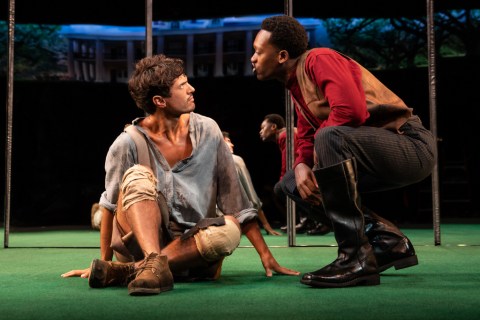
(L to R): James Cusati-Moyer and Ato Blankson-Wood in ‘Slave Play,’ written by Jeremy O. Harris, directed by Robert O’Hara (photo by Matthew Murphy)
Phillip (Sullivan Jones) and Alana (Annie McNamara) portray a married couple who cannot achieve a hot intimacy until they enact their antebellum sex play. In their fantasy Alana is Master MacGregor’s wife and Phillip is her house slave who does what she wants. What pleases her is to take over the masculine role while he takes on the feminine role during a sexual encounter, something which makes her freer for intimacy with her partner. However, they too have issues because of Phillip’s race identity problems which he is loathe to admit and which to him are invisible.
The couple Kaneisha (Joaquina Kalukango) and Jim (Paul Alexander Nolan do not progress on this fourth day of the sexual fantastic. Jim finds the therapy ridiculous and demeaning. Ironically, it is Kaneisha who has engineered the roles and takes the lead in their improvisation. She portrays the slave and Jim (who has a British colonial accent-another irony) is the overseer who commands her unjustly, then sexually uses her as she uses him. But Jim finds her fantasy an impossibility and will not subject himself to it. Is this not a case of subliminal control and domination over his wife Kaneisha?
With each of the couples’ fantasies, there are strong elements of sadomasochism which are supposedly exorcised in the service of removing blocking psychic layers that impede the couples’ pleasure with each other. Unfortunately, Jim has stopped the process for all the couples. A condition of the therapy they have all agreed to is that if one cannot continue, all must not continue. When the couples meet to discuss and analyze what they felt during their fantastic sexual exploits exposing their sub rosa “plantation” mentality, the conflict is on. And Harris’s characterizations continue on a profound and humorous track as problems arise. Each couple ends up confronting their partner with results that are both humorous and poignant.
At this juncture social scientists and therapy guides Patricia (Irene Sofia Lucio) and Tea (Chalia La Tour) attempt to analyze and reaffirm their subjects’ positive changes as a result of the antebellum sexual play therapy. That the researchers do this in a controlled, manipulative way is an irony considering that all seek freedom from their internalized racial oppressions (the predator/prey elements of human behavior). Harris sardonically reveals these individuals, including the scientists, may be duping themselves into believing they’re getting closer to a “clear,” when what they seek cannot be achieved in a week-long process, regardless of how extreme the interventions. Perhaps, what has been internalized must be overthrown with individual introspection on the part of both partners after a long period of time. There is no quick fix except sustained love, growth, patience, understanding and the will to be close which eventually, through loving practice, will manifest. Maybe.

Annie McNamara and Sullivan Jones in ‘Slave Play,’ written by Jeremy O. Harris, directed by Robert O’Hara (Matthew Murphy)
The “liberal” posture which infects the “white” characters who are coupled up with their “darker” equally infected counterparts Harris explodes by the play’s end, as he disintegrates the notion that racism’s complexities may be dealt with through extreme interventions and quickie therapies. Especially for couple Kaneisha and Jim there has been a break through in their relationship at great cost to Jim who upon facing himself, dislikes what he perceives himself to be. Whether they continue together after this turning point doesn’t matter. Each have understood a soul revelation and will never be the same again.
Harris’ Slave Play instructs us about our perceptions, our attitudes and our willingness to go to that place that is uncomfortable to shed the pretense and stop pandering to faux racial equanimity and justice. That is why the curtain mirror that reflects the audience’s faces effected by Clint Ramos’s superb scenic design is a clever touch in keeping with Harris’ themes. The more visible reflections are for the audience members who are down front in the expensive seats.
Shouldn’t we examine our own proclivities and assumptions about sex, race and power dynamics? Or should we just ignore that there is a confluence of currents roiling in the subterranean waters of our souls about race? How do we overthrow our past and live freely without internalized cultural oppressions: misogyny, paternalism, institutional racism, body objectification, appearance fascism, sexism, chauvinism, reverse racism and impulses of white supremacy which move along a continuum from faint to furious? All of these oppressions impact our intimacy with ourselves and others, whether we are in mixed race relationships or not. Harris suggest we investigate these tantalizing questions which are not for the faint of heart.
As Americans steeped in a social history of racial power dynamics that continue today, though many are loathe to admit it, one cannot view this play as a light observer. To have the themes resonate, one should follow the characters to the most profound levels and then consider the myths, the conceptualizations about being black, white and gradations of both culturally. One must see with new eyes what has not been seen before at this crucial time when leaders speak to and embrace racist hate groups (KKK, Neo Nazis, etc.) curry favor with the likes of David Duke and Richard Spencer, and give political advisors like Steven Miller great power and moment over US Immigration policy with the precise intent to discriminate, promote fear and abuse for political purposes.
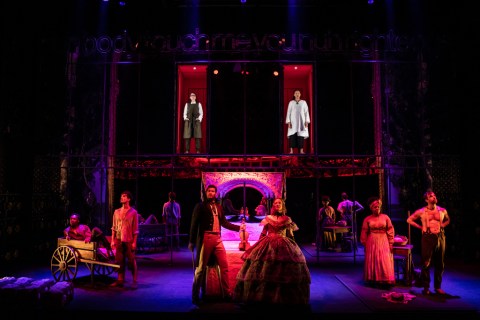
(On Ground L to R): Ato Blankson-Wood, James Cusati-Moyer, Sullivan Jones, Annie McNamara, Joaquina Kalukango, Paul Alexander Nolan. (In red boxes L to R): Irene Sofia Lucio and Chalia La Tour, ‘Slave Play,’ directed by Robert O’Hara, written by Jeremy O. Harris (Matthew Murphy)
Harris intends to shock us into a dialogue to confront our own assumptions on whatever level we can, so we might grow as Americans who recognize their rich yet horrific social, political and cultural history. As Harris’ characters recognize they are stymied and self-harmed by their own misconceptions, depressions and failures to deal with the historical, ancestral folkways and noxious human behaviors they’ve internalized, at least they attempt to overthrow them. Shouldn’t we, Harris suggests? But are we up for this? We should be! Look at the gun shootings at synagogues and black churches.
Until there are conversations about such controversial topics as Slave Play raises, the country’s divisiveness may be exploited by pernicious leaders and malevolent foreign intelligence services who foment racial hatreds to satisfy their own personal agendas. Our culture’s current divides are toxic. To mitigate them requires a complexity of understanding and introspection on a personal level. Harris indicates dealing with this on an interracial, mixed couple level may be the way to get there if there is love, patience, understanding and will. The issues are hyper complex and are not adequately answered by quick fixes and exotic hyperbolic interventions which themselves represent the internalized predator/prey, oppressor/oppressed remnants of racism.
The ensemble is wonderful and acts seamlessly together with a comfortability at behaviors which appear impossibly raw. The therapy session is particularly acute, funny, authentic and smashing. All the actors are standouts as is required with such an amazing play. Kudos to the director who shepherded them. Each couple ends up confronting their partner with results that are both humorous and poignant.
The design team also shines: Dede Ayite (costume design) Jiyoun Chang (lighting design) Lindsay Jones (sound design & original music) Cookie Jordan (hair & wig design). Conceived at New York Theatre Workshop where it ran in from November 2018 to January 2019, Slave Play has come to Broadway where it is provoking consternation, confusion and revelation. It runs with no intermission until 19 January. There are too many reasons why you should see this play if you are an American, and especially if you have a bit of residual racism within and are adult enough to laugh at yourself. For tickets and times CLICK HERE.
‘The Height of the Storm,’ Starring Jonathan Pryce, Eileen Atkins in Bravura Performances
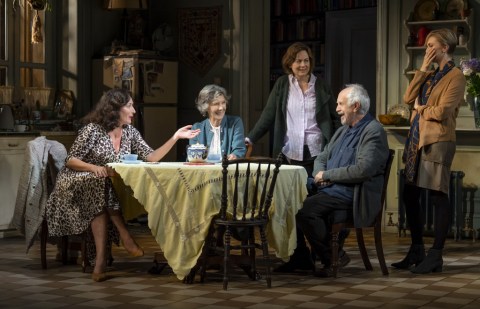
Lucy Cohu, Eileen Atkins, Amanda Drew, Jonathan Pryce, Lisa O’Hare in ‘In the Height of the Storm, by Florian Zeller, translated by Christopher Hampton, directed by Jonathan Kent (Joan Marcus)
The Height of the Storm written by Florian Zeller (The Father, The Mother, The Son trilogy) translated by Christopher Hampton and directed by Jonathan Kent will be poignant for those who have family with Alzheimer’s or parents with advanced dementia. After seeing the play, my experience having relatives with these devastating conditions darkly reminded me of the MO of how such folks live in existential time. The divide between past and present, fabrication and fact are filtered through unconscious impulses that make memories rise to the surface of consciousness like dead fish subject to random currents. In the tangled mind of those with dementia, hallucinations prevail. Memory co-exists with scenes in “present” time and all remains fluid, colored by the perceptions of the moment in whatever moment it is.
Living under such confusion remains frustrating for the sufferer and family who must bear up against the onslaught of alternating states of consciousness and melding realities. Family members sustain the disease. Forced to be complicit with the fantastical consciousness exhibited by their afflicted parent, they choose not to upset them with the facts of current time, place and circumstance which would be pointless. The afflicted wouldn’t accept what they say anyway, convinced of the truth of where they are, lost in their dreamscape of past perceptions. It is a cruel joke to try to make sense of the nonsensical.
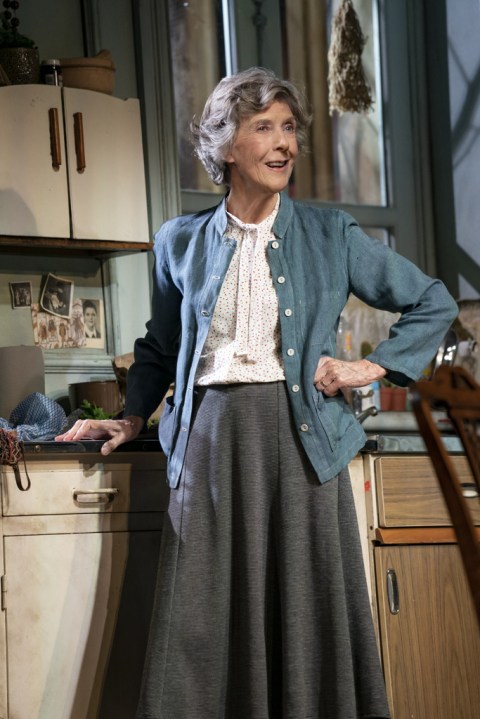
Eileen Atkins, ‘In the Height of the Storm,’ directed by Jonathan Kent, written by Florian Zeller, translated by by Christopher Hampton (Joan Marcus)
And so it goes for the characters in Zeller’s The Height of the Storm which elucidates a marriage between André and Madeleine that has lasted amidst triumphs and conflicts for fifty years. And so it goes for the audience who arbitrates the “reality” in present time of what it experiences during the interactions of family members (André, Madeleine, Anne, Élise) though clouds of glorious time past intervene. And sometimes the clouds work themselves into a storm, the memory of which repeats and repeats in their conversation.
In this play the fog, confusion, the displacement of time present with time past are acutely manifested by writer André (Jonathan Pryce in a portrayal that is a tour de force) though the entire family manifests elements of the same as they relate to him and each other. Madeleine played with astounding, measured brightness by Eileen Atkins is André’s stoic, vibrant, organized, take-charge wife who floats in and out of his stream-of-consciousness as he fades in and out of her conversations with her daughters.

Jonathan Pryce, ‘In the Height of the Storm,’ directed by Jonathan Kent, written by Florian Zeller, translated by by Christopher Hampton (Joan Marcus)
Zeller also focused on dementia in another of his plays, The Father (2016, The Samuel J. Friedman Theatre) starring Frank Langella who won a Tony Award for his performance. In The Father, another iteration of André must deal with the vicissitudes of memory loss, confusion, and his psychological responses of anger to that which is uncontrollable, his disease. Without the mitigating influence of his wife, André and his two daughters Élise and Anne must confront his worsening condition. The arc of development is explicit; we “get it.” We empathize and find catharsis in the tragedy of a family impacted by the mental disintegration of the patriarch. In The Father Zeller wraps up the characters, development and themes neatly; we are grateful, move on and generally forget what we’ve witnessed.
There is no such easiness in The Height of the Storm which is unforgettable because it is elliptical, abstruse and annoyingly so until we understand Zeller’s themes and the core of where he is driving this work. There is no clear arc of development in chronological story-telling. Time is defined by memory and that is the present consciousness. The amorphous, vague threads of conversation are filled with details chucked into the dialogue as we watch the daughters, Anne (Amanda Drew), Élise (Lisa O’Hare) father (André) and mother (Madeleine) interact, slip in and out of present and past moments, watch each other, are silent listeners. The moment we think we understand the concrete facts, for example that André won’t talk to Anne initially because he is caught up in a foggy Alzheimer’s reverie looking out the window, the axis of the scene shifts and he speaks to her and ends the interlude spouting, “Toll the bell, toll the bell. For all of you. Oblivion to the living!”

Jonathan Pryce, ‘In the Height of the Storm,’ directed by Jonathan Kent, written by Florian Zeller, translated by by Christopher Hampton (Joan Marcus)
This is a pronouncement that seems incredibly profound. And though we may admit it to ourselves or not, we face an oblivion of belief. We presume we understand what is happening around us in our lives, but it is our own perception, what we choose to believe about aspects of reality. We have no way of proving we are right or wrong. That is a form of oblivion whether we accept it or not. Similarly, as the characters in the play progress with each other, we watch/soldier on attempting to grab hold of and make sense of the interactions of the family. Moments of wisdom fade. And another curious scene of convolution ensues.
Zeller’s work is replete with axis shifts that create staggering imbalances so we are confounded about what is happening because we are not grounded in time. That it appears to be mid morning in a stately Victorian kitchen with a study nook, hallway lined with bookshelves, a kitchen window overlooking a garden doesn’t help. Precisely when the events occurred and in what sequence remains opaque. This is one morning of one or two mornings in the consciousness of André and Madeleine and their grown daughters who visit at vital times. Then it appears the mornings meld together without particularity except for tidbits of “apparent” distinguishing details in conversation.
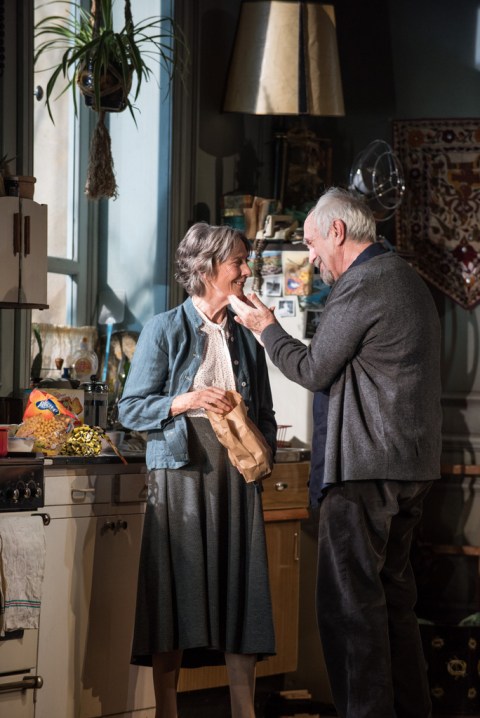
Eileen Atkins, Jonathan Pryce in ‘In the Height of the Storm,’ directed by Jonathan Kent, written by Florian Zeller, translated by by Christopher Hampton (Joan Marcus)
After Anne and André discuss the problem of his living alone in the house by himself, the scene subtly shifts and the atmosphere brightens with the truth or appearance of reality. The efficient, solid-state Madeleine comes in from shopping and lightly humors André. Is this present reality unfolding or someone’s memory from time past? Surely, this scene happened at some point in their lives. But when? We must sustain our confusion as uncomfortable as it is. But not for long because Zeller is constantly upending our former perceptions and muddling our attempt to make meaning. We experience André’s addled mind at work navigating the sea of confusion that is representative of those with dementia. And yet, we also experience Madeleine’s grounded, fact-based consciousness in alternate scenes after atmosphere shifts that randomly intrude, governed by a family member’s comment that joggles a memory and changes the mood once more from lightness to the austere and portentous.
Flowers arrive signifying someone has died. Who? It can’t be the characters present. As Madeleine and her daughters have a conversation about André in the past tense as he sits quietly in the chair, our certainty grows that he has died, physically, surely mentally. Then Zeller shifts the axis once more and in the next moments, André comes to life and he and Madeleine talk about what she is cooking (mushrooms). This subject brings up additional free associations from the past, i.e. André’s walks to look for mushrooms until he stopped when he heard another gentleman did the same and fell into the river and “died.” But we find out from André in another scene, that this man’s death was faked when André sees him years later with a woman. It is one more detail which we cannot deem with certainty is either credible or fictional or twisted threads of both.

Eileen Atkins, Jonathan Pryce in ‘In the Height of the Storm,’ directed by Jonathan Kent, written by Florian Zeller, translated by by Christopher Hampton (Joan Marcus)
With such convolutions in the characters’ conversations, Zeller demonstrates the randomness of consciousness, reality and memory. With each uncertainty prevails. In the scenes that follow, it appears that Madeleine has died as his daughters decide what to do with André, who for his part, is contented to stay in the gorgeous house and particularly the kitchen where he appears most comfortable remembering his lunches with Madeleine cooking mushrooms.
Zeller plays with our suppositions like a magician. He makes it untenable for us to choose what to assume is happening. In this we become like André and unlike Madeleine who remains assured, nonplussed and forward moving. An important theme Zeller emphasizes is that the nature of perception, choices, undercurrents that propel memories into the foreground may be wholly unreliable to begin with. If we are unlucky to have dementia, such expurgations from the unconscious force us to live in the memory we’ve edited as reality without the barriers of time. But that may not be so unlucky, after all. It is the epitome of existentialism, of living in the moment, whatever the moment is, whenever it comes, erupts, departs, until another “moment” arrives.
As a result themes of uncertainty of what consciousness is are reflected in each of the characterizations in the play. We cannot identity who has died, what the time line is, when the storm came and whether the scenes are the characters transformative memories or reflections of André‘s thoughts in his besieged mind which may not be as addled as we assume. An attempt to make sense of the “say what?” without outside evidence to understand whether André or Madeleine or both have died remains futile. Regardless, whichever parent has fled or will flee the planet first, the other is or will be left to deal with the memories, consequences and aftermath- for the daughters’ upset or consternation at the loss of a partner. Or something else. It appears that Madeleine is able to cope better than André whose lifeblood is Madeleine. However, that, too, is equivocal.
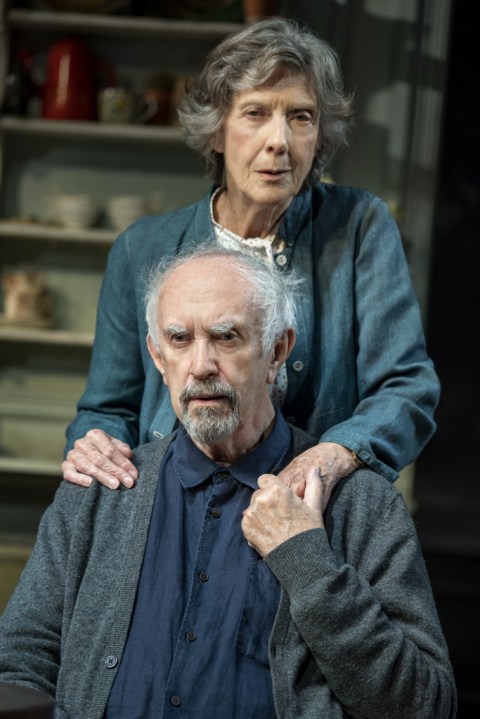
Eileen Atkins, Jonathan Pryce in ‘In the Height of the Storm,’ directed by Jonathan Kent, written by Florian Zeller, translated by by Christopher Hampton (Joan Marcus)
Finally, in the last scene, the daughters leave with all of their obstructions. The couple have the house and memories to themselves. It is a scene of pure consciousness with humor and heartbreak. Only then do we comfortably settle on the determination that when all was said and done, considering André‘s affairs, personality difficulties, and Madeleine’s wifely stoicism and love for her husband, their marriage was a fairly good one and they are together. Of course, Madeleine gets the credit for the unity of their marriage which André acknowledges. But for all our comfort, we may be witnessing the conversation of two ethereal beings in present consciousness, a sardonic irony that Zeller teases us with. Interestingly, with all of our assumptions about who dies first, after that storm, consciousness continues, a resurrection. And the unity the couple established and now share remains uplifted forever.
It seems that one of Zeller’s intents for the play as a series of reflections and vital vignettes that have little arc of development, is to place us in a consternation of misshapen realities that keep us off balance and frustrated until we relax. Such is the haphazard upside down world of those with dementia and those who must negotiate another’s dementia. But the theme also arises that those who live in their beliefs and certainties are not unlike the Alzheimer’s patient. They too may live in a fog of past memories, dreaming up what never happened, only they don’t know it. For both the ill and not so ill, Zeller affirms that glimpses of reality are fleeting; the past or future dominates. Living in the moment is a rarity. But if one is fortunate as both characters are at the play’s conclusion, one lives in a state of agreement and contentment “when the kids have gone.”
Jonathan Pryce and Eileen Atkins make this dense work sing and vibrate it into life, infusing their characters with truth and authenticity. Kudos to the creative team: Anthony Ward (scenic & costume design) Hugh Vanstone (lighting design) Paul Groothuis (sound design) Gary Yershon (original music).
The Height of the Storm runs with no intermission at Manhattan Theatre Club’s Samuel J. Friedman Theatre, 261 West 47th Street. For tickets and times CLICK HERE.
.
‘Derren Brown Secret,’ is a Stunner, a “Mind” Field, Raising Illusions to Unforgettable Art!
Derren Brown SECRET, written by Andy Nyman, Derren Brown & Andrew O’Connor, directed by Andrew O’Connor, Andy Nyman at the Cort Theatre (Matthew Murphy)
Derren Brown SECRET in its first time on Broadway at The Cort Theatre is nothing short of brilliant. Every illusion that Brown performs to perfection with scintillating charm and lightening smoothness, I have figured out! No! I haven’t. But I am still trying my damnedest two days after I saw Wednesday night’s show. And I am completely frustrated because the only way I will ever know is to ask Derren Brown or another magician to affirm whether my explanations might be correct. So, I’m at an impasse. However, I may know “the secrets” if I research/practice mesmerization, hypnosis and psychological manipulation or read about Brown’s iconic mind control exploits in the UK, which are each one of them harrowing “mind fucks” of entertainment that end up being great, harmless fun. Hmmm!
From convincing middle managers to commit armed robbery, to sticking viewers at home to their sofas, Brown may be one of the foremost masters of mind control in the world. Indeed, he makes President Donald Trump look like a crass sharpie. Thankfully, Brown is a mild-mannered English gentleman with a posh accent who paints and obviously enjoys what he does and will not run for the U.S. Presidency. If he ever does, the country would be in… Well, actually, perhaps he should run. Too bad there is a citizenship requirement. His honesty alone would be absolutely refreshing.

Derren Brown SECRET, written by Andy Nyman, Derren Brown & Andrew O’Connor, directed by Andrew O’Connor, Andy Nyman at the Cort Theatre (Matthew Murphy)
Seriously, Derren Brown is no joke. He is awe-inspiring. And this production will win awards because it is a lesson in human experience, crowd psychology, mind control, the power of suggestion and one’s inability to resist what is already in the unconscious, especially if one attempts to resist it. That is to say, the show is a lesson not only in illusion and mind manipulation and the mysterious, it is above all a lesson in audience participation and a revelation of you as an audience member in a dual role of watching yourself in all your unsubtle susceptibility and experiencing your psychological weaknesses.
It must also be a learning experience for Derren Brown. Indeed, he is always perfecting his artistry, honing his senses and his psychological talents. Whatever it takes to uplift his craft and ability to gauge the audience and manipulate them to a heightened interactive performance so that they stay in dynamic one accord, Brown appears to be pursuing this to the highest degree.
Derren Brown SECRET, written by Andy Nyman, Derren Brown & Andrew O’Connor, directed by Andrew O’Connor, Andy Nyman at the Cort Theatre (Matthew Murphy)
The audience’s “one accord” changes which makes each and every performance fabulous. Diverse audience members are a historical treasure of synchronicity and singularity. To bring audience members “there” who come with unusual lives and schedules and backstories is an impossibility made possible by their will and desire to be “there.” So to say that each night of Derren Brown SECRET is unique, is an understatement. An understatement of understatement. The audience’s and Brown’s particularity is what places this show at the pinnacle of live solo performance. Because of this exceptionalism Brown has deservedly won the Drama Desk in 2017 for his debut show, Secret. And he has won two Olivier Awards and five nominations. a record for one-person shows since the inception of the Olivier Awards.
Derren Brown SECRET showcases the illusory as high artistic execution. Brown begins the first act by reminding us that in our minds the world we live in is our own definition/explanation/fiction. Our perception is our choice, what suits us, probably learned or rejected or somewhat retained from our parents and/or the culture is ours and ours alone.

Derren Brown SECRET, written by Andy Nyman, Derren Brown & Andrew O’Connor, directed by Andrew O’Connor, Andy Nyman at the Cort Theatre (Matthew Murphy)
These moments of wisdom Brown employs throughout to gain our confidence and convince us that he is on our side. Of course his honesty and wisdom relaxes and blinds us to our own susceptibility to ourselves. It is a glorious misdirection, a mesmerization. Indeed, throughout the show, we will forget what we have just witnessed in plain sight and remember only unconsciously that which is inaccessible. The joke is on us and we laugh, yet are unsettled. Is this what is going on all day, every day, at work and at play? Oh, my God!
I watched carefully, so “out of the corner of my eye” in my peripheral vision I saw, what Brown told us would happen, then forgot I saw it. Yes, it did happen, but I missed it. Twice! Brown upends, distracts, and with verbal legerdemain disappears the visible, all the while warning us what to expect. His honesty is treacherous and exciting.
Derren Brown SECRET, written by Andy Nyman, Derren Brown & Andrew O’Connor, directed by Andrew O’Connor, Andy Nyman at the Cort Theatre (Matthew Murphy)
This is also a production in encouraging an audience member’s humility. Whenever I think that “I’ve arrived,” all I have to remember is a gorilla and a banana and Derren Brown to deflate my self-important arrogance. To understand what I mean, you must see the production. There is no spoiler alert.
Completely necessary for this show’s success is audience trust. Thus, to elicit audience participation to a maximum of effect, a good deal of this unparalleled production includes mentally massaging the audience which Brown does surreptitiously; he is a cypher with fragrant oils, gentle, quick hands. Meanwhile, this congeniality brings out audience interactions and responses which are authentic, humorous, genuine, unaffecting, human, all guided by Brown with adroit good will.
Derren Brown SECRET, written by Andy Nyman, Derren Brown & Andrew O’Connor, directed by Andrew O’Connor, Andy Nyman at the Cort Theatre (Matthew Murphy)
Audience interactivity and seeming spontaneity are rather “a character” along with Brown, whose persona is confident, wise, gently suggestive, witty, comfortable and youthfully avuncular. The audience responds by going onstage, as well as by thinking and sitting in their seats as they watch close-up projections of what is going on via the back wall. If you are in the audience, whether Brown chooses you to join a few others onstage for various illusions, or asks you to think of a celebrity, or asks you to think of a question for him, or write a question, or catch a “frisbee-thingy,” you are involved mentally, though you might passively think you are simply observing. And if you go unconscious and sleep? You are really interacting; you may stand up and walk down the aisle toward the stage!
I can only suggest the aftereffects of his mysterious illusory psychological craft and a bit of my amazement at the audience’s hushed, unified, “mind field” response in an example that is glorious and indescribable, though I will try. During the show Brown offers autobiographical information as patter to endear us to him. The story he shares about his deceased grandfather who enjoyed mysteries and magic is charming, humorous and a bit heartbreaking as Brown relates, it lovingly. Then Brown incorporates this story in an illusion. The night I was present, this involved bringing a woman participant on stage. Brown asked her a few questions about her relationship with a grandparent.
Derren Brown SECRET, written by Andy Nyman, Derren Brown & Andrew O’Connor, directed by Andrew O’Connor, Andy Nyman at the Cort Theatre (Matthew Murphy)
Brown crafted an extemporaneous event with the woman participant involving the audience in its creation. During these sterling moments the attentive audience, the woman participant and storyteller Brown become spectators in a joyous fabrication that was unimaginable beforehand and unfathomable after Brown concludes with a philosophical, metaphorical and mysterious flourish. From start to finish the entire audience was breathless, engaged, inspired and the woman participant was gobsmacked.
For those lovely moments, Brown returned us to the innocence of childhood in our first heartbeats of wonder. That is one of the beauties of this production, Brown’s continually igniting our imagination to fly to the realms of the supernal. But Brown does set us gently down into reality, afterward. We know we’ve been “had.” But it’s ok. Maybe we’ll become more learned about ourselves and more forgiving of our susceptibilities to return to a true place of wonderment after-all.
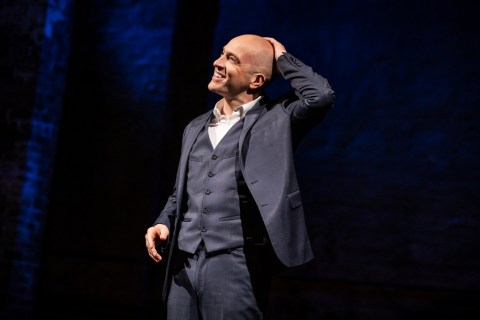
Derren Brown SECRET, written by Andy Nyman, Derren Brown & Andrew O’Connor, directed by Andrew O’Connor, Andy Nyman at the Cort Theatre (Matthew Murphy)
Explaining such illusions spoils the fun of the unknown. That’s why Derren Brown SECRET is celestial. The show is a mystery, wrapped in a box (like one of the illusions) of riddles filled with the fantastic and there are no explanations. Even the ushers are sworn to secrecy. I’m still trying to shake the thought that I’ve been screwed with mentally as I love to figure things out, and I’m annoyed that I’m not quite there yet. But that’s a part of what the power of suggestion does. Someone suggests. The more you fight it, the more you are hooked. Better to go with the flow and then the extraction from the spider’s web will come in due time.
Brown is an ADEPT. He mesmerizes in the direction you think you are going then find out that you are somewhere else completely. He is dastardly, wicked fun and the evening disappears like a shot. Maybe I need to return to “get” what I missed. But what if I miss it again? More frustration!
Of course that’s one of the many points that Derren Brown, performer and co-writer (with Andy Nyman and Andrew O’Connor who also directed) makes in this starry-minded, ephemeral, psychically untouchable production. Intriguingly, if you think that the audience has been planted with Brown’s co-conspirators to effect his “stupid pet tricks,” that is a simple yet profound error prompted by frustration. Unless you are an exceptional mesmerizer yourself and are a genius at misdirection and ledgerdemain like he is, you will not arrive at an explanation. But why even bother? It is a fabulous joy being returned to child-like innocence where all manner of spiritual mysteries are real, having been beaten out of us by ourselves after whatever ill wind blows.
Kudos to the creative team who enhance the enjoyment all the more: Takeshi Kata (scenic design) Ben Stanton (lighting design) Jill Bc Du Boff (sound design) Caite Hevner (projection design). Derren Brown SECRET runs with one intermission at the Cort Theatre (West 48th Street between 7th and 6th) until 4 January. I dare you to go!!! For tickets and times CLICK HERE.
‘Moulin Rouge! The Musical’ Celebrates the Seductive Delights of the Iconic Venue in a Sumptuous Feast for the Senses

(L-R): Jacqueline B. Arnold, Robyn Hurder, Holly James, Jeigh Madjus in Moulin Rouge! The Musical, book by John Logan, Music Supervision, Orchestrations, Arrangements & Additional Lyrics by Justin Levine directed by Alex Timbers (Matthew Murphy)
The moment you enter the Al Hirshfeld Theatre, a paradise of sensuality embraces your soul and immerses you in the suggestion of hedonistic pleasure. Immediately, you are “eyes wide open,” moving along a course where anything is possible, even an after hours engagement with one of the male, female or transgender perfections of beauty, scantily but tastefully adorned, who saunter on the catwalks and peer out at you from the stage. Undulating rhythms and sensual music in this Bohemian, Paris, Left Bank cabaret/theater/dance hall soothe and allure. The luxurious red and gold appointments, the deep cherry and red velvet variegated stage curtains, the banquets, chandeliers, gleaming brass, the golden cherubim all whisper romance, sex, excitement and a whirlwind of indulgence. Whoever you are, you will be encouraged to understand that you can achieve your vision of an exalted life, a life where freedom, truth, beauty and love raise you above a bruising and squalid reality out there on the dark streets.

Danny Burstein in Moulin Rouge! The Musical, directed by Alex Timbers (Matthew Murphy)
This is the Moulin Rouge Club at Moulin Rouge! The Musical. Expect the finest in fantasy and escapism. If your intellect and imagination are ripe to receive, you will never be the same again! As you sense this revelation La Chocolat (Jacqueline B. Arnold), Nini (Robyn Hurder), Arabia (Holly James), Baby Doll (Jeigh Madjus), parade their “stuff” and throatily grind to the beats as they torch out “Lady Marmalade,” in an unforgettable opening number joined by the ensemble. This full throttle ignition is brilliantly conceived with grand style and prodigious effort by the creative team. My God, what a triumph!

(L to R): Sahr Ngaujah, Aaron Tveit, Ricky Rojas in Moulin Rouge! The Musical, directed by Alex Timbers (Matthew Murphy)
The production directed by the illimitable Alex Timbers, with a clever book by John Logan (based on the 2001 Twentieth Century Fox Motion Picture written by Baz Luhrmann and Craig Pearce, directed by Baz Luhrmann), with “to-die-for” music supervision, orchestrations and arrangements by Justin Levine is a towering majestical remembrance of what never was but might have been during La Belle Époque in Paris and specifically at the fin de siè·cle. From the on-point luxurious, sexy, ravishing costumes by Catherine Zuber to the energetic, aggressive, dance numbers choreographed by Sonya Tayeh, this musical is a non stop festival. “Bad Romance” is especially gravitating as a thrilling, energetic, “lemme consume your lips,” head to head, face-off with couples gyrating to the hot Lady Gaga song which thematically epitomizes the romance among the principal couples: The Duke of Monroth (Tam Mutu), Satine (Karen Olivo), Christian (Aaron Tveit), and the lesser lights: Santiago (Ricky Rojas), and Nini (Robyn Hurder), all of whom are sensational in voice, and character portrayals.

Karen Olivo Aaron Tveit in Moulin Rouge! The Musical, directed by Alex Timbers (Matthew Murphy)
Baz Luhrmann and Catherine Martin provided their creative services to the production which is an update of their ground-breaking, award-winning film Moulin Rouge (2001). And indeed, the basic arc of development inspired by a meld of characters and plots from Giuseppe Verdi’s opera La Traviata and Giacomo Puccini’s La Boheme remains with added tweaks of humor, phantasm and fun, delivered by incredible performances, perhaps the most preeminent charismatic, chameleon of of them all being the gobsmacking Danny Burstein.

The Company, Moulin Rouge! The Musical, directed by Alex Timbers (Matthew Murphy)
Burstein is a mesmerizing scene stealer. Amidst the splendiferous sets (Derek McLane), and shimmering, vibrantly lit (Justin Townsend), festivities, Burstein, as the club’s artistic owner/showman Harold Zidler, is the “God-like” host of confabulation. And he is damn good at it, in fact so adorable that we understand how and why Harold has kept his “chickens” together through thick and the current financially thin stage of the Moulin Rouge Club’s history. As Burstein’s Harold winningly controls our imaginations and guides the glory and spectacle, we willingly follow him believing he has our best interests at heart because to him there is no sin, no judgment. Within this space and for this night, we are free to be our fantasies.

Tam Mutu in Moulin Rouge! The Musical, directed by Alex Timbers (Matthew Murphy)
What this production does exceedingly well is reveal that the Moulin Rouge Club into which Zidler has put his heart, soul and every red hot cent he owes is an artistic production down to the lavish sets and well-heeled orchestra. And he and the ensemble live for this art. Thus, Burstein’s performance is a revelatory genius of Zidler’s dedication and desperation. Motivated by his craft and concern for his artistic family, his character’s steely sweetness is genuine, his charm and love is pure without oily ingratitude or predatory insidiousness. Above all he makes clear in the behind the scenes discussions with Olivo’s Satine, that his desire is to supply his patrons’ complete enjoyment so his company will survive and remain off the streets and away from the impoverished hellishness they all came from.
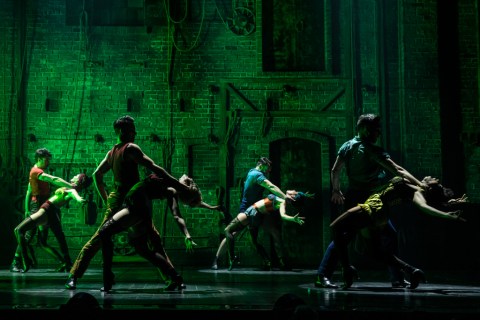
Moulin Rouge! The Musical, The Company, directed by Alex Timbers (Matthew Murphy)
Likewise, Satine’s love for Zidler and her company of friends and compatriots, one of whom is the great painter Toulouse-Lautrec (the very fine, grounded Sahr Ngaujah), reveals they understand the club’s liquidity is their life and happiness. Thus, Satine’s characterization is profound. She is the “read deal:” she is their salvation, their mother, their friend, their life-blood, their sacrifice. The sense of love and community among the ensemble is palpable so we believe Burstein’s Harold when he insists that Satine should “go to hospital,” as her friends insist as well. Without her, they are lost.
Karen Olivo’s Satine is a sensual, hot, earth-mother and high-class courtesan, experienced, wise, unmoved. She is not an ethereal beauty, but dominant, solid in will, though failing in flesh. She is a perfect symbol to represent what Harold’s artistic creation stands for, a lotus risen from the mud into full flower which will fade quickly. Olivo’s fullness of voice soars during her duets with Tveit’s Christian who is her equal in range, power and sensitivity. “The Elephant Medley” (the love song riff mash-up they sing in her boudoir as a “come-on” and “let-down”), that has been enhanced with additional numbers is just smashing.
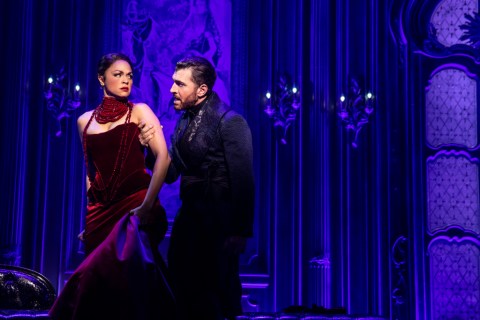
Karen Olivo, Tam Mutu, Moulin Rouge! The Musical, directed by Alex Timbers (Matthew Murphy)
Her introduction by Zidler as the “jewel” of the Moulin Rouge Club as she descends on a trapeze singing the “Diamond Medley” symbolizes her ethos and the club’s centrality as a necessity in the hearts of a society at that time and perhaps for all time. Escapism is in; it always was and always will be. The more authentic the fantasy, the better. And Satine, like Zidler, are exceptional conveyors. Their importance is an equivalent to their patrons’ happiness. Thus, she is fitting as a timeless symbol of the club; their interwoven stories will always resonate and instruct with wisdom, which like a diamond shines but cuts.
Obviously, Logan’s book adapted from Luhrmann’s and Craig Pearce’s film, reflects depth in its simple story of artists attempting to survive in a carnivorous world, as they use their charms and love inducements to glean wealthy backers. And all goes well, until the artists are hoisted on their own petard of humanity, and they fall fatally in love, and others fall fatally in lust with them. As cultural icons, artists cannot be owned or even possessed. (a not so subtle message to philistines everywhere). Satine and Zidler belong to their art, themselves and the world, as Ngaujah’s Toulouse-Lautrec affirms despite The Duke of Monroth’s insistence that Monroth owns the club and all its performers. This is another intriguing theme. When art is put in the hands of philistine owners, it crumbles for they lack the talent, will and spirit to create. Instead, they should uplift the brilliance of creators like Zidler. He knows how to draw the crowds but lacks the finances to sustain the Moulin Rouge Club.
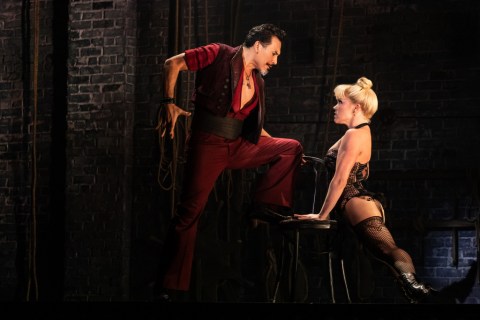
Ricky Rojas, Robyn Hurder, Moulin Rouge! The Musical, directed Alex Timbers (Matthew Murphy)
The scenes when Lautrec and the company rehearse and Mutu’s Duke attempts to assist are particularly to the point and humorous. Monroth’s ego gets in the way after he senses he has lost Satine to Christian. Yet, he is willing to keep her despite her lack of affection for him. And his jealousy rises to spoil the show, as Christian’s jealousy rises to provoke the Duke. Yet, the show must go on, but how? Satine, once more must “save the day,” but she is not immortal.

Aaron Tveit, Karen Olivo, Moulin Rouge! The Musical, directed by Alex Timbers (Matthew Murphy)
As rivals for her love and lust Tveit’s Christian and Mutu’s Duke are worthy. The intricacies of plot which involve Satine’s eventual love for the innocent and consumed Christian, and sexual enticement of the Duke are woven adroitly. Particularly delightful are Mutu’s mash-up of Mick Jagger’s songs (his “Sympathy for the Devil” could have gone on longer). And the conversion of lyrics to a male orientation for Rihanna’s “Only Girl” are hilarious. Mutu manages to be wicked but sexy and seductive. His intentions are insidious but he retains the exceptionalism of aristocracy that assumes privilege from generational wealth that goes back centuries. Importantly, it is the humor in Mutu’s depiction that keeps him interesting and edgy and not loathsome, which is in keeping with the comedic tone of the production.
As a keen and successful rival, Tveit expertly tweaks the humor related to Christian’s, creating his compositions in the funny scene when he first befriends Lautrec and Santiago. He does this with expert timing and together the three render their exchange into pure farce. His “Ohio” demeanor evolves by the conclusion from a “lad” to a man who “comes into his own.” He is every inch the authentic lover. His duets with Satine in which they both feed song refrains to each other are happily playful, suggestive and grounded. And in the delivery of his last songs, Tveit is amazing, heartfelt, sonorous. As a couple in a loving affair that grows into something more, Tveit and Olivo strike powerful resonances.
Nothing more can be lauded about Mouline Rouge! The Musical except that the sound design by Peter Hylenski was on point, balanced, targeted. I heard words from well known songs that I never “got” before, for example Katy Perry’s “Firework,” which Olivo sends into the heavens as a PURE WOW! Thus, I could greater appreciate the character development, the themes, symbols, the ironies, the true riches of this mythic production because the song mash-ups and medleys were crystal clear.
This is a Broadway show in the true spirit of New York City’s greatness. To see these performers, you should get tickets immediately and order another set to revisit a month or two out. I guarantee that seeing it again, you will note many other elements that you missed the first time around as you peel back layers. If you can’t see it again, some of the music is on YouTube. Check for updates.
The show runs with one intermission at the Al Hirschfeld Theatre on West 45th street. For tickets and times CLICK HERE.
The cast album is currently available for streaming at https://smarturl.it/MRtheMusical
‘Betrayal’ Starring Tom Hiddleston, Zawe Ashton, Charlie Cox in Quintessential Harold Pinter

(L to R): Charlie Cox, Zawe Ashton, Charlie Cox in Harold Pinter’s ‘Betrayal,’ directed by Jamie Lloyd (Marc Brenner)
For those who have seen one of the many revivals of Harold Pinter’s brilliant, award winning play Betrayal or its film equivalent (1983), you cannot help but be engaged following the intrigue and duplicity of the triangulated relationship between married couple Emma and Robert, and close friend Jerry. In Betrayal, Pinter raises deceitfulness to a fine art as he memorializes how a convolution of lies evolve into the death of a marriage. The current revival directed with exceptional insight and precision by Jamie Lloyd and acted to perfection by Tom Hiddleston (Robert) Zawe Ashton (Emma) and Charlie Cox (Jerry) at the Bernard B. Jacobs Theatre, vaults Pinter’s work into the heavens.
Though I have not seen every revival, this one most probably exceeds productions that came before it with few exceptions, perhaps the only one being the production in 2013 directed by Mike Nichols starring real-life-couple Daniel Craig and Rachel Weisz. However, I cannot adequately compare for this spectacular production is mind-blowing. It took my breath away.

Tom Hiddleston in Harold Pinter’s ‘Betrayal,’ directed by Jamie Lloyd (Marc Brenner)
Director Jamie Lloyd removes any extraneous spectacle of sets, props, costumes. He supplants them with unobtrusive design elements to enhance Pinter’s themes so we focus on the interactions of the three principals and their responses to each other both sub rosa and manifest. Lloyd retains a spare physicality during scene changes employing the use of a revolving platform to spin the characters back into time and flashback where they finally land on the “beginning” event in Emma’s/Robert’s bedroom. It is then in 1968 when Jerry poetically, fervently seduces Emma mentally and plants the seeds of the irrevocable ending of it all in her consciousness. In a reverse chronological order we witness the ending dissolution of the marriage at the top of the play. Pinter reveals in reverse the salient conversations which slide back to the initial thrusts of “love and betrayal” between Jerry and Emma which are integral to their relationship with Robert. who manages to retain control despite their duplicity with a mendacity all his own.

Charlie Cox in Harold Pinter’s ‘Betrayal,’ directed by Jamie Lloyd (Marc Brenner)
To clarify the structure of the seven year affair, Lloyd adds projections of the backward turning years on the wall and the front of the proscenium. Thus, we note in backward evolution events which lead to the primal moment when the canker worm of adultery first nestles on the flower of Robert’s and Emma’s marriage, a worm which we witness from the initial scene and which completely has eaten away Emma’s, Robert’s and Jerry’s well being and peace. However, at the top, like most interactions we ourselves have, we are not sure what we witness until the final revelation of deceit at the play’s conclusion.
For the entire production, Lloyd has constructed as the main set piece, the backdrop of a blandly colored wall at the rear of the stage against which the actor not engaged in a scene stands facing the audience or leaning in profile. Lloyd’s enlightened staging reinforces the nature of the relationship among Robert, Emma and Jerry as if they are one being and entity. It also heightens the notion that the one absent is everpresent in the others’ minds, and that he or she will be the subject of the conversation between the other two.

(L to R): Tom Hiddleston, Charlie Cox, Zawe Ashton in Harold Pinter’s ‘Betrayal,’ directed by Jamie Lloyd (Marc Brenner)
Maintaining the presence of all the principals on stage whether they are actively engaged or silently hovering, also elucidates the nature and condition of each. It is as if they enjoy the necessity of being a “threesome” of duplicity, though they are not a “threesome” physically or sexually. Nevertheless, each is seared and entrapped in the consciousness of the other two and never really is far away from “them” when the other two are together cheating “behind his/her back.” The fascinating staging furthers Lloyd’s theme: if there is to be an affair, the three are perhaps most satisfied in being clandestine with each other in a strange egotistical and mental sadomasochism which allows them to continue betraying and misleading each other for years. Thus, the themes of betrayal for each of the characters is nuanced and layered and because Robert, Jerry and Emma cannot confront the truth of their own illness of self-deception, the destruction of their relationships between and among each other grows, despite their willful obliviousness.

(L to R): Zawe Ashton, Charlie Cox, Tom Hiddleston in Harold Pinter’s ‘Betrayal,’ directed by Jamie Lloyd (Marc Brenner)
Lloyd’s focus on psyche and consciousness rises to great thematic purpose and illustrates why Pinter never includes the presence of Judith, Jerry’s spouse or the others with whom Robert and Emma are having affairs. These others are ancillary to the vitality of the psychic “threesome.” As a result we understand how Emma, Robert and Jerry function together swimming in the medium of lies pulling toward and against each other to an inevitable dissolution of what they once were before the affair between Emma and Jerry began.
For what Lloyd’s staging and incredible direction with the equally scintillating acting by Hiddleston, Ashton and Cox evokes and symbolizes, we experience a production which is thrilling, alive, masterful. For in the hands, minds and instruments of these brilliant talents, Pinter’s Betrayal is a play about consciousness and the emotional and mental agility of ego, impulse, deflection and undercurrent so that we understand each character’s intentions and feelings though these may never be expressed and may hover as the unspoken and insidious. Hiddleston, Ashton and Cox circle smugly around the truth, even to the point of lying about “how they are doing.” All are doing poorly, considering they’ve blown apart love and friendship and have reveled in allowing a cover-up to persist with a sub rosa disdain and rebuke of each other. We witness a tragedy which the characters are loathe to admit. Only the waiter wonderfully portrayed by Eddie Arnold remains cheerful, positive and authentic.
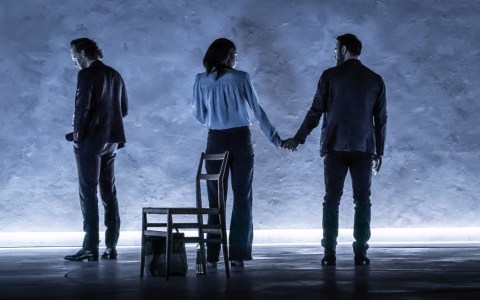
(L to R): Tom Hiddleston, Zawe Ashton, Charlie Cox in Harold Pinter’s ‘Betrayal,’ directed by Jamie Lloyd (Marc Brenner)
Interestingly, when prodded, the characters deflect. Typical of Pinteresque dialogue, a simple “How are you?” and response of “Fine,” becomes weighted with subterranean meaning and import. The individual whether Robert or Emma or Jerry is not fine. Indeed, their souls are in tatters. Though the relationship between and among each was profound (Emma and Robert have two children together, one after she sleeps with Jerry; Robert actually likes Jerry better than Emma) it is not intimate. Each is an isolate, separate and alone, inauthentic, insincere, manipulative. Pinter displays the very core of friendship and love for these three. They lovingly, charmingly, metaphorically stab each other again and again in the back while smiling in each other’s faces. They accomplish their treacheries to preserve ego. Meanwhile, how can their center hold? Eventually, it doesn’t.
Of course this is the human condition: fronting, saving face. God forbid these would admit hurt, pain and torment. God forbid Robert would smash Jerry’s head in for seducing his wife or confront Jerry with the truth. God forbid Emma and Robert would go to therapy. Instead, we discover that Robert becomes “all right” with their affair and doesn’t share his knowledge with Jerry punitively, until Jerry furiously confronts him after the affair is over for two years. Likewise, Emma’s ego is shattered when she discovers Robert punishingly, ironically, has been unfaithful to her for years. Thus, we note how Robert has controlled Jerry and Emma and manipulated them while letting them believe he was the “weakling” and cuckold. That he encourages it and that they are outraged at his behavior and unfaithfulness is the height of irony, humor and cynicism.

Tom Hiddleston, Zawe Ashton in Harold Pinter’s ‘Betrayal,’ directed by Jamie Lloyd (Marc Brenner)
What particularly enthralled me was the emotional grist of Hiddleston, Zawe and Cox revealed at various times when the truth smashes into them. The actors allow us to see glimpses of the pain the characters are hiding. This occurs, for example: when Hiddleston initially discovers Emma’s letter to Jerry; when Emma discovers her marriage which has been over for years, is finally over; when Jerry discovers with outrage how Robert hid his knowledge of the affair from him for four years without a stir or breath of upset or anger. Each of them plodded on living with their own perfidy and self- deception without feeling the necessity of coming to an end of themselves in truth. Cox, Hiddleston and Zawe are absolutely stunning in their moment-to-moment responses to each other. Theirs is breathtaking ensemble work.
Betrayal is a magnificent production. I didn’t want it to end and the standing ovation wasn’t enough appreciation, surely, for such marvelous work. Kudos to Soutra Gilmour (scenic & costume design) Jon Clark (lighting design) Ben and Max Ringham (sound design and composition) for executing Jamie Lloyd’s vision and in creating a medium in which the actors’ portrayals are encouraged to vibrate with life.
Betrayal runs with no intermission at the Bernard B. Jacobs Theatre (242 West 45th Street) until 8 December. Don’t miss this theatrical event which will surely bring in nominations for the cast and director. For tickets and times CLICK HERE.
 CAROLE DI TOSTI