Category Archives: NYC Theater Reviews
Broadway,
‘A Man of No Importance’ at CSC, a Superb Revival
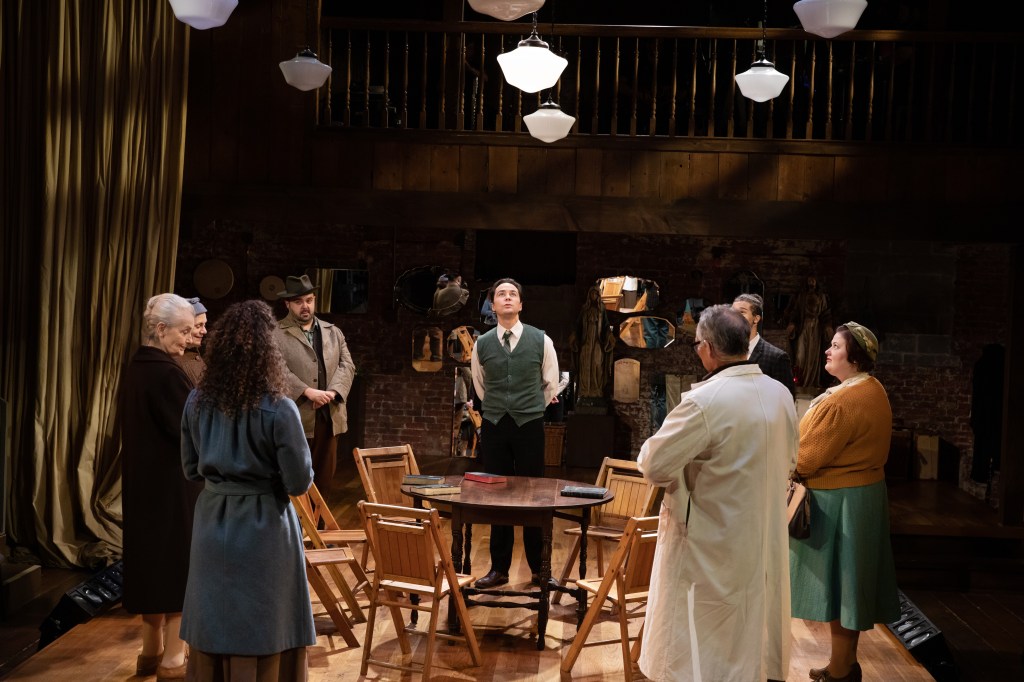
In its second Off Broadway go-round (Lincoln Center in 2002) Terrence McNally’s book and Stephen Flaherty’s music with Lynn Ahrens’ lyrics of A Man of No Importance directed and designed by John Doyle, is currently at CSC until 18 of December. The production is Doyle’s unaffecting and warm goodbye as Artistic Director of CSC. The uplifting, poignant musical appropriately reminds us of the vitality of theater, whether it be in an office space or a majestic 1500 seat house on 42nd street. Unlike the titular film A Man of No Importance is based on (1994, starring Albert Finney, written by Barry Devlin, produced by Little Bird) live theater is interactive. The audience spurs on the actors in a kinetic, telepathic bond that is incredibly enjoyable once opening night jitters are put to rest.
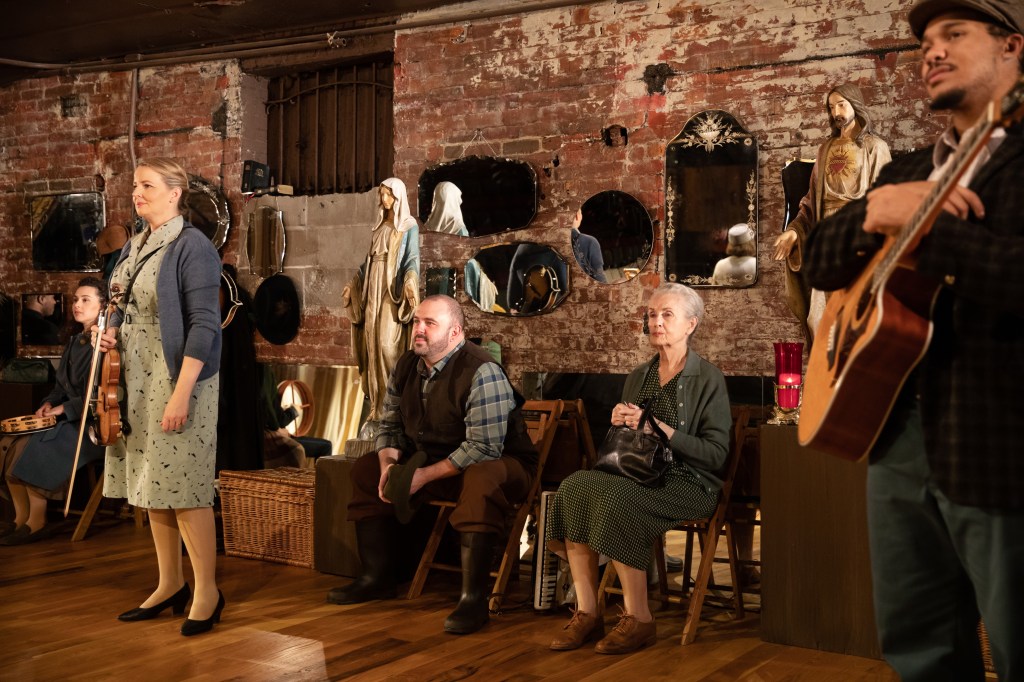
This most probably is what keeps protagonist Alfie, a DIY theater director of Dublin’s St. Imelda’s Church players inspired and engaged, though their performances are reportedly terrible. And it is why he is wickedly devastated when Father Kenny (Nathaniel Stampley) closes down their production of Salome, because it is inappropriate and untoward for a community church theater show, though the story is right out of scripture. Actually, by the end of the production we learn that the butcher, Mr. Carney (Thom Sesma), who is one of their amateur troupe, complained to Father Kenny that Salome was tantamount to pornography because he had a small role and that pissed him off.
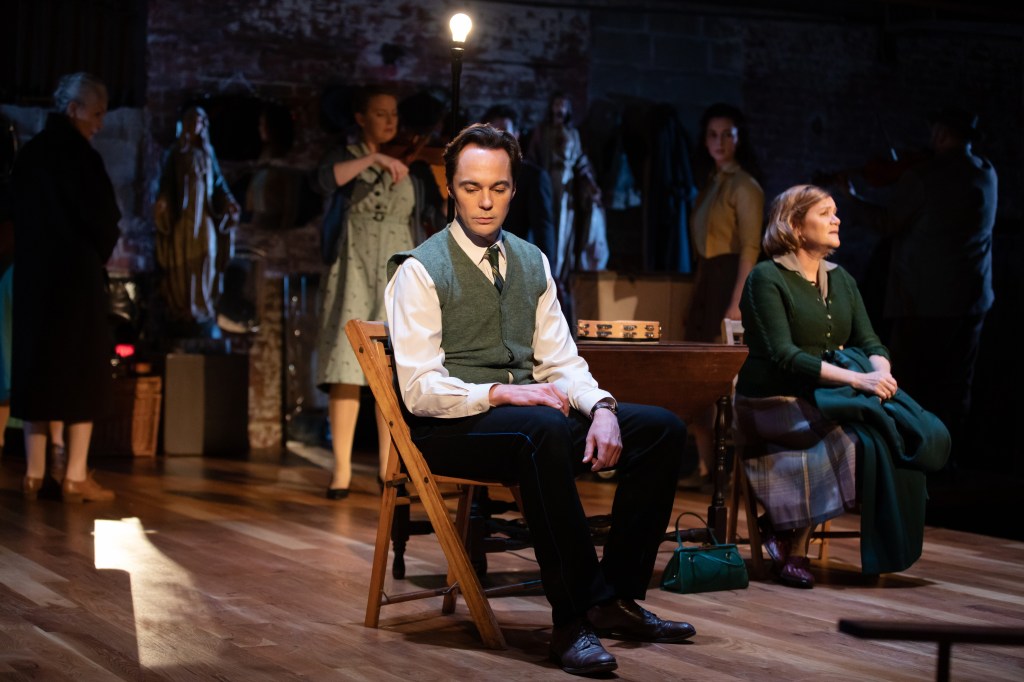
Alfie (portrayed by the likable and heartfelt Jim Parsons) apart from his love and spirit guidance by Oscar Wilde, who encourages him to read poems while at his job as a conductor on a Dublin bus, is a closeted, sensitive gay man. He lives with his domineering sister Lily (the always superb Mare Winningham) in their small apartment, where he keeps a raft of books and tests out his gourmet international recipes on her unadorned, “Irish stew palette.”
The year is 1964 before the cultural revolution, “free love,” mini skirts, The Beatles phenomenon and a relaxation of Catholicism’s strictures that didn’t really happen until decades later. Then, the Republic of Ireland was repressed and oppressed by doctrine that made it look more like the radical, right-wing conservative anti-LGBTQ, anti-abortion, red state swamp areas of the American South in 2022. Because of such cultural dispossession, Alfie lives in a fantasy world of art, theater and poetry. He remains inspired by his spiritual advisor, fellow Irishman Oscar Wilde, as he tries to improve the lives of those around him, whether at his job as a conductor, at home with his sister, or at the church, directing his St. Imelda Players.
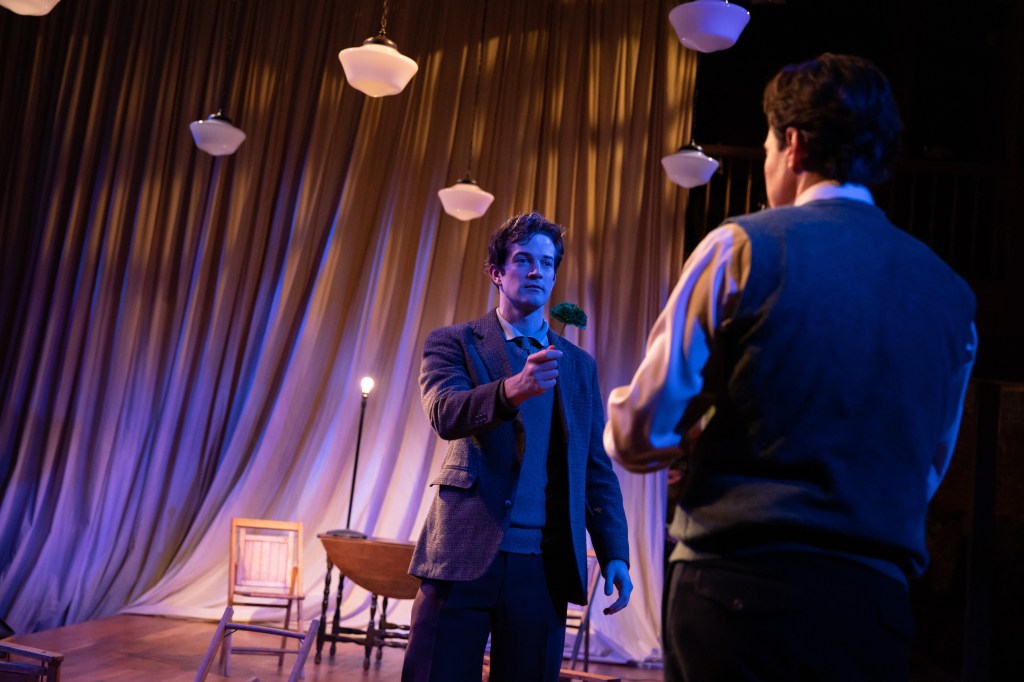
When Father Kenny closes down their amateur troupe, Alfie is quite bereft, until the St. Imelda Players decide to perform a play of the events that have brought them to where they are at the finish line in the present (1964) with no winning trophy. But instead of directing them, Alfie will be the star of their play.
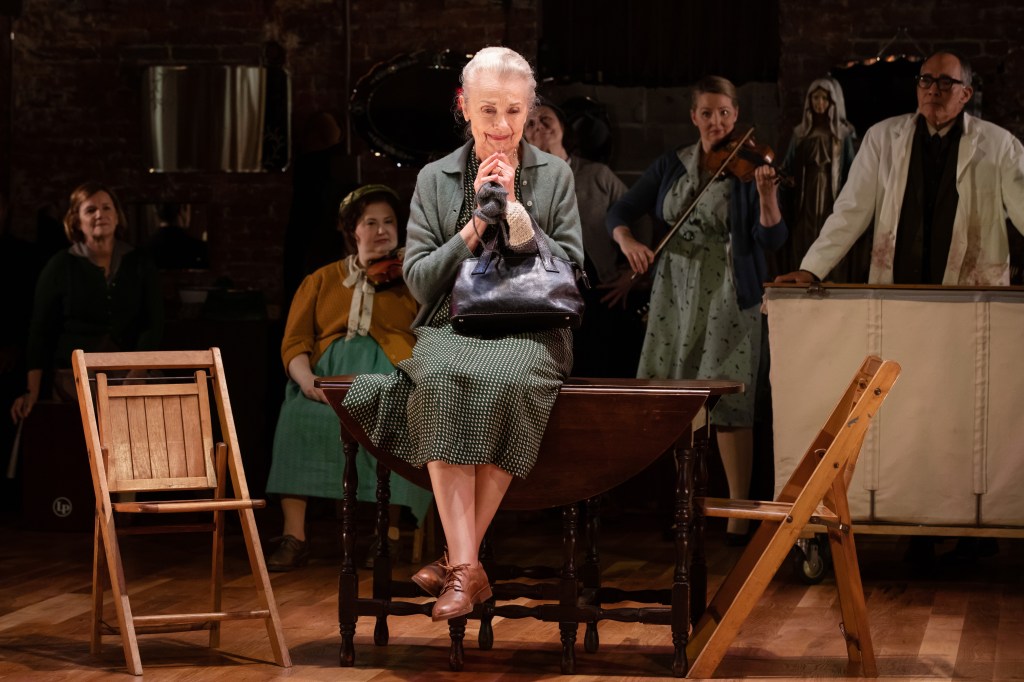
Cleverly, McNally, Flaherty and Ahrens adjusted and adapted the film as a flashback sandwiched by the present. The church players become the Greek chorus who engineer the events of the play, streamlining them into the action that happened at St. Imelda’s before Father Kenny shuttered their company. They sing songs that embody the emotional feeling and turning points of those events. These songs include the conflict between and among the characters, personal confessions and revelations, and the positive message that they gain from what they’ve learned together. They introduce Alfie as their star, then perform the tuneful, ironic opening number, “A Man of No Importance,” in celebration of their beloved friend and director who is their hero, integral to all of their lives. We learn by the conclusion of their musical, that to them, he is a man of great significance.

Doyle has staged the musical with an approach to DIY theater, reflective of what the St. Imelda Players might effect. The props are cleverly selected, i.e. a drum is used as the bus steering wheel. The actors use minimal furniture to create the environs where the events occur. Chairs suggest the bus that conductor Alfie is on with the driver, the affable and lively Robbie Fay (A.J. Shively, whose “The Streets of Dublin” rocks it). The players become the bus passengers with a new passenger Adele, the lovely voiced Shereen Ahmed catching the attention of Alfie as he quotes from a poem by his spirit mentor Oscar Wilde. By the end of their ride, The St. Imelda Players complete singing the titular “A Man of No Importance.”
As the players give us a tour of Alfie’s life in Dublin, we drop in on him with sister Lily, who is happy to discover that Alfie has found interest in a woman. She sings”Burden of Life” as an answer to her prayers so that perhaps now Alfie can settle down, and she can be free of taking care of him. Mare Winningham is humorous and vibrant as she takes on the role of Lily. A Catholic woman, she and the others in the troupe miss all the cues that her brother just might not be into women. When this finally comes out later, she reassures him in the song “Tell Me Why” that even though he is gay, she loves him anyway and he should have told her.
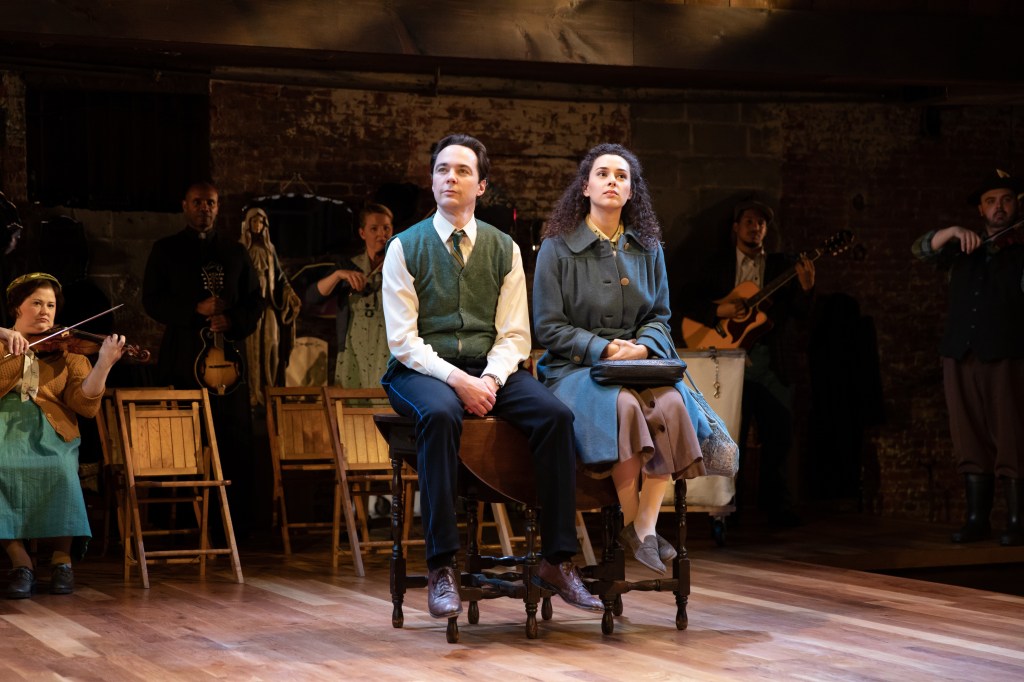
Alfie’s interest in Adele is not because her beauty entices him romantically. He thinks she is perfect for the role of Salome. Though she avers and refuses the part initially, Alfie is persuasive and she finally relents. It is his hope to have the handsome Robbie play the part of John the Baptist, perfectly cast to act with Adele. Robbie puts him off and instead invites him to come to the pub (the wonderful “The Streets of Dublin”). Alfie accompanies Robbie and makes a fool of himself singing “Love’s Never Lost” in front of Robbie’s friends. Embarrassed, Alfie leaves, further disturbed at Breton Beret’s (Da’Von T. Moody) interest in him. Additionally, he’s confounded by the “love that dare not speak its name,” a love that he feels for his “Bosie,” as he imagines Robbie to be. (Bosie refers to Lord Alfred Douglas, Wilde’s lover.)
Alfie can only admit this inner conflict as he looks at himself in a mirror encouraged by Oscar Wilde (Thom Sesma). He sings the lyrical “Man in the Mirror” as a way to work through his emotions to achieve self-acceptance. Parsons approaches Alfie’s inner conflict with yearning and honesty, confessing in a dream-state to the persecuted and vilified Oscar Wilde, a man who understands the torment he goes through.

Spurred by her discussion with Mr. Carney about Alfie’s weirdness (“Books”), Carney’s insistence that Salome is pornography, and his pressure to marry, which Lily puts off using Alfie as an excuse, Lily makes an attempt as a matchmaker. She invites Adele home for a meal that Alfie has cooked. Afterward, Alfie walks Adele home and as a friend, he gets her to admit she has “someone.” Her tears suggest that there is a reason her boyfriend is not with her. To reassure her Alfie calms her with another beautiful ballad, “Love Who You Love.” As she leaves, Alfie bumps into Breton Beret who propositions him. Alfie wisely restrains himself. His intuition is correct but his unresolved conflict between his shame at being gay and his longing to find someone to be with is a devastation in a Catholic country where being a homosexual is a mortal sin requiring repentance and conversion. Interestingly, he imagines Oscar Wilde encourages him by suggesting that the only way to remove temptation is by giving in to it.
In Doyle’s production the musical is streamlined to eliminate an intermission and keep it as one continuous series of events that move with swiftness, as players would effect their version of what happened, without including every detail. There are fewer players and most of them are incredible musicians that round out the small band tucked away in a second floor balcony against the back wall of the CSC playing area, where the audience abuts on three sides. Thanks to Bruce Coughlin (orchestrations), Caleb Hoyer (music director) Strange Cranium (electronic music design) the music arrangements, Doyle’s staging and the players’ vocal work is gorgeous, and seamlessly, perfectly wrought in configuring the St. Imelda’s Players’ production. Indeed, they are much better than they’ve jokingly been described.

After the turning point (“Love Who You Love” carries the theme) the players reveal that Adele can’t continue with her lines as Salome because the words convict her soul. She can’t act a role where she’s supposed to be innocent and virginal, because in real life, she’s a fallen woman, who had intercourse out of wedlock and now is pregnant. Full of guilt and remorse her punishment is self-torment and humiliation. She must emotionally suffer the rest of her life because abortion is out of the question and the father won’t marry her to make the baby legitimate. The church and the oppressive paternalistic folkways of the culture vilify her with unworthiness and condemnation.
Catholicism hangs over the heads of the characters like a dirge of annihilation and judgment. Adele will have to go home to receive help from her parents to raise the child. Meanwhile, Mr. Carney also uses religious folkways to shut down the play. To add insult to injury, Robbie feels condemned by Alfie when Alfie unwittingly interrupts Robbie and Mrs. Patrick (Jessica Tyler Wright) making love in the bus garage. Feeling the weight of the sin of adultery, Robbie insults Alfie and judges Alfie’s life is without love, an accusation that torments Alfie because he loves Robbie.
Alfie can never reveal this love to him because it would drive Robbie away. Though Alfie has attempted to confess to Father Kenny (“Confession”) he can’t bring himself to reveal his great sin and thus is damned with guilt. As a result of the conflict of loving someone who would never love him, and being accused by that same person as being unloving, Alfie throws caution to the winds. He engages with Breton Beret who has been waiting for the opportunity to make himself look like a real man by beating up a “poof.”

Clearly, the film (1994) was made at a time when the Catholic church was dealing with its own sexual sins which finally came to the fore in the world wide expose of pederasty in the church around 2002. However, the film/musical sets the events back in the 1960s before any of the cultural revolutions took place. Nevertheless, to understand the full force of Catholicism condemnation of homosexuality, check the numbers of gay men who were abused as Alfie is abused by the likes of Breton Beret, or look at the numbers of Catholic gay men committing suicide because they couldn’t reconcile their feelings with their religion. Also, read up on the Republic of Ireland’s approach toward girls who got pregnant out of wedlock in the book Philomena (also a fabulous film with Judi Dench). Or read the stories of the Magdalene Laundries, captured in the film The Magdalene Sisters. The brutality of the paternalistic Catholic folkways winked at male adultery like Robbie’s and swept it under the rug as “boys will be boys.” As for gays or women with babies born out of wedlock, the humiliation, shame and condemnation was a cruelty that destroyed lives.

In the book of the musical McNally is not heavy handed with Catholicism in its iteration at St. Imelda’s community church. The musical has a light touch and religion appears to take a back seat, if we are not aware of the entrenched history of the church and its devastation on its believers. Rather, it is understated with Robbie’s anger at being discovered by Alfie, and Adele’s tears when the father of her child abandons her after he takes what he wants. Alfie gets the worst of it because he is discovered as a homosexual by the police who come to save him from being beaten to death by Beret. But the rub is he can’t press charges for assault because public opinion against “poofs” is more reprehensible than a physical assault. In fact it is intimated that Beret gets backroom laughs and cheers for beating up a homosexual who fell for his enticement.
McNally, Flaherty and Ahren configure the church’s worst folkways to be the sub rosa driving force for all of the humiliation, self-condemnation and torment that makes the conclusion so incredibly vital to A Man of No Importance. Thanks to Doyle, the performers and the creative team’s talents, the conclusion is uplifting and poignant for us today with a message of love and acceptance that is never old. It is the true spirit of Christmas in this “Happy Holidays” season, and in the United States needs to be proclaimed from the rooftops. In its quiet and unassuming way, A Man of No Importance is a trophy winner.
Kudos to Ann Hould-Ward (costume design), Adam Honore (lighting design) and Sun Hee Kil (sound design) and the entire cast and creative team who bring Doyle’s vision to life. The excellent must-see A Man of No Importance is at CSC until 18 December. For tickets and times go to their website: https://www.classicstage.org/current-season/a-man-of-no-importance
‘Camp Siegfried,’ a Review of the Second Stage Production

Did you know that in the 1930s the Nazis ran propaganda summer camps for youngsters, like the one in Yaphank, on Long Island New York and elsewhere across the United States? Camp Siegfried was created by the German-American Bund, led by Fritz Kuhn to sway various Americans to support Germany in its bid to overthrow Communism, Judism and “corrupt” liberalism in Europe and elsewhere in the world. Considering that there was a large German immigrant population in the United States, the Nazi Party’s idea of propagandizing United States German citizens toward the benefits of Nazism in support of Hitler’s Germany was a sound one.
Bess Wohl’s titular play about Camp Siegfried falls short of powerfully dramatizing the true nature and danger of such Nazi camps that were pro-Hitler retreats sponsored by German loyalists. Wohl’s Camp Siegfried, a two hander “romance among the Nazis” directed by David Cromer is currently running at 2ndStage with no intermission. Unfortunately, the production lacks dynamism, terror and moment in its attempt to reveal the gradual inculcation of Nazi doctrine in the minds of the protagonists.

Wohl’s attempt not to give too much away proves damaging to the overall impact of the play. What should be directly energized and dramatized in the Nazi Party’s will to dominate, never really comes across. The only time it does is when a speech is proclaimed by She (Lily McInerny’s graduated intensity works well) and only because of the added response to the speech. It becomes the high point because of canned cheering which increases as the venom and hatred increases in She’s speech, spoken in German. (There are no super-titles, so German is an imperative if you want to understand it.) But by the time that speech arrives, so much more could have been done to incisively reveal the sub rosa impact of the brainwashing on the teens that should be terrifying but isn’t. The play’s overall effect lands with a thud as do its themes which are muddled.
This camp and others in New York stoked the fervency for the 1939 Nazi rally at Madison Square Garden which was protested by those against Hitler’s fascism. The camps were considered egregious and they were shut down. Camp Siegfried’s propagandizing was greater than what Wohl’s play suggests in her attempt to portray the interactions between the teens. This is a missed opportunity especially for us during this time of growing white nationalism in our culture which needs to be called out for its violent hatefulness. Those who proudly display swastikas should not be greeted with smiles and pats on the back. Such acceptance is consent and grows toward hate crimes. And if the symbols of Nazism are understated, or treated as non existent as in Wohl’s play, that is an inconvenient misdirection. Not revealing the typical abundance of signage used by the Nazi Party loyalists in the US camps is questionable and removes the play’s chilling effect.
Hitler and Goebbel’s propaganda was steeped in occult symbolism. The Nazis believed in the power of the Swastika in their flags, insignias, their specially designed uniforms which conveyed “majesty” and fear in their intent to show dominance and preeminence. To suggest subtly how one might be seduced into wickedness without showing the associated “signs” of how that wickedness is conveyed is problematic. This is especially so when Camp Siegfried’s name is used, but the power of Nazi will and their purpose for the camp in this play, appears expositionally without menace until the very end, and as a result, seems random and confused.
The camp is seen through the perspectives of these teens as an OK place where they can have sexual fun, abuse each other verbally and physically and learn “stuff.” That they they are propagandized into one of the greatest, evil political belief systems of 1938 on the eve of Hitler’s invasion of Poland after annexing Austria is momentous. That sense of moment is intentionally mitigated because only part of the story at the camp is conveyed by the teens. For me, that is a weakness in the play’s structure in addition to its dependence, not on dramatic dialogue, but on exposition. Dynamic drama is missing. For example She’s visit to the doctor, if activated with an actual visit instead of as exposition, the weight of the camp’s abuse would be made more powerful by the doctor’s direct comments. Additionally, drama might have been conveyed via a different, more visceral examination of the camp reflected in scenic design and lighting design. Costume design and sound design succeed best at conveying the sinister symbols of Nazism at the camp but only during She’s speech and in He’s costume after he joins her when she is finished.
Depending upon the resources one looks up, in 1938 in this camp and others, those at the camp dressed in Nazi uniforms and drilled military-style with marching, inspections, and flag-raising ceremonies. Swastika flags were situated next to the American flag. However, since Wohl’s play involves a two character limitation of the nameless He (Johnny Berchtold) and She (Lily McInerny), there are no other “campers” to show this “glory” of Hitler that the camp Nazis uplift. There are no portraits of Hitler, though there supposedly were at the real camp.
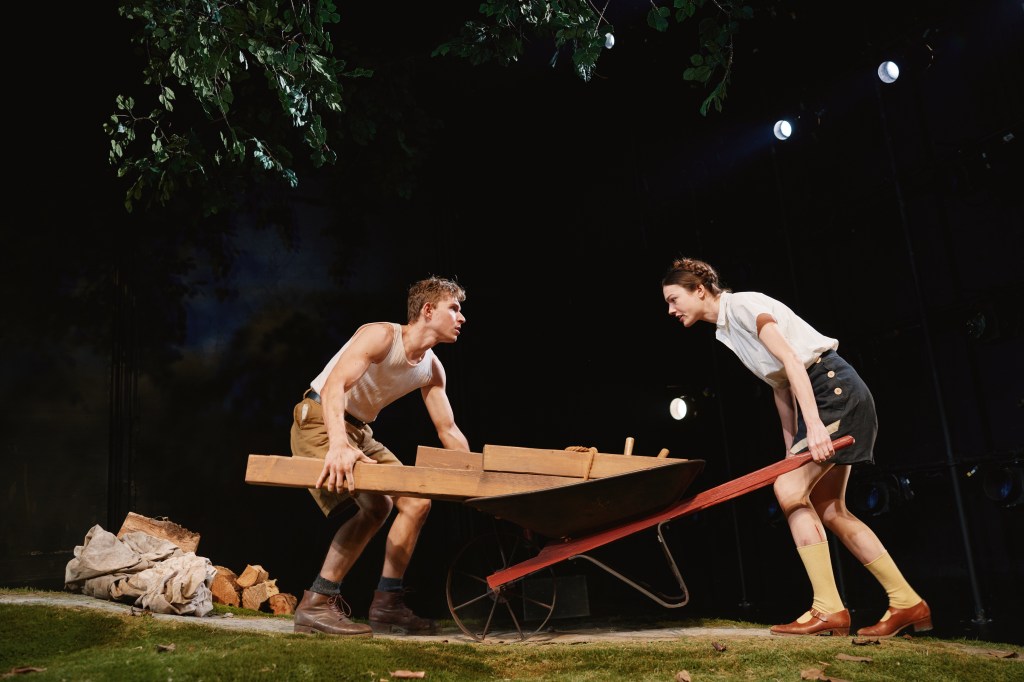
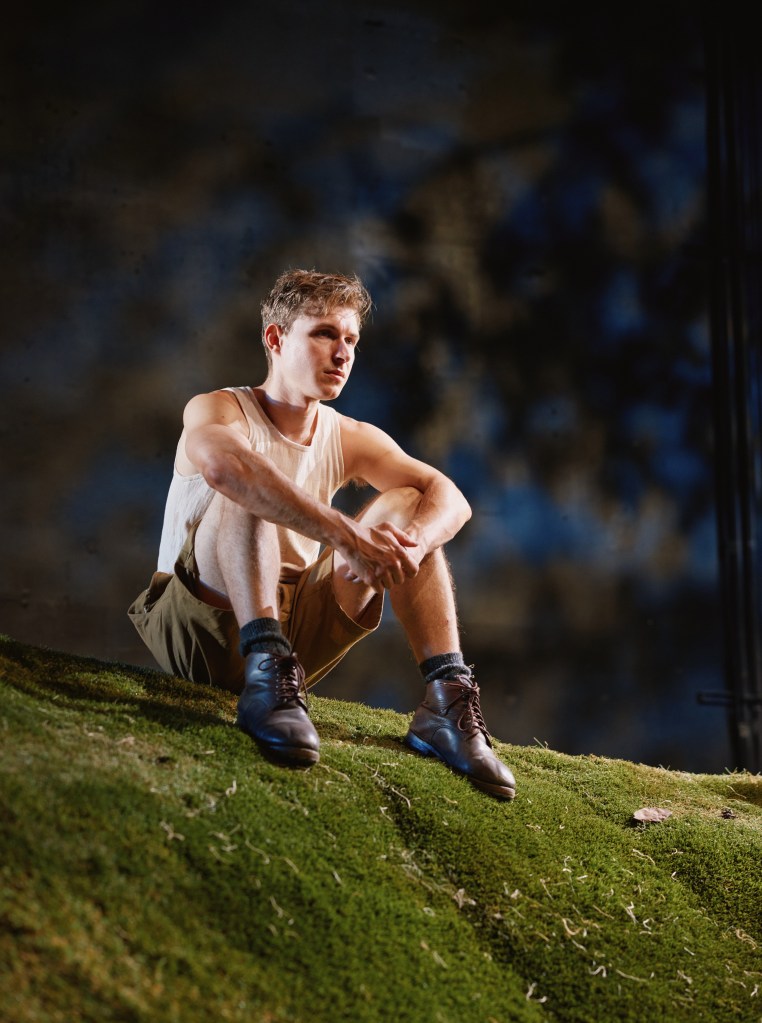
We only see the camp exterior. Brett J. Banakis’ scenic design creates the naturalistic set of a hillside and wooden fence-like wall abutting the camp. When He and She put together a platform that is later used for She’s speech, there are no swastikas, pictures or flags draping it, though there is canned cheering. The effects of what the climax of that speech might have been thematically and viscerally are diminished because the key symbolism of Hitler’s Nazi propaganda is absent. A sinister aspect is only suggested in the canned cheering in what sounds like a Nazi rally in 1930s Germany.
In Wohl’s Camp Siegfried, much is expositional; much is ancillary. We hear Hitler and Goebbel’s names mentioned as streets in the camp. We hear that the teens must do the work and if they are injured, they must suffer through it and be strong. She discusses the symbolism of the name Siegfried which she has learned and she tries to learn German. He chops wood for the all night bonfires; no workers from labor unions are allowed as unions were thought to have Jews (a reference He makes). The discriminatory aspects of this are downplayed. As he chops wood they get to know one another and more things are revealed about the camp. For example She reports various girls brag about having sex with specific boys.
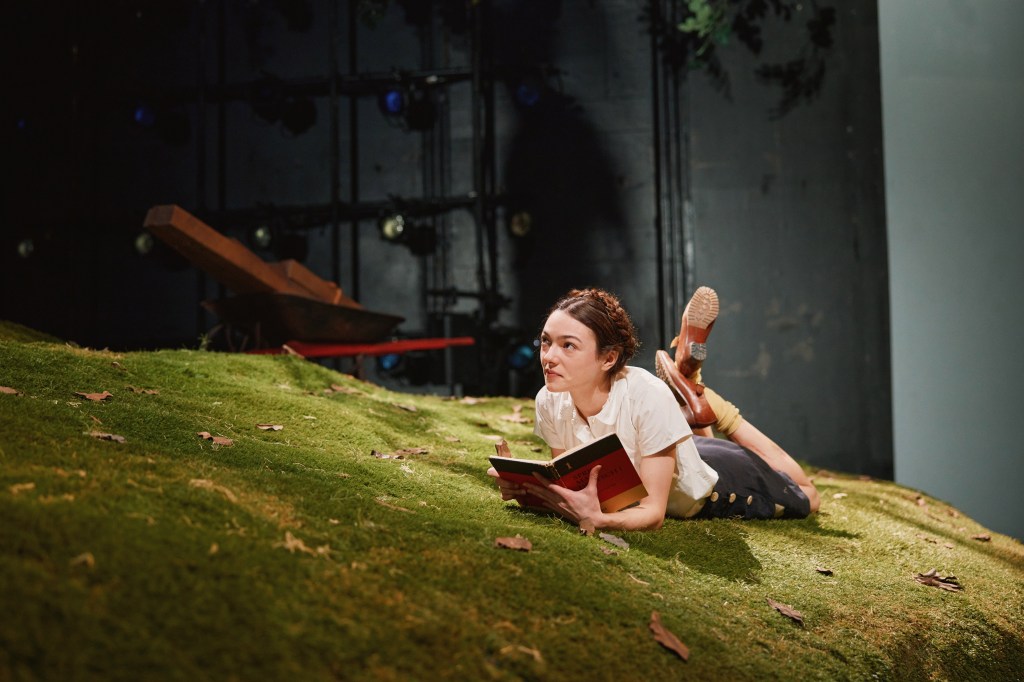
That the young men and women are being encouraged to “breed” and create Aryan replicas is unconnected to Nazism and the import of the activity is skewed. In one segment while He masterbates masochistically, She sadistically belittles and demeans him to be worthless. Their activity is disjointed and we are led to believe that their behavior isn’t connected with what the intentioned propaganda of the camp toward young men and women is. In some scenes after they couple, She demonstrates pride in telling He about her pregnancy. Her pregnancy is a lie, learned propaganda and manipulation. Wohl’s He and She fall in line with the learned camp behaviors out of gross inferiority and shyness. However, the characters are shallowly drawn and lack emotional grist. They are not easy to empathize with and thus, their indoctrination has less of an impact on the overall themes and conclusion which ends hollowly.
In the source material Camp Siegfried’s grounds had Nazi and Hitler Youth flags and pictures of Adolf Hitler. Men were photographed in uniforms (Italian Fascist-style blackshirts, SA-style brownshirts and Nazi military uniforms. It is arguable whether it is more frightening to see a sexual relationship between two teenagers budding against a background of Nazi flags whipping in the wind next to American flags, or an absence of them as if they don’t exist. However, in their absence, the danger and horror of what Camp Siegfried symbolized for that time and what its exploration through the teens’ eyes intimates for our time is lessened to the point that one wonders why the titular camp was selected and its purpose downplayed as an artifice. There is no visceral imagery or camp life that is believable and too much exposition gets in the way of the dynamic dramatic.
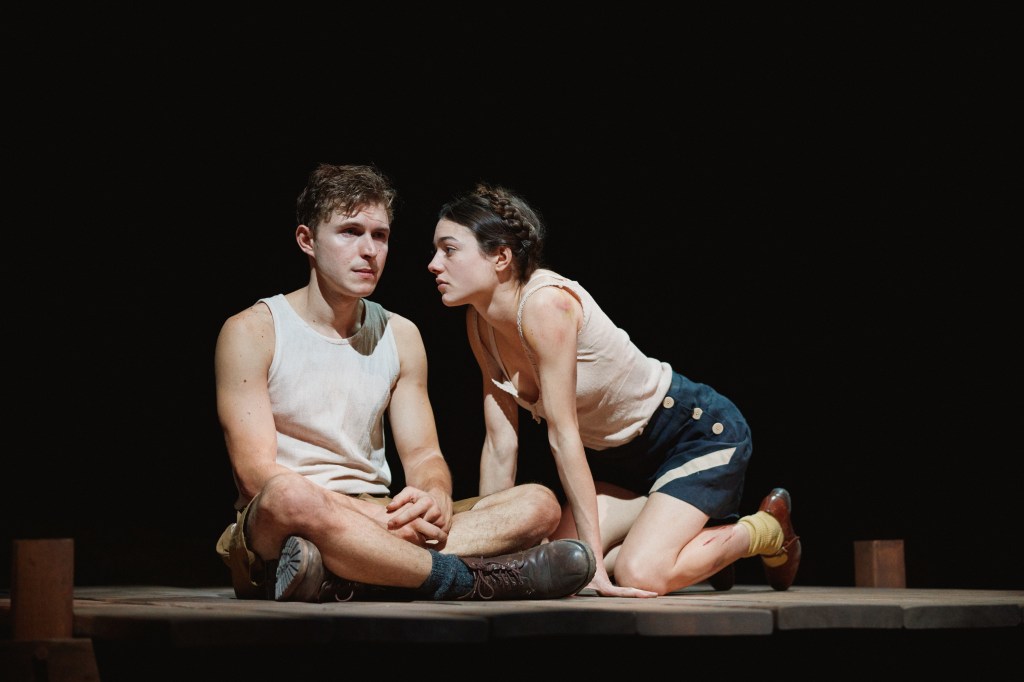
When He and She first meet on a back wall of the camp hillside, He tells She about the camp activities which include marching. If the “power” and “glory” of Hitler’s propaganda spectacle was manifest each day with the signage and Swastika flags, without learned revulsion, then Nazification would have drawn He and She in large part through the spectacle of such symbols that the adults at the camp salute to and venerate. But that which was a huge part of the symbolism used to bring unity, awe and fear by the Nazi Party and German loyalists, who use the camp to train future Nazi leaders, is absent. The audience is never allowed in to the camp and what they hear isn’t enough to make a difference because it is never activated or visualized.
The only events actualized concern their sexual relationship, the wood chopping, the platform building and the speech. All should have more than a slim thread of the Nazi connections but they don’t until the last two minutes of the play and only through exposition. Otherwise this would be a typical summer camp (it isn’t). We follow two teens (the actors in their Broadway debut make the best of their roles) and their relationship. She gives a speech with a Nazi salute that reveals her indoctrination. And the purpose of the camp is revealed with her description of what she’s been through to the doctor. We only find that out because she tells He.
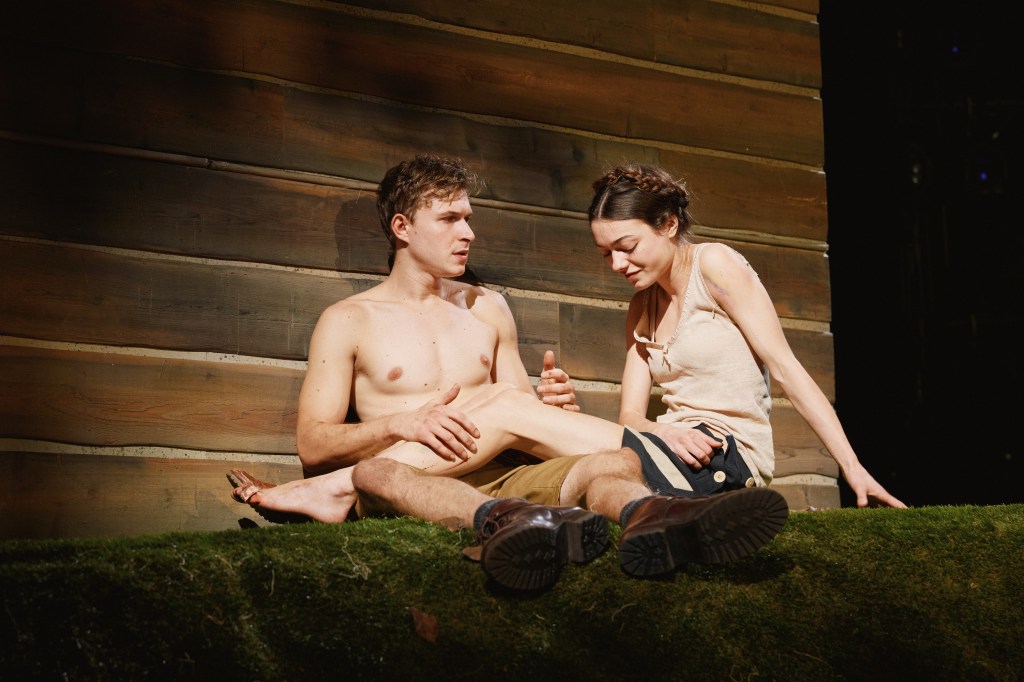
Wohl conveys the focus of the camp in a gradual sub rosa way via exposition and He’s behaviors. Unconnected to the other camp members or activities, the action is unclear as to the extent it is unfair and cruel (until at the conclusion She reports how the doctor defined what happened at the camp as a delusion). Likewise, another activity He engages in is archery. But its importance as potential discipline and military training is muted as are all the actions we see the teens undertake. However, in reality camp activities are organized to make future Nazi leaders in the US to run for political office, to unify German Americans, and place them in leadership roles to dominate in coherence with Hitler’s Third Reich.
This is hinted at via exposition and reportage at the end of the play when She reports to He that she went to a doctor outside the camp after He has beaten her badly. When she tells the doctor why she’s so cut up, revealing the camp’s abusive treatment in addition to He’s beating, the doctor (an outsider) tells her, “Anyone can be seduced.” And he follows this with, “Never underestimate your infinite capacity for delusion.” As she reports this to He, the spell is broken. She tells He they were both caught up in the delusion. He doesn’t accept what she says and tells her that Herr Kuhn has invited him to Germany and he will meet the higher ups and join the “worldwide fight.” This important scene with the doctor is reduced to exposition, yet it is what changes her mind about the camp.
Anything that might strike horror for us today is not shown. This seems misguided and changes the thrust of the play, whitewashing it. There is nothing benign about a Nazi Swastika flag next to the American flag which was pictured at the real Camp Siegfried. The play’s camp carries the title, but the substance and meaning are squeezed out of it. Thus, the lure of the propaganda which should be terrifying to us because we know what is behind it, never finds emotional power or effect. The forward movement becomes some teens playing at sex and being adults and searching out each other with a backdrop at a camp that we hear appreciates the Nazi Party, Hitler, teaches German, has all-night rallies and marches. The culmination occurs when She delivers a speech and lifts her hand in the Sieg Heil salute and feels pleased with herself but reverses after her discussion with the doctor.
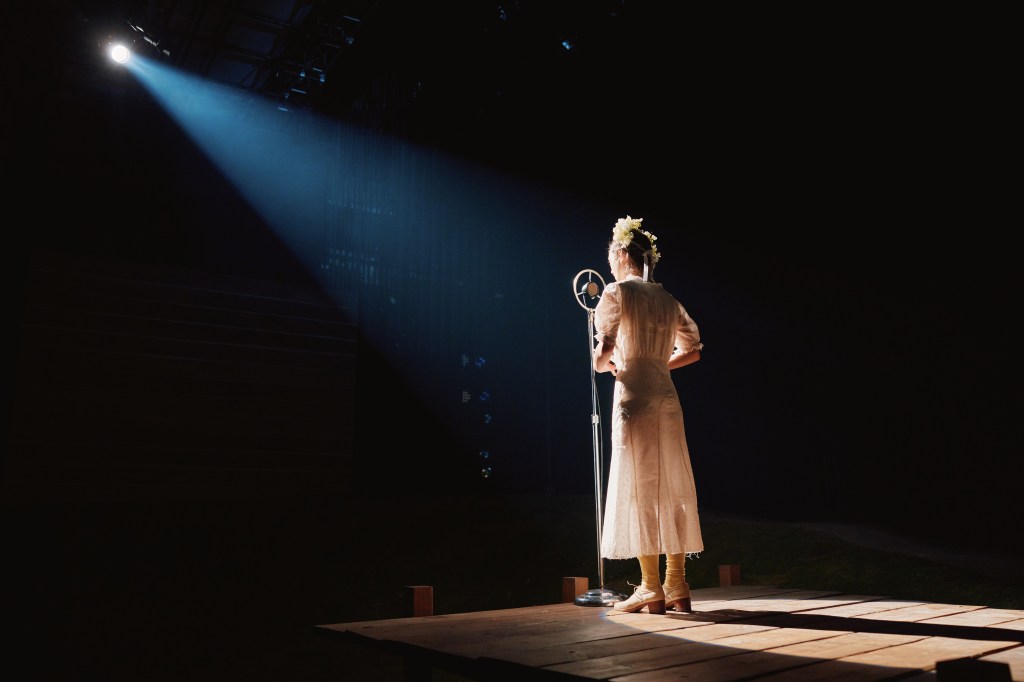
It may be horrific to have a Nazi Swastika onstage with other Nazi paraphernalia, but that horror is real and signifies something beyond just the freedom to express it. More might have been done to reveal the iconography of the Nazi party that was propagandizing the teens at the camp since it was such iconography that swelled German pride during that period of time in Germany and during the 1939 Nazi Party rally at Madison Square Garden.
Thus, the play never rises to the dramatic moments of danger and fear that Wohl might have brought to bear during our time that again sees the rise of white nationalism in our country, and on Long Island. There, on Long Island, the KKK, confederate flags and white nationalistic Holocaust Denier T-Shirts have been seen in allegedly patriotic parades and boat regattas supporting Donald Trump, a proponent of White Nationalism (think Nazis) and anti-democratic insurrections. Not to include the symbols or uniforms as they were used at the real Camp Siegfried, when white nationalism threatens our very democratic institutions is problematic.
At the Capitol on January 6th, there are pictures of Holocaust deniers proudly wearing T-shirts proclaiming that 6 million more should have been killed. This occurred during an insurrection that intended to nullify our constitution and install a despotic, white nationalist, who decries not indecency, bigotry, anti-semisitism, racism and hatred, but anyone who criticizes him. This is a time when a known Holocaust denier went to Mar-a-Lago, a few days ago, the place once referred to as the Southern White House. Actions and words carry great meaning.
The Nazis gently referred to and mildly presented in this play via exposition were essentially absent. Especially absent are key symbols of Nazi propaganda that the Nazi Party used for their potent and clever manipulation to sway the minds of Germans. Their non-appearance in the play is definitely a teachable moment. Likewise, the decision to omit these dramatic elements carefully constructed by the Nazi Party to excite and unify, in a play about Nazi allurements, also is a teachable moment. Their absence is silence.
Camp Siegfried runs with no intermission at https://cart.2st.com/events
‘Evanston Salt Costs Climbing,’ Arbery’s Excellent Play is a Must-See
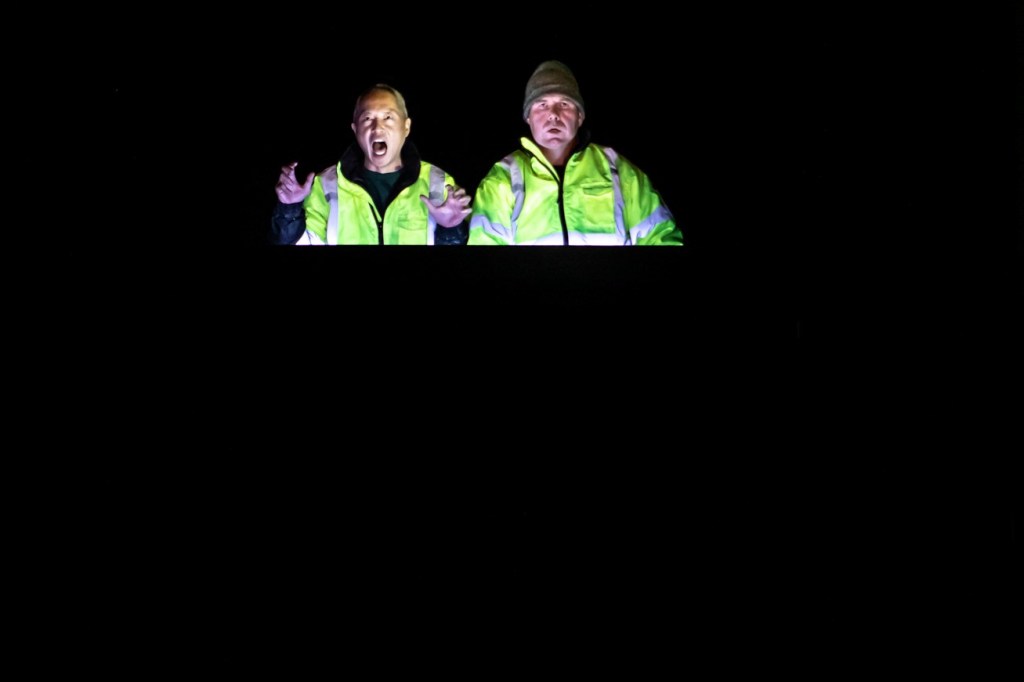
In the microcosm is the macrocosm. This is especially so in the setting Will Arbery presents in Evanston Salt Costs Climbing, the sardonic, metaphysical-realistic 95-minute play acutely directed by Danya Taymor, currently at the Signature Theatre presented by The New Group.
A key theme of Arbery’s exceptional work turns on the notion that the larger picture of what is happening resides in the details which human beings have a penchant for ignoring, though it is right before their eyes. Do we see the connections, or are we like the characters in this play, willfully unaware until a catastrophe results and it is too late to do anything about it? Arbery examines these themes in his thought-provoking, stylized work that suggests we cannot escape how we relate to our environment, no matter how much we attempt to obviate it. Indeed, Arbery points out that it is this blindness that has brought us to the brink of self-annihilation. Ironically, even standing on the brink looking down, we can’t manage to do what is needed to confront the human disaster that is unfolding before our eyes.
At the opening of Arbery’s play two truck driver forty-somethings, Peter (the superb Jeb Kreager), and Basil (Ken Leung is his vivacious side-kick), share their morning coffee before they take their rounds spreading salt to safe-guard the roads in and around Evanston, Illinois. We let this information slide away from us without giving it much thought. However, everything in Arbery’s play is profound and the characters’ lives and future are encompassed in the smallest detail of salt spreading. In that detail is reflected the wider invisible world that the characters sense is out there, both under the ground, pushing to break apart the sham infrastructure that cities have built for the purpose of commerce, or in the invisible world that hangs above in the ambient atmosphere pressing down on the characters to confound them and make them despondent.

The world that Arbery’s characters inhabit is representational. The action takes place in the environs of the Evanston “salt dome,” in the truck, and in Maiworm’s home, all staged with superb and symbolic minimalism by Matt Saunders’s scenic design, Isabella Byrd’s lighting design and Mikaal Sulaimon’s sound design. Before Peter and Basil begin their shift, Maiworm, the public works administrator who is their boss (the excellent Quincy Tyler Bernstine), stops in as she does each morning. Maiworm is astute and stays on top of the forward moving trends regarding the Green Movement. She understands the “larger picture” of the changing environmental conditions which impact their jobs and of which Peter and Basil remain unaware. Maiworm attempts to enlighten them by reading an article to them, the gist of which states that the record colder temperatures are requiring record levels of salt use. These are driving up the salt costs.
If we are paying attention, we understand the cause and effect of global warming and weather weirding indicated in this small detail of salt costs. After Maiworm reads the article, Peter says an article should be written about the fun he has with Basil driving in the truck. He doesn’t catch the “devil” in the details. In other words, he never makes the leap that the costs might impact his current job, his hours or salary. He assumes all will remain static in this job he’s had for twenty years.

Basil, who writes micro-fiction, ignores the underlying significance of the article for another reason. He tells Peter no one wants to read an article about their job because it has no “pull” or interest. The connection between Arbery as a writer and Basil is understated. It is as if Arbery twits himself about the intentional boring context of “salt costs climbing,” knowing that such a subject will not keep the audience engaged. However, Arbery is having us on. That is not what the play is about. And how the playwright cleverly connects this “detail” with its hidden significance making it dynamic and indelibly related to his characters is striking and horrifically revelatory to us.
Basil asks Maiworm about the impact of the increasing salt costs. Arbery reveals why Basil asks the question in the next scenes when we see that he and Maiworm have developed a covert sexual relationship unbeknownst to Peter. Thus, unlike Peter who doesn’t see or care about the symbolism behind the details, Basil is open to Maiworm’s thoughts and most probably encourages the direction of her decisions to feather her own nest and advance in her administrative position which must take into consideration the budget which includes the price of salt. However, on another level, he too misses the significance connecting the dots to climate change and colder weather which will create havoc if the powers that be (including Maiworm), don’t properly plan for it.
In a humorous scene that follows, we understand why Peter loves driving in the truck with Basil. They act silly and ridiculous, sharing “manly” antics as “roadies,” who do their job and maintain a friendly relationship, where they can cut loose and have a free-for all (which mostly entails cursing). Also, during this time Basil and Peter discuss more personal issues. Basil relates the dream he has of his grandmother who has told him, “Don’t let the Lady in Purple come near you.” He states, in the last part of the dream, The Lady in Purple does come near his grandmother, who dies. We intuit that the Purple Lady may be Death.

Additionally, Basil discusses that he ends up fusing with the Purple Lady and reverts to a dying little boy as the Purple Lady takes him. This, he tells Peter, happens during a time when cities are freezing and burning. Basil’s description is metaphoric and prescient in its representation of global warming, which he never mentions by name as if it doesn’t exist. By degrees, Arbery reveals how the events Basil describes in the dream come to fruition in his life in a mysterious way that merges phantasmagoria with reality later in the play.
Peter expresses that he is sad and his dreams are surrounding darkness and noise. This reflects Peter’s depression and suicidal thoughts. Basil, who has discussed Peter’s wanting to kill himself and kill his wife is concerned that Peter is in bad shape. Basil tells Maiworm about Peter and she vaguely comments she’ll watch out for him.
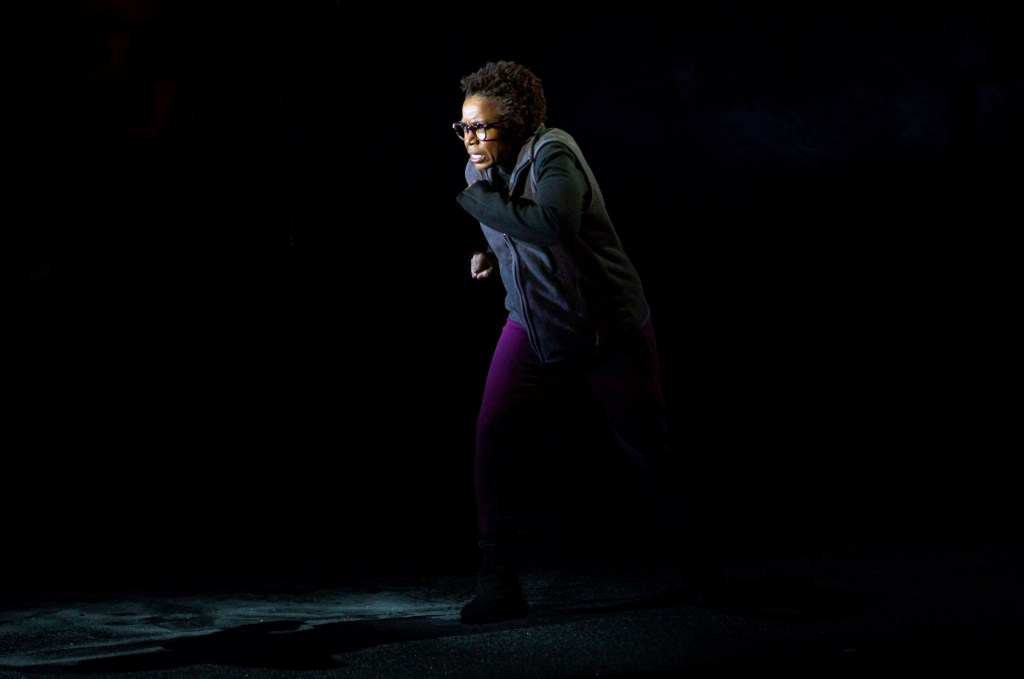
The dynamics of the interrelationships complicate as we learn more about Maiworm’s adopted daughter, Jane Jr., who suffers from depression and has suicidal thoughts like Peter. As Jane Jr. Rachel Sachnoff gives a fine, nuanced performance. of the only character who understands the impact of climate change. Maiworm’s concern for Jane Jr. includes trying to direct her interests by getting her to read Jane Jacobs’ book The Death and Life of Great American Cities. Additionally, Maiworm encourages Jane Jr. to help others by singing to them at the nursing home. To make her feel needed, Maiworm uses Jane Jr. as her confidante. After a nightmare provoked by the suicide of the journalist who wrote the article Maiworm reads to Peter and Basil, Maiworm discusses her anxiety about Evanston. Maiworm tells Jane that she saw the dead rise from under the ground as the journalist fused with them. Then she segues the discussion to heated permeable pavers, the technology to make roads heat up so they can melt ice and snow to eliminate the use of salt and reduce costs.
Like all exceptional playwrights, Arbery reveals the trenchant themes by gradually through their connections. Eventually we learn one aspect why the heated permeable pavers might be a great solution. The salt is incredibly toxic and destructive to wildlife. Salt run-off pollutes the water table creating toxic blooms releasing poisonous chemical compounds and metals that kill animals and people.
Interestingly, this is the first we hear of such a technology, but not the last. We discover much later when Arbery connects the dots that Maiworm, to advance in her position, is part of the program to bring heated permeable pavers to Evanston, unbeknownst to Peter and Basil, whose jobs will become obsolete as a result. However, the implications of this Arbery does not make “visible” until after personal devastation occurs to each of the characters over the course of the three consecutive brutal winters in Illinois when the play takes place.
Arbery boxes in the characters who increasingly become dislocated through sadness and depression, indirectly caused by ignoring the moment of what is happening around them in the environment. Arbery indicates that though they don’t see the larger picture of the apocalyptic effects of climate change, in the unseen realm of the invisible world, it impacts them day and night. Jane Jr. is aware of this. It is mostly the cause of her depression and desire to end her life. She considers her Dad lucky that he died and doesn’t have to experience the impending doom that can be felt everywhere. Maiworm and others go about their lives as if nothing is happening. They live in a denial and that doesn’t quite work because they sense the coming destruction but don’t articulate its connection to what they feel is happening. Articulation is the beginning of recognition.
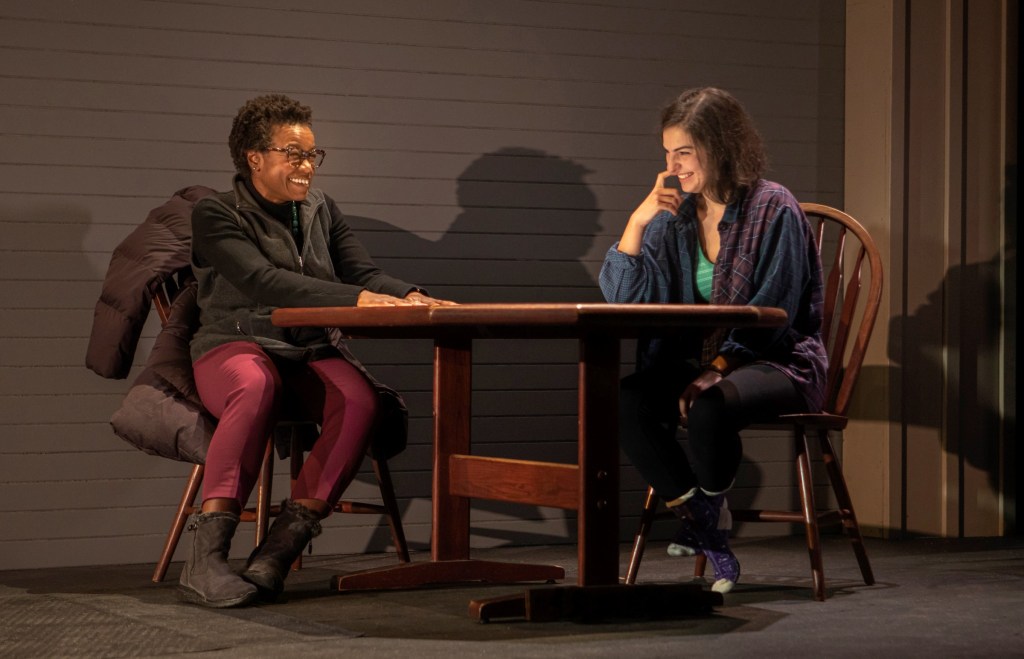
The unseen doom disturbs everyone. Peter’s suicidal thoughts continue and his situation worsens after his wife dies from an accident on the icy roads that didn’t have enough salt on them (presumably because less salt was used to defray costs). Fortunately, his daughter lives and they bond over Dominoes Pizza and watching the truck come to their door, a fun event for the six-year-old. Their relationship is the bright light in the play.
Maiworm’s guilt about Peter’s wife’s death is understated, but her behavior becomes more hyper and the overarching doom she senses increases in her life with Jane Jr. Additionally, the doom is in Basil’s dreams and shows up in his micro-fiction. When he is confronted with his past and inability to deal with it in his present, he is swallowed up (the Purple Lady makes an appearance). Basil joins the other dead in the earth metaphorically and physically fulfilling his nightmares. How Taymor and her team effect this is strange and dislocating, intensifying the play’s foreboding which becomes palpable to the audience.
Maiworm who could understand the impending doom of global warning’s impact on their lives, can only manage to live in the microcosm to fulfill her desire for advancement. She is the most blind and she blindsides others. Palliative measures to correct the dire future with “heated permeable pavers,” are too little too late. Caught up in the details, she ignores the “bigger picture.”
The climax of the encroachment of the unseen (the environment rebelling), upon the characters occurs toward the end of the play where Arbery delivers his key message delivered by a supernatural incarnation of a presence from the past, Jane Jacobs. As Jacobs, Ken Leung arises in black funereal dress. Without his accent he comes across with clear, precise anger and a clarion warning. Jane Jacobs suggests what we must do as human beings to face the oblivion of our own making. See the play; there is no spoiler alert.
Taymor’s direction of the actors is spot-on as they convey the suppressed doom in the tension and growing personal alarm in their dreams and confessions. All of the creative artists majestically bring together Arbery’s and Taymor’s vision of the dire consequence of the environment rebelling as an incarnate “thing.” Saunders, Byrd, Sulaiman and Sarafina Bush’s costume design, help to manifest terror in the atmosphere of the play through the suggestions of mysterious other-worldiness peeking through reality. We “get” the palpable danger human beings have created for themselves with their willful ignorance, negligence and dereliction of duty. That danger drives Maiworm, but because she ignores the signs and can’t translate what she feels into understanding, her obsession is misdirected. Caught up with the pavers for the future, Maiworm forgets to order salt for the present winter and they must hire others to do the job of salting the roads. She is rewarded for her incompetence as her advancement continues up the administrative chain.
The director and her team use at varying intensities darkness, shadows and light to great effect. Additionally, they alternate silence and loud sounds of the truck engines, screeching tires and grating sounds made by the raising and lowering of the warehouse garage doors. They employ storm sounds as well. These help to enhance the ominous atmosphere the characters feel and creates in us a growing dread. Also, the use of lighting and sound suggest the extremes of heat and cold and the eerie, weird quality of the environment as a being which humanity has monstrously shaped by its abuse. As a result of Taymor’s direction, Saunders, Bush, Byrd and Sulaiman’s artistry the nameless stark, terrible becomes real and the playwright’s themes hit home. Their prodigious efforts combined with the actors’ authenticity create memorable live theater that should not be missed.
For tickets and times go to their website https://thenewgroup.org/production/evanston-salt-costs-climbing/
‘Catch as Catch Can’ Review
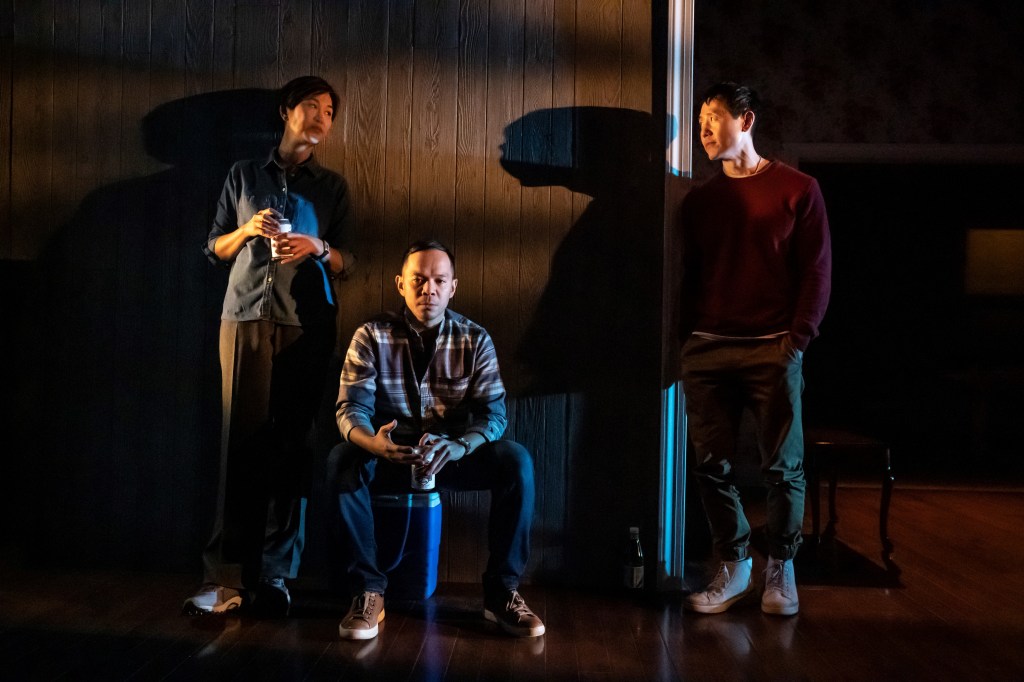
In the service of confronting anti-Asian racism and the bias against mental illness, Catch as Catch Can by Mia Chung, directed by Daniel Aukin widely misses. The one-act play at Playwrights Horizons, reignited from a run at The New Ohio Theatre in 2018 complicates structurally and thematically. Unfortunately, the lack of forthright presentation skews the power of the messages and leaves one questioning the characterizations. Instead, one should be questioning the impact of parental conditioning on learned behavior.
Our conditioning is how we abide by family roles, gender, ethnic biases, unless we choose to overcome them. Conditioning importantly impacts our psychological stability. This theme, if clearly presented by the playwright is prescient for us today. However, much was lost in the presentation of this production at Playwrights Horizons until November 20th.

Three actors fluidly portray six roles which is easy enough. The roles they illuminate are of different ages and genders and there’s the rub. Jon Norman Schneider and Rob Yang at the top of the very long one-act (1 hour 50 minutes), portray mothers Roberta Lavecchia and Theresa Phelan. In subsequent scenes they play their sons Robbie Lavecchia and Tim Phelan. Cindy Cheung portrays father Lon Lavecchia and daughter Daniela Lavecchia.
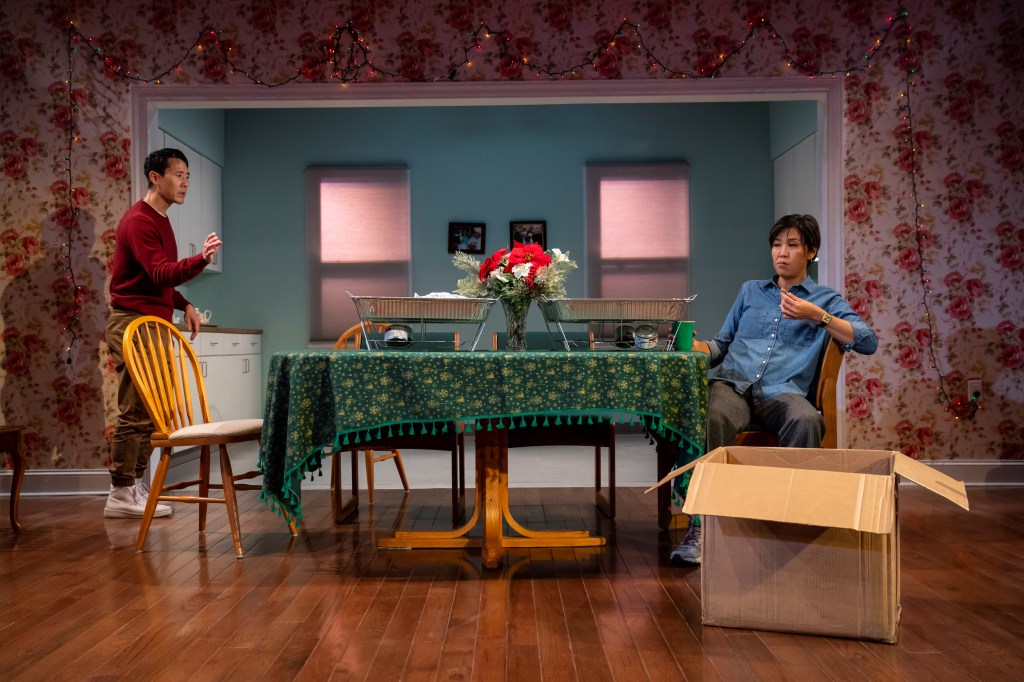
What is the point of the actors portraying characters who are cross-gender, cross ages while they, too, belie the ethnicity of their characters (Italian and Irish)? In watching Cindy Cheung portray father Lon Lavecchia, and daughter Daniela Lavecchia, we see how the character has been influenced by her father’s parenting. In watching Jon Norman Schneider portray mother Roberta Lavecchia and son Robbie Lavecchia, we understand the mother’s influence on her son. Likewise, as we watch Rob Yang portray mother Theresa Phelan and son Tim Phelan, we understand how Tim’s nature and behaviors are conditioned and influenced by his mother Theresa. Wouldn’t the dialogue reveal this without all the crosses to bear?
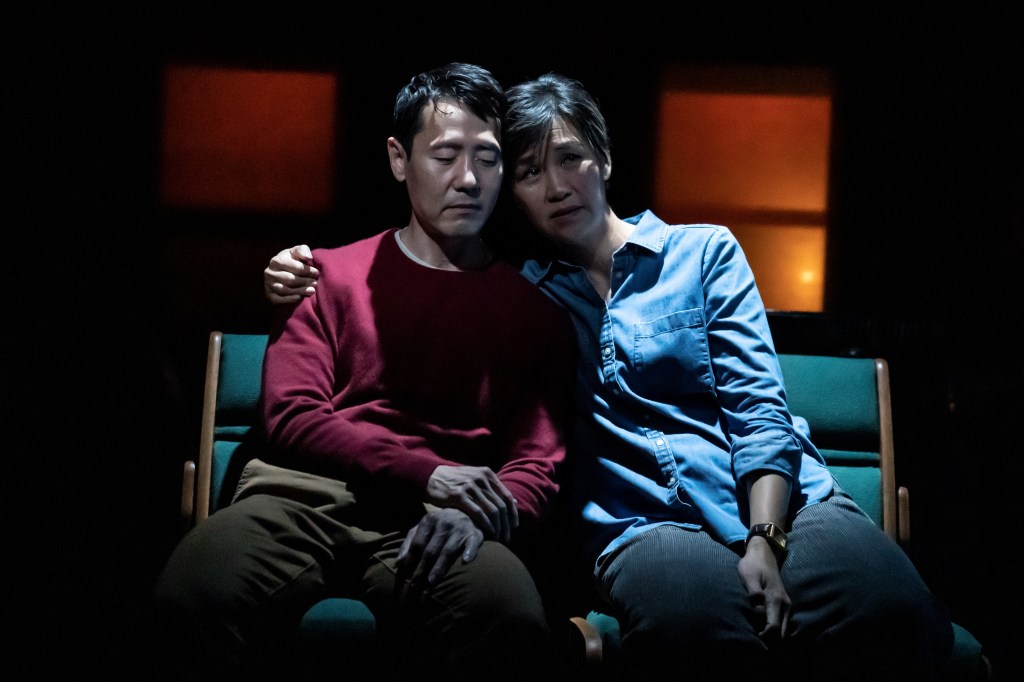
It took me about 3 minutes to understand that the effeminate mannerisms and strained voices of Jon Norman Schneider as Roberta and Rob Yang as Theresa were stylized to convey the impact of these women on their children. This becomes clearer when we later see the doubling up portrayals of the actors playing the sons, as “chips off the old maternal block.”
The first scene between the two mothers sitting and having tea played more for humor than for authenticity. However, I found myself forced to listen acutely to the dialogue to understand that neighbors Roberta and Theresa are concerned about their sons and that is a point of mutual shared interest. Their sons have been with Korean American women. Roberta is comfortable enough not to disguise her bias against son Robbie’s wife, who he divorced two years prior. On the other hand, Theresa is concerned that her son Tim is going to be engaged to a very pretty Koren American woman who looks “like a doll” and has small hands. We discover later that Tim who has severe emotional issues has been lying to his mother about this woman, perhaps to reassure her he is “normal,” for she can’t accept another way for him to be.
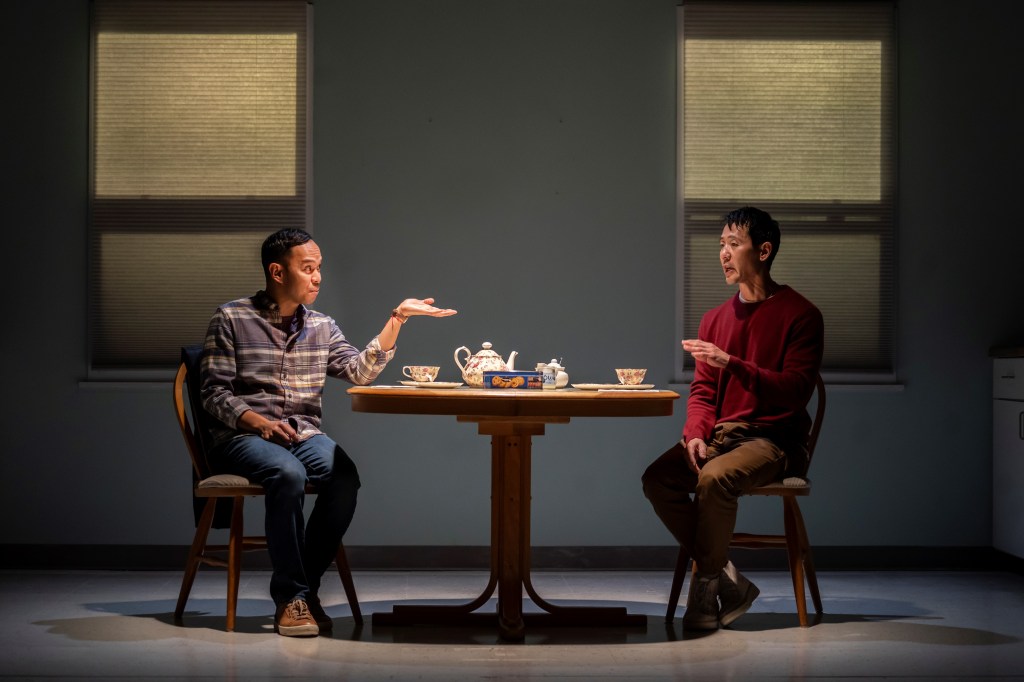
The playwright has sought to stylize the entire foray into subjects which perhaps should be dealt with honestly rather than to obscure them. However, even in neighborly relationships and in families, so much occurs sub rosa. In all human relationships behavior is obscured. And sometimes we learn more from what is not said than what is. That is one message of the play, it would seem, as an outcropping of the playwright’s intentional doubling and mixing of ages and genders and also including two Asian actors. The question remains, does the mixing of genders, ages and ethnicities elucidate or befuddle? And to what extent does confusion enhance one’s passion in expressing one’s message?
Stripping away the artificial and stylized constructs, the authentic action which is most on point is the preparation for the family reunion. where we have already seen where the food and last names identify ethnicity for the Italian Lavecchias and Irish Phelans. We become engaged as the actors hang the Christmas lights, get the chaffing dishes and organize for the large buffet, that is sprinkled with humor, including the thought that a friend’s vegan teenager will not be eating Mrs. Lavecchia’s wonderful meatballs and sausages. The scene is in the congeniality of the season until a monkey wrench is thrown in when Tim and Daniela go shopping to pick up additional supplies. Tim kisses Daniela, truths are revealed. The moment is incredibly awkward and sets us up for Tim’s later emotional and psychological breakdown. Cheung and Yang do a bang-up job with this scene as a lead in to the strongest part of the play, Tim’s illness.

The last part of the one-act is the clearest. Tim’s profound depression which he’s been hiding from his mother is acute. Friends also miss it and can really do little to help. In the conversation he has with his mother that moves from response to comment, Yang’s portrayal of mother and son is superb and differentiated. Theresa’s unemotional delivery segues into Tim’s unemotional, opaque monotone that reveals his desolate state. Thus, when Cheung’s Daniela explains that she finds he tried to hang himself in their house where he was staying, we are not surprised. Nor are we surprised at Daniela’s expressed hatred for Theresa who can’t acknowledge what is happening to her son. We have seen Tim’s debilitating depression in action with his mother who doesn’t understand her son.
The subsequent hospital scene where Yang’s Tim acts out against being there to his final scene with Robbie convey the misery and hopelessness of his condition. Yang and Schneider do a wonderful job at this juncture. From benign beginning between the almost silly Theresa and Roberta to the conclusion, Tim’s severe illness finally emerges. We note that the events and conversations have led up to this point as merely the tip of the iceberg below which Tim’s state looms to crash into his mother. He can no longer front with her and they become alienated. Theresa rejects his mental state and perhaps as a distraction appears more concerned about herself. However, Robbie is accepting and loving to Tim. We would like to believe he will be there for him. Yet, in a fade to black the outcome is uncertain, as is with mental illness where the patient doesn’t believe in the efficacy of his own survival.

With a different directorial approach, the themes might have been brought to bear more powerfully. Unfortunately, with this iteration, there is much that remained muddled. One wonders how the dialogue would stand up if the six characters were not in search of delineated roles melting into a mix of ages and genders. Possibly, if performances were less stylized with speech patterns and mannerisms forcing for laughs, the results would have been more dynamic. Indeed, the parts of the production that were authentic and acted with spot-on immediacy (minus exposition), were standouts. Kudos to the three actors in those sections.
Kudos to the creative team that effected the variety of setting changes including the hospital scene. Likewise, to the fine organization of props and setting for the Christmas celebration. The team includes Matt Saunders (scenic design), Enver Chakartash (costume design), Marika Kent (lighting design), Bray Poor (sound design).
‘Almost Famous’ The Broadway Musical Gives a Shimmering Nod to 1970s Rock ‘n’ Roll

From the response of the audience’s standing ovation and cheering, the snarky comparison by critics to the lead actors of Almost Famous and Dear Evan Hansen and other criticisms didn’t seem to matter. That is because Almost Famous delivers. This is especially so if one has seen the titular film (2000). If you appreciate a nod to what Howard Stern refers to as the best music of the past (better than the 1960s), and take that love or fandom to The Bernard B. Jacobs Theatre, you will be happy you went to see this enjoyable production of Almost Famous directed by Jeremy Herrin.
Written by Cameron Crowe (book and lyrics), and Tom Kitt (music and lyrics), based on the Paramount Pictures and Columbia Pictures film written by Cameron Crowe, the show spreads its uplift and hope during a holiday season that is bringing crowds to Manhattan. Tourists, rockers and Broadway fans up for an entertaining night out will be pleased at the sterling voices, the humor, the energy of the performers and the music which connects the familiar story-line to the historical 70s music scene with nostalgia and poignance.

The classic rock covers (i.e. Deep Purple, the Allman Brothers), sustain us while Kitt’s original music is interesting with memorable songs like “Morocco,” “The Night Sky’s Got Nothing on You,” and “Everybody’s Coming Together.” The new melodies (a combination of rock and pop), convey the heart of the characters who are subtly drawn.
Fandom is the key to frequent successful film to stage transference. It may or may not apply here. The creators have taken a leap into the Broadway musical genre. They’ve created original songs for live performance and they have slipped in songs from the period (Led Zeppelin, Joni Mitchell, Cat Stevens, Lynard Skinner, Stevie Wonder, David Bowie and Elton John) into the musical’s action but not in the same way as in the film, whose background was replete with rock ‘n’ roll songs from start to finish. That doesn’t happen with this musical that has 18 newly-written songs. Included are four reprises from Tom Kitt (music) and Cameron Crowe (lyrics). The songs move the action as the characters express their conflicts, issues, desires and feelings and get tangled up in each others’ agendas.

Staged cleverly with Sarah O’Gleby’s movement, director Jeremy Herrin and the creative team eschew traditional choreography and keep the sets simple and minimalist to suit roadies on tour with the exception of William’s and Elaine’s home. This is in the service of suggesting the free form movement of the 1970s. The concept of great rock was fading into new musical trends like Rap then moved in the 1980s to MTV domination. Ultimately, the musical is a nod to 1970s rock ‘n’ roll and its ethos before commercialization and digital technology skewed it into something else.

Though the action is condensed with the added musical numbers, the arc of plot development, based on Crowe’s real-life journey as a teenage rock writer, follows the film. Wisely, the humorous lines in the production are lifted from Crowe’s writing, which won an Oscar for best original screenplay (2001).
One of the most important themes of the musical reveals an ambience of the 1970s, that was culturally strained between liberalism and conservatism. This is partly suggested by the opening number “1973,” when William Miller (the excellent Casey Likes), confesses to rock ‘n’ roll critic Lester Bangs (a manic, funny Rob Colletti). William sings about his conflicts with his mom. She stands in the way of his discovering “who he is.” In a state of flux, his mother Elaine (the humorous Anika Larsen), a teacher fearful of “drugs, sex and rock ‘n’ roll,”controls William and his sister Anita to the point where Anita (Emily Schultheis), rebels and leaves home.

However, Elaine can’t quite figure out who she is either. She adopts a healthy vegetarian/vegan lifestyle, clearly a liberal cultural influence. Yet, conservatively, she disagrees with subversive music (the rock ‘n’ roll Anita loves), and its cultural aftereffects (sex, drugs, wild partying). The pull of conservatism and liberalism is one William faces in his conflict with Elaine, but he’s leaning toward the underground and subversive, reinforced when his sister gives him all her rock ‘n’ roll albums to be “cool.” These inspire him to write for his school newspaper with the hope of a possible career as a writer or future music critic.
One element of his confusion, unbeknownst to him. is that his mother had him skip grades and lied about his age. Meanwhile, he is embarrassed because he has no pubes, is alone, uncool and alienated by classmates who humiliate him. Naturally, when he receives a response from Lester Bangs, the finest rock critic in Christendom, who accepts and encourages him, he jumps at the chance to write for Bangs’ Creem Magazine. On the road to being a bone fide critic, he lands an assignment from Rolling Stone to profile a rising band called Stillwater.

William manages to obtain Elaine’s permission by swearing he will remain pure and stay away from drugs and sex. Elaine relents because she dimly thinks it is better to connect with him and “keep him near,” (which fails), rather than lose him like she lost Anita. Ironically, she loses him in a different way. The rock band “kidnaps her son,” a funny and wonderful refrain in “Elaine’s Lecture” which is a lament that carries her angst about what is happening to William. He goes on the road with the band to get an interview, for which Ben Fong-Torres (Matthew C. Yee), will pay him handsomely. It’s an opportunity too good to pass up.
Likes’ William enjoys the excitement of “getting down” with beautiful young women who assist bands in their mission to be great. These groupies, cheering the praises of their leader Penny Lane (Solea Pfeiffer), have re-branded themselves as The Band-Aids. They are rock ‘n’ roll muses and their mission is “all about the music.” Indeed, Penny Lane has so fulfilled her role, that musicians have written 14 songs about her, and “all of them good,” affirms Estrella (Julia Cassandra).

With such a build-up of excitement Likes’ William is smitten with Penny (Solea Pfeiffer), and her Band-Aides who, along with Estrella, include Sapphire (Katie Ladner) and Polexia (Jana Djenne Jackson). Solea Pfeiffer is an “all that” Penny Lane who doesn’t quite convince us that she is about the music and so “cool” and scintillating to musicians, that she is their fount of inspiration. But then she is not supposed to. The Band-Aids, Penny and Stillwater’s Russel Hammond (Chris Wood), Jeff Bebe (wild, rocking Drew Gehling), Larry Fellows (Matt Bittner), and Silent Ed (Brandon Contreras) are “hype.” The actors (the Band-Aids and Stillwater), do a superb job of managing their characters’ “cool” with enough awkwardness for us to know that they are “almost famous,” but not there yet. And as a result, they will never really achieve super stardom because they get in each other’s way and are totally “uncool.”
The Band-Aides and Stillwater must walk the tightrope of not believing their own image to avoid falling into a destructive abyss which threatens throughout. This conflict and tension abates after the moment of truth on the airplane, especially when Woods’ Hammond and Gehling’s Jeff Bebe reveal their deepest secrets because they fear the plane will crash. This scene is technically delivered to surprising effect. Humorously, the tiny jet “flying” on a chord from one side of the stage to the other was so “over-the-top,” it worked in the service of farce.
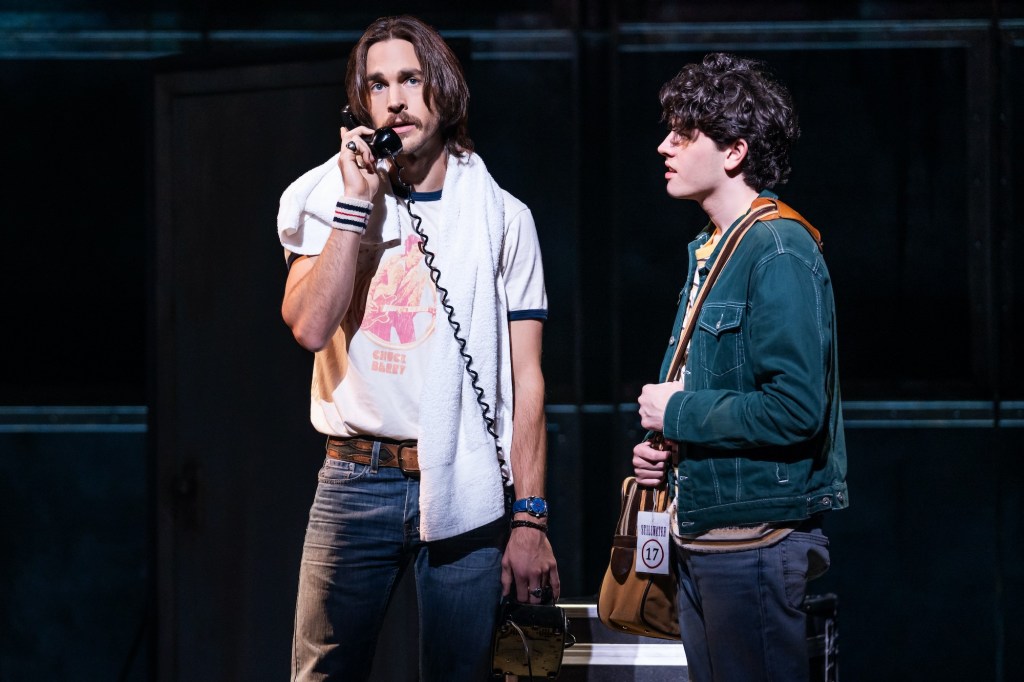
The actors did a great job with the scene to convey just enough humor and fear to “spill the beans” and further wreck Stillwater’s “togetherness.” Believing their own hype brought them to facing this catastrophe on the plane. If they continued to take their humble tour bus, they would have been safer. The real dose of reality that Hammond says he wants is a pose only revealed when he thinks he’s going to die. Thanks to Derek McLane (scenic & video design), Natasha Katz (lighting design), Peter Hylenski (sound design), and the actors’ authenticity, the scene embodies their magical thinking vs. truth, a key conflict and theme of the musical.

Williams’ adventures initially captured in his journey through the songs, “Who Are You With?,” “Ramble On,” “Penny and William,” “Fever Dog,” and “Morocco,” evidence the pitfalls of being a rock ‘n’ roll critic who is always a “watcher” of the action, not a creator of it. Colletti’s Bangs humorously warns William to be “honest and unmerciful.” When William gets a taste of the band culture, its groupies and the challenge to be accepted, he tries not to be overwhelmed or lose his “objectivity.” Yet, he succumbs to their manipulations. First, there’s the rejection of him as a critic (called “The Enemy” by Stillwater’s Jeff Bebe). This wears him down and makes him want to “fit-in.” Though he resists and manipulates band members with flattery, he never adheres to Lester Bangs’s sage advice. Gradually, William is sucked in because Stillwater’s Bebe, Hammond and Penny Lane are good at “the game.” William is clever, but he’s a neophyte.
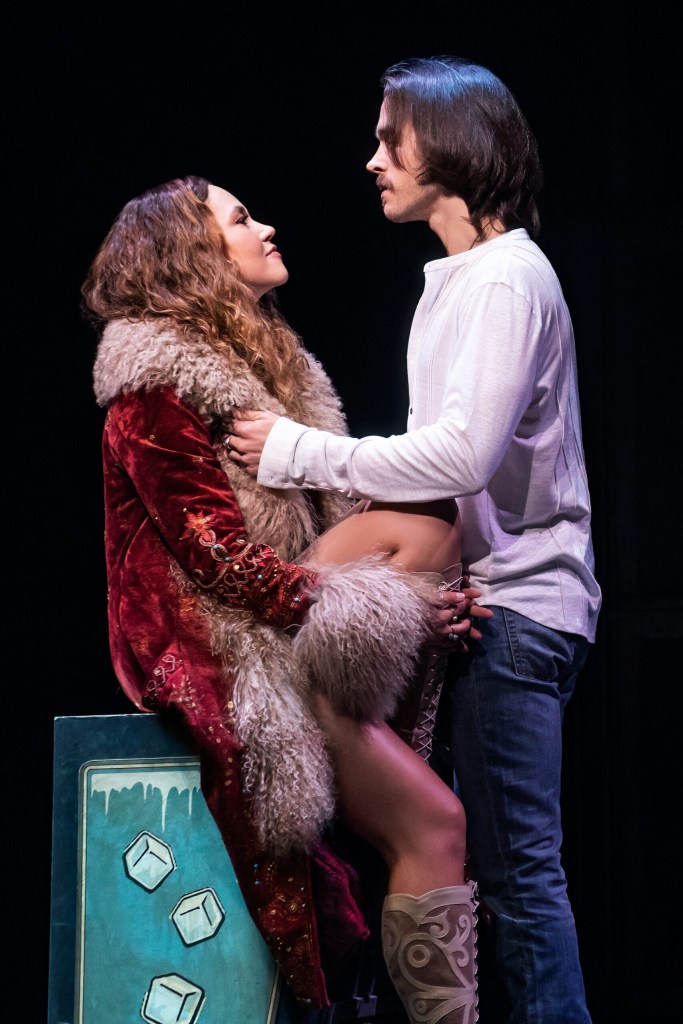
This “congenial” conflict between William, the band and Penny Lane disappears when he believes he is a friend, (“Something Real,” “No Friends,” the healing of divisions with “Tiny Dancer,” “Lost in New York City, Pt. 1” and “River/Lost in New York City Pt. 2”). But this “friendship” is a blind and his presumed love with Penny Lane eventually clarifies for him when she leaves him to the Band-Aids and joins Hammond (“It Ain’t Easy”). He is discouraged, but hangs on and writes a piece for Rolling Stone. However, it is rejected by fact-checker Allison (Emily Schultheis), and he is accused of writing a puff piece that Stillwater encouraged him to write. Only until Wood’s Hammond finally verifies William’s honest and “unmerciful” article to Rolling Stone, is the “magical fake world” of the band blown apart. However, this is beneficial for it allows the band and groupies to begin a new day.
Through lines in characterization are consistently effected. The conflict between son and mother abides from start to finish and provides much of the humor. Anika Larsen deftly balances Elaine as a typical loving parent, whose concern, knowledge and control are acceptable to the audience. She is never acerbic or preachy in the songs “He Knows Too Little (And I Know Too Much),” “Elaine’s Lecture,” and “Listen to Me.” Resolutions occur by the conclusion, when Anita has found herself and the full company sings the reprise of “Everybody’s Coming Together,” a rousing standout.
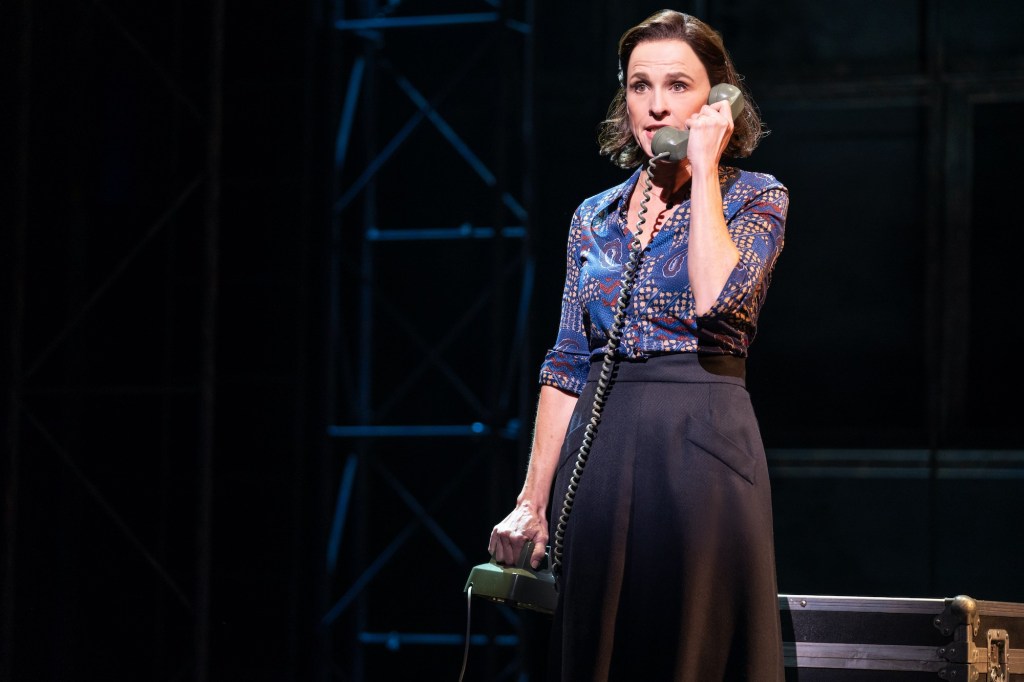
The actors, shepherded by Jeremy Herrin, do an excellent job of precluding who will end up on the floor of their own demise. This is strongest when we note the rifts between Bebe and Hammond, beginning when the T-shirts are distributed, then moving to the partial healing of their divisions on the bus with the singing of “Tiny Dancer,” another knockout scene and high-point at the conclusion of Act I. Though manager Dick Roswell (Gerard Canonico), has brought them together for a while, the conflicts among band members continue. They encompass Penny Lane and Russell’s relationship. Penny Lane is sold out in a bet that William witnesses during the Poker game scene. Pfeiffer’s Penny Lane and Likes’ William are excellent together with resonating lyricism and power when he saves her life after she overdoses on Quaaludes.
Most of the new songs work. Additional strong scenes/songs include Penny and William’s “The Real World,” Russell and Penny Lane’s “The Night-Time Sky’s Got Nothing on You” and “Something Real” when Woods’ Hammond falls apart at a fan’s house. At this point before the end of Act I, William attempts to keep Russell away from acid and fails. Woods and Likes do an excellent job revealing the negative pressure on their characters from the hype that Wood’s Hammond attempts to escape. It is an irony that he can’t because he is as needy and “uncool” as Penny Lane, Jeff Bebe and the others. However, he just hides it better.
Interestingly, in his immersion with the band, the only time they all come out of their “image” is when Likes’ blows it up with the final Rolling Stone piece about them, something that Wood’s Hammond encourages and has yearned for. Then, even Penny Lane is able to gain the strength to go to Morocco, leading to a satisfactory conclusion with “Fever Dog Bows,” which the entire company sings as a tribute to 1970s rock ‘n’ roll.
Kudos to the creative team already mentioned with special praise for Bryan Perri’s music supervision and direction, and Lorenzo Pisoni as physical movement coordinator. This is one to see for the shimmering performances, rousing music and nostalgia for a time we will never see again in its wacky innocence and silly “hedonism,” which seems quaint viewed through our current perspective. For tickets and times go to their website: https://almostfamousthemusical.com/
‘Walking With Ghosts,’ Gabriel Byrne’s Sonorous Solo Performance Resonates With Power and Intimacy

One way to reconcile being haunted by a past that is anchored to memories of people and places which have long disappeared, is to connect them to the present in the hearts and minds of those interested in their elucidation. Gabriel Byrne accomplishes this with his superb solo performance of his memoir Walking With Ghosts, adapted for the stage and directed by Lonny Price. The ghosts of Byrne’s past come to life through this humorous and poignant one-man show, currently at the Music Box Theater in a presentation that runs with one intermission.
In Walking With Ghosts Byrne captures the lyrical Irish rhythms of language as he touches upon the innocence, beauty, awkwardness, fear and grace in his childhood, growing up in Walkinstown, Dublin, Ireland before he left for the seminary in England at 11 years old to answer God’s call to be a priest. Through monologues, and evocative dialogue humorously peppered with the accents, voices and gestures of his parents, town characters, friends, a noxious teacher, even a brief encounter with writer Brendan Beehan, Byrne conveys the circumstances which contributed to forming his character and inspired him to expand his dramatic sensibilities.
These burgeoned into a globally renown career as a stage, film and TV actor as well as a film director, screenwriter and producer. Byrne has been twice nominated for a Tony award, has been nominated for Emmys and has won a Golden Globe and two Satellite Awards to name a few of the accolades he’s received for his work over the years. To understand the public, artistic Byrne, see his work and become acquainted with how he grapples with each genre, sometimes wearing a different hat than that of the actor.
To understand the private Byrne, Walking With Ghosts provides that portrait with illuminating, enjoyable glimpses into his childhood. He includes profound excavations that are personal and trenchant experiences which he relates as a forthright and raw expose coming “to know the world.” And as a coda to his successful career, which he leaps over and saves for another time (for there are no ghosts there), he recalls his parents’ humorous responses to his celebrity and ruefully admits to finally hearing their voices after they are gone.
In this third of his Broadway outings, Byrne showcases his remarkable talents. He appears onstage alone with minimal spectacle, directed lighting, spare props, and unadorned in the same clothing throughout. Indeed, Byrne is the transformative vehicle we focus upon, riveted with his immersive storytelling as both narrator and character, the elusive ghost boy, who has attempted to dodge and forget individuals in his past, but now stops and reflects about them lovingly, starkly for a few stirring hours with a ready, curious audience.

With lush, evocative descriptions and acutely crafted details, Byrne introduces his dreamscape and forages bravely into his past. He recalls his return to his vastly changed hometown overrun by development, where he feels like an intruder and claims himself “emigrant, immigrant and exile.” When he invites us in to receive his ghostly re-imaginings in haunted environs where ghost boy is running, we understand it is an incomplete and picaresque rendering. As in scripture, we see through a glass darkly without enough illumination and clarity to process everything. Yet what we see, hear and appreciate is from the depths of Byrne’s heart and private revelations bravely embodied so that we may identify and receive the gift he has humbly given to us.
Symbolically, the set design by Sinéad McKenna, features a back wall that is an artfully fractured mirror in need of repair, rather like a soul that has weathered the shocks and batterings evidenced by the damage but still holds together as one piece. McKenna’s lighting reflects a blur of colors and upturns Byrne’s shadow, so that it is an upside down pendant. It reminds one of the Tarot Card, the Hanged Man, which, in one interpretation indicates sacrifice and surrender.
Byrne’s remembrances structured in a fleeting chronology, like all memories, are vivid paintbrush images that strike then evanesce in humor and empathy. Other times his tellings sear into our minds, especially if we’ve experienced something similar. Throughout and together, Byrne’s recollections are a meditation on life that unfolds with beauty, synergy and power. To attempt to define one event or another as pivotal to his life remains an uncertain guess and requires thought. For all the memories he selects fashion who Byrne is from clearly apparent career profile and beyond to where the lines blur as son, brother, religious acolyte, amateur actor, friend and so much more. Thus, Byrne’s ghost boy leaps into characterizations and stories using themes and threads of ideas rather than a linear historical accounting.
Some recollections are unspooled in anectedotes and many of them land with humor. Enjoyable are his remembrances about his mother, i.e. her comments about his birth and his mystical naming received through an angelic visitation. Then there’s the soft, comforting recollection of his mother singing him a lullaby and his kneeling in prayer with his invisible guardian angel, who he knows stands near to protect him through the night. And there’s the memory of his father coming home from work as a cooper. Right afterward, he begs his father to ride on his knee playing “horsey, horsey,” his favorite game as father and son show affection for one another.
More acute, prickly memories move to the influence of the Catholic Church teachings and his first day of school when Byrne’s mother accompanies him and delivers him over to a formidable nun whose waxy hand he takes. Funny are his impressions of Christ on the cross, bleeding and naked except for a “nappy,” and his knowledge about heaven as he gives us his child’s take on the soul, limbo and the holy ghost as a pigeon. The latter prompts a sister to rebuke him, “It’s a dove not a common dirty pigeon off the street.”
And after recalling episodes of his days at school, the floodgates open and other aspects of the world enter. There’s his mother’s friend Mrs. Gordon, an iconic, crone-like figure, who enjoys frightening him so he wets the bed at night. And the joy of the thrilling Bicentennial Fair which is the epitome of a child’s play-land. He enjoins the exciting sights, sounds and feelings about the rides, candy, food and fireworks Irish-style, all of which Byrne relates in vivid technicolor.
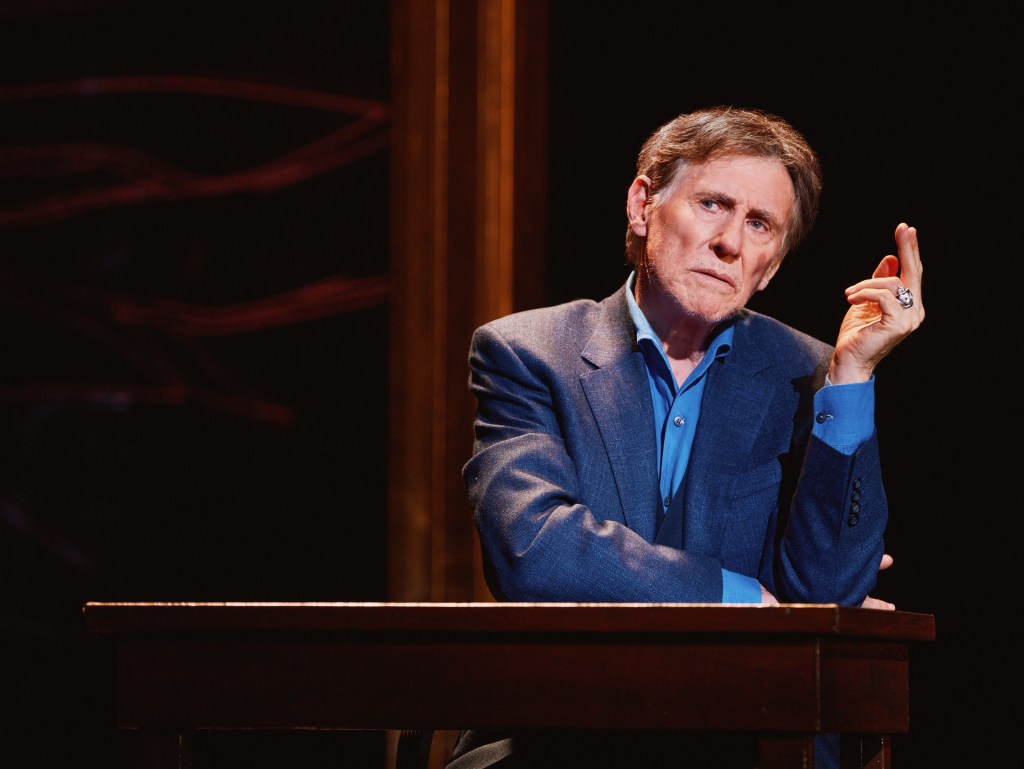
The import of religion to his family is as palpable as open flame to flesh. From humorous quips about mortal sins to how Jesus could be in a wafer and where he goes when you swallow him, he discusses Holy Communion. We calculate his poignant revelation preparing for this sacred day. First his mother takes him to tea at the Shelbourne Hotel, then on to famous Clery’s for his outfit. We note the family’s struggle with finances and flinch when he is ashamed at his mother counting out the coins to pay the bills. Equally touching is Byrne’s description gorging on candy and sweets that he doesn’t have very often and that he buys from his Holy Communion donations. He becomes so sick he soils his expensive outfit and hides in the bushes for hours fearful his mother with be angry with him. When she finds him, he discovers she loves and soothes him despite ruining what costs so much, an item that means so much, but they can’t really afford.
Byrne’s humor and enthusiasm extends to a meditation on his beloved grandmother who took him to the “pictures” and inspired a love of film. His description of a brutal and abusive teacher in his elementary school is only ameliorated when students get revenge then stick together and don’t confess, despite the pressure to do so. These and other events amass the ghosts that walk with Byrne in his childhood that fade. However, there is one ghost that haunts him for much of his life.
Enchanted by the idea that God might be calling him to be a priest, he goes to England to the seminary where he is happy. Enjoying being in England and getting away from home, he believes he has found a place of refuge. He is not hit or humiliated by the other kids as he was in Ireland. Also, he plays football and he makes easy friends. However, this changes on a dime. Byrne’s description of how the priest who favors him, gives him wine to drink, and absolves him of any impure thoughts he might have uses these sly techniques to insinuate and initiate a predatory sexual attack. The dialogue is pointed as Byrne assumes the accent and soothing demeanor of the priest. The event is so clearly disclosed and so classic of sexual predators, we shouldn’t be surprised. However, we are shocked and horrified. Byrne’s expose of the Catholic Church and the priest reveals the turning point in his life. The glorious faith that his parents believed in and lovingly shared with him in hope, his naming brought by an angelic visitation, his innocence and his desire to be holy is devastated and destroyed.
Years later after he’s found himself, Byrne shares that he located the priest via the internet and calls him, perhaps searching within to forgive the priest and forgive himself. On the phone he can’t bring himself to tell the elderly retiree with a poor memory in a retirement home that he wishes hell on him. In a confused daze, the priest thanks him for calling. He hangs up; empathy overtakes him. Throughout the the rest of the play, it is clear that this event contributed to Byrne’s choices after he left the seminary. He expresses the incident so vividly, it is indelible, irrevocable. That is the keen point Byrne makes through understatement without ranting or passion.
What happened to him happened throughout the global Catholic Church then and most probably is still happening today. However, if one doesn’t understand faith, religion and the power of a culture and family that holds God dear to them and has for centuries, the ghostly impact of this priest on Byrne’s life will be completely lost or misunderstood. As a reverential dramatic moment, the scene is incredibly rendered by Byrne. We sense that this raw incident he expresses not only for himself, but for every other person who has been sexually abused by a cleric whether Catholic, protestant, New Age, Hindi, etc.

In Act II we understand how the events in the seminary emotionally jack knife and send Byrne wandering away from his association with the Catholic Church to atheism. After he returns home from the seminary (Does he tell his parents what happened?), a series of unenlightened jobs that worsen (plumber, dishwasher, toilet attendant), keep him foundering until eventually, his friend suggests he join a non professional repertory company of actors. They are so welcoming, it is then he finally feels he belongs and is at home. As he outlines how he does various parts with his actor friends, a lively take on how each of his colleagues takes their bows is smashing. It is one of the more exuberant stagings by Price that segues into Byrne’s career moving off to the Focus Theatre and sojourns into professional acting and subsequent humorous disasters until he begins to support himself.
The second act has two other significant reverential moments recalled by Byrne. His sister Marian who he was close to pursues an acting career in London. However, though no one can explain how, she ends up in a mental asylum and they call Byrne to pick her up and take her home. What he describes, we’ve seen in films and we shouldn’t be surprised. Yet, his recollections are vivid and disturbing. Again, we are shocked by his incredible rendering of the asylum and the treatments she receives to “make her well” but which don’t. Byrne’s metaphor for her, “a wildflower in a crumbling wall,” expresses the culture that has caught her, but one in which she still provides beauty. However, the stigmatized by her mental illness, that beauty is not recognized. Thus, we empathize with his emotional response when he receives a call that she has died unexpectedly. She’s in her early thirties. She is one more ghost who haunts him.
Byrne’s episode with Richard Burton is not only fascinating, it, too, is heart-breaking. Drinking is a part of the culture in Ireland as it is in Wales where Richard Burton became addicted. It also is embedded in the culture of the entertainment industry which is a destroyer of artists. Byrne shares the time in Venice when he and Burton are working together and become drinking buddies. The occasion segues to Byrne’s recognition that he’s an alcoholic and must seek help which he does relaying he’s 24 years sober. He reminds us and himself that he has made it out of that hell, whereas Burton died with alcohol crystals coating his spine at his death. Once again Byrne’s understatement and lively reminiscences are the tip of the iceberg. Below are the miserable trials, the pain of alcoholism, the hangovers, the physical and emotional devastation and looming death. But this doesn’t need to be spoken and Byrne is not preachy, just thankful. The warning to others is clear. It’s possible to come out of it, if you get help.
A quick note about Sinéad Diskin’s music and sound which floats in and out unobtrusively. Like the structure of Walking With Ghosts, it is thematic and threaded, conveying the elusive emotions that substantiate Byrne’s episodic meditations. With the prosceniums frames that sometimes are gold other times red, etc., the mirror effect is enhanced as they appear in perspective to diminish in the distance suggesting the motif of fading away and evanescence. Such is the nature of memory that erupts and disappears unless one keeps it alive in another repository which Byrne does evoking their ghostly presence each night on stage. He identifies our part in this process or reconciliation in his final statement. The ghosts he was walking with are in him. He is no longer running. He has made peace with himself and them.
This must-see production is a heartfelt encomium to Byrne’s past spoken with the lilt of poetic feeling that is never overdone, but is as light as mists that burn off in daylight. For tickets and times go to their website: https://gabrielbyrneonbroadway.com/
Quiara Alegría Hudes’ ‘My Broken Language’ in a World Premiere at the Signature Theatre

Quiara Alegría Hudes (2011 Pultizer Prize winner for the play Water By the Spoonful), is widely known for what The New Yorker has described as her “exceptional body of work, at once lyrical and colloquial, playful and spiritual.” She is best known for co-writing (with Lin Manuel-Miranda), the book for the Tony award-winning musical In the Heights. She also wrote the screenplay for the beloved film adaptation of In the Heights, heralded by audiences around the world.

Wanting to keep her family stories from Puerto Rico and Philadelphia alive, in 2021Hudes published her memoir My Broken Language to much acclaim. In it Hudes captured her childhood and teenage years, distilling with sumptuous language and feeling the personalities, ethos, joys and excitement of the amazing women who influenced her life and nurtured her.
Based on her titular memoir, Quiara Alegría Hudes brings My Broken Language to the Signature Theatre with a sterling, vivacious cast who humorously and vibrantly break open Hudes’ memories and bring them to life in their portrayals of Hudes’ strong women. Through the actors’ depictions and Hudes’ fine shepherding of their performances, we understand the love which shaped the artist, who, with poetic insight, invites us to examine their empathy, humanity and humor.

Hudes directs and writes this adaptation for the stage. She divides it into 7 lyrical movements, which elucidate seminal stages in her life. At the top of the presentation, pianist Ariacne Trujillo-Durand enters and strikes us with an upbeat, celebratory merengue as five actors (who play various iterations of the Author character and her relatives), dance then close with an annunciation of the setting and play’s title. It is 1988 in North Philly where Hudes grew up.
We learn why Hudes begins at this point and ends the arc of her play’s development in a memory which is from this vital time in her life. It is the day when she must acknowledge her womanhood, the day when she first menstruates and finds the scarlet “sin” staining her underwear with brown-red blood.

This momentous event happens after she goes to Six Flags Adventure with her god-like, “in the know,” fabulous older cousins. Zabryna Guevara, Yani Marin, Samora la Perdida, Marilyn Torres take up the cousin roles and activate their identities while Daphne Rubin-Vega narrates the Author character descriptions of events. As they carry on and crack jokes and communicate with truck drivers gesturing widely, Rubin-Vega’s Author character becomes sick with heat and nausea. The rollicking trip is fun for the cousins, but the Author stays alone in the car as the others run to the rides without her.
The Author is suffering from her period, she discovers later. However, the event is symbolic. Her life path is different from theirs. Thus, as they leave her to have fun at the park, she will leave them far behind with her educational exploits and journey to become an artist. However, their voices and ethos remain with her because they, her Abuela and mother are integral to her identity. To reconcile the past with the burgeoning evocation of herself, she writes and gives power to her relatives as she remembers and honors the beauty and glory of who these women are.
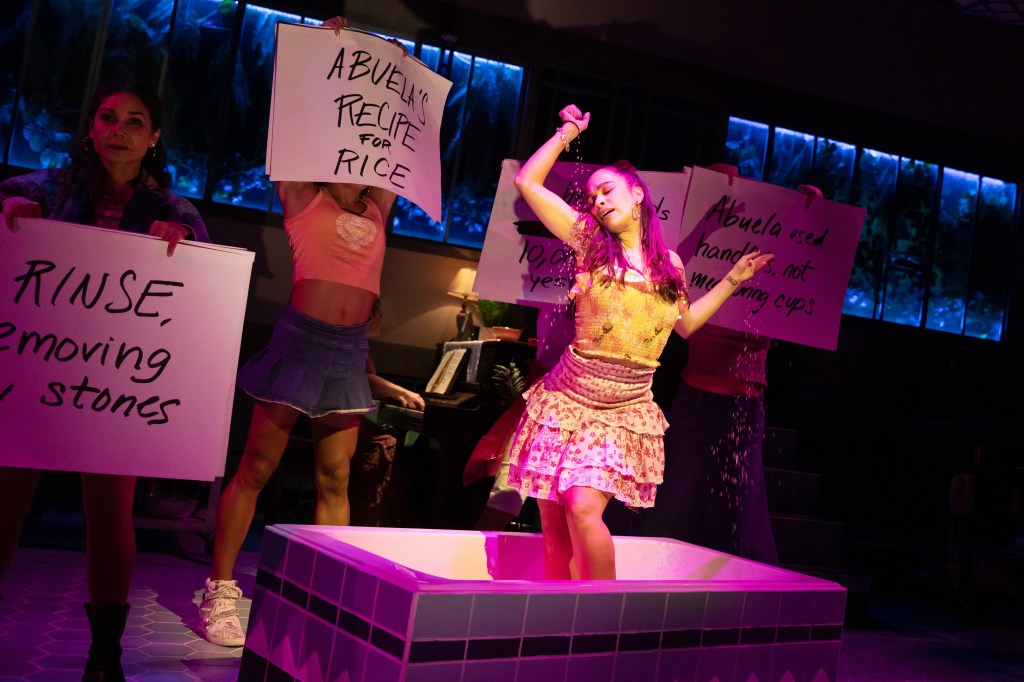
When Rubin-Vega’s Author returns home to find she is now a woman, Hudes uses the occasion for humor. Abuela gives her a huge pair of panties and she is comforted with a warm beverage and watches TV. She considers whether she will be as robust and striking as the women cousins who took her to Six Flags. Interestingly, the contrast between the Author’s life and theirs is manifest at the end of the segment. The Author from the present lists the ages and names of those cousins who die before their time. They are stricken with the ills of the barrio, ills which Hudes manages to avoid through her education and the loving guidance of Abuela, her mom and the watchful spirits hovering to protect her immediate family.
My Broken Language follows the arc of Hudes’ development and ends as Zabryna Guevara’s Author character finishes her first play in the advanced playwriting class at Brown University in 2004, when she is twenty-six. In this last movement Guevara’s Author is possessed with a spirit to perform trance-like writing. After she finishes the second act of her play, the Author notes she’s written a word she never intended to put in her play. It is then she recalls a “minor” incident from her past, that had great meaning for her, but which she didn’t realize at the time.

A few months after the fateful day of her womanhood, she recalls that a scurrilous man on the street pulled her over and whispered a demeaning, paternalistic slur in her ear. The epithet stained the beauty of her female identity and trashed it. The slur reflects how some men objectify and sexualize women to justify abusing them. However, because of the amazing women who guide the Author, as well as her education, and her search to reconcile her identity through her writing, she realizes that she is able to cast off the centuries old label. Influenced by the spirits, she casts off its meaning by using the epithet in her play. It is a unique and triumphant moment that Hudes’ direction and writing memorializes.
Like the first movement, all of the movements reveal significant and symbolic memories from Hudes’ past. The director/playwright focuses on her multi-generational Puerto Rican family, including her Abuela, mother, cousins and herself as Author, as she presents a mash up of monologue, literary text, vibrant music and movement in flashback.
Arnulfo Maldonado’s scenic design is functionally minimalistic in its representation of the Author’s house and environs where she grew up in North Philly. These facilely extend to other settings like Hudes’ room at Brown University where she writes her play. The set pieces, for example tile boxes that match the tile flooring, morph to various items, i.e. a car, a bathtub, etc., as the actors imaginatively recreate important events in Hudes’ life that reflect joyful and sad moments, the spirits, and the celebration of their lives in the dance.

Five actors don the role of the Author. They spin in and out of the various stages of her life in a multiplicity of voices and postures. They represent the Author’s inner voices as she realizes their import in shaping her future and expanding her artistic being.
Ostensibly, the Author character unfolds snatches of Hudes’ memoir in all of it beauty and glory as she strings together unique descriptors that make her experiences and her impressions of her beloved nurturing relatives palpable. Zabryna Guevara, Yani Marin, Samora la Perdida, Daphne Rubin-Vega and Marilyn Torres inhabit the Author character during the various movements. In skirting the margins of many communities, we note that theirs is a language they’ve created as their own, some even without having learned to read. That fact astounds and motivates the Author all the more to devour all literature in a obsession she seeks to fulfill as she reads American and British classics.
When she discovers her relative cannot read, she motivates herself and reads at an advanced level. Her hunger to explore the dominant culture reveals how she intends to escape the barrio as she makes it a point to enumerate family who die young. Having the education and language to use as a vehicle of escape, she returns to her roots. In this adaptation she relays this vital act of memory using a multiplicity of voices and vibes. Ultimately, the beauty of the language Hudes selects brings her Abuela, her mom, her cousins and the spirits into powerful, loving focus.

The production is stylized into narrative that is acted out. The dynamic interactions are less interactive than perhaps one might expect. If Hudes expands each of the seven movements to create consistent, moment-to-moment character dialogue, the power of the inner and outer voices of the Author, represented by the actors/characters, will be strengthened.
Strongest are the music and the celebratory dance. Choreographed by Ebony Williams with music supervision by Alex Lacamoire, the joy and vibrance of Hudes’ past resonates. The actors that inhabit the Author and her various women relatives never drop focus or enthusiasm. They, the music and dance are the electric energy of Hudes’ work. Additionally, her language is soaring. One fully appreciates it by reading her memoir and picking up a copy of the script. It is intense and profound.
Kudos to the creative team including Arnulfo Maldonado (scenic design), Dede Ayite (costume design), Jen Schriever (lighting design), Leah Gelpe (sound design), Ann James (cultural specialist), J. Jared Janas (hair, wig and makeup design).
The World Premiere of My Broken Language, written and directed by Quiara Alegría Hudes, is currently running in residency at The Romulus Linney Courtyard Theatre (at The Pershing Square Signature Center), until November 27th. It is 90 minutes with no intermission. For tickets and times go to their website: https://www.signaturetheatre.org/shows-and-events.aspx
‘Leopoldstadt,’ Tom Stoppard’s Brilliant Chronicle of Family Holds a Trenchant Warning

In five acts spanning the years from 1899 through 1955, Tom Stoppard focuses on a wealthy, Jewish, Viennese family as they navigate the turbulent waters of social and cultural transformation in Leopoldstadt. Stoppard’s latest play begins at the turn of the century and moves through two World Wars. In it the playwright heightens the most salient themes about antisemitism, social responsibility, discrimination, human rights, family, ancestry and ever-changing political power structures which promote tribalism.
Stoppard weaves these concepts into the story of the multi-generational Merz and Jakobovicz families. With a panoramic view, Stoppard shadows their journey forward and backward as Jews, who attempt to maintain their identity and place in the culture and society of Vienna, Austria. Stoppard’s masterwork which first premiered in London, is currently in its Broadway run at the Longacre Theatre, coming in at 2 hours, 10 minutes with no intermission. Leopoldstadt, directed by Patrick Marber, is one of Stoppard’s finest works.
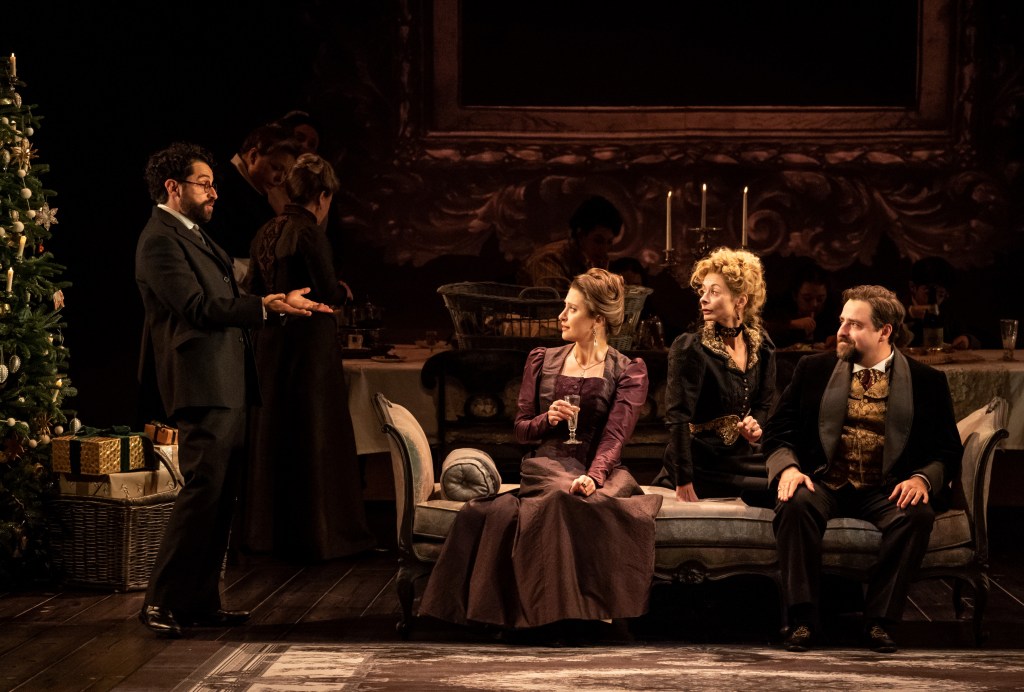
When we meet the members of the two families in the large Merz drawing room as they celebrate Christmas 1899, Hermann Merz (David Krumholtz) affirms that they can be grateful for Emperor Franz-Joseph’s new freedoms. For over fifty years as Jews, they have said goodbye to “wearing a yellow patch and stepping off the pavement to make way for an Austrian.” They must only withstand discrimination “now and then.” Wealthy textile manufacturer Hermann, baptized a Christian, has married the elegant and lovely blonde-haired Gretl (Faye Castelow), who is having her likeness painted by the foremost artist of the Vienna Succession, Gustav Klimt.
During the conversations we note the prosperity and culture of these two families, who inhabit the same social circles as the foremost professionals and artists in Viennese society. They name-drop Mahler, Schoenberg, Schnitzler and Freud. Hermann affirms his evolution as a Jew. “My grandfather wore a caftan, my father went to the opera and wore a top hat, and I have the singers to dinner-actors, writers, musicians.” Professor Ludwig Jakobovicz (Brandon Uranowitz) is a patient of Sigmund Freud and interested in his own dreams. Ludwig shows his theoretical mathematical prowess by questioning Hermann and Gretl’s son Jacob about Riemann sums. Doctor Ernst Jakobovicz (Aaron Neil) is meeting the lecturers for a Christmas drink. This is protocol, for he is a Christian.

To emphasize his full embrace of the cultured Vienna as the Promised Land, Hermann repudiates any interest as a Jew in Theodore Herzl’s Zionist idea of a liberal state in Palestine. Ludwig agrees that no one would want to go to the desert, certainly not the Jews who are part of Austrian bourgeois high society. Obviously, Hermann is not prejudiced. He practices the dictum that Jews in business should to be opened-minded to all cultures and religions to expand their opportunities, if they are to succeed. We discover later in the play, that success is paramount in Hermann’s life. With forward momentum, Hermann’s wealth and cultural aspirations have been bolstered by his marriage to his Christian wife Gretl. He is the first Christian of Jewish descent in the family.
However, Grandma Emilia (Betsy Aidem) reminds Hermann of the cost of his sacrifice for his children to be Christian. He has thrown over what he should have valued most, family and ancestry. But it’s no matter. Attitudes toward Jews have shifted. Grandma Emilia points out that once “hated as Christ-killers, Jews are now hated for being Jews.” Illustrating how much Hermann has changed for the sake of his career, Ludwig supports her comment with the terrible reality: he will always be a Jew. Grandma and Ludwig toast to a future territory for Jews, where they might be safe. That their wish comes true after the horrific Holocaust and murder of millions gives us chilling pause. However, safety, even in modern Israel, is elusive.
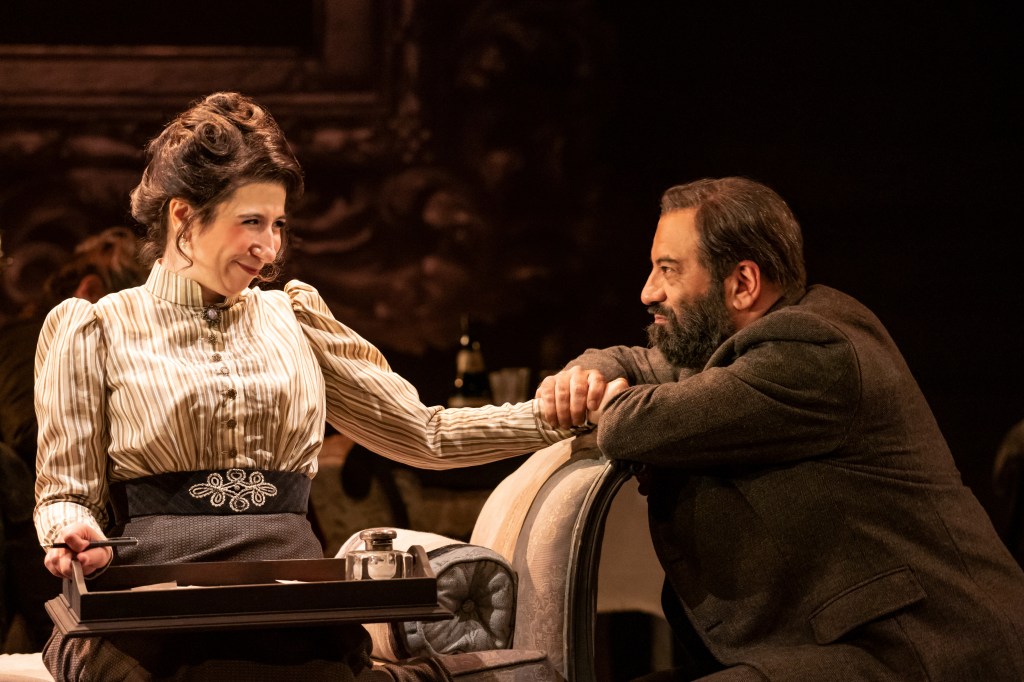
In this first act Stoppard has laid out the ground rules, intimating how the principle theme, “it can happen here and it can happen again,” will come to resonate as an irrevocable truth. As a family member states toward the play’s end, “barbarism can’t be eradicated by culture.” Indeed, the rational is often supplanted by the irrational. In the subsequent acts we understand how this becomes a reality for the two Jewish families in the play. They ignore the burgeoning antisemitism in Vienna. Ineffectively, they attempt to navigate around it by sticking together and celebrating tradition, until it is too late to leave.

In Act 2 (1900) Stoppard unspools his themes to reveal that the discrimination that Hermann refers to runs deeper than “now and then.” Fritz (Arty Froushan), an Austrian dragoon, eschews the younger Jewess Hanna and falls in love with the older Gretl, Hermann’s wife. They carry on an affair for a time, until she tells him she must break it off because Klimt’s painting of her will be finished, and she will be recognized sneaking around with him. When Fritz boasts about his affair making a Jewish slur in the company of gentlemen and in Hermann’s presence, Hermann initially doesn’t realize Gretl is Fritz’ lover. He thinks Fritz is insulting Gretl and attempts to recover their honor by proposing a duel. Refusing to engage Hermann because he is a Jew, Fritz insults him further by telling him his military status forbids him dueling with Jews.
Humiliated and doubly stripped of his honor, Hermann must bow to Friz, whose antisemitism holds sway. This prejudice is a warning that Hermann will always be an inferior in a culture that despises his heritage. Though Fritz’s rejection saves Hermann’s life, Hermann is gravely affronted and embittered because he doesn’t consider himself a Jew. However, Hermann later exploits the situation to his and his family’s advantage, after he realizes that Gretl and Fritz have had an affair. Ironically, being identified as a Jew upsets Hermann more than his wife’s infidelity. From this moment afterward, the situation worsens for Viennese Jews and members of these two families.

In subsequent acts we see the families experiencing events with less emphasis on the culture, as they uplift the Jewish traditions to humorous effect because they are not religious. For example, Stoppard has them confuse the banker Otto with the Mohel who is late to Nathan’s brit milah, as Sally runs to and fro conflicted about her son’s painful circumcision. She is not mindful about the symbolism of the circumcision, which means he is bound to God. Instead, she wants him to “be like his father,” following tradition. Interestingly, her decision is fateful. Stoppard intimates the importance of his being bound to God at the conclusion of the play.
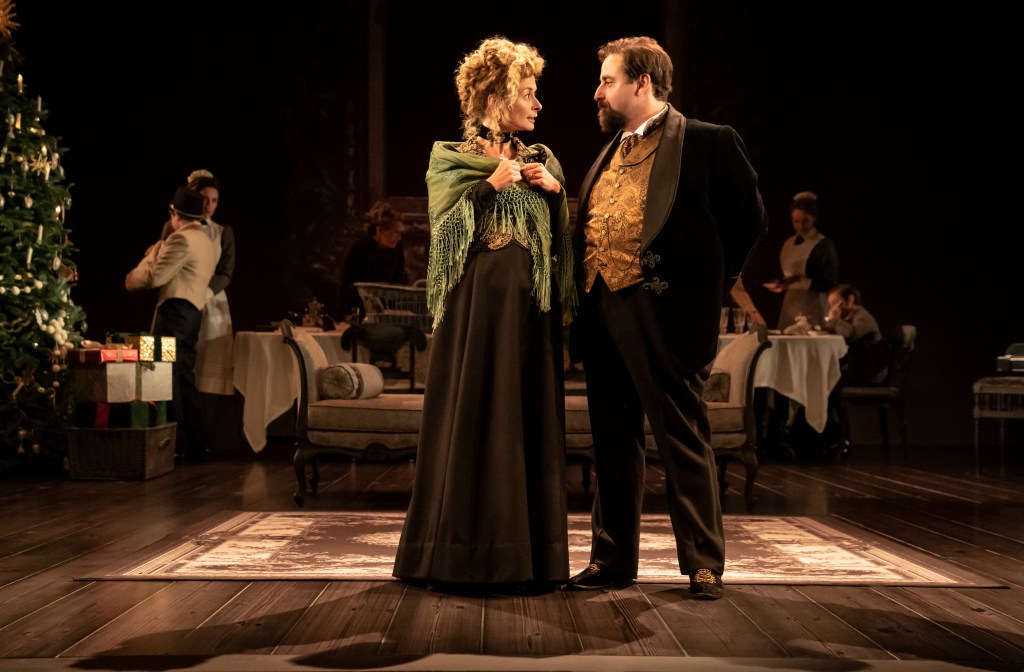
Richard Hudson’s set design manifests the transformations in the society and family fortunes from 1899 to 1955, as we note the movement in time from Belle Époque opulence (1899, 1900) to spare minimalism after World War I (1924) to the Anschluss (annexation) of Austria, and Krystallnacht (night of broken glass, 1938), after the room is stripped of valuables. Finally, the once elegant drawing room is completely bare and stark, when we come upon the reunion of three remaining family members in 1955 (Act 5). However, we are reminded of the once glorious decor via flashback to the 1900 Seder of Act II, when Rosa remembers her shame at forgetting where she hid the afikomen (a symbol of redemption). The scene in Act 5 then flashes forward, as Rosa enumerates the family members murdered by the Nazis, family she couldn’t get out because of quotas, though as a citizen of the United States, she was willing to sponsor them on her meager salary. Stoppard’s irony about Rosa losing the afikomen runs parallel to her inability to save any of her family from dying at Auschwitz.

It is Gretl, clueless about the Seder and the afikomen’s meaning, who produces another matzo to calm everyone, though the ceremony’s meaning is blown apart. In later years Gretl has brain cancer. She dies, unable to save herself or Hermann with her Christianity. Hermann’s conversion is not recognized under the race laws of a unified Austria/Germany. Like Ludwig said, regardless, Hermann is a Jew. The ancestors he has rejected are irrevocably his relatives through blood ties. However, he doesn’t fully realize he has rejected one world for entrance into another. But he remains in “no man’s land,” without a ‘territory,” because the anti-Semites will not allow him to gain entry.

Effectively using the drawing room set to reveal the Merz family’s dwindling fortunes with fewer and fewer adornments as time marches on, the family members age before our eyes, though there are always four of the youngest generation present to carry on the bloodline. Stoppard continues building on the themes he introduced in Act I, as political and social issues become more complex after the fall of the Austro-Hungarian Empire. In the aftermath of WW I the losing nations rally and attempt to recoup their power. Austria becomes a Republic overrun by various political parties (communists, democratic socialists, nationalists), who struggle for ultimate control.

In Act 3 (1924) as the family is in an uproar with Nathan’s brit milah, Hermann makes arrangements with his banker Otto to adjust to gyrating markets in an Austria roiling with the demands of WWI reparations payments. Otto (humorously, ironically mistaken for the Mohel), warns Hermann about the country’s nationalistic future. Austrians are voting for uniting Austria and Germany to “restore their destiny together as one Christian nation leading in science and culture.” Where will the Jews fit in? When Hermann questions this, Otto suggests that class war turns people against each other, but nationalism binds them together. Austria is embracing German nationalism as its own. As they conclude the discussion, Nathan’s circumcision is cheered by family.
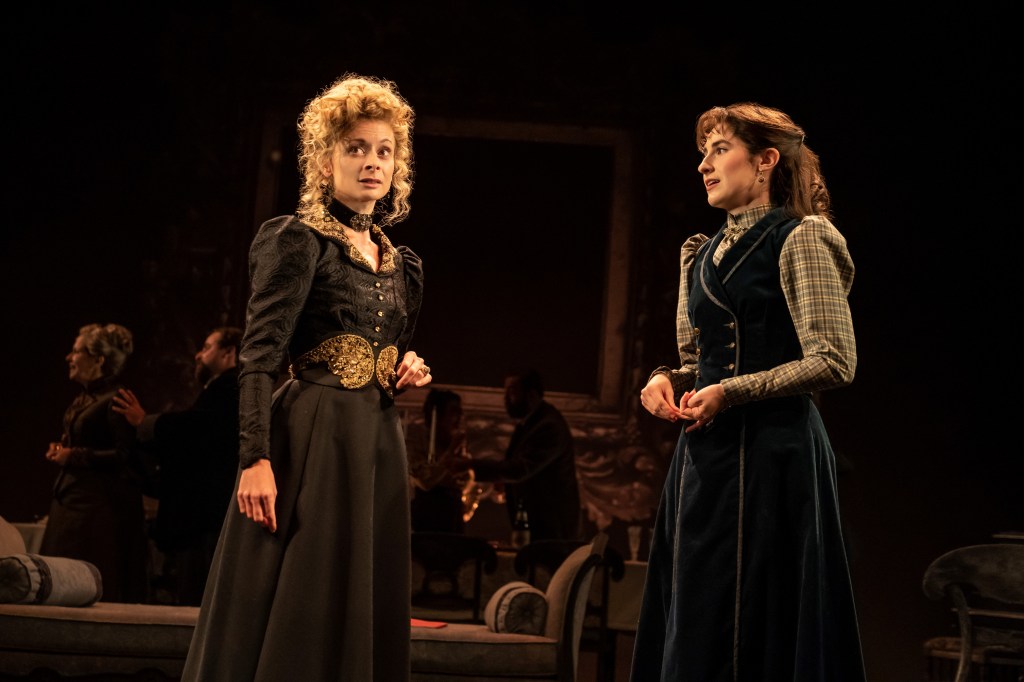
The celebration has an air of ironic doom. As one more Jewish male is bound to God, it is one more Jew who will be subjected to oppression and persecution in a society that will strengthen itself by excluding him as “the other.” In a seamless movement between Act 3 and Act 4, the circumcised Nathan emerges fourteen years later and stands in the street, looking at the sky to see bombers flying overhead. The family has not immigrated to another country. Only Rosa is in New York. The net is closing in on them.
As predicted by Otto and intimated by Ludwig, things have gotten worse and are heading backward toward the time when yellow patches were worn on clothing in the 1830s in the Jewish ghetto of Leopoldstadt. The drawing room is stripped of valuable items and Klimt’s painting of Gretl is gone, as the family gathers once more united for strength and information.

Act 4 (1938) is the devastation of an Austria in lockstep with Hitler’s despotism, manifesting even greater antisemitism than that shown in Berlin, which still allows Jews to go to cafes, movies, etc. The underlying discrimination which appeared to be residual is no longer sub rosa in Austria. That which Hermann and others said wouldn’t happen again, is striking up the band in their faces, indecently, aggressively, proudly. But what are they doing about it?
Percy (Seth Numrich), a journalist and fiancee of Nellie (Tedra Millan), tells them that as Jews, they are political refugees. They are subject to quotas dictated by 32 countries that met at a conference to discuss what to do about receiving Austrian Jews. Particularly appalling is the antisemitism in the countries who shrink their quotas to receive Jews based upon the will of the trade unions. Members of the family hear that their cultured friends and colleagues are leaving on special visas. Shouldn’t they also leave?

Stoppard intermingles Percy’s admonitions with Sally (Sara Topham) reading Grimm’s fairy tales to the children (an ironic symbol), while Ludwig discusses the knots on a cat’s cradle puzzle with Leo and Nathan. The juxtaposition of their calm interactions with the children, and Percy’s insistence that Nellie must marry him and leave her parents to then help family immigrate to England, creates tension. As Ernst adds his information, the suspense increases. In treating writers and artists and interpreting their dreams, Dr. Freud senses the underlying tribal chaos to come. He decides to leave. Additionally, Ernst discusses Klimt’s wild paintings for the university that suggest, on a subliminal level, that the “rational is at the mercy of the irrational,” and “barbarism will not be eradicated by culture.” Once in fashion, the paintings are considered subversive.
In a vast and growing conservatism, Klimt’s art is labeled as nonsensical and offensive. The labels are a harbinger of the Third Reich’s future confiscation of valuable paintings, censored then banned as decadent. It is a ruse to steal millions of dollars of valuable art, that wealthy Jewish merchants and families purchased in the golden years of cultural blossoming. As the “now and then” discrimination has increased, culture has been supplanted by tribalism and propaganda that “proves” Jews’ dirty genetic inferiority. Not only does Dr, Freud leave, so do other bright lights, once the “toast” of Viennese culture and society.

Percy tells them the discrimination will only worsen.Nellie ignores him and insists that things will get better. As if to punctuate Percy’s accuracy, an Austrian civilian (Corey Brill) with a swastika armband abruptly enters. He checks their racial identity as Jews and stipulates that Hermann is not exempt from his blood heritage. He insults Ernst for “hanging around” and doesn’t allow him to accompany his wife Eva to the mental asylum, though she is deaf and blind. After the Civilian harasses and demeans the children with epithets, he directs Hermann to sign over the business to the state because he has used it to commit crimes (convenient lies to justify theft). As the Civilian leaves, he warns them they are to be evicted the following day and can only take one suitcase with valuables under 15 reichsmarks. It is then Hermann discusses how he has protected his business from legal confiscation and tells the family they must go to live in Leopoldstadt. As sounds of “the night of broken glass” increase, little Heini plays on his toy piano to drown out the terror, a symbol of culture’s diminutive power against barbaric acts of tyranny.

One hundred years before, the Merz and Jakobovicz family’s ancestors were forced to wear a yellow patch of exclusion that justified the limitations of their easy movement in Viennese society. Only for a brief period were the Merz and Jakobovicz’s free, thanks to Emperor Franz Joseph. Sadly, they were duped because the hatred and antisemitism was always bubbling underneath, despite their great contributions creating an amazing culture. At this point, Grandma Emilia’s adjurations come home to roost. Jews are hated for their bloodline, a fact which Hermann nor the others can accept. That they are not Orthodox nor very religious makes their bloodline even more damnable. Stoppard’s irony hits with a double impact.

In the last act (1955) during the reunion of American Aunt Rosa (Jenna Augen), Nathan (Brandon Uranowitz), and Englishman Leo (Arty Froushan), we watch these family members attempt to reconcile their different experiences as Jews during the Holocaust. Rosa and Nathan almost indict Leo for not understanding the heartbreak they’ve experienced. Only until Leo remembers an incident in the drawing room, when Ernst stitched a wound on his hand after he broke a cup, does he remember the family, the drawing room, Ludwig and the cat’s cradle. It is then Leo breaks down in tears at the revelation of feeling. It is then that he begins to understand the import and impact of the Holocaust and the hatreds that stole his family from him.
The three conclude with uncertainty about Austria which acts the innocent victim, though many complicit Austrians were guards in concentration camps and helped round up Jews for transports to the camps. Aunt Rosa, who purchased Hermann’s apartment, vows to get back what was stolen, Klimt’s painting of Gretl. Nathan counters that there will be difficulty proving the painting’s provenance. As Aunt Rosa, Leo and Nathan look over the family tree, they review family members (Ernst, Gertl, Hermann, Jacob, Eva,Hanna, etc.), we’ve come to know and empathize with. Many of these died, at Auschwitz. Some died in Vienna, one committing suicide in Leopoldstadt, one committing suicide after the war is over. Their deaths are a poignant, heartbreaking devastation. The doom, revealed in dreams and in artists’ works, warned what was to come. There were many warnings. Family members ignored them at their own peril.

There is much about this production that is astounding. The opening act is spectacular, as we see the beauty of that time in Vienna, thanks to Richard Hudson’s scenic design, Brigitte Reiffenstuel’s costume design, Neil Austin’s lighting design, Adam Cork’s sound design and original music, and Isaac Madge’s projection design. Because of the efforts of the creative team, we recognize how two World Wars smashed the greatness of the people and their contributions of genius to enlighten and uplift. The society that benefited, boiled up with masochistic barbarism to devour that genius. Thus, in seeing the panorama of this time period (1899-1955) through the lives of family members, it becomes clear how the demonization of groups, injustice and war set back civilization in unthinkable ways.
Leopoldstadt encapsulates the questions that many have asked, and it answers them. If the Jews had not been “free” under Emperor Franz Joseph, would they have been able to do the exploits they accomplished? The subsequent Acts 2-5 reveal the answer, and affirm the political brutality and will to destroy encouraged by the prejudiced, the barbarians, the tribalists. By oppressing/destroying others to effect a genocide, what exactly is gained? Is not the annihilation of talent and brilliance for all time an irrevocable loss for humanity?

Stoppard’s work is filled with ironies and quotes that resound with pithy fervor. A final irony is that the most Jewish one in the family is Leo (Leopold), who was taken to England by his mother Nellie, and Percy, his stepfather. His own father was killed by Austrians. However, Leo doesn’t realize his ancestry, which his mother fearfully kept from him. Instead, he conveniently identified with England and all its blessings, “a top country,” while eschewing its most horrific acts of “still upper lip” genocide, colonialism and crass exploitation of “inferior” non white cultures. When Nathan tells Leo that both his parents and both sets of grandparents were Jewish, it is a revelation. That Leo receives it, at a point when he can most appreciate it, is poignant. For as he joins Nathan and Rosa in remembering those lost, he begins to understand his own history and identity.

As a minor criticism of the production, in Act 4, the scene when the Civilian and two police enter, the action is restrained. The acting in that section of Act 4 (from all involved), lacked the fervor necessary to reinforce the point that the once enlightened Austrians have revealed themselves to be barbarians. A greater intensity might have strengthened the conclusion and the emotional empathy for the family stolen from Nathan. That intensity then would reinforce the contrasting triumph and truth residing in Nathan, the only one who made it out of Auschwitz to give his testimony that the Holocaust is not a fiction.
Leopoldstadt is an incredible achievement. Kudos to the director Patrick Marber and the creative team who explored the director and Stoppard’s vision. And kudos to the fine actors who portrayed Stoppard’s characters. Their work warns us about ourselves and our penchant for escaping damning, painful, inconvenient truths. The production is horrifically current in revealing that denialism and silence in all its forms will be exploited by opportunistic, political criminals, for whom tribalism and barbarism are the only way to get what they want.
To see this magnificent work, go to their website: https://leopoldstadtplay.com/
‘Death of a Salesman,’ Starring Wendell Pierce, Sharon D Clarke in Dynamic, Powerful Performances
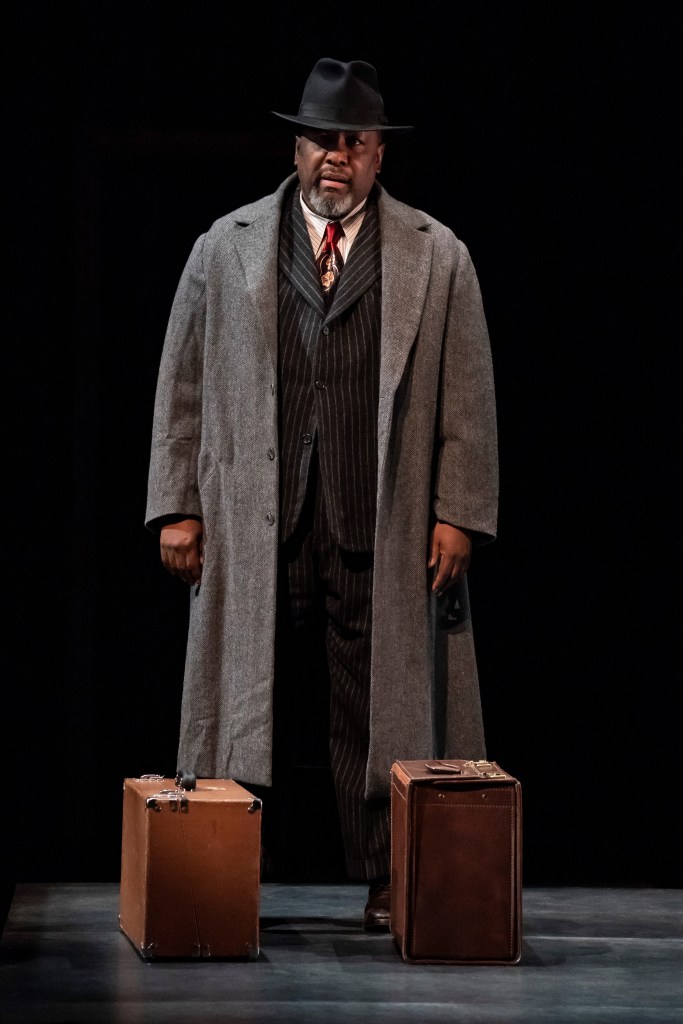
Director Miranda Cromwell has given Arthur Miller’s Death of a Salesman another go round in a revival elucidating the most salient features of Miller’s modern tragedy. Cromwell’s version, currently at the Hudson Theatre, reminds us that as a classic of the 20th century, the play’s themes are timeless, and Loman’s fall is representative of what the powerless man experiences every day of his life.
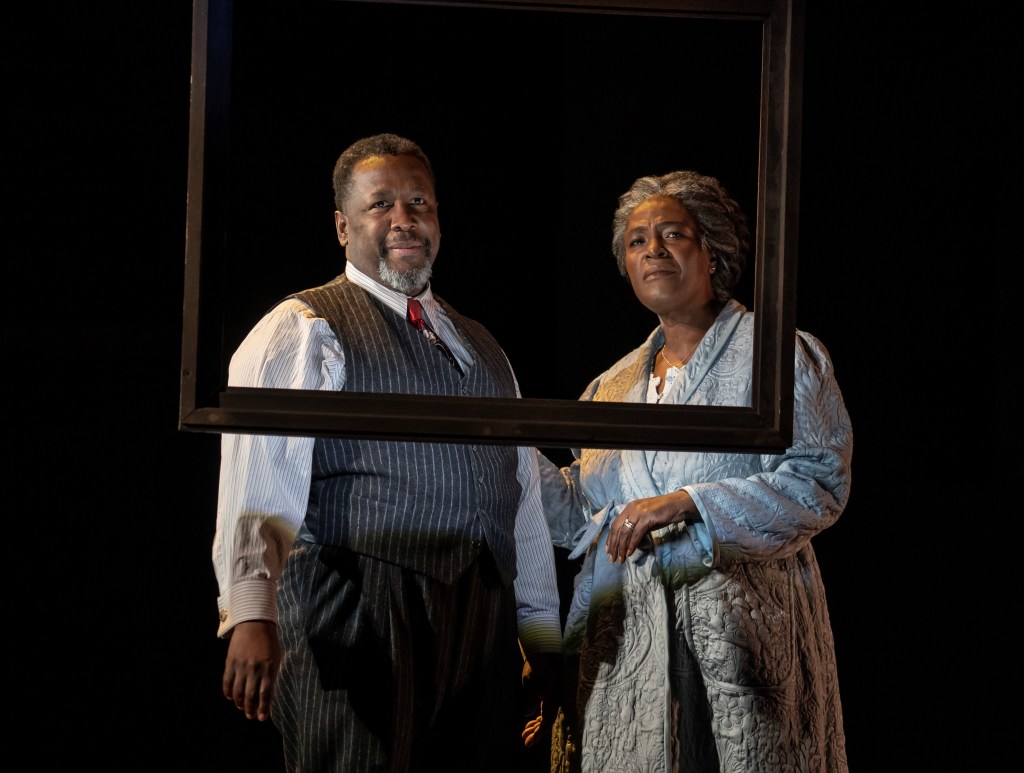
Starring the dynamic, stirring Wendell Pierce as Everyman Willy Loman and Sharon D Clarke as wife Linda, the cast and creatives provide a dramatic and thought provoking view of Miller’s American family. With tremendous currency Cromwell’s version explores the heartfelt tragedy of the diminishing patriarch whose foibles are easily identifiable and relatable to our lives.
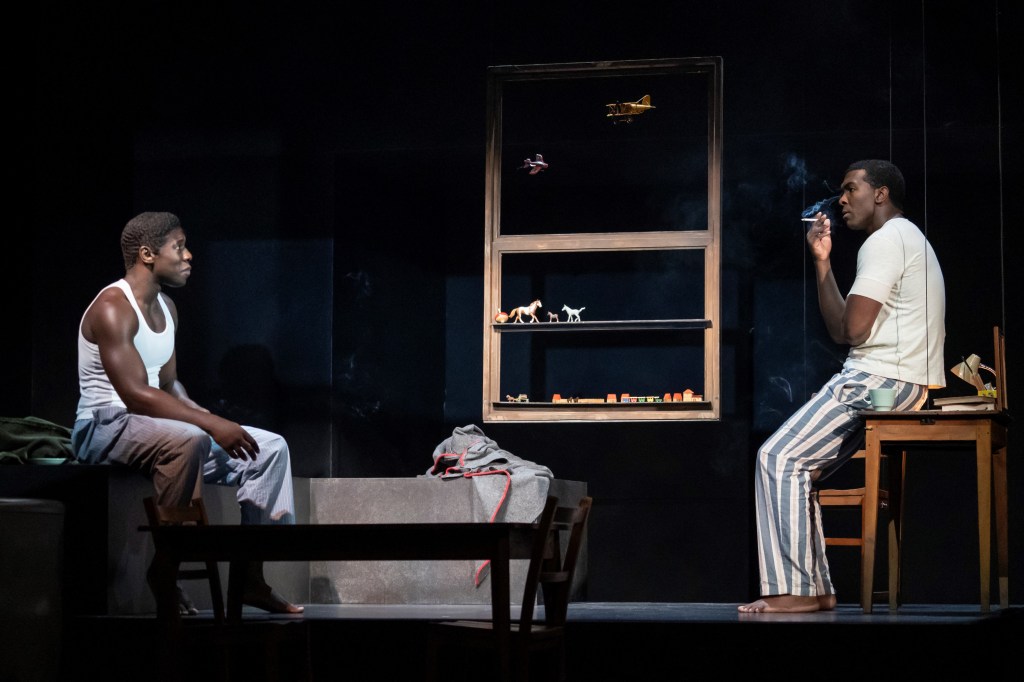
From beginning to the conclusion Cromwell shepherds her remarkable cast in a unique reexamination of Willy and Linda Loman, a husband and wife team who cling to falsehoods and illusions for the sake of each other to get to the next day. Fatefully, Willy’s end is irrevocable and Miller’s play expertly imagined by the director reveals the steps which ensure that Willy’s train wreck life moves with increasing devastation to come to the “end of the line,” Willy’s complete breakdown and suicide. Miller’s characterizations are heightened in this revival brought to life from moment-to-moment by the ensemble all of whom are spot-on sensational.
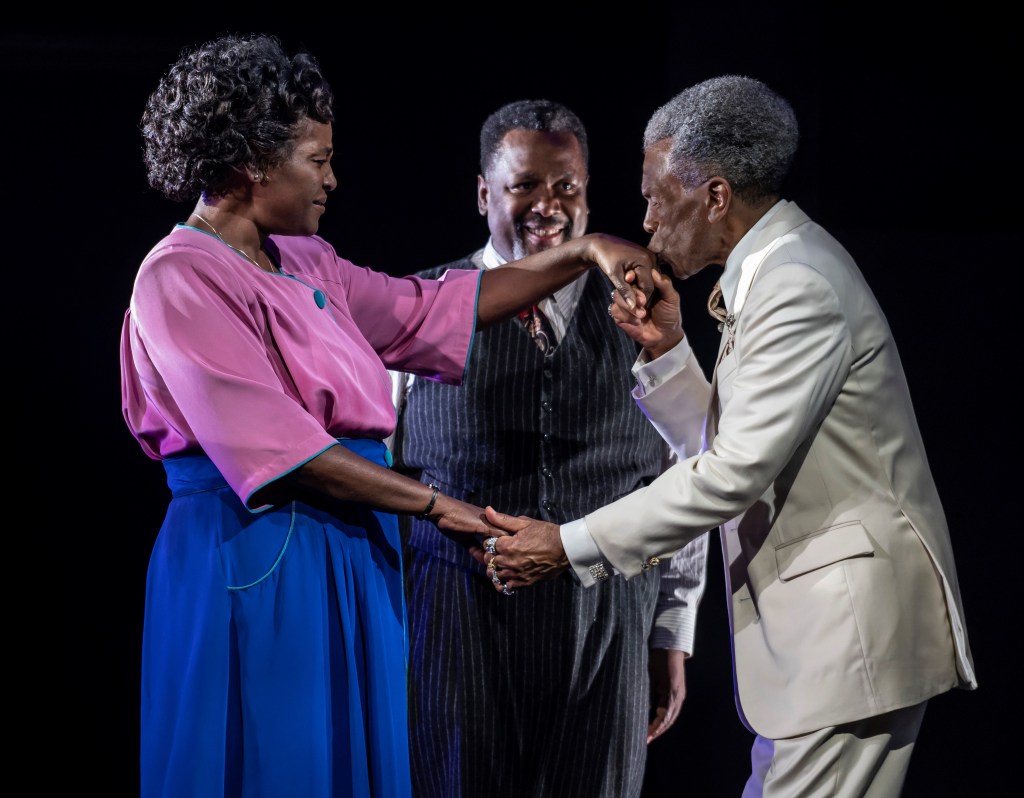
Particularly wonderful, Pierce’s Loman spools out Willy’s loss of power, self-esteem and confidence as he clings to his fantasies and is beaten by memories of his past failures. These become more stark and tormenting until until his ghostly guide, the wonderful, stately André De Shields as Ben, encourages him toward the “proposition” (a life insurance payout) he can’t refuse.
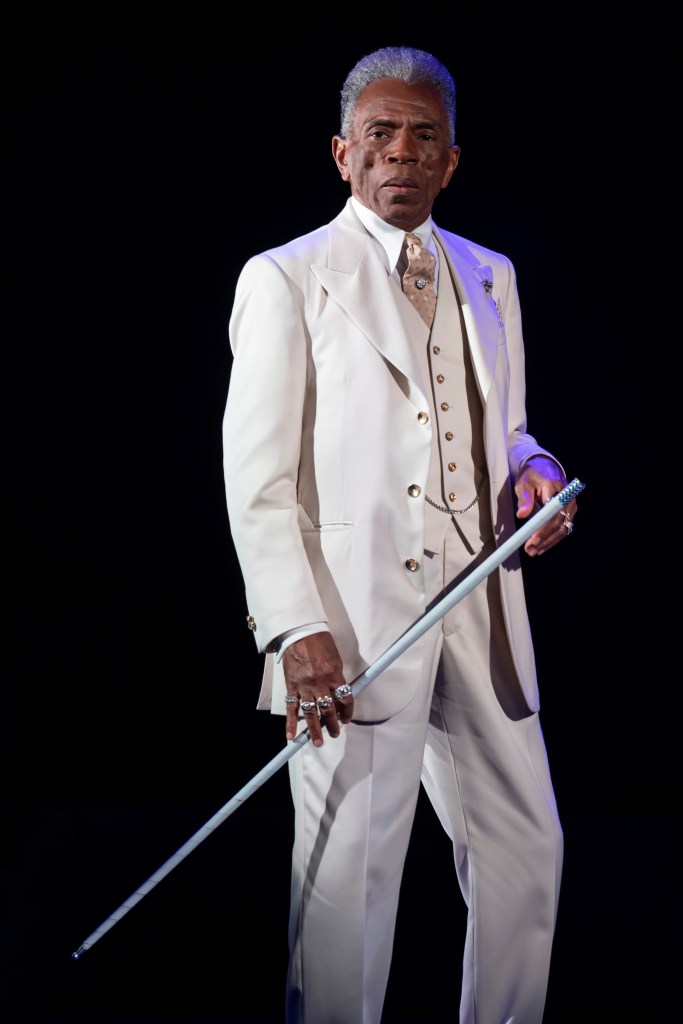
Cromwell’s, staging, Jen Schriever’s lighting design and Mikaal Sulaiman’s sound design relay Willy’s searing flashback visions. Pierce’s Willy makes these physical as if they slash his mind so that he is forced to respond with fury, as he attempts to stop the fears and guilt that drive him toward insanity. Clarke’s Linda kindly couches Willy’s lies and bombast with her own obfuscations and illusions. She is frustrating and infuriating for pandering to Willy’s babble. That Pierce’s Willy ignores and berates her and Clarke’s Linda puts up with him out of love is typical of such relationships of endurance and suffering. However, it becomes obvious that Linda fronts Willy and hides her underlying hopelessness and fear which she confesses to their sons Biff (Khris Davis) and Hap (McKinley Belcher III). Thus, Linda is two people. The loving wife to her husband who puts up with his abuse. And the truthful mother who upbraids her children and seeks their help with her ill husband.

Indeed, Linda knows Willy is desperate and on the brink of suicide. However, she spins her own conundrum. Fatalistically she watches Willie, expecting him to finish himself off in the basement. Yet, at the conclusion she dupes herself into believing Biff exacerbates and is the cause of Willie’s torments. Believing that Biff and Hap’s absence will relieve Willy and he will be “OK,” her delusion contributes to Willy’s suicide as she “lets him go.” Even at the end, she can barely confront what she knew was coming all along. She questions it. Clarke’s Linda can’t process his suicide and is still oblivious to the lies he’s told her to glorify his life. This is so even after Biff in his revelation scene exposes the family as predicate liars. Clarke’s Linda is numbed to realizing the truth of who Willie is. Throughout Clarke’s vital acting reveals a woman at sea going only so far in her realizations, then pulling back just short of making a difference for her entire family. Pierce and Clarke authentically create the type of marriage that reveals how blind love is, especially when it is slathered with lies and illusions.
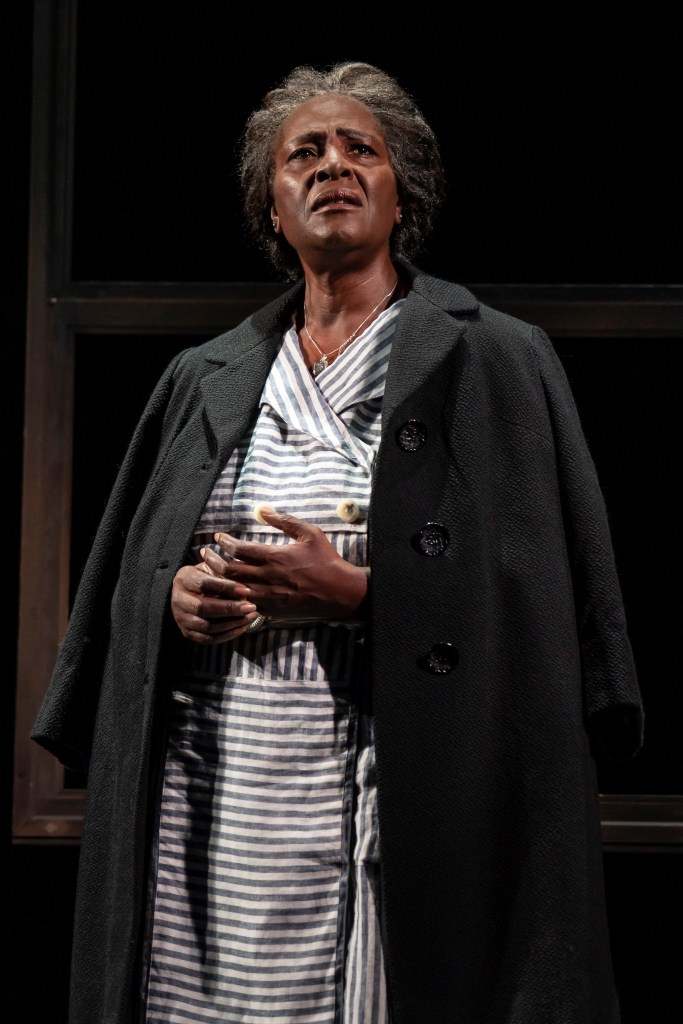
The morass Willy and Linda have built for each other and their children has so entangled the family, they cannot bear to be around each other for the continuous gaslighting and exaggerations. Willy responds to thirty-four-year-old Biff in extremes ranging from insult to encouragement and mostly argument if Biff doesn’t agree and bow to his “judgment.”
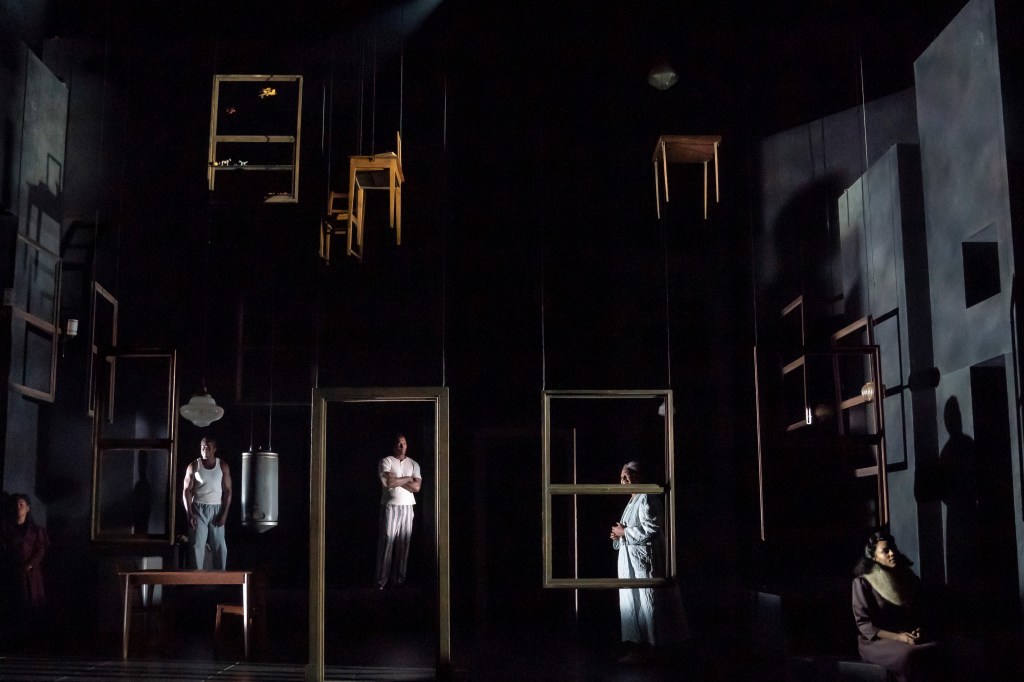
Pierce’s Willy pitted against Davis’ vibrant and soulful Biff works with authentic poignance. Revealing their relationship built on lies, Cromwell with acute minimalism sets up the climactic flashback when Biff, encouraged by Willy to ignore his studies, fails math and runs to Willy in Boston for help. Finding Willy with another woman devastates Biff. It demeans Linda and shows Willy’s life with family is a sham since he can’t uphold his marriage vows. In a dynamic scene between the two actors Pierce’s Willy uses pretense to con his son and overwhelm Davis’ Biff from understanding the facts. But Biff realizes who his father is and can’t forgive him, feeling terrible for Linda. Crying, Biff leaves, forever sealing Willy’s guilt that he has destroyed Biff’s life and proven himself a fraud.

For his part Belcher III’s Hap is a convincing “chip off the old block,” on steroids. He follows in Willy’s footsteps and abides in his own delusions that he’ll make a success of himself, though he can’t admit he is at a low rung in the hierarchy of his company. Belcher III and Davis work hand in glove as the two brothers, one selling himself 24/7, the other seeking his identity and finally discovering it. Biff, the hero of Miller’s play because he faces the truth and confronts the family with their lies, courageously admits he has hit rock bottom. Too resounding for Willy to accept, it is one more torment slashing Willy’s mind. Davis, especially as the truthful Biff in the last scenes is superb.
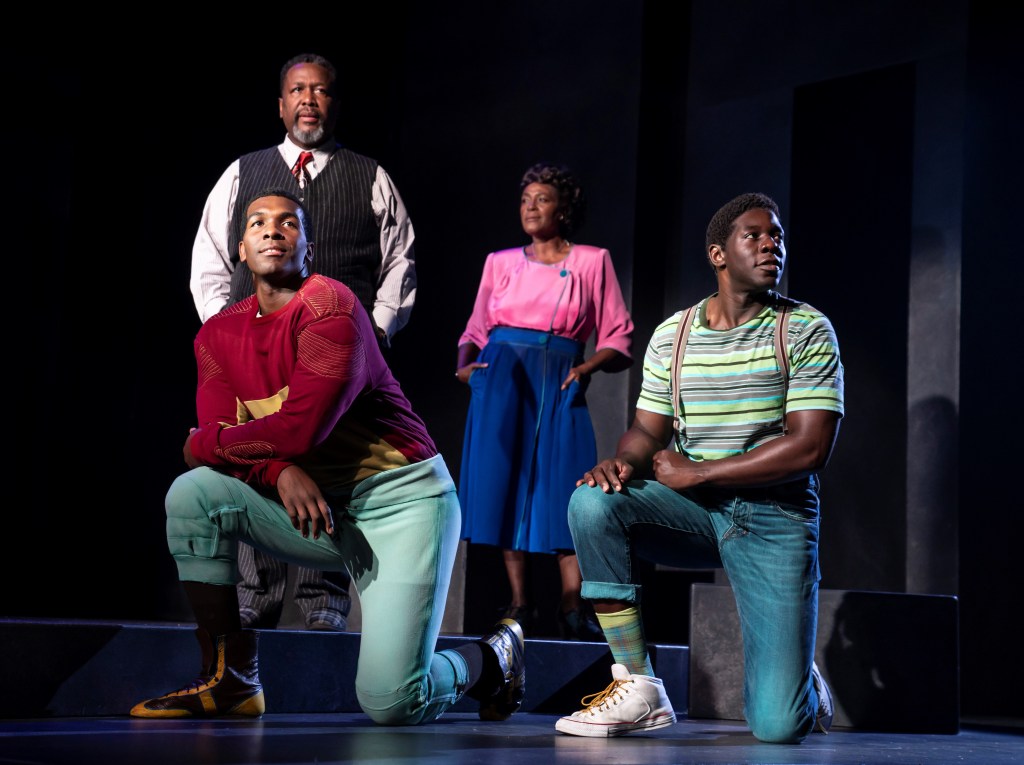
During the flashbacks, Hap, Biff, Linda and Willy enliven the family interactions and dynamics along with neighbor Charley (Delaney Williams in a terrific portrayal), and son Bernard (Stephen Stocking masters the young and the older Bernard with solid acting chops). Charley and Bernard are admirable and kind; their decency in the face of Willy’s insults is smashing. Williams and Stocking are another team to round out this fine ensemble, all of whose work is authentic and beautifully synergistic.

For example Pierce and Davis’s performances along with Lynn Hawley as The Woman perfectly render Biff and Willy’s destruction of their relationship with the awkwardness of a naked expose, as Biff and The Woman catch up Willy blabbering in his lies. Also, as we do during the flashbacks of the family, including the high school days with the excellent Williams and Stocking, we follow, engrossed with the Loman family as we “get” how the fabric of their lives unravels, and we realize why Willy’s suicide comes when it does.
Willy’s breakdown is Pierce’s gradual tour de force with each flashback, each event showing how Willy is brought closer to the brink until he can take no more. Miller reveals that much could have happened to stop him. However, the obfuscations and self-delusions are so great, only Biff could help. But it is too late. Biff can only save himself. Not even the hero can save Willy from his ghostly dreams to die “the death of a salesman” with a fulfilled proposition of $20,000 for his family, a fallen hero after all.
The scenic design by Anna Fleischle is minimalistic and suggestive with wooden frames introducing Willy and Linda. Unadorned furniture suggests Hap and Biff’s bedroom, Howard’s office, the hotel room, etc., revealing the play unfolds mostly in flashback at crucial points in Willy’s past in his memories. The flashback scenes are without framing and the staging is free formed, revealing Willy’s flights of fancy that make him happy. The guilt and fear torments are staged accordingly as Willy attempts to escape himself but can’t. The change in time Cromwell has reflected in the costume changes (co-costume designers Anna Fleischle, Sarita Fellows) of Linda, Biff, Hap, Charlie and Bernard. Only Willy wears the same outfit, always his suit whether jacket on or off, a salesman to the last.
Cromwell uses funeral music in the beginning and at the ending to frame the play about Willy’s life. This structural unity adds grace and embodies the concept of Willy’s death and the life he lives elucidated to reveal why he commits suicide. However, Charlie exonerates Willy and suggests, “nobody dast blame this man. A salesman has got to dream. It comes with the territory.”
This revival is illuminating and fresh, a must-see, especially for its performances and enlightened direction. For tickets and times go to their website: https://www.thehudsonbroadway.com/whatson/death-of-a-salesman/
‘Topdog/Underdog,’ The Cons’ Slow Walk Into Violence

Suzan-Lori Parks’ revival of her Pulitzer Prize winning Topdog/Underdog currently at the Golden Theater measures all the worst elements of America’s love affair with hustlers, grifters, swindlers, confidence men and bamboozlers. Clever con artists encourage the falsehoods of the American Dream, the greatest con ever, that prosperity buys happiness. Brothers Booth (Yahya Abdul-Mateen II), and Lincoln (Corey Hawkins), have bought into the idea that to be “the man” they must do the con, in other words, financially “make a killing” easily and quickly.
Oftentimes, the admirer of the confidence game identifies with the artistry of the hustler, who dupes his mark because he plays upon his vulnerabilities. Of course, the fan never believes that he could be the sucker who falls for the scam. Thus, arrogance and self-deception increase his susceptibility to the con artist’s fraud. Bamboozlers at the top of their game sense the weaknesses of their pigeons (greed, dishonesty, vanity, opportunism, lust, compassion, credulity, desperation and naïveté). They mine them like gold to bring their con home.

Topdog/Underdog reveals Parks’ sardonic genius, as she plays her audience with irony upon irony. Under the apt direction of Kenny Leon and his creative team we are sucked in to the long con as Parks prompts us to laugh at her brilliantly conceived characters Lincoln and Booth, expertly played by Hawkins and Abdul-Mateen II. Parks and Leon draw us into the illusion the characters create, as the hustler (Lincoln or Booth?), slowly lures his mark and exploits his vulnerabilities. The unfolding of the long con happens through a series of short cons where Lincoln and Booth circle each other, get the upper hand, then lose it as they temporarily fall for each others’ lies and posturing. However, one must look closely through the humor and the repartee because what is happening is the draw down to “make a killing.” Who the final winner is depends on how you see it.

Thematically, Parks uses the concept of the confidence game to expose the American culture’s hustle, primarily of Blacks, and of all who are not wealthy. Parks ridicules sub rosa all who believe they escape the oppressive economic structure which cons Lincoln and Booth to commit fraud, lie and steal. Indeed, the “unoppressed” don’t have to engage in such “criminal” behaviors to survive. Instead, they are duped into perpetuating the demeaning economic system and its institutions, only to create a different form of oppression in their lives, one that is harder to detect, and difficult to overcome.
Thus, as the audience watches Lincoln and Booth shred, front, insult and play each other as chumps, they sit smugly back laughing and missing the point. Parks, the con master, tapping their vulnerabilities has them on. This is especially so if the audience believes that not being of color exempts them from oppression. For in her primal message in this amazing work, Parks challenges us to empathize with the characters to fully understand how the profound racial themes, ironies and symbolism of Topdog/Underdog relate and interlock with the oppressive systems that hoodwink us and govern our lives.

The cleverly constructed two-hander, shepherded by Leon and performed with perfection by the actors, fascinates with dynamic, power shifting twists from beginning to conclusion. Lincoln is the older brother and the apparent “top dog.” He has what Booth wants, the talent and artistry to “make a killing” at three-card monte. However, Lincoln doesn’t “touch the cards” since the demise of one of his sidekicks in their scam that used to pull in $1000 a day. Lincoln’s teammate got shot. so Lincoln lays low and stops hustling. We discover this at the top of the play as Booth importunes his brother to teach him his moves and continually pesters him throughout Act I and II to join him and make tons of money at three card monte. Lincoln tells Booth he is done with the grift and involved with something else. However, Lincoln is blind to the import of what he’s chosen to do.
After his life fell apart and he lost his wife and his apartment, Lincoln was dislocated, a shadow of his former “cool” self, without wads of cash at his disposal. Desperate for money, at his wits end, Lincoln demeans himself by taking a job that racially exploits his dignity. Lincoln grovels for his money by sitting in a penny arcade dressed up as Abraham Lincoln, while visitors pay to shoot him. Booth finds the job despicable. He intuits that his brother is being “played” by his bigoted boss and the racists that pay to be the assassins of a black facsimile of President Abraham Lincoln. Part of Lincoln’s costume, along with the beard, hat and long coat of the type President Lincoln wore is the make up which is white face paint.

Parks’ irony in depicting the character of Lincoln is layered and upon examination, both humorous and tragic for many reasons. Lincoln playing Lincoln who “freed the slaves” out of convenience in the power struggle of the Civil War is a deprecating self-effacement and loss of empowerment for the once talented hustler. Lincoln’s white face is a further diminution into enslavement and toadying to “the man.” You can’t get much lower than a Black man putting on white face in an egregious parody which has him assume the role of his oppressor who conned the culture with his signing of the Emancipation Proclamation.

The irony that President Lincoln wanted to send all the Blacks back to Africa doesn’t matter to Lincoln, whose lack of knowledge and desperation damn him to willingly accept the demeaning job which erodes his confidence and self-determination. Additionally, his small salary given to humiliate him by “playing” a president who was the dubious “savior” of Blacks and was hated by Southern bigots, who possibly have come to ridicule him, reveals the extent to which Lincoln is in bondage to the white power structure. That he tells Booth it’s an easy job is Parks’ further thematic irony. Indeed, it is easy to be hoodwinked by “the man,” to internalize oppression and enjoy it because it is safer than to struggle and stand up against it. Lincoln has integrated slavery into his being. He represents one type of Black man in the society who works for a pittance in a job not worth his dignity.
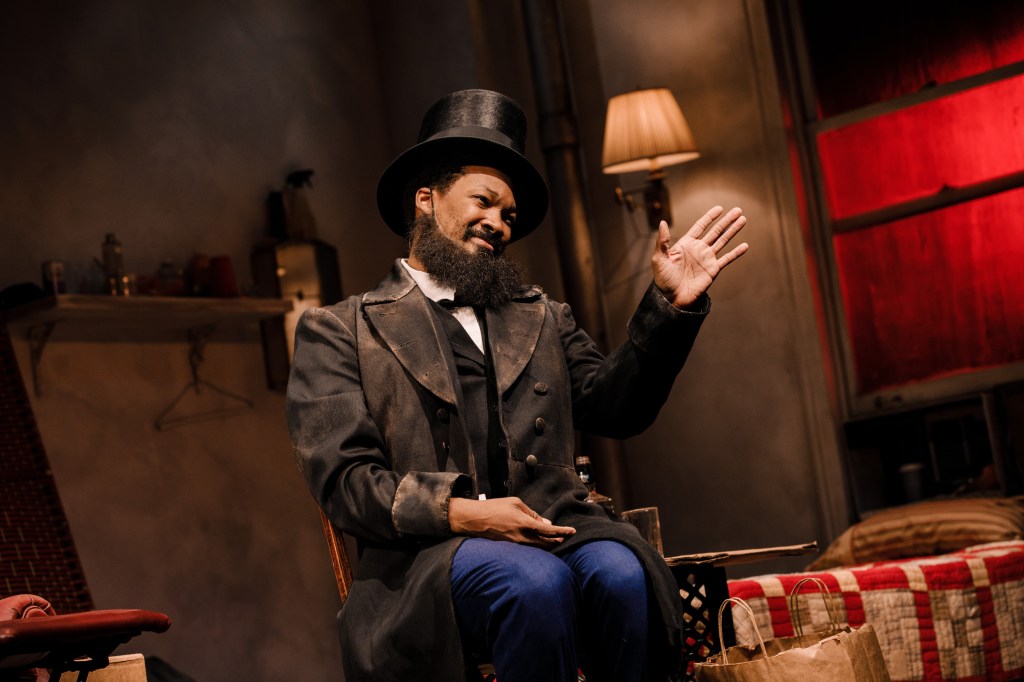
Already, we understand that Parks is having us on, as she has us on about the names of these brothers which their father gave them as a crude and blasphemous joke. It intimates one will murder the other at some point in their miserable lives. As Booth and Lincoln discuss their parents and upbringing, we realize it is a continuation of dis-empowerment, self-effacement and abuse in a continuum, Parks suggests, hearkens back to slavery days. Their parents have passed down to them a diminished life, where they believe dignity and empowerment are only achieved in perfecting “the con.”
Every aspect of their existence reflects their bondage to cultural oppression and impoverishment of opportunity. Lincoln and Booth live together in one raggedy, shabby room in a boarding house without a sink and a toilet. Arnulfo Maldonado’s pointed, superb set design speaks of the realistic poverty and destitution that discloses they are one level above homelessness. The few pieces of furniture and other items most probably are cobbled together from found objects on the street or those stolen, “boosted” by Booth which is his main hustle. It is Booth’s room, so he gets to sleep in the bed that looks like it was pulled from a 1940s psychiatric hospital shown in old black and white films. The recliner where Lincoln sleeps is uncomfortable without a mattress, pillow or blanket.

The beauty of this play is in deciding who the mark is for the long con, as the con artist lures him by degrees and allows him to think he is winning. It is also in understanding the degrees of subtly Parks uses to develop the manipulations of the brothers from their initiation of the first “throw down of the cards” metaphorically, to the last winning hit at the play’s conclusion in Act II. The actors ply their on-point artifice by degrees. Importantly, in Act I they both appear to be genuine and organic as the brothers congenially front each other and appear generous. Booth shares his boost of clothes with Lincoln. Lincoln shares his paycheck to cover the rent, food, etc. However, as the game is on and we get to know each brother, the tension mounts especially as Booth insists upon teaming up with Lincoln in the grand hustle, which Lincoln refuses to do throughout the play. Seemingly without intention, Lincoln’s refusal is a come-on, which makes Booth all the more hungry for Lincoln to engage with him.

In a progression of ironic comments Hawkin’s Lincoln lays bare Abdul-Mateen II’s Booth and his braggadocio about his “girlfriend” Grace. On the other hand, Booth massages Lincoln’s pride in his hustling expertise. He builds him up so he can then compete with him and indicate he, too, is an adept. Then, eventually he will take him down as he hoists Lincoln on his own arrogant petard. Theirs is a constant thrust and parry, dodge and pivot, shuck and jive. By the conclusion they slash and burn with cruelty. As the older brother, Hawkins’ Lincoln appears wiser. However, depending upon our interpretation and Parks’ ambiguity, which allows for a number of possibilities, his wisdom is turned on its head.

Both actors superbly intimate the growing rivalry via the subtext between the brothers. Lincoln’s talent is always in control of the thrust and parry required to lure in the stooge. This riles competitive Booth. Though neither understands their own identity, nor their place as pawns-suckers in the overall scheme of things, Booth has a better understanding of the white oppression that keeps Blacks demeaned. Lincoln has a greater understanding of human nature. Instead of uniting to benefit each other, both are debilitated by their own loss of machismo and pride, their self-confidence stripped by their upbringing and the surrounding culture. In attempting to get it back through “the con,” they only fall in the abyss. They don’t understand the extent to which they are duped by the economic system and its vast inequities. The only thing that Lincoln fully understands is that he is talented enough to rig the game of three card monte and win. It is this he attempts to teach Booth, who fails and answers Lincoln’s grift in the only way he knows how.

Parks indicates that both brothers are blind to their own entrenchment in the falsehoods of the power structure which suggests one can “get ahead” by any means necessary. Of course, ignorance of the game and not knowing one is being played is 90% of “the man’s” success. That the culture’s long con pits the players against each other, sometimes to the death, as in the case of Lincoln’s sidekick is a danger which rightly gave Lincoln pause. But Lincoln’s hands and ego, spurred on by Booth, are “itching” to throw the cards again. That he is “one of the best” is his tragedy.
Both of the brothers con each other until the game is over. Their persistence results in the fated ending which Parks intimates is an inevitability given the cultural context in which Black men, like Lincoln and Booth, attempt to survive. The way to figure out the winning card in the game of three-card monte is to watch the first move of the hustler’s hand at the outset. Lincoln sarcastically tells this to Booth in the last scene of the play, as he demeans his little brother with his perfect moves. Though Lincoln presents his mastery to Booth, both brothers are chumps, duped by the white patriarchy to see each other as “the enemy.”

They don’t understand their place in the culture because they lack the knowledge of the past. Without that knowledge they are conned into scamming money as a way to be in control and get power. However, the cultural long con is so viciously rigged against them and all the classes, even brothers turn against each other to prove themselves. It is a psychotic, racist society that perniciously strips Black men of their beauty and vitality, then entices them to self-destruction by getting them to believe they can win in a game that has been rigged against them from before the time they were born. In Topdog/Underdog Parks indicts the racist culture and condemns its wickedness in establishing, fueling and perpetuating the long con that annihilates.
Parks’ metaphor of cons as it relates to our culture is even more current today than when the play premiered on Broadway in 2001. As Lincoln and Booth try to get over to make it to the next day, they are representative Black men. On a fast track to hell, the brothers can’t win for losing. The economic and social system won’t let them succeed. They are fated to play each other until both are played out. Parks reveals with her trenchant use of the names that since the Emancipation of the Slaves, the con of freedom was just that, a con. For Blacks freedom is a bitter “pie in the sky” lure. The lure persists today more than ever as institutions are set up for the corporations and the uber wealthy to be the winners. Politicos use the long con to dupe their constituents that they will help them be prosperous. Considering that our freedoms are currently under siege from political con artists who lie, cheat and steal, thumbing their nose at the judicial system, Park and Leon’s production is horrifically in the moment.

The play’s symbolic themes are conveyed in Lincoln and Booth’s stylized world, rendered astutely by Maldonado, Dede Ayite’s costumes, Allen Lee Hughes’ lighting, and Justin Ellington’s sound design. Within that world are the deceptions that we think don’t apply to us. Yet, using Lincoln as her mouthpiece, Parks reminds us about what is key. “You win only if ‘the man’ lets you.” The power structure, the patriarchy, the haves will draw you with the short con so you stay to play the long con, where they attempt to take it all, even your illusions of democracy.
Parks brilliant play reminds that all of us are marks subject to the game controllers of the corrupt culture that values money over people. As Lincoln and Booth do, we guide our lives based on the lies of prosperity, of money equaling happiness, as we sacrifice the most important verities in our lives (love, family, friendship), to “get over” and prove we are “somebody.” Following this paradigm to its ridiculous conclusion, the “top dogs” of the culture are the most duped. They have ultimately rigged the game against themselves.

If Parks’ microcosm of the events that occur between the brothers is stretched to the macrocosm, no one wins. In fact the game destroys everyone who plays it. The controllers ultimately lose, because the values that make up the foundation of the game, that prizes money over people, are illusory. The controllers, too, are people, buying into the lie that money is more valuable than their own lives. Thus, the “top dogs” destroy the possibilities for their own goodness and benefit by harming others who are valuable human beings. Indeed, the “top dogs” are more blind, deaf and dumb than Lincoln and Booth. And ironically, with all their power and money, they are worthless. It is the brothers who we care about and with whom we identify and cry with, thanks to Hawkins and and Abdul-Mateen II’s wonderful performances.
Kudos to all the creative team who make this production scintillate with life. Once again these include Arnulfo Maldonado (scenic design), Dede Ayite (costume design), Allen Lee Hughes (lighting design), Justin Ellington (sound design), Don’t miss Hawkins and Abdul-Mateen II’s superb performances in this gripping and matchless play. For tickets and times go to their website: https://topdogunderdog.com/tickets/

