Category Archives: NYC Theater Reviews
Broadway,
‘Between Riverside and Crazy,’ in its Stunning Broadway Premiere
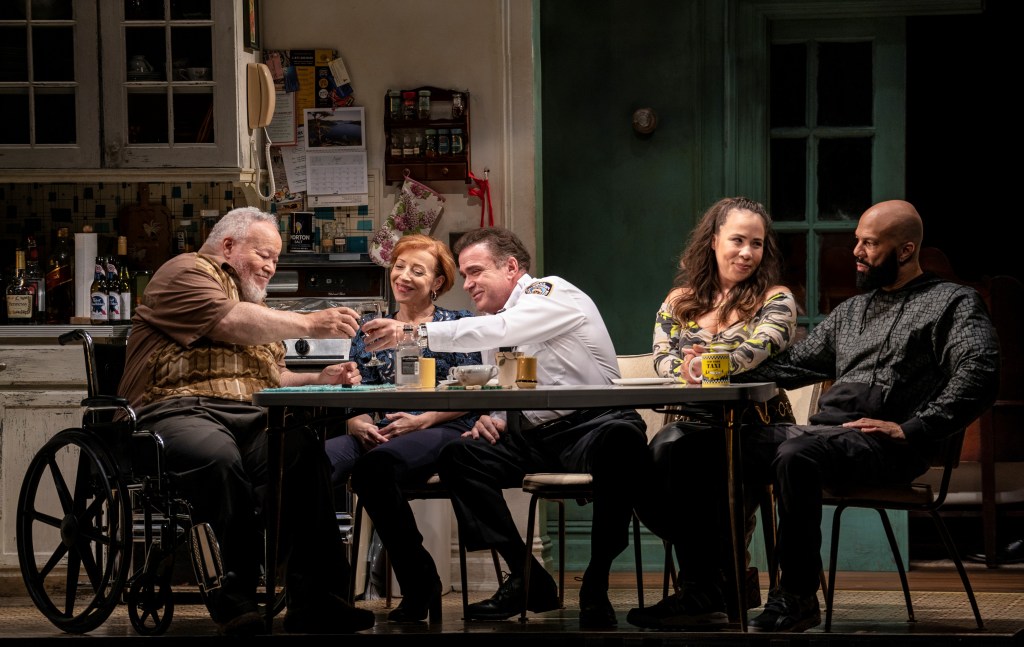
When it premiered Off Broadway at the Atlantic and then moved to 2nd Stage in 2014, Stephen Adly Guirgis’ Between Riverside and Crazy, directed by Austin Pendleton, won a passel of New York City Theater awards in 2015 (New York Drama Critics Circle Award for Best Play, Lucille Lortel Award for Outstanding Play, Outer Critics Circle Award for Outstanding New Off Broadway Play). Also, it won the 2015 Pulitzer Prize for Drama.
Starring mostly the same cast as in its 2014 outing, the 2022-2023 production appears to be topping itself with solid, incisive direction by Pendleton and sharp ensemble performances led by the mind blowing Stephen McKinley Henderson, who inhabits Pops as sure as he lives and breathes the character’s feisty attitude, edgy humor and earthy sangfroid. Henderson’s performance is a tour de force, a character portrayal of a manipulator able to dodge and parry with the “best” of them to outsmart all comers and “get over” even when he has lost the war and is trying to win his last battle, though the likelihood isn’t in his favor.

Guirgis plies old ground in Between Riverside and Crazy. He examines Black lives that are moving on in the struggle to rise up in New York City, as they attempt to negotiate middle class economics, while the discriminatory city institutions fight them at every turn. In this environment every day is a hustle and the institutions who have hustled Blacks for generations are obvious. However, how does one fight City Hall and still remain in tact? Pops is an old salt and has managed to learn the ropes as a NYC cop. The problem is he lost his wife, his son has just been released from jail and he likes to have a drink or two or three. Can he suppress his wayward impulses, sustain himself and support his son getting back on his feet to prevent Junior’s recidivism?
The play opens with Pops having his breakfast (pie and whiskey-spiked coffee) with Oswaldo (Victor Almanzar in a riveting performance). Oswaldo is a friend of his son Junior’s who clearly is needy and has psychological issues which Guirgis reveals later in the play. Pops’ banter with Oswaldo indicates the situation and relationship between the men. Oswaldo positions Pops as his “Dad,” because he allows him to stay and help him get on his feet without paying rent, though Oswaldo affirms that he wants to and will when he is more flush in his finances. Who Oswaldo is and how he became friends with Junior clarifies as the play progresses. Indeed, they most probably share more than a few crimes.
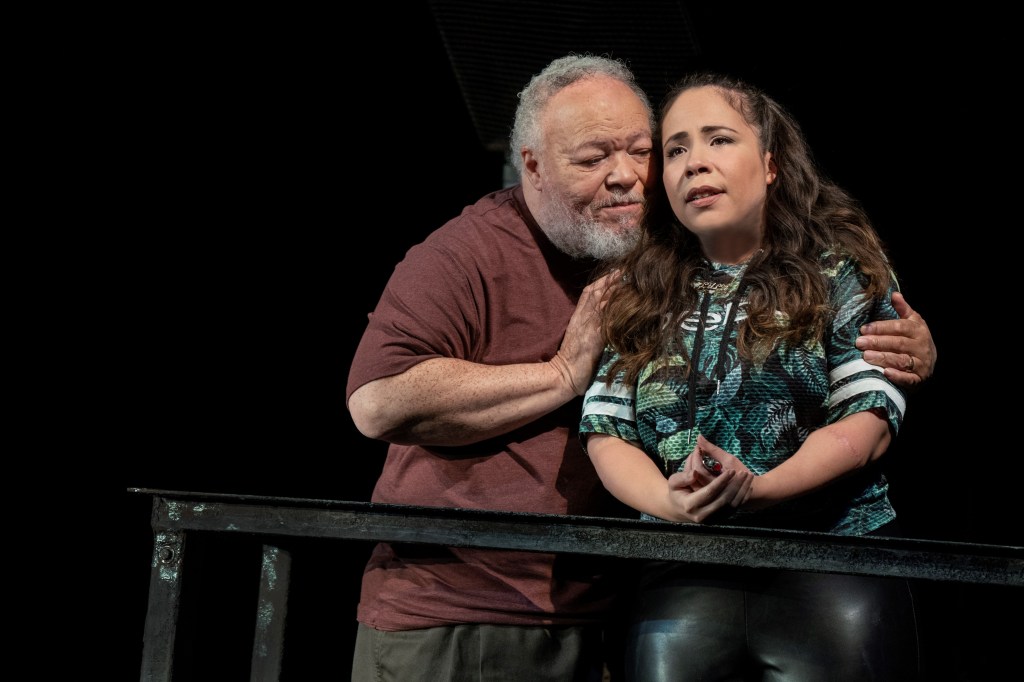
As a former New York City cop who has been retired after being shot by another cop in a questionable racial incident that Pops has been litigating against the NYPD for eight years, Pops is aware of who Oswaldo is. Interestingly, ironically, he is helping out his son’s friend as a fatherly figure. Of course that isn’t as easy as it appears at the top of the play.
Pops lives in a spacious, valuable, rent-controlled apartment on Riverside Drive in a gentrified area. The apartment whose former structural beauty and interior cared for by Pops’ deceased wife is apparent and fading (scenic design by Walt Spangler). Pops is in your face with Junior’s friends and girlfriend Lulu (the fine Rosa Colon) who he chides for exposing her ample buttocks and breasts and comments about her lack of intelligence to Oswaldo, behind her back as an afterthought. Guirgis has given Pops the bulk of the humorous dialogue and makes sure the other characters that circle him are beholden to him, and give him the proper obeisance, so he might gently insult and dominate them.

Clearly, Pops is witty with tons of street smarts, and we are drawn in by his outgoing nature and backhanded charm. However, Guirgis leaves numerous clues that Pops is into a power dynamic and must have the last word and must have the upper hand in the relationships he has with others. As we watch him “front” and “get over,” we ask to what extent this is part of his hustle and interior nature that he developed as a way to survive? To his credit Guirgis leaves enough ambiguity in his characterizations to suggest the deeper psychology along with the cultural aspects of discrimination without belaboring the themes. We are invited to watch these characters unfold with glimpses into their lives in a light-handed approach that is heavy with meaning, if one wishes to acknowledge it.
Thus, on the one hand Pops’ demeanor is entertaining and hysterical. On the other hand, it is so because Pops is driven to keep others “at bay” and “in their place.” This is the situation that abides until the conclusion, though Guirgis throws twists and divergences in the plot, redirects our attention and makes Pops appear to be the weak one who can’t get out from under his own foibles and issues. Guirgis constructs episodic humorous moments that are surprising and lead to an equally surprising resolution which is totally in character with Pops, whose every nuance, gesture and line delivery are mined brilliantly by Henderson, guided by Pendleton’s deft direction.

Thus, it would appear that Pops has created an environment where secrets are kept and Lulu, Junior and Oswaldo are allowed to take advantage of Pops’ largesse. This is especially true of Junior, who possibly is using his Dad’s apartment to store items that fell off a truck, something Pops turns a blind eye to. As Junior, Common is making his stage debut and he manages to negotiate the complex character’s love/hate relationship with Pops as they spar and “get along” as best they are able because both are dangerously similar in pride, ego and charm. This is so even though they are on the opposite sides of the law and Junior has recently been released from prison.
The principal conflict in Guirgis’ character study occurs after the playwright spins out the expositional dynamics. Pops’ former partner Detective O’Connor (Elizabeth Canavan) and her fiance Lieutenant Caro (J. Anthony Crane in the Tuesday night performance I saw) have a scrumptious dinner that Pops cooks for them. After a lovely repast, Caro delivers a proposition to Pops. Only then do we understand the precarious situation Pops has put himself in. The dire circumstances have been encouraged by Pops’ own negligence and lack of due diligence. He has not kept up with his rent. He has not taken the offer the NYPD has put forth to pay for his pain and suffering (his sexual function has been debilitated) in the litigation. Additionally, Pops faces an eviction spurred on by the building’s tenant complaints, some of which seem sound, but also reveal discrimination.

How has Pops managed to back himself into this corner, though he doesn’t appear to belong in his wife’s wheelchair which he enjoys sitting in and can just as easily get out of? Importantly, Gurgis suggests sub rosa explanations for Pops deteriorated emotional state and his reliance on drinking. Nothing is clear at the outset, but after the visit by O’Connor and Caro, the extent to which Pops has allowed his potential enemies to leverage his present circumstances against him emerges. Will Pops be able to finesse the situation? By the end of Act One when Pops is injured and burglarized, we are convinced that Pops’ weaknesses have overcome him and he is doomed to go the way of his wife.
Guirgis’ Act II heads off in a zany direction which further validates the playwrights’ admiration for the prodigious character he has created in Pops, foibles and all. There is no spoiler alert, here. You’ll just have to see this superb production. A good part of the enjoyment of this premiere is watching Henderson hit every note of Pops’ subtle genius in redirecting those around him to eventually achieve what he wishes. He even bests Church Lady (the funny Maria-Christina Oliveras). Her machinations to “get over” on him which results in a reversal of fortune that is redemptive for both Pops and her are LOL smashing.

The ensemble is top notch and Pendleton’s direction leaves little on the table and is equally stunning. Kudos to the creative team with Alexis Forte’s costume design, Keith Parham’s lighting design, Ryan Rumery’s original music & sound design which are excellent. Gigi Buffington as vocal coach does a great job in assisting the actors in the parlance of the culture of Pops and his satellites so that they are seamlessly authentic and spot-on in their portrayals.
I did have a minor issue with Walt Spangler’s beautiful scenic design. Pops’ apartment revolves on a turntable which limits staging options. Granted that Pops is central to every scene. However, at times the actors’ conversations are directed toward Pops with their backs to the audience. These requires they project or “cheat” in their stance to be seen which at times they did not. This is an instance when the scenic design as lovely as it is didn’t enhance the overall production, but hampered it, a minor point.
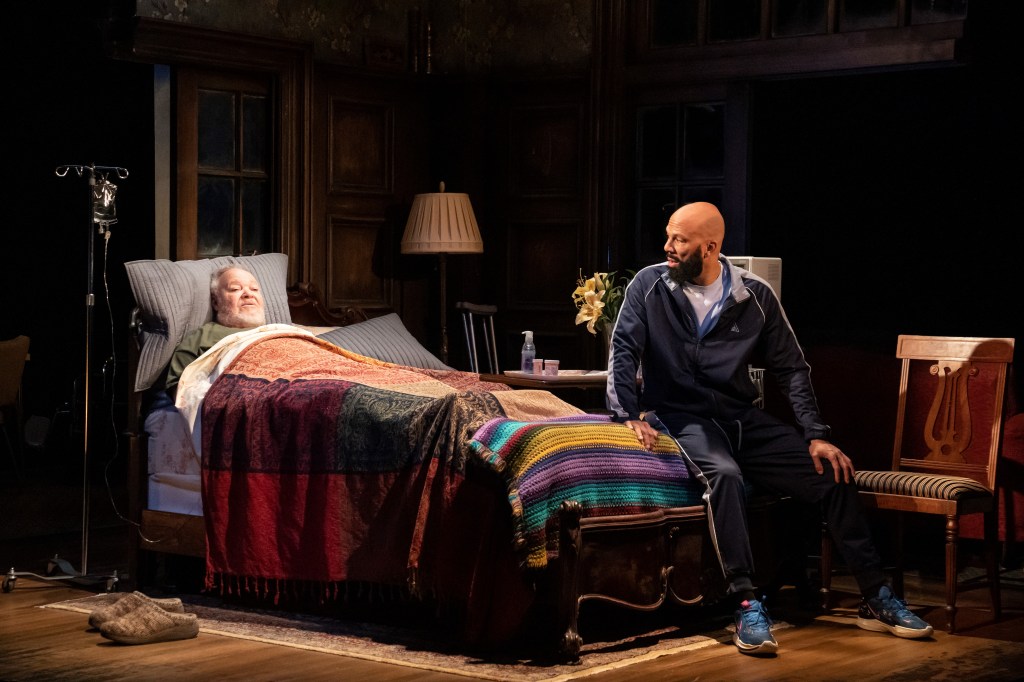
Between Riverside and Crazy is a must-see for its performances, ensemble work and fine shepherding by Austin Pendleton. It is in a limited engagement until February 12th unless it is extended. For tickets and times go to their website: https://2st.com/shows/between-riverside-and-crazy#calendar
‘Des Moines,’ the Opaque and Mysterious Artfully Shine at TFANA

In Des Moines by award winning writer Denis Johnson nothing vital seems to happen during the time Dan, his wife Marta, their grandson Jimmy, Father Michael and Mrs. Drinkwater get smashing drunk and have a wild party in Dan and Marta’s modest second floor apartment in Des Moines, Iowa. Yet, in the 12 hours they spend together, much does happen. Connections are made, personal revelations are expressed and in each individual’s life, as a result of the dynamic interactions that take place, all experience a shift. For some it’s in perspective. For others the change is behavioral. However, in this deceptively “small” but mighty play, Johnson reveals the importance of listening to others’ faint soul cries and helping them relax into a zaniness that soothes.
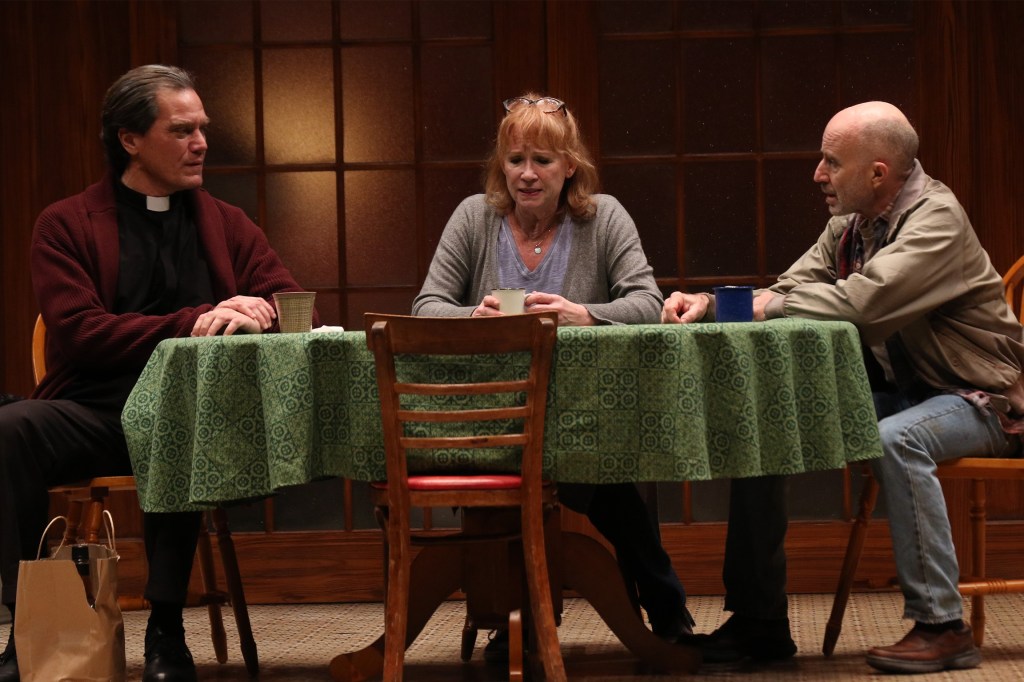
At the play’s outset for a moment all is blackness. We hear a deafening roar, a loud cacophony of noise, a piercing, grating, rolling thunderous sound like a ripping away of the earth’s atmosphere as if a bomb had been dropped. We ask what is happening and what does that sound mean?
The lights come up on cab driver, husband Dan who has come home from work. He hits upon what the sound might be as he discusses with wife Marta that Mrs. Drinkwater, the wife of a man who died in a recent plane crash, has sought him out to ask him questions. Dan was one of the last people to speak to Mr. Drinkwater, when he took him to the airport, before he got in the plane that crashed in an embankment, killing everyone onboard. Thus, we put together the roaring sound at the top of the play with the plane engines roaring before the crash.

By the end of the play we are no closer to understanding the symbolism, though it is repeated during a blackout between scenes after a raucous party. Perhaps it symbolizes the “veil being rent,” what must happen in human consciousness to allow enlightenment and an awakening to flood the psyche with new understanding. Though Johnson makes references to being awakened and made aware, these concepts are fleeting, and unexplained.
This is one of the joys of Des Moines in which Johnson seems to suggest that human existence in its greatest depth is about understanding, empathy and the bridge of consciousness between and among people in the realms of their own experience. All of these elements at one point or another Johnson touches upon in each of his characterizations, portrayed by prodigious actors, who are incisively directed by Arin Arbus.

During Dan’s discussion with Marta, we understand that he is startled that Mrs. Drinkwater would seek him out to ask him questions about her dead husband. It is as if she looks for anything to bring her comfort through the trauma she’s experiencing from her partner’s strange death in a shocking, rare accident. During Dan’s discussion, the playwright raises questions about the fragility of life and the permanence of death. The conundrum of dying in life daily, momentarily looms, then vaporizes as Dan jumps to raw reality. He tells Marta how medical examiners attempt to identify the smashed bodies picked up at the crash site. From what he’s learned from Mrs. Drinkwater, the next of kin are asked to think about looking for one identifying feature of their loved one and not look at or imagine the entire body. Immediately, one’s loved one is reduced to one feature to better help the coroners during the cold and alienating identification process. This is another startling crash of death’s finality which shakes Dan.
Arliss Howard who portrays Dan with an organic realism and authenticity relays Dan’s concern about Mrs. Drinkwater. She is Black and Mr. Drinkwater was a prominent Black lawyer. Seeking information, Mrs. Drinkwater has shown up at the car garage daily to joggle Dan’s memory until he finally pictures her husband and remembers snatches of conversation they had in the cab before Dan dropped him off at the airport. Thus, an ancillary, “meaningless” conversation carries with it great moment for Mrs. Drinkwater and for Dan in light of the catastrophe of Mr. Drinkwater’s irrational and sudden death. Indeed, we are reminded if it happened to him, death will happen to us. Momento mori. Mortality is a hard fact Dan nor Mrs. Drinkwater can’t seem to negotiate, nor can Marta as we discover in her interaction with Father Michael when the priest visits.
Johanna Day as Marta is perfect as Dan’s patient, dutiful partner, who listens to Dan’s concern and gets the importance of this last conversation with the husband. Also, it isn’t unusual to her that Mrs. Drinkwater wants to know everything Dan can remember. We learn later that Dan and Marta, too, have suffered a sudden loss of a loved one. Thus, Mrs. Drinkwater’s endless questioning makes weird sense and reveals the pain and hurt she obviously experiences. It is a shared hurt for Dan and Marta, which we note later in Marta’s fleeting few words which vaporize into thin air, not belabored because the pain of loss has settled into the characters’ ethos, becoming a part of their consciousness.

From their interchange in the kitchen, we note that Dan’s and Marta’s is a close relationship. This closeness bears up throughout the play. They appear to be a typical, married, older couple who have lived together for years. However, on closer inspection, there is nothing typical about them. There is a profound comfort to their relationship that reveals a tight bond that connects them beyond understanding. This closeness especially manifests in their drinking, carousing, acceptance and love of their transgender grandson, who lives with them and who is wheelchair bound. They are also bonded together having experienced pain, loss and tragedy.
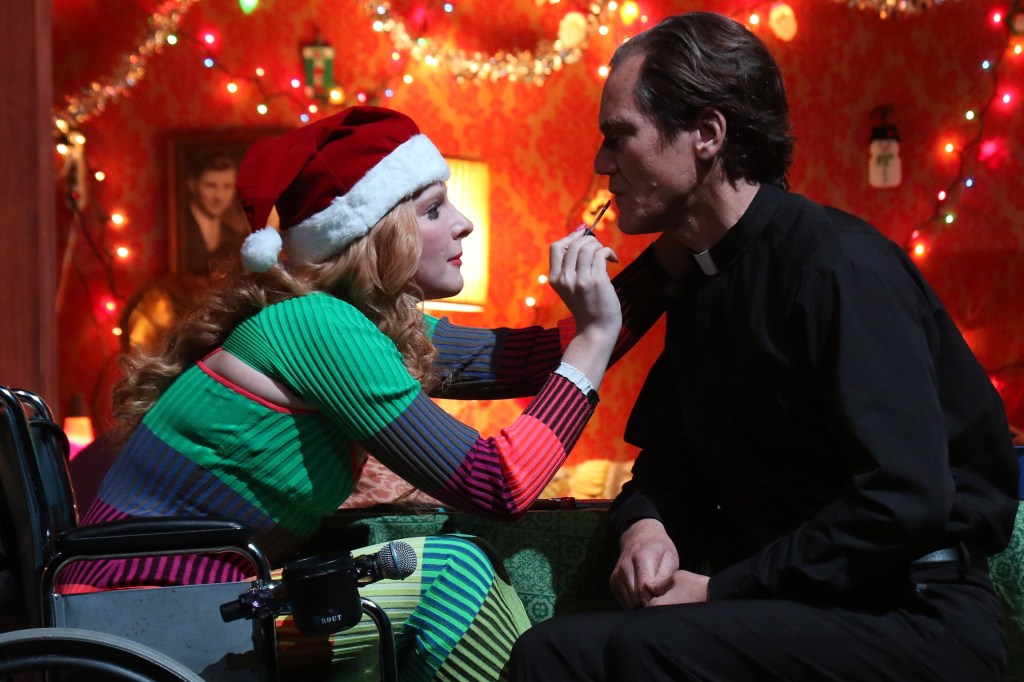
The character dynamics take off when Father Michael (the superb Michael Shannon) visits. Denis Johnson has set up Father’s Michael character by having Dan discuss with Marta that he saw Father Michael wearing make-up in front of a gay bar. Ironically, Dan mentions that he won’t feel so inferior or insecure at Confession knowing that Father Michael is less than perfect and most probably is gay. His response is all about forgiveness and an absence of judgment. And it is clear that this has now become a two way street of forgiveness and acceptance.
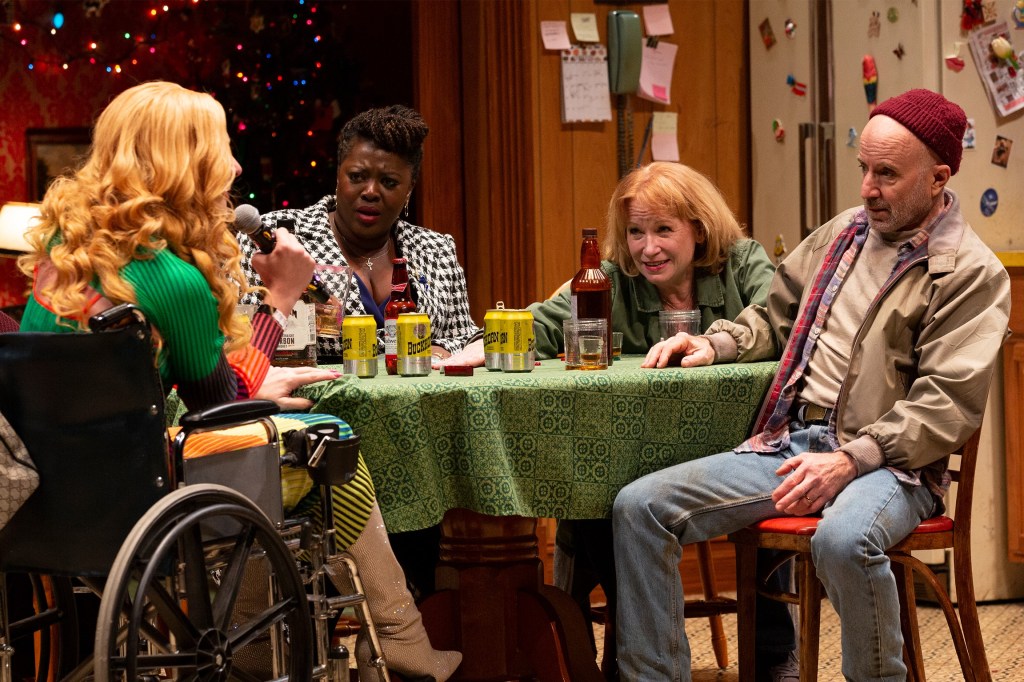
Marta has asked Father Michael to come over to receive comfort and perhaps prayer as she tells Dan that the doctors only gave her two to four months to live because the cancer has spread throughout her body. The only comfort Father Michael gives is his honesty in saying that death is a mystery and one can’t say much about it. However, the most accurate and hopeful comment he tells her is that the doctors don’t know everything. In other words their prognosis may be wrong. Father Michael ends any further discussion of Marta’s cancer and shifts to another topic abruptly which is humorous. Then the action gyrates so that Dan and Marta decide to pick up some beers as if the dire conversation never happened nor should happen. Dan and Marta promise to come back, leaving Father Michael with Jimmy (Hari Nef) in a blonde wig, rhinestone boots, make-up and wheelchair.
Jimmy who has been crippled by a doctor during the sex change operation appears to take this in stride. However, we discover what is motivating Jimmy’s apparent calm later in the play, the hope of walking again. The scene between Nef’s Jimmy and Shannon’s Father Michael is wonderfully acted, free and spot-on quirky. Jimmy tells Father Michael that he heard his parents discussing that Father Michael wears make-up. Father Michael is honest. Jimmy suggests that Father Michael allow him to be his make-up artist. Though Father Michael prefers putting on his own make up, with good will, he lets Jimmy add lipstick, rouge and eye-shadow to his face. The two bond during this amazing scene because the actors are “in the moment” superb.

As Jimmy, Hari Nef is adorably believable without pushing any of “behaviors” to get a laugh. Shannon’s prodigious versatility as an actor has him portray cruel thugs (Bullet Train) and Elvis (Elvis and Nixon) to name a few of his screen roles. As Father Michael he is organic, hysterical and profound. He negotiates the whimsical and empathetic priest with an uncanny and otherworldly aspect. Shannon’s delivery of Father Michael’s most philosophical and trenchant lines is sheer perfection in their tossed away thoughtfulness. It is as if Shannon’s Father peers into another realm, expresses what he sees, then retracts from it like nothing extraordinary has happened, though it has.
To round out the gathering Mrs. Drinkwater (the heartfelt Heather Alicia Simms) shows up looking for the gold wedding band that she gave Dan and forgot to take back. Dan and Marta have not returned with the beers, so Father Shannon and Jimmy introduce themselves and Mrs. Drinkwater tells them that her husband was killed in the plane crash. Abruptly, Father Michael announces that they need to have drinks and specifically, depth chargers (shots dropped in a mug of beer). At this point, the wild party begins and when Dan and Marta return with more beer, the events revolve upside down and sideways as each takes their turn at Karaoke and “lets it all hang out.” Kudos to Hari Nef, Michael Shannon and Heather Alicia Simms for their passionate renditions of their solo numbers.

The fun is in watching the actors enjoy themselves to the hilt and in the process, convey the loneliness and angst each of the characters personally experiences. We appreciate the drunken camaraderie and comfort they share. It is better than that of “old friends” who know “too much” of their pain and torment. Nevertheless, they have just enough information about each other. They understand that they all are imperfect and have experienced loss, uncertainty, confusion. They have been tossed about by life’s seemingly random trials, forced to assign their own meaning to the haphazard and horrible events. Theirs is the sticky understanding that they can help each other through their personal crises that none of them can specifically explain because it can’t be articulated. All they can do is state concrete facts about conditions. But underneath are miles of subsurface emotions, psychic damage, pain, fear, sorrow.

The hope is that they are alive with the determination to keep on “truckin’,” as they receive solace in understanding the ubiquity of their absurd-life-in-death condition. They, like all human beings, roll a metaphoric boulder up a hill, knowing at the top they will slip and fall to the bottom. Then, they will have to do it again and again does Sisyphus of Greek mythology.
For Dan and Marta, the loss of their daughter who overdosed is most acutely felt, a fact they mention then drop. For Mrs. Drinkwater, the loss of her husband has dislocated her and upended her identity about herself. Who is she now and how does she define herself without him? For Nef’s Jimmy, the paralysis is devastating, but it may not be permanent. At one point when Jimmy is alcohol buzzed, he stands up and proclaims that he, “will walk again.” Lastly, Father Michael is negotiating his physical person, his celibacy, his marriage to Mr. Drinkwater (a mysterious notion) and his straddling the otherworldly realms of consciousness and spirit.
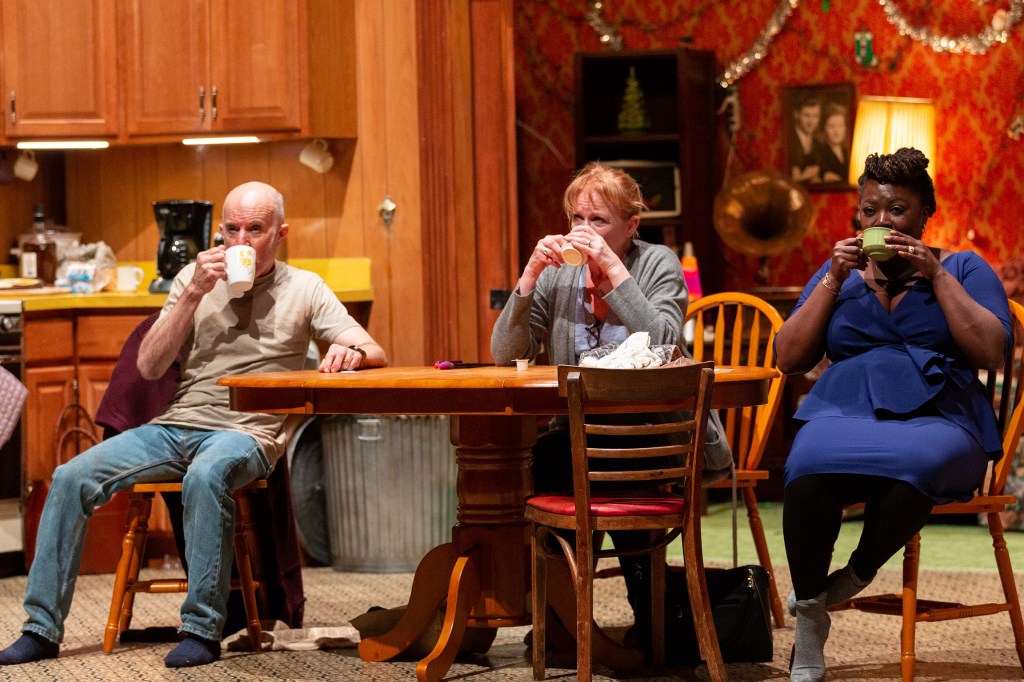
Johnson’s play cannot easily be pinned down in its hybrid, comedic absurdism and avant garde elusiveness. It zips along with unlikely and surprising twists with every character dynamic and every character expose. Its strong spiritual themes about life, the afterlife, consciousness and no boundaries between and among these realities, are thought-provoking. The ensemble’s acting is top-notch and their team work reaches a high-point when each performs their solos while the others move into themselves, all creating an exceptional, flowing dance.
Arin Arbus has staged the wildness so that it is zany yet meaningful with the help of Byron Easley (choreographer). Riccardo Hernandez’s scenic design, Qween Jean’s costume design, Scott Zielinski lighting design and Mikaal Sulaiman’s original music and sound design effectively capture the director’s vision and enhance Johnson’s themes about human nature, pain and seeking to escape from it with like-minded others through alcohol or just letting go. In this production, which emphasizes humanity, forgiveness, understanding and empathy, we realize the isolation of individuality and the commonality of emotions whether joyful or sorrowful, that often prompt escapism to crazy, if only for a moment in an eternity of time.
This is one to see. It ends January 8 and runs with no intermission. For tickets and times go to their website https://www.tfana.org/current-season/des-moines/overview
‘A Child’s Christmas in Wales,’ Tidings of Comfort and Joy in Dylan Thomas’ Reflections

Irish Repertory Theatre’s A Child’s Christmas in Wales by the brilliant Dylan Thomas, adapted and directed by Charlotte Moore hits the spot for Christmas loveliness and grace. An old-time favorite of Irish Repertory Theatre, this is the sixth version they have produced since their first adaptation in 2002 of A Celtic Christmas. Thanks to Charlotte Moore’s prodigious dramatic talents this is one of the most heartwarming, elegant and memorable of versions and I’ve seen a few. Perhaps it is because of its simplicity as a chamber musical, which features poignant songs written by Charlotte Moore, and the favorite traditional carols of the season, one receives a new appreciation of Christmas. Its vitality in bringing together a community that greatly longs to erase thoughts of separation that have characterized the past few years, cannot be underestimated.

For this production of A Child’s Christmas in Wales, the stage is flanked with tall, stalwart looking Christmas trees uniformly lit against a mirrored background which adds to the stage width and depth, thanks to John Lee Beatty’s set design. There are even large presents tucked away in a back corner on the left side of the stage continuation. The light reflections, and nuanced lighting (Michael Gottlieb) softly enhance the six singers. These include Kerry Conte, Ali Ewoldt, Jay Aubrey Jones, Kylie Kuioka, Ashley Robinson and Reed Lancaster, who was covering for Dan Macke the night I saw the production.
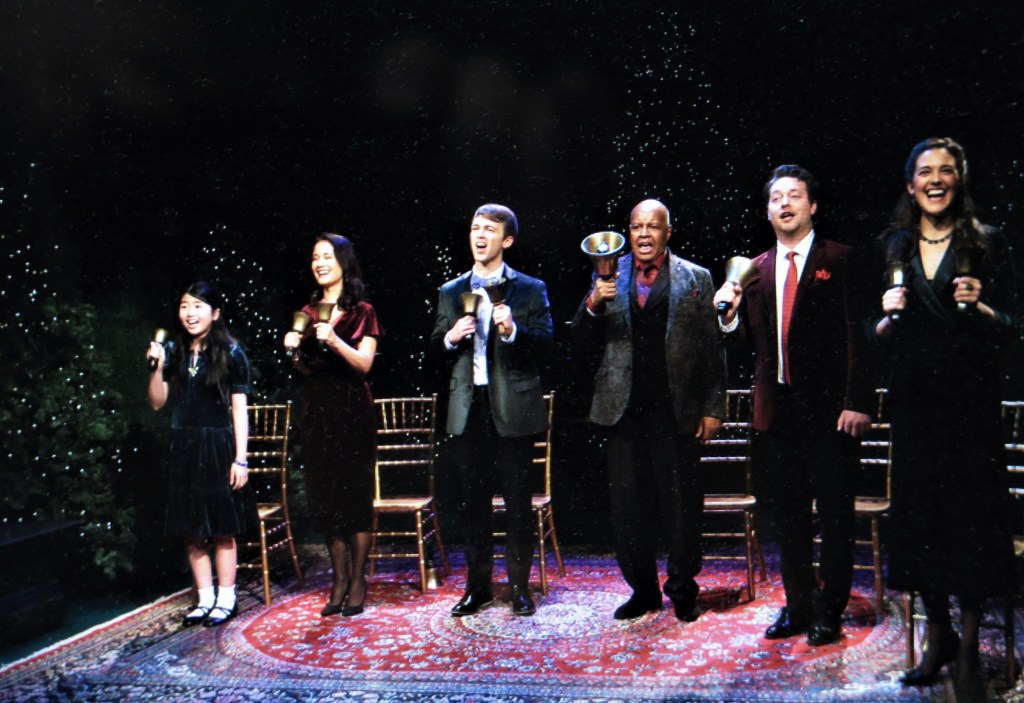
The trees in their arrangement are an excellent choice not only for their placement but for their symbolism representative of Christ and Christianity. The fir tree was widely adopted during the Victorian Age after a picture of Queen Victoria, German Prince Albert and their family appeared in Illustrated London News. Queen Victoria was so popular that the public became enamored of the royal family standing around the decorated, tall, fir tree. They clamored to make it fashionable, cutting down their own trees or purchasing them from vendors after demanding them. Certainly, the historic Christmas captured by Thomas’ gorgeously poetic language seems best ringing out the holiday season with the trees as a evergreen, mythic backdrop.
The music supervision by John Bell and music direction by David Hancock Turner are impeccable. I particularly enjoyed the carols I hadn’t heard in a long while, the traditional ones like “A-Soaling” (Hey, Ho, Nobody Home), “I Don’t Want a Lot for Christmas” and the humorous “Miss Fogarty’s Christmas Cake.” There are songs sung in Welsh “Tawel Nos” (“Silent Night”) which moves to a beautiful segue of “O Holy Night.” And I was surprised to discover that “Deck the Halls,” All Through the Night” and “Suo Gan” are traditional Welsh songs.

I felt an otherworldly appreciation of the carols and live music and singing arranged with thoughtfulness and joy. Thoma’s clever and poignant remembrances narrated with every attention to his incredible wordcraft by the ensemble remind us of a romantic past that we all long for. I am so sick and tired of the canned, artificial music signaling commercialism and grasping greed as it pipes over the loudspeakers of big box stores and various establishments. I do hope this chamber musical was recorded. Its one-of-a-kind exceptionalism in its celebration of a historic time before cell phones, mass media, television and the complications of what at times seems like overwhelming chaos, is bar none.

What was another pleasant surprise were the songs “Take My Hand, Tomorrow’s Christmas,” “Open Your Eyes,” and “Walking in the Snow.” The music and lyrics are Charlotte Moore’s and they appropriately threaded throughout the 75 minute presentation among Thomas’ memories that speak of childhood innocence, frankness (in his recall of the quirky aunts and uncles) and sense of security and safety embraced by a loving family. His work is a milestone and thankfully Irish Repertory Theatre has shared its immutable glory with us, reminding us of family, friends, love, community, history and the meaning of such vital themes that strengthen our lives.

David Toser’s costume design are befitting of the fashionable stylishness of a lovely holiday party where everyone is shining in their finery like their own decorated Christmas trees. In this “never to be forgotten day at the end of the unremembered year” Thomas’ snowy Christmas Day in Wales at the Irish Repertory Theatre is a stunner whose nostalgia is all the more affecting now that Christmas has passed.

See it before it closes. For tickets and times go to their website: https://irishrep.org/show/2022-2023-season/a-childs-christmas-in-wales-4/
‘Some Like it Hot’ Fires up the Laughter, Dazzling at the Schubert

One of the more intricately updated movie adaptations on Broadway that sparks a flame that will surely last, Some Like it Hot is perfect for the holiday season and year-round. From start to finish the sensational cast keeps the audience laughing, thanks to enlightened direction, (Casey Nicholaw), seamlessly wrought staging, superb pacing, on-point timing and smashing songs sung by spot-on principals and company.
Performances by standouts J. Harrison Ghee (Jerry/Daphne), Christian Borle (Joe/Josephine), Sugar (Adrianna Hicks), Natasha Yvette Williams (Sweet Sue) and Kevin Del Aguila (Osgood) hurtle the comedy at breakneck speed around the roller coaster turns of plot, mostly familiar to those who have seen the original titular film upon which this two-act musical comedy is based. Currently, Some Like it Hot is at the Sam S. Schubert Theatre without an end-date.
With book by Matthew Lopez and Amber Ruffin, with additional material by Christian Borle and Joe Farrell, music by Marc Shaiman and lyrics by Scott Wittman and Marc Shaiman, Some Like it Hot, mostly through songs unspools the story of two Chicago musicians. Witnesses to a murder by a crime boss and his henchmen, Jerry (J. Harrison Ghee) and Joe (Christian Borle) must leave town to avoid being killed. As they flee for their lives moving from the streets of Chicago to a train journey across country to California, to their hotel destination, the cast joyously sings 10 songs in Act I and 8 songs in Act II.

The strongest numbers meld superlatively with the jazz/blues club and rehearsal scenes and display the wacky characterizations, i.e. Osgood (the marvelous K.J. Hippensteel) and his relationship with Daphne, for maximum humor. The club and rehearsal songs are rollicking, streams of musical electricity that include “I’m California Bound,” “Take It up a Step,” “Zee Bap” and “Some Like it Hot,” and in Act II “Let’s Be Bad,” and “Baby, Let’s Get Good.” The music can’t be beat if you love jazz, blues and a compendium of styles from that era.
The opening speakeasy scene “What Are You Thirsty For,” prepares us for the rousing up-tempo and hot jazz style that characterizes the music of Sweet Sue’s all-girl band. The song, like all of those in the club scenes maintains the high-paced energy which never lets up, thanks in part to Natasha Yvette Williams, whose band conductor Sue rules with a firm hand, is humorous and twits Josephine (Joe) about her age because she looks dowdy and frumpy, in a joke that is milked throughout. In assuming their new roles as women, both Joe and Jerry take pride in their beauty and femininity and are insulted if men “step out of line” and take liberties, or as in the instance of Sweet Sue with Josephine/Joe, feel hurt pride that they do not look pretty and young. Of course the irony that these men are becoming enlightened to what it is really like to be women, pestered and objectified by men is just priceless.

The first number establishes the setting of the Great Depression and Prohibition and introduces three leads two of which by the skin of their teeth avoid a police raid and being locked up by Mulligan (Adam Heller), who hauls in Sweet Sue and her band closing them down. That Jerry and Joe escape, establishes their characters’ MO throughout. They shuck and jive, deep man dive to survive, staying one step ahead of police or gangsters. But I am getting ahead of myself. Out on the street and down on their luck, jobs for a bass player and sax player are hard to come by.
Joe and Jerry try the Cheetah Club, owned by Spats Columbo. Mark Lotito’s convincing no nonsense gangster with a humorous touch is perfect for the role which requires some fleet footedness, during the wild chases and shoot-out scenes acutely conceived, staged and choreographed by Casey Nicholaw.
At the Cheetah Club, Spats’ man Mack (Casey Garvin) hires Joe but rejects Jerry because he’s Black. The musical is savvy about revealing the extreme Jim Crow racism of the 1930s through Mack’s obvious prejudice. The production also beautifully answers the racism and bigotry with the idea of family, love and unity with the cleverly written “You Can’t Have Me (If You Don’t Have Him).” Joe insists he and Jerry are a duo, and family (the Tip Tap Twins) who must stick together. As an act “We’re two of a kind, if you’re colorblind, separate mothers …but we’re brothers under the skin.” The singing is accompanied by Joe and Jerry’s excellent tap dancing which wins the day when Spats himself appears and reveals his approval of their talents.
The irony is not lost on us that Spats is tolerant of Jerry’s Black heritage and in this light is more humane than your average lynching bigot from the South, bullying Blacks to bow and scrape. Of course Spats is a murderer of another type (he kills competitor thugs and rats); he’s just not a racist or lynching bigot murderer. This is a fantastic send-up of “honorable” criminals vs. low-down, scurrilous, hate-filled murderers which is intimated but never stated. Thus, Spats we can laugh at, the the bigot in the Southern shadows we prefer not to think about though they exist and are the reason why Sweet Sue goes to California and not Alabama.

The clever lyrics and humor related to the bigotry toward Black performers during a time of extreme Jim Crow racism in the nation is a subject for jokes delivered by Sweet Sue and Jerry sparingly with irony. The references to racism are understated, and actually highlight the difference between past and present. Yet it is enough as a sad reminder and subtle warning about the uptick in white nationalism and bigotry in our time, hyped up on steroids during the former president Donald Trump’s administration because he gave permission to the KKK and other groups to express their racial hatreds openly as “very fine people.” In this production, the lightheartedness countering the prejudice and racism of the time sends a powerful message about acceptance that is not preachy or overdone.
For example Sue ironically determines the destination of her all-girl band to a place where they won’t be lynched or ostracized since Sue, bass player Jerry/Daphne (J. Harrison Ghee), lead singer Sugar (Adrianna Hicks) and others are Black artists. However, Sue never uses racially charged words. She only refers to how she looks and the audience breaks out in hysteria. After all, it’s the 1930s. Yet residual bigotry is in tragically in the 2022s. Importantly, the beauty of this update reveals the vitality of music and the arts which have always been in the forefront of accepting people, not for their skin color, elitist pedigree or class, but for their artistry and talent. Thus, the theme that art, music and entertainment as a noble calling is underscored as it brings us together in unity and harmony and encourages the best of our humanity.
The complications thicken when Jerry and Joe are at the Cheetah Club and prove themselves to be successful. Excited, Joe wants to discuss their order in the program with Spats at the precise moment when the musicians witness Spats murdering Toothpick Charlie for giving information to Mulligan. The frenzy of Joe and Jerry witnessing the murder and then running away in a marvelous chase scene into the women’s dressing room where they get the idea to go out in drag to save their lives is logically wrought and hysterical. Dressed as Daphne and Josephine, Joe and Jerry are able to walk by Spats and his henchmen without a “hitch.” Now, the only thing left for them to do is follow a tip they receive about joining Sweet Sue’s band.

In a one line quip, we learn they pay two ruffians to steal the instruments of a female bass player and sax player who had jobs in Sue’s band but lost them when they were unable to get instruments at the last minute. Thus, Daphne and Josephine conveniently step up for the positions as the clever Sweet Sue notices their unusual coincidence and timing. This tweak is one of many that works in Matthew Lopez and Amber Ruffin’s well thought out book that is filled with new quips and one-liners that land every time, thanks to Williams, Borle and Ghee’s exceptional timing and delivery.
With the conceit of Daphne/Jerry and Josephine/Joe going cross country as women using the all-girl band as their sanctuary and milked to max, the rest of the action follows a steady route until they arrive at their destination. On the journey the men get to bunk with women and learn temperance and self- restraint as they are reduced to looking but not touching. Also, Josephine discovers the inner workings of the lovely Sugar who he is falling in love with (“A Darker Shade of Blue,” “At the Old Majestic Nickel Matinee”) as she sings the blues ballads about her life and dreams.
In California the intensity increases. Joe and Jerry have to decide whether to leave and go to Mexico. However, there are dangerous reasons that stand in the way of their making the best decision of their lives. Joe has fallen for Sugar and Jerry has fallen for being a woman, a condition which emerges when the wealthy Osgood in “Poor Little Millionaire” shows he is interested in Daphne. As Osgood appeals to the feminine in Jerry, Jerry/Daphne has a new knowledge of himself as an evolved individual whom he actually likes better than when he was Jerry. This is not only LOL and J. Harrison Ghee makes the most of this new knowledge, it is refreshingly current and an excellent update of the original material in the film by Matthew Lopez and Amber Ruffin.
Meanwhile, unbeknownst to them, Spats and his men are making their way toward Jerry and Joe. It is only a matter of time before they will meet face to face. When they do in “Tip Tap Trouble,” the chase is an incredible tap dance with precisely timed, synchronized movement that is choreographed using doors. Nicholaw’s staging is a marvel. The number is paced by the ensemble to perfection with such apt choreography, it is absolutely breathtaking. The number brings down the house.

In this musical comedy as in the film, “all’s well that ends well.” Spats is arrested just in time by Mulligan and the couples reveal themselves and there are no hard feelings. In fact Osgood is pleased. The notion that you love despite gender and race, if you have the openness to allow yourself that joy, is the most satisfying of the musical comedy’s themes. And it is the most welcome and truthful. For, as Some Like it Hot posits, if one looks and truly sees individuals for who they are, no one should be rejected or belittled. It is a fantastic notion for this LOL musical comedy whose profound underlying meaning shouldn’t be underestimated.
From cast, principals, music and every element referred to in this review, the production has been fine tuned as a celebration of one of the greatest comedy films which was a stylistic throwback to the thirties. Likewise with this production there are numbers which reflect the black and white musicals of the past, whether it be their elegance or brassy, jazz tunes and rigorous tap numbers. The ensemble and swings are perfection and add to the enthusiasm and excitement of a show that is beyond sizzling fun. Some Like it Hot is a love letter to Hollywood Studio films that we will never see again, and a love letter to the present that we hope for with unity, tolerance and love.
Kudos go to Natasha Katz (lighting design) Brian Ronan (sound design) Gregg Barnes (costume design) Scott Pask (scenic design) Josh Marquette (hair design) Milagros Medina-Cerdeira (make-up design). The train is amazing thanks to Scott Pask who manages a streamlined, futuristic look that is full bodied and rich. The full bodied richness is especially so with the hotel interiors and various spaces that Nicholaw transitions into and out of in the twinkling of an eye to keep up the pacing. It is as if the entire production is on a metronome and moves to the ethereal beats of hilarity, somewhere out there in comedy heaven.
All praise goes to Mary-Mitchell Campbell for her music supervision, Charlie Rosen and Bryan Carter for their orchestrations. Final kudos goes to all involved with dance, vocal and musical arrangements and the creative team who helped to make this production shimmering glory every night.
What a smashing, important production that is as light as a feather going down but stays with you for its vital themes, music, rhythms (I just adored “Tip Tap Trouble” for its multiple layers) LOL book and great delivery by actors, who managed to be funny and not cartoonish.
See it! Go to their website for tickets and times https://somelikeithotmusical.com/
‘The Piano Lesson’ is a Striking Revival That Delivers Exceptional Acting, Acute Direction and Prodigious Mastery
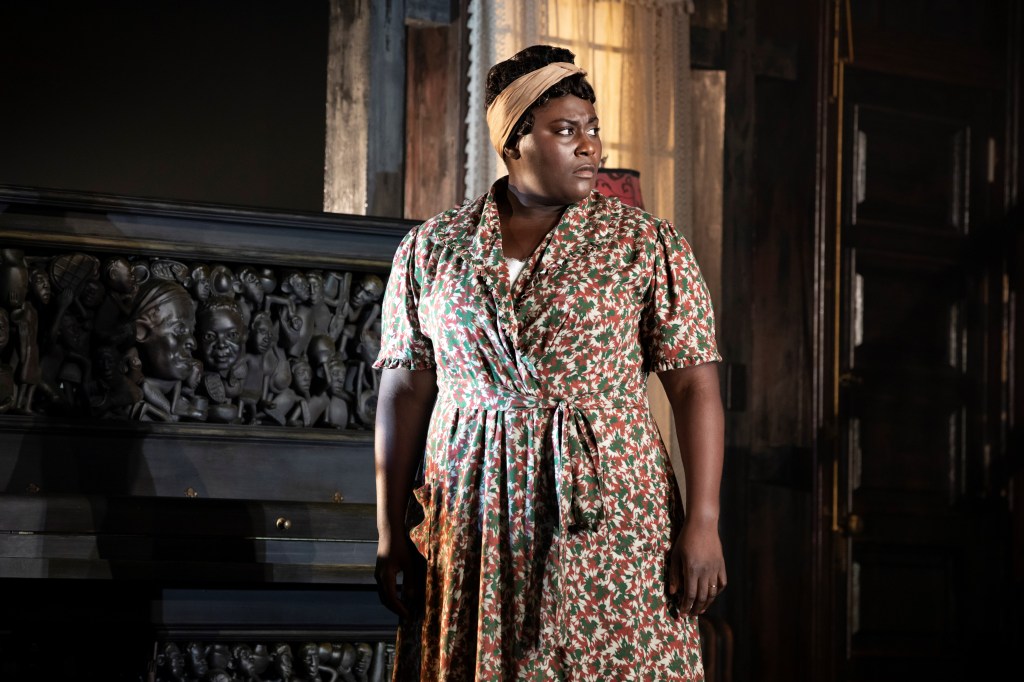
How do we reconcile a past of misery, torment and devastation? Do we bury it or embrace the goodness our ancestors brought to bear as they raised us? Do we take the next steps to rise up to the inner glory they encouraged, or mourn in resentment never exorcising the anguish that seeped into our psyches? In August Wilson’s richly crafted Pulitzer Prize-winning play The Piano Lesson, currently running at the Ethel Barrymore Theatre, the character Berniece (superbly portrayed by Danielle Brooks) must reconcile herself to her past and become the conduit that translates legacy into new beginnings for her family and her daughter.
The Piano Lesson symbolizes how African Americans must approach their painful history of slavery as a planting field which may give birth to strong generations that carry new hope and opportunity for a positive future. Additionally, in this production directed by Latanya Richardson Jackson, Wilson suggests what that future might be with an uplifting conclusion where family understanding and unity are restored after nefarious forces steeped in colonial, paternalistic folkways and institutional racism, sought to keep the family divided and conquered.

August Wilson’s play debuted on Broadway in 1990, not only winning the Pulitzer Prize but also winning the Drama Desk Award for Outstanding Play, as well as the New York Critic’s Circle Award for Best Play. The Piano Lesson which takes place in Pittsburgh, 1936 is one in a collection of 10 plays in Wilson’s American Century Cycle. Each of the plays, set in a different decade, chronicles African American struggles and triumphs as various families move away from the remnants of slavery and its impact from 1900 through the 1990s. The work has enjoyed three revivals, one Off Broadway in 2013 and the two Broadway outings (1990, 2022).
This outstanding revival features seminal performances by a superb ensemble and a clarifying vision about the play by the director. Each actor brings vitality and authentically to manifest the roiling fear and oppression that still hangs over the lives of characters Berniece (Danielle Brooks) Boy Willie (John David Washington) and family uncles Doaker (Samuel L. Jackson) and Wining Boy (Michael Potts) as they attempt to move beyond their traumatic past. It is a slavery past where ancestors saw toil and heartache and a recent past where Berniece and her family saw violence, bloodshed and anything but a peaceful passing to ancestral graves.

Events come to a head when Boy Willie visits the family for the first time in three years since Berniece lost her husband Crawley. Boy Willie comes with a vital personal mission so he braves his sister Berniece’s ire because he is at a turning point in his life. Berniece and Boy Willie have been estranged because she blames him for Crawley’s death. Tired of sharecropping for others, Boy Willie leaps when he is offered an opportunity where he, too, can embrace the “American Dream.” In an ironic twist he would be purchasing land his ancestors worked as slaves made available after the slave master’s descendant, the head of the Sutter family, fell down a well and died. Boy Willie’s purchase would allow him to end being exploited by others so he might work to lift himself to a better life.
However, he needs to raise more cash to complete the land deal, so he intends to sell their family heirloom, a beautifully carved upright piano which is housed in Uncle Doaker’s Pittsburgh home where Berniece and her 11-year-old daughter live. As is often the case with inheritances, there are family squabbles about how to dispose of various items. The piano not only is valuable materially, it symbolizes the family’s history and legacy, which is both beautiful and terrible. An ancestor carved the faces of family members on it to soothe the slave master’s wife who was missing her slaves that were traded for the piano. Over the years, the piano has become the family totem that conveys a spiritual weight and emblematic preciousness. Wilson signifies this when Boy Willie and friend Lymon find it nearly impossible to lift by themselves.
Berniece understands the piano’s significance to the depths of her soul and refuses to allow Boy Willie to remove it. For seven years after their mother died, Berniece stopped playing it to honor her mother’s remembrance. Though only Maretha (played by Jurnee Swan at the performance I saw) and Uncle Wining Boy play it, Berniece justifies keeping it because of Mama Ola Charles. Mama Ola daily polished it “til her hands bled, then rubbed the blood in…mixed it up with the rest of the blood on it” and mourned over the tragic loss of her husband, Boy Charles who was murdered after he stole it and hid it to retain its ownership. He believed if the Sutter family kept the piano, they symbolically “lorded” it over the Charles family, who they would oppress as their ersatz slaves, if not physically, then psychically and emotionally.
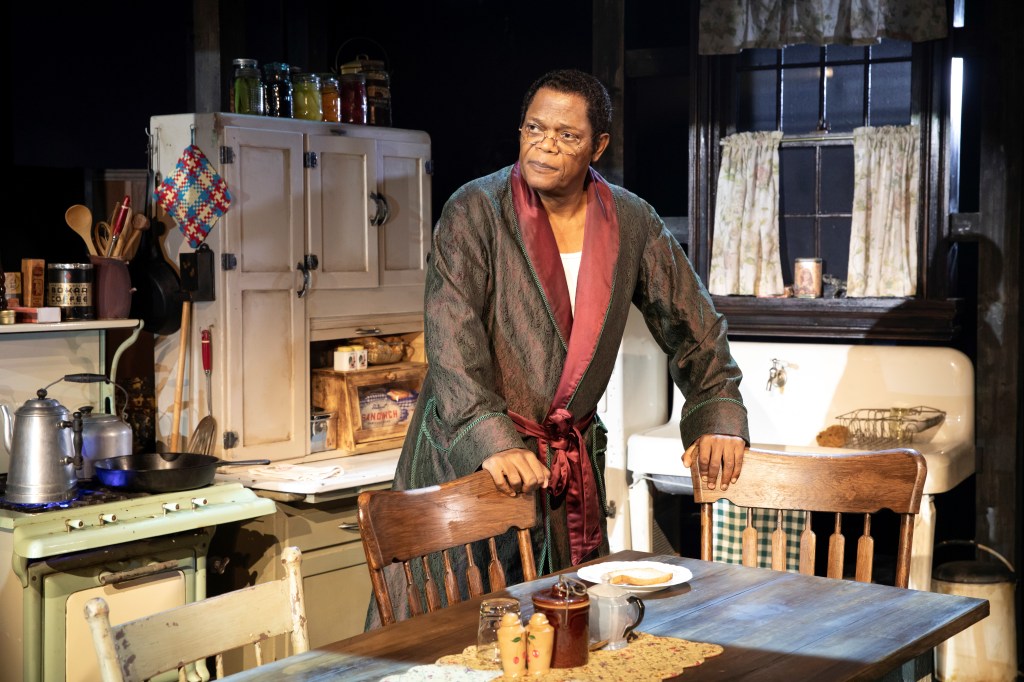
Gradually, Samuel L. Jackson’s Doaker reveals the story of the piano’s history since slavery days. With understated reverence as an explanation why Berniece will never let it go, he discusses how the carvings of each ancestor and their stories reside there as a remembrance of their identity and the sacrificial death of his brother Boy Charles, who first imbued the piano with the symbolic and spiritual significance of their family’s legacy of forward momentum.
Jackson’s Doaker and Danielle Brooks’ Berniece superbly translate the importance of this magical object with nuance and power that gives rise to our understanding why the ancestral spirits are hovering in the piano’s majesty in a battle that becomes otherworldly between the Sutter and the Charles family. It is a battle which has been continuing revealed at the top of the play with Boy Willie’s excited, impassioned entrance and reflected in Beowulf Boritt’s incredible set of Doaker’s simple four room house whose spare roof timbers exposed to the sky appear to be split and separating.
Indeed, the Charles family is a house divided by disagreement, disharmony and mourning tied in and caused by the racial discrimination, and inequitable economic opportunities intended to keep African Americans entrenched in poverty and peonage. To be free of Sutter oppression the Charles family must move away from the Sutters’ (symbolic of white racists) murderous, thieving behaviors, exploitive folkways and lack of empathy for others. They must free themselves from materialism, selfishness and criminality that has destroyed their humanity, as Brook’s Berniece expresses in her indictment of the men in her immediate family, including her dead husband Crawley.

Boy Willie’s presence at this point in time after Sutter is found at the bottom of a well is intriguing. Has Sutter’s wicked ghost driven him up to trouble Berniece about the piano despite its legacy? Or does he just want to make a better life for himself as he suggests? Berniece believes he pushed Sutter to his death, knowing the Sutter land would be put up for sale. Though Washington’s Boy Willie makes a convincing argument that he is not a murderer and Pott’s colorful Wining Boy suggests it’s the vengeful “Ghosts of the Yellow Dog” that caused Sutter’s fall to his death, Berniece is not convinced. Boy Willie’s presence has brought confusion and turmoil, exceptionally rendered by Washington’s Boy Willie, who appears so impassioned about selling the piano, he acts like a man possessed.
Additionally, Boy Willie’s obviation of the importance of the piano as their family legacy is answered with his apology to Berniece as if that is enough because he will sell it regardless. That answer isn’t enough for her. However, Boy Willie insists forcefully almost manically that he will use the land and make something with it, even though the deal is by word of mouth and could be another bamboozle by the Sutter family as Uncle Wining Boy suggests.

That the ghost of Sutter appears to members of the family around the same time that Boy Willie appears is more than a coincidence. That Boy Willie is the only one who doesn’t see the ghost is also more than a coincidence. Berniece, Doaker, Maretha and Wining Boy see the ghost who has been manifesting on the second floor above where Boritt’s roof timbers separate, threatening with well-paced grinding sounds (Scott Lehrer) to split the house up and fragment it completely.
Why doesn’t Boy Willie see Sutter’s ghost? Has Boy Willie become an instrument of the Sutter family, influenced/possessed by Sutter’s ghost to continue the tradition of theft, exploitation and bloodshed (the chains of slavery days) luring Boy Willie with the dream of being “his own boss?” The longer Boy Willie stays to sell a truck load of watermelons, the more the arguing and airing of grievances continues, intermingled with wonderful songs they sing, the first led by Jackson’s Doaker and the last by Potts’ Wining Boy who made a profitable living which he couldn’t sustain playing piano and cutting a few records.
However, nothing will ameliorate Boy Willie’s lust for the money the piano will bring. Finally, when push comes to shove, Berniece and Doaker do take out their guns ready to shoot Boy Willie if he and his friend Lymon (Doron JePaul Mitchell when I saw the show) remove the piano.
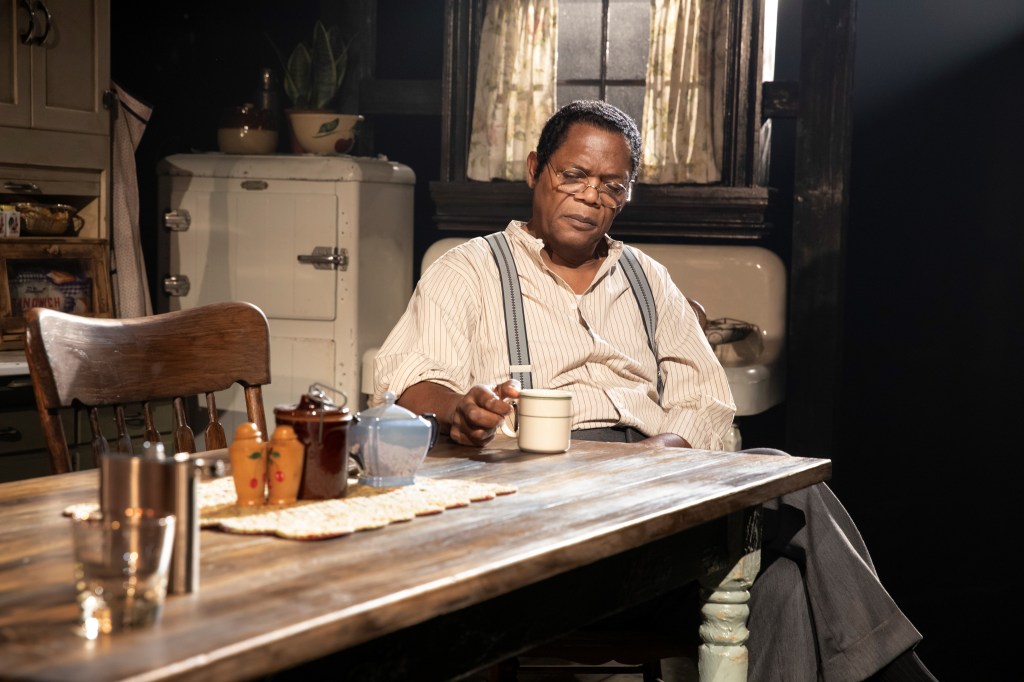
Brooks’ Berniece is so fervent that we believe she will shoot her brother to protect her ancestors’ legacy whose symbolism and spiritual strength she has embraced during Boy Willie’s importuning her to give it up. Washington’s Boy Willie is every inch her equal, stoked by the Sutter relative with the lure of land and his own ambition, like the Biblical Esau, willing to sell his birthright without any guarantees. Brooks and Washington are perfect foils and deliver amazing performances. Jackson’s Doaker and Pott’s Uncle Wining Boy present the stabilizing, humorous counterbalance to the frenzied brother and sister. If not for Wining Boy’s playing the piano at that heightened moment when Berniece has the gun, she would shoot Boy Willie, and Sutter’s ghost would have triumphed, completely destroying the family. Jackson’s direction and the timing of Potts and Samuel L. Jackson’s interference and distractions round out the incredible drama that moves toward the last scene of the play.
It is then that all the characters acknowledge the ghost of Sutter’s presence in the grinding sound of the house being pulled asunder by the warring spirits which also represent the values which the families prize. These are the values which Boy Willie must decide on. Should he be like the Sutters or raise up his own family’s legacy as Doaker has learned to do as a trainman and as Berniece has done steadfastly living one day at a time? Does Boy Willie have the resolve to shake off destructive forces and slowly carve out a life for himself with a lasting peace? At the top of the play Washington’s Boy Willie is so possessed by the Sutter’s offer and righting the past exploitation of his family, he can’t wait to follow them down the same pathways. However, Washington’s Boy Willie does change and is redirected.

Encouraged by everyone who feels the presence of Sutter’s ghost, preacher Avery (Trai Byers-another superb performance) who Berniece has been seeing, attempts to cast out the pernicious Sutter. He fails. Only Berniece calling on the help of her ancestors’ spirits who assist in the spiritual battle overcomes the ghost of Sutter’s presence and hold over their family. As she sings and plays the piano, on the second floor we watch the impact of her prayers and the Charles family’s spirits on Boy Willie as Washington manifests the struggle with Sutter’s ghost. As his body arches over then releases, we note that Sutter’s ghost, its tormenting lures that possessed Boy Willie leave. The two siblings are finally in agreement with Doaker and Wining Boy that what Sutter represents has no place in their family. As it leaves Boy Willie, miraculously, the house is made whole. With a grinding sound and the final sighting and restitution of the Ghosts of the Yellow Dog (you have to see the play to understand what happens) the separated timbers rejoin. It’s an incredible effect and magnificent, symbolic realization of Wilson’s immutable themes, about family unity in reconciliation with the past to move forward, thanks to the creative team, wonderful actors and Jackson’s direction.
Jackson’s staging and use of special effects (Jeff’s Sugg’s projection design, Lehrer’s sound design, Japhy Weideman’s lighting design, Boritt’s fabulous set) convey Boy Willie’s struggle, exorcism and redemption from the tradition of oppression, bloodshed and materialistic selfishness that have corrupted the Sutters and work to corrupt him and completely divide his family. He is only able to gain strength to be released when Brooks’ Berniece accepts how the legacy of past can be turned into a positive future by becoming the conduit of the ancestral spirits. It is their beauty, sanctity and strength that rise up to lead her, Maretha and the others forward, if they allow themselves to be led.
Boy Willie and Berniece join hands in unity. His demeanor transforms into calmness. He no longer wants to sell the piano, understanding that his family history and his identity are in unity. With the house returned to wholeness, the wicked impulses will no more occlude the lives of Berniece, Boy Willie and the others. Now they can move forward and carve their own history in the reality of their lives.
Throughout Wilson raises questions whether Boy Willie got revenge on Sutter for having his father burned alive and the question of whether he killed him to get the land in an ironic triumph. Another question is whether the Sutters are serious about selling the land to Boy Willie given the history between the two families. In the production these questions are emphasized by director Jackson’s vision of the themes and characterizations of this complicated work brought to a phenomenal apotheosis at the conclusion. However, as in life, ambuity is the spice that keeps us enthralled along with the chilling presence of the supernatural hovering.
This is a one of a kind production that exceptionally realizes August Wilson’s intent with every fiber of the artists’ prodigious efforts. I have nothing but praise for what they have done and will do for the run of the play.
For tickets and times to see this living masterpiece go to their website: https://pianolessonplay.com/
‘Ohio State Murders,’ Audra McDonald’s Performance is Stunning in This Exceptional Production
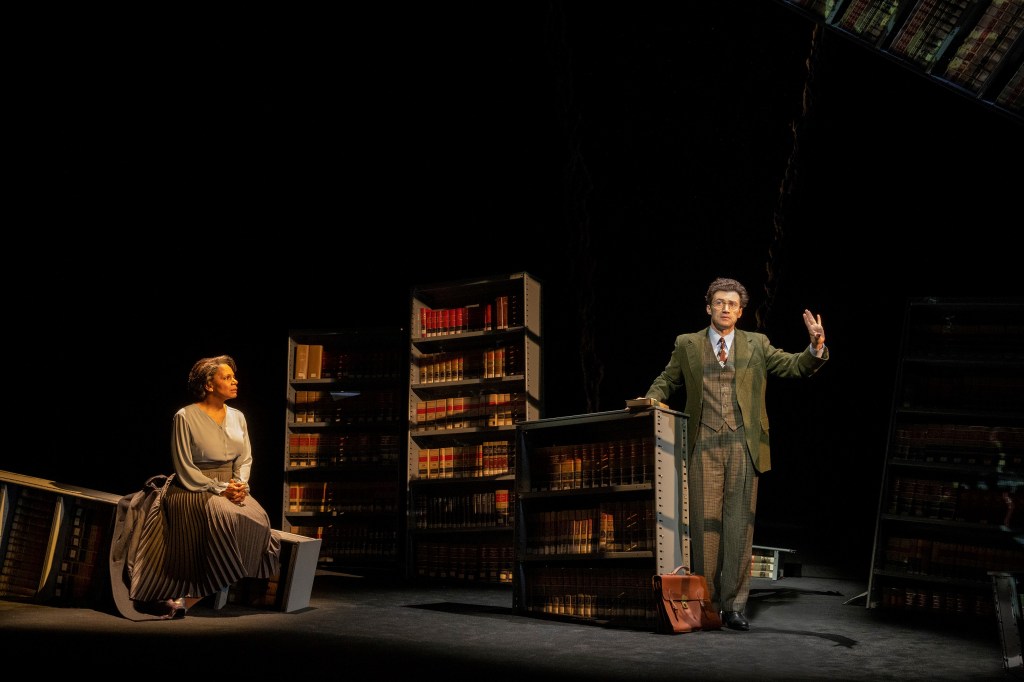
For her first Broadway outing Adrienne Kennedy’s Ohio State Murders has been launched by six-time Tony award winner Audra McDonald into the heavens, and into history with a magnificent, complexly wrought and richly emotional performance. The taut, concise drama about racism, sexism, emotional devastation and the ability to triumph with quiet resolution is directed by Kenny Leon and currently runs at the James Earl Jones Theatre until 12 February. It is a must-see for McDonald’s measured, brilliantly nuanced portrayal of Suzanne Alexander, who tells the story of budding writer Suzanne, in a surreally configured narrative that blends time frames and requires astute listening and thinking, as it enthralls and surprises.
This type of work is typical of Kennedy whose 1964 Funnyhouse of a Negro won an Obie Award. That was the first of many accolades for a woman who writes in multiple genres and whose dramas evoke avant garde presentations and lyrically poetic narratives that are haunting and stylistically striking. As one who explores race in America and has contributed to literature, poetry and drama expressing the Black woman’s experience without rhetoric, but with illuminating, symbolic, word crafting power, Kennedy has been included in the Theater Hall of Fame. In 2022 she received the Gold Medal for Drama from the American Academy of Arts and Letters. The Gold Medal for Drama is awarded every six years and is not bestowed lightly; only 16 individuals including Eugene O’Neill have been so honored.
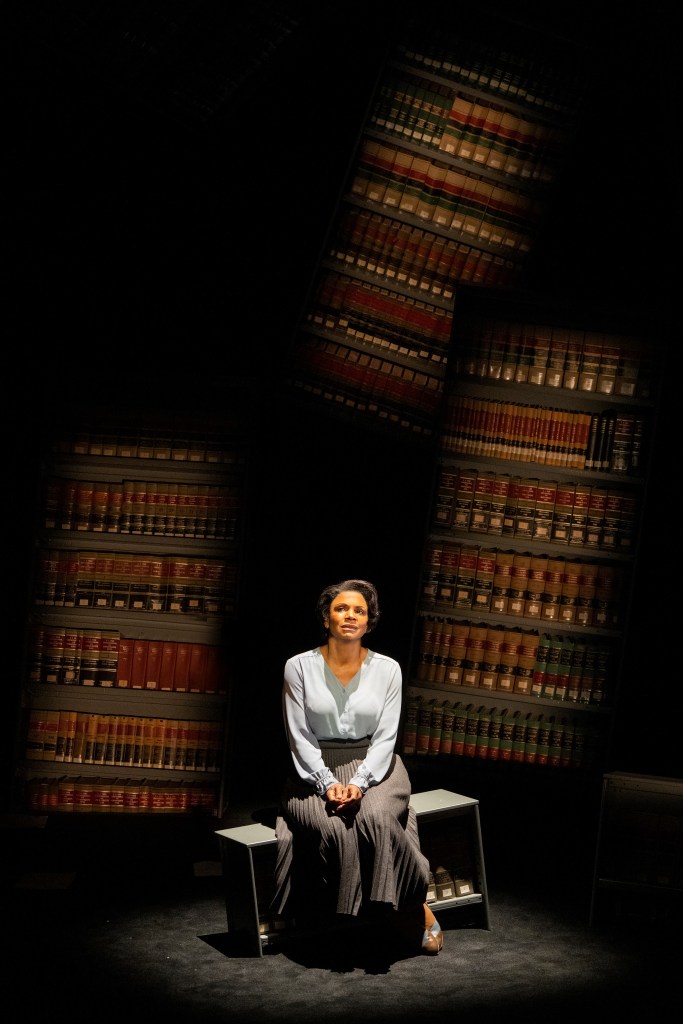
This production of Ohio State Murders remains true to Kennedy’s wistful, understated approach to the dramatic, moving along an arc of alternating emotional revelation and suppression in the expose of her characters and their traumatic experiences. Leon and McDonald have teased out a 75 minute production with no intermission, intricate and profound, as Kennedy references and parallels other works of literature to carry glimpses of her characters’ complexity without clearly delineating the specifics of their behaviors. In the play much is suggested, little is clarified. Toward the unwired conclusion we find out a brief description of how the murders occurred and by whom. The details and the motivations are distilled in a few sentences with a crashing blow.
Much is opaque, laden with sub rosa emotion, depression, heartbreak and quiet reflection couched in remembrances. The most crucial matters are obviated. The intimacy between the two principals which may or may not be glorious or tragic is invisible. That is Kennedy’s astounding feat. Much is left to our imaginations. We can only surmise how, when and where Suzanne and Robert Hampshire (Bryce Pinkham in a rich, understated and austere portrayal) who becomes “Bobby” got together and coupled when Suzanne supposedly visited his house. Their relationship mirrors that of the characters in Tess of the D’Urbervilles by Thomas Hardy. It is this novel which first brings the professor and student together in mutual admiration over a brilliant paper Suzanne writes and he praises.
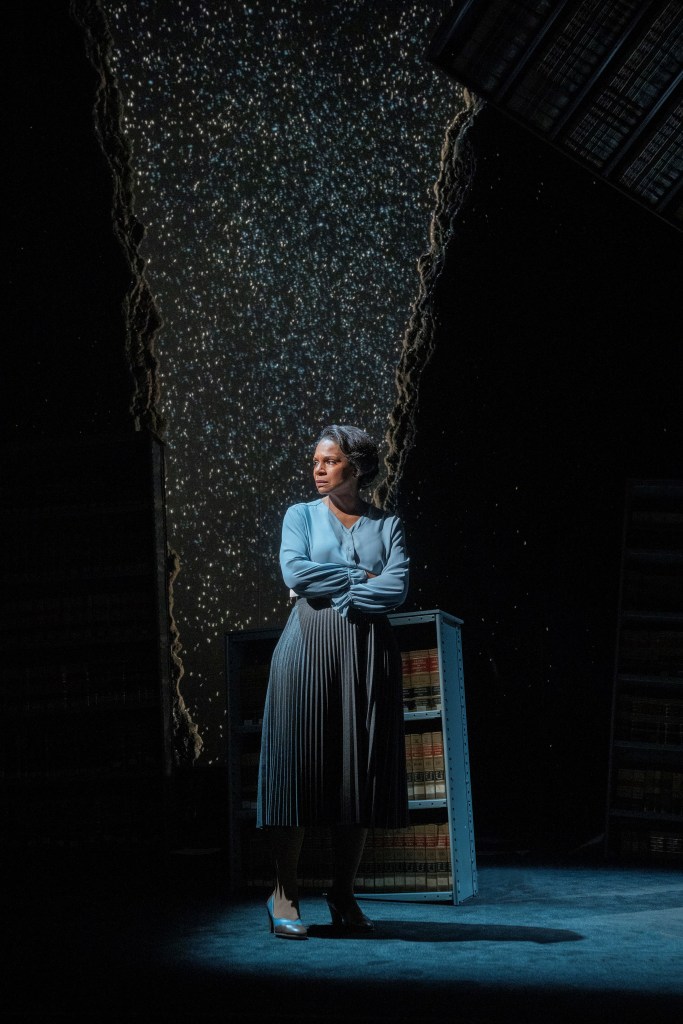
What is mesmerizing and phenomenal about Kennedy’s work is how and why McDonald’s Suzanne follows a process of revelation not with a linear, chronological storytelling structure, but with an uncertain, in the moment remembering. McDonald moves “through a glass darkly,” unraveling recollections, as her character carefully unspools what happened, sees it anew as it unfolds in her memory, then responds to the old and new emotions the recalled memories create.
Audra McDonald is extraordinary as Suzanne Alexander, who has returned to her alma mater to discuss her own writing which has been published and about which there are questions concerning the choice of her violent images. The frame of Suzanne’s lecture is in the present and begins and ends the play. By the conclusion Suzanne has answered the questions. Kennedy’s circuitous narrative winds through flashback as Suzanne relates her experiences at Ohio State when she was a freshman and her movements were dictated by the bigotry that impacted her life there.
In the flashback McDonald’s Suzanne leaps into the difficult task of familiarizing us with the campus and environs, the discrimination, her dorm, roommate Iris Ann (Abigail Stephenson) and others (portrayed by Lizan Mitchell and Mister Fitzgerald), all vital to understanding Suzanne’s story about the violence in her writing. Importantly, McDonald’s Suzanne begins with what is most personal to her, the new world she discovers in her English classes. These are taught by Robert Hampshire, (the astonishing Bryce Pinkham) a professor new to the college. Reading in wonder and listening to his lectures, Suzanne’s fascination with literature, writing and criticism blossoms under his tutelage.
Within the main flashback Kennedy moves forward and backward, not allowing time to delineate what happened, but rather allowing Suzanne’s emotional memories to lead her storytelling. After authorities expel her from Ohio State, she lives with her Aunt and then returns with her babies to work and live with a family friend in the hope of finishing her education. During this recollection she refers to the time when she lived in the dorm and was disdained by the other girls.
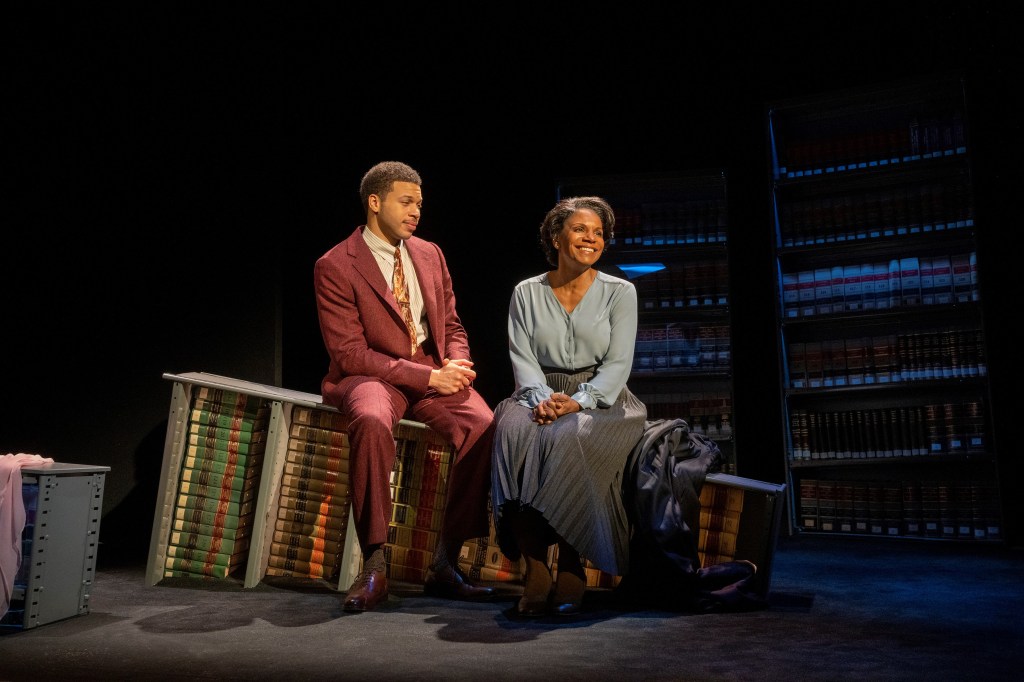
Kennedy anchors the sequence of events in time by using the names of individuals Suzanne meets. For example when she returns after she has been expelled, she meets David (Mister Fitzgerald) who she dates and eventually marries after the Ohio State murders. What keeps us engrossed is how Suzanne fluidly merges time fragments within the years she was at the college. She digresses and jumps in memory as she retells the story, as if escaping from emotion in a repressive flash forward, until she can resume her composure. At the conclusion, Suzanne references the murders of her babies.
Thus, with acute, truncated description that is both poetic and imagistic, McDonald’s Suzanne slowly breaks our hearts. McDonald elucidates every word, every phrase, imbuing it with Suzanne’s particular, rich meaning. Though the character is psychologically blinded and perhaps refuses to initially accept who the killer of her babies might be, there is the uncertainty that she may know all along, but is loathe to admit it to her self, because it is incredibly painful. At the conclusion when she reveals the murderer’s identity and events surrounding both murders, she is remote and cold, as is the snow falling behind outside the crevasse. At that segment McDonald’s unemotional rendering triggers our imaginations. In a flash we understand the what and why. We receive the knowledge as a gut-wrenching blow. Fear has encouraged the murderer in a culture whose violence and racism bathes its citizens in hatred.
When McDonald’s Suzanne Alexander brings us back to the present as she pulls us up with her from the recesses of her memory, we are shocked again. We have been gripped and enthralled, swept up in the events of tragedy and sorrow, senseless violence and loss. The question of why bloody imagery is in Suzanne’s writing has been answered. But many more questions have been raised. For example, in an environment of learning and erudition, how is the murder of innocents possible? Isn’t education supposed to help individuals transcend impulses that are hateful and violent? Kennedy’s themes are horrifically current, underscored by mass shootings in Ulvade, Texas and other schools and colleges across the nation since this play was written (1992). At the heart of such murdering is racism, white domestic terrorism, bigotry, hatred, inhumanity.
The other players appear briefly to enhance Suzanne’s remembrances. Pinkham’s precisely carved professor Hampshire reveals all the clues to his nature and future actions in the passages he reads to his classes from the Hardy novel, then Beowuf and in references to King Arthur and the symbol of the “abyss” he discusses in two lectures Suzanne attends. All, he delivers tellingly with increasing foreboding. Indeed, the passages are revelatory of what he is experiencing symbolically in his soul and psyche. When Suzanne describes his physical presence during the last lecture, when she states he is looking weaker than he did when he taught his English classes, it is a clue. Pinkham’s Hampshire is superbly portrayed with intimations of the quiet, profound and troubled depths of the character’s inner state of mind.
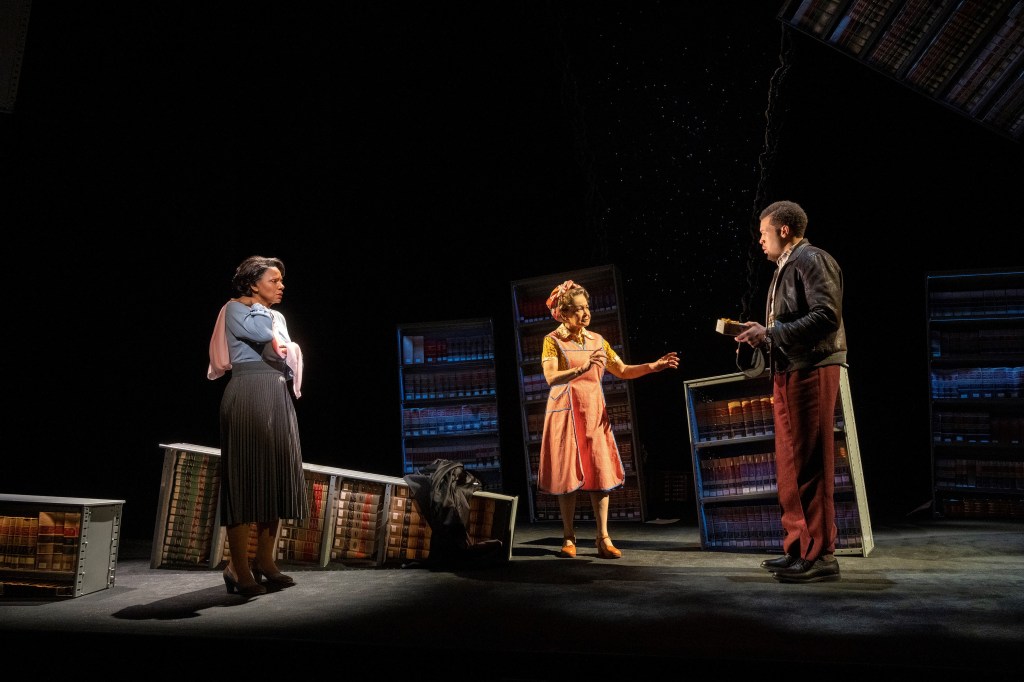
Importantly, Kennedy, through Suzanne’s revelations about the university when she was a freshman, indicates the racism of the student body as well as the bigotry of the officials and faculty, which Black students like Suzanne and Iris must overcome. There is nothing overt. There are no insults and epithets. All is equivocal, but Suzanne feels the hatred and the injustice regarding unequal opportunities.
For example it is assumed that she cannot “handle” the literature classes and must go through trial classes to judge whether she is capable of advanced work as an English major. When she tells professor Hampshire, he insists that this shouldn’t be happening. Nevertheless, he has no power to change her circumstances, though he has supported and encouraged her writing. The college’s bigotry is entrenched, as she and other Black women are discouraged in their studies and forced out surreptitiously so that they cannot complain or protest.
Kenny Leon’s vision complements Kennedy’s play. It is imagistic, minimalistic and surreal, thanks to Beowulf Boritt’s scenic design, Jeff Sugg’s projection design, Allen Lee Hughes lighting design and Justin Ellington’s sound design. At the top of the play there are two worlds. We see black and white projections of of WWII and the aftermath through a v-shaped crevasse that divides the outside culture and the interior of the college in the library symbolized by faux book cases. These are suspended in the air and move around symbolically following what Suzanne discusses and describes.
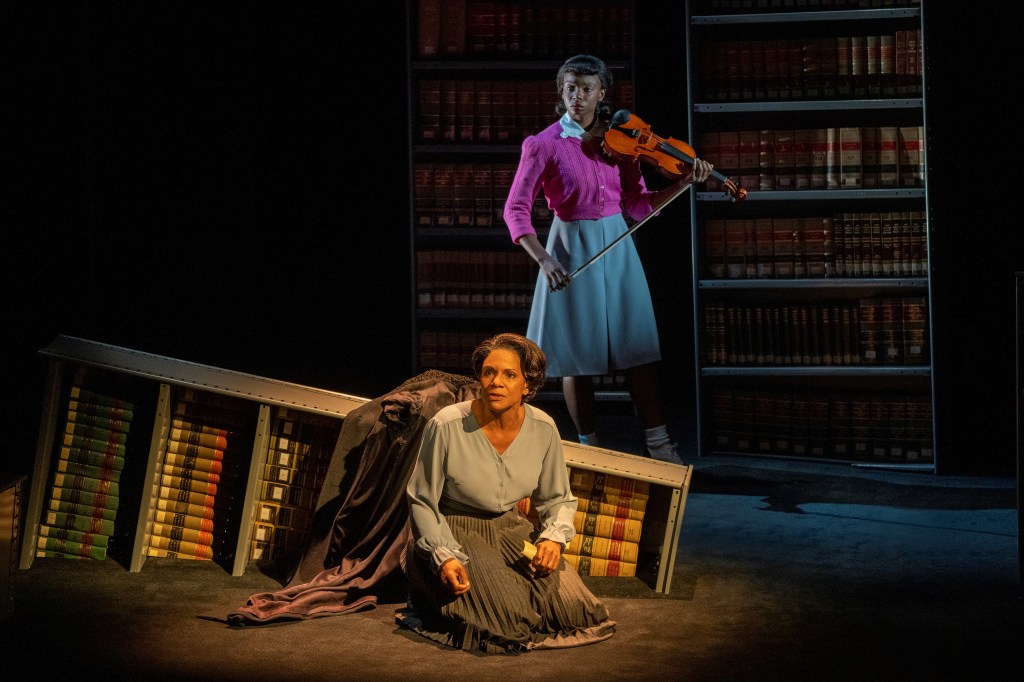
The books are a persistent irony and heavy with meaning. They sometimes serve as a backdrop for projections, for example to label areas of the campus. On the one hand they represent a lure to Suzanne who venerates literature. They suggest the amalgam of learning that is supposed to educate and improve the culture and society. However, the bigoted keepers of knowledge in their “ivory” towers use them as weapons of exclusion and inhumanity, psychologically and emotionally, harming Blacks and others who are not white or who are considered inferior. Leon’s vision and the artistic team’s infusion of this symbolism throughout the play are superb.
In the instance of the one individual who appreciates Suzanne’s writing, the situation becomes twisted and that too, becomes weaponized against her. However, that she has been invited back to her alma mater all those years later to discuss her writing indicates the strength of her character to overcome the incredible suffering she endured. At the conclusion of her talk in the present she reveals her inner power to leap over the obstacles the bigoted college officials put before her. Her return so many years later is indeed a triumph.
Leon and the creative team take the symbolism of rejection, isolation, emotional coldness and inhumanity and bring it from the outdoors to the indoors. Beyond the crevasse in the wintertime environment, the snow falls during Suzanne’s description of events. Eventually, by the end of the play, the exterior and interior merge. The violence we saw at the top of the play in pictures of the War and its aftermath has spread to Ohio State. The snow falls indoors. Finally, Suzanne Alexander is able to publicly speak of it openly and honestly after discovering there was a cover-up of the truth that even her father agreed to out of shame and humiliation.
Ohio State Murders is a historic event that should not be missed. When you see it, listen for the interview of Adrienne Kennedy before the play begins as the audience is seated. She discusses her education at Ohio State and the attitudes of the faculty and college staff. Life informs art as is the case with Adrienne Kennedy’s wonderful avant garde play and this magnificent production.
For tickets and times to to their website: https://ohiostatemurdersbroadway.com/
‘Downstate’ a Powerhouse of a Play, With Sterling Performances

Do we ever receive justice for wrongs done to us if the wrongdoer goes to jail and apologizes? Or are we so damaged no justice or forgiveness is possible? In Downstate, Bruce Norris raises such questions and many more in his compelling play superbly directed by Pam MacKinnon currently at Playwrights Horizons.
At the top of the play the reserved Andy (Tim Hopper) and his concerned wife Em (Sally Murphy) sit opposite Fred (Francis Guinan) who is a senior gentleman, disabled in a motorized wheelchair. As they attempt to discuss why Andy has come to visit, Dee (K. Todd Freeman) comes in with a shopping cart with groceries and Gio (Matthew J. Harris) quibbles with him about the money he owes Dee for bananas. Surveying the house and the roommates, only Fred is white, we surmise this living arrangement has been forced. As it turns out, all four roommates including Felix (Eddie Torres) who eventually comes out of his bedroom to make himself breakfast are convicted sex offenders, who wear leg braces so their activities may be monitored.
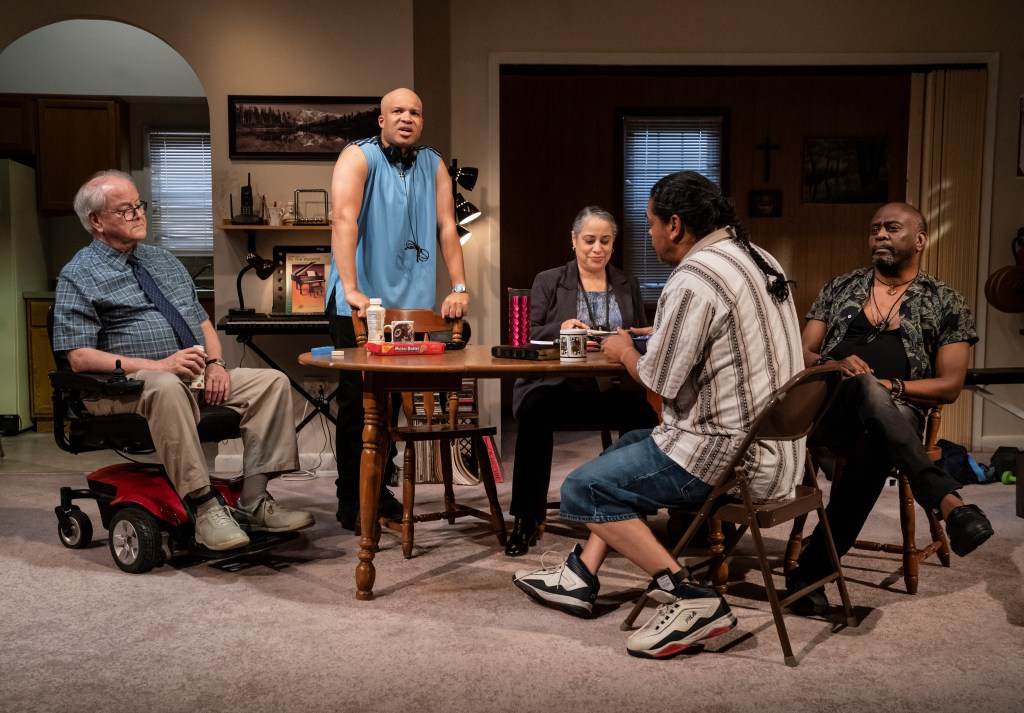
Andy visits Fred with Em to discuss Fred’s predation which happened over thirty years ago, when Andy was twelve and Fred was his piano teacher. Andy tells Fred he ruined his life and he can’t function the way he felt he could have if Fred had left him alone. Norris intimates subterranean clues why Andy has taken the liberty to visit Fred. Though Fred didn’t have to, he agrees to see Andy. In his 40s Andy is not supposed to be anywhere near Fred because Fred has served time and has been convicted and is currently transitioning and living in the half-way house. That Andy seeks Fred out and travels from Chicago to Downstate with his wife to deal with Fred is problematic and portentous.
After Andy and Em finish reading letters of judgment and recrimination they’ve written to Fred which Fred listens to calmly, they both reiterate that Fred is evil. When Em senses Andy is hesitating, she tells him to stop backpedaling and continue with why he’s come to see Fred. It is to get a full admission of what Fred has done to Andy. Fred insists he admitted to all of his actions in court, apologized and was sentenced. As they attempt to continue this discussion, the roommates are attempting to live their lives, get ready for work, make breakfast and use the bathroom. Clearly, the couple are a disruption to Dee, Gio and Felix. Yet, Em and Andy take umbrage at the activities around them interfering with the seriousness of their meeting. It is apparent that the mission they are on obviates the humanity of the other men whom they look down on. In their self-righteous ferocity there is an underlying remoteness and cruelty that Norris reveals in superb dialogue acted exceptionally.
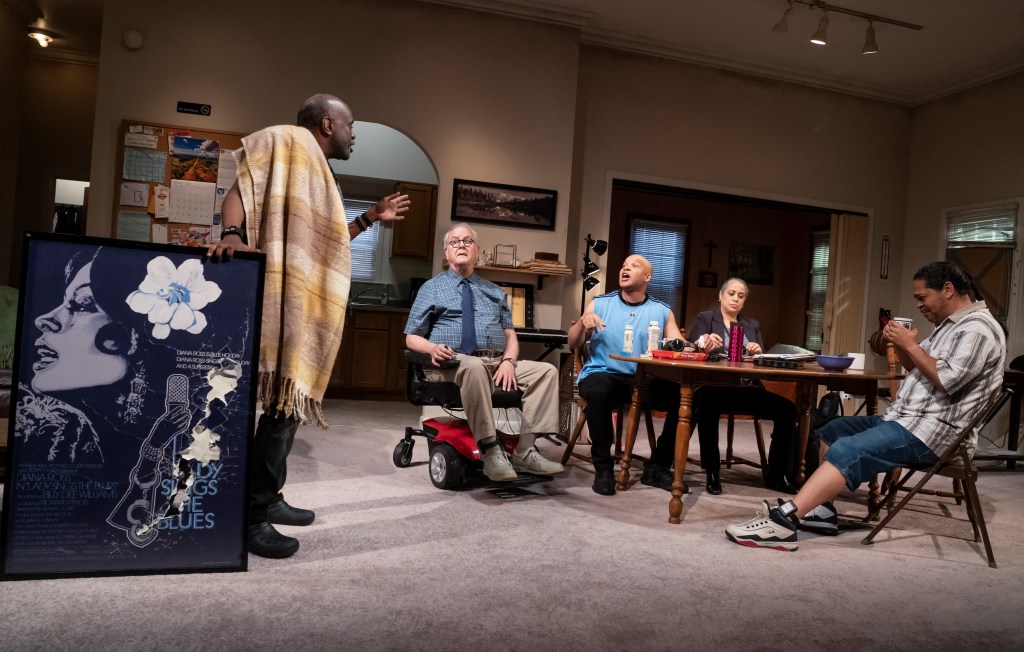
Indeed, Andy and Em are so absorbed in Andy’s victimization and his wish to fully confront Fred with it, they become annoyed by the interruptions in an environment which Andy admits does not fit his expectations. It is as if in Andy’s imagination, he expects Fred to be a silent robot upon which he can unleash vilification without Fred responding as he sits in an isolated room just to listen to Andy’s rant about him. And ironically, part of that logical diatribe includes Andy telling Fred he has fantasized killing him. Interestingly, Fred responds with humanity and humility. He is apologetic and kindly to Andy which Andy ignores and dismisses. Andy reiterates that he has a right and is not supposed to feel empathy for and forgive Fred. Fred can extend him grace, but he doesn’t have to or want to receive it nor will he bestow it.
Norris does an impeccable job of revealing the humanity of both sides of the equation, especially in indicating that Andy, who is in therapy, has no idea how Fred’s life has been altered by what Fred refers to as his own sickness and deserved punishment. He believes Fred to be a fake. Tim Hopper’s Andy, Francis Guinan’s Fred and Sally Murphy’s Em are sensational in their performances listening acutely to each other and reacting with spot-on authenticity. Indeed, though we feel for Hopper’s Andy, Guinan’s Fred who is unassuming, childlike and kindly pulls us in and encourages our sympathy. When he reveals in a later discussion with Andy in Act II that an outraged fellow prisoner slyly brought in steel toed boots and kicked Fred so that his back was broken and he has to have a colostomy bag and can’t walk, we consider Andy’s “breast-beating” and Fred’s indulging him to be beyond ironic.
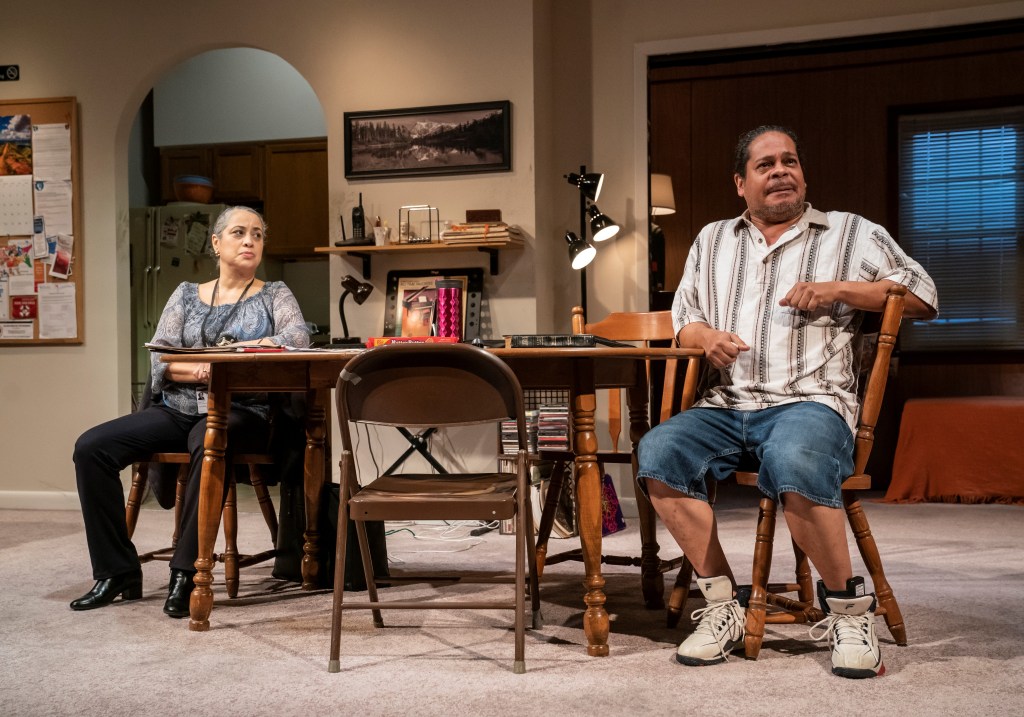
The relationship between Em and Andy as Norris infers, and the actors ingeniously perform with nuance, reveals there are intimacy issues and problems. Thus, Andy’s psychology seeking out Fred is much more complicated than having him sign a reconciliation paper. In Act II the complication is further exposed and we note Andy’s emotional issues which he can’t confront in himself. These allow him to cling to victimization perhaps for another reason. Clearly, Andy and Em are not satisfied with the “justice” Fred has received and by the end of the play we understand that there is more to predation that happens between victims and their predators, than what there is assumed to be. Perhaps, it is not all on the evil and perverted side of the predator. This is tricky ground and Norris navigates it with understanding, forthrightness and intelligence.
After Andy and Em leave in annoyance, PO Ivy (Susanna Guzman in a fine performance) visits. It is here where we begin to understand how the individuals are monitored and hated by the outside community. Also, the problems that they face living in the house are not being addressed by the state, another example that they are a bottom priority. For example, the house needs a broken window and a leaky septic tank repaired. Ivy tells them that they should pay for the repairs themselves. She is too overworked to deal with it. There are more important reasons for her visit. Ivy brings information which indicates the culture’s judgment of sex offenders has mandated increased restrictions on their transportation and mobility. When Dee asks for the particulars, they discover that the routes they must now take are illogical. The point is that the neighborhood opposes their being in the area and petitions constantly for them to leave; the mandate is a sop thrown to the neighborhood.

Norris also outlines the interactions between the four men. Gio and Felix, who are religious, act superior and reject Dee’s lifestyle as a homosexual. Gio accuses Dee of taking advantage of Fred, who needs help bathing and toileting and pays Dee. Meanwhile, Ivy confronts Gio about his behaviors and he is defensive, insulting and bullying. She has to warn him that she can send him back to prison if he doesn’t shape up. In Ivy’s interactions with Eddie Torres’ Felix, we note her attempt to be even-handed. However, in Guzman’s questioning of Torres’ Felix, again, we feel for both characters. She must do her job and Felix is trying to live his life and at least reach out to his daughter on her birthday. Torres is spot-on in his emotionalism and his broken-hardheartedness. His portrayal is beautifully human and tugs at our hearts.
As a secondary character of great importance, Gio’s co-worker, Effie, has a friend who is a sex offender, so she should know the balancing act that must be taken with offenders. She doesn’t care. Norris uses her character as a catalyst. She has become close to Gio and plays fast and loose with his status as a first time offender found guilty of statutory rape with a minor. Gabi Samels’ Effie is provocative, high wired, a “wise-ass” and loud-mouth, knowledgeable enough about the law to use it with Guzman’s Ivy. Through Ivy and Dee’s response to her, we note her ADHD carelessness and irresponsibility is a train wreck waiting to happen.

K. Todd Freeman’s Dee serves as the house master, who on the one hand is aware of everyone’s business, but also watches out for each of the roommates, regarding their rights and responsibilities not to screw it up for each other. Sometimes it is efficacious and other times it backfires. Norris has given Dee the most humorous, witty, intelligent and lovable lines as a former show business person and lover of the arts. Freeman is incredible as the black, senior homosexual, who makes the perfect ironic retort when coming up against bigotry, hypocrisy and cruelty, displayed especially by Gio and Andy. Freeman and Guinan show their prodigious acting talents in establishing the caring, kind relationship between Dee and Fred. In their interactions with Gio and Felix, their performance is nuanced, and Freeman’s ironic delivery as Dee, who uses his humor to lay bare Gio’s arrogance and Andy’s internal psychological fears, is breathtaking.
Norris’s characterizations are beautifully drawn. The playwright enables us to better understand the impact of the hatred and fear leveled by a culture that has little mercy for individuals such as the offenders in Downstate. The humanity that the actors portray in Gio, Fred, Dee and Felix is heartfelt, poignant and tragic. As those on the outside, Andy, Em, Guzman and Gabi Samels are edgy and powerful. All of the characters’ interactions are organic, complex and nuanced. Not enough praise can be given to Pam MacKinnon for shepherding the fine performances of this stark, amazing, forceful ensemble piece.

Norris has set up the action threads in Act I, that he unravels to explode sensationally in Act II. There is no spoiler alert in this review. You will just have to see Downstate to find out the conflict developments between Andy and Fred, Ivy and Felix, and Gio and the catalysts Dee and Effie. The result is cataclysmic and heartbreaking
Kudos to Todd Rosenthal’s scenic design, Clint Ramos’ costume design, Adam Silverman’s lighting design, Carolyn Downing’s sound design, which are perfect for the reality and drama that MacKinnon’s vision requires. This gobsmacking production is one to see for its themes of love, humanity and grace, its wonderful performances and ensemble acting, and its overall production design. For tickets and times go to their website: https://www.playwrightshorizons.org/shows/plays/downstate2223/
‘Ain’t No Mo,’ the Uproarious Satire Explodes With Brilliance on Broadway

Ain’t No Mo which premiered at The Public Theater in 2019 brings its scathing, sardonic wit and wisdom to Broadway in a broader, handsomer, electrically paced production with incredible performances and extraordinary, complex dynamism. Presented by a host of producing partners with Lee Daniels topping the list and The Public Theater end-stopping it, Jordan E. Cooper’s brilliance now can be appreciated by a wider audience. Directed by Stevie Walker-Webb, the production shines brightly with the creative team of Scott Pask (scenic design) Emilio Sosa (costume design) Adam Honore, who also was responsible for lighting design in the Public Theater production, Jonathan Deans and Taylor Williams (sound design) and Mia M. Neal (hair & wig design).
The tenor, structure and characterizations which send up Black cultural attitudes and systemic white institutional racism and fascism in Cooper’s excoriating farce and brash, in-your face cataclysm of vignettes, remain essentially the same as the Public’s production which I adored and thought incredibly trenchant (https://wordpress.com/posts/caroleditosti.com?s=ain%27t+no+mo). Based on the premise of the political collapse of the country with Putin installing Donald Trump as president (my opinion as per the Mueller Report) as the main conceit of the play, the government offers a one-way flight back to Africa for all Blacks.
This was a perfect trope in 2019 and still is. Though we have a different administration in the presidency, the same pernicious elements that uplift oppression and inequity refuse to submit to the constitution which safeguards Black citizens and all citizens’ rights. Indeed, since 2019 the villians are hell bent to vitiate as many of our rights as they can. So Cooper’s play is tremendously vital as a clarion call against white supremacist tyranny and despotism at the heart of Trumpism and Republicans’ silent agreement with it.
Cooper attempts a few updates in this production since 2019. He references Black Lives Matter and Vice President Kamala Harris. However, he omits references to the horrific changes in the political climate which has worsened. Nor does he reference the Biden presidency which has sought to reverse every perverse corruption the Trump presidency and Republican party in silent complicity wrought on the country. Trump’s blasphemy of democracy, the January 6th insurrection and COVID botch job (read Bob Woodward’s book Rage) where Trump wittingly exacerbated the proliferation of the virus, killing the most vulnerable communities (persons of color, the elderly) are not mentioned in this production. The updates are unnecessary because Cooper’s themes are more current than ever. In fact they are prescient and hilariously frightening.
The Trump Republicans have continued their fascism and racism with a new vengeance against the Democratic Party which appears to stand for democracy and accountability. At this writing the entire Republican Party has not raised the hue and cry necessary to condemn Trump’s association with two individuals who support white supremacy, Nazis and in particular one individual’s praise of Hitler as a Holocaust denier.
Such white supremacist oppression and outright tyranny are the key points of Ain’t No Mo which suggests truth in ridicule and doesn’t posit simplistic solutions. Cooper’s genius with Stevie Walker-Webb’s superb director’s illumination REPRESENT metaphorically. Within the high-anxiety, farcical elements of the play are the roiling currents of fear and anxiety that reveal what it is to be black in the United States today, regardless of whichever black socioeconomic class one fits into.

This is especially so after the January 6th insurrection, 1,100,000 pandemic deaths and the screaming lies of white supremacist terrorist QAnon politicos like Louis Gomer, Marjorie Taylor Green and fist pumping Josh Hawley. It is especially so as Trump acolytes whitewash violent behaviors as patriotic expressions of freedom, in a cover-up of what they actually are, crimes against humanity and an attempt to destroy the constitution and the rule of law which holds white supremacist terrorist criminals like the Oath Keepers and Proud Boys and their encouragers (Trump’s allies) accountable.
Thus, Cooper’s prologue set in a local black church in 2008 at a metaphoric funeral service of Brother Righttocomplain is beyond perfect. Pastor Freeman, the wonderful Marchant Davis, proclaims that the election of black president Barack Obama will save the black community and remove their need to protest injustice, inequity, police brutality and lynchings, and racial hatreds. Parishioners (Fedna Jacquet, Shannon Matesky, Ebony Marshall-Oliver, Crystal Lucas-Perry) dressed in tight white dresses, thanks to Emilio Sosa’s outrageously funny costume design, scream and shout the glory. These congregants affirm with Pastor Freeman that the “light-skinned” (an irony) Black president will solve all their problems as their very own messiah whose freeing power they “own.”
Cooper’s memes and jokes are acutely ironic and a veritable laugh riot. For example he affirms that Obama is their “ni&&er” and as such there “ain’t no mo discrimination, ain’t no mo holleration, ain’t gone be NO more haterration…” The good reverend lists an end to every conceivable example of racist terror visited upon Blacks since the Civil War because with a Black president, abuse of the Black race by an unjust government will now stop. Of course, this is an irony because learned behavior and systemic institutional racism is so complex and entrenched, everyone in the nation must work very hard to overcome it. Given the pockets of prejudice and discrimination even in blue states, this is easier said than done. Cooper illustrates this beautifully by the conclusion of the opening scene.
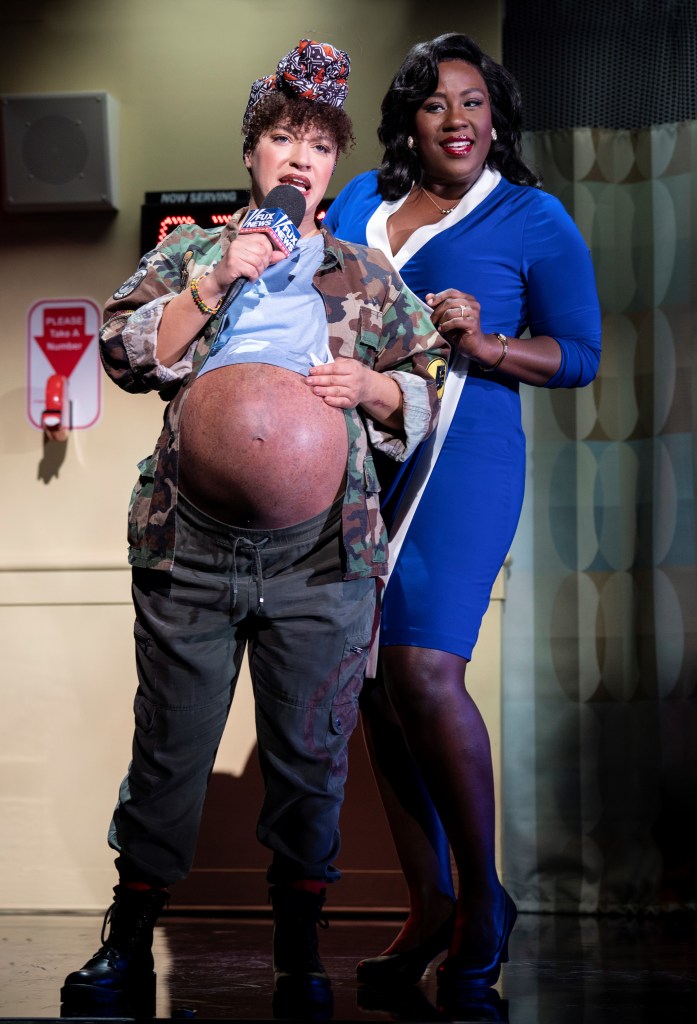
With the burial of Brother Righttocomplain, “Freeman” preaches “ain’t no mo strife, no more marches to be led, no more tears to be shed…” in celebration of a real “going home party.” Of course, when Pastor Freeman hears gunfire as the parishioners praise, sing and dance, reality makes its ugly appearance. With sirens, cop cars’ flashing lights and gun shots, the future descends during the Obama presidency and afterward to the annihilating Trump presidency.
Above the shouts of praise Marchand’s Freeman hears the overwhelming news reports of the Flint water crisis, deaths of Trayvon Martin, Oscar Grant, Aiyana Jones, Rekia Boyd, Jordan Davis, Alton Sterling, The Charleston Nine and countless others. The reports reveal Freeman’s overestimation of Obama’s power as a Black president to mitigate racial hatreds and alleviate the social oppression Blacks experience every day. The same discrimination and violence raises its ugly head, despite President Obama’s best efforts to stop it. So the foreboding harbinger of the Trump presidency’s return to Jim Crow 2.0 terrors hover, unless blacks hop on those flights to Africa on African American Airlines. If they evacuate, they will save their lives. If they stay, they lose everything including their black identity and will end up dead or in prison.
Of course Cooper’s Africa evacuation is what President Abraham Lincoln suggested as a way to solve the “negro question” after the Civil War was over. However, Frederick Douglass stood up to Lincoln and vociferously opposed leaving because the United States was their country since 1619, and their association would never be African because their tribal history had been taken from them.

As a solution to the hell of Black America’s unequal treatment under the law, evacuation to Africa is Cooper’s over-the-top response. It is a double irony considering that once again, Blacks are introduced to a new form of dispossession, alienation, abandonment and diaspora, while the oppressive white culture “owns” all of the historical contributions Blacks have made in the arts, sciences, government, technology, industry and every field imaginable. In the play African Americans’ contributions reside metaphorically in a lovely bag which flight attendant Peaches (the inimitable Jordan E. Cooper) tries to take with her as she attempts to board the flight. But symbolically, the bag cannot be removed to Africa. And trying to leave with it, Peaches misses the flight and loses her identity and everything she’s fought for as an American. She is reduced to the state of those who survived the Middle Passage and were set up to be auctioned off as slaves. But she is “keeper” of the bag and recognizes that she is left to represent Black culture and identity.
Another key point Cooper makes with the symbolism of the “bag” is that the greatest Black contributions have been forged in the crucible of slavery and subsequent decades of oppression as Blacks and the culture have changed laws to be more equitable. Black contributions are as indelible to who Americans are as a culture and society as the Native Indian lands are the foundation upon which this nation has been built and has prospered. Though white oppression and white supremacist tyranny vaults its own greatness in lies, ignoring such contributions, it is a dangerous oversight and underestimation of Black energy, vitality and creativity. American greatness is in its diversity, and the culture and society will thrive if no one is left behind or evacuated. We must work together and seek equity for all to be great (an underlying theme of Cooper’s play).
After the opening prologue the play’s structure alternates between vignettes of various Black Americans’ response to escape to Africa and Peaches’ growing frustration boarding passengers under a deadline as an exit strategy from the hell of the coming white oppression. Cooper’s Peaches is wonderful as the wired, loud, candid, funny flight attendant who prods her passengers with the consequences of staying: prison and confiscation of everything they own or death (transmogrification). With each vignette we are apprised of the oppression Blacks have been conditioned to which is the foremost reason why Blacks should leave.
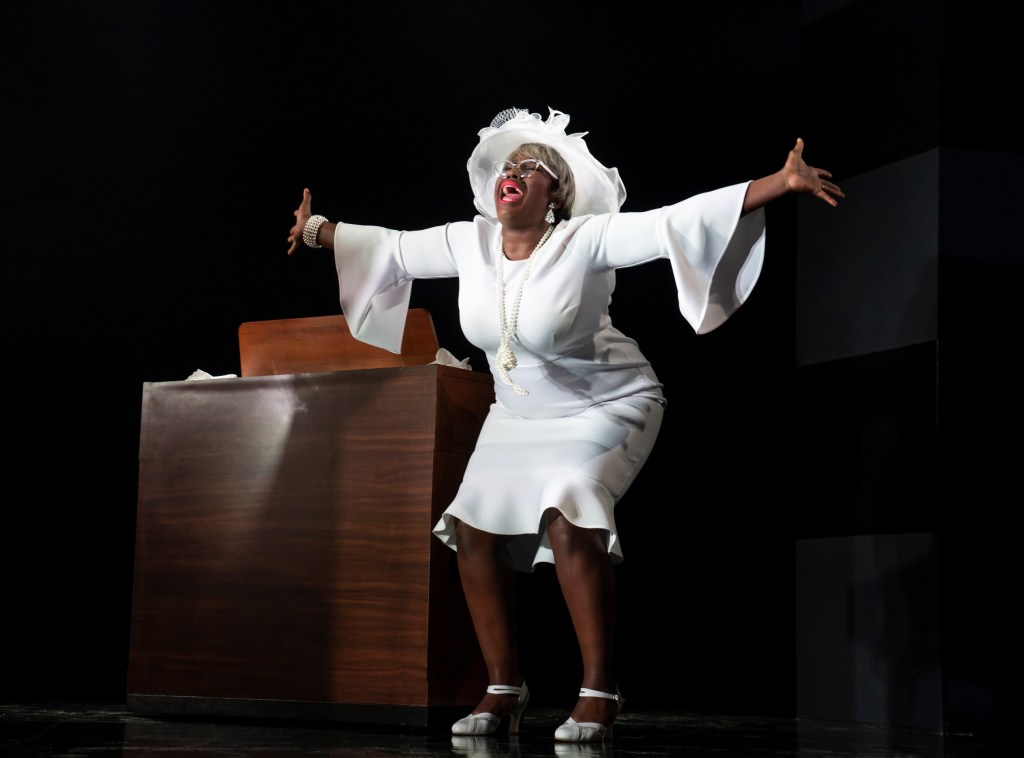
In the “Circle of Life” sequence which takes place at a clinic (since Roe vs. Wade was overturned with Dobbs, this is a particularly poignant scene) we watch the digital counter enumerate that are millions in line to terminate their pregnancies rather than give birth to a child whose days are numbered. Surely odds are they will end up as a statistic of police brutality, gang violence or other casualty of an oppressive culture which has come to kill those who drive or walk “while black.” Damien (Marchant Davis) tries to convince the pregnant Trisha (Fedna Jacquet) to keep his child rather than abort it. However, he is a spirit, shot to death, so Trisha who waits with another woman for almost two months finally goes into the room for the procedure as the plane arrives to begin boarding passengers in a humorous end of the scene as one pregnant woman thinks the plane is filled with the “9/11 bit*&es,” coming for their heads.
In a revelation of how Black identity is twisted and nullified by the culture, “The Real Baby Momas of the Southside” is a hysterical parody of any of the puerile reality series which reduce women to silly, gossipy, back-biting, angry, fools, whether black or white, as “benign” entertainment value. God forbid if this were a political show which demonstrated their intelligence and erudition. Instead, memes of what Black identity means come to the fore in this humorous and drop-dead serious send-up of shows which exploit the idea of “being Black.” Some of the funniest lines come when the women are off camera (the cameramen are white) and we discover that they don’t have children and speak without accents and epithets. We see the show is a blind to please and brainwash the audience, who enjoys seeing how “low-class” Black women are. Meanwhile, there are other ways of being, but this isn’t a show about how strong, forthright, powerful and intelligent Black women are.
“The lighter the skin, the better” is a reality Blacks have had to deal with because of white fascist physical mores. The trend has morphed over the decades into a perverse reverse. Other ethnic groups including whites have embraced the “Black ethos” in a perverse acceptance of only the superficiality of “being black” without accepting or recognizing any of the horrific sacrifices Blacks have made over their 400-year history in this nation. Cooper’s beautiful example of this appears on steroids with the character Rachonda, whose real name is Rachel (Shannon Matesky). She is a baby mama the others reject because she is white and is going through transracial treatments to become Black. When she is called out on it in a LOL moment by Tracy (Ebony Marshall-Oliver), Kendra (Fedna Jacquet) and Karen (Crystal Lucas-Perry), she reveals that she has no clue about Black American sacrifices and and just wants to ride the current wave of Black female “cool,” generated by Michelle Obama. She never receives the email inviting her to escape to Africa, caught between her memes and unconverted to her “full Blackness,” an irony.

In the last two vignettes before Cooper’s exceptional, heartfelt conclusion, the first reveals a wealthy Black family who embrace white upper class mores, genociding their own identity to convince themselves they belong to the superior, fascist, master race (like a celebrity who recently praised Hitler). By internalizing white supremacist values, they don’t even realize they have destroyed their identity, their souls and their uniqueness. Furthermore, by adopting the”white” ethos as the proud bourgeois class, they have trampled all those who have shed blood to advance the hope of achieving civil rights, equal opportunity and justice by overcoming institutional racism. The bourgeois family don’t believe they are oppressed because they live by the “green.” The supremacists would never come for them because they have money.
We don’t realize how brainwashed they are until Black (the amazing Crystal Lucas-Perry) emerges from her prison underneath the mansion where their wealthy father has chained her for forty years. Finally free, Black confronts them in one of the most wild, convulsively humorous and hyperbolic rants about their blackness and the imperative to leave for Africa. They are so “white-fascist-think,” the truth she speaks is anathema. They kill her (typical Black on Black crime). The neighbors hearing “Black” screaming non bourgeois are infuriated about it. They call the police right at the precise moment Black has been genocided.
The scene is a powder keg of dynamite performances which are memorable and tragic because the family believes that they are a different identity via the “green” (money). It doesn’t matter if they stay or go. They have already lost everything valuable about what their culture means. Staying, they lose their lives. Cooper’s theme is clear. An oppressive fascist culture has as its most horrific tactic, get blacks to destroy the finest traits about them, their Blackness, by rejecting it and internalizing white tropes. Without that Blackness, they embody the worst of the fascist “master race.” They genocide their own and themselves.
Cooper also identifies the Black, female prison population in a very powerful scene. When freedom is posited, one of the prisoners, Blue (Crystal Lucas Perry transitions to a completely different mien and aura) hesitates to leave. In great fear and rage from all the abuse of her past, she creates a situation where she almost destroys her chances for freedom and is killed (or never makes the plane and is transmogrified). How Cooper ends this vignette and the last one when Peaches doesn’t make the flight to join those evacuating the US, are memorable scenes. They leave the audience in awe. The majesty of the actors’ performances and the stark language laden with substance and richness are stunning.
It is a supreme irony that though there is not one Caucasian in his play, Cooper’s themes and messages are particularly for those who have been blinded to believe that their skin color exempts them from white supremacy’s tyranny. It is only a matter of degree. Despotism impacts everyone in the culture as Cooper indicates in the last scene of the play.
In the end scene, the jet pulls away as the Blacks leave for Africa renouncing everything to go to a safe haven, while Peaches is left “holding the bag,” though it cannot be pulled up from the very place on which it rests, having become rooted to America. Cooper’s hyperbole may seem a farcical extreme. However, what they escape in the play we all faced because of the tyranny of the former president, who weaponized of a pandemic which killed a larger proportionate number of blacks and people of color. The blasphemous white supremacist tyranny the Blacks escape via his play’s metaphor, in reality, incited an undeclared war against U.S. democracy in a violent insurrection to thwart the peaceful transfer of power when Trump lost the election. Cooper’s understanding of the murderous intent of white supremacy is divinely inspired. He is a veritable Cassandra in his ability to read the ominous signs and incorporate them in this play. So the point that the only safe haven from such white tyranny is a return to Africa has been made palpable in the Ain’t No Mo, 2022.
The work is breathtaking in its themes, performances, writing and artistry. Don’t miss it. For tickets and times go to their website https://aintnomobway.com/ You will belly laugh and be moved at the same time.
T
‘You Will Get Sick’ Linda Lavin is a Breath of Fresh Air

Sometimes the best way to accept the inevitable is to step into the realm of the fantastic and approach the unapproachable through magical thinking and an encouragement toward vacating reality. In You Will Get Sick by Noah Diaz, directed by Sam Pinkleton presented by the Roundabout Theatre Company, the unnamed characters traverse through unspecified settings and manage their lives of quiet desperation with humor and a sense of camaraderie that comes with a price. The price is avoiding the blinding truth until they are ready to receive it.
Daniel K. Isaac’s character is the emotionally distant, sweet #1, who has a phone conversation with Linda Lavin’s #2 at the top of the play. Initially, I questioned why they speak to each other since money is discussed upfront and it wasn’t clear what the exchange services were. However, when character #2 straightens out how she wants the money delivered, we discover she is an actor, is on a project and above all needs to supplement her finances. Character #1 eventually clarifies the services he pays her for in this absurdist, quirky play whose surreal elements are funny, surprising and metaphoric.
Interestingly, there is an internal war in character #1, which we may identify with at one level or another. He has been in denial about the severity of his illness. The initial service he requires of #2 is to listen to him as he tells her about his condition, so in the telling he can acknowledge what he is going through, confront it and then position himself to tell his sister. At least he knows he is in denial. Blindness related to not admitting the signs of disease when they first appear is a typical reaction, unless one is a hypochondriac, which #1 clearly is not. When we understand what #1 is going through, we consider COVID-19 deniers.The most extreme were on their death beds scorning their nurses and doctors’ COVID diagnosis. These went to their deaths with the peaceful conviction that anything other than COVID was killing them.

Though #1 isn’t as blind as those individuals, he can’t reconcile his illness. He can’t even admit to himself that his body is falling apart, that his hands are growing numb, that it is becoming harder to walk and impossible not to fall in the shower. His condition is incurable and there has been a diagnosis which we never learn. Yet, as the play progresses, #1 struggles with himself emotionally and must be as detached as possible to begin to comprehend that the plans for his life, his hopes and dreams have been shuttered by the drama that is overtaking his body’s ability to function.
Many youth who are immortal until they aren’t, think that illness is what happens to the old and feeble. However, this doesn’t appear to be Character #1’s thinking…that sickness is for the old. We discover later in the play in a discussion he has with his sister that he is aware that sickness can impact the young and kill them. In fact he took care of his sibling Patrick who was ill, maybe of the same disease, and nursed him until he died. So he is not a callow thirty-something. Clearly, taking care of his brother was a sacrifice of love, but it took its toll on him. In his discussion with his sister, #1 states he doesn’t want her to take care of him, nor does he want aides to help out. Somehow, he will deal with this on his own and allow the illness to take its course. The recognition of the impact of illness on family, since he has had that experience, most probably has overwhelmed him. Denialism and blindness allow one to transition to the truth gradually.
The first step in #1’s plan is to come back from denialism and face reality with someone who is not a relative. To do this and remain less emotionally overwhelmed, he decides to pay someone to listen to him reconcile the fact that he is “sick,” though he never frames it as an illness that is cutting short his life. That is a bridge too far, and one he is not ready to cross. Thus, Lavin’s humorous character #2 becomes the one to take on the impossible burden of listening to him as he describes factually what his body is doing. Character #1’s mind and emotions are so shut down, he can’t discuss this with his co-workers or his sister, just yet. Character #2 will help prepare him for those discussions.
Character #2 is desperate for the money and does odd jobs and takes acting classes so she can become good enough to audition for the role of Dorothy in The Wizard of Oz. Character #2 and #1 are idiosyncratic and pursue their own realities and somehow manage to accept one another’s weirdness with generosity so that what they both wish, they help each other achieve. The actors are superb in making the unusual seem regular with their direct, in the moment authenticity. Importantly, though they are not friends, #1 and #2 help each other feel less alone against the personal trials they face.

Character #1’s connection with character #2 strengthens after he sends her a check which he didn’t sign. That forces a face-to-face meeting which leads to other meetings, the next when he hires character #2 to tell his sister (Character #3 is Marinda Anderson) about his condition. When the three of them meet, Diaz constructs a humorous scene in a restaurant with a crying waiter (Nate Miller) that Pinkleton directs with excellent pacing for humor. After this meeting with his sister we understand the limitations of family and why #1 doesn’t want to bother her about what he is going through.
In addition to his illness, #1 faces another problem. He must escape the monstrous birds that sound like crows, who prey upon and kill the sick. Nate Miller’s character #4 plays a number of parts relating to the bird menace. One is a salesman who sells insurance to protect against the humongous birds. Another is a despondent waiter (he appears in #1’s meeting with his sister) whose mother was taken by a monstrous bird. Thus, on top of having to confront the deterioration of his body, #1 has to beware of these other worldly birds. Interestingly, #2’s attitude toward the bird attacks is sanguine, almost uninterested. She will stay well as an older person and help this thirty-something in his illness. Theirs is an ironic reversal of the natural order of things.
Character #2’s response to Miller’s bird insurance salesman sums up her reaction to most things at this point in her life’s experience. She tells him a choice epithet about where to go. Linda Lavin’s #2 uses epithets as seasonings to make her delectable, unstoppable character more immediate and no nonsense. Lavin, with decades of know-how has fine tuned her rhythm and timing for humor, cleverly waiting for the chortling laughter that always follows her character’s well-placed retorts.

Diaz messages a number of themes with these unusual characters who are fanciful but manage to be endearing because they are so vulnerable. Caregiving, Diaz suggests, sometimes requires allurements like money because family can’t always be counted on to help. Sometimes strangers are better attuned because they are not emotional and there are no problematic bonds. Characters #2 and #1 arrive at a congeniality of quid pro quos. #1 even goes to one of #2’s acting classes where they act out “lion” and “tiger” in a humorous segment which actually takes #1’s mind off his condition and physically helps him. Lavin is not only spry at 85-years old, her “lion” and “tiger” steal the show. Her spot-on performance has her addressing the audience and singing an audition song (for the part of Dorothy) in which she ends up in the wrong register. And after trying it a few times, #2 never gets it right.
For his part Isaac’s #1 handles the absurdist elements with authenticity. When he spits up the hay, symbolic of where he originated from, and representative of his illness, the action is weird and frightening, but believable. He negotiates the straw-man, scarecrow imagery in the later scenes with matter-of-fact acceptance. These segments and his apparent suspension (with special effects) suggesting tropes from The Wizard of Oz, an iconic story whose verities relate to the characterizations in You Will Get Sick, are fascinating to ponder. However, the playwright is a master of the opaque and uncertain, never really pinning down any particular truths apart from the fact expressed in the title and our susceptibility to our mortal state. That he delivers these themes gently with fantastic elements is enough.
Isaac’s character #1 echoes Dorothy’s wish to return home as related to The Wizard of Oz. Lavin’s #2 helps him achieve that wish as #1 helps #2 achieve her goal. At the play’s conclusion we note that the money #2 has received from #1 has allowed her to purchase a gingham dress and red shiny slippers so she can properly audition for the part of Dorothy, a dream she’s had her entire life.
#1 makes it home. For him home is in a field of hay (though wheat might be more metaphorical). There he meets up with his brother Patrick, Character #5 (Dario Ladani Sanchez) who joins him holding a microphone. It is Patrick’s voice we have heard (in voice over) expressing #1’s interior thoughts throughout the play.
At the conclusion we understand the importance of #5 in helping give #1 solace and comfort to keep his emotional turmoil at bay so he can function and find his way to “get back to where he once belonged.” At home in the field with Patrick, #1 is able to breathe freely, away from the noise and the hectic gyrations of city life. There, he seems well and is in his right place. The metaphors settle into a finality at the conclusion. Indeed, the human condition vies between sickness and wellness. As Diaz’s title suggests, humans are mere mortals. There is an immutable inevitably of sickness. During it, if we are fortunate, we will “get back to where we once belonged” (our home and what that means to us).
Kudos to dots (set design) Michael Kross and Alicia Austin (costume design) Cha See (lighting design) Lee Kinney (original music and sound design) Daniel Kluger (original music and sound effects) Skylar Fox (magic and illusions) Tommy Kurzman (hair and wig design) who bring Diaz’s play and Pinkleton’s vision of it to fruition.
Diaz’s daring, imagistic play is in its World Premiere at the Laura Pels Theatre, Harold and Miriam Steinberg Center for Theatre until 11 December. For tickets and times go to their website https://www.roundabouttheatre.org/get-tickets/2022-2023-season/you-will-get-sick/performances
In ‘A Christmas Carol,’ Jefferson Mays is The Masterpiece
Someone once said, “It is easier for a camel to go through an eye of a needle than for a rich man to enter the Kingdom of Heaven.” Increased with golden toilets, their own airplanes and wanting for nothing, the rich don’t need to believe in God nor be accountable to anyone. Indeed in Charles Dickens’ A Christmas Carol adapted by Jefferson Mays, Susan Lyons and Michael Arden, currently at the Nederlander Theatre, we recognize what it takes for a stingy, greedy, penurious rich man like Scrooge to transform into a generous, kind soul who demonstrates God’s love. Scrooge must be kidnapped by ghosts and taken on a spiritual journey toward a horrific ending. He must face the black night of the soul as death comes for him. If you’re familiar with Dickens’ story, you know the outcome. “Bah! Humbug!”
With Jefferson Mays in the driver’s seat of this truly heavenly Christmas Carol, directed by Michael Arden, running until 1st of January, we glory over Mays’ Scroogey ending. Employing magnificent performance skills honed to perfection, Mays brings to life Dickens’ popular story in a viscerally charged solo performance for the ages. The man of many faces, voices, gestures and personalities, Mays (Tony Award for I am my Own Wife) inhabits 50 or more characters to proclaim the message of goodness, love, joy and redemption in the true spirit of Christmas for audience members fortunate to catch him live this holiday season. He even portrays a cooking potato and enlivens the mist and fog that enters Scrooge’s chambers. Shriek!
Conceived by Michael Arden and Dane Laffrey, the production is an acutely tailored phantasmagoria of delight, fear, fun, strangeness and the macabre on steroids. It flies on ghostly wings at the speed of light and sound without an intermission, then it ends in Mays’ virtuoso curtain call to a standing ovation. Though you swear there are heavenly hosts that accompany him during his bows, look again. Yes, during the production there were many individuals onstage taking part in this amazing interactive storytelling. But no. Only he stands grinning in the spotlight pleased that the audience was hushed and enthralled, and suspended in time, caught up with him in the ethereal web of make believe, that is too real to accept for all of its mortality in immortality.
With the streamlined Mays, Lyons, Arden adaptation, Dickens’ prose is steadfast, ironic, cryptic, paired down to an acute sensibility so that Mays vibrates his instrument to produce Scrooge, Marley, all the Cratchits, his nephew Fred, Scrooge’s sister, Fezziwig, the Christmas spirits, Londoners and other souls and beings with pointed, sonorous, gravelly, delicate, squeaky, smooth, guttural vocal modulations. In other instances with a mere look, smile, shake of the head, shrug of the shoulders or flip of the hand, we see each member of the Cratchit family sitting around the dinner table. The scene is the centerpiece of Mays’ wit and whimsy assisted by no special effects because he IS the master of the “stuff” of kinetic presentation.
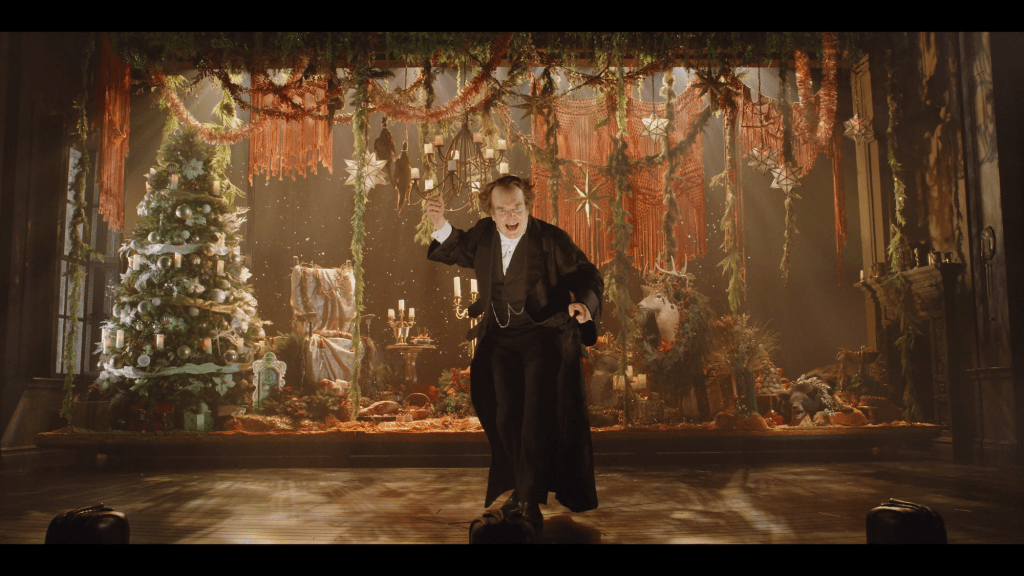
All these lovely and frightening individuals are authentically realized, as Mays fuses various genders, ages, mortals and immortals seamlessly with heartfelt, poignant and unmistakable generosity, a veritable melting pot of democracy. To say that Mays pours out every cell of his being to clarify Dickens’ message to update it for our time, is an understatement. With humanity he filters through his own soul the two most mortal of sins (a denial of God’s commands to love Him and love thy neighbors). Effecting this, Mays materializes and elucidates the stark, craven distinctions between the haves and have nots. Even Dickens, who railed at the predation of the owner class upon the worker class, shoved into debtors prisons and workhouses, would be proud to see what his words have wrought in Mays’ prophetic and brilliant enactments.
Clearly, this Carol slams the shameful indecency flying about the heads of grasping, rich owners like Scrooge and Marley whose greedy, hardened hearts perpetuate the impoverishment of workers in order to squeeze obscene profits for themselves because “they can,” for no one in the complicit government stops them.
But I have gotten ahead of myself. This production is without sentimentality, chiefly because with bounteous affection, Mays adheres to Dickens’ renderings. He allows the richness of Dickens’ words to organically inspire his every emotion, bringing a new understanding to what Dickens has achieved and revealing why this work is timeless.
The script is similar to the one that Dickens toured and enlivened himself with presentation foremost in his mind. The plot points are essentially the same, however, the creative team transfigures Dickens’ work, heightening it to a dimensional reality that is beyond our tangible realm. Dane Laffrey (scenic and costume design) Ben Stanton (lighting design) Joshua D. Reid (sound design) Lucy MacKinnon (production design) Cookie Jordan (hair, wig & makeup design), attend to details, carving them from Dickens’ language, lifting our felt experience to a transcendence that is breathtaking. Mays and the creative team’s efforts perfectly complement each other to reveal the characters like never before.
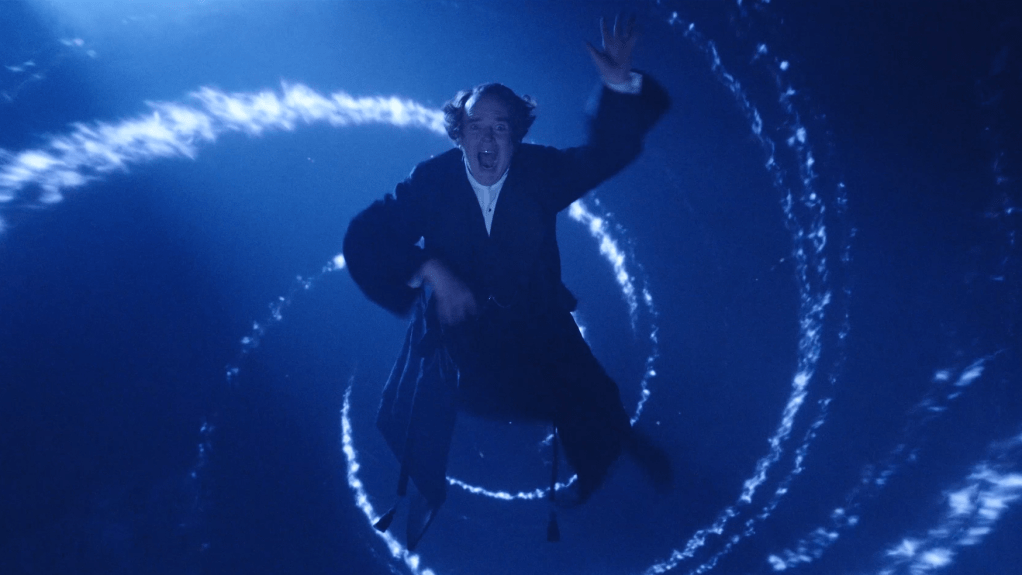
First, this version of A Christmas Carol is about darkness. Ebenezer Scrooge and his kindred partner in spiritual crime Marley, are souls without light. The moment the audience members enter, the show has begun. It is a viewing of a casket on a bier, surrounded by total stygian darkness, if not for the inky-greenish, backlit glow, eerily portending the supernatural after the irrevocable end to Marley’s mortal flesh. Then with a shock and thunderous clap, darkness and fear descend, snuffing out the light everywhere.
The evening I was present in the audience, there were nervous titters of laughing fear and what seemed an interminable wait which increased our tension. Then one, lone candle flickered in the palpable darkness, lit by “The Mourner” draped in black Victorian dress with top hat. Jefferson Mays, the narrator! Loudly, Mays proclaims the immutable fact that “Jacob Marley was dead,” to a community of mortals who, like Scrooge, don’t believe death will come for them. But then neither did Marley. The joke is a blasphemy to those who believe in money and no God.
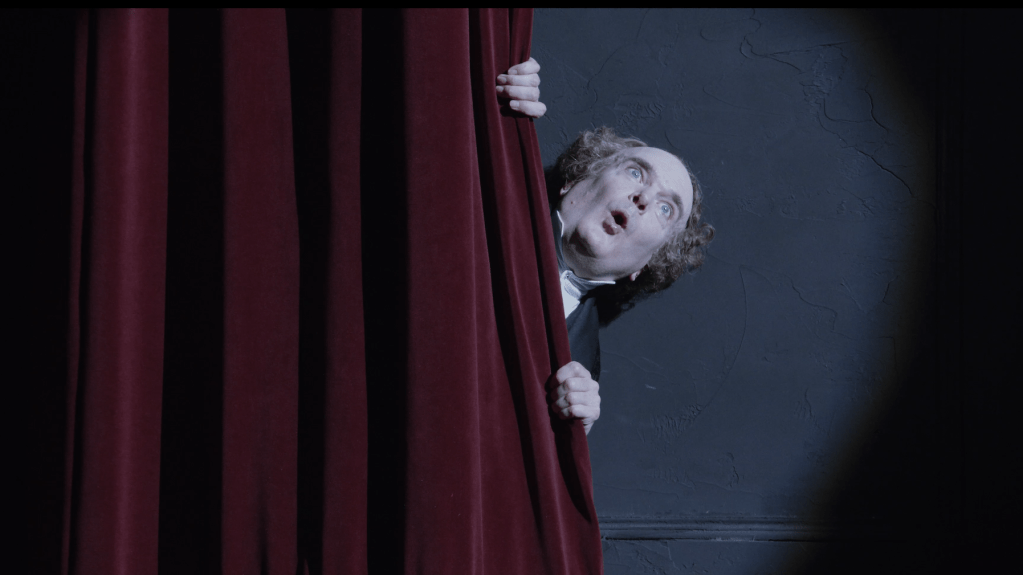
Well, mystery solved. We know that it is Marley who is in the coffin. But what was that horrifying loud clap like a door closing on light forever? As Mays makes his way across the stage to light another candle which sends a weak glow through the caliginous room, we are rapt, mesmerized by the creative team’s ingenuity to fill us with an anticipated dread. It comes as Mays’ narrator begins the tale of the man in the coffin and the frightening events that happen to his partner Scrooge on this night, Christmas eve, a night signifying that grace is available even to a man of wicked greed like Scrooge, who believes Christmas (God’s love and gift of redemption) is a “Bah! Humbug!” fiction.
There is no end to the shocks erupting throughout this spectral and darkly fabulous presentation. The frightening effects and accompanying sounds startle and thrill. I was amazed by the amorphous, yet defined steam engine pealing out whistles and chugging puffs of smoke; in the twinkling of an eye present, then vanished as Dane Laffrey’s scenic design, Ben Stanton’s lighting design, Joshua D. Reid’s sound design and Lucy Mackinnon’s production design evoked the setting of a Victorian London. In the drapes and accoutrements of Scrooge’s bedroom to the “horn of plenty” abundance of the the groaning table of Christmas Present, everywhere on stage and with that locomotive, the audience is there “back in the day,” 150 years before. Calling me to attention, the immediacy alerted my expectations. I barely had time to wonder what other ghostly remnants of the past like that steam engine would present the shifting atmospheres of time and place in present, past and future Christmases, when Mays was in his states of becoming. From crotchety Scrooge to cheery nephew Fred to beloved, Bob Cratchit, all three sprung into spontaneous interaction.
Throughout, I heard, maybe for the first time, Dickens’ precise word craftsmanship. For example in this script Dickens strings together acute descriptors of Scrooge’s covetousness-squeezing, wrenching, grasping, scraping, etc., and ends with an incalculably gobsmacking simile that identifies the man’s state of being as a result of covetousness: “Scrooge was as solitary as an oyster.” I’ve always appreciated Dickens’ genius. This production vaulted him to higher heights in my writerly estimation.
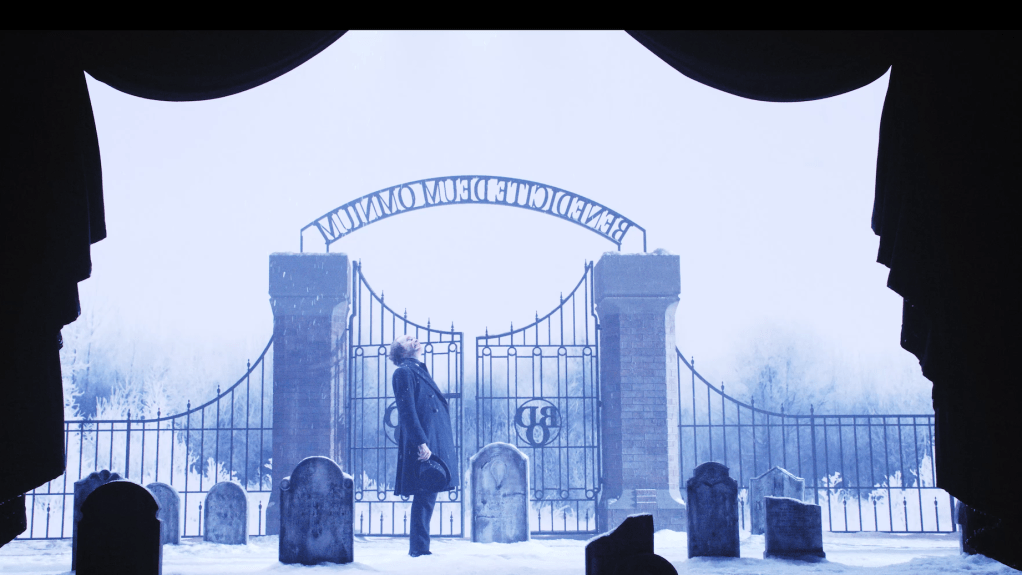
The thing is Mays is hyper aware of every word and he evokes its meaning with an appreciation of Dickens’ style, humor and ironies. And he wants us to catch these gems and have fun with them as he does. His performance is so immediate and embracing it is impossible to “intellectualize.” You just have to watch and react to whatever laugh comes up or be afraid of whatever fearful demon or entity comes next. I thought that the projected, darkness-filled children, one of which was pronounced to be “doom,” were particularly galling. With the darkness as it moves into the light-filled joy, Mays in collaboration with Arden and the production designers, creates a beloved tribute to Dickens’ greatness.
The emotions and reactions conveyed by various scenes are too many to enumerate. A few include Mays’ terrible infusion of Marley’s spirit, more chilling than Hamlet’s father for there is no surcease in his torment in a purgatory. Marley’s mortal sins have brought him to his irrevocable destination and he cries to be heard and listened to. That he visits Scrooge to reveal there are consequences in an afterlife where there is a God and where damnation is of one’s own making is grace enough bestowed on his partner in crime. Thus, Scrooge is taken up short at this visitation of one as godless and unbelieving as he. Mays’ seamless segues between Scrooge and Marley are incredible.
Likewise, as mentioned, the Cratchit scene is just superbly riotous. I found the wondrous Christmas Present segment one of joy, happiness, abundance and light. It is sandwiched between the previous Christmas Past scene of lugubriousness, and the coming gloom of Christmas Future’s portentous finality.
Of course for all of us, whether young or old, it’s memento mori another theme of this spectacular production. The incarnation of Death (Danny Gardner) when the creative team pulls out all stops is terrifying. It is enough to appall the most avuncular, sweet, scientific atheist who swears god is a fiction for frightened children. No wonder the irascible incorrigible goes down on his knees against such a being.
No more need be said except this production is a shining light, at a time when all around are dark hearts waiting to devour goodness and mercy because they can’t distinguish it from the light of joy the opposite to be “Bah Humbug!” fictions. Once live captured streaming two years ago, this live performance will most probably not be seen again, unless there is a return of grace in years to come. That’s why you should see it now. Mays is amaysing! For tickets and times go to their website: https://www.achristmascarollive.com/tickets/

