Category Archives: NYC Theater Reviews
Broadway,
‘The Lehman Trilogy’ is a Triumph, Review
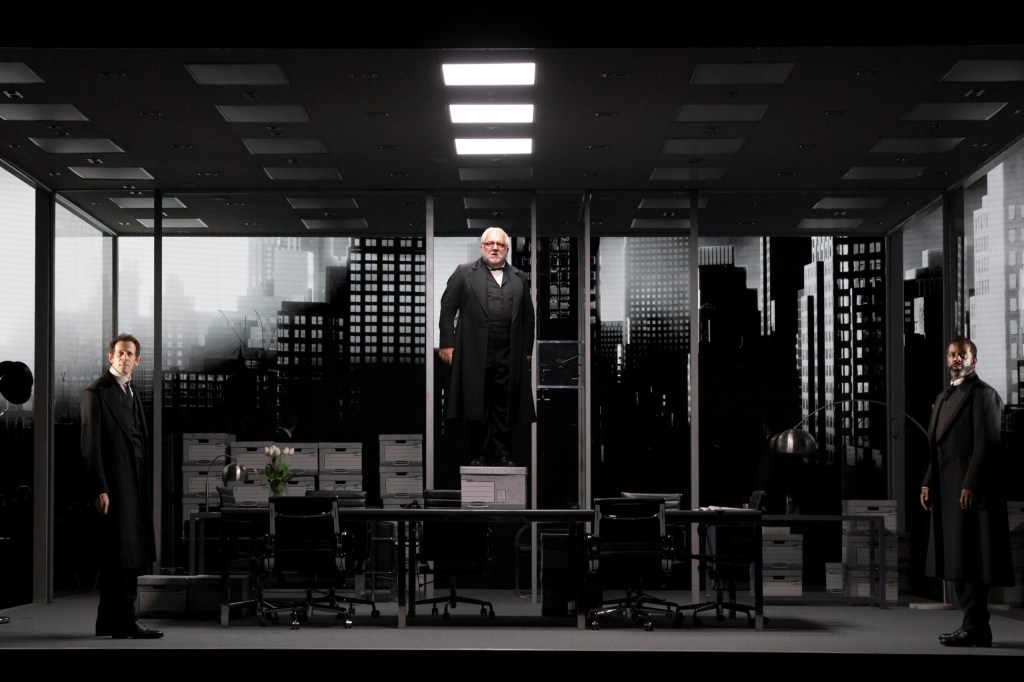
When you see Stefano Massini’s The Lehman Trilogy at the Nederlander Theatre, and you must because it is a majestic triumph which will win many awards and perhaps a Pulitzer, view it with an expansive perspective. Acutely directed by Sam Mendes, with a superb adaptation by Ben Power, the production’s themes highlight the best and worst of human attributes and American values. We see prescience and blindness, preternatural dreams and uncanny business acumen, along with unethical, unfettered capitalism and greed. If we are honest, we identify with this humanly drawn family, that hungers to be something in a new world that offers opportunity where the old world does not.

Humorously, poetically chronicling the Lehmans from their humble German immigrant beginnings, the brilliant Simon Russell Beale, (Henry Lehman), Adam Godley (Meyer Lehman), and Adrian Lester (Emanuel Lehman), channel the brothers, their wives, sons, grandsons, great grandsons, business partners and others with an incredible flare for irony and imagined similitude. Prodigiously, they unfold the Lehman brothers’ odyssey from “rags to riches” with a dynamism as fervent and ebullient as the brothers’ driving ambition which rose them to their Olympian glory in America.

The production is an amazing hybrid of dramatic intensity. It is an epic tone poem and heartbreaking American fairy-tale. It is a tragicomedy, a veritable operatic opus under Mendes’ guidance, Es Devlin’s fantastic, profound scenic design and Luke Halls’ directed, vital video design. Intriguingly, it remains engaging and edge-of-your-seat suspenseful through two intermissions and three hours. By the conclusion, you are exhausted with the joy, sorrow and profoundness of what you have witnessed. Just incredible! Three actors delivered the story of four generational lifetimes with resonance, care and extraordinary vibrancy. They are so anointed.

At certain moments the audience was silent, hushed, enthralled; no seals barked or coughed out of fear of disturbance. Perhaps this occurred because The Lehman Trilogy threads the history of antebellum America and the story of the most culturally complex, diverse and extreme (i.e. poverty and wealth), city on the globe, New York. Indeed, the audience watches transfixed by the magic of what “made in America” means, threading the poisoned soil of slavery to what “made in America” means today in an incredibly complicated and even more slavery poisoned institutionalization of economic corruption etherealized.
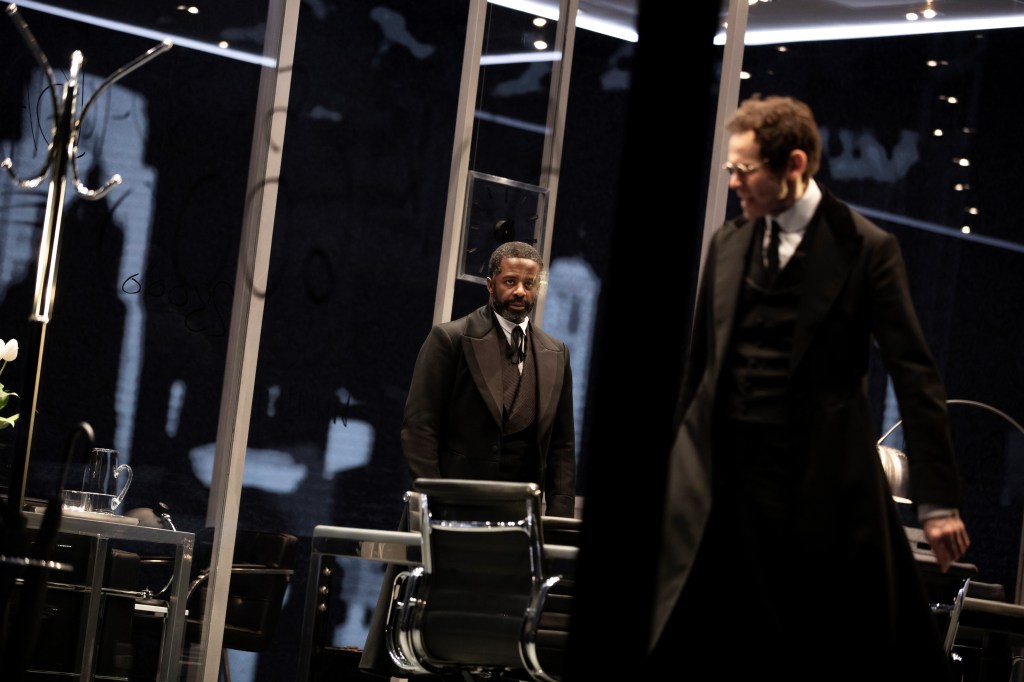
One of the subtle arcs of Massini’s and Powers’ Trilogy follows the growth of this corruption in one family as they expand their business. The brothers’ ambitious fervor morphs in each generation (the actors of the succeeding generation play the sons and grandchildren), until by the end, when Lehman Brothers is sold and divided up and sold again, when there are no more Lehmans involved in running an empire that still carries its name, we understand that outside forces and individuals have caused the interior dissolution via excess, greed and spiritual debauchery.

Especially powerful is the last segment of the Trilogy, “The Immortal.” After the second segment, “Fathers and Sons” concludes with the first and second suicide of the 1929 crash, the third segment continues with more suicides on that cataclysmic day as the debacle of selling goes on. And the segment ends in September 2008 a minute before the fateful phone call that no one is bailing out Lehman Brothers which becomes the sacrificial lamb that fails, while other firms are “too big to fail.” How American!

It is a keen irony that Lehman Brothers survives the 1929 crash. Indeed, they make it through the Civil War, WW I, the stock market crash and the great depression and WW II. Lehman Brothers is successful after the internet bubble burst and it moves steadily into the mortgage market mess in the 21st century until…it collapses. During the last Lehman generation, we watch how Bobby’s takeover and presidency shifts the perspective with regard to personal life and business; all is reform, even his religious observance. No longer do the Lehmans sit Shiva for the passing of a Lehman according to Talmudic Law; only three minutes of silence are allowed to recognize the passing of Bobby’s Dad, Phillip, before the business of Wall Street resumes in their offices.

Thus, by degrees, Lehman Brothers meets the future; the sun never sets on the huge investment bank with global centers everywhere which Bobby and his partners govern. The name becomes “immortalized,” even as Bobby symbolically dances into the future decades after his death. Adam Godley’s nimble movements are phenomenal in this dancing scene with the actors symbolically twisting Lehman Brothers into the success of the Water Street Trading Division and beyond. It’s hysterical and profound, a dance of ironic immortality which can’t last. No one thought Lehman Brothers could go bankrupt, but it is fated to. According to the brilliant themes and symbols (golden calf, golden goddess, tight rope walker), and ironies of Massini and Power, Lehman Brothers reaches its own apotheosis in the last moments of the production. Then the phone call comes and it’s over.
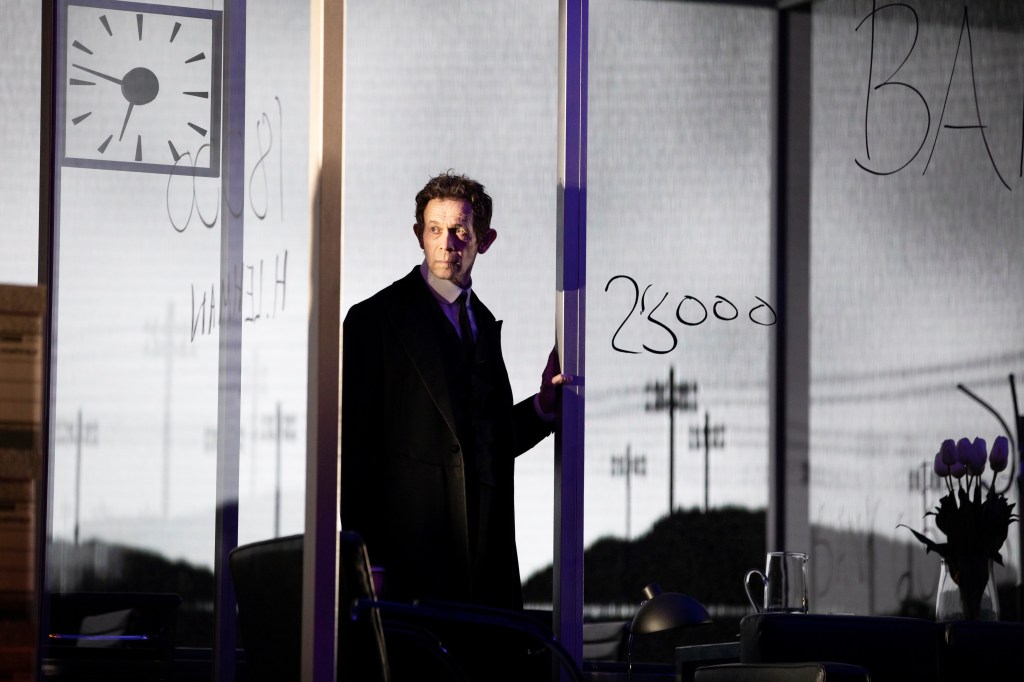
It is clear that after the last Lehman dies, others who take over (Peterson, Glucksman, Fuld), apply their own meretricious agenda on Lehman Brothers, defying good will and sound sense. Indeed, the entity that falls to its destruction is nothing like what Henry, Mayer and Emanuel and their progeny imagined or would have supported. Is this disingenuous? Massini, Powers, Mendes and the actors make an incredibly convincing case. Without the guiding influence of Judaic values and the mission that only the original family understood, Lehman Brothers is “Lehman” in name only. All of the meaning, value and venerable history have been sucked out of it.

Thus, is revealed the import of the conclusion. The once sound mission of Lehmans, under-girded by the values of the Talmud and Judaism is no more on the material plane. It exists in an infernal infamy, a cautionary tale of the ages. So it is fitting that in the last scene in the afterlife, one minute before that fateful phone call on September 15, 2008, Henry, Meyer and Emmanuel say Kaddish, a prayer for Lehman Brother’s demise. The dead bury the dead. Pure genius.

Massini’s/Power’s metaphors, Mendes and the actors understand and realize beautifully. They toss them off as so many luscious grains to feed off intellectually, if you like. Es Devlin’s revolving through history, glass house structure (just begging to have stones thrown at it), which the actors write on graffitizing the importance of Lehmans’ historical name-changing success is amazing. The turning platform and “see through” glass adds a profound conceptional component to the themes of money, power, finance and the energy of entrepreneurship. Luke Halls’ impactful video projections (the terrifying dream sequences, the burning Alabama cotton fields, the digital signals of the derivatives markets, etc.), enhance the actors’ storytelling with power. So do Jon Clark’s lighting design and Nick Powell’s sound design. Not to be overlooked Katrina Lindsay’s (costume design) and other creatives must be proud to have helped to effect this production’s greatness. They are Dominic Bilkey (co-sound design), Candida Caldicot (music director), Poly Bennett (movement).
There is more, but let peace be still and award The Lehman Trilogy sumptuously, all voting members of various organizations. It is just spectacular. For tickets and times go to their website: https://thelehmantrilogy.com/
NYTW’S ‘Sanctuary City’ at the Lucille Lortel Theatre

One of the most fascinating elements of the superb Martyna Majok’s Sanctuary City, directed by Rebecca Frecknall, is the symbolic stylization conveyed by the script. Majok’s script is a powerhouse. It is rhythmic, poetic and a rap of eternal, brief moments of brilliance in time. Majok’s layered work elucidates how relationships begin, not with long conversational pieces, but with connecting, truncated slips of thought. She suggests that relationships evolve through the power of memory and imagination, the interactions between “B” (the adorable and heartfelt Jasal Chase-Owens), and the emotionally wired “G” (the wonderful Sharlene Cruz,). These prove to be fatal, fairy wisps in the first part of the production.
Frecknall’s staging on a bare, raised platform, sans props and any theatrical spectacle, requires that the audience focus on Majok’s words which, abstracted, are short, repetitive bursts. For emphasis and effect, Frecknall follows the brief, seven word or less sentences with brilliant strobe light flashes, denoting flashbacks and changes of scene, situation and time. The intriguing lighting and set design are by Tom Scutt and Isabella Byrd with Mikaal Sulaiman’s sound design.

The effect, revealing the stress and anxiety of the characters, recalls the dislocation and alienation that characters experience in plays like Beckett’s Waiting for Godot. Such stylized dialogue brings to mind the mission of Theatre of the Absurdists, who highlighted the incapacity of language to convey emotion and heart. When human beings experience trauma, internal isolation and nihilism to a devastating extent, verbalization seems impossible.
Thus, as teenagers “B” and “G” move and re-position themselves onstage. As the portray these characters Chase-Owens and Cruz, offer fragments of memory recalling the past with intensity. Engaged, we follow intently, discovering that they are illegal aliens. “B’s” mom is fed up and intends to return to a country that her son was too young to know. “G’s” mom is oppressed and abused by the partner she lives with who also wallops “G” for good measure when she gets in the way. “G” and “B,” who are archetypes of dreamers everywhere, have parents who are single women. Hampered by fear of reprisal and intimidated by threats of deportation, the mothers are unable to make comfortable lives for their children. They struggle to do their best, but instead “B” and “G” are brought into a cold, indecent, alien world of devastation without citizenship.

We watch in the dim light and lightning-like flashes how Cruz’s “G” often climbs up the fire escape seeking “sanctuary” and help from Chase-Owens “B.” The abuse, arguments and chaos at her apartment create phenomenal stress; she must leave. “B” welcomes her and eventually she sleeps in his bed and they have sex to make a connection so they feel less alone. Both confide in each other, encourage each other at school and “dream” of better times which eventually do happen for “G.” The superb actors create a relationship dynamic that is believable and vital. Interested and invested in their prodigiously skilled portrayals, we stay with them throughout the play.
The setting is New Jersey in 2006, in a country which ill uses its immigrants because political parties have exploited the issue of citizenship as a way to consolidate power. For “B” who fears getting caught and being deported, the emotional terrors are like a war of attrition that force him and his mother to live an impoverished pressure-cooker existence. They wait daily for the explosion to occur, of their being caught and deported.

We discover through the light flashes and their circular movements on the platform, that “B” and “G” trace the chronology of their relationship in staccato bursts of memory. These lead to an apotheosis at the play’s conclusion. We empathize with “B’s” concern for his mother, who suffers abuse and bullying from her employer. She obeys his every word, and overlooks his skimping her pay. His disrespect is better than returning to the homeland, until she reaches a point of no return and decides it is enough.
Thus, Majok reminds us continually by examining the plight of “G’s” and “B’s” situation, that immigrant women are often sexually abused and beaten because they have no leverage. As in the case of “G’s” mother, orders of protection are useless because the partner can call INS (currently ICE), and have them deported, if they don’t comply sexually. Indeed, once the partner exhausts the mother, the implication is that he will come for “G.” At times “G” shows up at “B’s” bleeding and bruised by his wanton brutality.

However, hope does come. And in the same stylized format of language, “G” tells “B” that her mother got her papers and miraculously, “G” is a citizen. That moment of G’s” joy causes “B’s” searing pain. While “G” no longer fears discovery and looks forward to their moving away from her mom’s monstrous partner, we note “B’s” sadness and envy. He is stuck. His mother is going back to the “homeland” and his confidante and ersatz lover has “made it” to a more superior position in the immigrant pecking order, while he must wallow in her wake, facing the shadows of fear and oppression alone.
It is at this juncture that a turning point occurs. The guilt “G” feels about her position in comparison to “B’s” situation wears on her. She forms the idea that as he has given her sanctuary, perhaps she can do the same for him. Her method is to select the way to citizenship immigrants have employed for decades. After all, she has feelings for him and is willing to risk her life offering to marry him, though, if discovered, she possibly would lose her own citizenship, be fined and jailed after he is deported.
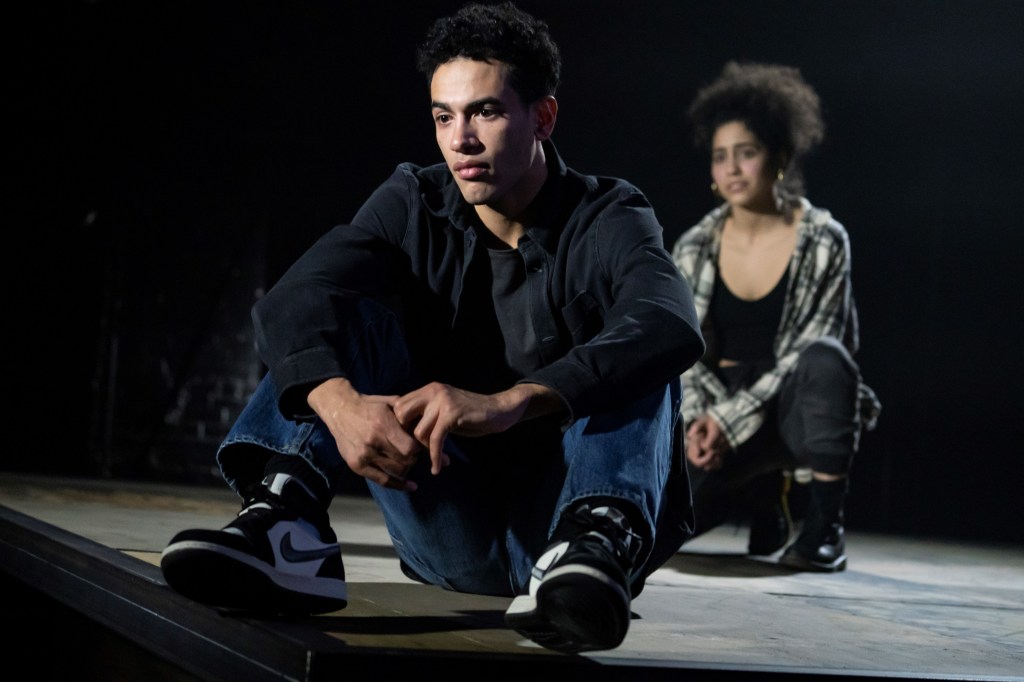
Majok’s script sags when the plans evolve for “G” to help “B.” Perhaps due to the continued flashes of light and whirl-y-gig staging, the sameness becomes tedious. However, there is the wonderful and welcome respite of their dancing and going to the prom with additional colorful lighting. The diversion from the stasis of the repetitive stagnant (the symbolism is apparent…no need to bludgeon the audience), might have come sooner.
And then comes the transformation of a three-year hiatus which Frecknall announces with sound effects and darkness both of which are symbolically ominous. Subsequently, Henry (the excellent Austin Smith) comes onto the threshold of “B’s” life to provide safety and emotional sustenance as “G” once had, until she returns, and the three clash. In this second sequence of events, all is light with no obfuscation. “B” and “G” no longer maneuver around each other. Their dynamic is straightforward. Now, it is “G” who must sink or swim in her emotional guilt while “B” makes a decision about citizenship and sacrificing love.
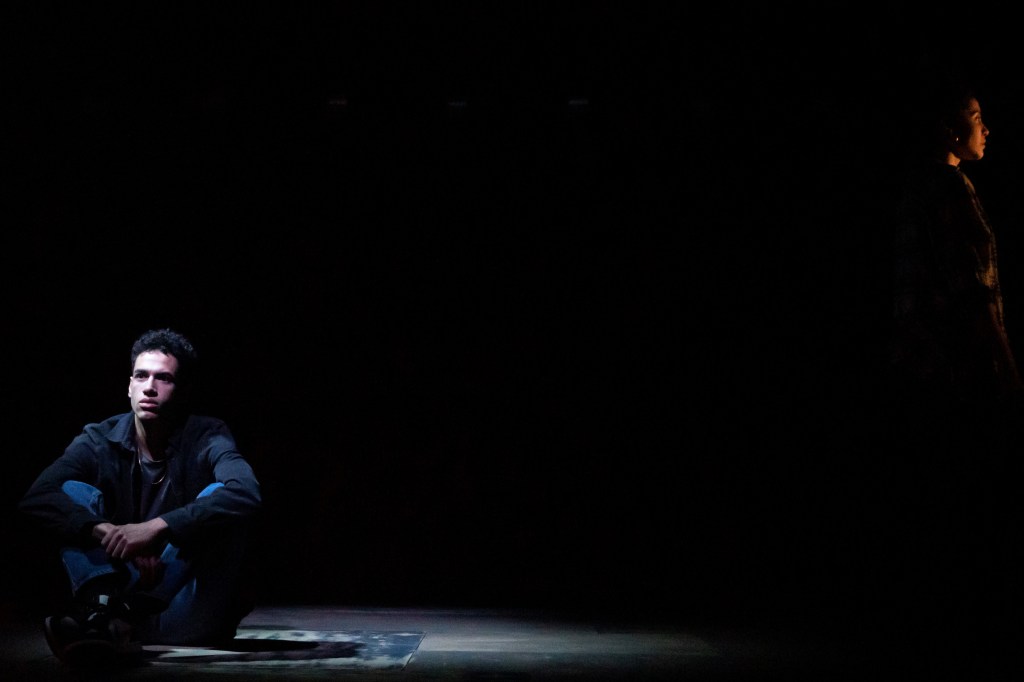
What happened to “G” and “B’s” compact, their relationship, their closeness? Majok presents the stark themes. Immigrants and illegal aliens are compelled by political forces to behave in ways counter to their altruistic good will and sense of decency. Of course, this doesn’t just pertain to those trying for citizenship. It doubly applies to citizens who have become mentally and emotionally inert and are inured to the sensitivities of others because they are weighted down by materialism and consumerism. In other words, they having forgotten “where they came from.” Ironically, the country then, no longer becomes a sanctuary, but a prison that has sucked their life force dry.
These themes are only a few of those that Majok covers in this play of antitheses: of connection and isolation, of compromise and extremism, of fear and hope, of dislocation and community, of alienation and unity.
Through various administrations, we’ve closed our borders following the need of politicians to use immigration and immigrants as playthings to boogeymen citizens and grow their political power base. Sanctuary City shines a unique light on the PTSD that arises for those who want a better life and are willing to risk their substance to dream big and/or help others who are lost in limbo between citizenship and deportation; those who wait for the light of deliverance. Majok’s writing is poetic and austere with the rhythms of immigrants’ and aliens’ voices and silences.
Kudos to the technical team that melded the elements lighting, sound, stage design, etc., to reflect the themes and sync them with the beautiful movement, and symbolism staged and directed by Frecknall. Her acute talents exceptional and show insight, precision and intuition.. If you can get down to Lucille Lortel Theatre to see Sanctuary City before it closes this weekend. you will be happy you did. For tickets and times go to their website. https://www.nytw.org/show/sanctuary-city/
‘Chicken & Biscuits’: Delicious Farcical Fare @ Circle in the Square

In this current time of COVID when our country faces daily crises of social disunity, dangerous political extremism, economic injustice and abdication of sound public health practices by craven Republican governors, Chicken & Biscuits written by Douglas Lyons, directed by Zhailon Levingston appears to lack currency on superficial inspection. Benign family squabbles, sibling rivalry, death and succession, a same-sex relationship, such subject matter at the heart of the play is quaint fare for a comedic entertainment that offends no one.
Except Chicken & Biscuits neither lacks currency nor is a quaint, “sitcom,” family comedy. Its levity and humor smacks of farce and satire with dead-on threads of truthfulness. However, if one is dreaming, much will slip past in the twinkling of an eye in this play about black culture, family and the foundations of faith that undergird the best hope for the black American experience in a racist culture that hovers invisibly and surfaces surreptitiously in Lyons’ one-liners.

The occasion is the funeral for the father of the Mabry family. He was the pastor of a Connecticut Pentecostal-type (there is a bit of dancing in the spirit) black church. Succeeding him in the position is Pastor Reginald (played with humor and oratorical fervor by Norm Lewis). The imposing, ambitious, dominant matriarch Baneatta (the funny Cleo King) whose resume would make any ignorant racist’s head spin, stands by his side in the church family.
Gathering with their parents are daughter and son: the accomplished Simone (Alana Raquel Bowers) and actor Kenny (Devere Rogers). Rounding out the family “going home” celebration are Baneatta’s hyper vivacious sister Beverly (the gloriously out there Ebony Marshall-Oliver) and Beverly’s enlightened, wise-cracking DJ daughter La ‘Trice Franklin (the buoyant Aigner Mizzelle). To spice up the explosive, sometimes irreverent proceedings are Kenny’s Jewish lover, Logan Leibowitz (the LOL Michael Urie) and mystery guest Brianna (sweet NaTasha Yvette Williams).

Before the guests arrive Reginald counsels Baneatta to relax and not become embroiled by family machinations. We note Baneatta’s stresses when she prays to God for patience in a humorous riff about her sister. During this preamble to the funeral service, others step in and out of the vestibule. They share their hysterical misgivings and woes about the family interactions to come.

The staging at the Circle in the Square is finely employed; the flexible set design by Lawrence E. Moten III and clever rearrangement of furniture and props serve as a church basement, sanctuary, nave and more. The modern stained glass windows and wood paneling upstage center, flanked by paintings of a black Jesus and crosses on both sides, serve to create the atmosphere of a thriving church. The underlying symbolism is superb as is the assertion of freedom from the typical forms of bondage Christianity.

Each family member, an ironic stereotype of themselves, identifies the complications that will arise as emotional storm clouds threaten on the horizon of the funeral and aftermath. Kenny attempts to soothe Logan who has been disrespected and largely ignored by Baneatta and Simone who cannot brook Kenny’s being gay, nor his attraction to a Jewish white man. When we see them in action with Logan, we note their austerity of warmth with mincing words and behaviors. As they watch him founder in blackland Christendom with two strikes against him, his whiteness and his gay Jewishness, he crumples instead of standing to and giving it back for fear of offense. These scenes are just hysterical and we see beyond to the strength and character of the individuals and their weaknesses.

As Logan, Urie’s ironic, humorous complaints to Kenny when they are alone, set up the tropes and jokes which follow as we watch how Baneatta and Simone treat him like a rare breed of exotic who must give obeisance. Hysterically, Kenny breezily abandons Logan to their clutches: it’s sink or swim time for Logan. Urie plays this to the hilt authentically, riotously with partners, King and Alana Raquel Bowers as the straight women who “bring it.” Watching this is both funny and upsetting. The women are intentionally clever. Their response is anything but Christian, loving and warm, but who is playing whom? We are reminded of the hypocrisy of evangelical churches to the LGBT community who engage in political Republican actions. Though this is a church in Connecticut and its members are most probably Democrats, the similar odor is clear. We wonder, can the situation evolve for the better? Can they achieve common ground?
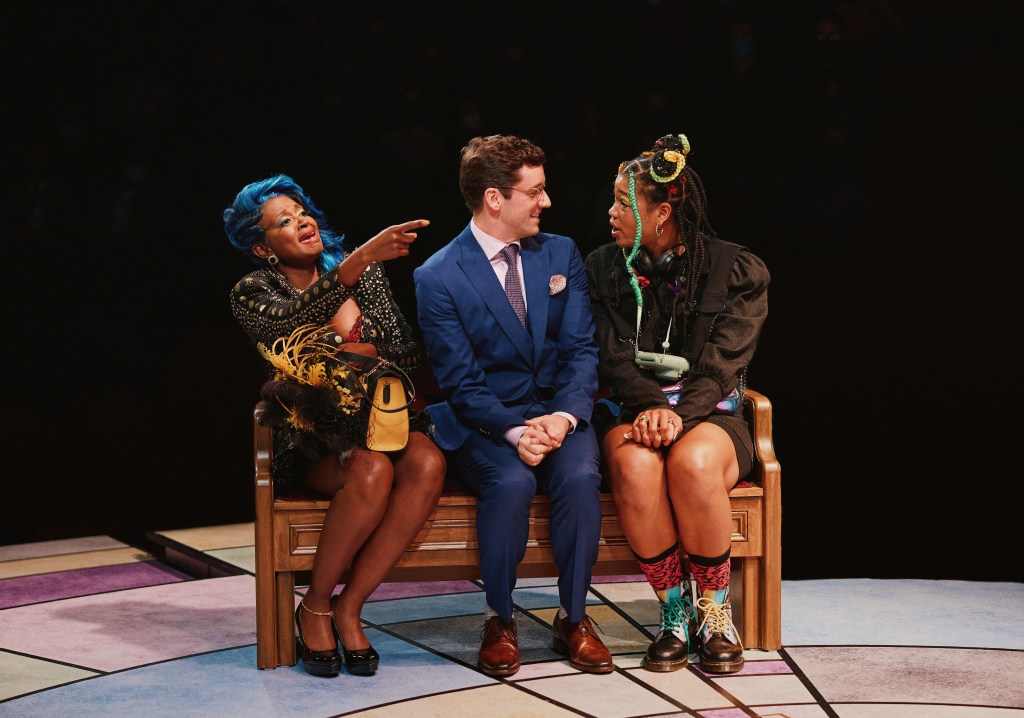
The only one who accepts Logan with Christ’s unconditional love and hugs is Pastor Reginald. And Logan longingly remembers that Reginald’s Dad (who we discover to be a waggish, wild pastor) showed the same love. For Logan it is no small comfort, but apparently this open behavior was typical of the deceased pastor’s liberalism and Christian equanimity.
Obvious is the clash between lifestyles and personalities of the sisters: the educated achievement-oriented Baneatta, and the wild, flashily dressed, divorced and “out-there” Beverly and her DJ, hip, savvy, “ready for her social media celebrity” La ‘Trice. Mother and daughter counsel each other to “shut it,” projecting widely but not seeing their own faults and outrageousness to care to change. They do it because they are funny and they laugh at themselves. Do they have anything better to do being who they are? Marshall-Oliver and Mizzelle make for a great mother-daughter team.
Truly, the women dominate this world as the service, the sermon and eulogies get underway. Their behaviors and actions are at various proportions of farcical and funny as are all these typical, atypically drawn individuals.

Nevertheless, underlying the laughter and stealthy ridicule of each character being themselves, we get the importance of family and faith community. Despite the miry clay conflicts that emerge as part of the whirlwind of events that race through the play to the end revelation, these individuals have each other’s backs. And entry into the family, as Logan discovers, is not easily won. However, when it’s won, it’s forever.
The service is down-home (different from evangelical) with the hope of less hypocrisy via a more spiritual relationship with God. Thus, when the Pastor preaches in the spirit and dances a bit in the spirit, the audience even takes up the “Amens” in concordance. Indeed, the hope of a better way flows from Pastor Reginald’s fountain of faith. And by the conclusion of Chicken & Biscuits, a better way has been found in the dynamic of each of the family relationships, catalyzed by a mystery guest that Baneatta feared and kept secret for most of their lives.
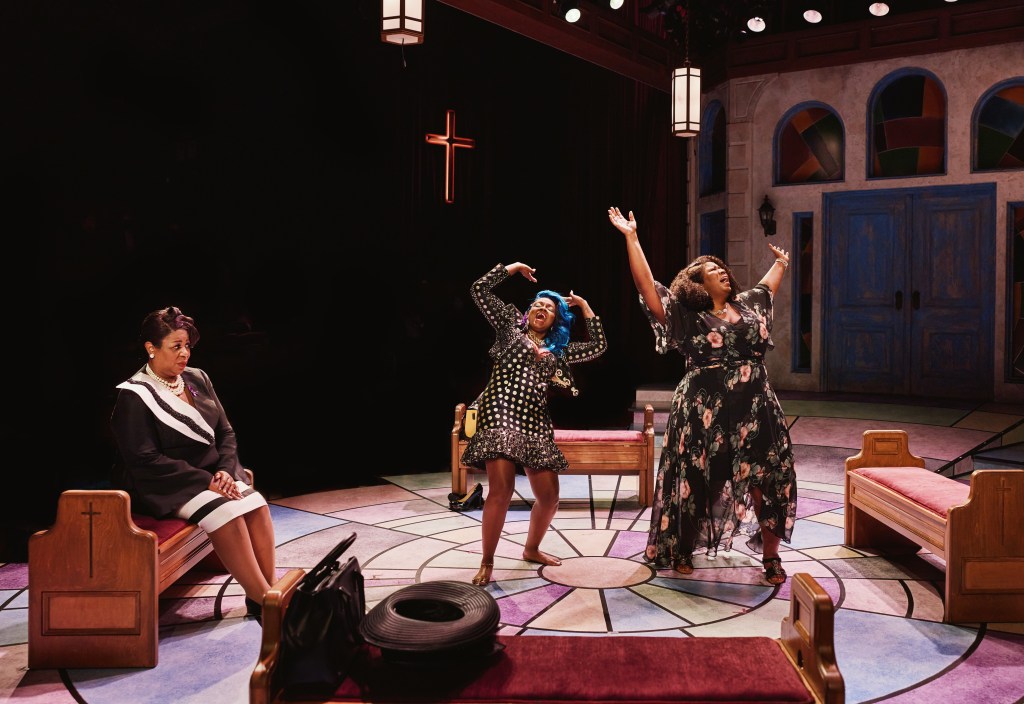
Chicken & Biscuits serves on many levels. For those who enjoy a riotous comedy/farce with characters that tickle one’s funny bone continually, this is the perfect play. For those who enjoy being entertained, yet also enjoy the illumination that comes when thematic truths about life and people are cleverly revealed without preachy presentments, then this play surely delivers. For those who value the unity of family that never devolves to hatred, division, anger and bitter insult and rancor, the play is a portrait of a black family which resonates through the medium of satire and good will.
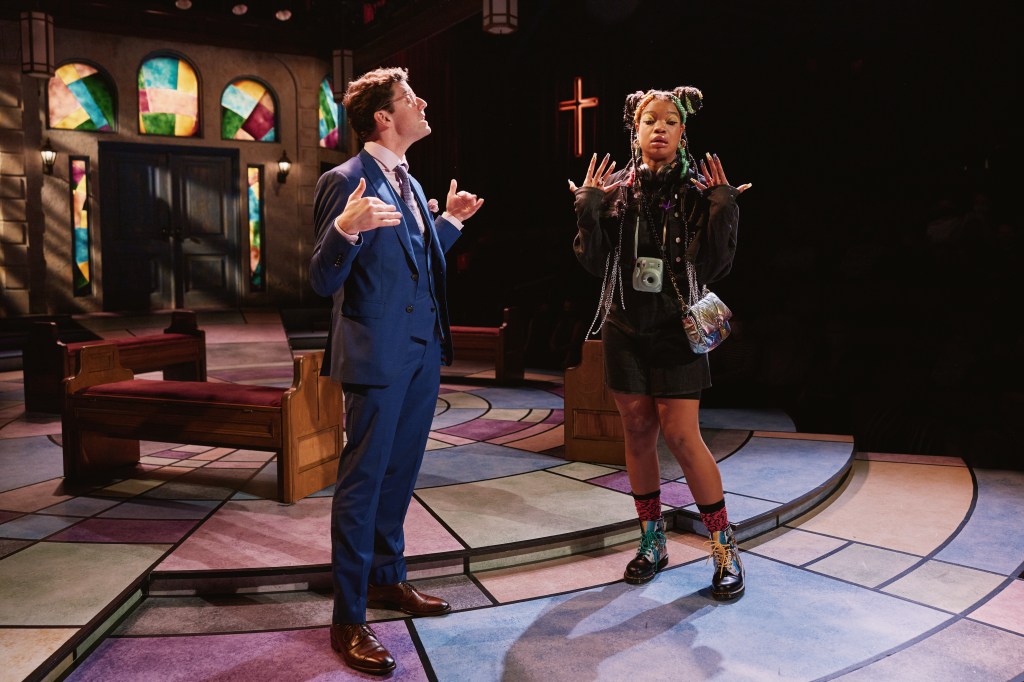
Kudos to Nikiya Mathis for her hair/wig and makeup designs: I loved her cool hair design for La ‘Trice, and Baneatta’s sober, contrasting hair and hat, to Beverly’s unsanctimonious hair and feathery headpiece. Simone’s hair design was just luscious. And additional kudos to Dede Ayite’s great, character revealing costume designs, Adam Honoré’s beautiful lighting design and Twi McCallum’s sound design. Their assistance was superb in making this a wonderful romp with circumspection if you divine it.
You need to see Chicken & Biscuits for the cast’s excellent ensemble work, Levingston’s direction and Lyons’ uproarious writing. In all its satiric humor about family “types,” the production took me away from divisive political rancor and stereotypes that follow. Chicken & Biscuits is a welcome joy. For tickets and times go to their website. https://chickenandbiscuitsbway.com/
‘SIX the Musical’ is Glorious Fun!

It took over 500 years for the six wives of Henry VIII to finally remix history and set the record straight, which they do nightly on Broadway in SIX the Musical at the Brooks Atkinson. What a phenomenal fun time to join these ex-wives in their exclusive club as they dish up the failed monarch, who is driven to upend the Catholic Church, lie, steal and kill in the name of gaining a male heir. We’ve had enough mansplaining about Henry’s actions. It’s time for the ladies!

Gloriously, these ex-wives take back their queenly power, rudely wrenched from them by Henry’s cruel machinations: divorce, decapitation, expulsion. And in sisterly collaboration they raise their voices which becomes a chorus of jubilation and foot stomping exuberance to vacate the patriarchal, historical perspective and lift up their identities, apart from the monarch, who never got the best of them. With their audience fandom singing along, whooping and applauding rhythmically during the songs and especially in the final song “Six,” it is enough to rock Henry VIII in his moldering grave in St. George’s Chapel, Windsor Castle. Can you hear them, Henry?

Toby Marlow and Lucy Moss in an inspirational fit of glory have come up with one of the most joyous and meaningful concepts that wraps history in a modern, insightful, revealing perspective, as told by women who are great in their own right. And in the retelling of their stories, we realize because of who these women were/are, Henry VIII is one of the most written about monarchs in British history and media (TV, plays, movies). The women are the central focus in SIX the Musical as they should be. This marvelous production is mind-blowing, refreshing, profound.
Why do Marlow and Moss, and Moss and Jamie Armitage, who both directed succeed in this show first presented at the Edinburgh Fringe in 2017? They enjoin historical facts with hot rhymes and rhythms and rock/pop concert fever topped off with a dynamic, explosive, vibrant, “It’s showtime” cast and creatives.

The design, look and feel of this Renaissance of light and sound knocks the audience’s enjoyment into the heavens. All design elements cohere with the theme, showcasing these women as stars. The women’s story deserves this futuristic retelling. Hence the sparkles and spangles and beads and sci-fi metallic-looking brilliance, thanks to Gabriella Slade’s out-of-this-world costume design which makes sense. Indeed, with Emma Bailey’s sensational set design and Tim Deiling’s equally eye-popping lighting design, the exuberant grandeur is fanciful, magical and funny. It has all the smattering of the Renaissance royal court in a mash up of pop/rock elegance.
Importantly, we’ve come to hear each of the women relate their story, especially the ones we are least familiar with. Initially, they tell us this is a competition of songs and virtuoso singing. Who is the most miserably treated by the cruel Henry? And we get to vote our favorable, miserable Queen to aggrandize her fame above the others, perhaps to make up for Henry’s malevolence.

They sing in order of their marriages after they introduce the funny and rousing fact that they are “Ex-Wives.” However, the tone is all about being “out there!” And we realize from their sassiness and boldness, being an ex-wife of a monarch is something to take pride in.
Catherine of Aragon, the dynamic Adrianna Hicks dishes on Henry in “No Way” in the Queenspiration style of Beyoncé and Shakira. The feisty Andrea Macasaet as Anne Boleyn insists she lost her head in the hysterical “Don’t Lose Ur Head.” Thus, no one can “top” Boleyn she quips; she feels she’s already won the prize as the most miserable of the ex-wife sufferers. Many jokes follow her separation from her head as the running-joke that never tires. Her Queenspiration style follows Lily Allen and Avril Lavigne, but she is all Andrea Macasaet, a spit-fire, not really standing in anyone else’s shoes.
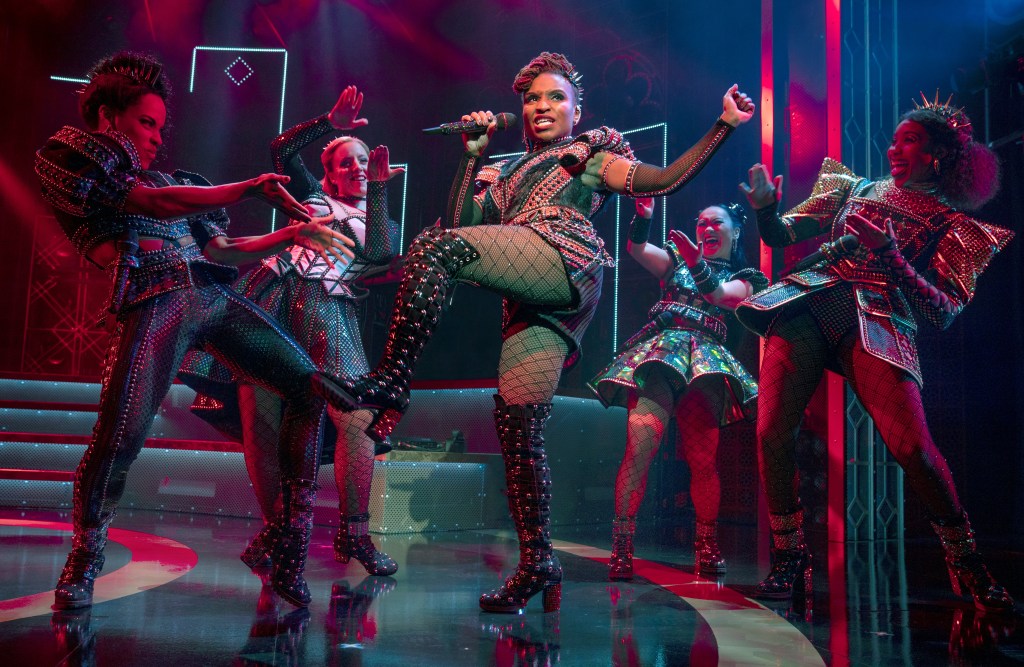
At this juncture, Marlow and Moss create a pause in the rollicking, pop/rock song and hip-hop movement ballyhoo. It is an appropriate change up. After all, history wrapped in music and shining light is never hackneyed or the same. Thus, Jane Seymour (the soulful Abby Mueller), appears not to be disabused by Henry like the others. She’s the one “he truly loved.” Obviously, she can’t parade herself as the most victimized. So she sings a beautiful ballad “Heart of Stone” of Henry’s love and her loyalty to him, but so soon lost in childbirth. Abby Mueller’s song style is Adele and Sia.
One of the most LOL and Social Media twitting of the queens is Brittney Mack’s Anna of Cleves, who must take back her power after all the queens mock her in the song “Haus of Holbein.” Henry famously went to Germany for this wife, fell in love with her portrait in oil and proposed via his officials. When she showed up in person, Henry rejected her outright as unattractive.

In “Get Down” are some of the funniest lyrics as Anna of Cleves reveals her great good fortune sitting on the throne in her castle living in luxury without having to deal with the bruiser Henry. “You said I tricked ya, cause I didn’t look like my profile picture,” hearkens to all the dating sites and social media sites where folks don’t put up their most recent pictures. In the style of Nicki Minaj and Rihanna, the sensational Brittney Mack has a blast stomping Henry.
Perhaps the most memorable song and the most true to life is what the beheaded Katherine Howard (Courtney Mack was terrific when I saw it October 6th), sings, “All You Wanna Do.” Kathrine Howard had many affairs and sings of the men who importune her sexually, then leave her “high and dry.” Of course, Henry, finding out about her former promiscuity, creates an act to punish her for her sexual experience and knowledge. “It’s off with her head, too!” The double standard here goes beyond the pale with Henry sewing his wild oats in every village and town in his kingdom. The song meaning in the style of Ariana Grande and Brittney Spears sung by Mack is powerful and beautiful.

Catherine Parr (the brassy Anna Uzele), brings on the 4th Wave feminist revelation. Why should there be a contest, a male construct of oppression to divide and conquer? Catherine Parr singing “I don’t Need Your Love,’ is the modern woman who can make it on her own. Indeed, the first woman in England to publish books in her own name, Catherine Parr rocks. Also, she outlived Henry and his penchant to divorce and behead. Anna Uzele sings in the style of Alicia Keys and Emeli Sandé.
By the concluding song, “Six,” even men stand up, applaud and clap to the finale. The cast and the wonderful Ladies in Waiting all girl band (Julia Schade, Michelle Osbourne, Kimi Hayes, Elena Bonomo), help to explode male presumptions and make sure the message is clear: patriarchy has no place in a kinder, gentler, decent society and culture where equanimity is a key goal.
This production and its creatives can’t be praised enough. See it twice. For tickets and times go to https://sixonbroadway.com/
‘Pass Over’ at the August Wilson Theatre is Glorious
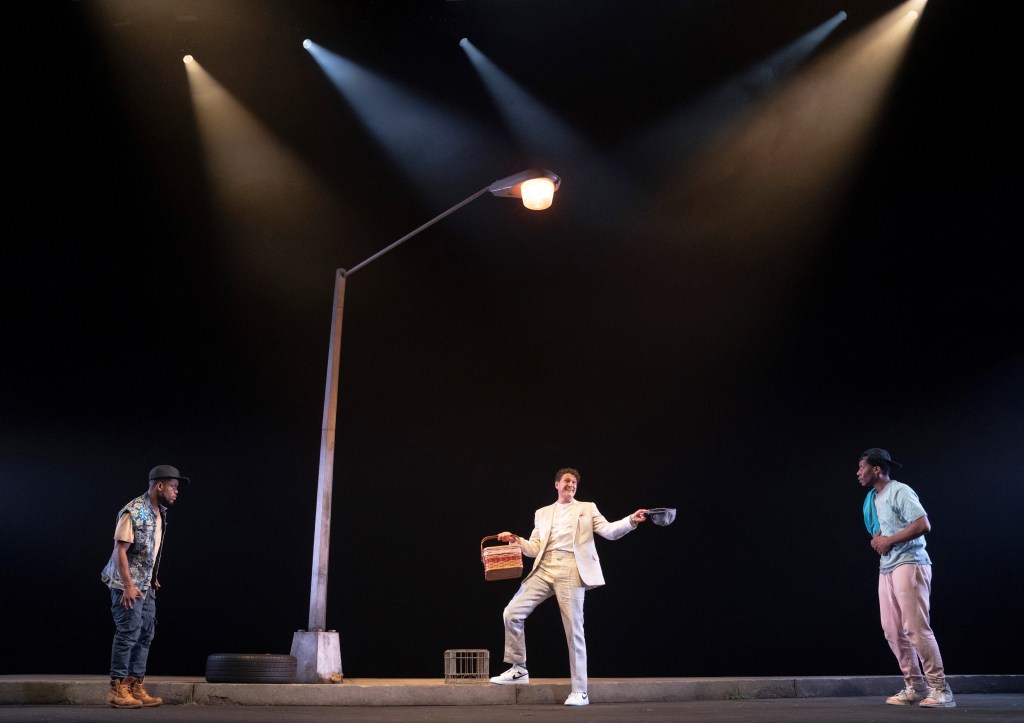
Two men standing on a desolate street corner with a lamppost shining on a blasted, deserted, space save for a garbage can, a patch of weeds, a tire, a wire milk carton. Such is the material/empirical setting reminiscent in its isolation and abstract loneliness of Samuel Beckett’s setting in ‘Waiting For Godot.’ Likewise the comedic and clown-like Moses (the brilliant Jon Michael Hill) and his Homie, clowning sidekick Kitch (the brilliant Namir Smallwood) appear similar to Vladimir and Estragon. However, they are not. They are black. And where Vladimir and Estragon “wait,” unafraid, bored, wiling away the hours, Moses and Kitch exist in a hellish landscape afraid of death at the hands of the “PoPos,” shorthand for police.
Whether one has seen Beckett’s Godot or not, doesn’t matter. The isolation of these two individuals and their express desires to leave this heartless existence that holds the terror of black men dying by a simulated “justice” which is tantamount to the injustice of lynching is conveyed with empathy and poignancy by the creative team of actors and director Danya Taymor. With acute care, emotional grist, comedic genius and dynamic drama, they bring to stark, felt life, Antoinette Chinonye Nwandu’s haunting, memorable dialogue in Pass Over, currently running at the August Wilson Theatre in a cool, streamlined no intermission production.
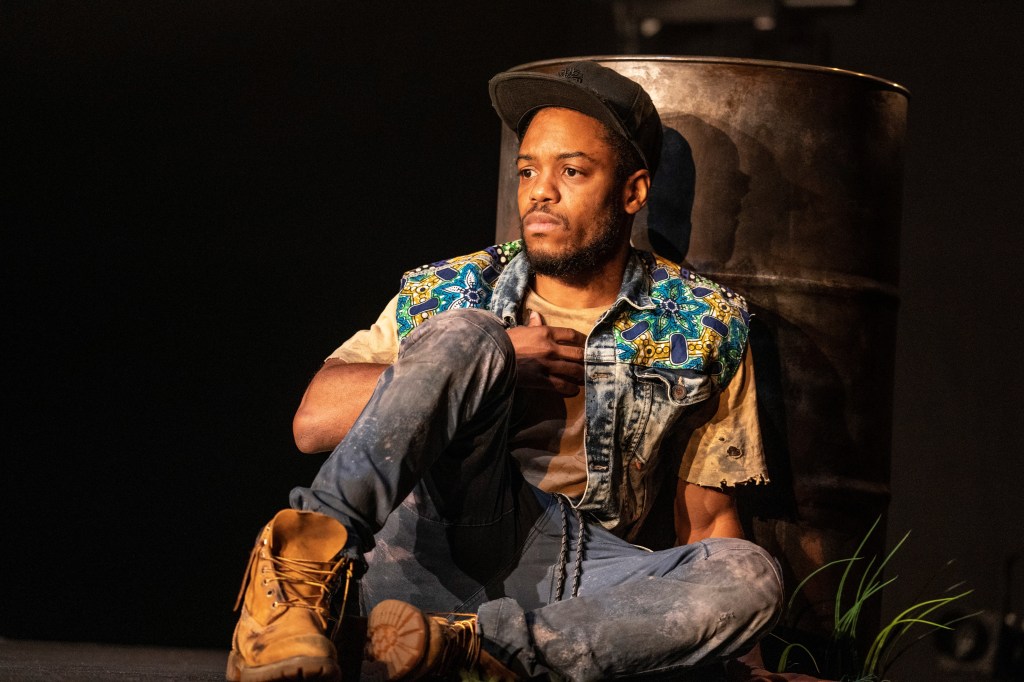
When we first meet the likable Moses and Kitch, we understand their camaraderie and support for one another, as well as the similarity of their desires, fantasizing about the finer things of a luxurious, material, elite lifestyle. Though Moses is the leader and Kitch is his follower and admirer, their synchronicity and dependency is clear, for they wish to “pass over,” to get to the “promised land,” the “land of milk and honey” represented by the “American Dream.”
And whether we have eaten lobster or drank Crystal, like they wish to, we, too, have craved the finer things of life and may even feel a sense of superiority that we have experienced them, where these impoverished of the ghetto block can only entertain themselves and each other by dreaming about such extravagances in a humorous and ironic game which has become a way of bonding between them.
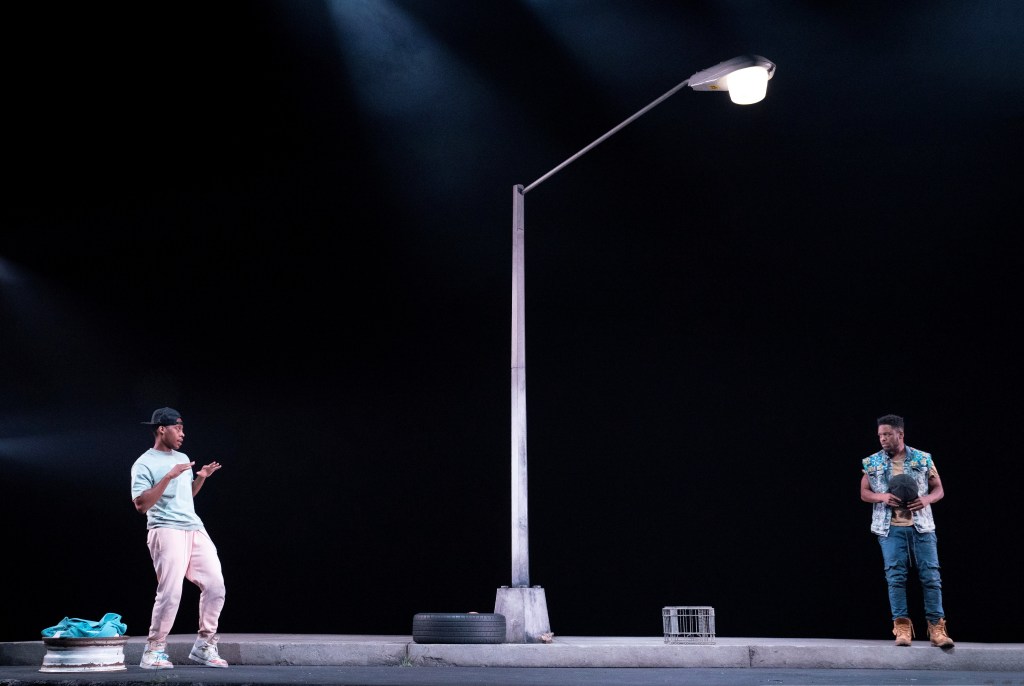
Fifteen minutes in to the thrust and parry of humor, the gaming is interrupted by a Pavlovian signal that has brainwashed them to fear: the stage floods momentarily with a steely light and a dull, blaring warning sound. (It reminded me of Steven Spielberg’s 2005 film War of the Worlds, when there sounds a far-reaching alarm announcing the aliens’ presence.) We learn later that Moses and Kitch recognize this alarm as the sound of death; that another black friend or acquaintance in their neighborhood has been killed by police. They cower and crouch in fear until the light and sound normalizes to the stasis of desolation, and once again they return to humor and the grace of planning to escape and go somewhere where they can live free from fear in a greater abundance of prosperity than their current existence.
However, there are two caveats. They must elude the PoPos, as Moses led the Israelites to elude the angel of death which “passed over” the the First Born if the blood of the lamb was on the doorposts of the Israelites’ homes. Secondly, the PoPos expect them to remain on the block to never escape their oppression and misery. Thus, they are free only in their games, humor and imagination, while their physical bodies are subject to the reality of their dire existence with the threat of death hanging over their lives. Will they be able to “pass over” and escape death? The symbolism is spiritual with possibilities for escaping all of what the playwright infers elements of the death state is in this life.
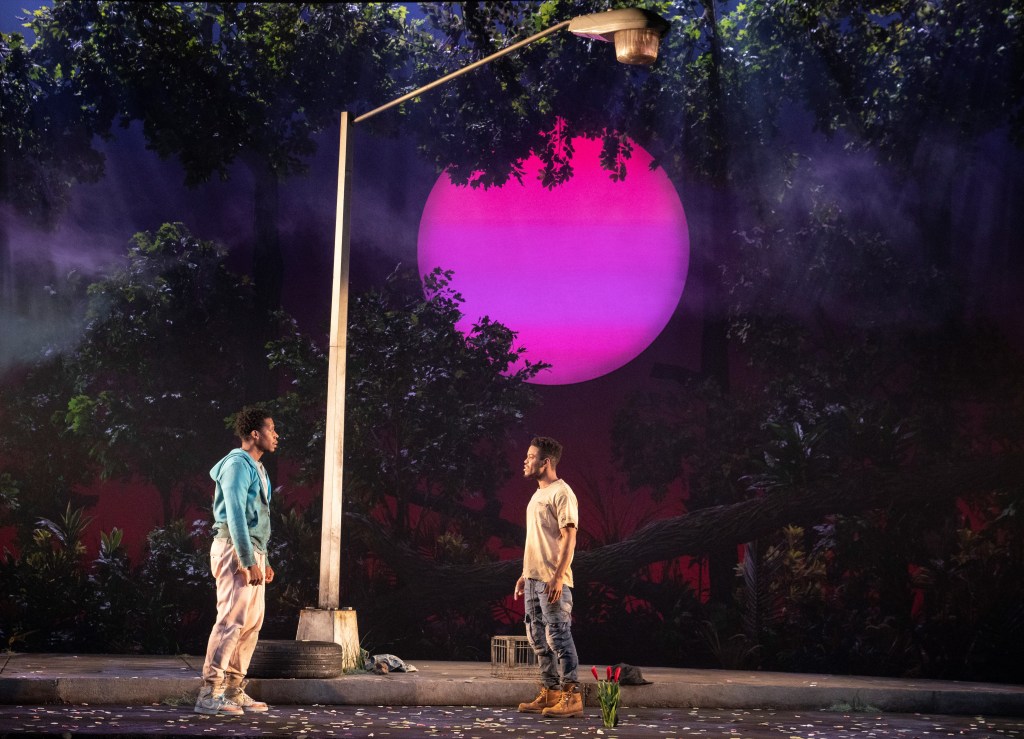
Into their ghetto corner (which the playwright suggests symbolizes as historical oppression and redemption-a river’s edge, a plantation, a desert city built by slaves and a new world on the horizon) comes Mister who slips up and calls himself Master (the wonderful Gabriel Ebert). Taymor has him ironically dressed in a white suit and vest, such as gentlemen of the Old South used to wear on or off the plantation. Mister, intending to visit his ill mother with a picnic basket of food, inexplicably gets lost and arrives with his bounty to the ghetto block.
At first Moses, whom his religion teacher encouraged to live up to his namesake, the Biblical Moses, proudly eschews Mister’s offer of food charity, though both he and Kitch are hungry. However, sociable, “good-natured” Mister cajoles and tempts them. And after he massages their egos with charm and humility, he shares some of the delicious food in his basket with Moses and Kitch in a wonderfully humorous staged scene.
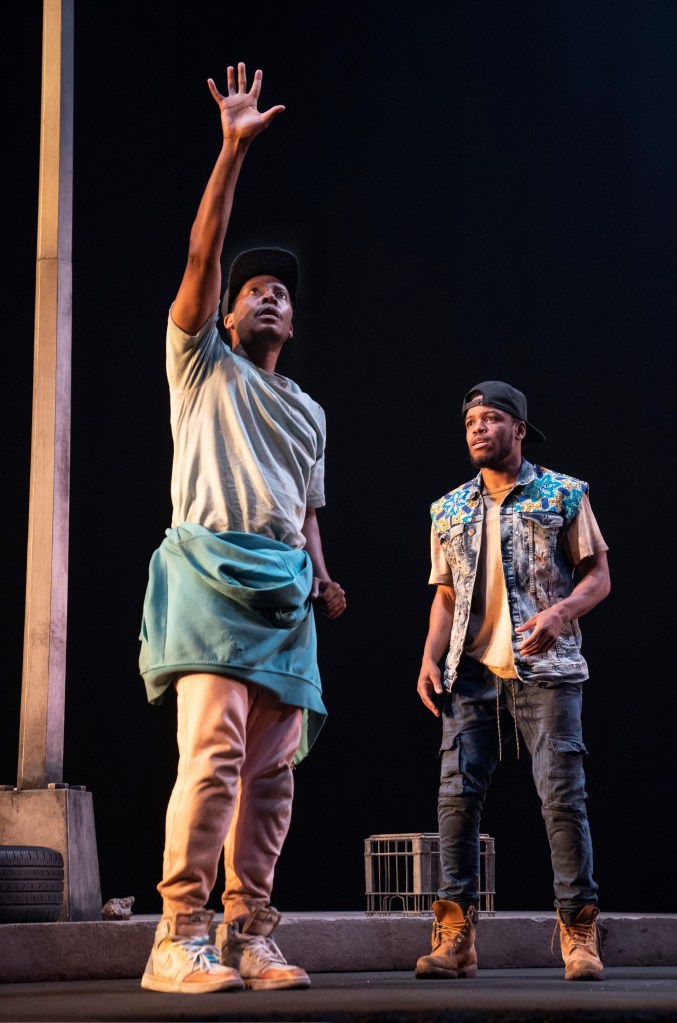
We note the roles between the individuals and hints of seduction and exploitation, expecting some catastrophe, however, Nwandu has tricks up her sleeve and the situation with Mister is as it appears. Mister worms his way into their hearts and they become friendly. And for a fascinating moment they forget about “getting off the block,” and being all they can be, lulled by the food. Intriguingly, Mister chides them for abusing their use of the “N” word which he cannot use, because as Moses suggests, he doesn’t own that word.
It is an ironic gesture since it is perhaps the only “thing” Mister doesn’t “own,” as a representative of the dominant oppressor race. Though Mister doesn’t “own” their black identity which they have accepted as their own, is it something which is good for them or is it another trick of oppression? After Mister leaves, Moses and Kitch realize that adopting that identity is a trick of the white culture and the PoPos, for by inference, the “N” label associates with low-down and/or slovenly criminal behavior, regardless of whether they are deserving of such labels or not. Ironically, they have proudly accepted that term as their identity, but it has resulted in black male deaths at the hands of the police.
Deciding to cover for themselves, using Mister’s gentile manners, they avoid trouble, when Ossifer (a police officer played by Gabriel Ebert who is the different side of the same coin as Mister) shows up. Moses and Kitch become “gentlemen” in word and action, imitating Mister. It works. Ossifer leaves them alone and protects them as culturally “white” until Kitch slips up and uses the “N” word triggering the brutality of the police officer who confronts them as their oppressor to control, belittle and demean. Under these circumstances we feel the depressive desolation of the historical and current inferior “slave.” And Ossifer terrorizes them reminding them that their lives are only useful for living in fear and misery as “the controlled.” The only respite Moses and Kitch have is the humor and hope Kitch and Moses stir up within themselves and share with each other to make existence bearable until they can “pass over.”
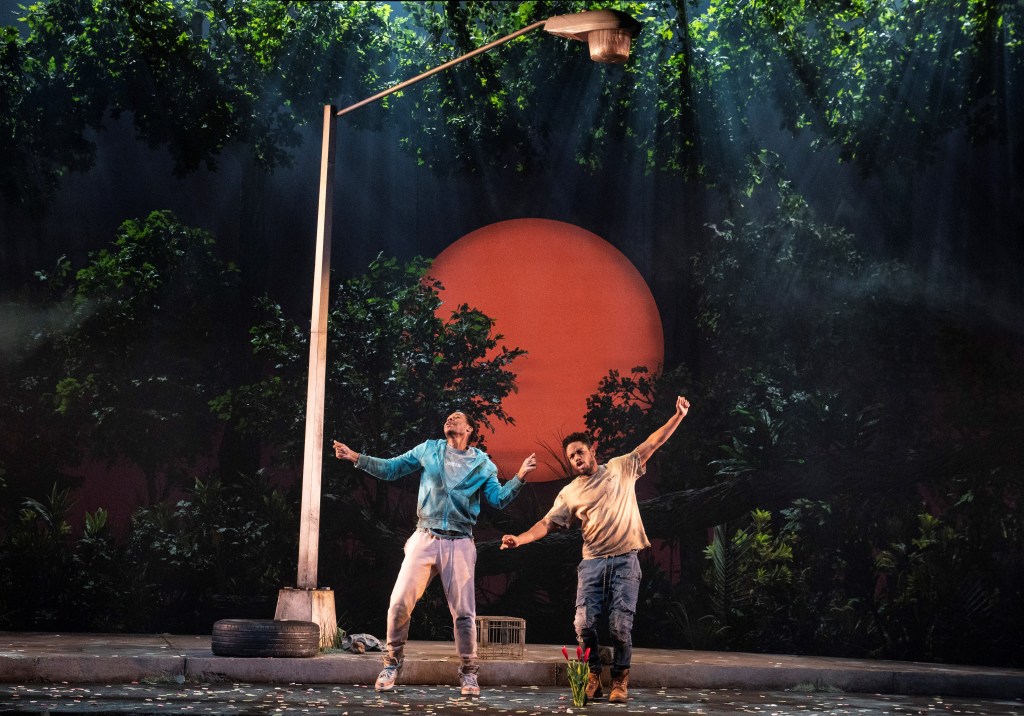
In an amazing turning point, Nwandu clarifies a new meaning for the term Moses references from the Bible, “pass over.” It is a spiritual one that Moses convinces Kitch they must now seek, no longer wanting to deal with the despair and long trial of a desolate existence.
Taymor, shepherding Hill, Smallwood and Ebert creates extreme tension throughout. Especially when Ebert as Mister and Ossifer shows up. The atmosphere is that of a pressure cooker sizzling until it seethes into an explosion which does occur. We, like Moses and Kitch, expect the blast after every joke, around every game they play, especially when the alarm sounds and lights flare up that the PoPos have killed another black man. Nwandu cleverly distorts the thrust of the heat and danger providing extraordinary twists in the turn of evolving events. These become revelatory, magical and lead to the unexpected and heartfelt.
The beauty of the conclusion is in its realization of a return to an ideal which isn’t actually some pie in the sky fantasy, but is present and real. In the production it occurs with the help of and extraordinary supernatural intervention as happened to the Biblical Moses. Taking one step forward after another, Moses, Kitch and Ossifer (a reborn Christopher) are released and the imagined consciousness comes into being. However, the lure of what’s past beckons. One must not turn around to be enticed, or everything will be lost in the material plane where the human race has crashed and burned for millennia.
Pass Over is a must see for its fantastic performances, its uniqueness, its joy, despair, thematic truths and its wonderful faith and hope in human nature. I could not help but be gratified that there were no female characters. Their absence is lyrically pointed. The production is mesmerizing and I have nothing but praise for how the playwright, director and actors connected with the truth of what we face as a multifaceted and diverse society that is desperately crying out for healing and redemption. But as Nwandu suggests, the promised land is already here. We must look to our own inner strengths and step out to cross that “river”and never turn back.
Kudos to the creative team that made this production fly and whose effects helped to send chills down my spine and tears down my face. They include Wilson Chin (scenic design) Sarafina Bush (costume design) Marcus Doshi (lighting design) and Justin Ellington (sound design). Pass Over runs until the 10th of October. This is one you cannot miss. For tickets and times go to the Pass Over website by clicking HERE.
‘Ghosting’ Streaming at The Irish Repertory Theatre

Theatermania has referred to the Irish Repertory Theatre as the “Leader of Streaming Theater,” during the pandemic. Its shows have been top notch during the unprecedented New York City theater shutdown. Ghosting written by Jamie Beamsh and Anne O’Riordan, performed by Anne O’Riordan is an intriguing and thoughtful provoking offering. Recorded live at Theatre Royal Waterford in Ireland, that theater, Thrown Shapes and the Irish Repertory Theatre collaborated to stream the presentation which concludes in a few days. (4th July)
Anne O’Riordan’s performance is nuanced, personal and superb. She personifies the voice and demeanor of various characters with the exception of one, for a symbolic reason. Sheila, nicknamed “She” for short, left Waterford for London and has been there for six years. We gradually discover the reason why, though she initially misleads us and we think it is because her former boyfriend who took her virginity then “ghosted” her. In the vernacular, ghosting means an individual cuts off all communication and ends a relationship without explaining why, without going through miserable late night begging sessions to “stay together.” In other words, he cut her off and never spoke to her again.

From her position at work, we note she is irascible and unapproachable. She doesn’t have any friends, nor does she have any hobbies or interests that she discusses. She essentially complains about her co-worker who clearly cares about her and with whom she might establish a relationship. She is uninterested and aloof. We consider is it him or her. As Sheila confides in us she slips information discussing that she can’t sleep at night. Perhaps, her irate attitude is because she hasn’t been home to Ireland in six years. Perhaps it is because she has not kept up with family after her mother died. Thus, we determine she grieves. Some people never end their grieving for a parent. No communication is easier than tears and longing for who will never retrun.
The turning point comes when she can’t sleep one night and someone shows up at the foot of her bed. Is this a dream? Is this reality? Is she hallucinating because she has gone insane? We follow along for the ride not wanting to believe that Sheila is psycho, though in some circles, she immediately would be given medication and confront her obviously deep-seated issues with group or individual psychotherapy. But this is different. Sheila is rational; her story, thus far, is logical and we accept that her former boyfriend at the foot of her bed is a ghost or has emerged out of her dream to stop ghosting her by ghosting her. The irony is humorous.
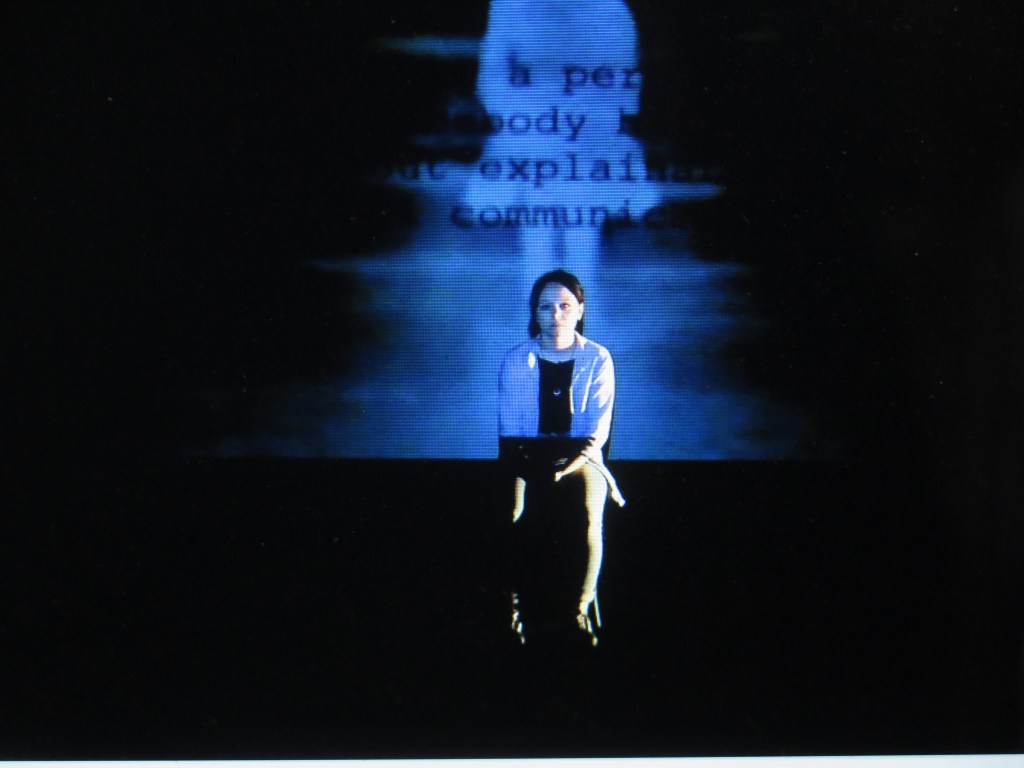
From there the twists and turns gyrate and we whirl along in Sheila’s adventure as she maneuvers a journey back to Ireland. What happens there becomes an examination of her admission that she has been the one ghosting. She’s ghosted her father, her family and friends there. Most importantly, she’s ghosted herself. She realizes she’s been living a non-living reality, not existing so that she deferred grappling with herself, her destiny and future. Does she make plans and enjoy the moments and breaths of her life? No. She has been a shadow person, beyond a state of hibernation. And the only way that she comes out of it is through someone else’s sacrifice and a supernatural visitation, an earthquake that shakes her unto herself to show her what she’s been doing.
When Sheila returns to Waterford, her hometown, she’s drawn home for an urgent reason (to her) via a text her sister sends her. She meets her sister in a bar but she vows not to see her father. Startling and embarrassing, emotional events occur. The miraculous visitations continue until she is brought to a reconciliation with herself and her family after she returns to her home in London.
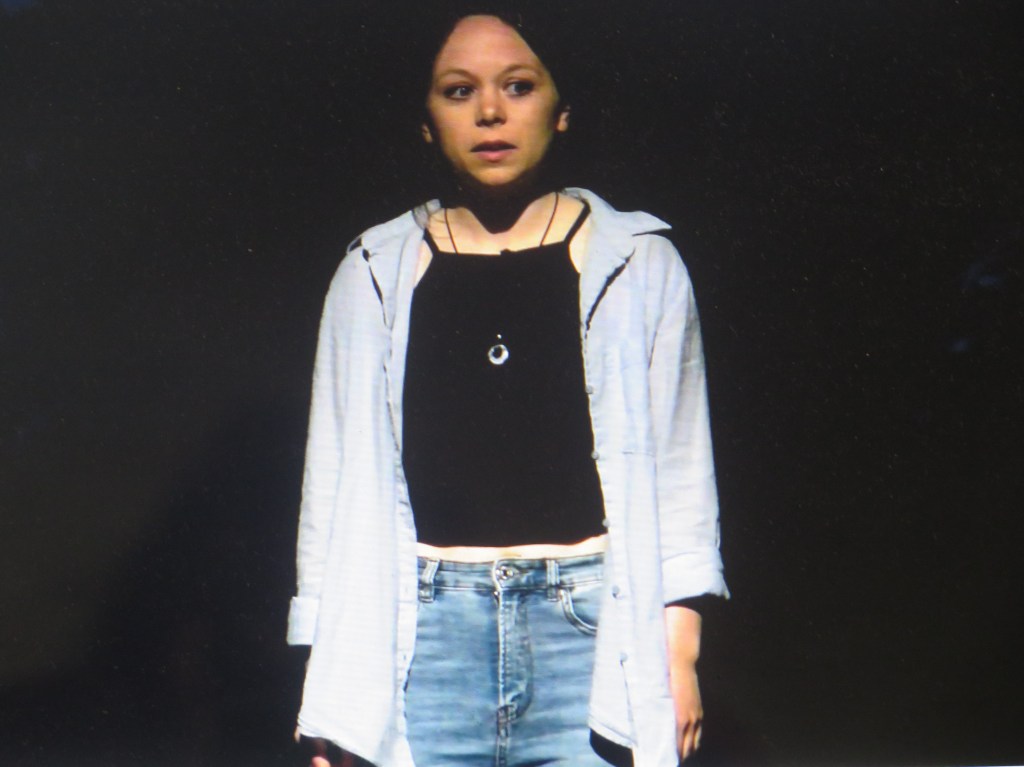
Beamish and O’Riordan’s writing has elements of the philosophical poetical. The direction of the visitation scenes is spot on. The scenes are powerful and remain atmospheric and suspenseful as we wonder, like the character of Sheila, where we are being taken. Importantly, the issues of why Sheila left Waterford, why Mark, her boyfriend ghosted her are eventually answered, though other mysteries are opquae.
The beauty of this work is the meld of the supernatural with reality; the sacred and the profane delivered through the lighting effects, projections and sound design (Beamish effected most of it with Dermot Quinn taking care of the lighting design). Vitally, it is O’Riordan’s authentic and finely hued performance which makes us believe and go along with her on this wild, exceptional journey. We remain curious and engaged with her as she touches the shadows of another consciousness which is hers, her boyfriend’s her father’s. Importantly, we are astounded at the human capacity for love despite misery and unredeemed emotional pain, and the ability to want to heal, even if it means stirring spirits from the other side to help us.,

Ghosting reminds us with paramount intention that our actions have dualistic purposes that we may not understand, initially. But if we hang on long enough, the answers come and we can confront ourselves, evaluate and be gentle to our sensitive inner being which needs care. Sheila, by the conclusion of Ghosting resolves the emotional pain, though it will always be with her. However, the miraculous helps her look at it and stop ghosting herself, by making herself more present to accept actions which she once loathed about herself.
This is one you shouldn’t miss for O’Riordan’s performance which is memorable, for the production values and for the direction. Jamie Beamish directed the livestream. Aidan Kelly directed the original stage production. Ghosting streams until Sunday, 4 July unless they extend it. In order to make reservations go to Irish Repertory Theatre.
Check out the production and the 2021 seasonal offerings coming up. Theater in NYC is going live full blast in September. The Irish Repertory will be a part of that celebration. However, it’s appeal has now become global and most probably they will continue to stream performances during their season so if you are in Australia, New Zealand, Hong Kong and Ireland, you won’t miss out. Donations are always welcome . CLICK HERE for details in the pull down menu.
Reflections on ‘The Gardener’by Lanie Robertson, With a Stellar Cast in its World Premiere Online
Stacy Keach Zoom Theater, the “good friends of Lincoln Center Theater” is offering a free virtual event to benefit The Actor’s Fund. The world premiere of Lanie Robertson’s magnificent play The Gardener is streaming live until February 18, 2021 on this link. https://www.stacykeachzoomtheater.com/

Starring Ed Harris as Claude Monet, Stacy Keach as the Prime Minister of France, Georges Clemenceau, and Amy Madigan as Monet’s stepdaughter Blanche, the playwright spins out the days which become the turning point in the lives of Monet and Clemenceau as they reaffirm the closeness of their relationship as good friend,s who inspire each other to benefit the culture and world around them.
Robertson begins the play identifying elements that essentially intimate the cultural times in which both men, lived though not through specific dates. The chronology is abstruse. For example Monet has lost his wife Camille and his son, Jean which has devastated him. And he refers to these events and their impact on him as does his stepdaughter Blanche. At the top of the play we follow the discussion that Clemenceau has survived an assassination attempt which identifies the time around 1919 after WWI. After the assassination attempt which Monet and Blanche believe killed Clemenceau, he turns up jocularly alive to visit Monet. The painter is at Giverny, Monet’s studio and garden, which he is planting and developing and to which Monet refers as his true legacy.

Interestingly, Clemenceau doesn’t “get the love” Monet expresses about the flora and fauna of the garden environs which Monet works day and night, and has come to know as intimately as he knows his paint’s thickness on his variety of brushes. Clemenceau claims he prefers the city noises, uproar and busyness of street hustle and bustle and his life as a politician, journalist and Prime Minister of France.
Much is subtext and inference in this play which draws one into the mystery of these two icons. It may force one to look up more information about the time, Monet’s greatest of masterpieces and this statesman of France who was prickly, Republican (in the French sense of the word) a humanist, Monet’s good friend and lover of art. I cannot imagine a better selection of cast than Amy Madigan, Ed Harris and Stacy Keach who also acutely directed this vibrant production.

Of course though Clemenceau could not have foreseen the romance of Giverny for global tourism and posterity, art lovers and professionals alike understand the importance of Giverny’s gardens to Monet’s final works; the garden informed his painting and provided the inspiration and respite to innovate and be energized to the muses of the creative process. Thus, both Monet’s garden and his works have become synonymous with Monet’s complicated genius and artistry.

What is intriguing about Robertson’s The Gardener, which heightens this interplay of Monet’s artistic talent being dependent upon his skill as a gardener, is the vitality of Monet’s relationship with Clemenceau. Again, this is inferred as the great unspoken. It was Clemenceau who after Monet died, arranged for the display of Monet’s Nymphéas (Water Lilies) cycle which eventually ended up in 1927 at Orangerie, now Musée de l’Orangerie in Paris, France. Clemenceau understood the greatness of Monet’s intention to symbolize the hope of peace, and healing power of nature, light and solace of the garden to soothe and renew the souls of soldiers who returned emotionally and psychically deadened after the hellish abyss of WWI. Clemenceau’s attraction to Monet’s work and friendship, was reaffirmed in 1908 and lasted to the end of their lives. Robertson suggests Clemenceau sought Monet and his work for its power to revitalize and restore his being. The friends’ connection lies beyond the veil, in an ineffable, immutable bond. And if one investigates further, theirs was an agreed upon arrangement that was fated for all time.

What is not spoken of in the play, Robertson alludes to and the brilliant actors convey, inhabiting these iconic individuals. It is Monet’s Water Lilies masterpiece that he worked on for three decades and to which Clemenceau encouraged him to add panels. The day after the Armistice in 1918 was when Monet asked Clemenceau to take two panels which he signed on Victory day and offer them to the State. Clemenceau was the intermediary to have Monet’s “great decoration” displayed in the way Monet wanted, a display that he finalized the conceptualization of right after his son Jean died. Thus, when Harris as the bereft Monet discusses Jean’s death with Clemenceau and the sonorous and vital Amy Madigan as Blanche expresses her grandfather’s great grief and hers at Jean’s loss, we understand why Monet sent away everyone from his home. We understand his need to be alone for his final work to be finished. We understand (sorry for the spoiler alert) why Blanche leaves with Clemenceau. It is for the greatness of what is to come; and all contributed in their way to its becoming.

This “becoming” achieved its final form in the arrangement of the panels in the Orangerie as a panoramic frieze exhibited seamlessly to embrace the viewer in two elliptical rooms. The two panels at Clemenceau’s suggestion grew to 8, though Monet pledged more. But these 8 are the apotheosis of the Water Lilies cycle that Monet had begun thirty years before. He meant it to be his final contribution to the uplifting of France and perhaps for all time and for all of the world, as a monument to peace.
It has been said that Clemenceau encouraged Monet to create a total of 19 paintings some of which Monet destroyed. Indeed, Monet held them all back, hoping to achieve greater and greater perfection until he could work on them no longer, and his death released the paintings to Clemenceau in 1926. In1927 Clemenceau secured the 8 panels to establish the exhibit which is the impressionist’s monumental achievement, not necessarily appreciated nor understood by the public in 1927 or the next decade.

However, when one visits the Musée de l’Orangerie, one experiences the arrangement of Monet’s unique vision of form and color in a watery landscape that is sprinkled with waterlilies, shimmering ripples, willow branches, tree and cloud reflections, varying shades of light and dark green vegetation, all suggesting the ethereal qualities of light and air. Symbolized beautifully is the thread of life these natural elements that were conceived in Monet’s consciousness and then manifested in his garden which, for as long as it remains, imbues the eternal as does the “great decoration.”

Monet said about his creation, it is the “illusion of an endless whole, of a wave with no horizon and no shore.” Assuredly, the “elliptical shape of the rooms” suggests the mathematical symbol for infinity. The panels are a seamless continuum in time and space materialized. Likewise, Monet conceptualized his garden, planted, watered and cultivated the rich soils to express a beauty which he materialized using his vast array of knowledge of florals and accompanying plants to align the inner eye with the infinite, the eternal. His Garden and Monet’s exhibit in Musée de l’Orangerie are nonpareil.
This production is broadly relevant in its themes and scope. What better way to memorialize the message to remain uplifted through art in our time of mob violence at the Capitol, the horrifying insurrection against democracy, a noxious political divide and a pandemic. What could be better than to view the exchanges between two exceptional actors portraying cultural giants looking back to a similar time (the aftermath of the brutal WWI and the Spanish flu epidemic) as they worked to bring the hope of peace through the halo of artistic expression.

Harris, Keach and Madigan give brilliant performances re-imagining individuals we are barely acquainted with but know culturally. Memorable is Madigan’s humorous taking down of Harris’ Monet when as Blanche, she is outraged that Monet gives her pate to the cats, the sumptuous pate that she slaved. Her specific and factual description of what it took to make pate back in the day is marvelous. The actors convey the humanity of these greats at a still point in time that allows us to identify, engage and appreciate their friendship and the value of such friendships in times of great trouble.
The messages, themes and parallels of that time to this carry great relevance and currency for us today. Bravo and thanks to Robertson, Harris, Keach, Madigan and the creative team for this superb and unforgettable zoom theater experience. To see it CLICK HERE. https://www.stacykeachzoomtheater.com/ IT ENDS ON FEBRUARY 18, 2021. You will be happy you did. And after you finish watching, donate to The Actor’s Fund, CLICK HERE
‘Mustard’ 2021 Origin 1st Irish Theatre Festival Solo Production

In the award winning solo production Mustard performed by Eva O’Conner and directed by Hildegard Ryan, the condiment of various shades of yellow and heat gains a new symbolism and significance. The award-winning comedy/drama, an offering of the 2021 Origin 1st Irish Theatre Festival online, is from Fishamble: The New Play Company based in Dublin. Mustard has been screening online in January because of the pandemic.
The Origin 1st Irish Theatre Festival is presented yearly. Because of the pandemic, this is the first year it has been streaming productions online, including a total of 20 events, with panels on various topics. One, for example, concerns producing during the pandemic.

Mustard originally premiered at the Edinburgh Fringe Festival in 2019, where it won the 2019 Lustrum Award, Edinburgh, and the 2019 Scotsman Fringe First Award. It was also nominated for the Scottish Mental Health Awards 2019. Eva O’Conner was last seen in the 2020 Origin 1st Irish Theatre Festival in Maz & Bricks. She is a superb performer whether in a two-hander or solo as in Mustard which she also wrote.
How O’Connor inhabits the the retelling of the story of the love possessed, lovelorn, hollowed-out character E is absolutely authentic and moment to moment mesmerizing. Her dynamic enactment of E’s relationship with a stunning, professional cyclist from London is both humorous and striking in its approach, as she develops the shades of difference between passion and obsession, between sexual addiction and love. All of this is accomplished in the name of the character’s yearning for a lasting relationship and a dollop of madness on the side.

What E discovers about herself is her ability to maximize self-loathing. As she reflects back on the relationship, she encounters her stifling obsession for the cyclist who demeans her with a series of annihilating events. The humiliation and embarrassment of her dead-on emotional suffocation and idolatry of him as her “love” object consumes her. And, it renders her immobile in an acute depression which she endures by returning home to mom. Vying between want and repulsion because she allowed the cyclist (a Brit) to redefine her being, she realizes she crafted this eternal fire of “love” for him into a weapon of emotional self-destruction.
Her only release is “mustard.” How she employs the condiment to salve her soul, psyche and physical yearning becomes an active segment of E’s account. We watch fascinated as she sets the stage for the moment of maximum catharsis and pain, curious about how all of the various props she has brought with her, a bucket, a clothesline, etc. figure into the context of her explaining the “love” affair with this “guy” whom she’s lived with for almost a year.

O’Connor performs the characters of E, her evangelical mother and her English sometime lover with personality and spot-on revelation. Her relationship with her mother is humorously delivered with Irish accent and gesturing. Her adoration of the cyclist and her final answer to his effrontery, slaughtering her soul, is disclosed in heady wonder. Over all, O’Connor’s dialogue, descriptions, infusions of rhythmic language and unique interplay of the characters is beautiful, lush, unique and thrilling. For anyone who has experienced a similar stripping down to raw nerve by a “love interest,” this is a must see. O’Connor and her character’s emotionally mad ride are unforgettable.
After twenty minutes of viewing, it is obvious why O’Connor won awards for her play, incisively and excellently directed by Hildegard Ryan. Once again Fishamble: The New Play Company proves itself to be on the cutting edge of drama and comedy that is significant, as it expresses the depths of human emotion and feeling with dramatic ardor and vitality.
You can still see the last week of the 2021 Origin 1st Irish Theatre Festival by going to their website to view the calendar of events; these end on January 31st. For tickets to plays and the calendar of events CLICK HERE. For tickets to Mustard whose last performances are on Wednesday, 27th January at 8 pm and Sunday, 31st of January at 2 pm, click on this link. CLICK HERE for MUSTARD. You’ll be glad you did.
‘Meet Me in St. Louis’: Irish Repertory Theatre’s Spectacular Holiday Show

Irish Repertory Theatre continually proves that it can do the extraordinary with skill, talent and enthusiasm, as it mesmerizes and endears its members, donors and global audience with exceptional productions. This is particularly amazing during a time when New York City theater is staying safe and waiting until the blessings of the COVID-19 vaccines mitigate the dangers of the pandemic which to date has killed 330,000 Americans.
Thus, we welcome being cheered up for the holiday season. And what better way than to peer into past reflections of hope when The Louisiana Purchase Exposition, unofficially the 1904 St. Louis World’s Fair, commemorated the 100th year of the Louisiana Purchase. The Fair, the last great international exposition before World War I, was an extravaganza that included hundreds of thousands of people, animals, unique items and displays. It magnified the bright future of industry and innovation from 63 exhibiting countries and 43 of the 45 United States.

Excitement about the St. Louis Fair, which is the central image highlighted in the titular song of the musical Meet Me in St. Louis, drives the beginning and finale of the Irish Rep production. The book by Hugh Wheeler and songs by Hugh Martin and Ralph Blane are based on the Kensington Stories by Sally Benson and the 1944 MGM Motion Picture Meet Me in St Louis. Adapted and directed by Charlotte Moore with musical direction by John Bell, orchestrations by Josh Clayton and produced by Ciarán Reilly, this Holiday Special in Song and Screen can be appreciated again and again, whether with family or individually. You will never tire of the show because it is that wonderful.

The production values are sophisticated and spot-on. The orchestra’s superb technique performed seamlessly on zoom (thanks to the wizardry of musicians, Bell, M. Florian Staab and others) perfectly blends with the gorgeous voices of the cast, a tricky technical feat, especially with the ensemble numbers. The tuneful and lighthearted, upbeat songs (Trolley Song,” “Meet Me in St. Louis,” “Drunk Song,” “Touch of the Irish”) and in other instances poignant, familiar numbers (“The Boy Next Door”) are a pleasant remembrance, if you have seen the MGM film and the 1989 Broadway version which starred Charlotte Moore as Anne Smith.

Some of the songs in the Broadway version have been cut, a wise choice for a streaming production you watch via your tablet, phone or computer. But one song that had been cut from the 1989 Broadway show was added in the Irish Rep version (“You’ll Hear a Bell”). This song, reprised in the second act, is beautifully rendered by the golden-throated, imminently watchable Melissa Errico the mother. Anne Smith encourages her daughter Esther (Shereen Ahmed) about understanding and recognizing love based on her own experience with her husband, Alonzo Smith, Esther’s father.
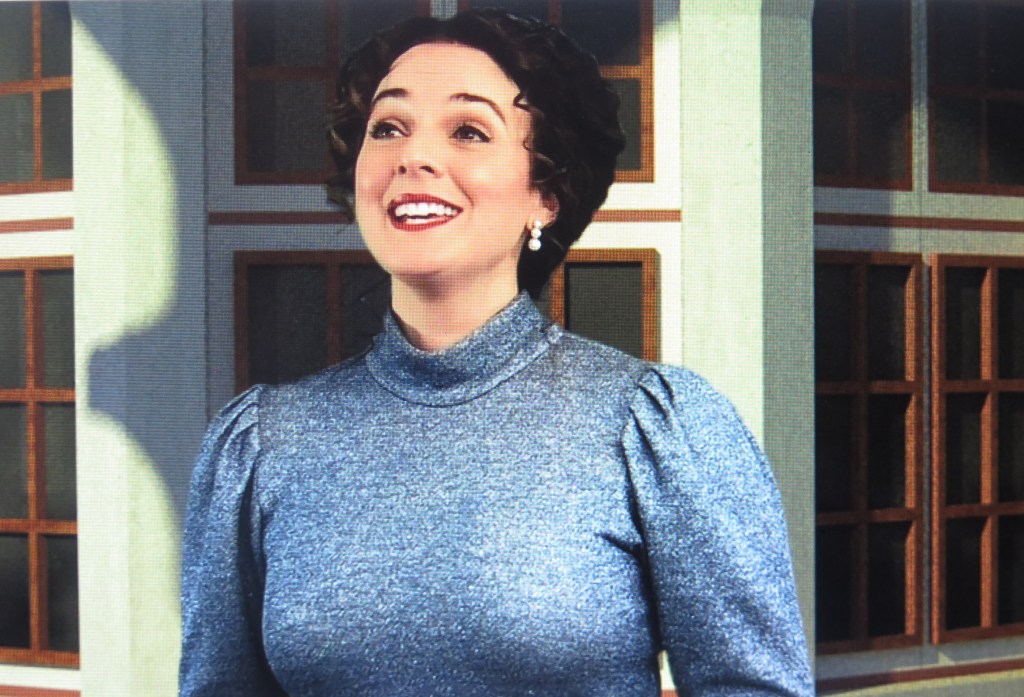
Charlotte Moore shepherds the cast with precision. She astutely teases out winning performances and humor from Kylie Kuioka (Tootie) who is a fireball of joy and mischievousness, the perfect foil for the sedate, companionable, near-in-age, wry, older sister Agnes (Austyn Johnson). The marriageable sisters, Rose (the vibrant Ali Ewoldt) and linchpin of the production, Esther (the soulful, exciting Shereen Ahmed) propel the plot development. Theirs is newfound love with their prospective partners the reserved Warren Sheffield (Ian Holcomb in a fine portrayal) and the “boy next door” John Truitt (the affable, illimitable Max Von Essen).
As Esther expresses good will toward the family which is sorrowful about moving, she poignantly sings the profound (“Have Yourself a Merry Little Christmas”) which is nostaligic under any circumstances and particularly heartbreaking under present circumstances of the pandemic. Shereen Ahmed’s Esther is particularly well wrought with her lyrical vocal instrument and authenticity of portrayal in the lead that Judy Garland played on film.

With the couples’ togetherness thrown down by Alonzo Smith’s moving the family to New York to make more money and raise their standard of living, we note this makes sense if seen through modern values that lift wealth and money above well being and happiness. However, Father Smith (Rufus Collins does a fine job in the concluding scene) in a throwback to old-fashioned values and economies of the past (only Dads worked) chooses to please his family by remaining in St. Louis. It is a gift that all adore beyond treasure and we yearn for in a culture that over the last two decades has been on the brink of losing its fundamental values of the preciousness of life, love and family.
William Bellamy, Kerry Conte, Kathy Fitzgerald, Jay Aubrey Jones and Ashley Robinson round out the cast of this marvelous production which was produced remotely with the dexterous application of green screens and lovely backdrops. In its technique, applied imagination and sheer audacity, the production, not streamed live from a stage, is a book musical with actors separate, home alone. filming, which has never having been done before. This was a realization which John Bell musical director affirmed to Melissa Errico who quipped in her New York Times article that Meet Me in St. Louis was a show where no one actually would meet in St. Louis or anywhere else. Read Melissa Errico’s account here.
Great praise goes to the cast, the creative team and director Charlotte Moore for this Christmas treasure. The Irish Repertory Theatre has exercised their vitality and prodigious cleverness to provide this most American of celebratory entertainments at a time when we crave affirmations of friendship, love, family, togetherness and joy present in the show’s themes. This is one you must not miss.
Irish Repertory Theatre’s Meet Me in St. Louis runs until Saturday, 2nd January. For tickets and times go to the Irish Repertory Theatre’s website. Click Here.
‘A Touch of the Poet’ The Irish Repertory Theatre’s Superb Revival of Eugene O’Neill’s Revelation of Class in America

The Irish Repertory Theatre’s activity during the COVID-19 pandemic is nothing short of award-winning. They have remained stalwart in presenting streaming live productions, filmed productions and filmed productions online by actors who have done their work solo from their own homes, which afterward are seamlessly brought together by creative technicians.
The latter phenomenon is perhaps the finest example of the tremendous effort the Irish Rep is ready to perform keeping in mind their unction to do no harm to actors, technicians and audience members during this incredibly dangerous time, where if you peruse statistics on Worldometer, the death toll in the U.S. marches toward the numbers of dead during four years of our involvement in WWII. Considering that the COVID atrocities have occurred over a 9 month period under the abdicated watch and depraved indifference of Donald J. Trump and the sleepwalking GOP, the death toll is staggering and egregious.
Thus, global watchers of Irish Repertory Theatre which hail from Australia to Ireland and all parts of the United States, are so grateful for the opportunities that engaged and talented actors and the Irish Rep’s creative team provide. As they unleash their talent and passion to create wonderful artistic performances, the productions help sustain us through this unprecedented crisis in our lives.
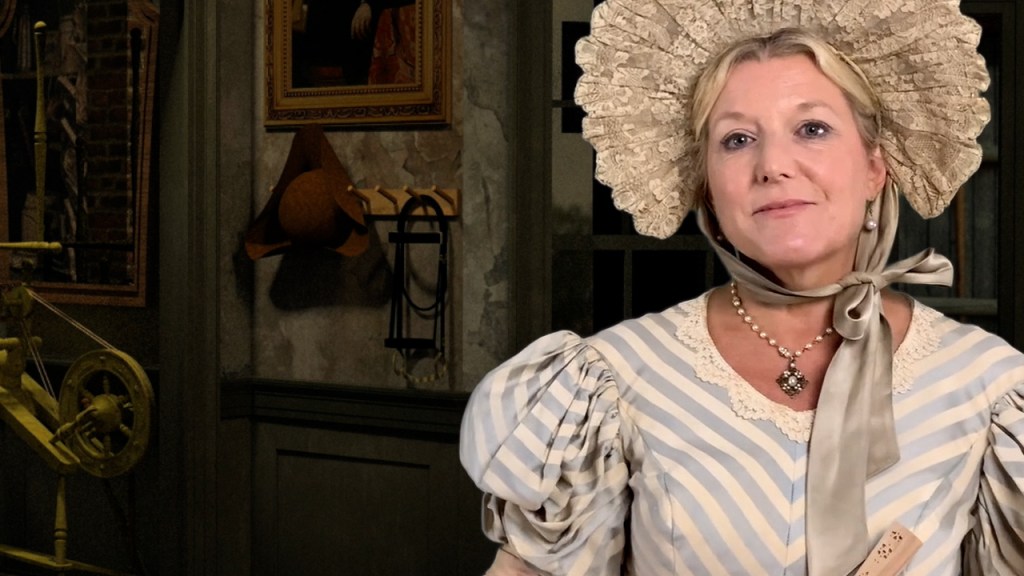
In their latest offering Eugene O’Neill’s A Touch of the Poet, the Irish Rep used the magnificent set they had created that was ready for production when the pandemic hit and New York was put on pause. With painstaking coordination, director Ciarán O’Reilly, the actors, technicians and artistic team configured a maverick presentation that launches the Irish Rep into new territory and reveals to other theater companies a way to deal with the vicissitudes of social distancing in performance. Each of the actors filmed their portrayals solo with attention to the staging of their actor/character counterparts.

The result is gobsmacking and actors’ performances are treasures. How they accomplished this feat of interaction keeping it dynamic and vital is beyond entertainment. The production of A Touch of the Poet is a profound recognition that with genius and collaboration, the breathtaking can result. And their collaboration elevates what many consider to be one of O’Neill’s more mediocre plays to one of illustrious depth.
This revival elucidates that in O’Neill’s work there is much that is parallel to our time as we follow the misfortunes and revelations of the humanity of the Melody family. In themes and characterizations we identify with the expose of Con Melody’s self-betrayal. Striking is his wanton self-abuse and the abuse of his wife and daughter as he pursues fantasies that no longer support the vitality of their lives and, in fact, hinder their appreciation of who they are and what they might be.
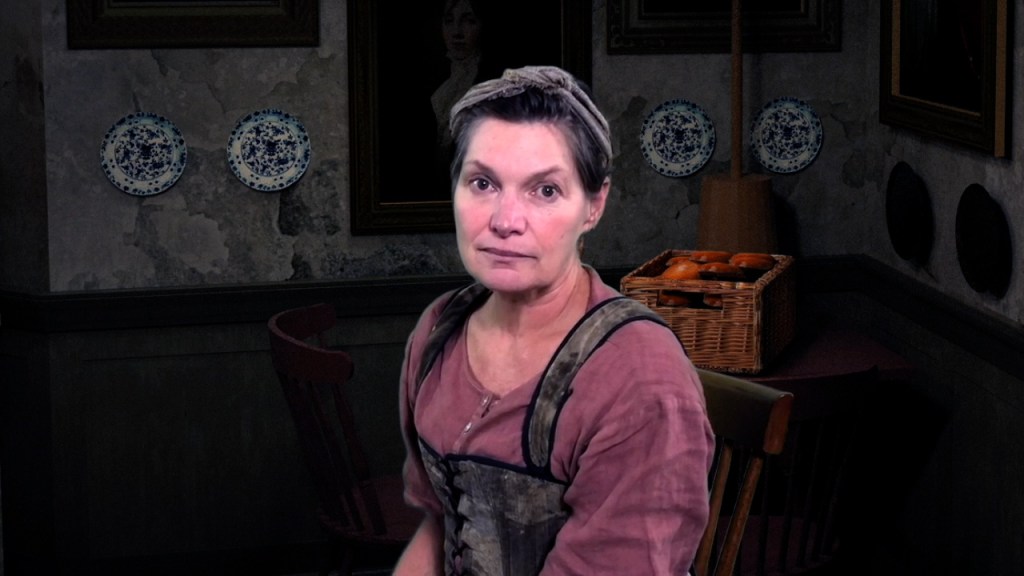
O’Neill sets his drama in Boston around 1828. The Melody family headed up by the alcoholic, self-destructive fantasist “Con” Melody (exquisitely portrayed by Robert Cuccioli) runs a ramshackle Inn with attached bar. Along with “Con,” are Sara (Belle Aykroyd) the stunning, truth-telling, rebellious foil to her father and Nora ( Kate Forbes) his pliant, subservient, fawning wife. The four live hand to mouth because Con abides in his glory days when he was a fiery and intrepid Major in the Dragoons, serving under the eventually exalted Duke of Wellington.
At the outset of the play, Jamie Cregan (Andy Murray gives a fine performance of Melody’s soldier underling and partner in brawling) provides the backstory of Con’s inner and outer conflict that Con has been unable to confront his entire life. Jamie explains how Con is an erstwhile gentleman with roots from the Irish peasant class that his father struggled to escape from. The father eventually advances himself and carves out an inheritance for Melody who is lifted into the airs of landed gentry and rises to a position of power in the British military.
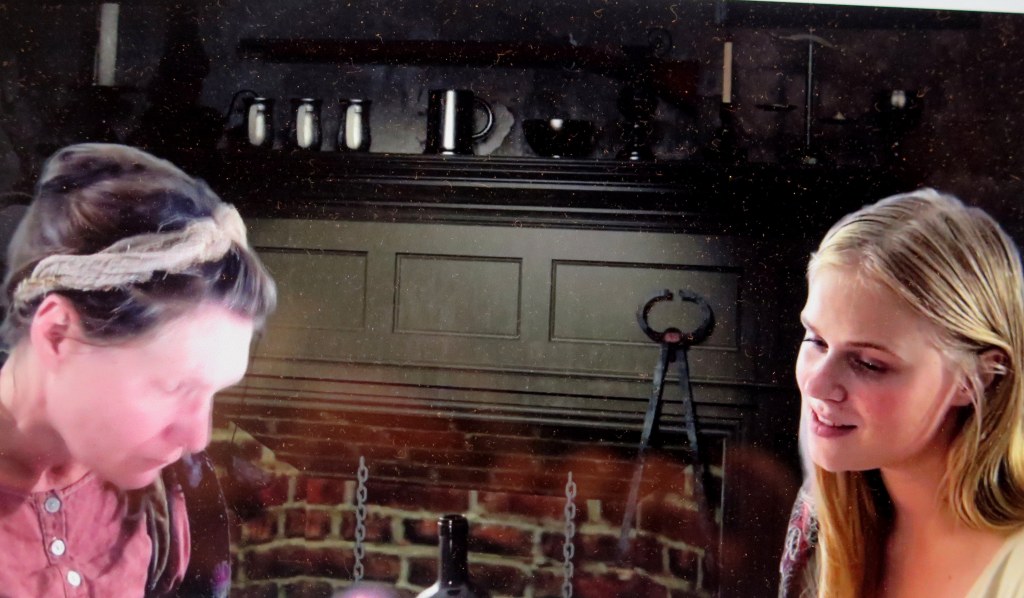
When Con’s philandering, drinking ways cause him to be sanctioned and ejected from his position as Major, Melody flees to the United States with Nora where they purchase the Inn and raise Sara. Swindled by a Yankee, who lies about the value and prosperity of the Inn, they barely scrape out an existence which is further impoverished by Con’s alcoholism and his inability to make his way in the United States.
Con’s relationship to Nora and Sara varies from drunken rages when he belittles and demeans both to guilty apologies and attempts to make amends with blandishments. Cuccioli balances the drunken bouts and insults with hasty apology that is both humorous and heartfelt. Through his spot-on portrayal we understand the impossibility of Con’s self-hatred and his attempt to escape both his alcoholism and his menial position in the new world as classism and discrimination drive him deeper into self-loathing. Cuccioli is particularly illuminating when he entertains the magical persona of “The Major.” As he affirms his exalted personage in a conveniently placed mirror, quoting Lord Byron, he imagines his long-lost greatness and gentility are still within.
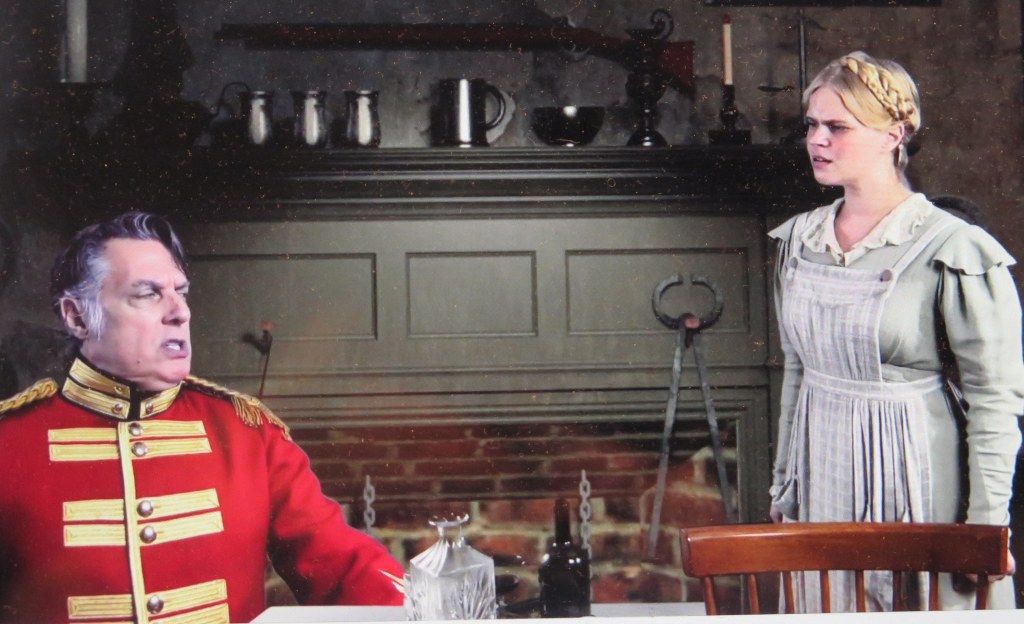
Indeed, Cuccioli’s stance, mien, presence convince us that he was once an individual of great deeds and valor and has fallen on hard times but will remain unbroken and unbowed. Nora adores him for she has “won” this dignitary’s love and that raises her own identity and self-esteem. Kate Forbes is just incredible as she mediates Nora’s self-recriminations, with her subservience to Con as she waits on his every whim. She never reproaches him for his abusiveness, indeed, she accepts his cruelties and disdain as worthy of her low station.
Cuccioli and Forbes relay powerful portrayals of these two individuals as they complete the dance of superior to menial externally which becomes the reverse when we see that Con needs to believe he is genteel and honorable, the stiff-upper-lipped gentleman of quality. However, ultimately, Nora dominates; Nora obliges and encourages him to fulfill her own assumptions about his love, as he lowers himself to rages and miscreant behavior.

Belle Aykroyd’s Sara who challenges Con’s treatment of Nora adds spark and fire to the dynamic of the family. She is the flint that ignites Con and inflames his drunken rages. She fills out the charged, family interplay with an amazing performance of irony and savagery. An instance of this occurs when Sara mocks Con’s puffery and “superiority” by putting on an Irish brogue and acting the menial. Apparently, Con has attempted to teach both Nora and Sara the finer ways, but Nora is unwittingly inflexible and Sara, who “knows better” enjoys defying her father at every turn.
Sara stirs the cauldron of infamy when she entices the guest of a wealthy land-owner to fall in love while she nurses him to health. Through her pursuit of him we learn of Nora’s own desires of greatness realized through her love of Con which becomes the similar road that Sara travels down. To raise her self-esteem in her own eyes and self-love, she becomes sexually involved with Simon Hartford (a blasphemy at the time) despite the threat of his mother Deborah Hartford’s (Mary McCann) disapproval. Deborah Hartford will make sure their relationship is doomed because of their class and economic differences.
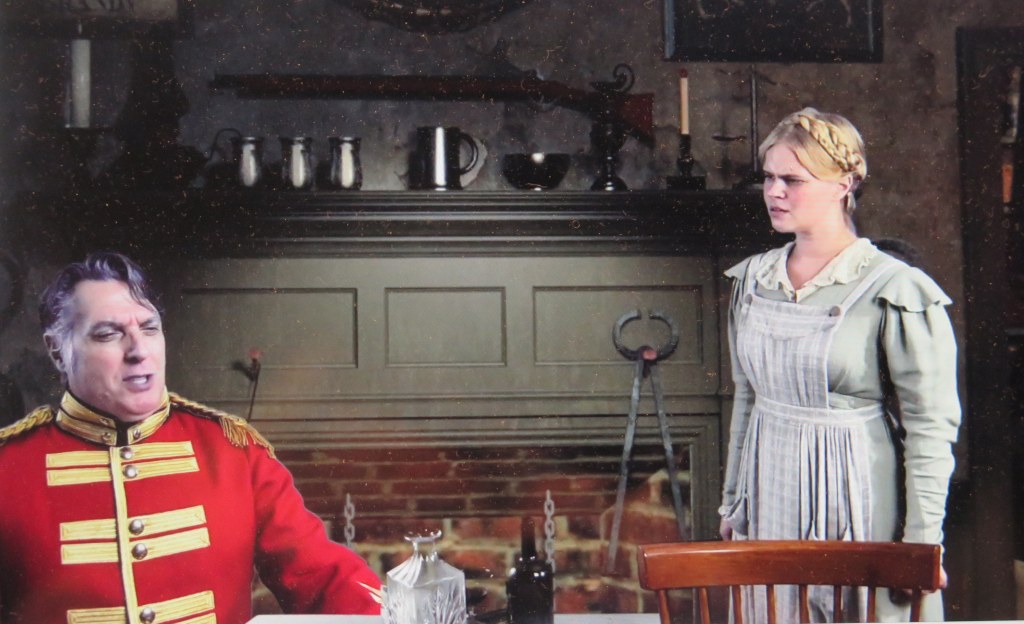
In the climax of the play which skirts the edges of physical confrontation, the actors seamlessly convey the action, considering each filmed his/her performance in their own homes. Thanks to the precise staging, it works when Con slaps Sara, when he caresses his wife at the conclusion with a new-found reverence of her patience and concern for him, and when he is physically bold in his attempts to kiss Deborah Hartford. Mary McCann’s staid and well-born Deborah Hartford is the perfect inducement for Con to entrap himself in one more perfidious and humiliating debasement.
From this juncture onward, we anticipate Con’s complete obliteration and the hope of a renewal. O’Neill satisfies; his ironic twists and Con’s ultimate affirmation of the foundations of his soul is as uplifting as it is cathartic. Now, his wife and daughter will have to adjust to this new day and redefine their expectations of their lives. Sara has already begun but the road she has chosen, like her mother’s is hard and treacherous with only her estimation of love to propel her onward.
Kudos to all the actors who negotiated the new medium of filmed staging on film and made it real. Likewise, kudos to the director who shepherded them through with extraordinary results. Last but not least are Alejo Vietti (costume design) Michael Gottlieb (lighting design) M. Florian Staab (sound design and mix) Ryan Rumery (original music) Sarah Nichols (video editor) April Anne Kline production coordinator.
This sensational collaboration magnifies the themes so you can greater appreciate O’Neill’s play of revelation and redemption through confronting one’s own shibboleths and destroying them. The revival shines a refreshing light on A Touch of the Poet and burnishes it with a new glory.
This is a production you must not miss. After this evening’s performance at 8 pm there are three more performances, two Saturday 31 October, and one performance on 1 November at 3 pm. For tickets to the online performances go to the listed site .https://web.ovationtix.com/trs/cal/32325?_ga=2.134261553.1367444511.160409768

