Category Archives: Off Broadway
‘Antigone (This Play I Read in High School)’ Review
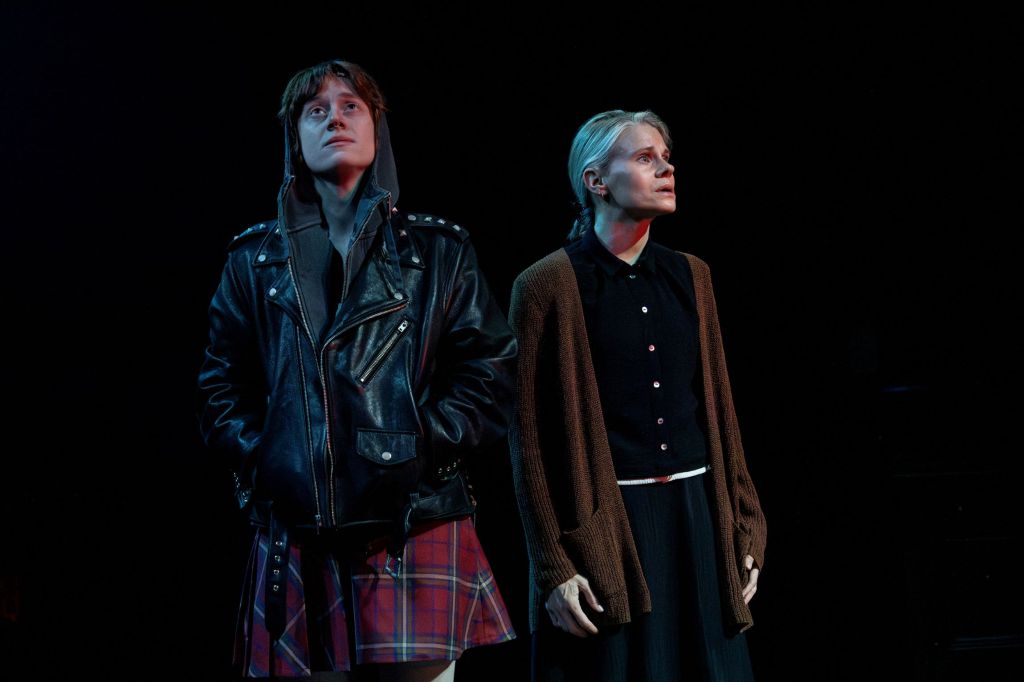
Strong performances from the leads Celia Keenan-Bolger, Susannah Perkins and Tony Shalhoub lift up Anna Ziegler’s unbalanced, convoluted feminist revision of Sophocles’ masterpiece Antigone. An irony not to be overlooked is that Antigone is a tragedy about a profoundly heroic and powerful woman who overturns the rule of the patriarchy-her Uncle Creon’s leadership-and destroys it and its future by adhering to spiritual and moral laws rather than the state’s. Ziegler gives a nod to the inherent “feminism” in Antigone in her adaptation which must be lauded for her attempt. However, its execution and rearrangements fall far short of the original. Directed by Tyne Rafaeli, Antigone (This Play I Read in High School) runs at the Public Theater until April 5, 2026.
Zigler reconfigures Antigone through the lens of Keenan-Bolger’s unnamed “Chorus/Narrator.” The playwright uses modern, feminist issues to frame and review Antigone’s heroism by having the Chorus/Narrator create her own scenario of the play she knew from high school. In effect, she imagines the Antigone/Creon conflict in a winding plot that relates to the Chorus/Narrator’s womanhood and identity.
Finding she is pregnant at an older age, the Chorus/Narrator must decide if she should keep the child or get an abortion, given who she thinks she is. However, this straightforward question comes after we witness her shadow her version of Antigone (exiled Oedipus and deceased Jocasta’s rebellious daughter) calling her up during events in the Chorus/Narrator’s life. In effect she uses Antigone to surge power into her own life over the years and help her resolve her problematic relationship with her mother, who she believes didn’t love her. The process of revisiting her own reclamation of the Antigone/Creon conflict enables her to validate her identity and her choices, and establish the power of her voice which she does by the play’s conclusion.
Through the Chorus/Narrator’s lens Antigone is a hip teenager with cropped hair (designers Robert Pickens, Katie Gell), wearing a black leather jacket, loosely fitting top and red plaid skirt courtesy of Ever Chakartash’s costume design. All of the characters are in modern dress, save Ismene, Antigone’s sister, who the narrator “sees” in a smock dress which she wears during her own self-imposed isolation, while Antigone makes defiant decisions. The set design (David Zinn) is minimalist mostly defined by props, for example, a lectern when Creon speaks to the crowd, a security screener at the palace entrance, a settee for Ismene’s room and more.
In the narrator’s first scenario the wild and recalcitrant, Antigone carouses in a bar and ends up with a pickup instead of going to her Uncle Creon’s coronation. She hears he’s become a hard-line politician and to keep control has established many strict laws to create order out of a chaotic Thebes. One of his laws is the banning of abortions which gives rise to illegal abortionists in the back of bodegas. Antigone eventually visits one of these after discovering her pregnancy from her love relationship with Haemon, Creon’s son, her fiance whom she has cheated on.
Key to the Chorus/Narrator’s conflict with herself is establishing her own life and identity, so scenarios especially between Creon and Antigone that she envisions help her. In the second act Antigone confronts Creon about having the illegal abortion. She tells him her body is her own and her choices are her own. They are acts of freedom. She will not be ruled by state laws or Creon’s laws, but by herself. The fact that she asserts this because she believes she can and should is a revolutionary act. The Chorus/Narrator’s view of Antigone is an independent, autonomous being beyond any laws, speaking truth to power, brave and unafraid. Her ultimate power is in ending a pregnancy, another life, if she chooses.
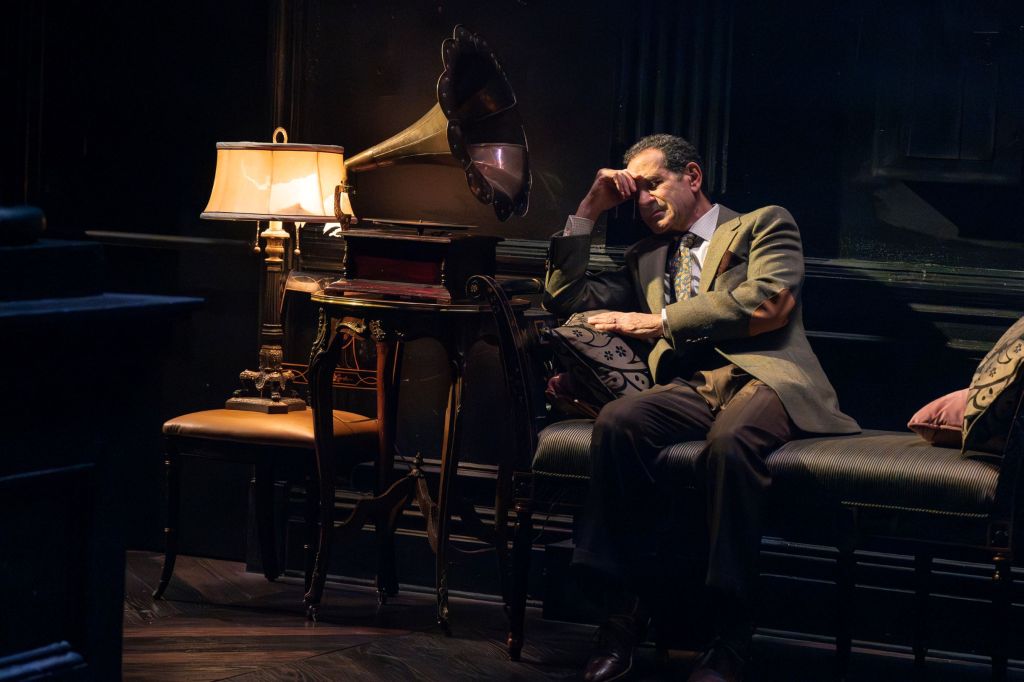
Creon has no power over Antigone in this context, over her reproductive rights. Thus the Chorus/Narrator imagines a dynamic scene where Antigone illustrates her act of freedom and of owning her own body to Creon. Perkins’ Antigone disrobes and points to various injuries and scars only she knows about. Naked, in full possession of herself in front of Shalhoub’s Creon, we believe in the power and determination of Perkins’ Antigone. Only she can objectify her own body, if she so chooses. Perkins makes a meal of this scene and we can identify with her argument keeping in mind how long it took for women to get to this point which was overturned federally in Dobbs after women experienced the freedom to choose via Roe v Wade for 49 years.
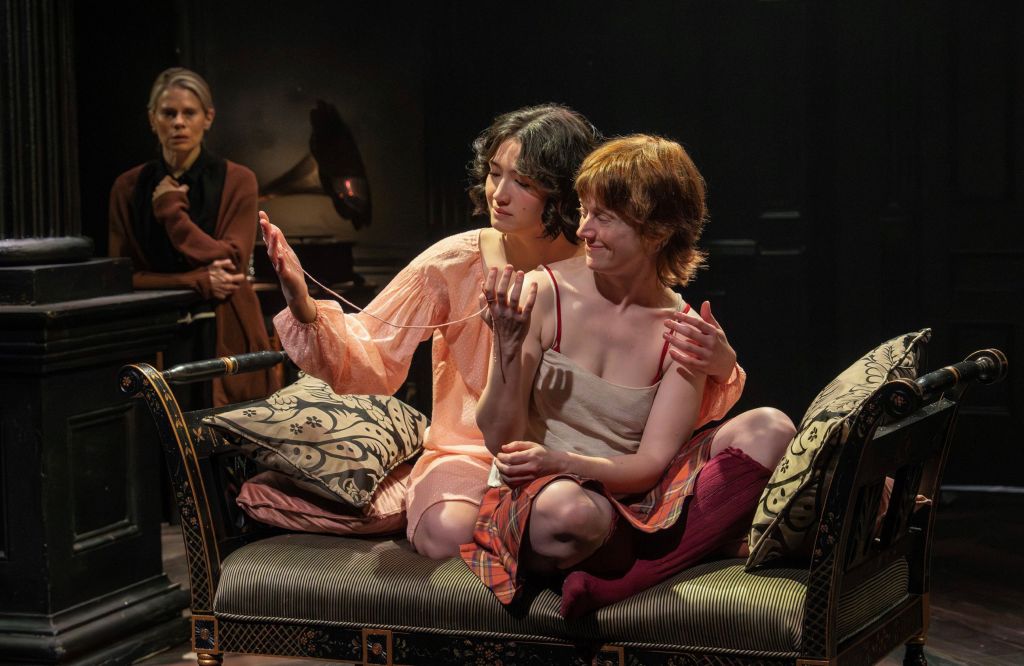
Apart from this high-point and Shalhoub’s Creon’s impassioned speech justifying why she must apologize publicly for getting the abortion, the characters don’t resonate. In Sophocles’ Antigone/Creon conflict we feel the enormity of the stakes and the depths of Antigone’s despair which prompts her decision to disobey Creon and not let her brother’s spirit wander for eternity. Unfortunately, Ziegler’s Chorus/Narrator’s inner conflict is not fully explored with grist or emotion. This prevents us from engaging with her as we look through the Chorus/Narrator lens darkly and have difficulty completely identifying with her version of Antigone.
It is an irony that Tony Shalhoub’s Creon, so expertly acted, elevates Creon. We note his character loves his son, niece and family. Unlike the more brutal tyrannical Creon of Sophocles’ original, Shalhoub’s Creon delivers the most reasoned and believable argument for his actions. Shalhoub actually humanizes Creon. Antigone’s choice to end her pregnancy, apart from her action of naked self-possession, becomes reduced from the heroic, noble Antigone in the original play to that of a willful revolutionary who does what she wants not because of any other reason, but to assert her will against the state, because she can. She refuses to apologize but her revolutionary act of facing death is not realized in Creon’s death penalty. She bleeds out from the bad abortion, the meaning of her act diminished.
Unfortunately, Ziegler’s framing structure reduces the characters’ stakes and prevents the audience from being drawn into the plight of Keean-Bolger’s Chorus/Narrator or Perkins’ Antigone to care about what happens to them. This occurs despite the acting chops both women acutely display. The structure is at fault, not their performances.
Antigone (This Play I Read in High School) runs 2 hours15 minutes through April 5 at the Public Theater https://publictheater.org/productions/season/2526/antigone-this-play-i-read-in-high-school/
‘Bughouse’ John Kelly Becomes the Fascinating Ousider Artist Henry Darger
An unknown until his work was discovered just before his death, the incredible outsider artist and epic novelist Henry Darger (1892-1973) is celebrated at the Vineyard Theatre in the multi-media work Bughouse. Adapted from the writings of Henry Darger by Pulitzer Prize-winning playwright Beth Henley, the 70-minute play is conceived and directed by Drama Desk and Obie Award winner Martha Clarke.
The dance-theater director’s prodigious talents are on full display in Bughouse. Incisively, Clarke shepherds Obie Award-winning performance artist John Kelly to emotionally spin Henry Darger’s creative angst into the fantastical in this beautiful and poignant production. Heartily embraced by its audiences, Bughouse has been extended an additional week until April 5, 2026.
Martha Clarke uses Ruth Lingford’s animation, John Narun’s projection design and Fred Murphy’s cinematography to create the layered realities of Darger’s exterior and interior worlds. She uses animations created from Darger’s illustrations to explore and enhance Darger’s life and work. When projected on windows and mirrors, the “unreal realms” live to the delight of the audience. Kelly’s Darger moves seamlessly through the artist’s interior states of consciousness with enthusiasm and feeling. We can’t help but identify with Darger’s uniquely metaphoric creations. These include archetypal battles between good and evil. When hearing of Darger’s childhood experiences, one concludes the battles express emotional conflicts from his past that he could only reconcile through his artistic creations.

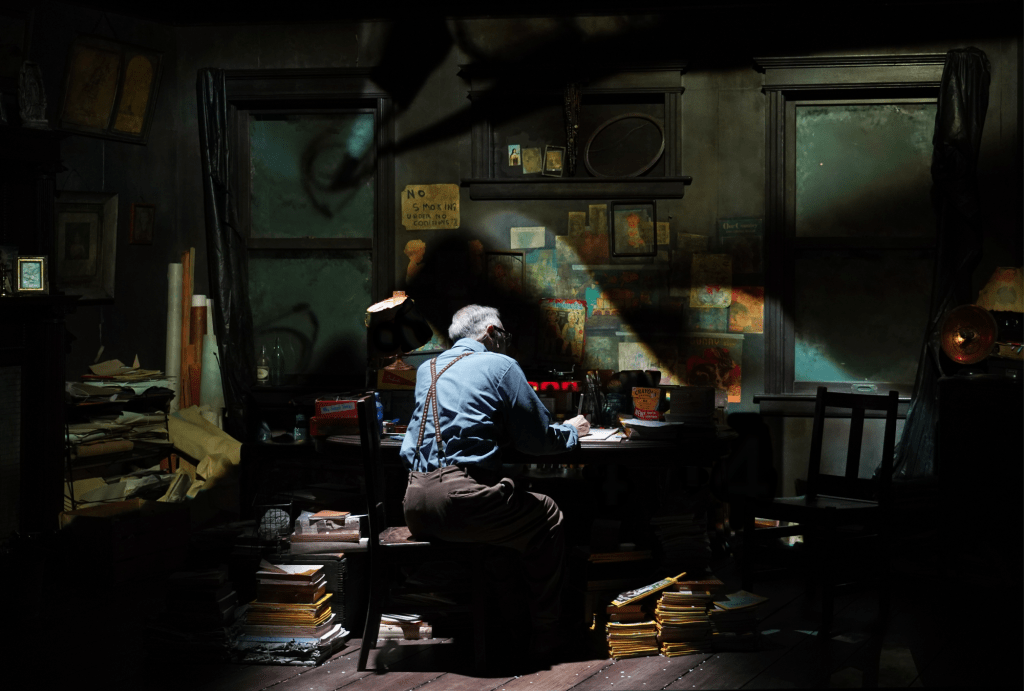
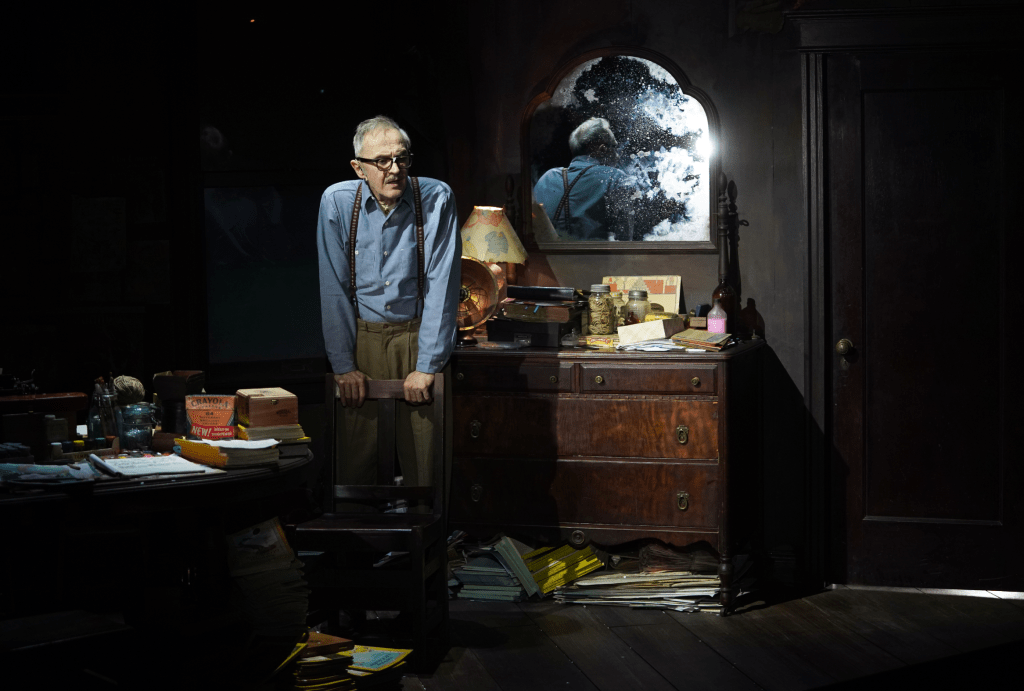
Inspired by photographs of Darger’s apartment, Neil Patel’s production design shows Darger living and creating in a claustrophobic, curio and antique stuffed apartment. In Patel’s recreation, Darger hordes National Geographics and period magazines in piles on the floor. Various items crowd every inch of space in the room. Papers and illustrations cover the table where Darger types up his magnum opus, a few lines of which Kelly’s Darger reads as he types. Beth Henley aptly uses passages from Darger’s epic fantasy in Bughouse (i.e. “The Vivian Girls, fought bravely against the Christian hating, child slave holding Glandelinian demons.”)
The audience becomes Darger’s confidente as we watch his creative process unfold. When he explains his life story, his imagination sparks. Immediately, he moves to type up the continuing adventures of the Vivian Girls, his chief protagonists. “The Vivian Girls…were prettier than fairies and as good as saints and though delicate in form as they looked, they were perfectly strong.”
In their perfection, his characters fight battles in righteousness, overcoming oppression and brutality. Darger explains what makes them heroic when he says, “Beautiful as they were in features however, they were more beautiful in soul doing all that all good children should do, and were so righteous and attended church so frequently every day that their father began to look upon them as saints!”
In between sharing his woeful childhood after his mother died and his father could no long care for him, Darger expresses his hatred of the abuse he experienced as a child. From the nuns in the school he attended, “Mission of Our Lady of Mercy,” and the caretaker at an asylum for feeble-minded children, where he lived until he finally escaped after two failed attempts, Darger was bullied and persecuted for “being different.” Based on various reports and his examination, a doctor misdiagnosed him as feeble-minded when, in fact, the opposite was true. Henry’s father taught him to read at a very young age so he could read the newspaper to him.
We question why these incompetent individuals didn’t recognize or encourage Darger’s talents. But then perhaps snatches of the creative soul of the reclusive, hospital janitor and dishwasher Henry Darger wouldn’t be the essence marvelously portrayed by John Kelly in this fine production. If one believes the adage that pain and suffering produce the artistic drive to express and relieve an artist and writer’s soul’s agonies, then Darger surely is representative.
Thankfully, Darger’s incredible imagination and genius lives on in 350 exquisite watercolors which appear in museums, galleries and collections worldwide. His fantasy novel of 15,000 pages, his 5000 page autobiography and more are available to read.
Caveat: noted is the warning that the content in Darger’s illustrations sometimes depict harm against children as the heroines battle to free enslaved children against evil forces. Also, some of the illustrations depict children without clothes. A few of these images are “included in brief moments in Bughouse.”
Bughouse runs 70 minutes with no intermission at the Vineyard Theatre until April 5, 2026. https://vineyardtheatre.org/shows/bughouse/
‘Marcel on the Train’ a Celebration of Life Using the Silent Power of Mime
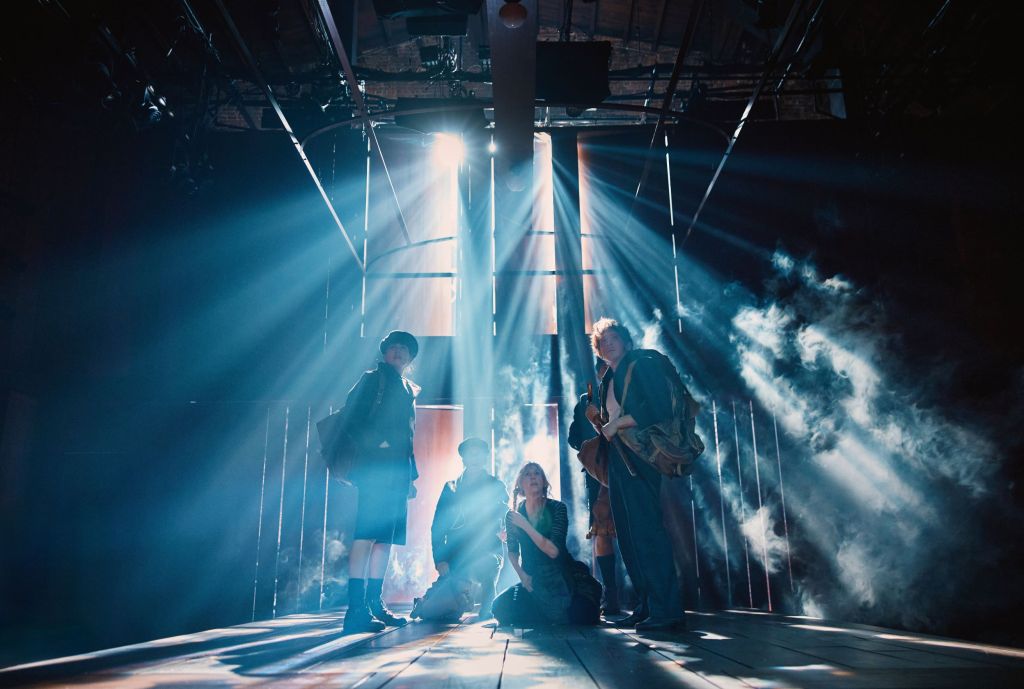
Live theater has the power to enthrall while inspiring a deep emotional impact, not only with well-honed dialogue and organic staging, but with movement and well-placed silences. With an emphasis on the latter, Marcel on the Train is mesmerizing and emotionally powerful. The drama is a tribute to celebrated icon of mime, Marcel Marceau. With a fascinating twist it captures a little known fact about Marceau’s life. As a young Frenchman he helped his brother save Jewish children with the French Resistance during the WWII Nazi occupation. This poetic, profound and suspenseful production finely directed by Marshall Pailet is inspired by Marceau’s courage and work in the Resistance. It currently runs at CSC until March 22, 2026.
Written by Marshall Pailet and Ethan Slater, who portrays Marceau, the events begin with an introduction to Marceau’s power to fluidly convey the invisible with simple movements. With these he manifests concrete objects that the audience sees with their imaginations in a silent, collective consciousness.
The opening scene happens in an abandoned train car overgrown with weeds, all invisible. Once Slater’s Marceau mimes sliding the doorway open, he views his surroundings. He sees a flower, picks it, and behold, his hand becomes the flower which opens, then dies. Another cast member enters and joins Marceau in the three sided space that is the train car. His right hand is a fluttering butterfly whose movements are accompanied by a riff of piano music, via Jill BC Du Boff’s sound design. Other performers whose hands are butterflies fill the train car with delicate beauty. Then, they vanish.
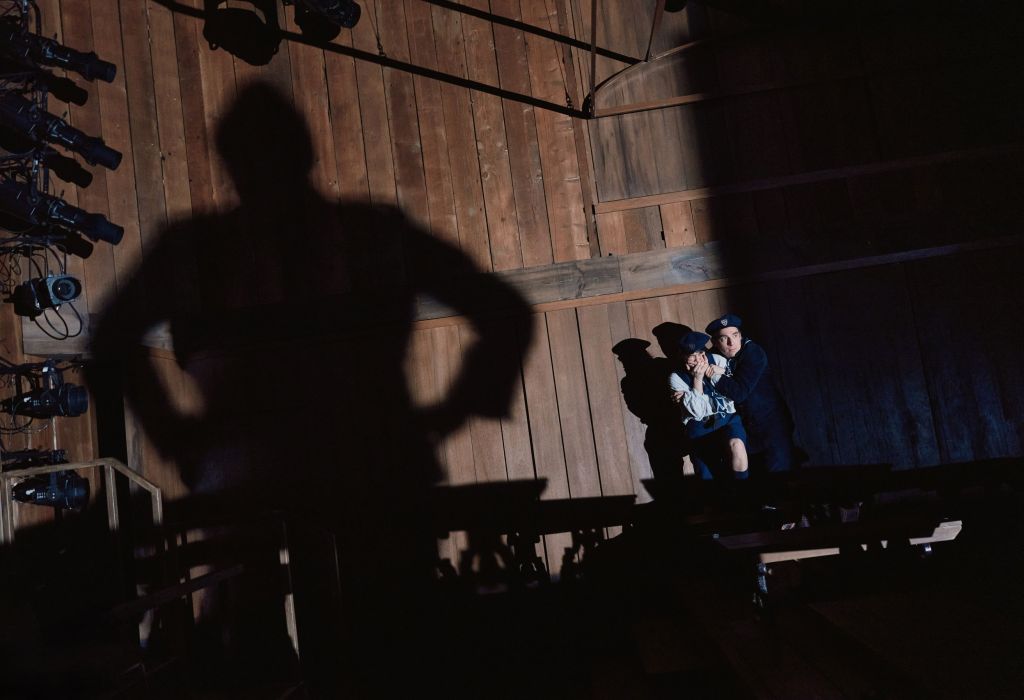
The scene transforms with the whistle and chugging sounds of the train. The performers turn into sleeping children and the difficult Berthe (Tedra Millan) screams as she awakens from a nightmare. Marceau attempts to understand her explanation and comfort her with humor in his role as chaperone of the 12-year-old boys (two girls are in disguise) under his charge. The train takes the 20-year-old Marceau and the four “boys” to a Boy Scout Camp in Switzerland to escape Nazi deportation to the concentration camps.
Pailet and Slater disclose the backstory in flashback vignettes where Marceau at various points remembers scenes from the past with his brother or father. These fill in gaps to clarify present events. In one such scene his brother Georges (Aaron Serotsky) discusses the foolproof plan (Jews never become Boy Scouts) to save children. Georges volunteers a reluctant Marceau to take them on a train through Nazi occupied France to the Swiss border. The flashbacks seamlessly return to the present stressful circumstances on the train created effectively with minimal design by Scott Davis and atmospheric lighting by Studio Luna.
As Marceau attempts to comfort the nihilistic, quarrelsome Berthe with humor, she criticizes his bad jokes and throws their dire situation in his face. Her character, though unlikable, provides the forward momentum challenging Marceau to rise above the dangerous circumstances. He persists and succeeds in rocking her off her negativity and fear with the silence of mime.
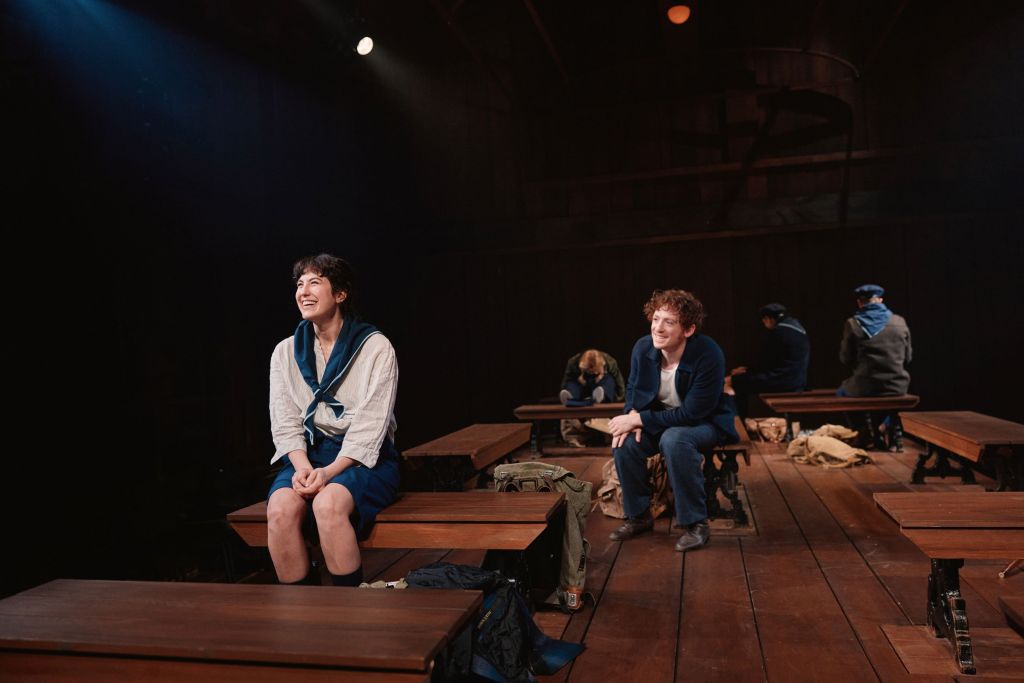
This becomes the template Marceau uses as he and the children travel toward the Alps, encountering obstacles along the way. Particularly tense scenes concern the unexpected. For example Georges doesn’t meet them at a stop where he was supposed to board the train to accompany them. Other frightening moments occur when they encounter the Nazis, especially as they come closer to their destination and the Swiss border crossing. At these moments of possibly being discovered, the stakes go through the roof. In each case, Marceau proves his mettle by using his art to distract the children and provide the hope and courage to confront extreme danger by believing in a positive outcome. Slater’s Marceau proves his talent using the power of silence and kinetic physicality. His creative imagination entrances the children. Thus, they follow his lead to keep quiet and not fight with each other and expose their true identity.
As a break in this template of Marceau’s softening the hellish situation with his artistry, Pailet and Slater interpose a scene in the future for each of the children. It is Marceau’s affirmation that they will not be captured and die in the camps. For example, Adolphe’s (Max Gordon Moore), future takes place in a POW camp in Vietnam. Marceau told him to remember something from his time on the train, Adolphe uses this remembrance to give himself hope. As a result he lightens the outlook for himself and another soldier despite the hellishness of the POW camp.
Marceau gives each of the children hope by telling them he sees their futures. Of course this inspiration deters them from believing in the present which is peopled by Nazis who intend to send any and all Jewish kinder off to the extermination camps.
The ensemble is superb. The staging and direction surprising and engaging. Slater, whose effervescent performance was perfection in the title role of “SpongeBob SquarePants: The Broadway Musical.” is of necessity the standout in a startling, endearing portrayal he helped write for himself. The scene where he picks up the snow that becomes the white make-up of Bip the Clown is searing and poignant. Slater’s few, profound gestures carry a lifetime of meaning in Marceau’s sixty-year career as a mime and actor in films who most always played himself with ironic silence.
Marcel on the Train runs 100 minutes with no intermission through March 22 at Classic Stage Company. classicstage.org.
‘The Dinosaurs’ at Playwrights Horizons
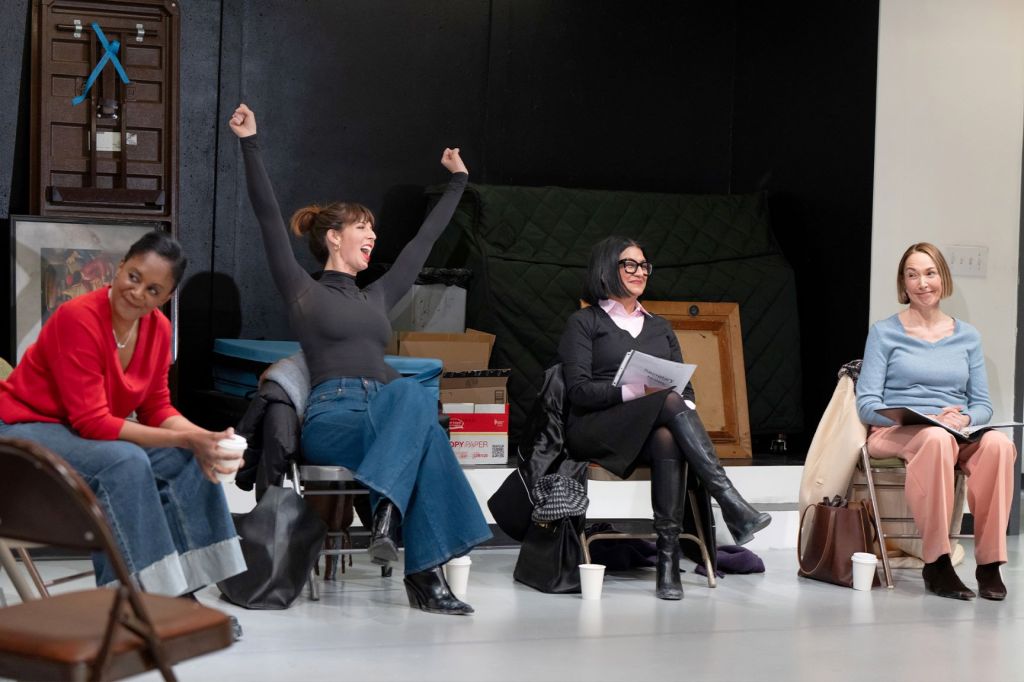
In The Dinosaurs written by Jacob Perkins and directed by Les Waters, time stands still yet moves in leaps that are hard to figure out. It takes place in a room where women who are alcoholics meet, form community and establish friendships helping each other through the years. With strong performances that require solo monologues, the characters share experiences and perspectives and enumerate their days of continuing sobriety. The Dinosaurs currently runs at Playwrights Horizons until March 8, 2026.
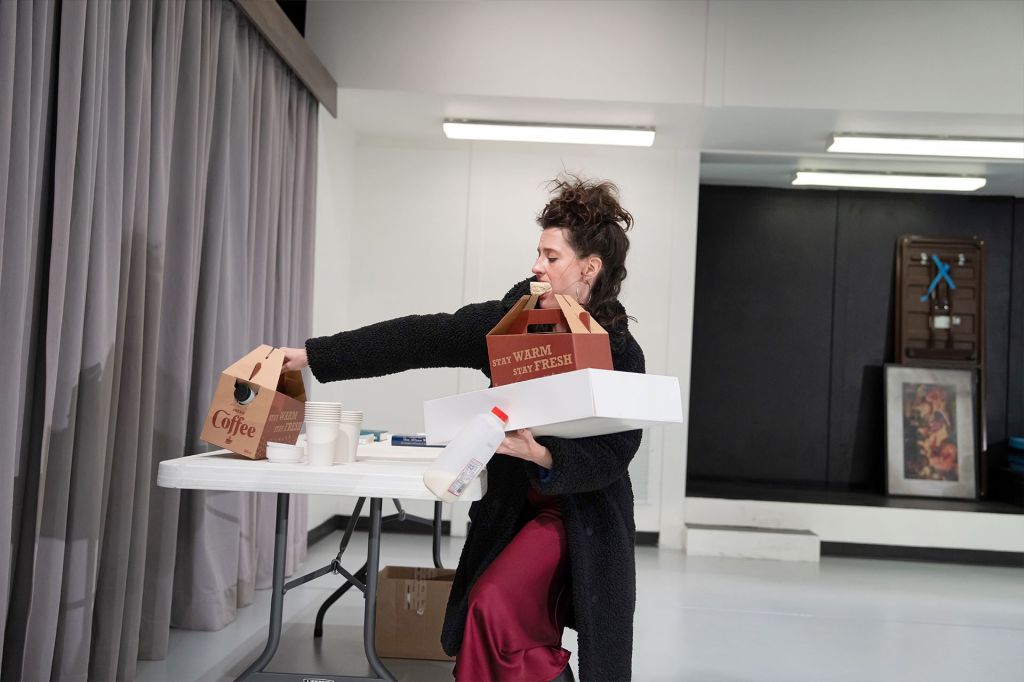
As the characters set up the neutral unadorned room (scenic design by dots), where they meet, wait for participants to show up and reaffirm the rules of their sessions, we understand this is a female inclusive community. April Matthis as Jane is first to arrive to begin setting up chairs, followed by nervous Buddy (Keilly McQuail), who after a humorous exchange with nonjudgmental Jane, decides she can’t stay. She does show up during the meditation and the end only making a connection with Jane in a layering that makes the time structure hard to divine.
Next, Elizabeth Marvel as Joan enters with the coffee and helps Jane set up. She is followed by Kathleen Chalfant’s Jolly as the longest, oldest member of the group, who brings positivity and warmth with the donuts and scones. Newer member Joane (Maria Elena Ramirez), arrives with gossip about a female teacher. Finally, Janet (Mallory Portnoy)–the appointed time keeper–arrives late and is the first one to share on the topic “coming back,” after their group meditation.
The playwright avoids heavy emotional content related to grief, sorrow, regrets, abuse or violence. Indeed, he avoids in the moment conflict in the plot and character development, with the exception of Joan, Jane and Joane who disagree about feeling empathy for a “lonely” female teacher who has sex with a teen who is “of age.” Jolly provides the down-to-earth humorous perspective as the argument persists then ends once Janet arrives. Interestingly, one would think these are average women of various ages who live regular lives, but for their momentous pronouncement later, during their time to share, that they are alcoholics.
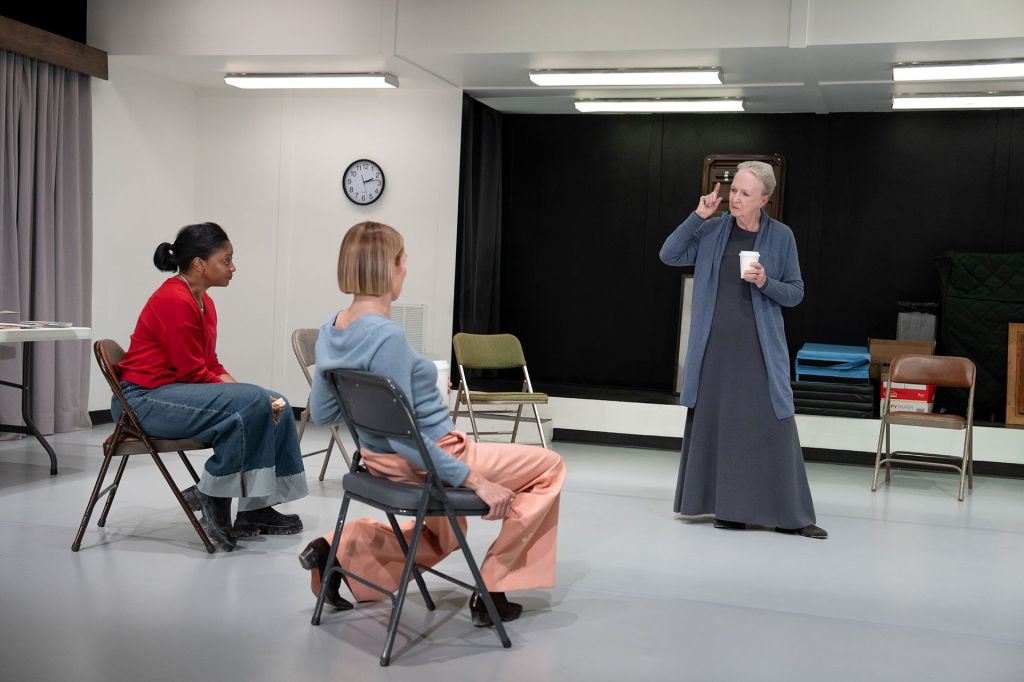
The production spends a good deal of time having Joan, Jane and Jolly set up the room making small talk. Chalfant’s portrayal as Jolly mesmerizes with substance, authenticity and humor, which she clearly infuses with backstory and meaning. In comparison with the other women, Jolly’s character is the most delineated because of Chalfant’s superb, specific performance, as is Marvel’s Joan who reveals why she is an alcoholic toward the end of the play. Otherwise, the characters divulge little else about themselves. This forces the audience to imagine who these women are and why they chose alcohol as their drug and not opiates, barbiturates, food or other addictive elements to anesthetize themselves and escape from life’s “slings and arrows of outrageous fortune;” if indeed, that is why they are alcoholics.
Janet’s metaphoric experience about being driven by a chauffeur she hates and who tells her to throw out the body of a man instead of carrying it around, seems to express her situation of carrying baggage which she eventually throws away in her awake dream state. However, we don’t understand to what she refers and she doesn’t connect the dots. Likewise, the others say little hard evidence about their situations. This adds to a general tiresome opaqueness.
All important personal details are absent, perhaps playwright censored to indicate his characters’ self-censorship. No explanation is given by the playwright, which leaves a huge gap in the ethos of the play. Nevertheless, a picture forms of these characters and the process of their recovery from a disease. However, its horrific effects in their personal lives as they share with their community is never identified. Indeed, the recovery process seems deadening as the women avoid discussing even the difficulty of fighting the urge to taste a drop of their favorite alcoholic beverage.
The characters also avoid discussing the severity of their alcoholism. If the blood never boils with emotion, then not feeling alive removes any impulse to drink. Perhaps keeping a steady deadened state is their key to recovery. How fortunate that they have found other individuals who allow this type of emotional void to be shared. Their tell-tale meditation at the beginning of their meeting indicates what substitutes for feeling and the connection with their feelings.
Notable examples of a separation perhaps disassociation from feelings happen with a few of the characters. Joane’s discussion of finding her son pleasuring an older man in their house seems devoid of an emotional reaction on her part in relation to her drinking. The assumption is that her discovery caused the rift between herself and her son that she describes and perhaps this led to her alcoholism. She and her son never discussed or dealt with her seeing her son with the older man. Did this lead to the dire circumstances that happened later in their lives? Ramirez’ Joane recalls it with dispassion though she takes a moment to breathe revealing the confession is difficult. Her admission that she is revealing it for the first time is groundbreaking.
That her son at fifteen was under the apparent influence of an older man reflective of the current pedophilia reports in the Epstein files is passed over without judgment by Joan or any of the other women. Is this what it takes to recover from alcoholism, this passive, non-reactive state of mind while others are there to just listen?
Joan’s time lapse discussion of the days of her recovery to sixteen years emerges with vitality. A matter-of-fact statement of her number of years without a drink that has seen her in this room with various community members of alcoholics hearing her make comments becomes her milestone. And apparently, during that sixteen year period she had to say goodbye to Jolly who dies and whom she misses. Thus, Jolly’s influence on her own recovery is reduced to less than a minute of time, though counting the years of struggle to maintain sobriety must have seemed an eternity. Unfortunately, there is a grand absence of information. Perkins revels in being opaque. More is needed.
Thankfully, the actors do a yeowoman’s job of leaping over the play’s lack of detail by providing as much of their interior substance as possible. Nevertheless, the lifeblood of theatricality and living onstage is hindered by the playwright’s lack of clarity. Nor is the play’s incoherence at times clarified by Waters’ direction.
Perhaps Rainer Maria Rilke’s quote from Book of Hours which Perkins uses to head up his script might have been spoken aloud by one of the characters in a prelude to The Dinosaurs. The lines of poetry present a lens though which to view each of the characters’ journeys, lifting them to a spiritual plane and revealing the irrelevance of time.
I live my life in widening circles that reach out across the world. I may not complete this last one but I give myself to it. I circle around God, around the primordial tower. I’ve been circling for thousands of years and I still don’t know: am I a falcon, a storm, or a great song. –Rainer Maria Rilke from Book of Hours
The Dinosaurs runs 1 hour 15 minutes at Playwrights Horizons until March 8, 2026. playwrightshorizons.org.
‘Chinese Republicans’ a Sardonic Look at Chinese Women and the Glass Ceiling
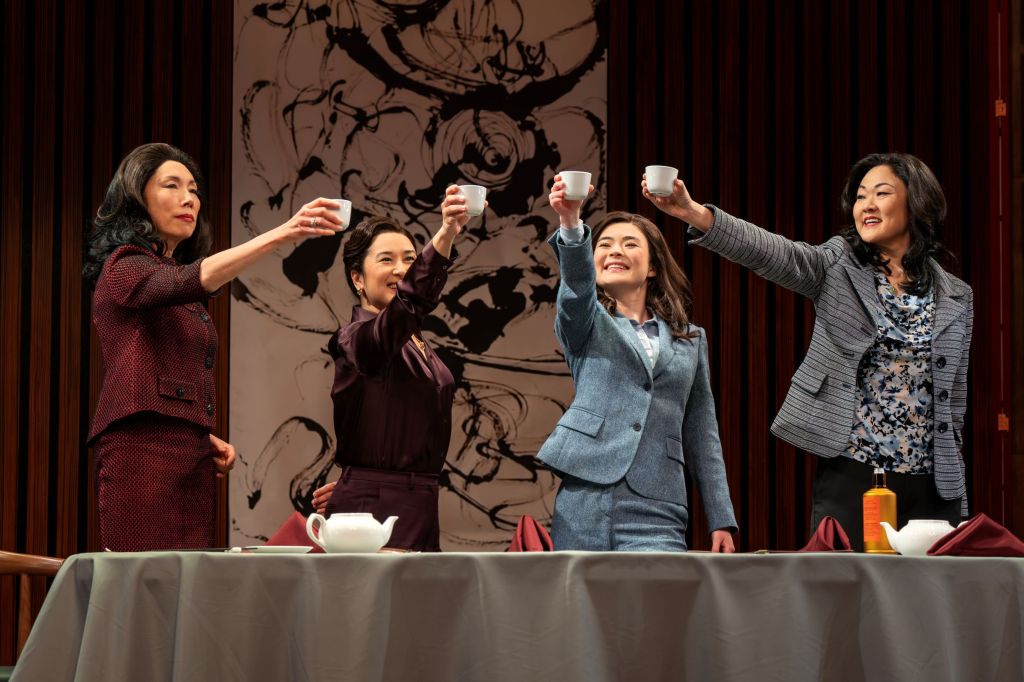
A cross section of how Chinese American women have fared in the corporate world is the engaging subject of Alex Lin’s ironic, humorous and ultimately devastating play Chinese Republicans. Directed by Chay Yew, the well-honed production examines personal sacrifice, identity conflicts, and nuanced discrimination (gender, age, cultural). Currently, Chinese Republicans runs at the Roundabout, Laura Pels Theare, Harold and Miriam Steinberg Center for Theatre until April 5, 2026.
The playwright spins a complex dynamic about Chinese American corporate working women. Yew expertly unfolds the complications among four women of different generations, including one immigrant, working to get her citizenship. During meetings designed to encourage affinity but which actually stir resentments and competitiveness, each of the characters reveals the struggle they face to break the glass ceiling, competing against their less qualified male counterparts. Though the story is unfortunately all too familiar, Lin spikes the interactions with an original, darkly funny approach that resonates with currency.
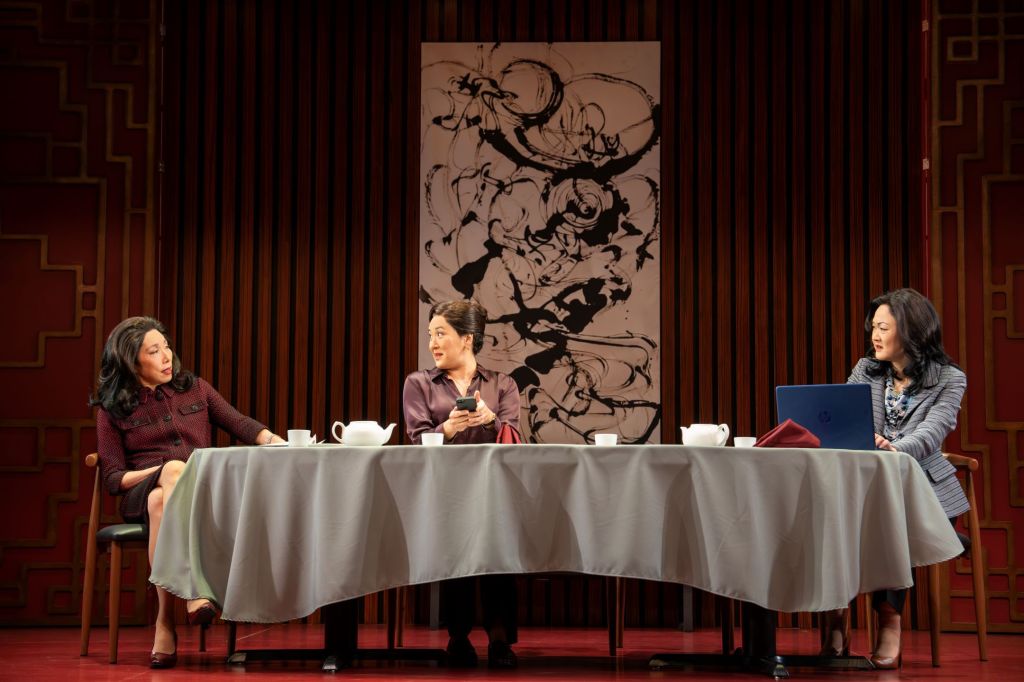
The production takes off by introducing us to four female suits who work at various upper level positions at Friedman Wallace, as they gather for their “affinity luncheon,” where they meet once a month at a Chinese restaurant. We note ambition, assertiveness and edginess which might as readily be exhibited by any male power-player succeeding in a tough environment. However, these women must obviously work much harder for their success because of internal biases against them culturally as women, and especially as Chinese women. Lin and Yew dance artfully around this gender debility by focusing on cultural elements and details. This strengthens the irony and themes while instructing the audience on elements about the Chinese culture they may not know.
First and most preeminent with experience and knowledge to instruct the younger suits is Phyllis (Jodi Long). She holds little back and uses her irony as a weapon. Ellen, (Jennifer Ikeda), Phyllis’ mentee, has sacrificed having children for her position and plans on becoming partner. Iris (Jully Lee), an immigrant who speaks four dialects, chides the others, especially Ellen on their bad Mandarin and losing touch with their Chinese identity. Lastly, Katie (Anna Zavelson) is the youngest and newest member of the group. Confident and positive about her recent promotion, Katie enthusiastically intones she is excited about their “making a difference.” Then she proclaims, “Come on Asian queens.”
From this luncheon onward, Lin and Yew prove the difficulty for each of the characters to be “Asian queens” in their workplace or their personal lives. Mostly the scenes take place at the restaurant as neutral ground with the exception of the game show farce when Iris ironically shreds Ellen, Phyllis and Katie’s ambitions with irony as part of a fever dream turned nightmare. The side scene after Katie does a turn around and evolves into an advocate for unionizing Friedman Wallace is funny, as she stands in front of the building pumping up a labor rat while the others watch her from the conference room at Friedman Wallace in shock and horror.
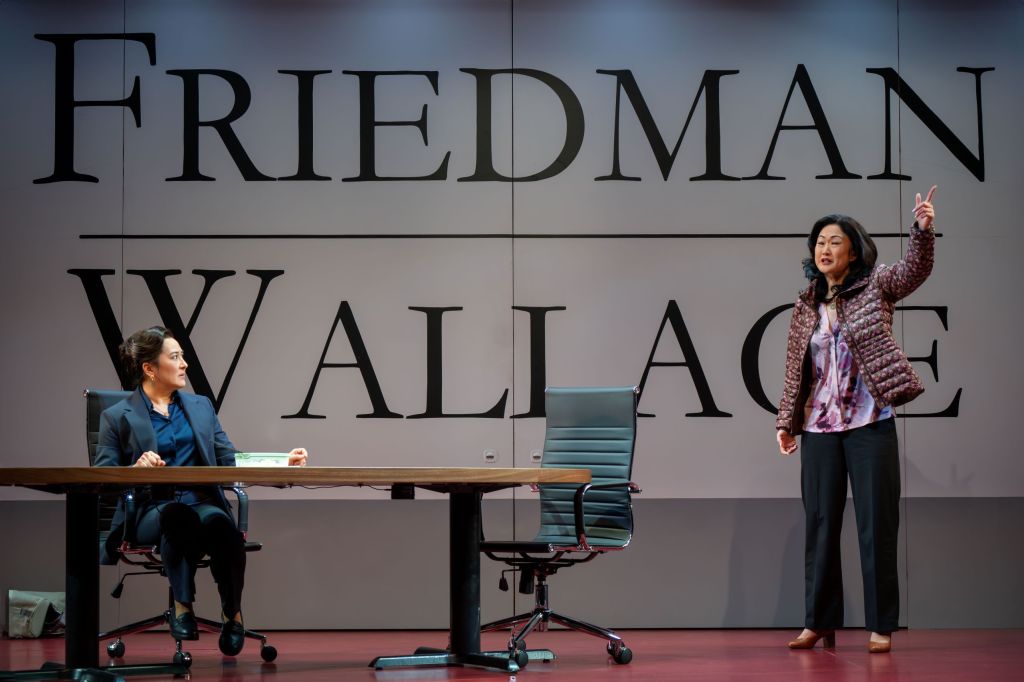
How and why Katie reverts to an anti-Republican unionizer from “gun-ho” Asian queen Republican in all its glory involves the corrupt male culture of Friedman Wallace, to discriminatory street violence against Phyllis, to Iris’ immigration hell, to sexual harassment and much more. However, we learn a few twists and turns about each of the characters that add to our admiration of these highly competent women who have endured and suffered nobly, knowing in their bones that not only are the odds stacked against them to ever be at the top, they have strived and sacrificed to what end? A sea of regrets?
The ensemble is uniformly superior. Each portrays their characters with authenticity and a no holds barred approach. As a result the concluding revelations land with poignancy and a powerful kick. The double irony of the evolving meaning of being a Republican is tragic, considering the current face and brand of the MAGA party. Lin neatly slips this information about being Republican into Katie’s development from corporate martinet to human being with a conscience. It’s a reminder to history buffs and salient information for others that political labels are meaningless.
Chinese Republicans fires on all levels of theatricality and spectacle, adhering to Yew’s minimalist, unadorned vision for Lin’s play which focuses on character and themes. Wilson Chin (set design), Ania Yavich (costume design) and other creatives present an attractive backdrop which lends itself to disappearing so the actors are able to live onstage and emotionally, profoundly impact the audience.
https://www.roundabouttheatre.org/get-tickets/2025-2026-season/chinese-republicans
Elevator Repair Service’s ‘Ulysses’ by James Joyce, a Review
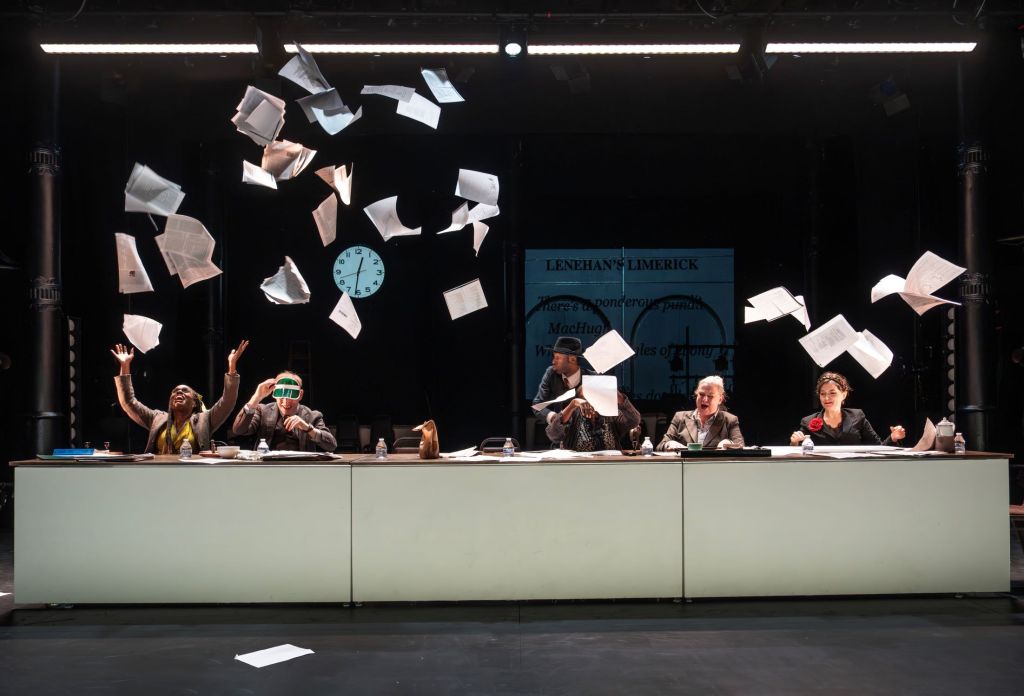
Elevator Repair Service became renowned when they presented Gatz, a verbatim six hour production of F. Scott Fitzgerald’s The Great Gatsby at the Public, as part of the Under the Radar Festival in 2006. Since their remarkable Gatz outing, they have followed up with other memorable presentations. It would appear they have outdone themselves with their prodigious effort in their New York City premiere of James Joyce’s opaque, complicated novel Ulysses. The near three-hour production directed by John Collins with co-direction and dramaturgy by Scott Shepherd, currently runs at The Public Theater until March 1, 2026.
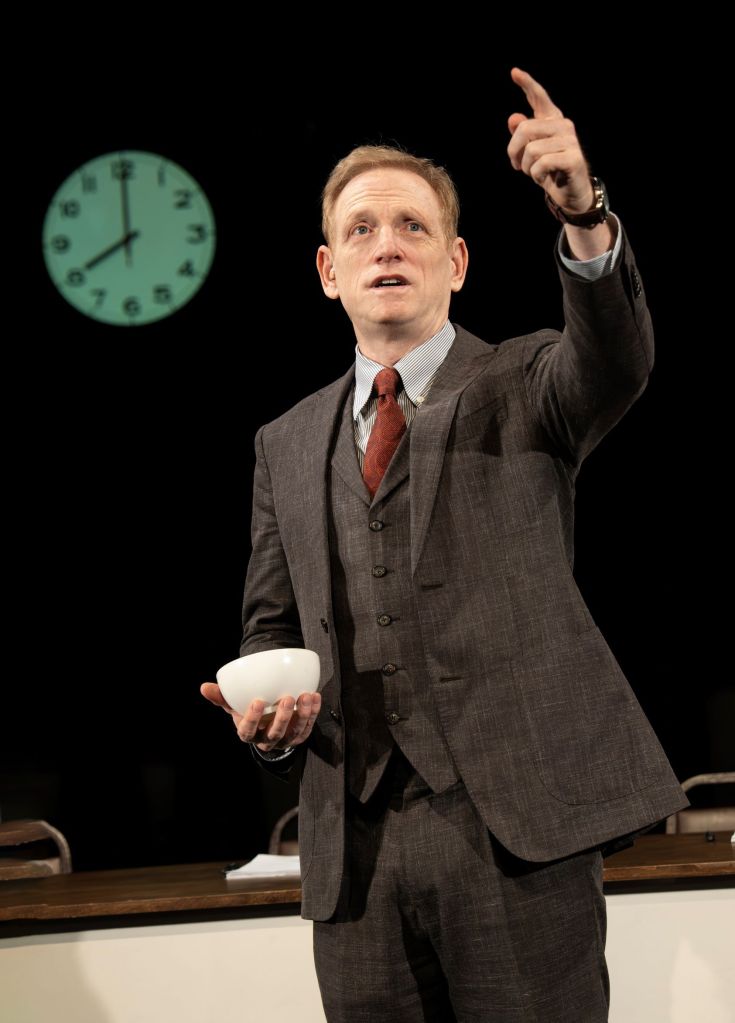
At the top of the play Scott Shepherd introduces the play with smiling affability and grace. He directly addresses the audience, reminding them that “not much happens in Ulysses, apart from everything you can possibly imagine,” and that it happens in the span of a day beginning precisely at 8 a.m,, Thursday June 16, 1904 in Dublin, Ireland. Before Shepherd dons the character Buck Mulligan who appears at the beginning of the novel, he discusses that in the “spirit of confusion and controversy” (labels by critics), Joyce’s day in the life of three characters will be read with cuts in the text. Elevator Repair Service elected to remove Joyce’s text to redeem the time. The cuts are indicated by the cast “fast forwarding” over the narrative.
Collins and the creative team cleverly effect this “fast forwarding” with gyrating, shaking movement and action. Ben Williams’ design replicates the sound of a tape spinning forward. To anyone who may be following along with their own copy of the novel, the “fast forward” segments are humorous and telling. However, the cuts pare away some of the details and depths of character Joyce thought vital to include in his parallel of Dublin figures with the most important characters of the Odyssey: home returning hero Odysseus, long-suffering wife, Penelope, and warrior son, Telemachus.
After Shepherd’s introduction, Ulysses moves from a sedentary reading with multiple actors into a fully staged and costumed production as it progresses through the day’s events principally following Stephen Dedalus (Chisopher-Rashee Sevenson), who represents Telemachus, Leopold Bloom (Vin Knight), as Odysseus, and Molly Bloom (Maggie Hoffman) as Penelope.
The events illuminate these characters, and the cast superbly theatricalizes the novel’s humor, whimsy and farce. Some scenes more successfully realize Joyce’s playfulness and wit better than others. For example when Bloom decides to go to another pub after seeing the sloppy, gluttonous patrons of the first bar, the cast revels in portraying the slovenly, grotesque Dubliners. slobbering over their food. Additionally, the scene where Bloom faces his deepest anxieties shows Knight’s Bloom giving birth to “eight male yellow and white children.” Director Collins hysterically stages Bloom’s “labor” with Knight in the birthing position, legs apart, as Shepherd “catches” eight baby dolls he then throws to the attending cast members.
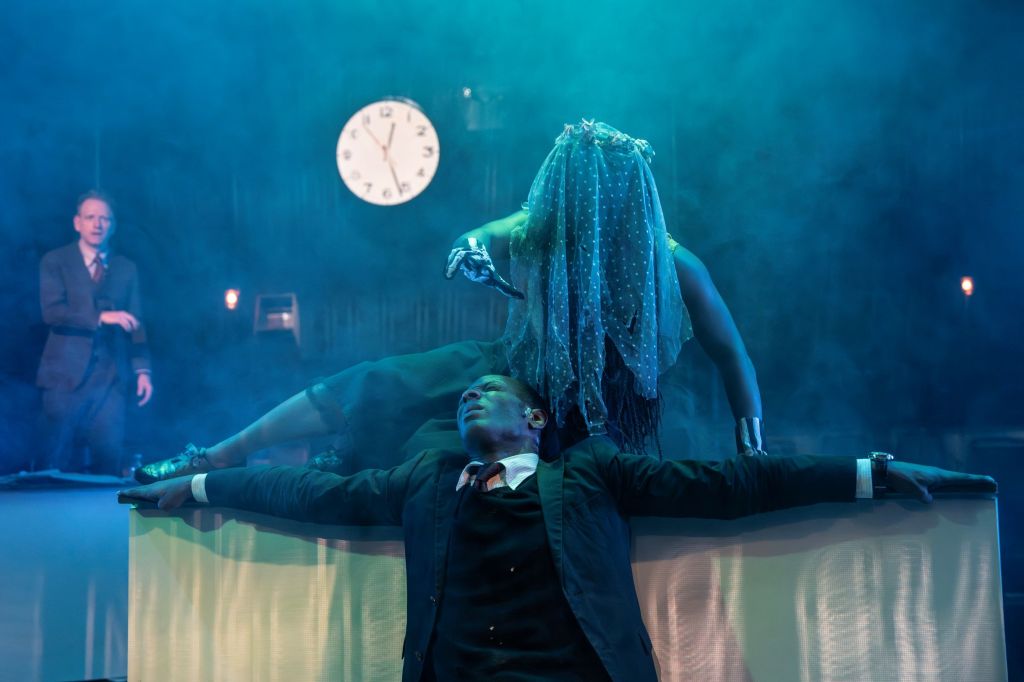
As costumes and props are added to the staging, we understand Leopold Bloom’s persecution as an outsider and a Jew. Also, wee note Stephen Dedalus as the writer/poet outsider who eventually joins Bloom, a father figure, who Bloom takes home for a time until Dedalus leaves to wander the night alone. Chistopher-Rashee Stevenson portrays the young Dedalus, a teacher whose unworthy friends lead him to drink and misdirection. Dedalus grieves his recently deceased mother and toward the end of the play has a nightmare visitation by her frightening, judgmental ghost.
For those familiar with the novel, the cast becomes outsized in rendering the various Dubliners that Knight’s Bloom and Stevenson’s Dedalus encounter. The dramatization is ultimately entertaining. We identify with Bloom as an Everyman, an anti-hero, who tries to get through the day in peace, while dismissing the knowledge that his wife Molly cuckolds him. Though he hasn’t been intimate with her since their baby Rudy died, he is unsettled that she conducts an affair with Blazes Boylan in their marriage bed at home. Somehow, Bloom has discovered that Molly who is a singer will be meeting with Boylan at 4 p.m. that afternoon. On his journey through the day he avoids confronting Boylan as they carry on with their activities around Dublin.
The ironic anti-parallel to the Odyssey, on the one hand, is that Molly Bloom is far from a Penelope who physically remained loyal to Odysseus, where Molly has an affair. On the other hand, late at night as Bloom sleeps with his feet awkwardly next to her face, we understand that Molly still loves Bloom and is emotionally and intellectually loyal. In her stream of consciousness monologue, seductively delivered by Maggie Hoffman, Molly arouses herself with memories of her relationship with Bloom when they were first together. It was then that she transferred a seed-cake from her mouth to his, sensually expressing her love.
Collins’s staging of the scene is humorous and profound. It defines why Molly has been present in Bloom’s consciousness throughout his strange journey traversing the streets of Dublin until he eventually finds his way home to her bed later that evening.
For those unfamiliar with Joyce’s novel, they will find the events and people a muddled hodgepodge that clarifies then becomes opaque, like a light switch turning on and off. Characters swap places with each other as seven actors take on numerous parts in a sometimes confusing array. Only Bloom, Dedalus and Molly stand out, true to Joyce’s vision for Ulysses for they embody Joyce’s themes about life. Thus, Bloom and Dedalus move through the day with flashes of brilliance, revelation, connection, irony and dread. Their reactions interest us. And Molly Bloom in her ending monologue puts a capstone on the vitality and beauty of a women’s perspective, as she experiences the sensuality and power of love for Bloom through reminiscence.
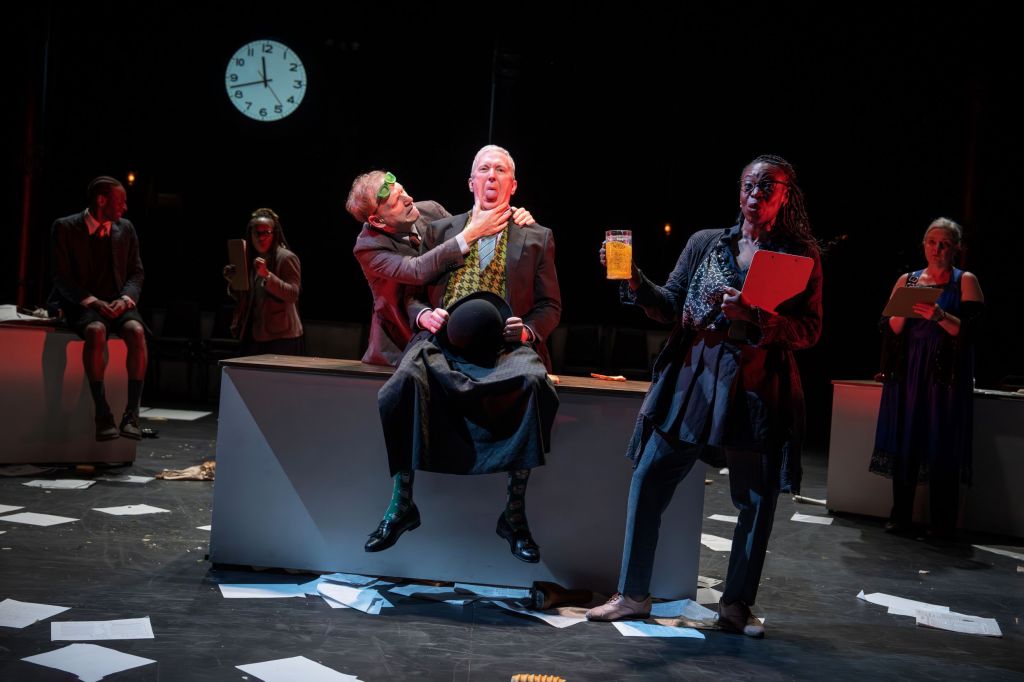
The costume design by Enver Chakartash reflects the time period with a fanciful modernist flourish that gives humor and depth to the personalities of the characters. For example Blazes Boylan (Scott Shepard) who has the affair with Molly wears a straw hat, outrageous wig and light suit that aligns with his jaunty gait. The scenic design by DOTS is minimalist and functional as is Marika Kent’s lighting design and Mathew Deinhart’s projection design. Most outstanding is Ben Williams’ acute, specific sound design which brings the scenes to life and follows the text adding fun and delight.
By the conclusion the audience is spent following the challenge of recognizing Joyce’s Dublin and the three unusual intellectuals and artists who he chooses to explore. Elevator Repair Service has elucidated the novel beyond what one might endeavor to understand reading it on one’s own. Importantly, they’ve made Ulysses an experience to marvel at and question.
Ulysses runs 2 hours 45 minutes with one intermission at the Public Theater through March 1, 2026. https://publictheater.org/productions/season/2526/ulysses
Kara Young and Nicholas Braun Fine-Tune Their Performances in ‘Gruesome Playground Injuries’

What do people do when they have emotional pain? Sometimes it shows physically in stomach aches. Sometimes to release internal stress people risk physical injury doing wild stunts, like jumping off a school roof on a bike. In Rajiv Joseph’s humorous and profound Gruesome Playground Injuries, currently in revival at the Lucille Lortel Theater until December 28th, we meet Kayleen and Doug. Two-time Tony Award winner Kara Young and Succession star Nicolas Braun portray childhood friends who connect, lose track of each other and reconnect over a thirty year period.
Joseph charts their growth and development from childhood to thirty-somethings against a backdrop of hospital rooms, ERs, medical facilities and the school nurse’s office, where they initially meet when they go to seek relief from their suffering. After the first session when they are 8-year-olds, to the last time we see them at 38-year-olds at an ice rink, we calculate their love and concern for each other, while they share memories of the most surprising and weird times together. One example is when they stare at their melded vomit swishing around in a wastepaper basket when they were 13-year-olds.

How do they maintain their relationship if they don’t see each other for years after high school? Their friends keep them updated so they can meet up and provide support. From their childhood days they’ve intimately bonded by playing “show and tell,” swapping stories about their external wounds, which Joseph implies are the physical manifestations of their soul pain. After Doug graduates from college, when Doug is injured, someone tips off Kayleen who comes to his side to “heal him,” something he believes she does and something she hopes she does, though she doesn’t feel worthy of its sanctity.
Joseph’s two-hander about these unlikely best friends alludes to their deep psychological and emotional isolation that contributes to their self-destructive impulses. Kayleen’s severe stomach pains and vomiting stems from her upbringing. For example in Kayleen’s relationship with her parents we learn her mother abandoned the family and ran off to be with other lovers while her father raised the kids and didn’t celebrate their birthdays. Yet, when her mother dies, the father tells Kayleen she was “a better woman than Kayleen would ever be.” There is no love lost between them.
Doug, whose mom says he is accident prone, uses his various injuries to draw in Kayleen because he feels close to her. She gives him attention and likes touching the wounds on his face, eyes, etc. Further examination reveals that Doug comes from a loving family, the opposite of Kayleen’s. Yet, he may be psychologically troubled because he risks his life needlessly. For example, after college, he stands on the roof of a building during a storm and is struck by lightening, which puts him in a coma. His behavior appears foolish or suicidal. Throughout their relationship Kayleen calls him stupid. The truth lies elsewhere.

Of course, when Kayleen hears he is in a coma (they are 28-year-olds), after the lightening episode, she comes to his rescue and lays hands on him and tells him not to die. He recovers but he never awakens when she prays over him. She doesn’t find out he’s alive until five years later when he visits her in a medical facility. There, she recuperates after she tried to cut out her stomach pain with a knife. She was high on drugs. At that point they are 33-year-olds. Doug tells her to keep in touch, and not let him drift away, which happened before.
Joseph charts their relationship through their emotional dynamic with each other which is difficult to access because of the haphazard structure of the play, listing ages and injuries before various scenes. In this Joseph mirrors the haphazard events of our lives which are difficult to figure out. Throughout the 8 brief, disordered, flashback scenes identified by projections on the backstage wall listing their ages (8, 23,13, 28, 18, 33, 23, 38) and references to Doug’s and Kayleen’s injuries, Joseph explores his characters’ chronological growth while indicating their emotional growth remains nearly the same, as when we first meet them at 8-years-old. In the script, despite their adult ages, Joseph refers to them as “kids.”
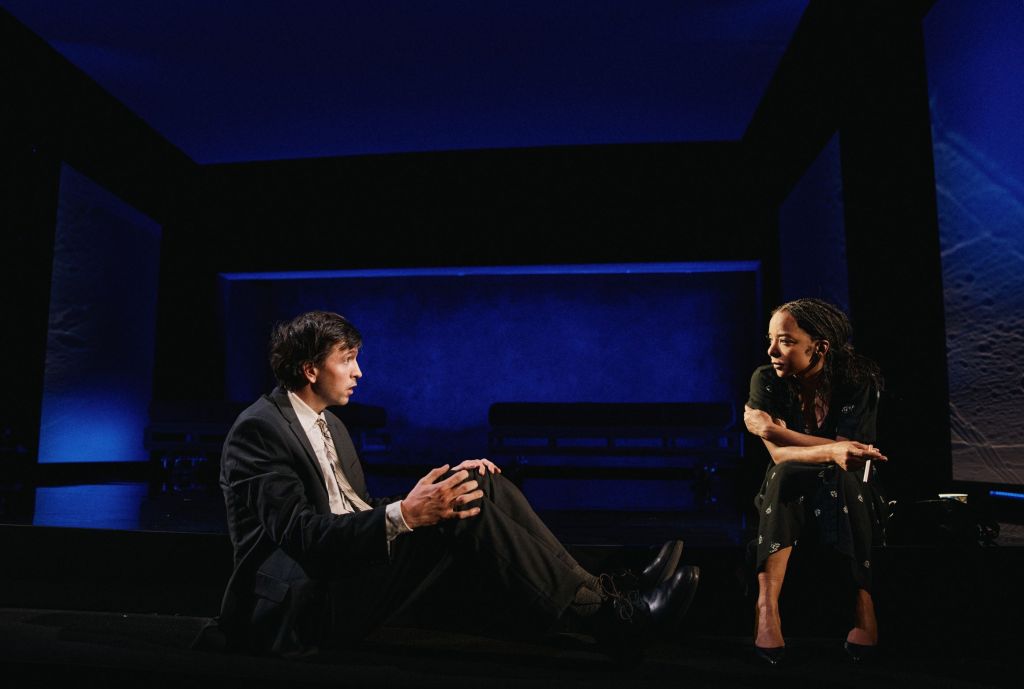
Toward the end of the play via flashback (when they are 18-year-olds), we discover their concern and love for for each other and inability to carry through with a complete and lasting union as boyfriend and girlfriend. When Doug tries to push it, Kayleen isn’t emotionally available. Likewise when Kayleen is ready to move into something more (they are 38-year-olds), Doug refuses her touch. By then he has completely wrecked himself physically and can only work his job at the ice rink sitting on the Zamboni.
Young and Braun are terrific. Their nuanced performances create their characters’ relationship dynamic with spot-on authenticity. Acutely directed by Neil Pepe, we gradually put the pieces together as the mystery unfolds about these two. We understand Kayleen insults Doug as a defense mechanism, yet is attracted to his self-destructive nature with which she identifies. We “get” his protection of her because of her abusive father. One guy in school who Doug fights when the kid calls her a “skank,” beats him up. Doug knows he can’t win the fight, but he defends Kayleen’s name and reputation.
The lack of chronology makes the emotional resonance and causation of the characters’ behavior more difficult to glean. One must ride the portrayals of Young and Braun with rapt attention or you will miss many of Joseph’s themes about pain, suffering and the salve for it in companionship, honesty and love.
In additional clues to their character’s isolation, Young and Braun move the minimal props, the hospital beds, the bedding. They rearrange them for each scene. On either side of the stage in a dimly lit space (lighting by Japhy Weideman), Young and Braun quickly fix their hair and don different costumes (Sarah Laux’s costume design), and apply blood and injury-related makeup (Brian Strumwasser’s makeup design). In these transitions, which also reveal passages of time in ten and fifteen year intervals, we understand that they are alone, within themselves, without help from anyone. This further provides clues to the depths of Joseph’s portrait of Kayleen and Doug, which the actors convey with poignance, humor and heartbreak.
Gruesome Playground Injuries runs 1 hour 30 minutes with no intermission through 28 December at the Lucille Lortel Theater; gruesomeplaygroundinjuries.com.
‘The Baker’s Wife,’ Lovely, Poignant, Profound
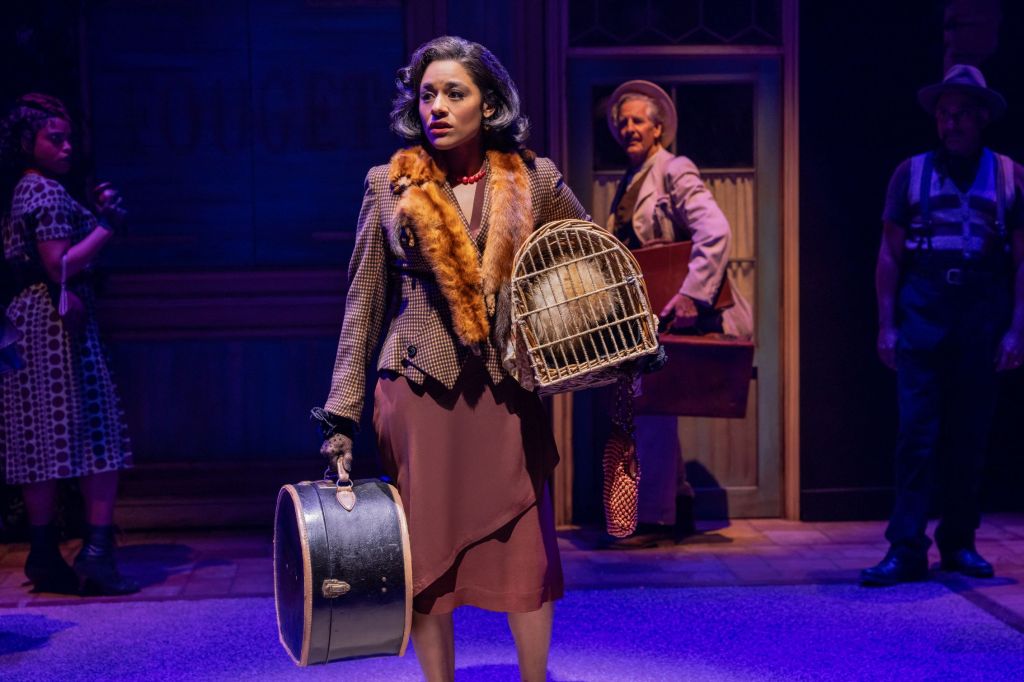
It is easy to understand why the musical by Stephen Schwartz (music, lyrics) and Joseph Stein (book) after numerous reworkings and many performances since its premiere in 1976 has continued to gain a cult following. Despite never making it to Broadway, The Baker’s Wife has its growing fan club. This profound, beautiful and heartfelt production at Classic Stage Company directed by Gordon Greenberg will surely add to the fan club numbers after it closes its limited run on 21 December.
Based on the film, “La Femme du Boulanger” by Marcel Pagnol (1938), which adapted Jean Giono’s novella“Jean le Bleu,” The Baker’s Wife is set in a tiny Provençal village during the mid-1930s. The story follows the newly hired baker, Aimable (Scott Bakula), and his much younger wife, Geneviève (Oscar winner, Ariana De Bose). The townspeople who have been without a baker and fresh bread, croissants or pastries for months, hail the new couple with love when they finally arrive in rural Concorde. Ironically, bread and what it symbolically refers to is the only item upon which they readily agree.
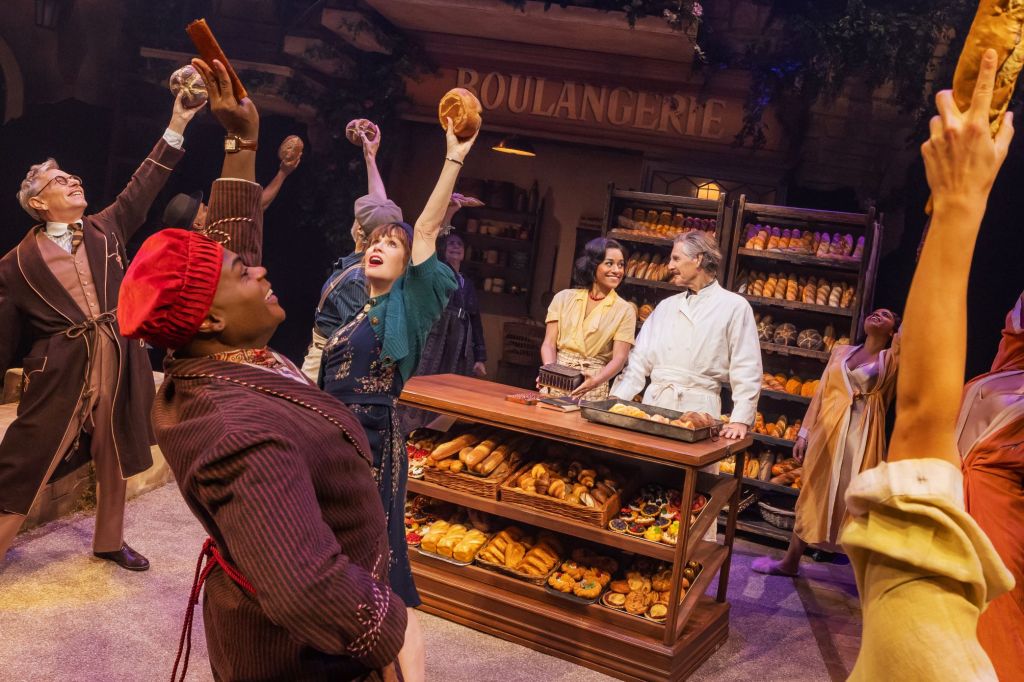
If you have not been to France, you may not “get” the community’s orgasmic and funny ravings about Aimable’s fresh, luscious bread in the song “Bread.” A noteworthy fact is that French breads are free from preservatives, dyes, chemicals which the French ban, so you can taste the incredible difference. The importance of this superlative baker and his bread become the conceit upon which the musical tuns.
Schwartz’s gorgeously lyrical music and the parable-like simplicity of Stein’s book reaffirm the values of forgiveness, humility, community and graciousness as they relate to the story of Geneviève. She abandons her loving husband Aimable and runs away to have adventures with handsome, wild, young Dominique (Kevin William Paul), the Marquis’ chauffeur. When the devastated Aimable starts drinking and stops making bread, the townspeople agree they cannot allow Aimable to fall down on his job. The Marquis (Nathan Lee Graham), is more upset about losing Aimable’s bread than the car Domnique stole.
Casting off long held feuds and disagreements, they unite together and send out a search party to return Geneviève without judgment to Aimable, who has resolved to be alone. Meanwhile, Geneviève decides to leave Dominique who is hot-blooded but cold-hearted. In a serendipitous moment three of the villagers come upon Geneviève waiting to catch a bus to Marseilles. They gently encourage her to return to Concorde, affirming the town will not judge her.
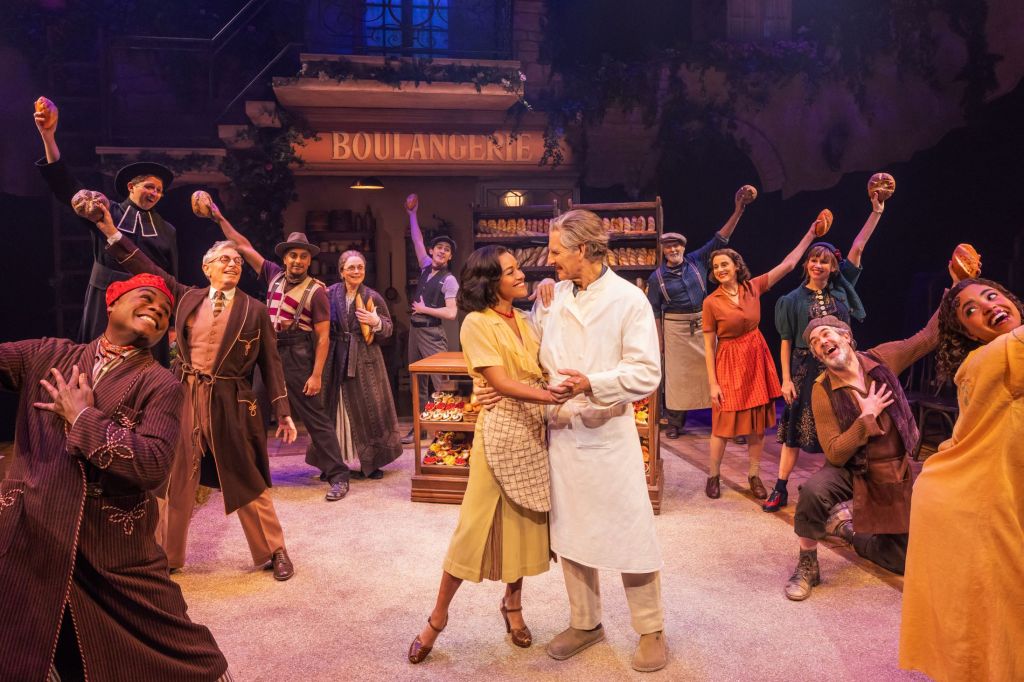
She realizes she has nowhere to go and acknowledges her wrong-headed ways, acting like Pompom her cat who also ran off. Geneviève returns to Aimable for security, comfort and stability, and Pompom returns because she is hungry. Aimable feeds both, but scolds the cat for running after a stray tom cat in the moonlight. When he asks Pompom if she will run away again, DeBose quietly, meaningfully tells Bakula’s Aimable, she will not leave again. The understanding and connection returns metaphorically between them.
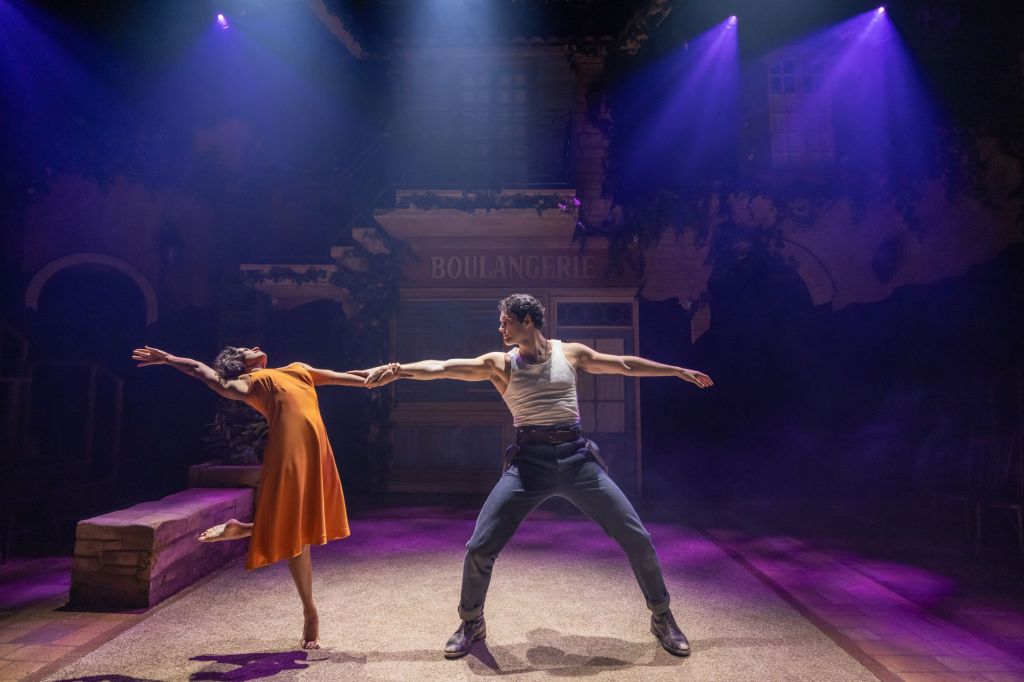
Director Gordon Greenberg’s dynamically staged and beautifully designed revival succeeds because of the exceptional Scott Bakula and perfect Ariana DeBose, who also dances balletically (choreography by Stephanie Klemons). DeBose’s singing is beyond gorgeous and Bakula’s Aimable resonates with pride and poignancy The superb ensemble evokes the community of the village which swirls its life around the central couple.
Greenberg’s acute, well-paced direction reveals an obvious appreciation and familiarity with The Baker’s Wife. Having directed two previous runs, one in New Jersey (2005), the other at The Menier Chocolate Factory in London (2024), Greenberg fashions this winning, immersive production with the cafe square spilling out into the CSC’s central space with the audience on three sides. The production offers the unique experience of cafe seating for audience members.
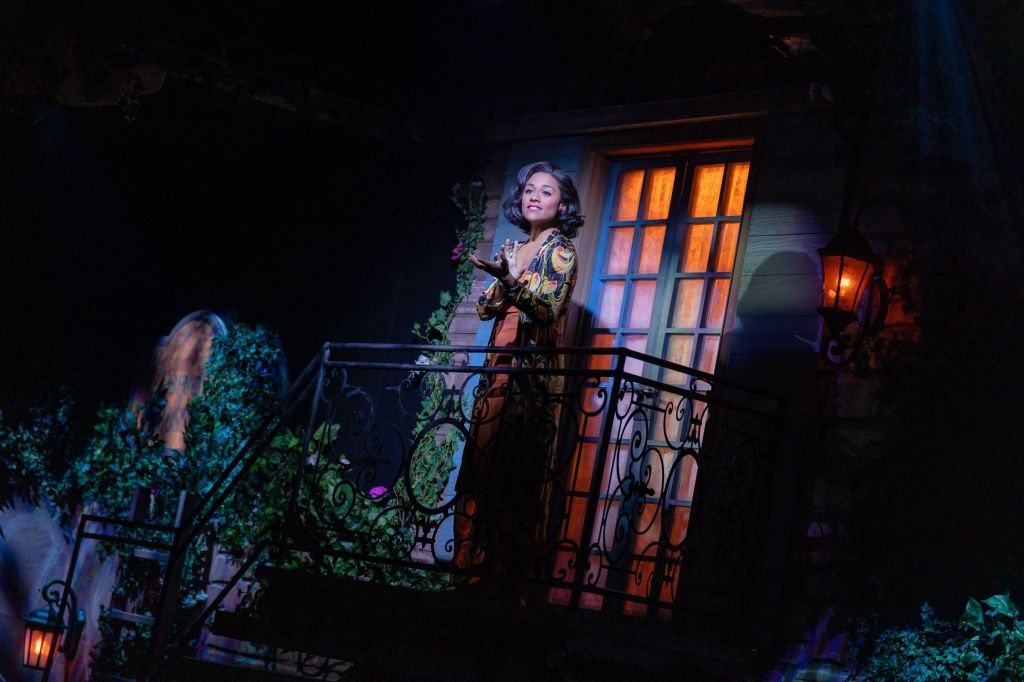
Jason Sherwood’s scenic design creates the atmosphere of the small village of Concorde with ivy draping the faux walls, suggesting the village’s quaint buildings. The baker’s boulanger on the ground floor at the back of the theater is in a two-story building with the second floor bedroom hidden by curtains with the ivy covered “Romeo and Juliet” balcony in front. The balcony features prominently as a device of romance, escape or union. From there DeBoise’s Geneviève stands dramatically while Kevin William Paul’s Dominique serenades her, pretending it is the baker’s talents he praises. From there DeBoise exquisitely sings “Meadowlark.”
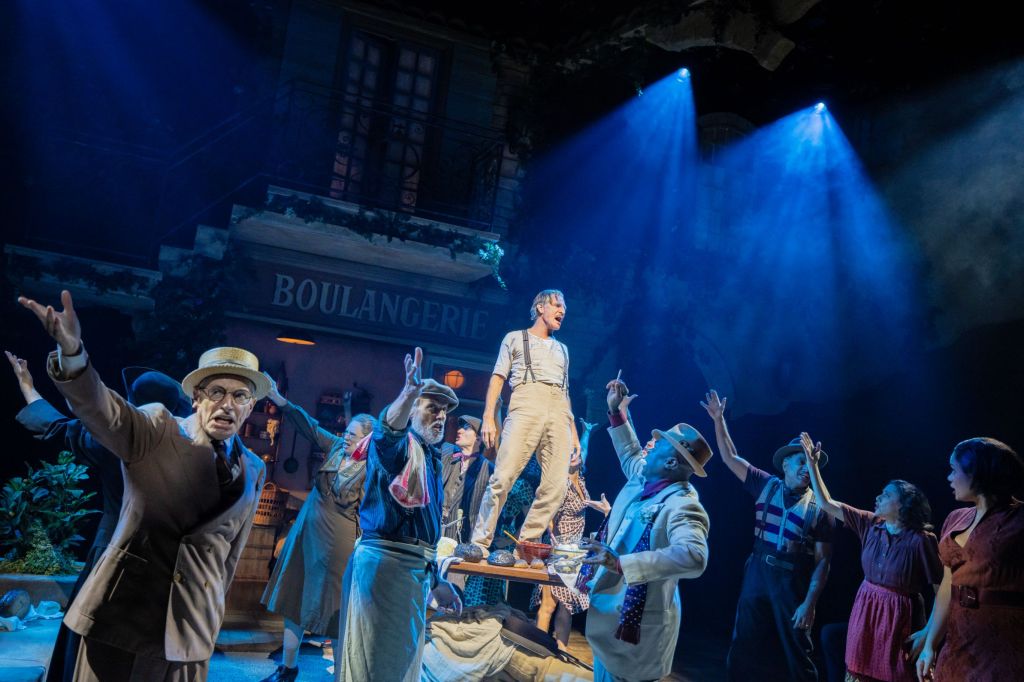
Greenberg’s vision for the musical, the sterling leads and the excellent ensemble overcome the show’s flaws. The actors breathe life into the dated script and misogynistic jokes by integrating these as cultural aspects of the small French community of Concorde in the time before WW II. The community composed of idiosyncratic members show they can be disagreeable and divisive with each other. However, they come together when they attempt to find Geneviève and return her to Aimable to restore balance to their collective, with bread for their emotional and physical sustenance.
All of the wonderful work by ensemble members keep the musical pinging. Robert Cuccioli plays ironic husband Claude with Judy Kuhn as his wife Denise. They are the cafe owning, long married couple, who serve as the foils for the newly married Aimable and Geneviève. They provide humor with wise cracks about each other as the other townspeople chime in with their jokes and songs about annoying neighbors.
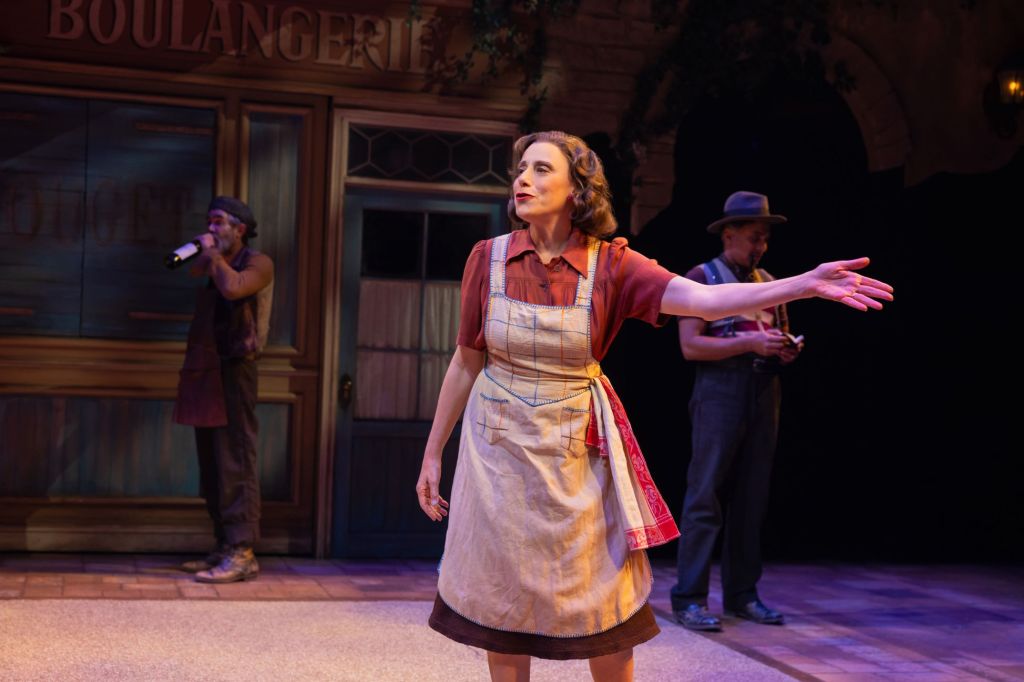
Like the other townspeople, who watch the events with the baker and his wife and learn about themselves, Claude and Denise realize the lust of their youth has morphed into love and great appreciation for each other in their middle age. Kuhn’s Denise opens and closes the production singing about the life and people of the village who gain a new perspective in the memorable signature song, “Chanson.”
The event with the baker and his wife stirs the townspeople to re-evaluate their former outlooks and biased attitudes. The women especially receive a boon from Geneviève’s actions. They toast to her while the men have gone on their search, leaving the women “without their instruction.” And for the first time Hortense (Sally Murphy), stands up to her dictatorial husband Barnaby (Manu Narayan) and leaves to visit a relative. She may never return. Clearly, the townspeople inch their way forward in getting along with each other, to “break bread” congenially as a result of an experience with “the baker and his wife,” that they will never forget.
The Baker’s Wife runs 2 hours 30 minutes with one intermission at Classic Stage Company through Dec. 21st; classicstage.org.
‘Diversion.’ Nurses under Pressure, Forgotten Heroes in Crisis, Review

In Scott Organ’s Diversion, the break room of a hospital intensive care unit is a place to let off steam. It is also the location where crimes happen and perps are exposed. Organ cleverly uses this setting for his 90 minute play in an extended run at the Barrow Group’s Studio Theater until December 21st.
The play’s tensions increase after Organ introduces us to four nurses who we later discover negotiate their own personal traumas, while assisting others to live or die. Though we don’t see their trauma, we hear about it and hear about how they may attempt to overcome it through opioids. When their own supply runs out, one or more may have stolen the hospital’s medications to satisfy their addiction. However, the program monitoring the opioids is impossible to bypass without triggering an investigation.
We learn of the conflict when the head nurse Bess (Thaïs Bass-Moore) tells the staff that their unit has been targeted. One or more of the nurses or doctors have diverted drugs. Bess offers to get the individuals into a program to clean up if they quietly come to her first before the company investigator, Josephine (Colleen Clinton), discovers who they are and turns them over to the police.
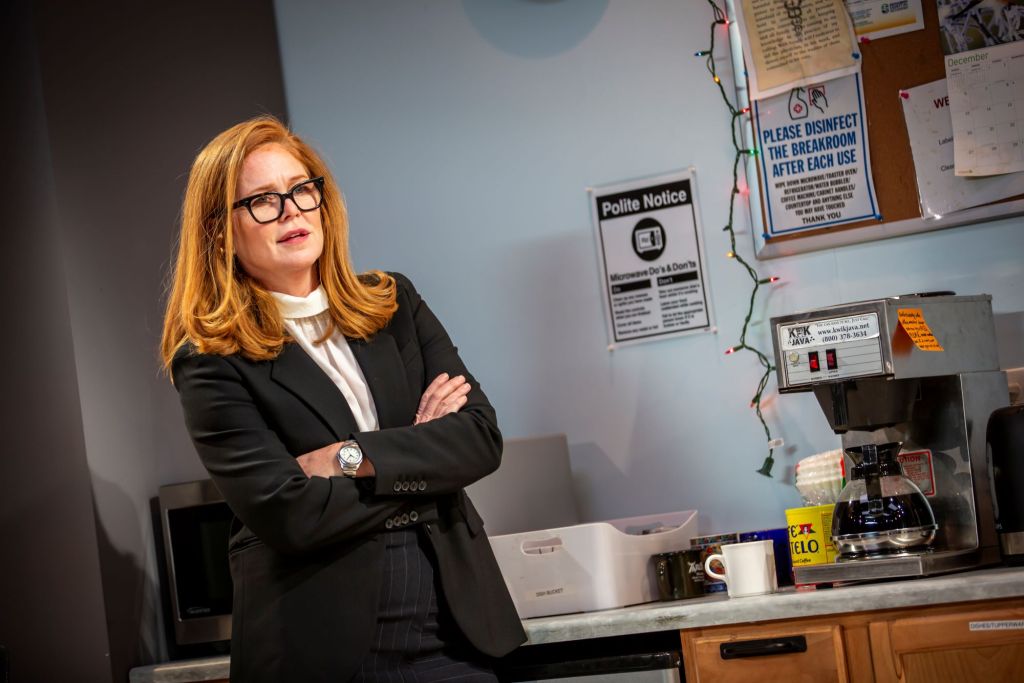
Having been through a disruptive investigation 8 years before when medications were taken, Bess shares her distress. She looks to experienced staff member Emilia (Tricia Alexandro) for help to be her “eyes and ears.” Josephine, a former nurse herself, attempts wisdom and a friendly approach to glean proof she refers to as “data,” by having informal conversations with the staff members. From her perspective, all are suspects, each may have diverted. She will not stop until she proves who the culprit is.
The youngest and least experienced nurse is Mandy (West Duchovny). She keeps late hours, always seems exhausted, and catches up on her sleep in the break room, a clue. The only male of the group, Mike (Connor Wilson), shows his hand when he discusses the street value of a fentanyl patch. The edgy, angry Amy (Deanna Lenhart), insults Josephine publicly to her face, but hypocritically shares the compromising life problems of other staff members to Josephine behind their backs.

Emilia, the kindest, most compassionate of the group is recently divorced and recovering from the psychological stresses of working through COVID’s long hours, extraordinary emotional demands and understaffed conditions. However, she does admit to Amy that Josephine’s presence is disruptive and adds to their stress, when they should be able to take their breaks from ICU high anxiety in peace.
No one confesses. However, Organ does reveal the addict at the end of Act I. Instead of judgment, Organ’s sympathetic characterizations and the actors’ acute ensemble work create empathy. We easily identify with the individual who is filled with regrets and self-recrimination. In Act II, when they still do not confess, we understand that the cost is too great, as they try to handle their addiction on their own, unsuccessfully. When Josephine closes in to identify the culprit/culprits, Organ allows us to feel what it is like to be a good person stuck in a tunnel of pain and darkness with no way out.

Organ’s poignant, suspenseful and humanly engaging drama has strong elements of comedic relief so we appreciate the relationship dynamic among the nurses which is both tense and humorous. Importantly, the play’s subject matter is topical. It focuses on nurses as the heroes of healthcare. They have been underestimated, underappreciated and, like military veterans, ill-used without proper support. Of course, the opioid epidemic should be front and center in light of our failing healthcare system which is under duress and about to be further de-funded with impactful cuts to Medicaid and possibly Medicare.
Though the production might have run without an intermission to heighten the suspense, director Seth Barrish incisively shepherds the excellent cast for maximum understanding and empathy. The set, costumes, props and lighting cohere with what one imagines of a hospital ICU break room for staff, who seek its respite without gaining comfort, especially since they are suspects of an investigation that can have no happy outcome.
Diversion
The play runs 95 minutes with one intermission through December 21, 2025 at The Barrow Group Performing Arts Center, Studio Theater (520 8th Ave, 9th floor). Barrowroup.org
‘Archduke,’ Patrick Page and Kristine Nielsen are Not to be Missed
What is taught in history books about WWI usually references Gavrilo Princip as the spark that ignited the “war to end all wars.” Princip and his nationalist, anarchic Bosnian Serb fellows, devoted to the cause of freeing Serbia from the Austro-Hungarian empire, did finally assassinate the Archduke Franz Ferdinand and Duchess of Austria-Hungary. This occurred after they made mistakes which nearly botched their mission.
What might have happened if they didn’t murder the royals? The conclusion of Rajiv Joseph’s Archduke offers a “What if?” It’s a profound question, not to be underestimated.
In Archduke, Rajiv Joseph (Bengal Tiger at the Baghdad Zoo), has fun with this historical moment of the Archduke’s assassination. In fact he turns it on its head. With irony he fictionalizes what some scholars think about a conspiracy. They have suggested that Serbian military officer Dragutin “Apis” Dimitrijevic (portrayed exceptionally by Patrick Page), sanctioned and helped organize the conspiracy behind the assassination. The sardonic comedy Archduke, about how youths become the pawns of elites to exact violence and chaos, currently runs at Roundabout’s Laura Pels Theater until December 21st.
Joseph’s farce propels its characters forward with dark, insinuating flourishes. The playwright re-imagines the backstory leading up to the cataclysmic assassination that changed the map of Europe after the bloodiest war in history up to that time. He mixes facts (names, people, dates, places), with fiction (dialogue, incidents, idiosyncratic characterizations, i.e. Sladjana’s time in the chapel with the young men offering them “cherries”). Indeed, he employs revisionist history to align his meta-theme with our current time. Then, as now, sinister, powerful forces radicalize desperate young men to murder for the sake of political agendas.
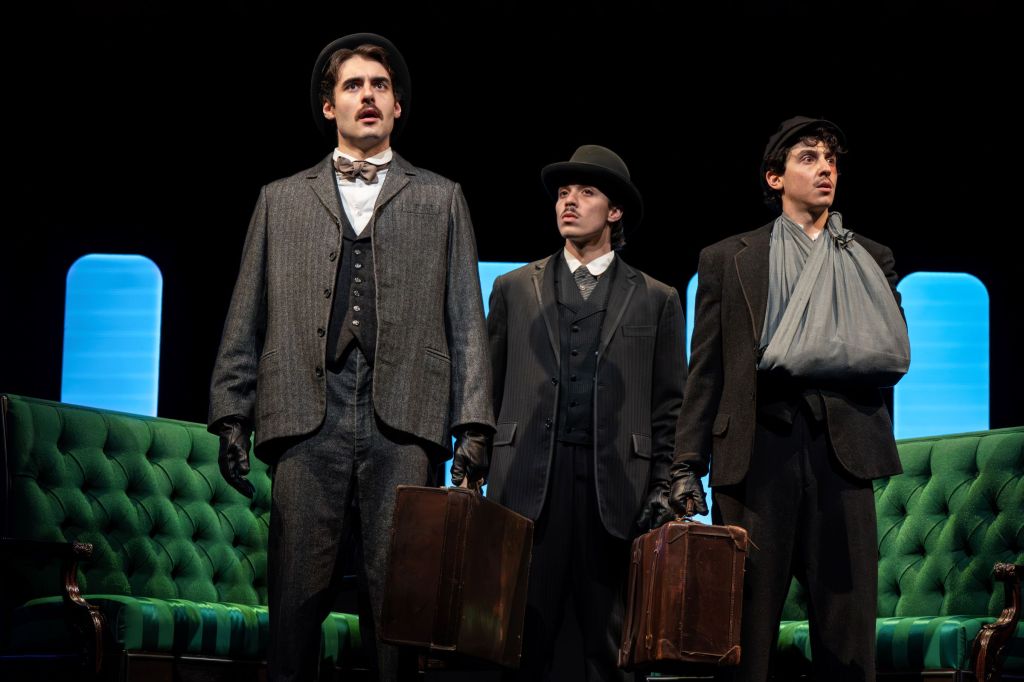
In order to convey his ideas Joseph compresses the time of the radicalization for dramatic purposes. Also, he laces the characterizations and events with dark humor, action and sometimes bloodcurdling descriptions of violence.
For example in “Apis'” mesmerizing description of a regicide he committed (June, 1903), for which he was proclaimed a Serbian hero, he acutely describes the act (he disemboweled them). He emphasizes the killing with specificity asking questions of those he mentors to drive the point home, so to speak. Then, Captain Dragutin “Apis” Dimitrijevic dramatically explains that he was shot three times and the bullets were never removed. Page delivers the speech with power, nuance and grit. Just terrific.
Interestingly, the fact that Dimitrijevic took three bullets that were never removed fits with historical references. Page’s anointed “Apis” relates his act of heroism to Gavrilo (the winsome, affecting Jake Berne), Nedeljko (the fiesty Jason Sanchez), and Trifko (the fine Adrien Rolet), to instruct them in bravery. The playwright teases the audience by placing factual clues throughout the play, as if he dares you to look them up.
History buffs will be entertained. Those who are indifferent will enjoy the fight sequences and Kristine Nielsen’s slapstick humor and perfect timing. They will listen raptly to Patrick Page’s fervent story and watch his slick manipulations. Director Darko Tresnjak (A Gentleman’s Guide to Love and Murder), shepherds the scenes carefully. The production and all its artistic elements benefit from his coherent vision, his superb pacing and smart staging. Set design is by Alexander Dodge, with Linda Cho’s costume design, Matthew Richards’ lighting design and Jane Shaw’s sound design.
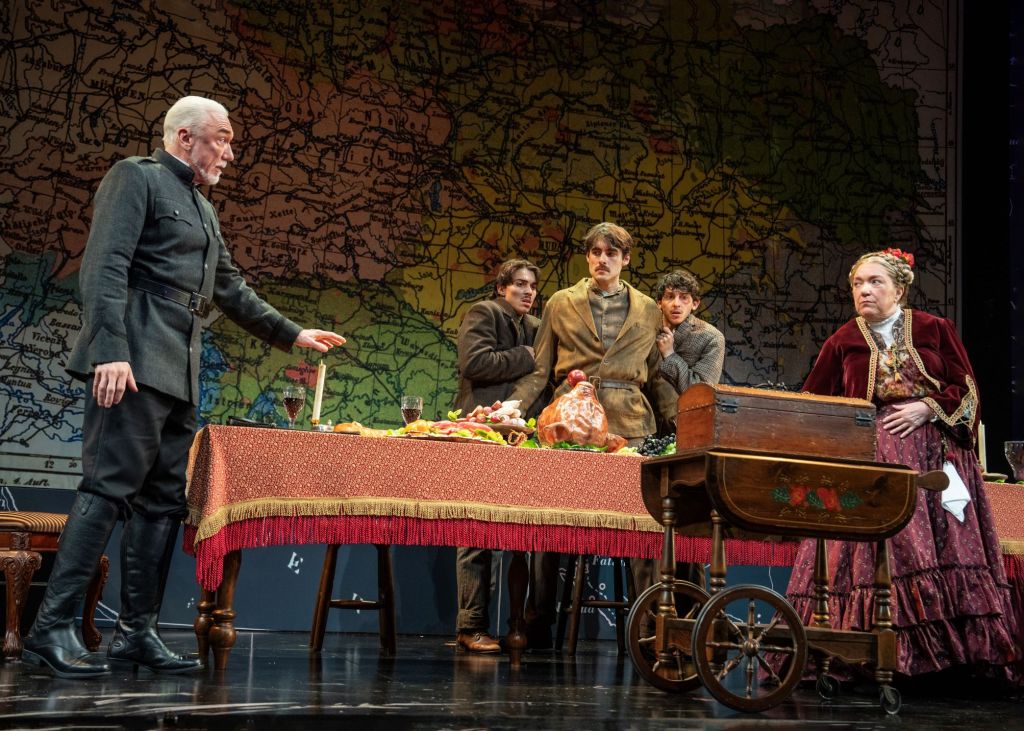
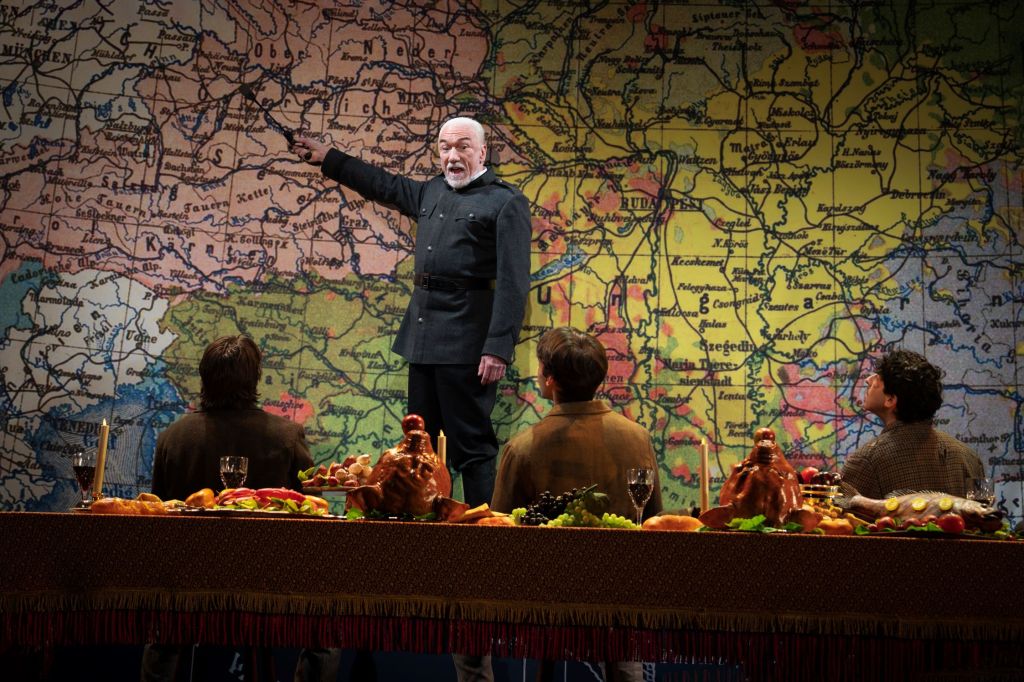
In Joseph’s re-imagining before “Apis” delivers this speech of glory and violence, the Captain has his cook stuff the starving, tubercular, young teens with a sumptuous feast. As they eat, he provides the history lessons using a pointer and an expansive map of the Austro-Hungarian empire. Like brainwashed lap dogs they agree with him when he tells them to. They are inspired by his personal story of glory and riches, and the luxurious surroundings. Notably, they become attuned to his bravery and sacrifice to Serbia, after their bellies are full, having devoured as much as possible.
Why them and how did they get there? Joseph infers the machinations behind the “Apis'” persuasion in Scene 1, which takes place in a warehouse and serves as the linchpin of how young men become the dupes of those like the charming, well-connected Dimitrijevic. From the teens’ conversation we divine that a secret cabal cultivates and entraps desperate, dying young men. Indeed, in real life there was a secret society (The Black Hand), that Captain Dimitrijevic belonged to and that Gavrilo was affiliated with. The playwright ironically hints at these ties when the Captain gives Gavrilo and the others black gloves.
In the warehouse scene the soulful and dynamic interaction between Berne’s Gavrilo and Sanchez’s Nedeljko creates empathy. The fine actors stir our sympathy and interest. We note that the culture and society have forgotten these hapless innocents that are treated like insignificant refuse. As a result they become ready prey to be exploited. The nineteen-year-old orphans have similar backgrounds. Clearly, their poverty, purposelessness, lack of education and hunger bring them to a conspiratorial doctor they learn about because he is free and perhaps can help.
However, he gives them the bad news that they are dying and nothing can be done. As part of the plan, the doctor refers both Gavrilo and Nedeljko to “a guy” in a warehouse for a job or something useful and “meaningful.”
True to the doctor’s word, the abusive Trifko arrives expecting to see more “lungers.” After he shows them a bomb that doesn’t explode when dropped (a possible reference to the misdirected bombing during the initial attempt against the Archduke), Trifko browbeats and lures them to the Captain (“Apis”), with his reference to a “lady cook.”
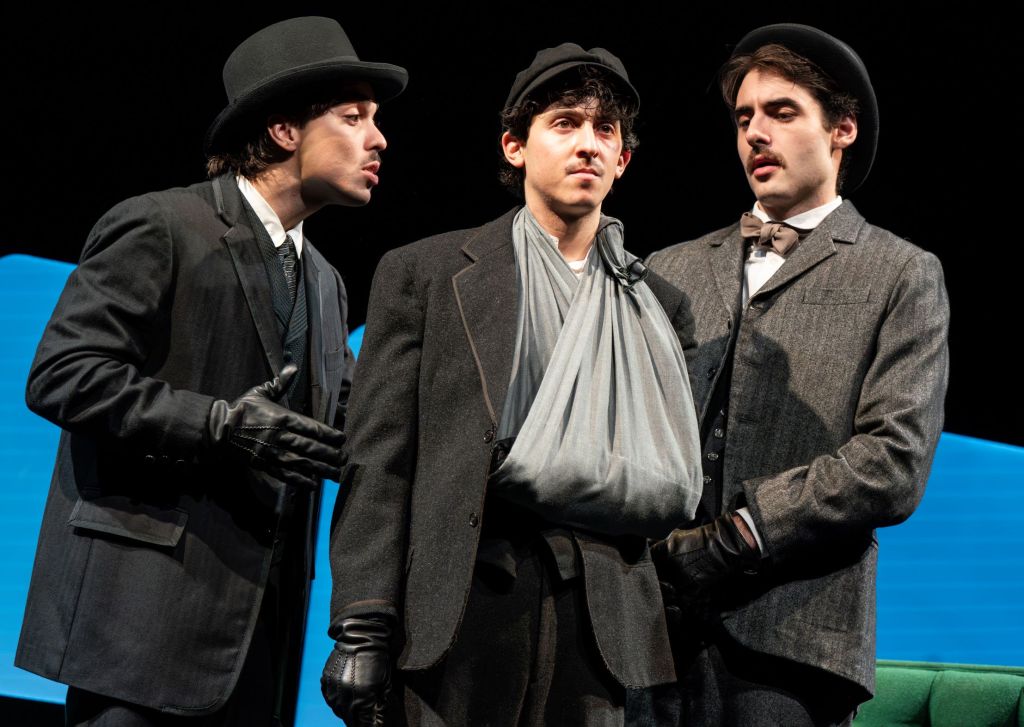
Why not go? They are starving, and they “have nothing to lose.” The cook, Sladjana, turns out to be the always riotous Kristine Nielsen, who provides a good deal of the humor during the Captain’s history lessons, and the radicalization of the teens, the feast, sweets, and “special boxes” filled with surprises that she brings in and takes out. Nielsen’s antics ground Archduke in farce, and the scenes with her are imminently entertaining as she revels in the ridiculous to audience laughter.
With their needs met and their psychological and emotional manhood stoked to make their names famous, the young men throw off their religious condemnation of suicide and agree to martyr themselves and kill the Archduke to free Serbia. Enjoying the prospects of a train ride and a bed and more food, after a bit of practice, shooting the Archduke and Duchess, with “Apis” and Sladjana pretending to be royalty, they head off to Sarajevo. Since Joseph’s play is revisionist, you will just have to see how and why he spins the ending as he does with the characters imaging their own, “What if?”
The vibrantly sinister, nefarious Dragutin “Apis” Dimitrijevic, who seduces and spins polemic like a magician with convincing prestidigitation, seems relevant in light of the present day’s media propaganda. Whether mainstream, which censors information, fearful of true investigative reporting, or social media, which must be navigated carefully to avoid propaganda bots, both spin their dangerous perspectives. The more needy the individuals emotionally, physically, psychologically, the more amenable they are to propaganda. And the more desperate (consider Luigi Mangione or Shane Tamura or the suspect in the recent shooting of the National Guard in Washington, D.D.), the less they have to lose being a martyr.
Joseph’s point is well taken. In Archduke the teens were abandoned and left to survive as so much flotsam and jetsam in a dying Austro-Hungarian empire. Is his play an underhanded warning? If we don’t take care of our youth, left to their own devices, they will remind us they matter too, and take care of us. Political violence, as Joseph and history reveal, is structured by those most likely to gain. Cui bono? All the more benefit of impunity and immunity if others are persuaded to pull the trigger, cause a riotous coup, release the button, poison, etc., and take the fall for it.
Archduke runs 2 hours with one intermission at Laura Pels Theater through December 21st. roundabouttheatre.org.
 CAROLE DI TOSTI