Category Archives: Off Broadway
‘Bob & Carol & Ted & Alice,’ A Musical Comedy Based on the Titular Motion Picture
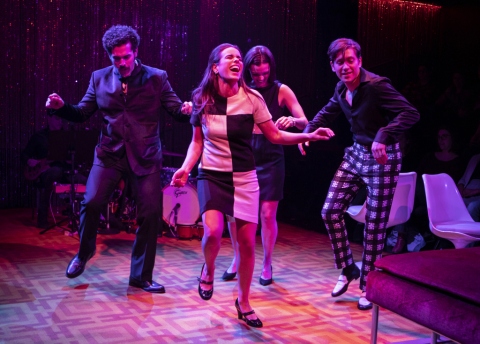
Joél Pérez, Anna Nogueira, Jennifer Damiano, Michael Zegen in Bob & Carol & Ted & Alice, based on the Columbia Pictures motion picture written by Paul Mazursky and Larry Tucker, music by Duncan Sheik, book by Jonathan Marc Sherman, lyrics by Duncan Sheik and A Asmanda Green, musical staging by Kelly Devine, direted by Scott Elliott at the Pershing Square Signature Center (Monique Carboni)
Bob & Carol & Ted & Alice based on the Columbia Pictures film written by Paul Mazursky and Larry Tucker, with music by Duncan Sheik, book by Jonathan Marc Sherman and lyrics by Duncan Sheik and Amanda Green is a lightly satiric, musical comedy, with mellow, soulful music. The production, like its titular film counterpart, hearkens back to an easier time before AIDS, STDS, the debacle of the Viet Nam War and the cultural stresses afterward, when the country faced chaotic divisiveness that was not easily answered by later political administrations.
Directed by Scott Elliott, the production is a delight with adorable actors portraying the thirty-something married couples Carol (Jennifer Damiano) and Bob (Joél Pérez), Ted (Michael Zegen) and Alice (Ana Nogueira) who try to redefine themselves according to the hot pants, younger generational trends which tout the rejection of binding sexual mores and strictures.
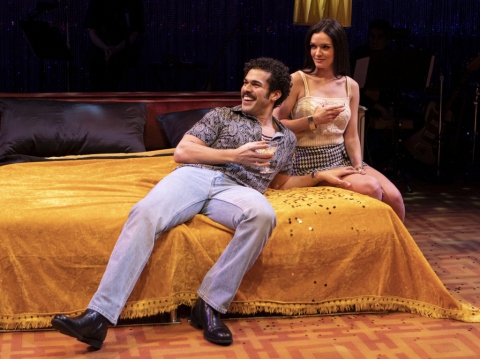
(L to ): Joél Pérez, Jennifer Damiano Bob & Carol & Ted & Alice, based on the Columbia Pictures motion picture written by Paul Mazursky and Larry Tucker, music by Duncan Sheik, book by Jonathan Marc Sherman, lyrics by Duncan Sheik and Amanda Green, musical staging by Kelly Devine, direted by Scott Elliott at the Pershing Square Signature Center (Monique Carboni)
This was the time of open marriages, when free love was being embraced as revelational. Various generations either looked askance in horror or savored the sex with hallucinogens and weed. So instead of rotting in aging and being left behind, Bob and Carol take a break from the kids, go to a New Age type resort, and embrace the “new” concepts of this inner freedom and tranquility.
Bob and Carol begin the arc of the story development and conflicts after they return from their growth experience at the retreat (like Esalen) led by the director (who is also the band leader) portrayed by Suzanne Vega. The experience “opens” them up to a new world of freedom using the techniques we have all come to know today (meditation, primal screams, intense feeling expressions, etc.).
They return home believing that the experience translates into their daily lives by allowing them to understand their values, their “ethos,” and their capacity to break away into new experiences. Of course one of the most important is extending the boundaries of their marriage and expanding themselves to include acceptance of their partner’s actions whatever they may be. Bob initiates this extension by having sex, in an unfaithful act, which surprisingly Carol accepts and answers with one of her own. Both affirm, “It was just sex, not love.”
For Ted and Alice who essentially watch and don’t indulge, their learning is vicarious, but they can’t move beyond the boundaries of their own morals and sensibility of love. They judgmentally remain within the strictures of their marriage vows and monogamy. The contrast between the two couples is telling: here are the liberals and the conservatives. But beneath each conservative heart is the quest to be liberal. And in this production, it is no less so.

Suzanne Vega in Bob & Carol & Ted & Alice, based on the Columbia Pictures motion picture written by Paul Mazursky and Larry Tucker, music by Duncan Sheik, book by Jonathan Marc Sherman, lyrics by Duncan Sheik and Amanda Green, musical staging by Kelly Devine, direted by Scott Elliott at the Pershing Square Signature Center (Monique Carboni)
As you watch the events unfold and empathize with the characters along their journeys of self-discovery, you can’t help but fall a bit in love with them. They are so cute in their questioning searches as they soldier on to their discoveries with quasi-comical seriousness. Watching liberal couple Bob and Carol explore the outer limits of love and marriage, extramarital affairs, infidelity, sexuality and enlightened contrast between love and sex, we are along for their ride because it is neither shocking nor lustful, nor pornographic. It just is.
Considering what has transpired between then (1969) and now, the perniciousness of sexual plagues and wildness of Studio 54 that gave rise to them, which followed the “free love” generation, by comparison, these couples are sweet neophytes. The production mirrors this laid-back pleasantness in mood and tone delivered by Sheik’s balancing music, sung with fluidity, smoothness and grace by Grammy winner Suzanne Vega, and with melodic lyricism by the ensemble.
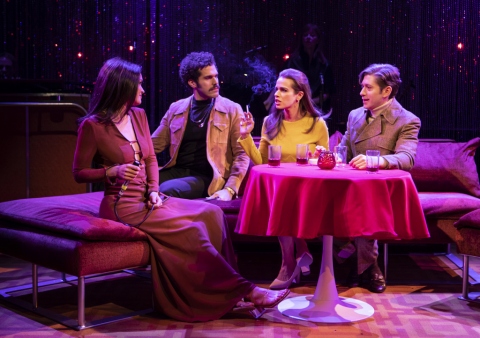
(L to R): Jennifer Daimiano, Joél Pérez, Anna Nogueira,, Michael Zegen in Bob & Carol & Ted & Alice, based on the Columbia Pictures motion picture written by Paul Mazursky and Larry Tucker, music by Duncan Sheik, book by Jonathan Marc Sherman, lyrics by Duncan Sheik and Amanda Green, musical staging by Kelly Devine, direted by Scott Elliott at the Pershing Square Signature Center (Monique Carboni)
The characters’ “new” sexual endeavors infuse the production with the mild raciness of the 1969 film. The original which spawned a later TV show was a comedy satire about the cultural mores transformation. A success at the box office, it did have Oscar-winning nominations for the actors who played Ted (Elliot Gould) and Alice (Dyan Cannon).
Overall, Bob & Carol & Ted & Alice is a retrospective and homage to the the culture and class who dipped in lightly with just their toes as they approached the swirling currents of social change. However, they never took the plunge into the deep end of promiscuity, three-ways, pornography, open marriage and divorce. They accomplished just enough to stimulate themselves, then slid back into their comfort zones measuring their lives with coffee spoons as they dabbled with introspection.
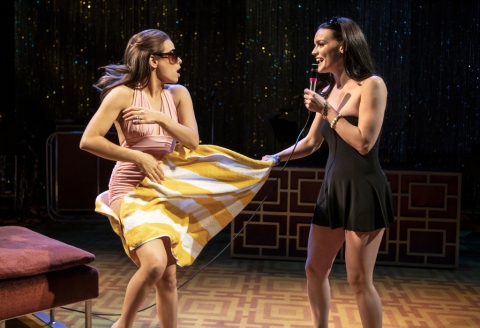
(L to R): Ana Nogueira, Jennifer Damiano in Bob & Carol & Ted & Alice, based on the Columbia Pictures motion picture written by Paul Mazursky and Larry Tucker, music by Duncan Sheik, book by Jonathan Marc Sherman, lyrics by Duncan Sheik and Amanda Green, musical staging by Kelly Devine, direted by Scott Elliott at the Pershing Square Signature Center (Monique Carboni)
Sheik’s music and the ironic Suzanne Vega as band leader, “mistress of ceremonies” reintroduce for our time a derivation of pop’s easy listening. As the overarching guiding light of threaded musical commentary, Suzanne Vega’s lilting, sensuous voice showcases the four characters as she editorializes their journey beginning with Bob and Carol’s stay at the retreat and their “enlightened” return when they share their enlivening experiences with their conservative friends Ted and Alice.
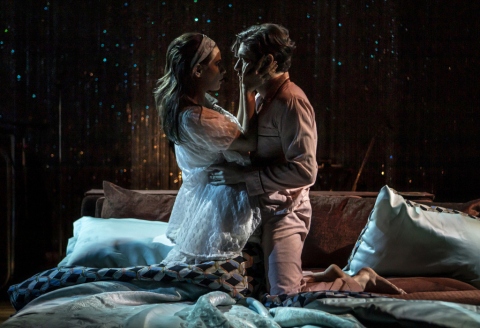
Ana Nogueira, Michael Zegen in Bob & Carol & Ted & Alice, based on the Columbia Pictures motion picture written by Paul Mazursky and Larry Tucker, music by Duncan Sheik, book by Jonathan Marc Sherman, lyrics by Duncan Sheik and Amanda Green, musical staging by Kelly Devine, direted by Scott Elliott at the Pershing Square Signature Center (Monique Carboni)
But as the bonds between the couples loosen, the audience becomes intrigued. Ted and Alice warm up to their friends’ “exploits.” Bob and Carol appear sophisticated, cool and free in their “open” marriage. The men and women separately sing about and discuss their sexuality with their spouses. This leads each to consider their lives with their partners. The songs eventually reveal that each couple is inspired to reaffirm their love for each other.
But we know what’s coming: “monkey see, monkey do”! Humorously, the two couples push the envelope by spending a night together in the bedroom with interesting results. Ultimately, they discover the vitality of loving one individual with intimacy and true spiritual bonding. This can only happen when each member of the couple reveals that they are vulnerable and need help to receive the intimacy and beauty of love from their spouse.
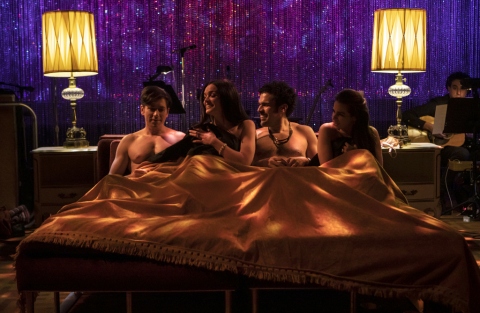
The cast of Bob & Carol & Ted & Alice, based on the Columbia Pictures motion picture written by Paul Mazursky and Larry Tucker, music by Duncan Sheik, book by Jonathan Marc Sherman, lyrics by Duncan Sheik and Amanda Green, musical staging by Kelly Devine, direted by Scott Elliott at the Pershing Square Signature Center (Monique Carboni)
The production is enjoyable and a throwback to a simpler time when all seemed right with loving just one individual in a satisfying marriage. In our tumultuous social and political fabric that is too frightening to contemplate and whose nightly news and snarky, edgy, social and cultural reports are the antithesis of entertainment, this the production is fun. Thus, the concept of “the open marriage” which Bob and Carol investigate with Ted and Alice with the quips and satiric jokes laced in and clever writing by Jonathan Marc Sherman’s book becomes a pleasant and satisfying relief.
There is no heavy lifting here, nothing more profound and mysterious than how and why we fall in love with each other which is a wonderful “thing” to contemplate. It is the wonder that engages us and immerses us in another time. And as we contemplate and review this historical retrospective of the social and cultural mores of the 1960s, we also enjoy the costumes and the California dreaming liquidity of the music so that we are able to ride on the waves of the production’s serenity.
The ensemble and director have established the right tenor for the comedic elements. And Sheik’s music is subtly, appropriately emotional as the characters search themselves and each other to understand the mysteries of love how and why they love.
Special kudos to Kelly Devine’s musical staging and to the following creatives: Derek McLane (scenic design) Jeff Mahshie (costume design) Jeff Croiter (lighting design) Jessica Paz (sound design). Additional kudos to Duncan Sheik for the orchestrations, Jason Hart for music supervision, vocal arrangements and additional orchestrations and Antoine Silverman for music coordination.
The New Group’s presentation of Bob & Carol & Ted & Alice runs with no intermission until 22nd March. For tickets and times CLICK HERE.
‘The Commons’ by Lily Akerman at 59E59 Theaters

(L to R): Julia Greer, Olivia Khoshatefeh, Ben Newman, Ben Katz, ‘The Commons,’ written by Lily Akerman, directed by Emma Miller, at 59E59 Theaters (Carol Rosegg)
How does one survive in New York City without being subsidized by one’s parents while making a modest income to pay the rent on a 300 square foot studio that is half of one’s income? One has housemates. That way one can afford a larger space at a reduced cost and actually be able to enjoy a finer lifestyle. There are problems, though. As the human numbers augument to share the space, conflicts arise as each must accommodate and subvert their own idiosyncrasies and proclivities to compromise with their housemates, especially when sharing the common areas (kitchen, bathroom, etc.). In the mix and melding of personalities who live together, what can result may be funny, dramatic or challenging, but it is never dull. And for some it sure beats living ALONE!

Ben Katz, Olivia Khoshatefeh in ‘The Commons,’ by Lily Akerman, directed by Emma Miller at 59E59 Theaters (Carol Rosegg)
Lily Akerman’s World Premiere comedy The Commons, presented by The Hearth and directed by Emma Miller, explores what happens when particular housemates attempt to survive in an environment of diminishing resources and increasingly complex habitats with limited space. In the play we note how the living situation becomes pressurized and the individuals become stressed by the mundane ordinary. Miniscule issues balloon to paramount proportion when housemates attempt to share responsibilities though there is no one in the lead and all must decide by gaining consensus. Housemates must “take up the slack” for each other, set rules, then hold each other accountable when there are violations. Something as simple as doing the dishes or making bread takes on significant heft and can cause hurt feelings and oppressed wills, unless individuals have the maturity and equanimity to reach viable agreements.

(L to R): Julia Greer, Olivia Khoshatefeh in ‘The Commons,’ by Lily Akerman, directed by Emma Miller at 59E59 Theaters (Carol Rosegg)
Akerman examines four characters Robyn (Ben Newman) Janira (Olivia Khoshatefeh) Dee (Julia Greer) and Cliff (Ben Katz) and sets them interacting with and against each other as they confront homely situations like cleaning, dish washing, making bread and struggling against a mouse invasion. Akerman adds a fifth character, Anna (Olivia Abiassi) who is a romantic interest for Cliff. Anna’s brief visit convolutes the mix of personalities who already strain to get along. None of the housemates are friends, so it becomes an unusual occasion when they decide to go out to a bar together and in another segment let loose and dance their stress away.
The vitality and comedy of the production resides in the fine acting of the ensemble who make the most seemingly ridiculous superficialities (a dirty stovetop burner) of mega importance with authenticity, as if the issue was a matter of “life and death.” The humor of dealing with a mouse that had to be killed and the tragedy of the creature losing its life as memorialized by Janira (Koshatefeh does a wonderful job with this comedic bit) is marvelous.
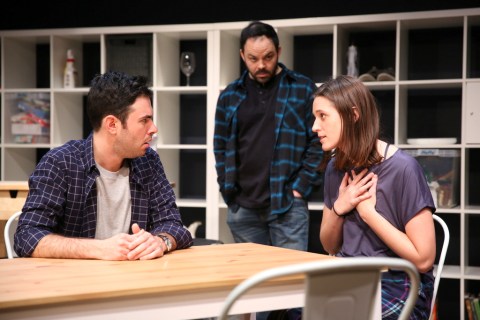
(L to R): Ben Katz, Ben Newman, Julia Greer in ‘The Commons,’ written by Lily Akerman, directed by Emma Miller, at 59E59 Theaters (Carol Rosegg)
As we chortle at the characters having to deal with their particular angst at the problem of living with others, we can’t help but note that their embroilios are telling. The common areas are the centers which carry the stress when a particular housemate like Cliff or Janira don’t act with accountability to the “whole.” As housemates attempt to resolve the issues the comedy rises and we identify with how humans act and react with guilt, excuses, judgment, subterfuge and inner upset as they attempt to manipulate the situation to their own satisfaction. Also, the philosophical approaches of each of the housemates become superimposed on the living situation for each. This is especially ironic as Robyn expresses his opinion that living with housemates communally is healthier than couples living and raising their family in isolation.
Aikerman’s play however, is about much more than the characters attempting to work out their living arrangements with compromises, meetings and rules enforcements. It is a metaphor for how we adjust to others “living on top of us” as sources and space diminish and we must decide whether we should open our borders or close them, accept refugees to forestall the humanitarian crisis or let them perish or ignore those who have been victimized by their own birth in third world countries. The Commons in microcosm is representative of the macrocosm. Behind the comedy bits and vignettes involving each of the characters in the hot seat, is the presentation of larger themes that Akerman highlights for all of us, whether we live in crowded cities with sparse affordable housing or less densely populated rural areas that hold few opportunities.

Ben Newman, Ben Katz in ‘The Commons,’ by Lily Akerman, directed by Emma Miller at 59E59 Theaters (Carol Rosegg)
Some of these questions follow on a symbolic level: In the looming portent of climate change relocation, how will populations accommodate each other as refugees move from areas of devastation? How will dwindling resources prompted by global warming and weather weirding impact societies, turning the haves against the have nots who knock at their doors for help? Will cultures readily share or will there be genocide of ethnic groups? Do ethics and morality abide if leaders ignore human standards of right and wrong and replace them with money and power as the enforcement of decision making? Will everyone benefit if cultures shift to a “might is right” ethos or is that one more way of introducing self-destruction into the parameters of global reorganization necessitated by climate chaos which is already manifesting?
The Commons at its funniest reveals the base responses and reactions of housemates accused of their mistakes which are funny because they are exaggerated. But what becomes obvious is the dynamic of accountability. The housemates are accountable and responsible to each other. Selfishness no longer cuts it when one’s dishes are always left clogging up the sink and one is gobbling down another’s food because he or she forgot to go shopping. The results are humorous. But the underbelly of this is dark. In order to survive and thrive, we must live with each other and be responsible for our own actions as we contribute to the goodness of everyone else. Only by doing that do we all make our lives purposeful and valuable.
To fully appreciate Akerman’s larger themes, one must lift The Commons above the characters’ petty details to note the moral treatises underneath. Like the housemates who adjust to each other and hold each other accountable for their actions and “pull together,” so must we as nations globally do our part as contributors to each others’ greater good. Shirking our responsibility through science denial, moral and ethical turpitude, and negligence will only come back to haunt us in the end.
Kudos to the creative design team with scenic design by Emma Finckel, costume design by Dara Affholter, lighting design by Victoria Bain and sound design by Caroline Eng. The Commons runs with no intermission at 59E59 Theaters until 23rd February. For tickets and times CLICK HERE.
‘How to Load a Musket,’ a Striking Look at History by Talene Monahon at 59E59 Theaters
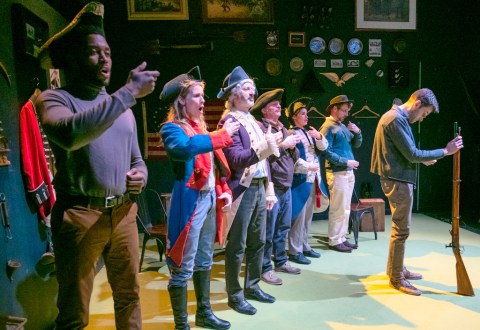
The Company, Adam Chanler-Berat in ‘How to Load a Musket,’ by Talene Monahon, directed by Jaki Bradley at 59E59 Theaters (Russ Rowland)
Why would anyone want to reenact the most bloody battles of American History? In the World Premiere of How to Load a Musket, currently at 59E59 Theaters until 26 January (unless it is extended which it should be) playwright Talene Monahon examines the nature and viewpoints of American citizens who devote time, energy, money and passion to acting out various historical wartime confrontations that founded and preserved our United States of America.
The play that Monahon configured relates perspectives based upon her interviews with reenactors in Massachusetts, New York and Virginia. With exceptional actors portraying the individuals she interviewed, director Jaki Bradley brilliantly stages a production that is vibrant, humorous, at times chilling and always memorable.
Monahan interviewed individuals addicted to portraying historic events principally those occurring during the Revolutionary War and the Civil War. What she discovered turned out to be fascinating portraits of a unique group of impassioned citizens who “got the bug” to participate in reenactments, some for the past thirty years. In her interviews, she gleaned their demographics, their interest in American history and their views about our country, formed during and after their extensive research and their activities with others to conduct reenactments for an audience of history and battle lovers.
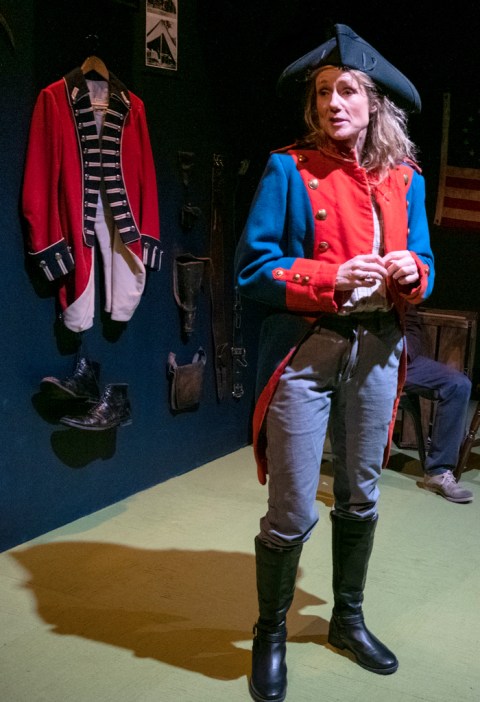
Lucy Taylor in ‘How to Load a Musket,’ by Talene Monahon, directed by Jaki Bradley at 59E59 Theaters (Russ Rowland)
The production entertains us with these quirky, odd individuals, who put on battle dress and show us how to load and shoot a musket. In initial sequences related to the Revolutionary War, individuals familiarize us with this clannish hobby and identify the levels of those who engage in the fun of it. There are those who went out and did extensive research and are incredibly serious about “getting back into the past,” to the point of attempting to relive it with accuracy. These folks eat hardtack, sew their own outfits and starve themselves as happened because Congress didn’t allot enough provisions for our soldiers during the Revolutionary War. And then there are the “Farbies.” These folks are not authentic or historically accurate. So as Larry says, “For some of us, as we get older, we want a little more comforts of home; so when my ten flap is closed at night, it’s not 1776. It’s 2015.”
We learn about the typical positions of reenactors, from those who play fifes, to those who portray George and Martha Washington, British soldiers and even King George. The sheer fun of it is escapism, to remove oneself from the stresses of modernity and imagine a time when the air and water were cleaner. Of course, that is the male perspective. One of the women reenactors, the fifes-woman (Lucy Taylor) reminds us that women died in childbirth, oftentimes, and there were horrific childhood diseases that killed, “back in the day”. The beauty of reenactments is that one can imagine oneself living in a desired time and place as another individual for a few hours, and yet return to the comforts of one’s modern life.

(L to R): Richard Topol, Nicole Villamil, ‘How to Load a Musket,’ by Talene Monahon, directed by Jaki Bradley at 59E59 Theaters (Russ Rowland)
From these interviewed the playwright teases out reactions fomented from the political climate, and the increasing social and cultural divide, after the 2016 election shifted participants’ attitudes and feelings. Their notions reflect the deepening discourse about the nation’s founders as slaveholders, the increasing acts of white supremacy under this presidency, and the confluence of racism and symbols of the confederacy, i.e. the flag, once thought harmless, now viewed by many as egregious remnants of our nation’s inglorious and inhuman past. Naturally, there are those who find these sentiments appalling, as if to nullify a history that is painful but moving in the progressive direction of “freedom for all.” Without the Civil War, no slaves would have been freed until many years later. The price paid, of course, is incalculable.
During the production which spans the years from Fall of 2015 through July 2017, and up to 2019, those interviewed discuss the present divisions in the country that reveal their roots in the Civil War, including the events in Charlottesville and the white supremacist marchers opposed to the “tearing down” of Robert E. Lee’s statue. Interestingly, for the first time ever after another reenactment, there is a bomb incident. This threatened violence for what once was a fun, staged event and hobby, indicates that spirits are darkening in the country. Those who are interviewed, note these changes with alarm.
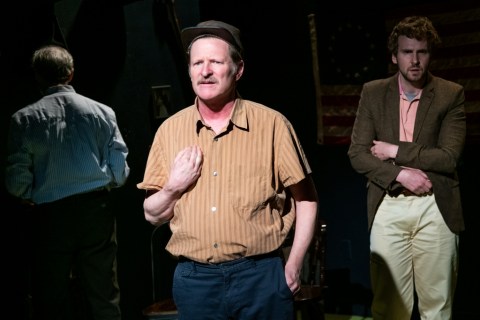
(L to R): Andy Taylor, Ryan Spahn in ‘How to Load a Musket,’ by Talene Monahon, directed by Jaki Bradley at 59E59 Theaters (Russ Rowland)
Cleverly, Monahon uses issues to raise questions and reveal themes. Some of these concern our ideas about the formation of our nation to gain freedom. Others reveal divergent perspectives of citizens from the South and North. Interestingly, the interviewed (who are “characters”) point out, after a Revolutionary War enactment, the idea that America is an experiment which may or may not last. Throughout, issues related to slavery and its attendant racism are brought up stirring questions about what this means for us today. The actors portraying real people are reflected through the prism of changing trends based upon our social climate. Vitally, the playwright reveals the cultural shift in how these individuals view what the reenactments mean to them during the past five years.

Adam Chanler-Berat in ‘How to Load a Musket,’ by Talene Monahon, directed by Jaki Bradley (Russ Rowland)
Eight actors portray the individual reenactors, switching into various parts. These are a cross-section: old, young, male, female, black, Hispanic, mother-son, father-son, educated, working class. The dialogue is lightly edited from the interviews. Essentially, the playwright quotes individuals verbatim. Thus, the accents, the humor, the chilling commentary ring with authenticity to reveal what folks in our country believe and think. Importantly, without the exceptional and adroit acting by the ensemble (Carolyn Braver, Adam Chanler-Berat, David J. Cork, Ryan Spahn, Andy Taylor, Lucy Taylor, Richard Topol and Nicole Villamil) who bring this production to its sweet spot, none of the import and power of the themes would resound as fully or shine as vitally, especially the theme about the encroaching violence in our culture.
The production from its scenic design (Lawrence E. Moten III) costumes (Olivia Vaughn Hern) lighting (Stacey Derosier) sound design (Jim Petty) original music (Zoe Sarnak) to staging is superior. Artifacts from the various periods of history adorn two walls of the set, including the costumes and hats the actors use throughout. Actors take their entrances and exists from three different sides of the set, two of which the audience surrounds as two sides of a rectangle; This is minimalistic and smart. The intimate setting allows the audience to feel a part of the action as the actors, at times, interact and directly address comments to them.
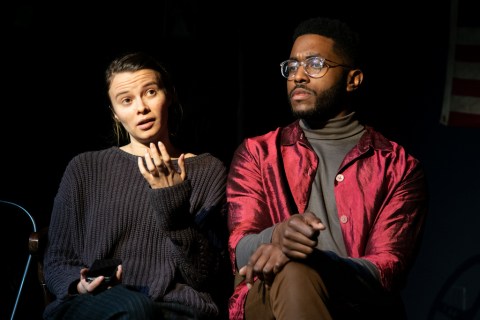
Carolyn Braver, David J. Cork in ‘How to Load a Musket,’ by Talene Monahon, directed by Jaki Bradley at 59E59 Theaters (Russ Rowland)
As a capstone to the ideas that are presented, Monahon introduces TM, the playwright, as a character (portrayed by Carolyn Braver). On a subway, TM and artist Dread Scott (David J. Cork) discuss the idea of genocide. An Armenian, she discusses its meaning to her (the Turks conducted a genocide and expulsion campaign against the Armenians (1914-1923). Indeed, as a black man Dread understands the meaning of genocide related to what happened during the American institution of slavery. As an important part of American History, he invites her to his proposed 1811 Slave Rebellion reenactment in New Orleans which TM attends two months after their subway meeting.
This powerful conclusion is telling. As an Armenian, TM is struck by Jeffrey’s (Richard Topol) use of the word “genocide” to indicate how he feels about his southern ancestry being vitiated with the removal of the confederate flag and statues of confederate soldiers from parks and federal buildings in the south. The application of Jeffrey’s “genocide” in juxtaposition with Dread’s idea to reenact the rebellion which has been removed from US history books and the Armenian genocide which has been largely left out of the History of Western Civilization is ironic. In a weird confluence, all have understood what being “wiped out,” means, and there is a unity. Perhaps, as Dread states at the end, it is a portentous recognition that “heroes in seeking liberation, receive mercy.” This is especially so in reenactments.
The production that rings with great truth provides a jumping off point for us to consider what our country means to each of us and how we can reconcile that meaning. Above all, the playwright, director and actors inspire us to broaden our understanding of aspects of our society beyond the stereotypic “Red States” and “Blue States” that we may not have considered before. As we question attitudes that may not resonate with ours, nevertheless, we must stand in each other’s shoes, especially those that we may have previously disdained.
How to Load a Musket is a must-see for its originality, ingeniousness and wonderful performances shepherded beautifully by Jaki Bradley. It is running with no intermission at 59E59 Theaters until 26 January. For tickets and times CLICK HERE.
‘Maz and Bricks’ by Eva O’Connor at 59E59 Theaters

(L to R): Eva O’Connor, Ciaran O’Brien in Fishamble’s ‘Maz and Bricks,’ by Eva O’Connor, directed by Jim Culleton, at 59E59 Theaters (Lunaria)
Maz and Bricks by Eva O’Connor takes place on a tram, and on the streets of Dublin over two days in 2017. Its setting is monumental because at this time, the campaign to repeal the Eighth Amendment of the Constitution of Ireland was at its height. Because of the popular support, reflected in the protests to repeal the amendment which banned abortion, the amendment was repealed in 2018, and a women’s right to make decisions about her own body was solidified under the law.
During the campaign, Maz, who is on her way to a massive protest in Dublin to repeal the constitutional abortion ban, meets Bricks. Their initial meeting filled with conflict and humorous, verbal smackdowns becomes the linchpin that changes both of their lives.
The production presented by Fishamble, The New Play Company, won an Olivier Award and is in its US premiere at 59E59 Theaters, as part of Origin’s 1st Irish. Experiencing the 80 minute production which has no intermission, a minimal, spare set and fine staging, one can understand why it is an award-winner. First, it is directed with precision and sensitivity by Jim Culleton. Secondly, O’Connor’s titular characterizations lure us with their vitality, and surprise us with their raw likeability. The play is well crafted with continually dynamic interchanges by the characters and an unadorned, satisfying, character-driven plot development, with powerful themes that hold currency for our times.

(L to R): Eva O’Connor, Ciaran O’Brien in Fishamble’s ‘Maz and Bricks,’ by Eva O’Connor, directed by Jim Culleton, at 59E59 Theaters (Lunaria)
Thanks to the superb performances by Eva O’Connor (playwright) who also performs Maz, and Ciaran O’Brien as Bricks, we are led on a journey that moves deeper into the minds and hearts of these individuals, as they become acquainted, gain interest in each other, bounce apart, then couple together in mutual respect and caring. By the conclusion of the production we note how “in the twinkling of an eye, at the last sound of the trumpet,” individuals can open up and help each other reach a place of authenticity and healing, that they did not realize they could reach in themselves alone.
Upon first meeting Maz and Bricks, we are struck by Bricks’ over-confidence, braggadocio and utterly loutish behavior during a phone conversation on a tram, which one needs ear plugs to ignore. When Maz calls Bricks out for his “wildly inappropriate behavior,” and reveals that she is finishing a placard about a nineteen-year-old who died because she couldn’t get a legal abortion, Bricks recoups himself, twits her and tries to smooth over Maz’s attitude by sharing details about his life. After this meeting where he discovers her name and tells her his, the characters, in open monologues to the audience, share their perspectives about the meeting and then describe the next steps as they make their way through their day’s events. Maz goes to the protest; Bricks goes to Lara’s (his X partner) to pick up Yas, his daughter, to take her to the zoo.
The monologues are in rhymes which rhythmically play out with vibrance and power, adding interest and keeping the audience focused at their novelty. Bricks describes how Lara prevents him from his seeing their daughter because she heard about his untoward behavior with her cousin. Bricks’ forthright manner, as he eventually tells the truth to Maz, is a turning point. The playwright exacts a shift in Bricks’ characterization from the lout to the individual underneath the mask. We note his vulnerability, insecurity and upset at not being allowed to be with his daughter, whom he loves. We understand that the cousin may have set him up, so that Lara might punish him using Yas, a cruel action. Desolate, Bricks ends up at the protest. He is just in time to stop Maz from getting into trouble throwing stones at the anti-abortion protesters.

Eva O’Connor in Fishamble’s ‘Maz and Bricks’ by Eva O’Connor, directed by Jim Culleton at 59E59 Theaters (Lunaria)
As they thrust and parry, with jibes and humor, O’Connor evolves the dialogue between these two flawed individuals. She heightens the monologues in a unique way so that the characters step away from the action, and with thoughtful, sometimes philosophical commentary, bring themselves to the next step in their relationship with each other. This is a clever device the playwright employs. It gives us the benefit of the characters’ inner thoughts to reveal their personalities and how their feelings relate to their resultant outer actions.
Thus, by degrees, we note the mystery of how Maz and Bricks, who appeared so antithetical to each other at the outset, find common ground with which to understand each other. They demonstrate that “opposites attract,” as Bricks indicates in his interest in Maz, who is unlike anyone he has ever known. However, once they find the raw and authentic centers of each other’s emotions, they realize they are not that different in their humanity and impulses toward decency.
The characters evolve in their relationship as they hang out with each other and spend the day. O’Connor uses their first interaction on the tram as a thematic prelude on a number of levels. She suggests that it is possible to compromise with others about political views, if one is open-minded and hopeful. That Bricks has an ulterior motive, turns into something deeper as Bricks tells us when he stops Maz’s stone throwing. He intuits that his interference, may lead to something between them. If not, he will crash and burn in humiliation. It is a risk he is willing to take.

(L to R): Eva O’Connor, Ciaran O’Brien in Fishamble’s ‘Maz and Bricks,’ by Eva O’Connor, directed by Jim Culleton, at 59E59 Theaters (Lunaria)
O’Connor’s characters grow more likeable in their interest and acceptance of each other, driven by acute direction and nuanced, spot-on performances by the actors. We believe that Maz and Bricks might care for each other in a world that is chaotic and filled with pain for them, as we later learn. However, in spite of the problems and turmoil that they must confront and do confront with each other’s help, theirs is a relationship worth saving and deepening.
In its conclusion Maz and Bricks is refreshing, satisfying and real. O’Connor presents themes about prejudice, open-mindedness, truthfulness and human dignity in respecting one another’s viewpoint and in “standing in another’s shoes.” It is a behavior that we sorely need to reflect upon and practice in the current, divisive, political climate in the U.S. and elsewhere around the globe.
Kudos to the creative team: Maree Kearns (set and costume design) Sinéad McKenna (lighting designer) Carl Kennedy (sound designer) who, with director Jim Culleton and the actors, have made this a must-see production. Maz and Bricks runs until 23 February at 59E59 Theaters, Theater B. This is one you won’t want to miss. For tickets and times, go to their website by CLICKING HERE.
‘Greater Clements,’ by Samuel D. Hunter at Lincoln Center Theater

(L to R): Nina Hellman, Judith Ivey, Ken Narasaki, Edmund Donovan,, Andrew Garman in ‘Greater Clements,’ by Samuel D. Hunter, directed by Davis McCallum (T. Charles Erickson)
Greater Clements, by Samuel D. Hunter, directed by Davis McCallum spotlights a dying town whose end comes “not with a bang, but with a whimper,” especially for those who have invested their sweat in its history to make a life there, however, insignificant and invisible. The production stars Judith Ivey as stalwart Maggie, whose emotional range is delivered with power and grist. The superb Edmund Donovan is her outlier son who is doomed to confront his psychological illness without the tools to manage himself successfully. Greater Clements reveals lives lived in quiet desperation before they fizzle out or implode in despair, while looking for for an exit from soul pain which never comes.
The play opens in darkness, thousands of feet below ground as a miner (we discover this is Joe-Edmund Donovan-who once gave mine tours) in his gear with one bright headlamp speaks about the Dodson Mine and a mining catastrophe in 1972. It was then his grandfather burned alive and a total of 81 men lost their lives. Immediately, in the darkness, we have a sense of foreboding, of a doomsday trajectory of the town and its people.
The scene shifts from the mine shaft to the bi-level set (Dane Laffrey’s creation) via an elevator that rises and falls to expose Maggie’s museum and mining tour office and bedroom in a later act. The elevator set is a neat contrivance, but it is view obstructing and unwieldy, notwithstanding the symbolism conveyed of the oppressive, confining and dangerous conditions the townspeople and miners lived with all of their lives.
Clements, a defunct mining center of Idaho whose largest mine closed 12 years before the setting of 2017, represents an every-town of the once booming industrial west before Reagan’s outsourcing, recent automation and current energy technologies siphoned off jobs, factories and hope. With no inspiration to transfer its prosperity toward tourism, or developing other resources, Clements has been “decommissioned” as a functioning town.

Haley Sakamoto, Edmund Donovan in ‘Greater Clements,’ by Samuel D. Hunter, directed by Davis McCallum (T. Charles Erickson)
Ironically, in a sort of self-immolation memorial, to keep away wealthy elites from other states who might take over and bring back the rosy bloom in its cheeks, town officials have voted to unincorporate Clements and remove all municipal services. The thought comes off as follows. “If we can’t make a go of it, we’ll do everything in our power to prevent you from trying. You want to try? Start from scratch!” The last indignity has been to deliver the town to the darkness from whence it came, as they turn off the juice to power the street lights and one, lone stoplight that once allowed a bustling downtown crowd to cross the street in safety.
The concept of removing Clements from the historical record, exemplifies a number of Hunter’s themes about such mid-west devastation since Reaganomics, which has been exacerbated with tax cuts to the wealthy, moving right up to today, while leaving places like Clements in the dust. The town, like many other areas in Red States, became mired in the past and never got out from under its own debris to prepare for a viable future. Rather than to be forward thinking, even after the mine shut downs, town fathers chose oblivion masochistically, like the places that sprung up during the gold rush, then dissolved into ghost towns, when the rich veins of ore dried up.
Maggie, who has kept the town’s history alive with her museum and her mine tours, has been forced to close down, in effect, removing Clements from historical significance and obviating its residents’ lives from remembrance. The retrenchment and immaturity of the attitudes of the town fathers, reflected by their choice to unincorporate, reveals the same rage, powerlessness and victimization that propels one into self-damaging choices.
Hunter subtly references the self-destructive attitudes of the Red States’ populace, like those in this Idaho town, that most probably put someone like Trump in power, believing he would keep his promise, perhaps to add “industrial” jobs to the economy; a canard. It is one of the ironies that Hunter slips in quietly that pervades throughout, as we watch the disintegration of the town and the lives that once made it a community and held it together. Clements has blown itself off the map rather than to persist. This of course leaves residents like Maggie no choice but to escape to restore their dignity to “make it to the next day.” We learn later of Maggie’s abyss of despair for she, too, voted with the town fathers in vengeance, almost as an unthinking afterthought.
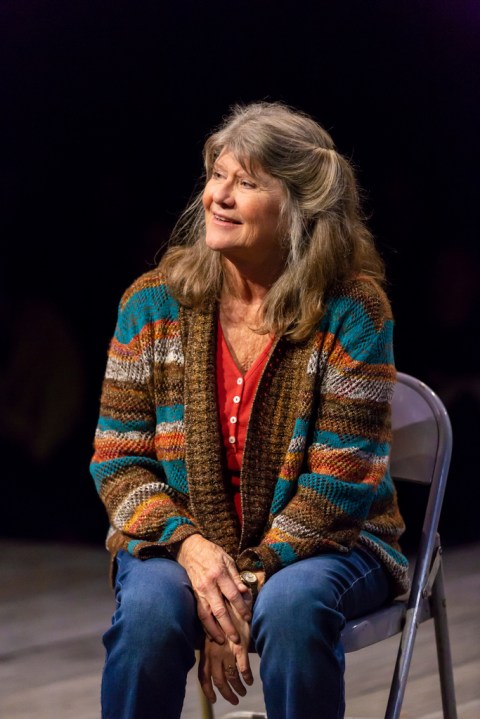
Judith Ivey in’Greater Clements,’ written by Samuel D. Hunter and directed by Davis McCallum (T. Charles Erickson)
The idea of being disconnected (unincorporated) from the future and each other is a theme which plays out in the relationships between and among the characters. Maggie, the sheriff (Andrew Garman) and her nosy neighbor Olivia (Megan Bartle) are among the individuals remaining who keep up an acquaintanceship, but do not go beyond the surface to discuss, at depth, issues related to the town’s death or their own aching problems. Maggie refuses to discuss much with Olivia, and when she is backed in a corner about her resentment about wealthy people buying up property, she finally reveals she hates the mine that killed her father and paid him low wages. That she is conflicted is an under statement. Her mine tours and “keeper of the flame” museum has put bread on her table. Indeed, her inner conflicts and regrets are many, and her lack of introspection about herself is the flaw which causes the final destruction for the family.
As the foil and main driver of the action, Joe, Maggie’s twenty-seven-year-old son is the one who will inherit Maggie’s and the town’s legacy. Maggie has brought him back to stay with her because she cannot let go. She feels alone and responsible for his well-being, since he ran off and was barely caring for himself in another state. Years before, when the mine closed, Maggie’s husband left her to run off with a gay man. She was forced to raise Joe alone which has been a tremendous burden that Joe reminds her of cannily and apologetically at various points throughout the play.
Joe has psychological debilities. He socially functions as a 15 year old, and in the past often got into trouble. As Joe attempts to communicate with his mother and reach some sort of settlement upon his return, we note their sturm and drang. It is apparent in Act III, during a heart to heart between them, that Joe has taken stock of himself and his situation with his mother, and indeed, is more knowledgeable than she. As the “fall guy” prodded by the sheriff, Olivia and his mother, and manipulated by Kel (Haley Sakamoto) who, herself, is a psychological mess, one can see the consequences of the impact of their own small-town behaviors which lead him on an unstoppable crash course toward an end zone for the opposite team.
Their mother/son relationship is the most gripping element of Greater Clements. Developing their character’s stresses and their attempt to communicate, despite their inner depression and hopelessness, becomes the linchpin of the drama and a tour de force between Ivey and Donovan. They are magnificent in these roles. Their emotional authenticity is spot-on. Maggie’s abject blindness about herself, and Joe’s self-awareness are heart-wrenching as we hope for them, yet know they do not really hope for themselves or each other. This is reflected throughout the play in its symbols (i.e. Joe’s grandfather’s watch which Joe prizes). The watch was pulled off the grandfather’s incinerated body after the mine catastrophe. The watch makes it through the Pacific Theater WW II and the mine’s fiery flames, but its crystal cracks when Maggie knocks it from its place on a shelf, out of nervous carelessness.
As Maggie is one of the last to leave Clements, she reaches out to a far light at the end of the tunnel for Joe and herself. She contacts a high school love, Billy (Ken Narasaki) with whom she tangentially maintained a relationship for the past fifty years. Billy and Kel, his granddaughter stay with Maggie and Joe. Problems develop which we intuit, but which Maggie in her rush to reformulate her relationship with Billy ignores until too late. An explanation for her fervor is revealed. Their love was banned by her father because of Billy’s ethnicity (Japanese American) and her father’s sensitivity to fighting the Japanese during WW II. Though Billy has cancer, he remains hopeful having conquered the disease the first time. Maggie remains nonplussed, and believes his well-meaning, cheerfulness. She is anxious to have some happiness in life which Billy will give her.

Judith Ivey, Ken Narasaki in ‘Greater Clements,’ by Samuel D. Hunter, directed by Davis McCallum (T. Charles Erickson)
Hunter and Ivey again highlight Maggie’s underlying flaws. Disconnected with herself and perhaps not fully working through despair at never really living life for herself, but living to nurse others, once again, Maggie appears to be doubling the load, not only having to care for Joe, but for Billy as well. This, despite Billy’s claims that he cares for her and doesn’t need a nurse. Regardless, because Maggie appears addicted to hardship, the likelihood that she will be involved in Billy’s care and troubles with Patrick, his alcoholic son, is great.
Ironically, it is Joe who questions her motive why she brought him back to a dead-end situation. Is Maggie like many women of her age and economic status, too afraid to strike out on her own, freely, to take care only of herself? Or is she comforted to feeling the only true purpose of her life is that of a nurturer who takes care of others, and when trouble comes, makes a botch of it? Hunter’s characterizations of Maggie and Joe are richly drawn, fueled by the fine performances. Billy and Kel serve as doorstops which open and close varying events. Joe’s developing closeness with Kel which ends in a backfire when she importunes him to take her down the mine shaft where they shouldn’t be, and then he later keeps secret her walk by herself, ends in further conflict and recrimination. Joe is picked on by the sheriff, Billy, Olivia and Maggie like a flock of chickens pecking at a bloodspot. He can’t please them, thus, he can’t please himself. All he can do is agree with them and apologize.
Billy and Maggie’s alone-time discussions reveal the red-neck prejudice of the area with residues still present against “the other.” Nearby is the Japanese-American internment camp which once housed Japanese Americans during WWII. In another irony of the play, now, Minidoka War Relocation Center is a National Historic Site accepting numerous visitors each year. Clements, once the largest mine center in the country, with a grand historic past, no longer exists except in its abandonment.
Hunter’s tone throughout portends disaster. The flaws of Maggie’s blindness plummet the characters into the rather long play’s tragic end. The rising and falling set that recedes into the darkness of the mine, and Maggie’s attempts to retrieve a former love that will most probably end in her despair, nursing him to his death, is a reality that she is shocked into realizing. Indeed, nothing can prosper in this place, which has willfully refused to enter the 21st century. Maggie should have left long ago. But that would require self-knowledge, the desire to free herself from her own enslavement and to hope for a better future. Hunter capstones the characters and rural America as he sees them and indeed, he points to the self-destruction and hopelessness that infuses them. It’s a warning we in the cities should not take lightly and which resonates at the conclusion, that all will not be “fine.”
Noted are Kaye Voyce (costumes) Yi Zhao (lighting) Fitz Patton (original music and sound). Greater Clements fills the heart and mind with its richness. It runs two hours, 55 minutes with two intermissions at The Mitzi E. Newhouse at Lincoln Center until 19th January. For tickets and times CLICK HERE.
‘Sing Street’ a Stirring Musical Adaptation of the Award-Nominated Titular Film

Brenock O’Connor (center) and company, Sing Street, book by Enda Walsh, music & lyrics by Gary Clark & John Carney, based on the film written and directed by John Carney, original story by John Carney & Simon Carmody, choreography by Sonya Tayeh, directed by Rebecca Taichman, NYTW (Matthew Murphy)
It’s 1982 Dublin, Republic of Ireland. The country is in a recession and there is no work anywhere. Those with mobility and ambition leave for London and the United States, while the Conors led by out-of-work architect Dad (Robert is played by Billy Carter) and his family exhaust their savings and downsize their lifestyles. The circumstances create drama for the lives of the struggling family of five in writer/director John Carney’s vibrant if thinly drawn theatrical adaptation of his 2016 film Sing Street, currently enjoying its run at New York Theatre Workshop until 26 January.
Based on Carney’s film, the comedy/musical with dramatic elements is directed by Tony Award winning Rebecca Taichman (Indecent 2017) with book by Enda Walsh, music and lyrics by Gary Clark and John Carney and choreography by Sonya Tayeh. The original story is by John Carney and Simon Carmody.
Sing Street has additional songs (others from the film have been pared), with selections from iconic tunes from New Wave and pop groups including songs by Depeche Mode, Spandau Ballet, Japan and others. And there are original songs, some of them from the movie, co-written by John Carney and Gary Clark (former lead of Scottish band Danny Wilson from the late 1980s).
Enamored by Carney’s film Taichman was inspired to adapt the film for the stage. She pursued the project, meeting Carney in London where additional conversations and meetings resulted in Enda Walsh writing a first draft of a libretto using the score from the film. The project evolved. There were more creative meetings and additional work periods and a refining of book and music with extensive development at New York Theatre Workshop that incorporated movement.
Considering that Carney and Walsh had brought together a theatrical adaptation of Tony Award Winning Once (from Carney’s 2007 film Once), beginning Off Broadway at NYTW (2011), and shifting to Broadway in 2012 (garnering 8 Tonys and other theater awards), the creative team appears golden. Will Sing Street follow the same trajectory as Once to land on Broadway when it is ready? Its incubation at NYTW looks to be moving it in the right direction.
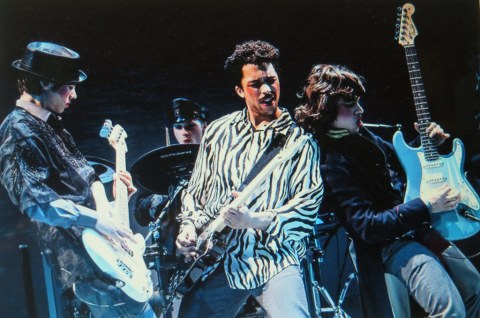
(L to R): Sam Poon, Anthony Genovesi, Jakeim Hart, Gian Perez in Sing Street, book by Enda Walsh, music & lyrics by Gary Clark & John Carney, based on the film written and directed by John Carney, original story by John Carney & Simon Carmody, choreography by Sonya Tayeh, directed by Rebecca Taichman, NYTW (Matthew Murphy)
As in Once, the actors are talented musicians/singers. They play a wide variety of instruments to make up the band that teenage Conor (Brenock O’Connor), seamlessly puts together to impress and lure Raphina (Zara Devlin), who presents herself as a “model.” Impressed, smitten by her look and demeanor, Conor invites her to appear in a music video with his band. Conor’s pitch is a stretch for he has no band and most probably Raphina who has dropped out of school to “become” a model is laying it on “thick” as well. But no matter; the die is cast, and the intrigue is on. Both have made each other the inspirational backboard upon which to encourage and solidify their dreams and hopes.
Since Conor’s family’s fortunes have spiraled downward, he must attend the reasonably tuitioned state-run Christian Brothers school on Synge Street (named after John Millington Synge the poet, playwright, prose writer, political radical and co-founder of the Abbey Theatre). That Conor decides to turn a curse into a blessing by morphing the name of “Synge” to “Sing” as part of the title of his band is his ingenious, if not ironic touch, because the venue where he must attend school is anything but desirable, initially. Nevertheless, as one of the many themes of the production, Conor pushes himself to the top of a coal heap and turns coal into diamonds withstanding the pressure he undergoes in the school and on this street.
The new environs are a far cry from Conor’s Tony elite Jesuit school where he fit in and did well. The headmaster of Christian Brothers, Brother Baxter (Martin Moran) is a martinet who challenges Conor at every turn, even to censuring him for defying the regulation color of his shoes (they must be black). Conor doesn’t have the money for new ones, but if he did, he would most probably spend it on something more uplifting and useful.
Their disagreements and Baxter’s unexplained wrath grow into a peaked conflict which could be deepened beyond Baxter’s one-sided characterization. He is, rather a stereotypical, cleric “bad-guy,” antagonist to Conor’s angelic-faced, innocent whom we root for unquestioningly because he’s heading up a boy-band with grand ambitions. What’s not to love about Conor? What’s not to dislike about Brother Baxter? Complexity is wanted.

Zara Devlin, Brenock O’Connor in Sing Street, book by Enda Walsh, music & lyrics by Gary Clark & John Carney, based on the film written and directed by John Carney, original story by John Carney & Simon Carmody, choreography by Sonya Tayeh, directed by Rebecca Taichman, NYTW (Matthew Murphy
Conor is also at odds with some outliers in the school community who bully him and beat him up, i.e. Barry (Johnny Newcomb), whom we discover to be gay and hiding under machismo thuggishness. Classically, his warped background and lack of self-knowledge or acceptance about who he is provokes his bellicosity. Walsh and Carney reveal his vulnerability in his scenes with Sandra (the superb Anne L. Nathan), rounding out his character and revealing his development.
Interestingly, it is the adversity reflected in the change of schools that forces Conor to rise to the occasion guided by his college-drop-out brother Brendan (the sensational Gus Halper), to establish his band (the most entertaining and delightful part of Act I). In the process of tackling obstacles to bring together clever and talented Eamon (Sam Poon), Kevin (Gian Perez), Larry (Jakeim Hart), Gary (Brendan C. Callahan), and Darren (Max William Bartos), Conor gains confidence and shares his enthusiasm and empowerment with his band members. The feelings are mutual. This bravado helps him in a face-off with Barry and eventually inspires him to stand up to Baxter’s niggling injustices. The climax of their conflict comes in Act II, after Baxter gives Conor and his “Sing Street Band” permission to enter The Inner-City Dublin School Band Contest, then sadistically punishes Conor by retracting his permission. Conor and the Band’s response is joyous.
Underscored throughout is Conor’s growing love relationship with Raphina, despite her threat to be pulled away to London by her boyfriend, and Conor’s deteriorating family situation as his father splits with his mother Penny (Amy Warren). Penny moves out to fulfill an affair with her boss. Conor’s sister Anne (Skyler Volpe), and older brother Brendan, who himself needs a resurrection into a new person since he can’t move himself to leave the house, are Conor’s support group. The scene where the family situation blows up rings with authenticity, and we are happy as is Brendan (Halper’s song at the finale is just terrific), that Conor is able to break away and leave with Raphina, enriched and enlivened by what he has accomplished on Synge Street, with “Sing Street.” Conor truly has reversed his fortunes and spun out a golden path for himself.
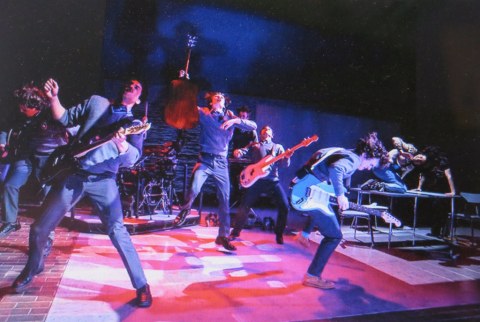
Brenock O’Connor (center right) and company, Sing Street, book by Enda Walsh, music & lyrics by Gary Clark & John Carney, based on the film written and directed by John Carney, original story by John Carney & Simon Carmody, choreography by Sonya Tayeh, directed by Rebecca Taichman, NYTW (Matthew Murphy)
The music and performances are steady, effervescent and fun; it is a joy to be returned to the 1980s era which was nothing short of vibrant. We are in a different environment with a projection of the Irish Sea beckoning in the background, the waters flowing at the conclusion of the production. The band’s movements/song performances are right-on and glorious, and it is a rally to watch O’Connor’s Conor work his magic with confidence spurred on by Halper’s Gus who is gobsmacking in the role as Conor’s caring older brother.
The love relationship that develops between Raphina and Conor is convincing; though indeed we wonder how much of Raphina’s riffs to Conor are a complete front job. What does the future have to offer for a female drop out who comes from a troubled family life? Love from someone as appealing, dynamic and ambitious as Conor is a miraculous gift. She would be a fool to spurn him.
In its verve, positive themes, joyful celebration of 1980s music and triumph over a time of doldrums in Dublin, Sing Street is illustrious and welcoming. Kudos to the creative team who helped the production morph from screen to stage. These include: Martin Lowe (music supervisor, orchestration & arrangements) Bob Crowley (scenic & costume design) Christopher Akerlind (lighting design) Darron I. West (co-sound design) Charles Coes (co-sound design) J. Jared Janas (hair & makeup design) Fred Lassen (music director).
Sing Street is running at NYTW until 26th of January. See it for its music, performances and overall joie de vivre. For tickets and times CLICK HERE.
‘London Assurance’ directed by Charlotte Moore at The Irish Repertory Theatre, a Rollicking Christmas Treat

(L to R): Colin McPhillamy, Elliot Joseph, Caroline Strang, Rachel Pickup, Robert Zuckerman, Evan Zes, Meg Hennessy, Brian Keane, Ian Holcomb, ‘London Assurance, by Dion Boucicault, directed by Charlotte Moore, Irish Repertory Theatre (Carol Rosegg)
London Assurance, the vibrant farce by Dion Boucicault, directed by Charlotte Moore at the Irish Rep is the perfect production for the Christmas season to keep the cheer bright. The acting is superb, the pacing of high jinx is acutely shepherded by Moore. Altogether, there is everything to like and enjoy and nothing to find fault with in this production which runs until 26 January.
A mix between a drawing room comedy and slapstick without the physicality but oodles of wordplay, Boucicault’s London Assurance also satirizes stock character types, social classes and the notions of marriage for convenience which were beginning to be blown away by the idea of love matches, at the time the play takes place Christmastime, 1841.
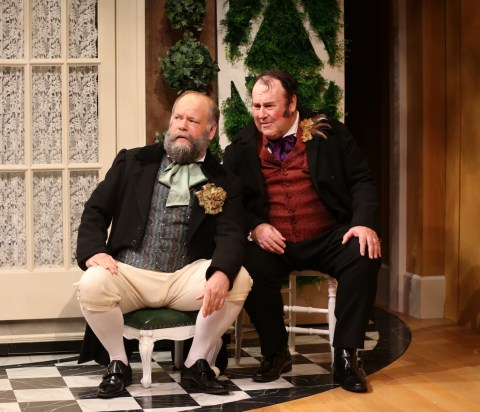
(L to R): Brian Keane, Colin MPhillamy in ‘London Assurance,’ by Dion Boucicault, directed by Charlotte Moore, Irish Repertory Theatre (Carol Rosegg)
The action begins when dissolute Charles Courtly (Ian Holcomb) arrives with his friend Dazzle (Craig Wesley Divino) in the morning hours after a night of hard drinking and partying. Charles lives with his father Sir Harcourt Courtly (Colin McPhillamy is perfection as the fop who is easily duped by his own puffery). Courtly believes his son to be the innocent, demure, hard-working student who eschews gambling and drinking. Charles is the antithesis. Servant Cool (Elliot Joseph) lies to protect Charles.

(L to R): Meg Hennessy, Caroline Strang in ‘London Assurance,’ by Dion Boucicault, directed by Charlotte Moore, Irish Repertory Theatre (Carol Rosegg)
After Dazzle and Cool carry Charles off in a drunken stupor, Sir Courtly enters in his dressing gown wishing for his breakfast. Courtly reminds Cool of the recent most important events of his life. He and his friend Max Harkaway (the fine Brian Keane) have arranged for the elderly Courtly’s marriage to Max’s young, beautiful niece Grace (Caroline Strang) in exchange for an obviation of debts, and her dowry. If Courtly or Grace nullifies the arrangement, Grace’s money will be Charles’ inheritance.
The arc of development involves the foiling of Courtly’s plans when all visit Max’ country estate in Gloucestershire where Courtly is supposed to finalize his engagement to Grace. Max has invited Dazzle and of course Dazzle brings along Charles for the adventure and fun the visit promises to be, though Sir Courtly doesn’t realize that Charles has joined the party. At Max’ estate, Grace meets a disguised Charles who poses as Augustus Hamilton to dupe his father who believes him to be home studying. Both Holcomb and McPhillamy pull off the bad disguise non-recognition and Sir Courtly’s dubious response to his son’s “lookalike” with great humor.

Caroline Strang, Ian Holcomb, in ‘London Assurance,’ by Dion Boucicault, directed by Charlotte Moore, Irish Repertory Theatre (Carol Rosegg)
Charles, ever the playboy, flirts with Grace unaware that she is his future mother. For her part Grace is sanguine about marrying Sir Courtly, but falls in a hot love with Charles. What are they to do? How can they put off Sir Courtly and Uncle Max Harkaway and effect their marriage to each other? By this point in the plot the playwright has drawn us in for Sir Courtly is no particular catch and to American audiences today, the idea of a woman having to drop her dowry in the lap of an elderly gentleman in order to survive is almost unthinkable, especially when the marriage has been arranged for her.
In the succeeding scenes we meet the lovely friends of Max, Lady Gay Spanker (the wonderfully comedic Rachel Pickup) and her ancient-looking husband Adolphus Spanker (Robert Zukerman draws many laughs with his outrage about his wife leaving him) who is vital, spry and a force of nature that Lady Gay Spanker loves as her protector. However, when Charles beseeches Lady Gay for her help to dissuade his father from sealing “the deal” with Max for Grace, Lady Gay thinks of a humorous idea to break up plans of Sir Courtly’s marriage.
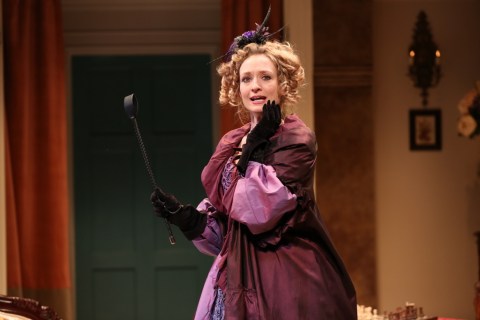
Rachel Pickup in ‘London Assurance, by Dion Boucicault, directed by Charlotte Moore, Irish Repertory Theatre (Carol Rosegg)
In great good fun she seduces the pompous Sir Courtly to fall in love with her behind her husband’s and Grace’s back. Sir Courtly who believes himself to be twenty years younger and on the cutting edge of fashion, is tricked by Lady Gay. He rushes after her to win her kisses and affection. Of course, when Spanker hears that his wife may separate from him, his reaction is hysterical. Meanwhile, Lady Gay is having the time of her life in harmless fun to help out two young lovers who doubt each other’s love. The complications rise and Lady Gay works her miracle for a good cause, until…
This is no spoiler alert. You will just have to see this humorous LOL production to appreciate how the playwright adds complex and humorous twists to the relationships and magnifies mishaps and errors raising the stakes and jokes to a delightful climax with a duel.

Colin McPhillamy, Rachel Pickup in in ‘London Assurance, by Dion Boucicault, directed by Charlotte Moore, Irish Repertory Theatre (Carol Rosegg)
Charlotte Moore’s sense of comedic timing, what does and doesn’t work has been engineered to a fine froth so that the actors appear to be these authentic, vivacious, funny individuals. I cannot imagine Colin McPhillamy, Ian Holcomb, Rachel Pickup, Robert Zukerman, Caroline Strang, Evan Zes (the funny conniving lawyer) Brian Keane, Craig Wesley Divino, Elliot Joseph and Meg Hennessy sounding and behaving any differently in real life than they do onstage. Their performances are stunning. Their timing is spot-on.
Interestingly, the cast has managed to portray their characters so that they are not “the types” they appear to be, but are funny because their traits are humorous. Evan Zes as the “sneaky, obtrusive” lawyer Mark Meddle dismissed by Meg Hennessy’s “go-to-girl” Pert, with the accusation of “slander” is an example. In the hands of these actors this is accomplished with seamless effort. Additionally, the actors handle the asides to the audience with an easy, intimate confessional tone that enhances the comedy. Finally, we enjoy the foibles of each character whom the actors have invested in with their perceptive, canny skills.
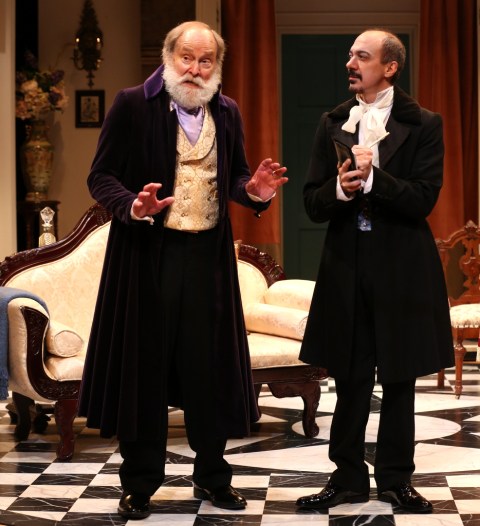
Robert Zuckerman, Evan Zes in ‘London Assurance, by Dion Boucicault, directed by Charlotte Moore, Irish Repertory Theatre (Carol Rosegg)
The sets sparkle with beauty and apparent luxury thanks to James Noone’s scenic design. The interiors are befitting of what one would expect of Sir Courtly’s and Max’s residences. Likewise, Sara Jean Tosetti’s costume design and Robert-Charles Vallance’s hair designs authenticate the period and social status of the characters with excellence. Lady Gay’s purples (I loved her costumes that reflected her expansive, lively character) matched with a lighter shade of purple for her husband’s cravat (?). As a couple they reflected a refined, spiffy, fascinating dynamic. Indeed the creative team’s techniques and strategies inspired by Charlotte Moore’s vision for the production were not overblown, but were “a Goldilocks.” Rounding out the team are Michael Gottlieb’s lighting desgin and M. Florian Staab’s sound design. The music was lighthearted and chosen for the splendid mood of the production.
Once again Irish Repertory Theatre proves its stalwart magnificence for the season with this marvelous comedy that Charlotte Moore, the ensemble and creative team have imbued with their joie de vivre and experience. If you don’t see it, you will have missed a special production. London Assurance runs with one intermission until 26 January. For tickets and times CLICK HERE.
‘One November Yankee,’ Starring Harry Hamlin, Stefanie Powers at 59E59 Theaters
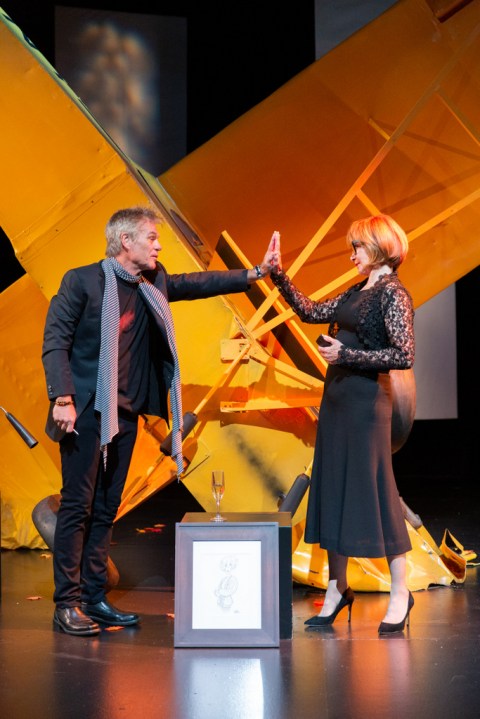
Harry Hamlin, Stefanie Powers in ‘One November Yankee,’ written and directed by Joshua Ravetch at 59E59 Theaters (Matt Urban)
One November Yankee the comedy written and directed by Joshua Ravetch sports an intriguing structure. The play is four scenes: a flashback and a flash forward framed by beginning and ending scenes between a brother and sister that take place at MOMA. This is where art curator Maggie and modern artist Ralph are putting the finishing touches on Ralph’s art installation. The play is about siblings, different pairs in each of the scenes played by Stefanie Powers and Harry Hamlin. Each pair of siblings with a combination of love and rancor face-off against each other with humor, with pathos. Eventually, they resolve their differences. With one pair the resolution has an unusual twist.
As the production opens Maggie and Ralph argue about Ralph’s art work. Maggie avers with sarcasm and witticisms about what the project stands for and what it is. In the center of the presentation area is a “tangled mangle of debris,” that appears to be a yellow Piper Cub that has crashed in the woods. We later discover the installation has a basis in truth. Ralph has entitled his piece “Crumpled Plane,” to exemplify his social criticism of a “Civilization in Ruin.” Maggie, who has helped to bring money in to fund the project is not “thrilled” with Ralph’s work.
The quippy thrust and parry of their argument is well-crafted with bits of irony. Harry Hamlin who is Ralph, and Stefanie Powers as Maggie carry off the coolness and chic of these well-healed characters with fine-tuned humor and aplomb. What becomes intriguing are the references and through-lines Ravetch establishes about the three different brother/sister relationships. These are picked up in the next scenes (a flashback, and flashforward to the present) and are cleverly related as we watch how the sibling pairs collaborate to make the best of difficult situations.

Harry Hamlin in ‘One November Yankee,’ written and directed by Joshua Ravetch at 59E59 Theaters (Matt Urban)
In the initial play frame Ravetch introduces the metaphor and thread of flight. Maggie describes how she is forced to fly Jet Blue coach (something which she never does) to get to New York and be present for Ralph’s exhibition. Is it a premonition of what she will be able to afford when Ralph’s exhibition doesn’t get off the ground? Perhaps. After being diverted to Philly because of bad weather, Maggie’s only recourse is to fly on a puddle jumper to Vermont where she must take a Greyhound to NYC. The puddle jumper thread hits home when she confronts her brother’s art installation, a smashed yellow puddle jumper with a forest behind it. This crashed plane symbolizes the possibility of another “crash,” the crush of negative critical reviews of Ralph’s art installation which may lead to the loss of Maggie’s job and the end of her career.
During the course of Ralph’s attempt to defend his work against Maggie’s jibes, he references their relationship to the one of the brother and sister who went missing after the plane crash he’s attempting to effect through art. This crash and the other hundreds of plane crashes which occur over the U.S. and which he represents with this artistic endeavor, complete with videos of the Wright Brothers, “flying machines” of old, and the journey of the yellow Piper Cub has great meaning for him. His art mimic’s life’s art, and as in much of the play is a facsimile to what has happened and will happen.
Ralph explains that his exhibit symbolizes how the expected “glorious” future which began with the Wright Brothers and promised “flying cars,” convenient monorails in suburban settings and an end to traffic jams has devolved into the decline and a “Civilization in Ruin.” What “began at Kitty Hawk, ends here in this room,” he suggests. That this is an overblown, self-important, humorous notion which Hamlin as Ralph delivers as a serious pronouncement is ironic as Power’s Maggie calls him on it. She responds to this and his defense of his work with sarcasm. Eventually she lands on the subject of her birthday which she spent alone without him because he forgot, another possible reason why she is so edgy.

Harry Hamlin in ‘One November Yankee,’ written and directed by Joshua Ravetch at 59E59 Theaters (Matt Urban)
Obviously, this brother and sister vie between being close as siblings and rancorous as rivals. The scene ends with Ralph playing the video of the Yellow Piper Cub’s journey as Maggie reads the article about the brother and sister lost in the mountains of New Hampshire five years prior. As the plane on the video flies into the flashback, Ravetch unspools what happened to the next brother and sister pair as they attempt to negotiate their downed plane that appears the same as Ralph’s artwork.
In the next scene Powers and Hamlin play Margo and Harry who sport different demographics than the first couple revealed in their dress, manner, hair and speech patterns. Both sets of siblings, however, are Jews and the humor connected with this gets a laugh, with the fine pacing and dead pan delivery by Hamlin and Powers. We discover that it is Margo’s carelessness that has brought about the crash which becomes more dire as time progresses for they are unequipped for the cold with no provisions and no functioning radio communications or beacon to signal where they are. Furthermore, Harry is injured and cannot walk out of the woods.
The second pair of siblings relate bits and pieces of their life and annoyances they’ve had with each other as they attempt to figure out what to do, for example, whether to wait for rescue or attempt to save themselves. References that Maggie and Ralph made in the framed scene five years later are eerily appropriate and tie in to the interactions of Margo and Harry. The space/time continuum melds somehow with the plane crash and the playwright suggests that each male/female sibling relationship has commonalities in a family dynamic that is relatable and empathetic. Ravetch is playful in drawing the similitude of characterizations. However, as the parallels and detail threads coincide, there is also a haunting and poignant tenor that we are seeing something profound in all of humanity.

Stefanie Powers, Harry Hamlin in ‘One November Yankee,’ written and directed by Joshua Ravetch at 59E59 Theaters (Matt Urban)
One overriding question remains. Did Ralph decide to create his artwork of a disaster which occurred to Harry and Margo because of some ethereal reason? Why has his imagination been so stirred? As we leave the second set of siblings facing the dark and cold, we are left with Margo’s indecision to stay or leave to find rescuers. The scene ends as they sing a song from the past to comfort each other as the evening of cold closes in.
The third scene flashes forward to the setting of the plane crash in present time, the same month as the Ralph’s art opening which has been inspired by Margo and Harry. In this scene part of the mystery is solved by hikers Mia and Ronnie, again portrayed by Powers and Hamlin, who stumble upon the crash. These siblings, too, parry and thrust and yield prickly comments, merging discussions of the past issues as they search the area and find clues to what happened to the passengers. Again, Ravetch conveys similar elements and threads from the previous scenes and drops them in the Mia and Ronnie scene weaving a fabric of relationships. Mia and Ronnie discover what is left of one of the siblings, whose body is now a skeleton. Of course they must alert the authorities to see what happened to the other sibling
The scene shifts once more to MOMA. Maggie and Ralph capstone their relationship, face the music and the former reading of the plane crash segues into Maggie reading aloud a critical review which is priceless. The last tie in is to the real crash site which is evocative and the final mystery about the missing sibling.
The fun of the production is watching how Powers and Hamlin portray with lightheartedness and authenticity three sets of siblings during the backdrop of dealing with “One November Yankee,” the name of the Piper Cub. As it turns out, the title of the plane, too, is symbolic. The set design by Dana Moran Williams is ambitious and Kate Bergh’s costume design suggests the differences among the siblings. Lighting design by Scott Cocchiaro and sound design by Lucas Campbell help to execute Ravetch’s vision for the production.
One November Yankee is 90 minutes with no intermission. It runs at 59E59 Theaters through 29th of December. For tickets and times CLICK HERE.
‘The Half-Life of Marie Curie,’ Lauren Gunderson’s Work Uplifts With Brilliance and Currency

(L to R): Franesca Faridany, Kate Mulgrew, The Half-Life of Marie urie, Lauren Gunderson, Gayle Taylor Upchurch, Minetta Lane Theatre Audible (Joan Marcus)
Iconic Madame Curie, the two-time Nobel Prize winner in the fields of chemistry and physics, was told by the committee awarding her prize the second time that she shouldn’t show up in person to receive it. She was having “women’s troubles,” we learn in Lauren Gunderson’s The Half-Life of Marie Curie, directed by Gaye Taylor Upchurch. The play is a profound and humorous evocation of the close friendship between Marie Curie (the magnificent, in-the-moment Francesca Faridany) and Hertha Ayrton (the equally magnificent, always present Kate Mulgrew). Ayrton, the British engineer, mathematician, physicist and inventor, was a suffragette and a celebrated genius in her own right. She paired as the perfect friend to Curie and helped her when Curie was at a nadir in her life.
Gunderson’s play whose setting is in Paris and England, reinforces the importance of women’s preeimence in the cultural flow of ideas in every field of endeavor. Furthermore, it highlights how folkways about women’s relegation to second class citizenship was a socially defeating, nihilistic ethic for the advancement of women and especially for the advancement of men. Gunderson reveals how Curie triumphed over the most antiquated of mores, especially after she loses the security and probity of her husband status in society after his death.

Franesca Faridany, ‘The Half-Life of Marie urie,’ Lauren Gunderson, Gayle Taylor Upchurch, Minetta Lane Theatre Audible (Joan Marcus)
In her collaboration with husband Pierre both made ground-breaking discoveries identifying and naming polonium (after her native Poland) and radium. They coined the word “radioactivity,” to list a few of their accomplishments together. Curie’s work even after Pierre died established for all time that a women’s place was not behind the scenes as the little housewife, but could be in the forefront of the evolving scientific age. Curie, then and now, as is Ayrton, a beacon for all of us.
The Curies with Henri Becquerel received the Nobel Prize for their research on the “radiation phenomenon,” a prize hard won for Curie who was not nominated until a committee member and advocate for women scientists made a complaint to have her name added. Not only was Curie the first woman to win a Nobel Prize, she is the only woman to win the Nobel Prize twice. And she is the only person to win the Nobel Prize in two different fields, a feat no man or women after her has managed to accomplish. One shudders to think about the women who are being kept down by males and the internalization of this oppression by women as right and true. And this is advocated by men who cannot brook a female in leadership positions due to their own internal frailties and insecurities.
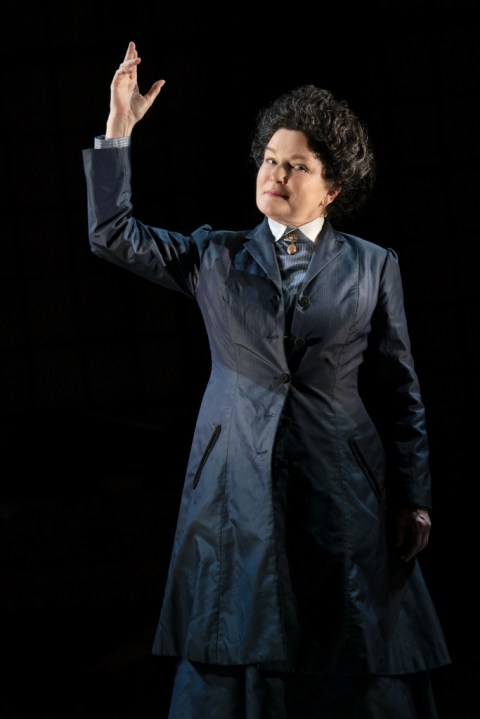
Kate Mulgrew, The Half-Life of Marie urie, Lauren Gunderson, Gayle Taylor Upchurch, Minetta Lane Theatre Audible (Joan Marcus)
How life on this planet might have been very different if women were allowed parity in the professions for the betterment of society is anyone’s guess. After seeing Gunderson’s work and witnessing the dynamic she crafts between these two genius friends, one comes away encouraged, regardless of whether one is male or female. For a major theme is understanding the great and vital necessity of establishing collaborative efforts and parity between the sexes. As a detriment to all, the elevation of one to the suppression of the other, is a noxious practice which has been attempted with a political vengeance in our culture in the last three years. Such retrograde actions only result in horrific damage for both sexes, especially the elites who depend upon the “little people’s” consumerism. It must stop and Gunderson’s celebration of these two women as an exemplar in our culture and other influencers insure that it will, hopefully sooner than later.
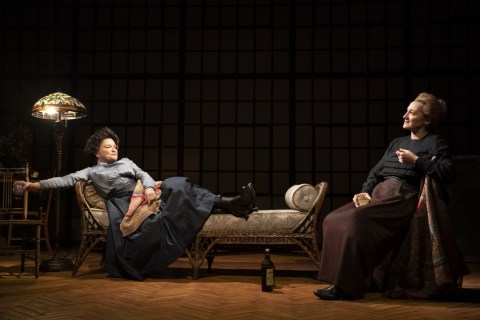
(L to R): Franesca Faridany, Kate Mulgrew, The Half-Life of Marie urie, Lauren Gunderson, Gayle Taylor Upchurch, Minetta Lane Theatre Audible (Joan Marcus)
Gunderson highlights these themes about gender parity opening her play at a crucial point in the life of Marie Curie after Pierre’s death. Curie might have succumbed to her “women’s troubles,” if not for the encouragement and intervention of Hertha Ayrton. Hertha offers Marie an infusion of love and affirmation of their friendship, as well as a refuge at her seaside home in England, where Marie may recuperate from her physical ailments and emotionally resurrect from the trauma of scandal.
The “troubles,” Gunderson relates during Ayrton’s exhortations to Curie to remain firm and solid to weather the scandal of Curie’s affair with married Paul Langevin, Pierre’s student and fellow scientist. The playwright subtly and with dynamism forms the arguments between the two women, one cowering, humiliated in despair, the other, a proud, indomitable scientist and suffragette strengthening her friend. During their back and forth thrust and parry, we discover important details. The dialogue is sage, clever, poetic, humorous with little exposition, all in the service of defining the wonderful, well-drawn characters most beautifully acted by Faridany and Mulgrew. The writing exemplifies how these women portray their care for each other acutely, as they take us into their relationship. As a witness to this, we are grateful to be watching and listening to their elucidating adages and poetic wisdom.
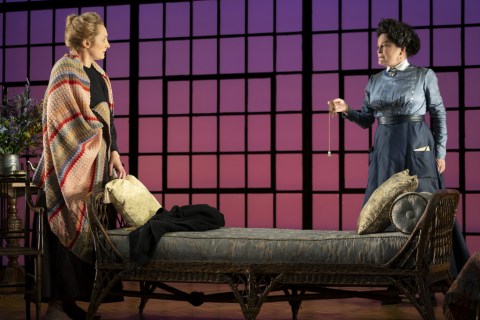
(L to R): Franesca Faridany, Kate Mulgrew, The Half-Life of Marie urie, Lauren Gunderson, Gayle Taylor Upchurch, Minetta Lane Theatre Audible (Joan Marcus)
What has happened to Curie in light of her contributions to science can only be described as monstrous. Mrs. Langevin, suspecting that her husband was in a “love nest” with Curie, works to expose and destroy her. She hires an investigator who breaks into their apartment and finds incriminating love letters which prove their adultery and are subsequently leaked to the papers. The press engages in a smear campaign portraying Curie as a home wrecker and a seductive Jew (she wasn’t Jewish) as they feed into the xenophobia and anti-semitism of the time. In keeping with entrenched folkways, the papers portray Mrs. Langevin as the innocent, ill-treated victim of their betrayal. The real truth is somewhere in between as Paul Langevin actually improves his stature as Curie’s lover. We never discover his relationship with his wife and he comes off as the cavalier and romantic rogue whose “wife salvages hearth and home” belying her malevolence toward Curie.
Curie introduces herself to us paralleling her life to radioactivity. We hear lovely music then sounds of what will be identified as a demonstration. When Ayrton enters her apartment, she finds Curie in great despair. She and her children are held hostage in their apartment by the angry mob protesting in the streets demanding Curie’s censure for her whoredoms.

Franesca Faridany, ‘The Half-Life of Marie urie,’ Lauren Gunderson, Gayle Taylor Upchurch, Minetta Lane Theatre Audible (Joan Marcus)
Ayrton makes her grand entrance with humor and vitality and gradually helps to stiffen Curie’s resolve not to allow the scandal and vituperations of the press to completely overwhelm her into depression and career death. During the course of the humorous back and forth, we discover how Curie’s life has been upended, her career and work halted, her daughters harmed by the nefarious publicity in which Mrs. Langevin is happily vindicated and justice applied through malign falsehoods. The fact that Mrs. Langevin, “the woman scorned” goes after her rival publicly when her husband is equally responsible and deserves as much of the public ire as Curie, is a sad fact of the cultural folkways. Either way, women lose. Certainly Mrs. Langevin needs the financial support of her husband. Thus, she attacks Curie the one who endangers her home manipulating cultural mores. Ironically, Langevin rather “has his cake and eats it too.” (We discover later his wife is pregnant.)
The gender conflicts Gunderson alludes to stem from the oppression of the patriarchy which controls every institution, and whose tentacles of power stretch globally. The double standards allowing men every freedom and women every restriction, especially with regard to sexual openness, Gunderson, through the voice of the ironic Ayrton lays bare. Enforced is the underlying truth that women, like children, must be silent, demure, passive, and above all, unemotional. Ayrton reinforces that this oppression must be undone with laws giving women the vote and ability to speak and stand for themselves autonomously for the greater good of society.

(L to R): Franesca Faridany, Kate Mulgrew, The Half-Life of Marie urie, Lauren Gunderson, Gayle Taylor Upchurch, Minetta Lane Theatre Audible (Joan Marcus)
Ayrton quips about how the culture deals differently with men when they have affairs. Men are lauded, encouraged for their virility. Women are character assassinated, labeled sluts, etc., especially when the man is younger. That Curie’s career is put on hold and she is stripped of almost everything including a place where she and her daughters can live in unmolested peace is a testament to the abysmal place of in the culture who are given no consideration. They are invisible, shunted to a no-where-land, chosen after last place, while men are foremost.
The clarity of the injustices of gender inequality are saliently pinpointed in Gunderson’s examination of Curie and Ayrton’s heroism. Their concerted efforts to combat the public’s outrage are admirable. Despite warnings to the contrary, Curie attends the Nobel ceremony, accepts her prize and makes a cogent speech all of which takes great effort. And that was just the beginning of the next chapter in the lives of both women, who worked together to help the soldiers with their discoveries during WW I, accumulating more intrepid achievements that would make anyone’s head spin.
This last chapter in their lives is poetically and poignantly rendered by Faridany and Mulgrew guided by Gaye Taylor Upchurch. The actors bring Gunerson’s words to life with radiance and potency so that these women become our endearing mentors. They reveal what is possible if one persists and stands against males in power who conduct smear campaigns and proclaim women have no place in their world. This is the great and irrevocable lie of fear and obstruction which cannot and will not stand. Like truth, parity, collaboration and the freedom to choose one’s own destiny before God is an inevitability that will increase for women encouraging them to shine their light so that others can see.
This is a sterling production which is so well-crafted and portrayed by the actors it is not to be missed. See it before it closes on 22nd December. The Half-Life of Marie Curie with excellently conceived scenic design by Rachel Hauck, costume design by Sarah Laux, lighting design by Amith handrashaker and sound design by Darron L. West is at Minetta Lane Theatre (Minetta Lane off 6th Avenue). For tickets and times CLICK HERE.
‘The Young Man From Atlanta,’ Starring Kristine Nielsen, Aidan Quinn
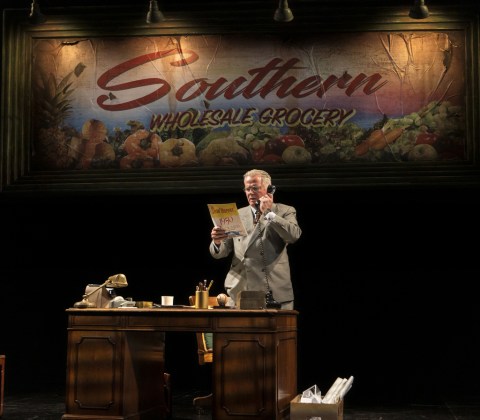
Aidan Quinn in ‘The Young Man From Atlanta,’ by Horton Foote, directed by Michael Wilson at the Signature Theatre (Monique Carboni)
Horton Foote’s Pulitzer Prize-winning The Young Man From Atlanta, directed by Michael Wilson currently in revival at The Signature Theatre is one of Foote’s homely plays exploring loss, alienation and quiet reconciliations. Kristine Nielsen stars as demure, sheltered housewife Lily Dale Kidder in an uncharacteristic turn away from the high comedy of Taylor Mac’s Gary (it’s a blossoming). Aidan Quinn is her husband, wholesale grocer Will Kidder whose security and success is upended in the twinkling of an eye by the end of the play’s first scene. With these prototypical characterizations, whose actor portrayals are shepherded with sensitivity by Wilson, Foote treats us to a slice of suburban Americana in a representative middle upper class dynamic as a couple confronts the unspoken and faces the unspeakable with poignancy and primacy to move together into the winter of their lives.

Aidan Quinn, Kristine Nielsen in ‘The Young Man From Atlanta,’ by Horton Foote, directed by Michael Wilson at the Signature Theatre (Monique Carboni)
Foote opens the play at Will Kidder’s office where we identify Will’s assurance, ambition and success in his discussions with Tom Jackson (Dan Bittner) his assistant and underling in the company. It is an incredible irony and stroke out of left field that boss Ted Cleveland Jr. (Devon Abner) has appointed Tom to replace Kidder whom he fires because he is, in effect, “over the hill” and unaware of the new trends. However, during Tom’s friendly discussion with Kidder when we learn Will has built a new, expensive house perhaps to keep his wife busy and away from thoughts about their son who drowned, Tom is sanguine about his new position and Kidder’s impending doom. To his face he acts the innocent and only until Ted Cleveland Jr. tells Kidder he is fired and that Tom replaced him does the shock wear off and we realize Tom’s surreptitious nature.
Foote, the actors and Wilson allow us to think the opening is just an expositional scene, when in fact the playwright is laying down tracks to steamroll over his protagonists by its end and throughout the play. Inherent in the first scene we note the main themes of the play and character flaws: secrecy, disconnectedness, dishonesty, underhandedness, blindness, pride, insecurity and wobbly integrity.

(L to R): Aidan Quinn, Dan Bittner,’The Young Man From Atlanta,’ by Horton Foote, directed by Michael Wilson, Signature Theatre
(Monique Carboni)
Quinn’s Kidder takes the news badly and provokes Cleveland Jr. to waive his three month severance because of his blustery, boastful comments about starting his own company. Quinn is superb in revealing the bombastic as well as quieter moments of the character. Indeed, Kidder’s frustration and annoyance that his life and career are taking a dive into the toilet and his life’s work has been abruptly shortened is portrayed with heartfelt, spot-on authenticity by Quinn.
The themes become magnified in the next scenes. Rather than confide in Lily Dale about his firing the moment he steps in the door, he hides the truth from her and attempts to face the trial of coming up with the money for the house and other expenses alone. Repeatedly, the couple reveal that they have lived “quiet lives of their own desperation” without confiding in each other. The excuse is that they do not want to upset each other, however, in their lies of omission, they upset themselves more and make huge mistakes which increase the pressure under which they live, pressure which results in Will’s deteriorating heart.

Aidan Quinn, Kristine Nielsen, Stephen Payne in ‘The Young Man From Atlanta,’ by Horton Foote, directed by Michael Wilson at the Signature Theatre (Monique Carboni)
In the midst of this excitement are phone calls. It’s the young man from Atlanta who was the roommate of their deceased son Bill. Throughout the play, he is unnamed and remains a ghostly presence shading them with possible portents about their son’s life. Indeed, by not giving this momentous presence a name or face (he never materializes) he becomes a symbol of menace, of the lie that destroys quietly, of the deception that kills, of the unrevealed mystery that eats away at one’s soul from inside out. Unless and until Will and Lily Dale together deal with “the young man from Atlanta,” both protagonists will self-destruct. It is how they confront this spectre and what he is that propels the marvelous, tricky development of the play.
It is in the first scene that we are apprised of this “young man” in a phone call to Will’s office. Will refuses to speak to him. We sense there is an occult meaning as he calls again and then must be turned away. Foote keeps his mysterious presence looming in the background. Who is he, what does he want and why does he keep calling? Eventually, the material answers give clues to the play’s deeper meanings.

Kristine Nielsen, Stephen Payne in ‘The Young Man From Atlanta,’ by Horton Foote, directed by Michael Wilson at the Signature Theatre (Monique Carboni)
As the conflict progresses and Lily Dale and Will stop speaking to each other we discover clues that Lily Dale and Will reveal almost prying out the truth from themselves for fear that hearing it they will break down. Quinn and Nielsen work together beautifully at the gradual exposure of the light as the dawn breaks in their souls. Fortunately, the light breaks on them at different intervals and doesn’t completely overcome them, though Quinn’s performance yields that Will hangs on the edge of darkness. He may collapse and die on Lily Dale. But Foote’s intention is not more tragedy, it is deliverance in the quiet moments when still, small voices murmur in the dark hours of waiting for the dawn.
Because this couple are there for each other in their weakest moments, we understand that though their marriage has had sustained rough patches through the seasons, the most devastating one being the loss of their son and the occluded reason why he died, they do have each other. And it is to each other by the end of the play, they turn for hope and solace as they accept what they cannot change and not regret too much that they weren’t on top of themselves and their own blindness sooner.

Kristine Nielsen, Stephen Payne in ‘The Young Man From Atlanta,’ by Horton Foote, directed by Michael Wilson at the Signature Theatre (Monique Carboni)
Rounding out the characters are Lily Dale’s stepfather Pete Davenport and his grandnephew Carson. As Pete, Stephen Payne gives a fine, humorous and measured portrayal of one who appears to be kindly and steady if not too discerning. Davenport stays with Lily and Will. In a particularly well suited scene that drew great chuckles from an audience who understood and had been there, the couple hits up Pete for money separately then together in an attempt to raise the funds to start Will in his own business. Davenport is cheerful and openhanded, but eventually, the fund raising plot explodes when Will goes to the banks and is refused loans. Left and right doors shut in his face and the money that Lily Dale had in her savings has been mysteriously depleted, though Will appears to have given her everything she needs for the new house.
The mystery of this continues until the truth spurts out from guilty consciences and we discover almost everything that has been hidden. As in life, though, there are some secrets only those who kept them know the answers to. However, it is Carson who unwraps the package of assumptions, lies of omission, hidden secrets and deceptions with his cheerful, unassuming presence which ironically also carries with it a hidden and secret component.

Aidan Quinn in ‘The Young Man From Atlanta,’ by Horton Foote, directed by Michael Wilson at the Signature Theatre (Monique Carboni)
Carson (Jon Orsini) appears innocent and charming. But the intrigue and conflict increases when Carson reveals he knew Bill’s roommate, the young man from Atlanta who keeps calling the house and upsetting Will and Lily Dale. Carson identifies negative elements about the lying character of Bill’s roommate. Afterward, continued revelations come fast and furious from Will who discovered he was taking money from Bill. He finally reveals this to Lily Dale to chide her to stay away from the young man. The deceptions, the manipulated lures of Bill’s roommate who Lily Dale sees as a lifeline to her dead son continue, until finally the couple confront what in 1950 Houston, Texas was unmentionable, if unthinkable.
As one who helps Lily Dale eventually get to that confrontation, there is the former housekeeper who took care of Lily Dale when she was younger. The dignified, lovely, elderly, black Etta Doris (Pat Bowie) is ushered into the new home by their efficient housekeeper Clara (Harriet D. Foy). Etta Doris is a symbolic character, and she comes with an ironic reckoning. In her elderly, lame condition she feels an imperative to see Lily Dale. She walks a great length to their new home after the bus can only take her so far. Etta Doris comments on the loveliness of the home, and then expresses her condolences on the loss of Bill whom she remembered when he was a child. It is this connection from the past that has an impact on Lily Dale and it is Etta Doris’ unction of her faith and good will that brings to bear a greater truth on Lily Dale, though it is not immediately apparent.
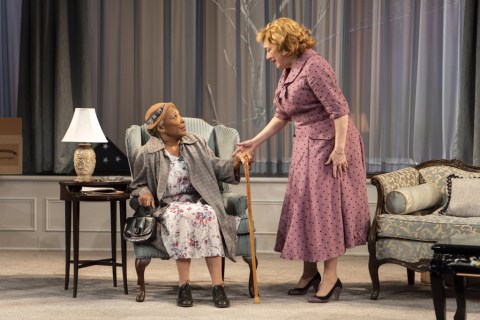
(L to R): Pat Bowie, Kristine Nielsen, Stephen Payne in ‘The Young Man From Atlanta,’ by Horton Foote, directed by Michael Wilson at the Signature Theatre (Monique Carboni)
In including Clara and Etta Doris as a reference to another class that was an integral part of the well being of Houston’s elite, Etta Doris is a loving and authentic individual who does not restrain herself from showing her care and concern for Lily Dale. That it is she that offers Lily Dale a remembered affection from the past is one of the vital breakthroughs in the play. With her quiet, vital being, Etta Doris brings that which strengthens Lily Dale to face the truths that Will confronts her with by the play’s end. In that confrontation, Lily Dale and Will must cling to each other and resolve to live with the hurt and pain of their own imperfections. And they must hope that their shared truth will continue to reconcile them to each other and make them stronger, more loving, connected individuals.
The Young Man From Atlanta thanks to its strong ensemble work and fine direction by Michael Wilson resonates as a play of great humanity and truth that is deserving of its Pulitzer. With Jeff Cowie’s scenic design, Van Broughton Ramsey’s costume design, David Lander’s lighting design and John Gromada’s sound design and original music, Wilson’s vision is realized.
The production will be at the Pershing Square Signature Center until 15 December. For tickets and times CLICK HERE.

